“an ecosystem to generate electricity from footsteps”
JACOB SABU, MA COLLEGE OF ENGG 1
“ a future energy conservation replacement for tiles”
JACOB SABU, MA COLLEGE OF ENGG
PAVEGEN TILES
PAVEGEN
• Most of the countries try to innovate
alternative electricity power for their usage.
• In civil construction field, we are introducing
a energy conserving technology as a
replacement for tiles.
• Laurence Kembell-Cook, the director of
PaveGen Systems imagined a new idea to
generate electricity from pavement slabs.
.
2
JACOB SABU, MA COLLEGE OF ENGG
• The idea later named as Pavegen
technology.
• It is also known as Kinetic footfall.
PAVEGEN TILES
• Pavegen is a technology
that has been developed by
paving slab tiles to convert
energy from people’s footsteps
into electric power.
3
JACOB SABU, MA COLLEGE OF ENGG
What are Pavegen tiles?
.
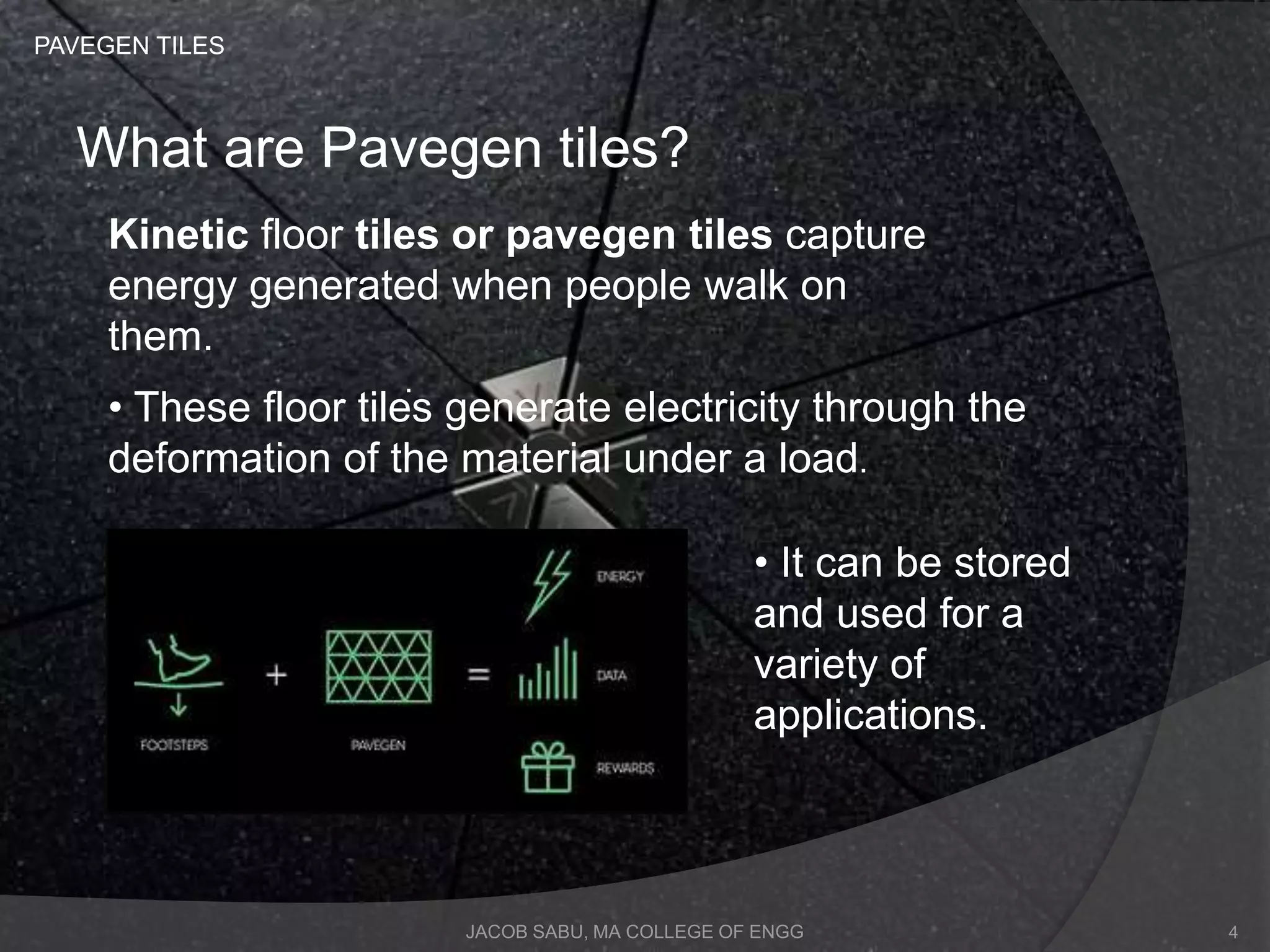
Kinetic floor tiles or pavegen tiles capture
energy generated when people walk on
them.
• These floor tiles generate electricity through the
deformation of the material under a load.
• It can be stored
and used for a
variety of
applications.
PAVEGEN TILES
4
JACOB SABU, MA COLLEGE OF ENGG
• The old version of these tiles are square
shaped.
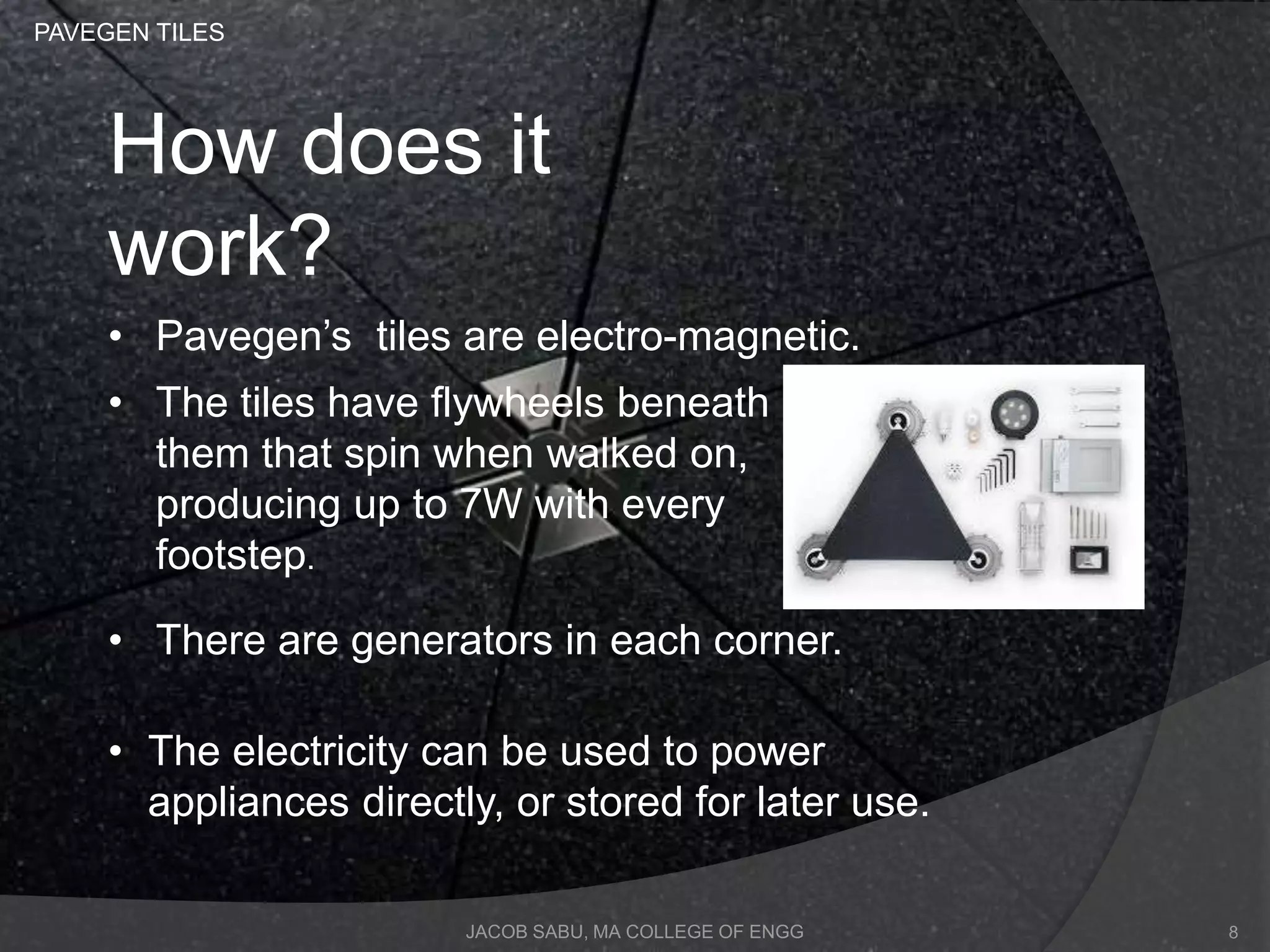
• The latest version is in the
shape of triangle which consists
of a generator in each corner
which maximizes the energy
output no matter where you step.
• The top surface of the flooring tile unit is made
from recycled rubber and stainless steel.
• The base of the slab is constructed from over
80% recycled materials with concrete.
PAVEGEN TILES
5
JACOB SABU, MA COLLEGE OF ENGG
PAVEGEN TILES
6
JACOB SABU, MA COLLEGE OF ENGG
WORKING PRINCIPLE
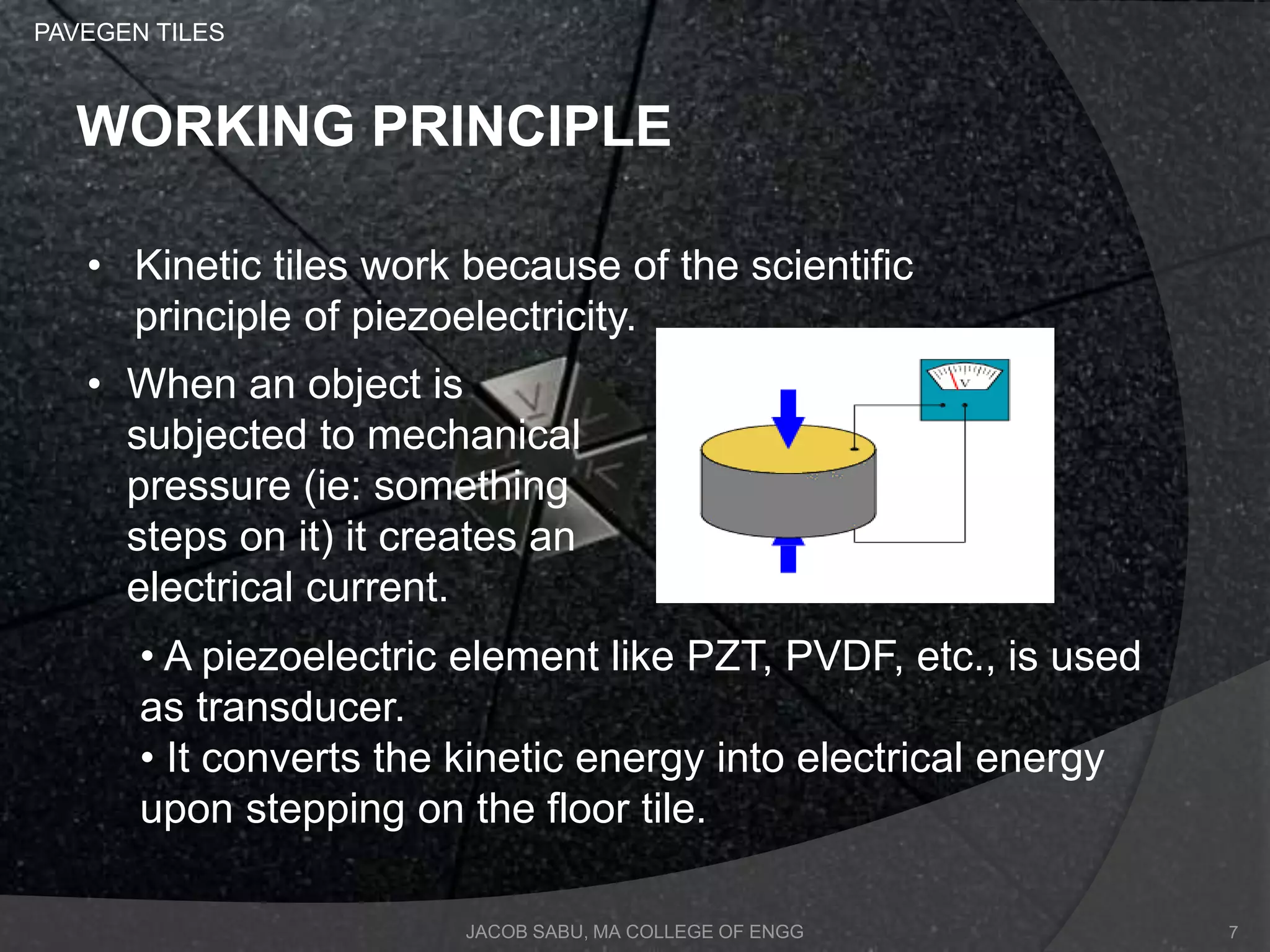
• Kinetic tiles work because of the scientific
principle of piezoelectricity.
• When an object is
subjected to mechanical
pressure (ie: something
steps on it) it creates an
electrical current.
• A piezoelectric element like PZT, PVDF, etc., is used
as transducer.
• It converts the kinetic energy into electrical energy
upon stepping on the floor tile.
PAVEGEN TILES
7
JACOB SABU, MA COLLEGE OF ENGG
How does it
work?
• Pavegen’s tiles are electro-magnetic.
• The tiles have flywheels beneath
them that spin when walked on,
producing up to 7W with every
footstep.
• There are generators in each corner.
• The electricity can be used to power
appliances directly, or stored for later use.
PAVEGEN TILES
8
JACOB SABU, MA COLLEGE OF ENGG
PAVEGEN TILES
9
JACOB SABU, MA COLLEGE OF ENGG
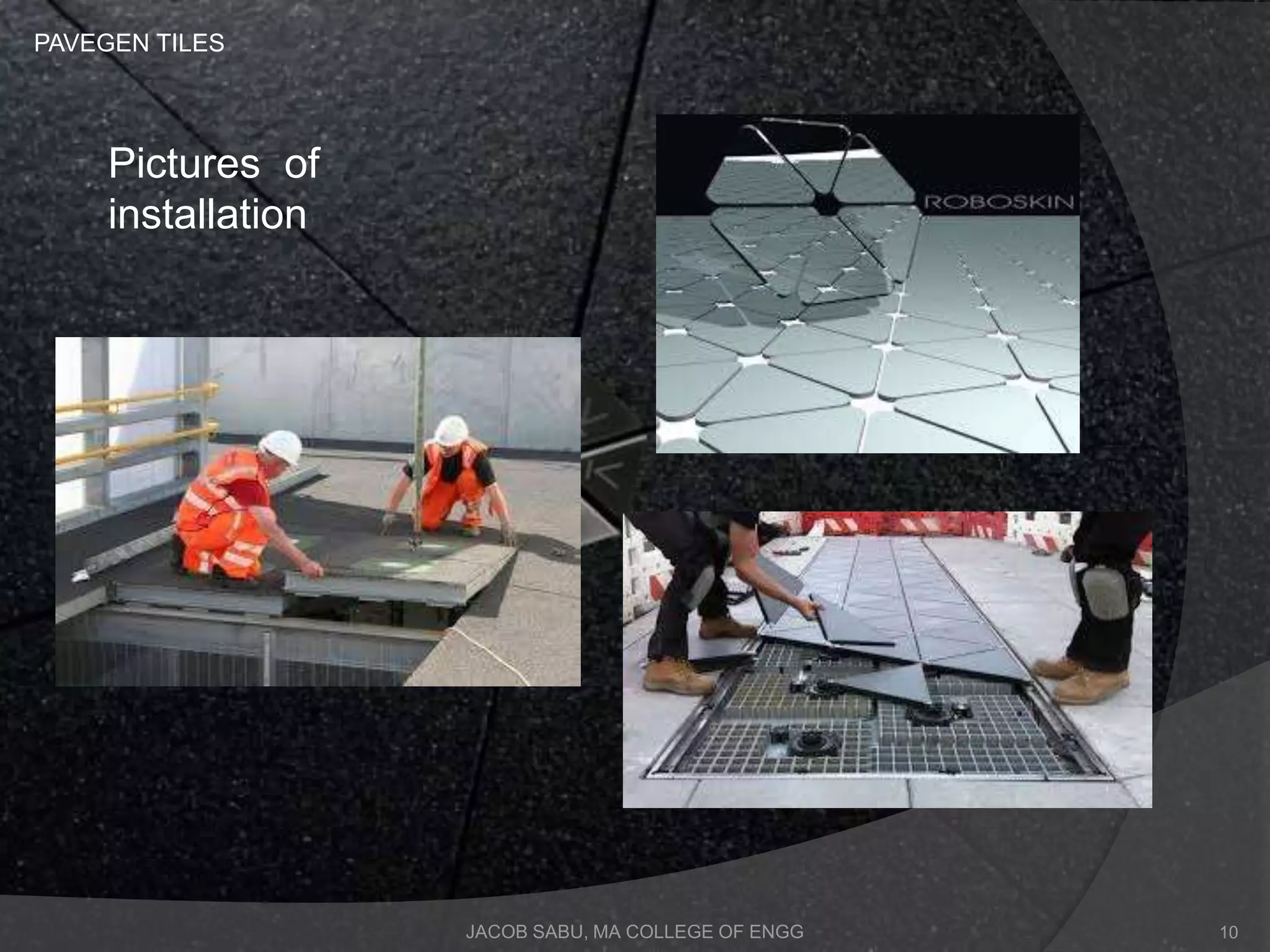
Pictures of
installation
PAVEGEN TILES
10
JACOB SABU, MA COLLEGE OF ENGG
Achievements
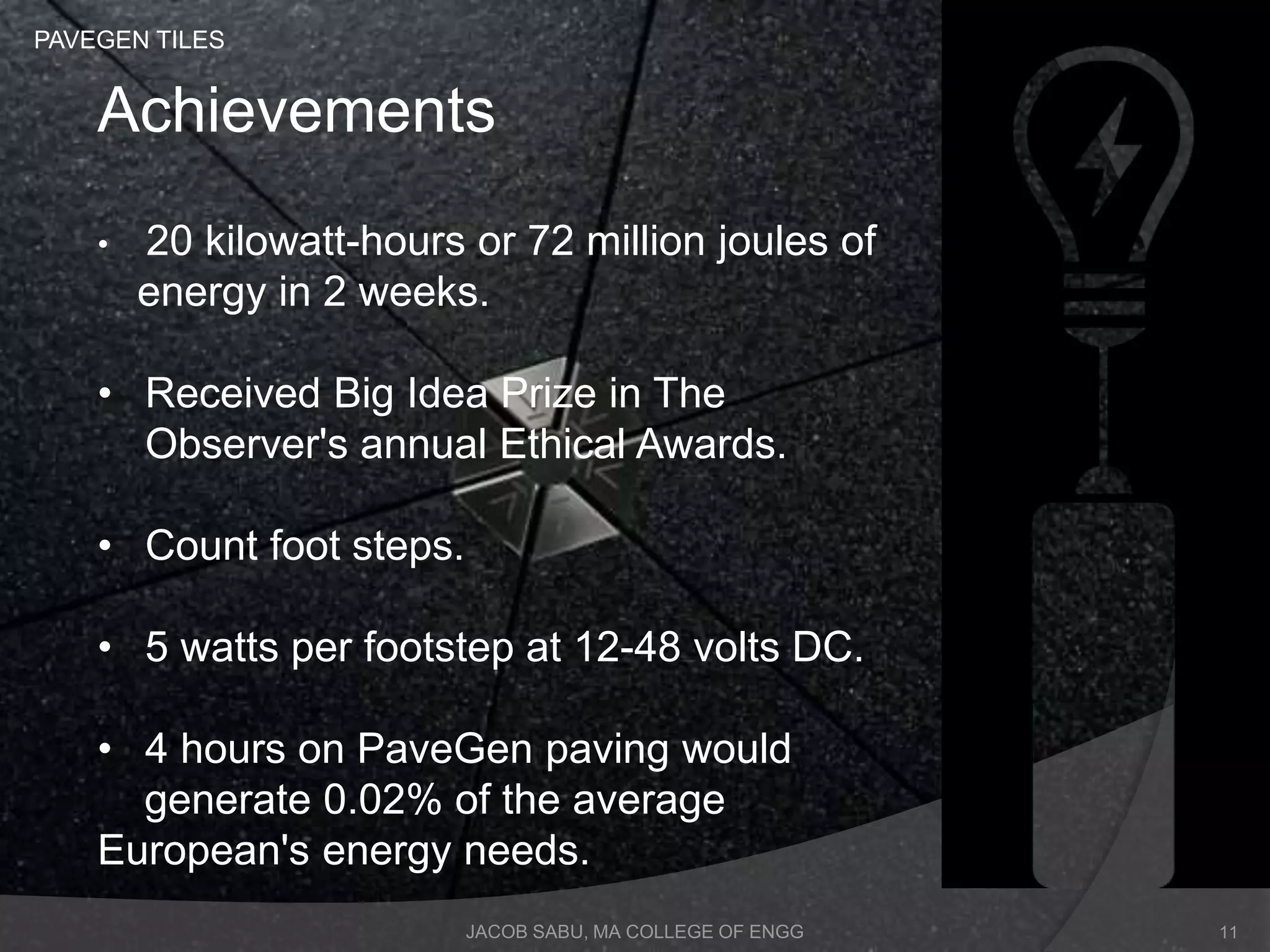
• 20 kilowatt-hours or 72 million joules of
energy in 2 weeks.
• Received Big Idea Prize in The
Observer's annual Ethical Awards.
• Count foot steps.
• 5 watts per footstep at 12-48 volts DC.
• 4 hours on PaveGen paving would
generate 0.02% of the average
European's energy needs.
PAVEGEN TILES
11
JACOB SABU, MA COLLEGE OF ENGG
APPLICATIONS IN CIVIL
ENGINEERING
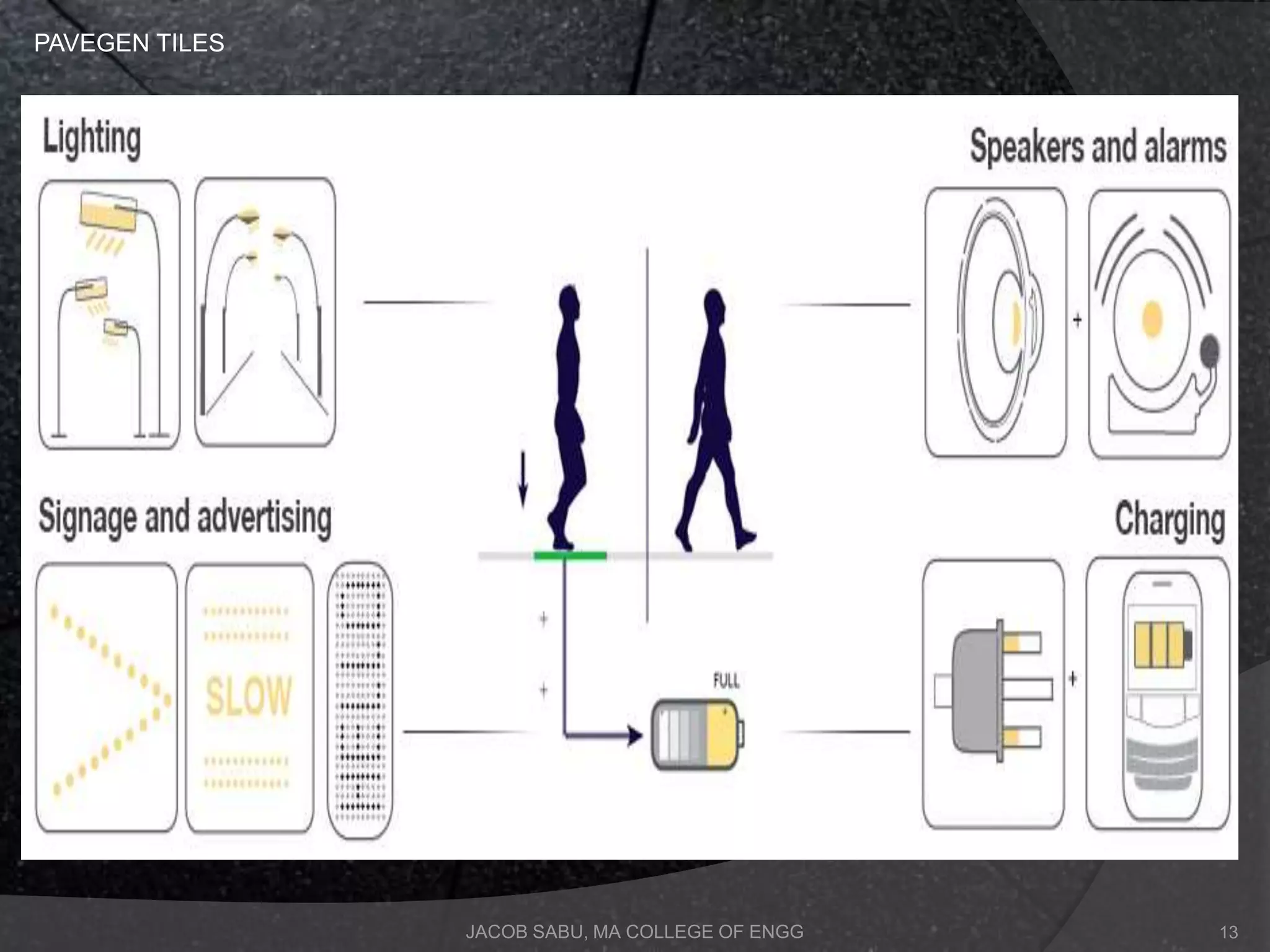
• This idea can be implemented in the
floors of crowded places as footpaths,
railway platforms etc.
• Stairs can be also used for production of
energy by mere walking.
• Used for security purposes and in
various alarm systems.
• For street lights.
• In bus station.
• In airports.
• In play grounds.
PAVEGEN TILES
12
JACOB SABU, MA COLLEGE OF ENGG
PAVEGEN TILES
13
JACOB SABU, MA COLLEGE OF ENGG
• Tiles are completely Renewable & Eco friendly
technology.
Advantages
• It is waterproof and damp proof.
• This technology is highly suitable for urban areas.
• No need fuel input.
• This is a Non-conventional system.
• Less maintenance cost.
• We can reduce approximately 6.817 tons of
excessive CO2 every day emissions by tiles into
atmosphere, by using Pavegen technology.
PAVEGEN TILES
14
JACOB SABU, MA COLLEGE OF ENGG
Disadvantages
• Low amount of energy is produced during each step
or movement of the slab.
• Initial cost is extremely high [ from $75 to $160 per
square foot ]
• Uncertainty about economic life.
• Market acceptance and most productive use.
• It cannot be used as a primary energy source.
.
• In India, we have to import these technology for
replacement of tiles.
PAVEGEN TILES
15
JACOB SABU, MA COLLEGE OF ENGG
• Simon Langton Grammar School for Boys – UK
• Empire State Building – US
• Panduit Corporation World Headquarters – US
• Riverdale Country School – US
REAL WORLD INSTALLATIONS
16
THANK YOU
JACOB SABU, MA COLLEGE OF ENGG 17

Pavegen

  • 1.
    “an ecosystem togenerate electricity from footsteps” JACOB SABU, MA COLLEGE OF ENGG 1
  • 2.
    “ a futureenergy conservation replacement for tiles” JACOB SABU, MA COLLEGE OF ENGG PAVEGEN TILES PAVEGEN • Most of the countries try to innovate alternative electricity power for their usage. • In civil construction field, we are introducing a energy conserving technology as a replacement for tiles. • Laurence Kembell-Cook, the director of PaveGen Systems imagined a new idea to generate electricity from pavement slabs. . 2
  • 3.
    JACOB SABU, MACOLLEGE OF ENGG • The idea later named as Pavegen technology. • It is also known as Kinetic footfall. PAVEGEN TILES • Pavegen is a technology that has been developed by paving slab tiles to convert energy from people’s footsteps into electric power. 3
  • 4.
    JACOB SABU, MACOLLEGE OF ENGG What are Pavegen tiles? . Kinetic floor tiles or pavegen tiles capture energy generated when people walk on them. • These floor tiles generate electricity through the deformation of the material under a load. • It can be stored and used for a variety of applications. PAVEGEN TILES 4
  • 5.
    JACOB SABU, MACOLLEGE OF ENGG • The old version of these tiles are square shaped. • The latest version is in the shape of triangle which consists of a generator in each corner which maximizes the energy output no matter where you step. • The top surface of the flooring tile unit is made from recycled rubber and stainless steel. • The base of the slab is constructed from over 80% recycled materials with concrete. PAVEGEN TILES 5
  • 6.
    JACOB SABU, MACOLLEGE OF ENGG PAVEGEN TILES 6
  • 7.
    JACOB SABU, MACOLLEGE OF ENGG WORKING PRINCIPLE • Kinetic tiles work because of the scientific principle of piezoelectricity. • When an object is subjected to mechanical pressure (ie: something steps on it) it creates an electrical current. • A piezoelectric element like PZT, PVDF, etc., is used as transducer. • It converts the kinetic energy into electrical energy upon stepping on the floor tile. PAVEGEN TILES 7
  • 8.
    JACOB SABU, MACOLLEGE OF ENGG How does it work? • Pavegen’s tiles are electro-magnetic. • The tiles have flywheels beneath them that spin when walked on, producing up to 7W with every footstep. • There are generators in each corner. • The electricity can be used to power appliances directly, or stored for later use. PAVEGEN TILES 8
  • 9.
    JACOB SABU, MACOLLEGE OF ENGG PAVEGEN TILES 9
  • 10.
    JACOB SABU, MACOLLEGE OF ENGG Pictures of installation PAVEGEN TILES 10
  • 11.
    JACOB SABU, MACOLLEGE OF ENGG Achievements • 20 kilowatt-hours or 72 million joules of energy in 2 weeks. • Received Big Idea Prize in The Observer's annual Ethical Awards. • Count foot steps. • 5 watts per footstep at 12-48 volts DC. • 4 hours on PaveGen paving would generate 0.02% of the average European's energy needs. PAVEGEN TILES 11
  • 12.
    JACOB SABU, MACOLLEGE OF ENGG APPLICATIONS IN CIVIL ENGINEERING • This idea can be implemented in the floors of crowded places as footpaths, railway platforms etc. • Stairs can be also used for production of energy by mere walking. • Used for security purposes and in various alarm systems. • For street lights. • In bus station. • In airports. • In play grounds. PAVEGEN TILES 12
  • 13.
    JACOB SABU, MACOLLEGE OF ENGG PAVEGEN TILES 13
  • 14.
    JACOB SABU, MACOLLEGE OF ENGG • Tiles are completely Renewable & Eco friendly technology. Advantages • It is waterproof and damp proof. • This technology is highly suitable for urban areas. • No need fuel input. • This is a Non-conventional system. • Less maintenance cost. • We can reduce approximately 6.817 tons of excessive CO2 every day emissions by tiles into atmosphere, by using Pavegen technology. PAVEGEN TILES 14
  • 15.
    JACOB SABU, MACOLLEGE OF ENGG Disadvantages • Low amount of energy is produced during each step or movement of the slab. • Initial cost is extremely high [ from $75 to $160 per square foot ] • Uncertainty about economic life. • Market acceptance and most productive use. • It cannot be used as a primary energy source. . • In India, we have to import these technology for replacement of tiles. PAVEGEN TILES 15
  • 16.
    JACOB SABU, MACOLLEGE OF ENGG • Simon Langton Grammar School for Boys – UK • Empire State Building – US • Panduit Corporation World Headquarters – US • Riverdale Country School – US REAL WORLD INSTALLATIONS 16
  • 17.
    THANK YOU JACOB SABU,MA COLLEGE OF ENGG 17