40     |   MAY 2014     |     FOOD & BEVERAGE REPORTER	 www.fbreporter.com
S
ome innovations have seen the
glass container take on “properties”
of the product, as in the case of
Callegari olive oil where the bottle takes
the form of a droplet of oil (New York
launch, 2012).
The South African situation differs
in that when it comes to shapes and
particular molds desired by customers,
Richard Irwin of Bottle Printers SA says
“it is very difficult to find something
new on the market, without a customer
having to buy/create their own patented
mold or even import the bottles. We
have, however, seen a growing need for
new and original molds/shapes to be
available in the market.”
“Consumption needs based on
criteria such as age, gender, lifestyle
and purchasing power and packaging,
coupled with stringent legislative
requirements, means shape and label
enhancements have to work harder than
ever at both a functional and aesthetic
levels, while remaining cost efficient
and sustainable,”says Consol’s sales and
marketing director Dale Carolin.
Shapes and quality of glass definitely
help to represent the actual quality of
the contents, given that the glass and
appearance of the bottle, as well as
the decoration, is of a particularly high
standard, Irwin says. It appears to the
consumer as a quality product, which
is the producer’s main intention, using
packaging as an additional ‘sell’tactic.
“All our customers now know the effect
and the competitive edge that can be
gained based purely on the appearance
of their product.”
He says that unfortunately,
because of the low margins on most
food products, there is not much
investment in packaging. “Foods made
locally, especially on a smaller scale
of manufacturing and retail, tend to
use generic bottles or jars. But with
higher margins in the beverage market
(especially alcohol), there is a lot
more investment into R&D in terms
of product and packaging to enhance
brand perception. As there are more
resources available, and thus more
experimentation, customers will be
exposed to new shapes and bolder
designs. A unique shape different from
the product’s competitors certainly puts
a brand ahead when it comes to catching
the consumer’s eye.”
Labelling and sleeving
Irwin points out that paper labels have
become popular in the wine industry as
this option is cost effective and also has
less impact on the environment than
laminated labels. Major trends seen
in the past year are direct decoration
printing and decorative shrink sleeving.
Decorative shrink sleeving has proved
glass decorating
Glass takes shape as
preferred package
Packaging has evolved
to such sophisticated
levels that the choice for
doing justice to a product
offering is no longer a
simple one. Glass food
and beverage packaging
materials are driving
a new focus in shape
selection and decorative
options, particularly in
the luxury goods and high
end market.
www.fbreporter.com	 FOOD & BEVERAGE REPORTER     |    MAY 2014     |     41	
its advantages. Overseas (especially
China) sleeving has not only become a
fashion for unique packaging but is also
used as a means to portray a product to
the consumer. It can be applied to the
bottle in hard-to-reach areas that other
techniques are not capable of achieving,
says Irwin.
“Sleeving is becoming increasingly
popular for special edition bottles that
mark brand milestones like birthdays
and anniversaries,”Carolin states.
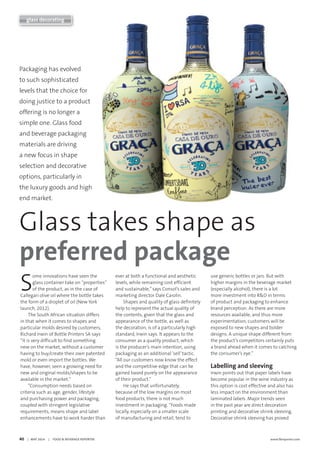
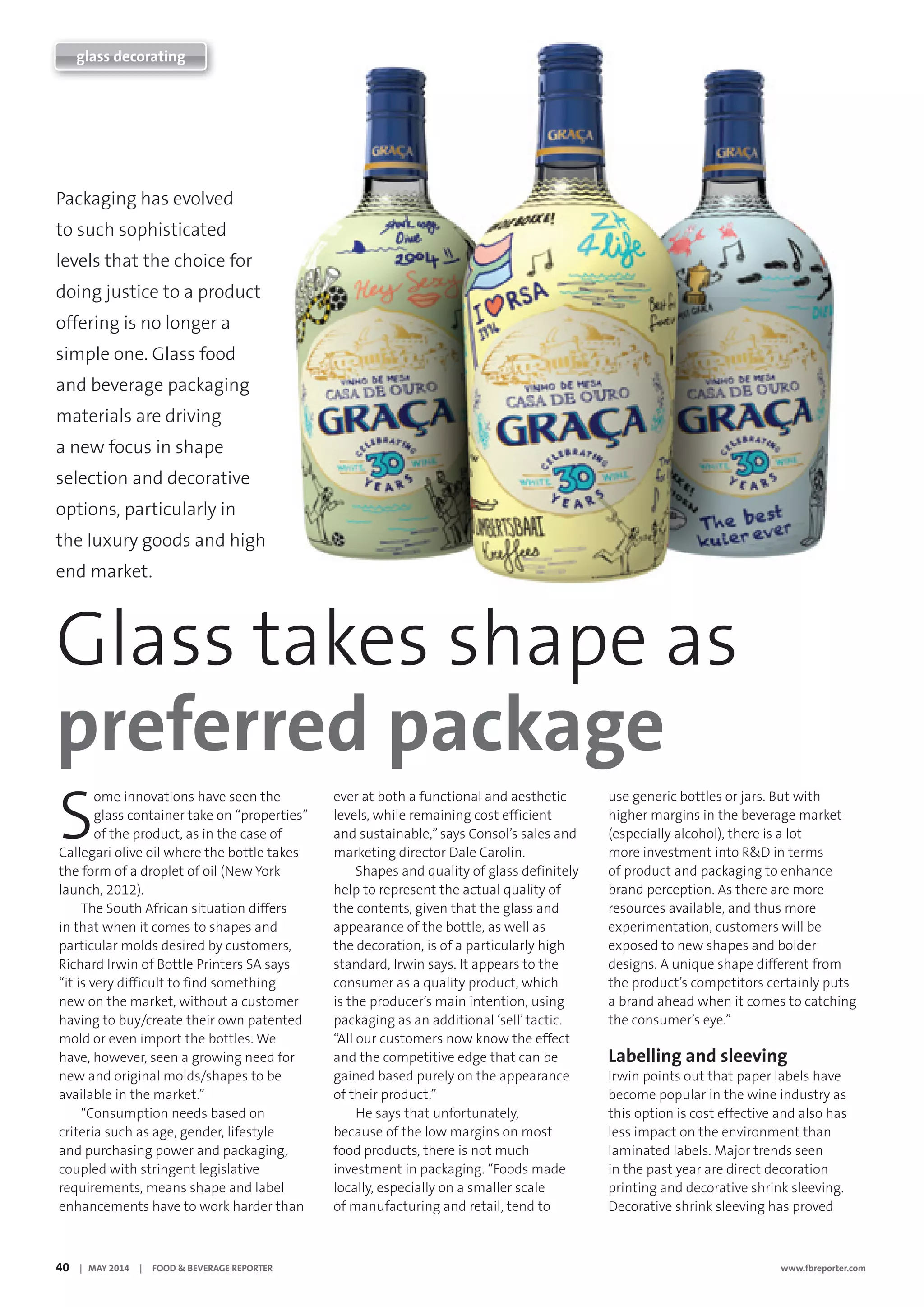
“The Graca 30-year anniversary bottle
launched last year demonstrates the use
of sleeving with an eye catching result.”
“Not without its challenges, the
taper on the Graca bottle required
modifications to make it work and the
sleeve had to be shrunk evenly from the
base to the neck.”
Irwin says: “Innovations in direct
printing and direct decoration allow for a
bottle to completely change its look and
to differentiate either across a product
line or even between rivals which have
similar shaped bottles (due to the low
variance in what can be supplied without
sourcing a mold), making the image of
that product unique and original.”
Foiling techniques
Consol has confirmed an increase over
the past 12 months in the demand for
PSL labelling, as well as sleeving, with
customers incorporating vivid design and
use of colour to differentiate products.
“There has also been an escalation in
demand for neck foil which delivers a
more premium aesthetic and adds a
flamboyant, metallic shine to logos, and
can be combined with all decorating and
coating. More detailed embossing has
also risen in prevalence,”says Carolin.
Consol’s PSL process accommodates
up to three labels on a bottle, allowing
customers to accommodate both
relevant and legally required product
information. The ability to vary the size
and application of the labels means that
specific market trends can be addressed.
According to Carolin, the craft brewing
industry appears to favour the classic
look of a label which is a 270˚ wrap
around their bottles.
“The ACL (applied ceramic labelling)
glass decorating
42     |   MAY 2014     |     FOOD & BEVERAGE REPORTER	 www.fbreporter.com
glass decorating
process offers up to four colours, the
ability for a full 360˚ body and neck
covering, and delivers a scuff proof,
tactile label. Labels withstanding
30+ production life cycles are gaining
prominence in the beverage market,
along with labels withstanding long
periods of ice bucket immersion.”
New technology
Carolin claims that advances in
technology have radically enhanced
what can be achieved with glass
packaging shapes and designs. “The
glass manufacturing process itself offers
diversity in terms of process innovations,
including internal and external
embossing, push ups, thick bases, black
glass and light weighting. The new
340ml Black Label bottle, Castle Lite’s
340ml and 440ml bottles, and the 330ml
Hansa bottle, all changed shape in the
past year - evidence of the prominence
of pack changes in this sector of the
beverage market.”
In early 2013 Bottle Printers of South
Africa purchased a new coating machine.
“We wanted to offer something new and
different to our customers and believe
we can service existing
customers in SA as well
as bring in new ones by
allowing greater range
when they present
their ideas.”Irwin says
the investment paid
off due to the high
level of demand for
this technique in
the SA industry.
“Although it was
offered to the
market before,
Bottle Printers
took it one
step further by
being able to
offer advanced
technology in the
manufacturing
process for
increased
output, as well
as the facility
of a five-colour
vignetted finish
on a glass bottle,
and a quality
translucent
colour variation with an even coating
giving the impression of pigment inside
the glass.”
Carolin says current decorating
techniques include fusing ink with glass
at a very high temperature, a process
generally used in the beverage, cosmetic
and tableware categories.
Foiling directly onto glass is a new
process, Irwin says. Previous techniques
have involved the age-old hot stamping
technique and high stove metallic
printing containing compounds of
platinum and gold to create a mirror
effect on the glass. Now foiling directly
onto glass at lower temperatures has
allowed for a more accurate and “crisp”
print than hot stamping, and the lower
temperatures allow for the bottle to be
coated in any colour, without the heat
of a metallic high stove print (which
requires 1 ½ hours at 600 to 650˚C to
cure) affecting its coating. The same
“shiny”effect can be achieved in silver,
gold and other specified colours. The
company has also started to explore
and implement a digital printing
process to produce full colour prints
with photo quality.
Coating of bottles and glassware
involves a process whereby the outside
surface of the bottle is sprayed directly
to produce glass of almost any colour
(pantone references). There are a number
of effects along with this, such as a solid
colour coating, a translucent glossy
finish, or a matt colour-frosting effect. A
hammertone finish can also be effected.
“With our modern technology, we can
also colour-coat multi-colours onto one
bottle, from two to five colours.”
Cost implications
Irwin says: “Cost has quite an impact
on overall budgeted allocation for the
packaging of a particular product, but
when that cost is amortised against
potential sales due to unique packaging,
or against the perception that the
consumer is buying into fashion rather
than just a product, the cost implications
do not disturb the overall value that a
coated and printed bottle can offer.”This
also applies to any improvements such
as foiling onto glass and specialised
printing methods.
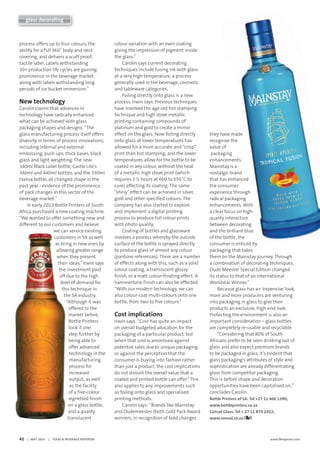
Carolin says: “Brands like Mainstay
and Oudemeester (both Gold Pack Award
winners, in recognition of bold changes
they have made
recognise the
value of
packaging
enhancements.
Mainstay is a
nostalgic brand
that has enhanced
the consumer
experience through
radical packaging
enhancements. With
a clear focus on high-
quality interaction
between decorating
and the brilliant blue
of the bottle, the
consumer is enticed by
packaging that takes
them on the Mainstay journey. Through
a combination of decorating techniques,
Oude Meester Special Edition changed
its status to that of an international
Worldstar Winner.”
Because glass has an ‘expensive’look,
more and more producers are venturing
into packaging in glass to give their
products an exclusive, high-end look.
Protecting the environment is also an
important consideration – glass bottles
are completely re-usable and recyclable.
“Considering that 80% of South
Africans prefer to be seen drinking out of
glass and also expect premium brands
to be packaged in glass, it’s evident that
glass packaging’s attributes of style and
sophistication are already differentiating
glass from competitor packaging.
This is before shape and decoration
opportunities have been capitalised on,”
concludes Carolin.
Bottle Printers of SA: Tel +27 11 466 1390;
www.bottleprinters.co.za  
Consol Glass: Tel + 27 11 874 2422;
www.consol.co.za

Glass takes shape as preferred package

  • 1.
    40 | MAY 2014 | FOOD & BEVERAGE REPORTER www.fbreporter.com S ome innovations have seen the glass container take on “properties” of the product, as in the case of Callegari olive oil where the bottle takes the form of a droplet of oil (New York launch, 2012). The South African situation differs in that when it comes to shapes and particular molds desired by customers, Richard Irwin of Bottle Printers SA says “it is very difficult to find something new on the market, without a customer having to buy/create their own patented mold or even import the bottles. We have, however, seen a growing need for new and original molds/shapes to be available in the market.” “Consumption needs based on criteria such as age, gender, lifestyle and purchasing power and packaging, coupled with stringent legislative requirements, means shape and label enhancements have to work harder than ever at both a functional and aesthetic levels, while remaining cost efficient and sustainable,”says Consol’s sales and marketing director Dale Carolin. Shapes and quality of glass definitely help to represent the actual quality of the contents, given that the glass and appearance of the bottle, as well as the decoration, is of a particularly high standard, Irwin says. It appears to the consumer as a quality product, which is the producer’s main intention, using packaging as an additional ‘sell’tactic. “All our customers now know the effect and the competitive edge that can be gained based purely on the appearance of their product.” He says that unfortunately, because of the low margins on most food products, there is not much investment in packaging. “Foods made locally, especially on a smaller scale of manufacturing and retail, tend to use generic bottles or jars. But with higher margins in the beverage market (especially alcohol), there is a lot more investment into R&D in terms of product and packaging to enhance brand perception. As there are more resources available, and thus more experimentation, customers will be exposed to new shapes and bolder designs. A unique shape different from the product’s competitors certainly puts a brand ahead when it comes to catching the consumer’s eye.” Labelling and sleeving Irwin points out that paper labels have become popular in the wine industry as this option is cost effective and also has less impact on the environment than laminated labels. Major trends seen in the past year are direct decoration printing and decorative shrink sleeving. Decorative shrink sleeving has proved glass decorating Glass takes shape as preferred package Packaging has evolved to such sophisticated levels that the choice for doing justice to a product offering is no longer a simple one. Glass food and beverage packaging materials are driving a new focus in shape selection and decorative options, particularly in the luxury goods and high end market.
  • 2.
    www.fbreporter.com FOOD &BEVERAGE REPORTER | MAY 2014 | 41 its advantages. Overseas (especially China) sleeving has not only become a fashion for unique packaging but is also used as a means to portray a product to the consumer. It can be applied to the bottle in hard-to-reach areas that other techniques are not capable of achieving, says Irwin. “Sleeving is becoming increasingly popular for special edition bottles that mark brand milestones like birthdays and anniversaries,”Carolin states. “The Graca 30-year anniversary bottle launched last year demonstrates the use of sleeving with an eye catching result.” “Not without its challenges, the taper on the Graca bottle required modifications to make it work and the sleeve had to be shrunk evenly from the base to the neck.” Irwin says: “Innovations in direct printing and direct decoration allow for a bottle to completely change its look and to differentiate either across a product line or even between rivals which have similar shaped bottles (due to the low variance in what can be supplied without sourcing a mold), making the image of that product unique and original.” Foiling techniques Consol has confirmed an increase over the past 12 months in the demand for PSL labelling, as well as sleeving, with customers incorporating vivid design and use of colour to differentiate products. “There has also been an escalation in demand for neck foil which delivers a more premium aesthetic and adds a flamboyant, metallic shine to logos, and can be combined with all decorating and coating. More detailed embossing has also risen in prevalence,”says Carolin. Consol’s PSL process accommodates up to three labels on a bottle, allowing customers to accommodate both relevant and legally required product information. The ability to vary the size and application of the labels means that specific market trends can be addressed. According to Carolin, the craft brewing industry appears to favour the classic look of a label which is a 270˚ wrap around their bottles. “The ACL (applied ceramic labelling) glass decorating
  • 3.
    42 | MAY 2014 | FOOD & BEVERAGE REPORTER www.fbreporter.com glass decorating process offers up to four colours, the ability for a full 360˚ body and neck covering, and delivers a scuff proof, tactile label. Labels withstanding 30+ production life cycles are gaining prominence in the beverage market, along with labels withstanding long periods of ice bucket immersion.” New technology Carolin claims that advances in technology have radically enhanced what can be achieved with glass packaging shapes and designs. “The glass manufacturing process itself offers diversity in terms of process innovations, including internal and external embossing, push ups, thick bases, black glass and light weighting. The new 340ml Black Label bottle, Castle Lite’s 340ml and 440ml bottles, and the 330ml Hansa bottle, all changed shape in the past year - evidence of the prominence of pack changes in this sector of the beverage market.” In early 2013 Bottle Printers of South Africa purchased a new coating machine. “We wanted to offer something new and different to our customers and believe we can service existing customers in SA as well as bring in new ones by allowing greater range when they present their ideas.”Irwin says the investment paid off due to the high level of demand for this technique in the SA industry. “Although it was offered to the market before, Bottle Printers took it one step further by being able to offer advanced technology in the manufacturing process for increased output, as well as the facility of a five-colour vignetted finish on a glass bottle, and a quality translucent colour variation with an even coating giving the impression of pigment inside the glass.” Carolin says current decorating techniques include fusing ink with glass at a very high temperature, a process generally used in the beverage, cosmetic and tableware categories. Foiling directly onto glass is a new process, Irwin says. Previous techniques have involved the age-old hot stamping technique and high stove metallic printing containing compounds of platinum and gold to create a mirror effect on the glass. Now foiling directly onto glass at lower temperatures has allowed for a more accurate and “crisp” print than hot stamping, and the lower temperatures allow for the bottle to be coated in any colour, without the heat of a metallic high stove print (which requires 1 ½ hours at 600 to 650˚C to cure) affecting its coating. The same “shiny”effect can be achieved in silver, gold and other specified colours. The company has also started to explore and implement a digital printing process to produce full colour prints with photo quality. Coating of bottles and glassware involves a process whereby the outside surface of the bottle is sprayed directly to produce glass of almost any colour (pantone references). There are a number of effects along with this, such as a solid colour coating, a translucent glossy finish, or a matt colour-frosting effect. A hammertone finish can also be effected. “With our modern technology, we can also colour-coat multi-colours onto one bottle, from two to five colours.” Cost implications Irwin says: “Cost has quite an impact on overall budgeted allocation for the packaging of a particular product, but when that cost is amortised against potential sales due to unique packaging, or against the perception that the consumer is buying into fashion rather than just a product, the cost implications do not disturb the overall value that a coated and printed bottle can offer.”This also applies to any improvements such as foiling onto glass and specialised printing methods. Carolin says: “Brands like Mainstay and Oudemeester (both Gold Pack Award winners, in recognition of bold changes they have made recognise the value of packaging enhancements. Mainstay is a nostalgic brand that has enhanced the consumer experience through radical packaging enhancements. With a clear focus on high- quality interaction between decorating and the brilliant blue of the bottle, the consumer is enticed by packaging that takes them on the Mainstay journey. Through a combination of decorating techniques, Oude Meester Special Edition changed its status to that of an international Worldstar Winner.” Because glass has an ‘expensive’look, more and more producers are venturing into packaging in glass to give their products an exclusive, high-end look. Protecting the environment is also an important consideration – glass bottles are completely re-usable and recyclable. “Considering that 80% of South Africans prefer to be seen drinking out of glass and also expect premium brands to be packaged in glass, it’s evident that glass packaging’s attributes of style and sophistication are already differentiating glass from competitor packaging. This is before shape and decoration opportunities have been capitalised on,” concludes Carolin. Bottle Printers of SA: Tel +27 11 466 1390; www.bottleprinters.co.za Consol Glass: Tel + 27 11 874 2422; www.consol.co.za