Post-Custodial
Methods in
Archival Practice
A DISCUSSION WITH ITZA CARBAJAL
Access and Care of Indigenous Cultural Knowledge Course | November 5, 2018
hello!
I’m Itza Carbajal
2017 UT iSchool graduate. Now the Latin American Metadata
Librarian for LLILAS Benson
Twitter: @archiviststan
Website: www.itzacarbajal.com
1. Defining Post-Custodialism
Original Framework
Gerald Ham, 1981
● Late 20th century revolution in information processing is inexorably
changing the world and the work of archivists.
● These changes Ham argued pushes archivists into a new period he
called post-custodial archival history.
● Earlier period meant record quantities were relatively small; the
technology of records creation, storage, and retrieval fairly simple; and
archivists assumed a passive role in shaping the documentary record.
● Previous custodial ethos made archivists excessively proprietary
toward archival holdings
● New period brings many changes including computer processing of
information allowed people to collect, preserve, and manipulate vast
quantities of social and economic data.
● Now archivists can make a large portion of their holdings as available
as printed books, but this requires changes in outmoded ideas about
where and by whom resources are used.
Post-Custodialism in a International Context
Latin America
During a project called the HRDI, collaborating partners
(UTL/LLILAs Benson) had to confront many atypical practical
acquisition and access conditions (distance, ethical
considerations, evolving nature of records). Also a result of
traditional repositories trying to preserve living records (meaning
those still in use by creators)
Caribbean
Jeannette Bastian studies the definition of custodialism in the
case study of the records of a former Danish colony now known as
the United States Virgin Islands.
● Both governmental entities split and retrieve records leaving
no physical onsite records for Virgin Islanders
This study focused more on the aspect of how managing the
records also means managing access to the records.
Some Post-Custodialism Principles
● Creators must take on record manager roles
● Decentralization of holdings
● Utilize the benefits of modern technology to provide easy and centralized
access
● Coherent and comprehensive acquisition program
● Better use of limited resources available for archival work
● Encourage inter-institutional cooperation
● Archival service center providing traditional services to smaller institutions
such as purchasing supplies, providing records survey, etc.
● Provide needed short- term vocational assistance as well as consultations on
project planning and administration
● (re)balances power between.. colonizer/colonized, global South/Global North,
repository/creator
● (re)defines archival practice and expectations between different parties
● (re)locates the archival enterprise responsibilities
● Diversify and democratize the historical record.
“ While many of LLILAS Benson’s
digital archival projects are
described as Post-Custodial or at
times noncustodial, the actual
Post-Custodial approaches differ
Slightly from project to project.
- Itza Carbajal
2. LLILAS Benson Post Custodial Projects
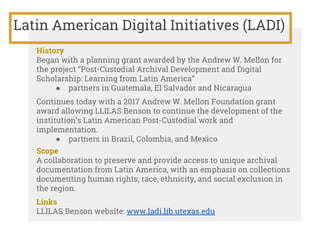
Latin American Digital Initiatives (LADI)
History
Began with a planning grant awarded by the Andrew W. Mellon for
the project “Post-Custodial Archival Development and Digital
Scholarship: Learning from Latin America”
● partners in Guatemala, El Salvador and Nicaragua
Continues today with a 2017 Andrew W. Mellon Foundation grant
award allowing LLILAS Benson to continue the development of the
institution’s Latin American Post-Custodial work and
implementation.
● partners in Brazil, Colombia, and Mexico
Scope
A collaboration to preserve and provide access to unique archival
documentation from Latin America, with an emphasis on collections
documenting human rights, race, ethnicity, and social exclusion in
the region.
Links
LLILAS Benson website: www.ladi.lib.utexas.edu
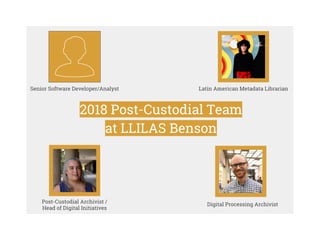
2018 Post-Custodial Team
at LLILAS Benson
Senior Software Developer/Analyst
Post-Custodial Archivist /
Head of Digital Initiatives
Latin American Metadata Librarian
Digital Processing Archivist
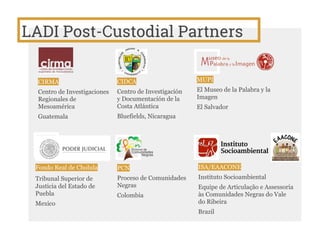
LADI Post-Custodial Partners
CIRMA
Centro de Investigaciones
Regionales de
Mesoamérica
Guatemala
CIDCA
Centro de Investigación
y Documentación de la
Costa Atlántica
Bluefields, Nicaragua
MUPI
El Museo de la Palabra y la
Imagen
El Salvador
Fondo Real de Cholula
Tribunal Superior de
Justicia del Estado de
Puebla
Mexico
PCN
Proceso de Comunidades
Negras
Colombia
ISA/EAACONE
Instituto Socioambiental
Equipe de Articulação e Assessoria
às Comunidades Negras do Vale
do Ribeira
Brazil
Human Rights Documentation Project (HRDI)
History
Initial brainstorming occured in at a 2007 conference titled “Human
Rights Archives and Documentation: Meeting the Needs of Research,
Teaching, Advocacy, and Social Justice” co-sponsored by UT Libraries,
Center for Research Libraries, and Columbia University.
First proposed project was a collaboration with Kigali Genocide
Memorial Center in Rwanda with final project launched in 2008.
Scope
HRDI is committed to the long-term preservation of fragile and
vulnerable records of human rights struggles worldwide, the promotion
and secure usage of human rights archival materials, and the
advancement of human rights research and advocacy around the
world.
Links
LLILAS Benson HRDI website: http://legacy.lib.utexas.edu/hrdi
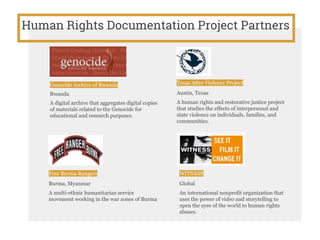
Human Rights Documentation Project Partners
Genocide Archive of Rwanda
Rwanda
A digital archive that aggregates digital copies
of materials related to the Genocide for
educational and research purposes.
Free Burma Rangers
Burma, Myanmar
A multi-ethnic humanitarian service
movement working in the war zones of Burma
WITNESS
Global
An international nonprofit organization that
uses the power of video and storytelling to
open the eyes of the world to human rights
abuses.
Texas After Violence Project
Austin, Texas
A human rights and restorative justice project
that studies the effects of interpersonal and
state violence on individuals, families, and
communities.
Archivo Histórico de la Policia Nacional (AHPN)
History
In 2005 Guatemalan human rights office governmental
representatives during an on-site investigation of abandoned
barracks in Guatemala City stumbled almost literally into a room
full of deteriorating documents.
Scope
Includes more than 7 thousand nine hundred linear meters of
packets of folios (~60 million folios). Records date from the late
nineteenth century (1882) and extend to 1997. Types vary from
official correspondence, register of investigated people,
registration cards, arrest records, etc)
Links
LLILAS Benson Website: https://ahpn.lib.utexas.edu/
AHPN Guatemala Website: http://archivohistoricopn.org/
3. Possibilities of Post-Custodialism
Funnel Funding to Other Organizations
Changing the outcome of funding landscape to
funnel financials resources to new and/or
smaller groups and provide access to funds.
Traditional archival institutions utilize perceived
standing with funders, governments, and other
authorities.
Post-Custodial Opportunities
Diversify Collections & Historical Narratives
Collaboration with nontraditional archival
institutions introduces a wider selection of
historical materials.
Post-Custodial Opportunities
Transmission of Skills
Archivists provide trainings and insights on tools
relevant to archival practice to non-archivists or
archivists from a variety of archival settings
Disrupt Divisions of Expertise
Archivists shift to consultants whose aim is to build
local knowledge and expertise on archival
processes. Traditional archival institutions
distribute claim to specialized knowledge.
Post-Custodial Opportunities
Shift Responsibilities and Authority
Consulting role requires that archivists plan
alongside local practitioners and may even
relinquish decision-making powers to local
parties.
Reform Metadata Practices
A further shift away from a field specialists
approach, these metadata practices take into
account local parties’ expertise and proximity to
record topics and subjects. Archivist is no longer
the authority on the context and content.
THANKS!
Comments or questions?
Email me at i.carbajal [at] austin [dot] utexas [dot] edu
or
tweet me! @archiviststan
?
Further Readings
□ Bastian, Jeannette. "A Question of Custody: The Colonial Archives of the United States Virgin Islands." The
American Archivist 64, no. 1 (2001): 96-114. doi:10.17723/aarc.64.1.h6k872252u2gr377.
□ From Custody to Collaboration: The Post Custodial Archival Model at the University
of Texas Libraries. (2013). https://library.stanford.edu/sites/default/files/Univ%20of%20Texas.pdf
□ Ham, F. "Archival Strategies for the Post-Custodial Era." The American Archivist 44, no. 3 (Summer 1981):
207-16. doi:10.17723/aarc.44.3.6228121p01m8k376.
□ Kelleher, Christian. "Archives Without Archives: (Re)Locating and (Re)Defining the Archive Through
Post-Custodial Praxis." Journal of Critical Library and Information Studies 1, no. 2 (2017).
doi:10.24242/jclis.v1i2.29.
□ LLILAS Benson Latin American Studies and Collections Receives Mellon Foundation Grant." University of
Texas Libraries. Accessed November 05, 2018. https://legacy.lib.utexas.edu/about/news/llilas-
benson-latin-american-studies-and-collections-receives-mellon-foundation-grant.
□ Polk, T. Archiving Human Rights Documentation: The Promise of the Post-Custodial Approach in Latin
America. (2016). https://llilasbensonmagazine.org/2016/08/05/archiving-human-
rights-documentation-the-promise-of-the-post-custodial-approach-in-latin-america
□ Shein, C. and Lapworth, E. Say Yes to Digital Surrogates: Strengthening the Archival Record in the
Postcustodial Era. Journal of Western Archives [online] 7(1), (2016)
http://digitalcommons.usu.edu/westernarchives/vol7/iss1/9

Post-Custodial Methods in Archival Practice

  • 1.
    Post-Custodial Methods in Archival Practice ADISCUSSION WITH ITZA CARBAJAL Access and Care of Indigenous Cultural Knowledge Course | November 5, 2018
  • 2.
    hello! I’m Itza Carbajal 2017UT iSchool graduate. Now the Latin American Metadata Librarian for LLILAS Benson Twitter: @archiviststan Website: www.itzacarbajal.com
  • 3.
  • 4.
    Original Framework Gerald Ham,1981 ● Late 20th century revolution in information processing is inexorably changing the world and the work of archivists. ● These changes Ham argued pushes archivists into a new period he called post-custodial archival history. ● Earlier period meant record quantities were relatively small; the technology of records creation, storage, and retrieval fairly simple; and archivists assumed a passive role in shaping the documentary record. ● Previous custodial ethos made archivists excessively proprietary toward archival holdings ● New period brings many changes including computer processing of information allowed people to collect, preserve, and manipulate vast quantities of social and economic data. ● Now archivists can make a large portion of their holdings as available as printed books, but this requires changes in outmoded ideas about where and by whom resources are used.
  • 5.
    Post-Custodialism in aInternational Context Latin America During a project called the HRDI, collaborating partners (UTL/LLILAs Benson) had to confront many atypical practical acquisition and access conditions (distance, ethical considerations, evolving nature of records). Also a result of traditional repositories trying to preserve living records (meaning those still in use by creators) Caribbean Jeannette Bastian studies the definition of custodialism in the case study of the records of a former Danish colony now known as the United States Virgin Islands. ● Both governmental entities split and retrieve records leaving no physical onsite records for Virgin Islanders This study focused more on the aspect of how managing the records also means managing access to the records.
  • 6.
    Some Post-Custodialism Principles ●Creators must take on record manager roles ● Decentralization of holdings ● Utilize the benefits of modern technology to provide easy and centralized access ● Coherent and comprehensive acquisition program ● Better use of limited resources available for archival work ● Encourage inter-institutional cooperation ● Archival service center providing traditional services to smaller institutions such as purchasing supplies, providing records survey, etc. ● Provide needed short- term vocational assistance as well as consultations on project planning and administration ● (re)balances power between.. colonizer/colonized, global South/Global North, repository/creator ● (re)defines archival practice and expectations between different parties ● (re)locates the archival enterprise responsibilities ● Diversify and democratize the historical record.
  • 7.
    “ While manyof LLILAS Benson’s digital archival projects are described as Post-Custodial or at times noncustodial, the actual Post-Custodial approaches differ Slightly from project to project. - Itza Carbajal
  • 8.
    2. LLILAS BensonPost Custodial Projects
  • 9.
    Latin American DigitalInitiatives (LADI) History Began with a planning grant awarded by the Andrew W. Mellon for the project “Post-Custodial Archival Development and Digital Scholarship: Learning from Latin America” ● partners in Guatemala, El Salvador and Nicaragua Continues today with a 2017 Andrew W. Mellon Foundation grant award allowing LLILAS Benson to continue the development of the institution’s Latin American Post-Custodial work and implementation. ● partners in Brazil, Colombia, and Mexico Scope A collaboration to preserve and provide access to unique archival documentation from Latin America, with an emphasis on collections documenting human rights, race, ethnicity, and social exclusion in the region. Links LLILAS Benson website: www.ladi.lib.utexas.edu
  • 10.
    2018 Post-Custodial Team atLLILAS Benson Senior Software Developer/Analyst Post-Custodial Archivist / Head of Digital Initiatives Latin American Metadata Librarian Digital Processing Archivist
  • 11.
    LADI Post-Custodial Partners CIRMA Centrode Investigaciones Regionales de Mesoamérica Guatemala CIDCA Centro de Investigación y Documentación de la Costa Atlántica Bluefields, Nicaragua MUPI El Museo de la Palabra y la Imagen El Salvador Fondo Real de Cholula Tribunal Superior de Justicia del Estado de Puebla Mexico PCN Proceso de Comunidades Negras Colombia ISA/EAACONE Instituto Socioambiental Equipe de Articulação e Assessoria às Comunidades Negras do Vale do Ribeira Brazil
  • 12.
    Human Rights DocumentationProject (HRDI) History Initial brainstorming occured in at a 2007 conference titled “Human Rights Archives and Documentation: Meeting the Needs of Research, Teaching, Advocacy, and Social Justice” co-sponsored by UT Libraries, Center for Research Libraries, and Columbia University. First proposed project was a collaboration with Kigali Genocide Memorial Center in Rwanda with final project launched in 2008. Scope HRDI is committed to the long-term preservation of fragile and vulnerable records of human rights struggles worldwide, the promotion and secure usage of human rights archival materials, and the advancement of human rights research and advocacy around the world. Links LLILAS Benson HRDI website: http://legacy.lib.utexas.edu/hrdi
  • 13.
    Human Rights DocumentationProject Partners Genocide Archive of Rwanda Rwanda A digital archive that aggregates digital copies of materials related to the Genocide for educational and research purposes. Free Burma Rangers Burma, Myanmar A multi-ethnic humanitarian service movement working in the war zones of Burma WITNESS Global An international nonprofit organization that uses the power of video and storytelling to open the eyes of the world to human rights abuses. Texas After Violence Project Austin, Texas A human rights and restorative justice project that studies the effects of interpersonal and state violence on individuals, families, and communities.
  • 14.
    Archivo Histórico dela Policia Nacional (AHPN) History In 2005 Guatemalan human rights office governmental representatives during an on-site investigation of abandoned barracks in Guatemala City stumbled almost literally into a room full of deteriorating documents. Scope Includes more than 7 thousand nine hundred linear meters of packets of folios (~60 million folios). Records date from the late nineteenth century (1882) and extend to 1997. Types vary from official correspondence, register of investigated people, registration cards, arrest records, etc) Links LLILAS Benson Website: https://ahpn.lib.utexas.edu/ AHPN Guatemala Website: http://archivohistoricopn.org/
  • 15.
    3. Possibilities ofPost-Custodialism
  • 16.
    Funnel Funding toOther Organizations Changing the outcome of funding landscape to funnel financials resources to new and/or smaller groups and provide access to funds. Traditional archival institutions utilize perceived standing with funders, governments, and other authorities. Post-Custodial Opportunities Diversify Collections & Historical Narratives Collaboration with nontraditional archival institutions introduces a wider selection of historical materials.
  • 17.
    Post-Custodial Opportunities Transmission ofSkills Archivists provide trainings and insights on tools relevant to archival practice to non-archivists or archivists from a variety of archival settings Disrupt Divisions of Expertise Archivists shift to consultants whose aim is to build local knowledge and expertise on archival processes. Traditional archival institutions distribute claim to specialized knowledge.
  • 18.
    Post-Custodial Opportunities Shift Responsibilitiesand Authority Consulting role requires that archivists plan alongside local practitioners and may even relinquish decision-making powers to local parties. Reform Metadata Practices A further shift away from a field specialists approach, these metadata practices take into account local parties’ expertise and proximity to record topics and subjects. Archivist is no longer the authority on the context and content.
  • 19.
    THANKS! Comments or questions? Emailme at i.carbajal [at] austin [dot] utexas [dot] edu or tweet me! @archiviststan ?
  • 20.
    Further Readings □ Bastian,Jeannette. "A Question of Custody: The Colonial Archives of the United States Virgin Islands." The American Archivist 64, no. 1 (2001): 96-114. doi:10.17723/aarc.64.1.h6k872252u2gr377. □ From Custody to Collaboration: The Post Custodial Archival Model at the University of Texas Libraries. (2013). https://library.stanford.edu/sites/default/files/Univ%20of%20Texas.pdf □ Ham, F. "Archival Strategies for the Post-Custodial Era." The American Archivist 44, no. 3 (Summer 1981): 207-16. doi:10.17723/aarc.44.3.6228121p01m8k376. □ Kelleher, Christian. "Archives Without Archives: (Re)Locating and (Re)Defining the Archive Through Post-Custodial Praxis." Journal of Critical Library and Information Studies 1, no. 2 (2017). doi:10.24242/jclis.v1i2.29. □ LLILAS Benson Latin American Studies and Collections Receives Mellon Foundation Grant." University of Texas Libraries. Accessed November 05, 2018. https://legacy.lib.utexas.edu/about/news/llilas- benson-latin-american-studies-and-collections-receives-mellon-foundation-grant. □ Polk, T. Archiving Human Rights Documentation: The Promise of the Post-Custodial Approach in Latin America. (2016). https://llilasbensonmagazine.org/2016/08/05/archiving-human- rights-documentation-the-promise-of-the-post-custodial-approach-in-latin-america □ Shein, C. and Lapworth, E. Say Yes to Digital Surrogates: Strengthening the Archival Record in the Postcustodial Era. Journal of Western Archives [online] 7(1), (2016) http://digitalcommons.usu.edu/westernarchives/vol7/iss1/9