BUREAUCRATIC
LEADERSHIP
Present to Ma'am Zahra
Presented by Ansha Shamas
Origin and Meaning
 The term or word bureaucracy has two parts-one is bureau which means an office
transacting particular business or a government department.
 Cracy denotes a particular form of government.
 Hence bureaucracy implies a system of government in which most of the decisions
are taken by state officials rather than by elected representatives. So bureaucracy
is a form of government run or managed by some officers
Max Weber leadership style
 At the end of the 19th century, it was German sociologist Max Weber who was the first
to use and describe the term bureaucracy. This is also known as the Bureaucratic
Theory of management or the Max Weber theory.
 He believed bureaucracy was the most efficient way to set up an organisation,
administration and organizations.
 Max Weber believed it was a better than traditional structures. In a bureaucracy,
everyone is treated equal and the division of labour is clearly described for each
employee.
BUREAUCRACY DEFINITION
 Bureaucracy definition: “Bureaucracy is an organizational structure that is
characterized by many rules, standardized processes, procedures and requirements,
number of desks, meticulous division of labour and responsibility, clear hierarchies and
professional, almost impersonal interactions between employees”
 According to the Bureaucratic Theory of Max Weber, such a structure was
indispensable in large organizations in structurally performing all tasks by a great
number of employees.
 In addition, in a bureaucracy, selection and promotion only occur on the basis of
technical qualifications.
Legal Responsibility
 According to the Bureaucratic
Theory of Max Weber, three types of
power can be found in organizations;
 Traditional power,
 Charismatic power
 Legal power
THE CORE ELEMENTS
OF BUREAUCRATIC
LEADERSHIP
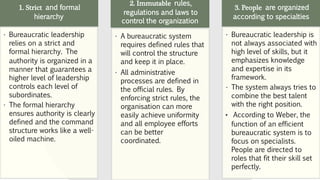
1. Strict and formal
hierarchy
• Bureaucratic leadership
relies on a strict and
formal hierarchy. The
authority is organized in a
manner that guarantees a
higher level of leadership
controls each level of
subordinates.
• The formal hierarchy
ensures authority is clearly
defined and the command
structure works like a well-
oiled machine.
2. Immutable rules,
regulations and laws to
control the organization
• A bureaucratic system
requires defined rules that
will control the structure
and keep it in place.
• All administrative
processes are defined in
the official rules. By
enforcing strict rules, the
organisation can more
easily achieve uniformity
and all employee efforts
can be better
coordinated.
3. People are organized
according to specialties
• Bureaucratic leadership is
not always associated with
high level of skills, but it
emphasizes knowledge
and expertise in its
framework.
• The system always tries to
combine the best talent
with the right position.
• According to Weber, the
function of an efficient
bureaucratic system is to
focus on specialists.
People are directed to
roles that fit their skill set
perfectly.
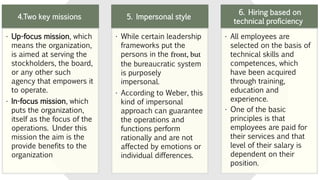
4.Two key missions
• Up-focus mission, which
means the organization,
is aimed at serving the
stockholders, the board,
or any other such
agency that empowers it
to operate.
• In-focus mission, which
puts the organization,
itself as the focus of the
operations. Under this
mission the aim is the
provide benefits to the
organization
5. Impersonal style
• While certain leadership
frameworks put the
persons in the front, but
the bureaucratic system
is purposely
impersonal.
• According to Weber, this
kind of impersonal
approach can guarantee
the operations and
functions perform
rationally and are not
affected by emotions or
individual differences.
6. Hiring based on
technical proficiency
• All employees are
selected on the basis of
technical skills and
competences, which
have been acquired
through training,
education and
experience.
• One of the basic
principles is that
employees are paid for
their services and that
level of their salary is
dependent on their
position.
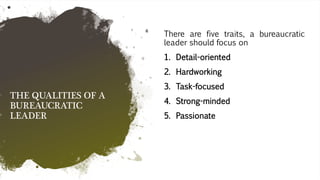
THE QUALITIES OF A
BUREAUCRATIC
LEADER
There are five traits, a bureaucratic
leader should focus on
1. Detail-oriented
2. Hardworking
3. Task-focused
4. Strong-minded
5. Passionate
Advantages of Bureaucracy
 Division of labor: Makes work easier; leads to specialization.
 Efficiency: Competency increases; work is efficiently done under the supervision of
immediate managers in the hierarchy.
 Accountability and answerability: Common citizens can hold government officials and
bureaucrats accountable for the actions performed.
 Rules and regulations: The set of rules and regulations that are clearly stated in most
cases makes obedience to them a prerequisite in the bureaucratic structure.
 Ease of administration: Makes administration easier; the organization is more rationally
arranged in a structural hierarchy.
Disadvantages of Bureaucracy
 Red tape: Bureaucracy by its very character follows a certain set of rules and regulations.
This imparts lack of flexibility and can often lead to inefficiency.
 Bureaucratic delays: The complicated set of rules in a bureaucratic system often causes
long delays.
 Bureaucratic corruption: Corruption in the higher rungs of bureaucracy can be very
disastrous to the economy.
 Paperwork: A lot of paperwork may be required even for very simple work.
 Nepotism: Nepotism in bureaucracy is often a problem. The managers sitting on top may
favor their own people and help them rise quicker than more deserving individuals.
EXAMPLE OF
FAMOUS
BUREAUCRATIC
LEADERS
Winston Churchill
 While the British Prime Minister, Winston Churchill, showed several different
leadership qualities, bureaucratic leadership is among the strongest models he
used. Churchill had charisma, which he used during the Second World War, but he
also relied on a heavily structured system to get things done.
 Churchill was also a detail-oriented leader, something that is a key trait in the
bureaucratic framework. He wanted to know everything involving different aspects
of the government and wartime military effort.
 He understood the importance of trial and error, knowing it’ll be inevitable to have
ups and downs in whatever you do. He smartly said, “Success is not final, failure is
not fatal; it is the courage to continue that counts.”
Bureaucratic leadership

Bureaucratic leadership

  • 1.
    BUREAUCRATIC LEADERSHIP Present to Ma'amZahra Presented by Ansha Shamas
  • 2.
    Origin and Meaning The term or word bureaucracy has two parts-one is bureau which means an office transacting particular business or a government department.  Cracy denotes a particular form of government.  Hence bureaucracy implies a system of government in which most of the decisions are taken by state officials rather than by elected representatives. So bureaucracy is a form of government run or managed by some officers
  • 3.
    Max Weber leadershipstyle  At the end of the 19th century, it was German sociologist Max Weber who was the first to use and describe the term bureaucracy. This is also known as the Bureaucratic Theory of management or the Max Weber theory.  He believed bureaucracy was the most efficient way to set up an organisation, administration and organizations.  Max Weber believed it was a better than traditional structures. In a bureaucracy, everyone is treated equal and the division of labour is clearly described for each employee.
  • 4.
    BUREAUCRACY DEFINITION  Bureaucracydefinition: “Bureaucracy is an organizational structure that is characterized by many rules, standardized processes, procedures and requirements, number of desks, meticulous division of labour and responsibility, clear hierarchies and professional, almost impersonal interactions between employees”  According to the Bureaucratic Theory of Max Weber, such a structure was indispensable in large organizations in structurally performing all tasks by a great number of employees.  In addition, in a bureaucracy, selection and promotion only occur on the basis of technical qualifications.
  • 5.
    Legal Responsibility  Accordingto the Bureaucratic Theory of Max Weber, three types of power can be found in organizations;  Traditional power,  Charismatic power  Legal power
  • 6.
    THE CORE ELEMENTS OFBUREAUCRATIC LEADERSHIP
  • 7.
    1. Strict andformal hierarchy • Bureaucratic leadership relies on a strict and formal hierarchy. The authority is organized in a manner that guarantees a higher level of leadership controls each level of subordinates. • The formal hierarchy ensures authority is clearly defined and the command structure works like a well- oiled machine. 2. Immutable rules, regulations and laws to control the organization • A bureaucratic system requires defined rules that will control the structure and keep it in place. • All administrative processes are defined in the official rules. By enforcing strict rules, the organisation can more easily achieve uniformity and all employee efforts can be better coordinated. 3. People are organized according to specialties • Bureaucratic leadership is not always associated with high level of skills, but it emphasizes knowledge and expertise in its framework. • The system always tries to combine the best talent with the right position. • According to Weber, the function of an efficient bureaucratic system is to focus on specialists. People are directed to roles that fit their skill set perfectly.
  • 8.
    4.Two key missions •Up-focus mission, which means the organization, is aimed at serving the stockholders, the board, or any other such agency that empowers it to operate. • In-focus mission, which puts the organization, itself as the focus of the operations. Under this mission the aim is the provide benefits to the organization 5. Impersonal style • While certain leadership frameworks put the persons in the front, but the bureaucratic system is purposely impersonal. • According to Weber, this kind of impersonal approach can guarantee the operations and functions perform rationally and are not affected by emotions or individual differences. 6. Hiring based on technical proficiency • All employees are selected on the basis of technical skills and competences, which have been acquired through training, education and experience. • One of the basic principles is that employees are paid for their services and that level of their salary is dependent on their position.
  • 9.
    THE QUALITIES OFA BUREAUCRATIC LEADER There are five traits, a bureaucratic leader should focus on 1. Detail-oriented 2. Hardworking 3. Task-focused 4. Strong-minded 5. Passionate
  • 10.
    Advantages of Bureaucracy Division of labor: Makes work easier; leads to specialization.  Efficiency: Competency increases; work is efficiently done under the supervision of immediate managers in the hierarchy.  Accountability and answerability: Common citizens can hold government officials and bureaucrats accountable for the actions performed.  Rules and regulations: The set of rules and regulations that are clearly stated in most cases makes obedience to them a prerequisite in the bureaucratic structure.  Ease of administration: Makes administration easier; the organization is more rationally arranged in a structural hierarchy.
  • 11.
    Disadvantages of Bureaucracy Red tape: Bureaucracy by its very character follows a certain set of rules and regulations. This imparts lack of flexibility and can often lead to inefficiency.  Bureaucratic delays: The complicated set of rules in a bureaucratic system often causes long delays.  Bureaucratic corruption: Corruption in the higher rungs of bureaucracy can be very disastrous to the economy.  Paperwork: A lot of paperwork may be required even for very simple work.  Nepotism: Nepotism in bureaucracy is often a problem. The managers sitting on top may favor their own people and help them rise quicker than more deserving individuals.
  • 12.
  • 13.
    Winston Churchill  Whilethe British Prime Minister, Winston Churchill, showed several different leadership qualities, bureaucratic leadership is among the strongest models he used. Churchill had charisma, which he used during the Second World War, but he also relied on a heavily structured system to get things done.  Churchill was also a detail-oriented leader, something that is a key trait in the bureaucratic framework. He wanted to know everything involving different aspects of the government and wartime military effort.  He understood the importance of trial and error, knowing it’ll be inevitable to have ups and downs in whatever you do. He smartly said, “Success is not final, failure is not fatal; it is the courage to continue that counts.”