FRUIT RIPENING CONDITIONS
Ilyana Causing & Sharmaine Ylanan
Introduction
• Fruits can be classified into two groups:
• Climacteric and Non-climacteric
• Biale and Barcus published measurements of the respiration rate of
some fruits
• They classified them into Climacteric, Non-climacteric and Indeterminate
• Respiration rate of non-climacteric fruit and vegetables tends to
decrease during development
• Ripening involves physical and chemical changes in the fruit
• This occur after the fruit is at full maturity
Introduction
• Immature fruit may be harvested and exposed to postharvest
conditions that are conductive to ripening
• Temperature, Gas content in the atmosphere, and Humidity
• Initiation of ripening occurs when the threshold level of ethylene
reached the cells of the fruit
• Can occur naturally during maturity or if the fruit undergoes stress
Changes During Fruit Ripening
• Color
• Texture
• Carbohydrates
• Acids
• Phenolic Compounds
• Flavor and Aroma
• Toxicity
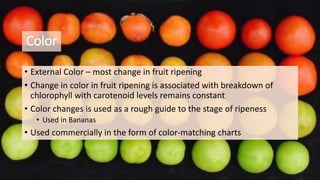
Color
• External Color – most change in fruit ripening
• Change in color in fruit ripening is associated with breakdown of
chlorophyll with carotenoid levels remains constant
• Color changes is used as a rough guide to the stage of ripeness
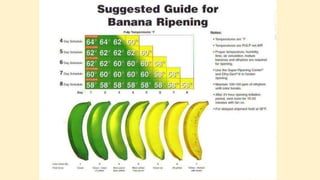
• Used in Bananas
• Used commercially in the form of color-matching charts
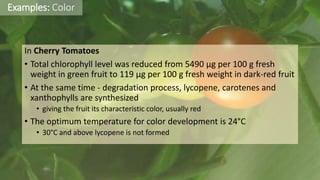
Examples: Color
In Cherry Tomatoes
• Total chlorophyll level was reduced from 5490 μg per 100 g fresh
weight in green fruit to 119 μg per 100 g fresh weight in dark-red fruit
• At the same time - degradation process, lycopene, carotenes and
xanthophylls are synthesized
• giving the fruit its characteristic color, usually red
• The optimum temperature for color development is 24°C
• 30°C and above lycopene is not formed
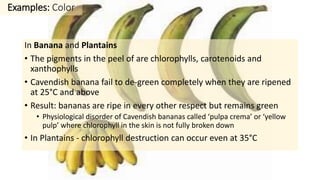
In Banana and Plantains
• The pigments in the peel of are chlorophylls, carotenoids and
xanthophylls
• Cavendish banana fail to de-green completely when they are ripened
at 25°C and above
• Result: bananas are ripe in every other respect but remains green
• Physiological disorder of Cavendish bananas called ‘pulpa crema’ or ‘yellow
pulp’ where chlorophyll in the skin is not fully broken down
• In Plantains - chlorophyll destruction can occur even at 35°C
Examples: Color
Texture
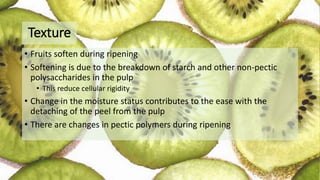
• Fruits soften during ripening
• Softening is due to the breakdown of starch and other non-pectic
polysaccharides in the pulp
• This reduce cellular rigidity
• Change in the moisture status contributes to the ease with the
detaching of the peel from the pulp
• There are changes in pectic polymers during ripening
Texture
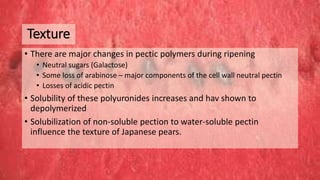
• There are major changes in pectic polymers during ripening
• Neutral sugars (Galactose)
• Some loss of arabinose – major components of the cell wall neutral pectin
• Losses of acidic pectin
• Solubility of these polyuronides increases and hav shown to
depolymerized
• Solubilization of non-soluble pection to water-soluble pectin
influence the texture of Japanese pears.
Texture
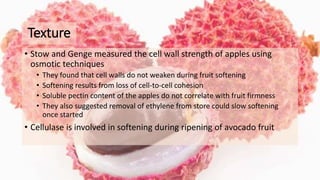
• Stow and Genge measured the cell wall strength of apples using
osmotic techniques
• They found that cell walls do not weaken during fruit softening
• Softening results from loss of cell-to-cell cohesion
• Soluble pectin content of the apples do not correlate with fruit firmness
• They also suggested removal of ethylene from store could slow softening
once started
• Cellulase is involved in softening during ripening of avocado fruit
Texture
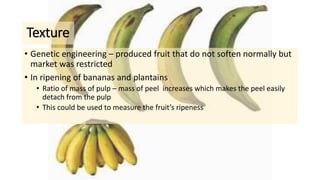
• Genetic engineering – produced fruit that do not soften normally but
market was restricted
• In ripening of bananas and plantains
• Ratio of mass of pulp – mass of peel increases which makes the peel easily
detach from the pulp
• This could be used to measure the fruit’s ripeness
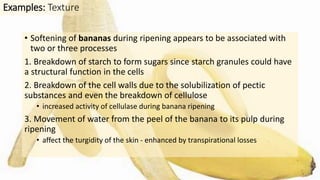
• Softening of bananas during ripening appears to be associated with
two or three processes
1. Breakdown of starch to form sugars since starch granules could have
a structural function in the cells
2. Breakdown of the cell walls due to the solubilization of pectic
substances and even the breakdown of cellulose
• increased activity of cellulase during banana ripening
3. Movement of water from the peel of the banana to its pulp during
ripening
• affect the turgidity of the skin - enhanced by transpirational losses
Examples: Texture
Carbohydrates
• In Climacteric fruit there is increase in starch content during
development
• Hydrolysis of starch to simple sugars is a chemical change during
ripening
• Early part of ripening – Sucrose is the predominant sugar
• Later stage – Glucose and Fructose predominates
• Proportion of different sugars is related to the stage in the respiratory
climacteric of the fruit
Carbohydrates
• Starch is broken down to sucrose – by action of sucrose phosphate
synthetase
• Non-reducing sugar from sucrose – by acid hydrolysis
• Starch-sugar conversion is influenced by harvest maturity
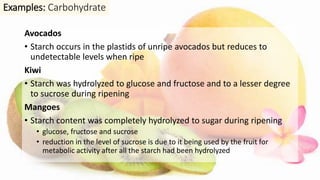
Avocados
• Starch occurs in the plastids of unripe avocados but reduces to
undetectable levels when ripe
Kiwi
• Starch was hydrolyzed to glucose and fructose and to a lesser degree
to sucrose during ripening
Mangoes
• Starch content was completely hydrolyzed to sugar during ripening
• glucose, fructose and sucrose
• reduction in the level of sucrose is due to it being used by the fruit for
metabolic activity after all the starch had been hydrolyzed
Examples: Carbohydrate
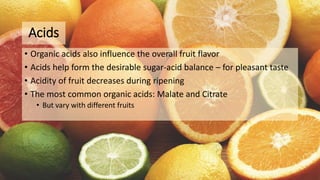
Acids
• Organic acids also influence the overall fruit flavor
• Acids help form the desirable sugar-acid balance – for pleasant taste
• Acidity of fruit decreases during ripening
• The most common organic acids: Malate and Citrate
• But vary with different fruits
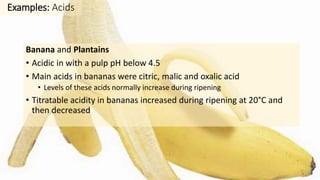
Banana and Plantains
• Acidic in with a pulp pH below 4.5
• Main acids in bananas were citric, malic and oxalic acid
• Levels of these acids normally increase during ripening
• Titratable acidity in bananas increased during ripening at 20°C and
then decreased
Examples: Acids
Phenolic Compounds
• Phenolic (i.e. Tannins) are polymerized to insoluble compounds
• It reduce astringency in the ripe banana fruit
• Tannins most important phenolic compound
• give fruit an astringency taste
• As fruit ripens astringency decreases
• Tannins form polymers due to change in structure
• Phenolics are responsible for the oxidative browning reaction in
immature fruit
• Polyphenol oxidase – responsible for this reaction
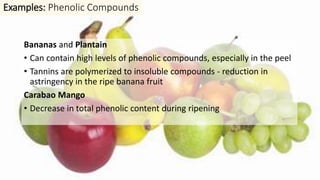
Bananas and Plantain
• Can contain high levels of phenolic compounds, especially in the peel
• Tannins are polymerized to insoluble compounds - reduction in
astringency in the ripe banana fruit
Carabao Mango
• Decrease in total phenolic content during ripening
Examples: Phenolic Compounds
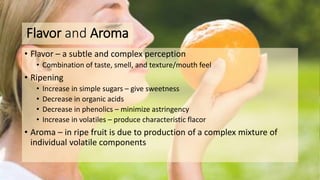
Flavor and Aroma
• Flavor – a subtle and complex perception
• Combination of taste, smell, and texture/mouth feel
• Ripening
• Increase in simple sugars – give sweetness
• Decrease in organic acids
• Decrease in phenolics – minimize astringency
• Increase in volatiles – produce characteristic flacor
• Aroma – in ripe fruit is due to production of a complex mixture of
individual volatile components
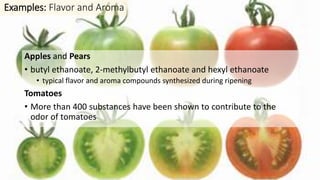
Apples and Pears
• butyl ethanoate, 2-methylbutyl ethanoate and hexyl ethanoate
• typical flavor and aroma compounds synthesized during ripening
Tomatoes
• More than 400 substances have been shown to contribute to the
odor of tomatoes
Examples: Flavor and Aroma
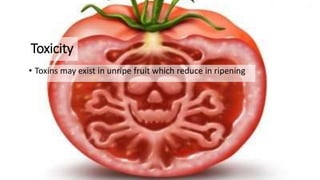
Toxicity
• Toxins may exist in unripe fruit which reduce in ripening
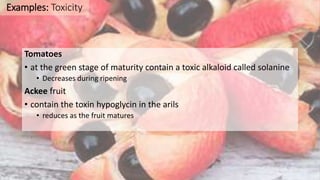
Tomatoes
• at the green stage of maturity contain a toxic alkaloid called solanine
• Decreases during ripening
Ackee fruit
• contain the toxin hypoglycin in the arils
• reduces as the fruit matures
Examples: Toxicity
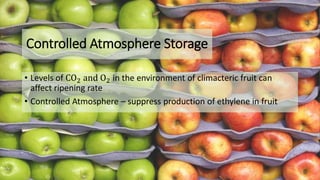
Controlled Atmosphere Storage
• Levels of CO2 and O2 in the environment of climacteric fruit can
affect ripening rate
• Controlled Atmosphere – suppress production of ethylene in fruit
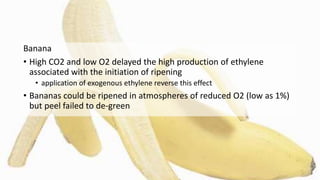
Banana
• High CO2 and low O2 delayed the high production of ethylene
associated with the initiation of ripening
• application of exogenous ethylene reverse this effect
• Bananas could be ripened in atmospheres of reduced O2 (low as 1%)
but peel failed to de-green
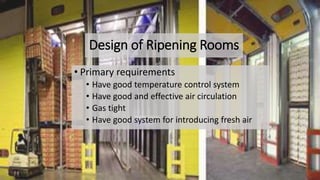
Design of Ripening Rooms
• Primary requirements
• Have good temperature control system
• Have good and effective air circulation
• Gas tight
• Have good system for introducing fresh air
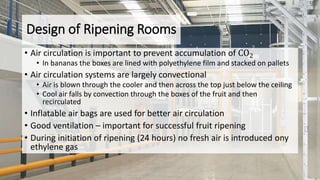
Design of Ripening Rooms
• Air circulation is important to prevent accumulation of CO2
• In bananas the boxes are lined with polyethylene film and stacked on pallets
• Air circulation systems are largely convectional
• Air is blown through the cooler and then across the top just below the ceiling
• Cool air falls by convection through the boxes of the fruit and then
recirculated
• Inflatable air bags are used for better air circulation
• Good ventilation – important for successful fruit ripening
• During initiation of ripening (24 hours) no fresh air is introduced ony
ethylene gas
Design of Ripening Rooms
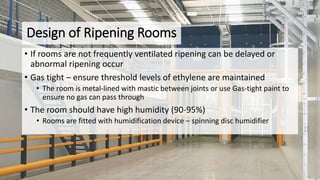
• If rooms are not frequently ventilated ripening can be delayed or
abnormal ripening occur
• Gas tight – ensure threshold levels of ethylene are maintained
• The room is metal-lined with mastic between joints or use Gas-tight paint to
ensure no gas can pass through
• The room should have high humidity (90-95%)
• Rooms are fitted with humidification device – spinning disc humidifier
Ethylene on Ripening
• Change in physiology of climacteric fruit from maturation to ripening
is initiated when cellular quantities of ethylene reach a threshold level
• High levels of CO2 in stores could compete with ethylene for binding
sites in fruits
• CO2 accumulation in the intercellular spaces of fruit acts as an ethylene
antagonist
• Increase in ethylene synthesis is followed by changes in the fruits
physiology, texture and composition
Ethylene on Ripening
• Threshold levels of ethylene will be reached naturally at fruit
maturity
• Can also arise by the fruit being put under stress during
production (water shortage, infection by disease-causing
organisms, mechanical damage and exposing fruit to low
humidity)
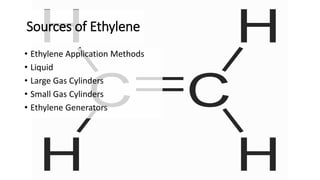
Sources of Ethylene
• Ethylene Application Methods
• Liquid
• Large Gas Cylinders
• Small Gas Cylinders
• Ethylene Generators
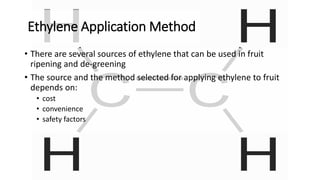
Ethylene Application Method
• There are several sources of ethylene that can be used in fruit
ripening and de-greening
• The source and the method selected for applying ethylene to fruit
depends on:
• cost
• convenience
• safety factors
Liquid
• Ethrel or Etheph on (2- chloroethylphosphonic acid) is used as a
source of ethylene. Ethrel is hydrolyzed in plant tissue to produce
ethylene, phosphate and chloride
• Ethylene can also be released from Ethrel by mixing it with a base
such as sodium hydroxide
• Ethrel ‘C’ - will release 93 g from 1 litre or 74.4 litres of ethylene gas per litre
of Ethrel
• Used initiate fruit to ripen by placing containers of Ethrel in a gas-tight room
containing the fruit and then adding the base to the containers
Large Gas Cylinders
• Ethylene is available in large steel cylinders where it is stored under
pressure
• Use of large cylinders of the pure gas is discouraged –Ethylene is
highly flammable
• Dilution with nitrogen – allow margin for error
• Application: Volume of the room should have been previously
calculated and the volume of ethylene introduced calculated with a
flow meter and a stop-watch
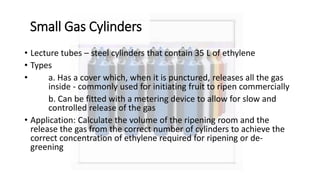
Small Gas Cylinders
• Lecture tubes – steel cylinders that contain 35 L of ethylene
• Types
• a. Has a cover which, when it is punctured, releases all the gas
inside - commonly used for initiating fruit to ripen commercially
b. Can be fitted with a metering device to allow for slow and
controlled release of the gas
• Application: Calculate the volume of the ripening room and the
release the gas from the correct number of cylinders to achieve the
correct concentration of ethylene required for ripening or de-
greening
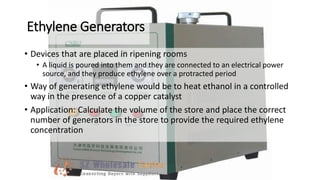
Ethylene Generators
• Devices that are placed in ripening rooms
• A liquid is poured into them and they are connected to an electrical power
source, and they produce ethylene over a protracted period
• Way of generating ethylene would be to heat ethanol in a controlled
way in the presence of a copper catalyst
• Application: Calculate the volume of the store and place the correct
number of generators in the store to provide the required ethylene
concentration
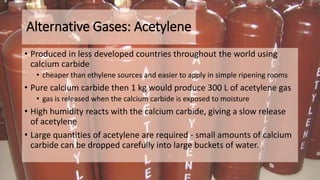
Alternative Gases: Acetylene
• Produced in less developed countries throughout the world using
calcium carbide
• cheaper than ethylene sources and easier to apply in simple ripening rooms
• Pure calcium carbide then 1 kg would produce 300 L of acetylene gas
• gas is released when the calcium carbide is exposed to moisture
• High humidity reacts with the calcium carbide, giving a slow release
of acetylene
• Large quantities of acetylene are required - small amounts of calcium
carbide can be dropped carefully into large buckets of water.
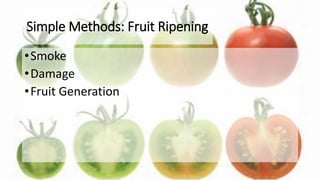
Simple Methods: Fruit Ripening
•Smoke
•Damage
•Fruit Generation
Smoke
• Smoky fire is lit in the ripening room
• Produce various gases, including acetylene, ethylene and carbon
monoxide – initiate ripening
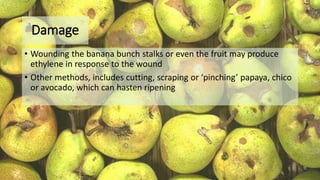
Damage
• Wounding the banana bunch stalks or even the fruit may produce
ethylene in response to the wound
• Other methods, includes cutting, scraping or ‘pinching’ papaya, chico
or avocado, which can hasten ripening
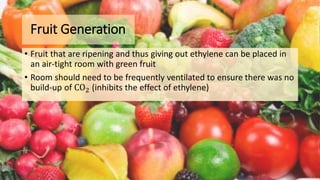
Fruit Generation
• Fruit that are ripening and thus giving out ethylene can be placed in
an air-tight room with green fruit
• Room should need to be frequently ventilated to ensure there was no
build-up of CO2 (inhibits the effect of ethylene)

Fruit Ripening Conditions

  • 1.
    FRUIT RIPENING CONDITIONS IlyanaCausing & Sharmaine Ylanan
  • 2.
    Introduction • Fruits canbe classified into two groups: • Climacteric and Non-climacteric • Biale and Barcus published measurements of the respiration rate of some fruits • They classified them into Climacteric, Non-climacteric and Indeterminate • Respiration rate of non-climacteric fruit and vegetables tends to decrease during development • Ripening involves physical and chemical changes in the fruit • This occur after the fruit is at full maturity
  • 3.
    Introduction • Immature fruitmay be harvested and exposed to postharvest conditions that are conductive to ripening • Temperature, Gas content in the atmosphere, and Humidity • Initiation of ripening occurs when the threshold level of ethylene reached the cells of the fruit • Can occur naturally during maturity or if the fruit undergoes stress
  • 4.
    Changes During FruitRipening • Color • Texture • Carbohydrates • Acids • Phenolic Compounds • Flavor and Aroma • Toxicity
  • 5.
    Color • External Color– most change in fruit ripening • Change in color in fruit ripening is associated with breakdown of chlorophyll with carotenoid levels remains constant • Color changes is used as a rough guide to the stage of ripeness • Used in Bananas • Used commercially in the form of color-matching charts
  • 6.
    Examples: Color In CherryTomatoes • Total chlorophyll level was reduced from 5490 μg per 100 g fresh weight in green fruit to 119 μg per 100 g fresh weight in dark-red fruit • At the same time - degradation process, lycopene, carotenes and xanthophylls are synthesized • giving the fruit its characteristic color, usually red • The optimum temperature for color development is 24°C • 30°C and above lycopene is not formed
  • 7.
    In Banana andPlantains • The pigments in the peel of are chlorophylls, carotenoids and xanthophylls • Cavendish banana fail to de-green completely when they are ripened at 25°C and above • Result: bananas are ripe in every other respect but remains green • Physiological disorder of Cavendish bananas called ‘pulpa crema’ or ‘yellow pulp’ where chlorophyll in the skin is not fully broken down • In Plantains - chlorophyll destruction can occur even at 35°C Examples: Color
  • 9.
    Texture • Fruits softenduring ripening • Softening is due to the breakdown of starch and other non-pectic polysaccharides in the pulp • This reduce cellular rigidity • Change in the moisture status contributes to the ease with the detaching of the peel from the pulp • There are changes in pectic polymers during ripening
  • 10.
    Texture • There aremajor changes in pectic polymers during ripening • Neutral sugars (Galactose) • Some loss of arabinose – major components of the cell wall neutral pectin • Losses of acidic pectin • Solubility of these polyuronides increases and hav shown to depolymerized • Solubilization of non-soluble pection to water-soluble pectin influence the texture of Japanese pears.
  • 11.
    Texture • Stow andGenge measured the cell wall strength of apples using osmotic techniques • They found that cell walls do not weaken during fruit softening • Softening results from loss of cell-to-cell cohesion • Soluble pectin content of the apples do not correlate with fruit firmness • They also suggested removal of ethylene from store could slow softening once started • Cellulase is involved in softening during ripening of avocado fruit
  • 12.
    Texture • Genetic engineering– produced fruit that do not soften normally but market was restricted • In ripening of bananas and plantains • Ratio of mass of pulp – mass of peel increases which makes the peel easily detach from the pulp • This could be used to measure the fruit’s ripeness
  • 13.
    • Softening ofbananas during ripening appears to be associated with two or three processes 1. Breakdown of starch to form sugars since starch granules could have a structural function in the cells 2. Breakdown of the cell walls due to the solubilization of pectic substances and even the breakdown of cellulose • increased activity of cellulase during banana ripening 3. Movement of water from the peel of the banana to its pulp during ripening • affect the turgidity of the skin - enhanced by transpirational losses Examples: Texture
  • 14.
    Carbohydrates • In Climactericfruit there is increase in starch content during development • Hydrolysis of starch to simple sugars is a chemical change during ripening • Early part of ripening – Sucrose is the predominant sugar • Later stage – Glucose and Fructose predominates • Proportion of different sugars is related to the stage in the respiratory climacteric of the fruit
  • 15.
    Carbohydrates • Starch isbroken down to sucrose – by action of sucrose phosphate synthetase • Non-reducing sugar from sucrose – by acid hydrolysis • Starch-sugar conversion is influenced by harvest maturity
  • 16.
    Avocados • Starch occursin the plastids of unripe avocados but reduces to undetectable levels when ripe Kiwi • Starch was hydrolyzed to glucose and fructose and to a lesser degree to sucrose during ripening Mangoes • Starch content was completely hydrolyzed to sugar during ripening • glucose, fructose and sucrose • reduction in the level of sucrose is due to it being used by the fruit for metabolic activity after all the starch had been hydrolyzed Examples: Carbohydrate
  • 17.
    Acids • Organic acidsalso influence the overall fruit flavor • Acids help form the desirable sugar-acid balance – for pleasant taste • Acidity of fruit decreases during ripening • The most common organic acids: Malate and Citrate • But vary with different fruits
  • 18.
    Banana and Plantains •Acidic in with a pulp pH below 4.5 • Main acids in bananas were citric, malic and oxalic acid • Levels of these acids normally increase during ripening • Titratable acidity in bananas increased during ripening at 20°C and then decreased Examples: Acids
  • 19.
    Phenolic Compounds • Phenolic(i.e. Tannins) are polymerized to insoluble compounds • It reduce astringency in the ripe banana fruit • Tannins most important phenolic compound • give fruit an astringency taste • As fruit ripens astringency decreases • Tannins form polymers due to change in structure • Phenolics are responsible for the oxidative browning reaction in immature fruit • Polyphenol oxidase – responsible for this reaction
  • 20.
    Bananas and Plantain •Can contain high levels of phenolic compounds, especially in the peel • Tannins are polymerized to insoluble compounds - reduction in astringency in the ripe banana fruit Carabao Mango • Decrease in total phenolic content during ripening Examples: Phenolic Compounds
  • 21.
    Flavor and Aroma •Flavor – a subtle and complex perception • Combination of taste, smell, and texture/mouth feel • Ripening • Increase in simple sugars – give sweetness • Decrease in organic acids • Decrease in phenolics – minimize astringency • Increase in volatiles – produce characteristic flacor • Aroma – in ripe fruit is due to production of a complex mixture of individual volatile components
  • 22.
    Apples and Pears •butyl ethanoate, 2-methylbutyl ethanoate and hexyl ethanoate • typical flavor and aroma compounds synthesized during ripening Tomatoes • More than 400 substances have been shown to contribute to the odor of tomatoes Examples: Flavor and Aroma
  • 23.
    Toxicity • Toxins mayexist in unripe fruit which reduce in ripening
  • 24.
    Tomatoes • at thegreen stage of maturity contain a toxic alkaloid called solanine • Decreases during ripening Ackee fruit • contain the toxin hypoglycin in the arils • reduces as the fruit matures Examples: Toxicity
  • 25.
    Controlled Atmosphere Storage •Levels of CO2 and O2 in the environment of climacteric fruit can affect ripening rate • Controlled Atmosphere – suppress production of ethylene in fruit
  • 26.
    Banana • High CO2and low O2 delayed the high production of ethylene associated with the initiation of ripening • application of exogenous ethylene reverse this effect • Bananas could be ripened in atmospheres of reduced O2 (low as 1%) but peel failed to de-green
  • 27.
    Design of RipeningRooms • Primary requirements • Have good temperature control system • Have good and effective air circulation • Gas tight • Have good system for introducing fresh air
  • 28.
    Design of RipeningRooms • Air circulation is important to prevent accumulation of CO2 • In bananas the boxes are lined with polyethylene film and stacked on pallets • Air circulation systems are largely convectional • Air is blown through the cooler and then across the top just below the ceiling • Cool air falls by convection through the boxes of the fruit and then recirculated • Inflatable air bags are used for better air circulation • Good ventilation – important for successful fruit ripening • During initiation of ripening (24 hours) no fresh air is introduced ony ethylene gas
  • 29.
    Design of RipeningRooms • If rooms are not frequently ventilated ripening can be delayed or abnormal ripening occur • Gas tight – ensure threshold levels of ethylene are maintained • The room is metal-lined with mastic between joints or use Gas-tight paint to ensure no gas can pass through • The room should have high humidity (90-95%) • Rooms are fitted with humidification device – spinning disc humidifier
  • 30.
    Ethylene on Ripening •Change in physiology of climacteric fruit from maturation to ripening is initiated when cellular quantities of ethylene reach a threshold level • High levels of CO2 in stores could compete with ethylene for binding sites in fruits • CO2 accumulation in the intercellular spaces of fruit acts as an ethylene antagonist • Increase in ethylene synthesis is followed by changes in the fruits physiology, texture and composition
  • 31.
    Ethylene on Ripening •Threshold levels of ethylene will be reached naturally at fruit maturity • Can also arise by the fruit being put under stress during production (water shortage, infection by disease-causing organisms, mechanical damage and exposing fruit to low humidity)
  • 32.
    Sources of Ethylene •Ethylene Application Methods • Liquid • Large Gas Cylinders • Small Gas Cylinders • Ethylene Generators
  • 33.
    Ethylene Application Method •There are several sources of ethylene that can be used in fruit ripening and de-greening • The source and the method selected for applying ethylene to fruit depends on: • cost • convenience • safety factors
  • 34.
    Liquid • Ethrel orEtheph on (2- chloroethylphosphonic acid) is used as a source of ethylene. Ethrel is hydrolyzed in plant tissue to produce ethylene, phosphate and chloride • Ethylene can also be released from Ethrel by mixing it with a base such as sodium hydroxide • Ethrel ‘C’ - will release 93 g from 1 litre or 74.4 litres of ethylene gas per litre of Ethrel • Used initiate fruit to ripen by placing containers of Ethrel in a gas-tight room containing the fruit and then adding the base to the containers
  • 35.
    Large Gas Cylinders •Ethylene is available in large steel cylinders where it is stored under pressure • Use of large cylinders of the pure gas is discouraged –Ethylene is highly flammable • Dilution with nitrogen – allow margin for error • Application: Volume of the room should have been previously calculated and the volume of ethylene introduced calculated with a flow meter and a stop-watch
  • 36.
    Small Gas Cylinders •Lecture tubes – steel cylinders that contain 35 L of ethylene • Types • a. Has a cover which, when it is punctured, releases all the gas inside - commonly used for initiating fruit to ripen commercially b. Can be fitted with a metering device to allow for slow and controlled release of the gas • Application: Calculate the volume of the ripening room and the release the gas from the correct number of cylinders to achieve the correct concentration of ethylene required for ripening or de- greening
  • 37.
    Ethylene Generators • Devicesthat are placed in ripening rooms • A liquid is poured into them and they are connected to an electrical power source, and they produce ethylene over a protracted period • Way of generating ethylene would be to heat ethanol in a controlled way in the presence of a copper catalyst • Application: Calculate the volume of the store and place the correct number of generators in the store to provide the required ethylene concentration
  • 38.
    Alternative Gases: Acetylene •Produced in less developed countries throughout the world using calcium carbide • cheaper than ethylene sources and easier to apply in simple ripening rooms • Pure calcium carbide then 1 kg would produce 300 L of acetylene gas • gas is released when the calcium carbide is exposed to moisture • High humidity reacts with the calcium carbide, giving a slow release of acetylene • Large quantities of acetylene are required - small amounts of calcium carbide can be dropped carefully into large buckets of water.
  • 39.
    Simple Methods: FruitRipening •Smoke •Damage •Fruit Generation
  • 40.
    Smoke • Smoky fireis lit in the ripening room • Produce various gases, including acetylene, ethylene and carbon monoxide – initiate ripening
  • 41.
    Damage • Wounding thebanana bunch stalks or even the fruit may produce ethylene in response to the wound • Other methods, includes cutting, scraping or ‘pinching’ papaya, chico or avocado, which can hasten ripening
  • 42.
    Fruit Generation • Fruitthat are ripening and thus giving out ethylene can be placed in an air-tight room with green fruit • Room should need to be frequently ventilated to ensure there was no build-up of CO2 (inhibits the effect of ethylene)

Editor's Notes

  • #9 Advanced stages of banana ripeness are characterized by the appearance of brown flecks or spots on the skin