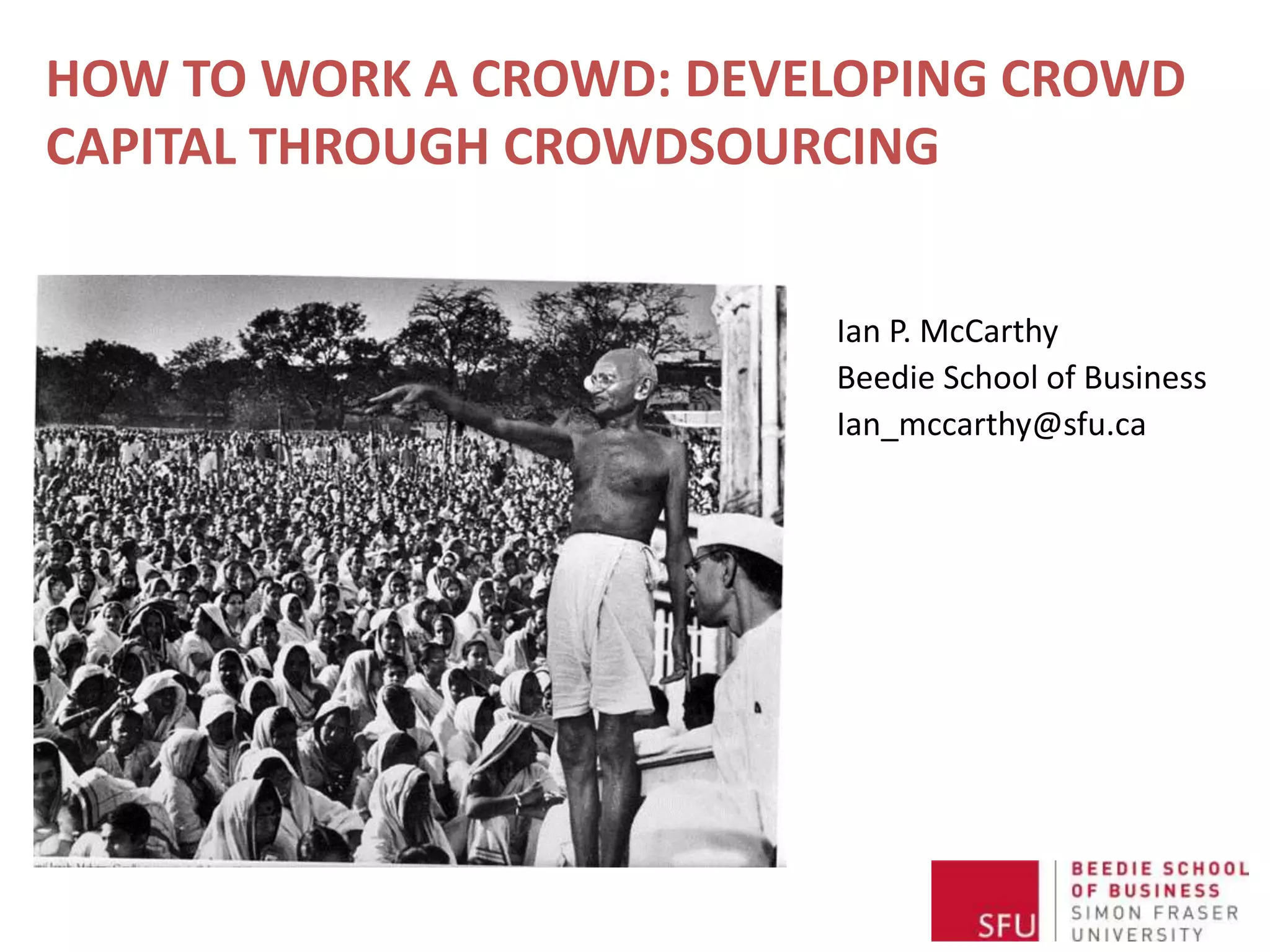
HOW TO WORK A CROWD: DEVELOPING CROWD
CAPITAL THROUGH CROWDSOURCING
Ian P. McCarthy
Beedie School of Business
Ian_mccarthy@sfu.ca
Based on the following
research:
Prpić, J., Shukla, P. P.,
Kietzmann, J. H., & McCarthy,
I. P. (2015). How to work a
crowd: Developing crowd
capital through
crowdsourcing. Business
Horizons, 58(1), 77-85.
Access the full paper here.
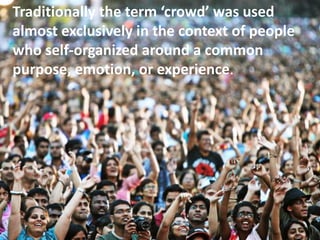
Traditionally the term ‘crowd’ was used
almost exclusively in the context of people
who self-organized around a common
purpose, emotion, or experience.
CROWDSOURCING DEFINED
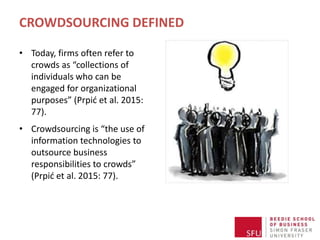
• Today, firms often refer to
crowds as “collections of
individuals who can be
engaged for organizational
purposes” (Prpić et al. 2015:
77).
• Crowdsourcing is “the use of
information technologies to
outsource business
responsibilities to crowds”
(Prpić et al. 2015: 77).
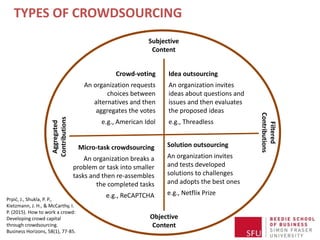
TYPES OF CROWDSOURCING
Crowd-voting
An organization requests
choices between
alternatives and then
aggregates the votes
e.g., American Idol
Idea crowdsourcing
An organization invites
ideas about questions and
issues and then evaluates
the proposed ideas
e.g., Threadless
Micro-task crowdsourcing
An organization breaks a
problem or task into smaller
tasks and then re-assembles
the completed tasks
e.g., ReCAPTCHA
Solution crowrdsourcing
An organization invites
and tests developed
solutions to challenges
and adopts the best ones
e.g., Netflix Prize
Subjective
Content
Objective
Content
Aggregated
Contributions
Filtered
Contributions
Prpić, J., Shukla, P. P.,
Kietzmann, J. H., & McCarthy, I.
P. (2015). How to work a crowd:
Developing crowd capital
through crowdsourcing.
Business Horizons, 58(1), 77-85.
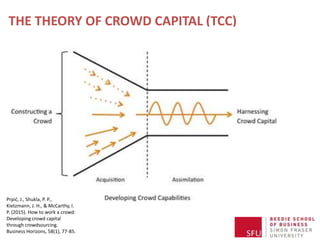
THE THEORY OF CROWD CAPITAL (TCC)
Prpić, J., Shukla, P. P.,
Kietzmann, J. H., & McCarthy, I.
P. (2015). How to work a crowd:
Developing crowd capital
through crowdsourcing.
Business Horizons, 58(1), 77-85.
1. Determine why you want to crowdsource. Why do you want to
outsource a task to a crowd?
2. Define the population of individuals needed to perform the
task. Who are they? Where are they? Why will they help? How
will they help? How diverse is the population? How
independent are the individuals?
3. Determine the simple rules that individuals would follow so as
to (i) construct the crowd, and (ii) harness the capital of the
crowd.
4. Determine the technologies needed to acquire and assimilate
the capital from the crowd.
HOW TO WORK A CROWD
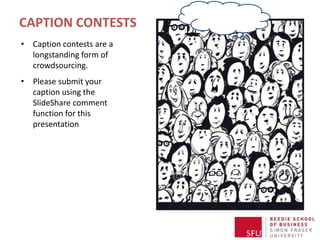
CAPTION CONTESTS
• Caption contests are a
longstanding form of
crowdsourcing.
• Please submit your
caption using the
SlideShare comment
function for this
presentation

How to work a crowd: Developing crowd capital through crowdsourcing

  • 1.
    HOW TO WORKA CROWD: DEVELOPING CROWD CAPITAL THROUGH CROWDSOURCING Ian P. McCarthy Beedie School of Business Ian_mccarthy@sfu.ca
  • 2.
    Based on thefollowing research: Prpić, J., Shukla, P. P., Kietzmann, J. H., & McCarthy, I. P. (2015). How to work a crowd: Developing crowd capital through crowdsourcing. Business Horizons, 58(1), 77-85. Access the full paper here.
  • 3.
    Traditionally the term‘crowd’ was used almost exclusively in the context of people who self-organized around a common purpose, emotion, or experience.
  • 4.
    CROWDSOURCING DEFINED • Today,firms often refer to crowds as “collections of individuals who can be engaged for organizational purposes” (Prpić et al. 2015: 77). • Crowdsourcing is “the use of information technologies to outsource business responsibilities to crowds” (Prpić et al. 2015: 77).
  • 5.
    TYPES OF CROWDSOURCING Crowd-voting Anorganization requests choices between alternatives and then aggregates the votes e.g., American Idol Idea crowdsourcing An organization invites ideas about questions and issues and then evaluates the proposed ideas e.g., Threadless Micro-task crowdsourcing An organization breaks a problem or task into smaller tasks and then re-assembles the completed tasks e.g., ReCAPTCHA Solution crowrdsourcing An organization invites and tests developed solutions to challenges and adopts the best ones e.g., Netflix Prize Subjective Content Objective Content Aggregated Contributions Filtered Contributions Prpić, J., Shukla, P. P., Kietzmann, J. H., & McCarthy, I. P. (2015). How to work a crowd: Developing crowd capital through crowdsourcing. Business Horizons, 58(1), 77-85.
  • 6.
    THE THEORY OFCROWD CAPITAL (TCC) Prpić, J., Shukla, P. P., Kietzmann, J. H., & McCarthy, I. P. (2015). How to work a crowd: Developing crowd capital through crowdsourcing. Business Horizons, 58(1), 77-85.
  • 7.
    1. Determine whyyou want to crowdsource. Why do you want to outsource a task to a crowd? 2. Define the population of individuals needed to perform the task. Who are they? Where are they? Why will they help? How will they help? How diverse is the population? How independent are the individuals? 3. Determine the simple rules that individuals would follow so as to (i) construct the crowd, and (ii) harness the capital of the crowd. 4. Determine the technologies needed to acquire and assimilate the capital from the crowd. HOW TO WORK A CROWD
  • 8.
    CAPTION CONTESTS • Captioncontests are a longstanding form of crowdsourcing. • Please submit your caption using the SlideShare comment function for this presentation