Photo:DavidBrazier/IWMIPhoto:TomvanCakenberghe/IWMIPhoto:DavidBrazier/IWMIPhoto:DavidBrazier/IWMI
Hydropower development and
livelihoods: A quest for a balanced
approach through research and
partnerships
Sonali Senaratna Sellamuttu, Olivier Joffre, Nguyen
Duy Phuong, Jharendu Pant, Bounthanom Bouaham
and Anousith Keophoxay
Fifth International Conference on Water Resources and Hydropower
Development in Asia, Colombo, Sri Lanka
11-13 March 2014
www.iwmi.org
A water-secure world
Background
• The Mekong River Basin faces massive development
investment with regard to hydropower.
• Little attention given to how dams can be constructed
and operated in ways that optimize benefits for all
water users, including riparian communities.
• Involuntary displacements mean local people are
often unable to engage in their original livelihood
activities.
www.iwmi.org
A water-secure world
Research Objective
• Identify and pilot test innovative livelihood options
that use the new environmental conditions created
as a result of the hydropower development.
3
www.iwmi.org
A water-secure world
Sites CPWF Mekong Project are focusing on
• Theun Hinboun
Expansion Project
(THXP), Lao PDR
• Yali, Vietnam
www.iwmi.org
A water-secure world
Participatory impact pathways and
partnerships
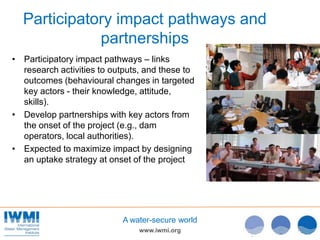
• Participatory impact pathways – links
research activities to outputs, and these to
outcomes (behavioural changes in targeted
key actors - their knowledge, attitude,
skills).
• Develop partnerships with key actors from
the onset of the project (e.g., dam
operators, local authorities).
• Expected to maximize impact by designing
an uptake strategy at onset of the project
5
www.iwmi.org
A water-secure world
Broad scale and household livelihood
surveys
• Yali, Vietnam: Survey of 250 HHs
(male/female respondents) in 4 communes
(Sa Binh, Yali, Ya Xier and Ya Tang). Included
Kinh and ethnic minorities - Jarai.
• THXP, Lao PDR: Survey of 100 HHs
(male/female respondents) in the
Downstream Relocation Site (Phoumakneng)
www.iwmi.org
A water-secure world
Vietnam
• Drawdown area of
Yali reservoir is used
by farmer to grow
cassava, but:
– risk of flooding is high
at the end of the crop
– duration on land
exposure is too short
to achieve maximum
yield with the
commonly used
variety (KM 94)
www.iwmi.org
A water-secure world
Vietnam livelihood pilot – Key
outcomes
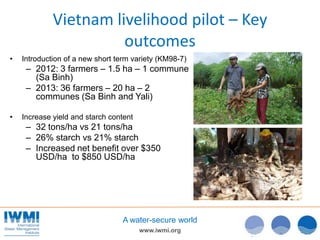
• Introduction of a new short term variety (KM98-7)
– 2012: 3 farmers – 1.5 ha – 1 commune
(Sa Binh)
– 2013: 36 farmers – 20 ha – 2
communes (Sa Binh and Yali)
• Increase yield and starch content
– 32 tons/ha vs 21 tons/ha
– 26% starch vs 21% starch
– Increased net benefit over $350
USD/ha to $850 USD/ha
www.iwmi.org
A water-secure world
Up-scale livelihood pilot results
• Due to success of pilot demand for
new variety has increased.
• Training courses and field visits
were organized in 2012-2013 for
over 500 farmer HHs (both men and
women) in the 4 communes (both
Kinh and Jarai ethnic groups).
• DARD plans to expand the
cultivated area of KM 98-7 to about
400 ha - 500 ha by 2016-2017.
www.iwmi.org
A water-secure world
Vietnam livelihood pilot – Lessons
learned
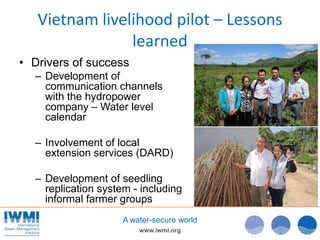
• Drivers of success
– Development of
communication channels
with the hydropower
company – Water level
calendar
– Involvement of local
extension services (DARD)
– Development of seedling
replication system - including
informal farmer groups
www.iwmi.org
A water-secure world
Lao PDR
• Context
– Development of Irrigation in
resettlement site for dry
season rice, flooded in rainy
season
– Depletion of fisheries
resources caused by
hydropower development
• Pilots- Rice fish Culture
– Use the access to water for
integrated rice-fish culture
– Expend the productivity of
flooded rice fields during the
rainy season
www.iwmi.org
A water-secure world
Feasibility of rice-fish Integrated
Agriculture-Aquaculture (IAA)
• Technical feasibility
• Social feasibility
• Financial feasibility
12
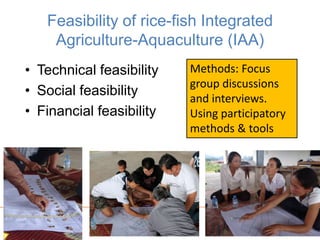
Methods: Focus
group discussions
and interviews.
Using participatory
methods & tools
www.iwmi.org
A water-secure world
Implementing rice-fish IAA pilot
• Implemented over a 6 month period with 15 farmer
households (men and women) who volunteered.
Date Activity
25 Oct – 20
Nov
Excavation of refuge pond
25 – 30 Nov Fertilization of pond
29 Nov – 5 Dec Paddy transplant
14-18 Dec Stocking fingerlings
15-18 Jan Refuge pond connected to paddy field
18-25 March Paddy and fish harvested.
www.iwmi.org
A water-secure world
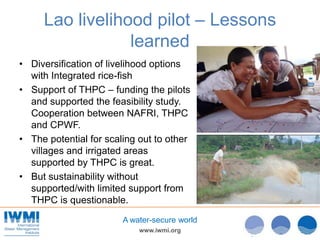
Lao livelihood pilot – key outcomes
• 15 households tested the pilot
– Increase productivity of rice fields
: fish yield : 317 kg/ha
– Improve protein supply for
households
– Reduce time spent fishing
– Synergy with other livelihood
activity: Homestead aquaculture
pond
• Adoption of the technology by
most of the farmers and
development of more aquaculture
www.iwmi.org
A water-secure world
Lao livelihood pilot – Lessons
learned
• Diversification of livelihood options
with Integrated rice-fish
• Support of THPC – funding the pilots
and supported the feasibility study.
Cooperation between NAFRI, THPC
and CPWF.
• The potential for scaling out to other
villages and irrigated areas
supported by THPC is great.
• But sustainability without
supported/with limited support from
THPC is questionable.
www.iwmi.org
A water-secure world
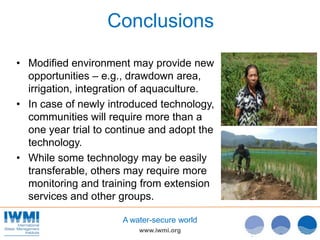
Conclusions
• Modified environment may provide new
opportunities – e.g., drawdown area,
irrigation, integration of aquaculture.
• In case of newly introduced technology,
communities will require more than a
one year trial to continue and adopt the
technology.
• While some technology may be easily
transferable, others may require more
monitoring and training from extension
services and other groups.
www.iwmi.org
A water-secure world
Conclusions
• Capacity building of local staff
took place as a result of the
livelihood pilots.
• A combination of strong
partnerships from the onset with
the private sector or government
authorities and credible research
results can gain support for
livelihood-enhancement activities
in relation to sustainable
hydropower development.
Photo:DavidBrazier/IWMIPhoto:TomvanCakenberghe/IWMIPhoto:DavidBrazier/IWMIPhoto:DavidBrazier/IWMI
Thank You

Hydropower development and livelihoods: A quest for a balanced approach through research and partnerships

  • 1.
    Photo:DavidBrazier/IWMIPhoto:TomvanCakenberghe/IWMIPhoto:DavidBrazier/IWMIPhoto:DavidBrazier/IWMI Hydropower development and livelihoods:A quest for a balanced approach through research and partnerships Sonali Senaratna Sellamuttu, Olivier Joffre, Nguyen Duy Phuong, Jharendu Pant, Bounthanom Bouaham and Anousith Keophoxay Fifth International Conference on Water Resources and Hydropower Development in Asia, Colombo, Sri Lanka 11-13 March 2014
  • 2.
    www.iwmi.org A water-secure world Background •The Mekong River Basin faces massive development investment with regard to hydropower. • Little attention given to how dams can be constructed and operated in ways that optimize benefits for all water users, including riparian communities. • Involuntary displacements mean local people are often unable to engage in their original livelihood activities.
  • 3.
    www.iwmi.org A water-secure world ResearchObjective • Identify and pilot test innovative livelihood options that use the new environmental conditions created as a result of the hydropower development. 3
  • 4.
    www.iwmi.org A water-secure world SitesCPWF Mekong Project are focusing on • Theun Hinboun Expansion Project (THXP), Lao PDR • Yali, Vietnam
  • 5.
    www.iwmi.org A water-secure world Participatoryimpact pathways and partnerships • Participatory impact pathways – links research activities to outputs, and these to outcomes (behavioural changes in targeted key actors - their knowledge, attitude, skills). • Develop partnerships with key actors from the onset of the project (e.g., dam operators, local authorities). • Expected to maximize impact by designing an uptake strategy at onset of the project 5
  • 6.
    www.iwmi.org A water-secure world Broadscale and household livelihood surveys • Yali, Vietnam: Survey of 250 HHs (male/female respondents) in 4 communes (Sa Binh, Yali, Ya Xier and Ya Tang). Included Kinh and ethnic minorities - Jarai. • THXP, Lao PDR: Survey of 100 HHs (male/female respondents) in the Downstream Relocation Site (Phoumakneng)
  • 7.
    www.iwmi.org A water-secure world Vietnam •Drawdown area of Yali reservoir is used by farmer to grow cassava, but: – risk of flooding is high at the end of the crop – duration on land exposure is too short to achieve maximum yield with the commonly used variety (KM 94)
  • 8.
    www.iwmi.org A water-secure world Vietnamlivelihood pilot – Key outcomes • Introduction of a new short term variety (KM98-7) – 2012: 3 farmers – 1.5 ha – 1 commune (Sa Binh) – 2013: 36 farmers – 20 ha – 2 communes (Sa Binh and Yali) • Increase yield and starch content – 32 tons/ha vs 21 tons/ha – 26% starch vs 21% starch – Increased net benefit over $350 USD/ha to $850 USD/ha
  • 9.
    www.iwmi.org A water-secure world Up-scalelivelihood pilot results • Due to success of pilot demand for new variety has increased. • Training courses and field visits were organized in 2012-2013 for over 500 farmer HHs (both men and women) in the 4 communes (both Kinh and Jarai ethnic groups). • DARD plans to expand the cultivated area of KM 98-7 to about 400 ha - 500 ha by 2016-2017.
  • 10.
    www.iwmi.org A water-secure world Vietnamlivelihood pilot – Lessons learned • Drivers of success – Development of communication channels with the hydropower company – Water level calendar – Involvement of local extension services (DARD) – Development of seedling replication system - including informal farmer groups
  • 11.
    www.iwmi.org A water-secure world LaoPDR • Context – Development of Irrigation in resettlement site for dry season rice, flooded in rainy season – Depletion of fisheries resources caused by hydropower development • Pilots- Rice fish Culture – Use the access to water for integrated rice-fish culture – Expend the productivity of flooded rice fields during the rainy season
  • 12.
    www.iwmi.org A water-secure world Feasibilityof rice-fish Integrated Agriculture-Aquaculture (IAA) • Technical feasibility • Social feasibility • Financial feasibility 12 Methods: Focus group discussions and interviews. Using participatory methods & tools
  • 13.
    www.iwmi.org A water-secure world Implementingrice-fish IAA pilot • Implemented over a 6 month period with 15 farmer households (men and women) who volunteered. Date Activity 25 Oct – 20 Nov Excavation of refuge pond 25 – 30 Nov Fertilization of pond 29 Nov – 5 Dec Paddy transplant 14-18 Dec Stocking fingerlings 15-18 Jan Refuge pond connected to paddy field 18-25 March Paddy and fish harvested.
  • 14.
    www.iwmi.org A water-secure world Laolivelihood pilot – key outcomes • 15 households tested the pilot – Increase productivity of rice fields : fish yield : 317 kg/ha – Improve protein supply for households – Reduce time spent fishing – Synergy with other livelihood activity: Homestead aquaculture pond • Adoption of the technology by most of the farmers and development of more aquaculture
  • 15.
    www.iwmi.org A water-secure world Laolivelihood pilot – Lessons learned • Diversification of livelihood options with Integrated rice-fish • Support of THPC – funding the pilots and supported the feasibility study. Cooperation between NAFRI, THPC and CPWF. • The potential for scaling out to other villages and irrigated areas supported by THPC is great. • But sustainability without supported/with limited support from THPC is questionable.
  • 16.
    www.iwmi.org A water-secure world Conclusions •Modified environment may provide new opportunities – e.g., drawdown area, irrigation, integration of aquaculture. • In case of newly introduced technology, communities will require more than a one year trial to continue and adopt the technology. • While some technology may be easily transferable, others may require more monitoring and training from extension services and other groups.
  • 17.
    www.iwmi.org A water-secure world Conclusions •Capacity building of local staff took place as a result of the livelihood pilots. • A combination of strong partnerships from the onset with the private sector or government authorities and credible research results can gain support for livelihood-enhancement activities in relation to sustainable hydropower development.
  • 18.