Group 4
1668— 
 Periodic table was first published by Dmitri Mendeleev in 1869. 
The elements carbon, sulfur, iron, tin, lead, copper, mercury, silver, and gold 
are known to humans since ancient times. 
1669— 
 Phosphorus was discovered by German alchemist Hennig Brand. 
1735— 
 Cobalt was first discovered by a Swedish chemist Georg Brandt. 
1748— 
 Platinum was described by Julius Caesar Scaliger in 1557. But the metal 
was observed by Antonio de Ulloa and Don Jorge Juan y Santacilia in 1748. 
1751— 
 Nickel was discovered by the Swedish chemist Axel Fredrik Cronstedt. 
1766— 
 Hydrogen was discovered by English chemist and physicist Henry 
Cavendish.
1772— 
 Nitrogen was discovered by Scottish chemist Daniel Rutherford. 
1774— 
 Chlorine was discovered by a Swedish scientist, Carl William Scheele. 
1774— 
 Manganese was first observed by Swedish chemist Johann Gottlieb Gahn. 
1774— 
 Oxygen was discovered by English chemist Joseph Priestley and Swedish 
chemist Carl Wilhelm Scheele. 
1781— 
 Swedish chemist Peter Jacob Hjelm isolated molybdenum in 1781. However 
molybdenum was discovered by Carl Welhelm Scheele, a Swedish chemist, 
in 1778. 
1782— 
 Tellurium was discovered by Austrian mineralogist Franz-Joseph Müller von 
Reichenstein.
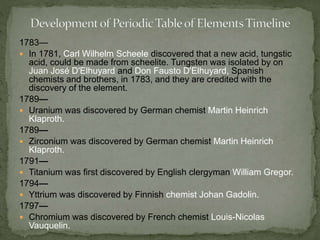
1783— 
 In 1781, Carl Wilhelm Scheele discovered that a new acid, tungstic 
acid, could be made from scheelite. Tungsten was isolated by on 
Juan José D'Elhuyard and Don Fausto D'Elhuyard, Spanish 
chemists and brothers, in 1783, and they are credited with the 
discovery of the element. 
1789— 
 Uranium was discovered by German chemist Martin Heinrich 
Klaproth. 
1789— 
 Zirconium was discovered by German chemist Martin Heinrich 
Klaproth. 
1791— 
 Titanium was first discovered by English clergyman William Gregor. 
1794— 
 Yttrium was discovered by Finnish chemist Johan Gadolin. 
1797— 
 Chromium was discovered by French chemist Louis-Nicolas 
Vauquelin.
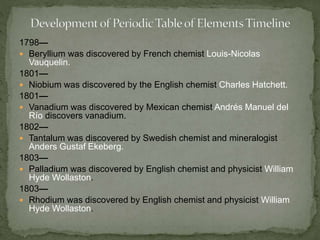
1798— 
 Beryllium was discovered by French chemist Louis-Nicolas 
Vauquelin. 
1801— 
 Niobium was discovered by the English chemist Charles Hatchett. 
1801— 
 Vanadium was discovered by Mexican chemist Andrés Manuel del 
Río discovers vanadium. 
1802— 
 Tantalum was discovered by Swedish chemist and mineralogist 
Anders Gustaf Ekeberg. 
1803— 
 Palladium was discovered by English chemist and physicist William 
Hyde Wollaston. 
1803— 
 Rhodium was discovered by English chemist and physicist William 
Hyde Wollaston.
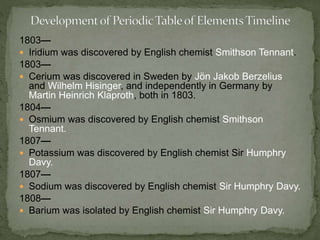
1803— 
 Iridium was discovered by English chemist Smithson Tennant. 
1803— 
 Cerium was discovered in Sweden by Jön Jakob Berzelius 
and Wilhelm Hisinger, and independently in Germany by 
Martin Heinrich Klaproth, both in 1803. 
1804— 
 Osmium was discovered by English chemist Smithson 
Tennant. 
1807— 
 Potassium was discovered by English chemist Sir Humphry 
Davy. 
1807— 
 Sodium was discovered by English chemist Sir Humphry Davy. 
1808— 
 Barium was isolated by English chemist Sir Humphry Davy.
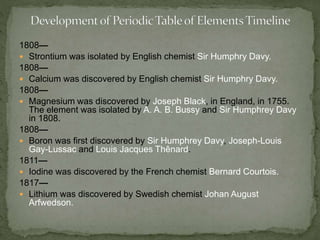
1808— 
 Strontium was isolated by English chemist Sir Humphry Davy. 
1808— 
 Calcium was discovered by English chemist Sir Humphry Davy. 
1808— 
 Magnesium was discovered by Joseph Black, in England, in 1755. 
The element was isolated by A. A. B. Bussy and Sir Humphrey Davy 
in 1808. 
1808— 
 Boron was first discovered by Sir Humphrey Davy, Joseph-Louis 
Gay-Lussac and Louis Jacques Thênard. 
1811— 
 Iodine was discovered by the French chemist Bernard Courtois. 
1817— 
 Lithium was discovered by Swedish chemist Johan August 
Arfwedson.
1817— 
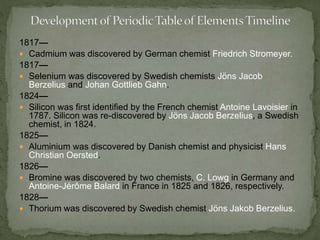
 Cadmium was discovered by German chemist Friedrich Stromeyer. 
1817— 
 Selenium was discovered by Swedish chemists Jöns Jacob 
Berzelius and Johan Gottlieb Gahn. 
1824— 
 Silicon was first identified by the French chemist Antoine Lavoisier in 
1787. Silicon was re-discovered by Jöns Jacob Berzelius, a Swedish 
chemist, in 1824. 
1825— 
 Aluminium was discovered by Danish chemist and physicist Hans 
Christian Oersted. 
1826— 
 Bromine was discovered by two chemists, C. Lowg in Germany and 
Antoine-Jérôme Balard in France in 1825 and 1826, respectively. 
1828— 
 Thorium was discovered by Swedish chemist Jöns Jakob Berzelius.
1839— 
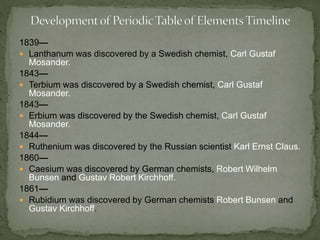
 Lanthanum was discovered by a Swedish chemist, Carl Gustaf 
Mosander. 
1843— 
 Terbium was discovered by a Swedish chemist, Carl Gustaf 
Mosander. 
1843— 
 Erbium was discovered by the Swedish chemist, Carl Gustaf 
Mosander. 
1844— 
 Ruthenium was discovered by the Russian scientist Karl Ernst Claus. 
1860— 
 Caesium was discovered by German chemists, Robert Wilhelm 
Bunsen and Gustav Robert Kirchhoff. 
1861— 
 Rubidium was discovered by German chemists Robert Bunsen and 
Gustav Kirchhoff.
1861— 
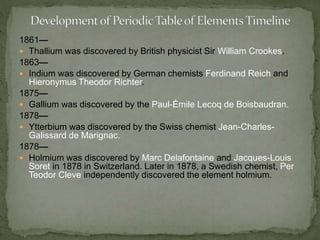
 Thallium was discovered by British physicist Sir William Crookes. 
1863— 
 Indium was discovered by German chemists Ferdinand Reich and 
Hieronymus Theodor Richter. 
1875— 
 Gallium was discovered by the Paul-Émile Lecoq de Boisbaudran. 
1878— 
 Ytterbium was discovered by the Swiss chemist Jean-Charles- 
Galissard de Marignac. 
1878— 
 Holmium was discovered by Marc Delafontaine and Jacques-Louis 
Soret in 1878 in Switzerland. Later in 1878, a Swedish chemist, Per 
Teodor Cleve independently discovered the element holmium.
1879— 
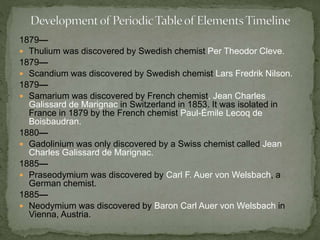
 Thulium was discovered by Swedish chemist Per Theodor Cleve. 
1879— 
 Scandium was discovered by Swedish chemist Lars Fredrik Nilson. 
1879— 
 Samarium was discovered by French chemist, Jean Charles 
Galissard de Marignac in Switzerland in 1853. It was isolated in 
France in 1879 by the French chemist Paul-Émile Lecoq de 
Boisbaudran. 
1880— 
 Gadolinium was only discovered by a Swiss chemist called Jean 
Charles Galissard de Marignac. 
1885— 
 Praseodymium was discovered by Carl F. Auer von Welsbach, a 
German chemist. 
1885— 
 Neodymium was discovered by Baron Carl Auer von Welsbach in 
Vienna, Austria.
1886— 
 Germanium was discovered by German chemist Clemens Alexander 
Winkler. 
1886— 
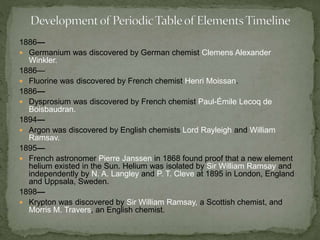
 Fluorine was discovered by French chemist Henri Moissan. 
1886— 
 Dysprosium was discovered by French chemist Paul-Émile Lecoq de 
Boisbaudran. 
1894— 
 Argon was discovered by English chemists Lord Rayleigh and William 
Ramsav. 
1895— 
 French astronomer Pierre Janssen in 1868 found proof that a new element 
helium existed in the Sun. Helium was isolated by Sir William Ramsay and 
independently by N. A. Langley and P. T. Cleve at 1895 in London, England 
and Uppsala, Sweden. 
1898— 
 Krypton was discovered by Sir William Ramsay, a Scottish chemist, and 
Morris M. Travers, an English chemist.
1898— 
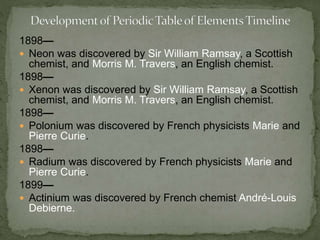
 Neon was discovered by Sir William Ramsay, a Scottish 
chemist, and Morris M. Travers, an English chemist. 
1898— 
 Xenon was discovered by Sir William Ramsay, a Scottish 
chemist, and Morris M. Travers, an English chemist. 
1898— 
 Polonium was discovered by French physicists Marie and 
Pierre Curie. 
1898— 
 Radium was discovered by French physicists Marie and 
Pierre Curie. 
1899— 
 Actinium was discovered by French chemist André-Louis 
Debierne.
1900— 
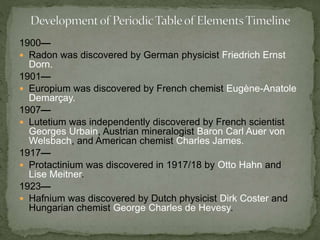
 Radon was discovered by German physicist Friedrich Ernst 
Dorn. 
1901— 
 Europium was discovered by French chemist Eugène-Anatole 
Demarçay. 
1907— 
 Lutetium was independently discovered by French scientist 
Georges Urbain, Austrian mineralogist Baron Carl Auer von 
Welsbach, and American chemist Charles James. 
1917— 
 Protactinium was discovered in 1917/18 by Otto Hahn and 
Lise Meitner. 
1923— 
 Hafnium was discovered by Dutch physicist Dirk Coster and 
Hungarian chemist George Charles de Hevesy.
1925— 
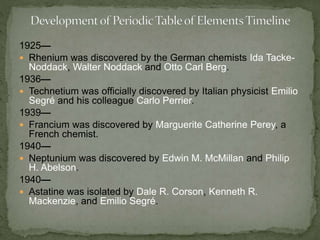
 Rhenium was discovered by the German chemists Ida Tacke- 
Noddack, Walter Noddack and Otto Carl Berg. 
1936— 
 Technetium was officially discovered by Italian physicist Emilio 
Segré and his colleague Carlo Perrier. 
1939— 
 Francium was discovered by Marguerite Catherine Perey, a 
French chemist. 
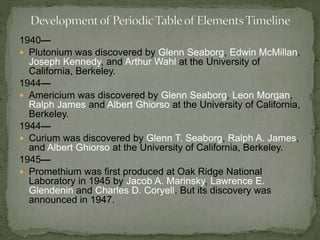
1940— 
 Neptunium was discovered by Edwin M. McMillan and Philip 
H. Abelson. 
1940— 
 Astatine was isolated by Dale R. Corson, Kenneth R. 
Mackenzie, and Emilio Segré.
1940— 
 Plutonium was discovered by Glenn Seaborg, Edwin McMillan, 
Joseph Kennedy, and Arthur Wahl at the University of 
California, Berkeley. 
1944— 
 Americium was discovered by Glenn Seaborg, Leon Morgan, 
Ralph James and Albert Ghiorso at the University of California, 
Berkeley. 
1944— 
 Curium was discovered by Glenn T. Seaborg, Ralph A. James, 
and Albert Ghiorso at the University of California, Berkeley. 
1945— 
 Promethium was first produced at Oak Ridge National 
Laboratory in 1945 by Jacob A. Marinsky, Lawrence E. 
Glendenin and Charles D. Coryell. But its discovery was 
announced in 1947.
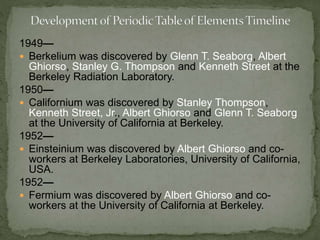
1949— 
 Berkelium was discovered by Glenn T. Seaborg, Albert 
Ghiorso, Stanley G. Thompson and Kenneth Street at the 
Berkeley Radiation Laboratory. 
1950— 
 Californium was discovered by Stanley Thompson, 
Kenneth Street, Jr., Albert Ghiorso and Glenn T. Seaborg 
at the University of California at Berkeley. 
1952— 
 Einsteinium was discovered by Albert Ghiorso and co-workers 
at Berkeley Laboratories, University of California, 
USA. 
1952— 
 Fermium was discovered by Albert Ghiorso and co-workers 
at the University of California at Berkeley.
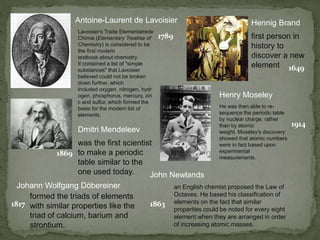
Antoine-Laurent de Lavoisier Hennig Brand 
Lavoisier's Traite Elementairede 
Chimie (Elementary Treatise of 
Chemistry) is considered to be 
the first modern 
textbook about chemistry. 
It contained a list of "simple 
substances" that Lavoisier 
believed could not be broken 
down further, which 
included oxygen, nitrogen, hydr 
ogen, phosphorus, mercury, zin 
c and sulfur, which formed the 
basis for the modern list of 
elements. 
first person in 
history to 
discover a new 
element 
Dmitri Mendeleev 
was the first scientist 
to make a periodic 
table similar to the 
one used today. 
Henry Moseley 
He was then able to re-sequence 
the periodic table 
by nuclear charge, rather 
than by atomic 
weight. Moseley's discovery 
showed that atomic numbers 
were in fact based upon 
experimental 
measurements. 
Johann Wolfgang Döbereiner 
formed the triads of elements 
with similar properties like the 
triad of calcium, barium and 
strontium. 
1817 
John Newlands 
an English chemist proposed the Law of 
Octaves. He based his classification of 
elements on the fact that similar 
properties could be noted for every eight 
element when they are arranged in order 
of increasing atomic masses. 
1863 
1869 
1649 
1914 
1789
Development of Periodic Table Timeline

Development of Periodic Table Timeline

  • 1.
  • 3.
    1668—  Periodictable was first published by Dmitri Mendeleev in 1869. The elements carbon, sulfur, iron, tin, lead, copper, mercury, silver, and gold are known to humans since ancient times. 1669—  Phosphorus was discovered by German alchemist Hennig Brand. 1735—  Cobalt was first discovered by a Swedish chemist Georg Brandt. 1748—  Platinum was described by Julius Caesar Scaliger in 1557. But the metal was observed by Antonio de Ulloa and Don Jorge Juan y Santacilia in 1748. 1751—  Nickel was discovered by the Swedish chemist Axel Fredrik Cronstedt. 1766—  Hydrogen was discovered by English chemist and physicist Henry Cavendish.
  • 4.
    1772—  Nitrogenwas discovered by Scottish chemist Daniel Rutherford. 1774—  Chlorine was discovered by a Swedish scientist, Carl William Scheele. 1774—  Manganese was first observed by Swedish chemist Johann Gottlieb Gahn. 1774—  Oxygen was discovered by English chemist Joseph Priestley and Swedish chemist Carl Wilhelm Scheele. 1781—  Swedish chemist Peter Jacob Hjelm isolated molybdenum in 1781. However molybdenum was discovered by Carl Welhelm Scheele, a Swedish chemist, in 1778. 1782—  Tellurium was discovered by Austrian mineralogist Franz-Joseph Müller von Reichenstein.
  • 5.
    1783—  In1781, Carl Wilhelm Scheele discovered that a new acid, tungstic acid, could be made from scheelite. Tungsten was isolated by on Juan José D'Elhuyard and Don Fausto D'Elhuyard, Spanish chemists and brothers, in 1783, and they are credited with the discovery of the element. 1789—  Uranium was discovered by German chemist Martin Heinrich Klaproth. 1789—  Zirconium was discovered by German chemist Martin Heinrich Klaproth. 1791—  Titanium was first discovered by English clergyman William Gregor. 1794—  Yttrium was discovered by Finnish chemist Johan Gadolin. 1797—  Chromium was discovered by French chemist Louis-Nicolas Vauquelin.
  • 6.
    1798—  Berylliumwas discovered by French chemist Louis-Nicolas Vauquelin. 1801—  Niobium was discovered by the English chemist Charles Hatchett. 1801—  Vanadium was discovered by Mexican chemist Andrés Manuel del Río discovers vanadium. 1802—  Tantalum was discovered by Swedish chemist and mineralogist Anders Gustaf Ekeberg. 1803—  Palladium was discovered by English chemist and physicist William Hyde Wollaston. 1803—  Rhodium was discovered by English chemist and physicist William Hyde Wollaston.
  • 7.
    1803—  Iridiumwas discovered by English chemist Smithson Tennant. 1803—  Cerium was discovered in Sweden by Jön Jakob Berzelius and Wilhelm Hisinger, and independently in Germany by Martin Heinrich Klaproth, both in 1803. 1804—  Osmium was discovered by English chemist Smithson Tennant. 1807—  Potassium was discovered by English chemist Sir Humphry Davy. 1807—  Sodium was discovered by English chemist Sir Humphry Davy. 1808—  Barium was isolated by English chemist Sir Humphry Davy.
  • 8.
    1808—  Strontiumwas isolated by English chemist Sir Humphry Davy. 1808—  Calcium was discovered by English chemist Sir Humphry Davy. 1808—  Magnesium was discovered by Joseph Black, in England, in 1755. The element was isolated by A. A. B. Bussy and Sir Humphrey Davy in 1808. 1808—  Boron was first discovered by Sir Humphrey Davy, Joseph-Louis Gay-Lussac and Louis Jacques Thênard. 1811—  Iodine was discovered by the French chemist Bernard Courtois. 1817—  Lithium was discovered by Swedish chemist Johan August Arfwedson.
  • 9.
    1817—  Cadmiumwas discovered by German chemist Friedrich Stromeyer. 1817—  Selenium was discovered by Swedish chemists Jöns Jacob Berzelius and Johan Gottlieb Gahn. 1824—  Silicon was first identified by the French chemist Antoine Lavoisier in 1787. Silicon was re-discovered by Jöns Jacob Berzelius, a Swedish chemist, in 1824. 1825—  Aluminium was discovered by Danish chemist and physicist Hans Christian Oersted. 1826—  Bromine was discovered by two chemists, C. Lowg in Germany and Antoine-Jérôme Balard in France in 1825 and 1826, respectively. 1828—  Thorium was discovered by Swedish chemist Jöns Jakob Berzelius.
  • 10.
    1839—  Lanthanumwas discovered by a Swedish chemist, Carl Gustaf Mosander. 1843—  Terbium was discovered by a Swedish chemist, Carl Gustaf Mosander. 1843—  Erbium was discovered by the Swedish chemist, Carl Gustaf Mosander. 1844—  Ruthenium was discovered by the Russian scientist Karl Ernst Claus. 1860—  Caesium was discovered by German chemists, Robert Wilhelm Bunsen and Gustav Robert Kirchhoff. 1861—  Rubidium was discovered by German chemists Robert Bunsen and Gustav Kirchhoff.
  • 11.
    1861—  Thalliumwas discovered by British physicist Sir William Crookes. 1863—  Indium was discovered by German chemists Ferdinand Reich and Hieronymus Theodor Richter. 1875—  Gallium was discovered by the Paul-Émile Lecoq de Boisbaudran. 1878—  Ytterbium was discovered by the Swiss chemist Jean-Charles- Galissard de Marignac. 1878—  Holmium was discovered by Marc Delafontaine and Jacques-Louis Soret in 1878 in Switzerland. Later in 1878, a Swedish chemist, Per Teodor Cleve independently discovered the element holmium.
  • 12.
    1879—  Thuliumwas discovered by Swedish chemist Per Theodor Cleve. 1879—  Scandium was discovered by Swedish chemist Lars Fredrik Nilson. 1879—  Samarium was discovered by French chemist, Jean Charles Galissard de Marignac in Switzerland in 1853. It was isolated in France in 1879 by the French chemist Paul-Émile Lecoq de Boisbaudran. 1880—  Gadolinium was only discovered by a Swiss chemist called Jean Charles Galissard de Marignac. 1885—  Praseodymium was discovered by Carl F. Auer von Welsbach, a German chemist. 1885—  Neodymium was discovered by Baron Carl Auer von Welsbach in Vienna, Austria.
  • 13.
    1886—  Germaniumwas discovered by German chemist Clemens Alexander Winkler. 1886—  Fluorine was discovered by French chemist Henri Moissan. 1886—  Dysprosium was discovered by French chemist Paul-Émile Lecoq de Boisbaudran. 1894—  Argon was discovered by English chemists Lord Rayleigh and William Ramsav. 1895—  French astronomer Pierre Janssen in 1868 found proof that a new element helium existed in the Sun. Helium was isolated by Sir William Ramsay and independently by N. A. Langley and P. T. Cleve at 1895 in London, England and Uppsala, Sweden. 1898—  Krypton was discovered by Sir William Ramsay, a Scottish chemist, and Morris M. Travers, an English chemist.
  • 14.
    1898—  Neonwas discovered by Sir William Ramsay, a Scottish chemist, and Morris M. Travers, an English chemist. 1898—  Xenon was discovered by Sir William Ramsay, a Scottish chemist, and Morris M. Travers, an English chemist. 1898—  Polonium was discovered by French physicists Marie and Pierre Curie. 1898—  Radium was discovered by French physicists Marie and Pierre Curie. 1899—  Actinium was discovered by French chemist André-Louis Debierne.
  • 15.
    1900—  Radonwas discovered by German physicist Friedrich Ernst Dorn. 1901—  Europium was discovered by French chemist Eugène-Anatole Demarçay. 1907—  Lutetium was independently discovered by French scientist Georges Urbain, Austrian mineralogist Baron Carl Auer von Welsbach, and American chemist Charles James. 1917—  Protactinium was discovered in 1917/18 by Otto Hahn and Lise Meitner. 1923—  Hafnium was discovered by Dutch physicist Dirk Coster and Hungarian chemist George Charles de Hevesy.
  • 16.
    1925—  Rheniumwas discovered by the German chemists Ida Tacke- Noddack, Walter Noddack and Otto Carl Berg. 1936—  Technetium was officially discovered by Italian physicist Emilio Segré and his colleague Carlo Perrier. 1939—  Francium was discovered by Marguerite Catherine Perey, a French chemist. 1940—  Neptunium was discovered by Edwin M. McMillan and Philip H. Abelson. 1940—  Astatine was isolated by Dale R. Corson, Kenneth R. Mackenzie, and Emilio Segré.
  • 17.
    1940—  Plutoniumwas discovered by Glenn Seaborg, Edwin McMillan, Joseph Kennedy, and Arthur Wahl at the University of California, Berkeley. 1944—  Americium was discovered by Glenn Seaborg, Leon Morgan, Ralph James and Albert Ghiorso at the University of California, Berkeley. 1944—  Curium was discovered by Glenn T. Seaborg, Ralph A. James, and Albert Ghiorso at the University of California, Berkeley. 1945—  Promethium was first produced at Oak Ridge National Laboratory in 1945 by Jacob A. Marinsky, Lawrence E. Glendenin and Charles D. Coryell. But its discovery was announced in 1947.
  • 18.
    1949—  Berkeliumwas discovered by Glenn T. Seaborg, Albert Ghiorso, Stanley G. Thompson and Kenneth Street at the Berkeley Radiation Laboratory. 1950—  Californium was discovered by Stanley Thompson, Kenneth Street, Jr., Albert Ghiorso and Glenn T. Seaborg at the University of California at Berkeley. 1952—  Einsteinium was discovered by Albert Ghiorso and co-workers at Berkeley Laboratories, University of California, USA. 1952—  Fermium was discovered by Albert Ghiorso and co-workers at the University of California at Berkeley.
  • 19.
    Antoine-Laurent de LavoisierHennig Brand Lavoisier's Traite Elementairede Chimie (Elementary Treatise of Chemistry) is considered to be the first modern textbook about chemistry. It contained a list of "simple substances" that Lavoisier believed could not be broken down further, which included oxygen, nitrogen, hydr ogen, phosphorus, mercury, zin c and sulfur, which formed the basis for the modern list of elements. first person in history to discover a new element Dmitri Mendeleev was the first scientist to make a periodic table similar to the one used today. Henry Moseley He was then able to re-sequence the periodic table by nuclear charge, rather than by atomic weight. Moseley's discovery showed that atomic numbers were in fact based upon experimental measurements. Johann Wolfgang Döbereiner formed the triads of elements with similar properties like the triad of calcium, barium and strontium. 1817 John Newlands an English chemist proposed the Law of Octaves. He based his classification of elements on the fact that similar properties could be noted for every eight element when they are arranged in order of increasing atomic masses. 1863 1869 1649 1914 1789