Page 1 | Proprietary and Copyrighted Information
The Accountancy Profession
and the Sustainable
Development Goals
Warren Allen
UNCTAD ISAR
Geneva, Switzerland
November 4, 2015
Page 2 | Proprietary and Copyrighted Information
“Everyone can play a role in making progress
for people and the planet.”
United Nations
Page 3 | Proprietary and Copyrighted Information
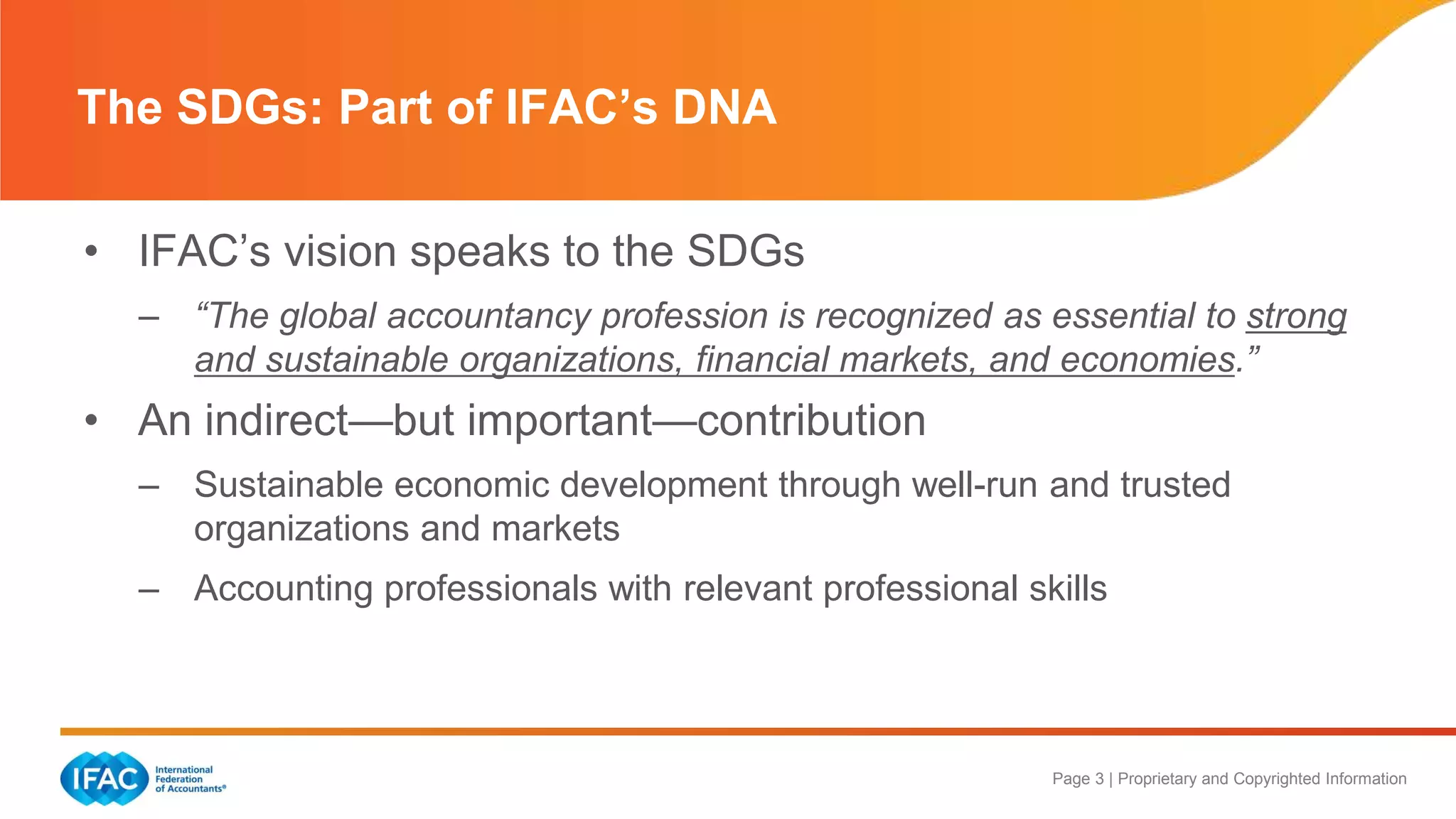
• IFAC’s vision speaks to the SDGs
– “The global accountancy profession is recognized as essential to strong
and sustainable organizations, financial markets, and economies.”
• An indirect—but important—contribution
– Sustainable economic development through well-run and trusted
organizations and markets
– Accounting professionals with relevant professional skills
The SDGs: Part of IFAC’s DNA
Page 4 | Proprietary and Copyrighted Information
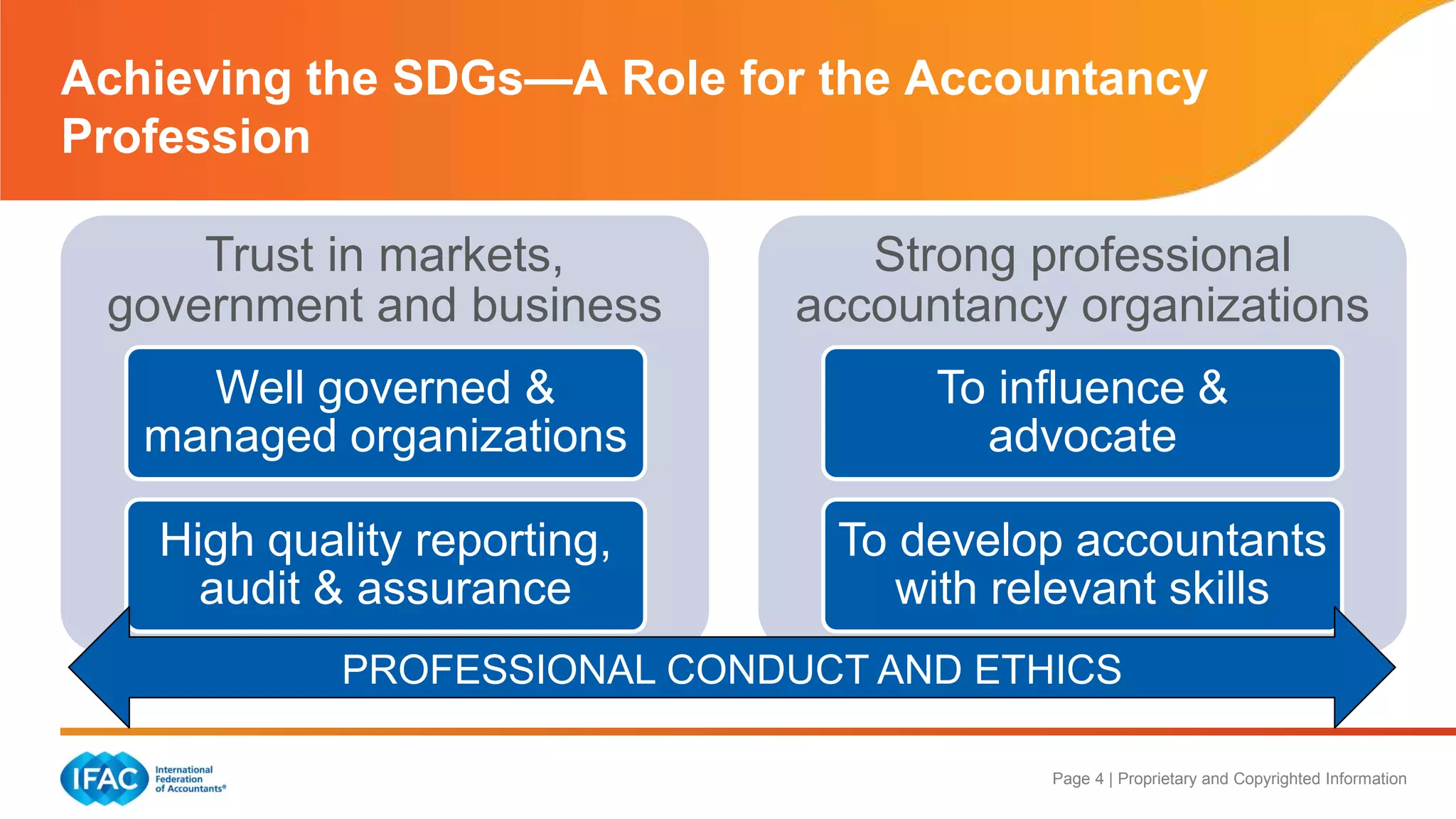
Trust in markets,
government and business
Well governed &
managed organizations
High quality reporting,
audit & assurance
Strong professional
accountancy organizations
To influence &
advocate
To develop accountants
with relevant skills
Achieving the SDGs—A Role for the Accountancy
Profession
PROFESSIONAL CONDUCT AND ETHICS
Page 5 | Proprietary and Copyrighted Information
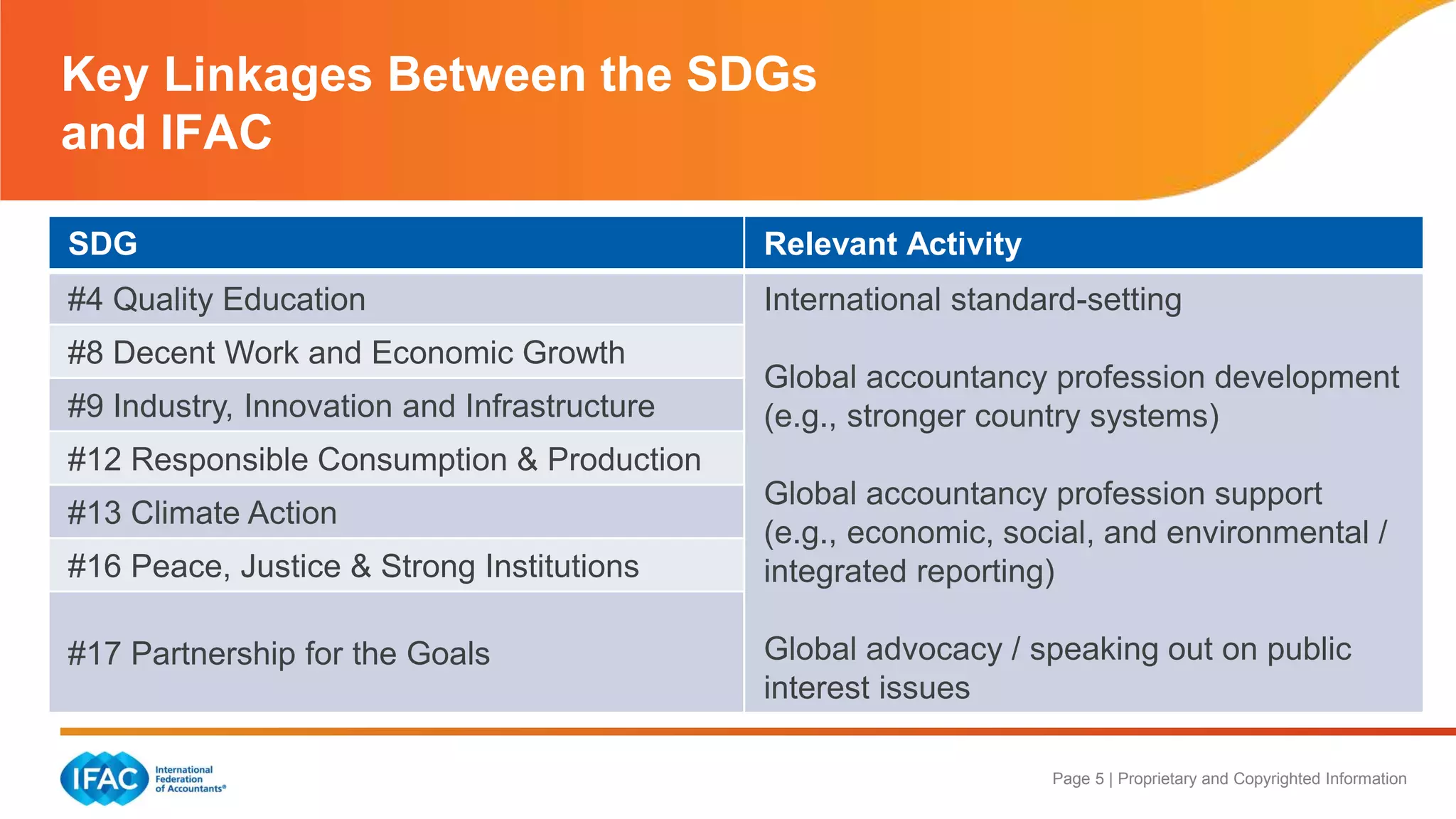
Key Linkages Between the SDGs
and IFAC
SDG Relevant Activity
#4 Quality Education International standard-setting
Global accountancy profession development
(e.g., stronger country systems)
Global accountancy profession support
(e.g., economic, social, and environmental /
integrated reporting)
Global advocacy / speaking out on public
interest issues
#8 Decent Work and Economic Growth
#9 Industry, Innovation and Infrastructure
#12 Responsible Consumption & Production
#13 Climate Action
#16 Peace, Justice & Strong Institutions
#17 Partnership for the Goals
Page 6 | Proprietary and Copyrighted Information
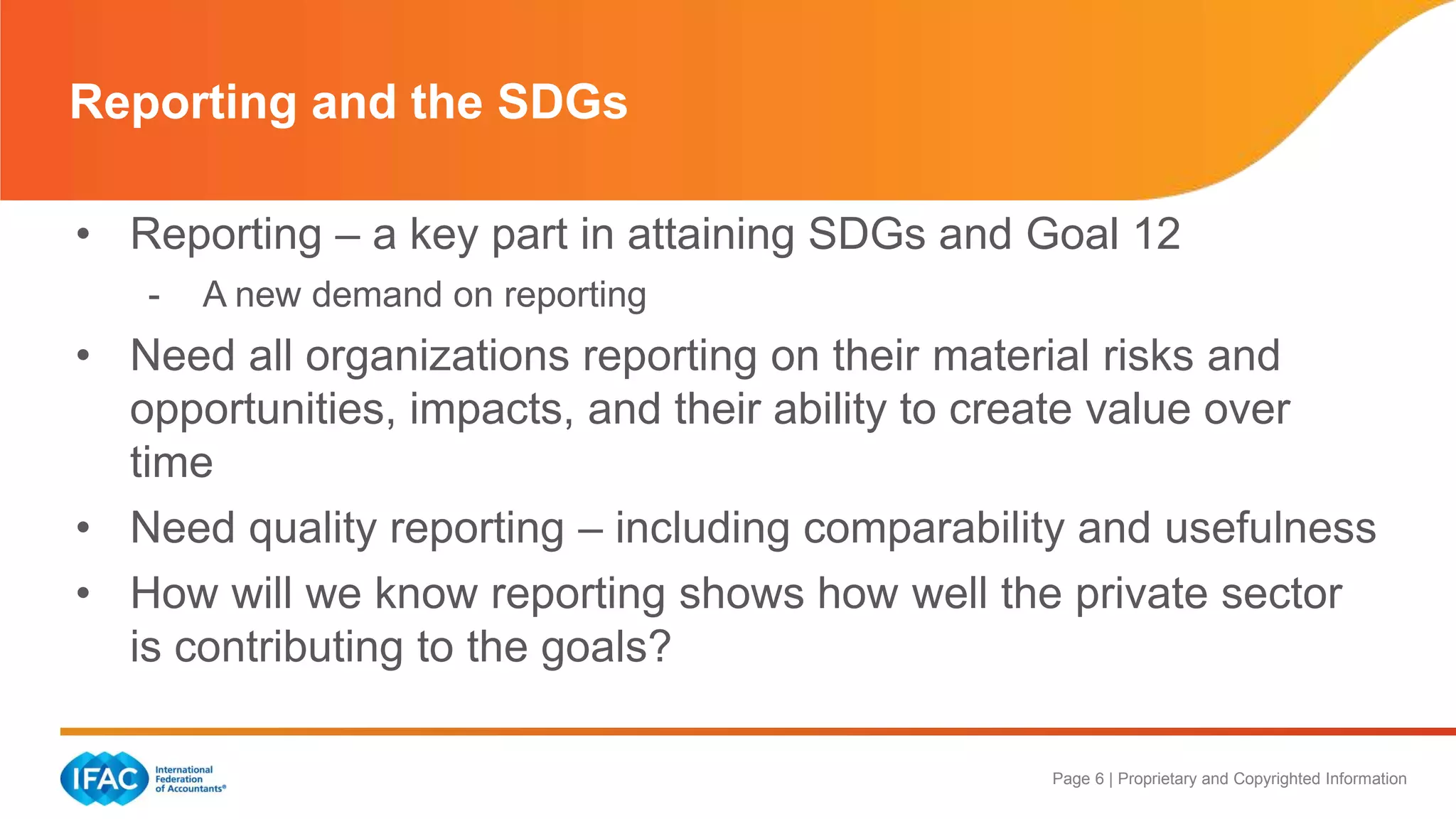
Reporting and the SDGs
• Reporting – a key part in attaining SDGs and Goal 12
- A new demand on reporting
• Need all organizations reporting on their material risks and
opportunities, impacts, and their ability to create value over
time
• Need quality reporting – including comparability and usefulness
• How will we know reporting shows how well the private sector
is contributing to the goals?
Page 7 | Proprietary and Copyrighted Information
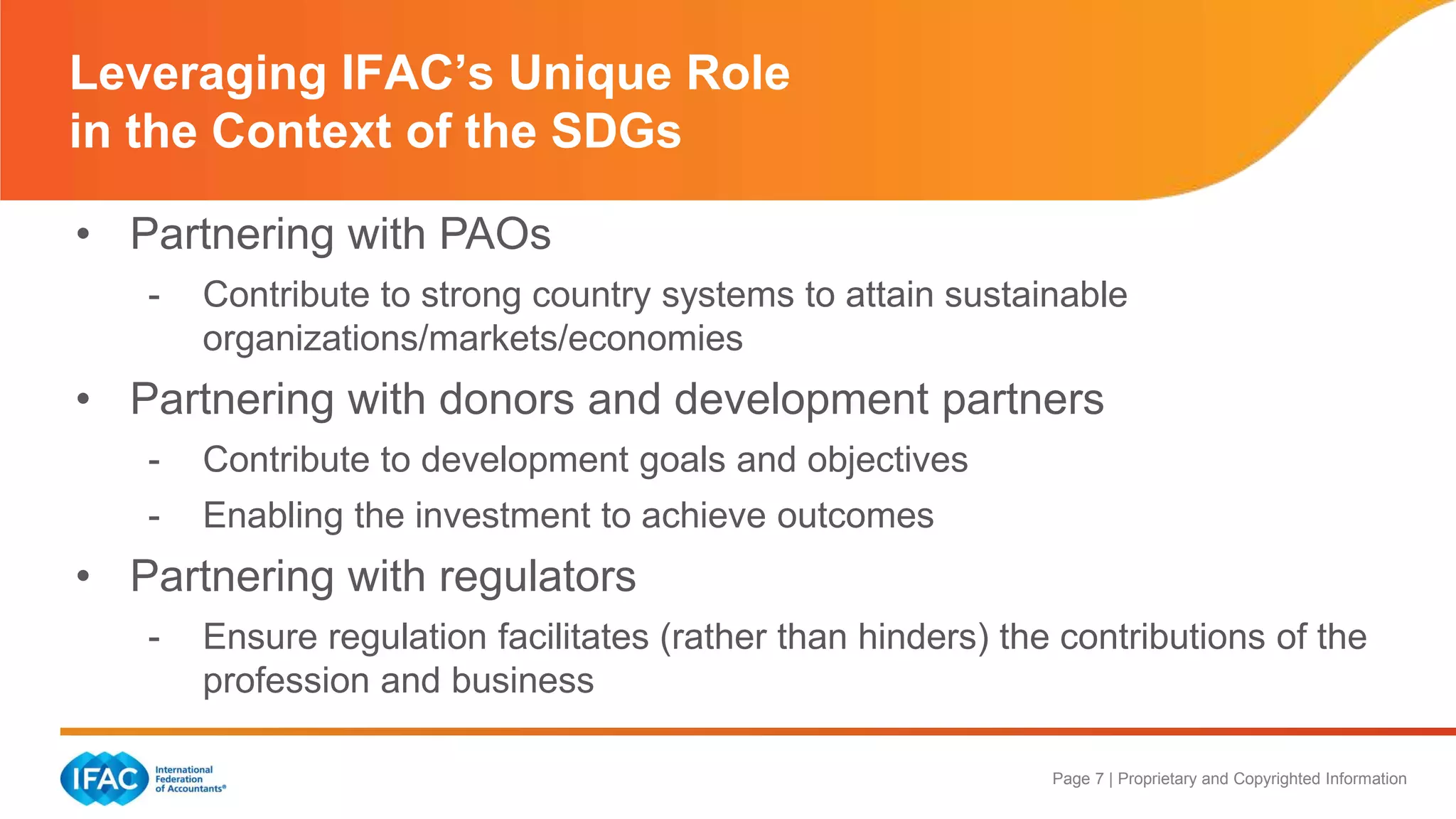
Leveraging IFAC’s Unique Role
in the Context of the SDGs
• Partnering with PAOs
- Contribute to strong country systems to attain sustainable
organizations/markets/economies
• Partnering with donors and development partners
- Contribute to development goals and objectives
- Enabling the investment to achieve outcomes
• Partnering with regulators
- Ensure regulation facilitates (rather than hinders) the contributions of the
profession and business
Page 8 | Proprietary and Copyrighted Information
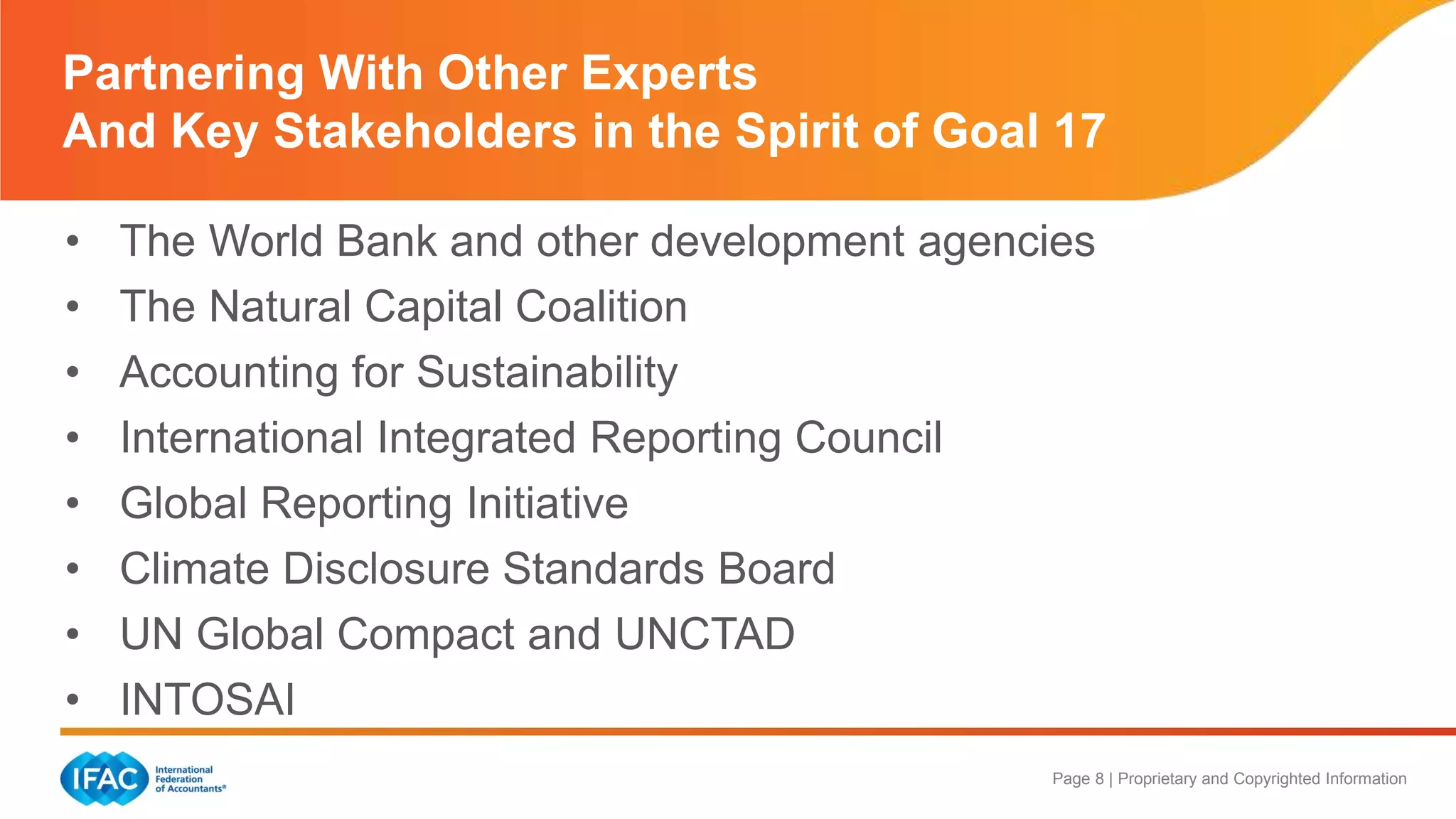
Partnering With Other Experts
And Key Stakeholders in the Spirit of Goal 17
• The World Bank and other development agencies
• The Natural Capital Coalition
• Accounting for Sustainability
• International Integrated Reporting Council
• Global Reporting Initiative
• Climate Disclosure Standards Board
• UN Global Compact and UNCTAD
• INTOSAI
www.ifac.org

The Accountancy Profession and the Sustainable Development Goals

  • 1.
    Page 1 |Proprietary and Copyrighted Information The Accountancy Profession and the Sustainable Development Goals Warren Allen UNCTAD ISAR Geneva, Switzerland November 4, 2015
  • 2.
    Page 2 |Proprietary and Copyrighted Information “Everyone can play a role in making progress for people and the planet.” United Nations
  • 3.
    Page 3 |Proprietary and Copyrighted Information • IFAC’s vision speaks to the SDGs – “The global accountancy profession is recognized as essential to strong and sustainable organizations, financial markets, and economies.” • An indirect—but important—contribution – Sustainable economic development through well-run and trusted organizations and markets – Accounting professionals with relevant professional skills The SDGs: Part of IFAC’s DNA
  • 4.
    Page 4 |Proprietary and Copyrighted Information Trust in markets, government and business Well governed & managed organizations High quality reporting, audit & assurance Strong professional accountancy organizations To influence & advocate To develop accountants with relevant skills Achieving the SDGs—A Role for the Accountancy Profession PROFESSIONAL CONDUCT AND ETHICS
  • 5.
    Page 5 |Proprietary and Copyrighted Information Key Linkages Between the SDGs and IFAC SDG Relevant Activity #4 Quality Education International standard-setting Global accountancy profession development (e.g., stronger country systems) Global accountancy profession support (e.g., economic, social, and environmental / integrated reporting) Global advocacy / speaking out on public interest issues #8 Decent Work and Economic Growth #9 Industry, Innovation and Infrastructure #12 Responsible Consumption & Production #13 Climate Action #16 Peace, Justice & Strong Institutions #17 Partnership for the Goals
  • 6.
    Page 6 |Proprietary and Copyrighted Information Reporting and the SDGs • Reporting – a key part in attaining SDGs and Goal 12 - A new demand on reporting • Need all organizations reporting on their material risks and opportunities, impacts, and their ability to create value over time • Need quality reporting – including comparability and usefulness • How will we know reporting shows how well the private sector is contributing to the goals?
  • 7.
    Page 7 |Proprietary and Copyrighted Information Leveraging IFAC’s Unique Role in the Context of the SDGs • Partnering with PAOs - Contribute to strong country systems to attain sustainable organizations/markets/economies • Partnering with donors and development partners - Contribute to development goals and objectives - Enabling the investment to achieve outcomes • Partnering with regulators - Ensure regulation facilitates (rather than hinders) the contributions of the profession and business
  • 8.
    Page 8 |Proprietary and Copyrighted Information Partnering With Other Experts And Key Stakeholders in the Spirit of Goal 17 • The World Bank and other development agencies • The Natural Capital Coalition • Accounting for Sustainability • International Integrated Reporting Council • Global Reporting Initiative • Climate Disclosure Standards Board • UN Global Compact and UNCTAD • INTOSAI
  • 9.

Editor's Notes

  • #2 .
  • #3 Seventeen global goals for sustainable development. They are goals that everyone globally can get behind to help achieve over the next thirty years. We all need to determine which goals we can work with our institutions in helping to achieve Background: Historic moment - In September, 193 UN member state governments agreed the 17 goals after a 3 year consultation process  UN and governments have shared interests with 3 key stakeholders business, investors and civil society. The goals are challenging and cannot be met without collective action by these 3 key stakeholders Role of business will be critical as in many jurisdictions it will generate more employment than the public sector and have a broader reach and ability to create prosperity. Therefore business transparency will be key Key features: Universal applying to all countries  Cover 3 key pillars of SD Allow for national context and customization, particularly around targets and measurement 
  • #4 Many of the SDGs depend on high standards of governance and transparency. The profession's contribution to the SDGs is largely indirect, but an important cog in the wheel Aid and investment is of course critical, but needs to come with higher standards of governance, anti-corruption measures and ultimately greater trust in governments and business. To help achieve this we need a strong and diverse accountancy profession that can develop professional accountants with the relevant skills, and professional accountants that contribute to sustainable and resilient organizations and capital markets. IFAC is particularly focused on the social benefits that the profession can bring, and we work hard to ensure the perception of the profession is public interest and SDG focused.
  • #5 The goals make explicit the need for ethical leadership in the private sector. Acting responsibly is key Irrespective of one’s economic or ideological persuasion, a moral challenge can arise from the way the markets focus on financial returns in the short term, perhaps at the expense of the social, commercial, reputational, and, ultimately, financial risks arising over the long-term. This longer-term risk arises through the misallocation of resources to unsustainable business models, for example those that have an over dependency on capitals that might be non-renewable or increasingly scarce. A responsibility of business is to itself and the owners, but quite clearly there is now a general acceptance that there is also a responsibility to the societies in which they operate. Globalization and industrialization has presented sustainable development dilemmas such as inequality, social challenges in the supply chain, and other ethical and moral challenges. A specific and critical contribution of the accountancy profession is ensuring well governed and managed organizations, through the professional skills of accountants, high quality corporate reporting, audit and assurance underpinned by the professional conduct of ethics that accountants bring to their work.
  • #6 Turning to the goals themselves, clearly we cannot focus on all 17 goals. With its focus on sustainable business practices and reporting, Goal 12 is very much an area the accountancy profession can contribute to and has a greater degree of direct influence over and I will come back to this goal in a minute. You may have heard Paul Druckman of the IIRC talk about Goal 17: Strengthen the means of implementation and revitalize the global partnerships for sustainable development as being the focus at the IIRC. However, there are other goals that the accountancy profession can facilitate through our strategic objectives and activities on: International standards development and implementation Developing the profession and PAOs Supporting the profession in embracing business and management practices that support sustainability management and reporting Providing a global voice, for example IFAC GRA work is dedicated to the mission of achieving sustainable organizations and economic stability and growth; whether it be when we talk about public sector financial management, enhanced organizational reporting, global regulatory convergence, or taxation. For a good example of the focus on stability and growth, and long-term sustainability, then look no further than the IFAC submissions to the G-20 and to the UN Framework Convention on Climate Change as it facilitates a new international agreement on emissions reduction targets leading up to the 21st session of the Conference of the Parties, which takes place in Paris in December. These activities contribute in some measure to the range of goals listed on the slide.
  • #7 6
  • #8 7
  • #9 8