0
the rise of
the 21st century brand economy
IAB Europe Interact
Milan, Italy
May 24, 2018
1
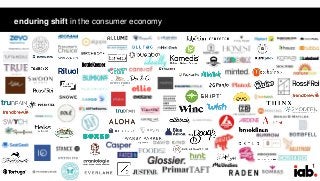
enduring shift in the consumer economy
1
2
01. brand growth
at the crossroads
the 21st century brand economy
3
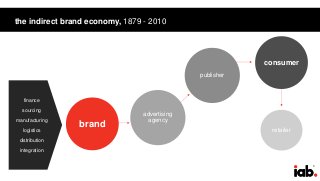
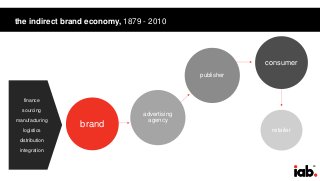
the indirect brand economy, 1879 - 2010
retailer
publisher
advertising
agency
brand
consumer
finance
sourcing
manufacturing
logistics
distribution
integration
4
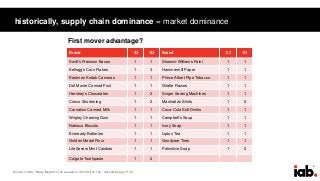
historically, supply chain dominance = market dominance
Brand ‘23 ‘83 Brand ‘23 ‘83
Swift’s Premium Bacon 1 1 Sherwin-Williams Paint 1 1
Kellogg’s Corn Flakes 1 3 Hammermill Paper 1 1
Eastman Kodak Cameras 1 1 Prince Albert Pipe Tobacco 1 1
Del Monte Canned Fruit 1 1 Gilette Razors 1 1
Hershey’s Chocolates 1 2 Singer Sewing Machines 1 1
Crisco Shortening 1 2 Manhattan Shirts 1 5
Carnation Canned Milk 1 1 Coca-Cola Soft Drinks 1 1
Wrigley Chewing Gum 1 1 Campbell’s Soup 1 1
Nabisco Biscuits 1 1 Ivory Soap 1 1
Eveready Batteries 1 1 Lipton Tea 1 1
Golden Medal Flour 1 1 Goodyear Tires 1 1
LifeSavers Mint Candies 1 1 Palmolive Soap 1 2
Colgate Toothpaste 1 2
First mover advantage?
Source: (1983), “Study: Majority of 25 Leaders in 1923 Still on Top,” Advertising Age, P.32.
5
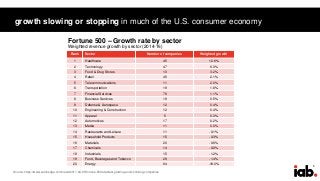
growth slowing or stopping in much of the U.S. consumer economy
Source: https://www.zerohedge.com/news/2017-04-05/fortune-500s-fastest-growing-and-shrinking-companies
Rank Sector Number of companies Weighted growth
1 Healthcare 45 12.6%
2 Technology 47 6.3%
3 Food & Drug Stores 10 3.2%
4 Retail 45 2.1%
5 Telecommunications 11 2.0%
6 Transportation 19 1.8%
7 Financial Services 78 1.1%
8 Business Services 19 0.5%
9 Defense & Aerospace 12 0.4%
10 Engineering & Construction 12 0.4%
11 Apparel 5 0.3%
12 Automotives 17 0.2%
13 Media 11 0.0%
14 Restaurants and Leisure 11 -0.1%
15 Household Products 15 -0.3%
16 Materials 20 -0.6%
17 Chemicals 14 -0.8%
18 Industrials 15 -1.2%
19 Food, Beverages and Tobacco 29 -1.4%
20 Energy 64 -19.0%
Fortune 500 – Growth rate by sector
Weighted revenue growth by sector (2014-16)
6
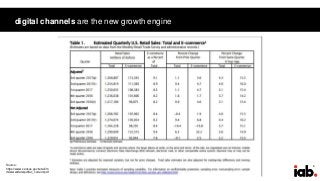
digital channels are the new growth engine
Source:
https://www.census.gov/retail/m
rts/www/data/pdf/ec_current.pdf
7
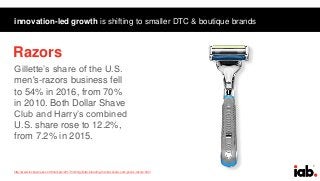
innovation-led growth is shifting to smaller DTC & boutique brands
http://www.foxbusiness.com/markets/2017/04/04/gillette-bleeding-market-share-cuts-prices-razors.html
Gillette’s share of the U.S.
men's-razors business fell
to 54% in 2016, from 70%
in 2010. Both Dollar Shave
Club and Harry’s combined
U.S. share rose to 12.2%,
from 7.2% in 2015.
20 biggest CPG brands reported flat sales while smaller
brands grew 2.4 percent.1
Razors
8
innovation-led growth is shifting to smaller DTC & boutique brands
http://files.shareholder.com/downloads/JNJ/5910160687x0x959899/BFE37E3C-99A1-454D-B8EE-D0E16CFB6046/JNJ_Earnings_Presentation_3Q2017.pdf; http://ir.valeant.com/~/media/Files/V/Valeant-IR/reports-and-
presentations/q3-2017-earnings-presentation.pdf; https://qz.com/1154306/hubble-sold-contact-lenses-with-a-fake-prescription-from-a-made-up-doctor/
J&J’s Acuvue: +8% YOY
Bausch & Lomb: +6% YOY
Hubble Contacts: +20% monthly
20 biggest CPG brands reported flat sales while smaller
brands grew 2.4 percent.1
Contact Lenses
9
innovation-led growth is shifting to smaller DTC & boutique brands
https://www.petfoodindustry.com/articles/6826-us-pet-food-market-to-reach-us27-billion-in-2018; https://www.forbes.com/sites/helainahovitz/2016/06/13/pets-before-profits-the-40m-gamble-that-paid-
off-for-this-ceo/#2a59a71c7e87; https://www.forbes.com/sites/nataliesportelli/2017/05/17/the-farmers-dog-raises-8m-to-bring-made-to-order-dog-food-to-your-door/#45b4248a4998
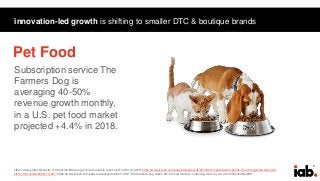
Subscription service The
Farmers Dog is
averaging 40-50%
revenue growth monthly,
in a U.S. pet food market
projected +4.4% in 2018.
Pet Food
10
innovation-led growth is shifting to smaller DTC & boutique brands
https://www.forbes.com/sites/amyfeldman/2017/05/02/dozens-of-upstart-companies-are-upending-the-15-billion-mattress-market/#70b4bedc7da3
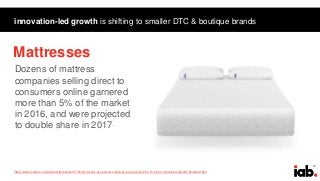
Dozens of mattress
companies selling direct to
consumers online garnered
more than 5% of the market
in 2016, and were projected
to double share in 2017.
20 biggest CPG brands reported flat sales while smaller
brands grew 2.4 percent.1
Mattresses
11
innovation-led growth is shifting to smaller DTC & boutique brands
https://www.onespace.com/blog/2018/01/how-dsw-is-staying-ahead-of-digital-disruption/; https://www.owler.com/iaApp/12158276/allbirds-company-profile; https://www.owler.com/iaApp/8360630/m--
gemi-company-profile; https://www.owler.com/iaApp/1187789/jack-erwin-company-profile
https://infogram.com/copy-us-retail-shoe-store-sales-update-1gdjp9oy36xepyw
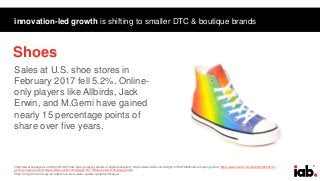
Sales at U.S. shoe stores in
February 2017 fell 5.2%. Online-
only players like Allbirds, Jack
Erwin, and M.Gemi have gained
nearly 15 percentage points of
share over five years.
20 biggest CPG brands reported flat sales while smaller
brands grew 2.4 percent.1
Shoes
12
innovation-led growth is shifting to smaller DTC & boutique brands
https://www.technomic.com/technomic-study-reveals-global-opportunities-within-meal-kit-market; IBISworld iExpert Industry Summary 44511
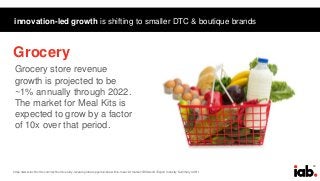
Grocery store revenue
growth is projected to be
~1% annually through 2022.
The market for Meal Kits is
expected to grow by a factor
of 10x over that period.
Grocery
13
innovation-led growth is shifting to smaller DTC & boutique brands
http://www.adweek.com/digital/digital-advertising-is-facing-its-ultimate-moment-of-truth-and-billions-of-dollars-are-at-stake/
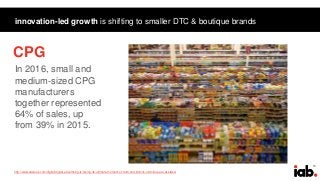
In 2016, small and
medium-sized CPG
manufacturers
together represented
64% of sales, up
from 39% in 2015.
CPG
14
02. the three
last miles
the 21st century brand economy
15
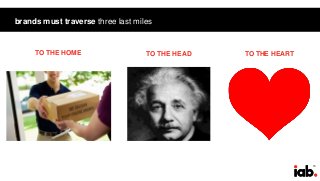
brands must traverse three last miles
TO THE HEAD TO THE HEARTTO THE HOME
16
the cloud forces brands to connect directly with consumers
Source: http://www.jdpower.com/press-releases/2013-social-media-benchmark-study
2/3
of consumers
expect direct
brand
connectivity
67%
of consumers have
used a company's
social media site for
servicing
17
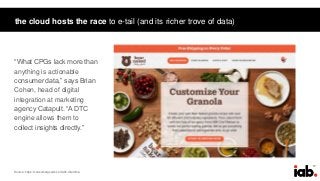
the cloud hosts the race to e-tail (and its richer trove of data)
“What CPGs lack more than
anything is actionable
consumer data,” says Brian
Cohen, head of digital
integration at marketing
agency Catapult. “A DTC
engine allows them to
collect insights directly.”
Source: https://consumergoods.com/dtc-dilemma
18
Source: https://www.mckinsey.com/industries/consumer-packaged-goods/our-insights/supply-chain-4-0-in-consumer-goods
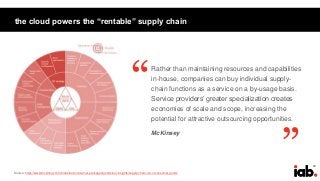
the cloud powers the “rentable” supply chain
Rather than maintaining resources and capabilities
in-house, companies can buy individual supply-
chain functions as a service on a by-usage basis.
Service providers’ greater specialization creates
economies of scale and scope, increasing the
potential for attractive outsourcing opportunities.
McKinsey
“ “
19
your better toothpastes, delivered
20
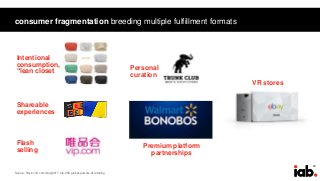
consumer fragmentation breeding multiple fulfillment formats
“
“
Shareable
experiences
Flash
selling
Intentional
consumption,
“lean closet
Personal
curation
Premium platform
partnerships
VR stores
Source: https://nrf.com/blog/2017-top-250-global-powers-of-retailing
21
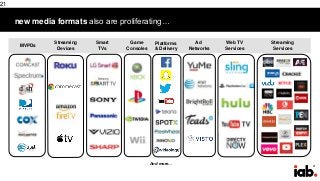
new media formats also are proliferating…
21
Game
Consoles
Streaming
Devices
Smart
TVs
Streaming
Services
MVPDs
And more…
Web TV
Services
Ad
Networks
Platforms
& Delivery
22
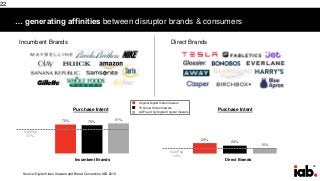
… generating affinities between disruptor brands & consumers
22
Direct Brands
Original Digital Video Viewers
TV Show Online Viewers
Ad-Free Only Digital Original Viewers
78% 76%
81%
Incumbent Brands
29%
22%
15%
Direct Brands
Gen Pop
67%
Gen Pop
14%
Incumbent Brands
Purchase Intent
Source: Digital Video Viewers and Brand Connection, IAB 2018.
Purchase Intent
23
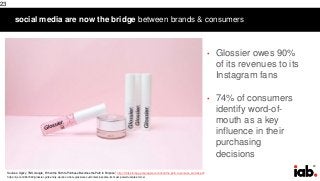
social media are now the bridge between brands & consumers
23
• Glossier owes 90%
of its revenues to its
Instagram fans
• 74% of consumers
identify word-of-
mouth as a key
influence in their
purchasing
decisions
Sources: Ogilvy, TNS, Google, “When the Path to Purchase Becomes the Path to Purpose,” http://think.storage.googleapis.com/docs/the-path-to-purpose_articles.pdf;
https://qz.com/847460/glossier-girls-emily-weiss-on-how-glossiers-customers-became-its-most-powerful-sales-force/
24
the indirect brand economy, 1879 - 2010
retailer
publisher
advertising
agency
brand
consumer
finance
sourcing
manufacturing
logistics
distribution
integration
25
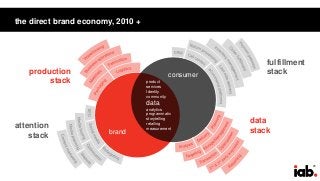
the direct brand economy, 2010 +
product
services
Identity
community
data
analytics
programmatic
storytelling
retailing
measurement
consumer
brand
fulfillment
stack
data
stack
attention
stack
production
stack
26
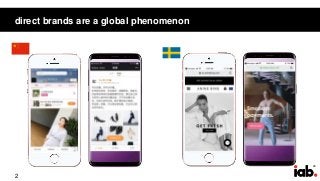
direct brands are a global phenomenon
2
27
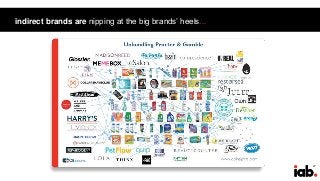
indirect brands are nipping at the big brands’ heels...
28
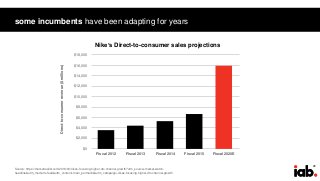
some incumbents have been adapting for years
Source: https://marketrealist.com/2016/03/nikes-focusing-higher-dtc-channel-growth?utm_source=market-watch-
headline&utm_medium=feed&utm_content=main_permalink&utm_campaign=nikes-focusing-higher-dtc-channel-growth
Fiscal 2012
Direct-to-consumerrevenue($millions)
$18,000
$16,000
$14,000
$12,000
$10,000
$8,000
$6,000
$4,000
$2,000
$0
Fiscal 2013 Fiscal 2014 Fiscal 2015 Fiscal 2020E
Nike’s Direct-to-consumer sales projections
29
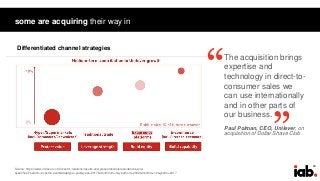
some are acquiring their way in
Source: https://www.unilever.com/investor-relations/results-and-presentations/presentations-and-
speeches/?search=investor+event&datetype=year&year=2017&monthfrom=1&yearfrom=2002&monthto=12&yearto=2017
The acquisition brings
expertise and
technology in direct-to-
consumer sales we
can use internationally
and in other parts of
our business.
Paul Polman, CEO, Unilever, on
acquisition of Dollar Shave Club
Differentiated channel strategies
“ “
30
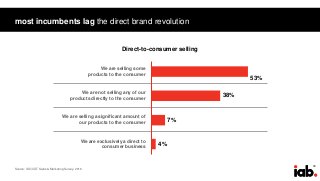
most incumbents lag the direct brand revolution
Direct-to-consumer selling
We are selling some
products to the consumer
We are not selling any of our
products directly to the consumer
We are selling a significant amount of
our products to the consumer
We are exclusively a direct to
consumer business
Source: IDC/CGT Sales & Marketing Survey, 2016
53%
38%
7%
4%
31
04. brand strategy
for revolutionary times
the 21st century brand economy
32
think
direct
33
a two-way
relationship
> a one-way
impression
34
performance is the only
metric that matters
35
brand safety
is not optional
36
story
matters
37
go omni
get hybrid
38
get a
3d view
of your
1d customer
39
IAB Direct Brands
Conference
October 30-31, 2018
Direct Brands
Benchmarking Study
Q4 2018
Best Cases
IAB 250 2.0
40
Randall@iab.com

Interact 2018 - Direct to Consumer. An evolution in how consumer brands create and extract value

  • 1.
    0 the rise of the21st century brand economy IAB Europe Interact Milan, Italy May 24, 2018
  • 2.
    1 enduring shift inthe consumer economy 1
  • 3.
    2 01. brand growth atthe crossroads the 21st century brand economy
  • 4.
    3 the indirect brandeconomy, 1879 - 2010 retailer publisher advertising agency brand consumer finance sourcing manufacturing logistics distribution integration
  • 5.
    4 historically, supply chaindominance = market dominance Brand ‘23 ‘83 Brand ‘23 ‘83 Swift’s Premium Bacon 1 1 Sherwin-Williams Paint 1 1 Kellogg’s Corn Flakes 1 3 Hammermill Paper 1 1 Eastman Kodak Cameras 1 1 Prince Albert Pipe Tobacco 1 1 Del Monte Canned Fruit 1 1 Gilette Razors 1 1 Hershey’s Chocolates 1 2 Singer Sewing Machines 1 1 Crisco Shortening 1 2 Manhattan Shirts 1 5 Carnation Canned Milk 1 1 Coca-Cola Soft Drinks 1 1 Wrigley Chewing Gum 1 1 Campbell’s Soup 1 1 Nabisco Biscuits 1 1 Ivory Soap 1 1 Eveready Batteries 1 1 Lipton Tea 1 1 Golden Medal Flour 1 1 Goodyear Tires 1 1 LifeSavers Mint Candies 1 1 Palmolive Soap 1 2 Colgate Toothpaste 1 2 First mover advantage? Source: (1983), “Study: Majority of 25 Leaders in 1923 Still on Top,” Advertising Age, P.32.
  • 6.
    5 growth slowing orstopping in much of the U.S. consumer economy Source: https://www.zerohedge.com/news/2017-04-05/fortune-500s-fastest-growing-and-shrinking-companies Rank Sector Number of companies Weighted growth 1 Healthcare 45 12.6% 2 Technology 47 6.3% 3 Food & Drug Stores 10 3.2% 4 Retail 45 2.1% 5 Telecommunications 11 2.0% 6 Transportation 19 1.8% 7 Financial Services 78 1.1% 8 Business Services 19 0.5% 9 Defense & Aerospace 12 0.4% 10 Engineering & Construction 12 0.4% 11 Apparel 5 0.3% 12 Automotives 17 0.2% 13 Media 11 0.0% 14 Restaurants and Leisure 11 -0.1% 15 Household Products 15 -0.3% 16 Materials 20 -0.6% 17 Chemicals 14 -0.8% 18 Industrials 15 -1.2% 19 Food, Beverages and Tobacco 29 -1.4% 20 Energy 64 -19.0% Fortune 500 – Growth rate by sector Weighted revenue growth by sector (2014-16)
  • 7.
    6 digital channels arethe new growth engine Source: https://www.census.gov/retail/m rts/www/data/pdf/ec_current.pdf
  • 8.
    7 innovation-led growth isshifting to smaller DTC & boutique brands http://www.foxbusiness.com/markets/2017/04/04/gillette-bleeding-market-share-cuts-prices-razors.html Gillette’s share of the U.S. men's-razors business fell to 54% in 2016, from 70% in 2010. Both Dollar Shave Club and Harry’s combined U.S. share rose to 12.2%, from 7.2% in 2015. 20 biggest CPG brands reported flat sales while smaller brands grew 2.4 percent.1 Razors
  • 9.
    8 innovation-led growth isshifting to smaller DTC & boutique brands http://files.shareholder.com/downloads/JNJ/5910160687x0x959899/BFE37E3C-99A1-454D-B8EE-D0E16CFB6046/JNJ_Earnings_Presentation_3Q2017.pdf; http://ir.valeant.com/~/media/Files/V/Valeant-IR/reports-and- presentations/q3-2017-earnings-presentation.pdf; https://qz.com/1154306/hubble-sold-contact-lenses-with-a-fake-prescription-from-a-made-up-doctor/ J&J’s Acuvue: +8% YOY Bausch & Lomb: +6% YOY Hubble Contacts: +20% monthly 20 biggest CPG brands reported flat sales while smaller brands grew 2.4 percent.1 Contact Lenses
  • 10.
    9 innovation-led growth isshifting to smaller DTC & boutique brands https://www.petfoodindustry.com/articles/6826-us-pet-food-market-to-reach-us27-billion-in-2018; https://www.forbes.com/sites/helainahovitz/2016/06/13/pets-before-profits-the-40m-gamble-that-paid- off-for-this-ceo/#2a59a71c7e87; https://www.forbes.com/sites/nataliesportelli/2017/05/17/the-farmers-dog-raises-8m-to-bring-made-to-order-dog-food-to-your-door/#45b4248a4998 Subscription service The Farmers Dog is averaging 40-50% revenue growth monthly, in a U.S. pet food market projected +4.4% in 2018. Pet Food
  • 11.
    10 innovation-led growth isshifting to smaller DTC & boutique brands https://www.forbes.com/sites/amyfeldman/2017/05/02/dozens-of-upstart-companies-are-upending-the-15-billion-mattress-market/#70b4bedc7da3 Dozens of mattress companies selling direct to consumers online garnered more than 5% of the market in 2016, and were projected to double share in 2017. 20 biggest CPG brands reported flat sales while smaller brands grew 2.4 percent.1 Mattresses
  • 12.
    11 innovation-led growth isshifting to smaller DTC & boutique brands https://www.onespace.com/blog/2018/01/how-dsw-is-staying-ahead-of-digital-disruption/; https://www.owler.com/iaApp/12158276/allbirds-company-profile; https://www.owler.com/iaApp/8360630/m-- gemi-company-profile; https://www.owler.com/iaApp/1187789/jack-erwin-company-profile https://infogram.com/copy-us-retail-shoe-store-sales-update-1gdjp9oy36xepyw Sales at U.S. shoe stores in February 2017 fell 5.2%. Online- only players like Allbirds, Jack Erwin, and M.Gemi have gained nearly 15 percentage points of share over five years. 20 biggest CPG brands reported flat sales while smaller brands grew 2.4 percent.1 Shoes
  • 13.
    12 innovation-led growth isshifting to smaller DTC & boutique brands https://www.technomic.com/technomic-study-reveals-global-opportunities-within-meal-kit-market; IBISworld iExpert Industry Summary 44511 Grocery store revenue growth is projected to be ~1% annually through 2022. The market for Meal Kits is expected to grow by a factor of 10x over that period. Grocery
  • 14.
    13 innovation-led growth isshifting to smaller DTC & boutique brands http://www.adweek.com/digital/digital-advertising-is-facing-its-ultimate-moment-of-truth-and-billions-of-dollars-are-at-stake/ In 2016, small and medium-sized CPG manufacturers together represented 64% of sales, up from 39% in 2015. CPG
  • 15.
    14 02. the three lastmiles the 21st century brand economy
  • 16.
    15 brands must traversethree last miles TO THE HEAD TO THE HEARTTO THE HOME
  • 17.
    16 the cloud forcesbrands to connect directly with consumers Source: http://www.jdpower.com/press-releases/2013-social-media-benchmark-study 2/3 of consumers expect direct brand connectivity 67% of consumers have used a company's social media site for servicing
  • 18.
    17 the cloud hoststhe race to e-tail (and its richer trove of data) “What CPGs lack more than anything is actionable consumer data,” says Brian Cohen, head of digital integration at marketing agency Catapult. “A DTC engine allows them to collect insights directly.” Source: https://consumergoods.com/dtc-dilemma
  • 19.
    18 Source: https://www.mckinsey.com/industries/consumer-packaged-goods/our-insights/supply-chain-4-0-in-consumer-goods the cloudpowers the “rentable” supply chain Rather than maintaining resources and capabilities in-house, companies can buy individual supply- chain functions as a service on a by-usage basis. Service providers’ greater specialization creates economies of scale and scope, increasing the potential for attractive outsourcing opportunities. McKinsey “ “
  • 20.
  • 21.
    20 consumer fragmentation breedingmultiple fulfillment formats “ “ Shareable experiences Flash selling Intentional consumption, “lean closet Personal curation Premium platform partnerships VR stores Source: https://nrf.com/blog/2017-top-250-global-powers-of-retailing
  • 22.
    21 new media formatsalso are proliferating… 21 Game Consoles Streaming Devices Smart TVs Streaming Services MVPDs And more… Web TV Services Ad Networks Platforms & Delivery
  • 23.
    22 … generating affinitiesbetween disruptor brands & consumers 22 Direct Brands Original Digital Video Viewers TV Show Online Viewers Ad-Free Only Digital Original Viewers 78% 76% 81% Incumbent Brands 29% 22% 15% Direct Brands Gen Pop 67% Gen Pop 14% Incumbent Brands Purchase Intent Source: Digital Video Viewers and Brand Connection, IAB 2018. Purchase Intent
  • 24.
    23 social media arenow the bridge between brands & consumers 23 • Glossier owes 90% of its revenues to its Instagram fans • 74% of consumers identify word-of- mouth as a key influence in their purchasing decisions Sources: Ogilvy, TNS, Google, “When the Path to Purchase Becomes the Path to Purpose,” http://think.storage.googleapis.com/docs/the-path-to-purpose_articles.pdf; https://qz.com/847460/glossier-girls-emily-weiss-on-how-glossiers-customers-became-its-most-powerful-sales-force/
  • 25.
    24 the indirect brandeconomy, 1879 - 2010 retailer publisher advertising agency brand consumer finance sourcing manufacturing logistics distribution integration
  • 26.
    25 the direct brandeconomy, 2010 + product services Identity community data analytics programmatic storytelling retailing measurement consumer brand fulfillment stack data stack attention stack production stack
  • 27.
    26 direct brands area global phenomenon 2
  • 28.
    27 indirect brands arenipping at the big brands’ heels...
  • 29.
    28 some incumbents havebeen adapting for years Source: https://marketrealist.com/2016/03/nikes-focusing-higher-dtc-channel-growth?utm_source=market-watch- headline&utm_medium=feed&utm_content=main_permalink&utm_campaign=nikes-focusing-higher-dtc-channel-growth Fiscal 2012 Direct-to-consumerrevenue($millions) $18,000 $16,000 $14,000 $12,000 $10,000 $8,000 $6,000 $4,000 $2,000 $0 Fiscal 2013 Fiscal 2014 Fiscal 2015 Fiscal 2020E Nike’s Direct-to-consumer sales projections
  • 30.
    29 some are acquiringtheir way in Source: https://www.unilever.com/investor-relations/results-and-presentations/presentations-and- speeches/?search=investor+event&datetype=year&year=2017&monthfrom=1&yearfrom=2002&monthto=12&yearto=2017 The acquisition brings expertise and technology in direct-to- consumer sales we can use internationally and in other parts of our business. Paul Polman, CEO, Unilever, on acquisition of Dollar Shave Club Differentiated channel strategies “ “
  • 31.
    30 most incumbents lagthe direct brand revolution Direct-to-consumer selling We are selling some products to the consumer We are not selling any of our products directly to the consumer We are selling a significant amount of our products to the consumer We are exclusively a direct to consumer business Source: IDC/CGT Sales & Marketing Survey, 2016 53% 38% 7% 4%
  • 32.
    31 04. brand strategy forrevolutionary times the 21st century brand economy
  • 33.
  • 34.
  • 35.
    34 performance is theonly metric that matters
  • 36.
  • 37.
  • 38.
  • 39.
    38 get a 3d view ofyour 1d customer
  • 40.
    39 IAB Direct Brands Conference October30-31, 2018 Direct Brands Benchmarking Study Q4 2018 Best Cases IAB 250 2.0
  • 41.

Editor's Notes

  • #2 EPOCHAL SHIFT IN THE CONSUMER ECONOMY AS PROFOUND A CHANGE AS THE INDUSTRIAL REVOLUTION ITSELF IT’S NOT A STORY OF DOOM-AND-GLOOM. IT IS A STORY OF OPPORTUNITY – BUT ONLY IF YOU RECOGNIZE THE ENORMOUS CHANGES IN THE LIFECYCLE OF CONSUMER BRANDS. THE WAY BRANDS ARE BORN, THE WAY BRANDS GROW UP, AND THE WAY BRANDS DIE – THE WAY THEY ARE IDEATED, PRODUCED, SOLD, AND MONETIZED – THESE HAVE CHANGED FOREVER. SOME OF THIS WILL BE OBVIOUS TO YOU. SOME WILL BE NEW. WHAT’S ORIGINAL, I BELIEVE, IS THAT WE TAKE AN END-TO-END SUPPLY CHAIN VIEW OF THE PHENOMENON. THIS ISN’T JUST ABOUT PRODUCTION. IT’S CERTAINLY NOT JUST ABOUT MARKETING AND ADVERTISING. NOR IS IT JUST ABOUT RETAILING. IT’S ABOUT ALL OF THE ABOVE, AND HOW THEY FIT TOGETHER IN THE 21ST CENTURY BRAND ECONOMY.
  • #3 Warby Parker in eyewear, Glossier in cosmetics, Casper in mattresses, Away in luggage – These are not interesting curiosities. These companies actually represent an enduring shift in the way the consumer economy operates. And if you are a longtime, successful incumbent – as all of you in this room are – they are illuminating a path to your own future.
  • #4 If you’re a longtime incumbent brand in most consumer categories, where you are, is at a crossroads
  • #5 Since Procter & Gamble invented Ivory soap, ushering in the era of consumer packaged goods Ownership and operation of high-barrier-to-entry, capital-intensive supply chains. Value extraction by third-party handoffs We call this “The Indirect Brand Economy.” Brands would first go through advertising agencies, because agencies, beginning in the late 19th Century, owned all the competitive pricing information about media. The agencies then went to another third party, what we today call publishers, because publishers controlled virtually all access to the consumer. As recently as 1992, physical retail stores claimed more than 96 percent of the $2 trillion in U.S. retail sales, according to the U.S. Census Bureau. What the Commerce Department calls onstore retailing - the selling of goods and services outside the confines of a retail facility, including direct selling, mail order, catalogue sales, telephone solicitations, and e-commerce - accounted for less than 4 percent of retail sales.
  • #6 Brand preference is persistent over time, in some cases over more than a century, and may tie back to the original order of entry among the current surviving brands At the individual consumer level, brand tastes are also found to be highly persistent and to evolve slowly over a consumer’s lifetime. (Annual Review of Economics) If you could make it to number one in your category, and you committed resources to distribution, production, and managerial expertise, chances are you could stay number one. In the 25 categories on this chart, 19 of the brands that were #1 in 1923 were still #1 in 1983.
  • #7 GDP Growth 1947-2018 averaged 3.21%. GDP Growth 1st Quarter 2018 2.3% All but three consumer-facing categories lag even that. In some categories, the degree of slowdown is alarming. Total CPG unit purchases in the U.S. decreased by 2.5 percent in Q1 2017 compared with Q1 2016, according to our cousins at the Association of National Advertisers. This after flat growth from 2013 through 2016
  • #8 Underneath those headline numbers are some profound changes in the way growth is happening. First is an accelerating shift of store-based retailing to other channels. E-commerce is growing 3-7 times faster per quarter than total retail commerce, according to the Census Bureau. 14% of Americans say they consider buying online, which is up from 9% in 2015. Non-store retailing – 3-4% of a $2 trillion retail economy in the 1990s – is today more than 10% of a $5 trillion retail economy. A $60 billion market in 1992 is now a $500 billion market. Needless to say, some retailers – especially those that hadn’t prepared for the omnichannel wave – find themselves challenged. 9,000 U.S. retail stores closed in the United States last year. Cushman & Wakefield projects another 12,000 will shutter this year.



  • #9 THIS BIG BANG IN OMNI-CHANNEL FULFILLMENT IS LITERALLY OPENING UP PARTICIPATION IN THE CONSUMER ECONOMY LET’S LOOK QUICKLY AT SOME INDIVIDUAL CATEGORIES
  • #15 THIS ISN’T JUST ABOUT DELIVERY TO THE HOME. IT’S ABOUT WHAT’S HAPPENING IN THE STORE, AS SMALLER, NICHE CREATIVE IDEAS NOW HAVE WAYS TO ENTER CONSUMER CONSCIOUSNESS… AND GET BOUGHT
  • #16 What’s propelling the increasing velocity of this new consumer economy? One compelling way to think about it is that there are three last miles that any consumer brand must traverse, and that technology is closing those gaps with increasing rapidity.
  • #17 There’s the last mile to the head: Communication of the rational value of a product or service to the consumer. “Less filling, great taste.” “50 percent off – today only.” These are all rational or functional appeals. There’s the last mile to the heart: Emotional appeals that place a product or brand within someone’s lifestyle, soul, or demographic. “Nobody gets between me and my Calvin’s.” “Baseball, hot dogs, apple pie, and Chevrolet.” “Real women, real beauty” – these are historic emotional appeals. And there’s the last mile to the home: Getting the goods into the hands of the consumer. The technology that is closing all three last miles is the cloud-based Internet. The Cloud is to the 21st Century what the mechanical loom was to the 18th Century – a technology that changes the geographic scope and human scale of an endeavor. Centuries of progress took goods and produced them faster, distributed them more widely, and got them to where they were needed just-in-time. The Cloud took this increasingly finely-tuned ability to manage supply and demand across borders, and enabled it to segment down to the individual level. For the first time, it became possible for customers to make demands of companies as individuals – and to have those demands fulfilled.
  • #18 THE CLOUD IS THE GREAT CONNECTOR This individual connectedness between companies and consumers – an impossibility just 25 years ago – is now an assumed right. Today, J.D. Power says two-thirds of consumers expect direct connectivity to companies.
  • #19 Brands get something equally valuable from these interactions – first-party data that fuels every other function of the enterprise. The cloud is also where all the data – first-party from consumers, and other first-party data from suppliers – connects together to create THE ENRICHED ENTERPRISE This is the proper way to look at etail. It is not just about consumer convenience. It is not just about data. It is not just about the sale. It is about all three, together, inextricably intertwined. The greater the number of digital consumer relationships, the more a brand gains first-party data that continually improves every other enterprise function. The better your products, the more acute your customer value analysis, the more refined your pricing, the more precise your real-time analytics and offers, the more competitive your company becomes. DATA IS TO THE 21ST CENTURY WHAT CAPITAL WAS TO THE 20TH CENTURY
  • #20 What’s notable about the Cloud-centered industrial revolution is that every bit of it is for rent. The expensive, end-to-end, supply chain functions that companies used to need to own or control are now promiscuously available for lease, including the hard functions of sourcing, production, logistics, and fulfillment. This new supply chain revolution is called Supply Chain as a Service, and it allows companies to outsource to a single provider or to multiple providers any and all the essentials of their supply chain – inventory management, production, supply planning, quality control, maintenance - in the same way business process outsourcing enabled them to outsource back-office functions in the 1980s and 1990s. The value of scale – one of the essential support structures of the Indirect Brand Economy – is eroding. Toothpaste story
  • #22 As costs of entry plummet, as the need for first-party data grows, so does a fragmentation of both consumer opportunity and the fulfillment experience. But the reality is even more complex. We are witnessing the advent of perhaps a score of different fulfillment experiences – and increasingly they are omni-channel, a hybrid of virtual and physical shopping: Flash stores, personal curation services, platform partnerships, virtual reality stores are just a few of the new ways consumer needs and desires can be fulfilled. Walmart was an early leader in bringing the virtual and the physical together, with its acquisition of digital fashion brand Bonobos, Shoes.com, and others. “Fewer, Better Things” is the slogan for Cuyana, a San Francisco based e-commerce retailer which has found a market niche by selling customers high quality, craftsman=made goods. The success of their “lean closet” approach reflects a change in customer preferences away from rampant consumption toward intentional consumption.  Customers want authentic, sharable experiences to further their personal brand. Retailers that can consistently deliver these moments will grow a fiercely loyal customer base. T2 boasts a loyal social media following which helped it grow from one store in Melbourne in 1996 to a global brand, acquired by Unilever in 2013. In China, e-commerce power-players Alibaba and Tmall have competition from Vipshop, which has grown by popularizing the flash-sale model. It sells mid-market clothing and accessory brands, using a time-limited discount model. Interestingly, 90 percent of Vipshop’s sales are outside of China’s Tier 1 cities. 
  • #23 AT IAB, WE HAVE BEEN PARTICULARLY FOCUSED ON THE RISE OF OVER-THE-TOP TELEVISION, AND STREAMING SERVICES WE COULD SEE THAT DISRUPTOR VIDEO SERVICES LIKE REFINERY 29, VICE, NETFLIX, AND HULU MIRROR THE LOW-END DISRUPTION WE SEE ELSEWHERE IN THE CONSUMER ECONOMY. WE ALSO SEE VIDEO AS THE SOURCE OF MUCH OF THE ADVERTISING SPEND GROWTH IN DIGITAL. IN OUR RECENTLY RELEASED IAB DIGITAL AD SPENDING REPORT, DONE WITH PWC, WE FOUND THAT MOBILE ADVERTISING IS NOW A $50 BILLION INDUSTRY, ALMOST AS LARGE AS TOTAL TELEVISION. A 36% YOY INCREASE. PURE DIGITAL VIDEO – NOT DELIVERED TO A MOBILE DEVICE - IS GROWING ALMOST AS FAST, AND LAST YEAR CONSTITUTED A $12 BILLION INDUSTRY
  • #24 In an IAB study. 12 consumer categories 12 Incumbent Brands and 12 Direct Brands in each respective category. While, established “Incumbent Brands,” like Brooks Brothers, Maybelline, and Samsonite, have a higher level of awareness, familiarity, engagement, and purchase intent when looking across the entire digital video viewer landscape, disruptor brands are catching up with them via new media/ What we found is that there is a strong affinity between ODV viewers and newer direct-to-consumer “Direct Brands,” such as Away, Birchbox, and Bonobos the ODV audience has a higher awareness of this type of brand than the general digital video audience, and are more likely to purchase from Direct Brands than the average video
  • #25 Disuptor brands are designed to be shared on social media. These brands rely heavily on their own visual content as well as user-generated content to create experience-based hubs for their most loyal consumers. Take Glossier, for example. The beauty brand launched its product line on Instagram as part of its core promotion strategy. Glossier CEO Emily Weiss estimates that Glossier owes 90 percent of its revenue to its fans on Instagram.  “It hasn’t been through paid or built marketing spend,” she said. “It’s been mostly word-of-mouth.” Glossier consumers are not outliers,  74 percent of consumers identify word-of-mouth as a key influencer in their purchasing decisions (Source: Google study)
  • #26 we have lived for almost 140 years inside what we call the Indirect Brand Economy. Indirect Brands created value through their high-barrier-to-entry, capital-intensive, owned-and-operated supply chains, and extracted that value through indirect, one-way relationships with their end consumers, mediated by a series of independent third parties, ending with fulfillment in a physical retail store.
  • #27 Direct Brand Economy. We date its origin to 2010. That’s the year Warby Parker was founded. In this new economy, 21st Century Brands create value by tapping into a low-barrier-to-entry, capital-flexible, leased or rented supply chains. And they extract that value through a multiplicity of fulfillment models, all of which have a single thing in common: they aim to create a mutually beneficial, two-way relationship between the brand and the consumer, because that interactive relationship throws off the data that is the central competitive element for every other function in the enterprise. In the Direct Brand Economy, supply chain functions reside in four “stacks.” These are the production stack, the attention stack, the fulfillment stack, and the data stack – all of their functions available to rent, or to insource, depending on your strategic requirements. WE CALL THIS THE “STACK YOUR OWN” SUPPLY CHAIN
  • #28 the Direct-to-Consumer trend is not US only. t is indeed a global phenomenon. From China to Sweden, we have found many direct to consumer brands that are sharing similar characteristics we have uncovered from digital native, storytelling/content driven to data fueled and multi-channel.
  • #29 The Direct Brand revolution has not gone unnoticed by the giant incumbents. This illustration by the consulting firm CB Insights brilliantly captures the Direct Brand assault on incumbents. It shows how 42 upstart Direct Brands have targeted Procter & Gamble across all its categories.
  • #30 Nike plans for its DTC sales to grow by almost 2.5x in the next five years, from $6.6 billion in fiscal 2015 to $16 billion by fiscal 2020. The company beat its own target of $5 billion in DTC sales by fiscal 2015 by over $1.5 billion. The company’s e-commerce sales grew 55% year-over-year to $1.2 billion in fiscal 2015, making up about 3.9% of the total revenue clocked in the year. In the first two quarters of fiscal 2016, digital sales from Nike’s websites grew 48% year-over-year in currency-neutral terms. 
  • #31 Unilever’s $1 billion acquisition of Dollar Shave Club "expertise and technology in direct-to-consumer sales we can use internationally and in other parts of our business."Unilever said at its recent Investor Day, Nov. 2017, that it expects “experience platforms and e-commerce to reach 30% of turnover in 2022, from 15% in 2012”.  Company said that 70% of its growth in “the near future” would come from two platforms, Personal Care, and e-commerce/DTC. Opened “The Hub,” an internal “disruption center” to “define new ways of working for digital initiatives and shape the future of Digital Marketing for Unilever Personal Care”.  Hellman’s mayonnaise: The brand has partnered with Quiqup,  an on-demand delivery service, for the tests and will use its platform and app. In it, users will be able to choose a recipe and have all of the ingredients at their door within an hour.
  • #32 According to research by IDC, only 18 percent of 100 top consumer goods companies said they were making omnichannel fulfillment via DTC a business priority in the foreseeable future.
  • #33 what does the 21st Century Brand Economy mean for you? First, let me tell you what it doesn’t mean. It doesn’t mean that Direct Brands will take the place of the industrial giants that have dominated consumer product categories for generations. In fact, most of these Direct Brands are small – under $1 billion in annual sales. But they are eating away at incumbents’ leadership, one fraction of a share point at a time. So you must watch them. You must know them. You must partner with them. You must learn from them – and adapt.
  • #34 There is only one strategy in the world: Think Direct. “Think Direct” doesn’t mean you should be selling all your products and services directly to each of your individual end consumers. But it does mean you have to be where they are. It means you have to know a substantial number of them as individuals. It means you should expect to hear from them, and know how and when they’ll want to hear from you. It means you have to understand them well enough to speak in a voice they understand, and to use what they tell you to create the products they want, at the prices they’re willing to pay, delivered in the ways they want it. Consider the first three theses of the Cluetrain Manifesto: Markets are conversations. Markets consist of human beings, not demographic sectors. Conversations among human beings sound human. They are conducted in a human voice. This is what Walt Disney did in March, when it created a DTC division, put its head of strategy in charge, and combined its international operations and even its media sales operations with it. IGER: “we are combining the management of our direct-to-consumer distribution platforms, technology and international operations to deliver the entertainment and sports content consumers around the world want most, with more choice, personalization and convenience than ever before.”
  • #35 At the center of becoming direct must be the recognition that a two-way relationship is more valuable to all brands than a one-way impression. It’s not that mass advertising won’t matter. It’s that it will become less valuable as more and more consumer-facing brands cross the chasm and concentrate their activity on creating, reinforcing, and extracting value from their actual consumer relationships. This is why we are continuing to see double-digit growth rates in Internet advertising overall – and as high as 36% year-on-year in segments like mobile advertising – versus other media, where growth is flat or declining. Uniquely among media, digital allows for the direct connection, the two-way relationship, the give-and-the-take…and the give again.
  • #36 As you may have seen many trade press headlines lamenting the challenges and morass in media measurement, 51% of brand and agency buyers cite consistent cross-screen measurement as a main challenge to video and TV advertising according to a Videology study. Cross-platform TV/video measurement in particular is a pain point - Metrics used to measure video on linear TV and online are vastly different. Without comparable metrics, it’s hard for media buyers and planners to assess the relative value of cross-platform ad inventories. The lack of consensus in metrics presents a barrier and friction point to significant investment decisions which require a solid and accurate understanding of where and to what extent audiences are watching TV and digital video. THIS CHALLENGING MEAUREMENT ENVIRONMENT SETS UP THE NEXT STRATEGIC GUIDEPOST… Marketing is no longer about locating and entertaining mass audiences It’s about bringing in customers. One at a time, by the thousands, by the millions DIRECT BRAND WAR ROOMS DAY TRADING & ARBING MEDIA
  • #37 This means that brand safety is not optional. It is a requirement in the 21st Century Brand Economy. The reason has little to do with the soft concept of “reputation.” It’s because if you don’t have your consumers’ trust, you won’t get their data. And without their data, you don’t have a company. NO TRUST = NO DATA = NO COMPANY. IT’S AS SIMPLE AS THAT.
  • #38 Certainly, another strategic takeaway from this emphasis on creative is that story matters. Direct Brands are as subject to commoditization perceptions as Indirect Brands. Perhaps even more subject to such pressures, in that the barriers to entry are low, every competitor has access to the same supply chain functions, and the basic cost of attention also is low. Taken together, that renders differentiation by function or price difficult, and compels direct brands early in their lifecycle to start differentiating by lifestyle, and by story. Native advertising, meaning the creation and distribution of branded content is a large and growing marketing tactic driven by desire to reach consumers in more organic ways. Increasingly, brands are operating their content marketing efforts as an ongoing business process, not simply a one-off campaign. IAB’s Getting In-Feed Sponsored Content right study showed consumer preference for in-feed sponsored content ads over any other type of digital advertising. Done right, it is a win for the consumer, the brand and the site where the content lives. Branded video advertising is gaining increased traction as brands shift their roles from advertisers to storytellers. According to a Trusted Media Brands study, 37% of total marketers and agency respondents believe branded video and pre/mid/post roll are equally important to their video strategy; 38% of marketers side with branded video. In addition, one-third will increase investment in branded video. branded video formats: 33% higher ad recall, 50% more ad affinity, and 55% larger purchase intent. We think this is why publisher content studios have become such a popular service for Direct Brands. Consider the branded content podcast partnership between Menu Box service Blue Apron and Gimlet Media. It’s designed to enhance Blue Apron’s strategy “to build a lifestyle brand around home cooking, deepen our relationship with our customers, and win new fans.”
  • #39 This leads directly to the next strategic insight. The singular fulfillment experience – the drive-them-to-third-party-retail-store consummation of brand communications that dominated for more than a century – is now over. That means as brands, you’ve got to hybridize – you need to work across fulfillment channels. It’s not good enough to be only physical. And it’s going to be hard to be only digital. By “hybridize,” I mean aid the brands as they develop their own presence across myriad spaces – especially the virtual and the physical. Look at what’s happening to the leading-edge Direct Brands BONOBOS SELLS TO WALMART, IN ORDER TO BE EVERYWHERE ITS CONSUMERS WANT IT TO BE WARBY PARKER LAUNCHES PHYSICAL RETAIL STORES MADISON REED OPENS THREE COLOR BARS, ON ITS WAY TO 20 BY YEAR-END, ALL IN MAJOR METROPOLITAN AREAS AWAY LUGGAGE LAUNCHES STORES, AND A PHYSICAL TRAVEL MAGAZINE Here’s the mantra to remember: Because there are now multiple ways to fulfill desire, you must have multiple ways to instill desire.
  • #40 Why do Direct Brands want such multidimensional access to their consumers? Because no matter how intimate a brand’s relationship with a consumer, that relationship is almost entirely one-dimensional. Mars Petcare will know its consumer only as a dog owner. But in IRL and in virtual space alike, we all live varied and complex lives. Hence my final piece of strategic guidance: Bring brands a three-dimensional view of their one-dimensional customer. This is what the best media companies, agencies, researchers, and creatives have done since the beginning of modern marketing – understand the total consumer, everywhere he or she may be.
  • #41 A last word. Eighty percent of what IAB, the IAB Tech Lab, and the IAB Education Foundation do will not change. We will still work with our members to identify best practices for growing company revenues and profits. We will still put the highest priority on brand safety and consumer safety, because as I say year after year, no trust means no data means no business. We still will devote ourselves to developing global, cross-industry technical standards, to create greater, safer efficiencies in the marketing and media supply chain. We’re going to bring the brands into the room. Our members have a lot to learn from them and their evolution. We also have a lot to teach them – about the best content marketing, risks to their data in the global public policy environment, best practices and technical developments in attribution modeling, and many other things. The centerpiece of this mutual learning experience will be the IAB Direct Brands Conference on October 30-31, 2018. This conference will become an annual fixture on the IAB calendar. At that event, we will release a more refined version of the IAB 250, pinpointing exactly which Direct Brands – both newcomers and evolved incumbents – are having the most impact in their categories. We also expect to release our first-ever benchmarking report on the Direct Brand Economy, diving deep into their operations to learn how they work with media, marketing, and data partners, what obstacles they are facing, and what’s contributing to their growth.