TOPIC HALLIDAY’S MODEL OF LANGUAGE
AND DISCOURSE
PRESENTED TO MA’AM FARKHANDA TAUQEER
PRESENTED BY FASEHA AFZAL (ROLL#21)
ZARMEENA NOOR (ROLL#32)
 Halliday’s has sought to create an approach to linguistics that treat
language an foundational for the building of human experience. His
insight and publications form an approach called Systematic-functional
linguistics.
 Systematic-functional Linguistics as its name suggests, consider function
and semantics as the basis of human language and communication
activity. Unlike structural approaches that privilege syntax, SFL-oriented
linguistics begin an analysis with social context and then look at how
languages act upon, and is constrained and influenced by this social
context.
 A key concept in Halliday’s approach is the “context of situation” which
obtains “through a systematic relationship between the social environment
on the one hand, and the functional organization of language on the
other”
DESCRIPTION AND TERMS FOR
ANALYSING SPOKEN AND WRITTEN
LANGUAGE
 TOKENS: the number of individual items/words.
 TYPES: the different kinds of words used e.g. lexical(content) items and
grammatical (functional) items.
 LEXICAL DENSITY: the ratio of lexical and grammatical items in an
utterances or text;
“a measure of information density within a text”
TAKE-HOME MESSAGE: written language is lexically dense, while oral
language is syntactically more complex.
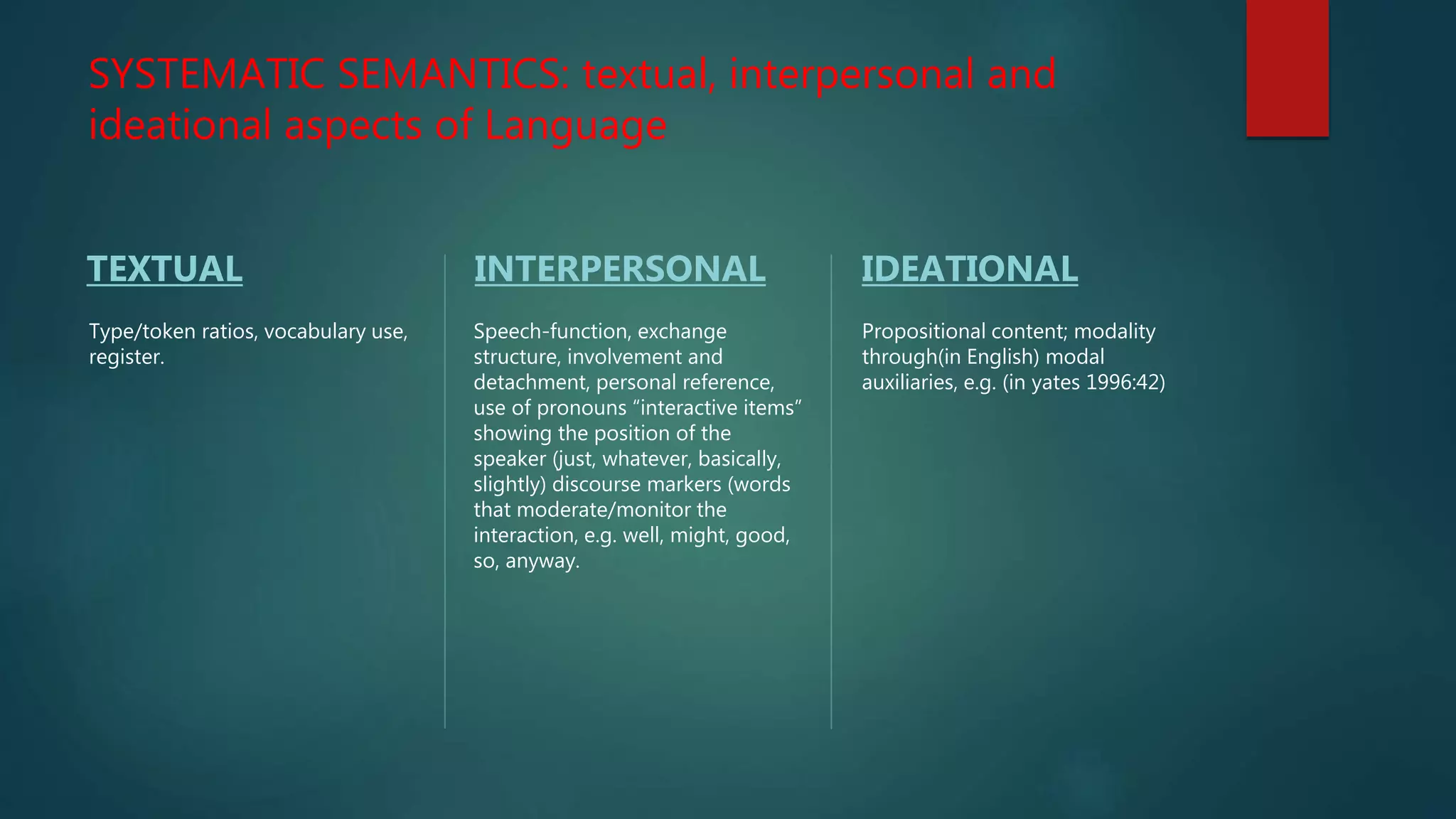
SYSTEMATIC SEMANTICS: textual, interpersonal and
ideational aspects of Language
TEXTUAL
Type/token ratios, vocabulary use,
register.
INTERPERSONAL
Speech-function, exchange
structure, involvement and
detachment, personal reference,
use of pronouns “interactive items”
showing the position of the
speaker (just, whatever, basically,
slightly) discourse markers (words
that moderate/monitor the
interaction, e.g. well, might, good,
so, anyway.
IDEATIONAL
Propositional content; modality
through(in English) modal
auxiliaries, e.g. (in yates 1996:42)
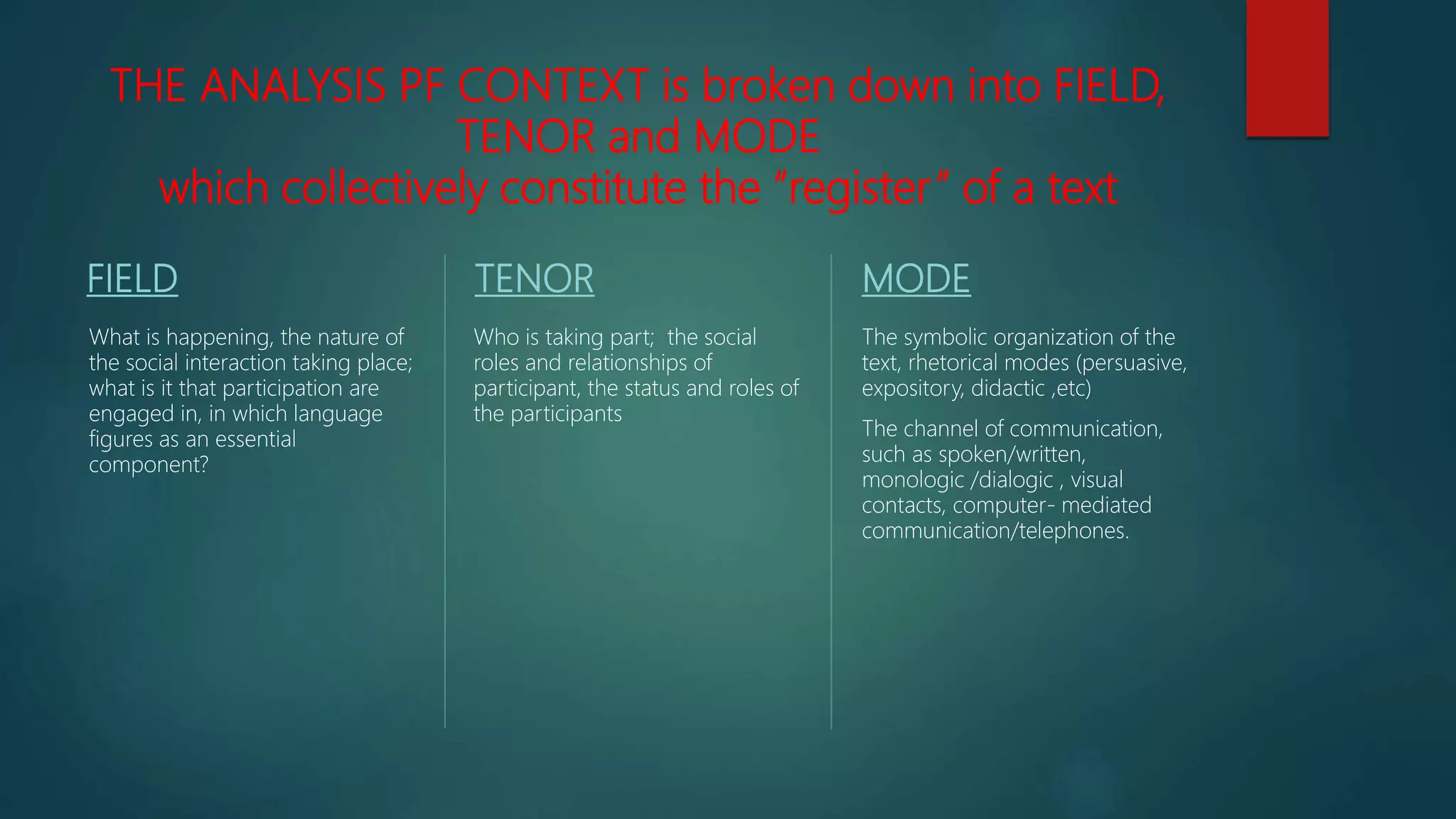
THE ANALYSIS PF CONTEXT is broken down into FIELD,
TENOR and MODE
which collectively constitute the “register” of a text
FIELD
What is happening, the nature of
the social interaction taking place;
what is it that participation are
engaged in, in which language
figures as an essential
component?
TENOR
Who is taking part; the social
roles and relationships of
participant, the status and roles of
the participants
MODE
The symbolic organization of the
text, rhetorical modes (persuasive,
expository, didactic ,etc)
The channel of communication,
such as spoken/written,
monologic /dialogic , visual
contacts, computer- mediated
communication/telephones.

Halliday's model of language and discousre

  • 1.
    TOPIC HALLIDAY’S MODELOF LANGUAGE AND DISCOURSE PRESENTED TO MA’AM FARKHANDA TAUQEER PRESENTED BY FASEHA AFZAL (ROLL#21) ZARMEENA NOOR (ROLL#32)
  • 2.
     Halliday’s hassought to create an approach to linguistics that treat language an foundational for the building of human experience. His insight and publications form an approach called Systematic-functional linguistics.  Systematic-functional Linguistics as its name suggests, consider function and semantics as the basis of human language and communication activity. Unlike structural approaches that privilege syntax, SFL-oriented linguistics begin an analysis with social context and then look at how languages act upon, and is constrained and influenced by this social context.
  • 3.
     A keyconcept in Halliday’s approach is the “context of situation” which obtains “through a systematic relationship between the social environment on the one hand, and the functional organization of language on the other”
  • 4.
    DESCRIPTION AND TERMSFOR ANALYSING SPOKEN AND WRITTEN LANGUAGE  TOKENS: the number of individual items/words.  TYPES: the different kinds of words used e.g. lexical(content) items and grammatical (functional) items.  LEXICAL DENSITY: the ratio of lexical and grammatical items in an utterances or text; “a measure of information density within a text” TAKE-HOME MESSAGE: written language is lexically dense, while oral language is syntactically more complex.
  • 5.
    SYSTEMATIC SEMANTICS: textual,interpersonal and ideational aspects of Language TEXTUAL Type/token ratios, vocabulary use, register. INTERPERSONAL Speech-function, exchange structure, involvement and detachment, personal reference, use of pronouns “interactive items” showing the position of the speaker (just, whatever, basically, slightly) discourse markers (words that moderate/monitor the interaction, e.g. well, might, good, so, anyway. IDEATIONAL Propositional content; modality through(in English) modal auxiliaries, e.g. (in yates 1996:42)
  • 6.
    THE ANALYSIS PFCONTEXT is broken down into FIELD, TENOR and MODE which collectively constitute the “register” of a text FIELD What is happening, the nature of the social interaction taking place; what is it that participation are engaged in, in which language figures as an essential component? TENOR Who is taking part; the social roles and relationships of participant, the status and roles of the participants MODE The symbolic organization of the text, rhetorical modes (persuasive, expository, didactic ,etc) The channel of communication, such as spoken/written, monologic /dialogic , visual contacts, computer- mediated communication/telephones.