Economics Ch. 5
Prices
5.1, 5.2, 5.3

                  1
What is the role of the price
system?
• It guides producers and consumers to work together and
  balance supply and demand by compromise.
• Answers the basic economic questions (ch. 2) in a free
  enterprise market.


                                                           2
What are the benefits of the
price system?
• It provides information, like prices of resources and goods
• incentives, gives people a reason to buy something (sale)
• choice, the price system increases the choices available of
  product
• efficiency, key benefit in the price system, provides for the
  wide use of resources and encourages efficiency by giving info
  to the consumer and producer
• and
• Flexibility, the way the price system deals with the changes in
  supply and demand.

                                                                    3
What are the limitations of the
price system?
• Externalities – the effect the market has on people that aren’t
  directly connected to the consumption or production of
  goods. May be good or bad.
• Public goods – a good or service that is consumed by all
  members of a society or group. It is a limitation due to the
  face that the price system fails to assign the cost of public
  goods to all consumers. (the rich don’t pay enough taxes) (free
  healthcare for any government official)
• Instability – due to drastic weather changes and other things
  like worker protests, drastic price changes are made. Because
  of this, small businesses can go out of business or a necessity
  can become so overwhelmingly expensive that no one will be
                                                                    4
  able to buy it.
What is market equilibrium?
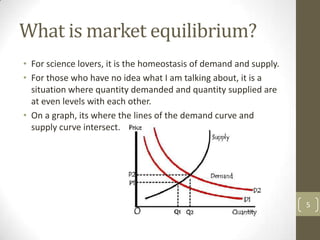
• For science lovers, it is the homeostasis of demand and supply.
• For those who have no idea what I am talking about, it is a
  situation where quantity demanded and quantity supplied are
  at even levels with each other.
• On a graph, its where the lines of the demand curve and
  supply curve intersect.


                                                                    5
How does the price system handle
product surpluses and shortages?
• Producers change prices and quantities of goods provided.
• When there is a surplus, the amount supplied exceeds the
  amount consumed. It tells the producers the products they
  are selling are overpriced.
• When there’s a shortage, it means there isn’t enough of the
  product and it’s too cheap. If they raise the price, the product
  will have less demand and will set the market at equilibrium.


                                                                     6
How do shifts in demand and
supply affect market equilibrium?
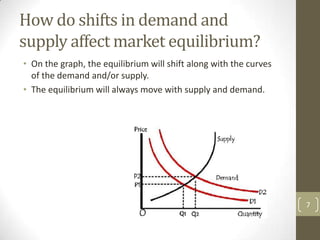
• On the graph, the equilibrium will shift along with the curves
  of the demand and/or supply.
• The equilibrium will always move with supply and demand.


                                                                   7
Why do governments set
prices sometimes?
• To address the limitations of the price system.
• Governments can assign the cost of public goods, and
  externalities.
• It also helps to keep the market functioning smoothly and
  away from economic depressions.
• At times, like during world war 2, the government rationed
  goods so we could send goods off to war for the army men.


                                                               8
What do governments try to establish with
price floors, price ceilings and rationing?
• boundaries
• Price ceiling: the limit on how expensive a good can be. The
  government establishes this because if they didn’t prices of
  living would go up tremendously. For example, the price of
  rent on apartments would go up if there was more demand
  for them in a certain area, but since the city council
  intervened, we are still able to afford living in them.
• Price floor: the limit how cheap a good can be. Ex: Minimum
  wage.
• Rationing: the government tries to establish equality in the
  amount of goods or supplies each consumer or producer will
  be able to have.                                               9
What happens when
governments manage prices?
• The government interferes with the natural flow of supply and
  demand which can cause imbalances and prevent markets
  from reaching equilibrium.
• It stops people from raising the prices to make more profit
  and in turn make more product or a better product.
• With rationing, critics say its unfair, costly and creates black
  markets.


                                                                     10
Credits
• Picture:
• "Fundamentals of Business." Business. Changes in Market
  Equilibrium. N.p., 2009. Web. 24 Aug. 2012.
  <http://www.history-society.com/changes-in-market.html>.
• Info:
• Pennington, Robert Leroy. Holt Economics. Austin, Texas:
  Holt, Rinehart and Winston, 2003. Print.


                                                             11

Economics chapter 5

  • 1.
  • 2.
    What is therole of the price system? • It guides producers and consumers to work together and balance supply and demand by compromise. • Answers the basic economic questions (ch. 2) in a free enterprise market. 2
  • 3.
    What are thebenefits of the price system? • It provides information, like prices of resources and goods • incentives, gives people a reason to buy something (sale) • choice, the price system increases the choices available of product • efficiency, key benefit in the price system, provides for the wide use of resources and encourages efficiency by giving info to the consumer and producer • and • Flexibility, the way the price system deals with the changes in supply and demand. 3
  • 4.
    What are thelimitations of the price system? • Externalities – the effect the market has on people that aren’t directly connected to the consumption or production of goods. May be good or bad. • Public goods – a good or service that is consumed by all members of a society or group. It is a limitation due to the face that the price system fails to assign the cost of public goods to all consumers. (the rich don’t pay enough taxes) (free healthcare for any government official) • Instability – due to drastic weather changes and other things like worker protests, drastic price changes are made. Because of this, small businesses can go out of business or a necessity can become so overwhelmingly expensive that no one will be 4 able to buy it.
  • 5.
    What is marketequilibrium? • For science lovers, it is the homeostasis of demand and supply. • For those who have no idea what I am talking about, it is a situation where quantity demanded and quantity supplied are at even levels with each other. • On a graph, its where the lines of the demand curve and supply curve intersect. 5
  • 6.
    How does theprice system handle product surpluses and shortages? • Producers change prices and quantities of goods provided. • When there is a surplus, the amount supplied exceeds the amount consumed. It tells the producers the products they are selling are overpriced. • When there’s a shortage, it means there isn’t enough of the product and it’s too cheap. If they raise the price, the product will have less demand and will set the market at equilibrium. 6
  • 7.
    How do shiftsin demand and supply affect market equilibrium? • On the graph, the equilibrium will shift along with the curves of the demand and/or supply. • The equilibrium will always move with supply and demand. 7
  • 8.
    Why do governmentsset prices sometimes? • To address the limitations of the price system. • Governments can assign the cost of public goods, and externalities. • It also helps to keep the market functioning smoothly and away from economic depressions. • At times, like during world war 2, the government rationed goods so we could send goods off to war for the army men. 8
  • 9.
    What do governmentstry to establish with price floors, price ceilings and rationing? • boundaries • Price ceiling: the limit on how expensive a good can be. The government establishes this because if they didn’t prices of living would go up tremendously. For example, the price of rent on apartments would go up if there was more demand for them in a certain area, but since the city council intervened, we are still able to afford living in them. • Price floor: the limit how cheap a good can be. Ex: Minimum wage. • Rationing: the government tries to establish equality in the amount of goods or supplies each consumer or producer will be able to have. 9
  • 10.
    What happens when governmentsmanage prices? • The government interferes with the natural flow of supply and demand which can cause imbalances and prevent markets from reaching equilibrium. • It stops people from raising the prices to make more profit and in turn make more product or a better product. • With rationing, critics say its unfair, costly and creates black markets. 10
  • 11.
    Credits • Picture: • "Fundamentalsof Business." Business. Changes in Market Equilibrium. N.p., 2009. Web. 24 Aug. 2012. <http://www.history-society.com/changes-in-market.html>. • Info: • Pennington, Robert Leroy. Holt Economics. Austin, Texas: Holt, Rinehart and Winston, 2003. Print. 11