Maize Group Report Back
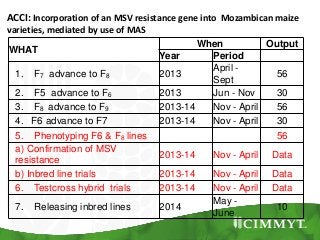
ACCI: Incorporation of an MSV resistance gene into Mozambican maize
varieties, mediated by use of MAS
WHAT
When Output
Year Period
1. F7 advance to F8 2013
April -
Sept
56
2. F5 advance to F6 2013 Jun - Nov 30
3. F8 advance to F9 2013-14 Nov - April 56
4. F6 advance to F7 2013-14 Nov - April 30
5. Phenotyping F6 & F8 lines 56
a) Confirmation of MSV
resistance
2013-14 Nov - April Data
b) Inbred line trials 2013-14 Nov - April Data
6. Testcross hybrid trials 2013-14 Nov - April Data
7. Releasing inbred lines 2014
May -
June
10
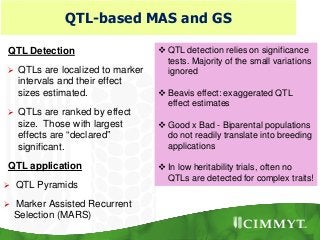
QTL-based MAS and GS
QTL Detection
 QTLs are localized to marker
intervals and their effect
sizes estimated.
 QTLs are ranked by effect
size. Those with largest
effects are “declared”
significant.
QTL application
 QTL Pyramids
 Marker Assisted Recurrent
Selection (MARS)
 QTL detection relies on significance
tests. Majority of the small variations
ignored
 Beavis effect: exaggerated QTL
effect estimates
 Good x Bad - Biparental populations
do not readily translate into breeding
applications
 In low heritability trials, often no
QTLs are detected for complex traits!
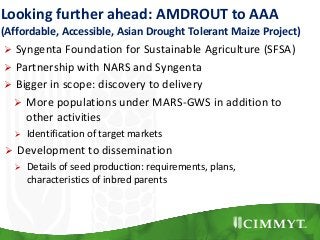
Looking further ahead: AMDROUT to AAA
(Affordable, Accessible, Asian Drought Tolerant Maize Project)
 Syngenta Foundation for Sustainable Agriculture (SFSA)
 Partnership with NARS and Syngenta
 Bigger in scope: discovery to delivery
 More populations under MARS-GWS in addition to
other activities
 Identification of target markets
 Development to dissemination
 Details of seed production: requirements, plans,
characteristics of inbred parents
GRM 2013: Maize product catalogue and project status -- Projects ongoing, completed, and to be continued post-2014 -- BS Vivek

  • 1.
  • 2.
    ACCI: Incorporation ofan MSV resistance gene into Mozambican maize varieties, mediated by use of MAS WHAT When Output Year Period 1. F7 advance to F8 2013 April - Sept 56 2. F5 advance to F6 2013 Jun - Nov 30 3. F8 advance to F9 2013-14 Nov - April 56 4. F6 advance to F7 2013-14 Nov - April 30 5. Phenotyping F6 & F8 lines 56 a) Confirmation of MSV resistance 2013-14 Nov - April Data b) Inbred line trials 2013-14 Nov - April Data 6. Testcross hybrid trials 2013-14 Nov - April Data 7. Releasing inbred lines 2014 May - June 10
  • 3.
    QTL-based MAS andGS QTL Detection  QTLs are localized to marker intervals and their effect sizes estimated.  QTLs are ranked by effect size. Those with largest effects are “declared” significant. QTL application  QTL Pyramids  Marker Assisted Recurrent Selection (MARS)  QTL detection relies on significance tests. Majority of the small variations ignored  Beavis effect: exaggerated QTL effect estimates  Good x Bad - Biparental populations do not readily translate into breeding applications  In low heritability trials, often no QTLs are detected for complex traits!
  • 4.
    Looking further ahead:AMDROUT to AAA (Affordable, Accessible, Asian Drought Tolerant Maize Project)  Syngenta Foundation for Sustainable Agriculture (SFSA)  Partnership with NARS and Syngenta  Bigger in scope: discovery to delivery  More populations under MARS-GWS in addition to other activities  Identification of target markets  Development to dissemination  Details of seed production: requirements, plans, characteristics of inbred parents