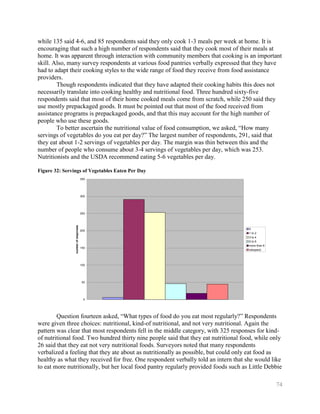
Community Food Security
                in Johnson County, Tennessee
        A Local Food Strategy for Self-Sufficiency, Economic
            Development, and Community Engagement


                                        August 2010

Authors:
Tamara McNaughton, Principal Investigator
Kelly Jo Drey-Houck
Leah Joyner
Suzanne McKinney
Alison Singer
Appalachian Sustainable Agriculture Project
Johnson County Food Security Council


                   Project funded by a Community Food Projects grant from the
              US Department of Agriculture National Institute for Food and Agriculture
                   (USDA NIFA) under award number 2009-33800-20122
Johnson County Farmers Market

www.johnsoncountyfarmersmarket.org
  johnsoncountyfm@gmail.com
          (423)895-9980


                                     ii
Table of Contents

TABLE OF FIGURES ........................................................................................................................... ii
TABLE OF APPENDICES ................................................................................................................... ii
INTRODUCTION ................................................................................................................................iii
  ACKNOWLEDGEMENTS .......................................................................................................................iii
  EXECUTIVE SUMMARY ....................................................................................................................... iv
BACKGROUND ................................................................................................................................... 1
  COMMUNITY FOOD SECURITY DEFINITION .......................................................................................... 1
  HISTORY OF THE JOHNSON COUNTY COMMUNITY FOOD ASSESSMENT PROJECT ................................. 3
  ORIGINAL GOALS FOR THE FOOD ASSESSMENT AND PLANNING PROJECT ............................................ 5
  SOCIOECONOMIC AND DEMOGRAPHIC CHARACTERISTICS ................................................................... 7
ASSESSING THE DYNAMICS OF FOOD IN JOHNSON COUNTY ............................................. 11
  COMMUNITY FOOD RESOURCES ........................................................................................................ 11
    Community-Based and Local Food Options ............................................................................... 11
    ―Alternative‖ Sources of Food..................................................................................................... 13
    Farms According to Agricultural Census .................................................................................... 15
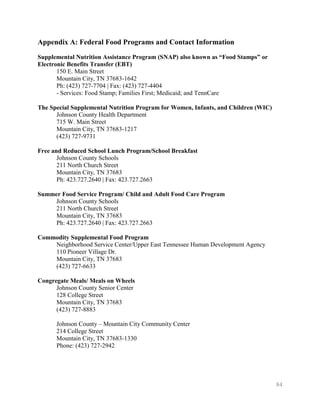
    Federal Food Programs ................................................................................................................ 18
    Emergency Food Assistance Programs ....................................................................................... 21
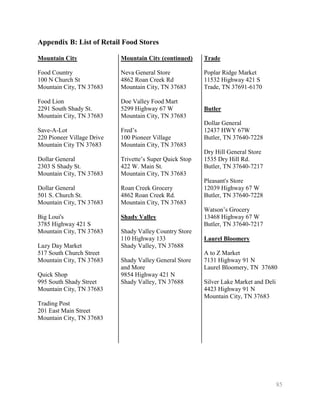
    Retail Stores and Other Places to Purchase Food ........................................................................ 23
    Educational Programs .................................................................................................................. 24
  FOOD PRODUCTION AND CONSUMPTION: THE AGRICULTURAL ECONOMY ........................................ 26
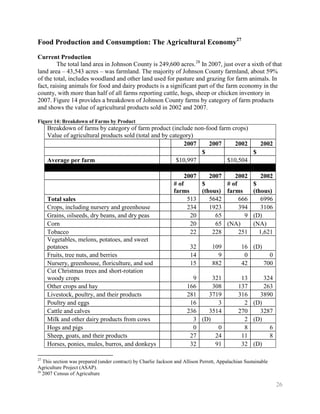
    Current Production ...................................................................................................................... 26
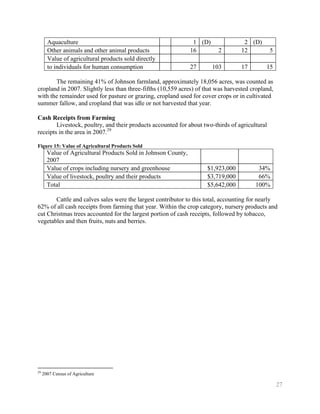
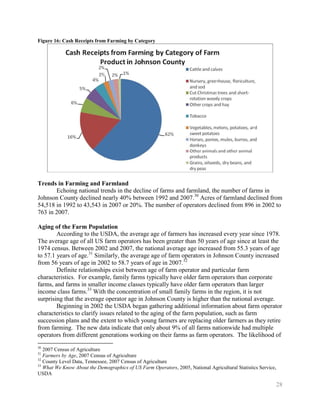
    Cash Receipts from Farming ....................................................................................................... 27
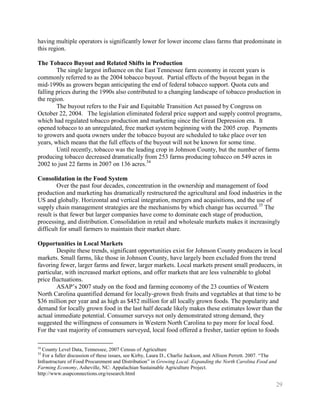
    Trends in Farming and Farmland ................................................................................................ 28
    Aging of the Farm Population ..................................................................................................... 28
    The Tobacco Buyout and Related Shifts in Production ............................................................... 29
    Consolidation in the Food System ............................................................................................... 29
    Opportunities in Local Markets ................................................................................................... 29
    Consumer Food Spending and Consumption Figures for Johnson County and Tri-Cities ......... 30
  FOOD STORE SURVEYS ...................................................................................................................... 35
    Food Availability and Affordability ............................................................................................ 35
    Food Accessibility ....................................................................................................................... 38
  INTERVIEWS WITH KEY STAKEHOLDERS ........................................................................................... 41
  FOCUS GROUPS ................................................................................................................................. 44
    Consumers ................................................................................................................................... 45
    Producers ..................................................................................................................................... 62
  COMMUNITY MEETINGS .................................................................................................................... 67
    What do we have?........................................................................................................................ 67
    What do we want? ....................................................................................................................... 69
    High School Groups .................................................................................................................... 70
  COMMUNITY SURVEY ....................................................................................................................... 71
CONCLUSION .................................................................................................................................... 78
  FIVE PROJECTS TO PURSUE AS DESIRED BY THE COMMUNITY ........................................................... 78
  RECOMMENDATIONS FROM APPALACHIAN SUSTAINABLE AGRICULTURE PROJECT (ASAP) .............. 80
WORKS CITED .................................................................................................................................. 83

                                                                                                                                                     i
Table of Figures
Figure 1: Haves, Needs, and Challenges................................................................................................ 3
Figure 2: County Map ............................................................................................................................ 7
Figure 3: Age Distribution ..................................................................................................................... 8
Figure 4: Race Distribution .................................................................................................................... 8
Figure 5: Per Capita Income .................................................................................................................. 9
Figure 6: Demographic Comparisons .................................................................................................. 10
Figure 7: Land in Farms ....................................................................................................................... 15
Figure 8: Average Size of Farms ......................................................................................................... 16
Figure 9: Number of Farms.................................................................................................................. 16
Figure 10: Farms by Value of Sales ..................................................................................................... 17
Figure 11: Farms by Size in Acres ....................................................................................................... 17
Figure 12: Food Program Participation................................................................................................ 19
Figure 13: Food Pantry Distribution Map ............................................................................................ 22
Figure 14: Breakdown of Farms by Product ........................................................................................ 26
Figure 15: Value of Agricultural Products Sold .................................................................................. 27
Figure 16: Cash Receipts from Farming by Category ......................................................................... 28
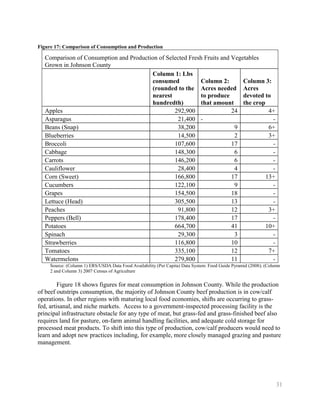
Figure 17: Comparison of Consumption and Production .................................................................... 31
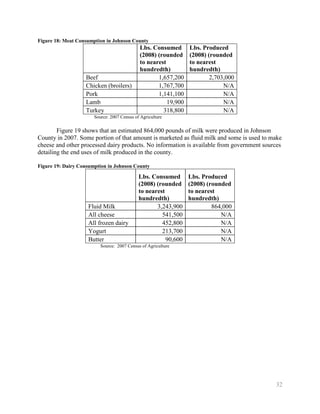
Figure 18: Meat Consumption in Johnson County .............................................................................. 32
Figure 19: Dairy Consumption in Johnson County ............................................................................. 32
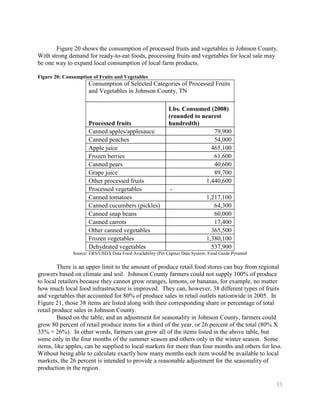
Figure 20: Consumption of Fruits and Vegetables .............................................................................. 33
Figure 21: Market Share of Retail for Fruits and Vegetables .............................................................. 34
Figure 22: Percentage of Ideal Food Availability ................................................................................ 35
Figure 23: Percentage of Actual Food Availability ............................................................................. 36
Figure 24: Percentage Missing Food Items by Category ..................................................................... 36
Figure 25: Store Thrifty Food Plan vs. Federal Thrifty Food Plan Guideline ..................................... 37
Figure 26: Store Thrifty Food Plan without Missing Items vs. Guidelines ......................................... 37
Figure 27: Demographics of Focus Group Participants (Consumers) ................................................ 45
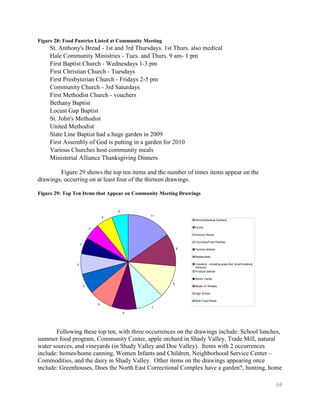
Figure 28: Food Pantries Listed at Community Meeting ..................................................................... 68
Figure 29: Top Ten Items that Appear on Community Meeting Drawings ......................................... 68
Figure 30: Food Security in Johnson County....................................................................................... 72
Figure 31: Percent Eaten from Gardens and Hunting .......................................................................... 73
Figure 32: Servings of Vegetables Eaten Per Day ............................................................................... 74


                                                      Table of Appendices
Appendix A: Federal Food Programs and Contact Information .......................................................... 84
Appendix B: List of Retail Food Stores ............................................................................................... 85
Appendix C: Food Assistance Provider Survey ................................................................................... 86
Appendix D: Focus Group Questions Outline ..................................................................................... 89
Appendix E: Community Survey ......................................................................................................... 92
Appendix F: Definitions ...................................................................................................................... 96


                                                                                                                                                 ii
Introduction

Acknowledgements
      We are grateful to many people who participated in the Johnson County Community Food
Assessment and Planning Project (JCCFAPP). This process was made possible through a grant
from the Community Food Projects grant program from the US Department of Agriculture
National Institute of Food and Agriculture (USDA NIFA).
      The Johnson County Food Security Council met monthly over the course of the project:
Tracy Buckles, Diane Darocha, Casey Dorenbush, Gloria Griffith, Tamara McNaughton, Elaine
Moore, Angie Stout, RoseEdda Slemp, Rick Thomason, Sally Tugman, Joy Wachs, Bill Ward,
Mike Wiles, with Appalachian State University students, East Tennessee State University
students, and Johnson County High School students. Flo Bellamy and her staff at the Johnson
County-Mountain City Community Center hosted these meetings.
      We are thankful for the students who have worked with us on the project. Johnson County
High School FFA and 4-H Honor Club students gathered surveys under the guidance of Harvey
Burniston, Jr., LaVonna Roush, and Timbra Huffman. East Tennessee State University Nursing
School students, Rebecca Mullins, Robi Persinger-Titus, Nicole Presnell, and Amanda Rowlette
conducted sixteen interviews with key stake holders. Appalachian State University students,
Michael Blow, Leah Joyner, Suzanne McKinney, and Alison Singer, along with Kelly Jo Drey-
Houck of Mountain Laurel Consulting, gathered, compiled, and analyzed data and wrote this
document under the guidance of Tamara McNaughton, Johnson County Farmers Market
Manager and JCCFAPP Principle Investigator.
      Community members working with key organizations in Johnson County gathered surveys
and engaged community members: Bill Benedict, Joyce Kidd, Amanda Mullins, Ann Mullins,
Leni Smith, Angie Stout, Ella Stout, Jewel Stout, Sue Teixeira, and Nancy Wills.
      Many thanks to Kelly Jo Drey-Houck and Joy Wachs for conducting the focus groups.
Much gratitude to Diane and Bekah Darocha who prepared fantastic meals for the focus groups
and community meetings. Joyce Kidd and her staff at the Senior Center hosted one of the
community meetings and prepared the meal. Torainna Aschenback, Appalachia Cares
AmeriCorps Member, was elemental in preparing for one of the community meetings held at the
Crewette building. Photos of Johnson County farms are included courtesy of Leah Joyner.
      This plan was possible only because a large number of un-named community members
provided valuable input included throughout this document. Many thanks to all the individuals
who answered surveys and other questions, participated in focus groups, attended community
meetings, and connected or were inspired by the project in other ways.


                                                                                           iii
Executive Summary
        The Johnson County Community Food Assessment and Planning Project (JCCFAPP) has
engaged community members in a conversation about food security and self-reliance in Johnson
County over the past year. These discussions occurred in Food Security Council meetings held
monthly, sixteen interviews with key stakeholders, five focus groups, three community meetings
and meals, and two high school classes. Written surveys were collected from eight emergency
and federal food assistance providers, nearly 700 Johnson County residents, and eight food stores
were inventoried. Residents also chatted about food production, distribution, and consumption at
the Johnson County Farmers Market and other venues. Certainly these dialogues continued in
many homes.
        The 2002 Community Food Assessment Toolkit, written by Barbara Cohen for the US
Department of Agriculture, guided this project. This toolkit focuses mostly on federal,
emergency, and retail food sources. Additions were made to the JCCFAPP to include more
information about the local food system. The Food Security Council determined the overall
direction of the project based on the original goals of this assessment. These goals were:
formalize a community Food Security Council, engage community members in an open-ended
community food assessment, discover new linkages in the local food system, and prepare and
present a comprehensive plan for food security in Johnson County while also helping develop
local jobs and businesses with partners.
        Johnson County residents are extremely innovative in securing, distributing, and eating
food that is locally and regionally produced. Community assets that were consistently
mentioned during the assessment process included: home gardens, farms, churches, food
pantries, the vocational agriculture program at the high school, the community center, the senior
center, federal food programs, grocery stores, restaurants, Trade Mill, the farmers market,
roadside and household produce stands, sharing and/or selling produce from home gardens,
natural and wild foods, and traveling to wholesale farmers markets. Over 50% of those surveyed
said they grow a garden and participants at all of the community meetings and focus groups
mentioned gardens as important assets in the community.
        The county issued a strong call for community gardens. Educational workshops and
coordinated information sharing were important to many. Engaging youth, creating jobs,
offering fresh food at a reasonable cost, and nutrition were mentioned time and again throughout
the process. Community gardens can provide a focus for workshops and information sharing.
Youth and adults of all ages can participate according to their ability. Fresh, inexpensive,
nutritious food can be grown in these gardens while creating potential income for participants.
        Community gardens can produce affordable, available, and accessible food. A tillable
piece of property, a tiller, seeds, plants, water, tools, and people to lead and work in the garden
are the basic necessities to produce an abundance of fresh food. Community gardens are a
logical solution because they foster the principles of: plenty of food for everyone, a sense of
community, and self-sufficiency. These gardens would naturally be places for people to share
both workload and ideas and receive fresh food for their efforts. They can share equipment,
tools, and supplies and teach and learn from each others’ knowledge and gardening skills.
Working together also provides social opportunities, allows people to get to know their
neighbors, and builds community. The excess from the gardens could be sold at the local and
other regional farmers markets to generate revenue. Tax incentives could be provided to land
owners to encourage planting food gardens. These community gardens could inspire and support

                                                                                                 iv
various home garden growers throughout the county. The community garden idea brought
forward by participants is an obvious next step in developing farming and gardening skills,
community self-sufficiency, and our local food system.
         Federal, community, and emergency food programs serve a large number of people in the
county. More than 24% of the county was supported by food stamps in March 2010. The
community center and senior center serve over 2000 meals combined to youth and seniors in a
month, eighty five percent of school children receive free and reduced lunch, and food pantries
provide hundreds of food bags to local residents each month. Yet people do not have enough to
eat as expressed in the surveys and focus groups. People want to grow their own fresh food in
the summer and preserve it for the winter.
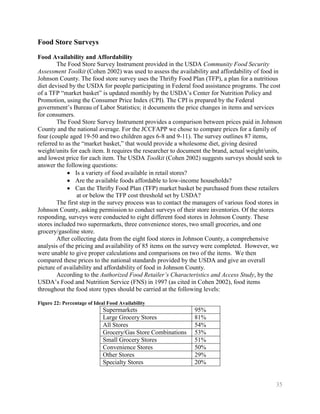
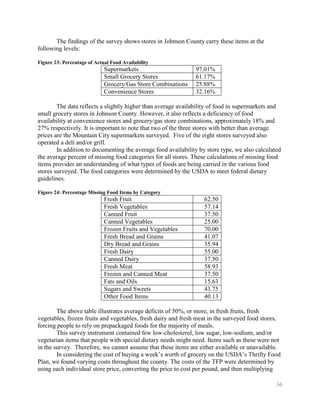
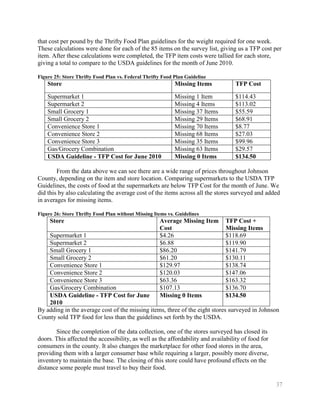
         The food store survey pointed out that the cost of a ―Thrifty Food Plan Basket,‖ a plan for
a nutritious diet devised by the USDA for those collecting Federal food assistance programs, at
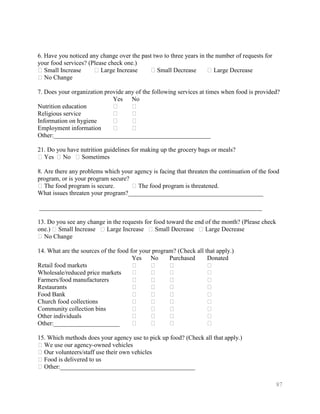
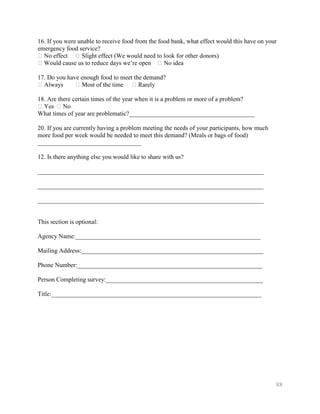
supermarkets in Mountain City is slightly less expensive and have more items than the national
average of supermarkets. In the outer parts of the county, the cost and selection of items on a
―Thrifty Food Plan Basket‖ are more expensive and less available than the national average.
         The upper limit to the amount of local produce retail food stores and individuals can buy
from regional growers is based on climate and soil related limitations. But, is there an upper
limit to the amount of food that could be produced for regional consumers? Johnson County
farmers could not supply 100% of produce to local retailers because they cannot grow oranges,
lemons, or bananas, for example, no matter how much local food infrastructure is improved.
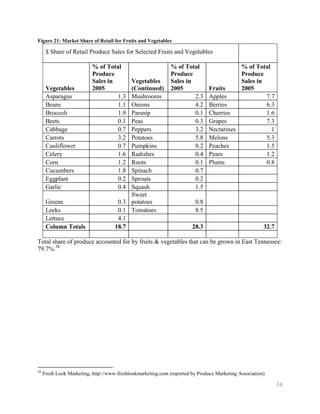
They can, however, grow 38 different types of fruits and vegetables. In Figure 21, those 38
items are listed along with their corresponding share or percentage of total retail produce sales.
Based on the table, an adjustment for seasonality would indicate that Johnson County farmers
could grow 80 percent of retail produce items for a third of the year, or 26 percent of the market
total (80% X 33% = 26%).
         Johnson County has a solid base of farms, gardens, grocery stores, and food pantries as
well as the vocational agriculture department and the farmers market that are the foundation of
the local food system. Some of these elements work together and some work independently. For
instance, one grocery store in Mountain City will purchase locally grown food crops. Some
work exclusively within the boundaries of Johnson County and others depend on outside food
sources. This assessment is a comprehensive overview of these assets.
         Through this process we have seen the incredibly dynamic nature of the food system and
how the system can change from one year to the next. Some of the places discussed in this
document are no longer in existence. Other existing and emerging elements of the food system
may have been overlooked; however, if we missed any part of the Johnson County food system,
it was not intentional or due to lack of community participation. This document is the
completion of the food assessment and planning process, but is only the beginning of a long
term, comprehensive community and economic process focusing on innovative food and farming
strategies.


                                                                                                  v
Background
Community Food Security Definition
        There is no universally accepted definition of ―community food security,‖ a relatively
new concept that involves nutrition, education, public health, anti-hunger, sustainable
agriculture, community development, and other perspectives. USDA defines food security as
―Access by all people at all times to enough food for an active, healthy life. Food security
includes at a minimum: (1) the ready availability of nutritionally adequate and safe foods, and (2)
an assured ability to acquire acceptable foods in socially acceptable ways (e.g., without resorting
to emergency food supplies, scavenging, stealing, or other coping strategies)‖ (Bickel et al.
2000).
          ―Community food security can be described as a prevention concept that supports the
development and enhancement of sustainable, community-based strategies to improve access
of low-income households to healthful nutritious food supplies, to increase the self-reliance of
communities in providing for their own food needs, and to promote comprehensive responses
to local food, farm, and nutrition issues. Community food security focuses on the underlying
economic, institutional, and social factors related to the quality, quantity, availability, and
affordability of food.‖1

        Policies and programs implemented under the label of community food security address
a diverse range of issues, including:
        Food availability and affordability
        Direct food marketing
        Diet-related health problems
        Participation in and access to federal nutrition assistance programs
        Ecologically sustainable agricultural production
        Farmland preservation
        Economic viability of rural communities
        Economic opportunity and job security
        Community development and social cohesion

       According to the USDA Toolkit (Cohen 2002), Communities are considered to be food
insecure if:
       There is a lack of adequate resources for people to purchase food
       Food purchasing resources are not accessible to all community members
       Food available through these resources is not sufficient in quantity or variety
       Food available is not affordable
       There are inadequate food assistance resources for low-income people to purchase food
       There are no local food production resources
       Locally produced food is not available to community members
       There is no support for local food production resources
       There is a substantial level of household food insecurity in the community.

1
    http://www.kerrcenter.com/community_food/definitions.htm

                                                                                                 1
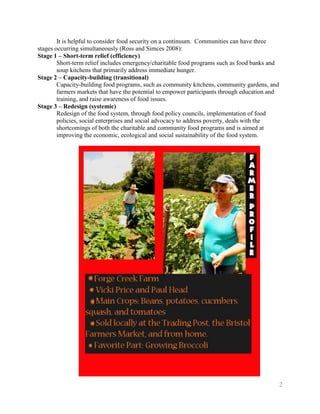
It is helpful to consider food security on a continuum. Communities can have three
stages occurring simultaneously (Ross and Simces 2008):
Stage 1 – Short-term relief (efficiency)
        Short-term relief includes emergency/charitable food programs such as food banks and
        soup kitchens that primarily address immediate hunger.
Stage 2 – Capacity-building (transitional)
        Capacity-building food programs, such as community kitchens, community gardens, and
        farmers markets that have the potential to empower participants through education and
        training, and raise awareness of food issues.
Stage 3 – Redesign (systemic)
        Redesign of the food system, through food policy councils, implementation of food
        policies, social enterprises and social advocacy to address poverty, deals with the
        shortcomings of both the charitable and community food programs and is aimed at
        improving the economic, ecological and social sustainability of the food system.


                                                                                                2
History of the Johnson County Community Food Assessment Project
        In May 2008 the Johnson County Community Foundation, a partner of the East
Tennessee Foundation, awarded a grant to host a ―Local Food Lunch‖ in October of the same
year. This lunch was held at the Johnson County-Mountain City Community Center and was
attended by 30 community members, mostly producers who were interested in expanding their
markets. Attendees participated in an activity where they listed what we have in Johnson County
related to food, what we need, and challenges we experience. Figure 1 is a chart of these
findings:

Figure 1: Haves, Needs, and Challenges
         Haves:                               Needs:                       Challenges:
         Lots of fertile land                 Communication/coordination   Lack of motivation
         Water                                Farmers Market               Lack of cooperation
         Experience                           Customers                    organization &
         Culture/community                    Marketing                    communication
         Desire to stay on land/lifestyle     Education                    Involvement
         Poor economy (hungry                 Neighbors with land          Education of
         people)                              Retired land owners          growers &
         Edible native plants                 wanting young farmers        consumers
         Environment friendly to              Promote ―Victory Gardens‖    Difficult economy
         diverse livestock                    Raise awareness of local     Flood plain/rain
         Farms and farmers                    farmers (tours, education)   Costs of distribution
         Good growing conditions              Viable industry
         Products: corn, apples, etc.         Diversity of crops
         High School Vocational Agriculture   Commercial kitchen
         Home gardens
         Interest in organic/
         sustainable agriculture
         Extension services

        Representatives from Appalachian Sustainable Agriculture Project (ASAP) gave a
presentation about the potential of local markets and how their organization builds local food
systems and supports small farmers with local markets. Attendees enjoyed a meal of Johnson
County grown food prepared by the Johnson County Senior Center.
        Two more meetings were hosted during the following months so attendees could talk
informally about community food security and possible steps to increase our food self
sufficiency. Nine individuals convened in December 2008 and volunteered to share the task of
gathering basic raw data on community food security indicators. The indicator charts in the
USDA Community Food Security Assessment Toolkit by Barbara Cohen were used as a guide.
The group reconvened in January 2009 to bring the data together which was compiled in a
rudimentary fashion.
        At this January meeting, the group decided that our community could benefit from a
more in-depth look into the information gathered, including more qualitative information from
community members. The decision was made to apply for a Community Food Project Planning
Grant; the application was submitted in May 2009.
        In February 2009 a local businessman offered the quonset building at Shouns Crossroads
to establish a farmers market in the county. A public meeting was held in March to determine if

                                                                                                   3
there was interest in a Johnson County farmers market. Thirty people attended this meeting
where a five member board of directors was established. The board proceeded to work
diligently, establishing bylaws, rules for vendors, and operations for the Johnson County Farmers
Market (JCFM). They also recruited vendors and publicized the market to customers. Opening
day was May 30th 2009. The JCFM has been a success with tremendous community support.
        Award notification from the United States Department of Agriculture’s National Institute
for Food and Agriculture (USDA NIFA) was received in September 2009 for funding of the
Johnson County Community Food Assessment and Planning Project (JCCFAPP). The Johnson
County Farmers Market took on the implementation task and Appalachian Native Plants serves
as the fiscal agent.
        The Food Security Council was established October 2009 to guide and implement the
JCCFAPP. This Council consists mostly of women who work in areas of health and nutrition
education in the county. Monthly Food Security Council meetings were held over the course of
the project to provide insight, guidance, and support in the effort. The Council has been joined
by a wide variety of community members and college students in gathering the information
presented in this document. This document is the completion of the food assessment and
planning process, but is only the beginning of long term, comprehensive community and
economic development focusing on innovative food and farming strategies.


                                                                                               4
Original Goals for the Food Assessment and Planning Project

The USDA uses the following criteria to determine Community Food Project Awards:
     Meeting the food needs of low-income people
     Increasing community self-reliance
     Promoting comprehensive responses to food, farm and nutrition issues
     Developing innovative links
     Supporting entrepreneurial development
     Encouraging long-term planning
     Encouraging multi-system, interagency approach
     Achieving project self-sufficiency

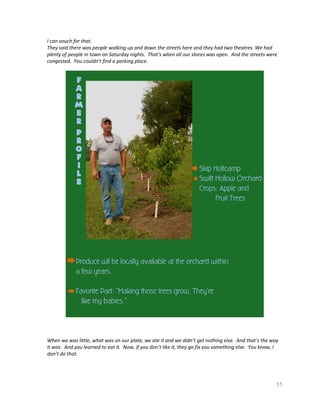
As such, the original project goals and their outcomes are as follows:

1. Establish a Community Food Security Council that will implement the community food
security plan and increase the long term sustainability of our community food system.
        The Food Security Council was established within the first month of the project. This
council consists of seven members and includes low-income residents and professionals from
organizations that work directly with low-income food service recipients. The council met once
per month to drive the assessment and planning process forward. Throughout the project,
members developed assessment tools and recruited volunteers.

2. Engage community members in an open-ended community food assessment through primary
sources, community meetings, focus groups, and surveys. This assessment may include a profile
of community socioeconomic and demographic characteristics, a profile of community food
resources, assessment of household food security, assessment of food resource accessibility,
assessment of food availability and affordability, and assessment of community food production,
including home grown food. Key aspects of the assessment will be determined by the Food
Security Council and community participants. After the assessment, the community has become
better informed about food security issues and ways to decrease food security concerns.
        At least 1000 surveys were planned to be collected directly from a broad base of the
community including youth, seniors, various food service clients and recipients, farmers, grocers,
and other citizens. The specific format and questions of these surveys was determined by the
Food Security Council. Ultimately, 659 surveys were collected.
        Five focus groups, with 48 total participants, were hosted in the first eight months of the
project with seven to fourteen people attending each of these focus groups.
        Four open community meetings were also hosted to share and gather information.

3. Discover linkages between farmers/producers, processing facilities, distribution channels, and
consumers to make affordable quality foods more readily available to residents of Johnson
County with particular attention to low-income residents.
        By engaging community members in the assessment and planning process, people began
to discover gaps in our food system that can be filled and other opportunities to link various
sectors of the food system.


                                                                                                 5
4. Write and present a comprehensive, long-term community food security plan to Johnson
County and Mountain City officials with the intention that it will be adopted by the Town
Council and the County Commission.
        By September 2010 the Community Food Security Plan for Johnson County will be
completed and presented at both the Mountain City Town Council and the Johnson County
Commission. Both of these groups of elected officials will be asked to adopt the plan as part of
their community economic development strategies. Presenting at these meetings will ensure that
the document is recorded in their meeting minutes. The plan will also be summarized and
submitted to the local newspapers for publication.

5. Assist with business planning and development of agriculturally based enterprises that are
discovered and/or inspired by participants in the assessment and planning process.
       In January 2010 the Johnson County Economic Development Partnership (JCEDP)
employee took a new job in another county. This JCEDP employee had committed to assist with
business planning and development during the course of the project. Johnson County was
without a JCEDP employee until July 2010. In the meantime, the Johnson County Farmers
Market assisted four new vendors in developing their agricultural enterprises.


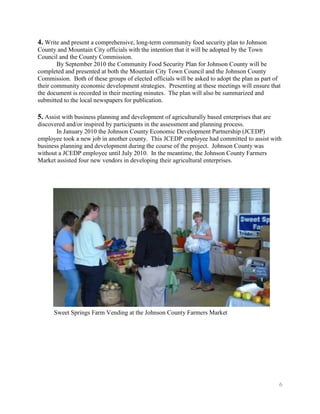
      Sweet Springs Farm Vending at the Johnson County Farmers Market


                                                                                                6
Socioeconomic and Demographic Characteristics
        Johnson County is a rural, tight-knit community with strong kinship networks and a
wealth of social capital. The community prides itself on self-sufficiency, which is an important
concept in food security.
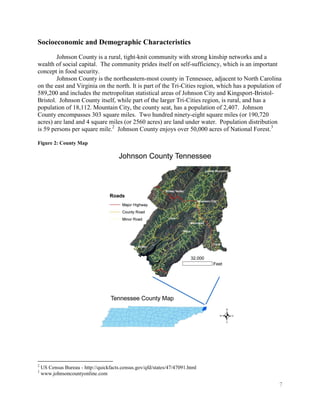
        Johnson County is the northeastern-most county in Tennessee, adjacent to North Carolina
on the east and Virginia on the north. It is part of the Tri-Cities region, which has a population of
589,200 and includes the metropolitan statistical areas of Johnson City and Kingsport-Bristol-
Bristol. Johnson County itself, while part of the larger Tri-Cities region, is rural, and has a
population of 18,112. Mountain City, the county seat, has a population of 2,407. Johnson
County encompasses 303 square miles. Two hundred ninety-eight square miles (or 190,720
acres) are land and 4 square miles (or 2560 acres) are land under water. Population distribution
is 59 persons per square mile.2 Johnson County enjoys over 50,000 acres of National Forest.3

Figure 2: County Map


2
    US Census Bureau - http://quickfacts.census.gov/qfd/states/47/47091.html
3
    www.johnsoncountyonline.com

                                                                                                    7
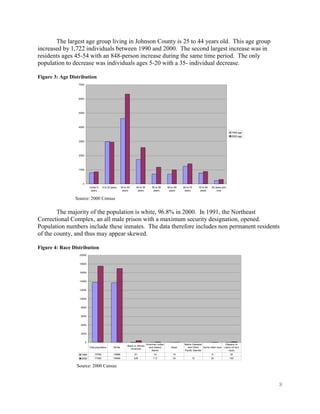
The largest age group living in Johnson County is 25 to 44 years old. This age group
increased by 1,722 individuals between 1990 and 2000. The second largest increase was in
residents ages 45-54 with an 848-person increase during the same time period. The only
population to decrease was individuals ages 5-20 with a 35- individual decrease.

Figure 3: Age Distribution
                  7000


                  6000


                  5000


                  4000

                                                                                                                                                            1990 age
                                                                                                                                                            2000 age

                  3000


                  2000


                  1000


                    0
                             Under 5     5 to 20 years     20 to 44      45 to 54       55 to 59      60 to 64   65 to 74     75 to 84   85 years and
                              years                         years         years          years         years      years        years         over


                Source: 2000 Census

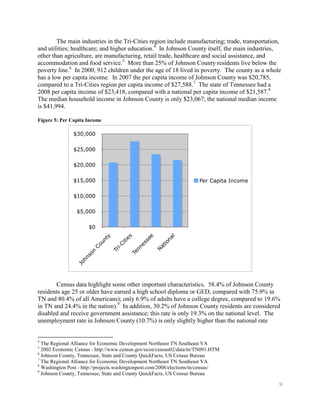
        The majority of the population is white, 96.8% in 2000. In 1991, the Northeast
Correctional Complex, an all male prison with a maximum security designation, opened.
Population numbers include these inmates. The data therefore includes non permanent residents
of the county, and thus may appear skewed.

Figure 4: Race Distribution
                  20000


                  18000


                  16000


                  14000


                  12000


                  10000


                   8000


                   6000


                   4000


                   2000


                         0
                                                                                    American Indian               Native Hawaiian                     Hispanic or
                                                                 Black or African
                             Total population      White                              and Alaska         Asian      and Other      Some other race   Latino (of any
                                                                    American
                                                                                        Native                    Pacific Islander                       race)
                    1990         13766             13668               61                 14              14                             9                32
                    2000         17499             16946               428               113              33            10               52               150


                 Source: 2000 Census


                                                                                                                                                                       8
The main industries in the Tri-Cities region include manufacturing; trade, transportation,
and utilities; healthcare; and higher education.4 In Johnson County itself, the main industries,
other than agriculture, are manufacturing, retail trade, healthcare and social assistance, and
accommodation and food service.5 More than 25% of Johnson County residents live below the
poverty line.6 In 2000, 912 children under the age of 18 lived in poverty. The county as a whole
has a low per capita income. In 2007 the per capita income of Johnson County was $20,785,
compared to a Tri-Cities region per capita income of $27,588.7 The state of Tennessee had a
2008 per capita income of $23,418, compared with a national per capita income of $21,587.8
The median household income in Johnson County is only $23,067; the national median income
is $41,994.

Figure 5: Per Capita Income


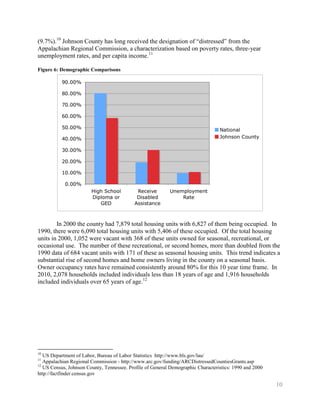
       Census data highlight some other important characteristics. 58.4% of Johnson County
residents age 25 or older have earned a high school diploma or GED, compared with 75.9% in
TN and 80.4% of all Americans); only 6.9% of adults have a college degree, compared to 19.6%
in TN and 24.4% in the nation).9 In addition, 30.2% of Johnson County residents are considered
disabled and receive government assistance; this rate is only 19.3% on the national level. The
unemployment rate in Johnson County (10.7%) is only slightly higher than the national rate


4
  The Regional Alliance for Economic Development Northeast TN Southeast VA
5
  2002 Economic Census - http://www.census.gov/econ/census02/data/tn/TN091.HTM
6
  Johnson County, Tennessee, State and County QuickFacts, US Census Bureau
7
  The Regional Alliance for Economic Development Northeast TN Southeast VA
8
  Washington Post - http://projects.washingtonpost.com/2008/elections/tn/census/
9
  Johnson County, Tennessee, State and County QuickFacts, US Census Bureau

                                                                                                 9
(9.7%).10 Johnson County has long received the designation of ―distressed‖ from the
Appalachian Regional Commission, a characterization based on poverty rates, three-year
unemployment rates, and per capita income.11

Figure 6: Demographic Comparisons


        In 2000 the county had 7,879 total housing units with 6,827 of them being occupied. In
1990, there were 6,090 total housing units with 5,406 of these occupied. Of the total housing
units in 2000, 1,052 were vacant with 368 of these units owned for seasonal, recreational, or
occasional use. The number of these recreational, or second homes, more than doubled from the
1990 data of 684 vacant units with 171 of these as seasonal housing units. This trend indicates a
substantial rise of second homes and home owners living in the county on a seasonal basis.
Owner occupancy rates have remained consistently around 80% for this 10 year time frame. In
2010, 2,078 households included individuals less than 18 years of age and 1,916 households
included individuals over 65 years of age.12


10
   US Department of Labor, Bureau of Labor Statistics http://www.bls.gov/lau/
11
   Appalachian Regional Commission - http://www.arc.gov/funding/ARCDistressedCountiesGrants.asp
12
   US Census, Johnson County, Tennessee. Profile of General Demographic Characteristics: 1990 and 2000
http://factfinder.census.gov

                                                                                                         10
Assessing the Dynamics of Food in Johnson County

Community Food Resources
Community-Based and Local Food Options
          Looking at Community Food Security on a continuum as described in the introduction
(see pg. 2), Johnson County has many short term relief (stage one) programs. The Johnson
County Farmers Market (JCFM) is the only capacity building (stage two) project. There are also
redesign (stage three) actions such as the Food Security Council, state-level policies for school
food procurement that support local food, and the beginnings of food sector community
economic development/social enterprises.
          The USDA Toolkit (Cohen 2002) used to conduct this food assessment includes six
indicators for food production resources: community gardens, school-based gardens, community
supported agriculture programs, farms, dairies and fisheries, and food manufacturers and
distributors. Farms are discussed in a later section. Johnson County has no school-based
gardens, community supported agriculture programs, or food distributors.
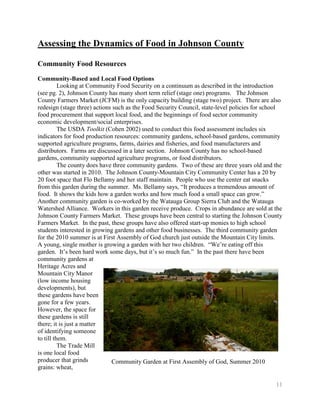
          The county does have three community gardens. Two of these are three years old and the
other was started in 2010. The Johnson County-Mountain City Community Center has a 20 by
20 foot space that Flo Bellamy and her staff maintain. People who use the center eat snacks
from this garden during the summer. Ms. Bellamy says, ―It produces a tremendous amount of
food. It shows the kids how a garden works and how much food a small space can grow.‖
Another community garden is co-worked by the Watauga Group Sierra Club and the Watauga
Watershed Alliance. Workers in this garden receive produce. Crops in abundance are sold at the
Johnson County Farmers Market. These groups have been central to starting the Johnson County
Farmers Market. In the past, these groups have also offered start-up monies to high school
students interested in growing gardens and other food businesses. The third community garden
for the 2010 summer is at First Assembly of God church just outside the Mountain City limits.
A young, single mother is growing a garden with her two children. ―We’re eating off this
garden. It’s been hard work some days, but it’s so much fun.‖ In the past there have been
community gardens at
Heritage Acres and
Mountain City Manor
(low income housing
developments), but
these gardens have been
gone for a few years.
However, the space for
these gardens is still
there; it is just a matter
of identifying someone
to till them.
          The Trade Mill
is one local food
producer that grinds          Community Garden at First Assembly of God, Summer 2010
grains: wheat,

                                                                                              11
buckwheat, corn, and others into flour and meal. Most of the grains for the Mill are grown in the
county by John Shull, who was encouraged to diversify his grain crops specifically to supply the
Mill. The Mill has also been known to grind grain for individuals. James Miller, a third
generation miller runs the water-powered operation and uses pre-civil war equipment that came
from Old Snyder’s Mill down the road. The Trade Mill sometimes sells their products at the
Johnson County Farmers Market. In early summer of 2010 they received a standing order of
5,000 bags per month to supply Food City Supermarkets, a regional chain with stores throughout
southeast Virginia. Food City is known to support many local food agripreneurs in the region.
        One family dairy remains in the county and sells their milk to Southeast Dairy Farmers of
America, an organization that only purchases milk free of hormones. The dairy also supplies
milk to their family and friends. One man in Laurel Bloomery drives milk trucks. Some dairies
in the county closed as recently as 1998. Two livestock auctions also operate in the county. One
of these auction houses was the first in the state of Tennessee.
        Some cattlemen will sell beef on the hoof to interested consumers. Once the beef is
purchased, the live animal is trucked to a slaughter house and belongs to the consumer.
Arrangements are made on types of cuts desired and the consumer picks it up or can arrange for
further delivery. Producer/consumer relationships like this tighten links in the local food
economy.
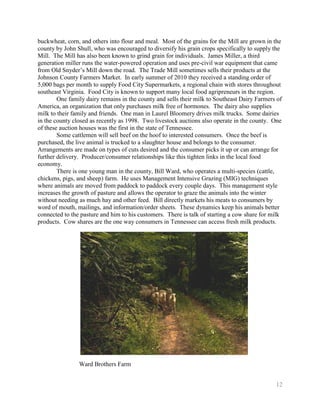
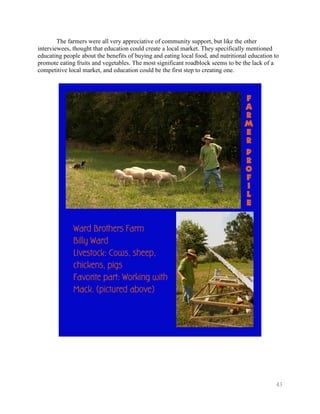
        There is one young man in the county, Bill Ward, who operates a multi-species (cattle,
chickens, pigs, and sheep) farm. He uses Management Intensive Grazing (MIG) techniques
where animals are moved from paddock to paddock every couple days. This management style
increases the growth of pasture and allows the operator to graze the animals into the winter
without needing as much hay and other feed. Bill directly markets his meats to consumers by
word of mouth, mailings, and information/order sheets. These dynamics keep his animals better
connected to the pasture and him to his customers. There is talk of starting a cow share for milk
products. Cow shares are the one way consumers in Tennessee can access fresh milk products.


                Ward Brothers Farm


                                                                                              12
The Cow Share Bill was passed May 2009 in Tennessee. ―This law solidifies the position
that it is perfectly legal for an owner or a partial owner to drink their own cow's milk. Partial is a
very key word in this bill. In fact, without this word, the bill would not be the same and would
not carry the weight and strength that it does. Partial owners are cow (or any hoofed mammal)
share owners and the bill states their legal position loud and clear. Now farmers can enter into
share/boarding contracts free from worry that a government agency will tell them they cannot.‖13
         Johnson County High School has one of the nation’s leading Vocational Agriculture
Programs with a large fish operation that raises and sells tilapia and koi, as well as hydroponic
lettuce, tomatoes, cucumbers, and herbs. These products, along with vegetable and flower
transplants in the spring, are sold to the school food service program, local restaurants, and are
available for local consumers to purchase at the school during the school year. The greenhouses
are closed in the summer; however pre-orders for fish and produce can be placed before the end
of the school year. They maintain a waiting list for their fish. The produce is sold on a first
come, first serve basis.
         Various other greenhouses and feed/seed stores are located in the county providing
vegetable and flower transplants, fertilizers, sprays, and other materials for vegetable gardens
and gardeners. Two of these stores are in Mountain City, one in Laurel Bloomery, one in Doe
Valley, and two in Shady Valley. Home gardeners also start vegetable transplants to share with
their friends and family, but they are not official businesses.
         Twelve miles from Mountain City, across the North Carolina border, a meat processor
cuts meat but is not USDA certified. This processor serves many people in Johnson County,
processing various meat animals. He also participates in the Hunters for the Hungry Program.
Another man in the Butler area processes meat for people and conducts hunter safety courses.
For the retail sale of meat, butchering must be done in a USDA certified packing house. The
closest USDA processors are at least a one hour trip away.

“Alternative” Sources of Food
        Johnson County residents are creative in identifying, distributing, and eating food that is
locally and regionally produced. In addition to the six indicators for food production resources
described in the previous section, resources have been consistently identified during the
assessment process: home gardens (including sharing and/or selling produce from home
gardens), natural and wild foods, roadside and household produce stands, traveling to wholesale
farmers markets, and ―dumpster diving‖ to rescue thrown away food.
        Large and small gardens can be seen in fields and yards throughout the county. Corn,
beans, tomatoes, and potatoes are some of the most common crops grown. Some porches have
hanging containers for growing tomatoes. Many people give extra produce to their family and
neighbors. This dynamic of sharing not only keeps people fed, but also supports kinship and
social networks. Even small amounts of fresh produce are better when you grow them yourself
or receive them from people you know.
        Natural and wild foods have also been reported in community meetings. A list of wild
foods includes: fish, deer, rabbit, squirrel, turkey, insects, frogs, crayfish, turtles and snakes.
Mushrooms, herbs, fruits, berries, and other wild foods were also listed. Johnson County is
blessed with over 50,000 acres of National Forest, Watauga Lake, trout streams, small creeks,
and other forested areas. These areas generate an abundance of natural and wild foods.


13
     http://www.tennesseansforrawmilk.com/updates.html

                                                                                                   13
Produce stands are scattered throughout the county. Some of these produce stands are
connected to farms, home gardens with excess harvest, flea markets and country stores. Many of
these stands stay in business for years and others have lasted less than a year. This is a difficult
business because the product must be sold or it will perish. Produce stands have been in
Mountain City, Forge Creek, Laurel Bloomery, Doe Valley, and Butler. Some people pull their
trucks off the side of the road in Mountain City, Butler, and Trade and sell their produce. Some
of these are truck stands operated by individuals who grew the product and others have bought
the product for resale. These trucks have been seen selling apples, corn, cantaloupes, cabbage
and even oranges and grapefruits in the winter.
         A handful of sizable farms and home gardens sell bushels and half bushels of produce.
Lynn Snyder’s U-pick farm is well known throughout the county as somewhere you can pick
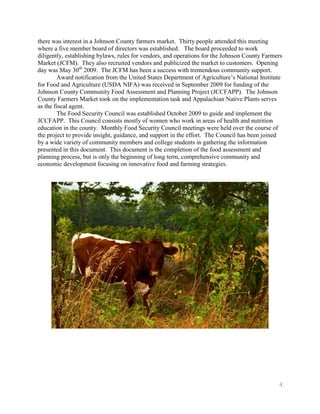
bushels of tomatoes and beans, for instance, to can for the winter months.14 Forge Creek Farm is
another farm that will take phone orders for bushels of beans, potatoes, and other products for
on-farm sales. It was said that Trivette’s in Dry Hill has been taking similar orders during the
2010 summer. In Shady Valley at least four farmers sell potatoes by the bushel, and at least
three farmers sell apples by the bushel. One family sells flats of strawberries, and there is one U-
pick blueberry farm.


      Forge Creek Farm

        Another innovative action people take to get local and regional food on Johnson County
dinner tables is to drive to large wholesale farmers markets in Chucky (Nolichucky), Tennessee
and Asheville, North Carolina. Bags of corn, bushels of beans, tomatoes, and potatoes are
brought into Johnson County from these outlets and residents can preserve them for winter
meals.


14
  Unfortunately, Mr. Snyder’s business partner, Marie, came down with an illness in the winter of 2009 and was
unable to work with him to keep their stand open for the 2010 season.

                                                                                                                 14
Farms According to Agricultural Census
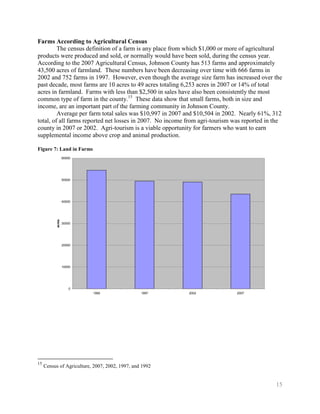
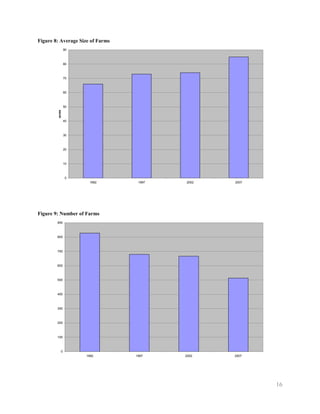
         The census definition of a farm is any place from which $1,000 or more of agricultural
products were produced and sold, or normally would have been sold, during the census year.
According to the 2007 Agricultural Census, Johnson County has 513 farms and approximately
43,500 acres of farmland. These numbers have been decreasing over time with 666 farms in
2002 and 752 farms in 1997. However, even though the average size farm has increased over the
past decade, most farms are 10 acres to 49 acres totaling 6,253 acres in 2007 or 14% of total
acres in farmland. Farms with less than $2,500 in sales have also been consistently the most
common type of farm in the county.15 These data show that small farms, both in size and
income, are an important part of the farming community in Johnson County.
         Average per farm total sales was $10,997 in 2007 and $10,504 in 2002. Nearly 61%, 312
total, of all farms reported net losses in 2007. No income from agri-tourism was reported in the
county in 2007 or 2002. Agri-tourism is a viable opportunity for farmers who want to earn
supplemental income above crop and animal production.

Figure 7: Land in Farms
                   60000


                   50000


                   40000
           acres


                   30000


                   20000


                   10000


                      0
                           1992                  1997      2002               2007


15
     Census of Agriculture, 2007, 2002, 1997, and 1992


                                                                                             15
Figure 8: Average Size of Farms
                90


                80


                70


                60


                50
        acres


                40


                30


                20


                10


                0
                      1992         1997   2002   2007


Figure 9: Number of Farms
        900


        800


        700


        600


        500


        400


        300


        200


        100


            0
                     1992         1997    2002   2007


                                                        16
Figure 10: Farms by Value of Sales
                        350


                        300


                        250


                                                                     less than $2500
      number of farms


                        200                                          $2,500-4,999
                                                                     $5,000-9,999
                                                                     $10,000-24,999
                                                                     $25,000-49,999
                        150                                          $50,000-99,999
                                                                     $100,000 or more


                        100


                        50


                         0
                              1992   1997           2002    2007


Figure 11: Farms by Size in Acres
                        400


                        350


                        300


                        250
                                                                        1-9 acres
      number of farms


                                                                        10-49 acres
                                                                        50-179 acres
                        200
                                                                        180-499 acres
                                                                        500-999 acres
                                                                        1000 or more
                        150


                        100


                        50


                         0
                              1992    1997           2002     2007
                                             year

                                                                                        17
Cattle and calves accounted for 66% of total farm sales on 58% of all farms in 2007, with
293 farms having cattle and calf inventory. The 2007 inventory of cattle in the county was 9,543
with 5,524 of these animals sold in the same year. Egg layers are the next largest inventory with
444 in 2007. In 2007, 35 vegetable farms used 36 acres of land; this acreage was up from 11
farms and 9 acres in 2002. In 1997, 14 farms with 72 harvested acres of vegetable and melons
were reported. Land in orchards also increased in 2007 to 9 farms with 14 acres from 1 farm in
2002. In 2009, the largest orchard, Swift Hollow Farm, planted 100 apple trees. An additional
100 trees will be planted in the fall of 2010. 13 farms with 34 acres of berries were reported. 11
of these farms harvested 11 acres of berries.
        There were no commodities raised and delivered under production contracts during 2007
in Johnson County. The largest commodity raised under contract in Tennessee is broilers and
other meat type chickens. Only 547 farms raise these commodities under contract in the entire
state of Tennessee.
        Arugula farming began in Shady Valley in 2009. An out-of-state, commercial grower
leases farmland from three Shady Valley families to grow the arugula. The land owners receive
lease payments for their land and two to three local residents work part-time jobs, a farm
manager and a tractor driver or two. The company has imported most of the other workers. The
arugula is picked and immediately shipped to Florida, so the product does not stay in the local
food system.
Federal, State, and Other Programs for Farmers
       Many federal and state programs are available to assist farmers including Farm Service
Agency (FSA) programs, Natural Resource Conservation Services (NRCS) programs, and
Tennessee Department of Agriculture grants.
       The Greenbelt law allows property tax reduction for farms of at least 10 acres, but not
more than 1,500 acres per county. These farms must provide evidence of $1,500 annual income
from the agricultural activity. Unfortunately the small farmer is ineligible.

Federal Food Programs
        A variety of federal food assistance programs are available to county residents, and data
show that Johnson County has a high level of participation in these programs. Federal programs
available in Johnson County include: Food Stamp or Supplemental Nutritional Assistance
Program (SNAP); Women, Infants, and Children (WIC); Free and Reduced School Lunch;
School Breakfast; Summer Food Services; Commodities Distribution; Congregate Meals at
Senior Centers; Meals on Wheels; and Child and Adult Care Food.
        The USDA Food Stamp Program is the premier food assistance program, and primarily
bases eligibility on income, household size, and assets. Participants receive benefits to purchase
food at participating food stores and farmers markets. As of March 2010, the Food Stamp
Program was helping 4,433 individuals from 2,235 households, or 24.5% of the county with over
$500,000 in food stamps.16 This is significantly higher than the Tennessee state average of 11%,
or the national average of 8.6%.17
        The Special Supplemental Nutrition Program for Women, Infants, and Children provides
assistance to pregnant and postpartum women and their children up to age five. When children
turn five, they are no longer eligible. To qualify, family income must be at or below 185% of the

16
     http://tn.gov/humanserv/adfam/fs_stats.html
17
     US Department of Agriculture

                                                                                               18
federal poverty guidelines, and the family must have been determined to be nutritionally at risk.18
Monthly participation in the WIC Program in Johnson County included 626 individuals in
January of 2008, or 3.5% of total county population, slightly higher than the 2009 national
average of 2.9%.19 Tennessee’s monthly WIC participation averaged 2.6% of the total state
population in 2006.20
        Although these two federal assistance programs are widely used throughout Johnson
County, there are certain limitations. The Food Stamp and WIC programs each have only one
site county-wide, in Mountain City. The Department of Human Services on East Main Street
takes applications for Food Stamps. The Health Department, located on West Main, takes
applications for the WIC Program.
        Johnson County children who attend public school are served meals through three federal
programs coordinated by the School Nutritionist and her staff. ―The Local Education Agency
(LEA)/School Food Authority (SFA) accepts responsibility for providing free and reduced-price
meals and snacks and free milk operating the National School Lunch Program School Breakfast
Program, Special Milk Program for children, Afterschool Snack Program, and Fresh Fruits and
Vegetables Program to eligible children in the school(s) under its jurisdiction‖.21 The Free and
Reduced School Lunch Program offers free or reduced price lunches based on family income.
Johnson County’s participation is 10% higher than the national average, with approximately 71%
of the county’s 2,300 students eligible for the program.22 As of 2010, 60% of students
nationwide were eligible for free or reduced lunches.23

Figure 12: Food Program Participation


18
   US Department of Agriculture http://www.fns.usda.gov/wic/howtoapply/eligibilityrequirements.htm
19
   National WIC Association
20
   Food Research and Action Center
21
   http://snp.state.tn.us/Tndoe/TndoeMore/Policyed.asp
22
   US Department of Agriculture
23
   Food Research and Action Center

                                                                                                     19
The Breakfast Program feeds an average of 802 individuals per day or 40% of the
school’s average daily attendance. The Lunch Program feeds 85% of the average daily
attendance. All seven of the public schools participate in both the School Lunch program and
the School Breakfast Programs. The School Breakfast Program is similar to the School Lunch
Program, providing a tiered system for free or reduced breakfasts dependent on family income
(Cohen 2002).
        The number of Summer Food Service Program sites increased from 14 throughout the
county in 2009 to 27 in 2010. The school nutritionist uses flyers to post the locations throughout
the community. These locations offer varying services from snacks to breakfast and lunch for
school aged children ages 1-18 without any eligibility requirements. The 2010 sites include
three schools, eleven churches, eight parks, four low-income apartment complexes, and the
Johnson County-Mountain City Community Center. The 2010 increase in sites includes the
addition of many church and community park sites, with the Laurel Bloomery and Neva areas
having more sites added. Due to geography, it has been difficult to distribute summer food
meals to Shady Valley. According to the School Nutritionist’s records, the 14 sites in 2009
served a total of 7,738 lunch and 1,432 breakfast meals in June 2009. In July 2009, 5,465 lunch
and 707 breakfast meals were served.
        There is one daycare in Johnson County that takes advantage of the Federal program
titled Child and Adult Care Food Program. This daycare serves two snacks and lunch each
weekday to children between one and five years of age. They are currently serving between
eighteen and twenty children daily.
        The Commodity Supplemental Food Program, funded through the USDA, targets low-
income pregnant women, new mothers and their children, and elderly residents at least 60 years
old.24 The Upper East Tennessee Human Development Agency, locally known as the
Neighborhood Service Center, coordinates this and other programs such as a bread give away on
Thursdays and Fridays. Johnson County’s Commodity Program had 350 participants in 2009
and 2010, and maintains a quarterly distribution system. The March 2010 distribution did not
have enough food to meet the needs of all participants.
        Other federally funded programs in Johnson County include congregate meals and Meals
on Wheels. Seven hundred congregate meals are served monthly at the two Senior Centers, one
in Mountain City and the other in Shady Valley. The Shady Valley site was closed in the summer
of 2010 due to lack of participation. Meals on Wheels delivered 800 homebound meals per
month through these Centers, when both were open. These meals are delivered by community
volunteers. The Community Center has the Kid’s Café that serves around 1300 meals a month to
children and is able to serve every child who comes to eat. They sometimes provide meals to
family members of these children. The Community Center swimming pool is also a Summer
Food Service Program site, meaning that they provide meals for children in their child care
program and for community children not attending child care. The Community Center provides
breakfast, lunch, and dinner during the summer when school is not in session.
        The Department of Human Services, Health Department, Public School system,
Neighborhood Service Center, Community Center, and Senior Center are an important network
of offices that provide federal food assistance. These programs are essential for low-income
families. US food prices rose faster in 2006 and 2007 than at any time since 1990. Prices for all
food purchased in the US increased 4% in 2007, up from a 2.4% gain in 2006. In 2007, the


24
     US Department of Agriculture http://www.fns.usda.gov/fdd/programs/csfp/default.htm

                                                                                               20
average US consumer spent 9.8% of disposable personal income (income available after taxes)
on food (Clauson 2008).
        Government surveys indicate that lower income consumers spend a larger share of their
available income on food than middle- or higher income consumers. Data from the 2005
Consumer Expenditure Survey indicate that households earning $10,000 to $14,999 a year,
before taxes, spent an average of 25% of their income on food. Households earning $15,000 to
$19,999 a year, before taxes, spent 19% of their income on food in 2005. The recent accelerated
increase in food prices is likely to result in lower income households spending an even greater
share of their available money on food in 2008 (Clauson 2008).


   Volunteers prepare for Commodities distribution

Emergency Food Assistance Programs
        Emergency Food Assistance providers are distinguished from the Federal Food
Assistance Programs as designated by the USDA, and are classified under five categories:
emergency kitchens, food pantries, food banks, food rescue organizations, and emergency food
organizations (Ohls and Saleem-Ismail 2002). Johnson County has a number of food pantries
that provide a large quantity of food bags and boxes to residents of the county. These pantries
also act as emergency food organizations and food rescue organizations, but are not classified as
such. All of these pantries other than the Senior Center and Community Center are operated by
faith based organizations. The county does not have any emergency kitchens, food banks, food
rescue organizations, or emergency food organizations. These four areas are unmet opportunities
that could be created if the community was interested.
        The largest pantries are Hale’s Community Ministries at the old Roan Creek Baptist
Church, St. Anthony’s Bread at St. Anthony of Padua Catholic Church, First Baptist Church, and
First Christian Church. St. Anthony’s also hosts a medical mission at their first Thursday food
distribution. Various other churches operate pantries but the exact number is hard to determine.
Five pantries are included in a brochure distributed by the Department of Human Services.
According to information gathered at one of the community meetings held during the last year,
15 pantries, all affiliated with churches, operate in the county. This list of food pantries is
included in Figure 28. Some of these other pantries concentrate on providing food for people in
their congregation, providing emergency food, or giving food vouchers.


                                                                                              21
Figure 13: Food Pantry Distribution Map


        Staff of the local food assistance programs (pantries, commodities, senior center, and
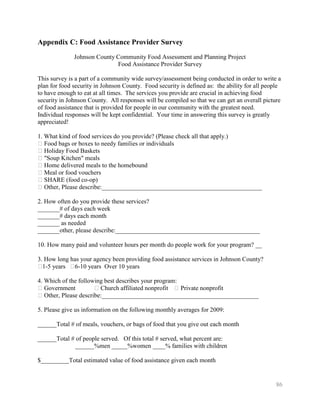
community center) were asked to complete a survey regarding their food assistance service. This
survey is included in Appendix C. Although not every question had a hundred percent response
rate and not all food assistance providers answered the survey, enough data were collected to
create a general picture of emergency food assistance in Johnson County. The providers all give
food bags and boxes to needy families, and six of the seven pantries also provide special holiday
food baskets. The providers are open from once a month to five days a week; these hours are
somewhat dependent on both food availability and consumers’ needs.
        The five church-affiliated pantries that completed the survey provide between 60 and 270
meals, vouchers, or food bags per month, serving between 100 and 3,180 people per month.25
The Johnson County Senior Center and Community Center serve around 2,800 more meals a
month, both to homebound residents and those who attend the centers. Six of the eight
respondents have seen increases in food demand in the past two or three years, but the pantry
staff are confident they can meet the demand. The main challenges they face are lack of
volunteers, cuts in funding, and the availability and pricing of food for their baskets.


25
     These numbers may include repeat consumers.

                                                                                              22
The pantries receive their food from a variety of sources – retail stores, church
collections, community donations, farmers/producers, food banks, and restaurants. Some of the
food is donated by those sources, and the pantries also purchase food from the sources. One
pantry received potatoes grown on an acre by a Shady Valley church in the fall of 2009. They
were hopeful they would receive a similar crop in fall 2010. At least one of the pantries has
trouble finding fresh produce to provide their customers. Once the pantries have acquired the
food, they generally use nutritional guidelines to create the boxes/bags of food for distribution. In
addition to providing food for their customers, most of them also provide nutritional education,
and sometimes hygiene information. Being church-affiliated, several of the pantries also offer
religious services.
        While some of the providers indicate a lack of food at certain times of the year (varying
from winter to summer to spring to the holiday season), they all express general satisfaction at
the level of food support from their various sources. Two of the providers indicate a desire for
more food to distribute, but six of the eight respondents either ―most of the time‖ or ―always‖
have enough food to meet the demand. The providers are well-supplied in terms of food amount,
though not always in food variety; as long as demand does not increase and community support
continues they can meet the need.
        There has been an ongoing conversation over the years as to how these pantries might
consolidate or communicate to ensure there is no abuse of these services. Suggestions have
included a single central pantry, internet programs that assist providers with inter-agency
communication, and personal communications. Many of these food providers are already
communicating personally to check in with each other about whether recipients are ―shopping‖
the providers.

Retail Stores and Other Places to Purchase Food
        Twenty three retail food stores operate in Johnson County; seventeen stores participate in
the Food Stamp program. In total thirteen stores are located in Mountain City, four in Butler,
two in Shady Valley, two in Laurel Bloomery, one in Neva, and one in Trade. A list of these
stores is included in Appendix B. An in-depth look at these stores is included in the Food
Availability and Affordability section.
        Various produce stands have opened and closed from year to year. A handful of
producers and resellers set up on the side of the road throughout the county and sell produce
from the back of their trucks. These stands are important entrepreneurial activities that capture
local dollars for local producers. Spending money locally keeps dollars in the community and
increases local wealth through the multiplier effect.
        One consumer food cooperative has been organized by a few local residents. This
cooperative purchases bulk whole foods such as dry beans, brown rice, quinoa, nuts, and flour
every other month. Many organic choices are available through this cooperative buying club.
The food is delivered the month after orders are placed. Word of mouth is used to recruit new
participants to this cooperative.
        Johnson County initiated a farmers market, Johnson County Farmers Market (JCFM), in
2009. This market competes with the larger markets of Bristol and Johnson City by keeping
local products in the community. Many people involved in past attempts to initiate farmers
markets have given their full support to this market which is chartered in the state of Tennessee
and has submitted its application to the IRS for designation as a 501(c)3 non-profit organization.
The mission of the JCFM is to ―help strengthen a local sustainable agricultural and food

                                                                                                  23
economy. [They] do this by providing education, engaging in community and economic
development, and promoting the availability and benefits of local food and agriculture.‖26
        The Johnson County Farmers Market received a grant from the USDA Farmers Market
Promotion Program in September 2009 with Appalachian Native Plants, Inc. as the fiscal agent.
This grant allows vendors to accept food stamps (Supplemental Nutrition Assistance Program) at
this market, provided support materials and labor needed to implement this program, and
promoted this service, the market, and its vendors. Nationwide, farmers markets started
accepting food stamps only five years ago whereas grocery stores have been accepting these
benefits for many years. JCFM subsequently received the opportunity to double dollars for food
stamp customers. This program made possible by a sub-grant through Appalachian Sustainable
Development from the Wholesome Wave Foundation. The double dollar opportunity is a great
example of how private funding can help support federal programs and increase the power of
local food dollars that recycle within the community.
        With the assistance of our local health educator, the Johnson County Farmers Market
submitted applications in 2009 for to the Senior and WIC Farmers Market Nutrition Assistance
Program (SFMNP and WICFMNP). The application was not selected. The FMNP programs are
also eligible for double dollar assistance with private funds. Residents believe that locally
produced food is more expensive and is therefore unaffordable for low-income families. These
types of farmers market programs help put money in the pockets of local food producers and also
offer affordable fresh local foods for low-income consumers.
        Most retail food stores, including the farmers market, are located within Mountain City
making accessibility an issue for residents living in the outskirts of the county. These consumers
access retail food stores in Virginia, North Carolina, and nearby cities like Elizabethton,
Tennessee. Sales tax rates are lower in neighboring states, encouraging travel to make food
purchases.

Educational Programs
        Many educational programs are offered throughout Johnson County. The Vocational
Agriculture program at the high school, Johnson County Farmers Market, local businesses,
University of Tennessee Extension, and other organizations and individuals teach others about
food production, nutrition, cooking, and preservation.
        Johnson County High School has one of the nation’s leading Vocational Agriculture
programs. Students can select from classes ranging from greenhouse production, hydroponics,
aquaponics, leadership, floriculture, agricultural mechanics, and various other topics.
        The Johnson County Farmers Market has hosted workshops open to the public: food
safety and Good Agricultural Practices (GAPs), domestic kitchen certification, seed saving and
swapping, food independence/growing your own, beneficial garden insects, and ―tips and tricks
on how to sell at a farmers market‖.
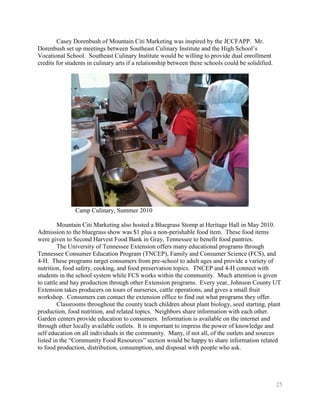
        A week-long ―Camp Culinary‖ was hosted in July, 2010 by Mountain Citi Marketing.
Connections were made with Southeast Culinary Institute, which sent two professional chefs and
their assistants to teach various cooking techniques, knife skills and cutting styles, food
presentation, decorative food art, nutrition, kitchen safety, and sanitation. Some of the
assignments the students participated in were menu design, food graphics and in-depth
discussions regarding our health and the way we eat. Nelson Chapel Baptist Church provided
the use of their state of the art kitchen in their new Family Life Center.
26
     http://www.johnsoncountyfarmersmarket.org/index.html

                                                                                               24
Casey Dorenbush of Mountain Citi Marketing was inspired by the JCCFAPP. Mr.
Dorenbush set up meetings between Southeast Culinary Institute and the High School’s
Vocational School. Southeast Culinary Institute would be willing to provide dual enrollment
credits for students in culinary arts if a relationship between these schools could be solidified.


               Camp Culinary, Summer 2010

         Mountain Citi Marketing also hosted a Bluegrass Stomp at Heritage Hall in May 2010.
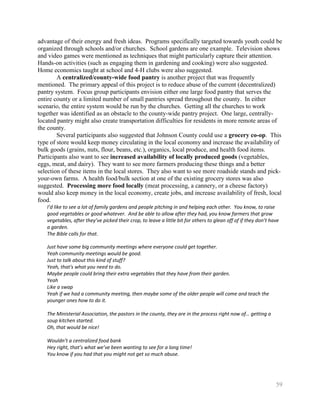
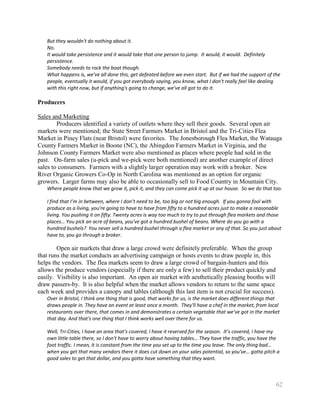
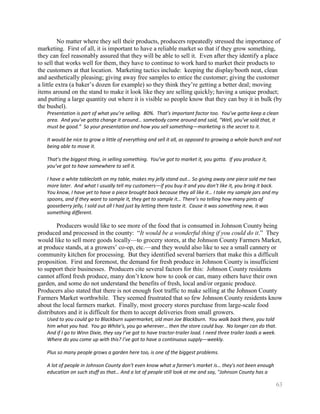
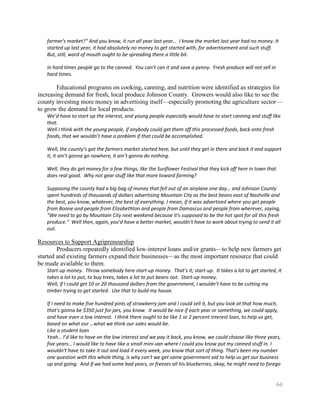
Admission to the bluegrass show was $1 plus a non-perishable food item. These food items
were given to Second Harvest Food Bank in Gray, Tennessee to benefit food pantries.
         The University of Tennessee Extension offers many educational programs through
Tennessee Consumer Education Program (TNCEP), Family and Consumer Science (FCS), and
4-H. These programs target consumers from pre-school to adult ages and provide a variety of
nutrition, food safety, cooking, and food preservation topics. TNCEP and 4-H connect with
students in the school system while FCS works within the community. Much attention is given
to cattle and hay production through other Extension programs. Every year, Johnson County UT
Extension takes producers on tours of nurseries, cattle operations, and gives a small fruit
workshop. Consumers can contact the extension office to find out what programs they offer.
         Classrooms throughout the county teach children about plant biology, seed starting, plant
production, food nutrition, and related topics. Neighbors share information with each other.
Garden centers provide education to consumers. Information is available on the internet and
through other locally available outlets. It is important to impress the power of knowledge and
self education on all individuals in the community. Many, if not all, of the outlets and sources
listed in the ―Community Food Resources‖ section would be happy to share information related
to food production, distribution, consumption, and disposal with people who ask.


                                                                                                     25
Food Production and Consumption: The Agricultural Economy27
Current Production
         The total land area in Johnson County is 249,600 acres.28 In 2007, just over a sixth of that
land area – 43,543 acres – was farmland. The majority of Johnson County farmland, about 59%
of the total, includes woodland and other land used for pasture and grazing for farm animals. In
fact, raising animals for food and dairy products is a significant part of the farm economy in the
county, with more than half of all farms reporting cattle, hogs, sheep or chicken inventory in
2007. Figure 14 provides a breakdown of Johnson County farms by category of farm products
and shows the value of agricultural products sold in 2002 and 2007.

Figure 14: Breakdown of Farms by Product
     Breakdown of farms by category of farm product (include non-food farm crops)
     Value of agricultural products sold (total and by category)
                                                             2007   2007    2002    2002
                                                                  $               $
     Average per farm                                     $10,997        $10,504

                                                                     2007    2007    2002                2002
                                                                # of      $       # of                $
                                                                farms     (thous) farms               (thous)
     Total sales                                                      513    5642      666               6996
     Crops, including nursery and greenhouse                          234    1923      394               3106
     Grains, oilseeds, dry beans, and dry peas                         20      65        9            (D)
     Corn                                                              20      65 (NA)                (NA)
     Tobacco                                                           22     228      251              1,621
     Vegetables, melons, potatoes, and sweet
     potatoes                                                           32        109           16 (D)
     Fruits, tree nuts, and berries                                     14          9            0       0
     Nursery, greenhouse, floriculture, and sod                         15        882           42     700
     Cut Christmas trees and short-rotation
     woody crops                                                        9     321               13     324
     Other crops and hay                                              166     308              137     263
     Livestock, poultry, and their products                           281   3719               316   3890
     Poultry and eggs                                                  16       3                2 (D)
     Cattle and calves                                                236   3514               270   3287
     Milk and other dairy products from cows                            3 (D)                    2 (D)
     Hogs and pigs                                                      0       0                8       6
     Sheep, goats, and their products                                  27      24               11       8
     Horses, ponies, mules, burros, and donkeys                        32      91               32 (D)

27
   This section was prepared (under contract) by Charlie Jackson and Allison Perrett, Appalachian Sustainable
Agriculture Project (ASAP).
28
   2007 Census of Agriculture

                                                                                                                26
Aquaculture                                               1 (D)              2 (D)
       Other animals and other animal products                  16         2       12           5
       Value of agricultural products sold directly
       to individuals for human consumption                     27       103       17        15

       The remaining 41% of Johnson farmland, approximately 18,056 acres, was counted as
cropland in 2007. Slightly less than three-fifths (10,559 acres) of that was harvested cropland,
with the remainder used for pasture or grazing, cropland used for cover crops or in cultivated
summer fallow, and cropland that was idle or not harvested that year.

Cash Receipts from Farming
        Livestock, poultry, and their products accounted for about two-thirds of agricultural
receipts in the area in 2007.29

Figure 15: Value of Agricultural Products Sold
       Value of Agricultural Products Sold in Johnson County,
       2007
       Value of crops including nursery and greenhouse               $1,923,000          34%
       Value of livestock, poultry and their products                $3,719,000          66%
       Total                                                         $5,642,000         100%

       Cattle and calves sales were the largest contributor to this total, accounting for nearly
62% of all cash receipts from farming that year. Within the crop category, nursery products and
cut Christmas trees accounted for the largest portion of cash receipts, followed by tobacco,
vegetables and then fruits, nuts and berries.


29
     2007 Census of Agriculture

                                                                                                    27
Figure 16: Cash Receipts from Farming by Category


Trends in Farming and Farmland
       Echoing national trends in the decline of farms and farmland, the number of farms in
Johnson County declined nearly 40% between 1992 and 2007.30 Acres of farmland declined from
54,518 in 1992 to 43,543 in 2007 or 20%. The number of operators declined from 896 in 2002 to
763 in 2007.

Aging of the Farm Population
        According to the USDA, the average age of farmers has increased every year since 1978.
The average age of all US farm operators has been greater than 50 years of age since at least the
1974 census. Between 2002 and 2007, the national average age increased from 55.3 years of age
to 57.1 years of age.31 Similarly, the average age of farm operators in Johnson County increased
from 56 years of age in 2002 to 58.7 years of age in 2007.32
        Definite relationships exist between age of farm operator and particular farm
characteristics. For example, family farms typically have older farm operators than corporate
farms, and farms in smaller income classes typically have older farm operators than larger
income class farms.33 With the concentration of small family farms in the region, it is not
surprising that the average operator age in Johnson County is higher than the national average.
        Beginning in 2002 the USDA began gathering additional information about farm operator
characteristics to clarify issues related to the aging of the farm population, such as farm
succession plans and the extent to which young farmers are replacing older farmers as they retire
from farming. The new data indicate that only about 9% of all farms nationwide had multiple
operators from different generations working on their farms as farm operators. The likelihood of
30
   2007 Census of Agriculture
31
   Farmers by Age, 2007 Census of Agriculture
32
   County Level Data, Tennessee, 2007 Census of Agriculture
33
   What We Know About the Demographics of US Farm Operators, 2005, National Agricultural Statistics Service,
USDA

                                                                                                           28
having multiple operators is significantly lower for lower income class farms that predominate in
this region.

The Tobacco Buyout and Related Shifts in Production
        The single largest influence on the East Tennessee farm economy in recent years is
commonly referred to as the 2004 tobacco buyout. Partial effects of the buyout began in the
mid-1990s as growers began anticipating the end of federal tobacco support. Quota cuts and
falling prices during the 1990s also contributed to a changing landscape of tobacco production in
the region.
        The buyout refers to the Fair and Equitable Transition Act passed by Congress on
October 22, 2004. The legislation eliminated federal price support and supply control programs,
which had regulated tobacco production and marketing since the Great Depression era. It
opened tobacco to an unregulated, free market system beginning with the 2005 crop. Payments
to growers and quota owners under the tobacco buyout are scheduled to take place over ten
years, which means that the full effects of the buyout will not be known for some time.
        Until recently, tobacco was the leading crop in Johnson County, but the number of farms
producing tobacco decreased dramatically from 253 farms producing tobacco on 549 acres in
2002 to just 22 farms in 2007 on 136 acres.34

Consolidation in the Food System
         Over the past four decades, concentration in the ownership and management of food
production and marketing has dramatically restructured the agricultural and food industries in the
US and globally. Horizontal and vertical integration, mergers and acquisitions, and the use of
supply chain management strategies are the mechanisms by which change has occurred. 35 The
result is that fewer but larger companies have come to dominate each stage of production,
processing, and distribution. Consolidation in retail and wholesale markets makes it increasingly
difficult for small farmers to maintain their market share.

Opportunities in Local Markets
        Despite these trends, significant opportunities exist for Johnson County producers in local
markets. Small farms, like those in Johnson County, have largely been excluded from the trend
favoring fewer, larger farms and fewer, larger markets. Local markets present small producers, in
particular, with increased market options, and offer markets that are less vulnerable to global
price fluctuations.
        ASAP’s 2007 study on the food and farming economy of the 23 counties of Western
North Carolina quantified demand for locally-grown fresh fruits and vegetables at that time to be
$36 million per year and as high as $452 million for all locally grown foods. The popularity and
demand for locally grown food in the last half decade likely makes these estimates lower than the
actual immediate potential. Consumer surveys not only demonstrated strong demand, they
suggested the willingness of consumers in Western North Carolina to pay more for local food.
For the vast majority of consumers surveyed, local food offered a fresher, tastier option to foods

34
  County Level Data, Tennessee, 2007 Census of Agriculture
35
  For a fuller discussion of these issues, see Kirby, Laura D., Charlie Jackson, and Allison Perrett. 2007. ―The
Infrastructure of Food Procurement and Distribution‖ in Growing Local: Expanding the North Carolina Food and
Farming Economy, Asheville, NC: Appalachian Sustainable Agriculture Project.
http://www.asapconnections.org/research.html

                                                                                                               29
produced in more distant regions and a way to support local farmers, local communities, a
healthy environment, and the rural character of the region.
       These attitudes are supported by national market research by the Hartman Group and
JWT Advertising, which have identified local as one of the food attributes most highly valued by
consumers nationwide. These marketing experts have predicted that consumer demand will shift
from organics to locally sourced food. The research group, Packaged Facts, has predicted that the
market for locally-grown food will reach $7 billion in 2011.

Consumer Food Spending and Consumption Figures for Johnson County and Tri-Cities

Consumer Spending
        Johnson County residents spent $41,882,188 on food in 2007.36 The average household
spent $3,311 on groceries and $2,470 on food consumed in other places that year. For Johnson
County, where 18,112 residents, including 2,000 inmates, equals 7244.8 households, this figure
breaks down to $23,987,532 spent on food consumed at home and $17,894,656 spent on food
consumed away from home. A little less than three quarters of all away-from-home food
spending typically occurs in restaurants.37
        Demand for local food and farm products will be a subset of these figures, though actual
consumer spending on local food and farm products is difficult to calculate. The USDA collects
limited data on sales from farmers to consumers and collects no data regarding sales from
farmers to businesses, organizations, or institutions in specific geographic areas.

Consumption Estimates
        Figures 17, 18, and 19 show consumption estimates for various product categories.
Figure 17, beginning with Column 1, shows consumption estimates in pounds for selected fresh
fruits and vegetables. Column 2 shows acreage needed to grow those amounts, and Column 3
shows how many acres are devoted to growing the crops in the county. Acreage data should be
viewed with caution. In some cases the USDA suppresses county-level data, for example when
production is limited or only one or two farms report growing a particular crop. In other cases
reported acreage may be higher than actual acreage because of formulas used by the USDA to
create county profiles based on limited information.


36
   2007 Consumer Expenditure Survey, Bureau of Labor Statistics. Calculations based on per consumer unit
estimates for the South region of the US
37
   Table 3 in Food Away from Home. Total Expenditures. Food CPI and Expenditures Briefing Room. Economic
Research Service, USDA

                                                                                                           30
Figure 17: Comparison of Consumption and Production

  Comparison of Consumption and Production of Selected Fresh Fruits and Vegetables
  Grown in Johnson County
                                        Column 1: Lbs
                                        consumed           Column 2:        Column 3:
                                        (rounded to the Acres needed Acres
                                        nearest            to produce       devoted to
                                        hundredth)         that amount      the crop
  Apples                                         292,900                24            4+
  Asparagus                                       21,400 -                             -
  Beans (Snap)                                    38,200                 9            6+
  Blueberries                                     14,500                 2            3+
  Broccoli                                       107,600                17             -
  Cabbage                                        148,300                 6             -
  Carrots                                        146,200                 6             -
  Cauliflower                                     28,400                 4             -
  Corn (Sweet)                                   166,800                17           13+
  Cucumbers                                      122,100                 9             -
  Grapes                                         154,500                18             -
  Lettuce (Head)                                 305,500                13             -
  Peaches                                         91,800                12            3+
  Peppers (Bell)                                 178,400                17             -
  Potatoes                                       664,700                41           10+
  Spinach                                         29,300                 3             -
  Strawberries                                   116,800                10             -
  Tomatoes                                       335,100                12            7+
  Watermelons                                    279,800                11             -
     Source: (Column 1) ERS/USDA Data Food Availability (Per Capita) Data System: Food Guide Pyramid (2008); (Column
     2 and Column 3) 2007 Census of Agriculture

         Figure 18 shows figures for meat consumption in Johnson County. While the production
of beef outstrips consumption, the majority of Johnson County beef production is in cow/calf
operations. In other regions with maturing local food economies, shifts are occurring to grass-
fed, artisanal, and niche markets. Access to a government-inspected processing facility is the
principal infrastructure obstacle for any type of meat, but grass-fed and grass-finished beef also
requires land for pasture, on-farm animal handling facilities, and adequate cold storage for
processed meat products. To shift into this type of production, cow/calf producers would need to
learn and adopt new practices including, for example, more closely managed grazing and pasture
management.


                                                                                                                  31
Figure 18: Meat Consumption in Johnson County
                                             Lbs. Consumed       Lbs. Produced
                                             (2008) (rounded     (2008) (rounded
                                             to nearest          to nearest
                                             hundredth)          hundredth)
                   Beef                             1,657,200            2,703,000
                   Chicken (broilers)               1,767,700                 N/A
                   Pork                             1,141,100                 N/A
                   Lamb                                 19,900                N/A
                   Turkey                             318,800                 N/A
                       Source: 2007 Census of Agriculture

        Figure 19 shows that an estimated 864,000 pounds of milk were produced in Johnson
County in 2007. Some portion of that amount is marketed as fluid milk and some is used to make
cheese and other processed dairy products. No information is available from government sources
detailing the end uses of milk produced in the county.

Figure 19: Dairy Consumption in Johnson County

                                             Lbs. Consumed       Lbs. Produced
                                             (2008) (rounded     (2008) (rounded
                                             to nearest          to nearest
                                             hundredth)          hundredth)
                    Fluid Milk                      3,243,900             864,000
                    All cheese                        541,500                N/A
                    All frozen dairy                  452,800                N/A
                    Yogurt                            213,700                N/A
                    Butter                              90,600               N/A
                          Source: 2007 Census of Agriculture


                                                                                           32
Figure 20 shows the consumption of processed fruits and vegetables in Johnson County.
With strong demand for ready-to-eat foods, processing fruits and vegetables for local sale may
be one way to expand local consumption of local farm products.

Figure 20: Consumption of Fruits and Vegetables
                      Consumption of Selected Categories of Processed Fruits
                      and Vegetables in Johnson County, TN

                                                             Lbs. Consumed (2008)
                                                             (rounded to nearest
                      Processed fruits                       hundredth)
                      Canned apples/applesauce                               79,900
                      Canned peaches                                         54,000
                      Apple juice                                           465,100
                      Frozen berries                                         61,600
                      Canned pears                                           40,600
                      Grape juice                                            89,700
                      Other processed fruits                              1,440,600
                      Processed vegetables                    -
                      Canned tomatoes                                     1,217,100
                      Canned cucumbers (pickles)                             64,300
                      Canned snap beans                                      60,000
                      Canned carrots                                         17,400
                      Other canned vegetables                               365,500
                      Frozen vegetables                                   1,380,100
                      Dehydrated vegetables                                 537,900
               Source: ERS/USDA Data Food Availability (Per Capita) Data System: Food Guide Pyramid

         There is an upper limit to the amount of produce retail food stores can buy from regional
growers based on climate and soil. Johnson County farmers could not supply 100% of produce
to local retailers because they cannot grow oranges, lemons, or bananas, for example, no matter
how much local food infrastructure is improved. They can, however, 38 different types of fruits
and vegetables that accounted for 80% of produce sales in retail outlets nationwide in 2005. In
Figure 21, those 38 items are listed along with their corresponding share or percentage of total
retail produce sales in Johnson County.
         Based on the table, and an adjustment for seasonality in Johnson County, farmers could
grow 80 percent of retail produce items for a third of the year, or 26 percent of the total (80% X
33% = 26%). In other words, farmers can grow all of the items listed in the above table, but
some only in the four months of the summer season and others only in the winter season. Some
items, like apples, can be supplied to local markets for more than four months and others for less.
Without being able to calculate exactly how many months each item would be available to local
markets, the 26 percent is intended to provide a reasonable adjustment for the seasonality of
production in the region.

                                                                                                      33
Figure 21: Market Share of Retail for Fruits and Vegetables

      $ Share of Retail Produce Sales for Selected Fruits and Vegetables

                           % of Total                         % of Total                  % of Total
                           Produce                            Produce                     Produce
                           Sales in       Vegetables          Sales in                    Sales in
      Vegetables           2005           (Continued)         2005             Fruits     2005
      Asparagus                     1.3   Mushrooms                    2.3     Apples              7.7
      Beans                         1.1   Onions                       4.2     Berries             6.3
      Broccoli                      1.9   Parsnip                      0.1     Cherries            1.6
      Beets                         0.1   Peas                         0.3     Grapes              7.3
      Cabbage                       0.7   Peppers                      3.2     Nectarines            1
      Carrots                       3.2   Potatoes                     5.8     Melons              5.3
      Cauliflower                   0.7   Pumpkins                     0.2     Peaches             1.5
      Celery                        1.6   Radishes                     0.4     Pears               1.2
      Corn                          1.2   Roots                        0.1     Plums               0.8
      Cucumbers                     1.8   Spinach                      0.7
      Eggplant                      0.2   Sprouts                      0.2
      Garlic                        0.4   Squash                       1.5
                                          Sweet
      Greens                          0.3 potatoes                       0.8
      Leeks                           0.1 Tomatoes                       8.5
      Lettuce                         4.1
      Column Totals                  18.7                              28.3                            32.7

Total share of produce accounted for by fruits & vegetables that can be grown in East Tennessee:
79.7%.38


38
     Fresh Look Marketing, http://www.freshlookmarketing.com (reported by Produce Marketing Association)

                                                                                                              34
Food Store Surveys
Food Availability and Affordability
        The Food Store Survey Instrument provided in the USDA Community Food Security
Assessment Toolkit (Cohen 2002) was used to assess the availability and affordability of food in
Johnson County. The food store survey uses the Thrifty Food Plan (TFP), a plan for a nutritious
diet devised by the USDA for people participating in Federal food assistance programs. The cost
of a TFP ―market basket‖ is updated monthly by the USDA’s Center for Nutrition Policy and
Promotion, using the Consumer Price Index (CPI). The CPI is prepared by the Federal
government’s Bureau of Labor Statistics; it documents the price changes in items and services
for consumers.
        The Food Store Survey Instrument provides a comparison between prices paid in Johnson
County and the national average. For the JCCFAPP we chose to compare prices for a family of
four (couple aged 19-50 and two children ages 6-8 and 9-11). The survey outlines 87 items,
referred to as the ―market basket,‖ that would provide a wholesome diet, giving desired
weight/units for each item. It requires the researcher to document the brand, actual weight/units,
and lowest price for each item. The USDA Toolkit (Cohen 2002) suggests surveys should seek to
answer the following questions:
                Is a variety of food available in retail stores?
                Are the available foods affordable to low-income households?
                Can the Thrifty Food Plan (TFP) market basket be purchased from these retailers
                 at or below the TFP cost threshold set by USDA?
        The first step in the survey process was to contact the managers of various food stores in
Johnson County, asking permission to conduct surveys of their store inventories. Of the stores
responding, surveys were conducted to eight different food stores in Johnson County. These
stores included two supermarkets, three convenience stores, two small groceries, and one
grocery/gasoline store.
        After collecting data from the eight food stores in Johnson County, a comprehensive
analysis of the pricing and availability of 85 items on the survey were completed. However, we
were unable to give proper calculations and comparisons on two of the items. We then
compared these prices to the national standards provided by the USDA and give an overall
picture of availability and affordability of food in Johnson County.
        According to the Authorized Food Retailer’s Characteristics and Access Study, by the
USDA’s Food and Nutrition Service (FNS) in 1997 (as cited in Cohen 2002), food items
throughout the food store types should be carried at the following levels:

Figure 22: Percentage of Ideal Food Availability
                             Supermarkets                     95%
                             Large Grocery Stores             81%
                             All Stores                       54%
                             Grocery/Gas Store Combinations   53%
                             Small Grocery Stores             51%
                             Convenience Stores               50%
                             Other Stores                     29%
                             Specialty Stores                 20%


                                                                                               35
The findings of the survey shows stores in Johnson County carry these items at the
following levels:

Figure 23: Percentage of Actual Food Availability
                             Supermarkets                      97.01%
                             Small Grocery Stores              61.17%
                             Grocery/Gas Store Combinations    25.88%
                             Convenience Stores                32.16%

        The data reflects a slightly higher than average availability of food in supermarkets and
small grocery stores in Johnson County. However, it also reflects a deficiency of food
availability at convenience stores and grocery/gas store combinations, approximately 18% and
27% respectively. It is important to note that two of the three stores with better than average
prices are the Mountain City supermarkets surveyed. Five of the eight stores surveyed also
operated a deli and/or grill.
        In addition to documenting the average food availability by store type, we also calculated
the average percent of missing food categories for all stores. These calculations of missing food
items provides an understanding of what types of foods are being carried in the various food
stores surveyed. The food categories were determined by the USDA to meet federal dietary
guidelines.

Figure 24: Percentage Missing Food Items by Category
                             Fresh Fruit                           62.50
                             Fresh Vegetables                      57.14
                             Canned Fruit                          37.50
                             Canned Vegetables                     25.00
                             Frozen Fruits and Vegetables          70.00
                             Fresh Bread and Grains                41.07
                             Dry Bread and Grains                  35.94
                             Fresh Dairy                           55.00
                             Canned Dairy                          37.50
                             Fresh Meat                            58.93
                             Frozen and Canned Meat                37.50
                             Fats and Oils                         15.63
                             Sugars and Sweets                     43.75
                             Other Food Items                      40.13

        The above table illustrates average deficits of 50%, or more, in fresh fruits, fresh
vegetables, frozen fruits and vegetables, fresh dairy and fresh meat in the surveyed food stores,
forcing people to rely on prepackaged foods for the majority of meals.
        This survey instrument contained few low-cholesterol, low sugar, low-sodium, and/or
vegetarian items that people with special dietary needs might need. Items such as these were not
in the survey. Therefore, we cannot assume that these items are either available or unavailable.
        In considering the cost of buying a week’s worth of grocery on the USDA’s Thrifty Food
Plan, we found varying costs throughout the county. The costs of the TFP were determined by
using each individual store price, converting the price to cost per pound, and then multiplying

                                                                                                36
that cost per pound by the Thrifty Food Plan guidelines for the weight required for one week.
These calculations were done for each of the 85 items on the survey list, giving us a TFP cost per
item. After these calculations were completed, the TFP item costs were tallied for each store,
giving a total to compare to the USDA guidelines for the month of June 2010.

Figure 25: Store Thrifty Food Plan vs. Federal Thrifty Food Plan Guideline
    Store                                                   Missing Items          TFP Cost

    Supermarket 1                                           Missing 1 Item         $114.43
    Supermarket 2                                           Missing 4 Items        $113.02
    Small Grocery 1                                         Missing 37 Items       $55.59
    Small Grocery 2                                         Missing 29 Items       $68.91
    Convenience Store 1                                     Missing 70 Items       $8.77
    Convenience Store 2                                     Missing 68 Items       $27.03
    Convenience Store 3                                     Missing 35 Items       $99.96
    Gas/Grocery Combination                                 Missing 63 Items       $29.57
    USDA Guideline - TFP Cost for June 2010                 Missing 0 Items        $134.50

        From the data above we can see there are a wide range of prices throughout Johnson
County, depending on the item and store location. Comparing supermarkets to the USDA TFP
Guidelines, the costs of food at the supermarkets are below TFP Cost for the month of June. We
did this by also calculating the average cost of the items across all the stores surveyed and added
in averages for missing items.

Figure 26: Store Thrifty Food Plan without Missing Items vs. Guidelines
     Store                                           Average Missing Item      TFP Cost +
                                                     Cost                      Missing Items
    Supermarket 1                                    $4.26                     $118.69
    Supermarket 2                                    $6.88                     $119.90
    Small Grocery 1                                  $86.20                    $141.79
    Small Grocery 2                                  $61.20                    $130.11
    Convenience Store 1                              $129.97                   $138.74
    Convenience Store 2                              $120.03                   $147.06
    Convenience Store 3                              $63.36                    $163.32
    Gas/Grocery Combination                          $107.13                   $136.70
    USDA Guideline - TFP Cost for June               Missing 0 Items           $134.50
    2010
By adding in the average cost of the missing items, three of the eight stores surveyed in Johnson
County sold TFP food for less than the guidelines set forth by the USDA.

       Since the completion of the data collection, one of the stores surveyed has closed its
doors. This affected the accessibility, as well as the affordability and availability of food for
consumers in the county. It also changes the marketplace for other food stores in the area,
providing them with a larger consumer base while requiring a larger, possibly more diverse,
inventory to maintain the base. The closing of this store could have profound effects on the
distance some people must travel to buy their food.

                                                                                                    37
Availability and affordability of food relates back to accessibility. All of the
supermarkets are located within Mountain City limits. As previously discussed, Mountain City
supermarkets have acceptable food availability when compared to the TFP basket. The grocery
stores, convenience stores and grocery/gas combination stores are primarily located in the
outlying areas of the county. Stores outside the city limits show marked deficiencies in the
availability of these food items.
        In going back to the three questions we set out to answer, we can definitively answer the
second question. A variety of food is not available in all the food stores surveyed. The data
reflects six or eight stores show 29 or more missing items, equal to or greater than 34.12% of the
TFP items. The items most frequently missing in inventories were fresh fruit, fresh vegetables,
frozen fruits and vegetables, fresh dairy and fresh meat.
        The second question was, ―Can the Thrifty Food Plan (TFP) market basket be purchased
from these retailers at or below the TFP cost threshold set by USDA?‖ Based on our
calculations, the Thrifty Food Plan cannot be purchased from all retailers at or below the TFP
cost threshold. While three of the eight stores are less expensive than the TFP cost threshold, the
majority of retailers are more expensive. The higher prices for the five stores demonstrate that
more money must be spent from a family’s budget on food than directed by the Federal
government under the Thrifty Food Plan.

Food Accessibility
         The assessment of food resource accessibility provides a snapshot of where and how
Johnson County residents obtain food. The USDA Toolkit provided us with four primary
questions to explore:
                 Are food resources located near low-income neighborhoods?
                 Is public and/or private transportation available between the resources and low-
                 income neighborhoods?
                 What barriers influence people’s use of community food resources?
                 Does the community have the infrastructure necessary to deliver Federal food
                 assistance benefits effectively?
         Information provided through focus groups, community meetings, surveys, observations,
and research over the course of the JCFAPP helped us answer these questions, but also created
more questions in the process.
         We had to take into consideration a slightly different set of circumstances when it comes
to food resource locations and transportation. As stated previously in the ―Socioeconomic and
Demographic Characteristics,‖ Johnson County has a population of 18,112 with 25.8% of
residents living below the federal poverty line.39 The ruralism of Johnson County creates a
problem for defining low-income ―neighborhoods‖; the 25.8% of low-income households are
widely dispersed throughout the county. There are at least four subsidized housing
neighborhoods within the Mountain City limits. For these residents, food resources are nearby.
         The highest levels of food resource accessibility are found in Mountain City. Most of the
stores, social services, food pantries, and other food locations are based in Mountain City, giving
the citizens of the town better food resource accessibility. The lack of public transportation is a
barrier to acquiring food resources for those without vehicles, especially during inclement
weather or for those with disabilities and/or health problems.

39
     Johnson County, Tennessee, State and County QuickFacts, U. S. Census Bureau

                                                                                                 38
Accessibility to food requires availability and affordability, in assessing food security in
any community. ―Maximizing the effectiveness of Federal food assistance programs requires that
sufficient quantities of healthful foods are available in the marketplace at prices low-income
households can afford.‖ (Cohen 2002) Although this is a correct statement, we perceive this
assessment as a valuable tool for all households in Johnson County looking to maximize food
dollars.
         The outlying areas of Butler, Doe Valley, Shady Valley, Laurel Bloomery, Neva, and
Trade all have some type of convenience gas station or small grocery offering a limited
inventory of food resources; however, to visit a supermarket or larger grocery requires members
of those communities to travel into Mountain City or other counties to do their shopping. The
lack of public transportation in these areas greatly impacts low-income households. People
without vehicles must rely on family, friends, churches, and social services to transport them to
food resource locations. While collecting survey data, people were observed sharing rides to
food pantries because they lacked transportation. In some cases, delivery drivers pick up large
numbers of food bags to take to homebound recipients and others who do not have access to
transportation.
         Resident’s use of community food resources are influenced by several factors besides
distance and transportation problems. Use of food resources depends on shopping patterns,
federal programs, education, general knowledge, and stigma; all of these pieces are
interdependent and work with and affect food procurement strategies of Johnson County
residents.
         The historic knowledge of gardening, canning, and preserving in rural areas has been on
the decline in recent years. This decrease in traditional knowledge affects shopping patterns for
Johnson County residents. Instead of nutritional foods and fresh produce being purchased and
processed, prepackaged items are bought. This has, in turn, reduced profits for fresh produce
stands in the county, affecting their long term viability. This reduces the affordability and
availability of fresh produce.
         A general lack of information is also a food resource barrier. In the course of our study,
we determined some people were not aware the Johnson County Farmers Market accepts EBT
(Electronic Benefit Transfer), what has been historically referred to as food stamps. In many
cases, when we asked survey respondents if they were aware that the Farmers Market accepted
―food stamps‖, they were very excited and said they were not aware. However, we were also
conscious of an effort by the Johnson County Farmers Market to let people know they were
taking ―EBT‖. The farmers market was just beginning to get the word out. This seemingly small
breakdown in communication, the disassociation of the terms ―EBT‖ and ―food stamps‖, caused
a food location barrier to occur for low-income households.
         In another instance, we found some food pantries are advertised, but not actually
functioning. While this is a dynamic situation that changes depending on the amount of food, it
can be one of great frustration to those in need. If residents take time to drive to a food pantry
that is not open, time, money, and energy are wasted. The individual is discouraged and
reluctant to return or to seek food.
         Program gaps are also an issue in Johnson County. Through the schools we see
successful, comprehensive food programs for children and adolescents. We also see
programming, such as Meals on Wheels, for elderly and homebound residents in the county.
However, there is a gap in programming, outside of federal and church-coordinated programs for
delivering meals and food to residents between the ages of 18 to 65. Over 30% of county

                                                                                                  39
residents are permanently disabled and additional residents are temporarily disabled or
homebound. Disability also affects food procurement. One survey respondent said, ―I had back
surgery and was under doctor’s orders to not do anything for three weeks. I called a few places to
see about assistance in getting food and found that no one could really help me, especially when
it came to delivering food. Outside of a few meals made by friends and people at church I had to
go to the store; I couldn’t not eat.‖
         In the analysis of food resource accessibility, it has been determined there are a number
of barriers to securing food resources in Johnson County. Access is limited by both social and
economic factors. Although many food resource locations exist, they are sometimes difficult to
get to, only supply a limited number of items, or are cost-prohibitive to an individual or family.
In addition, miscommunication and misinformation can lead to decreased access to food
resources. The federal programs in Johnson County are comprehensive and do provide some
food security; however, stigma, education, and knowledge all play roles in the shopping patterns
of the individuals most at risk for food insecurity. Reliable sources of transportation are vital to
life in a rural county, especially in food security. Without access to transportation, people cannot
access food resource locations or federal programs.
         As to the overall question of food availability, affordability, and accessibility for low-
income households, this really depends on where families shop. It also depends on their level of
federal assistance and their access to transportation. Indeed, this is a subjective question that
defies a single answer. However, we do see a trend that people are worried about the cost of food
and transportation and the potential loss of jobs, which play a direct role in availability,
affordability, and accessibility of food.


                                                                                                 40
Interviews with Key Stakeholders

        To evaluate community needs, nursing students from East Tennessee State University
conducted 16 interviews at the beginning of the Food Assessment and Planning Process. The
people interviewed were chosen based on their firsthand knowledge and experience with the
local Johnson County food system, and were identified by the Johnson County Food Security
Council. Farmers, government officials, community service personnel, and health educators
were interviewed.
        The specific questions varied between the interviewers, the answers were grouped based
on theme. Except for the farmer interviews, which will be discussed later, the questions included
perceptions of food security in Johnson County, barriers to food security, specific assistance
programs available to residents, and recommendations to improve food security in the county.
        The general perception of food security among the interviewees was that there are
individuals and families struggling to get enough to eat, though two government officials did
mention that it was probably negligence on the part of the parents if their children were hungry
because there is assistance for people who need it. All the other interviewees however, agreed
that there is a definite food security problem, and most mentioned that even if people do have
enough food to prevent hunger, food often is not healthy and nutritious.
        According to every stakeholder, the largest barrier to food security is education.
Education was mentioned in several different contexts, ranging from basic gardening skills to
knowledge of how a local food economy operates. A lack of communication was cited by one of
the government officials, in the context of Johnson County being rural, making it difficult to
educate the people who live far from the county’s only incorporated town, Mountain City. This
lack of knowledge was echoed by several other interviewees, in terms of people being unaware
of assistance programs. The rural nature of the county also contributes to limited transportation,
as people may find it difficult to get to food pantries or WIC and food stamp registration
locations. Additionally, although Johnson County has recently implemented a farmers market,
residents travel to it, and not everyone has access to transportation. One interviewee mentioned
a new taxi service in Johnson County that may transport some people with fare.
        Education was certainly the most cited barrier to food security, several other barriers
were mentioned. The educators in particular had a long list of barriers, but including problems
with receiving and using federal assistance, fast-paced lifestyles, cooking healthy food, lack of
transportation (both public and private), the relative affordability of unhealthy food, and lack of
fresh fruits and vegetables in the food distribution programs. The government officials and one
of the educators mentioned the poor economy as a contributor to food insecurity, as there are few
opportunities in the current job market. As one educator put it, ―[We’re] losing [our] youth
because there aren’t any jobs available.‖
        A variety of food assistance programs were mentioned, but there was a lack of consistent
responses among the interviewees, indicating the aforementioned deficiency in communication
and need for education. The educators specifically talked about the Commodities program,
Summer Lunch Program, the Catholic Church distribution, the Food Lion bakery give away of
older baked goods to food assistance programs, and the School Lunch and Breakfast Programs.
The Senior Center employees mentioned the Commodities Program, the school and summer
programs, and added that there are seven food pantries, and the congregate and homebound
delivery meals their center provides. The government officials seemed unaware of many of the
programs, suggesting that food pantries would be helpful. Officials are aware of the Community

                                                                                                41
Center and Neighborhood Service Center, which has a Thursday distribution from a local
grocery store and runs the federal commodities distribution, but believe there is a lack of options
and government assistance. This lack of consistency among the interviewees reveals the
shortcomings of communication and awareness of programs throughout the county. It also
demonstrates a need for educating the public, including public officials, about the various
assistance opportunities available to Johnson County residents. A list of these federal food
programs is included in Appendix A.
         Recommendations for educating the public include teaching people about the economics
of buying locally and home cooking, nutritional education, and knowledge about the various
assistance programs. Transportation was also mentioned by multiple people, including residents’
ability to reach pantries or distribution centers, and the lack of assistance programs to deliver
food to residents. The school district employees emphasized the need for federal funding and
expressed frustration with some of the rules and bureaucracy surrounding the federal School
Lunch and Breakfast programs. There was a consensus among all those interviewed, including
the farmers, that people need more education about growing and processing their own food. The
community personnel discussed educating people using language they can understand, and
perhaps providing education on farms instead of hoping farmers will come to classes. They said
that farmers have been doing what they do for years or generations, and thus don’t feel
compelled to attend classes, but if individuals brought education to the farmers, the farmers
would be willing to listen.
         This willingness to cooperate, given the right circumstances, was expressed in the four
farmer interviews. The farmers all had small farms, and produced a variety of goods, from
produce to jams and jellies to meat and dairy. When asked why they farm, the most common
reason was because they wanted to know where their food was grown. As one farmer said, ―It
ties in largely with a self-sufficient lifestyle, and knowing what goes into raising your food.‖
The farmers also wanted to eat and produce higher quality goods than could be found at
supermarkets or grocery stores. Other reasons for farming included: money, keeping up the
family business, and the benefits of exercise that comes with farming.
         While the farmers all seemed to enjoy their chosen occupation, they did face many
challenges, including the time it takes to farm, the juggling of family concerns and work, and
legal issues, such as restrictions on direct marketing. As far as Johnson County as a whole, the
interviewees felt that it was difficult to start farms because people have a lack of knowledge and
experience, and start-up costs can be high. Also, they all expressed the immense challenge of
marketing and advertising.
         For the farms to be successful and part of a sustainable local food economy there needs to
be a local demand and market for their goods. The farmers market is one place to take their
goods, but each one of the farmers said they would like the market to be in Mountain City itself,
a more visible location. They also wanted to see more advertising for the market, and more
vendors.
         The farmers market was discussed in the interviews, and the farmers were asked specific
questions about it. Across the board, the farmers thought the market should be located in a more
central location in Mountain City itself, have more advertising, and include more vendors. The
farmers spoke of the difficulty in attracting vendors because of the lack of customers at the local
farmers market. Many people have been taking their goods to markets in larger cities, such as
Bristol or Kingsport, for years. More money can be made at these larger city markets with
higher population numbers, than at the Johnson County Farmers Market.

                                                                                                42
The farmers were all very appreciative of community support, but like the other
interviewees, thought that education could create a local market. They specifically mentioned
educating people about the benefits of buying and eating local food, and nutritional education to
promote eating fruits and vegetables. The most significant roadblock seems to be the lack of a
competitive local market, and education could be the first step to creating one.


                                                                                               43
Focus Groups
        A focus group is essentially a group interview or small-group discussion session. The
group is facilitated by a moderator and designed to engage the participants in discussion on a
specific topic. The USDA Toolkit (Cohen 2002) recommends focus groups on the following
topics: key informants, household food security, food shopping patterns, household food
assistance, and community food production resources. A group for key informants was not
needed because students from East Tennessee State University conducted interviews with the
key informants (see pg. 40 for results of these interviews). Of the remaining topics that pertain
to consumers—household food security, food shopping patterns, and household food
assistance—the Food Security Council determined that household food security was most
important to them. We decided to organize five focus groups for consumers, with each group
asked the same set of questions. The questions mostly focused on strategies for coping with
household food insecurity and ideas for building community food security and sustainability in
the local food system. Additional questions provided information on shopping patterns and use
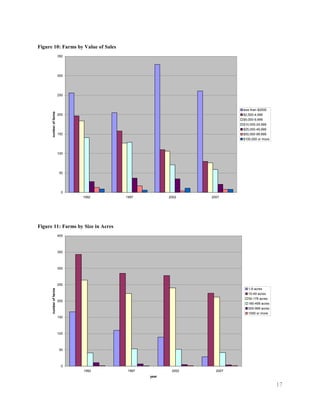
of food assistance programs. Farmers and growers participated in the sixth group, which
included questions on community food production resources. Questions were based on sample
questions from the USDA Toolkit, library research (especially Krueger 2009), and input from the
Council. The list of questions used for the focus groups is included in Appendix D.
        We used several strategies to recruit participants. A ―help wanted‖ flyer was posted and
distributed in public places around the county; a short announcement was also submitted to the
local paper and the local AM radio station. Collaborating with survey collection at the food
pantries, however, was the most effective outreach strategy. Members of the JCCFAPP project
team went to the food pantries on distribution day and surveyed the recipients as they arrived.
After completing a survey, recipients were asked if they were also interested in participating in a
focus group. If so, their contact information was recorded. Later, we followed up with each of
these individuals by telephone and asked them a series of ―screening‖ questions to determine
their suitability for participation in a focus group. These questions were also based on the
sample questions in the USDA Toolkit and input from the Council. Producers were selected
based on suggestions from the Council and were also screened.
        Consumers were grouped according to income and frequency of household food
shortages. We wanted them to have relatively similar standing in regard to household food
security so they would feel comfortable sharing their experiences with one another. The low
income groups included people who worry about running out of food on a regular basis; rely
heavily on food pantries and food assistance programs, and whose annual household income is
well below the federal poverty line.40 The middle income group included people who usually
have enough to eat but work hard to stretch their food budget. The annual household income of
these folks is just above the poverty line; most of them work but they are one emergency away
from food insecurity. The upper income group included people who have plenty of money and
food. Many of them were involved in efforts to feed the hungry through food pantries at their
church. The producer group included individuals who make a living growing and selling: beef,
vegetables, orchard crops (e.g. apples, peaches), and value added products (e.g. jams, jellies,
baked goods). Their farms ranged in size from 180 acres for grazing cattle to 5 acres of diverse


40
     http://aspe.hhs.gov/poverty/09poverty.shtml

                                                                                                44
vegetables. Several of the participants had been farming all their lives, while others were just
getting started.

Figure 27: Demographics of Focus Group Participants (Consumers)
                 Gender              Age               Community of Residence
         # of
                     Fe-
Income partici- Male      < 35 35-45 46-55 56-65 66< Mt. City Butler Laurel Trade
                     male
        pants
Low       23     7    16   1     5    14     1    2    16       2      4      1
Middle    10     1    9          3     2     5          8       1      1
Upper      8     4    4                1     5    2     7              1

        Four consumer groups were conducted between March 18 and March 31, 2010. One
producer group was held on April 5, 2010. The goal was to have 8-10 participants in each group
for a grand total of 48 participants. However, due to the large size of one of the consumer
groups, we were able to attain the goal of 48 total participants in only five focus groups rather
than six. Groups ranged in size from 7-14 participants, the median group size was 9. Each
participant received a $40 payment. Everyone also received two copies of a consent form; one to
keep and one to sign. Signed copies have been kept on file. Audio recordings were made and
transcribed. One Council member moderated the groups while another took notes. All
identifying information collected in the groups - including the transcriptions, notes and
recordings - has been kept confidential.
        Three morning groups were held at the Mountain City/Johnson County Community
Center; lunch was provided after the discussion. Two evening groups were held at First Baptist
Church; dinner was provided upon arrival. Another Council member volunteered to help with
the food; she made a special effort to prepare healthy food. Because transportation can be a
barrier to participation for low-income individuals, we initially intended to host groups in
different areas of the county. Ultimately, we were not able to recruit enough participants from
other communities to make it worthwhile to host any of the groups in communities besides
Mountain City. In addition, participants did not identify transportation as a barrier; they seemed
accustomed driving into Mountain City on a regular basis.

Consumers

Hunger and Food Insecurity
        All of the low-income households participating in focus groups reported they had worried
about running out of food during the past year. About half of the middle-income households
reported the same. Most of the low-income households also reported that they worry about
running out of food EVERY MONTH. While most upper-income households do manage their
food budget to avoid waste and overspending, they do not worry about going hungry.
        Food insecurity is clearly a widespread problem in Johnson County. Several residents
reported not having enough money to cover their basic expenses (food, health care, and housing)
every month—even if they were receiving public assistance. Because hunger is a symptom of
poverty, these concerns are tied to larger concerns about the economy, loss of jobs (especially
manufacturing jobs that have gone overseas), and lack of opportunities for young people to make
a living in Johnson County.

                                                                                                   45
And a lot of us just can’t hardly live. The income ain’t good.

   I think a lot of people… I know me, I mean if you have that many girls. You feed your kids first and
   whatever else is left, if that’s what you have, well you’re going to eat it.

   When the kids are missing so much school, I say to them, “Did you have a great time on your days off?”
   Sometimes kids would say to me, “I like to come to school because we get to eat here.” They didn’t have
   enough to eat at home. It’s heartbreaking.

   I know quite a few people that their medicine was so expensive that they didn’t get to buy no food that
   month.

This problem is compounded by rising food prices.
   Sometimes you got to go to three grocery stores just to get a little bag, because the prices of everything…
   Well if everything is real high and they’re not having no sales, then your money’s not going to go that far.
   So I mean a little tiny bag can cost you $30 and you ain’t got nothing.

   I was volunteering down there at [a local produce stand]. And they’re expensive, but we’re finding out
   that it’s expensive everywhere. It’s just the cost of living is going up.

     Johnson County families (in all income groups) are very resourceful, stretching their food
budgets and making food last longer. While shopping they: stock up at the beginning of the
month, buy generic items at the grocery store, sacrifice quality for lower price (particularly with
meat), select cheap food (e.g. spaghetti, rice, beans), and buy food on sale. At home they: make
sure that leftovers are not wasted, freeze items bought in bulk so that they do not spoil, add
garden vegetables to home cooked meals increasing the number of servings, eat seasonal
vegetables when they are plentiful, preserve food during the growing season, make soup or other
dishes that provide many servings, choose ingredients creatively to make the most out of what
they have, and prepare meals from scratch to save money on processed items (e.g. bread, potato
chips).
   If I am getting toward the end of my food budget, then I go in my freezer and I see what I’ve stored in
   there and make sure that I use it. So it doesn’t go to waste.
   We kind of worry [about running out of food], but I try to keep everything stocked ahead. Where we
   shop, we try to buy in bulk.

   I take an inventory of what I have. And then I make up menus and then my grocery shopping will consist
   of just making up for what we don’t have. You know, and that’s really helped, especially through this
   winter.

   Another thing that we do is we make sure that the leftovers get eaten.

   I’ve had to eat spaghetti four times in a week; because that’s the cheapest thing that you can get. And
   I’ve had beans and rice that many times too because beans and rice, you know, that’s the cheapest you
   can do.

     Food pantries and food stamps are very important to Johnson County households. All of the
low-income households represented at a focus group participate in some form of food assistance
program. Approximately 60% of the middle-income households reported the same. Most upper-


                                                                                                             46
income households have never participated in a food assistance program, but if they have, it was
a long time ago and/or for a limited period of time.
     Several focus group participants mentioned that they simply would not have enough to eat
without these programs. Without assistance, they fear that they would starve to death. People
particularly rely on these programs during the winter (especially during the holidays) and at the
end of the month. Food stamps also help stretch the grocery budget because food purchased
using these benefits is not taxed.
   Over there, they give pretty good food [at the Commodities distribution]. If it wouldn’t have been for
   them one time, I wouldn’t have had nothing.

   Yeah, we go to food pantries. Without [them] I wouldn’t have anything.
   I wouldn’t either.
   A lot of the churches, you can get at the church too.
   Yeah, they give a lot of help.
   Yeah, they help you out a lot.

   How important are these food assistance programs to your household?
   Very important.
   Very important.
   Yeah, very important, they’re very important.
   Food stamps helps a lot. I mean they really do…I mean, if I didn’t have food stamps, I don’t know what I
   would do. Because we would starve. Literally. We would.

   The way the economy is now, you’ve got to get food stamps to even eat. I mean, by the time you pay
   your bills, that’s just it.

     People also rely on their friends, family, church, and neighbors for support. Focus group
participants in all income groups also report providing this type of support to others. They give
food away (especially from their gardens) and prepare meals together. For food insecure
households, this can mean sharing food that is needed to make it through the month. When
family comes over to eat (either because they’re visiting or because they don’t have any food
either) it makes it particularly difficult to make it to the end of the month.
   I give a lot of deer away. I usually, if somebody wants me to kill them one, I will.

   That’s what helps me a lot, is friend’s gardens.

   Even when I didn’t have anything I was still helping somebody else.

   I probably give 80% of my garden away, just to local people, you know.

   Well our neighbor that lives next door to us, a lot of times we’ll cook and she’ll cook and we just, you
   know, give her part of our food and she gives us something back. You know, just sharing. That way one
   person doesn’t have to cook everything.
   That’s how my neighbor is. He’ll help cook, or I’ll cook and we’ll invite him over one night or he’ll invite us
   over when he does. My husband’s mom or one of them will invite us and that helps a lot too. I’ve found
   this is a really well meaning society. People really do help each other, they care about each other.

   Well last night my son ran out of food… so he asked me to fix him supper and I fixed him supper. My son
   he gets food stamps and he has a job, but he don’t make much at his job. He only gets 2 something a
   week and he has bills. Like myself, I got bills and sometimes I run out of food. Most time, I got food

                                                                                                               47
because I go to the food pantries and stuff. But now, I fixed my son a meal. Now if he runs out of food, I
   fix him something to eat.

     Despite the prevalence with which focus group participants reported participating in food
assistance programs, there is also a concern that others are falling through the cracks. Pride,
isolation/lack of transportation, fear of government, and lack of knowledge about assistance
programs are reasons cited for this.
   There’s some people in this county that really, really, really need help. They won’t ask for it and it’s slow
   to get them to accept somehow… The bottom line is, folks that really need the help—it’s there. Number
   one they got to be aware of it. And number two they got to accept it. And I don’t know how you
   overcome the pride thing. Or suspicions of government.

   I had a neighbor that didn't have running water in the house. It was an elderly man and his wife… I tried
   to get social, you know the social service building here they have a lady, Nancy Wills, she's in charge of
   protecting the elderly. And so I got her involved to go out there and they wouldn't even talk to her. You
   know, they're afraid that the government was going to take, take away you know, social security and
   those sort of things, and they just said, “We don't need your help.” Yet they were, to get water they had
   to go next door to their neighbor at night and do it, get it by the jugs or the bucket-fulls.

Food Pantries
      As previously mentioned, food pantries are a very important source of emergency food
assistance for Johnson County residents and conversation frequently turned to this topic. Focus
group participants receiving these benefits are very appreciative; however, they are somewhat
troubled by the fact that items available at the pantries are often unhealthy, out of date, or well
past their peak of freshness.
   Yeah, I don’t know. There’s just something about that out of date deal that bugs me.

   Sometimes when you go to a pantry, sometimes they give you excellent things like a bag of apples,
   potatoes, cherries, but then sometimes they give you all kinds of pastries and breads and all kinds of
   macaroni and cheese and stuff. So you got some good stuff they give you, but then a lot of stuff you
   really don’t need nutritiously.

   Bananas that started turning black and everything. You can’t eat them.
   The meat is like at the last stage that it can be good.

     Shelter Rock in North Carolina—which provides weekly food boxes and a hot meal for
anyone that shows up—was emphasized a couple of times as a favorite food pantry (although
transportation can be a difficulty). Contrary to the provider survey findings (see pg. 23), this
seems to suggest that the Johnson County pantries are not meeting the demand and that
recipients would like to receive food boxes from the local pantries more often to ensure they
have enough food through the end of the month.
   And we go to a church over in Shelter Rock. And when we go over there, they give us a meal and stuff
   and we listen to the sermon and then they give us stuff that they have… It’s on a Tuesday.
   If you can go, you've got to have gas money. If you have gas money to go.
   Yeah that's true because it’s an hour drive. Usually a bunch of us get together and go.
   A meal and they give you food.
   They cook it right there


                                                                                                              48
Sometimes we even get a case of water, sometimes they give us juices. I mean you know just different
   stuff. Sometimes they give us bread. It's just depending on what they have. Big cans, sometimes you get
   the gallon cans of stuff.
   What is it about that particular place that makes it worthwhile to drive out of the county to go versus
   the pantries that are here?
   Well even if you have $10 for the gas to go over there, what they give you and stuff, you can't buy that
   kind for that.
   Plus it's a hot meal instead of a cold meal. That they provide for you.
   Well a lot of them here, like you say, you can only go to them certain times, this is year round, every
   Tuesday. They even have dentists over there that comes in and will help you if you participate in a
   program.
   So they'll give you about 3 times more than what the [local] pantries will.
   Oh yes.
   I mean it's not like bags, its boxes of stuff.
   Honestly, a lot of us don't have a means of going. You know, whether we don't have a car or our family
   can't help us because they are barely getting by. I mean there is drawbacks.

     Focus group participants with experience in providing emergency food assistance were very
concerned that these programs are being abused—that recipients have other motivations besides
hunger for visiting the food pantries as often as they can. Recipients wasting the food that they
receive, feeding it to their pets, and/or trading it for drugs were the primary concerns cited. It
was also repeatedly stressed that, despite any abuse that might occur, it is important to continue
providing this assistance to make sure that the children of Johnson County are fed. While these
comments are most certainly rooted in personal experience, they also seem to draw on widely-
held stereotypes of welfare recipients as lazy, dishonest, and irresponsible.
   I know there’s people that goes from here to Watauga County to the food bank. I know they do.
   But if people don’t have a conscience, you can’t give them one.
   But you know, that’s still fine, because if there’s children in the family. Even though you might have, even
   if the father or the mother was on meth or whatever, you still got to feed that child.

   We've got this one lady that handles it and she tries to watch because some people wants to come back
   more often, you know every week or so if they can. So she kind of monitors that.
   And they leave your church and then they come down here [to my church].
   That goes back to they're selling their food stamps.
   I've seen them come to our church and get their clothes and stuff and food and then you go up to Mike's
   BBQ on Saturday and they're sitting there selling them.
   So it's abused.
   The food stamp program really needs to be readjusted. Because we've got a, up to 60% of the food
   stamps in Johnson County are being sold to buy cigarettes, drugs and alcohol.

   It's a real problem of the conscience. You know, you don't want anybody to go hungry when you have
   more than you need. And it's available, but then you don't, also you don't want people abusing the
   program.

     Focus group participants with experience receiving emergency food assistance have a
slightly different perspective. They believe that most recipients are truly motivated by hunger
and that any abuse that does occur is an isolated incident rather than indicative of a widespread
trend.


                                                                                                            49
Do you think that some people abuse the food pantry programs or take food when they don't really
   need it?
   Yes, I've known a couple of people that just go to the food pantry just to get food for their dogs.
   For real? Wow.
   I mean I used to live with somebody that would go to the food pantry and we would be pretty much
   hungry and they would feed it to their dogs to keep their dogs from starving. So I just started buying my
   own food and, you know, going to the food pantry and putting it in my room and keeping it so that they
   couldn't feed it to their dogs.
   Is there a way to prevent people from doing that?
   No, cause you can always say, oh I'm not doing that with it, unless you really have proof then
   … [B]ecause most people that go to those food banks are really [hungry].
   Surely it'd have to be just a few. Because when I go and I talk to people that are waiting and stuff, you
   know I've never seen anybody that wasn't really, really there for the food.
   I haven't either. I mean, but only a couple of people that I've talked to or know, that goes in there and
   gets it, just, you know, for extra or, like I said, to feed their dogs or. And my granny, she does go, but she
   also, what she does not eat of it she gives, she hands it down to other people in my family. That really
   helps them, people that can't get out.
   I think that it helps not just us but, our, just our family, our friends. Because the stuff that I won't eat or
   my kids won't eat
   I'll pass it on
   When I have a lot of something, then I pass it on. So it's real handy here.

     In addition, very little evidence emerged during the focus groups to suggest that Johnson
County families waste food. Participants in the lower income groups, in particular, seem to be
particularly offended by waste. Despite their concerns about the quality of the items available at
food pantries, they would rather see food of questionable quality be used than have it go to
waste.
   That's like up here at Food Country they throw everything. There was a case of eggs, there would be like
   maybe two or three cracked… they put the whole box in there.
   They just throw it outside, take it out in the dumpster.
   Why don't they give that to somebody? That makes me mad. Why don't they give that to somebody?
   I know. Or at least sell them real cheap.
   But there would be like maybe two eggs that was broken and instead of separating those and taking it
   back and cleaning them off and getting them back up, and putting, selling them. They just threw the
   whole box. I mean the whole box that they came in. They just threw them away!
   That stuff should be donated to the pantries.

     It is impossible to use the focus group data to specifically determine the manner and extent
to which food pantries (or other assistance programs) are being abused. More meaningfully,
however, the data does indicate a very basic lack of understanding among people of different
socioeconomic backgrounds. To move forward, it may be more important to bridge class divides
in Johnson County than it is to root out and rectify any abuse that may be occurring.

Shopping
     Focus group participants identified the following retail establishments as places where they
shop for groceries: Save-A-Lot, Food Country, Food Lion, and Dollar General in Mountain
City; Save-A-Lot, Go Grocery Outlet, and Wal-Mart in Elizabethton; Wal-Mart in Bristol; Food
City in Damascus; and health food stores in Boone. Many also stated that they ―shop the sales‖


                                                                                                                50
rather than favor one particular store. Individuals from low-income households rely heavily on
Save-A-Lot.
   I get the papers that comes out and look and see where the best bargains is. And that’s usually the way I
   shop.

   Pick out and go through the sale papers and see which has got the best deals. Maybe go as much as
   three different stores just to find, get some buys to get what you could afford with your money.

     Several participants stated that they prefer to leave Johnson County to shop if possible.
Lower-income households typically do so in order to save money on their grocery bill. Quality
of meat and produce, availability of bulk items, and availability of organic items were other
reasons people mentioned for leaving Johnson County to shop.
    And we do most of our shopping, like my food stamps shopping I’ll do in Mountain City if I can because
   the tax is so much higher. And then the money that I have to spend, I’ll go out to Wal-Mart in Bristol and
   the Food City in Damascus. And the tax is like 2.5% on food out there. So it’s a huge difference. I think
   it’s like, what 9.5% here? It’s a huge difference. So, we just look for the stuff that’s on sale I guess.
   That’s what we do.

   I’m not really happy with the produce that they supply to the grocery stores here in Mountain City. They
   could do better….You can just go across the state line into Boone and it’s a hundred times better quality,
   generally speaking, than you can get here. And there’s no reason for that—its 20 miles away.

   If you can afford the gas, the food is a lot lower prices at the stores out of town. And they have a lot more
   organic… a lot more choice too.

     Convenience and reduced travel expenses are benefits of shopping in Mountain City. The
availability of local produce at Food Country was also mentioned several times.
   Well, for me Damascus is the same distance as Mountain City where I live. But I have more appointments
   in Mountain City to go to, so I shop here more often for that reason.

   We’ll make a day of it. We make the whole day our shopping day and we shop once a month when we
   get our check. And then we’ll go to Food Lion, Food Country, and then we head out to Damascus and
   Bristol. And then during the month if we need anything in between then, it’s easier just to run to Food
   Lion or Food Country that way. So I guess we kind of use it during the month as a staple, distance wise.

   Well, one thing that’s nice about Food Country is that, sometimes they will use some of the local farmer
   things. Like right now we’re getting peppers and that’s exactly where we’re going because you can get
   them for half the price, they’re cheaper than even Wal-Mart.

 ―Alternative‖ Sources of Food
     In addition to grocery stores, there are many other sources of food that are very important to
Johnson County families. Focus group participants reported eating food from an ―alternative
source‖ once a week, a few times a week, every day, or even up to 50% of their food supply. A
great number of participants—in all income groups—mentioned their gardens and preserving
food.
   I just moved here about three and a half years ago and never grew one thing before I moved here. And
   I’m delighted, I have this big garden and I grow all this stuff and I have bees.

   My kids were raised on fresh vegetables.

   I eat out of the garden all year round.

                                                                                                              51
I put out gardens a lot with my son, me and my mom, and we share with everybody in the community.

    We used to bury our potatoes and cabbage and stuff, and dig a hole, and bury your stuff. Bury your food
    - to store it. We used to call it… a dirt cellar.

    Hunting, roadside stands, pick-your-own, farmers markets, gleaning, collecting wild edibles,
and ―dumpster diving‖ are additional sources of food that were mentioned. Deer, rabbit, snake,
frog legs, and squirrel were mentioned as wild game that is used for food.
    I like deer meat anytime…I usually kill 12, 15 a year.

    We killed a beef. We probably killed seven deer. We kill our own pork.

    We eat a lot of deer meat, rabbit, squirrel, bear…My whole family hunts…my two boys, my dad.

    A great deal of the stuff in my freezer is venison. And fish that I caught.

    I always get mine at the produce stand where they sell produce by the side of the road. They have quite a
    bit of stuff there.

    When we first moved here he hit the dumpster in Elizabethton at night and you wouldn’t believe the stuff.

       Focus group participants identified several reasons why they prefer these ―alternative‖
sources of food to the grocery store: it saves money, it tastes better, it is better quality, it is safer,
it is healthier, the source is perceived to be more trustworthy, it buffers against food insecurity,
and it builds and strengthens relationships in the community.
    I never bought a tomato in a grocery store yet that was worth the energy it took to slice that thing.

    [T]hey’re grown in Florida and other places and they’ve got to pick it when it’s green.

    You make friends. You give it away and people become your friends. You invite them to your church and
    they come to your church and then they meet other people and pretty soon it’s just a big old swap thing.
    Our church likes to cook. We cook a whole lot at our church.

    I try to grow it organically…Especially I worry about the stuff in the store that comes from out of the
    country. And you worry about what standards they have. I know what I did with mine. I know what’s
    been put on it and what hasn’t.

    But you know if you grow your own you know you don’t have [dangerous bacteria] in it. You’re not going
    to have something, if you’re going to eat it, that it’s going to kill you or hurt you. When you grow your
    own, and canning food or fixing food at home, it brings your whole family together. If you’ve got a bigger
    family that, everybody goes in on, depends on it, it just makes a better family atmosphere.

    I would say the beef, they’re getting really bad because of all the shots they put into it. It’s getting worse.
    It’s better to go to wild game because you know you ain’t going to get all that.

    It’s also nice to have the fresh food. When you get it from the garden or farmers market its fresher and
    you’re also supporting local business.

    It saves you money where you can buy something else that you actually need.

    So if you got a garden, then you know you’ve got some food, at least some vegetables or something in it.
    And if you got hunting, you know you got a piece of meat.


                                                                                                                52
Despite the benefits of ―alternative‖ sources, nearly all of the focus group participants get
most of their food from the grocery store. A lack of space and lack of skill/knowledge are the
main reasons why people do not garden. Focus group participants also mentioned physical
disability, not being able to afford supplies (plants, fertilizer, seeds, etc.), fear of failure, lack of
interest, lack of time, unwillingness to do the physical labor, and vandalism. Lack of
skill/knowledge, not being able to afford a license, and not liking the taste of wild game are
reasons why people choose not to hunt or fish. Reasons why people don’t rely more on fresh,
local or organic produce include: a lack of information about what is available and where to find
it, it is only available at certain times of the year, they cannot afford it, it is difficult to travel to
places where it is sold (especially if they have to go out of county), and not enough
fresh/local/organic items are available in the community.
    I used to until I got my back injured so I can’t hunt no more. But they still let me fish.

    I think a lot of people, they’ve got used to..[thinking] they can’t do it. If you knew somebody could step in
    and help, they would have food too.

    Most people don’t advertise. You’ve just got to see them. Or hope that you see them along the road or
    somewhere like that when you’re out and about. Most people can’t afford gas to just be out and about
    anymore. I think they should be able to advertise them, you know like in the newspaper or over the radio
    or maybe put a bulletin up.

    I don’t know if I would want a garden or not, it’s a lot of work.

    There’s very few women that are educated on [hunting wild game]. And a lot of times we don’t have the
    guns, we don’t have license to do these things.
    And it costs money for the license and stuff.
    Even when you fish it’s expensive. That license is expensive and then you don’t know whether you’re
    going to catch anything or not.
    [And] you don’t know if you can eat the fish you catch.

    What are some of the barriers that exist to being able to buy more locally produced goods?
    The price. I mean it’s cheaper at these other places.
    I think that’s the big thing. Price.

    I’ve always had a garden all my life. My problem right now is mostly the area to do it in.

    No, I’ve wanted to grow a garden but I have never had a green thumb and I’ve never really known how to
    do it…That’s something I’ve wanted to learn how to do, is garden, and to can. But I’m not sure how a
    person learns that.

    Mine is a time issue. I work two jobs, have a small child, and do lots of other stuff. And it’s just easier to
    run in the grocery store and grab it and go. Instead of going, you know, to three different places.

    When you get a little pack of cucumber seeds, you don’t get but just a little bit, they’re high.

Nutrition
      Many focus group participants reported that they are not satisfied with the nutritional
quality of their diet. Lower income individuals were more likely to report this dissatisfaction.
The cost of more nutritious food, particularly fresh vegetables, was cited as the primary obstacle
to a healthier diet. The fact that convenience food is often unhealthy also makes it more difficult
to obtain a nutritious diet. Other factors include: lack of self-discipline, pervasiveness of junk
                                                                                                                53
food advertising on TV, difficulty interpreting food labels for restricted diets (e.g. low-sodium,
diabetic), and peer pressure young people face at school.
    My son eats more vegetables than he does anything else. So I usually get what’s leftover, meat or
    something like that. I don’t particularly get enough vegetables that I know that I need. But I’d rather him
    have it than me.

    The television has a huge impact… The other day I was fasting and watching something and, it’s like, it’s
    all junk, and there is a ton of food! That’s all, in fact most of it, is food… And it’s not good food either. It’s
    like, no wonder, if we spend so much time watching television, you just don’t even know it’s happening.

    When I was a single mom, worked full-time and had 3 kids, and they had ball practice, we’d drive through
    McDonalds sometimes. Because, just what you’re saying, time issue.

    We don’t take the time. Many of us don’t have the time, but a lot of people just don’t take the time to
    prepare it yourself.

    It’s a matter of choice, whether to buy that bag of cheese flavored Doritos or fruit.

    What barriers do you face in improving the nutritional quality of your diet?
    Just the cost

    They have sales so often on cookies… but I don’t see sales on apple and broccoli.

     Several participants also identified lack of knowledge about nutrition as a barrier to a
healthier diet. However, nutrition education was always recommended for someone else. No
one stated that they wanted additional education about healthy eating habits for themselves.
―Because our church wanted to do classes on different areas that they needed, child care and all
that. But we didn’t get anyone to sign up.” Indeed, the idea that education is a solution to poor
nutrition is based on the assumption that people who understand the basics of a healthy diet will
make healthy choices most of the time. And this is not necessarily true.

A Vision for the Future
     When asked to envision what Johnson County would look like in an ideal world, focus
group participants emphasized plenty of food—―No more hunger”; plenty of good jobs—―A job
for everybody”; a sense of community; and self-sufficiency.
    Community gardens. People sharing things. Instead of just me, me, me-- make it me and you.

    I have big community gardens, more neighbors and friends helping each other and more of the families
    getting together and helping other people and having community recycling place where you can recycle
    things and put that into something for summer gardens. And if you do that, you’re not only feeding your
    family, you can feed a whole community. Feed lots of people.

    I'd like to see something like that happen to where people that really needed help, able bodied people,
    would have a public farm where they could go to raise their food, raise enough to feed the elderly and the
    children. And help those in need. We could be a self-sufficient county. With our weather and our land
    and our people with the knowledge. We could be a self-supporting food system.

In many cases, their vision for the future is closely tied to nostalgia for the past.
    So I heard, years ago, back in the 50s and 40s, Mountain City was the place.
    People would come from everywhere to Mountain City.


                                                                                                                   54
I can vouch for that.
They said there was people walking up and down the streets here and they had two theatres. We had
plenty of people in town on Saturday nights. That’s when all our stores was open. And the streets were
congested. You couldn’t find a parking place.


When we was little, what was on our plate, we ate it and we didn’t get nothing else. And that’s the way
it was. And you learned to eat it. Now, if you don’t like it, they go fix you something else. You know, I
don’t do that.


                                                                                                        55
It’s like the old fashioned way, years ago people took their wheat to the mill and got it ground, the corn
   and everything.

   In particular, they lament the loss of small farms and Johnson County’s agricultural heritage.
   Used to you could buy milk off the farmers, but now they, you can’t hardly do that now… There ain’t
   nobody selling it out to just the public.
   We used to have a lot more produce in this county. A lot more little stands, from people’s private little
   farms and stuff. A lot of the old timers have gone and we’ve lost a lot of that. This used to be a lot of
   vegetables and everything here. It was the green bean capital you know.

   There used to be a blueberry farm in Butler too. Just down almost into Butler, there used to be a couple
   of strawberry farms here too, but there’s nobody around anymore. Nobody’s growing them anymore.

     A couple of participants were not so optimistic about the future. It was suggested that
perhaps this is the future we have to look forward to if Johnson County residents do not step up
and work together to create a different future for their community.
   I think that things going to look real scary. A lot of bad issues. People may not know how to take care of
   their basic needs. And poverty. More sickness. Because they’re not getting the right nutrition…. And
   government may not can step in and help. Without the farmers and with prices getting higher, if you
   don’t have money you can’t afford to provide for your family. You won’t be able to live. [It looks like a
   famine is coming.]

   I don’t think the future is looking too good. In time it’s getting harder.

   Maybe that’s more like how things will turn out if we don’t do anything to change it.
   I think that’s the whole purpose of this meeting, isn’t it? Is to try to help change what you said.
   Some things is going to have to be different.

Existing Assets
    Focus group participants listed many assets that already exist in Johnson County that could
be used to build a more sustainable food system, improve the quality of life in the community,
and move towards the ideal world.

       Churches
       Food Pantries
          o St. Anthony’s: provides food and Crossroads Medical Mission
          o Hale’s Community Ministries
          o First Baptist
          o Presbyterian Church: 5 Cents a Meal program provides $25-50 vouchers that can
              be used in the local grocery stores
          o Community Church
          o Shelter Rock (NC): provides hot meals and food boxes
       Meals on Wheels
       School lunch
       Summer food service program
       Backpack program: sending produce home with school kids
       Neighborhood Service Center
       Higher Ground: provides lunch for participants every day

                                                                                                               56
Commodities distribution at the National Guard Armory
    Small farmers
        o Snyder’s
        o Shull’s Farm
        o Billy Ward
    Produce stands
        o People that sell at Mike’s BBQ
        o Lambert’s in Valley Forge
    Place in North Carolina that sells fresh milk, butter
    Local people that sell eggs
    Places to get a deer processed: Kenny Cole’s, another place in Virginia
    Good quality farm land: especially if farmers have extra space they would share with a
    community garden
    Gardening: especially if resources (seed, equipment) and knowledge are shared
    Hunters
    Greenhouses and aquaculture center at the high school
    Farmers market
        o Elizabethton
        o Yadkinville
        o Johnson County
    Garden at community center
    Duffies Amish store
    Cheese factory in West Jefferson
    Trade Mill
    Local winery
    The golf course

Well I think it sounds like the churches are really stepping up to the plate here. I am really impressed with
how many, I didn’t realize that that many churches had food pantries. And it seems like they are…
certainly they’re fulfilling a huge need.

I know with our grandkids, [the school system] sends back food home, is it once a month, or every Friday
or something. And a lot of times [their mother], you know, she’ll give it to me for over at my house
because they won’t eat at their house. But it’s good food, like cans of ravioli, juices, milk.

That’s something to go look at if you’ve never seen the aqua center [at the high school].

There’s a lot of good farmers not doing the work and a lot of good land that’s not being used.

We have a lot of talented people, it’s just they’re starting to get together in different ways… Trying to get,
promoting what we’re doing right here. There’s a lot of talented people.

And we’ve got so much information, I mean all these old people. I mean, we’ve got so many people in this
community from the mountains and they know so much about farming and canning and the way it used
to be.


                                                                                                           57
Potential Projects
        Focus group participants had many creative ideas for grassroots projects that would
benefit the community. Community gardens were far and away the most frequently mentioned.
They are a logical solution because they can help foster the qualities of the ideal world described
above: plenty of food for everyone, a sense of community, and self-sufficiency. Participants
envisioned gardens on donated property—perhaps in a fallow field belonging to a local farmer or
on government property. Some envisioned large gardens of 10-15 acres and others suggested a
larger number of smaller gardens located close to the members/volunteers homes. The garden
could be sub-divided into smaller individual gardens or each member could be responsible for
one or two crops that would be shared among the entire group. Vegetables were the primary
focus of the gardens, but cows and chickens were also suggested. Community composting could
be incorporated into the garden to reduce waste and provide material to enrich the soil. A
portion of the harvest could be sold to generate funds to maintain the garden. It was also
suggested that security of the site be considered to prevent vandalism.
        People working together are a very important component of the community garden. This
allows for members/volunteers to pool resources. They can share equipment, tools, and supplies
and they can also teach and learn from each others’ knowledge and gardening skills. Working
together also provides social opportunities, allows people to get to know their neighbors, and
builds community. The members and volunteers of the community garden could occasionally
gather for covered dish dinners to socialize and celebrate the fruits of their labor. Community
gardens are also a way for the community to produce food for the elderly and other individuals
that are not physically able to garden. It also addresses another common barrier to home
gardening: lack of suitable space. Tax deductions could be provided as an incentive to
participate.
        Increasing the number of families with home gardens was also mentioned repeatedly as
a strategy for increasing food security and self-sufficiency. Some would also like to see more
small-scale livestock production for eggs, dairy, and meat. Again, increased composting was
suggested as a strategy for decreasing the cost of supplies/inputs. Participants want to see
families, friends, and neighbors teaching, learning, and working together to ensure each others’
success. Mechanisms to connect people with gardens and excess produce to people who don’t
have gardens and don’t have enough food, were another suggestion.
        Various forms of educational programs were also repeatedly suggested. Both adults
and youth need to be educated on gardening, food preservation (canning and freezing), hunting
and butchering wild game, cooking and nutrition, and general self-sufficiency. However, the
classroom setting is intimidating or uninteresting for many people. Organized opportunities for
people to get together and share knowledge informally are preferable. This could include a
covered-dish dinner at which people were encouraged to swap recipes, seeds, and gardening tips.
It was frequently mentioned that the older generation of Johnson County residents has a wealth
of knowledge and experience to share with the younger generations. It was also frequently
mentioned that the younger generations have limited self-sufficiency skills. This concern was
voiced by adults in the focus groups, but the high school groups (see pg. 70) confirmed that this
is a concern for their own generation. Members of different generations should be encouraged to
work side by side. Community gardens would have many of these types of educational
opportunities.
        Engaging youth in community projects would give them positive activities on which to
spend their time and keep them out of trouble. It would also serve as an opportunity to take

                                                                                                58
advantage of their energy and fresh ideas. Programs specifically targeted towards youth could be
organized through schools and/or churches. School gardens are one example. Television shows
and video games were mentioned as techniques that might particularly capture their attention.
Hands-on activities (such as engaging them in gardening and cooking) were also suggested.
Home economics taught at school and 4-H clubs were also suggested.
        A centralized/county-wide food pantry is another project that was frequently
mentioned. The primary appeal of this project is to reduce abuse of the current (decentralized)
pantry system. Focus group participants envision either one large food pantry that serves the
entire county or a limited number of small pantries spread throughout the county. In either
scenario, the entire system would be run by the churches. Getting all the churches to work
together was identified as an obstacle to the county-wide pantry project. One large, centrally-
located pantry might also create transportation difficulties for residents in more remote areas of
the county.
        Several participants also suggested that Johnson County could use a grocery co-op. This
type of store would keep money circulating in the local economy and increase the availability of
bulk goods (grains, nuts, flour, beans, etc.), organics, local produce, and health food items.
Participants also want to see increased availability of locally produced goods (vegetables,
eggs, meat, and dairy). They want to see more farmers producing these things and a better
selection of these items in the local stores. They also want to see more roadside stands and pick-
your-own farms. A health food/bulk section at one of the existing grocery stores was also
suggested. Processing more food locally (meat processing, a cannery, or a cheese factory)
would also keep money in the local economy, create jobs, and increase availability of fresh, local
food.
   I’d like to see a lot of family gardens and people pitching in and helping each other. You know, to raise
   good vegetables or good whatever. And be able to allow after they had, you know farmers that grow
   vegetables, after they’ve picked their crop, to leave a little bit for others to glean off of if they don’t have
   a garden.
   The Bible calls for that.

   Just have some big community meetings where everyone could get together.
   Yeah community meetings would be good.
   Just to talk about this kind of stuff?
   Yeah, that's what you need to do.
   Maybe people could bring their extra vegetables that they have from their garden.
   Yeah
   Like a swap
   Yeah if we had a community meeting, then maybe some of the older people will come and teach the
   younger ones how to do it.

   The Ministerial Association, the pastors in the county, they are in the process right now of… getting a
   soup kitchen started.
   Oh, that would be nice!

   Wouldn’t a centralized food bank
   Hey right, that’s what we’ve been wanting to see for a long time!
   You know if you had that you might not get so much abuse.


                                                                                                                 59
Community gardens, something that they're starting to do now. It gives apartment dwellers a place
   where they can garden and it’s social for some people to get out and just see other people. It's a little bit
   of exercise in the summer. I don't know if there'd be a need for that here in town.
   I think it would be nice because a lot, I know some people that don't have an area to garden in. And they
   used to call them victory gardens, when times were hard, when people got together and gardened and it
   was… social.

   If each one of us could find one person that needed help. You know and it could be helping them in the
   garden, showing them how to do something, we can learn from each other.

   This is what we teach in my church and I think that’s where it can start… Churches are an important part
   of this and I think we can utilize that because… God wants us to use our bodies as a temple for Him first of
   all, you know, is why we need to be healthy and I think that’s where it could start.

   I used to buy fresh milk and eggs but now that lady is gone and I have a hard time.
   That would be something I would love to do.

   We need to show [young people] the values, you know, in life of what you have to do to survive.
    Yeah, that's right.
    As much as they're so much more ingenious than I am, they can think of so many more brilliant ways to
   get things done than people like me that're set in our ways, just trying to survive. They have a lot better
   ideas than my age people.

   I think one thing I’d like to see too, you know, these children growing up, is put a garden in class for them
   too. High schoolers have it and I think the children could benefit from it too.

   A lot of people don’t know how to raise a garden, don’t know how to do that stuff. They just need to be
   showed how to do it.

   You don't have to grow food, you can grow flowers too in the garden. So people could sit around and
   talk. One thing they have is people don't talk to each other anymore. They don't even know, lot of people
   don't even know, can't name five people that live on their street. You know, it's like, they just don't know
   who lives next door because we've all become protective. We're afraid of our neighbors.

   Johnson County would need to be zoned. Nobody hit me. They'd have to have a farm area, industrial
   parks, a residential area and a commercial area. Because now it's sort of mixed up and you could never
   have a walk-around downtown community or something like that. Because you know, you'd be
   someone's farm land or a used car lot or something like that. So if you zoned it all out, then you'd have
   areas where things went. So, it sounds like I'm a communist or something but I'm not.

Other ideas that were mentioned less frequently:
       Gleaning
       Greenhouses (These would extend the growing season but it was acknowledged they
       would be difficult to maintain)
       A way to access surplus food and/or use food waste. (Immediate solutions are also
       needed to address pressing hunger problems.)
       Coupons to make it easier for poor people to buy food (e.g. expanded assistance
       programs)
       Soup kitchen


                                                                                                              60
Homeless shelter
       Store with sliding scale prices for poor people
       Summer feeding program expanded to adults
       Bike trail
       Zoning (to allow for farmland preservation and a more centralized, walkable community)
       State-run public farm
       Flea market
       Wal-Mart
       Advertising Johnson County as an agricultural area to draw tourism/development
       Drive-thru deli that offers healthy options for eating on the go
       Corporations that produce junk food should have to pay for health care
       School programs with better quality food. Get kids used to eating vegetables and/or
       make them do it.

         Participants recognize that change is difficult and that, at times in the past when people
tried to start new things, they were not successful. But they also see cause for optimism.
Everyone can do a little something to contribute. Word of mouth is the best way to get the word
out and start organizing people.
   [The County Commission]… just wanted everything to stay the way it was. They missed out on so many
   good grants, the city could have got, or the county could have got, that they could’ve improved the
   county so much.

   Whatever they do, they just need to work together. And have an open mind.

   How do people find out about these things?
   Word of mouth. From one person to the other.
   Yeah, this town, you just tell one person, everybody knows pretty much.

   But it’s going to take an effort. Anything, ANYTHING like that will take an effort. It’s not the easy way.

   I think there are people that are willing. I think there are quite a few people that are willing to if they
   knew what was going.

   But I think that some of those large, long-time landowners, I think that they’re just trying to keep
   Mountain City... the way it was. But they’re making it hard… I kept hearing some of the local people that
   they wouldn’t go to the farmers market. And I said why? And they just said, “Well we like it the old way.”
   There’s some resistance.

   I think we can teach by example. I mean, by being, that's really about all the little people can do, like you
   said, complain about it, but being a living testimony, you know, hey, this is do-able, it is affordable, we
   could do this.

   We could volunteer our time too. Even if it’s just a couple hours one day a week. And be willing to teach
   a, well, all I can do is cook, so a cooking class. Or gardening, people who understand gardening.

   What about going to city council meetings? Is that a way that people can get things accomplished here?
   No
   I'd be terrified to go there. I mean you're very right. We need, we need to do it.
   If there's a bunch of us get together and we just keep hounding them, they'd have to hear us.

                                                                                                                 61
But they wouldn't do nothing about it.
   No.
   It would take persistence and it would take that one person to jump. It would, it would. Definitely
   persistence.
   Somebody needs to rock the boat though.
   What happens is, we've all done this, get defeated before we even start. But if we had the support of the
   people, eventually it would, if you got everybody saying, you know, what I don't really feel like dealing
   with this right now, but if anything's going to change, we've all got to do it.

Producers

Sales and Marketing
        Producers identified a variety of outlets where they sell their goods. Several open air
markets were mentioned; the State Street Farmers Market in Bristol and the Tri-Cities Flea
Market in Piney Flats (near Bristol) were favorites. The Jonesborough Flea Market, the Watauga
County Farmers Market in Boone (NC), the Abingdon Farmers Market in Virginia, and the
Johnson County Farmers Market were also mentioned as places where people had sold in the
past. On-farm sales (u-pick and we-pick were both mentioned) are another example of direct
sales to consumers. Farmers with a slightly larger operation may work with a broker. New
River Organic Growers Co-Op in North Carolina was mentioned as an option for organic
growers. Larger farms may also be able to occasionally sell to Food Country in Mountain City.
   Where people know that we grow it, pick it, and they can come pick it up at our house. So we do that too.

   I find that I’m in between, where I don’t need to be, too big or not big enough. If you gonna fool with
   produce as a living, you're going to have to have from fifty to a hundred acres just to make a reasonable
   living. You pushing it on fifty. Twenty acres is way too much to try to put through flea markets and those
   places… You pick an acre of beans, you've got a hundred bushel of beans. Where do you go with a
   hundred bushels? You never sell a hundred bushel through a flea market or any of that. So you just about
   have to, you go through a broker.

        Open air markets that draw a large crowd were definitely preferable. When the group
that runs the market conducts an advertising campaign or hosts events to draw people in, this
helps the vendors. The flea markets seem to draw a large crowd of bargain-hunters and this
allows the produce vendors (especially if there are only a few) to sell their product quickly and
easily. Visibility is also important. An open air market with aesthetically pleasing booths will
draw passers-by. It is also helpful when the market allows vendors to return to the same space
each week and provides a canopy and tables (although this last item is not crucial for success).
   Over in Bristol, I think one thing that is good, that works for us, is the market does different things that
   draws people in. They have an event at least once a month. They'll have a chef in the market, from local
   restaurants over there, that comes in and demonstrates a certain vegetable that we've got in the market
   that day. And that's one thing that I think works well over there for us.

   Well, Tri-Cities, I have an area that’s covered, I have it reserved for the season. It’s covered, I have my
   own little table there, so I don't have to worry about having tables… They have the traffic, you have the
   foot traffic. I mean, it is constant from the time you set up to the time you leave. The only thing bad…
   when you get that many vendors there it does cut down on your sales potential, so you've… gotta pitch a
   good sales to get that dollar, and you gotta have something that they want.


                                                                                                             62
No matter where they sell their products, producers repeatedly stressed the importance of
marketing. First of all, it is important to have a reliable market so that if they grow something,
they can feel reasonably assured that they will be able to sell it. Even after they identify a place
to sell that works well for them, they have to continue to work hard to market their products to
the customers at that location. Marketing tactics include: keeping the display/booth neat, clean
and aesthetically pleasing; giving away free samples to entice the customer; giving the customer
a little extra (a baker’s dozen for example) so they think they’re getting a better deal; moving
items around on the stand to make it look like they are selling quickly; having a unique product;
and putting a large quantity out where it is visible so people know that they can buy it in bulk (by
the bushel).
   Presentation is part of what you’re selling. 80%. That’s important factor too. You’ve gotta keep a clean
   area. And you’ve gotta change it around… somebody come around and said, “Well, you’ve sold that, it
   must be good.” So your presentation and how you sell something—marketing is the secret to it.

   It would be nice to grow a little of everything and sell it all, as opposed to growing a whole bunch and not
   being able to move it.

   That’s the biggest thing, in selling something. You’ve got to market it, you gotta. If you produce it,
   you’ve got to have somewhere to sell it.

   I have a white tablecloth on my table, makes my jelly stand out… So giving away one piece sold me two
   more later. And what I usually tell my customers—if you buy it and you don’t like it, you bring it back.
   You know, I have yet to have a piece brought back because they all like it… I take my sample jars and my
   spoons, and if they want to sample it, they get to sample it… There’s no telling how many pints of
   gooseberry jelly, I sold out all I had just by letting them taste it. Cause it was something new, it was
   something different.

        Producers would like to see more of the food that is consumed in Johnson County being
produced and processed in the county: ―It would be a wonderful thing if you could do it.‖ They
would like to sell more goods locally—to grocery stores, at the Johnson County Farmers Market,
at produce stands, at a growers’ co-op, etc.—and they would also like to see a small cannery or
community kitchen for processing. But they identified several barriers that make this a difficult
proposition. First and foremost, the demand for fresh produce in Johnson County is insufficient
to support their businesses. Producers cite several factors for this: Johnson County residents
cannot afford fresh produce, many don’t know how to cook or can, many others have their own
garden, and some do not understand the benefits of fresh, local and/or organic produce.
Producers also stated that there is not enough foot traffic to make selling at the Johnson County
Farmers Market worthwhile. They seemed frustrated that so few Johnson County residents know
about the local farmers market. Finally, most grocery stores purchase from large-scale food
distributors and it is difficult for them to accept deliveries from small growers.
   Used to you could go to Blackburn supermarket, old man Joe Blackburn. You walk back there, you told
   him what you had. You go White's, you go wherever… then the store could buy. No longer can do that.
   And if I go to Winn Dixie, they say I’ve got to have tractor-trailer load. I need three trailer loads a week.
   Where do you come up with this? I’ve got to have a continuous supply—weekly.

   Plus so many people grows a garden here too, is one of the biggest problems.

   A lot of people in Johnson County don't even know what a farmer's market is… they's not been enough
   education on such stuff as that… And a lot of people still look at me and say, "Johnson County has a

                                                                                                               63
farmer's market?" And you know, it run all year last year… I know the market last year had no money. It
   started up last year, it had absolutely no money to get started with, for advertisement and such stuff.
   But, still, word of mouth ought to be spreading there a little bit.

   In hard times people go to the canned. You can’t can it and save a penny. Fresh produce will not sell in
   hard times.

        Educational programs on cooking, canning, and nutrition were identified as strategies for
increasing demand for fresh, local produce Johnson County. Growers would also like to see the
county investing more money in advertising itself—especially promoting the agriculture sector—
to grow the demand for local products.
   We’d have to start up the interest, and young people especially would have to start canning and stuff like
   that.
   Well I think with the young people, if anybody could get them off this processed foods, back onto fresh
   foods, that we wouldn’t have a problem if that could be accomplished.

   Well, the county’s got the farmers market started here, but until they get in there and back it and support
   it, it ain’t gonna go nowhere, it ain’t gonna do nothing.

   Well, they do get money for a few things, like the Sunflower Festival that they kick off here in town that
   does real good. Why not gear stuff like that more toward farming?

   Supposing the county had a big bag of money that fell out of an airplane one day… and Johnson County
   spent hundreds of thousands of dollars advertising Mountain City as the best beans east of Nashville and
   the best, you know, whatever, the best of everything. I mean, if it was advertised where you get people
   from Boone and people from Elizabethton and people from Damascus and people from wherever, saying,
   “We need to go by Mountain City next weekend because it's supposed to be the hot spot for all this fresh
   produce.” Well then, again, you’d have a better market, wouldn't have to work about trying to send it all
   out.

Resources to Support Agripreneurship
        Producers repeatedly identified low-interest loans and/or grants—to help new farmers get
started and existing farmers expand their businesses—as the most important resource that could
be made available to them.
   Start-up money. Throw somebody here start-up money. That’s it; start-up. It takes a lot to get started, it
   takes a lot to put, to buy trees, takes a lot to put beans out. Start-up money.
   Well, if I could get 10 or 20 thousand dollars from the government, I wouldn’t have to be cutting my
   timber trying to get started. Use that to build my house.

   If I need to make five hundred pints of strawberry jam and I could sell it, but you look at that how much,
   that's gonna be $350 just for jars, you know. It would be nice if each year or something, we could apply,
   and have even a low interest. I think there ought to be like 1 or 2 percent interest loan, to help us get,
   based on what our …what we think our sales would be.
   Like a student loan
   Yeah… I’d like to have on the low interest and we pay it back, you know, we could choose like three years,
   five years… I would like to have like a small mini-van where I could you know put my canned stuff in. I
   wouldn't have to take it out and load it every week, you know that sort of thing. That's been my number
   one question with this whole thing, is why can't we get some government aid to help us get our business
   up and going. And if we had some bad years, or freezes all his blueberries, okay, he might need to forego


                                                                                                              64
his payments that year if he doesn't have any income coming in. Say he had a crop failure, we're gonna
   let him start with his payments next year, or something.

   I had several students that graduated from college at Wilkes with a degree in horticulture and nowhere to
   go… Their schooling didn’t benefit them. So that’s the thing, if they’re gonna get the schooling they need
   to know that there’s gonna be a job or something, that the government’s gonna help them get started in
   the business.

They would also like to have more hands-on assistance from the Johnson County Agricultural
Extension Service.
   It used to be a really a good deal. But they've got those boys’ hands so tied now, they can no longer do
   much for you. They used, if I had a problem with beans, I’d call up here, here'd come [an extension agent],
   they'd go through that, pull that up, send it to the University of Tennessee, within twenty-four hours I’d
   have all this data back, what the problem was. None of that is there now.
   They can’t come out and help you anymore.
   We’re talking about hands-on. No hands-on.
   They have to sit there and try to tell you what your problems are.
   Getting on the computer.

In seeming contradiction to their enthusiasm for assistance programs, they are very wary of
government and regulations.
   I don’t apply for any grant or any loan through the federal government because they’ll tie you up, son.
   The state of Tennessee will tie you up. They will mess with you, you get so sick of it you can’t stand it. I
   have no use for the borrowing money. I mean, I do without a lot of things.

   Well, going through the certified organic deal, now that is one nightmare. I did a little of that. Never
   again am I fooling with that.
   When you get involved too, you’ve got more paperwork than you do actual work. It ain’t worth it.
   And the government walking in, when they want to, as they want to.

   If you’ve got beef around here and you decided to sell it, you wouldn’t believe the red tape you’ve got to
   go through. Just to sell a piece of meat around here.

Changes in Agriculture
       When asked about their most pressing concern for the future of food and agriculture in
Johnson County, the producers emphasized loss of farmland and the difficulty small farmers
have in making a living farming.
   Well, not just in Johnson County, in this nation, we're gonna have to quit turning Class A and B farmland
   into parking lots, housing developments, and everything else. We're gonna run out of ground, and once
   you destroy Class A land, you don't get it back.
   You know why… your Class A land’s going for parking lots, housing developments?... They can’t make it,
   they can’t farm. You don't sell farmland, where you sell housing developments, used to be farmland but
   nobody can make any money farming.
   That’s where a little bit of government regulation would come in handy…
   Well, that’s what I’m saying. We're gonna have to regulate selling farmland. It'll come down to where
   you can afford to buy farmland then, and farm it. But it's gonna have to be farmed. You can't continue to
   sell this stuff, you know, out for housing developments.

   I think that at some point the government’s gonna have to step in and start subsidizing smaller farms.


                                                                                                              65
They’re going to have to quit subsidizing the big farms. Now… don’t ever let anybody tell you those big
   farmers are hurting. They are not hurting, they are making megabucks. I’ve been there.

   I’d just like to see the small farmer be able to make it. You know, I mean, small farms never make a lot of
   money, but I’d just like to see them survive. You know, I think that’ll go hand in hand with the death of
   our country when a small farmer can’t make his.

They also remember a time when agriculture was a booming business in Johnson County.
   They actually flourished during the Second World War and right after the Second World War. That's when
   they flourished. When the beans were here, you had three automobile dealerships in this county. When
   the bean market was here, this was the world's largest individual bean capital. Thousands and thousands
   and thousands of handpicked beans a day, lined up from tri-state down to the tobacco warehouses,
   waiting to unload.

   That was a big thing during the 50s and 60s here, and beginning in the 70s. I guess I grew up cropping in
   the 70s. Beans were hampered and they were shipped to Charlotte I think. And some they went to up in
   Virginia, things like that… We loaded pickup trucks and we stopped at air markets, we stopped at some of
   the, some of the grocery chains and so about that. We got into West Virginia some of the scab towns
   there where the miners were. And that went real good in there because they would come out there at the
   Piggly Wiggly stores and a shopper there would be pushing two shopping carts. He'd be pushing one and
   dragging one with the other hand, and they'd load it up. Had money in it then, that was in the 60’s, the
   mining was going good, so that was a good place to go.


          Jenkins Hollow Mini-Farm Vending at Johnson County Farmers Market


                                                                                                             66
Community Meetings
        Four community meetings were hosted for the JCCFAPP. These meetings included a
free home cooked meal available to all community residents. It was made clear that people did
not need to attend the meetings to enjoy a meal with others. One of the meetings was hosted at
the Senior Center, two at the Crewette Building, and one at the high school. Groups at the high
school followed a different format than the other three community meetings. It is important to
note that more people came for the meals than did for the meeting. This may be an indicator that
a soup kitchen is needed in Johnson County.
        The first meeting was held as a general information collection session. The second
meeting was promoted as focusing on the possibility of starting a soup kitchen. The third
meeting was promoted as focusing on the possibility of supporting existing community gardens
and starting new ones. The high school meetings followed a lesson plan focusing on educating
participants about the similarities and differences in food systems.
        At three of the community meetings, participants were given an overview of the goals
and activities of the JCCFAPP. Put simply, the goals are to discover what we have and what we
want in regard to everything related to food. The full JCCFAPP project activities include these
community meetings, focus groups, a community wide survey, food store surveys, interviews
with key stake holders, a review of census and other related data, and casual conversations with
county residents. After giving this background, questions and comments were solicited. Once
questions and comments were discussed, participants were asked to fill out the community wide
survey. With all the surveys collected, people were asked to break into small groups of 4-5
individuals. Each group was given a large piece of paper. They were asked to discuss among
themselves and draw on the paper everything they know about in Johnson County that is related
to food. A representative from each group then shared their drawing with the larger group.
These drawings were hung on the wall for everyone to see. A brief discussion was held as to
what the similarities and differences were among the various drawings. The discussion then
moved into a brainstorming session. The topic of the brainstorming session was ―what food-
related things do we want.‖

What do we have?
        Thirteen groups made drawings in response to the question: ―What specifically do we
have in Johnson County related to food?‖ Eleven of these drawings included home gardens,
making that the most common answer. There were drawings of garden patches listing the
various crops in the rows: carrots, onions, tomatoes, etc. Farms and grocery stores were the
second-most common answer, appearing on eight of the drawings.
        Food pantries were drawn on seven of the pictures. Specific farms, grocery stores, and
pantries were listed on some of the pictures. Of particular interest was a list of food pantries and
other church affiliated eating activities created at the April meeting. It is telling how many
churches and community members give away food to help people in need.


                                                                                                  67
Figure 28: Food Pantries Listed at Community Meeting
     St. Anthony's Bread - 1st and 3rd Thursdays. 1st Thurs. also medical
     Hale Community Ministries - Tues. and Thurs. 9 am- 1 pm
     First Baptist Church - Wednesdays 1-3 pm
     First Christian Church - Tuesdays
     First Presbyterian Church - Fridays 2-5 pm
     Community Church - 3rd Saturdays
     First Methodist Church - vouchers
     Bethany Baptist
     Locust Gap Baptist
     St. John's Methodist
     United Methodist
     State Line Baptist had a huge garden in 2009
     First Assembly of God is putting in a garden for 2010
     Various Churches host community meals
     Ministerial Alliance Thanksgiving Dinners

        Figure 29 shows the top ten items and the number of times items appear on the
drawings, occurring on at least four of the thirteen drawings.

Figure 29: Top Ten Items that Appear on Community Meeting Drawings


                                        4

                                    4           11
                                                               Home/Individual Gardens


                            4                                  Farms

                                                               Grocery Stores

                                                               Churches/Food Pantries
                    4
                                                           8   Farmers Market

                                                               Restaurants

                5                                              Livestock - including grass fed, small livestock,
                                                               chickens
                                                               Produce Stands

                                                               Senior Center
                                                       8
                        5                                      Meals on Wheels

                                                               High School

                                                               Wild Food Plants
                                6
                                                7
                                            6


       Following these top ten, with three occurrences on the drawings include: School lunches,
summer food program, Community Center, apple orchard in Shady Valley, Trade Mill, natural
water sources, and vineyards (in Shady Valley and Doe Valley). Items with 2 occurrences
include: homes/home canning, Women Infants and Children, Neighborhood Service Center –
Commodities, and the dairy in Shady Valley. Other items on the drawings appearing once
include: Greenhouses, Does the North East Correctional Complex have a garden?, hunting, home

                                                                                                                   68
health care, ―The Place‖ for teens, nursing home, wasted land, church and community support.
Other mentions of community support include: support for people growing and providing food,
empowerment, availability/viability/dignity, and sponsorships.

What do we want?
         Community gardens were mentioned at all three of the meetings. In the January meeting
the participants felt a need for a space to have their gardens and a specific person to be on site to
guide gardeners. At the April meeting, focused on a soup kitchen, the idea was suggested that
the community gardens supply the soup kitchen with fresh produce. These participants wanted
to know if chickens could be included, how big the gardens would be, and possible liability
issues. Participants at the third meeting, focused on community gardens, talked about the
importance of promoting the gardens through community outreach and public service
announcements in the media. It was mentioned that low-income residents may not have easy
access to various forms of media. Community gardens were talked about as places that empower
people to provide food for themselves and could inspire others to grow their own.
         Youth involvement was also mentioned at all of the meetings. The Future Farmers of
America is an amazing program at the high school winning numerous awards. They have a
―Food for America‖ program that could be implemented. This program connects high school
students with elementary school students where the high schoolers educate the younger students
about growing gardens. People feel the importance of education could be better instilled in
youth. One participant noted that people under 18 in North Carolina are not allowed to have
their driver’s license if they are not in school. This was noted as one policy that would
encourage youth to stay in school.
         Education was also important at all three meetings. People think there needs to be greater
education in proper meal portions, cooking, preparing, and preserving food, home economics,
making your own baby food, enriching soil for better plant growth, organic foods, and exercise
activities.
         A community kitchen came up at two of the meetings. The participants at the January
meeting thought the kitchen could act as a venue for the farmers market, provide meals, and have
a store that sells local products. The April meeting was focused on using the kitchen for soup
kitchen purposes while also providing education in cooking, canning, and nutrition. The April
meeting brought forward a series of questions and it was suggested that a comprehensive needs
assessment be undertaken.
         A communication network was also important to participants. They want ways of being
informed about what is happening related to food production and distribution.
         Other specific suggestions that came up included: creating a master list of food
distributors/providers, a community supported agriculture (CSA) farm, living wage job creation,
help in starting more farms including hydroponic, aquaculture, and mushrooms. They were also
interested in gleaning programs like ―plant a row for the hungry,‖ other food rescue programs
and hosting plant and seed swaps.
         The cost of gardening materials was a concern. It was interesting to see how the
participants linked these costs to corporate agriculture, and local, state, and national policies.
Participants noted the corporate control of the agricultural system, the government paying
farmers NOT to produce, genetically modified organisms (GMOs) such as the terminator seeds
that produce seed that can’t be saved, and wages staying the same while costs of food, seed, feed
and other materials rise.

                                                                                                  69
Some policy suggestions were given at these community meetings. Attendees thought
there should be nutritional requirements for food stamp purchases. They feel there should be
policies to keep jobs in the county like tariffs on imports.

High School Groups
        Twenty-nine agriculture students participated in groups. Two class sessions, one with 12
students and the other with 17, were taken to discuss how different types of food systems operate
(how national/international food systems compare to local food systems). The students
participated in an activity where they put together pictures and descriptions of four food items.
After they worked on these pictures in small groups, the whole group reconvened to share their
pictures and discuss the food system.
        Students in the first group were especially keen on the possibility of a natural disaster.
One particular student felt that ―locally grown food provides a safe haven if disaster strikes.‖
Locally grown food does not require long distance transportation; it tastes better, and is easier to
secure. They figured we would ―always have a supply‖ and ―wouldn’t have to wait‖ if we grew
our own. They are aware that we live in a community that still grows its own food. Eighteen of
these students help with home gardens their parents grow. Saving seeds was also mentioned as
an important activity. All of them thought gardens were important, but also thought that many
teens are more interested in ―new stuff‖ like video games. If young people could get away from
video games long enough, they could learn from their elders. They feel we need more young
people growing food. ―If young people don’t farm today, who will farm in the future‖ was said
by one student. Another student pointed out, ―We are the Future Farmers of America.‖
        The second group brought up concerns like rBGH (growth hormones), genetically
engineered foods, E. coli in the national food system, and government control of school
curriculum. They mentioned ―victory gardens‖ and how they were used to help the war effort
during World War II. They feel that it is good to start on a community level with something like
a farmers market so people can see how to sustain communities.
        When asked what they are most worried about, ―jobs‖ echoed across the room. ―There is
nothing to do‖ and they are bored. They would like a better skate park, a place with activities for
teenagers, a movie theater, and bowling alley. They thought the idea of a community garden
would be fun where they could teach younger students. There are two FFA programs that could
be implemented to support school gardens, Food for America and Partners in Active Learning
Success (PALS).
        These students are informed about the global food system and aware that farmers make
only 19 cents of the market dollar for foods on store shelves. Farmers do most of the work and
should get most of the money instead of big corporations getting the money. Some of them think
local food sounds like another government handout. They did express a concern that local
people would not be able to afford locally grown and/or organic foods. Others of them think
local food could generate more money, businesses, and jobs in the county.


                                                                                                 70
Community Survey

        A written survey consisting of 27 questions was distributed throughout Johnson County
over the course of the project. During the first couple months, the Food Security Council worked
to determine what types of questions to ask. Once the questions were determined (see Appendix
E), the council set out to gather 1,000 responses. Parents of school children, food pantry
consumers, and farmers market consumers were directly targeted by the Food Security Council.
These outlets were attended to gather surveys in person. Surveys were also distributed through
the other various food assistance providers, by FFA students at the high school, 4-H students at
the middle school, and office buildings in Mountain City. One of the Appalachian State
University students, knowledgeable about online survey tools, posted the survey online. Online
access to the survey was promoted on the Johnson County Library’s webpage, the Johnson
County Farmers Market webpage, by word of mouth, and through email campaigns. This
strategy ensured that people from all income levels and communities in the county had the
opportunity to give their input. Ultimately, 659 surveys were gathered from community
members.
        Question one asked, ―What community do you live in?‖ The most commonly noted areas
of residence were Johnson County and Mountain City. There were respondents from Butler,
Cold Springs, Doe Valley, Laurel Bloomery, Trade, Roan Creek, Fords Creek, Neva, Shady
Valley, Pleasant Valley, Sugar Creek, Crackers Neck, and other small communities within the
county. The widespread range of responses to this question ensured that opinions were gathered
from all geographic areas of the county.
        Personal demographic information was optional on the survey. Females accounted for
74% of the survey respondents, and 20% were male. The remaining 6% chose not to answer this
question. Nearly half the respondents were in the 35-59 year old age bracket and 39% were in
the $0-20,000 income category. Eighty percent identify as being white (non-Hispanic) with 15%
choosing not to respond with their ethnicity. Demographics of survey respondents are relatively
close to the overall demographics of the community, other than the gender imbalance. The high
number of females who answered the survey may indicate that women source food for the
household more than men.
        In response to a question about household eating habits, 51% of all respondents said they
―always have enough to eat and the kinds of food they wanted.‖ 26.5% said they ―always had
enough to eat, but not always the kind of food they want.‖ 9.5% said they ―sometimes do not
have enough to eat‖ and 2.5% said they ―often do not have enough to eat.‖ Over 10% left this
question blank. While it seems apparent that most people have the kinds of food that they want,
it is important to keep in mind how many people use food assistance programs. Without these
programs these numbers would drop significantly. Also, in discussions with community
members who use food assistance it was clear that many people are happy to receive food of any
type, and would not say that it is not the kind of food that they want.


                                                                                              71
Figure 30: Food Security in Johnson County
                                   60


                                   50


                                   40
                                                                 We always have enough to eat and the kinds of
          percent of respondents


                                                                 food we want.
                                                                 We have enough to eat but not always the kinds
                                                                 of food we want.
                                                                 We sometimes do not have enough to eat.
                                   30

                                                                 Often we do not have enough to eat.

                                                                 (skipped)

                                   20


                                   10


                                   0


         This question about household eating habits is an ―early question to screen out the food-
secure respondents‖ (Bickel et al. 2000). In April 1995, the US Census Bureau implemented the
first Food Security Supplement to its Current Population Survey (CPS). These measurements
include a series of survey questions to identify the severity of food insecurity at the local, state,
and national levels. While these additional questions would have more comprehensive assessed
the extent of food insecurity in Johnson County, this level of detail was beyond the scope of this
project. It would appear that half of the population is food secure, but do people have enough to
eat because they access federal food programs, food pantries, other services and alternative food
sources? The USDA definition of food security says that people are food secure if they do not
resort to emergency food assistance.
         Question nineteen asked, ―Have you ever applied for food stamps?‖ Forty three percent
of all respondents chose not to answer this question. Eighty-two respondents said yes, and 292
said no. When asked why they were not receiving food stamps, 245 respondents said that they
don’t need them. Eighty-seven said that they did not think that they were qualified. Twenty-three
said that they applied and were turned down. Twenty people said that they do not want to apply.
Some of the open-ended responses gave insight into some underlying attitudes in Johnson
County. Responses included, ―because I have a job,‖ and, ―because I don’t think it’s the
government’s place to provide for me or my family,‖ and, ―work.‖ These attitudes were also
reflected to interns at certain points during the survey process. A couple community members
were upset at the mention of social justice in our brochure. Other responses were things such as,
―don’t qualify,‖ ―make too much money,‖ and ―I don’t know.‖
         Three hundred seventy-eight respondents, or 57%, said they receive food stamps, while
225 do not. Some recipients were only given a $16 stipend for the entire month, but said that it
was worth the time to do this because it qualified them for other aid programs.


                                                                                                                  72
When asked about federal food programs and emergency food programs, the most widely
used program was the food pantries, followed by the school breakfast and lunch program. The
top three food pantries people referenced were First Baptist, Hale’s, and St. Anthony’s. More
community members used the commodity foods programs than those who used WIC or summer
food. The largest number of respondents, 84, said they depend on these food assistance programs
for more than five meals per week. The other answers were fairly evenly spread between one
meal and four meals per week.
        Because Johnson County has such strong agricultural roots, many people supplement
their groceries with wild or cultivated food. Question two asked, ―Do you or anyone in your
household grow a vegetable garden or hunt for meat for the house?‖ Over half (57%) of
respondents noted that they grow a vegetable garden, while 20.95% of respondents said that
someone hunts for meat for the house. Even those who do not garden or hunt themselves are
often a beneficiary of someone else’s garden or hunting. Over 50% of respondents said that
someone does share gardened vegetables and wild game with them, while 40% said they do not
receive food from others. Over half of respondents said that only 0-25% of their yearly food
intake comes from gardened or hunted food. Over 26% said that about 25-50% of their food
comes from hunting and gardening, while 10.81% of respondents said 50-75% of their food
comes from these sources. Only about 3.19% of all community members surveyed said that 75-
100% of their food is from a home garden or wild game. Of all respondents, 40% said that at
least 25% of their annual food intake is grown or hunted by themselves or people they know.
Figure 31 charts the survey answers to: ―How much of what you eat each year comes from your
garden/hunting or someone else’s garden/hunting?‖

Figure 31: Percent Eaten from Gardens and Hunting
                                 400


                                 350


                                 300


                                 250
           number of responses


                                                                                0-25%
                                                                                25-50%
                                 200                                            50-75%
                                                                                75-100%
                                                                                (skipped)

                                 150


                                 100


                                 50


                                  0


       Because one of the JCCFAPP goals is to grow the local food economy, residents’
cooking habits were evaluated. Two hundred thirty-nine respondents said that they cook more
than 11 meals per week at home, indicating that most of their eating is home cooked food. One
hundred seventy five people (26%) said that they cook about 7 to 10 meals per week at home,

                                                                                                73
while 135 said 4-6, and 85 respondents said they only cook 1-3 meals per week at home. It is
encouraging that such a high number of respondents said that they cook most of their meals at
home. It was apparent through interaction with community members that cooking is an important
skill. Also, many survey respondents at various food pantries verbally expressed that they have
had to adapt their cooking styles to the wide range of food they receive from food assistance
providers.
        Though respondents indicated that they have adapted their cooking habits this does not
necessarily translate into cooking healthy and nutritional food. Three hundred sixty-five
respondents said that most of their home cooked meals come from scratch, while 250 said they
use mostly prepackaged goods. It must be pointed out that most of the food received from
assistance programs is prepackaged goods, and that this may account for the high number of
people who use these goods.
        To better ascertain the nutritional value of food consumption, we asked, ―How many
servings of vegetables do you eat per day?‖ The largest number of respondents, 291, said that
they eat about 1-2 servings of vegetables per day. The margin was thin between this and the
number of people who consume about 3-4 servings of vegetables per day, which was 253.
Nutritionists and the USDA recommend eating 5-6 vegetables per day.

Figure 32: Servings of Vegetables Eaten Per Day
                                      350


                                      300


                                      250
                number of responses


                                                                                     0
                                      200
                                                                                     1 to 2
                                                                                     3 to 4
                                                                                     5 to 6
                                                                                     more than 6
                                      150
                                                                                     (skipped)


                                      100


                                      50


                                       0


        Question fourteen asked, ―What types of food do you eat most regularly?‖ Respondents
were given three choices: nutritional, kind-of nutritional, and not very nutritional. Again the
pattern was clear that most respondents fell in the middle category, with 325 responses for kind-
of nutritional food. Two hundred thirty nine people said that they eat nutritional food, while only
26 said that they eat not very nutritional foods. Surveyors noted that many respondents
verbalized a feeling that they ate about as nutritionally as possible, but could only eat food as
healthy as what they received for free. One respondent verbally told an intern that she would like
to eat more nutritionally, but her local food pantry regularly provided foods such as Little Debbie

                                                                                                   74
snacks, cereals, and bread. She stressed that this was the only food her family would have access
to, so they ate it no matter the nutritional value.
         In an attempt to evaluate the current local food economy, respondents were asked,
―Where do you or other members of your household do most of your grocery shopping?‖ The
instructions for this question asked respondents to check only one store, but the majority of
surveys had multiple answers checked for the question. The reason for this became apparent
upon viewing the open ended other option. A large number of respondents said they shop
wherever the best sales are, such as Wal-Mart and Food City. Quite a few respondents said that
they shop at EarthFare and Harris Teeter in Boone because they prefer more fresh fruits and
vegetables and like to buy organic goods. Many residents noted that they go to Food City in
Damascus, Virginia. These respondents verbally told surveyors that the reason for this was to
avoid high food taxes in Tennessee. It is apparent that most residents in Johnson County shop at
various stores for various reasons, and that the data for this question was quite skewed in relation
to the variety of food store choices residents make.
         To follow up on shopping habits, the survey asked for reasons for shopping at certain
locations. The main reason listed was lower prices, as 333 respondents noted. Three hundred five
respondents said they choose a convenient location, while 229 said they make their choice based
on selection. Seventy-three residents said they choose a store because it accepts food stamps. The
result of lower prices as the main driving factor for food store choice reinforces the attitudes
encountered in other survey questions and in the focus groups.
         As far as locally-produced food goes, the most frequented local food outlet was the
Johnson County Farmers Market (a category that also included other multiple vendor markets).
One hundred ninety respondents had shopped at the Famers Market, and 118 said they bought
produce from the Johnson County High School. One hundred fifty-four respondents said that
they had bought produce from a produce stand or another single vendor market. Names for these
single vendors include Shull’s, Scottie’s, Forge Creek Farm, Snyders, Watson’s, Arrowhead, and
various friends and neighbors. Sixty-ones community members said they had bought produce
from the Trade Mill in the past.
         The survey included open-ended questions to spur thought about the state of food
security in Johnson County. The most popular suggestion was more tips for getting the most out
of your money at the grocery store. The other top four useful items were information on money-
saving recipes and cooking techniques, information or classes on canning and other ways to
preserve food, healthy eating information, and information about government programs and
services.
         Three hundred thirty-two residents responded to a question about food concerns in the
county. Resoundingly, ―price‖ is the biggest concern with 72 people expressing concern, saying:
―quality, price, and being able to buy more LOCAL products,‖ ―too expensive for people like me
on disability,‖ ―not available or are too expensive,‖ ―going up higher,‖ and ―we need lower
prices‖.
         The second largest concern, with 60 responses, was that there are many people in the
county who do not have enough food to eat. Concerns about hungry children were mentioned in
18 of these 60 responses. People are concerned that ―a lot of people don’t have enough,‖ that
there is ―not enough to go around,‖ ―children and older adults who do not have enough to eat or
nutritious food to eat,‖ and that there is ―not enough food to prepare.‖ Many recognize the
importance of schools in feeding hungry children with statements like, ―too many of my children
do not get enough to eat outside of school,‖ ―children not having good food to eat. They really

                                                                                                 75
go to school to have something to eat,‖ ―low income children not having enough food after
school and during the summer,‖ and, ―now that school will end, children will go hungry‖.
         The third largest concern, with 20 responses, was the lack of home gardens and farms in
the county. People said there is ―not enough growed,‖ ―it bothers me that not as many people
grow gardens as use to,‖ ―more needs to be home-grown,‖ there are ―not enough gardens in the
county.‖ One respondent said, ―people should plant more gardens and have nutritional food,‖
which leads to one of the next largest concerns about food- nutrition and freshness of food.
         Many people mentioned the lack of nutritional value in food people eat and the
importance of nutrition education. Some responses include: ―Most of the food available are
processed, non nutritional. We need affordable healthy food choices that will increase our well
being and lower our illness level,‖ ―nutrition misuse causing obesity and other health problems,‖
and, ―children doing without enough and the right kinds of nutrition.‖ One respondent said we
―need more teaching for children (about) healthy choices. Not everyone gets this opportunity
from parents.‖
         Freshness of available foods in the county goes hand in hand with the sense that people
should grow more gardens. Fifteen of the respondents expressed concern about the freshness of
food available in the county. There were concerns about the lack of jobs, local food, organic
food, and knowledge about the undesirable health impacts of eating fast and junk foods. A few
people were concerned about the success of the farmers market, that people are able and know
how to preserve food, the impacts of meth, too many fast food restaurants, and not enough
produce stands.
         Overall, the price of food and people not having enough to eat are the main concerns for
Johnson County residents. The third largest concern, the lack of gardens, could be the answer to
the first two concerns. If people were able to grow gardens, the food would be both affordable
and available. These gardens could also generate income for people and educate them about
nutrition.
         Question twenty five asked, ―Do you have any other comments? Any ideas about
helping relieve hunger while also providing connections between locally produced food and local
consumers.‖ Because complex, open-ended questions tend to have lower response rates, it is not
surprising that only 131 people answered this question. Twenty-eight of these answers said
growing gardens could relieve hunger, making it the most common response. Community and
home gardens were the most prevalent types of gardens mentioned. School gardens were also
mentioned a few times. Four of the twenty eight stated that it would be beneficial to have
community kitchens connected to these gardens. There were three other respondents that
mentioned kitchens, two of which referenced soup kitchens specifically and the third referred to
canning kitchens like there ―used to be.‖ In total there were seven responses that remarked on
having a kitchen for community purposes. Three respondents thought it would be helpful to
provide resources for gardening such as ―offer[ing] seeds or plants to food stamp or needy
families so they can grow their own‖ and providing ―free mulch, compost, etc. to help some of us
build up our clay/forest soil.‖ One respondent said they thought a community farm ―would
provide jobs, local produce, and if it was government assisted the prices could be lower.‖ The
price of food was a comment for eight of the respondents. Seven others noted the need for jobs
in Johnson County.
         Seventeen respondents noted education as a key to relieving hunger making education
the second highest response to the question on how to relieve hunger. Nine of these seventeen


                                                                                              76
responses were directed at educating people in how to grow food gardens. The remaining seven
responses included the need for education in nutrition, and cooking and preserving food.
        Of the other suggestions and comments, food prices, jobs, education, the farmers market,
and food sharing were the most common responses. Many respondents expressed satisfaction
with the farmers market: ―It’s great what the Johnson County Farmers Market is attempting to
do,‖ ―we love the Johnson County Farmers Market and hope to see more vendors and products
as we prefer to buy local as much as possible,‖ and, ―continue expanding the farmers market and
provide opportunities for low income households to shop at the market.‖
        ―Education is key in helping to remove the stigma attached to food stamp benefactors…‖
The idea of more societal education was introduced: ―The truth is that the majority of people that
receive food stamps are disabled/elderly/mentally challenged.‖ Recommendations for education
also included direction in how to grow gardens, nutritional education, and cooking and food
preservation.


         Home Canned Green Beans


                                                                                               77
Conclusion
         It is striking how the findings of the various assessment components reinforce each other.
When taken as a whole, several themes emerge from the data – from the voices of Johnson
County residents. The extent to which Johnson County families struggle with the cost of food,
hunger, and household food insecurity is distressing. On the other hand, the resourcefulness of
local residents and the degree to which they go out of their way to help their neighbors is
heartwarming. As one focus group participant noted: ―Even when I didn’t have anything, I was
still helping somebody else.‖ JCCFAPP participants recognize many assets that already exist in
the community that could be used to increase community food security. They are proud of the
county’s agricultural heritage and remember fondly a time when – less than a generation ago –
Johnson County had a booming bean economy. When asked to describe a vision for the future
of their community, they cite: good jobs, no more hunger, a sense of community, and self-
sufficiency.
         Many Johnson County families require immediate food assistance. There is some
evidence to suggest that expanding food assistance programs - by broadening the scope of
transportation or home delivery options, increasing the amount of food that families are able to
receive from the extensive network of local food pantries, or opening a local soup kitchen - could
reduce these hardships. The Food Security Council understands these needs, but has emphasized
a slightly different approach to community food security.
         As described in the Background section, programs to promote community food security
can be placed into three categories. Stage one ―short-term relief‖ programs (e.g. food pantries
and soup kitchens) address the immediate need and provide crucial services, but they do not
address the root causes of hunger. Many organizations provide short-term relief in the county;
they are described in the Federal Food Programs and Emergency Food Assistance Programs
sections. There are not as many that provide stage two ―capacity-building‖ and stage three
―redesign‖ programs.
         Throughout the assessment process, it was made clear to participants that their input
would be used to identify existing assets in the community and prioritize five specific grassroots
projects that could be implemented upon completion of this plan. People were specifically asked
what types of projects they would like to see in the community. Residents’ responses fell into all
three categories: ―short-term relief,‖ ―capacity building,‖ and ―redesign.‖ Because a
comprehensive approach is needed, the Food Security Council has prioritized how the JCCFAPP
can promote stage two and stage three programs and fill an important niche in existing food
security efforts. Steps are being taken to bring together the people and pieces necessary to make
the following projects a reality.

Five Projects to Pursue as Desired by the Community
   1.   Community gardens
   2.   Educational workshops and outreach
   3.   A ―food hub‖ for coordinated information sharing on food resources
   4.   Home garden outreach and development
   5.   Marketing campaign for Johnson County Farmers Market


                                                                                                78
As the capacity of the Food Security Council, the Johnson County Farmers Market, and other
local organizations grows, we will be able to take on additional projects. These longer-term
priorities include:
         Farm to School programs
         Integrate more support (especially start-ups funds and business/marketing planning) for
         agripreneurs into the Johnson County Community Economic Development agency
         Community kitchen/soup kitchen

Seven Objectives to Pursue
   1. Establish community gardens to promote self-sufficiency.
      Five sites have been identified as places to establish the first gardens.
      Each garden will have a ―garden leader‖ to facilitate information sharing, work efforts,
      outreach, and recruit participants.
   2. Provide educational workshops: gardening skills, food preservation, cooking, nutrition,
      and self-sufficiency.
      Various workshops will be hosted at the community gardens, the farmers market, and in
      partnership with other organizations throughout the county. Topics for these workshops
      will be determined by participants of the gardens, farmers market, and related
      organizations.
   3. Build a network of communication.
      The Johnson County Farmers Market will maintain communications with various food
      resource organizations and maintain an updated database of food resources in Johnson
      County and surrounding areas. This information will be available on the farmers market
      webpage, at the community gardens, and will be distributed semi-annually to community
      and other food resource organizations.
   4. Provide outreach efforts to support home gardeners.
   5. Provide marketing campaign for Johnson County Farmers Market.
      Promotional materials and advertisements will be created and distributed throughout
      Johnson County and surrounding areas. These promotions will include: newspaper and
      radio ads, web listings, business and rack cards, other print materials such as ―local food
      guides‖ and signage.
   6. Renew a connection with Johnson County Community Economic Development
      organizations to support agripreneurs.
      Workshops in business start-up, management, and funding will be coordinated with these
      organizations.
      Seek funding for efforts related to creating a local food system and support for farmers.
   7. Farms to Schools programs - Engage young people in gardening activities.
      School aged children will be targeted for participation in the community gardens.
      Field trips to farms will be subsidized so children can afford to go on these trips.

        In recent years, ―local food‖ has become the buzzword of a national movement that
emphasizes the environmental, economic, social, and health benefits of small-scale farming,
direct sales to consumers, and ―local food systems.‖ Appalachian Sustainable Agriculture
Project documented a substantial market potential for food production in Johnson County. Many
local residents understand the benefits of fresh, local, and organic foods and would like to

                                                                                               79
consume more of these products. Many families cannot afford to purchase more fresh vegetables
or organic food items. The number of second homeowners in Johnson County is on the rise. In
addition, many Johnson County residents prioritize home gardens over market-based solutions.
There is potential for local food systems as an economic development strategy in Johnson
County. The projects identified by Johnson County residents’ highlight the importance of self-
sufficiency and thereby differ from what is typified by the national local foods movement.
        To create meaningful change, improve the standard of living in Johnson County, and
increase community food security, it is important to address the root causes of hunger – one of
which is poverty. JCCFAPP participants placed their concerns about rising food prices in the
bigger picture of a local economy that is distressed. Residents are very concerned about the lack
of good jobs and the difficulty they have in meeting their basic needs. They connect this to
national and global economic trends, citing changes in the US economy that have sent many
manufacturing jobs overseas, eroding the ability of ―blue collar‖ workers to earn a living wage.
        Strengthening the local food system has the potential to grow the local economy through
food and agriculture-related businesses – thereby reducing poverty and increasing food security
at the same time. Support for farmers and other agripreneurs is necessary. Community and
home gardens are an important strategy to alleviate food insecurity. While these and other
development efforts are on-going, producers have access to nearby markets in larger cities.
Increasing economic opportunities within the county will make market-based options more
accessible. The JCCFAPP has taken a systemic, strategic approach in promoting ―capacity
building‖ and ―redesign‖ projects in order to increase the amount of fresh local food available in
Johnson County as well as residents’ ability to afford those items.

Recommendations from Appalachian Sustainable Agriculture Project
(ASAP)41
1. Access local market opportunities in nearby urban centers. Within one hour’s drive of
Mountain City there are significant population centers. In Tennessee is the Johnson City MSA
(Metropolitan Statistical Area) with nearly 200,000 inhabitants and the Kingsport-Bristol-Bristol,
Tennessee-Virginia MSA with a population of over 300,000. Less than 30 miles away in North
Carolina is Watauga County (pop. 45,000)42 and Boone, which is a popular tourist destination
with many restaurants, inns, and other businesses catering to tourists.

2. Provide training and support to Johnson County farmers. To access local market opportunities,
farmers will need specific types of assistance and information. For small and larger scale
markets, direct marketing and indirect marketing, farmers need to develop skills in business
planning and market planning. Business planning and market planning in particular are key
strategies to mitigating the risk of entering and expanding into new market outlets. Farmers need
assistance determining what types of market outlets are a good match for the capacity of their
farm. For retail and institutional outlets in particular, farmers may need assistance in developing
relationships with buyers and information specific to market requirements including packaging
and labeling requirements, liability insurance, delivery, food safety certifications.


41
   These recommendations are based on information presented in ―Food Production and Consumption: the
Agricultural Economy‖ (see pg. 26) and were prepared by Charlie Jackson and Allison Perrett of ASAP.
42
   North Carolina Rural Center

                                                                                                       80
3. Support direct-to-consumer market outlets. Direct markets provide the highest return to
farmers in comparison to other markets, they provide an easy entry point for farmers new to
marketing because of the minimal cost required for entry, and in providing a direct connection
between consumer and farmer they cultivate customer loyalty and advocacy for local farms and
food. ASAP surveys of farmers market shoppers demonstrate that the markets are supported by
an increasing base of repeat customers who shop there not just for food but for the experience of
interacting directly with the people that grow their food and for a sense of community. Between
2002 and 2010, the number of farmers markets and Community Supported Agriculture farms
(CSAs) in the Southern Appalachian region has increased about 80 percent. This statistic echoes
the data from the 2007 Agricultural Census, which shows a 49% increase in direct food sales to
$1.2 billion in 2007 from $812 million in 2002. Support might be in the form of the promotion of
existing direct-to-consumer outlets—tailgate markets, CSAs, on-farm stores and stands;
workshops and training for farmers on relevant topics—salesmanship and display, best food
safety practices, food regulation, marketing and promotion, etc; or in the form of assistance with
the expansion of outlets.

4. Explore the viability of larger scale retail market outlets. There is a practical limit to how
much food can be sold through direct market outlets and the largest share of consumers’ food
spending will continue to be in grocery stores and supermarkets. In the Tri-Cities area, there is at
least one grocery store chain that sources produce from local farms. Food City is a family owned
company with 93 stores across three states. There are at least nine locations in the Tri-Cities
region, and their distribution warehouse is located within 30 miles in Abington, Virginia.

5. Explore the viability of institutional market outlets including public schools, hospitals, and
colleges. With the growth of the local food movement, there has been increasing interest by
schools, hospitals, and colleges in providing fresh, local options to students, staff, patients, and
employees. With institutional market settings like schools and hospitals there is the opportunity
to highlight the connections between food, food access, and health; nurture healthy eating habits
in kids and families; and over the long term build support and appreciation for local farms and
food. With schools and hospitals, because they reach broad constituencies and reach across
socioeconomic and other cultural lines, these outlets provide opportunities to increase the
distribution of fresh, local food to vulnerable children and families.
        Public schools in particular provide farms in rural settings with market options. Rural
areas often lack sufficient market outlets but school systems exist in every county and have the
potential to provide a steady market for farmers. Additionally, in the Tri-Cities region major
employers are in healthcare and higher education with over a dozen hospitals and over 15
colleges/universities.
        As a market venue for farmers, institutional markets should be part of an overall strategy
of market diversification. Institutional markets can not only be difficult for farms to access
because of specific institutional and infrastructure requirements, they can be less profitable to
individual farms because often there is a middleman involved.

6. Consider market diversification as a risk management strategy. From an economic standpoint,
a market diversification strategy where producers sell into a variety of market outlets makes
business sense. In times of economic strife and in the context of market fluctuations, farms
selling into a diversity of market outlets are going to be more resilient.

                                                                                                  81
7. Promote Johnson County farms and food. With more and more interest by consumers in
supporting local farms and buying local food, it is vital that consumers know where find local
food and, in retail and institutional market settings in particular, are able to identify it and make
informed purchasing decisions. ASAP’s consumer research in Western North Carolina shows
the significance of local labeling. The majority of consumers surveyed indicated that they would
buy more local if it were labeled local and pay more. Demand for local can only be realized if
consumers can find and identify local products. In this context, marketing and promotion
through advertisements, packaging and labeling, in-store promotional materials, through
packaging and labeling, and other forms of promotion is a critical element. ASAP’s Appalachian
Grown™ regional branding and certification program provides farms with a means to enhance
the visibility of their products in local markets and accordingly, their ability to compete more
effectively. Johnson County is in ASAP’s Appalachian Grown region.

8. Investigate the types of assistance and resources available through farm support services and
relevant nonprofits in the region.

9. Conduct additional research to quantify the demand of specific market outlets in Johnson
County and the Tri-Cities region.


     Shoppers at the Johnson County Farmers Market


                                                                                                  82
Works Cited
Bickel, Gary, Mark Nord, Cristofer Price, William Hamilton, and John Cook. 2000. Guide to
   Measuring Household Food Security, Revised 2000. Alexandria, VA: US Department of
   Agriculture, Food and Nutrition Service. http://www.fns.usda.gov/fsec/files/fsguide.pdf

Clauson, Annette. 2008. Despite Higher Food Prices, Percent of US Income Spent on Food
   Remains Constant. Amber Waves: The Economics of Food, Farming, Natural Resources,
   and Rural America (September). USDA Economic Research Service.
   http://www.ers.usda.gov/AmberWaves/September08/Findings/PercentofIncome.htm

Cohen, Barbara. 2002. Community Food Security Assessment Toolkit. USDA Economic
   Research Service. http://www.ers.usda.gov/Publications/EFAN02013/

DeMuth, Suzanne. 1993. Community Supported Agriculture (CSA): An Annotated Bibliography
  and Resource Guide, USDA, National Agricultural Library.

Kobayashi, Michelle, Lee Tyson, and Jeanette Abi-Nader. 2010. The Activities and
   Impacts of Community Food Projects 2005-2009, USDA National Institute of Food and
   Agriculture.

Krueger, Richard A. and Mary Anne Casey. 2009. Focus Groups: A Practical Guide for
   AppliedResearch, 4th edition. Los Angeles: Sage Publications.

National Research Center, Inc. 2006. Community Food Project Evaluation Handbook, 3rd
   edition, Portland, OR: Community Food Security Coalition.
   http://foodsecurity.org/pubs.html#cfp_eval

Ohls, James and Fazana Saleem-Ismail. 2002. The Emergency Food Assistance System—
   Findings from the Provider Survey, Volume 1: Executive Summary. USDA Economic
   Research Service, Food and Rural Economics Division.
   http://www.ers.usda.gov/publications/fanrr16-1/fanrr16-1.pdf

Ross, Sue and Zena Simces. 2008. Community Food Assessment Guide. Vancouver,
   BC: Provincial Health Services Authority.http://www.phsa.ca/NR/rdonlyres/
   76D687CF6596-46FEAA9AA536D61FB038/28451/PHSAreportCFAI
   communityfood assessmentguide.pdf

Winne, Mark. Community food security: Promoting food security and building healthy food
   systems. Venice, CA: Community Food Security Coalition


                                                                                             83
Appendix A: Federal Food Programs and Contact Information
Supplemental Nutrition Assistance Program (SNAP) also known as “Food Stamps” or
Electronic Benefits Transfer (EBT)
       150 E. Main Street
       Mountain City, TN 37683-1642
       Ph: (423) 727-7704 | Fax: (423) 727-4404
       - Services: Food Stamp; Families First; Medicaid; and TennCare

The Special Supplemental Nutrition Program for Women, Infants, and Children (WIC)
      Johnson County Health Department
      715 W. Main Street
      Mountain City, TN 37683-1217
      (423) 727-9731

Free and Reduced School Lunch Program/School Breakfast
       Johnson County Schools
       211 North Church Street
       Mountain City, TN 37683
       Ph: 423.727.2640 | Fax: 423.727.2663

Summer Food Service Program/ Child and Adult Food Care Program
     Johnson County Schools
     211 North Church Street
     Mountain City, TN 37683
     Ph: 423.727.2640 | Fax: 423.727.2663

Commodity Supplemental Food Program
    Neighborhood Service Center/Upper East Tennessee Human Development Agency
    110 Pioneer Village Dr.
    Mountain City, TN 37683
    (423) 727-6633

Congregate Meals/ Meals on Wheels
      Johnson County Senior Center
      128 College Street
      Mountain City, TN 37683
      (423) 727-8883

      Johnson County – Mountain City Community Center
      214 College Street
      Mountain City, TN 37683-1330
      Phone: (423) 727-2942


                                                                                    84
Appendix B: List of Retail Food Stores

Mountain City               Mountain City (continued)     Trade

Food Country                Neva General Store            Poplar Ridge
100 N Church St             4862 Roan Creek Rd            11532 Highway 421 S
Mountain City, TN 37683     Mountain City, TN 37683       Trade, TN 37691-6170

Food Lion                   Doe Valley Food Mart
2291 South Shady St.        5299 Highway 67 W             Butler
Mountain City, TN 37683     Mountain City, TN 37683
                                                          Dollar General
Save-A-Lot                  Fred’s                        12437 HWY 67W
220 Pioneer Village Drive   100 Pioneer Village           Butler, TN 37640-7228
Mountain City TN 37683      Mountain City, TN 37683
                                                          Dry Hill General Store
Dollar General              Trivette’s Super Quick Stop   1535 Dry Hill Rd.
2303 S Shady St.            422 W. Main St.               Butler, TN 37640-7217
Mountain City, TN 37683     Mountain City, TN 37683
                                                          Pleasan
Dollar General              Roan Creek Grocery            12039 Highway 67 W
501 S. Church St.           4862 Roan Creek Rd.           Butler, TN 37640-7228
Mountain City, TN 37683     Mountain City, TN 37683
                                                          Watson’s Grocery
Big Loui's                  Shady Valley                  13468 Highway 67 W
3785 Highway 421 S                                        Butler, TN 37640-7217
Mountain City, TN 37683     Shady Valley Country Store
                            110 Highway 133               Laurel Bloomery
Lazy Day Market             Shady Valley, TN 37688
517 South Church Street                                   A to Z Market
Mountain City, TN 37683     Shady Valley General Store    7131 Highway 91 N
                            and More                      Laurel Bloomery, TN 37680
Quick Shop                  9854 Highway 421 N
995 South Shady Street      Shady Valley, TN 37688        Silver Lake Market and Deli
Mountain City, TN 37683                                   4423 Highway 91 N
                                                          Mountain City, TN 37683
Trading Post
201 East Main Street
Mountain City, TN 37683


                                                                                        85
Appendix C: Food Assistance Provider Survey
              Johnson County Community Food Assessment and Planning Project
                             Food Assistance Provider Survey

This survey is a part of a community wide survey/assessment being conducted in order to write a
plan for food security in Johnson County. Food security is defined as: the ability for all people
to have enough to eat at all times. The services you provide are crucial in achieving food
security in Johnson County. All responses will be compiled so that we can get an overall picture
of food assistance that is provided for people in our community with the greatest need.
Individual responses will be kept confidential. Your time in answering this survey is greatly
appreciated!

1. What kind of food services do you provide? (Please check all that apply.)
�Food bags or boxes to needy families or individuals
�Holiday Food Baskets
�"Soup Kitchen" meals
�Home delivered meals to the homebound
�Meal or food vouchers
�SHARE (food co-op)
�Other, Please describe:___________________________________________________

2. How often do you provide these services?
_______# of days each week
_______# days each month
_______ as needed
_______other, please describe:______________________________________________

10. How many paid and volunteer hours per month do people work for your program? __

3. How long has your agency been providing food assistance services in Johnson County?
� years �
  1-5        6-10 years Over 10 years

4. Which of the following best describes your program:
�Government           � Church affiliated nonprofit �Private nonprofit
�Other, Please describe:__________________________________________________

5. Please give us information on the following monthly averages for 2009:

______Total # of meals, vouchers, or bags of food that you give out each month

______Total # of people served. Of this total # served, what percent are:
              ______%men _____%women ____% families with children

$_________Total estimated value of food assistance given each month


                                                                                               86
6. Have you noticed any change over the past two to three years in the number of requests for
your food services? (Please check one.)
�Small Increase       � Large Increase     �Small Decrease          � Large Decrease
�No Change

7. Does your organization provide any of the following services at times when food is provided?
                             Yes No
Nutrition education          �      �
Religious service            �      �
Information on hygiene       �      �
Employment information       �      �
Other:__________________________________________________

21. Do you have nutrition guidelines for making up the grocery bags or meals?
�Yes �No � Sometimes

8. Are there any problems which your agency is facing that threaten the continuation of the food
program, or is your program secure?
�The food program is secure.        �The food program is threatened.
What issues threaten your program?___________________________________________

_______________________________________________________________________

13. Do you see any change in the requests for food toward the end of the month? (Please check
one.) �Small Increase � Large Increase �Small Decrease � Large Decrease
�No Change

14. What are the sources of the food for your program? (Check all that apply.)
                                      Yes No        Purchased      Donated
Retail food markets                   �      �      �              �
Wholesale/reduced price markets       �      �      �              �
Farmers/food manufacturers            �      �      �              �
Restaurants                           �      �      �              �
Food Bank                             �      �      �              �
Church food collections               �      �      �              �
Community collection bins             �      �      �              �
Other individuals                     �      �      �              �
Other:_____________________           �      �      �              �

15. Which methods does your agency use to pick up food? (Check all that apply.)
�We use our agency-owned vehicles
�Our volunteers/staff use their own vehicles
�Food is delivered to us
�Other:___________________________________________

                                                                                                87
16. If you were unable to receive food from the food bank, what effect would this have on your
emergency food service?
�No effect � Slight effect (We would need to look for other donors)
�Would cause us to reduce days we’re open � No idea

17. Do you have enough food to meet the demand?
�Always       � Most of the time �Rarely

18. Are there certain times of the year when it is a problem or more of a problem?
�Yes �No
What times of year are problematic?________________________________________

20. If you are currently having a problem meeting the needs of your participants, how much
more food per week would be needed to meet this demand? (Meals or bags of food)
_________________________________

12. Is there anything else you would like to share with us?

________________________________________________________________________

________________________________________________________________________

________________________________________________________________________


This section is optional:

Agency Name:___________________________________________________________

Mailing Address:__________________________________________________________

Phone Number:___________________________________________________________

Person Completing survey:__________________________________________________

Title:___________________________________________________________________


                                                                                             88
Appendix D: Focus Group Questions Outline

Questions for Consumer Focus Groups

Opening Question
Tell us who you are, where you live, and your favorite food

Shopping Patterns
Where do you do most of your shopping?
Besides the grocery store, where else do you get food?
How important are these ―alternative‖ sources of food in your regular food supply?
       Do you rely on them more at specific times of the month or at certain times of the year?
Are there any benefits to relying on these ―alternative‖ sources instead of the grocery store?
Are there any reasons why you don’t utilize ―alternative‖ sources of food?

Household Food Security
How many people would say that they either ran out or worried about running out of food during
the past year?
How many people would say that they either run out or worry about running out of food every
month?
What are some of the things that you might do to make your food or food money last longer?
How many people have ever participated in any kind of food assistance program (food stamps,
food pantry, etc)?
Think about the food assistance programs you participate in. How important are these programs
to your household?
You also may have a less formal support system, that is, friends and family who will lend you
money, give you food, cook for you, or let you buy on credit.
        Can you describe some of these networks?
        Do you ever provide this type of support for family members or friends?
What would you say is most important in helping you cope with times when food or food
concerns are a major problem?

Community Food Security
Now we’re going to switch gears a little bit. We’ve been talking about household food use. And
now we’re going to talk about how food and agriculture impact the entire community.
[Explain food system diagram]
What assets does Johnson County already have that could be used to increase its food security?
What are your biggest concerns about food and agriculture in Johnson County?
[hand out paper and pens] Close your eyes. Imagine you are transported in a time machine 20
years into the future and Johnson County is in an ideal world. Imagine what kind of community
you would want for your grandchildren. What role do food and agriculture play in this ideal
world?
Spend a few minutes quietly thinking and writing about your ideal world.
        What kinds of food are people eating?
        Where does this food come from?
        Where and when do they eat?

                                                                                              89
How does it impact people’s health?
        How does agriculture impact the economy? How does it impact the environment?
What is it like in your ideal world?
What do you think the community—local elected officials, businesses, and local residents
working together and building on the assets we’ve already discussed-- could do to help create
this ideal world?
What do you think is the most important thing the community could do to help create this ideal
world?
Are you willing to get involved in this effort? What could you do to help?

Ending Questions
The purpose of this group today was to get information on the amounts and types of food you are
using in your household and to gather your ideas for the future of food and agriculture in
Johnson County. Have we missed anything?


Questions for Producers Focus Group

Opening Question
Tell us who you are, where you live, and what you like most about being involved in local food
production.

Running Your Business
What are some of the places you sell your products?
       Why do these places work the best for you?
Are there other places you would like to sell your products?
       What are the barriers that prevent you from expanding to these other outlets?
What food processing resources would you like to see in the community?
How has food production in Johnson County changed in the recent past?
Would you view programs to promote home gardening and community gardens as competing
with your business?

Community Involvement
Do you think it’s important for most of the food consumed in Johnson County to have been
produced and/or processed within the County?
       Why or why not?
Do you think most Johnson County residents feel the same way [support the local food system]?
       Do they frequently patronize local food producers or markets?
       Do you think Johnson County residents have adequate information on what local food
       producers and markets are available?
What types of resources or programs would help expand food-related entrepreneurship in
Johnson County?
What other types of community support are needed?


                                                                                                 90
Community Food Security
What assets does Johnson County already have that could be used to grow the local food system?
What are your biggest concerns about food and agriculture in Johnson County?
What do you think the community—local elected officials, businesses, and local residents
working together and building on the assets we’ve already discussed-- could do to help support a
stronger local food system?

Ending Questions
Have we missed anything? Is there anything you really wanted to discuss tonight that hasn’t
already been mentioned?


                                                                                              91
Appendix E: Community Survey

         Johnson County Community Food Assessment Survey
1. What community do you live in? ____________

2. Do you or anyone in your household: grow a vegetable garden?  Yes  No
                                    hunt for meat for the house?  Yes  No

3. Does someone in another household: share garden vegetables or hunted meat
   with you?  Yes  No

4. How much of what you eat each year comes from your garden and hunting
   and/or someone else’s garden and hunting?
    0-25%      25-50%            50-75%  75-100%

5. Do you know how to grow vegetables?  Yes  No
   If no, would you like to learn?  Yes  No
   If yes, would you be interested in teaching others?  Yes  No

6. Would you grow vegetables if someone had garden space to share?  Yes  No

7. Do you have space for a garden you would be willing to share with others in
   your community?  Yes  No

8. Where do you eat most of your meals? (please check one)
    At home                           Sit down restaurant
    At home of family                 Convenience store
    Fast food                         Church
    Workplace
    Other (please explain)_______________

9.       Where do your children, living at home, eat most of their meals?
        No children at home
        At home                              Sit down restaurant
        At another home                      Convenience store
        Fast food                            School
        Church                               Workplace
        Other (please explain)_______________

10. Do you cook meals at home?  Yes  No

11. If yes, how many meals per week do you prepare at home?
    1-3  4-6  7-10  more than 11

12. Do you prepare these meals mostly from
    scratch   Or      prepackaged goods?


                                                                                 92
13. How many servings of vegetables do you eat per day?
    0    1-2     3-4  5-6  more than 6

14. What types of food do you eat most regularly?
    Nutritional      Kind of nutritional      Not very nutritional

15. Where do you or other members of your household do most of your grocery
    shopping? (check one)
    Food Lion              Save a Lot
    Food Country           Convenience Stores
    Dollar Store
    Out of county (please describe)________________
    Other (please describe)______________________

16. Why do you shop at this store? (please check all that apply)
    Convenient location          Lower prices
    Good selection               Accepts food stamps
    Other (please explain)_____________________

17. How do you or members of your household get to this store?
    Own car                    Walk
    Friend or relatives car    Bike
    Other (please explain)_______________

18. Have you ever shopped at the following outlets for locally produced food?
    (Please check all that apply)
     Trade Mill
     Johnson County Farmers Market or other multiple vendor market
     Johnson County High School
     Local Farm (please name)____________________
     Produce Stand or other single vendor market (please name)__________
     Other (please name)_______________________

19. Do you or anyone in your household receive food stamps?
    Yes (answer the following question)
   How many weeks worth of food can you usually buy with your food
   stamps? ________
   (skip to question 19)
    No (please answer the following questions)
   Have you ever applied for food stamps?  Yes  No
   What are the reasons you’re not getting food stamps?
   (Please check all that apply)
    don’t need them                      do not want to apply
    applied/turned down                  not worth the trouble
    don’t think I’m qualified            don’t have transportation
    waiting for stamps                   don’t know about food stamps
    embarrassment/pride                  can’t fill out forms
    other (please explain)______________________


                                                                              93
20. Do you or anyone in your household regularly use any of the following food
       programs?
      Senior Center                School Breakfast/Lunch Program
      Meals on Wheels              SHARE
      Summer Food Program           WIC
      Commodity Program             Community Center Meals
      Food Pantry (which one or ones)?____________
      Other (please name)_____________________

21. How many meals total per week do you eat through these programs?
    1  2  3 4  more than 5

22. Which of these statements best describes the food eating in your household in the
   last twelve months? (check one)
    We always have enough to eat and the kinds of food we wanted.
    We have enough to eat but not always the kinds of food we want.
    We sometimes do not have enough to eat.
    Often we do not have enough to eat.

23. Would any of the following things be helpful to you or other members of your
    household?
   tips on getting the most for your money at the grocery store
   information on money-saving recipes and cooking techniques
   information or classes on canning and other ways to put up food
   recipes and information for using government commodity foods
   healthy eating information
   food safety information
   help with reading or understanding forms and instructions
   information about government programs and services
   other (please explain)______________________

24. What are your biggest concerns about food in Johnson County?
   __________________________________________________________
   __________________________________________________________
   __________________________________________________________
   __________________________________________________________
   _________________________________

25. Do you have any other comments? Any ideas about helping relieve hunger while
   also building connections between locally produced food and local consumers?
   __________________________________________________________
   __________________________________________________________
   __________________________________________________________
   __________________________________________________________
   _________________________________


                                                                                    94
26. Are you: Male ___ Female ___

27. About how old are you?
    17 and under  18-34          35-59        60 and over


This section is optional

28. What ethnicity do you most closely identify with?
   White (non-Hispanic)
   African American (non-Hispanic)
   Hispanic
   American Indian/Alaskan Native
   Asian or Pacific Islander
   Other (please describe) _____________

29. Including yourself how many people live in your household?
  Total _____ Children under 18 ____ Adults 18 and over _____

30. What range includes your total household income, before taxes, for 2008?
    $0-$20,000                          $20,001 to$30,000
    $30,001 to $50,000                  $50,001 & over

31. Are you interested in getting involved with the Johnson County Community Food
   Assessment and Planning Project?  Yes  No

   If yes, may we record your contact information?  Yes  No

Name:___________________________________________________

Adress:__________________________________________________

Phone Number:____________________________________________

Email:___________________________________________________


Where did you fill out this survey?

______________________________


                                                                                    95
Appendix F: Definitions
Community Food Assessment - A collaborative and participatory process to systematically
examine a broad range of community food assets and resources, so as to inform on local issues
that need attention and change actions to make the community more food secure (Kobayashi et al
2010).

Community Garden - A garden where people share basic resources—land, water, and sunlight.
Community gardens are the sites of a unique combination of activities such as food production,
recreation, social and cultural exchange, and the development of open space, community spirit,
skills, and competence (Kobayashi et al 2010).

Community Supported Agriculture (CSA) - A community of individuals who pledge support
to a farm operation so that the farmland becomes, either legally or spiritually, the community's
farm, with the growers and consumers providing mutual support and sharing the risks and
benefits of food production (DeMuth 1993).

Dumpster Diving – The practice of sifting through commercial or private trash to find items that
have been discarded by their owners, but which may be useful to dumpster divers.

Electronic Benefit Transfer (EBT) - An electronic system that allows a recipient to authorize
transfer of their government benefits from a Federal account to a retailer account to pay for
products received. Also known as Food Stamps. EBT was changed to Supplemental Nutrition
Assistance Program (SNAP) in 2009.

Farmers Market - Organization that provides resources and a gathering place for farmers and
consumers to exchange products (Kobayashi et al 2010).

Food and Nutrition Service (FNS) - Administrators of nutrition assistance programs of the US
Department of Agriculture. The mission of FNS is to provide children and needy families better
access to food and a more healthful diet through its food assistance programs and comprehensive
nutrition education efforts.43

Food Bank - A non-profit/charitable organization that distributes mostly donated food to a
wide variety of agencies, including but not limited to food pantries.

Food-buying Cooperative - A group of people or organizations that purchases food together in
bulk to receive discounted prices or increased access (Kobayashi et al 2010).

Food Insecurity — Limited or uncertain availability of nutritionally adequate and safe foods or
limited or uncertain ability to acquire acceptable foods in socially acceptable ways.

Food Policy Council/ Network - A Food Policy Council (FPC) is comprised of stakeholders
from various segments of a state or local food system. Councils can be officially sanctioned
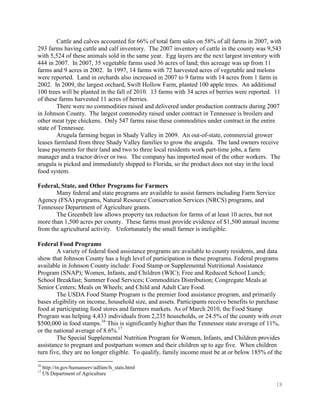
43
     http://www.fns.usda.gov/fns/about.htm


                                                                                                   96
through a government action (such as legislation or an Executive Order) or can be a grassroots
effort. While this category is not limited to policy initiatives, many FPCs’ primary goal is to
examine the operation of the local food system and provide ideas or recommendations for how it
can be improved (Kobayashi et al 2010).

Food Security — ―Access by all people at all times to enough food for an active, healthy life.
Food security includes at a minimum: (1) the ready availability of nutritionally adequate and safe
foods, and (2) an assured ability to acquire acceptable foods in socially acceptable ways (e.g.,
without resorting to emergency food supplies, scavenging, stealing, or other coping strategies)‖
(Bickel et al 2000).

Food Sovereignty - The right of peoples to healthy and culturally appropriate food produced
through ecologically sound and sustainable methods, and their right to define their own food and
agriculture systems. It puts those who produce, distribute and consume food at the heart of food
systems and policies rather than the demands of markets and corporations.

Food System - Encompasses the complete supply chain of food, from production to
consumption.

Genetically Modified Organism (GMO) - an organism whose genetic material has been altered
using genetic engineering techniques. These techniques, generally known as recombinant DNA
technology, use DNA molecules from different sources, which are combined into one molecule
to create a new set of genes. This DNA is then transferred into an organism, giving it modified or
novel genes. Transgenic organisms, a subset of GMOs, are organisms which have inserted DNA
that originated in a different species. Some GMOs contain no DNA from other species and are
therefore not transgenic but cisgenic.

Gleaning - The collection of leftover crops after fields have been harvested.

Hunger —The uneasy or painful sensation caused by a lack of food. The recurrent and
involuntary lack of access to food (Cohen 2002).

Locavore - Those who are interested in eating food that is locally produced.

Organic – That which is natural. Food produced without the use of artificial fertilizers,
pesticides, and other chemicals.

Promoting Local Food Purchases - An education, outreach, or public relations campaign that
highlights the benefits of purchasing raw and value-added local foods and food products. This
may encompass support for activities such as buy-local campaigns, community supported
agriculture, farmto-cafeteria efforts, and farmers markets (Kobayashi et al 2010).

Self-Sufficiency - A quality or condition of being independently efficient. ―A measure of self-
sufficiency in food is regarded as one of the primary elements in natural defense.‖44


44
     World Agriculture (Rural Institute for International Affairs Study Group)


                                                                                                97
Social Capital - the interpersonal networks and common civic values which influence the
infrastructure and economy of a particular society; the nature, extent, or value of these citizens
coming together to participate in public space on public issues.

Social Justice - In the context of community food security, social justice is ―the injustice of
hunger and food insecurity‖ as well as ―the adequacy of wages and working conditions for all
those who earn their livelihoods from the food system‖ (Winne).

Sustainable Agriculture - an integrated system of plant and animal production practices having
a site-specific application that will: 1) Satisfy human food needs 2) Enhance environmental
quality 3) Make most efficient use of nonrenewable resources 4) Sustain economic viability for
farm operations 5) Improve quality of life.45

“Victory Garden” - a vegetable garden maintained to provide food in wartime (spec. WWII)


45
  "Farm Bill" Food, Agriculture, Conservation, and Trade Act of 1990 (FACTA), Public Law 101-624, Title XVI,
Subtitle A, Section 1603 (Government Printing Office, Washington, DC, 1990)


                                                                                                           98

Community Food Security in Johnson County, Tennessee: A Local Food Strategy

  • 1.
    Community Food Security in Johnson County, Tennessee A Local Food Strategy for Self-Sufficiency, Economic Development, and Community Engagement August 2010 Authors: Tamara McNaughton, Principal Investigator Kelly Jo Drey-Houck Leah Joyner Suzanne McKinney Alison Singer Appalachian Sustainable Agriculture Project Johnson County Food Security Council Project funded by a Community Food Projects grant from the US Department of Agriculture National Institute for Food and Agriculture (USDA NIFA) under award number 2009-33800-20122
  • 2.
    Johnson County FarmersMarket www.johnsoncountyfarmersmarket.org johnsoncountyfm@gmail.com (423)895-9980 ii
  • 3.
    Table of Contents TABLEOF FIGURES ........................................................................................................................... ii TABLE OF APPENDICES ................................................................................................................... ii INTRODUCTION ................................................................................................................................iii ACKNOWLEDGEMENTS .......................................................................................................................iii EXECUTIVE SUMMARY ....................................................................................................................... iv BACKGROUND ................................................................................................................................... 1 COMMUNITY FOOD SECURITY DEFINITION .......................................................................................... 1 HISTORY OF THE JOHNSON COUNTY COMMUNITY FOOD ASSESSMENT PROJECT ................................. 3 ORIGINAL GOALS FOR THE FOOD ASSESSMENT AND PLANNING PROJECT ............................................ 5 SOCIOECONOMIC AND DEMOGRAPHIC CHARACTERISTICS ................................................................... 7 ASSESSING THE DYNAMICS OF FOOD IN JOHNSON COUNTY ............................................. 11 COMMUNITY FOOD RESOURCES ........................................................................................................ 11 Community-Based and Local Food Options ............................................................................... 11 ―Alternative‖ Sources of Food..................................................................................................... 13 Farms According to Agricultural Census .................................................................................... 15 Federal Food Programs ................................................................................................................ 18 Emergency Food Assistance Programs ....................................................................................... 21 Retail Stores and Other Places to Purchase Food ........................................................................ 23 Educational Programs .................................................................................................................. 24 FOOD PRODUCTION AND CONSUMPTION: THE AGRICULTURAL ECONOMY ........................................ 26 Current Production ...................................................................................................................... 26 Cash Receipts from Farming ....................................................................................................... 27 Trends in Farming and Farmland ................................................................................................ 28 Aging of the Farm Population ..................................................................................................... 28 The Tobacco Buyout and Related Shifts in Production ............................................................... 29 Consolidation in the Food System ............................................................................................... 29 Opportunities in Local Markets ................................................................................................... 29 Consumer Food Spending and Consumption Figures for Johnson County and Tri-Cities ......... 30 FOOD STORE SURVEYS ...................................................................................................................... 35 Food Availability and Affordability ............................................................................................ 35 Food Accessibility ....................................................................................................................... 38 INTERVIEWS WITH KEY STAKEHOLDERS ........................................................................................... 41 FOCUS GROUPS ................................................................................................................................. 44 Consumers ................................................................................................................................... 45 Producers ..................................................................................................................................... 62 COMMUNITY MEETINGS .................................................................................................................... 67 What do we have?........................................................................................................................ 67 What do we want? ....................................................................................................................... 69 High School Groups .................................................................................................................... 70 COMMUNITY SURVEY ....................................................................................................................... 71 CONCLUSION .................................................................................................................................... 78 FIVE PROJECTS TO PURSUE AS DESIRED BY THE COMMUNITY ........................................................... 78 RECOMMENDATIONS FROM APPALACHIAN SUSTAINABLE AGRICULTURE PROJECT (ASAP) .............. 80 WORKS CITED .................................................................................................................................. 83 i
  • 4.
    Table of Figures Figure1: Haves, Needs, and Challenges................................................................................................ 3 Figure 2: County Map ............................................................................................................................ 7 Figure 3: Age Distribution ..................................................................................................................... 8 Figure 4: Race Distribution .................................................................................................................... 8 Figure 5: Per Capita Income .................................................................................................................. 9 Figure 6: Demographic Comparisons .................................................................................................. 10 Figure 7: Land in Farms ....................................................................................................................... 15 Figure 8: Average Size of Farms ......................................................................................................... 16 Figure 9: Number of Farms.................................................................................................................. 16 Figure 10: Farms by Value of Sales ..................................................................................................... 17 Figure 11: Farms by Size in Acres ....................................................................................................... 17 Figure 12: Food Program Participation................................................................................................ 19 Figure 13: Food Pantry Distribution Map ............................................................................................ 22 Figure 14: Breakdown of Farms by Product ........................................................................................ 26 Figure 15: Value of Agricultural Products Sold .................................................................................. 27 Figure 16: Cash Receipts from Farming by Category ......................................................................... 28 Figure 17: Comparison of Consumption and Production .................................................................... 31 Figure 18: Meat Consumption in Johnson County .............................................................................. 32 Figure 19: Dairy Consumption in Johnson County ............................................................................. 32 Figure 20: Consumption of Fruits and Vegetables .............................................................................. 33 Figure 21: Market Share of Retail for Fruits and Vegetables .............................................................. 34 Figure 22: Percentage of Ideal Food Availability ................................................................................ 35 Figure 23: Percentage of Actual Food Availability ............................................................................. 36 Figure 24: Percentage Missing Food Items by Category ..................................................................... 36 Figure 25: Store Thrifty Food Plan vs. Federal Thrifty Food Plan Guideline ..................................... 37 Figure 26: Store Thrifty Food Plan without Missing Items vs. Guidelines ......................................... 37 Figure 27: Demographics of Focus Group Participants (Consumers) ................................................ 45 Figure 28: Food Pantries Listed at Community Meeting ..................................................................... 68 Figure 29: Top Ten Items that Appear on Community Meeting Drawings ......................................... 68 Figure 30: Food Security in Johnson County....................................................................................... 72 Figure 31: Percent Eaten from Gardens and Hunting .......................................................................... 73 Figure 32: Servings of Vegetables Eaten Per Day ............................................................................... 74 Table of Appendices Appendix A: Federal Food Programs and Contact Information .......................................................... 84 Appendix B: List of Retail Food Stores ............................................................................................... 85 Appendix C: Food Assistance Provider Survey ................................................................................... 86 Appendix D: Focus Group Questions Outline ..................................................................................... 89 Appendix E: Community Survey ......................................................................................................... 92 Appendix F: Definitions ...................................................................................................................... 96 ii
  • 5.
    Introduction Acknowledgements We are grateful to many people who participated in the Johnson County Community Food Assessment and Planning Project (JCCFAPP). This process was made possible through a grant from the Community Food Projects grant program from the US Department of Agriculture National Institute of Food and Agriculture (USDA NIFA). The Johnson County Food Security Council met monthly over the course of the project: Tracy Buckles, Diane Darocha, Casey Dorenbush, Gloria Griffith, Tamara McNaughton, Elaine Moore, Angie Stout, RoseEdda Slemp, Rick Thomason, Sally Tugman, Joy Wachs, Bill Ward, Mike Wiles, with Appalachian State University students, East Tennessee State University students, and Johnson County High School students. Flo Bellamy and her staff at the Johnson County-Mountain City Community Center hosted these meetings. We are thankful for the students who have worked with us on the project. Johnson County High School FFA and 4-H Honor Club students gathered surveys under the guidance of Harvey Burniston, Jr., LaVonna Roush, and Timbra Huffman. East Tennessee State University Nursing School students, Rebecca Mullins, Robi Persinger-Titus, Nicole Presnell, and Amanda Rowlette conducted sixteen interviews with key stake holders. Appalachian State University students, Michael Blow, Leah Joyner, Suzanne McKinney, and Alison Singer, along with Kelly Jo Drey- Houck of Mountain Laurel Consulting, gathered, compiled, and analyzed data and wrote this document under the guidance of Tamara McNaughton, Johnson County Farmers Market Manager and JCCFAPP Principle Investigator. Community members working with key organizations in Johnson County gathered surveys and engaged community members: Bill Benedict, Joyce Kidd, Amanda Mullins, Ann Mullins, Leni Smith, Angie Stout, Ella Stout, Jewel Stout, Sue Teixeira, and Nancy Wills. Many thanks to Kelly Jo Drey-Houck and Joy Wachs for conducting the focus groups. Much gratitude to Diane and Bekah Darocha who prepared fantastic meals for the focus groups and community meetings. Joyce Kidd and her staff at the Senior Center hosted one of the community meetings and prepared the meal. Torainna Aschenback, Appalachia Cares AmeriCorps Member, was elemental in preparing for one of the community meetings held at the Crewette building. Photos of Johnson County farms are included courtesy of Leah Joyner. This plan was possible only because a large number of un-named community members provided valuable input included throughout this document. Many thanks to all the individuals who answered surveys and other questions, participated in focus groups, attended community meetings, and connected or were inspired by the project in other ways. iii
  • 6.
    Executive Summary The Johnson County Community Food Assessment and Planning Project (JCCFAPP) has engaged community members in a conversation about food security and self-reliance in Johnson County over the past year. These discussions occurred in Food Security Council meetings held monthly, sixteen interviews with key stakeholders, five focus groups, three community meetings and meals, and two high school classes. Written surveys were collected from eight emergency and federal food assistance providers, nearly 700 Johnson County residents, and eight food stores were inventoried. Residents also chatted about food production, distribution, and consumption at the Johnson County Farmers Market and other venues. Certainly these dialogues continued in many homes. The 2002 Community Food Assessment Toolkit, written by Barbara Cohen for the US Department of Agriculture, guided this project. This toolkit focuses mostly on federal, emergency, and retail food sources. Additions were made to the JCCFAPP to include more information about the local food system. The Food Security Council determined the overall direction of the project based on the original goals of this assessment. These goals were: formalize a community Food Security Council, engage community members in an open-ended community food assessment, discover new linkages in the local food system, and prepare and present a comprehensive plan for food security in Johnson County while also helping develop local jobs and businesses with partners. Johnson County residents are extremely innovative in securing, distributing, and eating food that is locally and regionally produced. Community assets that were consistently mentioned during the assessment process included: home gardens, farms, churches, food pantries, the vocational agriculture program at the high school, the community center, the senior center, federal food programs, grocery stores, restaurants, Trade Mill, the farmers market, roadside and household produce stands, sharing and/or selling produce from home gardens, natural and wild foods, and traveling to wholesale farmers markets. Over 50% of those surveyed said they grow a garden and participants at all of the community meetings and focus groups mentioned gardens as important assets in the community. The county issued a strong call for community gardens. Educational workshops and coordinated information sharing were important to many. Engaging youth, creating jobs, offering fresh food at a reasonable cost, and nutrition were mentioned time and again throughout the process. Community gardens can provide a focus for workshops and information sharing. Youth and adults of all ages can participate according to their ability. Fresh, inexpensive, nutritious food can be grown in these gardens while creating potential income for participants. Community gardens can produce affordable, available, and accessible food. A tillable piece of property, a tiller, seeds, plants, water, tools, and people to lead and work in the garden are the basic necessities to produce an abundance of fresh food. Community gardens are a logical solution because they foster the principles of: plenty of food for everyone, a sense of community, and self-sufficiency. These gardens would naturally be places for people to share both workload and ideas and receive fresh food for their efforts. They can share equipment, tools, and supplies and teach and learn from each others’ knowledge and gardening skills. Working together also provides social opportunities, allows people to get to know their neighbors, and builds community. The excess from the gardens could be sold at the local and other regional farmers markets to generate revenue. Tax incentives could be provided to land owners to encourage planting food gardens. These community gardens could inspire and support iv
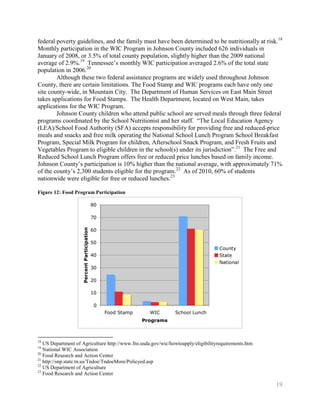
  • 7.
    various home gardengrowers throughout the county. The community garden idea brought forward by participants is an obvious next step in developing farming and gardening skills, community self-sufficiency, and our local food system. Federal, community, and emergency food programs serve a large number of people in the county. More than 24% of the county was supported by food stamps in March 2010. The community center and senior center serve over 2000 meals combined to youth and seniors in a month, eighty five percent of school children receive free and reduced lunch, and food pantries provide hundreds of food bags to local residents each month. Yet people do not have enough to eat as expressed in the surveys and focus groups. People want to grow their own fresh food in the summer and preserve it for the winter. The food store survey pointed out that the cost of a ―Thrifty Food Plan Basket,‖ a plan for a nutritious diet devised by the USDA for those collecting Federal food assistance programs, at supermarkets in Mountain City is slightly less expensive and have more items than the national average of supermarkets. In the outer parts of the county, the cost and selection of items on a ―Thrifty Food Plan Basket‖ are more expensive and less available than the national average. The upper limit to the amount of local produce retail food stores and individuals can buy from regional growers is based on climate and soil related limitations. But, is there an upper limit to the amount of food that could be produced for regional consumers? Johnson County farmers could not supply 100% of produce to local retailers because they cannot grow oranges, lemons, or bananas, for example, no matter how much local food infrastructure is improved. They can, however, grow 38 different types of fruits and vegetables. In Figure 21, those 38 items are listed along with their corresponding share or percentage of total retail produce sales. Based on the table, an adjustment for seasonality would indicate that Johnson County farmers could grow 80 percent of retail produce items for a third of the year, or 26 percent of the market total (80% X 33% = 26%). Johnson County has a solid base of farms, gardens, grocery stores, and food pantries as well as the vocational agriculture department and the farmers market that are the foundation of the local food system. Some of these elements work together and some work independently. For instance, one grocery store in Mountain City will purchase locally grown food crops. Some work exclusively within the boundaries of Johnson County and others depend on outside food sources. This assessment is a comprehensive overview of these assets. Through this process we have seen the incredibly dynamic nature of the food system and how the system can change from one year to the next. Some of the places discussed in this document are no longer in existence. Other existing and emerging elements of the food system may have been overlooked; however, if we missed any part of the Johnson County food system, it was not intentional or due to lack of community participation. This document is the completion of the food assessment and planning process, but is only the beginning of a long term, comprehensive community and economic process focusing on innovative food and farming strategies. v
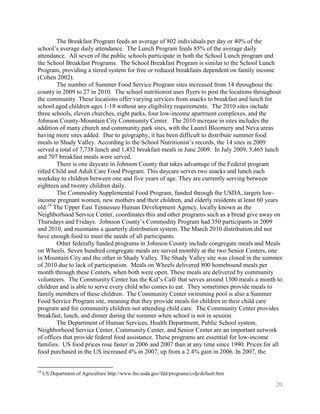
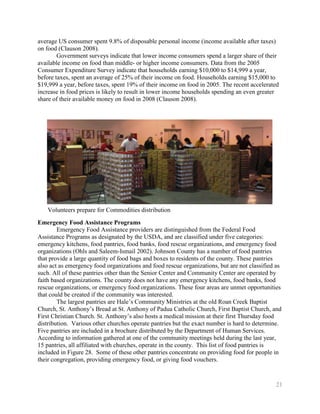
  • 8.
    Background Community Food SecurityDefinition There is no universally accepted definition of ―community food security,‖ a relatively new concept that involves nutrition, education, public health, anti-hunger, sustainable agriculture, community development, and other perspectives. USDA defines food security as ―Access by all people at all times to enough food for an active, healthy life. Food security includes at a minimum: (1) the ready availability of nutritionally adequate and safe foods, and (2) an assured ability to acquire acceptable foods in socially acceptable ways (e.g., without resorting to emergency food supplies, scavenging, stealing, or other coping strategies)‖ (Bickel et al. 2000). ―Community food security can be described as a prevention concept that supports the development and enhancement of sustainable, community-based strategies to improve access of low-income households to healthful nutritious food supplies, to increase the self-reliance of communities in providing for their own food needs, and to promote comprehensive responses to local food, farm, and nutrition issues. Community food security focuses on the underlying economic, institutional, and social factors related to the quality, quantity, availability, and affordability of food.‖1 Policies and programs implemented under the label of community food security address a diverse range of issues, including: Food availability and affordability Direct food marketing Diet-related health problems Participation in and access to federal nutrition assistance programs Ecologically sustainable agricultural production Farmland preservation Economic viability of rural communities Economic opportunity and job security Community development and social cohesion According to the USDA Toolkit (Cohen 2002), Communities are considered to be food insecure if: There is a lack of adequate resources for people to purchase food Food purchasing resources are not accessible to all community members Food available through these resources is not sufficient in quantity or variety Food available is not affordable There are inadequate food assistance resources for low-income people to purchase food There are no local food production resources Locally produced food is not available to community members There is no support for local food production resources There is a substantial level of household food insecurity in the community. 1 http://www.kerrcenter.com/community_food/definitions.htm 1
  • 9.
    It is helpfulto consider food security on a continuum. Communities can have three stages occurring simultaneously (Ross and Simces 2008): Stage 1 – Short-term relief (efficiency) Short-term relief includes emergency/charitable food programs such as food banks and soup kitchens that primarily address immediate hunger. Stage 2 – Capacity-building (transitional) Capacity-building food programs, such as community kitchens, community gardens, and farmers markets that have the potential to empower participants through education and training, and raise awareness of food issues. Stage 3 – Redesign (systemic) Redesign of the food system, through food policy councils, implementation of food policies, social enterprises and social advocacy to address poverty, deals with the shortcomings of both the charitable and community food programs and is aimed at improving the economic, ecological and social sustainability of the food system. 2
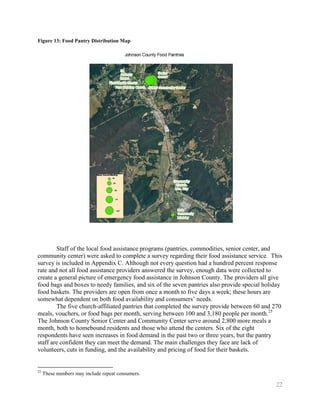
  • 10.
    History of theJohnson County Community Food Assessment Project In May 2008 the Johnson County Community Foundation, a partner of the East Tennessee Foundation, awarded a grant to host a ―Local Food Lunch‖ in October of the same year. This lunch was held at the Johnson County-Mountain City Community Center and was attended by 30 community members, mostly producers who were interested in expanding their markets. Attendees participated in an activity where they listed what we have in Johnson County related to food, what we need, and challenges we experience. Figure 1 is a chart of these findings: Figure 1: Haves, Needs, and Challenges Haves: Needs: Challenges: Lots of fertile land Communication/coordination Lack of motivation Water Farmers Market Lack of cooperation Experience Customers organization & Culture/community Marketing communication Desire to stay on land/lifestyle Education Involvement Poor economy (hungry Neighbors with land Education of people) Retired land owners growers & Edible native plants wanting young farmers consumers Environment friendly to Promote ―Victory Gardens‖ Difficult economy diverse livestock Raise awareness of local Flood plain/rain Farms and farmers farmers (tours, education) Costs of distribution Good growing conditions Viable industry Products: corn, apples, etc. Diversity of crops High School Vocational Agriculture Commercial kitchen Home gardens Interest in organic/ sustainable agriculture Extension services Representatives from Appalachian Sustainable Agriculture Project (ASAP) gave a presentation about the potential of local markets and how their organization builds local food systems and supports small farmers with local markets. Attendees enjoyed a meal of Johnson County grown food prepared by the Johnson County Senior Center. Two more meetings were hosted during the following months so attendees could talk informally about community food security and possible steps to increase our food self sufficiency. Nine individuals convened in December 2008 and volunteered to share the task of gathering basic raw data on community food security indicators. The indicator charts in the USDA Community Food Security Assessment Toolkit by Barbara Cohen were used as a guide. The group reconvened in January 2009 to bring the data together which was compiled in a rudimentary fashion. At this January meeting, the group decided that our community could benefit from a more in-depth look into the information gathered, including more qualitative information from community members. The decision was made to apply for a Community Food Project Planning Grant; the application was submitted in May 2009. In February 2009 a local businessman offered the quonset building at Shouns Crossroads to establish a farmers market in the county. A public meeting was held in March to determine if 3
  • 11.
    there was interestin a Johnson County farmers market. Thirty people attended this meeting where a five member board of directors was established. The board proceeded to work diligently, establishing bylaws, rules for vendors, and operations for the Johnson County Farmers Market (JCFM). They also recruited vendors and publicized the market to customers. Opening day was May 30th 2009. The JCFM has been a success with tremendous community support. Award notification from the United States Department of Agriculture’s National Institute for Food and Agriculture (USDA NIFA) was received in September 2009 for funding of the Johnson County Community Food Assessment and Planning Project (JCCFAPP). The Johnson County Farmers Market took on the implementation task and Appalachian Native Plants serves as the fiscal agent. The Food Security Council was established October 2009 to guide and implement the JCCFAPP. This Council consists mostly of women who work in areas of health and nutrition education in the county. Monthly Food Security Council meetings were held over the course of the project to provide insight, guidance, and support in the effort. The Council has been joined by a wide variety of community members and college students in gathering the information presented in this document. This document is the completion of the food assessment and planning process, but is only the beginning of long term, comprehensive community and economic development focusing on innovative food and farming strategies. 4
  • 12.
    Original Goals forthe Food Assessment and Planning Project The USDA uses the following criteria to determine Community Food Project Awards: Meeting the food needs of low-income people Increasing community self-reliance Promoting comprehensive responses to food, farm and nutrition issues Developing innovative links Supporting entrepreneurial development Encouraging long-term planning Encouraging multi-system, interagency approach Achieving project self-sufficiency As such, the original project goals and their outcomes are as follows: 1. Establish a Community Food Security Council that will implement the community food security plan and increase the long term sustainability of our community food system. The Food Security Council was established within the first month of the project. This council consists of seven members and includes low-income residents and professionals from organizations that work directly with low-income food service recipients. The council met once per month to drive the assessment and planning process forward. Throughout the project, members developed assessment tools and recruited volunteers. 2. Engage community members in an open-ended community food assessment through primary sources, community meetings, focus groups, and surveys. This assessment may include a profile of community socioeconomic and demographic characteristics, a profile of community food resources, assessment of household food security, assessment of food resource accessibility, assessment of food availability and affordability, and assessment of community food production, including home grown food. Key aspects of the assessment will be determined by the Food Security Council and community participants. After the assessment, the community has become better informed about food security issues and ways to decrease food security concerns. At least 1000 surveys were planned to be collected directly from a broad base of the community including youth, seniors, various food service clients and recipients, farmers, grocers, and other citizens. The specific format and questions of these surveys was determined by the Food Security Council. Ultimately, 659 surveys were collected. Five focus groups, with 48 total participants, were hosted in the first eight months of the project with seven to fourteen people attending each of these focus groups. Four open community meetings were also hosted to share and gather information. 3. Discover linkages between farmers/producers, processing facilities, distribution channels, and consumers to make affordable quality foods more readily available to residents of Johnson County with particular attention to low-income residents. By engaging community members in the assessment and planning process, people began to discover gaps in our food system that can be filled and other opportunities to link various sectors of the food system. 5
  • 13.
    4. Write andpresent a comprehensive, long-term community food security plan to Johnson County and Mountain City officials with the intention that it will be adopted by the Town Council and the County Commission. By September 2010 the Community Food Security Plan for Johnson County will be completed and presented at both the Mountain City Town Council and the Johnson County Commission. Both of these groups of elected officials will be asked to adopt the plan as part of their community economic development strategies. Presenting at these meetings will ensure that the document is recorded in their meeting minutes. The plan will also be summarized and submitted to the local newspapers for publication. 5. Assist with business planning and development of agriculturally based enterprises that are discovered and/or inspired by participants in the assessment and planning process. In January 2010 the Johnson County Economic Development Partnership (JCEDP) employee took a new job in another county. This JCEDP employee had committed to assist with business planning and development during the course of the project. Johnson County was without a JCEDP employee until July 2010. In the meantime, the Johnson County Farmers Market assisted four new vendors in developing their agricultural enterprises. Sweet Springs Farm Vending at the Johnson County Farmers Market 6
  • 14.
    Socioeconomic and DemographicCharacteristics Johnson County is a rural, tight-knit community with strong kinship networks and a wealth of social capital. The community prides itself on self-sufficiency, which is an important concept in food security. Johnson County is the northeastern-most county in Tennessee, adjacent to North Carolina on the east and Virginia on the north. It is part of the Tri-Cities region, which has a population of 589,200 and includes the metropolitan statistical areas of Johnson City and Kingsport-Bristol- Bristol. Johnson County itself, while part of the larger Tri-Cities region, is rural, and has a population of 18,112. Mountain City, the county seat, has a population of 2,407. Johnson County encompasses 303 square miles. Two hundred ninety-eight square miles (or 190,720 acres) are land and 4 square miles (or 2560 acres) are land under water. Population distribution is 59 persons per square mile.2 Johnson County enjoys over 50,000 acres of National Forest.3 Figure 2: County Map 2 US Census Bureau - http://quickfacts.census.gov/qfd/states/47/47091.html 3 www.johnsoncountyonline.com 7
  • 15.
    The largest agegroup living in Johnson County is 25 to 44 years old. This age group increased by 1,722 individuals between 1990 and 2000. The second largest increase was in residents ages 45-54 with an 848-person increase during the same time period. The only population to decrease was individuals ages 5-20 with a 35- individual decrease. Figure 3: Age Distribution 7000 6000 5000 4000 1990 age 2000 age 3000 2000 1000 0 Under 5 5 to 20 years 20 to 44 45 to 54 55 to 59 60 to 64 65 to 74 75 to 84 85 years and years years years years years years years over Source: 2000 Census The majority of the population is white, 96.8% in 2000. In 1991, the Northeast Correctional Complex, an all male prison with a maximum security designation, opened. Population numbers include these inmates. The data therefore includes non permanent residents of the county, and thus may appear skewed. Figure 4: Race Distribution 20000 18000 16000 14000 12000 10000 8000 6000 4000 2000 0 American Indian Native Hawaiian Hispanic or Black or African Total population White and Alaska Asian and Other Some other race Latino (of any American Native Pacific Islander race) 1990 13766 13668 61 14 14 9 32 2000 17499 16946 428 113 33 10 52 150 Source: 2000 Census 8
  • 16.
    The main industriesin the Tri-Cities region include manufacturing; trade, transportation, and utilities; healthcare; and higher education.4 In Johnson County itself, the main industries, other than agriculture, are manufacturing, retail trade, healthcare and social assistance, and accommodation and food service.5 More than 25% of Johnson County residents live below the poverty line.6 In 2000, 912 children under the age of 18 lived in poverty. The county as a whole has a low per capita income. In 2007 the per capita income of Johnson County was $20,785, compared to a Tri-Cities region per capita income of $27,588.7 The state of Tennessee had a 2008 per capita income of $23,418, compared with a national per capita income of $21,587.8 The median household income in Johnson County is only $23,067; the national median income is $41,994. Figure 5: Per Capita Income Census data highlight some other important characteristics. 58.4% of Johnson County residents age 25 or older have earned a high school diploma or GED, compared with 75.9% in TN and 80.4% of all Americans); only 6.9% of adults have a college degree, compared to 19.6% in TN and 24.4% in the nation).9 In addition, 30.2% of Johnson County residents are considered disabled and receive government assistance; this rate is only 19.3% on the national level. The unemployment rate in Johnson County (10.7%) is only slightly higher than the national rate 4 The Regional Alliance for Economic Development Northeast TN Southeast VA 5 2002 Economic Census - http://www.census.gov/econ/census02/data/tn/TN091.HTM 6 Johnson County, Tennessee, State and County QuickFacts, US Census Bureau 7 The Regional Alliance for Economic Development Northeast TN Southeast VA 8 Washington Post - http://projects.washingtonpost.com/2008/elections/tn/census/ 9 Johnson County, Tennessee, State and County QuickFacts, US Census Bureau 9
  • 17.
    (9.7%).10 Johnson Countyhas long received the designation of ―distressed‖ from the Appalachian Regional Commission, a characterization based on poverty rates, three-year unemployment rates, and per capita income.11 Figure 6: Demographic Comparisons In 2000 the county had 7,879 total housing units with 6,827 of them being occupied. In 1990, there were 6,090 total housing units with 5,406 of these occupied. Of the total housing units in 2000, 1,052 were vacant with 368 of these units owned for seasonal, recreational, or occasional use. The number of these recreational, or second homes, more than doubled from the 1990 data of 684 vacant units with 171 of these as seasonal housing units. This trend indicates a substantial rise of second homes and home owners living in the county on a seasonal basis. Owner occupancy rates have remained consistently around 80% for this 10 year time frame. In 2010, 2,078 households included individuals less than 18 years of age and 1,916 households included individuals over 65 years of age.12 10 US Department of Labor, Bureau of Labor Statistics http://www.bls.gov/lau/ 11 Appalachian Regional Commission - http://www.arc.gov/funding/ARCDistressedCountiesGrants.asp 12 US Census, Johnson County, Tennessee. Profile of General Demographic Characteristics: 1990 and 2000 http://factfinder.census.gov 10
  • 18.
    Assessing the Dynamicsof Food in Johnson County Community Food Resources Community-Based and Local Food Options Looking at Community Food Security on a continuum as described in the introduction (see pg. 2), Johnson County has many short term relief (stage one) programs. The Johnson County Farmers Market (JCFM) is the only capacity building (stage two) project. There are also redesign (stage three) actions such as the Food Security Council, state-level policies for school food procurement that support local food, and the beginnings of food sector community economic development/social enterprises. The USDA Toolkit (Cohen 2002) used to conduct this food assessment includes six indicators for food production resources: community gardens, school-based gardens, community supported agriculture programs, farms, dairies and fisheries, and food manufacturers and distributors. Farms are discussed in a later section. Johnson County has no school-based gardens, community supported agriculture programs, or food distributors. The county does have three community gardens. Two of these are three years old and the other was started in 2010. The Johnson County-Mountain City Community Center has a 20 by 20 foot space that Flo Bellamy and her staff maintain. People who use the center eat snacks from this garden during the summer. Ms. Bellamy says, ―It produces a tremendous amount of food. It shows the kids how a garden works and how much food a small space can grow.‖ Another community garden is co-worked by the Watauga Group Sierra Club and the Watauga Watershed Alliance. Workers in this garden receive produce. Crops in abundance are sold at the Johnson County Farmers Market. These groups have been central to starting the Johnson County Farmers Market. In the past, these groups have also offered start-up monies to high school students interested in growing gardens and other food businesses. The third community garden for the 2010 summer is at First Assembly of God church just outside the Mountain City limits. A young, single mother is growing a garden with her two children. ―We’re eating off this garden. It’s been hard work some days, but it’s so much fun.‖ In the past there have been community gardens at Heritage Acres and Mountain City Manor (low income housing developments), but these gardens have been gone for a few years. However, the space for these gardens is still there; it is just a matter of identifying someone to till them. The Trade Mill is one local food producer that grinds Community Garden at First Assembly of God, Summer 2010 grains: wheat, 11
  • 19.
    buckwheat, corn, andothers into flour and meal. Most of the grains for the Mill are grown in the county by John Shull, who was encouraged to diversify his grain crops specifically to supply the Mill. The Mill has also been known to grind grain for individuals. James Miller, a third generation miller runs the water-powered operation and uses pre-civil war equipment that came from Old Snyder’s Mill down the road. The Trade Mill sometimes sells their products at the Johnson County Farmers Market. In early summer of 2010 they received a standing order of 5,000 bags per month to supply Food City Supermarkets, a regional chain with stores throughout southeast Virginia. Food City is known to support many local food agripreneurs in the region. One family dairy remains in the county and sells their milk to Southeast Dairy Farmers of America, an organization that only purchases milk free of hormones. The dairy also supplies milk to their family and friends. One man in Laurel Bloomery drives milk trucks. Some dairies in the county closed as recently as 1998. Two livestock auctions also operate in the county. One of these auction houses was the first in the state of Tennessee. Some cattlemen will sell beef on the hoof to interested consumers. Once the beef is purchased, the live animal is trucked to a slaughter house and belongs to the consumer. Arrangements are made on types of cuts desired and the consumer picks it up or can arrange for further delivery. Producer/consumer relationships like this tighten links in the local food economy. There is one young man in the county, Bill Ward, who operates a multi-species (cattle, chickens, pigs, and sheep) farm. He uses Management Intensive Grazing (MIG) techniques where animals are moved from paddock to paddock every couple days. This management style increases the growth of pasture and allows the operator to graze the animals into the winter without needing as much hay and other feed. Bill directly markets his meats to consumers by word of mouth, mailings, and information/order sheets. These dynamics keep his animals better connected to the pasture and him to his customers. There is talk of starting a cow share for milk products. Cow shares are the one way consumers in Tennessee can access fresh milk products. Ward Brothers Farm 12
  • 20.
    The Cow ShareBill was passed May 2009 in Tennessee. ―This law solidifies the position that it is perfectly legal for an owner or a partial owner to drink their own cow's milk. Partial is a very key word in this bill. In fact, without this word, the bill would not be the same and would not carry the weight and strength that it does. Partial owners are cow (or any hoofed mammal) share owners and the bill states their legal position loud and clear. Now farmers can enter into share/boarding contracts free from worry that a government agency will tell them they cannot.‖13 Johnson County High School has one of the nation’s leading Vocational Agriculture Programs with a large fish operation that raises and sells tilapia and koi, as well as hydroponic lettuce, tomatoes, cucumbers, and herbs. These products, along with vegetable and flower transplants in the spring, are sold to the school food service program, local restaurants, and are available for local consumers to purchase at the school during the school year. The greenhouses are closed in the summer; however pre-orders for fish and produce can be placed before the end of the school year. They maintain a waiting list for their fish. The produce is sold on a first come, first serve basis. Various other greenhouses and feed/seed stores are located in the county providing vegetable and flower transplants, fertilizers, sprays, and other materials for vegetable gardens and gardeners. Two of these stores are in Mountain City, one in Laurel Bloomery, one in Doe Valley, and two in Shady Valley. Home gardeners also start vegetable transplants to share with their friends and family, but they are not official businesses. Twelve miles from Mountain City, across the North Carolina border, a meat processor cuts meat but is not USDA certified. This processor serves many people in Johnson County, processing various meat animals. He also participates in the Hunters for the Hungry Program. Another man in the Butler area processes meat for people and conducts hunter safety courses. For the retail sale of meat, butchering must be done in a USDA certified packing house. The closest USDA processors are at least a one hour trip away. “Alternative” Sources of Food Johnson County residents are creative in identifying, distributing, and eating food that is locally and regionally produced. In addition to the six indicators for food production resources described in the previous section, resources have been consistently identified during the assessment process: home gardens (including sharing and/or selling produce from home gardens), natural and wild foods, roadside and household produce stands, traveling to wholesale farmers markets, and ―dumpster diving‖ to rescue thrown away food. Large and small gardens can be seen in fields and yards throughout the county. Corn, beans, tomatoes, and potatoes are some of the most common crops grown. Some porches have hanging containers for growing tomatoes. Many people give extra produce to their family and neighbors. This dynamic of sharing not only keeps people fed, but also supports kinship and social networks. Even small amounts of fresh produce are better when you grow them yourself or receive them from people you know. Natural and wild foods have also been reported in community meetings. A list of wild foods includes: fish, deer, rabbit, squirrel, turkey, insects, frogs, crayfish, turtles and snakes. Mushrooms, herbs, fruits, berries, and other wild foods were also listed. Johnson County is blessed with over 50,000 acres of National Forest, Watauga Lake, trout streams, small creeks, and other forested areas. These areas generate an abundance of natural and wild foods. 13 http://www.tennesseansforrawmilk.com/updates.html 13
  • 21.
    Produce stands arescattered throughout the county. Some of these produce stands are connected to farms, home gardens with excess harvest, flea markets and country stores. Many of these stands stay in business for years and others have lasted less than a year. This is a difficult business because the product must be sold or it will perish. Produce stands have been in Mountain City, Forge Creek, Laurel Bloomery, Doe Valley, and Butler. Some people pull their trucks off the side of the road in Mountain City, Butler, and Trade and sell their produce. Some of these are truck stands operated by individuals who grew the product and others have bought the product for resale. These trucks have been seen selling apples, corn, cantaloupes, cabbage and even oranges and grapefruits in the winter. A handful of sizable farms and home gardens sell bushels and half bushels of produce. Lynn Snyder’s U-pick farm is well known throughout the county as somewhere you can pick bushels of tomatoes and beans, for instance, to can for the winter months.14 Forge Creek Farm is another farm that will take phone orders for bushels of beans, potatoes, and other products for on-farm sales. It was said that Trivette’s in Dry Hill has been taking similar orders during the 2010 summer. In Shady Valley at least four farmers sell potatoes by the bushel, and at least three farmers sell apples by the bushel. One family sells flats of strawberries, and there is one U- pick blueberry farm. Forge Creek Farm Another innovative action people take to get local and regional food on Johnson County dinner tables is to drive to large wholesale farmers markets in Chucky (Nolichucky), Tennessee and Asheville, North Carolina. Bags of corn, bushels of beans, tomatoes, and potatoes are brought into Johnson County from these outlets and residents can preserve them for winter meals. 14 Unfortunately, Mr. Snyder’s business partner, Marie, came down with an illness in the winter of 2009 and was unable to work with him to keep their stand open for the 2010 season. 14
  • 22.
    Farms According toAgricultural Census The census definition of a farm is any place from which $1,000 or more of agricultural products were produced and sold, or normally would have been sold, during the census year. According to the 2007 Agricultural Census, Johnson County has 513 farms and approximately 43,500 acres of farmland. These numbers have been decreasing over time with 666 farms in 2002 and 752 farms in 1997. However, even though the average size farm has increased over the past decade, most farms are 10 acres to 49 acres totaling 6,253 acres in 2007 or 14% of total acres in farmland. Farms with less than $2,500 in sales have also been consistently the most common type of farm in the county.15 These data show that small farms, both in size and income, are an important part of the farming community in Johnson County. Average per farm total sales was $10,997 in 2007 and $10,504 in 2002. Nearly 61%, 312 total, of all farms reported net losses in 2007. No income from agri-tourism was reported in the county in 2007 or 2002. Agri-tourism is a viable opportunity for farmers who want to earn supplemental income above crop and animal production. Figure 7: Land in Farms 60000 50000 40000 acres 30000 20000 10000 0 1992 1997 2002 2007 15 Census of Agriculture, 2007, 2002, 1997, and 1992 15
  • 23.
    Figure 8: AverageSize of Farms 90 80 70 60 50 acres 40 30 20 10 0 1992 1997 2002 2007 Figure 9: Number of Farms 900 800 700 600 500 400 300 200 100 0 1992 1997 2002 2007 16
  • 24.
    Figure 10: Farmsby Value of Sales 350 300 250 less than $2500 number of farms 200 $2,500-4,999 $5,000-9,999 $10,000-24,999 $25,000-49,999 150 $50,000-99,999 $100,000 or more 100 50 0 1992 1997 2002 2007 Figure 11: Farms by Size in Acres 400 350 300 250 1-9 acres number of farms 10-49 acres 50-179 acres 200 180-499 acres 500-999 acres 1000 or more 150 100 50 0 1992 1997 2002 2007 year 17
  • 25.
    Cattle and calvesaccounted for 66% of total farm sales on 58% of all farms in 2007, with 293 farms having cattle and calf inventory. The 2007 inventory of cattle in the county was 9,543 with 5,524 of these animals sold in the same year. Egg layers are the next largest inventory with 444 in 2007. In 2007, 35 vegetable farms used 36 acres of land; this acreage was up from 11 farms and 9 acres in 2002. In 1997, 14 farms with 72 harvested acres of vegetable and melons were reported. Land in orchards also increased in 2007 to 9 farms with 14 acres from 1 farm in 2002. In 2009, the largest orchard, Swift Hollow Farm, planted 100 apple trees. An additional 100 trees will be planted in the fall of 2010. 13 farms with 34 acres of berries were reported. 11 of these farms harvested 11 acres of berries. There were no commodities raised and delivered under production contracts during 2007 in Johnson County. The largest commodity raised under contract in Tennessee is broilers and other meat type chickens. Only 547 farms raise these commodities under contract in the entire state of Tennessee. Arugula farming began in Shady Valley in 2009. An out-of-state, commercial grower leases farmland from three Shady Valley families to grow the arugula. The land owners receive lease payments for their land and two to three local residents work part-time jobs, a farm manager and a tractor driver or two. The company has imported most of the other workers. The arugula is picked and immediately shipped to Florida, so the product does not stay in the local food system. Federal, State, and Other Programs for Farmers Many federal and state programs are available to assist farmers including Farm Service Agency (FSA) programs, Natural Resource Conservation Services (NRCS) programs, and Tennessee Department of Agriculture grants. The Greenbelt law allows property tax reduction for farms of at least 10 acres, but not more than 1,500 acres per county. These farms must provide evidence of $1,500 annual income from the agricultural activity. Unfortunately the small farmer is ineligible. Federal Food Programs A variety of federal food assistance programs are available to county residents, and data show that Johnson County has a high level of participation in these programs. Federal programs available in Johnson County include: Food Stamp or Supplemental Nutritional Assistance Program (SNAP); Women, Infants, and Children (WIC); Free and Reduced School Lunch; School Breakfast; Summer Food Services; Commodities Distribution; Congregate Meals at Senior Centers; Meals on Wheels; and Child and Adult Care Food. The USDA Food Stamp Program is the premier food assistance program, and primarily bases eligibility on income, household size, and assets. Participants receive benefits to purchase food at participating food stores and farmers markets. As of March 2010, the Food Stamp Program was helping 4,433 individuals from 2,235 households, or 24.5% of the county with over $500,000 in food stamps.16 This is significantly higher than the Tennessee state average of 11%, or the national average of 8.6%.17 The Special Supplemental Nutrition Program for Women, Infants, and Children provides assistance to pregnant and postpartum women and their children up to age five. When children turn five, they are no longer eligible. To qualify, family income must be at or below 185% of the 16 http://tn.gov/humanserv/adfam/fs_stats.html 17 US Department of Agriculture 18
  • 26.
    federal poverty guidelines,and the family must have been determined to be nutritionally at risk.18 Monthly participation in the WIC Program in Johnson County included 626 individuals in January of 2008, or 3.5% of total county population, slightly higher than the 2009 national average of 2.9%.19 Tennessee’s monthly WIC participation averaged 2.6% of the total state population in 2006.20 Although these two federal assistance programs are widely used throughout Johnson County, there are certain limitations. The Food Stamp and WIC programs each have only one site county-wide, in Mountain City. The Department of Human Services on East Main Street takes applications for Food Stamps. The Health Department, located on West Main, takes applications for the WIC Program. Johnson County children who attend public school are served meals through three federal programs coordinated by the School Nutritionist and her staff. ―The Local Education Agency (LEA)/School Food Authority (SFA) accepts responsibility for providing free and reduced-price meals and snacks and free milk operating the National School Lunch Program School Breakfast Program, Special Milk Program for children, Afterschool Snack Program, and Fresh Fruits and Vegetables Program to eligible children in the school(s) under its jurisdiction‖.21 The Free and Reduced School Lunch Program offers free or reduced price lunches based on family income. Johnson County’s participation is 10% higher than the national average, with approximately 71% of the county’s 2,300 students eligible for the program.22 As of 2010, 60% of students nationwide were eligible for free or reduced lunches.23 Figure 12: Food Program Participation 18 US Department of Agriculture http://www.fns.usda.gov/wic/howtoapply/eligibilityrequirements.htm 19 National WIC Association 20 Food Research and Action Center 21 http://snp.state.tn.us/Tndoe/TndoeMore/Policyed.asp 22 US Department of Agriculture 23 Food Research and Action Center 19
  • 27.
    The Breakfast Programfeeds an average of 802 individuals per day or 40% of the school’s average daily attendance. The Lunch Program feeds 85% of the average daily attendance. All seven of the public schools participate in both the School Lunch program and the School Breakfast Programs. The School Breakfast Program is similar to the School Lunch Program, providing a tiered system for free or reduced breakfasts dependent on family income (Cohen 2002). The number of Summer Food Service Program sites increased from 14 throughout the county in 2009 to 27 in 2010. The school nutritionist uses flyers to post the locations throughout the community. These locations offer varying services from snacks to breakfast and lunch for school aged children ages 1-18 without any eligibility requirements. The 2010 sites include three schools, eleven churches, eight parks, four low-income apartment complexes, and the Johnson County-Mountain City Community Center. The 2010 increase in sites includes the addition of many church and community park sites, with the Laurel Bloomery and Neva areas having more sites added. Due to geography, it has been difficult to distribute summer food meals to Shady Valley. According to the School Nutritionist’s records, the 14 sites in 2009 served a total of 7,738 lunch and 1,432 breakfast meals in June 2009. In July 2009, 5,465 lunch and 707 breakfast meals were served. There is one daycare in Johnson County that takes advantage of the Federal program titled Child and Adult Care Food Program. This daycare serves two snacks and lunch each weekday to children between one and five years of age. They are currently serving between eighteen and twenty children daily. The Commodity Supplemental Food Program, funded through the USDA, targets low- income pregnant women, new mothers and their children, and elderly residents at least 60 years old.24 The Upper East Tennessee Human Development Agency, locally known as the Neighborhood Service Center, coordinates this and other programs such as a bread give away on Thursdays and Fridays. Johnson County’s Commodity Program had 350 participants in 2009 and 2010, and maintains a quarterly distribution system. The March 2010 distribution did not have enough food to meet the needs of all participants. Other federally funded programs in Johnson County include congregate meals and Meals on Wheels. Seven hundred congregate meals are served monthly at the two Senior Centers, one in Mountain City and the other in Shady Valley. The Shady Valley site was closed in the summer of 2010 due to lack of participation. Meals on Wheels delivered 800 homebound meals per month through these Centers, when both were open. These meals are delivered by community volunteers. The Community Center has the Kid’s Café that serves around 1300 meals a month to children and is able to serve every child who comes to eat. They sometimes provide meals to family members of these children. The Community Center swimming pool is also a Summer Food Service Program site, meaning that they provide meals for children in their child care program and for community children not attending child care. The Community Center provides breakfast, lunch, and dinner during the summer when school is not in session. The Department of Human Services, Health Department, Public School system, Neighborhood Service Center, Community Center, and Senior Center are an important network of offices that provide federal food assistance. These programs are essential for low-income families. US food prices rose faster in 2006 and 2007 than at any time since 1990. Prices for all food purchased in the US increased 4% in 2007, up from a 2.4% gain in 2006. In 2007, the 24 US Department of Agriculture http://www.fns.usda.gov/fdd/programs/csfp/default.htm 20
  • 28.
    average US consumerspent 9.8% of disposable personal income (income available after taxes) on food (Clauson 2008). Government surveys indicate that lower income consumers spend a larger share of their available income on food than middle- or higher income consumers. Data from the 2005 Consumer Expenditure Survey indicate that households earning $10,000 to $14,999 a year, before taxes, spent an average of 25% of their income on food. Households earning $15,000 to $19,999 a year, before taxes, spent 19% of their income on food in 2005. The recent accelerated increase in food prices is likely to result in lower income households spending an even greater share of their available money on food in 2008 (Clauson 2008). Volunteers prepare for Commodities distribution Emergency Food Assistance Programs Emergency Food Assistance providers are distinguished from the Federal Food Assistance Programs as designated by the USDA, and are classified under five categories: emergency kitchens, food pantries, food banks, food rescue organizations, and emergency food organizations (Ohls and Saleem-Ismail 2002). Johnson County has a number of food pantries that provide a large quantity of food bags and boxes to residents of the county. These pantries also act as emergency food organizations and food rescue organizations, but are not classified as such. All of these pantries other than the Senior Center and Community Center are operated by faith based organizations. The county does not have any emergency kitchens, food banks, food rescue organizations, or emergency food organizations. These four areas are unmet opportunities that could be created if the community was interested. The largest pantries are Hale’s Community Ministries at the old Roan Creek Baptist Church, St. Anthony’s Bread at St. Anthony of Padua Catholic Church, First Baptist Church, and First Christian Church. St. Anthony’s also hosts a medical mission at their first Thursday food distribution. Various other churches operate pantries but the exact number is hard to determine. Five pantries are included in a brochure distributed by the Department of Human Services. According to information gathered at one of the community meetings held during the last year, 15 pantries, all affiliated with churches, operate in the county. This list of food pantries is included in Figure 28. Some of these other pantries concentrate on providing food for people in their congregation, providing emergency food, or giving food vouchers. 21
  • 29.
    Figure 13: FoodPantry Distribution Map Staff of the local food assistance programs (pantries, commodities, senior center, and community center) were asked to complete a survey regarding their food assistance service. This survey is included in Appendix C. Although not every question had a hundred percent response rate and not all food assistance providers answered the survey, enough data were collected to create a general picture of emergency food assistance in Johnson County. The providers all give food bags and boxes to needy families, and six of the seven pantries also provide special holiday food baskets. The providers are open from once a month to five days a week; these hours are somewhat dependent on both food availability and consumers’ needs. The five church-affiliated pantries that completed the survey provide between 60 and 270 meals, vouchers, or food bags per month, serving between 100 and 3,180 people per month.25 The Johnson County Senior Center and Community Center serve around 2,800 more meals a month, both to homebound residents and those who attend the centers. Six of the eight respondents have seen increases in food demand in the past two or three years, but the pantry staff are confident they can meet the demand. The main challenges they face are lack of volunteers, cuts in funding, and the availability and pricing of food for their baskets. 25 These numbers may include repeat consumers. 22
  • 30.
    The pantries receivetheir food from a variety of sources – retail stores, church collections, community donations, farmers/producers, food banks, and restaurants. Some of the food is donated by those sources, and the pantries also purchase food from the sources. One pantry received potatoes grown on an acre by a Shady Valley church in the fall of 2009. They were hopeful they would receive a similar crop in fall 2010. At least one of the pantries has trouble finding fresh produce to provide their customers. Once the pantries have acquired the food, they generally use nutritional guidelines to create the boxes/bags of food for distribution. In addition to providing food for their customers, most of them also provide nutritional education, and sometimes hygiene information. Being church-affiliated, several of the pantries also offer religious services. While some of the providers indicate a lack of food at certain times of the year (varying from winter to summer to spring to the holiday season), they all express general satisfaction at the level of food support from their various sources. Two of the providers indicate a desire for more food to distribute, but six of the eight respondents either ―most of the time‖ or ―always‖ have enough food to meet the demand. The providers are well-supplied in terms of food amount, though not always in food variety; as long as demand does not increase and community support continues they can meet the need. There has been an ongoing conversation over the years as to how these pantries might consolidate or communicate to ensure there is no abuse of these services. Suggestions have included a single central pantry, internet programs that assist providers with inter-agency communication, and personal communications. Many of these food providers are already communicating personally to check in with each other about whether recipients are ―shopping‖ the providers. Retail Stores and Other Places to Purchase Food Twenty three retail food stores operate in Johnson County; seventeen stores participate in the Food Stamp program. In total thirteen stores are located in Mountain City, four in Butler, two in Shady Valley, two in Laurel Bloomery, one in Neva, and one in Trade. A list of these stores is included in Appendix B. An in-depth look at these stores is included in the Food Availability and Affordability section. Various produce stands have opened and closed from year to year. A handful of producers and resellers set up on the side of the road throughout the county and sell produce from the back of their trucks. These stands are important entrepreneurial activities that capture local dollars for local producers. Spending money locally keeps dollars in the community and increases local wealth through the multiplier effect. One consumer food cooperative has been organized by a few local residents. This cooperative purchases bulk whole foods such as dry beans, brown rice, quinoa, nuts, and flour every other month. Many organic choices are available through this cooperative buying club. The food is delivered the month after orders are placed. Word of mouth is used to recruit new participants to this cooperative. Johnson County initiated a farmers market, Johnson County Farmers Market (JCFM), in 2009. This market competes with the larger markets of Bristol and Johnson City by keeping local products in the community. Many people involved in past attempts to initiate farmers markets have given their full support to this market which is chartered in the state of Tennessee and has submitted its application to the IRS for designation as a 501(c)3 non-profit organization. The mission of the JCFM is to ―help strengthen a local sustainable agricultural and food 23
  • 31.
    economy. [They] dothis by providing education, engaging in community and economic development, and promoting the availability and benefits of local food and agriculture.‖26 The Johnson County Farmers Market received a grant from the USDA Farmers Market Promotion Program in September 2009 with Appalachian Native Plants, Inc. as the fiscal agent. This grant allows vendors to accept food stamps (Supplemental Nutrition Assistance Program) at this market, provided support materials and labor needed to implement this program, and promoted this service, the market, and its vendors. Nationwide, farmers markets started accepting food stamps only five years ago whereas grocery stores have been accepting these benefits for many years. JCFM subsequently received the opportunity to double dollars for food stamp customers. This program made possible by a sub-grant through Appalachian Sustainable Development from the Wholesome Wave Foundation. The double dollar opportunity is a great example of how private funding can help support federal programs and increase the power of local food dollars that recycle within the community. With the assistance of our local health educator, the Johnson County Farmers Market submitted applications in 2009 for to the Senior and WIC Farmers Market Nutrition Assistance Program (SFMNP and WICFMNP). The application was not selected. The FMNP programs are also eligible for double dollar assistance with private funds. Residents believe that locally produced food is more expensive and is therefore unaffordable for low-income families. These types of farmers market programs help put money in the pockets of local food producers and also offer affordable fresh local foods for low-income consumers. Most retail food stores, including the farmers market, are located within Mountain City making accessibility an issue for residents living in the outskirts of the county. These consumers access retail food stores in Virginia, North Carolina, and nearby cities like Elizabethton, Tennessee. Sales tax rates are lower in neighboring states, encouraging travel to make food purchases. Educational Programs Many educational programs are offered throughout Johnson County. The Vocational Agriculture program at the high school, Johnson County Farmers Market, local businesses, University of Tennessee Extension, and other organizations and individuals teach others about food production, nutrition, cooking, and preservation. Johnson County High School has one of the nation’s leading Vocational Agriculture programs. Students can select from classes ranging from greenhouse production, hydroponics, aquaponics, leadership, floriculture, agricultural mechanics, and various other topics. The Johnson County Farmers Market has hosted workshops open to the public: food safety and Good Agricultural Practices (GAPs), domestic kitchen certification, seed saving and swapping, food independence/growing your own, beneficial garden insects, and ―tips and tricks on how to sell at a farmers market‖. A week-long ―Camp Culinary‖ was hosted in July, 2010 by Mountain Citi Marketing. Connections were made with Southeast Culinary Institute, which sent two professional chefs and their assistants to teach various cooking techniques, knife skills and cutting styles, food presentation, decorative food art, nutrition, kitchen safety, and sanitation. Some of the assignments the students participated in were menu design, food graphics and in-depth discussions regarding our health and the way we eat. Nelson Chapel Baptist Church provided the use of their state of the art kitchen in their new Family Life Center. 26 http://www.johnsoncountyfarmersmarket.org/index.html 24
  • 32.
    Casey Dorenbush ofMountain Citi Marketing was inspired by the JCCFAPP. Mr. Dorenbush set up meetings between Southeast Culinary Institute and the High School’s Vocational School. Southeast Culinary Institute would be willing to provide dual enrollment credits for students in culinary arts if a relationship between these schools could be solidified. Camp Culinary, Summer 2010 Mountain Citi Marketing also hosted a Bluegrass Stomp at Heritage Hall in May 2010. Admission to the bluegrass show was $1 plus a non-perishable food item. These food items were given to Second Harvest Food Bank in Gray, Tennessee to benefit food pantries. The University of Tennessee Extension offers many educational programs through Tennessee Consumer Education Program (TNCEP), Family and Consumer Science (FCS), and 4-H. These programs target consumers from pre-school to adult ages and provide a variety of nutrition, food safety, cooking, and food preservation topics. TNCEP and 4-H connect with students in the school system while FCS works within the community. Much attention is given to cattle and hay production through other Extension programs. Every year, Johnson County UT Extension takes producers on tours of nurseries, cattle operations, and gives a small fruit workshop. Consumers can contact the extension office to find out what programs they offer. Classrooms throughout the county teach children about plant biology, seed starting, plant production, food nutrition, and related topics. Neighbors share information with each other. Garden centers provide education to consumers. Information is available on the internet and through other locally available outlets. It is important to impress the power of knowledge and self education on all individuals in the community. Many, if not all, of the outlets and sources listed in the ―Community Food Resources‖ section would be happy to share information related to food production, distribution, consumption, and disposal with people who ask. 25
  • 33.
    Food Production andConsumption: The Agricultural Economy27 Current Production The total land area in Johnson County is 249,600 acres.28 In 2007, just over a sixth of that land area – 43,543 acres – was farmland. The majority of Johnson County farmland, about 59% of the total, includes woodland and other land used for pasture and grazing for farm animals. In fact, raising animals for food and dairy products is a significant part of the farm economy in the county, with more than half of all farms reporting cattle, hogs, sheep or chicken inventory in 2007. Figure 14 provides a breakdown of Johnson County farms by category of farm products and shows the value of agricultural products sold in 2002 and 2007. Figure 14: Breakdown of Farms by Product Breakdown of farms by category of farm product (include non-food farm crops) Value of agricultural products sold (total and by category) 2007 2007 2002 2002 $ $ Average per farm $10,997 $10,504 2007 2007 2002 2002 # of $ # of $ farms (thous) farms (thous) Total sales 513 5642 666 6996 Crops, including nursery and greenhouse 234 1923 394 3106 Grains, oilseeds, dry beans, and dry peas 20 65 9 (D) Corn 20 65 (NA) (NA) Tobacco 22 228 251 1,621 Vegetables, melons, potatoes, and sweet potatoes 32 109 16 (D) Fruits, tree nuts, and berries 14 9 0 0 Nursery, greenhouse, floriculture, and sod 15 882 42 700 Cut Christmas trees and short-rotation woody crops 9 321 13 324 Other crops and hay 166 308 137 263 Livestock, poultry, and their products 281 3719 316 3890 Poultry and eggs 16 3 2 (D) Cattle and calves 236 3514 270 3287 Milk and other dairy products from cows 3 (D) 2 (D) Hogs and pigs 0 0 8 6 Sheep, goats, and their products 27 24 11 8 Horses, ponies, mules, burros, and donkeys 32 91 32 (D) 27 This section was prepared (under contract) by Charlie Jackson and Allison Perrett, Appalachian Sustainable Agriculture Project (ASAP). 28 2007 Census of Agriculture 26
  • 34.
    Aquaculture 1 (D) 2 (D) Other animals and other animal products 16 2 12 5 Value of agricultural products sold directly to individuals for human consumption 27 103 17 15 The remaining 41% of Johnson farmland, approximately 18,056 acres, was counted as cropland in 2007. Slightly less than three-fifths (10,559 acres) of that was harvested cropland, with the remainder used for pasture or grazing, cropland used for cover crops or in cultivated summer fallow, and cropland that was idle or not harvested that year. Cash Receipts from Farming Livestock, poultry, and their products accounted for about two-thirds of agricultural receipts in the area in 2007.29 Figure 15: Value of Agricultural Products Sold Value of Agricultural Products Sold in Johnson County, 2007 Value of crops including nursery and greenhouse $1,923,000 34% Value of livestock, poultry and their products $3,719,000 66% Total $5,642,000 100% Cattle and calves sales were the largest contributor to this total, accounting for nearly 62% of all cash receipts from farming that year. Within the crop category, nursery products and cut Christmas trees accounted for the largest portion of cash receipts, followed by tobacco, vegetables and then fruits, nuts and berries. 29 2007 Census of Agriculture 27
  • 35.
    Figure 16: CashReceipts from Farming by Category Trends in Farming and Farmland Echoing national trends in the decline of farms and farmland, the number of farms in Johnson County declined nearly 40% between 1992 and 2007.30 Acres of farmland declined from 54,518 in 1992 to 43,543 in 2007 or 20%. The number of operators declined from 896 in 2002 to 763 in 2007. Aging of the Farm Population According to the USDA, the average age of farmers has increased every year since 1978. The average age of all US farm operators has been greater than 50 years of age since at least the 1974 census. Between 2002 and 2007, the national average age increased from 55.3 years of age to 57.1 years of age.31 Similarly, the average age of farm operators in Johnson County increased from 56 years of age in 2002 to 58.7 years of age in 2007.32 Definite relationships exist between age of farm operator and particular farm characteristics. For example, family farms typically have older farm operators than corporate farms, and farms in smaller income classes typically have older farm operators than larger income class farms.33 With the concentration of small family farms in the region, it is not surprising that the average operator age in Johnson County is higher than the national average. Beginning in 2002 the USDA began gathering additional information about farm operator characteristics to clarify issues related to the aging of the farm population, such as farm succession plans and the extent to which young farmers are replacing older farmers as they retire from farming. The new data indicate that only about 9% of all farms nationwide had multiple operators from different generations working on their farms as farm operators. The likelihood of 30 2007 Census of Agriculture 31 Farmers by Age, 2007 Census of Agriculture 32 County Level Data, Tennessee, 2007 Census of Agriculture 33 What We Know About the Demographics of US Farm Operators, 2005, National Agricultural Statistics Service, USDA 28
  • 36.
    having multiple operatorsis significantly lower for lower income class farms that predominate in this region. The Tobacco Buyout and Related Shifts in Production The single largest influence on the East Tennessee farm economy in recent years is commonly referred to as the 2004 tobacco buyout. Partial effects of the buyout began in the mid-1990s as growers began anticipating the end of federal tobacco support. Quota cuts and falling prices during the 1990s also contributed to a changing landscape of tobacco production in the region. The buyout refers to the Fair and Equitable Transition Act passed by Congress on October 22, 2004. The legislation eliminated federal price support and supply control programs, which had regulated tobacco production and marketing since the Great Depression era. It opened tobacco to an unregulated, free market system beginning with the 2005 crop. Payments to growers and quota owners under the tobacco buyout are scheduled to take place over ten years, which means that the full effects of the buyout will not be known for some time. Until recently, tobacco was the leading crop in Johnson County, but the number of farms producing tobacco decreased dramatically from 253 farms producing tobacco on 549 acres in 2002 to just 22 farms in 2007 on 136 acres.34 Consolidation in the Food System Over the past four decades, concentration in the ownership and management of food production and marketing has dramatically restructured the agricultural and food industries in the US and globally. Horizontal and vertical integration, mergers and acquisitions, and the use of supply chain management strategies are the mechanisms by which change has occurred. 35 The result is that fewer but larger companies have come to dominate each stage of production, processing, and distribution. Consolidation in retail and wholesale markets makes it increasingly difficult for small farmers to maintain their market share. Opportunities in Local Markets Despite these trends, significant opportunities exist for Johnson County producers in local markets. Small farms, like those in Johnson County, have largely been excluded from the trend favoring fewer, larger farms and fewer, larger markets. Local markets present small producers, in particular, with increased market options, and offer markets that are less vulnerable to global price fluctuations. ASAP’s 2007 study on the food and farming economy of the 23 counties of Western North Carolina quantified demand for locally-grown fresh fruits and vegetables at that time to be $36 million per year and as high as $452 million for all locally grown foods. The popularity and demand for locally grown food in the last half decade likely makes these estimates lower than the actual immediate potential. Consumer surveys not only demonstrated strong demand, they suggested the willingness of consumers in Western North Carolina to pay more for local food. For the vast majority of consumers surveyed, local food offered a fresher, tastier option to foods 34 County Level Data, Tennessee, 2007 Census of Agriculture 35 For a fuller discussion of these issues, see Kirby, Laura D., Charlie Jackson, and Allison Perrett. 2007. ―The Infrastructure of Food Procurement and Distribution‖ in Growing Local: Expanding the North Carolina Food and Farming Economy, Asheville, NC: Appalachian Sustainable Agriculture Project. http://www.asapconnections.org/research.html 29
  • 37.
    produced in moredistant regions and a way to support local farmers, local communities, a healthy environment, and the rural character of the region. These attitudes are supported by national market research by the Hartman Group and JWT Advertising, which have identified local as one of the food attributes most highly valued by consumers nationwide. These marketing experts have predicted that consumer demand will shift from organics to locally sourced food. The research group, Packaged Facts, has predicted that the market for locally-grown food will reach $7 billion in 2011. Consumer Food Spending and Consumption Figures for Johnson County and Tri-Cities Consumer Spending Johnson County residents spent $41,882,188 on food in 2007.36 The average household spent $3,311 on groceries and $2,470 on food consumed in other places that year. For Johnson County, where 18,112 residents, including 2,000 inmates, equals 7244.8 households, this figure breaks down to $23,987,532 spent on food consumed at home and $17,894,656 spent on food consumed away from home. A little less than three quarters of all away-from-home food spending typically occurs in restaurants.37 Demand for local food and farm products will be a subset of these figures, though actual consumer spending on local food and farm products is difficult to calculate. The USDA collects limited data on sales from farmers to consumers and collects no data regarding sales from farmers to businesses, organizations, or institutions in specific geographic areas. Consumption Estimates Figures 17, 18, and 19 show consumption estimates for various product categories. Figure 17, beginning with Column 1, shows consumption estimates in pounds for selected fresh fruits and vegetables. Column 2 shows acreage needed to grow those amounts, and Column 3 shows how many acres are devoted to growing the crops in the county. Acreage data should be viewed with caution. In some cases the USDA suppresses county-level data, for example when production is limited or only one or two farms report growing a particular crop. In other cases reported acreage may be higher than actual acreage because of formulas used by the USDA to create county profiles based on limited information. 36 2007 Consumer Expenditure Survey, Bureau of Labor Statistics. Calculations based on per consumer unit estimates for the South region of the US 37 Table 3 in Food Away from Home. Total Expenditures. Food CPI and Expenditures Briefing Room. Economic Research Service, USDA 30
  • 38.
    Figure 17: Comparisonof Consumption and Production Comparison of Consumption and Production of Selected Fresh Fruits and Vegetables Grown in Johnson County Column 1: Lbs consumed Column 2: Column 3: (rounded to the Acres needed Acres nearest to produce devoted to hundredth) that amount the crop Apples 292,900 24 4+ Asparagus 21,400 - - Beans (Snap) 38,200 9 6+ Blueberries 14,500 2 3+ Broccoli 107,600 17 - Cabbage 148,300 6 - Carrots 146,200 6 - Cauliflower 28,400 4 - Corn (Sweet) 166,800 17 13+ Cucumbers 122,100 9 - Grapes 154,500 18 - Lettuce (Head) 305,500 13 - Peaches 91,800 12 3+ Peppers (Bell) 178,400 17 - Potatoes 664,700 41 10+ Spinach 29,300 3 - Strawberries 116,800 10 - Tomatoes 335,100 12 7+ Watermelons 279,800 11 - Source: (Column 1) ERS/USDA Data Food Availability (Per Capita) Data System: Food Guide Pyramid (2008); (Column 2 and Column 3) 2007 Census of Agriculture Figure 18 shows figures for meat consumption in Johnson County. While the production of beef outstrips consumption, the majority of Johnson County beef production is in cow/calf operations. In other regions with maturing local food economies, shifts are occurring to grass- fed, artisanal, and niche markets. Access to a government-inspected processing facility is the principal infrastructure obstacle for any type of meat, but grass-fed and grass-finished beef also requires land for pasture, on-farm animal handling facilities, and adequate cold storage for processed meat products. To shift into this type of production, cow/calf producers would need to learn and adopt new practices including, for example, more closely managed grazing and pasture management. 31
  • 39.
    Figure 18: MeatConsumption in Johnson County Lbs. Consumed Lbs. Produced (2008) (rounded (2008) (rounded to nearest to nearest hundredth) hundredth) Beef 1,657,200 2,703,000 Chicken (broilers) 1,767,700 N/A Pork 1,141,100 N/A Lamb 19,900 N/A Turkey 318,800 N/A Source: 2007 Census of Agriculture Figure 19 shows that an estimated 864,000 pounds of milk were produced in Johnson County in 2007. Some portion of that amount is marketed as fluid milk and some is used to make cheese and other processed dairy products. No information is available from government sources detailing the end uses of milk produced in the county. Figure 19: Dairy Consumption in Johnson County Lbs. Consumed Lbs. Produced (2008) (rounded (2008) (rounded to nearest to nearest hundredth) hundredth) Fluid Milk 3,243,900 864,000 All cheese 541,500 N/A All frozen dairy 452,800 N/A Yogurt 213,700 N/A Butter 90,600 N/A Source: 2007 Census of Agriculture 32
  • 40.
    Figure 20 showsthe consumption of processed fruits and vegetables in Johnson County. With strong demand for ready-to-eat foods, processing fruits and vegetables for local sale may be one way to expand local consumption of local farm products. Figure 20: Consumption of Fruits and Vegetables Consumption of Selected Categories of Processed Fruits and Vegetables in Johnson County, TN Lbs. Consumed (2008) (rounded to nearest Processed fruits hundredth) Canned apples/applesauce 79,900 Canned peaches 54,000 Apple juice 465,100 Frozen berries 61,600 Canned pears 40,600 Grape juice 89,700 Other processed fruits 1,440,600 Processed vegetables - Canned tomatoes 1,217,100 Canned cucumbers (pickles) 64,300 Canned snap beans 60,000 Canned carrots 17,400 Other canned vegetables 365,500 Frozen vegetables 1,380,100 Dehydrated vegetables 537,900 Source: ERS/USDA Data Food Availability (Per Capita) Data System: Food Guide Pyramid There is an upper limit to the amount of produce retail food stores can buy from regional growers based on climate and soil. Johnson County farmers could not supply 100% of produce to local retailers because they cannot grow oranges, lemons, or bananas, for example, no matter how much local food infrastructure is improved. They can, however, 38 different types of fruits and vegetables that accounted for 80% of produce sales in retail outlets nationwide in 2005. In Figure 21, those 38 items are listed along with their corresponding share or percentage of total retail produce sales in Johnson County. Based on the table, and an adjustment for seasonality in Johnson County, farmers could grow 80 percent of retail produce items for a third of the year, or 26 percent of the total (80% X 33% = 26%). In other words, farmers can grow all of the items listed in the above table, but some only in the four months of the summer season and others only in the winter season. Some items, like apples, can be supplied to local markets for more than four months and others for less. Without being able to calculate exactly how many months each item would be available to local markets, the 26 percent is intended to provide a reasonable adjustment for the seasonality of production in the region. 33
  • 41.
    Figure 21: MarketShare of Retail for Fruits and Vegetables $ Share of Retail Produce Sales for Selected Fruits and Vegetables % of Total % of Total % of Total Produce Produce Produce Sales in Vegetables Sales in Sales in Vegetables 2005 (Continued) 2005 Fruits 2005 Asparagus 1.3 Mushrooms 2.3 Apples 7.7 Beans 1.1 Onions 4.2 Berries 6.3 Broccoli 1.9 Parsnip 0.1 Cherries 1.6 Beets 0.1 Peas 0.3 Grapes 7.3 Cabbage 0.7 Peppers 3.2 Nectarines 1 Carrots 3.2 Potatoes 5.8 Melons 5.3 Cauliflower 0.7 Pumpkins 0.2 Peaches 1.5 Celery 1.6 Radishes 0.4 Pears 1.2 Corn 1.2 Roots 0.1 Plums 0.8 Cucumbers 1.8 Spinach 0.7 Eggplant 0.2 Sprouts 0.2 Garlic 0.4 Squash 1.5 Sweet Greens 0.3 potatoes 0.8 Leeks 0.1 Tomatoes 8.5 Lettuce 4.1 Column Totals 18.7 28.3 32.7 Total share of produce accounted for by fruits & vegetables that can be grown in East Tennessee: 79.7%.38 38 Fresh Look Marketing, http://www.freshlookmarketing.com (reported by Produce Marketing Association) 34
  • 42.
    Food Store Surveys FoodAvailability and Affordability The Food Store Survey Instrument provided in the USDA Community Food Security Assessment Toolkit (Cohen 2002) was used to assess the availability and affordability of food in Johnson County. The food store survey uses the Thrifty Food Plan (TFP), a plan for a nutritious diet devised by the USDA for people participating in Federal food assistance programs. The cost of a TFP ―market basket‖ is updated monthly by the USDA’s Center for Nutrition Policy and Promotion, using the Consumer Price Index (CPI). The CPI is prepared by the Federal government’s Bureau of Labor Statistics; it documents the price changes in items and services for consumers. The Food Store Survey Instrument provides a comparison between prices paid in Johnson County and the national average. For the JCCFAPP we chose to compare prices for a family of four (couple aged 19-50 and two children ages 6-8 and 9-11). The survey outlines 87 items, referred to as the ―market basket,‖ that would provide a wholesome diet, giving desired weight/units for each item. It requires the researcher to document the brand, actual weight/units, and lowest price for each item. The USDA Toolkit (Cohen 2002) suggests surveys should seek to answer the following questions: Is a variety of food available in retail stores? Are the available foods affordable to low-income households? Can the Thrifty Food Plan (TFP) market basket be purchased from these retailers at or below the TFP cost threshold set by USDA? The first step in the survey process was to contact the managers of various food stores in Johnson County, asking permission to conduct surveys of their store inventories. Of the stores responding, surveys were conducted to eight different food stores in Johnson County. These stores included two supermarkets, three convenience stores, two small groceries, and one grocery/gasoline store. After collecting data from the eight food stores in Johnson County, a comprehensive analysis of the pricing and availability of 85 items on the survey were completed. However, we were unable to give proper calculations and comparisons on two of the items. We then compared these prices to the national standards provided by the USDA and give an overall picture of availability and affordability of food in Johnson County. According to the Authorized Food Retailer’s Characteristics and Access Study, by the USDA’s Food and Nutrition Service (FNS) in 1997 (as cited in Cohen 2002), food items throughout the food store types should be carried at the following levels: Figure 22: Percentage of Ideal Food Availability Supermarkets 95% Large Grocery Stores 81% All Stores 54% Grocery/Gas Store Combinations 53% Small Grocery Stores 51% Convenience Stores 50% Other Stores 29% Specialty Stores 20% 35
  • 43.
    The findings ofthe survey shows stores in Johnson County carry these items at the following levels: Figure 23: Percentage of Actual Food Availability Supermarkets 97.01% Small Grocery Stores 61.17% Grocery/Gas Store Combinations 25.88% Convenience Stores 32.16% The data reflects a slightly higher than average availability of food in supermarkets and small grocery stores in Johnson County. However, it also reflects a deficiency of food availability at convenience stores and grocery/gas store combinations, approximately 18% and 27% respectively. It is important to note that two of the three stores with better than average prices are the Mountain City supermarkets surveyed. Five of the eight stores surveyed also operated a deli and/or grill. In addition to documenting the average food availability by store type, we also calculated the average percent of missing food categories for all stores. These calculations of missing food items provides an understanding of what types of foods are being carried in the various food stores surveyed. The food categories were determined by the USDA to meet federal dietary guidelines. Figure 24: Percentage Missing Food Items by Category Fresh Fruit 62.50 Fresh Vegetables 57.14 Canned Fruit 37.50 Canned Vegetables 25.00 Frozen Fruits and Vegetables 70.00 Fresh Bread and Grains 41.07 Dry Bread and Grains 35.94 Fresh Dairy 55.00 Canned Dairy 37.50 Fresh Meat 58.93 Frozen and Canned Meat 37.50 Fats and Oils 15.63 Sugars and Sweets 43.75 Other Food Items 40.13 The above table illustrates average deficits of 50%, or more, in fresh fruits, fresh vegetables, frozen fruits and vegetables, fresh dairy and fresh meat in the surveyed food stores, forcing people to rely on prepackaged foods for the majority of meals. This survey instrument contained few low-cholesterol, low sugar, low-sodium, and/or vegetarian items that people with special dietary needs might need. Items such as these were not in the survey. Therefore, we cannot assume that these items are either available or unavailable. In considering the cost of buying a week’s worth of grocery on the USDA’s Thrifty Food Plan, we found varying costs throughout the county. The costs of the TFP were determined by using each individual store price, converting the price to cost per pound, and then multiplying 36
  • 44.
    that cost perpound by the Thrifty Food Plan guidelines for the weight required for one week. These calculations were done for each of the 85 items on the survey list, giving us a TFP cost per item. After these calculations were completed, the TFP item costs were tallied for each store, giving a total to compare to the USDA guidelines for the month of June 2010. Figure 25: Store Thrifty Food Plan vs. Federal Thrifty Food Plan Guideline Store Missing Items TFP Cost Supermarket 1 Missing 1 Item $114.43 Supermarket 2 Missing 4 Items $113.02 Small Grocery 1 Missing 37 Items $55.59 Small Grocery 2 Missing 29 Items $68.91 Convenience Store 1 Missing 70 Items $8.77 Convenience Store 2 Missing 68 Items $27.03 Convenience Store 3 Missing 35 Items $99.96 Gas/Grocery Combination Missing 63 Items $29.57 USDA Guideline - TFP Cost for June 2010 Missing 0 Items $134.50 From the data above we can see there are a wide range of prices throughout Johnson County, depending on the item and store location. Comparing supermarkets to the USDA TFP Guidelines, the costs of food at the supermarkets are below TFP Cost for the month of June. We did this by also calculating the average cost of the items across all the stores surveyed and added in averages for missing items. Figure 26: Store Thrifty Food Plan without Missing Items vs. Guidelines Store Average Missing Item TFP Cost + Cost Missing Items Supermarket 1 $4.26 $118.69 Supermarket 2 $6.88 $119.90 Small Grocery 1 $86.20 $141.79 Small Grocery 2 $61.20 $130.11 Convenience Store 1 $129.97 $138.74 Convenience Store 2 $120.03 $147.06 Convenience Store 3 $63.36 $163.32 Gas/Grocery Combination $107.13 $136.70 USDA Guideline - TFP Cost for June Missing 0 Items $134.50 2010 By adding in the average cost of the missing items, three of the eight stores surveyed in Johnson County sold TFP food for less than the guidelines set forth by the USDA. Since the completion of the data collection, one of the stores surveyed has closed its doors. This affected the accessibility, as well as the affordability and availability of food for consumers in the county. It also changes the marketplace for other food stores in the area, providing them with a larger consumer base while requiring a larger, possibly more diverse, inventory to maintain the base. The closing of this store could have profound effects on the distance some people must travel to buy their food. 37
  • 45.
    Availability and affordabilityof food relates back to accessibility. All of the supermarkets are located within Mountain City limits. As previously discussed, Mountain City supermarkets have acceptable food availability when compared to the TFP basket. The grocery stores, convenience stores and grocery/gas combination stores are primarily located in the outlying areas of the county. Stores outside the city limits show marked deficiencies in the availability of these food items. In going back to the three questions we set out to answer, we can definitively answer the second question. A variety of food is not available in all the food stores surveyed. The data reflects six or eight stores show 29 or more missing items, equal to or greater than 34.12% of the TFP items. The items most frequently missing in inventories were fresh fruit, fresh vegetables, frozen fruits and vegetables, fresh dairy and fresh meat. The second question was, ―Can the Thrifty Food Plan (TFP) market basket be purchased from these retailers at or below the TFP cost threshold set by USDA?‖ Based on our calculations, the Thrifty Food Plan cannot be purchased from all retailers at or below the TFP cost threshold. While three of the eight stores are less expensive than the TFP cost threshold, the majority of retailers are more expensive. The higher prices for the five stores demonstrate that more money must be spent from a family’s budget on food than directed by the Federal government under the Thrifty Food Plan. Food Accessibility The assessment of food resource accessibility provides a snapshot of where and how Johnson County residents obtain food. The USDA Toolkit provided us with four primary questions to explore: Are food resources located near low-income neighborhoods? Is public and/or private transportation available between the resources and low- income neighborhoods? What barriers influence people’s use of community food resources? Does the community have the infrastructure necessary to deliver Federal food assistance benefits effectively? Information provided through focus groups, community meetings, surveys, observations, and research over the course of the JCFAPP helped us answer these questions, but also created more questions in the process. We had to take into consideration a slightly different set of circumstances when it comes to food resource locations and transportation. As stated previously in the ―Socioeconomic and Demographic Characteristics,‖ Johnson County has a population of 18,112 with 25.8% of residents living below the federal poverty line.39 The ruralism of Johnson County creates a problem for defining low-income ―neighborhoods‖; the 25.8% of low-income households are widely dispersed throughout the county. There are at least four subsidized housing neighborhoods within the Mountain City limits. For these residents, food resources are nearby. The highest levels of food resource accessibility are found in Mountain City. Most of the stores, social services, food pantries, and other food locations are based in Mountain City, giving the citizens of the town better food resource accessibility. The lack of public transportation is a barrier to acquiring food resources for those without vehicles, especially during inclement weather or for those with disabilities and/or health problems. 39 Johnson County, Tennessee, State and County QuickFacts, U. S. Census Bureau 38
  • 46.
    Accessibility to foodrequires availability and affordability, in assessing food security in any community. ―Maximizing the effectiveness of Federal food assistance programs requires that sufficient quantities of healthful foods are available in the marketplace at prices low-income households can afford.‖ (Cohen 2002) Although this is a correct statement, we perceive this assessment as a valuable tool for all households in Johnson County looking to maximize food dollars. The outlying areas of Butler, Doe Valley, Shady Valley, Laurel Bloomery, Neva, and Trade all have some type of convenience gas station or small grocery offering a limited inventory of food resources; however, to visit a supermarket or larger grocery requires members of those communities to travel into Mountain City or other counties to do their shopping. The lack of public transportation in these areas greatly impacts low-income households. People without vehicles must rely on family, friends, churches, and social services to transport them to food resource locations. While collecting survey data, people were observed sharing rides to food pantries because they lacked transportation. In some cases, delivery drivers pick up large numbers of food bags to take to homebound recipients and others who do not have access to transportation. Resident’s use of community food resources are influenced by several factors besides distance and transportation problems. Use of food resources depends on shopping patterns, federal programs, education, general knowledge, and stigma; all of these pieces are interdependent and work with and affect food procurement strategies of Johnson County residents. The historic knowledge of gardening, canning, and preserving in rural areas has been on the decline in recent years. This decrease in traditional knowledge affects shopping patterns for Johnson County residents. Instead of nutritional foods and fresh produce being purchased and processed, prepackaged items are bought. This has, in turn, reduced profits for fresh produce stands in the county, affecting their long term viability. This reduces the affordability and availability of fresh produce. A general lack of information is also a food resource barrier. In the course of our study, we determined some people were not aware the Johnson County Farmers Market accepts EBT (Electronic Benefit Transfer), what has been historically referred to as food stamps. In many cases, when we asked survey respondents if they were aware that the Farmers Market accepted ―food stamps‖, they were very excited and said they were not aware. However, we were also conscious of an effort by the Johnson County Farmers Market to let people know they were taking ―EBT‖. The farmers market was just beginning to get the word out. This seemingly small breakdown in communication, the disassociation of the terms ―EBT‖ and ―food stamps‖, caused a food location barrier to occur for low-income households. In another instance, we found some food pantries are advertised, but not actually functioning. While this is a dynamic situation that changes depending on the amount of food, it can be one of great frustration to those in need. If residents take time to drive to a food pantry that is not open, time, money, and energy are wasted. The individual is discouraged and reluctant to return or to seek food. Program gaps are also an issue in Johnson County. Through the schools we see successful, comprehensive food programs for children and adolescents. We also see programming, such as Meals on Wheels, for elderly and homebound residents in the county. However, there is a gap in programming, outside of federal and church-coordinated programs for delivering meals and food to residents between the ages of 18 to 65. Over 30% of county 39
  • 47.
    residents are permanentlydisabled and additional residents are temporarily disabled or homebound. Disability also affects food procurement. One survey respondent said, ―I had back surgery and was under doctor’s orders to not do anything for three weeks. I called a few places to see about assistance in getting food and found that no one could really help me, especially when it came to delivering food. Outside of a few meals made by friends and people at church I had to go to the store; I couldn’t not eat.‖ In the analysis of food resource accessibility, it has been determined there are a number of barriers to securing food resources in Johnson County. Access is limited by both social and economic factors. Although many food resource locations exist, they are sometimes difficult to get to, only supply a limited number of items, or are cost-prohibitive to an individual or family. In addition, miscommunication and misinformation can lead to decreased access to food resources. The federal programs in Johnson County are comprehensive and do provide some food security; however, stigma, education, and knowledge all play roles in the shopping patterns of the individuals most at risk for food insecurity. Reliable sources of transportation are vital to life in a rural county, especially in food security. Without access to transportation, people cannot access food resource locations or federal programs. As to the overall question of food availability, affordability, and accessibility for low- income households, this really depends on where families shop. It also depends on their level of federal assistance and their access to transportation. Indeed, this is a subjective question that defies a single answer. However, we do see a trend that people are worried about the cost of food and transportation and the potential loss of jobs, which play a direct role in availability, affordability, and accessibility of food. 40
  • 48.
    Interviews with KeyStakeholders To evaluate community needs, nursing students from East Tennessee State University conducted 16 interviews at the beginning of the Food Assessment and Planning Process. The people interviewed were chosen based on their firsthand knowledge and experience with the local Johnson County food system, and were identified by the Johnson County Food Security Council. Farmers, government officials, community service personnel, and health educators were interviewed. The specific questions varied between the interviewers, the answers were grouped based on theme. Except for the farmer interviews, which will be discussed later, the questions included perceptions of food security in Johnson County, barriers to food security, specific assistance programs available to residents, and recommendations to improve food security in the county. The general perception of food security among the interviewees was that there are individuals and families struggling to get enough to eat, though two government officials did mention that it was probably negligence on the part of the parents if their children were hungry because there is assistance for people who need it. All the other interviewees however, agreed that there is a definite food security problem, and most mentioned that even if people do have enough food to prevent hunger, food often is not healthy and nutritious. According to every stakeholder, the largest barrier to food security is education. Education was mentioned in several different contexts, ranging from basic gardening skills to knowledge of how a local food economy operates. A lack of communication was cited by one of the government officials, in the context of Johnson County being rural, making it difficult to educate the people who live far from the county’s only incorporated town, Mountain City. This lack of knowledge was echoed by several other interviewees, in terms of people being unaware of assistance programs. The rural nature of the county also contributes to limited transportation, as people may find it difficult to get to food pantries or WIC and food stamp registration locations. Additionally, although Johnson County has recently implemented a farmers market, residents travel to it, and not everyone has access to transportation. One interviewee mentioned a new taxi service in Johnson County that may transport some people with fare. Education was certainly the most cited barrier to food security, several other barriers were mentioned. The educators in particular had a long list of barriers, but including problems with receiving and using federal assistance, fast-paced lifestyles, cooking healthy food, lack of transportation (both public and private), the relative affordability of unhealthy food, and lack of fresh fruits and vegetables in the food distribution programs. The government officials and one of the educators mentioned the poor economy as a contributor to food insecurity, as there are few opportunities in the current job market. As one educator put it, ―[We’re] losing [our] youth because there aren’t any jobs available.‖ A variety of food assistance programs were mentioned, but there was a lack of consistent responses among the interviewees, indicating the aforementioned deficiency in communication and need for education. The educators specifically talked about the Commodities program, Summer Lunch Program, the Catholic Church distribution, the Food Lion bakery give away of older baked goods to food assistance programs, and the School Lunch and Breakfast Programs. The Senior Center employees mentioned the Commodities Program, the school and summer programs, and added that there are seven food pantries, and the congregate and homebound delivery meals their center provides. The government officials seemed unaware of many of the programs, suggesting that food pantries would be helpful. Officials are aware of the Community 41
  • 49.
    Center and NeighborhoodService Center, which has a Thursday distribution from a local grocery store and runs the federal commodities distribution, but believe there is a lack of options and government assistance. This lack of consistency among the interviewees reveals the shortcomings of communication and awareness of programs throughout the county. It also demonstrates a need for educating the public, including public officials, about the various assistance opportunities available to Johnson County residents. A list of these federal food programs is included in Appendix A. Recommendations for educating the public include teaching people about the economics of buying locally and home cooking, nutritional education, and knowledge about the various assistance programs. Transportation was also mentioned by multiple people, including residents’ ability to reach pantries or distribution centers, and the lack of assistance programs to deliver food to residents. The school district employees emphasized the need for federal funding and expressed frustration with some of the rules and bureaucracy surrounding the federal School Lunch and Breakfast programs. There was a consensus among all those interviewed, including the farmers, that people need more education about growing and processing their own food. The community personnel discussed educating people using language they can understand, and perhaps providing education on farms instead of hoping farmers will come to classes. They said that farmers have been doing what they do for years or generations, and thus don’t feel compelled to attend classes, but if individuals brought education to the farmers, the farmers would be willing to listen. This willingness to cooperate, given the right circumstances, was expressed in the four farmer interviews. The farmers all had small farms, and produced a variety of goods, from produce to jams and jellies to meat and dairy. When asked why they farm, the most common reason was because they wanted to know where their food was grown. As one farmer said, ―It ties in largely with a self-sufficient lifestyle, and knowing what goes into raising your food.‖ The farmers also wanted to eat and produce higher quality goods than could be found at supermarkets or grocery stores. Other reasons for farming included: money, keeping up the family business, and the benefits of exercise that comes with farming. While the farmers all seemed to enjoy their chosen occupation, they did face many challenges, including the time it takes to farm, the juggling of family concerns and work, and legal issues, such as restrictions on direct marketing. As far as Johnson County as a whole, the interviewees felt that it was difficult to start farms because people have a lack of knowledge and experience, and start-up costs can be high. Also, they all expressed the immense challenge of marketing and advertising. For the farms to be successful and part of a sustainable local food economy there needs to be a local demand and market for their goods. The farmers market is one place to take their goods, but each one of the farmers said they would like the market to be in Mountain City itself, a more visible location. They also wanted to see more advertising for the market, and more vendors. The farmers market was discussed in the interviews, and the farmers were asked specific questions about it. Across the board, the farmers thought the market should be located in a more central location in Mountain City itself, have more advertising, and include more vendors. The farmers spoke of the difficulty in attracting vendors because of the lack of customers at the local farmers market. Many people have been taking their goods to markets in larger cities, such as Bristol or Kingsport, for years. More money can be made at these larger city markets with higher population numbers, than at the Johnson County Farmers Market. 42
  • 50.
    The farmers wereall very appreciative of community support, but like the other interviewees, thought that education could create a local market. They specifically mentioned educating people about the benefits of buying and eating local food, and nutritional education to promote eating fruits and vegetables. The most significant roadblock seems to be the lack of a competitive local market, and education could be the first step to creating one. 43
  • 51.
    Focus Groups A focus group is essentially a group interview or small-group discussion session. The group is facilitated by a moderator and designed to engage the participants in discussion on a specific topic. The USDA Toolkit (Cohen 2002) recommends focus groups on the following topics: key informants, household food security, food shopping patterns, household food assistance, and community food production resources. A group for key informants was not needed because students from East Tennessee State University conducted interviews with the key informants (see pg. 40 for results of these interviews). Of the remaining topics that pertain to consumers—household food security, food shopping patterns, and household food assistance—the Food Security Council determined that household food security was most important to them. We decided to organize five focus groups for consumers, with each group asked the same set of questions. The questions mostly focused on strategies for coping with household food insecurity and ideas for building community food security and sustainability in the local food system. Additional questions provided information on shopping patterns and use of food assistance programs. Farmers and growers participated in the sixth group, which included questions on community food production resources. Questions were based on sample questions from the USDA Toolkit, library research (especially Krueger 2009), and input from the Council. The list of questions used for the focus groups is included in Appendix D. We used several strategies to recruit participants. A ―help wanted‖ flyer was posted and distributed in public places around the county; a short announcement was also submitted to the local paper and the local AM radio station. Collaborating with survey collection at the food pantries, however, was the most effective outreach strategy. Members of the JCCFAPP project team went to the food pantries on distribution day and surveyed the recipients as they arrived. After completing a survey, recipients were asked if they were also interested in participating in a focus group. If so, their contact information was recorded. Later, we followed up with each of these individuals by telephone and asked them a series of ―screening‖ questions to determine their suitability for participation in a focus group. These questions were also based on the sample questions in the USDA Toolkit and input from the Council. Producers were selected based on suggestions from the Council and were also screened. Consumers were grouped according to income and frequency of household food shortages. We wanted them to have relatively similar standing in regard to household food security so they would feel comfortable sharing their experiences with one another. The low income groups included people who worry about running out of food on a regular basis; rely heavily on food pantries and food assistance programs, and whose annual household income is well below the federal poverty line.40 The middle income group included people who usually have enough to eat but work hard to stretch their food budget. The annual household income of these folks is just above the poverty line; most of them work but they are one emergency away from food insecurity. The upper income group included people who have plenty of money and food. Many of them were involved in efforts to feed the hungry through food pantries at their church. The producer group included individuals who make a living growing and selling: beef, vegetables, orchard crops (e.g. apples, peaches), and value added products (e.g. jams, jellies, baked goods). Their farms ranged in size from 180 acres for grazing cattle to 5 acres of diverse 40 http://aspe.hhs.gov/poverty/09poverty.shtml 44
  • 52.
    vegetables. Several ofthe participants had been farming all their lives, while others were just getting started. Figure 27: Demographics of Focus Group Participants (Consumers) Gender Age Community of Residence # of Fe- Income partici- Male < 35 35-45 46-55 56-65 66< Mt. City Butler Laurel Trade male pants Low 23 7 16 1 5 14 1 2 16 2 4 1 Middle 10 1 9 3 2 5 8 1 1 Upper 8 4 4 1 5 2 7 1 Four consumer groups were conducted between March 18 and March 31, 2010. One producer group was held on April 5, 2010. The goal was to have 8-10 participants in each group for a grand total of 48 participants. However, due to the large size of one of the consumer groups, we were able to attain the goal of 48 total participants in only five focus groups rather than six. Groups ranged in size from 7-14 participants, the median group size was 9. Each participant received a $40 payment. Everyone also received two copies of a consent form; one to keep and one to sign. Signed copies have been kept on file. Audio recordings were made and transcribed. One Council member moderated the groups while another took notes. All identifying information collected in the groups - including the transcriptions, notes and recordings - has been kept confidential. Three morning groups were held at the Mountain City/Johnson County Community Center; lunch was provided after the discussion. Two evening groups were held at First Baptist Church; dinner was provided upon arrival. Another Council member volunteered to help with the food; she made a special effort to prepare healthy food. Because transportation can be a barrier to participation for low-income individuals, we initially intended to host groups in different areas of the county. Ultimately, we were not able to recruit enough participants from other communities to make it worthwhile to host any of the groups in communities besides Mountain City. In addition, participants did not identify transportation as a barrier; they seemed accustomed driving into Mountain City on a regular basis. Consumers Hunger and Food Insecurity All of the low-income households participating in focus groups reported they had worried about running out of food during the past year. About half of the middle-income households reported the same. Most of the low-income households also reported that they worry about running out of food EVERY MONTH. While most upper-income households do manage their food budget to avoid waste and overspending, they do not worry about going hungry. Food insecurity is clearly a widespread problem in Johnson County. Several residents reported not having enough money to cover their basic expenses (food, health care, and housing) every month—even if they were receiving public assistance. Because hunger is a symptom of poverty, these concerns are tied to larger concerns about the economy, loss of jobs (especially manufacturing jobs that have gone overseas), and lack of opportunities for young people to make a living in Johnson County. 45
  • 53.
    And a lotof us just can’t hardly live. The income ain’t good. I think a lot of people… I know me, I mean if you have that many girls. You feed your kids first and whatever else is left, if that’s what you have, well you’re going to eat it. When the kids are missing so much school, I say to them, “Did you have a great time on your days off?” Sometimes kids would say to me, “I like to come to school because we get to eat here.” They didn’t have enough to eat at home. It’s heartbreaking. I know quite a few people that their medicine was so expensive that they didn’t get to buy no food that month. This problem is compounded by rising food prices. Sometimes you got to go to three grocery stores just to get a little bag, because the prices of everything… Well if everything is real high and they’re not having no sales, then your money’s not going to go that far. So I mean a little tiny bag can cost you $30 and you ain’t got nothing. I was volunteering down there at [a local produce stand]. And they’re expensive, but we’re finding out that it’s expensive everywhere. It’s just the cost of living is going up. Johnson County families (in all income groups) are very resourceful, stretching their food budgets and making food last longer. While shopping they: stock up at the beginning of the month, buy generic items at the grocery store, sacrifice quality for lower price (particularly with meat), select cheap food (e.g. spaghetti, rice, beans), and buy food on sale. At home they: make sure that leftovers are not wasted, freeze items bought in bulk so that they do not spoil, add garden vegetables to home cooked meals increasing the number of servings, eat seasonal vegetables when they are plentiful, preserve food during the growing season, make soup or other dishes that provide many servings, choose ingredients creatively to make the most out of what they have, and prepare meals from scratch to save money on processed items (e.g. bread, potato chips). If I am getting toward the end of my food budget, then I go in my freezer and I see what I’ve stored in there and make sure that I use it. So it doesn’t go to waste. We kind of worry [about running out of food], but I try to keep everything stocked ahead. Where we shop, we try to buy in bulk. I take an inventory of what I have. And then I make up menus and then my grocery shopping will consist of just making up for what we don’t have. You know, and that’s really helped, especially through this winter. Another thing that we do is we make sure that the leftovers get eaten. I’ve had to eat spaghetti four times in a week; because that’s the cheapest thing that you can get. And I’ve had beans and rice that many times too because beans and rice, you know, that’s the cheapest you can do. Food pantries and food stamps are very important to Johnson County households. All of the low-income households represented at a focus group participate in some form of food assistance program. Approximately 60% of the middle-income households reported the same. Most upper- 46
  • 54.
    income households havenever participated in a food assistance program, but if they have, it was a long time ago and/or for a limited period of time. Several focus group participants mentioned that they simply would not have enough to eat without these programs. Without assistance, they fear that they would starve to death. People particularly rely on these programs during the winter (especially during the holidays) and at the end of the month. Food stamps also help stretch the grocery budget because food purchased using these benefits is not taxed. Over there, they give pretty good food [at the Commodities distribution]. If it wouldn’t have been for them one time, I wouldn’t have had nothing. Yeah, we go to food pantries. Without [them] I wouldn’t have anything. I wouldn’t either. A lot of the churches, you can get at the church too. Yeah, they give a lot of help. Yeah, they help you out a lot. How important are these food assistance programs to your household? Very important. Very important. Yeah, very important, they’re very important. Food stamps helps a lot. I mean they really do…I mean, if I didn’t have food stamps, I don’t know what I would do. Because we would starve. Literally. We would. The way the economy is now, you’ve got to get food stamps to even eat. I mean, by the time you pay your bills, that’s just it. People also rely on their friends, family, church, and neighbors for support. Focus group participants in all income groups also report providing this type of support to others. They give food away (especially from their gardens) and prepare meals together. For food insecure households, this can mean sharing food that is needed to make it through the month. When family comes over to eat (either because they’re visiting or because they don’t have any food either) it makes it particularly difficult to make it to the end of the month. I give a lot of deer away. I usually, if somebody wants me to kill them one, I will. That’s what helps me a lot, is friend’s gardens. Even when I didn’t have anything I was still helping somebody else. I probably give 80% of my garden away, just to local people, you know. Well our neighbor that lives next door to us, a lot of times we’ll cook and she’ll cook and we just, you know, give her part of our food and she gives us something back. You know, just sharing. That way one person doesn’t have to cook everything. That’s how my neighbor is. He’ll help cook, or I’ll cook and we’ll invite him over one night or he’ll invite us over when he does. My husband’s mom or one of them will invite us and that helps a lot too. I’ve found this is a really well meaning society. People really do help each other, they care about each other. Well last night my son ran out of food… so he asked me to fix him supper and I fixed him supper. My son he gets food stamps and he has a job, but he don’t make much at his job. He only gets 2 something a week and he has bills. Like myself, I got bills and sometimes I run out of food. Most time, I got food 47
  • 55.
    because I goto the food pantries and stuff. But now, I fixed my son a meal. Now if he runs out of food, I fix him something to eat. Despite the prevalence with which focus group participants reported participating in food assistance programs, there is also a concern that others are falling through the cracks. Pride, isolation/lack of transportation, fear of government, and lack of knowledge about assistance programs are reasons cited for this. There’s some people in this county that really, really, really need help. They won’t ask for it and it’s slow to get them to accept somehow… The bottom line is, folks that really need the help—it’s there. Number one they got to be aware of it. And number two they got to accept it. And I don’t know how you overcome the pride thing. Or suspicions of government. I had a neighbor that didn't have running water in the house. It was an elderly man and his wife… I tried to get social, you know the social service building here they have a lady, Nancy Wills, she's in charge of protecting the elderly. And so I got her involved to go out there and they wouldn't even talk to her. You know, they're afraid that the government was going to take, take away you know, social security and those sort of things, and they just said, “We don't need your help.” Yet they were, to get water they had to go next door to their neighbor at night and do it, get it by the jugs or the bucket-fulls. Food Pantries As previously mentioned, food pantries are a very important source of emergency food assistance for Johnson County residents and conversation frequently turned to this topic. Focus group participants receiving these benefits are very appreciative; however, they are somewhat troubled by the fact that items available at the pantries are often unhealthy, out of date, or well past their peak of freshness. Yeah, I don’t know. There’s just something about that out of date deal that bugs me. Sometimes when you go to a pantry, sometimes they give you excellent things like a bag of apples, potatoes, cherries, but then sometimes they give you all kinds of pastries and breads and all kinds of macaroni and cheese and stuff. So you got some good stuff they give you, but then a lot of stuff you really don’t need nutritiously. Bananas that started turning black and everything. You can’t eat them. The meat is like at the last stage that it can be good. Shelter Rock in North Carolina—which provides weekly food boxes and a hot meal for anyone that shows up—was emphasized a couple of times as a favorite food pantry (although transportation can be a difficulty). Contrary to the provider survey findings (see pg. 23), this seems to suggest that the Johnson County pantries are not meeting the demand and that recipients would like to receive food boxes from the local pantries more often to ensure they have enough food through the end of the month. And we go to a church over in Shelter Rock. And when we go over there, they give us a meal and stuff and we listen to the sermon and then they give us stuff that they have… It’s on a Tuesday. If you can go, you've got to have gas money. If you have gas money to go. Yeah that's true because it’s an hour drive. Usually a bunch of us get together and go. A meal and they give you food. They cook it right there 48
  • 56.
    Sometimes we evenget a case of water, sometimes they give us juices. I mean you know just different stuff. Sometimes they give us bread. It's just depending on what they have. Big cans, sometimes you get the gallon cans of stuff. What is it about that particular place that makes it worthwhile to drive out of the county to go versus the pantries that are here? Well even if you have $10 for the gas to go over there, what they give you and stuff, you can't buy that kind for that. Plus it's a hot meal instead of a cold meal. That they provide for you. Well a lot of them here, like you say, you can only go to them certain times, this is year round, every Tuesday. They even have dentists over there that comes in and will help you if you participate in a program. So they'll give you about 3 times more than what the [local] pantries will. Oh yes. I mean it's not like bags, its boxes of stuff. Honestly, a lot of us don't have a means of going. You know, whether we don't have a car or our family can't help us because they are barely getting by. I mean there is drawbacks. Focus group participants with experience in providing emergency food assistance were very concerned that these programs are being abused—that recipients have other motivations besides hunger for visiting the food pantries as often as they can. Recipients wasting the food that they receive, feeding it to their pets, and/or trading it for drugs were the primary concerns cited. It was also repeatedly stressed that, despite any abuse that might occur, it is important to continue providing this assistance to make sure that the children of Johnson County are fed. While these comments are most certainly rooted in personal experience, they also seem to draw on widely- held stereotypes of welfare recipients as lazy, dishonest, and irresponsible. I know there’s people that goes from here to Watauga County to the food bank. I know they do. But if people don’t have a conscience, you can’t give them one. But you know, that’s still fine, because if there’s children in the family. Even though you might have, even if the father or the mother was on meth or whatever, you still got to feed that child. We've got this one lady that handles it and she tries to watch because some people wants to come back more often, you know every week or so if they can. So she kind of monitors that. And they leave your church and then they come down here [to my church]. That goes back to they're selling their food stamps. I've seen them come to our church and get their clothes and stuff and food and then you go up to Mike's BBQ on Saturday and they're sitting there selling them. So it's abused. The food stamp program really needs to be readjusted. Because we've got a, up to 60% of the food stamps in Johnson County are being sold to buy cigarettes, drugs and alcohol. It's a real problem of the conscience. You know, you don't want anybody to go hungry when you have more than you need. And it's available, but then you don't, also you don't want people abusing the program. Focus group participants with experience receiving emergency food assistance have a slightly different perspective. They believe that most recipients are truly motivated by hunger and that any abuse that does occur is an isolated incident rather than indicative of a widespread trend. 49
  • 57.
    Do you thinkthat some people abuse the food pantry programs or take food when they don't really need it? Yes, I've known a couple of people that just go to the food pantry just to get food for their dogs. For real? Wow. I mean I used to live with somebody that would go to the food pantry and we would be pretty much hungry and they would feed it to their dogs to keep their dogs from starving. So I just started buying my own food and, you know, going to the food pantry and putting it in my room and keeping it so that they couldn't feed it to their dogs. Is there a way to prevent people from doing that? No, cause you can always say, oh I'm not doing that with it, unless you really have proof then … [B]ecause most people that go to those food banks are really [hungry]. Surely it'd have to be just a few. Because when I go and I talk to people that are waiting and stuff, you know I've never seen anybody that wasn't really, really there for the food. I haven't either. I mean, but only a couple of people that I've talked to or know, that goes in there and gets it, just, you know, for extra or, like I said, to feed their dogs or. And my granny, she does go, but she also, what she does not eat of it she gives, she hands it down to other people in my family. That really helps them, people that can't get out. I think that it helps not just us but, our, just our family, our friends. Because the stuff that I won't eat or my kids won't eat I'll pass it on When I have a lot of something, then I pass it on. So it's real handy here. In addition, very little evidence emerged during the focus groups to suggest that Johnson County families waste food. Participants in the lower income groups, in particular, seem to be particularly offended by waste. Despite their concerns about the quality of the items available at food pantries, they would rather see food of questionable quality be used than have it go to waste. That's like up here at Food Country they throw everything. There was a case of eggs, there would be like maybe two or three cracked… they put the whole box in there. They just throw it outside, take it out in the dumpster. Why don't they give that to somebody? That makes me mad. Why don't they give that to somebody? I know. Or at least sell them real cheap. But there would be like maybe two eggs that was broken and instead of separating those and taking it back and cleaning them off and getting them back up, and putting, selling them. They just threw the whole box. I mean the whole box that they came in. They just threw them away! That stuff should be donated to the pantries. It is impossible to use the focus group data to specifically determine the manner and extent to which food pantries (or other assistance programs) are being abused. More meaningfully, however, the data does indicate a very basic lack of understanding among people of different socioeconomic backgrounds. To move forward, it may be more important to bridge class divides in Johnson County than it is to root out and rectify any abuse that may be occurring. Shopping Focus group participants identified the following retail establishments as places where they shop for groceries: Save-A-Lot, Food Country, Food Lion, and Dollar General in Mountain City; Save-A-Lot, Go Grocery Outlet, and Wal-Mart in Elizabethton; Wal-Mart in Bristol; Food City in Damascus; and health food stores in Boone. Many also stated that they ―shop the sales‖ 50
  • 58.
    rather than favorone particular store. Individuals from low-income households rely heavily on Save-A-Lot. I get the papers that comes out and look and see where the best bargains is. And that’s usually the way I shop. Pick out and go through the sale papers and see which has got the best deals. Maybe go as much as three different stores just to find, get some buys to get what you could afford with your money. Several participants stated that they prefer to leave Johnson County to shop if possible. Lower-income households typically do so in order to save money on their grocery bill. Quality of meat and produce, availability of bulk items, and availability of organic items were other reasons people mentioned for leaving Johnson County to shop. And we do most of our shopping, like my food stamps shopping I’ll do in Mountain City if I can because the tax is so much higher. And then the money that I have to spend, I’ll go out to Wal-Mart in Bristol and the Food City in Damascus. And the tax is like 2.5% on food out there. So it’s a huge difference. I think it’s like, what 9.5% here? It’s a huge difference. So, we just look for the stuff that’s on sale I guess. That’s what we do. I’m not really happy with the produce that they supply to the grocery stores here in Mountain City. They could do better….You can just go across the state line into Boone and it’s a hundred times better quality, generally speaking, than you can get here. And there’s no reason for that—its 20 miles away. If you can afford the gas, the food is a lot lower prices at the stores out of town. And they have a lot more organic… a lot more choice too. Convenience and reduced travel expenses are benefits of shopping in Mountain City. The availability of local produce at Food Country was also mentioned several times. Well, for me Damascus is the same distance as Mountain City where I live. But I have more appointments in Mountain City to go to, so I shop here more often for that reason. We’ll make a day of it. We make the whole day our shopping day and we shop once a month when we get our check. And then we’ll go to Food Lion, Food Country, and then we head out to Damascus and Bristol. And then during the month if we need anything in between then, it’s easier just to run to Food Lion or Food Country that way. So I guess we kind of use it during the month as a staple, distance wise. Well, one thing that’s nice about Food Country is that, sometimes they will use some of the local farmer things. Like right now we’re getting peppers and that’s exactly where we’re going because you can get them for half the price, they’re cheaper than even Wal-Mart. ―Alternative‖ Sources of Food In addition to grocery stores, there are many other sources of food that are very important to Johnson County families. Focus group participants reported eating food from an ―alternative source‖ once a week, a few times a week, every day, or even up to 50% of their food supply. A great number of participants—in all income groups—mentioned their gardens and preserving food. I just moved here about three and a half years ago and never grew one thing before I moved here. And I’m delighted, I have this big garden and I grow all this stuff and I have bees. My kids were raised on fresh vegetables. I eat out of the garden all year round. 51
  • 59.
    I put outgardens a lot with my son, me and my mom, and we share with everybody in the community. We used to bury our potatoes and cabbage and stuff, and dig a hole, and bury your stuff. Bury your food - to store it. We used to call it… a dirt cellar. Hunting, roadside stands, pick-your-own, farmers markets, gleaning, collecting wild edibles, and ―dumpster diving‖ are additional sources of food that were mentioned. Deer, rabbit, snake, frog legs, and squirrel were mentioned as wild game that is used for food. I like deer meat anytime…I usually kill 12, 15 a year. We killed a beef. We probably killed seven deer. We kill our own pork. We eat a lot of deer meat, rabbit, squirrel, bear…My whole family hunts…my two boys, my dad. A great deal of the stuff in my freezer is venison. And fish that I caught. I always get mine at the produce stand where they sell produce by the side of the road. They have quite a bit of stuff there. When we first moved here he hit the dumpster in Elizabethton at night and you wouldn’t believe the stuff. Focus group participants identified several reasons why they prefer these ―alternative‖ sources of food to the grocery store: it saves money, it tastes better, it is better quality, it is safer, it is healthier, the source is perceived to be more trustworthy, it buffers against food insecurity, and it builds and strengthens relationships in the community. I never bought a tomato in a grocery store yet that was worth the energy it took to slice that thing. [T]hey’re grown in Florida and other places and they’ve got to pick it when it’s green. You make friends. You give it away and people become your friends. You invite them to your church and they come to your church and then they meet other people and pretty soon it’s just a big old swap thing. Our church likes to cook. We cook a whole lot at our church. I try to grow it organically…Especially I worry about the stuff in the store that comes from out of the country. And you worry about what standards they have. I know what I did with mine. I know what’s been put on it and what hasn’t. But you know if you grow your own you know you don’t have [dangerous bacteria] in it. You’re not going to have something, if you’re going to eat it, that it’s going to kill you or hurt you. When you grow your own, and canning food or fixing food at home, it brings your whole family together. If you’ve got a bigger family that, everybody goes in on, depends on it, it just makes a better family atmosphere. I would say the beef, they’re getting really bad because of all the shots they put into it. It’s getting worse. It’s better to go to wild game because you know you ain’t going to get all that. It’s also nice to have the fresh food. When you get it from the garden or farmers market its fresher and you’re also supporting local business. It saves you money where you can buy something else that you actually need. So if you got a garden, then you know you’ve got some food, at least some vegetables or something in it. And if you got hunting, you know you got a piece of meat. 52
  • 60.
    Despite the benefitsof ―alternative‖ sources, nearly all of the focus group participants get most of their food from the grocery store. A lack of space and lack of skill/knowledge are the main reasons why people do not garden. Focus group participants also mentioned physical disability, not being able to afford supplies (plants, fertilizer, seeds, etc.), fear of failure, lack of interest, lack of time, unwillingness to do the physical labor, and vandalism. Lack of skill/knowledge, not being able to afford a license, and not liking the taste of wild game are reasons why people choose not to hunt or fish. Reasons why people don’t rely more on fresh, local or organic produce include: a lack of information about what is available and where to find it, it is only available at certain times of the year, they cannot afford it, it is difficult to travel to places where it is sold (especially if they have to go out of county), and not enough fresh/local/organic items are available in the community. I used to until I got my back injured so I can’t hunt no more. But they still let me fish. I think a lot of people, they’ve got used to..[thinking] they can’t do it. If you knew somebody could step in and help, they would have food too. Most people don’t advertise. You’ve just got to see them. Or hope that you see them along the road or somewhere like that when you’re out and about. Most people can’t afford gas to just be out and about anymore. I think they should be able to advertise them, you know like in the newspaper or over the radio or maybe put a bulletin up. I don’t know if I would want a garden or not, it’s a lot of work. There’s very few women that are educated on [hunting wild game]. And a lot of times we don’t have the guns, we don’t have license to do these things. And it costs money for the license and stuff. Even when you fish it’s expensive. That license is expensive and then you don’t know whether you’re going to catch anything or not. [And] you don’t know if you can eat the fish you catch. What are some of the barriers that exist to being able to buy more locally produced goods? The price. I mean it’s cheaper at these other places. I think that’s the big thing. Price. I’ve always had a garden all my life. My problem right now is mostly the area to do it in. No, I’ve wanted to grow a garden but I have never had a green thumb and I’ve never really known how to do it…That’s something I’ve wanted to learn how to do, is garden, and to can. But I’m not sure how a person learns that. Mine is a time issue. I work two jobs, have a small child, and do lots of other stuff. And it’s just easier to run in the grocery store and grab it and go. Instead of going, you know, to three different places. When you get a little pack of cucumber seeds, you don’t get but just a little bit, they’re high. Nutrition Many focus group participants reported that they are not satisfied with the nutritional quality of their diet. Lower income individuals were more likely to report this dissatisfaction. The cost of more nutritious food, particularly fresh vegetables, was cited as the primary obstacle to a healthier diet. The fact that convenience food is often unhealthy also makes it more difficult to obtain a nutritious diet. Other factors include: lack of self-discipline, pervasiveness of junk 53
  • 61.
    food advertising onTV, difficulty interpreting food labels for restricted diets (e.g. low-sodium, diabetic), and peer pressure young people face at school. My son eats more vegetables than he does anything else. So I usually get what’s leftover, meat or something like that. I don’t particularly get enough vegetables that I know that I need. But I’d rather him have it than me. The television has a huge impact… The other day I was fasting and watching something and, it’s like, it’s all junk, and there is a ton of food! That’s all, in fact most of it, is food… And it’s not good food either. It’s like, no wonder, if we spend so much time watching television, you just don’t even know it’s happening. When I was a single mom, worked full-time and had 3 kids, and they had ball practice, we’d drive through McDonalds sometimes. Because, just what you’re saying, time issue. We don’t take the time. Many of us don’t have the time, but a lot of people just don’t take the time to prepare it yourself. It’s a matter of choice, whether to buy that bag of cheese flavored Doritos or fruit. What barriers do you face in improving the nutritional quality of your diet? Just the cost They have sales so often on cookies… but I don’t see sales on apple and broccoli. Several participants also identified lack of knowledge about nutrition as a barrier to a healthier diet. However, nutrition education was always recommended for someone else. No one stated that they wanted additional education about healthy eating habits for themselves. ―Because our church wanted to do classes on different areas that they needed, child care and all that. But we didn’t get anyone to sign up.” Indeed, the idea that education is a solution to poor nutrition is based on the assumption that people who understand the basics of a healthy diet will make healthy choices most of the time. And this is not necessarily true. A Vision for the Future When asked to envision what Johnson County would look like in an ideal world, focus group participants emphasized plenty of food—―No more hunger”; plenty of good jobs—―A job for everybody”; a sense of community; and self-sufficiency. Community gardens. People sharing things. Instead of just me, me, me-- make it me and you. I have big community gardens, more neighbors and friends helping each other and more of the families getting together and helping other people and having community recycling place where you can recycle things and put that into something for summer gardens. And if you do that, you’re not only feeding your family, you can feed a whole community. Feed lots of people. I'd like to see something like that happen to where people that really needed help, able bodied people, would have a public farm where they could go to raise their food, raise enough to feed the elderly and the children. And help those in need. We could be a self-sufficient county. With our weather and our land and our people with the knowledge. We could be a self-supporting food system. In many cases, their vision for the future is closely tied to nostalgia for the past. So I heard, years ago, back in the 50s and 40s, Mountain City was the place. People would come from everywhere to Mountain City. 54
  • 62.
    I can vouchfor that. They said there was people walking up and down the streets here and they had two theatres. We had plenty of people in town on Saturday nights. That’s when all our stores was open. And the streets were congested. You couldn’t find a parking place. When we was little, what was on our plate, we ate it and we didn’t get nothing else. And that’s the way it was. And you learned to eat it. Now, if you don’t like it, they go fix you something else. You know, I don’t do that. 55
  • 63.
    It’s like theold fashioned way, years ago people took their wheat to the mill and got it ground, the corn and everything. In particular, they lament the loss of small farms and Johnson County’s agricultural heritage. Used to you could buy milk off the farmers, but now they, you can’t hardly do that now… There ain’t nobody selling it out to just the public. We used to have a lot more produce in this county. A lot more little stands, from people’s private little farms and stuff. A lot of the old timers have gone and we’ve lost a lot of that. This used to be a lot of vegetables and everything here. It was the green bean capital you know. There used to be a blueberry farm in Butler too. Just down almost into Butler, there used to be a couple of strawberry farms here too, but there’s nobody around anymore. Nobody’s growing them anymore. A couple of participants were not so optimistic about the future. It was suggested that perhaps this is the future we have to look forward to if Johnson County residents do not step up and work together to create a different future for their community. I think that things going to look real scary. A lot of bad issues. People may not know how to take care of their basic needs. And poverty. More sickness. Because they’re not getting the right nutrition…. And government may not can step in and help. Without the farmers and with prices getting higher, if you don’t have money you can’t afford to provide for your family. You won’t be able to live. [It looks like a famine is coming.] I don’t think the future is looking too good. In time it’s getting harder. Maybe that’s more like how things will turn out if we don’t do anything to change it. I think that’s the whole purpose of this meeting, isn’t it? Is to try to help change what you said. Some things is going to have to be different. Existing Assets Focus group participants listed many assets that already exist in Johnson County that could be used to build a more sustainable food system, improve the quality of life in the community, and move towards the ideal world. Churches Food Pantries o St. Anthony’s: provides food and Crossroads Medical Mission o Hale’s Community Ministries o First Baptist o Presbyterian Church: 5 Cents a Meal program provides $25-50 vouchers that can be used in the local grocery stores o Community Church o Shelter Rock (NC): provides hot meals and food boxes Meals on Wheels School lunch Summer food service program Backpack program: sending produce home with school kids Neighborhood Service Center Higher Ground: provides lunch for participants every day 56
  • 64.
    Commodities distribution atthe National Guard Armory Small farmers o Snyder’s o Shull’s Farm o Billy Ward Produce stands o People that sell at Mike’s BBQ o Lambert’s in Valley Forge Place in North Carolina that sells fresh milk, butter Local people that sell eggs Places to get a deer processed: Kenny Cole’s, another place in Virginia Good quality farm land: especially if farmers have extra space they would share with a community garden Gardening: especially if resources (seed, equipment) and knowledge are shared Hunters Greenhouses and aquaculture center at the high school Farmers market o Elizabethton o Yadkinville o Johnson County Garden at community center Duffies Amish store Cheese factory in West Jefferson Trade Mill Local winery The golf course Well I think it sounds like the churches are really stepping up to the plate here. I am really impressed with how many, I didn’t realize that that many churches had food pantries. And it seems like they are… certainly they’re fulfilling a huge need. I know with our grandkids, [the school system] sends back food home, is it once a month, or every Friday or something. And a lot of times [their mother], you know, she’ll give it to me for over at my house because they won’t eat at their house. But it’s good food, like cans of ravioli, juices, milk. That’s something to go look at if you’ve never seen the aqua center [at the high school]. There’s a lot of good farmers not doing the work and a lot of good land that’s not being used. We have a lot of talented people, it’s just they’re starting to get together in different ways… Trying to get, promoting what we’re doing right here. There’s a lot of talented people. And we’ve got so much information, I mean all these old people. I mean, we’ve got so many people in this community from the mountains and they know so much about farming and canning and the way it used to be. 57
  • 65.
    Potential Projects Focus group participants had many creative ideas for grassroots projects that would benefit the community. Community gardens were far and away the most frequently mentioned. They are a logical solution because they can help foster the qualities of the ideal world described above: plenty of food for everyone, a sense of community, and self-sufficiency. Participants envisioned gardens on donated property—perhaps in a fallow field belonging to a local farmer or on government property. Some envisioned large gardens of 10-15 acres and others suggested a larger number of smaller gardens located close to the members/volunteers homes. The garden could be sub-divided into smaller individual gardens or each member could be responsible for one or two crops that would be shared among the entire group. Vegetables were the primary focus of the gardens, but cows and chickens were also suggested. Community composting could be incorporated into the garden to reduce waste and provide material to enrich the soil. A portion of the harvest could be sold to generate funds to maintain the garden. It was also suggested that security of the site be considered to prevent vandalism. People working together are a very important component of the community garden. This allows for members/volunteers to pool resources. They can share equipment, tools, and supplies and they can also teach and learn from each others’ knowledge and gardening skills. Working together also provides social opportunities, allows people to get to know their neighbors, and builds community. The members and volunteers of the community garden could occasionally gather for covered dish dinners to socialize and celebrate the fruits of their labor. Community gardens are also a way for the community to produce food for the elderly and other individuals that are not physically able to garden. It also addresses another common barrier to home gardening: lack of suitable space. Tax deductions could be provided as an incentive to participate. Increasing the number of families with home gardens was also mentioned repeatedly as a strategy for increasing food security and self-sufficiency. Some would also like to see more small-scale livestock production for eggs, dairy, and meat. Again, increased composting was suggested as a strategy for decreasing the cost of supplies/inputs. Participants want to see families, friends, and neighbors teaching, learning, and working together to ensure each others’ success. Mechanisms to connect people with gardens and excess produce to people who don’t have gardens and don’t have enough food, were another suggestion. Various forms of educational programs were also repeatedly suggested. Both adults and youth need to be educated on gardening, food preservation (canning and freezing), hunting and butchering wild game, cooking and nutrition, and general self-sufficiency. However, the classroom setting is intimidating or uninteresting for many people. Organized opportunities for people to get together and share knowledge informally are preferable. This could include a covered-dish dinner at which people were encouraged to swap recipes, seeds, and gardening tips. It was frequently mentioned that the older generation of Johnson County residents has a wealth of knowledge and experience to share with the younger generations. It was also frequently mentioned that the younger generations have limited self-sufficiency skills. This concern was voiced by adults in the focus groups, but the high school groups (see pg. 70) confirmed that this is a concern for their own generation. Members of different generations should be encouraged to work side by side. Community gardens would have many of these types of educational opportunities. Engaging youth in community projects would give them positive activities on which to spend their time and keep them out of trouble. It would also serve as an opportunity to take 58
  • 66.
    advantage of theirenergy and fresh ideas. Programs specifically targeted towards youth could be organized through schools and/or churches. School gardens are one example. Television shows and video games were mentioned as techniques that might particularly capture their attention. Hands-on activities (such as engaging them in gardening and cooking) were also suggested. Home economics taught at school and 4-H clubs were also suggested. A centralized/county-wide food pantry is another project that was frequently mentioned. The primary appeal of this project is to reduce abuse of the current (decentralized) pantry system. Focus group participants envision either one large food pantry that serves the entire county or a limited number of small pantries spread throughout the county. In either scenario, the entire system would be run by the churches. Getting all the churches to work together was identified as an obstacle to the county-wide pantry project. One large, centrally- located pantry might also create transportation difficulties for residents in more remote areas of the county. Several participants also suggested that Johnson County could use a grocery co-op. This type of store would keep money circulating in the local economy and increase the availability of bulk goods (grains, nuts, flour, beans, etc.), organics, local produce, and health food items. Participants also want to see increased availability of locally produced goods (vegetables, eggs, meat, and dairy). They want to see more farmers producing these things and a better selection of these items in the local stores. They also want to see more roadside stands and pick- your-own farms. A health food/bulk section at one of the existing grocery stores was also suggested. Processing more food locally (meat processing, a cannery, or a cheese factory) would also keep money in the local economy, create jobs, and increase availability of fresh, local food. I’d like to see a lot of family gardens and people pitching in and helping each other. You know, to raise good vegetables or good whatever. And be able to allow after they had, you know farmers that grow vegetables, after they’ve picked their crop, to leave a little bit for others to glean off of if they don’t have a garden. The Bible calls for that. Just have some big community meetings where everyone could get together. Yeah community meetings would be good. Just to talk about this kind of stuff? Yeah, that's what you need to do. Maybe people could bring their extra vegetables that they have from their garden. Yeah Like a swap Yeah if we had a community meeting, then maybe some of the older people will come and teach the younger ones how to do it. The Ministerial Association, the pastors in the county, they are in the process right now of… getting a soup kitchen started. Oh, that would be nice! Wouldn’t a centralized food bank Hey right, that’s what we’ve been wanting to see for a long time! You know if you had that you might not get so much abuse. 59
  • 67.
    Community gardens, somethingthat they're starting to do now. It gives apartment dwellers a place where they can garden and it’s social for some people to get out and just see other people. It's a little bit of exercise in the summer. I don't know if there'd be a need for that here in town. I think it would be nice because a lot, I know some people that don't have an area to garden in. And they used to call them victory gardens, when times were hard, when people got together and gardened and it was… social. If each one of us could find one person that needed help. You know and it could be helping them in the garden, showing them how to do something, we can learn from each other. This is what we teach in my church and I think that’s where it can start… Churches are an important part of this and I think we can utilize that because… God wants us to use our bodies as a temple for Him first of all, you know, is why we need to be healthy and I think that’s where it could start. I used to buy fresh milk and eggs but now that lady is gone and I have a hard time. That would be something I would love to do. We need to show [young people] the values, you know, in life of what you have to do to survive. Yeah, that's right. As much as they're so much more ingenious than I am, they can think of so many more brilliant ways to get things done than people like me that're set in our ways, just trying to survive. They have a lot better ideas than my age people. I think one thing I’d like to see too, you know, these children growing up, is put a garden in class for them too. High schoolers have it and I think the children could benefit from it too. A lot of people don’t know how to raise a garden, don’t know how to do that stuff. They just need to be showed how to do it. You don't have to grow food, you can grow flowers too in the garden. So people could sit around and talk. One thing they have is people don't talk to each other anymore. They don't even know, lot of people don't even know, can't name five people that live on their street. You know, it's like, they just don't know who lives next door because we've all become protective. We're afraid of our neighbors. Johnson County would need to be zoned. Nobody hit me. They'd have to have a farm area, industrial parks, a residential area and a commercial area. Because now it's sort of mixed up and you could never have a walk-around downtown community or something like that. Because you know, you'd be someone's farm land or a used car lot or something like that. So if you zoned it all out, then you'd have areas where things went. So, it sounds like I'm a communist or something but I'm not. Other ideas that were mentioned less frequently: Gleaning Greenhouses (These would extend the growing season but it was acknowledged they would be difficult to maintain) A way to access surplus food and/or use food waste. (Immediate solutions are also needed to address pressing hunger problems.) Coupons to make it easier for poor people to buy food (e.g. expanded assistance programs) Soup kitchen 60
  • 68.
    Homeless shelter Store with sliding scale prices for poor people Summer feeding program expanded to adults Bike trail Zoning (to allow for farmland preservation and a more centralized, walkable community) State-run public farm Flea market Wal-Mart Advertising Johnson County as an agricultural area to draw tourism/development Drive-thru deli that offers healthy options for eating on the go Corporations that produce junk food should have to pay for health care School programs with better quality food. Get kids used to eating vegetables and/or make them do it. Participants recognize that change is difficult and that, at times in the past when people tried to start new things, they were not successful. But they also see cause for optimism. Everyone can do a little something to contribute. Word of mouth is the best way to get the word out and start organizing people. [The County Commission]… just wanted everything to stay the way it was. They missed out on so many good grants, the city could have got, or the county could have got, that they could’ve improved the county so much. Whatever they do, they just need to work together. And have an open mind. How do people find out about these things? Word of mouth. From one person to the other. Yeah, this town, you just tell one person, everybody knows pretty much. But it’s going to take an effort. Anything, ANYTHING like that will take an effort. It’s not the easy way. I think there are people that are willing. I think there are quite a few people that are willing to if they knew what was going. But I think that some of those large, long-time landowners, I think that they’re just trying to keep Mountain City... the way it was. But they’re making it hard… I kept hearing some of the local people that they wouldn’t go to the farmers market. And I said why? And they just said, “Well we like it the old way.” There’s some resistance. I think we can teach by example. I mean, by being, that's really about all the little people can do, like you said, complain about it, but being a living testimony, you know, hey, this is do-able, it is affordable, we could do this. We could volunteer our time too. Even if it’s just a couple hours one day a week. And be willing to teach a, well, all I can do is cook, so a cooking class. Or gardening, people who understand gardening. What about going to city council meetings? Is that a way that people can get things accomplished here? No I'd be terrified to go there. I mean you're very right. We need, we need to do it. If there's a bunch of us get together and we just keep hounding them, they'd have to hear us. 61
  • 69.
    But they wouldn'tdo nothing about it. No. It would take persistence and it would take that one person to jump. It would, it would. Definitely persistence. Somebody needs to rock the boat though. What happens is, we've all done this, get defeated before we even start. But if we had the support of the people, eventually it would, if you got everybody saying, you know, what I don't really feel like dealing with this right now, but if anything's going to change, we've all got to do it. Producers Sales and Marketing Producers identified a variety of outlets where they sell their goods. Several open air markets were mentioned; the State Street Farmers Market in Bristol and the Tri-Cities Flea Market in Piney Flats (near Bristol) were favorites. The Jonesborough Flea Market, the Watauga County Farmers Market in Boone (NC), the Abingdon Farmers Market in Virginia, and the Johnson County Farmers Market were also mentioned as places where people had sold in the past. On-farm sales (u-pick and we-pick were both mentioned) are another example of direct sales to consumers. Farmers with a slightly larger operation may work with a broker. New River Organic Growers Co-Op in North Carolina was mentioned as an option for organic growers. Larger farms may also be able to occasionally sell to Food Country in Mountain City. Where people know that we grow it, pick it, and they can come pick it up at our house. So we do that too. I find that I’m in between, where I don’t need to be, too big or not big enough. If you gonna fool with produce as a living, you're going to have to have from fifty to a hundred acres just to make a reasonable living. You pushing it on fifty. Twenty acres is way too much to try to put through flea markets and those places… You pick an acre of beans, you've got a hundred bushel of beans. Where do you go with a hundred bushels? You never sell a hundred bushel through a flea market or any of that. So you just about have to, you go through a broker. Open air markets that draw a large crowd were definitely preferable. When the group that runs the market conducts an advertising campaign or hosts events to draw people in, this helps the vendors. The flea markets seem to draw a large crowd of bargain-hunters and this allows the produce vendors (especially if there are only a few) to sell their product quickly and easily. Visibility is also important. An open air market with aesthetically pleasing booths will draw passers-by. It is also helpful when the market allows vendors to return to the same space each week and provides a canopy and tables (although this last item is not crucial for success). Over in Bristol, I think one thing that is good, that works for us, is the market does different things that draws people in. They have an event at least once a month. They'll have a chef in the market, from local restaurants over there, that comes in and demonstrates a certain vegetable that we've got in the market that day. And that's one thing that I think works well over there for us. Well, Tri-Cities, I have an area that’s covered, I have it reserved for the season. It’s covered, I have my own little table there, so I don't have to worry about having tables… They have the traffic, you have the foot traffic. I mean, it is constant from the time you set up to the time you leave. The only thing bad… when you get that many vendors there it does cut down on your sales potential, so you've… gotta pitch a good sales to get that dollar, and you gotta have something that they want. 62
  • 70.
    No matter wherethey sell their products, producers repeatedly stressed the importance of marketing. First of all, it is important to have a reliable market so that if they grow something, they can feel reasonably assured that they will be able to sell it. Even after they identify a place to sell that works well for them, they have to continue to work hard to market their products to the customers at that location. Marketing tactics include: keeping the display/booth neat, clean and aesthetically pleasing; giving away free samples to entice the customer; giving the customer a little extra (a baker’s dozen for example) so they think they’re getting a better deal; moving items around on the stand to make it look like they are selling quickly; having a unique product; and putting a large quantity out where it is visible so people know that they can buy it in bulk (by the bushel). Presentation is part of what you’re selling. 80%. That’s important factor too. You’ve gotta keep a clean area. And you’ve gotta change it around… somebody come around and said, “Well, you’ve sold that, it must be good.” So your presentation and how you sell something—marketing is the secret to it. It would be nice to grow a little of everything and sell it all, as opposed to growing a whole bunch and not being able to move it. That’s the biggest thing, in selling something. You’ve got to market it, you gotta. If you produce it, you’ve got to have somewhere to sell it. I have a white tablecloth on my table, makes my jelly stand out… So giving away one piece sold me two more later. And what I usually tell my customers—if you buy it and you don’t like it, you bring it back. You know, I have yet to have a piece brought back because they all like it… I take my sample jars and my spoons, and if they want to sample it, they get to sample it… There’s no telling how many pints of gooseberry jelly, I sold out all I had just by letting them taste it. Cause it was something new, it was something different. Producers would like to see more of the food that is consumed in Johnson County being produced and processed in the county: ―It would be a wonderful thing if you could do it.‖ They would like to sell more goods locally—to grocery stores, at the Johnson County Farmers Market, at produce stands, at a growers’ co-op, etc.—and they would also like to see a small cannery or community kitchen for processing. But they identified several barriers that make this a difficult proposition. First and foremost, the demand for fresh produce in Johnson County is insufficient to support their businesses. Producers cite several factors for this: Johnson County residents cannot afford fresh produce, many don’t know how to cook or can, many others have their own garden, and some do not understand the benefits of fresh, local and/or organic produce. Producers also stated that there is not enough foot traffic to make selling at the Johnson County Farmers Market worthwhile. They seemed frustrated that so few Johnson County residents know about the local farmers market. Finally, most grocery stores purchase from large-scale food distributors and it is difficult for them to accept deliveries from small growers. Used to you could go to Blackburn supermarket, old man Joe Blackburn. You walk back there, you told him what you had. You go White's, you go wherever… then the store could buy. No longer can do that. And if I go to Winn Dixie, they say I’ve got to have tractor-trailer load. I need three trailer loads a week. Where do you come up with this? I’ve got to have a continuous supply—weekly. Plus so many people grows a garden here too, is one of the biggest problems. A lot of people in Johnson County don't even know what a farmer's market is… they's not been enough education on such stuff as that… And a lot of people still look at me and say, "Johnson County has a 63
  • 71.
    farmer's market?" Andyou know, it run all year last year… I know the market last year had no money. It started up last year, it had absolutely no money to get started with, for advertisement and such stuff. But, still, word of mouth ought to be spreading there a little bit. In hard times people go to the canned. You can’t can it and save a penny. Fresh produce will not sell in hard times. Educational programs on cooking, canning, and nutrition were identified as strategies for increasing demand for fresh, local produce Johnson County. Growers would also like to see the county investing more money in advertising itself—especially promoting the agriculture sector— to grow the demand for local products. We’d have to start up the interest, and young people especially would have to start canning and stuff like that. Well I think with the young people, if anybody could get them off this processed foods, back onto fresh foods, that we wouldn’t have a problem if that could be accomplished. Well, the county’s got the farmers market started here, but until they get in there and back it and support it, it ain’t gonna go nowhere, it ain’t gonna do nothing. Well, they do get money for a few things, like the Sunflower Festival that they kick off here in town that does real good. Why not gear stuff like that more toward farming? Supposing the county had a big bag of money that fell out of an airplane one day… and Johnson County spent hundreds of thousands of dollars advertising Mountain City as the best beans east of Nashville and the best, you know, whatever, the best of everything. I mean, if it was advertised where you get people from Boone and people from Elizabethton and people from Damascus and people from wherever, saying, “We need to go by Mountain City next weekend because it's supposed to be the hot spot for all this fresh produce.” Well then, again, you’d have a better market, wouldn't have to work about trying to send it all out. Resources to Support Agripreneurship Producers repeatedly identified low-interest loans and/or grants—to help new farmers get started and existing farmers expand their businesses—as the most important resource that could be made available to them. Start-up money. Throw somebody here start-up money. That’s it; start-up. It takes a lot to get started, it takes a lot to put, to buy trees, takes a lot to put beans out. Start-up money. Well, if I could get 10 or 20 thousand dollars from the government, I wouldn’t have to be cutting my timber trying to get started. Use that to build my house. If I need to make five hundred pints of strawberry jam and I could sell it, but you look at that how much, that's gonna be $350 just for jars, you know. It would be nice if each year or something, we could apply, and have even a low interest. I think there ought to be like 1 or 2 percent interest loan, to help us get, based on what our …what we think our sales would be. Like a student loan Yeah… I’d like to have on the low interest and we pay it back, you know, we could choose like three years, five years… I would like to have like a small mini-van where I could you know put my canned stuff in. I wouldn't have to take it out and load it every week, you know that sort of thing. That's been my number one question with this whole thing, is why can't we get some government aid to help us get our business up and going. And if we had some bad years, or freezes all his blueberries, okay, he might need to forego 64
  • 72.
    his payments thatyear if he doesn't have any income coming in. Say he had a crop failure, we're gonna let him start with his payments next year, or something. I had several students that graduated from college at Wilkes with a degree in horticulture and nowhere to go… Their schooling didn’t benefit them. So that’s the thing, if they’re gonna get the schooling they need to know that there’s gonna be a job or something, that the government’s gonna help them get started in the business. They would also like to have more hands-on assistance from the Johnson County Agricultural Extension Service. It used to be a really a good deal. But they've got those boys’ hands so tied now, they can no longer do much for you. They used, if I had a problem with beans, I’d call up here, here'd come [an extension agent], they'd go through that, pull that up, send it to the University of Tennessee, within twenty-four hours I’d have all this data back, what the problem was. None of that is there now. They can’t come out and help you anymore. We’re talking about hands-on. No hands-on. They have to sit there and try to tell you what your problems are. Getting on the computer. In seeming contradiction to their enthusiasm for assistance programs, they are very wary of government and regulations. I don’t apply for any grant or any loan through the federal government because they’ll tie you up, son. The state of Tennessee will tie you up. They will mess with you, you get so sick of it you can’t stand it. I have no use for the borrowing money. I mean, I do without a lot of things. Well, going through the certified organic deal, now that is one nightmare. I did a little of that. Never again am I fooling with that. When you get involved too, you’ve got more paperwork than you do actual work. It ain’t worth it. And the government walking in, when they want to, as they want to. If you’ve got beef around here and you decided to sell it, you wouldn’t believe the red tape you’ve got to go through. Just to sell a piece of meat around here. Changes in Agriculture When asked about their most pressing concern for the future of food and agriculture in Johnson County, the producers emphasized loss of farmland and the difficulty small farmers have in making a living farming. Well, not just in Johnson County, in this nation, we're gonna have to quit turning Class A and B farmland into parking lots, housing developments, and everything else. We're gonna run out of ground, and once you destroy Class A land, you don't get it back. You know why… your Class A land’s going for parking lots, housing developments?... They can’t make it, they can’t farm. You don't sell farmland, where you sell housing developments, used to be farmland but nobody can make any money farming. That’s where a little bit of government regulation would come in handy… Well, that’s what I’m saying. We're gonna have to regulate selling farmland. It'll come down to where you can afford to buy farmland then, and farm it. But it's gonna have to be farmed. You can't continue to sell this stuff, you know, out for housing developments. I think that at some point the government’s gonna have to step in and start subsidizing smaller farms. 65
  • 73.
    They’re going tohave to quit subsidizing the big farms. Now… don’t ever let anybody tell you those big farmers are hurting. They are not hurting, they are making megabucks. I’ve been there. I’d just like to see the small farmer be able to make it. You know, I mean, small farms never make a lot of money, but I’d just like to see them survive. You know, I think that’ll go hand in hand with the death of our country when a small farmer can’t make his. They also remember a time when agriculture was a booming business in Johnson County. They actually flourished during the Second World War and right after the Second World War. That's when they flourished. When the beans were here, you had three automobile dealerships in this county. When the bean market was here, this was the world's largest individual bean capital. Thousands and thousands and thousands of handpicked beans a day, lined up from tri-state down to the tobacco warehouses, waiting to unload. That was a big thing during the 50s and 60s here, and beginning in the 70s. I guess I grew up cropping in the 70s. Beans were hampered and they were shipped to Charlotte I think. And some they went to up in Virginia, things like that… We loaded pickup trucks and we stopped at air markets, we stopped at some of the, some of the grocery chains and so about that. We got into West Virginia some of the scab towns there where the miners were. And that went real good in there because they would come out there at the Piggly Wiggly stores and a shopper there would be pushing two shopping carts. He'd be pushing one and dragging one with the other hand, and they'd load it up. Had money in it then, that was in the 60’s, the mining was going good, so that was a good place to go. Jenkins Hollow Mini-Farm Vending at Johnson County Farmers Market 66
  • 74.
    Community Meetings Four community meetings were hosted for the JCCFAPP. These meetings included a free home cooked meal available to all community residents. It was made clear that people did not need to attend the meetings to enjoy a meal with others. One of the meetings was hosted at the Senior Center, two at the Crewette Building, and one at the high school. Groups at the high school followed a different format than the other three community meetings. It is important to note that more people came for the meals than did for the meeting. This may be an indicator that a soup kitchen is needed in Johnson County. The first meeting was held as a general information collection session. The second meeting was promoted as focusing on the possibility of starting a soup kitchen. The third meeting was promoted as focusing on the possibility of supporting existing community gardens and starting new ones. The high school meetings followed a lesson plan focusing on educating participants about the similarities and differences in food systems. At three of the community meetings, participants were given an overview of the goals and activities of the JCCFAPP. Put simply, the goals are to discover what we have and what we want in regard to everything related to food. The full JCCFAPP project activities include these community meetings, focus groups, a community wide survey, food store surveys, interviews with key stake holders, a review of census and other related data, and casual conversations with county residents. After giving this background, questions and comments were solicited. Once questions and comments were discussed, participants were asked to fill out the community wide survey. With all the surveys collected, people were asked to break into small groups of 4-5 individuals. Each group was given a large piece of paper. They were asked to discuss among themselves and draw on the paper everything they know about in Johnson County that is related to food. A representative from each group then shared their drawing with the larger group. These drawings were hung on the wall for everyone to see. A brief discussion was held as to what the similarities and differences were among the various drawings. The discussion then moved into a brainstorming session. The topic of the brainstorming session was ―what food- related things do we want.‖ What do we have? Thirteen groups made drawings in response to the question: ―What specifically do we have in Johnson County related to food?‖ Eleven of these drawings included home gardens, making that the most common answer. There were drawings of garden patches listing the various crops in the rows: carrots, onions, tomatoes, etc. Farms and grocery stores were the second-most common answer, appearing on eight of the drawings. Food pantries were drawn on seven of the pictures. Specific farms, grocery stores, and pantries were listed on some of the pictures. Of particular interest was a list of food pantries and other church affiliated eating activities created at the April meeting. It is telling how many churches and community members give away food to help people in need. 67
  • 75.
    Figure 28: FoodPantries Listed at Community Meeting St. Anthony's Bread - 1st and 3rd Thursdays. 1st Thurs. also medical Hale Community Ministries - Tues. and Thurs. 9 am- 1 pm First Baptist Church - Wednesdays 1-3 pm First Christian Church - Tuesdays First Presbyterian Church - Fridays 2-5 pm Community Church - 3rd Saturdays First Methodist Church - vouchers Bethany Baptist Locust Gap Baptist St. John's Methodist United Methodist State Line Baptist had a huge garden in 2009 First Assembly of God is putting in a garden for 2010 Various Churches host community meals Ministerial Alliance Thanksgiving Dinners Figure 29 shows the top ten items and the number of times items appear on the drawings, occurring on at least four of the thirteen drawings. Figure 29: Top Ten Items that Appear on Community Meeting Drawings 4 4 11 Home/Individual Gardens 4 Farms Grocery Stores Churches/Food Pantries 4 8 Farmers Market Restaurants 5 Livestock - including grass fed, small livestock, chickens Produce Stands Senior Center 8 5 Meals on Wheels High School Wild Food Plants 6 7 6 Following these top ten, with three occurrences on the drawings include: School lunches, summer food program, Community Center, apple orchard in Shady Valley, Trade Mill, natural water sources, and vineyards (in Shady Valley and Doe Valley). Items with 2 occurrences include: homes/home canning, Women Infants and Children, Neighborhood Service Center – Commodities, and the dairy in Shady Valley. Other items on the drawings appearing once include: Greenhouses, Does the North East Correctional Complex have a garden?, hunting, home 68
  • 76.
    health care, ―ThePlace‖ for teens, nursing home, wasted land, church and community support. Other mentions of community support include: support for people growing and providing food, empowerment, availability/viability/dignity, and sponsorships. What do we want? Community gardens were mentioned at all three of the meetings. In the January meeting the participants felt a need for a space to have their gardens and a specific person to be on site to guide gardeners. At the April meeting, focused on a soup kitchen, the idea was suggested that the community gardens supply the soup kitchen with fresh produce. These participants wanted to know if chickens could be included, how big the gardens would be, and possible liability issues. Participants at the third meeting, focused on community gardens, talked about the importance of promoting the gardens through community outreach and public service announcements in the media. It was mentioned that low-income residents may not have easy access to various forms of media. Community gardens were talked about as places that empower people to provide food for themselves and could inspire others to grow their own. Youth involvement was also mentioned at all of the meetings. The Future Farmers of America is an amazing program at the high school winning numerous awards. They have a ―Food for America‖ program that could be implemented. This program connects high school students with elementary school students where the high schoolers educate the younger students about growing gardens. People feel the importance of education could be better instilled in youth. One participant noted that people under 18 in North Carolina are not allowed to have their driver’s license if they are not in school. This was noted as one policy that would encourage youth to stay in school. Education was also important at all three meetings. People think there needs to be greater education in proper meal portions, cooking, preparing, and preserving food, home economics, making your own baby food, enriching soil for better plant growth, organic foods, and exercise activities. A community kitchen came up at two of the meetings. The participants at the January meeting thought the kitchen could act as a venue for the farmers market, provide meals, and have a store that sells local products. The April meeting was focused on using the kitchen for soup kitchen purposes while also providing education in cooking, canning, and nutrition. The April meeting brought forward a series of questions and it was suggested that a comprehensive needs assessment be undertaken. A communication network was also important to participants. They want ways of being informed about what is happening related to food production and distribution. Other specific suggestions that came up included: creating a master list of food distributors/providers, a community supported agriculture (CSA) farm, living wage job creation, help in starting more farms including hydroponic, aquaculture, and mushrooms. They were also interested in gleaning programs like ―plant a row for the hungry,‖ other food rescue programs and hosting plant and seed swaps. The cost of gardening materials was a concern. It was interesting to see how the participants linked these costs to corporate agriculture, and local, state, and national policies. Participants noted the corporate control of the agricultural system, the government paying farmers NOT to produce, genetically modified organisms (GMOs) such as the terminator seeds that produce seed that can’t be saved, and wages staying the same while costs of food, seed, feed and other materials rise. 69
  • 77.
    Some policy suggestionswere given at these community meetings. Attendees thought there should be nutritional requirements for food stamp purchases. They feel there should be policies to keep jobs in the county like tariffs on imports. High School Groups Twenty-nine agriculture students participated in groups. Two class sessions, one with 12 students and the other with 17, were taken to discuss how different types of food systems operate (how national/international food systems compare to local food systems). The students participated in an activity where they put together pictures and descriptions of four food items. After they worked on these pictures in small groups, the whole group reconvened to share their pictures and discuss the food system. Students in the first group were especially keen on the possibility of a natural disaster. One particular student felt that ―locally grown food provides a safe haven if disaster strikes.‖ Locally grown food does not require long distance transportation; it tastes better, and is easier to secure. They figured we would ―always have a supply‖ and ―wouldn’t have to wait‖ if we grew our own. They are aware that we live in a community that still grows its own food. Eighteen of these students help with home gardens their parents grow. Saving seeds was also mentioned as an important activity. All of them thought gardens were important, but also thought that many teens are more interested in ―new stuff‖ like video games. If young people could get away from video games long enough, they could learn from their elders. They feel we need more young people growing food. ―If young people don’t farm today, who will farm in the future‖ was said by one student. Another student pointed out, ―We are the Future Farmers of America.‖ The second group brought up concerns like rBGH (growth hormones), genetically engineered foods, E. coli in the national food system, and government control of school curriculum. They mentioned ―victory gardens‖ and how they were used to help the war effort during World War II. They feel that it is good to start on a community level with something like a farmers market so people can see how to sustain communities. When asked what they are most worried about, ―jobs‖ echoed across the room. ―There is nothing to do‖ and they are bored. They would like a better skate park, a place with activities for teenagers, a movie theater, and bowling alley. They thought the idea of a community garden would be fun where they could teach younger students. There are two FFA programs that could be implemented to support school gardens, Food for America and Partners in Active Learning Success (PALS). These students are informed about the global food system and aware that farmers make only 19 cents of the market dollar for foods on store shelves. Farmers do most of the work and should get most of the money instead of big corporations getting the money. Some of them think local food sounds like another government handout. They did express a concern that local people would not be able to afford locally grown and/or organic foods. Others of them think local food could generate more money, businesses, and jobs in the county. 70
  • 78.
    Community Survey A written survey consisting of 27 questions was distributed throughout Johnson County over the course of the project. During the first couple months, the Food Security Council worked to determine what types of questions to ask. Once the questions were determined (see Appendix E), the council set out to gather 1,000 responses. Parents of school children, food pantry consumers, and farmers market consumers were directly targeted by the Food Security Council. These outlets were attended to gather surveys in person. Surveys were also distributed through the other various food assistance providers, by FFA students at the high school, 4-H students at the middle school, and office buildings in Mountain City. One of the Appalachian State University students, knowledgeable about online survey tools, posted the survey online. Online access to the survey was promoted on the Johnson County Library’s webpage, the Johnson County Farmers Market webpage, by word of mouth, and through email campaigns. This strategy ensured that people from all income levels and communities in the county had the opportunity to give their input. Ultimately, 659 surveys were gathered from community members. Question one asked, ―What community do you live in?‖ The most commonly noted areas of residence were Johnson County and Mountain City. There were respondents from Butler, Cold Springs, Doe Valley, Laurel Bloomery, Trade, Roan Creek, Fords Creek, Neva, Shady Valley, Pleasant Valley, Sugar Creek, Crackers Neck, and other small communities within the county. The widespread range of responses to this question ensured that opinions were gathered from all geographic areas of the county. Personal demographic information was optional on the survey. Females accounted for 74% of the survey respondents, and 20% were male. The remaining 6% chose not to answer this question. Nearly half the respondents were in the 35-59 year old age bracket and 39% were in the $0-20,000 income category. Eighty percent identify as being white (non-Hispanic) with 15% choosing not to respond with their ethnicity. Demographics of survey respondents are relatively close to the overall demographics of the community, other than the gender imbalance. The high number of females who answered the survey may indicate that women source food for the household more than men. In response to a question about household eating habits, 51% of all respondents said they ―always have enough to eat and the kinds of food they wanted.‖ 26.5% said they ―always had enough to eat, but not always the kind of food they want.‖ 9.5% said they ―sometimes do not have enough to eat‖ and 2.5% said they ―often do not have enough to eat.‖ Over 10% left this question blank. While it seems apparent that most people have the kinds of food that they want, it is important to keep in mind how many people use food assistance programs. Without these programs these numbers would drop significantly. Also, in discussions with community members who use food assistance it was clear that many people are happy to receive food of any type, and would not say that it is not the kind of food that they want. 71
  • 79.
    Figure 30: FoodSecurity in Johnson County 60 50 40 We always have enough to eat and the kinds of percent of respondents food we want. We have enough to eat but not always the kinds of food we want. We sometimes do not have enough to eat. 30 Often we do not have enough to eat. (skipped) 20 10 0 This question about household eating habits is an ―early question to screen out the food- secure respondents‖ (Bickel et al. 2000). In April 1995, the US Census Bureau implemented the first Food Security Supplement to its Current Population Survey (CPS). These measurements include a series of survey questions to identify the severity of food insecurity at the local, state, and national levels. While these additional questions would have more comprehensive assessed the extent of food insecurity in Johnson County, this level of detail was beyond the scope of this project. It would appear that half of the population is food secure, but do people have enough to eat because they access federal food programs, food pantries, other services and alternative food sources? The USDA definition of food security says that people are food secure if they do not resort to emergency food assistance. Question nineteen asked, ―Have you ever applied for food stamps?‖ Forty three percent of all respondents chose not to answer this question. Eighty-two respondents said yes, and 292 said no. When asked why they were not receiving food stamps, 245 respondents said that they don’t need them. Eighty-seven said that they did not think that they were qualified. Twenty-three said that they applied and were turned down. Twenty people said that they do not want to apply. Some of the open-ended responses gave insight into some underlying attitudes in Johnson County. Responses included, ―because I have a job,‖ and, ―because I don’t think it’s the government’s place to provide for me or my family,‖ and, ―work.‖ These attitudes were also reflected to interns at certain points during the survey process. A couple community members were upset at the mention of social justice in our brochure. Other responses were things such as, ―don’t qualify,‖ ―make too much money,‖ and ―I don’t know.‖ Three hundred seventy-eight respondents, or 57%, said they receive food stamps, while 225 do not. Some recipients were only given a $16 stipend for the entire month, but said that it was worth the time to do this because it qualified them for other aid programs. 72
  • 80.
    When asked aboutfederal food programs and emergency food programs, the most widely used program was the food pantries, followed by the school breakfast and lunch program. The top three food pantries people referenced were First Baptist, Hale’s, and St. Anthony’s. More community members used the commodity foods programs than those who used WIC or summer food. The largest number of respondents, 84, said they depend on these food assistance programs for more than five meals per week. The other answers were fairly evenly spread between one meal and four meals per week. Because Johnson County has such strong agricultural roots, many people supplement their groceries with wild or cultivated food. Question two asked, ―Do you or anyone in your household grow a vegetable garden or hunt for meat for the house?‖ Over half (57%) of respondents noted that they grow a vegetable garden, while 20.95% of respondents said that someone hunts for meat for the house. Even those who do not garden or hunt themselves are often a beneficiary of someone else’s garden or hunting. Over 50% of respondents said that someone does share gardened vegetables and wild game with them, while 40% said they do not receive food from others. Over half of respondents said that only 0-25% of their yearly food intake comes from gardened or hunted food. Over 26% said that about 25-50% of their food comes from hunting and gardening, while 10.81% of respondents said 50-75% of their food comes from these sources. Only about 3.19% of all community members surveyed said that 75- 100% of their food is from a home garden or wild game. Of all respondents, 40% said that at least 25% of their annual food intake is grown or hunted by themselves or people they know. Figure 31 charts the survey answers to: ―How much of what you eat each year comes from your garden/hunting or someone else’s garden/hunting?‖ Figure 31: Percent Eaten from Gardens and Hunting 400 350 300 250 number of responses 0-25% 25-50% 200 50-75% 75-100% (skipped) 150 100 50 0 Because one of the JCCFAPP goals is to grow the local food economy, residents’ cooking habits were evaluated. Two hundred thirty-nine respondents said that they cook more than 11 meals per week at home, indicating that most of their eating is home cooked food. One hundred seventy five people (26%) said that they cook about 7 to 10 meals per week at home, 73
  • 81.
    while 135 said4-6, and 85 respondents said they only cook 1-3 meals per week at home. It is encouraging that such a high number of respondents said that they cook most of their meals at home. It was apparent through interaction with community members that cooking is an important skill. Also, many survey respondents at various food pantries verbally expressed that they have had to adapt their cooking styles to the wide range of food they receive from food assistance providers. Though respondents indicated that they have adapted their cooking habits this does not necessarily translate into cooking healthy and nutritional food. Three hundred sixty-five respondents said that most of their home cooked meals come from scratch, while 250 said they use mostly prepackaged goods. It must be pointed out that most of the food received from assistance programs is prepackaged goods, and that this may account for the high number of people who use these goods. To better ascertain the nutritional value of food consumption, we asked, ―How many servings of vegetables do you eat per day?‖ The largest number of respondents, 291, said that they eat about 1-2 servings of vegetables per day. The margin was thin between this and the number of people who consume about 3-4 servings of vegetables per day, which was 253. Nutritionists and the USDA recommend eating 5-6 vegetables per day. Figure 32: Servings of Vegetables Eaten Per Day 350 300 250 number of responses 0 200 1 to 2 3 to 4 5 to 6 more than 6 150 (skipped) 100 50 0 Question fourteen asked, ―What types of food do you eat most regularly?‖ Respondents were given three choices: nutritional, kind-of nutritional, and not very nutritional. Again the pattern was clear that most respondents fell in the middle category, with 325 responses for kind- of nutritional food. Two hundred thirty nine people said that they eat nutritional food, while only 26 said that they eat not very nutritional foods. Surveyors noted that many respondents verbalized a feeling that they ate about as nutritionally as possible, but could only eat food as healthy as what they received for free. One respondent verbally told an intern that she would like to eat more nutritionally, but her local food pantry regularly provided foods such as Little Debbie 74
  • 82.
    snacks, cereals, andbread. She stressed that this was the only food her family would have access to, so they ate it no matter the nutritional value. In an attempt to evaluate the current local food economy, respondents were asked, ―Where do you or other members of your household do most of your grocery shopping?‖ The instructions for this question asked respondents to check only one store, but the majority of surveys had multiple answers checked for the question. The reason for this became apparent upon viewing the open ended other option. A large number of respondents said they shop wherever the best sales are, such as Wal-Mart and Food City. Quite a few respondents said that they shop at EarthFare and Harris Teeter in Boone because they prefer more fresh fruits and vegetables and like to buy organic goods. Many residents noted that they go to Food City in Damascus, Virginia. These respondents verbally told surveyors that the reason for this was to avoid high food taxes in Tennessee. It is apparent that most residents in Johnson County shop at various stores for various reasons, and that the data for this question was quite skewed in relation to the variety of food store choices residents make. To follow up on shopping habits, the survey asked for reasons for shopping at certain locations. The main reason listed was lower prices, as 333 respondents noted. Three hundred five respondents said they choose a convenient location, while 229 said they make their choice based on selection. Seventy-three residents said they choose a store because it accepts food stamps. The result of lower prices as the main driving factor for food store choice reinforces the attitudes encountered in other survey questions and in the focus groups. As far as locally-produced food goes, the most frequented local food outlet was the Johnson County Farmers Market (a category that also included other multiple vendor markets). One hundred ninety respondents had shopped at the Famers Market, and 118 said they bought produce from the Johnson County High School. One hundred fifty-four respondents said that they had bought produce from a produce stand or another single vendor market. Names for these single vendors include Shull’s, Scottie’s, Forge Creek Farm, Snyders, Watson’s, Arrowhead, and various friends and neighbors. Sixty-ones community members said they had bought produce from the Trade Mill in the past. The survey included open-ended questions to spur thought about the state of food security in Johnson County. The most popular suggestion was more tips for getting the most out of your money at the grocery store. The other top four useful items were information on money- saving recipes and cooking techniques, information or classes on canning and other ways to preserve food, healthy eating information, and information about government programs and services. Three hundred thirty-two residents responded to a question about food concerns in the county. Resoundingly, ―price‖ is the biggest concern with 72 people expressing concern, saying: ―quality, price, and being able to buy more LOCAL products,‖ ―too expensive for people like me on disability,‖ ―not available or are too expensive,‖ ―going up higher,‖ and ―we need lower prices‖. The second largest concern, with 60 responses, was that there are many people in the county who do not have enough food to eat. Concerns about hungry children were mentioned in 18 of these 60 responses. People are concerned that ―a lot of people don’t have enough,‖ that there is ―not enough to go around,‖ ―children and older adults who do not have enough to eat or nutritious food to eat,‖ and that there is ―not enough food to prepare.‖ Many recognize the importance of schools in feeding hungry children with statements like, ―too many of my children do not get enough to eat outside of school,‖ ―children not having good food to eat. They really 75
  • 83.
    go to schoolto have something to eat,‖ ―low income children not having enough food after school and during the summer,‖ and, ―now that school will end, children will go hungry‖. The third largest concern, with 20 responses, was the lack of home gardens and farms in the county. People said there is ―not enough growed,‖ ―it bothers me that not as many people grow gardens as use to,‖ ―more needs to be home-grown,‖ there are ―not enough gardens in the county.‖ One respondent said, ―people should plant more gardens and have nutritional food,‖ which leads to one of the next largest concerns about food- nutrition and freshness of food. Many people mentioned the lack of nutritional value in food people eat and the importance of nutrition education. Some responses include: ―Most of the food available are processed, non nutritional. We need affordable healthy food choices that will increase our well being and lower our illness level,‖ ―nutrition misuse causing obesity and other health problems,‖ and, ―children doing without enough and the right kinds of nutrition.‖ One respondent said we ―need more teaching for children (about) healthy choices. Not everyone gets this opportunity from parents.‖ Freshness of available foods in the county goes hand in hand with the sense that people should grow more gardens. Fifteen of the respondents expressed concern about the freshness of food available in the county. There were concerns about the lack of jobs, local food, organic food, and knowledge about the undesirable health impacts of eating fast and junk foods. A few people were concerned about the success of the farmers market, that people are able and know how to preserve food, the impacts of meth, too many fast food restaurants, and not enough produce stands. Overall, the price of food and people not having enough to eat are the main concerns for Johnson County residents. The third largest concern, the lack of gardens, could be the answer to the first two concerns. If people were able to grow gardens, the food would be both affordable and available. These gardens could also generate income for people and educate them about nutrition. Question twenty five asked, ―Do you have any other comments? Any ideas about helping relieve hunger while also providing connections between locally produced food and local consumers.‖ Because complex, open-ended questions tend to have lower response rates, it is not surprising that only 131 people answered this question. Twenty-eight of these answers said growing gardens could relieve hunger, making it the most common response. Community and home gardens were the most prevalent types of gardens mentioned. School gardens were also mentioned a few times. Four of the twenty eight stated that it would be beneficial to have community kitchens connected to these gardens. There were three other respondents that mentioned kitchens, two of which referenced soup kitchens specifically and the third referred to canning kitchens like there ―used to be.‖ In total there were seven responses that remarked on having a kitchen for community purposes. Three respondents thought it would be helpful to provide resources for gardening such as ―offer[ing] seeds or plants to food stamp or needy families so they can grow their own‖ and providing ―free mulch, compost, etc. to help some of us build up our clay/forest soil.‖ One respondent said they thought a community farm ―would provide jobs, local produce, and if it was government assisted the prices could be lower.‖ The price of food was a comment for eight of the respondents. Seven others noted the need for jobs in Johnson County. Seventeen respondents noted education as a key to relieving hunger making education the second highest response to the question on how to relieve hunger. Nine of these seventeen 76
  • 84.
    responses were directedat educating people in how to grow food gardens. The remaining seven responses included the need for education in nutrition, and cooking and preserving food. Of the other suggestions and comments, food prices, jobs, education, the farmers market, and food sharing were the most common responses. Many respondents expressed satisfaction with the farmers market: ―It’s great what the Johnson County Farmers Market is attempting to do,‖ ―we love the Johnson County Farmers Market and hope to see more vendors and products as we prefer to buy local as much as possible,‖ and, ―continue expanding the farmers market and provide opportunities for low income households to shop at the market.‖ ―Education is key in helping to remove the stigma attached to food stamp benefactors…‖ The idea of more societal education was introduced: ―The truth is that the majority of people that receive food stamps are disabled/elderly/mentally challenged.‖ Recommendations for education also included direction in how to grow gardens, nutritional education, and cooking and food preservation. Home Canned Green Beans 77
  • 85.
    Conclusion It is striking how the findings of the various assessment components reinforce each other. When taken as a whole, several themes emerge from the data – from the voices of Johnson County residents. The extent to which Johnson County families struggle with the cost of food, hunger, and household food insecurity is distressing. On the other hand, the resourcefulness of local residents and the degree to which they go out of their way to help their neighbors is heartwarming. As one focus group participant noted: ―Even when I didn’t have anything, I was still helping somebody else.‖ JCCFAPP participants recognize many assets that already exist in the community that could be used to increase community food security. They are proud of the county’s agricultural heritage and remember fondly a time when – less than a generation ago – Johnson County had a booming bean economy. When asked to describe a vision for the future of their community, they cite: good jobs, no more hunger, a sense of community, and self- sufficiency. Many Johnson County families require immediate food assistance. There is some evidence to suggest that expanding food assistance programs - by broadening the scope of transportation or home delivery options, increasing the amount of food that families are able to receive from the extensive network of local food pantries, or opening a local soup kitchen - could reduce these hardships. The Food Security Council understands these needs, but has emphasized a slightly different approach to community food security. As described in the Background section, programs to promote community food security can be placed into three categories. Stage one ―short-term relief‖ programs (e.g. food pantries and soup kitchens) address the immediate need and provide crucial services, but they do not address the root causes of hunger. Many organizations provide short-term relief in the county; they are described in the Federal Food Programs and Emergency Food Assistance Programs sections. There are not as many that provide stage two ―capacity-building‖ and stage three ―redesign‖ programs. Throughout the assessment process, it was made clear to participants that their input would be used to identify existing assets in the community and prioritize five specific grassroots projects that could be implemented upon completion of this plan. People were specifically asked what types of projects they would like to see in the community. Residents’ responses fell into all three categories: ―short-term relief,‖ ―capacity building,‖ and ―redesign.‖ Because a comprehensive approach is needed, the Food Security Council has prioritized how the JCCFAPP can promote stage two and stage three programs and fill an important niche in existing food security efforts. Steps are being taken to bring together the people and pieces necessary to make the following projects a reality. Five Projects to Pursue as Desired by the Community 1. Community gardens 2. Educational workshops and outreach 3. A ―food hub‖ for coordinated information sharing on food resources 4. Home garden outreach and development 5. Marketing campaign for Johnson County Farmers Market 78
  • 86.
    As the capacityof the Food Security Council, the Johnson County Farmers Market, and other local organizations grows, we will be able to take on additional projects. These longer-term priorities include: Farm to School programs Integrate more support (especially start-ups funds and business/marketing planning) for agripreneurs into the Johnson County Community Economic Development agency Community kitchen/soup kitchen Seven Objectives to Pursue 1. Establish community gardens to promote self-sufficiency. Five sites have been identified as places to establish the first gardens. Each garden will have a ―garden leader‖ to facilitate information sharing, work efforts, outreach, and recruit participants. 2. Provide educational workshops: gardening skills, food preservation, cooking, nutrition, and self-sufficiency. Various workshops will be hosted at the community gardens, the farmers market, and in partnership with other organizations throughout the county. Topics for these workshops will be determined by participants of the gardens, farmers market, and related organizations. 3. Build a network of communication. The Johnson County Farmers Market will maintain communications with various food resource organizations and maintain an updated database of food resources in Johnson County and surrounding areas. This information will be available on the farmers market webpage, at the community gardens, and will be distributed semi-annually to community and other food resource organizations. 4. Provide outreach efforts to support home gardeners. 5. Provide marketing campaign for Johnson County Farmers Market. Promotional materials and advertisements will be created and distributed throughout Johnson County and surrounding areas. These promotions will include: newspaper and radio ads, web listings, business and rack cards, other print materials such as ―local food guides‖ and signage. 6. Renew a connection with Johnson County Community Economic Development organizations to support agripreneurs. Workshops in business start-up, management, and funding will be coordinated with these organizations. Seek funding for efforts related to creating a local food system and support for farmers. 7. Farms to Schools programs - Engage young people in gardening activities. School aged children will be targeted for participation in the community gardens. Field trips to farms will be subsidized so children can afford to go on these trips. In recent years, ―local food‖ has become the buzzword of a national movement that emphasizes the environmental, economic, social, and health benefits of small-scale farming, direct sales to consumers, and ―local food systems.‖ Appalachian Sustainable Agriculture Project documented a substantial market potential for food production in Johnson County. Many local residents understand the benefits of fresh, local, and organic foods and would like to 79
  • 87.
    consume more ofthese products. Many families cannot afford to purchase more fresh vegetables or organic food items. The number of second homeowners in Johnson County is on the rise. In addition, many Johnson County residents prioritize home gardens over market-based solutions. There is potential for local food systems as an economic development strategy in Johnson County. The projects identified by Johnson County residents’ highlight the importance of self- sufficiency and thereby differ from what is typified by the national local foods movement. To create meaningful change, improve the standard of living in Johnson County, and increase community food security, it is important to address the root causes of hunger – one of which is poverty. JCCFAPP participants placed their concerns about rising food prices in the bigger picture of a local economy that is distressed. Residents are very concerned about the lack of good jobs and the difficulty they have in meeting their basic needs. They connect this to national and global economic trends, citing changes in the US economy that have sent many manufacturing jobs overseas, eroding the ability of ―blue collar‖ workers to earn a living wage. Strengthening the local food system has the potential to grow the local economy through food and agriculture-related businesses – thereby reducing poverty and increasing food security at the same time. Support for farmers and other agripreneurs is necessary. Community and home gardens are an important strategy to alleviate food insecurity. While these and other development efforts are on-going, producers have access to nearby markets in larger cities. Increasing economic opportunities within the county will make market-based options more accessible. The JCCFAPP has taken a systemic, strategic approach in promoting ―capacity building‖ and ―redesign‖ projects in order to increase the amount of fresh local food available in Johnson County as well as residents’ ability to afford those items. Recommendations from Appalachian Sustainable Agriculture Project (ASAP)41 1. Access local market opportunities in nearby urban centers. Within one hour’s drive of Mountain City there are significant population centers. In Tennessee is the Johnson City MSA (Metropolitan Statistical Area) with nearly 200,000 inhabitants and the Kingsport-Bristol-Bristol, Tennessee-Virginia MSA with a population of over 300,000. Less than 30 miles away in North Carolina is Watauga County (pop. 45,000)42 and Boone, which is a popular tourist destination with many restaurants, inns, and other businesses catering to tourists. 2. Provide training and support to Johnson County farmers. To access local market opportunities, farmers will need specific types of assistance and information. For small and larger scale markets, direct marketing and indirect marketing, farmers need to develop skills in business planning and market planning. Business planning and market planning in particular are key strategies to mitigating the risk of entering and expanding into new market outlets. Farmers need assistance determining what types of market outlets are a good match for the capacity of their farm. For retail and institutional outlets in particular, farmers may need assistance in developing relationships with buyers and information specific to market requirements including packaging and labeling requirements, liability insurance, delivery, food safety certifications. 41 These recommendations are based on information presented in ―Food Production and Consumption: the Agricultural Economy‖ (see pg. 26) and were prepared by Charlie Jackson and Allison Perrett of ASAP. 42 North Carolina Rural Center 80
  • 88.
    3. Support direct-to-consumermarket outlets. Direct markets provide the highest return to farmers in comparison to other markets, they provide an easy entry point for farmers new to marketing because of the minimal cost required for entry, and in providing a direct connection between consumer and farmer they cultivate customer loyalty and advocacy for local farms and food. ASAP surveys of farmers market shoppers demonstrate that the markets are supported by an increasing base of repeat customers who shop there not just for food but for the experience of interacting directly with the people that grow their food and for a sense of community. Between 2002 and 2010, the number of farmers markets and Community Supported Agriculture farms (CSAs) in the Southern Appalachian region has increased about 80 percent. This statistic echoes the data from the 2007 Agricultural Census, which shows a 49% increase in direct food sales to $1.2 billion in 2007 from $812 million in 2002. Support might be in the form of the promotion of existing direct-to-consumer outlets—tailgate markets, CSAs, on-farm stores and stands; workshops and training for farmers on relevant topics—salesmanship and display, best food safety practices, food regulation, marketing and promotion, etc; or in the form of assistance with the expansion of outlets. 4. Explore the viability of larger scale retail market outlets. There is a practical limit to how much food can be sold through direct market outlets and the largest share of consumers’ food spending will continue to be in grocery stores and supermarkets. In the Tri-Cities area, there is at least one grocery store chain that sources produce from local farms. Food City is a family owned company with 93 stores across three states. There are at least nine locations in the Tri-Cities region, and their distribution warehouse is located within 30 miles in Abington, Virginia. 5. Explore the viability of institutional market outlets including public schools, hospitals, and colleges. With the growth of the local food movement, there has been increasing interest by schools, hospitals, and colleges in providing fresh, local options to students, staff, patients, and employees. With institutional market settings like schools and hospitals there is the opportunity to highlight the connections between food, food access, and health; nurture healthy eating habits in kids and families; and over the long term build support and appreciation for local farms and food. With schools and hospitals, because they reach broad constituencies and reach across socioeconomic and other cultural lines, these outlets provide opportunities to increase the distribution of fresh, local food to vulnerable children and families. Public schools in particular provide farms in rural settings with market options. Rural areas often lack sufficient market outlets but school systems exist in every county and have the potential to provide a steady market for farmers. Additionally, in the Tri-Cities region major employers are in healthcare and higher education with over a dozen hospitals and over 15 colleges/universities. As a market venue for farmers, institutional markets should be part of an overall strategy of market diversification. Institutional markets can not only be difficult for farms to access because of specific institutional and infrastructure requirements, they can be less profitable to individual farms because often there is a middleman involved. 6. Consider market diversification as a risk management strategy. From an economic standpoint, a market diversification strategy where producers sell into a variety of market outlets makes business sense. In times of economic strife and in the context of market fluctuations, farms selling into a diversity of market outlets are going to be more resilient. 81
  • 89.
    7. Promote JohnsonCounty farms and food. With more and more interest by consumers in supporting local farms and buying local food, it is vital that consumers know where find local food and, in retail and institutional market settings in particular, are able to identify it and make informed purchasing decisions. ASAP’s consumer research in Western North Carolina shows the significance of local labeling. The majority of consumers surveyed indicated that they would buy more local if it were labeled local and pay more. Demand for local can only be realized if consumers can find and identify local products. In this context, marketing and promotion through advertisements, packaging and labeling, in-store promotional materials, through packaging and labeling, and other forms of promotion is a critical element. ASAP’s Appalachian Grown™ regional branding and certification program provides farms with a means to enhance the visibility of their products in local markets and accordingly, their ability to compete more effectively. Johnson County is in ASAP’s Appalachian Grown region. 8. Investigate the types of assistance and resources available through farm support services and relevant nonprofits in the region. 9. Conduct additional research to quantify the demand of specific market outlets in Johnson County and the Tri-Cities region. Shoppers at the Johnson County Farmers Market 82
  • 90.
    Works Cited Bickel, Gary,Mark Nord, Cristofer Price, William Hamilton, and John Cook. 2000. Guide to Measuring Household Food Security, Revised 2000. Alexandria, VA: US Department of Agriculture, Food and Nutrition Service. http://www.fns.usda.gov/fsec/files/fsguide.pdf Clauson, Annette. 2008. Despite Higher Food Prices, Percent of US Income Spent on Food Remains Constant. Amber Waves: The Economics of Food, Farming, Natural Resources, and Rural America (September). USDA Economic Research Service. http://www.ers.usda.gov/AmberWaves/September08/Findings/PercentofIncome.htm Cohen, Barbara. 2002. Community Food Security Assessment Toolkit. USDA Economic Research Service. http://www.ers.usda.gov/Publications/EFAN02013/ DeMuth, Suzanne. 1993. Community Supported Agriculture (CSA): An Annotated Bibliography and Resource Guide, USDA, National Agricultural Library. Kobayashi, Michelle, Lee Tyson, and Jeanette Abi-Nader. 2010. The Activities and Impacts of Community Food Projects 2005-2009, USDA National Institute of Food and Agriculture. Krueger, Richard A. and Mary Anne Casey. 2009. Focus Groups: A Practical Guide for AppliedResearch, 4th edition. Los Angeles: Sage Publications. National Research Center, Inc. 2006. Community Food Project Evaluation Handbook, 3rd edition, Portland, OR: Community Food Security Coalition. http://foodsecurity.org/pubs.html#cfp_eval Ohls, James and Fazana Saleem-Ismail. 2002. The Emergency Food Assistance System— Findings from the Provider Survey, Volume 1: Executive Summary. USDA Economic Research Service, Food and Rural Economics Division. http://www.ers.usda.gov/publications/fanrr16-1/fanrr16-1.pdf Ross, Sue and Zena Simces. 2008. Community Food Assessment Guide. Vancouver, BC: Provincial Health Services Authority.http://www.phsa.ca/NR/rdonlyres/ 76D687CF6596-46FEAA9AA536D61FB038/28451/PHSAreportCFAI communityfood assessmentguide.pdf Winne, Mark. Community food security: Promoting food security and building healthy food systems. Venice, CA: Community Food Security Coalition 83
  • 91.
    Appendix A: FederalFood Programs and Contact Information Supplemental Nutrition Assistance Program (SNAP) also known as “Food Stamps” or Electronic Benefits Transfer (EBT) 150 E. Main Street Mountain City, TN 37683-1642 Ph: (423) 727-7704 | Fax: (423) 727-4404 - Services: Food Stamp; Families First; Medicaid; and TennCare The Special Supplemental Nutrition Program for Women, Infants, and Children (WIC) Johnson County Health Department 715 W. Main Street Mountain City, TN 37683-1217 (423) 727-9731 Free and Reduced School Lunch Program/School Breakfast Johnson County Schools 211 North Church Street Mountain City, TN 37683 Ph: 423.727.2640 | Fax: 423.727.2663 Summer Food Service Program/ Child and Adult Food Care Program Johnson County Schools 211 North Church Street Mountain City, TN 37683 Ph: 423.727.2640 | Fax: 423.727.2663 Commodity Supplemental Food Program Neighborhood Service Center/Upper East Tennessee Human Development Agency 110 Pioneer Village Dr. Mountain City, TN 37683 (423) 727-6633 Congregate Meals/ Meals on Wheels Johnson County Senior Center 128 College Street Mountain City, TN 37683 (423) 727-8883 Johnson County – Mountain City Community Center 214 College Street Mountain City, TN 37683-1330 Phone: (423) 727-2942 84
  • 92.
    Appendix B: Listof Retail Food Stores Mountain City Mountain City (continued) Trade Food Country Neva General Store Poplar Ridge 100 N Church St 4862 Roan Creek Rd 11532 Highway 421 S Mountain City, TN 37683 Mountain City, TN 37683 Trade, TN 37691-6170 Food Lion Doe Valley Food Mart 2291 South Shady St. 5299 Highway 67 W Butler Mountain City, TN 37683 Mountain City, TN 37683 Dollar General Save-A-Lot Fred’s 12437 HWY 67W 220 Pioneer Village Drive 100 Pioneer Village Butler, TN 37640-7228 Mountain City TN 37683 Mountain City, TN 37683 Dry Hill General Store Dollar General Trivette’s Super Quick Stop 1535 Dry Hill Rd. 2303 S Shady St. 422 W. Main St. Butler, TN 37640-7217 Mountain City, TN 37683 Mountain City, TN 37683 Pleasan Dollar General Roan Creek Grocery 12039 Highway 67 W 501 S. Church St. 4862 Roan Creek Rd. Butler, TN 37640-7228 Mountain City, TN 37683 Mountain City, TN 37683 Watson’s Grocery Big Loui's Shady Valley 13468 Highway 67 W 3785 Highway 421 S Butler, TN 37640-7217 Mountain City, TN 37683 Shady Valley Country Store 110 Highway 133 Laurel Bloomery Lazy Day Market Shady Valley, TN 37688 517 South Church Street A to Z Market Mountain City, TN 37683 Shady Valley General Store 7131 Highway 91 N and More Laurel Bloomery, TN 37680 Quick Shop 9854 Highway 421 N 995 South Shady Street Shady Valley, TN 37688 Silver Lake Market and Deli Mountain City, TN 37683 4423 Highway 91 N Mountain City, TN 37683 Trading Post 201 East Main Street Mountain City, TN 37683 85
  • 93.
    Appendix C: FoodAssistance Provider Survey Johnson County Community Food Assessment and Planning Project Food Assistance Provider Survey This survey is a part of a community wide survey/assessment being conducted in order to write a plan for food security in Johnson County. Food security is defined as: the ability for all people to have enough to eat at all times. The services you provide are crucial in achieving food security in Johnson County. All responses will be compiled so that we can get an overall picture of food assistance that is provided for people in our community with the greatest need. Individual responses will be kept confidential. Your time in answering this survey is greatly appreciated! 1. What kind of food services do you provide? (Please check all that apply.) �Food bags or boxes to needy families or individuals �Holiday Food Baskets �"Soup Kitchen" meals �Home delivered meals to the homebound �Meal or food vouchers �SHARE (food co-op) �Other, Please describe:___________________________________________________ 2. How often do you provide these services? _______# of days each week _______# days each month _______ as needed _______other, please describe:______________________________________________ 10. How many paid and volunteer hours per month do people work for your program? __ 3. How long has your agency been providing food assistance services in Johnson County? � years � 1-5 6-10 years Over 10 years 4. Which of the following best describes your program: �Government � Church affiliated nonprofit �Private nonprofit �Other, Please describe:__________________________________________________ 5. Please give us information on the following monthly averages for 2009: ______Total # of meals, vouchers, or bags of food that you give out each month ______Total # of people served. Of this total # served, what percent are: ______%men _____%women ____% families with children $_________Total estimated value of food assistance given each month 86
  • 94.
    6. Have younoticed any change over the past two to three years in the number of requests for your food services? (Please check one.) �Small Increase � Large Increase �Small Decrease � Large Decrease �No Change 7. Does your organization provide any of the following services at times when food is provided? Yes No Nutrition education � � Religious service � � Information on hygiene � � Employment information � � Other:__________________________________________________ 21. Do you have nutrition guidelines for making up the grocery bags or meals? �Yes �No � Sometimes 8. Are there any problems which your agency is facing that threaten the continuation of the food program, or is your program secure? �The food program is secure. �The food program is threatened. What issues threaten your program?___________________________________________ _______________________________________________________________________ 13. Do you see any change in the requests for food toward the end of the month? (Please check one.) �Small Increase � Large Increase �Small Decrease � Large Decrease �No Change 14. What are the sources of the food for your program? (Check all that apply.) Yes No Purchased Donated Retail food markets � � � � Wholesale/reduced price markets � � � � Farmers/food manufacturers � � � � Restaurants � � � � Food Bank � � � � Church food collections � � � � Community collection bins � � � � Other individuals � � � � Other:_____________________ � � � � 15. Which methods does your agency use to pick up food? (Check all that apply.) �We use our agency-owned vehicles �Our volunteers/staff use their own vehicles �Food is delivered to us �Other:___________________________________________ 87
  • 95.
    16. If youwere unable to receive food from the food bank, what effect would this have on your emergency food service? �No effect � Slight effect (We would need to look for other donors) �Would cause us to reduce days we’re open � No idea 17. Do you have enough food to meet the demand? �Always � Most of the time �Rarely 18. Are there certain times of the year when it is a problem or more of a problem? �Yes �No What times of year are problematic?________________________________________ 20. If you are currently having a problem meeting the needs of your participants, how much more food per week would be needed to meet this demand? (Meals or bags of food) _________________________________ 12. Is there anything else you would like to share with us? ________________________________________________________________________ ________________________________________________________________________ ________________________________________________________________________ This section is optional: Agency Name:___________________________________________________________ Mailing Address:__________________________________________________________ Phone Number:___________________________________________________________ Person Completing survey:__________________________________________________ Title:___________________________________________________________________ 88
  • 96.
    Appendix D: FocusGroup Questions Outline Questions for Consumer Focus Groups Opening Question Tell us who you are, where you live, and your favorite food Shopping Patterns Where do you do most of your shopping? Besides the grocery store, where else do you get food? How important are these ―alternative‖ sources of food in your regular food supply? Do you rely on them more at specific times of the month or at certain times of the year? Are there any benefits to relying on these ―alternative‖ sources instead of the grocery store? Are there any reasons why you don’t utilize ―alternative‖ sources of food? Household Food Security How many people would say that they either ran out or worried about running out of food during the past year? How many people would say that they either run out or worry about running out of food every month? What are some of the things that you might do to make your food or food money last longer? How many people have ever participated in any kind of food assistance program (food stamps, food pantry, etc)? Think about the food assistance programs you participate in. How important are these programs to your household? You also may have a less formal support system, that is, friends and family who will lend you money, give you food, cook for you, or let you buy on credit. Can you describe some of these networks? Do you ever provide this type of support for family members or friends? What would you say is most important in helping you cope with times when food or food concerns are a major problem? Community Food Security Now we’re going to switch gears a little bit. We’ve been talking about household food use. And now we’re going to talk about how food and agriculture impact the entire community. [Explain food system diagram] What assets does Johnson County already have that could be used to increase its food security? What are your biggest concerns about food and agriculture in Johnson County? [hand out paper and pens] Close your eyes. Imagine you are transported in a time machine 20 years into the future and Johnson County is in an ideal world. Imagine what kind of community you would want for your grandchildren. What role do food and agriculture play in this ideal world? Spend a few minutes quietly thinking and writing about your ideal world. What kinds of food are people eating? Where does this food come from? Where and when do they eat? 89
  • 97.
    How does itimpact people’s health? How does agriculture impact the economy? How does it impact the environment? What is it like in your ideal world? What do you think the community—local elected officials, businesses, and local residents working together and building on the assets we’ve already discussed-- could do to help create this ideal world? What do you think is the most important thing the community could do to help create this ideal world? Are you willing to get involved in this effort? What could you do to help? Ending Questions The purpose of this group today was to get information on the amounts and types of food you are using in your household and to gather your ideas for the future of food and agriculture in Johnson County. Have we missed anything? Questions for Producers Focus Group Opening Question Tell us who you are, where you live, and what you like most about being involved in local food production. Running Your Business What are some of the places you sell your products? Why do these places work the best for you? Are there other places you would like to sell your products? What are the barriers that prevent you from expanding to these other outlets? What food processing resources would you like to see in the community? How has food production in Johnson County changed in the recent past? Would you view programs to promote home gardening and community gardens as competing with your business? Community Involvement Do you think it’s important for most of the food consumed in Johnson County to have been produced and/or processed within the County? Why or why not? Do you think most Johnson County residents feel the same way [support the local food system]? Do they frequently patronize local food producers or markets? Do you think Johnson County residents have adequate information on what local food producers and markets are available? What types of resources or programs would help expand food-related entrepreneurship in Johnson County? What other types of community support are needed? 90
  • 98.
    Community Food Security Whatassets does Johnson County already have that could be used to grow the local food system? What are your biggest concerns about food and agriculture in Johnson County? What do you think the community—local elected officials, businesses, and local residents working together and building on the assets we’ve already discussed-- could do to help support a stronger local food system? Ending Questions Have we missed anything? Is there anything you really wanted to discuss tonight that hasn’t already been mentioned? 91
  • 99.
    Appendix E: CommunitySurvey Johnson County Community Food Assessment Survey 1. What community do you live in? ____________ 2. Do you or anyone in your household: grow a vegetable garden?  Yes  No hunt for meat for the house?  Yes  No 3. Does someone in another household: share garden vegetables or hunted meat with you?  Yes  No 4. How much of what you eat each year comes from your garden and hunting and/or someone else’s garden and hunting?  0-25%  25-50%  50-75%  75-100% 5. Do you know how to grow vegetables?  Yes  No If no, would you like to learn?  Yes  No If yes, would you be interested in teaching others?  Yes  No 6. Would you grow vegetables if someone had garden space to share?  Yes  No 7. Do you have space for a garden you would be willing to share with others in your community?  Yes  No 8. Where do you eat most of your meals? (please check one)  At home  Sit down restaurant  At home of family  Convenience store  Fast food  Church  Workplace  Other (please explain)_______________ 9. Where do your children, living at home, eat most of their meals?  No children at home  At home  Sit down restaurant  At another home  Convenience store  Fast food  School  Church  Workplace  Other (please explain)_______________ 10. Do you cook meals at home?  Yes  No 11. If yes, how many meals per week do you prepare at home?  1-3  4-6  7-10  more than 11 12. Do you prepare these meals mostly from  scratch Or  prepackaged goods? 92
  • 100.
    13. How manyservings of vegetables do you eat per day?  0  1-2  3-4  5-6  more than 6 14. What types of food do you eat most regularly?  Nutritional  Kind of nutritional  Not very nutritional 15. Where do you or other members of your household do most of your grocery shopping? (check one)  Food Lion  Save a Lot  Food Country  Convenience Stores  Dollar Store  Out of county (please describe)________________  Other (please describe)______________________ 16. Why do you shop at this store? (please check all that apply)  Convenient location  Lower prices  Good selection  Accepts food stamps  Other (please explain)_____________________ 17. How do you or members of your household get to this store?  Own car  Walk  Friend or relatives car  Bike  Other (please explain)_______________ 18. Have you ever shopped at the following outlets for locally produced food? (Please check all that apply)  Trade Mill  Johnson County Farmers Market or other multiple vendor market  Johnson County High School  Local Farm (please name)____________________  Produce Stand or other single vendor market (please name)__________  Other (please name)_______________________ 19. Do you or anyone in your household receive food stamps?  Yes (answer the following question) How many weeks worth of food can you usually buy with your food stamps? ________ (skip to question 19)  No (please answer the following questions) Have you ever applied for food stamps?  Yes  No What are the reasons you’re not getting food stamps? (Please check all that apply)  don’t need them  do not want to apply  applied/turned down  not worth the trouble  don’t think I’m qualified  don’t have transportation  waiting for stamps  don’t know about food stamps  embarrassment/pride  can’t fill out forms  other (please explain)______________________ 93
  • 101.
    20. Do youor anyone in your household regularly use any of the following food programs?  Senior Center  School Breakfast/Lunch Program  Meals on Wheels  SHARE  Summer Food Program  WIC  Commodity Program  Community Center Meals  Food Pantry (which one or ones)?____________  Other (please name)_____________________ 21. How many meals total per week do you eat through these programs?  1  2  3 4  more than 5 22. Which of these statements best describes the food eating in your household in the last twelve months? (check one)  We always have enough to eat and the kinds of food we wanted.  We have enough to eat but not always the kinds of food we want.  We sometimes do not have enough to eat.  Often we do not have enough to eat. 23. Would any of the following things be helpful to you or other members of your household?  tips on getting the most for your money at the grocery store  information on money-saving recipes and cooking techniques  information or classes on canning and other ways to put up food  recipes and information for using government commodity foods  healthy eating information  food safety information  help with reading or understanding forms and instructions  information about government programs and services  other (please explain)______________________ 24. What are your biggest concerns about food in Johnson County? __________________________________________________________ __________________________________________________________ __________________________________________________________ __________________________________________________________ _________________________________ 25. Do you have any other comments? Any ideas about helping relieve hunger while also building connections between locally produced food and local consumers? __________________________________________________________ __________________________________________________________ __________________________________________________________ __________________________________________________________ _________________________________ 94
  • 102.
    26. Are you:Male ___ Female ___ 27. About how old are you?  17 and under  18-34  35-59  60 and over This section is optional 28. What ethnicity do you most closely identify with?  White (non-Hispanic)  African American (non-Hispanic)  Hispanic  American Indian/Alaskan Native  Asian or Pacific Islander  Other (please describe) _____________ 29. Including yourself how many people live in your household? Total _____ Children under 18 ____ Adults 18 and over _____ 30. What range includes your total household income, before taxes, for 2008?  $0-$20,000  $20,001 to$30,000  $30,001 to $50,000  $50,001 & over 31. Are you interested in getting involved with the Johnson County Community Food Assessment and Planning Project?  Yes  No If yes, may we record your contact information?  Yes  No Name:___________________________________________________ Adress:__________________________________________________ Phone Number:____________________________________________ Email:___________________________________________________ Where did you fill out this survey? ______________________________ 95
  • 103.
    Appendix F: Definitions CommunityFood Assessment - A collaborative and participatory process to systematically examine a broad range of community food assets and resources, so as to inform on local issues that need attention and change actions to make the community more food secure (Kobayashi et al 2010). Community Garden - A garden where people share basic resources—land, water, and sunlight. Community gardens are the sites of a unique combination of activities such as food production, recreation, social and cultural exchange, and the development of open space, community spirit, skills, and competence (Kobayashi et al 2010). Community Supported Agriculture (CSA) - A community of individuals who pledge support to a farm operation so that the farmland becomes, either legally or spiritually, the community's farm, with the growers and consumers providing mutual support and sharing the risks and benefits of food production (DeMuth 1993). Dumpster Diving – The practice of sifting through commercial or private trash to find items that have been discarded by their owners, but which may be useful to dumpster divers. Electronic Benefit Transfer (EBT) - An electronic system that allows a recipient to authorize transfer of their government benefits from a Federal account to a retailer account to pay for products received. Also known as Food Stamps. EBT was changed to Supplemental Nutrition Assistance Program (SNAP) in 2009. Farmers Market - Organization that provides resources and a gathering place for farmers and consumers to exchange products (Kobayashi et al 2010). Food and Nutrition Service (FNS) - Administrators of nutrition assistance programs of the US Department of Agriculture. The mission of FNS is to provide children and needy families better access to food and a more healthful diet through its food assistance programs and comprehensive nutrition education efforts.43 Food Bank - A non-profit/charitable organization that distributes mostly donated food to a wide variety of agencies, including but not limited to food pantries. Food-buying Cooperative - A group of people or organizations that purchases food together in bulk to receive discounted prices or increased access (Kobayashi et al 2010). Food Insecurity — Limited or uncertain availability of nutritionally adequate and safe foods or limited or uncertain ability to acquire acceptable foods in socially acceptable ways. Food Policy Council/ Network - A Food Policy Council (FPC) is comprised of stakeholders from various segments of a state or local food system. Councils can be officially sanctioned 43 http://www.fns.usda.gov/fns/about.htm 96
  • 104.
    through a governmentaction (such as legislation or an Executive Order) or can be a grassroots effort. While this category is not limited to policy initiatives, many FPCs’ primary goal is to examine the operation of the local food system and provide ideas or recommendations for how it can be improved (Kobayashi et al 2010). Food Security — ―Access by all people at all times to enough food for an active, healthy life. Food security includes at a minimum: (1) the ready availability of nutritionally adequate and safe foods, and (2) an assured ability to acquire acceptable foods in socially acceptable ways (e.g., without resorting to emergency food supplies, scavenging, stealing, or other coping strategies)‖ (Bickel et al 2000). Food Sovereignty - The right of peoples to healthy and culturally appropriate food produced through ecologically sound and sustainable methods, and their right to define their own food and agriculture systems. It puts those who produce, distribute and consume food at the heart of food systems and policies rather than the demands of markets and corporations. Food System - Encompasses the complete supply chain of food, from production to consumption. Genetically Modified Organism (GMO) - an organism whose genetic material has been altered using genetic engineering techniques. These techniques, generally known as recombinant DNA technology, use DNA molecules from different sources, which are combined into one molecule to create a new set of genes. This DNA is then transferred into an organism, giving it modified or novel genes. Transgenic organisms, a subset of GMOs, are organisms which have inserted DNA that originated in a different species. Some GMOs contain no DNA from other species and are therefore not transgenic but cisgenic. Gleaning - The collection of leftover crops after fields have been harvested. Hunger —The uneasy or painful sensation caused by a lack of food. The recurrent and involuntary lack of access to food (Cohen 2002). Locavore - Those who are interested in eating food that is locally produced. Organic – That which is natural. Food produced without the use of artificial fertilizers, pesticides, and other chemicals. Promoting Local Food Purchases - An education, outreach, or public relations campaign that highlights the benefits of purchasing raw and value-added local foods and food products. This may encompass support for activities such as buy-local campaigns, community supported agriculture, farmto-cafeteria efforts, and farmers markets (Kobayashi et al 2010). Self-Sufficiency - A quality or condition of being independently efficient. ―A measure of self- sufficiency in food is regarded as one of the primary elements in natural defense.‖44 44 World Agriculture (Rural Institute for International Affairs Study Group) 97
  • 105.
    Social Capital -the interpersonal networks and common civic values which influence the infrastructure and economy of a particular society; the nature, extent, or value of these citizens coming together to participate in public space on public issues. Social Justice - In the context of community food security, social justice is ―the injustice of hunger and food insecurity‖ as well as ―the adequacy of wages and working conditions for all those who earn their livelihoods from the food system‖ (Winne). Sustainable Agriculture - an integrated system of plant and animal production practices having a site-specific application that will: 1) Satisfy human food needs 2) Enhance environmental quality 3) Make most efficient use of nonrenewable resources 4) Sustain economic viability for farm operations 5) Improve quality of life.45 “Victory Garden” - a vegetable garden maintained to provide food in wartime (spec. WWII) 45 "Farm Bill" Food, Agriculture, Conservation, and Trade Act of 1990 (FACTA), Public Law 101-624, Title XVI, Subtitle A, Section 1603 (Government Printing Office, Washington, DC, 1990) 98