Timog Asya
Group 4
Timog Asya
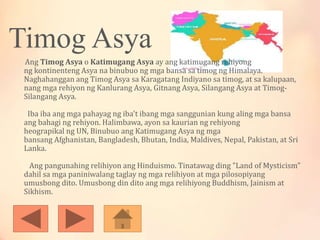
Ang Timog Asya o Katimugang Asya ay ang katimugang rehiyong
ng kontinenteng Asya na binubuo ng mga bansa sa timog ng Himalaya.
Naghahanggan ang Timog Asya sa Karagatang Indiyano sa timog, at sa kalupaan,
nang mga rehiyon ng Kanlurang Asya, Gitnang Asya, Silangang Asya at Timog-
Silangang Asya.
Iba iba ang mga pahayag ng iba't ibang mga sanggunian kung aling mga bansa
ang bahagi ng rehiyon. Halimbawa, ayon sa kaurian ng rehiyong
heograpikal ng UN, Binubuo ang Katimugang Asya ng mga
bansang Afghanistan, Bangladesh, Bhutan, India, Maldives, Nepal, Pakistan, at Sri
Lanka.
Ang pangunahing relihiyon ang Hinduismo. Tinatawag ding "Land of Mysticism"
dahil sa mga paniniwalang taglay ng mga relihiyon at mga pilosopiyang
umusbong dito. Umusbong din dito ang mga relihiyong Buddhism, Jainism at
Sikhism.
Pamir Mountains
Sigiraya
Belum Caves
Kali Gandaki
Hunza Valley
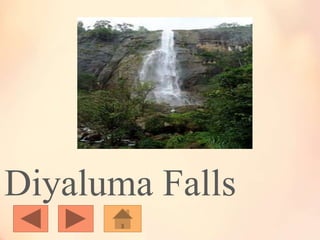
Diyaluma Falls
Sundarbans
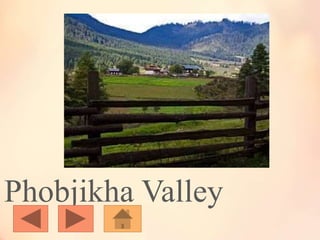
Phobjikha Valley
Mga Tanawin Sa Timog Asya
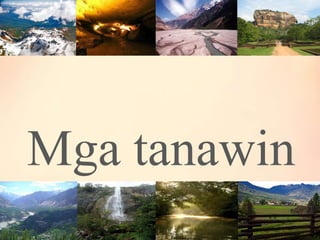
Mga tanawin
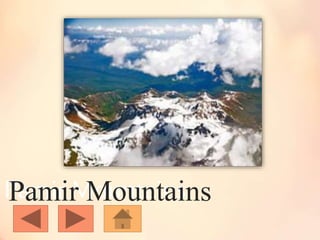
Pamir MountainsPamir Mountains
Pamir mountains
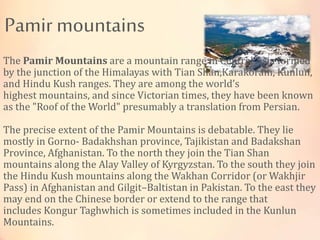
The Pamir Mountains are a mountain range in Central Asia formed
by the junction of the Himalayas with Tian Shan,Karakoram, Kunlun,
and Hindu Kush ranges. They are among the world’s
highest mountains, and since Victorian times, they have been known
as the "Roof of the World" presumably a translation from Persian.
The precise extent of the Pamir Mountains is debatable. They lie
mostly in Gorno- Badakhshan province, Tajikistan and Badakshan
Province, Afghanistan. To the north they join the Tian Shan
mountains along the Alay Valley of Kyrgyzstan. To the south they join
the Hindu Kush mountains along the Wakhan Corridor (or Wakhjir
Pass) in Afghanistan and Gilgit–Baltistan in Pakistan. To the east they
may end on the Chinese border or extend to the range that
includes Kongur Taghwhich is sometimes included in the Kunlun
Mountains.
Belum Caves
Belum caves
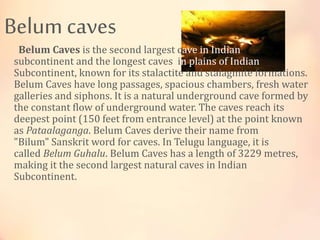
Belum Caves is the second largest cave in Indian
subcontinent and the longest caves in plains of Indian
Subcontinent, known for its stalactite and stalagmite formations.
Belum Caves have long passages, spacious chambers, fresh water
galleries and siphons. It is a natural underground cave formed by
the constant flow of underground water. The caves reach its
deepest point (150 feet from entrance level) at the point known
as Pataalaganga. Belum Caves derive their name from
"Bilum" Sanskrit word for caves. In Telugu language, it is
called Belum Guhalu. Belum Caves has a length of 3229 metres,
making it the second largest natural caves in Indian
Subcontinent.
Kali Gandaki
Kali gandaki
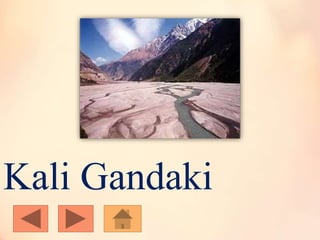
The Kali Gandaki or Gandaki River (also known as
the Narayani in southern Nepal and the Gandak in India)
is one of the major rivers of Nepal and a left bank
tributary of the Ganges in India. It is also called Krishna
Gandaki in Nepal. In Nepal the river is notable for its
deep gorge through the Himalayas and its
enormous hydroelectric potential. It has a total catchment
area of 46,300 square kilometers (17,900 sq mi), most of
it in Nepal. The basin also contains three of the world's 14
mountains over
8,000m,Dhaulagiri, Manaslu and Annapurna I. Dhaulagiri
is the highest point of the Gandaki basin. It lies between
the similar Kosi system to the east and
the Karnali (Ghaghara) system to the west.
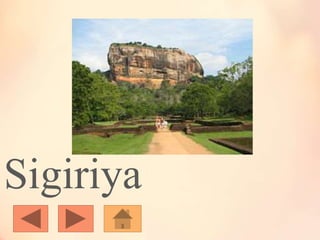
Sigiriya
SigiriyaSigiriya is an ancient palace located in the central Matal
District near the town of Dambulla in the Central
Province, Sri Lanka. The name refers to a site of historical
and archaeological significance that is dominated by a
massive column of rock nearly 200 metres (660 ft) high.
According to the ancient Sri Lankan chronicle the
Culavangsha, this site was selected by King Kasyapa (477 –
495 CE) for his new capital. He built his palace on the top of
this rock and decorated its sides with colourful frescoes. On
a small plateau about halfway up the side of this rock he
built a gateway in the form of an enormous lion. The name
of this place is derived from this structure — Sīhāgiri, the
Lion Rock. The capital and the royal palace was abandoned
after the king's death. It was used as a Buddhist monastery
until the 14th century.
Sigiriya today is a UNESCO listed World Heritage Site. It is
one of the best preserved examples of ancient urban
planning. It is the most visited historic site in Sri Lanka.
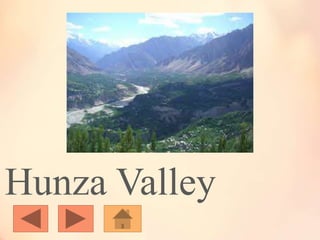
Hunza Valley
Hunza valley
The Hunza is a mountainous valley in the Gilgit–Baltistan region
of Pakistan. The Hunza is situated north/west of the Hunza River, at an
elevation of around 2,500 metres (8,200 ft). The territory of Hunza is
about 7,900 square kilometres (3,100 sq mi). Aliabad is the main town
while Baltit is a popular tourist destination because of the spectacular
scenery of the surrounding mountains like Ultar
Sar, Rakaposhi, Bojahagur Duanasir II, Ghenta Peak, Hunza Peak, Passu
Peak, Diran Peak and Bublimotin (Ladyfinger Peak), all 6,000 metres
(19,685 ft) or higher.
Diyaluma Falls
Diyaluma falls
Diyaluma water falls' is 220m high and the second
highest waterfall in Sri Lanka and 361st highest waterfall
in the world. It is situated 6 km away
from Koslanda in Badulla District on Colombo-
Badulla highway. The Falls are formed by Punagala Oya, a
tributary of Kuda Oya which in turn, is a tributary of
Kirindi Oya
In Sinhalese, Diyaluma or Diya Haluma means "rapid
flow of water". According to Dr.R.L. Brohier, the famous
historian, Diyaluma is the setting of the folklore about a
tragedy involving a young King and a young woman of a
low-caste.
Sundarbans
Sundarbans
The Sundarbans is the largest single block of
tidal halophytic mangrove forest in the world.The
Sunderbans is approximately 10,000 Sq Km of which 60% is
located in Bangladesh with the remainder in India. The
Sunderbans is a UNESCO World Heritage Site.
The Sundarbans National Park is a National Park, Tiger
Reserve, and a Biosphere Reserve located in the
Sundarbans delta in the Indian state of West Bengal.
Sundarbans South, East and West are three protected forests
in Bangladesh. This region is densely covered
by mangrove forests, and is one of the largest reserves for
the Bengal tiger.
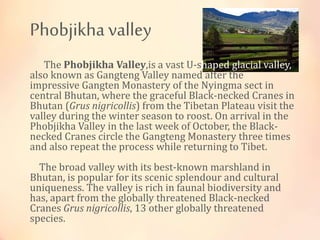
Phobjikha Valley
Phobjikha valley
The Phobjikha Valley,is a vast U-shaped glacial valley,
also known as Gangteng Valley named after the
impressive Gangten Monastery of the Nyingma sect in
central Bhutan, where the graceful Black-necked Cranes in
Bhutan (Grus nigricollis) from the Tibetan Plateau visit the
valley during the winter season to roost. On arrival in the
Phobjikha Valley in the last week of October, the Black-
necked Cranes circle the Gangteng Monastery three times
and also repeat the process while returning to Tibet.
The broad valley with its best-known marshland in
Bhutan, is popular for its scenic splendour and cultural
uniqueness. The valley is rich in faunal biodiversity and
has, apart from the globally threatened Black-necked
Cranes Grus nigricollis, 13 other globally threatened
species.
Mga Miyembro
B14 Maiwat, Glen Jay
B17 Sobremonte, Jose Silverio
G5 Cariño, Ma. Fatima
G6 Cruz, Emmalyn
G10 Javier, Ma. Sarah

Timog Asya

  • 1.
  • 2.
    Timog Asya Ang TimogAsya o Katimugang Asya ay ang katimugang rehiyong ng kontinenteng Asya na binubuo ng mga bansa sa timog ng Himalaya. Naghahanggan ang Timog Asya sa Karagatang Indiyano sa timog, at sa kalupaan, nang mga rehiyon ng Kanlurang Asya, Gitnang Asya, Silangang Asya at Timog- Silangang Asya. Iba iba ang mga pahayag ng iba't ibang mga sanggunian kung aling mga bansa ang bahagi ng rehiyon. Halimbawa, ayon sa kaurian ng rehiyong heograpikal ng UN, Binubuo ang Katimugang Asya ng mga bansang Afghanistan, Bangladesh, Bhutan, India, Maldives, Nepal, Pakistan, at Sri Lanka. Ang pangunahing relihiyon ang Hinduismo. Tinatawag ding "Land of Mysticism" dahil sa mga paniniwalang taglay ng mga relihiyon at mga pilosopiyang umusbong dito. Umusbong din dito ang mga relihiyong Buddhism, Jainism at Sikhism.
  • 3.
    Pamir Mountains Sigiraya Belum Caves KaliGandaki Hunza Valley Diyaluma Falls Sundarbans Phobjikha Valley Mga Tanawin Sa Timog Asya
  • 4.
  • 5.
  • 6.
    Pamir mountains The PamirMountains are a mountain range in Central Asia formed by the junction of the Himalayas with Tian Shan,Karakoram, Kunlun, and Hindu Kush ranges. They are among the world’s highest mountains, and since Victorian times, they have been known as the "Roof of the World" presumably a translation from Persian. The precise extent of the Pamir Mountains is debatable. They lie mostly in Gorno- Badakhshan province, Tajikistan and Badakshan Province, Afghanistan. To the north they join the Tian Shan mountains along the Alay Valley of Kyrgyzstan. To the south they join the Hindu Kush mountains along the Wakhan Corridor (or Wakhjir Pass) in Afghanistan and Gilgit–Baltistan in Pakistan. To the east they may end on the Chinese border or extend to the range that includes Kongur Taghwhich is sometimes included in the Kunlun Mountains.
  • 7.
  • 8.
    Belum caves Belum Cavesis the second largest cave in Indian subcontinent and the longest caves in plains of Indian Subcontinent, known for its stalactite and stalagmite formations. Belum Caves have long passages, spacious chambers, fresh water galleries and siphons. It is a natural underground cave formed by the constant flow of underground water. The caves reach its deepest point (150 feet from entrance level) at the point known as Pataalaganga. Belum Caves derive their name from "Bilum" Sanskrit word for caves. In Telugu language, it is called Belum Guhalu. Belum Caves has a length of 3229 metres, making it the second largest natural caves in Indian Subcontinent.
  • 9.
  • 10.
    Kali gandaki The KaliGandaki or Gandaki River (also known as the Narayani in southern Nepal and the Gandak in India) is one of the major rivers of Nepal and a left bank tributary of the Ganges in India. It is also called Krishna Gandaki in Nepal. In Nepal the river is notable for its deep gorge through the Himalayas and its enormous hydroelectric potential. It has a total catchment area of 46,300 square kilometers (17,900 sq mi), most of it in Nepal. The basin also contains three of the world's 14 mountains over 8,000m,Dhaulagiri, Manaslu and Annapurna I. Dhaulagiri is the highest point of the Gandaki basin. It lies between the similar Kosi system to the east and the Karnali (Ghaghara) system to the west.
  • 11.
  • 12.
    SigiriyaSigiriya is anancient palace located in the central Matal District near the town of Dambulla in the Central Province, Sri Lanka. The name refers to a site of historical and archaeological significance that is dominated by a massive column of rock nearly 200 metres (660 ft) high. According to the ancient Sri Lankan chronicle the Culavangsha, this site was selected by King Kasyapa (477 – 495 CE) for his new capital. He built his palace on the top of this rock and decorated its sides with colourful frescoes. On a small plateau about halfway up the side of this rock he built a gateway in the form of an enormous lion. The name of this place is derived from this structure — Sīhāgiri, the Lion Rock. The capital and the royal palace was abandoned after the king's death. It was used as a Buddhist monastery until the 14th century. Sigiriya today is a UNESCO listed World Heritage Site. It is one of the best preserved examples of ancient urban planning. It is the most visited historic site in Sri Lanka.
  • 13.
  • 14.
    Hunza valley The Hunzais a mountainous valley in the Gilgit–Baltistan region of Pakistan. The Hunza is situated north/west of the Hunza River, at an elevation of around 2,500 metres (8,200 ft). The territory of Hunza is about 7,900 square kilometres (3,100 sq mi). Aliabad is the main town while Baltit is a popular tourist destination because of the spectacular scenery of the surrounding mountains like Ultar Sar, Rakaposhi, Bojahagur Duanasir II, Ghenta Peak, Hunza Peak, Passu Peak, Diran Peak and Bublimotin (Ladyfinger Peak), all 6,000 metres (19,685 ft) or higher.
  • 15.
  • 16.
    Diyaluma falls Diyaluma waterfalls' is 220m high and the second highest waterfall in Sri Lanka and 361st highest waterfall in the world. It is situated 6 km away from Koslanda in Badulla District on Colombo- Badulla highway. The Falls are formed by Punagala Oya, a tributary of Kuda Oya which in turn, is a tributary of Kirindi Oya In Sinhalese, Diyaluma or Diya Haluma means "rapid flow of water". According to Dr.R.L. Brohier, the famous historian, Diyaluma is the setting of the folklore about a tragedy involving a young King and a young woman of a low-caste.
  • 17.
  • 18.
    Sundarbans The Sundarbans isthe largest single block of tidal halophytic mangrove forest in the world.The Sunderbans is approximately 10,000 Sq Km of which 60% is located in Bangladesh with the remainder in India. The Sunderbans is a UNESCO World Heritage Site. The Sundarbans National Park is a National Park, Tiger Reserve, and a Biosphere Reserve located in the Sundarbans delta in the Indian state of West Bengal. Sundarbans South, East and West are three protected forests in Bangladesh. This region is densely covered by mangrove forests, and is one of the largest reserves for the Bengal tiger.
  • 19.
  • 20.
    Phobjikha valley The PhobjikhaValley,is a vast U-shaped glacial valley, also known as Gangteng Valley named after the impressive Gangten Monastery of the Nyingma sect in central Bhutan, where the graceful Black-necked Cranes in Bhutan (Grus nigricollis) from the Tibetan Plateau visit the valley during the winter season to roost. On arrival in the Phobjikha Valley in the last week of October, the Black- necked Cranes circle the Gangteng Monastery three times and also repeat the process while returning to Tibet. The broad valley with its best-known marshland in Bhutan, is popular for its scenic splendour and cultural uniqueness. The valley is rich in faunal biodiversity and has, apart from the globally threatened Black-necked Cranes Grus nigricollis, 13 other globally threatened species.
  • 21.
    Mga Miyembro B14 Maiwat,Glen Jay B17 Sobremonte, Jose Silverio G5 Cariño, Ma. Fatima G6 Cruz, Emmalyn G10 Javier, Ma. Sarah