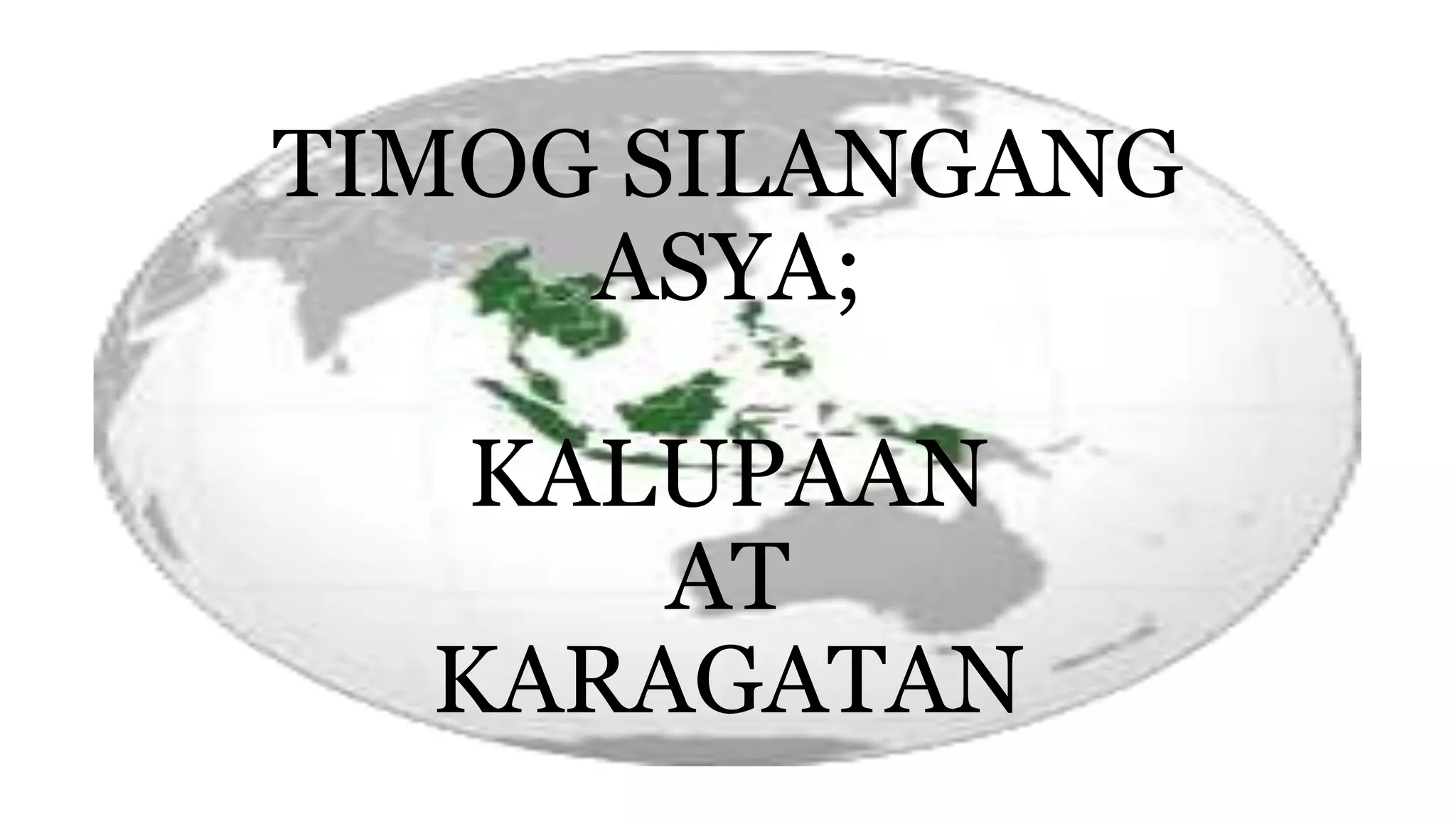




TIMOG SILANGANG
ASYA;
KALUPAAN
AT
KARAGATAN
Ang Timog Silangang Asya ay
isang subrehiyon ng kontinenteng Asya,
na binubuo ng mga bansang heograpikal
nasa timog ng Tsina, silangan ng Indiya,
kanluran ng Bagong Guinea at hilaga
ng Australya. Ang klima sa rehiyong ito
ay karaniwang tropikal, mainit at
mahalumigmig sa loob ng isang buong
taon.
HEOGRAPIKAL NA ASPETO
NG
TIMOG SILANGANG ASYA
Heograpikal:
Ang Timog Silangang Asya ay
heograpikal na nahahati sa dalawang
rehiyon, na tinatawag na Kalupaang
Timog Silangang Asya (o
ang Indotsina) at ang Karagatang
Timog Silangang Asya (o
ang Kapuluang Malay)
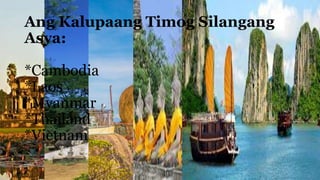
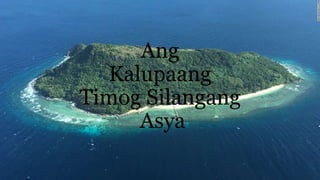
Ang Kalupaang Timog Silangang
Asya:
*Cambodia
*Laos
*Myanmar
*Thailand
*Vietnam
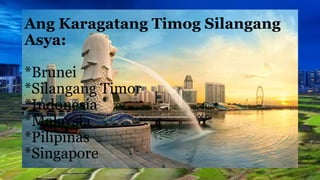
Ang Karagatang Timog Silangang
Asya:
*Brunei
*Silangang Timor
*Indonesia
*Malaysia
*Pilipinas
*Singapore
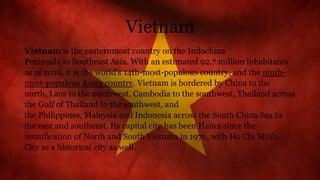
Ang
Kalupaang
Timog Silangang
Asya
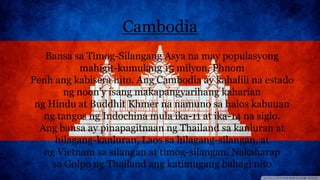
Cambodia
Bansa sa Timog-Silangang Asya na may populasyong
mahigit-kumulang 15 milyon. Phnom
Penh ang kabisera nito. Ang Cambodia ay kahalili na estado
ng noon'y isang makapangyarihang kaharian
ng Hindu at Buddhit Khmer na namuno sa halos kabuuan
ng tangos ng Indochina mula ika-11 at ika-14 na siglo.
Ang bansa ay pinapagitnaan ng Thailand sa kanluran at
hilagang-kanluran, Laos sa hilagang-silangan, at
ng Vietnam sa silangan at timog-silangan. Nakaharap
sa Golpo ng Thailand ang katimugang bahagi nito
Tourist
Attractions
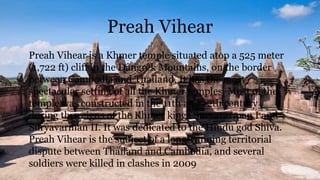
Preah Vihear
Preah Vihear is a Khmer temple situated atop a 525 meter
(1,722 ft) cliff in the Dângrêk Mountains, on the border
between Cambodia and Thailand. It has the most
spectacular setting of all the Khmer temples. Most of the
temple was constructed in the 11th and 12th century
during the reigns of the Khmer kings Suryavarman I and
Suryavarman II. It was dedicated to the Hindu god Shiva.
Preah Vihear is the subject of a long-running territorial
dispute between Thailand and Cambodia, and several
soldiers were killed in clashes in 2009
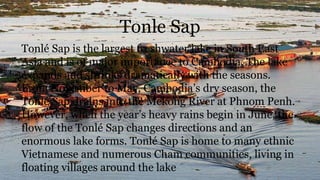
Tonle Sap
Tonlé Sap is the largest freshwater lake in South East
Asia and is of major importance to Cambodia. The lake
expands and shrinks dramatically with the seasons.
From November to May, Cambodia’s dry season, the
Tonlé Sap drains into the Mekong River at Phnom Penh.
However, when the year’s heavy rains begin in June, the
flow of the Tonlé Sap changes directions and an
enormous lake forms. Tonlé Sap is home to many ethnic
Vietnamese and numerous Cham communities, living in
floating villages around the lake
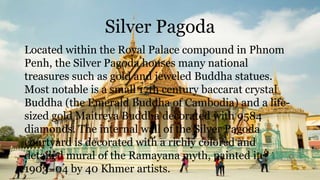
Silver Pagoda
Located within the Royal Palace compound in Phnom
Penh, the Silver Pagoda houses many national
treasures such as gold and jeweled Buddha statues.
Most notable is a small 17th century baccarat crystal
Buddha (the Emerald Buddha of Cambodia) and a life-
sized gold Maitreya Buddha decorated with 9584
diamonds. The internal wall of the Silver Pagoda
courtyard is decorated with a richly colored and
detailed mural of the Ramayana myth, painted in
1903–04 by 40 Khmer artists.
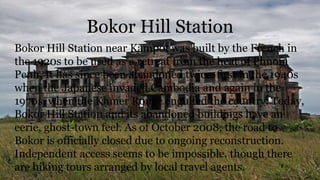
Bokor Hill Station
Bokor Hill Station near Kampot was built by the French in
the 1920s to be used as a retreat from the heat of Phnom
Penh. It has since been abandoned twice, first in the 1940s
when the Japanese invaded Cambodia and again in the
1970s, when the Khmer Rouge engulfed the country. Today,
Bokor Hill Station and its abandoned buildings have an
eerie, ghost-town feel. As of October 2008, the road to
Bokor is officially closed due to ongoing reconstruction.
Independent access seems to be impossible. though there
are hiking tours arranged by local travel agents.
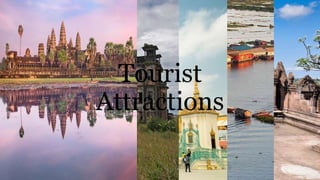
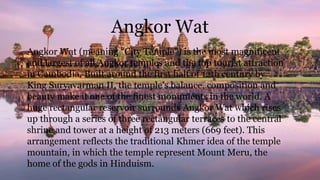
Angkor Wat
Angkor Wat (meaning “City Temple”) is the most magnificent
and largest of all Angkor temples and the top tourist attraction
in Cambodia. Built around the first half of 12th century by
King Suryavarman II, the temple’s balance, composition and
beauty make it one of the finest monuments in the world. A
huge rectangular reservoir surrounds Angkor Wat which rises
up through a series of three rectangular terraces to the central
shrine and tower at a height of 213 meters (669 feet). This
arrangement reflects the traditional Khmer idea of the temple
mountain, in which the temple represent Mount Meru, the
home of the gods in Hinduism.
Natural Resources
*The forests of Cambodia include evergreen, semi-evergreen, deciduous,
swamp, mangrove and bamboo forest in various conditions from closed to
disturbed and mosaic formations. There are also re-growth and plantation
forests as well as open forest types including evergreen shrub land and dry
deciduous shrub land.
*The main energy source in Cambodia is wood, accounting for 80% of national
energy consumption (UNEP, 2010). Most households, even in urban areas, rely
on traditional energy sources since fossil fuels are either not available or too
expensive. 94% of the population living in rural areas relies on wood, charcoal,
car batteries and kerosene (UNCDF, 2010). Most primitive fuels are sourced
from forests; in rural areas in the form of fuel wood and in towns and cities as
charcoal. The UNDP forecasts that wood-derived fuels will remain the main
source of cooking energy in rural areas until 2030.
Climate
Climate and Seasons in Cambodia. Cambodia has a
tropical climate with warm temperatures throughout
the year. There are two seasons in Cambodia. The
northeast monsoon season runs from December
through April, bringing sunny, dry weather especially in
January and February.
Laos
An ancient human skull was recovered from the Tam Pa Ling Cave in
the Annamite Mountains in northern Laos; the skull is at least 46,000
years old, making it the oldest modern human fossil found to date in
Southeast Asia. Stone artefacts including Hoabinhian types have been
found at sites dating to the Late Pleistocene in northern Laos.
Archaeological evidence suggests agriculturist society developed during
the 4th millennium BC. Burial jars and other kinds of sepulchers suggest
a complex society in which bronze objects appeared around 1500 BC,
and iron tools were known from 700 BC. The proto-historic period is
characterised by contact with Chinese and Indian civilisations. According
to linguistic and other historical evidence, Tai-speaking tribes migrated
southwestward to the modern territories of Laos and Thailand
from Guangxi sometime between the 8th–10th centuries.
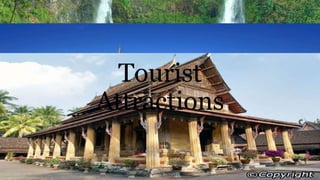
Tourist
Attractions
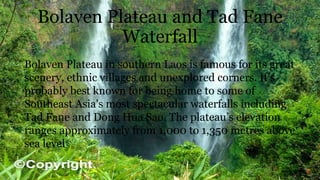
Bolaven Plateau and Tad Fane
Waterfall
Bolaven Plateau in southern Laos is famous for its great
scenery, ethnic villages and unexplored corners. It’s
probably best known for being home to some of
Southeast Asia's most spectacular waterfalls including
Tad Fane and Dong Hua Sao. The plateau’s elevation
ranges approximately from 1,000 to 1,350 metres above
sea level
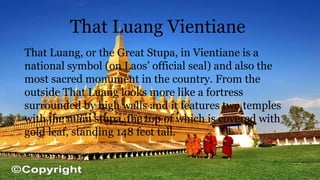
That Luang Vientiane
That Luang, or the Great Stupa, in Vientiane is a
national symbol (on Laos’ official seal) and also the
most sacred monument in the country. From the
outside That Luang looks more like a fortress
surrounded by high walls and it features two temples
with the main stupa, the top of which is covered with
gold leaf, standing 148 feet tall.
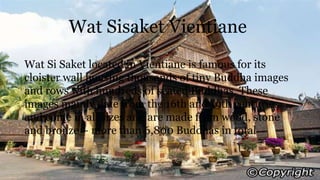
Wat Sisaket Vientiane
Wat Si Saket located in Vientiane is famous for its
cloister wall housing thousands of tiny Buddha images
and rows with hundreds of seated Buddhas. These
images mainly date from the 16th and 19th centuries
and come in all sizes and are made from wood, stone
and bronze – more than 6,800 Buddhas in total
Natural resources
timber, hydropower, gypsum, tin, gold, gemstones.
Climate
Laos has a tropical monsoon climate, with a
pronounced rainy season from May through October, a
cool dry season from November through February, and
a hot dry season in March and April. Generally,
monsoons occur at the same time across the country,
although that time may vary significantly from one year
to the next.
Myanmar
Ang Myanmar, o ang Repulika ng Unyon ng Myanmar (internasyunal: Republic of the Union of
Myanmar), dating Kaisahan ng Burma, ay ang pinakamalaking bansa (sa sakop pang-heograpiya) sa
lupaing nasa loob ng kontinente ng Timog-silangang Asya. Napapaligiran ng Tsina sa hilaga, Laos sa
silangan, Thailand sa timog-silangan, Banglades sa kanluran, at Indiya sa hilaga-kanluran, kasama
ang Dagat Andaman sa timog, at ang Look ng Bengal sa timog-kanluran (sa kabuuang mahigit sa
2,000 kilometrong baybaying-dagat).
Ang Burma ay naging tirahan ng iba’t – ibang lahi.Ang kapatagan ng ilog ng Irrawaddy at Salween ay
panirahan ng mga dayuhang nagmula sa Tibet, Tsina, at India. Ang naghalong lahi ng mga pangkat na
ito ang naging ninuno ng mg kasalukuyang Burmese. Pinaniniwalaang ang kahariang Pagan ang
naglatag ng pundasyon ng kahariang Burma.
Si Anawratha ang kinikilalang unang hari ng kahariang Burma.Naging malugod ang pagtanggap ni
Anawratha sa relihiyong Buddhism. Kaya’t lumganap ang sining at panitikang Buddhist sa lipunang
Burmese.
Nang namatay si Anawratha, ang mga sumunod na hari ng Burma ay sadyang naging mahina. Sa loob
ng dalawang siglo ang imperyo ay naging pugad ng nag – aaway na kaharian. Si Buyin Naung ang
muling nakapagbalik ng pagkakaisa sa imperyo at itinatag niya ang kabisera ng Burma sa Pegu
hanggang sa kanyang kamatayan noong 1581.
Tourist
Attractions
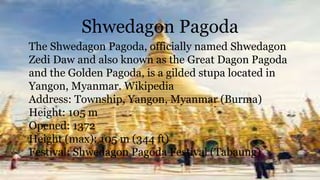
Shwedagon Pagoda
The Shwedagon Pagoda, officially named Shwedagon
Zedi Daw and also known as the Great Dagon Pagoda
and the Golden Pagoda, is a gilded stupa located in
Yangon, Myanmar. Wikipedia
Address: Township, Yangon, Myanmar (Burma)
Height: 105 m
Opened: 1372
Height (max): 105 m (344 ft)
Festival: Shwedagon Pagoda Festival (Tabaung)
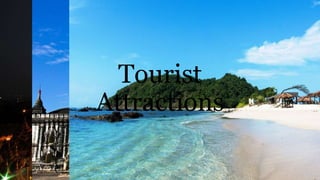
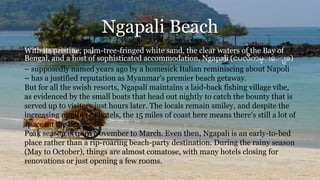
Ngapali Beach
With its pristine, palm-tree-fringed white sand, the clear waters of the Bay of
Bengal, and a host of sophisticated accommodation, Ngapali (ငပလီကမ္း ေးး ခ)
– supposedly named years ago by a homesick Italian reminiscing about Napoli
– has a justified reputation as Myanmar's premier beach getaway.
But for all the swish resorts, Ngapali maintains a laid-back fishing village vibe,
as evidenced by the small boats that head out nightly to catch the bounty that is
served up to visitors just hours later. The locals remain smiley, and despite the
increasing number of hotels, the 15 miles of coast here means there's still a lot of
space on the beach.
Peak season is from November to March. Even then, Ngapali is an early-to-bed
place rather than a rip-roaring beach-party destination. During the rainy season
(May to October), things are almost comatose, with many hotels closing for
renovations or just opening a few rooms.
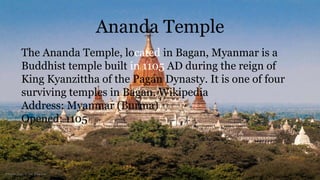
Ananda Temple
The Ananda Temple, located in Bagan, Myanmar is a
Buddhist temple built in 1105 AD during the reign of
King Kyanzittha of the Pagan Dynasty. It is one of four
surviving temples in Bagan. Wikipedia
Address: Myanmar (Burma)
Opened: 1105
Yamang Likas
Myanmar ay mayaman sa likas na yaman tulad ng petrolyo,
timber, lata, antimonyo, sink, tanso, Tungsten, nangunguna,
karbon, ang ilang mga gawa sa marmol, limestone,
mahalagang bato, natural gas, at hydropower. Myanmar ding
masuwerte sa pagkakaroon ng malalaking nakatayo ng teak
at iba pang handwoods. Ayon sa pinakahuling ulat ng UN
World Development, Myanmar ay may isang tinantyang
natural Myanmar forest area ng 43% pababa mula sa 12%
mula sa 10 taon na ang nakaraan, at ang ranggo ika-33 sa
tuktok ng mundo 100 bansa.
Klima
Tag-ulan : Mayo-Oktubre
Thailand
Ang Kaharian ng Thailand o Taylandiya ay isang bansa sa Timog-Silangang
Asya napapaligiran ito ng Laos at Cambodia sa silangan, ang Tangway ng
Thailand at Malaysia sa timog, at Dagat Andaman at Myanmar sa kanluran.
Nakilala ang Thailand bilang Siam, na naging opisyal na pangalan hanggang Mayo
11, 1949. Nangangahulugang "kalayaan" ang salitang Thai (ไทย) sa wikang Thai.
Pangalan din ito ng mga grupong etnikong Thai na nagdudulot sa ilang nakatira
dito, partikular ang mga kalakihang minoryang Instik, na patuloy na tawagin ang
bansa bilang Siam. Dahil sa heograpikal na lokasyon, ang kultura ng mga Thai ay
labis na naimpluwensiyahan ng Tsina at ng India. Subalit, marami ring mga
kakaibang kulturang umusbong sa Thailand simula noong nagsimula ang kultura
ng Baan Chiang. Ang unang estadong Thai na nabuo ay nagsimula sa isang
Kahariang Budhista ng Sukhothai noong 1238, kasunod ng paghina at pagbagsak
ng Emperyong Khmer noong ika-13 - hanggang ika-15 siglo.
Tourist
Attractions
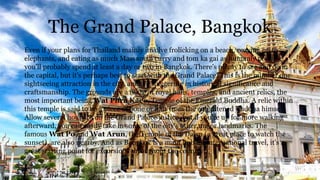
The Grand Palace, Bangkok
Even if your plans for Thailand mainly involve frolicking on a beach, cozying up to
elephants, and eating as much Massaman curry and tom ka gai as humanly possible,
you'll probably spend at least a day or two in Bangkok. There's plenty to see and do in
the capital, but it's perhaps best to start with the Grand Palace. This is the number one
sightseeing attraction in the city, and it's staggering in historical significance and
craftsmanship. The grounds are a maze of royal halls, temples, and ancient relics, the
most important being Wat Phra Kaeo, Temple of the Emerald Buddha. A relic within
this temple is said to be a piece of bone or hair from the enlightened Buddha himself.
Allow several hours to do the Grand Palace justice, but if you're up for more walking
afterward, you can easily take in some of the city's other major landmarks. The
famous Wat Po and Wat Arun, the Temple of the Dawn (a great place to watch the
sunset), are also nearby. And as Bangkok is a main hub for international travel, it's a
great starting point for excursions throughout the country.
Sunday Walking Street,
Chiang Mai
Every Thailand visitor looks forward to cheap and delicious food, and it can be found in
abundance at Chiang Mai's Sunday Night Walking Street. Vendors sell all kinds of treats:
pad Thai, chicken satay, samosas, crab cakes, fried bananas, sweet rotees, and fresh fruit
shakes - often for less than $2 a piece. When you've satisfied your culinary cravings, you can
peruse hundreds of stalls selling an array of unique goods such as all-natural soaps, hand-
dyed textiles bearing the unique patterns of local hill tribes, incense and essential oils,
musical instruments, paintings, wall hangings, and more.
The market gets crowded every week without fail, no matter what time of year you're
visiting, so brace yourself and try to enjoy being part of the throng. This is a must-do in
Chiang Mai, and is an essential part of the Thailand experience. If you're not around for the
Sunday market, or just want to get a taste of other market experiences in Chiang Mai, check
out the Saturday Night Walking Street or the Night Bazaar on Chang Klan Road, a
daily event. For something less touristy, check out the daytime Warorot Market, near
Mae Ping River.
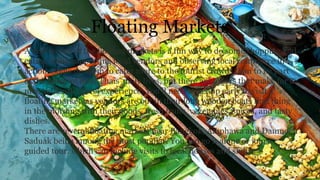
Floating Markets
A visit to one of the floating markets is a fun way to do some shopping and
eating while supporting local vendors and observing local commerce in
action. Some do seem to cater more to the tourist crowds than to be part
of the fabric of local Thais' daily lives, but there are others that make for a
nice authentic travel experience. You'll need to get up early to visit a
floating market, as vendors are out in their long wooden boats first thing
in the morning with their goods, fresh fruits, vegetables, spices, and tasty
dishes.
There are several floating markets near Bangkok, Amphawa and Damnoen
Saduak being among the most popular. You can go it alone or join a
guided tour, which can include visits to local houses and shops.
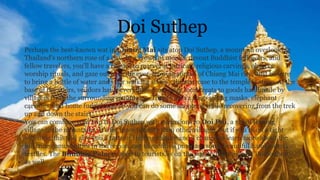
Doi Suthep
Perhaps the best-known wat in Chiang Mai sits atop Doi Suthep, a mountain overlooking
Thailand's northern rose of a city. In a crowd of monks, devout Buddhist followers, and
fellow travelers, you'll have a chance to marvel at intricate religious carvings, observe
worship rituals, and gaze out over the ever-growing sprawl of Chiang Mai city. Just be sure
to bring a bottle of water and your walking shoes - the staircase to the temple is steep. At the
base of the stairs, vendors hawk everything from tasty local treats to goods handmade by
villagers from the surrounding mountains. There's also a shop selling masks, elephant
carvings, and home furnishings so you can do some shopping while recovering from the trek
up and down the stairs.
You can combine your trip to Doi Suthep with excursions to Doi Pui, a small Hmong
village in the mountains. It's far more touristy than other villages, but if you're on a tight
schedule, this will give you a taste of Hmong culture and a chance to learn more about the
hill tribe communities in the region, not to mention purchase some beautiful hand-woven
textiles. The Bhubing Palace, open to tourists, is on the way to Doi Pui from Doi Suthep
as well
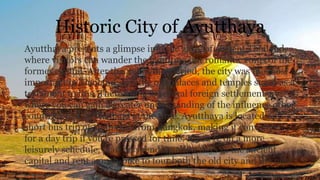
Historic City of Ayutthaya
Ayutthaya presents a glimpse into the glory of ancient Thailand,
where visitors can wander the haunting but romantic ruins of the
former capital. After the Sukhothai period, the city was the most
important in Thailand, and the old palaces and temples stand as a
testament to this. There are also several foreign settlements,
where you can gain a greater understanding of the influence other
countries had in Thailand at the time. Ayutthaya is located only a
short bus trip or train ride from Bangkok, making it convenient
for a day trip if you're pressed for time. If you're on a more
leisurely schedule, plan on spending a few days in the ancient
capital and rent a push-bike to tour both the old city and the new
Natural Resources
Thailand is rich in natural resources. Among the
known mineral deposits are coal, gold, lead, tin,
tungsten, manganese, zinc, and precious stones. The
rich alluvial soil along the Chao Phraya and other rivers
constitutes another important resource.
Climate
Thailand's climate is tropical with a mean annual
temperature of 28°C and high humidity. There are
three distinct seasons – the hot season from March to
May, the cool season from November to February and
the rainy season from about June to October.
Vietnam
Vietnam is the easternmost country on the Indochina
Peninsula in Southeast Asia. With an estimated 92.7 million inhabitants
as of 2016, it is the world's 14th-most-populous country, and the ninth-
most-populous Asian country. Vietnam is bordered by China to the
north, Laos to the northwest, Cambodia to the southwest, Thailand across
the Gulf of Thailand to the southwest, and
the Philippines, Malaysia and Indonesia across the South China Sea to
the east and southeast. Its capital city has been Hanoi since the
reunification of North and South Vietnam in 1976, with Ho Chi Minh
City as a historical city as well.
Tourist
Attractions
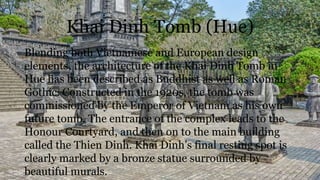
Khai Dinh Tomb (Hue)
Blending both Vietnamese and European design
elements, the architecture of the Khai Dinh Tomb in
Hue has been described as Buddhist as well as Roman
Gothic. Constructed in the 1920s, the tomb was
commissioned by the Emperor of Vietnam as his own
future tomb. The entrance of the complex leads to the
Honour Courtyard, and then on to the main building
called the Thien Dinh. Khai Dinh’s final resting spot is
clearly marked by a bronze statue surrounded by
beautiful murals.
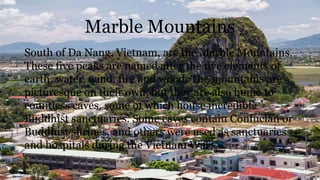
Marble Mountains
South of Da Nang, Vietnam, are the Marble Mountains.
These five peaks are named after the five elements of
earth, water, wind, fire and wood. The mountains are
picturesque on their own, but they are also home to
countless caves, some of which house incredible
Buddhist sanctuaries. Some caves contain Confucian or
Buddhist shrines, and others were used as sanctuaries
and hospitals during the Vietnam War.
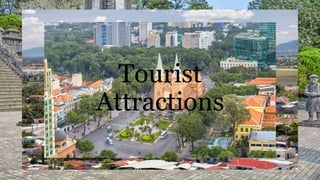
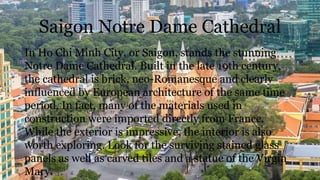
Saigon Notre Dame Cathedral
In Ho Chi Minh City, or Saigon, stands the stunning
Notre Dame Cathedral. Built in the late 19th century,
the cathedral is brick, neo-Romanesque and clearly
influenced by European architecture of the same time
period. In fact, many of the materials used in
construction were imported directly from France.
While the exterior is impressive, the interior is also
worth exploring. Look for the surviving stained glass
panels as well as carved tiles and a statue of the Virgin
Mary.
Natural Resources
Vietnam is reasonably endowed withmineral
resources including many that not been developed.
Vietnam's main natural resources consist of coal,
phosphates, rare earth elements, bauxite,
chromate,copper, gold, iron, manganese, silver, zinc,
offshore oil and gas deposits,timber, hydropower ...
Climate
Viet Nam is located in both a tropical and a temperate
zone. It is characterized by strong monsoon influences,
but has a considerable amount of sun, a high rate of
rainfall, and high humidity. Regions located near the
tropics and in the mountainous regions are endowed
with a temperate climate.
Karagatang
Timog Silangang
Asya
Brunei
Brunei is a tiny nation on the island of Borneo, in 2
distinct sections surrounded by Malaysia and the South
China Sea. It's known for its beaches and biodiverse
rainforest, much of it protected within reserves. The
capital, Bandar Seri Begawan, is home to the opulent
Jame’Asr Hassanil Bolkiah mosque and its 29 golden
domes. The capital's massive Istana Nurul Iman palace
is the residence of Brunei’s ruling sultan.
Tourist
Attractions
James ‘Asr Hassanil Bolkiah
Mosque
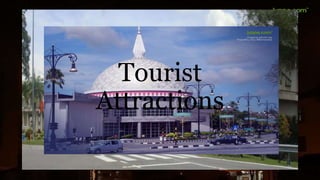
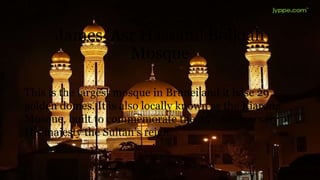
This is the largest mosque in Brunei and it hase 29
golden domes. It is also locally known as the Kiarong
Mosque, built to commemorate the 25th Anniversary of
His majesty the Sultan’s reign.
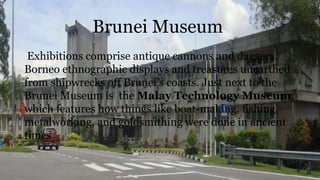
Brunei Museum
Exhibitions comprise antique cannons and daggers,
Borneo ethnographic displays and treasures unearthed
from shipwrecks off Brunei’s coasts. Just next to the
Brunei Museum is the Malay Technology Museum,
which features how things like boat-making, fishing,
metalworking, and goldsmithing were done in ancient
times
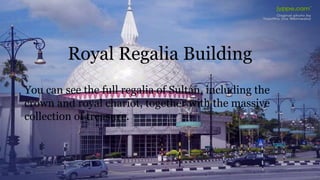
Royal Regalia Building
You can see the full regalia of Sultan, including the
crown and royal chariot, together with the massive
collection of treasure.
Natural Resources
Brunei Darussalam's main exports consist of three
major commodities - crude oil,petroleum products
and liquefied natural gas - sold largely to Japan, the
United States and ASEAN countries.
Climate
The climate in Brunei is tropical equatorial and humid
subtropical at higher altitudes with heavy rainfall.
Bandar Seri Begawan's climate is tropical equatorial
with two seasons. Dry season is extremely hot (24 to 36
°C or 75.2 to 96.8 °F).
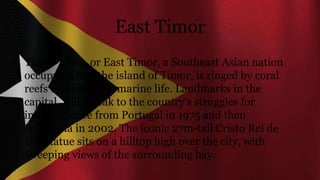
East Timor
Timor-Leste, or East Timor, a Southeast Asian nation
occupying half the island of Timor, is ringed by coral
reefs teeming with marine life. Landmarks in the
capital, Dili, speak to the country's struggles for
independence from Portugal in 1975 and then
Indonesia in 2002. The iconic 27m-tall Cristo Rei de
Dili statue sits on a hilltop high over the city, with
sweeping views of the surrounding bay.
Tourist
Attractions
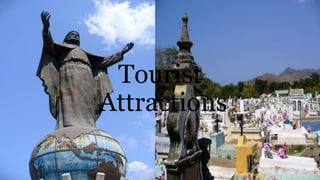
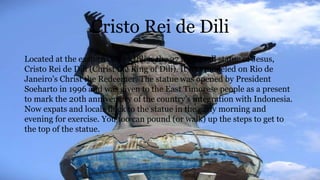
Cristo Rei de Dili
Located at the eastern end of Dili is the 27 meter tall statue of Jesus,
Cristo Rei de Dili (Christ the King of Dili). It was modeled on Rio de
Janeiro’s Christ the Redeemer. The statue was opened by President
Soeharto in 1996 and was given to the East Timorese people as a present
to mark the 20th anniversary of the country’s integration with Indonesia.
Now expats and locals flock to the statue in the early morning and
evening for exercise. You too can pound (or walk) up the steps to get to
the top of the statue.
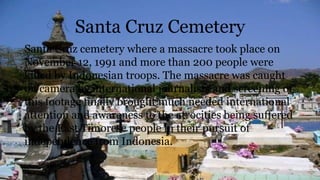
Santa Cruz Cemetery
Santa Cruz cemetery where a massacre took place on
November 12, 1991 and more than 200 people were
killed by Indonesian troops. The massacre was caught
on camera by international journalists and screening of
this footage finally brought much needed international
attention and awareness to the atrocities being suffered
by the East Timorese people in their pursuit of
independence from Indonesia.
Natural Resources
Natural resources: gold, petroleum, natural gas,
manganese, marble.
Climate
Located in southeast Asia, the island of Timor is part of
Maritime Southeast Asia. The local climate is tropical
and generally hot and humid, characterised by distinct
rainy and dry seasons. The capital, largest city and
main port is Dili.
Indonesia
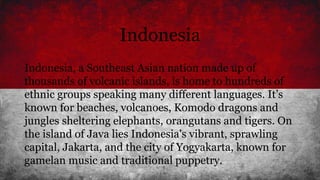
Indonesia, a Southeast Asian nation made up of
thousands of volcanic islands, is home to hundreds of
ethnic groups speaking many different languages. It’s
known for beaches, volcanoes, Komodo dragons and
jungles sheltering elephants, orangutans and tigers. On
the island of Java lies Indonesia's vibrant, sprawling
capital, Jakarta, and the city of Yogyakarta, known for
gamelan music and traditional puppetry.
Tourist
Attractions
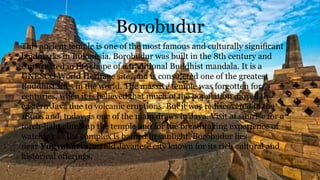
Borobudur
This ancient temple is one of the most famous and culturally significant
landmarks in Indonesia. Borobudur was built in the 8th century and
constructed in the shape of a traditional Buddhist mandala. It is a
UNESCO World Heritage site, and is considered one of the greatest
Buddhist sites in the world. The massive temple was forgotten for
centuries, when it is believed that much of the population moved to
eastern Java due to volcanic eruptions. But it was rediscovered in the
1800s and, today, is one of the main draws in Java. Visit at sunrise for a
torch-light climb up the temple and for the breathtaking experience of
watching as the complex is bathed in sunlight. Borobudur lies
near Yogyakarta, an old Javanese city known for its rich cultural and
historical offerings.
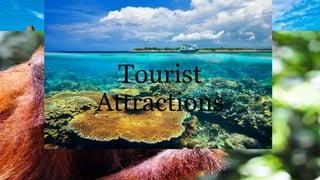
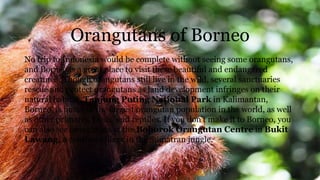
Orangutans of Borneo
No trip to Indonesia would be complete without seeing some orangutans,
and Borneo is a great place to visit these beautiful and endangered
creatures. Though orangutans still live in the wild, several sanctuaries
rescue and protect orangutans as land development infringes on their
natural habitat. Tanjung Puting National Park in Kalimantan,
Borneo, is home to the largest orangutan population in the world, as well
as other primates, birds, and reptiles. If you don't make it to Borneo, you
can also see orangutans at the Bohorok Orangutan Centre in Bukit
Lawang, a tourism village in the Sumatran jungle.
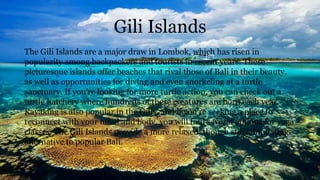
Gili Islands
The Gili Islands are a major draw in Lombok, which has risen in
popularity among backpackers and tourists in recent years. These
picturesque islands offer beaches that rival those of Bali in their beauty,
as well as opportunities for diving and even snorkeling at a turtle
sanctuary. If you're looking for more turtle action, you can check out a
turtle hatchery where hundreds of these creatures are born each year.
Kayaking is also popular in the Gilis, and if you're seeking a place to
reconnect with your mind and body, you will find several options for yoga
classes. The Gili Islands provide a more relaxed, though still stimulating,
alternative to popular Bali.
Natural Resources
Indonesia abounds with natural resources. It is the
world's largest exporter of steam coal, refined tin and
(until the enforcement of the export ban earlier this
year) nickelore. It is also a leading exporter
of gold, bauxite, lead, zinc andcopper.
Climate
Split by the equator, indonesia has an almost entirely
tropicalclimate, with the coastal plains averaging 28°C,
the inland and mountain areas averaging 26°C, and the
higher mountain regions, 23°C. The area's relative
humidity is quite high, and ranges between 70 and 90
percent.
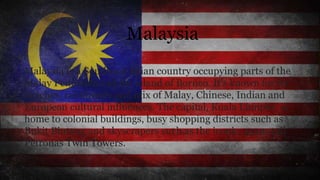
Malaysia
Malaysia is a Southeast Asian country occupying parts of the
Malay Peninsula and the island of Borneo. It's known for its
beaches, rainforests and mix of Malay, Chinese, Indian and
European cultural influences. The capital, Kuala Lumpur, is
home to colonial buildings, busy shopping districts such as
Bukit Bintang and skyscrapers such as the iconic, 451m-tall
Petronas Twin Towers.
Tourist
Attractions
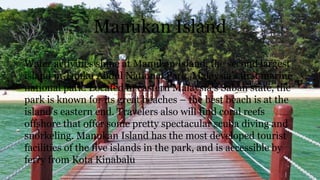
Manukan Island
Water activities shine at Manukan Island, the second largest
island in Tunku Abdul National Park, Malaysia’s first marine
national park. Located in eastern Malaysia’s Sabah state, the
park is known for its great beaches – the best beach is at the
island’s eastern end. Travelers also will find coral reefs
offshore that offer some pretty spectacular scuba diving and
snorkeling. Manukan Island has the most developed tourist
facilities of the five islands in the park, and is accessible by
ferry from Kota Kinabalu
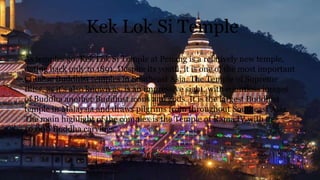
Kek Lok Si Temple
As temples go, Kek Lok Si Temple at Penang is a relatively new temple,
dating back only to 1891. Despite its youth, it is one of the most important
Chinese Buddhist temples in Southeast Asia. The Temple of Supreme
Bliss, as it’s also known as, is an impressive sight, with countless images
of Buddha another Buddhist icons and gods. It is the largest Buddhist
temple in Malaysia and draws pilgrims from throughout Southeast Asia.
The main highlight of the complex is the Temple of Rama IV with its
10,000 Buddha carvings.
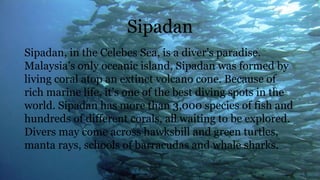
Sipadan
Sipadan, in the Celebes Sea, is a diver’s paradise.
Malaysia’s only oceanic island, Sipadan was formed by
living coral atop an extinct volcano cone. Because of
rich marine life, it’s one of the best diving spots in the
world. Sipadan has more than 3,000 species of fish and
hundreds of different corals, all waiting to be explored.
Divers may come across hawksbill and green turtles,
manta rays, schools of barracudas and whale sharks.
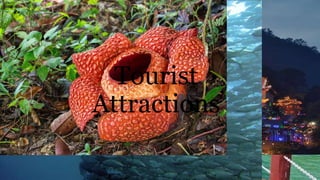
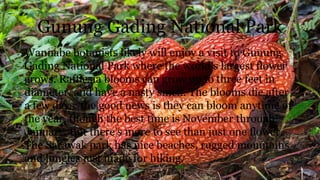
Gunung Gading National Park
Wannabe botanists likely will enjoy a visit to Gunung
Gading National Park where the world’s largest flower
grows. Rafflesia blooms can grow up to three feet in
diameter, and have a nasty smell. The blooms die after
a few days; the good news is they can bloom anytime of
the year, though the best time is November through
January. But there’s more to see than just one flower.
The Sarawak park has nice beaches, rugged mountains
and jungles just made for hiking.
Natural Resources
Malaysia has large deposits of tin and numerous rubber
trees. Other minerals include copper and
uranium, Palm oil, Timber, Petroleum and Natural
Gas . Palm oil may not sound like a very important
natural resource, but it is the primary cooking oil used
in Asia.
Climate
Located near the equator, Malaysia's climate is
categorised as equatorial, being hot and humid
throughout the year. The average rainfall is 250
centimetres (98 in) a year and the average temperature
is 27 °C (80.6 °F).
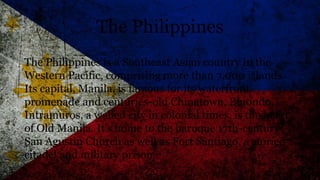
The Philippines
The Philippines is a Southeast Asian country in the
Western Pacific, comprising more than 7,000 islands.
Its capital, Manila, is famous for its waterfront
promenade and centuries-old Chinatown, Binondo.
Intramuros, a walled city in colonial times, is the heart
of Old Manila. It’s home to the baroque 17th-century
San Agustin Church as well as Fort Santiago, a storied
citadel and military prison.
Tourist
Attractions
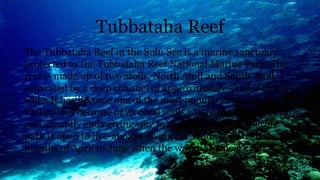
Tubbataha Reef
The Tubbataha Reef in the Sulu Sea is a marine sanctuary
protected as the Tubbataha Reef National Marine Park. The
reef is made up of two atolls, North Atoll and South Atoll,
separated by a deep channel of approximately 5 miles (8 km)
wide. It has become one of the most popular dive sites in the
Philippines because of its coral walls where the shallow coral
reef abruptly ends giving way to great depths. The marine
park is open to live-aboard diving excursions between the
months of April to June when the waves are most calm.
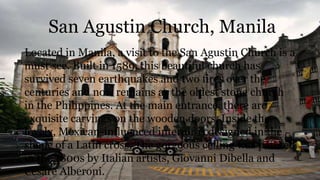
San Agustin Church, Manila
Located in Manila, a visit to the San Agustin Church is a
must see. Built in 1589, this beautiful church has
survived seven earthquakes and two fires over the
centuries and now remains as the oldest stone church
in the Philippines. At the main entrance, there are
exquisite carvings on the wooden doors. Inside the
lovely, Mexican-influenced interior is designed in the
shape of a Latin cross. The gorgeous ceiling was painted
in the 1800s by Italian artists, Giovanni Dibella and
Cesare Alberoni.
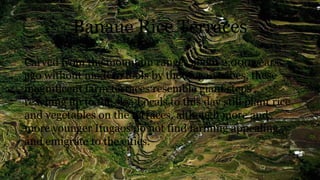
Banaue Rice Terraces
Carved from the mountain ranges about 2,000 years
ago without modern tools by the Ifugao tribes, these
magnificent farm terraces resemble giant steps
reaching up to the sky. Locals to this day still plant rice
and vegetables on the terraces, although more and
more younger Ifugaos do not find farming appealing
and emigrate to the cities.
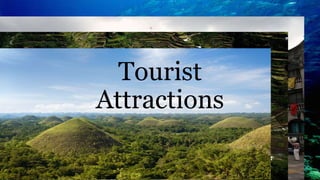
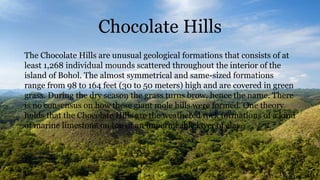
Chocolate Hills
The Chocolate Hills are unusual geological formations that consists of at
least 1,268 individual mounds scattered throughout the interior of the
island of Bohol. The almost symmetrical and same-sized formations
range from 98 to 164 feet (30 to 50 meters) high and are covered in green
grass. During the dry season the grass turns brow, hence the name. There
is no consensus on how these giant mole hills were formed. One theory
holds that the Chocolate Hills are the weathered rock formations of a kind
of marine limestone on top of an impermeable layer of clay.
Natural Resources
The Philippines is rich in natural resources. It has
fertile, arable lands, diverse flora and fauna, extensive
coastlines, and rich mineral deposits.
Climate
The Climate of the Philippines is either tropical
rainforest, tropical savanna or tropical monsoon, or
humid subtropical (in higher-altitude areas)
characterized by relatively high temperature,
oppressive humidity and plenty of rainfall.
Singapore
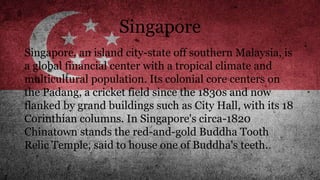
Singapore, an island city-state off southern Malaysia, is
a global financial center with a tropical climate and
multicultural population. Its colonial core centers on
the Padang, a cricket field since the 1830s and now
flanked by grand buildings such as City Hall, with its 18
Corinthian columns. In Singapore's circa-1820
Chinatown stands the red-and-gold Buddha Tooth
Relic Temple, said to house one of Buddha's teeth.
Tourist
Attractions
Gardens by the Bay
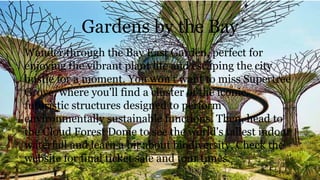
Wander through the Bay East Garden, perfect for
enjoying the vibrant plant life and escaping the city
bustle for a moment. You won't want to miss Supertree
Grove, where you'll find a cluster of the iconic,
futuristic structures designed to perform
environmentally sustainable functions. Then, head to
the Cloud Forest Dome to see the world's tallest indoor
waterfall and learn a bit about biodiversity. Check the
website for final ticket sale and tour times.
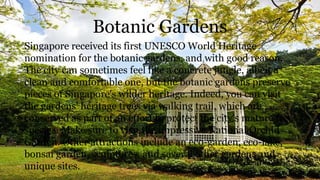
Botanic Gardens
Singapore received its first UNESCO World Heritage
nomination for the botanic gardens, and with good reason.
The city can sometimes feel like a concrete jungle, albeit a
clean and comfortable one, but the botanic gardens preserve
pieces of Singapore's wilder heritage. Indeed, you can visit
the gardens' heritage trees via walking trail, which are
conserved as part of an effort to protect the city's mature tree
species. Make sure to visit the impressive National Orchid
Garden. Other attractions include an eco-garden, eco-lake,
bonsai garden, sculptures, and several other gardens and
unique sites.
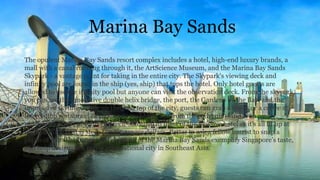
Marina Bay Sands
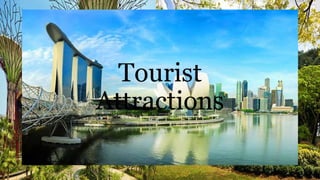
The opulent Marina Bay Sands resort complex includes a hotel, high-end luxury brands, a
mall with a canal running through it, the ArtScience Museum, and the Marina Bay Sands
Skypark - a vantage point for taking in the entire city. The Skypark's viewing deck and
infinity pool are found in the ship (yes, ship) that tops the hotel. Only hotel guests are
allowed to use the infinity pool but anyone can visit the observation deck. From the skypark,
you can see the innovative double helix bridge, the port, the Gardens by the Bay, and the
impressive skyline. While up there on top of the city, guests can grab a snack or a coffee at
the rooftop restaurant or pick up some keepsakes from the souvenir stand. You can
purchase a photo of yourself green-screened in front of the massive hotel as it's all lit up at
night, but the cost is steep: 50 Singapore dollars. Better to ask a fellow tourist to snap a
photo of you. The luxury and elegance of the Marina Bay Sands exemplify Singapore's taste,
and help designate a major international city in Southeast Asia.
Natural Resources
Singapore has very few natural resources. However, it
takes full advantage of those few that they have.
Deep water reserves of petroleum are mined and
exported to other countries. Also, Singapore is
important in electronics, as they are a key maker in
computer products.
Climate
Singapore is situated near the equator and has a
typically tropical climate, with abundant rainfall, high
and uniform temperatures, and high humidity all year
round. Many of its climate variables, such as
temperature and relative humidity, do not show large
month-to-month variation.
Timog silangang asya 1234567890987654321

Timog silangang asya 1234567890987654321

  • 1.
  • 2.
    Ang Timog SilangangAsya ay isang subrehiyon ng kontinenteng Asya, na binubuo ng mga bansang heograpikal nasa timog ng Tsina, silangan ng Indiya, kanluran ng Bagong Guinea at hilaga ng Australya. Ang klima sa rehiyong ito ay karaniwang tropikal, mainit at mahalumigmig sa loob ng isang buong taon.
  • 3.
  • 4.
    Heograpikal: Ang Timog SilangangAsya ay heograpikal na nahahati sa dalawang rehiyon, na tinatawag na Kalupaang Timog Silangang Asya (o ang Indotsina) at ang Karagatang Timog Silangang Asya (o ang Kapuluang Malay)
  • 5.
    Ang Kalupaang TimogSilangang Asya: *Cambodia *Laos *Myanmar *Thailand *Vietnam
  • 6.
    Ang Karagatang TimogSilangang Asya: *Brunei *Silangang Timor *Indonesia *Malaysia *Pilipinas *Singapore
  • 7.
  • 8.
    Cambodia Bansa sa Timog-SilangangAsya na may populasyong mahigit-kumulang 15 milyon. Phnom Penh ang kabisera nito. Ang Cambodia ay kahalili na estado ng noon'y isang makapangyarihang kaharian ng Hindu at Buddhit Khmer na namuno sa halos kabuuan ng tangos ng Indochina mula ika-11 at ika-14 na siglo. Ang bansa ay pinapagitnaan ng Thailand sa kanluran at hilagang-kanluran, Laos sa hilagang-silangan, at ng Vietnam sa silangan at timog-silangan. Nakaharap sa Golpo ng Thailand ang katimugang bahagi nito
  • 9.
  • 10.
    Preah Vihear Preah Vihearis a Khmer temple situated atop a 525 meter (1,722 ft) cliff in the Dângrêk Mountains, on the border between Cambodia and Thailand. It has the most spectacular setting of all the Khmer temples. Most of the temple was constructed in the 11th and 12th century during the reigns of the Khmer kings Suryavarman I and Suryavarman II. It was dedicated to the Hindu god Shiva. Preah Vihear is the subject of a long-running territorial dispute between Thailand and Cambodia, and several soldiers were killed in clashes in 2009
  • 11.
    Tonle Sap Tonlé Sapis the largest freshwater lake in South East Asia and is of major importance to Cambodia. The lake expands and shrinks dramatically with the seasons. From November to May, Cambodia’s dry season, the Tonlé Sap drains into the Mekong River at Phnom Penh. However, when the year’s heavy rains begin in June, the flow of the Tonlé Sap changes directions and an enormous lake forms. Tonlé Sap is home to many ethnic Vietnamese and numerous Cham communities, living in floating villages around the lake
  • 12.
    Silver Pagoda Located withinthe Royal Palace compound in Phnom Penh, the Silver Pagoda houses many national treasures such as gold and jeweled Buddha statues. Most notable is a small 17th century baccarat crystal Buddha (the Emerald Buddha of Cambodia) and a life- sized gold Maitreya Buddha decorated with 9584 diamonds. The internal wall of the Silver Pagoda courtyard is decorated with a richly colored and detailed mural of the Ramayana myth, painted in 1903–04 by 40 Khmer artists.
  • 13.
    Bokor Hill Station BokorHill Station near Kampot was built by the French in the 1920s to be used as a retreat from the heat of Phnom Penh. It has since been abandoned twice, first in the 1940s when the Japanese invaded Cambodia and again in the 1970s, when the Khmer Rouge engulfed the country. Today, Bokor Hill Station and its abandoned buildings have an eerie, ghost-town feel. As of October 2008, the road to Bokor is officially closed due to ongoing reconstruction. Independent access seems to be impossible. though there are hiking tours arranged by local travel agents.
  • 14.
    Angkor Wat Angkor Wat(meaning “City Temple”) is the most magnificent and largest of all Angkor temples and the top tourist attraction in Cambodia. Built around the first half of 12th century by King Suryavarman II, the temple’s balance, composition and beauty make it one of the finest monuments in the world. A huge rectangular reservoir surrounds Angkor Wat which rises up through a series of three rectangular terraces to the central shrine and tower at a height of 213 meters (669 feet). This arrangement reflects the traditional Khmer idea of the temple mountain, in which the temple represent Mount Meru, the home of the gods in Hinduism.
  • 15.
    Natural Resources *The forestsof Cambodia include evergreen, semi-evergreen, deciduous, swamp, mangrove and bamboo forest in various conditions from closed to disturbed and mosaic formations. There are also re-growth and plantation forests as well as open forest types including evergreen shrub land and dry deciduous shrub land. *The main energy source in Cambodia is wood, accounting for 80% of national energy consumption (UNEP, 2010). Most households, even in urban areas, rely on traditional energy sources since fossil fuels are either not available or too expensive. 94% of the population living in rural areas relies on wood, charcoal, car batteries and kerosene (UNCDF, 2010). Most primitive fuels are sourced from forests; in rural areas in the form of fuel wood and in towns and cities as charcoal. The UNDP forecasts that wood-derived fuels will remain the main source of cooking energy in rural areas until 2030.
  • 16.
    Climate Climate and Seasonsin Cambodia. Cambodia has a tropical climate with warm temperatures throughout the year. There are two seasons in Cambodia. The northeast monsoon season runs from December through April, bringing sunny, dry weather especially in January and February.
  • 17.
    Laos An ancient humanskull was recovered from the Tam Pa Ling Cave in the Annamite Mountains in northern Laos; the skull is at least 46,000 years old, making it the oldest modern human fossil found to date in Southeast Asia. Stone artefacts including Hoabinhian types have been found at sites dating to the Late Pleistocene in northern Laos. Archaeological evidence suggests agriculturist society developed during the 4th millennium BC. Burial jars and other kinds of sepulchers suggest a complex society in which bronze objects appeared around 1500 BC, and iron tools were known from 700 BC. The proto-historic period is characterised by contact with Chinese and Indian civilisations. According to linguistic and other historical evidence, Tai-speaking tribes migrated southwestward to the modern territories of Laos and Thailand from Guangxi sometime between the 8th–10th centuries.
  • 18.
  • 19.
    Bolaven Plateau andTad Fane Waterfall Bolaven Plateau in southern Laos is famous for its great scenery, ethnic villages and unexplored corners. It’s probably best known for being home to some of Southeast Asia's most spectacular waterfalls including Tad Fane and Dong Hua Sao. The plateau’s elevation ranges approximately from 1,000 to 1,350 metres above sea level
  • 20.
    That Luang Vientiane ThatLuang, or the Great Stupa, in Vientiane is a national symbol (on Laos’ official seal) and also the most sacred monument in the country. From the outside That Luang looks more like a fortress surrounded by high walls and it features two temples with the main stupa, the top of which is covered with gold leaf, standing 148 feet tall.
  • 21.
    Wat Sisaket Vientiane WatSi Saket located in Vientiane is famous for its cloister wall housing thousands of tiny Buddha images and rows with hundreds of seated Buddhas. These images mainly date from the 16th and 19th centuries and come in all sizes and are made from wood, stone and bronze – more than 6,800 Buddhas in total
  • 22.
    Natural resources timber, hydropower,gypsum, tin, gold, gemstones.
  • 23.
    Climate Laos has atropical monsoon climate, with a pronounced rainy season from May through October, a cool dry season from November through February, and a hot dry season in March and April. Generally, monsoons occur at the same time across the country, although that time may vary significantly from one year to the next.
  • 24.
    Myanmar Ang Myanmar, oang Repulika ng Unyon ng Myanmar (internasyunal: Republic of the Union of Myanmar), dating Kaisahan ng Burma, ay ang pinakamalaking bansa (sa sakop pang-heograpiya) sa lupaing nasa loob ng kontinente ng Timog-silangang Asya. Napapaligiran ng Tsina sa hilaga, Laos sa silangan, Thailand sa timog-silangan, Banglades sa kanluran, at Indiya sa hilaga-kanluran, kasama ang Dagat Andaman sa timog, at ang Look ng Bengal sa timog-kanluran (sa kabuuang mahigit sa 2,000 kilometrong baybaying-dagat). Ang Burma ay naging tirahan ng iba’t – ibang lahi.Ang kapatagan ng ilog ng Irrawaddy at Salween ay panirahan ng mga dayuhang nagmula sa Tibet, Tsina, at India. Ang naghalong lahi ng mga pangkat na ito ang naging ninuno ng mg kasalukuyang Burmese. Pinaniniwalaang ang kahariang Pagan ang naglatag ng pundasyon ng kahariang Burma. Si Anawratha ang kinikilalang unang hari ng kahariang Burma.Naging malugod ang pagtanggap ni Anawratha sa relihiyong Buddhism. Kaya’t lumganap ang sining at panitikang Buddhist sa lipunang Burmese. Nang namatay si Anawratha, ang mga sumunod na hari ng Burma ay sadyang naging mahina. Sa loob ng dalawang siglo ang imperyo ay naging pugad ng nag – aaway na kaharian. Si Buyin Naung ang muling nakapagbalik ng pagkakaisa sa imperyo at itinatag niya ang kabisera ng Burma sa Pegu hanggang sa kanyang kamatayan noong 1581.
  • 25.
  • 26.
    Shwedagon Pagoda The ShwedagonPagoda, officially named Shwedagon Zedi Daw and also known as the Great Dagon Pagoda and the Golden Pagoda, is a gilded stupa located in Yangon, Myanmar. Wikipedia Address: Township, Yangon, Myanmar (Burma) Height: 105 m Opened: 1372 Height (max): 105 m (344 ft) Festival: Shwedagon Pagoda Festival (Tabaung)
  • 27.
    Ngapali Beach With itspristine, palm-tree-fringed white sand, the clear waters of the Bay of Bengal, and a host of sophisticated accommodation, Ngapali (ငပလီကမ္း ေးး ခ) – supposedly named years ago by a homesick Italian reminiscing about Napoli – has a justified reputation as Myanmar's premier beach getaway. But for all the swish resorts, Ngapali maintains a laid-back fishing village vibe, as evidenced by the small boats that head out nightly to catch the bounty that is served up to visitors just hours later. The locals remain smiley, and despite the increasing number of hotels, the 15 miles of coast here means there's still a lot of space on the beach. Peak season is from November to March. Even then, Ngapali is an early-to-bed place rather than a rip-roaring beach-party destination. During the rainy season (May to October), things are almost comatose, with many hotels closing for renovations or just opening a few rooms.
  • 28.
    Ananda Temple The AnandaTemple, located in Bagan, Myanmar is a Buddhist temple built in 1105 AD during the reign of King Kyanzittha of the Pagan Dynasty. It is one of four surviving temples in Bagan. Wikipedia Address: Myanmar (Burma) Opened: 1105
  • 29.
    Yamang Likas Myanmar aymayaman sa likas na yaman tulad ng petrolyo, timber, lata, antimonyo, sink, tanso, Tungsten, nangunguna, karbon, ang ilang mga gawa sa marmol, limestone, mahalagang bato, natural gas, at hydropower. Myanmar ding masuwerte sa pagkakaroon ng malalaking nakatayo ng teak at iba pang handwoods. Ayon sa pinakahuling ulat ng UN World Development, Myanmar ay may isang tinantyang natural Myanmar forest area ng 43% pababa mula sa 12% mula sa 10 taon na ang nakaraan, at ang ranggo ika-33 sa tuktok ng mundo 100 bansa.
  • 30.
  • 31.
    Thailand Ang Kaharian ngThailand o Taylandiya ay isang bansa sa Timog-Silangang Asya napapaligiran ito ng Laos at Cambodia sa silangan, ang Tangway ng Thailand at Malaysia sa timog, at Dagat Andaman at Myanmar sa kanluran. Nakilala ang Thailand bilang Siam, na naging opisyal na pangalan hanggang Mayo 11, 1949. Nangangahulugang "kalayaan" ang salitang Thai (ไทย) sa wikang Thai. Pangalan din ito ng mga grupong etnikong Thai na nagdudulot sa ilang nakatira dito, partikular ang mga kalakihang minoryang Instik, na patuloy na tawagin ang bansa bilang Siam. Dahil sa heograpikal na lokasyon, ang kultura ng mga Thai ay labis na naimpluwensiyahan ng Tsina at ng India. Subalit, marami ring mga kakaibang kulturang umusbong sa Thailand simula noong nagsimula ang kultura ng Baan Chiang. Ang unang estadong Thai na nabuo ay nagsimula sa isang Kahariang Budhista ng Sukhothai noong 1238, kasunod ng paghina at pagbagsak ng Emperyong Khmer noong ika-13 - hanggang ika-15 siglo.
  • 32.
  • 33.
    The Grand Palace,Bangkok Even if your plans for Thailand mainly involve frolicking on a beach, cozying up to elephants, and eating as much Massaman curry and tom ka gai as humanly possible, you'll probably spend at least a day or two in Bangkok. There's plenty to see and do in the capital, but it's perhaps best to start with the Grand Palace. This is the number one sightseeing attraction in the city, and it's staggering in historical significance and craftsmanship. The grounds are a maze of royal halls, temples, and ancient relics, the most important being Wat Phra Kaeo, Temple of the Emerald Buddha. A relic within this temple is said to be a piece of bone or hair from the enlightened Buddha himself. Allow several hours to do the Grand Palace justice, but if you're up for more walking afterward, you can easily take in some of the city's other major landmarks. The famous Wat Po and Wat Arun, the Temple of the Dawn (a great place to watch the sunset), are also nearby. And as Bangkok is a main hub for international travel, it's a great starting point for excursions throughout the country.
  • 34.
    Sunday Walking Street, ChiangMai Every Thailand visitor looks forward to cheap and delicious food, and it can be found in abundance at Chiang Mai's Sunday Night Walking Street. Vendors sell all kinds of treats: pad Thai, chicken satay, samosas, crab cakes, fried bananas, sweet rotees, and fresh fruit shakes - often for less than $2 a piece. When you've satisfied your culinary cravings, you can peruse hundreds of stalls selling an array of unique goods such as all-natural soaps, hand- dyed textiles bearing the unique patterns of local hill tribes, incense and essential oils, musical instruments, paintings, wall hangings, and more. The market gets crowded every week without fail, no matter what time of year you're visiting, so brace yourself and try to enjoy being part of the throng. This is a must-do in Chiang Mai, and is an essential part of the Thailand experience. If you're not around for the Sunday market, or just want to get a taste of other market experiences in Chiang Mai, check out the Saturday Night Walking Street or the Night Bazaar on Chang Klan Road, a daily event. For something less touristy, check out the daytime Warorot Market, near Mae Ping River.
  • 35.
    Floating Markets A visitto one of the floating markets is a fun way to do some shopping and eating while supporting local vendors and observing local commerce in action. Some do seem to cater more to the tourist crowds than to be part of the fabric of local Thais' daily lives, but there are others that make for a nice authentic travel experience. You'll need to get up early to visit a floating market, as vendors are out in their long wooden boats first thing in the morning with their goods, fresh fruits, vegetables, spices, and tasty dishes. There are several floating markets near Bangkok, Amphawa and Damnoen Saduak being among the most popular. You can go it alone or join a guided tour, which can include visits to local houses and shops.
  • 36.
    Doi Suthep Perhaps thebest-known wat in Chiang Mai sits atop Doi Suthep, a mountain overlooking Thailand's northern rose of a city. In a crowd of monks, devout Buddhist followers, and fellow travelers, you'll have a chance to marvel at intricate religious carvings, observe worship rituals, and gaze out over the ever-growing sprawl of Chiang Mai city. Just be sure to bring a bottle of water and your walking shoes - the staircase to the temple is steep. At the base of the stairs, vendors hawk everything from tasty local treats to goods handmade by villagers from the surrounding mountains. There's also a shop selling masks, elephant carvings, and home furnishings so you can do some shopping while recovering from the trek up and down the stairs. You can combine your trip to Doi Suthep with excursions to Doi Pui, a small Hmong village in the mountains. It's far more touristy than other villages, but if you're on a tight schedule, this will give you a taste of Hmong culture and a chance to learn more about the hill tribe communities in the region, not to mention purchase some beautiful hand-woven textiles. The Bhubing Palace, open to tourists, is on the way to Doi Pui from Doi Suthep as well
  • 37.
    Historic City ofAyutthaya Ayutthaya presents a glimpse into the glory of ancient Thailand, where visitors can wander the haunting but romantic ruins of the former capital. After the Sukhothai period, the city was the most important in Thailand, and the old palaces and temples stand as a testament to this. There are also several foreign settlements, where you can gain a greater understanding of the influence other countries had in Thailand at the time. Ayutthaya is located only a short bus trip or train ride from Bangkok, making it convenient for a day trip if you're pressed for time. If you're on a more leisurely schedule, plan on spending a few days in the ancient capital and rent a push-bike to tour both the old city and the new
  • 38.
    Natural Resources Thailand isrich in natural resources. Among the known mineral deposits are coal, gold, lead, tin, tungsten, manganese, zinc, and precious stones. The rich alluvial soil along the Chao Phraya and other rivers constitutes another important resource.
  • 39.
    Climate Thailand's climate istropical with a mean annual temperature of 28°C and high humidity. There are three distinct seasons – the hot season from March to May, the cool season from November to February and the rainy season from about June to October.
  • 40.
    Vietnam Vietnam is theeasternmost country on the Indochina Peninsula in Southeast Asia. With an estimated 92.7 million inhabitants as of 2016, it is the world's 14th-most-populous country, and the ninth- most-populous Asian country. Vietnam is bordered by China to the north, Laos to the northwest, Cambodia to the southwest, Thailand across the Gulf of Thailand to the southwest, and the Philippines, Malaysia and Indonesia across the South China Sea to the east and southeast. Its capital city has been Hanoi since the reunification of North and South Vietnam in 1976, with Ho Chi Minh City as a historical city as well.
  • 41.
  • 42.
    Khai Dinh Tomb(Hue) Blending both Vietnamese and European design elements, the architecture of the Khai Dinh Tomb in Hue has been described as Buddhist as well as Roman Gothic. Constructed in the 1920s, the tomb was commissioned by the Emperor of Vietnam as his own future tomb. The entrance of the complex leads to the Honour Courtyard, and then on to the main building called the Thien Dinh. Khai Dinh’s final resting spot is clearly marked by a bronze statue surrounded by beautiful murals.
  • 43.
    Marble Mountains South ofDa Nang, Vietnam, are the Marble Mountains. These five peaks are named after the five elements of earth, water, wind, fire and wood. The mountains are picturesque on their own, but they are also home to countless caves, some of which house incredible Buddhist sanctuaries. Some caves contain Confucian or Buddhist shrines, and others were used as sanctuaries and hospitals during the Vietnam War.
  • 44.
    Saigon Notre DameCathedral In Ho Chi Minh City, or Saigon, stands the stunning Notre Dame Cathedral. Built in the late 19th century, the cathedral is brick, neo-Romanesque and clearly influenced by European architecture of the same time period. In fact, many of the materials used in construction were imported directly from France. While the exterior is impressive, the interior is also worth exploring. Look for the surviving stained glass panels as well as carved tiles and a statue of the Virgin Mary.
  • 45.
    Natural Resources Vietnam isreasonably endowed withmineral resources including many that not been developed. Vietnam's main natural resources consist of coal, phosphates, rare earth elements, bauxite, chromate,copper, gold, iron, manganese, silver, zinc, offshore oil and gas deposits,timber, hydropower ...
  • 46.
    Climate Viet Nam islocated in both a tropical and a temperate zone. It is characterized by strong monsoon influences, but has a considerable amount of sun, a high rate of rainfall, and high humidity. Regions located near the tropics and in the mountainous regions are endowed with a temperate climate.
  • 47.
  • 48.
    Brunei Brunei is atiny nation on the island of Borneo, in 2 distinct sections surrounded by Malaysia and the South China Sea. It's known for its beaches and biodiverse rainforest, much of it protected within reserves. The capital, Bandar Seri Begawan, is home to the opulent Jame’Asr Hassanil Bolkiah mosque and its 29 golden domes. The capital's massive Istana Nurul Iman palace is the residence of Brunei’s ruling sultan.
  • 49.
  • 50.
    James ‘Asr HassanilBolkiah Mosque This is the largest mosque in Brunei and it hase 29 golden domes. It is also locally known as the Kiarong Mosque, built to commemorate the 25th Anniversary of His majesty the Sultan’s reign.
  • 51.
    Brunei Museum Exhibitions compriseantique cannons and daggers, Borneo ethnographic displays and treasures unearthed from shipwrecks off Brunei’s coasts. Just next to the Brunei Museum is the Malay Technology Museum, which features how things like boat-making, fishing, metalworking, and goldsmithing were done in ancient times
  • 52.
    Royal Regalia Building Youcan see the full regalia of Sultan, including the crown and royal chariot, together with the massive collection of treasure.
  • 53.
    Natural Resources Brunei Darussalam'smain exports consist of three major commodities - crude oil,petroleum products and liquefied natural gas - sold largely to Japan, the United States and ASEAN countries.
  • 54.
    Climate The climate inBrunei is tropical equatorial and humid subtropical at higher altitudes with heavy rainfall. Bandar Seri Begawan's climate is tropical equatorial with two seasons. Dry season is extremely hot (24 to 36 °C or 75.2 to 96.8 °F).
  • 55.
    East Timor Timor-Leste, orEast Timor, a Southeast Asian nation occupying half the island of Timor, is ringed by coral reefs teeming with marine life. Landmarks in the capital, Dili, speak to the country's struggles for independence from Portugal in 1975 and then Indonesia in 2002. The iconic 27m-tall Cristo Rei de Dili statue sits on a hilltop high over the city, with sweeping views of the surrounding bay.
  • 56.
  • 57.
    Cristo Rei deDili Located at the eastern end of Dili is the 27 meter tall statue of Jesus, Cristo Rei de Dili (Christ the King of Dili). It was modeled on Rio de Janeiro’s Christ the Redeemer. The statue was opened by President Soeharto in 1996 and was given to the East Timorese people as a present to mark the 20th anniversary of the country’s integration with Indonesia. Now expats and locals flock to the statue in the early morning and evening for exercise. You too can pound (or walk) up the steps to get to the top of the statue.
  • 58.
    Santa Cruz Cemetery SantaCruz cemetery where a massacre took place on November 12, 1991 and more than 200 people were killed by Indonesian troops. The massacre was caught on camera by international journalists and screening of this footage finally brought much needed international attention and awareness to the atrocities being suffered by the East Timorese people in their pursuit of independence from Indonesia.
  • 59.
    Natural Resources Natural resources:gold, petroleum, natural gas, manganese, marble.
  • 60.
    Climate Located in southeastAsia, the island of Timor is part of Maritime Southeast Asia. The local climate is tropical and generally hot and humid, characterised by distinct rainy and dry seasons. The capital, largest city and main port is Dili.
  • 61.
    Indonesia Indonesia, a SoutheastAsian nation made up of thousands of volcanic islands, is home to hundreds of ethnic groups speaking many different languages. It’s known for beaches, volcanoes, Komodo dragons and jungles sheltering elephants, orangutans and tigers. On the island of Java lies Indonesia's vibrant, sprawling capital, Jakarta, and the city of Yogyakarta, known for gamelan music and traditional puppetry.
  • 62.
  • 63.
    Borobudur This ancient templeis one of the most famous and culturally significant landmarks in Indonesia. Borobudur was built in the 8th century and constructed in the shape of a traditional Buddhist mandala. It is a UNESCO World Heritage site, and is considered one of the greatest Buddhist sites in the world. The massive temple was forgotten for centuries, when it is believed that much of the population moved to eastern Java due to volcanic eruptions. But it was rediscovered in the 1800s and, today, is one of the main draws in Java. Visit at sunrise for a torch-light climb up the temple and for the breathtaking experience of watching as the complex is bathed in sunlight. Borobudur lies near Yogyakarta, an old Javanese city known for its rich cultural and historical offerings.
  • 64.
    Orangutans of Borneo Notrip to Indonesia would be complete without seeing some orangutans, and Borneo is a great place to visit these beautiful and endangered creatures. Though orangutans still live in the wild, several sanctuaries rescue and protect orangutans as land development infringes on their natural habitat. Tanjung Puting National Park in Kalimantan, Borneo, is home to the largest orangutan population in the world, as well as other primates, birds, and reptiles. If you don't make it to Borneo, you can also see orangutans at the Bohorok Orangutan Centre in Bukit Lawang, a tourism village in the Sumatran jungle.
  • 65.
    Gili Islands The GiliIslands are a major draw in Lombok, which has risen in popularity among backpackers and tourists in recent years. These picturesque islands offer beaches that rival those of Bali in their beauty, as well as opportunities for diving and even snorkeling at a turtle sanctuary. If you're looking for more turtle action, you can check out a turtle hatchery where hundreds of these creatures are born each year. Kayaking is also popular in the Gilis, and if you're seeking a place to reconnect with your mind and body, you will find several options for yoga classes. The Gili Islands provide a more relaxed, though still stimulating, alternative to popular Bali.
  • 66.
    Natural Resources Indonesia aboundswith natural resources. It is the world's largest exporter of steam coal, refined tin and (until the enforcement of the export ban earlier this year) nickelore. It is also a leading exporter of gold, bauxite, lead, zinc andcopper.
  • 67.
    Climate Split by theequator, indonesia has an almost entirely tropicalclimate, with the coastal plains averaging 28°C, the inland and mountain areas averaging 26°C, and the higher mountain regions, 23°C. The area's relative humidity is quite high, and ranges between 70 and 90 percent.
  • 68.
    Malaysia Malaysia is aSoutheast Asian country occupying parts of the Malay Peninsula and the island of Borneo. It's known for its beaches, rainforests and mix of Malay, Chinese, Indian and European cultural influences. The capital, Kuala Lumpur, is home to colonial buildings, busy shopping districts such as Bukit Bintang and skyscrapers such as the iconic, 451m-tall Petronas Twin Towers.
  • 69.
  • 70.
    Manukan Island Water activitiesshine at Manukan Island, the second largest island in Tunku Abdul National Park, Malaysia’s first marine national park. Located in eastern Malaysia’s Sabah state, the park is known for its great beaches – the best beach is at the island’s eastern end. Travelers also will find coral reefs offshore that offer some pretty spectacular scuba diving and snorkeling. Manukan Island has the most developed tourist facilities of the five islands in the park, and is accessible by ferry from Kota Kinabalu
  • 71.
    Kek Lok SiTemple As temples go, Kek Lok Si Temple at Penang is a relatively new temple, dating back only to 1891. Despite its youth, it is one of the most important Chinese Buddhist temples in Southeast Asia. The Temple of Supreme Bliss, as it’s also known as, is an impressive sight, with countless images of Buddha another Buddhist icons and gods. It is the largest Buddhist temple in Malaysia and draws pilgrims from throughout Southeast Asia. The main highlight of the complex is the Temple of Rama IV with its 10,000 Buddha carvings.
  • 72.
    Sipadan Sipadan, in theCelebes Sea, is a diver’s paradise. Malaysia’s only oceanic island, Sipadan was formed by living coral atop an extinct volcano cone. Because of rich marine life, it’s one of the best diving spots in the world. Sipadan has more than 3,000 species of fish and hundreds of different corals, all waiting to be explored. Divers may come across hawksbill and green turtles, manta rays, schools of barracudas and whale sharks.
  • 73.
    Gunung Gading NationalPark Wannabe botanists likely will enjoy a visit to Gunung Gading National Park where the world’s largest flower grows. Rafflesia blooms can grow up to three feet in diameter, and have a nasty smell. The blooms die after a few days; the good news is they can bloom anytime of the year, though the best time is November through January. But there’s more to see than just one flower. The Sarawak park has nice beaches, rugged mountains and jungles just made for hiking.
  • 74.
    Natural Resources Malaysia haslarge deposits of tin and numerous rubber trees. Other minerals include copper and uranium, Palm oil, Timber, Petroleum and Natural Gas . Palm oil may not sound like a very important natural resource, but it is the primary cooking oil used in Asia.
  • 75.
    Climate Located near theequator, Malaysia's climate is categorised as equatorial, being hot and humid throughout the year. The average rainfall is 250 centimetres (98 in) a year and the average temperature is 27 °C (80.6 °F).
  • 76.
    The Philippines The Philippinesis a Southeast Asian country in the Western Pacific, comprising more than 7,000 islands. Its capital, Manila, is famous for its waterfront promenade and centuries-old Chinatown, Binondo. Intramuros, a walled city in colonial times, is the heart of Old Manila. It’s home to the baroque 17th-century San Agustin Church as well as Fort Santiago, a storied citadel and military prison.
  • 77.
  • 78.
    Tubbataha Reef The TubbatahaReef in the Sulu Sea is a marine sanctuary protected as the Tubbataha Reef National Marine Park. The reef is made up of two atolls, North Atoll and South Atoll, separated by a deep channel of approximately 5 miles (8 km) wide. It has become one of the most popular dive sites in the Philippines because of its coral walls where the shallow coral reef abruptly ends giving way to great depths. The marine park is open to live-aboard diving excursions between the months of April to June when the waves are most calm.
  • 79.
    San Agustin Church,Manila Located in Manila, a visit to the San Agustin Church is a must see. Built in 1589, this beautiful church has survived seven earthquakes and two fires over the centuries and now remains as the oldest stone church in the Philippines. At the main entrance, there are exquisite carvings on the wooden doors. Inside the lovely, Mexican-influenced interior is designed in the shape of a Latin cross. The gorgeous ceiling was painted in the 1800s by Italian artists, Giovanni Dibella and Cesare Alberoni.
  • 80.
    Banaue Rice Terraces Carvedfrom the mountain ranges about 2,000 years ago without modern tools by the Ifugao tribes, these magnificent farm terraces resemble giant steps reaching up to the sky. Locals to this day still plant rice and vegetables on the terraces, although more and more younger Ifugaos do not find farming appealing and emigrate to the cities.
  • 81.
    Chocolate Hills The ChocolateHills are unusual geological formations that consists of at least 1,268 individual mounds scattered throughout the interior of the island of Bohol. The almost symmetrical and same-sized formations range from 98 to 164 feet (30 to 50 meters) high and are covered in green grass. During the dry season the grass turns brow, hence the name. There is no consensus on how these giant mole hills were formed. One theory holds that the Chocolate Hills are the weathered rock formations of a kind of marine limestone on top of an impermeable layer of clay.
  • 82.
    Natural Resources The Philippinesis rich in natural resources. It has fertile, arable lands, diverse flora and fauna, extensive coastlines, and rich mineral deposits.
  • 83.
    Climate The Climate ofthe Philippines is either tropical rainforest, tropical savanna or tropical monsoon, or humid subtropical (in higher-altitude areas) characterized by relatively high temperature, oppressive humidity and plenty of rainfall.
  • 84.
    Singapore Singapore, an islandcity-state off southern Malaysia, is a global financial center with a tropical climate and multicultural population. Its colonial core centers on the Padang, a cricket field since the 1830s and now flanked by grand buildings such as City Hall, with its 18 Corinthian columns. In Singapore's circa-1820 Chinatown stands the red-and-gold Buddha Tooth Relic Temple, said to house one of Buddha's teeth.
  • 85.
  • 86.
    Gardens by theBay Wander through the Bay East Garden, perfect for enjoying the vibrant plant life and escaping the city bustle for a moment. You won't want to miss Supertree Grove, where you'll find a cluster of the iconic, futuristic structures designed to perform environmentally sustainable functions. Then, head to the Cloud Forest Dome to see the world's tallest indoor waterfall and learn a bit about biodiversity. Check the website for final ticket sale and tour times.
  • 87.
    Botanic Gardens Singapore receivedits first UNESCO World Heritage nomination for the botanic gardens, and with good reason. The city can sometimes feel like a concrete jungle, albeit a clean and comfortable one, but the botanic gardens preserve pieces of Singapore's wilder heritage. Indeed, you can visit the gardens' heritage trees via walking trail, which are conserved as part of an effort to protect the city's mature tree species. Make sure to visit the impressive National Orchid Garden. Other attractions include an eco-garden, eco-lake, bonsai garden, sculptures, and several other gardens and unique sites.
  • 88.
    Marina Bay Sands Theopulent Marina Bay Sands resort complex includes a hotel, high-end luxury brands, a mall with a canal running through it, the ArtScience Museum, and the Marina Bay Sands Skypark - a vantage point for taking in the entire city. The Skypark's viewing deck and infinity pool are found in the ship (yes, ship) that tops the hotel. Only hotel guests are allowed to use the infinity pool but anyone can visit the observation deck. From the skypark, you can see the innovative double helix bridge, the port, the Gardens by the Bay, and the impressive skyline. While up there on top of the city, guests can grab a snack or a coffee at the rooftop restaurant or pick up some keepsakes from the souvenir stand. You can purchase a photo of yourself green-screened in front of the massive hotel as it's all lit up at night, but the cost is steep: 50 Singapore dollars. Better to ask a fellow tourist to snap a photo of you. The luxury and elegance of the Marina Bay Sands exemplify Singapore's taste, and help designate a major international city in Southeast Asia.
  • 89.
    Natural Resources Singapore hasvery few natural resources. However, it takes full advantage of those few that they have. Deep water reserves of petroleum are mined and exported to other countries. Also, Singapore is important in electronics, as they are a key maker in computer products.
  • 90.
    Climate Singapore is situatednear the equator and has a typically tropical climate, with abundant rainfall, high and uniform temperatures, and high humidity all year round. Many of its climate variables, such as temperature and relative humidity, do not show large month-to-month variation.