The Volunteer Management CycleEight Steps (and 20 slides) to Ecstatically Happy, Supportive  Volunteers
Role of the Manager of Volunteers	In simple terms, the role of the Manger of Volunteer Resources is to ensure the right person is available for the right job at the right time and is ready, willing and able to fulfill their duties.
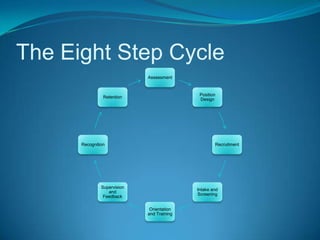
The Eight Step Cycle
A Word About: Risk ManagementRisk management is about minimizing the potential for harm to your participants, your volunteers, your staff and your organizationIt is the essential, overarching component of all volunteer management No program will ever be risk freeThere are steps you can and MUST take to protect everyone.
You Minimize Risk When:You have a program which supports and is prepared for utilization of volunteers
All volunteers are valued for their skills and contributions and are treated fairly – avoid favouritism – it will poison your program
You ensure your volunteers have a sound understanding of the organization, it’s structure and mission
You ensure your volunteer’s background, personal goals, skill sets, certifications and training match the job you have asked them to do
Your volunteers understand the goals and objectives of the program and are well trained and equippedYou Minimize Risk When:You give volunteers constructive feedback about, and recognition for the work they doYou give volunteers a reason to continue with your organizationYou maintain accurate records for each volunteer, including all administrative paperwork, communication, jobs assigned, hours worked, performance assessment, feedback and recognition given
AssessmentIs the Centre ready to utilize volunteers?Is the job appropriate for a volunteer?Are there volunteers available?
Position DesignTitleDate, time and location of eventSupervisor’s name and contact informationEmergency contact information, especially if after hoursDetailed description of responsibilities, as well as limits of authorityTraits required for the jobList of things to be provided by volunteer
Position DesignStatement of cost reimbursementDate, time and location of trainingWhere and when to pick up and return money, supplies, equipment etcBenefits to the volunteerThis information is compiled into a Position description which is read and signed by the volunteer
RecruitmentIt is easier and more cost effective to retain and retrain the volunteers you have than to recruit new ones.
Share your volunteer needs with your volunteers and AC members
Consider which demographic might fulfill your volunteer needs based on your position description
Where do you find that demographic?
Write your ads for that demographic and post where they will be seen by that demographic
Always present a problem, with the reader as the potential solutionIntake and ScreeningPrepare an intake document package.  Include a Centre brochure if you have one, a letter of welcome outlining how volunteer’s efforts impact the community, a volunteer application or profile for them to fill out and, along with your contact information,  a request for them to return it to you.  When someone drops by, or calls, make sure you have packages ready to hand out (or send out, or e-mail) and that others know where they are.  Get the information out immediately.
Intake and ScreeningThere are 22 different levels of screening for potential volunteersThe level of screening depends on the level of risk posed by volunteer involvement in an activityAll potential volunteers should be interviewed using a basic question listHigh risk volunteers may require reference checks, police security clearances and moreSecurity clearances are conducted through the MFSP Manager
Intake InterviewUse a standard question format, a sample of which is included in the Volunteer Management ManualThis is your opportunity to see how the potential volunteer presents themselves and to get a sense of whether they would be a good fit for the organizationLet them do most of the talking, this is not an orientation session.If they do not seem to be a good fit, you do not have to accept them as a volunteer.  Filling out the application does not guarantee them a “job”!

The Volunteer Management Cycle

  • 1.
    The Volunteer ManagementCycleEight Steps (and 20 slides) to Ecstatically Happy, Supportive Volunteers
  • 2.
    Role of theManager of Volunteers In simple terms, the role of the Manger of Volunteer Resources is to ensure the right person is available for the right job at the right time and is ready, willing and able to fulfill their duties.
  • 3.
  • 4.
    A Word About:Risk ManagementRisk management is about minimizing the potential for harm to your participants, your volunteers, your staff and your organizationIt is the essential, overarching component of all volunteer management No program will ever be risk freeThere are steps you can and MUST take to protect everyone.
  • 5.
    You Minimize RiskWhen:You have a program which supports and is prepared for utilization of volunteers
  • 6.
    All volunteers arevalued for their skills and contributions and are treated fairly – avoid favouritism – it will poison your program
  • 7.
    You ensure yourvolunteers have a sound understanding of the organization, it’s structure and mission
  • 8.
    You ensure yourvolunteer’s background, personal goals, skill sets, certifications and training match the job you have asked them to do
  • 9.
    Your volunteers understandthe goals and objectives of the program and are well trained and equippedYou Minimize Risk When:You give volunteers constructive feedback about, and recognition for the work they doYou give volunteers a reason to continue with your organizationYou maintain accurate records for each volunteer, including all administrative paperwork, communication, jobs assigned, hours worked, performance assessment, feedback and recognition given
  • 10.
    AssessmentIs the Centreready to utilize volunteers?Is the job appropriate for a volunteer?Are there volunteers available?
  • 11.
    Position DesignTitleDate, timeand location of eventSupervisor’s name and contact informationEmergency contact information, especially if after hoursDetailed description of responsibilities, as well as limits of authorityTraits required for the jobList of things to be provided by volunteer
  • 12.
    Position DesignStatement ofcost reimbursementDate, time and location of trainingWhere and when to pick up and return money, supplies, equipment etcBenefits to the volunteerThis information is compiled into a Position description which is read and signed by the volunteer
  • 13.
    RecruitmentIt is easierand more cost effective to retain and retrain the volunteers you have than to recruit new ones.
  • 14.
    Share your volunteerneeds with your volunteers and AC members
  • 15.
    Consider which demographicmight fulfill your volunteer needs based on your position description
  • 16.
    Where do youfind that demographic?
  • 17.
    Write your adsfor that demographic and post where they will be seen by that demographic
  • 18.
    Always present aproblem, with the reader as the potential solutionIntake and ScreeningPrepare an intake document package. Include a Centre brochure if you have one, a letter of welcome outlining how volunteer’s efforts impact the community, a volunteer application or profile for them to fill out and, along with your contact information, a request for them to return it to you. When someone drops by, or calls, make sure you have packages ready to hand out (or send out, or e-mail) and that others know where they are. Get the information out immediately.
  • 19.
    Intake and ScreeningThereare 22 different levels of screening for potential volunteersThe level of screening depends on the level of risk posed by volunteer involvement in an activityAll potential volunteers should be interviewed using a basic question listHigh risk volunteers may require reference checks, police security clearances and moreSecurity clearances are conducted through the MFSP Manager
  • 20.
    Intake InterviewUse astandard question format, a sample of which is included in the Volunteer Management ManualThis is your opportunity to see how the potential volunteer presents themselves and to get a sense of whether they would be a good fit for the organizationLet them do most of the talking, this is not an orientation session.If they do not seem to be a good fit, you do not have to accept them as a volunteer. Filling out the application does not guarantee them a “job”!

Editor's Notes

  • #2 Slide 1In order to get to know where everyone is at, I’d like each of you to tell me four things:Tell us about one place you have volunteeredWas it a good experience Why or why notWhat kind of volunteer management experience you haveWho is willing to go first? Give this person a magnet!Talk about Airman’s Attic experience and how their situation may be a result of poor volunteer management.Today we are going to talk about the basics of the Volunteer Management Cycle. There will be lots of time for you to ask specific questions about dealing with volunteers. Click
  • #3 Slide 2 ClickVolunteer programs can be delivered in two ways:By a Manager of Volunteers who handles the entire program, orBy each Program Coordinator If there are several Program Coordinators in an office, you have to be sure you are not competing for volunteers, annoying them with multiple requests etc. It would also be preferable for their to one database in order to track one volunteer’s activities completely and accurately.Click
  • #4 Slide 3There are 8 basic components to Volunteer ManagementClick
  • #5 Slide 4What do you think the biggest liability issues are in utilizing volunteers? Myth: Injury to the volunteer. You must also consider the potential harm a volunteer can do to both program participants and the reputation and financial wellbeing of the organization. Where does risk come from? Something as simple as not being prepared when a volunteer shows up to help, not providing the information they need to do a job, not matching them with the right job, not screening them properly etc. Every step in the volunteer management cycle should be approached with risk management as the main goal.Click through entries
  • #6 Slide 5Click through entriesFavouritism can be overt or subtle. It might involve calling one volunteer all the time and not calling someone else equally qualified, or it might involve a demonstration of your personal, friendly relationship in front of other volunteers. Keep your personal relationships on personal time.
  • #7 Slide 6Click through entries
  • #8  Break into groups of six –Have groups designate one person as the note taker/presenter. Give them 7 minutes to list the things which should be included in the assessment of readiness for volunteer engagement.Return and create a master list from each groups input.Reward the note taker presenter in each group with a magnetIs the Centre ready to utilize volunteers?Volunteers are not free. Are there adequate physical, technical and financial and staffing resources available to support volunteers?Policies in place, space for them to work, insurance coverage etcVolunteers must never replace a paid staff memberAre the staff prepared and available to work with volunteers? Of course we all know that volunteers must be made feel welcome and valued in spite of personality clashes and that as professionals and community leaders, we are expected to demonstrate this.Click through entries
  • #9 Slide 8Once you have decided an activity is an appropriate one for volunteer involvement, the next step is to design the position. Consider what kinds of qualities the volunteer will be required to have, including: availability, desire to fulfill this particular role (they might be the perfect fit but not interested), physical capabilities, matching skill sets, personality traits such as patience, creativity etc. Click through entries on slide 8 and 9
  • #10 Slide 9Click through entriesThere is a sample position description in the Volunteer Management Manual. A position description bank may prove helpful.
  • #11 Slide 10So now you are clear about what you would like your volunteer to do, how do you find one? Read the Recruitment motivation piece.Click through entries
  • #12 Slide 11Okay, you’ve got a live one, what do you do now? Be cautiously optimistic. Many people who request information about volunteering or a volunteer application never follow through. If they do, call within 24 hours of receiving their application to set a date for them to come in and talk to you.
  • #13 Slide 12Click through entriesScreening is serious business.
  • #14 Slide 13Click through entriesPeople can look good on paper and sound great on the phone, but until you see them face to face it is difficult to make any sound judgment. EVERYONE should go through an intake interview.Be honest and let them know that you appreciate their interest, but do not have anything suitable to match them with. If there is a deficit in skills, time avaiability etc, let them know. If they would be a great volunteer, they may be worth investing in training! Also, consider other ways they might participate.Always be aware that your potential volunteer WILL talk to others about their experience with you. That can be beneficial or detrimental to your program. Volunteers are your best source for recruiting new volunteers!
  • #15 Slide 14What is the difference between these two? Click3. Talk about the Run for the Cure experience
  • #16 Slide 15Click through entriesWhen providing feedback, talk about areas of strength as well as areas needing improvement. Try phrases like – “I would like to see you…” Eliminate the word “but” from your vocabulary – it negates everything that came before it.
  • #17 Slide 16Click 1 What is the difference between these two? Which is the most important?Click 2 How do you find out how a volunteer likes to be thanked? If you were going to learn to fly a plane…To enter flying competitionTo teach othersBecause you like to learn new thingsClick 3 Give event specific thanks at the event if possible, but NOT if it creates a problem – ie getting a paper certificate when you are doing massage in a park and you have greasy hands and no where to put it so it won’t get scrunched! Mail out letter and card within a week of the event. You can have a volunteer who is not involve with the event help you with this!Has anyone received thanks as a volunteer or been to a volunteer appreciation event that was particularly good or bad?Brainstorm events that are beyond the same old boring lunch or dinner
  • #18 Slide 17To restate what we said at the start, it is easier and more cost effective to retain and retrain volunteers than to recruit new ones. We have come full circle.Click through entries
  • #19 Slide 18Click through entries
  • #20 Slide 19Has anyone had experience with volunteers either not showing up or not performing their jobs? How did you handle it? What was the result?You will reduce the potential for problems if your recruitment screening and training components are carried out properly.Still, sometimes, people surprise you and behave in unexpected ways.Exercise – Divide into four groups – each group to appoint a note taker/presenter solve a problem and share the answer. You have 7 minutesClick through entries