Blacks In Movies and Television In the 20th Century
A Crash Course Introduction Brought to You by  Ethan Thomas
This Guy
The Beginning
 
This film by D.W. Griffith conveyed the theme that the down fall to society would occur if blacks were equal to whites .
Stepin Fetchit  ( Lincoln Theodore Monroe Andrew Perry)   An African American performer who became popular in the 20 and 30’s.
In his movies, Fetchit would bank in on performances that portrayed blacks as dumb, lazy, with little to no ambition .
Lena Horn was the woman that was able to find the roles that portrayed African American woman with honest interpretations.   Lena Horn
Her Movies
Paul Robeson made forward strides in choosing roles that had honest portrayals of African American men through out the 30’s and 40’s. Most roles played by blacks at this time were that of servants or characters living under the sharecropper system.  Paul Robeson
His Movies
The Cartoons
Many cartoon corporations would create racist depictions of African Americans through out the 30’s and 40’s
And a Racist Bugs Bunny Cartoon Little Black Sambo
From the movie Swing Time Blackface characters would also add to the oppressive climate.
Civil Rights Era
Racist Cartoons and shows like Amos & Andy, were banned by the mid to late 1960’s in large by pressuring from the NAACP filing complaints and forming viewer boycotts.
Diahann Carroll Diahann Carroll would follow up Lena Horn with positive African American female roles in the 50’s and 60’s.
Notable Films
Sydney Poitier Sydney Poitier would continue Paul Robeson’s legacy of portraying African American men in honest roles.
A Few of Poitier’s Films
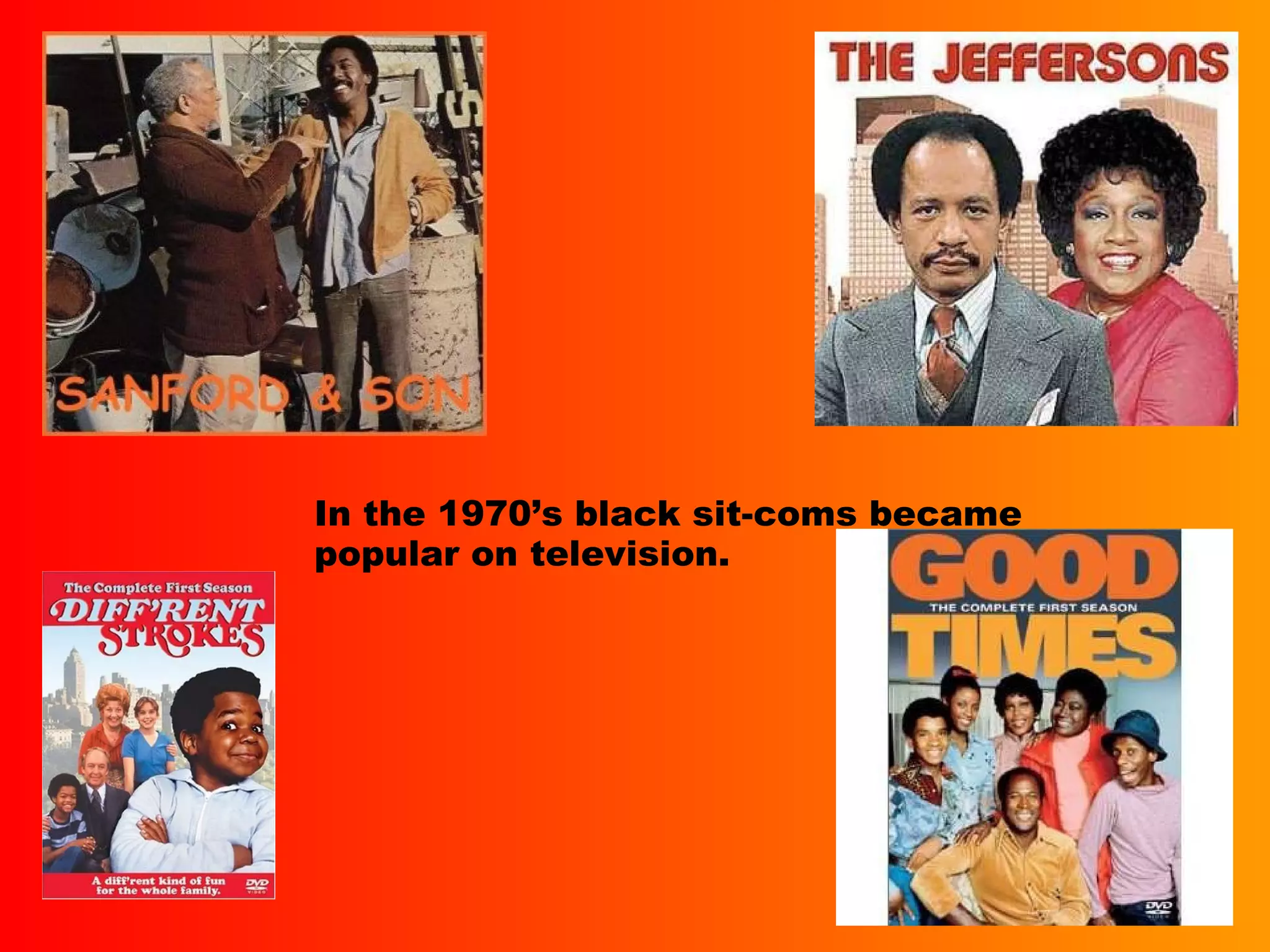
In the 1970’s black sit-coms became popular on television.
Despite the accomplishment of having shows revolve around people of color, old Minstrel archetypes, Mammy and the Coon, could be seen in certain characters.
Zip Coon  The character made a mockery of free blacks. An arrogant, ostentatious figure, he dressed in high style and spoke inappropriately. He also used puns that undermined his attempts to appear dignified. Mammy The character is defined as a source of earthy wisdom who is fiercely independent and brooks no backtalk. Although her image has changed a little over the years, the stereotype lives on. Her face can still be found on pancake boxes today.
Blacksploitation
In the 70’s, Blacksploitation movies would be the dominant source of African American Films. Despite the desire to have people of color in leading roles the stereotypes overshadowed this accomplishment. These movies were heavy on graphic sex scenes, violence, and stereotyped black men as  pimps, black women as whores, and criminals.
The films eventually generated a backlash led by Black leaders that put an end to Blacksploitation films by 1980. (Padgett)
In the late 80’s and early 90’s, movies such as  Glory ,  Do the Right Thing,  and  Boyz N the Hood  would create a change by showing a side of black history as well as inner city street life many Americans were not use to witnessing on film.
 
In the late 80’s, Bill Cosby would recreate the Cosby Show. Following this show would be a series of Black sit-coms in the 90’s
The Parent Hood These shows would continue to strive for positive African American depictions, but still use minstrel archetypes to create a marketable program.
Halle Berry and Denzel Washington would be the two actors of this generation to find honest African American roles portrayed in the movies.
So what does all this mean for a person of color like myself going into the film business?
If I were asked by a writer, director, or producer to do this I cold voice a compliant…   NOTE: As an intelligent audience understand the purpose of the following slides are not to incriminate as much as they are to raise awareness.
Not based on this
Nor this
Maybe this (Monkey is a derogatory term for a black person)
Definitely not okay .
A bit out dated?
So is this Jim Crow character
Okay
Pushing it
no
NO
NOOOOOOO!!!
I think the point has been made. Thank you for joining me  on this trip through black films in the 20th century.
Johnson, Allan G.  Privilege, Power, and Difference .  2nd ed.  New York,NY: McGraw-Hill, 2006. Print. Padgett, Kenneth. (n.d.).  Blackface! -the history of  racist  blackface stereotypes .  Retrieved from  black-face.com Smith, Jessie Carney. (2003).  Black firsts . Canton, MI:  Visible Ink Press.

Blacks in film and television 20th century

  • 1.
    Blacks In Moviesand Television In the 20th Century
  • 2.
    A Crash CourseIntroduction Brought to You by Ethan Thomas
  • 3.
  • 4.
  • 5.
  • 6.
    This film byD.W. Griffith conveyed the theme that the down fall to society would occur if blacks were equal to whites .
  • 7.
    Stepin Fetchit ( Lincoln Theodore Monroe Andrew Perry) An African American performer who became popular in the 20 and 30’s.
  • 8.
    In his movies,Fetchit would bank in on performances that portrayed blacks as dumb, lazy, with little to no ambition .
  • 9.
    Lena Horn wasthe woman that was able to find the roles that portrayed African American woman with honest interpretations. Lena Horn
  • 10.
  • 11.
    Paul Robeson madeforward strides in choosing roles that had honest portrayals of African American men through out the 30’s and 40’s. Most roles played by blacks at this time were that of servants or characters living under the sharecropper system. Paul Robeson
  • 12.
  • 13.
  • 14.
    Many cartoon corporationswould create racist depictions of African Americans through out the 30’s and 40’s
  • 15.
    And a RacistBugs Bunny Cartoon Little Black Sambo
  • 16.
    From the movieSwing Time Blackface characters would also add to the oppressive climate.
  • 17.
  • 18.
    Racist Cartoons andshows like Amos & Andy, were banned by the mid to late 1960’s in large by pressuring from the NAACP filing complaints and forming viewer boycotts.
  • 19.
    Diahann Carroll DiahannCarroll would follow up Lena Horn with positive African American female roles in the 50’s and 60’s.
  • 20.
  • 21.
    Sydney Poitier SydneyPoitier would continue Paul Robeson’s legacy of portraying African American men in honest roles.
  • 22.
    A Few ofPoitier’s Films
  • 23.
    In the 1970’sblack sit-coms became popular on television.
  • 24.
    Despite the accomplishmentof having shows revolve around people of color, old Minstrel archetypes, Mammy and the Coon, could be seen in certain characters.
  • 25.
    Zip Coon The character made a mockery of free blacks. An arrogant, ostentatious figure, he dressed in high style and spoke inappropriately. He also used puns that undermined his attempts to appear dignified. Mammy The character is defined as a source of earthy wisdom who is fiercely independent and brooks no backtalk. Although her image has changed a little over the years, the stereotype lives on. Her face can still be found on pancake boxes today.
  • 26.
  • 27.
    In the 70’s,Blacksploitation movies would be the dominant source of African American Films. Despite the desire to have people of color in leading roles the stereotypes overshadowed this accomplishment. These movies were heavy on graphic sex scenes, violence, and stereotyped black men as pimps, black women as whores, and criminals.
  • 28.
    The films eventuallygenerated a backlash led by Black leaders that put an end to Blacksploitation films by 1980. (Padgett)
  • 29.
    In the late80’s and early 90’s, movies such as Glory , Do the Right Thing, and Boyz N the Hood would create a change by showing a side of black history as well as inner city street life many Americans were not use to witnessing on film.
  • 30.
  • 31.
    In the late80’s, Bill Cosby would recreate the Cosby Show. Following this show would be a series of Black sit-coms in the 90’s
  • 32.
    The Parent HoodThese shows would continue to strive for positive African American depictions, but still use minstrel archetypes to create a marketable program.
  • 33.
    Halle Berry andDenzel Washington would be the two actors of this generation to find honest African American roles portrayed in the movies.
  • 34.
    So what doesall this mean for a person of color like myself going into the film business?
  • 35.
    If I wereasked by a writer, director, or producer to do this I cold voice a compliant… NOTE: As an intelligent audience understand the purpose of the following slides are not to incriminate as much as they are to raise awareness.
  • 36.
  • 37.
  • 38.
    Maybe this (Monkeyis a derogatory term for a black person)
  • 39.
  • 40.
    A bit outdated?
  • 41.
    So is thisJim Crow character
  • 42.
  • 43.
  • 44.
  • 45.
  • 46.
  • 47.
    I think thepoint has been made. Thank you for joining me on this trip through black films in the 20th century.
  • 48.
    Johnson, Allan G. Privilege, Power, and Difference . 2nd ed. New York,NY: McGraw-Hill, 2006. Print. Padgett, Kenneth. (n.d.). Blackface! -the history of racist blackface stereotypes . Retrieved from black-face.com Smith, Jessie Carney. (2003). Black firsts . Canton, MI: Visible Ink Press.