Creating a comprehensive library
service –
getting the equality duty right
SUE CHARTERIS for Local Government Association
SEPTEMBER 2013
Introduction
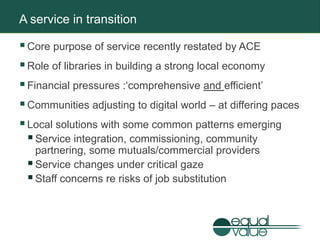
A service in transition

 Core purpose of service recently restated by ACE
 Role of libraries in building a strong local economy
 Financial pressures :‘comprehensive and efficient’
 Communities adjusting to digital world – at differing paces
 Local solutions with some common patterns emerging
 Service integration, commissioning, community
partnering, some mutuals/commercial providers
 Service changes under critical gaze
 Staff concerns re risks of job substitution
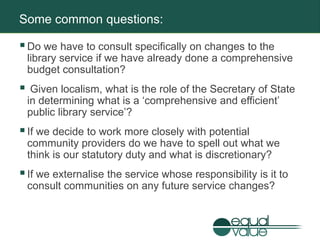
Some common questions:

 Do we have to consult specifically on changes to the
library service if we have already done a comprehensive
budget consultation?



Given localism, what is the role of the Secretary of State
in determining what is a ‘comprehensive and efficient’
public library service’?

 If we decide to work more closely with potential
community providers do we have to spell out what we
think is our statutory duty and what is discretionary?

 If we externalise the service whose responsibility is it to
consult communities on any future service changes?
Navigating the hybrid legal framework

 Public Libraries and Museums Act 1964
 The Best Value Duty- 2011 guidance

 Localism Act 2011
 Equality Act 2010 – S.149 Public Sector Equality Duty
 Judicial Reviews:
 Courts understand council’s obligations to make savings
to balance the books. But, getting both the equality duty
and best value duties right are proving key to sound
decisions
Click to edit Master title style


Click to edit Master text styles



Second level



Third level



Fourth level



Fifth level
Learning from Judicial reviews 1:

 The courts will examine the process you have gone
through

 Clearly document all factors in your considerations
 The equality duty requires you to ‘have regard to the

needs of protected groups’(which may be different)…’
so,this will require a thorough needs assessment

 Duty needs to be addressed throughout, and be

‘embedded in the process’- with substance and rigour

 Lawyers describe this as ‘ directing the mind’ to … It’s not
enough to act on your experience, inherent local
knowledge and ‘nous’
Learning from Judicial reviews 2:

 Do a thorough analysis of local need- do not ‘assume’
Consultation needs to be:

 ‘At a time when proposals are still at a formative stage
 The proposer must give sufficient reasons for any
proposal to enable intelligent consideration and response

 Adequate time must be given for consideration and
response

 The product of consultation must be conscientiously
taken into account in finalising any proposals’
Brent LBC ex parte Gunning (1985) 84 LGR 168
In applying the equality duty 1

 Consider the

potential impact of changes on all protected
groups, but not to the point of being over – literal ( Brent
judgement)

Worked Example:

 Lambeth Council’s Libraries Commission was provided with
evidence on:

 Usage analysed by race, gender, disability, age, sexual
orientation per catchment area

 The council used

this data and an analysis of borough wide
needs to do an analysis of comparative geographic need to
best ‘ understand the implications of any relocation of library
facilities on vulnerable communities within Lambeth
In applying the equality duty 2

 The 9 data sets used by Lambeth were:
 GCSE attainment
 Indices of multiple deprivation, heath domain data etc
aggregated to ward level
 IMD crime data
 Perception data including satisfaction with the local area as
a place to live and percentage of people getting on well with
one another
 Unemployment rates at ward level
 Free school meals
 Accessibility of the ward- analysed by public transport
Clearly in many areas rurality and broadband coverage would
be big considerations
Practical learning from councils’ experience 1

 Develop a library strategy that includes
 A clear vision for your library service
 What you want the service to achieve
 How you propose to deliver? taking into account:
 How well it meets local needs, both now and in the
future, drawing on documented evidence you hold
locally*, as well as members and officers’ local
knowledge,
 Equality impact assess your proposals and the impact
on all ‘protected groups’ specified in the Act and also
use this combined evidence to think about:
Click to edit Master title style


Click to edit Master text styles



Second level



Third level



Fourth level



Fifth level
Practical learning from councils’ experience 2



Whether there may be better ways of meeting local needs,
including those in your most disadvantaged communities,
bearing in mind the £ and staff capacity available, then,



Having considered what you need to do to meet your statutory
requirements;

 Inform communities and consult widely on options and on
specific opportunities

 Give time for communities to generate (alternative or
complementary)proposals



Involve staff and trades unions in generating options
Practical learning from councils’ experience 3



Stay on the front foot in communicating – being
prepared to adapt your proposals in the light of feedback
is key to securing genuine consultation and involvement



Build this into your timescale for change, recognising
the need for a period of transition.
Thank you! suecharteris@equalvalue.org
Sources of information

 ACE: Envisioning the Future of the Library Service
 http://www.artscouncil.org.uk/media/uploads/pdf/The_library_of
_the_future_May_2013.pdf

 ACE: Community Libraries
 http://www.artscouncil.org.uk/media/uploads/pdf/Community_li
braries_research_2013_guiding_principles.pdf

 LGA: Local Solutions for Public Libraries Services
 http://www.local.gov.uk/web/guest/publications/-

/journal_content/56/10171/3639438/PUBLICATIONTEMPLATE

 Public Libraries News:http://www.publiclibrariesnews.com
Reading and sources of support


Envisioning the Future of the Libraries Service



Community Libraries



LGA Practice site



LGA document 2011?

Creating a Comprehensive Library Service - Getting the Equality Duty Right (Sept 2013)

  • 1.
    Creating a comprehensivelibrary service – getting the equality duty right SUE CHARTERIS for Local Government Association SEPTEMBER 2013
  • 2.
  • 3.
    A service intransition  Core purpose of service recently restated by ACE  Role of libraries in building a strong local economy  Financial pressures :‘comprehensive and efficient’  Communities adjusting to digital world – at differing paces  Local solutions with some common patterns emerging  Service integration, commissioning, community partnering, some mutuals/commercial providers  Service changes under critical gaze  Staff concerns re risks of job substitution
  • 4.
    Some common questions: Do we have to consult specifically on changes to the library service if we have already done a comprehensive budget consultation?  Given localism, what is the role of the Secretary of State in determining what is a ‘comprehensive and efficient’ public library service’?  If we decide to work more closely with potential community providers do we have to spell out what we think is our statutory duty and what is discretionary?  If we externalise the service whose responsibility is it to consult communities on any future service changes?
  • 5.
    Navigating the hybridlegal framework  Public Libraries and Museums Act 1964  The Best Value Duty- 2011 guidance  Localism Act 2011  Equality Act 2010 – S.149 Public Sector Equality Duty  Judicial Reviews:  Courts understand council’s obligations to make savings to balance the books. But, getting both the equality duty and best value duties right are proving key to sound decisions
  • 6.
    Click to editMaster title style  Click to edit Master text styles  Second level  Third level  Fourth level  Fifth level
  • 7.
    Learning from Judicialreviews 1:  The courts will examine the process you have gone through  Clearly document all factors in your considerations  The equality duty requires you to ‘have regard to the needs of protected groups’(which may be different)…’ so,this will require a thorough needs assessment  Duty needs to be addressed throughout, and be ‘embedded in the process’- with substance and rigour  Lawyers describe this as ‘ directing the mind’ to … It’s not enough to act on your experience, inherent local knowledge and ‘nous’
  • 8.
    Learning from Judicialreviews 2:  Do a thorough analysis of local need- do not ‘assume’ Consultation needs to be:  ‘At a time when proposals are still at a formative stage  The proposer must give sufficient reasons for any proposal to enable intelligent consideration and response  Adequate time must be given for consideration and response  The product of consultation must be conscientiously taken into account in finalising any proposals’ Brent LBC ex parte Gunning (1985) 84 LGR 168
  • 9.
    In applying theequality duty 1  Consider the potential impact of changes on all protected groups, but not to the point of being over – literal ( Brent judgement) Worked Example:  Lambeth Council’s Libraries Commission was provided with evidence on:  Usage analysed by race, gender, disability, age, sexual orientation per catchment area  The council used this data and an analysis of borough wide needs to do an analysis of comparative geographic need to best ‘ understand the implications of any relocation of library facilities on vulnerable communities within Lambeth
  • 10.
    In applying theequality duty 2  The 9 data sets used by Lambeth were:  GCSE attainment  Indices of multiple deprivation, heath domain data etc aggregated to ward level  IMD crime data  Perception data including satisfaction with the local area as a place to live and percentage of people getting on well with one another  Unemployment rates at ward level  Free school meals  Accessibility of the ward- analysed by public transport Clearly in many areas rurality and broadband coverage would be big considerations
  • 11.
    Practical learning fromcouncils’ experience 1  Develop a library strategy that includes  A clear vision for your library service  What you want the service to achieve  How you propose to deliver? taking into account:  How well it meets local needs, both now and in the future, drawing on documented evidence you hold locally*, as well as members and officers’ local knowledge,  Equality impact assess your proposals and the impact on all ‘protected groups’ specified in the Act and also use this combined evidence to think about:
  • 12.
    Click to editMaster title style  Click to edit Master text styles  Second level  Third level  Fourth level  Fifth level
  • 13.
    Practical learning fromcouncils’ experience 2  Whether there may be better ways of meeting local needs, including those in your most disadvantaged communities, bearing in mind the £ and staff capacity available, then,  Having considered what you need to do to meet your statutory requirements;  Inform communities and consult widely on options and on specific opportunities  Give time for communities to generate (alternative or complementary)proposals  Involve staff and trades unions in generating options
  • 14.
    Practical learning fromcouncils’ experience 3  Stay on the front foot in communicating – being prepared to adapt your proposals in the light of feedback is key to securing genuine consultation and involvement  Build this into your timescale for change, recognising the need for a period of transition.
  • 15.
  • 16.
    Sources of information ACE: Envisioning the Future of the Library Service  http://www.artscouncil.org.uk/media/uploads/pdf/The_library_of _the_future_May_2013.pdf  ACE: Community Libraries  http://www.artscouncil.org.uk/media/uploads/pdf/Community_li braries_research_2013_guiding_principles.pdf  LGA: Local Solutions for Public Libraries Services  http://www.local.gov.uk/web/guest/publications/- /journal_content/56/10171/3639438/PUBLICATIONTEMPLATE  Public Libraries News:http://www.publiclibrariesnews.com
  • 17.
    Reading and sourcesof support  Envisioning the Future of the Libraries Service  Community Libraries  LGA Practice site  LGA document 2011?

Editor's Notes

  • #12 As well as , not instead of a community asset strategy that geDisabilityGender reassignmentMarriage and civil partnershipPregnancy and maternityRaceReligion or beliefSex and sexual orientation
  • #14 As well as , not instead of a community asset strategy that
  • #15 As well as , not instead of a community asset strategy that