Unit 1: Unseen
Poetry for GCSE
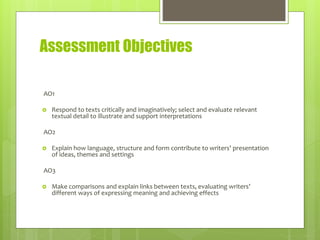
Assessment Objectives
AO1
 Respond to texts critically and imaginatively; select and evaluate relevant
textual detail to illustrate and support interpretations
AO2
 Explain how language, structure and form contribute to writers’ presentation
of ideas, themes and settings
AO3
 Make comparisons and explain links between texts, evaluating writers’
different ways of expressing meaning and achieving effects
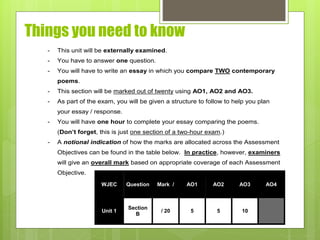
Things you need to know
- This unit will be externally examined.
- You have to answer one question.
- You will have to write an essay in which you compare TWO contemporary
poems.
- This section will be marked out of twenty using AO1, AO2 and AO3.
- As part of the exam, you will be given a structure to follow to help you plan
your essay / response.
- You will have one hour to complete your essay comparing the poems.
(Don’t forget, this is just one section of a two-hour exam.)
- A notional indication of how the marks are allocated across the Assessment
Objectives can be found in the table below. In practice, however, examiners
will give an overall mark based on appropriate coverage of each Assessment
Objective.
WJEC Question Mark / AO1 AO2 AO3 AO4
Unit 1
Section
B
/ 20 5 5 10
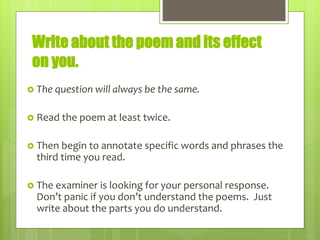
Write about the poem and its effect
on you.
 The question will always be the same.
 Read the poem at least twice.
 Then begin to annotate specific words and phrases the
third time you read.
 The examiner is looking for your personal response.
Don’t panic if you don’t understand the poems. Just
write about the parts you do understand.
Points to think about during these initial readings:
• Take note of the title: it may be perfectly self-
explanatory, or it may carry a deeper meaning. Either
way, it usually gives a useful lead.
• What is the train of thought? The best way to
determine this is to track through systematically,
reading in units of sense, not line by line. It’s usually
useful to read from punctuation mark to punctuation
mark, which will help break the poem into units of
sense.
 NEVER UNDERESTIMATE THE END OF A POEM! Often
the poet’s key message comes towards the end of the
poem, so it’s important to be thorough.
• Is there a specific voice? If so, whose? Poets
sometimes write as if they were a different character (
sometimes called the persona ), although often they
write as themselves, too. In either case, what is the
effect of the voice?
Examiner’s tips
 Is it addressed to someone? Love poems, for example,
sometimes use the second person (“you” ) which can
create a very intimate feeling. If the poem is addressed
to a specific person, what is the effect of this?
 Try asking yourself why the poet wrote the poem.
• What is its mood and atmosphere? Does it change at
all? How do you know? Pinpoint words and phrases
that help create the mood and atmosphere.
• Focus closely on the words used, and their effects.
• What about the way the poem is put together, or
organised - the lengths of lines, significant pauses, the
use of stanzas, any distinctive rhythm or rhyme?
• What is your personal response? Does it, for example,
connect with any of your own experiences or anything
else you’ve read or seen?
 Technical terms, device spotting, counting lines and
alphabetising rhyme schemes are only of any use if they
support your understanding of the poems and the
comparisons between them – and you show this.
 The examiner has endeavoured to choose poems that you
can access and, hopefully, enjoy writing about. Take it
personally!
 You shouldn’t try and count the number of comparisons
you make. More important is to show an understanding of
each poem bearing in mind that there will be some
similarities and differences between them.
 You might react and respond in similar ways towards the
two poems. Or you might feel excited by one – and
depressed by the other. But you must explain why you have
reacted and responded as you have.
How to approach
 Clear introduction compare the overall meaning, mood and
atmosphere in both poems. Perhaps you could talk about the
titles here.
 THREE SECTIONS. (at least two paragraphs within each)
• For each point you make about poem A, link it to poem B
(this will ensure you are constantly hitting AO3)
• Remember to explain how language, structure and form
contribute to writers’ presentation of ideas, themes and
settings (AO2)
• Write in detailed analytical paragraphs.
o Conclusion This is where you can use your ‘I’ voice – what is
the effect of each poem and what do you think each poet
was trying to achieve (writer’s purpose)
5 part
plan
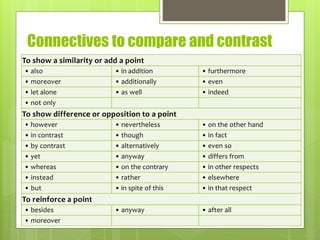
Connectives to compare and contrast
To show a similarity or add a point
• also • in addition • furthermore
• moreover • additionally • even
• let alone • as well • indeed
• not only
To show difference or opposition to a point
• however • nevertheless • on the other hand
• in contrast • though • in fact
• by contrast • alternatively • even so
• yet • anyway • differs from
• whereas • on the contrary • in other respects
• instead • rather • elsewhere
• but • in spite of this • in that respect
To reinforce a point
• besides • anyway • after all
• moreover

Unseen poetry WJEC revision

  • 1.
  • 2.
    Assessment Objectives AO1  Respondto texts critically and imaginatively; select and evaluate relevant textual detail to illustrate and support interpretations AO2  Explain how language, structure and form contribute to writers’ presentation of ideas, themes and settings AO3  Make comparisons and explain links between texts, evaluating writers’ different ways of expressing meaning and achieving effects
  • 3.
    Things you needto know - This unit will be externally examined. - You have to answer one question. - You will have to write an essay in which you compare TWO contemporary poems. - This section will be marked out of twenty using AO1, AO2 and AO3. - As part of the exam, you will be given a structure to follow to help you plan your essay / response. - You will have one hour to complete your essay comparing the poems. (Don’t forget, this is just one section of a two-hour exam.) - A notional indication of how the marks are allocated across the Assessment Objectives can be found in the table below. In practice, however, examiners will give an overall mark based on appropriate coverage of each Assessment Objective. WJEC Question Mark / AO1 AO2 AO3 AO4 Unit 1 Section B / 20 5 5 10
  • 4.
    Write about thepoem and its effect on you.  The question will always be the same.  Read the poem at least twice.  Then begin to annotate specific words and phrases the third time you read.  The examiner is looking for your personal response. Don’t panic if you don’t understand the poems. Just write about the parts you do understand.
  • 5.
    Points to thinkabout during these initial readings: • Take note of the title: it may be perfectly self- explanatory, or it may carry a deeper meaning. Either way, it usually gives a useful lead. • What is the train of thought? The best way to determine this is to track through systematically, reading in units of sense, not line by line. It’s usually useful to read from punctuation mark to punctuation mark, which will help break the poem into units of sense.  NEVER UNDERESTIMATE THE END OF A POEM! Often the poet’s key message comes towards the end of the poem, so it’s important to be thorough. • Is there a specific voice? If so, whose? Poets sometimes write as if they were a different character ( sometimes called the persona ), although often they write as themselves, too. In either case, what is the effect of the voice? Examiner’s tips
  • 6.
     Is itaddressed to someone? Love poems, for example, sometimes use the second person (“you” ) which can create a very intimate feeling. If the poem is addressed to a specific person, what is the effect of this?  Try asking yourself why the poet wrote the poem. • What is its mood and atmosphere? Does it change at all? How do you know? Pinpoint words and phrases that help create the mood and atmosphere. • Focus closely on the words used, and their effects. • What about the way the poem is put together, or organised - the lengths of lines, significant pauses, the use of stanzas, any distinctive rhythm or rhyme? • What is your personal response? Does it, for example, connect with any of your own experiences or anything else you’ve read or seen?
  • 7.
     Technical terms,device spotting, counting lines and alphabetising rhyme schemes are only of any use if they support your understanding of the poems and the comparisons between them – and you show this.  The examiner has endeavoured to choose poems that you can access and, hopefully, enjoy writing about. Take it personally!  You shouldn’t try and count the number of comparisons you make. More important is to show an understanding of each poem bearing in mind that there will be some similarities and differences between them.  You might react and respond in similar ways towards the two poems. Or you might feel excited by one – and depressed by the other. But you must explain why you have reacted and responded as you have.
  • 8.
    How to approach Clear introduction compare the overall meaning, mood and atmosphere in both poems. Perhaps you could talk about the titles here.  THREE SECTIONS. (at least two paragraphs within each) • For each point you make about poem A, link it to poem B (this will ensure you are constantly hitting AO3) • Remember to explain how language, structure and form contribute to writers’ presentation of ideas, themes and settings (AO2) • Write in detailed analytical paragraphs. o Conclusion This is where you can use your ‘I’ voice – what is the effect of each poem and what do you think each poet was trying to achieve (writer’s purpose) 5 part plan
  • 9.
    Connectives to compareand contrast To show a similarity or add a point • also • in addition • furthermore • moreover • additionally • even • let alone • as well • indeed • not only To show difference or opposition to a point • however • nevertheless • on the other hand • in contrast • though • in fact • by contrast • alternatively • even so • yet • anyway • differs from • whereas • on the contrary • in other respects • instead • rather • elsewhere • but • in spite of this • in that respect To reinforce a point • besides • anyway • after all • moreover