



• LO: to understand the social and historical background of the
novel
Starter
What are your impressions of
America?
Write down three
statements.
OF MICE AND MEN
LO: to understand the social
and historical background of
the novel
Context: An introduction to 1920s
America
• The Roaring Twenties / the Jazz Age:
 For many people in America (especially the cities such as New York and Chicago)
the 1920s are years of considerable prosperity. American goods are protected
from competition with imports by high tariffs (customs duties) and Americans
are encouraged to buy American produced consumer products such as cars,
washing machines, refrigerators and radios.
 The consumer goods boom does not affect all people equally. By 1929 over 50%
of Americans earn less than $2000 a year, with 40% below the poverty line.
Black and immigrant workers are particularly likely to be affected by low wages
and unemployment. Farming families are far less likely to enjoy the consumer
boom as many rural areas still have no electricity and small farm incomes drop
dramatically as the price of wheat falls.
Watch this short clip
1. Describe the faces of the people in the film
2. Why were so many of them queuing?
3. What kind of work were the men looking for?
4. How would you describe their lives?
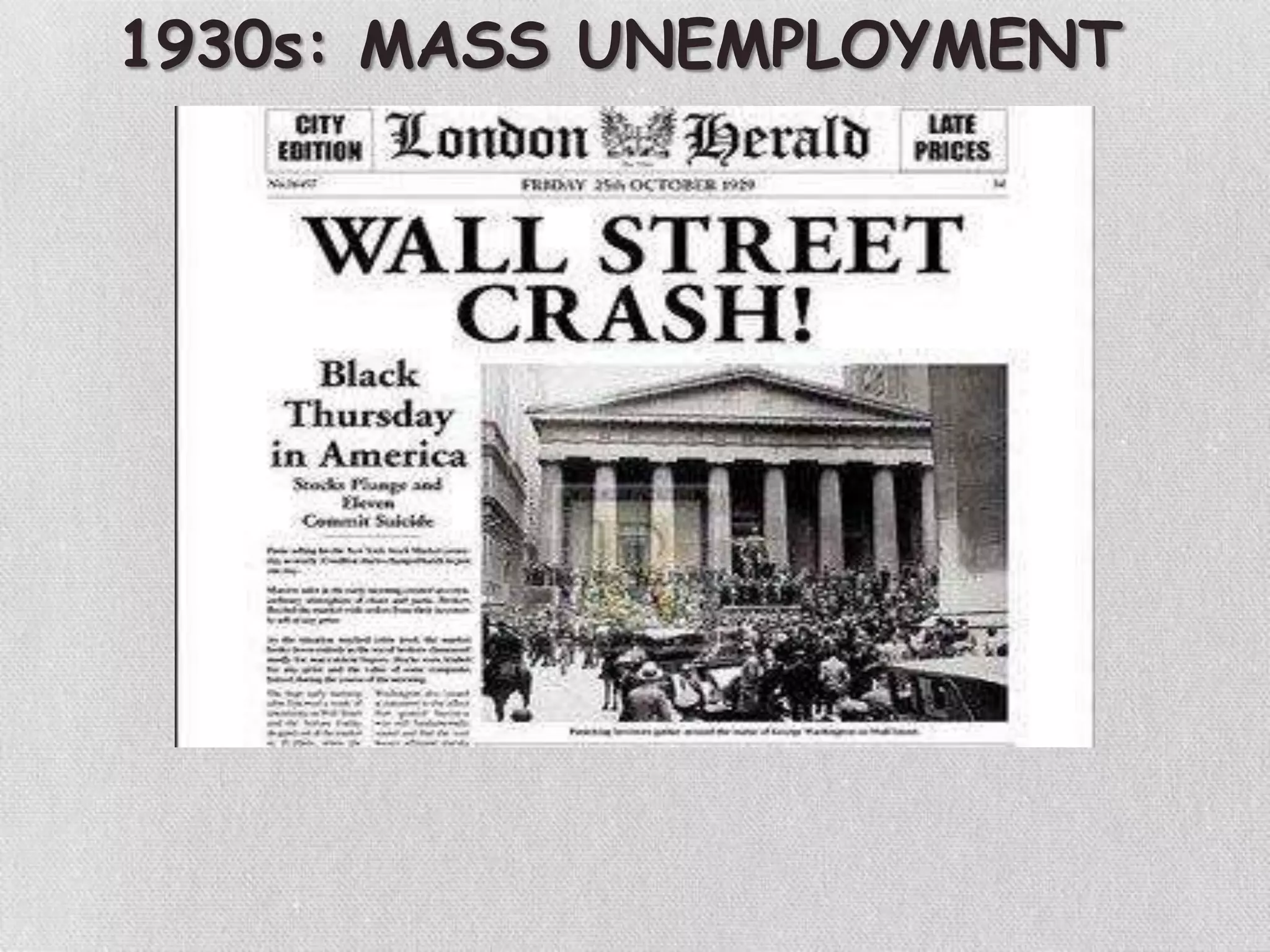
1930s: MASS UNEMPLOYMENT
THE GREAT DEPRESSION!
•On Black Thursday, October 29, 1929, the
stock market crashed, triggering the Great
Depression, the worst economic collapse in
the history of the modern industrial world.
•It spread from the United States to the rest
of the world, lasting from the end of 1929
until the early 1940s. With banks failing and
businesses closing, more than 15 million
Americans (one-quarter of the workforce)
became unemployed.
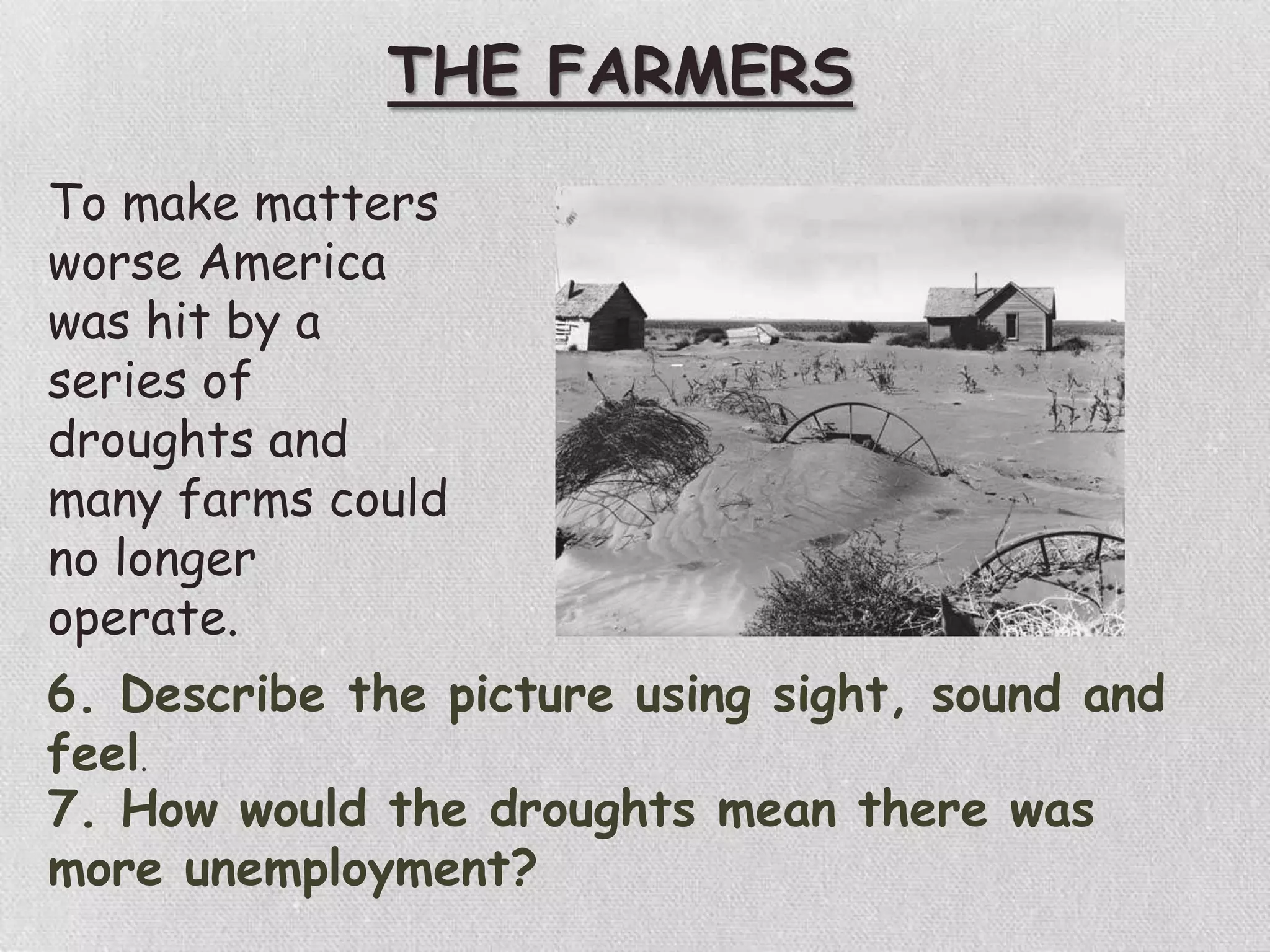
THE FARMERS
To make matters
worse America
was hit by a
series of
droughts and
many farms could
no longer
operate.
6. Describe the picture using sight, sound and
feel.
7. How would the droughts mean there was
more unemployment?
Historical Context
The depression also led to a drop in the
market price of farm crops, which
meant that farmers were forced to
produce more goods in order to earn
the same amount of money.
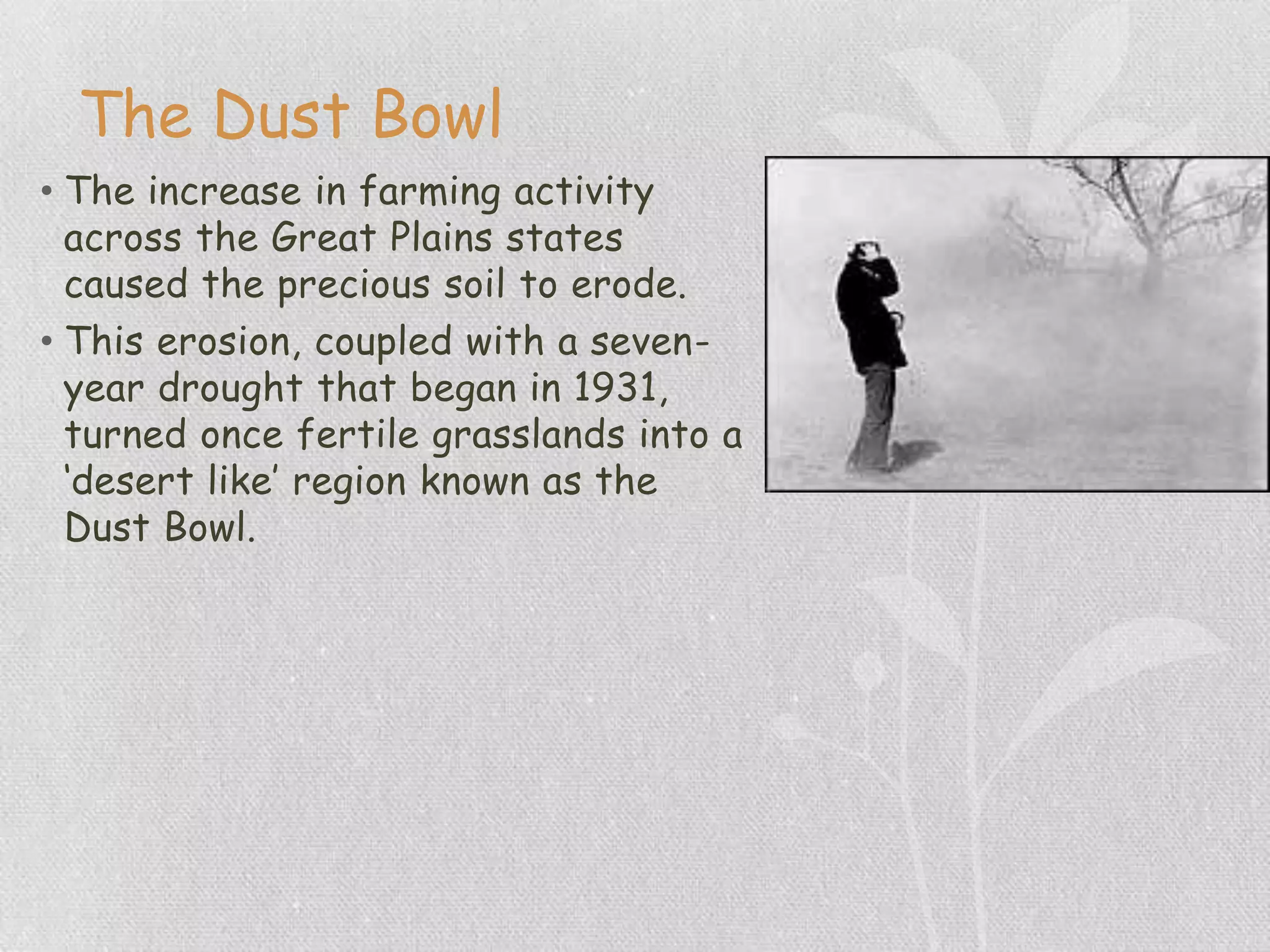
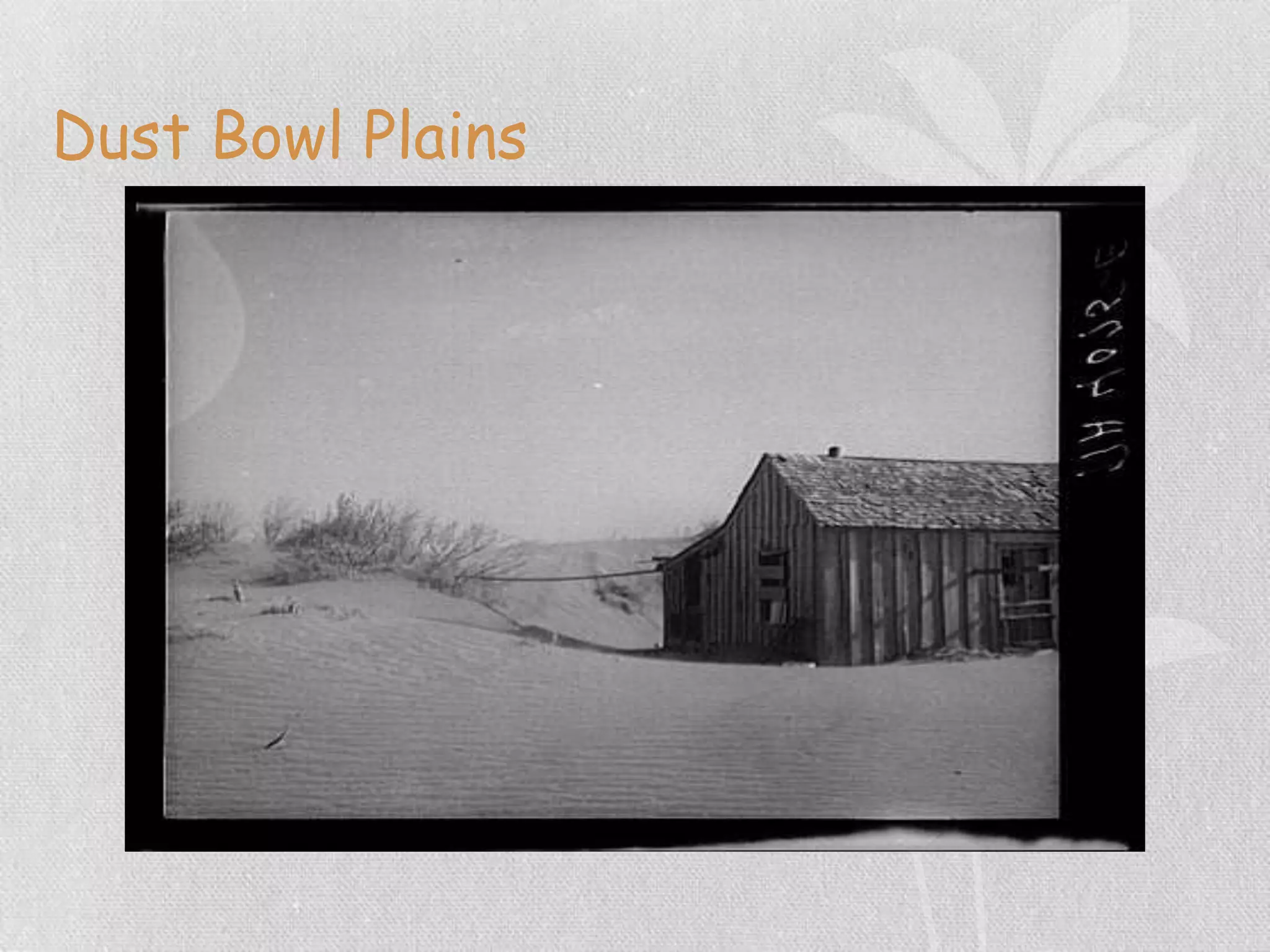
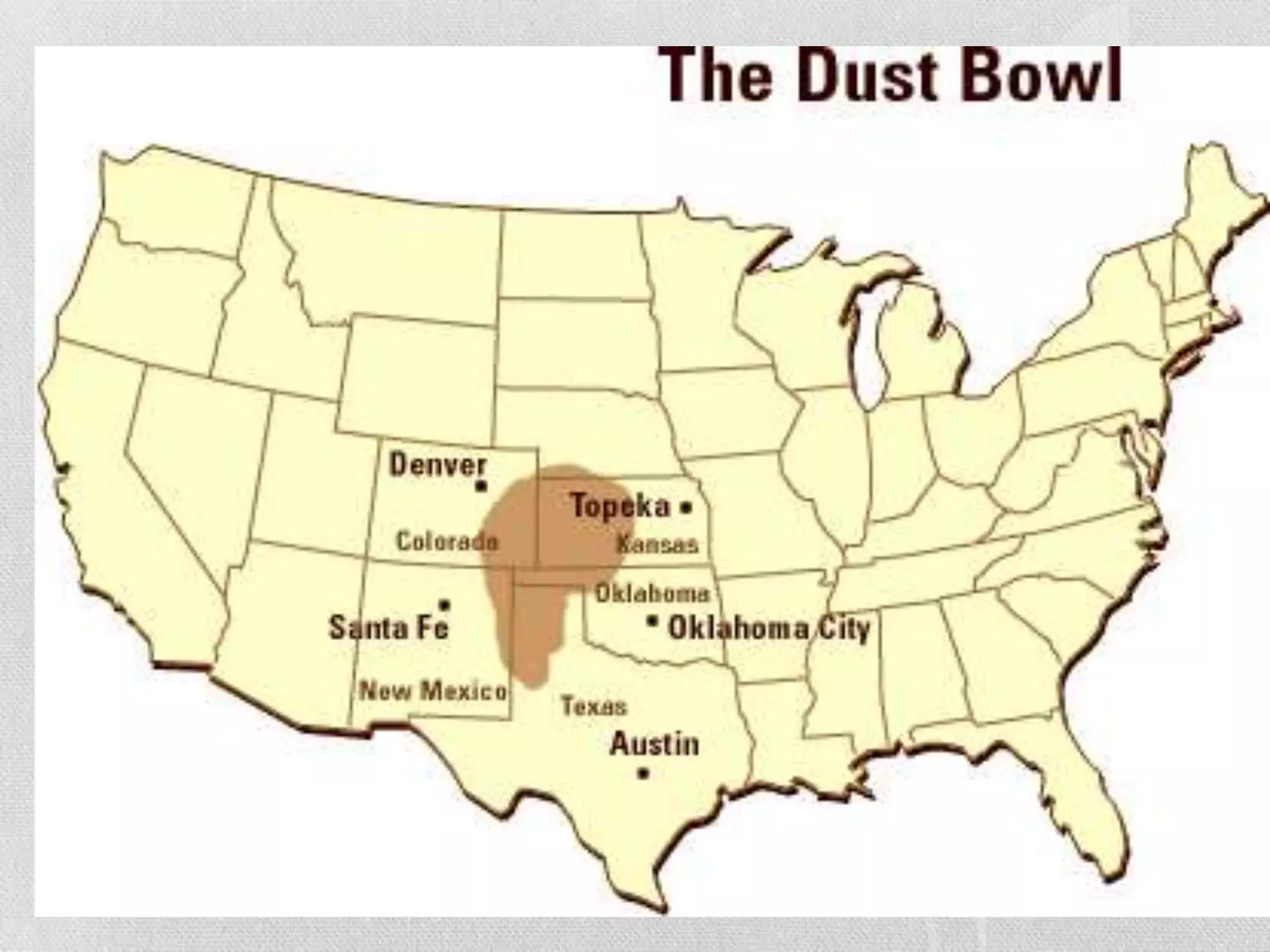
The Dust Bowl
• The increase in farming activity
across the Great Plains states
caused the precious soil to erode.
• This erosion, coupled with a seven-
year drought that began in 1931,
turned once fertile grasslands into a
„desert like‟ region known as the
Dust Bowl.
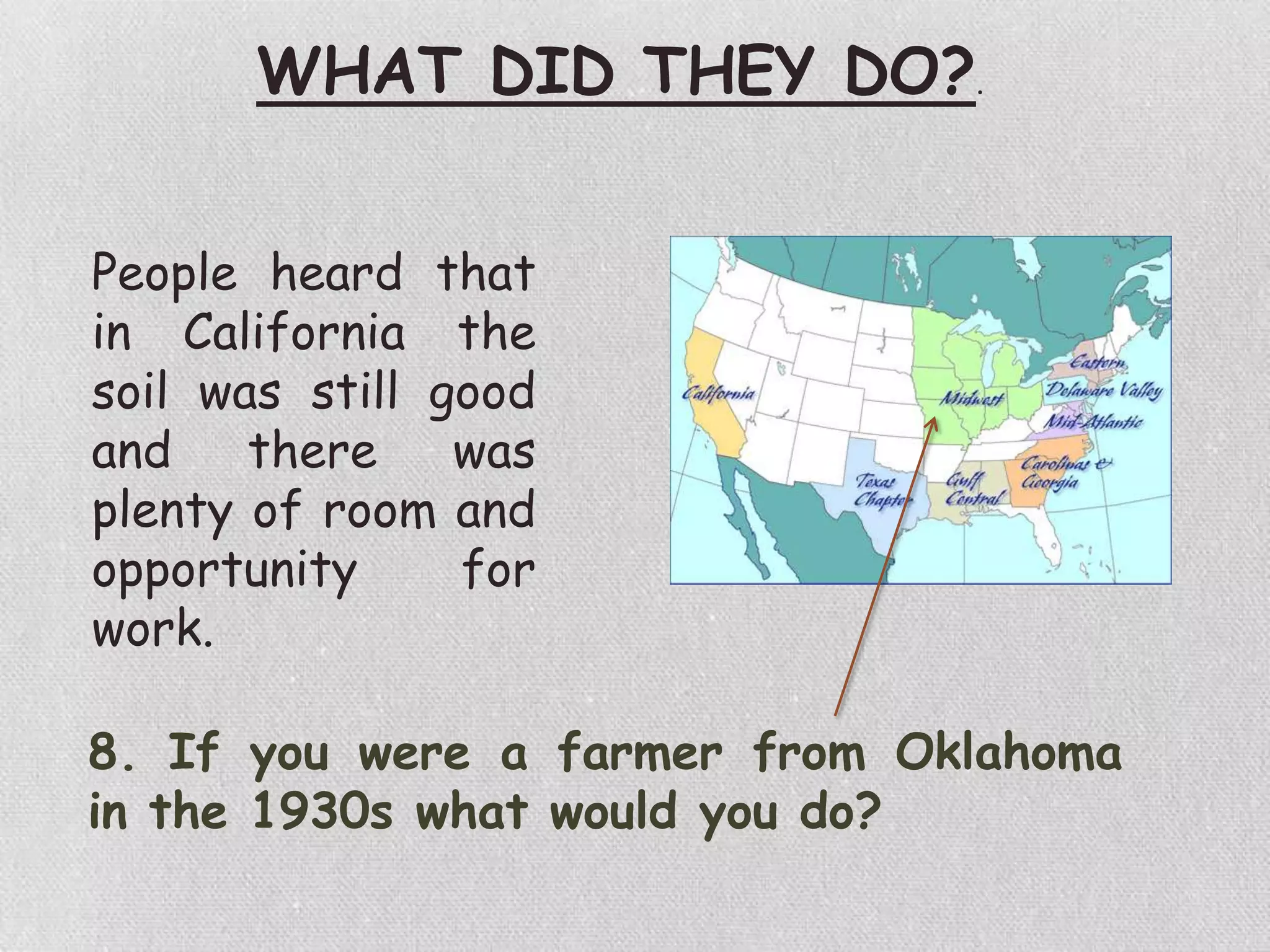
WHAT DID THEY DO?.
People heard that
in California the
soil was still good
and there was
plenty of room and
opportunity for
work.
8. If you were a farmer from Oklahoma
in the 1930s what would you do?
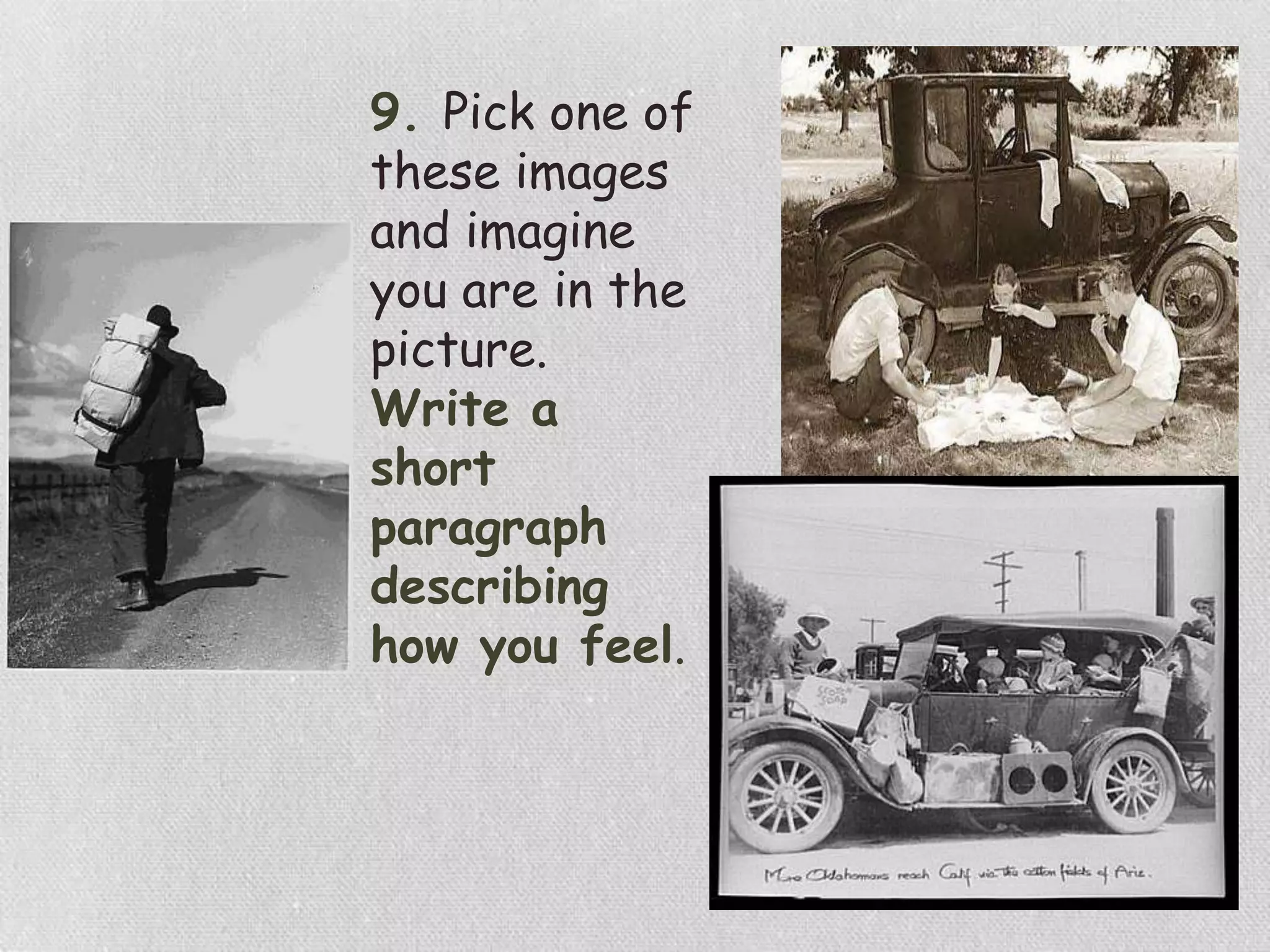
9. Pick one of
these images
and imagine
you are in the
picture.
Write a
short
paragraph
describing
how you feel.
Dust Bowl Plains
The History of Migrant Farmers in
California
•During the Great Depression,
economic and ecological forces (the
Dust Bowl) brought many rural poor
and migrant agricultural workers
from the Great Plains states, such
as Oklahoma, Texas, and Kansas, to
California.
Fill in the gaps…
What is the American Dream?
America has always been seen as the Land of________, partly because
immigrants from Europe saw it as a place of freedom, a place to begin a
new____, a place for real possibilities and _____for all.
This belief in America as a --_____ where ordinary people could create a
better life for themselves is often referred to as The American_____.
From the 17th century, where the first settlers arrived, immigrants dreamed of
a ______life in America
People went there to ______from persecution, to make a new life for
themselves and their______.
For many the dream became a _________.
The horrors of_______, of the American Civil War, the growth of slums and
the corruption of the government led to many _________ hopes
For many the dream ended with the ____Street crash in____.
Nightmare, Better, slavery, 1929, Dream, Wealth, Opportunity, shattered, life,
country, escape, families, Wall.
The American Dream…
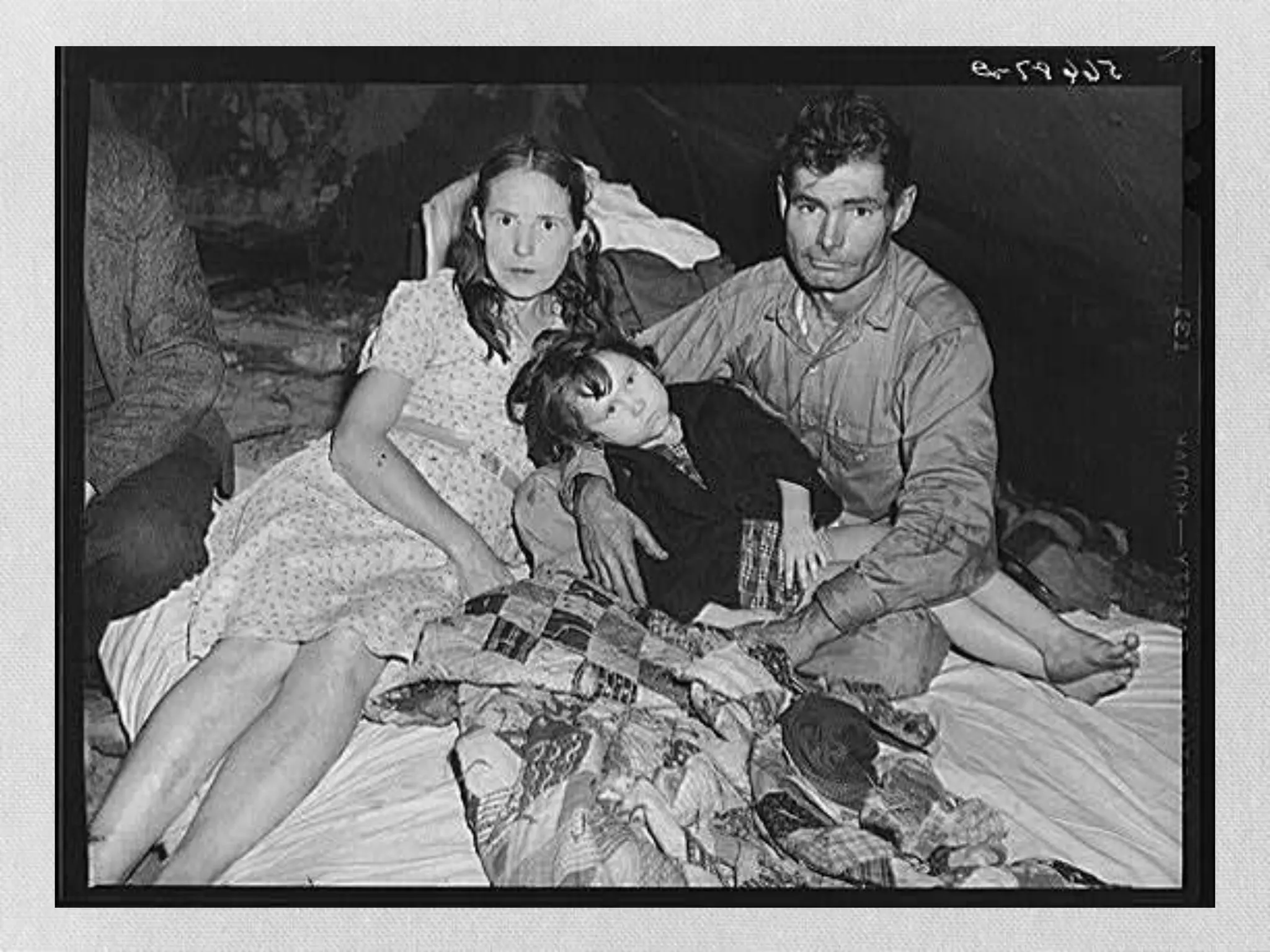
•Hundreds of
thousands of
farmers packed up
their families and
few belongings, and
headed for
California, which, for
numerous reasons,
seemed like a
promised land.
•The state‟s mild
climate promised a
longer growing
season and, with soil
favourable to a wider
range of crops, it
offered more
opportunities to
harvest.
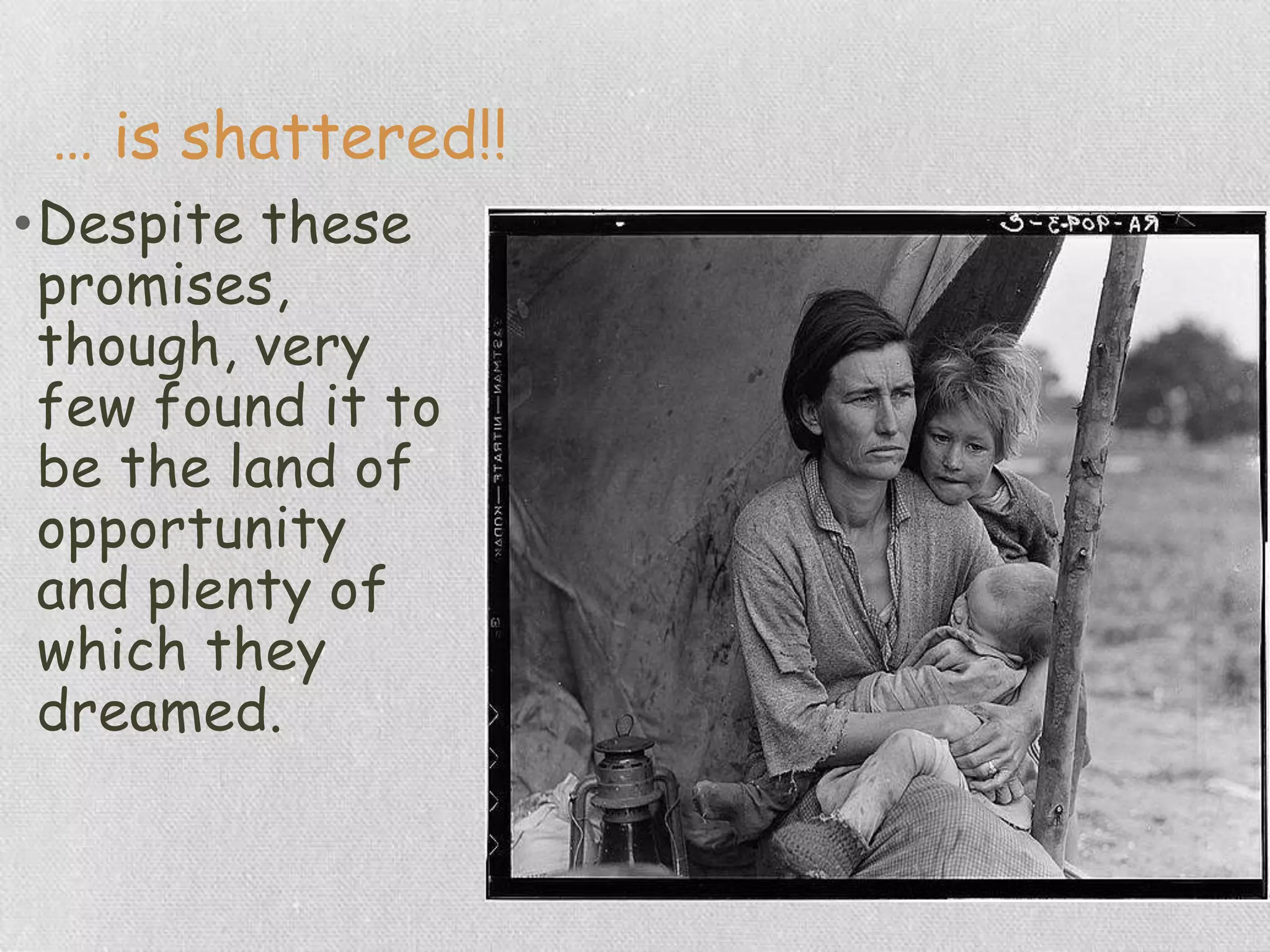
… is shattered!!
•Despite these
promises,
though, very
few found it to
be the land of
opportunity
and plenty of
which they
dreamed.
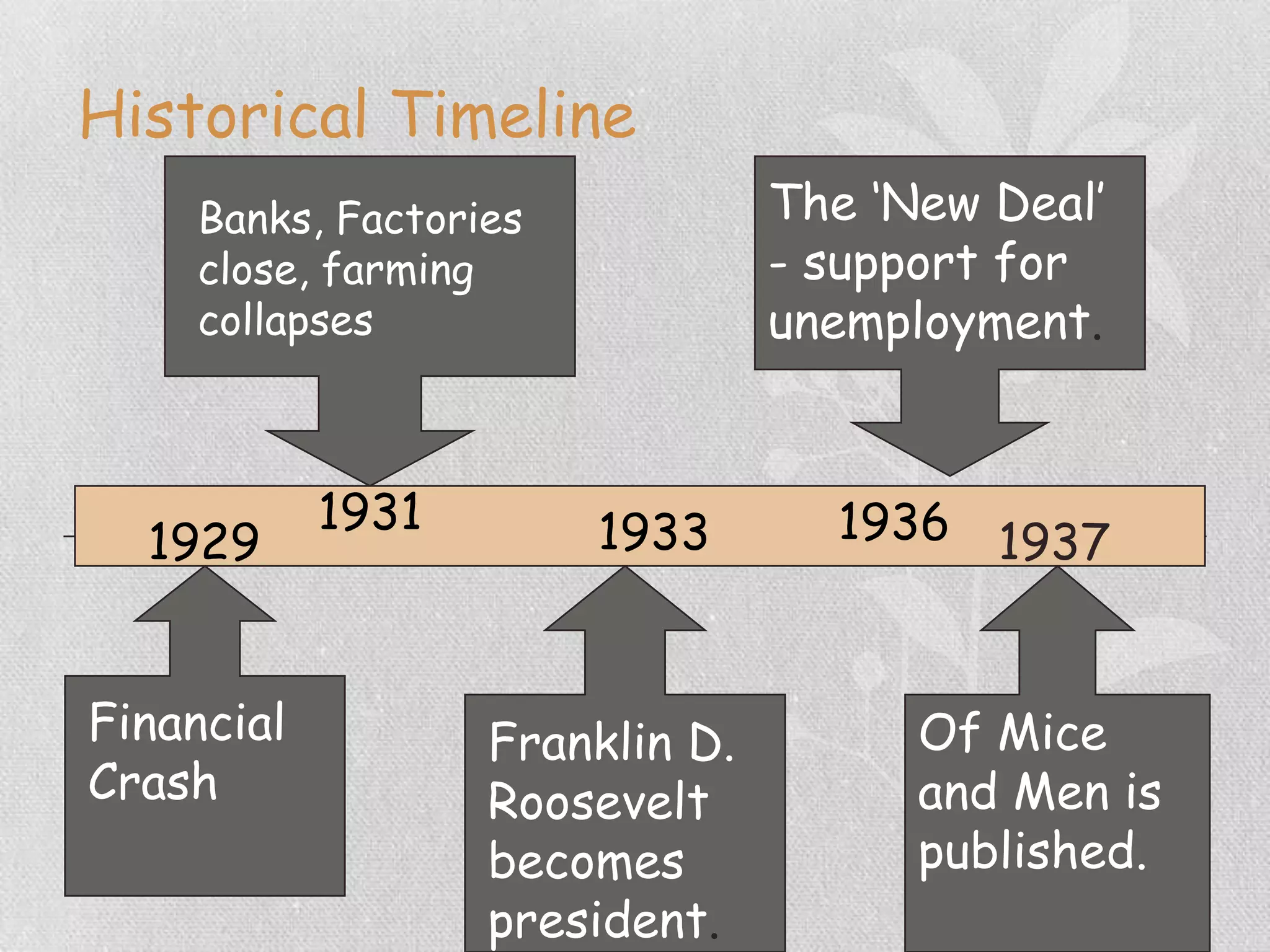
Historical Timeline
Financial
Crash
Banks, Factories
close, farming
collapses
1929
1931 1933
Franklin D.
Roosevelt
becomes
president.
1936
The „New Deal‟
- support for
unemployment.
1937
Of Mice
and Men is
published.
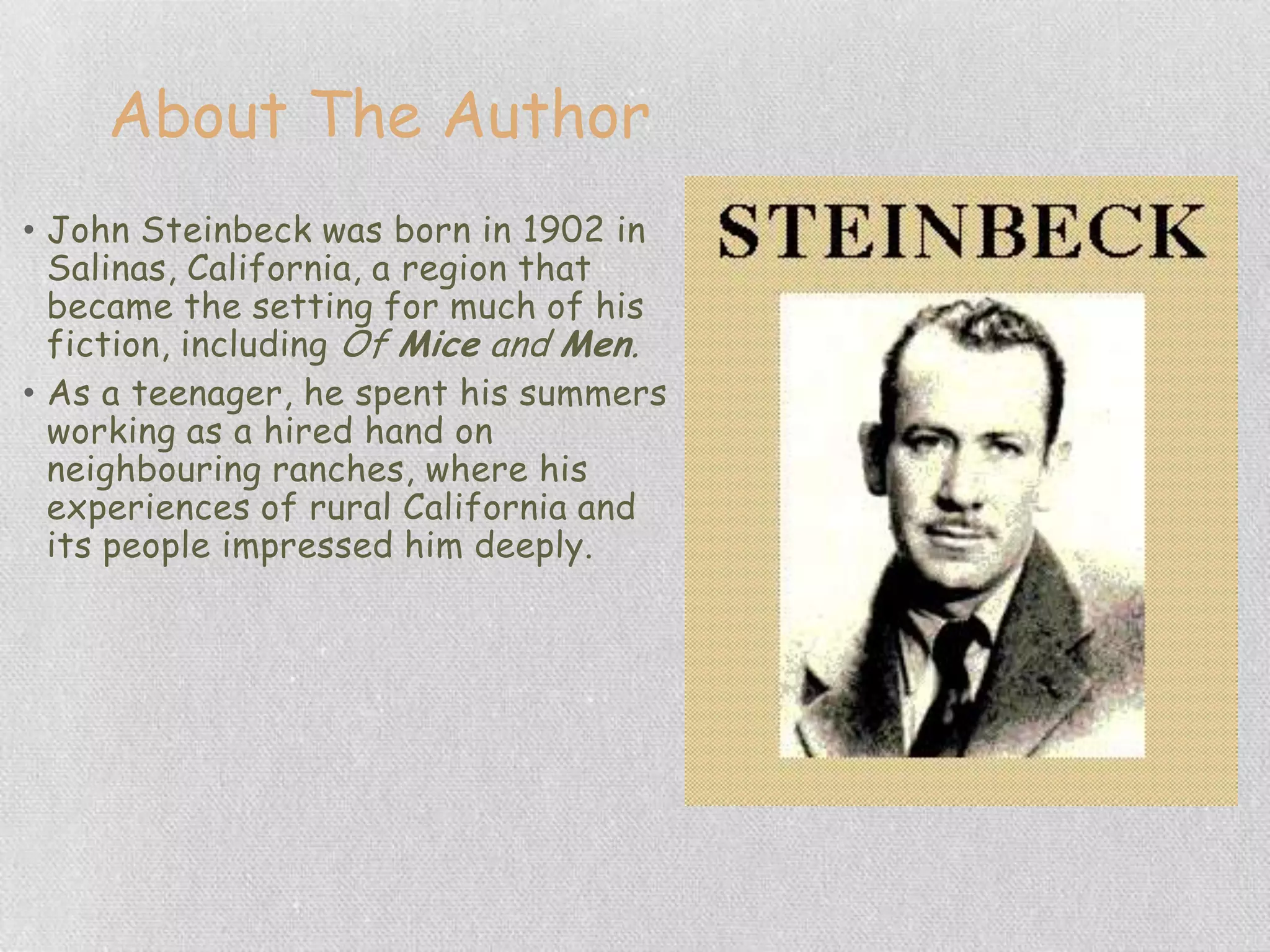
About The Author
• John Steinbeck was born in 1902 in
Salinas, California, a region that
became the setting for much of his
fiction, including Of Mice and Men.
• As a teenager, he spent his summers
working as a hired hand on
neighbouring ranches, where his
experiences of rural California and
its people impressed him deeply.
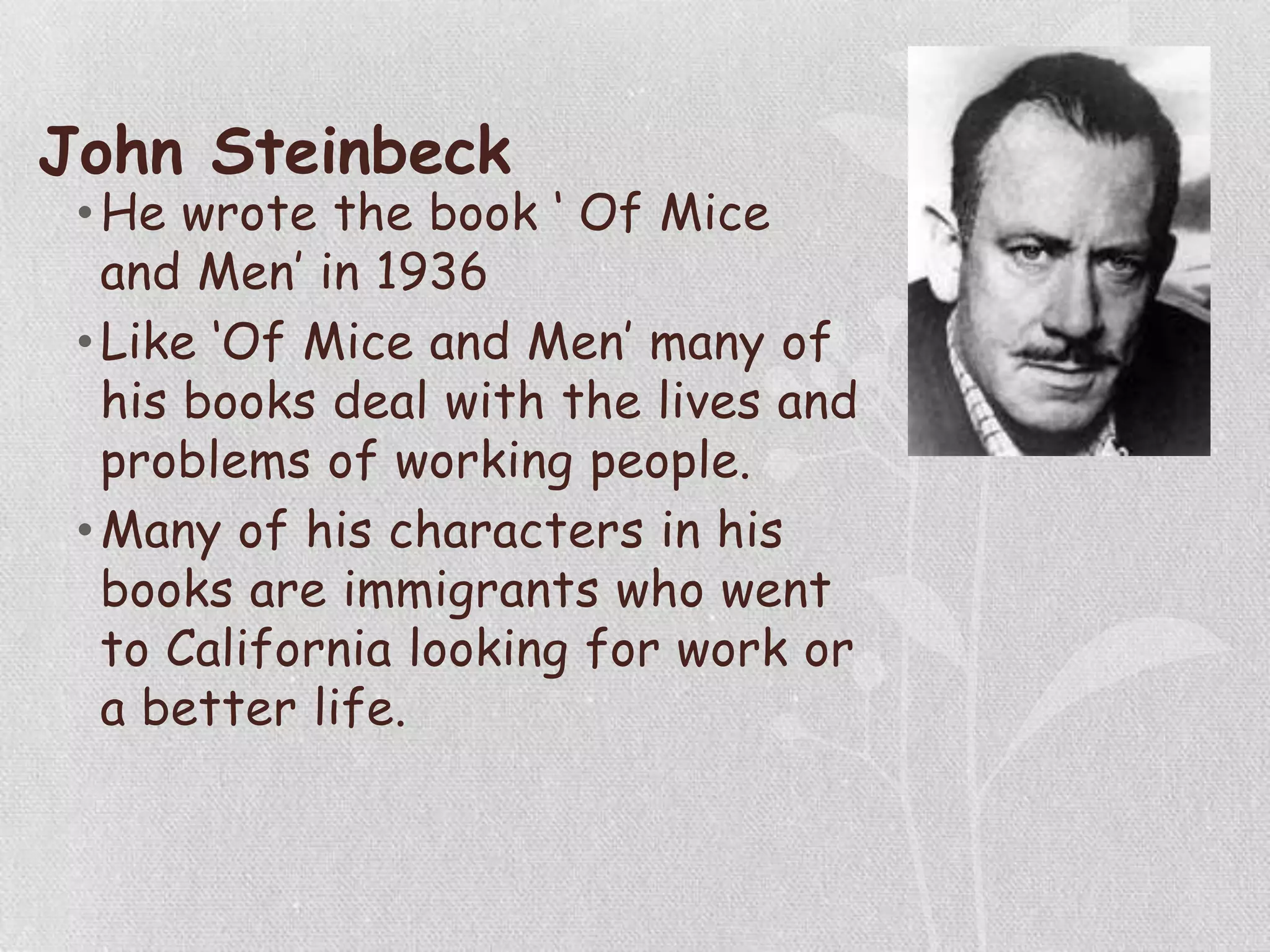
John Steinbeck
•He wrote the book „ Of Mice
and Men‟ in 1936
•Like „Of Mice and Men‟ many of
his books deal with the lives and
problems of working people.
•Many of his characters in his
books are immigrants who went
to California looking for work or
a better life.
Write this in your books:
Steinbeck's novels can all be classified as,
“social novels dealing
with the economic
problems of rural
labour.”
The Title
The title comes from a poem
by a Scottish poet Robert Burns.
‘The best laid schemes o’ mice and men
Gang aft agley (often go wrong)
And leave us nought but grief and pain
For promised joy!’
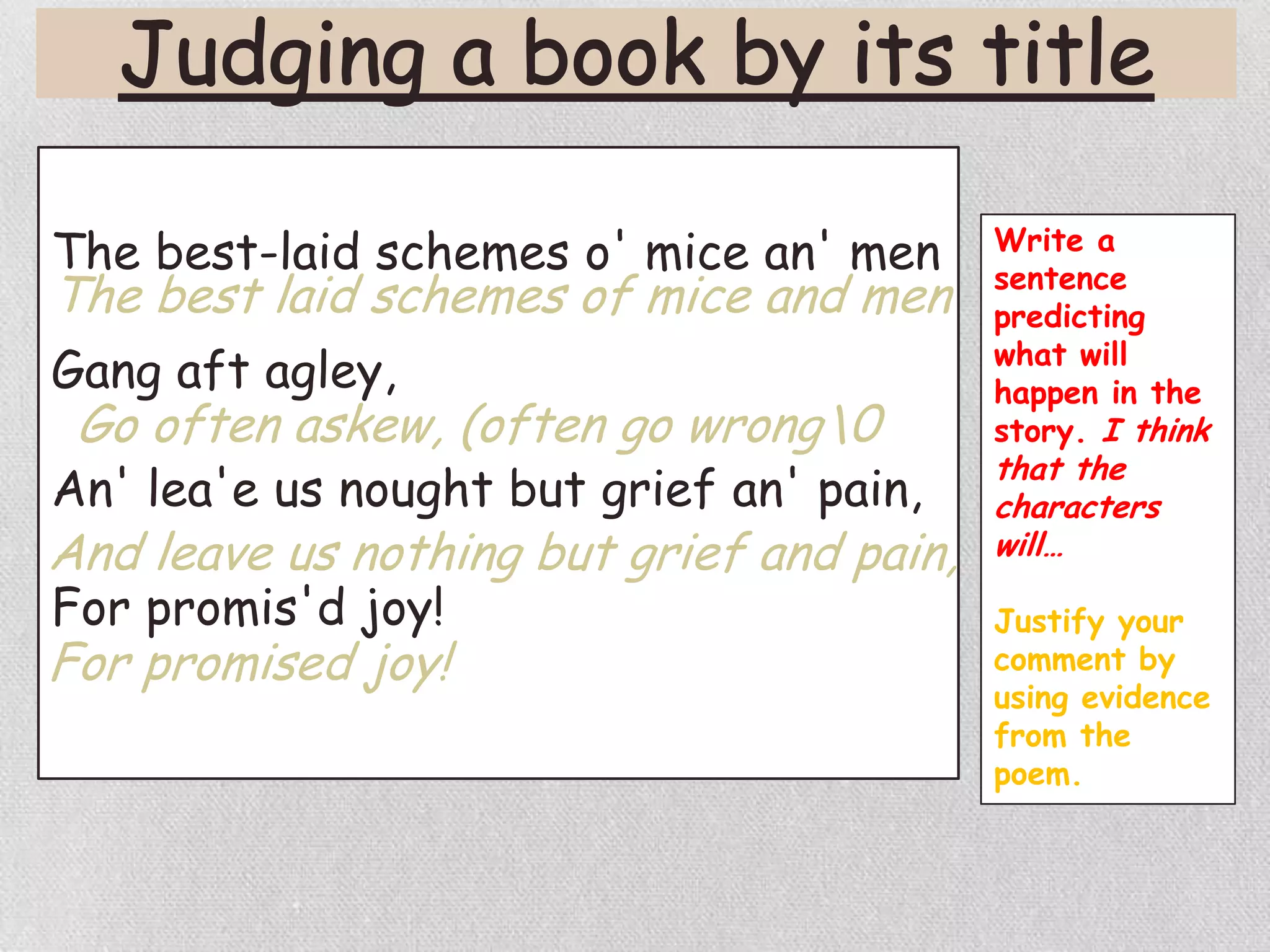
The best-laid schemes o' mice an' men
Gang aft agley,
An' lea'e us nought but grief an' pain,
For promis'd joy!
The best laid schemes of mice and men
Go often askew, (often go wrong0
And leave us nothing but grief and pain,
For promised joy!
Write a
sentence
predicting
what will
happen in the
story. I think
that the
characters
will…
Justify your
comment by
using evidence
from the
poem.

Omam background lesson_1

  • 1.
    • LO: tounderstand the social and historical background of the novel Starter What are your impressions of America? Write down three statements.
  • 2.
    OF MICE ANDMEN LO: to understand the social and historical background of the novel
  • 3.
    Context: An introductionto 1920s America • The Roaring Twenties / the Jazz Age:  For many people in America (especially the cities such as New York and Chicago) the 1920s are years of considerable prosperity. American goods are protected from competition with imports by high tariffs (customs duties) and Americans are encouraged to buy American produced consumer products such as cars, washing machines, refrigerators and radios.  The consumer goods boom does not affect all people equally. By 1929 over 50% of Americans earn less than $2000 a year, with 40% below the poverty line. Black and immigrant workers are particularly likely to be affected by low wages and unemployment. Farming families are far less likely to enjoy the consumer boom as many rural areas still have no electricity and small farm incomes drop dramatically as the price of wheat falls.
  • 4.
    Watch this shortclip 1. Describe the faces of the people in the film 2. Why were so many of them queuing? 3. What kind of work were the men looking for? 4. How would you describe their lives?
  • 5.
  • 6.
    THE GREAT DEPRESSION! •OnBlack Thursday, October 29, 1929, the stock market crashed, triggering the Great Depression, the worst economic collapse in the history of the modern industrial world. •It spread from the United States to the rest of the world, lasting from the end of 1929 until the early 1940s. With banks failing and businesses closing, more than 15 million Americans (one-quarter of the workforce) became unemployed.
  • 7.
    THE FARMERS To makematters worse America was hit by a series of droughts and many farms could no longer operate. 6. Describe the picture using sight, sound and feel. 7. How would the droughts mean there was more unemployment?
  • 8.
    Historical Context The depressionalso led to a drop in the market price of farm crops, which meant that farmers were forced to produce more goods in order to earn the same amount of money.
  • 9.
    The Dust Bowl •The increase in farming activity across the Great Plains states caused the precious soil to erode. • This erosion, coupled with a seven- year drought that began in 1931, turned once fertile grasslands into a „desert like‟ region known as the Dust Bowl.
  • 10.
    WHAT DID THEYDO?. People heard that in California the soil was still good and there was plenty of room and opportunity for work. 8. If you were a farmer from Oklahoma in the 1930s what would you do?
  • 11.
    9. Pick oneof these images and imagine you are in the picture. Write a short paragraph describing how you feel.
  • 12.
  • 13.
    The History ofMigrant Farmers in California •During the Great Depression, economic and ecological forces (the Dust Bowl) brought many rural poor and migrant agricultural workers from the Great Plains states, such as Oklahoma, Texas, and Kansas, to California.
  • 16.
    Fill in thegaps… What is the American Dream? America has always been seen as the Land of________, partly because immigrants from Europe saw it as a place of freedom, a place to begin a new____, a place for real possibilities and _____for all. This belief in America as a --_____ where ordinary people could create a better life for themselves is often referred to as The American_____. From the 17th century, where the first settlers arrived, immigrants dreamed of a ______life in America People went there to ______from persecution, to make a new life for themselves and their______. For many the dream became a _________. The horrors of_______, of the American Civil War, the growth of slums and the corruption of the government led to many _________ hopes For many the dream ended with the ____Street crash in____. Nightmare, Better, slavery, 1929, Dream, Wealth, Opportunity, shattered, life, country, escape, families, Wall.
  • 17.
    The American Dream… •Hundredsof thousands of farmers packed up their families and few belongings, and headed for California, which, for numerous reasons, seemed like a promised land. •The state‟s mild climate promised a longer growing season and, with soil favourable to a wider range of crops, it offered more opportunities to harvest.
  • 19.
    … is shattered!! •Despitethese promises, though, very few found it to be the land of opportunity and plenty of which they dreamed.
  • 20.
    Historical Timeline Financial Crash Banks, Factories close,farming collapses 1929 1931 1933 Franklin D. Roosevelt becomes president. 1936 The „New Deal‟ - support for unemployment. 1937 Of Mice and Men is published.
  • 21.
    About The Author •John Steinbeck was born in 1902 in Salinas, California, a region that became the setting for much of his fiction, including Of Mice and Men. • As a teenager, he spent his summers working as a hired hand on neighbouring ranches, where his experiences of rural California and its people impressed him deeply.
  • 22.
    John Steinbeck •He wrotethe book „ Of Mice and Men‟ in 1936 •Like „Of Mice and Men‟ many of his books deal with the lives and problems of working people. •Many of his characters in his books are immigrants who went to California looking for work or a better life.
  • 23.
    Write this inyour books: Steinbeck's novels can all be classified as, “social novels dealing with the economic problems of rural labour.”
  • 24.
    The Title The titlecomes from a poem by a Scottish poet Robert Burns. ‘The best laid schemes o’ mice and men Gang aft agley (often go wrong) And leave us nought but grief and pain For promised joy!’
  • 25.
    The best-laid schemeso' mice an' men Gang aft agley, An' lea'e us nought but grief an' pain, For promis'd joy! The best laid schemes of mice and men Go often askew, (often go wrong0 And leave us nothing but grief and pain, For promised joy! Write a sentence predicting what will happen in the story. I think that the characters will… Justify your comment by using evidence from the poem.