Self Marketing  - A Professional Approach Terry Gregory  Career Consultant g2 Career Coaching www.g2.org.uk www.ruthbradshaw.co.uk
Terry Gregory – Profile Former Assistant Director of HR (NHS) Management Trainer for 20+ years Professionally Qualified Careers Consultant 10+ years as an independent consultant Senior Outplacement Consultant with Capita PD and Hudson International Consulting Visiting Lecturer at Vilnius, Mykolas Romeris and ISM Universities, Vilnius, Lithuania  Registered Careers Guidance Practitioner (ICG) Member of Chartered Management Institute Member of Institute of Careers Guidance
NW Region – Employment Trends Source: NWRDA September 2009 Job losses are possible across various sectors but those most likely to be hit are:  Financial services Construction and real estate Professional services (especially those linked to financial services and construction) Retail Hospitality and leisure (as total disposable income declines).
Northwest businesses speaking directly to NWDA support the view that the  “business climate is improving”  with many sectors reporting cautious optimism. This includes a small amount of optimism in some sections of the  automotive sector , although the uncertainty around the future of the Vauxhall plant is a large threat to recovery in the Northwest. The  chemicals,   digital ,  environmental technology  and  food sectors  also report a better outlook for sections of their sectors.  Monthly Economic Update – September 2009
Personal Career MOT Here is your chance to do a quick MOT of your own career What does it tell you?
Workshop Content The Changing World of Work – Career Context Who’s managing YOUR career? What are your SKILLS? What are your ACHIEVEMENTS? Marketing yourself – CVs & Applications Job Matching Routes to Market
The Future of Work “ There is no such thing as a career  Path – it is crazy paving, and you lay it  yourself” Sir Dominic Cadbury
EMPLOYABILITY “ To be employed is to be at risk, to be employable is to be secure” Peter Hawkins, Liverpool John Moores University Author of: The Art of Building Windmills
Implications of the Changing World of Work Fewer opportunities to climb corporate ladder Career development – lateral Increased responsibilities / greater pressure Need to respond positively to change Need to embrace new technology Greater flexibility / hot desking / portfolio working Displacement of non core activities Employers paternalism disappeared Career change / lifelong learning – norm Employability rather than employment Knowledge management critical 40:40 replaced by 1:2:3 Career planning / management will become critical
Job Change Risk Matrix Current Job Sector New Job Sector Current Skills LOW RISK MEDIUM RISK New Skills MEDIUM RISK HIGH RISK
The Alignment Model What do you want?   What do they want? What do you offer?   What do they offer?
Managing Your career Self-awareness Packaging yourself (USP) Promoting yourself
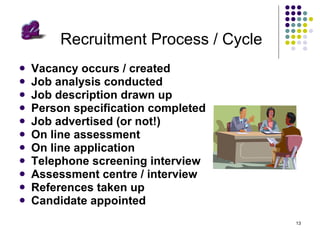
Recruitment Process / Cycle Vacancy occurs / created Job analysis conducted Job description drawn up Person specification completed Job advertised (or not!) On line assessment On line application Telephone screening interview Assessment centre / interview References taken up Candidate appointed
Competency Profile Using the skills analysis sheet identify your current skills profile Add to the list any skills you use but are not on the list Which of these will be relevant for your next job? What skills do you need to have for your next job? How will you acquire them?
Skills / Competencies Communication:  In my role as Training Manager I regularly had to communicate ideas and information to professional colleagues both orally and by production of executive briefing papers and reports Team Working: As a key member of the Production team I played a significant  role by ensuring that all members had an opportunity to contribute and when appropriate challenged colleagues assertively to ensure that the task was achieved and the team goal met.
Sunday Times Newspaper - 30 August 2009 ........ and press 3 for graduate jobs at call centres. “ Hello, I’ve got a 2:1, how may I help you?” Call centres, once seen as the sweatshop of the British economy, are being flooded with job applications from university leavers who have found that traditional career opportunities wither in a recession.
Employers Perception of Graduate 1 “ One third of our members are not happy with the employability skills of  the graduates they recruit.” “ Many graduates are failing to show themselves  fit for purpose …….amongst the employability skills lacking are communication, team working and business acumen.” MilesTempleman Institute of Directors (Guardian 20/02/2007 )
Employers Perception of Graduates 2 Universities should do more to teach students basic “people and communications skills” and make sure that they understand the importance of  getting to work on time , to prepare them better for the world of work, business leaders said yesterday.  Richard Lambert Director General (CBI)  Times Newspaper  18 September 2008
What Do Employers Expect of Graduates? Academic attainment Evidence of transferable skills Evidence of work experience  Evidence that you have taken advantage of your time at university Knowledge of and an interest in the job and their organisation Good “self presentation”
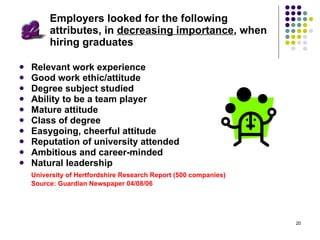
Employers looked for the following attributes, in  decreasing importance , when hiring graduates Relevant work experience Good work ethic/attitude Degree subject studied  Ability to be a team player  Mature attitude  Class of degree Easygoing, cheerful attitude Reputation of university attended  Ambitious and career-minded Natural leadership  University of Hertfordshire Research Report (500 companies) Source: Guardian Newspaper 04/08/06
Packaging Yourself Your CV / Covering Letter Your telephone manner Your self-presentation
Identifying Career Achievements Write down your achievements over the last five years How successful were they? Were they all your own work? Do they pass the SO WHAT test?
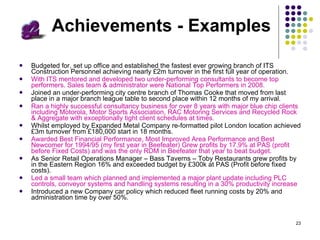
Achievements - Examples Budgeted for, set up office and established the fastest ever growing branch of ITS Construction Personnel achieving nearly £2m turnover in the first full year of operation. With ITS mentored and developed two under-performing consultants to become top performers. Sales team & administrator were National Top Performers in 2008. Joined an under-performing city centre branch of Thomas Cooke that moved from last place in a major branch league table to second place within 12 months of my arrival . Ran a highly successful consultancy business for over 8 years with major blue chip clients including Motorola, Motor Sports Association, RAC Motoring Services and Recycled Rock & Aggregate with exceptionally tight client schedules at times. Whilst employed by Expanded Metal Company re-formatted pilot London location achieved £3m turnover from £180,000 start in 18 months. Awarded Best Financial Performance, Most Improved Area Performance and Best Newcomer for 1994/95 (my first year in Beefeater) Grew profits by 17.9% at PAS (profit before Fixed Costs) and was the only RDM in Beefeater that year to beat budget.  As Senior Retail Operations Manager – Bass Taverns – Toby Restaurants grew profits by in the Eastern Region 16% and exceeded budget by £300k at PAS (Profit before fixed costs). Led a small team which planned and implemented a major plant update including PLC controls, conveyor systems and handling systems resulting in a 30% productivity increase Introduced a new Company car policy which reduced fleet running costs by 20% and administration time by over 50%.
The CV  (Syndicate group exercise) What is the main purpose of a CV and what information should it contain?
Golden Rules for a CV Maximum of 2 pages Plain white 100g paper Black ink – no fancy type 12/14 point – Arial (RNIB) No photographs (unless asked for) Spelling To profile or not to profile?
Golden Rules - Continued Include personal details (? DOB) Immaculate layout / symmetrical Bite size chunks (psychological impact) Details of Education / Qualifications Employment details  Compile a “skills matrix” Identify life/job/education achievements Voluntary work
What kind of CV? Reverse Chronological Functional Hybrid
CVs – Key Points Must be internally consistent Make it easy for the reader Don’t include negative information Have a portfolio CV and target employer Always send a covering letter Send as an attachment if by e – mail (PDF) Don’t use tables or columns Does it pass “the wet Thursday afternoon” test?
Getting Your Message Across Some research amongst leading recruiters has suggested that many spend only 20 to 30 seconds skim reading a CV before:- Decide to continue reading Put it to one side for “future” reading Bin it! Your CV has got to scream “READ ME”
Information I Want - Quickly! Who is this person? What have they been doing? Have they been successful? What will they bring to the organisation? Can you provide this information in a way that is appealing to the eye and succinct?
Promoting Yourself Your CV/resume Your covering letters Your networking Your self-presentation
Application Forms - Flavours Come in three:- Spaghetti Bolognese Chicken Vindaloo Dogs Dinner Amazed at state of some forms submitted!!
Application Forms Gives control to recruiter – request specific information Every candidate required to provide  information in same format Often have Equal Opp’s monitoring form “ Good employers” provide job description and person specification Take away the reasons for not short listing
Application Forms - Rules Read the application form at least 3 times Read Job Description / Person Specification Follow the instructions e.g. black ink! Word process or handwritten (see previous) Neat and tidy (many forms badly designed) Match skills to requirements of job Additional information – don’t write essay
Application Forms – Rules 2 Use bullet points and short sentences  Be concise – address specific criteria Do not lie (extemporise?)  Avoid leisure pursuits unless  relevant Be positive in what you write Ensure good grammar / spelling No one gets a job by being modest!
Summary of Key Points CV/Application forms – neat & presentable Target the requirements of the job Provide  evidence  of skills / competencies Present information in “digestible” fashion Do not lie or inflate your skills/experience Be positive and believe what you write You have  one chance  to make an impact
Covering Letters When do you use them? What format? Content Tone Advertised job Speculative
Covering Letter Why are you writing (response to advert or speculative)? Introduce yourself Market yourself Say what you want to happen next
Job matching Most adverts are aspirational Don’t apply if you don’t match – it wastes everybody’s time and it’s depressing! If you have an 80% match – GO FOR IT!
Routes to Market Advertised jobs (25%) Speculative approaches (10%) Recruitment agencies (15%) Networking (50%)
Getting the job Recruiters are paid by the employer Make it easy for them They may discriminate against you It’s about rejection not selection It’s a numbers game
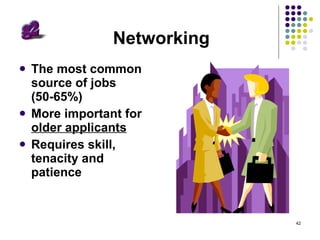
Networking The most common source of jobs (50-65%) More important for  older applicants Requires skill, tenacity and patience
Networking Who is in your network – personally and professionally? What do you want from them? How will you approach them? How do you feel about asking for help? What will you do with the information they give you? Equation: 1 x 50 x 50 = 2500
Managing the Interview Process Research the company / organisation Prepare all your documentation Find out who is interviewing you Any activities on the day Check out venue / facilities Prepare your competency checklist List questions you want to ask Get a good nights sleep!
The Interview Never offer negative information give positive answers and sell “features / benefits” Expand on yes/no answers - have examples from your experience Ask for clarification of questions (don’t assume the panel understand them!) Many interviewers on panel because of position, status or politics (and often untrained) Don’t talk for too long – check with panel
The Interview Dress appropriately Make an impact – “you never get second chance to make a first impression” Display confidence and assertiveness Ask for clarification if you do not understand a question Watch body language / non-verbals of interviewers Demonstrate good listening skills i.e. answer the question they ask! Do not panic if you find a question difficult to answer Ask “sensible” questions Thank panel at the end of interview
Interviews – Final Thoughts It is not the Spanish Inquisition You should be treated with courtesy and respect The panel should  never  argue or disagree with you – but they may challenge you You are interviewing them as much as they are interviewing you Do you really want to work for this organisation?
So, NOW ………... Don’t try…just DO
The Future of Work The company of the future will only have  two employees A man to watch the machinery A dog to bite the man if he touches the  machinery Warren Bennis
Terry Gregory Career Consultant G2 Career Coaching www.g2.org.uk www.ccg-consultancy.co.uk

Career Management Programme Maze8 Version 4

  • 1.
    Self Marketing - A Professional Approach Terry Gregory Career Consultant g2 Career Coaching www.g2.org.uk www.ruthbradshaw.co.uk
  • 2.
    Terry Gregory –Profile Former Assistant Director of HR (NHS) Management Trainer for 20+ years Professionally Qualified Careers Consultant 10+ years as an independent consultant Senior Outplacement Consultant with Capita PD and Hudson International Consulting Visiting Lecturer at Vilnius, Mykolas Romeris and ISM Universities, Vilnius, Lithuania Registered Careers Guidance Practitioner (ICG) Member of Chartered Management Institute Member of Institute of Careers Guidance
  • 3.
    NW Region –Employment Trends Source: NWRDA September 2009 Job losses are possible across various sectors but those most likely to be hit are: Financial services Construction and real estate Professional services (especially those linked to financial services and construction) Retail Hospitality and leisure (as total disposable income declines).
  • 4.
    Northwest businesses speakingdirectly to NWDA support the view that the “business climate is improving” with many sectors reporting cautious optimism. This includes a small amount of optimism in some sections of the automotive sector , although the uncertainty around the future of the Vauxhall plant is a large threat to recovery in the Northwest. The chemicals, digital , environmental technology and food sectors also report a better outlook for sections of their sectors. Monthly Economic Update – September 2009
  • 5.
    Personal Career MOTHere is your chance to do a quick MOT of your own career What does it tell you?
  • 6.
    Workshop Content TheChanging World of Work – Career Context Who’s managing YOUR career? What are your SKILLS? What are your ACHIEVEMENTS? Marketing yourself – CVs & Applications Job Matching Routes to Market
  • 7.
    The Future ofWork “ There is no such thing as a career Path – it is crazy paving, and you lay it yourself” Sir Dominic Cadbury
  • 8.
    EMPLOYABILITY “ Tobe employed is to be at risk, to be employable is to be secure” Peter Hawkins, Liverpool John Moores University Author of: The Art of Building Windmills
  • 9.
    Implications of theChanging World of Work Fewer opportunities to climb corporate ladder Career development – lateral Increased responsibilities / greater pressure Need to respond positively to change Need to embrace new technology Greater flexibility / hot desking / portfolio working Displacement of non core activities Employers paternalism disappeared Career change / lifelong learning – norm Employability rather than employment Knowledge management critical 40:40 replaced by 1:2:3 Career planning / management will become critical
  • 10.
    Job Change RiskMatrix Current Job Sector New Job Sector Current Skills LOW RISK MEDIUM RISK New Skills MEDIUM RISK HIGH RISK
  • 11.
    The Alignment ModelWhat do you want? What do they want? What do you offer? What do they offer?
  • 12.
    Managing Your careerSelf-awareness Packaging yourself (USP) Promoting yourself
  • 13.
    Recruitment Process /Cycle Vacancy occurs / created Job analysis conducted Job description drawn up Person specification completed Job advertised (or not!) On line assessment On line application Telephone screening interview Assessment centre / interview References taken up Candidate appointed
  • 14.
    Competency Profile Usingthe skills analysis sheet identify your current skills profile Add to the list any skills you use but are not on the list Which of these will be relevant for your next job? What skills do you need to have for your next job? How will you acquire them?
  • 15.
    Skills / CompetenciesCommunication: In my role as Training Manager I regularly had to communicate ideas and information to professional colleagues both orally and by production of executive briefing papers and reports Team Working: As a key member of the Production team I played a significant role by ensuring that all members had an opportunity to contribute and when appropriate challenged colleagues assertively to ensure that the task was achieved and the team goal met.
  • 16.
    Sunday Times Newspaper- 30 August 2009 ........ and press 3 for graduate jobs at call centres. “ Hello, I’ve got a 2:1, how may I help you?” Call centres, once seen as the sweatshop of the British economy, are being flooded with job applications from university leavers who have found that traditional career opportunities wither in a recession.
  • 17.
    Employers Perception ofGraduate 1 “ One third of our members are not happy with the employability skills of the graduates they recruit.” “ Many graduates are failing to show themselves fit for purpose …….amongst the employability skills lacking are communication, team working and business acumen.” MilesTempleman Institute of Directors (Guardian 20/02/2007 )
  • 18.
    Employers Perception ofGraduates 2 Universities should do more to teach students basic “people and communications skills” and make sure that they understand the importance of getting to work on time , to prepare them better for the world of work, business leaders said yesterday. Richard Lambert Director General (CBI) Times Newspaper 18 September 2008
  • 19.
    What Do EmployersExpect of Graduates? Academic attainment Evidence of transferable skills Evidence of work experience Evidence that you have taken advantage of your time at university Knowledge of and an interest in the job and their organisation Good “self presentation”
  • 20.
    Employers looked forthe following attributes, in decreasing importance , when hiring graduates Relevant work experience Good work ethic/attitude Degree subject studied Ability to be a team player Mature attitude Class of degree Easygoing, cheerful attitude Reputation of university attended Ambitious and career-minded Natural leadership University of Hertfordshire Research Report (500 companies) Source: Guardian Newspaper 04/08/06
  • 21.
    Packaging Yourself YourCV / Covering Letter Your telephone manner Your self-presentation
  • 22.
    Identifying Career AchievementsWrite down your achievements over the last five years How successful were they? Were they all your own work? Do they pass the SO WHAT test?
  • 23.
    Achievements - ExamplesBudgeted for, set up office and established the fastest ever growing branch of ITS Construction Personnel achieving nearly £2m turnover in the first full year of operation. With ITS mentored and developed two under-performing consultants to become top performers. Sales team & administrator were National Top Performers in 2008. Joined an under-performing city centre branch of Thomas Cooke that moved from last place in a major branch league table to second place within 12 months of my arrival . Ran a highly successful consultancy business for over 8 years with major blue chip clients including Motorola, Motor Sports Association, RAC Motoring Services and Recycled Rock & Aggregate with exceptionally tight client schedules at times. Whilst employed by Expanded Metal Company re-formatted pilot London location achieved £3m turnover from £180,000 start in 18 months. Awarded Best Financial Performance, Most Improved Area Performance and Best Newcomer for 1994/95 (my first year in Beefeater) Grew profits by 17.9% at PAS (profit before Fixed Costs) and was the only RDM in Beefeater that year to beat budget. As Senior Retail Operations Manager – Bass Taverns – Toby Restaurants grew profits by in the Eastern Region 16% and exceeded budget by £300k at PAS (Profit before fixed costs). Led a small team which planned and implemented a major plant update including PLC controls, conveyor systems and handling systems resulting in a 30% productivity increase Introduced a new Company car policy which reduced fleet running costs by 20% and administration time by over 50%.
  • 24.
    The CV (Syndicate group exercise) What is the main purpose of a CV and what information should it contain?
  • 25.
    Golden Rules fora CV Maximum of 2 pages Plain white 100g paper Black ink – no fancy type 12/14 point – Arial (RNIB) No photographs (unless asked for) Spelling To profile or not to profile?
  • 26.
    Golden Rules -Continued Include personal details (? DOB) Immaculate layout / symmetrical Bite size chunks (psychological impact) Details of Education / Qualifications Employment details Compile a “skills matrix” Identify life/job/education achievements Voluntary work
  • 27.
    What kind ofCV? Reverse Chronological Functional Hybrid
  • 28.
    CVs – KeyPoints Must be internally consistent Make it easy for the reader Don’t include negative information Have a portfolio CV and target employer Always send a covering letter Send as an attachment if by e – mail (PDF) Don’t use tables or columns Does it pass “the wet Thursday afternoon” test?
  • 29.
    Getting Your MessageAcross Some research amongst leading recruiters has suggested that many spend only 20 to 30 seconds skim reading a CV before:- Decide to continue reading Put it to one side for “future” reading Bin it! Your CV has got to scream “READ ME”
  • 30.
    Information I Want- Quickly! Who is this person? What have they been doing? Have they been successful? What will they bring to the organisation? Can you provide this information in a way that is appealing to the eye and succinct?
  • 31.
    Promoting Yourself YourCV/resume Your covering letters Your networking Your self-presentation
  • 32.
    Application Forms -Flavours Come in three:- Spaghetti Bolognese Chicken Vindaloo Dogs Dinner Amazed at state of some forms submitted!!
  • 33.
    Application Forms Givescontrol to recruiter – request specific information Every candidate required to provide information in same format Often have Equal Opp’s monitoring form “ Good employers” provide job description and person specification Take away the reasons for not short listing
  • 34.
    Application Forms -Rules Read the application form at least 3 times Read Job Description / Person Specification Follow the instructions e.g. black ink! Word process or handwritten (see previous) Neat and tidy (many forms badly designed) Match skills to requirements of job Additional information – don’t write essay
  • 35.
    Application Forms –Rules 2 Use bullet points and short sentences Be concise – address specific criteria Do not lie (extemporise?) Avoid leisure pursuits unless relevant Be positive in what you write Ensure good grammar / spelling No one gets a job by being modest!
  • 36.
    Summary of KeyPoints CV/Application forms – neat & presentable Target the requirements of the job Provide evidence of skills / competencies Present information in “digestible” fashion Do not lie or inflate your skills/experience Be positive and believe what you write You have one chance to make an impact
  • 37.
    Covering Letters Whendo you use them? What format? Content Tone Advertised job Speculative
  • 38.
    Covering Letter Whyare you writing (response to advert or speculative)? Introduce yourself Market yourself Say what you want to happen next
  • 39.
    Job matching Mostadverts are aspirational Don’t apply if you don’t match – it wastes everybody’s time and it’s depressing! If you have an 80% match – GO FOR IT!
  • 40.
    Routes to MarketAdvertised jobs (25%) Speculative approaches (10%) Recruitment agencies (15%) Networking (50%)
  • 41.
    Getting the jobRecruiters are paid by the employer Make it easy for them They may discriminate against you It’s about rejection not selection It’s a numbers game
  • 42.
    Networking The mostcommon source of jobs (50-65%) More important for older applicants Requires skill, tenacity and patience
  • 43.
    Networking Who isin your network – personally and professionally? What do you want from them? How will you approach them? How do you feel about asking for help? What will you do with the information they give you? Equation: 1 x 50 x 50 = 2500
  • 44.
    Managing the InterviewProcess Research the company / organisation Prepare all your documentation Find out who is interviewing you Any activities on the day Check out venue / facilities Prepare your competency checklist List questions you want to ask Get a good nights sleep!
  • 45.
    The Interview Neveroffer negative information give positive answers and sell “features / benefits” Expand on yes/no answers - have examples from your experience Ask for clarification of questions (don’t assume the panel understand them!) Many interviewers on panel because of position, status or politics (and often untrained) Don’t talk for too long – check with panel
  • 46.
    The Interview Dressappropriately Make an impact – “you never get second chance to make a first impression” Display confidence and assertiveness Ask for clarification if you do not understand a question Watch body language / non-verbals of interviewers Demonstrate good listening skills i.e. answer the question they ask! Do not panic if you find a question difficult to answer Ask “sensible” questions Thank panel at the end of interview
  • 47.
    Interviews – FinalThoughts It is not the Spanish Inquisition You should be treated with courtesy and respect The panel should never argue or disagree with you – but they may challenge you You are interviewing them as much as they are interviewing you Do you really want to work for this organisation?
  • 48.
    So, NOW ………...Don’t try…just DO
  • 49.
    The Future ofWork The company of the future will only have two employees A man to watch the machinery A dog to bite the man if he touches the machinery Warren Bennis
  • 50.
    Terry Gregory CareerConsultant G2 Career Coaching www.g2.org.uk www.ccg-consultancy.co.uk

Editor's Notes