Why discovery of open books
is a challenge
How to build a successful OA books programme
ALPSP seminar, 22 February, London
Eelco Ferwerda
OAPEN Foundation
Discoverability
–OAPEN
–Challenges
–Metadata
–Good practises
–DOAB
–What you can do
OAPEN Foundation
Dedicated to OA books
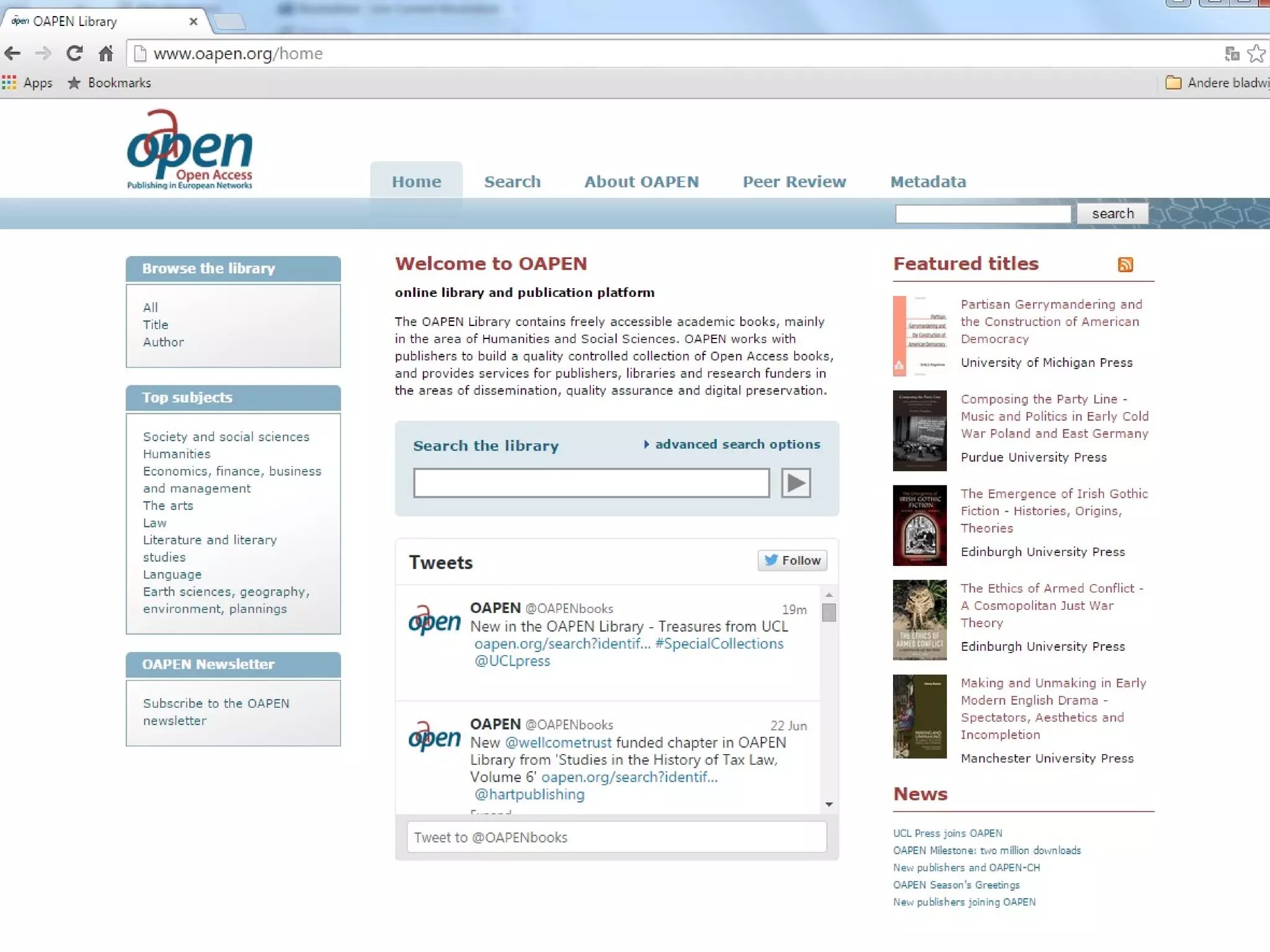
•OAPEN Library
– Hosting full text collection of OA books (+ chapters)
– Only peer reviewed content
– 150+ publishers, 3400+ books
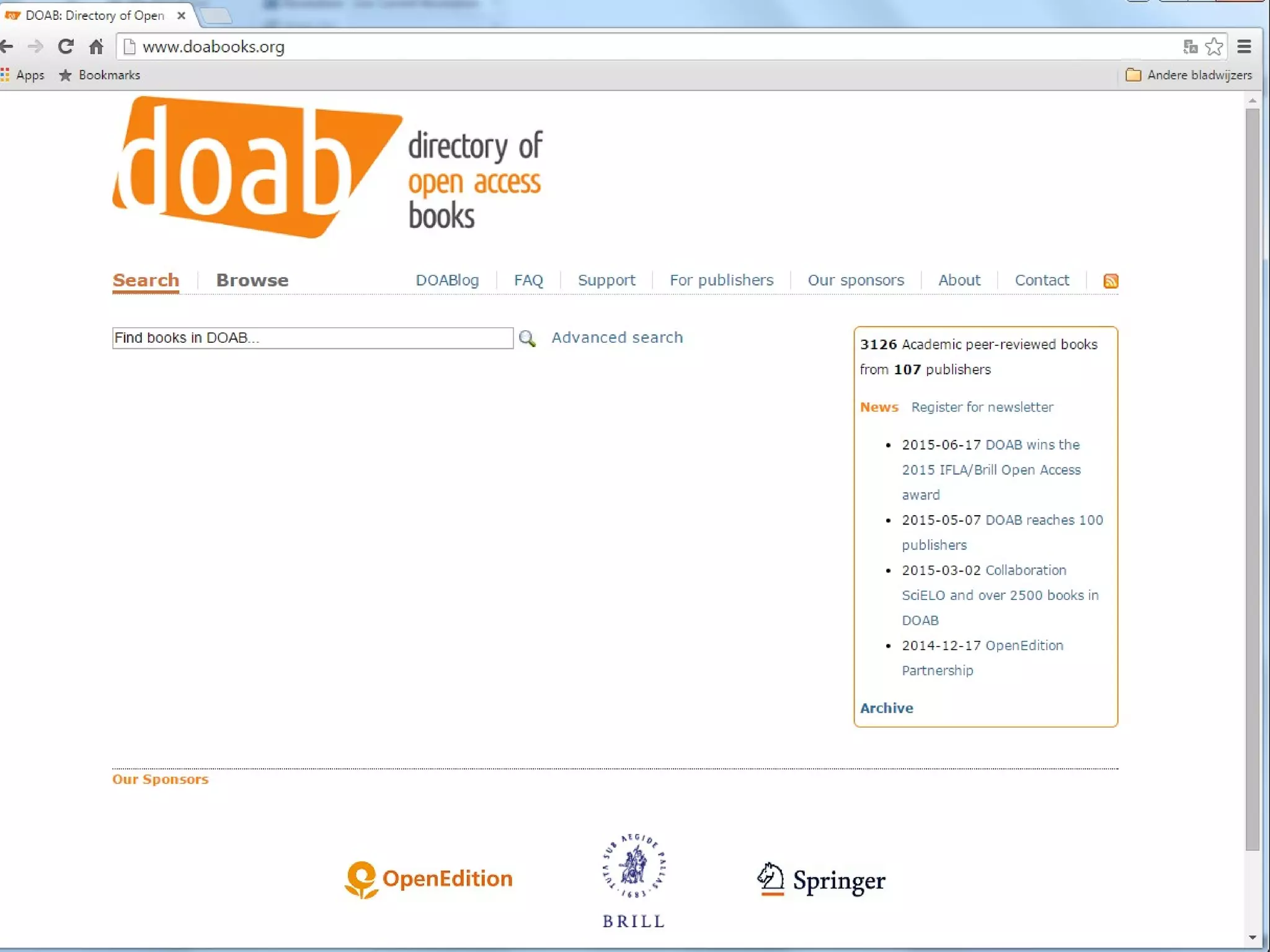
•Directory of Open Access Books
– Discovery service, 6000 OA books from 170 publishers
•Focus on post publication services:
– Quality assurance
– Deposit, aggregation, archiving
– Discovery and Dissemination
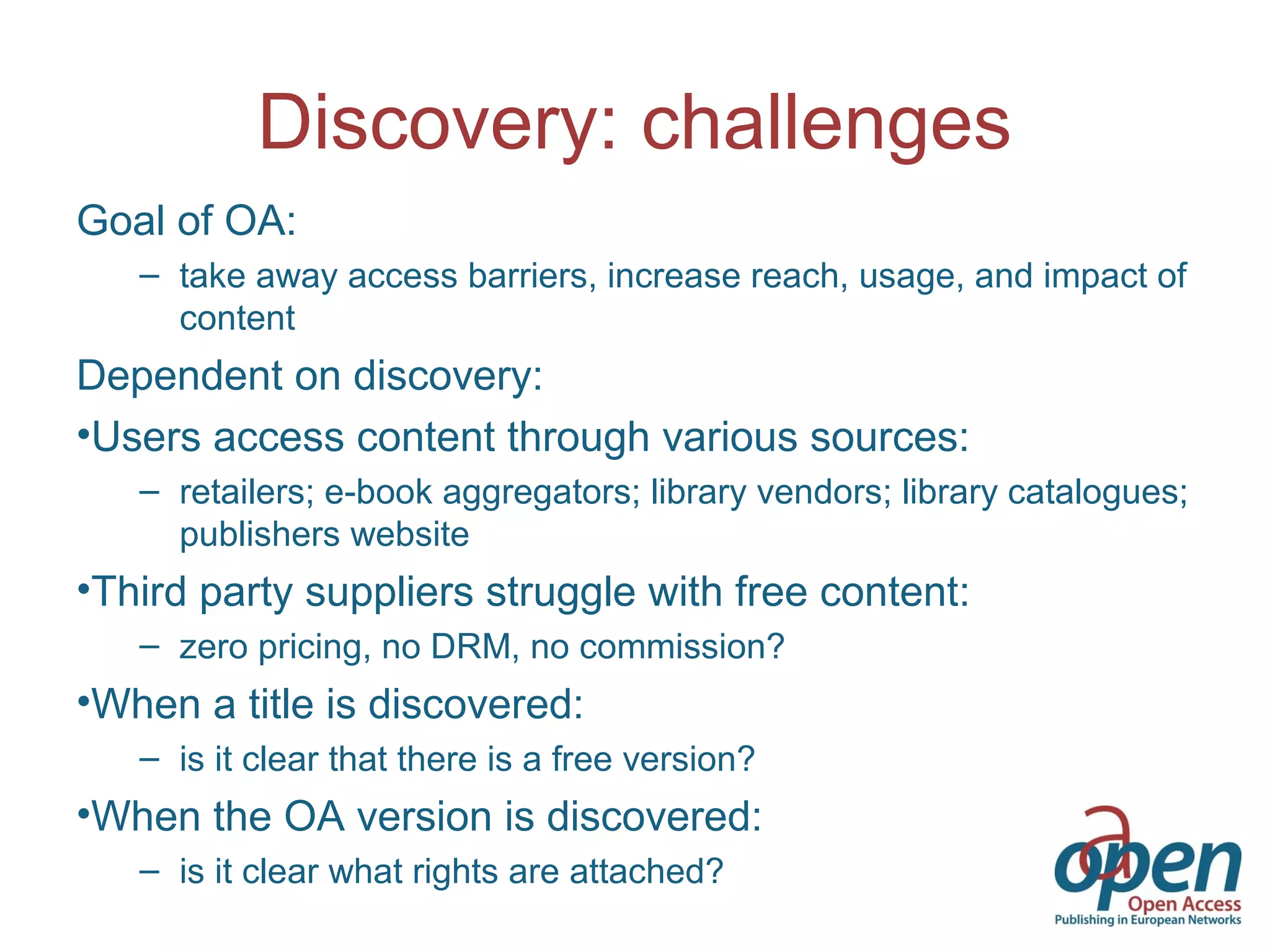
Discovery: challenges
Goal of OA:
– take away access barriers, increase reach, usage, and impact of
content
Dependent on discovery:
•Users access content through various sources:
– retailers; e-book aggregators; library vendors; library catalogues;
publishers website
•Third party suppliers struggle with free content:
– zero pricing, no DRM, no commission?
•When a title is discovered:
– is it clear that there is a free version?
•When the OA version is discovered:
– is it clear what rights are attached?
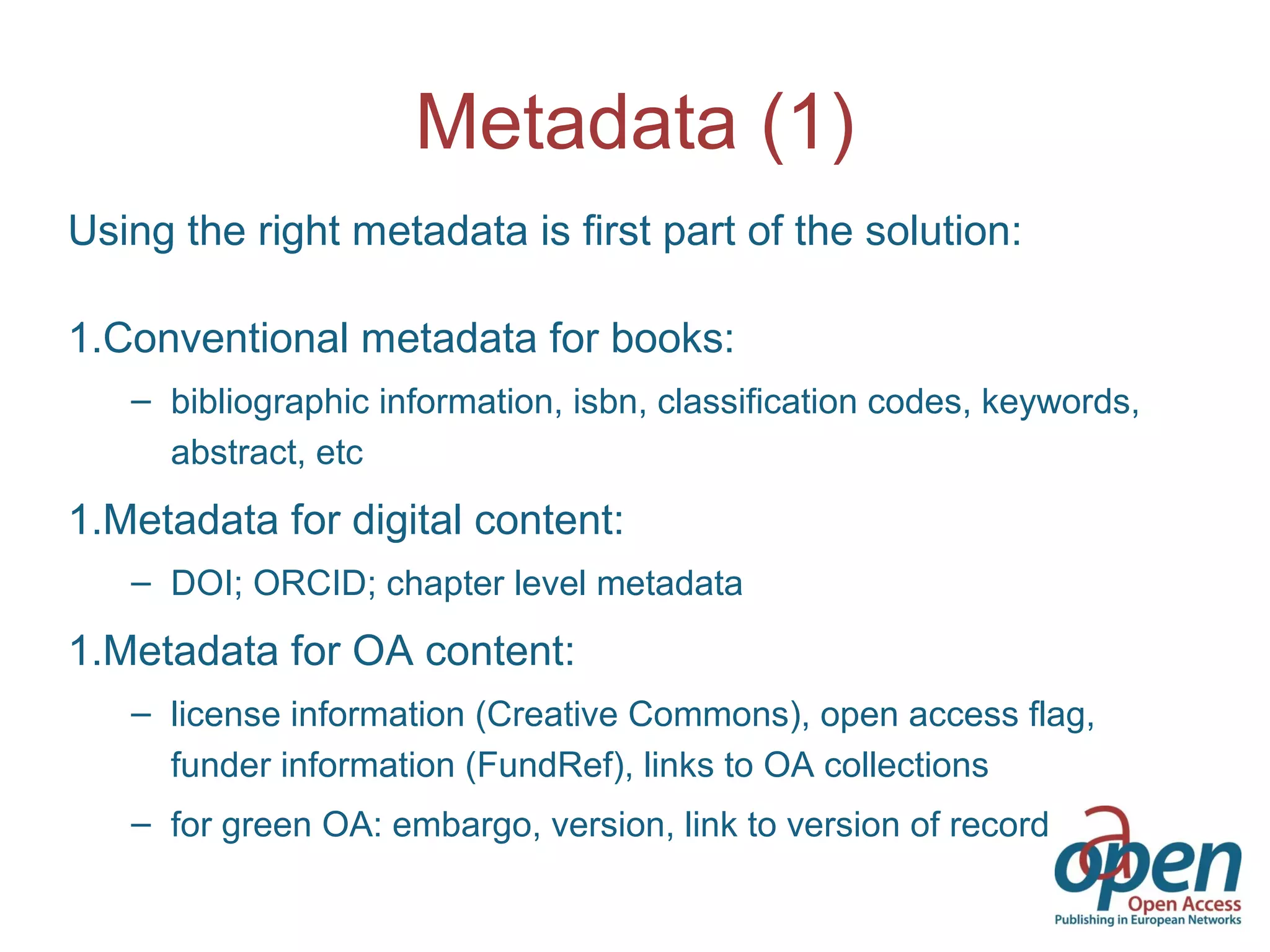
Metadata (1)
Using the right metadata is first part of the solution:
1.Conventional metadata for books:
– bibliographic information, isbn, classification codes, keywords,
abstract, etc
1.Metadata for digital content:
– DOI; ORCID; chapter level metadata
1.Metadata for OA content:
– license information (Creative Commons), open access flag,
funder information (FundRef), links to OA collections
– for green OA: embargo, version, link to version of record
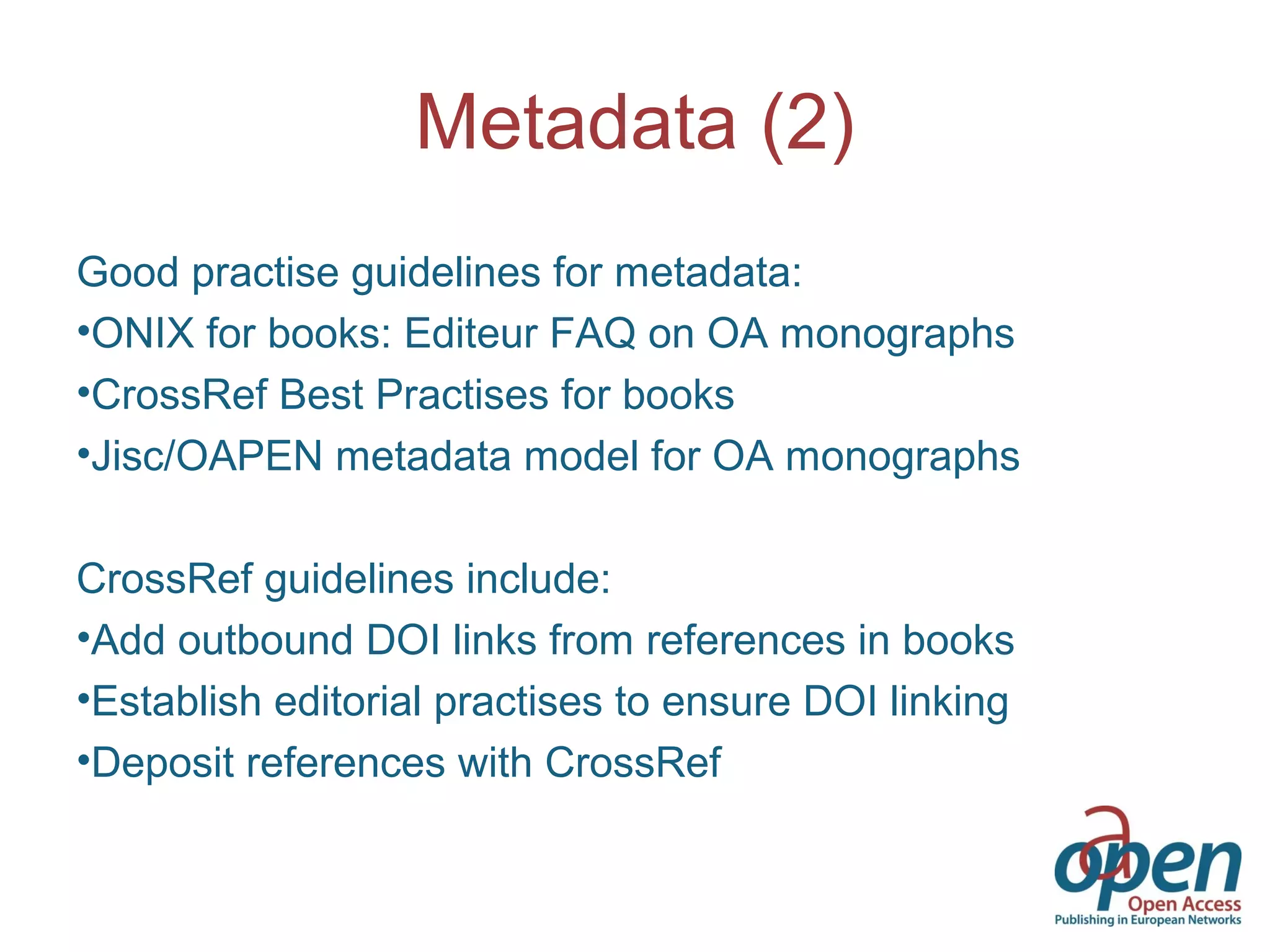
Metadata (2)
Good practise guidelines for metadata:
•ONIX for books: Editeur FAQ on OA monographs
•CrossRef Best Practises for books
•Jisc/OAPEN metadata model for OA monographs
CrossRef guidelines include:
•Add outbound DOI links from references in books
•Establish editorial practises to ensure DOI linking
•Deposit references with CrossRef
Metadata (3)
The purpose of metadata is to support dissemination:
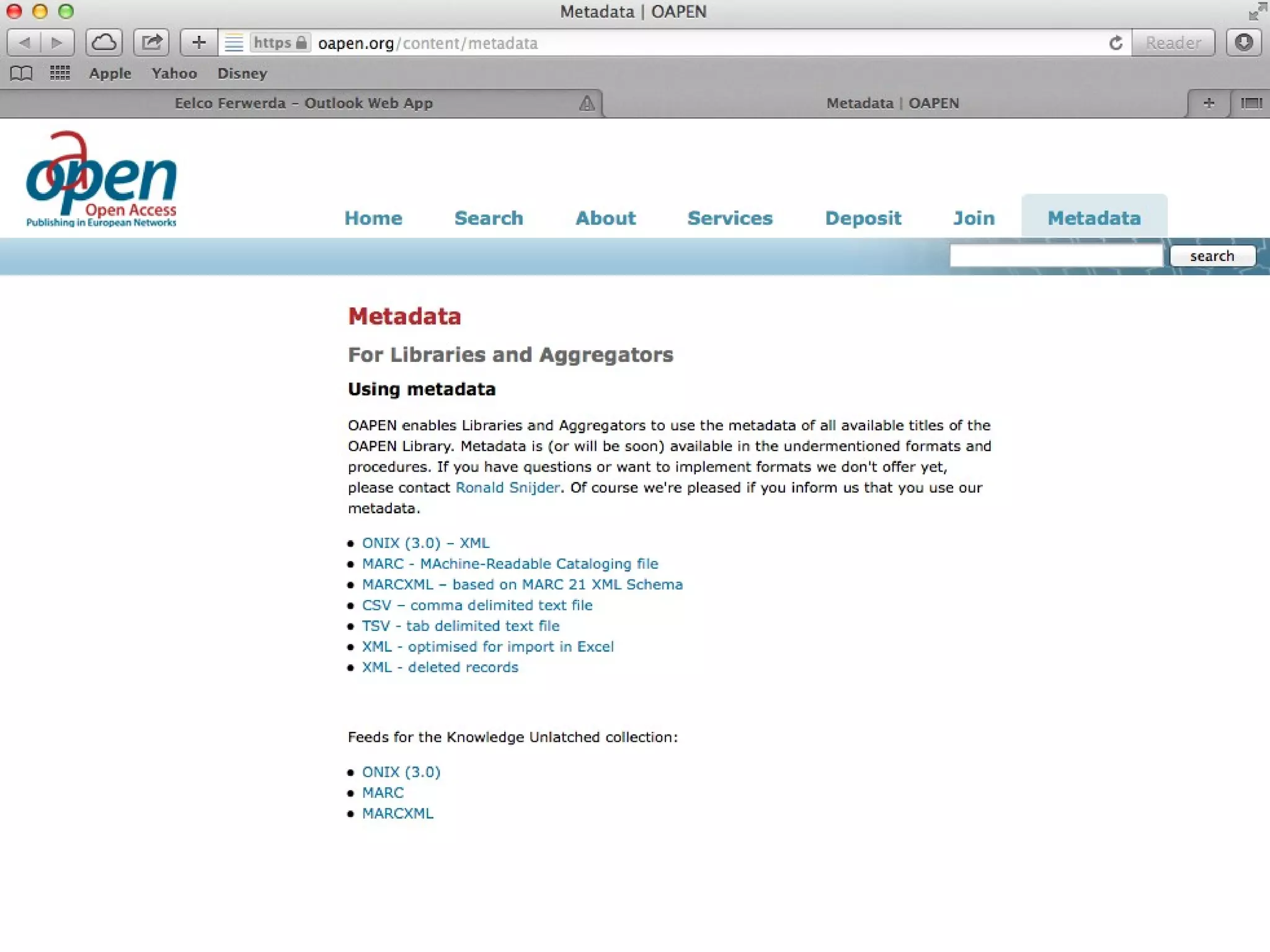
•Formats to supply metadata:
– ONIX 3.0 (book industry)
– MARC21 (library community)
•Provide metadata feeds for various channels:
– Library discovery systems: OCLC WorldCat; ExLibris Primo; ProQuest’s
Summon; EBSCO Discovery
– OA channels: harvesting through OAI-PMH; BASE
– Web resources: Europeana; DPLA
•Hosting & discovery platforms:
– OAPEN; JSTOR; Ingenta Open
– Discovery service for OA books: DOAB
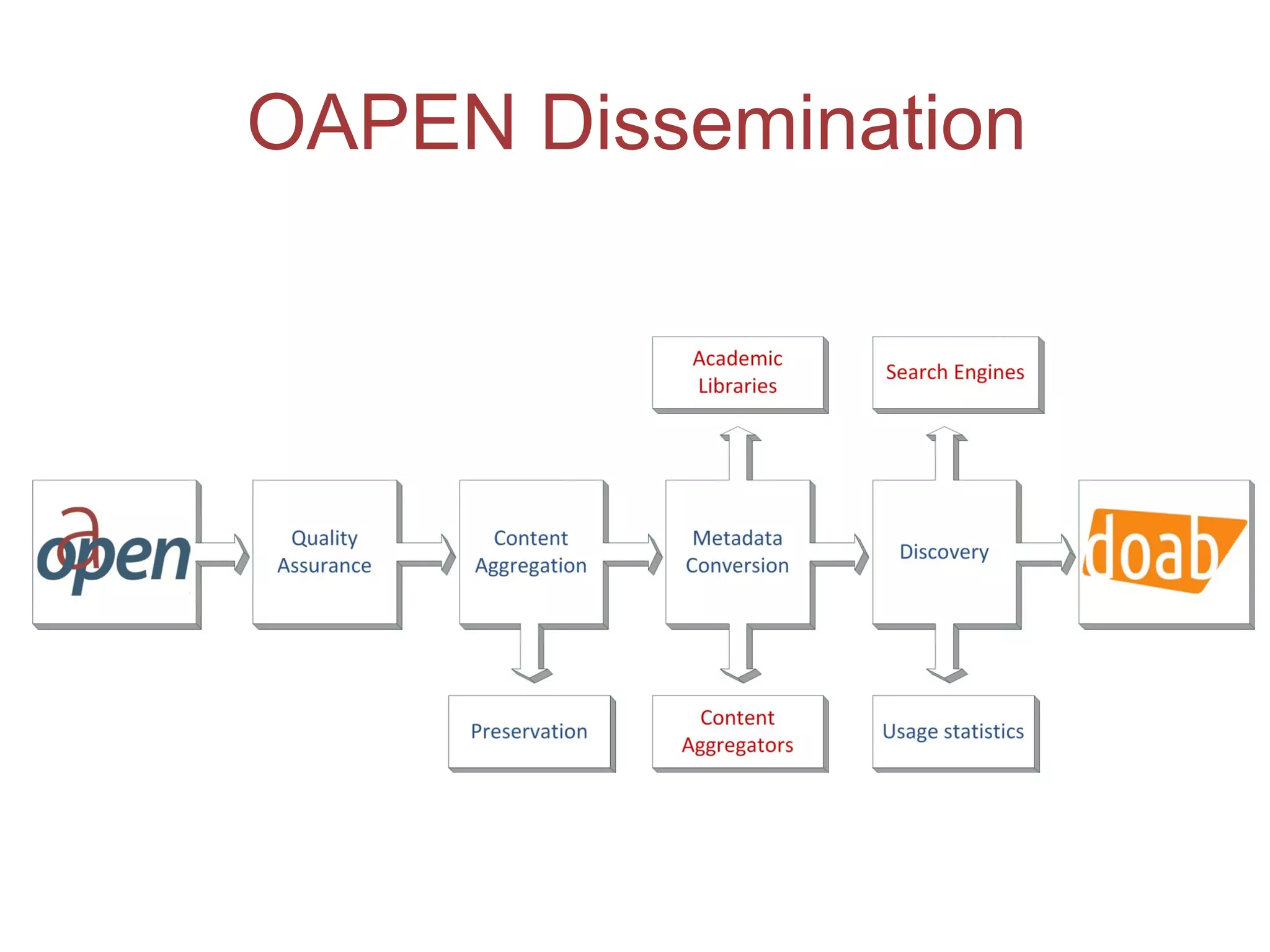
OAPEN Dissemination
OAPEN Dissemination
DOAB
Discovery service for OA books:
•Publishers apply to be listed
•DOAB reviews applications based on
requirements for OA books
•Listed publishers upload the metadata of their OA
books
•Libraries include the DOAB collection in their
discovery system
DOAB works
• DOAB is second largest source of referrals for
OAPEN (20%, after facebook)
• Books listed in DOAB are downloaded 60%
more than unlisted books
• Recent study:
‘…aggregation of OA metadata by a trusted entity such
as DOAB plays a significant role in facilitating OA book
discoverability in library catalogs’
- Aaron McCollough, in: Libraries and the Academy, Vol. 17, No.1 (2017)
What you should do
Conclusion of study
Two most important factors to make OA books
discoverable through library catalogs:
1.Publishers should deposit OA monograph
records in DOAB
2.Libraries should systematically opt to include or
display OA monograph records
References
 Good practise guidelines for metadata:
- ONIX for books: Editeur FAQ on OA monographs
http://www.editeur.org/files/ONIX%203/20140722%20Open%20Access%20e
- CrossRef Best Practises for books
www.crossref.org/06members/best_practices_for_books.html
- Jisc/OAPEN metadata model for OA monographs
https://www.oapen.org/content/sites/default/files/u6/WP3%20Metadata
%20for%20OA%20monographs%20-%2020160607.pdf
 Article:
- Aaron McCollough, ‘Does It Make a Sound: Are Open Access
Aonographs Discoverable in Library Catalogs?’ in: Libraries and the
Academy, Vol. 17, No.1 (2017)
https://www.press.jhu.edu/journals/portal_libraries_and_the_academy/
portal_pre_print/articles/17.1mccollough.pdf
Thank you
Eelco Ferwerda
e.ferwerda@oapen.org
www.oapen.org - @oapenbooks
www.doabooks.org - @doabooks

Why discovery of open books is a challenge

  • 1.
    Why discovery ofopen books is a challenge How to build a successful OA books programme ALPSP seminar, 22 February, London Eelco Ferwerda OAPEN Foundation
  • 2.
  • 3.
    OAPEN Foundation Dedicated toOA books •OAPEN Library – Hosting full text collection of OA books (+ chapters) – Only peer reviewed content – 150+ publishers, 3400+ books •Directory of Open Access Books – Discovery service, 6000 OA books from 170 publishers •Focus on post publication services: – Quality assurance – Deposit, aggregation, archiving – Discovery and Dissemination
  • 6.
    Discovery: challenges Goal ofOA: – take away access barriers, increase reach, usage, and impact of content Dependent on discovery: •Users access content through various sources: – retailers; e-book aggregators; library vendors; library catalogues; publishers website •Third party suppliers struggle with free content: – zero pricing, no DRM, no commission? •When a title is discovered: – is it clear that there is a free version? •When the OA version is discovered: – is it clear what rights are attached?
  • 7.
    Metadata (1) Using theright metadata is first part of the solution: 1.Conventional metadata for books: – bibliographic information, isbn, classification codes, keywords, abstract, etc 1.Metadata for digital content: – DOI; ORCID; chapter level metadata 1.Metadata for OA content: – license information (Creative Commons), open access flag, funder information (FundRef), links to OA collections – for green OA: embargo, version, link to version of record
  • 8.
    Metadata (2) Good practiseguidelines for metadata: •ONIX for books: Editeur FAQ on OA monographs •CrossRef Best Practises for books •Jisc/OAPEN metadata model for OA monographs CrossRef guidelines include: •Add outbound DOI links from references in books •Establish editorial practises to ensure DOI linking •Deposit references with CrossRef
  • 9.
    Metadata (3) The purposeof metadata is to support dissemination: •Formats to supply metadata: – ONIX 3.0 (book industry) – MARC21 (library community) •Provide metadata feeds for various channels: – Library discovery systems: OCLC WorldCat; ExLibris Primo; ProQuest’s Summon; EBSCO Discovery – OA channels: harvesting through OAI-PMH; BASE – Web resources: Europeana; DPLA •Hosting & discovery platforms: – OAPEN; JSTOR; Ingenta Open – Discovery service for OA books: DOAB
  • 10.
  • 11.
  • 12.
    DOAB Discovery service forOA books: •Publishers apply to be listed •DOAB reviews applications based on requirements for OA books •Listed publishers upload the metadata of their OA books •Libraries include the DOAB collection in their discovery system
  • 13.
    DOAB works • DOABis second largest source of referrals for OAPEN (20%, after facebook) • Books listed in DOAB are downloaded 60% more than unlisted books • Recent study: ‘…aggregation of OA metadata by a trusted entity such as DOAB plays a significant role in facilitating OA book discoverability in library catalogs’ - Aaron McCollough, in: Libraries and the Academy, Vol. 17, No.1 (2017)
  • 14.
    What you shoulddo Conclusion of study Two most important factors to make OA books discoverable through library catalogs: 1.Publishers should deposit OA monograph records in DOAB 2.Libraries should systematically opt to include or display OA monograph records
  • 15.
    References  Good practiseguidelines for metadata: - ONIX for books: Editeur FAQ on OA monographs http://www.editeur.org/files/ONIX%203/20140722%20Open%20Access%20e - CrossRef Best Practises for books www.crossref.org/06members/best_practices_for_books.html - Jisc/OAPEN metadata model for OA monographs https://www.oapen.org/content/sites/default/files/u6/WP3%20Metadata %20for%20OA%20monographs%20-%2020160607.pdf  Article: - Aaron McCollough, ‘Does It Make a Sound: Are Open Access Aonographs Discoverable in Library Catalogs?’ in: Libraries and the Academy, Vol. 17, No.1 (2017) https://www.press.jhu.edu/journals/portal_libraries_and_the_academy/ portal_pre_print/articles/17.1mccollough.pdf
  • 16.
    Thank you Eelco Ferwerda e.ferwerda@oapen.org www.oapen.org- @oapenbooks www.doabooks.org - @doabooks