Disaster Preparedness Training
for Community Organizations
Conni Wells
Owner, Axis Group I, LLC
Rich La Belle
Executive Director, Family Network on Disabilities
Patti Derr
Executive Director, Texas Federation of Families for Children’s
Mental Health
Bringing Recovery Supports to Scale
Technical Assistance Center Strategy
This presentation was supported by contract number HHSS2832012000351/HHSS28342002T from the
Substance Abuse and Mental Health Services Administration (SAMHSA). The views, opinions, and
content of this presentation are those of the presenters and do not necessarily reflect the views,
opinions, or policies of SAMHSA or the U.S. Department of Health and Human Services (HHS).
Presenters
Juan Vélez Court
Co-founder, Nuestra Mente
Peer Coordinator, Puerto Rico Strategic Targeted
Response to the Opioid Crisis, Ministry of Mental Health
and Substance Abuse
Conni Wells
Owner, Axis Group I, LLC
Housekeeping Items
• Phone lines will be MUTED. Please participate using
the “Comments and Chat” box.
• You can post questions any time during the
presentation.
• The session is scheduled for 60 minutes and is being
recorded. The recording link, which reflects today’s
chat, will be shared with all registrants.
This training is designed for leaders from peer-run, faith-based,
and community organizations.
It will help you build the organization’s capacity to meet the needs
of the people you serve with mental health conditions or substance
use disorder before, during, and after a disaster by
1. familiarizing you with disaster policies, programs, and
services;
2. explaining the role of your organization in disaster planning,
response, and recovery;
3. outlining ways to improve organizational disaster resilience;
and
4. presenting strategies for protecting organizational assets.
Training Goals
Header
• Based on the “Disaster
Organizational Planning
Assessment”
• A planning chart designed to
assist organizations in
• setting goals, timelines,
and direction; and
• playing a more pivotal role
in building their capacity to
help others in disaster
planning, response, and
recovery.
Organizing the Organization
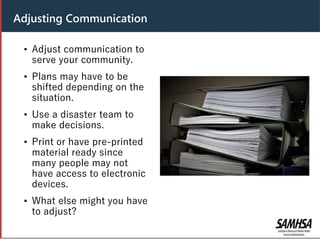
Header
1. Planning
2. Response
3. Recovery
Outline
Planning
“Emergency preparedness is a team sport.”
- Eric Whitaker
Header
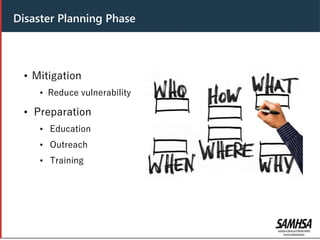
• Mitigation
• Reduce vulnerability
• Preparation
• Education
• Outreach
• Training
Disaster Planning Phase
Disaster Training
• Training is necessary for organizational
preparedness.
• Organizations must be trained to prepare.
• Working with local emergency and disaster
partners is essential.
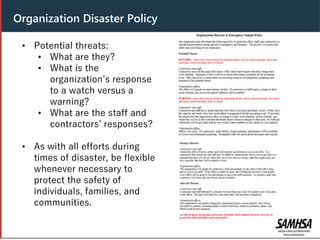
Organization Disaster Policy
• Potential threats:
• What are they?
• What is the
organization’s response
to a watch versus a
warning?
• What are the staff and
contractors’ responses?
• As with all efforts during
times of disaster, be flexible
whenever necessary to
protect the safety of
individuals, families, and
communities.
Vulnerability Assessment
• Understand and address
vulnerable areas.
• Recognize that everyone
is vulnerable.
• Consider who may be the
most vulnerable
• Ask and look for
assistance.
Understanding the Vulnerability Assessment
• Use the assessment to better understand your
organization’s areas of vulnerability.
• Check the box to identify vulnerability to different
hazards:
 Very Likely
 Likely
 Not likely
 Not a threat
• Look for “Very Likely” and “Likely” areas.
• Have a plan that addresses these issues.
Disaster Management Team
• Assists in planning the
response to disaster
• Considers extra needs for
those with mental or
substance use disorders
• Made up of key staff
• Assists in developing
plans
• Guides organization in a
disaster
Disaster Plan
• Every organization needs a disaster plan.
• The plan helps direct the organization's response
and recovery.
• The plan helps to organize
• information,
• contacts, and
• details.
Disaster relief veteran and peer movement leader, Kaye Rote,
of Oklahoma recommends assigning one person at your
organization to contact the following people or organizations
when disaster threatens or has occurred:
1. Your state’s Department of Mental Health
2. The U.S. Department of Homeland Security
3. Pharmacies and pharmaceutical companies for
information on how people can access medications
quickly
4. Private practice therapists to compile a list of those
who are able volunteer time
5. Mental health advocacy leaders, starting in state and
branching out nationally
Incorporate partnerships into your plan
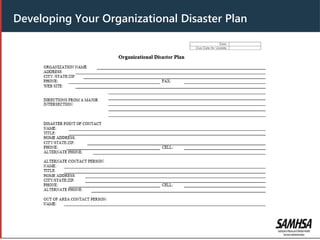
Developing Your Organizational Disaster Plan
Area Emergency and Disaster Partners
• Meet with disaster partners:
• Red Cross
• Emergency Management
• Learn the services and
supports offered.
• Build a partnership.
• Do this before a disaster occurs.
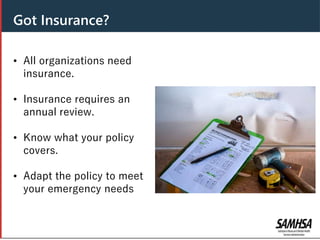
Got Insurance?
• All organizations need
insurance.
• Insurance requires an
annual review.
• Know what your policy
covers.
• Adapt the policy to meet
your emergency needs
Documenting Assets
• Take pictures.
• Create an inventory.
• Get estimates on replacement.
• Know the method of documentation required.
Header
• Laws require that HIPAA-protected and other private
information remain confidential.
• Preplanning is necessary to protect this information.
Protecting Confidentiality
Header
• Know where and how to get supplies.
• Turn to local Red Cross and other disaster programs
for assistance.
• Ensure you can gather the necessary items.
• Have the resources on standby.
Disaster Supplies
Header
• Depending on the results of your Vulnerability
Assessment, supplies may include
• sandbags,
• fire extinguishers,
• fireproof lock boxes,
• boards for windows,
• a generator, and
• ...others?
Possible Supplies
Header
• Emergency lights with
battery back-up to make
it safer to move around
and also serve as a
security measure.
• Consider keeping head
lamps or other portable
lighting on hand.
Emergency Lighting
Header
UL-listed surge protectors or battery backup systems
assist in preventing loss of data or function during
intermittent, unexpected electrical loss.
Battery Strips
Header
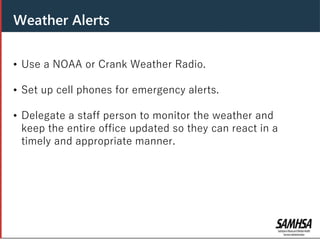
• Use a NOAA or Crank Weather Radio.
• Set up cell phones for emergency alerts.
• Delegate a staff person to monitor the weather and
keep the entire office updated so they can react in a
timely and appropriate manner.
Weather Alerts
Header
• All data should be
backed up.
• Backup data should not
be in the same location
as original data.
• Do not rely solely on the
cloud.
• An additional storage
source could be a thumb
drive
Data Protection
Header
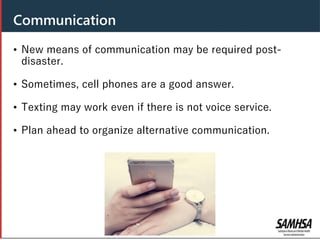
• New means of communication may be required post-
disaster.
• Sometimes, cell phones are a good answer.
• Texting may work even if there is not voice service.
• Plan ahead to organize alternative communication.
Communication
Header
• Post staff schedules at all times.
• Don’t rely only on the internet.
• Take the schedule with you, if evacuation is
necessary.
Schedules
Header
• Store equipment and important files away from
windows or pipes.
• Put smaller equipment in garbage or lawn bags.
• Be sure you can move equipment if necessary.
• Example: Use a trash bin on wheels for easier transport
• Plan ahead.
Protecting Equipment
Header
Post two places for staff to meet.
• Practice getting to the meeting place once a quarter to
save time and ensure safety
• Follow the recommendations of emergency and
disaster partners.
• Share this information with new staff during
orientation.
Designated Meeting Place
Header
• Designate an out-of-state or
out-of-area partner to be the
check-in point.
• Check-in points serve as a
place to relay safety
information, needs, and
updates.
• Use another organization if
possible.
• Partners can receive calls
from staff that are checking in
from different locations.
Check-in
All Staff Check-In Log
Staff Name Method of
Contact
Location Complications Plan (stay,
evacuate)
Anticipated
Return Date
Impact on
Family/Home
Needs
Header
• What are your local or state
policies on medical priority?
• Know the answer so you
can advise those you serve.
• Call your area Emergency
Management Services; if
necessary, meet with them.
• Keep copies of the policies
(local and state) for future
reference.
Medical Priority-Seek Subject Matter Expertise
SAMPLE POLICY
New Hampshire Disaster Policies for people with recovery support needs
taken from their Department of Health and Human Services Disaster
Behavioral Health Response Plan, revised in 2011.
F. Disaster-Related Services to be Provided
The following mental health and substance use disorder services can be
rapidly made available to survivors of disaster, their families, the general
public, disaster workers and volunteers utilizing resources from the
DBHRT, CMHC and other behavioral health providers. Specific services
include:
Medical Priority, cont.
• 24-hour response capacity
• crisis intervention
• psychological first aid
• outreach
• individual and community assessment
• strategic planning
• screening and referral
• individual stabilization
• crisis management briefings (town hall
meetings)
• critical incident stress debriefings
• crisis counseling
• community education
• stress management
• brief supportive counseling
• training
• support groups.
Header
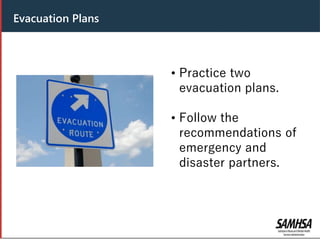
• Practice two
evacuation plans.
• Follow the
recommendations of
emergency and
disaster partners.
Evacuation Plans
Header
• Clearly post all emergency numbers for staff:
• electric companies
• gas companies
• Red Cross
• hospitals
• Send a copy to staff members’ cell phones
Posting Emergency Numbers
Header
• Staff should know how to shut off utilities to prevent
further loss or electrocution.
• Get assistance from local utility companies.
• Keep necessary tools at location of shut-off.
Turning Off Utilities
Header
• All non-electronic
documents should be
scanned:
• IRS papers
• documents signed by
lawyers
• corporate papers
• Keep them off-site with
other documents
Important Documents
Header
• Develop and disseminate staff and partner
contact lists with this information:
• phone numbers
• street addresses
• directions to people’s homes
Contact Lists
Header
• Arrange for programmable
call-forwarding.
• Forward calls to a safe
number belonging to
• another organization out of
the disaster area, or
• a designated cell phone.
Phone Lines
Header
• Have one line for staff calls only.
• Leave recorded messages for staff to get
further instructions.
• Other partners can use these messages to
learn the organization’s next steps.
Staff Line
Header
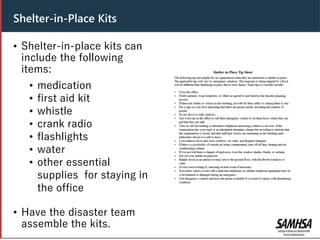
• Shelter-in-place kits can
include the following
items:
• medication
• first aid kit
• whistle
• crank radio
• flashlights
• water
• other essential
supplies for staying in
the office
• Have the disaster team
assemble the kits.
Shelter-in-Place Kits
Header
• Develop small grab bags,
that will fit in a backpack.
• Use them if evacuation is
needed.
• Include the office
disaster plan.
• Include other items, for
instance:
• sanitizer
• first aid supplies
• water
• flashlight
Disaster Grab Bags
More items are located on the checklist for the organizational shelter-in-place kit
Header
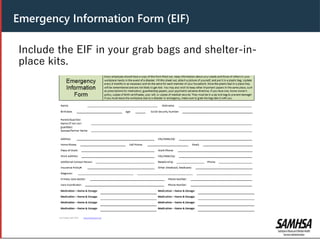
Include the EIF in your grab bags and shelter-in-
place kits.
Emergency Information Form (EIF)
Header
• Use self-soothing boxes made
up of a variety of items to
distract and soothe people
during stressful times.
• As part of the planning
process, have each staff
member develop his or her
calming box.
• Keep boxes at the office and
distribute them at
appropriate times.
Calming Box
A box might include:
• chocolates
• stress ball/toy
• fidget cube
• small stuffed
animal
• soothing pictures or
quotes
• bubbles
• scented inhaler,
oils
• small play dough
• cards
• coloring books and
markers
Header
• Staff members need
family disaster plans to
ensure preparation for
their own families.
• Keep these plans in
their personnel file.
• Staff can use templates
and references included
in the Additional
Resources document of
the training documents.
Staff Disaster Plans
Header
• Develop a targeted plan to assist those being served.
• Help your community be better prepared
• What will be needed?
• Non-electronic information
• Materials in several languages
• Information on evacuation options
Assisting Others
Header
Response
“In times of disaster, basic connectivity is a form of aid that connects
people to the resources critical for survival and enables humanitarian
organizations to quickly deliver life-saving information.”
—Tae Yoo
Header
“Disasters happen but our work, our mission continues. Actually, what we
do is more important after a disaster than before.”
—Board president of a nonprofit organization
Header
• Organizations should know when and how to
implement their disaster response plan.
Your Response Plan in Action
Header
• Put the disaster response plan into place.
• Respond according to
• directions given by authorities,
• disaster type and threat,
• time available, and
• what is safest and most likely to preserve human
lives.
Evacuation
Header
• If there is time, take the following actions:
• Call the designated check point.
• Shut off water, gas, and electricity before leaving.
• Post a note telling others when you left and where
you are going.
• Lock the doors.
• Use the route recommended by authorities.
Evacuation
Header
Where will staff go?
Shelter
Special shelter
Hotel
Friends
Drop-in center
Home
Local Churches
Header
• Appropriate for people with well-controlled illnesses
or disorders.
• Intended for people who
• can transfer themselves or whose family is there to
assist; or
• require little assistance or care.
• May work well for
• people with medication-controlled conditions;
• people with visual, speech, or hearing
impairments; or
• people on special diets
Regular Shelters
Header
• Appropriate for those individuals who are
• medically fragile,
• medically dependent on power for life support, or
• medically dependent on care for many activities of
daily living.
• Note: Some shelters and hospitals limit the number of
family members.
Special Needs Shelters, Hospitals, and Care Facilities
Header
• Stay in your home or office during a disaster.
• You must have all of the supplies you need and be
able to manage for at least three days.
• Notify the local EMS and your care team if you shelter
in place.
• Set up regular check-ins with team members.
• Have someone check on you after the emergency has
passed.
• Never stay if it is recommended that you evacuate.
Sheltering-in-Place
Header
• Are we safer by staying rather than evacuating?
• Can we manage the needs of those in the office for
three days with little or no outside assistance?
• Can we meet any crisis or emergency on our own for
that period of time?
• Can we make decisions about our needs without
consultation or help for three days?
• Do we have the supplies and equipment to meet our
special needs for three days?
• If your answer is “No” to any of these, then LEAVE!
Questions to Ask Yourself
Header
• Adjust communication to
serve your community.
• Plans may have to be
shifted depending on the
situation.
• Use a disaster team to
make decisions.
• Print or have pre-printed
material ready since
many people may not
have access to electronic
devices.
• What else might you have
to adjust?
Adjusting Communication
• Electronic communication, such as internet
communication with email and Facebook:
• Prepare ahead of time.
• Broadcast how you will communicate.
• Develop a template.
• Cell phone and text messaging:
• Keep numbers in an accessible file.
• Develop the message ahead of time.
• Public service announcements and media:
• Write PSAs or scripts in advance.
• Find out what the media will need.
Preparing Communication
Preparing Communication, cont.
• Written communications:
• Develop and print ahead of time
• Use printed labels
• Print in the languages of those you serve
• Face-to-face/door-to-door:
• Travel in groups
• Carry disaster supplies with you (e.g.,
batteries, flashlights, wet wipes, sanitizer gel,
etc.)
• Use translators when needed
• Bring along a community leader
Header
• The safety and needs of the program and
organization should be assessed.
• The organization’s status and capacity will dictate
its role in the response and recovery process.
• Information should be shared regularly with
funders, partners, the board of directors, area
disaster response teams, and others involved in the
daily operation of the organization.
Assessment and Reporting
Header
• Quickly assess what is
available
• Know the limitations:
• eligibility
• services offered
• caps on assistance
• See the National
Resources document.
• See the Community
Disaster Resources
template provided to
locate resources specific
to your community or
state.
Locating Resources
Header
• Staff may have a variety of reactions to a
disaster, all of which may be common
responses to difficult situations.
• These reactions can include:
• Feeling physically and mentally drained
• Having difficulty making decisions or
staying focused
• Becoming easily frustrated
• Arguing
• Feeling tired, sad, numb, lonely, or
worried
• Experiencing changes in appetite or
sleep patterns
• Most of these reactions are temporary and
will go away over time.
Emotional Support for Staff
Header
• Maintain a dedicated phone line for staff to call, leave
updates, or request assistance
• Call staff daily to check in and see how they are doing
• Help staff meet their needs FIRST
• Ensure staff and their families are safe
• Seek resources and support for all staff in need
• Ensure staff are paid
How You Can Help
Header
• Communicate your current capacity to funders, major
stakeholders, and partners
• to garner additional assistance if needed, and
• to explain why you may be unable to meet
deadlines set prior to the disaster.
Communication With Funders and Board of Directors
Header
Recovery
“While natural disasters capture headlines and national attention short-
term, the work of recovery and rebuilding is long-term.”
—Sylvia Mathews Burwell
Header
You need a place of operations where
• work is directed,
• accountability is maintained, and
• everyday office functions are carried out.
Security and Safety
Header
• Ensure long-term phone service is in place.
• Link to out-of-area numbers that are toll-free, such
as other non-profit organizations.
• Set up a new phone line and number just for
recovery information and support.
Phone and Communication
Header
• Continue to communicate with technical assistance
centers, funders, board members, and other partners
on a regular basis.
• After a disaster, your partners can
• support your work,
• gather donations,
• funnel resources and information, and
• help with the caseload by adopting some of the
work.
Communication Beyond the Disaster Area
Header
• Develop a temporary operational plan.
• Share the plan with your partners.
• Ensure that you meet the requirements of funders.
Temporary Operational Plan
Header
• See the Temporary
Operational Plan template.
• Be honest and realistic.
• Make it a snapshot of your
organization at the date
and time that you fill out
the form.
• Update the plan if a major
change occurs.
• Send the updated plan to
critical partners on a
regular and predictive
basis.
Utilizing the Temporary Operational Plan
Header
• Develop new materials to help
reach out to those you serve.
• Explain that the organization is
still in operation and can continue
to assist with recovery.
• Develop these materials in all of
the languages used in the
community you serve.
• Utilize additional modes of
communication to reach more
people (e.g., social media and
group texts)
Adjusting Outreach
Header
• Register, or at a minimum, touch base with the
following partners:
• Red Cross
• Emergency management
• Local health department
• This should not be the first contact. Establish
these relationships during the planning phase.
• Connect with your area’s Federal Emergency
Management Agency (FEMA) team
Touch Base with Disaster Partners
Header
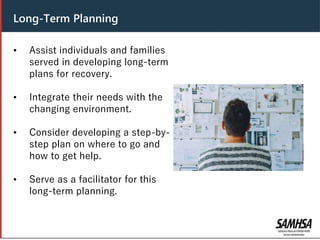
• Assist individuals and families
served in developing long-term
plans for recovery.
• Integrate their needs with the
changing environment.
• Consider developing a step-by-
step plan on where to go and
how to get help.
• Serve as a facilitator for this
long-term planning.
Long-Term Planning
Header
“Helping others is easy when everything is calm. The
true test is how well you respond to the needs of
yourself, your organization, your family, your staff, and
those you serve all at the same time, amidst chaos and
fear. Hurricanes, fires, and floods—those are what
made us our best.”
—Executive director of a statewide family network
Closing
SAMHSA’s mission is to reduce the impact of substance abuse and mental illness on America’s communities.
1-877-SAMHSA-7 (1-877-726-4727) • 1-800-487-4889 (TDD)
http://www.samhsa.gov

T8_DisasterReadiness_PPT-Training-TA Resource_5_20_19.pptx

  • 1.
    Disaster Preparedness Training forCommunity Organizations Conni Wells Owner, Axis Group I, LLC Rich La Belle Executive Director, Family Network on Disabilities Patti Derr Executive Director, Texas Federation of Families for Children’s Mental Health
  • 2.
    Bringing Recovery Supportsto Scale Technical Assistance Center Strategy This presentation was supported by contract number HHSS2832012000351/HHSS28342002T from the Substance Abuse and Mental Health Services Administration (SAMHSA). The views, opinions, and content of this presentation are those of the presenters and do not necessarily reflect the views, opinions, or policies of SAMHSA or the U.S. Department of Health and Human Services (HHS).
  • 3.
    Presenters Juan Vélez Court Co-founder,Nuestra Mente Peer Coordinator, Puerto Rico Strategic Targeted Response to the Opioid Crisis, Ministry of Mental Health and Substance Abuse Conni Wells Owner, Axis Group I, LLC
  • 4.
    Housekeeping Items • Phonelines will be MUTED. Please participate using the “Comments and Chat” box. • You can post questions any time during the presentation. • The session is scheduled for 60 minutes and is being recorded. The recording link, which reflects today’s chat, will be shared with all registrants.
  • 5.
    This training isdesigned for leaders from peer-run, faith-based, and community organizations. It will help you build the organization’s capacity to meet the needs of the people you serve with mental health conditions or substance use disorder before, during, and after a disaster by 1. familiarizing you with disaster policies, programs, and services; 2. explaining the role of your organization in disaster planning, response, and recovery; 3. outlining ways to improve organizational disaster resilience; and 4. presenting strategies for protecting organizational assets. Training Goals
  • 6.
    Header • Based onthe “Disaster Organizational Planning Assessment” • A planning chart designed to assist organizations in • setting goals, timelines, and direction; and • playing a more pivotal role in building their capacity to help others in disaster planning, response, and recovery. Organizing the Organization
  • 7.
  • 8.
    Planning “Emergency preparedness isa team sport.” - Eric Whitaker
  • 9.
    Header • Mitigation • Reducevulnerability • Preparation • Education • Outreach • Training Disaster Planning Phase
  • 10.
    Disaster Training • Trainingis necessary for organizational preparedness. • Organizations must be trained to prepare. • Working with local emergency and disaster partners is essential.
  • 11.
    Organization Disaster Policy •Potential threats: • What are they? • What is the organization’s response to a watch versus a warning? • What are the staff and contractors’ responses? • As with all efforts during times of disaster, be flexible whenever necessary to protect the safety of individuals, families, and communities.
  • 12.
    Vulnerability Assessment • Understandand address vulnerable areas. • Recognize that everyone is vulnerable. • Consider who may be the most vulnerable • Ask and look for assistance.
  • 13.
    Understanding the VulnerabilityAssessment • Use the assessment to better understand your organization’s areas of vulnerability. • Check the box to identify vulnerability to different hazards:  Very Likely  Likely  Not likely  Not a threat • Look for “Very Likely” and “Likely” areas. • Have a plan that addresses these issues.
  • 14.
    Disaster Management Team •Assists in planning the response to disaster • Considers extra needs for those with mental or substance use disorders • Made up of key staff • Assists in developing plans • Guides organization in a disaster
  • 15.
    Disaster Plan • Everyorganization needs a disaster plan. • The plan helps direct the organization's response and recovery. • The plan helps to organize • information, • contacts, and • details.
  • 16.
    Disaster relief veteranand peer movement leader, Kaye Rote, of Oklahoma recommends assigning one person at your organization to contact the following people or organizations when disaster threatens or has occurred: 1. Your state’s Department of Mental Health 2. The U.S. Department of Homeland Security 3. Pharmacies and pharmaceutical companies for information on how people can access medications quickly 4. Private practice therapists to compile a list of those who are able volunteer time 5. Mental health advocacy leaders, starting in state and branching out nationally Incorporate partnerships into your plan
  • 17.
  • 18.
    Area Emergency andDisaster Partners • Meet with disaster partners: • Red Cross • Emergency Management • Learn the services and supports offered. • Build a partnership. • Do this before a disaster occurs.
  • 19.
    Got Insurance? • Allorganizations need insurance. • Insurance requires an annual review. • Know what your policy covers. • Adapt the policy to meet your emergency needs
  • 20.
    Documenting Assets • Takepictures. • Create an inventory. • Get estimates on replacement. • Know the method of documentation required.
  • 21.
    Header • Laws requirethat HIPAA-protected and other private information remain confidential. • Preplanning is necessary to protect this information. Protecting Confidentiality
  • 22.
    Header • Know whereand how to get supplies. • Turn to local Red Cross and other disaster programs for assistance. • Ensure you can gather the necessary items. • Have the resources on standby. Disaster Supplies
  • 23.
    Header • Depending onthe results of your Vulnerability Assessment, supplies may include • sandbags, • fire extinguishers, • fireproof lock boxes, • boards for windows, • a generator, and • ...others? Possible Supplies
  • 24.
    Header • Emergency lightswith battery back-up to make it safer to move around and also serve as a security measure. • Consider keeping head lamps or other portable lighting on hand. Emergency Lighting
  • 25.
    Header UL-listed surge protectorsor battery backup systems assist in preventing loss of data or function during intermittent, unexpected electrical loss. Battery Strips
  • 26.
    Header • Use aNOAA or Crank Weather Radio. • Set up cell phones for emergency alerts. • Delegate a staff person to monitor the weather and keep the entire office updated so they can react in a timely and appropriate manner. Weather Alerts
  • 27.
    Header • All datashould be backed up. • Backup data should not be in the same location as original data. • Do not rely solely on the cloud. • An additional storage source could be a thumb drive Data Protection
  • 28.
    Header • New meansof communication may be required post- disaster. • Sometimes, cell phones are a good answer. • Texting may work even if there is not voice service. • Plan ahead to organize alternative communication. Communication
  • 29.
    Header • Post staffschedules at all times. • Don’t rely only on the internet. • Take the schedule with you, if evacuation is necessary. Schedules
  • 30.
    Header • Store equipmentand important files away from windows or pipes. • Put smaller equipment in garbage or lawn bags. • Be sure you can move equipment if necessary. • Example: Use a trash bin on wheels for easier transport • Plan ahead. Protecting Equipment
  • 31.
    Header Post two placesfor staff to meet. • Practice getting to the meeting place once a quarter to save time and ensure safety • Follow the recommendations of emergency and disaster partners. • Share this information with new staff during orientation. Designated Meeting Place
  • 32.
    Header • Designate anout-of-state or out-of-area partner to be the check-in point. • Check-in points serve as a place to relay safety information, needs, and updates. • Use another organization if possible. • Partners can receive calls from staff that are checking in from different locations. Check-in All Staff Check-In Log Staff Name Method of Contact Location Complications Plan (stay, evacuate) Anticipated Return Date Impact on Family/Home Needs
  • 33.
    Header • What areyour local or state policies on medical priority? • Know the answer so you can advise those you serve. • Call your area Emergency Management Services; if necessary, meet with them. • Keep copies of the policies (local and state) for future reference. Medical Priority-Seek Subject Matter Expertise
  • 34.
    SAMPLE POLICY New HampshireDisaster Policies for people with recovery support needs taken from their Department of Health and Human Services Disaster Behavioral Health Response Plan, revised in 2011. F. Disaster-Related Services to be Provided The following mental health and substance use disorder services can be rapidly made available to survivors of disaster, their families, the general public, disaster workers and volunteers utilizing resources from the DBHRT, CMHC and other behavioral health providers. Specific services include: Medical Priority, cont. • 24-hour response capacity • crisis intervention • psychological first aid • outreach • individual and community assessment • strategic planning • screening and referral • individual stabilization • crisis management briefings (town hall meetings) • critical incident stress debriefings • crisis counseling • community education • stress management • brief supportive counseling • training • support groups.
  • 35.
    Header • Practice two evacuationplans. • Follow the recommendations of emergency and disaster partners. Evacuation Plans
  • 36.
    Header • Clearly postall emergency numbers for staff: • electric companies • gas companies • Red Cross • hospitals • Send a copy to staff members’ cell phones Posting Emergency Numbers
  • 37.
    Header • Staff shouldknow how to shut off utilities to prevent further loss or electrocution. • Get assistance from local utility companies. • Keep necessary tools at location of shut-off. Turning Off Utilities
  • 38.
    Header • All non-electronic documentsshould be scanned: • IRS papers • documents signed by lawyers • corporate papers • Keep them off-site with other documents Important Documents
  • 39.
    Header • Develop anddisseminate staff and partner contact lists with this information: • phone numbers • street addresses • directions to people’s homes Contact Lists
  • 40.
    Header • Arrange forprogrammable call-forwarding. • Forward calls to a safe number belonging to • another organization out of the disaster area, or • a designated cell phone. Phone Lines
  • 41.
    Header • Have oneline for staff calls only. • Leave recorded messages for staff to get further instructions. • Other partners can use these messages to learn the organization’s next steps. Staff Line
  • 42.
    Header • Shelter-in-place kitscan include the following items: • medication • first aid kit • whistle • crank radio • flashlights • water • other essential supplies for staying in the office • Have the disaster team assemble the kits. Shelter-in-Place Kits
  • 43.
    Header • Develop smallgrab bags, that will fit in a backpack. • Use them if evacuation is needed. • Include the office disaster plan. • Include other items, for instance: • sanitizer • first aid supplies • water • flashlight Disaster Grab Bags More items are located on the checklist for the organizational shelter-in-place kit
  • 44.
    Header Include the EIFin your grab bags and shelter-in- place kits. Emergency Information Form (EIF)
  • 45.
    Header • Use self-soothingboxes made up of a variety of items to distract and soothe people during stressful times. • As part of the planning process, have each staff member develop his or her calming box. • Keep boxes at the office and distribute them at appropriate times. Calming Box A box might include: • chocolates • stress ball/toy • fidget cube • small stuffed animal • soothing pictures or quotes • bubbles • scented inhaler, oils • small play dough • cards • coloring books and markers
  • 46.
    Header • Staff membersneed family disaster plans to ensure preparation for their own families. • Keep these plans in their personnel file. • Staff can use templates and references included in the Additional Resources document of the training documents. Staff Disaster Plans
  • 47.
    Header • Develop atargeted plan to assist those being served. • Help your community be better prepared • What will be needed? • Non-electronic information • Materials in several languages • Information on evacuation options Assisting Others
  • 48.
    Header Response “In times ofdisaster, basic connectivity is a form of aid that connects people to the resources critical for survival and enables humanitarian organizations to quickly deliver life-saving information.” —Tae Yoo
  • 49.
    Header “Disasters happen butour work, our mission continues. Actually, what we do is more important after a disaster than before.” —Board president of a nonprofit organization
  • 50.
    Header • Organizations shouldknow when and how to implement their disaster response plan. Your Response Plan in Action
  • 51.
    Header • Put thedisaster response plan into place. • Respond according to • directions given by authorities, • disaster type and threat, • time available, and • what is safest and most likely to preserve human lives. Evacuation
  • 52.
    Header • If thereis time, take the following actions: • Call the designated check point. • Shut off water, gas, and electricity before leaving. • Post a note telling others when you left and where you are going. • Lock the doors. • Use the route recommended by authorities. Evacuation
  • 53.
    Header Where will staffgo? Shelter Special shelter Hotel Friends Drop-in center Home Local Churches
  • 54.
    Header • Appropriate forpeople with well-controlled illnesses or disorders. • Intended for people who • can transfer themselves or whose family is there to assist; or • require little assistance or care. • May work well for • people with medication-controlled conditions; • people with visual, speech, or hearing impairments; or • people on special diets Regular Shelters
  • 55.
    Header • Appropriate forthose individuals who are • medically fragile, • medically dependent on power for life support, or • medically dependent on care for many activities of daily living. • Note: Some shelters and hospitals limit the number of family members. Special Needs Shelters, Hospitals, and Care Facilities
  • 56.
    Header • Stay inyour home or office during a disaster. • You must have all of the supplies you need and be able to manage for at least three days. • Notify the local EMS and your care team if you shelter in place. • Set up regular check-ins with team members. • Have someone check on you after the emergency has passed. • Never stay if it is recommended that you evacuate. Sheltering-in-Place
  • 57.
    Header • Are wesafer by staying rather than evacuating? • Can we manage the needs of those in the office for three days with little or no outside assistance? • Can we meet any crisis or emergency on our own for that period of time? • Can we make decisions about our needs without consultation or help for three days? • Do we have the supplies and equipment to meet our special needs for three days? • If your answer is “No” to any of these, then LEAVE! Questions to Ask Yourself
  • 58.
    Header • Adjust communicationto serve your community. • Plans may have to be shifted depending on the situation. • Use a disaster team to make decisions. • Print or have pre-printed material ready since many people may not have access to electronic devices. • What else might you have to adjust? Adjusting Communication
  • 59.
    • Electronic communication,such as internet communication with email and Facebook: • Prepare ahead of time. • Broadcast how you will communicate. • Develop a template. • Cell phone and text messaging: • Keep numbers in an accessible file. • Develop the message ahead of time. • Public service announcements and media: • Write PSAs or scripts in advance. • Find out what the media will need. Preparing Communication
  • 60.
    Preparing Communication, cont. •Written communications: • Develop and print ahead of time • Use printed labels • Print in the languages of those you serve • Face-to-face/door-to-door: • Travel in groups • Carry disaster supplies with you (e.g., batteries, flashlights, wet wipes, sanitizer gel, etc.) • Use translators when needed • Bring along a community leader
  • 61.
    Header • The safetyand needs of the program and organization should be assessed. • The organization’s status and capacity will dictate its role in the response and recovery process. • Information should be shared regularly with funders, partners, the board of directors, area disaster response teams, and others involved in the daily operation of the organization. Assessment and Reporting
  • 62.
    Header • Quickly assesswhat is available • Know the limitations: • eligibility • services offered • caps on assistance • See the National Resources document. • See the Community Disaster Resources template provided to locate resources specific to your community or state. Locating Resources
  • 63.
    Header • Staff mayhave a variety of reactions to a disaster, all of which may be common responses to difficult situations. • These reactions can include: • Feeling physically and mentally drained • Having difficulty making decisions or staying focused • Becoming easily frustrated • Arguing • Feeling tired, sad, numb, lonely, or worried • Experiencing changes in appetite or sleep patterns • Most of these reactions are temporary and will go away over time. Emotional Support for Staff
  • 64.
    Header • Maintain adedicated phone line for staff to call, leave updates, or request assistance • Call staff daily to check in and see how they are doing • Help staff meet their needs FIRST • Ensure staff and their families are safe • Seek resources and support for all staff in need • Ensure staff are paid How You Can Help
  • 65.
    Header • Communicate yourcurrent capacity to funders, major stakeholders, and partners • to garner additional assistance if needed, and • to explain why you may be unable to meet deadlines set prior to the disaster. Communication With Funders and Board of Directors
  • 66.
    Header Recovery “While natural disasterscapture headlines and national attention short- term, the work of recovery and rebuilding is long-term.” —Sylvia Mathews Burwell
  • 67.
    Header You need aplace of operations where • work is directed, • accountability is maintained, and • everyday office functions are carried out. Security and Safety
  • 68.
    Header • Ensure long-termphone service is in place. • Link to out-of-area numbers that are toll-free, such as other non-profit organizations. • Set up a new phone line and number just for recovery information and support. Phone and Communication
  • 69.
    Header • Continue tocommunicate with technical assistance centers, funders, board members, and other partners on a regular basis. • After a disaster, your partners can • support your work, • gather donations, • funnel resources and information, and • help with the caseload by adopting some of the work. Communication Beyond the Disaster Area
  • 70.
    Header • Develop atemporary operational plan. • Share the plan with your partners. • Ensure that you meet the requirements of funders. Temporary Operational Plan
  • 71.
    Header • See theTemporary Operational Plan template. • Be honest and realistic. • Make it a snapshot of your organization at the date and time that you fill out the form. • Update the plan if a major change occurs. • Send the updated plan to critical partners on a regular and predictive basis. Utilizing the Temporary Operational Plan
  • 72.
    Header • Develop newmaterials to help reach out to those you serve. • Explain that the organization is still in operation and can continue to assist with recovery. • Develop these materials in all of the languages used in the community you serve. • Utilize additional modes of communication to reach more people (e.g., social media and group texts) Adjusting Outreach
  • 73.
    Header • Register, orat a minimum, touch base with the following partners: • Red Cross • Emergency management • Local health department • This should not be the first contact. Establish these relationships during the planning phase. • Connect with your area’s Federal Emergency Management Agency (FEMA) team Touch Base with Disaster Partners
  • 74.
    Header • Assist individualsand families served in developing long-term plans for recovery. • Integrate their needs with the changing environment. • Consider developing a step-by- step plan on where to go and how to get help. • Serve as a facilitator for this long-term planning. Long-Term Planning
  • 75.
    Header “Helping others iseasy when everything is calm. The true test is how well you respond to the needs of yourself, your organization, your family, your staff, and those you serve all at the same time, amidst chaos and fear. Hurricanes, fires, and floods—those are what made us our best.” —Executive director of a statewide family network Closing SAMHSA’s mission is to reduce the impact of substance abuse and mental illness on America’s communities. 1-877-SAMHSA-7 (1-877-726-4727) • 1-800-487-4889 (TDD) http://www.samhsa.gov