Neonatal Chest X-ray
An Overview
Learning objectives
1. When and when not to do a neonatal chest x-ray?
2. What does a normal chest x-ray look like?
3. Position of tubes and catheters?
4. Common causes of neonatal respiratory distress.
5. Surgical diagnoses.
6. References.
When to do a Chest X-ray?
For initial
diagnosis
Detioration
causes
Catheter/ tube
placements
When not to do a chest x-ray?
Daily x-ray for
ventilated babies
Repeated x-ray
after every
reajustment of
catheter / tube
Routine pre- and
post-intubation
Without clear
indication
Not routine to
cover abdomen
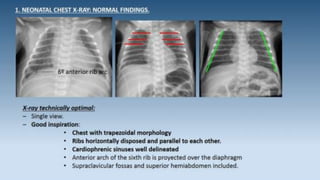
The normal
chest x-ray
technique
• In AP with patient supine
• Lateral films useful for:
1. Pneumothorax
2. Localisation of tube/catheter
Before commenting on a Chest X-ray: Review
History and indication
Is the film rotated
Is there good inspiration
Exposure
Fig. 2: Rotated chest X-ray may simulate cardiomegaly or hyperdense hemithorax (image on the left).
New X-ray study in the same patient reveals no cardiopulmonary disease (image on the right).
Term or
preterm?
In preterm babies:
Lack of subcutaneous fat
Lack of humeral head ossification
Look for umbilical clip:
Will remain until about 1-2 weeks after baby is
born
Points to
remember
• Diaphragm is usually till 6th rib anteriorly
and 8th rib posteriorly
• Thymus is prominent: cardiothoracic ratio
may reach 0.6
• Air bronchograms may be present
• Heart is often rounded in appearance
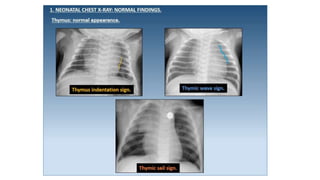
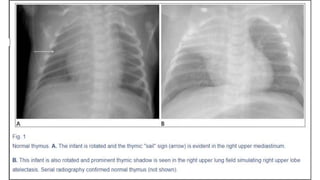
The thymus
• The thymus is relatively prominent in infants
• Draped around the heart constituting the
cardiothymic silhouette.
• Sometimes it shows triangular projection
laterally, which is known as a "sail" sign
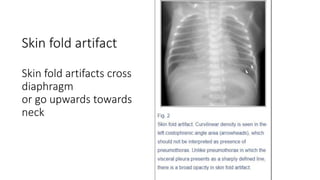
Skin fold artifact
Skin fold artifacts cross
diaphragm
or go upwards towards
neck
Tubes and Catheters
Endotracheal
tube
Umbilical arterial
catheter
Umbilical venous
catheter
Central venous
catheter
Others:
-Chest tube
-Pigtails
-Nasogastric
tube
Endotracheal
tube
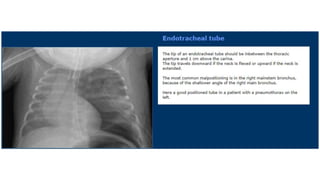
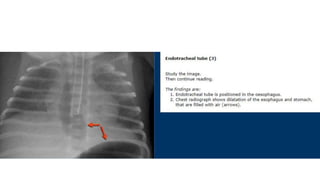
• Middle of clavicles and carina level
• Approximately 1-2cm above carina
• Affected by neck rotation and flexion
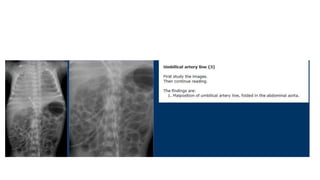
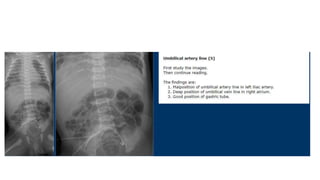
Umbilical arterial
catheter
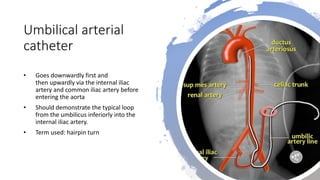
• Goes downwardly first and
then upwardly via the internal iliac
artery and common iliac artery before
entering the aorta
• Should demonstrate the typical loop
from the umbilicus inferiorly into the
internal iliac artery.
• Term used: hairpin turn
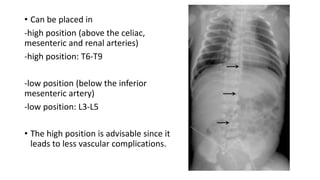
• Can be placed in
-high position (above the celiac,
mesenteric and renal arteries)
-high position: T6-T9
-low position (below the inferior
mesenteric artery)
-low position: L3-L5
• The high position is advisable since it
leads to less vascular complications.
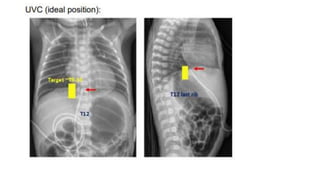
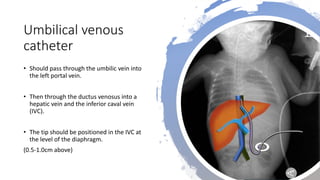
Umbilical venous
catheter
• Should pass through the umbilic vein into
the left portal vein.
• Then through the ductus venosus into a
hepatic vein and the inferior caval vein
(IVC).
• The tip should be positioned in the IVC at
the level of the diaphragm.
(0.5-1.0cm above)
This can lead to cardiac arrhythmias or
perforation.
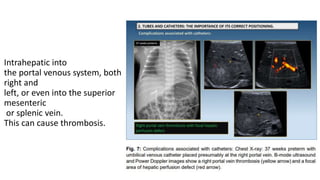
Intrahepatic into
the portal venous system, both
right and
left, or even into the superior
mesenteric
or splenic vein.
This can cause thrombosis.
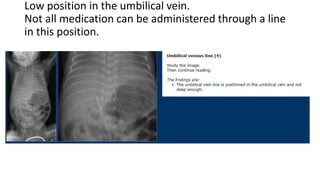
Low position in the umbilical vein.
Not all medication can be administered through a line
in this position.
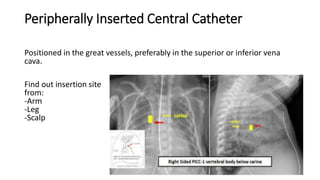
Peripherally Inserted Central Catheter
Positioned in the great vessels, preferably in the superior or inferior vena
cava.
Find out insertion site
from:
-Arm
-Leg
-Scalp
Hyperinflation
Expansion: >6
ribs anteriorly/8
ribs posteriorly
Flattening of
diaphragm
Ribs more
horizontal
Increased
lucency of lungs
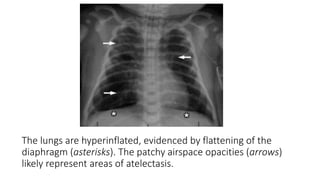
The lungs are hyperinflated, evidenced by flattening of the
diaphragm (asterisks). The patchy airspace opacities (arrows)
likely represent areas of atelectasis.
Common
Pathologies
Respiratory
Distress
Syndrome
(Hyaline
Membrane
Disease)
• Typically in preterm neonates and low birth
weight.
• Related to lung maturity and surfactant
production.
• RDS show underaerated lungs with variable
degrees of opacities from granular lungs to
total white-out.
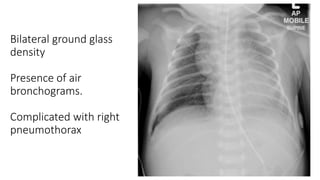
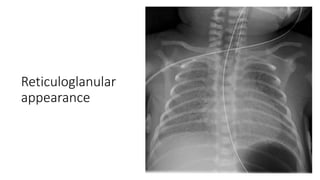
• Classic radiographic findings of RDS:
-Small lung volume
-Ground-glass or hazy lung
-Air bronchogram
• Lung volumes are small since its pathophysiology is essentially
underinflated alveoli.
• Air bronchograms commonly seen in the central regions, more
pronounced when the endotracheal tube is placed.
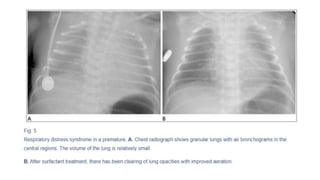
Bilateral ground glass
density
Presence of air
bronchograms.
Complicated with right
pneumothorax
Reticuloglanular
appearance
Transient
Tachypnea of
the Newborn
(Wet lung)
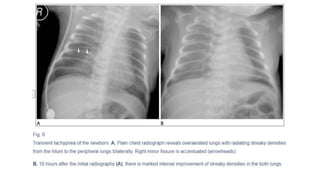
• Caused by fluid retention in alveolar spaces
and interstitium.
• Common findings:
-Prominent hilum with streaky lucencies
-Small pleural effusion
-Cardiomegaly
-Interstitial edema
• Normal chest radiograph by 48-72 hours
postpartum
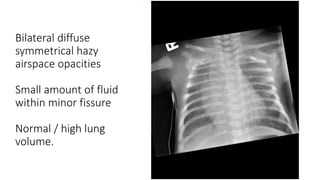
Bilateral diffuse
symmetrical hazy
airspace opacities
Small amount of fluid
within minor fissure
Normal / high lung
volume.
Meconium
Aspiration
Syndrome
• Contaminated meconium may be aspirated into the
baby's airway in utero or during delivery.
• More commonly found in term or near-term babies.
• Aspirated meconium particles mechanically occlude
the bronchioles.
• Air leak including pneumothorax is common and
pulmonary hypertension is a major prognostic
determinant.
Classical
findings
-Increased lung volume
-Heterogeneous opacities
-Air leak
• Superimposed infection is frequent
Widespread
coarse opacities
Neonatal
pneumonia
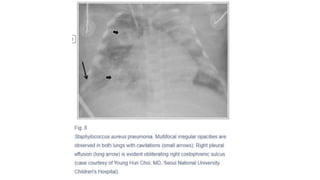
• Most common pathogen for neonatal
pneumonia is group B beta hemolytic
streptococcus (GBS), which is known to mimick
RDS on radiographs.
• Unilateral lung involvement and presence of
pleural effusion favor GBS pneumonia.
• Radiographic features of neonatal pneumonia
are also nonspecific with a wide spectrum of
chest findings mimicking RDS, TTN, or meconium
aspiration.
Can be early onset (caused
by GBS) or late onset
(caused by gram positive
bacteria).
The most frequent and
characteristic alveolar
pattern is dense
bilateral air space filling
process with numerous air
bronchograms.
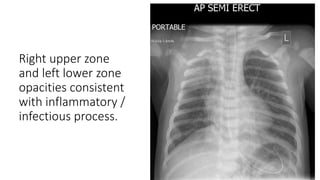
Right upper zone
and left lower zone
opacities consistent
with inflammatory /
infectious process.
Differential diagnosis of diffuse pulmonary
disease in the newborn
High lung volumes, streaky perihilar densities Low lung volumes, granular opacities
1. Meconium aspiration syndrome
2. Transient tachypnea of the newborn
3. Neonatal pneumonia
1. Surfactant deficiency
2. Beta hemolytic streptococcal pneumonia
Surgical causes
Diaphragmatic
hernia
Esophageal
atresia
Diaphragmatic
hernia
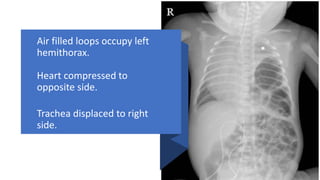
• More common on the left side (Bochdalek
hernia)
• Air-filled bowel loops are seen in the
hemithorax and the heart and mediastinum
are shifted to the opposite side.
• Stomach gas can be seen either in the
thorax or in the abdomen
Air filled loops occupy left
hemithorax.
Heart compressed to
opposite side.
Trachea displaced to right
side.
Esophageal
atresia
• Can occur with or without trachoesophageal
fistula.
• The esophagus ends blindly regardless of
the type, and is detected as air-distended
with coiling of the nasogastric tube on plain
radiograph.
• Sometimes vertebral anomalies may be
present as part of VATERL
References
• Survival Radiology: neonatal chest X-ray for
residents.
https://dx.doi.org/10.1594/ecr2015/C-2351
• Interpretation of Neonatal Chest
Radiography
https://doi.org/10.3348/jksr.2016.74.5.279
• Neonatal chest xray interpretation-Dr
Praveen Kumar
• The Neonatal and Paediatric Chest-
Radiology Key

Neonatal Chest X-Ray

  • 1.
  • 2.
    Learning objectives 1. Whenand when not to do a neonatal chest x-ray? 2. What does a normal chest x-ray look like? 3. Position of tubes and catheters? 4. Common causes of neonatal respiratory distress. 5. Surgical diagnoses. 6. References.
  • 3.
    When to doa Chest X-ray? For initial diagnosis Detioration causes Catheter/ tube placements
  • 4.
    When not todo a chest x-ray? Daily x-ray for ventilated babies Repeated x-ray after every reajustment of catheter / tube Routine pre- and post-intubation Without clear indication Not routine to cover abdomen
  • 5.
    The normal chest x-ray technique •In AP with patient supine • Lateral films useful for: 1. Pneumothorax 2. Localisation of tube/catheter
  • 6.
    Before commenting ona Chest X-ray: Review History and indication Is the film rotated Is there good inspiration Exposure
  • 7.
    Fig. 2: Rotatedchest X-ray may simulate cardiomegaly or hyperdense hemithorax (image on the left). New X-ray study in the same patient reveals no cardiopulmonary disease (image on the right).
  • 8.
    Term or preterm? In pretermbabies: Lack of subcutaneous fat Lack of humeral head ossification Look for umbilical clip: Will remain until about 1-2 weeks after baby is born
  • 9.
    Points to remember • Diaphragmis usually till 6th rib anteriorly and 8th rib posteriorly • Thymus is prominent: cardiothoracic ratio may reach 0.6 • Air bronchograms may be present • Heart is often rounded in appearance
  • 11.
    The thymus • Thethymus is relatively prominent in infants • Draped around the heart constituting the cardiothymic silhouette. • Sometimes it shows triangular projection laterally, which is known as a "sail" sign
  • 14.
    Skin fold artifact Skinfold artifacts cross diaphragm or go upwards towards neck
  • 15.
    Tubes and Catheters Endotracheal tube Umbilicalarterial catheter Umbilical venous catheter Central venous catheter Others: -Chest tube -Pigtails -Nasogastric tube
  • 16.
    Endotracheal tube • Middle ofclavicles and carina level • Approximately 1-2cm above carina • Affected by neck rotation and flexion
  • 20.
    Umbilical arterial catheter • Goesdownwardly first and then upwardly via the internal iliac artery and common iliac artery before entering the aorta • Should demonstrate the typical loop from the umbilicus inferiorly into the internal iliac artery. • Term used: hairpin turn
  • 21.
    • Can beplaced in -high position (above the celiac, mesenteric and renal arteries) -high position: T6-T9 -low position (below the inferior mesenteric artery) -low position: L3-L5 • The high position is advisable since it leads to less vascular complications.
  • 25.
    Umbilical venous catheter • Shouldpass through the umbilic vein into the left portal vein. • Then through the ductus venosus into a hepatic vein and the inferior caval vein (IVC). • The tip should be positioned in the IVC at the level of the diaphragm. (0.5-1.0cm above)
  • 26.
    This can leadto cardiac arrhythmias or perforation.
  • 27.
    Intrahepatic into the portalvenous system, both right and left, or even into the superior mesenteric or splenic vein. This can cause thrombosis.
  • 28.
    Low position inthe umbilical vein. Not all medication can be administered through a line in this position.
  • 29.
    Peripherally Inserted CentralCatheter Positioned in the great vessels, preferably in the superior or inferior vena cava. Find out insertion site from: -Arm -Leg -Scalp
  • 30.
    Hyperinflation Expansion: >6 ribs anteriorly/8 ribsposteriorly Flattening of diaphragm Ribs more horizontal Increased lucency of lungs
  • 31.
    The lungs arehyperinflated, evidenced by flattening of the diaphragm (asterisks). The patchy airspace opacities (arrows) likely represent areas of atelectasis.
  • 32.
  • 33.
    Respiratory Distress Syndrome (Hyaline Membrane Disease) • Typically inpreterm neonates and low birth weight. • Related to lung maturity and surfactant production. • RDS show underaerated lungs with variable degrees of opacities from granular lungs to total white-out.
  • 34.
    • Classic radiographicfindings of RDS: -Small lung volume -Ground-glass or hazy lung -Air bronchogram • Lung volumes are small since its pathophysiology is essentially underinflated alveoli. • Air bronchograms commonly seen in the central regions, more pronounced when the endotracheal tube is placed.
  • 35.
    Bilateral ground glass density Presenceof air bronchograms. Complicated with right pneumothorax
  • 36.
  • 38.
    Transient Tachypnea of the Newborn (Wetlung) • Caused by fluid retention in alveolar spaces and interstitium. • Common findings: -Prominent hilum with streaky lucencies -Small pleural effusion -Cardiomegaly -Interstitial edema • Normal chest radiograph by 48-72 hours postpartum
  • 40.
    Bilateral diffuse symmetrical hazy airspaceopacities Small amount of fluid within minor fissure Normal / high lung volume.
  • 41.
    Meconium Aspiration Syndrome • Contaminated meconiummay be aspirated into the baby's airway in utero or during delivery. • More commonly found in term or near-term babies. • Aspirated meconium particles mechanically occlude the bronchioles. • Air leak including pneumothorax is common and pulmonary hypertension is a major prognostic determinant.
  • 42.
    Classical findings -Increased lung volume -Heterogeneousopacities -Air leak • Superimposed infection is frequent
  • 43.
  • 44.
    Neonatal pneumonia • Most commonpathogen for neonatal pneumonia is group B beta hemolytic streptococcus (GBS), which is known to mimick RDS on radiographs. • Unilateral lung involvement and presence of pleural effusion favor GBS pneumonia. • Radiographic features of neonatal pneumonia are also nonspecific with a wide spectrum of chest findings mimicking RDS, TTN, or meconium aspiration.
  • 45.
    Can be earlyonset (caused by GBS) or late onset (caused by gram positive bacteria). The most frequent and characteristic alveolar pattern is dense bilateral air space filling process with numerous air bronchograms.
  • 46.
    Right upper zone andleft lower zone opacities consistent with inflammatory / infectious process.
  • 48.
    Differential diagnosis ofdiffuse pulmonary disease in the newborn High lung volumes, streaky perihilar densities Low lung volumes, granular opacities 1. Meconium aspiration syndrome 2. Transient tachypnea of the newborn 3. Neonatal pneumonia 1. Surfactant deficiency 2. Beta hemolytic streptococcal pneumonia
  • 49.
  • 50.
    Diaphragmatic hernia • More commonon the left side (Bochdalek hernia) • Air-filled bowel loops are seen in the hemithorax and the heart and mediastinum are shifted to the opposite side. • Stomach gas can be seen either in the thorax or in the abdomen
  • 51.
    Air filled loopsoccupy left hemithorax. Heart compressed to opposite side. Trachea displaced to right side.
  • 52.
    Esophageal atresia • Can occurwith or without trachoesophageal fistula. • The esophagus ends blindly regardless of the type, and is detected as air-distended with coiling of the nasogastric tube on plain radiograph. • Sometimes vertebral anomalies may be present as part of VATERL
  • 54.
    References • Survival Radiology:neonatal chest X-ray for residents. https://dx.doi.org/10.1594/ecr2015/C-2351 • Interpretation of Neonatal Chest Radiography https://doi.org/10.3348/jksr.2016.74.5.279 • Neonatal chest xray interpretation-Dr Praveen Kumar • The Neonatal and Paediatric Chest- Radiology Key

Editor's Notes

  • #7 Rotated might stimulate disease 
  • #42 meconium is rarely found in amniotic fluid before 34 gestational weeks of age.