Writing the Problem/Solution Paper
How to write like a pro!
The first thing: Thesis Statement
• The first thing you need to do when setting out
to write the paper on a problem/solution is to
state the problem and offer a possible solution
to the problem in a thesis statement. For
example:
Thesis:
• Childhood obesity is a serious health problem in
the United States today, but who is ultimately
responsible for ensuring that children receive
proper nutrition and adequate exercise? Most
argue that the parents are responsible, but
some believe the government needs to step in
and solve this growing problem. There are
many programs in place to ensure that children
who live in poverty receive proper nutrition, but
is this enough?
The body of the paper…
• The next step to successful writing is the body
of the paper. There are a few things you need
to master to write an exceptional paper:
• Word Choice
• Transitions
• Relevant Content
• Organizational Structure
The Outline
• You should create an outline based on your
thesis and information you have found for your
paper.
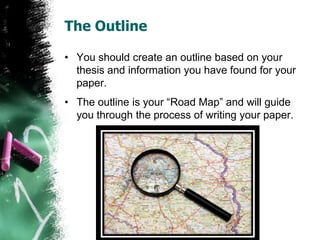
• The outline is your “Road Map” and will guide
you through the process of writing your paper.
Outline Basics
• Your outline begins with the Thesis and the
Introduction. It looks like this:
• Title of paper centered
• I. Thesis: Childhood obesity is……
• The thesis should state the problem, the
solution or other relevant information that you
will discuss in the paper.
• Often, the thesis or Introduction are left for last
because information in your paper dictates what
is discussed.
The Paragraphs:
• The next step is to break it down!
• Step one: During your brainstorming, you should
have listed the main points that you planned on
discussing or researching. Let’s look again at the
introduction and pull out the points:
• 1-state the problem: Childhood Obesity
 A. How is obesity defined?
 What percentage of children are Obese in the U.
S. A. ?
 Is it a demographic problem?
Paragraphs, continued…
• The next paragraph should talk about who is
responsible:
• II. Who bears responsibility for the child’s
health?
 Parents
 State or Federal Government
 Other Family members
Paragraphs, continued…
• Finally, you want to provide information that is
part of the solution. If you are asked to offer
your opinion in the paper, make sure you
include a section in your outline for that as well.
You may wish to include that in your concluding
paragraph.
• III. Programs and Responsible Parties
 Government Programs
 Familial Solutions
 Parental accountability
Paragraphs, continued…
• Now you need to write your conclusion. Many
teachers have told you in the past to restate
your thesis, but this seems very redundant. It
would be best to highlight the points in your
paper and draw a conclusion based on what
you learned. This requires that you actually take
the time to think about what you learned.
The KWL
• You may have been assigned the KWL chart
before your paper. Now is the time to take that
last column and elaborate in the conclusion of
your paper.
• On the next page, there is a strong conclusion
based on the information that you probably
found. I took the liberty of writing what I know to
be true.
Conclusion:
• Example:
• Though childhood obesity is a problem, there
are solutions and it does take a number of
people and organizations to help combat it.
Parents are the first line of defense since it
is, ultimately, their responsibility to provide for
the basic needs of their children. As long as
people who can’t afford children keep having
children, the society will have to foot the bill for
keeping these children healthy so they do not
become lifetime burdens on that society.
Transitions
• Now that you have put the information into a
good working paper, you need to make sure
your ideas flow from one point to the next with a
logical and smooth flow. This is where
transitions come into play.
• Transitions help move your points from one to
the other without sounding choppy or like you
just threw your thoughts willy-nilly onto the
page.
Using Transitional Words…
• Using transitions is not just a quick fix…throw in
a transitional word or phrase and you are done!
• Using transitions takes thought and planning.
• Let’s view some examples of transitional
devices and sentences at the Online Writing
Lab at Perdue University’s site:
• http://owl.english.purdue.edu/owl/resource/574/
2/
• Another great site:
https://www.msu.edu/~jdowell/135/transw.html
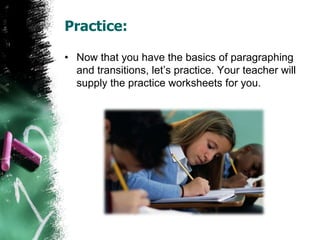
Practice:
• Now that you have the basics of paragraphing
and transitions, let’s practice. Your teacher will
supply the practice worksheets for you.
Word Choice
• Using the right words in a paper or any
writing, for that matter, is very important. You
don’t want to use words that make you sound
ignorant and you want to use words that are
relevant to your subject.
• One rule to practice is to really know what the
words mean.
• Some students do use words that do not mean
what they think and this changes the meaning
of the sentence, sometimes drastically!
Word choice
Malapropisms:
• "Oh! it gives me the hydrostatics to such a degree." [hysterics]
• "I hope you will represent her to the captain as an object not altogether
illegible.
[eligible]
• "...she might reprehend the true meaning of what she is saying."
[comprehend]
• "...she's as headstrong as an allegory on the banks of Nile." [alligator]
• "I am sorry to say, Sir Anthony, that my affluence over my niece is very
small.” [influence]
• "Why, murder's the matter! slaughter's the matter! killing's the matter! - but
he can tell you the perpendiculars."
[particulars]
(fun-with-words.com 2011)
Spelling
• Another issue that many students face is
spelling. There are many commonly confused
words and these are silly mistakes that your
spell checker does NOT identify.
• See this link for commonly misspelled words:
• http://grammar.yourdictionary.com/spelling-and-
word-lists/misspelled.html
• It is always a good idea to check your spelling
yourself. It pays to take your time!
Final thoughts…
• As a final thought, after you have written your
paper, read it aloud to yourself or some one
else who can hear mistakes. When you read a
paper aloud, you often hear things that you
would not read. This is because you are not as
focused as you think and now you are engaging
a different part of your brain.
• It works!
• Try it out.

Writing the problem

  • 1.
    Writing the Problem/SolutionPaper How to write like a pro!
  • 2.
    The first thing:Thesis Statement • The first thing you need to do when setting out to write the paper on a problem/solution is to state the problem and offer a possible solution to the problem in a thesis statement. For example:
  • 3.
    Thesis: • Childhood obesityis a serious health problem in the United States today, but who is ultimately responsible for ensuring that children receive proper nutrition and adequate exercise? Most argue that the parents are responsible, but some believe the government needs to step in and solve this growing problem. There are many programs in place to ensure that children who live in poverty receive proper nutrition, but is this enough?
  • 4.
    The body ofthe paper… • The next step to successful writing is the body of the paper. There are a few things you need to master to write an exceptional paper: • Word Choice • Transitions • Relevant Content • Organizational Structure
  • 5.
    The Outline • Youshould create an outline based on your thesis and information you have found for your paper. • The outline is your “Road Map” and will guide you through the process of writing your paper.
  • 6.
    Outline Basics • Youroutline begins with the Thesis and the Introduction. It looks like this: • Title of paper centered • I. Thesis: Childhood obesity is…… • The thesis should state the problem, the solution or other relevant information that you will discuss in the paper. • Often, the thesis or Introduction are left for last because information in your paper dictates what is discussed.
  • 7.
    The Paragraphs: • Thenext step is to break it down! • Step one: During your brainstorming, you should have listed the main points that you planned on discussing or researching. Let’s look again at the introduction and pull out the points: • 1-state the problem: Childhood Obesity  A. How is obesity defined?  What percentage of children are Obese in the U. S. A. ?  Is it a demographic problem?
  • 8.
    Paragraphs, continued… • Thenext paragraph should talk about who is responsible: • II. Who bears responsibility for the child’s health?  Parents  State or Federal Government  Other Family members
  • 9.
    Paragraphs, continued… • Finally,you want to provide information that is part of the solution. If you are asked to offer your opinion in the paper, make sure you include a section in your outline for that as well. You may wish to include that in your concluding paragraph. • III. Programs and Responsible Parties  Government Programs  Familial Solutions  Parental accountability
  • 10.
    Paragraphs, continued… • Nowyou need to write your conclusion. Many teachers have told you in the past to restate your thesis, but this seems very redundant. It would be best to highlight the points in your paper and draw a conclusion based on what you learned. This requires that you actually take the time to think about what you learned.
  • 11.
    The KWL • Youmay have been assigned the KWL chart before your paper. Now is the time to take that last column and elaborate in the conclusion of your paper. • On the next page, there is a strong conclusion based on the information that you probably found. I took the liberty of writing what I know to be true.
  • 12.
    Conclusion: • Example: • Thoughchildhood obesity is a problem, there are solutions and it does take a number of people and organizations to help combat it. Parents are the first line of defense since it is, ultimately, their responsibility to provide for the basic needs of their children. As long as people who can’t afford children keep having children, the society will have to foot the bill for keeping these children healthy so they do not become lifetime burdens on that society.
  • 13.
    Transitions • Now thatyou have put the information into a good working paper, you need to make sure your ideas flow from one point to the next with a logical and smooth flow. This is where transitions come into play. • Transitions help move your points from one to the other without sounding choppy or like you just threw your thoughts willy-nilly onto the page.
  • 14.
    Using Transitional Words… •Using transitions is not just a quick fix…throw in a transitional word or phrase and you are done! • Using transitions takes thought and planning. • Let’s view some examples of transitional devices and sentences at the Online Writing Lab at Perdue University’s site: • http://owl.english.purdue.edu/owl/resource/574/ 2/ • Another great site: https://www.msu.edu/~jdowell/135/transw.html
  • 15.
    Practice: • Now thatyou have the basics of paragraphing and transitions, let’s practice. Your teacher will supply the practice worksheets for you.
  • 16.
    Word Choice • Usingthe right words in a paper or any writing, for that matter, is very important. You don’t want to use words that make you sound ignorant and you want to use words that are relevant to your subject. • One rule to practice is to really know what the words mean. • Some students do use words that do not mean what they think and this changes the meaning of the sentence, sometimes drastically!
  • 17.
    Word choice Malapropisms: • "Oh!it gives me the hydrostatics to such a degree." [hysterics] • "I hope you will represent her to the captain as an object not altogether illegible. [eligible] • "...she might reprehend the true meaning of what she is saying." [comprehend] • "...she's as headstrong as an allegory on the banks of Nile." [alligator] • "I am sorry to say, Sir Anthony, that my affluence over my niece is very small.” [influence] • "Why, murder's the matter! slaughter's the matter! killing's the matter! - but he can tell you the perpendiculars." [particulars] (fun-with-words.com 2011)
  • 18.
    Spelling • Another issuethat many students face is spelling. There are many commonly confused words and these are silly mistakes that your spell checker does NOT identify. • See this link for commonly misspelled words: • http://grammar.yourdictionary.com/spelling-and- word-lists/misspelled.html • It is always a good idea to check your spelling yourself. It pays to take your time!
  • 19.
    Final thoughts… • Asa final thought, after you have written your paper, read it aloud to yourself or some one else who can hear mistakes. When you read a paper aloud, you often hear things that you would not read. This is because you are not as focused as you think and now you are engaging a different part of your brain. • It works! • Try it out.