1
2


A judge in Israel
 Tribe of Manasseh
     A Gileadite
  Father – Gilead
Mother a prostitute
 Rejected & cast out
   (Judges 11:1-3).
3


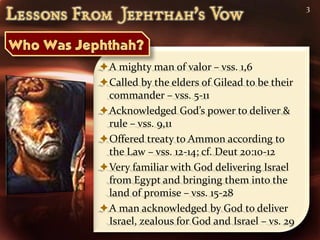
A mighty man of valor – vss. 1,6
Called by the elders of Gilead to be their
 commander – vss. 5-11
Acknowledged God’s power to deliver &
 rule – vss. 9,11
Offered treaty to Ammon according to
 the Law – vss. 12-14; cf. Deut 20:10-12
Very familiar with God delivering Israel
 from Egypt and bringing them into the
 land of promise – vss. 15-28
A man acknowledged by God to deliver
 Israel, zealous for God and Israel – vs. 29
4


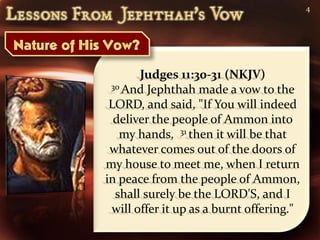
       Judges 11:30-31 (NKJV)
 30 And Jephthah made a vow to the

 LORD, and said, "If You will indeed
  deliver the people of Ammon into
   my hands, 31 then it will be that
 whatever comes out of the doors of
my house to meet me, when I return
in peace from the people of Ammon,
  shall surely be the LORD'S, and I
 will offer it up as a burnt offering."
5


Was not as rash as many think –
 expresses his dependence upon God for
 the victory as well as his earnest desire for
 the deliverance of his people – vss. 29-32
Man or animal? - Jephthah expected a
 person to meet him, - “out of the doors
 of my house” – vs. 31
Possible interpretations –
   “or I have offered up for it--a burnt-
     offering” – [YLT]
   “I will offer it up as a burnt offering”
     [NKJV] – i.e. “like a burnt offering”
6


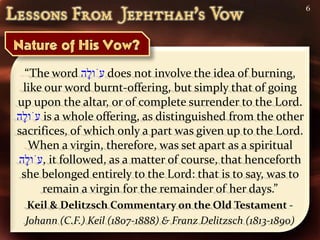
  “The word ‫ עֹו ָה‬does not involve the idea of burning,
                 ‫ל‬
 like our word burnt-offering, but simply that of going
up upon the altar, or of complete surrender to the Lord.
‫ עֹו ָה‬is a whole offering, as distinguished from the other
 ‫ל‬
sacrifices, of which only a part was given up to the Lord.
   When a virgin, therefore, was set apart as a spiritual
‫ ,עֹו ָה‬it followed, as a matter of course, that henceforth
  ‫ל‬
 she belonged entirely to the Lord: that is to say, was to
       remain a virgin for the remainder of her days.”
 Keil & Delitzsch Commentary on the Old Testament -
 Johann (C.F.) Keil (1807-1888) & Franz Delitzsch (1813-1890)
7


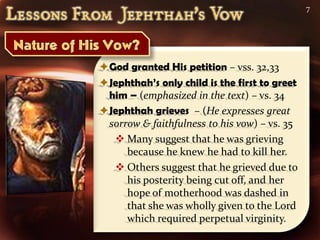
God granted His petition – vss. 32,33
Jephthah’s only child is the first to greet
 him – (emphasized in the text) – vs. 34
Jephthah grieves – (He expresses great
 sorrow & faithfulness to his vow) – vs. 35
   Many suggest that he was grieving
     because he knew he had to kill her.
   Others suggest that he grieved due to
     his posterity being cut off, and her
     hope of motherhood was dashed in
     that she was wholly given to the Lord
     which required perpetual virginity.
8


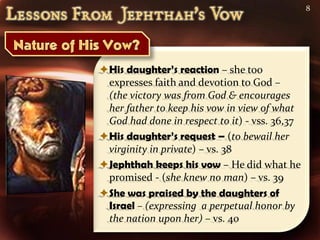
His daughter’s reaction – she too
 expresses faith and devotion to God –
 (the victory was from God & encourages
 her father to keep his vow in view of what
 God had done in respect to it) - vss. 36,37
His daughter’s request – (to bewail her
 virginity in private) – vs. 38
Jephthah keeps his vow – He did what he
 promised - (she knew no man) – vs. 39
She was praised by the daughters of
 Israel – (expressing a perpetual honor by
 the nation upon her) – vs. 40
9


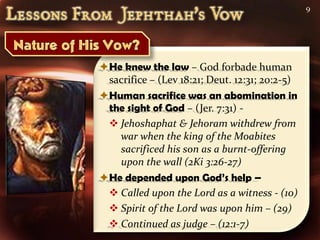
He knew the law – God forbade human
 sacrifice – (Lev 18:21; Deut. 12:31; 20:2-5)
Human sacrifice was an abomination in
 the sight of God – (Jer. 7:31) -
  Jehoshaphat & Jehoram withdrew from
   war when the king of the Moabites
   sacrificed his son as a burnt-offering
   upon the wall (2Ki 3:26-27)
He depended upon God’s help –
  Called upon the Lord as a witness - (10)
  Spirit of the Lord was upon him – (29)
  Continued as judge – (12:1-7)
10


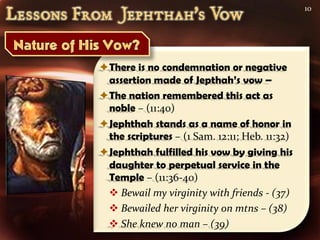
There is no condemnation or negative
 assertion made of Jepthah’s vow –
The nation remembered this act as
 noble – (11:40)
Jephthah stands as a name of honor in
 the scriptures – (1 Sam. 12:11; Heb. 11:32)
Jephthah fulfilled his vow by giving his
 daughter to perpetual service in the
 Temple – (11:36-40)
  Bewail my virginity with friends - (37)
  Bewailed her virginity on mtns – (38)
  She knew no man – (39)
11


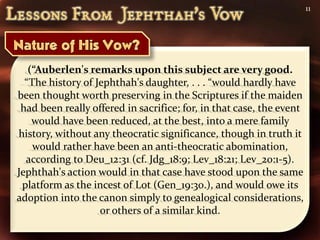
   (“Auberlen's remarks upon this subject are very good.
  “The history of Jephthah's daughter, . . . “would hardly have
been thought worth preserving in the Scriptures if the maiden
 had been really offered in sacrifice; for, in that case, the event
    would have been reduced, at the best, into a mere family
history, without any theocratic significance, though in truth it
    would rather have been an anti-theocratic abomination,
  according to Deu_12:31 (cf. Jdg_18:9; Lev_18:21; Lev_20:1-5).
Jephthah's action would in that case have stood upon the same
 platform as the incest of Lot (Gen_19:30.), and would owe its
adoption into the canon simply to genealogical considerations,
                   or others of a similar kind.
12


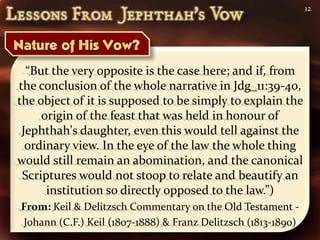
  “But the very opposite is the case here; and if, from
the conclusion of the whole narrative in Jdg_11:39-40,
the object of it is supposed to be simply to explain the
     origin of the feast that was held in honour of
 Jephthah's daughter, even this would tell against the
  ordinary view. In the eye of the law the whole thing
would still remain an abomination, and the canonical
 Scriptures would not stoop to relate and beautify an
      institution so directly opposed to the law.”)
From: Keil & Delitzsch Commentary on the Old Testament -
Johann (C.F.) Keil (1807-1888) & Franz Delitzsch (1813-1890)
13


God can use anyone who will trust
 in Him – (11:1-11; Exo. 3:11; Judges;
 Acts 4:13; 1 Cor. 1:26)
We need to learn to trust and
 depend upon God – (11:12-33; Mat.
 6:19-34; Rom. 8:28-39)
We must take our commitments
 to the Lord seriously – We must
 count the cost – (11:30-39; Luke
 14:25-33; Eccl. 5:2-5; Mat. 5:33,37)
Our commitment to the Lord
 requires sacrifice and faithfulness
 – (11:30-39; Rom. 12:1-3; Phil. 2:1-5)
14


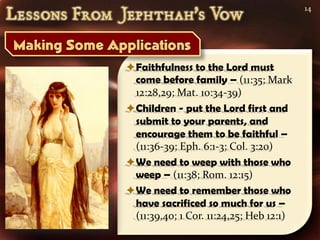
Faithfulness to the Lord must
 come before family – (11:35; Mark
 12:28,29; Mat. 10:34-39)
Children - put the Lord first and
 submit to your parents, and
 encourage them to be faithful –
 (11:36-39; Eph. 6:1-3; Col. 3:20)
We need to weep with those who
 weep – (11:38; Rom. 12:15)
We need to remember those who
 have sacrificed so much for us –
 (11:39,40; 1 Cor. 11:24,25; Heb 12:1)
15


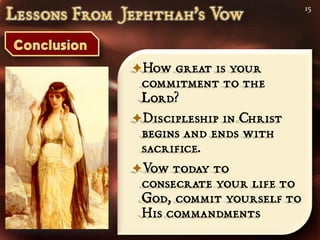
How great is your
 commitment to the
 Lord?
Discipleship in Christ
 begins and ends with
 sacrifice.
Vow today to
 consecrate your life to
 God, commit yourself to
 His commandments
16
17


                         Charts by Don McClain
                        Prepared December 21-24, 2010
                         Preached December 26, 2010
                      West 65th Street church of Christ
                              P.O. Box 190062
                           Little Rock AR 72219
                                501-568-1062
                         Prepared using PPT 2010 –
                       Email – donmcclain@sbcglobal.net
                     More PPT & Audio Sermons:
    http://w65stchurchofchrist.org/donmaccla/2010SermonPage.html

 Note – Many of the transition effects used in this presentation are lost using
                              PPT 2007 Viewer
          To view transitions you can download PPT 2010 viewer:
http://www.microsoft.com/downloads/en/details.aspx?displaylang=en&Famil
                yID=cb9bf144-1076-4615-9951-294eeb832823

Lessons From Jephthah's Vow

  • 1.
  • 2.
    2 A judge inIsrael Tribe of Manasseh A Gileadite Father – Gilead Mother a prostitute Rejected & cast out (Judges 11:1-3).
  • 3.
    3 A mighty manof valor – vss. 1,6 Called by the elders of Gilead to be their commander – vss. 5-11 Acknowledged God’s power to deliver & rule – vss. 9,11 Offered treaty to Ammon according to the Law – vss. 12-14; cf. Deut 20:10-12 Very familiar with God delivering Israel from Egypt and bringing them into the land of promise – vss. 15-28 A man acknowledged by God to deliver Israel, zealous for God and Israel – vs. 29
  • 4.
    4 Judges 11:30-31 (NKJV) 30 And Jephthah made a vow to the LORD, and said, "If You will indeed deliver the people of Ammon into my hands, 31 then it will be that whatever comes out of the doors of my house to meet me, when I return in peace from the people of Ammon, shall surely be the LORD'S, and I will offer it up as a burnt offering."
  • 5.
    5 Was not asrash as many think – expresses his dependence upon God for the victory as well as his earnest desire for the deliverance of his people – vss. 29-32 Man or animal? - Jephthah expected a person to meet him, - “out of the doors of my house” – vs. 31 Possible interpretations –  “or I have offered up for it--a burnt- offering” – [YLT]  “I will offer it up as a burnt offering” [NKJV] – i.e. “like a burnt offering”
  • 6.
    6 “Theword ‫ עֹו ָה‬does not involve the idea of burning, ‫ל‬ like our word burnt-offering, but simply that of going up upon the altar, or of complete surrender to the Lord. ‫ עֹו ָה‬is a whole offering, as distinguished from the other ‫ל‬ sacrifices, of which only a part was given up to the Lord. When a virgin, therefore, was set apart as a spiritual ‫ ,עֹו ָה‬it followed, as a matter of course, that henceforth ‫ל‬ she belonged entirely to the Lord: that is to say, was to remain a virgin for the remainder of her days.” Keil & Delitzsch Commentary on the Old Testament - Johann (C.F.) Keil (1807-1888) & Franz Delitzsch (1813-1890)
  • 7.
    7 God granted Hispetition – vss. 32,33 Jephthah’s only child is the first to greet him – (emphasized in the text) – vs. 34 Jephthah grieves – (He expresses great sorrow & faithfulness to his vow) – vs. 35  Many suggest that he was grieving because he knew he had to kill her.  Others suggest that he grieved due to his posterity being cut off, and her hope of motherhood was dashed in that she was wholly given to the Lord which required perpetual virginity.
  • 8.
    8 His daughter’s reaction– she too expresses faith and devotion to God – (the victory was from God & encourages her father to keep his vow in view of what God had done in respect to it) - vss. 36,37 His daughter’s request – (to bewail her virginity in private) – vs. 38 Jephthah keeps his vow – He did what he promised - (she knew no man) – vs. 39 She was praised by the daughters of Israel – (expressing a perpetual honor by the nation upon her) – vs. 40
  • 9.
    9 He knew thelaw – God forbade human sacrifice – (Lev 18:21; Deut. 12:31; 20:2-5) Human sacrifice was an abomination in the sight of God – (Jer. 7:31) -  Jehoshaphat & Jehoram withdrew from war when the king of the Moabites sacrificed his son as a burnt-offering upon the wall (2Ki 3:26-27) He depended upon God’s help –  Called upon the Lord as a witness - (10)  Spirit of the Lord was upon him – (29)  Continued as judge – (12:1-7)
  • 10.
    10 There is nocondemnation or negative assertion made of Jepthah’s vow – The nation remembered this act as noble – (11:40) Jephthah stands as a name of honor in the scriptures – (1 Sam. 12:11; Heb. 11:32) Jephthah fulfilled his vow by giving his daughter to perpetual service in the Temple – (11:36-40)  Bewail my virginity with friends - (37)  Bewailed her virginity on mtns – (38)  She knew no man – (39)
  • 11.
    11 (“Auberlen's remarks upon this subject are very good. “The history of Jephthah's daughter, . . . “would hardly have been thought worth preserving in the Scriptures if the maiden had been really offered in sacrifice; for, in that case, the event would have been reduced, at the best, into a mere family history, without any theocratic significance, though in truth it would rather have been an anti-theocratic abomination, according to Deu_12:31 (cf. Jdg_18:9; Lev_18:21; Lev_20:1-5). Jephthah's action would in that case have stood upon the same platform as the incest of Lot (Gen_19:30.), and would owe its adoption into the canon simply to genealogical considerations, or others of a similar kind.
  • 12.
    12 “Butthe very opposite is the case here; and if, from the conclusion of the whole narrative in Jdg_11:39-40, the object of it is supposed to be simply to explain the origin of the feast that was held in honour of Jephthah's daughter, even this would tell against the ordinary view. In the eye of the law the whole thing would still remain an abomination, and the canonical Scriptures would not stoop to relate and beautify an institution so directly opposed to the law.”) From: Keil & Delitzsch Commentary on the Old Testament - Johann (C.F.) Keil (1807-1888) & Franz Delitzsch (1813-1890)
  • 13.
    13 God can useanyone who will trust in Him – (11:1-11; Exo. 3:11; Judges; Acts 4:13; 1 Cor. 1:26) We need to learn to trust and depend upon God – (11:12-33; Mat. 6:19-34; Rom. 8:28-39) We must take our commitments to the Lord seriously – We must count the cost – (11:30-39; Luke 14:25-33; Eccl. 5:2-5; Mat. 5:33,37) Our commitment to the Lord requires sacrifice and faithfulness – (11:30-39; Rom. 12:1-3; Phil. 2:1-5)
  • 14.
    14 Faithfulness to theLord must come before family – (11:35; Mark 12:28,29; Mat. 10:34-39) Children - put the Lord first and submit to your parents, and encourage them to be faithful – (11:36-39; Eph. 6:1-3; Col. 3:20) We need to weep with those who weep – (11:38; Rom. 12:15) We need to remember those who have sacrificed so much for us – (11:39,40; 1 Cor. 11:24,25; Heb 12:1)
  • 15.
    15 How great isyour commitment to the Lord? Discipleship in Christ begins and ends with sacrifice. Vow today to consecrate your life to God, commit yourself to His commandments
  • 16.
  • 17.
    17 Charts by Don McClain Prepared December 21-24, 2010 Preached December 26, 2010 West 65th Street church of Christ P.O. Box 190062 Little Rock AR 72219 501-568-1062 Prepared using PPT 2010 – Email – donmcclain@sbcglobal.net More PPT & Audio Sermons: http://w65stchurchofchrist.org/donmaccla/2010SermonPage.html Note – Many of the transition effects used in this presentation are lost using PPT 2007 Viewer To view transitions you can download PPT 2010 viewer: http://www.microsoft.com/downloads/en/details.aspx?displaylang=en&Famil yID=cb9bf144-1076-4615-9951-294eeb832823