Enter Gossipsub
A scalable, extensible & hardened P2P PubSub Router protocol
David Dias david@protocol.ai
• 1) Motivation for P2P PubSub
• 2) Evolution of libp2p PubSub: FloodSub -> RandomSub -> GossipSub
• 3) Hardening GossipSub
• 4) What’s next (or left❕)
Agenda
• 1) Motivation for P2P PubSub
• 2) Evolution of libp2p PubSub: FloodSub -> RandomSub -> GossipSub
• 3) 🌟 Hardening GossipSub
• 4) 🌟 What’s next (or left❕)
Agenda
Motivation for P2P PubSub
Enable Real-Time Applications
on the IPFS/libp2p Network
To create the rich experience
we got used with the Web 2.0
Without relying on any piece
of centralised infrastructure
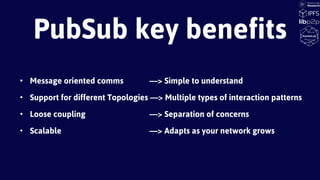
• Message oriented comms —> Simple to understand
• Support for different Topologies —> Multiple types of interaction patterns
• Loose coupling —> Separation of concerns
• Scalable —> Adapts as your network grows
PubSub key benefits
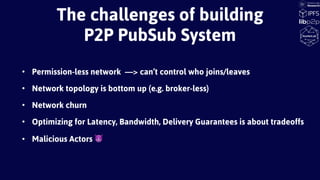
• Permission-less network —> can’t control who joins/leaves
• Network topology is bottom up (e.g. broker-less)
• Network churn
• Optimizing for Latency, Bandwidth, Delivery Guarantees is about tradeoffs
• Malicious Actors 😈
The challenges of building
P2P PubSub System
Evolution of libp2p PubSub
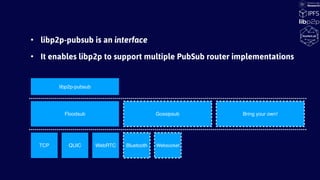
• libp2p-pubsub is an interface
• It enables libp2p to support multiple PubSub router implementations
libp2p-pubsub
Floodsub
TCP
Gossipsub Bring your own!
QUIC WebRTC Bluetooth Websocket
The first router - Floodsub
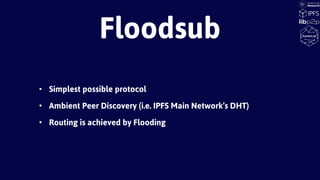
• Simplest possible protocol
• Ambient Peer Discovery (i.e. IPFS Main Network’s DHT)
• Routing is achieved by Flooding
Floodsub
Floodsub
Floodsub
Floodsub
Floodsub
Floodsub
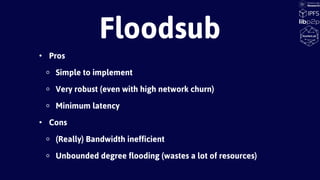
• Pros
◦ Simple to implement
◦ Very robust (even with high network churn)
◦ Minimum latency
• Cons
◦ (Really) Bandwidth inefficient
◦ Unbounded degree flooding (wastes a lot of resources)
Floodsub
Floodsub
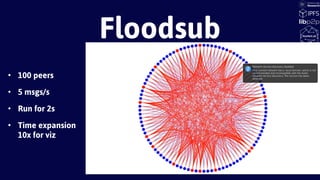
• 100 peers
• 5 msgs/s
• Run for 2s
• Time expansion
10x for viz
A stepping stone - Randomsub
• Experiment to see how the Network performed if we did message
forwarding at random
• Pros
◦ Still simple to implement
◦ Less bandwidth intensive
• Cons
◦ Creates dark spots (nodes that don’t get the messages)
• Note, this implementation wasn’t spec’ed, it was done as an experiment
Randomsub
Current generation - Gossipsub 🌟
• Trades latency for bandwidth efficiency
• Self-stabilising algorithm (nodes cooperate with each other)
• Support for protocol extensions
Gossipsub
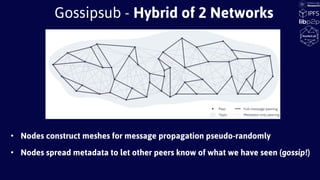
• Nodes construct meshes for message propagation pseudo-randomly
• Nodes spread metadata to let other peers know of what we have seen (gossip!)
Gossipsub - Hybrid of 2 Networks
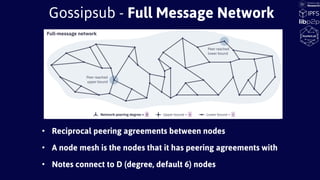
• Reciprocal peering agreements between nodes
• A node mesh is the nodes that it has peering agreements with
• Notes connect to D (degree, default 6) nodes
Gossipsub - Full Message Network
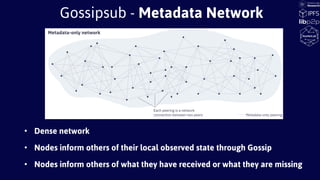
• Dense network
• Nodes inform others of their local observed state through Gossip
• Nodes inform others of what they have received or what they are missing
Gossipsub - Metadata Network
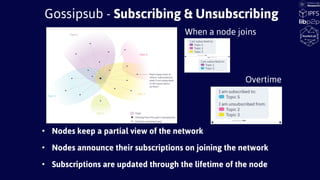
• Nodes keep a partial view of the network
• Nodes announce their subscriptions on joining the network
• Subscriptions are updated through the lifetime of the node
Gossipsub - Subscribing & Unsubscribing
When a node joins
Overtime
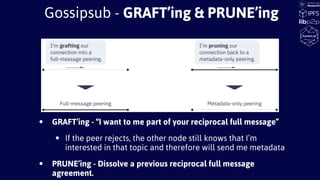
• GRAFT’ing - “I want to me part of your reciprocal full message”
• If the peer rejects, the other node still knows that I’m
interested in that topic and therefore will send me metadata
• PRUNE’ing - Dissolve a previous reciprocal full message
agreement.
Gossipsub - GRAFT’ing & PRUNE’ing
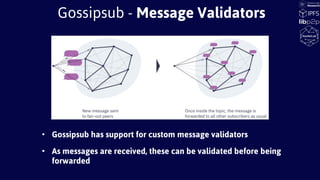
• Gossipsub has support for custom message validators
• As messages are received, these can be validated before being
forwarded
Gossipsub - Message Validators
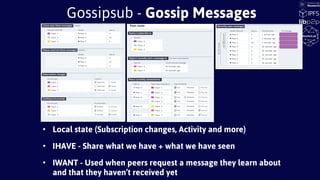
• Local state (Subscription changes, Activity and more)
• IHAVE - Share what we have + what we have seen
• IWANT - Used when peers request a message they learn about
and that they haven’t received yet
Gossipsub - Gossip Messages
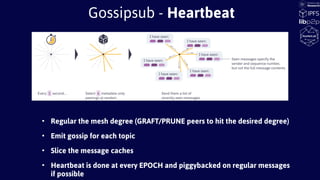
• Regular the mesh degree (GRAFT/PRUNE peers to hit the desired degree)
• Emit gossip for each topic
• Slice the message caches
• Heartbeat is done at every EPOCH and piggybacked on regular messages
if possible
Gossipsub - Heartbeat
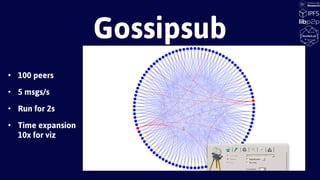
Gossipsub
• 100 peers
• 5 msgs/s
• Run for 2s
• Time expansion
10x for viz
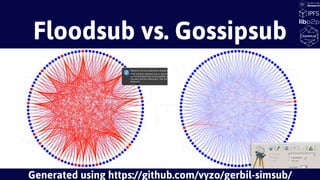
Floodsub vs. Gossipsub
Generated using https://github.com/vyzo/gerbil-simsub/
• Real-Time updates
• Resiliency to network churn
• Adjustable tradeoffs (bandwidth vs. latency)
• Scales to large networks
Recap:
What libp2p Pubsub with Gossipsub gives us
Hardening Gossipsub
Hardening Gossipsub
v1.1
Class of attacks
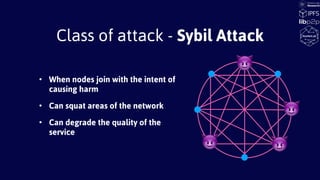
Class of attack - Sybil Attack
😈
😈
😈
😈
• When nodes join with the intent of
causing harm
• Can squat areas of the network
• Can degrade the quality of the
service
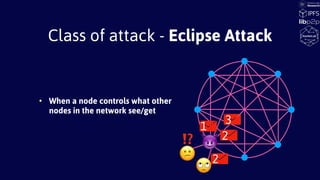
Class of attack - Eclipse Attack
• When a node controls what other
nodes in the network see/get
😈
1
2
2
⁉
😕
🙄
3
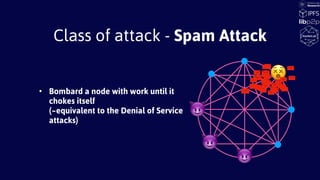
Class of attack - Spam Attack
😈
😵
😈
😈
• Bombard a node with work until it
chokes itself
(~equivalent to the Denial of Service
attacks)
Mitigation Strategies
The spec is a joy to read ✨
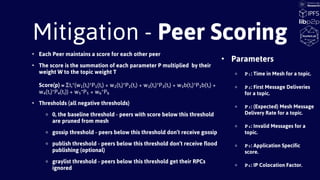
Mitigation - Peer Scoring
• Each Peer maintains a score for each other peer
• The score is the summation of each parameter P multiplied by their
weight W to the topic weight T
Score(p) = Σtᵢ*(w₁(tᵢ)*P₁(tᵢ) + w₂(tᵢ)*P₂(tᵢ) + w₃(tᵢ)*P₃(tᵢ) + w₃b(tᵢ)*P₃b(tᵢ) +
w₄(tᵢ)*P₄(tᵢ)) + w₅*P₅ + w₆*P₆
• Thresholds (all negative thresholds)
◦ 0, the baseline threshold - peers with score below this threshold
are pruned from mesh
◦ gossip threshold - peers below this threshold don’t receive gossip
◦ publish threshold - peers below this threshold don’t receive flood
publishing (optional)
◦ graylist threshold - peers below this threshold get their RPCs
ignored
• Parameters
◦ P₁: Time in Mesh for a topic.
◦ P₂: First Message Deliveries
for a topic.
◦ P₃: (Expected) Mesh Message
Delivery Rate for a topic.
◦ P₄: Invalid Messages for a
topic.
◦ P₅: Application Specific
score.
◦ P₆: IP Colocation Factor.
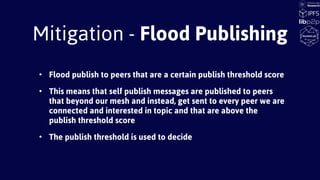
Mitigation - Flood Publishing
• Flood publish to peers that are a certain publish threshold score
• This means that self publish messages are published to peers
that beyond our mesh and instead, get sent to every peer we are
connected and interested in topic and that are above the
publish threshold score
• The publish threshold is used to decide
Mitigation -
Peer Exchange on Prune
• When a node gets Prune’ed, it receives of other candidate peers
• This is a way to rely less on Ambient Peer Discovery and use the
Gossipsub network to do the PeerDiscovery itself
Mitigation - Spam Protections
• GRAFT messages for unknown topics are ignored (vs. v1.0 would
respond with PRUNE)
• IWANT responses are rate limited
• If spam is observed, it impacts the Score of the peer
Mitigation -
Explicit Peering Agreements
• Establish direct connection agreements to keep connections
always open
• Great between nodes that are federated or have any special
reason to always be connected
We are not done just yet❕
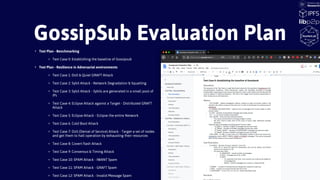
• Test Plan - Benchmarking
◦ Test Case 0: Establishing the baseline of Gossipsub
• Test Plan - Resilience in Adversarial environments
◦ Test Case 1: DoS & Quiet GRAFT Attack
◦ Test Case 2: Sybil Attack - Network Degradation & Squatting
◦ Test Case 3: Sybil Attack - Sybils are generated in a small pool of
IPs
◦ Test Case 4: Eclipse Attack against a Target - Distributed GRAFT
Attack
◦ Test Case 5: Eclipse Attack - Eclipse the entire Network
◦ Test Case 6: Cold Boot Attack
◦ Test Case 7: DoS (Denial of Service) Attack - Target a set of nodes
and get them to halt operation by exhausting their resources
◦ Test Case 8: Covert flash Attack
◦ Test Case 9: Consensus & Timing Attack
◦ Test Case 10: SPAM Attack - IWANT Spam
◦ Test Case 11: SPAM Attack - GRAFT Spam
◦ Test Case 12: SPAM Attack - Invalid Message Spam
GossipSub Evaluation Plan
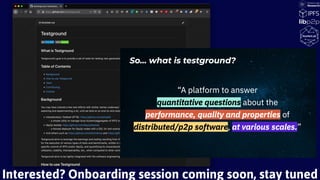
Interested? Onboarding session coming soon, stay tuned
Jupyter Integration into Testground
1) Open Test Plan
2) Adjust the parameters
3) Run and visualise the results!
We are producing a Gossipsub report to be available soon™
Wrapping up 🎁
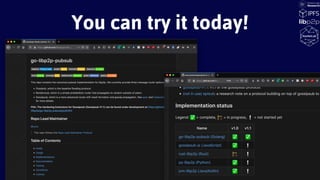
You can try it today!
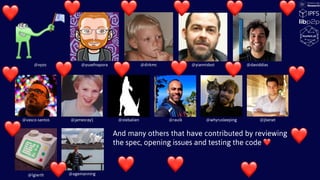
@vyzo @yusefnapora @dirkmc @yiannisbot @daviddias
@agemanning
@jbenet@whyrusleeping@stebalien @raulk@jamesray1@vasco-santos
@lgierth
And many others that have contributed by reviewing
the spec, opening issues and testing the code ❤
❤
❤ ❤ ❤ ❤ ❤ ❤
❤
❤
❤❤❤
❤
❤ ❤ ❤ ❤❤
Thank you!
David Dias david@protocol.ai
Join the discussion
◦ Chat at #libp2p in freenode (with a matrix.org bridge!)
◦ Forum at https://discuss.libp2p.io/

Enter Gossipsub, A scalable, extensible & hardened P2P PubSub Router protocol

  • 1.
    Enter Gossipsub A scalable,extensible & hardened P2P PubSub Router protocol David Dias david@protocol.ai
  • 2.
    • 1) Motivationfor P2P PubSub • 2) Evolution of libp2p PubSub: FloodSub -> RandomSub -> GossipSub • 3) Hardening GossipSub • 4) What’s next (or left❕) Agenda
  • 3.
    • 1) Motivationfor P2P PubSub • 2) Evolution of libp2p PubSub: FloodSub -> RandomSub -> GossipSub • 3) 🌟 Hardening GossipSub • 4) 🌟 What’s next (or left❕) Agenda
  • 4.
  • 5.
    Enable Real-Time Applications onthe IPFS/libp2p Network
  • 6.
    To create therich experience we got used with the Web 2.0
  • 7.
    Without relying onany piece of centralised infrastructure
  • 15.
    • Message orientedcomms —> Simple to understand • Support for different Topologies —> Multiple types of interaction patterns • Loose coupling —> Separation of concerns • Scalable —> Adapts as your network grows PubSub key benefits
  • 16.
    • Permission-less network—> can’t control who joins/leaves • Network topology is bottom up (e.g. broker-less) • Network churn • Optimizing for Latency, Bandwidth, Delivery Guarantees is about tradeoffs • Malicious Actors 😈 The challenges of building P2P PubSub System
  • 17.
  • 18.
    • libp2p-pubsub isan interface • It enables libp2p to support multiple PubSub router implementations libp2p-pubsub Floodsub TCP Gossipsub Bring your own! QUIC WebRTC Bluetooth Websocket
  • 19.
    The first router- Floodsub
  • 20.
    • Simplest possibleprotocol • Ambient Peer Discovery (i.e. IPFS Main Network’s DHT) • Routing is achieved by Flooding Floodsub
  • 21.
  • 22.
  • 23.
  • 24.
  • 25.
  • 26.
    • Pros ◦ Simpleto implement ◦ Very robust (even with high network churn) ◦ Minimum latency • Cons ◦ (Really) Bandwidth inefficient ◦ Unbounded degree flooding (wastes a lot of resources) Floodsub
  • 27.
    Floodsub • 100 peers •5 msgs/s • Run for 2s • Time expansion 10x for viz
  • 28.
    A stepping stone- Randomsub
  • 29.
    • Experiment tosee how the Network performed if we did message forwarding at random • Pros ◦ Still simple to implement ◦ Less bandwidth intensive • Cons ◦ Creates dark spots (nodes that don’t get the messages) • Note, this implementation wasn’t spec’ed, it was done as an experiment Randomsub
  • 30.
    Current generation -Gossipsub 🌟
  • 31.
    • Trades latencyfor bandwidth efficiency • Self-stabilising algorithm (nodes cooperate with each other) • Support for protocol extensions Gossipsub
  • 32.
    • Nodes constructmeshes for message propagation pseudo-randomly • Nodes spread metadata to let other peers know of what we have seen (gossip!) Gossipsub - Hybrid of 2 Networks
  • 33.
    • Reciprocal peeringagreements between nodes • A node mesh is the nodes that it has peering agreements with • Notes connect to D (degree, default 6) nodes Gossipsub - Full Message Network
  • 34.
    • Dense network •Nodes inform others of their local observed state through Gossip • Nodes inform others of what they have received or what they are missing Gossipsub - Metadata Network
  • 35.
    • Nodes keepa partial view of the network • Nodes announce their subscriptions on joining the network • Subscriptions are updated through the lifetime of the node Gossipsub - Subscribing & Unsubscribing When a node joins Overtime
  • 36.
    • GRAFT’ing -“I want to me part of your reciprocal full message” • If the peer rejects, the other node still knows that I’m interested in that topic and therefore will send me metadata • PRUNE’ing - Dissolve a previous reciprocal full message agreement. Gossipsub - GRAFT’ing & PRUNE’ing
  • 37.
    • Gossipsub hassupport for custom message validators • As messages are received, these can be validated before being forwarded Gossipsub - Message Validators
  • 38.
    • Local state(Subscription changes, Activity and more) • IHAVE - Share what we have + what we have seen • IWANT - Used when peers request a message they learn about and that they haven’t received yet Gossipsub - Gossip Messages
  • 39.
    • Regular themesh degree (GRAFT/PRUNE peers to hit the desired degree) • Emit gossip for each topic • Slice the message caches • Heartbeat is done at every EPOCH and piggybacked on regular messages if possible Gossipsub - Heartbeat
  • 40.
    Gossipsub • 100 peers •5 msgs/s • Run for 2s • Time expansion 10x for viz
  • 41.
    Floodsub vs. Gossipsub Generatedusing https://github.com/vyzo/gerbil-simsub/
  • 42.
    • Real-Time updates •Resiliency to network churn • Adjustable tradeoffs (bandwidth vs. latency) • Scales to large networks Recap: What libp2p Pubsub with Gossipsub gives us
  • 43.
  • 44.
  • 45.
  • 46.
    Class of attack- Sybil Attack 😈 😈 😈 😈 • When nodes join with the intent of causing harm • Can squat areas of the network • Can degrade the quality of the service
  • 47.
    Class of attack- Eclipse Attack • When a node controls what other nodes in the network see/get 😈 1 2 2 ⁉ 😕 🙄 3
  • 48.
    Class of attack- Spam Attack 😈 😵 😈 😈 • Bombard a node with work until it chokes itself (~equivalent to the Denial of Service attacks)
  • 49.
  • 50.
    The spec isa joy to read ✨
  • 51.
    Mitigation - PeerScoring • Each Peer maintains a score for each other peer • The score is the summation of each parameter P multiplied by their weight W to the topic weight T Score(p) = Σtᵢ*(w₁(tᵢ)*P₁(tᵢ) + w₂(tᵢ)*P₂(tᵢ) + w₃(tᵢ)*P₃(tᵢ) + w₃b(tᵢ)*P₃b(tᵢ) + w₄(tᵢ)*P₄(tᵢ)) + w₅*P₅ + w₆*P₆ • Thresholds (all negative thresholds) ◦ 0, the baseline threshold - peers with score below this threshold are pruned from mesh ◦ gossip threshold - peers below this threshold don’t receive gossip ◦ publish threshold - peers below this threshold don’t receive flood publishing (optional) ◦ graylist threshold - peers below this threshold get their RPCs ignored • Parameters ◦ P₁: Time in Mesh for a topic. ◦ P₂: First Message Deliveries for a topic. ◦ P₃: (Expected) Mesh Message Delivery Rate for a topic. ◦ P₄: Invalid Messages for a topic. ◦ P₅: Application Specific score. ◦ P₆: IP Colocation Factor.
  • 52.
    Mitigation - FloodPublishing • Flood publish to peers that are a certain publish threshold score • This means that self publish messages are published to peers that beyond our mesh and instead, get sent to every peer we are connected and interested in topic and that are above the publish threshold score • The publish threshold is used to decide
  • 53.
    Mitigation - Peer Exchangeon Prune • When a node gets Prune’ed, it receives of other candidate peers • This is a way to rely less on Ambient Peer Discovery and use the Gossipsub network to do the PeerDiscovery itself
  • 54.
    Mitigation - SpamProtections • GRAFT messages for unknown topics are ignored (vs. v1.0 would respond with PRUNE) • IWANT responses are rate limited • If spam is observed, it impacts the Score of the peer
  • 55.
    Mitigation - Explicit PeeringAgreements • Establish direct connection agreements to keep connections always open • Great between nodes that are federated or have any special reason to always be connected
  • 56.
    We are notdone just yet❕
  • 57.
    • Test Plan- Benchmarking ◦ Test Case 0: Establishing the baseline of Gossipsub • Test Plan - Resilience in Adversarial environments ◦ Test Case 1: DoS & Quiet GRAFT Attack ◦ Test Case 2: Sybil Attack - Network Degradation & Squatting ◦ Test Case 3: Sybil Attack - Sybils are generated in a small pool of IPs ◦ Test Case 4: Eclipse Attack against a Target - Distributed GRAFT Attack ◦ Test Case 5: Eclipse Attack - Eclipse the entire Network ◦ Test Case 6: Cold Boot Attack ◦ Test Case 7: DoS (Denial of Service) Attack - Target a set of nodes and get them to halt operation by exhausting their resources ◦ Test Case 8: Covert flash Attack ◦ Test Case 9: Consensus & Timing Attack ◦ Test Case 10: SPAM Attack - IWANT Spam ◦ Test Case 11: SPAM Attack - GRAFT Spam ◦ Test Case 12: SPAM Attack - Invalid Message Spam GossipSub Evaluation Plan
  • 58.
    Interested? Onboarding sessioncoming soon, stay tuned
  • 59.
    Jupyter Integration intoTestground 1) Open Test Plan 2) Adjust the parameters 3) Run and visualise the results! We are producing a Gossipsub report to be available soon™
  • 60.
  • 61.
    You can tryit today!
  • 62.
    @vyzo @yusefnapora @dirkmc@yiannisbot @daviddias @agemanning @jbenet@whyrusleeping@stebalien @raulk@jamesray1@vasco-santos @lgierth And many others that have contributed by reviewing the spec, opening issues and testing the code ❤ ❤ ❤ ❤ ❤ ❤ ❤ ❤ ❤ ❤ ❤❤❤ ❤ ❤ ❤ ❤ ❤❤
  • 63.
    Thank you! David Diasdavid@protocol.ai Join the discussion ◦ Chat at #libp2p in freenode (with a matrix.org bridge!) ◦ Forum at https://discuss.libp2p.io/