Software Architecture Chris F Carroll
Software Architecture for
Information Security
Part 1: expressing requirements
Software Architecture Chris F Carroll
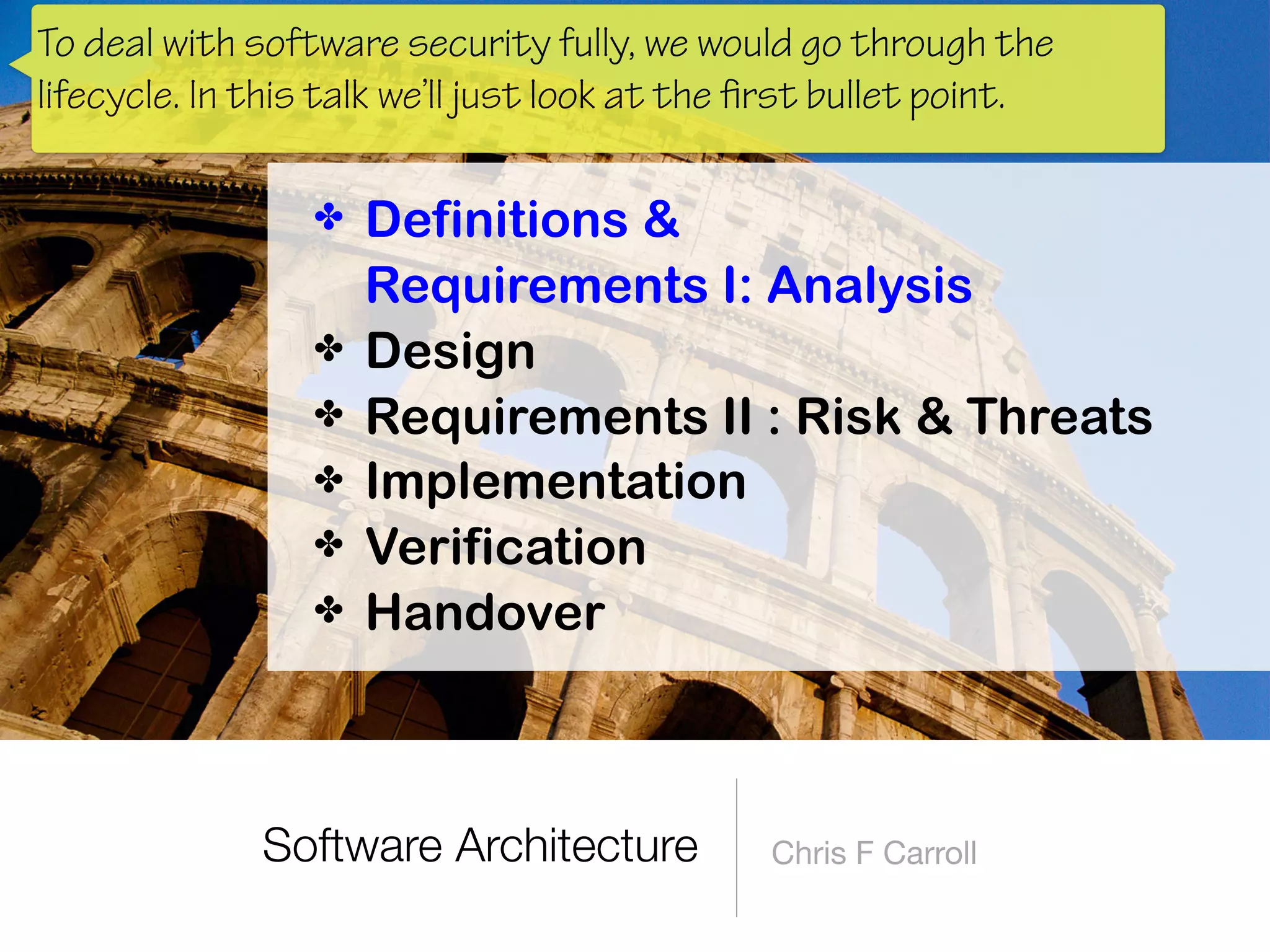
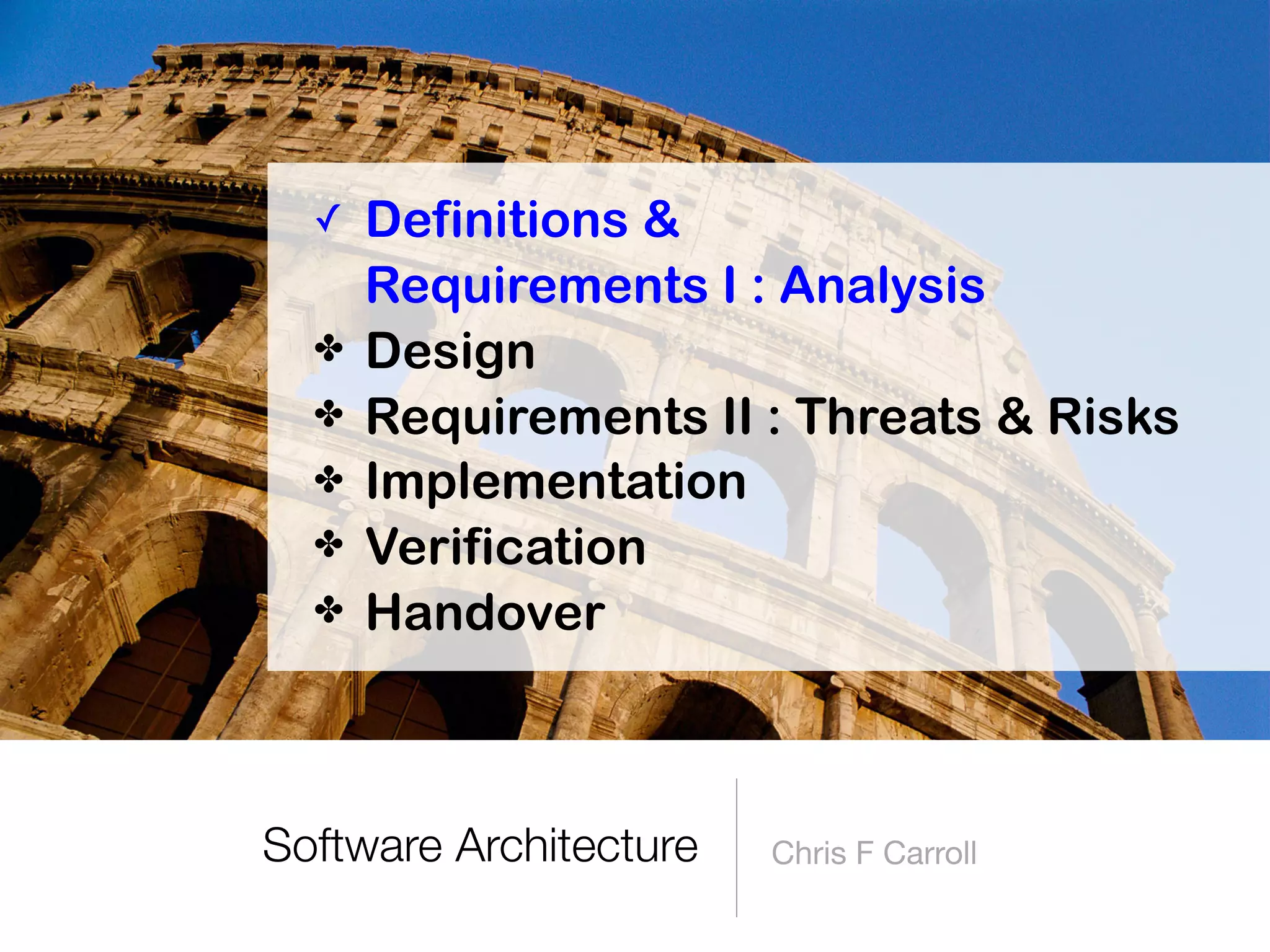
✤ Definitions & 

Requirements I: Analysis
✤ Design
✤ Requirements II : Risk & Threats
✤ Implementation
✤ Verification
✤ Handover
To deal with software security fully, we would go through the
lifecycle. In this talk we’ll just look at the first bullet point.
Software Architecture Chris F Carroll
Stating & Analysing 

Information Security Requirements 

using ISO 27000
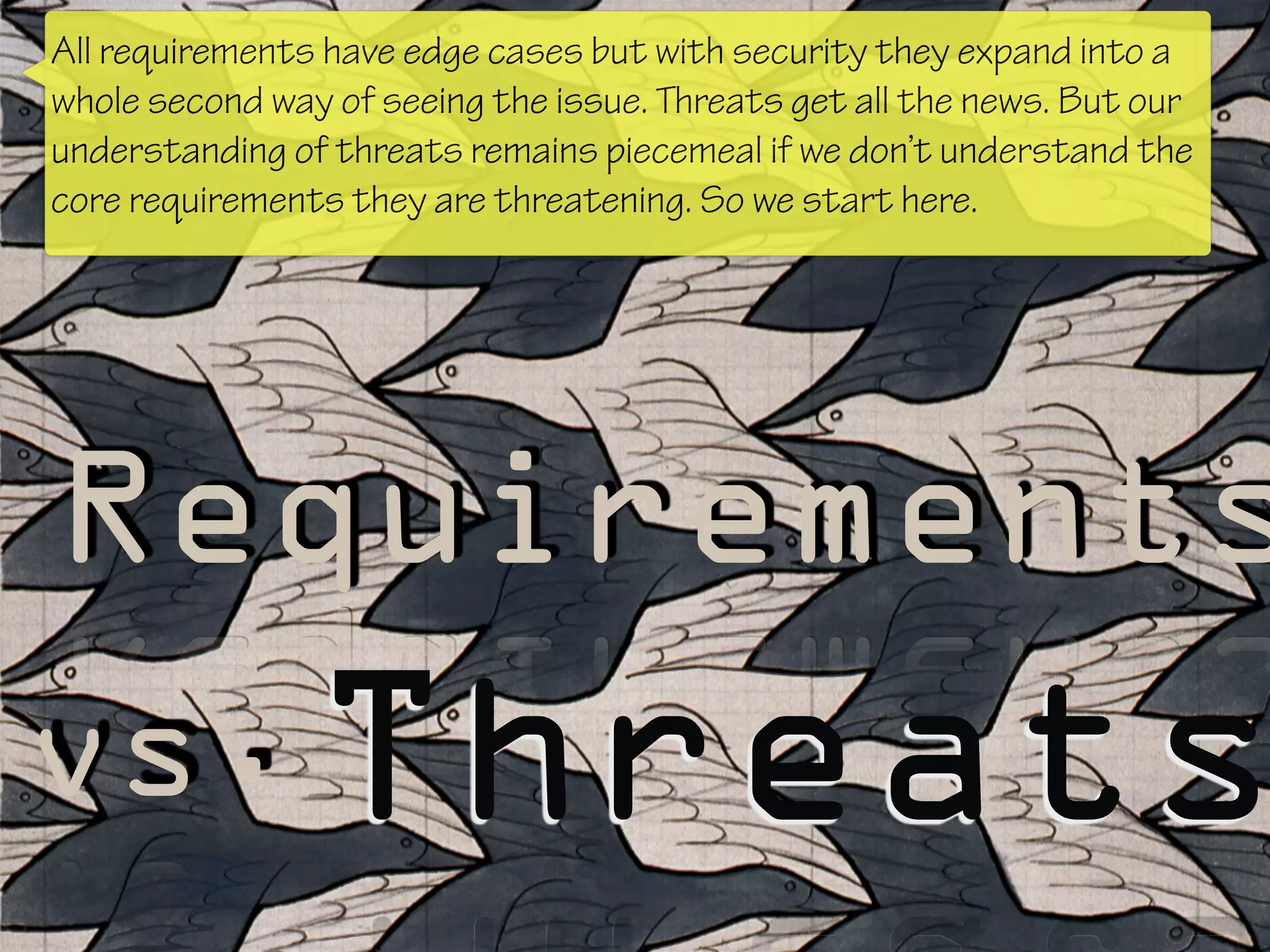
Requirements
Threatsvs.
All requirements have edge cases but with security they expand into a
whole second way of seeing the issue. Threats get all the news. But our
understanding of threats remains piecemeal if we don’t understand the
core requirements they are threatening. So we start here.
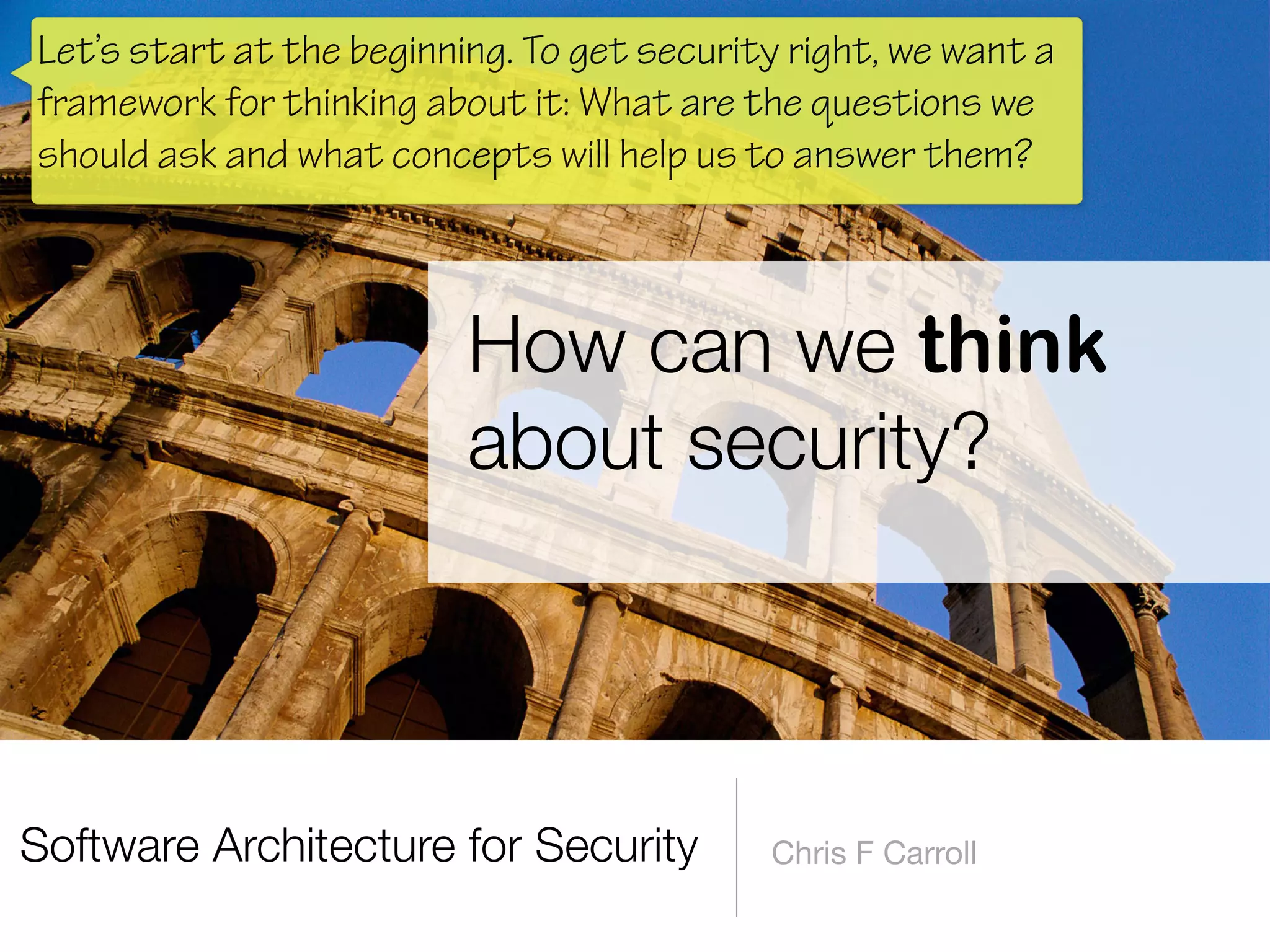
Software Architecture for Security Chris F Carroll
How can we think
about security?
Let’s start at the beginning. To get security right, we want a
framework for thinking about it: What are the questions we
should ask and what concepts will help us to answer them?
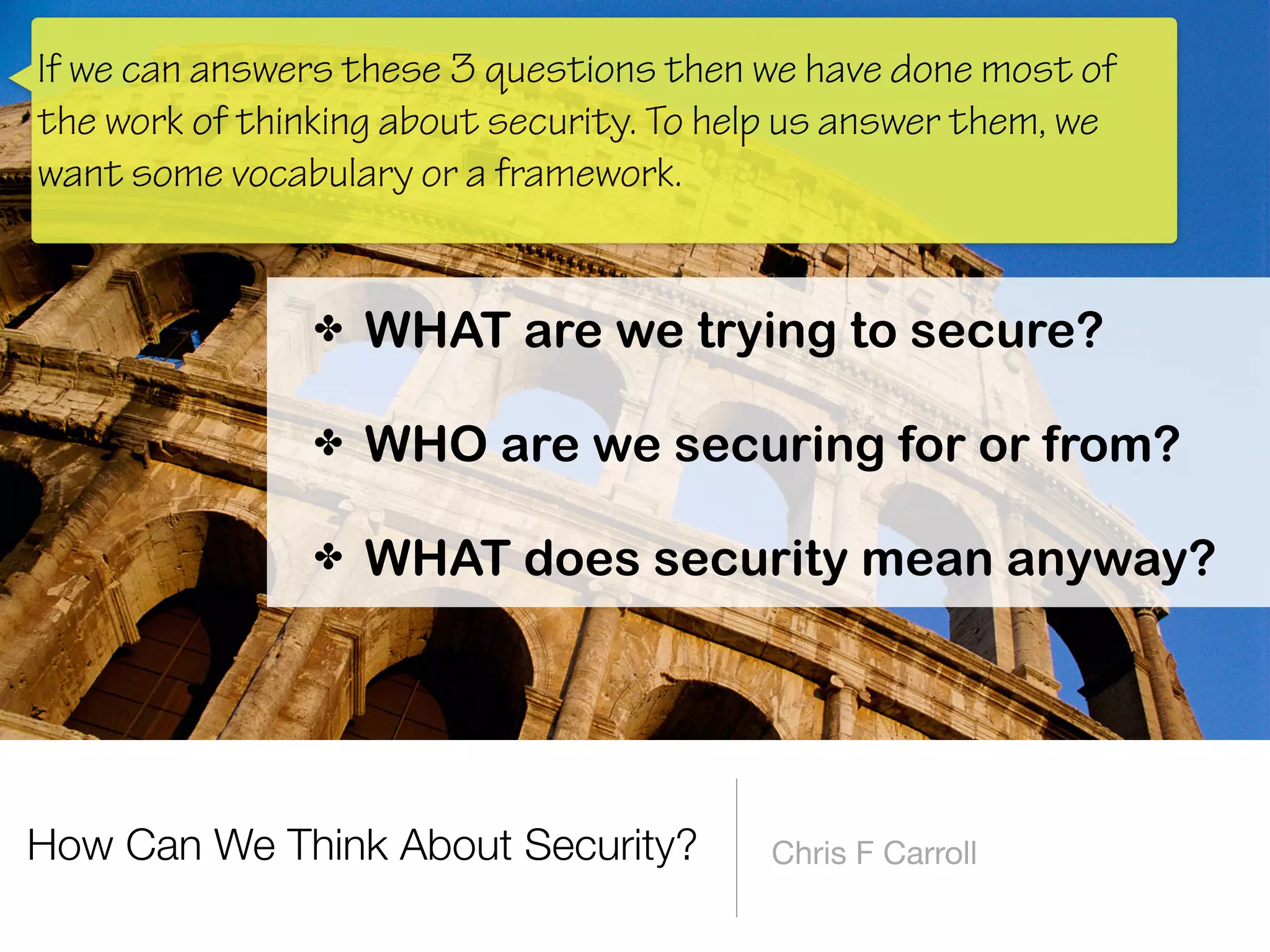
How Can We Think About Security? Chris F Carroll
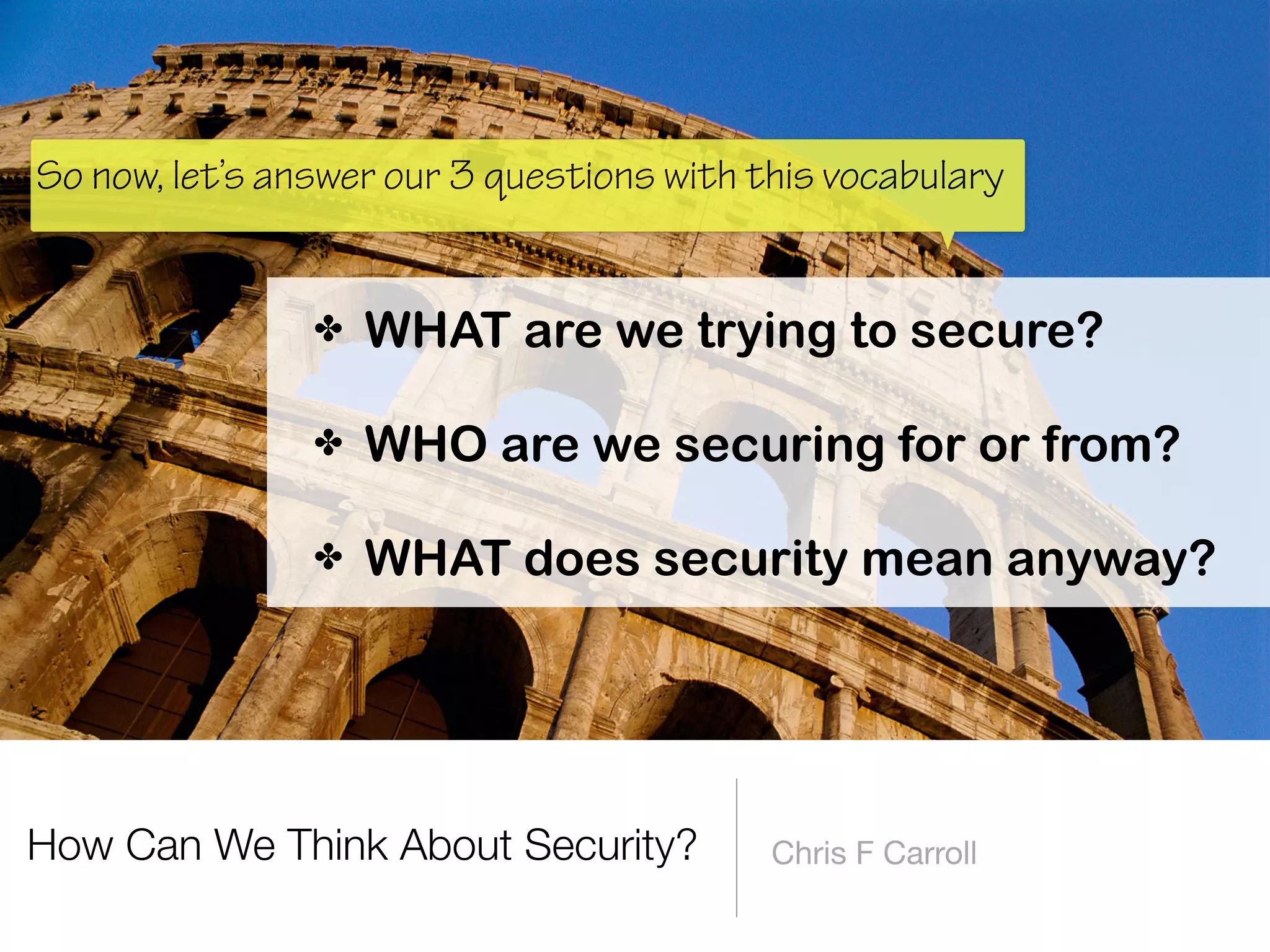
✤ WHAT are we trying to secure?

✤ WHO are we securing for or from?

✤ WHAT does security mean anyway?
If we can answers these 3 questions then we have done most of
the work of thinking about security. To help us answer them, we
want some vocabulary or a framework.
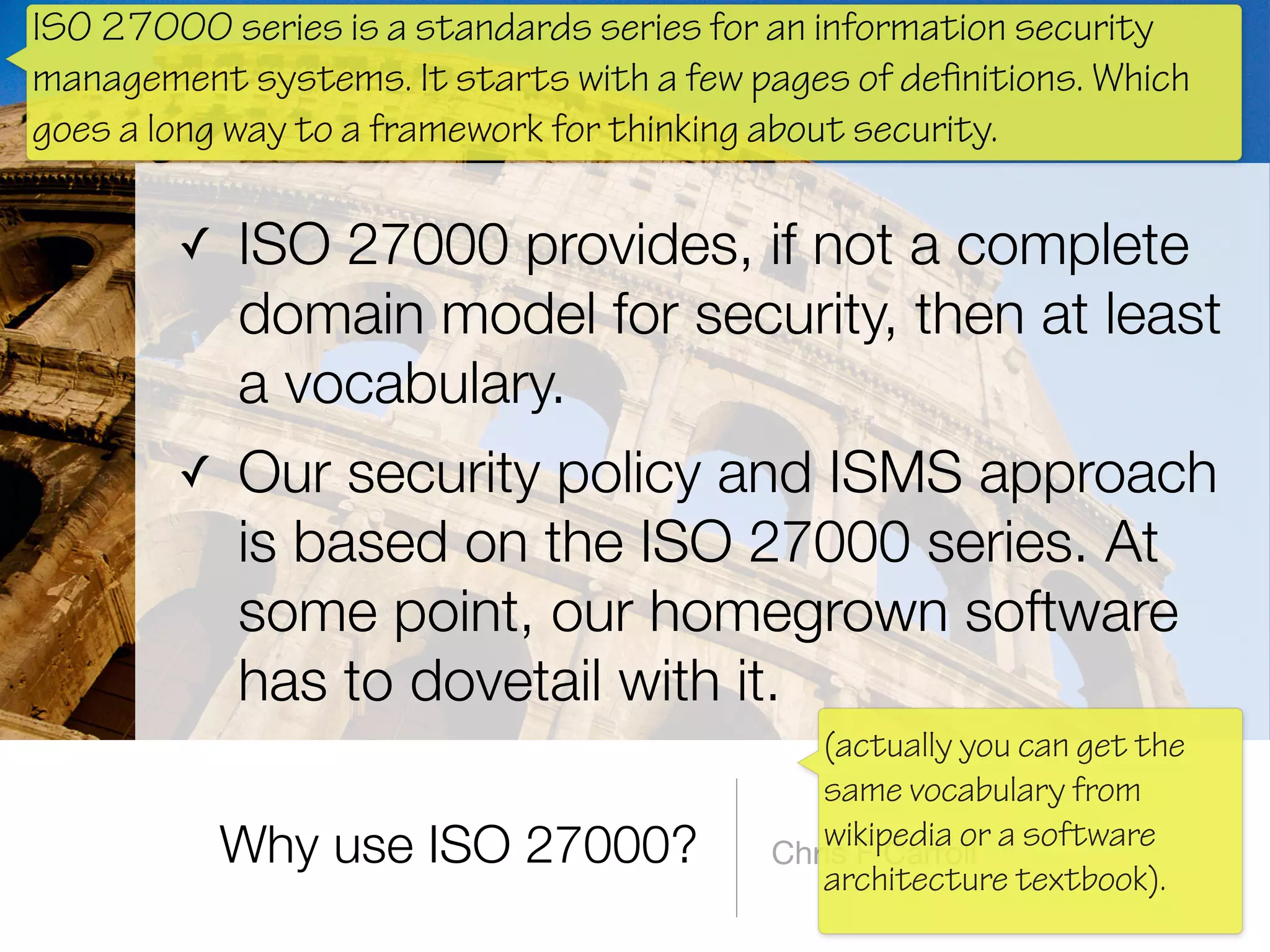
Why use ISO 27000?
✓ ISO 27000 provides, if not a complete
domain model for security, then at least
a vocabulary.
✓ Our security policy and ISMS approach
is based on the ISO 27000 series. At
some point, our homegrown software
has to dovetail with it.
Chris F Carroll
ISO 27000 series is a standards series for an information security
management systems. It starts with a few pages of definitions. Which
goes a long way to a framework for thinking about security.
(actually you can get the
same vocabulary from
wikipedia or a software
architecture textbook).
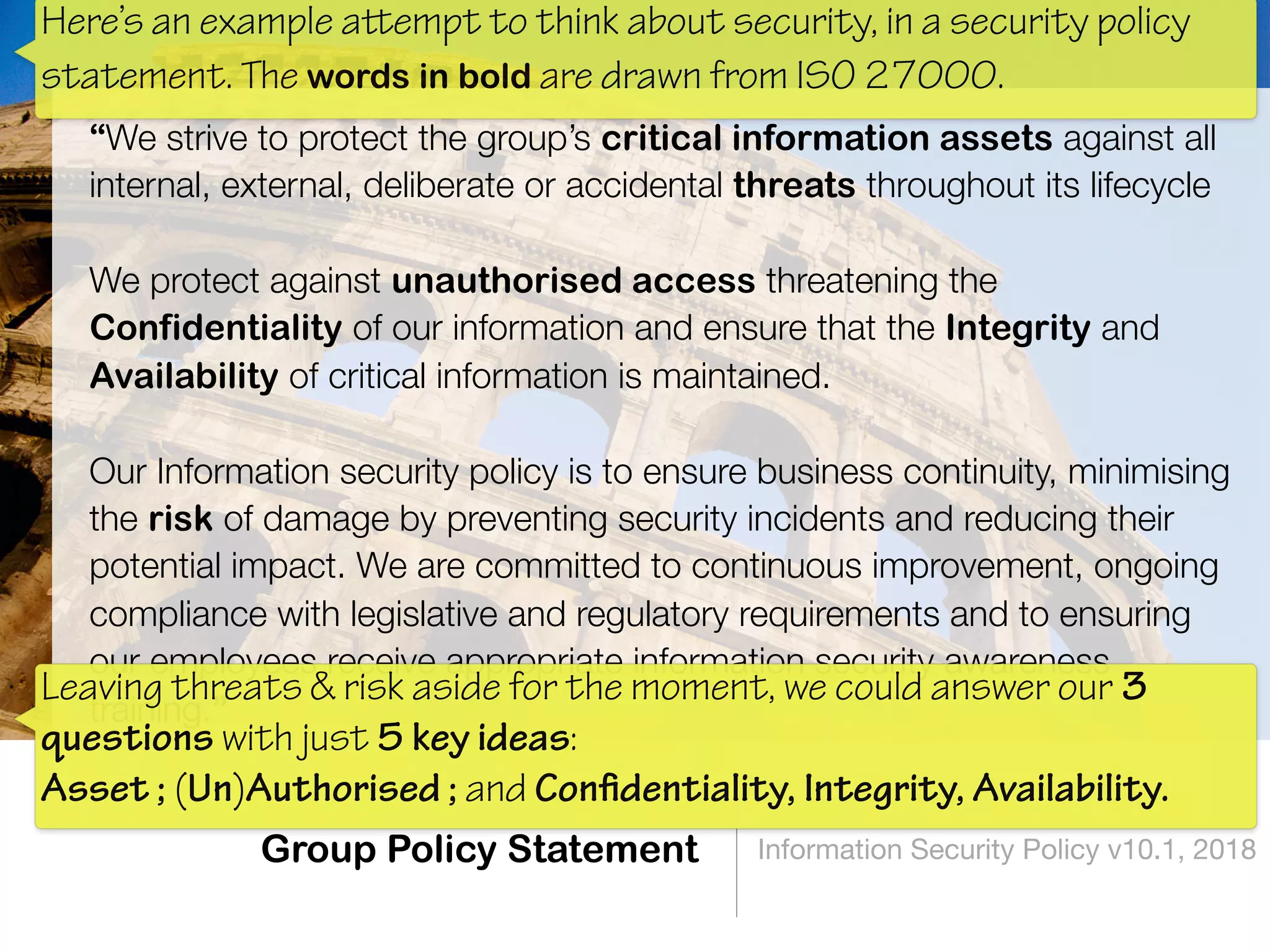
Group Policy Statement Information Security Policy v10.1, 2018
“We strive to protect the group’s critical information assets against all
internal, external, deliberate or accidental threats throughout its lifecycle

We protect against unauthorised access threatening the
Confidentiality of our information and ensure that the Integrity and
Availability of critical information is maintained.

Our Information security policy is to ensure business continuity, minimising
the risk of damage by preventing security incidents and reducing their
potential impact. We are committed to continuous improvement, ongoing
compliance with legislative and regulatory requirements and to ensuring
our employees receive appropriate information security awareness
training.”
Leaving threats & risk aside for the moment, we could answer our 3
questions with just 5 key ideas: 

Asset ; (Un)Authorised ; and Confidentiality, Integrity, Availability.
Here’s an example attempt to think about security, in a security policy
statement. The words in bold are drawn from ISO 27000.
How Can We Think About Security? Chris F Carroll
✤ WHAT are we trying to secure?

✤ WHO are we securing for or from?

✤ WHAT does security mean anyway?
So now, let’s answer our 3 questions with this vocabulary
Chris F Carroll
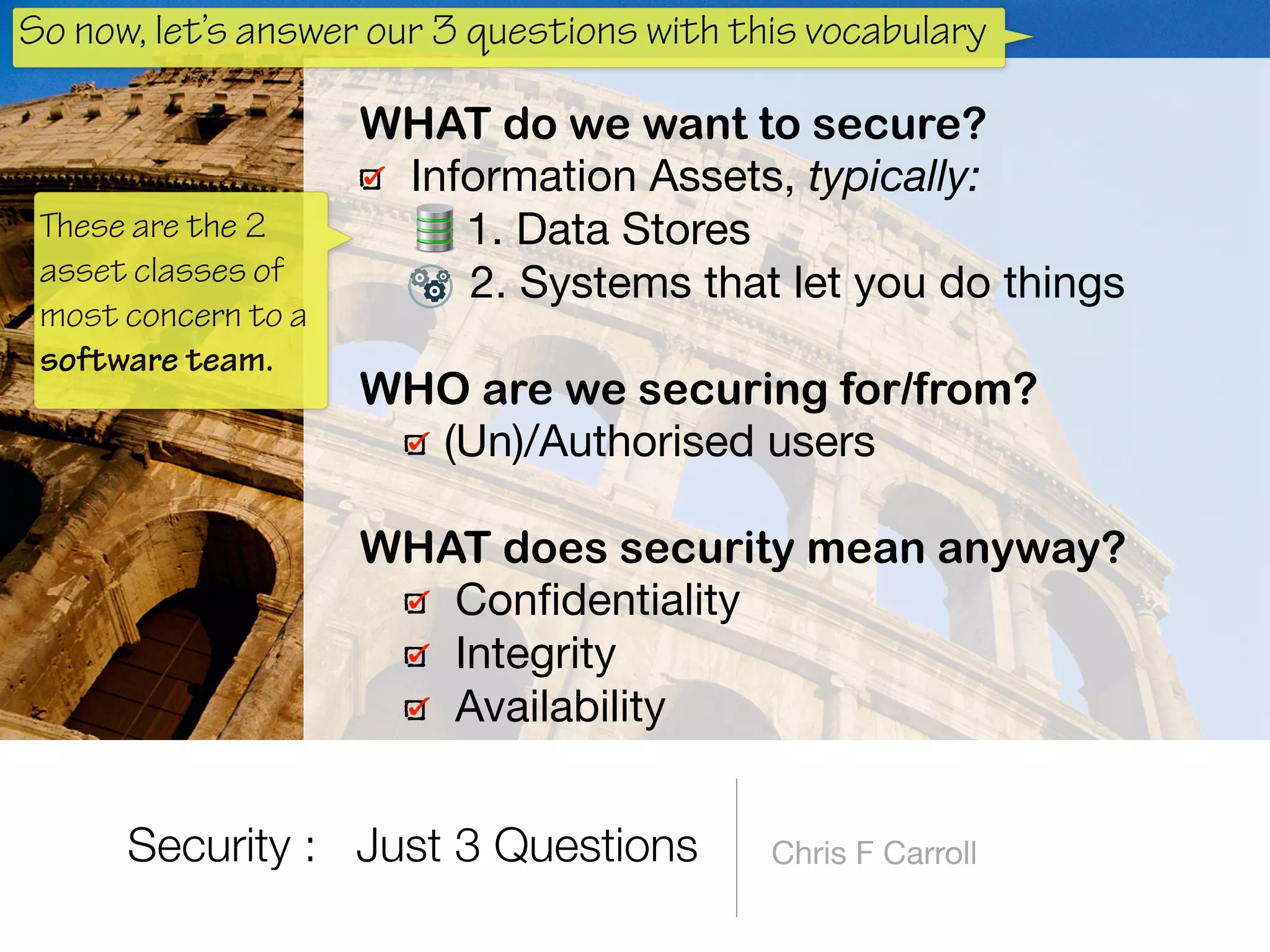
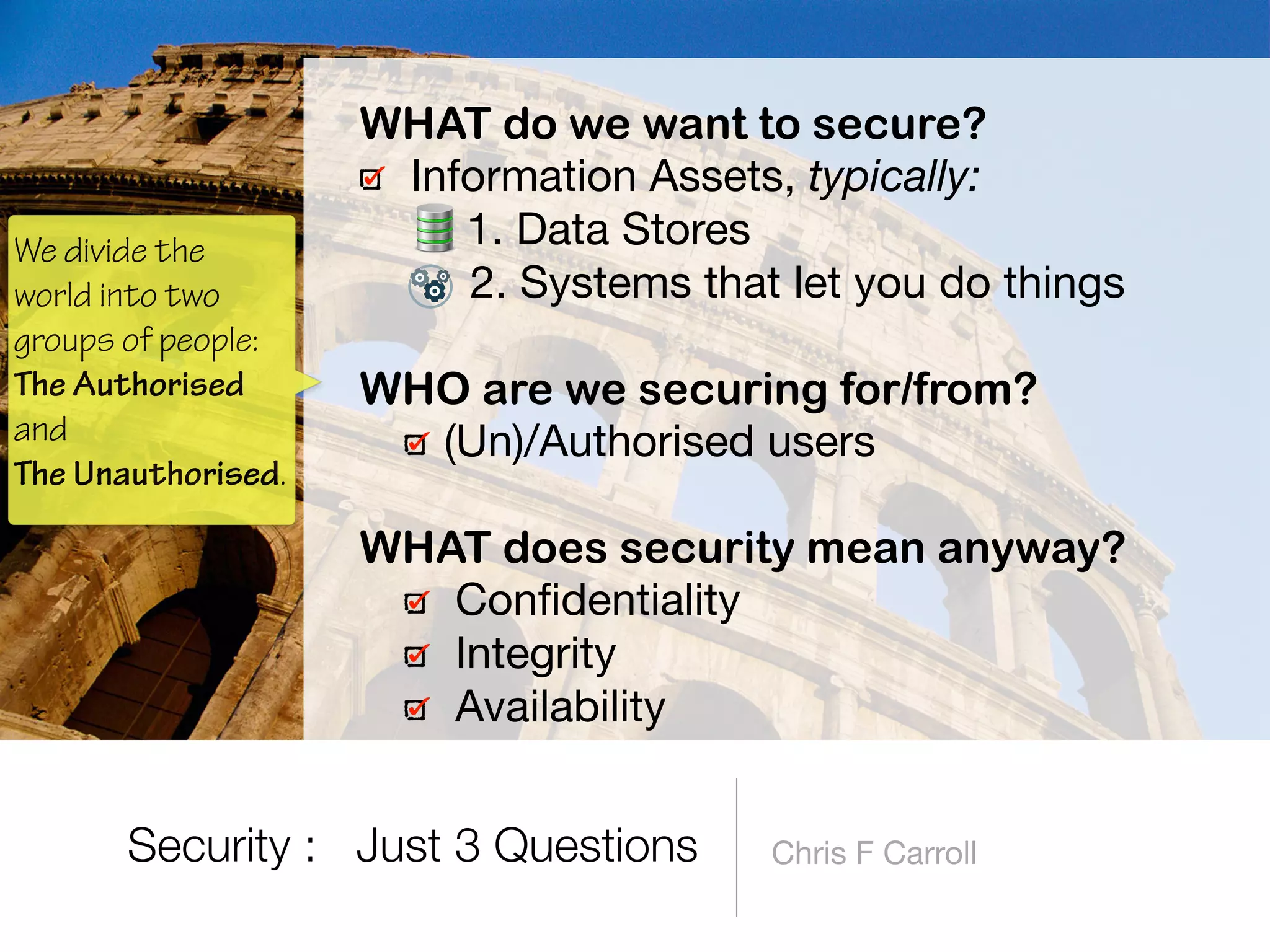
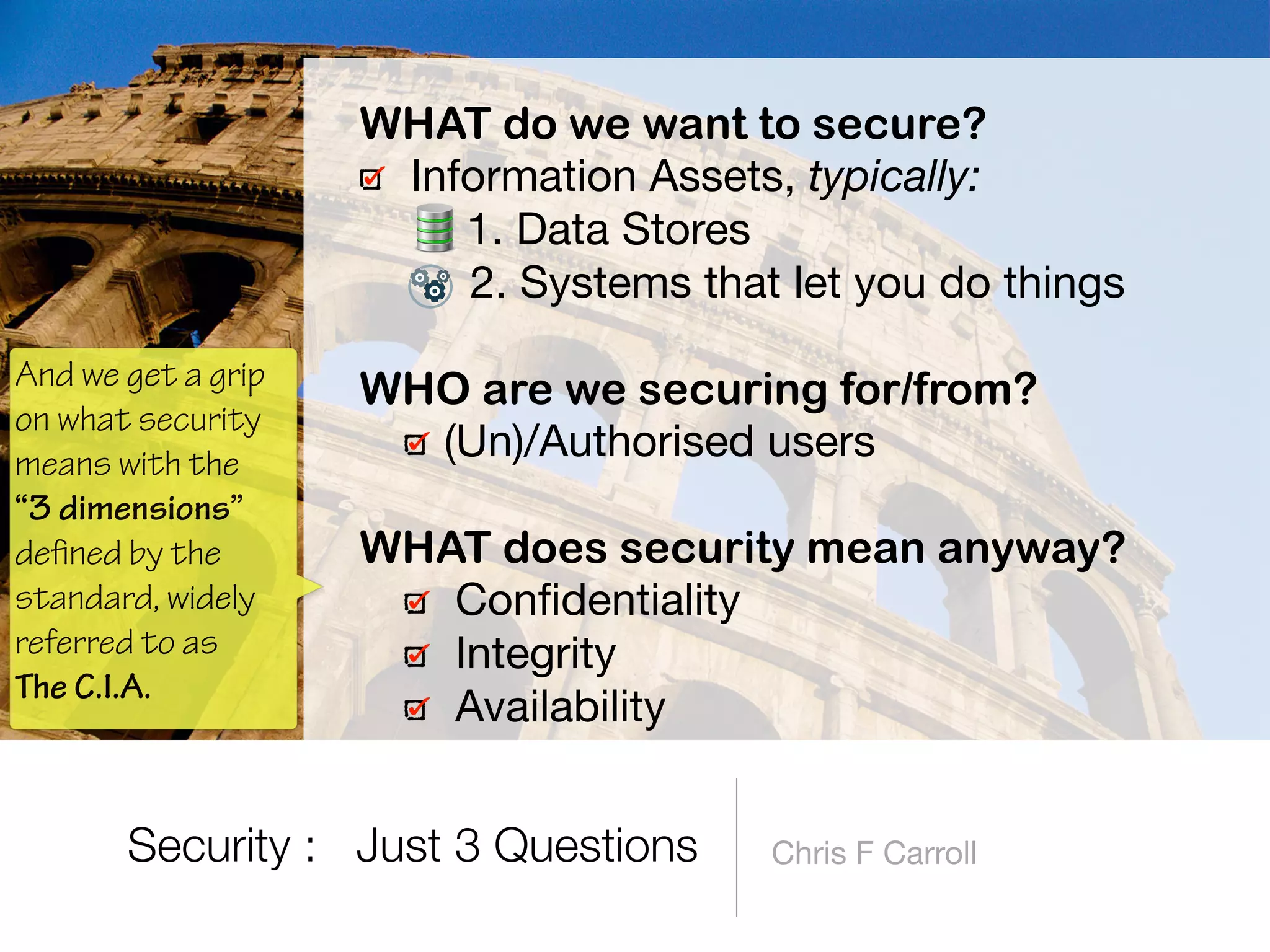
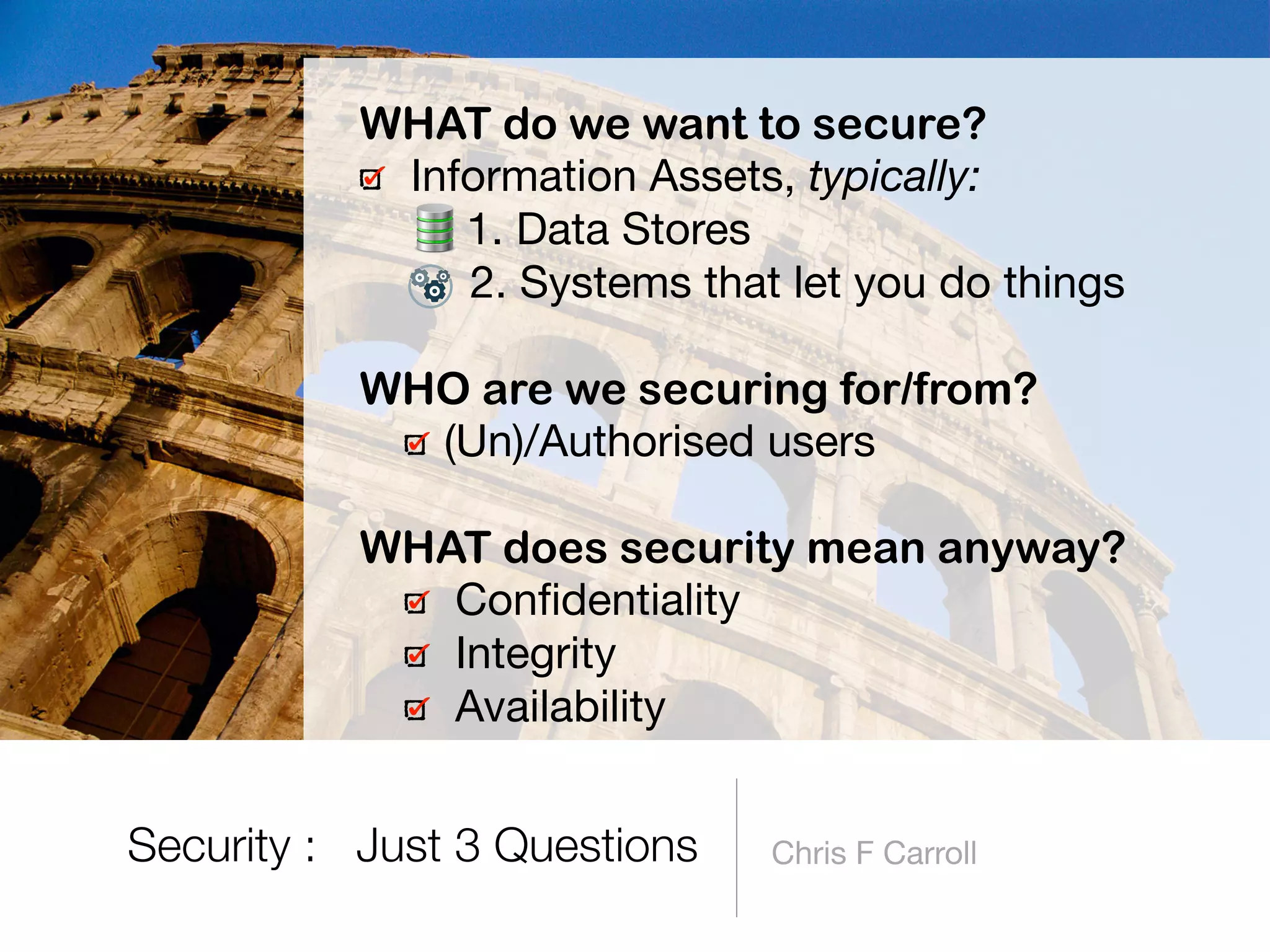
WHAT do we want to secure?
Information Assets, typically:

1. Data Stores

2. Systems that let you do things

WHO are we securing for/from?
(Un)/Authorised users

WHAT does security mean anyway?
Confidentiality

Integrity

Availability
Security : Just 3 Questions
These are the 2
asset classes of
most concern to a
software team.
So now, let’s answer our 3 questions with this vocabulary
Chris F Carroll
WHAT do we want to secure?
Information Assets, typically:

1. Data Stores

2. Systems that let you do things

WHO are we securing for/from?
(Un)/Authorised users

WHAT does security mean anyway?
Confidentiality

Integrity

Availability
Security : Just 3 Questions
We divide the
world into two
groups of people:
The Authorised
and 

The Unauthorised.
Chris F Carroll
WHAT do we want to secure?
Information Assets, typically:

1. Data Stores

2. Systems that let you do things

WHO are we securing for/from?
(Un)/Authorised users

WHAT does security mean anyway?
Confidentiality

Integrity

Availability
Security : Just 3 Questions
And we get a grip
on what security
means with the
“3 dimensions”
defined by the
standard, widely
referred to as 

The C.I.A.
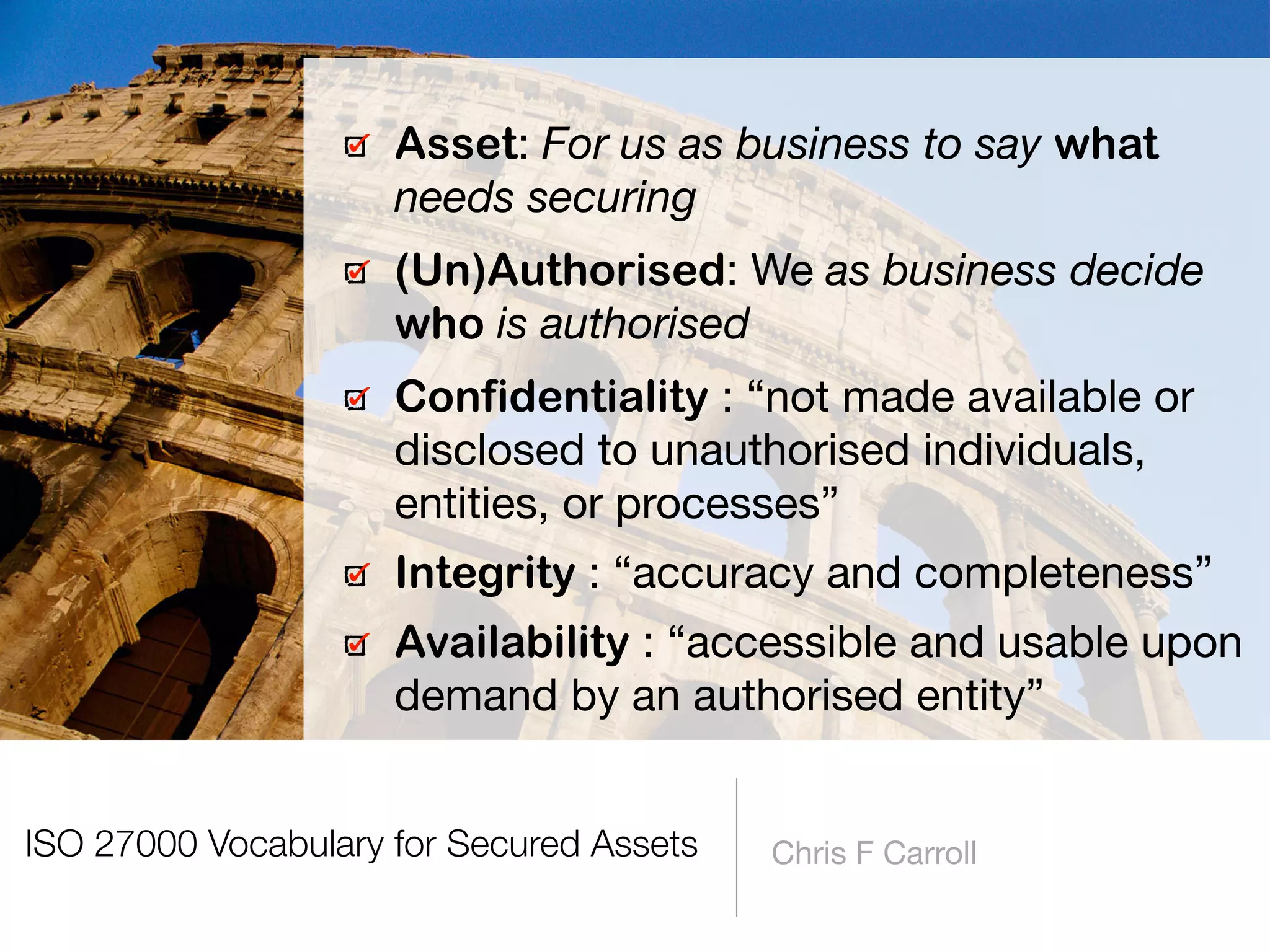
ISO 27000 Vocabulary for Secured Assets Chris F Carroll
Asset: For us as business to say what
needs securing

(Un)Authorised: We as business decide
who is authorised
Confidentiality : “not made available or
disclosed to unauthorised individuals,
entities, or processes”

Integrity : “accuracy and completeness”

Availability : “accessible and usable upon
demand by an authorised entity”
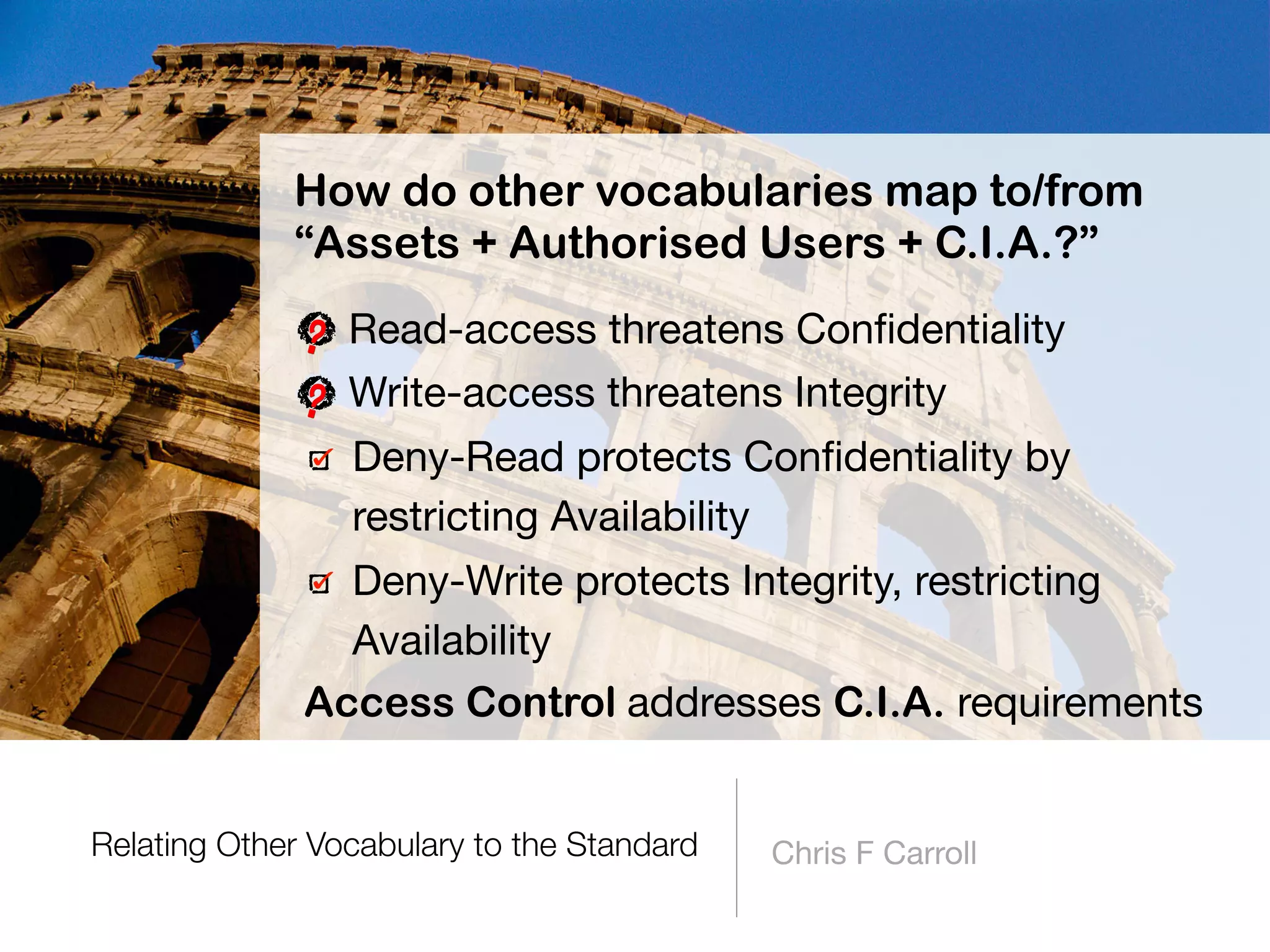
Relating Other Vocabulary to the Standard Chris F Carroll
How do other vocabularies map to/from
“Assets + Authorised Users + C.I.A.?”
Read-access threatens Confidentiality

Write-access threatens Integrity

Deny-Read protects Confidentiality by
restricting Availability

Deny-Write protects Integrity, restricting
Availability
Access Control addresses C.I.A. requirements
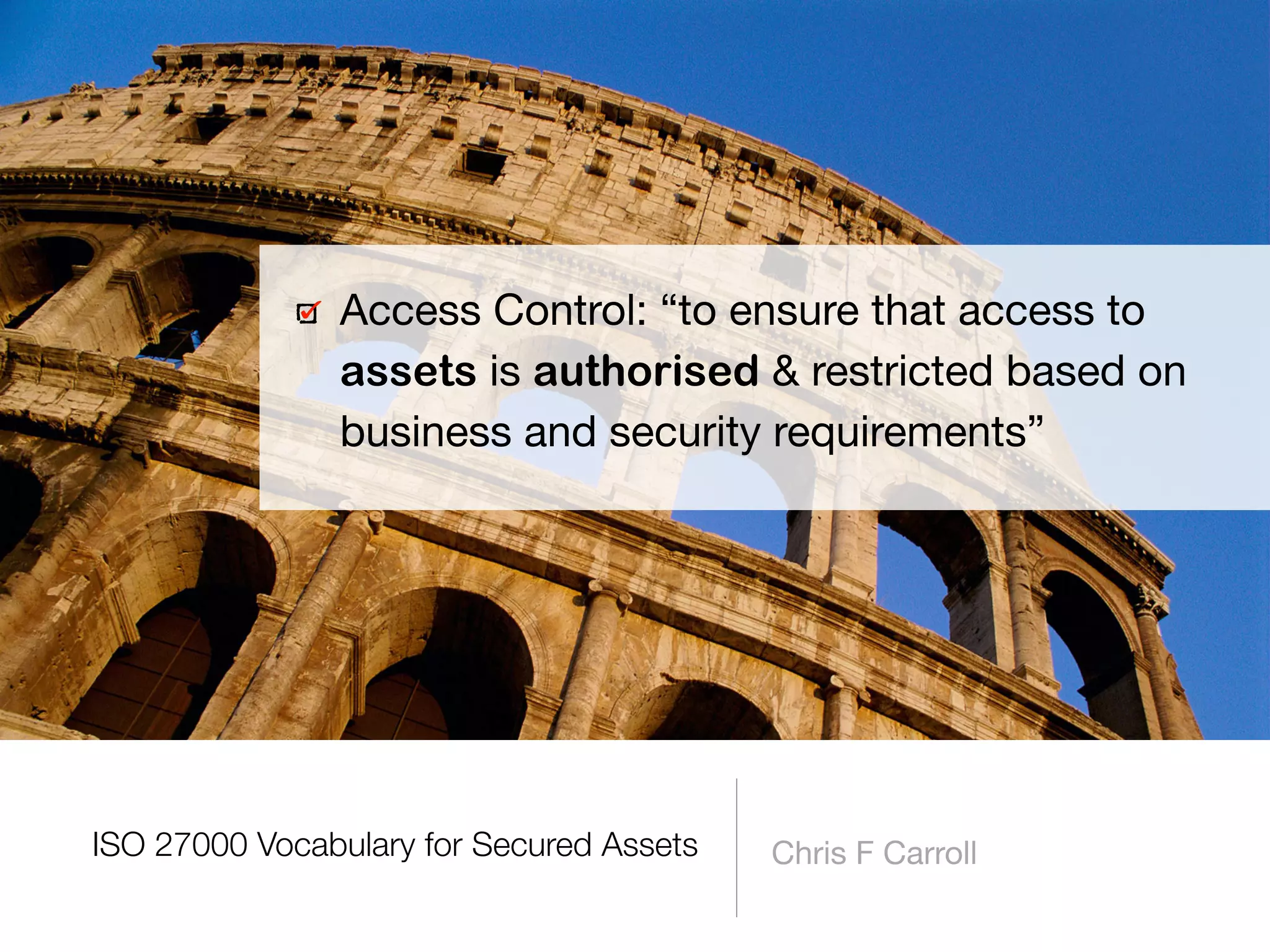
Chris F Carroll
Access Control: “to ensure that access to
assets is authorised & restricted based on
business and security requirements”
ISO 27000 Vocabulary for Secured Assets
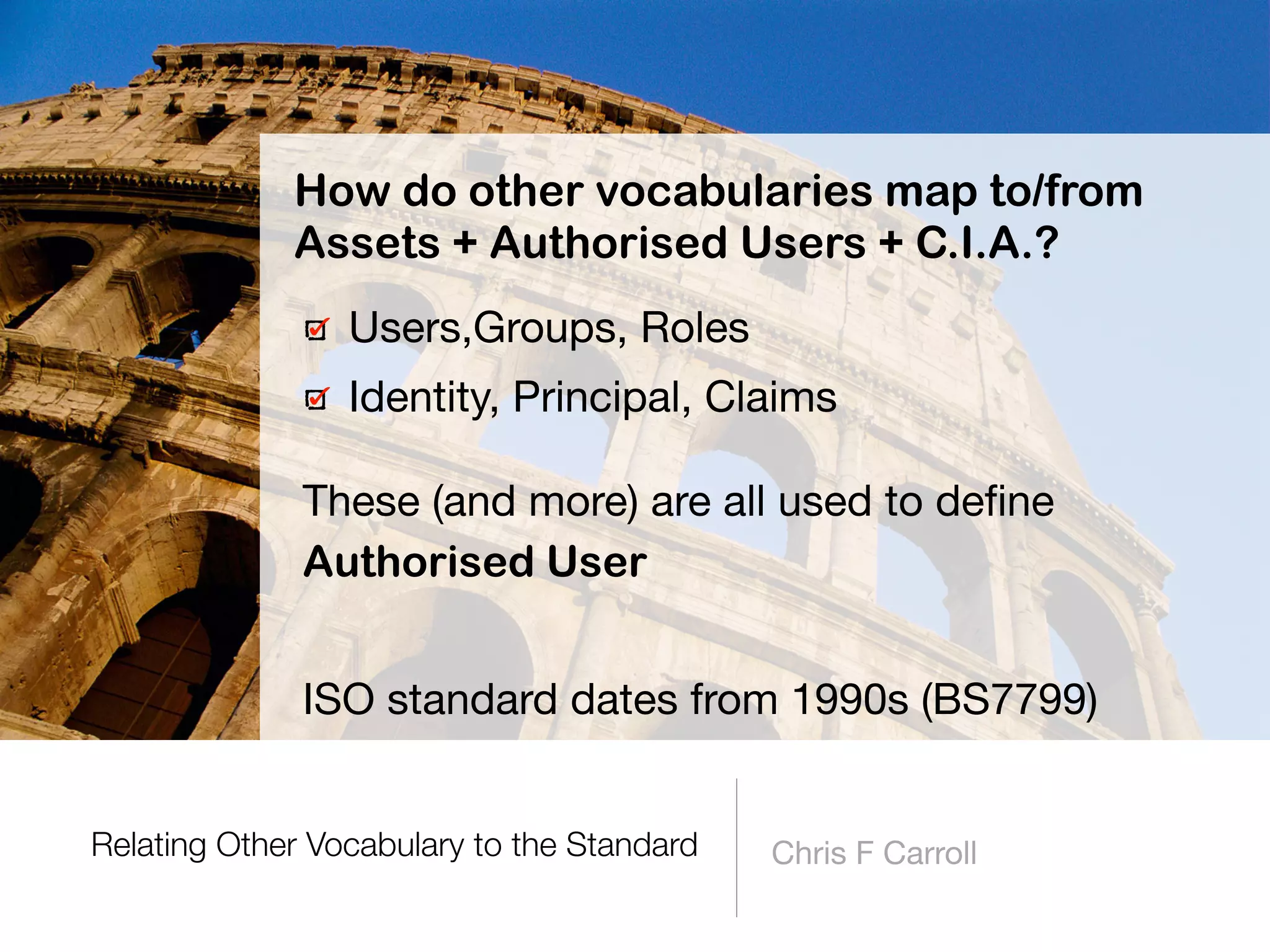
Relating Other Vocabulary to the Standard Chris F Carroll
Users,Groups, Roles

Identity, Principal, Claims
These (and more) are all used to define 

Authorised User
ISO standard dates from 1990s (BS7799)
How do other vocabularies map to/from
Assets + Authorised Users + C.I.A.?
Relating Other Vocabulary to the Standard Chris F Carroll
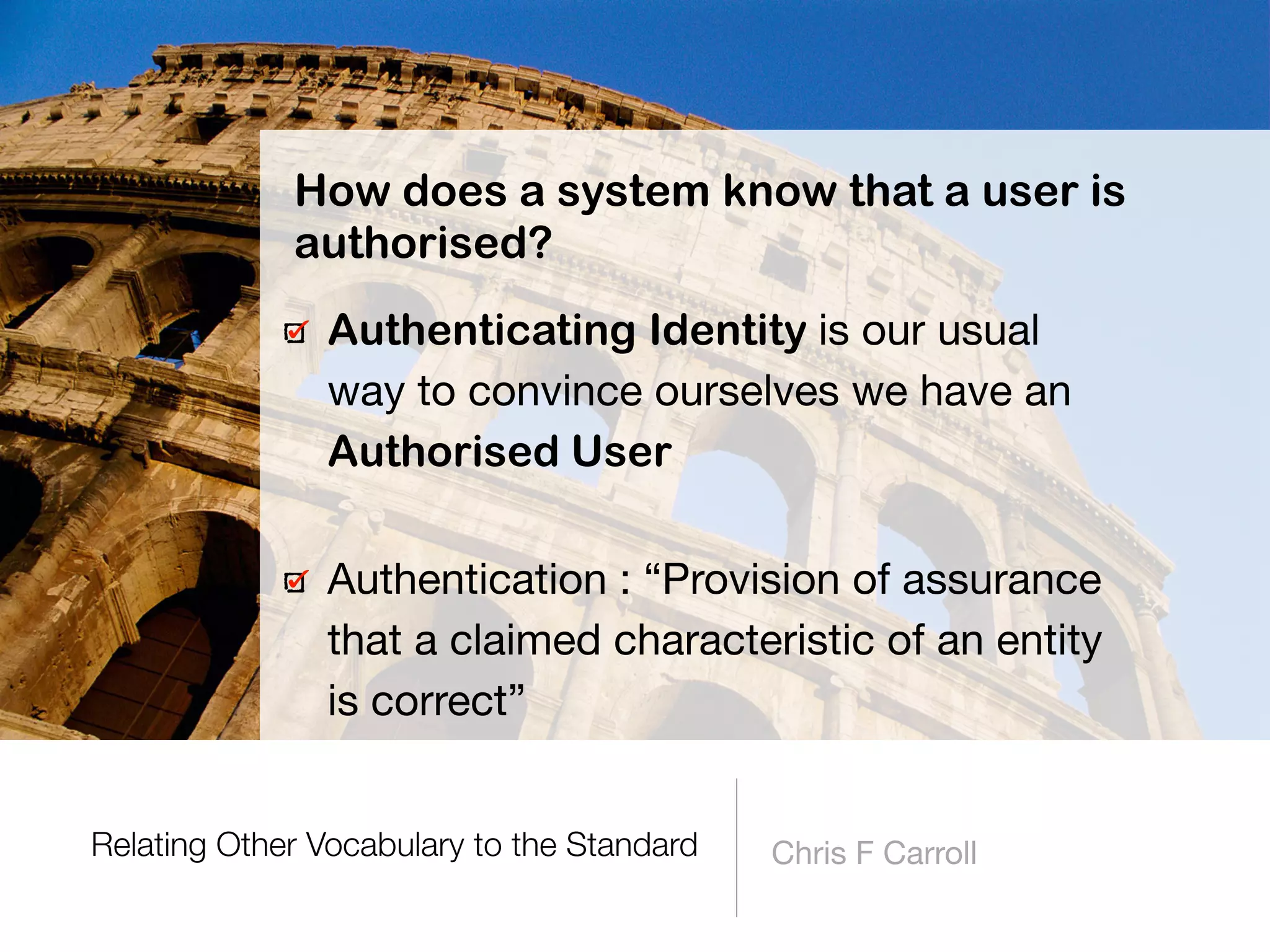
Authenticating Identity is our usual
way to convince ourselves we have an
Authorised User
How does a system know that a user is
authorised?
Authentication : “Provision of assurance
that a claimed characteristic of an entity
is correct”
Relating Other Vocabulary to the Standard Chris F Carroll
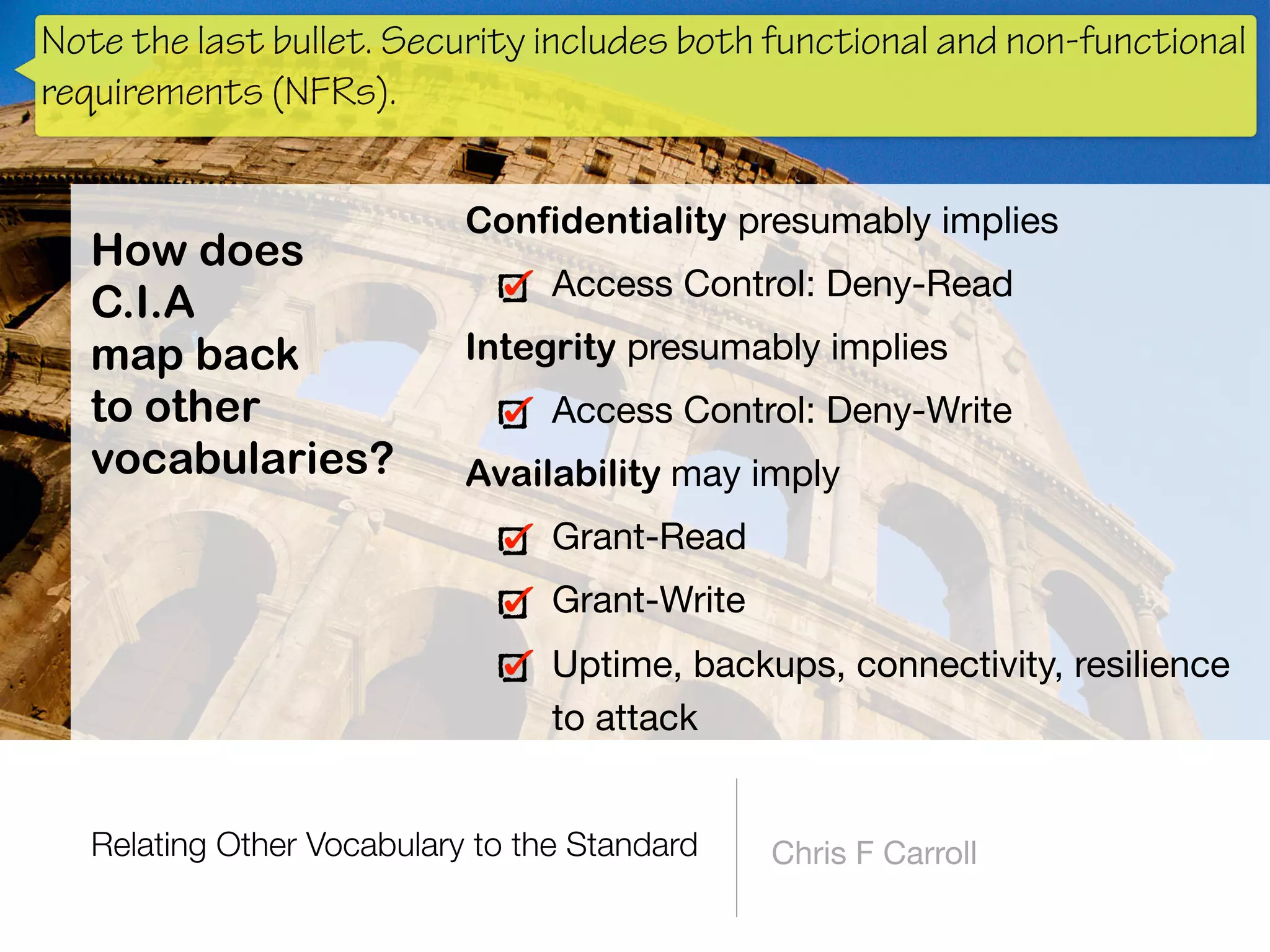
Confidentiality presumably implies

Access Control: Deny-Read

Integrity presumably implies

Access Control: Deny-Write

Availability may imply
Grant-Read

Grant-Write

Uptime, backups, connectivity, resilience
to attack
How does
C.I.A
map back
to other
vocabularies?
Note the last bullet. Security includes both functional and non-functional
requirements (NFRs).
Security : Just 3 Questions Chris F Carroll
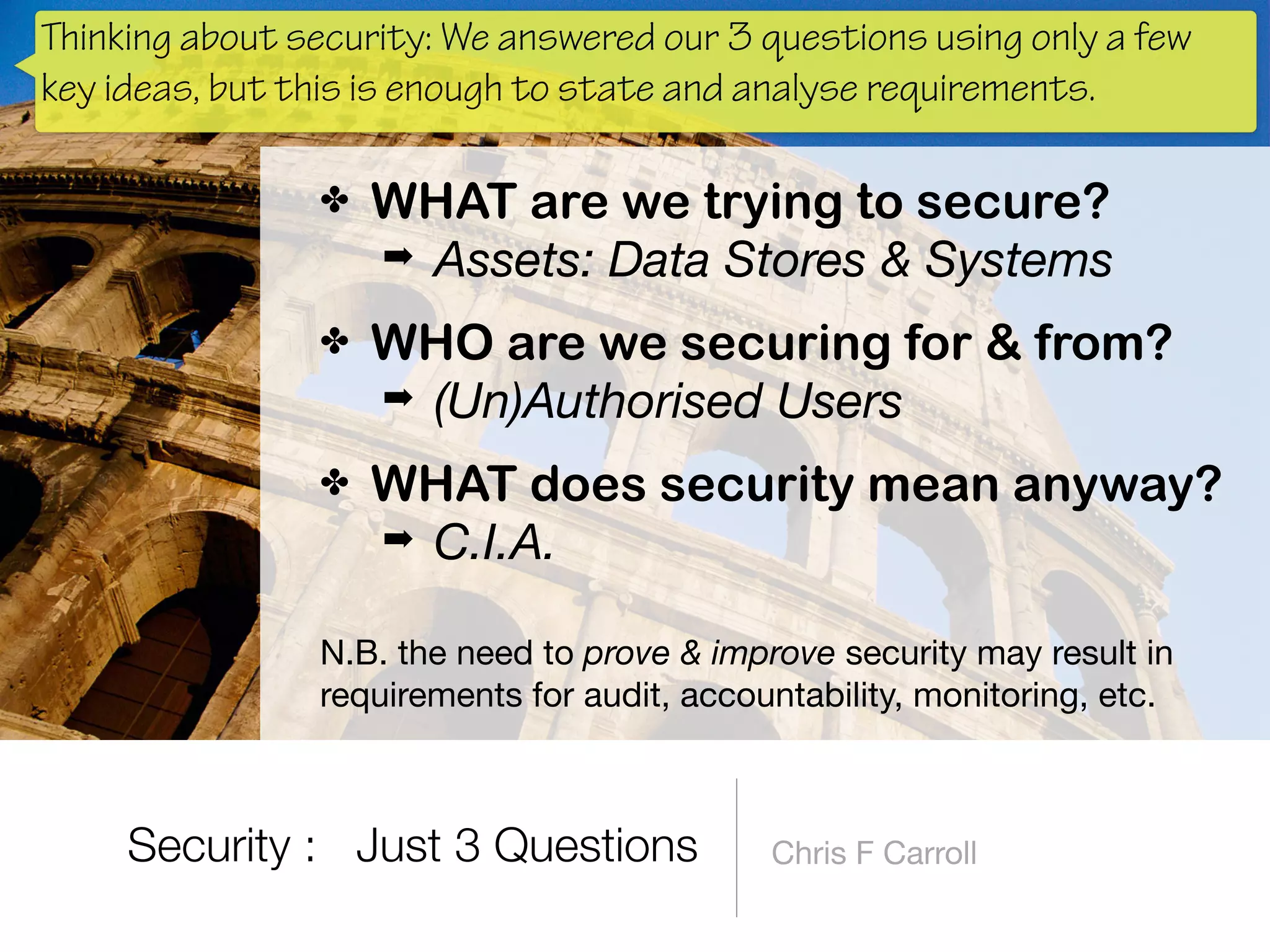
✤ WHAT are we trying to secure?
➡ Assets: Data Stores & Systems
✤ WHO are we securing for & from?
➡ (Un)Authorised Users
✤ WHAT does security mean anyway?
➡ C.I.A.

N.B. the need to prove & improve security may result in
requirements for audit, accountability, monitoring, etc.
Thinking about security: We answered our 3 questions using only a few
key ideas, but this is enough to state and analyse requirements.
Software Architecture Chris F Carroll
How can we use
this?
Security Requirements Chris F Carroll
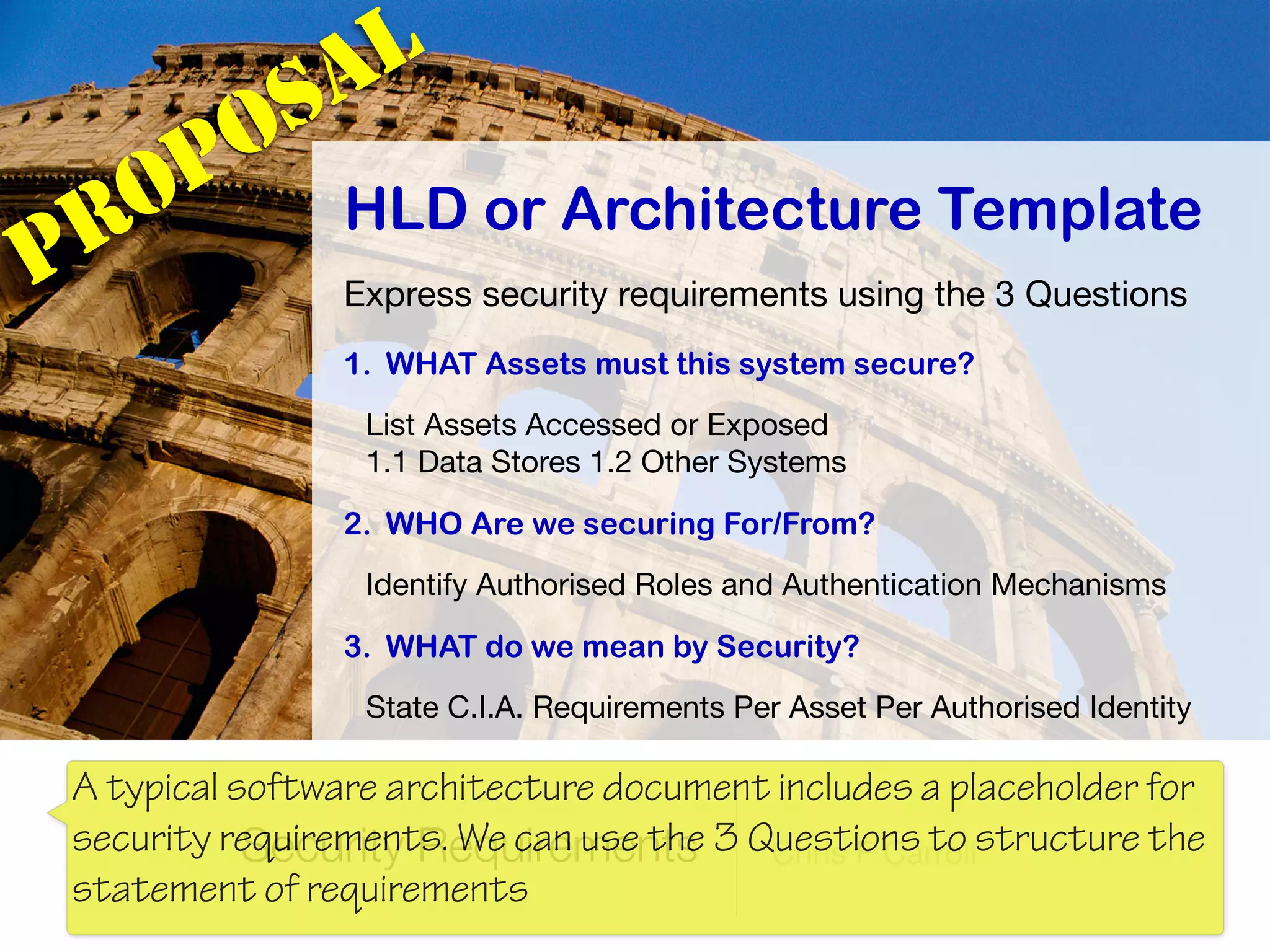
HLD or Architecture Template
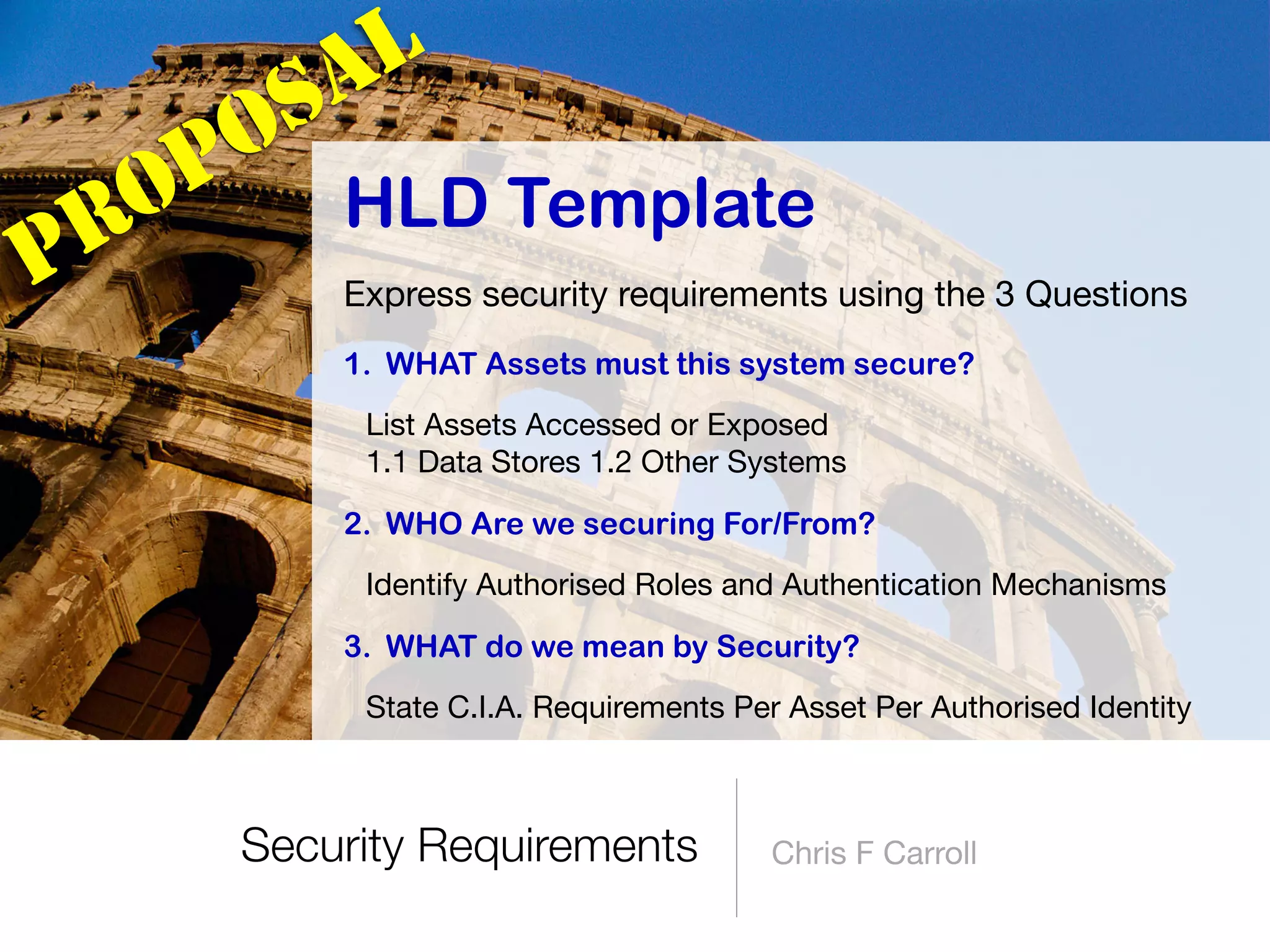
Express security requirements using the 3 Questions

1. WHAT Assets must this system secure?
List Assets Accessed or Exposed

1.1 Data Stores 1.2 Other Systems

2. WHO Are we securing For/From?
Identify Authorised Roles and Authentication Mechanisms

3. WHAT do we mean by Security?
State C.I.A. Requirements Per Asset Per Authorised Identity
PROPOSAL
A typical software architecture document includes a placeholder for
security requirements. We can use the 3 Questions to structure the
statement of requirements
Security Requirements Chris F Carroll
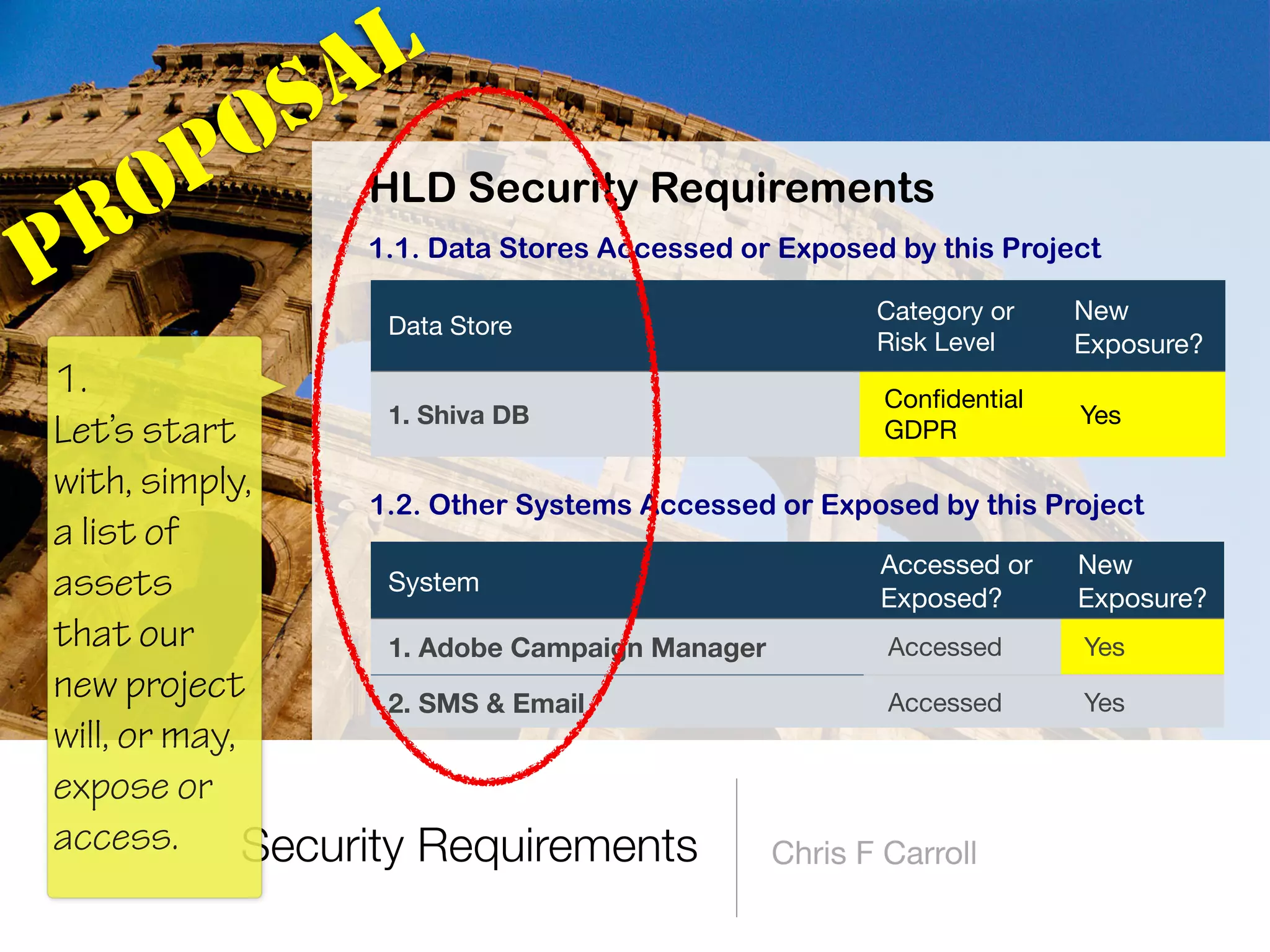
HLD Security Requirements
1.1. Data Stores Accessed or Exposed by this Project
Data Store
Category or
Risk Level
New
Exposure?
1. Shiva DB
Confidential

GDPR
Yes
PROPOSAL
System
Accessed or
Exposed?
New
Exposure?
1. Adobe Campaign Manager Accessed Yes
2. SMS & Email Accessed Yes
1.2. Other Systems Accessed or Exposed by this Project
1.
Let’s start
with, simply,
a list of
assets
that our
new project
will, or may,
expose or
access.
Security Requirements Chris F Carroll
HLD Security Requirements
1.1. Data Stores Accessed or Exposed by this Project
Data Store
Category or
Risk Level
New
Exposure?
1. Shiva DB
Confidential

GDPR
Yes
PROPOSAL
System
Accessed or
Exposed?
New
Exposure?
1. Adobe Campaign Manager Accessed Yes
2. SMS & Email Accessed Yes
1.2. Other Systems Accessed or Exposed by this Project
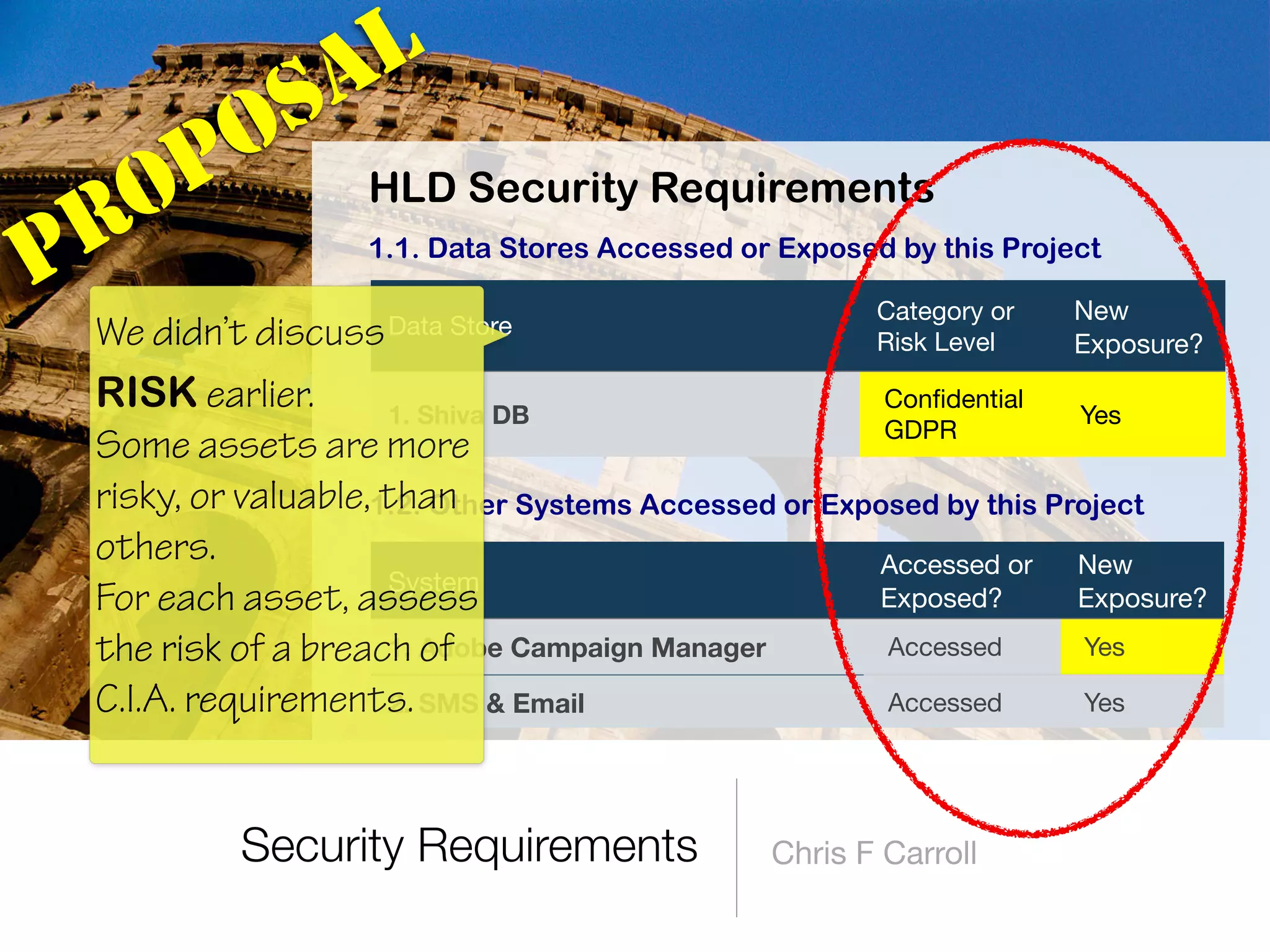
We didn’t discuss
RISK earlier.
Some assets are more
risky, or valuable, than
others.
For each asset, assess
the risk of a breach of
C.I.A. requirements.
Security Requirements Chris F Carroll
PROPOSAL
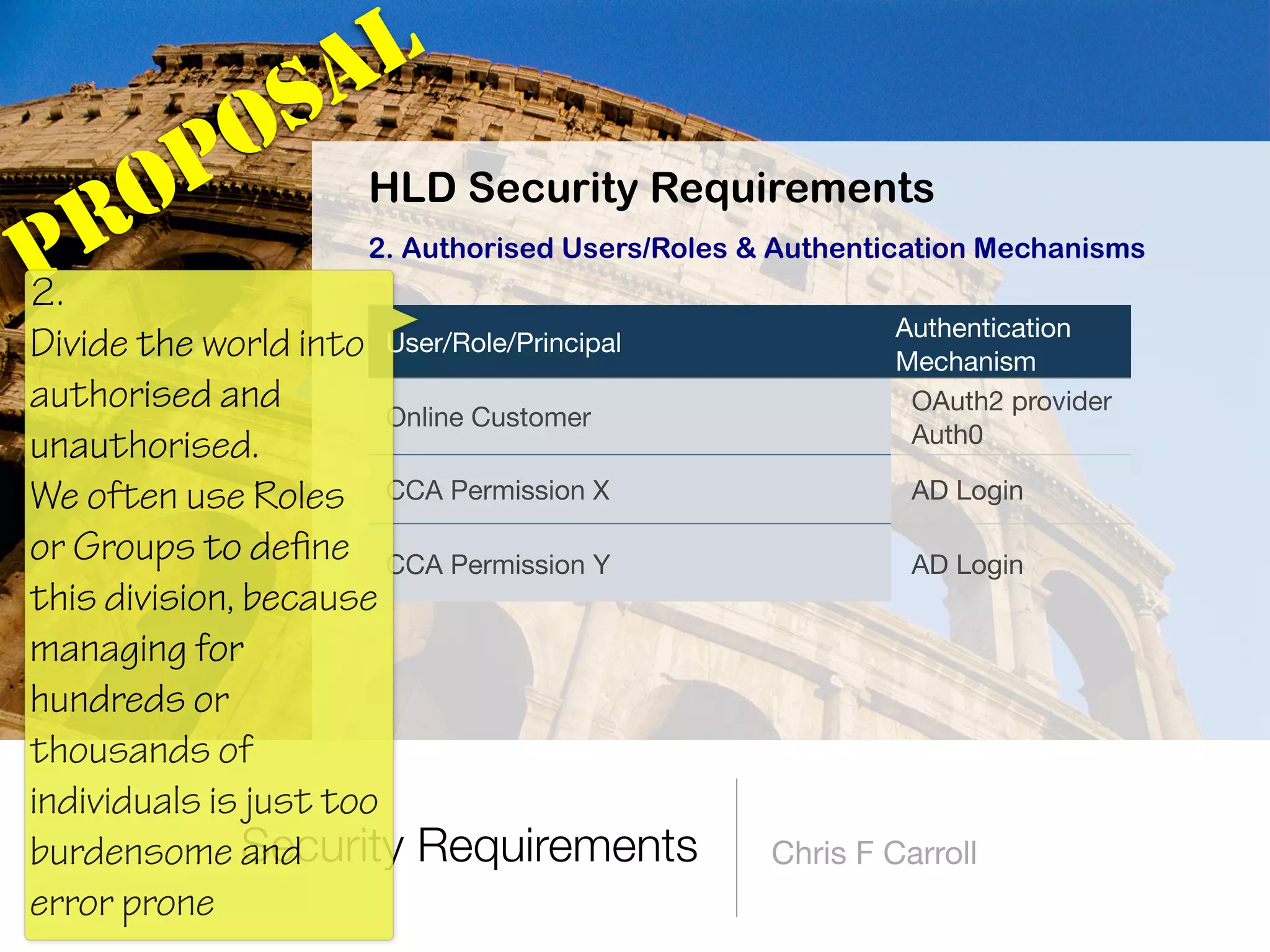
User/Role/Principal
Authentication
Mechanism
Online Customer
OAuth2 provider
Auth0
CCA Permission X AD Login
CCA Permission Y AD Login
HLD Security Requirements
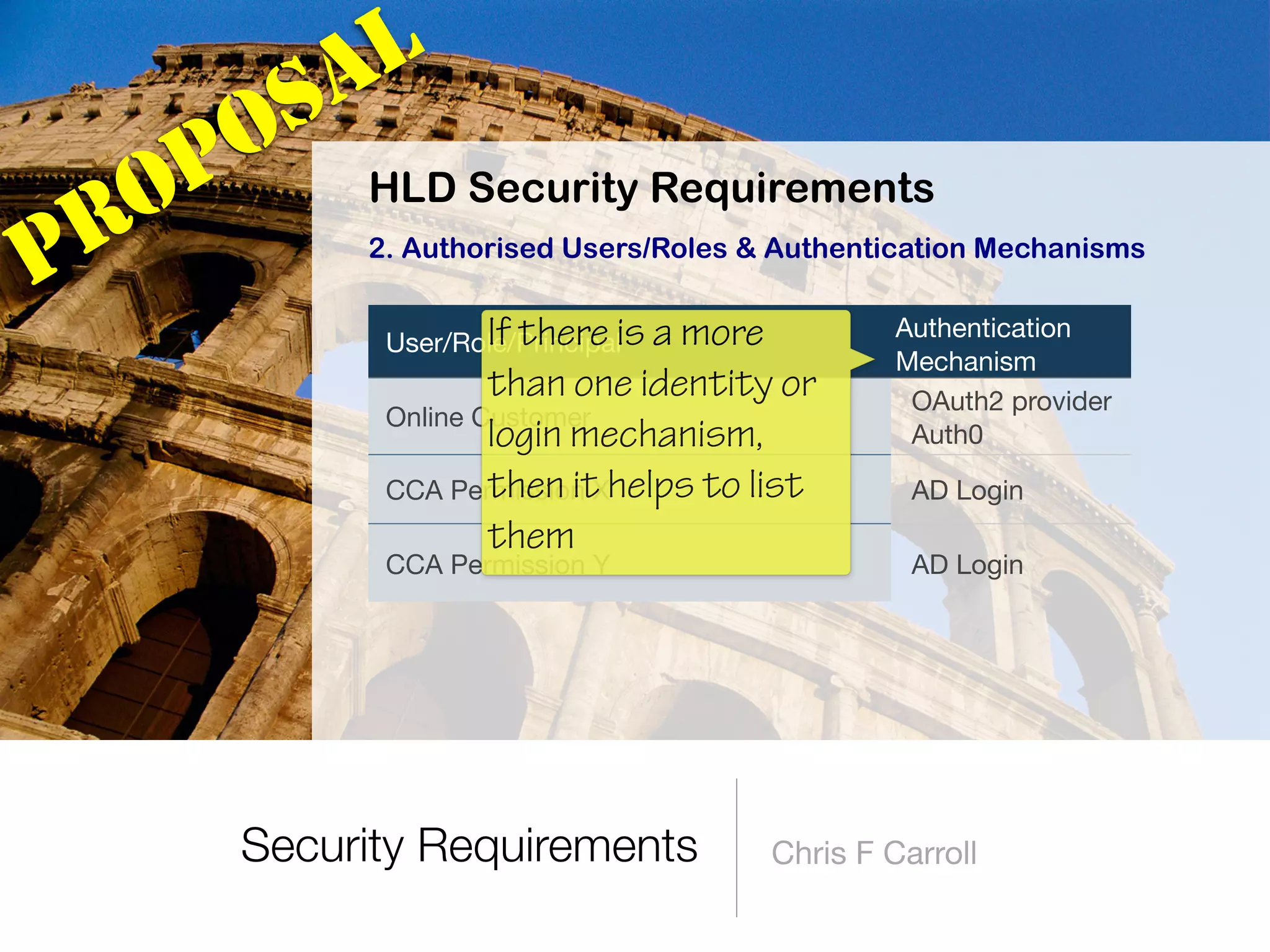
2. Authorised Users/Roles & Authentication Mechanisms
2. 

Divide the world into
authorised and
unauthorised.
We often use Roles
or Groups to define
this division, because
managing for
hundreds or
thousands of
individuals is just too
burdensome and
error prone
Security Requirements Chris F Carroll
PROPOSAL
User/Role/Principal
Authentication
Mechanism
Online Customer
OAuth2 provider
Auth0
CCA Permission X AD Login
CCA Permission Y AD Login
HLD Security Requirements
2. Authorised Users/Roles & Authentication Mechanisms
If there is a more
than one identity or
login mechanism,
then it helps to list
them
Security Requirements Chris F Carroll
PROPOSAL
Asset
Authorised
User
Confidentiality

(Read Access is
restricted to…)
Integrity

(Operations

restricted to…)
Customer
DB
Authenticated
Customer
Read access to
own data only
Permissions detailed
below…
Adobe
Campaign
Manager
Service
Account
NONE needed
Permitted Operations
below…
Email &
SMS
Service
Account
NONE needed
Permitted Operations
below…
HLD Security Requirements
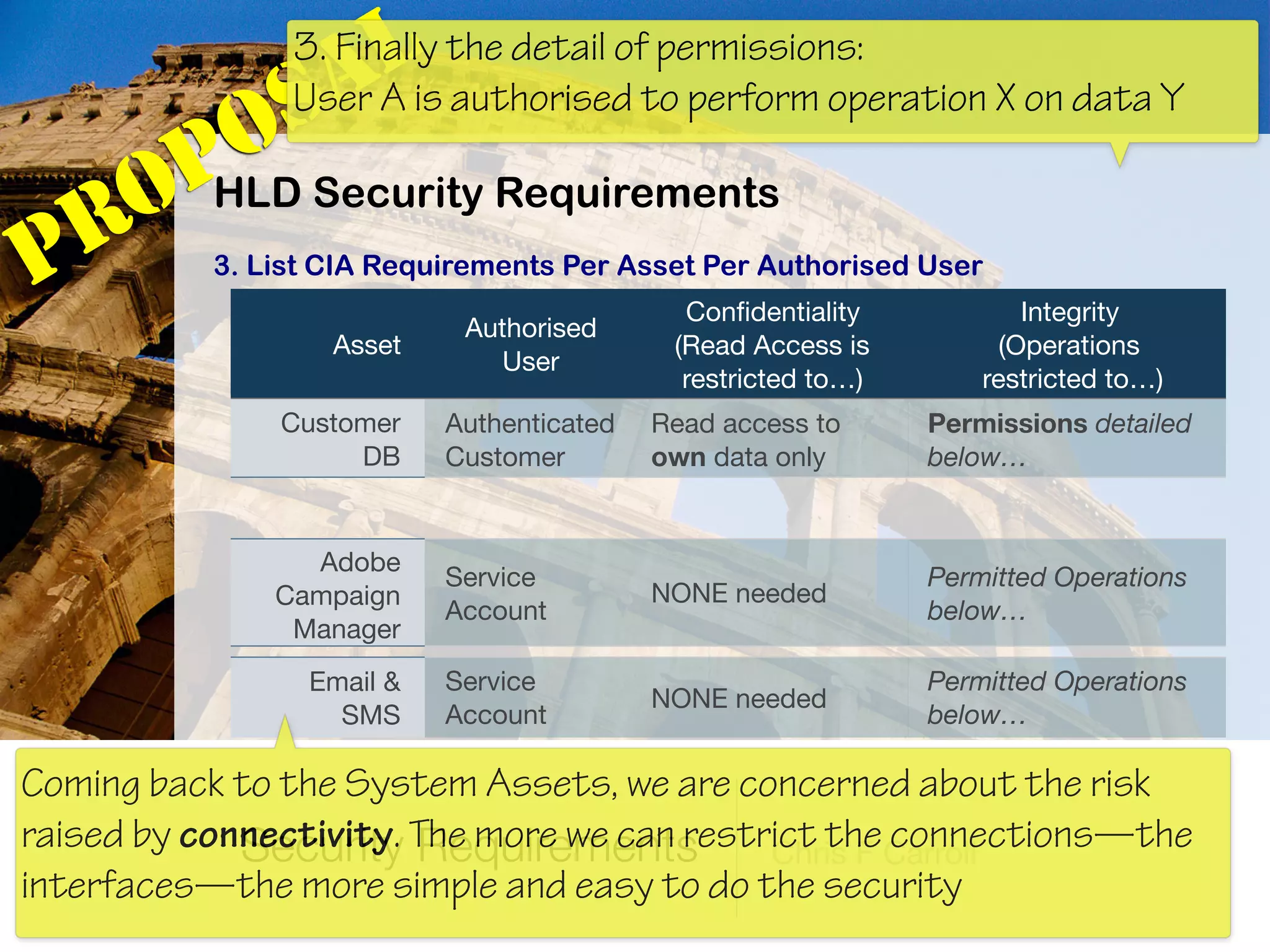
3. List CIA Requirements Per Asset Per Authorised User
3. Finally the detail of permissions: 

User A is authorised to perform operation X on data Y
Coming back to the System Assets, we are concerned about the risk
raised by connectivity. The more we can restrict the connections—the
interfaces—the more simple and easy to do the security
Security Requirements Chris F Carroll
HLD Template
Express security requirements using the 3 Questions

1. WHAT Assets must this system secure?
List Assets Accessed or Exposed

1.1 Data Stores 1.2 Other Systems

2. WHO Are we securing For/From?
Identify Authorised Roles and Authentication Mechanisms

3. WHAT do we mean by Security?
State C.I.A. Requirements Per Asset Per Authorised Identity
PROPOSAL
Security Requirements Analysis Chris F Carroll
Asset
Id Assets Where is it?
Type of
Asset Who's Asset?
Required
Confidentiality
Level
Required
Availability &
Integrity Level
1 LB code and scripts BitBucket, Dev
Machines,
Private NuGet
Our labour LB Low Medium
2 AWS Dev AWS Dev Our labour LB Low Medium
3 AWS Live
Infrastructure Design
& Runtime
AWS Live: ECS EC2 Operations LB Low Business Process
Critical
4 All Customer's
Business Data
AWS Live: ECS EC2 DB Customers'
Data
Customers Business Critical Business Process
Critical
5 All Customer's
Customers Personal
Data
AWS Live: ECS EC2 DB
Logs
Personal Data Customers'
Customers
Business &
Regulatory
Critical
Business Process
Critical
6 Single Customer's
Business Data
AWS Live: ECS EC2 DB Customer's
Data
Customers Business Critical Business Process
Critical
7 Single Customer's
Customers Personal
Data
AWS Live: ECS EC2 DB
Logs
Personal Data Customer's
Customers
Business &
Regulatory
Critical
Business Process
Critical
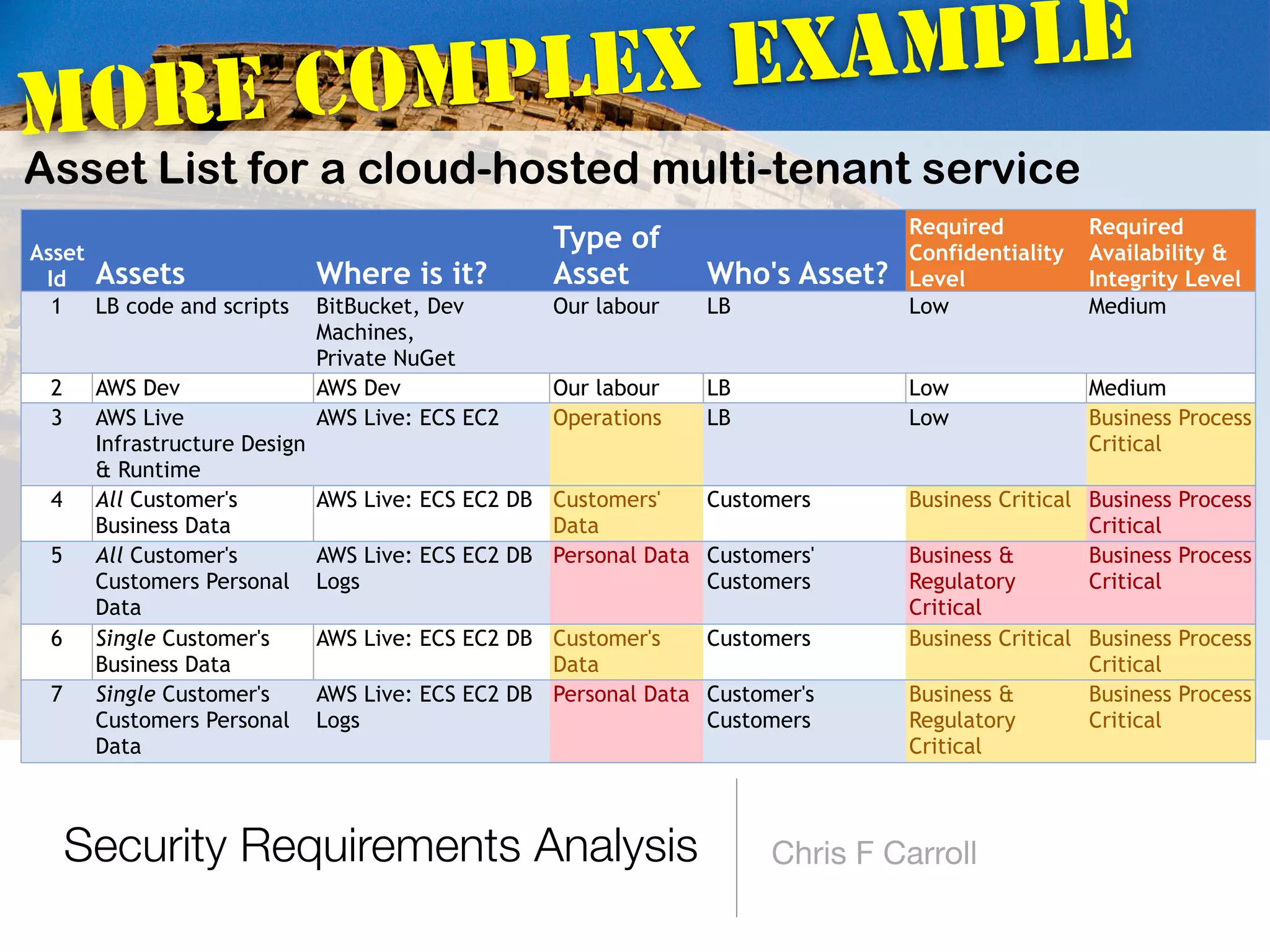
Asset List for a cloud-hosted multi-tenant service
More complex example
Design for Security Requirements Chris F Carroll
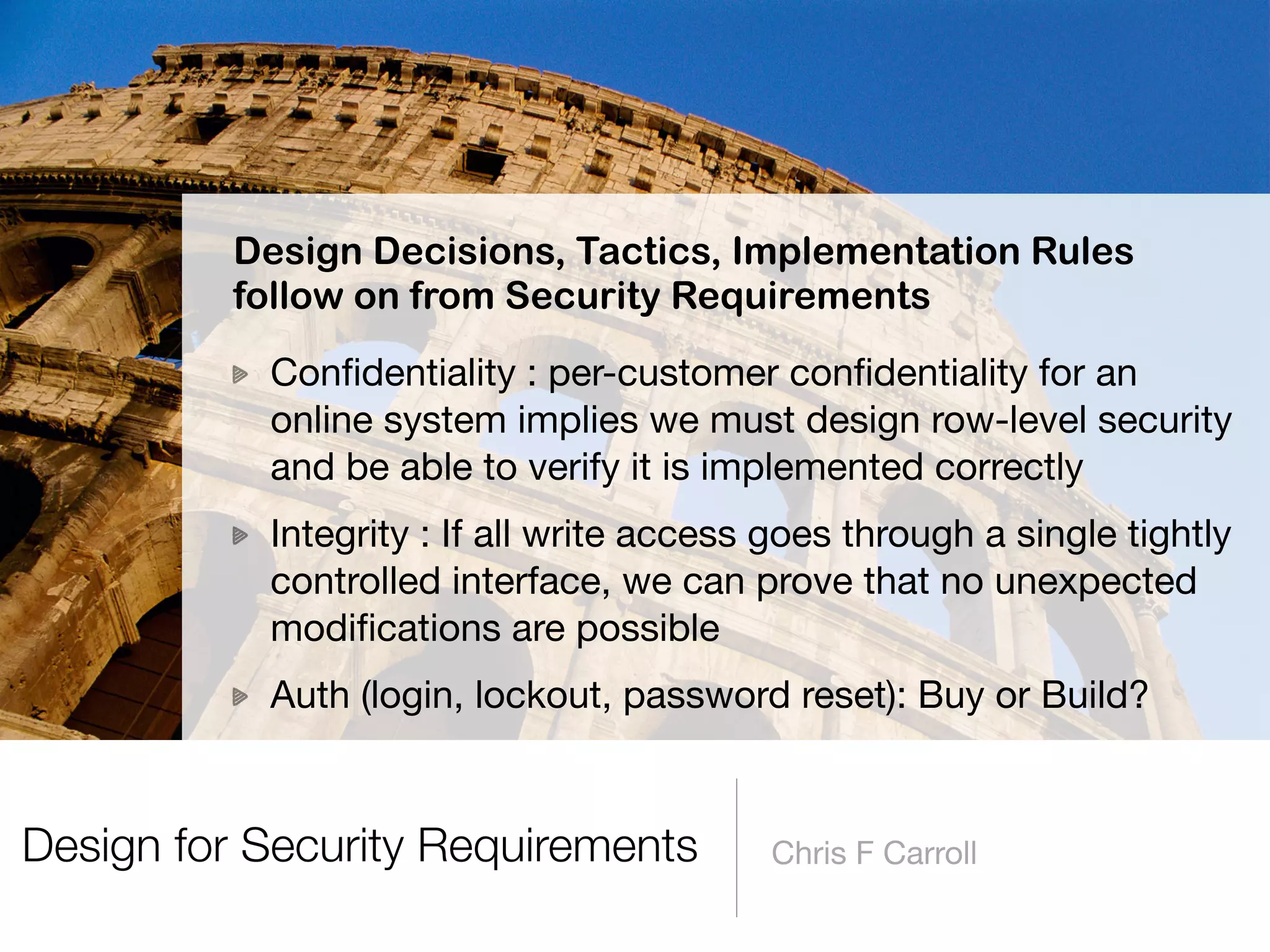
Confidentiality : per-customer confidentiality for an
online system implies we must design row-level security
and be able to verify it is implemented correctly

Integrity : If all write access goes through a single tightly
controlled interface, we can prove that no unexpected
modifications are possible

Auth (login, lockout, password reset): Buy or Build?
Design Decisions, Tactics, Implementation Rules

follow on from Security Requirements
Chris F Carroll
WHAT do we want to secure?
Information Assets, typically:

1. Data Stores

2. Systems that let you do things

WHO are we securing for/from?
(Un)/Authorised users

WHAT does security mean anyway?
Confidentiality

Integrity

Availability
Security : Just 3 Questions
Software Architecture Chris F Carroll
✓ Definitions & 

Requirements I : Analysis
✤ Design
✤ Requirements II : Threats & Risks
✤ Implementation
✤ Verification
✤ Handover

What is Security, anyway? Software architecture for information security part 1 : Expressing requirements with iso27000 annotated

  • 1.
    Software Architecture ChrisF Carroll Software Architecture for Information Security Part 1: expressing requirements
  • 2.
    Software Architecture ChrisF Carroll ✤ Definitions & 
 Requirements I: Analysis ✤ Design ✤ Requirements II : Risk & Threats ✤ Implementation ✤ Verification ✤ Handover To deal with software security fully, we would go through the lifecycle. In this talk we’ll just look at the first bullet point.
  • 3.
    Software Architecture ChrisF Carroll Stating & Analysing 
 Information Security Requirements 
 using ISO 27000
  • 4.
    Requirements Threatsvs. All requirements haveedge cases but with security they expand into a whole second way of seeing the issue. Threats get all the news. But our understanding of threats remains piecemeal if we don’t understand the core requirements they are threatening. So we start here.
  • 5.
    Software Architecture forSecurity Chris F Carroll How can we think about security? Let’s start at the beginning. To get security right, we want a framework for thinking about it: What are the questions we should ask and what concepts will help us to answer them?
  • 6.
    How Can WeThink About Security? Chris F Carroll ✤ WHAT are we trying to secure?
 ✤ WHO are we securing for or from?
 ✤ WHAT does security mean anyway? If we can answers these 3 questions then we have done most of the work of thinking about security. To help us answer them, we want some vocabulary or a framework.
  • 7.
    Why use ISO27000? ✓ ISO 27000 provides, if not a complete domain model for security, then at least a vocabulary. ✓ Our security policy and ISMS approach is based on the ISO 27000 series. At some point, our homegrown software has to dovetail with it. Chris F Carroll ISO 27000 series is a standards series for an information security management systems. It starts with a few pages of definitions. Which goes a long way to a framework for thinking about security. (actually you can get the same vocabulary from wikipedia or a software architecture textbook).
  • 8.
    Group Policy StatementInformation Security Policy v10.1, 2018 “We strive to protect the group’s critical information assets against all internal, external, deliberate or accidental threats throughout its lifecycle
 We protect against unauthorised access threatening the Confidentiality of our information and ensure that the Integrity and Availability of critical information is maintained.
 Our Information security policy is to ensure business continuity, minimising the risk of damage by preventing security incidents and reducing their potential impact. We are committed to continuous improvement, ongoing compliance with legislative and regulatory requirements and to ensuring our employees receive appropriate information security awareness training.” Leaving threats & risk aside for the moment, we could answer our 3 questions with just 5 key ideas: 
 Asset ; (Un)Authorised ; and Confidentiality, Integrity, Availability. Here’s an example attempt to think about security, in a security policy statement. The words in bold are drawn from ISO 27000.
  • 9.
    How Can WeThink About Security? Chris F Carroll ✤ WHAT are we trying to secure?
 ✤ WHO are we securing for or from?
 ✤ WHAT does security mean anyway? So now, let’s answer our 3 questions with this vocabulary
  • 10.
    Chris F Carroll WHATdo we want to secure? Information Assets, typically: 1. Data Stores 2. Systems that let you do things
 WHO are we securing for/from? (Un)/Authorised users
 WHAT does security mean anyway? Confidentiality Integrity Availability Security : Just 3 Questions These are the 2 asset classes of most concern to a software team. So now, let’s answer our 3 questions with this vocabulary
  • 11.
    Chris F Carroll WHATdo we want to secure? Information Assets, typically: 1. Data Stores 2. Systems that let you do things
 WHO are we securing for/from? (Un)/Authorised users
 WHAT does security mean anyway? Confidentiality Integrity Availability Security : Just 3 Questions We divide the world into two groups of people: The Authorised and 
 The Unauthorised.
  • 12.
    Chris F Carroll WHATdo we want to secure? Information Assets, typically: 1. Data Stores 2. Systems that let you do things
 WHO are we securing for/from? (Un)/Authorised users
 WHAT does security mean anyway? Confidentiality Integrity Availability Security : Just 3 Questions And we get a grip on what security means with the “3 dimensions” defined by the standard, widely referred to as 
 The C.I.A.
  • 13.
    ISO 27000 Vocabularyfor Secured Assets Chris F Carroll Asset: For us as business to say what needs securing (Un)Authorised: We as business decide who is authorised Confidentiality : “not made available or disclosed to unauthorised individuals, entities, or processes” Integrity : “accuracy and completeness” Availability : “accessible and usable upon demand by an authorised entity”
  • 14.
    Relating Other Vocabularyto the Standard Chris F Carroll How do other vocabularies map to/from “Assets + Authorised Users + C.I.A.?” Read-access threatens Confidentiality Write-access threatens Integrity Deny-Read protects Confidentiality by restricting Availability Deny-Write protects Integrity, restricting Availability Access Control addresses C.I.A. requirements
  • 15.
    Chris F Carroll AccessControl: “to ensure that access to assets is authorised & restricted based on business and security requirements” ISO 27000 Vocabulary for Secured Assets
  • 16.
    Relating Other Vocabularyto the Standard Chris F Carroll Users,Groups, Roles Identity, Principal, Claims These (and more) are all used to define 
 Authorised User ISO standard dates from 1990s (BS7799) How do other vocabularies map to/from Assets + Authorised Users + C.I.A.?
  • 17.
    Relating Other Vocabularyto the Standard Chris F Carroll Authenticating Identity is our usual way to convince ourselves we have an Authorised User How does a system know that a user is authorised? Authentication : “Provision of assurance that a claimed characteristic of an entity is correct”
  • 18.
    Relating Other Vocabularyto the Standard Chris F Carroll Confidentiality presumably implies Access Control: Deny-Read Integrity presumably implies Access Control: Deny-Write Availability may imply Grant-Read Grant-Write Uptime, backups, connectivity, resilience to attack How does C.I.A map back to other vocabularies? Note the last bullet. Security includes both functional and non-functional requirements (NFRs).
  • 19.
    Security : Just3 Questions Chris F Carroll ✤ WHAT are we trying to secure? ➡ Assets: Data Stores & Systems ✤ WHO are we securing for & from? ➡ (Un)Authorised Users ✤ WHAT does security mean anyway? ➡ C.I.A.
 N.B. the need to prove & improve security may result in requirements for audit, accountability, monitoring, etc. Thinking about security: We answered our 3 questions using only a few key ideas, but this is enough to state and analyse requirements.
  • 20.
    Software Architecture ChrisF Carroll How can we use this?
  • 21.
    Security Requirements ChrisF Carroll HLD or Architecture Template Express security requirements using the 3 Questions 1. WHAT Assets must this system secure? List Assets Accessed or Exposed
 1.1 Data Stores 1.2 Other Systems 2. WHO Are we securing For/From? Identify Authorised Roles and Authentication Mechanisms 3. WHAT do we mean by Security? State C.I.A. Requirements Per Asset Per Authorised Identity PROPOSAL A typical software architecture document includes a placeholder for security requirements. We can use the 3 Questions to structure the statement of requirements
  • 22.
    Security Requirements ChrisF Carroll HLD Security Requirements 1.1. Data Stores Accessed or Exposed by this Project Data Store Category or Risk Level New Exposure? 1. Shiva DB Confidential
 GDPR Yes PROPOSAL System Accessed or Exposed? New Exposure? 1. Adobe Campaign Manager Accessed Yes 2. SMS & Email Accessed Yes 1.2. Other Systems Accessed or Exposed by this Project 1. Let’s start with, simply, a list of assets that our new project will, or may, expose or access.
  • 23.
    Security Requirements ChrisF Carroll HLD Security Requirements 1.1. Data Stores Accessed or Exposed by this Project Data Store Category or Risk Level New Exposure? 1. Shiva DB Confidential
 GDPR Yes PROPOSAL System Accessed or Exposed? New Exposure? 1. Adobe Campaign Manager Accessed Yes 2. SMS & Email Accessed Yes 1.2. Other Systems Accessed or Exposed by this Project We didn’t discuss RISK earlier. Some assets are more risky, or valuable, than others. For each asset, assess the risk of a breach of C.I.A. requirements.
  • 24.
    Security Requirements ChrisF Carroll PROPOSAL User/Role/Principal Authentication Mechanism Online Customer OAuth2 provider Auth0 CCA Permission X AD Login CCA Permission Y AD Login HLD Security Requirements 2. Authorised Users/Roles & Authentication Mechanisms 2. 
 Divide the world into authorised and unauthorised. We often use Roles or Groups to define this division, because managing for hundreds or thousands of individuals is just too burdensome and error prone
  • 25.
    Security Requirements ChrisF Carroll PROPOSAL User/Role/Principal Authentication Mechanism Online Customer OAuth2 provider Auth0 CCA Permission X AD Login CCA Permission Y AD Login HLD Security Requirements 2. Authorised Users/Roles & Authentication Mechanisms If there is a more than one identity or login mechanism, then it helps to list them
  • 26.
    Security Requirements ChrisF Carroll PROPOSAL Asset Authorised User Confidentiality (Read Access is restricted to…) Integrity
 (Operations
 restricted to…) Customer DB Authenticated Customer Read access to own data only Permissions detailed below… Adobe Campaign Manager Service Account NONE needed Permitted Operations below… Email & SMS Service Account NONE needed Permitted Operations below… HLD Security Requirements 3. List CIA Requirements Per Asset Per Authorised User 3. Finally the detail of permissions: 
 User A is authorised to perform operation X on data Y Coming back to the System Assets, we are concerned about the risk raised by connectivity. The more we can restrict the connections—the interfaces—the more simple and easy to do the security
  • 27.
    Security Requirements ChrisF Carroll HLD Template Express security requirements using the 3 Questions 1. WHAT Assets must this system secure? List Assets Accessed or Exposed
 1.1 Data Stores 1.2 Other Systems 2. WHO Are we securing For/From? Identify Authorised Roles and Authentication Mechanisms 3. WHAT do we mean by Security? State C.I.A. Requirements Per Asset Per Authorised Identity PROPOSAL
  • 28.
    Security Requirements AnalysisChris F Carroll Asset Id Assets Where is it? Type of Asset Who's Asset? Required Confidentiality Level Required Availability & Integrity Level 1 LB code and scripts BitBucket, Dev Machines, Private NuGet Our labour LB Low Medium 2 AWS Dev AWS Dev Our labour LB Low Medium 3 AWS Live Infrastructure Design & Runtime AWS Live: ECS EC2 Operations LB Low Business Process Critical 4 All Customer's Business Data AWS Live: ECS EC2 DB Customers' Data Customers Business Critical Business Process Critical 5 All Customer's Customers Personal Data AWS Live: ECS EC2 DB Logs Personal Data Customers' Customers Business & Regulatory Critical Business Process Critical 6 Single Customer's Business Data AWS Live: ECS EC2 DB Customer's Data Customers Business Critical Business Process Critical 7 Single Customer's Customers Personal Data AWS Live: ECS EC2 DB Logs Personal Data Customer's Customers Business & Regulatory Critical Business Process Critical Asset List for a cloud-hosted multi-tenant service More complex example
  • 29.
    Design for SecurityRequirements Chris F Carroll Confidentiality : per-customer confidentiality for an online system implies we must design row-level security and be able to verify it is implemented correctly Integrity : If all write access goes through a single tightly controlled interface, we can prove that no unexpected modifications are possible Auth (login, lockout, password reset): Buy or Build? Design Decisions, Tactics, Implementation Rules
 follow on from Security Requirements
  • 30.
    Chris F Carroll WHATdo we want to secure? Information Assets, typically: 1. Data Stores 2. Systems that let you do things
 WHO are we securing for/from? (Un)/Authorised users
 WHAT does security mean anyway? Confidentiality Integrity Availability Security : Just 3 Questions
  • 31.
    Software Architecture ChrisF Carroll ✓ Definitions & 
 Requirements I : Analysis ✤ Design ✤ Requirements II : Threats & Risks ✤ Implementation ✤ Verification ✤ Handover