Chris F Carroll
Software Technical Design
for Security
Software Architecture for Security
Requirements
Threats
vs.
All requirements have edge cases, but with security they expand into a
whole second way of seeing the issue. Threats get all the news! But our
understanding of threats remains piecemeal if we don’t understand the
core requirements they are threatening. So we start here.
Software Architecture for Security Chris F Carroll
How can we think
about security?
Software Architecture claims to help us THINK about software
systems. To get security right, we want a framework for thinking about
it: What are the questions we should ask, and what concepts will help
us to answer them?
Software Architecture for Security Chris F Carroll
① Ask the Right Questions


② Have a “Domain Model”
How Can We Think About Security? Chris F Carroll
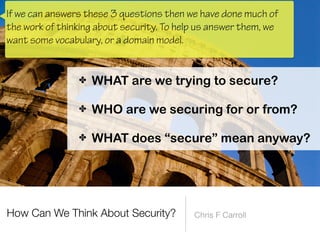
✤ WHAT are we trying to secure?


✤ WHO are we securing for or from?


✤ WHAT does “secure” mean anyway?
If we can answers these 3 questions then we have done much of
the work of thinking about security. To help us answer them, we
want some vocabulary, or a domain model.
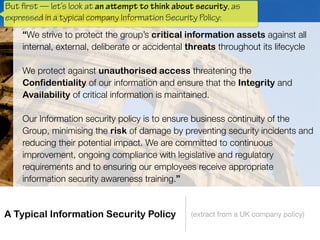
A Typical Information Security Policy (extract from a UK company policy)
“We strive to protect the group’s critical information assets against all
internal, external, deliberate or accidental threats throughout its lifecycle


We protect against unauthorised access threatening the
Confidentiality of our information and ensure that the Integrity and
Availability of critical information is maintained.


Our Information security policy is to ensure business continuity of the
Group, minimising the risk of damage by preventing security incidents and
reducing their potential impact. We are committed to continuous
improvement, ongoing compliance with legislative and regulatory
requirements and to ensuring our employees receive appropriate
information security awareness training.”
But
fi
ned in
ISO27000, the basis for many company’s
Security Management. For software
development to match the security policy
it might help to have—at least—a
common vocabulary?!
Chris F Carroll
(you can get the same
vocabulary from wikipedia
or a security or software
architecture textbook).
Chris F Carroll
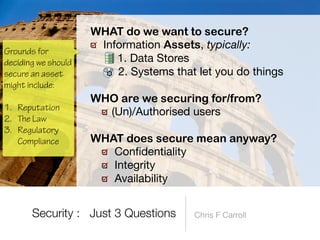
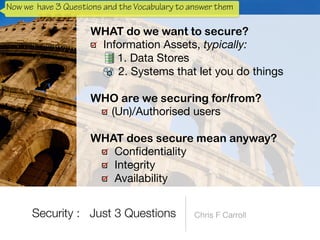
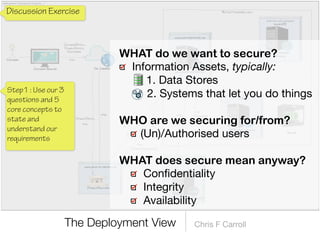
WHAT do we want to secure?


Information Assets, typically:

1. Data Stores

2. Systems that let you do things

WHO are we securing for/from?


(Un)/Authorised users

WHAT does secure mean anyway?


Con
fi
dentiality

Integrity

Availability
Security : Just 3 Questions
Grounds for
deciding we should
secure an asset
might include:
Information Assets, typically:

1. Data Stores

2. Systems that let you do things

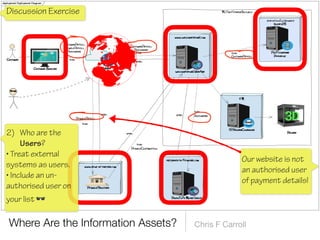
WHO are we securing for/from?


(Un)/Authorised users

WHAT does secure mean anyway?


Con
fi
dentiality

Integrity

Availability
Security : Just 3 Questions
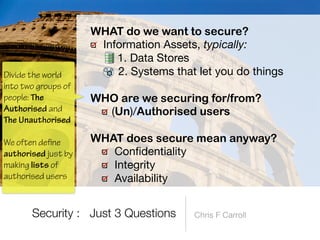
Divide the world
into two groups of
people: The
Authorised and
Information Assets, typically:

1. Data Stores

2. Systems that let you do things

WHO are we securing for/from?


(Un)/Authorised users

WHAT does secure mean anyway?


Confidentiality


Integrity


Availability
Security : Just 3 Questions
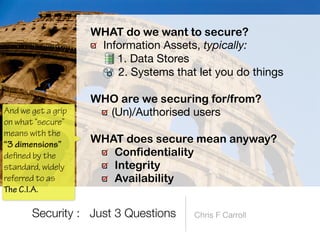
And we get a grip
on what “secure”
means with the
“3 dimensions”
de
Information Assets, typically:

1. Data Stores

2. Systems that let you do things

WHO are we securing for/from?


(Un)/Authorised users

WHAT does secure mean anyway?


Con
fi
dentiality

Integrity

Availability
Security : Just 3 Questions
Now we have 3 Questions and the Vocabulary to answer them
Architecture for Information Security Chris F Carroll
Questions So Far?
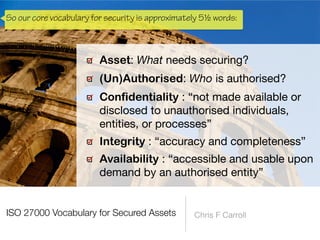
ISO 27000 Vocabulary for Secured Assets Chris F Carroll
Access Control


User, Groups, Roles


Authentication & Authorisation,
Principals, Claims


IAM, OAuth2, JWT


Uptime, Reliability, Backups
Discussion: How do our 3 questions and 5 core concepts relate to
these other things you might hear about when discussing security?
Chris F Carroll
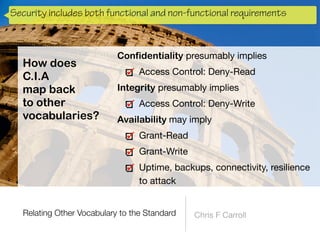
Access Control: “to ensure that access to
assets is authorised & restricted based on
business and security requirements”
ISO 27000 Vocabulary for Secured Assets
Controlling Read-Access sounds like Con
Grant-Read

Grant-Write

Uptime, backups, connectivity, resilience
to attack
How does
C.I.A


map back


to other
vocabularies?
Security includes both functional and non-functional requirements
Security : Just 3 Questions Chris F Carroll
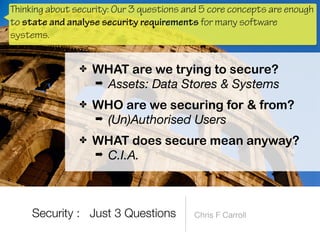
✤ WHAT are we trying to secure?


➡ Assets: Data Stores & Systems
✤ WHO are we securing for & from?


➡ (Un)Authorised Users
✤ WHAT does secure mean anyway?


➡ C.I.A.
Thinking about security: Our 3 questions and 5 core concepts are enough
to state and analyse security requirements for many software
systems.
Architecture for Information Security Chris F Carroll
Questions So Far?
2 Questions about Secured Assets Chris F Carroll
About these Assets we are securing…

✤ Where are they?


✤ What paths access them?
Thinking about security: When we get to Technical Design, two more
questions about assets may simplify our design enormously
Architecture for Information Security Chris F Carroll
Exercise: www.my
fi
rst startup.com
Discussion Exercise: Let’s do a security design & review for a small startup
Architecture For Information Security Chris F Carroll
www.wesculptitforu.com
Send us a Photo and we’ll


send you a sculpture!


Only £0.99 per cm³ + p&p!
Discussion Exercise
Architecture For Information Security Chris F Carroll
www.wesculptitforu.com
Send us a Photo and we’ll


send you a sculpture!


Only £0.99 per cm³ + p&p!
Discussion Exercise
Let’s do a security design for this
startup!
Information Assets, typically:

1. Data Stores

2. Systems that let you do things

WHO are we securing for/from?


(Un)/Authorised users

WHAT does secure mean anyway?


Con
fi
dentiality

Integrity

Availability
Discussion Exercise
Step1 : Use our 3
questions and 5
core concepts to
state and
understand our
requirements
Where Are the Information Assets? Chris F Carroll
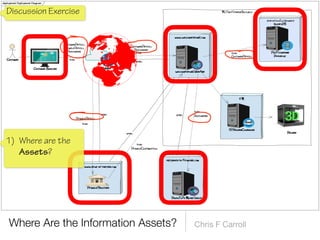
Discussion Exercise
1) Where are the
Assets?
Where Are the Information Assets? Chris F Carroll
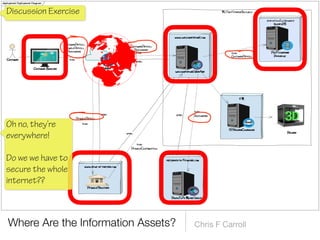
Discussion Exercise
Oh no, they’re
everywhere!
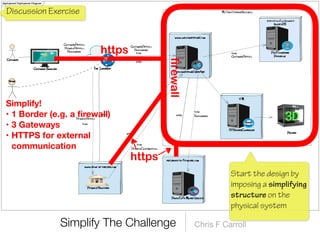
fi
rewall)
• 3 Gateways
• HTTPS for external
communication
Discussion Exercise
https
https
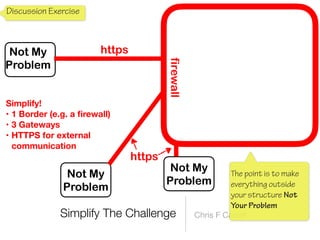
firewall Start the design by
imposing a simplifying
structure on the
physical system
Simplify The Challenge Chris F Carroll
Not My


Problem
Not My


Problem
Not My


Problem
Discussion Exercise
The point is to make
everything outside
your structure Not
Your Problem
https
https
firewall
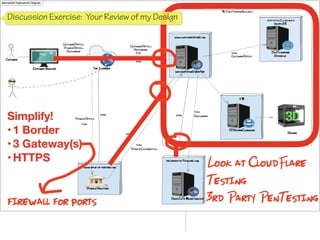
Simplify!
• 1 Border (e.g. a
fi
rewall)
• 3 Gateways
• HTTPS for external
communication
Simplify The Challenge Chris F Carroll
Not My


Problem
Not My


Problem
Not My


Problem
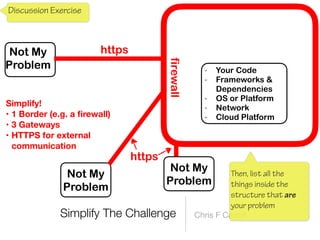
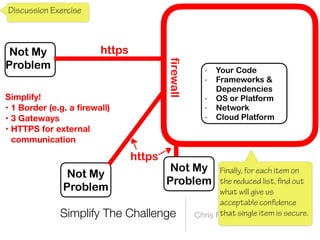
- Your Code


- Frameworks &
Dependencies


- OS or Platform


- Network


- Cloud Platform
Discussion Exercise
https
https
firewall
Simplify!
• 1 Border (e.g. a
fi
rewall)
• 3 Gateways
• HTTPS for external
communication
Then, list all the
things inside the
structure that are
your problem
Simplify The Challenge Chris F Carroll
Not My


Problem
Not My


Problem
Not My


Problem
- Your Code


- Frameworks &
Dependencies


- OS or Platform


- Network


- Cloud Platform
Discussion Exercise
Simplify!
• 1 Border (e.g. a
fi
rewall)
• 3 Gateways
• HTTPS for external
communication
https
https
firewall Finally, for each item on
the reduced list,
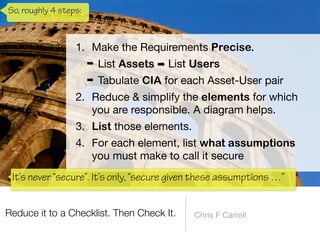
1) A list of Assets & Users; then a table of CIA requirements
for each Asset-User pair (or e.g. asset-role pair)


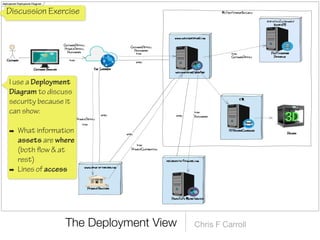
2) A Deployment View that


❖ Shows where the Assets are


❖ “proves” (well, claims) they are only reachable through the
System in an authorised way.


3) A list of assumptions which must hold, and/or
procedures which must be followed, for (2) to be true.
Architecture for Information Security Chris F Carroll
✤ You may be a little disappointed that the last item is not,
“Fo
ll
ow
th
is procedure and Lo! It sha
ll
be secure.”


✤ The last item can only be, “These are the assumptions
& procedures which give us acceptable confidence it
is secure.”
Discussion Exercise: Your Review of my Design
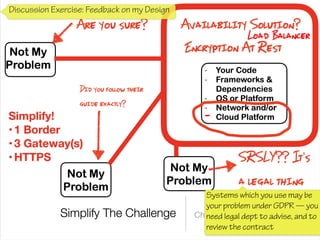
Discussion Exercise: Feedback on my Design
-
Load Balancer
Systems which you use may be
your problem under GDPR — you
need legal dept to advise, and to
review the contract
Actions after a Security Design Review Chris F Carroll
My response to design review might typically be:


1) Updating or correcting one or more of the lists I made


2) Adding or clarifying assumptions


3) Agreeing with IT Operations and/or CIO if any changes to
security procedures may be needed


4) Agreeing with IT Operations any other changes needed
NB even in a micro-startup where I was a 1-person IT department,
I would get someone to review security design
Architecture for Information Security Chris F Carroll
Questions So Far?
Chris F Carroll
✤ How do we Know it’s secure?


✤ WHY do we care about security?
A Fourth Question 😲
fi
nd an insecurity?
Security: the further you go, the more complicated it gets …
Thinking Even More About Security
Security: Not a Hobby, a Way of Life Chris F Carroll
✤ So we need audit, monitoring, reviews …

✤ Managing security becomes an entire,
never ending, management system & set
of processes. Hence “ISMS”

✤ We must understand risk
Security: the further you go, the more complicated it gets …
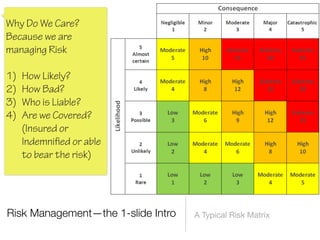
Risk Management—the 1-slide Intro A Typical Risk Matrix
Why Do We Care?
Because we are
managing Risk
fi
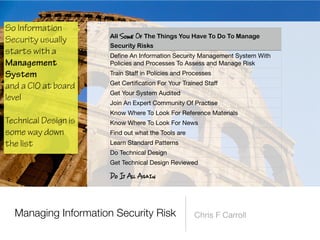
ne An Information Security Management System With
Policies and Processes To Assess and Manage Risk
Train Sta
ff
in Policies and Processes
Get Certi
fi
cation For Your Trained Sta
f
Get Your System Audited
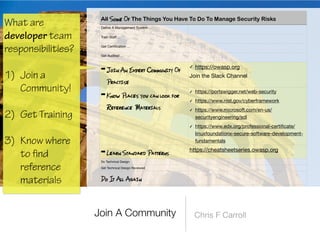
Join An Expert Community Of Practise
Know Where To Look For Reference Materials
Know Where To Look For News
Find out what the Tools are
Learn Standard Patterns
Do Technical Design
Get Technical Design Reviewed
Do It All Again
So Information
Security usually
starts with a
Management
System


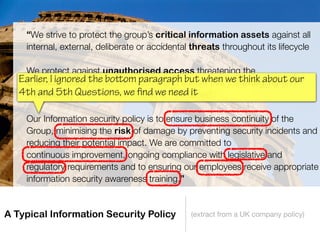
We protect against unauthorised access threatening the
Confidentiality of our information and ensure that the Integrity and
Availability of critical information is maintained.


Our Information security policy is to ensure business continuity of the
Group, minimising the risk of damage by preventing security incidents and
reducing their potential impact. We are committed to


continuous improvement, ongoing compliance with legislative and
regulatory requirements and to ensuring our employees receive appropriate
information security awareness training.”
Earlier, I ignored the bo
fi
ne A Management System …
Train Sta
ff
…
Get Certi
fi
cation …
Get Audited …
➡ Join An Expert Community Of
Practise
✓ https://owasp.org

Join the Slack Channel
➡ Know Places you can look for
Reference Materials
✓ https://portswigger.net/web-security

✓ https://www.nist.gov/cyberframework

✓ https://www.microsoft.com/en-us/
securityengineering/sdl

✓ https://www.edx.org/professional-certi
fi
cate/
linuxfoundationx-secure-software-development-
fundamentals
➡ Learn Standard Patterns
https://cheatsheetseries.owasp.org
Do Technical Design
Get Technical Design Reviewed
Do It All Again
What are
developer team
responsibilities?
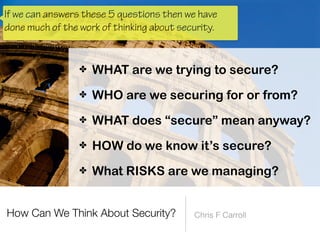
✤ WHO are we securing for or from?


✤ WHAT does “secure” mean anyway?


✤ HOW do we know it’s secure?


✤ What RISKS are we managing?
If we can answers these 5 questions then we have
done much of the work of thinking about security.
Chris F Carroll
Software Technical Design
for Security
Software Architecture for Security

Software Technical Design for Information Security: A short intro for Tech Leads & Architects

  • 1.
    Chris F Carroll SoftwareTechnical Design for Security Software Architecture for Security
  • 2.
    Requirements Threats vs. All requirements haveedge cases, but with security they expand into a whole second way of seeing the issue. Threats get all the news! But our understanding of threats remains piecemeal if we don’t understand the core requirements they are threatening. So we start here.
  • 3.
    Software Architecture forSecurity Chris F Carroll How can we think about security? Software Architecture claims to help us THINK about software systems. To get security right, we want a framework for thinking about it: What are the questions we should ask, and what concepts will help us to answer them?
  • 4.
    Software Architecture forSecurity Chris F Carroll ① Ask the Right Questions ② Have a “Domain Model”
  • 5.
    How Can WeThink About Security? Chris F Carroll ✤ WHAT are we trying to secure? 
 ✤ WHO are we securing for or from? 
 ✤ WHAT does “secure” mean anyway? If we can answers these 3 questions then we have done much of the work of thinking about security. To help us answer them, we want some vocabulary, or a domain model.
  • 6.
    A Typical InformationSecurity Policy (extract from a UK company policy) “We strive to protect the group’s critical information assets against all internal, external, deliberate or accidental threats throughout its lifecycle 
 We protect against unauthorised access threatening the Confidentiality of our information and ensure that the Integrity and Availability of critical information is maintained. 
 Our Information security policy is to ensure business continuity of the Group, minimising the risk of damage by preventing security incidents and reducing their potential impact. We are committed to continuous improvement, ongoing compliance with legislative and regulatory requirements and to ensuring our employees receive appropriate information security awareness training.” But
  • 7.
    fi ned in ISO27000, thebasis for many company’s Security Management. For software development to match the security policy it might help to have—at least—a common vocabulary?! Chris F Carroll (you can get the same vocabulary from wikipedia or a security or software architecture textbook).
  • 8.
    Chris F Carroll WHATdo we want to secure? Information Assets, typically: 1. Data Stores 2. Systems that let you do things
 WHO are we securing for/from? (Un)/Authorised users
 WHAT does secure mean anyway? Con fi dentiality Integrity Availability Security : Just 3 Questions Grounds for deciding we should secure an asset might include:
  • 9.
    Information Assets, typically: 1.Data Stores 2. Systems that let you do things
 WHO are we securing for/from? (Un)/Authorised users
 WHAT does secure mean anyway? Con fi dentiality Integrity Availability Security : Just 3 Questions Divide the world into two groups of people: The Authorised and
  • 10.
    Information Assets, typically: 1.Data Stores 2. Systems that let you do things
 WHO are we securing for/from? (Un)/Authorised users
 WHAT does secure mean anyway? Confidentiality Integrity Availability Security : Just 3 Questions And we get a grip on what “secure” means with the “3 dimensions” de
  • 12.
    Information Assets, typically: 1.Data Stores 2. Systems that let you do things
 WHO are we securing for/from? (Un)/Authorised users
 WHAT does secure mean anyway? Con fi dentiality Integrity Availability Security : Just 3 Questions Now we have 3 Questions and the Vocabulary to answer them
  • 13.
    Architecture for InformationSecurity Chris F Carroll Questions So Far?
  • 14.
    ISO 27000 Vocabularyfor Secured Assets Chris F Carroll Access Control User, Groups, Roles Authentication & Authorisation, Principals, Claims IAM, OAuth2, JWT Uptime, Reliability, Backups Discussion: How do our 3 questions and 5 core concepts relate to these other things you might hear about when discussing security?
  • 15.
    Chris F Carroll AccessControl: “to ensure that access to assets is authorised & restricted based on business and security requirements” ISO 27000 Vocabulary for Secured Assets Controlling Read-Access sounds like Con
  • 20.
    Grant-Read Grant-Write Uptime, backups, connectivity,resilience to attack How does C.I.A map back to other vocabularies? Security includes both functional and non-functional requirements
  • 21.
    Security : Just3 Questions Chris F Carroll ✤ WHAT are we trying to secure? ➡ Assets: Data Stores & Systems ✤ WHO are we securing for & from? ➡ (Un)Authorised Users ✤ WHAT does secure mean anyway? ➡ C.I.A. Thinking about security: Our 3 questions and 5 core concepts are enough to state and analyse security requirements for many software systems.
  • 22.
    Architecture for InformationSecurity Chris F Carroll Questions So Far?
  • 23.
    2 Questions aboutSecured Assets Chris F Carroll About these Assets we are securing… ✤ Where are they? ✤ What paths access them? Thinking about security: When we get to Technical Design, two more questions about assets may simplify our design enormously
  • 24.
    Architecture for InformationSecurity Chris F Carroll Exercise: www.my fi rst startup.com Discussion Exercise: Let’s do a security design & review for a small startup
  • 25.
    Architecture For InformationSecurity Chris F Carroll www.wesculptitforu.com Send us a Photo and we’ll 
 send you a sculpture! Only £0.99 per cm³ + p&p! Discussion Exercise
  • 26.
    Architecture For InformationSecurity Chris F Carroll www.wesculptitforu.com Send us a Photo and we’ll 
 send you a sculpture! Only £0.99 per cm³ + p&p! Discussion Exercise Let’s do a security design for this startup!
  • 28.
    Information Assets, typically: 1.Data Stores 2. Systems that let you do things
 WHO are we securing for/from? (Un)/Authorised users
 WHAT does secure mean anyway? Con fi dentiality Integrity Availability Discussion Exercise Step1 : Use our 3 questions and 5 core concepts to state and understand our requirements
  • 29.
    Where Are theInformation Assets? Chris F Carroll Discussion Exercise 1) Where are the Assets?
  • 30.
    Where Are theInformation Assets? Chris F Carroll Discussion Exercise Oh no, they’re everywhere!
  • 32.
    fi rewall) • 3 Gateways •HTTPS for external communication Discussion Exercise https https firewall Start the design by imposing a simplifying structure on the physical system
  • 33.
    Simplify The ChallengeChris F Carroll Not My Problem Not My Problem Not My Problem Discussion Exercise The point is to make everything outside your structure Not Your Problem https https firewall Simplify! • 1 Border (e.g. a fi rewall) • 3 Gateways • HTTPS for external communication
  • 34.
    Simplify The ChallengeChris F Carroll Not My Problem Not My Problem Not My Problem - Your Code - Frameworks & Dependencies - OS or Platform - Network - Cloud Platform Discussion Exercise https https firewall Simplify! • 1 Border (e.g. a fi rewall) • 3 Gateways • HTTPS for external communication Then, list all the things inside the structure that are your problem
  • 35.
    Simplify The ChallengeChris F Carroll Not My Problem Not My Problem Not My Problem - Your Code - Frameworks & Dependencies - OS or Platform - Network - Cloud Platform Discussion Exercise Simplify! • 1 Border (e.g. a fi rewall) • 3 Gateways • HTTPS for external communication https https firewall Finally, for each item on the reduced list,
  • 37.
    1) A listof Assets & Users; then a table of CIA requirements for each Asset-User pair (or e.g. asset-role pair) 2) A Deployment View that ❖ Shows where the Assets are ❖ “proves” (well, claims) they are only reachable through the System in an authorised way. 3) A list of assumptions which must hold, and/or procedures which must be followed, for (2) to be true.
  • 38.
    Architecture for InformationSecurity Chris F Carroll ✤ You may be a little disappointed that the last item is not, “Fo ll ow th is procedure and Lo! It sha ll be secure.” 
 ✤ The last item can only be, “These are the assumptions & procedures which give us acceptable confidence it is secure.”
  • 39.
    Discussion Exercise: YourReview of my Design
  • 40.
    Discussion Exercise: Feedbackon my Design - Load Balancer Systems which you use may be your problem under GDPR — you need legal dept to advise, and to review the contract
  • 41.
    Actions after aSecurity Design Review Chris F Carroll My response to design review might typically be: 1) Updating or correcting one or more of the lists I made 2) Adding or clarifying assumptions 3) Agreeing with IT Operations and/or CIO if any changes to security procedures may be needed 4) Agreeing with IT Operations any other changes needed NB even in a micro-startup where I was a 1-person IT department, I would get someone to review security design
  • 42.
    Architecture for InformationSecurity Chris F Carroll Questions So Far?
  • 43.
    Chris F Carroll ✤How do we Know it’s secure? ✤ WHY do we care about security? A Fourth Question 😲
  • 44.
    fi nd an insecurity? Security:the further you go, the more complicated it gets … Thinking Even More About Security
  • 45.
    Security: Not aHobby, a Way of Life Chris F Carroll ✤ So we need audit, monitoring, reviews …
 ✤ Managing security becomes an entire, never ending, management system & set of processes. Hence “ISMS”
 ✤ We must understand risk Security: the further you go, the more complicated it gets …
  • 46.
    Risk Management—the 1-slideIntro A Typical Risk Matrix Why Do We Care? Because we are managing Risk
  • 47.
    fi ne An InformationSecurity Management System With Policies and Processes To Assess and Manage Risk Train Sta ff in Policies and Processes Get Certi fi cation For Your Trained Sta f Get Your System Audited Join An Expert Community Of Practise Know Where To Look For Reference Materials Know Where To Look For News Find out what the Tools are Learn Standard Patterns Do Technical Design Get Technical Design Reviewed Do It All Again So Information Security usually starts with a Management System
  • 48.
    
 We protect againstunauthorised access threatening the Confidentiality of our information and ensure that the Integrity and Availability of critical information is maintained. 
 Our Information security policy is to ensure business continuity of the Group, minimising the risk of damage by preventing security incidents and reducing their potential impact. We are committed to 
 continuous improvement, ongoing compliance with legislative and regulatory requirements and to ensuring our employees receive appropriate information security awareness training.” Earlier, I ignored the bo
  • 49.
    fi ne A ManagementSystem … Train Sta ff … Get Certi fi cation … Get Audited … ➡ Join An Expert Community Of Practise ✓ https://owasp.org Join the Slack Channel ➡ Know Places you can look for Reference Materials ✓ https://portswigger.net/web-security ✓ https://www.nist.gov/cyberframework ✓ https://www.microsoft.com/en-us/ securityengineering/sdl ✓ https://www.edx.org/professional-certi fi cate/ linuxfoundationx-secure-software-development- fundamentals ➡ Learn Standard Patterns https://cheatsheetseries.owasp.org Do Technical Design Get Technical Design Reviewed Do It All Again What are developer team responsibilities?
  • 50.
    ✤ WHO arewe securing for or from? ✤ WHAT does “secure” mean anyway? ✤ HOW do we know it’s secure? ✤ What RISKS are we managing? If we can answers these 5 questions then we have done much of the work of thinking about security.
  • 51.
    Chris F Carroll SoftwareTechnical Design for Security Software Architecture for Security