Planning your campaign
The OASIS model
Shayoni Lynn MCIPR CMPRCA
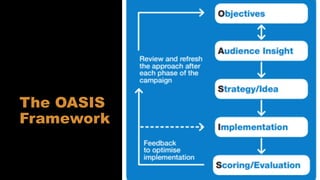
The OASIS
Framework
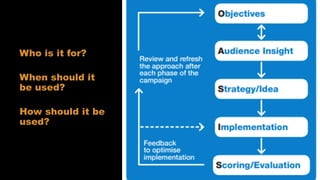
Who is it for?
When should it
be used?
How should it be
used?
What are we trying to achieve?
“The implementation of effective campaigns is at the heart of
our work. For rigorous and systematic campaign
development, GCS staff follow the OASIS campaigns
framework, and make selective use of other GCS campaign
planning tools where required.”
- Alex Aiken
Executive Director of Government Communications
What are we trying to achieve?
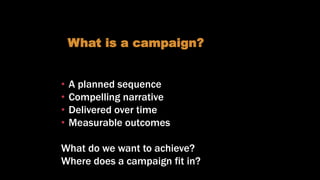
• A planned sequence
• Compelling narrative
• Delivered over time
• Measurable outcomes
What do we want to achieve?
Where does a campaign fit in?
What is a campaign?
What are we trying to achieve?
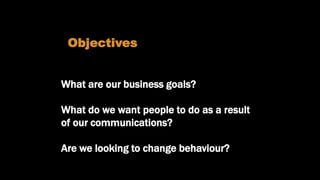
What are our business goals?
What do we want people to do as a result
of our communications?
Are we looking to change behaviour?
Objectives
What are we trying to achieve?
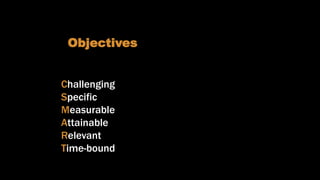
Challenging
Specific
Measurable
Attainable
Relevant
Time-bound
Objectives
What are we trying to achieve?
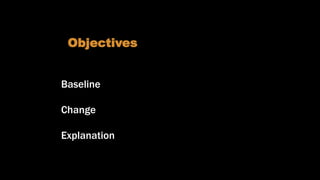
Baseline
Change
Explanation
Objectives
Understanding our audiences
Audience insight
It is important that we use insight to understand:
• who they are
• how they will reach a desired outcome
• what barriers exist that might stop your audiences from reaching
desired outcomes
Understanding our audiences
Why adopt a strategic approach to
understanding your audiences?
Who are they?
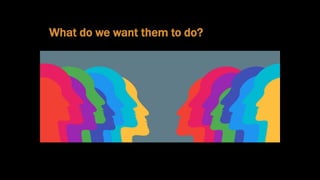
What do we want them to do?
COM-B
Capability
COM-B
Opportunity
COM-B
Motivation
Identifying interventions
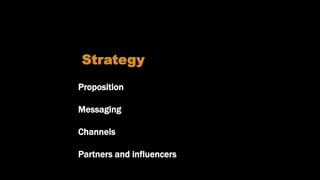
Strategy
Proposition
Messaging
Channels
Partners and influencers
Identifying interventions
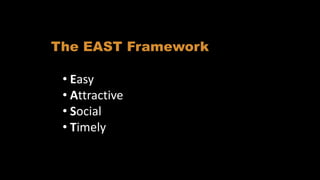
The EAST Framework
• Easy
• Attractive
• Social
• Timely
Identifying interventions
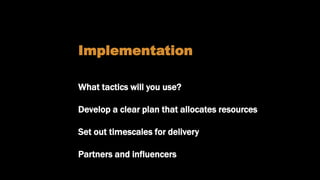
Implementation
What tactics will you use?
Develop a clear plan that allocates resources
Set out timescales for delivery
Partners and influencers
Identifying interventions
Scoring
Evaluation Framework 2.0
Focus on outcomes
Were the objectives met? Why or why not?
Identifying interventions
Scoring - metrics
Metrics are divided according to the four categories
identified by AMEC:
inputs
outputs
outtakes
outcomes
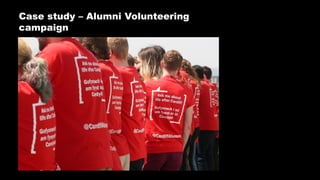
Case study – Alumni Volunteering
campaign
Objectives
Business objective
Develop and deliver an Alumni Volunteering
Programme to support UK and international
student recruitment, enhance student
employability, and support student experience
initiatives
Objectives
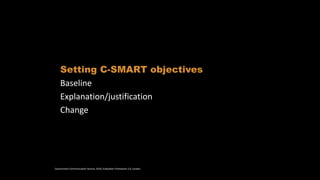
Setting C-SMART objectives
Baseline
Explanation/justification
Change
Government Communication Service, 2018, Evaluation Framework 2.0, London.
Objectives
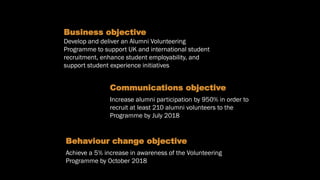
Business objective
Develop and deliver an Alumni Volunteering
Programme to support UK and international student
recruitment, enhance student employability, and
support student experience initiatives
Communications objective
Increase alumni participation by 950% in order to
recruit at least 210 alumni volunteers to the
Programme by July 2018
Behaviour change objective
Achieve a 5% increase in awareness of the Volunteering
Programme by October 2018
Audience insight
173,000 alumni 180 countries
Audience insight
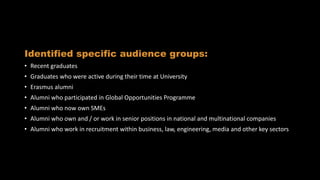
Identified specific audience groups:
• Recent graduates
• Graduates who were active during their time at University
• Erasmus alumni
• Alumni who participated in Global Opportunities Programme
• Alumni who now own SMEs
• Alumni who own and / or work in senior positions in national and multinational companies
• Alumni who work in recruitment within business, law, engineering, media and other key sectors
Audience insight – COM-B
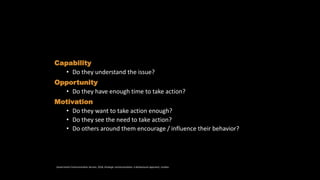
Capability
• Do they understand the issue?
Opportunity
• Do they have enough time to take action?
Motivation
• Do they want to take action enough?
• Do they see the need to take action?
• Do others around them encourage / influence their behavior?
Government Communication Service, 2018, Strategic communications: a behavioural approach, London.
Strategy
• Clearly defined target audience
• Proposition
• Messages
• Channel strategy
The EAST Framework
Government Communication Service, 2018, Strategic communications: a behavioural approach, London.
Easy
Attractive
Social
Timely
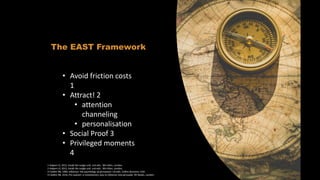
The EAST Framework
1 Halpern D, 2015, Inside the nudge unit, snd edn, WH Allen, London.
2 Halpern D, 2015, Inside the nudge unit, snd edn, WH Allen, London.
3 Cialdini RB, 1984, Influence: the psychology of persuasion, trd edn, Collins Business, USA.
4 Cialdini RB, 2016, Pre-suasion: a revolutionary way to influence and persuade, RH Books, London.
30
• Avoid friction costs
1
• Attract! 2
• attention
channeling
• personalisation
• Social Proof 3
• Privileged moments
4
Implementation
Testing – A/B + randomised control groups
• 6 months’ testing – content, creatives, calls to action
• Landing pages
• Specificity
• Sender credibility
Launch
• Launched on 31 January – generated over 100 applications
• Integrated campaign
• Suite of creatives: videos, photos, infographics
• Channel mix: emails, website, blogs, organic and paid social media, magazine
Title
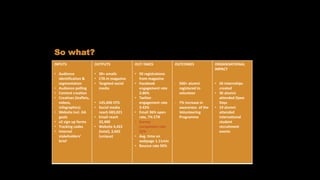
So what?
Scoring
INPUTS
• Audience
identification &
segmentation
• Audience polling
• Content creation
• Creatives (leaflets,
videos,
infographics)
• Website incl. GA
goals
• x2 sign up forms
• Tracking codes
• Internal
stakeholders’
brief
OUTPUTS
• 30+ emails
• CTA in magazine
• Targeted social
media
• 145,000 OTS
• Social media
reach 683,021
• Email reach
32,400
• Website 4,422
(total), 3,665
(unique)
OUT-TAKES
• 50 registrations
from magazine
• Facebook
engagement rate
3.86%
• Twitter
engagement rate
3.43%
• Email 36% open
rate, 7% CTR
• Survey
completion rate
22%
• Avg. time on
webpage 1.11min
• Bounce rate 50%
OUTCOMES
- 500+ alumni
registered to
volunteer
- 7% increase in
awareness of the
Volunteering
Programme
ORGANISATIONAL
IMPACT
• 56 internships
created
• 36 alumni
attended Open
Days
• 19 alumni
attended
international
student
recruitment
events
Any questions?
Want to learn more?
Shayoni Lynn MCIPR CMPRCA
@shayonislynn
shayoni@lynnpr.co.uk
bit.ly/LynnPR1
15% off with discount code Nudge15
Any questions?
Exercise – mapping audiences
In pairs, identify three particular issues facing your
organisation and the stakeholders who are most likely to:
• Be impacted
• Impact your organisation as a result of the issue
Ask yourself:
• Why are these stakeholders important? Be the audience.
• What do they need to know?
• What do they want to know?
Creative campaign
planning
Sponsored by
Wales Networking Group
25 September 2019
Cardiff
#CCwales
Visit the CharityComms website to view
slides from past events, see what events
we have coming up and to check out
what else we do:
www.charitycomms.org.uk

Planning your campaign: the OASIS model​

  • 1.
    Planning your campaign TheOASIS model Shayoni Lynn MCIPR CMPRCA
  • 2.
  • 3.
    Who is itfor? When should it be used? How should it be used?
  • 4.
    What are wetrying to achieve? “The implementation of effective campaigns is at the heart of our work. For rigorous and systematic campaign development, GCS staff follow the OASIS campaigns framework, and make selective use of other GCS campaign planning tools where required.” - Alex Aiken Executive Director of Government Communications
  • 5.
    What are wetrying to achieve? • A planned sequence • Compelling narrative • Delivered over time • Measurable outcomes What do we want to achieve? Where does a campaign fit in? What is a campaign?
  • 6.
    What are wetrying to achieve? What are our business goals? What do we want people to do as a result of our communications? Are we looking to change behaviour? Objectives
  • 7.
    What are wetrying to achieve? Challenging Specific Measurable Attainable Relevant Time-bound Objectives
  • 8.
    What are wetrying to achieve? Baseline Change Explanation Objectives
  • 9.
    Understanding our audiences Audienceinsight It is important that we use insight to understand: • who they are • how they will reach a desired outcome • what barriers exist that might stop your audiences from reaching desired outcomes
  • 10.
    Understanding our audiences Whyadopt a strategic approach to understanding your audiences?
  • 11.
  • 12.
    What do wewant them to do?
  • 13.
  • 14.
  • 15.
  • 16.
  • 17.
    Identifying interventions The EASTFramework • Easy • Attractive • Social • Timely
  • 18.
    Identifying interventions Implementation What tacticswill you use? Develop a clear plan that allocates resources Set out timescales for delivery Partners and influencers
  • 19.
    Identifying interventions Scoring Evaluation Framework2.0 Focus on outcomes Were the objectives met? Why or why not?
  • 20.
    Identifying interventions Scoring -metrics Metrics are divided according to the four categories identified by AMEC: inputs outputs outtakes outcomes
  • 21.
    Case study –Alumni Volunteering campaign
  • 22.
    Objectives Business objective Develop anddeliver an Alumni Volunteering Programme to support UK and international student recruitment, enhance student employability, and support student experience initiatives
  • 23.
    Objectives Setting C-SMART objectives Baseline Explanation/justification Change GovernmentCommunication Service, 2018, Evaluation Framework 2.0, London.
  • 24.
    Objectives Business objective Develop anddeliver an Alumni Volunteering Programme to support UK and international student recruitment, enhance student employability, and support student experience initiatives Communications objective Increase alumni participation by 950% in order to recruit at least 210 alumni volunteers to the Programme by July 2018 Behaviour change objective Achieve a 5% increase in awareness of the Volunteering Programme by October 2018
  • 25.
  • 26.
    Audience insight Identified specificaudience groups: • Recent graduates • Graduates who were active during their time at University • Erasmus alumni • Alumni who participated in Global Opportunities Programme • Alumni who now own SMEs • Alumni who own and / or work in senior positions in national and multinational companies • Alumni who work in recruitment within business, law, engineering, media and other key sectors
  • 27.
    Audience insight –COM-B Capability • Do they understand the issue? Opportunity • Do they have enough time to take action? Motivation • Do they want to take action enough? • Do they see the need to take action? • Do others around them encourage / influence their behavior? Government Communication Service, 2018, Strategic communications: a behavioural approach, London.
  • 28.
    Strategy • Clearly definedtarget audience • Proposition • Messages • Channel strategy
  • 29.
    The EAST Framework GovernmentCommunication Service, 2018, Strategic communications: a behavioural approach, London. Easy Attractive Social Timely
  • 30.
    The EAST Framework 1Halpern D, 2015, Inside the nudge unit, snd edn, WH Allen, London. 2 Halpern D, 2015, Inside the nudge unit, snd edn, WH Allen, London. 3 Cialdini RB, 1984, Influence: the psychology of persuasion, trd edn, Collins Business, USA. 4 Cialdini RB, 2016, Pre-suasion: a revolutionary way to influence and persuade, RH Books, London. 30 • Avoid friction costs 1 • Attract! 2 • attention channeling • personalisation • Social Proof 3 • Privileged moments 4
  • 31.
    Implementation Testing – A/B+ randomised control groups • 6 months’ testing – content, creatives, calls to action • Landing pages • Specificity • Sender credibility Launch • Launched on 31 January – generated over 100 applications • Integrated campaign • Suite of creatives: videos, photos, infographics • Channel mix: emails, website, blogs, organic and paid social media, magazine
  • 32.
  • 33.
    So what? Scoring INPUTS • Audience identification& segmentation • Audience polling • Content creation • Creatives (leaflets, videos, infographics) • Website incl. GA goals • x2 sign up forms • Tracking codes • Internal stakeholders’ brief OUTPUTS • 30+ emails • CTA in magazine • Targeted social media • 145,000 OTS • Social media reach 683,021 • Email reach 32,400 • Website 4,422 (total), 3,665 (unique) OUT-TAKES • 50 registrations from magazine • Facebook engagement rate 3.86% • Twitter engagement rate 3.43% • Email 36% open rate, 7% CTR • Survey completion rate 22% • Avg. time on webpage 1.11min • Bounce rate 50% OUTCOMES - 500+ alumni registered to volunteer - 7% increase in awareness of the Volunteering Programme ORGANISATIONAL IMPACT • 56 internships created • 36 alumni attended Open Days • 19 alumni attended international student recruitment events
  • 34.
    Any questions? Want tolearn more? Shayoni Lynn MCIPR CMPRCA @shayonislynn shayoni@lynnpr.co.uk bit.ly/LynnPR1 15% off with discount code Nudge15
  • 35.
    Any questions? Exercise –mapping audiences In pairs, identify three particular issues facing your organisation and the stakeholders who are most likely to: • Be impacted • Impact your organisation as a result of the issue Ask yourself: • Why are these stakeholders important? Be the audience. • What do they need to know? • What do they want to know?
  • 36.
    Creative campaign planning Sponsored by WalesNetworking Group 25 September 2019 Cardiff #CCwales
  • 37.
    Visit the CharityCommswebsite to view slides from past events, see what events we have coming up and to check out what else we do: www.charitycomms.org.uk