Neonatal Mechanical Ventilation
Introduction:
• Introduction in 1960’s one of major inventions
in Neonatology.
• Along with Antenatal steroids and Surfactant
replacement ,ventilation played imp role in
increasing neonatal survival.
• Although life saving it may cause BPD.
Benefits of MV:
• Improve Gas exchange, by lung recruitment to
improve V/Q matching.
• Decrease WOB
• CO2 removal in babies with respiratory
depression and apnea.
Indications for Ventilation:
• Respiratory Acidosis,pH<7.2 and PaCO2> 60
mm Hg.
• Hypoxia PaO2<50 mmHg.
• Recurrent Apnea.
• Downes score> 7.
Common Conditions:
• RDS
• Apnea of Prematurity.
• Septicemia-Pneumonia
• Post operative recovery.
• PPHN
• MAS
• Congenital pulmonary or cardiac
anomalies(CDH).
Types of :
• CMV: Exchange of gas in bulk similar to tidal volume
Initiation of breath-Ventilator (CMV or IMV)
Patient
Tidal volume regulation- PC
VC
Breath is terminated- Volume
Time .
Flow regulated.
• HFV: small volume of gas at extremely rapid rate(300-
1500)
290 Modes on 33 Ventilators .
One ventilator- Care fusion Avea ,offers choice of 44 different modes
Initiation of Breath:
 Synchronised Ventilation:(Patient triggered)
-SIMV
-A/C Ventilation
-Pressure support ventilation(PSV)
-NAVA
 CMV or IMV.
Increase in death rate using SIMV(RR-1.19)
No difference in air leak,IVH,BPD,extubation failure
Shorter duration of Ventilation in SIMV(Mean difference -35 hrs)
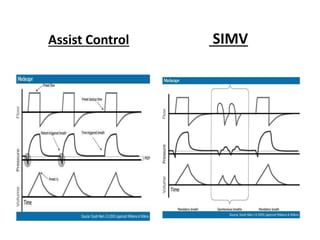
Assist Control SIMV
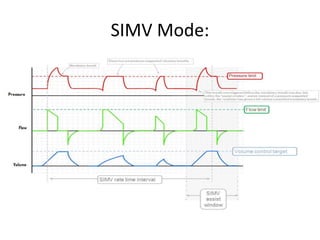
SIMV Mode:
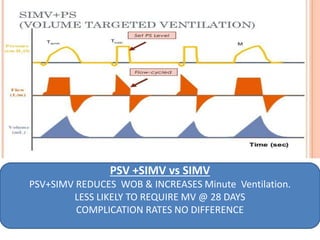
PSV +SIMV vs SIMV
PSV+SIMV REDUCES WOB & INCREASES Minute Ventilation.
LESS LIKELY TO REQUIRE MV @ 28 DAYS
COMPLICATION RATES NO DIFFERENCE
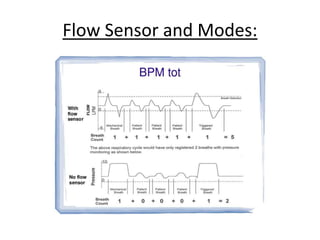
Flow Sensor and Modes:
NAVA
Observational studies have shown better synchrony, less PIP and
sedation with similar ABG
Further research needed to determine effects on outcome
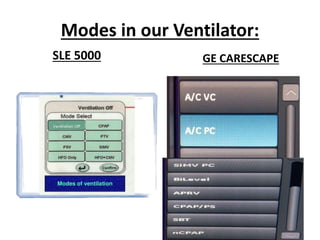
Modes in our Ventilator:
SLE 5000 GE CARESCAPE
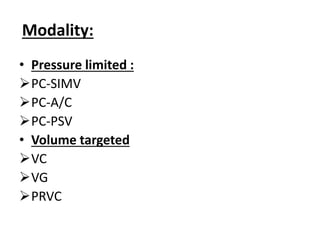
Modality:
• Pressure limited :
PC-SIMV
PC-A/C
PC-PSV
• Volume targeted
VC
VG
PRVC
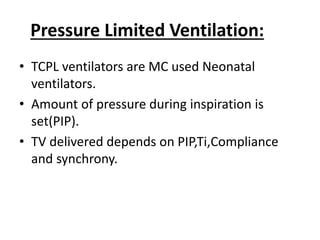
Pressure Limited Ventilation:
• TCPL ventilators are MC used Neonatal
ventilators.
• Amount of pressure during inspiration is
set(PIP).
• TV delivered depends on PIP,Ti,Compliance
and synchrony.
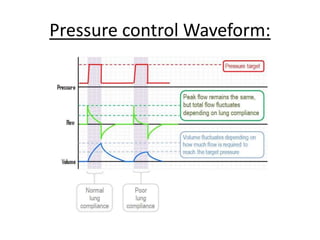
Pressure control Waveform:
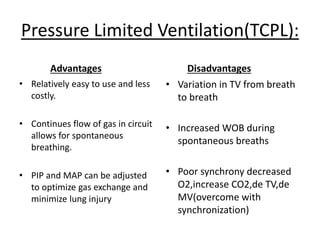
Pressure Limited Ventilation(TCPL):
Advantages
• Relatively easy to use and less
costly.
• Continues flow of gas in circuit
allows for spontaneous
breathing.
• PIP and MAP can be adjusted
to optimize gas exchange and
minimize lung injury
Disadvantages
• Variation in TV from breath
to breath
• Increased WOB during
spontaneous breaths
• Poor synchrony decreased
O2,increase CO2,de TV,de
MV(overcome with
synchronization)
Volume Targeted Ventilation:
• Provides consistent TV resulting in less lung
injury.
• In 2011,volume targeted ventilation had
replaced pressure limited ventilation in 25 of
50 neonatal tertiary units.
• Volume control & Volume Guarantee
Volume Controlled Ventilation:
• Set TV (4-6ml/kg) is delivered by variation in
PIP.
• RR and max Ti are set.
• Measure TV delivered to circuit ,No
compensation for ET tube leaks
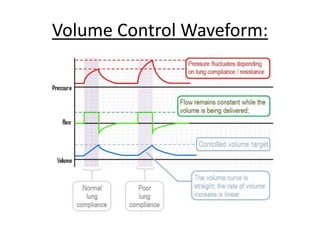
Volume Control Waveform:
Volume guarntee(VG):
• Modified pressure targeted ventilation.
• Addition of microprocessor that adjusts the
pressure to ensure Targeted Tidal Volume(TTV).
• TV,Ti,Max PIP is set
• Flow sensor senses ex TV to adjust pressure for
next few breaths.
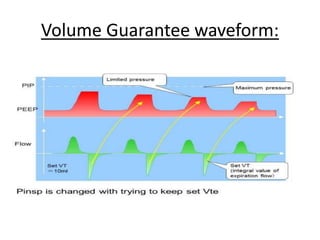
Volume Guarantee waveform:
Controlling Volume ,a better mode?
• Costly and needs more expertise.
• Lower rate of death and BPD(RR-0.73).
• Reduced rate of Air leak(RR-0.46),days of
ventilation,Hypocarbia and neurologic
injury(RR-0.48)
Volume targeted ventilation with either SIMV
or A/C using modified TCPL ventilators with TTV
of 4-6ml/kg with permissive hypercarbia should
be initial mode of ventilation
Ventilator settings and strategies:
Parameters in Conventional ventilation:
• Mode of ventilation
• PIP
• PEEP
• Flow
• Inspiratory time(Ti)
• Fio2
• Rate.
• Trigger
• Tidal Volume(TTV)
• I:E ratio
Setting PIP:
• PIP is the primary factor used to deliver tidal
volume
• PIP required mainly depends on the
compliance of lungs
• Useful clinical indicator of adequate PIP is
gentle chest rise with every vent breath.
• If compliance is normal, initiate with 12-14 If
abnormal, check chest rise on hand ventilation
Setting PIP:
Insufficient PIP
• Insufficient ventilation
• Decreased oxygenation
• Generalized atelectasis
High PIP
• Increased barotraumas (air
leaks)
• Increased BPD
• Impede venous return/
cardiac output
Setting PEEP:
• Adequate PEEP improves FRC & V/Q mismatch
• PEEP levels between 3 – 6 improve
oxygenation & well tolerated
Setting PEEP:
• Choices are between 3 - 6
• If FRC is expected to be:
normal: 3
moderately reduced: 4
severly reduced: 5 – 6
• Low PEEP-Atelectotrauma
Co2 retention due to V/Q mismatch
• High PEEP-Decrease lung compliance
Impede venous return/ shock
Pulmonary air leaks
• RR is one of the primary determinants of MV,
thus CO2 elimination
• No conclusive evidence for appropriate RR
• In SIMV mode ventilatory rate may not affect
ABG as much as anticipated
• Choices are between 20 to 60
• Considerations are:
- work of breathing
- Is there asynchrony: need for overdrive?
- pressure requirement ?
Setting FiO2:
• Choices are between 21-100%
• Target is Pa02 of 50-70 mm Hg with Spo2 of
88-95%.
• If lung compliance is good start with 21-25%
• Other lung conditions start with FiO2 50%
• Very rapid rate may cause insufficient
inspiratory time and decreased tidal volume
• May lead to inadvertent PEEP and gas
trapping due to inadequate expiration
• CO2 retention, impaired cardiac output
High RR
• Low RR
Setting Ti:
• The respiratory system time constant
determines optimal Ti & Te
• Ideal Ti = 3 x time constant
• An Ti of 0.3 – 0.4 sec is commonly used
• In conditions like MAS – shorter Ti (0.25sec)
• In severe ARDS / Pulmonary hemorrhage
prolonged Ti (0.5 sec)
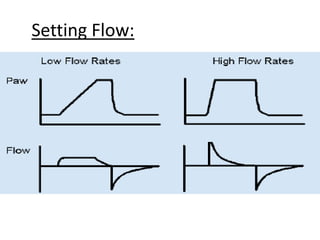
Setting Flow:
• Adequate flow rate is required for the
ventilator to deliver the desired PIP &
waveform
• Minimum flow rate of about 3 times the
infants MV
• Flows of 4 -10 L/min are sufficient for most
infants
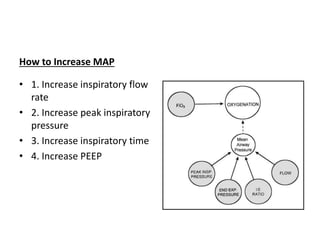
Mean Airway
Pressure:
How to Increase MAP
• 1. Increase inspiratory flow
rate
• 2. Increase peak inspiratory
pressure
• 3. Increase inspiratory time
• 4. Increase PEEP
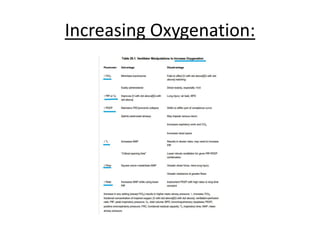
Increasing Oxygenation:
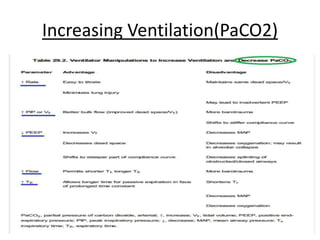
Increasing Ventilation(PaCO2)
Neonatal mechanical ventilation

Neonatal mechanical ventilation

  • 1.
  • 2.
    Introduction: • Introduction in1960’s one of major inventions in Neonatology. • Along with Antenatal steroids and Surfactant replacement ,ventilation played imp role in increasing neonatal survival. • Although life saving it may cause BPD.
  • 3.
    Benefits of MV: •Improve Gas exchange, by lung recruitment to improve V/Q matching. • Decrease WOB • CO2 removal in babies with respiratory depression and apnea.
  • 4.
    Indications for Ventilation: •Respiratory Acidosis,pH<7.2 and PaCO2> 60 mm Hg. • Hypoxia PaO2<50 mmHg. • Recurrent Apnea. • Downes score> 7.
  • 5.
    Common Conditions: • RDS •Apnea of Prematurity. • Septicemia-Pneumonia • Post operative recovery. • PPHN • MAS • Congenital pulmonary or cardiac anomalies(CDH).
  • 6.
    Types of : •CMV: Exchange of gas in bulk similar to tidal volume Initiation of breath-Ventilator (CMV or IMV) Patient Tidal volume regulation- PC VC Breath is terminated- Volume Time . Flow regulated. • HFV: small volume of gas at extremely rapid rate(300- 1500) 290 Modes on 33 Ventilators . One ventilator- Care fusion Avea ,offers choice of 44 different modes
  • 7.
    Initiation of Breath: Synchronised Ventilation:(Patient triggered) -SIMV -A/C Ventilation -Pressure support ventilation(PSV) -NAVA  CMV or IMV. Increase in death rate using SIMV(RR-1.19) No difference in air leak,IVH,BPD,extubation failure Shorter duration of Ventilation in SIMV(Mean difference -35 hrs)
  • 8.
  • 9.
  • 11.
    PSV +SIMV vsSIMV PSV+SIMV REDUCES WOB & INCREASES Minute Ventilation. LESS LIKELY TO REQUIRE MV @ 28 DAYS COMPLICATION RATES NO DIFFERENCE
  • 12.
  • 13.
    NAVA Observational studies haveshown better synchrony, less PIP and sedation with similar ABG Further research needed to determine effects on outcome
  • 14.
    Modes in ourVentilator: SLE 5000 GE CARESCAPE
  • 15.
    Modality: • Pressure limited: PC-SIMV PC-A/C PC-PSV • Volume targeted VC VG PRVC
  • 16.
    Pressure Limited Ventilation: •TCPL ventilators are MC used Neonatal ventilators. • Amount of pressure during inspiration is set(PIP). • TV delivered depends on PIP,Ti,Compliance and synchrony.
  • 17.
  • 18.
    Pressure Limited Ventilation(TCPL): Advantages •Relatively easy to use and less costly. • Continues flow of gas in circuit allows for spontaneous breathing. • PIP and MAP can be adjusted to optimize gas exchange and minimize lung injury Disadvantages • Variation in TV from breath to breath • Increased WOB during spontaneous breaths • Poor synchrony decreased O2,increase CO2,de TV,de MV(overcome with synchronization)
  • 19.
    Volume Targeted Ventilation: •Provides consistent TV resulting in less lung injury. • In 2011,volume targeted ventilation had replaced pressure limited ventilation in 25 of 50 neonatal tertiary units. • Volume control & Volume Guarantee
  • 20.
    Volume Controlled Ventilation: •Set TV (4-6ml/kg) is delivered by variation in PIP. • RR and max Ti are set. • Measure TV delivered to circuit ,No compensation for ET tube leaks
  • 21.
  • 22.
    Volume guarntee(VG): • Modifiedpressure targeted ventilation. • Addition of microprocessor that adjusts the pressure to ensure Targeted Tidal Volume(TTV). • TV,Ti,Max PIP is set • Flow sensor senses ex TV to adjust pressure for next few breaths.
  • 23.
  • 24.
    Controlling Volume ,abetter mode? • Costly and needs more expertise. • Lower rate of death and BPD(RR-0.73). • Reduced rate of Air leak(RR-0.46),days of ventilation,Hypocarbia and neurologic injury(RR-0.48)
  • 25.
    Volume targeted ventilationwith either SIMV or A/C using modified TCPL ventilators with TTV of 4-6ml/kg with permissive hypercarbia should be initial mode of ventilation
  • 26.
  • 27.
    Parameters in Conventionalventilation: • Mode of ventilation • PIP • PEEP • Flow • Inspiratory time(Ti) • Fio2 • Rate. • Trigger • Tidal Volume(TTV) • I:E ratio
  • 28.
    Setting PIP: • PIPis the primary factor used to deliver tidal volume • PIP required mainly depends on the compliance of lungs • Useful clinical indicator of adequate PIP is gentle chest rise with every vent breath. • If compliance is normal, initiate with 12-14 If abnormal, check chest rise on hand ventilation
  • 29.
    Setting PIP: Insufficient PIP •Insufficient ventilation • Decreased oxygenation • Generalized atelectasis High PIP • Increased barotraumas (air leaks) • Increased BPD • Impede venous return/ cardiac output
  • 30.
    Setting PEEP: • AdequatePEEP improves FRC & V/Q mismatch • PEEP levels between 3 – 6 improve oxygenation & well tolerated
  • 31.
    Setting PEEP: • Choicesare between 3 - 6 • If FRC is expected to be: normal: 3 moderately reduced: 4 severly reduced: 5 – 6 • Low PEEP-Atelectotrauma Co2 retention due to V/Q mismatch • High PEEP-Decrease lung compliance Impede venous return/ shock Pulmonary air leaks
  • 32.
    • RR isone of the primary determinants of MV, thus CO2 elimination • No conclusive evidence for appropriate RR • In SIMV mode ventilatory rate may not affect ABG as much as anticipated • Choices are between 20 to 60 • Considerations are: - work of breathing - Is there asynchrony: need for overdrive? - pressure requirement ?
  • 33.
    Setting FiO2: • Choicesare between 21-100% • Target is Pa02 of 50-70 mm Hg with Spo2 of 88-95%. • If lung compliance is good start with 21-25% • Other lung conditions start with FiO2 50%
  • 34.
    • Very rapidrate may cause insufficient inspiratory time and decreased tidal volume • May lead to inadvertent PEEP and gas trapping due to inadequate expiration • CO2 retention, impaired cardiac output High RR • Low RR
  • 35.
    Setting Ti: • Therespiratory system time constant determines optimal Ti & Te • Ideal Ti = 3 x time constant • An Ti of 0.3 – 0.4 sec is commonly used • In conditions like MAS – shorter Ti (0.25sec) • In severe ARDS / Pulmonary hemorrhage prolonged Ti (0.5 sec)
  • 36.
    Setting Flow: • Adequateflow rate is required for the ventilator to deliver the desired PIP & waveform • Minimum flow rate of about 3 times the infants MV • Flows of 4 -10 L/min are sufficient for most infants
  • 37.
  • 38.
    How to IncreaseMAP • 1. Increase inspiratory flow rate • 2. Increase peak inspiratory pressure • 3. Increase inspiratory time • 4. Increase PEEP
  • 39.
  • 40.