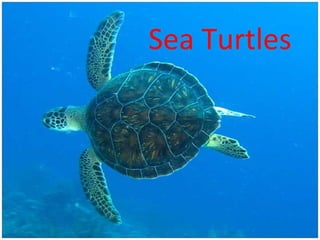
Sea Turtles
Characteristics of Reptiles
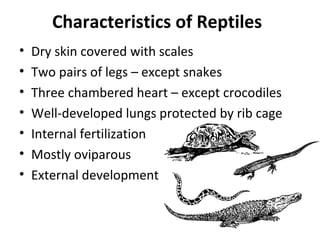
• Dry skin covered with scales
• Two pairs of legs – except snakes
• Three chambered heart – except crocodiles
• Well-developed lungs protected by rib cage
• Internal fertilization
• Mostly oviparous
• External development
Marine Reptiles
• Sea turtles
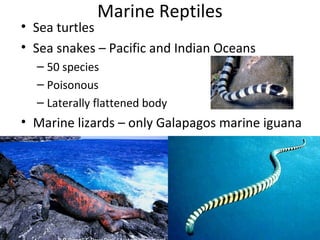
• Sea snakes – Pacific and Indian Oceans
– 50 species
– Poisonous
– Laterally flattened body
• Marine lizards – only Galapagos marine iguana
Sea TurtleSea Turtle
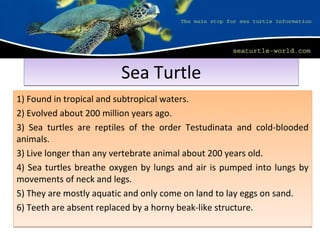
1) Found in tropical and subtropical waters.
2) Evolved about 200 million years ago.
3) Sea turtles are reptiles of the order Testudinata and cold-blooded
animals.
3) Live longer than any vertebrate animal about 200 years old.
4) Sea turtles breathe oxygen by lungs and air is pumped into lungs by
movements of neck and legs.
5) They are mostly aquatic and only come on land to lay eggs on sand.
6) Teeth are absent replaced by a horny beak-like structure.
1) Found in tropical and subtropical waters.
2) Evolved about 200 million years ago.
3) Sea turtles are reptiles of the order Testudinata and cold-blooded
animals.
3) Live longer than any vertebrate animal about 200 years old.
4) Sea turtles breathe oxygen by lungs and air is pumped into lungs by
movements of neck and legs.
5) They are mostly aquatic and only come on land to lay eggs on sand.
6) Teeth are absent replaced by a horny beak-like structure.
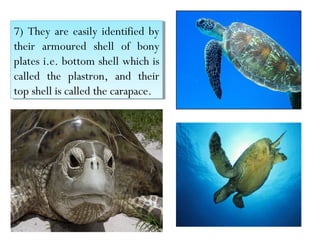
7) They are easily identified by
their armoured shell of bony
plates i.e. bottom shell which is
called the plastron, and their
top shell is called the carapace.
7) They are easily identified by
their armoured shell of bony
plates i.e. bottom shell which is
called the plastron, and their
top shell is called the carapace.
• All turtles are oviparous
• Salt glands near eyes – removes excess salt
gained from drinking sea water – looks like
tears
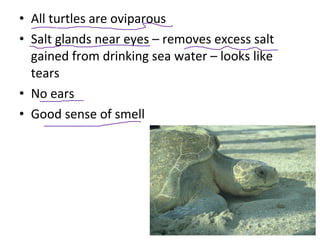
• No ears
• Good sense of smell
Feeding
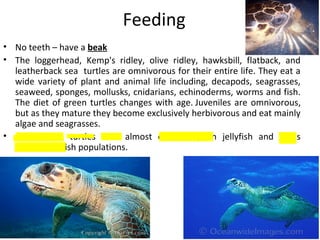
• No teeth – have a beak
• The loggerhead, Kemp's ridley, olive ridley, hawksbill, flatback, and
leatherback sea turtles are omnivorous for their entire life. They eat a
wide variety of plant and animal life including, decapods, seagrasses,
seaweed, sponges, mollusks, cnidarians, echinoderms, worms and fish.
The diet of green turtles changes with age. Juveniles are omnivorous,
but as they mature they become exclusively herbivorous and eat mainly
algae and seagrasses.
• Leatherback turtles feed almost exclusively on jellyfish and helps
control jellyfish populations.
Movement
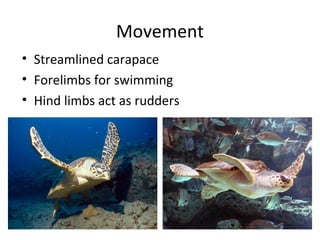
• Streamlined carapace
• Forelimbs for swimming
• Hind limbs act as rudders
Anatomy
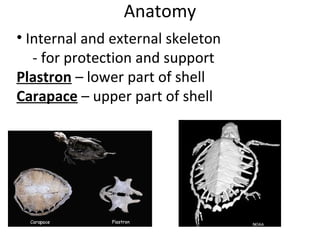
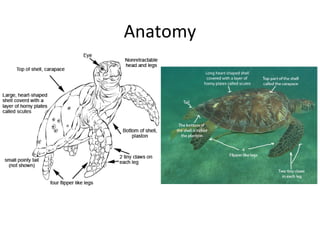
• Internal and external skeleton
- for protection and support
Plastron – lower part of shell
Carapace – upper part of shell
Anatomy
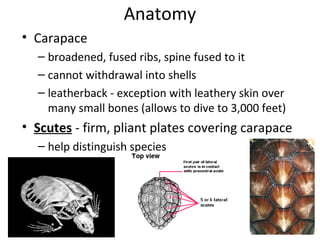
• Carapace
– broadened, fused ribs, spine fused to it
– cannot withdrawal into shells
– leatherback - exception with leathery skin over
many small bones (allows to dive to 3,000 feet)
• Scutes - firm, pliant plates covering carapace
– help distinguish species
Anatomy
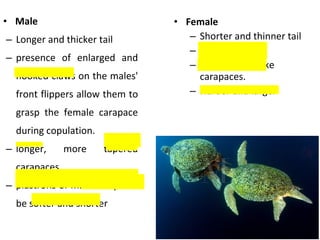
• Male
– Longer and thicker tail
– presence of enlarged and
hooked claws on the males'
front flippers allow them to
grasp the female carapace
during copulation.
– longer, more tapered
carapaces
– plastrons of males may also
be softer and shorter
• Female
– Shorter and thinner tail
– Normal claws
– round, dome-like
carapaces.
– Harder and larger
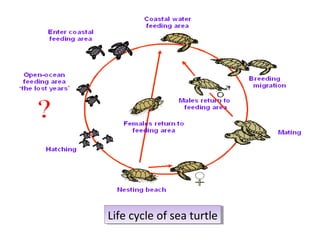
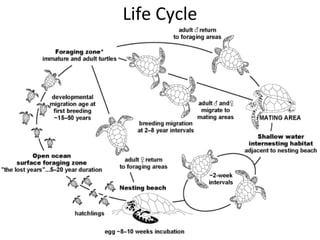
Life cycle of sea turtleLife cycle of sea turtle
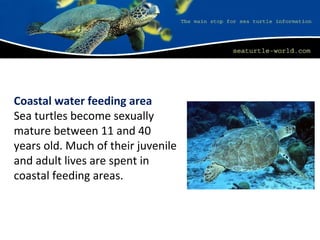
Coastal water feeding area
Sea turtles become sexually
mature between 11 and 40
years old. Much of their juvenile
and adult lives are spent in
coastal feeding areas.
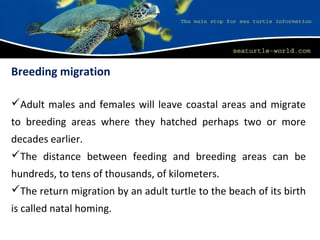
Breeding migration
Adult males and females will leave coastal areas and migrate
to breeding areas where they hatched perhaps two or more
decades earlier.
The distance between feeding and breeding areas can be
hundreds, to tens of thousands, of kilometers.
The return migration by an adult turtle to the beach of its birth
is called natal homing.
• It is not known exactly how turtles are able to navigate to the beaches
where they were born to nest after so many years, but there are a number
of theories to explain this amazing phenomenon including the use of the
earth's magnetic field (kind of like a "mental GPS").
• Adelita, a female loggerhead, was the first marine creature tracked across
the entire Pacific Ocean. She was tracked for a year covering 12,000 km
during her migration from Mexico to Japan, the place of her birth.
• Unlike other species, the Australian flatback sea turtle does not migrate to
mating and nesting areas. They mate and nest only in Australia.
Some interesting facts about breeding migration
Mating
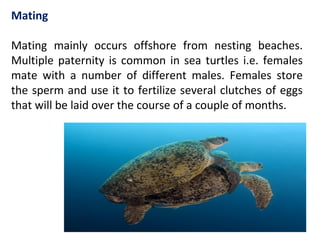
Mating mainly occurs offshore from nesting beaches.
Multiple paternity is common in sea turtles i.e. females
mate with a number of different males. Females store
the sperm and use it to fertilize several clutches of eggs
that will be laid over the course of a couple of months.
Males return to feeding area
Males return to their feeding areas once the females
begin to nest.
Like females, male turtles show natal homing, but visit
broader areas and more sites than females do. Males
will try to mate with as many females as they can
during a season. Once males have mated and are
unsuccessful in finding more mates, they return to
their feeding areas.
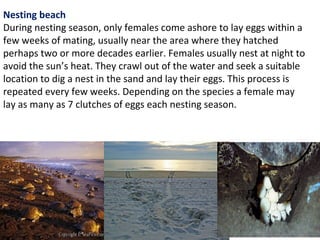
Nesting beach
During nesting season, only females come ashore to lay eggs within a
few weeks of mating, usually near the area where they hatched
perhaps two or more decades earlier. Females usually nest at night to
avoid the sun’s heat. They crawl out of the water and seek a suitable
location to dig a nest in the sand and lay their eggs. This process is
repeated every few weeks. Depending on the species a female may
lay as many as 7 clutches of eggs each nesting season.
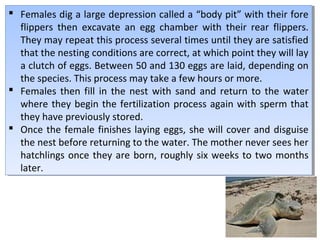
 Females dig a large depression called a “body pit” with their fore
flippers then excavate an egg chamber with their rear flippers.
They may repeat this process several times until they are satisfied
that the nesting conditions are correct, at which point they will lay
a clutch of eggs. Between 50 and 130 eggs are laid, depending on
the species. This process may take a few hours or more.
 Females then fill in the nest with sand and return to the water
where they begin the fertilization process again with sperm that
they have previously stored.
 Once the female finishes laying eggs, she will cover and disguise
the nest before returning to the water. The mother never sees her
hatchlings once they are born, roughly six weeks to two months
later.
 Females dig a large depression called a “body pit” with their fore
flippers then excavate an egg chamber with their rear flippers.
They may repeat this process several times until they are satisfied
that the nesting conditions are correct, at which point they will lay
a clutch of eggs. Between 50 and 130 eggs are laid, depending on
the species. This process may take a few hours or more.
 Females then fill in the nest with sand and return to the water
where they begin the fertilization process again with sperm that
they have previously stored.
 Once the female finishes laying eggs, she will cover and disguise
the nest before returning to the water. The mother never sees her
hatchlings once they are born, roughly six weeks to two months
later.
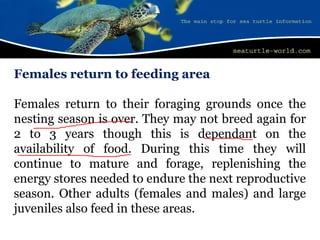
Females return to feeding area
Females return to their foraging grounds once the
nesting season is over. They may not breed again for
2 to 3 years though this is dependant on the
availability of food. During this time they will
continue to mature and forage, replenishing the
energy stores needed to endure the next reproductive
season. Other adults (females and males) and large
juveniles also feed in these areas.
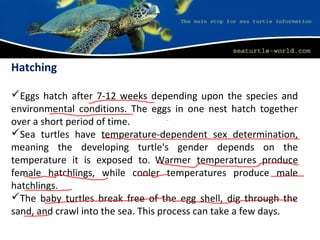
Hatching
Eggs hatch after 7-12 weeks depending upon the species and
environmental conditions. The eggs in one nest hatch together
over a short period of time.
Sea turtles have temperature-dependent sex determination,
meaning the developing turtle's gender depends on the
temperature it is exposed to. Warmer temperatures produce
female hatchlings, while cooler temperatures produce male
hatchlings.
The baby turtles break free of the egg shell, dig through the
sand, and crawl into the sea. This process can take a few days.
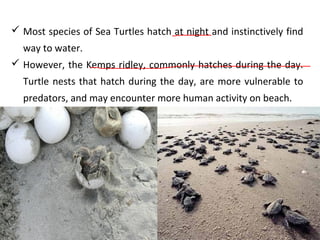
 Most species of Sea Turtles hatch at night and instinctively find
way to water.
 However, the Kemps ridley, commonly hatches during the day.
Turtle nests that hatch during the day, are more vulnerable to
predators, and may encounter more human activity on beach.
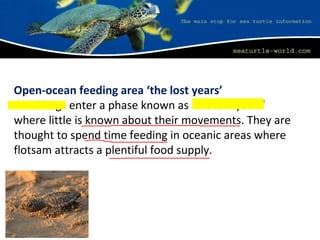
Open-ocean feeding area ‘the lost years’
Hatchlings enter a phase known as ‘the lost years’
where little is known about their movements. They are
thought to spend time feeding in oceanic areas where
flotsam attracts a plentiful food supply.
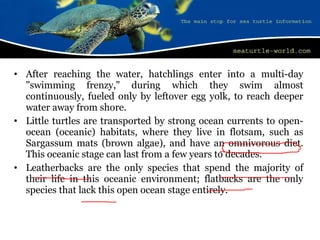
• After reaching the water, hatchlings enter into a multi-day
"swimming frenzy," during which they swim almost
continuously, fueled only by leftover egg yolk, to reach deeper
water away from shore.
• Little turtles are transported by strong ocean currents to open-
ocean (oceanic) habitats, where they live in flotsam, such as
Sargassum mats (brown algae), and have an omnivorous diet.
This oceanic stage can last from a few years to decades.
• Leatherbacks are the only species that spend the majority of
their life in this oceanic environment; flatbacks are the only
species that lack this open ocean stage entirely.
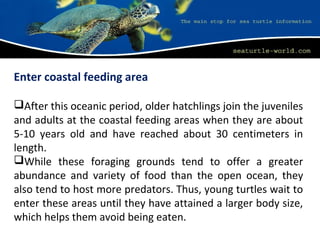
Enter coastal feeding area
After this oceanic period, older hatchlings join the juveniles
and adults at the coastal feeding areas when they are about
5-10 years old and have reached about 30 centimeters in
length.
While these foraging grounds tend to offer a greater
abundance and variety of food than the open ocean, they
also tend to host more predators. Thus, young turtles wait to
enter these areas until they have attained a larger body size,
which helps them avoid being eaten.
Life Cycle
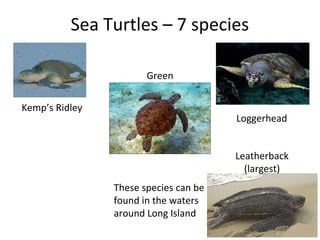
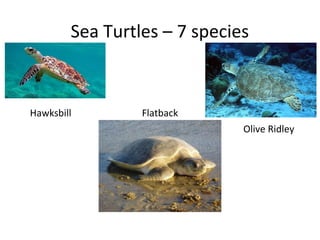
Sea Turtles – 7 species
Kemp’s Ridley
Green
Loggerhead
Leatherback
(largest)
These species can be
found in the waters
around Long Island
Sea Turtles – 7 species
Flatback
Olive Ridley
Hawksbill
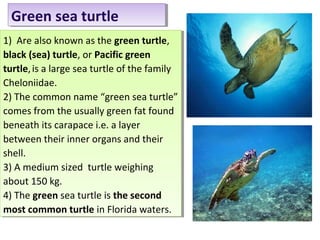
Green sea turtleGreen sea turtle
1) Are also known as the green turtle,
black (sea) turtle, or Pacific green
turtle,is a large sea turtle of the family
Cheloniidae.
2) The common name “green sea turtle”
comes from the usually green fat found
beneath its carapace i.e. a layer
between their inner organs and their
shell.
3) A medium sized turtle weighing
about 150 kg.
4) The green sea turtle is the second
most common turtle in Florida waters.
1) Are also known as the green turtle,
black (sea) turtle, or Pacific green
turtle,is a large sea turtle of the family
Cheloniidae.
2) The common name “green sea turtle”
comes from the usually green fat found
beneath its carapace i.e. a layer
between their inner organs and their
shell.
3) A medium sized turtle weighing
about 150 kg.
4) The green sea turtle is the second
most common turtle in Florida waters.
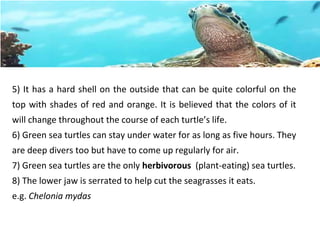
5) It has a hard shell on the outside that can be quite colorful on the
top with shades of red and orange. It is believed that the colors of it
will change throughout the course of each turtle’s life.
6) Green sea turtles can stay under water for as long as five hours. They
are deep divers too but have to come up regularly for air.
7) Green sea turtles are the only herbivorous (plant-eating) sea turtles.
8) The lower jaw is serrated to help cut the seagrasses it eats.
e.g. Chelonia mydas
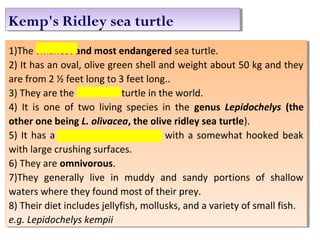
Kemp's Ridley sea turtleKemp's Ridley sea turtle
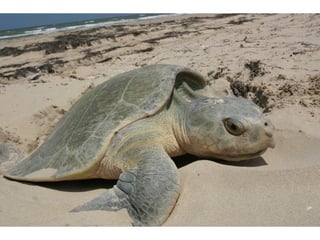
1)The smallest and most endangered sea turtle.
2) It has an oval, olive green shell and weight about 50 kg and they
are from 2 ½ feet long to 3 feet long..
3) They are the rarest sea turtle in the world.
4) It is one of two living species in the genus Lepidochelys (the
other one being L. olivacea, the olive ridley sea turtle).
5) It has a triangular-shaped head with a somewhat hooked beak
with large crushing surfaces.
6) They are omnivorous.
7)They generally live in muddy and sandy portions of shallow
waters where they found most of their prey.
8) Their diet includes jellyfish, mollusks, and a variety of small fish.
e.g. Lepidochelys kempii
1)The smallest and most endangered sea turtle.
2) It has an oval, olive green shell and weight about 50 kg and they
are from 2 ½ feet long to 3 feet long..
3) They are the rarest sea turtle in the world.
4) It is one of two living species in the genus Lepidochelys (the
other one being L. olivacea, the olive ridley sea turtle).
5) It has a triangular-shaped head with a somewhat hooked beak
with large crushing surfaces.
6) They are omnivorous.
7)They generally live in muddy and sandy portions of shallow
waters where they found most of their prey.
8) Their diet includes jellyfish, mollusks, and a variety of small fish.
e.g. Lepidochelys kempii
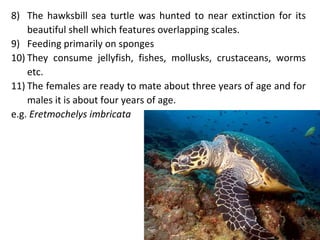
1) The hawksbill sea turtle (Eretmochelys imbricata) is a critically
endangered sea turtle belonging to the family Cheloniidae.
2) It elongated, tapered head ends in a beak-like mouth and its
beak is more sharply pronounced and hooked than others. For
this it is called Hawksbill.
3) The hawksbill's arms have two visible claws on each flipper.
4) It features a heart shaped shell on its body. As the turtle gets
older that heart shape will change and the shell will get longer.
5) A small beautifully patterned turtle weighing about 50-100 kg
with an overall size of less than three feet.
6) The hawksbill sea turtle is usually found in the southern Gulf of
Mexico and Caribbean.
7) Hawksbills evidently reach maturity after 20 years.
1) The hawksbill sea turtle (Eretmochelys imbricata) is a critically
endangered sea turtle belonging to the family Cheloniidae.
2) It elongated, tapered head ends in a beak-like mouth and its
beak is more sharply pronounced and hooked than others. For
this it is called Hawksbill.
3) The hawksbill's arms have two visible claws on each flipper.
4) It features a heart shaped shell on its body. As the turtle gets
older that heart shape will change and the shell will get longer.
5) A small beautifully patterned turtle weighing about 50-100 kg
with an overall size of less than three feet.
6) The hawksbill sea turtle is usually found in the southern Gulf of
Mexico and Caribbean.
7) Hawksbills evidently reach maturity after 20 years.
Hawksbill sea turtleHawksbill sea turtle
8) The hawksbill sea turtle was hunted to near extinction for its
beautiful shell which features overlapping scales.
9) Feeding primarily on sponges
10) They consume jellyfish, fishes, mollusks, crustaceans, worms
etc.
11) The females are ready to mate about three years of age and for
males it is about four years of age.
e.g. Eretmochelys imbricata
Olive Ridley sea turtle
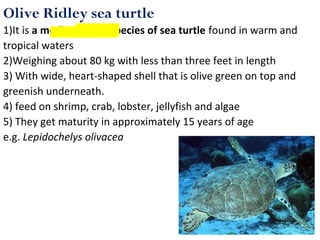
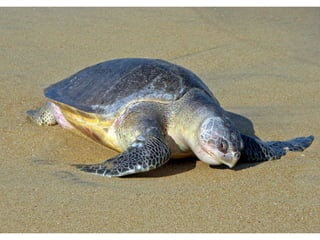
1)It is a medium-sized species of sea turtle found in warm and
tropical waters
2)Weighing about 80 kg with less than three feet in length
3) With wide, heart-shaped shell that is olive green on top and
greenish underneath.
4) feed on shrimp, crab, lobster, jellyfish and algae
5) They get maturity in approximately 15 years of age
e.g. Lepidochelys olivacea
Leatherback sea turtleLeatherback sea turtle
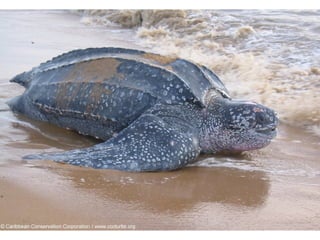
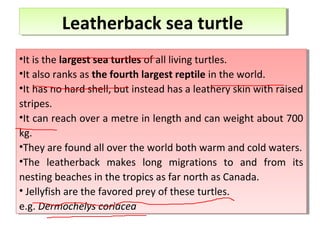
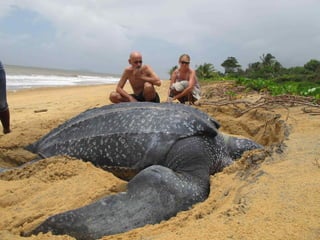
•It is the largest sea turtles of all living turtles.
•It also ranks as the fourth largest reptile in the world.
•It has no hard shell, but instead has a leathery skin with raised
stripes.
•It can reach over a metre in length and can weight about 700
kg.
•They are found all over the world both warm and cold waters.
•The leatherback makes long migrations to and from its
nesting beaches in the tropics as far north as Canada.
• Jellyfish are the favored prey of these turtles.
e.g. Dermochelys coriacea
•It is the largest sea turtles of all living turtles.
•It also ranks as the fourth largest reptile in the world.
•It has no hard shell, but instead has a leathery skin with raised
stripes.
•It can reach over a metre in length and can weight about 700
kg.
•They are found all over the world both warm and cold waters.
•The leatherback makes long migrations to and from its
nesting beaches in the tropics as far north as Canada.
• Jellyfish are the favored prey of these turtles.
e.g. Dermochelys coriacea
Australian Flatback
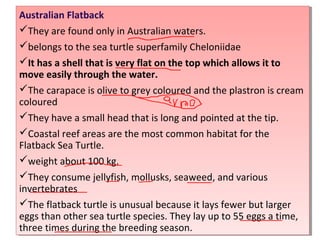
They are found only in Australian waters.
belongs to the sea turtle superfamily Cheloniidae
It has a shell that is very flat on the top which allows it to
move easily through the water.
The carapace is olive to grey coloured and the plastron is cream
coloured
They have a small head that is long and pointed at the tip.
Coastal reef areas are the most common habitat for the
Flatback Sea Turtle.
weight about 100 kg.
They consume jellyfish, mollusks, seaweed, and various
invertebrates
The flatback turtle is unusual because it lays fewer but larger
eggs than other sea turtle species. They lay up to 55 eggs a time,
three times during the breeding season.
Australian Flatback
They are found only in Australian waters.
belongs to the sea turtle superfamily Cheloniidae
It has a shell that is very flat on the top which allows it to
move easily through the water.
The carapace is olive to grey coloured and the plastron is cream
coloured
They have a small head that is long and pointed at the tip.
Coastal reef areas are the most common habitat for the
Flatback Sea Turtle.
weight about 100 kg.
They consume jellyfish, mollusks, seaweed, and various
invertebrates
The flatback turtle is unusual because it lays fewer but larger
eggs than other sea turtle species. They lay up to 55 eggs a time,
three times during the breeding season.
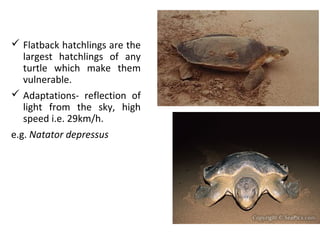
 Flatback hatchlings are the
largest hatchlings of any
turtle which make them
vulnerable.
 Adaptations- reflection of
light from the sky, high
speed i.e. 29km/h.
e.g. Natator depressus
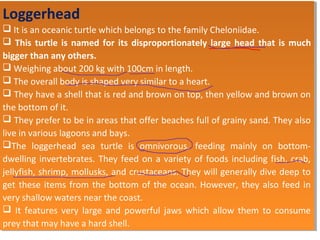
Loggerhead
 It is an oceanic turtle which belongs to the family Cheloniidae.
 This turtle is named for its disproportionately large head that is much
bigger than any others.
 Weighing about 200 kg with 100cm in length.
 The overall body is shaped very similar to a heart.
 They have a shell that is red and brown on top, then yellow and brown on
the bottom of it.
 They prefer to be in areas that offer beaches full of grainy sand. They also
live in various lagoons and bays.
The loggerhead sea turtle is omnivorous, feeding mainly on bottom-
dwelling invertebrates. They feed on a variety of foods including fish, crab,
jellyfish, shrimp, mollusks, and crustaceans. They will generally dive deep to
get these items from the bottom of the ocean. However, they also feed in
very shallow waters near the coast.
 It features very large and powerful jaws which allow them to consume
prey that may have a hard shell.
Loggerhead
 It is an oceanic turtle which belongs to the family Cheloniidae.
 This turtle is named for its disproportionately large head that is much
bigger than any others.
 Weighing about 200 kg with 100cm in length.
 The overall body is shaped very similar to a heart.
 They have a shell that is red and brown on top, then yellow and brown on
the bottom of it.
 They prefer to be in areas that offer beaches full of grainy sand. They also
live in various lagoons and bays.
The loggerhead sea turtle is omnivorous, feeding mainly on bottom-
dwelling invertebrates. They feed on a variety of foods including fish, crab,
jellyfish, shrimp, mollusks, and crustaceans. They will generally dive deep to
get these items from the bottom of the ocean. However, they also feed in
very shallow waters near the coast.
 It features very large and powerful jaws which allow them to consume
prey that may have a hard shell.
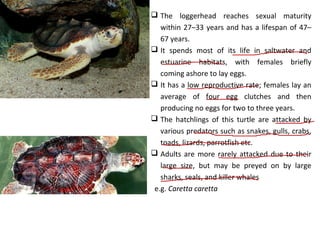
 The loggerhead reaches sexual maturity
within 27–33 years and has a lifespan of 47–
67 years.
 It spends most of its life in saltwater and
estuarine habitats, with females briefly
coming ashore to lay eggs.
 It has a low reproductive rate; females lay an
average of four egg clutches and then
producing no eggs for two to three years.
 The hatchlings of this turtle are attacked by
various predators such as snakes, gulls, crabs,
toads, lizards, parrotfish etc.
 Adults are more rarely attacked due to their
large size, but may be preyed on by large
sharks, seals, and killer whales
e.g. Caretta caretta
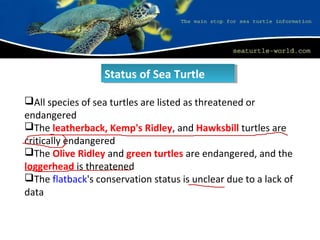
Status of Sea TurtleStatus of Sea Turtle
All species of sea turtles are listed as threatened or
endangered
The leatherback, Kemp's Ridley, and Hawksbill turtles are
critically endangered
The Olive Ridley and green turtles are endangered, and the
loggerhead is threatened
The flatback's conservation status is unclear due to a lack of
data
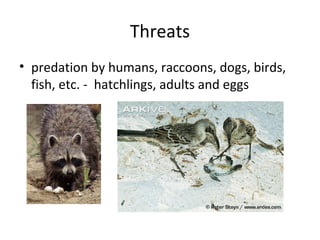
Threats
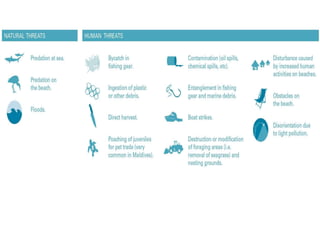
• predation by humans, raccoons, dogs, birds,
fish, etc. - hatchlings, adults and eggs
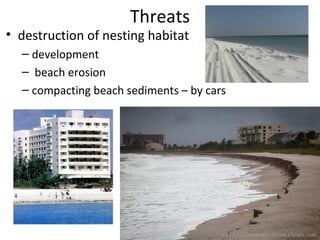
Threats
• destruction of nesting habitat
– development
– beach erosion
– compacting beach sediments – by cars
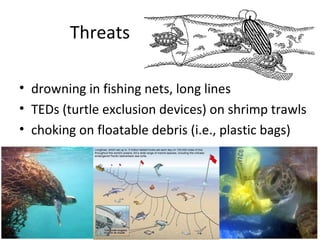
Threats
• drowning in fishing nets, long lines
• TEDs (turtle exclusion devices) on shrimp trawls
• choking on floatable debris (i.e., plastic bags)
Threats
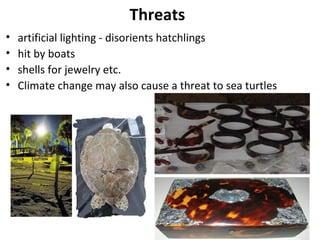
• artificial lighting - disorients hatchlings
• hit by boats
• shells for jewelry etc.
• Climate change may also cause a threat to sea turtles
Sea turtles introduction

Sea turtles introduction

  • 1.
  • 2.
    Characteristics of Reptiles •Dry skin covered with scales • Two pairs of legs – except snakes • Three chambered heart – except crocodiles • Well-developed lungs protected by rib cage • Internal fertilization • Mostly oviparous • External development
  • 3.
    Marine Reptiles • Seaturtles • Sea snakes – Pacific and Indian Oceans – 50 species – Poisonous – Laterally flattened body • Marine lizards – only Galapagos marine iguana
  • 4.
    Sea TurtleSea Turtle 1)Found in tropical and subtropical waters. 2) Evolved about 200 million years ago. 3) Sea turtles are reptiles of the order Testudinata and cold-blooded animals. 3) Live longer than any vertebrate animal about 200 years old. 4) Sea turtles breathe oxygen by lungs and air is pumped into lungs by movements of neck and legs. 5) They are mostly aquatic and only come on land to lay eggs on sand. 6) Teeth are absent replaced by a horny beak-like structure. 1) Found in tropical and subtropical waters. 2) Evolved about 200 million years ago. 3) Sea turtles are reptiles of the order Testudinata and cold-blooded animals. 3) Live longer than any vertebrate animal about 200 years old. 4) Sea turtles breathe oxygen by lungs and air is pumped into lungs by movements of neck and legs. 5) They are mostly aquatic and only come on land to lay eggs on sand. 6) Teeth are absent replaced by a horny beak-like structure.
  • 5.
    7) They areeasily identified by their armoured shell of bony plates i.e. bottom shell which is called the plastron, and their top shell is called the carapace. 7) They are easily identified by their armoured shell of bony plates i.e. bottom shell which is called the plastron, and their top shell is called the carapace.
  • 6.
    • All turtlesare oviparous • Salt glands near eyes – removes excess salt gained from drinking sea water – looks like tears • No ears • Good sense of smell
  • 7.
    Feeding • No teeth– have a beak • The loggerhead, Kemp's ridley, olive ridley, hawksbill, flatback, and leatherback sea turtles are omnivorous for their entire life. They eat a wide variety of plant and animal life including, decapods, seagrasses, seaweed, sponges, mollusks, cnidarians, echinoderms, worms and fish. The diet of green turtles changes with age. Juveniles are omnivorous, but as they mature they become exclusively herbivorous and eat mainly algae and seagrasses. • Leatherback turtles feed almost exclusively on jellyfish and helps control jellyfish populations.
  • 8.
    Movement • Streamlined carapace •Forelimbs for swimming • Hind limbs act as rudders
  • 9.
    Anatomy • Internal andexternal skeleton - for protection and support Plastron – lower part of shell Carapace – upper part of shell
  • 10.
    Anatomy • Carapace – broadened,fused ribs, spine fused to it – cannot withdrawal into shells – leatherback - exception with leathery skin over many small bones (allows to dive to 3,000 feet) • Scutes - firm, pliant plates covering carapace – help distinguish species
  • 11.
  • 12.
    • Male – Longerand thicker tail – presence of enlarged and hooked claws on the males' front flippers allow them to grasp the female carapace during copulation. – longer, more tapered carapaces – plastrons of males may also be softer and shorter • Female – Shorter and thinner tail – Normal claws – round, dome-like carapaces. – Harder and larger
  • 13.
    Life cycle ofsea turtleLife cycle of sea turtle
  • 14.
    Coastal water feedingarea Sea turtles become sexually mature between 11 and 40 years old. Much of their juvenile and adult lives are spent in coastal feeding areas.
  • 15.
    Breeding migration Adult malesand females will leave coastal areas and migrate to breeding areas where they hatched perhaps two or more decades earlier. The distance between feeding and breeding areas can be hundreds, to tens of thousands, of kilometers. The return migration by an adult turtle to the beach of its birth is called natal homing.
  • 16.
    • It isnot known exactly how turtles are able to navigate to the beaches where they were born to nest after so many years, but there are a number of theories to explain this amazing phenomenon including the use of the earth's magnetic field (kind of like a "mental GPS"). • Adelita, a female loggerhead, was the first marine creature tracked across the entire Pacific Ocean. She was tracked for a year covering 12,000 km during her migration from Mexico to Japan, the place of her birth. • Unlike other species, the Australian flatback sea turtle does not migrate to mating and nesting areas. They mate and nest only in Australia. Some interesting facts about breeding migration
  • 17.
    Mating Mating mainly occursoffshore from nesting beaches. Multiple paternity is common in sea turtles i.e. females mate with a number of different males. Females store the sperm and use it to fertilize several clutches of eggs that will be laid over the course of a couple of months.
  • 18.
    Males return tofeeding area Males return to their feeding areas once the females begin to nest. Like females, male turtles show natal homing, but visit broader areas and more sites than females do. Males will try to mate with as many females as they can during a season. Once males have mated and are unsuccessful in finding more mates, they return to their feeding areas.
  • 19.
    Nesting beach During nestingseason, only females come ashore to lay eggs within a few weeks of mating, usually near the area where they hatched perhaps two or more decades earlier. Females usually nest at night to avoid the sun’s heat. They crawl out of the water and seek a suitable location to dig a nest in the sand and lay their eggs. This process is repeated every few weeks. Depending on the species a female may lay as many as 7 clutches of eggs each nesting season.
  • 20.
     Females diga large depression called a “body pit” with their fore flippers then excavate an egg chamber with their rear flippers. They may repeat this process several times until they are satisfied that the nesting conditions are correct, at which point they will lay a clutch of eggs. Between 50 and 130 eggs are laid, depending on the species. This process may take a few hours or more.  Females then fill in the nest with sand and return to the water where they begin the fertilization process again with sperm that they have previously stored.  Once the female finishes laying eggs, she will cover and disguise the nest before returning to the water. The mother never sees her hatchlings once they are born, roughly six weeks to two months later.  Females dig a large depression called a “body pit” with their fore flippers then excavate an egg chamber with their rear flippers. They may repeat this process several times until they are satisfied that the nesting conditions are correct, at which point they will lay a clutch of eggs. Between 50 and 130 eggs are laid, depending on the species. This process may take a few hours or more.  Females then fill in the nest with sand and return to the water where they begin the fertilization process again with sperm that they have previously stored.  Once the female finishes laying eggs, she will cover and disguise the nest before returning to the water. The mother never sees her hatchlings once they are born, roughly six weeks to two months later.
  • 21.
    Females return tofeeding area Females return to their foraging grounds once the nesting season is over. They may not breed again for 2 to 3 years though this is dependant on the availability of food. During this time they will continue to mature and forage, replenishing the energy stores needed to endure the next reproductive season. Other adults (females and males) and large juveniles also feed in these areas.
  • 22.
    Hatching Eggs hatch after7-12 weeks depending upon the species and environmental conditions. The eggs in one nest hatch together over a short period of time. Sea turtles have temperature-dependent sex determination, meaning the developing turtle's gender depends on the temperature it is exposed to. Warmer temperatures produce female hatchlings, while cooler temperatures produce male hatchlings. The baby turtles break free of the egg shell, dig through the sand, and crawl into the sea. This process can take a few days.
  • 23.
     Most speciesof Sea Turtles hatch at night and instinctively find way to water.  However, the Kemps ridley, commonly hatches during the day. Turtle nests that hatch during the day, are more vulnerable to predators, and may encounter more human activity on beach.
  • 24.
    Open-ocean feeding area‘the lost years’ Hatchlings enter a phase known as ‘the lost years’ where little is known about their movements. They are thought to spend time feeding in oceanic areas where flotsam attracts a plentiful food supply.
  • 25.
    • After reachingthe water, hatchlings enter into a multi-day "swimming frenzy," during which they swim almost continuously, fueled only by leftover egg yolk, to reach deeper water away from shore. • Little turtles are transported by strong ocean currents to open- ocean (oceanic) habitats, where they live in flotsam, such as Sargassum mats (brown algae), and have an omnivorous diet. This oceanic stage can last from a few years to decades. • Leatherbacks are the only species that spend the majority of their life in this oceanic environment; flatbacks are the only species that lack this open ocean stage entirely.
  • 26.
    Enter coastal feedingarea After this oceanic period, older hatchlings join the juveniles and adults at the coastal feeding areas when they are about 5-10 years old and have reached about 30 centimeters in length. While these foraging grounds tend to offer a greater abundance and variety of food than the open ocean, they also tend to host more predators. Thus, young turtles wait to enter these areas until they have attained a larger body size, which helps them avoid being eaten.
  • 27.
  • 28.
    Sea Turtles –7 species Kemp’s Ridley Green Loggerhead Leatherback (largest) These species can be found in the waters around Long Island
  • 29.
    Sea Turtles –7 species Flatback Olive Ridley Hawksbill
  • 30.
    Green sea turtleGreensea turtle 1) Are also known as the green turtle, black (sea) turtle, or Pacific green turtle,is a large sea turtle of the family Cheloniidae. 2) The common name “green sea turtle” comes from the usually green fat found beneath its carapace i.e. a layer between their inner organs and their shell. 3) A medium sized turtle weighing about 150 kg. 4) The green sea turtle is the second most common turtle in Florida waters. 1) Are also known as the green turtle, black (sea) turtle, or Pacific green turtle,is a large sea turtle of the family Cheloniidae. 2) The common name “green sea turtle” comes from the usually green fat found beneath its carapace i.e. a layer between their inner organs and their shell. 3) A medium sized turtle weighing about 150 kg. 4) The green sea turtle is the second most common turtle in Florida waters.
  • 31.
    5) It hasa hard shell on the outside that can be quite colorful on the top with shades of red and orange. It is believed that the colors of it will change throughout the course of each turtle’s life. 6) Green sea turtles can stay under water for as long as five hours. They are deep divers too but have to come up regularly for air. 7) Green sea turtles are the only herbivorous (plant-eating) sea turtles. 8) The lower jaw is serrated to help cut the seagrasses it eats. e.g. Chelonia mydas
  • 32.
    Kemp's Ridley seaturtleKemp's Ridley sea turtle 1)The smallest and most endangered sea turtle. 2) It has an oval, olive green shell and weight about 50 kg and they are from 2 ½ feet long to 3 feet long.. 3) They are the rarest sea turtle in the world. 4) It is one of two living species in the genus Lepidochelys (the other one being L. olivacea, the olive ridley sea turtle). 5) It has a triangular-shaped head with a somewhat hooked beak with large crushing surfaces. 6) They are omnivorous. 7)They generally live in muddy and sandy portions of shallow waters where they found most of their prey. 8) Their diet includes jellyfish, mollusks, and a variety of small fish. e.g. Lepidochelys kempii 1)The smallest and most endangered sea turtle. 2) It has an oval, olive green shell and weight about 50 kg and they are from 2 ½ feet long to 3 feet long.. 3) They are the rarest sea turtle in the world. 4) It is one of two living species in the genus Lepidochelys (the other one being L. olivacea, the olive ridley sea turtle). 5) It has a triangular-shaped head with a somewhat hooked beak with large crushing surfaces. 6) They are omnivorous. 7)They generally live in muddy and sandy portions of shallow waters where they found most of their prey. 8) Their diet includes jellyfish, mollusks, and a variety of small fish. e.g. Lepidochelys kempii
  • 34.
    1) The hawksbillsea turtle (Eretmochelys imbricata) is a critically endangered sea turtle belonging to the family Cheloniidae. 2) It elongated, tapered head ends in a beak-like mouth and its beak is more sharply pronounced and hooked than others. For this it is called Hawksbill. 3) The hawksbill's arms have two visible claws on each flipper. 4) It features a heart shaped shell on its body. As the turtle gets older that heart shape will change and the shell will get longer. 5) A small beautifully patterned turtle weighing about 50-100 kg with an overall size of less than three feet. 6) The hawksbill sea turtle is usually found in the southern Gulf of Mexico and Caribbean. 7) Hawksbills evidently reach maturity after 20 years. 1) The hawksbill sea turtle (Eretmochelys imbricata) is a critically endangered sea turtle belonging to the family Cheloniidae. 2) It elongated, tapered head ends in a beak-like mouth and its beak is more sharply pronounced and hooked than others. For this it is called Hawksbill. 3) The hawksbill's arms have two visible claws on each flipper. 4) It features a heart shaped shell on its body. As the turtle gets older that heart shape will change and the shell will get longer. 5) A small beautifully patterned turtle weighing about 50-100 kg with an overall size of less than three feet. 6) The hawksbill sea turtle is usually found in the southern Gulf of Mexico and Caribbean. 7) Hawksbills evidently reach maturity after 20 years. Hawksbill sea turtleHawksbill sea turtle
  • 35.
    8) The hawksbillsea turtle was hunted to near extinction for its beautiful shell which features overlapping scales. 9) Feeding primarily on sponges 10) They consume jellyfish, fishes, mollusks, crustaceans, worms etc. 11) The females are ready to mate about three years of age and for males it is about four years of age. e.g. Eretmochelys imbricata
  • 36.
    Olive Ridley seaturtle 1)It is a medium-sized species of sea turtle found in warm and tropical waters 2)Weighing about 80 kg with less than three feet in length 3) With wide, heart-shaped shell that is olive green on top and greenish underneath. 4) feed on shrimp, crab, lobster, jellyfish and algae 5) They get maturity in approximately 15 years of age e.g. Lepidochelys olivacea
  • 38.
    Leatherback sea turtleLeatherbacksea turtle •It is the largest sea turtles of all living turtles. •It also ranks as the fourth largest reptile in the world. •It has no hard shell, but instead has a leathery skin with raised stripes. •It can reach over a metre in length and can weight about 700 kg. •They are found all over the world both warm and cold waters. •The leatherback makes long migrations to and from its nesting beaches in the tropics as far north as Canada. • Jellyfish are the favored prey of these turtles. e.g. Dermochelys coriacea •It is the largest sea turtles of all living turtles. •It also ranks as the fourth largest reptile in the world. •It has no hard shell, but instead has a leathery skin with raised stripes. •It can reach over a metre in length and can weight about 700 kg. •They are found all over the world both warm and cold waters. •The leatherback makes long migrations to and from its nesting beaches in the tropics as far north as Canada. • Jellyfish are the favored prey of these turtles. e.g. Dermochelys coriacea
  • 41.
    Australian Flatback They arefound only in Australian waters. belongs to the sea turtle superfamily Cheloniidae It has a shell that is very flat on the top which allows it to move easily through the water. The carapace is olive to grey coloured and the plastron is cream coloured They have a small head that is long and pointed at the tip. Coastal reef areas are the most common habitat for the Flatback Sea Turtle. weight about 100 kg. They consume jellyfish, mollusks, seaweed, and various invertebrates The flatback turtle is unusual because it lays fewer but larger eggs than other sea turtle species. They lay up to 55 eggs a time, three times during the breeding season. Australian Flatback They are found only in Australian waters. belongs to the sea turtle superfamily Cheloniidae It has a shell that is very flat on the top which allows it to move easily through the water. The carapace is olive to grey coloured and the plastron is cream coloured They have a small head that is long and pointed at the tip. Coastal reef areas are the most common habitat for the Flatback Sea Turtle. weight about 100 kg. They consume jellyfish, mollusks, seaweed, and various invertebrates The flatback turtle is unusual because it lays fewer but larger eggs than other sea turtle species. They lay up to 55 eggs a time, three times during the breeding season.
  • 42.
     Flatback hatchlingsare the largest hatchlings of any turtle which make them vulnerable.  Adaptations- reflection of light from the sky, high speed i.e. 29km/h. e.g. Natator depressus
  • 43.
    Loggerhead  It isan oceanic turtle which belongs to the family Cheloniidae.  This turtle is named for its disproportionately large head that is much bigger than any others.  Weighing about 200 kg with 100cm in length.  The overall body is shaped very similar to a heart.  They have a shell that is red and brown on top, then yellow and brown on the bottom of it.  They prefer to be in areas that offer beaches full of grainy sand. They also live in various lagoons and bays. The loggerhead sea turtle is omnivorous, feeding mainly on bottom- dwelling invertebrates. They feed on a variety of foods including fish, crab, jellyfish, shrimp, mollusks, and crustaceans. They will generally dive deep to get these items from the bottom of the ocean. However, they also feed in very shallow waters near the coast.  It features very large and powerful jaws which allow them to consume prey that may have a hard shell. Loggerhead  It is an oceanic turtle which belongs to the family Cheloniidae.  This turtle is named for its disproportionately large head that is much bigger than any others.  Weighing about 200 kg with 100cm in length.  The overall body is shaped very similar to a heart.  They have a shell that is red and brown on top, then yellow and brown on the bottom of it.  They prefer to be in areas that offer beaches full of grainy sand. They also live in various lagoons and bays. The loggerhead sea turtle is omnivorous, feeding mainly on bottom- dwelling invertebrates. They feed on a variety of foods including fish, crab, jellyfish, shrimp, mollusks, and crustaceans. They will generally dive deep to get these items from the bottom of the ocean. However, they also feed in very shallow waters near the coast.  It features very large and powerful jaws which allow them to consume prey that may have a hard shell.
  • 44.
     The loggerheadreaches sexual maturity within 27–33 years and has a lifespan of 47– 67 years.  It spends most of its life in saltwater and estuarine habitats, with females briefly coming ashore to lay eggs.  It has a low reproductive rate; females lay an average of four egg clutches and then producing no eggs for two to three years.  The hatchlings of this turtle are attacked by various predators such as snakes, gulls, crabs, toads, lizards, parrotfish etc.  Adults are more rarely attacked due to their large size, but may be preyed on by large sharks, seals, and killer whales e.g. Caretta caretta
  • 45.
    Status of SeaTurtleStatus of Sea Turtle All species of sea turtles are listed as threatened or endangered The leatherback, Kemp's Ridley, and Hawksbill turtles are critically endangered The Olive Ridley and green turtles are endangered, and the loggerhead is threatened The flatback's conservation status is unclear due to a lack of data
  • 46.
    Threats • predation byhumans, raccoons, dogs, birds, fish, etc. - hatchlings, adults and eggs
  • 47.
    Threats • destruction ofnesting habitat – development – beach erosion – compacting beach sediments – by cars
  • 48.
    Threats • drowning infishing nets, long lines • TEDs (turtle exclusion devices) on shrimp trawls • choking on floatable debris (i.e., plastic bags)
  • 49.
    Threats • artificial lighting- disorients hatchlings • hit by boats • shells for jewelry etc. • Climate change may also cause a threat to sea turtles