The ‘Southernisation’ of Development:
are the DAC donors moving South?
Emma Mawdsley
University of Cambridge
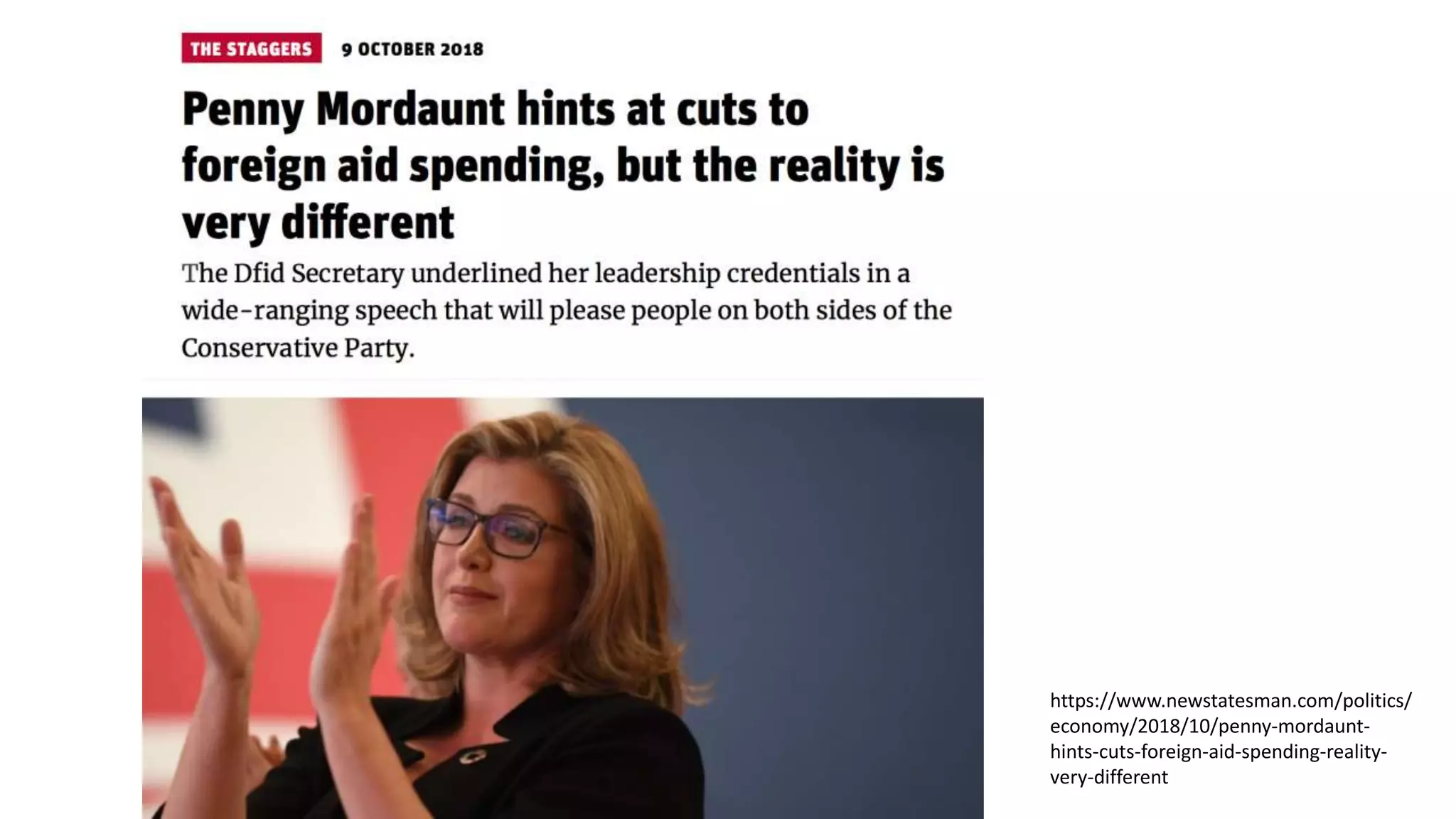
https://www.newstatesman.com/politics/
economy/2018/10/penny-mordaunt-
hints-cuts-foreign-aid-spending-reality-
very-different
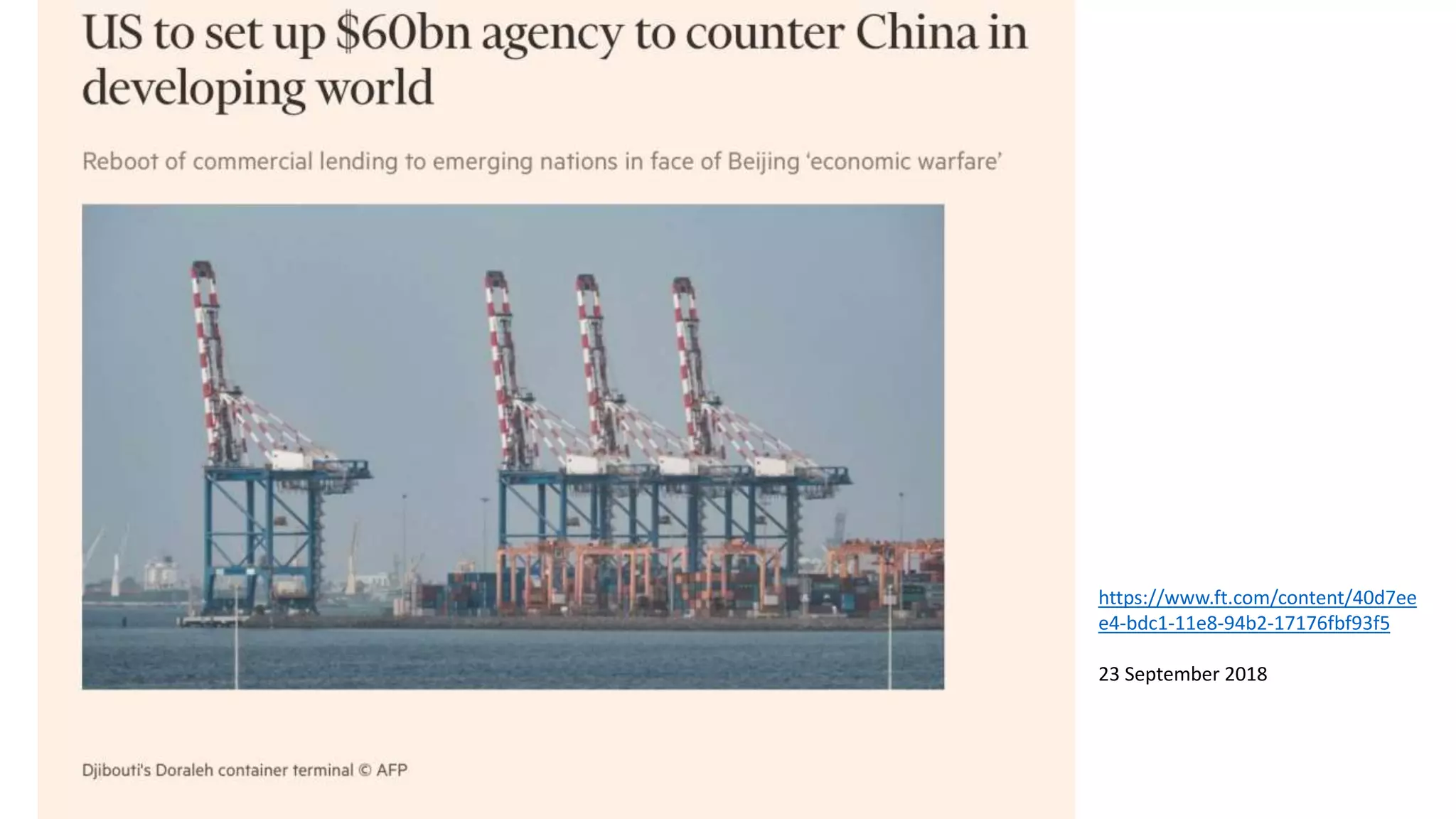
https://www.ft.com/content/40d7ee
e4-bdc1-11e8-94b2-17176fbf93f5
23 September 2018
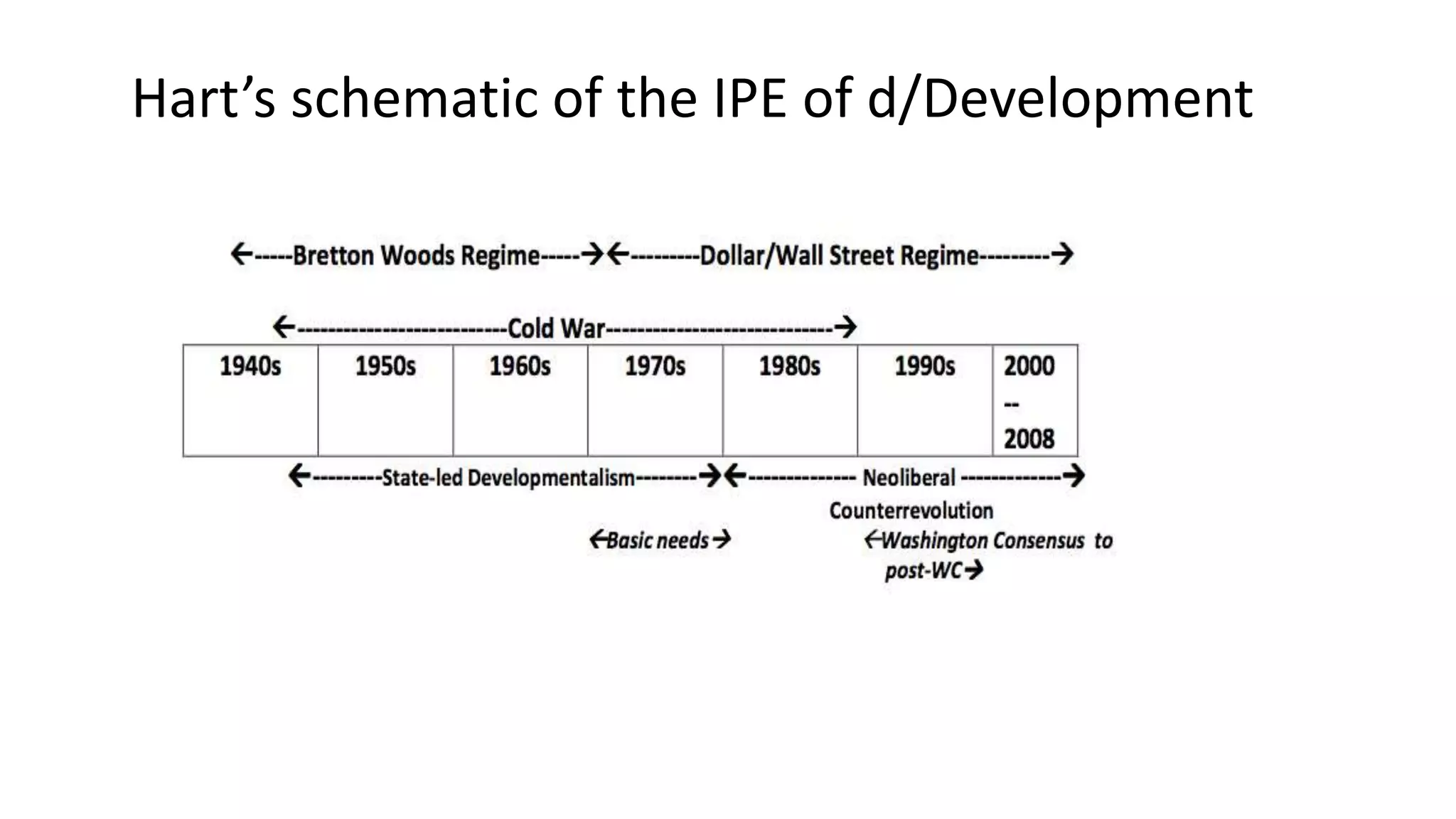
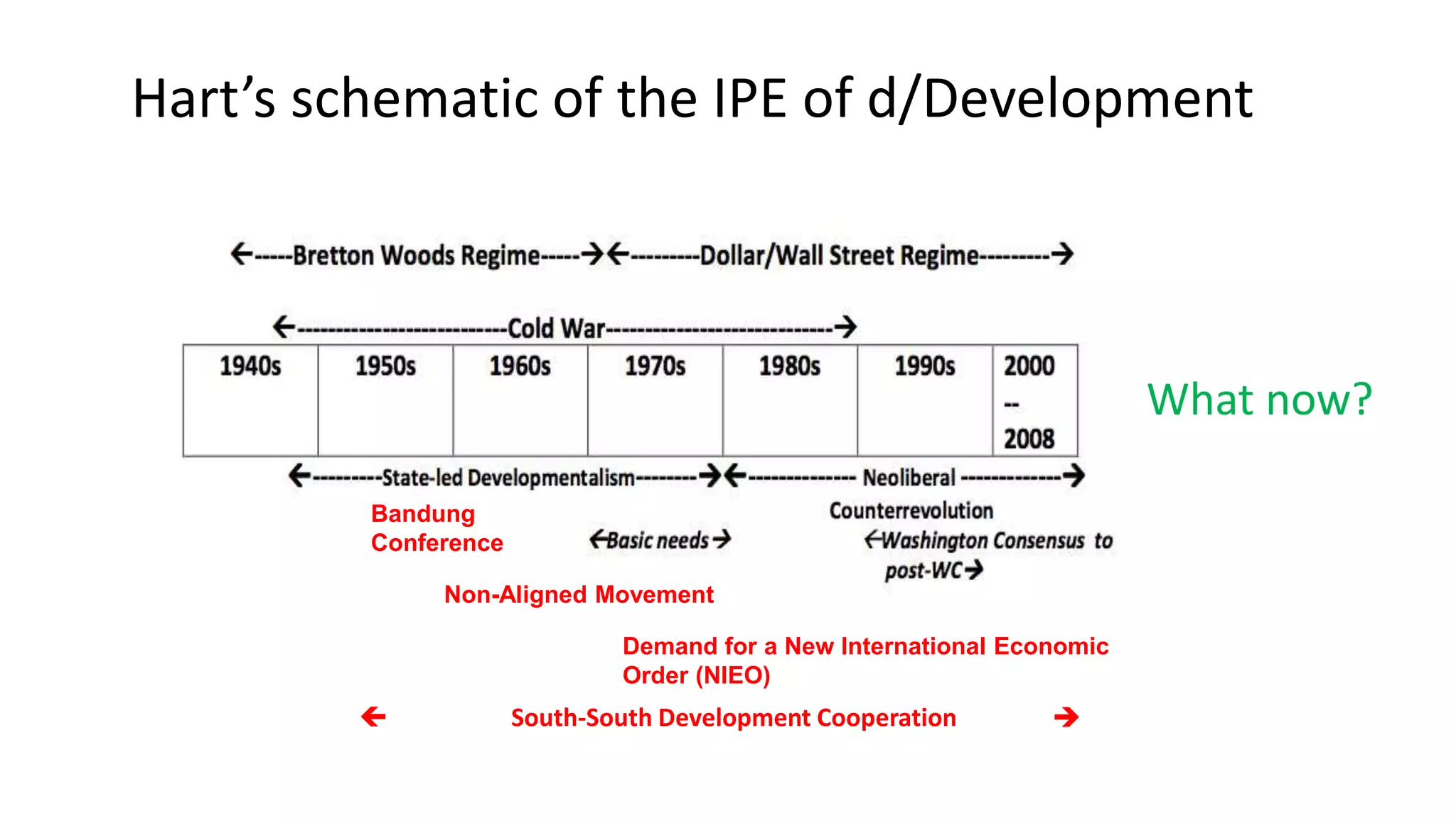
Hart’s schematic of the IPE of d/Development

Bandung
Conference
Non-Aligned Movement
Demand for a New International Economic
Order (NIEO)
South-South Development Cooperation
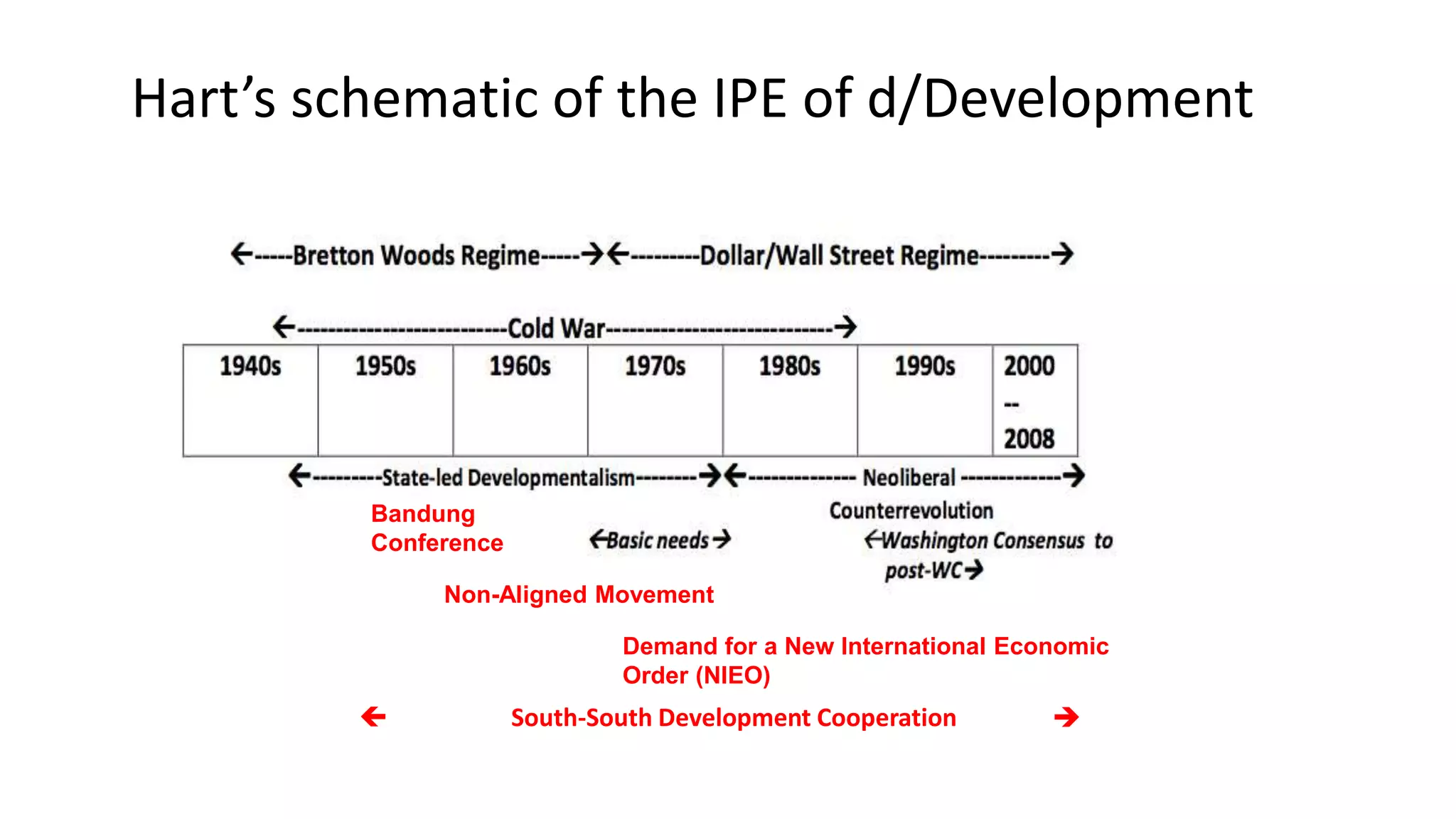
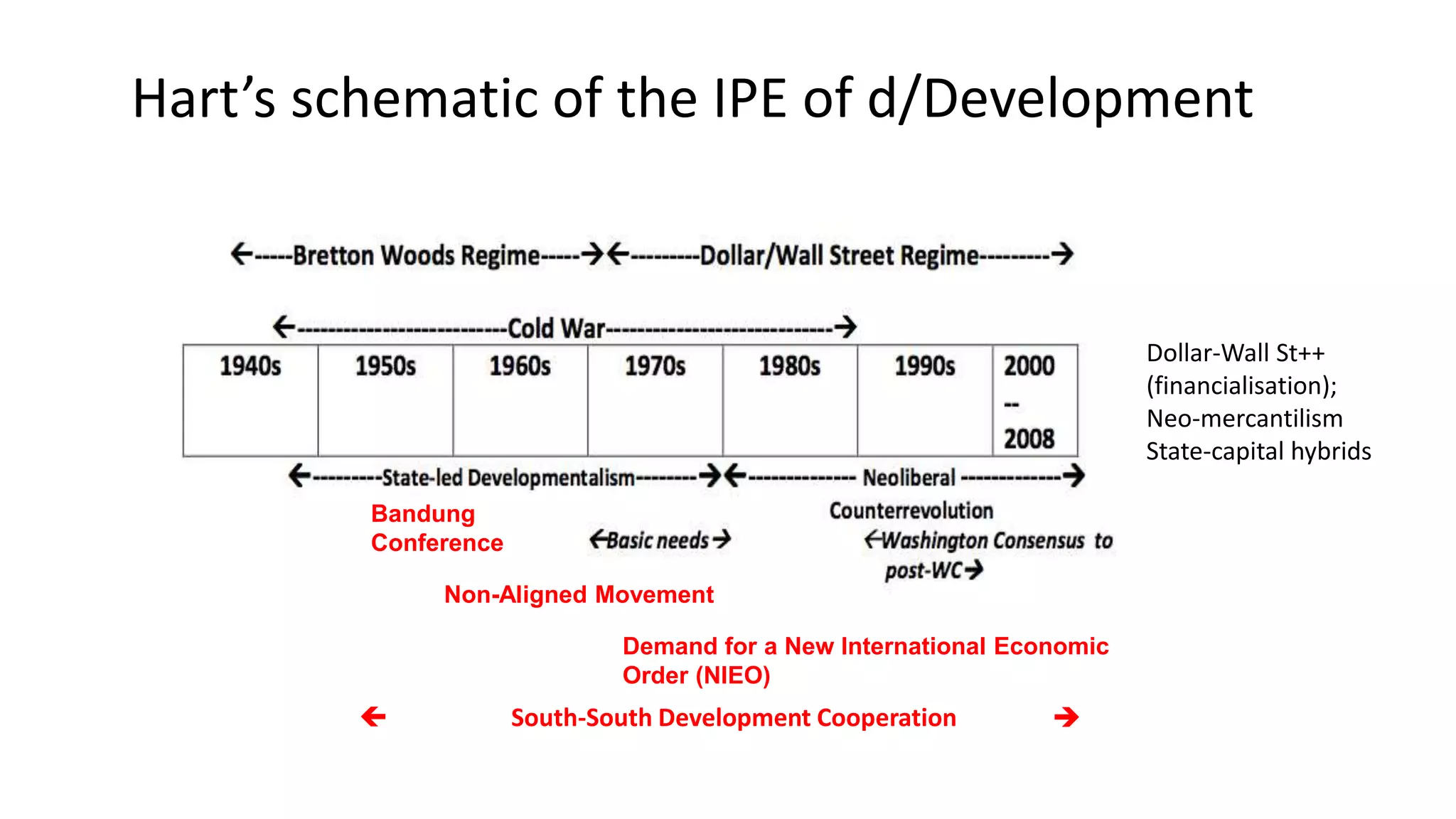
Hart’s schematic of the IPE of d/Development

Bandung
Conference
Non-Aligned Movement
Demand for a New International Economic
Order (NIEO)
South-South Development Cooperation
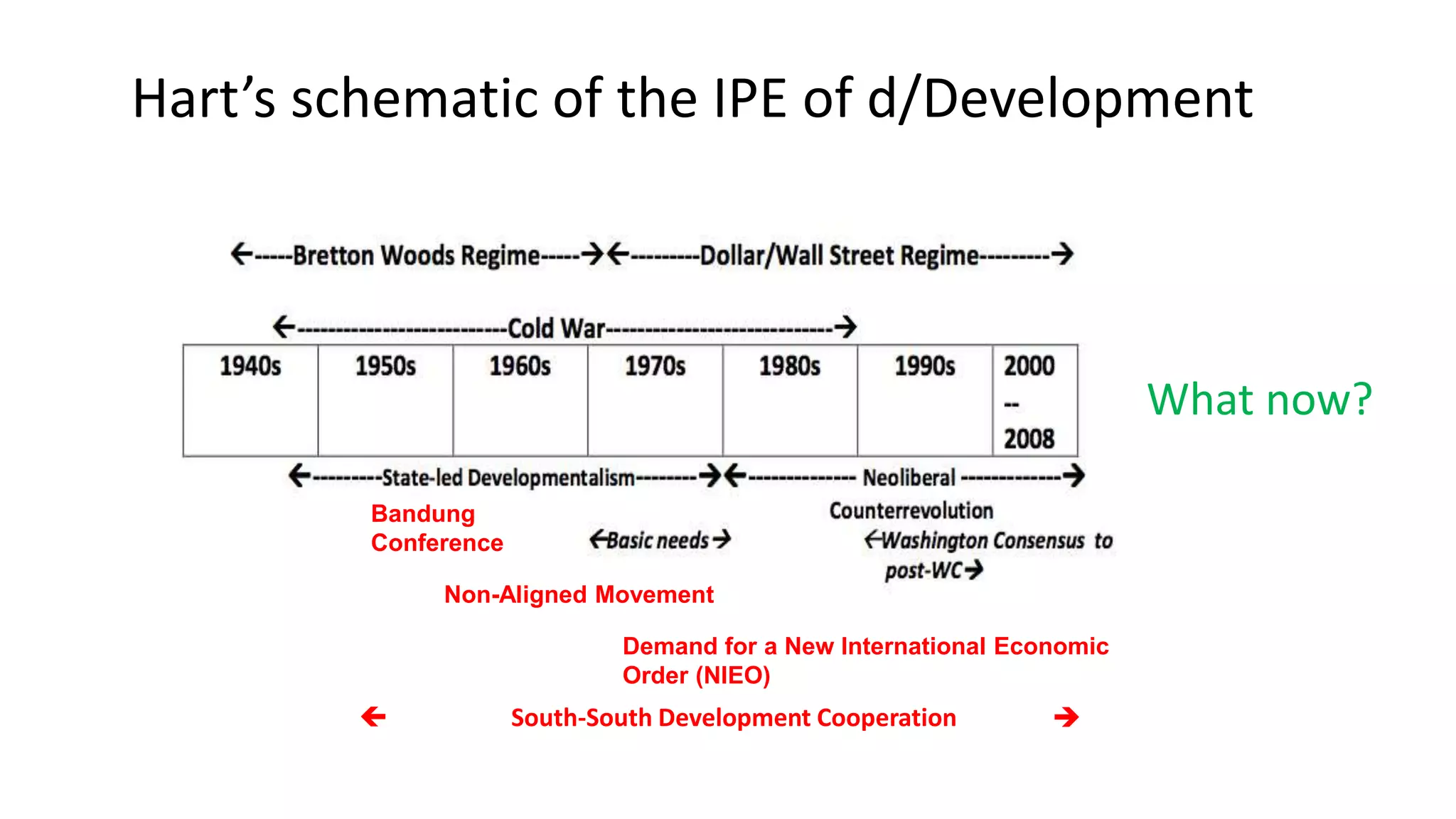
Hart’s schematic of the IPE of d/Development
What now?
Argument
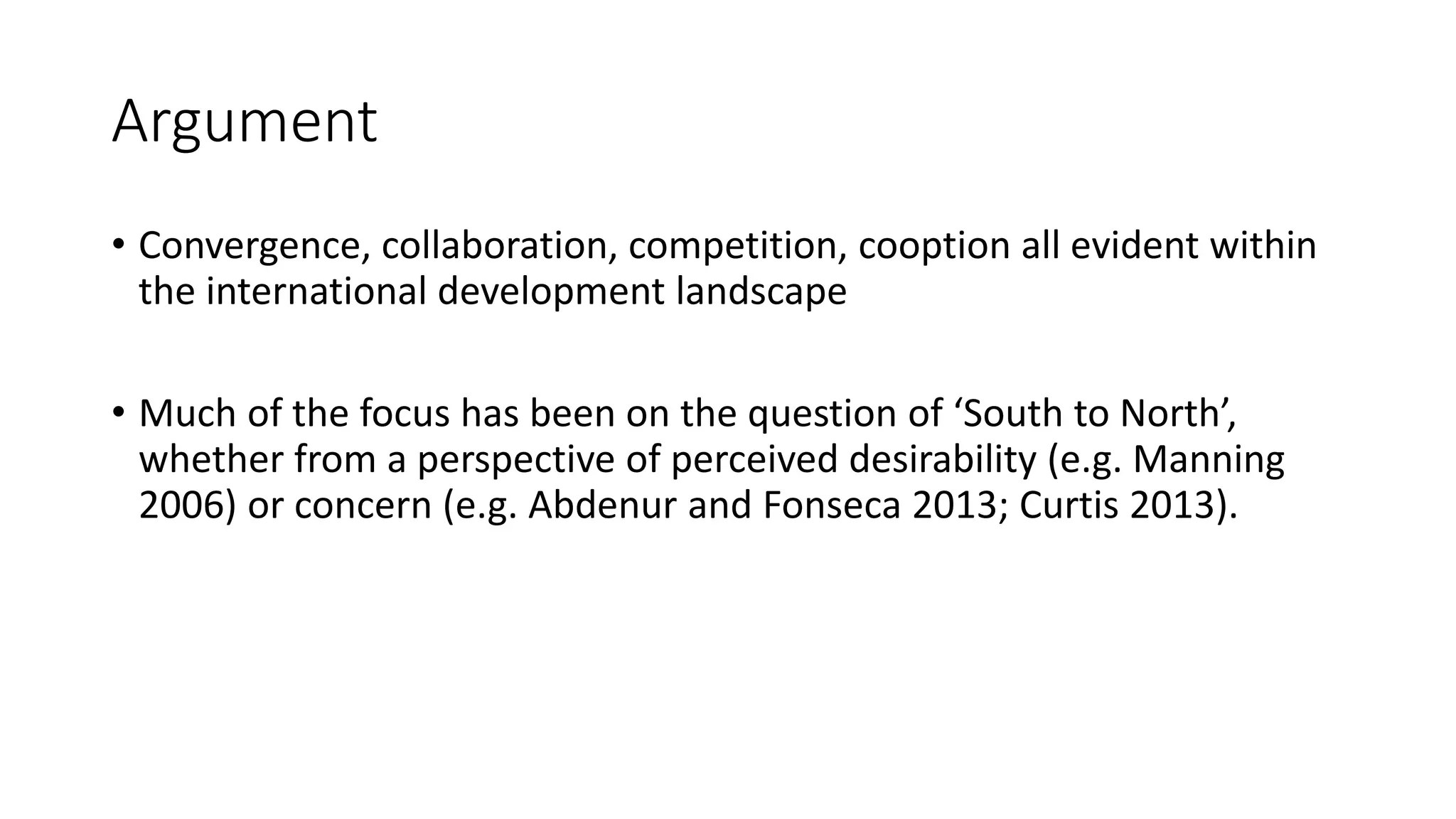
• Convergence, collaboration, competition, cooption all evident within
the international development landscape
• Much of the focus has been on the question of ‘South to North’,
whether from a perspective of perceived desirability (e.g. Manning
2006) or concern (e.g. Abdenur and Fonseca 2013; Curtis 2013).
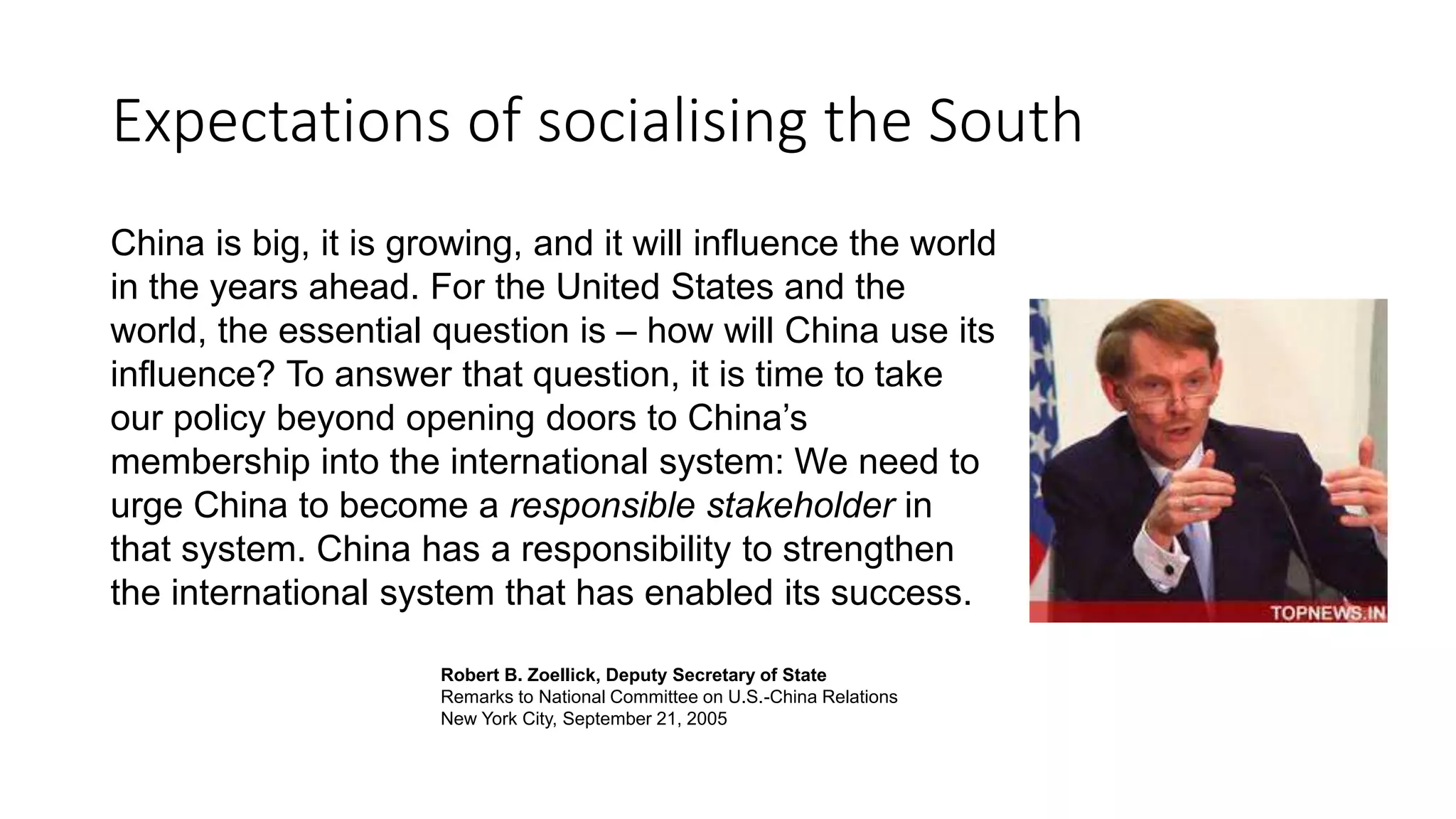
Expectations of socialising the South
China is big, it is growing, and it will influence the world
in the years ahead. For the United States and the
world, the essential question is – how will China use its
influence? To answer that question, it is time to take
our policy beyond opening doors to China’s
membership into the international system: We need to
urge China to become a responsible stakeholder in
that system. China has a responsibility to strengthen
the international system that has enabled its success.
Robert B. Zoellick, Deputy Secretary of State
Remarks to National Committee on U.S.-China Relations
New York City, September 21, 2005
Argument
• Convergence, collaboration, competition, cooption all evident within
the international development landscape
• Much of the focus has been on the question of ‘South to North’,
whether from a perspective of perceived desirability (e.g. Manning)
or concern (e.g. Abdenur and Fonseca 2013; Curtis 2013).
• What about ‘North to South’?
• Case Study: UK
Problematising ‘Southernisation’
• Methodological nationalism?
Problematising ‘Southernisation’
• Methodological nationalism?
• Essentialising North/South
• Which ‘South’? Cuba or China, Brazil or Botswana?
• Which ‘North’? Norway or USA? Japan or New Zealand?
Problematising ‘Southernisation’
• Methodological nationalism?
• Essentialising North/South
• Which ‘South’? Cuba or China, Brazil or Botswana?
• Which ‘North’? Norway or USA? Japan or New Zealand?
• Southernisation or DAC reversion?
• Geostrategic primacy; focus on infrastructure and growth; the value of
authoritarian leadership
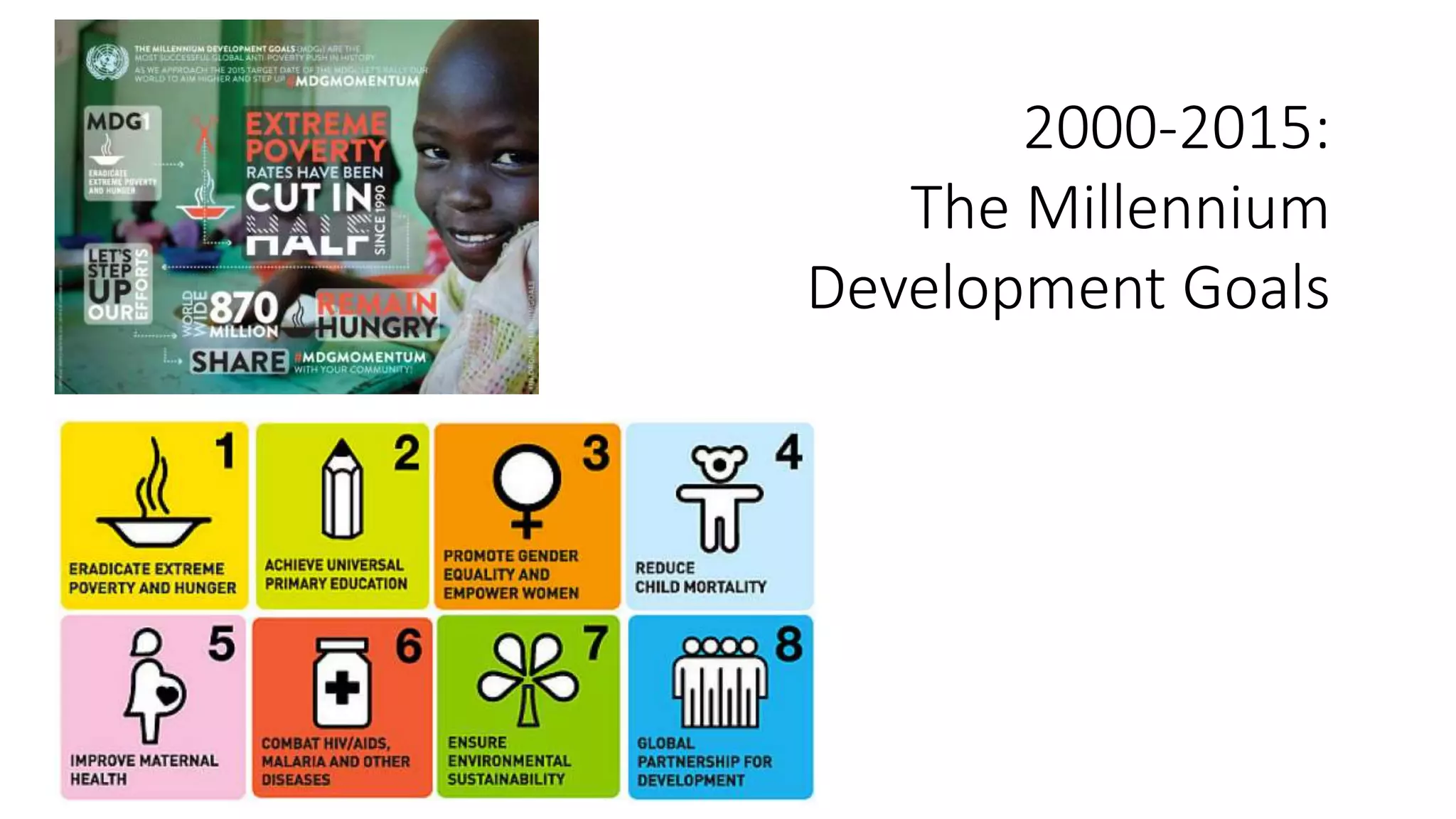
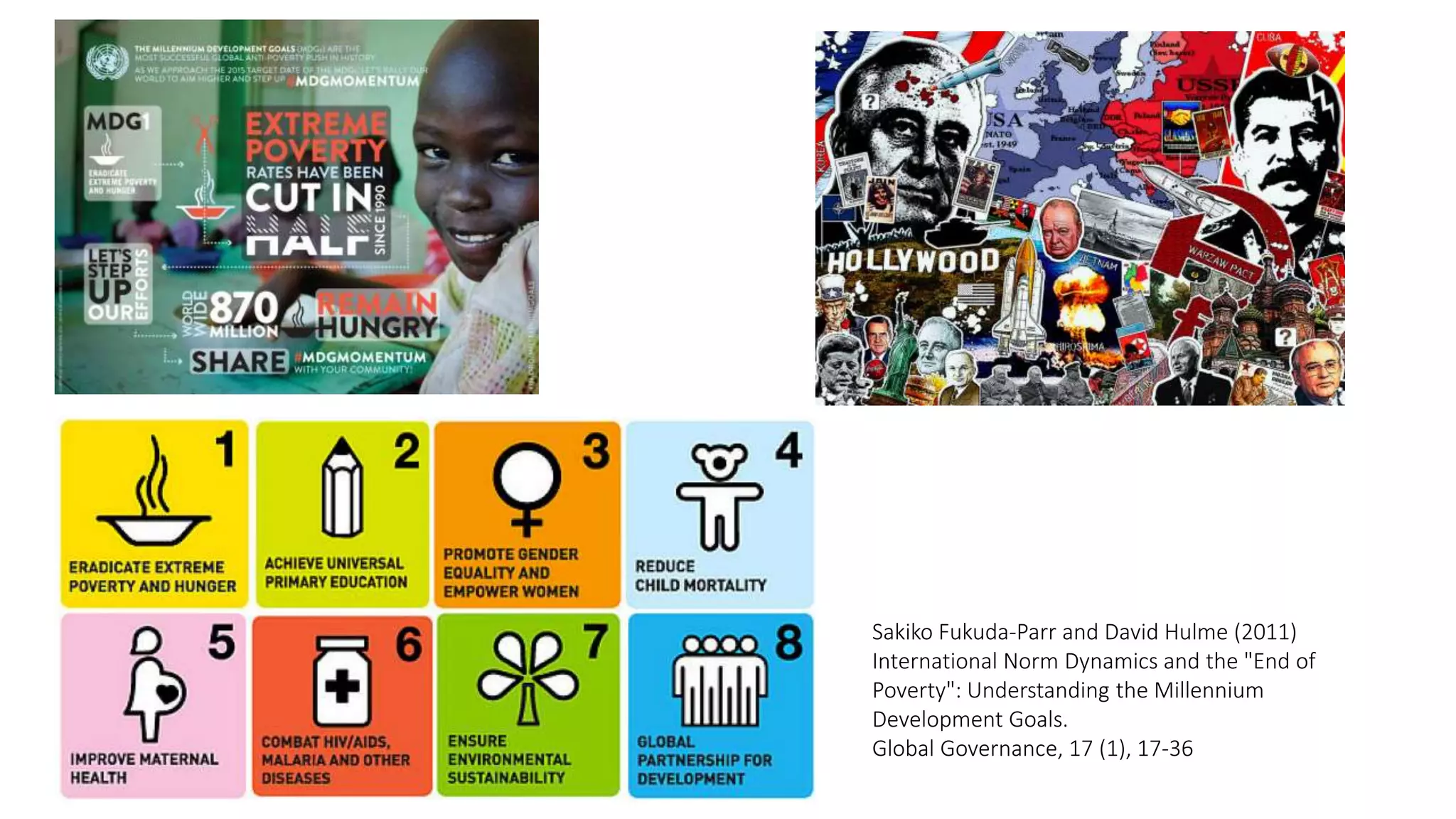
2000-2015:
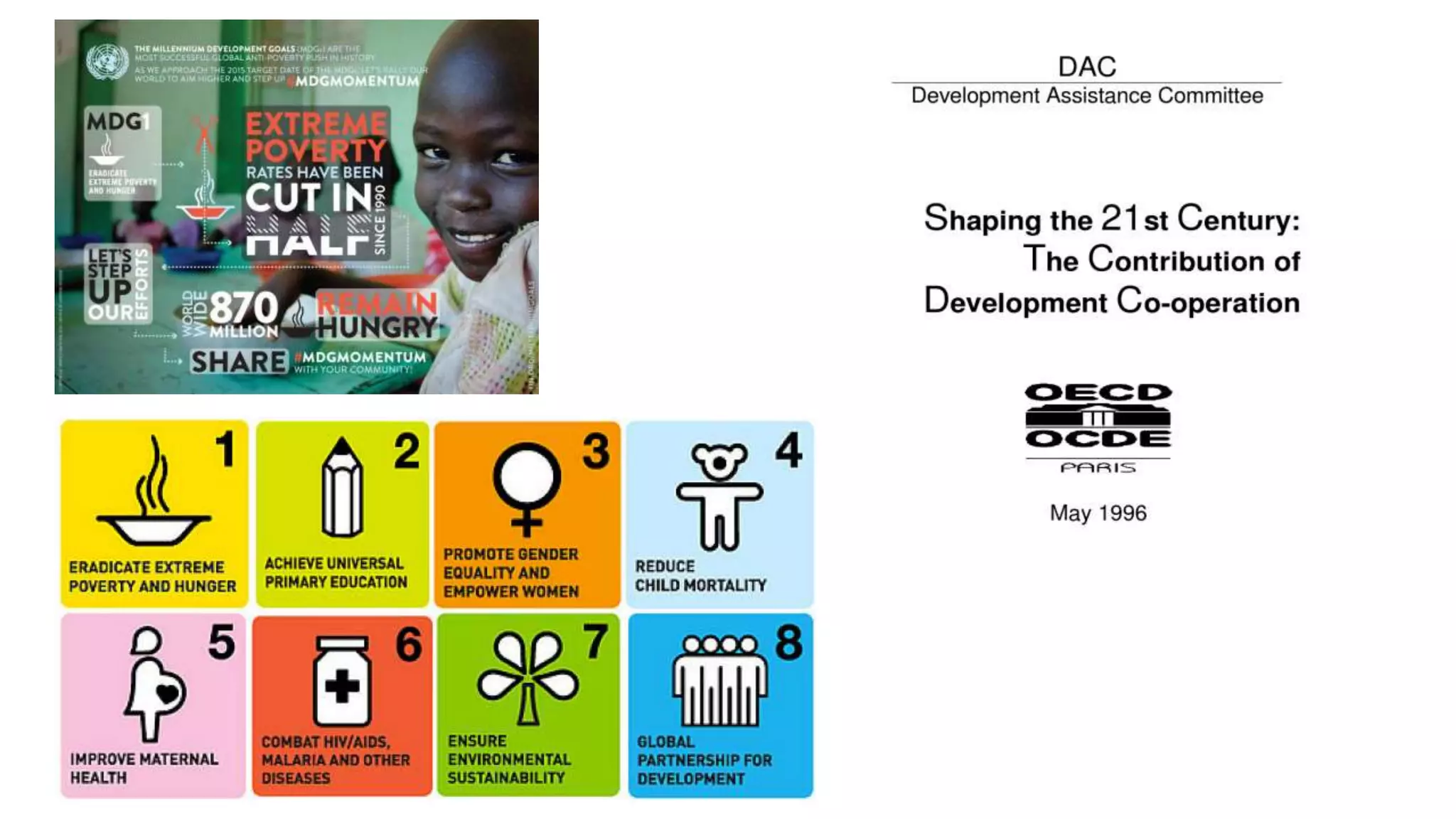
The Millennium
Development Goals
‘MDG era’
• 2000-2015 “represented an unprecedented period of international
agreement about what ‘development’ consists of, and clear targets as
to what was to be achieved” (Willis, 2016)
• Poverty reduction moved to become the ‘central analytic’ of development
• Apparent global consensus
• Partnership, responsibility, reform
• Foreign Aid (Official Development Assistance – ODA) the emblematic form of
financing
Sakiko Fukuda-Parr and David Hulme (2011)
International Norm Dynamics and the "End of
Poverty": Understanding the Millennium
Development Goals.
Global Governance, 17 (1), 17-36
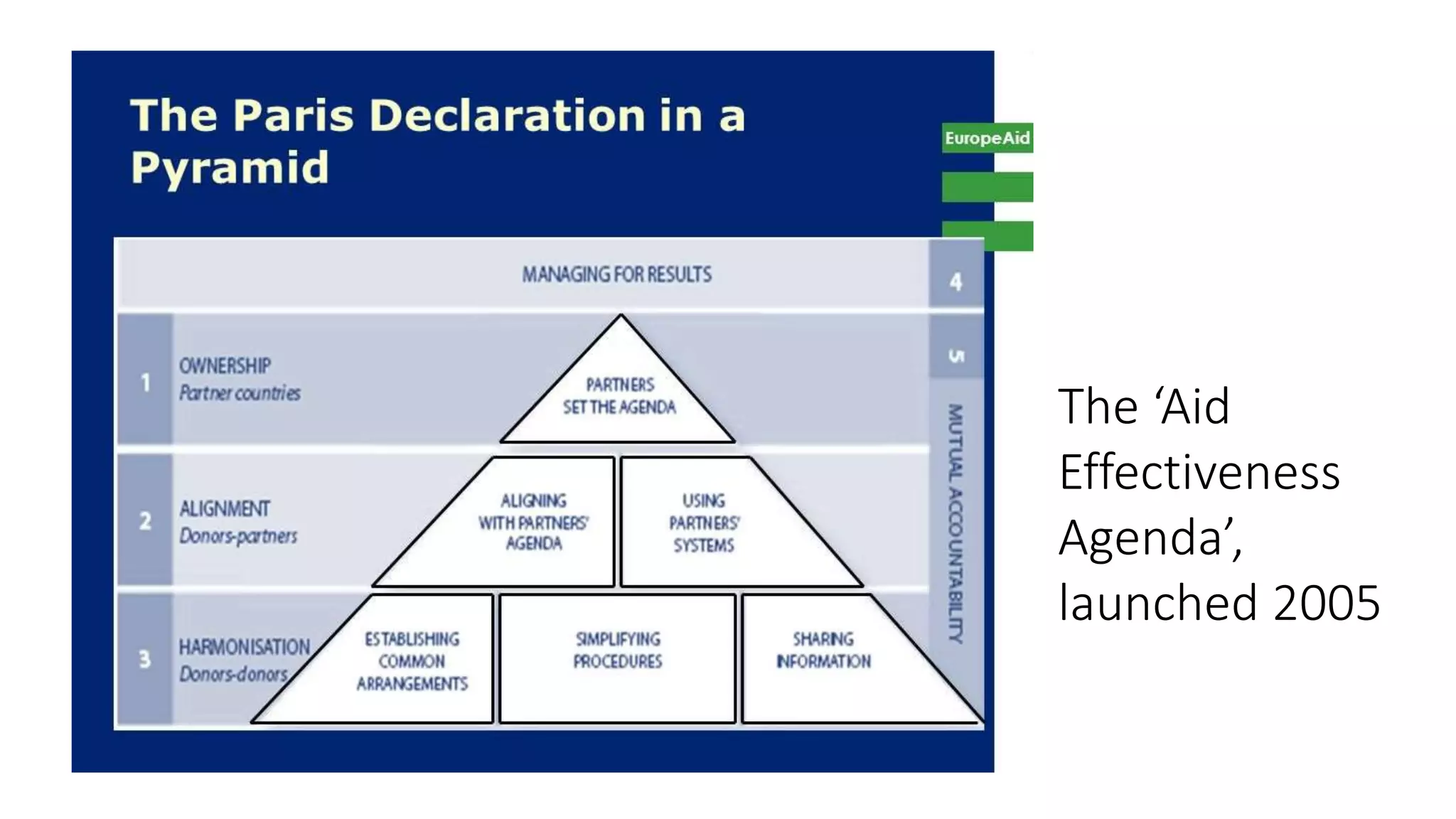
The ‘Aid
Effectiveness
Agenda’,
launched 2005
Re-engineering UK foreign aid
1) An increasingly explicit assertion that aid must work in the ‘national
interest’
Re-engineering UK foreign aid
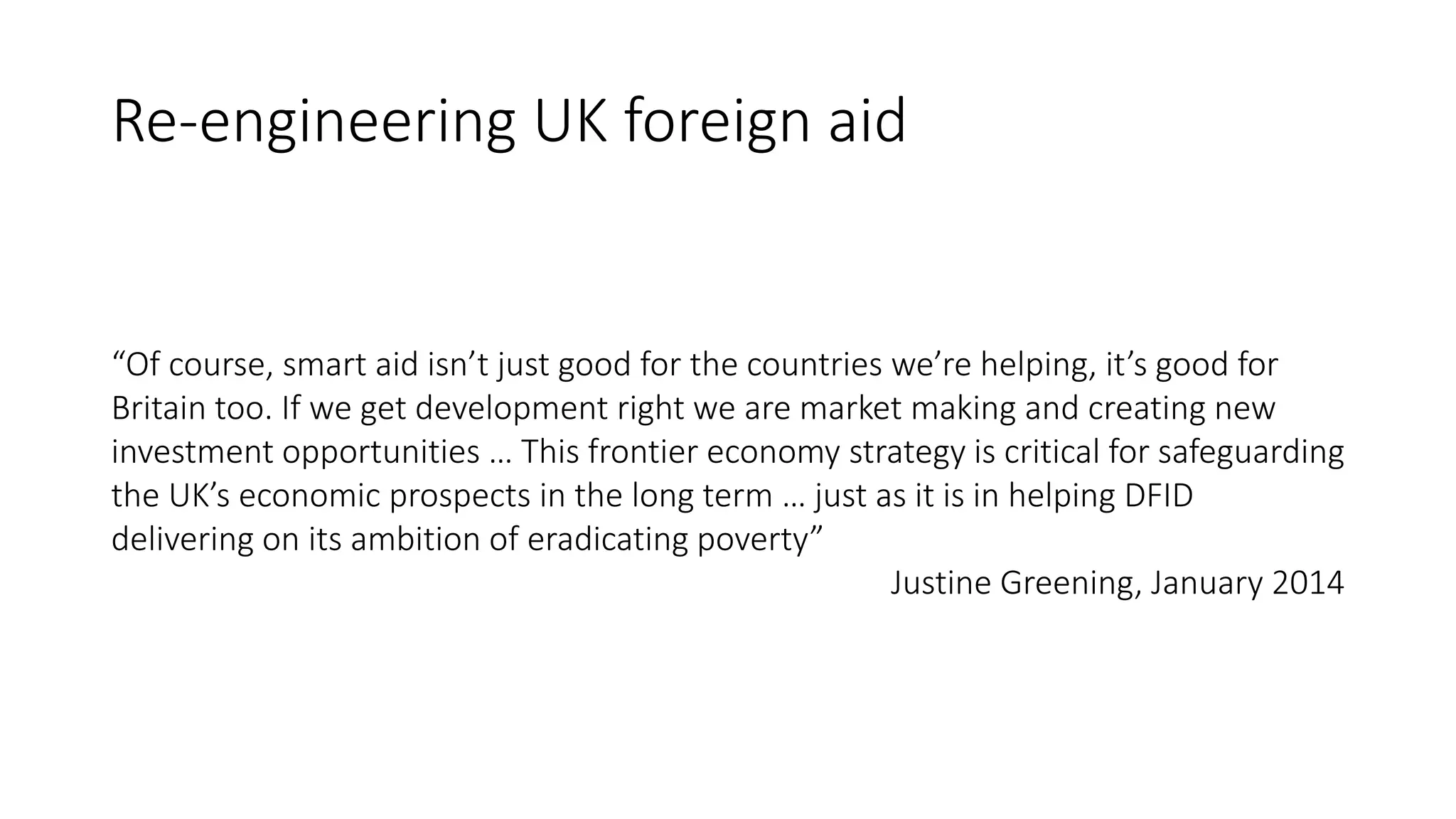
“Of course, smart aid isn’t just good for the countries we’re helping, it’s good for
Britain too. If we get development right we are market making and creating new
investment opportunities … This frontier economy strategy is critical for safeguarding
the UK’s economic prospects in the long term … just as it is in helping DFID
delivering on its ambition of eradicating poverty”
Justine Greening, January 2014
Re-engineering UK foreign aid
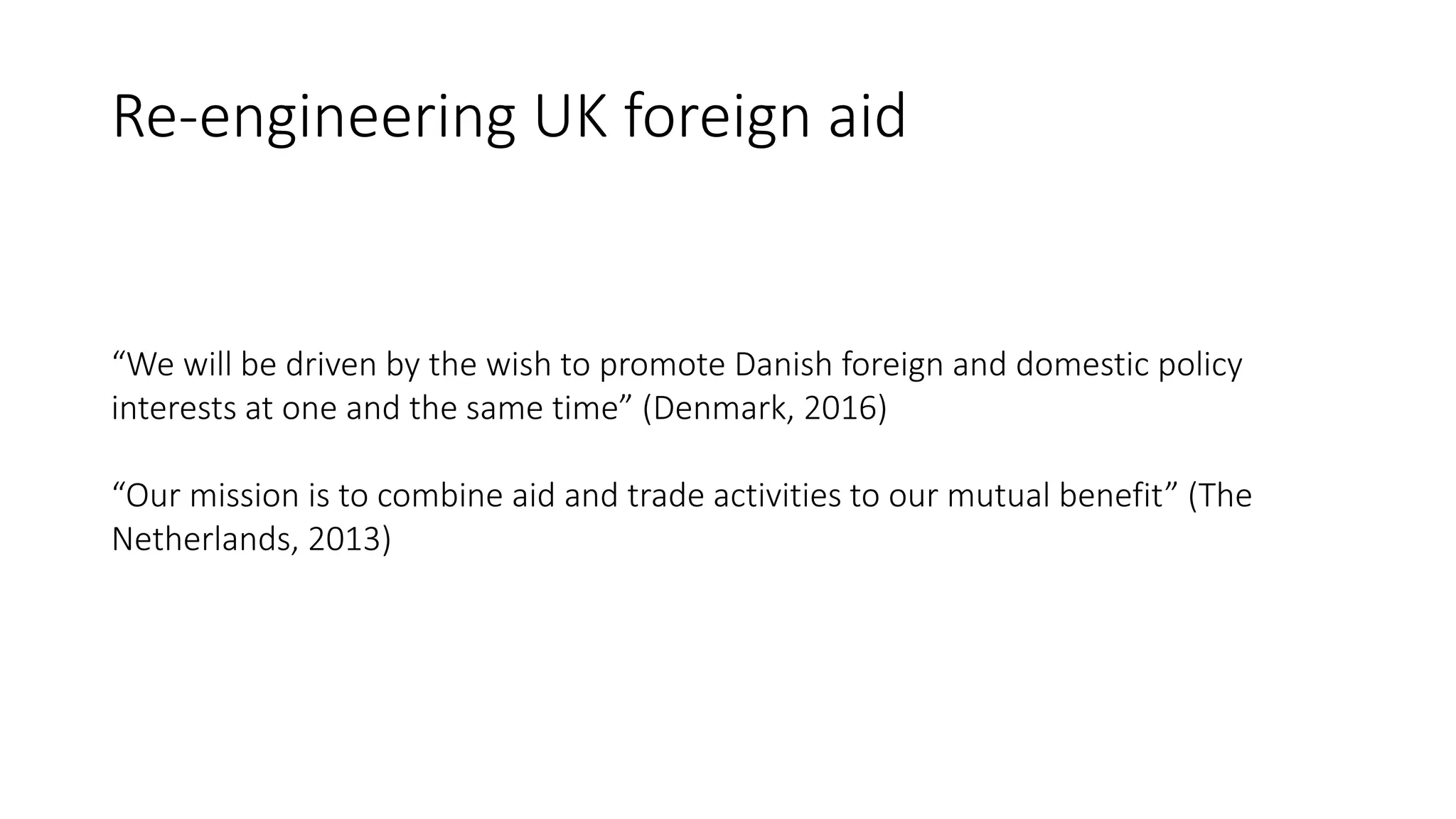
“We will be driven by the wish to promote Danish foreign and domestic policy
interests at one and the same time” (Denmark, 2016)
“Our mission is to combine aid and trade activities to our mutual benefit” (The
Netherlands, 2013)
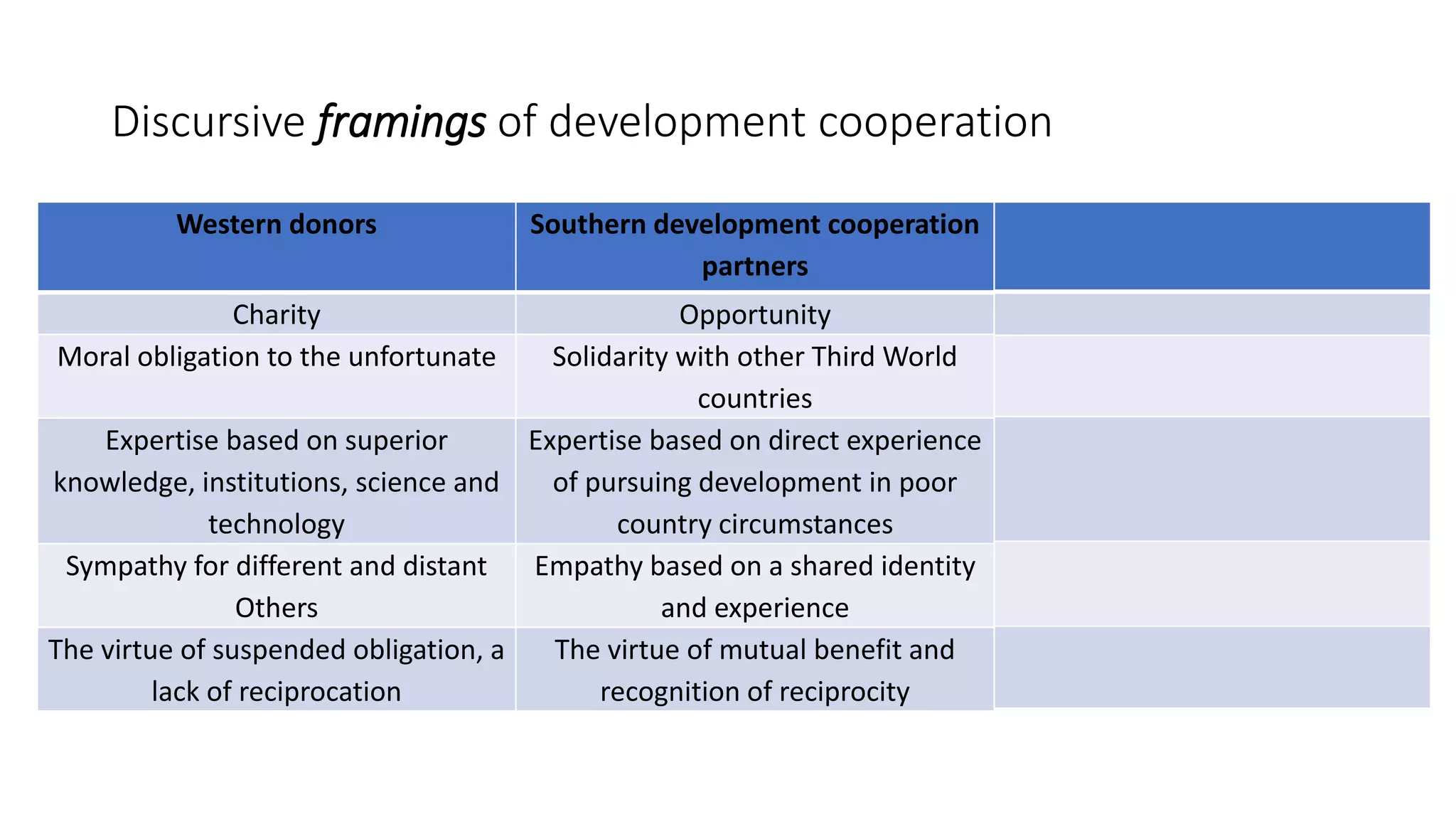
Discursive framings of development cooperation
Western donors Southern development cooperation
partners
Charity Opportunity
Moral obligation to the unfortunate Solidarity with other Third World
countries
Expertise based on superior
knowledge, institutions, science and
technology
Expertise based on direct experience
of pursuing development in poor
country circumstances
Sympathy for different and distant
Others
Empathy based on a shared identity
and experience
The virtue of suspended obligation, a
lack of reciprocation
The virtue of mutual benefit and
recognition of reciprocity
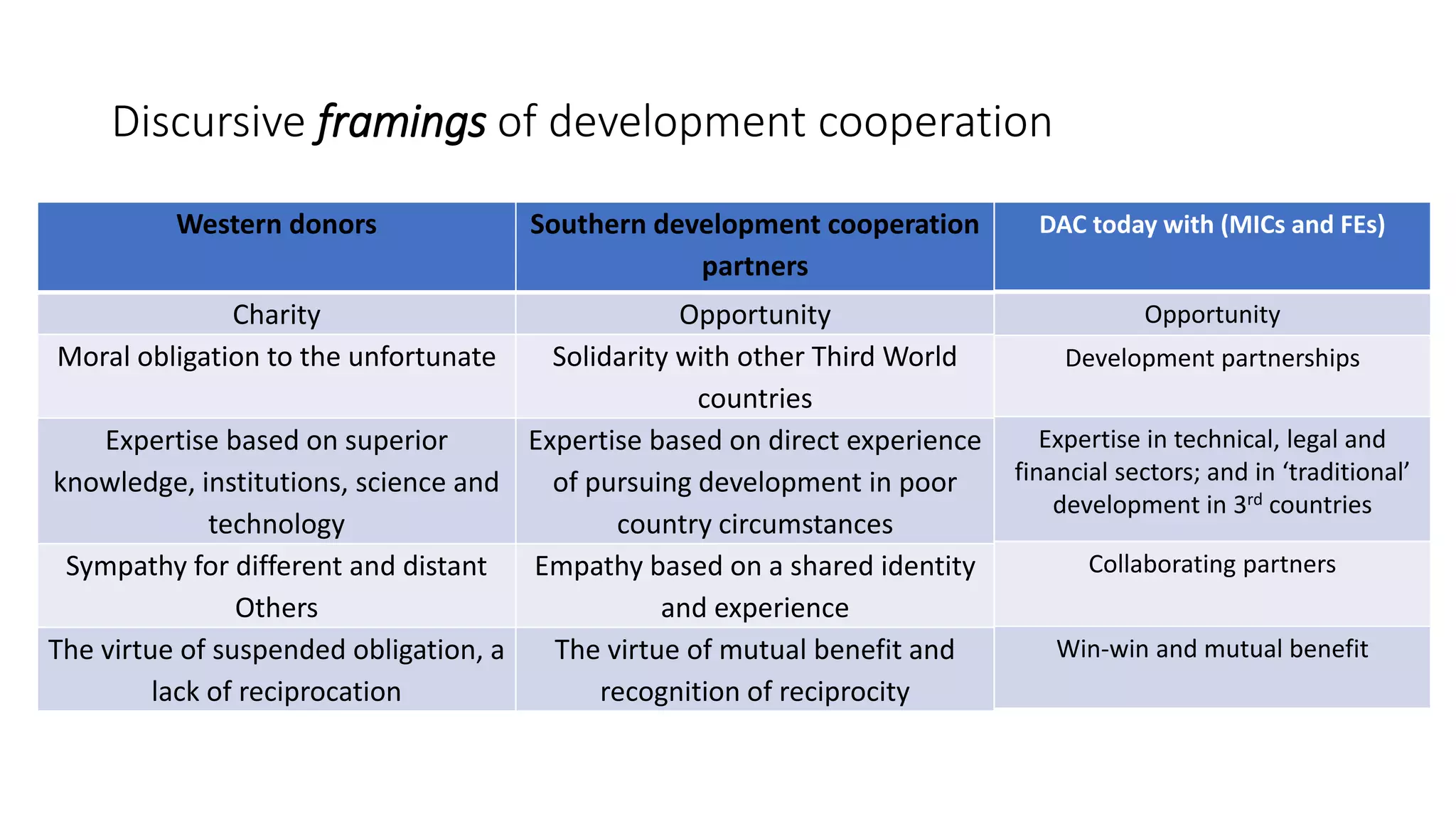
Discursive framings of development cooperation
Western donors Southern development cooperation
partners
Charity Opportunity
Moral obligation to the unfortunate Solidarity with other Third World
countries
Expertise based on superior
knowledge, institutions, science and
technology
Expertise based on direct experience
of pursuing development in poor
country circumstances
Sympathy for different and distant
Others
Empathy based on a shared identity
and experience
The virtue of suspended obligation, a
lack of reciprocation
The virtue of mutual benefit and
recognition of reciprocity
DAC today with (MICs and FEs)
Opportunity
Development partnerships
Expertise in technical, legal and
financial sectors; and in ‘traditional’
development in 3rd countries
Collaborating partners
Win-win and mutual benefit
Re-engineering UK foreign aid
2) (Re-)centring (private sector-led) economic growth
“It is my intention to recast DFID as a government department that
understands the private sector, that has at its disposal the right tools
to deliver and that is equipped to support a vibrant, resilient and
growing business sector in the poorest countries. To do this we will
need to add new types of people with different skills.”
• Andrew Mitchell, Secretary of State, speech at the LSE, 12 October 2010
Wealth creation moves to the centre
• DFID: New Private Sector Department (2011); new Director General for Economic
Development; Economic Development Strategic Framework (January 2014)
• More funding for the Commonwealth Development Corporation (CDC)
• New instruments of lending (e.g. returnable loans; DFID should “have the characteristics
of a Sovereign Wealth Fund”)
• E.g. 2013: launch of Impact Investment Fund
• New staff, contractors, programmes, funding levels and directions
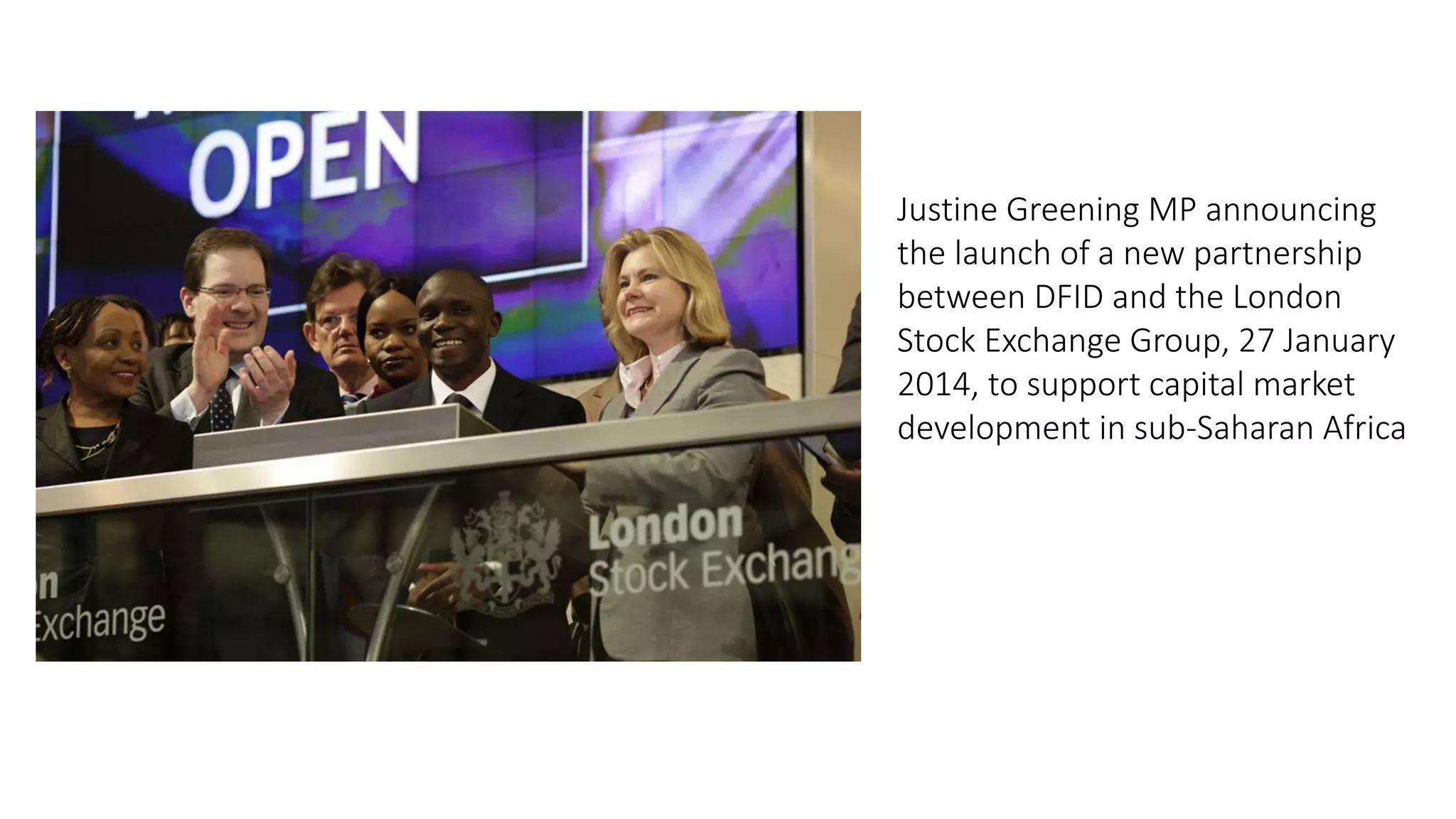
Justine Greening MP announcing
the launch of a new partnership
between DFID and the London
Stock Exchange Group, 27 January
2014, to support capital market
development in sub-Saharan Africa
“This is a win-win partnership. It
means the best run stock exchange
in the world, our stock exchange
right here in London, will be
offering their expertise to a region
where capital markets are in their
infancy. And it also means the LSEG
will have a fantastic, positive
relationship with these frontier
economies as they take off.”
Re-engineering UK foreign aid
3) Development diplomacy
• Maintaining DFID’s high standing but to a wider and different
audience
• UK’s role as one of the three co-chairs of the Global Partnership for
Effective Development Cooperation
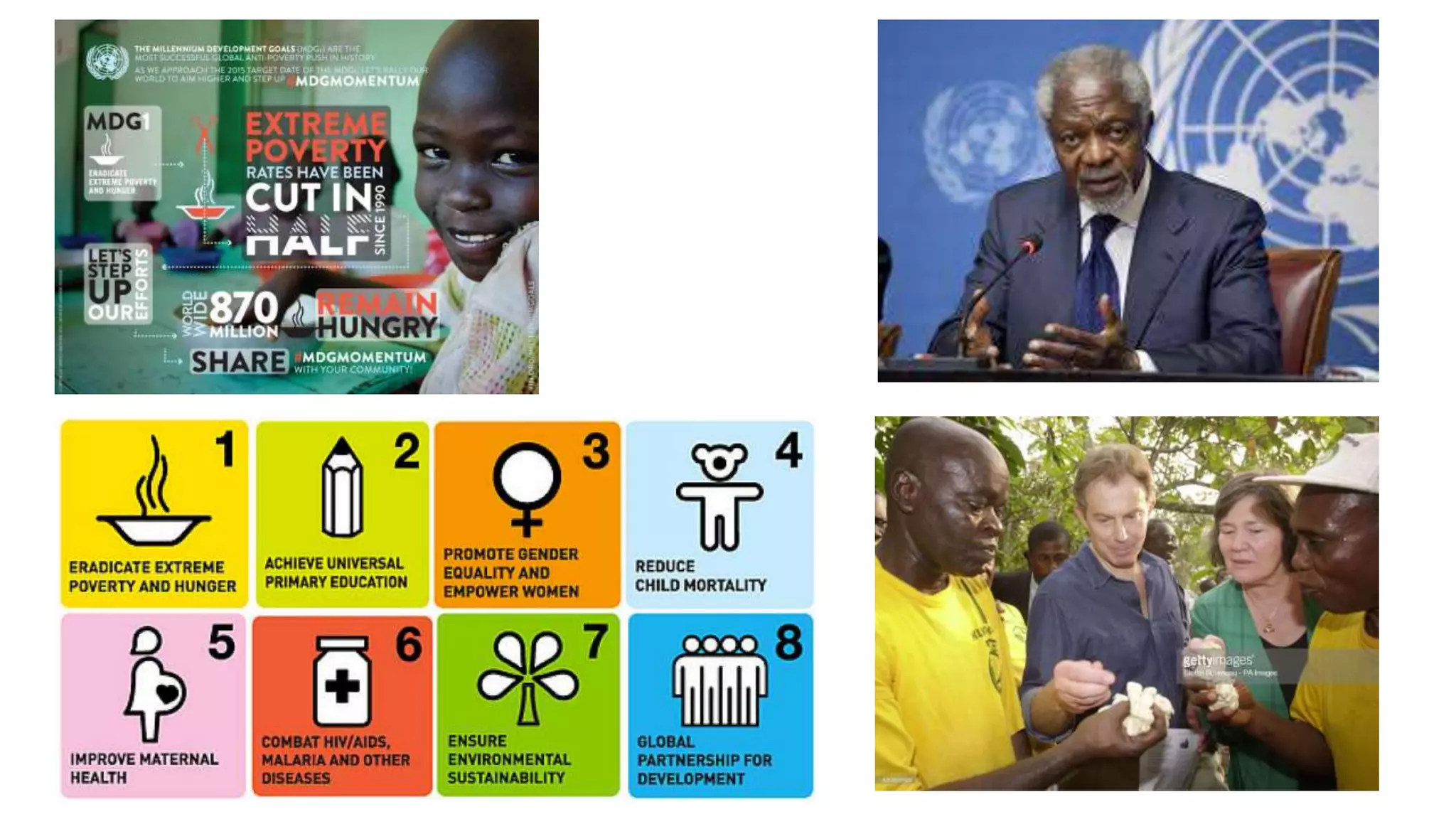
• David Cameron one of the three co-Chairs of the UN High Level Panel
on post-2015
• Creating innovative partnerships with India and China
Re-engineering UK foreign aid
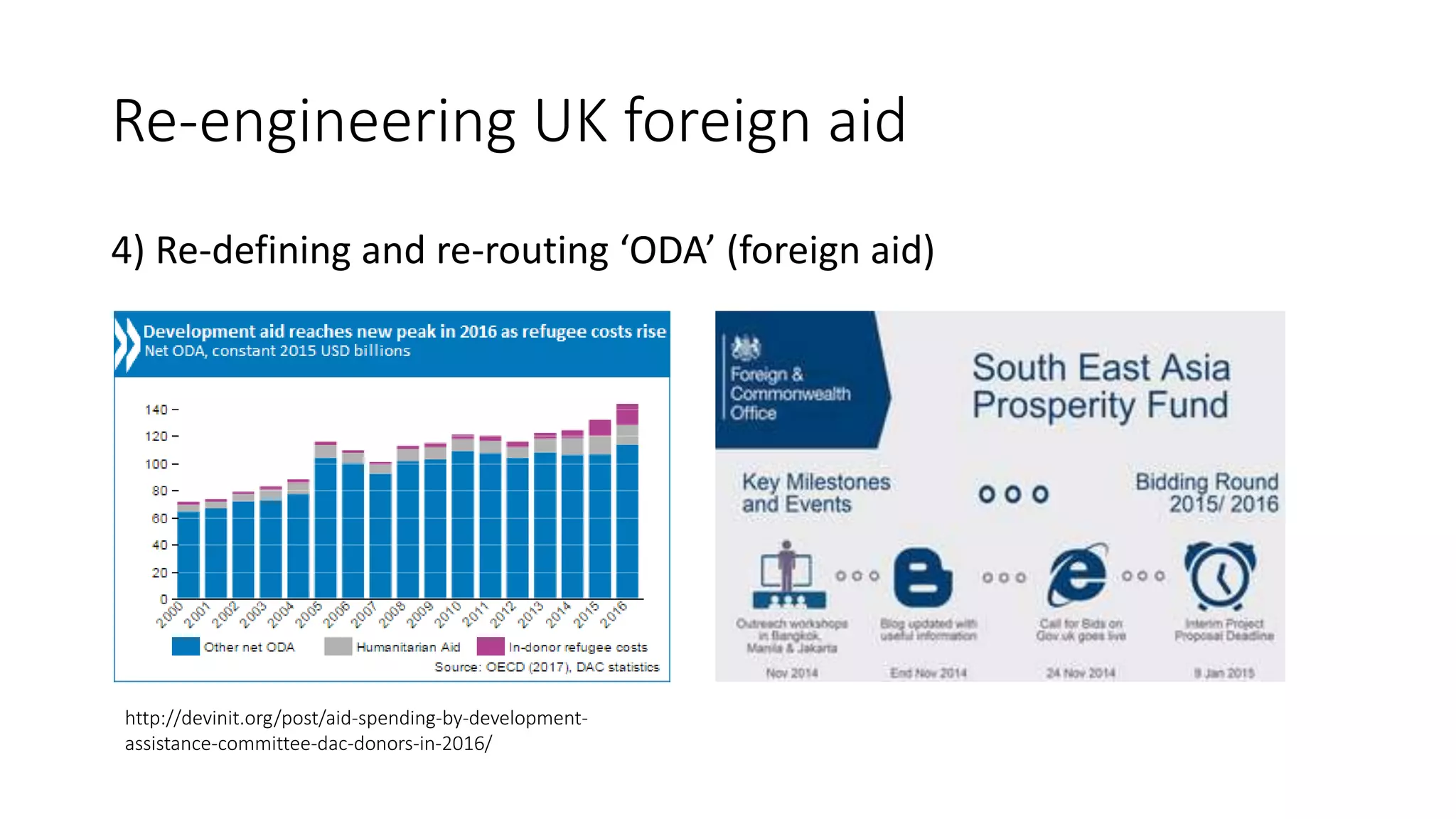
4) Re-defining and re-routing ‘ODA’ (foreign aid)
http://devinit.org/post/aid-spending-by-development-
assistance-committee-dac-donors-in-2016/
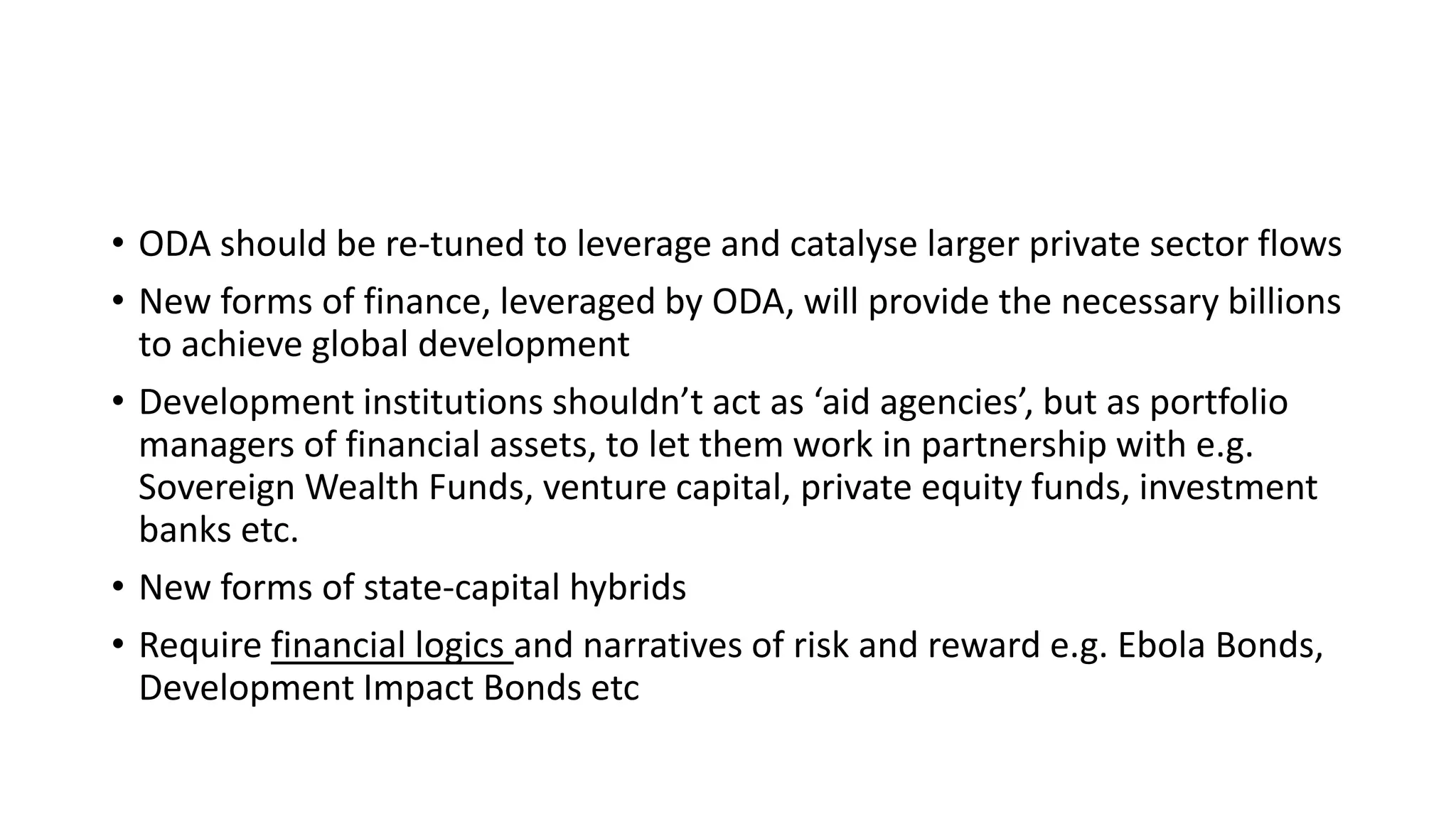
• ODA should be re-tuned to leverage and catalyse larger private sector flows
• New forms of finance, leveraged by ODA, will provide the necessary billions
to achieve global development
• Development institutions shouldn’t act as ‘aid agencies’, but as portfolio
managers of financial assets, to let them work in partnership with e.g.
Sovereign Wealth Funds, venture capital, private equity funds, investment
banks etc.
• New forms of state-capital hybrids
• Require financial logics and narratives of risk and reward e.g. Ebola Bonds,
Development Impact Bonds etc
“The launch earlier this month of the first rupee-denominated bond in
London is an example of the close and growing economic cooperation
between the UK and India and underlines the capital’s status as a
leading global hub for innovative finance … The new UK support for
India’s economic development – including two venture funds and
equity investments in innovative businesses – will help 2 million more
people across the country access the finance they need to get jobs, start
businesses and support their families. Investing in India’s private sector
benefits India’s poorest people while also generating a return on
investment for the UK, helping to build a more prosperous future for
both countries”.
Priti Patel (2016) Sec of State for International Development
Carroll and Jarvis (2014:538) argue that:
… risk mitigation for capital (including financial capital) – that is the
escorting of international capital by multilateral development
agencies into frontier and emerging market settings – has itself
become a valued form of development policy, making many (often
large) infrastructure projects and other investments proceed with
alacrity.
Conclusions: UK
• Reinvention of international development, not redundancy
• UK seeking a leadership role, institutionally and ideationally, within a more
multipolar field
• Seeking strategic partnerships with BICS, MINTS, but also ‘frontier markets’
(e.g. Ethiopia); while re-engineering ‘traditional’ alliances e.g. with India
• Paradox of stronger national interest in a period of (apparent) declining
public and political support
• Economy, growth and finance are core targets
• Significant restructuring of DFID/existing norms and architecture
• Can this be sustained in the face of considerable public, media and political
opposition?
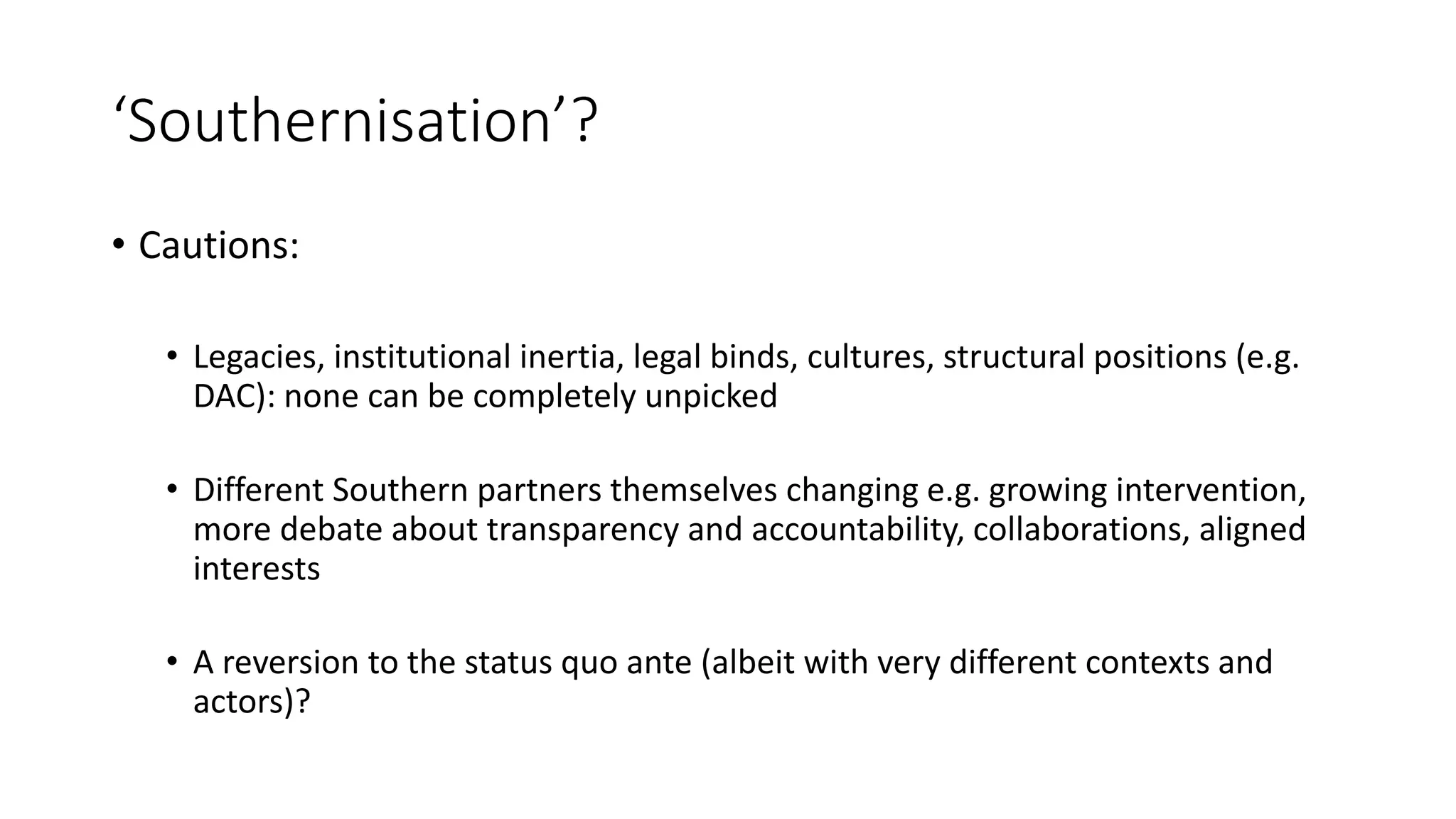
‘Southernisation’?
• Cautions:
• Legacies, institutional inertia, legal binds, cultures, structural positions (e.g.
DAC): none can be completely unpicked
• Different Southern partners themselves changing e.g. growing intervention,
more debate about transparency and accountability, collaborations, aligned
interests
• A reversion to the status quo ante (albeit with very different contexts and
actors)?
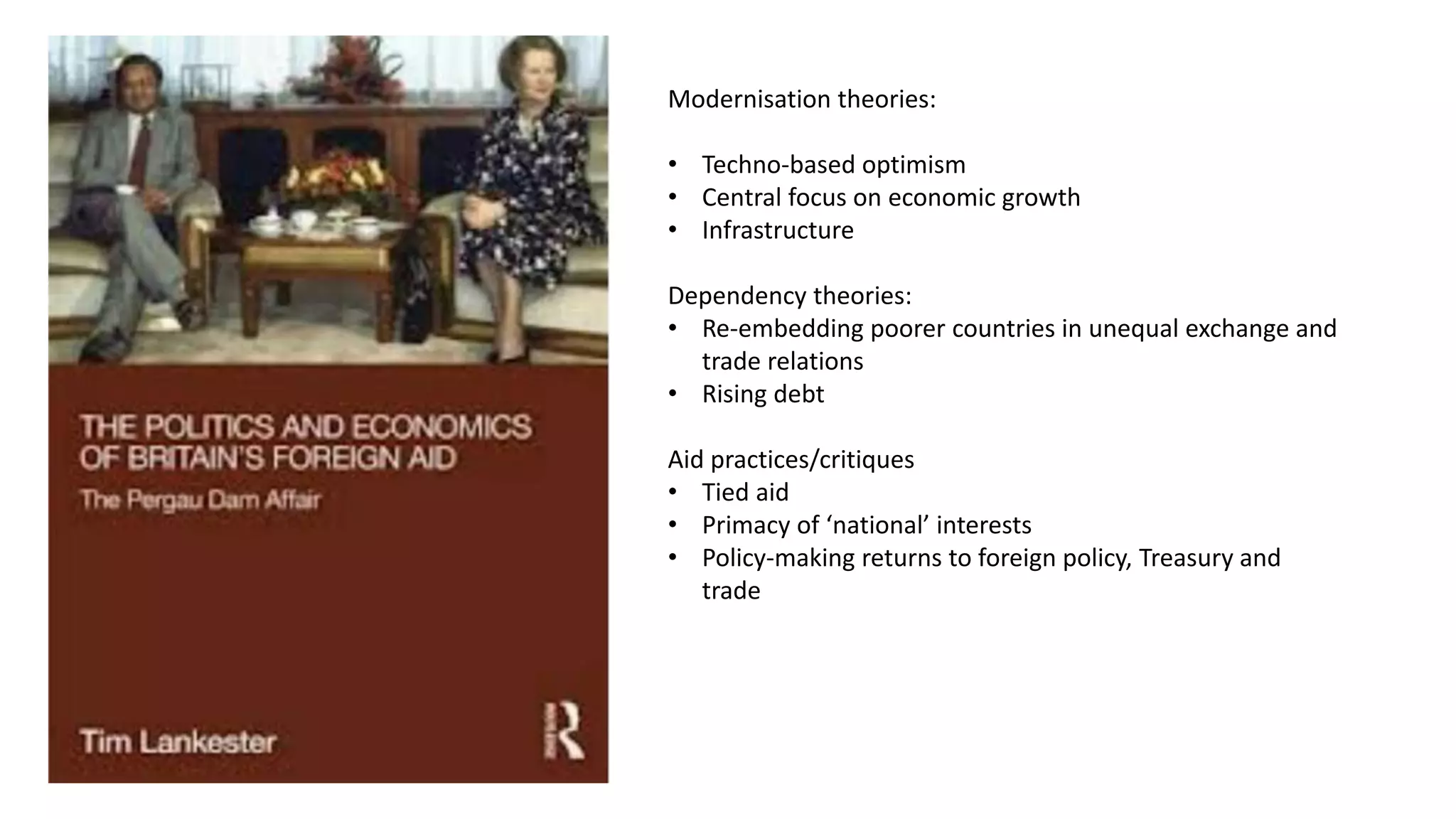
Modernisation theories:
• Techno-based optimism
• Central focus on economic growth
• Infrastructure
Dependency theories:
• Re-embedding poorer countries in unequal exchange and
trade relations
• Rising debt
Aid practices/critiques
• Tied aid
• Primacy of ‘national’ interests
• Policy-making returns to foreign policy, Treasury and
trade

Bandung
Conference
Non-Aligned Movement
Demand for a New International Economic
Order (NIEO)
South-South Development Cooperation
Hart’s schematic of the IPE of d/Development
What now?

Bandung
Conference
Non-Aligned Movement
Demand for a New International Economic
Order (NIEO)
South-South Development Cooperation
Hart’s schematic of the IPE of d/Development
Dollar-Wall St++
(financialisation);
Neo-mercantilism
State-capital hybrids

GDI Lecture Series: The Southernisation of Development with Emma Mawdsley

  • 1.
    The ‘Southernisation’ ofDevelopment: are the DAC donors moving South? Emma Mawdsley University of Cambridge
  • 2.
  • 3.
  • 5.
    Hart’s schematic ofthe IPE of d/Development
  • 6.
     Bandung Conference Non-Aligned Movement Demand fora New International Economic Order (NIEO) South-South Development Cooperation Hart’s schematic of the IPE of d/Development
  • 7.
     Bandung Conference Non-Aligned Movement Demand fora New International Economic Order (NIEO) South-South Development Cooperation Hart’s schematic of the IPE of d/Development What now?
  • 8.
    Argument • Convergence, collaboration,competition, cooption all evident within the international development landscape • Much of the focus has been on the question of ‘South to North’, whether from a perspective of perceived desirability (e.g. Manning 2006) or concern (e.g. Abdenur and Fonseca 2013; Curtis 2013).
  • 9.
    Expectations of socialisingthe South China is big, it is growing, and it will influence the world in the years ahead. For the United States and the world, the essential question is – how will China use its influence? To answer that question, it is time to take our policy beyond opening doors to China’s membership into the international system: We need to urge China to become a responsible stakeholder in that system. China has a responsibility to strengthen the international system that has enabled its success. Robert B. Zoellick, Deputy Secretary of State Remarks to National Committee on U.S.-China Relations New York City, September 21, 2005
  • 10.
    Argument • Convergence, collaboration,competition, cooption all evident within the international development landscape • Much of the focus has been on the question of ‘South to North’, whether from a perspective of perceived desirability (e.g. Manning) or concern (e.g. Abdenur and Fonseca 2013; Curtis 2013). • What about ‘North to South’? • Case Study: UK
  • 11.
  • 12.
    Problematising ‘Southernisation’ • Methodologicalnationalism? • Essentialising North/South • Which ‘South’? Cuba or China, Brazil or Botswana? • Which ‘North’? Norway or USA? Japan or New Zealand?
  • 13.
    Problematising ‘Southernisation’ • Methodologicalnationalism? • Essentialising North/South • Which ‘South’? Cuba or China, Brazil or Botswana? • Which ‘North’? Norway or USA? Japan or New Zealand? • Southernisation or DAC reversion? • Geostrategic primacy; focus on infrastructure and growth; the value of authoritarian leadership
  • 14.
  • 15.
    ‘MDG era’ • 2000-2015“represented an unprecedented period of international agreement about what ‘development’ consists of, and clear targets as to what was to be achieved” (Willis, 2016) • Poverty reduction moved to become the ‘central analytic’ of development • Apparent global consensus • Partnership, responsibility, reform • Foreign Aid (Official Development Assistance – ODA) the emblematic form of financing
  • 16.
    Sakiko Fukuda-Parr andDavid Hulme (2011) International Norm Dynamics and the "End of Poverty": Understanding the Millennium Development Goals. Global Governance, 17 (1), 17-36
  • 20.
  • 24.
    Re-engineering UK foreignaid 1) An increasingly explicit assertion that aid must work in the ‘national interest’
  • 25.
    Re-engineering UK foreignaid “Of course, smart aid isn’t just good for the countries we’re helping, it’s good for Britain too. If we get development right we are market making and creating new investment opportunities … This frontier economy strategy is critical for safeguarding the UK’s economic prospects in the long term … just as it is in helping DFID delivering on its ambition of eradicating poverty” Justine Greening, January 2014
  • 26.
    Re-engineering UK foreignaid “We will be driven by the wish to promote Danish foreign and domestic policy interests at one and the same time” (Denmark, 2016) “Our mission is to combine aid and trade activities to our mutual benefit” (The Netherlands, 2013)
  • 27.
    Discursive framings ofdevelopment cooperation Western donors Southern development cooperation partners Charity Opportunity Moral obligation to the unfortunate Solidarity with other Third World countries Expertise based on superior knowledge, institutions, science and technology Expertise based on direct experience of pursuing development in poor country circumstances Sympathy for different and distant Others Empathy based on a shared identity and experience The virtue of suspended obligation, a lack of reciprocation The virtue of mutual benefit and recognition of reciprocity
  • 28.
    Discursive framings ofdevelopment cooperation Western donors Southern development cooperation partners Charity Opportunity Moral obligation to the unfortunate Solidarity with other Third World countries Expertise based on superior knowledge, institutions, science and technology Expertise based on direct experience of pursuing development in poor country circumstances Sympathy for different and distant Others Empathy based on a shared identity and experience The virtue of suspended obligation, a lack of reciprocation The virtue of mutual benefit and recognition of reciprocity DAC today with (MICs and FEs) Opportunity Development partnerships Expertise in technical, legal and financial sectors; and in ‘traditional’ development in 3rd countries Collaborating partners Win-win and mutual benefit
  • 29.
    Re-engineering UK foreignaid 2) (Re-)centring (private sector-led) economic growth “It is my intention to recast DFID as a government department that understands the private sector, that has at its disposal the right tools to deliver and that is equipped to support a vibrant, resilient and growing business sector in the poorest countries. To do this we will need to add new types of people with different skills.” • Andrew Mitchell, Secretary of State, speech at the LSE, 12 October 2010
  • 30.
    Wealth creation movesto the centre • DFID: New Private Sector Department (2011); new Director General for Economic Development; Economic Development Strategic Framework (January 2014) • More funding for the Commonwealth Development Corporation (CDC) • New instruments of lending (e.g. returnable loans; DFID should “have the characteristics of a Sovereign Wealth Fund”) • E.g. 2013: launch of Impact Investment Fund • New staff, contractors, programmes, funding levels and directions
  • 31.
    Justine Greening MPannouncing the launch of a new partnership between DFID and the London Stock Exchange Group, 27 January 2014, to support capital market development in sub-Saharan Africa
  • 32.
    “This is awin-win partnership. It means the best run stock exchange in the world, our stock exchange right here in London, will be offering their expertise to a region where capital markets are in their infancy. And it also means the LSEG will have a fantastic, positive relationship with these frontier economies as they take off.”
  • 33.
    Re-engineering UK foreignaid 3) Development diplomacy • Maintaining DFID’s high standing but to a wider and different audience • UK’s role as one of the three co-chairs of the Global Partnership for Effective Development Cooperation • David Cameron one of the three co-Chairs of the UN High Level Panel on post-2015 • Creating innovative partnerships with India and China
  • 35.
    Re-engineering UK foreignaid 4) Re-defining and re-routing ‘ODA’ (foreign aid) http://devinit.org/post/aid-spending-by-development- assistance-committee-dac-donors-in-2016/
  • 36.
    • ODA shouldbe re-tuned to leverage and catalyse larger private sector flows • New forms of finance, leveraged by ODA, will provide the necessary billions to achieve global development • Development institutions shouldn’t act as ‘aid agencies’, but as portfolio managers of financial assets, to let them work in partnership with e.g. Sovereign Wealth Funds, venture capital, private equity funds, investment banks etc. • New forms of state-capital hybrids • Require financial logics and narratives of risk and reward e.g. Ebola Bonds, Development Impact Bonds etc
  • 37.
    “The launch earlierthis month of the first rupee-denominated bond in London is an example of the close and growing economic cooperation between the UK and India and underlines the capital’s status as a leading global hub for innovative finance … The new UK support for India’s economic development – including two venture funds and equity investments in innovative businesses – will help 2 million more people across the country access the finance they need to get jobs, start businesses and support their families. Investing in India’s private sector benefits India’s poorest people while also generating a return on investment for the UK, helping to build a more prosperous future for both countries”. Priti Patel (2016) Sec of State for International Development
  • 38.
    Carroll and Jarvis(2014:538) argue that: … risk mitigation for capital (including financial capital) – that is the escorting of international capital by multilateral development agencies into frontier and emerging market settings – has itself become a valued form of development policy, making many (often large) infrastructure projects and other investments proceed with alacrity.
  • 39.
    Conclusions: UK • Reinventionof international development, not redundancy • UK seeking a leadership role, institutionally and ideationally, within a more multipolar field • Seeking strategic partnerships with BICS, MINTS, but also ‘frontier markets’ (e.g. Ethiopia); while re-engineering ‘traditional’ alliances e.g. with India • Paradox of stronger national interest in a period of (apparent) declining public and political support • Economy, growth and finance are core targets • Significant restructuring of DFID/existing norms and architecture • Can this be sustained in the face of considerable public, media and political opposition?
  • 40.
    ‘Southernisation’? • Cautions: • Legacies,institutional inertia, legal binds, cultures, structural positions (e.g. DAC): none can be completely unpicked • Different Southern partners themselves changing e.g. growing intervention, more debate about transparency and accountability, collaborations, aligned interests • A reversion to the status quo ante (albeit with very different contexts and actors)?
  • 41.
    Modernisation theories: • Techno-basedoptimism • Central focus on economic growth • Infrastructure Dependency theories: • Re-embedding poorer countries in unequal exchange and trade relations • Rising debt Aid practices/critiques • Tied aid • Primacy of ‘national’ interests • Policy-making returns to foreign policy, Treasury and trade
  • 42.
     Bandung Conference Non-Aligned Movement Demand fora New International Economic Order (NIEO) South-South Development Cooperation Hart’s schematic of the IPE of d/Development What now?
  • 43.
     Bandung Conference Non-Aligned Movement Demand fora New International Economic Order (NIEO) South-South Development Cooperation Hart’s schematic of the IPE of d/Development Dollar-Wall St++ (financialisation); Neo-mercantilism State-capital hybrids