Property Strategy
Corporate and Property Strategy
An organisation holds property in order to undertake its core
business
A co-ordinated property strategy is essential to the effective
management of an organisation’s property.
Property Strategy
• According to Balch the Property Strategy should
ask:-
• What is the property objective?
• What difficulties are there that need to be overcome to
achieve that objective?
• What opportunities are there to be exploited?
• This can be analysed using a SWOT Analysis
• How can the property requirements be funded?
• Over what timescale can the objectives be achieved?"
(Balch, 1994)
Basic considerations
• Why are we holding this property? - Is it central to the
organisation’s activities, e.g a factory, classroom, ward, etc; or is
it ancillary e.g. admin office, storage etc?
• Does geography matter? A hospital has to be accessible to its
patients. A call centre can be anywhere in the world.
• How important is interpersonal interaction between staff? Can
they work from home?
• How much space is required for the function?
• Is image important?
Adapted from Nourse and Roulac, 1993
Questions
•Does the organisation know the effect of property on
the organisation’s profitability?
•Are you in the most efficient location?
•Do you have too much or too little space?
•Are you better off owning or leasing?
Property Strategy
• "Developing a property strategy requires the collation of
certain and essential basic evidence:-
• What do you own?
• What is its purpose?
• What is its utilisation?
• What is it's functional suitability?
• What does it cost to run?
• What is its opportunity cost?
• What is it value?
• What is its condition?
• What is its energy performance?"
(Balch, 1994)
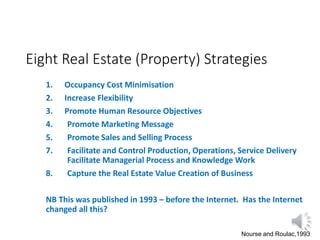
Eight Real Estate (Property) Strategies
1. Occupancy Cost Minimisation
2. Increase Flexibility
3. Promote Human Resource Objectives
4. Promote Marketing Message
5. Promote Sales and Selling Process
7. Facilitate and Control Production, Operations, Service Delivery
Facilitate Managerial Process and Knowledge Work
8. Capture the Real Estate Value Creation of Business
NB This was published in 1993 – before the Internet. Has the Internet
changed all this?
Nourse and Roulac,1993
Corporate Strategic Alignment
• Successful corporate strategic alignment depends on:-
• a clear corporate vision and well defined strategies to accompany the vision
• engaged senior management supportive of the corporate real estate link
• business units and functional support units must be linked to the strategic
planning process
• corporate real estate internal relationships and outside service providers must
be managed to support the corporate vision and a strategic management
process
• strategic alignment will produce a keener competitive capability and can produce
high levels of shareholder value.
Englert, 2001

Property strategy

  • 1.
  • 2.
    Corporate and PropertyStrategy An organisation holds property in order to undertake its core business A co-ordinated property strategy is essential to the effective management of an organisation’s property.
  • 3.
    Property Strategy • Accordingto Balch the Property Strategy should ask:- • What is the property objective? • What difficulties are there that need to be overcome to achieve that objective? • What opportunities are there to be exploited? • This can be analysed using a SWOT Analysis • How can the property requirements be funded? • Over what timescale can the objectives be achieved?" (Balch, 1994)
  • 4.
    Basic considerations • Whyare we holding this property? - Is it central to the organisation’s activities, e.g a factory, classroom, ward, etc; or is it ancillary e.g. admin office, storage etc? • Does geography matter? A hospital has to be accessible to its patients. A call centre can be anywhere in the world. • How important is interpersonal interaction between staff? Can they work from home? • How much space is required for the function? • Is image important? Adapted from Nourse and Roulac, 1993
  • 5.
    Questions •Does the organisationknow the effect of property on the organisation’s profitability? •Are you in the most efficient location? •Do you have too much or too little space? •Are you better off owning or leasing?
  • 6.
    Property Strategy • "Developinga property strategy requires the collation of certain and essential basic evidence:- • What do you own? • What is its purpose? • What is its utilisation? • What is it's functional suitability? • What does it cost to run? • What is its opportunity cost? • What is it value? • What is its condition? • What is its energy performance?" (Balch, 1994)
  • 7.
    Eight Real Estate(Property) Strategies 1. Occupancy Cost Minimisation 2. Increase Flexibility 3. Promote Human Resource Objectives 4. Promote Marketing Message 5. Promote Sales and Selling Process 7. Facilitate and Control Production, Operations, Service Delivery Facilitate Managerial Process and Knowledge Work 8. Capture the Real Estate Value Creation of Business NB This was published in 1993 – before the Internet. Has the Internet changed all this? Nourse and Roulac,1993
  • 8.
    Corporate Strategic Alignment •Successful corporate strategic alignment depends on:- • a clear corporate vision and well defined strategies to accompany the vision • engaged senior management supportive of the corporate real estate link • business units and functional support units must be linked to the strategic planning process • corporate real estate internal relationships and outside service providers must be managed to support the corporate vision and a strategic management process • strategic alignment will produce a keener competitive capability and can produce high levels of shareholder value. Englert, 2001