Grounding Self & Collective Care in Social Justice
Building Self-Care into
Community Engaged Work
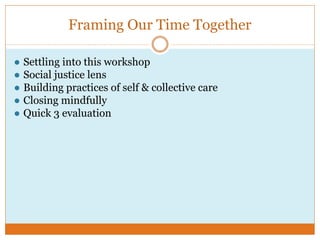
Framing Our Time Together
● Settling into this workshop
● Social justice lens
● Building practices of self & collective care
● Closing mindfully
● Quick 3 evaluation
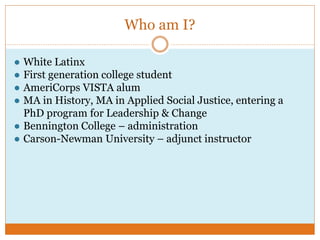
Who am I?
● White Latinx
● First generation college student
● AmeriCorps VISTA alum
● MA in History, MA in Applied Social Justice, entering a
PhD program for Leadership & Change
● Bennington College – administration
● Carson-Newman University – adjunct instructor
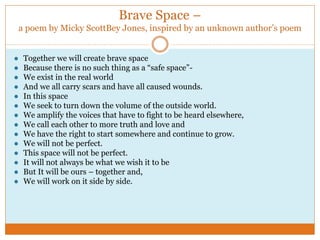
Brave Space –
a poem by Micky ScottBey Jones, inspired by an unknown author’s poem
● Together we will create brave space
● Because there is no such thing as a “safe space”-
● We exist in the real world
● And we all carry scars and have all caused wounds.
● In this space
● We seek to turn down the volume of the outside world.
● We amplify the voices that have to fight to be heard elsewhere,
● We call each other to more truth and love and
● We have the right to start somewhere and continue to grow.
● We will not be perfect.
● This space will not be perfect.
● It will not always be what we wish it to be
● But It will be ours – together and,
● We will work on it side by side.
Self & Collective Care is Community Engagement
● Checking in with ourselves: Meditation
● Checking in with our community: Community
Connections + The West Wing hybrid
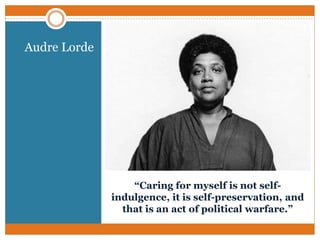
“Caring for myself is not self-
indulgence, it is self-preservation, and
that is an act of political warfare.”
Audre Lorde
Liberatory Leadership
● “Systems of oppression de-center liberatory
approaches in leadership, leading to high rates of
burnout, overwhelm, ineffective campaigns, a
revolving door for people of color, surface
relationships and high levels of physical, mental,
spiritual and emotional duress.”
● “When practice and action meet, we are able to show
up sustainably and consistently as leaders for long
haul social change.”
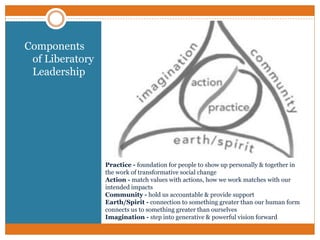
Practice - foundation for people to show up personally & together in
the work of transformative social change
Action - match values with actions, how we work matches with our
intended impacts
Community - hold us accountable & provide support
Earth/Spirit - connection to something greater than our human form
connects us to something greater than ourselves
Imagination - step into generative & powerful vision forward
Components
of Liberatory
Leadership
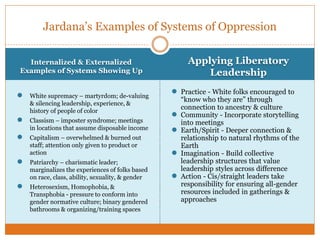
Internalized & Externalized
Examples of Systems Showing Up
Applying Liberatory
Leadership
● Practice - White folks encouraged to
“know who they are” through
connection to ancestry & culture
● Community - Incorporate storytelling
into meetings
● Earth/Spirit - Deeper connection &
relationship to natural rhythms of the
Earth
● Imagination - Build collective
leadership structures that value
leadership styles across difference
● Action - Cis/straight leaders take
responsibility for ensuring all-gender
resources included in gatherings &
approaches
Jardana’s Examples of Systems of Oppression
● White supremacy – martyrdom; de-valuing
& silencing leadership, experience, &
history of people of color
● Classism – imposter syndrome; meetings
in locations that assume disposable income
● Capitalism – overwhelmed & burned out
staff; attention only given to product or
action
● Patriarchy – charismatic leader;
marginalizes the experiences of folks based
on race, class, ability, sexuality, & gender
● Heterosexism, Homophobia, &
Transphobia - pressure to conform into
gender normative culture; binary gendered
bathrooms & organizing/training spaces
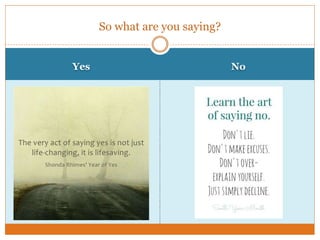
Yes No
So what are you saying?
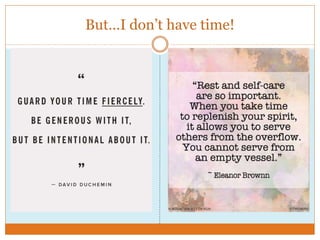
But…I don’t have time!
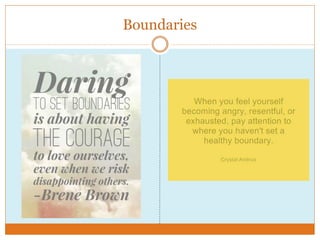
Boundaries
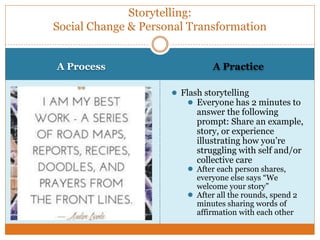
A Process A Practice
● Flash storytelling
● Everyone has 2 minutes to
answer the following
prompt: Share an example,
story, or experience
illustrating how you’re
struggling with self and/or
collective care
● After each person shares,
everyone else says “We
welcome your story”
● After all the rounds, spend 2
minutes sharing words of
affirmation with each other
Storytelling:
Social Change & Personal Transformation
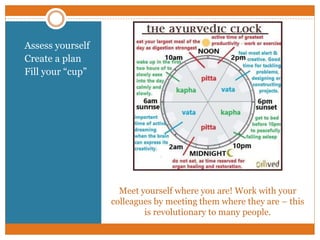
Meet yourself where you are! Work with your
colleagues by meeting them where they are – this
is revolutionary to many people.
Assess yourself
Create a plan
Fill your “cup”
Little Changes Add Up
● Reminder - decolonizing our systems & the ways we show up
takes time
● Small acts of self-care
● Creating/making time in collective spaces
● How you start & end meetings, open or close spaces matters
● Checking in with one another
● Boundaries
● Holding one another accountable to self-care plans
● Try new approaches until you find what works for you & your
organization
● Advocate for yourself, use your voice – don’t wait for change
from others or systems/institutions
● Share what you learn to model & encourage others
● Self-care station(s)
Resources – A Few of the Many
● Audre Lorde – Sister Outsider
● Bessel Van Der Kolk – The Body Keeps Score
● Brene Brown – Daring Greatly & Rising Strong
● Jardana Peacock – Work on Liberatory Leadership,
Practice Showing Up (book)
● Mental Health First Aid training
● Think outside your discipline, expertise, etc. – try to find
the resources you don’t know you don’t know
Resources – Podcasts, apps, & more
● Headspace (meditation app)
● Practical bullet journaling – only focus on what you need
● Oprah’s SuperSoul Conversations (podcast)
● Self Care Sundays (podcast)
● On Being with Krista Tippett (podcast)
● Healing Justice (podcast)
● The Science of Happiness (podcast)
● CTZN (podcast)
● Stop, Breathe, Think (app)
Brave Space –
a poem by Micky ScottBey Jones, inspired by an unknown author’s poem
● Together we will create brave space
● Because there is no such thing as a “safe space”-
● We exist in the real world
● And we all carry scars and have all caused wounds.
● In this space
● We seek to turn down the volume of the outside world.
● We amplify the voices that have to fight to be heard elsewhere,
● We call each other to more truth and love and
● We have the right to start somewhere and continue to grow.
● We will not be perfect.
● This space will not be perfect.
● It will not always be what we wish it to be
● But It will be ours – together and,
● We will work on it side by side.

Building Self and Collective Care into Community Engaged Work Workshop

  • 1.
    Grounding Self &Collective Care in Social Justice Building Self-Care into Community Engaged Work
  • 2.
    Framing Our TimeTogether ● Settling into this workshop ● Social justice lens ● Building practices of self & collective care ● Closing mindfully ● Quick 3 evaluation
  • 3.
    Who am I? ●White Latinx ● First generation college student ● AmeriCorps VISTA alum ● MA in History, MA in Applied Social Justice, entering a PhD program for Leadership & Change ● Bennington College – administration ● Carson-Newman University – adjunct instructor
  • 4.
    Brave Space – apoem by Micky ScottBey Jones, inspired by an unknown author’s poem ● Together we will create brave space ● Because there is no such thing as a “safe space”- ● We exist in the real world ● And we all carry scars and have all caused wounds. ● In this space ● We seek to turn down the volume of the outside world. ● We amplify the voices that have to fight to be heard elsewhere, ● We call each other to more truth and love and ● We have the right to start somewhere and continue to grow. ● We will not be perfect. ● This space will not be perfect. ● It will not always be what we wish it to be ● But It will be ours – together and, ● We will work on it side by side.
  • 5.
    Self & CollectiveCare is Community Engagement ● Checking in with ourselves: Meditation ● Checking in with our community: Community Connections + The West Wing hybrid
  • 6.
    “Caring for myselfis not self- indulgence, it is self-preservation, and that is an act of political warfare.” Audre Lorde
  • 7.
    Liberatory Leadership ● “Systemsof oppression de-center liberatory approaches in leadership, leading to high rates of burnout, overwhelm, ineffective campaigns, a revolving door for people of color, surface relationships and high levels of physical, mental, spiritual and emotional duress.” ● “When practice and action meet, we are able to show up sustainably and consistently as leaders for long haul social change.”
  • 8.
    Practice - foundationfor people to show up personally & together in the work of transformative social change Action - match values with actions, how we work matches with our intended impacts Community - hold us accountable & provide support Earth/Spirit - connection to something greater than our human form connects us to something greater than ourselves Imagination - step into generative & powerful vision forward Components of Liberatory Leadership
  • 9.
    Internalized & Externalized Examplesof Systems Showing Up Applying Liberatory Leadership ● Practice - White folks encouraged to “know who they are” through connection to ancestry & culture ● Community - Incorporate storytelling into meetings ● Earth/Spirit - Deeper connection & relationship to natural rhythms of the Earth ● Imagination - Build collective leadership structures that value leadership styles across difference ● Action - Cis/straight leaders take responsibility for ensuring all-gender resources included in gatherings & approaches Jardana’s Examples of Systems of Oppression ● White supremacy – martyrdom; de-valuing & silencing leadership, experience, & history of people of color ● Classism – imposter syndrome; meetings in locations that assume disposable income ● Capitalism – overwhelmed & burned out staff; attention only given to product or action ● Patriarchy – charismatic leader; marginalizes the experiences of folks based on race, class, ability, sexuality, & gender ● Heterosexism, Homophobia, & Transphobia - pressure to conform into gender normative culture; binary gendered bathrooms & organizing/training spaces
  • 10.
    Yes No So whatare you saying?
  • 11.
  • 12.
  • 13.
    A Process APractice ● Flash storytelling ● Everyone has 2 minutes to answer the following prompt: Share an example, story, or experience illustrating how you’re struggling with self and/or collective care ● After each person shares, everyone else says “We welcome your story” ● After all the rounds, spend 2 minutes sharing words of affirmation with each other Storytelling: Social Change & Personal Transformation
  • 14.
    Meet yourself whereyou are! Work with your colleagues by meeting them where they are – this is revolutionary to many people. Assess yourself Create a plan Fill your “cup”
  • 15.
    Little Changes AddUp ● Reminder - decolonizing our systems & the ways we show up takes time ● Small acts of self-care ● Creating/making time in collective spaces ● How you start & end meetings, open or close spaces matters ● Checking in with one another ● Boundaries ● Holding one another accountable to self-care plans ● Try new approaches until you find what works for you & your organization ● Advocate for yourself, use your voice – don’t wait for change from others or systems/institutions ● Share what you learn to model & encourage others ● Self-care station(s)
  • 16.
    Resources – AFew of the Many ● Audre Lorde – Sister Outsider ● Bessel Van Der Kolk – The Body Keeps Score ● Brene Brown – Daring Greatly & Rising Strong ● Jardana Peacock – Work on Liberatory Leadership, Practice Showing Up (book) ● Mental Health First Aid training ● Think outside your discipline, expertise, etc. – try to find the resources you don’t know you don’t know
  • 17.
    Resources – Podcasts,apps, & more ● Headspace (meditation app) ● Practical bullet journaling – only focus on what you need ● Oprah’s SuperSoul Conversations (podcast) ● Self Care Sundays (podcast) ● On Being with Krista Tippett (podcast) ● Healing Justice (podcast) ● The Science of Happiness (podcast) ● CTZN (podcast) ● Stop, Breathe, Think (app)
  • 18.
    Brave Space – apoem by Micky ScottBey Jones, inspired by an unknown author’s poem ● Together we will create brave space ● Because there is no such thing as a “safe space”- ● We exist in the real world ● And we all carry scars and have all caused wounds. ● In this space ● We seek to turn down the volume of the outside world. ● We amplify the voices that have to fight to be heard elsewhere, ● We call each other to more truth and love and ● We have the right to start somewhere and continue to grow. ● We will not be perfect. ● This space will not be perfect. ● It will not always be what we wish it to be ● But It will be ours – together and, ● We will work on it side by side.