Statistical analysis
•	 	All efficacy analyses were performed on the intent-to-treat (ITT) population
•	 For time to onset of 12- and 24-week CDP, the p-values were based on a log-rank test stratified by geographic
region and age. The overall hazard ratio was estimated using a stratified Cox regression model with the same
stratification factors used in the log-rank test. Patients with initial disability progression who discontinued
treatment early with no confirmatory EDSS assessment were considered as having confirmed disability
•	 For T25FW and total volume of brain T2 hyperintense lesions, the p-values were based on ranked ANCOVA at
120-week visit adjusted for baseline, geographic region and age, with missing values imputed by last observation
carried forward. Point estimates and 95% confidence intervals were calculated using a mixed-effect model
repeated measure (MMRM) analysis on log-transformed data adjusted for baseline, geographic region and age
•	 For change in whole brain volume, the p-value is based on MMRM on percentage change adjusted for Week 24
brain volume, geographic region and age
RESULTS
Baseline demographics and disease characteristics
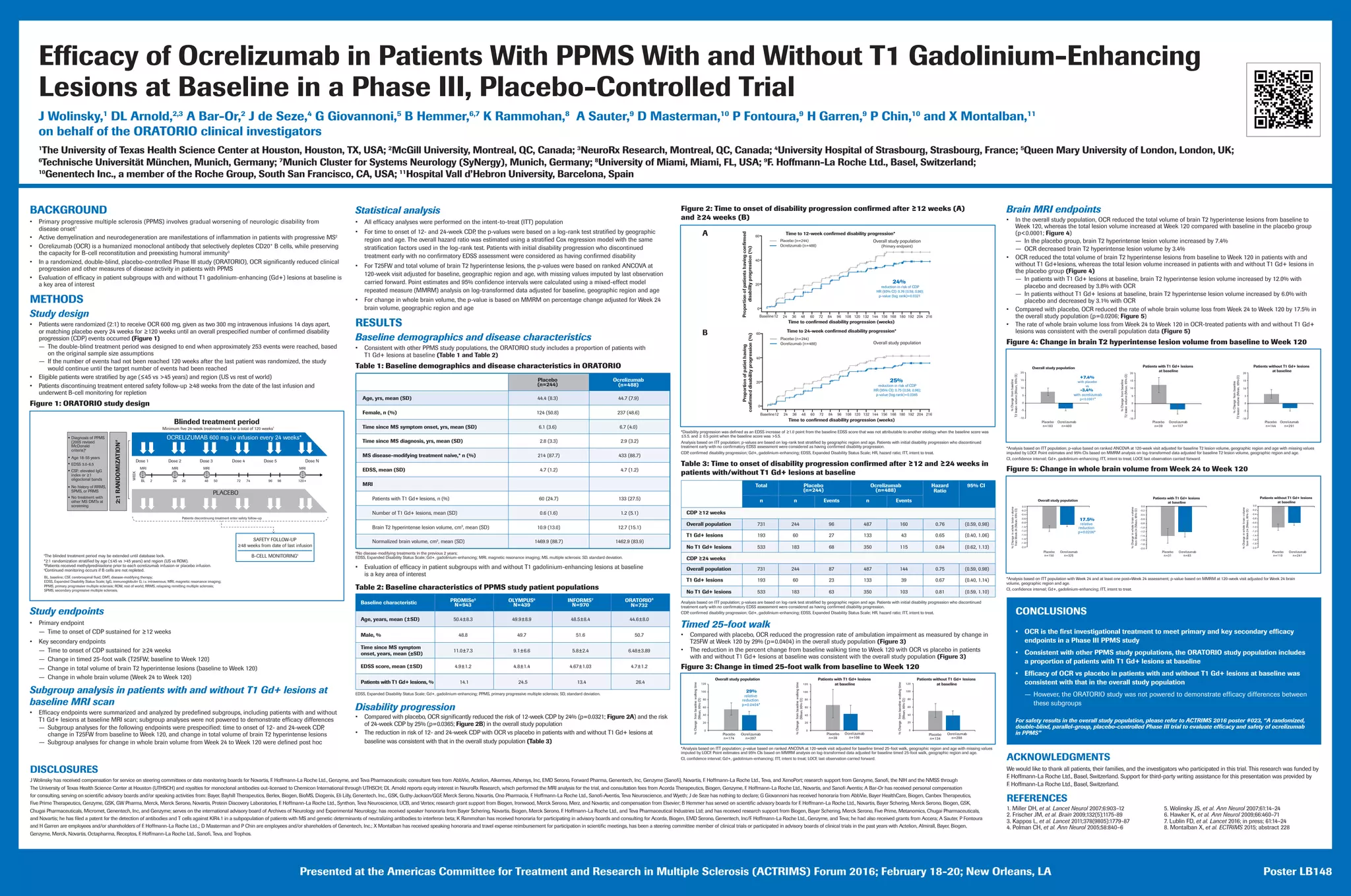
•	 Consistent with other PPMS study populations, the ORATORIO study includes a proportion of patients with
T1 Gd+ lesions at baseline (Table 1 and Table 2)
Table 1: Baseline demographics and disease characteristics in ORATORIO
Placebo
(n=244)
Ocrelizumab
(n=488)
Age, yrs, mean (SD) 44.4 (8.3) 44.7 (7.9)
Female, n (%) 124 (50.8) 237 (48.6)
Time since MS symptom onset, yrs, mean (SD) 6.1 (3.6) 6.7 (4.0)
Time since MS diagnosis, yrs, mean (SD) 2.8 (3.3) 2.9 (3.2)
MS disease-modifying treatment naive,* n (%) 214 (87.7) 433 (88.7)
EDSS, mean (SD) 4.7 (1.2) 4.7 (1.2)
MRI
Patients with T1 Gd+ lesions, n (%) 60 (24.7) 133 (27.5)
Number of T1 Gd+ lesions, mean (SD) 0.6 (1.6) 1.2 (5.1)
Brain T2 hyperintense lesion volume, cm3
, mean (SD) 10.9 (13.0) 12.7 (15.1)
Normalized brain volume, cm3
, mean (SD) 1469.9 (88.7) 1462.9 (83.9)
*No disease-modifying treatments in the previous 2 years;
EDSS, Expanded Disability Status Scale; Gd+, gadolinium-enhancing; MRI, magnetic resonance imaging; MS, multiple sclerosis; SD, standard deviation.
•	 Evaluation of efficacy in patient subgroups with and without T1 gadolinium-enhancing lesions at baseline
is a key area of interest
Table 2: Baseline characteristics of PPMS study patient populations
Baseline characteristic PROMISe5
N=943
OLYMPUS6
N=439
INFORMS7
N=970
ORATORIO8
N=732
Age, years, mean (±SD) 50.4±8.3 49.9±8.9 48.5±8.4 44.6±8.0
Male, % 48.8 49.7 51.6 50.7
Time since MS symptom
onset, years, mean (±SD)
11.0±7.3 9.1±6.6 5.8±2.4 6.48±3.89
EDSS score, mean (±SD) 4.9±1.2 4.8±1.4 4.67±1.03 4.7±1.2
Patients with T1 Gd+ lesions, % 14.1 24.5 13.4 26.4
EDSS, Expanded Disability Status Scale; Gd+, gadolinium-enhancing; PPMS, primary progressive multiple sclerosis; SD, standard deviation.
Disability progression
•	 Compared with placebo, OCR significantly reduced the risk of 12-week CDP by 24% (p=0.0321; Figure 2A) and the risk
of 24-week CDP by 25% (p=0.0365; Figure 2B) in the overall study population
•	 The reduction in risk of 12- and 24-week CDP with OCR vs placebo in patients with and without T1 Gd+ lesions at
baseline was consistent with that in the overall study population (Table 3)
Figure 2: Time to onset of disability progression confirmed after ≥12 weeks (A)
and ≥24 weeks (B)
*Disability progression was defined as an EDSS increase of ≥1.0 point from the baseline EDSS score that was not attributable to another etiology when the baseline score was
≤5.5, and ≥ 0.5 point when the baseline score was >5.5.
Analysis based on ITT population; p-values are based on log-rank test stratified by geographic region and age. Patients with initial disability progression who discontinued
treatment early with no confirmatory EDSS assessment were considered as having confirmed disability progression.
CDP, confirmed disability progression; Gd+, gadolinium-enhancing; EDSS, Expanded Disability Status Scale; HR, hazard ratio; ITT, intent to treat.
Table 3: Time to onset of disability progression confirmed after ≥12 and ≥24 weeks in
patients with/without T1 Gd+ lesions at baseline
Total Placebo
(n=244)
Ocrelizumab
(n=488)
Hazard
Ratio
95% CI
n n Events n Events
CDP ≥12 weeks
Overall population 731 244 96 487 160 0.76 (0.59, 0.98)
T1 Gd+ lesions 193 60 27 133 43 0.65 (0.40, 1.06)
No T1 Gd+ lesions 533 183 68 350 115 0.84 (0.62, 1.13)
CDP ≥24 weeks
Overall population 731 244 87 487 144 0.75 (0.59, 0.98)
T1 Gd+ lesions 193 60 23 133 39 0.67 (0.40, 1.14)
No T1 Gd+ lesions 533 183 63 350 103 0.81 (0.59, 1.10)
Analysis based on ITT population; p-values are based on log-rank test stratified by geographic region and age. Patients with initial disability progression who discontinued
treatment early with no confirmatory EDSS assessment were considered as having confirmed disability progression.
CDP, confirmed disability progression; Gd+, gadolinium-enhancing; EDSS, Expanded Disability Status Scale; HR, hazard ratio; ITT, intent to treat.
Timed 25-foot walk
•	 Compared with placebo, OCR reduced the progression rate of ambulation impairment as measured by change in
T25FW at Week 120 by 29% (p=0.0404) in the overall study population (Figure 3)
•	 The reduction in the percent change from baseline walking time to Week 120 with OCR vs placebo in patients
with and without T1 Gd+ lesions at baseline was consistent with the overall study population (Figure 3)
Figure 3: Change in timed 25-foot walk from baseline to Week 120
*Analysis based on ITT population; p-value based on ranked ANCOVA at 120-week visit adjusted for baseline timed 25-foot walk, geographic region and age with missing values
imputed by LOCF. Point estimates and 95% CIs based on MMRM analysis on log-transformed data adjusted for baseline timed 25-foot walk, geographic region and age.
CI, confidence interval; Gd+, gadolinium-enhancing; ITT, intent to treat; LOCF, last observation carried forward.
BACKGROUND
•	 Primary progressive multiple sclerosis (PPMS) involves gradual worsening of neurologic disability from
disease onset1
•	 Active demyelination and neurodegeneration are manifestations of inflammation in patients with progressive MS2
•	 Ocrelizumab (OCR) is a humanized monoclonal antibody that selectively depletes CD20+
B cells, while preserving
the capacity for B-cell reconstitution and preexisting humoral immunity3
•	 In a randomized, double-blind, placebo-controlled Phase III study (ORATORIO), OCR significantly reduced clinical
progression and other measures of disease activity in patients with PPMS
•	 Evaluation of efficacy in patient subgroups with and without T1 gadolinium-enhancing (Gd+) lesions at baseline is
a key area of interest
METHODS
Study design
•	 Patients were randomized (2:1) to receive OCR 600 mg, given as two 300 mg intravenous infusions 14 days apart,
or matching placebo every 24 weeks for ≥120 weeks until an overall prespecified number of confirmed disability
progression (CDP) events occurred (Figure 1)
—— The double-blind treatment period was designed to end when approximately 253 events were reached, based
on the original sample size assumptions
—— If the number of events had not been reached 120 weeks after the last patient was randomized, the study
would continue until the target number of events had been reached
•	 Eligible patients were stratified by age (≤45 vs >45 years) and region (US vs rest of world)
•	 Patients discontinuing treatment entered safety follow-up ≥48 weeks from the date of the last infusion and
underwent B-cell monitoring for repletion
Figure 1: ORATORIO study design
Study endpoints
•	 Primary endpoint
—— Time to onset of CDP sustained for ≥12 weeks
•	 Key secondary endpoints
—— Time to onset of CDP sustained for ≥24 weeks
—— Change in timed 25-foot walk (T25FW; baseline to Week 120)
—— Change in total volume of brain T2 hyperintense lesions (baseline to Week 120)
—— Change in whole brain volume (Week 24 to Week 120)
Subgroup analysis in patients with and without T1 Gd+ lesions at
baseline MRI scan
•	 Efficacy endpoints were summarized and analyzed by predefined subgroups, including patients with and without
T1 Gd+ lesions at baseline MRI scan; subgroup analyses were not powered to demonstrate efficacy differences
—— Subgroup analyses for the following endpoints were prespecified: time to onset of 12- and 24-week CDP,
change in T25FW from baseline to Week 120, and change in total volume of brain T2 hyperintense lesions
—— Subgroup analyses for change in whole brain volume from Week 24 to Week 120 were defined post hoc
Efficacy of Ocrelizumab in Patients With PPMS With and Without T1 Gadolinium-Enhancing
Lesions at Baseline in a Phase III, Placebo-Controlled Trial
J Wolinsky,1
DL Arnold,2,3
A Bar-Or,2
J de Seze,4
G Giovannoni,5
B Hemmer,6,7
K Rammohan,8
A Sauter,9
D Masterman,10
P Fontoura,9
H Garren,9
P Chin,10
and X Montalban,11
on behalf of the ORATORIO clinical investigators
1
The University of Texas Health Science Center at Houston, Houston, TX, USA; 2
McGill University, Montreal, QC, Canada; 3
NeuroRx Research, Montreal, QC, Canada; 4
University Hospital of Strasbourg, Strasbourg, France; 5
Queen Mary University of London, London, UK;
6
Technische Universität München, Munich, Germany; 7
Munich Cluster for Systems Neurology (SyNergy), Munich, Germany; 8
University of Miami, Miami, FL, USA; 9
F. Hoffmann-La Roche Ltd., Basel, Switzerland;
10
Genentech Inc., a member of the Roche Group, South San Francisco, CA, USA; 11
Hospital Vall d’Hebron University, Barcelona, Spain
Brain MRI endpoints
•	 In the overall study population, OCR reduced the total volume of brain T2 hyperintense lesions from baseline to
Week 120, whereas the total lesion volume increased at Week 120 compared with baseline in the placebo group
(p<0.0001; Figure 4)
—— In the placebo group, brain T2 hyperintense lesion volume increased by 7.4%
—— OCR decreased brain T2 hyperintense lesion volume by 3.4%
•	 OCR reduced the total volume of brain T2 hyperintense lesions from baseline to Week 120 in patients with and
without T1 Gd+lesions, whereas the total lesion volume increased in patients with and without T1 Gd+ lesions in
the placebo group (Figure 4)
—— In patients with T1 Gd+ lesions at baseline, brain T2 hyperintense lesion volume increased by 12.0% with
placebo and decreased by 3.8% with OCR
—— In patients without T1 Gd+ lesions at baseline, brain T2 hyperintense lesion volume increased by 6.0% with
placebo and decreased by 3.1% with OCR
•	 Compared with placebo, OCR reduced the rate of whole brain volume loss from Week 24 to Week 120 by 17.5% in
the overall study population (p=0.0206; Figure 5)
•	 The rate of whole brain volume loss from Week 24 to Week 120 in OCR-treated patients with and without T1 Gd+
lesions was consistent with the overall population data (Figure 5)
Figure 4: Change in brain T2 hyperintense lesion volume from baseline to Week 120
*Analysis based on ITT population; p-value based on ranked ANCOVA at 120-week visit adjusted for baseline T2 lesion volume, geographic region and age with missing values
imputed by LOCF. Point estimates and 95% CIs based on MMRM analysis on log-transformed data adjusted for baseline T2 lesion volume, geographic region and age.
CI, confidence interval; Gd+, gadolinium-enhancing; ITT, intent to treat; LOCF, last observation carried forward.
Figure 5: Change in whole brain volume from Week 24 to Week 120
*Analysis based on ITT population with Week 24 and at least one post–Week 24 assessment; p-value based on MMRM at 120-week visit adjusted for Week 24 brain
volume, geographic region and age.
CI, confidence interval; Gd+, gadolinium-enhancing; ITT, intent to treat.
CONCLUSIONS
•	 OCR is the first investigational treatment to meet primary and key secondary efficacy
endpoints in a Phase III PPMS study
•	 Consistent with other PPMS study populations, the ORATORIO study population includes
a proportion of patients with T1 Gd+ lesions at baseline
•	 Efficacy of OCR vs placebo in patients with and without T1 Gd+ lesions at baseline was
consistent with that in the overall study population
—— However, the ORATORIO study was not powered to demonstrate efficacy differences between
these subgroups
For safety results in the overall study population, please refer to ACTRIMS 2016 poster #023, “A randomized,
double-blind, parallel-group, placebo-controlled Phase III trial to evaluate efficacy and safety of ocrelizumab
in PPMS”
Presented at the Americas Committee for Treatment and Research in Multiple Sclerosis (ACTRIMS) Forum 2016; February 18-20; New Orleans, LA Poster LB148
Minimum five 24-week treatment dose for a total of 120 weeks†
Blinded treatment period
Diagnosis of PPMS
(2005 revised
McDonald
criteria)4
Age 18-55 years
EDSS 3.0-6.5
CSF: elevated IgG
index or ≥1
oligoclonal bands
No history of RRMS,
SPMS, or PRMS
No treatment with
other MS DMTs at
screening
Dose 1
Patients discontinuing treatment enter safety follow-up
Dose 2 Dose 3 Dose 4 Dose 5 Dose N
MRI
BL 2 24 26 48 50 72 74 96 98 120+
MRI MRI MRI
SAFETY FOLLOW-UP
≥48 weeks from date of last infusion
B-CELL MONITORING‡
2:1RANDOMIZATION
OCRELIZUMAB 600 mg i.v infusion every 24 weeks*
WEEK
PLACEBO
BL, baseline; CSF, cerebrospinal fluid; DMT, disease-modifying therapy;
EDSS, Expanded Disability Status Scale; IgG, immunoglobulin G; i.v. intravenous; MRI, magnetic resonance imaging;
PPMS, primary progressive multiple sclerosis; ROW, rest of world; RRMS, relapsing remitting multiple sclerosis;
SPMS, secondary progressive multiple sclerosis.
†
The blinded treatment period may be extended until database lock.
#
2:1 randomization stratified by age (≤45 vs >45 years) and region (US vs ROW).
*Patients received methylprednisolone prior to each ocrelizumab infusion or placebo infusion.
‡
Continued monitoring occurs if B cells are not repleted.
DISCLOSURES
J Wolinsky has received compensation for service on steering committees or data monitoring boards for Novartis, F. Hoffmann-La Roche Ltd., Genzyme, and Teva Pharmaceuticals; consultant fees from AbbVie, Actelion, Alkermes, Athersys, Inc, EMD Serono, Forward Pharma, Genentech, Inc, Genzyme (Sanofi), Novartis, F. Hoffmann-La Roche Ltd., Teva, and XenoPort; research support from Genzyme, Sanofi, the NIH and the NMSS through
The University of Texas Health Science Center at Houston (UTHSCH) and royalties for monoclonal antibodies out-licensed to Chemicon International through UTHSCH; DL Arnold reports equity interest in NeuroRx Research, which performed the MRI analysis for the trial, and consultation fees from Acorda Therapeutics, Biogen, Genzyme, F. Hoffmann-La Roche Ltd., Novartis, and Sanofi Aventis; A Bar-Or has received personal compensation
for consulting, serving on scientific advisory boards and/or speaking activities from: Bayer, Bayhill Therapeutics, Berlex, Biogen, BioMS, Diogenix, Eli Lilly, Genentech, Inc., GSK, Guthy-Jackson/GGF, Merck Serono, Novartis, Ono Pharmacia, F. Hoffmann-La Roche Ltd., Sanofi-Aventis, Teva Neuroscience, and Wyeth; J de Seze has nothing to declare; G Giovannoni has received honoraria from AbbVie, Bayer HealthCare, Biogen, Canbex Therapeutics,
Five Prime Therapeutics, Genzyme, GSK, GW Pharma, Merck, Merck Serono, Novartis, Protein Discovery Laboratories, F. Hoffmann-La Roche Ltd., Synthon, Teva Neuroscience, UCB, and Vertex; research grant support from Biogen, Ironwood, Merck Serono, Merz, and Novartis; and compensation from Elsevier; B Hemmer has served on scientific advisory boards for F. Hoffmann-La Roche Ltd., Novartis, Bayer Schering, Merck Serono, Biogen, GSK,
Chugai Pharmaceuticals, Micromet, Genentech, Inc, and Genzyme; serves on the international advisory board of Archives of Neurology and Experimental Neurology; has received speaker honoraria from Bayer Schering, Novartis, Biogen, Merck Serono, F. Hoffmann-La Roche Ltd., and Teva Pharmaceutical Industries Ltd; and has received research support from Biogen, Bayer Schering, Merck Serono, Five Prime, Metanomics, Chugai Pharmaceuticals,
and Novartis; he has filed a patent for the detection of antibodies and T cells against KIR4.1 in a subpopulation of patients with MS and genetic determinants of neutralizing antibodies to interferon beta; K Rammohan has received honoraria for participating in advisory boards and consulting for Acorda, Biogen, EMD Serono, Genentech, Inc/F. Hoffmann-La Roche Ltd., Genzyme, and Teva; he had also received grants from Accera; A Sauter, P Fontoura
and H Garren are employees and/or shareholders of F. Hoffmann-La Roche Ltd.,; D Masterman and P Chin are employees and/or shareholders of Genentech, Inc.; X Montalban has received speaking honoraria and travel expense reimbursement for participation in scientific meetings, has been a steering committee member of clinical trials or participated in advisory boards of clinical trials in the past years with Actelion, Almirall, Bayer, Biogen,
Genzyme, Merck, Novartis, Octapharma, Receptos, F. Hoffmann-La Roche Ltd., Sanofi, Teva, and Trophos.
60
40
20
0
Placebo (n=244)
Ocrelizumab (n=488)
12Baseline 24 36 48 60 72 84 96 108 120 132 144 156 168 180 192 204 216
Time to confirmed disability progression (weeks)
Proportionofpatientshavingconfirmed
disabilityprogression(%)
24%
reduction in risk of CDP
HR (95% CI): 0.76 (0.59, 0.98);
p-value (log rank)=0.0321
Overall study population
(Primary endpoint)
Time to 12-week confirmed disability progression*
60
40
20
0
12Baseline 24 36 48 60 72 84 96 108 120 132 144 156 168 180 192 204 216
Time to confirmed disability progression (weeks)
Time to 24-week confirmed disability progression*
Placebo (n=244)
Ocrelizumab (n=488)
Proportionofpatiethaving
confirmeddisabilityprogression(%)
25%
reduction in risk of CDP
HR (95% CI): 0.75 (0.58, 0.98);
p-value (log rank)=0.0365
Overall study population
A
B
Placebo
n=174
Ocrelizumab
n=397
29%
relative
reduction
p=0.0404*
0
20
40
60
80
100
120
0
20
40
60
80
100
120
Ocrelizumab
n=106
Placebo
n=39
Patients without T1 Gd+ lesions
at baseline
Patients with T1 Gd+ lesions
at baseline
Overall study population
0
20
40
60
80
100
120
Ocrelizumab
n=288
Placebo
n=134
%Changefrombaselinewalkingtime
(Mean,95%CI)
%Changefrombaselinewalkingtime
(Mean,95%CI)
%Changefrombaselinewalkingtime
(Mean,95%CI)
ACKNOWLEDGMENTS
We would like to thank all patients, their families, and the investigators who participated in this trial. This research was funded by
F. Hoffmann-La Roche Ltd., Basel, Switzerland. Support for third-party writing assistance for this presentation was provided by
F. Hoffmann-La Roche Ltd., Basel, Switzerland.
REFERENCES
1. Miller DH, et al. Lancet Neurol 2007;6:903–12
2. Frischer JM, et al. Brain 2009;132(5);1175-89
3. Kappos L, et al. Lancet 2011;378(9805):1779-87
4. Polman CH, et al. Ann Neurol 2005;58:840–6
5. Wolinsky JS, et al. Ann Neurol 2007;61:14–24
6. Hawker K, et al. Ann Neurol 2009;66:460–71
7. Lublin FD, et al. Lancet 2016; in press; 61:14–24
8. Montalban X, et al. ECTRIMS 2015; abstract 228
-2.0
-1.8
-1.6
-1.4
-1.2
-1.0
-0.8
-0.6
-0.4
-0.2
0.0
Placebo
n=150
Ocrelizumab
n=325
%Changeinwholebrainvolume
fromWeek24(Mean,95%CI)
17.5%
relative
reduction
p=0.0206*
Placebo
n=31
Ocrelizumab
n=83
Placebo
n=119
Ocrelizumab
n=241
%Changeinwholebrainvolume
fromWeek24(Mean,95%CI)
%Changeinwholebrainvolume
fromWeek24(Mean,95%CI)
Patients without T1 Gd+ lesions
at baseline
Patients with T1 Gd+ lesions
at baseline
Overall study population
-2.0
-1.8
-1.6
-1.4
-1.2
-1.0
-0.8
-0.6
-0.4
-0.2
0.0
-2.0
-1.8
-1.6
-1.4
-1.2
-1.0
-0.8
-0.6
-0.4
-0.2
0.0
%Changefrombaseline
T2lesionvolume(Mean,95%CI)
Placebo
n=183
Ocrelizumab
n=400
Placebo
n=39
Ocrelizumab
n=107
%Changefrombaseline
T2lesionvolume(Mean,95%CI)
Placebo
n=144
Ocrelizumab
n=291
%Changefrombaseline
T2lesionvolume(Mean,95%CI)
+7.4%
with placebo
vs
-3.4%
with ocrelizumab
p<0.0001*
Overall study population
-10
-5
0
5
10
15
20
-10
-5
0
5
10
15
20
-10
-5
0
5
10
15
20
Patients without T1 Gd+ lesions
at baseline
Patients with T1 Gd+ lesions
at baseline

Actrims 2016 oratorio lb poster wolinsky_lb148

  • 1.
    Statistical analysis • Allefficacy analyses were performed on the intent-to-treat (ITT) population • For time to onset of 12- and 24-week CDP, the p-values were based on a log-rank test stratified by geographic region and age. The overall hazard ratio was estimated using a stratified Cox regression model with the same stratification factors used in the log-rank test. Patients with initial disability progression who discontinued treatment early with no confirmatory EDSS assessment were considered as having confirmed disability • For T25FW and total volume of brain T2 hyperintense lesions, the p-values were based on ranked ANCOVA at 120-week visit adjusted for baseline, geographic region and age, with missing values imputed by last observation carried forward. Point estimates and 95% confidence intervals were calculated using a mixed-effect model repeated measure (MMRM) analysis on log-transformed data adjusted for baseline, geographic region and age • For change in whole brain volume, the p-value is based on MMRM on percentage change adjusted for Week 24 brain volume, geographic region and age RESULTS Baseline demographics and disease characteristics • Consistent with other PPMS study populations, the ORATORIO study includes a proportion of patients with T1 Gd+ lesions at baseline (Table 1 and Table 2) Table 1: Baseline demographics and disease characteristics in ORATORIO Placebo (n=244) Ocrelizumab (n=488) Age, yrs, mean (SD) 44.4 (8.3) 44.7 (7.9) Female, n (%) 124 (50.8) 237 (48.6) Time since MS symptom onset, yrs, mean (SD) 6.1 (3.6) 6.7 (4.0) Time since MS diagnosis, yrs, mean (SD) 2.8 (3.3) 2.9 (3.2) MS disease-modifying treatment naive,* n (%) 214 (87.7) 433 (88.7) EDSS, mean (SD) 4.7 (1.2) 4.7 (1.2) MRI Patients with T1 Gd+ lesions, n (%) 60 (24.7) 133 (27.5) Number of T1 Gd+ lesions, mean (SD) 0.6 (1.6) 1.2 (5.1) Brain T2 hyperintense lesion volume, cm3 , mean (SD) 10.9 (13.0) 12.7 (15.1) Normalized brain volume, cm3 , mean (SD) 1469.9 (88.7) 1462.9 (83.9) *No disease-modifying treatments in the previous 2 years; EDSS, Expanded Disability Status Scale; Gd+, gadolinium-enhancing; MRI, magnetic resonance imaging; MS, multiple sclerosis; SD, standard deviation. • Evaluation of efficacy in patient subgroups with and without T1 gadolinium-enhancing lesions at baseline is a key area of interest Table 2: Baseline characteristics of PPMS study patient populations Baseline characteristic PROMISe5 N=943 OLYMPUS6 N=439 INFORMS7 N=970 ORATORIO8 N=732 Age, years, mean (±SD) 50.4±8.3 49.9±8.9 48.5±8.4 44.6±8.0 Male, % 48.8 49.7 51.6 50.7 Time since MS symptom onset, years, mean (±SD) 11.0±7.3 9.1±6.6 5.8±2.4 6.48±3.89 EDSS score, mean (±SD) 4.9±1.2 4.8±1.4 4.67±1.03 4.7±1.2 Patients with T1 Gd+ lesions, % 14.1 24.5 13.4 26.4 EDSS, Expanded Disability Status Scale; Gd+, gadolinium-enhancing; PPMS, primary progressive multiple sclerosis; SD, standard deviation. Disability progression • Compared with placebo, OCR significantly reduced the risk of 12-week CDP by 24% (p=0.0321; Figure 2A) and the risk of 24-week CDP by 25% (p=0.0365; Figure 2B) in the overall study population • The reduction in risk of 12- and 24-week CDP with OCR vs placebo in patients with and without T1 Gd+ lesions at baseline was consistent with that in the overall study population (Table 3) Figure 2: Time to onset of disability progression confirmed after ≥12 weeks (A) and ≥24 weeks (B) *Disability progression was defined as an EDSS increase of ≥1.0 point from the baseline EDSS score that was not attributable to another etiology when the baseline score was ≤5.5, and ≥ 0.5 point when the baseline score was >5.5. Analysis based on ITT population; p-values are based on log-rank test stratified by geographic region and age. Patients with initial disability progression who discontinued treatment early with no confirmatory EDSS assessment were considered as having confirmed disability progression. CDP, confirmed disability progression; Gd+, gadolinium-enhancing; EDSS, Expanded Disability Status Scale; HR, hazard ratio; ITT, intent to treat. Table 3: Time to onset of disability progression confirmed after ≥12 and ≥24 weeks in patients with/without T1 Gd+ lesions at baseline Total Placebo (n=244) Ocrelizumab (n=488) Hazard Ratio 95% CI n n Events n Events CDP ≥12 weeks Overall population 731 244 96 487 160 0.76 (0.59, 0.98) T1 Gd+ lesions 193 60 27 133 43 0.65 (0.40, 1.06) No T1 Gd+ lesions 533 183 68 350 115 0.84 (0.62, 1.13) CDP ≥24 weeks Overall population 731 244 87 487 144 0.75 (0.59, 0.98) T1 Gd+ lesions 193 60 23 133 39 0.67 (0.40, 1.14) No T1 Gd+ lesions 533 183 63 350 103 0.81 (0.59, 1.10) Analysis based on ITT population; p-values are based on log-rank test stratified by geographic region and age. Patients with initial disability progression who discontinued treatment early with no confirmatory EDSS assessment were considered as having confirmed disability progression. CDP, confirmed disability progression; Gd+, gadolinium-enhancing; EDSS, Expanded Disability Status Scale; HR, hazard ratio; ITT, intent to treat. Timed 25-foot walk • Compared with placebo, OCR reduced the progression rate of ambulation impairment as measured by change in T25FW at Week 120 by 29% (p=0.0404) in the overall study population (Figure 3) • The reduction in the percent change from baseline walking time to Week 120 with OCR vs placebo in patients with and without T1 Gd+ lesions at baseline was consistent with the overall study population (Figure 3) Figure 3: Change in timed 25-foot walk from baseline to Week 120 *Analysis based on ITT population; p-value based on ranked ANCOVA at 120-week visit adjusted for baseline timed 25-foot walk, geographic region and age with missing values imputed by LOCF. Point estimates and 95% CIs based on MMRM analysis on log-transformed data adjusted for baseline timed 25-foot walk, geographic region and age. CI, confidence interval; Gd+, gadolinium-enhancing; ITT, intent to treat; LOCF, last observation carried forward. BACKGROUND • Primary progressive multiple sclerosis (PPMS) involves gradual worsening of neurologic disability from disease onset1 • Active demyelination and neurodegeneration are manifestations of inflammation in patients with progressive MS2 • Ocrelizumab (OCR) is a humanized monoclonal antibody that selectively depletes CD20+ B cells, while preserving the capacity for B-cell reconstitution and preexisting humoral immunity3 • In a randomized, double-blind, placebo-controlled Phase III study (ORATORIO), OCR significantly reduced clinical progression and other measures of disease activity in patients with PPMS • Evaluation of efficacy in patient subgroups with and without T1 gadolinium-enhancing (Gd+) lesions at baseline is a key area of interest METHODS Study design • Patients were randomized (2:1) to receive OCR 600 mg, given as two 300 mg intravenous infusions 14 days apart, or matching placebo every 24 weeks for ≥120 weeks until an overall prespecified number of confirmed disability progression (CDP) events occurred (Figure 1) —— The double-blind treatment period was designed to end when approximately 253 events were reached, based on the original sample size assumptions —— If the number of events had not been reached 120 weeks after the last patient was randomized, the study would continue until the target number of events had been reached • Eligible patients were stratified by age (≤45 vs >45 years) and region (US vs rest of world) • Patients discontinuing treatment entered safety follow-up ≥48 weeks from the date of the last infusion and underwent B-cell monitoring for repletion Figure 1: ORATORIO study design Study endpoints • Primary endpoint —— Time to onset of CDP sustained for ≥12 weeks • Key secondary endpoints —— Time to onset of CDP sustained for ≥24 weeks —— Change in timed 25-foot walk (T25FW; baseline to Week 120) —— Change in total volume of brain T2 hyperintense lesions (baseline to Week 120) —— Change in whole brain volume (Week 24 to Week 120) Subgroup analysis in patients with and without T1 Gd+ lesions at baseline MRI scan • Efficacy endpoints were summarized and analyzed by predefined subgroups, including patients with and without T1 Gd+ lesions at baseline MRI scan; subgroup analyses were not powered to demonstrate efficacy differences —— Subgroup analyses for the following endpoints were prespecified: time to onset of 12- and 24-week CDP, change in T25FW from baseline to Week 120, and change in total volume of brain T2 hyperintense lesions —— Subgroup analyses for change in whole brain volume from Week 24 to Week 120 were defined post hoc Efficacy of Ocrelizumab in Patients With PPMS With and Without T1 Gadolinium-Enhancing Lesions at Baseline in a Phase III, Placebo-Controlled Trial J Wolinsky,1 DL Arnold,2,3 A Bar-Or,2 J de Seze,4 G Giovannoni,5 B Hemmer,6,7 K Rammohan,8 A Sauter,9 D Masterman,10 P Fontoura,9 H Garren,9 P Chin,10 and X Montalban,11 on behalf of the ORATORIO clinical investigators 1 The University of Texas Health Science Center at Houston, Houston, TX, USA; 2 McGill University, Montreal, QC, Canada; 3 NeuroRx Research, Montreal, QC, Canada; 4 University Hospital of Strasbourg, Strasbourg, France; 5 Queen Mary University of London, London, UK; 6 Technische Universität München, Munich, Germany; 7 Munich Cluster for Systems Neurology (SyNergy), Munich, Germany; 8 University of Miami, Miami, FL, USA; 9 F. Hoffmann-La Roche Ltd., Basel, Switzerland; 10 Genentech Inc., a member of the Roche Group, South San Francisco, CA, USA; 11 Hospital Vall d’Hebron University, Barcelona, Spain Brain MRI endpoints • In the overall study population, OCR reduced the total volume of brain T2 hyperintense lesions from baseline to Week 120, whereas the total lesion volume increased at Week 120 compared with baseline in the placebo group (p<0.0001; Figure 4) —— In the placebo group, brain T2 hyperintense lesion volume increased by 7.4% —— OCR decreased brain T2 hyperintense lesion volume by 3.4% • OCR reduced the total volume of brain T2 hyperintense lesions from baseline to Week 120 in patients with and without T1 Gd+lesions, whereas the total lesion volume increased in patients with and without T1 Gd+ lesions in the placebo group (Figure 4) —— In patients with T1 Gd+ lesions at baseline, brain T2 hyperintense lesion volume increased by 12.0% with placebo and decreased by 3.8% with OCR —— In patients without T1 Gd+ lesions at baseline, brain T2 hyperintense lesion volume increased by 6.0% with placebo and decreased by 3.1% with OCR • Compared with placebo, OCR reduced the rate of whole brain volume loss from Week 24 to Week 120 by 17.5% in the overall study population (p=0.0206; Figure 5) • The rate of whole brain volume loss from Week 24 to Week 120 in OCR-treated patients with and without T1 Gd+ lesions was consistent with the overall population data (Figure 5) Figure 4: Change in brain T2 hyperintense lesion volume from baseline to Week 120 *Analysis based on ITT population; p-value based on ranked ANCOVA at 120-week visit adjusted for baseline T2 lesion volume, geographic region and age with missing values imputed by LOCF. Point estimates and 95% CIs based on MMRM analysis on log-transformed data adjusted for baseline T2 lesion volume, geographic region and age. CI, confidence interval; Gd+, gadolinium-enhancing; ITT, intent to treat; LOCF, last observation carried forward. Figure 5: Change in whole brain volume from Week 24 to Week 120 *Analysis based on ITT population with Week 24 and at least one post–Week 24 assessment; p-value based on MMRM at 120-week visit adjusted for Week 24 brain volume, geographic region and age. CI, confidence interval; Gd+, gadolinium-enhancing; ITT, intent to treat. CONCLUSIONS • OCR is the first investigational treatment to meet primary and key secondary efficacy endpoints in a Phase III PPMS study • Consistent with other PPMS study populations, the ORATORIO study population includes a proportion of patients with T1 Gd+ lesions at baseline • Efficacy of OCR vs placebo in patients with and without T1 Gd+ lesions at baseline was consistent with that in the overall study population —— However, the ORATORIO study was not powered to demonstrate efficacy differences between these subgroups For safety results in the overall study population, please refer to ACTRIMS 2016 poster #023, “A randomized, double-blind, parallel-group, placebo-controlled Phase III trial to evaluate efficacy and safety of ocrelizumab in PPMS” Presented at the Americas Committee for Treatment and Research in Multiple Sclerosis (ACTRIMS) Forum 2016; February 18-20; New Orleans, LA Poster LB148 Minimum five 24-week treatment dose for a total of 120 weeks† Blinded treatment period Diagnosis of PPMS (2005 revised McDonald criteria)4 Age 18-55 years EDSS 3.0-6.5 CSF: elevated IgG index or ≥1 oligoclonal bands No history of RRMS, SPMS, or PRMS No treatment with other MS DMTs at screening Dose 1 Patients discontinuing treatment enter safety follow-up Dose 2 Dose 3 Dose 4 Dose 5 Dose N MRI BL 2 24 26 48 50 72 74 96 98 120+ MRI MRI MRI SAFETY FOLLOW-UP ≥48 weeks from date of last infusion B-CELL MONITORING‡ 2:1RANDOMIZATION OCRELIZUMAB 600 mg i.v infusion every 24 weeks* WEEK PLACEBO BL, baseline; CSF, cerebrospinal fluid; DMT, disease-modifying therapy; EDSS, Expanded Disability Status Scale; IgG, immunoglobulin G; i.v. intravenous; MRI, magnetic resonance imaging; PPMS, primary progressive multiple sclerosis; ROW, rest of world; RRMS, relapsing remitting multiple sclerosis; SPMS, secondary progressive multiple sclerosis. † The blinded treatment period may be extended until database lock. # 2:1 randomization stratified by age (≤45 vs >45 years) and region (US vs ROW). *Patients received methylprednisolone prior to each ocrelizumab infusion or placebo infusion. ‡ Continued monitoring occurs if B cells are not repleted. DISCLOSURES J Wolinsky has received compensation for service on steering committees or data monitoring boards for Novartis, F. Hoffmann-La Roche Ltd., Genzyme, and Teva Pharmaceuticals; consultant fees from AbbVie, Actelion, Alkermes, Athersys, Inc, EMD Serono, Forward Pharma, Genentech, Inc, Genzyme (Sanofi), Novartis, F. Hoffmann-La Roche Ltd., Teva, and XenoPort; research support from Genzyme, Sanofi, the NIH and the NMSS through The University of Texas Health Science Center at Houston (UTHSCH) and royalties for monoclonal antibodies out-licensed to Chemicon International through UTHSCH; DL Arnold reports equity interest in NeuroRx Research, which performed the MRI analysis for the trial, and consultation fees from Acorda Therapeutics, Biogen, Genzyme, F. Hoffmann-La Roche Ltd., Novartis, and Sanofi Aventis; A Bar-Or has received personal compensation for consulting, serving on scientific advisory boards and/or speaking activities from: Bayer, Bayhill Therapeutics, Berlex, Biogen, BioMS, Diogenix, Eli Lilly, Genentech, Inc., GSK, Guthy-Jackson/GGF, Merck Serono, Novartis, Ono Pharmacia, F. Hoffmann-La Roche Ltd., Sanofi-Aventis, Teva Neuroscience, and Wyeth; J de Seze has nothing to declare; G Giovannoni has received honoraria from AbbVie, Bayer HealthCare, Biogen, Canbex Therapeutics, Five Prime Therapeutics, Genzyme, GSK, GW Pharma, Merck, Merck Serono, Novartis, Protein Discovery Laboratories, F. Hoffmann-La Roche Ltd., Synthon, Teva Neuroscience, UCB, and Vertex; research grant support from Biogen, Ironwood, Merck Serono, Merz, and Novartis; and compensation from Elsevier; B Hemmer has served on scientific advisory boards for F. Hoffmann-La Roche Ltd., Novartis, Bayer Schering, Merck Serono, Biogen, GSK, Chugai Pharmaceuticals, Micromet, Genentech, Inc, and Genzyme; serves on the international advisory board of Archives of Neurology and Experimental Neurology; has received speaker honoraria from Bayer Schering, Novartis, Biogen, Merck Serono, F. Hoffmann-La Roche Ltd., and Teva Pharmaceutical Industries Ltd; and has received research support from Biogen, Bayer Schering, Merck Serono, Five Prime, Metanomics, Chugai Pharmaceuticals, and Novartis; he has filed a patent for the detection of antibodies and T cells against KIR4.1 in a subpopulation of patients with MS and genetic determinants of neutralizing antibodies to interferon beta; K Rammohan has received honoraria for participating in advisory boards and consulting for Acorda, Biogen, EMD Serono, Genentech, Inc/F. Hoffmann-La Roche Ltd., Genzyme, and Teva; he had also received grants from Accera; A Sauter, P Fontoura and H Garren are employees and/or shareholders of F. Hoffmann-La Roche Ltd.,; D Masterman and P Chin are employees and/or shareholders of Genentech, Inc.; X Montalban has received speaking honoraria and travel expense reimbursement for participation in scientific meetings, has been a steering committee member of clinical trials or participated in advisory boards of clinical trials in the past years with Actelion, Almirall, Bayer, Biogen, Genzyme, Merck, Novartis, Octapharma, Receptos, F. Hoffmann-La Roche Ltd., Sanofi, Teva, and Trophos. 60 40 20 0 Placebo (n=244) Ocrelizumab (n=488) 12Baseline 24 36 48 60 72 84 96 108 120 132 144 156 168 180 192 204 216 Time to confirmed disability progression (weeks) Proportionofpatientshavingconfirmed disabilityprogression(%) 24% reduction in risk of CDP HR (95% CI): 0.76 (0.59, 0.98); p-value (log rank)=0.0321 Overall study population (Primary endpoint) Time to 12-week confirmed disability progression* 60 40 20 0 12Baseline 24 36 48 60 72 84 96 108 120 132 144 156 168 180 192 204 216 Time to confirmed disability progression (weeks) Time to 24-week confirmed disability progression* Placebo (n=244) Ocrelizumab (n=488) Proportionofpatiethaving confirmeddisabilityprogression(%) 25% reduction in risk of CDP HR (95% CI): 0.75 (0.58, 0.98); p-value (log rank)=0.0365 Overall study population A B Placebo n=174 Ocrelizumab n=397 29% relative reduction p=0.0404* 0 20 40 60 80 100 120 0 20 40 60 80 100 120 Ocrelizumab n=106 Placebo n=39 Patients without T1 Gd+ lesions at baseline Patients with T1 Gd+ lesions at baseline Overall study population 0 20 40 60 80 100 120 Ocrelizumab n=288 Placebo n=134 %Changefrombaselinewalkingtime (Mean,95%CI) %Changefrombaselinewalkingtime (Mean,95%CI) %Changefrombaselinewalkingtime (Mean,95%CI) ACKNOWLEDGMENTS We would like to thank all patients, their families, and the investigators who participated in this trial. This research was funded by F. Hoffmann-La Roche Ltd., Basel, Switzerland. Support for third-party writing assistance for this presentation was provided by F. Hoffmann-La Roche Ltd., Basel, Switzerland. REFERENCES 1. Miller DH, et al. Lancet Neurol 2007;6:903–12 2. Frischer JM, et al. Brain 2009;132(5);1175-89 3. Kappos L, et al. Lancet 2011;378(9805):1779-87 4. Polman CH, et al. Ann Neurol 2005;58:840–6 5. Wolinsky JS, et al. Ann Neurol 2007;61:14–24 6. Hawker K, et al. Ann Neurol 2009;66:460–71 7. Lublin FD, et al. Lancet 2016; in press; 61:14–24 8. Montalban X, et al. ECTRIMS 2015; abstract 228 -2.0 -1.8 -1.6 -1.4 -1.2 -1.0 -0.8 -0.6 -0.4 -0.2 0.0 Placebo n=150 Ocrelizumab n=325 %Changeinwholebrainvolume fromWeek24(Mean,95%CI) 17.5% relative reduction p=0.0206* Placebo n=31 Ocrelizumab n=83 Placebo n=119 Ocrelizumab n=241 %Changeinwholebrainvolume fromWeek24(Mean,95%CI) %Changeinwholebrainvolume fromWeek24(Mean,95%CI) Patients without T1 Gd+ lesions at baseline Patients with T1 Gd+ lesions at baseline Overall study population -2.0 -1.8 -1.6 -1.4 -1.2 -1.0 -0.8 -0.6 -0.4 -0.2 0.0 -2.0 -1.8 -1.6 -1.4 -1.2 -1.0 -0.8 -0.6 -0.4 -0.2 0.0 %Changefrombaseline T2lesionvolume(Mean,95%CI) Placebo n=183 Ocrelizumab n=400 Placebo n=39 Ocrelizumab n=107 %Changefrombaseline T2lesionvolume(Mean,95%CI) Placebo n=144 Ocrelizumab n=291 %Changefrombaseline T2lesionvolume(Mean,95%CI) +7.4% with placebo vs -3.4% with ocrelizumab p<0.0001* Overall study population -10 -5 0 5 10 15 20 -10 -5 0 5 10 15 20 -10 -5 0 5 10 15 20 Patients without T1 Gd+ lesions at baseline Patients with T1 Gd+ lesions at baseline