
Cooperative Extension	 PALS-3
Revised 2018
MoneyTalk
A Financial Guide ForWomen
Written by
Patricia Q. Brennan, M.A., CFP®
, CRPC®
, AFC, CHC, CFCS
Rutgers Cooperative Extension
Barbara M. O’Neill, Ph.D., CFP®
, CRPC®
, AFC, CHC, CFCS
Rutgers Cooperative Extension
Plant and Life Sciences Publishing (PALS)
34 Plant Science
Ithaca, New York 14853
ii
From the 192-page book Money Talk: A Financial Guide for Women, PALS-3
Available from PALS Publishing, www.palspublishing.com/moneytalk, Ph. 607-255-7654
PALS-3
April 2018
© 2018 by PALS (Plants and Life Sciences Publishing).
All rights reserved. Inquiries invited.
Requests to reprint parts of this publication should be sent to PALS.
In your request, please state which parts of the publication you would like to reprint
and describe how you intend to use the material. Contact PALS if you have any questions.
Plant and Life Sciences Publishing (PALS)
34 Plant Science
Ithaca, New York 14853
Phone: (607) 255-7654
E-mail: palspublishing@cornell.edu
Web site: palspublishing.com
Marty Sailus, PALS Director
iii
From the 192-page book Money Talk: A Financial Guide for Women, PALS-3
Available from PALS Publishing, www.palspublishing.com/moneytalk, Ph. 607-255-7654
TABLE OF CONTENTS
	Acknowledgments...................................................................................................................... v
	Disclaimers................................................................................................................................. v
	 About the Authors..................................................................................................................... vi
	 Dear Money Talk Reader.......................................................................................................... vii
SESSION I
Financial Basics
	 LESSON 1	 • Understanding Your Relationship to Money................................................................................ 2
	 LESSON 2	 • Money Values and Goals............................................................................................................. 6
	 LESSON 3	 • Testing Your Financial Fitness................................................................................................... 10
	 LESSON 4	 • Managing Household Cash Flow.............................................................................................. 13
	 LESSON 5	 • Calculating Your Net Worth...................................................................................................... 23
	 LESSON 6	 • Tips for Smarter Borrowing...................................................................................................... 25
	 LESSON 7	 • Financial Record Keeping......................................................................................................... 31
SESSION II
Are You Covered? Insurance Basics
	 LESSON 1	 • Managing Life’s Risks................................................................................................................ 46
	 LESSON 2	 • Insurance Basics....................................................................................................................... 47
	 LESSON 3	 • Life Insurance........................................................................................................................... 51
	 LESSON 4	 • Health Insurance...................................................................................................................... 54
	 LESSON 5	 • Disability Insurance.................................................................................................................. 56
	 LESSON 6	 • Long-Term Care Insurance....................................................................................................... 58
	 LESSON 7	 • Auto Insurance......................................................................................................................... 59
	 LESSON 8	 • Homeowner’s Insurance............................................................................................................ 61
	 LESSON 9	 • Umbrella Liability Insurance..................................................................................................... 63
SESSION III
Investing Basics
	 LESSON 1	 • Setting Goals and Finding Solutions......................................................................................... 72
	 LESSON 2	 • Understanding and Accepting Risk........................................................................................... 74
	 LESSON 3	 • Investment Choices—Stocks, Bonds, and Mutual Funds.......................................................... 78
	 LESSON 4	 • What Are Stocks and Why Should You Own Them?................................................................. 83
	 LESSON 5	 • What Are Bonds and Why Should You Own Them?................................................................. 87
	 LESSON 6	 • What Are Mutual Funds and Why Should You Own Them?..................................................... 91
iv
From the 192-page book Money Talk: A Financial Guide for Women, PALS-3
Available from PALS Publishing, www.palspublishing.com/moneytalk, Ph. 607-255-7654
SESSION IV
Investing for Retirement
	 LESSON 1	 • Asset Allocation and Diversification ....................................................................................... 103
	 LESSON 2	 • Building an Investment Portfolio for Retirement .................................................................... 106
	 LESSON 3	 • Investment Returns ............................................................................................................... 109
	 LESSON 4	 • Taking the Guesswork out of Retirement ............................................................................... 113
	 LESSON 5	 • Keeping Your Financial Records in Order .............................................................................. 129
	 LESSON 6	 • Withdrawals—How to Make Your Money Last....................................................................... 132
	 LESSON 7	 • How to Choose Financial Professionals................................................................................... 133
SESSION V
Planning for Future Life Events
	 LESSON 1	 • Estate Planning Fundamentals................................................................................................ 146
	 LESSON 2	 • The Bare Essentials of Estate Planning.................................................................................... 152
	 LESSON 3	 • The Matter of Trusts............................................................................................................... 159
	 LESSON 4	 • Estate Taxes............................................................................................................................ 162
	 LESSON 5	 • Widowhood........................................................................................................................... 167
	 LESSON 6	 • Divorce...................................................................................................................................170
	 LESSON 7	 • Marriage and Remarriage........................................................................................................ 174
	 LESSON 8	 • Cohabitation........................................................................................................................... 176
			 Appendix: Action Steps.......................................................................................................... 179	
			Abbreviations......................................................................................................................... 182
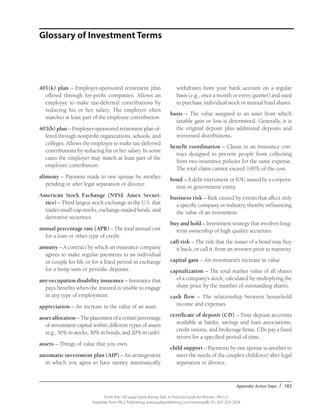
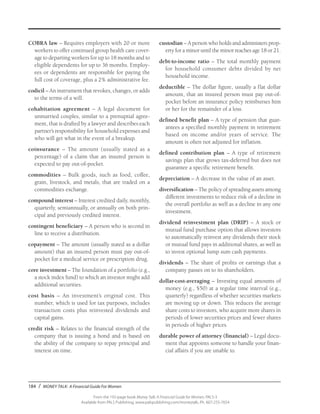
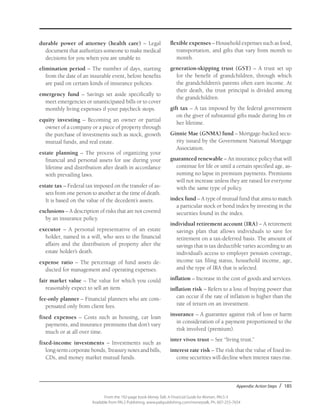
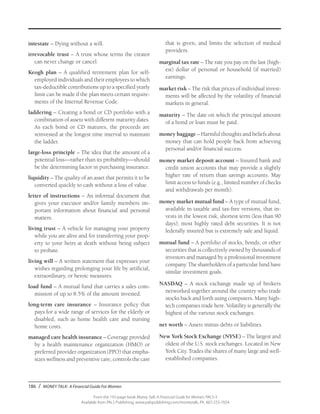
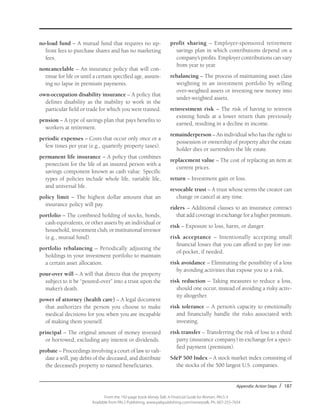
			 Glossary of Investment Terms................................................................................................. 183
			 About PALS............................................................................................................................ 189
			Sponsors................................................................................................................................ 190
v
From the 192-page book Money Talk: A Financial Guide for Women, PALS-3
Available from PALS Publishing, www.palspublishing.com/moneytalk, Ph. 607-255-7654
Acknowledgments
The authors thank the following peer reviewers for offering
comments to improve the quality and accuracy of the text
at the time of its original publication:
Karen P. Bennett
Extension Professor and Specialist/Forest Resources
University of New Hampshire Cooperative Extension
Mary L. Carsky, Ph.D.
Professor of Marketing
University of Hartford/Barney School of Business
Cynthia Needles Fletcher, Ph.D.
Professor and Extension Specialist
Human Development and Family Studies
Iowa State University
Gail M. Gordon
Business Development and Family Economics Specialist
University of Wyoming Cooperative Extension Service
Agricultural and Applied Economics
Patricia K. Gorman
Family Resource Management Field Specialist
Iowa State University Extension
Louis Gorr
Extension Agent, Family and Consumer Sciences/
Management, Housing, and Consumer Education
Virginia Cooperative Extension
Virginia Polytechnic Institute and State University
Lynne C. Grant
Extension Educator, Family and Consumer Sciences
University of Connecticut Cooperative Extension System
Joanne Bordelon Hamilton, AFC
Extension Educator
University of Maryland
Celia Ray Hayhoe, Ph.D., CFP®
Family Financial Management Extension Specialist
Apparel, Housing, and Resource Management
Virginia Polytechnic Institute and State University
Beverly Healy
Extension Educator
University of Idaho Cooperative Extension System
Suzann Enzian Knight
Extension Professor and Specialist
University of New Hampshire Cooperative Extension
Family Studies Department
Robin L. Kuleck
Family Living Educator, Resource Management
Penn State Cooperative Extension
Geri Mason
Family and Consumer Science Educator
University of Maryland/Wicomico County Extension
Barbara S. Poole, Ph.D.
Associate Professor, Finance
Roger Williams University
Patricia Swanson, Ph.D.,CFP®
Extension State Specialist and Adjunct Assistant Professor
Human Development and Family Studies
Iowa State University
Elizabeth S. Trent
Associate Professor, Emerita
University of Vermont
Josephine Turner, CFP®
Professor, Family, Youth, and Community Sciences
University of Florida
The authors also thank Linda Intili at Rutgers Cooperative
Extension of Morris County, for typing the original manu-
script, and Money Talk class participants, who provided help-
ful feedback and encouragement. The authors offer special
thanks to Marty Sailus and Cathleen Walker at NRAES for
supporting the project; to Joy Drohan for her exceptional
and meticulous copy editing; to Andrea Gray for creating a
sensible and attractive design; and to Jeff Miller of The Art
Department, Ithaca, New York, for the cover design. (Cover
art is from Getty Images, Inc., www.gettyimages.com.)
Disclaimers
The content of this publication is believed to be current as of this
printing, but subsequent legislative and regulatory changes and new
developments may date the material.
The intent of this publication is to provide accurate and authori-
tative information. The publisher in no way purports to render legal,
financial, or other professional services. Readers should consult the
services of a competent professional if legal advice or other expert
assistance is required.
Mention of a trademark, proprietary product, or commercial
firm in text, tables, or figures does not constitute an endorsement
by the Cooperative Extension System or the publisher and does not
imply approval to the exclusion of other suitable products or firms.
vi
From the 192-page book Money Talk: A Financial Guide for Women, PALS-3
Available from PALS Publishing, www.palspublishing.com/moneytalk, Ph. 607-255-7654
About the Authors
Patricia Q. Brennan, a Certified Financial Planner (CFP®
),
was a Family and Consumer Sciences Educator with Rut­gers
Cooperative Extension of Morris County from 1981 to 2008.
She held the tenured faculty rank of associate professor at the
School of Environmental and Biological Sciences, Rutgers
University. Professor Brennan is a chartered retirement plan-
ning counselor (CRPC), an accredited financial counselor
(AFC), and a certified housing counselor (CHC). She taught
more than 80 personal finance classes annually and wrote
and recorded a weekly five-minute morning radio program
on station WMTR. She wrote for Morris County newspa-
pers, appeared regularly on the Cablevision cable TV show
“Money Counts,” and made guest appearances on CNBC
and News 12 New Jersey. Professor Brennan made more
than 30 national professional conference presentations and
contributed numerous articles for professional journals and
proceedings. She earned a B.S. in Home Economics from
Immaculata University and an M.A. in Education from
Montclair State University.
Barbara M. O’Neill, Ph.D., holds the rank of Distinguished
Professor in the Department of Agricultural, Food, and
Resource Economics at the School of Environmental and
Biological Sciences, Rutgers University, where she has
been a faculty member since 1978. She currently serves
as Rutgers Cooperative Extension’s Specialist in Financial
Resource Management. She is a certified financial planner
(CFP®
), a chartered retirement planning counselor (CRPC),
an accredited financial counselor (AFC), a certified housing
counselor (CHC), a Certified Financial Educator (CFEd),
and certified in family and consumer sciences (CFCS). Dr.
O’Neill has written more than 1,500 consumer newspaper
articles and more than 100 articles for professional journals
and conference proceedings. She served as national president
of the Association For Financial Counseling and Planning
Education in 2003. She is the author of five books—three
financial case-study books published by Rutgers University,
and Saving On A Shoestring and Investing On A Shoestring,
trade books published by Dearborn Financial Publishing.
vii
From the 192-page book Money Talk: A Financial Guide for Women, PALS-3
Available from PALS Publishing, www.palspublishing.com/moneytalk, Ph. 607-255-7654
Dear Money Talk Reader,
Money Talk: A Financial Guide For Women was developed because women have
unique financial needs. Statistics tell us that it is only a matter of time before most
(85–90%) women will be on their own financially. Some will never marry, some
will see their marriages end in divorce, and some will outlive their husbands.
Women have unique financial needs for the following reasons.
•	We live longer, on average, than men, so our money has to last longer.
•	We earn less, on average, than men do.
•	We may have gaps in our employment history, due to family care giving,
that will affect future retirement benefits.
•	Some women rely on a spouse for income and are at risk for becoming a
“displaced homemaker” if the relationship ends (e.g., in death and divorce).
•	Some women lack financial experience because “the man is supposed to
handle the money.”
This guidebook will provide you with information that you need to take
charge of your financial future. Each of the five class sessions includes a number
of investment lessons. They will also introduce you to important financial terms
such as “net worth” and “expense ratio.”
Each class session also features a number of exercises. They were included
so that you could “personalize” the information. In other words, instead of just
reading about how to calculate your net worth, you have a form to calculate
your own (Session I). In Session III, there are forms to compare different types
of investments and calculate your investment risk tolerance.
Simply reading Money Talk: A Financial Guide For Women will not change your
financial situation. You need to take action (e.g., starting an individual retire-
ment account [IRA]) to achieve your financial goals. That’s why the exercises
are included. You’ll find a list of Minimum “Need to Knows” at the end of each
session. These are the most important facts covered in each lesson.
Your local Cooperative Extension office is a resource that can help you
improve your financial well-being through classes, speaking engagements,
publications, financial consultations, Web sites, newspaper articles, and other
outreach methods. Feel free to get in touch if we can be of assistance.
Patricia Q. Brennan, CFP®
	 Dr. Barbara M. O’Neill, CFP®
	 Senior Extension Trainer Emeritus	 Extension Specialist in Financial
			 Resource Management
	
April 2018
viii
From the 192-page book Money Talk: A Financial Guide for Women, PALS-3
Available from PALS Publishing, www.palspublishing.com/moneytalk, Ph. 607-255-7654
No matter how much women prefer
to lean, to be protected and supported,
nor how much men prefer to have them do so,
they must make the voyage of life alone,
and for safety in an emergency
they must know something
of the laws of navigation.
Elizabeth Cady Stanton, 1892
Financial Basics / 1
From the 192-page book Money Talk: A Financial Guide for Women, PALS-3
Available from PALS Publishing, www.palspublishing.com/moneytalk, Ph. 607-255-7654
SESSION I
Financial Basics
Mary has a little jar
And in it she drops change
Twenty years from now, she hopes
It’ll be in the ten-thousand dollar range
What will be covered in Session I
Financial Planning Lessons
	 1.	Understanding Your Relationship to Money
	 2.	Money Values and Goals
	 3.	Testing Your Financial Fitness
	 4.	Managing Household Cash Flow
	 5.	Calculating Your Net Worth
	 6.	Tips for Smarter Borrowing
	 7.	Financial Record Keeping
Terms to Learn (bolded in the text)
Cash flow	 Fixed expenses	 Net worth
Compound interest	 Flexible expenses	 Periodic expenses
Debt-to-income ratio	 Liquidity	 Spending plan
Emergency fund	 Money “baggage”	 Values
Exercises
	 1. 	Money Coat of Arms
	 2.	Emotional Uses of Money
	 3.	Ten Things I Love to Do
	 4.	Evaluate Your Financial Goals
	 5.	Financial Fitness Quiz
	 6.	Checklist of Expenses
	 7.	Household Expenses: Week by Week
	 8.	Anticipated Occasional Expenses in Next 12 Months
	 9.	Spending Plan Worksheet
	10.	Finding Money to Save Worksheet
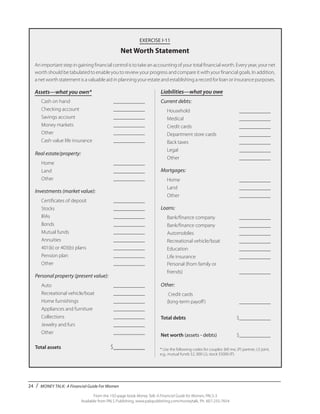
	11.	Net Worth Statement
	12.	Credit Card Comparison Worksheet
	13.	Credit File Request Form
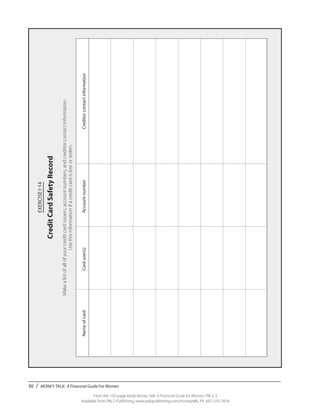
	14.	Credit Card Safety Record
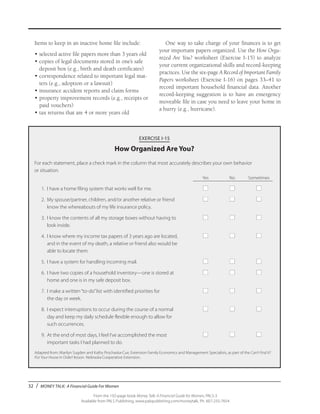
	15.	How Organized Are You?
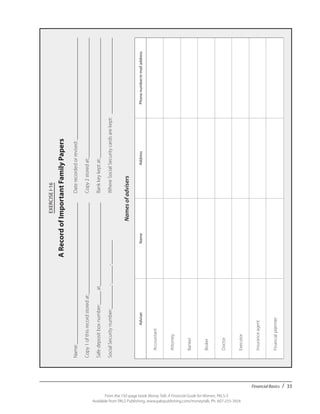
16.	A Record of Important Family Papers
2 / MONEY TALK: A Financial Guide For Women
From the 192-page book Money Talk: A Financial Guide for Women, PALS-3
Available from PALS Publishing, www.palspublishing.com/moneytalk, Ph. 607-255-7654
LESSON 1
Understanding Your Relationship to Money
People’s feelings about money are often a stron-
ger influence on their spending and saving deci-
sions than the amount of money they earn. People
often use money in connection with a number of
emotions and motivations, including security, power,
control, status, and success, and to build self-esteem.
Understanding these emotions is a key to successful
financial management.
We are also influenced by “money messages” in so-
ciety (e.g., advertising). People receive money messages
from a variety of places. Sources of money messages
include parents, religion, media, friends, and financial
institutions.
“Money baggage.” Harmful thoughts and beliefs
about money that can hold people back from
achieving personal and/or financial success.
Examples of negative money baggage include:
•	“My net worth determines my self worth,”
•	“It’s just too complicated,”
•	“Live for today—the future doesn’t matter,” and
•	“The man should make all financial decisions.”
Understanding your money baggage is the first step
in making changes to improve your finances. To bet-
ter understand your money baggage, reflect on what
you’ve heard about money from society, your parents,
your friends, and/or your spouse. Also, what do you
say about money? What does money mean to you?
A number of books have been written about money
personalities, which is another way of looking at factors
that influence financial decisions. Money Harmony, by
Olivia Mellan, for example, classifies money personali-
ties as hoarder, spender, money monk, avoider, and
amasser.
Another way to probe your money decisions, val-
ues, and financial goals is to ask yourself some tough
questions:
•	What is the meaning and purpose of your life?
• 	What would you do if you found out you had
less than 10 years to live?
• 	How do you want to be remembered?
Many people take stock of their lives at some point,
often in midlife or after a “wake-up call” such as cancer
or a heart attack. Very often the things we like to do
best cost little or nothing. A life assessment process
includes weighing needs and wants and pausing to
enjoy simple pleasures. As the old saying goes, the
best things in life are often free.
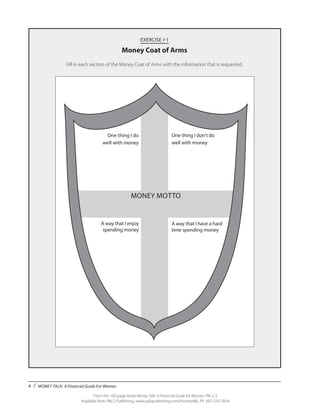
Use the Money Coat of Arms (Exercise I-1) on page
4 to better understand your relationship with money.
In the five sections of the coat of arms, describe the
following items:
•	one thing you do well with money
•	one thing you don’t do well with money
• 	your money motto (e.g., “happiness is positive
cash flow”)
• 	a way that you enjoy spending money
• 	a way that you have a hard time spending
money
Use the Emotional Uses of Money worksheet (Exercise
I-2) on page 5 to better understand the underlying
emotions associated with your spending decisions.
Making Positive Financial Changes
Why do some women achieve their financial goals
while others, who earn the same income or more, fail
to make progress? Probably dozens of answers to this
question exist, including a person’s age, income, em-
ployment, marital status, and access to employer sav-
Financial Basics / 3
From the 192-page book Money Talk: A Financial Guide for Women, PALS-3
Available from PALS Publishing, www.palspublishing.com/moneytalk, Ph. 607-255-7654
ings plans (e.g., 401(k)s and credit unions). Another
explanation for financial goal achievement is personal
qualities, such as:
•	a positive attitude,
• 	a desire to achieve a specific goal,
• 	focus and self-control,
• 	financial knowledge, and
• 	specific actions taken (e.g., investing $3,000
annually in an IRA) to reach a financial goal
(e.g., accumulate $100,000 for retirement). In
other words, “where there’s a will, there’s a way.”
Achieving financial goals is not just a matter of
money. It’s about an internal desire to improve one’s fi-
nances and “walk the walk” with specific practices (e.g.,
enrolling in a 401(k) plan) that move you forward. Ac-
cording to a popular theory, behavioral change occurs in
defined stages, based on a person’s readiness to change.
At the precontemplation stage of change, people
may not even be aware that a problem (e.g., high
debt load) exists or that adjustments should be made
in their lives. At the contemplation stage, they gain
knowledge about alternative behaviors and begin to
understand ways to change (e.g., reduce spending).
At the preparation stage, people commit to make a
change and gain required skills (e.g., read a book
on personal finance). At the action stage, they “take
the plunge” and actually change their behavior. In
the maintenance stage, people work to sustain their
change and reap the rewards of their efforts (e.g.,
increased bank balance).
In the precontemplation and contemplation stages,
a key process is consciousness-raising, or raised aware-
ness. An example of this process is that news stories
about the benefits of saving small dollar amounts on a
regular basis might cause a person to think, “I should
save some money.” Commitment takes place during the
preparation stage of change. An example of commit-
ment is, “I will save $25 per paycheck.” At the action
stage of change, countering is an important process.
This means substituting a healthy response (e.g., sav-
ing $3 per day) for an unhealthy one (e.g., spending
$3 per day on lottery tickets).
Another action stage change process is environmen-
tal control. This means restructuring your environment
to reduce the probability of a problem-causing event.
An example is signing up for a mutual fund automatic
savings plan (e.g., $50 per month) so that part of
your income can be invested in fund shares before
it is spent. Another is having your paycheck directly
deposited at a bank.
Personal change is difficult, and it doesn’t happen
just because we want it to. Most successful changes
require persistence, positive thoughts, and a strong
support system. Believe in yourself and your ability to
make changes that will improve your finances. Even
small amounts of savings add up over time.
Remember this phrase: “If it is to be, it’s up to me.”
You, alone, control your financial destiny. When facing
financial challenges, having a positive attitude is im-
portant. You can give up and say “I’ll never save enough
money,” or you can resolve to take action to improve
your life. People who think positively generally expe-
rience greater success than “naysayers” because they
believe that there’s a connection between what they do
today and what will happen in the future.
Today is the first day of the rest of your financial
life. Make the most of it.
4 / MONEY TALK: A Financial Guide For Women
From the 192-page book Money Talk: A Financial Guide for Women, PALS-3
Available from PALS Publishing, www.palspublishing.com/moneytalk, Ph. 607-255-7654
EXERCISE I-1
Money Coat of Arms
Fill in each section of the Money Coat of Arms with the information that is requested.
	
MONEY MOTTO
One thing I don’t do
well with money
A way that I have a hard
time spending money
One thing I do
well with money
A way that I enjoy
spending money
Financial Basics / 5
From the 192-page book Money Talk: A Financial Guide for Women, PALS-3
Available from PALS Publishing, www.palspublishing.com/moneytalk, Ph. 607-255-7654
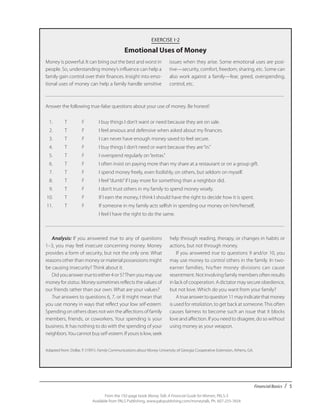
EXERCISE I-2
Emotional Uses of Money
Answer the following true-false questions about your use of money. Be honest!
	 1.	 T	 F	 I buy things I don’t want or need because they are on sale.
	 2.	 T	 F	 I feel anxious and defensive when asked about my finances.
	 3.	 T	 F	 I can never have enough money saved to feel secure.
	 4.	 T	 F	 I buy things I don’t need or want because they are“in.”
	 5.	 T	 F	 I overspend regularly on“extras.”
	 6.	 T	 F	 I often insist on paying more than my share at a restaurant or on a group gift.
	 7.	 T	 F	 I spend money freely, even foolishly, on others, but seldom on myself.
	 8.	 T	 F	 I feel“dumb”if I pay more for something than a neighbor did.
	 9.	 T	 F	 I don’t trust others in my family to spend money wisely.
	10.	 T	 F	 If I earn the money, I think I should have the right to decide how it is spent.
	11.	 T	 F	 If someone in my family acts selfish in spending our money on him/herself,
				 I feel I have the right to do the same.
Analysis: If you answered true to any of questions
1–3, you may feel insecure concerning money. Money
provides a form of security, but not the only one. What
reasons other than money or material possessions might
be causing insecurity? Think about it.
Did you answer true to either 4 or 5?Then you may use
money for status. Money sometimes reflects the values of
our friends rather than our own. What are your values?
True answers to questions 6, 7, or 8 might mean that
you use money in ways that reflect your low self-esteem.
Spending on others does not win the affections of family
members, friends, or coworkers. Your spending is your
business. It has nothing to do with the spending of your
neighbors.You cannot buy self-esteem. If yours is low, seek
help through reading, therapy, or changes in habits or
actions, but not through money.
If you answered true to questions 9 and/or 10, you
may use money to control others in the family. In two-
earner families, his/her money divisions can cause
resentment. Not involving family members often results
in lack of cooperation. A dictator may secure obedience,
but not love. Which do you want from your family?
Atrueanswertoquestion11mayindicatethatmoney
is used for retaliation, to get back at someone.This often
causes fairness to become such an issue that it blocks
love and affection. If you need to disagree, do so without
using money as your weapon.
Adapted from: Dollar, P. (1991). Family Communications about Money. University of Georgia Cooperative Extension, Athens, GA.
Money is powerful. It can bring out the best and worst in
people. So, understanding money’s influence can help a
family gain control over their finances. Insight into emo-
tional uses of money can help a family handle sensitive
issues when they arise. Some emotional uses are posi-
tive—security, comfort, freedom, sharing, etc. Some can
also work against a family—fear, greed, overspending,
control, etc.
6 / MONEY TALK: A Financial Guide For Women
From the 192-page book Money Talk: A Financial Guide for Women, PALS-3
Available from PALS Publishing, www.palspublishing.com/moneytalk, Ph. 607-255-7654
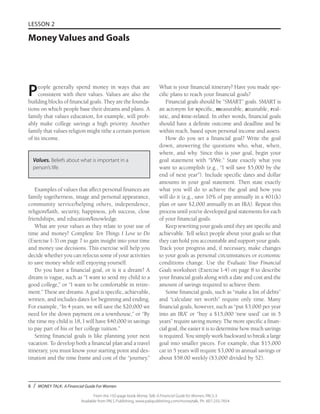
LESSON 2
Money Values and Goals
People generally spend money in ways that are
consistent with their values. Values are also the
building blocks of financial goals. They are the founda-
tions on which people base their dreams and plans. A
family that values education, for example, will prob-
ably make college savings a high priority. Another
family that values religion might tithe a certain portion
of its income.
Values. Beliefs about what is important in a
person’s life.
Examples of values that affect personal finances are
family togetherness, image and personal appearance,
community service/helping others, independence,
religion/faith, security, happiness, job success, close
friend­ships, and education/knowledge.
What are your values as they relate to your use of
time and money? Complete Ten Things I Love to Do
(Exercise I-3) on page 7 to gain insight into your time
and money use decisions. This exercise will help you
decide whether you can refocus some of your activities
to save money while still enjoying yourself.
Do you have a financial goal, or is it a dream? A
dream is vague, such as “I want to send my child to a
good college,” or “I want to be comfortable in retire-
ment.” These are dreams. A goal is specific, achievable,
written, and includes dates for beginning and ending.
For example, “In 4 years, we will save the $20,000 we
need for the down payment on a town­house,” or “By
the time my child is 18, I will have $40,000 in savings
to pay part of his or her college tuition.”
Setting financial goals is like planning your next
vacation. To develop both a financial plan and a travel
itinerary, you must know your starting point and des-
tination and the time frame and cost of the “journey.”
What is your financial itinerary? Have you made spe-
cific plans to reach your financial goals?
Financial goals should be “SMART” goals. SMART is
an acronym for specific, measurable, attainable, real-
istic, and time-related. In other words, financial goals
should have a definite outcome and deadline and be
within reach, based upon personal income and assets.
How do you set a financial goal? Write the goal
down, answering the questions who, what, when,
where, and why. Since this is your goal, begin your
goal statement with “I/We.” State exactly what you
want to accomplish (e.g., “I will save $5,000 by the
end of next year”). Include specific dates and dollar
amounts in your goal statement. Then state exactly
what you will do to achieve the goal and how you
will do it (e.g., save 10% of pay annually in a 401(k)
plan or save $2,000 annually in an IRA). Repeat this
process until you’ve developed goal statements for each
of your financial goals.
Keep rewriting your goals until they are specific and
achievable. Tell select people about your goals so that
they can hold you accountable and support your goals.
Track your progress and, if necessary, make changes
to your goals as personal circumstances or economic
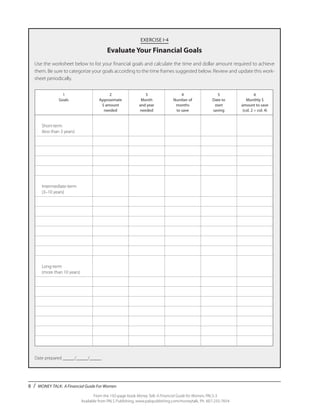
conditions change. Use the Evaluate Your Financial
Goals worksheet (Exercise I-4) on page 8 to describe
your financial goals along with a date and cost and the
amount of savings required to achieve them.
Some financial goals, such as “make a list of debts”
and “calculate net worth” require only time. Many
financial goals, however, such as “put $3,000 per year
into an IRA” or “buy a $15,000 ‘new used’ car in 5
years” require saving money. The more specific a finan-
cial goal, the easier it is to determine how much savings
is required. You simply work backward to break a large
goal into smaller pieces. For example, that $15,000
car in 5 years will require $3,000 in annual savings or
about $58.00 weekly ($3,000 divided by 52).
Financial Basics / 7
From the 192-page book Money Talk: A Financial Guide for Women, PALS-3
Available from PALS Publishing, www.palspublishing.com/moneytalk, Ph. 607-255-7654
Goals provide a framework for investment decisions
and help narrow down your choices. For example, if
you have a short-term goal, such as freshman-year col-
lege tuition in a year or a new car purchase in 3 years,
you’ll want to keep this money in cash assets (e.g., a
money market mutual fund) so that there’s no loss of
principal. Equity investments such as stock (a security
that represents a unit of ownership in a corporation)
or growth mutual funds (a portfolio of stocks that is
collectively owned by many investors and managed
by a professional investment company) would be a
poor choice due to the historical volatility of the stock
market in short time frames.
On the other hand, if you have a long-term goal,
such as college expenses for a newborn or retirement in
20 years, cash assets are a poor choice due to the risk
of loss of purchasing power. Stocks or growth mutual
funds would be better places to save for these long-term
goals. We know from research by Ibbotson Associates
(a Chicago investment research firm) that stocks are
less volatile in longer time frames (a principle called
time diversification) and provide the best historical
return (gain or loss you receive from investing) of any
asset class.
Several studies have shown a link between the act of
planning and subsequent financial behavior. A survey
sponsored by NationsBank and the Consumer Federa-
tion of America found that, no matter what their income,
people with a plan save more money, save or invest
in smarter ways, and feel better about their financial
progress than those without a plan.
According to the annual Retirement Confidence Sur-
vey (RCS) by the Employee Benefit Research Institute,
workers who have done a retirement savings calcula-
tion have saved considerably more than those who
have not. Thus, doing a retirement savings calculation
appears to be related to changing saving behavior.
Bottom line: determine your financial goals before
you spend or invest your money and know what you’re
investing for. A key to investment success is financial
goal setting. Remember that people don’t plan to fail,
they fail to plan and set financial goals.
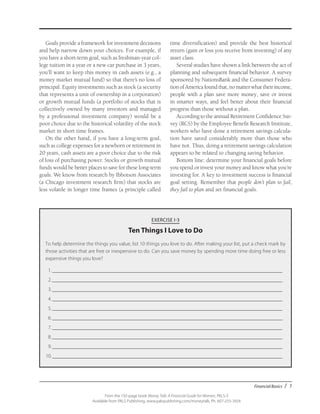
EXERCISE I-3
Ten Things I Love to Do
To help determine the things you value, list 10 things you love to do. After making your list, put a check mark by
those activities that are free or inexpensive to do. Can you save money by spending more time doing free or less
expensive things you love?
	 1._________________________________________________________________________________________
	2._________________________________________________________________________________________
	3._________________________________________________________________________________________
	4._________________________________________________________________________________________
	5._________________________________________________________________________________________
	6._________________________________________________________________________________________
	7._________________________________________________________________________________________
	8._________________________________________________________________________________________
	9._________________________________________________________________________________________
	10._________________________________________________________________________________________
8 / MONEY TALK: A Financial Guide For Women
From the 192-page book Money Talk: A Financial Guide for Women, PALS-3
Available from PALS Publishing, www.palspublishing.com/moneytalk, Ph. 607-255-7654
EXERCISE I-4
Evaluate Your Financial Goals
Use the worksheet below to list your financial goals and calculate the time and dollar amount required to achieve
them. Be sure to categorize your goals according to the time frames suggested below. Review and update this work-
sheet periodically.
	
1
Goals
2
Approximate
$ amount
needed
3
Month
and year
needed
4
Number of
months
to save
5
Date to
start
saving
6
Monthly $
amount to save
(col. 2 ÷ col. 4)
Short-term
(less than 3 years)
Intermediate-term
(3–10 years)
Long-term
(more than 10 years)
Date prepared _____/_____/_____
Financial Basics / 9
From the 192-page book Money Talk: A Financial Guide for Women, PALS-3
Available from PALS Publishing, www.palspublishing.com/moneytalk, Ph. 607-255-7654
Starting an Emergency Fund
A financial goal that everyone should have is to estab-
lish some type of emergency fund. This is savings set
aside specifically to meet emergencies or unanticipated
bills or to cover monthly living expenses if your pay-
check stops (e.g., unemployment). Too often people
use credit cards or borrow from family members in an
emergency because they don’t have a savings account to
fall back on when unexpected things happen. This just
digs them further into debt when interest is charged
on unpaid balances. Decide up front what constitutes
an emergency so that money from the fund is not used
for recurring expenses, such as birthdays.
Make establishing an emergency fund a priority.
Fund it with approximately 3–6 months or more of
living expenses or whatever gives you peace of mind.
Whenever you withdraw from the emergency fund,
pay yourself back based on a predetermined schedule
as you would any other bill. Discipline yourself to use
this money only for real emergencies (e.g., car repairs,
broken appliances, sickness, etc.).
Keep your emergency fund in a liquid savings prod-
uct such as a money market mutual fund or short-term
certificate of deposit (CD). A liquid investment can be
converted quickly to cash without loss of value. To get
started, save even $5 or $10 per paycheck or whatever
you can afford. Another way to start an emergency fund
is to save $1 per day, plus pocket change. At the end
of each month, you should have about $50 saved, or
$600 after 1 year.
10 / MONEY TALK: A Financial Guide For Women
From the 192-page book Money Talk: A Financial Guide for Women, PALS-3
Available from PALS Publishing, www.palspublishing.com/moneytalk, Ph. 607-255-7654
LESSON 3
Testing Your Financial Fitness
Do you get an annual physical each year from your
doctor and periodic screening tests such as
mammograms and Pap tests? You should. Frequent
monitoring of your physical health and early detection
of health problems, such as cancer or heart disease,
is very important. Likewise, a “financial checkup” is
also advisable to:
•	monitor progress from year to year
(e.g., increased savings)
•	identify problems
(e.g., a high debt-to-income ratio)
•	identify solutions to problems
(e.g., reducing household expenses)
•	set and monitor financial goals
(e.g., a child’s college education)
•	identify needed action
(e.g., purchasing additional life insurance)
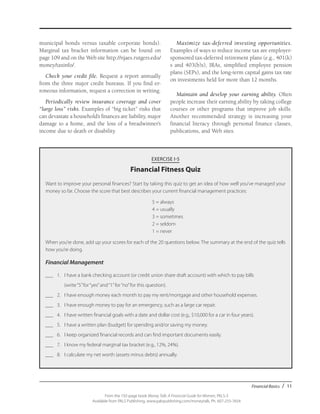
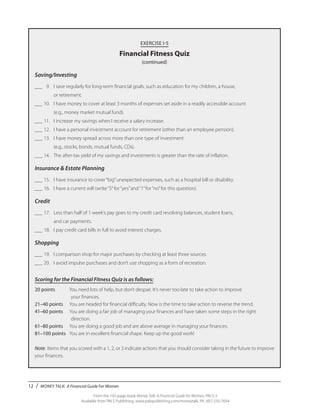
Use the Financial Fitness Quiz (Exercise I-5) on pages
11–12 to assess your financial health. At the end of the
quiz is a description of how to interpret your score.
Questions that you mark with a 1 (never) or 2 (seldom)
indicate areas for improvement.
Want to get your finances in order? Below are a
dozen financial management strategies to consider to
improve your financial fitness. Many of these will be
discussed in depth later in this session.
Do a savings analysis. Determine how much money
is needed to fund future financial goals. For example, if
you need $10,000 for a new car in 4 years, you’ll need
to save $2,500 per year or $96.15 ($2,500 divided by
26) per biweekly paycheck. Break down large goals
into smaller doable pieces.
“Pay yourself first.” Implement automated savings
methods such as direct deposit of your paycheck,
payroll deductions for a credit union or 401(k) plan,
and automatic investment plans offered by mutual
funds or company direct stock purchase programs.
For automatic investment plans, your bank checking
or savings account is debited monthly for the amount
of share purchases.
Debt analysis. Determine the percentage of house-
hold take-home pay spent on consumer debt such
as credit cards, car loans, and student loans. If your
consumer debt ratio exceeds 15–20% of take-home
pay, this is an indication that you are becoming over-
extended (e.g., $350 of monthly consumer debt with a
$2,200 monthly net income = a 16% debt ratio [{350
÷ 2,200} x 100]).
Accelerate debt repayment. One way to accelerate
debt repayment is to obtain a PowerPay© analysis (see
www.powerpay.org). Power­Pay© will help you save
money by allocating the monthly payment from debts
that are repaid to remaining creditors.
Develop a spending plan. A spending plan (a.k.a.,
budget) is a written plan for spending and saving
money. Basically, you total all income sources and all
monthly expenses, including 1/12 of the annual cost of
occasional expenses such as quarterly property taxes,
then adjust the figures and your spending habits until
income = expenses + savings.
Organize your financial records. Make a list of im-
portant financial data, such as names and addresses of
financial advisors and insurance agents, locations of
important papers, and bank and investment account
information.
Calculate your net worth. Net worth is household
assets minus debts. Try to calculate your net worth
annually to measure your financial progress.
Determine your marginal tax bracket (the rate you
pay on the last (highest) dollar of personal or house-
hold (if married) earnings)—Then use this informa-
tion to make investing decisions (e.g., tax-exempt
Financial Basics / 11
From the 192-page book Money Talk: A Financial Guide for Women, PALS-3
Available from PALS Publishing, www.palspublishing.com/moneytalk, Ph. 607-255-7654
municipal bonds versus taxable corporate bonds).
Marginal tax bracket information can be found on
page 109 and on the Web site http://njaes.rutgers.edu/
money/taxinfo/.
Check your credit file. Request a report annually
from the three major credit bureaus. If you find er-
roneous information, request a correction in writing.
Periodically review insurance coverage and cover
“large loss” risks. Examples of “big ticket” risks that
can devastate a household’s finances are liability, major
damage to a home, and the loss of a breadwinner’s
income due to death or disability.
Maximize tax-deferred investing opportunities.
Examples of ways to reduce income tax are employer-
sponsored tax-deferred retirement plans (e.g., 401(k)
s and 403(b)s), IRAs, simplified employee pension
plans (SEPs), and the long-term capital gains tax rate
on investments held for more than 12 months.
Maintain and develop your earning ability. Often
people increase their earning ability by taking college
courses or other programs that improve job skills.
Another recommended strategy is increasing your
financial literacy through personal finance classes,
publications, and Web sites.
EXERCISE I-5
Financial Fitness Quiz
Want to improve your personal finances? Start by taking this quiz to get an idea of how well you’ve managed your
money so far. Choose the score that best describes your current financial management practices:
	 5 = always
	 4 = usually
	 3 = sometimes
	 2 = seldom
	 1 = never
When you’re done, add up your scores for each of the 20 questions below. The summary at the end of the quiz tells
how you’re doing.
Financial Management
___	 1.	 I have a bank checking account (or credit union share draft account) with which to pay bills
		 (write“5”for“yes”and“1”for“no”for this question).
___	 2.	 I have enough money each month to pay my rent/mortgage and other household expenses.
___	 3.	 I have enough money to pay for an emergency, such as a large car repair.
___	 4.	 I have written financial goals with a date and dollar cost (e.g., $10,000 for a car in four years).
___	 5.	 I have a written plan (budget) for spending and/or saving my money.
___	 6.	 I keep organized financial records and can find important documents easily.
___	 7.	 I know my federal marginal tax bracket (e.g., 12%, 24%).
___	 8.	 I calculate my net worth (assets minus debts) annually.
12 / MONEY TALK: A Financial Guide For Women
From the 192-page book Money Talk: A Financial Guide for Women, PALS-3
Available from PALS Publishing, www.palspublishing.com/moneytalk, Ph. 607-255-7654
EXERCISE I-5
Financial Fitness Quiz
(continued)
Saving/Investing
___	 9.	 I save regularly for long-term financial goals, such as education for my children, a house,
		 or retirement.
___	10.	 I have money to cover at least 3 months of expenses set aside in a readily accessible account
		 (e.g., money market mutual fund).
___	11.	 I increase my savings when I receive a salary increase.
___	12.	 I have a personal investment account for retirement (other than an employee pension).
___	13.	 I have money spread across more than one type of investment
		 (e.g., stocks, bonds, mutual funds, CDs).
___	14.	 The after-tax yield of my savings and investments is greater than the rate of inflation.
Insurance & Estate Planning
___	15.	 I have insurance to cover“big”unexpected expenses, such as a hospital bill or disability.
___	16.	 I have a current will (write“5”for“yes”and“1”for“no”for this question).
Credit
___	17.	 Less than half of 1 week’s pay goes to my credit card revolving balances, student loans,
		 and car payments.
___	18.	 I pay credit card bills in full to avoid interest charges.
Shopping
___	19.	 I comparison shop for major purchases by checking at least three sources.
___	20.	 I avoid impulse purchases and don’t use shopping as a form of recreation.
Scoring for the Financial Fitness Quiz is as follows:
20 points	 You need lots of help, but don’t despair. It’s never too late to take action to improve
	your finances.
21–40 points	 You are headed for financial difficulty. Now is the time to take action to reverse the trend.
41–60 points	 You are doing a fair job of managing your finances and have taken some steps in the right 		
	direction.
61–80 points	 You are doing a good job and are above average in managing your finances.
81–100 points	 You are in excellent financial shape. Keep up the good work!
Note: 	Items that you scored with a 1, 2, or 3 indicate actions that you should consider taking in the future to improve
your finances.
Financial Basics / 13
From the 192-page book Money Talk: A Financial Guide for Women, PALS-3
Available from PALS Publishing, www.palspublishing.com/moneytalk, Ph. 607-255-7654
LESSON 4
Managing Household Cash Flow
To get a handle on your household’s cash flow, you
need a spending plan.
In other words, you need to do a realistic side-by-
side comparison of what you earn (income) and where
the money goes (savings and household expenses). A
spending plan provides direction for future financial
decisions and indicates whether there is sufficient
income with which to pay expenses.
Cash flow. The relationship between household
income and expenses.
Spending plan. A plan for spending and saving
money.
If this sounds like “budgeting,” you’re right. “Spend-
ing plan” is a fancy way of saying “budget.” Still, there
are subtle differences between the two. First, “spending
plan” is a more positive term because it includes the
word “spending.” Most people like to spend money.
The word “plan” also emphasizes control of your mon-
ey, rather than letting your money control you. The
word “budget,” on the other hand, is often perceived
negatively (e.g., deprivation) and discourages people
from taking financial control of their lives.
Spending plans provide a number of advantages.
•	They help determine where money is currently
being spent.
•	They force you to make spending choices and
prioritize needs and wants.
•	They help you live within your income.
•	They can include savings for “big ticket” finan-
cial goals such as a new car or retirement.
•	They can reduce worrying, out-of-control feel-
ings, and family fights about money.
Although not nearly as “sexy” a topic as some “hot”
new investment, spending plans are the foundation
of financial planning. Why? Unless money is left over
after covering household expenses, little can be done
in other areas of personal finance, such as investments
or retirement planning.
To prepare a spending plan, it is first necessary to
know what you earn and spend. To do this, track your
household income and expenses for a full month.
Start with gross income so that taxes are viewed as
an “expense.” Try to choose a “typical” month rather
than the December holiday season, in which people
tend to spend more than usual. Household earnings
include net (after-tax) income from a job, benefit pay-
ments (e.g., Social Security, pension, unemployment,
disability), child support or alimony, public assistance,
self-employment income, and other income sources
(e.g., rental income). Add all income from family mem-
bers who contribute to household expenses together
to obtain a total of monthly household net income.
Now total your monthly expenses for an entire typi-
cal month. Using your spending records as a guide,
make a list of fixed expenses such as housing, car loan
payments, and insurance premiums that don’t vary
over time. Next, make a list of flexible expenses such
as food, transportation, and gifts that vary from month
to month. Finally, make a list of periodic expenses
(e.g., holiday expenses, quarterly property taxes) that
come around only once or a few times a year and divide
the annual cost by 12 to arrive at a monthly cost. For
example, $4,000 of annual property taxes would cost
$333 monthly.
Be sure to set aside money to meet financial goals
(e.g., $100 deposited monthly into a mutual fund) as
a monthly “expense.” If you lack an emergency fund
of 3 months’ expenses, include a “line item” in your
spending plan to gradually build up your reserves. If
you have access to “automated” savings plans, such as
a 401(k), sign up today. Even small amounts of sav-
ings (e.g., $15 per paycheck) will grow substantially
over time.
14 / MONEY TALK: A Financial Guide For Women
From the 192-page book Money Talk: A Financial Guide for Women, PALS-3
Available from PALS Publishing, www.palspublishing.com/moneytalk, Ph. 607-255-7654
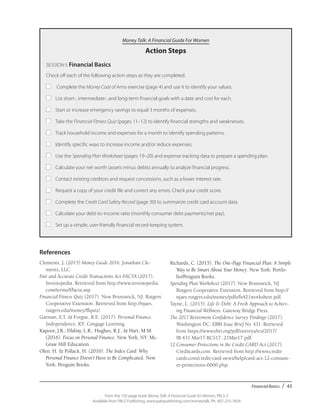
Four worksheets are included in this unit to help
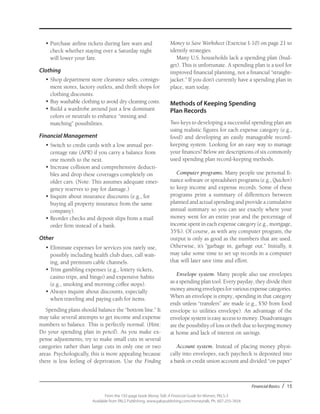
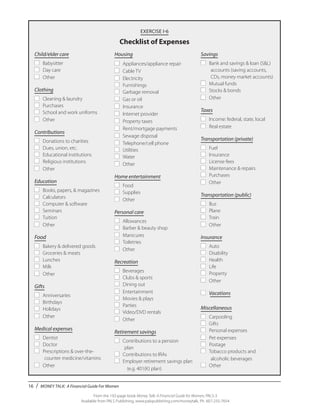
you manage your money. Use the Checklist of Expenses
(Exercise I-6) on page 16 as you track your spending
so that you don’t forget any expense categories. Use the
Household Expenses: Week by Week (Exercise I-7) work-
sheet on page 17 to record your actual expenses. Use
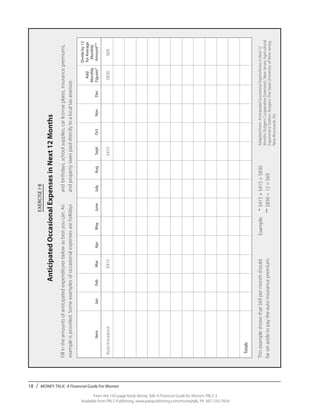
the Anticipated Occasional Expenses in Next 12 Months
(Exercise I-8) worksheet on page 18 to determine the
annual and monthly cost of nonmonthly expenses
(e.g., vacation, quarterly insurance premiums, and
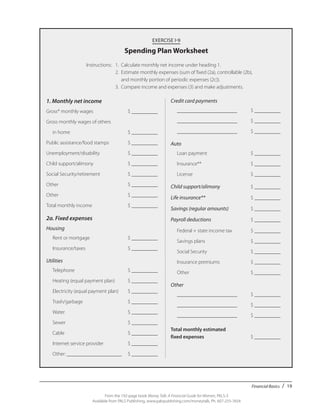
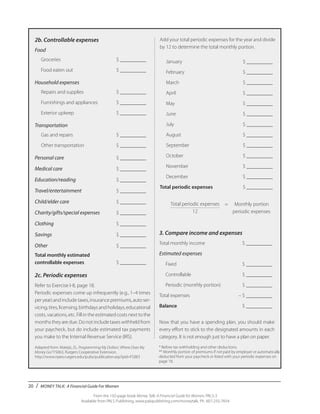
property taxes). Use the Spending Plan Worksheet
(Exercise I-9) on pages 19–20 to total income and ex-
penses and adjust the numbers so that income equals
expenses, including savings.
Earn more than you spend and you have positive
cash flow. Spend more than you earn and you have
negative cash flow. You have three ways to manage
cash flow and make it a positive number: earn more,
spend less, or do a little of both.
Painless Ways to Reduce Expenses
Literally hundreds of books are available about ways to
live on less. Many are organized by spending category.
Below are some ideas to consider.
Housing
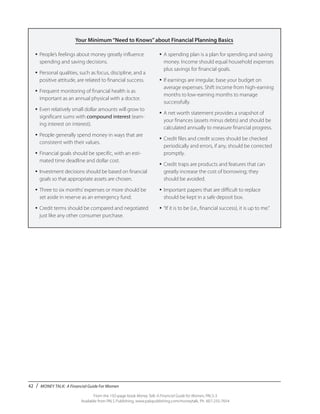
•	Consider refinancing an existing mortgage if
savings exceed the up-front cost (e.g., points).
•	Ask your mortgage lender to cancel private
mortgage insurance when home equity reaches
20% of home value (e.g., $20,000 of equity on
a $100,000 home).
•	Purchase appliances with a high energy effi-
ciency ratio.
Food
•	Combine coupons with store sales and/or prod-
uct rebates for additional savings.
•	Buy in bulk when items are on sale or in season
(e.g., produce and canned goods).
•	Buy store or generic brands if they have the
cheapest price.
Utilities
•	Consider “bundling” phone, cable, and internet
service if it saves money.
•	Use e-mail in lieu of phone calls to reduce tele-
phone charges.
•	Sign up for a generous voice, text, and data cell
phone plan, or use inexpensive prepaid phone
cards.
•	Eliminate add-on features to phone service that
you don’t use.
•	Compare the cost of cable television and satel-
lite service.
•	Close off unused rooms in the winter to con-
serve heat.
•	Insulate your hot water heater and reduce the
temperature to 120°F.
Transportation
•	Keep a car as long as possible to reduce depre-
ciation and financing costs.
•	Consider buying a late model used car instead
of a new one.
Ways to Increase Household Income
•	 Adjust tax withholding (e.g., a $1,000 refund is
equal to an additional $83 per month).
•	 Add a second job or work overtime.
•	 Start a home-based business or freelance your
talents and skills.
•	 Increase/collect child support and alimony. (Note:
This may require court intervention.)
•	 Access public benefits (e.g., low-cost health
screenings and pet rabies clinics).
•	 Sell assets (e.g., sell a car, have a garage sale).
•	 Upgrade job skills through additional education
or training.
•	 Charge adult children room and board.
•	 Use tax benefits not previously used
(e.g., earned income tax credit).
•	 Collect money previously loaned to others.
•	 Establish a barter network (e.g., child care coop-
erative).
•	 House share or take in a compatible boarder or
roommate.
Financial Basics / 15
From the 192-page book Money Talk: A Financial Guide for Women, PALS-3
Available from PALS Publishing, www.palspublishing.com/moneytalk, Ph. 607-255-7654
•	Purchase airline tickets during fare wars and
check whether staying over a Saturday night
will lower your fare.
Clothing
•	Shop department store clearance sales, consign-
ment stores, factory outlets, and thrift shops for
clothing discounts.
•	Buy washable clothing to avoid dry cleaning costs.
•	Build a wardrobe around just a few dominant
colors or neutrals to enhance “mixing and
matching” possibilities.
Financial Management
•	Switch to credit cards with a low annual per-
centage rate (APR) if you carry a balance from
one month to the next.
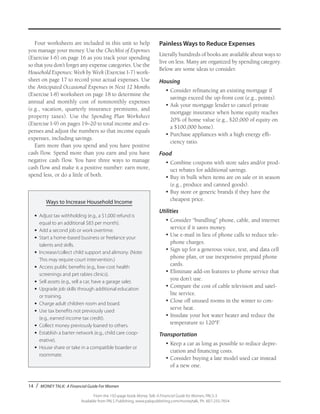
•	Increase collision and comprehensive deducti­
bles and drop these coverages completely on
older cars. (Note: This assumes adequate emer-
gency reserves to pay for damage.)
•	Inquire about insurance discounts (e.g., for
buying all property insurance from the same
company).
•	Reorder checks and deposit slips from a mail
order firm instead of a bank.
Other
•	Eliminate expenses for services you rarely use,
possibly including health club dues, call wait-
ing, and premium cable channels.
•	Trim gambling expenses (e.g., lottery tickets,
casino trips, and bingo) and expensive habits
(e.g., smoking and morning coffee stops).
•	Always inquire about discounts, especially
when traveling and paying cash for items.
Spending plans should balance the “bottom line.” It
may take several attempts to get income and expense
numbers to balance. This is perfectly normal. (Hint:
Do your spending plan in pencil). As you make ex-
pense adjustments, try to make small cuts in several
categories rather than large cuts in only one or two
areas. Psychologically, this is more appealing because
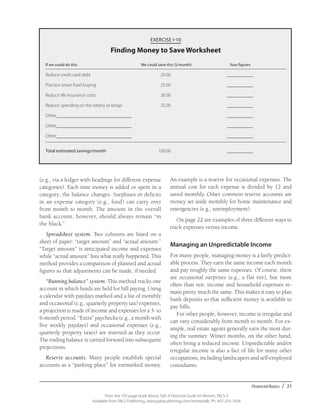
there is less feeling of deprivation. Use the Finding
Money to Save Worksheet (Exercise I-10) on page 21 to
identify strategies.
Many U.S. households lack a spending plan (bud-
get). This is unfortunate. A spending plan is a tool for
improved financial planning, not a financial “straight-
jacket.” If you don’t currently have a spending plan in
place, start today.
Methods of Keeping Spending
Plan Records
Two keys to developing a successful spending plan are
using realistic figures for each expense category (e.g.,
food) and developing an easily manageable record-
keeping system. Looking for an easy way to manage
your finances? Below are descriptions of six commonly
used spending plan record-keeping methods.
Computer programs. Many people use personal fi-
nance software or spreadsheet programs (e.g., Quicken)
to keep income and expense records. Some of these
programs print a summary of differences between
planned and actual spending and provide a cumulative
annual summary so you can see exactly where your
money went for an entire year and the percentage of
income spent in each expense category (e.g., mortgage,
35%). Of course, as with any computer program, the
output is only as good as the numbers that are used.
Otherwise, it’s “garbage in, garbage out.” Initially, it
may take some time to set up records in a computer
that will later save time and effort.
Envelope system. Many people also use envelopes
as a spending plan tool. Every payday, they divide their
money among envelopes for various expense categories.
When an envelope is empty, spending in that category
ends unless “transfers” are made (e.g., $50 from food
envelope to utilities envelope). An advantage of the
envelope system is easy access to money. Disadvantages
are the possibility of loss or theft due to keeping money
at home and lack of interest on savings.
Account system. Instead of placing money physi-
cally into envelopes, each paycheck is deposited into
a bank or credit union account and divided “on paper”
16 / MONEY TALK: A Financial Guide For Women
From the 192-page book Money Talk: A Financial Guide for Women, PALS-3
Available from PALS Publishing, www.palspublishing.com/moneytalk, Ph. 607-255-7654
EXERCISE I-6
Checklist of Expenses
Child/elder care
■ Babysitter
■ Day care
■ Other
Clothing
■ Cleaning & laundry
■ Purchases
■ School and work uniforms
■ Other
Contributions
■ Donations to charities
■ Dues, union, etc.
■ Educational institutions
■ Religious institutions
■ Other
Education
■ Books, papers, & magazines
■ Calculators
■ Computer & software
■ Seminars
■ Tuition
■ Other
Food
■ Bakery & delivered goods
■ Groceries & meats
■ Lunches
■ Milk
■ Other
Gifts
■ Anniversaries
■ Birthdays
■ Holidays
■ Other
Medical expenses
■ Dentist
■ Doctor
■ Prescriptions & over-the-		
	 counter medicine/vitamins
■ Other
Savings
■ Bank and savings & loan (S&L) 	
	 accounts (saving accounts, 		
	 CDs, money market accounts)
■ Mutual funds
■ Stocks & bonds
■ Other
Taxes
■ Income: federal, state, local
■ Real estate
Transportation (private)
■ Fuel
■ Insurance
■ License fees
■ Maintenance & repairs
■ Purchases
■ Other
Transportation (public)
■ Bus		
■ Plane
■ Train		
■ Other
Insurance
■ Auto
■ Disability
■ Health
■ Life
■ Property
■ Other
■ Vacations
Miscellaneous
■ Carpooling
■ Gifts
■ Personal expenses
■ Pet expenses
■ Postage
■ Tobacco products and 		
	 alcoholic beverages
■ Other
Housing
■ Appliances/appliance repair
■ Cable TV
■ Electricity
■ Furnishings
■ Garbage removal
■ Gas or oil
■ Insurance
■ Internet provider
■ Property taxes
■ Rent/mortgage payments
■ Sewage disposal
■ Telephone/cell phone
■ Utilities
■ Water
■ Other
Home entertainment
■ Food
■ Supplies
■ Other
Personal care
■ Allowances
■ Barber & beauty shop
■ Manicures
■ Toiletries
■ Other
Recreation
■ Beverages
■ Clubs & sports
■ Dining out
■ Entertainment
■ Movies & plays
■ Parties
■ Video/DVD rentals
■ Other
Retirement savings
■ Contributions to a pension
	plan
■ Contributions to IRAs
■ Employer retirement savings plan
	 (e.g. 401(K) plan)
Financial Basics / 17
From the 192-page book Money Talk: A Financial Guide for Women, PALS-3
Available from PALS Publishing, www.palspublishing.com/moneytalk, Ph. 607-255-7654
EXERCISE I-7
Household Expenses: Week by Week
	 Week of 	 Week of 	 Week of 	 Week of 	 Week of
Household expense	 ___________	 ___________	___________	___________	___________
Allowance for children
Beverages/snacks
Child/elder care
Clothing
Contributions
Education
Entertainment
Food at home
Food eaten out
Gifts
Home furnishings
Home maintenance
Insurance
Loan payments
Personal care
Rent/mortgage
Savings
Taxes
Transportation
Utilities
Other: (list)
________________________					
________________________					
Total					
Adapted from: Hogarth, J., Take Control of Your Finances. Cornell Cooperative Extension, Ithaca, NY.
18 / MONEY TALK: A Financial Guide For Women
From the 192-page book Money Talk: A Financial Guide for Women, PALS-3
Available from PALS Publishing, www.palspublishing.com/moneytalk, Ph. 607-255-7654
EXERCISEI-8
AnticipatedOccasionalExpensesinNext12Months
andbirthdays,schoolsupplies,carlicenseplates,insurancepremiums,
andpropertytaxespaiddirectlytoalocaltaxassessor.
Fillintheamountsofanticipatedexpendituresbelowasbestyoucan.An
exampleisprovided.Someexamplesofoccasionalexpensesareholidays
															Divideby12
														Add	forAverage
														Monthly	Monthly
	Item	Jan	Feb	Mar	Apr	May	June	July	Aug	Sept	Oct	Nov	Dec	Figures*	Amount**
	AutoInsurance	$415	$415	$830	$69
	Totals
Example:	*	$415+$415=$830
	**	$830÷12=$69
Thisexampleshowsthat$69permonthshould
besetasidetopaytheautoinsurancepremium.
Adaptedfrom:AnticipatedOccasionalExpendituresinNext12
Months.RutgersCooperativeExtension,NewJerseyAgricultural
ExperimentStation.Rutgers,TheStateUniversityofNewJersey,
NewBrunswick,NJ.
Financial Basics / 19
From the 192-page book Money Talk: A Financial Guide for Women, PALS-3
Available from PALS Publishing, www.palspublishing.com/moneytalk, Ph. 607-255-7654
EXERCISE I-9
Spending Plan Worksheet
	 Instructions:	 1. Calculate monthly net income under heading 1.
		 2. Estimate monthly expenses (sum of fixed (2a), controllable (2b),
			 and monthly portion of periodic expenses (2c)).
		 3. Compare income and expenses (3) and make adjustments.
1. Monthly net income
Gross* monthly wages	 $ __________
Gross monthly wages of others 	
	 in home	 $ __________
Public assistance/food stamps	 $ __________
Unemployment/disability	 $ __________
Child support/alimony	 $ __________
Social Security/retirement	 $ __________
Other	 $ __________
Other	 $ __________
Total monthly income 	 $ __________
2a. Fixed expenses
Housing
	 Rent or mortgage	 $ __________
	 Insurance/taxes	 $ __________
Utilities
	 Telephone	 $ __________
	 Heating (equal payment plan)	 $ __________
	 Electricity (equal payment plan)	 $ __________
	 Trash/garbage	 $ __________
	 Water	 $ __________
	 Sewer	 $ __________
	 Cable	 $ __________
	 Internet service provider	 $ __________
	 Other: _____________________	 $ __________
Credit card payments
	 _______________________	 $ __________
	 _______________________	 $ __________
	 _______________________	 $ __________
Auto
	 Loan payment	 $ __________
	 Insurance**	 $ __________
	 License	 $ __________
Child support/alimony	 $ __________
Life insurance** 	 $ __________
Savings (regular amounts) 	 $ __________
Payroll deductions 	 $ __________
	 Federal + state income tax	 $ __________
	 Savings plans	 $ __________
	 Social Security	 $ __________
	 Insurance premiums	 $ __________
	 Other	 $ __________
Other
	 _______________________	 $ __________
	 _______________________	 $ __________
	 _______________________	 $ __________
Total monthly estimated
fixed expenses	 $ __________
20 / MONEY TALK: A Financial Guide For Women
From the 192-page book Money Talk: A Financial Guide for Women, PALS-3
Available from PALS Publishing, www.palspublishing.com/moneytalk, Ph. 607-255-7654
2b. Controllable expenses
Food
	 Groceries	 $ __________
	 Food eaten out	 $ __________
Household expenses
	 Repairs and supplies	 $ __________
	 Furnishings and appliances	 $ __________
	 Exterior upkeep	 $ __________
Transportation
	 Gas and repairs	 $ __________
	 Other transportation	 $ __________
Personal care	 $ __________
Medical care 	 $ __________
Education/reading	 $ __________
Travel/entertainment	 $ __________
Child/elder care	 $ __________
Charity/gifts/special expenses	 $ __________
Clothing	 $ __________
Savings	 $ __________
Other 	 $ __________
Total monthly estimated
controllable expenses 	 $ __________
2c. Periodic expenses
Refer to Exercise I-8, page 18.
Periodic expenses come up infrequently (e.g., 1–4 times
peryear)andincludetaxes,insurancepremiums,autoser-
vicing,tires,licensing,birthdaysandholidays,educational
costs, vacations, etc. Fill in the estimated costs next to the
months they are due. Do not include taxes withheld from
your paycheck, but do include estimated tax payments
you make to the Internal Revenue Service (IRS).
Add your total periodic expenses for the year and divide
by 12 to determine the total monthly portion.
	 January	 $ __________
	 February	 $ __________
	 March	 $ __________
	 April	 $ __________
	 May	 $ __________
	 June	 $ __________
	 July	 $ __________
	 August	 $ __________
	 September	 $ __________
	 October	 $ __________
	 November	 $ __________
	 December	 $ __________
Total periodic expenses	 $ __________
Adapted from: Matejic, D., Programming My Dollars: Where Does My
Money Go? FS063, Rutgers Cooperative Extension.
http://www.njaes.rutgers.edu/pubs/publication.asp?pid=FS063
3. Compare income and expenses
Total monthly income	 $ __________
Estimated expenses
	 Fixed	 $ __________
	 Controllable	 $ __________
	 Periodic (monthly portion) 	 $ __________
Total expenses	 – $ __________
Balance 	 $ __________
Now that you have a spending plan, you should make
every effort to stick to the designated amounts in each
category. It is not enough just to have a plan on paper.
* Before tax withholding and other deductions.
** Monthly portion of premiums if not paid by employer or automatically
deducted from your paycheck or listed with your periodic expenses on
page 18.
	 Total periodic expenses
	12
=	 Monthly portion
	 periodic expenses
Financial Basics / 21
From the 192-page book Money Talk: A Financial Guide for Women, PALS-3
Available from PALS Publishing, www.palspublishing.com/moneytalk, Ph. 607-255-7654
(e.g., via a ledger with headings for different expense
categories). Each time money is added or spent in a
category, the balance changes. Surpluses or deficits
in an expense category (e.g., food) can carry over
from month to month. The amount in the overall
bank account, however, should always remain “in
the black.”
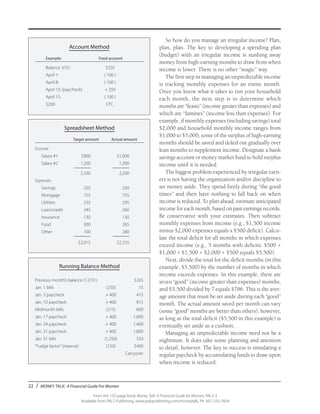
Spreadsheet system. Two columns are listed on a
sheet of paper: “target amount” and “actual amount.”
“Target amount” is anticipated income and expenses
while “actual amount” lists what really happened. This
method provides a comparison of planned and actual
figures so that adjustments can be made, if needed.
“Running balance” system. This method tracks one
account in which funds are held for bill paying. Using
a calendar with paydays marked and a list of monthly
and occasional (e.g., quarterly property tax) expenses,
a projection is made of income and expenses for a 3- to
6-month period. “Extra” paychecks (e.g., a month with
five weekly paydays) and occasional expenses (e.g.,
quarterly property taxes) are inserted as they occur.
The ending balance is carried forward into subsequent
projections.
Reserve accounts. Many people establish special
accounts as a “parking place” for earmarked money.
EXERCISE I-10
Finding Money to Save Worksheet
If we could do this	 We could save this ($/month)	 Your figures
Reduce credit card debt	 20.00	 ___________
Practice smart food buying	 25.00	 ___________
Reduce life insurance costs	 30.00	 ___________
Reduce spending on the lottery or bingo	 25.00	 ___________
Other________________________________		 ___________
Total estimated savings/month	100.00	 ___________	
An example is a reserve for occasional expenses. The
annual cost for each expense is divided by 12 and
saved monthly. Other common reserve accounts are
money set aside monthly for home maintenance and
emergencies (e.g., unemployment).
On page 22 are examples of three different ways to
track expenses versus income.
Managing an Unpredictable Income
For many people, managing money is a fairly predict-
able process. They earn the same income each month
and pay roughly the same expenses. Of course, there
are occasional surprises (e.g., a flat tire), but more
often than not, income and household expenses re-
main pretty much the same. This makes it easy to plan
bank deposits so that sufficient money is available to
pay bills.
For other people, however, income is irregular and
can vary considerably from month to month. For ex-
ample, real estate agents generally earn the most dur-
ing the summer. Winter months, on the other hand,
often bring a reduced income. Unpredictable and/or
irregular income is also a fact of life for many other
occupations, including landscapers and self-employed
consultants.
22 / MONEY TALK: A Financial Guide For Women
From the 192-page book Money Talk: A Financial Guide for Women, PALS-3
Available from PALS Publishing, www.palspublishing.com/moneytalk, Ph. 607-255-7654
So how do you manage an irregular income? Plan,
plan, plan. The key to developing a spending plan
(budget) with an irregular income is stashing away
money from high-earning months to draw from when
income is lower. There is no other “magic” way.
The first step in managing an unpredictable income
is tracking monthly expenses for an entire month.
Once you know what it takes to run your household
each month, the next step is to determine which
months are “feasts” (income greater than expenses) and
which are “famines” (income less than expenses). For
example, if monthly expenses (including savings) total
$2,000 and household monthly income ranges from
$1,000 to $5,000, some of the surplus of high-earning
months should be saved and doled out gradually over
lean months to supplement income. Designate a bank
savings account or money market fund to hold surplus
income until it is needed.
The biggest problem experienced by irregular earn-
ers is not having the organization and/or discipline to
set money aside. They spend freely during “the good
times” and then have nothing to fall back on when
income is reduced. To plan ahead, estimate anticipated
income for each month, based on past earnings records.
Be conservative with your estimates. Then subtract
monthly expenses from income (e.g., $1,500 income
minus $2,000 expenses equals a $500 deficit). Calcu-
late the total deficit for all months in which expenses
exceed income (e.g., 5 months with deficits: $500 +
$1,000 + $1,500 + $2,000 + $500 equals $5,500).
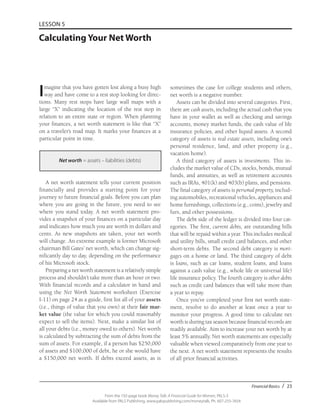
Next, divide the total for the deficit months (in this
example, $5,500) by the number of months in which
income exceeds expenses. In this example, there are
seven “good” (income greater than expenses) months,
and $5,500 divided by 7 equals $786. This is the aver-
age amount that must be set aside during each “good”
month. The actual amount saved per month can vary
(some “good” months are better than others), however,
as long as the total deficit ($5,500 in this example) is
eventually set aside as a cushion.
Managing an unpredictable income need not be a
nightmare. It does take some planning and attention
to detail, however. The key to success is simulating a
regular paycheck by accumulating funds to draw upon
when income is reduced.
Account Method
	 Example:	 Food account
	 Balance 3/31:	 $250
	 April 1:	 ( 100 )
	 April 8:	 ( 100 )
	 April 13: (paycheck)	 + 250
	 April 15:	 ( 100 )
	$200	 ETC.
Spreadsheet Method
	 Target amount	 Actual amount
Income	
	 Salary #1	 $900	 $1,000
	 Salary #2	 1,200	 1,200	 	 _______	_______
		 2,100	 2,200
Expenses
	Savings	 250	 250
	Mortgage	 755	 755
	 Utilities 	 235	 295
	Loan/credit	 245	 260
	Insurance	 130	 130
	 Food 	 300	 265
	Other	 100	 280
		 _______	 _______
		 $2,015	 $2,235
Running Balance Method
Previous month’s balance (12/31)		 $265
Jan. 1 bills	 (250)	 15
Jan. 3 paycheck	 + 400	 415
Jan. 10 paycheck	 + 400	 815
Midmonth bills	 (215)	 600
Jan. 17 paycheck	 + 400	 1,000
Jan. 24 paycheck	 + 400	 1,400
Jan. 31 paycheck	 + 400	 1,800
Jan. 31 bills	 (1,250)	 550
“Fudge factor”(reserve)	 (150)	 $400
		Carryover
Financial Basics / 23
From the 192-page book Money Talk: A Financial Guide for Women, PALS-3
Available from PALS Publishing, www.palspublishing.com/moneytalk, Ph. 607-255-7654
LESSON 5
Calculating Your Net Worth
Imagine that you have gotten lost along a busy high
way and have come to a rest stop looking for direc-
tions. Many rest stops have large wall maps with a
large “X” indicating the location of the rest stop in
relation to an entire state or region. When planning
your finances, a net worth statement is like that “X”
on a traveler’s road map. It marks your finances at a
particular point in time.
Net worth = assets – liabilities (debts)
A net worth statement tells your current position
financially and provides a starting point for your
journey to future financial goals. Before you can plan
where you are going in the future, you need to see
where you stand today. A net worth statement pro-
vides a snapshot of your finances on a particular day
and indicates how much you are worth in dollars and
cents. As new snapshots are taken, your net worth
will change. An extreme example is former Microsoft
chairman Bill Gates’ net worth, which can change sig-
nificantly day to day, depending on the performance
of his Microsoft stock.
Preparing a net worth statement is a relatively simple
process and shouldn’t take more than an hour or two.
With financial records and a calculator in hand and
using the Net Worth Statement worksheet (Exercise
I-11) on page 24 as a guide, first list all of your assets
(i.e., things of value that you own) at their fair mar-
ket value (the value for which you could reasonably
expect to sell the items). Next, make a similar list of
all your debts (i.e., money owed to others). Net worth
is calculated by subtracting the sum of debts from the
sum of assets. For example, if a person has $250,000
of assets and $100,000 of debt, he or she would have
a $150,000 net worth. If debts exceed assets, as is
sometimes the case for college students and others,
net worth is a negative number.
Assets can be divided into several categories. First,
there are cash assets, including the actual cash that you
have in your wallet as well as checking and savings
accounts, money market funds, the cash value of life
insurance policies, and other liquid assets. A second
category of assets is real estate assets, including one’s
personal residence, land, and other property (e.g.,
vacation home).
A third category of assets is investments. This in-
cludes the market value of CDs, stocks, bonds, mutual
funds, and annuities, as well as retirement accounts
such as IRAs, 401(k) and 403(b) plans, and pensions.
The final category of assets is personal property, includ-
ing automobiles, recreational vehicles, appliances and
home furnishings, collections (e.g., coins), jewelry and
furs, and other possessions.
The debt side of the ledger is divided into four cat-
egories. The first, current debts, are outstanding bills
that will be repaid within a year. This includes medical
and utility bills, small credit card balances, and other
short-term debts. The second debt category is mort-
gages on a home or land. The third category of debt
is loans, such as car loans, student loans, and loans
against a cash value (e.g., whole life or universal life)
life insurance policy. The fourth category is other debts
such as credit card balances that will take more than
a year to repay.
Once you’ve completed your first net worth state-
ment, resolve to do another at least once a year to
monitor your progress. A good time to calculate net
worth is during tax season because financial records are
readily available. Aim to increase your net worth by at
least 5% annually. Net worth statements are especially
valuable when viewed comparatively from one year to
the next. A net worth statement represents the results
of all prior financial activities.
24 / MONEY TALK: A Financial Guide For Women
From the 192-page book Money Talk: A Financial Guide for Women, PALS-3
Available from PALS Publishing, www.palspublishing.com/moneytalk, Ph. 607-255-7654
EXERCISE I-11
Net Worth Statement
An important step in gaining financial control is to take an accounting of your total financial worth. Every year, your net
worth should be tabulated to enable you to review your progress and compare it with your financial goals. In addition,
a net worth statement is a valuable aid in planning your estate and establishing a record for loan or insurance purposes.
Assets—what you own*
	 Cash on hand	 ____________
	 Checking account 	 ____________
	 Savings account	 ____________
	 Money markets	 ____________
	Other	 ____________
	 Cash value life insurance 	 ____________
Real estate/property:
	Home	 ____________
	Land	 ____________
	Other	 ____________
Investments (market value):
	 Certificates of deposit 	 ____________
	Stocks	 ____________
	IRAs	 ____________
	Bonds	 ____________
	 Mutual funds	 ____________
	Annuities	 ____________
	 401(k) or 403(b) plans 	 ____________
	 Pension plan 	 ____________
	Other	 ____________
Personal property (present value):
	Auto	 ____________
	 Recreational vehicle/boat	 ____________
	 Home furnishings 	 ____________
	 Appliances and furniture 	 ____________
	Collections	 ____________
	 Jewelry and furs 	 ____________
	Other	 ____________
	
Total assets	 $__________
Liabilities—what you owe
Current debts:
	 Household	 ____________
	Medical	 ____________
	 Credit cards 	 ____________
	 Department store cards 	 ____________
	 Back taxes	 ____________
	Legal	 ____________
	Other	 ____________
Mortgages:
	Home	 ____________
	Land	 ____________
	Other	 ____________
Loans:
	 Bank/finance company 	 ____________
	 Bank/finance company 	 ____________
	 Automobiles 	 ____________
	 Recreational vehicle/boat 	 ____________
	Education	 ____________
	 Life insurance	 ____________		
	 Personal (from family or
	friends)	 ____________
Other:	
	 Credit cards
	 (long-term payoff)	 ____________
Total debts 	$____________
	
Net worth (assets - debts)	$____________
* Use the following codes for couples: (M) me, (P) partner, (J) joint,
e.g., mutual funds $2, 000 (J), stock $5000 (P).
Financial Basics / 25
From the 192-page book Money Talk: A Financial Guide for Women, PALS-3
Available from PALS Publishing, www.palspublishing.com/moneytalk, Ph. 607-255-7654
LESSON 6
Tips for Smarter Borrowing
Credit is the use of someone else’s money for
a price, which is called interest. Other fees (e.g.,
late and over-the-limit fees) may also be charged. The
use of credit creates debt, which is the outstanding
balance owed to lenders. Debt repayment is a major
expense for many families. Some people spend a day’s
pay (or more) per week repaying car loans, credit cards,
and other debts. Not only is this expensive, but money
that goes toward payments is unavailable for investing.
Below are 24 tips for smarter borrowing.
	 1.	Borrow as little as possible by making the larg-
est down payment you can afford (e.g., on a car).
When car payments end, continue making the
previous monthly payment to yourself as a way
to build savings for items such as your next car.
	2.	Shop for the best credit deal, just as you would
for other purchases. Compare at least three
credit issuers (e.g., banks) for the lowest APR
and fees. Use the Credit Card Comparison Work-
sheet (Exercise I-12) on page 28 to compare
three credit card offers.
	3.	Separate borrowing decisions from purchasing
decisions. In other words, don’t just accept the
financing arrangement offered by a merchant
(e.g., car dealer or furniture store). Shop around
for better terms (e.g., through an employer cred-
it union).
	 4.	Always pay more than the minimum monthly
payment. Otherwise, it could take years, even de-
cades, to repay a loan. Even small amounts added
to minimum payments produce awesome savings.
For example, according to the book Slash Your
Debt, send $25 a month more than the minimum
on a 17% credit card with a $5,000 outstanding
balance and you’ll save $7,192 in interest and
352 payments (almost 30 years).
	5.	Say no to credit life or disability insurance if you
already have adequate individual or group poli-
cies. If you don’t currently have life or disability
insurance and need it, shop around for the best
buy in coverage.
	6.	Avoid being “upside down” on a car loan. This
means that you owe more than a car is worth.
Shorten the length of your car loan or make a
larger down payment.
	 7.	Pay credit card bills promptly to reduce the aver-
age daily balance on which interest is charged.
	8.	Limit credit card cash advances. The interest rate
is high because most creditors charge interest
from the date money is borrowed (i.e., there is
usually no grace period), along with transaction
fees (e.g., $2.50).
	9.	Transfer balances on high-rate credit cards to
those with low 6-month “teaser rates.” Try to
pay off the balance before the low rate expires
or seek another low-rate card. (Note: Doing this
too frequently could lower your credit score.)
10.	Request a copy of your credit file. Every U.S.
resident is entitled to receive a free copy of their
credit file each year from each of the major cred-
it bureaus: Experian, Equifax, and TransUnion.
Use the Credit File Request Form (Exercise I-13)
on page 29 to make your request. If there are er-
rors in your credit file, contact the credit bureau
promptly and request a correction.
11.	Request a copy of your credit score. Credit
scores are three-digit numbers that range from
the 300s (worst) through the 800s (best). Lend-
ers use them to assess a person’s creditworthi-
ness and to determine the interest rates charged
for a loan or credit card. Credit scores are avail-
able online for a fee from www.myfico.com and
26 / MONEY TALK: A Financial Guide For Women
From the 192-page book Money Talk: A Financial Guide for Women, PALS-3
Available from PALS Publishing, www.palspublishing.com/moneytalk, Ph. 607-255-7654
from each of the three major credit bureaus
(www.experian.com, www.transunion.com, and
www.equifax.com).
12.	Complete the Credit Card Safety Record (Exercise
I-14) on page 30, which includes spaces to list
the issuers of your credit cards, the card user(s),
the account number, and the telephone num-
ber and mailing address of the issuer. Keep this
form with your financial records in case a credit
card is lost or stolen.
13.	Calculate your debt-to-income ratio by divid-
ing the total monthly payment for household
consumer debts into net (after-tax) household
income. For example, a family with a $250 car
payment and $100 of monthly credit card pay-
ments and a $2,500 monthly net income would
have a debt-to-income ratio of .14 ($350 divided
by $2,500) or 14%. Financial experts generally
recommend a debt-to-income ratio of no more
than 15–20%. Above that, it is easy to become
overextended and experience difficulty making
payments. It is also recommended that consumer
debt (e.g., credit cards, car loans, and student
loans), plus housing costs (e.g., rent or mortgage
payment), not exceed 40–50% of take-home pay.
14.	Consider alternatives to credit cards to reduce
interest costs. One example is using a home
equity loan to consolidate high-interest credit
card bills if you have the discipline not to run
up credit card balances again. Interest on up to
$100,000 of home equity debt is usually tax-de-
ductible. Other lower cost sources of money are
credit unions and loans against a 401(k) (note:
certain limits apply) or cash value life insurance
policy. Repay the loan promptly to protect your
future financial security.
15.	Avoid borrowing money from finance com-
panies. Apply at a bank or credit union first.
Finance companies generally charge high inter-
est rates and can be considered a negative refer-
ence in credit reports, thus lowering your credit
score. This is because potential lenders may see
this as an indication that you couldn’t get a loan
elsewhere due to prior problems.
16.	Consider closing less attractive credit card ac-
counts so that you don’t appear “credit heavy”
to potential lenders. Don’t close your oldest
accounts, however, because this could lower
your credit score. Good candidates for closure
are high-interest department store accounts and
credit cards that charge high annual member-
ship fees.
17.	Carry a list of credit card billing cycle dates with
you when you shop. This will help you select
the card that provides the longest “float” time
between the date of purchase and the date that
payment is due.
18.	Select a credit card that best matches your debt
repayment style. If you generally make mini-
mum or partial payments, look for a credit card
with a low interest rate. If you pay your bill in
full, seek a grace period and no (or a low) an-
nual fee. A grace period is the number of days
you have before a credit card company starts
charging interest on new purchases.
19.	Design your own debt repayment schedule
by paying more than the minimum amount
required. For example, repay a home equity
loan over 3–5 years, not a bank’s 15–20-year
schedule. Another is a “do-it-yourself” biweekly
mortgage. Simply divide your mortgage pay-
ment (principal and interest) by 12 and add that
amount to each monthly payment. This has the
same effect as a biweekly mortgage (i.e., 13 pay-
ments per year).
20.	Negotiate a discount from lenders, especially if
you have a good credit history. Many credit card
issuers will reduce annual fees and/or interest
rates upon request. Before calling, role play your
request with a friend to sharpen your negotiat-
ing skills. If you have other credit cards or pre-
approved offers, hint that you will close your
account or switch to another card issuer unless
your request is honored.
Financial Basics / 27
From the 192-page book Money Talk: A Financial Guide for Women, PALS-3
Available from PALS Publishing, www.palspublishing.com/moneytalk, Ph. 607-255-7654
21.	Read credit card disclosure charts and surround-
ing footnotes carefully. By law, all credit card offers
must include a so-called “Schumer Box” (named
for the sponsor of the bill) that includes the APR,
various fees, and the minimum finance charge.
22.	Complain if you get hit with an unjustified penal-
ty (e.g., late fee). Many creditors will reverse these
charges upon request, at least for the first time.
23.	Beware of credit traps. These are products and
features that can greatly increase the cost of
borrowing. Examples of credit traps include:
•	late fees, which can be charged when payment
is only a day late.
•	over-the-limit fees charged for as long as a bor-
rower’s balance exceeds the credit limit.
•	cash advances that charge interest immediately
when a credit card is used to obtain cash.
•	skip-a-month offers that allow borrowers to
skip a payment but continue to accrue interest.
•	rent-to-own agreements that allow consum-
ers to rent items by the week for a stated time
(often 78 weeks), resulting in a cost that is two
to four times the amount it would cost to pur-
chase an item outright.
24.	Visit www.powerpay.org for a PowerPay© analy-
sis. This online program helps users accelerate
debt repayment by printing out a repayment cal-
endar that adds monthly payments from paid-off
debts (e.g., Sears credit card) to remaining debts
(e.g., MasterCard), resulting in hundreds, even
thousands, of dollars of interest savings.
28 / MONEY TALK: A Financial Guide For Women
From the 192-page book Money Talk: A Financial Guide for Women, PALS-3
Available from PALS Publishing, www.palspublishing.com/moneytalk, Ph. 607-255-7654
EXERCISEI-12
CreditCardComparisonWorksheet
						
			Grace	Annual		Balance	
	Nameofissuer	APR	period	fee	Otherfees	calculationmethod	Otherfeatures
	ABCCredit	19.8%	25days	$20	$20:latefee	Averagedaily	2%cashbackpoints	
					$20:overlimitfee	balance(including	
					$2:cashadvancefee	newpurchases)	
	XYZCredit	16.0%	None	None	$15:latefee	Dailybalance	Useofcardprovides
					$15:overlimitfee	(includingnew	discountson
					$1:transactionfee	purchases)	autopurchases.
Financial Basics / 29
From the 192-page book Money Talk: A Financial Guide for Women, PALS-3
Available from PALS Publishing, www.palspublishing.com/moneytalk, Ph. 607-255-7654
You have the right to get a free copy of your credit file disclosure, commonly called a credit report, once every 12 months, from each of
the nationwide consumer credit reporting companies - Equifax, Experian and TransUnion.
For instant access to your free credit report, visit www.annualcreditreport.com.
For more information on obtaining your free credit report, visit www.annualcreditreport.com or call 877-322-8228.
Use this form if you prefer to write to request your credit report from any, or all, of the nationwide consumer credit reporting companies. The
following information is required to process your request. Omission of any information may delay your request.
If additional information is needed to process your request, the consumer credit
reporting company will contact you by mail.
Your request will be processed within 15 days of receipt and then mailed to you.
Annual Credit Report Request Form
Once complete, fold (do not staple or tape), place into a #10 envelope, affix required postage and mail to:
Annual Credit Report Request Service P.O. Box 105281 Atlanta, GA 30348-5281.
Copyright 2004, Central Source LLC
Equifax
Experian
TransUnion
I want a credit report from (shade
each that you would like to
receive):
Shade here if, for security
reasons, you want your credit
report to include no more than
the last four digits of your
Social Security Number.
Shade Circle Like This >
Not Like This >
Social Security Number:
- -
Date of Birth:
/ /
Month Day Year
First Name M.I.
Last Name JR, SR, III, etc.
Current Mailing Address:
House Number Street Name
City State ZipCode
ZipCodeStateCity
Apartment Number / Private Mailbox For Puerto Rico Only: Print Urbanization Name
Street NameHouse Number
Previous Mailing Address (complete only if at current mailing address for less than two years):
Fold HereFold Here
Fold HereFold Here
Please use a Black or Blue Pen and write your responses in PRINTED CAPITAL LETTERS without touching the sides of the boxes like the examples listed below:
For Puerto Rico Only: Print Urbanization NameApartment Number / Private Mailbox
31238
EXERCISE I-13
Credit File Request Form
30 / MONEY TALK: A Financial Guide For Women
From the 192-page book Money Talk: A Financial Guide for Women, PALS-3
Available from PALS Publishing, www.palspublishing.com/moneytalk, Ph. 607-255-7654
EXERCISEI-14
CreditCardSafetyRecord
Makealistofallofyourcreditcardissuers,accountnumbers,andcreditorcontactinformation.
Usethisinformationifacreditcardislostorstolen.
	Nameofcard	Carduser(s)	Accountnumber	Creditorcontactinformation
Financial Basics / 31
From the 192-page book Money Talk: A Financial Guide for Women, PALS-3
Available from PALS Publishing, www.palspublishing.com/moneytalk, Ph. 607-255-7654
LESSON 7
Financial Record Keeping
When was the last time you couldn’t find an im-
portant document or receipt? Do you remem-
ber how frustrating it was looking for something you
know you had carefully put away somewhere? That’s
why it’s so important to keep good financial records.
They can:
• 	prove that a bill has been paid.
• 	save time and stress by not having to search for
certain papers.
• 	show legal proof of events (e.g., birth, death,
marriage, divorce).
• 	prove ownership of property.
• 	document tax deductions.
• 	dispute errors in bank, investment, credit card,
or other financial statements.
• 	document claims for benefits such as life insur-
ance and Social Security.
• 	expedite the timely payment of bills, thereby
avoiding late charges.
• 	simplify estate planning and the administration
of your financial affairs.
Many financial records, such as canceled checks, tax
records, and bank and credit card statements, can be
stored at home, preferably in an insulated steel box or
fire-resistant file cabinet. Some important documents
are best kept in a bank safe deposit box. These include
papers that you don’t need to refer to very often and/
or those that are difficult to replace.
Home storage can be divided into two categories:
active and inactive. Both kinds of files should be stored
in fireproof boxes that can be purchased at office sup-
ply stores. The active file includes papers that you may
need immediately; the inactive file is more for historical
value and may be used only occasionally. Items to keep
in an active home file include:
• 	appliance manuals and warranties
• 	bank and investment account statements (for as
long as you own an asset, plus at least 3 years)
• 	burial/funeral instructions
• 	canceled checks
• 	credit card information and loan payment records
• 	education (e.g., transcripts of college courses)
and employment (e.g., resume) records
• 	health benefit information and family health
records (e.g., immunizations)
• 	insurance policies
• 	inventory of the contents of safe deposit box
•	keys to safe deposit box
•	receipts for recently paid bills
•	receipts for items under warranty
•	Social Security information (e.g., benefit
estimates)
•	tax returns for the past 3 years
•	original wills and trusts (Note: Another secure
location for these papers is your attorney’s office
safe.)
Items to Keep in a Safe Deposit Box
	 •	adoption papers	 •	household inventory	 •	military discharge papers	
	 •	birth certificates		 (list and photographs or	 •	real estate deeds and mortgages	
	 •	citizenship papers		 videotape of possessions)	 •	stock and bond certificates
	 •	death certificates	 •	important contracts	 •	titles to automobiles			
•	divorce records	 •	marriage certificates	 •	wills and trusts (copy)
32 / MONEY TALK: A Financial Guide For Women
From the 192-page book Money Talk: A Financial Guide for Women, PALS-3
Available from PALS Publishing, www.palspublishing.com/moneytalk, Ph. 607-255-7654
EXERCISE I-15
How Organized Are You?
For each statement, place a check mark in the column that most accurately describes your own behavior
or situation.
	 Yes	 No	Sometimes
	 1.	 I have a home filing system that works well for me.	 ■	 ■	 ■	
	 2.	 My spouse/partner, children, and/or another relative or friend 	 ■	 ■	 ■
		 know the whereabouts of my life insurance policy.	
	 3.	 I know the contents of all my storage boxes without having to 	 ■	 ■	 ■
		 look inside.	
	 4.	 I know where my income tax papers of 3 years ago are located, 	 ■	 ■	 ■
		 and in the event of my death, a relative or friend also would be
		 able to locate them.	
	 5.	 I have a system for handling incoming mail.	 ■	 ■	 ■	
	 6.	 I have two copies of a household inventory—one is stored at 	 ■	 ■	 ■
		 home and one is in my safe deposit box.	
	 7.	 I make a written“to-do”list with identified priorities for 	 ■	 ■	 ■
		 the day or week.	
	 8.	 I expect interruptions to occur during the course of a normal 	 ■	 ■	 ■
		 day and keep my daily schedule flexible enough to allow for
		 such occurrences.	
	 9.	 At the end of most days, I feel I’ve accomplished the most 	 ■	 ■	 ■
		 important tasks I had planned to do.
Adapted from: Marilyn Sugden and Kathy Prochaska-Cue, Extension Family Economics and Management Specialists, as part of the Can’t Find It?
Put Your House in Order! lesson. Nebraska Cooperative Extension.
Items to keep in an inactive home file include:
• 	selected active file papers more than 3 years old
• 	copies of legal documents stored in one’s safe
deposit box (e.g., birth and death certificates)
• 	correspondence related to important legal mat-
ters (e.g., adoption or a lawsuit)
• 	insurance accident reports and claim forms
• 	property improvement records (e.g., receipts or
paid vouchers)
• 	tax returns that are 4 or more years old
One way to take charge of your finances is to get
your important papers organized. Use the How Orga-
nized Are You? worksheet (Exercise I-15) to analyze
your current organizational skills and record-keeping
practices. Use the six-page A Record of Important Family
Papers worksheet (Exercise I-16) on pages 33–41 to
record important household financial data. Another
record-keeping suggestion is to have an emergency
moveable file in case you need to leave your home in
a hurry (e.g., hurricane).
Financial Basics / 33
From the 192-page book Money Talk: A Financial Guide for Women, PALS-3
Available from PALS Publishing, www.palspublishing.com/moneytalk, Ph. 607-255-7654
EXERCISEI-16
ARecordofImportantFamilyPapers
Name:_______________________________________________________	Daterecordedorrevised:________________________________________
Copy1ofthisrecordstoredat:____________________________________	Copy2storedat:_______________________________________________
Safedepositboxnumber:_____at________________________________	Bankkeykeptat:_______________________________________________
SocialSecuritynumber:_________-_______-_________		WhereSocialSecuritycardsarekept:______________________________
Namesofadvisers
AdviserNameAddressPhonenumber/e-mailaddress
Accountant
Attorney
Banker
Broker
Doctor
Executor
Insuranceagent
Financialplanner
34 / MONEY TALK: A Financial Guide For Women
From the 192-page book Money Talk: A Financial Guide for Women, PALS-3
Available from PALS Publishing, www.palspublishing.com/moneytalk, Ph. 607-255-7654
Insurancepolicies
Type
Company
&addressPolicynumberEffectivedatePolicyamountPremiumPaymentdueBeneficiary
Location
ofpolicy
Life
Health&accident
Hospitalization
Majormedical
Disability
EXERCISEI-16
ARecordofImportantFamilyPapers
(continued)
Financial Basics / 35
From the 192-page book Money Talk: A Financial Guide for Women, PALS-3
Available from PALS Publishing, www.palspublishing.com/moneytalk, Ph. 607-255-7654
EXERCISEI-16
ARecordofImportantFamilyPapers
(continued)
Insurancepolicies
Type
Company
&addressPolicynumberEffectivedatePolicyamountPremiumPaymentdueBeneficiary
Location
ofpolicy
Medicare
Long-termcare
Vehicles
Homeowner’s/
renter’s
Umbrellaliability
36 / MONEY TALK: A Financial Guide For Women
From the 192-page book Money Talk: A Financial Guide for Women, PALS-3
Available from PALS Publishing, www.palspublishing.com/moneytalk, Ph. 607-255-7654
EXERCISEI-16
ARecordofImportantFamilyPapers
(continued)
Bankaccounts,savings,andcreditunionaccounts
TypeName&addressNameonaccountAccountnumberLocationofrecords
Individualchecking
Jointchecking
Savings
Other
Financial Basics / 37
From the 192-page book Money Talk: A Financial Guide for Women, PALS-3
Available from PALS Publishing, www.palspublishing.com/moneytalk, Ph. 607-255-7654
EXERCISEI-16
ARecordofImportantFamilyPapers
(continued)
U.S.savingsbonds,certificatesofdeposit,Treasurybills,bonds,andnotes
	
Serial
number
Owner&
co-owner
Purchase
price
Dateof
purchase
Maturity
date
Valueat
maturityBeneficiaryLocationofrecords
38 / MONEY TALK: A Financial Guide For Women
From the 192-page book Money Talk: A Financial Guide for Women, PALS-3
Available from PALS Publishing, www.palspublishing.com/moneytalk, Ph. 607-255-7654
EXERCISEI-16
ARecordofImportantFamilyPapers
(continued)
Stocks,bonds,andmutualfundshares
KindCompanyNumber
Nameon
certificate
Date
purchased
Number
ofshares
Costper
share
Income
due
Locationof
certificate
Financial Basics / 39
From the 192-page book Money Talk: A Financial Guide for Women, PALS-3
Available from PALS Publishing, www.palspublishing.com/moneytalk, Ph. 607-255-7654
EXERCISEI-16
ARecordofImportantFamilyPapers
(continued)
Vehicles
MakeModel&yearEnginenumberPurchasepriceRegistrationLocationoftitle
Realestate
TypeLocationPurchasepriceMortgageamountMortgageholderLocationofrecords
40 / MONEY TALK: A Financial Guide For Women
From the 192-page book Money Talk: A Financial Guide for Women, PALS-3
Available from PALS Publishing, www.palspublishing.com/moneytalk, Ph. 607-255-7654
EXERCISEI-16
ARecordofImportantFamilyPapers
(continued)
		
Description
Name&addressof
person/companyowedAccount#
Amount
ofdebt
Interest
rate
Number&
amountof
payments
Final
payment
due
Location
ofrecords
Debts
Paymentsdueme/us
Description
Name&address
ofpersonowing
Amount
ofpayment
Interest
rate
Number&
amountof
payments
Final
payment
due
Location
ofrecords
Financial Basics / 41
From the 192-page book Money Talk: A Financial Guide for Women, PALS-3
Available from PALS Publishing, www.palspublishing.com/moneytalk, Ph. 607-255-7654
EXERCISEI-16
ARecordofImportantFamilyPapers
(continued)
Otherimportantpapers
TypeofpaperLocationTypeofpaperLocationTypeofpaperLocation
AdoptionpapersDeedtohouse&lot
Militaryservice
records
AutomobiletitleDivorcepapers
Organization
membership
BaptismalrecordsEducationrecordsPassports
BirthcertificatesEmploymentrecords
Pensionrecords/
retirementplans
Businessrecords
Guaranteesand
warranties
Patents&copyrights
CanceledchecksHealthrecordsRealestateabstract
ChargeaccountlistHouseholdinventory
Rentalproperty
records
CitizenshippapersImportantkeys
SocialSecuritycard
&record
DeathcertificatesLastinstructionsTaxrecords
DeedtoburialplotLicensetopracticeWillfor:___________
Deedtofarm&lotsMarriagecertificatesWillfor:___________
42 / MONEY TALK: A Financial Guide For Women
From the 192-page book Money Talk: A Financial Guide for Women, PALS-3
Available from PALS Publishing, www.palspublishing.com/moneytalk, Ph. 607-255-7654
Your Minimum“Need to Knows”about Financial Planning Basics
•	People’s feelings about money greatly influence
spending and saving decisions.
•	Personal qualities, such as focus, discipline, and a
positive attitude, are related to financial success.
•	Frequent monitoring of financial health is as
important as an annual physical with a doctor.
•	Even relatively small dollar amounts will grow to
significant sums with compound interest (earn-
ing interest on interest).
•	People generally spend money in ways that are
consistent with their values.
•	Financial goals should be specific, with an esti-
mated time deadline and dollar cost.
•	Investment decisions should be based on financial
goals so that appropriate assets are chosen.
•	Three to six months’expenses or more should be
set aside in reserve as an emergency fund.
•	Credit terms should be compared and negotiated
just like any other consumer purchase.
•	A spending plan is a plan for spending and saving
money. Income should equal household expenses
plus savings for financial goals.
•	If earnings are irregular, base your budget on
average expenses. Shift income from high-earning
months to low-earning months to manage
successfully.
•	A net worth statement provides a snapshot of
your finances (assets minus debts) and should be
calculated annually to measure financial progress.
•	Credit files and credit scores should be checked
periodically and errors, if any, should be corrected
promptly.
•	Credit traps are products and features that can
greatly increase the cost of borrowing; they
should be avoided.
•	Important papers that are difficult to replace
should be kept in a safe deposit box.
•	“If it is to be (i.e., financial success), it is up to me.”
Financial Basics / 43
From the 192-page book Money Talk: A Financial Guide for Women, PALS-3
Available from PALS Publishing, www.palspublishing.com/moneytalk, Ph. 607-255-7654
Money Talk: A Financial Guide For Women
Action Steps
SESSION I: Financial Basics
Check off each of the following action steps as they are completed.
■	 Complete the Money Coat of Arms exercise (page 4) and use it to identify your values.
■	 List short-, intermediate-, and long-term financial goals with a date and cost for each.
■	 Start or increase emergency savings to equal 3 months of expenses.
■	 Take the Financial Fitness Quiz (pages 11–12) to identify financial strengths and weaknesses.
■	 Track household income and expenses for a month to identify spending patterns.
■	 Identify specific ways to increase income and/or reduce expenses.
■	 Use the Spending Plan Worksheet (pages 19–20) and expense tracking data to prepare a spending plan.
■	 Calculate your net worth (assets minus debts) annually to analyze financial progress.
■	 Contact existing creditors and request concessions, such as a lower interest rate.
■	 Request a copy of your credit file and correct any errors. Check your credit score.
■	 Complete the Credit Card Safety Record (page 30) to summarize credit card account data.
■	 Calculate your debt-to-income ratio (monthly consumer debt payments/net pay).
■	 Set up a simple, user-friendly financial record-keeping system.
References
Clements, J. (2015) Money Guide 2016. Jonathan Cle-
ments, LLC.
Fair and Accurate Credit Transactions Act-FACTA (2017).
Investopedia. Retrieved from http://www.investopedia.
com/terms/f/facta.asp.
Financial Fitness Quiz (2017). New Brunswick, NJ: Rutgers
Cooperative Extension. Retrieved from http://njaes.
rutgers.edu/money/ffquiz/.
Garman, E.T. & Forgue, R.E. (2017). Personal Finance.
Independence, KY: Cengage Learning.
Kapoor, J.R., Dlabay, L.R., Hughes, R.J., & Hart, M.M.
(2016). Focus on Personal Finance. New York, NY: Mc-
Graw Hill Education.
Olen. H. & Pollack, H. (2016). The Index Card: Why
Personal Finance Doesn’t Have to Be Complicated. New
York: Penguin Books.
Richards, C. (2015). The One-Page Financial Plan: A Simple
Way to Be Smart About Your Money. New York: Portfo-
lio/Penguin Books.
Spending Plan Worksheet (2017). New Brunswick, NJ:
Rutgers Cooperative Extension. Retrieved from http://
njaes.rutgers.edu/money/pdfs/fs421worksheet.pdf.
Tayne, L. (2015). Life & Debt: A Fresh Approach to Achiev-
ing Financial Wellness. Gateway Bridge Press.
The 2017 Retirement Confidence Survey Findings (2017).
Washington DC: EBRI Issue Brief No. 431. Retrieved
from https://www.ebri.org/pdf/surveys/rcs/2017/
IB.431.Mar17.RCS17..21Mar17.pdf.
12 Consumer Protections in the Credit CARD Act (2017).
Creditcards.com. Retrieved from http://www.credit-
cards.com/credit-card-news/help/card-act-12-consum-
er-protections-6000.php.
44 / MONEY TALK: A Financial Guide For Women
From the 192-page book Money Talk: A Financial Guide for Women, PALS-3
Available from PALS Publishing, www.palspublishing.com/moneytalk, Ph. 607-255-7654
Notes
Are You Covered? Insurance Basics / 45
From the 192-page book Money Talk: A Financial Guide for Women, PALS-3
Available from PALS Publishing, www.palspublishing.com/moneytalk, Ph. 607-255-7654
SESSION II
Are You Covered? Insurance Basics
Mary has a lot of risks
With her car, her home, and health
That’s why she buys insurance
So she can protect her wealth
What will be covered in Session II
Insurance Lessons
	 1.	Managing Life’s Risks
	 2.	Insurance Basics
	 3.	Life Insurance
	 4.	Health Insurance
	 5.	Disability Insurance
	 6.	Long-Term Care Insurance
	 7.	Auto Insurance
	 8.	Homeowner’s Insurance
	 9.	Umbrella Liability Insurance
Terms to Learn (bolded in the text)
Any-occupation disability insurance		 Liability insurance
Cash value					 Managed care health plan
Coinsurance					Noncancelable
Copayment					Own-occupation disability insurance
Declarations page				 Permanent life insurance
Deductible					Policy limit
Elimination period				Risk acceptance
Exclusions					Risk avoidance
Guaranteed renewable				Risk reduction
Indemnity plan health insurance			 Risk transfer
Large-loss principle				 Term life insurance
Exercises
	 1.	Life Insurance Needs
	 2.	Checklist for Financial Fitness
	 3.	Insurance Evaluation and Goals
46 / MONEY TALK: A Financial Guide For Women
From the 192-page book Money Talk: A Financial Guide for Women, PALS-3
Available from PALS Publishing, www.palspublishing.com/moneytalk, Ph. 607-255-7654
LESSON 1
Managing Life’s Risks
Life is full of risks.
Many of life’s risks have financial consequences.
Some examples of potential financial losses include:
•	damage to your car in an auto accident.
•	a fire that destroys your residence and personal
possessions.
•	loss of income due to disability (accident or ill-
ness).
•	loss of a household earner’s income due to death.
•	loss of a homemaker’s services (e.g., child care)
due to death.
•	large medical bills for a major disease (e.g.,
cancer) or injury (e.g., car accident).
•	a court judgment holding you liable for dam-
ages to others.
Risk. According to Webster’s Dictionary,
“exposure to loss, harm, or danger.”
People manage the risk of financial loss in five dif-
ferent ways. Below is a description of each method
and examples of each.
Do nothing and hope for the best. Deciding, con-
sciously or by default, to take no action to deal with
life’s risks is a risk management strategy used by some
people. For example, they forgo health insurance or
property insurance that covers the loss or theft of
personal possessions. Often, the cost of insurance is
an obstacle to managing risks. Thus, people who can
least afford to pay for a loss are often without coverage.
Risk avoidance. Eliminating the possibility of a loss
by avoiding activities that expose you to a risk. For
example, not driving in the snow avoids the chance
of a weather-related traffic accident. Ditto for other
potentially hazardous activities such as skiing, bungee
jumping, cigarette smoking, and sun-tanning.
Risk reduction. Instead of avoiding an activity al-
together, you take measures to reduce a loss, should
one occur. Examples include wearing seat belts when
driving, using smoke detectors and burglar alarms,
taking a defensive driving course, and buying a car
with airbags and/or an antitheft system.
Risk acceptance. Intentionally accepting small fi-
nancial losses that you can afford to pay out-of-pocket,
if needed. Generally, this is done to keep the cost of
insurance policies affordable. Three common examples
are the deductible (e.g., $500) for comprehensive and
collision auto coverage, dropping collision coverage
on an older car, and the copayment (e.g., 20%) for
medical expenses and doctor’s bills.
Risk transfer. Transferring the risk of loss to a third
party (insurance company) in exchange for a specified
payment (premium). Insurance coverage is especially
recommended for potentially large losses such as dis-
ability and liability. Insurance companies pool premi-
ums from many people to cover losses.
Are You Covered? Insurance Basics / 47
From the 192-page book Money Talk: A Financial Guide for Women, PALS-3
Available from PALS Publishing, www.palspublishing.com/moneytalk, Ph. 607-255-7654
LESSON 2
Insurance Basics
Insurance is the most common method that people
use to protect themselves against potential financial
losses.
Insurance. According to Webster’s Dictionary,
a guarantee against risk of loss or harm in
consideration of a payment proportioned to the
risk involved (premium).
An important principle behind the purchase of
insurance is the large-loss principle. This means that
the size (amount) of a potential loss—rather than its
probability—is the determining factor in purchasing
insurance.
In other words, you want to spend the bulk of your
insurance premium dollars to protect against risks that
can wipe out your assets and/or claim future income
for years to come (e.g., a court judgment). Small ex-
penses, such as a dented fender or broken eyeglasses,
should be covered through insurance deductibles or
emergency fund savings.
On the other hand, certain types of insurance are
clearly unnecessary. This includes insurance that dupli-
cates coverage you already have, insurance that covers
small losses, and very narrowly defined coverage (e.g.,
dread disease insurance). Below is a list of commonly
sold, but generally unnecessary, types of insurance.
Credit (life and/or disability) insurance. This covers
loan payments if a borrower becomes disabled or dies.
According to the Consumer Federation of America,
credit insurance is grossly overpriced. Credit insur-
ance is generally calculated as a flat rate per $100 of
loan balance. Sometimes it is added to a loan contract
without a borrower’s knowledge and/or consent, a
practice known as “packing.” Much better alternatives
are to build up emergency reserves to cover small debts
(e.g., $1,000 loan) and purchase or increase general
life and disability coverage to cover large debts (e.g.,
$80,000 mortgage).
Term life insurance for children. The purpose of
insurance is to protect dependents against the loss
of a household earner’s income. Children are gener-
ally dependents and have a low probability of dying.
Therefore, insuring them is rarely necessary. Some
people argue that policy proceeds could be used for a
child’s funeral or family grief counseling. However, it
is likely that college funds, no longer needed, could
be tapped for this, if necessary. As for the argument
that children could get sick and be turned down for
coverage later as an adult, they could probably still get
insurance through an employer group plan.
Cancer insurance. Cancer makes headlines, but
heart disease is actually America’s most frequent killer.
The bottom line is that no one knows what diseases
they may or may not contract. Therefore, compre-
hensive major medical coverage is needed rather than
“dread disease policies” that provide protection only
against a specific illness.
“Double indemnity” insurance rider. This policy
feature doubles the face amount of a life insurance
Major“Large-Loss”Risks that Can Greatly
Affect a Family’s Finances
•	Loss of income due to disability
(illness or accident).
•	Loss of a household earner’s income (death).
•	Destruction of one’s home due to fire, flooding,
etc.
•	Liability losses resulting from a court judgment.
•	Large hospital and doctor expenses
(e.g., expenses for cancer treatment).
48 / MONEY TALK: A Financial Guide For Women
From the 192-page book Money Talk: A Financial Guide for Women, PALS-3
Available from PALS Publishing, www.palspublishing.com/moneytalk, Ph. 607-255-7654
policy if a person dies from accidental causes. In reality,
most people do not die in accidents. If additional life
insurance is needed, it should be purchased as part
of a basic policy that provides coverage regardless of
the cause of death.
Hospital indemnity policies. These policies provide
a specific benefit for each day spent in a hospital.
Generally, they pay much less than the amount that
a patient is actually charged. Again, a much better
alternative is a comprehensive major medical health
insurance policy that covers expenses incurred both
in a hospital and as an outpatient.
Collision-damage waivers (car rentals). This is
coverage for the risk of damage to a rental car. It is
expensive and can add as much as 50% to the cost of
a car rental. Rental car use is probably covered under a
personal auto policy, so check with your auto insurance
agent. If not, a better alternative is to add a “rental car
rider” to your policy.
Life insurance for people without dependents. If
you are single and childless or have a working spouse
that can get by without your income, there may be no
economic reason to buy life insurance.
In addition to buying unnecessary coverage, the
following four errors are often made:
•	not following the “large-loss principle”—in
other words, covering small losses (e.g., hav-
ing a low deductible on auto collision) rather
than large ones (e.g., having a high auto liability
limit of at least $300,000 per occurrence).
•	not becoming knowledgeable about employer-
provided insurance benefits, especially if both
spouses in a couple work and benefits need to be
coordinated. Ditto for public benefits for income-
eligible families without health insurance.
•	failing to carry disability insurance to cover the
risk of loss of income due to accident or illness
and umbrella liability insurance to cover large
(e.g., $1 million and up) court judgements.
•	not checking the credit rating of an insurance
carrier, both at the time of policy purchase and
periodically after that. You should select a com-
pany with at least an “A” rating.
One of the largest insurance company rating firms,
A.M. Best, provides free reports to registered users
through their Web site at www.ambest.com. Other in-
surance company rating firms, which may have reports
in public libraries as well as information available by
phone and online, are Duff & Phelps, Moody’s, Stan-
dard & Poor’s, and Weiss Research. Other sources of
information about insurance company credit ratings
are your insurance agent and company sales brochures.
If an insurance company has a high rating, the rating
will be featured prominently in marketing materials.
To summarize what you’ve learned so far about
insurance, insurance companies aggregate risks and
use laws of probability and large numbers to provide
consumers with protection against financial losses
caused by illness, death, accidents, natural disasters,
and other destructive or damaging events. When you
purchase insurance, you pool your risks and premium
dollars with those of other people. You pay (or your
employer pays for you) a premium to an insurance
company that, in return, pays you (or someone else)
for the damaging effects of a loss, should one occur.
Evaluating your insurance needs is an important
part of financial planning. This includes determining
how much coverage you need and what type of policy
you should buy. When selecting insurance, you should:
•	insure for major losses and cover small losses
only if the premium is very inexpensive or paid
by a third party.
•	choose a company with a strong financial rat-
ing.
•	select enough coverage to adequately insure
your income (e.g., disability insurance) and
assets (e.g., liability and property insurance).
•	select the highest deductible you can afford.
•	pay annually or semiannually rather than quar-
terly or monthly (to reduce premium costs).
•	avoid duplicating coverage.
•	ask about available discounts (e.g., price break
for having all property coverage with one insur-
ance company).
Are You Covered? Insurance Basics / 49
From the 192-page book Money Talk: A Financial Guide for Women, PALS-3
Available from PALS Publishing, www.palspublishing.com/moneytalk, Ph. 607-255-7654
•	follow “The Rule of Three” and compare prices
from at least three competing insurers.
•	take the time to read a policy and understand
it, preferably before signing a contract.
The basic types of insurance that most people need
are as follows:
•	health/medical
•	disability
•	life
•	property (for homeowners or renters)
•	auto
In addition, for many people, the following types of
policies should also be purchased, or at least explored:
•	umbrella liability
•	long-term care
No matter what the type of policy, you’ll find the
following sections in an insurance contract.
Declarations page. This is descriptive material about
a particular person’s insurance policy (e.g., name of the
insured, beneficiary (if any), type and amount of cov-
erage, policy deductibles and/or coinsurance, period
(term) of coverage, premium amount and due date(s),
policy number, name of insurance agent).
Insuring agreements. These are broad descriptions
of coverage with definitions of important terms often
in boldface.
Exclusions. This is a description of risks that are
not covered by a policy. Common examples of policy
exclusions are nuclear war, earthquakes, and floods
(unless you have a special policy), a personal car used
as a taxi, and business liability losses (e.g., a client
comes to your home-based business and falls on the
sidewalk) on a personal insurance policy.
Endorsements and riders. These are additional
clauses to an insurance contract that add coverage in
exchange for a higher premium. Common examples
are theft coverage for property left in a vehicle, business
use of a car, and a “scheduled property rider” to cover
the total value of property such as jewelry and coins.
Insurance policies also contain the following fea-
tures that specify coverage limits.
Benefit coordination clauses. This feature is designed
to prevent people from collecting from two insurance
policies for the same expense, especially in the case
of two-worker families with employer-provided health
coverage. Generally, a worker can claim from a spouse’s
policy only the amount not covered by his or her em-
ployer’s policy. In other words, the total claim cannot
exceed 100% of the cost.
Deductible. This is a dollar figure, usually a flat dollar
amount (e.g., $200 or $500), that an insured person
must pay out-of-pocket before an insurance policy
reimburses him or her for the remainder of a loss. For
example, with a $500 deductible and a $2,000 covered
loss, the insured would pay $500 and the insurance
company would pay the remaining $1,500.
Elimination period. With some types of policies
(e.g., disability and long-term care), there is a certain
number of days (e.g., 30, 60, or 90), starting from the
date of an insurable event (e.g., injuries from an ac-
cident), before benefits are paid.
Copayment. Copayments are commonly used with
prescription drug coverage and office visits to doctors.
They are the amount (e.g., $5 per office visit or $10
per prescription) that an insured person must pay
out-of-pocket. The remainder of the cost is covered
by the medical plan.
Coinsurance. This is the amount (usually stated as
a percentage) of a claim that an insured person is ex-
pected to pay out-of-pocket. For example, some health
insurance policies pay 80% of approved charges and
the insured is responsible for 20%. There is a limit on
the amount someone must pay for health care costs
during a policy period (typically a year). This is called
the out-of-pocket maximum. While various health
care plans can have different out-of-pocket maximums,
health care reform sets maximum annual limits.
50 / MONEY TALK: A Financial Guide For Women
From the 192-page book Money Talk: A Financial Guide for Women, PALS-3
Available from PALS Publishing, www.palspublishing.com/moneytalk, Ph. 607-255-7654
Policy limit. This is the highest dollar amount that
an insurance policy will pay. For example, an auto
insurance policy with a $300,000 liability limit will
not pay benefits greater than $300,000.
Are You Covered? Insurance Basics / 51
From the 192-page book Money Talk: A Financial Guide for Women, PALS-3
Available from PALS Publishing, www.palspublishing.com/moneytalk, Ph. 607-255-7654
LESSON 3
Life Insurance
One of the costliest risks that families face is the
death of a breadwinner (worker). This is espe-
cially true if a spouse and/or children depend upon
that person for all or part of their support. Losing that
income can be a tremendous financial blow. Another
person who may also need life insurance protection is
a full-time homemaker. Otherwise, his or her survivors
may not have enough money to hire people to provide
necessary services (e.g., child care).
To protect family members against financial di-
saster resulting from death, consider the purchase of
life insurance. Life insurance makes sense if you have
dependents who would suffer financially in the event
of your death. No simple formula exists to determine
the amount of life insurance you need. Instead, many
factors must be considered, including:
•	current assets and liabilities.
•	earning power of surviving family members.
•	other sources of income to the family.
•	projected expenses and family support.
Carry too little insurance and you may not provide
sufficient resources for your family after your death.
Carry too much and you may not enjoy a reasonable
level of living while you’re alive. Many insurance
companies have worksheets to calculate life insurance
needs. They total up a family’s economic needs and
subtract available resources. You can also use the Life
Insurance Needs worksheet (Exercise II-1) on page 52
to calculate your life insurance needs.
The worksheet assumes that you’ll need 75% of your
current income if a breadwinner is not alive. This is
because living costs will be reduced. It also includes a
calculation of lump sum cash needs such as mortgage
liquidation (optional), debt repayment, and funeral
expenses, as well as calculations for the income needs
of children (e.g., college expenses) and the surviving
spouse. After the total amount of money needed is
calculated, existing income sources (e.g., government
Social Security benefits), insurance, and assets are
subtracted to determine the additional amount of
insurance required.
Once you have calculated the amount of coverage
that you need, choose an insurance product that is
right for you. Two basic types of coverage exist, which,
in one form or another, are the basis for virtually all
forms of life insurance. The two basic types are term
insurance and permanent (cash value) insurance.
Term life insurance is, as the name suggests, insur-
ance that provides protection only for a specific period
of time or term. It has no cash value or investment
component. Term insurance is one of the best ways to
solve an insurance need of short or limited duration
(e.g., a worker with young children). It generally also
has the lowest up-front premium cost.
Level term policies offer a level amount of protec-
tion for a given period of time (e.g., 10 years). Each
time the policy is renewed, the premium increases to
reflect the additional risk of loss as an insured person
ages. The longer the time of the guaranteed premium
(e.g., 15 years versus 5 years), the higher the initial
premium will be.
Decreasing term policies were developed for people
with an insurance need that declines over time. It is
most commonly used with home mortgages. With
decreasing term insurance, the level of protection de-
clines over time, but the premium remains constant.
Term insurance quotes are available online through
www.insure.com and www.accuquote.com. Some of
these Web sites also have online calculators to deter-
mine the amount of insurance you should have.
Permanent life insurance combines protection for
the life of the insured person with a savings component
known as the cash value. Annual premiums are fixed
for the life of the policy and are based on assumptions
about interest and mortality rates. They may be payable
52 / MONEY TALK: A Financial Guide For Women
From the 192-page book Money Talk: A Financial Guide for Women, PALS-3
Available from PALS Publishing, www.palspublishing.com/moneytalk, Ph. 607-255-7654
EXERCISE II-1
Life Insurance Needs
Name(s)______________________________________________	Date:________________
Item	 Example		 Your Amount
	 1.	 Income Replacement
	Enter 75% of your current income.	 $30,000		 $______________
	 2.	 Years Income Will Be Needed
	 Years	10	15	20	25	30	40
	 Factor	 8.98	 12.84	16.35	19.52	22.39	31.42
	Enter the factor number.	 x 22.39	 x	 $______________
	 3.	 Subtotal (#1 x #2)	 = 671,700	=	$______________
	 4.	 Funeral Expenses
	Enter the amount for funeral expenses
	and other final-expense needs.	 + 10,000	 +	 $______________
	5.	Debt
	Enter the total amount of all debt owed.	 + 140,000	 +	 $______________
	6.	Other
	Consider other needs such as college expenses,
	a readjustment period for a spouse, or day care.	 + 0	 +	 $______________
	 7.	 Total Expenses
	Add lines 3, 4, 5, and 6.	 = 821,700	 =	 $______________
	 8. 	Government Benefits
	Take the monthly amount of Social Security survivor benefits
	and other benefits and multiply by 12, and then multiply by
	the number of years they will be received. Subtract that
	amount from line 7 (e.g., $1,237 x 12 mos. x 14 yrs). 	 – 207,816 	 –	 $______________
	9.	Other
	Subtract other items such as current assets or income from
	other family members for the same time period as above
	(e.g., 14 years).	 – 300,000	 –	 $______________
	10.	 Total
	This is an estimate of how much insurance is needed to
	cover the needs of your survivors.	 = $313,884	=	$______________
© Alena C. Johnson. Adapted with permission from
The Financial Check-Up by Alena Johnson.
Are You Covered? Insurance Basics / 53
From the 192-page book Money Talk: A Financial Guide for Women, PALS-3
Available from PALS Publishing, www.palspublishing.com/moneytalk, Ph. 607-255-7654
for life or for a limited period and are generally higher
than term insurance premiums.
Common forms of cash value life insurance include
whole life, variable life, and universal life. The main
difference among these different forms is in the method
of cash value buildup. These policies are often sold
more for their investment returns than for death pro-
tection. However, you’ll generally get a higher return
and more flexibility with noninsurance investments
(e.g., stocks and mutual funds). Thus, many financial
experts advise buying 20- or 30-year level premium
term life insurance and “investing the difference”
between premiums for term and cash value policies.
Over time, your need for life insurance will change.
For example, if you leave a job to start a business, you
will probably lose company life insurance benefits
and need to purchase an individual policy. If you get
married or have a baby, you may need to buy your
first policy or increase existing coverage. Once your
children are grown and/or you’ve accumulated invested
assets over several decades, your need for life insurance
coverage should decrease. Below are some general tips
for purchasing life insurance.
•	 Avoid simplistic formulas (e.g., five or seven
times your income) for determining how much
life insurance you need. Instead, use a work­sheet
or online financial calculator and do an analysis
based on your family’s personal needs.
•	 Never cancel an existing policy until you’ve been
approved for a new one and have the new policy
in hand. Otherwise, you run the risk of lapsed
coverage and/or difficulty obtaining a new policy.
•	 Compare administrative costs and evaluate fees
and agents’ commissions before switching poli-
cies. The costs might outweigh the benefits.
•	 Review your beneficiary and contingent benefi­
ciary designations periodically and adjust as
needed.
•	 Buy credit life insurance (to repay debts if a bor-
rower dies) only if you cannot obtain life insur-
ance elsewhere.
•	 Ask your agent about the interest-adjusted net
cost. This is the most widely accepted method of
comparing cash value life insurance policies. Cost
comparisons should be made only between simi-
lar types of policies, however (e.g., universal life).
54 / MONEY TALK: A Financial Guide For Women
From the 192-page book Money Talk: A Financial Guide for Women, PALS-3
Available from PALS Publishing, www.palspublishing.com/moneytalk, Ph. 607-255-7654
LESSON 4
Health Insurance
An unexpected health crisis can easily wipe out a
family’s savings. Staying in a hospital for only 2 or
3 days can cost thousands of dollars. Many people rely
on an employer group policy (theirs or their spouse’s)
to pay at least part of their medical expenses. Because
of rising health care costs, however, many employ-
ers are shifting more of the cost to their employees
by requiring higher deductibles, copayments, and
payroll deductions for insurance premiums. In addi-
tion, increasing numbers of employers have adopted
managed care health insurance plans, such as health
maintenance organizations (HMOs) and preferred
provider organizations (PPOs), which require using
doctors and hospitals within the plan’s network. If you
choose to go “out of network,” you’ll be responsible for
all or part of the cost.
Government-facilitated marketplaces (or exchanges)
are available to purchase insurance from if coverage is
not available from an employer or government program
(e.g., Medicare and Medicaid). More information about
health insurance exchanges can be found at www.
healthcare.gov.
If you are self-employed or have an employer that
does not provide health benefits, shop around for cover-
age. Contact an insurance agent that represents many
companies. You may also be eligible for group coverage
through a trade or professional association, fraternal or
civic organization, or state heath insurance program.
Another option is to shop for coverage at a government-
facilitated exchange under the Affordable Care Act.
If you’re under age 65, you should have a compre-
hensive health insurance policy that includes both
basic protection (hospital, surgical, and medical ben-
efits) and major medical coverage for large expenses.
If you are over 65, you’ll want to purchase a Medicare
supplement (a.k.a., Medigap) policy for expenses not
covered by Medicare. A good source of information
about Medigap policies is the State Health Insurance
Assistance Program (SHIP), affiliated with state and
county aging/senior services offices, which provides
free counseling and/or Medigap policy shopping
guides (see www.shiptalk.org).
Below are some general tips for purchasing health
insurance.
•	 Look for a policy that is guaranteed renewable
or noncancelable. Both terms mean that a policy
will continue for life or until a certain specified
age, assuming no lapse in premium payments.
Guaranteed renewable policy premiums will not
increase unless they are raised for everyone with
the same type of policy. Noncancelable policy
premiums will not increase, period.
•	 Find out if your health care coverage, or your
spouse’s, can be continued after you retire (as a
supplement to Medicare) and, if so, at what cost
and with what conditions (e.g., you may need to
work for an employer for a minimum of 20 or 25
years to receive retiree health benefits).
•	 Learn the major provisions of the Affordable Care
Act, especially if you need this coverage. For
example, there are four levels of health coverage
(bronze, silver, gold, and platinum), and lifetime
maximums on coverage and denial of coverage
for pre-existing conditions are illegal.
•	 Understand what your health insurance policy
covers in addition to the essential health benefits
mandated by the Affordable Care Act. If a service
is not covered (e.g., elective surgery), you are
responsible for the total cost. Also, generally, the
lower the premium charged for health insurance,
the higher the out-of-pocket costs for deductibles,
Are You Covered? Insurance Basics / 55
From the 192-page book Money Talk: A Financial Guide for Women, PALS-3
Available from PALS Publishing, www.palspublishing.com/moneytalk, Ph. 607-255-7654
coinsurance, and/or copayments will be. This is
the cost-coverage trade-off.
•	 If you lose your job and, along with it, your
health benefits, you may be able to extend group
coverage through a federal law called COBRA.
The law requires employers with 20 or more
workers to offer continued coverage to depart-
ing workers for up to 18 months. Employees are
responsible for paying the full cost of coverage,
plus a 2% administrative fee.
•	 Another option that will often be less expensive
than COBRA is to purchase health insurance
through a government-facilitated exchange. If you
qualify according to income, you may receive ad-
vanced premium tax credits which lower monthly
premiums.
Below are some tips for dealing with a family medi-
cal crisis.
Keep good records. Save every document related to
your medical condition, including diagnostic reports,
medical bills, “explanation of benefits” statements from
health insurers, and receipts or canceled checks for
out-of-pocket expenses. If you belong to an HMO, save
a copy of each referral form and note the expiration
date and number of authorized visits to avoid a denial
of claims. If you’re scheduled for surgery or diagnostic
tests, always ask if the procedure has been precertified.
Don’t pay medical bills automatically. Several recent
published articles have reported that about 90% of
hospital bills contain at least one error and that the
majority of mistakes are made in the hospital’s favor.
Check all bills for medical services and ask for ex-
planations about questionable items. Also beware of
medical providers who agree to accept a contracted
rate from a managed care plan and then bill patients
for an additional amount. Some people pay bills for
which they are actually not responsible. Review your
health insurance and/or employee benefit documents.
If certain expenses are supposed to be covered, call the
medical provider and/or your insurance company and
ask why you received a bill.
Consider family and medical leave. For employees
of companies with 50 or more workers (within a 75-
mile radius of each other) who lack employer-paid
“sick days,” family and medical leave can be used
during a medical crisis to care for a family member
or for oneself. Eligible employees can receive up to
12 weeks of unpaid leave per year and return to their
previous (or a similar) job and maintain health cov-
erage while they’re away. This leave can be taken in
small increments. For example, cancer patients can
take a few days or a week off after each chemotherapy
treatment. You do not need to use the 12 weeks all
at once. Employees must generally provide their
employers with 30 days’ advance notice when their
leave is “foreseeable.”
56 / MONEY TALK: A Financial Guide For Women
From the 192-page book Money Talk: A Financial Guide for Women, PALS-3
Available from PALS Publishing, www.palspublishing.com/moneytalk, Ph. 607-255-7654
LESSON 5
Disability Insurance
restrictive definition because you are not considered
disabled unless there is no type of work that you can
do. Social Security uses the Any-Occ definition of
disability to qualify people for benefits. Naturally,
Own-Occ policies are more expensive than Any-Occ
because they allow people to collect benefits when they
could do a different type of job. Policies are also avail-
able with a split definition of disability (i.e., a certain
number of years of Own-Occ, followed by a switch to
Any-Occ) to keep premiums more affordable.
Another key feature of disability policies is the
elimination period (a.k.a., “waiting period”). This is the
number of days after a disability begins before benefits
are paid. The longer the elimination period (e.g., 90
days versus 30 days), the lower the premium will be for
a given amount (e.g., $1,000 per month) of disability
insurance. Disability policy costs and features vary,
however. Like life and health insurance, it is advisable
to follow “The Rule of Three” and compare at least
three competing policies before making a purchase.
Two key factors to consider when selecting an elimi-
nation period are the adequacy of emergency savings
to replace lost income and the availability and accrual
of employer-paid sick leave. For example, if you have
a secure job, with no plans to leave, and have worked
for 6 years and accumulated 60 sick days, you could
easily choose a 60-day elimination period. On the
other hand, if you have no savings or sick leave, you
may want a shorter waiting period if you can afford it.
Below are some general tips for purchasing dis-
ability insurance.
•	 Look for a policy that provides protection until
age 65 and is noncancelable. As noted on page
54, a noncancelable provision, as the name im-
plies, guarantees continuation of a disability
insurance policy until a specified age (e.g., 60
or 65). Of course, this assumes that premiums
Disability insurance, or rather, the lack of it, is the
biggest gap in family insurance coverage. Many
people have life insurance to protect their family if they
were to die and health insurance to pay their medical
bills. Relatively few people, however, have disability
insurance, which helps to cover the loss of income due
to an inability to work.
Disability insurance provides a source of income
to people who are unable to work because of an ac-
cident or illness. The maximum amount of coverage
is usually limited to about two-thirds (60–70%) of a
worker’s gross income to encourage him or her to re-
turn to work instead of living on disability payments.
Disability insurance is especially critical for single
people whose paycheck provides their only means of
support. It is also important for self-employed persons
and employees who are not able to accrue employer-
paid sick leave.
Some employers provide disability insurance, but
it is generally short-term (2 years or less) and may
replace only a small portion of a worker’s salary. Social
Security also provides disability benefits to qualified
individuals, but there are strict guidelines and at least
a 6-month waiting period. Worker’s compensation
provides benefits, but only for job-related disabilities.
Since all of these disability income resources have
limited benefits and restrictions, an individual policy
is recommended.
A key feature of disability insurance is the definition
of disability. Own-occupation (“Own-Occ”) poli-
cies define disability as the inability to work in the
particular field or trade for which you were trained.
For example, bus drivers and flight attendants and
surgeons all need to use their hands and sight to work.
If they have difficulty seeing or lose the use of an arm,
they cannot perform their job duties. Any-occupation
(“Any-Occ”) policies define disability as the inability to
engage in any type of employment. It is a much more
Are You Covered? Insurance Basics / 57
From the 192-page book Money Talk: A Financial Guide for Women, PALS-3
Available from PALS Publishing, www.palspublishing.com/moneytalk, Ph. 607-255-7654
are paid in a timely manner. A noncancelable
provision is better than a “guaranteed renewable”
feature because it prevents premiums from be-
ing raised. Guaranteed renewable policies, on the
other hand, can increase premiums for designated
groups of policyholders (e.g., blue-collar workers
or professionals and executives). The trade-off,
of course, is that noncancelable policies are more
costly than guaranteed renewable policies.
•	 Require that an ex-spouse purchase disability
insurance if you are dependent upon his income
for child support and/or alimony. Request this in
your divorce decree.
•	 Try to purchase coverage equal to 100% of your
after-tax income to avoid a reduction in lifestyle.
•	 Look for a policy that pays residual benefits to
make up for income lost when the insured is
unable to work at full capacity. In other words,
your benefit is prorated to make up for the actual
amount of income that is lost.
•	 Consider the costs and benefits of a cost-of-
living rider to protect the purchasing power of
your monthly benefit. Sometimes, the additional
cost results in only a small allowable increase in
coverage.
•	 Women should look for a policy that charges the
same premium for both sexes. Gender-based poli-
cies generally charge women more.
•	 If you don’t qualify for disability insurance (e.g.,
if you recently had a heart attack or treatment for
depression), invest the amount you would have
paid monthly for premiums to build up your
emergency reserves.
•	 Purchase a “waiver of premium” rider. This means
that if an insured is disabled for 90 days, the insur-
ance company waives further premium payments
for as long as the person remains disabled.
•	 Look for a “recurrent disability” clause. This
means that if a person recovers from a disability
but becomes disabled again from the same cause
within 6 months of returning to work, the com-
pany does not start the policy elimination period
all over again.
Remember, your earning power is one of your great-
est financial assets. Protect it with disability insurance.
Not convinced? Then consider this: Mortgage lenders
report that foreclosures due to disability occur 16
times as often as they do for death. Your chance of
being disabled for 3 months or longer prior to age 65
is about three times your chance of dying.
58 / MONEY TALK: A Financial Guide For Women
From the 192-page book Money Talk: A Financial Guide for Women, PALS-3
Available from PALS Publishing, www.palspublishing.com/moneytalk, Ph. 607-255-7654
LESSON 6
Long-Term Care Insurance
With longer average life expectancies being re-
ported for both men and women, the cost of
long-term care is an increasing financial risk. The term
“long-term care” refers to a wide range of services
ranging from limited assistance at home with daily
activities to admission to a nursing home for intensive
medical care and support. The risk of long-term care
can be dealt with in three ways: retain it (people with
a sufficient net worth can self-insure), avoid it (staying
healthy is the best method but, unfortunately, there
are no guarantees), or transfer it (pay an insurance
company to handle the risk).
Do you need long-term care (LTC) insurance?
Below are some guidelines to consider.
•	 A good rule of thumb, according to Kiplinger’s
Retirement Report, is that no more than 8% to
10% of your annual income should be spent on
long-term care premiums (e.g., $3,200 to $4,000
premium with a $40,000 income).
•	 Many long-term care experts say that if you
have more than $200,000 to $250,000 in assets
per person in your household (excluding your
residence) and an annual income of $40,000 to
$50,000 or more per person, you are a good can-
didate to buy a policy. You should also be able to
afford the premium without a lifestyle change,
as well as a potential 20–30% future increase. If
your net worth is over $1 million to $3 million,
you can often self-insure.
•	 Couples often need long-term care insurance
more than singles because, if one spouse ends
up in a nursing home, it can greatly reduce the
amount of assets left for the well spouse.
•	 The best time to purchase a policy is generally
around age 60. If you wait too long, premiums
increase significantly and/or you could become
uninsurable through a medical diagnosis or pre-
existing condition. If you buy in your 40s or 50s,
however, you could pay premiums for a long time
before coverage is actually needed.
Below are some additional tips for purchasing long-
term care insurance.
•	Understand how you qualify for benefits. Cov-
erage generally begins when a person is unable
to perform a certain number of “activities of
daily living” (e.g., bathing, dressing, toileting,
continence, moving to and from a bed or chair,
and eating).
•	Insist on inflation protection to increase the
amount of benefits over time. A “compound”
inflation rider results in a larger benefit increase
than a “simple” inflation rider, but it also costs
more. The difference is that a simple infla-
tion rider is calculated on the original benefit
amount, while the compound inflation rider is
based on the inflation-adjusted amount paid
the previous year.
•	Choose an appropriate elimination period (the
amount of time between when care begins and
when benefits are paid) based on the number
of days of care you can afford to pay for out-
of-pocket. Elimination periods can range from
zero to 90 to 365 days for people who can af-
ford to pay for a full year of care themselves in
exchange for a lower premium.
•	Two additional key decisions are the length of
time you’ll receive benefits (the range is 1 year
to an insured’s lifetime) and the benefit amount
(often a specific number of dollars per day).
The longer the benefit period and the higher
the policy benefit, the higher the cost.
•	Contact your county SHIP office for information
and counseling about available LTC policies.
Are You Covered? Insurance Basics / 59
From the 192-page book Money Talk: A Financial Guide for Women, PALS-3
Available from PALS Publishing, www.palspublishing.com/moneytalk, Ph. 607-255-7654
LESSON 7
Auto Insurance
One of the largest items in many household bud-
gets is auto insurance. The premium you pay for
auto insurance depends upon a number of personal
factors, including your state of residence, your driving
record, where you live (e.g., city versus rural area),
your marital status, and your credit history. That’s
right, some insurers are now checking credit scores as
a factor to determine insurance premiums. In addition,
driving an expensive, high-performance car, putting
a lot of miles on your car, and having a young driver
at home will run up your insurance bill.
Automobile insurance has two parts:
Liability coverage. This covers liability for bodily
injuries, property damage, and medical expenses to
others when you are at fault and coverage to pay for
injuries caused by an unidentified “hit and run” driver or
a motorist who is uninsured or underinsured (i.e., some-
one with liability limits less than the cost of damages).
Physical damage coverage (collision and compre-
hensive). This covers damage done to your vehicle
from a collision (e.g., with another car or a telephone
pole) or by fire, theft, flood, falling objects, or hitting
an animal.
Liability coverage can be stated as either a single-
limit or a split-limit. A single limit (e.g., $300,000)
means that an insurance company will pay up to that
amount for damages and injuries from a single ac-
cident. More commonly, though, liability limits are
expressed as split limits (e.g., 100/300/50). This means
that in a single accident the insurance company will
pay up to $100,000 for each person injured, $300,000
for the total accident, and $50,000 for property dam-
age. In light of today’s high medical costs and the
tendency of accident victims to sue, liability limits
of 100/300/50 or higher are recommended. You can
also increase your liability coverage further with an
umbrella liability policy.
Liability coverage is the most important part of an
auto insurance policy. It is important to remember that
there is no upper limit on a potential liability judg-
ment. It can be whatever the results of a lawsuit are if
you are in an auto accident and a court decides that
you are at fault. Awards in the millions of dollars are
not unheard of. On the other hand, the cost of fixing
physical damage to a car is limited to its replacement
value. If you total a car valued at $8,000, for example,
that is the maximum amount that you can lose. Al-
though this loss is high, it isn’t anywhere near the cost
of court-ordered damages.
The minimum required amount of liability cover-
age is set by individual states and is generally much
lower than 100/300/50. If someone had only $5,000
of minimum property coverage, for example, and was
held responsible for totaling a $40,000 luxury car, their
coverage would not even begin to cover the damages.
Ditto for liability for an injured person’s medical bills
(e.g., $60,000 of expenses – $30,000 of coverage =
$30,000 for which an underinsured motorist is re-
sponsible).
Below are some general tips for purchasing auto-
mobile insurance.
Increase liability coverage to at least 100/300/50.
Limits of $200,000 per person and $500,000 per ac-
cident are even better (unless you carry an umbrella
liability policy). In addition, raise your “uninsured
motorist” coverage (which covers you if a driver with
no liability insurance or inadequate liability insurance
Umbrella liability insurance. Excess liability
insurance that supplements the liability limits of a
homeowner’s or renter’s policy and an automobile
insurance policy (see Lesson 9, Umbrella Liability
Insurance, for more information).
60 / MONEY TALK: A Financial Guide For Women
From the 192-page book Money Talk: A Financial Guide for Women, PALS-3
Available from PALS Publishing, www.palspublishing.com/moneytalk, Ph. 607-255-7654
hits you) to 100/300/50 or higher. The extra cost is
usually minimal.
Raise the deductibles on your policy (e.g., collision)
to the highest level that you can afford to pay in case
of an accident. Make sure that you have this amount
(e.g., $1,000) saved in your emergency fund.
If you drive an older (7+ years) car, evaluate the cost
and payoff for collision and comprehensive coverage on
that vehicle. Check the Kelly Blue Book web site (www.
kbb.com) to find out what your car is worth. If it got
totaled, that is approximately how much you would
get from your insurance company, after the deductible.
Canceling collision and comprehensive coverage for
older cars is a way to keep premiums down.
Buy a make and model of car that is less costly to
insure and equip it with money-saving features such
as air bags and alarms. High-performance sports cars
are naturals for high-priced coverage. Standard sedans
are usually the cheapest to insure.
Take advantage of available discounts. For example,
combine two or more cars on one policy or purchase
homeowners and auto insurance from the same in-
surance company. Discounts may also be available
for short-distance drivers, part-time drivers (e.g.,
students away at school), drivers with a clean driving
record (i.e., no “at fault” accidents), cars with antitheft
devices, female drivers age 30–60, and students with
a B average or better.
Keep your driving record clean and consider taking
a defensive driving course. Make sure that teen divers
in your family take driver’s education training and
maintain a good academic record.
Avoid duplication of insurance. An example is cover-
age for auto-related medical expenses if you already
have a good comprehensive health insurance policy.
However, if you drive a lot of nonfamily members
around (e.g., carpooling), you may want to keep
medical payments coverage. Otherwise, an injured pas-
senger who does not have health insurance must sue
you for negligence to get coverage under your liability.
Shop around. Get information about rates, cover-
age, and claims service from a number of companies
or agents. A few phone calls could save $50–$100 per
year (or more).
Notify your insurance company if you or an insured
household member substantially increase or decrease
your driving; move to a different city or state; buy or
sell a car; or marry.
Are You Covered? Insurance Basics / 61
From the 192-page book Money Talk: A Financial Guide for Women, PALS-3
Available from PALS Publishing, www.palspublishing.com/moneytalk, Ph. 607-255-7654
LESSON 8
Homeowner’s Insurance
For many people, their home is the single largest
purchase they will ever make. Household furnish-
ings and personal possessions represent another sizable
investment. A lawsuit for a dwelling-related injury
could seriously jeopardize the average home­owner’s
financial future. The risk of damage to a home and/
or personal possessions and the possibility of home-
related liability are covered in a single package called
a homeowner’s policy, which protects against the fol-
lowing specific risks:
•	damages to a house or other structures
(e.g., a freestanding shed or garage)
•	loss of personal property
•	living expenses while your home is being re-
paired
•	personal liability
•	medical payments to others injured on your
property.
Specific types of homeowner’s insurance policies are
often referred to with an “HO” number. HO-1, HO-2,
and HO-3 policies are specifically for home­owners.
HO-4 policies are for renters and provide personal
property and liability coverage. HO-6 policies are
for condominium owners and insure the interior of a
condo owner’s unit, personal possessions, and liability
to others. A special type of homeowners coverage,
called HO-8, covers owners of older homes.
Take the time to photograph or videotape the
contents of your home or apartment. For major items
(e.g., electronic equipment), make a list of the brands
and serial numbers as well. Store this documentation
away from home, preferably in a safe deposit box at a
bank. You could also use a digital camera to produce
pictures for proof of ownership. Store the computer
files and/or printed photos with a written inventory
of major possessions. Documenting personal property
shouldn’t take a lot of time and is good “insurance” in
the event of fire, flood, or theft.
Another wise move is to check the adequacy of your
homeowner’s insurance policy. The most important
figure is the amount of insurance carried on a dwelling
because other property loss limits are usually stated as
percentages of it. Most insurers require that a home be
insured for at least 80% of its full replacement cost to
be considered fully insured. Replacement cost is the
amount that you would have to spend today to rebuild
a home, excluding the value of its land and foundation.
The 80% rule applies to losses on a home (dwelling)
only, not to personal property. There are restrictions,
however. Like all insurance, losses will be covered only
up to the limits of the policy. Here is a specific example.
A homeowner with a house having a replacement cost
of $200,000 should carry at least $160,000 (80%) of
coverage. If a fire caused $50,000 of damage (floods and
mudslides are generally excluded), the insured would
be paid the full $50,000 with no deduction for depre-
ciation. However, if the house were totally destroyed,
the insured would be able to collect up to $160,000,
which is the face value of the policy. Covering the risk of
loss of the full replacement value would require buying
$200,000 of dwelling coverage.
If you have less than 80% replacement coverage and
a partial loss, you will receive only partial payment to
repair the damage. Insurance companies use a formula
to determine prorated benefits for homes that are not
fully insured. If your home is insured for less than 80%
of its replacement value, you’ll receive the greater of
the actual cash value of the portion of the house that
was destroyed (actual cash value = replacement cost
minus depreciation) or a prorated amount as a result
of the following formula:
amount of insurance purchased x amount of loss
	 80% of replacement cost
62 / MONEY TALK: A Financial Guide For Women
From the 192-page book Money Talk: A Financial Guide for Women, PALS-3
Available from PALS Publishing, www.palspublishing.com/moneytalk, Ph. 607-255-7654
To use the same example as before, if a homeowner
had $150,000 of coverage on a $200,000 home (75%),
instead of $160,000 (80%), their coverage for a $50,000
loss would be prorated to $46,875 (150,000 ÷ 160,000
or 0.9375 x $50,000 = $46,875).
It is a big mistake not to insure your home for at
least 80% of replacement cost. Having 80% coverage
means that repairs are fully funded up to the policy
limit. Ideally, dwelling coverage should increase peri-
odically for inflation when your policy is renewed. If
not, check with your property and casualty insurance
agent to make sure that the amount of coverage is still
adequate.
As a general rule, the contents of a home are insured
for no more than half of the coverage on the home. A
much better choice is to add a guaranteed replace-
ment cost endorsement to your policy to cover both
the home and its contents.
For personal property, buy coverage that will re-
place items at current prices, up to a specified limit,
rather than at their actual cash value (after deprecia-
tion). Often, the extra premium for replacement-cost
coverage is very moderate (e.g., 10–15% more than
the amount charged for actual cash-value coverage).
Renters should purchase replacement cost coverage
also. If you own expensive items, such as jewelry or
silver coins, floater policies to insure their full value
are also advisable.
Below are some additional tips for purchasing
homeowner’s insurance.
Pay your premium annually to reduce the cost. Gen-
erally speaking, the less bookkeeping for an insurance
company, the lower the premium.
Installing safety devices, such as a burglar alarm and
smoke detectors, might also reduce your insurance
premium. Check with your agent to see what devices
qualify for discounts.
Don’t overinsure for small losses by selecting a low
(e.g., $250) deductible. In addition to raising your
premium, several low deductible claims within a few
years could result in cancellation of your policy.
Consider purchasing flood insurance, even if you’re
in a low-risk area. According to the Federal Emergency
Management Agency, the average premium is approxi-
mately $500 per year for $100,000 worth of coverage,
depending on where you live and what coverage you
choose. Federally backed flood insurance is the only
kind of policy that is available. Check to see if your
insurance company sells it. For additional information
about flood insurance, visit www.floodsmart.gov.
If your home is damaged, let your insurance com-
pany know that you’ve suffered damages, make a list
of all damaged or destroyed personal property, take
photographs of damages, and make temporary repairs
(if necessary) to prevent further damage.
Are You Covered? Insurance Basics / 63
From the 192-page book Money Talk: A Financial Guide for Women, PALS-3
Available from PALS Publishing, www.palspublishing.com/moneytalk, Ph. 607-255-7654
LESSON 9
Umbrella Liability Insurance
What if one of the neighborhood children fell
while climbing a tree in your yard and suffered a
severe, permanent injury? Or your dog bit a neighbor-
hood child? Or you accidentally hit a swimmer with
your motorboat? Or a houseguest fell and broke a hip
near your pool? Or your neighbor took offense at a
joke and sued you? Harsh examples, yes, but so are
the realities of today’s legal environment. Too often,
people are involved in lawsuits for events beyond their
control. People injured on your property or by your
actions may be able to prove that you were negligent
and collect damages.
Dollar amounts and the frequency of settlements for
all sorts of liability cases have skyrocketed in recent
years. Thus, one of the biggest financial risks that
people face is the risk of being brought before a jury
and sued for hundreds of thousands, even millions,
of dollars. Fortunately, there is insurance to protect
against this risk and it is relatively inexpensive.
Umbrella liability (a.k.a., “excess liability”) insur-
ance supplements the liability limits (e.g., $300,000)
of a homeowner’s or renter’s policy and an automobile
insurance policy. In addition, it covers situations ex-
cluded by other insurance, such as lawsuits for libel
and slander, defamation of character, false arrest or
false imprisonment, liability due to boat or aircraft
accidents, and damages you cause while on someone
else’s property. Activities related to an insured’s busi-
ness or business property are not covered, however.
Umbrella liability policies provide at least $1 million
in additional liability protection over and above what
policyowners already have with their existing home
and auto policies.
Here’s an example of how umbrella liability insur-
ance works. Assume an accident takes place on your
property and you are successfully sued for $650,000.
You carry $300,000 of underlying liability on your
homeowner’s insurance, along with a $1 million
umbrella policy. The first $300,000 of the settlement
would be paid under the homeowner’s policy and
the umbrella policy would pick up the $350,000 dif-
ference. If you were held liable for $1,300,000, you
would be covered for the full amount—a combination
of $300,000 from the homeowner’s coverage and the
$1 million umbrella liability limit.
Relatively few people file large liability claims so the
cost of umbrella coverage is reasonable. An estimated
80% of suits against individuals are settled for less than
$300,000. Policies generally cost between $300 and
$400 annually for the first $1 million of coverage and
about $500 for $2 million of coverage. Larger amounts
of coverage can also be purchased for increasingly
higher premiums.
Below are some tips for purchasing umbrella li-
ability insurance.
•	 Be sure to purchase the underlying amounts (e.g.,
$300,000) of auto and homeowner’s insurance
required by the policy issuer. Otherwise, there
will be a gap in coverage because umbrella li-
ability policies pay only damages that exceed this
amount. Some insurers will also require that you
purchase both your homeowners and auto policy
from them before they will issue an umbrella
policy.
•	 If you are active in the community, check to see if
protection from liability for service on nonprofit
boards is covered.
•	 Check at least three competing umbrella policies
and compare coverage and exclusions (e.g., dam-
ages by pets, overseas coverage, definition of cov-
ered family members).
64 / MONEY TALK: A Financial Guide For Women
From the 192-page book Money Talk: A Financial Guide for Women, PALS-3
Available from PALS Publishing, www.palspublishing.com/moneytalk, Ph. 607-255-7654
EXERCISE II-2
Insurance Checklist
Check“yes”or“no”for each question. Items for which“no”is checked indicate actions that should be taken in the
future to improve your household insurance coverage.
	 Yes	No
Can you locate your insurance policies, such as life, health, homeowner’s or renter’s, 	 ■ 	 ■	
automotive, and disability?
Do you know the type and amount of life insurance protection you have?	 ■ 	 ■
Is your life insurance coverage adequate to protect dependents and assets?	 ■ 	 ■
Do you know the names of the beneficiaries and contingent beneficiaries of your life 	 ■ 	 ■
insurance policies?
Do you know the type of health insurance protection you have and the provisions of 	 ■ 	 ■
the policy?
Do you have adequate disability insurance?	 ■ 	 ■
Is your automobile liability insurance sufficient?	 ■ 	 ■
Is your automobile adequately insured for collision, yet not overinsured?	 ■ 	 ■
Are your home and personal property insured for today’s replacement values?	 ■ 	 ■
Do you know the limits in your homeowner’s policy on loss of silver, furs, collectibles, 	 ■ 	 ■
computers, and stereo equipment?
Have you appraised and insured valuables such as jewelry, silver, and collectibles?	 ■ 	 ■
Have you made a personal property inventory?	 ■ 	 ■
If you are not a homeowner, do you have renter’s insurance that will cover your personal 	 ■ 	 ■
belongings?
Adapted from: Cude, Brenda. “Insurance Decisions.”University of Illinois Cooperative Extension. © Board of Trustees of the
University of Illinois.
Are You Covered? Insurance Basics / 65
From the 192-page book Money Talk: A Financial Guide for Women, PALS-3
Available from PALS Publishing, www.palspublishing.com/moneytalk, Ph. 607-255-7654
EXERCISE II-3
Insurance Evaluation and Goals
	 Today’s date ______/______/______ Review in 6 months on ______/______/______
Tohelpyouevaluateinsurancecoverageandplanforfutureneeds,completetheformsonthefollowingpagesus-
ingyourcurrentpoliciesasthesourceoftheinformation.Youmaywishtoconfirmyourfindingswithyouragent(s).
Homeowner’s Insurance
Name of insurance agency___________________________________ Telephone______________________
Address_________________________________________________________________________________
Agent___________________________ Name of company insuring your property______________________
Date of policy_______________ Annual premium $_____________ Policy number_____________________
Type of policy:	■ HO-1	 ■ HO-2	 ■ HO-3	 ■ Home business
	 ■ HO-4 (renters)	 ■ HO-6 (condominium)	 ■ HO-8 (older home)
Estimated replacement value of your home:	 $_____________	
Estimated value of home’s contents:	 $_____________
Building is insured for:		 $_____________	
Contents are insured for: 		 $_____________
Is your home insured for at least 80% of its replacement cost:	 ■ yes ■ no	
What is the deductible amount you must pay?	 $_____________
Medical coverage per person is:		 $_____________
Check the type of insurance, amount of coverage, and special riders or floaters.
Yes	 Amount 	 Cost/year ($/yr)
■ 	 full replacement value	 $_____________	 $_____________
■	 actual cash value	 $_____________	 $_____________
■	 flood damage	 $_____________	 $_____________
■	 earthquake damage	 $_____________	 $_____________
■	 loss of use limits	 $_____________	 $_____________
■	 credit card protection	 $_____________	 $_____________
■	 sewer backup	 $_____________	 $_____________
■	 other riders	 $_____________	 $_____________
66 / MONEY TALK: A Financial Guide For Women
From the 192-page book Money Talk: A Financial Guide for Women, PALS-3
Available from PALS Publishing, www.palspublishing.com/moneytalk, Ph. 607-255-7654
EXERCISE II-3
Insurance Evaluation and Goals
(continued)
What are your insured dollar limits, by category, on the following:
	 •	money, gold, silver, coins, bank notes, medals	 $_____________	
	 •	securities, deeds, manuscripts, stamps, valuable financial papers	 $_____________
	 •	watercraft and their trailers, furnishings, equipment, and outboard motors	 $_____________
	 •	trailers not used with watercraft	 $_____________
	 •	jewelry, precious and semiprecious stones, watches, and furs	 $_____________
	 •	silverware, silver plate, gold-ware, gold-plated ware, pewter-ware	 $_____________
	 •	guns and firearms 	 $_____________
	 •	computers, special stereo equipment 	 $_____________
Disability Insurance
I have disability insurance ■ through my employer ■ purchased by me.
Name of company that insures me ________________________________________________
Yearly premium $_____________ Agent__________________________ Telephone____________________
Amount I would receive per month if unable to work $__________________
Length of time I must wait before receiving benefits _________________________________
Can the policy be renewed? ■ yes ■ no Can it be canceled? ■ yes ■ no
How is disability defined and what does it include?_______________________________________________
_______________________________________________________________________________________
_______________________________________________________________________________________
How long can I receive benefits? _____________________
Health Insurance
My health insurance is provided ■ through my employer ■ by me ■ by spouse
Monthly or yearly premium is $_____________
The amount of copayment for each is $_____________ for office visits, $_____________ for prescription drugs,
and/or a $_____________ annual deductible.
The policy ■ can ■ cannot be canceled. It contains ■ vision ■ dental coverage.
The policy contains an out-of-pocket annual maximum payment of $_____________.
Are You Covered? Insurance Basics / 67
From the 192-page book Money Talk: A Financial Guide for Women, PALS-3
Available from PALS Publishing, www.palspublishing.com/moneytalk, Ph. 607-255-7654
EXERCISE II-3
Insurance Evaluation and Goals
(continued)
Automobile Insurance
Name of insurance agency__________________________________ Telephone_________________________
Address ______________________________ Agent________________________
Name of company insuring your vehicles____________________________________________
Policy number________________________________
What are your liability limits? (written, e.g., 100/300/50) ______________________________
Each person in the accident $_____________
Total bodily injury per accident $_____________
Total property damage per accident $_____________
What is your uninsured motorist coverage? $_____________
Each person per accident $____________ Total bodily injury per accident $_____________
What is your comprehensive coverage limit? $_____________ Your deductible $_____________
What is your collision limit? $_____________ What is your deductible? $_____________
Does your policy cover a rental car ■ when on vacation? ■ due to an accident?
Life Insurance
I have the following term life insurance ■ from my employer ■ purchased on my own.
■ Individual term	 $_____________ (amount) from ________________________________ (company)
■ Group term 	 $_____________ (amount) from ________________________________ (company)
■ Other	 $_____________ (amount) from ________________________________ (company)
I have the following cash value life insurance (whole life, variable life, etc.):
Agency purchased from_________________________ Company insuring me___________________________
Type of insurance_________________________ Policy number_________________________
Amount $_____________
The current cash value of all my life insurance as of today _____/_____/_____ is $_____________
The total amount of life insurance listing me as a beneficiary from my spouse or partner is $_____________
68 / MONEY TALK: A Financial Guide For Women
From the 192-page book Money Talk: A Financial Guide for Women, PALS-3
Available from PALS Publishing, www.palspublishing.com/moneytalk, Ph. 607-255-7654
EXERCISE II-3
Insurance Evaluation and Goals
(continued)
To Do List
To be fully aware of the insurance coverage that I have and to ensure adequate coverage at the most
reasonable cost, I should (check all that apply):
■	 prepare an inventory and take photographs or make a video of personal property.
■	 add smoke alarm(s), radon detector(s), and fire extinguisher(s) to my home.
■	 increase/decrease amount of dwelling cost coverage to at least 80% of replacement value.
■	 increase/decrease the deductible on homeowner’s policy.
■	 increase/decrease coverage of personal property on homeowner’s policy.
■	 add a rider to my homeowner’s policy to cover special items.
■	 insure my home/apartment and automobile(s) with the same company.
■	 increase the deductible on my automobile policy for comprehensive and collision.
■	 increase/decrease medical coverage on automobile policy.
■	 increase/decrease liability coverage on automobile policy.
■	 increase/decrease collision coverage on automobile(s).
■	 increase/decrease comprehensive coverage for automobile(s).
■	 increase/decrease uninsured/underinsured motorist coverage.
■	 investigate term life insurance.
■	 increase/decrease amount of life insurance on my life and that of my spouse/companion.
■	 review life insurance beneficiary designations to ensure they reflect my current situation.
■	 investigate cost and coverage for disability insurance.
■	 investigate the following changes in health insurance coverage (list).
	 ________________________________________________________________
	 ________________________________________________________________
■	 investigate cost and advantages of an umbrella policy.
■	 other (list).
	 ________________________________________________________________	
	 ________________________________________________________________
Exercise II-3 adapted with permission from: Dahl, B., A Working Woman’s Guide to Financial Security. Urbana, Ill.: University of Illinois
Cooperative Extension. ©Board of Trustees of the University of Illinois.
Are You Covered? Insurance Basics / 69
From the 192-page book Money Talk: A Financial Guide for Women, PALS-3
Available from PALS Publishing, www.palspublishing.com/moneytalk, Ph. 607-255-7654
Your Minimum“Need To Knows”about Insurance
•	 A periodic review of insurance coverage is necessary
to determine if present coverage is adequate. Use
the questions on the Insurance Checklist (Exercise II-2)
on page 64 to assess your present coverage and the
Insurance Evaluation and Goals work­sheet (Exercise
II-3) on pages 65–68 to record key details about your
current policies. Review the“to do list”for improved
insurance coverage at the end of Exercise II-3.
•	 There are five ways to manage life’s financial risks:
do nothing and hope for the best, risk avoidance,
risk reduction, risk acceptance, and risk transfer
(insurance).
•	 The size (amount) of a potential loss—rather than
its frequency—should be the determining factor in
purchasing insurance. This is called the“large-loss
principle.”
•	 Major large-loss risks are disability, liability, large
medical bills, loss of a household earner’s income,
and destruction of one’s home.
•	 Some insurance is unnecessary for most people,
including credit insurance, life insurance for children
and people without dependents, cancer insurance,
flight insurance, hospital indemnity policies, and
“double indemnity”clauses in life insurance for ac-
cidental deaths.
•	 Consumers should check the financial stability of an
insurance company before purchasing a policy.
•	 All insurance policies have features that limit cover-
age, including benefit coordination clauses, deduct-
ibles, copayments, coinsurance, elimination periods,
and policy limits.
•	 Life insurance makes sense if you have dependents
that would suffer financially in the event of your
death. This includes both family earners and full-time
homemakers.
•	 Term life insurance provides protection only for a
specific period; cash value life insurance contains a
savings component.
•	 Disability insurance provides a source of income to
people who are unable to work because of an ac-
cident or illness.
•	 The longer the elimination (waiting) period on an in-
surance policy, the lower the premium for a specific
amount of coverage will be.
•	 Liability coverage is the most important part of
an auto insurance policy and should be at least
100/300/50.
•	 A home should be insured for at least 80% of its
replacement cost, and a“guaranteed replacement
cost”rider should be purchased for both a home (if
available) and its contents.
•	 Umbrella liability insurance provides coverage above
underlying auto and home liability limits.
70 / MONEY TALK: A Financial Guide For Women
From the 192-page book Money Talk: A Financial Guide for Women, PALS-3
Available from PALS Publishing, www.palspublishing.com/moneytalk, Ph. 607-255-7654
Money Talk: A Financial Guide For Women
Action Steps
SESSION II: Insurance Basics
■	 Review existing insurance policies and identify weaknesses, such as low liability limits.
■	 Identify“big ticket”insurance gaps (e.g., lack of disability and LTC coverage).
■	 Use the Life Insurance Needs worksheet (page 52) or ask an agent to determine policy needs.
■	 Read the coverage limits and exclusions of your health insurance policy.
■	 Determine if you receive any disability insurance (DI) through your employer.
■	 Contact an insurance agent for three price quotes for an individual DI policy.
■	 If you have an individual DI policy, read the coverage limits and exclusions.
■	 Read the coverage limits of your auto and homeowner’s policy.
■	 Ask your property/casualty agent for ideas to reduce premiums and improve coverage.
■	 Get a price quote for umbrella liability coverage from your auto or homeowner’s agent.
■	 Get three price quotes for long-term care coverage and consider buying a policy if you are about age 60.
References
Clements, J. (2015) Money Guide 2016. Jonathan Cle-
ments, LLC.
Garman, E.T. & Forgue, R.E. (2017). Personal Finance.
Independence, KY: Cengage Learning.
Insurance Basics/Smart About Money (2017). Denver,
CO: National Endowment for Financial Education.
Retrieved from https://www.smartaboutmoney.org/
Courses/Money-Basics/Insurance.
Insurance Matters (2014). Athens, GA: University of
Georgia Cooperative Extension. Retrieved from https://
secure.caes.uga.edu/extension/publications/files/
pdf/C%201041-4_1.PDF.
Insurance: Necessity or Nuisance? (2017). Athens, GA:
University of Georgia Cooperative Extension. Retrieved
from https://secure.caes.uga.edu/extension/publica-
tions/files/pdf/C%201111_1.PDF,
Kapoor, J.R., Dlabay, L.R., Hughes, R.J., & Hart, M.M.
(2016). Focus on Personal Finance. New York, NY: Mc-
Graw Hill Education.
Personal Finance (2017). New Brunswick, NJ: Rutgers
Cooperative Extension. Retrieved from http://njaes.
rutgers.edu/money/.
Smart Choice Health Insurance (2016). College Park,
Maryland: University of Maryland Extension. Re-
trieved from http://cdn.extension.udel.edu/wp-content/
uploads/2013/08/01075020/Workbook-My-Smart-
Choice-3rd-edited.pdf.
Smart Choice and Smart Use Important Words to Know
(2016). College Park, Maryland: University of Mary-
land Extension. Retrieved from http://cdn.extension.
udel.edu/wp-content/uploads/2013/08/16081942/SC-
SU-Important-Words-to-Know.pdf.
The National Flood Insurance Program (2017). Washington,
DC: FEMA. Retrieved from https://www.fema.gov/
national-flood-insurance-program.
Investing Basics / 71
From the 192-page book Money Talk: A Financial Guide for Women, PALS-3
Available from PALS Publishing, www.palspublishing.com/moneytalk, Ph. 607-255-7654
SESSION III
Investing Basics
Mary had a little cash
In fives and tens and such
And every dollar Mary saved
Made her retirement fund more flush.
What will be covered in Session III
Investment Lessons
	 1.	Setting Goals and Finding Solutions
	 2.	Understanding and Accepting Risk
	 3.	Investment Choices—Stocks, Bonds, and Mutual Funds
	 4.	What Are Stocks and Why Should You Own Them?
	 5.	What Are Bonds and Why Should You Own Them?
	 6.	What Are Mutual Funds and Why Should You Own Them?
Terms to Learn (bolded in the text)
Bond						Maturity
Diversification					Mutual fund
Dividend reinvestment plan			 No-load
Expense ratio					Stock
Load						Taxable distribution
Exercises
	1.	$mart Financial Goal Setting
	2.	What Kind of Investor Are You?
	 3.	Finding Your Comfort Zone
	4.	Comparing Stock Investments
	5.	Comparing Fixed-Income Investments
	6.	Mutual Funds with a Growth Objective
	 7.	Mutual Funds with an Income Objective
	 8.	Mutual Funds with Both Growth and Income Objectives
	 9.	Mutual Funds with a Preservation of Capital Objective
10.	Mutual Funds with All Four Objectives
11.	Comparing Mutual Fund Investments
12.	Your Personal Investment Statement
72 / MONEY TALK: A Financial Guide For Women
From the 192-page book Money Talk: A Financial Guide for Women, PALS-3
Available from PALS Publishing, www.palspublishing.com/moneytalk, Ph. 607-255-7654
LESSON 1
Setting Goals and Finding Solutions
Mary is a 57-year-old human resource manager who
plans to retire in 5 years, yet she has no idea
(1) how much money she will need to supplement her
employer benefits and maintain her current standard of
living and (2) how long her savings must last.
In Session I, financial goal setting was introduced.
The topic is further expanded below as it relates to
investment decisions.
“Not setting measurable goals” is the biggest er-
ror Americans make with their money, according to
a survey by the Certified Financial Planner Board of
Standards. Even among people who have sought out
professional financial help, less than one-third actu-
ally know what they’d like their money to accomplish.
Why should goal setting be important to you? The
answer: research shows that it works. Setting mile-
stones for your money is similar to setting goals for
your career (promotion to manager in 2 years), your
health (lose 10 pounds in 3 months and exercise 1
hour, three times a week). If you don’t set goals, you’ll
have no way to measure your success.
To establish financial goals, learn how to create
$MART goals using the following criteria:
$	 Goals must bespecific and indicate dollar amounts,
dates, and resources to be used in reaching the
goals.
M	Goals must be measurable. Determine regular
amounts to set aside weekly, biweekly, or monthly.
Another good “M” word to consider is mutual.
Goals that are mutual, or shared with other family
members, will be easier to achieve. It also is impor-
tant to think about how you will keep yourself and
other family members motivated to achieve goals,
especially long-term goals.
A	 Your goals must be attainable given your financial
situation.
R	 It is important that your goals be realistic. What
resources are available for you to use in achieving
your goals? Review and revise your goals periodi-
cally as necessary.
T	 You must indicate a specific time period for ac-
complishing your goals. You must also be willing
to make trade offs in your financial life. Know the
difference between “needs” and “wants.” Prioritize
your goals because there is never enough money
to fund all of your financial goals at one time.
Take the time to put your goals in writing. Use the
worksheet $MART Financial Goal Setting, (Exercise
III-1, page 73) to help you list short- and long-term
financial goals. Then, to stay motivated, visualize how
you will feel when you accomplish your goals. Last,
regularly set aside a predetermined sum of money for
each specific financial goal.
Depending upon your goals and time frame, you
can select investments that provide income, growth,
or tax savings, or preserve your capital (the amount
initially invested).
•	If you don’t require additional income to meet
your everyday expenses or you are looking to
fund your retirement 30 years from now, long-
term growth would be your primary objective.
You would choose investments that can offer
growth over a long period. Because of the lon-
ger time frame, you could afford some risk.
•	You may be planning to replace your car in 3
years, so your objective would be preservation
of capital. You need to know the money will be
there when you need it.
•	You may be looking for tax savings to help you
shelter as much money as possible.
•	If you are nearing retirement, you might begin
converting some growth or tax-sheltered invest-
ments into those that produce income.
You may find that a combination of objectives, such
as growth and income, is best for you because no single
investment will provide all four benefits.
Investing Basics / 73
From the 192-page book Money Talk: A Financial Guide for Women, PALS-3
Available from PALS Publishing, www.palspublishing.com/moneytalk, Ph. 607-255-7654
EXERCISE III-1
$MART Financial Goal Setting
Directions: $MART goals need to be written down
on paper to reinforce their importance. Use the
worksheet below to set some short- and long-
term financial goals that follow the $MART goal
format.To keep the calculations simple, a 0% inter-
est rate and inflation rate are assumed and taxes
are excluded. A sample goal for each category is
provided.
To get where you want to go in life, decide in
advancehowyouwillgetthere.Goalsaresignposts
on the highway of the future. They serve as your
road map to personal, career, and financial success.
$ = Specific; M = Measurable; A = Attainable; R = Realistic; and T =Time period.
By keeping specific goals in view, you can direct your energies toward achieving your goals.
Short-term goals (less than 3 years)
	
* $15,000 ÷ 36 months = $417.00/month
Intermediate-term goals (3–10 years)
	
Long-term goals (longer than 10 years)
Goal Total cost Target date Amount to save/month
House down payment $15,000 3 years $417.00*
Goal Total cost Target date Amount to save/month
New car $20,000 5 years $333.33
Goal Total cost Target date Amount to save/month
College tuition $75,000 15 years $417.00*
74 / MONEY TALK: A Financial Guide For Women
From the 192-page book Money Talk: A Financial Guide for Women, PALS-3
Available from PALS Publishing, www.palspublishing.com/moneytalk, Ph. 607-255-7654
LESSON 2
Understanding and Accepting Risk
Investments come with varying degrees of risk, as
shown on the Risk Ladder on page 75. Table III-1
shows combinations of stocks, bonds, and cash in
the best and worst years from 1926 to 2016. Note the
greater average annual return—and greater chance of
loss—as the percentage of stock increases.
Any investment involves some risk. But if you have
taught yourself to recognize and evaluate the risks
you may incur, you will be better able to balance your
investment objectives and tolerance for risk.
The Major Investment Risks
Market risk. This refers to the risk that prices of
individual investments will be affected by the volatility
of financial markets in general. This means a stock’s
price may fall simply because the overall stock market
has dropped.
Higher risks (more stock) generally equate
with higher long-term average returns;
a long time horizon helps to lower risk.
Business risk. This is the risk caused by events that
affect only a specific company or industry, thereby in-
fluencing the value of an investment. Some examples
are a class action lawsuit against a company, the death
or firing of a company’s chief executive officer, or the
failure to get expected U.S. Food and Drug Administra-
tion approval for a company’s new drug.
Interest rate risk. An inverse relationship usually
exists between bond and stock prices and interest
rates. When interest rates rise, stock prices usually fall.
Bond values will also fall. Some investments, such as
Portfolio Allocation
Stock%/Bond %
Average Annual Return
(%)
Worst One-Year Loss
(%)
Number of Years Out of
91 With Losses
100% bonds 5.4% -8.1% (1969) 14 of 91
20% stocks and 80% bonds 6.6% -10.1% (1974) 12 of 91
30% stocks and 70% bonds 7.2% -14.2 % (1931) 14 of 91
40% stocks and 60% bonds 7.8% -18.4% (1931) 16 of 91
50% stocks and 50% bonds 8.3% -22.5% (1931) 17 of 91
60% stocks and 40% bonds 8.7% -26.6% (1931) 21 of 91
70% stocks and 30% bonds 9.1% -30.7% (1931) 22 of 91
80% stock and 20% bonds 9.5% -34.9% (1931) 23 of 91
100% stock 10.2% -43.1% (1931) 25 of 91
TABLE III-1
Asset Mixes and Their Past Performance: 1926–2016
* Stock returns are based on the Standard and Poor’s 500 Index (S&P 500), which is a benchmark of the performance of the 500 largest U.S. companies.
Bond returns are based on high-quality corporate bond indexes. Cash returns are based on the Citigroup 3-month Treasury Bill Index.
Source: Vanguard Portfolio Allocation Models (2017). Valley Forge, PA: The Vanguard Group Inc. Retrieved from https://personal.vanguard.com/us/in-
sights/saving-investing/model-portfolio-allocations.
Investing Basics / 75
From the 192-page book Money Talk: A Financial Guide for Women, PALS-3
Available from PALS Publishing, www.palspublishing.com/moneytalk, Ph. 607-255-7654
There’s no such thing as a perfect,
risk-free investment.
certificates of deposit (CDs) and bonds, have a fixed
rate of return. This can be to your benefit if interest
rates fall, but to your disadvantage if rates rise.
Inflation risk. Inflation risk refers to a loss of buy-
ing power, which can occur if the rate of inflation is
higher than the rate of return on an investment. The
rate of inflation averaged 2.9% during the time period
from 1926–2016. Had you invested in long-term
government bonds averaging 5.5% during that time,
your after-inflation return would have been only 2.6%
(5.5–2.9%).
Reinvestment risk. This is the risk of having to re-
invest existing funds at a lower return than previously
earned, resulting in a decline in income. Example: A
high-interest CD matures and you can only renew it
at a lower rate because interest rates have dropped.
Complete Exercise III-2, What Kind of Investor Are
You? (page 76), and Exercise III-3, Finding Your Comfort
Zone (page 77), to evaluate your tolerance for risk in
your investments.
Loanership vs. Ownership
You can invest money in two basic ways. You can loan
it to pay for a company’s or the government’s debt, OR
you can own the investment yourself. When you loan
your money to a company or the government, you
receive income based upon a set interest rate for a set
period of time. The entity promises to pay back your
original principal plus interest. Loanership, or debt
investments, include savings accounts and bonds;
money market accounts and funds; Treasury bills,
bonds, and notes; and certificates of deposit.
On the other hand...
When you own an investment or equity, you pur-
chase part or all of it. The value of ownership assets
will fluctuate with market conditions, potentially giv-
ing you a higher return than you might receive from
loaning money. Ownership investments include stocks,
stock-owning mutual funds, real estate, commodities,
collectibles, and precious metals (gold coins).
RUNG 4: HIGH RISK
Small-cap, sector, international,
emerging market, and precious
metal mutual funds; Penny
stocks; Commodities
RUNG 3: MODERATE TO
HIGH RISK
Stocks (income, blue chip,
growth, value); Stock mutual
funds; Index funds; High-yield
bond funds; Variable annuities
RUNG 2: LOW TO
MODERATE RISK
Municipal and corporate
bonds; Bond mutual funds;
Ginny Maes; Zero-coupon
bonds
RUNG 1: LOW RISK
T-bills, T-notes, and T-bonds;
Money market funds; CDs;
FDIC-insured money market
and savings accounts; EE
and I bonds; Fixed-rate
annuities
Risk Ladder
Which Investments
Match Your Risk
Tolerance?
76 / MONEY TALK: A Financial Guide For Women
From the 192-page book Money Talk: A Financial Guide for Women, PALS-3
Available from PALS Publishing, www.palspublishing.com/moneytalk, Ph. 607-255-7654
EXERCISE III-2
What Kind of Investor Are You?
By understanding and coming to grips with your risk tolerance, you can eliminate or limit any type of investment
that doesn’t fit your criteria. Check those statements that apply.
You are a conservative investor if:
	 ■ 	 You want your money safe at all times, and you don’t want to lose any of it.
	 ■	 Any decline in the value of your investment concerns you.
	 ■	 You are uncomfortable with price volatility.
	 ■	 You want to minimize losses and fluctuation in the value of your investments.
	 ■	 You would invest in something safe that offers a fixed rate of return.
	 ■	 You are willing to give up higher rates of return to keep most of your principal intact.
	 ■	 You prefer investments that offer income opportunities without much exposure to principal loss.
You are a moderate investor if:
	 ■	 You want your investment return to beat inflation by at least 2%.
	 ■	 You select investments that have a moderate amount of volatility yet offer the opportunity to earn a 	
		 higher rate of return than CDs or government bonds.
	 ■	 Although a decline in the value of your investments is a concern, you can accept temporary market 	
		 volatility in return for growth opportunities.
	 ■	 You would like to moderately increase the value of your investments with limited exposure to risk.
	 ■	 You want a balanced investment mix and are willing to tolerate some short-term fluctuation in value.
You are an aggressive investor if:
	 ■	 You like to pursue substantial appreciation opportunities, even though it puts your capital at high risk.
	 ■	 Temporary market fluctuations do not concern you because maximum appreciation is your primary 	
		 long-term goal.
	 ■	 You expect a return greater than the S&P 500 Index from your investments.
	 ■	 You are financially able to accept lower liquidity in your investment portfolio.
	 ■	 You can take calculated risks to ensure a potential for the highest return over time.
	 ■	 You have the conviction necessary to hold on to your investment during those years when it could 	
		 drop in value by 25% or more.
Conclusion: Based on my needs, concerns, and risk tolerance,
I consider myself to be a(n) ______________________ investor.
Adapted with permission from: Dahl, B., A Working Woman’s Guide to Financial Security. Urbana, Ill.: University of Illinois Cooperative
Extension. ©Board of Trustees of the University of Illinois.
Investing Basics / 77
From the 192-page book Money Talk: A Financial Guide for Women, PALS-3
Available from PALS Publishing, www.palspublishing.com/moneytalk, Ph. 607-255-7654
EXERCISE III-3
Finding Your Comfort Zone
Answer the following questions to determine your comfort with risk or market volatility.
1.	 Based on historical investment returns from 1926 to 2016, it is reasonable to expect the following
long-term market performance in excess of inflation:
			 Stocks	 5–7%
			 Long-term bonds	 2–3%
			 Treasury bills	 0–1%
	 With your investment philosophy in mind, what is your rate of return objective? Inflation plus _____________%.
2.	 To reach your long-term investment goals, how much risk or decline in your investment portfolio would you be
willing to tolerate in a given year?
		 ___ None	 ___ 10–14%
		 ___ 1–4%	 ___ 15–19%
		 ___ 5–9%	 ___ 20% or more
3.	 If a $10,000 investment you made for a goal 5 years away lost value during the first year, at what dollar amount
would you want to sell and move to a less volatile investment, rather than wait for a market turnaround?
		 ___ $9,500	 ___ Less than $8,000
		 ___ $9,000	 ___ I would not sell
		 ___ $8,500
4.	 If you are investing for retirement in 20 years and the stock market drops 20% or more in a given year, would you:
		 ___ Stop investing	 ___ Put new contributions into fixed income
		 ___ Move equities to a money market or CDs	 ___ Buy more stocks
		 ___ Continue to invest into equities predetermined amounts on a regular basis (dollar-cost-averaging)
Adapted with permission from: Dahl, B., A Working Woman’s Guide to Financial Security. Urbana, Ill.: University of Illinois Cooperative
Extension. ©Board of Trustees of the University of Illinois.
78 / MONEY TALK: A Financial Guide For Women
From the 192-page book Money Talk: A Financial Guide for Women, PALS-3
Available from PALS Publishing, www.palspublishing.com/moneytalk, Ph. 607-255-7654
LESSON 3
Investment Choices—Stocks, Bonds, and Mutual Funds
Mary, like many women, struggles with the risk
vs. reward tradeoff that is a part of investing.
She tends to choose investments so conservative that
her money does not grow once taxes and inflation are
factored in. For example, from 1926 to 2016, Treasury
bills have paid an average annual return of 3.4%. If you
subtract out 2.9% inflation, this leaves you with 0.5%,
and you still haven’t paid income taxes yet! You may
find, after ongoing study of the different investments
available, that you can gradually become more comfort-
able with risk and thus gain potentially more growth.
As shown on page 75, investments can be placed on
a risk ladder for better understanding of their relative
risks and rewards.
Rung 1—
Low-Risk (Conservative) Investments
Cash and Cash Equivalents
Savings accounts (regular passbook or statement).
Easily opened at commercial banks, savings and loan
(S&L) associations, and credit unions. Frequency of
compounding of interest varies; accounts are usually
government-insured and liquid (quickly converted to
cash without loss of value).
Money market deposit accounts. Bank and credit
union accounts that typically provide a slightly higher
rate of return than savings accounts. Money market
deposit accounts carry Federal Deposit Insurance
Corporation (FDIC) or National Credit Union Admin-
istration insurance for balances of up to $250,000.
You have slightly less access to your money (limited
number of checks and withdrawals per month) than
with a savings account.
Money market mutual funds. Unlike money market
deposit accounts (bank products), money market
mutual funds are mutual funds available in taxable
and tax-free versions. They invest in the lowest risk,
shortest term, most highly rated debt securities such
as Treasury bills and certificates of deposit and short-
term municipal debt instruments (such as municipal
bonds). Maturities (the date on which the principal
amount of a bond or loan must be paid) are less than
90 days to provide safety from a change in short-term
interest rates. Shares are worth $1.00 apiece. These
funds are not federally insured, but are extremely safe
and liquid and generally yield a bit more than money
market deposit accounts.
Certificates of deposit. CDs are deposit accounts
with strings attached. Depositors select the number
of days, months, or years to fit their goals and needs.
Available at banks, savings and loan associations,
credit unions, and brokerage firms, the rate of return,
depending on maturity, can be higher than what’s
available from money market funds. If you should
withdraw your money early, you’ll pay a 3–6-month
interest penalty. Bank CDs are insured. However, CDs
sold by brokerage firms may not be.
TABLE III-2
What Returns Can You Expect
from Your Investments?
			 Expected return
	 Investor 	 Type of 	 before inflation 	
	 profile	 investments	 and taxes (%)
	 Conservative	 Significant allocation	 1–5%
	 (low risk)	 to fixed income	
		 (bonds, money
		 markets, CDs, and
		 savings accounts)
	 Moderate	 Significant allocation 	 6–10%
	 (medium risk)	 to equities (stocks
		 and mutual funds)
	 Aggressive	 Significant allocation 	 11–15%
	 (high risk)	 to equities, including	
		 foreign, small cap,
		 and sector funds
Investing Basics / 79
From the 192-page book Money Talk: A Financial Guide for Women, PALS-3
Available from PALS Publishing, www.palspublishing.com/moneytalk, Ph. 607-255-7654
U.S. Treasury Securities
“Treasury securities” is an umbrella term for three
groups of securities with differing maturities.
Treasury bills (T-bills). These are types of short-term
federal debt securities with maturities ranging from a
few days to 52 weeks (1 year). You can buy a T-bill for
a minimum of $100, with increments of $100. T-bills
are purchased at a discount. This means that you will
pay less than face value upon purchase and get back
the face value at maturity.
U.S. Treasury notes and bonds. These kinds of
investments are popular because of their safety and
competitive interest rates. Interest on both kinds of
investments is paid semiannually. This interest is
subject to federal taxes but is free from state or local
taxes. Treasury notes are issued with maturities of 2, 3,
5, and 10 years. Treasury bonds are long-term federal
debt securities that mature in 30 years.
Treasury securities are available over the Internet
using a plan called Treasury Direct or for a small fee
from financial institutions. For more information about
Treasury Direct, visit www.treasurydirect.gov.
U.S. Series EE bonds and I bonds. Series EE bonds
are the lowest denomination securities issued by the
federal government with the income earned exempt
from state and local taxes. Federal taxes can be deferred
for up to 30 years or until the owner cashes in the
bond. Both Series EE and inflation-adjusted I bonds
are available in denominations ranging from $50 to
$5,000 (I bonds) or $10,000 (E bonds). The purchase
price of EE bonds is one-half of their face value (e.g.,
$50 for a $100 bond). I bonds are sold at face value
in the same denominations as Series EE. The accrued
interest on both series is paid when the bonds are
redeemed. Information about redeeming U.S. Savings
bonds is available at www.savingsbonds.gov.
Fixed-Rate Annuities
An annuity is a contract between an investor and a
life insurance company. You invest in the contract by
making a lump sum or periodic deposits in exchange
for tax-deferred growth of principal. A guaranteed
lifetime income is available if you “annuitize”—mean-
ing you convert your annuity account into a monthly
income stream. The investor is guaranteed a fixed rate
of return while the savings grow. The income received
is based on the amount invested, the length of time it
grows, and the interest rate paid on savings.
Annuities are popular retirement investments for
two reasons: they are tax-deferred, and the rate of
return is usually better than that of CDs. The disad-
vantages include:
•	Withdrawals before age 591⁄2 may trigger an IRS
penalty of 10%.
•	Fixed-rate annuities normally carry a declining
surrender fee (a type of commission whereby fees
are gradually reduced over time) for 5–10 years.
•	High expenses, including an annual contract
maintenance fee and mortality charge (1.30%
on average) to cover insurance company over-
head and death benefits.
Buy annuities only from companies rated A or better
(AAA is the top rating, then AA and A) by the recog-
nized rating services for insurance companies (Table
Note: Earnings on both bond series are subject to
federal tax but may be tax-free if cashed during a year
inwhichtheownerpaysqualifiededucationexpenses
and meets income guidelines (see Internal Revenue
Service (IRS) publication 970, Tax Benefits for Educa-
tion, for details).
Rating company Web site
Standard & Poor’s www.standardandpoors.com
Duff & Phelps www.duffllc.com
Moody’s www.moodys.com
Weiss Research www.weissratings.com
A.M. Best www.ambest.com
TABLE III-3
Rating Services of Insurance Companies
80 / MONEY TALK: A Financial Guide For Women
From the 192-page book Money Talk: A Financial Guide for Women, PALS-3
Available from PALS Publishing, www.palspublishing.com/moneytalk, Ph. 607-255-7654
III-3) so you can ensure that the money you invest will
be there when you want it.
Variable annuities invest in mutual fund-like sub-
accounts and are explained in greater detail on page 81.
Rung 2—
Low- to Moderate-Risk Investments
Bonds
A bond promises the return of your capital, plus inter-
est, if you hold it to its maturity date. When you buy a
bond, you are loaning your money to the issuer.
The safest bonds in the low- to moderate-risk
category (after the federally secured bonds described
in the Rung 1 section) are those rated A or better by
Moody’s or Standard and Poor’s rating services (see
page 89). Bonds rated BBB are considered medium
grade and those rated BB or lower are considered below
investment grade or “junk” bonds.
Municipal bonds. “Munis” are loans by investors to
a state or local government or related agency for the
purpose of building schools, hospitals, roads, bridges,
or other municipal projects. In turn, the government or
agency must honor the repayment of the bonds. How-
ever, all munis are not equal in quality. The higher the
rating (and safer the bond), the lower the yield. Interest
earned is federally tax-free and, if issued in your state,
state tax exempt. Generally, the yields on municipal
bonds are lower than what corporate bonds pay.
Corporate bonds. Companies issue bonds to pay for
all sorts of activities, from research and development
to acquisitions. The risk in corporate bonds is higher
than in Treasuries—but the return is higher, too. It is
generally 1–4% higher than a comparable Treasury
bond, depending on the credit risk of the company.
Available through brokerage firms, the minimum
investment is $1,000. The interest you earn on cor-
porate bonds is taxable by both the state and federal
governments.
Ginnie Mae funds (GNMAs). GNMAs are mortgage-
backed securities issued by the Government National
Mortgage Association. Investment is in repackaged
debt from 30-year government-funded home mort-
gages issued by the Federal Housing Authority and by
the Veterans Administration. GNMAs are considered
a “pass through” security because mortgage principal
and interest payments are distributed proportionately
to investors. As homeowners pay their monthly mort-
gage, their money is passed through to Ginnie Mae
investors—partly in interest and partly in return of
principal. GNMAs offer the full faith and credit backing
of the federal government and require a minimum in-
vestment of $25,000. They can be purchased through
banks and brokerage firms. They can also be purchased
for a lot less ($1,000–3,000) through a mutual fund
or unit investment trust.
The major risk with GNMAs is that when interest
rates fall people tend to refinance their mortgages. This
causes larger amounts of principal to be returned to
investors when interest rates drop, thus lowering the
expected rate of return.
Bond funds. All types of bonds are available in mu-
tual funds. Their value fluctuates according to busi-
ness, market, and economic conditions and can be as
unpredictable as stock funds. Since bond funds don’t
mature (the fund manager is constantly buying and
selling the bonds), an investor’s principal and income
stream is always subject to interest rate risk. To pre-
serve principal and earn a set amount of income for a
particular period of time, investors should probably
choose individual bonds if possible. The advantages
of bond funds, however, are the diversification you get
(the manager may buy hundreds of bonds), low invest-
ment minimums, the ability to reinvest dividends (the
share of profits or earnings that a company passes on to
its shareholders), ongoing professional management,
and a monthly check if you decide not to reinvest in
additional shares.
Zero-coupon bonds. With zero-coupon bonds, the
investor collects no (zero) interest during the life of
the bond. Instead, the bond sells at a deep discount
and each year the value of the bond increases. You get
all your money at maturity instead of collecting a little
each year. Corporations, municipalities, and the U.S.
Treasury issue zero-coupon bonds. The downside is
that you have to pay taxes on the interest earned each
Investing Basics / 81
From the 192-page book Money Talk: A Financial Guide for Women, PALS-3
Available from PALS Publishing, www.palspublishing.com/moneytalk, Ph. 607-255-7654
year even though you never put it in your pocket.
Those taxes can be deferred or eliminated if the bond
is put in an individual retirement account (IRA) or if
you purchase a municipal zero-coupon bond. Inter-
est on Treasury zero-coupon bonds is not subject to
state or local taxes, and interest on municipal zeros is
federally and/or state tax-exempt.
Rung 3—
Moderate- to High-Risk Investments
Ownership investments are assets that you buy and
own as property. As a stockholder (partial owner) of a
corporation or real estate, there is potential for growth
if the value of the asset increases and a potential for
loss if the value declines.
Stocks (a.k.a., equities) are the heart of a well-
managed portfolio and the best hedge against inflation
over the long run. Rung 3 investments are for long-
term money only—goals with deadlines more than 5
years in the future.
Stock Types
Income stocks are issued by companies that expect
to pay regular, relatively high (compared to other
companies) dividends (e.g., utilities).
Blue-chip stocks are issued by large, stable com-
panies with a record of profitability over many years;
they generally pay a dividend.
Growth stocks are issued by successful companies
with above-average earnings and tend to rise in value
every year. Growth stocks have a higher price relative
to earnings than stocks on average. The major risk is
that price declines are inevitable. Many growth stock
companies pay little or no dividends.
Value stocks can be issued by large or small compa-
nies and trade at prices that are low compared to their
true worth or future prospects. Often these stocks are
cheap because the companies have fallen out of favor.
They are generally less risky to own than growth stocks
because they have less to lose in a declining market and
have room to rise if company earnings improve. They
also carry lower price-earnings ratios and usually pay
bigger dividends than growth stocks.
Stock mutual funds are investment companies that
pool money from shareholders and invest in a variety
of stocks, including large, small, value, growth, sec-
tor, and international. The investment company sells
shares to investors. The shares provide investment
returns in the form of dividends and capital gains (an
investment’s increase in value).
Because mutual funds contain many investments,
they tend to be safer than individual stocks or bonds.
The price per share will fluctuate with business, mar-
ket, and economic conditions. Minimum investments
range from $500 to $5,000, in most cases, but can be
lower if payments are made automatically from your
checking account.
Mutual funds are available through full-service
brokerage firms for a sales charge (“load”) or directly
from discount brokers (fund “supermarkets” such as
Charles Schwab’s OneSource). You can also buy mutual
funds directly through the fund companies themselves
for lower sales charges or none at all (“low-load funds”
or “no-load funds”). History shows that no-load funds
perform as well as load funds.
Many mutual fund companies have good educa-
tional materials available on the Web or by mail.
Stock funds exist for every type of stock listed above.
Other popular types of stock funds are index funds,
which aim to match a particular market index (e.g.,
Standard & Poor’s 500) by investing in the securities
found in the index, balanced funds, which mix stocks
and bonds; and global funds, which invest in foreign
companies as well as U.S. companies.
Variable Annuities
In addition to fixed-rate annuities, there are also vari-
able annuities, which belong on Rung 3 or Rung 4
of the Risk Ladder, depending on the investments in
the account. A variable annuity is the same kind of
insurance contract (available through an insurance
Note: Mutual funds consisting of junk bonds, called
high-yield bond funds, belong on Rung 3. Because
they are lower quality, their share value fluctuates
more like a stock.
82 / MONEY TALK: A Financial Guide For Women
From the 192-page book Money Talk: A Financial Guide for Women, PALS-3
Available from PALS Publishing, www.palspublishing.com/moneytalk, Ph. 607-255-7654
company) as a fixed-rate annuity, except that the in-
vestor has the responsibility of managing the account
and choosing investments from an array of mutual
fund sub-accounts. The value of the annuity fluctuates
based on market performance of the underlying mu-
tual funds. Some variable annuities are offered without
surrender fees and sales charges through mutual fund
companies. However, all companies charge an annual
management fee of 0.25–2%. The assets grow tax-
deferred and earnings are taxed at ordinary income
tax rates rather than at lower capital gains rates. Low
expenses are absolutely critical here.
Rung 4—High-Risk Investments
Only aggressive mutual funds are included on Rung 4
of the Risk Ladder. The underlying individual securi-
ties would also belong in the high-risk category. These
mutual funds are appropriate for investors who have a
long time frame and can tolerate the most risk; these
funds can experience dramatic price changes.
Small company (small cap) funds tend to make
stellar gains in a rising market. Small companies are
young and growing fast, and their dramatic gains are
sometimes followed by sudden drops. Over time,
however, these funds tend to return more than Rung
3 funds—if you can tolerate the volatility.
Sector funds focus on particular industries, such as
technology, natural resources, health care, or financial
services, and purchase only stocks in one industry.
Emerging markets funds focus on companies in de-
veloping countries. The funds are vulnerable to currency
fluctuations and political conditions in those areas.
Gold and precious metals funds invest in the stock
of companies related to gold and precious metals (e.g.,
mining).
International funds invest in stocks and bonds of
companies located outside the United States.
Penny stocks are sold for $5 per share or less. If you
invest in them, be prepared to lose all of your money.
However, they can occasionally produce good returns.
Commodities are bulk goods, such as food, coffee,
grain, livestock, and metals, that are traded on the
Commodities Exchange.
Checking Up on Quality
If you are going to buy stocks, corporate bonds, shares
in a mutual fund, or an annuity, you should first re-
search their quality using the tools below. You want to
verify that the company is financially stable and profit-
able. The authoritative ratings for each type of invest-
ment are available in most libraries or on the Internet.
Ranking Services and Sources
Bonds: Standard & Poor’s and Moody’s. Ratings are
also available from brokers.
Annuities: Standard & Poor’s, Moody’s, and the other
rating services listed on page 80.
Stocks: Value Line Investment Survey and Standard &
Poor’s Stock Guide.
Mutual Funds:	 Morningstar and Value Line Mutual
Fund Survey
Investing Basics / 83
From the 192-page book Money Talk: A Financial Guide for Women, PALS-3
Available from PALS Publishing, www.palspublishing.com/moneytalk, Ph. 607-255-7654
LESSON 4
What Are Stocks and Why Should You Own Them?
Stock is an ownership asset. If you buy stock in a
company, you are a partial owner of that company,
even if it is only a minuscule piece.
Stock. A security that represents a unit of owner-
ship in a corporation.
How Does an Investor Make Money?
You can make money in two ways by owning stock
in a company.
1. Price appreciation (capital gain)
Example: You buy a stock at $25 a share and sell
it at $39 a share, which is $14 more than you
paid for it. Multiply the number of shares you
bought by $14 to figure your profit (capital gain).
2. Dividends. Dividends are the share of profits
or earnings a company makes that it passes on to its
shareholders.
Example: A company earned $15 million and had
10 million shares of stock outstanding. Divide $15
million by 10 million shares to get $1.50 per share
of earnings. The company decides to distribute 80
cents of the earnings per share to shareholders as
a dividend. If you owned 100 shares, you would
receive $20 ($0.20 x 100) each quarter, for a total
of $80 for the year.
In addition to ownership, the possibility for price
appreciation, and dividends, a stock investor also gets
a chance to help make corporate decisions by voting
her proxy (giving authorization to vote on company
business). An investor also has an opportunity to see
company management at work at the annual meeting.
There are two types of stock: preferred and common.
Preferred stock has an established dividend that
does not move up or down based on how well the
company is doing. Preferred stockholders always get
paid their dividends before common shareholders
and, if a company should fail, would be paid off first.
Common stock offers voting rights and any divi-
dends the company decides to pay. Dividends will
fluctuate depending on the company’s success or
failure. These are the shares that most investors own.
Where to Buy and Sell Stocks
You can buy or sell stock through full-service broker-
age firms, discount brokers, deep discount brokers,
directly from a company, and online. A commission
or fee is charged for every purchase and sale.
All publicly traded stocks are listed on one or more
exchanges or on the over-the-counter (OTC) market.
The three primary exchanges in the United States
where investors trade stock are:
•	The New York Stock Exchange (NYSE). This is
the largest and oldest of the U.S. stock exchang-
es (located in New York City); trades the shares
of many large and well-established companies.
•	NYSE Amex Equities (formerly the American
Stock Exchange). It handles about 10% of all
securities traded in the U.S.
•	The National Association of Securities Deal-
ers Automated Quotation System (NASDAQ or
OTC). NASDAQ is sometimes called the OTC
(over-the-counter) market because there is no
actual trading floor as there is at the NYSE.
The NASDAQ is made up of brokers networked
together around the country who trade stocks
back and forth with computers. A lot of high-
tech companies trade here, and volatility is
generally the highest of the stock exchanges.
84 / MONEY TALK: A Financial Guide For Women
From the 192-page book Money Talk: A Financial Guide for Women, PALS-3
Available from PALS Publishing, www.palspublishing.com/moneytalk, Ph. 607-255-7654
Stocks by Size
The size of a company is described in “market lingo”
as market capitalization, a.k.a., market cap. Market
cap is determined by multiplying the current price of
a share of stock by the number of outstanding shares.
Capitalization (Cap). The total market value of all
shares of a company’s stock; calculated by multi-
plying the share price by the number of outstand-
ing shares.
While exact definitions of market capitalization vary
somewhat according to various sources, all companies
can be classified into one of the following market cap
ranges:
Mega-cap	 Over $1 trillion
Large-cap	 Over $10 billion
Mid-cap	 Between $1 or $2 billion 	
		 and $10 billion
Small-cap	 Between $250 million and 	
		 $1 billion or $2 billion
Micro-cap	 Between $50 million and 	
		 $250 million
Nano-cap	 Below $50 million
How Stocks Measure Up—
What to Look For
For investors, the best way to evaluate and learn about
a stock is to use fundamental analysis, the study of
information about a corporation’s financial health and
likelihood of success. By examining a company’s man-
agement, its growth rate, how much it earns, and how
much it spends to run its business, you can determine
if it is a good buy or overpriced. This information can
be found in company annual reports and the Value Line
Investment Survey (available in library reference areas).
The most common stock measurements can reveal
valuable information:
Cash flow per share. Cash flow is the stream of
cash through a business. Bills need to be paid on time.
Cash flow per share is simply a company’s cash flow
divided by the number of shares outstanding. It tells
you what you are paying for a share of the company’s
cash flow.
Current ratio. This is one of the best measures of
whether a company can pay its bills. It is calculated by
dividing current assets by current liabilities. Current
assets are items that are used up and replaced often,
such as cash or inventory. Current liabilities are debt
payments that are due usually within 1 year. Look for
companies with a current ratio of at least 2:1.
Earnings per share. This is the most important of
growth measures. It’s the proverbial “bottom line” on a
company’s income statement and is calculated by divid-
ing what the company earned last quarter (or last year)
by the number of shares outstanding. Earnings reports
can often cause a stock to rise or fall sharply.
Dividend yield. A stock’s dividend yield is the annual
cash dividend divided by the current stock price (this
is always found in the newspaper). Usually the larger,
well-established companies offer higher dividend
yields and are considered to be safer stocks.
Price/book ratio. This ratio compares a stock’s price
to how much the stock is worth at that very moment
if a company had to be sold. To arrive at the book
value, the value of the company’s belongings would be
added up and then divided by the number of shares
outstanding. Then the current price of the stock is
divided by the book value to get the price/book ratio.
If the ratio is less than 1, buyers pay less for the stock
than its liquidation value, which is good.
Price/earnings ratio (PE). This is the most impor-
tant measure of a stock’s value. The price/earnings ratio
of a stock is calculated by dividing the price of a stock
by the earnings per share. It is riskier to invest in a
stock with a high PE because of the greater difficulty
of meeting the higher earnings expectations of analysts
and investors. Companies with lower PEs generally pay
dividends and are usually in slower growth industries.
You’ll often find very high PE ratios in the newer and
riskier technology companies.
Investing Basics / 85
From the 192-page book Money Talk: A Financial Guide for Women, PALS-3
Available from PALS Publishing, www.palspublishing.com/moneytalk, Ph. 607-255-7654
Winning Stock Market Strategies
Even though stocks have shown an upward trend since
1802, there have been lots of time periods when an
investor’s patience has been tried. But, in any case,
there are several strategies that will reduce your risk
and increase the possibility of higher growth.
Buy and hold. This is an investment strategy that
involves long-term ownership of high quality securi-
ties. Don’t try to time the markets. Market prices go
up as well as down. Be prepared to keep your money
in for the long haul, at least 5 years, and ignore the
temporary ups and downs in the stock market. Try-
ing to second-guess the market is about as sure as
betting on a horse race. It is impossible to know what
the market will do next week, next quarter, or next
year. A buy-and-hold strategy minimizes taxes (you
are taxed only when you finally sell) and transaction
costs (multiple commissions) and eases tax prepara-
tion (you have only dividends to report). Over the long
term, a sound stock investment should rise in value,
dividends should increase, and the stock may split,
giving you more shares.
Dollar-cost-averaging. This is a regular (e.g., month-
ly) investment of a predetermined amount (e.g., $50)
of money regardless of whether securities markets are
moving up or down. Dollar-cost-averaging is a disci-
plined way to invest in the stock market because you
are making a commitment to yourself to add to your
investments on a regular basis, regardless of market
conditions. It takes the emotions out of investing. The
set dollar amount you decide to invest periodically
will buy more shares when the prices are down and
fewer when the prices are high. When you average the
cost of your shares over time, you will find that this
method results in ownership of more shares at a lower
average price per share. Dollar-cost- averaging is very
easy to do with mutual fund automatic investment
and stock dividend reinvestment plans (DRIPs). Table
III-4 illustrates how regular investments lead to lower
average share prices.
TABLE III-4
Dollar-Cost-Averaging Illustration
Month
Regular
investment Share price
Shares
acquired
1 $100 $10.00 10.0
2 100 7.50 13.3
3 100 5.00 20.0
4 100 7.50 13.3
5 100 10.00 10.0
Total $500 $40.00 66.6
Your average share cost: $500 ÷ 66.6 = $7.50
Reinvest your dividends and capital gains—A DRIP
is the easiest and least expensive way to buy new stock.
By taking advantage of a direct investment plan, you
can purchase additional shares of stock directly from
a company without paying brokerage fees.
Dividend reinvestment plan (DRIP). A stock or
mutual fund purchase option that allows investors
to automatically reinvest any dividends their stock
or mutual fund pays in additional shares, as well as
to invest optional lump sum cash payments.
Use Exercise III-4, Comparing Stock Investments (page
86), to determine the best deal among three stocks in
which you are considering investing.
86 / MONEY TALK: A Financial Guide For Women
From the 192-page book Money Talk: A Financial Guide for Women, PALS-3
Available from PALS Publishing, www.palspublishing.com/moneytalk, Ph. 607-255-7654
EXERCISE III-4
Comparing Stock Investments
Your Minimum“Need to Knows”about Stocks
•	Stocks are ownership investments. The value of
your stocks will fluctuate with market conditions,
potentially giving you a higher return than you
might receive from loaned money (bonds).
•	It is possible for an individual investor to build real
wealth over time in the stock market.
•	Buying the stock of a company allows you to profit
from that company’s future growth and earnings.
•	Buy and hold stocks long-term—at least 5 years.
•	Stocks are worth only as much as a buyer will pay.
•	Don’t invest more than 5% of your total portfolio in
an individual company’s stock.
•	Do your homework. Don’t skip research just to get
in quickly.
•	Earnings per share is the most important measure
of a stock’s quality.
•	The best yardstick for a company’s value is its price/
earnings ratio.
•	Investing a set amount of money in the same stock
each month results in dollar-cost-averaging—
a good way to buy stock over time.
•	DRIPs permit you to buy a small number of shares
of stock and to reinvest dividends directly into
company shares.
Characteristic Stock investment #1 Stock investment #2 Stock investment #3
Name
Earnings per share
Dividend yield
Price/earnings ratio
Stock category
Stock size
Long-term debt
Cost per share
Other features
Investing Basics / 87
From the 192-page book Money Talk: A Financial Guide for Women, PALS-3
Available from PALS Publishing, www.palspublishing.com/moneytalk, Ph. 607-255-7654
LESSON 5
What Are Bonds and Why Should You Own Them?
Bonds are a very different type of investment from
stock, but equally important. When you are
younger, you’ll focus less on bonds than you will when
you are older. If you are in your 30s, you might have
only 20% of your portfolio in bonds, but as a 65 year-
old you might have 50–60% in bonds.
Bond. A debt instrument or IOU issued by a corpo-
ration or government entity.
Why are bonds important? Fixed-income invest-
ments—ranging from long-term corporate bonds,
Treasury notes and bills, CDs, and money market
mutual funds—address certain financial goals better
than others do (such as stocks or real estate). Being
able to tap the money you need when you need it is
the name of the game. Bonds also cushion your stock
portfolio. In years when the stock market is moving
down rather than up, a bond portfolio can often temper
your overall losses.
Decision Time—
Individual Bonds or Bond Funds?
Individual bonds will give you:
•	a set income stream (payable twice a year) over
the period of the loan (when you invest in a
bond, you’re loaning your money to the holder
of the bond).
•	all of your principal back at the end (when the
bond matures).
Bond mutual funds give you:
•	a portfolio composed of bonds that has no
maturity date. At no point in time are you guar-
anteed your full investment back. On the other
hand, you are getting diversification. Instead of
owning just one bond, you own pieces of many
bonds, perhaps 100 or more.
•	dividends that are paid out monthly instead of
semiannually.
•	the ability to cash out whenever you want.
Diversification. The policy of spreading assets
among different investments to reduce risk of a
decline in the overall portfolio as well as a decline
in any one investment.
The trade-off between owning bonds vs. bond funds is:
•	you can lose principal in a bond fund, but you
(usually) can’t with an individual bond, as long
as you hold it until maturity.
•	you can purchase bond funds with no sales
charge (commission). Not so with individual
bonds (unless they are new issue). You’ll pay
a commission to buy, as well as to sell, if you
redeem early.
Maturity. The date on which the principal amount
of a bond or loan must be paid.
Advice: If you have less than $50,000 to invest in
bonds, choose quality bond funds that have low
management fees. They come in many varieties, as
described earlier on page 80. It is difficult to build a
diversified bond portfolio with less money.
If you have $50,000 or more to invest, create a bond
portfolio with a combination of assets with different
maturity dates. This is called laddering (Table III-5,
page 88). As each bond matures, reinvest the proceeds
at the longest time interval to maintain the ladder.
88 / MONEY TALK: A Financial Guide For Women
From the 192-page book Money Talk: A Financial Guide for Women, PALS-3
Available from PALS Publishing, www.palspublishing.com/moneytalk, Ph. 607-255-7654
TABLE III-5
Example of Laddering
Current yield is based on the current market price
of the bond rather than the “par” or face value.
Example: A bond with a face value of $1,000
drops in value to $900. You still earn your $80
of interest income based on the bond’s stated rate
of interest. Thus, the current yield of the bond is
([$80 ÷ $900] x 100) or 8.9%.
What Should You Look Out For?
The five major risks of bonds and bond funds are:
Call risk, which relates to the fact that the issuer
of a bond can buy it back, or call it, from an investor
prior to maturity. “Yield-to-call” is similar to “yield-
to-maturity,” but it assumes the bond issuer will stop
paying interest on the call date. This is quite common
with municipal and corporate bonds. Investors are
forced to redeem their bonds at this point, as they will
no longer earn interest.
Credit (or default) risk, which relates to the financial
strength of the company that is issuing the bond and is
based on the ability of the company to repay principal
and interest on time. Look for highest quality as rated
by Standard & Poor’s and Moody’s (Table III-6).
Interest rate risk, which confirms that interest
rates and bond prices move in opposite directions.
Think of this movement like a seesaw. When bond
prices rise, interest rates go down. Conversely, when
interest rates rise, bond prices fall. In the latter case,
it means that your bond is losing value because new
bonds are being issued at a higher interest rate (see
figure on page 89).
Example: If you could buy a newly issued $1,000
bond paying a stated interest rate of 9%, you
certainly wouldn’t offer your friend $1,000 for
her bond paying 8%. So unless you can buy your
friend’s bond for less money, it’s a bad deal.
Time risk, which means that the volatility of bond
prices increases as their length of maturity increases.
The risk is that you will be stuck with a lower pay-
Year 1
Amount
($)
Yield
(%)
Maturity
(years)
Annual
interest ($)
10,000 5.00 1 500
10,000 5.25 2 525
10,000 5.50 3 550
10,000 5.75 4 575
10,000 6.00 5 600
Total $2,750
How Bonds Work
Bonds are issued with a face value of $1,000 but
are usually sold in increments of five (e.g., $5,000,
$10,000). The length of time between when a bond
is issued and when it matures varies significantly (e.g.,
short-term bonds mature in 2 years or less, intermedi-
ate bonds mature in 3–10 years, and long-term bonds
mature up to 30 years after issue).
Some bonds are sold at face or “par” value ($1,000)
and pay investors interest over the term of the bond.
Others, such as Series EE U.S. savings bonds and zero-
coupon bonds, are sold at a discount to their stated
value. They return nothing until they mature, and at
that time, give an investor the full face value.
Bond interest can be described in two ways. You’ll
need to understand the distinctions to avoid confusion
when you actually begin to invest.
Coupon rate, a.k.a., the stated interest rate, is used to
compute the interest payment in dollars that you will
receive from the bond as a percentage of the bond’s
face value, e.g., $1,000.
Example: A newly issued bond for $1,000 has
a coupon rate of 8%, meaning that you receive
a total of $80 of interest income for that year
(payable in two $40 payments). Every year, you
will collect $80 from the bond until it matures.
At that point, you get back your $1,000.
Investing Basics / 89
From the 192-page book Money Talk: A Financial Guide for Women, PALS-3
Available from PALS Publishing, www.palspublishing.com/moneytalk, Ph. 607-255-7654
ing bond until maturity when new ones are paying a
higher interest rate.
Example: If interest rates rise 1%, a 2-year Trea-
sury note (or short-term bond) loses nearly 2%
in value. On the other hand, a 30-year Treasury
loses about 12% in value.
Reinvestment risk, which can be experienced since
bond issuers have the right to call back their bonds
and return the bondholder’s principal. The risk is that
you generally have to reinvest your principal at lower
rates than you were receiving and counting on.
Exercise III-5, Comparing Fixed-Income Investments
(page 90), will help you compare three bond invest-
ment vehicles and choose the one best suited to your
needs.
TABLE III-6
Credit Quality Ratings and What They Mean
Moody’s Standard & Poor’s Fitch Interpretation
Aaa AAA AAA
Outstanding quality. If everything that can go wrong goes
wrong, the bond issuer can still service debt.
AA AA AA Very high quality by all standards.
A A A Investment grade; good quality.
Baa BBB BBB
Lowest investment-grade rating; satisfactory, but needs to be
monitored.
Ba BB BB Somewhat speculative; low grade.
B B B Very speculative.
Caa CCC CCC Even more speculative. Substantial risk.
Ca CC CC Widely speculative. May be in default.
C C C
In default. Junk. No interest being paid or bankruptcy petition
filed.
D D In default
Adapted with permission from: Thau, A.. The Bond Book. McGraw-Hill Trade.
Additional source: www.InvestinginBonds.com.
$1,000 BOND
(30-YEAR MATURITY)
If Interest Rates Stay Even
FACE VALUE
$1,000
	 $1,000
	 Price	Rate
	(Par)
If Interest Rates Go Up
		 Rate	
	$800
	 Price	
	(Discount)
	$1,200
	 Price	
	(Premium)
		
Rate
		
If Interest Rates Go Down
FACE VALUE
$1,000
FACE VALUE
$1,000
90 / MONEY TALK: A Financial Guide For Women
From the 192-page book Money Talk: A Financial Guide for Women, PALS-3
Available from PALS Publishing, www.palspublishing.com/moneytalk, Ph. 607-255-7654
EXERCISE III-5
Comparing Fixed-Income Investments
Your Minimum“Need to Knows”about Bonds
•	A bond is an interest-bearing security with a
maturity date.
•	A bond is a loan to a corporation, the federal
govern­ment, or a state or local government or
government agency.
•	Compared to stocks, bonds offer higher current
income with less volatility, but don’t grow in value.
•	Bonds are given ratings from AAA to C or D (depend-
ing on the rating firm), denoting their issuers’
ability to repay principal and interest owed to holders.
•	Low expenses are critical to bond fund returns.
•	Mutual funds that invest in bonds are generally
more risky than individual bonds, all things being
equal (for the same quality of bonds).
•	Bonds and bond funds are frequently recom-
mended as a low-risk way to balance or stabilize a
portfolio and for short-term goals.
•	It can be wise to limit bond maturities to 5 years
to reduce interest rate risk.
•	It is best not to sacrifice quality. Investing in
lower-rated junk bonds (or junk bond funds) can
be high risk.
Characteristic Fixed-income investment #1 Fixed-income investment #2 Fixed-income investment #3
Name
Return
Maturity date, if any
Minimum
investment amount
Subsequent
investment amount
Tax advantages, if any
Frequency of
interest payments
Quality rating
Other features
Investing Basics / 91
From the 192-page book Money Talk: A Financial Guide for Women, PALS-3
Available from PALS Publishing, www.palspublishing.com/moneytalk, Ph. 607-255-7654
LESSON 6
What Are Mutual Funds and Why Should You Own Them?
Every mutual fund has specific investment criteria
that are spelled out in its prospectus, the official
booklet that describes a mutual fund. Investors then
know what they are getting and can match their invest-
ment objective to that of a fund.
Mutual fund. A portfolio of stocks, bonds, or other
securities that is collectively owned by thousands
of investors and managed by a professional invest-
ment company. The shareholders are people who
have similar investment goals.
In a nutshell, this is how mutual funds work . . .
•	A large number of people with a common ob-
jective put money in a pot (a mutual fund) with
other people’s money.
•	They pool their money for more buying power.
•	The fund manager invests all of the money in a
collection of stocks, bonds, or other securities.
•	In exchange, investors are given shares in the
fund. The number they own is proportionate to
the amount they invest.
•	Investors receive or reinvest dividends and
capital gains distributed by the fund.
What Are the Advantages of Mutual Funds?
•	 You get full-time professional money management.
Most people do not have the time or skill to select
and monitor individual stocks and bonds.
•	 You get reduced risk through diversification be-
cause a mutual fund owns many stocks or bonds.
You can also pick your level of market risk by
choosing particular types of funds.
•	 You don’t need a lot of money to get started.
Many funds require only $1,000 to open an ac-
count, and some funds require minimum initial
investments as low as $500. Subsequent depos-
its can be as small as $25–100 if an automatic
investment plan (AIP) is adopted.
•	 You retain ready access to your money. A mutual
fund is required to buy back your shares, which
makes withdrawals easy. The management com-
pany will mail your check within 7 days of the
request at the closing price (the net asset value, or
NAV) on the day it is received. The NAV is calcu-
lated as follows:
value of fund securities – expenses
number of shares outstanding
Automatic investment plan. An arrangement
in which you agree to have money automatically
withdrawn from your bank account on a regular
basis (e.g., once a month or every quarter) and used
to purchase individual stock or mutual fund shares.
•	 Mutual funds are often a less expensive way to
invest than individual stocks because the thou-
sands of shareholders share research and operat-
ing costs. The most efficiently run funds have an
expense ratio of less than 1% per year. Some well-
established funds charge annual fees as low as
0.10–0.50%. Also, many funds are sold directly
through their sponsors with no sales charge; these
are known as no-load funds.
•	 Mutual funds are convenient. They can be
purchased (and sold) directly from a mutual
fund company by mail, by telephone, and from
full-service brokers, financial planners, banks, or
insurance companies.
•	 Automatic withdrawal plans are available, making
it possible to have a steady stream of income for
retirement (e.g., withdrawals of $250 per month).
92 / MONEY TALK: A Financial Guide For Women
From the 192-page book Money Talk: A Financial Guide for Women, PALS-3
Available from PALS Publishing, www.palspublishing.com/moneytalk, Ph. 607-255-7654
•	 Monitoring mutual funds and stocks is simple.
Prices are reported daily in the financial section of
many newspapers.
Now for the Downside . . .
•	 If there is a broad market drop, your fund’s value
will dip with it. The diversification of most
mutual funds protects you when one or several
securities fall, but not when the whole market
takes a downturn.
•	 Mutual funds have no guaranteed rate of return, as
there is with CDs and Treasury securities.
The decision will depend mainly on how much of the
research you are willing to do, whether it bothers you
to see some of your investment dollars go into sales
commissions, rather than into the funds themselves,
and how high a premium you place on convenience.
The four main avenues by which to own or redeem
funds are:
•	directly from the mutual fund company
•	financial planners and full-service brokers
•	banks with associated investment firms
•	discount brokers including mutual fund super-
markets such as Charles Schwab, Fidelity, TD
Ameritrade, and Vanguard.
Types of Mutual Funds
Mutual funds fall into three main categories:
•	stock (or equity) funds
•	bond funds
•	money market funds.
Stock Funds
Stock funds invest primarily in stocks. But stock fund
portfolios vary, depending on the fund’s investment
objective. The major distinction is that some stress
growth, some income, and some a combination of
the two. The profits on all stock fund distributions
are taxable (if held in a taxable account), but there is
no tax on the increase in value until shares are sold.
Bond Funds
Just like bonds, bond funds produce regular income.
However, unlike bonds, bond funds have no maturity
date and no guaranteed repayment of the amount
you invest. Dividends can be reinvested in the fund
to increase the principal. Buyers can invest a much
smaller amount of money than would be needed to buy
individual bonds and still get a diversified portfolio.
Bond funds come in many varieties with different
investment strategies, goals, and maturities. They
include investment-grade corporate bonds, Treasur-
ies, junk bonds, long-term, short-term, taxable, and
tax-free (municipals). Interest earned on corporate and
Taxable distributions. Payments to investors
of profits (capital gains) realized upon the sale of
securities within a mutual fund.
•	 Unwanted taxable distributions could also be a
disadvantage. Funds are required to pay out 98%
of their dividends, interest, and capital gains an-
nually. Taxes must be paid on these distributions,
even if you never received them but instead rein-
vested them in additional shares. Unfortunately,
sometimes you can also owe taxes even if your
fund lost money for the year. This is a non-issue
if funds are held in a tax-deferred account such as
a 401(k) or IRA.
Where to Buy and Sell Mutual Funds
The issue isn’t whether you can find someone to sell
you a mutual fund, but the best way for you to buy.
Expense ratio. The percentage of fund assets de-
ducted for management and operating expenses.
“No-load” funds. Require no up-front fees to pur-
chase shares and have no marketing fees.
“Low-load” funds. Carry a sales commission of
1–3% of the amount invested.
“Load” funds. Carry a sales commission of up to
8.5% of the amount invested.
Investing Basics / 93
From the 192-page book Money Talk: A Financial Guide for Women, PALS-3
Available from PALS Publishing, www.palspublishing.com/moneytalk, Ph. 607-255-7654
U.S. government funds is taxed. There is no federal
tax on municipals and no state and local taxes for
investors who live in the state and/or municipality
that issued them.
Money Market Funds
These funds resemble savings accounts. For every
dollar you put in, you get a dollar back, plus interest.
•	 Investors can write checks against their account,
but there is usually a per-check minimum (e.g.,
$250 or $500).
•	 Money market funds come in taxable and tax-free
varieties—taxables buy the best short-term corpo-
rate or government issues available. Tax-frees buy
municipal debt.
•	 A money market fund usually pays a little more
interest than a bank money market or CD, but
always compare.
•	 Check yields and management fees.
•	 Use a money market fund as a place to stash
money you’ll need soon, as a parking place for
cash you’ll invest later, and as a place for your
emergency fund.
Mutual Fund Objectives
A fund’s objective should correspond with an in­
vestor’s objective. Every mutual fund—stock, bond, or
money market—is established with a specific invest-
ment objective that fits into one of these basic goals:
•	future growth
•	current income
•	both income and growth
•	preservation of capital.
Use the following worksheets (Exercises III-6 to
III-11, pages 94–97) to help match your goals with
the appropriate mutual funds. Examples for each
category are provided. Any of the sample objectives
could be met by any of the mutual fund types in each
category. Write in your goals under “Your Objective”
in each work­sheet.
94 / MONEY TALK: A Financial Guide For Women
From the 192-page book Money Talk: A Financial Guide for Women, PALS-3
Available from PALS Publishing, www.palspublishing.com/moneytalk, Ph. 607-255-7654
EXERCISE III–6
Mutual Funds with a Growth Objective
	 Your objective	 Mutual funds with a growth objective
Examples:
Retirement in 25 years
College fund for a newborn
_____________________________	
_____________________________	
_____________________________
_____________________________	
_____________________________
_____________________________	
_____________________________
_____________________________
Growth funds invest for the long term, and share prices can fluctuate
considerably. They buy profitable, well-established companies that
expect above-average earnings growth. Income is secondary; they
pay very small dividends, if any.
Aggressive growth funds (also called maximum capital apprecia-
tion funds) use riskier investment techniques and/or invest in stocks
of smaller, less proven companies. They can be very volatile, but the
trade-off is a high potential for capital appreciation.
Small capitalization funds invest in stocks of small companies with
assets less than $1 billion and are riskier than larger capitalization
stock funds (more than $5 billion in assets). (Capitalization means
number of shares outstanding multiplied by the price per share. See
page 84 for details.)
Specialty or sector funds limit investments to a specific industry (e.g.,
health care, biotechnology, financial services).
International funds invest in securities of countries outside of the
United States.
Global funds invest in securities worldwide, including the United
States.
Index funds invest in stocks of one of the major broadly based market
indexes such as the S&P 500 (large companies), Russell 2000 (small
companies), or EAFE (an international index). Generally, these are
passively managed funds with low expenses (meaning there is no
manager deciding when to buy or sell securities).
Investing Basics / 95
From the 192-page book Money Talk: A Financial Guide for Women, PALS-3
Available from PALS Publishing, www.palspublishing.com/moneytalk, Ph. 607-255-7654
EXERCISE III-7
Mutual Funds with an Income Objective
	 Your objective	 Mutual funds with an income objective
Examples:
Additional income for high
tax-bracket retiree
Supplement Social Security and _
pension for living expenses
Lower risk in a stock-rich portfolio
____________________________
____________________________
____________________________
____________________________
Income funds usually include a combination of bonds and utility
stocks to produce steady income and lower investment risk.
Corporate bond funds are available in short-, intermediate-, or long-
term maturities. They invest in investment-grade bonds (debt) of
seasoned companies. Investment-grade bonds have ratings of AAA,
AA, A, or BBB by Moody’s or Standard and Poor’s.
Municipal bond funds (short-, intermediate-, long-term) invest in
tax-exempt municipal issues of state and local governments.They are
generally sought by investors in the 25% and higher tax brackets.
High-yield (junk) bond funds buy bonds with less than a BBB rating,
thereby increasing risk to seek a higher return (not suitable for the
risk-averse).
Governmentbondfundsinvestinsafegovernment-backedsecurities
(e.g., Treasury notes and bonds).
GNMAfunds hold securities backed by a pool of government-insured
mortgages.
Global bond funds invest in bonds of overseas companies.
EXERCISE III-8
Mutual Funds with Both Growth and Income Objectives
	 Your objective	 Mutual funds with both growth & income objectives
Examples:
College tuition in 7 years
Retirement in 10 years
_____________________________	
_____________________________	
Equity-income funds aim for moderate income and some growth,
investing primarily in blue-chip companies and utilities that pay cur-
rent income and higher dividends.
Growth and income funds aim for more long-term growth and a little
lessincomethanequity-incomefunds.Theyinvestinlargewell-known
firms that pay dividends.
Balanced funds combine stocks and bonds in one portfolio to earn
a reasonable income with reasonable growth. They usually contain a
fixed ratio of 60% stocks to 40% bonds.
96 / MONEY TALK: A Financial Guide For Women
From the 192-page book Money Talk: A Financial Guide for Women, PALS-3
Available from PALS Publishing, www.palspublishing.com/moneytalk, Ph. 607-255-7654
EXERCISE III-9
Mutual Funds with a Preservation of Capital Objective
	 Your objective	 Mutual funds with a preservation of capital objective
Example:
Down payment on a house
in 1 year
____________________________
____________________________
Taxable and tax-free money market funds invest in very short-term
debt securities such as Treasury bills and corporate IOUs known as
commercial paper.
Tax-free money market funds invest in very short-term securities
issued by state and local governments.
EXERCISE III-10
Mutual Funds with All Four Objectives
	 Your Objective	 Mutual funds with all four objectives
Examples:
Invest for retirement in 5 years in
one-fund portfolio (e.g., a fund
with multiple objectives)
New graduate starting from
scratch
____________________________ 	
____________________________ 	
____________________________
____________________________
____________________________ 	
Lifestylefunds typically offer three to four static portfolios from which
to select. Different mixes of stocks, bonds, and cash are offered to fit
people at different stages of life, with different tolerances for risk, or
those getting started with a limited amount of money (e.g., T. Rowe
Price Personal Strategy funds and Vanguard Life-Strategy funds).
Target Date Funds (a.k.a., Target Retirement Funds and Life Cycle
Funds) are a variation of lifestyle funds. Popular in 401(k) plans, they
are one-decision funds for retirement investing. Investors simply pick
a fund with a date close to their expected retirement (e.g., 2020, 2030)
or other long-term goal and fund managers do the rest—allocate
deposits around a broad spectrum of stocks, bonds, and cash and
automatically adjust asset weightings over time so that the fund
portfolio gets more conservative as the target date approaches. T.
Rowe Price, Vanguard, and Fidelity are well-respected choices.
Asset allocation funds aim for good returns with relatively low risk
by combining changing amounts of the three asset classes—stocks,
bonds, and cash. Managers of the fund shift the investments among
the categories at their own discretion.
Fundsoffundsaremutualfundsthatbuysharesoftheirfunds.Insome
instances these funds are run by a mutual fund family (e.g., Vanguard
STAR and T. Rowe Price Spectrum-Income).
Investing Basics / 97
From the 192-page book Money Talk: A Financial Guide for Women, PALS-3
Available from PALS Publishing, www.palspublishing.com/moneytalk, Ph. 607-255-7654
EXERCISE III-11
Comparing Mutual Fund Investments
Read the prospectus from three different mutual funds and complete the worksheet below.
A B C
Name of fund
Type of fund
Your objective(s)
Fund’s investment objective(s)
Performance over 1 year
over 3 years
over 5 years
(Optional) over 10 years
Minimum investment
Maximum cost (fees)
Commission/sales charge
Redemption fee
12b-1 fee*
Expense ratio
Manager tenure
Portfolio turnover rate
Other features
* A fee charged by mutual funds for advertising and distribution costs.
98 / MONEY TALK: A Financial Guide For Women
From the 192-page book Money Talk: A Financial Guide for Women, PALS-3
Available from PALS Publishing, www.palspublishing.com/moneytalk, Ph. 607-255-7654
EXERCISE III-12
Your Personal Investment Statement
Fill in the blanks to finalize your investment goals and plans.
	1.	I can best describe myself as a ___________________________ investor (conservative, moderate,
		 or aggressive).
	2. I feel most comfortable investing in (e.g., CDs, stocks, mutual funds)______________________________,
	 ________________________________, _________________________________, and
	 ________________________________.
	3. Possible alternative investments might be (e.g., real estate) _________________________________.
	4. I feel I will be able to get a real (after-inflation) return of _________% from my investments.
	5. Within the next month I will do the following to learn more about investing:
	 _____________________________________________________________________________________
	 _____________________________________________________________________________________
	6. Within the next year I will do the following to educate myself about investing:
	 _____________________________________________________________________________________
	 _____________________________________________________________________________________
	 _____________________________________________________________________________________
	7. By the year ___________, I wish to have $_____________ invested so I can
	 _____________________________________________________________________________________
	 _____________________________________________________________________________________
	8. By the time I plan to retire at age _______ in ________ years, I want to have accumulated
	 $______________________in assets.
	9. I will accomplish these goals by: ___________________________________________________________
	 _____________________________________________________________________________________
	 _____________________________________________________________________________________
10. The following circumstances might make me change my goals: __________________________________
	 _____________________________________________________________________________________
	 _____________________________________________________________________________________
Adapted with permission from: Dahl, B., AWorkingWoman’sGuidetoFinancialSecurity. Urbana, Ill.: University of Illinois Cooperative Extension.
©Board of Trustees of the University of Illinois.
Investing Basics / 99
From the 192-page book Money Talk: A Financial Guide for Women, PALS-3
Available from PALS Publishing, www.palspublishing.com/moneytalk, Ph. 607-255-7654
Your Minimum“Need to Knows”about Mutual Funds
Money Talk: A Financial Guide For Women
Action Steps
SESSION III: Investing Basics
■	 Identify your risk tolerance with the What Kind of Investor Are You? worksheet (page 76) and the Finding 	
		 Your Comfort Zone worksheet (page 77).
■	 Review the list of Rung 1 investments (page 78) and select those appropriate for your goals.
■	 Review the list of Rung 2 investments (page 80) and select those appropriate for your goals.
■	 Review the list of Rung 3 investments (page 81) and select those appropriate for your goals.
■	 Review the list of Rung 4 investments (page 82) and select those appropriate for your goals.
■	 Automate your investments with payroll deductions and/or automated deposits.
■	 Use the Comparing Stock Investments worksheet (page 86) to compare several possible stock investments.
■	 Use the Comparing Fixed-Income Investments worksheet (page 90) to compare fixed-income securities.
■	 Determine the type(s) of mutual funds that best match your investment objective.
■	 Use the Comparing Mutual Fund Investments worksheet (page 97) to compare mutual funds.
•	Mutual fund investing is simpler than investing in
individual stocks and bonds.
•	Mutual funds give you the benefit of instant broad
diversification and professional management,
usually at a low cost.
•	Mutual funds vary greatly according to investment
objective and what they invest in (e.g., stocks, bonds).
•	Buying (and selling) mutual funds is an easy process,
whether you do it directly through the fund compa-
ny itself or through a broker/financial planner, bank,
or mutual fund supermarket.
•	All mutual funds are established with a specific
investment objective that corresponds to one of
these goals: growth, income, growth and income,
preservation of capital, or a combination of all four.
•	Funds can be purchased directly without a sales
commission (no-load) or with a sales charge (load)
through a broker/financial planner.
•	All mutual funds charge management fees. Low-
cost funds are critical to better returns.
•	Look for mutual funds that have good performance
records, not just for 1 year, but for 3, 5, and 10 years.
•	With mutual funds and other investments, the
higher the risk, the greater the potential return.
•	Consider only no-load funds so that you’ll have all
your money working for you. There is no need to pay
a commission for a fund or to pay high expenses.
100 / MONEY TALK: A Financial Guide For Women
From the 192-page book Money Talk: A Financial Guide for Women, PALS-3
Available from PALS Publishing, www.palspublishing.com/moneytalk, Ph. 607-255-7654
References
Clements, J. (2015) Money Guide 2016. Jonathan Cle-
ments, LLC.
Garman, E.T. & Forgue, R.E. (2017). Personal Finance.
Independence, KY: Cengage Learning.
Ibbotson SSBI (2017). Chicago: Morningstar. Retrieved
from http://www.nylinvestments.com/polos/MST-
T02j-031766306.pdf.
Investing Basics/Smart About Money (2017). Denver,
CO: National Endowment for Financial Education.
Retrieved from https://www.smartaboutmoney.org/
Courses/Money-Basics/Investing.
Investing For Your Future (2017). eXtension/Cooperative
Extension System. Retrieved from http://articles.exten-
sion.org/pages/10984/investing-for-your-future.
Investment Risk Tolerance Quiz (2017). New Brunswick,
NJ: Rutgers Cooperative Extension. Retrieved from
http://njaes.rutgers.edu/money/riskquiz/.
Investor Education Modules (2017). Washington, DC:
FINRA Investor Education Foundation. Retrieved from
http://www.finrafoundation.org/resources/education/
modules/.
Kapoor, J.R., Dlabay, L.R., Hughes, R.J., & Hart, M.M.
(2016). Focus on Personal Finance. New York, NY: Mc-
Graw Hill Education.
Personal Finance (2017). New Brunswick, NJ: Rutgers
Cooperative Extension. Retrieved from http://njaes.
rutgers.edu/money/.
Treasury Direct (2017). Washington, DC: U.S. Treasury
Department. Retrieved from https://www.treasury-
direct.gov/.
Understanding Deposit Insurance (2017): Washington, DC;
Federal Deposit Insurance Corporation, Retrieved
from https://www.fdic.gov/deposit/deposits/.
Vanguard Portfolio Allocation Models (2017). Valley Forge,
PA: The Vanguard Group Inc. Retrieved from https://
personal.vanguard.com/us/insights/saving-investing/
model-portfolio-allocations.
What Are All of the Securities Markets in the U.S.A? (2017).
Investopedia. Retrieved from http://www.investopedia.
com/ask/answers/08/security-market-usa.asp.
Investing for Retirement / 101
From the 192-page book Money Talk: A Financial Guide for Women, PALS-3
Available from PALS Publishing, www.palspublishing.com/moneytalk, Ph. 607-255-7654
SESSION IV
Investing for Retirement
Mary has a lot of time
so she needs a little money
but...
If Mary had a little time
she’d need a lot of money
What will be covered in Session IV
Retirement Planning Lessons
	 1. Asset Allocation and Diversification
	 2. Building an Investment Portfolio for Retirement
	 3. Investment Returns
	 4. Taking the Guesswork out of Retirement
	 5. Keeping Your Financial Records in Order
	 6. Withdrawals—How to Make Your Money Last
	 7. How to Choose Financial Professionals
Terms to Learn (bolded in the text)
Asset allocation	 Defined contribution plan
Core investment	 Equity investing
Cost basis 	 Return
Defined benefit plan 	 Rules of 72 and 115
Exercises
	 1.	Your Asset Allocation Formula
	 2.	Your Investment Portfolio
	 3.	Estimating Your Investment Return
	 4.	Draw Your Retirement Dreams
	 5.	How Much Money Will You Need for Retirement?
	 6.	Looking Ahead to Retirement
	 7.	Estimated Cost of Living
	 8.	Estimating Your Retirement Income
	 9.	Ballpark Estimate
	10.	How $10 a Month Will Grow
	11. 	Purchase and Sale of Assets
	12.	Comparison of Financial Professionals
102 / MONEY TALK: A Financial Guide For Women
From the 192-page book Money Talk: A Financial Guide for Women, PALS-3
Available from PALS Publishing, www.palspublishing.com/moneytalk, Ph. 607-255-7654
2017 statistics from the U.S. Department of Labor
showed that women made up 46.8% of the labor
force. Many women are responsible for a sizable pro-
portion of their families’ income. They are also very
busy—in addition to jobs, women often have the major
share of raising kids and keeping the household going.
So it’s no wonder that many women don’t want the
added responsibility of investing money. But we have
to get over that. According to Marsha Bertrand in A
Women’s Guide to Savvy Investing, “Without money in
this world, you are in trouble. You have to know how
to take care of what you have and make it grow.”
An estimated 80–90% of women will be solely
responsible for their own finances at some point in
their lives. The bottom line is since most poor seniors
are women who have been widowed, separated, or
divorced, women of all ages need to understand invest-
ing and plan for their futures.
Many women of the baby-boom generation live
independently, not by design, but because of divorce
after being married for 15–30 years. Investing for
their future is sometimes a new responsibility; many
are without the 20 years or so of investing experience
that their spouses possess.
Lots of women of retirement age find themselves
suddenly single because of the death of their spouse.
They must cope with trying to figure out just what in-
vestments their husbands left, where they are, and how
they work. The teachable moment shouldn’t have to
be a life crisis to get us to learn the basics of investing.
Why are women behind in retirement planning?
1.	Many women don’t have as much money to work
with as men do.
2.	Women often have shorter work histories. The
average woman spends 11 years out of the work-
force taking care of family.
3.	A shorter work history means lower Social Secu-
rity benefits.
4.	Only 55% of working-age women working full
time participate in an employment-based retire-
ment plan, according to the Employee Benefit
Research Institute.
5.	Women earn only 82 cents for every dollar men
make, according to the U.S. Department of Labor.
6.	Women often do not fare as well as men in di-
vorce settlements.
So whether you are 22, 42, or 72, single or mar-
ried, understanding how to invest your money so that
you can take charge of your financial life should be a
high priority.
The most important step toward guaranteeing fu-
ture financial security is early planning for retirement.
Although the best time to start planning is when you
start working, few people are disciplined enough to do
this and/or they don’t understand the importance of
compound interest over time. You have already taken
an important first step, however, by educating yourself
on how to become financially secure.
Studies show that many retirees will need to replace
between 70 and 90% of their preretirement income to
maintain their current standard of living, and their sav-
ings will have to keep pace with inflation. Whether you
will be able to live on 70–90% of your pre­retirement
income depends on your current and planned retire-
ment lifestyle.
Financial planners such as Michael Stein, Certified
Financial Planner (CFP®
), author of The Prosperous
Retirement, find that many people need 100–110%
of their preretirement income in the early years of
retirement, especially if they plan expensive activities,
such as more travel. In midretirement, spending often
declines to 70–80% but may increase again later with
health and long-term care expenses.
Overview
Investing for Retirement / 103
From the 192-page book Money Talk: A Financial Guide for Women, PALS-3
Available from PALS Publishing, www.palspublishing.com/moneytalk, Ph. 607-255-7654
LESSON 1
Asset Allocation and Diversification
In Session III, various types of investments were de-
scribed. This session extends what you’ve already
learned by discussing specific investment strategies
for retirement.
You can’t turn on a financial talk radio show or read
a personal finance magazine without coming across
the word “diversification.” That is Wall Street’s word
for not putting all your eggs in one basket. What it
means is that there are three basic baskets of assets you
want to own—stocks, bonds, and cash equivalents.
Asset allocation involves the placement of a certain
percentage of investment capital within different types
of assets (e.g., 50% in stocks, 30% in bonds, and 20%
in cash).
Note: Mutual funds are not a separate asset class—
theyarecollectionsofstocks,bonds,cashinvestments,
orsomecombinationofthempickedbyaprofessional
managertomatchaninvestmentobjective.Bybuying
a mutual fund, you get built-in diversification.
When your portfolio is diversified, you don’t just
own one stock, bond, or cash investment, but a mix of
several or more of one or more asset types. Generally
speaking, stocks are riskier than bonds, which are, in
turn, riskier than cash.
We can expect stocks and bonds to move up and
down in price each year. Prices move at different rates
at different times, so spread your money around. Be-
cause nobody knows when the market will go up or
down, it is important to diversify in different industries
and types of investments to spread your risk.
The percentage of your money you want to allocate
to each investment type depends upon how far away
you are from actually needing that money. The longer
your time frame, the more years you have to weather
the ups and downs of the stock market and the more
you can put in stocks. The other factor that weighs
on how much risk to take is your tolerance for it. It’s
called the “sleep at night” factor.
The younger you are, the more stocks (equities) you
should own in your retirement portfolio to allow your
money to grow. As your goals and age change, you
may choose to put more funds into income-producing
(fixed-asset) investments and less into growth. Be sure
you don’t have too much duplication (for instance, you
probably don’t need two growth and income funds).
Most people use a mathematical method to deter-
mine what portion of their portfolio should be devoted
to various types of investments. The securities you
select will be determined by your age, income, job
security, marital status, loss aversion, general financial
needs, and current economic conditions of the country.
Think of your portfolio as a pie. The stocks, bonds,
mutual funds, and savings you choose are the filling.
Although there is no right portfolio for everyone, a
general guideline is:
	 Stocks and/or 	 40–90%
	 stock mutual funds	 (for growth and/or income)
	 Bonds	 5–50% (for income)
	 Cash equivalents	 10–25% (for liquidity)
Here’s another guideline to help you with your
asset allocation decision.
$ $
$$$
Your ideal asset allocation will be influenced by your . . .
Investment
Goals Risk
Tolerance	
Tax
Situation
Time
Horizon
Time and Skill
104 / MONEY TALK: A Financial Guide For Women
From the 192-page book Money Talk: A Financial Guide for Women, PALS-3
Available from PALS Publishing, www.palspublishing.com/moneytalk, Ph. 607-255-7654
This concept of asset allocation is designed to help
you reach your goals regardless of whether those goals
are 30 years off or in the next few years. Choose a
mix of investments that won’t keep you awake at
night or your stomach churning. Remember, patience
is imperative. Successful investing is as much a factor
of time as anything else. Completing Exercise IV-1,
Your Asset Allocation Formula, will help you come up
with an asset allocation formula that works for your
needs.
By setting up a personal allocation of assets in your
portfolio from the three baskets and letting time work
its magic, you should get where you want to go.
An investment in stocks should be made with an
understanding of the risks these securities entail. These
include the risk that the financial condition of the is-
suers of the securities in the portfolio, or the condition
of the stock market in general, may worsen.
No one knows what the future holds. All we have
is what history shows us. The more history we can
view—meaning the further back we look—the safer
projections about the future can be. But, and it is a big
BUT, past returns are no guarantee of future returns.
Table III-1 on page 74 shows sample asset allocations
(portfolio mixes) and the best, worst, and the average
annual return and worst one-year loss from January
1926 to December 2016.
Once you have determined your asset mix, to
maintain the balance in your portfolio, you’ll need to
periodically adjust your holdings. For example, if your
stocks (or stock mutual funds) have been increasing
in value faster than your bonds and T-bills, it won’t
be long before they represent a lot more than 50% of
the value of your portfolio. At that point, you’ll need
to sell enough of your stocks (or add new money to
bonds and T-bills) to get the percentage back to the
percentage you started with. This is called portfolio
rebalancing. You should consider rebalancing any
time your investment percentages get 5–10% out of
whack from their original weightings.
5–10+ Years
2 Years or Less
2–5 Years
• Money
Market
Accounts
• CDs
• Bonds
• T-notes
• Bond Funds
• Stock Funds
• Balanced Funds
	 Less 	 More
	Risk	 Risk
Guideline A: For risk-takers
Subtract your age from 115 ______________
The answer is the percentage of your total invest-
ment you should put in stocks.
Subtract that number from 100 ______________
The answer is the amount you should put in a
combination of bonds and cash.
Guideline B: For the risk-averse
Subtract your age from 100 ______________
The answer is the amount you should put in stocks.
Subtract that number from 100 ______________
The answer is the amount you should put in a
combination of bonds and cash.
	 Conservative	Moderate	 Aggressive
	 S = Stocks	 B = Bonds	 C = Cash management
B
C
S
B
C S
C
B
S
Investing for Retirement / 105
From the 192-page book Money Talk: A Financial Guide for Women, PALS-3
Available from PALS Publishing, www.palspublishing.com/moneytalk, Ph. 607-255-7654
EXERCISE IV-1
Your Asset Allocation Formula
Following is a sample asset allocation model that is based on age and life cycle and can be used as a starting
point in customizing your portfolio on the worksheet below. Total percentages should add up to 100% in each
column.
Asset allocation formula
Age 20
single (%)
Age 40
married with
children (%)
Age 60
preretiree (%)
Age 80
retired (%)
Cash (money market fund) 5 10 10 20
Certificates of deposit (CDs)/short-term
bonds or funds
5 10 10 25
Intermediate bonds (laddered) or funds 0 10 20 35
Large-cap domestic stocks 45 35 40 20
Small-cap domestic stocks 30 20 10 0
International stocks 15 15 10 0
Total 100 100 100 100
Your desired asset allocation
Your age _________
Cash (money market fund) %
CDs/short-term bonds or funds %
Intermediate bonds (laddered) or funds %
Large-cap domestic stocks %
Small-cap domestic stocks %
International stocks %
Total 100
106 / MONEY TALK: A Financial Guide For Women
From the 192-page book Money Talk: A Financial Guide for Women, PALS-3
Available from PALS Publishing, www.palspublishing.com/moneytalk, Ph. 607-255-7654
LESSON 2
Building an Investment Portfolio for Retirement
Before you can decide on specific investments to
fund your retirement goals, you need to have a
blueprint—a plan for dividing your retirement savings
among the three categories of investments, stocks,
bonds, and cash equivalents—that will get you there.
Selecting investments does not have to be a compli-
cated process. You just have to take one step at a time
and focus on your goal. It may not be practical or
financially feasible to implement your plan all at once,
but you will have the master plan.
The investment portfolio example on page 107 will
illustrate how to construct a portfolio and help you
visualize your asset allocation strategy to meet your
predetermined retirement savings goal.
Working your way down, the top slot of the pyramid
holds your financial goal, e.g., “accumulate $500,000
in 25 years.” The section below contains your monthly
investment ($492/month) in a tax-deferred (if possible)
account at a particular interest rate (e.g., an average
annual rate of 9%). Next, we do the broad asset class
division—how much in equity and how much in fixed
income (e.g., 60% equity (stocks), 40% fixed income).
Equity investing. Becoming an owner or par-
tial owner of a company or a piece of property
through the purchase of investments such as indi-
vidual stocks, stock mutual funds, and real estate.
We next break down the equity and fixed income
blocks further. In equities, we choose 50% stocks and
10% real estate. On the fixed income side, we choose
30% bonds and 10% money market. Moving down
another block, we get more specific. On the equity side,
we select 30% in a large company stock fund, 10% in
a small company stock fund, 10% in an international
stock fund, and 10% in a real estate fund. On the fixed
income side, we select 10% short-term bonds or bond
funds, 10% intermediate-term bonds or bond funds,
10% GNMA funds, and 10% in money market funds.
The final step of the process is to actually identify
the specific mutual funds (or individual securities)
for each asset class. Notice that various investment
strategies form the base of the pyramid—all of which
were discussed earlier. Exercise IV-2 (page 108) will
allow you to draw out your own investment portfolio.
Table IV-1 gives you some other estimates of what
you would need, depending on your age, to set aside
to reach a goal of $500,000 by age 65, assuming a 9%
average annual rate of return. For example, at age 40,
you would have to deposit a lump sum of $57,984 or
make monthly investments of $492 to accumulate this
nest egg. For simplicity, taxes are excluded from this
illustration.	
Index funds could be used as a core of your invest-
ment portfolio in each category because of their low
expenses. You could then add additional actively man-
aged funds to complement them.
Years to
age 65 Your age
Lump-sum
amount ($)
Monthly
investment
amount
($/mo.)
40 25 15,918 123
35 30 24,493 193
30 35 37,685 306
25 40 57,984 492
20 45 89,215 814
15 50 137,269 1,419
10 55 211,205 2,743
TABLE IV-1
Amount Required to Have a $500,000
Retirement Fund @ 9% Average Annual Return
Investing for Retirement / 107
From the 192-page book Money Talk: A Financial Guide for Women, PALS-3
Available from PALS Publishing, www.palspublishing.com/moneytalk, Ph. 607-255-7654
Investment Portfolio Example
Adapted from: Taylor, J., Building Wealth with Mutual Funds.
25
Years
$500,000
Invest $492/month
in tax-deferred account
returning 9% per year
60%
Equity
40%
Fixed income
10%
Real
estate
50%
Stocks
30%
Bonds
10%
Money
market
10%
Real
estate
•	30% U. S. large
company stocks
• 	10% U. S. small
company stocks
•	10% Inter-
national stocks
•	10% Short-term
•	10% Intermediate
•	10% GNMA
	 • Buy and hold
Underlying	 • Dollar cost averaging
Strategies:	 • Occasional portfolio rebalancing
	 • Monitoring of fund performance, management, and expenses
Fund B
Fund C
Fund D
Fund E
Fund F
Fund G
Fund HFund A
10%
Tax-free
money market
Core investment. The foundation of a portfolio
(e.g., a stock index fund) to which an investor
might add additional securities.
Index funds track a specific market index such as
the Standard & Poor’s 500. Actively managed funds
provide the opportunity to outperform the market and
to, therefore, potentially raise your investment returns.
You can make investing very simple and just choose
index funds in each category and at least be assured
of market-matching returns (minus expenses). This is
a more conservative approach than choosing actively
managed funds.
If you choose to combine index funds and actively
managed funds, here’s one way you could build a
portfolio. The percentages in Table IV-2 are merely
guidelines.
Component
Large-cap
stock funds
Small-cap
stock funds
International
stock funds
Real
estate
Core
70% index
funds
50%
index
40%
index
50%
index
Beyond
30%
actively
managed
50%
active
60%
active
50%
active
TABLE IV-2
Portfolio Illustration
Table IV-3 shows what the above proportions would
look like in dollars. Suppose you had $10,000 to in-
vest. Let’s say you want 60% of your money in stock
mutual funds, 30% in bond mutual funds, and 10% in
108 / MONEY TALK: A Financial Guide For Women
From the 192-page book Money Talk: A Financial Guide for Women, PALS-3
Available from PALS Publishing, www.palspublishing.com/moneytalk, Ph. 607-255-7654
EXERCISE IV-2
Your Investment Portfolio
TABLE IV-3
Stock Portion of Portfolio
money market (cash) funds. The cash portion would
be $1,000, and the bond portion would be $3,000.
The remaining $6,000 would be divided between
index and actively managed funds according to the
guidelines in the previous table.
To summarize, build a core with one broad-based in-
dex fund each in the large-cap, small-cap, international,
and real estate (optional) categories. Add to these no
more than two actively managed funds in each stock
asset class. In the fixed-income area, choose short- and
intermediate-term index funds, plus an actively man-
aged low expense fund (e.g., GNMA fund). Throw in
a money market fund, and your portfolio is complete.
Type
of fund
Total for
this class
of fund
(%)
Equivalent
amount
($)
Index/
nonindex
(%/%)
Equivalent
amount
($/$)
Large-cap 30 3,000 70/30 2,100/900
Small-cap 10 1,000 50/50 500/500
International 15 1,500 40/60 600/900
Real estate 5 500 50/50 250/250
Investing for Retirement / 109
From the 192-page book Money Talk: A Financial Guide for Women, PALS-3
Available from PALS Publishing, www.palspublishing.com/moneytalk, Ph. 607-255-7654
LESSON 3
Investment Returns
An investment gain or loss is referred to as the re-
turn. This may include the receipt of income
(in­terest, dividends, or rent) or capital gains. The
combination of income and capital gains or losses is
the total return from an investment.
Obviously, if the value of an investment has fallen,
a negative rate of return may result (depending upon
whether income received from the investment exceeds
the loss in value). However, if an investor doesn’t actu-
ally sell or liquidate the investment (rather, she holds
on to it) and the value of the investment goes down,
the loss may only be a “paper” one because the value
may rise again before she sells it.
Most investors measure return on a “yield” or “rate
of return” basis—that is, as a percentage of the amount
invested on an annualized basis—rather than in dollars.
That way, you can compare the yields on different in-
vestments and find out how much you earned per dollar
invested. Remember that the rate of inflation and your
tax bracket reduce the rate of return on any investment.
Minimum Rate of Return (RR)
You can estimate the minimum rate of return (RR) you
need to break even with inflation and federal taxes.
Divide the inflation rate by 1 minus your marginal
tax bracket (the tax rate you would pay on the last
dollar of income earned) expressed as a decimal. For
example, imagine that the inflation rate is 4% and you
are in the 24% marginal tax bracket.
RR = .04 = 0.0526 or 5.3%
	 1 –.24
The minimum rate of return needed to break even
is 5.3%. In the 12% bracket, the minimum rate of
return needed with a 4% inflation rate is 4.5% (.04
÷ (1 – .12)).
Table IV-4 lists the marginal tax rates for 2018. Table
IV-5 will give you an idea of what type of return you
will need to achieve to at least keep up with inflation
and taxes depending on your own marginal tax rate at
various inflation rates. For annual marginal tax bracket
updates, see http://njaes.rutgers.edu/money/taxinfo/.
TABLE IV-4
Individual Tax Rate Schedules for 2018
		 Taxable	 Marginal tax
		 income	 bracket rate
		 ($)	 (%)
	 Married filing jointly	 0–19,050	10
		 19,051–77,400	 12		
		 77,401–165,000	 22
		 165,001–315,000	 24
		 315,001–400,000	 32 		
		 400,001–600,000 	 35
		 over $600,000	 37
	 Head of household	 0–13,600	10
		 13,601–51,800	 12
		 51,801–82,500	 22
		 82,501–157,500 	 24
		 157,501–200,000	 32 		
		 200,001–500,000	 35
		 over $500,000	 37
	 Single	 0–9,525	10
		 9,526–38,700	 12
		 38,701–82,500	 22
		 82,501–157,500	 24
		 157,501–200,000	 32 		
		 200,001–500,000	 35
		 over $500,000	 37
	 Married filing separately	 0–9,525	10
		 9,526–38,700	 12
		 38,701–82,500	 22
		 82,501–157,500	 24
		 157,501–200,000	 32 		
		 200,001–300,000	 35
		 over $300,000	 37
110 / MONEY TALK: A Financial Guide For Women
From the 192-page book Money Talk: A Financial Guide for Women, PALS-3
Available from PALS Publishing, www.palspublishing.com/moneytalk, Ph. 607-255-7654
Rules of 72 and 115
Want to double your money? Triple your money? Of
course you do. Can anyone show you how to do it? Of
course they can’t. However, with the Rule of 72, you
can calculate how long it will take for your investments
to double. The Rule of 72 assumes that your investments
are tax-deferred and earning compound interest.
		 Rate of return Number of years
	 72 ÷ 	you receive = 	 for your money
		 per year	 to double
Let’s put this formula to work. If you have a 9%
investment return, your money will double in 8
years—72 divided by 9.
	 8 years to double
	 Rate of return 9%	 72
Maybe you would rather do more than double your
money. You’d prefer to triple it. Let’s move on to the
Rule of 115. Instead of using the number 72, use the
number 115. Now the money you have invested at 9%
will triple in 12.8 years (115 ÷ 9 = 12.8 years).
		12.8 years to triple
	 Rate of return 9%	 115
Rates of return on both are examples only and are
not meant to represent any specific investments.
These formulas can’t guide you to investments that
pay you the rate of interest you need, but they can
at least tell you at what rate you need to invest your
money to double or triple it within a certain time
frame. However, whether an investment can double or
triple your money is of less importance than the safety
and the appropriateness of the investment.
Determining Your“Real”Return
When a mutual fund touts its performance from last
year, it is saying how the fund did, not how you did in
the fund. There’s a difference. Calculating your precise
personal rate of return is difficult, but not impossible.
It’s the kind of data a financial advisor should provide
(although not all do). In any case, you can also esti-
mate your personal return using a reasonably simple
formula. An example is given below, followed by a
worksheet (Exercise IV-3) to help you determine your
own real return.
Here’s what you will need:
•	the balance in your account (or portfolio) at the
start of the year.
•	the value of that account, including any divi-
dends, capital gains, or interest that you took in
cash, at year’s end.
•	the total value of additional investments made
during the year (e.g., biweekly 401(k) plan
contributions).
•	a calculator.
Now, put that calculator through the following paces.
Step 1)	Write down the beginning balance of your 	
	 portfolio at the start of the year and your 		
	 ending balance at year’s end.
Step 2)	Add to your beginning balance one-half of 	
	 your total additional investments.
Step 3)	Subtract from your ending balance one-half 	
	 of your total additions over the year.
Step 4)	Divide the result in Step 3 by the result in 	
	 Step 2.
Step 5)	To turn the number into a percentage, 		
	 subtract 1 and multiply by 100.
TABLE IV-5
The Challenge of Earning a Break-Even
Rate of Return
	 If inflation is 	 You must earn this much (%) to break
	 this much (%)	 even after inflation & federal taxes
		 Marginal income tax rate
		 12%	22%	32%
	 2	 2.3	2.6	2.9	
	 3	 3.4	3.8	4.4	
	 4	 4.5	5.1	5.9
	 5	 5.7	6.4	7.3
	 6	 6.8	7.7	8.8
	 7	 7.9	 9.0	10.3
	 8	 9.1	10.2	11.7	
	 9	 10.2 	 11.5	 13.2
	 10	 11.3	12.8	14.7
Investing for Retirement / 111
From the 192-page book Money Talk: A Financial Guide for Women, PALS-3
Available from PALS Publishing, www.palspublishing.com/moneytalk, Ph. 607-255-7654
Estimating Your Return
Using Simple Arithmetic
Invest $200 per month or $2,400 over the year.
Step 1	
	 January 1—Account balance	 $15,368
	 December 31—Account balance	 $19,627
Step 2
		 $15,368	 Beginning balance	
	 Add	 $ 1,200	1/2 of $2,400 added
		 $16,568	
Step 3 	
		 $19,627	 Ending balance
	Subtract	 $ 1,200 	1/2 of $2,400 added
	 	 $18,427
Step 4
		 $18,427 	 = 1.11
		 $16,568
Step 5
To turn the number into a percentage, subtract 1
and multiply by 100. The return in this example
is 11.1%.
EXERCISE IV-3
Estimating Your Investment Return
Step 1
Write down the beginning balance of your	 	 $______________	 Beginning account balance		
portfolio at the start of the year and your
ending balance at year’s end.		 $______________	 Ending account balance
Step 2
Add to your beginning balance one-half of 		 $______________	 Beginning balance
your total additional investments during
	 +	$______________	 Add1⁄2 of additions made 		
the year.
			 to the account over the year	
	 =	$______________	
Step 3
Subtract from your ending balance one-half 		 $______________	 Ending balance
of your total additions over the year.
	 –	 $______________	 Subtract 1⁄2 of additions made to 	
				 the account over the year
	=	$______________
Step 4
Divide the result in Step 3 by the result in 		 $______________	 Result of Step 3
Step 2.
	 ÷	 $______________	 Result of Step 2
		 =	$______________	
Step 5
To turn the number into a percentage, 		 ______________	 %
subtract 1 and multiply by 100.
112 / MONEY TALK: A Financial Guide For Women
From the 192-page book Money Talk: A Financial Guide for Women, PALS-3
Available from PALS Publishing, www.palspublishing.com/moneytalk, Ph. 607-255-7654
Your Minimum“Need to Knows”about
Asset Allocation, Diversification, and Investment Returns
•	Asset allocation is the biggest factor in determin-
ing your overall return. Choose your asset alloca-
tion carefully.
•	Select investments based on your age, income,
job security, marital status, tolerance for risk, and
the general economic conditions of the country.
•	Consider investing primarily for growth if you are
in your prime earning years.
•	Have a healthy sense of caution when investing,
but don’t be paralyzed by fear. Time and experi-
ence will help.
•	Evaluate your investment returns annually.
•	Reevaluate your investment strategies periodically
to see if they’re keeping you on the path to your
goals.
Investing for Retirement / 113
From the 192-page book Money Talk: A Financial Guide for Women, PALS-3
Available from PALS Publishing, www.palspublishing.com/moneytalk, Ph. 607-255-7654
LESSON 4
Taking the Guesswork out of Retirement
•	 Social Security currently pays average 65-year-
olds 25–40% of what they will actually need to
maintain their preretirement lifestyle.
•	 People are living longer. Although you’ll likely
have more years of retirement to enjoy, you’ll also
have to pay for those extra years.
You can’t control the passing of time, but you can
take action when it comes to planning for your finan-
cial future. To help you get started, complete Exercises
IV-4 and IV-5.
EXERCISE IV-4
Draw Your Retirement Dreams
Only 22,283 days until retirement.
We all have a certain number of days until retire-
ment. That number will be different for each
person.
If you are like many people, retirement is always
something you put off thinking about until tomorrow.
But sooner than you think, tomorrow will be today. You
could be in for a rude awakening if you wait until the
last few years of work to plan for retirement.
These are some of the harsh realities:
•	 Americans aren’t saving enough. Our personal
savings rate in the United States today is about
3% of our disposable personal income.
•	 Baby Boomers have started to retire, further
straining the Social Security system.
•	 Most experts agree you’ll need between 70 and
100% of your preretirement income to retire
comfortably.
©2004 Riverdeep Interactive Learning Limited, and its licensors.
All rights reserved.
114 / MONEY TALK: A Financial Guide For Women
From the 192-page book Money Talk: A Financial Guide for Women, PALS-3
Available from PALS Publishing, www.palspublishing.com/moneytalk, Ph. 607-255-7654
Steps to Successful Retirement Planning
You will feel a sense of control over the retirement
process if you follow these financial planning steps:
•	identify and set preretirement and postretire-
ment goals.
•	estimate the length of your retirement.
•	determine your net worth.
•	estimate your retirement expenses.
•	estimate your retirement income.
•	balance expenses and income.
EXERCISE IV-5
How Much Money Will You Need for Retirement?
The preretirement planning decisions you make or don’t make now will determine your ability to realize your retire-
ment goals. Because you will probably live longer than you expect, proper financial planning now will determine
the standard of living you will enjoy throughout your retired life.
How much money will you need for retirement?
This is a difficult but crucial question to ask. Because many factors must be considered, the answer is,
“It depends.”Answer the following questions to begin to formulate a retirement plan:
•	What is your current age? ____________
•	At what age do you intend to retire? ____________
•	Do you plan to work during retirement? ____________
•	How many years might you live in retirement? (How long might you live?) ____________
•	How much are you currently earning? ____________
•	What will be your main source of income during retirement? ____________
•	How much money do you need (or want) to spend each month in
retirement to achieve your goals and maintain your lifestyle? ____________
•	How much have you already accumulated in employer benefits? ____________
•	How much have you already saved or invested for retirement? ____________
•	How comfortable are you taking risks with your investment dollars? ____________
•	How many people must you support (financially) now and in the future? ____________
Adapted with permission from: Dahl, B., A Working Woman’s Guide to Financial Security. Urbana, Ill.: University of Illinois Cooperative
Extension. © Board of Trustees of the University of Illinois.
•	plan for the effects of inflation.
•	evaluate and revise your plan.
Identify and Set Goals
Puttingrealistic,attainablegoalsinwritingwillhelpcrys-
tallize your thoughts about what you want your money
to do for you in retirement. The more specific you can
make your goals, the more likely you are to be com-
mitted to them. Your goals may change, and that’s OK.
Take a few minutes now to think ahead, prioritize
your goals, and complete Exercise IV-6. You may wish
Investing for Retirement / 115
From the 192-page book Money Talk: A Financial Guide for Women, PALS-3
Available from PALS Publishing, www.palspublishing.com/moneytalk, Ph. 607-255-7654
to review your goals each year when you complete
your annual review.
How Long Will You Live?
Therewasatimewhenyouweren’texpectedtolivemuch
past your 65th birthday. Now studies show that the pro-
portion of people reaching age 100 is slowly increasing
over time. Therefore, to be safe, most women should
plan for a retirement period of 30–40 years (age 95).
EXERCISE IV-6
Looking Ahead to Retirement
(Consider your answers from the previous exercise.)
If you retire at age 65, will you be able to maintain
your current standard of living for another 30 years
based on what you plan to receive in employee retire-
ment and Social Security benefits and what you have
already saved?
Determine Your Net Worth
This was done as part of Session I and should be up-
dated and evaluated each year.
Example Your situation
Your age today 42
Age you plan to retire 62
Number of years until retirement 20
Where do you plan to live? Madison, same home.
Will you work part-time? Yes
What hobbies/activities will you do
in your free time?
Volunteer at library, church choir.
Will you be caring for any family
members?
Don’t know.
Goals to accomplish before retiring Pay off mortgage.
Buy a new car.
Have $100,000 in savings/investments.
Finish B.A. degree.
Goals to accomplish after retiring Trip for two to Ireland.
Minor kitchen remodeling.
Start part-time business.
Adapted with permission from: Dahl, B., A Working Woman’s Guide to Financial Security. Urbana, Ill.: University of Illinois Cooperative Extension.
©Board of Trustees of the University of Illinois.
116 / MONEY TALK: A Financial Guide For Women
From the 192-page book Money Talk: A Financial Guide for Women, PALS-3
Available from PALS Publishing, www.palspublishing.com/moneytalk, Ph. 607-255-7654
How Will Your Spending Plan
Change in Retirement?
Some expenses in retirement may be lower
than in preretirement:
•	Housing costs could decrease as home equity
loans and mortgages are paid off.
•	Work-related expenses such as lunches away
from home, union or professional dues, trans­
portation, and wardrobe maintenance are
reduced.
•	Educational expenses for children are paid.
•	Most large household improvements and home
furnishings expenses are decreased.
•	Deductions for Social Security and contribu-
tions to a pension plan cease.
•	Savings and investments usually decrease but
hopefully do not stop.
•	Disability insurance will no longer be needed,
and you may choose to stop life insurance pay-
ments.
•	Discounts are available for a lot of goods and
services after age 55, 60, 62, or 65.
•	Federal and state income taxes are lower if you
are living on less.
Some expenses may essentially remain the same
or perhaps decrease in retirement:
•	Food prepared at home
•	Personal care
•	Automobile expenses, including insurance
•	Utilities
•	Homeowner’s/renter’s insurance (if you move)
•	Taxes (Some states don’t tax pension benefits.)
Other expenses may increase when you retire:
•	Medical and dental expenses and health insur-
ance premiums
•	Long-term care expenses
•	If you’re taking early retirement (before age 65),
you will need to purchase medical and dental
insurance. The cost for this period, until age
65, when Medicare begins, may well be $6,000
to $10,000 or more per year.
•	Expenditures for leisure, travel, and entertain-
ment may increase, especially in early retire-
ment years.
Anticipating Your Costs of Retirement Living
To know how much money you will need during
retirement, estimate your anticipated expenses. Base
this estimate on your current living expenses. Most
people want a standard of living in retirement similar to
their preretirement level. A written spending plan and
record of household expenses gives important informa-
tion for projecting retirement living costs. Use Exercise
IV-7, Estimated Cost of Living, on pages 118–119 to
indicate your costs now and after retirement.
•	Enter your current expenses for each category
in the “Now” column. Annual, semiannual, and
quarterly expenses should be broken down into
monthly amounts.
•	Decide if you will spend less, the same, or more
in each category after retirement. This will be
simple to do if you decide to remain in the
same home you lived in before retirement since
many of your expenses will remain the same.
•	If you think the expense will increase or de-
crease, put the new amount in the “After Retire-
ment” column based on the approximate dollar
amount in today’s dollars.
Where Will You Get Your Retirement Income?
Traditionally, retirement funds came from what is
called the three-legged stool: Social Security, employer-
sponsored plans, and personal savings and investments.
Unfortunately, many women’s “stools” aren’t supported
by three strong legs or, in some cases, even by two.
LEG 1—Social Security
Social Security is the foundation of most women’s re-
tirement income. This leg is paid for in equal amounts
by both you and your employer if you are an employee
and totally by you if you are self-employed.
Your eligibility for Social Security benefits is generally
based on your lifetime earnings record (or your spouse’s
earnings record) and your age. Eligibility for Social Se-
curity benefits requires meeting the work requirement
yourself or being married for at least 10 years to someone
Investing for Retirement / 117
From the 192-page book Money Talk: A Financial Guide for Women, PALS-3
Available from PALS Publishing, www.palspublishing.com/moneytalk, Ph. 607-255-7654
who does. You can review your Social Security benefit
estimate statement anytime with an online account set
upatwww.ssa.gov/myaccount/.Reviewingthisstatement
every year helps ensure its accuracy.
Currently, the average retiree receives under $17,000
per year and relies on Social Security for about 40%
of his or her income. The approximately top third of
retirees and retired couples depend far less on Social
Security—it is a lower percentage of their income.
Some points to consider:
•	 Employed women who are married, widowed,
or divorced after at least 10 years of marriage are
said to be “dually entitled” and are eligible to col-
lect Social Security benefits on the higher of their
own work record or their husband’s. Many receive
higher benefits based on their husband’s (rather
than their own) records. Just under half of dually
entitled women draw benefits based on their own
work record.
•	 Earned income in retirement may reduce your
Social Security benefits.
Retirement Income Sources
•	The government: Social Security, federal and state
pensions, veteran’s benefits.
•	Your employer: pension, profit-sharing, and tax-
deferred savings plans.
•	Your savings and investments: individual retire-
ment accounts (IRAs), Keoghs, SEPs (retirement
plans for self-employed workers), insurance,
stocks, bonds, mutual funds, money market
accounts or funds, rental real estate, savings ac-
counts, commissions, fees, or business income.
•	Your assets: your home, vehicles, collections
(coins, art, and antiques) when sold, anticipated
gifts and/or inheritances.
•	Additional earnings: full- or part-time employ-
ment after you and/or your spouse retire.
	A special earnings limit calculation is done for
the year in which a person reaches full retire-
ment age. Benefits are permanently reduced when
received between age 62 and full retirement age.
•	 Social Security retirement rules have changed for
people born after 1937. Full retirement age in-
creases in 2-month increments until it reaches 67
for people born in 1960 and later, as Table IV-6
shows.
TABLE IV-6
Full Retirement Age Depends
on Year of Birth
Year of birth Full retirement age
1937 or earlier 65
1938 65 and 2 months
1939 65 and 4 months
1940 65 and 6 months
1941 65 and 8 months
1942 65 and 10 months
1943–1954 66
1955 66 and 2 months
1956 66 and 4 months
1957 66 and 6 months
1958 66 and 8 months
1959 66 and 10 months
1960 and later 67
Adapted from: Social Security Retirement Benefits. Social Security Adminis-
tration, Publication No. 05-10035.
	 Age	 Annual limit*	 Reduction
	 < full retirement age	 $17,040	 $1 for every $2 earned
	 > full retirement age	 none	 none
* 2018 limit. The Social Security earnings limit is adjusted annually for
inflation. Consult www.ssa.gov for current information.
118 / MONEY TALK: A Financial Guide For Women
From the 192-page book Money Talk: A Financial Guide for Women, PALS-3
Available from PALS Publishing, www.palspublishing.com/moneytalk, Ph. 607-255-7654
Adapted with permission from: Dahl, B., A Working Woman’s Guide to Financial Security. Urbana, Ill.: University of Illinois Cooperative
Extension. ©Board of Trustees of the University of Illinois.
EXERCISE IV-7
Estimated Cost of Living
	 	 Expected change
		 in retirement 	 After retirement
	 Now per month	 (+ or –)	 per month
Housing
Electricity, heat (gas or oil)	 _____________	 _____________	 _____________
Floor covering, window treatments	 _____________	 _____________	 _____________
Furniture, appliances	 _____________	_____________	_____________
House cleaning, repair, yard care	 _____________	 _____________	 _____________
Internet service provider	 _____________	 _____________	 _____________
Phone, cellular phone	 _____________	 _____________	 _____________
Property taxes	 _____________	_____________	_____________
Rent or mortgage payments	 _____________	 _____________	 _____________
Water, sewer, garbage, recycling	 _____________	 _____________	 _____________
Insurance
Automobile	 _____________	_____________	_____________
Disability	 _____________	_____________	_____________
Flood	 _____________	_____________	_____________
Health	 _____________	_____________	_____________
Homeowner’s or renter’s	 _____________	 _____________	 _____________
Life	 _____________	_____________	_____________
Long-term care	 _____________	_____________	_____________
Umbrella liability	 _____________	_____________	_____________
Transportation
Bus/taxi/train/tolls/parking	 _____________	_____________	_____________
Gasoline	 _____________	_____________	_____________
License and vehicle registration	 _____________	 _____________	 _____________
Maintenance and repairs	 _____________	 _____________	 _____________
Monthly car payment(s)	 _____________	 _____________	 _____________
Clothing
Clothing for entire household	 _____________	 _____________	 _____________
Laundry/dry cleaning	 _____________	_____________	_____________
Investing for Retirement / 119
From the 192-page book Money Talk: A Financial Guide for Women, PALS-3
Available from PALS Publishing, www.palspublishing.com/moneytalk, Ph. 607-255-7654
		Expected change
		 in retirement 	 After retirement
	 Now per month	 (+ or –)	 per month
Food
At home (groceries)	 _____________	 _____________	 _____________
Away from home	 _____________	 _____________	 _____________
Entertainment
Cable TV, computer	 _____________	_____________	_____________
Memberships/dues	 _____________	_____________	_____________
Music, movies	 _____________	_____________	_____________
Sports	 _____________	_____________	_____________
Vacations, trips	 _____________	_____________	_____________
Donations
Charitable/political	 _____________	_____________	_____________
Gifts	 _____________	_____________	_____________
Religious	 _____________	_____________	_____________
Savings, investments
Banks, credit unions, money market funds	 _____________	 _____________	 _____________
Employer retirement plans:
	 Profit sharing, 401(k)s, 403(b)s	 _____________	 _____________	 _____________
Investments (taxable)	 _____________	_____________	_____________
Retirement: IRA, Keogh, SEP	 _____________	 _____________	 _____________
Health care
Deductibles/copayments	 _____________	_____________	_____________
Eye glasses, hearing aids	 _____________	 _____________	 _____________
Medications	 _____________	_____________	_____________
Physicians, dentists	 _____________	_____________	_____________
Taxes
Federal income tax	 _____________	 _____________	 _____________
Social Security (FICA)	 _____________	 _____________	 _____________
State income tax	 _____________	 _____________	 _____________
Other	 _____________	_____________	_____________
	 _____________	_____________	_____________
Total expenses	 $______________	 $______________	$_____________
120 / MONEY TALK: A Financial Guide For Women
From the 192-page book Money Talk: A Financial Guide for Women, PALS-3
Available from PALS Publishing, www.palspublishing.com/moneytalk, Ph. 607-255-7654
LEG 2—Pensions
Pension plans are usually either a defined benefit plan
that guarantees a specified monthly amount that may
or may not be adjusted for inflation, OR, a defined
contribution plan that grows tax-deferred but does
not guarantee a specific retirement benefit.
Some points to consider:
•	The pension leg of the stool is missing for many
women. You are more likely to have a defined
benefit employer-provided pension
if you work for a local, state, or federal
government, a large company, or one that is
unionized.
•	The trend today is toward defined contribution
plans that specify the amount of money em-
ployees can contribute annually to an employee
retirement account. These plans are not in-
Major Types of Defined
Contribution Plans
•	401(k) plans (offered through corporations),
403(b) plans (offered through K-12 schools, col-
leges, and nonprofit organizations), and Section
457 plans (offered through state and local govern-
ments)—allow an employee to make tax-deferred
contributions by reducing his or her salary by up
to $18,500 ($24,500 if age 50 and over) in 2018.
•	Profit-sharing plans—contributions depend on
the company’s profits, so employer contributions
can vary from year to year.
•	Money purchase pension plans—require an
employer to contribute a certain amount yearly
for each employee, generally a percentage of
earnings.
•	Stock bonus plans—require an employer to buy
stock in the company on behalf of the employee.
It is usually held in trust until retirement when the
employee can receive the shares or sell them at
their fair market value.
sured, but they are portable, that is, the money
in the plan may be taken out when you leave a
job. To avoid taxes, however, the money must
be transferred to another employer’s plan or to a
rollover IRA.
•	Your rights to benefits from an employer-spon-
sored retirement plan are defined by the vesting
schedule.
Vesting. Refers to the date when you are entitled
to the money that your employer has contributed
to your retirement account.
If your pension rights are not vested, you will get
back only your own contributions plus the earnings on
them. If you are fully vested because you have worked at
least the required number of years for your employer,
you probably will be eligible for full benefits. Be sure
to check your employer’s vesting schedule.
LEG 3—Savings and Investments
Even if you receive benefits from Social Security and
an employer-sponsored retirement plan, your stool
will have only two legs and you will probably not have
enough income to live comfortably at your preretire-
ment level. Your personal retirement savings program
should be the strongest leg on your stool because it
supports the other two. Besides employer plans, you
may also have private savings sources such as IRAs,
Keoghs, SEPs, and annuities. These are the types of
plans that YOU originate and control. You may also
have other investments in taxable accounts.
Few people find it easy to save for retirement. Many
people have trouble putting away money that they
won’t use for 20 years or more. Many women find it
difficult to save because current needs consume most
or all of their income and unexpected emergencies
frequently occur. Every dollar set aside today can
more than double, or even quadruple, if it can grow
tax-deferred or is invested wisely.
Use Exercise IV-8, Estimating Your Retirement Income,
to review all the sources of money to determine what
your potential retirement income will be.
Investing for Retirement / 121
From the 192-page book Money Talk: A Financial Guide for Women, PALS-3
Available from PALS Publishing, www.palspublishing.com/moneytalk, Ph. 607-255-7654
EXERCISE IV-8
Estimating Your Retirement Income
		 Monthly 	 Annual
		 income ($)	 income ($)
Government benefits	 Federal, state, and/or municipal government	
		pension	 ___________	 ___________
	 Social Security	 ___________	 ___________
	 Social Security on your spouse’s or former 		
		 spouse’s earnings or widow’s benefit	 ___________	 ___________
	 Veteran’s benefits	 ___________	 ___________
Employer benefits 	 401(k), 403(b), or Section 457 plans	 ___________	 ___________
	 Company pension plan(s)	 ___________	 ___________
	 Profit sharing	 ___________	 ___________
	 Stock purchase/ownership plan	 ___________	 ___________
Individual savings and	 Annuities (income)	 ___________	 ___________
investment income
	 Bonds (dividends)	 ___________	 ___________
	 Certificates of deposit (interest)	 ___________	 ___________
	 IRA	 ___________	___________
	 Money markets (interest)	 ___________	 ___________
	 Mutual funds (dividends, capital gains)	 ___________	 ___________
	 Pension/annuity from former spouse	 ___________	 ___________
	 Savings accounts (interest)	 ___________	 ___________
	 Stocks (dividends)	 ___________	 ___________
	 Treasury securities	 ___________	 ___________
Your earnings	 Commissions, royalties, consultant fees	 ___________	 ___________
	 Salary, wages, tips 	 ___________	 ___________
Other	 _______________________________	 ___________	___________
	 _______________________________	 ___________	___________
	 Total estimated income	 ___________	___________
Adapted with permission from: Dahl, B., A Working Woman’s Guide to Financial Security. Urbana, Ill.: University of Illinois Cooperative
Extension. ©Board of Trustees of the University of Illinois.
122 / MONEY TALK: A Financial Guide For Women
From the 192-page book Money Talk: A Financial Guide for Women, PALS-3
Available from PALS Publishing, www.palspublishing.com/moneytalk, Ph. 607-255-7654
Make Sure You’ll Reach Your Goal
To determine whether or not you are on track to reach
your retirement plan goals, you need to find out if
you have a “retirement income gap”—the difference
between how much you estimate you need in retire-
ment and how much you’ll actually have, based on
current savings, pension, and Social Security resources.
The last thing you want to discover after you retire is
that you don’t have enough money. Too many people
learn too late that the only available solution is to keep
working. Contact your human resources/benefits office
at work to get a pension estimate and the local Social
Security office or www.ssa.gov/myaccount/ for a Social
Security benefit estimate.
Use this information to complete the Ballpark Es-
timate worksheet (Exercise IV-9). This form is also
available on the American Savings Education Council’s
Web site at www.choosetosave.org and can be com-
pleted online.
This exercise simplifies issues that seem compli-
cated, such as the future value of current savings,
and can be completed with a calculator in a matter
of minutes. The Ballpark Estimate assumes that you’ll
realize a constant real (after inflation) return of 3%.
Jonathan Pond, financial planner and author, has
counseled “conservatively speaking, your retirement
savings should be equal to between 20 and 25 times
your [individual or combined (if married)] pretax in-
come (your shortfall after Social Security and pension)
in your first year of retirement.”
David Bach, in Smart Women Finish Rich, argues that
if the experts say that everyone (but they really mean
men) should be putting away 10% of their pretax in-
come for retirement, that’s not necessarily good enough
for women. After all, women live longer than men,
and as a result, need to put more away for retirement.
If women’s retirements tend to last 20% longer than
mens’, then women’s nest eggs need to be 20% larger.
In other words, as a woman, you should be saving at
least12% of your annual gross income.
Further analysis to determine how much you need
to save for retirement can be done either by using
computer software from sources such as T. Rowe Price,
Fidelity, and Vanguard or by consulting a financial
professional.
Balance Your Expenses and Your Income
Now that you know what your anticipated income
and your retirement expenses might be, you may have
discovered there is more anticipated expense than
income. Don’t give up. You have several alternatives
to help close the gap.
Save more money. Surveys show that most American
workers know their retirement savings and investments
will not be enough to provide a comfortable retirement.
Use Exercise IV-10 on page 126 to see how an extra
$10 a month will grow. If you can save more, multiply
the result by $10 units.
Increase your income. By working overtime or tak-
ing a part-time job in addition to your full-time job,
you can add to your savings program. You also might
wish to work part-time after retirement.
Boost your retirement contributions. Completely
fund your IRA each year and contribute as much as
possible to tax-deferred programs such as 401(k)s,
403(b)s, Keoghs, or SEPs. Automatic deductions from
your paycheck make it easier to save. Try to max out the
contribution limit, e.g., $18,500 in 2018, to a 401(k),
or at least up to your employer’s match. One strategy
to try is kicking up your contribution 1% more every
year, especially after receiving a raise.
One percent of a $35,000 salary, for example, is
$350. According to the investing tool the 401(k) Booster
Calculator, produced by Advantage Publications, for
a 40-year-old with 25 years to go to retirement, this
would mean $39,474 of additional savings at age 65,
assuming an 8% average return and 4% average an-
nual pay increases.
Put off retirement. By delaying retirement, you will
build additional Social Security, pension, and retire-
ment plan benefits. You will also reduce the number
of years you will have to provide for. For example, by
working an extra 3 years and factoring in compound
interest on your assets that are not being withdrawn,
Investing for Retirement / 123
From the 192-page book Money Talk: A Financial Guide for Women, PALS-3
Available from PALS Publishing, www.palspublishing.com/moneytalk, Ph. 607-255-7654
EXERCISE IV-9
Ballpark E$timate®
Planning for retirement is not a one-size-fits-all
exercise. The purpose of Ballpark is simply to give
you a basic idea of the savings you’ll need when
you retire. So let’s play ball!
Ifyouaremarried,youandyourspouseshouldeach
fill out your own Ballpark Estimate® work­sheet, tak-
ing your marital status into account when entering
your Social Security benefit in number 2 below.
1. 	How much annual income will you want in retirement? (Figure at least 70% of your current
	 annual gross income just to maintain your current standard of living; however, you may want
	 to enter a larger number. See the tips to help you select a goal at www.choosetosave.org.)	 $____________
2. 	Subtract the income you expect to receive annually from:
•	 Social Security—If you make less than $25,000, enter $8,000; between $25,000 and $40,000,
	 enter $12,000; over $40,000, enter $14,500. (For married couples—the lower-earning spouse
	 should enter either their own benefit based on their income or 50% of the higher-earning
	 spouse’s benefit, whichever is higher.)
	 For a more personalized estimate, enter the appropriate benefit figure from your Social
	 Security statement from the Social Security Administration (1-800-772-1213, www.ssa.gov).
	 Ballpark assumes you will begin receiving Social Security benefits at age 65, however, the
	 age for full benefits is rising to 67. Your Social Security statement will provide a personalized
	 benefit estimate based on your actual earning history.	 – $____________
•	 Traditional employer pension—a plan that pays a set dollar amount for life, where the
	 dollar amount depends on salary and years of service (in today’s dollars)	 .– $____________
•	 Part-time income	 – $____________
•	 Other (reverse annuity mortgage payments, earnings on assets, etc.)	 – $____________
This is how much you need to make up for each retirement year:	 = $____________
Now you want a ballpark estimate of how much money
you’ll need in the bank the day you retire. So the accoun-
tants went to work and devised this simple formula. For
the record, they figure you’ll realize a constant real rate of
return of 3% after inflation, you’ll live to age 87, and you’ll
begin to receive income from Social Security at age 65. If
you anticipate living longer than age 87 or earning less
than 3% real rate of return on your savings, you’ll want
to consider using a higher percentage of your current
annual gross income as a goal on line 1.
3.	 To determine the amount you’ll need to save, multiply the amount you need to make up
	 by the factor below.	 $____________
Choose your factor based on life expectancy (at age 65):
Age you expect
to retire
Male, 50th
percentile (age 82)
Femaile, 50th
percentile (age 86)
Male, 75th
percentile (age 89)
Female, 75th
percentile (age 92)
Male, 90th
percentile (age 94)
Female, 90th
percentile (age 97)
55 18.79 20.53 21.71 22.79 23.46 24.40
60 16.31 18.32 19.68 20.93 21.71 22.27
65 13.45 15.77 17.35 18.79 19.68 20.93
70 10.15 12.83 14.65 16.31 17.35 18.79
124 / MONEY TALK: A Financial Guide For Women
From the 192-page book Money Talk: A Financial Guide for Women, PALS-3
Available from PALS Publishing, www.palspublishing.com/moneytalk, Ph. 607-255-7654
EXERCISE IV-9
Ballpark E$timate®
(continued)
4.	 If you expect to retire before age 65, multiply your Social Security benefit from line 2 by the
	 factor below.	 + $__________
Age you expect to retire:	 55	 Your factor is:	 8.8
	 60		4.7
5.	 Multiply your savings to date by the factor below (include money accumulated in a 401(k),
	 IRA, or similar retirement plan).	 – $__________
If you want to retire in	 10 years	 Your factor is:	 1.3
	 15 years		 1.6
	 20 years		 1.8
	 25 years		 2.1
	 30 years		 2.4
	 35 years		 2.8
	 40 years		 3.3
Total additional savings needed at retirement: 	 = $__________
	
Don’t panic. Those same accountants devised another
formula to show you how much to save each year in
order to reach your goal amount. They factor in com-
pounding. That’s where your money not only makes
interest, your interest starts making interest as well,
creating a snowball effect.
6.	 To determine the ANNUAL amount you’ll need to save, multiply the TOTAL amount by
the factor below.	 = $__________
If you want to retire in	 10 years	 Your factor is:	 .085
	 15 years		 .052
	 20 years		 .036
	 25 years		 .027
	 30 years		 .020
	 35 years		 .016
	 40 years		 .013
See? It’s not impossible or even particularly painful. It
just takes planning. And the sooner you start, the better
off you’ll be.
The BallparkEstimate® is designed to provide a rough
estimate of what you will need to save annually to fund
a comfortable retirement. It provides an approximation
of projected Social Security benefits and utilizes only one
of many possible rates of return on your savings.Ballpark
reflects today’s dollars and does not account for inflation;
therefore, you should recalculate your savings needs
on a regular basis and as your salary and circumstances
change. You don’t want to stop with the Ballpark Esti-
mate®; it is only a first step in the retirement planning pro-
cess. You will need to do further analysis, either yourself
using a more detailed worksheet or computer software,
or with the assistance of a financial professional.
Reprinted with the permission of the American Savings Education Council, www.asec.org
Investing for Retirement / 125
From the 192-page book Money Talk: A Financial Guide for Women, PALS-3
Available from PALS Publishing, www.palspublishing.com/moneytalk, Ph. 607-255-7654
your nest egg might be able to last another 7–10 years,
depending on the rates of return and withdrawal.
Cut down on retirement expenses. You may decide to
move to a smaller home or apartment or to relocate to
a less expensive part of the country. Reevaluate keep-
ing your life insurance, particularly if your mortgage
is repaid or nearly repaid and the children are out of
the house and nobody is financially dependent on you.
Tap into your home equity (the value of your home
minus loans against it). Sell your existing home and
purchase a smaller, less expensive home and invest
the proceeds or rent and invest the proceeds of the
sale. Are you aware that a 1997 tax law allows you
to take advantage of up to a $500,000 (if married),
$250,000 (if single) capital gains tax break without
any age restriction?
Another way to tap equity in a home is to consider a
reverse mortgage, which will allow you to stay in your
home and receive either a lump-sum payment, a line
of credit, or periodic payments based on your home’s
equity, prevailing interest rates, and your life expectancy.
Earn a higher rate of return. The more you earn on
your investments, the less you will need to accumulate.
If you can earn even one or two extra percentage points
per year both before and after retirement, it can have a
sizable impact on the total assets that are accumulated.
For a more detailed description of retirement
catch-up strategies, download the Guidebook to Help
Late Savers Prepare for Retirement at http://www.smart-
aboutmoney.org/.
Inflation, the Silent Thief
The expenses you calculated in Exercise IV-7 (pages
118–119) are based upon today’s prices. But we all
know that today’s prices will not be accurate next year,
and certainly not 5, 10, 20, or 30 years from now when
you plan to retire.
Inflation, even if it is a low rate, will erode the value
of your retirement savings. The longer the period you
plan to be retired, the greater the potential erosion.
Long-term projections are difficult to make but should
still be attempted. Many of your financial decisions will
be greatly affected by inflation.
To estimate your income needs at retirement more
accurately, you need to:
•	know how long it will be before you retire.
•	estimate what the rate of inflation will be (the
average from 1926–2016 was 2.9%).
•	adjust your estimated expenses for different
categories.
•	begin with estimates based on current prices.
1.	Choose the number of years until your retirement
starts from the left-hand column of Table IV-7
(page 127).
2.	Select an inflation rate from the row across the
top of the table. Inflation cannot be predicted
from year to year, so estimate an average annual
rate.
3.	Read across and down to find the appropriate in-
flation factor corresponding to your predicted rate
of inflation (for example, 10 years at 4% inflation
yields a factor of 1.48).
4.	Refer back to Exercise IV-7 (pages 118–119).
Multiply your answer for total monthly expenses
by the inflation adjustment factor to get an idea of
how much you will need for your living expenses
in the first year of retirement, taking inflation into
account.
126 / MONEY TALK: A Financial Guide For Women
From the 192-page book Money Talk: A Financial Guide for Women, PALS-3
Available from PALS Publishing, www.palspublishing.com/moneytalk, Ph. 607-255-7654
EXERCISE IV-10
How $10 a Month Will Grow
					Interest rate earned
	Number
	of years	4%	 5%	6%	 7%	8%	9%	10%
	 1	 $122	$123	$124	$125	 $125	$126	$127
	2	 249	253	256	258	 261	264	267
	3	 382	389	395	402	 408	415	421
	4	 520	532	544	555	 567	580	592
	5	 663	683	701	720	 740	760	781
	6	 812	841	868	897	 926	957	989
	7	 968	1,008	1,046	1,086	 1,129	1,173	1,220
	8	 1,129	1,182	1,234	1,289	 1,348	1,409	1,474
	9	 1,297	1,366	1,435	1,507	 1,585	1,667	1,755
	10	 1,472	1,559	1,647	1,741	 1,842	1,950	2,066
	15	 2,461	2,684	2,923	3,188	 3,483	3,812	4,179
	20	 3,668	4,128	4,644	5,240	 5,929	6,729	7,657
	25	 5,152	5,980	6,965	8,148	 9,574	11,295	13,379
	 30	 6,940	 8,357	10,095	12,271	 15,003	18,445	22,793
Adapted from: Matejic, D., and Pankow, D. (1995). How to Save $1,000 or More a Year. Rutgers Cooperative Extension.
http://njaes.rutgers.edu/pubs/publication.asp?pid=FS539
Once you have studied the table above, use it to answer the following questions:
1.	How much can I set aside each month?	 $	____________
2.	What is my investment time frame?	 	 ____________ years
3.	What rate of return do I expect to earn?		 ____________ %
4.	How much money will I have in the future?	 $	____________
Investing for Retirement / 127
From the 192-page book Money Talk: A Financial Guide for Women, PALS-3
Available from PALS Publishing, www.palspublishing.com/moneytalk, Ph. 607-255-7654
TABLE IV-7
Inflation Factors
	 Years to
	 retirement	 Annual rate of inflation
		 3%	4%	5%	 6%	7%	 8%	9%	10%	11%	12%
	 1	 1.03	1.04	1.05	1.06	1.07	1.08	1.09	1.10	1.11	1.12
	2	 1.06	1.08	1.10	1.12	1.15	1.17	1.19	1.21	1.23	1.25
	3	 1.09	1.13	1.16	1.19	1.23	1.26	1.30	1.33	1.37	1.41
	4	 1.13	1.17	1.22	1.26	1.31	1.36	1.41	1.46	1.52	1.57
	5	 1.16	1.22	1.28	1.34	1.40	1.47	1.54	1.61	1.69	1.76
	6	 1.19	1.27	1.34	1.42	1.50	1.59	1.68	1.77	1.87	1.97
	7	 1.23	1.32	1.41	1.50	1.61	1.71	1.83	1.95	2.08	2.21
	8	 1.27	1.37	1.48	1.59	1.72	1.85	1.99	2.14	2.30	2.48
	9	 1.31	1.42	1.55	1.69	1.84	2.00	2.17	2.36	2.56	2.77
	10	 1.34	1.48	1.63	1.79	1.97	2.16	2.37	2.59	2.84	3.11
	11	 1.38	1.54	1.71	1.90	2.11	2.33	2.58	2.85	3.15	3.48
	12	 1.43	1.60	1.80	2.01	2.25	2.52	2.81	3.14	3.50	3.90
	13	 1.47	1.67	1.89	2.13	2.41	2.72	3.07	3.45	3.88	4.36
	14	 1.51	1.73	1.98	2.26	2.58	2.94	3.34	3.80	4.31	4.89
	15	 1.56	1.80	2.08	2.40	2.76	3.17	3.64	4.18	4.78	5.47
	16	 1.61	1.87	2.18	2.54	2.95	3.43	3.97	4.60	5.31	6.13
	17	 1.65	1.95	2.29	2.69	3.16	3.70	4.33	5.05	5.90	6.87
	18	 1.70	2.03	2.41	2.85	3.38	4.00	4.72	5.56	6.54	7.69
	19	 1.75	2.11	2.53	3.03	3.62	4.32	5.14	6.12	7.26	8.61
	20	 1.81	2.19	2.65	3.21	3.87	4.66	5.60	6.73	8.06	9.65
	21	 1.86	2.28	2.79	3.40	4.14	5.03	6.02	7.40	8.95	10.80
	22	 1.92	2.37	2.93	3.60	4.43	5.44	6.66	8.14	9.93	12.10
	23	 1.97	2.47	3.07	3.82	4.74	5.87	7.26	8.95	11.03	13.55
	24	 2.03	2.56	3.23	4.05	5.07	6.34	7.91	9.85	12.24	15.18
	25	 2.09	2.67	3.39	4.29	5.43	6.85	8.62	10.83	13.59	17.00
	26	 2.16	2.77	3.56	4.45	5.81	7.40	9.40	11.92	15.08	19.04
	27	 2.22	2.88	3.73	4.82	6.21	7.99	10.25	13.11	16.74	21.32
	28	 2.29	3.00	3.92	5.11	6.65	8.63	11.17	14.42	18.58	23.88
	29	 2.36	3.12	4.12	5.42	7.11	9.32	12.17	15.86	20.62	26.75
	30	 2.43	3.24	4.32	5.74	7.61	10.06	13.27	17.45	22.89	29.96
Example:
1.	You would like to retire at age 63, 12 years from now.
2.	You think the inflation rate will rise slowly and average about 4%.
3.	12 years at 4% = 1.60 inflation factor.
4.	Your estimated retirement income of $20,400 x inflation factor of 1.60 = $32,640 income needed for the first 		
	 year of retirement to live as you plan to.
128 / MONEY TALK: A Financial Guide For Women
From the 192-page book Money Talk: A Financial Guide for Women, PALS-3
Available from PALS Publishing, www.palspublishing.com/moneytalk, Ph. 607-255-7654
10 Tips for Securing a Worry-Free Retirement
Your Minimum“Need to Knows”about Planning for Retirement
	1.	 Plan for inflation to be higher than you think, rather
than lower.
	2.	 Practice living on the income you expect to receive
during retirement. If you are saving/investing up to
20% of your income, you are already living at 80%.
	3.	 Live beneath your means. Scale back your lifestyle
now to make an easier adjustment later on. Make
wise choices with your spending in favor of finan-
cial priorities. Remember that all the major purchas-
es you make now will have retirement implications.
	 4.	 “Pay yourself first” each payday. Set aside at least 5%
of your income, perhaps up to 20%. If money can be
saved through payroll deductions or automatic in-
vestment plans, you won’t see it or spend it. Think of
saving and investing as your number-one financial
obligation each month.
	5.	 Start planning and preparing early. However, it’s
also never too late to get started.
	6.	 Save and invest wisely. It’s imperative that you keep
ahead of inflation and shelter investment earnings
from taxes, where possible.
	7.	 Explore career possibilities you can pursue later in
life. Many people have turned a hobby into a pay-
ing venture.
	8.	 Mentally prepare yourself for retirement. Assess
your goals and values and relate them to how you
would like to live. Think about possibly relocating
as you travel to different areas of the country.
	9.	 Carefully analyze early retirement incentive plans if
you don’t have substantial savings and investments
to rely on. Always compare the offer to what you
could receive if you stayed until age 62 or 65. Seek
professional help before making a decision.
	10.	Stay invested. Experts agree that while many of us
can remember individual days in which the market
moved wildly up or down, over the long term, it
tends to rise. Historical data indicate that staying
invested—riding out those highs and lows—is a
valid long-term strategy. Market timing does not
work. So the solution is“stay the course.”It’s a time-
proven investment strategy.
•	Women generally live longer than men, but many
have far less money in retirement.
•	Your preretirement decisions will affect your ability
to realize your retirement goals.
•	Social Security will probably still be there when you
retire, but it will cover only 25–40% of your retire-
ment needs.
•	Your retirement income will come from a number of
sources: the government, your employer, your sav-
ings and investments, and possibly, full- or part-time
employment.
•	Even a low rate of inflation will erode the value of
your retirement nest egg.
•	Traditional company pensions are rare—today you
must manage your own pension, e.g., employer
401(k) and 403(b) plans.
•	Always make the maximum allowable contributions
to retirement plans if you can. It will make a big dif-
ference in 20 years.
•	Throughout your working life, estimate where you
are in your retirement savings goals and whether
you are on target or need to make up for lost time.
•	Although some expenses decrease in retirement, be
prepared for others to increase. Most experts say you
need between 70 and 100% of your preretirement
income to live in retirement.
Investing for Retirement / 129
From the 192-page book Money Talk: A Financial Guide for Women, PALS-3
Available from PALS Publishing, www.palspublishing.com/moneytalk, Ph. 607-255-7654
LESSON 5
Keeping Your Financial Records in Order
If you are like many people, you have a collection of
financial “stuff” that you don’t know whether to keep
or to toss out.
Keep your investment statements for two reasons:
•	 You can check for mistakes made by your broker
or mutual fund company and reported to the IRS.
If you sold any securities during the year (e.g.,
stocks, bonds) or received any dividends, your
broker or mutual fund company will send you
a 1099 form and a matching one to the IRS to
report the income or loss.
•	 Your statements will help keep you from paying
too much tax because they allow you to track
reinvested dividends and capital gains. Each time
you reinvest, it’s equivalent to the broker sending
you a check and your returning it to purchase
additional shares of stock. At the time of sale, you
are permitted to indicate exactly which shares you
want sold (identified by date of purchase). Usually
the shares with the highest cost basis will have a
more tax-favorable status in a rising stock market.
For mutual funds, you will be able to track the
taxes paid every year on the dividends and capital
gains the fund distributed. You will add them to
your cost basis when you sell.
For income tax filing, it is necessary to have records
of the date you acquired an asset, its purchase price,
and your date of sale or transfer to another investment.
Complete Exercise IV-11 and update it as necessary. If
records are lost, try contacting the company, checking
for prices in the business reference section of your
library, or paying a professional advisor to do the dig-
ging for you.
These Items Are “Keepers”
1.	Your tax returns. Copies from up to six previous
years can be retrieved from the IRS for a charge.
You need to keep the supporting documentation
for your tax returns (e.g., 1099s or brokerage state­
ments) for at least 3 years after you file. After that,
you can be audited only if the IRS suspects fraud.
2.	Your settlement documents on any house clos-
ings, including mortgage papers.
3.	Retirement plan records. This includes records of
contributions to plans, loans and distributions
from the funds, conversions, and rollovers.
4.	Records of purchase and sale of every investment
you own, whether bought by you, received as a
gift or inheritance, or given as a gift. The docu-
mentation should be kept for as long as you hold
the asset, plus at least 3 years.
5.	Regular statements from brokerage accounts,
mutual funds, limited partnerships, bank CDs, etc.
Once you have received your annual summary
statement, the monthlies or quarterlies can be
tossed.
Cost basis. An investment’s original cost. This
number, which is used for tax purposes, also in-
cludes transaction costs plus reinvested dividends
and capital gains.
130 / MONEY TALK: A Financial Guide For Women
From the 192-page book Money Talk: A Financial Guide for Women, PALS-3
Available from PALS Publishing, www.palspublishing.com/moneytalk, Ph. 607-255-7654
EXERCISE IV-11
Purchase and Sale of Assets
	 Date of 			 Purchase price	 Date of
	 purchase or	 Type of 	 Number	 or inheritance	 sale or	 Amount
	 inheritance	 security	 of shares	 value* ($)	 transfer	 of sale** ($)
	 *	 The purchase price plus cost of purchase, such as commission. For inherited assets, enter the value on the date of death.
	**	 The amount received from the sale of an asset excluding commissions or fees.
	Adapted from: Planning Your Retirement—An Investment for Your Future. Board of Regents of the University of Wisconsin System, doing business
as Division of Cooperative Extension of the University of Wisconsin-Extension.
Investing for Retirement / 131
From the 192-page book Money Talk: A Financial Guide for Women, PALS-3
Available from PALS Publishing, www.palspublishing.com/moneytalk, Ph. 607-255-7654
	
Your Minimum“Need to Knows”about Building a Portfolio and
Keeping Your Investment House in Order
•	Investing is not a one-time shot, but an ongoing
lifelong process.
•	Reinvesting dividends and capital gains is the best
way to systematically grow your portfolio.
•	Set up a plan in which you invest regularly, e.g.,
dollar-cost-averaging, and use a buy-and-hold strat-
egy in your taxable accounts to minimize taxes.
•	Index funds are a good choice for the core of both
your tax-deferred and taxable accounts.
•	Occasional rebalancing—generally not more than
once or twice a year—may be necessary to keep
your asset allocation at the correct proportions.
•	Once you settle on a sensible investment plan that
suits you, commit to it and believe in its logic. This
will keep you going when markets are in a down-
turn.
•	Good record keeping is essential to avoid overpay-
ment of taxes at the time of sale.
132 / MONEY TALK: A Financial Guide For Women
From the 192-page book Money Talk: A Financial Guide for Women, PALS-3
Available from PALS Publishing, www.palspublishing.com/moneytalk, Ph. 607-255-7654
LESSON 6
Withdrawals—How to Make Your Money Last
No single withdrawal rate is “just right” for every
individual. People have different goals and fam-
ily situations. Some may want to spend down to the
last dollar and others to leave a large inheritance. You
may hear or read advice that advocates withdrawal
rates of anywhere from 3 to 10% as “safe.” The newer
research however, using various asset allocation mod-
els and payout rates, suggests a first-year withdrawal
rate of about 4% of your retirement assets (e.g., 4% of
$100,000=$4,000). Thereafter, each year you would
increase the withdrawal amount by the inflation rate
for that year (e.g., 3% of $4,000=$120, for a second-
year withdrawal of $4,120). The 4% rate is based on
an asset allocation of 60% stock/40% fixed income.
This gives you the best chance of not outliving your
money, rather than the other way around.
If you’re a very conservative investor, you’ll need
to withdraw less (e.g., 3%). These conservative with-
drawal rates would be particularly important if you
were to go into retirement when the stock market is
in a downturn and stays there for a while. If you could
be guaranteed a bull market, such as we experienced
throughout the late 1990s, you could make withdraw-
als at a higher rate. The difference between 4 and 8%
may not seem very significant, but it is. It could spell
disaster, especially if you are planning an income
stream for 30–40 years. Later on in your retirement,
perhaps you could withdraw more.
Annuities
If you seek the comfort of knowing you’ll have a
guaranteed income, then you may wish to purchase
an immediate annuity, through which you trade your
lump sum principal for a lifetime income stream. The
downside of this strategy is that your monthly pay-
ments will not keep up with inflation—they remain
the same for life. Also, you don’t get to leave an inheri-
tance (what is left reverts to the insurance company)
unless you choose certain options, all of which lower
your payment.
Below are the common payout options from an
annuity.
Life annuity. You get the largest checks with this
choice, and payments will continue for your lifetime—
and only your lifetime. Payments do not continue to
your beneficiaries.
Joint and survivor annuity. This option provides a
continuing income for your spouse should you die
first—from 50 to 100% of what you were receiving.
Monthly payments are lower than those for a single life
annuity because they are extended over the lifetimes
of two people instead of one.
Cost of living adjustments. With this option, your
annuity would begin at a lower rate but would be
increased each year for inflation.
Life-with-period-certain annuity. This option gives
you a lifetime income plus a guarantee of payments
for 10 years or more. If you should die within that time,
your beneficiary collects the remaining payments.
Refund annuity. This plan guarantees a return of pre-
miums paid to purchase an annuity to the beneficiary
if the owner dies before sufficient payment.
When you purchase an annuity, two consider-
ations are of great importance. First, buy only from
companies rated A or better by the authoritative rat-
ing companies, such as Standard and Poor’s, Duff and
Phelps, and A.M. Best (see Session III, page 80, for
Web sites). Second, shop around for the best terms.
Each company may quote a different amount of income
for the same amount of principal. Use the Web site
www.annuityshopper.com to help with comparisons.
Investing for Retirement / 133
From the 192-page book Money Talk: A Financial Guide for Women, PALS-3
Available from PALS Publishing, www.palspublishing.com/moneytalk, Ph. 607-255-7654
LESSON 7
How to Choose Financial Professionals
It’s time to take a good look at your needs, interests,
and lifestyle. Over the course of your adult years, the
minimum financial chores you will need to handle are
your investments; securing and paying off loans; buy-
ing or selling a house; insuring your home, property,
and health; and protecting yourself against catastrophic
losses, as well as developing a plan to pass on your
home and assets to your beneficiaries.
A lot of those jobs you can do on your own, if you
have the interest and take the time to develop the
expertise. The knowledge is available to you in per-
sonal finance classes, books, magazines, newspapers,
newsletters, and via the Internet. However, more often
than not, you will need some outside help, even if it is
just someone who looks over your financial plan and
gives you the confidence to proceed.
Even though professional help is frequently very
important to personal money management, should
you choose the wrong advisor, your financial security
could be in jeopardy. So before you go out and sign
on with a financial planner, attorney, accountant, or
stockbroker, understand that the right way to pick
advisors requires discipline and attention to detail.
Here’s a way to get started:
•	Prepare a list of referrals from friends and other
professionals.
•	When possible, gather some preliminary infor-
mation, such as number of years in practice and
professional qualifications. Some professionals
will send you a resume. You might also be able
to get information from national professional as-
sociations by telephone or via their Web sites. For
financial planners, check www.plannersearch.
org, www.napfa.org, or www.cfp.net.
•	Remember the “Rule of Three”: Interview at
least three advisors. Use the Comparison of Fi-
nancial Professionals interview form on page 134
to help you in your search.
Below are the generic questions that you would ask
any professional. Then we’ll move into special ques-
tions for each type of financial advisor.
1.	How many years have you been in practice? At
least 3 years’ experience in dealing with financial
issues such as yours is desirable.
2.	What are your qualifications? Ask about formal
education and certifications in the field and how
he/she keeps his/her knowledge updated.
3.	Will there be a written contract? Unless you pay
for each visit, a contract is a must to confirm your
fee and service agreements. The contract should
list the tasks the professional is to perform,
provide an estimate of fees or a statement of how
charges are made, and explain how you will be
billed, e.g., quarterly, annually.
4.	How do you calculate your fees (e.g., hourly rate)?
Do research to find out what the range of fees
should be for the type of professional you are hir-
ing.
5.	How long should the work take to complete?
6.	Will you be delegating any of the work? If so, at
what rate and to whom?
7.	May I have references to contact? (Ask about cli-
ents in similar circumstances to yours.)
Use the worksheet in Exercise IV-12 to compare the
qualifications and fees of three financial professionals.
Hiring A Financial Planner
Qualified financial planners take a broad view of your
financial situation and design an overall strategy to
meet your personal financial goals. This necessitates an
in-depth look at your entire financial situation, current
cash flow, budget, net worth, savings, investments,
134 / MONEY TALK: A Financial Guide For Women
From the 192-page book Money Talk: A Financial Guide for Women, PALS-3
Available from PALS Publishing, www.palspublishing.com/moneytalk, Ph. 607-255-7654
EXERCISE IV-12
Comparison of Financial Professionals
	 Professional 1	 Professional 2	 Professional 3
	 Specialty area
	Name
	Address
	 Phone number
	 Referred by
	 Years of experience
	 Degrees or certifications
	 Verbal or written contact?
	 Issues to cover
	Compensation:
	 flat rate, hourly, retainer,
	 commissions, etc.
	 How many meetings?
	 Delegation of work?
	References?
	 Charge for telephone calls?
	 Other questions
Investing for Retirement / 135
From the 192-page book Money Talk: A Financial Guide for Women, PALS-3
Available from PALS Publishing, www.palspublishing.com/moneytalk, Ph. 607-255-7654
taxes, insurance, and retirement and estate arrange-
ments. You will want to look for financial planners
who evaluate your entire financial picture rather than
address only investments.
Just as you would with any person you pay for ad-
vice, you need to carefully check credentials. There is
little regulation of the financial planning industry. In
most states, anyone can claim to be a financial plan-
ner, regardless of training. Many of these individuals
have professional experience as insurance agents or
stockbrokers. Others have related professional careers
such as bankers, accountants, and tax and estate plan-
ning lawyers. However, only some of these people
have taken specialized courses and examinations in
all aspects of financial planning and must complete
ongoing education credits as well as ethics courses.
The most recognized credentials to look for are
Certified Financial Planner®
(CFP®
) or Chartered
Financial Consultant (ChFC). Beyond credentials,
look for extensive financial planning experience. And
remember, even with credentials and experience, there
are still no absolute guarantees of ethical practice.
What Do the Letters Mean?
Below are professional designations established by
self-regulatory membership organizations—not by
state or federal regulatory agencies—that signify study
in specific areas.
•	 CFP®
licensees have to complete a course of study
and pass examinations in risk management, in-
vestment, tax planning, retirement planning, and
estate planning. They must also have a minimum
of three years of work experience, continue to
update their knowledge in the field, and adhere
to a prescribed code of ethics. CFP®
licensees are
certified by the Certified Financial Planner Board
of Standards, Inc. (CFP Board).
•	 People holding the ChFC designation complete
courses in economics, investments, insurance,
taxation, and related areas from the American
College in Bryn Mawr, Pennsylvania. This des-
ignation is an outgrowth of the Chartered Life
Underwriter program, which indicates extensive
study of insurance. Ethics requirements also ap-
ply to holders of this designation.
•	 Personal financial specialist (PFS) designations
are obtained by some certified public accoun-
tants (CPAs). The designations call for additional
specialized education, and other requirements es-
tablished by the American Institute of CPAs must
be met. CPAs with the PFS designation provide a
broad range of personal financial services, which
may include investment advice.
Locating Financial Planners
Interview several financial planners so that you will
have choices to evaluate. Get references from friends
and other professionals. For lists of financial planners
in your areas, check with the following organizations:
CFP Board
www.cfp.net
Financial Planning Association (FPA)
www.plannersearch.org
Garrett Planning Network
www.garrettplanningnetwork.com
National Association of Personal Financial Advisors
(NAPFA)
www.napfa.org
Society of Financial Service Professionals
http://national.societyoffsp.org
XY Planning Network
www.xyplanningnetwork.com
Know How Your Financial Planner Earns Income
Many financial planners make all or part of their
income from commissions on the products they sell.
One way to avoid any conflict of interest is to select a
fee-only planner. Check with NAPFA for the names
of fee-only planners in your area.
136 / MONEY TALK: A Financial Guide For Women
From the 192-page book Money Talk: A Financial Guide for Women, PALS-3
Available from PALS Publishing, www.palspublishing.com/moneytalk, Ph. 607-255-7654
Fee-only planners. Financial planners who are
compensated from client fees only. They charge for
gathering and analyzing your financial data and recom-
mending a plan of action. They do not earn income
from the financial products they might suggest you
buy. Fees are typically from $250 to $500 per hour;
flat fees for a plan are based on an estimate of the
work involved. Ask if a fee-only planner is NAPFA-
registered. This indicates a high level of continuing
education and peer review.
Commission-only planners. Financial planners who
earn their money through commissions paid by the
sponsors of the investment products (e.g., annuities
and mutual funds) they sell.
Fee and commission planners. Financial planners
who are sometimes called “fee-based” or “fee-offset”
planners usually are compensated by some combination
of commissions for products sold, flat fees for financial
plans, and “trailing fees” on assets under management.
Sometimes the planner’s commissions will reduce the
initial planning fee that the planner quotes the client.
This is known as “fee-offset” compensation.
Choose your financial planner wisely and be an
informed consumer. Following is a five-page ques-
tionnaire to ask your prospective financial planner to
complete. It was developed by NAPFA. Photocopy it,
and if you like what you see in the answers, call and
ask the planner for a free half-hour get-acquainted
meeting. Select a planner on the basis of qualifications
and rapport. You want someone you’ll enjoy working
with and trust.
Hiring an Accountant
Accountants may serve as a possible source of financial
investment advice. Usually accountants provide rela-
tively generic advice on investment information rather
than recommending particular investments. They can
help you evaluate the possible effects of investment
alternatives on your overall financial condition, income
taxes, and future taxes.
•	Enrolled agents are tax preparers who have
passed an IRS certification examination and are
qualified tax advisors.
•	Public accountants are licensed and trained in
accounting. They cannot represent you before
the IRS in an audit.
•	CPAs obtain extensive education and experi-
ence in accounting, auditing, economics,
finance, management, and taxes to become
certified and licensed to practice. They must
also take ongoing continuing education courses
to maintain their certification.
Although anyone can be a paid tax preparer, only
an enrolled agent, CPA, or tax attorney can represent
you in an audit.
Questions to Ask a Tax Professional
1.	Is doing tax returns a regular part of your business?
2.	What kind of training do you have?
3.	Are you available to answer tax questions
throughout the year?
4.	Are you experienced with tax situations like mine?
5.	Are you conservative or aggressive in interpreting
tax laws and regulations?
6.	How much help would you provide if I were
audited?
7.	How much will preparing my return cost?
Hiring an attorney
Attorneys can provide information about legal and
tax implications of a particular investment but do not
generally advise you on which investments to make.
They are the only professionals who can provide legal
advice, resolve legal and property transfer issues, and
prepare legal documents (e.g., wills and trusts).
Attorneys may charge a flat fee for a particular service,
anhourlyrate,oracombinationofthetwo.Becauseattor-
neyfeestendtobehigh,theyaremostoftenconsultedfor
specific questions or issues (e.g., estate administration).
Investing for Retirement / 137
From the 192-page book Money Talk: A Financial Guide for Women, PALS-3
Available from PALS Publishing, www.palspublishing.com/moneytalk, Ph. 607-255-7654
Financial Planner Interview Questionnaire
Background and Experience
The backgrounds of financial planners can vary as much as the services offered. A planner’s education and experience
should demonstrate a solid foundation in financial planning and a commitment to keeping current.
Note: A yes or no answer requiring explanation is not necessarily cause for concern. The National Association of
Personal Financial Advisors (NAPFA) encourages you to give the advisor an opportunity to explain any response.
	 1.	 What is your educational background?
		■	 College degree and area of study: _______________________________________________________
		■	 Graduate degree and area of study: ______________________________________________________	
	 2.	 What are your financial planning credentials/designations and affiliations?
		■ NAPFA-Registered Financial Advisor (60 hours continuing education every 2 years)
		■ Certified Financial Planner (CFP) (30 hours continuing education every 2 years)
		■ Chartered Financial Consultant (ChFC) (30 hours continuing education every 2 years)
		■ Certified Public Accountant/Personal Financial Specialist (CPA/PFS) (60 points every 3 years)
		■ Other: 	
	 3.	 How long have you been offering financial planning services?
		■ Less than 2 years	 ■ 6–10 years
		■ 2–5 years	 ■ More than 10 years
		
	 4. 	Do you have clients who might be willing to speak with me about your services? ■ Yes ■ No
		 If no, explain __________________________________________________________________________
5.	 Will you provide me with references from other professionals? ■ Yes ■ No If no, explain
	 _____________________________________________________________________________________
	 _____________________________________________________________________________________
	
6.	 Have you ever been cited by a professional or regulatory governing body for disciplinary reasons?
		■ Yes ■ No
		If yes, explain _______________________________________________________________________
		__________________________________________________________________________________
138 / MONEY TALK: A Financial Guide For Women
From the 192-page book Money Talk: A Financial Guide for Women, PALS-3
Available from PALS Publishing, www.palspublishing.com/moneytalk, Ph. 607-255-7654
Financial Planner Interview Questionnaire
(continued)
	 7. 	Describe your financial planning work experience or attach your resume.
	 _______________________________________________________________________________________
	 _______________________________________________________________________________________
	 _______________________________________________________________________________________
	 _______________________________________________________________________________________
	 _______________________________________________________________________________________
	 _______________________________________________________________________________________
Services
Financial planners provide a range of services. It is important to match client needs with services provided.
	 1.	 Do you offer advice on: (check all that apply)
		■ Goal setting
		■ Cash management and budgeting
		■ Tax planning
		■ Investment review and planning
		■ Estate planning
		■ Insurance needs in the areas of life, disability, long-term care, health, and property/casualty
		■ Education funding
		■ Retirement planning
		■ Other: _____________________________________________________________________________
			__________________________________________________________________________________
	 2.	 Do you provide a comprehensive written analysis of my financial situation and recommendations?
		■ Yes ■ No
	 3.	 Does your financial planning service include recommendations for specific investments or investment____
		 products? ■ Yes ■ No
	 4.	 Do you offer assistance with implementation of the plan? ■ Yes ■ No
	 5.	 Do you offer continuous, on-going advice regarding my financial affairs, including advice on
		 non-investment-related financial issues? ■ Yes ■ No
	 6.	 Do you take possession of, or have access to, my assets? ■ Yes ■ No
	 7.	 If you were to provide me on-going investment advisory services, do you require“discretionary”trading __
		authority over my investment accounts? ■ Yes ■ No
Investing for Retirement / 139
From the 192-page book Money Talk: A Financial Guide for Women, PALS-3
Available from PALS Publishing, www.palspublishing.com/moneytalk, Ph. 607-255-7654
Financial Planner Interview Questionnaire
(continued)
Business Practice
	 1.	 How many clients do you work with? _______________________________________________________
	 2.	 Are you currently engaged in any other business, as a sole proprietor, partner, officer, employee, trustee, __
		 agent, or otherwise? (Exclude non-investment-related activities which are exclusively charitable, civic,
		 religious, or fraternal and are recognized as tax-exempt.) ■ Yes ■ No
		 If yes, explain: _________________________________________________________________________
			__________________________________________________________________________________
	 3. 	Will you or an associate of yours work with me?
		■ I will
		■ An associate will
		■ We have a team approach
		 If an associate will be my primary contact, complete questions 1–7 in the Background and Experience ____
		 section for each associate as well.
	 4.	 Will you sign the Fiduciary Oath below? ■ Yes ■ No
Fiduciary Oath
The advisor shall exercise his/her best efforts to act in good faith and in the best interests of the client. The
advisor shall provide written disclosure to the client prior to the engagement of the advisor, and thereafter
throughout the term of the engagement, of any conflicts of interest which will or reasonably may compromise
the impartiality or independence of the advisor.
The advisor, or any party in which the advisor has a financial interest, does not receive any compensation
or other remuneration that is contingent on any client’s purchase or sale of a financial product. The advisor
does not receive a fee or other compensation from another party based on the referral of a client or the client’s
business.
5.	 Do you have a business continuity plan?
	 ■ Yes ■ No
	 _____________________________________________________________________________________
If no, explain: ____________________________________________________________________________
	 _____________________________________________________________________________________
140 / MONEY TALK: A Financial Guide For Women
From the 192-page book Money Talk: A Financial Guide for Women, PALS-3
Available from PALS Publishing, www.palspublishing.com/moneytalk, Ph. 607-255-7654
Financial Planner Interview Questionnaire
(continued)
Compensation
Financial planning costs include what a client pays in fees and commissions. Comparison between planners requires full
information about potential total costs. It is important to have this information before entering into any agreement.
	 1.	 How is your firm compensated and how is your compensation calculated?
		■	 Fee only (as calculated below)
			 Hourly rate of $___________/hour
			 Flat fee of $___________
			 Percentage______% to _______% of _________
		■	 Commissions only; from securities, insurance, and/or other products that clients buy from a firm with ____ _	
			 which you are associated
		■	 Fee and commissions (fee-based)
		■	 Fee offset (charging a flat fee against which commissions are offset). If the commissions exceed the fee, is _ 	
			 the balance credited to me? ■ Yes ■ No
	 2.	 Do you have an agreement describing your compensation and services that will be provided in advance of _ 	
		 the engagement? ■ Yes ■ No
	 3.	 Do you have a minimum fee? ■ Yes ■ No
		 If so, explain: ____________________________________________________________________________
		_______________________________________________________________________________________ 	
		_______________________________________________________________________________________
		_______________________________________________________________________________________
		
		 4.	 If you earn commissions, approximately what percentage of your firm’s commission income comes from:
			 _______% Insurance products
			 _______% Annuities
			 _______% Mutual funds
			 _______% Limited partnerships
			 _______% Stocks and bonds
			 _______% Coins, tangibles, collectibles
			 _______% Other: ________________________________________________________________________
			 _______% Other: ________________________________________________________________________
			 100 %
Investing for Retirement / 141
From the 192-page book Money Talk: A Financial Guide for Women, PALS-3
Available from PALS Publishing, www.palspublishing.com/moneytalk, Ph. 607-255-7654
	 Financial Planner Interview Questionnaire
(continued)
	 5.	 Does any member of your firm act as a general partner to, participate in, or receive compensation from ___
		 investment companies whose products you may recommend to me? ■ Yes ■ No
	 6.	 Do you receive referral fees from attorneys, accountants, insurance professionals, mortgage brokers, or ___
			 others? ■ Yes ■ No
	 7.	 Do you receive on-going income from any of the mutual funds that you recommend in the form of _____
		 “12(b)1”	fees,“trailing”commissions, or other continuing payouts? ■ Yes ■ No
	 8.	 Are there financial incentives for you to recommend certain financial products? ■ Yes ■ No
			 If so, explain: ____________________________________________________________________________ 	
			 _______________________________________________________________________________________ 	
			 _______________________________________________________________________________________
Regulatory Compliance
Federal and state laws require that, under most circumstances, individuals or firms holding themselves out to the public
as providing investment advisory services be registered with either the U.S. Securities & Exchange Commission (SEC) or
the regulatory agency of the state in which the individual/firm conducts business.
	 1.	 I (or my firm) am registered as an Investment Advisor
		■ With the SEC
		■ With the state of ___________________________
Please provide your Form ADV Part II or brochure being used in compliance with the Investment Advisors Act
of 1940.
If not registered with either the SEC or any state, please indicate the allowable reason for non-registration.
	 _________________________________________________________________________________________
	 _________________________________________________________________________________________ 	
	 _________________________________________________________________________________________
	 _________________________________________________________________________________________
Signature of Planner: _____________________________________________________
Firm Name: ____________________________________________________________
Date: 	_________________________________________________________________ ____________________
Adapted with permission from the National Association of Personal Financial Advisors, Arlington Heights, IL. <www.napfa.org>
142 / MONEY TALK: A Financial Guide For Women
From the 192-page book Money Talk: A Financial Guide for Women, PALS-3
Available from PALS Publishing, www.palspublishing.com/moneytalk, Ph. 607-255-7654
Questions to Ask an Attorney
	 1.	What are your areas of concentration?
	 2.	Will you charge me for an initial consultation?
	 3.	Are your clients primarily individuals or 		
		companies?
	 4.	What steps will you follow once you know my 	
			 financial goals?
	 5.	How much of the required work will you do 		
		 yourself and how much will be delegated to 		
		 other attorneys or paralegals?
	 6.	Will you provide me copies of all relevant 		
		 correspondence and documents?
	 7.	How is your fee structured? Is it hourly, flat fee, 		
		 or flat fee-plus?
	 8.	What other costs might I incur, e.g., photo-		
		 copies, fax, telephone?
	 9.	How can I reduce my costs?
	10.	What experience do you have in the areas in 		
		 which I’m interested?
Hiring a Stockbroker
A registered representative (commonly called a stock-
broker, but sometimes referred to as a financial con-
sultant, account executive, or registered investment
adviser) is someone who is employed by a registered
broker-dealer firm and who is authorized to buy and
sell stocks, bonds, mutual funds, or certain other se-
curities for investors. Registered representatives must
be licensed through the Financial Industry Regulatory
Authority (FINRA), a self-regulatory organization, and
registered in each state in which they conduct busi-
ness. Registered representatives must pass a variety of
securities examinations, depending upon the type of
investments they are selling.
Full-service brokerage firms offer investment
advice and usually have research departments that
provide reports and other services to evaluate invest-
ment alternatives for their clients. One alternative to
working with a full-service broker is to subscribe to
an investment advisory newsletter or service. Then
you would place your order with a discount stock-
broker or directly with the source, such as a mutual
fund company.
Discount brokers are useful when you know what
investments you want to make and you don’t need
investment advice or help in examining investment
strategies and alternatives. Some larger discount bro-
kerage firms may provide some reports and other in-
formation services that investors can use in evaluating
various investment choices. Commissions at discount
brokers may be 30–70% less than at full-service bro-
kers. However, there may be a minimum fee.
Hiring a Real Estate Broker
You can buy or sell real estate without a broker. How-
ever, before you list your property as “for sale by owner,”
review what a good real estate broker can do for you:
•	provide information about the recent sales
prices of comparable properties.
•	familiarize you with the community you are
considering (quality of schools, safety, traffic,
and amenities).
Questions to Ask a Stockbroker
1.	Is the firm a member of a recognized national
stock exchange, the FINRA, or the SIPC (Securities
Investor Protection Corporation)?
2.	Are you and the firm duly licensed in the state?
(Check with your state securities regulator. Con-
tact information is available from www.nasaa.org.)
3.	For full service, what access will I have to my ac-
count executive?
4.	What kinds of research do you offer and how
often will I receive it?
5.	Will you supply copies of research used as the
basis for evaluating a specific security, and will
you provide an analysis?
6.	Will your recommendations be consistent with
the size and objectives of my portfolio?
7.	What are your transaction fees?
8.	Will you provide the names of three current
clients that I might contact as references?
Investing for Retirement / 143
From the 192-page book Money Talk: A Financial Guide for Women, PALS-3
Available from PALS Publishing, www.palspublishing.com/moneytalk, Ph. 607-255-7654
•	help you find a property to buy.
•	help you obtain financing.
•	provide suggestions to help you prepare your
house for sale.
•	use a multiple listing service (MLS) to advertise
your home or find homes for sale.
•	find and qualify buyers for property you want
to sell.
•	market your home, e.g., host open houses.
•	negotiate contracts or agreements for you.
•	prepare the contract and other pertinent paper-
work.
Real estate brokers that help buyers usually repre-
sent the seller. (That’s who is paying the commission.)
Ask your broker if he or she represents the buyer,
seller, or both. Ask how he or she would handle the
conflict of interest that might arise if you (the buyer
being represented) were interested in a property that
his or her agency had listed (representing the seller).
When you plan to sell your house, ask at least three
brokers to supply a market analysis on your home and
their recommendation of a sale price. Be wary of a
broker who suggests asking a price that is out of line
with the suggestions of other brokers. Too high a price
is likely to hurt the chances of a sale; too low a price
will lose you money. Go with a broker who can place
your home on the MLS, a broker information network
that publicizes homes for sale.
Eight Steps to Hiring a Financial
Professional—A Review
1.	Determine your financial needs and objectives.
2.	Check your conclusions with someone familiar
with your financial status.
3.	Learn as much as you can about various invest-
ment options.
4.	Learn as much as you can about the various types
of financial professionals and services.
5.	Attend unbiased public seminars.
6.	Get recommendations from others.
7.	Get names from professional associations.
8.	Interview at least three financial professionals for
each advisor position you wish to fill.
Questions to Ask a Real Estate Broker
1.	 Are you a licensed broker, an agent, or a sales
associate?
2.	How long have been licensed?
3.	Are you a member of the National Association
of Realtors?
4.	Do you work full-time as a real estate professional?
5.	How long have you been involved in this town/
neighborhood/county?
6.	Can you provide three references of recent clients?
7.	What houses have you sold in the past 60 days?
8.	What is your marketing plan to sell my home?
9.	What services does your company offer?
How to Check Your Broker’s or Planner’s
Background or Make a Complaint
To check a planner’s or broker’s background, start with
your state securities administrator. That office will send
you background materials on the advisor and can tell
you about any pending or prior disciplinary actions
against both the advisor and the firm.
Then move on to the FINRA public disclosure
phone center at 800-289-9999 or use the SEC’s In-
vestment Adviser Public Disclosure database at www.
finra.org to find out if the agency has any complaints
or cases pending against member broker-dealers.
References
Anspach, D. (2017). How to Estimate Your Retirement
Expenses. The Balance. Retrieved from https://www.
thebalance.com/how-to-estimate-your-retirement-
expenses-2388830.
Asset Allocation (2017). Investopedia. Retrieved from
http://www.investopedia.com/terms/a/asset-mix.asp.
Bach, D. (2009). Smart Women Finish Rich. New York:
Crown Business.
Ballpark Estimate (2017). Washington DC: Choose to
Save/American Savings Education Council. Retrieved
from http://www.choosetosave.org/ballpark/.
Campbell, T. (2017). Americans’ Average Social Security
Benefit at Age 66. The Motley Fool. Retrieved from
144 / MONEY TALK: A Financial Guide For Women
From the 192-page book Money Talk: A Financial Guide for Women, PALS-3
Available from PALS Publishing, www.palspublishing.com/moneytalk, Ph. 607-255-7654
Money Talk: A Financial Guide For Women
Action Steps
SESSION IV: Investing for Retirement
■	 Determine your desired investment asset allocation model.
■	 Determine the minimum interest rate you need to break even with taxes and inflation.
■	Use Your Investment Portfolio (Exercise IV-2, page 108) to list asset allocation and specific securities.
■	 Estimate the annual return for each of your investments or for your total portfolio.
■	 Answer the questions in How Much Money Will You Need For Retirement? (Exercise IV-5, page 114).
■	 Use Table IV-6 (page 117) to determine your full retirement age for Social Security.
■	 Use the Estimated Cost of Living worksheet (Exercise IV-7, page 118) to estimate retirement expenses.
■	 Use the Estimating Your Retirement Income worksheet (Exercise IV-8, page 121) to identify sources of
	 retirement funds.
■	 Calculate your retirement savings need using the Ballpark Estimate worksheet (Exercise IV-9, page 123).
■	 Use a file folder for each investment to store account purchase and sale records.
■	 Interview at least three financial services professionals before hiring an advisor.
■	 Use the Comparison of Financial Professionals worksheet (Exercise IV-12, page 134) to compare advisors.
https://www.fool.com/retirement/2016/12/16/ameri-
cans-average-social-security-benefit-at-age-6.aspx.
Details of the Conference Report for the Tax Cuts and Jobs
Act (2017). Tax Foundation. Retrieved from https://
taxfoundation.org/conference-report-tax-cuts-and-
jobs-act/
Fetterolf, J. (2017, March 7). In Many Countries, at Least
Four-in-Ten in Labor Force are Women. Washington,
DC: Pew Research Center. Retrieved from http://
www.pewresearch.org/fact-tank/2017/03/07/in-many-
countries-at-least-four-in-ten-in-the-labor-force-are-
women/.
How many people live to 100? (2016). Genealogy in Time.
Retrieved from http://www.genealogyintime.com/
GenealogyResources/Articles/how_many_people_live_
to_100_page1.html.
Individual Tax Planning Under the Tax Cuts and Jobs Act of
2017 (2017). Retrieved from https://www.kitces.com/
blog/final-gop-tax-plan-summary-tcja-2017-individu-
al-tax-brackets-pass-through-strategies/.
Investing For Your Future (2017). eXtension/Cooperative
Extension System. Retrieved from http://articles.exten-
sion.org/pages/10984/investing-for-your-future.
Kapoor, J.R., Dlabay, L.R., Hughes, R.J., & Hart, M.M.
(2016). Focus on Personal Finance. New York, NY: Mc-
Graw Hill Education.
Retirement Expenses Worksheet (2017). Valley Forge, PA:
The Vanguard Group. Retrieved from https://personal.
vanguard.com/us/insights/retirement/tool/retirement-
expense-worksheet.
Retirement Planner: Learn About Social Security Programs.
Washington, DC: Social Security Administration.
Retrieved from https://www.ssa.gov/planners/retire/
r&m6.html.
34 Things You Need to Know About the Incoming Tax
Law (2017). CNN Money: http://money.cnn.
com/2017/12/20/news/economy/republican-
tax-reform-everything-you-need-to-know/index.
html?sr=twmoney122017republican-tax-reform-
everything-you-need-to-know1115PMVODtopLink&li
nkId=46141673
United States Personal Savings Rate (2017). Trending Eco-
nomics. Retrieved from https://tradingeconomics.com/
united-states/personal-savings.
What’s Your New Bracket Under the GOP Tax Bill? Find Out
Here (2017). Fortune. Retrieved from http://fortune.
com/2017/12/20/gop-tax-bill-brackets/.
Women’s Median Earnings 82 Percent of Men’s in 2016
(2017, March 8). Washington, DC: U.S. Department
of Labor. Retrieved from https://www.bls.gov/opub/
ted/2017/womens-median-earnings-82-percent-of-
mens-in-2016.htm.
Planning for Future Life Events / 145
From the 192-page book Money Talk: A Financial Guide for Women, PALS-3
Available from PALS Publishing, www.palspublishing.com/moneytalk, Ph. 607-255-7654
SESSION V
Planning for Future Life Events
Mary has a spouse and kids
And a very special niece
That’s why she has a will and plans
To make sure they get a piece.
What will be covered in Session V
Estate Planning Lessons
1.	Estate Planning Fundamentals
2.	The Bare Essentials of Estate Planning
3.	The Matter of Trusts
4.	Estate Taxes
Money and Relationships Lessons
5.	Widowhood
6.	Divorce
7.	Marriage and Remarriage
8.	Cohabitation
Terms to Learn (bolded in the text)
Alimony	 Estate planning	 Pour-over will
Basis	 Fair market value	 Power of attorney (health care)
Child support	 Generation-skipping trust	 Probate
COBRA law	 Gift tax	 Replacement value
Codicil	 Intestate/intestacy	Revocable
Cohabitation agreement	 Irrevocable	 Stepped-up basis
Durable power of attorney 	 Living trust	 Testamentary trust
(financial)	 Living will	 Uniform Transfers to Minors Act
Exercises
1.	Estate Planning Checklist
2.	My Estate Inventory
3.	My Will Planning/Updating Checklist
4.	Letter of Instruction Checklist
5.	Postdivorce Housing Analysis
146 / MONEY TALK: A Financial Guide For Women
From the 192-page book Money Talk: A Financial Guide for Women, PALS-3
Available from PALS Publishing, www.palspublishing.com/moneytalk, Ph. 607-255-7654
LESSON 1
Estate Planning Fundamentals
Susan is thoroughly confused about estate planning
issues. Her eyes seem to glaze over whenever the
topic comes up, but she knows she can’t be in de-
nial about the subject any longer. She and her husband
Ben are both 48 years old. Recently, her best friend’s
spouse died suddenly and didn’t leave a will. This
is causing her friend and her friend’s children big
problems. It’s difficult for Susan to think of her house
and meager investments as an “estate.” She knows
that she and Ben had better get wills and maybe do more.
But what?
These are her questions:
•	What is estate planning?
•	Don’t you have to be rich to do estate planning?
•	Why should I (we) plan our estate?
•	What is the first step to take?
•	What are the basic estate planning documents?
•	What do I (we) need to take into consideration?
•	How do I ensure that my wishes are carried out
if I become terminally ill?
•	Should I (we) appoint guardians for our chil-
dren in case I (we) die prematurely? How can
we do this?
•	Are there any trusts that are appropriate for my
(our) estate planning goals?
Estate planning is a critical part of the financial
planning process. A goal of this session is to help you
understand the process and its importance in reaching
your goals. In the estate planning process, you want
to be assured that your assets, no matter how large or
small, go where you want them to go when you pass
on. You also want to minimize estate taxation and pro-
vide for minor children, survivors (e.g., your spouse),
and dependents. Perhaps you anticipate an inheritance
yourself that will affect your retirement assets and your
future standard of living.
It is extremely common for people to procrastinate
in planning their estate. One reason is that it is often
viewed as a chore to do when one gets older and chil-
dren are grown. It also can be time-consuming, and
the process can also be overwhelming if the decisions
that need to be made and the appropriate tools are
not understood.
It is very uncomfortable for most of us to think
about death and talk to our families about sensitive
topics such as money and our own mortality. Another
obstacle for many young families is not knowing whom
to name as a guardian for their children, so they avoid
the issue altogether by procrastinating.
Following (Exercise V-1) is an estate planning
checklist to complete that will help you get started.
What Are Your
Estate Planning Objectives?
Objectives of estate planning are personal. They should
come from you (and your spouse/partner) and not be
dictated by the attorney or other financial professionals
you work with. They may include:
•	 financial security for your spouse/partner and/or
self.
•	 giving your spouse/partner as much responsibility
and flexibility in managing the estate as he desires
or is capable of, while saving on potential taxes.
•	 minimizing the headaches and costs of probate.
Estate planning. The process of organizing your
financial and personal assets for use during your
lifetime and distribution after death in accordance
with prevailing laws. It ensures that your wishes are
carried out with a minimum of inconvenience and
expense to your family. It is an ongoing lifetime
process that includes planning for the care of your
dependents. Estate planning also includes gifting
during one’s lifetime.
Planning for Future Life Events / 147
From the 192-page book Money Talk: A Financial Guide for Women, PALS-3
Available from PALS Publishing, www.palspublishing.com/moneytalk, Ph. 607-255-7654
EXERCISE V-1
Estate Planning Checklist
				 Yes	 No			
1.	 I know what will happen to my children/dependents and my property should my spouse	 ■	 ■
	 and I both die.
2.	 My spouse and I each have valid, updated wills. The signed originals are stored 	 ■	 ■
	 (indicate location) ________________________________________________________.
3.	 I have checked all of my property titles to make sure that they don’t conflict with my will.	 ■	 ■
4.	 I have a clear understanding of the principal financial resources and liabilities of my estate.	 ■	 ■
5.	 I have checked the beneficiary designations on all individual retirement accounts (IRAs)	 ■	 ■
	 and other retirement accounts to make sure they are correct.
6.	 I expect to receive substantial assets/property as a gift or inheritance in the next few years.	 ■	 ■
7.	 I know what papers and records will be important in the event of my death.	 ■	 ■
8.	 I have a separate record of the important papers I keep in my safe deposit box or lock box. 	 ■	 ■		
	 The box, the key, and this record are located (indicate location) 				
	_______________________________________________________________________.
9.	 I know and understand what types of insurance policies I own. I last checked the beneficiary	 ■	 ■
	 designations on ___________________.
10.	I am aware that life insurance proceeds are subject to federal estate taxes and perhaps even 	 ■	 ■
	 probate (settlement of a deceased person’s estate in a court of law).
11.	I have put in writing my wishes regarding funeral and burial arrangements. This document 	 ■	 ■		
	 can be found (indicate location) _____________________________________________.
12.	I have communicated my estate plans to family members and/or friends.	 ■	 ■
	 Name: ____________________________________________________
	 Date: _____________________________________________________
13.	I have determined what assets in my estate will require probate.	 ■	 ■
14.	I have an estimate of the costs to my estate of possible estate taxes, funeral expenses, 	 ■	 ■
	 probate fees, legal fees, and unpaid property and income taxes.
15.	I have heard about living trusts and will check/have checked to see if this is appropriate 	 ■	 ■		
	 for my family.
16.	I have completed separate forms for power of attorney for health care and durable power 	 ■	 ■
	 of attorney for financial matters.
17.	An attorney has reviewed my will in the last 4 years, and it says what I want it to say.	 ■	 ■
18.	I have prepared a living will.	 ■	 ■
From Planning Your Retirement—An Investment for Your Future. ©2004 Board of Regents of the University of Wisconsin System,
doing business as Division of Cooperative Extension of the University of Wisconsin-Extension.
148 / MONEY TALK: A Financial Guide For Women
From the 192-page book Money Talk: A Financial Guide for Women, PALS-3
Available from PALS Publishing, www.palspublishing.com/moneytalk, Ph. 607-255-7654
•	 providing for minor children via guardianship if
you were to predecease them.
•	 ensuring that children are not left too many assets
at an inappropriate age.
•	 providing for enough liquidity so that assets do
not have to be sold hurriedly to pay debts or es-
tate taxes (e.g., having a life insurance trust to pay
expenses).
•	 minimizing taxes at time of death and estate taxes
after death.
•	 avoiding potential family conflicts and providing
equitable treatment of children.
•	 organizing important papers and records affect-
ing your estate plan in a place known to family
members, including your executor/executrix, and
letting them know of your overall estate plan.
Important point: You can’t avoid probate by not
having a will. Should you die without a will, a.k.a., die
“intestate,”one will be written for you. Your assets will
be distributed according to state intestacy laws.
Remember that even if you have prepared an estate
plan in the past, either your estate holdings or your
attitude toward it may have changed since you first
developed your plan.
Periodically Review Your Estate Plan
•	Have any new children or grandchildren been
born since you last reviewed your will?
•	Have any of your potential heirs died, married,
divorced, or become disabled since your will
was prepared?
•	Are there any other life-changing events that
have occurred that would prompt a revision of
your will?
•	Have federal or state estate tax laws changed?
To get started, you’ll need to collect all the papers
that show what you have to leave to heirs. Eventually,
you will add a copy of your will, any trust documents,
life insurance contracts, and powers of attorney to the
estate file. Then you will have to find a safe place to
store your estate planning documents. This can either
be a fireproof lock box kept in your home or a safe
deposit box held at the bank. Keep original documents
in one location and copies in the other.
What Is Your Estate?
Whatitisn’tisanexpensivehomethathasafencearound
it. Your estate is everything you own in your own name,
and your share of anything you own with others (e.g.,
your spouse, children, business partners). This includes
the fair market value of real property (e.g., land and
buildings) and personal property. It also means invest-
ments, retirement benefits, and life insurance policies.
You will need to tally up “today’s” net worth, but
the actual value of your estate is computed only after
you pass on. Knowing now what it adds up to will help
determine whether any estate taxes will be due, whether
there will be money to pay taxes or final expenses, and
whether there should be anything left for heirs.
Here is a more comprehensive checklist of what you
should count in an estate inventory:
■	 Real estate
■	 Securities (stocks, bonds, and mutual funds)
■	 Interest and dividends you’re owed that
haven’t been paid
■	 Bank accounts
■	 All tangible personal property (e.g., car)
■	 Life insurance policies you own
■	 No-fault insurance payments due to you
■	 Annuities paid by contract or agreement
■	 Value of any qualified retirement plan,
including IRAs and 401(k)s
■	 Unpaid judgments from lawsuits
■	 Income tax refunds
■	 Forgiven debts
■	 Closely held businesses
Complete Exercise V-2 (page 150), My Estate Inven-
tory. You may find it helpful to refer back to the Net
Probate. Proceedings involving a court of law
to validate a will, pay debts of the deceased, and
distribute the deceased’s property to named
beneficiaries.
Planning for Future Life Events / 149
From the 192-page book Money Talk: A Financial Guide for Women, PALS-3
Available from PALS Publishing, www.palspublishing.com/moneytalk, Ph. 607-255-7654
Worth Statement that you prepared in Session I, page
24, to jog your memory about what you actually have.
This is what the columns in Exercise V-2 mean:
“What I own” refers to everything discussed on the
previous page.
“How I own it” refers to how you hold title to the
property (next topic to be discussed.)
“Percentage owned” refers to the part of an asset you
own.Youmayownhalfyourhouse,allofAuntGertrude’s
silver broach, and one-quarter of a flower business.
“Net value” is the value of an asset owned minus
what is still owed on it. Example: Your home is worth
$300,000 and you have a $100,000 mortgage on it.
$300,000 – $100,000 = $200,000 net value
Note to married women: More than likely, your net
worth is not the same as your husband’s. Your net
worth and estate inventory statement will indicate:
•	how much money you have to bequeath to your
heirs, and
•	what your financial situation would be in the event
of widowhood or divorce.
It’s All In a Name—
The Name on the Piece of Paper . . .
Depending on the state you live in, there are three basic
ways to hold property. The property can be your pri-
mary residence, your beach cottage, your flower busi-
ness, or anything else of value that you have bought
alone or with another person.
Types of Ownership
Sole ownership. This is property owned solely by
an individual. It is also known as outright ownership.
When the owner dies, the property passes to heirs ac-
cording to his or her will. However, solely owned prop-
erty with a designated beneficiary(s), such as IRAs and
life insurance, passes automatically to the beneficiary.
Tenancy in common (TC). Two or more persons
own the property in distinct and separate shares. The
shares need not be equal, and each “tenant” can will
his or her shares to whomever he or she likes. The
share does not pass automatically to a spouse or other
tenant(s). An owner can sell his or her share without
the consent of the other owner(s).
Joint tenants with rights of survivorship (JTWROS).
The property is owned by two or more tenants together,
and each agrees that if one of them dies, his or her
shares automatically pass to the other(s). As with TC,
a tenant can sell his or her share without the consent
of the other.
Two other forms of ownership—“community prop-
erty” and “tenancy by the entirety”—are available in
some states. A third form of ownership, used often in
elder law, is “life estate/remainder.”
Community property (CP). The property and debts
acquired by a married person in the CP states: Califor-
nia, Louisiana, Arizona, Nevada, Texas, Washington,
Wisconsin, Idaho, New Mexico, and Puerto Rico. CP
is owned 50/50, regardless of which spouse’s name
appears on the title. If one spouse dies, his or her half
of the CP and all separate property are distributed ac-
cording to the will or the state’s intestacy law. It does
not automatically pass to the surviving spouse.
Tenancy by the entirety. A type of ownership avail-
able to married couples in some states. Property is
owned the same as in a joint ownership. However, it
cannot be sold without the consent of both spouses.
Upon the death of one spouse, it passes automatically
to the surviving spouse.
Life estate/remainder. The life tenant has the right to
the use and income on the property for so long as the
life tenant lives and the remainderperson is entitled
to the entire property upon the death of the life ten-
ant. This is commonly used in Medicaid planning. (A
remainderperson is an individual who has the right to
possession or ownership of the property after the estate
holder dies or surrenders the life estate.)
150 / MONEY TALK: A Financial Guide For Women
From the 192-page book Money Talk: A Financial Guide for Women, PALS-3
Available from PALS Publishing, www.palspublishing.com/moneytalk, Ph. 607-255-7654
EXERCISE V-2
My Estate Inventory
	 What I own	 How I own it	 Percentage owned	 Net value
	 Example:	 JTWROS*	 50%	 Property value:
	Home	 with		 $325,000
	 4 Penndale Lane	 Ben		 Mortgage owing:
	 Morristown, NJ			 $75,000
				 Net Value:
				 $250,000
*Joint tenants with rights of survivorship (see page 149).
Planning for Future Life Events / 151
From the 192-page book Money Talk: A Financial Guide for Women, PALS-3
Available from PALS Publishing, www.palspublishing.com/moneytalk, Ph. 607-255-7654
What Is Probate?
In some states probate is a relatively simple court-
supervised procedure for validating a will, paying
the bills of the decedent, and distributing his or her
property. In other states, this may not be the case.
Procedures and costs vary from state to state.
The probate procedure does not apply to property
that goes directly to heirs through beneficiary designa-
tions (such as life insurance and pension benefits),
property titles (such as joint ownership with right of
survivorship), or trust agreements. However, many
people do have financial assets and personal property
items that have to be transferred to beneficiaries by pro-
bate. The heirs for these items are designated by a will
or, if there is no will, by the intestacy laws of the state.
How Does Probate Work?
After you pass on, your executor—sometimes working
in tandem with a lawyer—will:
1.	File your will in the probate court of the county	
where you reside. (Depending on where you live,
the court that handles probate is called the “pro-
bate” or “surrogate” court.)
2.	Inventory your assets and your debts.
3.	Send a formal notice to each of your heirs say-
ing that your will has been filed for probate. (If
anyone wants to contest the will, he or she would
do so at this point.)
4.	If no one contests the provisions of your will, the
judge will approve the will.
5.	Your executor then pays any debts owed by your
estate (including estate taxes) and distributes the
remaining property to your heirs.
Estate Distribution Methods
There are six common ways to distribute your assets
from your estate, and none of them are perfect:
Do nothing. Dying without a will is called dying
intestate. When you die intestate, the probate court
distributes your estate according to the intestacy laws
of your state. The result may be contrary to your wishes
and the needs of your family and heirs.
Create a will. A will is a widely used document to
distribute assets. Remember, however, a will does not
avoid probate. During the probate process, your family
and heirs may not have access to your assets. In addi-
tion, your estate matters may become public record.
Create a living trust. This is also known as a revo-
cable (changeable or cancelable at any time) inter vivos
trust that permits you to place assets into trust while
you live (see page 159).
Establish joint ownership. Joint ownership of as-
sets, such as a home, car, or investments, is a com-
mon way to transfer property. Upon your death, your
ownership is immediately transferred to your surviving
co-owner(s).
Stepped-up basis. When you inherit assets that
have risen in value over the years, your tax basis
typically is the value as of the date at your benefac-
tor’s death, rather than what your benefactor paid.
An asset’s value generally is“stepped-up”to the
value as of the date of death.
Give your assets away. Gifting can be beneficial, but
if you need the money later, it’s gone. You can give up to
$15,000 (in 2018) to as many individuals as you want
in a year, $30,000 if you are a couple. This amount is
indexed periodically for inflation.
Designate beneficiaries. Assets such as insurance
policies, retirement plans, and some bank accounts
let you name a beneficiary. When you die, these as-
sets are paid directly to the person you named as a
beneficiary without probate unless the beneficiary
is your estate.
152 / MONEY TALK: A Financial Guide For Women
From the 192-page book Money Talk: A Financial Guide for Women, PALS-3
Available from PALS Publishing, www.palspublishing.com/moneytalk, Ph. 607-255-7654
LESSON 2
The Bare Essentials of Estate Planning
Abasic estate plan can help save money, not only
legal fees, but expensive probate delays, and
ensure that your assets are distributed the way you
wanted. A minimum estate plan should consist of the
following four documents:
1. A Valid and Up-to-date Will
It’s common knowledge to most adults that preparing
a will is important. But surprisingly, many of us do not
have wills. Do you? A will specifies exactly how your
estate is to be divided, who your beneficiaries will be,
and who is to be your executor/executrix (personal
representative) to settle your estate and distribute your
worldly goods.
To be valid, a will must conform to your state’s
rules. This is important to know if you are planning
to relocate to another state after retirement. Your local
bar association or area agency on aging can give you
guidance here.
You can create a will in three ways:
•	Ask your lawyer to draft a will for you.
•	Use a step-by-step legal guide or computer
program to draft your own will.
•	Use a standard fill-in-the-blank will form.
What should you do?
Most experts agree that using a lawyer who specializes
in wills and estates is smart and probably essential if
your estate is at all complicated, involves real estate,
or includes any bequests that might be challenged in
court. One disadvantage may be cost, since a compli-
cated will can be expensive. However, simple wills are
generally reasonably priced.
If you use a guidebook or computer program such
as those published by Nolo Press (www.nolo.com) to
write your own will, you can spend less for a perfectly
legal document. However, it is recommended that you
have a lawyer review your work so that your estate
doesn’t end up paying in court fees or avoidable estate
taxes everything you saved by doing it yourself—and
more.
The pros of a fill-in-the-blanks will are easy access
(you can purchase them in stationery stores) and
economy. The major con is that they’re inflexible and
cover only the most generic situations, such as leav-
ing everything to your spouse. Is a fill-in-the-blanks
will better than no will at all? Maybe. But there’s no
substitute for sound legal advice.
Basic Information in Your Will
•	Your full name, date of birth, and place of birth.
•	The address of your principal residence.
•	A statement that“this will revokes and supersedes
all prior wills and codicils.”
•	The name(s) of the executor/executrix whom
you appoint to settle your estate and contingent
appointees in case your first choice designee is
unable to serve.
•	Your instructions for distributing your property.
(State each person’s legal name and relationship
to you and describe the property he or she is to
receive.)
•	Directions for who is to receive any property not
described above.
•	Your directions for what is to happen to your
property in the event none of your named benefi-
ciaries survive you.
•	The names of the persons whose consent you
have obtained to serve as guardians of your minor
children and/or dependents.
Planning for Future Life Events / 153
From the 192-page book Money Talk: A Financial Guide for Women, PALS-3
Available from PALS Publishing, www.palspublishing.com/moneytalk, Ph. 607-255-7654
Codicil. An instrument that revokes, changes, or
adds to the terms of a will.
Making it official
The steps to making your will official are clearly spelled
out in state law (again, check with your local bar as-
sociation or area agency on aging).
Exercise V-3 (page 154) is a more detailed checklist
that covers important things to consider as you prepare
or revise an existing will.
2. Durable Power of Attorney
(for Finances)
Do you have someone you would want to handle your
financial affairs or make important decisions for you if
you were not able to care for yourself? This can hap-
pen only if you appoint that person to act for you by
signing a durable power of attorney.
A power of attorney is a legal document that au-
thorizes your agent to act for you in matters as simple
as writing or endorsing checks or as complex as selling
real estate. A power of attorney can be given to anyone
you choose and should be drawn up by a lawyer.
Durable power of attorney (financial). Legal
document that appoints someone to handle your
financial affairs if you are unable to. The durable
power of attorney, which terminates upon your
death, can take effect immediately upon signing
or can be designed to go into effect upon your
incapacity.
Be very careful whom you select for your durable
power of attorney. You must have complete faith and
trust in this person. Be sure the person you have chosen
is willing to serve. Also choose a back-up person (at-
torney-in-fact) and be sure that they, too, agree to serve.
A springing power of attorney takes effect only at
the point that you are unable to act for yourself. In
this case, the criteria for incapacity would be predeter-
mined, e.g., two doctors say you are no longer capable.
Your attorney could hold this power of attorney docu-
ment at his or her office until it is needed.
What can happen if you don’t create a durable
power of attorney? A court-appointed conservator
(perhaps not one you would have chosen) would
oversee the management of your affairs. It can result
in a long and expensive process.
3. Power of Attorney (for Health Care)
A power of attorney for health care is sometimes
known as a medical power of attorney or health care
proxy. It authorizes the person you choose to make
medical decisions for you when you are incapable
of making them yourself. You specify the conditions
when that person would exercise this power.
Power of attorney for health care. A legal docu-
ment that authorizes an agent you name to make
medical decisions for you when you are not able to
do so yourself.
You should discuss all your medical decisions,
including those for life-sustaining treatment, organ
donation, or experimental procedures, with your
physician, close family members, and your agent.
Make clear exactly what kind of care you would want
to receive. If these people understand what measures
you want taken, they will be better able to carry out
your wishes. Just be sure they are not so emotionally
close to you that they couldn’t act as you want them to.
You have the right to end or change your durable
power of attorney for health care at any time. Review it
at least every year or two and whenever there are major
changes in your life, such as a death, a serious illness,
or a move to another state. Be sure to give copies to
your doctors, your immediate family, your lawyer, and
the person you appoint as your agent. You should also
keep a copy with your important papers.
It is a good idea to include in your health care
document a living will. A living will formally spells
out your wishes regarding the use (or exclusion) of
medical treatments you specify when you have been
154 / MONEY TALK: A Financial Guide For Women
From the 192-page book Money Talk: A Financial Guide for Women, PALS-3
Available from PALS Publishing, www.palspublishing.com/moneytalk, Ph. 607-255-7654
EXERCISE V-3
My Will Planning/Updating Checklist
	 Where I stand today	 Date:________________________
		 Yes	 No	 N/A
Is my existing will representative of current times, including births or deaths of any of my 	 ■	 ■	 ■
intended beneficiaries?
Does it reflect changes in tax laws and not contain obsolete sections, including a former 	 ■	 ■	 ■	
state or residence?
Will I make any specific bequests to anyone? 	 ■	 ■	 ■
Have I planned for the disposition of my personal property—furniture, jewelry, and 	 ■	 ■	 ■
automobiles? (This should not be a part of a will, but on a separate list referred to in the will.)
Have I made provisions for the disposition of real estate or business interests? 	 ■	 ■	 ■
Does my will give directions for asset distribution if an heir predeceases me? 	 ■	 ■	 ■
Are trusts appropriate for certain beneficiaries, or should they receive assets outright? 	 ■	 ■	 ■
Is it necessary that particular beneficiaries be provided with periodic income? 	 ■	 ■	 ■
Does my will take advantage of the unlimited marital deduction (see page 160)? 	 ■	 ■	 ■
Have I provided for guardianship of my children? 	 ■	 ■	 ■
Should I give consideration to appointing a“financial”guardian for the children in addition 	 ■	 ■	 ■	
to a personal guardian?
Does my will specify that any minor children’s share of my estate be held in trust until they 	 ■	 ■	 ■	
reach maturity?
Does my will provide for a special needs trust to protect my disabled or incompetent heirs? 	 ■	 ■	 ■
Have I named an appropriate and capable person or institution to serve as executor or trustee? 	 ■	 ■	 ■
Have I selected and named in my will an alternate executor, trustee, and/or guardian? 	 ■	 ■	 ■
Does my will grant specific powers to the executor, as necessary, such as to retain or sell 	 ■	 ■	 ■	
property, to invest trust and estate assets, or to settle claims?
Does the ownership of my assets match the provisions of my will? 	 ■	 ■	 ■
Have I set aside an easy access account to pay my funeral expenses? 	 ■	 ■	 ■
Does my will name who will receive property if the beneficiary disclaims it? 	 ■	 ■	 ■
Have I identified where the money to pay debts and estate administrative costs will come from? 	 ■	 ■	 ■
Will my survivors have enough cash to pay ordinary family living expenses while my estate 	 ■	 ■	 ■	
is in probate?
Planning for Future Life Events / 155
From the 192-page book Money Talk: A Financial Guide for Women, PALS-3
Available from PALS Publishing, www.palspublishing.com/moneytalk, Ph. 607-255-7654
diagnosed as terminally ill, irreversibly unconscious,
or in a chronic vegetative state. This document will be
used if you are unable to provide instructions yourself
at the time medical decisions need to be made.
County surrogate offices and area agencies on ag-
ing/senior services often have living will forms too. A
living will generally must be witnessed by two people.
Under most state laws, there are two events that
must occur before a living will can have legal effect:
1.	You must be unable to make health care decisions
for yourself.
2.	For end of life decision-making purposes, you 	
must be diagnosed to be terminal or in a persistent 	
vegetative state or irreversible coma as decided by
two doctors, one of whom is your physician.
4. Letter of Instructions
A letter of instructions is not as crucial as the other
three essential estate planning documents, but your
heirs will be thankful if you provide one. A letter of
instructions is an informal document (you don’t need
an attorney to prepare it) that gives your executor in-
formation concerning important financial and personal
matters. Although it does not carry the legal weight of
a will, the letter of instructions is very helpful because
it clarifies any further requests (e.g., your personal
wishes as far as funeral preparations are concerned) to
be carried out upon death, thus relieving the surviving
family members of needless worry and guesswork. Be
sure to tell loved ones that this document exists and
where it is located.
Exercise V-4 will help you with what to include in
your letter of instructions.
Living will. A written statement that expresses
your wishes regarding prolonging your life by artifi-
cial, extraordinary, or heroic measures.
A living will is not a substitute for a power of attor-
ney for health care and is often prepared as a combined
directive. The living will provides guidance to health
care personnel and family members as to your wishes
regarding life-sustaining treatment. The health care
proxy names the person who is responsible for making
health care decisions on your behalf.
Each state that has legally authorized the living will
has its own form. Whether you are moving to another
state after retirement or staying put, you can get a free
copy of your state’s living will form from:
Caring Connections
www.caringinfo.org
They provide state-specific living will forms at
www.caringinfo.org/stateaddownload.
156 / MONEY TALK: A Financial Guide For Women
From the 192-page book Money Talk: A Financial Guide for Women, PALS-3
Available from PALS Publishing, www.palspublishing.com/moneytalk, Ph. 607-255-7654
EXERCISE V-4
Letter of Instructions Checklist
Expected benefits
Employer: _________________________________ Contact name: _____________________________
Telephone number:___________________________________
			 Yes	No	 Amount	 Beneficiary
Life insurance	 ■	 ■	_______________	 __________________
IRAs	 ■	 ■	_______________	 __________________
Pension	 ■	 ■	_______________	 __________________
Profit sharing	 ■	 ■	_______________	 __________________
401(k), 403(b), 457 plans	 ■	 ■	_______________	 __________________
Other insurance 	 ■	 ■	_______________	 __________________
Social Security	 ■	 ■	_______________	 __________________
Veteran’s benefits	 ■	 ■	_______________	 __________________
Other	 ■	 ■	_______________	 __________________
Contacts	 Phone number
Employer: _____________________________________________________ 	 _________________________
Funeral home: _________________________________________________ 	 _________________________
Lawyer: _______________________________________________________ 	 _________________________
Social Security office: ____________________________________________ 	 _________________________
Bank:_________________________________________________________ 	 _________________________
Insurance companies: ___________________________________________ 	 _________________________
_____________________________________________________________ 	 _________________________
Accountant: ___________________________________________________ 	 _________________________
Financial planner: _______________________________________________ 	 _________________________
Your funeral wishes
Details of arrangements:____________________________________________________________________
_______________________________________________________________________________________
_______________________________________________________________________________________
Cemetery location:________________________________________________________________________
Plot deed location:________________________________________________________________________
Planning for Future Life Events / 157
From the 192-page book Money Talk: A Financial Guide for Women, PALS-3
Available from PALS Publishing, www.palspublishing.com/moneytalk, Ph. 607-255-7654
Special wishes (anything you want heirs to know)
	 _________________________________________________________________________________________
	 ________________________________________________________________________________________
	 _________________________________________________________________________________________
	 ________________________________________________________________________________________
Personal papers
	 Location of important documents, e.g., will, birth certificate, diplomas, military records, marriage certificate:
	 ________________________________________________________________________________________
	 ________________________________________________________________________________________
	 ________________________________________________________________________________________
	 ________________________________________________________________________________________
	 ________________________________________________________________________________________
Investments
	 List of accounts and location of statements and names of institutions where they are held:
	 ________________________________________________________________________________________
	 ________________________________________________________________________________________
	 ________________________________________________________________________________________
	 ________________________________________________________________________________________
	 ________________________________________________________________________________________
Bank records
	 List of accounts and location of statements/passbooks:
	 ________________________________________________________________________________________
	 ________________________________________________________________________________________
	 ________________________________________________________________________________________
	 _________________________________________________________________________________________
	
Credit cards
	 Company, name on card, number, and location:
	 ________________________________________________________________________________________
	 ________________________________________________________________________________________
	 ________________________________________________________________________________________
	 ________________________________________________________________________________________
158 / MONEY TALK: A Financial Guide For Women
From the 192-page book Money Talk: A Financial Guide for Women, PALS-3
Available from PALS Publishing, www.palspublishing.com/moneytalk, Ph. 607-255-7654
Automobiles
	 Location of documents (e.g., titles, insurance): ____________________________________________________
House records
	 Title or deed, location of ownership documents, mortgages, property taxes, insurance, improvements:
_______________________________________________________________________________________
_______________________________________________________________________________________ 	
_______________________________________________________________________________________ 	
_______________________________________________________________________________________ 	
Outstanding loans
Name on loan, account number, monthly payment:
_______________________________________________________________________________________ 	
_______________________________________________________________________________________ 	
_______________________________________________________________________________________
Debts owed the estate
Name on loan, account number, monthly payment owed:
_______________________________________________________________________________________
	 _______________________________________________________________________________
	 _______________________________________________________________________________
Untitled property (e.g., jewelry, furniture, clothing)
Location of list of who is to receive particular personal items (should be attached to will):
_______________________________________________________________________________________
_______________________________________________________________________________________
_______________________________________________________________________________________
_______________________________________________________________________________________
_______________________________________________________________________________________ 	
Signature__________________________________	 Date ______________________
EXERCISE V-4
Letter of Instructions Checklist
(continued)
Planning for Future Life Events / 159
From the 192-page book Money Talk: A Financial Guide for Women, PALS-3
Available from PALS Publishing, www.palspublishing.com/moneytalk, Ph. 607-255-7654
LESSON 3
The Matter of Trusts
In general, a trust can speed the estate administra-
tive process, protect you (or your beneficiaries) from
lawsuits and creditors (if it is an irrevocable trust), and
allow for fair distribution of assets following death.
Specific trusts can be designed to meet all of your
estate planning goals.
Revocable. The creator can change the terms or
cancel the trust at any time.
Irrevocable. The creator can never change the
trust’s terms or cancel it.
Example: A trust can specify exact conditions
about the distribution of any inheritance (e.g., what
age a child can receive it). You can also create a trust
that will enable the trustee to distribute trust income
to heirs in accordance with their needs. This could
be particularly useful if you have a disabled child
or if you have children of greatly differing financial
means.
A simple will gives your assets to the beneficiaries
outright. A trust, living or testamentary, can provide
greater likelihood than a will that your exact wishes
are carried out.
Depending on the type, a trust may be created to
provide you with competent business and investment
management, provide for the possibility of your in-
capacity, and save on estate administration expenses
such as probate.
Trusts can be defined as either living trusts or
testamentary trusts. A living trust is established dur-
ing the creator’s lifetime, usually funded during life,
and may continue after the creator’s death. A living
trust may be revocable or irrevocable. Testamentary
trusts are created by the will and come into being at
the death of the creator.
Living Trusts
A revocable living trust enables you to stay in control
of your assets. Therefore, you continue to pay taxes
on the trust income. Often called an inter vivos trust,
this tool can serve a variety of purposes, including:
•	avoidance of probate, but not of estate taxes.
•	management of assets in the event you become
incapacitated.
•	protection of your separate assets in case of
divorce.
•	protection of your separate assets from a
spouse’s creditors.
•	ability to pass your home to your children after
your death, while giving your spouse rights to
live in it.
•	ease of passing property to your heirs.
•	avoidance of multiple probates if you own real
property in more than one state.
•	protection of privacy in your financial matters.
Inter vivos or living trust. A vehicle for managing
your property while you are alive and for trans-
ferring your property to heirs at death without
being subject to probate. A“trustee”manages the
property of others by distributing income and
principal to the trust beneficiaries according to
your instructions.
Table V-1 shows how a living trust is created and
functions.
Testamentary trust. A trust set up to manage
property for one or more beneficiaries following
the death of the creator.
160 / MONEY TALK: A Financial Guide For Women
From the 192-page book Money Talk: A Financial Guide for Women, PALS-3
Available from PALS Publishing, www.palspublishing.com/moneytalk, Ph. 607-255-7654
To make maximum use of a trust, it is important that
property titles be changed to the name of the trust. For
example, the title would say “Susan Jones Trust,” not
just “Susan Jones.” This process may include preparing
a new deed for real estate, changing the title on bank
accounts, or changing titles on brokerage accounts. A
“pour-over” will should accompany the trust agree-
ment to cover property not placed in the trust during
your lifetime, so that it will go into the trust at death
via a simple probate process.
Irrevocable trusts are less common and are generally
used for very specific purposes such as management
of assets going to family members the trust creator
(you) believes are too young to manage the property
themselves. For persons with estates larger than $11.2
million (in 2018), a major advantage of an irrevocable
living trust is that the assets in the trust are removed
from the maker’s estate, assuming that the owner is
not the trustee.
An irrevocable trust may be set up during your
lifetime or provided for in your will. Either way, you
give up all control of your funds in order to receive tax
advantages. The trustee passes the funds on to your
heir(s) as directed by the trust document. Variations
include:
•	support trusts that provide income for your
dependents.
•	bypass trusts that provide income to your
spouse while holding the assets for children.
•	qualified terminable interest property (QTIP)
trusts that maximize the marital deduction
(see “Spousal Transfers” below) while desig-
nating heirs to succeed your spouse. (Often
used in a second marriage situation where one
or both spouses have children from a former
union.)
•	insurance trusts that keep insurance proceeds
out of your estate.
•	charitable trusts that transfer assets to chari-
ties and enable you to claim an immediate tax
deduction.
Spousal Transfers
The unlimited marital deduction allows one spouse to
pass his or her entire estate, no matter what the size, to
the other completely free of federal estate taxes. How-
ever, giving all of your estate to your spouse outright
may not always be the best method of transferring
property.
If your estate was valued at more than $11.2 million
in 2018, consult a financial advisor for guidance about
a bypass or “B” trust.
TABLE V-I
Living Trust
Grantor (you)
transfers assets to trust
Trust
(created by legal document)
owns assets
Trustee
(you or someone you designate)
buys, sells, and manages assets in trust
Beneficiaries
ultimately receive trust assets
Note:	 Be wary of “free” living trust seminars and
high-pressure salespeople. Usually, these events are
nothing more than come-ons for paying a lawyer (or a
nonlawyer service) $1,000 or more to write up a living
trust. Sponsors often try to push the idea that much of
your estate is likely to be gobbled up by estate tax and
probate costs unless you set up trusts now to avoid
some of the estate tax.They encourage you to buy life
insurance to pay the rest of the estate taxes owed. In
truth, most people don’t have estates large enough
to owe estate tax. Be sure you need these benefits
before paying a substantial amount for them.
Pour-over will. A will that directs that the property
subject to it (e.g., IRAs, investments) be“poured-
over”into a trust upon the maker’s death.
Planning for Future Life Events / 161
From the 192-page book Money Talk: A Financial Guide for Women, PALS-3
Available from PALS Publishing, www.palspublishing.com/moneytalk, Ph. 607-255-7654
Uniform Transfers to Minors Act
A convenient way to make a moderate-sized gift to a
person under age 18 or 21 (depending upon the state
of residence) is to use the Uniform Transfers to Minors
Act (UTMA). This allows a person to give property to a
minor by transferring it to a custodian who holds and
administers the property for the minor until he or she
reaches age 18 or 21. The gift may be securities, life
insurance policies, annuity contracts, money, or real
property. A major advantage of a UTMA, rather than
a trust, is the ease of creation and its limited expense.
The custodian has broad discretion in managing the
property and may expend the property for the mi-
nor’s benefit. You may name yourself “custodian.” You
should also name a “successor custodian” in case you
or your first choice can’t do the job. However, if you
name yourself custodian and die before the child comes
of age, the money will be included in your taxable
estate—as though you hadn’t given it away.
Gifting Cautions:
Titling Property with Others
Some families believe that adding names of family
members to the titles of property is a wise move to
avoid probate and formalities. Frequently, they have
not estimated the associated costs based on the kind
of ownership they already have—much of it may not
even go through probate. If you or your parents are
tempted to add names to titles, do consider the fol-
lowing cautions:
•	 You can lose control of the asset. Property can
be “attached” if the recipient divorces, is sued, or
needs cash for his or her needs (accident, illness).
•	 All owners must sign (agree) if they want to mort-
gage, remortgage, or sell in the future.
•	 If one owner dies, that share is in his or her
estate, so the surviving co-owner must deal with
heirs of the deceased co-owner.
•	 Homestead credit eligibility (a property tax break)
can be lost if the co-owner is not living in the
residence more than 6 months a year.
•	 Giving assets of more than $15,000 (in 2018) in
any one year to any one person may create a tax-
able gift and require a gift tax return to be filed.
Uniform Transfers to Minors Act. Allows transfer of
ANY type of property, real or personal, tangible or
intangible, to a minor, to be managed by a custo-
dian for the benefit of a minor.
162 / MONEY TALK: A Financial Guide For Women
From the 192-page book Money Talk: A Financial Guide for Women, PALS-3
Available from PALS Publishing, www.palspublishing.com/moneytalk, Ph. 607-255-7654
LESSON 4
Estate Taxes
There is no secret about estate taxes. The govern-
ment wants a share of your estate. Estate tax is
the federal tax imposed on transfers of assets from one
person to another at death based on the value of the
decedent’s estate assets.
But, before you dive too deeply into this subject,
you should know that most people don’t have to worry
about it, especially now. Most estates are too small to
be taxed. Generally, no federal estate tax is assessed if
the net value of your taxable estate at death is less than
$11.2 million (in 2018). Estate tax rates are determined
by the size of a person’s taxable estate. The more you
own, the higher the rate.
A prosperous married couple, with a little bit of
planning—starting by making sure that at least $11.2
million in assets is in each spouse’s name (2018 fig-
ure)—can pass along $22.4 million tax-free (in 2018)
under current estate tax legislation.
Some states, in addition to federal estate tax, impose
a state inheritance and/or estate tax on the property of
a deceased person who lived or owned real estate in
that state (depending on whom your beneficiaries are).
You can specify in your will that your estate should
pay whatever inheritance taxes are due to save your
beneficiaries from having to sell property they inherit
so they can pay the tax.
Summary of Federal Estate, Gift, and
Generation-Skipping Tax Rules
Below is a summary of current estate tax law regulations:
•	 The estate tax exemption in 2018 is $11.2 million.
It will be indexed for inflation in future years.
•	 The lifetime gift tax exemption is also $11.2 mil-
lion in 2018 as is the generation-skipping trust
(GST) exemption.
•	 The top estate, gift, and GST tax rate is 40% in
2018.
People who inherit assets do not have to pay income
or capital gains tax on the value of those assets at the
time of inheritance. However, once a person inherits
assets, any income subsequently received from the assets
is treated as regular income or capital gains and subject
to federal and state income tax. One exception to this
rule is inheriting someone’s traditional IRA. Income
tax payments are owed because when the deceased
first invested the money, the contributions were tax
deductible, as was any money the IRA earned. When
Gift tax. A tax imposed by the federal government
on the giver of substantial gifts made during his or
her lifetime. No tax is usually owed at the time that
a tax return is filed unless you have used up your
unified credit (the estate tax credit that exempts a
certain amount of assets from taxation).
Generation-skipping trust (GST). A trust set up
for the benefit of grandchildren. Frequently, it is
drafted such that the trust pays only income to the
middle generation (the grandchildren’s parents).
When the middle generation passes on, the trust
principal is divided among the grandchildren—the
final beneficiaries.
Basis. The value assigned to an asset from which
taxable gain or loss is determined. It is generally
the original deposit plus additional deposits and
reinvested distributions.
Planning for Future Life Events / 163
From the 192-page book Money Talk: A Financial Guide for Women, PALS-3
Available from PALS Publishing, www.palspublishing.com/moneytalk, Ph. 607-255-7654
the money is withdrawn, Uncle Sam wants his due,
regardless of the death of the person who opened the
account. However, a surviving spouse usually is able
to roll over her husband’s IRA to her own account and
not pay tax on it until she makes withdrawals. Other
beneficiaries may be eligible for similar treatment.
Calculating your required distribution from an IRA,
beginning at age 701/2, no longer requires a degree
in math or accounting. Thanks to a 2002 change in
government regulations, now all you have to do is
add up the total amount in all of your IRA accounts
on December 31 of the previous year and divide the
amount in your IRAs by the appropriate figure in the
Uniform Distribution Table. The table is available at
many financial institutions that serve as IRA custodi-
ans (e.g., brokerage firms) and online at the Rutgers
Cooperative Extension Web site at www.rce.rutgers.
edu/money/ira-table.asp.
If you make a taxable gift, you will not have to pay
the tax at that time. Instead, the total amount of the
taxable gift must be deducted from your estate tax
exemption.
Good news! Gift tax rules contain four exceptions:
Limited annual tax-free giving. Federal tax law allows
individuals to give annual tax-free gifts up to $15,000
per year (in 2018) to as many persons as they choose.
Married couples may give up to $30,000 per year tax-
free to as many persons as they choose.
Example: Sharon gives $15,000 to each of her four
children ($60,000 total) in 2018. All of these gifts are
tax-exempt.
The marital exemption. All gifts between a husband
and wife in which the recipient is a U.S. citizen are
exempt from gift tax, regardless of the value of the gift.
Example: Susan leaves $2 million to her husband
Ben. No estate or gift tax is owed.
Important point: No income tax is owed on
inherited property at the time of the inheritance.
Thisadvicebearsrepeating: Even people who do not
have enough assets to be liable for estate taxes should
have a will so that their property is disposed of as they
intend. People with estate plans or wills should ask a
lawyer to review them to make sure they take best
advantage of current tax laws.
Note: The gift giver pays the gift tax, not the recipient.
Gift Tax
Congress imposes a tax on substantial gifts made
during a gift-giver’s lifetime. The law came into being
because the government figured out that if only prop-
erty left at death were taxed, then everyone would give
away as much as they could while they were alive—
thus, cheating the government of its due. So, to nix
tax incentives for making large gifts, gift tax rates are
the same as estate tax rates.
Note: The gift tax exemption is indexed yearly to
the cost of living. As the cost of living rises, the gift
tax exemption will also rise, but only in increments
of $1,000. Cost of living increases must cumulatively
add up to more than $1,000 before the annual exclu-
sion is raised.
The marital deduction can be disadvantageous if
a couple has assets worth more than the estate tax
exclusion and each leaves everything to the other. The
result is that the surviving spouse’s estate could grow
so large that there is an estate tax bill due at death,
when there could be none had they taken advantage of
each spouse’s exemption. The result is a higher estate
tax than necessary.
Gifts for medical bills. You can make unlimited gifts
in a single year if you make the gifts in direct payment
of medical bills for someone else. The requirement is
that you must pay the money directly to the provider
of the medical service.
164 / MONEY TALK: A Financial Guide For Women
From the 192-page book Money Talk: A Financial Guide for Women, PALS-3
Available from PALS Publishing, www.palspublishing.com/moneytalk, Ph. 607-255-7654
Gift for school tuition. You can make a gift of school
tuition (for any grade or type of school) by making a
direct payment to the institution for tuition bills for as
many students as you like. This exemption applies to
tuition only, not dorm rental fees, college meal plans,
or the purchase of books. You cannot reimburse some-
one who has already paid the tuition bill and receive
the tax exemption.
Planning for Future Life Events / 165
From the 192-page book Money Talk: A Financial Guide for Women, PALS-3
Available from PALS Publishing, www.palspublishing.com/moneytalk, Ph. 607-255-7654
Your Minimum“Need to Knows”about Estate Planning
•	Two principal estate planning goals are to pass on as
much of your assets with the least amount of taxation
and to make sure that your property is distributed the
way you want.
•	A bare bones estate plan consists of three docu-
ments—a will, a durable power of attorney for your
financial affairs, and a power of attorney for health care.
It’s also helpful to include a final letter of instructions.
•	Plan to have enough liquid assets so that there is
ready cash to pay for funeral costs and other expens-
es that follow death.
•	Whenever there is a federal or state tax law change,
have your attorney or accountant review your estate
plan to see if any of the changes affect you.
•	Put together an estate plan that is appropriate for
today. If your circumstances change, e.g., divorce or
widowhood, your estate plan can easily be updated
to reflect these changes. Review your estate plan at
least every 5 years.
•	The consequences of not minimizing taxes on your
estate (if it is substantial) are huge.
•	Make sure that your assets are titled properly to
ensure smooth distribution to your heirs. This is espe-
cially important if you have a trust.
•	Beneficiary and contingent beneficiary designations
on IRA and retirement benefits need to be reviewed
periodically, perhaps every year or two. Keep track of
your beneficiary designations using this download-
able document: https://njaes.rutgers.edu/money/
pdfs/beneficiary-designations.pdf
•	A will is the only document through which you can
legally name a guardian for your minor children.
•	Four legal exemptions to gift tax rules exist: 1) the
annual $15,000 exemption (in 2018) to as many
people as you want; 2) the marital exemption that
allows any amount to be transferred to a spouse; 3)
unlimited gifts for medical bills; 4) unlimited gifts for
school tuition.
•	The biggest estate planning mistake people make
is not having a will. This can create a nightmare for
your loved ones. No matter how large or small your
estate is, don’t let this happen to you.
166 / MONEY TALK: A Financial Guide For Women
From the 192-page book Money Talk: A Financial Guide for Women, PALS-3
Available from PALS Publishing, www.palspublishing.com/moneytalk, Ph. 607-255-7654
One of the certainties of life is change. Among the
things that can change, sometimes abruptly, in
a women’s life are:
•	job/career and employment status (e.g., full-
time and part-time work)
•	health (oneself and family members)
•	amount of household income (increase or
decrease)
•	amount of assets and debts (i.e., household net
worth)
•	relationships (e.g., widowhood, divorce)
The next four lessons discuss the impacts of rela-
tionship changes on a woman’s financial well-being.
Four common life transitions are described below:
•	widowhood
•	divorce
•	marriage and remarriage
•	cohabitation with a nonspouse.
Financial planning strategies for each life stage are
described. The objective of this unit is to help readers
prepare adequately for the financial consequences of
changed relationships. A change in marital status, for
example, need not cause a financial crisis.
Money and Relationships
Planning for Future Life Events / 167
From the 192-page book Money Talk: A Financial Guide for Women, PALS-3
Available from PALS Publishing, www.palspublishing.com/moneytalk, Ph. 607-255-7654
LESSON 5
Widowhood
Few events can turn a woman’s life upside down as
can the death of a spouse. In addition to the
shock and grief associated with death and the loss of
a spouse’s emotional support and companionship, there
is often less household income than before. Meanwhile,
household bills stay the same or even increase if there
are high medical or funeral bills to repay.
In addition, there are many decisions that need
to be made (e.g., how to invest the proceeds of a life
insurance policy), forms that need to be completed
(e.g., pensions, Social Security), and suggestions from
“helpful” family members and/or financial product
salespeople. For some widows, the pressure to do
something—anything—becomes unbearable. Deci-
sions are thus made quickly, much like a “hot potato”
that must quickly be tossed away.
The financial aftermath of widowhood is especially
traumatic for women who have little understanding
of their household finances. Suddenly there is this
necessary “learning curve” that comes at the worst
possible time. Financial knowledge and experience and
marketable job skills, on the other hand, are resources
for more effective coping.
Below are some suggestions to cope with financial
issues related to widowhood.
•	 Take your time. Do not make any major financial
decisions immediately. If you receive an insurance
settlement or other payment, place it in a bank
certificate of deposit or money market mutual
fund until you have time to explore longer-term
investment alternatives and/or educate yourself
about personal finance.
•	 Make sure you’re covered by health insurance. As-
suming you have no health insurance of your own,
call your spouse’s employer to find out if you’re
still covered under the company plan. If not, you
may be able to apply for continuation of coverage
for up to 36 months under the federal COBRA
law if you apply within 60 days of your spouse’s
death and pay the premiums. COBRA coverage is
available to employees of companies with 20 or
more workers. Another option for health insurance
is a policy under the Afforable Care Act (ACA). See
www.healthcare.gov for details.
•	 Get organized. Among the documents that you’ll
need to collect are original death certificates
(you’ll probably need about a dozen); insurance
policies; your marriage certificate; birth certifi-
cates for dependent children; the deceased’s will;
retirement plan (e.g., pension) records; and a
certificate of discharge from the military, if any.
•	 Retitle a spouse’s or jointly held (with right of
survivorship) assets, such as bank accounts, cred-
it cards, auto titles, and the deed to your house,
into your name. Expect minor hassles, such as
the need to obtain a signature guarantee for some
Resources that Can Ease a Widow’s
Financial Distress
•	adequate life insurance
•	a joint and survivor pension that provides
continued retirement benefits
•	a stable source of income (e.g., employment or
a small business)
•	continued health insurance coverage
•	savings/investments for financial goals
(e.g., children’s college)
•	low or no household debt
•	availability of Social Security survivor’s benefits
•	benefit counselors in a deceased spouse’s human
resources department
168 / MONEY TALK: A Financial Guide For Women
From the 192-page book Money Talk: A Financial Guide for Women, PALS-3
Available from PALS Publishing, www.palspublishing.com/moneytalk, Ph. 607-255-7654
documents. Also review your will, retirement
savings accounts (e.g., 401(k) or 403(b) plan and
IRA), and insurance policies. You may need to
change beneficiaries. Consider adding contingent
beneficiaries as well.
•	 Identify and secure financial resources. Some
examples include life insurance policy proceeds
(both individual and employer-provided cover-
age); employee benefits (e.g., deceased spouse’s
401(k) or 403(b) plan), and Veteran’s benefits
(e.g., burial in a national cemetery).
•	 If your deceased spouse was employed, contact his
or her employer regarding benefits due survivors.
For example, your spouse’s estate may be due a
final paycheck or payment for unused vacation and
sick leave. If the death was work-related, there may
be worker’s compensation benefits. If he or she was
retired and receiving a pension, check with the
employer about continued spousal payments.
•	 Apply for widow’s Social Security benefits. A
widow must be at least age 60 or have children
under age 16 living at home to collect these pay-
ments. If a widow collects a benefit on or after
turning 60, when she turns 62, she can switch to
a payment based on her own earnings record if it
will increase her benefit. For additional informa-
tion, visit the Social Security Administration Web
site at www.ssa.gov.
•	 Review your income tax status and withholding
amounts for pension payments and household in-
come. Complete a new W-4 form to make chang-
es. Widows can file federal and state taxes for their
spouse for the year of death. They can file jointly
for the year of death and for the next 2 years as a
qualifying widow. For further information, check
Internal Revenue Service (IRS) publication 559,
Survivors, Executors, and Administrators.
•	 Adjust to the situation economically, however
painful. This may require selling your home and
moving to a smaller place if you cannot afford
the payments. Whether you were a full-time
homemaker or part of a two-income couple, you
are bound to feel the effects of the loss of your
spouse’s income. Develop a spending plan (bud-
get) based on your changed financial status.
•	 Read and learn about financial planning. Sub-
scribe to a financial publication and/or attend
seminars to increase your knowledge. The Coop-
erative Extension basic investing course Investing
for Your Future is available free online at www.
investing.rutgers.edu.
•	 Evaluate your marketability as an employee, par-
ticularly if you were a full-time homemaker prior
to your spouse’s death. Marketable skills and
increased education are two of the best options
available for gaining greater economic security
and a higher standard of living. Community col-
leges and women’s centers are good sources of
information.
•	 Spend money and use credit wisely and try not
to allow monthly consumer debt payments to ex-
ceed 15–20% of take-home pay. It is not uncom-
mon for widows to act out their bitterness about
being “abandoned,” or to simply try to maintain
their previous lifestyle, with credit cards. Another
common error is dissipation of insurance pro-
ceeds within a few months of a spouse’s death.
•	 If you don’t have credit in your own name, apply
for a secured credit card that is backed by the de-
posit of a specific amount of money (e.g., $1,000)
with the credit card issuer.
•	 Seek professional advice, where needed, such as
an attorney to help with estate tax returns or a
Certified Financial Planner (CFP®
) for investment
decisions. Ask questions about anything that you
don’t understand or feel comfortable with. There
are no “dumb” questions when your future finan-
cial security is at stake. If a professional advisor
does not answer your questions with patience and
empathy, look elsewhere. For the names of local
CFPs, check the Web sites www.cfp.net and www.
plannersearch.org.
Planning for Future Life Events / 169
From the 192-page book Money Talk: A Financial Guide for Women, PALS-3
Available from PALS Publishing, www.palspublishing.com/moneytalk, Ph. 607-255-7654
•	 Don’t pay any large debts that your late spouse may
have incurred until you check with a lawyer. Debts
owed by the deceased are the responsibility of the
estate and should be forwarded to the executor.
Creditors will simply need to wait until the estate
is settled. If you pay bills with out-of-pocket funds
or personal savings, you could leave yourself short
of necessary cash, both for living expenses and a
financial emergency (e.g., car repairs).
•	 Review whether or not you need the same
amount of life insurance as before and make
changes accordingly. You might also want to
sell assets, such as your spouse’s car, if they are
no longer necessary and/or require unwanted
payments. Resist the urge to sell or give away
your spouse’s “collectible” possessions (e.g., gun
or coin collection) without first checking their
value.
170 / MONEY TALK: A Financial Guide For Women
From the 192-page book Money Talk: A Financial Guide for Women, PALS-3
Available from PALS Publishing, www.palspublishing.com/moneytalk, Ph. 607-255-7654
LESSON 6
Divorce
Like widowhood, divorce can have a profound long-
term effect on the financial well-being of a woman
and her children. This is especially true for women
who lack marketable job skills and/or those who earn
no, or a low, percentage of household income. Unlike
widows, there are no insurance settlements to receive
when a spouse is gone. In addition, household assets
and debts must be divided and the cost of retaining
legal counsel and/or a mediator is an added expense.
A number of well-publicized studies have found that
divorce reduces the economic status of women by
varying percentages. Many women must cope not
only with the effects of divorce but with the financial
challenges of single parenthood as well.
The goal of divorce, in many states, is to arrive at
a settlement that is “fair and equitable” based on the
facts and circumstances of an individual couple’s case.
For example, the earning ability of each spouse, their
respective ages, the amount of their assets and debts,
and the length of the marriage are key decision-making
factors. In some cases, decisions made at divorce are
carried out immediately. For example, if the only
property to be divided is a bank account, it can be
closed out and divided. Other divorces involve the
promise of things that will take place in the future,
such as spousal pension benefits, selling a house after
the youngest child reaches age 18, or college expenses
for children.
The period of time before and after a divorce is
stressful for many women. They are expected to
make rational and far-reaching decisions at a time of
emotional turmoil. This may also be many women’s
first experience with the court system and hiring an
attorney. Expenses often increase when a spouse moves
out and sets up a separate household. It is important,
however, to keep a clear head and not let emotions
(e.g., revenge) result in missed payments, lapsed insur-
ance, or other negative consequences.
Below are some suggestions to cope with financial
issues related to divorce.
•	 Do not sign a property settlement agreement, or
any other divorce-related document, that you do
not understand or one that you feel contains un-
fair terms. Consult your own attorney—not your
spouse’s attorney—before signing anything.
•	 Estimate the dollar value of your household prop-
erty using fair market value, which is the price
at which a willing buyer will buy an item and a
willing seller will sell it. Replacement value, on
the other hand, is the cost of replacing an item
(e.g., refrigerator) at current prices. As you and
your spouse discuss how you’ll divide property,
whichever one of you plans to keep the property
may think in terms of fair market value, while the
other (who will be replacing a piece of property)
may think in terms of replacement value.
•	 In addition to dividing your property, you must
determine who will pay which part of debts in-
curred during your marriage. List all of your and
your spouse’s debts, including your home mort-
gage, car payments, and credit card accounts.
Usually, one spouse or the other will assume an
obligation and agree to “hold harmless” the other
party. However, it is important to note that if
either party doesn’t pay a jointly held debt, credi-
tors may collect from either spouse. Creditors are
not bound by any agreement between spouses.
•	 Parents who are employable must support their
children. The court will determine each parent’s
obligation by applying state child support (pay-
ments by one spouse to another to meet the needs
of the couple’s child(ren) after legal separation
or divorce) guidelines based on combined gross
monthly income and number of children. Courts
Planning for Future Life Events / 171
From the 192-page book Money Talk: A Financial Guide for Women, PALS-3
Available from PALS Publishing, www.palspublishing.com/moneytalk, Ph. 607-255-7654
generally do not require child support past age 18
unless the parents agree in their divorce settle-
ment that support will continue while a child is
receiving post-high-school training or a college
education.
•	 A divorced person is eligible for Social Security
benefits based on a former spouse’s earnings, even
if the former spouse is not yet retired. To qualify
for benefits, the marriage must have lasted at least
10 years and both you and your ex-spouse must
be at least 62 years old. The amount paid to a
qualified ex-spouse is a percentage of the ben-
efit due the primary beneficiary. If the primary
beneficiary has not applied for benefits, but can
qualify and is age 62 or older, the spouse must
have been divorced for at least two years. If the ex-
spouse was already receiving benefits before the
divorce, there is no two-year waiting period. If you
remarry, you lose the right to benefits based on a
former spouse’s earnings unless the subsequent
marriage(s) also end in divorce. If more than one
marriage lasts 10 years or longer, you can elect
benefits based on the higher ex-spouse’s earnings.
•	 Like widows, divorced persons may be entitled
to continued group health insurance for up to
36 months under the federal COBRA law if they
lose their status as a dependent spouse. The cost
of coverage cannot exceed 102% of the premium
(group rate) paid by your ex-spouse’s employer.
You must apply for this coverage within 60 days
after a divorce is granted. Coverage under the Af-
fordable Care Act is also an option.
•	 A postdivorce spending plan (budget) is essential
for making realistic support and property distri-
bution decisions. Some women retain possession
of the family home when they are actually unable
to afford the mortgage, taxes, and maintenance on
their salary alone. They subsequently get behind
on payments and may have to sell the house at
a loss. Difficult as it might be to accept, a much
better alternative is often moving to a smaller
home or renting and either selling the house and
dividing the proceeds or having a higher-earning
spouse “buy you out.” Make a list of anticipated
income and expenses and adjust the numbers
until expenses are no more than what you earn
after divorce. Use Exercise V-5, Postdivorce Hous-
ing Analysis, to compare the costs of staying in
the family home and renting. If you are temporar-
ily living with family members, be sure to make
plans based on actual living costs.
•	 Know the tax consequences of divorce-related
decisions. Marital status on December 31 deter-
mines your tax-filing status for the year; if you
divorce before this date, you must file as either a
single taxpayer or head of household. Usually, the
custodial parent claims a couple’s children as de-
pendents. However, a custodial parent can waive
the right to claim dependents as part of a divorce
settlement, thus allowing the other parent to do
so. A signed waiver statement (IRS form #8332)
from the custodial parent must be attached to the
noncustodial parent’s tax return.
•	 Child support is neither deductible by the spouse
who pays it nor is it included in the income of the
recipient. Alimony (according to Webster’s dic-
tionary, payment made to one spouse by another
pending or after legal separation or divorce), on
the other hand, is taxable to the recipient and
deductible as an adjustment to the payer’s gross
income. Alimony generally ceases upon remar-
riage while child support continues until children
are grown.
•	 Protect your child support and/or alimony income
stream with life and disability insurance on your
ex-spouse. Otherwise, if he or she dies or becomes
disabled, future support payments may cease. If
necessary, take ownership of a life insurance policy
and/or request third-party notification of nonpay-
ment if there’s reason to believe that your ex-
spouse would let it lapse or change the beneficiary.
•	 Consider hiring a professional mediator to resolve
issues related to divorce. Mediators are trained
not to take sides but rather to work out a settle-
ment that is fair and equitable for both spouses.
This includes both financial issues and other
172 / MONEY TALK: A Financial Guide For Women
From the 192-page book Money Talk: A Financial Guide for Women, PALS-3
Available from PALS Publishing, www.palspublishing.com/moneytalk, Ph. 607-255-7654
Part 1: Estimated proceeds from sale of home
Estimated sales price	 (a) $_______________
Selling expenses
	 Amount required to pay off loan(s) in full 	 $_______________
	 Fix-up costs connected with sale (paint, minor repairs, etc.)	 $_______________
	 Realtor’s commission (often 6% of sales price)	 $_______________
	 Seller’s portion of closing costs (often 1% of sales price)	 $_______________
	 Other sales costs	 $_______________
	 Total selling expenses	 (b) $_______________
Estimated proceeds from sale (a minus b)	 $_______________
Part 2: Estimated cost of staying in the family home
	 Monthly mortgage payment	 $_______________
	 Monthly insurance payment*	 $_______________
	 Monthly property tax payment*	 $_______________
	 Electricity, gas, heating oil	 $_______________
	 Water and sewer charges	 $_______________
	 Garbage pickup	 $_______________
	 Yard work	 $_______________
	 Homeowner fee, association fee	 $_______________
	 Upkeep and repairs	 $_______________
	Other	 $_______________
	 Total monthly cost	 $_______________
	
	 * These may be included in the mortgage payment; if not, divide the yearly expense by 12 to arrive at the monthly cost.
EXERCISE V-5
Postdivorce Housing Analysis
Planning for Future Life Events / 173
From the 192-page book Money Talk: A Financial Guide for Women, PALS-3
Available from PALS Publishing, www.palspublishing.com/moneytalk, Ph. 607-255-7654
EXERCISE V-5
Postdivorce Housing Analysis
(continued)
Part 3: Estimated cost of renting
Monthly costs
	Rent	 $_______________
	 Electricity, gas, heating oil	 $_______________
	 Water and sewer charges	 $_______________
	 Garbage pickup	 $_______________
	 Yard work, if it is the renter’s responsibility	 $_______________
	 Renter’s insurance	 $_______________
	Other	 $_______________
	 Total monthly costs	 $_______________
One-time costs
	Moving	 $_______________
	 Deposits (security, cleaning, pet, key)	 $_______________
	 Utility hookups and deposits	 $_______________
	Other	 $_______________
	 Total one-time costs	 $_______________
	
	 Adapted from: Ford, R., Financial Concerns at Divorce. Rutgers Cooperative Extension Curriculum.
considerations such as child custody. Once these
issues are resolved, each spouse’s attorney can
assist with a final agreement. This is usually a far
less expensive and time-consuming process than
letting lawyers negotiate a settlement.
•	 Recognize that 50/50 splits of assets are not nec-
essarily equal. For example, if one spouse takes
sole possession of the family home, he or she also
shoulders the burden of future property taxes
and repairs. The other spouse who, for example,
receives the same dollar value in the form of a
pension has an asset that will continue to grow
tax-deferred. Clearly, this property distribution
is not equal even though the dollar value may be
the same at the time of divorce.
174 / MONEY TALK: A Financial Guide For Women
From the 192-page book Money Talk: A Financial Guide for Women, PALS-3
Available from PALS Publishing, www.palspublishing.com/moneytalk, Ph. 607-255-7654
LESSON 7
Marriage and Remarriage
Getting married or remarried means blending the
financial management practices and beliefs, not to
mention the income, assets, and debts, of two differ-
ent people. Sometimes, this is not easy. For example,
“spenders” married to “savers” are bound to experi-
ence some conflicts. For people who remarry, there
are additional challenges, such as relationships with
stepchildren and handling child support payments to
or from a former spouse.
One of the dilemmas that all couples face is devel-
oping a successful way of handling their money and
paying bills. Some couples choose to pool their money
in one account, while others keep their income and/
or assets separate. Another issue is how much each
spouse contributes toward household expenses and
how much each keeps for personal expenses.
There are also “technical” details, such as who keeps
the checkbook register, pays the bills, and makes
investment decisions. Although one spouse often as-
sumes these tasks, the other should also be familiar
with the couple’s cash flow and net worth. If both
spouses receive employer benefits, they need to be
coordinated. In addition, spending decisions, such as
the choice of furniture or a vacation destination, must
be made and often involve compromises.
Below are some suggestions related to financial
decisions upon marriage or remarriage.
•	 In two-paycheck households, prorate the amount
that each spouse contributes toward joint house-
hold expenses. The fairest way to do this is to
base each spouse’s deposit upon his or her respec-
tive income. For example, if two spouses earn
65% and 35% of household income, respectively,
the higher-earner should pay about two-thirds of
family bills and the lower-earner the other third.
After all bills are paid, each spouse should have
some spending money that is theirs to do with
as they please without consulting their partner.
In one-earner households, a system should be
established for providing spending money for the
nonearning spouse.
•	 Take advantage of each spouse’s access to re-
tirement savings such as 401(k) and 403(b)
plans. Contributions can be written off against a
couple’s joint income, and both spouses benefit.
If cash is limited for retirement plan contribu-
tions, fund the plan with the higher employer
match. Two other important considerations are
the investment options offered by each spouse’s
employer and the time required for benefits to
become vested.
•	 If the lower-earning spouse is the only one with
access to an employer-sponsored retirement plan,
he or she should contribute as much as possible.
In return, the higher-earning spouse can provide
the lower-earning spouse with some additional
spending money to offset the reduction in sal-
ary or pay for a higher percentage of household
expenses.
•	 Review and revise the beneficiary designations on
life insurance policies and pension and retire-
ment plans (e.g., 401(k)s) and name your spouse
as primary beneficiary, where appropriate. When
you remarry, you’ll probably want to provide for
your children from your former marriage as well
as your new spouse. One way to do this is with
a bypass trust or a QTIP trust (see page 160).
Income from these trusts goes to the surviving
spouse but, upon his or her death, assets are dis-
tributed to children or whomever the trust maker
designates. In addition, it is important to have
a will drafted or revised to reflect your changed
marital status.
•	 Communicate openly and honestly about finan-
cial matters with your new spouse. One effec-
Planning for Future Life Events / 175
From the 192-page book Money Talk: A Financial Guide for Women, PALS-3
Available from PALS Publishing, www.palspublishing.com/moneytalk, Ph. 607-255-7654
tive way to do this is with “I messages.” Instead
of blaming or accusing each other (e.g., “You’re
spending too much money and we’re going to
end up in the poorhouse”), start the message
with the word “I” and explain how you feel. An
example of an “I message” is “I get worried when
we charge more than $300 per month because
I’m afraid we won’t be able to pay it back.”
•	 Set common financial goals, such as the purchase
of furniture, or retirement in ten years. Agree to
provide support to each other for shared goals
and develop an action plan to make each goal
a reality. In addition, discuss your childhood
financial influences, assets and debts, and money
management habits (e.g., use of direct deposit or
online banking and debt repayment practices).
Money values should also be discussed because
they underlie financial decisions.
•	 Maintain at least one separate credit card in each
spouse’s name in case something happens to the
other person (e.g., illness or accident) or in the
event of a divorce.
•	 Adjust tax withholding on form W-4 to account
for the fact that as a couple your combined in-
come may place you in a higher tax bracket than
if you filed as two single taxpayers.
•	 If health benefits require employee contributions,
select the plan that provides the most compre-
hensive coverage at a reasonable cost. If both
plans are of high quality and provide spousal
coverage, ask if extra pay is available (from either
employer) for waiving coverage.
•	 Think of each spouse’s individual investments as
part of one larger portfolio and diversify accord-
ingly. This is especially true for retirement plans,
for which there is a tendency to view investments
as “his” and “hers” because they are connected
with different employers.
•	 Weigh the pros and cons of a one- vs. two-
paycheck lifestyle. Sometimes, especially when
the second income is a lot smaller than the first,
it hardly makes any difference at all financially
to have both spouses working. Work-related
expenses, such as income taxes, child care, and
transportation, may consume most of the second
income. Of course, there are also other factors to
consider such as the self-fulfillment and socializa-
tion that work provides.
176 / MONEY TALK: A Financial Guide For Women
From the 192-page book Money Talk: A Financial Guide for Women, PALS-3
Available from PALS Publishing, www.palspublishing.com/moneytalk, Ph. 607-255-7654
LESSON 8
Cohabitation
People choose to live together but not marry for a
number of reasons. Some are financial, such as a
desire to retain Social Security and pension benefits
(common among older unmarried couples) and/or
to reduce income taxes (the so-called “marriage tax”
requires many couples to pay more taxes than they
would if they filed as two single taxpayers).
Other reasons frequently cited for not marrying
include concerns about leaving an inheritance for chil-
dren from a prior marriage, fear of becoming legally
responsible for a partner’s debts or medical bills, and a
personal bias against, or previous bad experience with,
marriage or remarriage.
Nonmarriage relationships lack many of the legal
protections afforded to married couples. Thus, spe-
cial planning must be done to ensure the long-term
financial security of each partner. This is especially
critical with estate planning. If you haven’t clearly
stated your property distribution desires in a will, it
is almost certain that the surviving partner will lose
out. This is because state intestacy laws (which cover
people who die without a will) require possessions to
be distributed to your closest living relatives. In ad-
dition, employer benefits (e.g., health insurance and
pensions) may cover only employees and a spouse.
Unmarried couples often must pay more for health
insurance and save more for retirement as a result.
Below are some suggestions for unmarried couples.
•	 Inquire about joint property insurance instead
of paying more for two separate policies. Some
property insurance carriers may allow unmarried
partners to share a renter’s or homeowner’s policy.
Each party must own part of the property that is
covered, however.
•	 Consider signing a cohabitation agreement.
This is a legal document, similar to a prenuptial
agreement, that is drafted by a lawyer and de-
scribes each partner’s responsibility for household
expenses and who will get what in the event of a
breakup.
•	 Draw up a durable power of attorney and health
care power of attorney if you want your partner to
make financial and medical decisions for you in
the event of your incapacitation. Otherwise, the
courts will probably appoint a blood relative to
manage your affairs.
•	 Consider maintaining separate financial accounts
to avoid liability for each other’s debts and to pro-
tect each partner’s assets. This means individual
bank and brokerage accounts and credit cards.
Otherwise, if assets and debts get commingled,
one partner’s creditors can seize jointly owned
assets to repay a debt for which the other partner
would otherwise not be responsible. With joint
bank accounts, either partner could withdraw all
the funds at any time.
•	 Consider owning some property, such as a house,
jointly with a right of survivorship. This allows
jointly held assets to pass directly to your partner
upon your death, thereby avoiding probate. This
is especially important when your unmarried
partner does not get along with your family. The
surviving partner automatically becomes the sole
owner of the property when the other partner
dies.
•	 Understand that if both partners sign a lease,
mortgage, or other financial contract, each is
responsible for making full payments regardless
of what happens to the relationship (e.g., if the
rela­tionship ends and one partner moves to
another state). Consider whether you can handle
joint obligations on your income alone, if neces-
sary.
Planning for Future Life Events / 177
From the 192-page book Money Talk: A Financial Guide for Women, PALS-3
Available from PALS Publishing, www.palspublishing.com/moneytalk, Ph. 607-255-7654
Your Minimum“Need to Knows”about Money and Relationships
•	One of the certainties of life is change. Changed
relationships (e.g., divorce, marriage) have financial
consequences for women and their children.
•	When confronting a financial crisis, such as widow-
hood or divorce, take your time with major financial
decisions, such as investing a large sum of money.
•	If possible, continue health insurance provided
through a former spouse’s employer. Check to see if
you are eligible for COBRA coverage, which can ex-
tend benefits for up to 36 months at group rates. An-
other option is coverage under the Affordable Care
Act (ACA).
•	Widows should identify and secure resources, such
as Social Security benefits, life insurance proceeds,
and a deceased spouse’s pension and retirement
savings.
•	A change from married to single status may necessi-
tate painful adjustments such as moving to a smaller
home.
•	Consult your own attorney before signing a divorce
property settlement agreement.
•	A divorced person is eligible for Social Security ben-
efits on an ex-spouse’s record if the marriage lasted at
least 10 years.
•	Many divorce property settlement decisions have
income consequences.
•	50/50 splits (by value) of marital assets are not neces-
sarily equal.
•	Two-earner households could prorate each spouse’s
contribution toward joint household expenses based
upon their respective incomes.
•	“I”messages are effective ways to communicate with
family members about financial matters.
•	Each spouse in a married couple should have at least
one credit card in his or her name.
•	A two-earner couple should coordinate employee
health benefits and retirement plan investments.
•	Nonmarriage relationships lack many of the legal
protections afforded to married couples and, thus,
require special financial planning strategies.
178 / MONEY TALK: A Financial Guide For Women
From the 192-page book Money Talk: A Financial Guide for Women, PALS-3
Available from PALS Publishing, www.palspublishing.com/moneytalk, Ph. 607-255-7654
References
Congress Passes Sweeping New Tax Legislation (2017). Iowa
State University. Retrieved from https://www.calt.
iastate.edu/blogpost/congress-passes-sweeping-new-
tax-legislation#overlay-context=user.
Estate Planning Basics (2017). Fidelity. Retrieved from
https://www.fidelity.com/growing-managing-wealth/
estate-planning/basics.
Estate Planning Basics (2017). Thomson Reuters. Retrieved
from http://estate.findlaw.com/planning-an-estate/
estate-planning-basics.html.
Estate Planning Basics (2017). 360 Degrees of Fi-
nancial Literacy. American Institute of Certi-
fied Public Accountants. Retrieved from http://
www.360financialliteracy.org/Topics/Retirement-Plan-
ning/Estate-Planning-Basics.
Individual Tax Planning Under the Tax Cuts and Jobs Act of
2017 (2017). Retrieved from https://www.kitces.com/
blog/final-gop-tax-plan-summary-tcja-2017-individu-
al-tax-brackets-pass-through-strategies/.
IRS Increases Annual Gift Tax Exclusion for 2018 (2017).
Retrieved from https://www.ssacpa.com/irs-increases-
annual-gift-tax-exclusion-2018/.
Kapoor, J.R., Dlabay, L.R., Hughes, R.J., & Hart, M.M.
(2016). Focus on Personal Finance. New York, NY: Mc-
Graw Hill Education.
Pareto, C. (2017). Estate Planning Basics. Investopedia. Re-
trieved from http://www.investopedia.com/university/
estate-planning/.
Understanding the Basics of Estate Planning (2015). Val-
ley Forge, PA: The Vanguard Group. Retrieved
from https://personal.vanguard.com/pdf/a129.
pdf?2210080142.
What is Estate Planning? (2017). CNN Money. Retrieved
from http://money.cnn.com/retirement/guide/es-
tateplanning_basics.moneymag/index.htm.
Money Talk: A Financial Guide For Women
Action Steps
SESSION V: Planning for Future Life Events
■		 Complete the Estate Planning Checklist (Exercise V-I, page 147) to identify estate planning strengths and gaps.
■		 Use the My Estate Inventory worksheet (Exercise V-2, page 150) to total the value of property in your estate 		
		 and to provide information about your financial affairs to your heirs.
■		 Check that ownership titles on property do not conflict with terms of your will.
■		 Contact an attorney to draft a first-time will or review and revise an existing will.
■		 Review the My Will Planning/Updating Checklist worksheet (Exercise V-3, page 154) to identify planning gaps.
■		 Contact an attorney to draft durable powers of attorney for finances and health care.
■		 Prepare a living will to express your wishes about prolonging life by artificial means.
■		 Prepare a letter of instructions to list requests to be carried out upon your death.
■		 Consider using the annual gift tax exclusion to assist others and reduce your taxable estate.
Appendix: Action Steps / 179
From the 192-page book Money Talk: A Financial Guide for Women, PALS-3
Available from PALS Publishing, www.palspublishing.com/moneytalk, Ph. 607-255-7654
Money Talk: A Financial Guide For Women
Action Steps
Appendix: Action Steps
Every idea on this list of action steps will not apply to
every reader. You may have already taken some steps,
and others may not apply to your situation. It is easy to
get overwhelmed when looking at such a long list. Don’t!
Simply mark those steps that apply to you, check off the
ones you’ve already done, and take action on the others
at your own speed. Every action taken is a step toward
securing your financial future.
■	 Complete the Money Coat of Arms worksheet (Exercise I-1, page 4) and use it to identify your values.
■	 List short-, intermediate-, and long-term financial goals with a date and cost for each. (Exercise I-4, page 8)
■	 Start or increase emergency savings to equal 3 months’expenses.
■	 Take the Financial Fitness Quiz (Exercise I-5, page 11) to identify financial strengths and weaknesses.
■	 Track household income and expenses for a typical month to identify spending patterns. (Exercise I-7, page 17)
■	 Identify specific ways to increase income and/or reduce expenses.
■	 Use the Spending Plan Worksheet (Exercise I-9, page 19) and expense tracking data to prepare a budget.
■	 Calculate your net worth (assets minus debts) annually to analyze financial progress. (Exercise I-11, page 24)
■	 Contact existing creditors and request concessions, such as a lower interest rate.
■	 Request a copy of your credit file and correct any errors. Check your credit score. (Exercise I-13, page 29)
■	 Complete the Credit Card Safety Record (Exercise I-14, page 30) to summarize credit card account data.
■	 Calculate your debt-to-income ratio (monthly consumer debt payments/net earnings).
■	 Set up a simple, user-friendly financial record-keeping system.
■	 Review existing insurance policies and identify weaknesses, such as low liability limits.
■	 Identify“big ticket”insurance gaps (e.g., lack of disability and long-term care coverage).
■	 Complete the Life Insurance Needs worksheet (Exercise II-1, page 52) or ask an agent to determine
	 policy needs.
■	 Read the coverage limits and exclusions of your health insurance policy.
180 / MONEY TALK: A Financial Guide For Women
From the 192-page book Money Talk: A Financial Guide for Women, PALS-3
Available from PALS Publishing, www.palspublishing.com/moneytalk, Ph. 607-255-7654
Money Talk: A Financial Guide For Women
Action Steps
(continued)
■	 Determine if you receive any disability insurance (DI) through your employer.
■	 If not, contact an insurance agent for three price quotes for an individual DI policy.
■	 If you have a DI policy, read the coverage limits and exclusions.
■	 Read the coverage limits of your auto and homeowner’s policies.
■	 Ask your property/casualty agent for ideas to reduce premiums and improve coverage.
■	 Get a price quote for umbrella liability coverage from your auto or homeowner’s agent.
■	 Get three price quotes for long-term care coverage and consider buying a policy.
■	 Identify your risk tolerance with the What Kind of Investor Are You? worksheet (Exercise III-2, page 76).
■	 Review the list of Rung 1 investments (page 78) and select those appropriate for your goals.
■	 Review the list of Rung 2 investments (page 80) and select those appropriate for your goals.
■	 Review the list of Rung 3 investments (page 81) and select those appropriate for your goals.
■	 Review the list of Rung 4 investments (page 82) and select those appropriate for your goals.
■	 Automate your investments with payroll deductions and/or automated deposits.
■	 Use the Comparing Stock Investments worksheet (Exercise III-4, page 86) to compare equity investments.
■	 Use the Comparing Fixed-Income Investments worksheet (Exercise III-5, page 90) to compare fixed-income
	securities.
■	 Determine the type(s) of mutual funds that best match your investment objectives.
■	 Use the Comparing Mutual Fund Investments worksheet (Exercise III-11, page 97) to compare mutual funds.
■	 Determine your desired investment asset allocation model. (Exercise IV-1, page 105)
■	Use Your Investment Portfolio (Exercise IV-2, page 108) to list asset allocation and specific securities that will 		
	 help you reach your financial objectives.
■	 Determine the minimum interest rate you need to break even with taxes and inflation.
■	 Estimate the annual return for each of your investments or for your total portfolio. (Exercise IV-3, page 111)
■	 Answer the questions on How Much Money Will You Need for Retirement? (Exercise IV-5, page 114).
■	 Use Table IV-6 (page 117) to determine your full retirement age for Social Security.
■	 Use the Estimated Cost of Living worksheet (Exercise IV-7, page 118) to estimate retirement expenses.
Appendix: Action Steps / 181
From the 192-page book Money Talk: A Financial Guide for Women, PALS-3
Available from PALS Publishing, www.palspublishing.com/moneytalk, Ph. 607-255-7654
■	 Use the Estimating Your Retirement Income worksheet (Exercise IV-8, page 121) to identify sources of
	 retirement funds.
■	 Calculate your retirement savings need using the Ballpark Estimate worksheet (Exercise IV-9, page 123).
■	 Use a file folder for each investment to store account purchase and sales records.
■	 Interview at least three financial services professionals before hiring an advisor.
■	 Use the Comparison of Financial Professionals worksheet (Exercise IV-12, page 134) to compare advisors.
■	 Complete the Estate Planning Checklist (Exercise V-1, page 147) to identify estate planning strengths and 		
	gaps.
■	 Use the My Estate Inventory worksheet (Exercise V-2, page 150) to total the value of property in your estate.
■	 Verify that ownership titles on property do not conflict with terms of your will.
■	 Contact an attorney to draft a first-time will or review and revise an existing will.
■	 Review the My Will Planning/Updating Checklist worksheet (Exercise V-3, page 154) to identify planning gaps.
■	 Contact an attorney to draft durable powers of attorney for finances and health care.
■	 Prepare a living will to express your wishes about prolonging life by artificial means.
■	 Prepare a letter of instructions to list requests to be carried out upon your death. (Exercise V-4, page 156)
■	 Consider using the annual gift tax exclusion to assist others and reduce your taxable estate.
182 / MONEY TALK: A Financial Guide For Women
From the 192-page book Money Talk: A Financial Guide for Women, PALS-3
Available from PALS Publishing, www.palspublishing.com/moneytalk, Ph. 607-255-7654
AFC – Accredited Financial Counselor
AIP – automatic investment plan
APR – annual percentage rate
CD – certificate of deposit
CFCS – Certified in Family and Consumer Sciences
CFP – Certified Financial Planner®
CHC – Certified Housing Counselor
ChFC – Chartered Financial Consultant
CRPC – Chartered Retirement Planning Counselor
DI – disability insurance
DRIP – dividend reinvestment plan
FDIC – Federal Deposit Insurance Corporation
FINRA – Financial Industry Regulatory Authority
GNMA – Government National Mortgage
	Association
HMO – health maintenance organization
IRA – individual retirement account
Abbreviations
IRS – Internal Revenue Service
JTWROS – joint tenant with rights of survivorship
LTC – long-term care (insurance)
MLS – multiple listing service
NASDAQ – National Association of Securities Deal-
ers Automated Quotation System
NAV – net asset value
NYSE – New York Stock Exchange
OTC – over-the-counter stock
PE – price/earnings ratio
PFS – personal financial specialist
RR – rate of return
S&L – savings and loan
SEP – simplified employee pension plan
SHIP – State Health Insurance Assistance Program
TC – Tenancy in common
Appendix: Action Steps / 183
From the 192-page book Money Talk: A Financial Guide for Women, PALS-3
Available from PALS Publishing, www.palspublishing.com/moneytalk, Ph. 607-255-7654
401(k) plan – Employer-sponsored retirement plan
offered through for-profit companies. Allows an
employee to make tax-deferred contributions by
reducing his or her salary. The employer often
matches at least part of the employee contribution.
403(b) plan – Employer-sponsored retirement plan of-
fered through nonprofit organizations, schools, and
colleges. Allows the employee to make tax-deferred
contributions by reducing his or her salary. In some
cases the employer may match at least part of the
employee contribution.
alimony – Payment made to one spouse by another
pending or after legal separation or divorce.
American Stock Exchange (NYSE Amex Securi-
ties) – Third largest stock exchange in the U.S. that
trades small-cap stocks, exchange-traded funds, and
derivative securities.
annual percentage rate (APR) – The total annual cost
for a loan or other type of credit.
annuity – A contract by which an insurance company
agrees to make regular payments to an individual
or couple for life or for a fixed period in exchange
for a lump sum or periodic deposits.
any-occupation disability insurance – Insurance that
pays benefits when the insured is unable to engage
in any type of employment.
appreciation – An increase in the value of an asset.
asset allocation – Theplacementofacertainpercentage
of investment capital within different types of assets
(e.g., 50% in stocks, 30% in bonds, and 20% in cash).
assets – Things of value that you own.
automatic investment plan (AIP) – An arrangement
in which you agree to have money automatically
withdrawn from your bank account on a regular
basis (e.g., once a month or every quarter) and used
to purchase individual stock or mutual fund shares.
basis – The value assigned to an asset from which
taxable gain or loss is determined. Generally, it is
the original deposit plus additional deposits and
reinvested distributions.
benefit coordination – Clause in an insurance con-
tract designed to prevent people from collecting
from two insurance policies for the same expense.
The total claim cannot exceed 100% of the cost.
bond – A debt instrument or IOU issued by a corpora-
tion or government entity.
business risk – Risk caused by events that affect only
a specific company or industry, thereby influencing
the value of an investment.
buy and hold – Investment strategy that involves long-
term ownership of high quality securities.
call risk – The risk that the issuer of a bond may buy
it back, or call it, from an investor prior to maturity.
capital gain – An investment’s increase in value.
capitalization – The total market value of all shares
of a company’s stock; calculated by multiplying the
share price by the number of outstanding shares.
cash flow – The relationship between household
income and expenses.
certificate of deposit (CD) – Time deposit accounts
available at banks, savings and loan associations,
credit unions, and brokerage firms. CDs pay a fixed
return for a specified period of time.
child support – Payments by one spouse to another to
meet the needs of the couple’s child(ren) after legal
separation or divorce.
Glossary of Investment Terms
184 / MONEY TALK: A Financial Guide For Women
From the 192-page book Money Talk: A Financial Guide for Women, PALS-3
Available from PALS Publishing, www.palspublishing.com/moneytalk, Ph. 607-255-7654
COBRA law – Requires employers with 20 or more
workers to offer continued group health care cover-
age to departing workers for up to 18 months and to
eligible dependents for up to 36 months. Employ-
ees or dependents are responsible for paying the
full cost of coverage, plus a 2% administrative fee.
codicil – An instrument that revokes, changes, or adds
to the terms of a will.
cohabitation agreement – A legal document for
unmarried couples, similar to a prenuptial agree-
ment, that is drafted by a lawyer and describes each
partner’s responsibility for household expenses and
who will get what in the event of a breakup.
coinsurance – The amount (usually stated as a
percentage) of a claim that an insured person is
expected to pay out-of-pocket.
commodities – Bulk goods, such as food, coffee,
grain, livestock, and metals, that are traded on a
commodities exchange.
compound interest – Interest credited daily, monthly,
quarterly, semiannually, or annually on both prin-
cipal and previously credited interest.
contingent beneficiary – A person who is second in
line to receive a distribution.
copayment – The amount (usually stated as a dollar
amount) that an insured person must pay out-of-
pocket for a medical service or prescription drug.
core investment – The foundation of a portfolio (e.g.,
a stock index fund) to which an investor might add
additional securities.
cost basis – An investment’s original cost. This
number, which is used for tax purposes, includes
transaction costs plus reinvested dividends and
capital gains.
credit risk – Relates to the financial strength of the
company that is issuing a bond and is based on
the ability of the company to repay principal and
interest on time.
custodian – A person who holds and administers prop-
erty for a minor until the minor reaches age 18 or 21.
debt-to-income ratio – The total monthly payment
for household consumer debts divided by net
household income.
deductible – The dollar figure, usually a flat dollar
amount, that an insured person must pay out-of-
pocket before an insurance policy reimburses him
or her for the remainder of a loss.
defined benefit plan – A type of pension that guar-
antees a specified monthly payment in retirement
based on income and/or years of service. The
amount is often not adjusted for inflation.
defined contribution plan – A type of retirement
savings plan that grows tax-deferred but does not
guarantee a specific retirement benefit.
depreciation – A decrease in the value of an asset.
diversification – The policy of spreading assets among
different investments to reduce risk of a decline in
the overall portfolio as well as a decline in any one
investment.
dividend reinvestment plan (DRIP) – A stock or
mutual fund purchase option that allows investors
to automatically reinvest any dividends their stock
or mutual fund pays in additional shares, as well as
to invest optional lump sum cash payments.
dividends – The share of profits or earnings that a
company passes on to its shareholders.
dollar-cost-averaging – Investing equal amounts of
money (e.g., $50) at a regular time interval (e.g.,
quarterly) regardless of whether securities markets
are moving up or down. This reduces the average
share costs to investors, who acquire more shares in
periods of lower securities prices and fewer shares
in periods of higher prices.
durable power of attorney (financial) – Legal docu-
ment that appoints someone to handle your finan-
cial affairs if you are unable to.
Appendix: Action Steps / 185
From the 192-page book Money Talk: A Financial Guide for Women, PALS-3
Available from PALS Publishing, www.palspublishing.com/moneytalk, Ph. 607-255-7654
durable power of attorney (health care) – Legal
document that authorizes someone to make medical
decisions for you when you are unable to.
elimination period – The number of days, starting
from the date of an insurable event, before benefits
are paid on certain kinds of insurance policies.
emergency fund – Savings set aside specifically to
meet emergencies or unanticipated bills or to cover
monthly living expenses if your paycheck stops.
equity investing – Becoming an owner or partial
owner of a company or a piece of property through
the purchase of investments such as stock, growth
mutual funds, and real estate.
estate planning – The process of organizing your
financial and personal assets for use during your
lifetime and distribution after death in accordance
with prevailing laws.
estate tax – Federal tax imposed on the transfer of as-
sets from one person to another at the time of death.
It is based on the value of the decedent’s assets.
exclusions – A description of risks that are not covered
by an insurance policy.
executor – A personal representative of an estate
holder, named in a will, who sees to the financial
affairs and the distribution of property after the
estate holder’s death.
expense ratio – The percentage of fund assets de-
ducted for management and operating expenses.
fair market value – The value for which you could
reasonably expect to sell an item.
fee-only planner – Financial planners who are com-
pensated only from client fees.
fixed expenses – Costs such as housing, car loan
payments, and insurance premiums that don’t vary
much or at all over time.
fixed-income investments – Investments such as
long-term corporate bonds, Treasury notes and bills,
CDs, and money market mutual funds.
flexible expenses – Household expenses such as food,
transportation, and gifts that vary from month to
month.
generation-skipping trust (GST) – A trust set up
for the benefit of grandchildren, through which
the grandchildren’s parents often earn income. At
their death, the trust principal is divided among
the grandchildren.
gift tax – A tax imposed by the federal government
on the giver of substantial gifts made during his or
her lifetime.
Ginnie Mae (GNMA) fund – Mortgage-backed secu-
rity issued by the Government National Mortgage
Association.
guaranteed renewable – An insurance policy that will
continue for life or until a certain specified age, as-
suming no lapse in premium payments. Premiums
will not increase unless they are raised for everyone
with the same type of policy.
index fund – A type of mutual fund that aims to match
a particular stock or bond index by investing in the
securities found in the index.
individual retirement account (IRA) – A retirement
savings plan that allows individuals to save for
retirement on a tax-deferred basis. The amount of
savings that is tax deductible varies according to an
individual’s access to employer pension coverage,
income tax filing status, household income, age,
and the type of IRA that is selected.
inflation – Increase in the cost of goods and services.
inflation risk – Refers to a loss of buying power that
can occur if the rate of inflation is higher than the
rate of return on an investment.
insurance – A guarantee against risk of loss or harm
in consideration of a payment proportioned to the
risk involved (premium).
inter vivos trust – See “living trust.”
interest rate risk – The risk that the value of fixed in-
come securities will decline when interest rates rise.
186 / MONEY TALK: A Financial Guide For Women
From the 192-page book Money Talk: A Financial Guide for Women, PALS-3
Available from PALS Publishing, www.palspublishing.com/moneytalk, Ph. 607-255-7654
intestate – Dying without a will.
irrevocable trust – A trust whose terms the creator
can never change or cancel.
Keogh plan – A qualified retirement plan for self-
employed individuals and their employees to which
tax-deductible contributions up to a specified yearly
limit can be made if the plan meets certain require-
ments of the Internal Revenue Code.
laddering – Creating a bond or CD portfolio with a
combination of assets with different maturity dates.
As each bond or CD matures, the proceeds are
reinvested at the longest time interval to maintain
the ladder.
large-loss principle – The idea that the amount of a
potential loss—rather than its probability—should
be the determining factor in purchasing insurance.
liquidity – The quality of an asset that permits it to be
converted quickly to cash without a loss of value.
letter of instructions – An informal document that
gives your executor and/or family members im-
portant information about financial and personal
matters.
living trust – A vehicle for managing your property
while you are alive and for transferring your prop-
erty to your heirs at death without being subject
to probate.
living will – A written statement that expresses your
wishes regarding prolonging your life by artificial,
extraordinary, or heroic measures.
load fund – A mutual fund that carries a sales com-
mission of up to 8.5% of the amount invested.
long-term care insurance – Insurance policy that
pays for a wide range of services for the elderly or
disabled, such as home health care and nursing
home costs.
managed care health insurance – Coverage provided
by a health maintenance organization (HMO) or
preferred provider organization (PPO) that empha-
sizes wellness and preventive care, controls the care
that is given, and limits the selection of medical
providers.
marginal tax rate – The rate you pay on the last (high-
est) dollar of personal or household (if married)
earnings.
market risk – The risk that prices of individual invest-
ments will be affected by the volatility of financial
markets in general.
maturity – The date on which the principal amount
of a bond or loan must be paid.
money baggage – Harmful thoughts and beliefs about
money that can hold people back from achieving
personal and/or financial success.
money market deposit account – Insured bank and
credit union accounts that may provide a slightly
higher rate of return than savings accounts. May
limit access to funds (e.g., limited number of checks
and withdrawals per month).
money market mutual fund – A type of mutual fund,
available in taxable and tax-free versions, that in-
vests in the lowest risk, shortest term (less than 90
days), most highly rated debt securities. It is not
federally insured but is extremely safe and liquid.
mutual fund – A portfolio of stocks, bonds, or other
securities that is collectively owned by thousands of
investors and managed by a professional investment
company. The shareholders of a particular fund have
similar investment goals.
NASDAQ – A stock exchange made up of brokers
networked together around the country who trade
stocks back and forth using computers. Many high-
tech companies trade here. Volatility is generally the
highest of the various stock exchanges.
net worth – Assets minus debts or liabilities.
New York Stock Exchange (NYSE) – The largest and
oldest of the U.S. stock exchanges. Located in New
York City. Trades the shares of many large and well-
established companies.
Appendix: Action Steps / 187
From the 192-page book Money Talk: A Financial Guide for Women, PALS-3
Available from PALS Publishing, www.palspublishing.com/moneytalk, Ph. 607-255-7654
no-load fund – A mutual fund that requires no up-
front fees to purchase shares and has no marketing
fees.
noncancelable – An insurance policy that will con-
tinue for life or until a certain specified age, assum-
ing no lapse in premium payments.
own-occupation disability insurance – A policy that
defines disability as the inability to work in the
particular field or trade for which you were trained.
pension – A type of savings plan that pays benefits to
workers at retirement.
periodic expenses – Costs that occur only once or a
few times per year (e.g., quarterly property taxes).
permanent life insurance – A policy that combines
protection for the life of an insured person with a
savings component known as cash value. Specific
types of policies include whole life, variable life,
and universal life.
policy limit – The highest dollar amount that an
insurance policy will pay.
portfolio – The combined holding of stocks, bonds,
cash equivalents, or other assets by an individual or
household, investment club, or institutional investor
(e.g., mutual fund).
portfolio rebalancing – Periodically adjusting the
holdings in your investment portfolio to maintain
a certain asset allocation.
pour-over will – A will that directs that the property
subject to it be “poured-over” into a trust upon the
maker’s death.
power of attorney (health care) – A legal document
that authorizes the person you choose to make
medical decisions for you when you are incapable
of making them yourself.
principal – The original amount of money invested
or borrowed, excluding any interest or dividends.
probate – Proceedings involving a court of law to vali-
date a will, pay debts of the deceased, and distribute
the deceased’s property to named beneficiaries.
profit sharing – Employer-sponsored retirement
savings plan in which contributions depend on a
company’s profits. Employer contributions can vary
from year to year.
rebalancing – The process of maintaining asset class
weighting in an investment portfolio by selling
over-weighted assets or investing new money into
under-weighted assets.
reinvestment risk – The risk of having to reinvest
existing funds at a lower return than previously
earned, resulting in a decline in income.
remainderperson – An individual who has the right to
possession or ownership of property after the estate
holder dies or surrenders the life estate.
replacement value – The cost of replacing an item at
current prices.
return – Investment gain or loss.
revocable trust – A trust whose terms the creator can
change or cancel at any time.
riders – Additional clauses to an insurance contract
that add coverage in exchange for a higher premium.
risk – Exposure to loss, harm, or danger.
risk acceptance – Intentionally accepting small
financial losses that you can afford to pay for out-
of-pocket, if needed.
risk avoidance – Eliminating the possibility of a loss
by avoiding activities that expose you to a risk.
risk reduction – Taking measures to reduce a loss,
should one occur, instead of avoiding a risky activ-
ity altogether.
risk tolerance – A person’s capacity to emotionally
and financially handle the risks associated with
investing.
risk transfer – Transferring the risk of loss to a third
party (insurance company) in exchange for a speci-
fied payment (premium).
S&P 500 Index – A stock market index consisting of
the stocks of the 500 largest U.S. companies.
188 / MONEY TALK: A Financial Guide For Women
From the 192-page book Money Talk: A Financial Guide for Women, PALS-3
Available from PALS Publishing, www.palspublishing.com/moneytalk, Ph. 607-255-7654
SEP (simplified employee pension) plan – A tax-
deferred retirement plan for owners of small busi-
nesses and their employees, if any.
spending plan – A budget; a written plan for spending
and saving money.
stepped-up basis – An inherited asset is valued as of
the date of the donor’s death.
stock – Security that represents a unit of ownership
in a corporation.
stockbroker – Someone who is employed by a regis-
tered broker-dealer firm and who is authorized to
buy and sell stocks, bonds, mutual funds, or certain
other securities for investors.
stop-loss limit – A limit on the amount you must co-
pay per year on an insurance policy. Another term
for this is out-of-pocket maximum.
sunset provisions – When a federal law, such as tax
legislation, expires.
taxable distribution – Payment to investors of profits
realized upon the sale of securities within a mutual
fund.
tenancy by the entirely – A type of property owner-
ship available to married couples in some states.
tenancy in common – A type of property ownership
where two or more persons own property in distinct
and separate shares.
term life insurance – Provides life insurance protec-
tion only for a specific period. Has no cash value
at the end of that period.
testamentary trust – A trust set up to manage property
for one or more beneficiaries.
time risk – The greater volatility of bond prices as
their length of maturity increases.
total return – The combination of income and capital
gains or losses on an investment.
Treasury bill – A short-term federal debt security that
matures within a few days to 52 weeks (1 year).
Interest is exempt from state and local income tax.
Treasury bond – A long-term federal debt security
with a term of 30 years. Interest is subject to federal
taxes but is free from state or local taxes.
Treasury note – An intermediate-term federal debt
security with terms of 2, 3, 5, and 10 years. Inter-
est is subject to federal taxes but is free from state
or local taxes.
trustee – A person or financial institution who man-
ages the property of others. He or she distributes
income and principal to the trust beneficiaries ac-
cording to the estate holder’s instructions.
umbrella liability coverage – Excess liability in-
surance that supplements the liability limits of a
home­owner’s or renter’s policy and automobile
insurance policy.
Uniform Transfers to Minors Act (UTMA) – Allows
transfer of any type of property, real or personal,
tangible or intangible, to a minor, to be managed by
a custodian until the minor comes of age.
values – Beliefs about what is important in a person’s
life.
vesting – Refers to the date when you are entitled to
the money that your employer has contributed to
your retirement account.
volatility – The degree of price fluctuation associated
with a given investment, interest rate, or market in-
dex. The more price fluctuation that is experienced,
the greater the volatility.
zero-coupon bond – A corporate, municipal, or Trea-
sury bond that sells at a deep discount and whose
value increases every year.
Appendix: Action Steps / 189
From the 192-page book Money Talk: A Financial Guide for Women, PALS-3
Available from PALS Publishing, www.palspublishing.com/moneytalk, Ph. 607-255-7654
About PALS
Plant and Life Sciences Publishing (PALS) is a program of the Horticulture section
in the School of Integrative Plant Sciences, in the College of Agriculture and Life Sci-
ences (CALS) at Cornell University. PALS assists university faculty and their colleagues
in publishing, marketing and distributing books for small farmers, gardeners, land
owners, workshops, college courses, and consumers. The University of Maine is a
member university.
PALS books are practical and comprehensive. They are based on decades of grower
experience and university research. Book categories include garden and landscape,
small-scale farming, small-fruit production, composting, pasture-based livestock
production, rural-land management and personal finance. The gardening, small-scale
farming, small-fruit production, rural-land management, and pasture-based livestock
production books were written for the Northeast, Mid-Atlantic and Great-Lakes states
and adjoining Canadian provinces. Most contain knowledge that will be useful to a
wider audience.
Visit PALS web site for descriptions of books distributed.
Plant and Life Sciences Publishing (PALS)
34 Plant Science Building
Ithaca, New York 14853
Phone: (607) 255-7654
E-mail: palspublishing@cornell.edu
Web site: http://palspublishing.cals.cornell.edu
Marty Sailus, PALS Director
Money Talk Book-TOTAL

Money Talk Book-TOTAL

  • 1.
    Cooperative Extension PALS-3 Revised2018 MoneyTalk A Financial Guide ForWomen Written by Patricia Q. Brennan, M.A., CFP® , CRPC® , AFC, CHC, CFCS Rutgers Cooperative Extension Barbara M. O’Neill, Ph.D., CFP® , CRPC® , AFC, CHC, CFCS Rutgers Cooperative Extension Plant and Life Sciences Publishing (PALS) 34 Plant Science Ithaca, New York 14853
  • 2.
    ii From the 192-pagebook Money Talk: A Financial Guide for Women, PALS-3 Available from PALS Publishing, www.palspublishing.com/moneytalk, Ph. 607-255-7654 PALS-3 April 2018 © 2018 by PALS (Plants and Life Sciences Publishing). All rights reserved. Inquiries invited. Requests to reprint parts of this publication should be sent to PALS. In your request, please state which parts of the publication you would like to reprint and describe how you intend to use the material. Contact PALS if you have any questions. Plant and Life Sciences Publishing (PALS) 34 Plant Science Ithaca, New York 14853 Phone: (607) 255-7654 E-mail: palspublishing@cornell.edu Web site: palspublishing.com Marty Sailus, PALS Director
  • 3.
    iii From the 192-pagebook Money Talk: A Financial Guide for Women, PALS-3 Available from PALS Publishing, www.palspublishing.com/moneytalk, Ph. 607-255-7654 TABLE OF CONTENTS Acknowledgments...................................................................................................................... v Disclaimers................................................................................................................................. v About the Authors..................................................................................................................... vi Dear Money Talk Reader.......................................................................................................... vii SESSION I Financial Basics LESSON 1 • Understanding Your Relationship to Money................................................................................ 2 LESSON 2 • Money Values and Goals............................................................................................................. 6 LESSON 3 • Testing Your Financial Fitness................................................................................................... 10 LESSON 4 • Managing Household Cash Flow.............................................................................................. 13 LESSON 5 • Calculating Your Net Worth...................................................................................................... 23 LESSON 6 • Tips for Smarter Borrowing...................................................................................................... 25 LESSON 7 • Financial Record Keeping......................................................................................................... 31 SESSION II Are You Covered? Insurance Basics LESSON 1 • Managing Life’s Risks................................................................................................................ 46 LESSON 2 • Insurance Basics....................................................................................................................... 47 LESSON 3 • Life Insurance........................................................................................................................... 51 LESSON 4 • Health Insurance...................................................................................................................... 54 LESSON 5 • Disability Insurance.................................................................................................................. 56 LESSON 6 • Long-Term Care Insurance....................................................................................................... 58 LESSON 7 • Auto Insurance......................................................................................................................... 59 LESSON 8 • Homeowner’s Insurance............................................................................................................ 61 LESSON 9 • Umbrella Liability Insurance..................................................................................................... 63 SESSION III Investing Basics LESSON 1 • Setting Goals and Finding Solutions......................................................................................... 72 LESSON 2 • Understanding and Accepting Risk........................................................................................... 74 LESSON 3 • Investment Choices—Stocks, Bonds, and Mutual Funds.......................................................... 78 LESSON 4 • What Are Stocks and Why Should You Own Them?................................................................. 83 LESSON 5 • What Are Bonds and Why Should You Own Them?................................................................. 87 LESSON 6 • What Are Mutual Funds and Why Should You Own Them?..................................................... 91
  • 4.
    iv From the 192-pagebook Money Talk: A Financial Guide for Women, PALS-3 Available from PALS Publishing, www.palspublishing.com/moneytalk, Ph. 607-255-7654 SESSION IV Investing for Retirement LESSON 1 • Asset Allocation and Diversification ....................................................................................... 103 LESSON 2 • Building an Investment Portfolio for Retirement .................................................................... 106 LESSON 3 • Investment Returns ............................................................................................................... 109 LESSON 4 • Taking the Guesswork out of Retirement ............................................................................... 113 LESSON 5 • Keeping Your Financial Records in Order .............................................................................. 129 LESSON 6 • Withdrawals—How to Make Your Money Last....................................................................... 132 LESSON 7 • How to Choose Financial Professionals................................................................................... 133 SESSION V Planning for Future Life Events LESSON 1 • Estate Planning Fundamentals................................................................................................ 146 LESSON 2 • The Bare Essentials of Estate Planning.................................................................................... 152 LESSON 3 • The Matter of Trusts............................................................................................................... 159 LESSON 4 • Estate Taxes............................................................................................................................ 162 LESSON 5 • Widowhood........................................................................................................................... 167 LESSON 6 • Divorce...................................................................................................................................170 LESSON 7 • Marriage and Remarriage........................................................................................................ 174 LESSON 8 • Cohabitation........................................................................................................................... 176 Appendix: Action Steps.......................................................................................................... 179 Abbreviations......................................................................................................................... 182 Glossary of Investment Terms................................................................................................. 183 About PALS............................................................................................................................ 189 Sponsors................................................................................................................................ 190
  • 5.
    v From the 192-pagebook Money Talk: A Financial Guide for Women, PALS-3 Available from PALS Publishing, www.palspublishing.com/moneytalk, Ph. 607-255-7654 Acknowledgments The authors thank the following peer reviewers for offering comments to improve the quality and accuracy of the text at the time of its original publication: Karen P. Bennett Extension Professor and Specialist/Forest Resources University of New Hampshire Cooperative Extension Mary L. Carsky, Ph.D. Professor of Marketing University of Hartford/Barney School of Business Cynthia Needles Fletcher, Ph.D. Professor and Extension Specialist Human Development and Family Studies Iowa State University Gail M. Gordon Business Development and Family Economics Specialist University of Wyoming Cooperative Extension Service Agricultural and Applied Economics Patricia K. Gorman Family Resource Management Field Specialist Iowa State University Extension Louis Gorr Extension Agent, Family and Consumer Sciences/ Management, Housing, and Consumer Education Virginia Cooperative Extension Virginia Polytechnic Institute and State University Lynne C. Grant Extension Educator, Family and Consumer Sciences University of Connecticut Cooperative Extension System Joanne Bordelon Hamilton, AFC Extension Educator University of Maryland Celia Ray Hayhoe, Ph.D., CFP® Family Financial Management Extension Specialist Apparel, Housing, and Resource Management Virginia Polytechnic Institute and State University Beverly Healy Extension Educator University of Idaho Cooperative Extension System Suzann Enzian Knight Extension Professor and Specialist University of New Hampshire Cooperative Extension Family Studies Department Robin L. Kuleck Family Living Educator, Resource Management Penn State Cooperative Extension Geri Mason Family and Consumer Science Educator University of Maryland/Wicomico County Extension Barbara S. Poole, Ph.D. Associate Professor, Finance Roger Williams University Patricia Swanson, Ph.D.,CFP® Extension State Specialist and Adjunct Assistant Professor Human Development and Family Studies Iowa State University Elizabeth S. Trent Associate Professor, Emerita University of Vermont Josephine Turner, CFP® Professor, Family, Youth, and Community Sciences University of Florida The authors also thank Linda Intili at Rutgers Cooperative Extension of Morris County, for typing the original manu- script, and Money Talk class participants, who provided help- ful feedback and encouragement. The authors offer special thanks to Marty Sailus and Cathleen Walker at NRAES for supporting the project; to Joy Drohan for her exceptional and meticulous copy editing; to Andrea Gray for creating a sensible and attractive design; and to Jeff Miller of The Art Department, Ithaca, New York, for the cover design. (Cover art is from Getty Images, Inc., www.gettyimages.com.) Disclaimers The content of this publication is believed to be current as of this printing, but subsequent legislative and regulatory changes and new developments may date the material. The intent of this publication is to provide accurate and authori- tative information. The publisher in no way purports to render legal, financial, or other professional services. Readers should consult the services of a competent professional if legal advice or other expert assistance is required. Mention of a trademark, proprietary product, or commercial firm in text, tables, or figures does not constitute an endorsement by the Cooperative Extension System or the publisher and does not imply approval to the exclusion of other suitable products or firms.
  • 6.
    vi From the 192-pagebook Money Talk: A Financial Guide for Women, PALS-3 Available from PALS Publishing, www.palspublishing.com/moneytalk, Ph. 607-255-7654 About the Authors Patricia Q. Brennan, a Certified Financial Planner (CFP® ), was a Family and Consumer Sciences Educator with Rut­gers Cooperative Extension of Morris County from 1981 to 2008. She held the tenured faculty rank of associate professor at the School of Environmental and Biological Sciences, Rutgers University. Professor Brennan is a chartered retirement plan- ning counselor (CRPC), an accredited financial counselor (AFC), and a certified housing counselor (CHC). She taught more than 80 personal finance classes annually and wrote and recorded a weekly five-minute morning radio program on station WMTR. She wrote for Morris County newspa- pers, appeared regularly on the Cablevision cable TV show “Money Counts,” and made guest appearances on CNBC and News 12 New Jersey. Professor Brennan made more than 30 national professional conference presentations and contributed numerous articles for professional journals and proceedings. She earned a B.S. in Home Economics from Immaculata University and an M.A. in Education from Montclair State University. Barbara M. O’Neill, Ph.D., holds the rank of Distinguished Professor in the Department of Agricultural, Food, and Resource Economics at the School of Environmental and Biological Sciences, Rutgers University, where she has been a faculty member since 1978. She currently serves as Rutgers Cooperative Extension’s Specialist in Financial Resource Management. She is a certified financial planner (CFP® ), a chartered retirement planning counselor (CRPC), an accredited financial counselor (AFC), a certified housing counselor (CHC), a Certified Financial Educator (CFEd), and certified in family and consumer sciences (CFCS). Dr. O’Neill has written more than 1,500 consumer newspaper articles and more than 100 articles for professional journals and conference proceedings. She served as national president of the Association For Financial Counseling and Planning Education in 2003. She is the author of five books—three financial case-study books published by Rutgers University, and Saving On A Shoestring and Investing On A Shoestring, trade books published by Dearborn Financial Publishing.
  • 7.
    vii From the 192-pagebook Money Talk: A Financial Guide for Women, PALS-3 Available from PALS Publishing, www.palspublishing.com/moneytalk, Ph. 607-255-7654 Dear Money Talk Reader, Money Talk: A Financial Guide For Women was developed because women have unique financial needs. Statistics tell us that it is only a matter of time before most (85–90%) women will be on their own financially. Some will never marry, some will see their marriages end in divorce, and some will outlive their husbands. Women have unique financial needs for the following reasons. • We live longer, on average, than men, so our money has to last longer. • We earn less, on average, than men do. • We may have gaps in our employment history, due to family care giving, that will affect future retirement benefits. • Some women rely on a spouse for income and are at risk for becoming a “displaced homemaker” if the relationship ends (e.g., in death and divorce). • Some women lack financial experience because “the man is supposed to handle the money.” This guidebook will provide you with information that you need to take charge of your financial future. Each of the five class sessions includes a number of investment lessons. They will also introduce you to important financial terms such as “net worth” and “expense ratio.” Each class session also features a number of exercises. They were included so that you could “personalize” the information. In other words, instead of just reading about how to calculate your net worth, you have a form to calculate your own (Session I). In Session III, there are forms to compare different types of investments and calculate your investment risk tolerance. Simply reading Money Talk: A Financial Guide For Women will not change your financial situation. You need to take action (e.g., starting an individual retire- ment account [IRA]) to achieve your financial goals. That’s why the exercises are included. You’ll find a list of Minimum “Need to Knows” at the end of each session. These are the most important facts covered in each lesson. Your local Cooperative Extension office is a resource that can help you improve your financial well-being through classes, speaking engagements, publications, financial consultations, Web sites, newspaper articles, and other outreach methods. Feel free to get in touch if we can be of assistance. Patricia Q. Brennan, CFP® Dr. Barbara M. O’Neill, CFP® Senior Extension Trainer Emeritus Extension Specialist in Financial Resource Management April 2018
  • 8.
    viii From the 192-pagebook Money Talk: A Financial Guide for Women, PALS-3 Available from PALS Publishing, www.palspublishing.com/moneytalk, Ph. 607-255-7654 No matter how much women prefer to lean, to be protected and supported, nor how much men prefer to have them do so, they must make the voyage of life alone, and for safety in an emergency they must know something of the laws of navigation. Elizabeth Cady Stanton, 1892
  • 9.
    Financial Basics /1 From the 192-page book Money Talk: A Financial Guide for Women, PALS-3 Available from PALS Publishing, www.palspublishing.com/moneytalk, Ph. 607-255-7654 SESSION I Financial Basics Mary has a little jar And in it she drops change Twenty years from now, she hopes It’ll be in the ten-thousand dollar range What will be covered in Session I Financial Planning Lessons 1. Understanding Your Relationship to Money 2. Money Values and Goals 3. Testing Your Financial Fitness 4. Managing Household Cash Flow 5. Calculating Your Net Worth 6. Tips for Smarter Borrowing 7. Financial Record Keeping Terms to Learn (bolded in the text) Cash flow Fixed expenses Net worth Compound interest Flexible expenses Periodic expenses Debt-to-income ratio Liquidity Spending plan Emergency fund Money “baggage” Values Exercises 1. Money Coat of Arms 2. Emotional Uses of Money 3. Ten Things I Love to Do 4. Evaluate Your Financial Goals 5. Financial Fitness Quiz 6. Checklist of Expenses 7. Household Expenses: Week by Week 8. Anticipated Occasional Expenses in Next 12 Months 9. Spending Plan Worksheet 10. Finding Money to Save Worksheet 11. Net Worth Statement 12. Credit Card Comparison Worksheet 13. Credit File Request Form 14. Credit Card Safety Record 15. How Organized Are You? 16. A Record of Important Family Papers
  • 10.
    2 / MONEYTALK: A Financial Guide For Women From the 192-page book Money Talk: A Financial Guide for Women, PALS-3 Available from PALS Publishing, www.palspublishing.com/moneytalk, Ph. 607-255-7654 LESSON 1 Understanding Your Relationship to Money People’s feelings about money are often a stron- ger influence on their spending and saving deci- sions than the amount of money they earn. People often use money in connection with a number of emotions and motivations, including security, power, control, status, and success, and to build self-esteem. Understanding these emotions is a key to successful financial management. We are also influenced by “money messages” in so- ciety (e.g., advertising). People receive money messages from a variety of places. Sources of money messages include parents, religion, media, friends, and financial institutions. “Money baggage.” Harmful thoughts and beliefs about money that can hold people back from achieving personal and/or financial success. Examples of negative money baggage include: • “My net worth determines my self worth,” • “It’s just too complicated,” • “Live for today—the future doesn’t matter,” and • “The man should make all financial decisions.” Understanding your money baggage is the first step in making changes to improve your finances. To bet- ter understand your money baggage, reflect on what you’ve heard about money from society, your parents, your friends, and/or your spouse. Also, what do you say about money? What does money mean to you? A number of books have been written about money personalities, which is another way of looking at factors that influence financial decisions. Money Harmony, by Olivia Mellan, for example, classifies money personali- ties as hoarder, spender, money monk, avoider, and amasser. Another way to probe your money decisions, val- ues, and financial goals is to ask yourself some tough questions: • What is the meaning and purpose of your life? • What would you do if you found out you had less than 10 years to live? • How do you want to be remembered? Many people take stock of their lives at some point, often in midlife or after a “wake-up call” such as cancer or a heart attack. Very often the things we like to do best cost little or nothing. A life assessment process includes weighing needs and wants and pausing to enjoy simple pleasures. As the old saying goes, the best things in life are often free. Use the Money Coat of Arms (Exercise I-1) on page 4 to better understand your relationship with money. In the five sections of the coat of arms, describe the following items: • one thing you do well with money • one thing you don’t do well with money • your money motto (e.g., “happiness is positive cash flow”) • a way that you enjoy spending money • a way that you have a hard time spending money Use the Emotional Uses of Money worksheet (Exercise I-2) on page 5 to better understand the underlying emotions associated with your spending decisions. Making Positive Financial Changes Why do some women achieve their financial goals while others, who earn the same income or more, fail to make progress? Probably dozens of answers to this question exist, including a person’s age, income, em- ployment, marital status, and access to employer sav-
  • 11.
    Financial Basics /3 From the 192-page book Money Talk: A Financial Guide for Women, PALS-3 Available from PALS Publishing, www.palspublishing.com/moneytalk, Ph. 607-255-7654 ings plans (e.g., 401(k)s and credit unions). Another explanation for financial goal achievement is personal qualities, such as: • a positive attitude, • a desire to achieve a specific goal, • focus and self-control, • financial knowledge, and • specific actions taken (e.g., investing $3,000 annually in an IRA) to reach a financial goal (e.g., accumulate $100,000 for retirement). In other words, “where there’s a will, there’s a way.” Achieving financial goals is not just a matter of money. It’s about an internal desire to improve one’s fi- nances and “walk the walk” with specific practices (e.g., enrolling in a 401(k) plan) that move you forward. Ac- cording to a popular theory, behavioral change occurs in defined stages, based on a person’s readiness to change. At the precontemplation stage of change, people may not even be aware that a problem (e.g., high debt load) exists or that adjustments should be made in their lives. At the contemplation stage, they gain knowledge about alternative behaviors and begin to understand ways to change (e.g., reduce spending). At the preparation stage, people commit to make a change and gain required skills (e.g., read a book on personal finance). At the action stage, they “take the plunge” and actually change their behavior. In the maintenance stage, people work to sustain their change and reap the rewards of their efforts (e.g., increased bank balance). In the precontemplation and contemplation stages, a key process is consciousness-raising, or raised aware- ness. An example of this process is that news stories about the benefits of saving small dollar amounts on a regular basis might cause a person to think, “I should save some money.” Commitment takes place during the preparation stage of change. An example of commit- ment is, “I will save $25 per paycheck.” At the action stage of change, countering is an important process. This means substituting a healthy response (e.g., sav- ing $3 per day) for an unhealthy one (e.g., spending $3 per day on lottery tickets). Another action stage change process is environmen- tal control. This means restructuring your environment to reduce the probability of a problem-causing event. An example is signing up for a mutual fund automatic savings plan (e.g., $50 per month) so that part of your income can be invested in fund shares before it is spent. Another is having your paycheck directly deposited at a bank. Personal change is difficult, and it doesn’t happen just because we want it to. Most successful changes require persistence, positive thoughts, and a strong support system. Believe in yourself and your ability to make changes that will improve your finances. Even small amounts of savings add up over time. Remember this phrase: “If it is to be, it’s up to me.” You, alone, control your financial destiny. When facing financial challenges, having a positive attitude is im- portant. You can give up and say “I’ll never save enough money,” or you can resolve to take action to improve your life. People who think positively generally expe- rience greater success than “naysayers” because they believe that there’s a connection between what they do today and what will happen in the future. Today is the first day of the rest of your financial life. Make the most of it.
  • 12.
    4 / MONEYTALK: A Financial Guide For Women From the 192-page book Money Talk: A Financial Guide for Women, PALS-3 Available from PALS Publishing, www.palspublishing.com/moneytalk, Ph. 607-255-7654 EXERCISE I-1 Money Coat of Arms Fill in each section of the Money Coat of Arms with the information that is requested. MONEY MOTTO One thing I don’t do well with money A way that I have a hard time spending money One thing I do well with money A way that I enjoy spending money
  • 13.
    Financial Basics /5 From the 192-page book Money Talk: A Financial Guide for Women, PALS-3 Available from PALS Publishing, www.palspublishing.com/moneytalk, Ph. 607-255-7654 EXERCISE I-2 Emotional Uses of Money Answer the following true-false questions about your use of money. Be honest! 1. T F I buy things I don’t want or need because they are on sale. 2. T F I feel anxious and defensive when asked about my finances. 3. T F I can never have enough money saved to feel secure. 4. T F I buy things I don’t need or want because they are“in.” 5. T F I overspend regularly on“extras.” 6. T F I often insist on paying more than my share at a restaurant or on a group gift. 7. T F I spend money freely, even foolishly, on others, but seldom on myself. 8. T F I feel“dumb”if I pay more for something than a neighbor did. 9. T F I don’t trust others in my family to spend money wisely. 10. T F If I earn the money, I think I should have the right to decide how it is spent. 11. T F If someone in my family acts selfish in spending our money on him/herself, I feel I have the right to do the same. Analysis: If you answered true to any of questions 1–3, you may feel insecure concerning money. Money provides a form of security, but not the only one. What reasons other than money or material possessions might be causing insecurity? Think about it. Did you answer true to either 4 or 5?Then you may use money for status. Money sometimes reflects the values of our friends rather than our own. What are your values? True answers to questions 6, 7, or 8 might mean that you use money in ways that reflect your low self-esteem. Spending on others does not win the affections of family members, friends, or coworkers. Your spending is your business. It has nothing to do with the spending of your neighbors.You cannot buy self-esteem. If yours is low, seek help through reading, therapy, or changes in habits or actions, but not through money. If you answered true to questions 9 and/or 10, you may use money to control others in the family. In two- earner families, his/her money divisions can cause resentment. Not involving family members often results in lack of cooperation. A dictator may secure obedience, but not love. Which do you want from your family? Atrueanswertoquestion11mayindicatethatmoney is used for retaliation, to get back at someone.This often causes fairness to become such an issue that it blocks love and affection. If you need to disagree, do so without using money as your weapon. Adapted from: Dollar, P. (1991). Family Communications about Money. University of Georgia Cooperative Extension, Athens, GA. Money is powerful. It can bring out the best and worst in people. So, understanding money’s influence can help a family gain control over their finances. Insight into emo- tional uses of money can help a family handle sensitive issues when they arise. Some emotional uses are posi- tive—security, comfort, freedom, sharing, etc. Some can also work against a family—fear, greed, overspending, control, etc.
  • 14.
    6 / MONEYTALK: A Financial Guide For Women From the 192-page book Money Talk: A Financial Guide for Women, PALS-3 Available from PALS Publishing, www.palspublishing.com/moneytalk, Ph. 607-255-7654 LESSON 2 Money Values and Goals People generally spend money in ways that are consistent with their values. Values are also the building blocks of financial goals. They are the founda- tions on which people base their dreams and plans. A family that values education, for example, will prob- ably make college savings a high priority. Another family that values religion might tithe a certain portion of its income. Values. Beliefs about what is important in a person’s life. Examples of values that affect personal finances are family togetherness, image and personal appearance, community service/helping others, independence, religion/faith, security, happiness, job success, close friend­ships, and education/knowledge. What are your values as they relate to your use of time and money? Complete Ten Things I Love to Do (Exercise I-3) on page 7 to gain insight into your time and money use decisions. This exercise will help you decide whether you can refocus some of your activities to save money while still enjoying yourself. Do you have a financial goal, or is it a dream? A dream is vague, such as “I want to send my child to a good college,” or “I want to be comfortable in retire- ment.” These are dreams. A goal is specific, achievable, written, and includes dates for beginning and ending. For example, “In 4 years, we will save the $20,000 we need for the down payment on a town­house,” or “By the time my child is 18, I will have $40,000 in savings to pay part of his or her college tuition.” Setting financial goals is like planning your next vacation. To develop both a financial plan and a travel itinerary, you must know your starting point and des- tination and the time frame and cost of the “journey.” What is your financial itinerary? Have you made spe- cific plans to reach your financial goals? Financial goals should be “SMART” goals. SMART is an acronym for specific, measurable, attainable, real- istic, and time-related. In other words, financial goals should have a definite outcome and deadline and be within reach, based upon personal income and assets. How do you set a financial goal? Write the goal down, answering the questions who, what, when, where, and why. Since this is your goal, begin your goal statement with “I/We.” State exactly what you want to accomplish (e.g., “I will save $5,000 by the end of next year”). Include specific dates and dollar amounts in your goal statement. Then state exactly what you will do to achieve the goal and how you will do it (e.g., save 10% of pay annually in a 401(k) plan or save $2,000 annually in an IRA). Repeat this process until you’ve developed goal statements for each of your financial goals. Keep rewriting your goals until they are specific and achievable. Tell select people about your goals so that they can hold you accountable and support your goals. Track your progress and, if necessary, make changes to your goals as personal circumstances or economic conditions change. Use the Evaluate Your Financial Goals worksheet (Exercise I-4) on page 8 to describe your financial goals along with a date and cost and the amount of savings required to achieve them. Some financial goals, such as “make a list of debts” and “calculate net worth” require only time. Many financial goals, however, such as “put $3,000 per year into an IRA” or “buy a $15,000 ‘new used’ car in 5 years” require saving money. The more specific a finan- cial goal, the easier it is to determine how much savings is required. You simply work backward to break a large goal into smaller pieces. For example, that $15,000 car in 5 years will require $3,000 in annual savings or about $58.00 weekly ($3,000 divided by 52).
  • 15.
    Financial Basics /7 From the 192-page book Money Talk: A Financial Guide for Women, PALS-3 Available from PALS Publishing, www.palspublishing.com/moneytalk, Ph. 607-255-7654 Goals provide a framework for investment decisions and help narrow down your choices. For example, if you have a short-term goal, such as freshman-year col- lege tuition in a year or a new car purchase in 3 years, you’ll want to keep this money in cash assets (e.g., a money market mutual fund) so that there’s no loss of principal. Equity investments such as stock (a security that represents a unit of ownership in a corporation) or growth mutual funds (a portfolio of stocks that is collectively owned by many investors and managed by a professional investment company) would be a poor choice due to the historical volatility of the stock market in short time frames. On the other hand, if you have a long-term goal, such as college expenses for a newborn or retirement in 20 years, cash assets are a poor choice due to the risk of loss of purchasing power. Stocks or growth mutual funds would be better places to save for these long-term goals. We know from research by Ibbotson Associates (a Chicago investment research firm) that stocks are less volatile in longer time frames (a principle called time diversification) and provide the best historical return (gain or loss you receive from investing) of any asset class. Several studies have shown a link between the act of planning and subsequent financial behavior. A survey sponsored by NationsBank and the Consumer Federa- tion of America found that, no matter what their income, people with a plan save more money, save or invest in smarter ways, and feel better about their financial progress than those without a plan. According to the annual Retirement Confidence Sur- vey (RCS) by the Employee Benefit Research Institute, workers who have done a retirement savings calcula- tion have saved considerably more than those who have not. Thus, doing a retirement savings calculation appears to be related to changing saving behavior. Bottom line: determine your financial goals before you spend or invest your money and know what you’re investing for. A key to investment success is financial goal setting. Remember that people don’t plan to fail, they fail to plan and set financial goals. EXERCISE I-3 Ten Things I Love to Do To help determine the things you value, list 10 things you love to do. After making your list, put a check mark by those activities that are free or inexpensive to do. Can you save money by spending more time doing free or less expensive things you love? 1._________________________________________________________________________________________ 2._________________________________________________________________________________________ 3._________________________________________________________________________________________ 4._________________________________________________________________________________________ 5._________________________________________________________________________________________ 6._________________________________________________________________________________________ 7._________________________________________________________________________________________ 8._________________________________________________________________________________________ 9._________________________________________________________________________________________ 10._________________________________________________________________________________________
  • 16.
    8 / MONEYTALK: A Financial Guide For Women From the 192-page book Money Talk: A Financial Guide for Women, PALS-3 Available from PALS Publishing, www.palspublishing.com/moneytalk, Ph. 607-255-7654 EXERCISE I-4 Evaluate Your Financial Goals Use the worksheet below to list your financial goals and calculate the time and dollar amount required to achieve them. Be sure to categorize your goals according to the time frames suggested below. Review and update this work- sheet periodically. 1 Goals 2 Approximate $ amount needed 3 Month and year needed 4 Number of months to save 5 Date to start saving 6 Monthly $ amount to save (col. 2 ÷ col. 4) Short-term (less than 3 years) Intermediate-term (3–10 years) Long-term (more than 10 years) Date prepared _____/_____/_____
  • 17.
    Financial Basics /9 From the 192-page book Money Talk: A Financial Guide for Women, PALS-3 Available from PALS Publishing, www.palspublishing.com/moneytalk, Ph. 607-255-7654 Starting an Emergency Fund A financial goal that everyone should have is to estab- lish some type of emergency fund. This is savings set aside specifically to meet emergencies or unanticipated bills or to cover monthly living expenses if your pay- check stops (e.g., unemployment). Too often people use credit cards or borrow from family members in an emergency because they don’t have a savings account to fall back on when unexpected things happen. This just digs them further into debt when interest is charged on unpaid balances. Decide up front what constitutes an emergency so that money from the fund is not used for recurring expenses, such as birthdays. Make establishing an emergency fund a priority. Fund it with approximately 3–6 months or more of living expenses or whatever gives you peace of mind. Whenever you withdraw from the emergency fund, pay yourself back based on a predetermined schedule as you would any other bill. Discipline yourself to use this money only for real emergencies (e.g., car repairs, broken appliances, sickness, etc.). Keep your emergency fund in a liquid savings prod- uct such as a money market mutual fund or short-term certificate of deposit (CD). A liquid investment can be converted quickly to cash without loss of value. To get started, save even $5 or $10 per paycheck or whatever you can afford. Another way to start an emergency fund is to save $1 per day, plus pocket change. At the end of each month, you should have about $50 saved, or $600 after 1 year.
  • 18.
    10 / MONEYTALK: A Financial Guide For Women From the 192-page book Money Talk: A Financial Guide for Women, PALS-3 Available from PALS Publishing, www.palspublishing.com/moneytalk, Ph. 607-255-7654 LESSON 3 Testing Your Financial Fitness Do you get an annual physical each year from your doctor and periodic screening tests such as mammograms and Pap tests? You should. Frequent monitoring of your physical health and early detection of health problems, such as cancer or heart disease, is very important. Likewise, a “financial checkup” is also advisable to: • monitor progress from year to year (e.g., increased savings) • identify problems (e.g., a high debt-to-income ratio) • identify solutions to problems (e.g., reducing household expenses) • set and monitor financial goals (e.g., a child’s college education) • identify needed action (e.g., purchasing additional life insurance) Use the Financial Fitness Quiz (Exercise I-5) on pages 11–12 to assess your financial health. At the end of the quiz is a description of how to interpret your score. Questions that you mark with a 1 (never) or 2 (seldom) indicate areas for improvement. Want to get your finances in order? Below are a dozen financial management strategies to consider to improve your financial fitness. Many of these will be discussed in depth later in this session. Do a savings analysis. Determine how much money is needed to fund future financial goals. For example, if you need $10,000 for a new car in 4 years, you’ll need to save $2,500 per year or $96.15 ($2,500 divided by 26) per biweekly paycheck. Break down large goals into smaller doable pieces. “Pay yourself first.” Implement automated savings methods such as direct deposit of your paycheck, payroll deductions for a credit union or 401(k) plan, and automatic investment plans offered by mutual funds or company direct stock purchase programs. For automatic investment plans, your bank checking or savings account is debited monthly for the amount of share purchases. Debt analysis. Determine the percentage of house- hold take-home pay spent on consumer debt such as credit cards, car loans, and student loans. If your consumer debt ratio exceeds 15–20% of take-home pay, this is an indication that you are becoming over- extended (e.g., $350 of monthly consumer debt with a $2,200 monthly net income = a 16% debt ratio [{350 ÷ 2,200} x 100]). Accelerate debt repayment. One way to accelerate debt repayment is to obtain a PowerPay© analysis (see www.powerpay.org). Power­Pay© will help you save money by allocating the monthly payment from debts that are repaid to remaining creditors. Develop a spending plan. A spending plan (a.k.a., budget) is a written plan for spending and saving money. Basically, you total all income sources and all monthly expenses, including 1/12 of the annual cost of occasional expenses such as quarterly property taxes, then adjust the figures and your spending habits until income = expenses + savings. Organize your financial records. Make a list of im- portant financial data, such as names and addresses of financial advisors and insurance agents, locations of important papers, and bank and investment account information. Calculate your net worth. Net worth is household assets minus debts. Try to calculate your net worth annually to measure your financial progress. Determine your marginal tax bracket (the rate you pay on the last (highest) dollar of personal or house- hold (if married) earnings)—Then use this informa- tion to make investing decisions (e.g., tax-exempt
  • 19.
    Financial Basics /11 From the 192-page book Money Talk: A Financial Guide for Women, PALS-3 Available from PALS Publishing, www.palspublishing.com/moneytalk, Ph. 607-255-7654 municipal bonds versus taxable corporate bonds). Marginal tax bracket information can be found on page 109 and on the Web site http://njaes.rutgers.edu/ money/taxinfo/. Check your credit file. Request a report annually from the three major credit bureaus. If you find er- roneous information, request a correction in writing. Periodically review insurance coverage and cover “large loss” risks. Examples of “big ticket” risks that can devastate a household’s finances are liability, major damage to a home, and the loss of a breadwinner’s income due to death or disability. Maximize tax-deferred investing opportunities. Examples of ways to reduce income tax are employer- sponsored tax-deferred retirement plans (e.g., 401(k) s and 403(b)s), IRAs, simplified employee pension plans (SEPs), and the long-term capital gains tax rate on investments held for more than 12 months. Maintain and develop your earning ability. Often people increase their earning ability by taking college courses or other programs that improve job skills. Another recommended strategy is increasing your financial literacy through personal finance classes, publications, and Web sites. EXERCISE I-5 Financial Fitness Quiz Want to improve your personal finances? Start by taking this quiz to get an idea of how well you’ve managed your money so far. Choose the score that best describes your current financial management practices: 5 = always 4 = usually 3 = sometimes 2 = seldom 1 = never When you’re done, add up your scores for each of the 20 questions below. The summary at the end of the quiz tells how you’re doing. Financial Management ___ 1. I have a bank checking account (or credit union share draft account) with which to pay bills (write“5”for“yes”and“1”for“no”for this question). ___ 2. I have enough money each month to pay my rent/mortgage and other household expenses. ___ 3. I have enough money to pay for an emergency, such as a large car repair. ___ 4. I have written financial goals with a date and dollar cost (e.g., $10,000 for a car in four years). ___ 5. I have a written plan (budget) for spending and/or saving my money. ___ 6. I keep organized financial records and can find important documents easily. ___ 7. I know my federal marginal tax bracket (e.g., 12%, 24%). ___ 8. I calculate my net worth (assets minus debts) annually.
  • 20.
    12 / MONEYTALK: A Financial Guide For Women From the 192-page book Money Talk: A Financial Guide for Women, PALS-3 Available from PALS Publishing, www.palspublishing.com/moneytalk, Ph. 607-255-7654 EXERCISE I-5 Financial Fitness Quiz (continued) Saving/Investing ___ 9. I save regularly for long-term financial goals, such as education for my children, a house, or retirement. ___ 10. I have money to cover at least 3 months of expenses set aside in a readily accessible account (e.g., money market mutual fund). ___ 11. I increase my savings when I receive a salary increase. ___ 12. I have a personal investment account for retirement (other than an employee pension). ___ 13. I have money spread across more than one type of investment (e.g., stocks, bonds, mutual funds, CDs). ___ 14. The after-tax yield of my savings and investments is greater than the rate of inflation. Insurance & Estate Planning ___ 15. I have insurance to cover“big”unexpected expenses, such as a hospital bill or disability. ___ 16. I have a current will (write“5”for“yes”and“1”for“no”for this question). Credit ___ 17. Less than half of 1 week’s pay goes to my credit card revolving balances, student loans, and car payments. ___ 18. I pay credit card bills in full to avoid interest charges. Shopping ___ 19. I comparison shop for major purchases by checking at least three sources. ___ 20. I avoid impulse purchases and don’t use shopping as a form of recreation. Scoring for the Financial Fitness Quiz is as follows: 20 points You need lots of help, but don’t despair. It’s never too late to take action to improve your finances. 21–40 points You are headed for financial difficulty. Now is the time to take action to reverse the trend. 41–60 points You are doing a fair job of managing your finances and have taken some steps in the right direction. 61–80 points You are doing a good job and are above average in managing your finances. 81–100 points You are in excellent financial shape. Keep up the good work! Note: Items that you scored with a 1, 2, or 3 indicate actions that you should consider taking in the future to improve your finances.
  • 21.
    Financial Basics /13 From the 192-page book Money Talk: A Financial Guide for Women, PALS-3 Available from PALS Publishing, www.palspublishing.com/moneytalk, Ph. 607-255-7654 LESSON 4 Managing Household Cash Flow To get a handle on your household’s cash flow, you need a spending plan. In other words, you need to do a realistic side-by- side comparison of what you earn (income) and where the money goes (savings and household expenses). A spending plan provides direction for future financial decisions and indicates whether there is sufficient income with which to pay expenses. Cash flow. The relationship between household income and expenses. Spending plan. A plan for spending and saving money. If this sounds like “budgeting,” you’re right. “Spend- ing plan” is a fancy way of saying “budget.” Still, there are subtle differences between the two. First, “spending plan” is a more positive term because it includes the word “spending.” Most people like to spend money. The word “plan” also emphasizes control of your mon- ey, rather than letting your money control you. The word “budget,” on the other hand, is often perceived negatively (e.g., deprivation) and discourages people from taking financial control of their lives. Spending plans provide a number of advantages. • They help determine where money is currently being spent. • They force you to make spending choices and prioritize needs and wants. • They help you live within your income. • They can include savings for “big ticket” finan- cial goals such as a new car or retirement. • They can reduce worrying, out-of-control feel- ings, and family fights about money. Although not nearly as “sexy” a topic as some “hot” new investment, spending plans are the foundation of financial planning. Why? Unless money is left over after covering household expenses, little can be done in other areas of personal finance, such as investments or retirement planning. To prepare a spending plan, it is first necessary to know what you earn and spend. To do this, track your household income and expenses for a full month. Start with gross income so that taxes are viewed as an “expense.” Try to choose a “typical” month rather than the December holiday season, in which people tend to spend more than usual. Household earnings include net (after-tax) income from a job, benefit pay- ments (e.g., Social Security, pension, unemployment, disability), child support or alimony, public assistance, self-employment income, and other income sources (e.g., rental income). Add all income from family mem- bers who contribute to household expenses together to obtain a total of monthly household net income. Now total your monthly expenses for an entire typi- cal month. Using your spending records as a guide, make a list of fixed expenses such as housing, car loan payments, and insurance premiums that don’t vary over time. Next, make a list of flexible expenses such as food, transportation, and gifts that vary from month to month. Finally, make a list of periodic expenses (e.g., holiday expenses, quarterly property taxes) that come around only once or a few times a year and divide the annual cost by 12 to arrive at a monthly cost. For example, $4,000 of annual property taxes would cost $333 monthly. Be sure to set aside money to meet financial goals (e.g., $100 deposited monthly into a mutual fund) as a monthly “expense.” If you lack an emergency fund of 3 months’ expenses, include a “line item” in your spending plan to gradually build up your reserves. If you have access to “automated” savings plans, such as a 401(k), sign up today. Even small amounts of sav- ings (e.g., $15 per paycheck) will grow substantially over time.
  • 22.
    14 / MONEYTALK: A Financial Guide For Women From the 192-page book Money Talk: A Financial Guide for Women, PALS-3 Available from PALS Publishing, www.palspublishing.com/moneytalk, Ph. 607-255-7654 Four worksheets are included in this unit to help you manage your money. Use the Checklist of Expenses (Exercise I-6) on page 16 as you track your spending so that you don’t forget any expense categories. Use the Household Expenses: Week by Week (Exercise I-7) work- sheet on page 17 to record your actual expenses. Use the Anticipated Occasional Expenses in Next 12 Months (Exercise I-8) worksheet on page 18 to determine the annual and monthly cost of nonmonthly expenses (e.g., vacation, quarterly insurance premiums, and property taxes). Use the Spending Plan Worksheet (Exercise I-9) on pages 19–20 to total income and ex- penses and adjust the numbers so that income equals expenses, including savings. Earn more than you spend and you have positive cash flow. Spend more than you earn and you have negative cash flow. You have three ways to manage cash flow and make it a positive number: earn more, spend less, or do a little of both. Painless Ways to Reduce Expenses Literally hundreds of books are available about ways to live on less. Many are organized by spending category. Below are some ideas to consider. Housing • Consider refinancing an existing mortgage if savings exceed the up-front cost (e.g., points). • Ask your mortgage lender to cancel private mortgage insurance when home equity reaches 20% of home value (e.g., $20,000 of equity on a $100,000 home). • Purchase appliances with a high energy effi- ciency ratio. Food • Combine coupons with store sales and/or prod- uct rebates for additional savings. • Buy in bulk when items are on sale or in season (e.g., produce and canned goods). • Buy store or generic brands if they have the cheapest price. Utilities • Consider “bundling” phone, cable, and internet service if it saves money. • Use e-mail in lieu of phone calls to reduce tele- phone charges. • Sign up for a generous voice, text, and data cell phone plan, or use inexpensive prepaid phone cards. • Eliminate add-on features to phone service that you don’t use. • Compare the cost of cable television and satel- lite service. • Close off unused rooms in the winter to con- serve heat. • Insulate your hot water heater and reduce the temperature to 120°F. Transportation • Keep a car as long as possible to reduce depre- ciation and financing costs. • Consider buying a late model used car instead of a new one. Ways to Increase Household Income • Adjust tax withholding (e.g., a $1,000 refund is equal to an additional $83 per month). • Add a second job or work overtime. • Start a home-based business or freelance your talents and skills. • Increase/collect child support and alimony. (Note: This may require court intervention.) • Access public benefits (e.g., low-cost health screenings and pet rabies clinics). • Sell assets (e.g., sell a car, have a garage sale). • Upgrade job skills through additional education or training. • Charge adult children room and board. • Use tax benefits not previously used (e.g., earned income tax credit). • Collect money previously loaned to others. • Establish a barter network (e.g., child care coop- erative). • House share or take in a compatible boarder or roommate.
  • 23.
    Financial Basics /15 From the 192-page book Money Talk: A Financial Guide for Women, PALS-3 Available from PALS Publishing, www.palspublishing.com/moneytalk, Ph. 607-255-7654 • Purchase airline tickets during fare wars and check whether staying over a Saturday night will lower your fare. Clothing • Shop department store clearance sales, consign- ment stores, factory outlets, and thrift shops for clothing discounts. • Buy washable clothing to avoid dry cleaning costs. • Build a wardrobe around just a few dominant colors or neutrals to enhance “mixing and matching” possibilities. Financial Management • Switch to credit cards with a low annual per- centage rate (APR) if you carry a balance from one month to the next. • Increase collision and comprehensive deducti­ bles and drop these coverages completely on older cars. (Note: This assumes adequate emer- gency reserves to pay for damage.) • Inquire about insurance discounts (e.g., for buying all property insurance from the same company). • Reorder checks and deposit slips from a mail order firm instead of a bank. Other • Eliminate expenses for services you rarely use, possibly including health club dues, call wait- ing, and premium cable channels. • Trim gambling expenses (e.g., lottery tickets, casino trips, and bingo) and expensive habits (e.g., smoking and morning coffee stops). • Always inquire about discounts, especially when traveling and paying cash for items. Spending plans should balance the “bottom line.” It may take several attempts to get income and expense numbers to balance. This is perfectly normal. (Hint: Do your spending plan in pencil). As you make ex- pense adjustments, try to make small cuts in several categories rather than large cuts in only one or two areas. Psychologically, this is more appealing because there is less feeling of deprivation. Use the Finding Money to Save Worksheet (Exercise I-10) on page 21 to identify strategies. Many U.S. households lack a spending plan (bud- get). This is unfortunate. A spending plan is a tool for improved financial planning, not a financial “straight- jacket.” If you don’t currently have a spending plan in place, start today. Methods of Keeping Spending Plan Records Two keys to developing a successful spending plan are using realistic figures for each expense category (e.g., food) and developing an easily manageable record- keeping system. Looking for an easy way to manage your finances? Below are descriptions of six commonly used spending plan record-keeping methods. Computer programs. Many people use personal fi- nance software or spreadsheet programs (e.g., Quicken) to keep income and expense records. Some of these programs print a summary of differences between planned and actual spending and provide a cumulative annual summary so you can see exactly where your money went for an entire year and the percentage of income spent in each expense category (e.g., mortgage, 35%). Of course, as with any computer program, the output is only as good as the numbers that are used. Otherwise, it’s “garbage in, garbage out.” Initially, it may take some time to set up records in a computer that will later save time and effort. Envelope system. Many people also use envelopes as a spending plan tool. Every payday, they divide their money among envelopes for various expense categories. When an envelope is empty, spending in that category ends unless “transfers” are made (e.g., $50 from food envelope to utilities envelope). An advantage of the envelope system is easy access to money. Disadvantages are the possibility of loss or theft due to keeping money at home and lack of interest on savings. Account system. Instead of placing money physi- cally into envelopes, each paycheck is deposited into a bank or credit union account and divided “on paper”
  • 24.
    16 / MONEYTALK: A Financial Guide For Women From the 192-page book Money Talk: A Financial Guide for Women, PALS-3 Available from PALS Publishing, www.palspublishing.com/moneytalk, Ph. 607-255-7654 EXERCISE I-6 Checklist of Expenses Child/elder care ■ Babysitter ■ Day care ■ Other Clothing ■ Cleaning & laundry ■ Purchases ■ School and work uniforms ■ Other Contributions ■ Donations to charities ■ Dues, union, etc. ■ Educational institutions ■ Religious institutions ■ Other Education ■ Books, papers, & magazines ■ Calculators ■ Computer & software ■ Seminars ■ Tuition ■ Other Food ■ Bakery & delivered goods ■ Groceries & meats ■ Lunches ■ Milk ■ Other Gifts ■ Anniversaries ■ Birthdays ■ Holidays ■ Other Medical expenses ■ Dentist ■ Doctor ■ Prescriptions & over-the- counter medicine/vitamins ■ Other Savings ■ Bank and savings & loan (S&L) accounts (saving accounts, CDs, money market accounts) ■ Mutual funds ■ Stocks & bonds ■ Other Taxes ■ Income: federal, state, local ■ Real estate Transportation (private) ■ Fuel ■ Insurance ■ License fees ■ Maintenance & repairs ■ Purchases ■ Other Transportation (public) ■ Bus ■ Plane ■ Train ■ Other Insurance ■ Auto ■ Disability ■ Health ■ Life ■ Property ■ Other ■ Vacations Miscellaneous ■ Carpooling ■ Gifts ■ Personal expenses ■ Pet expenses ■ Postage ■ Tobacco products and alcoholic beverages ■ Other Housing ■ Appliances/appliance repair ■ Cable TV ■ Electricity ■ Furnishings ■ Garbage removal ■ Gas or oil ■ Insurance ■ Internet provider ■ Property taxes ■ Rent/mortgage payments ■ Sewage disposal ■ Telephone/cell phone ■ Utilities ■ Water ■ Other Home entertainment ■ Food ■ Supplies ■ Other Personal care ■ Allowances ■ Barber & beauty shop ■ Manicures ■ Toiletries ■ Other Recreation ■ Beverages ■ Clubs & sports ■ Dining out ■ Entertainment ■ Movies & plays ■ Parties ■ Video/DVD rentals ■ Other Retirement savings ■ Contributions to a pension plan ■ Contributions to IRAs ■ Employer retirement savings plan (e.g. 401(K) plan)
  • 25.
    Financial Basics /17 From the 192-page book Money Talk: A Financial Guide for Women, PALS-3 Available from PALS Publishing, www.palspublishing.com/moneytalk, Ph. 607-255-7654 EXERCISE I-7 Household Expenses: Week by Week Week of Week of Week of Week of Week of Household expense ___________ ___________ ___________ ___________ ___________ Allowance for children Beverages/snacks Child/elder care Clothing Contributions Education Entertainment Food at home Food eaten out Gifts Home furnishings Home maintenance Insurance Loan payments Personal care Rent/mortgage Savings Taxes Transportation Utilities Other: (list) ________________________ ________________________ Total Adapted from: Hogarth, J., Take Control of Your Finances. Cornell Cooperative Extension, Ithaca, NY.
  • 26.
    18 / MONEYTALK: A Financial Guide For Women From the 192-page book Money Talk: A Financial Guide for Women, PALS-3 Available from PALS Publishing, www.palspublishing.com/moneytalk, Ph. 607-255-7654 EXERCISEI-8 AnticipatedOccasionalExpensesinNext12Months andbirthdays,schoolsupplies,carlicenseplates,insurancepremiums, andpropertytaxespaiddirectlytoalocaltaxassessor. Fillintheamountsofanticipatedexpendituresbelowasbestyoucan.An exampleisprovided.Someexamplesofoccasionalexpensesareholidays Divideby12 Add forAverage Monthly Monthly Item Jan Feb Mar Apr May June July Aug Sept Oct Nov Dec Figures* Amount** AutoInsurance $415 $415 $830 $69 Totals Example: * $415+$415=$830 ** $830÷12=$69 Thisexampleshowsthat$69permonthshould besetasidetopaytheautoinsurancepremium. Adaptedfrom:AnticipatedOccasionalExpendituresinNext12 Months.RutgersCooperativeExtension,NewJerseyAgricultural ExperimentStation.Rutgers,TheStateUniversityofNewJersey, NewBrunswick,NJ.
  • 27.
    Financial Basics /19 From the 192-page book Money Talk: A Financial Guide for Women, PALS-3 Available from PALS Publishing, www.palspublishing.com/moneytalk, Ph. 607-255-7654 EXERCISE I-9 Spending Plan Worksheet Instructions: 1. Calculate monthly net income under heading 1. 2. Estimate monthly expenses (sum of fixed (2a), controllable (2b), and monthly portion of periodic expenses (2c)). 3. Compare income and expenses (3) and make adjustments. 1. Monthly net income Gross* monthly wages $ __________ Gross monthly wages of others in home $ __________ Public assistance/food stamps $ __________ Unemployment/disability $ __________ Child support/alimony $ __________ Social Security/retirement $ __________ Other $ __________ Other $ __________ Total monthly income $ __________ 2a. Fixed expenses Housing Rent or mortgage $ __________ Insurance/taxes $ __________ Utilities Telephone $ __________ Heating (equal payment plan) $ __________ Electricity (equal payment plan) $ __________ Trash/garbage $ __________ Water $ __________ Sewer $ __________ Cable $ __________ Internet service provider $ __________ Other: _____________________ $ __________ Credit card payments _______________________ $ __________ _______________________ $ __________ _______________________ $ __________ Auto Loan payment $ __________ Insurance** $ __________ License $ __________ Child support/alimony $ __________ Life insurance** $ __________ Savings (regular amounts) $ __________ Payroll deductions $ __________ Federal + state income tax $ __________ Savings plans $ __________ Social Security $ __________ Insurance premiums $ __________ Other $ __________ Other _______________________ $ __________ _______________________ $ __________ _______________________ $ __________ Total monthly estimated fixed expenses $ __________
  • 28.
    20 / MONEYTALK: A Financial Guide For Women From the 192-page book Money Talk: A Financial Guide for Women, PALS-3 Available from PALS Publishing, www.palspublishing.com/moneytalk, Ph. 607-255-7654 2b. Controllable expenses Food Groceries $ __________ Food eaten out $ __________ Household expenses Repairs and supplies $ __________ Furnishings and appliances $ __________ Exterior upkeep $ __________ Transportation Gas and repairs $ __________ Other transportation $ __________ Personal care $ __________ Medical care $ __________ Education/reading $ __________ Travel/entertainment $ __________ Child/elder care $ __________ Charity/gifts/special expenses $ __________ Clothing $ __________ Savings $ __________ Other $ __________ Total monthly estimated controllable expenses $ __________ 2c. Periodic expenses Refer to Exercise I-8, page 18. Periodic expenses come up infrequently (e.g., 1–4 times peryear)andincludetaxes,insurancepremiums,autoser- vicing,tires,licensing,birthdaysandholidays,educational costs, vacations, etc. Fill in the estimated costs next to the months they are due. Do not include taxes withheld from your paycheck, but do include estimated tax payments you make to the Internal Revenue Service (IRS). Add your total periodic expenses for the year and divide by 12 to determine the total monthly portion. January $ __________ February $ __________ March $ __________ April $ __________ May $ __________ June $ __________ July $ __________ August $ __________ September $ __________ October $ __________ November $ __________ December $ __________ Total periodic expenses $ __________ Adapted from: Matejic, D., Programming My Dollars: Where Does My Money Go? FS063, Rutgers Cooperative Extension. http://www.njaes.rutgers.edu/pubs/publication.asp?pid=FS063 3. Compare income and expenses Total monthly income $ __________ Estimated expenses Fixed $ __________ Controllable $ __________ Periodic (monthly portion) $ __________ Total expenses – $ __________ Balance $ __________ Now that you have a spending plan, you should make every effort to stick to the designated amounts in each category. It is not enough just to have a plan on paper. * Before tax withholding and other deductions. ** Monthly portion of premiums if not paid by employer or automatically deducted from your paycheck or listed with your periodic expenses on page 18. Total periodic expenses 12 = Monthly portion periodic expenses
  • 29.
    Financial Basics /21 From the 192-page book Money Talk: A Financial Guide for Women, PALS-3 Available from PALS Publishing, www.palspublishing.com/moneytalk, Ph. 607-255-7654 (e.g., via a ledger with headings for different expense categories). Each time money is added or spent in a category, the balance changes. Surpluses or deficits in an expense category (e.g., food) can carry over from month to month. The amount in the overall bank account, however, should always remain “in the black.” Spreadsheet system. Two columns are listed on a sheet of paper: “target amount” and “actual amount.” “Target amount” is anticipated income and expenses while “actual amount” lists what really happened. This method provides a comparison of planned and actual figures so that adjustments can be made, if needed. “Running balance” system. This method tracks one account in which funds are held for bill paying. Using a calendar with paydays marked and a list of monthly and occasional (e.g., quarterly property tax) expenses, a projection is made of income and expenses for a 3- to 6-month period. “Extra” paychecks (e.g., a month with five weekly paydays) and occasional expenses (e.g., quarterly property taxes) are inserted as they occur. The ending balance is carried forward into subsequent projections. Reserve accounts. Many people establish special accounts as a “parking place” for earmarked money. EXERCISE I-10 Finding Money to Save Worksheet If we could do this We could save this ($/month) Your figures Reduce credit card debt 20.00 ___________ Practice smart food buying 25.00 ___________ Reduce life insurance costs 30.00 ___________ Reduce spending on the lottery or bingo 25.00 ___________ Other________________________________ ___________ Other________________________________ ___________ Other________________________________ ___________ Total estimated savings/month 100.00 ___________ An example is a reserve for occasional expenses. The annual cost for each expense is divided by 12 and saved monthly. Other common reserve accounts are money set aside monthly for home maintenance and emergencies (e.g., unemployment). On page 22 are examples of three different ways to track expenses versus income. Managing an Unpredictable Income For many people, managing money is a fairly predict- able process. They earn the same income each month and pay roughly the same expenses. Of course, there are occasional surprises (e.g., a flat tire), but more often than not, income and household expenses re- main pretty much the same. This makes it easy to plan bank deposits so that sufficient money is available to pay bills. For other people, however, income is irregular and can vary considerably from month to month. For ex- ample, real estate agents generally earn the most dur- ing the summer. Winter months, on the other hand, often bring a reduced income. Unpredictable and/or irregular income is also a fact of life for many other occupations, including landscapers and self-employed consultants.
  • 30.
    22 / MONEYTALK: A Financial Guide For Women From the 192-page book Money Talk: A Financial Guide for Women, PALS-3 Available from PALS Publishing, www.palspublishing.com/moneytalk, Ph. 607-255-7654 So how do you manage an irregular income? Plan, plan, plan. The key to developing a spending plan (budget) with an irregular income is stashing away money from high-earning months to draw from when income is lower. There is no other “magic” way. The first step in managing an unpredictable income is tracking monthly expenses for an entire month. Once you know what it takes to run your household each month, the next step is to determine which months are “feasts” (income greater than expenses) and which are “famines” (income less than expenses). For example, if monthly expenses (including savings) total $2,000 and household monthly income ranges from $1,000 to $5,000, some of the surplus of high-earning months should be saved and doled out gradually over lean months to supplement income. Designate a bank savings account or money market fund to hold surplus income until it is needed. The biggest problem experienced by irregular earn- ers is not having the organization and/or discipline to set money aside. They spend freely during “the good times” and then have nothing to fall back on when income is reduced. To plan ahead, estimate anticipated income for each month, based on past earnings records. Be conservative with your estimates. Then subtract monthly expenses from income (e.g., $1,500 income minus $2,000 expenses equals a $500 deficit). Calcu- late the total deficit for all months in which expenses exceed income (e.g., 5 months with deficits: $500 + $1,000 + $1,500 + $2,000 + $500 equals $5,500). Next, divide the total for the deficit months (in this example, $5,500) by the number of months in which income exceeds expenses. In this example, there are seven “good” (income greater than expenses) months, and $5,500 divided by 7 equals $786. This is the aver- age amount that must be set aside during each “good” month. The actual amount saved per month can vary (some “good” months are better than others), however, as long as the total deficit ($5,500 in this example) is eventually set aside as a cushion. Managing an unpredictable income need not be a nightmare. It does take some planning and attention to detail, however. The key to success is simulating a regular paycheck by accumulating funds to draw upon when income is reduced. Account Method Example: Food account Balance 3/31: $250 April 1: ( 100 ) April 8: ( 100 ) April 13: (paycheck) + 250 April 15: ( 100 ) $200 ETC. Spreadsheet Method Target amount Actual amount Income Salary #1 $900 $1,000 Salary #2 1,200 1,200 _______ _______ 2,100 2,200 Expenses Savings 250 250 Mortgage 755 755 Utilities 235 295 Loan/credit 245 260 Insurance 130 130 Food 300 265 Other 100 280 _______ _______ $2,015 $2,235 Running Balance Method Previous month’s balance (12/31) $265 Jan. 1 bills (250) 15 Jan. 3 paycheck + 400 415 Jan. 10 paycheck + 400 815 Midmonth bills (215) 600 Jan. 17 paycheck + 400 1,000 Jan. 24 paycheck + 400 1,400 Jan. 31 paycheck + 400 1,800 Jan. 31 bills (1,250) 550 “Fudge factor”(reserve) (150) $400 Carryover
  • 31.
    Financial Basics /23 From the 192-page book Money Talk: A Financial Guide for Women, PALS-3 Available from PALS Publishing, www.palspublishing.com/moneytalk, Ph. 607-255-7654 LESSON 5 Calculating Your Net Worth Imagine that you have gotten lost along a busy high way and have come to a rest stop looking for direc- tions. Many rest stops have large wall maps with a large “X” indicating the location of the rest stop in relation to an entire state or region. When planning your finances, a net worth statement is like that “X” on a traveler’s road map. It marks your finances at a particular point in time. Net worth = assets – liabilities (debts) A net worth statement tells your current position financially and provides a starting point for your journey to future financial goals. Before you can plan where you are going in the future, you need to see where you stand today. A net worth statement pro- vides a snapshot of your finances on a particular day and indicates how much you are worth in dollars and cents. As new snapshots are taken, your net worth will change. An extreme example is former Microsoft chairman Bill Gates’ net worth, which can change sig- nificantly day to day, depending on the performance of his Microsoft stock. Preparing a net worth statement is a relatively simple process and shouldn’t take more than an hour or two. With financial records and a calculator in hand and using the Net Worth Statement worksheet (Exercise I-11) on page 24 as a guide, first list all of your assets (i.e., things of value that you own) at their fair mar- ket value (the value for which you could reasonably expect to sell the items). Next, make a similar list of all your debts (i.e., money owed to others). Net worth is calculated by subtracting the sum of debts from the sum of assets. For example, if a person has $250,000 of assets and $100,000 of debt, he or she would have a $150,000 net worth. If debts exceed assets, as is sometimes the case for college students and others, net worth is a negative number. Assets can be divided into several categories. First, there are cash assets, including the actual cash that you have in your wallet as well as checking and savings accounts, money market funds, the cash value of life insurance policies, and other liquid assets. A second category of assets is real estate assets, including one’s personal residence, land, and other property (e.g., vacation home). A third category of assets is investments. This in- cludes the market value of CDs, stocks, bonds, mutual funds, and annuities, as well as retirement accounts such as IRAs, 401(k) and 403(b) plans, and pensions. The final category of assets is personal property, includ- ing automobiles, recreational vehicles, appliances and home furnishings, collections (e.g., coins), jewelry and furs, and other possessions. The debt side of the ledger is divided into four cat- egories. The first, current debts, are outstanding bills that will be repaid within a year. This includes medical and utility bills, small credit card balances, and other short-term debts. The second debt category is mort- gages on a home or land. The third category of debt is loans, such as car loans, student loans, and loans against a cash value (e.g., whole life or universal life) life insurance policy. The fourth category is other debts such as credit card balances that will take more than a year to repay. Once you’ve completed your first net worth state- ment, resolve to do another at least once a year to monitor your progress. A good time to calculate net worth is during tax season because financial records are readily available. Aim to increase your net worth by at least 5% annually. Net worth statements are especially valuable when viewed comparatively from one year to the next. A net worth statement represents the results of all prior financial activities.
  • 32.
    24 / MONEYTALK: A Financial Guide For Women From the 192-page book Money Talk: A Financial Guide for Women, PALS-3 Available from PALS Publishing, www.palspublishing.com/moneytalk, Ph. 607-255-7654 EXERCISE I-11 Net Worth Statement An important step in gaining financial control is to take an accounting of your total financial worth. Every year, your net worth should be tabulated to enable you to review your progress and compare it with your financial goals. In addition, a net worth statement is a valuable aid in planning your estate and establishing a record for loan or insurance purposes. Assets—what you own* Cash on hand ____________ Checking account ____________ Savings account ____________ Money markets ____________ Other ____________ Cash value life insurance ____________ Real estate/property: Home ____________ Land ____________ Other ____________ Investments (market value): Certificates of deposit ____________ Stocks ____________ IRAs ____________ Bonds ____________ Mutual funds ____________ Annuities ____________ 401(k) or 403(b) plans ____________ Pension plan ____________ Other ____________ Personal property (present value): Auto ____________ Recreational vehicle/boat ____________ Home furnishings ____________ Appliances and furniture ____________ Collections ____________ Jewelry and furs ____________ Other ____________ Total assets $__________ Liabilities—what you owe Current debts: Household ____________ Medical ____________ Credit cards ____________ Department store cards ____________ Back taxes ____________ Legal ____________ Other ____________ Mortgages: Home ____________ Land ____________ Other ____________ Loans: Bank/finance company ____________ Bank/finance company ____________ Automobiles ____________ Recreational vehicle/boat ____________ Education ____________ Life insurance ____________ Personal (from family or friends) ____________ Other: Credit cards (long-term payoff) ____________ Total debts $____________ Net worth (assets - debts) $____________ * Use the following codes for couples: (M) me, (P) partner, (J) joint, e.g., mutual funds $2, 000 (J), stock $5000 (P).
  • 33.
    Financial Basics /25 From the 192-page book Money Talk: A Financial Guide for Women, PALS-3 Available from PALS Publishing, www.palspublishing.com/moneytalk, Ph. 607-255-7654 LESSON 6 Tips for Smarter Borrowing Credit is the use of someone else’s money for a price, which is called interest. Other fees (e.g., late and over-the-limit fees) may also be charged. The use of credit creates debt, which is the outstanding balance owed to lenders. Debt repayment is a major expense for many families. Some people spend a day’s pay (or more) per week repaying car loans, credit cards, and other debts. Not only is this expensive, but money that goes toward payments is unavailable for investing. Below are 24 tips for smarter borrowing. 1. Borrow as little as possible by making the larg- est down payment you can afford (e.g., on a car). When car payments end, continue making the previous monthly payment to yourself as a way to build savings for items such as your next car. 2. Shop for the best credit deal, just as you would for other purchases. Compare at least three credit issuers (e.g., banks) for the lowest APR and fees. Use the Credit Card Comparison Work- sheet (Exercise I-12) on page 28 to compare three credit card offers. 3. Separate borrowing decisions from purchasing decisions. In other words, don’t just accept the financing arrangement offered by a merchant (e.g., car dealer or furniture store). Shop around for better terms (e.g., through an employer cred- it union). 4. Always pay more than the minimum monthly payment. Otherwise, it could take years, even de- cades, to repay a loan. Even small amounts added to minimum payments produce awesome savings. For example, according to the book Slash Your Debt, send $25 a month more than the minimum on a 17% credit card with a $5,000 outstanding balance and you’ll save $7,192 in interest and 352 payments (almost 30 years). 5. Say no to credit life or disability insurance if you already have adequate individual or group poli- cies. If you don’t currently have life or disability insurance and need it, shop around for the best buy in coverage. 6. Avoid being “upside down” on a car loan. This means that you owe more than a car is worth. Shorten the length of your car loan or make a larger down payment. 7. Pay credit card bills promptly to reduce the aver- age daily balance on which interest is charged. 8. Limit credit card cash advances. The interest rate is high because most creditors charge interest from the date money is borrowed (i.e., there is usually no grace period), along with transaction fees (e.g., $2.50). 9. Transfer balances on high-rate credit cards to those with low 6-month “teaser rates.” Try to pay off the balance before the low rate expires or seek another low-rate card. (Note: Doing this too frequently could lower your credit score.) 10. Request a copy of your credit file. Every U.S. resident is entitled to receive a free copy of their credit file each year from each of the major cred- it bureaus: Experian, Equifax, and TransUnion. Use the Credit File Request Form (Exercise I-13) on page 29 to make your request. If there are er- rors in your credit file, contact the credit bureau promptly and request a correction. 11. Request a copy of your credit score. Credit scores are three-digit numbers that range from the 300s (worst) through the 800s (best). Lend- ers use them to assess a person’s creditworthi- ness and to determine the interest rates charged for a loan or credit card. Credit scores are avail- able online for a fee from www.myfico.com and
  • 34.
    26 / MONEYTALK: A Financial Guide For Women From the 192-page book Money Talk: A Financial Guide for Women, PALS-3 Available from PALS Publishing, www.palspublishing.com/moneytalk, Ph. 607-255-7654 from each of the three major credit bureaus (www.experian.com, www.transunion.com, and www.equifax.com). 12. Complete the Credit Card Safety Record (Exercise I-14) on page 30, which includes spaces to list the issuers of your credit cards, the card user(s), the account number, and the telephone num- ber and mailing address of the issuer. Keep this form with your financial records in case a credit card is lost or stolen. 13. Calculate your debt-to-income ratio by divid- ing the total monthly payment for household consumer debts into net (after-tax) household income. For example, a family with a $250 car payment and $100 of monthly credit card pay- ments and a $2,500 monthly net income would have a debt-to-income ratio of .14 ($350 divided by $2,500) or 14%. Financial experts generally recommend a debt-to-income ratio of no more than 15–20%. Above that, it is easy to become overextended and experience difficulty making payments. It is also recommended that consumer debt (e.g., credit cards, car loans, and student loans), plus housing costs (e.g., rent or mortgage payment), not exceed 40–50% of take-home pay. 14. Consider alternatives to credit cards to reduce interest costs. One example is using a home equity loan to consolidate high-interest credit card bills if you have the discipline not to run up credit card balances again. Interest on up to $100,000 of home equity debt is usually tax-de- ductible. Other lower cost sources of money are credit unions and loans against a 401(k) (note: certain limits apply) or cash value life insurance policy. Repay the loan promptly to protect your future financial security. 15. Avoid borrowing money from finance com- panies. Apply at a bank or credit union first. Finance companies generally charge high inter- est rates and can be considered a negative refer- ence in credit reports, thus lowering your credit score. This is because potential lenders may see this as an indication that you couldn’t get a loan elsewhere due to prior problems. 16. Consider closing less attractive credit card ac- counts so that you don’t appear “credit heavy” to potential lenders. Don’t close your oldest accounts, however, because this could lower your credit score. Good candidates for closure are high-interest department store accounts and credit cards that charge high annual member- ship fees. 17. Carry a list of credit card billing cycle dates with you when you shop. This will help you select the card that provides the longest “float” time between the date of purchase and the date that payment is due. 18. Select a credit card that best matches your debt repayment style. If you generally make mini- mum or partial payments, look for a credit card with a low interest rate. If you pay your bill in full, seek a grace period and no (or a low) an- nual fee. A grace period is the number of days you have before a credit card company starts charging interest on new purchases. 19. Design your own debt repayment schedule by paying more than the minimum amount required. For example, repay a home equity loan over 3–5 years, not a bank’s 15–20-year schedule. Another is a “do-it-yourself” biweekly mortgage. Simply divide your mortgage pay- ment (principal and interest) by 12 and add that amount to each monthly payment. This has the same effect as a biweekly mortgage (i.e., 13 pay- ments per year). 20. Negotiate a discount from lenders, especially if you have a good credit history. Many credit card issuers will reduce annual fees and/or interest rates upon request. Before calling, role play your request with a friend to sharpen your negotiat- ing skills. If you have other credit cards or pre- approved offers, hint that you will close your account or switch to another card issuer unless your request is honored.
  • 35.
    Financial Basics /27 From the 192-page book Money Talk: A Financial Guide for Women, PALS-3 Available from PALS Publishing, www.palspublishing.com/moneytalk, Ph. 607-255-7654 21. Read credit card disclosure charts and surround- ing footnotes carefully. By law, all credit card offers must include a so-called “Schumer Box” (named for the sponsor of the bill) that includes the APR, various fees, and the minimum finance charge. 22. Complain if you get hit with an unjustified penal- ty (e.g., late fee). Many creditors will reverse these charges upon request, at least for the first time. 23. Beware of credit traps. These are products and features that can greatly increase the cost of borrowing. Examples of credit traps include: • late fees, which can be charged when payment is only a day late. • over-the-limit fees charged for as long as a bor- rower’s balance exceeds the credit limit. • cash advances that charge interest immediately when a credit card is used to obtain cash. • skip-a-month offers that allow borrowers to skip a payment but continue to accrue interest. • rent-to-own agreements that allow consum- ers to rent items by the week for a stated time (often 78 weeks), resulting in a cost that is two to four times the amount it would cost to pur- chase an item outright. 24. Visit www.powerpay.org for a PowerPay© analy- sis. This online program helps users accelerate debt repayment by printing out a repayment cal- endar that adds monthly payments from paid-off debts (e.g., Sears credit card) to remaining debts (e.g., MasterCard), resulting in hundreds, even thousands, of dollars of interest savings.
  • 36.
    28 / MONEYTALK: A Financial Guide For Women From the 192-page book Money Talk: A Financial Guide for Women, PALS-3 Available from PALS Publishing, www.palspublishing.com/moneytalk, Ph. 607-255-7654 EXERCISEI-12 CreditCardComparisonWorksheet Grace Annual Balance Nameofissuer APR period fee Otherfees calculationmethod Otherfeatures ABCCredit 19.8% 25days $20 $20:latefee Averagedaily 2%cashbackpoints $20:overlimitfee balance(including $2:cashadvancefee newpurchases) XYZCredit 16.0% None None $15:latefee Dailybalance Useofcardprovides $15:overlimitfee (includingnew discountson $1:transactionfee purchases) autopurchases.
  • 37.
    Financial Basics /29 From the 192-page book Money Talk: A Financial Guide for Women, PALS-3 Available from PALS Publishing, www.palspublishing.com/moneytalk, Ph. 607-255-7654 You have the right to get a free copy of your credit file disclosure, commonly called a credit report, once every 12 months, from each of the nationwide consumer credit reporting companies - Equifax, Experian and TransUnion. For instant access to your free credit report, visit www.annualcreditreport.com. For more information on obtaining your free credit report, visit www.annualcreditreport.com or call 877-322-8228. Use this form if you prefer to write to request your credit report from any, or all, of the nationwide consumer credit reporting companies. The following information is required to process your request. Omission of any information may delay your request. If additional information is needed to process your request, the consumer credit reporting company will contact you by mail. Your request will be processed within 15 days of receipt and then mailed to you. Annual Credit Report Request Form Once complete, fold (do not staple or tape), place into a #10 envelope, affix required postage and mail to: Annual Credit Report Request Service P.O. Box 105281 Atlanta, GA 30348-5281. Copyright 2004, Central Source LLC Equifax Experian TransUnion I want a credit report from (shade each that you would like to receive): Shade here if, for security reasons, you want your credit report to include no more than the last four digits of your Social Security Number. Shade Circle Like This > Not Like This > Social Security Number: - - Date of Birth: / / Month Day Year First Name M.I. Last Name JR, SR, III, etc. Current Mailing Address: House Number Street Name City State ZipCode ZipCodeStateCity Apartment Number / Private Mailbox For Puerto Rico Only: Print Urbanization Name Street NameHouse Number Previous Mailing Address (complete only if at current mailing address for less than two years): Fold HereFold Here Fold HereFold Here Please use a Black or Blue Pen and write your responses in PRINTED CAPITAL LETTERS without touching the sides of the boxes like the examples listed below: For Puerto Rico Only: Print Urbanization NameApartment Number / Private Mailbox 31238 EXERCISE I-13 Credit File Request Form
  • 38.
    30 / MONEYTALK: A Financial Guide For Women From the 192-page book Money Talk: A Financial Guide for Women, PALS-3 Available from PALS Publishing, www.palspublishing.com/moneytalk, Ph. 607-255-7654 EXERCISEI-14 CreditCardSafetyRecord Makealistofallofyourcreditcardissuers,accountnumbers,andcreditorcontactinformation. Usethisinformationifacreditcardislostorstolen. Nameofcard Carduser(s) Accountnumber Creditorcontactinformation
  • 39.
    Financial Basics /31 From the 192-page book Money Talk: A Financial Guide for Women, PALS-3 Available from PALS Publishing, www.palspublishing.com/moneytalk, Ph. 607-255-7654 LESSON 7 Financial Record Keeping When was the last time you couldn’t find an im- portant document or receipt? Do you remem- ber how frustrating it was looking for something you know you had carefully put away somewhere? That’s why it’s so important to keep good financial records. They can: • prove that a bill has been paid. • save time and stress by not having to search for certain papers. • show legal proof of events (e.g., birth, death, marriage, divorce). • prove ownership of property. • document tax deductions. • dispute errors in bank, investment, credit card, or other financial statements. • document claims for benefits such as life insur- ance and Social Security. • expedite the timely payment of bills, thereby avoiding late charges. • simplify estate planning and the administration of your financial affairs. Many financial records, such as canceled checks, tax records, and bank and credit card statements, can be stored at home, preferably in an insulated steel box or fire-resistant file cabinet. Some important documents are best kept in a bank safe deposit box. These include papers that you don’t need to refer to very often and/ or those that are difficult to replace. Home storage can be divided into two categories: active and inactive. Both kinds of files should be stored in fireproof boxes that can be purchased at office sup- ply stores. The active file includes papers that you may need immediately; the inactive file is more for historical value and may be used only occasionally. Items to keep in an active home file include: • appliance manuals and warranties • bank and investment account statements (for as long as you own an asset, plus at least 3 years) • burial/funeral instructions • canceled checks • credit card information and loan payment records • education (e.g., transcripts of college courses) and employment (e.g., resume) records • health benefit information and family health records (e.g., immunizations) • insurance policies • inventory of the contents of safe deposit box • keys to safe deposit box • receipts for recently paid bills • receipts for items under warranty • Social Security information (e.g., benefit estimates) • tax returns for the past 3 years • original wills and trusts (Note: Another secure location for these papers is your attorney’s office safe.) Items to Keep in a Safe Deposit Box • adoption papers • household inventory • military discharge papers • birth certificates (list and photographs or • real estate deeds and mortgages • citizenship papers videotape of possessions) • stock and bond certificates • death certificates • important contracts • titles to automobiles • divorce records • marriage certificates • wills and trusts (copy)
  • 40.
    32 / MONEYTALK: A Financial Guide For Women From the 192-page book Money Talk: A Financial Guide for Women, PALS-3 Available from PALS Publishing, www.palspublishing.com/moneytalk, Ph. 607-255-7654 EXERCISE I-15 How Organized Are You? For each statement, place a check mark in the column that most accurately describes your own behavior or situation. Yes No Sometimes 1. I have a home filing system that works well for me. ■ ■ ■ 2. My spouse/partner, children, and/or another relative or friend ■ ■ ■ know the whereabouts of my life insurance policy. 3. I know the contents of all my storage boxes without having to ■ ■ ■ look inside. 4. I know where my income tax papers of 3 years ago are located, ■ ■ ■ and in the event of my death, a relative or friend also would be able to locate them. 5. I have a system for handling incoming mail. ■ ■ ■ 6. I have two copies of a household inventory—one is stored at ■ ■ ■ home and one is in my safe deposit box. 7. I make a written“to-do”list with identified priorities for ■ ■ ■ the day or week. 8. I expect interruptions to occur during the course of a normal ■ ■ ■ day and keep my daily schedule flexible enough to allow for such occurrences. 9. At the end of most days, I feel I’ve accomplished the most ■ ■ ■ important tasks I had planned to do. Adapted from: Marilyn Sugden and Kathy Prochaska-Cue, Extension Family Economics and Management Specialists, as part of the Can’t Find It? Put Your House in Order! lesson. Nebraska Cooperative Extension. Items to keep in an inactive home file include: • selected active file papers more than 3 years old • copies of legal documents stored in one’s safe deposit box (e.g., birth and death certificates) • correspondence related to important legal mat- ters (e.g., adoption or a lawsuit) • insurance accident reports and claim forms • property improvement records (e.g., receipts or paid vouchers) • tax returns that are 4 or more years old One way to take charge of your finances is to get your important papers organized. Use the How Orga- nized Are You? worksheet (Exercise I-15) to analyze your current organizational skills and record-keeping practices. Use the six-page A Record of Important Family Papers worksheet (Exercise I-16) on pages 33–41 to record important household financial data. Another record-keeping suggestion is to have an emergency moveable file in case you need to leave your home in a hurry (e.g., hurricane).
  • 41.
    Financial Basics /33 From the 192-page book Money Talk: A Financial Guide for Women, PALS-3 Available from PALS Publishing, www.palspublishing.com/moneytalk, Ph. 607-255-7654 EXERCISEI-16 ARecordofImportantFamilyPapers Name:_______________________________________________________ Daterecordedorrevised:________________________________________ Copy1ofthisrecordstoredat:____________________________________ Copy2storedat:_______________________________________________ Safedepositboxnumber:_____at________________________________ Bankkeykeptat:_______________________________________________ SocialSecuritynumber:_________-_______-_________ WhereSocialSecuritycardsarekept:______________________________ Namesofadvisers AdviserNameAddressPhonenumber/e-mailaddress Accountant Attorney Banker Broker Doctor Executor Insuranceagent Financialplanner
  • 42.
    34 / MONEYTALK: A Financial Guide For Women From the 192-page book Money Talk: A Financial Guide for Women, PALS-3 Available from PALS Publishing, www.palspublishing.com/moneytalk, Ph. 607-255-7654 Insurancepolicies Type Company &addressPolicynumberEffectivedatePolicyamountPremiumPaymentdueBeneficiary Location ofpolicy Life Health&accident Hospitalization Majormedical Disability EXERCISEI-16 ARecordofImportantFamilyPapers (continued)
  • 43.
    Financial Basics /35 From the 192-page book Money Talk: A Financial Guide for Women, PALS-3 Available from PALS Publishing, www.palspublishing.com/moneytalk, Ph. 607-255-7654 EXERCISEI-16 ARecordofImportantFamilyPapers (continued) Insurancepolicies Type Company &addressPolicynumberEffectivedatePolicyamountPremiumPaymentdueBeneficiary Location ofpolicy Medicare Long-termcare Vehicles Homeowner’s/ renter’s Umbrellaliability
  • 44.
    36 / MONEYTALK: A Financial Guide For Women From the 192-page book Money Talk: A Financial Guide for Women, PALS-3 Available from PALS Publishing, www.palspublishing.com/moneytalk, Ph. 607-255-7654 EXERCISEI-16 ARecordofImportantFamilyPapers (continued) Bankaccounts,savings,andcreditunionaccounts TypeName&addressNameonaccountAccountnumberLocationofrecords Individualchecking Jointchecking Savings Other
  • 45.
    Financial Basics /37 From the 192-page book Money Talk: A Financial Guide for Women, PALS-3 Available from PALS Publishing, www.palspublishing.com/moneytalk, Ph. 607-255-7654 EXERCISEI-16 ARecordofImportantFamilyPapers (continued) U.S.savingsbonds,certificatesofdeposit,Treasurybills,bonds,andnotes Serial number Owner& co-owner Purchase price Dateof purchase Maturity date Valueat maturityBeneficiaryLocationofrecords
  • 46.
    38 / MONEYTALK: A Financial Guide For Women From the 192-page book Money Talk: A Financial Guide for Women, PALS-3 Available from PALS Publishing, www.palspublishing.com/moneytalk, Ph. 607-255-7654 EXERCISEI-16 ARecordofImportantFamilyPapers (continued) Stocks,bonds,andmutualfundshares KindCompanyNumber Nameon certificate Date purchased Number ofshares Costper share Income due Locationof certificate
  • 47.
    Financial Basics /39 From the 192-page book Money Talk: A Financial Guide for Women, PALS-3 Available from PALS Publishing, www.palspublishing.com/moneytalk, Ph. 607-255-7654 EXERCISEI-16 ARecordofImportantFamilyPapers (continued) Vehicles MakeModel&yearEnginenumberPurchasepriceRegistrationLocationoftitle Realestate TypeLocationPurchasepriceMortgageamountMortgageholderLocationofrecords
  • 48.
    40 / MONEYTALK: A Financial Guide For Women From the 192-page book Money Talk: A Financial Guide for Women, PALS-3 Available from PALS Publishing, www.palspublishing.com/moneytalk, Ph. 607-255-7654 EXERCISEI-16 ARecordofImportantFamilyPapers (continued) Description Name&addressof person/companyowedAccount# Amount ofdebt Interest rate Number& amountof payments Final payment due Location ofrecords Debts Paymentsdueme/us Description Name&address ofpersonowing Amount ofpayment Interest rate Number& amountof payments Final payment due Location ofrecords
  • 49.
    Financial Basics /41 From the 192-page book Money Talk: A Financial Guide for Women, PALS-3 Available from PALS Publishing, www.palspublishing.com/moneytalk, Ph. 607-255-7654 EXERCISEI-16 ARecordofImportantFamilyPapers (continued) Otherimportantpapers TypeofpaperLocationTypeofpaperLocationTypeofpaperLocation AdoptionpapersDeedtohouse&lot Militaryservice records AutomobiletitleDivorcepapers Organization membership BaptismalrecordsEducationrecordsPassports BirthcertificatesEmploymentrecords Pensionrecords/ retirementplans Businessrecords Guaranteesand warranties Patents&copyrights CanceledchecksHealthrecordsRealestateabstract ChargeaccountlistHouseholdinventory Rentalproperty records CitizenshippapersImportantkeys SocialSecuritycard &record DeathcertificatesLastinstructionsTaxrecords DeedtoburialplotLicensetopracticeWillfor:___________ Deedtofarm&lotsMarriagecertificatesWillfor:___________
  • 50.
    42 / MONEYTALK: A Financial Guide For Women From the 192-page book Money Talk: A Financial Guide for Women, PALS-3 Available from PALS Publishing, www.palspublishing.com/moneytalk, Ph. 607-255-7654 Your Minimum“Need to Knows”about Financial Planning Basics • People’s feelings about money greatly influence spending and saving decisions. • Personal qualities, such as focus, discipline, and a positive attitude, are related to financial success. • Frequent monitoring of financial health is as important as an annual physical with a doctor. • Even relatively small dollar amounts will grow to significant sums with compound interest (earn- ing interest on interest). • People generally spend money in ways that are consistent with their values. • Financial goals should be specific, with an esti- mated time deadline and dollar cost. • Investment decisions should be based on financial goals so that appropriate assets are chosen. • Three to six months’expenses or more should be set aside in reserve as an emergency fund. • Credit terms should be compared and negotiated just like any other consumer purchase. • A spending plan is a plan for spending and saving money. Income should equal household expenses plus savings for financial goals. • If earnings are irregular, base your budget on average expenses. Shift income from high-earning months to low-earning months to manage successfully. • A net worth statement provides a snapshot of your finances (assets minus debts) and should be calculated annually to measure financial progress. • Credit files and credit scores should be checked periodically and errors, if any, should be corrected promptly. • Credit traps are products and features that can greatly increase the cost of borrowing; they should be avoided. • Important papers that are difficult to replace should be kept in a safe deposit box. • “If it is to be (i.e., financial success), it is up to me.”
  • 51.
    Financial Basics /43 From the 192-page book Money Talk: A Financial Guide for Women, PALS-3 Available from PALS Publishing, www.palspublishing.com/moneytalk, Ph. 607-255-7654 Money Talk: A Financial Guide For Women Action Steps SESSION I: Financial Basics Check off each of the following action steps as they are completed. ■ Complete the Money Coat of Arms exercise (page 4) and use it to identify your values. ■ List short-, intermediate-, and long-term financial goals with a date and cost for each. ■ Start or increase emergency savings to equal 3 months of expenses. ■ Take the Financial Fitness Quiz (pages 11–12) to identify financial strengths and weaknesses. ■ Track household income and expenses for a month to identify spending patterns. ■ Identify specific ways to increase income and/or reduce expenses. ■ Use the Spending Plan Worksheet (pages 19–20) and expense tracking data to prepare a spending plan. ■ Calculate your net worth (assets minus debts) annually to analyze financial progress. ■ Contact existing creditors and request concessions, such as a lower interest rate. ■ Request a copy of your credit file and correct any errors. Check your credit score. ■ Complete the Credit Card Safety Record (page 30) to summarize credit card account data. ■ Calculate your debt-to-income ratio (monthly consumer debt payments/net pay). ■ Set up a simple, user-friendly financial record-keeping system. References Clements, J. (2015) Money Guide 2016. Jonathan Cle- ments, LLC. Fair and Accurate Credit Transactions Act-FACTA (2017). Investopedia. Retrieved from http://www.investopedia. com/terms/f/facta.asp. Financial Fitness Quiz (2017). New Brunswick, NJ: Rutgers Cooperative Extension. Retrieved from http://njaes. rutgers.edu/money/ffquiz/. Garman, E.T. & Forgue, R.E. (2017). Personal Finance. Independence, KY: Cengage Learning. Kapoor, J.R., Dlabay, L.R., Hughes, R.J., & Hart, M.M. (2016). Focus on Personal Finance. New York, NY: Mc- Graw Hill Education. Olen. H. & Pollack, H. (2016). The Index Card: Why Personal Finance Doesn’t Have to Be Complicated. New York: Penguin Books. Richards, C. (2015). The One-Page Financial Plan: A Simple Way to Be Smart About Your Money. New York: Portfo- lio/Penguin Books. Spending Plan Worksheet (2017). New Brunswick, NJ: Rutgers Cooperative Extension. Retrieved from http:// njaes.rutgers.edu/money/pdfs/fs421worksheet.pdf. Tayne, L. (2015). Life & Debt: A Fresh Approach to Achiev- ing Financial Wellness. Gateway Bridge Press. The 2017 Retirement Confidence Survey Findings (2017). Washington DC: EBRI Issue Brief No. 431. Retrieved from https://www.ebri.org/pdf/surveys/rcs/2017/ IB.431.Mar17.RCS17..21Mar17.pdf. 12 Consumer Protections in the Credit CARD Act (2017). Creditcards.com. Retrieved from http://www.credit- cards.com/credit-card-news/help/card-act-12-consum- er-protections-6000.php.
  • 52.
    44 / MONEYTALK: A Financial Guide For Women From the 192-page book Money Talk: A Financial Guide for Women, PALS-3 Available from PALS Publishing, www.palspublishing.com/moneytalk, Ph. 607-255-7654 Notes
  • 53.
    Are You Covered?Insurance Basics / 45 From the 192-page book Money Talk: A Financial Guide for Women, PALS-3 Available from PALS Publishing, www.palspublishing.com/moneytalk, Ph. 607-255-7654 SESSION II Are You Covered? Insurance Basics Mary has a lot of risks With her car, her home, and health That’s why she buys insurance So she can protect her wealth What will be covered in Session II Insurance Lessons 1. Managing Life’s Risks 2. Insurance Basics 3. Life Insurance 4. Health Insurance 5. Disability Insurance 6. Long-Term Care Insurance 7. Auto Insurance 8. Homeowner’s Insurance 9. Umbrella Liability Insurance Terms to Learn (bolded in the text) Any-occupation disability insurance Liability insurance Cash value Managed care health plan Coinsurance Noncancelable Copayment Own-occupation disability insurance Declarations page Permanent life insurance Deductible Policy limit Elimination period Risk acceptance Exclusions Risk avoidance Guaranteed renewable Risk reduction Indemnity plan health insurance Risk transfer Large-loss principle Term life insurance Exercises 1. Life Insurance Needs 2. Checklist for Financial Fitness 3. Insurance Evaluation and Goals
  • 54.
    46 / MONEYTALK: A Financial Guide For Women From the 192-page book Money Talk: A Financial Guide for Women, PALS-3 Available from PALS Publishing, www.palspublishing.com/moneytalk, Ph. 607-255-7654 LESSON 1 Managing Life’s Risks Life is full of risks. Many of life’s risks have financial consequences. Some examples of potential financial losses include: • damage to your car in an auto accident. • a fire that destroys your residence and personal possessions. • loss of income due to disability (accident or ill- ness). • loss of a household earner’s income due to death. • loss of a homemaker’s services (e.g., child care) due to death. • large medical bills for a major disease (e.g., cancer) or injury (e.g., car accident). • a court judgment holding you liable for dam- ages to others. Risk. According to Webster’s Dictionary, “exposure to loss, harm, or danger.” People manage the risk of financial loss in five dif- ferent ways. Below is a description of each method and examples of each. Do nothing and hope for the best. Deciding, con- sciously or by default, to take no action to deal with life’s risks is a risk management strategy used by some people. For example, they forgo health insurance or property insurance that covers the loss or theft of personal possessions. Often, the cost of insurance is an obstacle to managing risks. Thus, people who can least afford to pay for a loss are often without coverage. Risk avoidance. Eliminating the possibility of a loss by avoiding activities that expose you to a risk. For example, not driving in the snow avoids the chance of a weather-related traffic accident. Ditto for other potentially hazardous activities such as skiing, bungee jumping, cigarette smoking, and sun-tanning. Risk reduction. Instead of avoiding an activity al- together, you take measures to reduce a loss, should one occur. Examples include wearing seat belts when driving, using smoke detectors and burglar alarms, taking a defensive driving course, and buying a car with airbags and/or an antitheft system. Risk acceptance. Intentionally accepting small fi- nancial losses that you can afford to pay out-of-pocket, if needed. Generally, this is done to keep the cost of insurance policies affordable. Three common examples are the deductible (e.g., $500) for comprehensive and collision auto coverage, dropping collision coverage on an older car, and the copayment (e.g., 20%) for medical expenses and doctor’s bills. Risk transfer. Transferring the risk of loss to a third party (insurance company) in exchange for a specified payment (premium). Insurance coverage is especially recommended for potentially large losses such as dis- ability and liability. Insurance companies pool premi- ums from many people to cover losses.
  • 55.
    Are You Covered?Insurance Basics / 47 From the 192-page book Money Talk: A Financial Guide for Women, PALS-3 Available from PALS Publishing, www.palspublishing.com/moneytalk, Ph. 607-255-7654 LESSON 2 Insurance Basics Insurance is the most common method that people use to protect themselves against potential financial losses. Insurance. According to Webster’s Dictionary, a guarantee against risk of loss or harm in consideration of a payment proportioned to the risk involved (premium). An important principle behind the purchase of insurance is the large-loss principle. This means that the size (amount) of a potential loss—rather than its probability—is the determining factor in purchasing insurance. In other words, you want to spend the bulk of your insurance premium dollars to protect against risks that can wipe out your assets and/or claim future income for years to come (e.g., a court judgment). Small ex- penses, such as a dented fender or broken eyeglasses, should be covered through insurance deductibles or emergency fund savings. On the other hand, certain types of insurance are clearly unnecessary. This includes insurance that dupli- cates coverage you already have, insurance that covers small losses, and very narrowly defined coverage (e.g., dread disease insurance). Below is a list of commonly sold, but generally unnecessary, types of insurance. Credit (life and/or disability) insurance. This covers loan payments if a borrower becomes disabled or dies. According to the Consumer Federation of America, credit insurance is grossly overpriced. Credit insur- ance is generally calculated as a flat rate per $100 of loan balance. Sometimes it is added to a loan contract without a borrower’s knowledge and/or consent, a practice known as “packing.” Much better alternatives are to build up emergency reserves to cover small debts (e.g., $1,000 loan) and purchase or increase general life and disability coverage to cover large debts (e.g., $80,000 mortgage). Term life insurance for children. The purpose of insurance is to protect dependents against the loss of a household earner’s income. Children are gener- ally dependents and have a low probability of dying. Therefore, insuring them is rarely necessary. Some people argue that policy proceeds could be used for a child’s funeral or family grief counseling. However, it is likely that college funds, no longer needed, could be tapped for this, if necessary. As for the argument that children could get sick and be turned down for coverage later as an adult, they could probably still get insurance through an employer group plan. Cancer insurance. Cancer makes headlines, but heart disease is actually America’s most frequent killer. The bottom line is that no one knows what diseases they may or may not contract. Therefore, compre- hensive major medical coverage is needed rather than “dread disease policies” that provide protection only against a specific illness. “Double indemnity” insurance rider. This policy feature doubles the face amount of a life insurance Major“Large-Loss”Risks that Can Greatly Affect a Family’s Finances • Loss of income due to disability (illness or accident). • Loss of a household earner’s income (death). • Destruction of one’s home due to fire, flooding, etc. • Liability losses resulting from a court judgment. • Large hospital and doctor expenses (e.g., expenses for cancer treatment).
  • 56.
    48 / MONEYTALK: A Financial Guide For Women From the 192-page book Money Talk: A Financial Guide for Women, PALS-3 Available from PALS Publishing, www.palspublishing.com/moneytalk, Ph. 607-255-7654 policy if a person dies from accidental causes. In reality, most people do not die in accidents. If additional life insurance is needed, it should be purchased as part of a basic policy that provides coverage regardless of the cause of death. Hospital indemnity policies. These policies provide a specific benefit for each day spent in a hospital. Generally, they pay much less than the amount that a patient is actually charged. Again, a much better alternative is a comprehensive major medical health insurance policy that covers expenses incurred both in a hospital and as an outpatient. Collision-damage waivers (car rentals). This is coverage for the risk of damage to a rental car. It is expensive and can add as much as 50% to the cost of a car rental. Rental car use is probably covered under a personal auto policy, so check with your auto insurance agent. If not, a better alternative is to add a “rental car rider” to your policy. Life insurance for people without dependents. If you are single and childless or have a working spouse that can get by without your income, there may be no economic reason to buy life insurance. In addition to buying unnecessary coverage, the following four errors are often made: • not following the “large-loss principle”—in other words, covering small losses (e.g., hav- ing a low deductible on auto collision) rather than large ones (e.g., having a high auto liability limit of at least $300,000 per occurrence). • not becoming knowledgeable about employer- provided insurance benefits, especially if both spouses in a couple work and benefits need to be coordinated. Ditto for public benefits for income- eligible families without health insurance. • failing to carry disability insurance to cover the risk of loss of income due to accident or illness and umbrella liability insurance to cover large (e.g., $1 million and up) court judgements. • not checking the credit rating of an insurance carrier, both at the time of policy purchase and periodically after that. You should select a com- pany with at least an “A” rating. One of the largest insurance company rating firms, A.M. Best, provides free reports to registered users through their Web site at www.ambest.com. Other in- surance company rating firms, which may have reports in public libraries as well as information available by phone and online, are Duff & Phelps, Moody’s, Stan- dard & Poor’s, and Weiss Research. Other sources of information about insurance company credit ratings are your insurance agent and company sales brochures. If an insurance company has a high rating, the rating will be featured prominently in marketing materials. To summarize what you’ve learned so far about insurance, insurance companies aggregate risks and use laws of probability and large numbers to provide consumers with protection against financial losses caused by illness, death, accidents, natural disasters, and other destructive or damaging events. When you purchase insurance, you pool your risks and premium dollars with those of other people. You pay (or your employer pays for you) a premium to an insurance company that, in return, pays you (or someone else) for the damaging effects of a loss, should one occur. Evaluating your insurance needs is an important part of financial planning. This includes determining how much coverage you need and what type of policy you should buy. When selecting insurance, you should: • insure for major losses and cover small losses only if the premium is very inexpensive or paid by a third party. • choose a company with a strong financial rat- ing. • select enough coverage to adequately insure your income (e.g., disability insurance) and assets (e.g., liability and property insurance). • select the highest deductible you can afford. • pay annually or semiannually rather than quar- terly or monthly (to reduce premium costs). • avoid duplicating coverage. • ask about available discounts (e.g., price break for having all property coverage with one insur- ance company).
  • 57.
    Are You Covered?Insurance Basics / 49 From the 192-page book Money Talk: A Financial Guide for Women, PALS-3 Available from PALS Publishing, www.palspublishing.com/moneytalk, Ph. 607-255-7654 • follow “The Rule of Three” and compare prices from at least three competing insurers. • take the time to read a policy and understand it, preferably before signing a contract. The basic types of insurance that most people need are as follows: • health/medical • disability • life • property (for homeowners or renters) • auto In addition, for many people, the following types of policies should also be purchased, or at least explored: • umbrella liability • long-term care No matter what the type of policy, you’ll find the following sections in an insurance contract. Declarations page. This is descriptive material about a particular person’s insurance policy (e.g., name of the insured, beneficiary (if any), type and amount of cov- erage, policy deductibles and/or coinsurance, period (term) of coverage, premium amount and due date(s), policy number, name of insurance agent). Insuring agreements. These are broad descriptions of coverage with definitions of important terms often in boldface. Exclusions. This is a description of risks that are not covered by a policy. Common examples of policy exclusions are nuclear war, earthquakes, and floods (unless you have a special policy), a personal car used as a taxi, and business liability losses (e.g., a client comes to your home-based business and falls on the sidewalk) on a personal insurance policy. Endorsements and riders. These are additional clauses to an insurance contract that add coverage in exchange for a higher premium. Common examples are theft coverage for property left in a vehicle, business use of a car, and a “scheduled property rider” to cover the total value of property such as jewelry and coins. Insurance policies also contain the following fea- tures that specify coverage limits. Benefit coordination clauses. This feature is designed to prevent people from collecting from two insurance policies for the same expense, especially in the case of two-worker families with employer-provided health coverage. Generally, a worker can claim from a spouse’s policy only the amount not covered by his or her em- ployer’s policy. In other words, the total claim cannot exceed 100% of the cost. Deductible. This is a dollar figure, usually a flat dollar amount (e.g., $200 or $500), that an insured person must pay out-of-pocket before an insurance policy reimburses him or her for the remainder of a loss. For example, with a $500 deductible and a $2,000 covered loss, the insured would pay $500 and the insurance company would pay the remaining $1,500. Elimination period. With some types of policies (e.g., disability and long-term care), there is a certain number of days (e.g., 30, 60, or 90), starting from the date of an insurable event (e.g., injuries from an ac- cident), before benefits are paid. Copayment. Copayments are commonly used with prescription drug coverage and office visits to doctors. They are the amount (e.g., $5 per office visit or $10 per prescription) that an insured person must pay out-of-pocket. The remainder of the cost is covered by the medical plan. Coinsurance. This is the amount (usually stated as a percentage) of a claim that an insured person is ex- pected to pay out-of-pocket. For example, some health insurance policies pay 80% of approved charges and the insured is responsible for 20%. There is a limit on the amount someone must pay for health care costs during a policy period (typically a year). This is called the out-of-pocket maximum. While various health care plans can have different out-of-pocket maximums, health care reform sets maximum annual limits.
  • 58.
    50 / MONEYTALK: A Financial Guide For Women From the 192-page book Money Talk: A Financial Guide for Women, PALS-3 Available from PALS Publishing, www.palspublishing.com/moneytalk, Ph. 607-255-7654 Policy limit. This is the highest dollar amount that an insurance policy will pay. For example, an auto insurance policy with a $300,000 liability limit will not pay benefits greater than $300,000.
  • 59.
    Are You Covered?Insurance Basics / 51 From the 192-page book Money Talk: A Financial Guide for Women, PALS-3 Available from PALS Publishing, www.palspublishing.com/moneytalk, Ph. 607-255-7654 LESSON 3 Life Insurance One of the costliest risks that families face is the death of a breadwinner (worker). This is espe- cially true if a spouse and/or children depend upon that person for all or part of their support. Losing that income can be a tremendous financial blow. Another person who may also need life insurance protection is a full-time homemaker. Otherwise, his or her survivors may not have enough money to hire people to provide necessary services (e.g., child care). To protect family members against financial di- saster resulting from death, consider the purchase of life insurance. Life insurance makes sense if you have dependents who would suffer financially in the event of your death. No simple formula exists to determine the amount of life insurance you need. Instead, many factors must be considered, including: • current assets and liabilities. • earning power of surviving family members. • other sources of income to the family. • projected expenses and family support. Carry too little insurance and you may not provide sufficient resources for your family after your death. Carry too much and you may not enjoy a reasonable level of living while you’re alive. Many insurance companies have worksheets to calculate life insurance needs. They total up a family’s economic needs and subtract available resources. You can also use the Life Insurance Needs worksheet (Exercise II-1) on page 52 to calculate your life insurance needs. The worksheet assumes that you’ll need 75% of your current income if a breadwinner is not alive. This is because living costs will be reduced. It also includes a calculation of lump sum cash needs such as mortgage liquidation (optional), debt repayment, and funeral expenses, as well as calculations for the income needs of children (e.g., college expenses) and the surviving spouse. After the total amount of money needed is calculated, existing income sources (e.g., government Social Security benefits), insurance, and assets are subtracted to determine the additional amount of insurance required. Once you have calculated the amount of coverage that you need, choose an insurance product that is right for you. Two basic types of coverage exist, which, in one form or another, are the basis for virtually all forms of life insurance. The two basic types are term insurance and permanent (cash value) insurance. Term life insurance is, as the name suggests, insur- ance that provides protection only for a specific period of time or term. It has no cash value or investment component. Term insurance is one of the best ways to solve an insurance need of short or limited duration (e.g., a worker with young children). It generally also has the lowest up-front premium cost. Level term policies offer a level amount of protec- tion for a given period of time (e.g., 10 years). Each time the policy is renewed, the premium increases to reflect the additional risk of loss as an insured person ages. The longer the time of the guaranteed premium (e.g., 15 years versus 5 years), the higher the initial premium will be. Decreasing term policies were developed for people with an insurance need that declines over time. It is most commonly used with home mortgages. With decreasing term insurance, the level of protection de- clines over time, but the premium remains constant. Term insurance quotes are available online through www.insure.com and www.accuquote.com. Some of these Web sites also have online calculators to deter- mine the amount of insurance you should have. Permanent life insurance combines protection for the life of the insured person with a savings component known as the cash value. Annual premiums are fixed for the life of the policy and are based on assumptions about interest and mortality rates. They may be payable
  • 60.
    52 / MONEYTALK: A Financial Guide For Women From the 192-page book Money Talk: A Financial Guide for Women, PALS-3 Available from PALS Publishing, www.palspublishing.com/moneytalk, Ph. 607-255-7654 EXERCISE II-1 Life Insurance Needs Name(s)______________________________________________ Date:________________ Item Example Your Amount 1. Income Replacement Enter 75% of your current income. $30,000 $______________ 2. Years Income Will Be Needed Years 10 15 20 25 30 40 Factor 8.98 12.84 16.35 19.52 22.39 31.42 Enter the factor number. x 22.39 x $______________ 3. Subtotal (#1 x #2) = 671,700 = $______________ 4. Funeral Expenses Enter the amount for funeral expenses and other final-expense needs. + 10,000 + $______________ 5. Debt Enter the total amount of all debt owed. + 140,000 + $______________ 6. Other Consider other needs such as college expenses, a readjustment period for a spouse, or day care. + 0 + $______________ 7. Total Expenses Add lines 3, 4, 5, and 6. = 821,700 = $______________ 8. Government Benefits Take the monthly amount of Social Security survivor benefits and other benefits and multiply by 12, and then multiply by the number of years they will be received. Subtract that amount from line 7 (e.g., $1,237 x 12 mos. x 14 yrs). – 207,816 – $______________ 9. Other Subtract other items such as current assets or income from other family members for the same time period as above (e.g., 14 years). – 300,000 – $______________ 10. Total This is an estimate of how much insurance is needed to cover the needs of your survivors. = $313,884 = $______________ © Alena C. Johnson. Adapted with permission from The Financial Check-Up by Alena Johnson.
  • 61.
    Are You Covered?Insurance Basics / 53 From the 192-page book Money Talk: A Financial Guide for Women, PALS-3 Available from PALS Publishing, www.palspublishing.com/moneytalk, Ph. 607-255-7654 for life or for a limited period and are generally higher than term insurance premiums. Common forms of cash value life insurance include whole life, variable life, and universal life. The main difference among these different forms is in the method of cash value buildup. These policies are often sold more for their investment returns than for death pro- tection. However, you’ll generally get a higher return and more flexibility with noninsurance investments (e.g., stocks and mutual funds). Thus, many financial experts advise buying 20- or 30-year level premium term life insurance and “investing the difference” between premiums for term and cash value policies. Over time, your need for life insurance will change. For example, if you leave a job to start a business, you will probably lose company life insurance benefits and need to purchase an individual policy. If you get married or have a baby, you may need to buy your first policy or increase existing coverage. Once your children are grown and/or you’ve accumulated invested assets over several decades, your need for life insurance coverage should decrease. Below are some general tips for purchasing life insurance. • Avoid simplistic formulas (e.g., five or seven times your income) for determining how much life insurance you need. Instead, use a work­sheet or online financial calculator and do an analysis based on your family’s personal needs. • Never cancel an existing policy until you’ve been approved for a new one and have the new policy in hand. Otherwise, you run the risk of lapsed coverage and/or difficulty obtaining a new policy. • Compare administrative costs and evaluate fees and agents’ commissions before switching poli- cies. The costs might outweigh the benefits. • Review your beneficiary and contingent benefi­ ciary designations periodically and adjust as needed. • Buy credit life insurance (to repay debts if a bor- rower dies) only if you cannot obtain life insur- ance elsewhere. • Ask your agent about the interest-adjusted net cost. This is the most widely accepted method of comparing cash value life insurance policies. Cost comparisons should be made only between simi- lar types of policies, however (e.g., universal life).
  • 62.
    54 / MONEYTALK: A Financial Guide For Women From the 192-page book Money Talk: A Financial Guide for Women, PALS-3 Available from PALS Publishing, www.palspublishing.com/moneytalk, Ph. 607-255-7654 LESSON 4 Health Insurance An unexpected health crisis can easily wipe out a family’s savings. Staying in a hospital for only 2 or 3 days can cost thousands of dollars. Many people rely on an employer group policy (theirs or their spouse’s) to pay at least part of their medical expenses. Because of rising health care costs, however, many employ- ers are shifting more of the cost to their employees by requiring higher deductibles, copayments, and payroll deductions for insurance premiums. In addi- tion, increasing numbers of employers have adopted managed care health insurance plans, such as health maintenance organizations (HMOs) and preferred provider organizations (PPOs), which require using doctors and hospitals within the plan’s network. If you choose to go “out of network,” you’ll be responsible for all or part of the cost. Government-facilitated marketplaces (or exchanges) are available to purchase insurance from if coverage is not available from an employer or government program (e.g., Medicare and Medicaid). More information about health insurance exchanges can be found at www. healthcare.gov. If you are self-employed or have an employer that does not provide health benefits, shop around for cover- age. Contact an insurance agent that represents many companies. You may also be eligible for group coverage through a trade or professional association, fraternal or civic organization, or state heath insurance program. Another option is to shop for coverage at a government- facilitated exchange under the Affordable Care Act. If you’re under age 65, you should have a compre- hensive health insurance policy that includes both basic protection (hospital, surgical, and medical ben- efits) and major medical coverage for large expenses. If you are over 65, you’ll want to purchase a Medicare supplement (a.k.a., Medigap) policy for expenses not covered by Medicare. A good source of information about Medigap policies is the State Health Insurance Assistance Program (SHIP), affiliated with state and county aging/senior services offices, which provides free counseling and/or Medigap policy shopping guides (see www.shiptalk.org). Below are some general tips for purchasing health insurance. • Look for a policy that is guaranteed renewable or noncancelable. Both terms mean that a policy will continue for life or until a certain specified age, assuming no lapse in premium payments. Guaranteed renewable policy premiums will not increase unless they are raised for everyone with the same type of policy. Noncancelable policy premiums will not increase, period. • Find out if your health care coverage, or your spouse’s, can be continued after you retire (as a supplement to Medicare) and, if so, at what cost and with what conditions (e.g., you may need to work for an employer for a minimum of 20 or 25 years to receive retiree health benefits). • Learn the major provisions of the Affordable Care Act, especially if you need this coverage. For example, there are four levels of health coverage (bronze, silver, gold, and platinum), and lifetime maximums on coverage and denial of coverage for pre-existing conditions are illegal. • Understand what your health insurance policy covers in addition to the essential health benefits mandated by the Affordable Care Act. If a service is not covered (e.g., elective surgery), you are responsible for the total cost. Also, generally, the lower the premium charged for health insurance, the higher the out-of-pocket costs for deductibles,
  • 63.
    Are You Covered?Insurance Basics / 55 From the 192-page book Money Talk: A Financial Guide for Women, PALS-3 Available from PALS Publishing, www.palspublishing.com/moneytalk, Ph. 607-255-7654 coinsurance, and/or copayments will be. This is the cost-coverage trade-off. • If you lose your job and, along with it, your health benefits, you may be able to extend group coverage through a federal law called COBRA. The law requires employers with 20 or more workers to offer continued coverage to depart- ing workers for up to 18 months. Employees are responsible for paying the full cost of coverage, plus a 2% administrative fee. • Another option that will often be less expensive than COBRA is to purchase health insurance through a government-facilitated exchange. If you qualify according to income, you may receive ad- vanced premium tax credits which lower monthly premiums. Below are some tips for dealing with a family medi- cal crisis. Keep good records. Save every document related to your medical condition, including diagnostic reports, medical bills, “explanation of benefits” statements from health insurers, and receipts or canceled checks for out-of-pocket expenses. If you belong to an HMO, save a copy of each referral form and note the expiration date and number of authorized visits to avoid a denial of claims. If you’re scheduled for surgery or diagnostic tests, always ask if the procedure has been precertified. Don’t pay medical bills automatically. Several recent published articles have reported that about 90% of hospital bills contain at least one error and that the majority of mistakes are made in the hospital’s favor. Check all bills for medical services and ask for ex- planations about questionable items. Also beware of medical providers who agree to accept a contracted rate from a managed care plan and then bill patients for an additional amount. Some people pay bills for which they are actually not responsible. Review your health insurance and/or employee benefit documents. If certain expenses are supposed to be covered, call the medical provider and/or your insurance company and ask why you received a bill. Consider family and medical leave. For employees of companies with 50 or more workers (within a 75- mile radius of each other) who lack employer-paid “sick days,” family and medical leave can be used during a medical crisis to care for a family member or for oneself. Eligible employees can receive up to 12 weeks of unpaid leave per year and return to their previous (or a similar) job and maintain health cov- erage while they’re away. This leave can be taken in small increments. For example, cancer patients can take a few days or a week off after each chemotherapy treatment. You do not need to use the 12 weeks all at once. Employees must generally provide their employers with 30 days’ advance notice when their leave is “foreseeable.”
  • 64.
    56 / MONEYTALK: A Financial Guide For Women From the 192-page book Money Talk: A Financial Guide for Women, PALS-3 Available from PALS Publishing, www.palspublishing.com/moneytalk, Ph. 607-255-7654 LESSON 5 Disability Insurance restrictive definition because you are not considered disabled unless there is no type of work that you can do. Social Security uses the Any-Occ definition of disability to qualify people for benefits. Naturally, Own-Occ policies are more expensive than Any-Occ because they allow people to collect benefits when they could do a different type of job. Policies are also avail- able with a split definition of disability (i.e., a certain number of years of Own-Occ, followed by a switch to Any-Occ) to keep premiums more affordable. Another key feature of disability policies is the elimination period (a.k.a., “waiting period”). This is the number of days after a disability begins before benefits are paid. The longer the elimination period (e.g., 90 days versus 30 days), the lower the premium will be for a given amount (e.g., $1,000 per month) of disability insurance. Disability policy costs and features vary, however. Like life and health insurance, it is advisable to follow “The Rule of Three” and compare at least three competing policies before making a purchase. Two key factors to consider when selecting an elimi- nation period are the adequacy of emergency savings to replace lost income and the availability and accrual of employer-paid sick leave. For example, if you have a secure job, with no plans to leave, and have worked for 6 years and accumulated 60 sick days, you could easily choose a 60-day elimination period. On the other hand, if you have no savings or sick leave, you may want a shorter waiting period if you can afford it. Below are some general tips for purchasing dis- ability insurance. • Look for a policy that provides protection until age 65 and is noncancelable. As noted on page 54, a noncancelable provision, as the name im- plies, guarantees continuation of a disability insurance policy until a specified age (e.g., 60 or 65). Of course, this assumes that premiums Disability insurance, or rather, the lack of it, is the biggest gap in family insurance coverage. Many people have life insurance to protect their family if they were to die and health insurance to pay their medical bills. Relatively few people, however, have disability insurance, which helps to cover the loss of income due to an inability to work. Disability insurance provides a source of income to people who are unable to work because of an ac- cident or illness. The maximum amount of coverage is usually limited to about two-thirds (60–70%) of a worker’s gross income to encourage him or her to re- turn to work instead of living on disability payments. Disability insurance is especially critical for single people whose paycheck provides their only means of support. It is also important for self-employed persons and employees who are not able to accrue employer- paid sick leave. Some employers provide disability insurance, but it is generally short-term (2 years or less) and may replace only a small portion of a worker’s salary. Social Security also provides disability benefits to qualified individuals, but there are strict guidelines and at least a 6-month waiting period. Worker’s compensation provides benefits, but only for job-related disabilities. Since all of these disability income resources have limited benefits and restrictions, an individual policy is recommended. A key feature of disability insurance is the definition of disability. Own-occupation (“Own-Occ”) poli- cies define disability as the inability to work in the particular field or trade for which you were trained. For example, bus drivers and flight attendants and surgeons all need to use their hands and sight to work. If they have difficulty seeing or lose the use of an arm, they cannot perform their job duties. Any-occupation (“Any-Occ”) policies define disability as the inability to engage in any type of employment. It is a much more
  • 65.
    Are You Covered?Insurance Basics / 57 From the 192-page book Money Talk: A Financial Guide for Women, PALS-3 Available from PALS Publishing, www.palspublishing.com/moneytalk, Ph. 607-255-7654 are paid in a timely manner. A noncancelable provision is better than a “guaranteed renewable” feature because it prevents premiums from be- ing raised. Guaranteed renewable policies, on the other hand, can increase premiums for designated groups of policyholders (e.g., blue-collar workers or professionals and executives). The trade-off, of course, is that noncancelable policies are more costly than guaranteed renewable policies. • Require that an ex-spouse purchase disability insurance if you are dependent upon his income for child support and/or alimony. Request this in your divorce decree. • Try to purchase coverage equal to 100% of your after-tax income to avoid a reduction in lifestyle. • Look for a policy that pays residual benefits to make up for income lost when the insured is unable to work at full capacity. In other words, your benefit is prorated to make up for the actual amount of income that is lost. • Consider the costs and benefits of a cost-of- living rider to protect the purchasing power of your monthly benefit. Sometimes, the additional cost results in only a small allowable increase in coverage. • Women should look for a policy that charges the same premium for both sexes. Gender-based poli- cies generally charge women more. • If you don’t qualify for disability insurance (e.g., if you recently had a heart attack or treatment for depression), invest the amount you would have paid monthly for premiums to build up your emergency reserves. • Purchase a “waiver of premium” rider. This means that if an insured is disabled for 90 days, the insur- ance company waives further premium payments for as long as the person remains disabled. • Look for a “recurrent disability” clause. This means that if a person recovers from a disability but becomes disabled again from the same cause within 6 months of returning to work, the com- pany does not start the policy elimination period all over again. Remember, your earning power is one of your great- est financial assets. Protect it with disability insurance. Not convinced? Then consider this: Mortgage lenders report that foreclosures due to disability occur 16 times as often as they do for death. Your chance of being disabled for 3 months or longer prior to age 65 is about three times your chance of dying.
  • 66.
    58 / MONEYTALK: A Financial Guide For Women From the 192-page book Money Talk: A Financial Guide for Women, PALS-3 Available from PALS Publishing, www.palspublishing.com/moneytalk, Ph. 607-255-7654 LESSON 6 Long-Term Care Insurance With longer average life expectancies being re- ported for both men and women, the cost of long-term care is an increasing financial risk. The term “long-term care” refers to a wide range of services ranging from limited assistance at home with daily activities to admission to a nursing home for intensive medical care and support. The risk of long-term care can be dealt with in three ways: retain it (people with a sufficient net worth can self-insure), avoid it (staying healthy is the best method but, unfortunately, there are no guarantees), or transfer it (pay an insurance company to handle the risk). Do you need long-term care (LTC) insurance? Below are some guidelines to consider. • A good rule of thumb, according to Kiplinger’s Retirement Report, is that no more than 8% to 10% of your annual income should be spent on long-term care premiums (e.g., $3,200 to $4,000 premium with a $40,000 income). • Many long-term care experts say that if you have more than $200,000 to $250,000 in assets per person in your household (excluding your residence) and an annual income of $40,000 to $50,000 or more per person, you are a good can- didate to buy a policy. You should also be able to afford the premium without a lifestyle change, as well as a potential 20–30% future increase. If your net worth is over $1 million to $3 million, you can often self-insure. • Couples often need long-term care insurance more than singles because, if one spouse ends up in a nursing home, it can greatly reduce the amount of assets left for the well spouse. • The best time to purchase a policy is generally around age 60. If you wait too long, premiums increase significantly and/or you could become uninsurable through a medical diagnosis or pre- existing condition. If you buy in your 40s or 50s, however, you could pay premiums for a long time before coverage is actually needed. Below are some additional tips for purchasing long- term care insurance. • Understand how you qualify for benefits. Cov- erage generally begins when a person is unable to perform a certain number of “activities of daily living” (e.g., bathing, dressing, toileting, continence, moving to and from a bed or chair, and eating). • Insist on inflation protection to increase the amount of benefits over time. A “compound” inflation rider results in a larger benefit increase than a “simple” inflation rider, but it also costs more. The difference is that a simple infla- tion rider is calculated on the original benefit amount, while the compound inflation rider is based on the inflation-adjusted amount paid the previous year. • Choose an appropriate elimination period (the amount of time between when care begins and when benefits are paid) based on the number of days of care you can afford to pay for out- of-pocket. Elimination periods can range from zero to 90 to 365 days for people who can af- ford to pay for a full year of care themselves in exchange for a lower premium. • Two additional key decisions are the length of time you’ll receive benefits (the range is 1 year to an insured’s lifetime) and the benefit amount (often a specific number of dollars per day). The longer the benefit period and the higher the policy benefit, the higher the cost. • Contact your county SHIP office for information and counseling about available LTC policies.
  • 67.
    Are You Covered?Insurance Basics / 59 From the 192-page book Money Talk: A Financial Guide for Women, PALS-3 Available from PALS Publishing, www.palspublishing.com/moneytalk, Ph. 607-255-7654 LESSON 7 Auto Insurance One of the largest items in many household bud- gets is auto insurance. The premium you pay for auto insurance depends upon a number of personal factors, including your state of residence, your driving record, where you live (e.g., city versus rural area), your marital status, and your credit history. That’s right, some insurers are now checking credit scores as a factor to determine insurance premiums. In addition, driving an expensive, high-performance car, putting a lot of miles on your car, and having a young driver at home will run up your insurance bill. Automobile insurance has two parts: Liability coverage. This covers liability for bodily injuries, property damage, and medical expenses to others when you are at fault and coverage to pay for injuries caused by an unidentified “hit and run” driver or a motorist who is uninsured or underinsured (i.e., some- one with liability limits less than the cost of damages). Physical damage coverage (collision and compre- hensive). This covers damage done to your vehicle from a collision (e.g., with another car or a telephone pole) or by fire, theft, flood, falling objects, or hitting an animal. Liability coverage can be stated as either a single- limit or a split-limit. A single limit (e.g., $300,000) means that an insurance company will pay up to that amount for damages and injuries from a single ac- cident. More commonly, though, liability limits are expressed as split limits (e.g., 100/300/50). This means that in a single accident the insurance company will pay up to $100,000 for each person injured, $300,000 for the total accident, and $50,000 for property dam- age. In light of today’s high medical costs and the tendency of accident victims to sue, liability limits of 100/300/50 or higher are recommended. You can also increase your liability coverage further with an umbrella liability policy. Liability coverage is the most important part of an auto insurance policy. It is important to remember that there is no upper limit on a potential liability judg- ment. It can be whatever the results of a lawsuit are if you are in an auto accident and a court decides that you are at fault. Awards in the millions of dollars are not unheard of. On the other hand, the cost of fixing physical damage to a car is limited to its replacement value. If you total a car valued at $8,000, for example, that is the maximum amount that you can lose. Al- though this loss is high, it isn’t anywhere near the cost of court-ordered damages. The minimum required amount of liability cover- age is set by individual states and is generally much lower than 100/300/50. If someone had only $5,000 of minimum property coverage, for example, and was held responsible for totaling a $40,000 luxury car, their coverage would not even begin to cover the damages. Ditto for liability for an injured person’s medical bills (e.g., $60,000 of expenses – $30,000 of coverage = $30,000 for which an underinsured motorist is re- sponsible). Below are some general tips for purchasing auto- mobile insurance. Increase liability coverage to at least 100/300/50. Limits of $200,000 per person and $500,000 per ac- cident are even better (unless you carry an umbrella liability policy). In addition, raise your “uninsured motorist” coverage (which covers you if a driver with no liability insurance or inadequate liability insurance Umbrella liability insurance. Excess liability insurance that supplements the liability limits of a homeowner’s or renter’s policy and an automobile insurance policy (see Lesson 9, Umbrella Liability Insurance, for more information).
  • 68.
    60 / MONEYTALK: A Financial Guide For Women From the 192-page book Money Talk: A Financial Guide for Women, PALS-3 Available from PALS Publishing, www.palspublishing.com/moneytalk, Ph. 607-255-7654 hits you) to 100/300/50 or higher. The extra cost is usually minimal. Raise the deductibles on your policy (e.g., collision) to the highest level that you can afford to pay in case of an accident. Make sure that you have this amount (e.g., $1,000) saved in your emergency fund. If you drive an older (7+ years) car, evaluate the cost and payoff for collision and comprehensive coverage on that vehicle. Check the Kelly Blue Book web site (www. kbb.com) to find out what your car is worth. If it got totaled, that is approximately how much you would get from your insurance company, after the deductible. Canceling collision and comprehensive coverage for older cars is a way to keep premiums down. Buy a make and model of car that is less costly to insure and equip it with money-saving features such as air bags and alarms. High-performance sports cars are naturals for high-priced coverage. Standard sedans are usually the cheapest to insure. Take advantage of available discounts. For example, combine two or more cars on one policy or purchase homeowners and auto insurance from the same in- surance company. Discounts may also be available for short-distance drivers, part-time drivers (e.g., students away at school), drivers with a clean driving record (i.e., no “at fault” accidents), cars with antitheft devices, female drivers age 30–60, and students with a B average or better. Keep your driving record clean and consider taking a defensive driving course. Make sure that teen divers in your family take driver’s education training and maintain a good academic record. Avoid duplication of insurance. An example is cover- age for auto-related medical expenses if you already have a good comprehensive health insurance policy. However, if you drive a lot of nonfamily members around (e.g., carpooling), you may want to keep medical payments coverage. Otherwise, an injured pas- senger who does not have health insurance must sue you for negligence to get coverage under your liability. Shop around. Get information about rates, cover- age, and claims service from a number of companies or agents. A few phone calls could save $50–$100 per year (or more). Notify your insurance company if you or an insured household member substantially increase or decrease your driving; move to a different city or state; buy or sell a car; or marry.
  • 69.
    Are You Covered?Insurance Basics / 61 From the 192-page book Money Talk: A Financial Guide for Women, PALS-3 Available from PALS Publishing, www.palspublishing.com/moneytalk, Ph. 607-255-7654 LESSON 8 Homeowner’s Insurance For many people, their home is the single largest purchase they will ever make. Household furnish- ings and personal possessions represent another sizable investment. A lawsuit for a dwelling-related injury could seriously jeopardize the average home­owner’s financial future. The risk of damage to a home and/ or personal possessions and the possibility of home- related liability are covered in a single package called a homeowner’s policy, which protects against the fol- lowing specific risks: • damages to a house or other structures (e.g., a freestanding shed or garage) • loss of personal property • living expenses while your home is being re- paired • personal liability • medical payments to others injured on your property. Specific types of homeowner’s insurance policies are often referred to with an “HO” number. HO-1, HO-2, and HO-3 policies are specifically for home­owners. HO-4 policies are for renters and provide personal property and liability coverage. HO-6 policies are for condominium owners and insure the interior of a condo owner’s unit, personal possessions, and liability to others. A special type of homeowners coverage, called HO-8, covers owners of older homes. Take the time to photograph or videotape the contents of your home or apartment. For major items (e.g., electronic equipment), make a list of the brands and serial numbers as well. Store this documentation away from home, preferably in a safe deposit box at a bank. You could also use a digital camera to produce pictures for proof of ownership. Store the computer files and/or printed photos with a written inventory of major possessions. Documenting personal property shouldn’t take a lot of time and is good “insurance” in the event of fire, flood, or theft. Another wise move is to check the adequacy of your homeowner’s insurance policy. The most important figure is the amount of insurance carried on a dwelling because other property loss limits are usually stated as percentages of it. Most insurers require that a home be insured for at least 80% of its full replacement cost to be considered fully insured. Replacement cost is the amount that you would have to spend today to rebuild a home, excluding the value of its land and foundation. The 80% rule applies to losses on a home (dwelling) only, not to personal property. There are restrictions, however. Like all insurance, losses will be covered only up to the limits of the policy. Here is a specific example. A homeowner with a house having a replacement cost of $200,000 should carry at least $160,000 (80%) of coverage. If a fire caused $50,000 of damage (floods and mudslides are generally excluded), the insured would be paid the full $50,000 with no deduction for depre- ciation. However, if the house were totally destroyed, the insured would be able to collect up to $160,000, which is the face value of the policy. Covering the risk of loss of the full replacement value would require buying $200,000 of dwelling coverage. If you have less than 80% replacement coverage and a partial loss, you will receive only partial payment to repair the damage. Insurance companies use a formula to determine prorated benefits for homes that are not fully insured. If your home is insured for less than 80% of its replacement value, you’ll receive the greater of the actual cash value of the portion of the house that was destroyed (actual cash value = replacement cost minus depreciation) or a prorated amount as a result of the following formula: amount of insurance purchased x amount of loss 80% of replacement cost
  • 70.
    62 / MONEYTALK: A Financial Guide For Women From the 192-page book Money Talk: A Financial Guide for Women, PALS-3 Available from PALS Publishing, www.palspublishing.com/moneytalk, Ph. 607-255-7654 To use the same example as before, if a homeowner had $150,000 of coverage on a $200,000 home (75%), instead of $160,000 (80%), their coverage for a $50,000 loss would be prorated to $46,875 (150,000 ÷ 160,000 or 0.9375 x $50,000 = $46,875). It is a big mistake not to insure your home for at least 80% of replacement cost. Having 80% coverage means that repairs are fully funded up to the policy limit. Ideally, dwelling coverage should increase peri- odically for inflation when your policy is renewed. If not, check with your property and casualty insurance agent to make sure that the amount of coverage is still adequate. As a general rule, the contents of a home are insured for no more than half of the coverage on the home. A much better choice is to add a guaranteed replace- ment cost endorsement to your policy to cover both the home and its contents. For personal property, buy coverage that will re- place items at current prices, up to a specified limit, rather than at their actual cash value (after deprecia- tion). Often, the extra premium for replacement-cost coverage is very moderate (e.g., 10–15% more than the amount charged for actual cash-value coverage). Renters should purchase replacement cost coverage also. If you own expensive items, such as jewelry or silver coins, floater policies to insure their full value are also advisable. Below are some additional tips for purchasing homeowner’s insurance. Pay your premium annually to reduce the cost. Gen- erally speaking, the less bookkeeping for an insurance company, the lower the premium. Installing safety devices, such as a burglar alarm and smoke detectors, might also reduce your insurance premium. Check with your agent to see what devices qualify for discounts. Don’t overinsure for small losses by selecting a low (e.g., $250) deductible. In addition to raising your premium, several low deductible claims within a few years could result in cancellation of your policy. Consider purchasing flood insurance, even if you’re in a low-risk area. According to the Federal Emergency Management Agency, the average premium is approxi- mately $500 per year for $100,000 worth of coverage, depending on where you live and what coverage you choose. Federally backed flood insurance is the only kind of policy that is available. Check to see if your insurance company sells it. For additional information about flood insurance, visit www.floodsmart.gov. If your home is damaged, let your insurance com- pany know that you’ve suffered damages, make a list of all damaged or destroyed personal property, take photographs of damages, and make temporary repairs (if necessary) to prevent further damage.
  • 71.
    Are You Covered?Insurance Basics / 63 From the 192-page book Money Talk: A Financial Guide for Women, PALS-3 Available from PALS Publishing, www.palspublishing.com/moneytalk, Ph. 607-255-7654 LESSON 9 Umbrella Liability Insurance What if one of the neighborhood children fell while climbing a tree in your yard and suffered a severe, permanent injury? Or your dog bit a neighbor- hood child? Or you accidentally hit a swimmer with your motorboat? Or a houseguest fell and broke a hip near your pool? Or your neighbor took offense at a joke and sued you? Harsh examples, yes, but so are the realities of today’s legal environment. Too often, people are involved in lawsuits for events beyond their control. People injured on your property or by your actions may be able to prove that you were negligent and collect damages. Dollar amounts and the frequency of settlements for all sorts of liability cases have skyrocketed in recent years. Thus, one of the biggest financial risks that people face is the risk of being brought before a jury and sued for hundreds of thousands, even millions, of dollars. Fortunately, there is insurance to protect against this risk and it is relatively inexpensive. Umbrella liability (a.k.a., “excess liability”) insur- ance supplements the liability limits (e.g., $300,000) of a homeowner’s or renter’s policy and an automobile insurance policy. In addition, it covers situations ex- cluded by other insurance, such as lawsuits for libel and slander, defamation of character, false arrest or false imprisonment, liability due to boat or aircraft accidents, and damages you cause while on someone else’s property. Activities related to an insured’s busi- ness or business property are not covered, however. Umbrella liability policies provide at least $1 million in additional liability protection over and above what policyowners already have with their existing home and auto policies. Here’s an example of how umbrella liability insur- ance works. Assume an accident takes place on your property and you are successfully sued for $650,000. You carry $300,000 of underlying liability on your homeowner’s insurance, along with a $1 million umbrella policy. The first $300,000 of the settlement would be paid under the homeowner’s policy and the umbrella policy would pick up the $350,000 dif- ference. If you were held liable for $1,300,000, you would be covered for the full amount—a combination of $300,000 from the homeowner’s coverage and the $1 million umbrella liability limit. Relatively few people file large liability claims so the cost of umbrella coverage is reasonable. An estimated 80% of suits against individuals are settled for less than $300,000. Policies generally cost between $300 and $400 annually for the first $1 million of coverage and about $500 for $2 million of coverage. Larger amounts of coverage can also be purchased for increasingly higher premiums. Below are some tips for purchasing umbrella li- ability insurance. • Be sure to purchase the underlying amounts (e.g., $300,000) of auto and homeowner’s insurance required by the policy issuer. Otherwise, there will be a gap in coverage because umbrella li- ability policies pay only damages that exceed this amount. Some insurers will also require that you purchase both your homeowners and auto policy from them before they will issue an umbrella policy. • If you are active in the community, check to see if protection from liability for service on nonprofit boards is covered. • Check at least three competing umbrella policies and compare coverage and exclusions (e.g., dam- ages by pets, overseas coverage, definition of cov- ered family members).
  • 72.
    64 / MONEYTALK: A Financial Guide For Women From the 192-page book Money Talk: A Financial Guide for Women, PALS-3 Available from PALS Publishing, www.palspublishing.com/moneytalk, Ph. 607-255-7654 EXERCISE II-2 Insurance Checklist Check“yes”or“no”for each question. Items for which“no”is checked indicate actions that should be taken in the future to improve your household insurance coverage. Yes No Can you locate your insurance policies, such as life, health, homeowner’s or renter’s, ■ ■ automotive, and disability? Do you know the type and amount of life insurance protection you have? ■ ■ Is your life insurance coverage adequate to protect dependents and assets? ■ ■ Do you know the names of the beneficiaries and contingent beneficiaries of your life ■ ■ insurance policies? Do you know the type of health insurance protection you have and the provisions of ■ ■ the policy? Do you have adequate disability insurance? ■ ■ Is your automobile liability insurance sufficient? ■ ■ Is your automobile adequately insured for collision, yet not overinsured? ■ ■ Are your home and personal property insured for today’s replacement values? ■ ■ Do you know the limits in your homeowner’s policy on loss of silver, furs, collectibles, ■ ■ computers, and stereo equipment? Have you appraised and insured valuables such as jewelry, silver, and collectibles? ■ ■ Have you made a personal property inventory? ■ ■ If you are not a homeowner, do you have renter’s insurance that will cover your personal ■ ■ belongings? Adapted from: Cude, Brenda. “Insurance Decisions.”University of Illinois Cooperative Extension. © Board of Trustees of the University of Illinois.
  • 73.
    Are You Covered?Insurance Basics / 65 From the 192-page book Money Talk: A Financial Guide for Women, PALS-3 Available from PALS Publishing, www.palspublishing.com/moneytalk, Ph. 607-255-7654 EXERCISE II-3 Insurance Evaluation and Goals Today’s date ______/______/______ Review in 6 months on ______/______/______ Tohelpyouevaluateinsurancecoverageandplanforfutureneeds,completetheformsonthefollowingpagesus- ingyourcurrentpoliciesasthesourceoftheinformation.Youmaywishtoconfirmyourfindingswithyouragent(s). Homeowner’s Insurance Name of insurance agency___________________________________ Telephone______________________ Address_________________________________________________________________________________ Agent___________________________ Name of company insuring your property______________________ Date of policy_______________ Annual premium $_____________ Policy number_____________________ Type of policy: ■ HO-1 ■ HO-2 ■ HO-3 ■ Home business ■ HO-4 (renters) ■ HO-6 (condominium) ■ HO-8 (older home) Estimated replacement value of your home: $_____________ Estimated value of home’s contents: $_____________ Building is insured for: $_____________ Contents are insured for: $_____________ Is your home insured for at least 80% of its replacement cost: ■ yes ■ no What is the deductible amount you must pay? $_____________ Medical coverage per person is: $_____________ Check the type of insurance, amount of coverage, and special riders or floaters. Yes Amount Cost/year ($/yr) ■ full replacement value $_____________ $_____________ ■ actual cash value $_____________ $_____________ ■ flood damage $_____________ $_____________ ■ earthquake damage $_____________ $_____________ ■ loss of use limits $_____________ $_____________ ■ credit card protection $_____________ $_____________ ■ sewer backup $_____________ $_____________ ■ other riders $_____________ $_____________
  • 74.
    66 / MONEYTALK: A Financial Guide For Women From the 192-page book Money Talk: A Financial Guide for Women, PALS-3 Available from PALS Publishing, www.palspublishing.com/moneytalk, Ph. 607-255-7654 EXERCISE II-3 Insurance Evaluation and Goals (continued) What are your insured dollar limits, by category, on the following: • money, gold, silver, coins, bank notes, medals $_____________ • securities, deeds, manuscripts, stamps, valuable financial papers $_____________ • watercraft and their trailers, furnishings, equipment, and outboard motors $_____________ • trailers not used with watercraft $_____________ • jewelry, precious and semiprecious stones, watches, and furs $_____________ • silverware, silver plate, gold-ware, gold-plated ware, pewter-ware $_____________ • guns and firearms $_____________ • computers, special stereo equipment $_____________ Disability Insurance I have disability insurance ■ through my employer ■ purchased by me. Name of company that insures me ________________________________________________ Yearly premium $_____________ Agent__________________________ Telephone____________________ Amount I would receive per month if unable to work $__________________ Length of time I must wait before receiving benefits _________________________________ Can the policy be renewed? ■ yes ■ no Can it be canceled? ■ yes ■ no How is disability defined and what does it include?_______________________________________________ _______________________________________________________________________________________ _______________________________________________________________________________________ How long can I receive benefits? _____________________ Health Insurance My health insurance is provided ■ through my employer ■ by me ■ by spouse Monthly or yearly premium is $_____________ The amount of copayment for each is $_____________ for office visits, $_____________ for prescription drugs, and/or a $_____________ annual deductible. The policy ■ can ■ cannot be canceled. It contains ■ vision ■ dental coverage. The policy contains an out-of-pocket annual maximum payment of $_____________.
  • 75.
    Are You Covered?Insurance Basics / 67 From the 192-page book Money Talk: A Financial Guide for Women, PALS-3 Available from PALS Publishing, www.palspublishing.com/moneytalk, Ph. 607-255-7654 EXERCISE II-3 Insurance Evaluation and Goals (continued) Automobile Insurance Name of insurance agency__________________________________ Telephone_________________________ Address ______________________________ Agent________________________ Name of company insuring your vehicles____________________________________________ Policy number________________________________ What are your liability limits? (written, e.g., 100/300/50) ______________________________ Each person in the accident $_____________ Total bodily injury per accident $_____________ Total property damage per accident $_____________ What is your uninsured motorist coverage? $_____________ Each person per accident $____________ Total bodily injury per accident $_____________ What is your comprehensive coverage limit? $_____________ Your deductible $_____________ What is your collision limit? $_____________ What is your deductible? $_____________ Does your policy cover a rental car ■ when on vacation? ■ due to an accident? Life Insurance I have the following term life insurance ■ from my employer ■ purchased on my own. ■ Individual term $_____________ (amount) from ________________________________ (company) ■ Group term $_____________ (amount) from ________________________________ (company) ■ Other $_____________ (amount) from ________________________________ (company) I have the following cash value life insurance (whole life, variable life, etc.): Agency purchased from_________________________ Company insuring me___________________________ Type of insurance_________________________ Policy number_________________________ Amount $_____________ The current cash value of all my life insurance as of today _____/_____/_____ is $_____________ The total amount of life insurance listing me as a beneficiary from my spouse or partner is $_____________
  • 76.
    68 / MONEYTALK: A Financial Guide For Women From the 192-page book Money Talk: A Financial Guide for Women, PALS-3 Available from PALS Publishing, www.palspublishing.com/moneytalk, Ph. 607-255-7654 EXERCISE II-3 Insurance Evaluation and Goals (continued) To Do List To be fully aware of the insurance coverage that I have and to ensure adequate coverage at the most reasonable cost, I should (check all that apply): ■ prepare an inventory and take photographs or make a video of personal property. ■ add smoke alarm(s), radon detector(s), and fire extinguisher(s) to my home. ■ increase/decrease amount of dwelling cost coverage to at least 80% of replacement value. ■ increase/decrease the deductible on homeowner’s policy. ■ increase/decrease coverage of personal property on homeowner’s policy. ■ add a rider to my homeowner’s policy to cover special items. ■ insure my home/apartment and automobile(s) with the same company. ■ increase the deductible on my automobile policy for comprehensive and collision. ■ increase/decrease medical coverage on automobile policy. ■ increase/decrease liability coverage on automobile policy. ■ increase/decrease collision coverage on automobile(s). ■ increase/decrease comprehensive coverage for automobile(s). ■ increase/decrease uninsured/underinsured motorist coverage. ■ investigate term life insurance. ■ increase/decrease amount of life insurance on my life and that of my spouse/companion. ■ review life insurance beneficiary designations to ensure they reflect my current situation. ■ investigate cost and coverage for disability insurance. ■ investigate the following changes in health insurance coverage (list). ________________________________________________________________ ________________________________________________________________ ■ investigate cost and advantages of an umbrella policy. ■ other (list). ________________________________________________________________ ________________________________________________________________ Exercise II-3 adapted with permission from: Dahl, B., A Working Woman’s Guide to Financial Security. Urbana, Ill.: University of Illinois Cooperative Extension. ©Board of Trustees of the University of Illinois.
  • 77.
    Are You Covered?Insurance Basics / 69 From the 192-page book Money Talk: A Financial Guide for Women, PALS-3 Available from PALS Publishing, www.palspublishing.com/moneytalk, Ph. 607-255-7654 Your Minimum“Need To Knows”about Insurance • A periodic review of insurance coverage is necessary to determine if present coverage is adequate. Use the questions on the Insurance Checklist (Exercise II-2) on page 64 to assess your present coverage and the Insurance Evaluation and Goals work­sheet (Exercise II-3) on pages 65–68 to record key details about your current policies. Review the“to do list”for improved insurance coverage at the end of Exercise II-3. • There are five ways to manage life’s financial risks: do nothing and hope for the best, risk avoidance, risk reduction, risk acceptance, and risk transfer (insurance). • The size (amount) of a potential loss—rather than its frequency—should be the determining factor in purchasing insurance. This is called the“large-loss principle.” • Major large-loss risks are disability, liability, large medical bills, loss of a household earner’s income, and destruction of one’s home. • Some insurance is unnecessary for most people, including credit insurance, life insurance for children and people without dependents, cancer insurance, flight insurance, hospital indemnity policies, and “double indemnity”clauses in life insurance for ac- cidental deaths. • Consumers should check the financial stability of an insurance company before purchasing a policy. • All insurance policies have features that limit cover- age, including benefit coordination clauses, deduct- ibles, copayments, coinsurance, elimination periods, and policy limits. • Life insurance makes sense if you have dependents that would suffer financially in the event of your death. This includes both family earners and full-time homemakers. • Term life insurance provides protection only for a specific period; cash value life insurance contains a savings component. • Disability insurance provides a source of income to people who are unable to work because of an ac- cident or illness. • The longer the elimination (waiting) period on an in- surance policy, the lower the premium for a specific amount of coverage will be. • Liability coverage is the most important part of an auto insurance policy and should be at least 100/300/50. • A home should be insured for at least 80% of its replacement cost, and a“guaranteed replacement cost”rider should be purchased for both a home (if available) and its contents. • Umbrella liability insurance provides coverage above underlying auto and home liability limits.
  • 78.
    70 / MONEYTALK: A Financial Guide For Women From the 192-page book Money Talk: A Financial Guide for Women, PALS-3 Available from PALS Publishing, www.palspublishing.com/moneytalk, Ph. 607-255-7654 Money Talk: A Financial Guide For Women Action Steps SESSION II: Insurance Basics ■ Review existing insurance policies and identify weaknesses, such as low liability limits. ■ Identify“big ticket”insurance gaps (e.g., lack of disability and LTC coverage). ■ Use the Life Insurance Needs worksheet (page 52) or ask an agent to determine policy needs. ■ Read the coverage limits and exclusions of your health insurance policy. ■ Determine if you receive any disability insurance (DI) through your employer. ■ Contact an insurance agent for three price quotes for an individual DI policy. ■ If you have an individual DI policy, read the coverage limits and exclusions. ■ Read the coverage limits of your auto and homeowner’s policy. ■ Ask your property/casualty agent for ideas to reduce premiums and improve coverage. ■ Get a price quote for umbrella liability coverage from your auto or homeowner’s agent. ■ Get three price quotes for long-term care coverage and consider buying a policy if you are about age 60. References Clements, J. (2015) Money Guide 2016. Jonathan Cle- ments, LLC. Garman, E.T. & Forgue, R.E. (2017). Personal Finance. Independence, KY: Cengage Learning. Insurance Basics/Smart About Money (2017). Denver, CO: National Endowment for Financial Education. Retrieved from https://www.smartaboutmoney.org/ Courses/Money-Basics/Insurance. Insurance Matters (2014). Athens, GA: University of Georgia Cooperative Extension. Retrieved from https:// secure.caes.uga.edu/extension/publications/files/ pdf/C%201041-4_1.PDF. Insurance: Necessity or Nuisance? (2017). Athens, GA: University of Georgia Cooperative Extension. Retrieved from https://secure.caes.uga.edu/extension/publica- tions/files/pdf/C%201111_1.PDF, Kapoor, J.R., Dlabay, L.R., Hughes, R.J., & Hart, M.M. (2016). Focus on Personal Finance. New York, NY: Mc- Graw Hill Education. Personal Finance (2017). New Brunswick, NJ: Rutgers Cooperative Extension. Retrieved from http://njaes. rutgers.edu/money/. Smart Choice Health Insurance (2016). College Park, Maryland: University of Maryland Extension. Re- trieved from http://cdn.extension.udel.edu/wp-content/ uploads/2013/08/01075020/Workbook-My-Smart- Choice-3rd-edited.pdf. Smart Choice and Smart Use Important Words to Know (2016). College Park, Maryland: University of Mary- land Extension. Retrieved from http://cdn.extension. udel.edu/wp-content/uploads/2013/08/16081942/SC- SU-Important-Words-to-Know.pdf. The National Flood Insurance Program (2017). Washington, DC: FEMA. Retrieved from https://www.fema.gov/ national-flood-insurance-program.
  • 79.
    Investing Basics /71 From the 192-page book Money Talk: A Financial Guide for Women, PALS-3 Available from PALS Publishing, www.palspublishing.com/moneytalk, Ph. 607-255-7654 SESSION III Investing Basics Mary had a little cash In fives and tens and such And every dollar Mary saved Made her retirement fund more flush. What will be covered in Session III Investment Lessons 1. Setting Goals and Finding Solutions 2. Understanding and Accepting Risk 3. Investment Choices—Stocks, Bonds, and Mutual Funds 4. What Are Stocks and Why Should You Own Them? 5. What Are Bonds and Why Should You Own Them? 6. What Are Mutual Funds and Why Should You Own Them? Terms to Learn (bolded in the text) Bond Maturity Diversification Mutual fund Dividend reinvestment plan No-load Expense ratio Stock Load Taxable distribution Exercises 1. $mart Financial Goal Setting 2. What Kind of Investor Are You? 3. Finding Your Comfort Zone 4. Comparing Stock Investments 5. Comparing Fixed-Income Investments 6. Mutual Funds with a Growth Objective 7. Mutual Funds with an Income Objective 8. Mutual Funds with Both Growth and Income Objectives 9. Mutual Funds with a Preservation of Capital Objective 10. Mutual Funds with All Four Objectives 11. Comparing Mutual Fund Investments 12. Your Personal Investment Statement
  • 80.
    72 / MONEYTALK: A Financial Guide For Women From the 192-page book Money Talk: A Financial Guide for Women, PALS-3 Available from PALS Publishing, www.palspublishing.com/moneytalk, Ph. 607-255-7654 LESSON 1 Setting Goals and Finding Solutions Mary is a 57-year-old human resource manager who plans to retire in 5 years, yet she has no idea (1) how much money she will need to supplement her employer benefits and maintain her current standard of living and (2) how long her savings must last. In Session I, financial goal setting was introduced. The topic is further expanded below as it relates to investment decisions. “Not setting measurable goals” is the biggest er- ror Americans make with their money, according to a survey by the Certified Financial Planner Board of Standards. Even among people who have sought out professional financial help, less than one-third actu- ally know what they’d like their money to accomplish. Why should goal setting be important to you? The answer: research shows that it works. Setting mile- stones for your money is similar to setting goals for your career (promotion to manager in 2 years), your health (lose 10 pounds in 3 months and exercise 1 hour, three times a week). If you don’t set goals, you’ll have no way to measure your success. To establish financial goals, learn how to create $MART goals using the following criteria: $ Goals must bespecific and indicate dollar amounts, dates, and resources to be used in reaching the goals. M Goals must be measurable. Determine regular amounts to set aside weekly, biweekly, or monthly. Another good “M” word to consider is mutual. Goals that are mutual, or shared with other family members, will be easier to achieve. It also is impor- tant to think about how you will keep yourself and other family members motivated to achieve goals, especially long-term goals. A Your goals must be attainable given your financial situation. R It is important that your goals be realistic. What resources are available for you to use in achieving your goals? Review and revise your goals periodi- cally as necessary. T You must indicate a specific time period for ac- complishing your goals. You must also be willing to make trade offs in your financial life. Know the difference between “needs” and “wants.” Prioritize your goals because there is never enough money to fund all of your financial goals at one time. Take the time to put your goals in writing. Use the worksheet $MART Financial Goal Setting, (Exercise III-1, page 73) to help you list short- and long-term financial goals. Then, to stay motivated, visualize how you will feel when you accomplish your goals. Last, regularly set aside a predetermined sum of money for each specific financial goal. Depending upon your goals and time frame, you can select investments that provide income, growth, or tax savings, or preserve your capital (the amount initially invested). • If you don’t require additional income to meet your everyday expenses or you are looking to fund your retirement 30 years from now, long- term growth would be your primary objective. You would choose investments that can offer growth over a long period. Because of the lon- ger time frame, you could afford some risk. • You may be planning to replace your car in 3 years, so your objective would be preservation of capital. You need to know the money will be there when you need it. • You may be looking for tax savings to help you shelter as much money as possible. • If you are nearing retirement, you might begin converting some growth or tax-sheltered invest- ments into those that produce income. You may find that a combination of objectives, such as growth and income, is best for you because no single investment will provide all four benefits.
  • 81.
    Investing Basics /73 From the 192-page book Money Talk: A Financial Guide for Women, PALS-3 Available from PALS Publishing, www.palspublishing.com/moneytalk, Ph. 607-255-7654 EXERCISE III-1 $MART Financial Goal Setting Directions: $MART goals need to be written down on paper to reinforce their importance. Use the worksheet below to set some short- and long- term financial goals that follow the $MART goal format.To keep the calculations simple, a 0% inter- est rate and inflation rate are assumed and taxes are excluded. A sample goal for each category is provided. To get where you want to go in life, decide in advancehowyouwillgetthere.Goalsaresignposts on the highway of the future. They serve as your road map to personal, career, and financial success. $ = Specific; M = Measurable; A = Attainable; R = Realistic; and T =Time period. By keeping specific goals in view, you can direct your energies toward achieving your goals. Short-term goals (less than 3 years) * $15,000 ÷ 36 months = $417.00/month Intermediate-term goals (3–10 years) Long-term goals (longer than 10 years) Goal Total cost Target date Amount to save/month House down payment $15,000 3 years $417.00* Goal Total cost Target date Amount to save/month New car $20,000 5 years $333.33 Goal Total cost Target date Amount to save/month College tuition $75,000 15 years $417.00*
  • 82.
    74 / MONEYTALK: A Financial Guide For Women From the 192-page book Money Talk: A Financial Guide for Women, PALS-3 Available from PALS Publishing, www.palspublishing.com/moneytalk, Ph. 607-255-7654 LESSON 2 Understanding and Accepting Risk Investments come with varying degrees of risk, as shown on the Risk Ladder on page 75. Table III-1 shows combinations of stocks, bonds, and cash in the best and worst years from 1926 to 2016. Note the greater average annual return—and greater chance of loss—as the percentage of stock increases. Any investment involves some risk. But if you have taught yourself to recognize and evaluate the risks you may incur, you will be better able to balance your investment objectives and tolerance for risk. The Major Investment Risks Market risk. This refers to the risk that prices of individual investments will be affected by the volatility of financial markets in general. This means a stock’s price may fall simply because the overall stock market has dropped. Higher risks (more stock) generally equate with higher long-term average returns; a long time horizon helps to lower risk. Business risk. This is the risk caused by events that affect only a specific company or industry, thereby in- fluencing the value of an investment. Some examples are a class action lawsuit against a company, the death or firing of a company’s chief executive officer, or the failure to get expected U.S. Food and Drug Administra- tion approval for a company’s new drug. Interest rate risk. An inverse relationship usually exists between bond and stock prices and interest rates. When interest rates rise, stock prices usually fall. Bond values will also fall. Some investments, such as Portfolio Allocation Stock%/Bond % Average Annual Return (%) Worst One-Year Loss (%) Number of Years Out of 91 With Losses 100% bonds 5.4% -8.1% (1969) 14 of 91 20% stocks and 80% bonds 6.6% -10.1% (1974) 12 of 91 30% stocks and 70% bonds 7.2% -14.2 % (1931) 14 of 91 40% stocks and 60% bonds 7.8% -18.4% (1931) 16 of 91 50% stocks and 50% bonds 8.3% -22.5% (1931) 17 of 91 60% stocks and 40% bonds 8.7% -26.6% (1931) 21 of 91 70% stocks and 30% bonds 9.1% -30.7% (1931) 22 of 91 80% stock and 20% bonds 9.5% -34.9% (1931) 23 of 91 100% stock 10.2% -43.1% (1931) 25 of 91 TABLE III-1 Asset Mixes and Their Past Performance: 1926–2016 * Stock returns are based on the Standard and Poor’s 500 Index (S&P 500), which is a benchmark of the performance of the 500 largest U.S. companies. Bond returns are based on high-quality corporate bond indexes. Cash returns are based on the Citigroup 3-month Treasury Bill Index. Source: Vanguard Portfolio Allocation Models (2017). Valley Forge, PA: The Vanguard Group Inc. Retrieved from https://personal.vanguard.com/us/in- sights/saving-investing/model-portfolio-allocations.
  • 83.
    Investing Basics /75 From the 192-page book Money Talk: A Financial Guide for Women, PALS-3 Available from PALS Publishing, www.palspublishing.com/moneytalk, Ph. 607-255-7654 There’s no such thing as a perfect, risk-free investment. certificates of deposit (CDs) and bonds, have a fixed rate of return. This can be to your benefit if interest rates fall, but to your disadvantage if rates rise. Inflation risk. Inflation risk refers to a loss of buy- ing power, which can occur if the rate of inflation is higher than the rate of return on an investment. The rate of inflation averaged 2.9% during the time period from 1926–2016. Had you invested in long-term government bonds averaging 5.5% during that time, your after-inflation return would have been only 2.6% (5.5–2.9%). Reinvestment risk. This is the risk of having to re- invest existing funds at a lower return than previously earned, resulting in a decline in income. Example: A high-interest CD matures and you can only renew it at a lower rate because interest rates have dropped. Complete Exercise III-2, What Kind of Investor Are You? (page 76), and Exercise III-3, Finding Your Comfort Zone (page 77), to evaluate your tolerance for risk in your investments. Loanership vs. Ownership You can invest money in two basic ways. You can loan it to pay for a company’s or the government’s debt, OR you can own the investment yourself. When you loan your money to a company or the government, you receive income based upon a set interest rate for a set period of time. The entity promises to pay back your original principal plus interest. Loanership, or debt investments, include savings accounts and bonds; money market accounts and funds; Treasury bills, bonds, and notes; and certificates of deposit. On the other hand... When you own an investment or equity, you pur- chase part or all of it. The value of ownership assets will fluctuate with market conditions, potentially giv- ing you a higher return than you might receive from loaning money. Ownership investments include stocks, stock-owning mutual funds, real estate, commodities, collectibles, and precious metals (gold coins). RUNG 4: HIGH RISK Small-cap, sector, international, emerging market, and precious metal mutual funds; Penny stocks; Commodities RUNG 3: MODERATE TO HIGH RISK Stocks (income, blue chip, growth, value); Stock mutual funds; Index funds; High-yield bond funds; Variable annuities RUNG 2: LOW TO MODERATE RISK Municipal and corporate bonds; Bond mutual funds; Ginny Maes; Zero-coupon bonds RUNG 1: LOW RISK T-bills, T-notes, and T-bonds; Money market funds; CDs; FDIC-insured money market and savings accounts; EE and I bonds; Fixed-rate annuities Risk Ladder Which Investments Match Your Risk Tolerance?
  • 84.
    76 / MONEYTALK: A Financial Guide For Women From the 192-page book Money Talk: A Financial Guide for Women, PALS-3 Available from PALS Publishing, www.palspublishing.com/moneytalk, Ph. 607-255-7654 EXERCISE III-2 What Kind of Investor Are You? By understanding and coming to grips with your risk tolerance, you can eliminate or limit any type of investment that doesn’t fit your criteria. Check those statements that apply. You are a conservative investor if: ■ You want your money safe at all times, and you don’t want to lose any of it. ■ Any decline in the value of your investment concerns you. ■ You are uncomfortable with price volatility. ■ You want to minimize losses and fluctuation in the value of your investments. ■ You would invest in something safe that offers a fixed rate of return. ■ You are willing to give up higher rates of return to keep most of your principal intact. ■ You prefer investments that offer income opportunities without much exposure to principal loss. You are a moderate investor if: ■ You want your investment return to beat inflation by at least 2%. ■ You select investments that have a moderate amount of volatility yet offer the opportunity to earn a higher rate of return than CDs or government bonds. ■ Although a decline in the value of your investments is a concern, you can accept temporary market volatility in return for growth opportunities. ■ You would like to moderately increase the value of your investments with limited exposure to risk. ■ You want a balanced investment mix and are willing to tolerate some short-term fluctuation in value. You are an aggressive investor if: ■ You like to pursue substantial appreciation opportunities, even though it puts your capital at high risk. ■ Temporary market fluctuations do not concern you because maximum appreciation is your primary long-term goal. ■ You expect a return greater than the S&P 500 Index from your investments. ■ You are financially able to accept lower liquidity in your investment portfolio. ■ You can take calculated risks to ensure a potential for the highest return over time. ■ You have the conviction necessary to hold on to your investment during those years when it could drop in value by 25% or more. Conclusion: Based on my needs, concerns, and risk tolerance, I consider myself to be a(n) ______________________ investor. Adapted with permission from: Dahl, B., A Working Woman’s Guide to Financial Security. Urbana, Ill.: University of Illinois Cooperative Extension. ©Board of Trustees of the University of Illinois.
  • 85.
    Investing Basics /77 From the 192-page book Money Talk: A Financial Guide for Women, PALS-3 Available from PALS Publishing, www.palspublishing.com/moneytalk, Ph. 607-255-7654 EXERCISE III-3 Finding Your Comfort Zone Answer the following questions to determine your comfort with risk or market volatility. 1. Based on historical investment returns from 1926 to 2016, it is reasonable to expect the following long-term market performance in excess of inflation: Stocks 5–7% Long-term bonds 2–3% Treasury bills 0–1% With your investment philosophy in mind, what is your rate of return objective? Inflation plus _____________%. 2. To reach your long-term investment goals, how much risk or decline in your investment portfolio would you be willing to tolerate in a given year? ___ None ___ 10–14% ___ 1–4% ___ 15–19% ___ 5–9% ___ 20% or more 3. If a $10,000 investment you made for a goal 5 years away lost value during the first year, at what dollar amount would you want to sell and move to a less volatile investment, rather than wait for a market turnaround? ___ $9,500 ___ Less than $8,000 ___ $9,000 ___ I would not sell ___ $8,500 4. If you are investing for retirement in 20 years and the stock market drops 20% or more in a given year, would you: ___ Stop investing ___ Put new contributions into fixed income ___ Move equities to a money market or CDs ___ Buy more stocks ___ Continue to invest into equities predetermined amounts on a regular basis (dollar-cost-averaging) Adapted with permission from: Dahl, B., A Working Woman’s Guide to Financial Security. Urbana, Ill.: University of Illinois Cooperative Extension. ©Board of Trustees of the University of Illinois.
  • 86.
    78 / MONEYTALK: A Financial Guide For Women From the 192-page book Money Talk: A Financial Guide for Women, PALS-3 Available from PALS Publishing, www.palspublishing.com/moneytalk, Ph. 607-255-7654 LESSON 3 Investment Choices—Stocks, Bonds, and Mutual Funds Mary, like many women, struggles with the risk vs. reward tradeoff that is a part of investing. She tends to choose investments so conservative that her money does not grow once taxes and inflation are factored in. For example, from 1926 to 2016, Treasury bills have paid an average annual return of 3.4%. If you subtract out 2.9% inflation, this leaves you with 0.5%, and you still haven’t paid income taxes yet! You may find, after ongoing study of the different investments available, that you can gradually become more comfort- able with risk and thus gain potentially more growth. As shown on page 75, investments can be placed on a risk ladder for better understanding of their relative risks and rewards. Rung 1— Low-Risk (Conservative) Investments Cash and Cash Equivalents Savings accounts (regular passbook or statement). Easily opened at commercial banks, savings and loan (S&L) associations, and credit unions. Frequency of compounding of interest varies; accounts are usually government-insured and liquid (quickly converted to cash without loss of value). Money market deposit accounts. Bank and credit union accounts that typically provide a slightly higher rate of return than savings accounts. Money market deposit accounts carry Federal Deposit Insurance Corporation (FDIC) or National Credit Union Admin- istration insurance for balances of up to $250,000. You have slightly less access to your money (limited number of checks and withdrawals per month) than with a savings account. Money market mutual funds. Unlike money market deposit accounts (bank products), money market mutual funds are mutual funds available in taxable and tax-free versions. They invest in the lowest risk, shortest term, most highly rated debt securities such as Treasury bills and certificates of deposit and short- term municipal debt instruments (such as municipal bonds). Maturities (the date on which the principal amount of a bond or loan must be paid) are less than 90 days to provide safety from a change in short-term interest rates. Shares are worth $1.00 apiece. These funds are not federally insured, but are extremely safe and liquid and generally yield a bit more than money market deposit accounts. Certificates of deposit. CDs are deposit accounts with strings attached. Depositors select the number of days, months, or years to fit their goals and needs. Available at banks, savings and loan associations, credit unions, and brokerage firms, the rate of return, depending on maturity, can be higher than what’s available from money market funds. If you should withdraw your money early, you’ll pay a 3–6-month interest penalty. Bank CDs are insured. However, CDs sold by brokerage firms may not be. TABLE III-2 What Returns Can You Expect from Your Investments? Expected return Investor Type of before inflation profile investments and taxes (%) Conservative Significant allocation 1–5% (low risk) to fixed income (bonds, money markets, CDs, and savings accounts) Moderate Significant allocation 6–10% (medium risk) to equities (stocks and mutual funds) Aggressive Significant allocation 11–15% (high risk) to equities, including foreign, small cap, and sector funds
  • 87.
    Investing Basics /79 From the 192-page book Money Talk: A Financial Guide for Women, PALS-3 Available from PALS Publishing, www.palspublishing.com/moneytalk, Ph. 607-255-7654 U.S. Treasury Securities “Treasury securities” is an umbrella term for three groups of securities with differing maturities. Treasury bills (T-bills). These are types of short-term federal debt securities with maturities ranging from a few days to 52 weeks (1 year). You can buy a T-bill for a minimum of $100, with increments of $100. T-bills are purchased at a discount. This means that you will pay less than face value upon purchase and get back the face value at maturity. U.S. Treasury notes and bonds. These kinds of investments are popular because of their safety and competitive interest rates. Interest on both kinds of investments is paid semiannually. This interest is subject to federal taxes but is free from state or local taxes. Treasury notes are issued with maturities of 2, 3, 5, and 10 years. Treasury bonds are long-term federal debt securities that mature in 30 years. Treasury securities are available over the Internet using a plan called Treasury Direct or for a small fee from financial institutions. For more information about Treasury Direct, visit www.treasurydirect.gov. U.S. Series EE bonds and I bonds. Series EE bonds are the lowest denomination securities issued by the federal government with the income earned exempt from state and local taxes. Federal taxes can be deferred for up to 30 years or until the owner cashes in the bond. Both Series EE and inflation-adjusted I bonds are available in denominations ranging from $50 to $5,000 (I bonds) or $10,000 (E bonds). The purchase price of EE bonds is one-half of their face value (e.g., $50 for a $100 bond). I bonds are sold at face value in the same denominations as Series EE. The accrued interest on both series is paid when the bonds are redeemed. Information about redeeming U.S. Savings bonds is available at www.savingsbonds.gov. Fixed-Rate Annuities An annuity is a contract between an investor and a life insurance company. You invest in the contract by making a lump sum or periodic deposits in exchange for tax-deferred growth of principal. A guaranteed lifetime income is available if you “annuitize”—mean- ing you convert your annuity account into a monthly income stream. The investor is guaranteed a fixed rate of return while the savings grow. The income received is based on the amount invested, the length of time it grows, and the interest rate paid on savings. Annuities are popular retirement investments for two reasons: they are tax-deferred, and the rate of return is usually better than that of CDs. The disad- vantages include: • Withdrawals before age 591⁄2 may trigger an IRS penalty of 10%. • Fixed-rate annuities normally carry a declining surrender fee (a type of commission whereby fees are gradually reduced over time) for 5–10 years. • High expenses, including an annual contract maintenance fee and mortality charge (1.30% on average) to cover insurance company over- head and death benefits. Buy annuities only from companies rated A or better (AAA is the top rating, then AA and A) by the recog- nized rating services for insurance companies (Table Note: Earnings on both bond series are subject to federal tax but may be tax-free if cashed during a year inwhichtheownerpaysqualifiededucationexpenses and meets income guidelines (see Internal Revenue Service (IRS) publication 970, Tax Benefits for Educa- tion, for details). Rating company Web site Standard & Poor’s www.standardandpoors.com Duff & Phelps www.duffllc.com Moody’s www.moodys.com Weiss Research www.weissratings.com A.M. Best www.ambest.com TABLE III-3 Rating Services of Insurance Companies
  • 88.
    80 / MONEYTALK: A Financial Guide For Women From the 192-page book Money Talk: A Financial Guide for Women, PALS-3 Available from PALS Publishing, www.palspublishing.com/moneytalk, Ph. 607-255-7654 III-3) so you can ensure that the money you invest will be there when you want it. Variable annuities invest in mutual fund-like sub- accounts and are explained in greater detail on page 81. Rung 2— Low- to Moderate-Risk Investments Bonds A bond promises the return of your capital, plus inter- est, if you hold it to its maturity date. When you buy a bond, you are loaning your money to the issuer. The safest bonds in the low- to moderate-risk category (after the federally secured bonds described in the Rung 1 section) are those rated A or better by Moody’s or Standard and Poor’s rating services (see page 89). Bonds rated BBB are considered medium grade and those rated BB or lower are considered below investment grade or “junk” bonds. Municipal bonds. “Munis” are loans by investors to a state or local government or related agency for the purpose of building schools, hospitals, roads, bridges, or other municipal projects. In turn, the government or agency must honor the repayment of the bonds. How- ever, all munis are not equal in quality. The higher the rating (and safer the bond), the lower the yield. Interest earned is federally tax-free and, if issued in your state, state tax exempt. Generally, the yields on municipal bonds are lower than what corporate bonds pay. Corporate bonds. Companies issue bonds to pay for all sorts of activities, from research and development to acquisitions. The risk in corporate bonds is higher than in Treasuries—but the return is higher, too. It is generally 1–4% higher than a comparable Treasury bond, depending on the credit risk of the company. Available through brokerage firms, the minimum investment is $1,000. The interest you earn on cor- porate bonds is taxable by both the state and federal governments. Ginnie Mae funds (GNMAs). GNMAs are mortgage- backed securities issued by the Government National Mortgage Association. Investment is in repackaged debt from 30-year government-funded home mort- gages issued by the Federal Housing Authority and by the Veterans Administration. GNMAs are considered a “pass through” security because mortgage principal and interest payments are distributed proportionately to investors. As homeowners pay their monthly mort- gage, their money is passed through to Ginnie Mae investors—partly in interest and partly in return of principal. GNMAs offer the full faith and credit backing of the federal government and require a minimum in- vestment of $25,000. They can be purchased through banks and brokerage firms. They can also be purchased for a lot less ($1,000–3,000) through a mutual fund or unit investment trust. The major risk with GNMAs is that when interest rates fall people tend to refinance their mortgages. This causes larger amounts of principal to be returned to investors when interest rates drop, thus lowering the expected rate of return. Bond funds. All types of bonds are available in mu- tual funds. Their value fluctuates according to busi- ness, market, and economic conditions and can be as unpredictable as stock funds. Since bond funds don’t mature (the fund manager is constantly buying and selling the bonds), an investor’s principal and income stream is always subject to interest rate risk. To pre- serve principal and earn a set amount of income for a particular period of time, investors should probably choose individual bonds if possible. The advantages of bond funds, however, are the diversification you get (the manager may buy hundreds of bonds), low invest- ment minimums, the ability to reinvest dividends (the share of profits or earnings that a company passes on to its shareholders), ongoing professional management, and a monthly check if you decide not to reinvest in additional shares. Zero-coupon bonds. With zero-coupon bonds, the investor collects no (zero) interest during the life of the bond. Instead, the bond sells at a deep discount and each year the value of the bond increases. You get all your money at maturity instead of collecting a little each year. Corporations, municipalities, and the U.S. Treasury issue zero-coupon bonds. The downside is that you have to pay taxes on the interest earned each
  • 89.
    Investing Basics /81 From the 192-page book Money Talk: A Financial Guide for Women, PALS-3 Available from PALS Publishing, www.palspublishing.com/moneytalk, Ph. 607-255-7654 year even though you never put it in your pocket. Those taxes can be deferred or eliminated if the bond is put in an individual retirement account (IRA) or if you purchase a municipal zero-coupon bond. Inter- est on Treasury zero-coupon bonds is not subject to state or local taxes, and interest on municipal zeros is federally and/or state tax-exempt. Rung 3— Moderate- to High-Risk Investments Ownership investments are assets that you buy and own as property. As a stockholder (partial owner) of a corporation or real estate, there is potential for growth if the value of the asset increases and a potential for loss if the value declines. Stocks (a.k.a., equities) are the heart of a well- managed portfolio and the best hedge against inflation over the long run. Rung 3 investments are for long- term money only—goals with deadlines more than 5 years in the future. Stock Types Income stocks are issued by companies that expect to pay regular, relatively high (compared to other companies) dividends (e.g., utilities). Blue-chip stocks are issued by large, stable com- panies with a record of profitability over many years; they generally pay a dividend. Growth stocks are issued by successful companies with above-average earnings and tend to rise in value every year. Growth stocks have a higher price relative to earnings than stocks on average. The major risk is that price declines are inevitable. Many growth stock companies pay little or no dividends. Value stocks can be issued by large or small compa- nies and trade at prices that are low compared to their true worth or future prospects. Often these stocks are cheap because the companies have fallen out of favor. They are generally less risky to own than growth stocks because they have less to lose in a declining market and have room to rise if company earnings improve. They also carry lower price-earnings ratios and usually pay bigger dividends than growth stocks. Stock mutual funds are investment companies that pool money from shareholders and invest in a variety of stocks, including large, small, value, growth, sec- tor, and international. The investment company sells shares to investors. The shares provide investment returns in the form of dividends and capital gains (an investment’s increase in value). Because mutual funds contain many investments, they tend to be safer than individual stocks or bonds. The price per share will fluctuate with business, mar- ket, and economic conditions. Minimum investments range from $500 to $5,000, in most cases, but can be lower if payments are made automatically from your checking account. Mutual funds are available through full-service brokerage firms for a sales charge (“load”) or directly from discount brokers (fund “supermarkets” such as Charles Schwab’s OneSource). You can also buy mutual funds directly through the fund companies themselves for lower sales charges or none at all (“low-load funds” or “no-load funds”). History shows that no-load funds perform as well as load funds. Many mutual fund companies have good educa- tional materials available on the Web or by mail. Stock funds exist for every type of stock listed above. Other popular types of stock funds are index funds, which aim to match a particular market index (e.g., Standard & Poor’s 500) by investing in the securities found in the index, balanced funds, which mix stocks and bonds; and global funds, which invest in foreign companies as well as U.S. companies. Variable Annuities In addition to fixed-rate annuities, there are also vari- able annuities, which belong on Rung 3 or Rung 4 of the Risk Ladder, depending on the investments in the account. A variable annuity is the same kind of insurance contract (available through an insurance Note: Mutual funds consisting of junk bonds, called high-yield bond funds, belong on Rung 3. Because they are lower quality, their share value fluctuates more like a stock.
  • 90.
    82 / MONEYTALK: A Financial Guide For Women From the 192-page book Money Talk: A Financial Guide for Women, PALS-3 Available from PALS Publishing, www.palspublishing.com/moneytalk, Ph. 607-255-7654 company) as a fixed-rate annuity, except that the in- vestor has the responsibility of managing the account and choosing investments from an array of mutual fund sub-accounts. The value of the annuity fluctuates based on market performance of the underlying mu- tual funds. Some variable annuities are offered without surrender fees and sales charges through mutual fund companies. However, all companies charge an annual management fee of 0.25–2%. The assets grow tax- deferred and earnings are taxed at ordinary income tax rates rather than at lower capital gains rates. Low expenses are absolutely critical here. Rung 4—High-Risk Investments Only aggressive mutual funds are included on Rung 4 of the Risk Ladder. The underlying individual securi- ties would also belong in the high-risk category. These mutual funds are appropriate for investors who have a long time frame and can tolerate the most risk; these funds can experience dramatic price changes. Small company (small cap) funds tend to make stellar gains in a rising market. Small companies are young and growing fast, and their dramatic gains are sometimes followed by sudden drops. Over time, however, these funds tend to return more than Rung 3 funds—if you can tolerate the volatility. Sector funds focus on particular industries, such as technology, natural resources, health care, or financial services, and purchase only stocks in one industry. Emerging markets funds focus on companies in de- veloping countries. The funds are vulnerable to currency fluctuations and political conditions in those areas. Gold and precious metals funds invest in the stock of companies related to gold and precious metals (e.g., mining). International funds invest in stocks and bonds of companies located outside the United States. Penny stocks are sold for $5 per share or less. If you invest in them, be prepared to lose all of your money. However, they can occasionally produce good returns. Commodities are bulk goods, such as food, coffee, grain, livestock, and metals, that are traded on the Commodities Exchange. Checking Up on Quality If you are going to buy stocks, corporate bonds, shares in a mutual fund, or an annuity, you should first re- search their quality using the tools below. You want to verify that the company is financially stable and profit- able. The authoritative ratings for each type of invest- ment are available in most libraries or on the Internet. Ranking Services and Sources Bonds: Standard & Poor’s and Moody’s. Ratings are also available from brokers. Annuities: Standard & Poor’s, Moody’s, and the other rating services listed on page 80. Stocks: Value Line Investment Survey and Standard & Poor’s Stock Guide. Mutual Funds: Morningstar and Value Line Mutual Fund Survey
  • 91.
    Investing Basics /83 From the 192-page book Money Talk: A Financial Guide for Women, PALS-3 Available from PALS Publishing, www.palspublishing.com/moneytalk, Ph. 607-255-7654 LESSON 4 What Are Stocks and Why Should You Own Them? Stock is an ownership asset. If you buy stock in a company, you are a partial owner of that company, even if it is only a minuscule piece. Stock. A security that represents a unit of owner- ship in a corporation. How Does an Investor Make Money? You can make money in two ways by owning stock in a company. 1. Price appreciation (capital gain) Example: You buy a stock at $25 a share and sell it at $39 a share, which is $14 more than you paid for it. Multiply the number of shares you bought by $14 to figure your profit (capital gain). 2. Dividends. Dividends are the share of profits or earnings a company makes that it passes on to its shareholders. Example: A company earned $15 million and had 10 million shares of stock outstanding. Divide $15 million by 10 million shares to get $1.50 per share of earnings. The company decides to distribute 80 cents of the earnings per share to shareholders as a dividend. If you owned 100 shares, you would receive $20 ($0.20 x 100) each quarter, for a total of $80 for the year. In addition to ownership, the possibility for price appreciation, and dividends, a stock investor also gets a chance to help make corporate decisions by voting her proxy (giving authorization to vote on company business). An investor also has an opportunity to see company management at work at the annual meeting. There are two types of stock: preferred and common. Preferred stock has an established dividend that does not move up or down based on how well the company is doing. Preferred stockholders always get paid their dividends before common shareholders and, if a company should fail, would be paid off first. Common stock offers voting rights and any divi- dends the company decides to pay. Dividends will fluctuate depending on the company’s success or failure. These are the shares that most investors own. Where to Buy and Sell Stocks You can buy or sell stock through full-service broker- age firms, discount brokers, deep discount brokers, directly from a company, and online. A commission or fee is charged for every purchase and sale. All publicly traded stocks are listed on one or more exchanges or on the over-the-counter (OTC) market. The three primary exchanges in the United States where investors trade stock are: • The New York Stock Exchange (NYSE). This is the largest and oldest of the U.S. stock exchang- es (located in New York City); trades the shares of many large and well-established companies. • NYSE Amex Equities (formerly the American Stock Exchange). It handles about 10% of all securities traded in the U.S. • The National Association of Securities Deal- ers Automated Quotation System (NASDAQ or OTC). NASDAQ is sometimes called the OTC (over-the-counter) market because there is no actual trading floor as there is at the NYSE. The NASDAQ is made up of brokers networked together around the country who trade stocks back and forth with computers. A lot of high- tech companies trade here, and volatility is generally the highest of the stock exchanges.
  • 92.
    84 / MONEYTALK: A Financial Guide For Women From the 192-page book Money Talk: A Financial Guide for Women, PALS-3 Available from PALS Publishing, www.palspublishing.com/moneytalk, Ph. 607-255-7654 Stocks by Size The size of a company is described in “market lingo” as market capitalization, a.k.a., market cap. Market cap is determined by multiplying the current price of a share of stock by the number of outstanding shares. Capitalization (Cap). The total market value of all shares of a company’s stock; calculated by multi- plying the share price by the number of outstand- ing shares. While exact definitions of market capitalization vary somewhat according to various sources, all companies can be classified into one of the following market cap ranges: Mega-cap Over $1 trillion Large-cap Over $10 billion Mid-cap Between $1 or $2 billion and $10 billion Small-cap Between $250 million and $1 billion or $2 billion Micro-cap Between $50 million and $250 million Nano-cap Below $50 million How Stocks Measure Up— What to Look For For investors, the best way to evaluate and learn about a stock is to use fundamental analysis, the study of information about a corporation’s financial health and likelihood of success. By examining a company’s man- agement, its growth rate, how much it earns, and how much it spends to run its business, you can determine if it is a good buy or overpriced. This information can be found in company annual reports and the Value Line Investment Survey (available in library reference areas). The most common stock measurements can reveal valuable information: Cash flow per share. Cash flow is the stream of cash through a business. Bills need to be paid on time. Cash flow per share is simply a company’s cash flow divided by the number of shares outstanding. It tells you what you are paying for a share of the company’s cash flow. Current ratio. This is one of the best measures of whether a company can pay its bills. It is calculated by dividing current assets by current liabilities. Current assets are items that are used up and replaced often, such as cash or inventory. Current liabilities are debt payments that are due usually within 1 year. Look for companies with a current ratio of at least 2:1. Earnings per share. This is the most important of growth measures. It’s the proverbial “bottom line” on a company’s income statement and is calculated by divid- ing what the company earned last quarter (or last year) by the number of shares outstanding. Earnings reports can often cause a stock to rise or fall sharply. Dividend yield. A stock’s dividend yield is the annual cash dividend divided by the current stock price (this is always found in the newspaper). Usually the larger, well-established companies offer higher dividend yields and are considered to be safer stocks. Price/book ratio. This ratio compares a stock’s price to how much the stock is worth at that very moment if a company had to be sold. To arrive at the book value, the value of the company’s belongings would be added up and then divided by the number of shares outstanding. Then the current price of the stock is divided by the book value to get the price/book ratio. If the ratio is less than 1, buyers pay less for the stock than its liquidation value, which is good. Price/earnings ratio (PE). This is the most impor- tant measure of a stock’s value. The price/earnings ratio of a stock is calculated by dividing the price of a stock by the earnings per share. It is riskier to invest in a stock with a high PE because of the greater difficulty of meeting the higher earnings expectations of analysts and investors. Companies with lower PEs generally pay dividends and are usually in slower growth industries. You’ll often find very high PE ratios in the newer and riskier technology companies.
  • 93.
    Investing Basics /85 From the 192-page book Money Talk: A Financial Guide for Women, PALS-3 Available from PALS Publishing, www.palspublishing.com/moneytalk, Ph. 607-255-7654 Winning Stock Market Strategies Even though stocks have shown an upward trend since 1802, there have been lots of time periods when an investor’s patience has been tried. But, in any case, there are several strategies that will reduce your risk and increase the possibility of higher growth. Buy and hold. This is an investment strategy that involves long-term ownership of high quality securi- ties. Don’t try to time the markets. Market prices go up as well as down. Be prepared to keep your money in for the long haul, at least 5 years, and ignore the temporary ups and downs in the stock market. Try- ing to second-guess the market is about as sure as betting on a horse race. It is impossible to know what the market will do next week, next quarter, or next year. A buy-and-hold strategy minimizes taxes (you are taxed only when you finally sell) and transaction costs (multiple commissions) and eases tax prepara- tion (you have only dividends to report). Over the long term, a sound stock investment should rise in value, dividends should increase, and the stock may split, giving you more shares. Dollar-cost-averaging. This is a regular (e.g., month- ly) investment of a predetermined amount (e.g., $50) of money regardless of whether securities markets are moving up or down. Dollar-cost-averaging is a disci- plined way to invest in the stock market because you are making a commitment to yourself to add to your investments on a regular basis, regardless of market conditions. It takes the emotions out of investing. The set dollar amount you decide to invest periodically will buy more shares when the prices are down and fewer when the prices are high. When you average the cost of your shares over time, you will find that this method results in ownership of more shares at a lower average price per share. Dollar-cost- averaging is very easy to do with mutual fund automatic investment and stock dividend reinvestment plans (DRIPs). Table III-4 illustrates how regular investments lead to lower average share prices. TABLE III-4 Dollar-Cost-Averaging Illustration Month Regular investment Share price Shares acquired 1 $100 $10.00 10.0 2 100 7.50 13.3 3 100 5.00 20.0 4 100 7.50 13.3 5 100 10.00 10.0 Total $500 $40.00 66.6 Your average share cost: $500 ÷ 66.6 = $7.50 Reinvest your dividends and capital gains—A DRIP is the easiest and least expensive way to buy new stock. By taking advantage of a direct investment plan, you can purchase additional shares of stock directly from a company without paying brokerage fees. Dividend reinvestment plan (DRIP). A stock or mutual fund purchase option that allows investors to automatically reinvest any dividends their stock or mutual fund pays in additional shares, as well as to invest optional lump sum cash payments. Use Exercise III-4, Comparing Stock Investments (page 86), to determine the best deal among three stocks in which you are considering investing.
  • 94.
    86 / MONEYTALK: A Financial Guide For Women From the 192-page book Money Talk: A Financial Guide for Women, PALS-3 Available from PALS Publishing, www.palspublishing.com/moneytalk, Ph. 607-255-7654 EXERCISE III-4 Comparing Stock Investments Your Minimum“Need to Knows”about Stocks • Stocks are ownership investments. The value of your stocks will fluctuate with market conditions, potentially giving you a higher return than you might receive from loaned money (bonds). • It is possible for an individual investor to build real wealth over time in the stock market. • Buying the stock of a company allows you to profit from that company’s future growth and earnings. • Buy and hold stocks long-term—at least 5 years. • Stocks are worth only as much as a buyer will pay. • Don’t invest more than 5% of your total portfolio in an individual company’s stock. • Do your homework. Don’t skip research just to get in quickly. • Earnings per share is the most important measure of a stock’s quality. • The best yardstick for a company’s value is its price/ earnings ratio. • Investing a set amount of money in the same stock each month results in dollar-cost-averaging— a good way to buy stock over time. • DRIPs permit you to buy a small number of shares of stock and to reinvest dividends directly into company shares. Characteristic Stock investment #1 Stock investment #2 Stock investment #3 Name Earnings per share Dividend yield Price/earnings ratio Stock category Stock size Long-term debt Cost per share Other features
  • 95.
    Investing Basics /87 From the 192-page book Money Talk: A Financial Guide for Women, PALS-3 Available from PALS Publishing, www.palspublishing.com/moneytalk, Ph. 607-255-7654 LESSON 5 What Are Bonds and Why Should You Own Them? Bonds are a very different type of investment from stock, but equally important. When you are younger, you’ll focus less on bonds than you will when you are older. If you are in your 30s, you might have only 20% of your portfolio in bonds, but as a 65 year- old you might have 50–60% in bonds. Bond. A debt instrument or IOU issued by a corpo- ration or government entity. Why are bonds important? Fixed-income invest- ments—ranging from long-term corporate bonds, Treasury notes and bills, CDs, and money market mutual funds—address certain financial goals better than others do (such as stocks or real estate). Being able to tap the money you need when you need it is the name of the game. Bonds also cushion your stock portfolio. In years when the stock market is moving down rather than up, a bond portfolio can often temper your overall losses. Decision Time— Individual Bonds or Bond Funds? Individual bonds will give you: • a set income stream (payable twice a year) over the period of the loan (when you invest in a bond, you’re loaning your money to the holder of the bond). • all of your principal back at the end (when the bond matures). Bond mutual funds give you: • a portfolio composed of bonds that has no maturity date. At no point in time are you guar- anteed your full investment back. On the other hand, you are getting diversification. Instead of owning just one bond, you own pieces of many bonds, perhaps 100 or more. • dividends that are paid out monthly instead of semiannually. • the ability to cash out whenever you want. Diversification. The policy of spreading assets among different investments to reduce risk of a decline in the overall portfolio as well as a decline in any one investment. The trade-off between owning bonds vs. bond funds is: • you can lose principal in a bond fund, but you (usually) can’t with an individual bond, as long as you hold it until maturity. • you can purchase bond funds with no sales charge (commission). Not so with individual bonds (unless they are new issue). You’ll pay a commission to buy, as well as to sell, if you redeem early. Maturity. The date on which the principal amount of a bond or loan must be paid. Advice: If you have less than $50,000 to invest in bonds, choose quality bond funds that have low management fees. They come in many varieties, as described earlier on page 80. It is difficult to build a diversified bond portfolio with less money. If you have $50,000 or more to invest, create a bond portfolio with a combination of assets with different maturity dates. This is called laddering (Table III-5, page 88). As each bond matures, reinvest the proceeds at the longest time interval to maintain the ladder.
  • 96.
    88 / MONEYTALK: A Financial Guide For Women From the 192-page book Money Talk: A Financial Guide for Women, PALS-3 Available from PALS Publishing, www.palspublishing.com/moneytalk, Ph. 607-255-7654 TABLE III-5 Example of Laddering Current yield is based on the current market price of the bond rather than the “par” or face value. Example: A bond with a face value of $1,000 drops in value to $900. You still earn your $80 of interest income based on the bond’s stated rate of interest. Thus, the current yield of the bond is ([$80 ÷ $900] x 100) or 8.9%. What Should You Look Out For? The five major risks of bonds and bond funds are: Call risk, which relates to the fact that the issuer of a bond can buy it back, or call it, from an investor prior to maturity. “Yield-to-call” is similar to “yield- to-maturity,” but it assumes the bond issuer will stop paying interest on the call date. This is quite common with municipal and corporate bonds. Investors are forced to redeem their bonds at this point, as they will no longer earn interest. Credit (or default) risk, which relates to the financial strength of the company that is issuing the bond and is based on the ability of the company to repay principal and interest on time. Look for highest quality as rated by Standard & Poor’s and Moody’s (Table III-6). Interest rate risk, which confirms that interest rates and bond prices move in opposite directions. Think of this movement like a seesaw. When bond prices rise, interest rates go down. Conversely, when interest rates rise, bond prices fall. In the latter case, it means that your bond is losing value because new bonds are being issued at a higher interest rate (see figure on page 89). Example: If you could buy a newly issued $1,000 bond paying a stated interest rate of 9%, you certainly wouldn’t offer your friend $1,000 for her bond paying 8%. So unless you can buy your friend’s bond for less money, it’s a bad deal. Time risk, which means that the volatility of bond prices increases as their length of maturity increases. The risk is that you will be stuck with a lower pay- Year 1 Amount ($) Yield (%) Maturity (years) Annual interest ($) 10,000 5.00 1 500 10,000 5.25 2 525 10,000 5.50 3 550 10,000 5.75 4 575 10,000 6.00 5 600 Total $2,750 How Bonds Work Bonds are issued with a face value of $1,000 but are usually sold in increments of five (e.g., $5,000, $10,000). The length of time between when a bond is issued and when it matures varies significantly (e.g., short-term bonds mature in 2 years or less, intermedi- ate bonds mature in 3–10 years, and long-term bonds mature up to 30 years after issue). Some bonds are sold at face or “par” value ($1,000) and pay investors interest over the term of the bond. Others, such as Series EE U.S. savings bonds and zero- coupon bonds, are sold at a discount to their stated value. They return nothing until they mature, and at that time, give an investor the full face value. Bond interest can be described in two ways. You’ll need to understand the distinctions to avoid confusion when you actually begin to invest. Coupon rate, a.k.a., the stated interest rate, is used to compute the interest payment in dollars that you will receive from the bond as a percentage of the bond’s face value, e.g., $1,000. Example: A newly issued bond for $1,000 has a coupon rate of 8%, meaning that you receive a total of $80 of interest income for that year (payable in two $40 payments). Every year, you will collect $80 from the bond until it matures. At that point, you get back your $1,000.
  • 97.
    Investing Basics /89 From the 192-page book Money Talk: A Financial Guide for Women, PALS-3 Available from PALS Publishing, www.palspublishing.com/moneytalk, Ph. 607-255-7654 ing bond until maturity when new ones are paying a higher interest rate. Example: If interest rates rise 1%, a 2-year Trea- sury note (or short-term bond) loses nearly 2% in value. On the other hand, a 30-year Treasury loses about 12% in value. Reinvestment risk, which can be experienced since bond issuers have the right to call back their bonds and return the bondholder’s principal. The risk is that you generally have to reinvest your principal at lower rates than you were receiving and counting on. Exercise III-5, Comparing Fixed-Income Investments (page 90), will help you compare three bond invest- ment vehicles and choose the one best suited to your needs. TABLE III-6 Credit Quality Ratings and What They Mean Moody’s Standard & Poor’s Fitch Interpretation Aaa AAA AAA Outstanding quality. If everything that can go wrong goes wrong, the bond issuer can still service debt. AA AA AA Very high quality by all standards. A A A Investment grade; good quality. Baa BBB BBB Lowest investment-grade rating; satisfactory, but needs to be monitored. Ba BB BB Somewhat speculative; low grade. B B B Very speculative. Caa CCC CCC Even more speculative. Substantial risk. Ca CC CC Widely speculative. May be in default. C C C In default. Junk. No interest being paid or bankruptcy petition filed. D D In default Adapted with permission from: Thau, A.. The Bond Book. McGraw-Hill Trade. Additional source: www.InvestinginBonds.com. $1,000 BOND (30-YEAR MATURITY) If Interest Rates Stay Even FACE VALUE $1,000 $1,000 Price Rate (Par) If Interest Rates Go Up Rate $800 Price (Discount) $1,200 Price (Premium) Rate If Interest Rates Go Down FACE VALUE $1,000 FACE VALUE $1,000
  • 98.
    90 / MONEYTALK: A Financial Guide For Women From the 192-page book Money Talk: A Financial Guide for Women, PALS-3 Available from PALS Publishing, www.palspublishing.com/moneytalk, Ph. 607-255-7654 EXERCISE III-5 Comparing Fixed-Income Investments Your Minimum“Need to Knows”about Bonds • A bond is an interest-bearing security with a maturity date. • A bond is a loan to a corporation, the federal govern­ment, or a state or local government or government agency. • Compared to stocks, bonds offer higher current income with less volatility, but don’t grow in value. • Bonds are given ratings from AAA to C or D (depend- ing on the rating firm), denoting their issuers’ ability to repay principal and interest owed to holders. • Low expenses are critical to bond fund returns. • Mutual funds that invest in bonds are generally more risky than individual bonds, all things being equal (for the same quality of bonds). • Bonds and bond funds are frequently recom- mended as a low-risk way to balance or stabilize a portfolio and for short-term goals. • It can be wise to limit bond maturities to 5 years to reduce interest rate risk. • It is best not to sacrifice quality. Investing in lower-rated junk bonds (or junk bond funds) can be high risk. Characteristic Fixed-income investment #1 Fixed-income investment #2 Fixed-income investment #3 Name Return Maturity date, if any Minimum investment amount Subsequent investment amount Tax advantages, if any Frequency of interest payments Quality rating Other features
  • 99.
    Investing Basics /91 From the 192-page book Money Talk: A Financial Guide for Women, PALS-3 Available from PALS Publishing, www.palspublishing.com/moneytalk, Ph. 607-255-7654 LESSON 6 What Are Mutual Funds and Why Should You Own Them? Every mutual fund has specific investment criteria that are spelled out in its prospectus, the official booklet that describes a mutual fund. Investors then know what they are getting and can match their invest- ment objective to that of a fund. Mutual fund. A portfolio of stocks, bonds, or other securities that is collectively owned by thousands of investors and managed by a professional invest- ment company. The shareholders are people who have similar investment goals. In a nutshell, this is how mutual funds work . . . • A large number of people with a common ob- jective put money in a pot (a mutual fund) with other people’s money. • They pool their money for more buying power. • The fund manager invests all of the money in a collection of stocks, bonds, or other securities. • In exchange, investors are given shares in the fund. The number they own is proportionate to the amount they invest. • Investors receive or reinvest dividends and capital gains distributed by the fund. What Are the Advantages of Mutual Funds? • You get full-time professional money management. Most people do not have the time or skill to select and monitor individual stocks and bonds. • You get reduced risk through diversification be- cause a mutual fund owns many stocks or bonds. You can also pick your level of market risk by choosing particular types of funds. • You don’t need a lot of money to get started. Many funds require only $1,000 to open an ac- count, and some funds require minimum initial investments as low as $500. Subsequent depos- its can be as small as $25–100 if an automatic investment plan (AIP) is adopted. • You retain ready access to your money. A mutual fund is required to buy back your shares, which makes withdrawals easy. The management com- pany will mail your check within 7 days of the request at the closing price (the net asset value, or NAV) on the day it is received. The NAV is calcu- lated as follows: value of fund securities – expenses number of shares outstanding Automatic investment plan. An arrangement in which you agree to have money automatically withdrawn from your bank account on a regular basis (e.g., once a month or every quarter) and used to purchase individual stock or mutual fund shares. • Mutual funds are often a less expensive way to invest than individual stocks because the thou- sands of shareholders share research and operat- ing costs. The most efficiently run funds have an expense ratio of less than 1% per year. Some well- established funds charge annual fees as low as 0.10–0.50%. Also, many funds are sold directly through their sponsors with no sales charge; these are known as no-load funds. • Mutual funds are convenient. They can be purchased (and sold) directly from a mutual fund company by mail, by telephone, and from full-service brokers, financial planners, banks, or insurance companies. • Automatic withdrawal plans are available, making it possible to have a steady stream of income for retirement (e.g., withdrawals of $250 per month).
  • 100.
    92 / MONEYTALK: A Financial Guide For Women From the 192-page book Money Talk: A Financial Guide for Women, PALS-3 Available from PALS Publishing, www.palspublishing.com/moneytalk, Ph. 607-255-7654 • Monitoring mutual funds and stocks is simple. Prices are reported daily in the financial section of many newspapers. Now for the Downside . . . • If there is a broad market drop, your fund’s value will dip with it. The diversification of most mutual funds protects you when one or several securities fall, but not when the whole market takes a downturn. • Mutual funds have no guaranteed rate of return, as there is with CDs and Treasury securities. The decision will depend mainly on how much of the research you are willing to do, whether it bothers you to see some of your investment dollars go into sales commissions, rather than into the funds themselves, and how high a premium you place on convenience. The four main avenues by which to own or redeem funds are: • directly from the mutual fund company • financial planners and full-service brokers • banks with associated investment firms • discount brokers including mutual fund super- markets such as Charles Schwab, Fidelity, TD Ameritrade, and Vanguard. Types of Mutual Funds Mutual funds fall into three main categories: • stock (or equity) funds • bond funds • money market funds. Stock Funds Stock funds invest primarily in stocks. But stock fund portfolios vary, depending on the fund’s investment objective. The major distinction is that some stress growth, some income, and some a combination of the two. The profits on all stock fund distributions are taxable (if held in a taxable account), but there is no tax on the increase in value until shares are sold. Bond Funds Just like bonds, bond funds produce regular income. However, unlike bonds, bond funds have no maturity date and no guaranteed repayment of the amount you invest. Dividends can be reinvested in the fund to increase the principal. Buyers can invest a much smaller amount of money than would be needed to buy individual bonds and still get a diversified portfolio. Bond funds come in many varieties with different investment strategies, goals, and maturities. They include investment-grade corporate bonds, Treasur- ies, junk bonds, long-term, short-term, taxable, and tax-free (municipals). Interest earned on corporate and Taxable distributions. Payments to investors of profits (capital gains) realized upon the sale of securities within a mutual fund. • Unwanted taxable distributions could also be a disadvantage. Funds are required to pay out 98% of their dividends, interest, and capital gains an- nually. Taxes must be paid on these distributions, even if you never received them but instead rein- vested them in additional shares. Unfortunately, sometimes you can also owe taxes even if your fund lost money for the year. This is a non-issue if funds are held in a tax-deferred account such as a 401(k) or IRA. Where to Buy and Sell Mutual Funds The issue isn’t whether you can find someone to sell you a mutual fund, but the best way for you to buy. Expense ratio. The percentage of fund assets de- ducted for management and operating expenses. “No-load” funds. Require no up-front fees to pur- chase shares and have no marketing fees. “Low-load” funds. Carry a sales commission of 1–3% of the amount invested. “Load” funds. Carry a sales commission of up to 8.5% of the amount invested.
  • 101.
    Investing Basics /93 From the 192-page book Money Talk: A Financial Guide for Women, PALS-3 Available from PALS Publishing, www.palspublishing.com/moneytalk, Ph. 607-255-7654 U.S. government funds is taxed. There is no federal tax on municipals and no state and local taxes for investors who live in the state and/or municipality that issued them. Money Market Funds These funds resemble savings accounts. For every dollar you put in, you get a dollar back, plus interest. • Investors can write checks against their account, but there is usually a per-check minimum (e.g., $250 or $500). • Money market funds come in taxable and tax-free varieties—taxables buy the best short-term corpo- rate or government issues available. Tax-frees buy municipal debt. • A money market fund usually pays a little more interest than a bank money market or CD, but always compare. • Check yields and management fees. • Use a money market fund as a place to stash money you’ll need soon, as a parking place for cash you’ll invest later, and as a place for your emergency fund. Mutual Fund Objectives A fund’s objective should correspond with an in­ vestor’s objective. Every mutual fund—stock, bond, or money market—is established with a specific invest- ment objective that fits into one of these basic goals: • future growth • current income • both income and growth • preservation of capital. Use the following worksheets (Exercises III-6 to III-11, pages 94–97) to help match your goals with the appropriate mutual funds. Examples for each category are provided. Any of the sample objectives could be met by any of the mutual fund types in each category. Write in your goals under “Your Objective” in each work­sheet.
  • 102.
    94 / MONEYTALK: A Financial Guide For Women From the 192-page book Money Talk: A Financial Guide for Women, PALS-3 Available from PALS Publishing, www.palspublishing.com/moneytalk, Ph. 607-255-7654 EXERCISE III–6 Mutual Funds with a Growth Objective Your objective Mutual funds with a growth objective Examples: Retirement in 25 years College fund for a newborn _____________________________ _____________________________ _____________________________ _____________________________ _____________________________ _____________________________ _____________________________ _____________________________ Growth funds invest for the long term, and share prices can fluctuate considerably. They buy profitable, well-established companies that expect above-average earnings growth. Income is secondary; they pay very small dividends, if any. Aggressive growth funds (also called maximum capital apprecia- tion funds) use riskier investment techniques and/or invest in stocks of smaller, less proven companies. They can be very volatile, but the trade-off is a high potential for capital appreciation. Small capitalization funds invest in stocks of small companies with assets less than $1 billion and are riskier than larger capitalization stock funds (more than $5 billion in assets). (Capitalization means number of shares outstanding multiplied by the price per share. See page 84 for details.) Specialty or sector funds limit investments to a specific industry (e.g., health care, biotechnology, financial services). International funds invest in securities of countries outside of the United States. Global funds invest in securities worldwide, including the United States. Index funds invest in stocks of one of the major broadly based market indexes such as the S&P 500 (large companies), Russell 2000 (small companies), or EAFE (an international index). Generally, these are passively managed funds with low expenses (meaning there is no manager deciding when to buy or sell securities).
  • 103.
    Investing Basics /95 From the 192-page book Money Talk: A Financial Guide for Women, PALS-3 Available from PALS Publishing, www.palspublishing.com/moneytalk, Ph. 607-255-7654 EXERCISE III-7 Mutual Funds with an Income Objective Your objective Mutual funds with an income objective Examples: Additional income for high tax-bracket retiree Supplement Social Security and _ pension for living expenses Lower risk in a stock-rich portfolio ____________________________ ____________________________ ____________________________ ____________________________ Income funds usually include a combination of bonds and utility stocks to produce steady income and lower investment risk. Corporate bond funds are available in short-, intermediate-, or long- term maturities. They invest in investment-grade bonds (debt) of seasoned companies. Investment-grade bonds have ratings of AAA, AA, A, or BBB by Moody’s or Standard and Poor’s. Municipal bond funds (short-, intermediate-, long-term) invest in tax-exempt municipal issues of state and local governments.They are generally sought by investors in the 25% and higher tax brackets. High-yield (junk) bond funds buy bonds with less than a BBB rating, thereby increasing risk to seek a higher return (not suitable for the risk-averse). Governmentbondfundsinvestinsafegovernment-backedsecurities (e.g., Treasury notes and bonds). GNMAfunds hold securities backed by a pool of government-insured mortgages. Global bond funds invest in bonds of overseas companies. EXERCISE III-8 Mutual Funds with Both Growth and Income Objectives Your objective Mutual funds with both growth & income objectives Examples: College tuition in 7 years Retirement in 10 years _____________________________ _____________________________ Equity-income funds aim for moderate income and some growth, investing primarily in blue-chip companies and utilities that pay cur- rent income and higher dividends. Growth and income funds aim for more long-term growth and a little lessincomethanequity-incomefunds.Theyinvestinlargewell-known firms that pay dividends. Balanced funds combine stocks and bonds in one portfolio to earn a reasonable income with reasonable growth. They usually contain a fixed ratio of 60% stocks to 40% bonds.
  • 104.
    96 / MONEYTALK: A Financial Guide For Women From the 192-page book Money Talk: A Financial Guide for Women, PALS-3 Available from PALS Publishing, www.palspublishing.com/moneytalk, Ph. 607-255-7654 EXERCISE III-9 Mutual Funds with a Preservation of Capital Objective Your objective Mutual funds with a preservation of capital objective Example: Down payment on a house in 1 year ____________________________ ____________________________ Taxable and tax-free money market funds invest in very short-term debt securities such as Treasury bills and corporate IOUs known as commercial paper. Tax-free money market funds invest in very short-term securities issued by state and local governments. EXERCISE III-10 Mutual Funds with All Four Objectives Your Objective Mutual funds with all four objectives Examples: Invest for retirement in 5 years in one-fund portfolio (e.g., a fund with multiple objectives) New graduate starting from scratch ____________________________ ____________________________ ____________________________ ____________________________ ____________________________ Lifestylefunds typically offer three to four static portfolios from which to select. Different mixes of stocks, bonds, and cash are offered to fit people at different stages of life, with different tolerances for risk, or those getting started with a limited amount of money (e.g., T. Rowe Price Personal Strategy funds and Vanguard Life-Strategy funds). Target Date Funds (a.k.a., Target Retirement Funds and Life Cycle Funds) are a variation of lifestyle funds. Popular in 401(k) plans, they are one-decision funds for retirement investing. Investors simply pick a fund with a date close to their expected retirement (e.g., 2020, 2030) or other long-term goal and fund managers do the rest—allocate deposits around a broad spectrum of stocks, bonds, and cash and automatically adjust asset weightings over time so that the fund portfolio gets more conservative as the target date approaches. T. Rowe Price, Vanguard, and Fidelity are well-respected choices. Asset allocation funds aim for good returns with relatively low risk by combining changing amounts of the three asset classes—stocks, bonds, and cash. Managers of the fund shift the investments among the categories at their own discretion. Fundsoffundsaremutualfundsthatbuysharesoftheirfunds.Insome instances these funds are run by a mutual fund family (e.g., Vanguard STAR and T. Rowe Price Spectrum-Income).
  • 105.
    Investing Basics /97 From the 192-page book Money Talk: A Financial Guide for Women, PALS-3 Available from PALS Publishing, www.palspublishing.com/moneytalk, Ph. 607-255-7654 EXERCISE III-11 Comparing Mutual Fund Investments Read the prospectus from three different mutual funds and complete the worksheet below. A B C Name of fund Type of fund Your objective(s) Fund’s investment objective(s) Performance over 1 year over 3 years over 5 years (Optional) over 10 years Minimum investment Maximum cost (fees) Commission/sales charge Redemption fee 12b-1 fee* Expense ratio Manager tenure Portfolio turnover rate Other features * A fee charged by mutual funds for advertising and distribution costs.
  • 106.
    98 / MONEYTALK: A Financial Guide For Women From the 192-page book Money Talk: A Financial Guide for Women, PALS-3 Available from PALS Publishing, www.palspublishing.com/moneytalk, Ph. 607-255-7654 EXERCISE III-12 Your Personal Investment Statement Fill in the blanks to finalize your investment goals and plans. 1. I can best describe myself as a ___________________________ investor (conservative, moderate, or aggressive). 2. I feel most comfortable investing in (e.g., CDs, stocks, mutual funds)______________________________, ________________________________, _________________________________, and ________________________________. 3. Possible alternative investments might be (e.g., real estate) _________________________________. 4. I feel I will be able to get a real (after-inflation) return of _________% from my investments. 5. Within the next month I will do the following to learn more about investing: _____________________________________________________________________________________ _____________________________________________________________________________________ 6. Within the next year I will do the following to educate myself about investing: _____________________________________________________________________________________ _____________________________________________________________________________________ _____________________________________________________________________________________ 7. By the year ___________, I wish to have $_____________ invested so I can _____________________________________________________________________________________ _____________________________________________________________________________________ 8. By the time I plan to retire at age _______ in ________ years, I want to have accumulated $______________________in assets. 9. I will accomplish these goals by: ___________________________________________________________ _____________________________________________________________________________________ _____________________________________________________________________________________ 10. The following circumstances might make me change my goals: __________________________________ _____________________________________________________________________________________ _____________________________________________________________________________________ Adapted with permission from: Dahl, B., AWorkingWoman’sGuidetoFinancialSecurity. Urbana, Ill.: University of Illinois Cooperative Extension. ©Board of Trustees of the University of Illinois.
  • 107.
    Investing Basics /99 From the 192-page book Money Talk: A Financial Guide for Women, PALS-3 Available from PALS Publishing, www.palspublishing.com/moneytalk, Ph. 607-255-7654 Your Minimum“Need to Knows”about Mutual Funds Money Talk: A Financial Guide For Women Action Steps SESSION III: Investing Basics ■ Identify your risk tolerance with the What Kind of Investor Are You? worksheet (page 76) and the Finding Your Comfort Zone worksheet (page 77). ■ Review the list of Rung 1 investments (page 78) and select those appropriate for your goals. ■ Review the list of Rung 2 investments (page 80) and select those appropriate for your goals. ■ Review the list of Rung 3 investments (page 81) and select those appropriate for your goals. ■ Review the list of Rung 4 investments (page 82) and select those appropriate for your goals. ■ Automate your investments with payroll deductions and/or automated deposits. ■ Use the Comparing Stock Investments worksheet (page 86) to compare several possible stock investments. ■ Use the Comparing Fixed-Income Investments worksheet (page 90) to compare fixed-income securities. ■ Determine the type(s) of mutual funds that best match your investment objective. ■ Use the Comparing Mutual Fund Investments worksheet (page 97) to compare mutual funds. • Mutual fund investing is simpler than investing in individual stocks and bonds. • Mutual funds give you the benefit of instant broad diversification and professional management, usually at a low cost. • Mutual funds vary greatly according to investment objective and what they invest in (e.g., stocks, bonds). • Buying (and selling) mutual funds is an easy process, whether you do it directly through the fund compa- ny itself or through a broker/financial planner, bank, or mutual fund supermarket. • All mutual funds are established with a specific investment objective that corresponds to one of these goals: growth, income, growth and income, preservation of capital, or a combination of all four. • Funds can be purchased directly without a sales commission (no-load) or with a sales charge (load) through a broker/financial planner. • All mutual funds charge management fees. Low- cost funds are critical to better returns. • Look for mutual funds that have good performance records, not just for 1 year, but for 3, 5, and 10 years. • With mutual funds and other investments, the higher the risk, the greater the potential return. • Consider only no-load funds so that you’ll have all your money working for you. There is no need to pay a commission for a fund or to pay high expenses.
  • 108.
    100 / MONEYTALK: A Financial Guide For Women From the 192-page book Money Talk: A Financial Guide for Women, PALS-3 Available from PALS Publishing, www.palspublishing.com/moneytalk, Ph. 607-255-7654 References Clements, J. (2015) Money Guide 2016. Jonathan Cle- ments, LLC. Garman, E.T. & Forgue, R.E. (2017). Personal Finance. Independence, KY: Cengage Learning. Ibbotson SSBI (2017). Chicago: Morningstar. Retrieved from http://www.nylinvestments.com/polos/MST- T02j-031766306.pdf. Investing Basics/Smart About Money (2017). Denver, CO: National Endowment for Financial Education. Retrieved from https://www.smartaboutmoney.org/ Courses/Money-Basics/Investing. Investing For Your Future (2017). eXtension/Cooperative Extension System. Retrieved from http://articles.exten- sion.org/pages/10984/investing-for-your-future. Investment Risk Tolerance Quiz (2017). New Brunswick, NJ: Rutgers Cooperative Extension. Retrieved from http://njaes.rutgers.edu/money/riskquiz/. Investor Education Modules (2017). Washington, DC: FINRA Investor Education Foundation. Retrieved from http://www.finrafoundation.org/resources/education/ modules/. Kapoor, J.R., Dlabay, L.R., Hughes, R.J., & Hart, M.M. (2016). Focus on Personal Finance. New York, NY: Mc- Graw Hill Education. Personal Finance (2017). New Brunswick, NJ: Rutgers Cooperative Extension. Retrieved from http://njaes. rutgers.edu/money/. Treasury Direct (2017). Washington, DC: U.S. Treasury Department. Retrieved from https://www.treasury- direct.gov/. Understanding Deposit Insurance (2017): Washington, DC; Federal Deposit Insurance Corporation, Retrieved from https://www.fdic.gov/deposit/deposits/. Vanguard Portfolio Allocation Models (2017). Valley Forge, PA: The Vanguard Group Inc. Retrieved from https:// personal.vanguard.com/us/insights/saving-investing/ model-portfolio-allocations. What Are All of the Securities Markets in the U.S.A? (2017). Investopedia. Retrieved from http://www.investopedia. com/ask/answers/08/security-market-usa.asp.
  • 109.
    Investing for Retirement/ 101 From the 192-page book Money Talk: A Financial Guide for Women, PALS-3 Available from PALS Publishing, www.palspublishing.com/moneytalk, Ph. 607-255-7654 SESSION IV Investing for Retirement Mary has a lot of time so she needs a little money but... If Mary had a little time she’d need a lot of money What will be covered in Session IV Retirement Planning Lessons 1. Asset Allocation and Diversification 2. Building an Investment Portfolio for Retirement 3. Investment Returns 4. Taking the Guesswork out of Retirement 5. Keeping Your Financial Records in Order 6. Withdrawals—How to Make Your Money Last 7. How to Choose Financial Professionals Terms to Learn (bolded in the text) Asset allocation Defined contribution plan Core investment Equity investing Cost basis Return Defined benefit plan Rules of 72 and 115 Exercises 1. Your Asset Allocation Formula 2. Your Investment Portfolio 3. Estimating Your Investment Return 4. Draw Your Retirement Dreams 5. How Much Money Will You Need for Retirement? 6. Looking Ahead to Retirement 7. Estimated Cost of Living 8. Estimating Your Retirement Income 9. Ballpark Estimate 10. How $10 a Month Will Grow 11. Purchase and Sale of Assets 12. Comparison of Financial Professionals
  • 110.
    102 / MONEYTALK: A Financial Guide For Women From the 192-page book Money Talk: A Financial Guide for Women, PALS-3 Available from PALS Publishing, www.palspublishing.com/moneytalk, Ph. 607-255-7654 2017 statistics from the U.S. Department of Labor showed that women made up 46.8% of the labor force. Many women are responsible for a sizable pro- portion of their families’ income. They are also very busy—in addition to jobs, women often have the major share of raising kids and keeping the household going. So it’s no wonder that many women don’t want the added responsibility of investing money. But we have to get over that. According to Marsha Bertrand in A Women’s Guide to Savvy Investing, “Without money in this world, you are in trouble. You have to know how to take care of what you have and make it grow.” An estimated 80–90% of women will be solely responsible for their own finances at some point in their lives. The bottom line is since most poor seniors are women who have been widowed, separated, or divorced, women of all ages need to understand invest- ing and plan for their futures. Many women of the baby-boom generation live independently, not by design, but because of divorce after being married for 15–30 years. Investing for their future is sometimes a new responsibility; many are without the 20 years or so of investing experience that their spouses possess. Lots of women of retirement age find themselves suddenly single because of the death of their spouse. They must cope with trying to figure out just what in- vestments their husbands left, where they are, and how they work. The teachable moment shouldn’t have to be a life crisis to get us to learn the basics of investing. Why are women behind in retirement planning? 1. Many women don’t have as much money to work with as men do. 2. Women often have shorter work histories. The average woman spends 11 years out of the work- force taking care of family. 3. A shorter work history means lower Social Secu- rity benefits. 4. Only 55% of working-age women working full time participate in an employment-based retire- ment plan, according to the Employee Benefit Research Institute. 5. Women earn only 82 cents for every dollar men make, according to the U.S. Department of Labor. 6. Women often do not fare as well as men in di- vorce settlements. So whether you are 22, 42, or 72, single or mar- ried, understanding how to invest your money so that you can take charge of your financial life should be a high priority. The most important step toward guaranteeing fu- ture financial security is early planning for retirement. Although the best time to start planning is when you start working, few people are disciplined enough to do this and/or they don’t understand the importance of compound interest over time. You have already taken an important first step, however, by educating yourself on how to become financially secure. Studies show that many retirees will need to replace between 70 and 90% of their preretirement income to maintain their current standard of living, and their sav- ings will have to keep pace with inflation. Whether you will be able to live on 70–90% of your pre­retirement income depends on your current and planned retire- ment lifestyle. Financial planners such as Michael Stein, Certified Financial Planner (CFP® ), author of The Prosperous Retirement, find that many people need 100–110% of their preretirement income in the early years of retirement, especially if they plan expensive activities, such as more travel. In midretirement, spending often declines to 70–80% but may increase again later with health and long-term care expenses. Overview
  • 111.
    Investing for Retirement/ 103 From the 192-page book Money Talk: A Financial Guide for Women, PALS-3 Available from PALS Publishing, www.palspublishing.com/moneytalk, Ph. 607-255-7654 LESSON 1 Asset Allocation and Diversification In Session III, various types of investments were de- scribed. This session extends what you’ve already learned by discussing specific investment strategies for retirement. You can’t turn on a financial talk radio show or read a personal finance magazine without coming across the word “diversification.” That is Wall Street’s word for not putting all your eggs in one basket. What it means is that there are three basic baskets of assets you want to own—stocks, bonds, and cash equivalents. Asset allocation involves the placement of a certain percentage of investment capital within different types of assets (e.g., 50% in stocks, 30% in bonds, and 20% in cash). Note: Mutual funds are not a separate asset class— theyarecollectionsofstocks,bonds,cashinvestments, orsomecombinationofthempickedbyaprofessional managertomatchaninvestmentobjective.Bybuying a mutual fund, you get built-in diversification. When your portfolio is diversified, you don’t just own one stock, bond, or cash investment, but a mix of several or more of one or more asset types. Generally speaking, stocks are riskier than bonds, which are, in turn, riskier than cash. We can expect stocks and bonds to move up and down in price each year. Prices move at different rates at different times, so spread your money around. Be- cause nobody knows when the market will go up or down, it is important to diversify in different industries and types of investments to spread your risk. The percentage of your money you want to allocate to each investment type depends upon how far away you are from actually needing that money. The longer your time frame, the more years you have to weather the ups and downs of the stock market and the more you can put in stocks. The other factor that weighs on how much risk to take is your tolerance for it. It’s called the “sleep at night” factor. The younger you are, the more stocks (equities) you should own in your retirement portfolio to allow your money to grow. As your goals and age change, you may choose to put more funds into income-producing (fixed-asset) investments and less into growth. Be sure you don’t have too much duplication (for instance, you probably don’t need two growth and income funds). Most people use a mathematical method to deter- mine what portion of their portfolio should be devoted to various types of investments. The securities you select will be determined by your age, income, job security, marital status, loss aversion, general financial needs, and current economic conditions of the country. Think of your portfolio as a pie. The stocks, bonds, mutual funds, and savings you choose are the filling. Although there is no right portfolio for everyone, a general guideline is: Stocks and/or 40–90% stock mutual funds (for growth and/or income) Bonds 5–50% (for income) Cash equivalents 10–25% (for liquidity) Here’s another guideline to help you with your asset allocation decision. $ $ $$$ Your ideal asset allocation will be influenced by your . . . Investment Goals Risk Tolerance Tax Situation Time Horizon Time and Skill
  • 112.
    104 / MONEYTALK: A Financial Guide For Women From the 192-page book Money Talk: A Financial Guide for Women, PALS-3 Available from PALS Publishing, www.palspublishing.com/moneytalk, Ph. 607-255-7654 This concept of asset allocation is designed to help you reach your goals regardless of whether those goals are 30 years off or in the next few years. Choose a mix of investments that won’t keep you awake at night or your stomach churning. Remember, patience is imperative. Successful investing is as much a factor of time as anything else. Completing Exercise IV-1, Your Asset Allocation Formula, will help you come up with an asset allocation formula that works for your needs. By setting up a personal allocation of assets in your portfolio from the three baskets and letting time work its magic, you should get where you want to go. An investment in stocks should be made with an understanding of the risks these securities entail. These include the risk that the financial condition of the is- suers of the securities in the portfolio, or the condition of the stock market in general, may worsen. No one knows what the future holds. All we have is what history shows us. The more history we can view—meaning the further back we look—the safer projections about the future can be. But, and it is a big BUT, past returns are no guarantee of future returns. Table III-1 on page 74 shows sample asset allocations (portfolio mixes) and the best, worst, and the average annual return and worst one-year loss from January 1926 to December 2016. Once you have determined your asset mix, to maintain the balance in your portfolio, you’ll need to periodically adjust your holdings. For example, if your stocks (or stock mutual funds) have been increasing in value faster than your bonds and T-bills, it won’t be long before they represent a lot more than 50% of the value of your portfolio. At that point, you’ll need to sell enough of your stocks (or add new money to bonds and T-bills) to get the percentage back to the percentage you started with. This is called portfolio rebalancing. You should consider rebalancing any time your investment percentages get 5–10% out of whack from their original weightings. 5–10+ Years 2 Years or Less 2–5 Years • Money Market Accounts • CDs • Bonds • T-notes • Bond Funds • Stock Funds • Balanced Funds Less More Risk Risk Guideline A: For risk-takers Subtract your age from 115 ______________ The answer is the percentage of your total invest- ment you should put in stocks. Subtract that number from 100 ______________ The answer is the amount you should put in a combination of bonds and cash. Guideline B: For the risk-averse Subtract your age from 100 ______________ The answer is the amount you should put in stocks. Subtract that number from 100 ______________ The answer is the amount you should put in a combination of bonds and cash. Conservative Moderate Aggressive S = Stocks B = Bonds C = Cash management B C S B C S C B S
  • 113.
    Investing for Retirement/ 105 From the 192-page book Money Talk: A Financial Guide for Women, PALS-3 Available from PALS Publishing, www.palspublishing.com/moneytalk, Ph. 607-255-7654 EXERCISE IV-1 Your Asset Allocation Formula Following is a sample asset allocation model that is based on age and life cycle and can be used as a starting point in customizing your portfolio on the worksheet below. Total percentages should add up to 100% in each column. Asset allocation formula Age 20 single (%) Age 40 married with children (%) Age 60 preretiree (%) Age 80 retired (%) Cash (money market fund) 5 10 10 20 Certificates of deposit (CDs)/short-term bonds or funds 5 10 10 25 Intermediate bonds (laddered) or funds 0 10 20 35 Large-cap domestic stocks 45 35 40 20 Small-cap domestic stocks 30 20 10 0 International stocks 15 15 10 0 Total 100 100 100 100 Your desired asset allocation Your age _________ Cash (money market fund) % CDs/short-term bonds or funds % Intermediate bonds (laddered) or funds % Large-cap domestic stocks % Small-cap domestic stocks % International stocks % Total 100
  • 114.
    106 / MONEYTALK: A Financial Guide For Women From the 192-page book Money Talk: A Financial Guide for Women, PALS-3 Available from PALS Publishing, www.palspublishing.com/moneytalk, Ph. 607-255-7654 LESSON 2 Building an Investment Portfolio for Retirement Before you can decide on specific investments to fund your retirement goals, you need to have a blueprint—a plan for dividing your retirement savings among the three categories of investments, stocks, bonds, and cash equivalents—that will get you there. Selecting investments does not have to be a compli- cated process. You just have to take one step at a time and focus on your goal. It may not be practical or financially feasible to implement your plan all at once, but you will have the master plan. The investment portfolio example on page 107 will illustrate how to construct a portfolio and help you visualize your asset allocation strategy to meet your predetermined retirement savings goal. Working your way down, the top slot of the pyramid holds your financial goal, e.g., “accumulate $500,000 in 25 years.” The section below contains your monthly investment ($492/month) in a tax-deferred (if possible) account at a particular interest rate (e.g., an average annual rate of 9%). Next, we do the broad asset class division—how much in equity and how much in fixed income (e.g., 60% equity (stocks), 40% fixed income). Equity investing. Becoming an owner or par- tial owner of a company or a piece of property through the purchase of investments such as indi- vidual stocks, stock mutual funds, and real estate. We next break down the equity and fixed income blocks further. In equities, we choose 50% stocks and 10% real estate. On the fixed income side, we choose 30% bonds and 10% money market. Moving down another block, we get more specific. On the equity side, we select 30% in a large company stock fund, 10% in a small company stock fund, 10% in an international stock fund, and 10% in a real estate fund. On the fixed income side, we select 10% short-term bonds or bond funds, 10% intermediate-term bonds or bond funds, 10% GNMA funds, and 10% in money market funds. The final step of the process is to actually identify the specific mutual funds (or individual securities) for each asset class. Notice that various investment strategies form the base of the pyramid—all of which were discussed earlier. Exercise IV-2 (page 108) will allow you to draw out your own investment portfolio. Table IV-1 gives you some other estimates of what you would need, depending on your age, to set aside to reach a goal of $500,000 by age 65, assuming a 9% average annual rate of return. For example, at age 40, you would have to deposit a lump sum of $57,984 or make monthly investments of $492 to accumulate this nest egg. For simplicity, taxes are excluded from this illustration. Index funds could be used as a core of your invest- ment portfolio in each category because of their low expenses. You could then add additional actively man- aged funds to complement them. Years to age 65 Your age Lump-sum amount ($) Monthly investment amount ($/mo.) 40 25 15,918 123 35 30 24,493 193 30 35 37,685 306 25 40 57,984 492 20 45 89,215 814 15 50 137,269 1,419 10 55 211,205 2,743 TABLE IV-1 Amount Required to Have a $500,000 Retirement Fund @ 9% Average Annual Return
  • 115.
    Investing for Retirement/ 107 From the 192-page book Money Talk: A Financial Guide for Women, PALS-3 Available from PALS Publishing, www.palspublishing.com/moneytalk, Ph. 607-255-7654 Investment Portfolio Example Adapted from: Taylor, J., Building Wealth with Mutual Funds. 25 Years $500,000 Invest $492/month in tax-deferred account returning 9% per year 60% Equity 40% Fixed income 10% Real estate 50% Stocks 30% Bonds 10% Money market 10% Real estate • 30% U. S. large company stocks • 10% U. S. small company stocks • 10% Inter- national stocks • 10% Short-term • 10% Intermediate • 10% GNMA • Buy and hold Underlying • Dollar cost averaging Strategies: • Occasional portfolio rebalancing • Monitoring of fund performance, management, and expenses Fund B Fund C Fund D Fund E Fund F Fund G Fund HFund A 10% Tax-free money market Core investment. The foundation of a portfolio (e.g., a stock index fund) to which an investor might add additional securities. Index funds track a specific market index such as the Standard & Poor’s 500. Actively managed funds provide the opportunity to outperform the market and to, therefore, potentially raise your investment returns. You can make investing very simple and just choose index funds in each category and at least be assured of market-matching returns (minus expenses). This is a more conservative approach than choosing actively managed funds. If you choose to combine index funds and actively managed funds, here’s one way you could build a portfolio. The percentages in Table IV-2 are merely guidelines. Component Large-cap stock funds Small-cap stock funds International stock funds Real estate Core 70% index funds 50% index 40% index 50% index Beyond 30% actively managed 50% active 60% active 50% active TABLE IV-2 Portfolio Illustration Table IV-3 shows what the above proportions would look like in dollars. Suppose you had $10,000 to in- vest. Let’s say you want 60% of your money in stock mutual funds, 30% in bond mutual funds, and 10% in
  • 116.
    108 / MONEYTALK: A Financial Guide For Women From the 192-page book Money Talk: A Financial Guide for Women, PALS-3 Available from PALS Publishing, www.palspublishing.com/moneytalk, Ph. 607-255-7654 EXERCISE IV-2 Your Investment Portfolio TABLE IV-3 Stock Portion of Portfolio money market (cash) funds. The cash portion would be $1,000, and the bond portion would be $3,000. The remaining $6,000 would be divided between index and actively managed funds according to the guidelines in the previous table. To summarize, build a core with one broad-based in- dex fund each in the large-cap, small-cap, international, and real estate (optional) categories. Add to these no more than two actively managed funds in each stock asset class. In the fixed-income area, choose short- and intermediate-term index funds, plus an actively man- aged low expense fund (e.g., GNMA fund). Throw in a money market fund, and your portfolio is complete. Type of fund Total for this class of fund (%) Equivalent amount ($) Index/ nonindex (%/%) Equivalent amount ($/$) Large-cap 30 3,000 70/30 2,100/900 Small-cap 10 1,000 50/50 500/500 International 15 1,500 40/60 600/900 Real estate 5 500 50/50 250/250
  • 117.
    Investing for Retirement/ 109 From the 192-page book Money Talk: A Financial Guide for Women, PALS-3 Available from PALS Publishing, www.palspublishing.com/moneytalk, Ph. 607-255-7654 LESSON 3 Investment Returns An investment gain or loss is referred to as the re- turn. This may include the receipt of income (in­terest, dividends, or rent) or capital gains. The combination of income and capital gains or losses is the total return from an investment. Obviously, if the value of an investment has fallen, a negative rate of return may result (depending upon whether income received from the investment exceeds the loss in value). However, if an investor doesn’t actu- ally sell or liquidate the investment (rather, she holds on to it) and the value of the investment goes down, the loss may only be a “paper” one because the value may rise again before she sells it. Most investors measure return on a “yield” or “rate of return” basis—that is, as a percentage of the amount invested on an annualized basis—rather than in dollars. That way, you can compare the yields on different in- vestments and find out how much you earned per dollar invested. Remember that the rate of inflation and your tax bracket reduce the rate of return on any investment. Minimum Rate of Return (RR) You can estimate the minimum rate of return (RR) you need to break even with inflation and federal taxes. Divide the inflation rate by 1 minus your marginal tax bracket (the tax rate you would pay on the last dollar of income earned) expressed as a decimal. For example, imagine that the inflation rate is 4% and you are in the 24% marginal tax bracket. RR = .04 = 0.0526 or 5.3% 1 –.24 The minimum rate of return needed to break even is 5.3%. In the 12% bracket, the minimum rate of return needed with a 4% inflation rate is 4.5% (.04 ÷ (1 – .12)). Table IV-4 lists the marginal tax rates for 2018. Table IV-5 will give you an idea of what type of return you will need to achieve to at least keep up with inflation and taxes depending on your own marginal tax rate at various inflation rates. For annual marginal tax bracket updates, see http://njaes.rutgers.edu/money/taxinfo/. TABLE IV-4 Individual Tax Rate Schedules for 2018 Taxable Marginal tax income bracket rate ($) (%) Married filing jointly 0–19,050 10 19,051–77,400 12 77,401–165,000 22 165,001–315,000 24 315,001–400,000 32 400,001–600,000 35 over $600,000 37 Head of household 0–13,600 10 13,601–51,800 12 51,801–82,500 22 82,501–157,500 24 157,501–200,000 32 200,001–500,000 35 over $500,000 37 Single 0–9,525 10 9,526–38,700 12 38,701–82,500 22 82,501–157,500 24 157,501–200,000 32 200,001–500,000 35 over $500,000 37 Married filing separately 0–9,525 10 9,526–38,700 12 38,701–82,500 22 82,501–157,500 24 157,501–200,000 32 200,001–300,000 35 over $300,000 37
  • 118.
    110 / MONEYTALK: A Financial Guide For Women From the 192-page book Money Talk: A Financial Guide for Women, PALS-3 Available from PALS Publishing, www.palspublishing.com/moneytalk, Ph. 607-255-7654 Rules of 72 and 115 Want to double your money? Triple your money? Of course you do. Can anyone show you how to do it? Of course they can’t. However, with the Rule of 72, you can calculate how long it will take for your investments to double. The Rule of 72 assumes that your investments are tax-deferred and earning compound interest. Rate of return Number of years 72 ÷ you receive = for your money per year to double Let’s put this formula to work. If you have a 9% investment return, your money will double in 8 years—72 divided by 9. 8 years to double Rate of return 9% 72 Maybe you would rather do more than double your money. You’d prefer to triple it. Let’s move on to the Rule of 115. Instead of using the number 72, use the number 115. Now the money you have invested at 9% will triple in 12.8 years (115 ÷ 9 = 12.8 years). 12.8 years to triple Rate of return 9% 115 Rates of return on both are examples only and are not meant to represent any specific investments. These formulas can’t guide you to investments that pay you the rate of interest you need, but they can at least tell you at what rate you need to invest your money to double or triple it within a certain time frame. However, whether an investment can double or triple your money is of less importance than the safety and the appropriateness of the investment. Determining Your“Real”Return When a mutual fund touts its performance from last year, it is saying how the fund did, not how you did in the fund. There’s a difference. Calculating your precise personal rate of return is difficult, but not impossible. It’s the kind of data a financial advisor should provide (although not all do). In any case, you can also esti- mate your personal return using a reasonably simple formula. An example is given below, followed by a worksheet (Exercise IV-3) to help you determine your own real return. Here’s what you will need: • the balance in your account (or portfolio) at the start of the year. • the value of that account, including any divi- dends, capital gains, or interest that you took in cash, at year’s end. • the total value of additional investments made during the year (e.g., biweekly 401(k) plan contributions). • a calculator. Now, put that calculator through the following paces. Step 1) Write down the beginning balance of your portfolio at the start of the year and your ending balance at year’s end. Step 2) Add to your beginning balance one-half of your total additional investments. Step 3) Subtract from your ending balance one-half of your total additions over the year. Step 4) Divide the result in Step 3 by the result in Step 2. Step 5) To turn the number into a percentage, subtract 1 and multiply by 100. TABLE IV-5 The Challenge of Earning a Break-Even Rate of Return If inflation is You must earn this much (%) to break this much (%) even after inflation & federal taxes Marginal income tax rate 12% 22% 32% 2 2.3 2.6 2.9 3 3.4 3.8 4.4 4 4.5 5.1 5.9 5 5.7 6.4 7.3 6 6.8 7.7 8.8 7 7.9 9.0 10.3 8 9.1 10.2 11.7 9 10.2 11.5 13.2 10 11.3 12.8 14.7
  • 119.
    Investing for Retirement/ 111 From the 192-page book Money Talk: A Financial Guide for Women, PALS-3 Available from PALS Publishing, www.palspublishing.com/moneytalk, Ph. 607-255-7654 Estimating Your Return Using Simple Arithmetic Invest $200 per month or $2,400 over the year. Step 1 January 1—Account balance $15,368 December 31—Account balance $19,627 Step 2 $15,368 Beginning balance Add $ 1,200 1/2 of $2,400 added $16,568 Step 3 $19,627 Ending balance Subtract $ 1,200 1/2 of $2,400 added $18,427 Step 4 $18,427 = 1.11 $16,568 Step 5 To turn the number into a percentage, subtract 1 and multiply by 100. The return in this example is 11.1%. EXERCISE IV-3 Estimating Your Investment Return Step 1 Write down the beginning balance of your $______________ Beginning account balance portfolio at the start of the year and your ending balance at year’s end. $______________ Ending account balance Step 2 Add to your beginning balance one-half of $______________ Beginning balance your total additional investments during + $______________ Add1⁄2 of additions made the year. to the account over the year = $______________ Step 3 Subtract from your ending balance one-half $______________ Ending balance of your total additions over the year. – $______________ Subtract 1⁄2 of additions made to the account over the year = $______________ Step 4 Divide the result in Step 3 by the result in $______________ Result of Step 3 Step 2. ÷ $______________ Result of Step 2 = $______________ Step 5 To turn the number into a percentage, ______________ % subtract 1 and multiply by 100.
  • 120.
    112 / MONEYTALK: A Financial Guide For Women From the 192-page book Money Talk: A Financial Guide for Women, PALS-3 Available from PALS Publishing, www.palspublishing.com/moneytalk, Ph. 607-255-7654 Your Minimum“Need to Knows”about Asset Allocation, Diversification, and Investment Returns • Asset allocation is the biggest factor in determin- ing your overall return. Choose your asset alloca- tion carefully. • Select investments based on your age, income, job security, marital status, tolerance for risk, and the general economic conditions of the country. • Consider investing primarily for growth if you are in your prime earning years. • Have a healthy sense of caution when investing, but don’t be paralyzed by fear. Time and experi- ence will help. • Evaluate your investment returns annually. • Reevaluate your investment strategies periodically to see if they’re keeping you on the path to your goals.
  • 121.
    Investing for Retirement/ 113 From the 192-page book Money Talk: A Financial Guide for Women, PALS-3 Available from PALS Publishing, www.palspublishing.com/moneytalk, Ph. 607-255-7654 LESSON 4 Taking the Guesswork out of Retirement • Social Security currently pays average 65-year- olds 25–40% of what they will actually need to maintain their preretirement lifestyle. • People are living longer. Although you’ll likely have more years of retirement to enjoy, you’ll also have to pay for those extra years. You can’t control the passing of time, but you can take action when it comes to planning for your finan- cial future. To help you get started, complete Exercises IV-4 and IV-5. EXERCISE IV-4 Draw Your Retirement Dreams Only 22,283 days until retirement. We all have a certain number of days until retire- ment. That number will be different for each person. If you are like many people, retirement is always something you put off thinking about until tomorrow. But sooner than you think, tomorrow will be today. You could be in for a rude awakening if you wait until the last few years of work to plan for retirement. These are some of the harsh realities: • Americans aren’t saving enough. Our personal savings rate in the United States today is about 3% of our disposable personal income. • Baby Boomers have started to retire, further straining the Social Security system. • Most experts agree you’ll need between 70 and 100% of your preretirement income to retire comfortably. ©2004 Riverdeep Interactive Learning Limited, and its licensors. All rights reserved.
  • 122.
    114 / MONEYTALK: A Financial Guide For Women From the 192-page book Money Talk: A Financial Guide for Women, PALS-3 Available from PALS Publishing, www.palspublishing.com/moneytalk, Ph. 607-255-7654 Steps to Successful Retirement Planning You will feel a sense of control over the retirement process if you follow these financial planning steps: • identify and set preretirement and postretire- ment goals. • estimate the length of your retirement. • determine your net worth. • estimate your retirement expenses. • estimate your retirement income. • balance expenses and income. EXERCISE IV-5 How Much Money Will You Need for Retirement? The preretirement planning decisions you make or don’t make now will determine your ability to realize your retire- ment goals. Because you will probably live longer than you expect, proper financial planning now will determine the standard of living you will enjoy throughout your retired life. How much money will you need for retirement? This is a difficult but crucial question to ask. Because many factors must be considered, the answer is, “It depends.”Answer the following questions to begin to formulate a retirement plan: • What is your current age? ____________ • At what age do you intend to retire? ____________ • Do you plan to work during retirement? ____________ • How many years might you live in retirement? (How long might you live?) ____________ • How much are you currently earning? ____________ • What will be your main source of income during retirement? ____________ • How much money do you need (or want) to spend each month in retirement to achieve your goals and maintain your lifestyle? ____________ • How much have you already accumulated in employer benefits? ____________ • How much have you already saved or invested for retirement? ____________ • How comfortable are you taking risks with your investment dollars? ____________ • How many people must you support (financially) now and in the future? ____________ Adapted with permission from: Dahl, B., A Working Woman’s Guide to Financial Security. Urbana, Ill.: University of Illinois Cooperative Extension. © Board of Trustees of the University of Illinois. • plan for the effects of inflation. • evaluate and revise your plan. Identify and Set Goals Puttingrealistic,attainablegoalsinwritingwillhelpcrys- tallize your thoughts about what you want your money to do for you in retirement. The more specific you can make your goals, the more likely you are to be com- mitted to them. Your goals may change, and that’s OK. Take a few minutes now to think ahead, prioritize your goals, and complete Exercise IV-6. You may wish
  • 123.
    Investing for Retirement/ 115 From the 192-page book Money Talk: A Financial Guide for Women, PALS-3 Available from PALS Publishing, www.palspublishing.com/moneytalk, Ph. 607-255-7654 to review your goals each year when you complete your annual review. How Long Will You Live? Therewasatimewhenyouweren’texpectedtolivemuch past your 65th birthday. Now studies show that the pro- portion of people reaching age 100 is slowly increasing over time. Therefore, to be safe, most women should plan for a retirement period of 30–40 years (age 95). EXERCISE IV-6 Looking Ahead to Retirement (Consider your answers from the previous exercise.) If you retire at age 65, will you be able to maintain your current standard of living for another 30 years based on what you plan to receive in employee retire- ment and Social Security benefits and what you have already saved? Determine Your Net Worth This was done as part of Session I and should be up- dated and evaluated each year. Example Your situation Your age today 42 Age you plan to retire 62 Number of years until retirement 20 Where do you plan to live? Madison, same home. Will you work part-time? Yes What hobbies/activities will you do in your free time? Volunteer at library, church choir. Will you be caring for any family members? Don’t know. Goals to accomplish before retiring Pay off mortgage. Buy a new car. Have $100,000 in savings/investments. Finish B.A. degree. Goals to accomplish after retiring Trip for two to Ireland. Minor kitchen remodeling. Start part-time business. Adapted with permission from: Dahl, B., A Working Woman’s Guide to Financial Security. Urbana, Ill.: University of Illinois Cooperative Extension. ©Board of Trustees of the University of Illinois.
  • 124.
    116 / MONEYTALK: A Financial Guide For Women From the 192-page book Money Talk: A Financial Guide for Women, PALS-3 Available from PALS Publishing, www.palspublishing.com/moneytalk, Ph. 607-255-7654 How Will Your Spending Plan Change in Retirement? Some expenses in retirement may be lower than in preretirement: • Housing costs could decrease as home equity loans and mortgages are paid off. • Work-related expenses such as lunches away from home, union or professional dues, trans­ portation, and wardrobe maintenance are reduced. • Educational expenses for children are paid. • Most large household improvements and home furnishings expenses are decreased. • Deductions for Social Security and contribu- tions to a pension plan cease. • Savings and investments usually decrease but hopefully do not stop. • Disability insurance will no longer be needed, and you may choose to stop life insurance pay- ments. • Discounts are available for a lot of goods and services after age 55, 60, 62, or 65. • Federal and state income taxes are lower if you are living on less. Some expenses may essentially remain the same or perhaps decrease in retirement: • Food prepared at home • Personal care • Automobile expenses, including insurance • Utilities • Homeowner’s/renter’s insurance (if you move) • Taxes (Some states don’t tax pension benefits.) Other expenses may increase when you retire: • Medical and dental expenses and health insur- ance premiums • Long-term care expenses • If you’re taking early retirement (before age 65), you will need to purchase medical and dental insurance. The cost for this period, until age 65, when Medicare begins, may well be $6,000 to $10,000 or more per year. • Expenditures for leisure, travel, and entertain- ment may increase, especially in early retire- ment years. Anticipating Your Costs of Retirement Living To know how much money you will need during retirement, estimate your anticipated expenses. Base this estimate on your current living expenses. Most people want a standard of living in retirement similar to their preretirement level. A written spending plan and record of household expenses gives important informa- tion for projecting retirement living costs. Use Exercise IV-7, Estimated Cost of Living, on pages 118–119 to indicate your costs now and after retirement. • Enter your current expenses for each category in the “Now” column. Annual, semiannual, and quarterly expenses should be broken down into monthly amounts. • Decide if you will spend less, the same, or more in each category after retirement. This will be simple to do if you decide to remain in the same home you lived in before retirement since many of your expenses will remain the same. • If you think the expense will increase or de- crease, put the new amount in the “After Retire- ment” column based on the approximate dollar amount in today’s dollars. Where Will You Get Your Retirement Income? Traditionally, retirement funds came from what is called the three-legged stool: Social Security, employer- sponsored plans, and personal savings and investments. Unfortunately, many women’s “stools” aren’t supported by three strong legs or, in some cases, even by two. LEG 1—Social Security Social Security is the foundation of most women’s re- tirement income. This leg is paid for in equal amounts by both you and your employer if you are an employee and totally by you if you are self-employed. Your eligibility for Social Security benefits is generally based on your lifetime earnings record (or your spouse’s earnings record) and your age. Eligibility for Social Se- curity benefits requires meeting the work requirement yourself or being married for at least 10 years to someone
  • 125.
    Investing for Retirement/ 117 From the 192-page book Money Talk: A Financial Guide for Women, PALS-3 Available from PALS Publishing, www.palspublishing.com/moneytalk, Ph. 607-255-7654 who does. You can review your Social Security benefit estimate statement anytime with an online account set upatwww.ssa.gov/myaccount/.Reviewingthisstatement every year helps ensure its accuracy. Currently, the average retiree receives under $17,000 per year and relies on Social Security for about 40% of his or her income. The approximately top third of retirees and retired couples depend far less on Social Security—it is a lower percentage of their income. Some points to consider: • Employed women who are married, widowed, or divorced after at least 10 years of marriage are said to be “dually entitled” and are eligible to col- lect Social Security benefits on the higher of their own work record or their husband’s. Many receive higher benefits based on their husband’s (rather than their own) records. Just under half of dually entitled women draw benefits based on their own work record. • Earned income in retirement may reduce your Social Security benefits. Retirement Income Sources • The government: Social Security, federal and state pensions, veteran’s benefits. • Your employer: pension, profit-sharing, and tax- deferred savings plans. • Your savings and investments: individual retire- ment accounts (IRAs), Keoghs, SEPs (retirement plans for self-employed workers), insurance, stocks, bonds, mutual funds, money market accounts or funds, rental real estate, savings ac- counts, commissions, fees, or business income. • Your assets: your home, vehicles, collections (coins, art, and antiques) when sold, anticipated gifts and/or inheritances. • Additional earnings: full- or part-time employ- ment after you and/or your spouse retire. A special earnings limit calculation is done for the year in which a person reaches full retire- ment age. Benefits are permanently reduced when received between age 62 and full retirement age. • Social Security retirement rules have changed for people born after 1937. Full retirement age in- creases in 2-month increments until it reaches 67 for people born in 1960 and later, as Table IV-6 shows. TABLE IV-6 Full Retirement Age Depends on Year of Birth Year of birth Full retirement age 1937 or earlier 65 1938 65 and 2 months 1939 65 and 4 months 1940 65 and 6 months 1941 65 and 8 months 1942 65 and 10 months 1943–1954 66 1955 66 and 2 months 1956 66 and 4 months 1957 66 and 6 months 1958 66 and 8 months 1959 66 and 10 months 1960 and later 67 Adapted from: Social Security Retirement Benefits. Social Security Adminis- tration, Publication No. 05-10035. Age Annual limit* Reduction < full retirement age $17,040 $1 for every $2 earned > full retirement age none none * 2018 limit. The Social Security earnings limit is adjusted annually for inflation. Consult www.ssa.gov for current information.
  • 126.
    118 / MONEYTALK: A Financial Guide For Women From the 192-page book Money Talk: A Financial Guide for Women, PALS-3 Available from PALS Publishing, www.palspublishing.com/moneytalk, Ph. 607-255-7654 Adapted with permission from: Dahl, B., A Working Woman’s Guide to Financial Security. Urbana, Ill.: University of Illinois Cooperative Extension. ©Board of Trustees of the University of Illinois. EXERCISE IV-7 Estimated Cost of Living Expected change in retirement After retirement Now per month (+ or –) per month Housing Electricity, heat (gas or oil) _____________ _____________ _____________ Floor covering, window treatments _____________ _____________ _____________ Furniture, appliances _____________ _____________ _____________ House cleaning, repair, yard care _____________ _____________ _____________ Internet service provider _____________ _____________ _____________ Phone, cellular phone _____________ _____________ _____________ Property taxes _____________ _____________ _____________ Rent or mortgage payments _____________ _____________ _____________ Water, sewer, garbage, recycling _____________ _____________ _____________ Insurance Automobile _____________ _____________ _____________ Disability _____________ _____________ _____________ Flood _____________ _____________ _____________ Health _____________ _____________ _____________ Homeowner’s or renter’s _____________ _____________ _____________ Life _____________ _____________ _____________ Long-term care _____________ _____________ _____________ Umbrella liability _____________ _____________ _____________ Transportation Bus/taxi/train/tolls/parking _____________ _____________ _____________ Gasoline _____________ _____________ _____________ License and vehicle registration _____________ _____________ _____________ Maintenance and repairs _____________ _____________ _____________ Monthly car payment(s) _____________ _____________ _____________ Clothing Clothing for entire household _____________ _____________ _____________ Laundry/dry cleaning _____________ _____________ _____________
  • 127.
    Investing for Retirement/ 119 From the 192-page book Money Talk: A Financial Guide for Women, PALS-3 Available from PALS Publishing, www.palspublishing.com/moneytalk, Ph. 607-255-7654 Expected change in retirement After retirement Now per month (+ or –) per month Food At home (groceries) _____________ _____________ _____________ Away from home _____________ _____________ _____________ Entertainment Cable TV, computer _____________ _____________ _____________ Memberships/dues _____________ _____________ _____________ Music, movies _____________ _____________ _____________ Sports _____________ _____________ _____________ Vacations, trips _____________ _____________ _____________ Donations Charitable/political _____________ _____________ _____________ Gifts _____________ _____________ _____________ Religious _____________ _____________ _____________ Savings, investments Banks, credit unions, money market funds _____________ _____________ _____________ Employer retirement plans: Profit sharing, 401(k)s, 403(b)s _____________ _____________ _____________ Investments (taxable) _____________ _____________ _____________ Retirement: IRA, Keogh, SEP _____________ _____________ _____________ Health care Deductibles/copayments _____________ _____________ _____________ Eye glasses, hearing aids _____________ _____________ _____________ Medications _____________ _____________ _____________ Physicians, dentists _____________ _____________ _____________ Taxes Federal income tax _____________ _____________ _____________ Social Security (FICA) _____________ _____________ _____________ State income tax _____________ _____________ _____________ Other _____________ _____________ _____________ _____________ _____________ _____________ Total expenses $______________ $______________ $_____________
  • 128.
    120 / MONEYTALK: A Financial Guide For Women From the 192-page book Money Talk: A Financial Guide for Women, PALS-3 Available from PALS Publishing, www.palspublishing.com/moneytalk, Ph. 607-255-7654 LEG 2—Pensions Pension plans are usually either a defined benefit plan that guarantees a specified monthly amount that may or may not be adjusted for inflation, OR, a defined contribution plan that grows tax-deferred but does not guarantee a specific retirement benefit. Some points to consider: • The pension leg of the stool is missing for many women. You are more likely to have a defined benefit employer-provided pension if you work for a local, state, or federal government, a large company, or one that is unionized. • The trend today is toward defined contribution plans that specify the amount of money em- ployees can contribute annually to an employee retirement account. These plans are not in- Major Types of Defined Contribution Plans • 401(k) plans (offered through corporations), 403(b) plans (offered through K-12 schools, col- leges, and nonprofit organizations), and Section 457 plans (offered through state and local govern- ments)—allow an employee to make tax-deferred contributions by reducing his or her salary by up to $18,500 ($24,500 if age 50 and over) in 2018. • Profit-sharing plans—contributions depend on the company’s profits, so employer contributions can vary from year to year. • Money purchase pension plans—require an employer to contribute a certain amount yearly for each employee, generally a percentage of earnings. • Stock bonus plans—require an employer to buy stock in the company on behalf of the employee. It is usually held in trust until retirement when the employee can receive the shares or sell them at their fair market value. sured, but they are portable, that is, the money in the plan may be taken out when you leave a job. To avoid taxes, however, the money must be transferred to another employer’s plan or to a rollover IRA. • Your rights to benefits from an employer-spon- sored retirement plan are defined by the vesting schedule. Vesting. Refers to the date when you are entitled to the money that your employer has contributed to your retirement account. If your pension rights are not vested, you will get back only your own contributions plus the earnings on them. If you are fully vested because you have worked at least the required number of years for your employer, you probably will be eligible for full benefits. Be sure to check your employer’s vesting schedule. LEG 3—Savings and Investments Even if you receive benefits from Social Security and an employer-sponsored retirement plan, your stool will have only two legs and you will probably not have enough income to live comfortably at your preretire- ment level. Your personal retirement savings program should be the strongest leg on your stool because it supports the other two. Besides employer plans, you may also have private savings sources such as IRAs, Keoghs, SEPs, and annuities. These are the types of plans that YOU originate and control. You may also have other investments in taxable accounts. Few people find it easy to save for retirement. Many people have trouble putting away money that they won’t use for 20 years or more. Many women find it difficult to save because current needs consume most or all of their income and unexpected emergencies frequently occur. Every dollar set aside today can more than double, or even quadruple, if it can grow tax-deferred or is invested wisely. Use Exercise IV-8, Estimating Your Retirement Income, to review all the sources of money to determine what your potential retirement income will be.
  • 129.
    Investing for Retirement/ 121 From the 192-page book Money Talk: A Financial Guide for Women, PALS-3 Available from PALS Publishing, www.palspublishing.com/moneytalk, Ph. 607-255-7654 EXERCISE IV-8 Estimating Your Retirement Income Monthly Annual income ($) income ($) Government benefits Federal, state, and/or municipal government pension ___________ ___________ Social Security ___________ ___________ Social Security on your spouse’s or former spouse’s earnings or widow’s benefit ___________ ___________ Veteran’s benefits ___________ ___________ Employer benefits 401(k), 403(b), or Section 457 plans ___________ ___________ Company pension plan(s) ___________ ___________ Profit sharing ___________ ___________ Stock purchase/ownership plan ___________ ___________ Individual savings and Annuities (income) ___________ ___________ investment income Bonds (dividends) ___________ ___________ Certificates of deposit (interest) ___________ ___________ IRA ___________ ___________ Money markets (interest) ___________ ___________ Mutual funds (dividends, capital gains) ___________ ___________ Pension/annuity from former spouse ___________ ___________ Savings accounts (interest) ___________ ___________ Stocks (dividends) ___________ ___________ Treasury securities ___________ ___________ Your earnings Commissions, royalties, consultant fees ___________ ___________ Salary, wages, tips ___________ ___________ Other _______________________________ ___________ ___________ _______________________________ ___________ ___________ Total estimated income ___________ ___________ Adapted with permission from: Dahl, B., A Working Woman’s Guide to Financial Security. Urbana, Ill.: University of Illinois Cooperative Extension. ©Board of Trustees of the University of Illinois.
  • 130.
    122 / MONEYTALK: A Financial Guide For Women From the 192-page book Money Talk: A Financial Guide for Women, PALS-3 Available from PALS Publishing, www.palspublishing.com/moneytalk, Ph. 607-255-7654 Make Sure You’ll Reach Your Goal To determine whether or not you are on track to reach your retirement plan goals, you need to find out if you have a “retirement income gap”—the difference between how much you estimate you need in retire- ment and how much you’ll actually have, based on current savings, pension, and Social Security resources. The last thing you want to discover after you retire is that you don’t have enough money. Too many people learn too late that the only available solution is to keep working. Contact your human resources/benefits office at work to get a pension estimate and the local Social Security office or www.ssa.gov/myaccount/ for a Social Security benefit estimate. Use this information to complete the Ballpark Es- timate worksheet (Exercise IV-9). This form is also available on the American Savings Education Council’s Web site at www.choosetosave.org and can be com- pleted online. This exercise simplifies issues that seem compli- cated, such as the future value of current savings, and can be completed with a calculator in a matter of minutes. The Ballpark Estimate assumes that you’ll realize a constant real (after inflation) return of 3%. Jonathan Pond, financial planner and author, has counseled “conservatively speaking, your retirement savings should be equal to between 20 and 25 times your [individual or combined (if married)] pretax in- come (your shortfall after Social Security and pension) in your first year of retirement.” David Bach, in Smart Women Finish Rich, argues that if the experts say that everyone (but they really mean men) should be putting away 10% of their pretax in- come for retirement, that’s not necessarily good enough for women. After all, women live longer than men, and as a result, need to put more away for retirement. If women’s retirements tend to last 20% longer than mens’, then women’s nest eggs need to be 20% larger. In other words, as a woman, you should be saving at least12% of your annual gross income. Further analysis to determine how much you need to save for retirement can be done either by using computer software from sources such as T. Rowe Price, Fidelity, and Vanguard or by consulting a financial professional. Balance Your Expenses and Your Income Now that you know what your anticipated income and your retirement expenses might be, you may have discovered there is more anticipated expense than income. Don’t give up. You have several alternatives to help close the gap. Save more money. Surveys show that most American workers know their retirement savings and investments will not be enough to provide a comfortable retirement. Use Exercise IV-10 on page 126 to see how an extra $10 a month will grow. If you can save more, multiply the result by $10 units. Increase your income. By working overtime or tak- ing a part-time job in addition to your full-time job, you can add to your savings program. You also might wish to work part-time after retirement. Boost your retirement contributions. Completely fund your IRA each year and contribute as much as possible to tax-deferred programs such as 401(k)s, 403(b)s, Keoghs, or SEPs. Automatic deductions from your paycheck make it easier to save. Try to max out the contribution limit, e.g., $18,500 in 2018, to a 401(k), or at least up to your employer’s match. One strategy to try is kicking up your contribution 1% more every year, especially after receiving a raise. One percent of a $35,000 salary, for example, is $350. According to the investing tool the 401(k) Booster Calculator, produced by Advantage Publications, for a 40-year-old with 25 years to go to retirement, this would mean $39,474 of additional savings at age 65, assuming an 8% average return and 4% average an- nual pay increases. Put off retirement. By delaying retirement, you will build additional Social Security, pension, and retire- ment plan benefits. You will also reduce the number of years you will have to provide for. For example, by working an extra 3 years and factoring in compound interest on your assets that are not being withdrawn,
  • 131.
    Investing for Retirement/ 123 From the 192-page book Money Talk: A Financial Guide for Women, PALS-3 Available from PALS Publishing, www.palspublishing.com/moneytalk, Ph. 607-255-7654 EXERCISE IV-9 Ballpark E$timate® Planning for retirement is not a one-size-fits-all exercise. The purpose of Ballpark is simply to give you a basic idea of the savings you’ll need when you retire. So let’s play ball! Ifyouaremarried,youandyourspouseshouldeach fill out your own Ballpark Estimate® work­sheet, tak- ing your marital status into account when entering your Social Security benefit in number 2 below. 1. How much annual income will you want in retirement? (Figure at least 70% of your current annual gross income just to maintain your current standard of living; however, you may want to enter a larger number. See the tips to help you select a goal at www.choosetosave.org.) $____________ 2. Subtract the income you expect to receive annually from: • Social Security—If you make less than $25,000, enter $8,000; between $25,000 and $40,000, enter $12,000; over $40,000, enter $14,500. (For married couples—the lower-earning spouse should enter either their own benefit based on their income or 50% of the higher-earning spouse’s benefit, whichever is higher.) For a more personalized estimate, enter the appropriate benefit figure from your Social Security statement from the Social Security Administration (1-800-772-1213, www.ssa.gov). Ballpark assumes you will begin receiving Social Security benefits at age 65, however, the age for full benefits is rising to 67. Your Social Security statement will provide a personalized benefit estimate based on your actual earning history. – $____________ • Traditional employer pension—a plan that pays a set dollar amount for life, where the dollar amount depends on salary and years of service (in today’s dollars) .– $____________ • Part-time income – $____________ • Other (reverse annuity mortgage payments, earnings on assets, etc.) – $____________ This is how much you need to make up for each retirement year: = $____________ Now you want a ballpark estimate of how much money you’ll need in the bank the day you retire. So the accoun- tants went to work and devised this simple formula. For the record, they figure you’ll realize a constant real rate of return of 3% after inflation, you’ll live to age 87, and you’ll begin to receive income from Social Security at age 65. If you anticipate living longer than age 87 or earning less than 3% real rate of return on your savings, you’ll want to consider using a higher percentage of your current annual gross income as a goal on line 1. 3. To determine the amount you’ll need to save, multiply the amount you need to make up by the factor below. $____________ Choose your factor based on life expectancy (at age 65): Age you expect to retire Male, 50th percentile (age 82) Femaile, 50th percentile (age 86) Male, 75th percentile (age 89) Female, 75th percentile (age 92) Male, 90th percentile (age 94) Female, 90th percentile (age 97) 55 18.79 20.53 21.71 22.79 23.46 24.40 60 16.31 18.32 19.68 20.93 21.71 22.27 65 13.45 15.77 17.35 18.79 19.68 20.93 70 10.15 12.83 14.65 16.31 17.35 18.79
  • 132.
    124 / MONEYTALK: A Financial Guide For Women From the 192-page book Money Talk: A Financial Guide for Women, PALS-3 Available from PALS Publishing, www.palspublishing.com/moneytalk, Ph. 607-255-7654 EXERCISE IV-9 Ballpark E$timate® (continued) 4. If you expect to retire before age 65, multiply your Social Security benefit from line 2 by the factor below. + $__________ Age you expect to retire: 55 Your factor is: 8.8 60 4.7 5. Multiply your savings to date by the factor below (include money accumulated in a 401(k), IRA, or similar retirement plan). – $__________ If you want to retire in 10 years Your factor is: 1.3 15 years 1.6 20 years 1.8 25 years 2.1 30 years 2.4 35 years 2.8 40 years 3.3 Total additional savings needed at retirement: = $__________ Don’t panic. Those same accountants devised another formula to show you how much to save each year in order to reach your goal amount. They factor in com- pounding. That’s where your money not only makes interest, your interest starts making interest as well, creating a snowball effect. 6. To determine the ANNUAL amount you’ll need to save, multiply the TOTAL amount by the factor below. = $__________ If you want to retire in 10 years Your factor is: .085 15 years .052 20 years .036 25 years .027 30 years .020 35 years .016 40 years .013 See? It’s not impossible or even particularly painful. It just takes planning. And the sooner you start, the better off you’ll be. The BallparkEstimate® is designed to provide a rough estimate of what you will need to save annually to fund a comfortable retirement. It provides an approximation of projected Social Security benefits and utilizes only one of many possible rates of return on your savings.Ballpark reflects today’s dollars and does not account for inflation; therefore, you should recalculate your savings needs on a regular basis and as your salary and circumstances change. You don’t want to stop with the Ballpark Esti- mate®; it is only a first step in the retirement planning pro- cess. You will need to do further analysis, either yourself using a more detailed worksheet or computer software, or with the assistance of a financial professional. Reprinted with the permission of the American Savings Education Council, www.asec.org
  • 133.
    Investing for Retirement/ 125 From the 192-page book Money Talk: A Financial Guide for Women, PALS-3 Available from PALS Publishing, www.palspublishing.com/moneytalk, Ph. 607-255-7654 your nest egg might be able to last another 7–10 years, depending on the rates of return and withdrawal. Cut down on retirement expenses. You may decide to move to a smaller home or apartment or to relocate to a less expensive part of the country. Reevaluate keep- ing your life insurance, particularly if your mortgage is repaid or nearly repaid and the children are out of the house and nobody is financially dependent on you. Tap into your home equity (the value of your home minus loans against it). Sell your existing home and purchase a smaller, less expensive home and invest the proceeds or rent and invest the proceeds of the sale. Are you aware that a 1997 tax law allows you to take advantage of up to a $500,000 (if married), $250,000 (if single) capital gains tax break without any age restriction? Another way to tap equity in a home is to consider a reverse mortgage, which will allow you to stay in your home and receive either a lump-sum payment, a line of credit, or periodic payments based on your home’s equity, prevailing interest rates, and your life expectancy. Earn a higher rate of return. The more you earn on your investments, the less you will need to accumulate. If you can earn even one or two extra percentage points per year both before and after retirement, it can have a sizable impact on the total assets that are accumulated. For a more detailed description of retirement catch-up strategies, download the Guidebook to Help Late Savers Prepare for Retirement at http://www.smart- aboutmoney.org/. Inflation, the Silent Thief The expenses you calculated in Exercise IV-7 (pages 118–119) are based upon today’s prices. But we all know that today’s prices will not be accurate next year, and certainly not 5, 10, 20, or 30 years from now when you plan to retire. Inflation, even if it is a low rate, will erode the value of your retirement savings. The longer the period you plan to be retired, the greater the potential erosion. Long-term projections are difficult to make but should still be attempted. Many of your financial decisions will be greatly affected by inflation. To estimate your income needs at retirement more accurately, you need to: • know how long it will be before you retire. • estimate what the rate of inflation will be (the average from 1926–2016 was 2.9%). • adjust your estimated expenses for different categories. • begin with estimates based on current prices. 1. Choose the number of years until your retirement starts from the left-hand column of Table IV-7 (page 127). 2. Select an inflation rate from the row across the top of the table. Inflation cannot be predicted from year to year, so estimate an average annual rate. 3. Read across and down to find the appropriate in- flation factor corresponding to your predicted rate of inflation (for example, 10 years at 4% inflation yields a factor of 1.48). 4. Refer back to Exercise IV-7 (pages 118–119). Multiply your answer for total monthly expenses by the inflation adjustment factor to get an idea of how much you will need for your living expenses in the first year of retirement, taking inflation into account.
  • 134.
    126 / MONEYTALK: A Financial Guide For Women From the 192-page book Money Talk: A Financial Guide for Women, PALS-3 Available from PALS Publishing, www.palspublishing.com/moneytalk, Ph. 607-255-7654 EXERCISE IV-10 How $10 a Month Will Grow Interest rate earned Number of years 4% 5% 6% 7% 8% 9% 10% 1 $122 $123 $124 $125 $125 $126 $127 2 249 253 256 258 261 264 267 3 382 389 395 402 408 415 421 4 520 532 544 555 567 580 592 5 663 683 701 720 740 760 781 6 812 841 868 897 926 957 989 7 968 1,008 1,046 1,086 1,129 1,173 1,220 8 1,129 1,182 1,234 1,289 1,348 1,409 1,474 9 1,297 1,366 1,435 1,507 1,585 1,667 1,755 10 1,472 1,559 1,647 1,741 1,842 1,950 2,066 15 2,461 2,684 2,923 3,188 3,483 3,812 4,179 20 3,668 4,128 4,644 5,240 5,929 6,729 7,657 25 5,152 5,980 6,965 8,148 9,574 11,295 13,379 30 6,940 8,357 10,095 12,271 15,003 18,445 22,793 Adapted from: Matejic, D., and Pankow, D. (1995). How to Save $1,000 or More a Year. Rutgers Cooperative Extension. http://njaes.rutgers.edu/pubs/publication.asp?pid=FS539 Once you have studied the table above, use it to answer the following questions: 1. How much can I set aside each month? $ ____________ 2. What is my investment time frame? ____________ years 3. What rate of return do I expect to earn? ____________ % 4. How much money will I have in the future? $ ____________
  • 135.
    Investing for Retirement/ 127 From the 192-page book Money Talk: A Financial Guide for Women, PALS-3 Available from PALS Publishing, www.palspublishing.com/moneytalk, Ph. 607-255-7654 TABLE IV-7 Inflation Factors Years to retirement Annual rate of inflation 3% 4% 5% 6% 7% 8% 9% 10% 11% 12% 1 1.03 1.04 1.05 1.06 1.07 1.08 1.09 1.10 1.11 1.12 2 1.06 1.08 1.10 1.12 1.15 1.17 1.19 1.21 1.23 1.25 3 1.09 1.13 1.16 1.19 1.23 1.26 1.30 1.33 1.37 1.41 4 1.13 1.17 1.22 1.26 1.31 1.36 1.41 1.46 1.52 1.57 5 1.16 1.22 1.28 1.34 1.40 1.47 1.54 1.61 1.69 1.76 6 1.19 1.27 1.34 1.42 1.50 1.59 1.68 1.77 1.87 1.97 7 1.23 1.32 1.41 1.50 1.61 1.71 1.83 1.95 2.08 2.21 8 1.27 1.37 1.48 1.59 1.72 1.85 1.99 2.14 2.30 2.48 9 1.31 1.42 1.55 1.69 1.84 2.00 2.17 2.36 2.56 2.77 10 1.34 1.48 1.63 1.79 1.97 2.16 2.37 2.59 2.84 3.11 11 1.38 1.54 1.71 1.90 2.11 2.33 2.58 2.85 3.15 3.48 12 1.43 1.60 1.80 2.01 2.25 2.52 2.81 3.14 3.50 3.90 13 1.47 1.67 1.89 2.13 2.41 2.72 3.07 3.45 3.88 4.36 14 1.51 1.73 1.98 2.26 2.58 2.94 3.34 3.80 4.31 4.89 15 1.56 1.80 2.08 2.40 2.76 3.17 3.64 4.18 4.78 5.47 16 1.61 1.87 2.18 2.54 2.95 3.43 3.97 4.60 5.31 6.13 17 1.65 1.95 2.29 2.69 3.16 3.70 4.33 5.05 5.90 6.87 18 1.70 2.03 2.41 2.85 3.38 4.00 4.72 5.56 6.54 7.69 19 1.75 2.11 2.53 3.03 3.62 4.32 5.14 6.12 7.26 8.61 20 1.81 2.19 2.65 3.21 3.87 4.66 5.60 6.73 8.06 9.65 21 1.86 2.28 2.79 3.40 4.14 5.03 6.02 7.40 8.95 10.80 22 1.92 2.37 2.93 3.60 4.43 5.44 6.66 8.14 9.93 12.10 23 1.97 2.47 3.07 3.82 4.74 5.87 7.26 8.95 11.03 13.55 24 2.03 2.56 3.23 4.05 5.07 6.34 7.91 9.85 12.24 15.18 25 2.09 2.67 3.39 4.29 5.43 6.85 8.62 10.83 13.59 17.00 26 2.16 2.77 3.56 4.45 5.81 7.40 9.40 11.92 15.08 19.04 27 2.22 2.88 3.73 4.82 6.21 7.99 10.25 13.11 16.74 21.32 28 2.29 3.00 3.92 5.11 6.65 8.63 11.17 14.42 18.58 23.88 29 2.36 3.12 4.12 5.42 7.11 9.32 12.17 15.86 20.62 26.75 30 2.43 3.24 4.32 5.74 7.61 10.06 13.27 17.45 22.89 29.96 Example: 1. You would like to retire at age 63, 12 years from now. 2. You think the inflation rate will rise slowly and average about 4%. 3. 12 years at 4% = 1.60 inflation factor. 4. Your estimated retirement income of $20,400 x inflation factor of 1.60 = $32,640 income needed for the first year of retirement to live as you plan to.
  • 136.
    128 / MONEYTALK: A Financial Guide For Women From the 192-page book Money Talk: A Financial Guide for Women, PALS-3 Available from PALS Publishing, www.palspublishing.com/moneytalk, Ph. 607-255-7654 10 Tips for Securing a Worry-Free Retirement Your Minimum“Need to Knows”about Planning for Retirement 1. Plan for inflation to be higher than you think, rather than lower. 2. Practice living on the income you expect to receive during retirement. If you are saving/investing up to 20% of your income, you are already living at 80%. 3. Live beneath your means. Scale back your lifestyle now to make an easier adjustment later on. Make wise choices with your spending in favor of finan- cial priorities. Remember that all the major purchas- es you make now will have retirement implications. 4. “Pay yourself first” each payday. Set aside at least 5% of your income, perhaps up to 20%. If money can be saved through payroll deductions or automatic in- vestment plans, you won’t see it or spend it. Think of saving and investing as your number-one financial obligation each month. 5. Start planning and preparing early. However, it’s also never too late to get started. 6. Save and invest wisely. It’s imperative that you keep ahead of inflation and shelter investment earnings from taxes, where possible. 7. Explore career possibilities you can pursue later in life. Many people have turned a hobby into a pay- ing venture. 8. Mentally prepare yourself for retirement. Assess your goals and values and relate them to how you would like to live. Think about possibly relocating as you travel to different areas of the country. 9. Carefully analyze early retirement incentive plans if you don’t have substantial savings and investments to rely on. Always compare the offer to what you could receive if you stayed until age 62 or 65. Seek professional help before making a decision. 10. Stay invested. Experts agree that while many of us can remember individual days in which the market moved wildly up or down, over the long term, it tends to rise. Historical data indicate that staying invested—riding out those highs and lows—is a valid long-term strategy. Market timing does not work. So the solution is“stay the course.”It’s a time- proven investment strategy. • Women generally live longer than men, but many have far less money in retirement. • Your preretirement decisions will affect your ability to realize your retirement goals. • Social Security will probably still be there when you retire, but it will cover only 25–40% of your retire- ment needs. • Your retirement income will come from a number of sources: the government, your employer, your sav- ings and investments, and possibly, full- or part-time employment. • Even a low rate of inflation will erode the value of your retirement nest egg. • Traditional company pensions are rare—today you must manage your own pension, e.g., employer 401(k) and 403(b) plans. • Always make the maximum allowable contributions to retirement plans if you can. It will make a big dif- ference in 20 years. • Throughout your working life, estimate where you are in your retirement savings goals and whether you are on target or need to make up for lost time. • Although some expenses decrease in retirement, be prepared for others to increase. Most experts say you need between 70 and 100% of your preretirement income to live in retirement.
  • 137.
    Investing for Retirement/ 129 From the 192-page book Money Talk: A Financial Guide for Women, PALS-3 Available from PALS Publishing, www.palspublishing.com/moneytalk, Ph. 607-255-7654 LESSON 5 Keeping Your Financial Records in Order If you are like many people, you have a collection of financial “stuff” that you don’t know whether to keep or to toss out. Keep your investment statements for two reasons: • You can check for mistakes made by your broker or mutual fund company and reported to the IRS. If you sold any securities during the year (e.g., stocks, bonds) or received any dividends, your broker or mutual fund company will send you a 1099 form and a matching one to the IRS to report the income or loss. • Your statements will help keep you from paying too much tax because they allow you to track reinvested dividends and capital gains. Each time you reinvest, it’s equivalent to the broker sending you a check and your returning it to purchase additional shares of stock. At the time of sale, you are permitted to indicate exactly which shares you want sold (identified by date of purchase). Usually the shares with the highest cost basis will have a more tax-favorable status in a rising stock market. For mutual funds, you will be able to track the taxes paid every year on the dividends and capital gains the fund distributed. You will add them to your cost basis when you sell. For income tax filing, it is necessary to have records of the date you acquired an asset, its purchase price, and your date of sale or transfer to another investment. Complete Exercise IV-11 and update it as necessary. If records are lost, try contacting the company, checking for prices in the business reference section of your library, or paying a professional advisor to do the dig- ging for you. These Items Are “Keepers” 1. Your tax returns. Copies from up to six previous years can be retrieved from the IRS for a charge. You need to keep the supporting documentation for your tax returns (e.g., 1099s or brokerage state­ ments) for at least 3 years after you file. After that, you can be audited only if the IRS suspects fraud. 2. Your settlement documents on any house clos- ings, including mortgage papers. 3. Retirement plan records. This includes records of contributions to plans, loans and distributions from the funds, conversions, and rollovers. 4. Records of purchase and sale of every investment you own, whether bought by you, received as a gift or inheritance, or given as a gift. The docu- mentation should be kept for as long as you hold the asset, plus at least 3 years. 5. Regular statements from brokerage accounts, mutual funds, limited partnerships, bank CDs, etc. Once you have received your annual summary statement, the monthlies or quarterlies can be tossed. Cost basis. An investment’s original cost. This number, which is used for tax purposes, also in- cludes transaction costs plus reinvested dividends and capital gains.
  • 138.
    130 / MONEYTALK: A Financial Guide For Women From the 192-page book Money Talk: A Financial Guide for Women, PALS-3 Available from PALS Publishing, www.palspublishing.com/moneytalk, Ph. 607-255-7654 EXERCISE IV-11 Purchase and Sale of Assets Date of Purchase price Date of purchase or Type of Number or inheritance sale or Amount inheritance security of shares value* ($) transfer of sale** ($) * The purchase price plus cost of purchase, such as commission. For inherited assets, enter the value on the date of death. ** The amount received from the sale of an asset excluding commissions or fees. Adapted from: Planning Your Retirement—An Investment for Your Future. Board of Regents of the University of Wisconsin System, doing business as Division of Cooperative Extension of the University of Wisconsin-Extension.
  • 139.
    Investing for Retirement/ 131 From the 192-page book Money Talk: A Financial Guide for Women, PALS-3 Available from PALS Publishing, www.palspublishing.com/moneytalk, Ph. 607-255-7654 Your Minimum“Need to Knows”about Building a Portfolio and Keeping Your Investment House in Order • Investing is not a one-time shot, but an ongoing lifelong process. • Reinvesting dividends and capital gains is the best way to systematically grow your portfolio. • Set up a plan in which you invest regularly, e.g., dollar-cost-averaging, and use a buy-and-hold strat- egy in your taxable accounts to minimize taxes. • Index funds are a good choice for the core of both your tax-deferred and taxable accounts. • Occasional rebalancing—generally not more than once or twice a year—may be necessary to keep your asset allocation at the correct proportions. • Once you settle on a sensible investment plan that suits you, commit to it and believe in its logic. This will keep you going when markets are in a down- turn. • Good record keeping is essential to avoid overpay- ment of taxes at the time of sale.
  • 140.
    132 / MONEYTALK: A Financial Guide For Women From the 192-page book Money Talk: A Financial Guide for Women, PALS-3 Available from PALS Publishing, www.palspublishing.com/moneytalk, Ph. 607-255-7654 LESSON 6 Withdrawals—How to Make Your Money Last No single withdrawal rate is “just right” for every individual. People have different goals and fam- ily situations. Some may want to spend down to the last dollar and others to leave a large inheritance. You may hear or read advice that advocates withdrawal rates of anywhere from 3 to 10% as “safe.” The newer research however, using various asset allocation mod- els and payout rates, suggests a first-year withdrawal rate of about 4% of your retirement assets (e.g., 4% of $100,000=$4,000). Thereafter, each year you would increase the withdrawal amount by the inflation rate for that year (e.g., 3% of $4,000=$120, for a second- year withdrawal of $4,120). The 4% rate is based on an asset allocation of 60% stock/40% fixed income. This gives you the best chance of not outliving your money, rather than the other way around. If you’re a very conservative investor, you’ll need to withdraw less (e.g., 3%). These conservative with- drawal rates would be particularly important if you were to go into retirement when the stock market is in a downturn and stays there for a while. If you could be guaranteed a bull market, such as we experienced throughout the late 1990s, you could make withdraw- als at a higher rate. The difference between 4 and 8% may not seem very significant, but it is. It could spell disaster, especially if you are planning an income stream for 30–40 years. Later on in your retirement, perhaps you could withdraw more. Annuities If you seek the comfort of knowing you’ll have a guaranteed income, then you may wish to purchase an immediate annuity, through which you trade your lump sum principal for a lifetime income stream. The downside of this strategy is that your monthly pay- ments will not keep up with inflation—they remain the same for life. Also, you don’t get to leave an inheri- tance (what is left reverts to the insurance company) unless you choose certain options, all of which lower your payment. Below are the common payout options from an annuity. Life annuity. You get the largest checks with this choice, and payments will continue for your lifetime— and only your lifetime. Payments do not continue to your beneficiaries. Joint and survivor annuity. This option provides a continuing income for your spouse should you die first—from 50 to 100% of what you were receiving. Monthly payments are lower than those for a single life annuity because they are extended over the lifetimes of two people instead of one. Cost of living adjustments. With this option, your annuity would begin at a lower rate but would be increased each year for inflation. Life-with-period-certain annuity. This option gives you a lifetime income plus a guarantee of payments for 10 years or more. If you should die within that time, your beneficiary collects the remaining payments. Refund annuity. This plan guarantees a return of pre- miums paid to purchase an annuity to the beneficiary if the owner dies before sufficient payment. When you purchase an annuity, two consider- ations are of great importance. First, buy only from companies rated A or better by the authoritative rat- ing companies, such as Standard and Poor’s, Duff and Phelps, and A.M. Best (see Session III, page 80, for Web sites). Second, shop around for the best terms. Each company may quote a different amount of income for the same amount of principal. Use the Web site www.annuityshopper.com to help with comparisons.
  • 141.
    Investing for Retirement/ 133 From the 192-page book Money Talk: A Financial Guide for Women, PALS-3 Available from PALS Publishing, www.palspublishing.com/moneytalk, Ph. 607-255-7654 LESSON 7 How to Choose Financial Professionals It’s time to take a good look at your needs, interests, and lifestyle. Over the course of your adult years, the minimum financial chores you will need to handle are your investments; securing and paying off loans; buy- ing or selling a house; insuring your home, property, and health; and protecting yourself against catastrophic losses, as well as developing a plan to pass on your home and assets to your beneficiaries. A lot of those jobs you can do on your own, if you have the interest and take the time to develop the expertise. The knowledge is available to you in per- sonal finance classes, books, magazines, newspapers, newsletters, and via the Internet. However, more often than not, you will need some outside help, even if it is just someone who looks over your financial plan and gives you the confidence to proceed. Even though professional help is frequently very important to personal money management, should you choose the wrong advisor, your financial security could be in jeopardy. So before you go out and sign on with a financial planner, attorney, accountant, or stockbroker, understand that the right way to pick advisors requires discipline and attention to detail. Here’s a way to get started: • Prepare a list of referrals from friends and other professionals. • When possible, gather some preliminary infor- mation, such as number of years in practice and professional qualifications. Some professionals will send you a resume. You might also be able to get information from national professional as- sociations by telephone or via their Web sites. For financial planners, check www.plannersearch. org, www.napfa.org, or www.cfp.net. • Remember the “Rule of Three”: Interview at least three advisors. Use the Comparison of Fi- nancial Professionals interview form on page 134 to help you in your search. Below are the generic questions that you would ask any professional. Then we’ll move into special ques- tions for each type of financial advisor. 1. How many years have you been in practice? At least 3 years’ experience in dealing with financial issues such as yours is desirable. 2. What are your qualifications? Ask about formal education and certifications in the field and how he/she keeps his/her knowledge updated. 3. Will there be a written contract? Unless you pay for each visit, a contract is a must to confirm your fee and service agreements. The contract should list the tasks the professional is to perform, provide an estimate of fees or a statement of how charges are made, and explain how you will be billed, e.g., quarterly, annually. 4. How do you calculate your fees (e.g., hourly rate)? Do research to find out what the range of fees should be for the type of professional you are hir- ing. 5. How long should the work take to complete? 6. Will you be delegating any of the work? If so, at what rate and to whom? 7. May I have references to contact? (Ask about cli- ents in similar circumstances to yours.) Use the worksheet in Exercise IV-12 to compare the qualifications and fees of three financial professionals. Hiring A Financial Planner Qualified financial planners take a broad view of your financial situation and design an overall strategy to meet your personal financial goals. This necessitates an in-depth look at your entire financial situation, current cash flow, budget, net worth, savings, investments,
  • 142.
    134 / MONEYTALK: A Financial Guide For Women From the 192-page book Money Talk: A Financial Guide for Women, PALS-3 Available from PALS Publishing, www.palspublishing.com/moneytalk, Ph. 607-255-7654 EXERCISE IV-12 Comparison of Financial Professionals Professional 1 Professional 2 Professional 3 Specialty area Name Address Phone number Referred by Years of experience Degrees or certifications Verbal or written contact? Issues to cover Compensation: flat rate, hourly, retainer, commissions, etc. How many meetings? Delegation of work? References? Charge for telephone calls? Other questions
  • 143.
    Investing for Retirement/ 135 From the 192-page book Money Talk: A Financial Guide for Women, PALS-3 Available from PALS Publishing, www.palspublishing.com/moneytalk, Ph. 607-255-7654 taxes, insurance, and retirement and estate arrange- ments. You will want to look for financial planners who evaluate your entire financial picture rather than address only investments. Just as you would with any person you pay for ad- vice, you need to carefully check credentials. There is little regulation of the financial planning industry. In most states, anyone can claim to be a financial plan- ner, regardless of training. Many of these individuals have professional experience as insurance agents or stockbrokers. Others have related professional careers such as bankers, accountants, and tax and estate plan- ning lawyers. However, only some of these people have taken specialized courses and examinations in all aspects of financial planning and must complete ongoing education credits as well as ethics courses. The most recognized credentials to look for are Certified Financial Planner® (CFP® ) or Chartered Financial Consultant (ChFC). Beyond credentials, look for extensive financial planning experience. And remember, even with credentials and experience, there are still no absolute guarantees of ethical practice. What Do the Letters Mean? Below are professional designations established by self-regulatory membership organizations—not by state or federal regulatory agencies—that signify study in specific areas. • CFP® licensees have to complete a course of study and pass examinations in risk management, in- vestment, tax planning, retirement planning, and estate planning. They must also have a minimum of three years of work experience, continue to update their knowledge in the field, and adhere to a prescribed code of ethics. CFP® licensees are certified by the Certified Financial Planner Board of Standards, Inc. (CFP Board). • People holding the ChFC designation complete courses in economics, investments, insurance, taxation, and related areas from the American College in Bryn Mawr, Pennsylvania. This des- ignation is an outgrowth of the Chartered Life Underwriter program, which indicates extensive study of insurance. Ethics requirements also ap- ply to holders of this designation. • Personal financial specialist (PFS) designations are obtained by some certified public accoun- tants (CPAs). The designations call for additional specialized education, and other requirements es- tablished by the American Institute of CPAs must be met. CPAs with the PFS designation provide a broad range of personal financial services, which may include investment advice. Locating Financial Planners Interview several financial planners so that you will have choices to evaluate. Get references from friends and other professionals. For lists of financial planners in your areas, check with the following organizations: CFP Board www.cfp.net Financial Planning Association (FPA) www.plannersearch.org Garrett Planning Network www.garrettplanningnetwork.com National Association of Personal Financial Advisors (NAPFA) www.napfa.org Society of Financial Service Professionals http://national.societyoffsp.org XY Planning Network www.xyplanningnetwork.com Know How Your Financial Planner Earns Income Many financial planners make all or part of their income from commissions on the products they sell. One way to avoid any conflict of interest is to select a fee-only planner. Check with NAPFA for the names of fee-only planners in your area.
  • 144.
    136 / MONEYTALK: A Financial Guide For Women From the 192-page book Money Talk: A Financial Guide for Women, PALS-3 Available from PALS Publishing, www.palspublishing.com/moneytalk, Ph. 607-255-7654 Fee-only planners. Financial planners who are compensated from client fees only. They charge for gathering and analyzing your financial data and recom- mending a plan of action. They do not earn income from the financial products they might suggest you buy. Fees are typically from $250 to $500 per hour; flat fees for a plan are based on an estimate of the work involved. Ask if a fee-only planner is NAPFA- registered. This indicates a high level of continuing education and peer review. Commission-only planners. Financial planners who earn their money through commissions paid by the sponsors of the investment products (e.g., annuities and mutual funds) they sell. Fee and commission planners. Financial planners who are sometimes called “fee-based” or “fee-offset” planners usually are compensated by some combination of commissions for products sold, flat fees for financial plans, and “trailing fees” on assets under management. Sometimes the planner’s commissions will reduce the initial planning fee that the planner quotes the client. This is known as “fee-offset” compensation. Choose your financial planner wisely and be an informed consumer. Following is a five-page ques- tionnaire to ask your prospective financial planner to complete. It was developed by NAPFA. Photocopy it, and if you like what you see in the answers, call and ask the planner for a free half-hour get-acquainted meeting. Select a planner on the basis of qualifications and rapport. You want someone you’ll enjoy working with and trust. Hiring an Accountant Accountants may serve as a possible source of financial investment advice. Usually accountants provide rela- tively generic advice on investment information rather than recommending particular investments. They can help you evaluate the possible effects of investment alternatives on your overall financial condition, income taxes, and future taxes. • Enrolled agents are tax preparers who have passed an IRS certification examination and are qualified tax advisors. • Public accountants are licensed and trained in accounting. They cannot represent you before the IRS in an audit. • CPAs obtain extensive education and experi- ence in accounting, auditing, economics, finance, management, and taxes to become certified and licensed to practice. They must also take ongoing continuing education courses to maintain their certification. Although anyone can be a paid tax preparer, only an enrolled agent, CPA, or tax attorney can represent you in an audit. Questions to Ask a Tax Professional 1. Is doing tax returns a regular part of your business? 2. What kind of training do you have? 3. Are you available to answer tax questions throughout the year? 4. Are you experienced with tax situations like mine? 5. Are you conservative or aggressive in interpreting tax laws and regulations? 6. How much help would you provide if I were audited? 7. How much will preparing my return cost? Hiring an attorney Attorneys can provide information about legal and tax implications of a particular investment but do not generally advise you on which investments to make. They are the only professionals who can provide legal advice, resolve legal and property transfer issues, and prepare legal documents (e.g., wills and trusts). Attorneys may charge a flat fee for a particular service, anhourlyrate,oracombinationofthetwo.Becauseattor- neyfeestendtobehigh,theyaremostoftenconsultedfor specific questions or issues (e.g., estate administration).
  • 145.
    Investing for Retirement/ 137 From the 192-page book Money Talk: A Financial Guide for Women, PALS-3 Available from PALS Publishing, www.palspublishing.com/moneytalk, Ph. 607-255-7654 Financial Planner Interview Questionnaire Background and Experience The backgrounds of financial planners can vary as much as the services offered. A planner’s education and experience should demonstrate a solid foundation in financial planning and a commitment to keeping current. Note: A yes or no answer requiring explanation is not necessarily cause for concern. The National Association of Personal Financial Advisors (NAPFA) encourages you to give the advisor an opportunity to explain any response. 1. What is your educational background? ■ College degree and area of study: _______________________________________________________ ■ Graduate degree and area of study: ______________________________________________________ 2. What are your financial planning credentials/designations and affiliations? ■ NAPFA-Registered Financial Advisor (60 hours continuing education every 2 years) ■ Certified Financial Planner (CFP) (30 hours continuing education every 2 years) ■ Chartered Financial Consultant (ChFC) (30 hours continuing education every 2 years) ■ Certified Public Accountant/Personal Financial Specialist (CPA/PFS) (60 points every 3 years) ■ Other: 3. How long have you been offering financial planning services? ■ Less than 2 years ■ 6–10 years ■ 2–5 years ■ More than 10 years 4. Do you have clients who might be willing to speak with me about your services? ■ Yes ■ No If no, explain __________________________________________________________________________ 5. Will you provide me with references from other professionals? ■ Yes ■ No If no, explain _____________________________________________________________________________________ _____________________________________________________________________________________ 6. Have you ever been cited by a professional or regulatory governing body for disciplinary reasons? ■ Yes ■ No If yes, explain _______________________________________________________________________ __________________________________________________________________________________
  • 146.
    138 / MONEYTALK: A Financial Guide For Women From the 192-page book Money Talk: A Financial Guide for Women, PALS-3 Available from PALS Publishing, www.palspublishing.com/moneytalk, Ph. 607-255-7654 Financial Planner Interview Questionnaire (continued) 7. Describe your financial planning work experience or attach your resume. _______________________________________________________________________________________ _______________________________________________________________________________________ _______________________________________________________________________________________ _______________________________________________________________________________________ _______________________________________________________________________________________ _______________________________________________________________________________________ Services Financial planners provide a range of services. It is important to match client needs with services provided. 1. Do you offer advice on: (check all that apply) ■ Goal setting ■ Cash management and budgeting ■ Tax planning ■ Investment review and planning ■ Estate planning ■ Insurance needs in the areas of life, disability, long-term care, health, and property/casualty ■ Education funding ■ Retirement planning ■ Other: _____________________________________________________________________________ __________________________________________________________________________________ 2. Do you provide a comprehensive written analysis of my financial situation and recommendations? ■ Yes ■ No 3. Does your financial planning service include recommendations for specific investments or investment____ products? ■ Yes ■ No 4. Do you offer assistance with implementation of the plan? ■ Yes ■ No 5. Do you offer continuous, on-going advice regarding my financial affairs, including advice on non-investment-related financial issues? ■ Yes ■ No 6. Do you take possession of, or have access to, my assets? ■ Yes ■ No 7. If you were to provide me on-going investment advisory services, do you require“discretionary”trading __ authority over my investment accounts? ■ Yes ■ No
  • 147.
    Investing for Retirement/ 139 From the 192-page book Money Talk: A Financial Guide for Women, PALS-3 Available from PALS Publishing, www.palspublishing.com/moneytalk, Ph. 607-255-7654 Financial Planner Interview Questionnaire (continued) Business Practice 1. How many clients do you work with? _______________________________________________________ 2. Are you currently engaged in any other business, as a sole proprietor, partner, officer, employee, trustee, __ agent, or otherwise? (Exclude non-investment-related activities which are exclusively charitable, civic, religious, or fraternal and are recognized as tax-exempt.) ■ Yes ■ No If yes, explain: _________________________________________________________________________ __________________________________________________________________________________ 3. Will you or an associate of yours work with me? ■ I will ■ An associate will ■ We have a team approach If an associate will be my primary contact, complete questions 1–7 in the Background and Experience ____ section for each associate as well. 4. Will you sign the Fiduciary Oath below? ■ Yes ■ No Fiduciary Oath The advisor shall exercise his/her best efforts to act in good faith and in the best interests of the client. The advisor shall provide written disclosure to the client prior to the engagement of the advisor, and thereafter throughout the term of the engagement, of any conflicts of interest which will or reasonably may compromise the impartiality or independence of the advisor. The advisor, or any party in which the advisor has a financial interest, does not receive any compensation or other remuneration that is contingent on any client’s purchase or sale of a financial product. The advisor does not receive a fee or other compensation from another party based on the referral of a client or the client’s business. 5. Do you have a business continuity plan? ■ Yes ■ No _____________________________________________________________________________________ If no, explain: ____________________________________________________________________________ _____________________________________________________________________________________
  • 148.
    140 / MONEYTALK: A Financial Guide For Women From the 192-page book Money Talk: A Financial Guide for Women, PALS-3 Available from PALS Publishing, www.palspublishing.com/moneytalk, Ph. 607-255-7654 Financial Planner Interview Questionnaire (continued) Compensation Financial planning costs include what a client pays in fees and commissions. Comparison between planners requires full information about potential total costs. It is important to have this information before entering into any agreement. 1. How is your firm compensated and how is your compensation calculated? ■ Fee only (as calculated below) Hourly rate of $___________/hour Flat fee of $___________ Percentage______% to _______% of _________ ■ Commissions only; from securities, insurance, and/or other products that clients buy from a firm with ____ _ which you are associated ■ Fee and commissions (fee-based) ■ Fee offset (charging a flat fee against which commissions are offset). If the commissions exceed the fee, is _ the balance credited to me? ■ Yes ■ No 2. Do you have an agreement describing your compensation and services that will be provided in advance of _ the engagement? ■ Yes ■ No 3. Do you have a minimum fee? ■ Yes ■ No If so, explain: ____________________________________________________________________________ _______________________________________________________________________________________ _______________________________________________________________________________________ _______________________________________________________________________________________ 4. If you earn commissions, approximately what percentage of your firm’s commission income comes from: _______% Insurance products _______% Annuities _______% Mutual funds _______% Limited partnerships _______% Stocks and bonds _______% Coins, tangibles, collectibles _______% Other: ________________________________________________________________________ _______% Other: ________________________________________________________________________ 100 %
  • 149.
    Investing for Retirement/ 141 From the 192-page book Money Talk: A Financial Guide for Women, PALS-3 Available from PALS Publishing, www.palspublishing.com/moneytalk, Ph. 607-255-7654 Financial Planner Interview Questionnaire (continued) 5. Does any member of your firm act as a general partner to, participate in, or receive compensation from ___ investment companies whose products you may recommend to me? ■ Yes ■ No 6. Do you receive referral fees from attorneys, accountants, insurance professionals, mortgage brokers, or ___ others? ■ Yes ■ No 7. Do you receive on-going income from any of the mutual funds that you recommend in the form of _____ “12(b)1” fees,“trailing”commissions, or other continuing payouts? ■ Yes ■ No 8. Are there financial incentives for you to recommend certain financial products? ■ Yes ■ No If so, explain: ____________________________________________________________________________ _______________________________________________________________________________________ _______________________________________________________________________________________ Regulatory Compliance Federal and state laws require that, under most circumstances, individuals or firms holding themselves out to the public as providing investment advisory services be registered with either the U.S. Securities & Exchange Commission (SEC) or the regulatory agency of the state in which the individual/firm conducts business. 1. I (or my firm) am registered as an Investment Advisor ■ With the SEC ■ With the state of ___________________________ Please provide your Form ADV Part II or brochure being used in compliance with the Investment Advisors Act of 1940. If not registered with either the SEC or any state, please indicate the allowable reason for non-registration. _________________________________________________________________________________________ _________________________________________________________________________________________ _________________________________________________________________________________________ _________________________________________________________________________________________ Signature of Planner: _____________________________________________________ Firm Name: ____________________________________________________________ Date: _________________________________________________________________ ____________________ Adapted with permission from the National Association of Personal Financial Advisors, Arlington Heights, IL. <www.napfa.org>
  • 150.
    142 / MONEYTALK: A Financial Guide For Women From the 192-page book Money Talk: A Financial Guide for Women, PALS-3 Available from PALS Publishing, www.palspublishing.com/moneytalk, Ph. 607-255-7654 Questions to Ask an Attorney 1. What are your areas of concentration? 2. Will you charge me for an initial consultation? 3. Are your clients primarily individuals or companies? 4. What steps will you follow once you know my financial goals? 5. How much of the required work will you do yourself and how much will be delegated to other attorneys or paralegals? 6. Will you provide me copies of all relevant correspondence and documents? 7. How is your fee structured? Is it hourly, flat fee, or flat fee-plus? 8. What other costs might I incur, e.g., photo- copies, fax, telephone? 9. How can I reduce my costs? 10. What experience do you have in the areas in which I’m interested? Hiring a Stockbroker A registered representative (commonly called a stock- broker, but sometimes referred to as a financial con- sultant, account executive, or registered investment adviser) is someone who is employed by a registered broker-dealer firm and who is authorized to buy and sell stocks, bonds, mutual funds, or certain other se- curities for investors. Registered representatives must be licensed through the Financial Industry Regulatory Authority (FINRA), a self-regulatory organization, and registered in each state in which they conduct busi- ness. Registered representatives must pass a variety of securities examinations, depending upon the type of investments they are selling. Full-service brokerage firms offer investment advice and usually have research departments that provide reports and other services to evaluate invest- ment alternatives for their clients. One alternative to working with a full-service broker is to subscribe to an investment advisory newsletter or service. Then you would place your order with a discount stock- broker or directly with the source, such as a mutual fund company. Discount brokers are useful when you know what investments you want to make and you don’t need investment advice or help in examining investment strategies and alternatives. Some larger discount bro- kerage firms may provide some reports and other in- formation services that investors can use in evaluating various investment choices. Commissions at discount brokers may be 30–70% less than at full-service bro- kers. However, there may be a minimum fee. Hiring a Real Estate Broker You can buy or sell real estate without a broker. How- ever, before you list your property as “for sale by owner,” review what a good real estate broker can do for you: • provide information about the recent sales prices of comparable properties. • familiarize you with the community you are considering (quality of schools, safety, traffic, and amenities). Questions to Ask a Stockbroker 1. Is the firm a member of a recognized national stock exchange, the FINRA, or the SIPC (Securities Investor Protection Corporation)? 2. Are you and the firm duly licensed in the state? (Check with your state securities regulator. Con- tact information is available from www.nasaa.org.) 3. For full service, what access will I have to my ac- count executive? 4. What kinds of research do you offer and how often will I receive it? 5. Will you supply copies of research used as the basis for evaluating a specific security, and will you provide an analysis? 6. Will your recommendations be consistent with the size and objectives of my portfolio? 7. What are your transaction fees? 8. Will you provide the names of three current clients that I might contact as references?
  • 151.
    Investing for Retirement/ 143 From the 192-page book Money Talk: A Financial Guide for Women, PALS-3 Available from PALS Publishing, www.palspublishing.com/moneytalk, Ph. 607-255-7654 • help you find a property to buy. • help you obtain financing. • provide suggestions to help you prepare your house for sale. • use a multiple listing service (MLS) to advertise your home or find homes for sale. • find and qualify buyers for property you want to sell. • market your home, e.g., host open houses. • negotiate contracts or agreements for you. • prepare the contract and other pertinent paper- work. Real estate brokers that help buyers usually repre- sent the seller. (That’s who is paying the commission.) Ask your broker if he or she represents the buyer, seller, or both. Ask how he or she would handle the conflict of interest that might arise if you (the buyer being represented) were interested in a property that his or her agency had listed (representing the seller). When you plan to sell your house, ask at least three brokers to supply a market analysis on your home and their recommendation of a sale price. Be wary of a broker who suggests asking a price that is out of line with the suggestions of other brokers. Too high a price is likely to hurt the chances of a sale; too low a price will lose you money. Go with a broker who can place your home on the MLS, a broker information network that publicizes homes for sale. Eight Steps to Hiring a Financial Professional—A Review 1. Determine your financial needs and objectives. 2. Check your conclusions with someone familiar with your financial status. 3. Learn as much as you can about various invest- ment options. 4. Learn as much as you can about the various types of financial professionals and services. 5. Attend unbiased public seminars. 6. Get recommendations from others. 7. Get names from professional associations. 8. Interview at least three financial professionals for each advisor position you wish to fill. Questions to Ask a Real Estate Broker 1. Are you a licensed broker, an agent, or a sales associate? 2. How long have been licensed? 3. Are you a member of the National Association of Realtors? 4. Do you work full-time as a real estate professional? 5. How long have you been involved in this town/ neighborhood/county? 6. Can you provide three references of recent clients? 7. What houses have you sold in the past 60 days? 8. What is your marketing plan to sell my home? 9. What services does your company offer? How to Check Your Broker’s or Planner’s Background or Make a Complaint To check a planner’s or broker’s background, start with your state securities administrator. That office will send you background materials on the advisor and can tell you about any pending or prior disciplinary actions against both the advisor and the firm. Then move on to the FINRA public disclosure phone center at 800-289-9999 or use the SEC’s In- vestment Adviser Public Disclosure database at www. finra.org to find out if the agency has any complaints or cases pending against member broker-dealers. References Anspach, D. (2017). How to Estimate Your Retirement Expenses. The Balance. Retrieved from https://www. thebalance.com/how-to-estimate-your-retirement- expenses-2388830. Asset Allocation (2017). Investopedia. Retrieved from http://www.investopedia.com/terms/a/asset-mix.asp. Bach, D. (2009). Smart Women Finish Rich. New York: Crown Business. Ballpark Estimate (2017). Washington DC: Choose to Save/American Savings Education Council. Retrieved from http://www.choosetosave.org/ballpark/. Campbell, T. (2017). Americans’ Average Social Security Benefit at Age 66. The Motley Fool. Retrieved from
  • 152.
    144 / MONEYTALK: A Financial Guide For Women From the 192-page book Money Talk: A Financial Guide for Women, PALS-3 Available from PALS Publishing, www.palspublishing.com/moneytalk, Ph. 607-255-7654 Money Talk: A Financial Guide For Women Action Steps SESSION IV: Investing for Retirement ■ Determine your desired investment asset allocation model. ■ Determine the minimum interest rate you need to break even with taxes and inflation. ■ Use Your Investment Portfolio (Exercise IV-2, page 108) to list asset allocation and specific securities. ■ Estimate the annual return for each of your investments or for your total portfolio. ■ Answer the questions in How Much Money Will You Need For Retirement? (Exercise IV-5, page 114). ■ Use Table IV-6 (page 117) to determine your full retirement age for Social Security. ■ Use the Estimated Cost of Living worksheet (Exercise IV-7, page 118) to estimate retirement expenses. ■ Use the Estimating Your Retirement Income worksheet (Exercise IV-8, page 121) to identify sources of retirement funds. ■ Calculate your retirement savings need using the Ballpark Estimate worksheet (Exercise IV-9, page 123). ■ Use a file folder for each investment to store account purchase and sale records. ■ Interview at least three financial services professionals before hiring an advisor. ■ Use the Comparison of Financial Professionals worksheet (Exercise IV-12, page 134) to compare advisors. https://www.fool.com/retirement/2016/12/16/ameri- cans-average-social-security-benefit-at-age-6.aspx. Details of the Conference Report for the Tax Cuts and Jobs Act (2017). Tax Foundation. Retrieved from https:// taxfoundation.org/conference-report-tax-cuts-and- jobs-act/ Fetterolf, J. (2017, March 7). In Many Countries, at Least Four-in-Ten in Labor Force are Women. Washington, DC: Pew Research Center. Retrieved from http:// www.pewresearch.org/fact-tank/2017/03/07/in-many- countries-at-least-four-in-ten-in-the-labor-force-are- women/. How many people live to 100? (2016). Genealogy in Time. Retrieved from http://www.genealogyintime.com/ GenealogyResources/Articles/how_many_people_live_ to_100_page1.html. Individual Tax Planning Under the Tax Cuts and Jobs Act of 2017 (2017). Retrieved from https://www.kitces.com/ blog/final-gop-tax-plan-summary-tcja-2017-individu- al-tax-brackets-pass-through-strategies/. Investing For Your Future (2017). eXtension/Cooperative Extension System. Retrieved from http://articles.exten- sion.org/pages/10984/investing-for-your-future. Kapoor, J.R., Dlabay, L.R., Hughes, R.J., & Hart, M.M. (2016). Focus on Personal Finance. New York, NY: Mc- Graw Hill Education. Retirement Expenses Worksheet (2017). Valley Forge, PA: The Vanguard Group. Retrieved from https://personal. vanguard.com/us/insights/retirement/tool/retirement- expense-worksheet. Retirement Planner: Learn About Social Security Programs. Washington, DC: Social Security Administration. Retrieved from https://www.ssa.gov/planners/retire/ r&m6.html. 34 Things You Need to Know About the Incoming Tax Law (2017). CNN Money: http://money.cnn. com/2017/12/20/news/economy/republican- tax-reform-everything-you-need-to-know/index. html?sr=twmoney122017republican-tax-reform- everything-you-need-to-know1115PMVODtopLink&li nkId=46141673 United States Personal Savings Rate (2017). Trending Eco- nomics. Retrieved from https://tradingeconomics.com/ united-states/personal-savings. What’s Your New Bracket Under the GOP Tax Bill? Find Out Here (2017). Fortune. Retrieved from http://fortune. com/2017/12/20/gop-tax-bill-brackets/. Women’s Median Earnings 82 Percent of Men’s in 2016 (2017, March 8). Washington, DC: U.S. Department of Labor. Retrieved from https://www.bls.gov/opub/ ted/2017/womens-median-earnings-82-percent-of- mens-in-2016.htm.
  • 153.
    Planning for FutureLife Events / 145 From the 192-page book Money Talk: A Financial Guide for Women, PALS-3 Available from PALS Publishing, www.palspublishing.com/moneytalk, Ph. 607-255-7654 SESSION V Planning for Future Life Events Mary has a spouse and kids And a very special niece That’s why she has a will and plans To make sure they get a piece. What will be covered in Session V Estate Planning Lessons 1. Estate Planning Fundamentals 2. The Bare Essentials of Estate Planning 3. The Matter of Trusts 4. Estate Taxes Money and Relationships Lessons 5. Widowhood 6. Divorce 7. Marriage and Remarriage 8. Cohabitation Terms to Learn (bolded in the text) Alimony Estate planning Pour-over will Basis Fair market value Power of attorney (health care) Child support Generation-skipping trust Probate COBRA law Gift tax Replacement value Codicil Intestate/intestacy Revocable Cohabitation agreement Irrevocable Stepped-up basis Durable power of attorney Living trust Testamentary trust (financial) Living will Uniform Transfers to Minors Act Exercises 1. Estate Planning Checklist 2. My Estate Inventory 3. My Will Planning/Updating Checklist 4. Letter of Instruction Checklist 5. Postdivorce Housing Analysis
  • 154.
    146 / MONEYTALK: A Financial Guide For Women From the 192-page book Money Talk: A Financial Guide for Women, PALS-3 Available from PALS Publishing, www.palspublishing.com/moneytalk, Ph. 607-255-7654 LESSON 1 Estate Planning Fundamentals Susan is thoroughly confused about estate planning issues. Her eyes seem to glaze over whenever the topic comes up, but she knows she can’t be in de- nial about the subject any longer. She and her husband Ben are both 48 years old. Recently, her best friend’s spouse died suddenly and didn’t leave a will. This is causing her friend and her friend’s children big problems. It’s difficult for Susan to think of her house and meager investments as an “estate.” She knows that she and Ben had better get wills and maybe do more. But what? These are her questions: • What is estate planning? • Don’t you have to be rich to do estate planning? • Why should I (we) plan our estate? • What is the first step to take? • What are the basic estate planning documents? • What do I (we) need to take into consideration? • How do I ensure that my wishes are carried out if I become terminally ill? • Should I (we) appoint guardians for our chil- dren in case I (we) die prematurely? How can we do this? • Are there any trusts that are appropriate for my (our) estate planning goals? Estate planning is a critical part of the financial planning process. A goal of this session is to help you understand the process and its importance in reaching your goals. In the estate planning process, you want to be assured that your assets, no matter how large or small, go where you want them to go when you pass on. You also want to minimize estate taxation and pro- vide for minor children, survivors (e.g., your spouse), and dependents. Perhaps you anticipate an inheritance yourself that will affect your retirement assets and your future standard of living. It is extremely common for people to procrastinate in planning their estate. One reason is that it is often viewed as a chore to do when one gets older and chil- dren are grown. It also can be time-consuming, and the process can also be overwhelming if the decisions that need to be made and the appropriate tools are not understood. It is very uncomfortable for most of us to think about death and talk to our families about sensitive topics such as money and our own mortality. Another obstacle for many young families is not knowing whom to name as a guardian for their children, so they avoid the issue altogether by procrastinating. Following (Exercise V-1) is an estate planning checklist to complete that will help you get started. What Are Your Estate Planning Objectives? Objectives of estate planning are personal. They should come from you (and your spouse/partner) and not be dictated by the attorney or other financial professionals you work with. They may include: • financial security for your spouse/partner and/or self. • giving your spouse/partner as much responsibility and flexibility in managing the estate as he desires or is capable of, while saving on potential taxes. • minimizing the headaches and costs of probate. Estate planning. The process of organizing your financial and personal assets for use during your lifetime and distribution after death in accordance with prevailing laws. It ensures that your wishes are carried out with a minimum of inconvenience and expense to your family. It is an ongoing lifetime process that includes planning for the care of your dependents. Estate planning also includes gifting during one’s lifetime.
  • 155.
    Planning for FutureLife Events / 147 From the 192-page book Money Talk: A Financial Guide for Women, PALS-3 Available from PALS Publishing, www.palspublishing.com/moneytalk, Ph. 607-255-7654 EXERCISE V-1 Estate Planning Checklist Yes No 1. I know what will happen to my children/dependents and my property should my spouse ■ ■ and I both die. 2. My spouse and I each have valid, updated wills. The signed originals are stored ■ ■ (indicate location) ________________________________________________________. 3. I have checked all of my property titles to make sure that they don’t conflict with my will. ■ ■ 4. I have a clear understanding of the principal financial resources and liabilities of my estate. ■ ■ 5. I have checked the beneficiary designations on all individual retirement accounts (IRAs) ■ ■ and other retirement accounts to make sure they are correct. 6. I expect to receive substantial assets/property as a gift or inheritance in the next few years. ■ ■ 7. I know what papers and records will be important in the event of my death. ■ ■ 8. I have a separate record of the important papers I keep in my safe deposit box or lock box. ■ ■ The box, the key, and this record are located (indicate location) _______________________________________________________________________. 9. I know and understand what types of insurance policies I own. I last checked the beneficiary ■ ■ designations on ___________________. 10. I am aware that life insurance proceeds are subject to federal estate taxes and perhaps even ■ ■ probate (settlement of a deceased person’s estate in a court of law). 11. I have put in writing my wishes regarding funeral and burial arrangements. This document ■ ■ can be found (indicate location) _____________________________________________. 12. I have communicated my estate plans to family members and/or friends. ■ ■ Name: ____________________________________________________ Date: _____________________________________________________ 13. I have determined what assets in my estate will require probate. ■ ■ 14. I have an estimate of the costs to my estate of possible estate taxes, funeral expenses, ■ ■ probate fees, legal fees, and unpaid property and income taxes. 15. I have heard about living trusts and will check/have checked to see if this is appropriate ■ ■ for my family. 16. I have completed separate forms for power of attorney for health care and durable power ■ ■ of attorney for financial matters. 17. An attorney has reviewed my will in the last 4 years, and it says what I want it to say. ■ ■ 18. I have prepared a living will. ■ ■ From Planning Your Retirement—An Investment for Your Future. ©2004 Board of Regents of the University of Wisconsin System, doing business as Division of Cooperative Extension of the University of Wisconsin-Extension.
  • 156.
    148 / MONEYTALK: A Financial Guide For Women From the 192-page book Money Talk: A Financial Guide for Women, PALS-3 Available from PALS Publishing, www.palspublishing.com/moneytalk, Ph. 607-255-7654 • providing for minor children via guardianship if you were to predecease them. • ensuring that children are not left too many assets at an inappropriate age. • providing for enough liquidity so that assets do not have to be sold hurriedly to pay debts or es- tate taxes (e.g., having a life insurance trust to pay expenses). • minimizing taxes at time of death and estate taxes after death. • avoiding potential family conflicts and providing equitable treatment of children. • organizing important papers and records affect- ing your estate plan in a place known to family members, including your executor/executrix, and letting them know of your overall estate plan. Important point: You can’t avoid probate by not having a will. Should you die without a will, a.k.a., die “intestate,”one will be written for you. Your assets will be distributed according to state intestacy laws. Remember that even if you have prepared an estate plan in the past, either your estate holdings or your attitude toward it may have changed since you first developed your plan. Periodically Review Your Estate Plan • Have any new children or grandchildren been born since you last reviewed your will? • Have any of your potential heirs died, married, divorced, or become disabled since your will was prepared? • Are there any other life-changing events that have occurred that would prompt a revision of your will? • Have federal or state estate tax laws changed? To get started, you’ll need to collect all the papers that show what you have to leave to heirs. Eventually, you will add a copy of your will, any trust documents, life insurance contracts, and powers of attorney to the estate file. Then you will have to find a safe place to store your estate planning documents. This can either be a fireproof lock box kept in your home or a safe deposit box held at the bank. Keep original documents in one location and copies in the other. What Is Your Estate? Whatitisn’tisanexpensivehomethathasafencearound it. Your estate is everything you own in your own name, and your share of anything you own with others (e.g., your spouse, children, business partners). This includes the fair market value of real property (e.g., land and buildings) and personal property. It also means invest- ments, retirement benefits, and life insurance policies. You will need to tally up “today’s” net worth, but the actual value of your estate is computed only after you pass on. Knowing now what it adds up to will help determine whether any estate taxes will be due, whether there will be money to pay taxes or final expenses, and whether there should be anything left for heirs. Here is a more comprehensive checklist of what you should count in an estate inventory: ■ Real estate ■ Securities (stocks, bonds, and mutual funds) ■ Interest and dividends you’re owed that haven’t been paid ■ Bank accounts ■ All tangible personal property (e.g., car) ■ Life insurance policies you own ■ No-fault insurance payments due to you ■ Annuities paid by contract or agreement ■ Value of any qualified retirement plan, including IRAs and 401(k)s ■ Unpaid judgments from lawsuits ■ Income tax refunds ■ Forgiven debts ■ Closely held businesses Complete Exercise V-2 (page 150), My Estate Inven- tory. You may find it helpful to refer back to the Net Probate. Proceedings involving a court of law to validate a will, pay debts of the deceased, and distribute the deceased’s property to named beneficiaries.
  • 157.
    Planning for FutureLife Events / 149 From the 192-page book Money Talk: A Financial Guide for Women, PALS-3 Available from PALS Publishing, www.palspublishing.com/moneytalk, Ph. 607-255-7654 Worth Statement that you prepared in Session I, page 24, to jog your memory about what you actually have. This is what the columns in Exercise V-2 mean: “What I own” refers to everything discussed on the previous page. “How I own it” refers to how you hold title to the property (next topic to be discussed.) “Percentage owned” refers to the part of an asset you own.Youmayownhalfyourhouse,allofAuntGertrude’s silver broach, and one-quarter of a flower business. “Net value” is the value of an asset owned minus what is still owed on it. Example: Your home is worth $300,000 and you have a $100,000 mortgage on it. $300,000 – $100,000 = $200,000 net value Note to married women: More than likely, your net worth is not the same as your husband’s. Your net worth and estate inventory statement will indicate: • how much money you have to bequeath to your heirs, and • what your financial situation would be in the event of widowhood or divorce. It’s All In a Name— The Name on the Piece of Paper . . . Depending on the state you live in, there are three basic ways to hold property. The property can be your pri- mary residence, your beach cottage, your flower busi- ness, or anything else of value that you have bought alone or with another person. Types of Ownership Sole ownership. This is property owned solely by an individual. It is also known as outright ownership. When the owner dies, the property passes to heirs ac- cording to his or her will. However, solely owned prop- erty with a designated beneficiary(s), such as IRAs and life insurance, passes automatically to the beneficiary. Tenancy in common (TC). Two or more persons own the property in distinct and separate shares. The shares need not be equal, and each “tenant” can will his or her shares to whomever he or she likes. The share does not pass automatically to a spouse or other tenant(s). An owner can sell his or her share without the consent of the other owner(s). Joint tenants with rights of survivorship (JTWROS). The property is owned by two or more tenants together, and each agrees that if one of them dies, his or her shares automatically pass to the other(s). As with TC, a tenant can sell his or her share without the consent of the other. Two other forms of ownership—“community prop- erty” and “tenancy by the entirety”—are available in some states. A third form of ownership, used often in elder law, is “life estate/remainder.” Community property (CP). The property and debts acquired by a married person in the CP states: Califor- nia, Louisiana, Arizona, Nevada, Texas, Washington, Wisconsin, Idaho, New Mexico, and Puerto Rico. CP is owned 50/50, regardless of which spouse’s name appears on the title. If one spouse dies, his or her half of the CP and all separate property are distributed ac- cording to the will or the state’s intestacy law. It does not automatically pass to the surviving spouse. Tenancy by the entirety. A type of ownership avail- able to married couples in some states. Property is owned the same as in a joint ownership. However, it cannot be sold without the consent of both spouses. Upon the death of one spouse, it passes automatically to the surviving spouse. Life estate/remainder. The life tenant has the right to the use and income on the property for so long as the life tenant lives and the remainderperson is entitled to the entire property upon the death of the life ten- ant. This is commonly used in Medicaid planning. (A remainderperson is an individual who has the right to possession or ownership of the property after the estate holder dies or surrenders the life estate.)
  • 158.
    150 / MONEYTALK: A Financial Guide For Women From the 192-page book Money Talk: A Financial Guide for Women, PALS-3 Available from PALS Publishing, www.palspublishing.com/moneytalk, Ph. 607-255-7654 EXERCISE V-2 My Estate Inventory What I own How I own it Percentage owned Net value Example: JTWROS* 50% Property value: Home with $325,000 4 Penndale Lane Ben Mortgage owing: Morristown, NJ $75,000 Net Value: $250,000 *Joint tenants with rights of survivorship (see page 149).
  • 159.
    Planning for FutureLife Events / 151 From the 192-page book Money Talk: A Financial Guide for Women, PALS-3 Available from PALS Publishing, www.palspublishing.com/moneytalk, Ph. 607-255-7654 What Is Probate? In some states probate is a relatively simple court- supervised procedure for validating a will, paying the bills of the decedent, and distributing his or her property. In other states, this may not be the case. Procedures and costs vary from state to state. The probate procedure does not apply to property that goes directly to heirs through beneficiary designa- tions (such as life insurance and pension benefits), property titles (such as joint ownership with right of survivorship), or trust agreements. However, many people do have financial assets and personal property items that have to be transferred to beneficiaries by pro- bate. The heirs for these items are designated by a will or, if there is no will, by the intestacy laws of the state. How Does Probate Work? After you pass on, your executor—sometimes working in tandem with a lawyer—will: 1. File your will in the probate court of the county where you reside. (Depending on where you live, the court that handles probate is called the “pro- bate” or “surrogate” court.) 2. Inventory your assets and your debts. 3. Send a formal notice to each of your heirs say- ing that your will has been filed for probate. (If anyone wants to contest the will, he or she would do so at this point.) 4. If no one contests the provisions of your will, the judge will approve the will. 5. Your executor then pays any debts owed by your estate (including estate taxes) and distributes the remaining property to your heirs. Estate Distribution Methods There are six common ways to distribute your assets from your estate, and none of them are perfect: Do nothing. Dying without a will is called dying intestate. When you die intestate, the probate court distributes your estate according to the intestacy laws of your state. The result may be contrary to your wishes and the needs of your family and heirs. Create a will. A will is a widely used document to distribute assets. Remember, however, a will does not avoid probate. During the probate process, your family and heirs may not have access to your assets. In addi- tion, your estate matters may become public record. Create a living trust. This is also known as a revo- cable (changeable or cancelable at any time) inter vivos trust that permits you to place assets into trust while you live (see page 159). Establish joint ownership. Joint ownership of as- sets, such as a home, car, or investments, is a com- mon way to transfer property. Upon your death, your ownership is immediately transferred to your surviving co-owner(s). Stepped-up basis. When you inherit assets that have risen in value over the years, your tax basis typically is the value as of the date at your benefac- tor’s death, rather than what your benefactor paid. An asset’s value generally is“stepped-up”to the value as of the date of death. Give your assets away. Gifting can be beneficial, but if you need the money later, it’s gone. You can give up to $15,000 (in 2018) to as many individuals as you want in a year, $30,000 if you are a couple. This amount is indexed periodically for inflation. Designate beneficiaries. Assets such as insurance policies, retirement plans, and some bank accounts let you name a beneficiary. When you die, these as- sets are paid directly to the person you named as a beneficiary without probate unless the beneficiary is your estate.
  • 160.
    152 / MONEYTALK: A Financial Guide For Women From the 192-page book Money Talk: A Financial Guide for Women, PALS-3 Available from PALS Publishing, www.palspublishing.com/moneytalk, Ph. 607-255-7654 LESSON 2 The Bare Essentials of Estate Planning Abasic estate plan can help save money, not only legal fees, but expensive probate delays, and ensure that your assets are distributed the way you wanted. A minimum estate plan should consist of the following four documents: 1. A Valid and Up-to-date Will It’s common knowledge to most adults that preparing a will is important. But surprisingly, many of us do not have wills. Do you? A will specifies exactly how your estate is to be divided, who your beneficiaries will be, and who is to be your executor/executrix (personal representative) to settle your estate and distribute your worldly goods. To be valid, a will must conform to your state’s rules. This is important to know if you are planning to relocate to another state after retirement. Your local bar association or area agency on aging can give you guidance here. You can create a will in three ways: • Ask your lawyer to draft a will for you. • Use a step-by-step legal guide or computer program to draft your own will. • Use a standard fill-in-the-blank will form. What should you do? Most experts agree that using a lawyer who specializes in wills and estates is smart and probably essential if your estate is at all complicated, involves real estate, or includes any bequests that might be challenged in court. One disadvantage may be cost, since a compli- cated will can be expensive. However, simple wills are generally reasonably priced. If you use a guidebook or computer program such as those published by Nolo Press (www.nolo.com) to write your own will, you can spend less for a perfectly legal document. However, it is recommended that you have a lawyer review your work so that your estate doesn’t end up paying in court fees or avoidable estate taxes everything you saved by doing it yourself—and more. The pros of a fill-in-the-blanks will are easy access (you can purchase them in stationery stores) and economy. The major con is that they’re inflexible and cover only the most generic situations, such as leav- ing everything to your spouse. Is a fill-in-the-blanks will better than no will at all? Maybe. But there’s no substitute for sound legal advice. Basic Information in Your Will • Your full name, date of birth, and place of birth. • The address of your principal residence. • A statement that“this will revokes and supersedes all prior wills and codicils.” • The name(s) of the executor/executrix whom you appoint to settle your estate and contingent appointees in case your first choice designee is unable to serve. • Your instructions for distributing your property. (State each person’s legal name and relationship to you and describe the property he or she is to receive.) • Directions for who is to receive any property not described above. • Your directions for what is to happen to your property in the event none of your named benefi- ciaries survive you. • The names of the persons whose consent you have obtained to serve as guardians of your minor children and/or dependents.
  • 161.
    Planning for FutureLife Events / 153 From the 192-page book Money Talk: A Financial Guide for Women, PALS-3 Available from PALS Publishing, www.palspublishing.com/moneytalk, Ph. 607-255-7654 Codicil. An instrument that revokes, changes, or adds to the terms of a will. Making it official The steps to making your will official are clearly spelled out in state law (again, check with your local bar as- sociation or area agency on aging). Exercise V-3 (page 154) is a more detailed checklist that covers important things to consider as you prepare or revise an existing will. 2. Durable Power of Attorney (for Finances) Do you have someone you would want to handle your financial affairs or make important decisions for you if you were not able to care for yourself? This can hap- pen only if you appoint that person to act for you by signing a durable power of attorney. A power of attorney is a legal document that au- thorizes your agent to act for you in matters as simple as writing or endorsing checks or as complex as selling real estate. A power of attorney can be given to anyone you choose and should be drawn up by a lawyer. Durable power of attorney (financial). Legal document that appoints someone to handle your financial affairs if you are unable to. The durable power of attorney, which terminates upon your death, can take effect immediately upon signing or can be designed to go into effect upon your incapacity. Be very careful whom you select for your durable power of attorney. You must have complete faith and trust in this person. Be sure the person you have chosen is willing to serve. Also choose a back-up person (at- torney-in-fact) and be sure that they, too, agree to serve. A springing power of attorney takes effect only at the point that you are unable to act for yourself. In this case, the criteria for incapacity would be predeter- mined, e.g., two doctors say you are no longer capable. Your attorney could hold this power of attorney docu- ment at his or her office until it is needed. What can happen if you don’t create a durable power of attorney? A court-appointed conservator (perhaps not one you would have chosen) would oversee the management of your affairs. It can result in a long and expensive process. 3. Power of Attorney (for Health Care) A power of attorney for health care is sometimes known as a medical power of attorney or health care proxy. It authorizes the person you choose to make medical decisions for you when you are incapable of making them yourself. You specify the conditions when that person would exercise this power. Power of attorney for health care. A legal docu- ment that authorizes an agent you name to make medical decisions for you when you are not able to do so yourself. You should discuss all your medical decisions, including those for life-sustaining treatment, organ donation, or experimental procedures, with your physician, close family members, and your agent. Make clear exactly what kind of care you would want to receive. If these people understand what measures you want taken, they will be better able to carry out your wishes. Just be sure they are not so emotionally close to you that they couldn’t act as you want them to. You have the right to end or change your durable power of attorney for health care at any time. Review it at least every year or two and whenever there are major changes in your life, such as a death, a serious illness, or a move to another state. Be sure to give copies to your doctors, your immediate family, your lawyer, and the person you appoint as your agent. You should also keep a copy with your important papers. It is a good idea to include in your health care document a living will. A living will formally spells out your wishes regarding the use (or exclusion) of medical treatments you specify when you have been
  • 162.
    154 / MONEYTALK: A Financial Guide For Women From the 192-page book Money Talk: A Financial Guide for Women, PALS-3 Available from PALS Publishing, www.palspublishing.com/moneytalk, Ph. 607-255-7654 EXERCISE V-3 My Will Planning/Updating Checklist Where I stand today Date:________________________ Yes No N/A Is my existing will representative of current times, including births or deaths of any of my ■ ■ ■ intended beneficiaries? Does it reflect changes in tax laws and not contain obsolete sections, including a former ■ ■ ■ state or residence? Will I make any specific bequests to anyone? ■ ■ ■ Have I planned for the disposition of my personal property—furniture, jewelry, and ■ ■ ■ automobiles? (This should not be a part of a will, but on a separate list referred to in the will.) Have I made provisions for the disposition of real estate or business interests? ■ ■ ■ Does my will give directions for asset distribution if an heir predeceases me? ■ ■ ■ Are trusts appropriate for certain beneficiaries, or should they receive assets outright? ■ ■ ■ Is it necessary that particular beneficiaries be provided with periodic income? ■ ■ ■ Does my will take advantage of the unlimited marital deduction (see page 160)? ■ ■ ■ Have I provided for guardianship of my children? ■ ■ ■ Should I give consideration to appointing a“financial”guardian for the children in addition ■ ■ ■ to a personal guardian? Does my will specify that any minor children’s share of my estate be held in trust until they ■ ■ ■ reach maturity? Does my will provide for a special needs trust to protect my disabled or incompetent heirs? ■ ■ ■ Have I named an appropriate and capable person or institution to serve as executor or trustee? ■ ■ ■ Have I selected and named in my will an alternate executor, trustee, and/or guardian? ■ ■ ■ Does my will grant specific powers to the executor, as necessary, such as to retain or sell ■ ■ ■ property, to invest trust and estate assets, or to settle claims? Does the ownership of my assets match the provisions of my will? ■ ■ ■ Have I set aside an easy access account to pay my funeral expenses? ■ ■ ■ Does my will name who will receive property if the beneficiary disclaims it? ■ ■ ■ Have I identified where the money to pay debts and estate administrative costs will come from? ■ ■ ■ Will my survivors have enough cash to pay ordinary family living expenses while my estate ■ ■ ■ is in probate?
  • 163.
    Planning for FutureLife Events / 155 From the 192-page book Money Talk: A Financial Guide for Women, PALS-3 Available from PALS Publishing, www.palspublishing.com/moneytalk, Ph. 607-255-7654 diagnosed as terminally ill, irreversibly unconscious, or in a chronic vegetative state. This document will be used if you are unable to provide instructions yourself at the time medical decisions need to be made. County surrogate offices and area agencies on ag- ing/senior services often have living will forms too. A living will generally must be witnessed by two people. Under most state laws, there are two events that must occur before a living will can have legal effect: 1. You must be unable to make health care decisions for yourself. 2. For end of life decision-making purposes, you must be diagnosed to be terminal or in a persistent vegetative state or irreversible coma as decided by two doctors, one of whom is your physician. 4. Letter of Instructions A letter of instructions is not as crucial as the other three essential estate planning documents, but your heirs will be thankful if you provide one. A letter of instructions is an informal document (you don’t need an attorney to prepare it) that gives your executor in- formation concerning important financial and personal matters. Although it does not carry the legal weight of a will, the letter of instructions is very helpful because it clarifies any further requests (e.g., your personal wishes as far as funeral preparations are concerned) to be carried out upon death, thus relieving the surviving family members of needless worry and guesswork. Be sure to tell loved ones that this document exists and where it is located. Exercise V-4 will help you with what to include in your letter of instructions. Living will. A written statement that expresses your wishes regarding prolonging your life by artifi- cial, extraordinary, or heroic measures. A living will is not a substitute for a power of attor- ney for health care and is often prepared as a combined directive. The living will provides guidance to health care personnel and family members as to your wishes regarding life-sustaining treatment. The health care proxy names the person who is responsible for making health care decisions on your behalf. Each state that has legally authorized the living will has its own form. Whether you are moving to another state after retirement or staying put, you can get a free copy of your state’s living will form from: Caring Connections www.caringinfo.org They provide state-specific living will forms at www.caringinfo.org/stateaddownload.
  • 164.
    156 / MONEYTALK: A Financial Guide For Women From the 192-page book Money Talk: A Financial Guide for Women, PALS-3 Available from PALS Publishing, www.palspublishing.com/moneytalk, Ph. 607-255-7654 EXERCISE V-4 Letter of Instructions Checklist Expected benefits Employer: _________________________________ Contact name: _____________________________ Telephone number:___________________________________ Yes No Amount Beneficiary Life insurance ■ ■ _______________ __________________ IRAs ■ ■ _______________ __________________ Pension ■ ■ _______________ __________________ Profit sharing ■ ■ _______________ __________________ 401(k), 403(b), 457 plans ■ ■ _______________ __________________ Other insurance ■ ■ _______________ __________________ Social Security ■ ■ _______________ __________________ Veteran’s benefits ■ ■ _______________ __________________ Other ■ ■ _______________ __________________ Contacts Phone number Employer: _____________________________________________________ _________________________ Funeral home: _________________________________________________ _________________________ Lawyer: _______________________________________________________ _________________________ Social Security office: ____________________________________________ _________________________ Bank:_________________________________________________________ _________________________ Insurance companies: ___________________________________________ _________________________ _____________________________________________________________ _________________________ Accountant: ___________________________________________________ _________________________ Financial planner: _______________________________________________ _________________________ Your funeral wishes Details of arrangements:____________________________________________________________________ _______________________________________________________________________________________ _______________________________________________________________________________________ Cemetery location:________________________________________________________________________ Plot deed location:________________________________________________________________________
  • 165.
    Planning for FutureLife Events / 157 From the 192-page book Money Talk: A Financial Guide for Women, PALS-3 Available from PALS Publishing, www.palspublishing.com/moneytalk, Ph. 607-255-7654 Special wishes (anything you want heirs to know) _________________________________________________________________________________________ ________________________________________________________________________________________ _________________________________________________________________________________________ ________________________________________________________________________________________ Personal papers Location of important documents, e.g., will, birth certificate, diplomas, military records, marriage certificate: ________________________________________________________________________________________ ________________________________________________________________________________________ ________________________________________________________________________________________ ________________________________________________________________________________________ ________________________________________________________________________________________ Investments List of accounts and location of statements and names of institutions where they are held: ________________________________________________________________________________________ ________________________________________________________________________________________ ________________________________________________________________________________________ ________________________________________________________________________________________ ________________________________________________________________________________________ Bank records List of accounts and location of statements/passbooks: ________________________________________________________________________________________ ________________________________________________________________________________________ ________________________________________________________________________________________ _________________________________________________________________________________________ Credit cards Company, name on card, number, and location: ________________________________________________________________________________________ ________________________________________________________________________________________ ________________________________________________________________________________________ ________________________________________________________________________________________
  • 166.
    158 / MONEYTALK: A Financial Guide For Women From the 192-page book Money Talk: A Financial Guide for Women, PALS-3 Available from PALS Publishing, www.palspublishing.com/moneytalk, Ph. 607-255-7654 Automobiles Location of documents (e.g., titles, insurance): ____________________________________________________ House records Title or deed, location of ownership documents, mortgages, property taxes, insurance, improvements: _______________________________________________________________________________________ _______________________________________________________________________________________ _______________________________________________________________________________________ _______________________________________________________________________________________ Outstanding loans Name on loan, account number, monthly payment: _______________________________________________________________________________________ _______________________________________________________________________________________ _______________________________________________________________________________________ Debts owed the estate Name on loan, account number, monthly payment owed: _______________________________________________________________________________________ _______________________________________________________________________________ _______________________________________________________________________________ Untitled property (e.g., jewelry, furniture, clothing) Location of list of who is to receive particular personal items (should be attached to will): _______________________________________________________________________________________ _______________________________________________________________________________________ _______________________________________________________________________________________ _______________________________________________________________________________________ _______________________________________________________________________________________ Signature__________________________________ Date ______________________ EXERCISE V-4 Letter of Instructions Checklist (continued)
  • 167.
    Planning for FutureLife Events / 159 From the 192-page book Money Talk: A Financial Guide for Women, PALS-3 Available from PALS Publishing, www.palspublishing.com/moneytalk, Ph. 607-255-7654 LESSON 3 The Matter of Trusts In general, a trust can speed the estate administra- tive process, protect you (or your beneficiaries) from lawsuits and creditors (if it is an irrevocable trust), and allow for fair distribution of assets following death. Specific trusts can be designed to meet all of your estate planning goals. Revocable. The creator can change the terms or cancel the trust at any time. Irrevocable. The creator can never change the trust’s terms or cancel it. Example: A trust can specify exact conditions about the distribution of any inheritance (e.g., what age a child can receive it). You can also create a trust that will enable the trustee to distribute trust income to heirs in accordance with their needs. This could be particularly useful if you have a disabled child or if you have children of greatly differing financial means. A simple will gives your assets to the beneficiaries outright. A trust, living or testamentary, can provide greater likelihood than a will that your exact wishes are carried out. Depending on the type, a trust may be created to provide you with competent business and investment management, provide for the possibility of your in- capacity, and save on estate administration expenses such as probate. Trusts can be defined as either living trusts or testamentary trusts. A living trust is established dur- ing the creator’s lifetime, usually funded during life, and may continue after the creator’s death. A living trust may be revocable or irrevocable. Testamentary trusts are created by the will and come into being at the death of the creator. Living Trusts A revocable living trust enables you to stay in control of your assets. Therefore, you continue to pay taxes on the trust income. Often called an inter vivos trust, this tool can serve a variety of purposes, including: • avoidance of probate, but not of estate taxes. • management of assets in the event you become incapacitated. • protection of your separate assets in case of divorce. • protection of your separate assets from a spouse’s creditors. • ability to pass your home to your children after your death, while giving your spouse rights to live in it. • ease of passing property to your heirs. • avoidance of multiple probates if you own real property in more than one state. • protection of privacy in your financial matters. Inter vivos or living trust. A vehicle for managing your property while you are alive and for trans- ferring your property to heirs at death without being subject to probate. A“trustee”manages the property of others by distributing income and principal to the trust beneficiaries according to your instructions. Table V-1 shows how a living trust is created and functions. Testamentary trust. A trust set up to manage property for one or more beneficiaries following the death of the creator.
  • 168.
    160 / MONEYTALK: A Financial Guide For Women From the 192-page book Money Talk: A Financial Guide for Women, PALS-3 Available from PALS Publishing, www.palspublishing.com/moneytalk, Ph. 607-255-7654 To make maximum use of a trust, it is important that property titles be changed to the name of the trust. For example, the title would say “Susan Jones Trust,” not just “Susan Jones.” This process may include preparing a new deed for real estate, changing the title on bank accounts, or changing titles on brokerage accounts. A “pour-over” will should accompany the trust agree- ment to cover property not placed in the trust during your lifetime, so that it will go into the trust at death via a simple probate process. Irrevocable trusts are less common and are generally used for very specific purposes such as management of assets going to family members the trust creator (you) believes are too young to manage the property themselves. For persons with estates larger than $11.2 million (in 2018), a major advantage of an irrevocable living trust is that the assets in the trust are removed from the maker’s estate, assuming that the owner is not the trustee. An irrevocable trust may be set up during your lifetime or provided for in your will. Either way, you give up all control of your funds in order to receive tax advantages. The trustee passes the funds on to your heir(s) as directed by the trust document. Variations include: • support trusts that provide income for your dependents. • bypass trusts that provide income to your spouse while holding the assets for children. • qualified terminable interest property (QTIP) trusts that maximize the marital deduction (see “Spousal Transfers” below) while desig- nating heirs to succeed your spouse. (Often used in a second marriage situation where one or both spouses have children from a former union.) • insurance trusts that keep insurance proceeds out of your estate. • charitable trusts that transfer assets to chari- ties and enable you to claim an immediate tax deduction. Spousal Transfers The unlimited marital deduction allows one spouse to pass his or her entire estate, no matter what the size, to the other completely free of federal estate taxes. How- ever, giving all of your estate to your spouse outright may not always be the best method of transferring property. If your estate was valued at more than $11.2 million in 2018, consult a financial advisor for guidance about a bypass or “B” trust. TABLE V-I Living Trust Grantor (you) transfers assets to trust Trust (created by legal document) owns assets Trustee (you or someone you designate) buys, sells, and manages assets in trust Beneficiaries ultimately receive trust assets Note: Be wary of “free” living trust seminars and high-pressure salespeople. Usually, these events are nothing more than come-ons for paying a lawyer (or a nonlawyer service) $1,000 or more to write up a living trust. Sponsors often try to push the idea that much of your estate is likely to be gobbled up by estate tax and probate costs unless you set up trusts now to avoid some of the estate tax.They encourage you to buy life insurance to pay the rest of the estate taxes owed. In truth, most people don’t have estates large enough to owe estate tax. Be sure you need these benefits before paying a substantial amount for them. Pour-over will. A will that directs that the property subject to it (e.g., IRAs, investments) be“poured- over”into a trust upon the maker’s death.
  • 169.
    Planning for FutureLife Events / 161 From the 192-page book Money Talk: A Financial Guide for Women, PALS-3 Available from PALS Publishing, www.palspublishing.com/moneytalk, Ph. 607-255-7654 Uniform Transfers to Minors Act A convenient way to make a moderate-sized gift to a person under age 18 or 21 (depending upon the state of residence) is to use the Uniform Transfers to Minors Act (UTMA). This allows a person to give property to a minor by transferring it to a custodian who holds and administers the property for the minor until he or she reaches age 18 or 21. The gift may be securities, life insurance policies, annuity contracts, money, or real property. A major advantage of a UTMA, rather than a trust, is the ease of creation and its limited expense. The custodian has broad discretion in managing the property and may expend the property for the mi- nor’s benefit. You may name yourself “custodian.” You should also name a “successor custodian” in case you or your first choice can’t do the job. However, if you name yourself custodian and die before the child comes of age, the money will be included in your taxable estate—as though you hadn’t given it away. Gifting Cautions: Titling Property with Others Some families believe that adding names of family members to the titles of property is a wise move to avoid probate and formalities. Frequently, they have not estimated the associated costs based on the kind of ownership they already have—much of it may not even go through probate. If you or your parents are tempted to add names to titles, do consider the fol- lowing cautions: • You can lose control of the asset. Property can be “attached” if the recipient divorces, is sued, or needs cash for his or her needs (accident, illness). • All owners must sign (agree) if they want to mort- gage, remortgage, or sell in the future. • If one owner dies, that share is in his or her estate, so the surviving co-owner must deal with heirs of the deceased co-owner. • Homestead credit eligibility (a property tax break) can be lost if the co-owner is not living in the residence more than 6 months a year. • Giving assets of more than $15,000 (in 2018) in any one year to any one person may create a tax- able gift and require a gift tax return to be filed. Uniform Transfers to Minors Act. Allows transfer of ANY type of property, real or personal, tangible or intangible, to a minor, to be managed by a custo- dian for the benefit of a minor.
  • 170.
    162 / MONEYTALK: A Financial Guide For Women From the 192-page book Money Talk: A Financial Guide for Women, PALS-3 Available from PALS Publishing, www.palspublishing.com/moneytalk, Ph. 607-255-7654 LESSON 4 Estate Taxes There is no secret about estate taxes. The govern- ment wants a share of your estate. Estate tax is the federal tax imposed on transfers of assets from one person to another at death based on the value of the decedent’s estate assets. But, before you dive too deeply into this subject, you should know that most people don’t have to worry about it, especially now. Most estates are too small to be taxed. Generally, no federal estate tax is assessed if the net value of your taxable estate at death is less than $11.2 million (in 2018). Estate tax rates are determined by the size of a person’s taxable estate. The more you own, the higher the rate. A prosperous married couple, with a little bit of planning—starting by making sure that at least $11.2 million in assets is in each spouse’s name (2018 fig- ure)—can pass along $22.4 million tax-free (in 2018) under current estate tax legislation. Some states, in addition to federal estate tax, impose a state inheritance and/or estate tax on the property of a deceased person who lived or owned real estate in that state (depending on whom your beneficiaries are). You can specify in your will that your estate should pay whatever inheritance taxes are due to save your beneficiaries from having to sell property they inherit so they can pay the tax. Summary of Federal Estate, Gift, and Generation-Skipping Tax Rules Below is a summary of current estate tax law regulations: • The estate tax exemption in 2018 is $11.2 million. It will be indexed for inflation in future years. • The lifetime gift tax exemption is also $11.2 mil- lion in 2018 as is the generation-skipping trust (GST) exemption. • The top estate, gift, and GST tax rate is 40% in 2018. People who inherit assets do not have to pay income or capital gains tax on the value of those assets at the time of inheritance. However, once a person inherits assets, any income subsequently received from the assets is treated as regular income or capital gains and subject to federal and state income tax. One exception to this rule is inheriting someone’s traditional IRA. Income tax payments are owed because when the deceased first invested the money, the contributions were tax deductible, as was any money the IRA earned. When Gift tax. A tax imposed by the federal government on the giver of substantial gifts made during his or her lifetime. No tax is usually owed at the time that a tax return is filed unless you have used up your unified credit (the estate tax credit that exempts a certain amount of assets from taxation). Generation-skipping trust (GST). A trust set up for the benefit of grandchildren. Frequently, it is drafted such that the trust pays only income to the middle generation (the grandchildren’s parents). When the middle generation passes on, the trust principal is divided among the grandchildren—the final beneficiaries. Basis. The value assigned to an asset from which taxable gain or loss is determined. It is generally the original deposit plus additional deposits and reinvested distributions.
  • 171.
    Planning for FutureLife Events / 163 From the 192-page book Money Talk: A Financial Guide for Women, PALS-3 Available from PALS Publishing, www.palspublishing.com/moneytalk, Ph. 607-255-7654 the money is withdrawn, Uncle Sam wants his due, regardless of the death of the person who opened the account. However, a surviving spouse usually is able to roll over her husband’s IRA to her own account and not pay tax on it until she makes withdrawals. Other beneficiaries may be eligible for similar treatment. Calculating your required distribution from an IRA, beginning at age 701/2, no longer requires a degree in math or accounting. Thanks to a 2002 change in government regulations, now all you have to do is add up the total amount in all of your IRA accounts on December 31 of the previous year and divide the amount in your IRAs by the appropriate figure in the Uniform Distribution Table. The table is available at many financial institutions that serve as IRA custodi- ans (e.g., brokerage firms) and online at the Rutgers Cooperative Extension Web site at www.rce.rutgers. edu/money/ira-table.asp. If you make a taxable gift, you will not have to pay the tax at that time. Instead, the total amount of the taxable gift must be deducted from your estate tax exemption. Good news! Gift tax rules contain four exceptions: Limited annual tax-free giving. Federal tax law allows individuals to give annual tax-free gifts up to $15,000 per year (in 2018) to as many persons as they choose. Married couples may give up to $30,000 per year tax- free to as many persons as they choose. Example: Sharon gives $15,000 to each of her four children ($60,000 total) in 2018. All of these gifts are tax-exempt. The marital exemption. All gifts between a husband and wife in which the recipient is a U.S. citizen are exempt from gift tax, regardless of the value of the gift. Example: Susan leaves $2 million to her husband Ben. No estate or gift tax is owed. Important point: No income tax is owed on inherited property at the time of the inheritance. Thisadvicebearsrepeating: Even people who do not have enough assets to be liable for estate taxes should have a will so that their property is disposed of as they intend. People with estate plans or wills should ask a lawyer to review them to make sure they take best advantage of current tax laws. Note: The gift giver pays the gift tax, not the recipient. Gift Tax Congress imposes a tax on substantial gifts made during a gift-giver’s lifetime. The law came into being because the government figured out that if only prop- erty left at death were taxed, then everyone would give away as much as they could while they were alive— thus, cheating the government of its due. So, to nix tax incentives for making large gifts, gift tax rates are the same as estate tax rates. Note: The gift tax exemption is indexed yearly to the cost of living. As the cost of living rises, the gift tax exemption will also rise, but only in increments of $1,000. Cost of living increases must cumulatively add up to more than $1,000 before the annual exclu- sion is raised. The marital deduction can be disadvantageous if a couple has assets worth more than the estate tax exclusion and each leaves everything to the other. The result is that the surviving spouse’s estate could grow so large that there is an estate tax bill due at death, when there could be none had they taken advantage of each spouse’s exemption. The result is a higher estate tax than necessary. Gifts for medical bills. You can make unlimited gifts in a single year if you make the gifts in direct payment of medical bills for someone else. The requirement is that you must pay the money directly to the provider of the medical service.
  • 172.
    164 / MONEYTALK: A Financial Guide For Women From the 192-page book Money Talk: A Financial Guide for Women, PALS-3 Available from PALS Publishing, www.palspublishing.com/moneytalk, Ph. 607-255-7654 Gift for school tuition. You can make a gift of school tuition (for any grade or type of school) by making a direct payment to the institution for tuition bills for as many students as you like. This exemption applies to tuition only, not dorm rental fees, college meal plans, or the purchase of books. You cannot reimburse some- one who has already paid the tuition bill and receive the tax exemption.
  • 173.
    Planning for FutureLife Events / 165 From the 192-page book Money Talk: A Financial Guide for Women, PALS-3 Available from PALS Publishing, www.palspublishing.com/moneytalk, Ph. 607-255-7654 Your Minimum“Need to Knows”about Estate Planning • Two principal estate planning goals are to pass on as much of your assets with the least amount of taxation and to make sure that your property is distributed the way you want. • A bare bones estate plan consists of three docu- ments—a will, a durable power of attorney for your financial affairs, and a power of attorney for health care. It’s also helpful to include a final letter of instructions. • Plan to have enough liquid assets so that there is ready cash to pay for funeral costs and other expens- es that follow death. • Whenever there is a federal or state tax law change, have your attorney or accountant review your estate plan to see if any of the changes affect you. • Put together an estate plan that is appropriate for today. If your circumstances change, e.g., divorce or widowhood, your estate plan can easily be updated to reflect these changes. Review your estate plan at least every 5 years. • The consequences of not minimizing taxes on your estate (if it is substantial) are huge. • Make sure that your assets are titled properly to ensure smooth distribution to your heirs. This is espe- cially important if you have a trust. • Beneficiary and contingent beneficiary designations on IRA and retirement benefits need to be reviewed periodically, perhaps every year or two. Keep track of your beneficiary designations using this download- able document: https://njaes.rutgers.edu/money/ pdfs/beneficiary-designations.pdf • A will is the only document through which you can legally name a guardian for your minor children. • Four legal exemptions to gift tax rules exist: 1) the annual $15,000 exemption (in 2018) to as many people as you want; 2) the marital exemption that allows any amount to be transferred to a spouse; 3) unlimited gifts for medical bills; 4) unlimited gifts for school tuition. • The biggest estate planning mistake people make is not having a will. This can create a nightmare for your loved ones. No matter how large or small your estate is, don’t let this happen to you.
  • 174.
    166 / MONEYTALK: A Financial Guide For Women From the 192-page book Money Talk: A Financial Guide for Women, PALS-3 Available from PALS Publishing, www.palspublishing.com/moneytalk, Ph. 607-255-7654 One of the certainties of life is change. Among the things that can change, sometimes abruptly, in a women’s life are: • job/career and employment status (e.g., full- time and part-time work) • health (oneself and family members) • amount of household income (increase or decrease) • amount of assets and debts (i.e., household net worth) • relationships (e.g., widowhood, divorce) The next four lessons discuss the impacts of rela- tionship changes on a woman’s financial well-being. Four common life transitions are described below: • widowhood • divorce • marriage and remarriage • cohabitation with a nonspouse. Financial planning strategies for each life stage are described. The objective of this unit is to help readers prepare adequately for the financial consequences of changed relationships. A change in marital status, for example, need not cause a financial crisis. Money and Relationships
  • 175.
    Planning for FutureLife Events / 167 From the 192-page book Money Talk: A Financial Guide for Women, PALS-3 Available from PALS Publishing, www.palspublishing.com/moneytalk, Ph. 607-255-7654 LESSON 5 Widowhood Few events can turn a woman’s life upside down as can the death of a spouse. In addition to the shock and grief associated with death and the loss of a spouse’s emotional support and companionship, there is often less household income than before. Meanwhile, household bills stay the same or even increase if there are high medical or funeral bills to repay. In addition, there are many decisions that need to be made (e.g., how to invest the proceeds of a life insurance policy), forms that need to be completed (e.g., pensions, Social Security), and suggestions from “helpful” family members and/or financial product salespeople. For some widows, the pressure to do something—anything—becomes unbearable. Deci- sions are thus made quickly, much like a “hot potato” that must quickly be tossed away. The financial aftermath of widowhood is especially traumatic for women who have little understanding of their household finances. Suddenly there is this necessary “learning curve” that comes at the worst possible time. Financial knowledge and experience and marketable job skills, on the other hand, are resources for more effective coping. Below are some suggestions to cope with financial issues related to widowhood. • Take your time. Do not make any major financial decisions immediately. If you receive an insurance settlement or other payment, place it in a bank certificate of deposit or money market mutual fund until you have time to explore longer-term investment alternatives and/or educate yourself about personal finance. • Make sure you’re covered by health insurance. As- suming you have no health insurance of your own, call your spouse’s employer to find out if you’re still covered under the company plan. If not, you may be able to apply for continuation of coverage for up to 36 months under the federal COBRA law if you apply within 60 days of your spouse’s death and pay the premiums. COBRA coverage is available to employees of companies with 20 or more workers. Another option for health insurance is a policy under the Afforable Care Act (ACA). See www.healthcare.gov for details. • Get organized. Among the documents that you’ll need to collect are original death certificates (you’ll probably need about a dozen); insurance policies; your marriage certificate; birth certifi- cates for dependent children; the deceased’s will; retirement plan (e.g., pension) records; and a certificate of discharge from the military, if any. • Retitle a spouse’s or jointly held (with right of survivorship) assets, such as bank accounts, cred- it cards, auto titles, and the deed to your house, into your name. Expect minor hassles, such as the need to obtain a signature guarantee for some Resources that Can Ease a Widow’s Financial Distress • adequate life insurance • a joint and survivor pension that provides continued retirement benefits • a stable source of income (e.g., employment or a small business) • continued health insurance coverage • savings/investments for financial goals (e.g., children’s college) • low or no household debt • availability of Social Security survivor’s benefits • benefit counselors in a deceased spouse’s human resources department
  • 176.
    168 / MONEYTALK: A Financial Guide For Women From the 192-page book Money Talk: A Financial Guide for Women, PALS-3 Available from PALS Publishing, www.palspublishing.com/moneytalk, Ph. 607-255-7654 documents. Also review your will, retirement savings accounts (e.g., 401(k) or 403(b) plan and IRA), and insurance policies. You may need to change beneficiaries. Consider adding contingent beneficiaries as well. • Identify and secure financial resources. Some examples include life insurance policy proceeds (both individual and employer-provided cover- age); employee benefits (e.g., deceased spouse’s 401(k) or 403(b) plan), and Veteran’s benefits (e.g., burial in a national cemetery). • If your deceased spouse was employed, contact his or her employer regarding benefits due survivors. For example, your spouse’s estate may be due a final paycheck or payment for unused vacation and sick leave. If the death was work-related, there may be worker’s compensation benefits. If he or she was retired and receiving a pension, check with the employer about continued spousal payments. • Apply for widow’s Social Security benefits. A widow must be at least age 60 or have children under age 16 living at home to collect these pay- ments. If a widow collects a benefit on or after turning 60, when she turns 62, she can switch to a payment based on her own earnings record if it will increase her benefit. For additional informa- tion, visit the Social Security Administration Web site at www.ssa.gov. • Review your income tax status and withholding amounts for pension payments and household in- come. Complete a new W-4 form to make chang- es. Widows can file federal and state taxes for their spouse for the year of death. They can file jointly for the year of death and for the next 2 years as a qualifying widow. For further information, check Internal Revenue Service (IRS) publication 559, Survivors, Executors, and Administrators. • Adjust to the situation economically, however painful. This may require selling your home and moving to a smaller place if you cannot afford the payments. Whether you were a full-time homemaker or part of a two-income couple, you are bound to feel the effects of the loss of your spouse’s income. Develop a spending plan (bud- get) based on your changed financial status. • Read and learn about financial planning. Sub- scribe to a financial publication and/or attend seminars to increase your knowledge. The Coop- erative Extension basic investing course Investing for Your Future is available free online at www. investing.rutgers.edu. • Evaluate your marketability as an employee, par- ticularly if you were a full-time homemaker prior to your spouse’s death. Marketable skills and increased education are two of the best options available for gaining greater economic security and a higher standard of living. Community col- leges and women’s centers are good sources of information. • Spend money and use credit wisely and try not to allow monthly consumer debt payments to ex- ceed 15–20% of take-home pay. It is not uncom- mon for widows to act out their bitterness about being “abandoned,” or to simply try to maintain their previous lifestyle, with credit cards. Another common error is dissipation of insurance pro- ceeds within a few months of a spouse’s death. • If you don’t have credit in your own name, apply for a secured credit card that is backed by the de- posit of a specific amount of money (e.g., $1,000) with the credit card issuer. • Seek professional advice, where needed, such as an attorney to help with estate tax returns or a Certified Financial Planner (CFP® ) for investment decisions. Ask questions about anything that you don’t understand or feel comfortable with. There are no “dumb” questions when your future finan- cial security is at stake. If a professional advisor does not answer your questions with patience and empathy, look elsewhere. For the names of local CFPs, check the Web sites www.cfp.net and www. plannersearch.org.
  • 177.
    Planning for FutureLife Events / 169 From the 192-page book Money Talk: A Financial Guide for Women, PALS-3 Available from PALS Publishing, www.palspublishing.com/moneytalk, Ph. 607-255-7654 • Don’t pay any large debts that your late spouse may have incurred until you check with a lawyer. Debts owed by the deceased are the responsibility of the estate and should be forwarded to the executor. Creditors will simply need to wait until the estate is settled. If you pay bills with out-of-pocket funds or personal savings, you could leave yourself short of necessary cash, both for living expenses and a financial emergency (e.g., car repairs). • Review whether or not you need the same amount of life insurance as before and make changes accordingly. You might also want to sell assets, such as your spouse’s car, if they are no longer necessary and/or require unwanted payments. Resist the urge to sell or give away your spouse’s “collectible” possessions (e.g., gun or coin collection) without first checking their value.
  • 178.
    170 / MONEYTALK: A Financial Guide For Women From the 192-page book Money Talk: A Financial Guide for Women, PALS-3 Available from PALS Publishing, www.palspublishing.com/moneytalk, Ph. 607-255-7654 LESSON 6 Divorce Like widowhood, divorce can have a profound long- term effect on the financial well-being of a woman and her children. This is especially true for women who lack marketable job skills and/or those who earn no, or a low, percentage of household income. Unlike widows, there are no insurance settlements to receive when a spouse is gone. In addition, household assets and debts must be divided and the cost of retaining legal counsel and/or a mediator is an added expense. A number of well-publicized studies have found that divorce reduces the economic status of women by varying percentages. Many women must cope not only with the effects of divorce but with the financial challenges of single parenthood as well. The goal of divorce, in many states, is to arrive at a settlement that is “fair and equitable” based on the facts and circumstances of an individual couple’s case. For example, the earning ability of each spouse, their respective ages, the amount of their assets and debts, and the length of the marriage are key decision-making factors. In some cases, decisions made at divorce are carried out immediately. For example, if the only property to be divided is a bank account, it can be closed out and divided. Other divorces involve the promise of things that will take place in the future, such as spousal pension benefits, selling a house after the youngest child reaches age 18, or college expenses for children. The period of time before and after a divorce is stressful for many women. They are expected to make rational and far-reaching decisions at a time of emotional turmoil. This may also be many women’s first experience with the court system and hiring an attorney. Expenses often increase when a spouse moves out and sets up a separate household. It is important, however, to keep a clear head and not let emotions (e.g., revenge) result in missed payments, lapsed insur- ance, or other negative consequences. Below are some suggestions to cope with financial issues related to divorce. • Do not sign a property settlement agreement, or any other divorce-related document, that you do not understand or one that you feel contains un- fair terms. Consult your own attorney—not your spouse’s attorney—before signing anything. • Estimate the dollar value of your household prop- erty using fair market value, which is the price at which a willing buyer will buy an item and a willing seller will sell it. Replacement value, on the other hand, is the cost of replacing an item (e.g., refrigerator) at current prices. As you and your spouse discuss how you’ll divide property, whichever one of you plans to keep the property may think in terms of fair market value, while the other (who will be replacing a piece of property) may think in terms of replacement value. • In addition to dividing your property, you must determine who will pay which part of debts in- curred during your marriage. List all of your and your spouse’s debts, including your home mort- gage, car payments, and credit card accounts. Usually, one spouse or the other will assume an obligation and agree to “hold harmless” the other party. However, it is important to note that if either party doesn’t pay a jointly held debt, credi- tors may collect from either spouse. Creditors are not bound by any agreement between spouses. • Parents who are employable must support their children. The court will determine each parent’s obligation by applying state child support (pay- ments by one spouse to another to meet the needs of the couple’s child(ren) after legal separation or divorce) guidelines based on combined gross monthly income and number of children. Courts
  • 179.
    Planning for FutureLife Events / 171 From the 192-page book Money Talk: A Financial Guide for Women, PALS-3 Available from PALS Publishing, www.palspublishing.com/moneytalk, Ph. 607-255-7654 generally do not require child support past age 18 unless the parents agree in their divorce settle- ment that support will continue while a child is receiving post-high-school training or a college education. • A divorced person is eligible for Social Security benefits based on a former spouse’s earnings, even if the former spouse is not yet retired. To qualify for benefits, the marriage must have lasted at least 10 years and both you and your ex-spouse must be at least 62 years old. The amount paid to a qualified ex-spouse is a percentage of the ben- efit due the primary beneficiary. If the primary beneficiary has not applied for benefits, but can qualify and is age 62 or older, the spouse must have been divorced for at least two years. If the ex- spouse was already receiving benefits before the divorce, there is no two-year waiting period. If you remarry, you lose the right to benefits based on a former spouse’s earnings unless the subsequent marriage(s) also end in divorce. If more than one marriage lasts 10 years or longer, you can elect benefits based on the higher ex-spouse’s earnings. • Like widows, divorced persons may be entitled to continued group health insurance for up to 36 months under the federal COBRA law if they lose their status as a dependent spouse. The cost of coverage cannot exceed 102% of the premium (group rate) paid by your ex-spouse’s employer. You must apply for this coverage within 60 days after a divorce is granted. Coverage under the Af- fordable Care Act is also an option. • A postdivorce spending plan (budget) is essential for making realistic support and property distri- bution decisions. Some women retain possession of the family home when they are actually unable to afford the mortgage, taxes, and maintenance on their salary alone. They subsequently get behind on payments and may have to sell the house at a loss. Difficult as it might be to accept, a much better alternative is often moving to a smaller home or renting and either selling the house and dividing the proceeds or having a higher-earning spouse “buy you out.” Make a list of anticipated income and expenses and adjust the numbers until expenses are no more than what you earn after divorce. Use Exercise V-5, Postdivorce Hous- ing Analysis, to compare the costs of staying in the family home and renting. If you are temporar- ily living with family members, be sure to make plans based on actual living costs. • Know the tax consequences of divorce-related decisions. Marital status on December 31 deter- mines your tax-filing status for the year; if you divorce before this date, you must file as either a single taxpayer or head of household. Usually, the custodial parent claims a couple’s children as de- pendents. However, a custodial parent can waive the right to claim dependents as part of a divorce settlement, thus allowing the other parent to do so. A signed waiver statement (IRS form #8332) from the custodial parent must be attached to the noncustodial parent’s tax return. • Child support is neither deductible by the spouse who pays it nor is it included in the income of the recipient. Alimony (according to Webster’s dic- tionary, payment made to one spouse by another pending or after legal separation or divorce), on the other hand, is taxable to the recipient and deductible as an adjustment to the payer’s gross income. Alimony generally ceases upon remar- riage while child support continues until children are grown. • Protect your child support and/or alimony income stream with life and disability insurance on your ex-spouse. Otherwise, if he or she dies or becomes disabled, future support payments may cease. If necessary, take ownership of a life insurance policy and/or request third-party notification of nonpay- ment if there’s reason to believe that your ex- spouse would let it lapse or change the beneficiary. • Consider hiring a professional mediator to resolve issues related to divorce. Mediators are trained not to take sides but rather to work out a settle- ment that is fair and equitable for both spouses. This includes both financial issues and other
  • 180.
    172 / MONEYTALK: A Financial Guide For Women From the 192-page book Money Talk: A Financial Guide for Women, PALS-3 Available from PALS Publishing, www.palspublishing.com/moneytalk, Ph. 607-255-7654 Part 1: Estimated proceeds from sale of home Estimated sales price (a) $_______________ Selling expenses Amount required to pay off loan(s) in full $_______________ Fix-up costs connected with sale (paint, minor repairs, etc.) $_______________ Realtor’s commission (often 6% of sales price) $_______________ Seller’s portion of closing costs (often 1% of sales price) $_______________ Other sales costs $_______________ Total selling expenses (b) $_______________ Estimated proceeds from sale (a minus b) $_______________ Part 2: Estimated cost of staying in the family home Monthly mortgage payment $_______________ Monthly insurance payment* $_______________ Monthly property tax payment* $_______________ Electricity, gas, heating oil $_______________ Water and sewer charges $_______________ Garbage pickup $_______________ Yard work $_______________ Homeowner fee, association fee $_______________ Upkeep and repairs $_______________ Other $_______________ Total monthly cost $_______________ * These may be included in the mortgage payment; if not, divide the yearly expense by 12 to arrive at the monthly cost. EXERCISE V-5 Postdivorce Housing Analysis
  • 181.
    Planning for FutureLife Events / 173 From the 192-page book Money Talk: A Financial Guide for Women, PALS-3 Available from PALS Publishing, www.palspublishing.com/moneytalk, Ph. 607-255-7654 EXERCISE V-5 Postdivorce Housing Analysis (continued) Part 3: Estimated cost of renting Monthly costs Rent $_______________ Electricity, gas, heating oil $_______________ Water and sewer charges $_______________ Garbage pickup $_______________ Yard work, if it is the renter’s responsibility $_______________ Renter’s insurance $_______________ Other $_______________ Total monthly costs $_______________ One-time costs Moving $_______________ Deposits (security, cleaning, pet, key) $_______________ Utility hookups and deposits $_______________ Other $_______________ Total one-time costs $_______________ Adapted from: Ford, R., Financial Concerns at Divorce. Rutgers Cooperative Extension Curriculum. considerations such as child custody. Once these issues are resolved, each spouse’s attorney can assist with a final agreement. This is usually a far less expensive and time-consuming process than letting lawyers negotiate a settlement. • Recognize that 50/50 splits of assets are not nec- essarily equal. For example, if one spouse takes sole possession of the family home, he or she also shoulders the burden of future property taxes and repairs. The other spouse who, for example, receives the same dollar value in the form of a pension has an asset that will continue to grow tax-deferred. Clearly, this property distribution is not equal even though the dollar value may be the same at the time of divorce.
  • 182.
    174 / MONEYTALK: A Financial Guide For Women From the 192-page book Money Talk: A Financial Guide for Women, PALS-3 Available from PALS Publishing, www.palspublishing.com/moneytalk, Ph. 607-255-7654 LESSON 7 Marriage and Remarriage Getting married or remarried means blending the financial management practices and beliefs, not to mention the income, assets, and debts, of two differ- ent people. Sometimes, this is not easy. For example, “spenders” married to “savers” are bound to experi- ence some conflicts. For people who remarry, there are additional challenges, such as relationships with stepchildren and handling child support payments to or from a former spouse. One of the dilemmas that all couples face is devel- oping a successful way of handling their money and paying bills. Some couples choose to pool their money in one account, while others keep their income and/ or assets separate. Another issue is how much each spouse contributes toward household expenses and how much each keeps for personal expenses. There are also “technical” details, such as who keeps the checkbook register, pays the bills, and makes investment decisions. Although one spouse often as- sumes these tasks, the other should also be familiar with the couple’s cash flow and net worth. If both spouses receive employer benefits, they need to be coordinated. In addition, spending decisions, such as the choice of furniture or a vacation destination, must be made and often involve compromises. Below are some suggestions related to financial decisions upon marriage or remarriage. • In two-paycheck households, prorate the amount that each spouse contributes toward joint house- hold expenses. The fairest way to do this is to base each spouse’s deposit upon his or her respec- tive income. For example, if two spouses earn 65% and 35% of household income, respectively, the higher-earner should pay about two-thirds of family bills and the lower-earner the other third. After all bills are paid, each spouse should have some spending money that is theirs to do with as they please without consulting their partner. In one-earner households, a system should be established for providing spending money for the nonearning spouse. • Take advantage of each spouse’s access to re- tirement savings such as 401(k) and 403(b) plans. Contributions can be written off against a couple’s joint income, and both spouses benefit. If cash is limited for retirement plan contribu- tions, fund the plan with the higher employer match. Two other important considerations are the investment options offered by each spouse’s employer and the time required for benefits to become vested. • If the lower-earning spouse is the only one with access to an employer-sponsored retirement plan, he or she should contribute as much as possible. In return, the higher-earning spouse can provide the lower-earning spouse with some additional spending money to offset the reduction in sal- ary or pay for a higher percentage of household expenses. • Review and revise the beneficiary designations on life insurance policies and pension and retire- ment plans (e.g., 401(k)s) and name your spouse as primary beneficiary, where appropriate. When you remarry, you’ll probably want to provide for your children from your former marriage as well as your new spouse. One way to do this is with a bypass trust or a QTIP trust (see page 160). Income from these trusts goes to the surviving spouse but, upon his or her death, assets are dis- tributed to children or whomever the trust maker designates. In addition, it is important to have a will drafted or revised to reflect your changed marital status. • Communicate openly and honestly about finan- cial matters with your new spouse. One effec-
  • 183.
    Planning for FutureLife Events / 175 From the 192-page book Money Talk: A Financial Guide for Women, PALS-3 Available from PALS Publishing, www.palspublishing.com/moneytalk, Ph. 607-255-7654 tive way to do this is with “I messages.” Instead of blaming or accusing each other (e.g., “You’re spending too much money and we’re going to end up in the poorhouse”), start the message with the word “I” and explain how you feel. An example of an “I message” is “I get worried when we charge more than $300 per month because I’m afraid we won’t be able to pay it back.” • Set common financial goals, such as the purchase of furniture, or retirement in ten years. Agree to provide support to each other for shared goals and develop an action plan to make each goal a reality. In addition, discuss your childhood financial influences, assets and debts, and money management habits (e.g., use of direct deposit or online banking and debt repayment practices). Money values should also be discussed because they underlie financial decisions. • Maintain at least one separate credit card in each spouse’s name in case something happens to the other person (e.g., illness or accident) or in the event of a divorce. • Adjust tax withholding on form W-4 to account for the fact that as a couple your combined in- come may place you in a higher tax bracket than if you filed as two single taxpayers. • If health benefits require employee contributions, select the plan that provides the most compre- hensive coverage at a reasonable cost. If both plans are of high quality and provide spousal coverage, ask if extra pay is available (from either employer) for waiving coverage. • Think of each spouse’s individual investments as part of one larger portfolio and diversify accord- ingly. This is especially true for retirement plans, for which there is a tendency to view investments as “his” and “hers” because they are connected with different employers. • Weigh the pros and cons of a one- vs. two- paycheck lifestyle. Sometimes, especially when the second income is a lot smaller than the first, it hardly makes any difference at all financially to have both spouses working. Work-related expenses, such as income taxes, child care, and transportation, may consume most of the second income. Of course, there are also other factors to consider such as the self-fulfillment and socializa- tion that work provides.
  • 184.
    176 / MONEYTALK: A Financial Guide For Women From the 192-page book Money Talk: A Financial Guide for Women, PALS-3 Available from PALS Publishing, www.palspublishing.com/moneytalk, Ph. 607-255-7654 LESSON 8 Cohabitation People choose to live together but not marry for a number of reasons. Some are financial, such as a desire to retain Social Security and pension benefits (common among older unmarried couples) and/or to reduce income taxes (the so-called “marriage tax” requires many couples to pay more taxes than they would if they filed as two single taxpayers). Other reasons frequently cited for not marrying include concerns about leaving an inheritance for chil- dren from a prior marriage, fear of becoming legally responsible for a partner’s debts or medical bills, and a personal bias against, or previous bad experience with, marriage or remarriage. Nonmarriage relationships lack many of the legal protections afforded to married couples. Thus, spe- cial planning must be done to ensure the long-term financial security of each partner. This is especially critical with estate planning. If you haven’t clearly stated your property distribution desires in a will, it is almost certain that the surviving partner will lose out. This is because state intestacy laws (which cover people who die without a will) require possessions to be distributed to your closest living relatives. In ad- dition, employer benefits (e.g., health insurance and pensions) may cover only employees and a spouse. Unmarried couples often must pay more for health insurance and save more for retirement as a result. Below are some suggestions for unmarried couples. • Inquire about joint property insurance instead of paying more for two separate policies. Some property insurance carriers may allow unmarried partners to share a renter’s or homeowner’s policy. Each party must own part of the property that is covered, however. • Consider signing a cohabitation agreement. This is a legal document, similar to a prenuptial agreement, that is drafted by a lawyer and de- scribes each partner’s responsibility for household expenses and who will get what in the event of a breakup. • Draw up a durable power of attorney and health care power of attorney if you want your partner to make financial and medical decisions for you in the event of your incapacitation. Otherwise, the courts will probably appoint a blood relative to manage your affairs. • Consider maintaining separate financial accounts to avoid liability for each other’s debts and to pro- tect each partner’s assets. This means individual bank and brokerage accounts and credit cards. Otherwise, if assets and debts get commingled, one partner’s creditors can seize jointly owned assets to repay a debt for which the other partner would otherwise not be responsible. With joint bank accounts, either partner could withdraw all the funds at any time. • Consider owning some property, such as a house, jointly with a right of survivorship. This allows jointly held assets to pass directly to your partner upon your death, thereby avoiding probate. This is especially important when your unmarried partner does not get along with your family. The surviving partner automatically becomes the sole owner of the property when the other partner dies. • Understand that if both partners sign a lease, mortgage, or other financial contract, each is responsible for making full payments regardless of what happens to the relationship (e.g., if the rela­tionship ends and one partner moves to another state). Consider whether you can handle joint obligations on your income alone, if neces- sary.
  • 185.
    Planning for FutureLife Events / 177 From the 192-page book Money Talk: A Financial Guide for Women, PALS-3 Available from PALS Publishing, www.palspublishing.com/moneytalk, Ph. 607-255-7654 Your Minimum“Need to Knows”about Money and Relationships • One of the certainties of life is change. Changed relationships (e.g., divorce, marriage) have financial consequences for women and their children. • When confronting a financial crisis, such as widow- hood or divorce, take your time with major financial decisions, such as investing a large sum of money. • If possible, continue health insurance provided through a former spouse’s employer. Check to see if you are eligible for COBRA coverage, which can ex- tend benefits for up to 36 months at group rates. An- other option is coverage under the Affordable Care Act (ACA). • Widows should identify and secure resources, such as Social Security benefits, life insurance proceeds, and a deceased spouse’s pension and retirement savings. • A change from married to single status may necessi- tate painful adjustments such as moving to a smaller home. • Consult your own attorney before signing a divorce property settlement agreement. • A divorced person is eligible for Social Security ben- efits on an ex-spouse’s record if the marriage lasted at least 10 years. • Many divorce property settlement decisions have income consequences. • 50/50 splits (by value) of marital assets are not neces- sarily equal. • Two-earner households could prorate each spouse’s contribution toward joint household expenses based upon their respective incomes. • “I”messages are effective ways to communicate with family members about financial matters. • Each spouse in a married couple should have at least one credit card in his or her name. • A two-earner couple should coordinate employee health benefits and retirement plan investments. • Nonmarriage relationships lack many of the legal protections afforded to married couples and, thus, require special financial planning strategies.
  • 186.
    178 / MONEYTALK: A Financial Guide For Women From the 192-page book Money Talk: A Financial Guide for Women, PALS-3 Available from PALS Publishing, www.palspublishing.com/moneytalk, Ph. 607-255-7654 References Congress Passes Sweeping New Tax Legislation (2017). Iowa State University. Retrieved from https://www.calt. iastate.edu/blogpost/congress-passes-sweeping-new- tax-legislation#overlay-context=user. Estate Planning Basics (2017). Fidelity. Retrieved from https://www.fidelity.com/growing-managing-wealth/ estate-planning/basics. Estate Planning Basics (2017). Thomson Reuters. Retrieved from http://estate.findlaw.com/planning-an-estate/ estate-planning-basics.html. Estate Planning Basics (2017). 360 Degrees of Fi- nancial Literacy. American Institute of Certi- fied Public Accountants. Retrieved from http:// www.360financialliteracy.org/Topics/Retirement-Plan- ning/Estate-Planning-Basics. Individual Tax Planning Under the Tax Cuts and Jobs Act of 2017 (2017). Retrieved from https://www.kitces.com/ blog/final-gop-tax-plan-summary-tcja-2017-individu- al-tax-brackets-pass-through-strategies/. IRS Increases Annual Gift Tax Exclusion for 2018 (2017). Retrieved from https://www.ssacpa.com/irs-increases- annual-gift-tax-exclusion-2018/. Kapoor, J.R., Dlabay, L.R., Hughes, R.J., & Hart, M.M. (2016). Focus on Personal Finance. New York, NY: Mc- Graw Hill Education. Pareto, C. (2017). Estate Planning Basics. Investopedia. Re- trieved from http://www.investopedia.com/university/ estate-planning/. Understanding the Basics of Estate Planning (2015). Val- ley Forge, PA: The Vanguard Group. Retrieved from https://personal.vanguard.com/pdf/a129. pdf?2210080142. What is Estate Planning? (2017). CNN Money. Retrieved from http://money.cnn.com/retirement/guide/es- tateplanning_basics.moneymag/index.htm. Money Talk: A Financial Guide For Women Action Steps SESSION V: Planning for Future Life Events ■ Complete the Estate Planning Checklist (Exercise V-I, page 147) to identify estate planning strengths and gaps. ■ Use the My Estate Inventory worksheet (Exercise V-2, page 150) to total the value of property in your estate and to provide information about your financial affairs to your heirs. ■ Check that ownership titles on property do not conflict with terms of your will. ■ Contact an attorney to draft a first-time will or review and revise an existing will. ■ Review the My Will Planning/Updating Checklist worksheet (Exercise V-3, page 154) to identify planning gaps. ■ Contact an attorney to draft durable powers of attorney for finances and health care. ■ Prepare a living will to express your wishes about prolonging life by artificial means. ■ Prepare a letter of instructions to list requests to be carried out upon your death. ■ Consider using the annual gift tax exclusion to assist others and reduce your taxable estate.
  • 187.
    Appendix: Action Steps/ 179 From the 192-page book Money Talk: A Financial Guide for Women, PALS-3 Available from PALS Publishing, www.palspublishing.com/moneytalk, Ph. 607-255-7654 Money Talk: A Financial Guide For Women Action Steps Appendix: Action Steps Every idea on this list of action steps will not apply to every reader. You may have already taken some steps, and others may not apply to your situation. It is easy to get overwhelmed when looking at such a long list. Don’t! Simply mark those steps that apply to you, check off the ones you’ve already done, and take action on the others at your own speed. Every action taken is a step toward securing your financial future. ■ Complete the Money Coat of Arms worksheet (Exercise I-1, page 4) and use it to identify your values. ■ List short-, intermediate-, and long-term financial goals with a date and cost for each. (Exercise I-4, page 8) ■ Start or increase emergency savings to equal 3 months’expenses. ■ Take the Financial Fitness Quiz (Exercise I-5, page 11) to identify financial strengths and weaknesses. ■ Track household income and expenses for a typical month to identify spending patterns. (Exercise I-7, page 17) ■ Identify specific ways to increase income and/or reduce expenses. ■ Use the Spending Plan Worksheet (Exercise I-9, page 19) and expense tracking data to prepare a budget. ■ Calculate your net worth (assets minus debts) annually to analyze financial progress. (Exercise I-11, page 24) ■ Contact existing creditors and request concessions, such as a lower interest rate. ■ Request a copy of your credit file and correct any errors. Check your credit score. (Exercise I-13, page 29) ■ Complete the Credit Card Safety Record (Exercise I-14, page 30) to summarize credit card account data. ■ Calculate your debt-to-income ratio (monthly consumer debt payments/net earnings). ■ Set up a simple, user-friendly financial record-keeping system. ■ Review existing insurance policies and identify weaknesses, such as low liability limits. ■ Identify“big ticket”insurance gaps (e.g., lack of disability and long-term care coverage). ■ Complete the Life Insurance Needs worksheet (Exercise II-1, page 52) or ask an agent to determine policy needs. ■ Read the coverage limits and exclusions of your health insurance policy.
  • 188.
    180 / MONEYTALK: A Financial Guide For Women From the 192-page book Money Talk: A Financial Guide for Women, PALS-3 Available from PALS Publishing, www.palspublishing.com/moneytalk, Ph. 607-255-7654 Money Talk: A Financial Guide For Women Action Steps (continued) ■ Determine if you receive any disability insurance (DI) through your employer. ■ If not, contact an insurance agent for three price quotes for an individual DI policy. ■ If you have a DI policy, read the coverage limits and exclusions. ■ Read the coverage limits of your auto and homeowner’s policies. ■ Ask your property/casualty agent for ideas to reduce premiums and improve coverage. ■ Get a price quote for umbrella liability coverage from your auto or homeowner’s agent. ■ Get three price quotes for long-term care coverage and consider buying a policy. ■ Identify your risk tolerance with the What Kind of Investor Are You? worksheet (Exercise III-2, page 76). ■ Review the list of Rung 1 investments (page 78) and select those appropriate for your goals. ■ Review the list of Rung 2 investments (page 80) and select those appropriate for your goals. ■ Review the list of Rung 3 investments (page 81) and select those appropriate for your goals. ■ Review the list of Rung 4 investments (page 82) and select those appropriate for your goals. ■ Automate your investments with payroll deductions and/or automated deposits. ■ Use the Comparing Stock Investments worksheet (Exercise III-4, page 86) to compare equity investments. ■ Use the Comparing Fixed-Income Investments worksheet (Exercise III-5, page 90) to compare fixed-income securities. ■ Determine the type(s) of mutual funds that best match your investment objectives. ■ Use the Comparing Mutual Fund Investments worksheet (Exercise III-11, page 97) to compare mutual funds. ■ Determine your desired investment asset allocation model. (Exercise IV-1, page 105) ■ Use Your Investment Portfolio (Exercise IV-2, page 108) to list asset allocation and specific securities that will help you reach your financial objectives. ■ Determine the minimum interest rate you need to break even with taxes and inflation. ■ Estimate the annual return for each of your investments or for your total portfolio. (Exercise IV-3, page 111) ■ Answer the questions on How Much Money Will You Need for Retirement? (Exercise IV-5, page 114). ■ Use Table IV-6 (page 117) to determine your full retirement age for Social Security. ■ Use the Estimated Cost of Living worksheet (Exercise IV-7, page 118) to estimate retirement expenses.
  • 189.
    Appendix: Action Steps/ 181 From the 192-page book Money Talk: A Financial Guide for Women, PALS-3 Available from PALS Publishing, www.palspublishing.com/moneytalk, Ph. 607-255-7654 ■ Use the Estimating Your Retirement Income worksheet (Exercise IV-8, page 121) to identify sources of retirement funds. ■ Calculate your retirement savings need using the Ballpark Estimate worksheet (Exercise IV-9, page 123). ■ Use a file folder for each investment to store account purchase and sales records. ■ Interview at least three financial services professionals before hiring an advisor. ■ Use the Comparison of Financial Professionals worksheet (Exercise IV-12, page 134) to compare advisors. ■ Complete the Estate Planning Checklist (Exercise V-1, page 147) to identify estate planning strengths and gaps. ■ Use the My Estate Inventory worksheet (Exercise V-2, page 150) to total the value of property in your estate. ■ Verify that ownership titles on property do not conflict with terms of your will. ■ Contact an attorney to draft a first-time will or review and revise an existing will. ■ Review the My Will Planning/Updating Checklist worksheet (Exercise V-3, page 154) to identify planning gaps. ■ Contact an attorney to draft durable powers of attorney for finances and health care. ■ Prepare a living will to express your wishes about prolonging life by artificial means. ■ Prepare a letter of instructions to list requests to be carried out upon your death. (Exercise V-4, page 156) ■ Consider using the annual gift tax exclusion to assist others and reduce your taxable estate.
  • 190.
    182 / MONEYTALK: A Financial Guide For Women From the 192-page book Money Talk: A Financial Guide for Women, PALS-3 Available from PALS Publishing, www.palspublishing.com/moneytalk, Ph. 607-255-7654 AFC – Accredited Financial Counselor AIP – automatic investment plan APR – annual percentage rate CD – certificate of deposit CFCS – Certified in Family and Consumer Sciences CFP – Certified Financial Planner® CHC – Certified Housing Counselor ChFC – Chartered Financial Consultant CRPC – Chartered Retirement Planning Counselor DI – disability insurance DRIP – dividend reinvestment plan FDIC – Federal Deposit Insurance Corporation FINRA – Financial Industry Regulatory Authority GNMA – Government National Mortgage Association HMO – health maintenance organization IRA – individual retirement account Abbreviations IRS – Internal Revenue Service JTWROS – joint tenant with rights of survivorship LTC – long-term care (insurance) MLS – multiple listing service NASDAQ – National Association of Securities Deal- ers Automated Quotation System NAV – net asset value NYSE – New York Stock Exchange OTC – over-the-counter stock PE – price/earnings ratio PFS – personal financial specialist RR – rate of return S&L – savings and loan SEP – simplified employee pension plan SHIP – State Health Insurance Assistance Program TC – Tenancy in common
  • 191.
    Appendix: Action Steps/ 183 From the 192-page book Money Talk: A Financial Guide for Women, PALS-3 Available from PALS Publishing, www.palspublishing.com/moneytalk, Ph. 607-255-7654 401(k) plan – Employer-sponsored retirement plan offered through for-profit companies. Allows an employee to make tax-deferred contributions by reducing his or her salary. The employer often matches at least part of the employee contribution. 403(b) plan – Employer-sponsored retirement plan of- fered through nonprofit organizations, schools, and colleges. Allows the employee to make tax-deferred contributions by reducing his or her salary. In some cases the employer may match at least part of the employee contribution. alimony – Payment made to one spouse by another pending or after legal separation or divorce. American Stock Exchange (NYSE Amex Securi- ties) – Third largest stock exchange in the U.S. that trades small-cap stocks, exchange-traded funds, and derivative securities. annual percentage rate (APR) – The total annual cost for a loan or other type of credit. annuity – A contract by which an insurance company agrees to make regular payments to an individual or couple for life or for a fixed period in exchange for a lump sum or periodic deposits. any-occupation disability insurance – Insurance that pays benefits when the insured is unable to engage in any type of employment. appreciation – An increase in the value of an asset. asset allocation – Theplacementofacertainpercentage of investment capital within different types of assets (e.g., 50% in stocks, 30% in bonds, and 20% in cash). assets – Things of value that you own. automatic investment plan (AIP) – An arrangement in which you agree to have money automatically withdrawn from your bank account on a regular basis (e.g., once a month or every quarter) and used to purchase individual stock or mutual fund shares. basis – The value assigned to an asset from which taxable gain or loss is determined. Generally, it is the original deposit plus additional deposits and reinvested distributions. benefit coordination – Clause in an insurance con- tract designed to prevent people from collecting from two insurance policies for the same expense. The total claim cannot exceed 100% of the cost. bond – A debt instrument or IOU issued by a corpora- tion or government entity. business risk – Risk caused by events that affect only a specific company or industry, thereby influencing the value of an investment. buy and hold – Investment strategy that involves long- term ownership of high quality securities. call risk – The risk that the issuer of a bond may buy it back, or call it, from an investor prior to maturity. capital gain – An investment’s increase in value. capitalization – The total market value of all shares of a company’s stock; calculated by multiplying the share price by the number of outstanding shares. cash flow – The relationship between household income and expenses. certificate of deposit (CD) – Time deposit accounts available at banks, savings and loan associations, credit unions, and brokerage firms. CDs pay a fixed return for a specified period of time. child support – Payments by one spouse to another to meet the needs of the couple’s child(ren) after legal separation or divorce. Glossary of Investment Terms
  • 192.
    184 / MONEYTALK: A Financial Guide For Women From the 192-page book Money Talk: A Financial Guide for Women, PALS-3 Available from PALS Publishing, www.palspublishing.com/moneytalk, Ph. 607-255-7654 COBRA law – Requires employers with 20 or more workers to offer continued group health care cover- age to departing workers for up to 18 months and to eligible dependents for up to 36 months. Employ- ees or dependents are responsible for paying the full cost of coverage, plus a 2% administrative fee. codicil – An instrument that revokes, changes, or adds to the terms of a will. cohabitation agreement – A legal document for unmarried couples, similar to a prenuptial agree- ment, that is drafted by a lawyer and describes each partner’s responsibility for household expenses and who will get what in the event of a breakup. coinsurance – The amount (usually stated as a percentage) of a claim that an insured person is expected to pay out-of-pocket. commodities – Bulk goods, such as food, coffee, grain, livestock, and metals, that are traded on a commodities exchange. compound interest – Interest credited daily, monthly, quarterly, semiannually, or annually on both prin- cipal and previously credited interest. contingent beneficiary – A person who is second in line to receive a distribution. copayment – The amount (usually stated as a dollar amount) that an insured person must pay out-of- pocket for a medical service or prescription drug. core investment – The foundation of a portfolio (e.g., a stock index fund) to which an investor might add additional securities. cost basis – An investment’s original cost. This number, which is used for tax purposes, includes transaction costs plus reinvested dividends and capital gains. credit risk – Relates to the financial strength of the company that is issuing a bond and is based on the ability of the company to repay principal and interest on time. custodian – A person who holds and administers prop- erty for a minor until the minor reaches age 18 or 21. debt-to-income ratio – The total monthly payment for household consumer debts divided by net household income. deductible – The dollar figure, usually a flat dollar amount, that an insured person must pay out-of- pocket before an insurance policy reimburses him or her for the remainder of a loss. defined benefit plan – A type of pension that guar- antees a specified monthly payment in retirement based on income and/or years of service. The amount is often not adjusted for inflation. defined contribution plan – A type of retirement savings plan that grows tax-deferred but does not guarantee a specific retirement benefit. depreciation – A decrease in the value of an asset. diversification – The policy of spreading assets among different investments to reduce risk of a decline in the overall portfolio as well as a decline in any one investment. dividend reinvestment plan (DRIP) – A stock or mutual fund purchase option that allows investors to automatically reinvest any dividends their stock or mutual fund pays in additional shares, as well as to invest optional lump sum cash payments. dividends – The share of profits or earnings that a company passes on to its shareholders. dollar-cost-averaging – Investing equal amounts of money (e.g., $50) at a regular time interval (e.g., quarterly) regardless of whether securities markets are moving up or down. This reduces the average share costs to investors, who acquire more shares in periods of lower securities prices and fewer shares in periods of higher prices. durable power of attorney (financial) – Legal docu- ment that appoints someone to handle your finan- cial affairs if you are unable to.
  • 193.
    Appendix: Action Steps/ 185 From the 192-page book Money Talk: A Financial Guide for Women, PALS-3 Available from PALS Publishing, www.palspublishing.com/moneytalk, Ph. 607-255-7654 durable power of attorney (health care) – Legal document that authorizes someone to make medical decisions for you when you are unable to. elimination period – The number of days, starting from the date of an insurable event, before benefits are paid on certain kinds of insurance policies. emergency fund – Savings set aside specifically to meet emergencies or unanticipated bills or to cover monthly living expenses if your paycheck stops. equity investing – Becoming an owner or partial owner of a company or a piece of property through the purchase of investments such as stock, growth mutual funds, and real estate. estate planning – The process of organizing your financial and personal assets for use during your lifetime and distribution after death in accordance with prevailing laws. estate tax – Federal tax imposed on the transfer of as- sets from one person to another at the time of death. It is based on the value of the decedent’s assets. exclusions – A description of risks that are not covered by an insurance policy. executor – A personal representative of an estate holder, named in a will, who sees to the financial affairs and the distribution of property after the estate holder’s death. expense ratio – The percentage of fund assets de- ducted for management and operating expenses. fair market value – The value for which you could reasonably expect to sell an item. fee-only planner – Financial planners who are com- pensated only from client fees. fixed expenses – Costs such as housing, car loan payments, and insurance premiums that don’t vary much or at all over time. fixed-income investments – Investments such as long-term corporate bonds, Treasury notes and bills, CDs, and money market mutual funds. flexible expenses – Household expenses such as food, transportation, and gifts that vary from month to month. generation-skipping trust (GST) – A trust set up for the benefit of grandchildren, through which the grandchildren’s parents often earn income. At their death, the trust principal is divided among the grandchildren. gift tax – A tax imposed by the federal government on the giver of substantial gifts made during his or her lifetime. Ginnie Mae (GNMA) fund – Mortgage-backed secu- rity issued by the Government National Mortgage Association. guaranteed renewable – An insurance policy that will continue for life or until a certain specified age, as- suming no lapse in premium payments. Premiums will not increase unless they are raised for everyone with the same type of policy. index fund – A type of mutual fund that aims to match a particular stock or bond index by investing in the securities found in the index. individual retirement account (IRA) – A retirement savings plan that allows individuals to save for retirement on a tax-deferred basis. The amount of savings that is tax deductible varies according to an individual’s access to employer pension coverage, income tax filing status, household income, age, and the type of IRA that is selected. inflation – Increase in the cost of goods and services. inflation risk – Refers to a loss of buying power that can occur if the rate of inflation is higher than the rate of return on an investment. insurance – A guarantee against risk of loss or harm in consideration of a payment proportioned to the risk involved (premium). inter vivos trust – See “living trust.” interest rate risk – The risk that the value of fixed in- come securities will decline when interest rates rise.
  • 194.
    186 / MONEYTALK: A Financial Guide For Women From the 192-page book Money Talk: A Financial Guide for Women, PALS-3 Available from PALS Publishing, www.palspublishing.com/moneytalk, Ph. 607-255-7654 intestate – Dying without a will. irrevocable trust – A trust whose terms the creator can never change or cancel. Keogh plan – A qualified retirement plan for self- employed individuals and their employees to which tax-deductible contributions up to a specified yearly limit can be made if the plan meets certain require- ments of the Internal Revenue Code. laddering – Creating a bond or CD portfolio with a combination of assets with different maturity dates. As each bond or CD matures, the proceeds are reinvested at the longest time interval to maintain the ladder. large-loss principle – The idea that the amount of a potential loss—rather than its probability—should be the determining factor in purchasing insurance. liquidity – The quality of an asset that permits it to be converted quickly to cash without a loss of value. letter of instructions – An informal document that gives your executor and/or family members im- portant information about financial and personal matters. living trust – A vehicle for managing your property while you are alive and for transferring your prop- erty to your heirs at death without being subject to probate. living will – A written statement that expresses your wishes regarding prolonging your life by artificial, extraordinary, or heroic measures. load fund – A mutual fund that carries a sales com- mission of up to 8.5% of the amount invested. long-term care insurance – Insurance policy that pays for a wide range of services for the elderly or disabled, such as home health care and nursing home costs. managed care health insurance – Coverage provided by a health maintenance organization (HMO) or preferred provider organization (PPO) that empha- sizes wellness and preventive care, controls the care that is given, and limits the selection of medical providers. marginal tax rate – The rate you pay on the last (high- est) dollar of personal or household (if married) earnings. market risk – The risk that prices of individual invest- ments will be affected by the volatility of financial markets in general. maturity – The date on which the principal amount of a bond or loan must be paid. money baggage – Harmful thoughts and beliefs about money that can hold people back from achieving personal and/or financial success. money market deposit account – Insured bank and credit union accounts that may provide a slightly higher rate of return than savings accounts. May limit access to funds (e.g., limited number of checks and withdrawals per month). money market mutual fund – A type of mutual fund, available in taxable and tax-free versions, that in- vests in the lowest risk, shortest term (less than 90 days), most highly rated debt securities. It is not federally insured but is extremely safe and liquid. mutual fund – A portfolio of stocks, bonds, or other securities that is collectively owned by thousands of investors and managed by a professional investment company. The shareholders of a particular fund have similar investment goals. NASDAQ – A stock exchange made up of brokers networked together around the country who trade stocks back and forth using computers. Many high- tech companies trade here. Volatility is generally the highest of the various stock exchanges. net worth – Assets minus debts or liabilities. New York Stock Exchange (NYSE) – The largest and oldest of the U.S. stock exchanges. Located in New York City. Trades the shares of many large and well- established companies.
  • 195.
    Appendix: Action Steps/ 187 From the 192-page book Money Talk: A Financial Guide for Women, PALS-3 Available from PALS Publishing, www.palspublishing.com/moneytalk, Ph. 607-255-7654 no-load fund – A mutual fund that requires no up- front fees to purchase shares and has no marketing fees. noncancelable – An insurance policy that will con- tinue for life or until a certain specified age, assum- ing no lapse in premium payments. own-occupation disability insurance – A policy that defines disability as the inability to work in the particular field or trade for which you were trained. pension – A type of savings plan that pays benefits to workers at retirement. periodic expenses – Costs that occur only once or a few times per year (e.g., quarterly property taxes). permanent life insurance – A policy that combines protection for the life of an insured person with a savings component known as cash value. Specific types of policies include whole life, variable life, and universal life. policy limit – The highest dollar amount that an insurance policy will pay. portfolio – The combined holding of stocks, bonds, cash equivalents, or other assets by an individual or household, investment club, or institutional investor (e.g., mutual fund). portfolio rebalancing – Periodically adjusting the holdings in your investment portfolio to maintain a certain asset allocation. pour-over will – A will that directs that the property subject to it be “poured-over” into a trust upon the maker’s death. power of attorney (health care) – A legal document that authorizes the person you choose to make medical decisions for you when you are incapable of making them yourself. principal – The original amount of money invested or borrowed, excluding any interest or dividends. probate – Proceedings involving a court of law to vali- date a will, pay debts of the deceased, and distribute the deceased’s property to named beneficiaries. profit sharing – Employer-sponsored retirement savings plan in which contributions depend on a company’s profits. Employer contributions can vary from year to year. rebalancing – The process of maintaining asset class weighting in an investment portfolio by selling over-weighted assets or investing new money into under-weighted assets. reinvestment risk – The risk of having to reinvest existing funds at a lower return than previously earned, resulting in a decline in income. remainderperson – An individual who has the right to possession or ownership of property after the estate holder dies or surrenders the life estate. replacement value – The cost of replacing an item at current prices. return – Investment gain or loss. revocable trust – A trust whose terms the creator can change or cancel at any time. riders – Additional clauses to an insurance contract that add coverage in exchange for a higher premium. risk – Exposure to loss, harm, or danger. risk acceptance – Intentionally accepting small financial losses that you can afford to pay for out- of-pocket, if needed. risk avoidance – Eliminating the possibility of a loss by avoiding activities that expose you to a risk. risk reduction – Taking measures to reduce a loss, should one occur, instead of avoiding a risky activ- ity altogether. risk tolerance – A person’s capacity to emotionally and financially handle the risks associated with investing. risk transfer – Transferring the risk of loss to a third party (insurance company) in exchange for a speci- fied payment (premium). S&P 500 Index – A stock market index consisting of the stocks of the 500 largest U.S. companies.
  • 196.
    188 / MONEYTALK: A Financial Guide For Women From the 192-page book Money Talk: A Financial Guide for Women, PALS-3 Available from PALS Publishing, www.palspublishing.com/moneytalk, Ph. 607-255-7654 SEP (simplified employee pension) plan – A tax- deferred retirement plan for owners of small busi- nesses and their employees, if any. spending plan – A budget; a written plan for spending and saving money. stepped-up basis – An inherited asset is valued as of the date of the donor’s death. stock – Security that represents a unit of ownership in a corporation. stockbroker – Someone who is employed by a regis- tered broker-dealer firm and who is authorized to buy and sell stocks, bonds, mutual funds, or certain other securities for investors. stop-loss limit – A limit on the amount you must co- pay per year on an insurance policy. Another term for this is out-of-pocket maximum. sunset provisions – When a federal law, such as tax legislation, expires. taxable distribution – Payment to investors of profits realized upon the sale of securities within a mutual fund. tenancy by the entirely – A type of property owner- ship available to married couples in some states. tenancy in common – A type of property ownership where two or more persons own property in distinct and separate shares. term life insurance – Provides life insurance protec- tion only for a specific period. Has no cash value at the end of that period. testamentary trust – A trust set up to manage property for one or more beneficiaries. time risk – The greater volatility of bond prices as their length of maturity increases. total return – The combination of income and capital gains or losses on an investment. Treasury bill – A short-term federal debt security that matures within a few days to 52 weeks (1 year). Interest is exempt from state and local income tax. Treasury bond – A long-term federal debt security with a term of 30 years. Interest is subject to federal taxes but is free from state or local taxes. Treasury note – An intermediate-term federal debt security with terms of 2, 3, 5, and 10 years. Inter- est is subject to federal taxes but is free from state or local taxes. trustee – A person or financial institution who man- ages the property of others. He or she distributes income and principal to the trust beneficiaries ac- cording to the estate holder’s instructions. umbrella liability coverage – Excess liability in- surance that supplements the liability limits of a home­owner’s or renter’s policy and automobile insurance policy. Uniform Transfers to Minors Act (UTMA) – Allows transfer of any type of property, real or personal, tangible or intangible, to a minor, to be managed by a custodian until the minor comes of age. values – Beliefs about what is important in a person’s life. vesting – Refers to the date when you are entitled to the money that your employer has contributed to your retirement account. volatility – The degree of price fluctuation associated with a given investment, interest rate, or market in- dex. The more price fluctuation that is experienced, the greater the volatility. zero-coupon bond – A corporate, municipal, or Trea- sury bond that sells at a deep discount and whose value increases every year.
  • 197.
    Appendix: Action Steps/ 189 From the 192-page book Money Talk: A Financial Guide for Women, PALS-3 Available from PALS Publishing, www.palspublishing.com/moneytalk, Ph. 607-255-7654 About PALS Plant and Life Sciences Publishing (PALS) is a program of the Horticulture section in the School of Integrative Plant Sciences, in the College of Agriculture and Life Sci- ences (CALS) at Cornell University. PALS assists university faculty and their colleagues in publishing, marketing and distributing books for small farmers, gardeners, land owners, workshops, college courses, and consumers. The University of Maine is a member university. PALS books are practical and comprehensive. They are based on decades of grower experience and university research. Book categories include garden and landscape, small-scale farming, small-fruit production, composting, pasture-based livestock production, rural-land management and personal finance. The gardening, small-scale farming, small-fruit production, rural-land management, and pasture-based livestock production books were written for the Northeast, Mid-Atlantic and Great-Lakes states and adjoining Canadian provinces. Most contain knowledge that will be useful to a wider audience. Visit PALS web site for descriptions of books distributed. Plant and Life Sciences Publishing (PALS) 34 Plant Science Building Ithaca, New York 14853 Phone: (607) 255-7654 E-mail: palspublishing@cornell.edu Web site: http://palspublishing.cals.cornell.edu Marty Sailus, PALS Director