© 2017, i-HR Consulting Sdn. Bhd.
Managing Common Employee Misconduct at Workplace
Breakfast talk
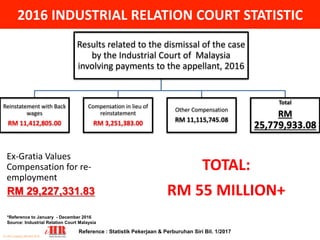
Results related to the dismissal of the case
by the Industrial Court of Malaysia
involving payments to the appellant, 2016
Reinstatement with Back
wages
RM 11,412,805.00
Compensation in lieu of
reinstatement
RM 3,251,383.00
Other Compensation
RM 11,115,745.08
Total
RM
25,779,933.08
2016 INDUSTRIAL RELATION COURT STATISTIC
*Reference to January - December 2016
Source: Industrial Relation Court Malaysia
Reference : Statistik Pekerjaan & Perburuhan Siri Bil. 1/2017
© i-HR Consulting Sdh Bhd 2016
Ex-Gratia Values
Compensation for re-
employment
RM 29,227,331.83
TOTAL:
RM 55 MILLION+
Meaning of Misconduct
• Case laws define misconduct; to be any
conduct on the part of employee which is
inconsistent with the faithful discharge of
his duties, or any breach of the express or
implied duties of an employee towards his
employer.
• It is also known as a form of improper
behavior or an intentional wrongdoing or a
deliberate violation of a rule or standard
of behavior.
12
© 2017 i-HR Consulting Sdn Bhd
Which Section of EA(55) deals
with Misconduct
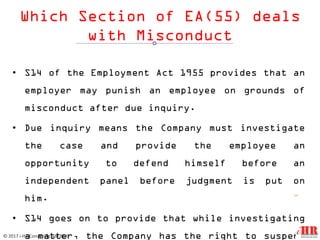
• S14 of the Employment Act 1955 provides that an
employer may punish an employee on grounds of
misconduct after due inquiry.
• Due inquiry means the Company must investigate
the case and provide the employee an
opportunity to defend himself before an
independent panel before judgment is put on
him.
• S14 goes on to provide that while investigating
a matter, the Company has the right to suspend
12
© 2017 i-HR Consulting Sdn Bhd
Why is it important to Act on
Misconduct Cases
• An employer who continues to keep an employee
in employment with full knowledge that the
employee has committed a breach of
duty/misconduct condones the breach, and such
waiver of retroactive permission prevents the
employer from later punishing the employee for
it.
• Many HR practitioners in Malaysia may be guilty
of this. It is however dangerous to condone
actions because it will almost be impossible to
12
© 2017 i-HR Consulting Sdn Bhd
Differentiating Minor and Major
Misconduct
• There is no hard and fast rule on what
constitutes major misconduct or minor
misconduct. The Employment Act 1955 does not
make reference to the words major and minor.
Companies generally like to differentiate major
and minor misconduct by identifying different
types of punishments for both categories of
misconduct.
• In fact, the list of minor and major misconduct
is subjective and might vary depending on the
12
© 2017 i-HR Consulting Sdn Bhd
Differentiating Minor and Major
Misconduct
• To answer this question, it really boils down
to the nature of your industry. I would put
misconduct that is serious enough to warrant
termination as major misconduct and the others
as minor misconduct. However, an employee who
habitually commits acts of minor misconduct
will be deemed to have committed a major act of
misconduct. i.e. Late-coming is minor
misconduct but habitual late-coming would then
12
© 2017 i-HR Consulting Sdn Bhd
MINOR MISCONDUCTincludes but is not limited to the following:-
• Late-coming to work
• Leaving the workplace early
• Absenteeism, usually less than 2
days
• Quarrelsome at work place
• Carelessness causing minor
damage to Company’s property
• Removing or defacing or
destroying Company’s notices
• Failure to wear uniform at work
place
• Failure to furnish information
• Malingering and feigning illness
• Loitering during work hours
• Smoking in restricted areas
• Failure to follow safety procedure
• Infringement of safety regulation
which does not cause damage to
property or person
• Unnecessary wastage’s of
documents and materials
• Abuse of Company’s property
• Refusing to accept servicing of
documents from Company
• Negligence in the care of tools,
equipment and apparatus
• Failure to keep work place clean
and tidy
• Obstructing other employees
from work.
© 2017 i-HR Consulting Sdn Bhd
MAJOR MISCONDUCT
includes but is not limited to the following:-
• Misappropriation of
Company’s money or property
• Theft/pilferage of Company’s
money property
• Fraud, dishonesty or
falsification
• Cheating the Company
• Fighting with other
employees or visitors
• Assaulting another employee
or visitor
• Soliciting or accepting illegal
gratification
• Participation in illegal strike
• Wilful insubordination or
disobedience
• Breach of fiduciary relationship
• Spreading malicious rumours
about the company
• Gambling in the company
premises
• Gross negligence and neglect of
duty
• Wilful damage of Company’s
property
• Sleeping while on duty
• Possession of illegal weapon
• Riotous or indecent behaviour
• Smoking in prohibited areas
• Drunk while on duty
© 2017 i-HR Consulting Sdn Bhd
Terminating Employees with
Misconduct
• Employees in Malaysia are granted security of
tenure from the day they are employed. S20 of
the Industrial Relations Act 1967 provides that
any employee who feels that he has been
dismissed without just cause and excuse may
file an action for reinstatement at the IR
Dept. As such, the contractual notice of
termination cannot be served before the
employer establishes a ground for termination
to happen. Examples of grounds for termination
would include misconduct, poor performance,
12
© 2017 i-HR Consulting Sdn Bhd
Terminating Employees with
Misconduct
• In matters concerning employee misconduct, it is
well settled that due process must be followed,
i.e. the adherence to the principles of natural
justice. In simple terms, the employee must be
given an opportunity to defend his case before an
independent panel. The first step to this is the
issuance of a show cause letter. If admission is
obtained, there is no need to proceed further but
if the employee denies the charges meted out
against him, then the employer will have to
investigate further through a domestic inquiry.
12
© 2017 i-HR Consulting Sdn Bhd
Can an employee be Suspended for
Misconduct
• Yes, an employee may be suspended for a maximum
of 14 days on half pay. Any subsequent
extension of the suspension period shall be on
full pay (potentially for additional
investigation and research with time
contraints).
• However, if the employee is found not guilty,
the 14 days held during the first period of
suspension will have to be reinstated in full.
12
© 2017 i-HR Consulting Sdn Bhd
Factors to take account before
PUNISHING!
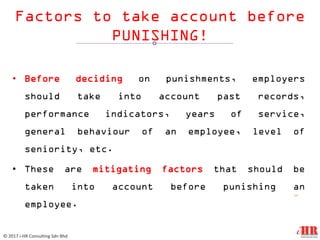
• Before deciding on punishments, employers
should take into account past records,
performance indicators, years of service,
general behaviour of an employee, level of
seniority, etc.
• These are mitigating factors that should be
taken into account before punishing an
employee.
12
© 2017 i-HR Consulting Sdn Bhd
Is Notice required for Termination
with Misconduct
• No, once an employee is found guilty of
misconduct and the company decides to punish an
employee, he is not entitled to notice and can
be terminated immediately (Section 14 (1) of
the EA 1955). Any unutilized annual leave will
also be forfeited.
12
© 2017 i-HR Consulting Sdn Bhd
Misconduct out of office hours
• Can disciplinary action be taken against an
employee who does something inappropriate
outside office hours and outside the company
premises?
• The law entails that employers can hold an
employee accountable for his conduct if they
can successfully establish sufficient nexus
between the employee’s off duty conduct and its
important on the business and image of the
12
© 2017 i-HR Consulting Sdn Bhd
Misconduct out of office hours
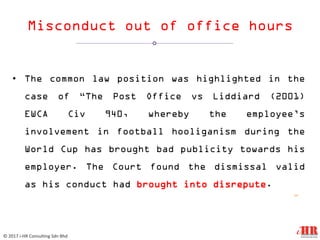
• The common law position was highlighted in the
case of “The Post Office vs Liddiard (2001)
EWCA Civ 940, whereby the employee’s
involvement in football hooliganism during the
World Cup has brought bad publicity towards his
employer. The Court found the dismissal valid
as his conduct had brought into disrepute.
12
© 2017 i-HR Consulting Sdn Bhd
Similar Case in Malaysia
Perwira Habib Bank Berhad v Tusoff bin Zakaria
(1995) 1 ILR 123:
• The Court upheld the decision to dismiss one of
their bank managers who had allegedly engaged
in illegal activities outside of his
employment.
• The Court held that as the bank manager was a
senior executive and must maintain a high
standard of conduct, as such the illegal
conduct would prejudice the bank by not
12
© 2017 i-HR Consulting Sdn Bhd
Drinking During Social Events
Mattel Tools Sdn Bhd v Anuar bin Hassan (1996) 1
MELR 294:
• Employee was alleged to be drunk and has used force
against other guests, damaged property, thrown
napkins, toppled chairs and shouted at other
employees.
• Court found dismissal was unfair although the
employee was fully drunk and misbehaved. The issue
was as the Company let off another senior manager in
similar circumstance with a warning therefore the
treatment was unfair.
12
© 2017 i-HR Consulting Sdn Bhd
Emails sent using personal computer
outside of work
Gosden v Lifeline Project Ltd:
• Employee during his off hours, received a chain
email on his home computer which contained racist
and sexist materials with the instruction to forward
to others. He forwarded to another colleague and the
colleague forwarded to another and it ended up on
Company’s intranet.
• Company dismissed the employee on the basis of gross
misconduct.
• The tribunal upheld the dismissal that the claimant
should have been aware that those persons he sent it
12
© 2017 i-HR Consulting Sdn Bhd
Practical Tips
• Employers should not practice double standards
when dealing with potential misconduct.
• The same level of punishment or disciplinary
action should be meted out for the same type of
misconduct.
12
© 2017 i-HR Consulting Sdn Bhd
Practical Tips
• Employers should act reasonably and comply with
procedural fairness before terminating an
employee for misconduct which took place
outside work. Minor misconduct may not warrant
termination, especially if the employee has
shown genuine remorse and has promised not to
repeat such actions. Prior to termination,
employees should be made aware of the
allegations made against them, and be given an
opportunity to explain their conduct. Major
misconduct (e.g.: use of illegal substances)
12
© 2017 i-HR Consulting Sdn Bhd
Practical Tips
• Employers have the burden of proof when it
comes to unfair dismissal cases. They have to
prove that the dismissal is fair. As such, a
dismissal for misconduct must be supported by
evidence and should not be premised on mere
allegations or rumours. Employers should assess
the evidence available and seek legal advice
before dismissing an employee for misconduct.
12
© 2017 i-HR Consulting Sdn Bhd
Process for Reporting MISCONDUCT
• Whistleblower Culture? – do you have process to
manage and monitor the new pro-reporting
culture. The process has to be objective and
with discretion…
• What issues to be covered in the process of
misconduct?
1. Announcing your new reporting and disciplinary
procedures
2. Specifically target line managers and upper
managers
12
© 2017 i-HR Consulting Sdn Bhd
Specify Potential Consequences to
Employees
• Thoroughly investigate the reported misconduct
• Make the problematic employee aware of their
misconduct
• Subject the problematic employee to sanction
• Take reasonable steps to ensure its adheres to
your disciplinary process
12
© 2017 i-HR Consulting Sdn Bhd
Summary of Dismissal
• For an employer to believe on reasonable
grounds that the employee’s conduct is
sufficiently serious to justify immediate
dismissal, it is first necessary for the
employer to establish that the employer did in
fact hold the belief as a matter of fact that:
the conduct was by the employee; the conduct
was serious; and that the conduct justified
immediate dismissal.
• This is to be contrasted to the provisions
12
© 2017 i-HR Consulting Sdn Bhd
Summary of Dismissal
• Secondly, it is necessary for the employer to
establish that there are reasonable grounds for
the employer holding that belief. It is thus
necessary for the employer to establish a basis
for the belief held which is reasonable. It
would usually be necessary for the employer to
establish what inquiries or investigations were
made to support a basis for holding that
belief. It would also ordinarily be expected
that the belief held be put to the employee,
even though the grounds for holding it may not
12
© 2017 i-HR Consulting Sdn Bhd
Summary of Dismissal
• Failure to make sufficient inquiries or to put
the accusation to the employee in many
circumstances might lead to a view that there
were no reasonable grounds for the belief to be
held.
12
© 2017 i-HR Consulting Sdn Bhd
Summary of Dismissal
• Proof of misconduct justifying summary
dismissal at common law as a prerequisite is
sufficient but not a necessary condition to
establishing a valid reason for dismissal. The
existence of a valid reason for dismissal, e.g.
serious misconduct, does not depend on
consistency with requirements for termination
for other purposes such as the requirements of
an enterprise agreement, legislation or the
common law. A valid reason is one that is
sound, defensible or well-founded. If a
12
© 2017 i-HR Consulting Sdn Bhd
Summary of Dismissal
• Handling and responding to employee misconduct
can be a very stressful situation for an HR
professional. Not to mention, a huge liability.
However, following a consistent procedure can
help the process go smoothly and can help you
avoid further problems. The steps outlined below
are great strategies for effectively dealing with
misconduct when a situation arises.
• Gather all the facts about the incident: Taking
the time to talk to all relevant persons -
information will lead to good disciplinary
12
© 2017 i-HR Consulting Sdn Bhd
Summary of Dismissal
• Don’t make termination decisions alone: When
making an employment termination decision,
involve human resources or a senior member of
management.
• This internal review will ensure consistent
discipline and minimize the risk of a
discrimination claim.
12
© 2017 i-HR Consulting Sdn Bhd
Summary of Dismissal
• Keep the situation in context with the employee’s
history: Weigh the offense in the context of the
employee’s overall record. The disciplinary measure
will likely be fairer. If it’s the employee’s first
incident of misconduct, consequences will often be
less severe than if it was the same employee’s
sixth incident of misconduct.
• Deal with situations as soon as possible: Waiting
to respond to a disciplinary concern may raise
questions about your motive. If the discipline is
severe, it’s undermined by the employer’s delay in
12
© 2017 i-HR Consulting Sdn Bhd
Summary of Dismissal
• Keep your goals in mind when disciplining:
Remember that the intent is to correct the
misconduct and modify the behavior, not to punish
the employee for wrongdoing.
• Maintain all documentation related to the
incident: Should the disciplinary decision come
into question, you’ll be thankful you’ve kept
copies of interview transcripts, bits of evidence
and anything else that backs up your
decision. Don’t RISK IT!
12
© 2017 i-HR Consulting Sdn Bhd
THANK YOU
THANKS FOR ATTENDING THIS SESSION
100
© 2017 i-HR Consulting Sdn Bhd

Art & Science Series - Misconduct 2017

  • 1.
    © 2017, i-HRConsulting Sdn. Bhd. Managing Common Employee Misconduct at Workplace Breakfast talk
  • 2.
    Results related tothe dismissal of the case by the Industrial Court of Malaysia involving payments to the appellant, 2016 Reinstatement with Back wages RM 11,412,805.00 Compensation in lieu of reinstatement RM 3,251,383.00 Other Compensation RM 11,115,745.08 Total RM 25,779,933.08 2016 INDUSTRIAL RELATION COURT STATISTIC *Reference to January - December 2016 Source: Industrial Relation Court Malaysia Reference : Statistik Pekerjaan & Perburuhan Siri Bil. 1/2017 © i-HR Consulting Sdh Bhd 2016 Ex-Gratia Values Compensation for re- employment RM 29,227,331.83 TOTAL: RM 55 MILLION+
  • 3.
    Meaning of Misconduct •Case laws define misconduct; to be any conduct on the part of employee which is inconsistent with the faithful discharge of his duties, or any breach of the express or implied duties of an employee towards his employer. • It is also known as a form of improper behavior or an intentional wrongdoing or a deliberate violation of a rule or standard of behavior. 12 © 2017 i-HR Consulting Sdn Bhd
  • 4.
    Which Section ofEA(55) deals with Misconduct • S14 of the Employment Act 1955 provides that an employer may punish an employee on grounds of misconduct after due inquiry. • Due inquiry means the Company must investigate the case and provide the employee an opportunity to defend himself before an independent panel before judgment is put on him. • S14 goes on to provide that while investigating a matter, the Company has the right to suspend 12 © 2017 i-HR Consulting Sdn Bhd
  • 5.
    Why is itimportant to Act on Misconduct Cases • An employer who continues to keep an employee in employment with full knowledge that the employee has committed a breach of duty/misconduct condones the breach, and such waiver of retroactive permission prevents the employer from later punishing the employee for it. • Many HR practitioners in Malaysia may be guilty of this. It is however dangerous to condone actions because it will almost be impossible to 12 © 2017 i-HR Consulting Sdn Bhd
  • 6.
    Differentiating Minor andMajor Misconduct • There is no hard and fast rule on what constitutes major misconduct or minor misconduct. The Employment Act 1955 does not make reference to the words major and minor. Companies generally like to differentiate major and minor misconduct by identifying different types of punishments for both categories of misconduct. • In fact, the list of minor and major misconduct is subjective and might vary depending on the 12 © 2017 i-HR Consulting Sdn Bhd
  • 7.
    Differentiating Minor andMajor Misconduct • To answer this question, it really boils down to the nature of your industry. I would put misconduct that is serious enough to warrant termination as major misconduct and the others as minor misconduct. However, an employee who habitually commits acts of minor misconduct will be deemed to have committed a major act of misconduct. i.e. Late-coming is minor misconduct but habitual late-coming would then 12 © 2017 i-HR Consulting Sdn Bhd
  • 8.
    MINOR MISCONDUCTincludes butis not limited to the following:- • Late-coming to work • Leaving the workplace early • Absenteeism, usually less than 2 days • Quarrelsome at work place • Carelessness causing minor damage to Company’s property • Removing or defacing or destroying Company’s notices • Failure to wear uniform at work place • Failure to furnish information • Malingering and feigning illness • Loitering during work hours • Smoking in restricted areas • Failure to follow safety procedure • Infringement of safety regulation which does not cause damage to property or person • Unnecessary wastage’s of documents and materials • Abuse of Company’s property • Refusing to accept servicing of documents from Company • Negligence in the care of tools, equipment and apparatus • Failure to keep work place clean and tidy • Obstructing other employees from work. © 2017 i-HR Consulting Sdn Bhd
  • 9.
    MAJOR MISCONDUCT includes butis not limited to the following:- • Misappropriation of Company’s money or property • Theft/pilferage of Company’s money property • Fraud, dishonesty or falsification • Cheating the Company • Fighting with other employees or visitors • Assaulting another employee or visitor • Soliciting or accepting illegal gratification • Participation in illegal strike • Wilful insubordination or disobedience • Breach of fiduciary relationship • Spreading malicious rumours about the company • Gambling in the company premises • Gross negligence and neglect of duty • Wilful damage of Company’s property • Sleeping while on duty • Possession of illegal weapon • Riotous or indecent behaviour • Smoking in prohibited areas • Drunk while on duty © 2017 i-HR Consulting Sdn Bhd
  • 10.
    Terminating Employees with Misconduct •Employees in Malaysia are granted security of tenure from the day they are employed. S20 of the Industrial Relations Act 1967 provides that any employee who feels that he has been dismissed without just cause and excuse may file an action for reinstatement at the IR Dept. As such, the contractual notice of termination cannot be served before the employer establishes a ground for termination to happen. Examples of grounds for termination would include misconduct, poor performance, 12 © 2017 i-HR Consulting Sdn Bhd
  • 11.
    Terminating Employees with Misconduct •In matters concerning employee misconduct, it is well settled that due process must be followed, i.e. the adherence to the principles of natural justice. In simple terms, the employee must be given an opportunity to defend his case before an independent panel. The first step to this is the issuance of a show cause letter. If admission is obtained, there is no need to proceed further but if the employee denies the charges meted out against him, then the employer will have to investigate further through a domestic inquiry. 12 © 2017 i-HR Consulting Sdn Bhd
  • 12.
    Can an employeebe Suspended for Misconduct • Yes, an employee may be suspended for a maximum of 14 days on half pay. Any subsequent extension of the suspension period shall be on full pay (potentially for additional investigation and research with time contraints). • However, if the employee is found not guilty, the 14 days held during the first period of suspension will have to be reinstated in full. 12 © 2017 i-HR Consulting Sdn Bhd
  • 13.
    Factors to takeaccount before PUNISHING! • Before deciding on punishments, employers should take into account past records, performance indicators, years of service, general behaviour of an employee, level of seniority, etc. • These are mitigating factors that should be taken into account before punishing an employee. 12 © 2017 i-HR Consulting Sdn Bhd
  • 14.
    Is Notice requiredfor Termination with Misconduct • No, once an employee is found guilty of misconduct and the company decides to punish an employee, he is not entitled to notice and can be terminated immediately (Section 14 (1) of the EA 1955). Any unutilized annual leave will also be forfeited. 12 © 2017 i-HR Consulting Sdn Bhd
  • 15.
    Misconduct out ofoffice hours • Can disciplinary action be taken against an employee who does something inappropriate outside office hours and outside the company premises? • The law entails that employers can hold an employee accountable for his conduct if they can successfully establish sufficient nexus between the employee’s off duty conduct and its important on the business and image of the 12 © 2017 i-HR Consulting Sdn Bhd
  • 16.
    Misconduct out ofoffice hours • The common law position was highlighted in the case of “The Post Office vs Liddiard (2001) EWCA Civ 940, whereby the employee’s involvement in football hooliganism during the World Cup has brought bad publicity towards his employer. The Court found the dismissal valid as his conduct had brought into disrepute. 12 © 2017 i-HR Consulting Sdn Bhd
  • 17.
    Similar Case inMalaysia Perwira Habib Bank Berhad v Tusoff bin Zakaria (1995) 1 ILR 123: • The Court upheld the decision to dismiss one of their bank managers who had allegedly engaged in illegal activities outside of his employment. • The Court held that as the bank manager was a senior executive and must maintain a high standard of conduct, as such the illegal conduct would prejudice the bank by not 12 © 2017 i-HR Consulting Sdn Bhd
  • 18.
    Drinking During SocialEvents Mattel Tools Sdn Bhd v Anuar bin Hassan (1996) 1 MELR 294: • Employee was alleged to be drunk and has used force against other guests, damaged property, thrown napkins, toppled chairs and shouted at other employees. • Court found dismissal was unfair although the employee was fully drunk and misbehaved. The issue was as the Company let off another senior manager in similar circumstance with a warning therefore the treatment was unfair. 12 © 2017 i-HR Consulting Sdn Bhd
  • 19.
    Emails sent usingpersonal computer outside of work Gosden v Lifeline Project Ltd: • Employee during his off hours, received a chain email on his home computer which contained racist and sexist materials with the instruction to forward to others. He forwarded to another colleague and the colleague forwarded to another and it ended up on Company’s intranet. • Company dismissed the employee on the basis of gross misconduct. • The tribunal upheld the dismissal that the claimant should have been aware that those persons he sent it 12 © 2017 i-HR Consulting Sdn Bhd
  • 20.
    Practical Tips • Employersshould not practice double standards when dealing with potential misconduct. • The same level of punishment or disciplinary action should be meted out for the same type of misconduct. 12 © 2017 i-HR Consulting Sdn Bhd
  • 21.
    Practical Tips • Employersshould act reasonably and comply with procedural fairness before terminating an employee for misconduct which took place outside work. Minor misconduct may not warrant termination, especially if the employee has shown genuine remorse and has promised not to repeat such actions. Prior to termination, employees should be made aware of the allegations made against them, and be given an opportunity to explain their conduct. Major misconduct (e.g.: use of illegal substances) 12 © 2017 i-HR Consulting Sdn Bhd
  • 22.
    Practical Tips • Employershave the burden of proof when it comes to unfair dismissal cases. They have to prove that the dismissal is fair. As such, a dismissal for misconduct must be supported by evidence and should not be premised on mere allegations or rumours. Employers should assess the evidence available and seek legal advice before dismissing an employee for misconduct. 12 © 2017 i-HR Consulting Sdn Bhd
  • 23.
    Process for ReportingMISCONDUCT • Whistleblower Culture? – do you have process to manage and monitor the new pro-reporting culture. The process has to be objective and with discretion… • What issues to be covered in the process of misconduct? 1. Announcing your new reporting and disciplinary procedures 2. Specifically target line managers and upper managers 12 © 2017 i-HR Consulting Sdn Bhd
  • 24.
    Specify Potential Consequencesto Employees • Thoroughly investigate the reported misconduct • Make the problematic employee aware of their misconduct • Subject the problematic employee to sanction • Take reasonable steps to ensure its adheres to your disciplinary process 12 © 2017 i-HR Consulting Sdn Bhd
  • 25.
    Summary of Dismissal •For an employer to believe on reasonable grounds that the employee’s conduct is sufficiently serious to justify immediate dismissal, it is first necessary for the employer to establish that the employer did in fact hold the belief as a matter of fact that: the conduct was by the employee; the conduct was serious; and that the conduct justified immediate dismissal. • This is to be contrasted to the provisions 12 © 2017 i-HR Consulting Sdn Bhd
  • 26.
    Summary of Dismissal •Secondly, it is necessary for the employer to establish that there are reasonable grounds for the employer holding that belief. It is thus necessary for the employer to establish a basis for the belief held which is reasonable. It would usually be necessary for the employer to establish what inquiries or investigations were made to support a basis for holding that belief. It would also ordinarily be expected that the belief held be put to the employee, even though the grounds for holding it may not 12 © 2017 i-HR Consulting Sdn Bhd
  • 27.
    Summary of Dismissal •Failure to make sufficient inquiries or to put the accusation to the employee in many circumstances might lead to a view that there were no reasonable grounds for the belief to be held. 12 © 2017 i-HR Consulting Sdn Bhd
  • 28.
    Summary of Dismissal •Proof of misconduct justifying summary dismissal at common law as a prerequisite is sufficient but not a necessary condition to establishing a valid reason for dismissal. The existence of a valid reason for dismissal, e.g. serious misconduct, does not depend on consistency with requirements for termination for other purposes such as the requirements of an enterprise agreement, legislation or the common law. A valid reason is one that is sound, defensible or well-founded. If a 12 © 2017 i-HR Consulting Sdn Bhd
  • 29.
    Summary of Dismissal •Handling and responding to employee misconduct can be a very stressful situation for an HR professional. Not to mention, a huge liability. However, following a consistent procedure can help the process go smoothly and can help you avoid further problems. The steps outlined below are great strategies for effectively dealing with misconduct when a situation arises. • Gather all the facts about the incident: Taking the time to talk to all relevant persons - information will lead to good disciplinary 12 © 2017 i-HR Consulting Sdn Bhd
  • 30.
    Summary of Dismissal •Don’t make termination decisions alone: When making an employment termination decision, involve human resources or a senior member of management. • This internal review will ensure consistent discipline and minimize the risk of a discrimination claim. 12 © 2017 i-HR Consulting Sdn Bhd
  • 31.
    Summary of Dismissal •Keep the situation in context with the employee’s history: Weigh the offense in the context of the employee’s overall record. The disciplinary measure will likely be fairer. If it’s the employee’s first incident of misconduct, consequences will often be less severe than if it was the same employee’s sixth incident of misconduct. • Deal with situations as soon as possible: Waiting to respond to a disciplinary concern may raise questions about your motive. If the discipline is severe, it’s undermined by the employer’s delay in 12 © 2017 i-HR Consulting Sdn Bhd
  • 32.
    Summary of Dismissal •Keep your goals in mind when disciplining: Remember that the intent is to correct the misconduct and modify the behavior, not to punish the employee for wrongdoing. • Maintain all documentation related to the incident: Should the disciplinary decision come into question, you’ll be thankful you’ve kept copies of interview transcripts, bits of evidence and anything else that backs up your decision. Don’t RISK IT! 12 © 2017 i-HR Consulting Sdn Bhd
  • 33.
    THANK YOU THANKS FORATTENDING THIS SESSION 100 © 2017 i-HR Consulting Sdn Bhd