


SACROILIAC
JOINT
SPECIAL TEST
● Thigh Thrust Test
● Gaenslen's Test
● Gapping test
● Knee to shoulder test
● Straight leg raise test
● Flamingo test
● Leg length test
● 90–90 Straight leg raise test
● Patrick test
● Trendelenburg test
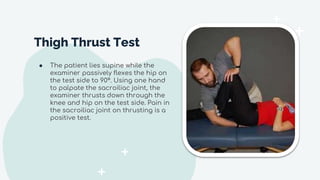
Thigh Thrust Test
● The patient lies supine while the
examiner passively flexes the hip on
the test side to 90°. Using one hand
to palpate the sacroiliac joint, the
examiner thrusts down through the
knee and hip on the test side. Pain in
the sacroiliac joint on thrusting is a
positive test.
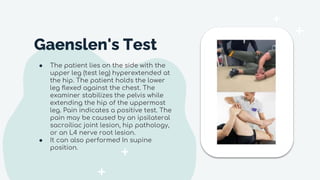
Gaenslen's Test
● The patient lies on the side with the
upper leg (test leg) hyperextended at
the hip. The patient holds the lower
leg flexed against the chest. The
examiner stabilizes the pelvis while
extending the hip of the uppermost
leg. Pain indicates a positive test. The
pain may be caused by an ipsilateral
sacroiliac joint lesion, hip pathology,
or an L4 nerve root lesion.
● It can also performed In supine
position.
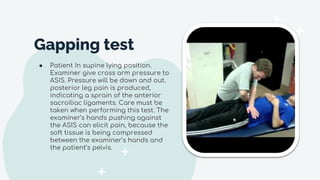
Gapping test
● Patient In supine lying position.
Examiner give cross arm pressure to
ASIS. Pressure will be down and out.
posterior leg pain is produced,
indicating a sprain of the anterior
sacroiliac ligaments. Care must be
taken when performing this test. The
examiner’s hands pushing against
the ASIS can elicit pain, because the
soft tissue is being compressed
between the examiner’s hands and
the patient’s pelvis.
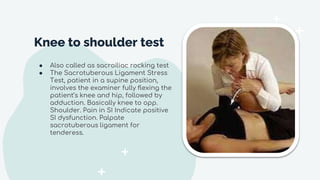
Knee to shoulder test
● Also called as sacroiliac rocking test
● The Sacrotuberous Ligament Stress
Test, patient in a supine position,
involves the examiner fully flexing the
patient’s knee and hip, followed by
adduction. Basically knee to opp.
Shoulder. Pain in SI Indicate positive
SI dysfunction. Palpate
sacrotuberous ligament for
tenderess.
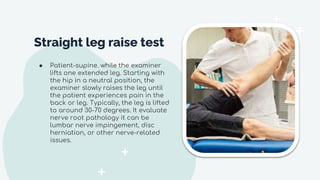
Straight leg raise test
● Patient-supine. while the examiner
lifts one extended leg. Starting with
the hip in a neutral position, the
examiner slowly raises the leg until
the patient experiences pain in the
back or leg. Typically, the leg is lifted
to around 30-70 degrees. It evaluate
nerve root pathology it can be
lumbar nerve impingement, disc
herniation, or other nerve-related
issues.
Flamingo test
● Position: stand on one leg. the weight
of the trunk causes the sacrum to
shift forward and distally with
forward rotation. The ilium moves in
the opposite direction. On the non–
weight-bearing side, the opposite
occurs, but the stress is greatest on
the stance side. Pain in the symphysis
pubis or sacroiliac joint indicates a
positive test. The stress may be
increased by having the patient hop
on one leg.
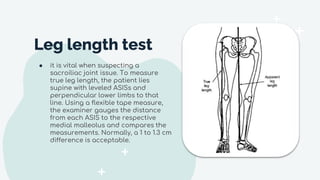
Leg length test
● it is vital when suspecting a
sacroiliac joint issue. To measure
true leg length, the patient lies
supine with leveled ASISs and
perpendicular lower limbs to that
line. Using a flexible tape measure,
the examiner gauges the distance
from each ASIS to the respective
medial malleolus and compares the
measurements. Normally, a 1 to 1.3 cm
difference is acceptable.
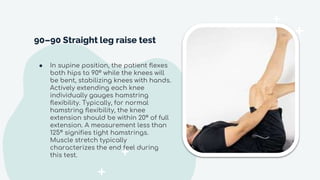
90–90 Straight leg raise test
● In supine position, the patient flexes
both hips to 90° while the knees will
be bent, stabilizing knees with hands.
Actively extending each knee
individually gauges hamstring
flexibility. Typically, for normal
hamstring flexibility, the knee
extension should be within 20° of full
extension. A measurement less than
125° signifies tight hamstrings.
Muscle stretch typically
characterizes the end feel during
this test.
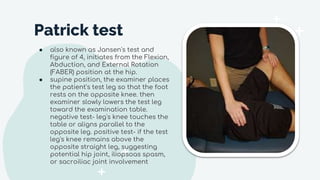
Patrick test
● also known as Jansen's test and
figure of 4, initiates from the Flexion,
Abduction, and External Rotation
(FABER) position at the hip.
● supine position, the examiner places
the patient's test leg so that the foot
rests on the opposite knee. then
examiner slowly lowers the test leg
toward the examination table.
negative test- leg's knee touches the
table or aligns parallel to the
opposite leg. positive test- if the test
leg's knee remains above the
opposite straight leg, suggesting
potential hip joint, iliopsoas spasm,
or sacroiliac joint involvement
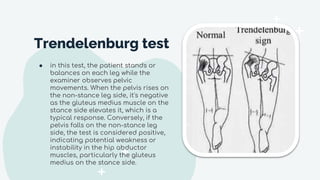
Trendelenburg test
● in this test, the patient stands or
balances on each leg while the
examiner observes pelvic
movements. When the pelvis rises on
the non-stance leg side, it's negative
as the gluteus medius muscle on the
stance side elevates it, which is a
typical response. Conversely, if the
pelvis falls on the non-stance leg
side, the test is considered positive,
indicating potential weakness or
instability in the hip abductor
muscles, particularly the gluteus
medius on the stance side.
Thank YOU !

Sacroiliac joint special test.pptx

  • 1.
  • 2.
    ● Thigh ThrustTest ● Gaenslen's Test ● Gapping test ● Knee to shoulder test ● Straight leg raise test ● Flamingo test ● Leg length test ● 90–90 Straight leg raise test ● Patrick test ● Trendelenburg test
  • 3.
    Thigh Thrust Test ●The patient lies supine while the examiner passively flexes the hip on the test side to 90°. Using one hand to palpate the sacroiliac joint, the examiner thrusts down through the knee and hip on the test side. Pain in the sacroiliac joint on thrusting is a positive test.
  • 4.
    Gaenslen's Test ● Thepatient lies on the side with the upper leg (test leg) hyperextended at the hip. The patient holds the lower leg flexed against the chest. The examiner stabilizes the pelvis while extending the hip of the uppermost leg. Pain indicates a positive test. The pain may be caused by an ipsilateral sacroiliac joint lesion, hip pathology, or an L4 nerve root lesion. ● It can also performed In supine position.
  • 5.
    Gapping test ● PatientIn supine lying position. Examiner give cross arm pressure to ASIS. Pressure will be down and out. posterior leg pain is produced, indicating a sprain of the anterior sacroiliac ligaments. Care must be taken when performing this test. The examiner’s hands pushing against the ASIS can elicit pain, because the soft tissue is being compressed between the examiner’s hands and the patient’s pelvis.
  • 6.
    Knee to shouldertest ● Also called as sacroiliac rocking test ● The Sacrotuberous Ligament Stress Test, patient in a supine position, involves the examiner fully flexing the patient’s knee and hip, followed by adduction. Basically knee to opp. Shoulder. Pain in SI Indicate positive SI dysfunction. Palpate sacrotuberous ligament for tenderess.
  • 7.
    Straight leg raisetest ● Patient-supine. while the examiner lifts one extended leg. Starting with the hip in a neutral position, the examiner slowly raises the leg until the patient experiences pain in the back or leg. Typically, the leg is lifted to around 30-70 degrees. It evaluate nerve root pathology it can be lumbar nerve impingement, disc herniation, or other nerve-related issues.
  • 8.
    Flamingo test ● Position:stand on one leg. the weight of the trunk causes the sacrum to shift forward and distally with forward rotation. The ilium moves in the opposite direction. On the non– weight-bearing side, the opposite occurs, but the stress is greatest on the stance side. Pain in the symphysis pubis or sacroiliac joint indicates a positive test. The stress may be increased by having the patient hop on one leg.
  • 9.
    Leg length test ●it is vital when suspecting a sacroiliac joint issue. To measure true leg length, the patient lies supine with leveled ASISs and perpendicular lower limbs to that line. Using a flexible tape measure, the examiner gauges the distance from each ASIS to the respective medial malleolus and compares the measurements. Normally, a 1 to 1.3 cm difference is acceptable.
  • 10.
    90–90 Straight legraise test ● In supine position, the patient flexes both hips to 90° while the knees will be bent, stabilizing knees with hands. Actively extending each knee individually gauges hamstring flexibility. Typically, for normal hamstring flexibility, the knee extension should be within 20° of full extension. A measurement less than 125° signifies tight hamstrings. Muscle stretch typically characterizes the end feel during this test.
  • 11.
    Patrick test ● alsoknown as Jansen's test and figure of 4, initiates from the Flexion, Abduction, and External Rotation (FABER) position at the hip. ● supine position, the examiner places the patient's test leg so that the foot rests on the opposite knee. then examiner slowly lowers the test leg toward the examination table. negative test- leg's knee touches the table or aligns parallel to the opposite leg. positive test- if the test leg's knee remains above the opposite straight leg, suggesting potential hip joint, iliopsoas spasm, or sacroiliac joint involvement
  • 12.
    Trendelenburg test ● inthis test, the patient stands or balances on each leg while the examiner observes pelvic movements. When the pelvis rises on the non-stance leg side, it's negative as the gluteus medius muscle on the stance side elevates it, which is a typical response. Conversely, if the pelvis falls on the non-stance leg side, the test is considered positive, indicating potential weakness or instability in the hip abductor muscles, particularly the gluteus medius on the stance side.
  • 13.