Worker’s Safety Handbook
for Rigger and Signalman
22
Contents
Preface	 3
Proper Attire for Rigger and Signalman	 4
Roles and Responsibilities of a Rigger	 5
Good and Bad Rigging Practices	 12
Inspection of Hooks and Shackles	 26
Types of Wear and Tear for Wire Ropes	 28
Roles and Responsibilities of a Signalman	 31
Recommended Crane Hand Signals	 33
Good Communication Practices	 36
Year of issue: 2011
3 4
Preface
This handbook serves as a workplace safety and health
resource for workers who are involved in work activities
involving lifting equipment such as cranes. The Rigger and
Signalman handbook highlights general safety pointers to
ensure safe lifting operations. This handbook was developed
to assist the Rigger and Signalman to better understand their
roles and responsibilities, show examples of good and bad
practices for loading and rigging, perform basic inspection
of lifting equipments such as hooks, shackles and wire ropes,
adhere to good communication practices, and recognise crane
hand signals.
This handbook is produced for education and informational
purposes by the National Crane SafetyTaskforce and Workplace
Safety and Health Council and serves as a reference for
good practices.
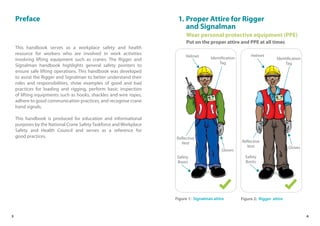
1.	Proper Attire for Rigger
and Signalman
Put on the proper attire and PPE at all times
Wear personal protective equipment (PPE)
Figure 1: Signalman attire Figure 2: Rigger attire
Gloves
Gloves
HelmetHelmet
Safety
Boots
Safety
Boots
Identification
Tag
Identification
Tag
Reflective
Vest
Reflective
Vest
5 6
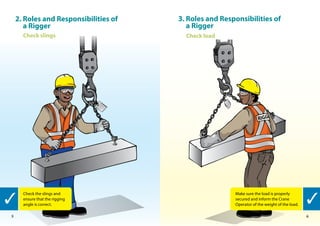
2.	Roles and Responsibilities of
a Rigger
Check slings
3.	Roles and Responsibilities of
a Rigger
Check load
Check the slings and
ensure that the rigging
angle is correct.
Make sure the load is properly
secured and inform the Crane
Operator of the weight of the load.
7 8
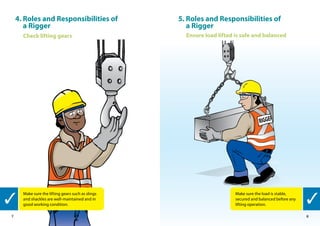
4.	Roles and Responsibilities of
a Rigger
Check lifting gears
5.	Roles and Responsibilities of
a Rigger
Ensure load lifted is safe and balanced
Make sure the lifting gears such as slings
and shackles are well-maintained and in
good working condition.
Make sure the load is stable,
secured and balanced before any
lifting operation.
9 10
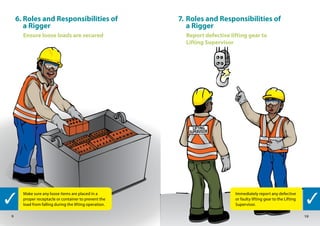
6.	Roles and Responsibilities of
a Rigger
Ensure loose loads are secured
7.	Roles and Responsibilities of
a Rigger
Report defective lifting gear to
Lifting Supervisor
Make sure any loose items are placed in a
proper receptacle or container to prevent the
load from falling during the lifting operation.
Immediately report any defective
or faulty lifting gear to the Lifting
Supervisor.
1211
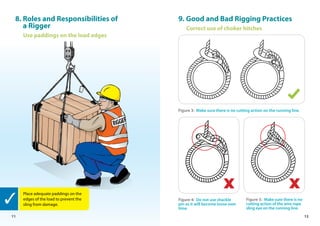
8.	Roles and Responsibilities of
a Rigger
Use paddings on the load edges
9.	Good and Bad Rigging Practices
Correct use of choker hitches
Figure 3: Make sure there is no cutting action on the running line.
Figure 4: Do not use shackle
pin as it will become loose over
time.
Figure 5: Make sure there is no
cutting action of the wire rope
sling eye on the running line.
Place adequate paddings on the
edges of the load to prevent the
sling from damage.
13 14
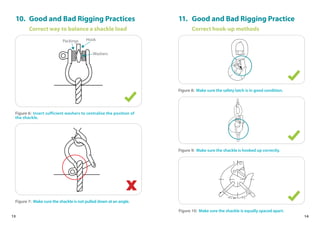
10.	 Good and Bad Rigging Practices
Correct way to balance a shackle load
Figure 6: Insert sufficient washers to centralise the position of
the shackle.
Packings Hook
Washers
Figure 7: Make sure the shackle is not pulled down at an angle.
45° 45°
Figure 8: Make sure the safety latch is in good condition.
Figure 9: Make sure the shackle is hooked up correctly.
Figure 10: Make sure the shackle is equally spaced apart.
11.	 Good and Bad Rigging Practice
Correct hook-up methods
15 16
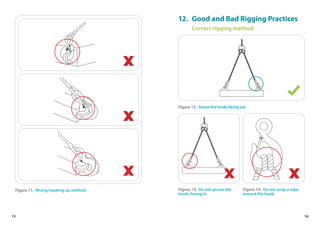
Figure 11: Wrong hooking up method.
12.	 Good and Bad Rigging Practices
Correct rigging method
Figure 12: Securethehooksfacingout.
Figure 13: Do not secure the
hooks facing in.
Figure 14: Do not wrap a rope
around the hook.
17 18
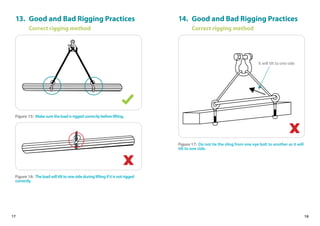
13.	 Good and Bad Rigging Practices
Correct rigging method
Figure 15: Makesuretheloadisriggedcorrectlybeforelifting.
Figure 16: Theloadwilltilttoonesideduringliftingifitisnotrigged
correctly.
Figure 17: Do not tie the sling from one eye bolt to another as it will
tilt to one side.
It will tilt to one side
14.	 Good and Bad Rigging Practices
Correct rigging method
19 20
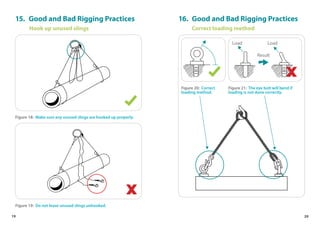
15.	 Good and Bad Rigging Practices
Hook up unused slings
Figure 18: Make sure any unused slings are hooked up properly.
Figure 19: Do not leave unused slings unhooked.
16.	 Good and Bad Rigging Practices
Correct loading method
Figure 20: Correct
loading method.
Figure 21: The eye bolt will bend if
loading is not done correctly.
Load Load
Result
21 22
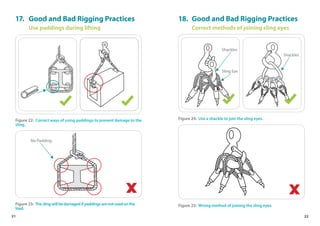
17.	 Good and Bad Rigging Practices
Use paddings during lifting
Figure 22: Correct ways of using paddings to prevent damage to the
sling.
Figure 23: Theslingwillbedamagedifpaddingsarenotusedonthe
load.
No Padding
18.	 Good and Bad Rigging Practices
Correct methods of joining sling eyes
Figure 24: Use a shackle to join the sling eyes.
Figure 25: Wrong method of joining the sling eyes.
Shackles
Sling Eye
Shackles
23 24
RIGGERMAN
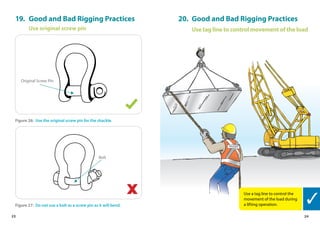
19.	 Good and Bad Rigging Practices
Use original screw pin
Original Screw Pin
Figure 26: Use the original screw pin for the shackle.
Figure 27: Do not use a bolt as a screw pin as it will bend.
Bolt
20.	 Good and Bad Rigging Practices
Use tag line to control movement of the load
Use a tag line to control the
movement of the load during
a lifting operation.
25 26
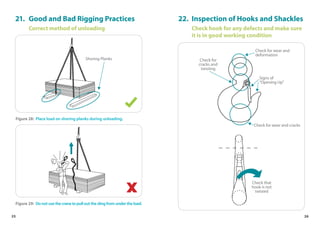
21.	 Good and Bad Rigging Practices
Correct method of unloading
Figure 28: Place load on shoring planks during unloading.
Shoring Planks
Figure 29: Donotusethecranetopullouttheslingfromundertheload.
22.	 Inspection of Hooks and Shackles
Check hook for any defects and make sure
it is in good working condition
Check that
hook is not
twisted
Check for wear and
deformation
Signs of
“Opening Up”
Check for
cracks and
twisting
Check for wear and cracks
27 28
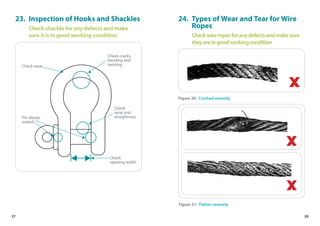
23.	 Inspection of Hooks and Shackles
Check shackle for any defects and make
sure it is in good working condition
Check
opening width
Pin always
seated
Check
wear and
straightness
Check cracks,
bending and
twistingCheck wear
24.	 Types of Wear and Tear for Wire
Ropes
Checkwireropesforanydefectsandmakesure
theyareingoodworkingcondition
Figure 30: Crushed severely.
Figure 31: Flatten severely.
29 30
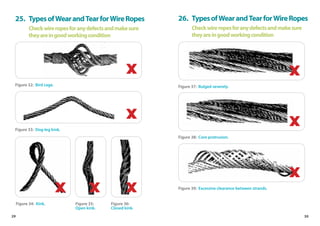
25.	 TypesofWearandTearforWireRopes
Checkwireropesforanydefectsandmakesure
theyareingoodworkingcondition
Figure 32: Bird cage.
Figure 33: Dog-leg kink.
Figure 35:
Open kink.
Figure 36:
Closed kink.
Figure 34: Kink.
26.	 TypesofWearandTearforWireRopes
Checkwireropesforanydefectsandmakesure
theyareingoodworkingcondition
Figure 37: Bulged severely.
Figure 38: Core protrusion.
Figure 39: Excessive clearance between strands.
31 32
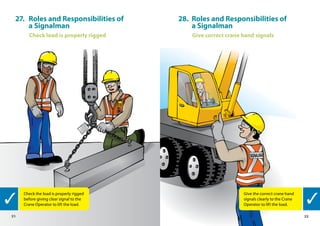
27.	 Roles and Responsibilities of
a Signalman
Check load is properly rigged
Check the load is properly rigged
before giving clear signal to the
Crane Operator to lift the load.
28.	 Roles and Responsibilities of
a Signalman
Give correct crane hand signals
Give the correct crane hand
signals clearly to the Crane
Operator to lift the load.
33 34
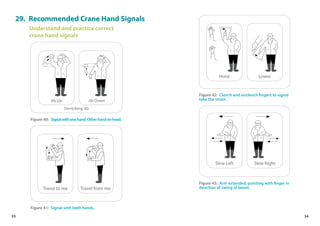
29.	 Recommended Crane Hand Signals
Understand and practice correct
crane hand signals
Jib Up Jib Down
Derricking Jib
Figure 40:	 Signalwithonehand.Otherhandonhead.
Figure 41:	 Signal with both hands.
Travel to me Travel from me
Slew Left Slew Right
Figure 42:	 Clench and unclench fingers to signal
take the strain.
Figure 43:	 Arm extended, pointing with finger in
direction of swing of boom.
Hoist Lower
LIFTING
PLAN
and
SWP
35 36
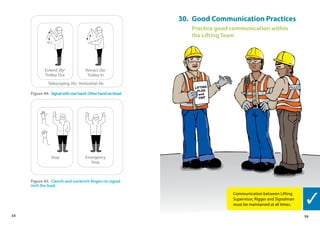
Figure 44:	 Signalwithonehand.Otherhandonhead.
Retract Jib/
Trolley In
Extend Jib/
Trolley Out
Telescoping Jib/ Horizontal Jib
Figure 45:	 Clench and unclench fingers to signal
inch the load.
Emergency
Stop
Stop
30.	 Good Communication Practices
Practice good communication within
the Lifting Team
Communication between Lifting
Supervisor, Rigger and Signalman
must be maintained at all times.
37
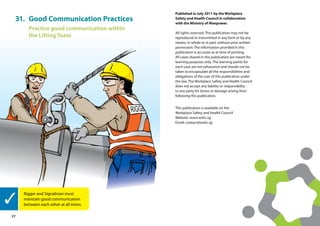
31.	 Good Communication Practices
Practice good communication within
the Lifting Team
Published in July 2011 by the Workplace
Safety and Health Council in collaboration
with the Ministry of Manpower.
All rights reserved. This publication may not be
reproduced or transmitted in any form or by any
means, in whole or in part, without prior written
permission. The information provided in this
publication is accurate as at time of printing.
All cases shared in this publication are meant for
learning purposes only. The learning points for
each case are not exhaustive and should not be
taken to encapsulate all the responsibilities and
obligations of the user of this publication under
the law. The Workplace Safety and Health Council
does not accept any liability or responsibility
to any party for losses or damage arising from
following this publication.
This publication is available on the
Workplace Safety and Health Council
Website: www.wshc.sg
Email: contact@wshc.sg
Rigger and Signalman must
maintain good communication
between each other at all times.

Rigging and lifting

  • 1.
    Worker’s Safety Handbook forRigger and Signalman
  • 2.
    22 Contents Preface 3 Proper Attirefor Rigger and Signalman 4 Roles and Responsibilities of a Rigger 5 Good and Bad Rigging Practices 12 Inspection of Hooks and Shackles 26 Types of Wear and Tear for Wire Ropes 28 Roles and Responsibilities of a Signalman 31 Recommended Crane Hand Signals 33 Good Communication Practices 36 Year of issue: 2011
  • 3.
    3 4 Preface This handbookserves as a workplace safety and health resource for workers who are involved in work activities involving lifting equipment such as cranes. The Rigger and Signalman handbook highlights general safety pointers to ensure safe lifting operations. This handbook was developed to assist the Rigger and Signalman to better understand their roles and responsibilities, show examples of good and bad practices for loading and rigging, perform basic inspection of lifting equipments such as hooks, shackles and wire ropes, adhere to good communication practices, and recognise crane hand signals. This handbook is produced for education and informational purposes by the National Crane SafetyTaskforce and Workplace Safety and Health Council and serves as a reference for good practices. 1. Proper Attire for Rigger and Signalman Put on the proper attire and PPE at all times Wear personal protective equipment (PPE) Figure 1: Signalman attire Figure 2: Rigger attire Gloves Gloves HelmetHelmet Safety Boots Safety Boots Identification Tag Identification Tag Reflective Vest Reflective Vest
  • 4.
    5 6 2. Roles andResponsibilities of a Rigger Check slings 3. Roles and Responsibilities of a Rigger Check load Check the slings and ensure that the rigging angle is correct. Make sure the load is properly secured and inform the Crane Operator of the weight of the load.
  • 5.
    7 8 4. Roles andResponsibilities of a Rigger Check lifting gears 5. Roles and Responsibilities of a Rigger Ensure load lifted is safe and balanced Make sure the lifting gears such as slings and shackles are well-maintained and in good working condition. Make sure the load is stable, secured and balanced before any lifting operation.
  • 6.
    9 10 6. Roles andResponsibilities of a Rigger Ensure loose loads are secured 7. Roles and Responsibilities of a Rigger Report defective lifting gear to Lifting Supervisor Make sure any loose items are placed in a proper receptacle or container to prevent the load from falling during the lifting operation. Immediately report any defective or faulty lifting gear to the Lifting Supervisor.
  • 7.
    1211 8. Roles and Responsibilitiesof a Rigger Use paddings on the load edges 9. Good and Bad Rigging Practices Correct use of choker hitches Figure 3: Make sure there is no cutting action on the running line. Figure 4: Do not use shackle pin as it will become loose over time. Figure 5: Make sure there is no cutting action of the wire rope sling eye on the running line. Place adequate paddings on the edges of the load to prevent the sling from damage.
  • 8.
    13 14 10. Goodand Bad Rigging Practices Correct way to balance a shackle load Figure 6: Insert sufficient washers to centralise the position of the shackle. Packings Hook Washers Figure 7: Make sure the shackle is not pulled down at an angle. 45° 45° Figure 8: Make sure the safety latch is in good condition. Figure 9: Make sure the shackle is hooked up correctly. Figure 10: Make sure the shackle is equally spaced apart. 11. Good and Bad Rigging Practice Correct hook-up methods
  • 9.
    15 16 Figure 11:Wrong hooking up method. 12. Good and Bad Rigging Practices Correct rigging method Figure 12: Securethehooksfacingout. Figure 13: Do not secure the hooks facing in. Figure 14: Do not wrap a rope around the hook.
  • 10.
    17 18 13. Goodand Bad Rigging Practices Correct rigging method Figure 15: Makesuretheloadisriggedcorrectlybeforelifting. Figure 16: Theloadwilltilttoonesideduringliftingifitisnotrigged correctly. Figure 17: Do not tie the sling from one eye bolt to another as it will tilt to one side. It will tilt to one side 14. Good and Bad Rigging Practices Correct rigging method
  • 11.
    19 20 15. Goodand Bad Rigging Practices Hook up unused slings Figure 18: Make sure any unused slings are hooked up properly. Figure 19: Do not leave unused slings unhooked. 16. Good and Bad Rigging Practices Correct loading method Figure 20: Correct loading method. Figure 21: The eye bolt will bend if loading is not done correctly. Load Load Result
  • 12.
    21 22 17. Goodand Bad Rigging Practices Use paddings during lifting Figure 22: Correct ways of using paddings to prevent damage to the sling. Figure 23: Theslingwillbedamagedifpaddingsarenotusedonthe load. No Padding 18. Good and Bad Rigging Practices Correct methods of joining sling eyes Figure 24: Use a shackle to join the sling eyes. Figure 25: Wrong method of joining the sling eyes. Shackles Sling Eye Shackles
  • 13.
    23 24 RIGGERMAN 19. Goodand Bad Rigging Practices Use original screw pin Original Screw Pin Figure 26: Use the original screw pin for the shackle. Figure 27: Do not use a bolt as a screw pin as it will bend. Bolt 20. Good and Bad Rigging Practices Use tag line to control movement of the load Use a tag line to control the movement of the load during a lifting operation.
  • 14.
    25 26 21. Goodand Bad Rigging Practices Correct method of unloading Figure 28: Place load on shoring planks during unloading. Shoring Planks Figure 29: Donotusethecranetopullouttheslingfromundertheload. 22. Inspection of Hooks and Shackles Check hook for any defects and make sure it is in good working condition Check that hook is not twisted Check for wear and deformation Signs of “Opening Up” Check for cracks and twisting Check for wear and cracks
  • 15.
    27 28 23. Inspectionof Hooks and Shackles Check shackle for any defects and make sure it is in good working condition Check opening width Pin always seated Check wear and straightness Check cracks, bending and twistingCheck wear 24. Types of Wear and Tear for Wire Ropes Checkwireropesforanydefectsandmakesure theyareingoodworkingcondition Figure 30: Crushed severely. Figure 31: Flatten severely.
  • 16.
    29 30 25. TypesofWearandTearforWireRopes Checkwireropesforanydefectsandmakesure theyareingoodworkingcondition Figure32: Bird cage. Figure 33: Dog-leg kink. Figure 35: Open kink. Figure 36: Closed kink. Figure 34: Kink. 26. TypesofWearandTearforWireRopes Checkwireropesforanydefectsandmakesure theyareingoodworkingcondition Figure 37: Bulged severely. Figure 38: Core protrusion. Figure 39: Excessive clearance between strands.
  • 17.
    31 32 27. Rolesand Responsibilities of a Signalman Check load is properly rigged Check the load is properly rigged before giving clear signal to the Crane Operator to lift the load. 28. Roles and Responsibilities of a Signalman Give correct crane hand signals Give the correct crane hand signals clearly to the Crane Operator to lift the load.
  • 18.
    33 34 29. RecommendedCrane Hand Signals Understand and practice correct crane hand signals Jib Up Jib Down Derricking Jib Figure 40: Signalwithonehand.Otherhandonhead. Figure 41: Signal with both hands. Travel to me Travel from me Slew Left Slew Right Figure 42: Clench and unclench fingers to signal take the strain. Figure 43: Arm extended, pointing with finger in direction of swing of boom. Hoist Lower
  • 19.
    LIFTING PLAN and SWP 35 36 Figure 44: Signalwithonehand.Otherhandonhead. Retract Jib/ Trolley In Extend Jib/ Trolley Out Telescoping Jib/ Horizontal Jib Figure 45: Clench and unclench fingers to signal inch the load. Emergency Stop Stop 30. Good Communication Practices Practice good communication within the Lifting Team Communication between Lifting Supervisor, Rigger and Signalman must be maintained at all times.
  • 20.
    37 31. Good CommunicationPractices Practice good communication within the Lifting Team Published in July 2011 by the Workplace Safety and Health Council in collaboration with the Ministry of Manpower. All rights reserved. This publication may not be reproduced or transmitted in any form or by any means, in whole or in part, without prior written permission. The information provided in this publication is accurate as at time of printing. All cases shared in this publication are meant for learning purposes only. The learning points for each case are not exhaustive and should not be taken to encapsulate all the responsibilities and obligations of the user of this publication under the law. The Workplace Safety and Health Council does not accept any liability or responsibility to any party for losses or damage arising from following this publication. This publication is available on the Workplace Safety and Health Council Website: www.wshc.sg Email: contact@wshc.sg Rigger and Signalman must maintain good communication between each other at all times.