Mutual Funds
129- Anshul Gupta
139- Gandluri Supraja Reddy
149- Kunal Gandhi
159- Pratit Vajani
169- Shanmuganandam T.
179- Vishal Adkar
An investment vehicle that is made up of a pool of funds
collected from many investors for the purpose of investing in
securities such as stocks, bonds, money market instruments
and similar assets.
Mutual Fund
How it works?
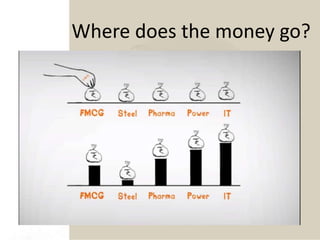
Where does the money go?
Features
• Mobilizing small savings
• Investment Avenue
• Professional management
• Diversified investment
• Better liquidity
• Reduced risks
• Investment protection
• Switching facility
• Tax benefits
• Low transaction cost
Reference:
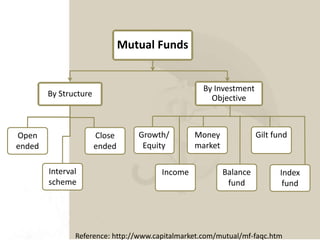
Mutual Funds
By Structure
By Investment
Objective
Growth/
Equity
Income
Money
market
Balance
fund
Gilt fund
Index
fund
Close
ended
Open
ended
Interval
scheme
Reference: http://www.capitalmarket.com/mutual/mf-faqc.htm
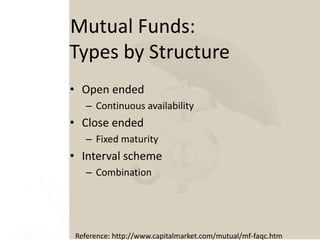
Mutual Funds:
Types by Structure
• Open ended
– Continuous availability
• Close ended
– Fixed maturity
• Interval scheme
– Combination
Reference: http://www.capitalmarket.com/mutual/mf-faqc.htm
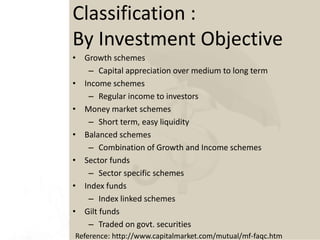
Classification :
By Investment Objective
• Growth schemes
– Capital appreciation over medium to long term
• Income schemes
– Regular income to investors
• Money market schemes
– Short term, easy liquidity
• Balanced schemes
– Combination of Growth and Income schemes
• Sector funds
– Sector specific schemes
• Index funds
– Index linked schemes
• Gilt funds
– Traded on govt. securities
Reference: http://www.capitalmarket.com/mutual/mf-faqc.htm
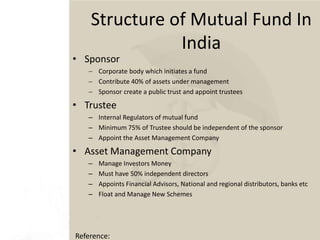
• Sponsor
 Corporate body which initiates a fund
 Contribute 40% of assets under management
 Sponsor create a public trust and appoint trustees
• Trustee
– Internal Regulators of mutual fund
– Minimum 75% of Trustee should be independent of the sponsor
– Appoint the Asset Management Company
• Asset Management Company
– Manage Investors Money
– Must have 50% independent directors
– Appoints Financial Advisors, National and regional distributors, banks etc
– Float and Manage New Schemes
Reference:
Structure of Mutual Fund In
India
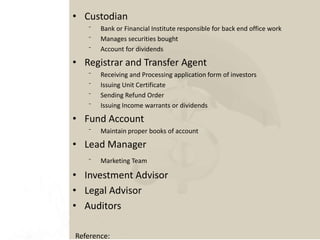
• Custodian
⁻ Bank or Financial Institute responsible for back end office work
⁻ Manages securities bought
⁻ Account for dividends
• Registrar and Transfer Agent
⁻ Receiving and Processing application form of investors
⁻ Issuing Unit Certificate
⁻ Sending Refund Order
⁻ Issuing Income warrants or dividends
• Fund Account
⁻ Maintain proper books of account
• Lead Manager
⁻ Marketing Team
• Investment Advisor
• Legal Advisor
• Auditors
Reference:
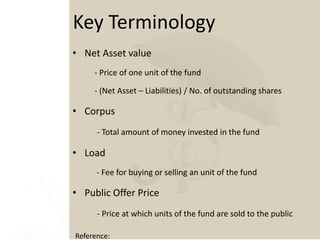
Key Terminology
• Net Asset value
- Price of one unit of the fund
- (Net Asset – Liabilities) / No. of outstanding shares
• Corpus
- Total amount of money invested in the fund
• Load
- Fee for buying or selling an unit of the fund
• Public Offer Price
- Price at which units of the fund are sold to the public
Reference:
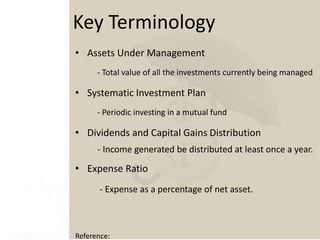
• Assets Under Management
- Total value of all the investments currently being managed
• Systematic Investment Plan
- Periodic investing in a mutual fund
• Dividends and Capital Gains Distribution
- Income generated be distributed at least once a year.
• Expense Ratio
- Expense as a percentage of net asset.
Key Terminology
Reference:
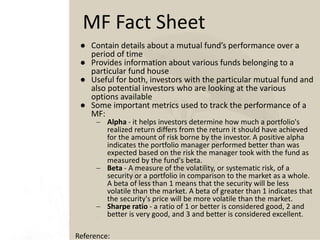
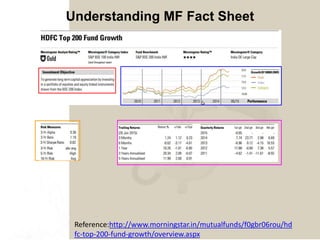
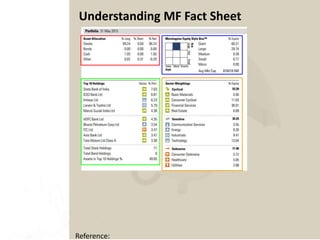
● Contain details about a mutual fund’s performance over a
period of time
● Provides information about various funds belonging to a
particular fund house
● Useful for both, investors with the particular mutual fund and
also potential investors who are looking at the various
options available
● Some important metrics used to track the performance of a
MF:
 Alpha - it helps investors determine how much a portfolio's
realized return differs from the return it should have achieved
for the amount of risk borne by the investor. A positive alpha
indicates the portfolio manager performed better than was
expected based on the risk the manager took with the fund as
measured by the fund's beta.
 Beta - A measure of the volatility, or systematic risk, of a
security or a portfolio in comparison to the market as a whole.
A beta of less than 1 means that the security will be less
volatile than the market. A beta of greater than 1 indicates that
the security's price will be more volatile than the market.
 Sharpe ratio - a ratio of 1 or better is considered good, 2 and
better is very good, and 3 and better is considered excellent.
MF Fact Sheet
Reference:
Understanding MF Fact Sheet
Reference:http://www.morningstar.in/mutualfunds/f0gbr06rou/hd
fc-top-200-fund-growth/overview.aspx
Understanding MF Fact Sheet
Reference:

Mutual fund

  • 1.
    Mutual Funds 129- AnshulGupta 139- Gandluri Supraja Reddy 149- Kunal Gandhi 159- Pratit Vajani 169- Shanmuganandam T. 179- Vishal Adkar
  • 2.
    An investment vehiclethat is made up of a pool of funds collected from many investors for the purpose of investing in securities such as stocks, bonds, money market instruments and similar assets. Mutual Fund
  • 3.
  • 4.
    Where does themoney go?
  • 5.
    Features • Mobilizing smallsavings • Investment Avenue • Professional management • Diversified investment • Better liquidity • Reduced risks • Investment protection • Switching facility • Tax benefits • Low transaction cost Reference:
  • 6.
    Mutual Funds By Structure ByInvestment Objective Growth/ Equity Income Money market Balance fund Gilt fund Index fund Close ended Open ended Interval scheme Reference: http://www.capitalmarket.com/mutual/mf-faqc.htm
  • 7.
    Mutual Funds: Types byStructure • Open ended – Continuous availability • Close ended – Fixed maturity • Interval scheme – Combination Reference: http://www.capitalmarket.com/mutual/mf-faqc.htm
  • 8.
    Classification : By InvestmentObjective • Growth schemes – Capital appreciation over medium to long term • Income schemes – Regular income to investors • Money market schemes – Short term, easy liquidity • Balanced schemes – Combination of Growth and Income schemes • Sector funds – Sector specific schemes • Index funds – Index linked schemes • Gilt funds – Traded on govt. securities Reference: http://www.capitalmarket.com/mutual/mf-faqc.htm
  • 9.
    • Sponsor  Corporatebody which initiates a fund  Contribute 40% of assets under management  Sponsor create a public trust and appoint trustees • Trustee – Internal Regulators of mutual fund – Minimum 75% of Trustee should be independent of the sponsor – Appoint the Asset Management Company • Asset Management Company – Manage Investors Money – Must have 50% independent directors – Appoints Financial Advisors, National and regional distributors, banks etc – Float and Manage New Schemes Reference: Structure of Mutual Fund In India
  • 10.
    • Custodian ⁻ Bankor Financial Institute responsible for back end office work ⁻ Manages securities bought ⁻ Account for dividends • Registrar and Transfer Agent ⁻ Receiving and Processing application form of investors ⁻ Issuing Unit Certificate ⁻ Sending Refund Order ⁻ Issuing Income warrants or dividends • Fund Account ⁻ Maintain proper books of account • Lead Manager ⁻ Marketing Team • Investment Advisor • Legal Advisor • Auditors Reference:
  • 11.
    Key Terminology • NetAsset value - Price of one unit of the fund - (Net Asset – Liabilities) / No. of outstanding shares • Corpus - Total amount of money invested in the fund • Load - Fee for buying or selling an unit of the fund • Public Offer Price - Price at which units of the fund are sold to the public Reference:
  • 12.
    • Assets UnderManagement - Total value of all the investments currently being managed • Systematic Investment Plan - Periodic investing in a mutual fund • Dividends and Capital Gains Distribution - Income generated be distributed at least once a year. • Expense Ratio - Expense as a percentage of net asset. Key Terminology Reference:
  • 13.
    ● Contain detailsabout a mutual fund’s performance over a period of time ● Provides information about various funds belonging to a particular fund house ● Useful for both, investors with the particular mutual fund and also potential investors who are looking at the various options available ● Some important metrics used to track the performance of a MF:  Alpha - it helps investors determine how much a portfolio's realized return differs from the return it should have achieved for the amount of risk borne by the investor. A positive alpha indicates the portfolio manager performed better than was expected based on the risk the manager took with the fund as measured by the fund's beta.  Beta - A measure of the volatility, or systematic risk, of a security or a portfolio in comparison to the market as a whole. A beta of less than 1 means that the security will be less volatile than the market. A beta of greater than 1 indicates that the security's price will be more volatile than the market.  Sharpe ratio - a ratio of 1 or better is considered good, 2 and better is very good, and 3 and better is considered excellent. MF Fact Sheet Reference:
  • 14.
    Understanding MF FactSheet Reference:http://www.morningstar.in/mutualfunds/f0gbr06rou/hd fc-top-200-fund-growth/overview.aspx
  • 15.
    Understanding MF FactSheet Reference: