Page 2
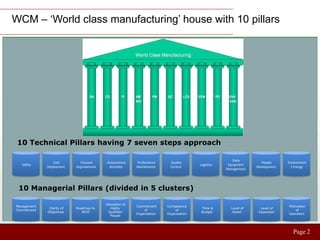
WCM – ‘World class manufacturing’ house with 10 pillars
10 Managerial Pillars (divided in 5 clusters)
10 Technical Pillars having 7 seven steps approach
Safety
Cost
Deployment
Focused
Improvement
Autonomous
Activities
Professional
Maintenance
Quality
Control
Logistics
Early
Equipment
Management
People
Development
Environment
/ Energy
Management
Commitment
Clarity of
Objectives
Roadmap to
WCM
Allocation of
Highly
Qualified
People
Commitment
of
Organization
Competence
of
Organization
Time &
Budget
Level of
Detail
Level of
Expansion
Motivation
of
Operators
Page 3
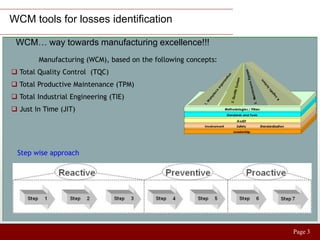
WCM tools for losses identification
Manufacturing (WCM), based on the following concepts:
 Total Quality Control (TQC)
 Total Productive Maintenance (TPM)
 Total Industrial Engineering (TIE)
 Just In Time (JIT)
WCM… way towards manufacturing excellence!!!
Step wise approach
Page 4
World class logistics stepwise approach
Step 6
Step 7
Integrate the
purchasing
departement
Adopt a
defined time
sequence
programming
Create flow Create a smooth flow Create an
accurate flow
Create a
controlled flow
Step 1
REACTIVE
Step 2
Step 3
Reengineer
assembly to
satisfy the
customers
Reorganize
internal
logistics
Reorganize
external
logistics
Step 1
MODEL AREA
“A” AREA
Step 4
Level out
production
Step 5
Refine internal
and external
logistics
“AA” AREA
Class /
Expansion
Step
1
Step
2
Step
3
Step
4
Step
5
Step
6
Model Area      
AA     
A   
PROACTIVEPREVENTIVE
Page 5
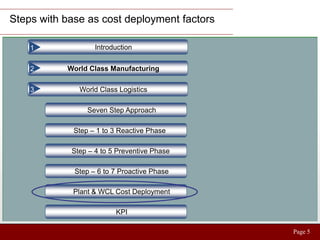
Steps with base as cost deployment factors
World Class Manufacturing2
Seven Step Approach
Step – 1 to 3 Reactive Phase
Step – 6 to 7 Proactive Phase
KPI
World Class Logistics3
Step – 4 to 5 Preventive Phase
Plant & WCL Cost Deployment
Introduction1
Page 6
WCL cost deployment
LOGISTICS PERIMETER
Page 7
Plant level losses identification
Page 8
Logistics losses identification
B/C of
each
project
In E matrix we
have detailed
list of projects
Yearly Potential
of Saving
Leader of the
project to
attack Loss
Cost incurred
to complete the
project
Page 9
Losses identification –Yard management
80%
85%
90%
95%
100%
105%
0
20
40
60
80
100
Land Cost Power / energy Manpower consumables
Value
%
In case of yard major loss identified is space
followed by energy, manpower
Page 10
0
1
2
3
4
5
6
TargetFG
inventory
AvgFG
inventory
Noofdays
Excess 2 days
FG inventory
10.5%
59%19%
11%
9%
2% FG StockThe major share of stock reduction actions
• Our Sales and operation process
reviewed with both customers and agreed
with revisions
• Based on this internal processes also fine
tuned
• Effecting reduction on FG inventory
and releasing space
Case 1 -Yard Space optimisation
Page 11
Reduction in space requirement by controlling FG inventory
As the Space is made available introduction new models was feasible in the
same space
M1 M4M3M2 M5
A
B
C
D
E
Page 12
Automation of process based on Invoicing trend
Product A Volume is 59 % of total volume and hence considered for study
59%19%
11%
9%
2% FG Stock
80%
90%
100%
110%
0
50
100
Page 13
Optimised process with reduction in process time
SAP
INOVICE
IDOC
IDOC PO
TO SO
INBOUND
DELIVERY
+ G.R
IDOC
FIAT
SAP
DEALERS CUST
CRM
PO
P.O In
Excel Sheet
P.O
Through
E - Mail
FIAT
S.O Creation
(Manual)
S.O.
Processing
Invoice Data
Information
(Excel Sheet)
TML GRN
Delivery
Creation
(Manual)
CUST
CRM
Through
E-mail
INCOMING
ORDERS
P.O Matching
in Sap (Manual)
DEALERS
CUST
CRM
CUST
SAP
CUST
WOW
CUST
SERVE
R XI
FIAT
SERVE
R XI
Start of
Warranty
Registratio
n
PO
INCOMING
ORDERS
Start Warranty Data
BeforeAfter
Page 14
Reduction in processing time helped for synchronised
invoicing on daily basis and reduction manpower resources
0
500
1000
1500
2000
2500
3000
1
/A
u
g
/1
0
3
/A
u
g
/1
0
5
/A
u
g
/1
0
7
/A
u
g
/1
0
9
/A
u
g
/1
0
1
1
/A
u
g
/1
0
1
3
/A
u
g
/1
0
1
5
/A
u
g
/1
0
1
7
/A
u
g
/1
0
1
9
/A
u
g
/1
0
2
1
/A
u
g
/1
0
2
3
/A
u
g
/1
0
2
5
/A
u
g
/1
0
2
7
/A
u
g
/1
0
2
9
/A
u
g
/1
0
3
1
/A
u
g
/1
0
Invoice Trend M 1
Stock
Cu Assignments
Cu Invoice
0
500
1000
1500
2000
2500
3000
3500
4000
4500
1
/Jul/1
0
3
/Jul/1
0
5
/Jul/1
0
7
/Jul/1
0
9
/Jul/1
0
11
/Jul/1
0
13
/Jul/1
0
15
/Jul/1
0
17
/Jul/1
0
19
/Jul/1
0
21
/Jul/1
0
23
/Jul/1
0
25
/Jul/1
0
27
/Jul/1
0
29
/Jul/1
0
31
/Jul/1
0
Invoice Trend M4
Stock
Cu Assignments
Cu Invoice
Benefits
The sales requirement for product A synchronised - Car invoicing with production
on daily basis
• Sales yard resources utilized uniformly avoiding rush in last few days resulting
overall reduction in manpower
• Service level is improved M1- M6 - AVG 91.2 %
M7- M12 - AVG 98.0 %
earlier improved
Benefit to cost ratio –B/C = 5.1
Page 15
Case 2 -Horizontal deployment of improvements through
the methodology for optimising the transportation
15
 In earlier method one vehicle carries
one body only.
 Body shells are protected through
plastic covers only.
 Truck Traffic very high inside the plant.
 Truck waiting time high
CD 6
Page 16
New method to carry 8 bodies / container
AFTER
Unloading of
Trailer
Trai
l
e
r
 In new method one carrier carries eight bodies/Truck.
 Body shells are protected due to closed carrier.
Action Taken
- Formation of Joint Team
(TML+FIAL)
- Concept finalization
- Safety Point
- Selection of Supplier
- Trials
- Negotiations
- Implementation
Page 17
Benefits to cost ratio more than 4
 CD Losses reduction due to Body not Available
 Body unloading possible within TAKT time.
 In plant Traffic management is easier.
 Fuel saving of 5 liter's/body.
 Smoke density is reduced by 57 to 56 Hart ridge units per car.
 Transportation Cost saving of supplier.
 Documentation paper saving.
 Quality issues got resolved.
Benefits
Benefit to cost ratio –B/C = 4.65
Page 18
WCL the way we move on
 Measurement and booking of losses
 Analysis in terms of cost
 Deciding priorities of projects based on amount of losses
 Develop team members in WCL tools
 Apply WCL tools to resolve the issues
 Track the results and benefits and get it approved from finance
 Horizontally deploy the improvements in other areas

WCM LOGISTICS

  • 1.
    Page 2 WCM –‘World class manufacturing’ house with 10 pillars 10 Managerial Pillars (divided in 5 clusters) 10 Technical Pillars having 7 seven steps approach Safety Cost Deployment Focused Improvement Autonomous Activities Professional Maintenance Quality Control Logistics Early Equipment Management People Development Environment / Energy Management Commitment Clarity of Objectives Roadmap to WCM Allocation of Highly Qualified People Commitment of Organization Competence of Organization Time & Budget Level of Detail Level of Expansion Motivation of Operators
  • 2.
    Page 3 WCM toolsfor losses identification Manufacturing (WCM), based on the following concepts:  Total Quality Control (TQC)  Total Productive Maintenance (TPM)  Total Industrial Engineering (TIE)  Just In Time (JIT) WCM… way towards manufacturing excellence!!! Step wise approach
  • 3.
    Page 4 World classlogistics stepwise approach Step 6 Step 7 Integrate the purchasing departement Adopt a defined time sequence programming Create flow Create a smooth flow Create an accurate flow Create a controlled flow Step 1 REACTIVE Step 2 Step 3 Reengineer assembly to satisfy the customers Reorganize internal logistics Reorganize external logistics Step 1 MODEL AREA “A” AREA Step 4 Level out production Step 5 Refine internal and external logistics “AA” AREA Class / Expansion Step 1 Step 2 Step 3 Step 4 Step 5 Step 6 Model Area       AA      A    PROACTIVEPREVENTIVE
  • 4.
    Page 5 Steps withbase as cost deployment factors World Class Manufacturing2 Seven Step Approach Step – 1 to 3 Reactive Phase Step – 6 to 7 Proactive Phase KPI World Class Logistics3 Step – 4 to 5 Preventive Phase Plant & WCL Cost Deployment Introduction1
  • 5.
    Page 6 WCL costdeployment LOGISTICS PERIMETER
  • 6.
    Page 7 Plant levellosses identification
  • 7.
    Page 8 Logistics lossesidentification B/C of each project In E matrix we have detailed list of projects Yearly Potential of Saving Leader of the project to attack Loss Cost incurred to complete the project
  • 8.
    Page 9 Losses identification–Yard management 80% 85% 90% 95% 100% 105% 0 20 40 60 80 100 Land Cost Power / energy Manpower consumables Value % In case of yard major loss identified is space followed by energy, manpower
  • 9.
    Page 10 0 1 2 3 4 5 6 TargetFG inventory AvgFG inventory Noofdays Excess 2days FG inventory 10.5% 59%19% 11% 9% 2% FG StockThe major share of stock reduction actions • Our Sales and operation process reviewed with both customers and agreed with revisions • Based on this internal processes also fine tuned • Effecting reduction on FG inventory and releasing space Case 1 -Yard Space optimisation
  • 10.
    Page 11 Reduction inspace requirement by controlling FG inventory As the Space is made available introduction new models was feasible in the same space M1 M4M3M2 M5 A B C D E
  • 11.
    Page 12 Automation ofprocess based on Invoicing trend Product A Volume is 59 % of total volume and hence considered for study 59%19% 11% 9% 2% FG Stock 80% 90% 100% 110% 0 50 100
  • 12.
    Page 13 Optimised processwith reduction in process time SAP INOVICE IDOC IDOC PO TO SO INBOUND DELIVERY + G.R IDOC FIAT SAP DEALERS CUST CRM PO P.O In Excel Sheet P.O Through E - Mail FIAT S.O Creation (Manual) S.O. Processing Invoice Data Information (Excel Sheet) TML GRN Delivery Creation (Manual) CUST CRM Through E-mail INCOMING ORDERS P.O Matching in Sap (Manual) DEALERS CUST CRM CUST SAP CUST WOW CUST SERVE R XI FIAT SERVE R XI Start of Warranty Registratio n PO INCOMING ORDERS Start Warranty Data BeforeAfter
  • 13.
    Page 14 Reduction inprocessing time helped for synchronised invoicing on daily basis and reduction manpower resources 0 500 1000 1500 2000 2500 3000 1 /A u g /1 0 3 /A u g /1 0 5 /A u g /1 0 7 /A u g /1 0 9 /A u g /1 0 1 1 /A u g /1 0 1 3 /A u g /1 0 1 5 /A u g /1 0 1 7 /A u g /1 0 1 9 /A u g /1 0 2 1 /A u g /1 0 2 3 /A u g /1 0 2 5 /A u g /1 0 2 7 /A u g /1 0 2 9 /A u g /1 0 3 1 /A u g /1 0 Invoice Trend M 1 Stock Cu Assignments Cu Invoice 0 500 1000 1500 2000 2500 3000 3500 4000 4500 1 /Jul/1 0 3 /Jul/1 0 5 /Jul/1 0 7 /Jul/1 0 9 /Jul/1 0 11 /Jul/1 0 13 /Jul/1 0 15 /Jul/1 0 17 /Jul/1 0 19 /Jul/1 0 21 /Jul/1 0 23 /Jul/1 0 25 /Jul/1 0 27 /Jul/1 0 29 /Jul/1 0 31 /Jul/1 0 Invoice Trend M4 Stock Cu Assignments Cu Invoice Benefits The sales requirement for product A synchronised - Car invoicing with production on daily basis • Sales yard resources utilized uniformly avoiding rush in last few days resulting overall reduction in manpower • Service level is improved M1- M6 - AVG 91.2 % M7- M12 - AVG 98.0 % earlier improved Benefit to cost ratio –B/C = 5.1
  • 14.
    Page 15 Case 2-Horizontal deployment of improvements through the methodology for optimising the transportation 15  In earlier method one vehicle carries one body only.  Body shells are protected through plastic covers only.  Truck Traffic very high inside the plant.  Truck waiting time high CD 6
  • 15.
    Page 16 New methodto carry 8 bodies / container AFTER Unloading of Trailer Trai l e r  In new method one carrier carries eight bodies/Truck.  Body shells are protected due to closed carrier. Action Taken - Formation of Joint Team (TML+FIAL) - Concept finalization - Safety Point - Selection of Supplier - Trials - Negotiations - Implementation
  • 16.
    Page 17 Benefits tocost ratio more than 4  CD Losses reduction due to Body not Available  Body unloading possible within TAKT time.  In plant Traffic management is easier.  Fuel saving of 5 liter's/body.  Smoke density is reduced by 57 to 56 Hart ridge units per car.  Transportation Cost saving of supplier.  Documentation paper saving.  Quality issues got resolved. Benefits Benefit to cost ratio –B/C = 4.65
  • 17.
    Page 18 WCL theway we move on  Measurement and booking of losses  Analysis in terms of cost  Deciding priorities of projects based on amount of losses  Develop team members in WCL tools  Apply WCL tools to resolve the issues  Track the results and benefits and get it approved from finance  Horizontally deploy the improvements in other areas