PRISMS
and FRUSTUM
By: Alwin Ng, Ong Von Wan, Phares Phung, Chloe
The, Yip Xiao Jung, David Tan, Carol Tang, Alison
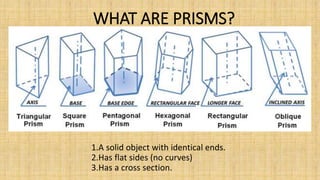
WHAT ARE PRISMS?
1.A solid object with identical ends.
2.Has flat sides (no curves)
3.Has a cross section.
Questions Involving Prisms
1. Surface Area
Calculated by multiplying base area by 2
and adding the perimeter of base
multiplied by height.
2.Volume of prism
Base area multiplied by height
3. Area and volume of cross section
(Frustum)
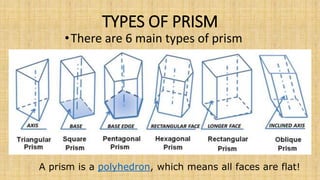
TYPES OF PRISM
•There are 6 main types of prism
A prism is a polyhedron, which means all faces are flat!
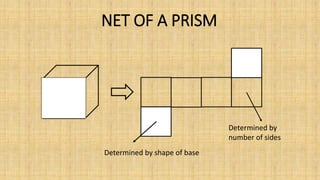
NET OF A PRISM
Determined by shape of base
Determined by
number of sides
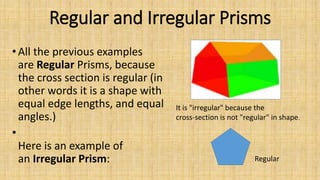
Regular and Irregular Prisms
•All the previous examples
are Regular Prisms, because
the cross section is regular (in
other words it is a shape with
equal edge lengths, and equal
angles.)
•
Here is an example of
an Irregular Prism:
It is "irregular" because the
cross-section is not "regular" in shape.
Regular
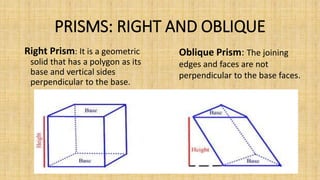
PRISMS: RIGHT AND OBLIQUE
Right Prism: It is a geometric
solid that has a polygon as its
base and vertical sides
perpendicular to the base.
Oblique Prism: The joining
edges and faces are not
perpendicular to the base faces.
SURFACE AREA OF A PRISM
Area = 2b + ph
b = area of a base
p = perimeter of a base
h = height of the prism
Ex:
Surface Area
= 2(½ X 8 X 3) + [(8+5+5) X 12]
= 240 cm2
VOLUME OF A PRISM
Volume = bh
b = area of base
h = height
Example:
Volume = (½ X 8 X 3) X 12
= 144 cm3
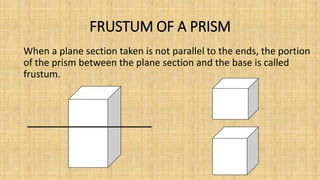
FRUSTUM OF A PRISM
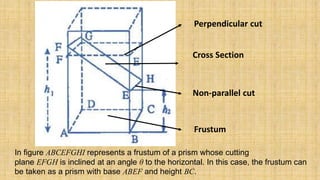
When a plane section taken is not parallel to the ends, the portion
of the prism between the plane section and the base is called
frustum.
Perpendicular cut
Non-parallel cut
Cross Section
Frustum
In figure ABCEFGHI represents a frustum of a prism whose cutting
plane EFGH is inclined at an angle θ to the horizontal. In this case, the frustum can
be taken as a prism with base ABEF and height BC.
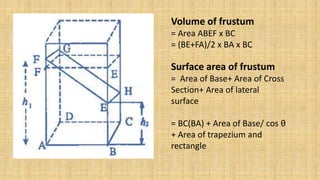
Volume of frustum
= Area ABEF x BC
= (BE+FA)/2 x BA x BC
Surface area of frustum
= Area of Base+ Area of Cross
Section+ Area of lateral
surface
= BC(BA) + Area of Base/ cos θ
+ Area of trapezium and
rectangle

Prisms

  • 1.
    PRISMS and FRUSTUM By: AlwinNg, Ong Von Wan, Phares Phung, Chloe The, Yip Xiao Jung, David Tan, Carol Tang, Alison
  • 2.
    WHAT ARE PRISMS? 1.Asolid object with identical ends. 2.Has flat sides (no curves) 3.Has a cross section.
  • 3.
    Questions Involving Prisms 1.Surface Area Calculated by multiplying base area by 2 and adding the perimeter of base multiplied by height. 2.Volume of prism Base area multiplied by height 3. Area and volume of cross section (Frustum)
  • 4.
    TYPES OF PRISM •Thereare 6 main types of prism A prism is a polyhedron, which means all faces are flat!
  • 5.
    NET OF APRISM Determined by shape of base Determined by number of sides
  • 6.
    Regular and IrregularPrisms •All the previous examples are Regular Prisms, because the cross section is regular (in other words it is a shape with equal edge lengths, and equal angles.) • Here is an example of an Irregular Prism: It is "irregular" because the cross-section is not "regular" in shape. Regular
  • 7.
    PRISMS: RIGHT ANDOBLIQUE Right Prism: It is a geometric solid that has a polygon as its base and vertical sides perpendicular to the base. Oblique Prism: The joining edges and faces are not perpendicular to the base faces.
  • 8.
    SURFACE AREA OFA PRISM Area = 2b + ph b = area of a base p = perimeter of a base h = height of the prism Ex: Surface Area = 2(½ X 8 X 3) + [(8+5+5) X 12] = 240 cm2
  • 9.
    VOLUME OF APRISM Volume = bh b = area of base h = height Example: Volume = (½ X 8 X 3) X 12 = 144 cm3
  • 10.
    FRUSTUM OF APRISM When a plane section taken is not parallel to the ends, the portion of the prism between the plane section and the base is called frustum.
  • 11.
    Perpendicular cut Non-parallel cut CrossSection Frustum In figure ABCEFGHI represents a frustum of a prism whose cutting plane EFGH is inclined at an angle θ to the horizontal. In this case, the frustum can be taken as a prism with base ABEF and height BC.
  • 12.
    Volume of frustum =Area ABEF x BC = (BE+FA)/2 x BA x BC Surface area of frustum = Area of Base+ Area of Cross Section+ Area of lateral surface = BC(BA) + Area of Base/ cos θ + Area of trapezium and rectangle