M
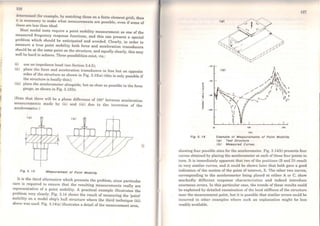
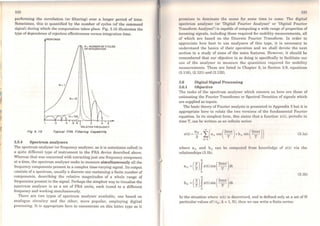
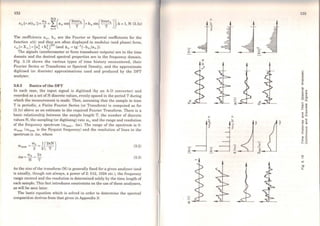
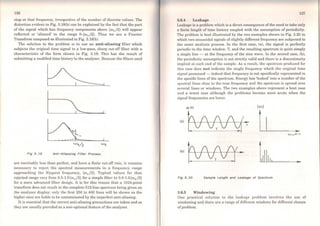
ERIN ., DVNAMICS S RI S
or J O Roh rt . Un1v1 1 lty oi S11 IJK
Mod 1t tino Th ory nd Prnctic
Du11110 thíl 1970 o now hra11ch of v1brnt1on engin1 ormg wa
v lop d, 11compn mg the rnost powcrffJI aspect~ of both
XJ 1 rl11u1111n1 r111d anllly111 nl t1 clt111q11os. 1he re.sulting tochnology lias
l rn k11own a Experimental Modal'Analysis or Modal Tcstmg. Tho
t hn1 1u • 1nvolvod draw on lhe é1clvances rnode 111 drg1tal s1gnal
f 1 1110 ncl in f1111te oloment mothods, and provido thc means of
mb111111g tho proclucts of both into a unified tool for studyino real
tructur il v1brntion probleins. Using modal testing tochniques, the
cl h p nnd fjjpquenc1os of practical structures can be measurect
urntoly, llrHI llrn results displayed iri a variety of ways. A detailed
"' th mat1cal model of a test slfucture can bo cTevised direc!'fy from
.uch rnoo uronionts nnd, with this, powerfui applications are possib/e,
111 ludmg
• Corr lot1on with predictt!d models leading to correction of these
r.u r, !
• rr d1ct1on ot lhe effects of modifying the test structure (perhaps to
1mprov 1ts dynamics);
• An ly· is of a11 assembled structure of which the testpiece forms one
omponont
..
or Ewins is known as a leading a~th'ority ~ the field; he has
r 1v d cm award and citation from the So~iety of Experimental
M chame for his promotion and teachlng of modal analysis. The text
r hl original book is now presented in a new and·ciearer font, and
th opportunity has been taken to revise the notation and terminology
in hn with proposed international standards.
~ RESEARCH STUOIES PRESS ll'.D,
~ l 111111011, Sornorsct, England
o
e
)>
r-
~
m
cn
-1
Modal Testing:
Theory and
Practice
D. J. EWINS
620.30724 1Ew56m
1010381126/ -~
Modal Testing:
Theory and Practice
MECHANJCAL ENGINEERING RESEAR('ll snmms
ENGINEERING DYNAMICS SERIES
Series Editor: Professor J. 8. Robcrts, University ofSussex. E11gla11d
2. Modal Testing: Theory and Practicc
D.J. Ewins
4. Parametric Random Vibration
R. A. lbrahim
5. Statistical Dynamics of Nonlinear and Time-Yarying Systems
M. T. Dimcntbcrg
6. Stral.cgics for Structural Dynamic Modification
John A. Brandon
7. Fragilily Analysis of Complex Structural Systcms
F. Casciati mui L. Faravelli
8. Yibroacoustical Diagnostics for Machines and Structures
M. F. Dimentberg, K. V. Frolov and A. 1. Menyailov
....
1
Modal Testing:
Theory and Practice
D. J. Ewins
Professor of Vibration Engineering,
Imperial College ofScience, Technology & Medicine,
London, England
~ESEARCH STUDIES PRESS LTD.
Taunton, Somerset, England
JOHN WILEY & SONS INC.
Ncw York · Chichester · Toronto · Bri~bane · Singapore
Rl"iFAIU~ll S l lll>IFS l'RI SS 1 11>.
2-1 Bch c<lrn: lfoa<l, lilun1u11, SomclC1. England l'A1 1111 >
Copyrigh1 O 19114 by Research S1ud1c l'rcss Lld.
Reprinted wi1h atncndmcnts Jurn: 1985
Rep1intcd wi1h a111cndmenrs April 1986
Reprinted 1988. 1989, 1991 , 1992 and 1994
Reprimed January 1995: revised with 11ew notation
re-set b) Abracadabra~. Milton Keyne>. England
All right; reo;ervcd.
No pare of1his book may be reproduccd by any rneans,
nor transmiucd. nor translated into a machinc language
without the wrincn pcrmis;.ion of the publisher.
Marketing and Obtribution:
Amlralia mui N1•n lealmul:
facaranda Wilcy Ltd.
GPO Box 859, Brisbanc, Queensland 4001 . Australia
Canada:
JOHN WILFY & so~ s CANADA LIMITED
22 Worces1er Road, Rexdale. Ontano. Canada
L11mpe. Afrírn, Mil/d/e Easr mui J11pm1:
JOl IN WILEY & SONS LIMITEI)
Bnffins Lanc, Chichcster, West Susscx. England
Nonh and So11rh Aml'l'im:
JOHN WILfY & SONS JNC.
605 Third An:nue. Nc" Yort-.. NY 10158. USA
So111h Easr Asía:
JOHI' WILEY & SONS (SEA) PTE LTD.
37 Jalan Pcmimpin 05-04
Block B Union lndutrial Building. Singapore 2057
Library of Congres~ Cataloging-in-Publication Data
Ewins, D. J.
Modal tcsting
(Mechanicnl cnginccring rcscarch srudies) (Engit1ccr-
ing dynamic~ series; 2)
Bibliography: p.
l ncludc~ indc
1. Vihr;1t1on lathcmatícal modeh. 2. Structurnl
dynamic, Mathema11car modcl' 1. Title. li. Serie.
Ili. Serie;.: bn!!incering dynam1c' crie~; 2.
TA355.E97 1984 624. 1'76 84-9988
ISBN O4719CU72 4 (Wilcy)
British Librar) Cataloguing in Publication Data
E:.wín,, D. J.
Modal testing. (Mcchanical Cn!!ineering
rcsearch studic, . onginecring clynamics
~cries)
1. Vibrntion Mathcmatical modcl;,. 1. Title li. Serie•
620.3'0724 QA865
ISBN O86380O17 3
ISBN O86380O1 7 3 (Rcscarch Studic;. Press Ltd.)
ISBN O471 990472 4 (Jolm Wilcy & Sons lnc.)
Primed in Gn:at Hnta111 by SRP L1d.• F.,wtcr
BAFJ f'7;=m
6,,;o 3oroJ'i
ZL
-V. .b
TOMBO: 33""!"'7/r:J..,-,- -..
c•IKJ D.o
PROC_ --1..il.3.:it 5 '1-
PRff -14. I f'f .Ls;;_
D.oT;•, -· & / _.f o, q1::.._
N. cm____ ___
CM-00102207-3
I1
i
t
Preface
Modal t esting t heor y a n d pract
i ce
620.30724 /Ew56m
(381126/97)
This book attempts to provide a reasonably detailed coverage of the
t.echnology ofmodal testing. This is nota new subject although many ofthe
most powerful techniques have only recently been developed and the
potential ofthe method only recently recognised. Modal testing is, in effect,
the process of constructing a mathematical model to describe the vibration
properties of a structure based on test data, rather than a conventional
theoretical analysis. As such, it has applications throughout the entire field
ofengineering.
The subject matter in the book is presented in a particular order, and
that for a particular reason. ln order to take the maximum advantage of
the methods of modal t.esting, it is essential that an appropriate level of
expertise be reached not only in measurement and (data) analysis
methods, but also in the theoretical basis upon which the technique is
founded. To this end, the readeris encouraged to make a detailed study or
review of the theory in Chapter 2 before proceeding to the more practical
aspects of the measurement process in Chapter 3. Even here, however, a
rclatively high level of theoretical competence is expected in order to
understand properly the implications and limitations of the difTerent types
of measurement method - sine, random and transient excitations and the
like.
In Chapt.er 4, the modal analysis methods used to process the measured
data are described, ranging from the basic and relatively simple to the
more advanced, computer-dependent. The analysis phase continues into
Chapter 5 where thc overall modelling process is outlined, treating
difTerent leveis of complexity of the model which are appropriate to the
d1fTcrent applications. Then, in Chapter 6, examples are given of some of
1hc many uses to which the product of a modal test may be put, a list
vii
which will undoubtedly grow in the next few ycars.
The opening chapter is rather more general, and serves both us on
introduction to the tcxt and also as an Overview of the subject. As such, it
provides an introduction to the rest of the work for the serious student but
also presents a condensation of the whole subject for readers who wish to
be apprised of the general activities and capabilities of a modal testing
facility but who lack the opportunity of the extensive 'hands-on' experience
which is essential for mastery of the subject. (ln the short course upon
which the book is based, the Overview is intended not only for those who
will attend the whole course but also for their managers who can only
spare a few hours!)
VIII
Acknowledgements
It is inevitable that many people contribute to such a work such as this and
I should like to acknowledge the support and assistance I have received
from several friends and colleagues.
I must record first my gratitude to Professor Peter Grootenhuis with
whom I have had the pleasure and privilege of studying and working for
some 20 years. Ris support and encouragement both launched and
sustained me in the work which has culminated in this book. The text has
developed alongside a series of short courses on Modal Testing, which I
havc given together with my colleague at Imperial College, David Robb. I
am most gruteful for his helpful comments on the book and for his many
practical contributions. Other university colleagues, both in London and
elsewhere, have kindly provided illustrations and, on many occasions,
stimulating discussion on all aspects of the subject and I must also
acknowledge the very significant contributions provided by severa!
generations of students whose researches have resulted in many of the
examples cited in the book. Likewise, many colleagues in industry have
provided me with opportunities to work on real-life problems, adding
relevance to our research, and have permitted the use of examples from
some of these for illustrations here. Without the cooperation of all of these
people, there would have been no book.
The actual preparation of the text has been a major undertaking and I
am indebted to my secretary, Lavinia Micklem, who has cheerfully
produced draft after draft of the manuscript until the publication dcadline
forced me to abandon further 'improvements'. Scrutiny of each draft
brought to light a number of mistakes in the text: I hope that the most
recent and concentrated efforts ofFrank Lacey, the publishers and myself
have succeeded in reducing these to a tolerable number, although I suspect
IX
one or two still rcmain! Thc illustrations were drawn from muny lilOurc<'ti
but the majority have bccn prepared by Judi Parkes and Ron Potter, und
for their efficient and careful efforts I am most grateful.
Lastly, I must pay tribute to the understanding and support of my
family who have patiently watched the date for my 'finishing' the book slip
through several of the best months of 1984.
D.J. Ewins
Author's Comments for the 1994 Edition
London,
Septembcr 1984
A decade has passed since I wrote the Preface and Acknowledgemcnts for
the first edition of Modal Testing: it hardly seems possible that it was so
long ago! Since that first edition, there have been a numbcr of minor
corrections and modifications made in the various reprints, mostly thanks
to readers of Lhe earlier editions. These amendments are all embodied in
this current re-set edition. Of course, it is time for a new or substantially
revised version of the book to be written, and that has been planned and
promised for a number of years! However, in the absence of the successful
completion of such a project, this edition presents the original text in a new
and clearer font and, at the sarne time, the opportunity has becn taken to
revise the notation and terminology to bring it into line with the recently-
proposed Notation for Modal Analysis and Testing, discussed at the
1992 Intemational Modal Analysis Conference and subsequently adopted
in 1993 by a number of Journals and other bodies. This Notation is
presented at the end ofthe main text.
During the past 10 years, many people have helped me to develop
further my understanding and appreciation ofthe subject ofModal Testing
and I wish to record my recognition of their contributions in this respect.
First, I would like to acknowledge the many contributions made by my
colleague at Imperial College, Mehmet Imregun, in particular in the
implementation of most of the techniques described in this book in the
software package MODENT and its associated routines. These capabilities
have greatly enhanced the shorl courses which I have continued to present
throughout the period, many in collaboration with another colleague at
X
Imperial College, David Robb.
A major influcnce in the subject has been provided by the Dynamic
Testing Agency (the DTA), an organisation founded in 1990 to help ensure
the use of 'best practice' in all forms of dynamic testing. Our activities in
encouraging and promoting the subject of Modal Testing were, in fact, the
initial stimulus for the founding of this Agency which now provides an
excellent focus for ali who wish to benefit from a technology which has
matured considerably in the past decade. I would like to acknowledge the
major contributions of many colleagues in the DTA to the development of
the subject and, especially, to the distillation and recording of what is
usually referred to as the 'expertise' of the most experienced practitioners
into a set of Handbooks which usefully supplement this textbook by
enabling the reader-turncd-user io get the maximum benefit from what is
a very powerful tool.
Lastly, I wish to record my real appreciation ofthe patience, forbearance
and long-suffering of my wife, Brenda, who has so often seen the other sidc
of these endeavours: the anti-social hours when a book like this tends to
get written (and revised), the endless working groups and meetings and
the many, many occasions when the experience-gathering phases of
teaching and practising the subject in any one of the four corners of the
globe mean yet another weckend when the home jobs are neglected.
xi
Wellington, Somerset,
October 1994
Contents
CHAPTER-1 OVERVIEW 1
l.l Introduction to Modal Testing 1
1.2 Applications ofModal Testing 3
1.3 Pbilosophy ofModal Testing 6
1.4 Summary ofThcory 8
1.5 Summary ofMeasurement Methods 14
1.6 Summary of Analysis 16
1.7 Rcview ofTcst Procedure 20
CHAPTER2 THEORETICAL BASIS 21
2.0 Introduction 21
2.1 Single-Degree-of-Freedom (SDOF) System Theory 23
2.2 Presentation and Properties of FRF Data for
SDOF Systern 28
2.3 Undamped Multi-Degree-of-Freedom (MDOF)
System . 42
2.4 Proportional Damping 52
2.5 Hysteretic Damping - General Case 55
2.6 Viscous Damping - General Case 62
2.7 Charact.cristics and Presentation ofMDOF FRF Data 69
2.8 Complete and Incomplete Models 82
2.9 Non-Sinusoidal Vibration and FRF Properties 86
2.10 Analysis ofWeakly Nonlinear Structures 95
CHAPTER3 MOBILITY MEASUREMENT TECHNIQUES 100
3.0 Introduction 100
3.1 Basic Measuremcnt System 101
3.2 Structure Preparation 103
3.3 Excitation of the Structure 108
xii
3.4 Transducers and Amplifiers
3.5 .Analysers
3.6 Digital Signal Processing
3.7 Use ofDifferent Excitation Types
3.8 Calibration
3.9 Mass Cancellation
3.10 Rotational Mobility Measurement
3.11 Measurements on Nonlinear Structures
3.12 Multi-Point Excitation Methods
119
128
131
143
160
162
166
168
172
CHAPTER4 MODAL PARAMETER EXTRACTION
METHODS 175
4.0 Introduction 175
4.1 Preliminary Checks ofFRF Data 176
4.2 SDOF Modal .Analysis 1- Peak-Amplitude 178
4.3 SDOF Modal Analysis II -Circle-Fit Method 181
4.4 SDOF Modal .Analysis III - Inverse Method 192
4.5 Residuals 195
4.6 MDOF Curve-Fitting Procedures 199
4.7 MDOF Curve-Fitting in the Time Domain 207
4.8 Multi-Curve Fits 218
4.9 Nonlinear Systems 221
CHAPTER5 DERIVATION OF MATHEMATICAL MODELS 226
5.0 Introduction 226
5.1 Modal Models 227
5.2 Display ofModal Model 231
5.3 Response Models 234
5.4
5.5
Spatial Models 238
Mobility Skeletons and System Models 239
CHAPTER6 APPLlCATIONS 248
6.0 Introduction 248
6.1
6.2
Comparison ofExperiment and Prediction 248
Correction or Adjustment ofModels 258
6.3 Structural Modification 267
6.4
6.5
Coupled Structure Analysis 270
Response Prediction and Force Determination 284
References 290
Notation 293
xiii
APPENDICES
1
2
3
Index
Use ofComplex Algebra for Harmonic Vibration
Review ofMatrix Notation and Properties
Fourier Analysis
xiv
296
298
303
309
CHAPTER 1
Overview
1.1 Introduction to Modal Testing
The experimental study of structural vibration has always provided a
major contribution to our efforts to understand and to control the many
vibration phenomena encountered in practice. Since the very early days of
awareness ofvibrations, experimental observations have been made for the
two major objectives of (a) determining the nature and extent of vibration
response levels and (b) verifying theoretical models and predictions. 1'oday,
structural vibration problems present a major hazard and design
limitation for a vcry wide range of engineering products. First, there are a
numbcr of strudures, from turbine bladcs to suspcnsion bridges, for which
structural integrity is of paramount concern, and for which a thorough and
precise knowledge of the dynamic characteristics is essential. Then, there
is an cven wider set of components or assemblies for which vibration is
directly related to performance, either by virtue of causing temporary
malfunction during excessive motion or by creating disturbance or
discomfort, including that of noise. For all these examples, it is import.ant
that the vibration levels encountered in service or operation be anticipated
and brought under satisfactory control.
The two vibration measurement objectives indicated above represent
two corresponding types of test. The first is one where vibration forces or,
more usually, responses are measured during 'operation' of the machine or
structure under study, whilo the second is a test where the structure or
component is vibrated with a known cxcitation, often out of its normal
service environment. This second type of test is generally made under
much more closely-controlled conditions than the former and consequently
yields more accurate and dctailed information. This type of tcst -
including both the data acquisition and its subsequent analysis - is
2
nowadays called 'Modal Testing' and is tbe subject of thc following tcxt.
While we shall be defining the specific quantities and parameters used as
we proceed, it is perbaps appropriare to stare clearly at this pointjust what
we mean by the name 'Modal Testing'. It is used here to encompass "the
processes involved in testing components or structures with the objective of
obtaining a mathematical description of their dynamic or vibration
behaviour". The forro of the 'mathematical description' or model varies
considerably from one application to the next: it can be an estimate of
natural frequency and damping factor in one case and a full mass-spring-
dashpot modcl for.the next.
Although the name is relatively new, the principies of modal testing
were laid down many years ago. These have evolved through various
phases when descriptions such as 'Resonance Testing' and 'Mechanical
Irnpedance Methods' were used to describe the general area of activity. One
of the more important mílestones in the development of the subject was
provided by the paper in 1947 by Kennedy and Pancu [1]'" . The methods
described there found applicatíon in the accurate determination of natural
frequcncies and damping leveis in aircraft structures and were not out-
dated for many ycars, untíl the rapid advance of measurement, and
analysís tcchniques in t,he 1960s. This activity paved the way for more
precise measurements and thus more powerful applications. A paper by
Bisbop and Gladwell in 1963 (2) described the state of the theory of
resonance testing which, at that time, was considerably in advance of its
practical implementation. Another work of the sarne period but from a
totally different viewpoint was the book by Salter (3) in which a relatively
non-analytical approach to the interpretation of measured data was
proposed. Whilst more demanding of the user than today's computer-
assisted automation of the sarne tasks, Salter's approach rewarded with a
considerable physica1 insight into the vibration of the strncture thus
studied. However, by 1970 thcre had been major advances in transducers,
electronics and digital analysers and the current techniques of modal
testing were establishcd. There are a great many papers which relate to
ihis period, as workcrs made further advances and applications, and a
· bibliography of several hundrcd such references now exists (4,5). The
following pagcs set out to bring together the major featurcs of all aspects of
the subject to providc a comprchensive guide to both the theory and the
practice ofmodal testing.
" Rcferences are lisled in pages 289-291
3
One final word by way ofintroduction: this subject (like many others but
perhaps more than most) has generated a wealth of jargon, not all of it
consistent! We have adopted a particular notation and terminology
throughout this work but in order to facilitate 'translation' for
compatibility with other references, and in particular the manuais of
various analysis equipment and software in widespread use, the
alternative names will be indicated as the various parameters are
introduced.
1.2 Applications of Modal Testing
Before embarking on both summarised and detailed descriptions of the
many aspects of the subject, it is important that we raise the question of
why modal tests are undertaken. Thcre are many applications to which the
results from a modal test may be put and several ofthese are, in fact, quite
powerful. However, it is important to remember that no single test or
analysis procedure is 'best' for all cases and so it is very important that a
clear objective is defined bcfore any test is undertaken so that the optimum
methods or techniques may be uscd. This process is best dealt with by
considcring in some detail the following questions: what is the desired
outcome from the study of which the modal test is a part? and, in what
forro are the results required in order to be ofmaximum use?
First then, it is appropriate to review the major applicatíon areas in
current use. ln all cases, it is true to say that a modal test is undertakcn in
order to obtain a mathematical model of the structure but it is in the
subsequent use of that model that the differences arise.
(A) Perhaps thc single most commonly used application is the
measurement of vibration modes in order to compare these with
corresponding data produced by a finite element or other theoretical model.
This application is often born out of a nced or desire to validate the
theoretical model prior to its use for predicting response leveis to complcx
excitations, sucb as shock, or other further stages of analysis. It is
generally felt that corroboration of the major modes of víbration by tests
can provide reassurance of the basic validity of the model which may then
be put to further use. For this specifi.c application, all that we require from
the test are: (i) accurate estimates of natural frequencies and (ii)
descriptions of the mode shapes using just sufficient detail and accuracy to
pennit their identification and correlation with those from the theoretical
model. At this stage, accurare mode shape data are not essential. It is
gcncrally not po11hiblc lo 'prcdict' thc dumping in cach modo of v1brnlton
frorn a thcorclicul modcl and so thcrc is nothing with which to compare
mcasurcmcnts of modal damping from thc tosts. However, such
information is usoCul as it can bo incorporated into the theoretical modol,
albeit as an approximation, prior to that being called upon to predict
specific response levels (which are often significantly influenced by the
damping).
(B) Many cases of experiment-theory comparison stop at the stage of
obtaining a set of results by each route and simply comparing thom.
Sometimes, an attempt will be made to adjust or correct lhe theoretical
model in order to bring its modal properties closer into line with the
measured results, but this is usually done using a trial-and-error approach.
A logical evolution of the procedure outlined above is the correlation,
rather than the comparison, of experimental and theoretical results. By
this is meant a process whoreby tho two sots of data are combincd,
quantitatively, in order to identify specifically the causes of the
discrepancies between predicted and measured properties. Such an
application is clearly more powerful than its less ambitious forerunner but,
equally, will be more demancling in terms of the accuracy required in the
data taken from the modal test. Specifically, a much more precise
description of the mode shape data (the 'eigenvectors') is required than is
generally necossary to depict or describe the general shape in pictorial
form.
(C) The next application area to be reviewed is that of using a modal test
in order to produce a mathematical model of a component which may then
be used to incorporate that component into a structural assembly. This is
oflen referred to as a 'substructuring process' and is widely used in
theoretical analysis of complox structures. Here again, it is a fully
quantitativo model that is sought - with accurate data required for
natural frequencies, modal dampings and mode shapes - and now has the
added constraint that all modes must be included simultaneously. It is not
sufficient to confine the model to certain individual modes - as may be
done for the provious comparisons or correlations - since out-of-range
modes will iníluence the structure's dynamic behaviour in a given
frequency range of interest for the complete assembly. Also, it is not
possible to ignore certain modes which exist in the range of interest but
which may present some difficulties for measurement or analysis. This
5
application is altogether more demancling than the previous ones and is
oflen undorestimated, and so inappropriately tackled, with the result that
the results do not match up to expectations.
(D) There is a variant of lhe previous application which is becoming of
considcrablo interest and potential and that is to the generation ofa model
which may be used for predicting the effects ofmodifications to the original
structure, as tested. Theoretically, this falls into the sarne class of process
as substructuring and has the sarne requiremonts of data accuracy and
quantity. However, sometimes the modification proceduro involves
relatively minar changes to the original, in order to fine tune a structure's
dynamics, and this situation can relax the data roquirements somewhat.
One particular consideration which applies to both this and the previous
case concerna the need for information about rotational motion, i.e.
moments (as well as forces) and rotational displacements (as well as
translational ones). Thesc are automatically included in theoretical
analyses but are generally ignored in experimentally-based studies for the
simple roason that they are so much more difficult to measure.
Nevertheless, they are generally an essential feature in coupling or
moclification applications.
(E) A different application for the model produced by a modal test is that
of force dotermination. Thero are a number of situations where knowledge
of the dynamic forces causing vibration is required but where direct
measuroment of these forces is not practical. For these cases, one solution
is offered by a process whereby measurements of the response caused by
the forces are combined with a mathematical description of the transfer
functions of lhe structure in order to deduce the forces. This process can be
very sensitivo to the accuracy of thc model uscd for the structure and so it
is often essential that the modol itself be derived from measurements· in
other words, via a modal test. '
(F) Lastly, in our review of applications it is appropriate to note that
whereas the normal proceduro is (a) to measure, (b) to analyse the
measured data and then (e) to derive a matbematical modol of the
structure, there are some cases whore this is not the optimum procedure.
The last step, (e), is usually taken in order to reduce a vast quantity of
actual measurements to a small and efficient data set usually referred to
as the 'modal model'. This reduction process has an additional benefit of
l
fi
t'limi1111tin1: Klll11ll 111<·011t1istcnc1cs wh1ch will incvitnhly occur in nwasurcd
clutu. llowt•v11r, it i11 solllctimcs found that the smoothing and averaging
procoduros involvod in this stop reduce the validity of the model and in
upplicotions whoro thc subsequent analysis is very sensitive to the
uccuracy of thc input data, this can presenta problem. Examples of this
problcm may bc found particularly in (E), force determination, and in (C),
subsystem coupling. The solution adopted is to generate a model ofthe test
structure using 'raw' turn, may well demand additional measurements
bcing made, and additional care to ensure the necessary accuracy.
1.3 Philosophy of Modal Testing
One of the major requirements of the subject ofmodal testing is a thorough
integration ofthree components:
(i) the theoretical basis ofvibration;
(ii) accurate measurement ofvibration and
(iii) realistic and detailed data analysis
There has in the past been a tendency to regard thcse as three different
specialist areas, with individual experts in each. However, the subject we
are exploring now demands a high level of understanding and competence
in all three and cannot achieve its full potential without the proper and
judicious rrúxture of the necessary components.
For example: when taking measurements of excitation and response
levels, a full knowledge of how the measured data are to be processed can
bc essential if the correct decisions are to be made as to the quality and
suitability of that data. Again, a thorough undcrstanding of the various
forms and trends adopted by plots of frequency. response functions for
complex structurcs can prevent the wasted effort of analysing incorrect
measurements: thcre are many features of these plots that can be assessed
very rapidly by the eyes of someone who understands the theoretical basis
ofthem.
Throughout this work, we shall repeat and re-emphasise the need for
this integration of lheoretical and experimental skills. Indeed, the route
chosen to devclop and to explain the details of the subject takes us first
through an extensivo review of the necessary theoretical foundation of
structural vibration. This theory is regarded as a necessary prerequisite to
the subsequent studies of measurement techniques, signal processing and
data analysis.
7
With an apprcciation of both the basis of the theory (and if not with ali
lhe detail straight away, then at lcast with an awareness that many such
details do exist), we can then turn our attention to the practical side; to the
excitation of lhe test structure and to the measurement of both t.he input
and response leveis during the controlled testing conditions of mobility
measurements. Already, here, there is a bewildering choice of test methods
- harmonic, random, transient excitations, for example - vying for choice
as the 'best' method in each application. Ifthe experimenter is not to be Ieft
at the mercy of the sophisticated digital analysis equipment now widely
available, he must fully acquaint himself witb the methods, limitations
and implications of the various techniques now widely used in this
measurement phase.
Next, we consider the 'Analysis' stage whcre the measured data
(invariably, frequency response functions or mobilities) are subjected to a
range of curve-fitting procedures in an attempt to find the mathematical
model which provides the closest description of the actually-observed
behaviour. There are many approaches, or algoritbms, for this phase and,
as is usually the case, no single one is ideal for all problems. Thus, an
appreciation of the alternatives is a necessary requirement for the
experimenter wishing to make optimum use ofhis time and resources.
Generally, though not always, an analysis is conducted on each
measured curve individually. Ifthis is the case, thcn there is a furlher step
in the process which we refer to as 'Modelling'. This is the final stage where
all the measured and processed data are combined to yield the most
compact and efficient description of the end result - a mathcmatical
model ofthe test structure - that is practicable.
This last phase, like the carlicr ones, involves some type of averaging as
the means by which a large quantity of measured data are reduced to a
(relative]y) small mathemalical model. This is an operation which must be
used with some care. The averaging process is a valid and valuable
technique provided that the data thus treated contain random variations:
data with systematic trends, such as are caused by non-linearities, should
not be averaged in the same way. We shall discuss this problem later on.
Thus we have attempted to describe the underlying philosophy of our
approach to modal testing and are now in a position to revicw the
highlights of lhe three maio phascs: theory, measurement and analysis in
order to provide a brief overviow of the entire subject.
1..1 Surnnuary of Tlwory
lr1 U1it{ mui t lu• followrng two scclions on overvicw of the various aspccts of
Llw i>ubjt•ct wdl lw prc!scntcd. This will highlight the key features of each
arcu of activity und is included for a number of reasons. First, it providos
Lho scrious studcnt with a non-detailed review of the different subjects to
bc dcalt with, cnabling him to see the context of each without being
distracted by thc rninutiae, and thus acts as a useful introduction to the
full study. Secondly, it provides him with a breakdown of the subject int-0
identifiable topics which are then useful as milestones for the process of
acquiring a comprchensive ability and understanding of the techniques.
Lastly, it also serves to provide the non-specialist or manager with an
explanation of the subject, trying to remove some of the mystery and
folklore which may have developed.
We begin with the theoretical basis of the subject since, as has already
been emphasised, a good grasp of this aspect is an essential prerequisitc
for successful modal testing.
It is very important that a clcar distinction is made between the free
vibration and the forced vibration analyses, these usually being two
successive stages in a full vibration analysis. As usual with vibration
studies, we start with the single degree-of-freedom (SDOF) system and use
this familiar model to introduce the general noLation and analysis
procedures which are later extended to the more general multi degree-of-
freedom (MDOF) systems. For the SDOF system, a frcc vibration analysis
yields its natural frequency and damping factor while a particular typ~ of
forced response analysis, assuming a harmonic excitation, leads to Lhe
definition of the frequency response function - such as mobility, the ratio
of velocity response to force input. These two types of rcsult are referred to
as "modal properLics" and "frequency response ch~racteristics" respectively
and they constitutc the basis of all our studies. Before leaving thc SDOF
model, it is appropriate to consider Lhe forro which a ploL ofthe mobiliLy (of
other type offrequency response function) takes. Three alternative ways of
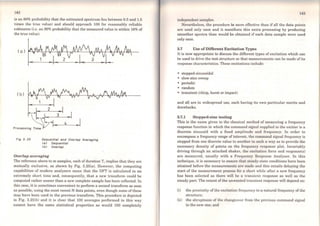
plotting this information are shown in Fig. 1.1 and, as will be discussed
later, it is always helpful to select the format which is best suited to the
particular applicaLion to hand.
Ncxt we consider Lhe more general class of systems with more than one
degree-of-freedom. For these, it is customary that the spatial properties -
the values of the mass, stiffuess and damper elements which make up the
model - be expressed as matrices. Those used throughout this work are
[M], the mass maLrix, (K], the stiffness matrix, (C), lhe viscous damping
(a}
(b)
Fig , • 1
..!
1
1 o
...
1
~r--__
JO .., 00
'° 100
1 _]
~
g
1
i
1
~
f
>O 40 64 10 100
Pre:qu.tAC)' (HJ:•
10""'
10-J
10-~
~
V
10-• ~
""'10· • ~10 10 so 100
] 1 Q 1 1
10 lO
'º 100
ftlfqHncy Obl
Afternatlve Formets for Dlspfsy of Frequency
Functlon oi s Slngle-Degree-ol-Free·dom System
<s> Linear
<b> Logarfthmíc
9
Response
1
}
lO
/m ( a/( ,./H l
Cl.0001
14.J ttr
- 0.0001
...."'
- 0.001
t•.J H.z •• ) ttr
FIQ 1. t <e> Nyqulst Plot
matrix, and [D), the structural or hysteretic damping matrix. The first
phase (of three) in the vibration ana1ysis of such systems is that of setting
up the governing equations of motion which, in effect, means determining
the elements of the above matrices. (This is a process which does exist for
the SDOF system but is often trivial.) The second phase is that of
performing a free vibration analysis using the equations of motion. This
analysis produces first a set of N natural frequencies and damping factors
(N being the number of degrees of freedom, or equations of motion) and
secondly a matching set of 'shape' vectors, each one of these bcing
associated with a specific natural frequency and damping factor. The
complete free vibration solution is conveniently contained in two matrices,
rÀ.2Jand [<l>], which are again referred to as the "modal prope:iies" or,
sometimcs, as the eigenva1ue (natural frequency and dampmg) and
eigenvector (mode shape) matrices. One element from the diagonal matrix
(Ã.2) contains both the natural frequency an d the damping factor for the
rth normal mode of vibration of the system whi1e the corresponding
column, {<>}r, from the full eigenvector matrix, [<I>], describes the shape
(the relative displacements of al1 parts of the system) of that sarne mode of
vibration. There are many detailed variations to this general picture,
depending upon the type and distribution of damping, but all cases can be
described in the sarne general way.
11
Tho third and fmal phase of theoretical analysis is the forced response ·
analysis, and in particular that for harmonic Cor sinusoidal) excitation. By
solving the equations of motion when harmonic forcing is app1ied, we are
able to describe the complete solution by a single matrix, known as the
"frequency response matrix" (H(co)], although unlike the previous two
matrix descriptions, the elements of this matrix are not constants but are
frequency-dependent, each element being itself a frequency response (or
mobility) function. Thus, element H jk (co) represents the harmonic
response in one of the coordinates, x j• caused by a single harmonic force
applied ata different coordinate, fk. Both these harmonic quantities are
described using complex algebra to accommodate the magnitude and
phase information, as also is H jk(e.o). Each such quantity is referred to as
a frequency response function, or FRF for short.
The particular relevance of these specific response characteristics is the
fact that they are the quantities which we are most likely to be able to
measure in practice. It is, of course, possible to describe each individual
frequency response function in terms of the various mass, stiffness and
damping elements of the system but the relevant expressioos are
extremely complex. However, it transpires that the sarne exprcssions can
be drastically simplified if we use the modal properties instead of the
spatial properties and it is possible to write a general expression for any
FRF, H jk (ro) as:
(1.1)
where À~ is the cigenvalue of the rth mode (its natural frequency and
damping factor combined;
~jr is the jth element of the rth eigenvector {~}r (i.e. the relative
displacement at that point during vibration in the rth mode);
N is the number ofdegrees offreedom (or modes)
This single expression is the foundation of modal testing: it shows a direct
connection between the modal properties of a system and its response
characteristics. From a purely theoretical viewpoint it provides an efficient
means ofpredicting response (by performing a free vibration analysis first)
while from a more practical standpoint, it suggests that there may be
12
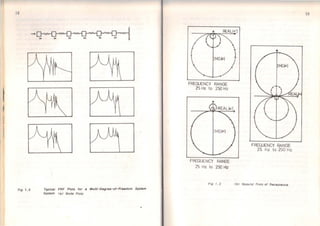
F/(1 l. 2 Typlcsl FRF Plots for s Multl-Dearee-of-Freedom System
System <sJ Bode Plots
FRECXJENCY RANGE
25 Hz to 250 Hz
IMGFc}
FREOUENCY RANGE
25 Hz to 250 Hz
Fig f. 2
FREQUENCY RANGE
25 Hz to 250 Hz
Cb) Nyqulst Plots or Receptsnce
13
1.
14
means of determining modal properties from mobilities which are
aroenable to direct measurement. Here again, it is appropriate to consider
the form which a plot of such an expression as (1.1) will take, and some
examples are shown in Fig. 1.2 which can be deduced entirely from the
equation itself, using different values for the modal properties or
coeffi.cients in the expression.
Thus we find that by making a thorough study of the theory of
structural vibration, we are able to 'predict' what we might expect to find if
we make mobility-type FRF measurements on actual hardware. Indeed, we
shall see later how these predictions can be quite detailed, to the point
where it is possible to comment on the likely quality of measured data.
We have outlined above the major aspects of the 'theoretical route' of
vibration analysis. There are also a number of topics which need to be
covered dealing with aspects of signal processing, non harmonic response
characteristics and non linear behaviour, but these may be regarded as
additional details which may be required in particular cases while the
above-mentioned items are fundamental and central to any application of
modal testing.
1.5 Summary of Measurement Methods
ln the previous section, we reviewed the major features of the appropriate
theory and these all led up to the frequency response characteristics. Thus
'the main measurement techniques which must be devised and developed
are those which will permit us to make direct measurements of the various
mobility properties ofthe test structure.
ln this review, we shall concentrate on the basic measurement system
used for single-point excitation, the type of test best suited to mobility
measurement, the main items of which of which are shown in Fig. 1.3.
Essentially, there are three aspects of the measurement process which
demand particular attention in order to ensure the acquisition of the high-
quality data which are required for the next stage - data analysis. These
are:
(i) the mechanical aspects of supporting and (correctly) exciting the
structure;
(ii) the correct transduction of the quantities to be measured - force
input and motion response; and
(iii) the signal processing which is appropriate to the type of test used.
Gtntralor
8 .-------..
Analyser
Command
SiglUI
Power
Amplifier
Monitor
Fig 1. 3 Baslc Components of Measurement System
Shaker
Response
Traruducen
15
ln the first category, we encounter questions as to how the testpiece should
be suspended, or supported, and how it should be driven. Usually, one of
three options is chosen for the support: free, or unrestrained, (which
usually means suspended on very soft springs); grounded, which requires
its rigid clamping at certain points; or in situ, where the testpiece is
connected to some other structure or component which presents a non-rigid
attachment. The choice itself will often be decided by various factors.
Amongst these may be a desire to correlate the test results with theory and
in this case it should be remembered that free boundaries are much easier
to simulate in the test condition than are clamped, or grounded ones. Also,
iftests are being made on one component which forms part of an assembly,
these may well be required for the free-free condition.
The mechanics of the excitation are achieved either by connecting a
vibration generator, or shaker, or by using some form of transient input,
such as a hammer blow or sudden release from a deformed position. Both
approaches have advantages and disadvantages and it can be very
important to choose the best one in each case.
Transducers are very important elements in the system as it is essential
that accurate measurements be made of both the input to the structure
and ofits response. Nowadays, piezoelectric transducers are widely used to
detect both force and acceleration and the ~ajor problems associated with
them are to ensure that they interfere with the test structure as little as
possible and that their performance is adequate for the ranges of frequency
und ompliludc of lhe lcsl. lncorrecl transduccr sclcct1on cun ~ivc riso to
vory largc crrors in thc mcasured data upon which all thc subscqucnt
ana1ysis is based.
Tbe mobility parameters to be measured can be obtained directly by
applying a harmonic excitation and then measuring the resulting harmonic
response. This type of test is often referred to as 'sinewave testing' and it
requires the attachment to the structure of a shaker. The frequency range
is covered either by stepping from one frequency to the next, or by slowly
sweeping the frequency continuously, in both cases allowing quasi-steady
conditions to be attained. Alternative excitation procedures are now widely
used. Periodic, pseudo-random or random excitation signals often replace
the sine-wave approach and are made practical by the existence of cornplex
signal processing analysers which are capable of resolving the frequency
content of both input and response signals, using Fourier analysis, and
thereby deducing the mobi1ity pararneters required. A further extension of
this development is possible using impulsive or transient excitations which
may be applied without connecting a shaker to the structure. AH of these
latter possibilities offer shorter testing times but great care must be
exercised in their use as there are many steps at which errors may be
incurred by incorrect application. Once again, a sound understanding of
the theoretical basis - this time of signal processing - is necessary to
ensure successful use of these advanced techniques.
As was the case with the theoretical review, the measurement process
also contains many dctailed features which will be described below. Here,
we have just outlined the central and most important topics to
0
be
considered. One final observation which must be made is that in modal
testing applications of vibration measurements, perhaps more than many
others, accuracy of the measured data is of paramount importance. This is
so because these data are generally to be submitted to a range of analysis
procedures, outlined in the next section, in order to extract the resulta
eventually sought. Some of these analysis processes are themselves quite
complex and can seldom be regarded as insensitive to the accuracy of the
input data. By way of a note of caution, Fig. 1.4 shows the extent of
variations which may be obtained by using different measurement
techniques on a particular test strucl.ure [6].
1.6 Summary ofAnalysis
'l'he thírd skill rcquired for modal testing is concemed with the analysis of
the measured mobility data. This is quite separate from the signal
17
..... - - - - - - -1- - , - - . -T- 'f-,..-,
·-·-....
·-!
i
...
>000. 1o' ...000 • .o• "°°º.10• 6'000 110• .000 • 10
1 1-000 •IO'
,.,.,......c,11111
Fig t. 4 varlous Measurements on Standard Testplece
processing which may be necessary to convert raw measurem~~~s into
frequency responses. It is a procedure whereby the measured mob1hties are
analysed in such a way as to find a theoretical mod~l which m~st closely
resembles the behaviour of the actual testpicce. Th1s process itself falls
into two stages: first, to identify the appropriate type of model and second,
to determine the appropriate parameters of the chosen model. Most of the
effort goes into this second stage, which is widely referred to as
'experimental modal analysis'. .
We have seen from our review of the theoretical aspects that we ca~
'predict' or better 'anticipate' the form of the mobility plots for a multi-
degree-of-ft:eedom ~ystem and we have also seen that these ma~ b~ directly
related to the modal properties of that system. The great maJor1ty of ~he
modal analysis effort involves the matching or curve-fi.tting an express1on
such as equation (1.1) above to the measured FRFs and thereby finding the
appropriate modal parameters. . .
A completely general curve-fi.tting approach 1s poss1ble but generally
inefficient. Mathematically, we can take an equation of the form
18
N
~ Ar
H(ro) =,L..J 2 2
r=l Àr - (J)
(l.2)
and curve-fita set ofmeasured values Hm(ro 1), Hm(ro2 ), ...,etc. to this
expression so that we obtain estimates for the coefficients Ah A2, ..., À.;,
À~, ..., etc. These coefficients are, of course, closely related to the modal
properties of the system. However, although such approaches are made,
they are inefficient and neither exploit the particular properties of
resonant systems nor take due account of the unequal quality of the
various measured points in the data set Hm (ro1), Hm (ro2), ...,etc., both of
which can have a significant influence on the overall process.
Thus there is no single modal analysis method but rather a selection,
each being the most appropriate in differing conditions.
The most widespread and one of the most useful approaches is that
known as the 'Single-Degree-of-Freedom Curve-Fit' or, often, the 'Circle
Fit' procedure. This metbod uses the fact that at frequencies dose to a
natural frequency, the mobility can often be approximated to that of a
single degree-of-freedom system plus a constant offset term (which
approximately accounts for the other modes). This assumption allows us to
use the circular nature of a modulus/phase polar plot (the Nyquist plot) of
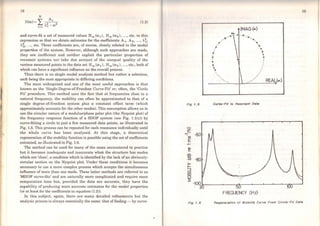
the frequency response function of a SDOF system (see Fig. 1.l(c)) by
curve-fitting a circle to justa few measured data points, as illustrated in
Fig. 1.5. This process can be repeated for each resonance individually until
the whole curve has been analysed. At this stage, a theoretical
regeneration of tbe mobility function is possible using the set of coefficients
extracted, as illustrated in Fig. 1.6.
The method can be used for many of the cases encountered in practice
but it becomes inadequate and inaccurate when the structure has modes
which are 'close', a condition which is identified by the lack ofan obviously-
circular section on the Nyquist plot. Under these conditions it becomes
necessary to use a more complex process which accepts the simultaneous
influence of more than one mode. These latter methods are referred to as
'MDOF curve-fits' and are naturally more complicated and require more
computation time but, provided the data are accurate, they have the
capability of producing more accurate estimates for the modal properties
(or at least for the coefficients in equation (1.2)).
ln this subject, again, there are many detailed refinements but the
analysis process is always essentially the sarne: that of finding - by curve-
Fig 1. 6
,.....
z
-... -60V)
E
~
cn
::g -80
>
t-
::J
IMAG (et)
~.............. .........+.. ·..•
. ·..•
_.+
·+
f ~
~ ++
+ +
+
t

···. ..···
.·
.•
Curve-Flt to Resonant Data
19
REAL(oe:)
ffi
o
~
-100"----__.._---=~-_.____....____,____,~,..,.,_--
3 5
FREQUENCY (Hz)
Fig 1. 6 Regeneratlon of Mobifity Curve From Circle-Fit Data
1
,, .
f
l
20
fiiLing - a set of modal propertios which bost match Lhe rot:!ponse
characteristics of the Lested structure. Some of thc more detuilcd
considerations include: compensating for slightly non-linear behaviour;
simultaneously analysing more then one mobility function and curve-
fitting to actual time histories (rather than the processed frequency
response functions).
1.7 Review ofTest Procedure
Having now outJined the major features ofthe three necessary ingredients
for modal testing, it is appropriate to end this introduction with a brief
review of just how these facilities are drawn together to conduct a modal
test.
The overall objective of the test is to determine a set of modal properties
for a structure. These consist of natural frequencies, damping factors and
mode shapes. The procedure consists ofthree steps:
(i) measure an appropriate set ofmobilities;
(ii) analyse these using appropriate curve-fitting procedures; and
(iii) combine the results ofthe curve-fits to construct the required model.
Using our knowledge of the theoretical relationship between mobility
functions and modal properties, it is possible to show that an 'appropriate'
set of mobilities to measure consists of just one row or one column in the
FRF matrix, (H(co)]. ln practice, this either means exciting the structure at
one point and measuring responses at ali points or measuring the response
at one point while the excitation is appJied separately at each point in tum.
(Tbis last option is most conveniently achieved using a hammer or other
non-contacting excitation device.)
In practice, this relatively simple procedure' will be embellished by
various detailed additions, but the general method is always as described
here.
..
21
CIIAPTER 2
Theoretical Basis
2.0 Introduction
It has already been emphasised that the theoretical foundations of modal
testing are of paramount importance to its successful implementation.
Thus it is appropriate that this first cbapter deals with the various aspects
of theory which are used at the different stages of modal analysis and
testing.
The majority of this chapter (Sections 2.1 to 2.8) deals with an analysis
of the basic vibration properties of the general linear structure, as these
form the basis of experimental modal analysis. Later sections extend the
theory somewhat to take account of the different ways in which such
properties can be measured (2.9) and some of the more complex features
which may be encountered (2.10). There are some topics of which
knowledge is assumed in the main text but for which a review is providcd
in the Appendices in case the current usage is unfamiliar.
Before embarking on the detailed analysis, it is appropriate to put the
diíferent stages into context and this can be done by showing what will be
called the 'theorP.tical route' for vibration analysis (Fig. 2.1). This
illustrates the three phases through which a typical vibration analysis
progresses. Generally, we start with a description of the structure's
physical characte1;stics, usually in terms of its mass, stiffness and
damping properties, and this is referred to as the Spatial Model.
Then it is customary to perform an analytical modal analysis of the
spatial model which leads to a description of the structure's behaviour as a
set of vibration modes; the Modal Model. This model is defined as a set of
natural frequencies with corresponding vibration mode shapes and
modal damping factors. It is important to remember that this solution
always describes the various ways in which the structure is capable of
22
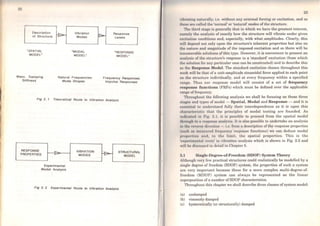
Descrlptlon
or Structure
·sPATIAL
MODEL•
Mass. Damplng
Stlrrness
Vlbratlon
Modes
ºMODAL
MODEL•
Natural Frequencles
Mode Shapes
Response
Leveis
.RESPONSE
MODEL"
Frequency Responses
Impulse Responses
Fig 2. f Theoretlcal Route to Vlbratlon Analysls
RESPONSE ~
PAOPERTIES -
Experimental
Modal Analysls
VIBRATION
MODES
· ~ STAUCTURAL
- MODEL
Fig 2. 2 Experimental Route to Vlbratlon Analysls
23
vil1rnl in" nntul'olly, i.c. without nny oxtcmal forcing or excitation, and so
1l1111111 nrll cnllcd thc 'normal' or 'natural' modes of the structure.
'l'lw third stngc is gcncrally that in which we have the greatest interest,
1111nwly thc analysis of cxacUy how the structure will vibrate under given
c•xcilotion conditions and, especially, with what amplitudes. Clearly, this
wall dcpcnd not only upon the structure's inherent properties but also on
lho nature and magnitude of the imposed excitation and so there will be
i11numcrable solutions of this type. However, it is convenient to present an
011alys1s of the structure's response to a 'standard' excitation (from which
1111 solution for any particular case can be constructed) and to describe this
"" tho ltesponse Model. The standard excitation chosen throughout this
work will bc that ofa unit-amplitude sinusoidal force applied to each point
011 thc structure individually, and at every frequency within a specified
111111~0. Thus our rcsponse model will consist of a set of frequency
roHponsc functions (FRFs) which must be defined over the applicable
r1111uc of frcqucncy.
'l'hroughout tho following analysis we shall be focusing on these three
Hiii"º" und typos of modcl - Spatial, Modal and Response - and it is
l'Ktwnt inl to undorstond fully thcir interdependence as it is upon this
t'l111n1t·lo1 iMtic thnt thc principies of modal testing are founded. As
i111li1•11l11cl i11 l1'11r 2 1, it i11 possiblc to procccd from the spatial model
th11111t1h 1111111t1111111111•111111lys1s. lt iA 01!10 possible to undertake an analysis
111 1111 11 v111 , ili1l'd io11 - i,t• from u dcscription of the response properties
111111•h flíl 1111'fl 1111 l'cl fn•qul!ncy n•sponsc functions) we can deduce modal
1111111111•1 ioa 1111'1, i11 tlw hmit, thc spatial properties. This is the
'1•x1wrinwnt11l roull'' lo v1brolion analysis which is shown in Fig. 2.2 and
will bo discu1m•d m dctail in Chapter 5.
2.1 Single-Degree-of-Freedom (SDOF) System Theory
Although very few practical structures could realistically be modelled by a
Kingle degree of freedom (SDOF) system, the properties of such a system
ure very important because those for a more complex multi-degree-of-
frcedom (MDOF) system can always be represented as the linear
1mpcrposition of a number ofSDOF characteristics.
Throughout this chapter we sball describe three classes of system model:
(a) undamped
(b) viscously damped
(c) hysteretically (or structurally) damped
24
Fig 2. 3
X
:c(t)
Fig 2. 4
f (t)
m
x(t)
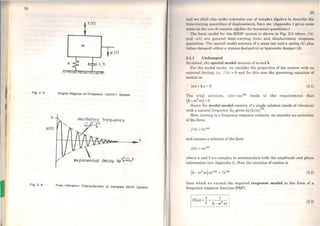
Slngle- Degree- ot-Freedom <SDOFJ System
oscillatory frequency
wo41-Ç2
Free -Vlbrotlon Chorocterlstlc ot Domped SDOF System
1111cl wt 11111111 ulso m:ike ext.cnsivc use of complox nlgcbrn to dc11crib1• tlrn
111111 ·v11ryi11i: quantilies of displaccmcnt, forco etc. (Appcndix 1 ~1vcs sonw
1111l1•t11111 llw u11c of complcx algebra for ham1onic quantitics.)
'1'111, husic modcl for the SDOF system is shown in Fig. 2.3 whcrc /(t )
1111cl t(t) uro general time-varying force and displacement rosponso
11111111 t.itice. 'l'ho spatial model consists of a mass (m) and a spring (k) plus
(wh11n dumpcd) cithcr a viscous dashpot (e) or hysteretic damper (d).
:U.1 Undamped
As 11tutcd, Lhe spatial model consista of m and k.
J.'or thc modal model, we consider the properties of the system with no
t'lttornal forcing, i.e. / (t) = O and for this case the governing equation of
motion is:
mx+kx =o (2.1)
'l'ho triai solution, x(t) =xeioot leads to the requirement thaL
(k- w2
m) =O.
Hence thc modal model consists ofa single solution (mode ofvibration)
with a natural frequency w0 given by(k/m}112.
Now, turning to a frequency response analysis, we consider an excitation
ofthe forro:
/(t) = feioot
and assume a solution of the form
x(t) =xeicot
where x and f are complex to accommodate both the amplitude and phasc
information (see Appendix 1). Now the equation ofmotion is
(2.2)
from which we extract the required response model in the form of a
frequency response function (FRF):
1H("') =-"= 1 1
f k-w2 m (2.3)
26
This particular form of FRF, where the response parameter is
displacement (as opposed to velocity or acceleration) is called a
"Receptance" and is sometimes written as a(ro). Note that this function,
along with other versions ofthe FRF, is independent of the excitation.
2.1.2 Viscous damping
If we add a viscous dashpot e, the equation of motion for free vibration
becomes
mi+ex+ kx =o (2.4)
and we must now use a more general triai solution:
x(t) = xe8 t (where s is complex, rather than imaginary, as before)
with which we obtain the condition:
(ms2
+cs + k) =O
This, in tum leads to
e ~c2
-4km
S12 =--±----
. 2m 2m
where
roõ = (k/m) Ç=c/c0 =(c/2.jkm)
which implies a modal solution of the form:
(2.5)
(2.6)
which is a single mode of vibration with a complex natural frequency
having two parts:
• the imaginary or oscillatory part; a frequency of coó =(roo ~1-Ç2 );
27
• lho rcul or dccay purL; a damping rate ofa (=Çêi>o).
'l'ho physical significance of these two parts of the modal model is
illustrat.cd in Lhe Lypical free response plot, shown in Fig. 2.4.
Lastly, we consider the forced response when /(t) =feirot and, as before,
wc assume x(t) =xeiwi_ Here, the equation ofmotion:
(2.7)
gives a receptance FRF ofthe form
1
H(co) = a(ro) =----,.--
(k - ro2 m)+i(coc) (2.8)
which is now complex, containing both magnitude and phase information.
Note that
ja(ro)I =l:l= 1
lfl ~{k-.ro2 m)2
+(coc)2
and La(ro)= Lx-Lf= tg- 1
(- roc/(k -ro2
m)) =-0a.
2.1.3 Structural damping
Close inspection of the behaviour of real structures suggests that the
viscous damping model used above is not very representative when applied
to MDOF systems. There appears to be a frequency-dependence exhibited
by real structures which is not described by the standard viscous dashpot
and what is required, apparently, is a damper whose rate varies inversely
with frequency: i.e. e= (d/w).
An alternative damping model is provided by the hysteretic or structural
damper which has not only the advantage mentioned above, but also
provides a much simpler analysis for MDOF systems, as shown below (in
Fig. 2.5). However, it presents difficulties to a rigorous free vibration
analysis and attention is gcnerally focused on the forced response analysis.
ln this case we can write an equation ofmotion
(2.9)
28
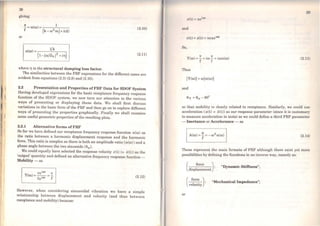
giving
X 1
- =a(w) = ...,.------,.---
f (k-ro2
m)+i(d)
(2.10)
or
a(ro) = 1/k
(1-(ro/Cilo )
2
+iTJ) (2.11)
where Tl is the structural damping loss factor.
The similarities between the FRF expressions for the different cases are
evident from equations (2.3) (2.8) and (2.10).
2.2 Presentation and Properties ofFRF Data for SDOF System
Having developed expressions for the basic receptance frequency response
function of the SDOF system, we now turn our attention to the various
ways of presenting or displaying these data. We shall first discuss
variations in the basic forro of the FRF and then go on to explore different
ways of presenting the properties graphically. Finally we shall examine
some useful geometric properties of the resulting plots.
2.2.1 Alternative forms ofFRF
So far we have defined our receptance frequency response function a(ro) as
the ratio between a harmonic displacement response and thc harmonic
force. This ratio is complexas there is both an amplitude ratio (a(ro)) anda
phase angle between the two sinusoids (0a).
We could equally have selected the response velocity v(t) (= i(t)) as the
'output' quantity and defined an altemative frequency response function -
Mobility - as
veirot v
Y(ro) =-.- =-
fe1rot f (2.12)
However, when considering sinusoidal vibration we have a simple
relationship between displacement and velocity (and thus between
re<:eptance and mobility) because:
und
v(t) = .X(t) iroxeirot
So,
( V.X . ()y Ct>) = - = J(J) - = )(J)(X (J)
f f
Thus
IYCw>I =rolcx<ro>I
and
0y =ªª-90°
(2.13)
80 that mobility is closely related to receptance. Similarly, we could use
acceleration (a(t) = x(t)) as our response parameter (since it is customary
to measure acceleration in tests) so we could define a third FRF parameter
- Inertance or Accelerance - as
a 2 )A(ro) = - = -ro cx(ro
f
(2.14)
These represent the main formats of FRF although there exist yet more
possibilities by defining the functions in an inverse way, namely as:
(
force ) "Dynamic Stiffness";
displacement ·
(
force ) "Mechanical Impedance";
velocity ·
or
1
30
(
force ) "Apparent Mass".
acceleration ·
However, these latter formats are discouraged, except in special cases, as
they can lead to considerable confusion and error if improperly used in
MDOF systems.
Table 2.1 gives details of ali six ofthe FRF parameters and ofthe names
and symbols variously used for them.
Response Parameter R Standard R/F Inverse F/R
RECEPTANCE
DISPLACEMENT
ADMI'ITANCE
DYNAMIC COMPLIANCE
DYNAMIC STIFFNESS
DYNAMIC FLEXIBILITY
VELOCITY MOBILITY MECHANICAL IMPEDANCE
ACCELERATION
ACCELERANCE
APPARENT MASS
INERTANCE
Table 2.1 Definitions ofFrequency Response Functions
Lastly, it should be noted that it is common practice to use H(oo) to refer
to frequency response functions generically.
2.2.2 Graphical display of FRF data
There is an overriding complication to plotting FRF data which derives
from the fact that they are complex and thus there are three quantities -
frequency plus two parts of the complex function - and these cannot be
fully displayed on a standard x-y graph. Because of this, any such simple
plot can only show two of the three quantities and so there are different
possibilities available, ali ofwhich are used from time to time.
The three most common forms ofpresentation are:
'"(i) Modulus (of FRF) vs Frequency and Phase vs Frequency (the Bode
type ofplot, consisting oftwo graphs); .
(ii) Real Part (of FRF) vs Frequency and lmaginary Part vs Frequency
(two plots); and
(iii) Real Part vs Imaginary Part (Nyquist plot: a single graph which does
not explicitly contain frequency information).
.......
z 10
E
~$2
-
i1i.--------------.......----'!'f.1FREOUENCY (Hz)
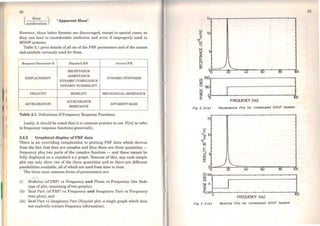
Fig 2. 5<aJ Receptance Plot for Undamped SDOF System
15
Fia 2. 5 <bJ Moblllty Plot for Undamped SDOF System
:u
32
z.._
N
'VI
E
"'g
w
u
z
~
a::
w
~
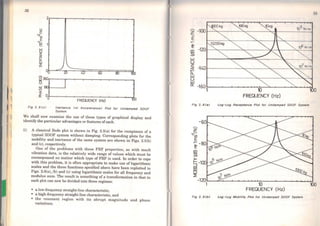
Fig 2. 5 <e) lnertance <or Accelerance) Plot for Undamped SDOF
System
We shall now examine the use of these types of graphical display and
identify the particular advantages or features ofeach.
(i) A classical Bode plot is shown in Fig. 2.5(a) for the receptance of a
typical SDOF system without damping. Corresponding plots for the
mobility and inertance of the sarne system are shown in Figs. 2.5(b)
and (e), respectively.
One of the problems with these FR~ properties, as with much
vibration data, is the relatively wide range of values which must be
encompassed no matter which type of FRF is used. ln order to cope
with this problem, it is often appropriate to make use of logarithmic
scales and the three functions specified above have been replotted in
Figs. 2.6(a), (b) and (e) using logarithmic scales for all frequency and
modulus axes. The result is something of a transformation in that in
each plot can now be divided into three regimes:
• a low-frequency straight-line characteristic;
• a high-frequency straight-line characteristic, and
• the resonant region with its abrupt magnitude and phase
variations.
1QS N /m
z -100~-=::....,,,---~~---~n-----
-E
~
cn:g
w
u
z
-1'10~
a..
w
u
w
a::: -160
1
Fig 2. 8 <aJ
.......
z
--.e/)
E
- -80
~
cn
~
>
~-100
ffi
~
10
FREQUENCY (Hz)
Log- Log Receptance Plot for Undamped SDOF System
-120,L---..::::::...___...___.__..&.-J..~L-:';10::---'--...,,,,._....__._~100
FREQUENCY (Hz)
Fig 2. 8(b) Log- Log Mobfllty Ptot for Undamped SDOF System
':j
~
34
........
z 10 k
N- -20
'li
E.-
w
u
z
;:!
a:
w
z.......
100 kg
-1001'-----""-"-__....__....~_,_,_............10_______......................--100
FREQUENCY (Hz)
Fig 2. 6(C) Log-Log lnertance Plot for Undamped SDOF System
FRF Parameter Mass StifTness
RECEPTANCE a(co) - 1/co2
m 1/k
logla<co>I -log(m) - 21og(co) - log(k)
MOBILITY Y(co) - i/com i(l)/k
log! Y(co)I - log(m) - log(co) log((I))- log(k)
ACCELERANCE A(co) 1/m -(1)2/k
JoglA<(l)>I -log(m) 2log((l))- log(k)
Table 2.2 Frequency Responses of Mass and Stiffness Elements
It is helpful and instructive to superimpose on these log-log plots a
grid of lines which show the relevant FRF characteristics separately
of simple mass elements and simple spring elements. Table 2.2 shows
the corresponding expressions for «m, cxk, Ym, etc. and from this it is
possible to see that mass and stiffness properties will always appear
as straight lines on log (modulus) vs log (frequency) plots, as shown in
Fig. 2.7. These have in fact been included in Fig. 2.6 but their
significance can be further appreciated by reference to Fig. 2.7 which
35
4
(a)
2
~
o
~ -20
~
::E: -4
FREOUENCY (Hz)
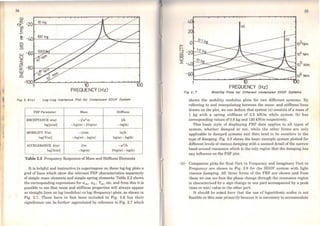
Fig 2. 7 Moblllty Plots for Dlfferent Undsmped SDOF Systems
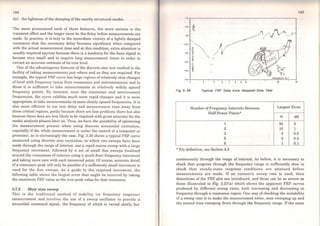
shows the mobility modulus plots for two different systems. By
referring to and interpolating between the mass- and stiffness-lines
drawn on the plot, we can deduce that system (a) consists of a mass of
1 kg with a spring stifTness of 2.5 kN/m while system (b) has
corresponding values of0.8 kg and 120 kN/m respectively.
This basic style of displaying FRF data applies to ali types of
system, whether damped or not, while thc other forros are only
applicable t-0 damped systems and then tend to be sensitive to the
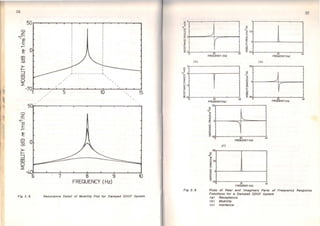
type of damping. Fig. 2.8 shows the basic example system plotted for
different leveis ofviscous damping with a zoomed detail ofthe narrow
band around resonance which is the only region that the damping has
any influence on the FRF plot.
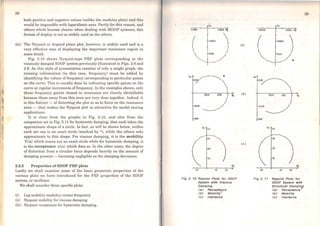
(ii) Companion plots for Real Part vs Frequency and Imaginary Part vs
Frequency are shown in Fig. 2.9 for the SDOF system with light
viscous damping. All three forros of the FRF are shown and from
these we can see how the phase change through the resonance region
is characterised by a sign change in one part accompanied by a peak
(max or min) value in the other part.
It should be noted here that the use of logarithmic scales is not
feasible in this case primarily because it is necessary to accommodate
36
-
Fig 2. 8
,,.
,
/
,
,
/
5
7
1
)- - - - - - - - - - - - J ,
'
'
10
8 9
FREOUENCV ( Hz)
'
' 15
'
10
Resonance Dera// of Mobll/ty Pior for Damped SDOF System
37
~3
~
i01--- -=:...-t-:::::==--""""i
~«~10~~~---~--.<1<-~~~~-;
z
~
-i 0-5
:;
í ~ o~
::J
20 l.O
t(} 20oFREOUENCY (Hz) FRECl.IEN::Y (Hz)
(a) (b)
05
~
-...E
8 o
i~
::J
~ -05
~(HzJ20 40 o
FRro.JENCY(Hz)
50
z"f-
~
i 
o
"llJ
1-·= 20
FREa.JOCY (Hz)
(C)
50
.
20
fRBl.eCY(Hz)
Fia 2. 9 Piors of Real and lmaalnary Parts of Frequency Response
Functlons for a Damped SDOF Sysrem
<aJ Receprance
<bJ Moblllty
<cJ lnertance
38
both positive and negative values (unlike the modulus plots) and this
would be impossible with logarithmic axes. Partly for this reason, and
others which become clearer when dealing with MDOF systems, this
format ofdisplay is not so widely used as the others.
(iii) The Nyquist or Argand plane plot, however, is widely used and is a
very effective way of displaying the important resonance region in
some detail.
Fig. 2.10 shows Nyquist-type FRF plots corresponding to the
viscously-damped SDOF system previously illustrated in Figs. 2.8 and
2.9. As this style of presentation consists of only a single graph, the
missing information (in this case, frequency) must be added by
identifying the values of frequency corresponding to particular points
on the curve. This is usually done by indicating specific points on the
1
1 curve at regular incrernents of frequency. In the examples shown, only
11 those frequency points closest to rcsonance are clearly identifiable
because those away from this area are very close together. Indeed, it
is this feature - of distorting the plot so as to focus on the resonance
area - that makes the Nyquist plot so attractive for modal testing
applications.
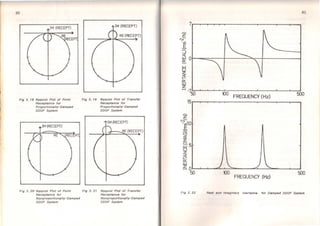
It is clear from the graphs in Fig. 2.10, and also from the
companion set in Fig. 2.11 for hysteretic damping, that each takes the
approximate shape of a circle. ln fact, as will be shown below, within
each set one is an exact circle (marked by *), while the others only
approximate to this shape. For viscous damping, it is the mobility
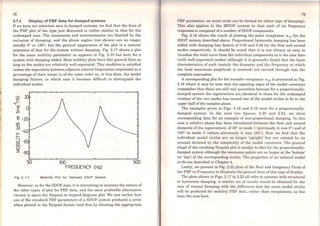
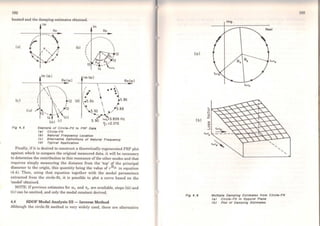
Y(c.o) which traces out an exact circle while for hysteretic damping, it
is the receptance a(c.o) which does so. In the other cases, the degree
of distortion from a circular 1ocus depends heavily on the amount of
damping present - becoming negligible as the damping decreascs.
2.2.3 Properties of SDOF FRF plots
Lastly we shall examine some of the basic geometric properties of the
various plots we have introduced for the FRF properties of the SDOF
system, or oscillator.
We shall consider three specific plots:
(i) Log mobility modulus versus frequency
(ii) Nyquist mobility for viscous damping
(iii) Nyquist receptance for hysteretic damping.
Fig
IM
·00005 0-0005 AE
-00005
-0001
IM •
0025 005 1:
-0025
-oos
IM
'º
~o
1·0
"E
-tO tO 20
2. 10 Nyqufst Pfots for SDOF
System wlth Vlscous
Damplng
CaJ Receptance
(b) MoblJlty"'
(C) lnertance
39
IM
oooos RE
·00005
(a)
-0001
•
IM
0025
(b) 0025 005
-0025
-OOS
IH 40
)()
(e)
2-0
!O
ffE
-1() IO 20
Flg2.11 Nyqulst Plots for
SDOF System wlth
Structural Damplng
ea> Receptance"'
(b) Moblllty
Cc> fnertance
40
It may be observed from Figs. 2.6(b), 2.7 and 2.8, and elsewhere, that for
light damping (typically less than 1%) the mobility FRF plot exhibits a
degree of symmetry about a vertical line passing through the resonance
frequency. As was pointed out by Salter, the basic forro of this plot can be
constructed quite accurately using the reference values indicated on Fig.
2.12.
>-1--
::l
ffi
o
~
§
LOG FREQUENCV
o
Fig 2. 12 Geometrlc Propertles of SDOF Moblllty Curve
Turning to the Nyquist plots, we shall show that the two particular
cases referred to above, namely:
• mobility for a viscously-damped system, and
• receptance for a hysteretically-damped system
both trace out exact circles as frequency wsweeps from Oto oo.
Take first the viscous damping case. Froro equations (2.8) and (2.13) we
have that the mobility is ;)"'1.... i~1
(SV~ l>
{.. w2c+iw(k-w2m)
Y(ro) =iroo.(ro) = ;w (2.15)
k - w m+iwc (k-w2m)2 +(wc)2
So '{(~-' ~?
"'>)' .I
!Vc)
41
2
Re(Y) = w e
(k - (1)
2m)2 +(WC)
2
Let
U = ( Re(Y)-
2~) and V= (Im(Y))
Then
u2 +v2 = ((k-w2m)2 +(roc)2r =(_!_)2
(
2 )2 2c
4c2
(k - w2
m) +(roc)
2
(2.16)
Hence, a plot of Re(Y(w)) vs Im(Y(w)) for w =O~ oo will trace out a circle
of radius 1/2c and with its centre at (Re = 1/2c, Im =O), as illustrated
clearly in Fig. 2.lO(b).
For the hysteretic damping case we have, from equation (2.10), a slightly
differe~t expression for the FRF:
1 (k-w2 m) -i(h)
cx(w) = =-----'----
(k- ro2 m)+ id (k -w2 m}2 +(d)2
(2.17)
so that
V= Im(o.) =___d___
(k-w2m)2
+(d)2
Although not the sarne expressions as those above for viscous damping, it
is possible to see that
(2.18)
demonstrating that a Nyquist plot of receptance for a hysteretically-
damped SDOF syslem will form a circle of radius 1/2d and centre at
42
(0, -1/2d) as illustrated in Fig. 2.ll(a).
2.3 Undamped Multi-Degree-of-Freedom (MDOF) System
Throughout much of the next six sections, we shall be discussing the
general multi-degree-of-freedom (MDOF) system, which might have two
degrees of freedom, or 20 or 200, and in doing so we shall be referring t.o
'matrices' and 'vectors' of data in a rather abstract and general way. ln
order to help visualise what some of these generalities mean, a specific
2DOF system, shown in Fig. 2.13, will be used although the general
expressions and solutions will apply to the whole range ofMDOF systems.
For an undamped MDOF system, with N degrees of freedom, the
governing equations ofmotion can be written in matrix formas
(M]{i(t)}+ (K]{x(t)} ={/(t)} (2.19)
where [M] and fK] are N x N mass and stiffness matrices respectively and
{x(t)} and {/(t)} are N x 1 vectors of time-varying displacements and
forces.
or
For our 2DOF example, the equations become
m 1i 1 +(k1 +k2)x1 -(k2)x2 =/1
m2i2 +(k2 +k3)x2 -(k2)x1 = !2
t-+X1 ....X2
k1 k2 ~
~),~,',,QFig 2. t 3 System wlth 2DOF Used as Example
m1 = t l<g m2 = t l<g l<t =1<3 =O. 4 MN/m
1<2 =O. 8 MN/m
or, using the data given in Fig. 2.13:
K =[ 1.2 - 0.8](MN/m)
-0.8 1.2
43
Wc shall consider first the free vibration solution (in order to determine
the normal or natural modal properties) by taking
{/(t)} ={O}
ln this case we shall assume that a solution exists of the forro
{x(t)} ={x}eiwt
where {x} is an N x 1 vector of time-independent amplitudes for which
case it is clear that {x} =- c.o2 {x}eimt.
(NOTE that this assumes that the whole system is capable of vibrating
ata single frequency, e.o.)
Substitution of this condition and trial solution into the equation of
motion (2.19), leads to
(2.20)
for which the only non-trivial solution is
(2.21)
or
from which condition can be found N values of c.o2
: (ro~, w~, ..., w;, ...,
w~), the undamped system's natural frequencies.
Substituting any one of these back into (2.20) yields a corresponding set
of relative values for {x}, i.e. {'l'}r, the so-called mode shape
corresponding to that natural frequency.
The complete solution can be expressed in two N x N matrices - th e
eigenmatrices - as
where (i)~ is the rth eigenvalue, or natural frequency squared, and {'I'}r is
a description of the corresponding mode shape.
Various numerical procedures are available which take the system
44
matrices (M) and [K) (lhe Spatial Model), and convert them to the two
eigenmatrices rwn and ('1'] (which constitute the Modal Model).
It is very important to realise at this stage that one of these two
matrices - the eigenvalue matrix - is unique, while the other - the
eigenvector matrix - is not. Whereas the natural frequencies are fixed
quantities, the mode shapes are subject to an indeterminate scaling factor
which does not afTect the sbape of the vibration mode, only its amplitude.
Thus, a mode shape vector of
1
2
1
o
describcs exactJy the sarne vibration mode as
and so on.
3
6
3
o
What determines how the eigenvectors are scaled, or "normalised" is
largely governed by the numerical procedures followed by the
eigensolution. This topic will be discussed in more detail below.
For our 2DOF example, we find that equation (2.21) becomes
=ro4
(m 1m2)- ro2((m 1 +m2)k2+m 1k 3 +m2k 1)+(k1k 2+k1k3 +k2k3 )=O
Numerically
This condition leads to (i) ~ = 4 x 10⁵
(rad/s)2
and (i)~ = 2x 10⁶
(rad/s)2.
Substituting eit.hcr value ofinto the equation ofmotion, gives
or
45
Numerically, we have a solution
Before proceeding with the next phase - the response analysis - it is
worthwhile to examine some of the properties of the modal model as these
greatly influence the subsequent analysis.
The modal model possesses some very important properties - known as
the Ortbogonality properties - which, concisely stated, are as follows:
['P]T [M]('I'] = ['mrJ
('I')T (K]('I'] =('"krJ
(2.22)
from which: roo;J =l"mrJ-
1
['krJ where mr and kr are often referred to
as the modal or generalised mass and stiffness ofmode r. Now, because
the eigenvector matrix is subject to an arbitrary scaling factor, the values
of mr and kr are not unique and so it is inadvisable to refer to "the"
generalised mass or stiffness of a particular mode. Many eigenvalue
extraction routines scale each vector so that its largest element has unit
magnitude (1.0), but this is not universal. ln any event, what is found is
that the ratio of (k r/mr) is unique and is equal to the eigenvalue, (ron.
Among the many scaling or normalisation processes, there is one which
has most relevance to modal testing and that is mass-normalisation. The
mass-normalised eigenvectors are writ.ten as (Cl>) and have the particular
property that
and thus (2.23)
(Cl>f [K)[<I>]= ['ro;j
The relationship between the mass-normalised mode shape for mode r,
1
46
{+}r' and its more general forro, fo/}r' is, simply:
(2.24)
or
A proof of the orthogonality properties is as follows. The equation ofmotion
may be written
(2.25)
For a particular modc, we have
(2.26)
Premultiply by a different. eigenvector, transposed:
(2.27)
We can also write
(2.28)
which we can transpose, and postmultiply by {'l'}'r, to give
(2.29)
But, since [M] and [K] are symmetric, they are identical t.o their
transposes and equat.ions (2.27) and (2.29) can be combined to give
(2.30)
which, if Wr -t:: @8 , can only be satisfied if
(2.31)
"7
Togcthcr wit.h cithcr (2.27) or (2.29), t.his mcans also that
(2.32)
For the special cases where r =s, equations (2.31) and (2.32) do not apply,
but it is clear from (2.27) that
({'li}; [K]{'li}r ) =w; ({'V}; (M]{'I'}r ) (2.33)
so that
and
Puttirlg together all the possible combinations of r and s leads to the full
matrix equation (2.22) abovc.
For our 2DOF example, the numerical results give eigenvectors which
are clearly plausible. Ifwe use them to calculate the generalised mass and
stiffness, we obtain
clearly
f-mrJ-11'-krJ =[ºo.4 o]06 r 2jL l 2.0 1 = Wr
To obtain the mass nonnalised version of these eigenvectors, we must
calcu]ate
[<J>]=[l l]r- j - 1/2 = [0.707 0.707]
1 - 1 IDr 0.707 --0.707
1
1
48
Tuming now to a response analysis, we shall consider the case where
t.he structure is excited sinusoidally by a set of forces all at the sarne
frequency, Có, but with various amplitudes and phases. Then
a.nd, as before, we shall assume a solution exists of the form
{x(t)}= {x}ei(l)t
where {f} and {x} are N x 1 vectors of time-independent complex
amplitudes.
The equation of motion then becomes
([K]-ro2 [Ml){x} ei(l)l = {f} ei(l)t (2.34)
...
or, rearranging to solve for the unknown responses,
{x} =([K]-ro2
[MJr
1
{r} (2.35a)
which may be writtcn
{x} =[a(ro)]{f} (2.35b)
where [a(ro)] is the N x N receptance matrix for the system and constitutes
its Response Model. The general element in the receptance FRF matrix,
a jk (ro), is defincd as follows:
fm =O, m =1, N; i: k (2.36)
and as such represents an individual receptance expression very similar to
that defined earlier for the SDOF system.
It is clearly possible for us to determine values for the elements of[cx(ro)]
at any frequency of interest simply by substituting the appropriate va1ues
into (2.35). However, this involves the inversion of a system matrix at each
frequency and this has several disadvantages, namely:
• it becomes costly for large-order systems Oarge N);
49
• it i" i1uifTil'it11t 1f only u fow of tho individual FRF expressions are
r1'<1uirc•d;
• rt. prnvrdcs no insight into the fonn of the various FRF properties.
f"hr Lhcsc, and othcr, reasons an alternative means of deriving the various
Ji' U' pnramctcrs is used which makes use of the modal properties for the
''Yiilcm.
ltctuming to (2.35) we can write
(1 K]- ro2 [Ml) = (cxCro)r1 (2.37)
Prcmultiply both sides by [<t>]T and postmultiply both sides by [<l>] to
ohtain
or
,- '
(2.38)
It is clear from this equation that the receptance matrix [cx(ro)] is
symmetric and this will be recognised as the principie of reciprocity which
applies to many structural characteristics. lts implications in this situation
are that:
Equation (2.39) permita us to compute any individual FRF parameter,
ajk (ro}, using the following formula
(2.40)

..,
J
50
or
which is very much simpler and more informative than by means of the
direct inverse, equation (2.35a). Here we introduce a new parameter, rAjk,
which we shall refor to as a Modal Constant: in this case, that for mode r
for this specific receptance linking coordinates j and k. (Note that other
presentations of the theory sometimes refor to the modal constant as a
'Residue' together with the use of'Pole' instead ofour natural frequency.)
The above is a most important result and is in fact the central relationship
upon which the whole subject is based. From the general equation (2.35a),
the typical individuaii FRF element a jk (ro), defined in (2.36), would be
expected to have the ~orm ofa ratio of two polynomials:
( )
- bo +b1co2 +b2co4 +... +bN- 1co2N-2
a jk (1) - 2 4 2N
a 0 +a1co +a2co +... +aNro
(2.41)
and in such a format it would be difficult to visualise the nature of the
function, a jk (co). However, it is clear that an expression such as (2.41) can
also be rewritten as
(2.42)
and by inspection of the form of (2.35a) it is also clear that the factors in
the denominator, (i)~, w~, etc. are indeed the natural frequencies of the
system, w; (this is because the denominator is necessarily formed by the
detI[K]- co2[MJI).
All this means that a forbidding expression such as (2.41) can be
expected to be reducible to a partial fractions series form, such as
(2.43)
Thus, the solution we obtain through equations (2.37) to (2.40) is not
51
unexpected, but ite eignifi.cance liee in the very simple and convenient
formula it provides for the coefficients, rAJ1t, in the series forro.
We can observe some of the above relationships through our 2DOF
example. The forced vibration equations ofmotion give
(k1 +k 2 -ro2m 1)x1 +·(- k2)x2 =f1
(-k2 )x 1+ (k2 + k s- ro2m2)x2 =f2
which,'in turn, give (for example):
(x1) k2 +ks - (1)2m2
Ti r2
=o =ro4
m1m2 - ro2((m1 +m2)k2 +m1ks +m2k1)
+(k1k2 + k2ks + k1ks)
or, nui:perically,
::
(o.sx 1012 - 2.4 x 10⁶ co2 + (1)4)
Now, if we use the modal summation formula (2.40) together with the
1results obtained earlier, we can write
 2 2
(X, 11 =(~) = (l 4>1 ) + ( 2 $1 )
f1 w~ - 002 ro~ -(1)2
or, numerically,
0.5 0.5
= +~~~~~
0.4x 10⁶ -(1)2 2 x l 06 - co2
which is equal to  (1.2 x 10⁶
-co2
)/(o.8x 10 12 -2.4 x 10⁶
(1)2 +ro4), as
above. •
The above characteristics of both the modal and response models of an
undam.ped MDOF system form the basis of the corresponding data for the
more general, damped, cases.
The following sections will examine the effects on these models of adding
52
various types of damping, while a discussion of the presentation MDOF
frequency response data is given in Section 2.7.
2.4 Proportional Damping
ln approaching the more general case of damped systems, it is convenient
to consider first a special type of damping which has the advantage of
being particularly easy to analyse. This type ofdamping is usually referred
to as 'proportional' damping (for reasons which will be clear later) although
this is a soniewhat restrictive title. The particular advantage of using a
proportional damping model in the analysis of structures is that the modes
of such a structure are almost identical to those of the undamped version of
the model. Specifically, the mode shapes are identical and the nr.tural
frequencies are very similar to those of the simpler system also. ln effect, it
is possible to derive the modal properties of a proportionally damped
system by analysing in full the undamped version and then making a
· correction for the presence of the damping. While this procedure is often
used in the theoretical analysis of structures, it should be noted t~.~t it is
only valid in the case of this special type or distribution of damping, wº1'1ch
may not generally apply to the real structures studied in modal tests.
If we return to the general equation of motion for a MDOF system,
equation (2.19) and add a viscous damping matrix [C)we obtain:
[M){i} +[C){i}+[K]{x} ={!} (2.44)
which is not so amenable to the type of solution followed in Section 2.3. A
general solution will be presented in the next sectiop, but here we shall
examine the properties of this equation for the case where the darnping
matrix is directly proportional to the stiffness matrix; i.e.
[C) = P[K] (2.45)
(NOTE - It is important. to note that this is not the only type of
proport.ional damping - see below.)
ln this case, it is clear that if we pre- and post-multiply the damping
matrix by the eigenvector matrix for the undamped system ['1']' in just the
same way as was done in equation (2.22) for the mass and stiffness
matrices, then we shall find:
(2.46)
wl" 11i tlw daagonol clemcnts Cr reprcscnt the generalised damping of U1c
111 1111118 modcs of thc system. The fact that this matrix is also diagonal
111 " " " thut the undamped system mode shapes ar e also those of the
(11111111•d systcm, and this is a particular feature of tbis type of damping.
l l11MHlulcmcnt can easily be demonstrated by taking the general equation
111 111111to n above (2.44) and, for the case of no excitation, pre- and post-
1111111 aplying tbe whole equation by the eigenvector matrix, ['P]. We shall
1111•11 llnd:
{P}=pvr 1{x} (2.47)
1111111which the rth individual equation is:
(2.48)
ltit-h is clearly that of a single degree of freedom system, or of a single
11111tlo of the system. This mode bas a complex natural frequency with an
t• 111lntory part of
111111 11 dccay part of
(11•11 11g lhe notation introduced above for the SDOF analysis).
'l'hcse characteristics ca1Ty over to the forced response analysis in which
11 1mple extension ·or the steps detailed between equations (2.34) and (2.40)
11 (lcl~ to the definition for the general receplance FRF as:
I li
(2.49)
54
which has a very similar form to that for the undamped system except that
now it becomes complex in the denominator as a result of the inclusion of
damping.
Gem?ral forms ofproportional damping
lt may be seen from the above that other distributions of damping will
bring about the sarne type of result and these are collectively included in
the classification 'proportional damping'. ln particular, if the damping
matrix is proportional to the mass matrix, then exactly the sarne type of
result ensues and, indeed, the usual definition of proportional damping is
that the damping matrix [C] should be ofthe forro:
[CJ =~(K)+ y(MJ (2.50)
ln this case, the damped system will have eigenvalues and eigenvectors as
follows:
' - - r:-r-2ror - Wr 'V 1- C.r
and
['f'damped ] =['f'undamped ]
Distributions of damping ofthe type described above are generally found
to be plausible from a practical standpoint: the actual damping
mechanisms are usually to be found in parallel with stiffness elements (for
internal material or hysteresis damping) or with mass elements (for
friction damping). There is a more general definition of the condition
required for the damped system to possess the sarne mode shapes as its
undamped counterpart, and that is:
(2.51)
although it is more difficult to make a direct physical interpretation of its
forro.
Finally, it can bc noted that an identical treatment can be made of a
MDOF system with hysterctic damping, producing the sarne essential
results. Ifthe general system equations ofmotion are expressed as:
55
IMl!d 1{IK1 iOJ){x} ={f} (2.52)
fiaul tht• hyslcrclic daroping matrix [D] is 'proportional', typically;
l'>J • MK)+y[M) (2.53)
t111, 11 we find that the mode shapes for the damped sy~tem are again
11 1, nlical to those of the undamped system and that the e1genvalues take
t li complex forro:
).,~ =ro; (l+ÍTlr) (2.54)
AIRo, the general FRF expression is written:
(2.55)
z.~ Hysteretic Damping - General Case
'l'hc analysis in the previous section for proportionally-damped sy~te~s
· · · ht m·to the characleristics of this more general descnptionit•vcs some ms1g
of practical structures. However, as was stated there, t~e c_ase ~f
proportional damping is a particular one which, although often JUStified m
11 theoretical analysis because it is realistic and also because º.f a lack ~f
uny more accurate model, does not apply to all cases. In our ~tudies here, 1t
ill very important that we consider the most general case if we are to be
uble to interpret and analyse correctly the data _we ?bserve on r~al
ttl ructures. These, after all, know nothing of our predil~ction for assum1~g
proportionality. Thus, we consider in the next two sections th~ properties
of systems with general damping elements, first ofthe hysteretic type, then
VIRCOUS.
W t rt by writing the general equation of motion for a MDOF system
e s a . h' h t
with hysteretic damping and harmonic excitation (as it is t is t a we are
working towards):
1M]{x}+[K]{x} +i[D] {x} ={f} eiwt (2.56)
Now, consider first the case where thet·e is no excitation and assume a
HOluLion ofthe forro:
56
{x}={x}e1Ãt (2.57)
Substituted into (2.56), this trial solution leads to a complex eigenproblem
whose solution is in the form of two matrices (as for the earlier undamped
case), containing the eigenvalues and eigenvectors. ln this case, howevcr,
these matrices are both complex, meaning that each natural frequency and
each mode shape is described in ~rms of complex quantities, We choose to
write the rth eigenvalue as
(2.58)
where Wr is the natural frequency and llr is the damping loss factor for
that mode. It is important to note that the natural frequency Wr is not
(necessarily) equal to lhe natural frequcncy of the undamped system, Wri
as was the case for proportional damping, although the two values will
generally bc very close in practice.
The complex mode shapcs are at firsl more difficult to interpret but in
fact what we find is that the amplitude of each coordinate has both a
magnitude anda phase angle. This is only very slightly different from the
undamped case as lhere we eífectively have a magnitude at each point plus
a phase angle which is either Oº or 180°, both of which can be completely
dcscribed using real numbcrs. What the inclusion of general damping
eífects does is to gcneralise this particular feature of the mode shape data.
This eigensolution can be seen to possess the sarne type of ortbogonality
properties as those demonstrated earlier for the undamped system and
may bc defi.ned by lhe cquations:
(2.59)
Again, the generalised mass and stiífness parameters (now complex)
depend upon the normalisation of the mode shapc vectors for their
magnitudes but always obey the relationship:
(2.60)
and here again we may define a set ofmass-normalised eigenvcctors as:
(2.61)
57
N111111•1·l""' 4•xample11 willi Btr uclural damping
t 11
11
lurthor numorical cxamples are included to illustrate the
t11
1
11111
rtc1rieticll of rnoro general dampcd systems, based on the following
li ll li" modcl:
Mcufol l
1111 0.5 kg
m 2 1.0 kg
m3 =1.5 kg
k 1 =k2 =k 3 =k 4 =k 5 =k6 =1.0xl0
3
N/m
C'UAO l(a) - Undamped
o
3352
o
[
0.464
[<1>] = 0.536
0.635
-0.218
-0.782
0.493
-1.318]
0.318
0.142
('u~c l(b)- Proportional structural damping (d j = 0.05k j•j = 1.6)
[
950(1+0.05i)
IÀ~J = o
o o ]3352(1+0.05i) o
o 6698(1+0.05i)o
[
0.464(0º) 0.218(180º)
!<1>) = 0.536(0º) 0.782(180º)
0.635 (Oº) 0.493 (Oº)
1.318(180º)]
0.318(0º)
0.142(0º)
<'nt1e l(c) - Non-proportional structural damping (d1=0.3k1,d2-s =O,
1,c. o. single damper between m 1 and ground)
[
957 (1+0.067i)
r1..~J = ºo
o o ]3354(l+0.042i) o
o 6690(1+0.078i)
[
0.463 (...{).5°)
1<I>) :: 0.537 (Oº)
0.636 (1.0º)
0.217(173º) 1.321(181º) l0.784(181°) 0.316(-6.7°)
0.492(-1.3º) 0.142(-3.1º)
58
NOTES:
(i) Each mode has a di!rerent damping factor.
(ii) Ali eigenvector arguments within 10° of0° or 180º (i.e. the modes are
almost 'real').
Model 2
ms =1.05 kgm 1 =1.0 kg
m2 =0.95 kg k 1 =k2 = ks =k4 =k5 =k6 =l.Ox103 N/m
Case 2(a)---'- Undamped
[
999
[ro;j = ~
o
3892
o [
0.577
[<1>] = 0.567
0.587
--0.602
--0.215
0.752
NOTE: This system has two close natural frequencies.
Case 2(b) - Proportional structural damping (di =0.05kj)
['À~J = o[
999 (1+0.05i)
3892(1+0.05i) oo o lo
[
0.577 (Oº) 0.602 (180°)
[<l>]= 0.567(0°) 0.215(180°)
0.587(0º) 0.752(0°)
o 4124{1+0.05i)
0.552 (Oº) l0.827 (180°)
0.207 (Oº)
0.552]
--0.827
0.207
Case 2(c) -Non-proportional structural damping (d1 =0.3ki.d2_6 =O)
lÀ~j = o[
1006(1+ O.lOi)
3942(1+0.031i) oo o lo
[
0.578 (-4°)
[<l>] = 0.569(2°)
0.588(2º)
0.851(162º}
0.570 (101°)
0.848 (12°)
o 4067(1+0.019i)
0.685 (40°) l1.019(176°)
0.560 (-50°)
59
/•111 ,.,.,/ n•s1>01uw analysis
W, 111rn noxt to tho anulysis of forced vibration for the particular case of
111111111111ic cxcitution and response, for which the governing equation of
111111 ion is:
(2.62)
A" 1J11foro, a direct solution to this problem may be obtained by using the
t •111.1hons ofmotion to give:
{x} {[KJ+i[D]-(J)2(MJr
1
{f} = [a<(J))]{f} (2.63)
t.11 t ugain this is very inefficient for numerical application and we shall
111.1ko use of the sarne procedure as before by multiplying both sides ofthe
1·ci11ation by the eigenvectors. Starting with (2.63), and following the sarne
prnccdure as between equations (2.37) and (2.39), we can write:
(2.64)
.md from this full matrix equation we can extract any one FRF element,
Kuch as a jk ((J)) and express it explicitly in a series form:
I
N (ti>jr) (<hr )
(l 11. ((J)) = . 2
J" (J)2-(J)2+111(J)
r=l r r r
(2.65)
which may also be rewritten in various alternative ways, such as:
111•
111 these expressions, the numerator (as well as the denominator) is now
romplex as a result of the complexity of the eigenvectors. It is in this
!l
'I
60
respe~t that the general damping case differs from that for proportional
dampmg.
Excitation by a general force vector
Having derive~ an expression for the general term in the frequency
response funct1on matrix exjk (ro), it is appropriate to consider next the
analysis o~ a situation where the system is excited simultaneously at
several pomts (rather than at just one, as is the case for the individual
FRF expressions).
The general behaviour for this case is governed by equation (2.62) and
the solution in (2.63). However, a more explicit (and perhaps useful) form
of this solution may be derived from (2.63) - although not very easily! _
as:
(2.66)
This equ~tio~ pcrmits the caJculation of one or more individual responscs
to an exc1tat1on ofsevera) simultaneous harmonic forces (ali ofwhich must
have the sarne frequency but may vary in magnitude and phase) and it
may be seen that the special case ofone single response to a single force (a
frequency response function) is clearly that quoted in (2.65).
Before leaving this section, it is worth mentioning another special case
of some interest, namely that where the excitation is a vector of mono-
phased forces. Here, the complete generality admitted in the previous
paragraph is restricted somewhat by insisting that ali forces have the sarne
frequency and phase, although their magnitudes may vary. What is of
interest in this case is to see whether there exi~t any conditions under
which it is possible to obtain a similarly mono-phased response (the whole
syste.m respond~ng with a single phase angle). This is not generally the
casem the solut1on to equation (2.66) above.
Thus, let the force and response vectors be represented by
{x} = {x} ei(Olt-e)
(2.67)
where both {F} and {x} are vectors of real quantities, and substitute these
61
11110 tho l'ctuntion ofmotion (2.62). 'I'his lcads lo a complex equation which
1 r111 Ili' eplit into real and imaginary parts lo give:
((-<1)2
(M) +(KJ)cose +(D)sin a){x} ={F}
((-w2(M] +[K])sin 0-(D] cosa){x} ={O}
(2.68)
'l'he second of this pair of equations can be treated as an eigenvalue
111 nblcm which has 'roots' 08 and corresponding 'vectors' {K}8
• These may
hu inserted back into the :first of the pair of equations (2.68) in order to
1• tublish the form of the (mono-phased) force vector necessary to bring
ubout the (mono-phased) response vector described by {K}8
• Thus we find
thnt. there exist a set of N mono-phased force vectors each of which, when
upplied as excitation to the system, results in a mono-phased response
rharacteristic.
lt must be notcd that t.his analysis is even more complicated than it
nppears at first, mainly because the equations used to obtain the above
rncntioned solution are functions of frequency. Thus, each solution
oblained as described above applies only at one specific frequency, ro8 •
However, it is particularly interesting to determine what frequencies must
be considered in order that the characteristic phase lag (0) between (ali)
the forces and (all) the responses is exactly 90 degrees. Inspection of
C'quation (2.68b) shows that if0 is to be 90°, then that equation reduces to:
(-ro2
(M)+(KJ){x} =O (2.69)
which is clearly the equation to be solved to find the undamped system
natural frequencies and mode shapes. Thus, we have the important result
that it is always possible to find a set of mono-phased forces which will
cause a mono-phased set of responses and, moreover, if these two sets of
mono-phased parameters are separated by exactly 90°, then the frequency
at which the system is vibrating is identical to one ofits undamped natural
frequencies and the displacement 'shape' is the corresponding undamped
mode shape.
This most important result is the basis for many ofthe multi-shaker test
procedures used (particularly in tbe aircraft industry) to isolate the
undamped modes ofstructures for comparison with theoretical predictions.
It is also noteworthy that this is one of the few methods for obtaining
62
directly the undamped modes as almost all other methods extract the
actual damped modes of the system under test. The physics of the
technique are quite simple: the force vector is chosen so that it exactly
balances all the damping forces, whatever these may be, and so the
principle applies equally to other types ofdamping.
Postscript
It is often observed that the analysis for hysteretic damping is less than
rigorous when applied to the free vibration situation, as we have done
above. However, it is an admissible model of damping for describing
harmonic forced vibration and this is the objective of most of our studies.
Moreover, it is always possible to express each of the receptance (or other
FRF) expressions either as a ratio of two polynomials (as explained in
Section 2.3) or as a series of simple terms such as those we have used
above. Each of the terms in the series may be identified with one of the
'modes' we have defined in the earlier free vibration analysis for the
system. Thus, whether or not the solution is st.rictly valid for a free
vibration analysis, we can usefully and confidently consider each of the
uncoupled terms or modes as being a genuine characteristic of the system.
As will be seen in the next section, the analysis required for the general
case of viscous damping - which is more rigorous - is considerably more
complicated than that used here which is, in effect, a very simple extension
ofthe undamped case.
2.6 Viscous Damping - General Case
We tum now to a corresponding treatment for the case of general viscous
damping. Exactly the sarne introductory comments apply in this case as
were made at the beginning of Section 2.5 and the only difference is in the
specific model chosen to represent the damping behaviour.
The general equation of motion for a MDOF system with viscous
damping and harmonic excitation is:
(M]{x}+(C){i} +(K) {x} ={/} (2.70)
As before, we consider first the case where there is zero excitation in order
to determine the natural modes of the system and to this end we assume a
solution to the equations ofmotion which has the·form
{x}={x}eªt (2.71)
1
63
H11h1:1htuting this into the appropriatc cquation ofmotion givcs:
(s21M]+s[C) t-(K]){x} ={O} (2.72)
lho solution of which constitutes a complex eigenproblem, although one
with a somewhat different solution to that of the corresponding stage for
thc previous case with hysteretic damping. ln this case, there are 2N
f'igenvalues, sr (as opposed to N values of Â.~ before) but these now occur
in complex conjugate pairs. (This is an inevitable result of the fact that all
the coefficients in the matrices are real and thus any characteristic values,
or roots, must either be real or occur in complex conjugate pairs.) As
bcfore, there is an eigenvector corresponding to each of these eigenvalues,
but these also occur as complex conjugates. Hence, we can describe the
cigensolution as:
o.nd
(2.73)
It is customary to express each eigenvalue Sr in the form:
where C.t>r is the 'natural frequency' and Çr is the critical damping ratio for
that mode. Sometimes, the quantity C.t>r is referred to as the 'undamped
natural frequency' but this is not strictly correct except in the case of
proportional damping (or, ofcourse, of a single degree of freedom system).
The eigensolution possesses orthogonality properties although these,
also, are different to those of the earlier cases. ln order to examine these,
we first note that any eigenvalue/eigenvector pair satisfies the equation
(s~[M)+sr(C)+[KJ}{'l'}r ={O} (2.74)
and then we pre-multiply this equation by {'I'}! so that we have:
(2.75)
A similar expression to (2.74) can be produced by using À.q and {'!'}q:
64
(s~(M]+sq(C]+(KJ){'l'}q ={O} (2.76)
which can be transposed, taking account of the symmetry of the system
matrices, to give:
(2.77)
If we now postmultiply this expression by {'V}r and subtract the result
from that in equation (2.75), we obtain:
(2.78)
and, provided sr and Sq are different, this leads to the first of a pair of
orthogonality equations:
(2.79a)
A second equation can be derived from the above expressions as follows:
Multiply (2.75) by Sq and (2.77) by sr and subtract one from the other to
obtain:
(2.79b)
These two equations - (2.79a) and (2.79b)- constitute the orthogonality
conditions of the system and it is immediately clear that they are far less
simple than those we have encountered previously. However, it is
interesting to examine the form they take when tpe modes r and q are a
complex conjugate pair. ln this case, we have that
sq =ror (-çr -i~1-çn (2.80)
and also that
(2.81)
Inserting these into equation (2.79a) gives
65
(2.82)
whcre { }H denotes the complex conjuge (Hermitian) transpose, from
which we obtain:
(2.83)
Similarly, inserting (2.80) and (2.81) into (2.79b) gives
(()~ {'V}~ [M]{'V}r + {'V}~ [K]{'V}r =O (2.84)
from which
(2.85)
ln these expressions, mr, kr and Cr may be described as modal I.°ªs~,
stiffness and damping parameters respectively although the meanmg is
slightly different to that used in the other systems.
Forced response analysis . .
ln this stage of the analysis, this case of general viscous dampmg agam
presents a more complex task. Returning to the basic equation, (2.70), and
assuming a harmonic response:
{x(t)} ={x}ei<Ot (2.86)
we can write the forced response solution directly as
{x} = ([K]-ro2[M]+iro[Cl)-l {f} (2.87)
but as in previous cases, this expression is not particularly con~enient for
numerical application. We shall seek a similar series expans1on .to that
which has been used in the earlier cases of undamped, proport1onally-
damped and hysteretically-damped systems but now we find that the
111
66
eigenvalue solution presented in the above equations is not directly
amenable to this task. ln fact, it is necessary to recast the equations in
order to achieve our aim.
Define a new coordinate vector {y} which is of order 2N and which
contains both the displacements {x} and the velocities {x}:
{y} = .{X}
X (2Nxl)
(2.88)
Equation (2.70) can then be written as:
[C: M)Nx2N {YJiNxl +(K: O]{y} = {O}Nxl (2.89)
However, in this form we have N equations and 2N unknowns and so we
add an identity equation of the type:
(M: O]{.Y}+[O : - M]{y} = {O} (2.90)
which can be combined to forma set of2N equations
(2.91a)
which can be simplified to:
(A]{.Y}+(B]{y} = {O} (2.91b)
These equations are now in a standard eigenvalue form and by assuming a
trial solution of the forro {y} ={y}est, we can obtain the 2N eigenvalues
and eigenvectors of the system, Â.r and {0}r, which together satisfy the
general equation:
(Â.r [A]+(B]){0}r ={O} r= 1, 2N (2.92)
These eigenproperties will, in géneral, be complex although for the same
reasons as previously they will always occur in conjugate pairs. They
possess orthogonality properties which are simply stated as
(e)T [A](0J = ['arJ
(0]T (B](0] =[ôrJ
and which have the usual characteristic that
r =1, 2N
67
(2.93)
(2.94)
Now we may express the forcing vector in terms of the new coordinate
system as:
{P}2Nxl ={~} (2.95)
and, assuming a similarly harmonic response and making use of the
previous development of a series forro expression of the response
(equations (2.34) to (2.40)), we may write:
l.~.} =2N {e};.{P}{e}r
.· L a (1co- s )
ICOX 2Nxl r =l T r
(2.96)
However, because the eigenvalues and vectors occur in complex conjugate
pairs, this last equation may be rewritten as:
l.~.}=±({e};.{P}{e}r +{e}: ~PJ{e:Ll·co 1 ªr (1co - sr) a (1co- s )1 x ~ r r
(2.97)
At tlris stage, it is convenient to extract a single response parameter, say
x j• resulting from a single force such as fk - the receptance frequency
response function exjk, and in this case, equation (2.97) leads to:
'li
68
(2.98)
Using the fact that Sr =rorC- Çr +i~l- Ç~) ,this expression can be further
reduced to the form:
where the coefficients R and S are obtained from:
{rRk }=2(çr Re{rGk }- Im{rGk }~1-ç;);
{r Sk }= 2Re{r Gk } ;
{rGk} = (ekr /ar ){0}r
(2.99)
(2.100)
The similarity between this expression and that derived in Section 2.5
(equation (2.65)) is evident, the main difference being in the frequency-
dependence of the numerator in the case ofviscous damping. Ifwe confine
our interest to a small range of frequency in the vicinity of one of the
natural frequencies (i.e. ro "' ror), then it is clear that (2.99) and (2.65) are
very similar indeed.
Excitation by general force vector
Although we have only fully developed the analysis for the case of a single
force, the ingredients already exist for the more general case ofmulti-point
excitation. The particular case of mono-phased forces has effectively been
dealt with in Section 2.5 because it was there shown that the results
obtained would apply to any type of damping.
69
2.7 Characteristics and Prescntation of MDOF FRF Data
2.7.1 A note about natural frequencies
Having now prcsented all thc basic theory, it is appropriate to comment on
the various definitions which have been introduced for 'natural'
frequencies. The basic defmition derives from the undamped system's
eigenvalues which yield thc frequencies at which free vibration of the
system can take place. These frequencies are identified by the symbol ê.i>r,
and this occurs in expressions for both free vibration response:
N
x(t)= Ixr eiêiirt
r=l
and for forced vibration, the FRF:
N A
a(w) = I -2r 2r =l (l)r - (J.)
For damped systcms, thc situation is more complicated and leads to two
alternative characteristic frequency parameters being defined - both
called 'natural' frequencies - one for free vibration (ro~) and the other for
forced vibration (O>r ). The former constitutes the oscillatory part of the free
vibration characteristic which, being complex, contains an exponential
decay term as well. Thus we have:
N
x(t) = I Xr e - art eiro~t
r=l
where w~ may or may not be identical to ror> depending on the type and
distribution of the damping (sec Table 2.3) The second definition comes
from the general form of the FRF expression which, combining all the
previous cases, may be writtcn in the form:
N C
a(ro) =~ r
L..J (l)2 -0)2 +iD
r =l r r
(2.101)
Here, Cr may be real or complex and Dr will be real, both may be constant
or frequency-dependent and ror will, in general, be different to both ê.i>r
lj
70
and ro;, except in some special cases. Table 2.3 summarises ali the
different cases which have been included.
7 •
Eqn. ~ Natural Frequency
Case for e D Free Forced
FRF (I)~ ro.
UNDAMPED 2.40 REAL, CONST. o - iii.ro.
PROP. HYST. 2.55 REAL, CONST. REAL, CONST. ro,. iii.
PROP. VISC. 2.49 REAL, CONST. REAL(ro) ro,.~1-Ç~ ro.
GEN. HYST. 2.65 COMPLEX, CONST. REAL, CONST. ro. ro,.
GEN. VISC. 2.99 COMPLEX(w) REAL(ro) w.~1- Ç~ Wr
-
Table 2.3 FRF Formulae and Natural Frequencies
2.7.2 Mobility and impedance parameters
In every case, the most important feature of the general expression in
(2.101) is its close relationship with the FRF expression for the much
simpler SDOF system, studied in detail in Section 2.1. We shall now
consider the properties of this type of function and then examine the
various means used to display the information it contains. It should be
emphasised that a thorough understanding of the forrn of the different
plots of FRF data is invaluable to an understanding of the modal analysis
processes which are described in Chapter 4.
First, we consider the various forms of FRF. As before, there are three
main alternatives, using displacement, velocity or acceleration response to
produce respectively receptance, mobility or inertance (or acceler~nce).
These three forros are interrelated in just the sarne way as described
earlier, so that we may write:
(Y(ro)] = iro[cx(ro)]
[A(ro)] = iro[Y(ro)]
= - ro2
[cx(ro)]
(2.102)
71
Howcvcr, thc FRF data of multi-degree-of-frcedom systems have a more
complex form than their SDOF counterparts and this may be seen from the
strict definition ofthe general receptance cljk which is:
fm = O, m = 1, N; m ~ k (2.103)
and it is the footnote qualification which is particularly important.
We saw in Sections 2.1 and 2.2 that there exista further three formats
for FRF data, these bcing the inverses ofthe standard receptance, mobility
and inertance and generally known as 'dynamic stiffness', 'mechanical
impedance' and 'apparent mass' respectively. Whereas with a SDOF
system there is no difficulty in using either one or its inverse, the sarne
cannot be said in the case of MDOF systems. It is true to say that for
MDOF systems we can define a complete set of dynamic stiffness or
irnpedance data (and indeed such data are used in some types of analysis),
but it is not a simple matter to derive these inverse properties from the
standard mobility typc as the following explanation demonstrates.
In general, we can determine the response ofa structure to an excitation
using the equation:
{x} = {v} = [Y(ro)]{f} (2.104a)
Equally, we can write the inverse equation using impedances instead of
mobilities, as:
{f}=[Z(ro)]{v} (2.104b)
The problem arises because the general element in the mobility matrix
( Yjk (ro)) is not simply related to its counterpart in the impedance matrix
(ZJ1c (ro)) as was the case for a SDOF system. Stated simply:
1
Y.ik (ro) =YJrj (ro) ~ - -
Z jk (ro)
(2.105)
and the reason for this unfortunate fact derives from the respective
definitions, which are:
..
72
(2.106)
It is clear from these expressions that while it is entirely feasible to
roeasure the mobility type ofFRF by applying just a single excitation force
and ensuring that no others are generated, it is far less straightforward to
measure an impedance property which demands that all coordinates except
one are grounded. Such a condition is almost impossible to achieve in a
practical situation.
Thus, we find that the only types of FRF which we can expect to
measure directly are those of the mobility or receptance type. Further, it is
necessary to guard against the temptation to derive impedance-type data
by measuring mobility functions and then computing their reciprocais:
these are not the sarne as the elements in the matrix inverse. We can also
see from this discussion that if one changes the number of coordinates
considered in a particular case (in practice we will probably only measure
at a small fraction of the total nwnber of degrees of freedom of a practical
structure), then the mobility functions involved remain exactly the sarne
but the impedances will vary.
Lastly, we should just note some definitions used to distinguish the
various types ofFRF.
A point mobility (or receptance, etc.) is one where the response
coordinate and the excitation coordinate are identical.
A transfer mobility is one where the response and excitation
coordinates are different.
Sometimes, these are further subdivided into direct and cross
mobilities, which describe whether the types of the coordinates for
response and excitation are identical - for example, whether they are both
x-direction translations, or one is x-direction and the other is y-direction,
etc.
2.7.8 Display for undamped system FRF data
As in the earlier section, it is helpful to examine the form which FRF data
take when presented in various graphical formats. This knowlcdge can be
invaluable in assessing the validity ofand interpreting measurcd data.
We shall start with the simplest case of undamped systems, for which
the receptance expression is given in equation (2.40). Using the type oflog-
log plot described in Section 2.2, we can plot the individual terms in the
.........
z
-.~ o
Fig 2. 14
s n 50
FREQUENCY (Hz)
Typlcal Moblllty Plot for Multl-Degree-of-Freedom System
<showlng Individual modal contrlbutlons>
FRF series as separate curves, as shown in Fig. 2.14 (which is actually a
plot ofmobility). ln this way, we can envisage the form the total FRF curve
will take as it is simply the summation of all the individual terms, or
curves. However, the exact shape of the curve is not quite so simple to
deduce as appears at first because part of the information (the phase) is
not shown. ln fact, in some sections of each curve, the receptance is
actually positive in sign and in others, it is negative but there is no
indication of this on the logarithmic plot which only shows the modulus.
However, when the addition of the various components is made to
determine the complete receptance expression, the signs of the various
terms are obviously of considerable importance. We shall examine some of
the important features using a simple example with just two modes - in
fact, based on the system used in Section 2.3 - and we shall develop the
FRF plots for two parameters, the point receptance (or mobility) a 11 and
the transfer a21· Fig. 2.15 is a mobility plot showing both the individual
terms in the series and applies to both the above mentioned mobilities. If
we look at the expressions for the receptances we have
1,
1~
74
o
z
~
'111
E
..e
o
2:
(ai
- 1 00'----'-~-'--'--'--'-~~~~--1.~"--~~--'~~--'-~--'
o
z
"Tlll
E
QI
....
-.o
o
~
50 100 200 500
Frequency (Hzl
(b)
-100.____._~....__.__.___._~~~~~~_._~~~-'-~~...._~~
50
Fig 2. t6
100 200
Frequency (Hzl
Mobllfty Plot for Undamped 2DOF System
<a> Polnt Mobllfty
(b) Transfer Mobllfty
500
and
a 11 <co) = o.s/(ro~ - ro2
)+o.s/(ro~ - ro
2
)
«21 (ro) =0.5/(ro~ - ro
2
) - 0.5/(c.o~ - c.o2
)
75
(2.107)
from which it can be seen that the only difference between the point and
the transfer receptances is in the sign of the modal constant (the
numerator) of the second mode and as the plots only show the modulus,
they are apparently insensitive to this difference. However, if we consider
what happens when the two terms are added to produce the actual FRF for
the MDOF system, we find the following characteristics.
Consider first the point mobility, Fig. 2.15(a). We see from (2.107) that
at frequencies below the first natural frequency, both terms have the sarne
sign and are thus additive, making the total FRF curve higher than either
component, but we must note that the plot uses a logarithmic scale so that
the contribution of the second mode at these low frequencies is relatively
insignificant. Hence, the total FRF curve is only slightly above that for the
first term. A similar argument and result apply at the high frequency end,
above the second natural frequency, where the total plot is just above that
for the second term alone. However, in the region between the two
resonances, we have a situation where the two components have opposite
sign to each other so that they are subtractive, rather than additive, and
indeed at the point where they cross, their sumis zero since there they are
of equal magnitude but opposite sign. On a logarithmic plot of this type,
this produces the antiresonance characteristic which is so similar to the
resonance. ln the immediate vicinity of either resonance, the contribution
ofthat term whose natural frequency is nearby isso much greater than the
other one that the total is, in effect, the sarne as that one term. Physically,
the response of the MDOF system just at one of its natural frequencies is
totally dominated by that mode and the other modes have very little
influence. (Remember that at this stage we are still concerned with
undamped, or effectively undamped, systems.)
Now consider the transfer mobility plot, Fig. 2.15(b). We can apply
similar reasoning as we progress along the frequency range with the sole
difference that the signs ofthe two terms in this case are opposite. Thus, at
very low frequencies and at very high frequencies, the total FRF curve lies
just below that of the nearest individual component while in the region
between the resonances, the two components now have the sarne sign and
so we do not encounter the cancelling-out feature which gave rise to the
antiresonance in the point mobility. ln fact, at the frequency where the two
1


76
tenns inLersect, the total curve has a magnitude of exactly twice that at
tbe crossover.
The principles illustrated here may be extended to any number of
degrees of freedom and there is a fundamental rule which has great value
and that is that if two consecutive modes have the sarne sign for the modal
constants, tben there will be an antiresonance at some frequency between
the natural frequencies of those two modes. If they have opposite signs,
there will not be an antiresonance, but just a minimum. (The most
important feature of tbe antiresonance is perhaps the fact that there is a
phase change associated with it, as well as a very low magnitude.)
It is also very interesting to determine what controls whether a
particular FRF will have positive or negative constants, and thus whether
it will exhibit antiresonances or not. Considerable insight may be gained
by considering the origin of the modal constant: it is the product of two
eigenvector elements, one at the response point and the other at the
excitation point. Clearly, if we are considering a point mobility, then the
modal constant for every mode must bc positive, it being the square of a
number. This means that for a point FRF, there must be an antiresonance
following every resonance, without exception.
The situation for transfer mobilities is less categoric because clearly the
modal constant will sometimes be positive and sometimes negative. Thus,
we expect transfer measurements to show a mixture of antiresonances and
minima. However, this mixture can be anticipated to some extent because
it can be shown that, in general, the further apart are the two points in
question, tbe more likely are the two eigenvector elements to alternate in
sign as one progresses through the modes. Thus, we might expect a
transfer mobility between two positions widely separate on the structure to
exhibit less antiresonances than one for two points relatively close
together. A clear example of this is given in Fig. 2.16 for a 6 degrees-of-
freedom system, showing a complete set of mobilities for excitation atone
extrem.ity.
Finally, it should be noted that if either the excitation or the
response coordinates happen to coincide with a node for one of the
modes (i.e. (4> jr)(4> kr) =O), then that mode will not appear as a resonance
on tbe FRF plot. This arises since, for such a case, we shall have rAjk = O
and so the only response which will be encountered at or near ro = IDr will
be due to the off-resonant contribution of all the other modes.
Fig 2. 16
77
100 (Hzl tXlO
"'21 o(51
'()()()
100 (Hz) 1000
"-31 o(61
Polnt and Transfer FRF Plots for a 6DOF System
78
2.7.4 Display of FRF data for damped systems
Jf we tum our attention now to damped systems, we find that the forro of
the FRF plot of the type just discussed is rather similar to that for thc
undamped case. The resonances and antiresonances are blunted by the
inclusion of damping, and the phase angles (not shown) are no longer
exactly Oº or 180º, but the general appearance of the plot is a natural
extension of that for the system without damping. Fig. 2.17 shows a plot
for the sarne mobility parameter as appears in Fig. 2.15 but here for a
system with damping added. Most mobility plots have this general form as
long as the modes are relatively well-separated. This condition is satisfied
unless the separation between adjacent natural frequencies (expressed as a
percentage of their mean) is of the sarne order as, or less than, the modal
damping factors, in which case it becomes difficult to distinguish the
individual modes.
........
z
--.
E o....-
50 100 500
FREOUENCY (Hz)
Fig 2. 17 Moblllty Plot for Dsmped 2DOF System
However, as for the SDOF case, it is interesting to examine the naturc of
the other types of plot for FRF data, and the most profitable alternative
version is again the Nyquist or Argand diagram plot. We saw earlier how
one of the standard FRF parameters of a SDOF system produced a circle
when plotted in the Nyquist format (and that by choosing the appropriate
79
FRF paramcter, an exact circle can be formed for either type of da.mping).
This also applies to the MDOF system in that each of its frequency
responses is composed ofa number ofSDOF components.
Fig. 2.18 shows the result of plotting the point receptance a n for the
2DOF system described above. Proportional hysteretic damping has been
added with damping loss factors of 0.02 and 0.04 for the first and second
modes respectively. It should be noted that it is not always as easy to
visualise the total curve from the individual components as is the case here
(with well-separated modes) although it is generally found that the basic
characteristics of each (mainly the diameter and the frequency at which
the local maximum amplitude is reached) are carried through into the
complete expression.
A corresponding plot for the transfer receptance a 21 is presented in Fig.
2.19 where it may be seen that the opposing signs of the modal constants
(remember that these are still real quantities because for a proportionally-
damped system the eigenvectors are identical to those for the undamped
version) of the two modes has caused one of the modal circles to be in the
upper halfofthe complex plane.
The examples given in Figa. 2.18 and 2.19 were for a proportionally-
damped system. ln the next two figures, 2.20 and 2.21, we show
corresponding data for an example of non-proportional damping. ln this
case a relative phase has been introduced between the first and second
elements of the eigenvectors: of30° in mode 1 (previously it was Oº) and of
150º in mode 2 (where previously it was 180°). Now we find that the
individual modal circles are no longer 'upright' but are rotated by an
amount dictated by the complexity of the modal constants. The general
shape of the resulting Nyquist plot is similar to that for the proportionally-
damped system although the rcsonance points are no longer at the 'bottom'
(or 'top') of the corresponding circlcs. The properties of an isolatcd modal
circle are described in Chapter 4.
Lastly, we present in Fig. 2.22 plots of the Real and Imaginary Parts of
the FRF vs Frequency to illustrate the general form ofthis type ofdisplay.
The plots shown in Figs. 2.17 to 2.22 all refer to systems with structural
or hysteretic damping. A similar sct of results would be obtained for the
case of viscous damping with thc difference that the exact modal circles
will be produccd for mobility FRF data, rather than receptances, as has
been the case here.
80
Fig 2. f 8 Nyqulst Plot of Polnt
Receptance for
Proportlonally- Damped
2DOF System
IM (RECEPT)
IM (RECEPT)
Fig 2. 19 Nyqulst Plot of Transfer
Receptance for
Proportlonally-Damped
2DOF System
IM (RECEPT)
Fig 2. 20 Nyqulst Plot of Polnt Fig 2. 2f Nyqulst Plot of Transfer
Receptance for
Nonproportlonally- Damped
2DOF System
Receptance for
Nonproportlonally- Damped
2DOF System
-~
~O::
w
z
81
- -7.::::----_.___,___,_~---------'------L---J.--~
50 100 500FREQUENCY (Hz)
15 ,-...,..--r--r--r-r----------~-----.,...------
FREOUENCY {Hz)
500
Fig 2. 22 Real and lmoglnary lnertance for Damped 2DOF System
82
Summary
The purpose of this section has been to predict the forro which will be
taken by plots of FRF data using the different display formats which are in
current use. Although we may have a working familiarity with measured
FRF plots, the results shown above have been derived entirely from
consideration of the theoretical basis of structural vibration theory and the
exercise in so doing proves to be invaluable when trying to understand and
interpret actual measured data.
2.8 Complete and Incomplete Models
All the preceding theory has been concerned with complete models; that is,
the analysis has been presented for an N degree of freedom system with
the implicit assumption that all the mass, stiffness and damping properties
are known and that ali the elements in the eigenmatrices and the FRF
matrix are available. While this is a valid approach for a theoretical study,
it is less generally applicable for experimentally-based investigations
where it is not usually possible to measurc all the coordinates, or to
examine all the modes possessed by a structure. Because ofthis limitation,
it is necessary to extend our analysis to examine the implications of having
access to something less than a complete set of data, or model, and this
leads us to the concept ofa 'reduced' or incomplete type ofmodel.
As intimated, there are two ways in which a model can be incomplete -
by the omission of some modes, or by the omission of some coordinates (or
both) - and we shall examine these individually, paying particular
attention to the implications for the response model (in the form of the FRF
matrix). Consider frrst the complete FRF matrix, which is N x N:
and then suppose that we decide to limit our description of the system to
include certain coordinates only (and thus to ignore what happens at the
others, which is not the sarne as supposing they do not exist). Our reduced
response model is now of order n x n, and is written as:
Now, it is clear that as we have not altered the basic system, and it still
has the sarne number of degrees of freedom even though we have foregone
our ability to describe ali of them, the elements which remain in the
H:I
reduced mobility matrix are identical to the corresponding elemcnts in thc
full N x N matrix. ln other words, the reduced matrix is formcd simply by
extracting the elements ofinterest and leaving behind those to be ignored.
At this point, it is appropriate to mention the consequences of this type
of reduction on the impedance type of FRF data. The impedance matrix
which corresponds to the reduced model defined by [HR) will be denoted as
[ZR ] and it is clear that
(2.108)
It is also clear that the element.s in the reduced impedance matrix such as
Z~ are not the sarne quantities as the corresponding elemente in the full
impedance matrix and, indeed, a completely different impedance matrix
applies to each spccific reduction.
We can also consider the implications of this form of reduction on thc
other types of model, narnely the modal model and the spatial modeJ. For
the modal model, elimination of the data pertaining to some of the
coordinates results in a smaller eigenvecoor matrix, which then becornes
rectangular or order n x N. This matrix still retains N columns, and the
corresponding eigenvalue matrix is still N x N becausc we still have all N
modes included.
For the spatial model it is more difficult to cifcct a reduction of this type.
It is clearly not realistic simply to remove the rows and columns
corresponding to the eliminated coordinates from the mass and stiffness
matrices as this would represent a drastic change to the system. It is
possible, however, to reduce these spatial matrices by a number ofmethods
which have the effect of redistributing the mass and stiffness (and
damping) properties which relate to the redundant coordinates amongst
those which are retained. ln this way, the total mass of the structure, and
its correct stiffness properties can be largely retained. The Guyan
reduction procedure is perhaps the best known of this type although there
are several modelling techniques. Such reduccd spatial properties will be
denoted as:
Next, we shall consider the other form of reduction in which not ali the N
modes ofthe system are included. Frequently, this is a necessary approach
84
in that many of the high frequency modes will be of little interest and
almost certainly very diffi.cult to measure. Considcr first the FRF matrix
and include initially all the coordinates but suppose that each element in
the matrix is computed using not all the N terms in the summation, i.e.:
(2.109)
ln full, we can thus write the FRF matrix as:
r( 2 2),r
1
T[Hfo>)]NxN =(<l>]Nxm Â.r -ü> ~mxm [<l>JmxN (2.110)
Of course, botb types of reduction can be combined when the resulting
matrix would be denoted:
[HR (ü>)]
nxn
Sometimes, it is convenient to attempt to provide an approximate
correction to the FRF data to compensate for the errors introduced by
leaving out some of the terms. This is usually effccted by adding a constant
or 'residual' term to each FRF, as shown in the following equation:
(2.111)
The consequence of neglecting some of the modes on the modal model is
evident in that the eigenvalue matrix becomes of order m x m and the
eigenvector matrix is again rectangular, althougli in the other sense, and
we have:
There is no immediate implication for the spatial type ofmodel ofomitting
some of the modes.
Fig. 2.23 shows the relationship between different forms ofcomplete and
inoomplete models.
~1·-· C
...
"'
li
85
~
<D
Ci.
E
o
()
86
2.9 Non-Sinusoidal Vibration and FRF Properties
With receptance and other FRF data we have a means of computing the
response of a MDOF system to an excitation which consists of a set of
harmonic forces of diffcrent amplitudes and phases but all of the sarne
frequency. In the general case, we can simply write
{x}ei0>t = [o:(ro)]{f}eiwt (2.112)
We shall now turn our attention to a range of other excitation/response
situations which exist in practice and which can be analysed using the
sarne frequency response functions. Also, we shall indicate how the FRF
properties can be obtained from measurements made during non-
sinusoidal vibration tests.
2.9.1 Periodic vibration
The first ofthese cases is that ofpcriodic vibration, in which the excitation
(and thus the response) is not simply sinusoidal although it does retain the
property of periodicity. Such a case is illustrated in the sketch of Fig.
2.24(a) which shows a sawtooth type of excitation and two of the responses
it produces from a system. Clearly, in this case there is no longer a simple
relationship between the input and the outputs, such as exists for
harmonic vibration where we simply need to define the amplitude and
phase of each parameter. As a result, any function relating input and
output in this case will necessarily be quite complex.
It transpires that the easiest way of computing the responses in such a
case as this is by means of Fourier Series. The basic principie of the
Fourier Analysis is that any periodic function (such as f0 (t), x 1(t) or
x2 ( t) in Fig. 2.24(a)) can be represented by a series of sinusoids of suitable
frequencies, amplitudes and phases, as illustrated in Fig. 2.24(b). (A more
detailed discussion of Fourier Series is given in Appendix 3). So
..
fo(t)= L oFn é»nt
n=l
21tn
(1) =--
n T (2.113)
Once a frequency decomposition of the forcing function has been obtained,
we may use the corresponding FRF data, computed at the specific
frequencies present in the forcing spectrum, in prder to compute the
corresponding frequency components ofthe responses ofinterest:
87
X1(t) ~ X2(t)N-.,'
,~, '
T T
lal
-
~· -~""
+
~A!vv•. -+
(b)
2TI'
'UJ= -, T
'UJí= l.1T'
T
VJ.=6lr
J T
r-=r--~ / ·,
)~ -+
+ +
Fig 2. 24 Perlodlc Slgnals and thelr Sinusoida/ Components
..Xj(t)= 2,o:jo<ron) oFn eiroot
n=l
21tn
(l)n =--
T
(2.114)
What must be notcd here is that although the response contains exactly
the sarne frequencies in its spectrum as does the forcing, the relative
magnitudes of the various components are different in the two cas~s
because the FRF data vary considerably with frequency. Thus, wc obtain
rcsponse time histories which are periodic with th.e sam~ p~riod as the
excitation but which have a quite different shape to it and, mcidentally, to
each other (see Fig. 2.24).
To derive FRF from periodic vibration
It is possible to determine a system's FRF properties from excitati.on .ª~d
response measurements when the vibration is periodic. To do th1s'. 1t 1s
necessary to determine the Fourier Series components of both the mput
force signal and of the relevant output response sign.al(s). Both of th~se
series will contain components at the sarne set of d1screte frequenc1es;
these being integer multiples of 2n/T, where Tis the fundamental ~riod.
Once these two series are available, the frequcncy rcsponse funcbon can
88
be defined at the sarne set offrequency points by computing the ratio of the
response component to the input component. For both data sets, there will
be two parts to each component - magnitude and phase (or sine and
cosine).
2.9.2 Transient vibration
We shall next turn our attention to the case of transient vibration which,
strictly speaking, cannot be treated by the sarne means as above because
the signals of excitation and response are not periodic. However, as
discussed in the Appendix on Fourier Analysis, it is sometimes possible to
extend the Fourier Series approach to a Fourier Transform for the case of
an infinitely long period. Here, it is generally possible to treat both the
transient input and response in this way and to obtain an inputJoutput
equation in the frequency domain. It is also possible to derive an
alternative relationship working in the time domain directly and we shall
see that these two approaches arrive at the sarne solution.
Analysis via Fourier Transform
For most transient cases, the input function f(t,} will satisfy the Dirichlet
condition and so its Fourier Transform F(ro) can be computed from:
-F(ro) = (l/21t) Jf(t)e- irot dt (2.115)
Now, at any frequency ro, the corresponding Fourier Transform of the
response, X(ro), can be determined from:
X(ro) =H(ro) F(ro) (2.116)
where H(ro) represents the appropriate version of the FRF for the
particular input and output parameters considered. We may then derive an
expression for the response itself, x(t), from the Inverse Fourier Transform
of X(ro):
-x(t) = J(H(ro) F(ro))eirot do.> (2.117)
89
m•sponse via time domain (superposition)
'l'l11s altcrnative analysis is sometimes referred to as 'Duhamel's Method'
ond is bascd on the ability to compute the response of a system to a simple
(unit) impulse. Fig. 2.25(a) shows a typical unit impulse excitation applied
ot time t = t' which has the property that although the function has
inf'inite magnitude and lasts for an infinitesimal time, the area underneath
1l (or the integral f(t)dt) is equal to unity. The response of a system at
t11ne t (after t') is defined as the system's unit Impulse Response Function
(IR.F) and has a direct relationship to the Frequency Response Function
(l•'RF) - one being in the time domain and the other in the frequency
domain. The IRF is written as:
h(t - t')
lfwe now considera more general transient excitation or input function, as
Hhown in Fig. 2.25(b), we see that it is possible to represent this as the
(ai
t (t}
Fig 2. 25
Area=1
t. t
Translent Slgnats
<a) Delta Functlon
(b)
(bJ Arbltrary Time Functlon
t. t
superposition of severa! impulses, each of magnitude (f(t')dt') and
occurring at different instants in time. The response ofa system to just one
of these incremental impulses can be written as:
õx(t) = h(t- t') f(t') dt' (2.118)
ond the total response of the system will be given by adding or
superimposing all the incremental responses as follows:
-x(t)= Jh(t-t') f(t')dt' h(t- t') =º· t:::; t' (2.119)
90
This input/output relationship appears somewhat different to that
obtained via the Fourier Transform method, equation (2.117), but we shall
find that there is in fact a very dose relationship between them. This we
can do by using the Fourier Transform approach to compute the response
of a system to a unit impulse. Thus, let f(t) = ô(O) and determine its
Fourier Transform F(ro). ln this case, application of equation (2.115) is
relatively easy and yields:
F(ro) = 1/2n
If we now insert this expression into the general response equation,
(2.117), and note that, by definition, this must be identical to the impulse
response function, we obtain:
..
x(t) = h(t) = (1/2n) JH(ro) eirot dro (2.120)
Thus we arrive at a most important result in finding the Impulse and
Frequency Response Functions to constitute a Fourier Transform pair.
Following from this derivation, we can also see that the IRF can also be
expressed as a modal series, just as is possible for the FRF. Thus, if we
write
H(ro) = LHr (ro)
where Hr (ro) is the contribution for a single mode, we can likewise write:
where, for a viscously-damped system, hr (t) =Ar es,t.
To derive FRF. from transient vibration
As before, we are able to prescribe a formula for obtaining a structure's
FRF properties from measurements made during a transient vibration
test. What is required is the cakulation of the Fourier Transforms of both
the excitation and the response signals. The ratio of these two functions
(both of frequency) can be computed in order to obtain an expression for
the corresponding frequency response function:
1l(ro) =X(ro)
F(ro)
91
(2.121)
"ln practice, it is much more common to compute a Discrete Fourier
'l'ransform (DFT) or Series and thus to perform the sarne set ofcalculations
11s described in the previous section for periodic vibration. Indeed, such an
npproach using a DFT assumes that the complete transient event is
pcriodic.
Alternatively, the spectrum analyser may be used to compute the FRF
in the sarne way as it would for random vibration (see below), namely by
taking the ratio of the spectra. This is only useful if a succession of
repeated transients are applied - nominally, the sarne as each other - in
which case any noise on individual measurements will be averaged out.
2.9.3 Random vibration
We come now to the most complex type of vibration - where both
oxcitation .and response are described by random processes. Although it
might be thought that this case could be treated in much the sarne way as
the previous one - by considering the random signals to be periodic with
infinite period - this is not possible because the inherent properties of
random signals cause them to violate the Dirichlet condition. As a result,
neither excitation nor response signals can be subjected to a valid Fourier
Transform calculation and another approach must be found.
It will be necessary to introduce and define two sets ofparameters which
are used to describe random signals: one based in the time domain - the
Correlation Functions - and the other in the frequency domain - the
Spectral Densities. We shall attempt here to provide some insight into
these quantities without necessarily detailing all the background theory.
Considera typical random vibration parameter, f(t), illustrated in Fig.
2.26(a), which will be assumed to be ergodic. We shall introduce and define
the Autocorrelation Function Rtr (-t) as the 'expected' (or average) value of
the product (f(t).f(t+-t)), computed along the time axis.'This will always
be a real and even function oftime, is written:
Rff('t) = E [f(t).f(t+-t)] (2.122)
and will generally take the form illustrated in the sketch of Fig. 2.26(b).
This correlation function, unlike the original quantity f(t), does satisfy the
requirements for Fourier transformation and thus we can obtain its
92
(o)
(b)
lc l
Fig 2. 26
f (t)
r
Ak.'LAJ
Baslc lngredlents oi Random S/gna/ Descrlptlon
<aJ Time Hlstory
<bJ Autocorrelatlon Functlon
<cJ Power Spectrel Denslty
Fourier Transform by the usual equation. The resulting parameter we
shall_ call a Spectral Density, in this case the Auto- or Power Spectral
Dens1ty (PSD), which is defined as:
..
Srr (w) = (1/27t) JRff (t) e-iM dt (2.123)
The ~uto-Spectral Density is a real and even function of frequency, and
does m .fact pro~de a frequency description of the original function f(t). It
has umts of (f /w) and would generally appear as in the plot of Fig. ,
2.26(c).
A similar concept can be applied to a pair of functions such as f(t) and
x(t) to produce cross correlation and cross spectral density functions. The
cross correlation function Rxr ('t) is defined as:
Rxf ('t) =E[x(t) .f(t+t)] (2.124)
93
und tho cross spcdral density (CSD) is defined as its Fourier Transform:
..
Sxr (w) = (1/27t) JRxr (t) e - im dt (2.125)
Cross correlation functions are real, but not always even, functions of time
and cross spectral densities, unlike auto spectral densities, are generally
complex functions of frequency with the particular conjugate property that:
S xr (w) =Srx (w) (2.126)
Now that we have established the necessary parameters to describe
random processes in general, we are in a position to define the
inputloutput relationships for systems undergoing random vibration. ln
deriving the final equations which permit the calculation of response from
known excitations, we shall not present a full analysis; rather, we shall
indicate the main path followed without detailing all the algebra. ln this
way, we hope to demonstrate the basis of the analysis and the origins of
the final expressions, which are the only ones required in normal modal
testing practice.
The analysis is based on the general excitation/response relationship in
the time domain, quoted above in equation (2.119) and repeated here:
..
x(t) = Jh(t - t')f(t')dt' (2.127)
Using this property, it is possible to derive an expression for x(t) and
another for x(t + t) and thus to caJcuJate the response autocorrelation,
Rxx ('t):
Rxx ('t) =E[x(t). x(t +t)] (2.128)
This equation can be manipulated to describe the response autocorrelation
in terms of the corresponding property of the excitation, Rff (t), but the
result is a complicated and unusable tripie integral. However, this sarne
equation can be transformed to the frequency domain to emerge with the
very simple form:
li
11
,~I"
94
Sxx (ffi) = 1H(ro)j2 Srr ((1)) (2.129)
Although apparently very convenient, equation (2.129) does not provide a
complete description ofthe random vibration conditions. Further, it is clear
that it could not be used to determine the FRF from measurements of
excitation and response because it contains only the modulus of H((l)), the
phase information being omitted from this formula. A second equation is
required and this may be obtained by a similar analysis based on the cross
correlation between the excitation and the response, the frequency domain
form ofwhich is:
or, alternatively:
Srx ((1)) =H(ro)Sff ((1))
Sxx (ro) = H((l)) Sxr ((1))
(2.130)
So far, all the analysis in this section has been confined to the case of a
single excitation parameter, although it is clear that several responses can
be considered by repeated application of the equations (2.129) and (2.130).
In fact, the analysis can be extended to situations where severa!
excitations are applied simultaneously, whether or not these are correlated
with each other. This analysis involves not only the autospectra of all the
individual excitations, but also the cross spectra which link one with the
others. The general input/output equation for this case is:
[Srx ((l))] =[Srr (ro)] [H(ro)] (2.131)
To derive FRF from random vibration
The pair of equations (2.130) provides us with the basis for a method of
determining a system's FRF properties from the measurement and
analysis ofa random vibration test. Using either ofthem, we have a simple
formula for determining the FRF from estimates of the relevant spectral
densities:
or
H((l)) = Srx (ro)
Str (ro)
H(ro) = Sxx (ro)
Sxr (ro)
(2.132)
95
ln fact, the existcnce of two equations (and a third, if we include (2.129))
presente an opportunity to check the quality of calculations made using
measured (and therefore imperfect) data, as will be discussed in more
detail in Chapter 3.
2.10 Analysis Of Weakly Nonlinear Structures
2.10.1 General
Before concluding our review of the theoretical basis of the subject, it is
appropriate to include a consideration of the possibility that not ali the
systems or structures encountered in practice will be linear. All the
preceding analysis and, indeed, the whole basis of the subject, assumes
linearity, an assumption which has two main implications in the present
context:
(i) that doubling the magnitude of the excitation force would simply
result in a doubling of the response, and so on (response linearity
related to excitation), and
(ii) that if two or more excitation patterns are applied simultaneously
then the response thus produced will be equal to the sum of the
responses caused by each excitation individually (i.e. the principie of
linear superposition applies).
We shall now introduce some of the characteristics exhibited by weakly
(i.e. slightly) nonlinear systems, not in order to provide detailed analysis
but so that such structural behaviour can be recognjsed and identified if
encountered during a modal test. Thus we shall seek to derive and
illustrate the frequency response characteristics of such a system.
The equation of motion for a single degree of freedom system with
displacement and/or velocity dependant nonlinearity is:
m (x+2Ç ro0 i +w~ x +µ(x,x)) =/(t) (2.133)
This equation can be expressed as
m(x+~i+&~x) = f(t) (2.134)
where ~ and w~ depend on the amplitude (a) and frequency (ro) of
vibration, according to:
•1
i'I
IJ
lij
11!
li
96
i. =- __!_µ(a cos 4> ,- a e.o0 sin 4>) sin 4> dcj>
1t a ro0
ro~ =ro~ + 2-µ(a cos cl> ,- a ro0 sin 4>) cos cj> dcj>
7t a
(2.135)
We shall confine our attention here to two specific cases of practical
interest, narnely
(a) cubic stiffness, where the spring force is given by k{x + px 3 ), and
(b) coulomb friction, where the (or some ofthe) damping is provided by
dry friction.
2.10.2 Cubic stiffness
ln this case, we have a basic equation ofmotion ofthe form
or
where
and
m(x+2Çro0 i+ro~ (x+Px 3
)) =f(t)
m(x+Xi+cõ~ x) =f(t)
i. =2Ç roo
ro~ =ro~ (1+3Pa2
/4)
(2.136)
(2.137)
ln the case of hannonic excitation, /(t) = f eioot, we find that in fact the
response x(t) is not simply harmonic - the noillinearity causes the
generation of some response (generally small) at multiples ofthe excitaiion
frequency - but it is convenient to examine the component ofthe response
at the excitation frequency. (Note that this is just what would be measured
in a sinusoidal Lest, though not with a random, periodic or transient test).
Then we shall fmd:
x(t) "' a eirot f/m
a =~---,----
&~ -ro2
+i Xw (2.138)
where ro~ and À. are themselves functions of a. Equation (2.138) needs
97
furthcr proccssing to find an cxplicit cxpression for a. This is obtaincd
from:
{3Pro~/4)
2
a
6
- (3(c.o~ -ro2
)Pro~/2)a4
+((ro~ -w2
)+(2Çro0 ro)
2
)a2
- (f/m)
2
=O (2.139)
which shows that there can either be one or three real roots. Ali cubic
stiffness systems ex.bibit this characteristic although the existence of the
two types of solution (one possible value for a, or three) depends upon the
frequency and the magnitude of the excitation and/or the nonlinearity.
Some typical plots are shown in Fig. 2.27, computed using the above
expressions.
z
~
E
"'...
..õ
o
~
o ~--------------:---------,
-25l._..____L..__ _ _ _.___ _ ____.~----:-:
19 20 21
Fig 2. 27
Frequency (Hzl
lm lm
F:l.O N/Kg 19- 21 Hz F: 2.0 N/Kg 19-21Hz
Frequency Response Characterlstlcs for Systems wlth Cublc
Stlftness Nonllnearlty
Ili
li
~'
~I
li
98
2.10.3 Coulomb friction
In this case, we have a basic equation ofmotion ofthe type:
or
m(.x+2Çw0 i+wõ x)+ ~f =/(t)
m(x +ix+&Õ x}=/(t)=mF(t)
where
- 4R
À= 2Çw0 + ( )
,7,2 - ,.,2
""O - "'O
xaw0 m
(2.140)
(2.141)
Once again, a harmonic excitation will produce a more complex, though
periodic, response whose fundamenta] component is given by
x(t) .. a ei(J)t
where a is obtained from
((wÕ - w2
)
2
+(2Çw0 w)2
)a2 +(8Çw2 R/x)a
+((4Rw/x w0 )
2
- {f/m)2
) =O (2.142)
Further analysis of this expression shows that only a single value of a
applies. Plots of (a/f) for various values offand/or R are illustrated in Fig.
2.28.
~
'"'E
-
.D
o
:E
Fig 2. 28
o
20
Frequency !Hzl
99
Frequency Responso Characterlstlcs of System wlth Coulomb
Frlctlon
,,
1
f
1
100
CHAPTER3
Mobility Measurement Techniques
3.0 Introduction
ln this chapter we shall be concerned with the measuremcnt techniques
which are used for modal testing. First, it is appropriate to consider
vibration measurcmcnt methods in general in order to view the context of
those used for our particular interest here. Basically, there are two types of
vibration mcasurcmcnt:
(i) those in whi.ch just one parameter is measured (usually a response
leve]), and
(ii) those in which both input and response output are measured.
Recalling the basic relationship:
1RESPONSE 1 = 1PROPERTIES 1 x 1INPUT 1
we can see lhat only when two of the three terms in this equation have
been measured can ,we define completely what is going on in the vibralion
of the test object. Ifwe measure only the response, then we are unable to
say whether a parLicularly large response leve! is dueto a strong excitati.on
or to a resonance of the structure. Nevertheless, both types of
measurement have their applications and much of the equipment and
instrumentation used is the sarne in both cases.
We shaJl be concerned here with the second type ofmeasurement, whcre
both excitation and rcsponse are measured simultaneously so that the
basic equation can be used to deduce the system properties directly from
the measured data. Within this category there are a number of different
approaches which can be adopted but we shall concentrate heavily on one
101
which we refer to as the 'single-point excitation' method. All the othcrs
involve simultaneous excitation at severa! points on the structure and
although we shall discuss these brieíly at the end of this chapter, our
interest will be focused on the more straightforward approach (at least
from the viewpoint of the experimenter) where the excitation is applied at
a single point (although in the course of a test, this point may be varied
around the structure). This type of measurement is often referred to as
'mobility measurement', and that is lhe name we shall use throughout this
work.
3.1 Basic Measurement System
The experimental set-up used for mobility measurement is basically quite
simple although there exista great many different variants on it, in terms
of the specific items used. There are three major items:
(i) an excitation mechanism,
(ii) a transduction syst,em (to measure the various parameters ofinterest,
and
(iii) an analyser, to extract the desired information (in the presence of the
inevitable imperfections which will accumulate on the measured
signals).
.--------.. Command
S.pal
Gtntrator
8 1
Allalyscr
Powtr
Amphíier
Sh~ker
Response
Transducers
Fig 3. 1 General Loyout oi Moblllty Meosurement System
Fig. 3.1 shows a typical layouL for the measurement system, detailing
some of the 'standard' items which are usually found. An additional
component has becn included in this illustration in the forro of a
102
Coniroller. This is now a common feature in many if not mosi modcrn.
measurement 'chains' and can be provide~ by a dcsktop, mini- or micro-
computer. As many of the detailed procedures in mobility measurements
are repetitive and tedious, some form of automation is highly desirable
and, ifprovided by a computer, this can also serve to process the measured
data as required for the modal analysis stage, later in the overall process.
The main items in the measurement chain are then:
(a) a source for the excitation signal. This will depend on the type of test
being underiaken and can be any ofthe following:
• sinusoidal (from an oscillator),
• random (from a noise generator),
• transient (from a special pulse generating device, or by applying an
impact with a hammer),
• periodic (from a spccial signal generator capable of producing a
specific frequcncy contcnt).
(b) Power Amplifier. This component. will be necessary in order to drive
the actual device used to vibrate the structure which, in turn, will
take one of a number of different forms, as discussed below. The
power amplifier will necessarily be selected to match the excitation
device.
(e) Exciter. The structurc can be excited into vibration in several ways,
although the two most commonly (and successfully) used are by an
attached shaker or by a hammer blow. Other possibilities exist by
stcp relaxation (releasing from a deflected po~ition) and by ambient.
excitation (such as wave, wind or roadway excitations), but these are
relatively special cases which are only used when the more
conventional methods are not possible.
(d) Transducers. Here again, there are a great many different
possibilities for the devices available to measure the excitation forces
and the various responses ofinterest. For the most part, piezoelectric
iransducers are widely used for both types of parameter although
strain gauges are often found to be convenient because of their
minimal interference with the test object.
(e) Conditioning Amplifters. Thc choico of ampliftor dcpends hoavily on
tho type of t.ransducer uscd and should, in effect, be regarded as pari
of it. ln all cases, its role is to strengthen the (usually) small signals
generated by the transducers so that they can be fed to tho analyser
for measurement.
(f) Analyser. The function of this item is simply to measure the various
signals developed by the transducers in order to ascertain the
magnitudes of the excitation force(s) and responses. ln essence, it is a
volt.meter but in practice it is a very sophisticated one. There are
different types of analyser available and the choice will depend on the
type ofexcitation which has been used: sinusoidal, random, transient,
periodic. The two most common devices are Spectrum (Fourier)
Analysers and Frequency Response Analysers although the sarne
functions as provided by these can be performed by a tuneable
narrow-band filter, a voltmcter anda phase meter plus a grcat deal of
time and patience!
3.2 Structure Preparation
3.2.1 Free and grounded supports
One important preliminary to the whole process of mobility measurement
is the preparation of the test structure itself. This is often not given the
attention it deserves and the consequences which accrue can cause an
unnecessary degradation of thc whole test.
The first decision which has to be taken is whethcr the structure is to bc
tested in a 'free' condition or 'grounded'. By 'free' is meant that the test
object is not attached to ground at any of its coordinates and is, in effect,
freely suspended in space. ln this condition, the structure will exhibit rigid
body modes which are determincd solely by its mass and inertia properties
and in which there is no bending or flexing at all. Theoretically, any
structure will posscss six rigid body modes and each of these has a natural
frequency ofOHz. By tcsting a structure in this free condition, we are able
to determine the rigid body modes and thus the mass and inertia
properties which can themselves be very useful data.
ln practice, ofcourse, it is not feasible to provide a truly frcc support -
the structure must be held in some way - but it is generally feasible to
provide a suspension system which closely approximates to this condition.
This can be achieved by supporting the testpiece on very soft 'springs', such
as might be provided by light elastic bands, so that thc rigid body modes,
104
while no longer having zero natural frequencies, have va1ues which are
very low in relation to those of the bending modes. ('Very low' in this
context means that the highest rigid body mode frequency is less than 10-
20% of that for the lowest bending mode.) If we achieve a suspension
system of this type, then we can still derive the rigid body (inertia)
properties from the very 1ow frequency behaviour of the structure without
having any significant influence on the fiexural modes that are the object of
the test. (ln fact, there are several instances where a test of this type may
be carried out only to examine the rigid body modes as this is an eífective
way of determining the full inertia properties of a complex structure.) One
added precaution which can be taken to ensure minimum interference by
the suspension on the lowest bending mode of the structure - the one
most vulnerable - is to attach tbe suspension as close as possible to nodal
points of tbe mode in question. Lastly, particular attention should be paid
to thc possibility of the suspension adding significant damping to otherwise
lightly-damped testpieces.
As a parting comment on this type of suspension, it is necessary to note
that any rigid body wi.11 possess no less than six modes and it is necessary
to check that the natural frequencies of all of these are sufficiently low
before being satisfied that the suspension system used is sufficiently soft.
To this end, suspension wires etc. should generally be normal to the
primary direction ofvibration, as in Fig. 3.6(b) rather than the case shown
in Fig. 3.6(a).
The other type of support is referred to as 'grounded' because it attempts
to fix se1ected points on the structure to ground. While this condition is
extremely easy to apply in a theoretical ana1ysis, simply by deleting the
appropriate coordinates, it is much more di~ficult to implement in the
practical case. The reason for this is that it is very difficult to provide a
base or foundation on which to attach the tcst structure which is
sufficiently rigid to provide the necessary grounding. All structures have a
finite impedance (or a non-zero mobility) and thus cannot be regarded as
tru1y rigid but whereas we are able to approximate the free condition by a
soft suspension, it is less easy to approximate the grounded condition
without taking extraordinary precautions when designing the support
structure. Perhaps the safest procedure to follow is to measure the mobility
of the base structure itself over the frequency range for the test and to
estab1ish that this is a much lower mobility than the corresponding levels
for the test structure at the point of attachment. If this condition can be
satisfied for all the coordinates to be grounded then the base structure can
105
reasonably be assumed to be grounded. However, as a word of caution, it
should be noted that the coordinates involved will often include rotations
and these are notoriously difficult to mcasure.
From the above comments, it might be concluded that we should always
test structures in a freely supportcd condition. Ideally, this is so but there
are numerous practical situations where this approach is simp1y not
foasible and again others where it is not the most appropriate. For
example, very large testpieces, such as parts of power generating stations
or civil engineering structures, could not be tested in a freely-supported
state. Further, in just the same way that low frequency properties of a
freely supported structure can provide information on its mass and inertia
characteristics, so also can the corresponding parts of the mobility curves
for a grounded structure yield information on its static stiífness. Another
consideration to be made when deciding on the formal of the test is thc
environment in which the structure is to opcrate. For example, if we
consider a turbine blade it is clear that in its opcrating condition the
vibration modes of interest will be much closer to those of a cantilevered
root fixing than to those ofa completely free biade. Whercas it is possible to
test and to analyse a single blade as a free structure, the modes and
frequencies which will then form the basis of the test/analysis comparison
will bc quite different from those which obtain under running conditions.
Of course, thcoretically, we can validate or obtain a model of the biade
using its free properties and expect this to be equally applicable when the
root is grounded, but in the real world, where we are dealing with
approximations and lcss-than-perfect data, there is additional comfort to
be gained from a comparison made using modes which are close to those of
the functioning structure, i.e. with a grounded root. A compromise
procedure can be applied in some cases in which the test object (such as the
biade) is connected at certain coordinates to another simple component of
known mobility, such as a known mass. This modified testpicce is then
studied experimentally and the effects of the added component 'removed'
analylically.
ln the above paragraphs, we have presented a number of considerations
which must be made in deciding what is the best way to support the test
struclure for mobility measurements. There is no universal method: each
test must be considered individually and the above points taken into
account. Perhaps as a fmal comment for those cases in which a decision is
difficult, we should observe that, at least from a theoretical standpoint, it is
always possible to determine the grounded structure's properties from
106
those in a free condition while it is not possible to go in the opposite
direction. (This characteristic comes from the fact that the free support
involves more degrees of freedom, some of which can later be deleted, while
it is not possible - without the addition ofnew data- to convert the more
limited model of a grounded structure to one with greater freedom as
would be necessary to describe a freely-supported structure.)
Examples ofboth types of test configuration are shown in Fig. 3.2.
3.2.2 Local stiffening
Ifit is decidcd to ground the structure, care must be taken to ensure that
no local stiffening or other distortion is introduced by the attachment,
other than that which is an integral part of the structure itself. In fact,
great care must be paid to the area of the attachment if a realistic and
reliable test configuration is to be obtained and it is advisable to pcrform
some simple checks to cnsure that the whole assernbly gives repcatable
results when disrnantlcd and rcassemblcd again. Such attention to detail
will be repaid by coníidencc in the eventual results.
Fig 3. 2B Exsmple of Grounded Structure
107
Fig 3. 21> Exemples of Freely-Supported Structures
108 109
3.3 Excitation of the Structure
3.3.1 General
Various devices are available for exciting the structure and severa} ofthese
are in widespread use. Basically, they can be divided into two types:
cont.acting and non-contacting. The first of these involves the connection of
an exciter of some form which remains attached to the structure
throughout the test, whether the excitation type is continuous (sinusoidal,
random etc.) or transient (pulse, chirp). The second type includes devices
which are either out of cont.act throughout the vibration (such as provided
by a non-contacting electromagnet) or which are only in contact for a short
period, while the excitation is being appJied (such as a hammer b1ow).
We shall discuss first the various types of vibrator, or shaker, of which
there are three in use:
• mechanical (out-of-balance rotating masses),
• e1ectromagnetic (moving coil in magnetic field),
• electrohydraulic.
Each has its advantages and disadvantages - which we shall attempt to
summarise below - and each is most effective within a particular
operating range, as illustrated by some typical data shown in Fig. 3.3. It
should be noted that exciters are often limited at very low frequencies by
the stroke (displacement) rather than by the force generated.
3.3.2 Mechanical exciters
The mechanical exciter is capable of generating a prescribed force at a
variable frequency although there is relatively little fiexibility or control in
its use. The magnitude of the force is restricted by the out-of-balance and is
only variable by making adjustments to this quantity - not something
which can be done while the vibration is continuing. Also, this type of
excit.ation mechanism is relatively ineífective at low frequencies because of
the speed-squared dependence. However, unless the amplitude ofvibration
caused by the exciter becomes large relative to the orbit of the out-of-
balance masses. the magnitude and phase of the excitation force is known
quite accurately and does not need further measurement, as'is the case for
the other types ofexciter.
3.3.3 Electromagnetic exciters
Perhaps the most common type of exciter is the electromagnetic (or
10,(XX)
llOO
FORCE
(N)
100
10
1
0·1
Fig 3. 3
FIXED
8o6SE /
/
FREE /
IPWS INtH
~1
FIXED
____, ~
............. I I ......
1 I
""/ I
/ II
'I
10 100
FREOIJEl'CY (Hzl
Typlcal EKclter Characterlstlcs


000
'electrodynamic') shaker in which the supplied input signal is converted to
an alternating magnetic field in which is placed a coil which is attached to
the drive part of the dcvice, and to the struclure. ln this case, the
frequency and amplitude of excitation are controlled independently of each
other, giving more operational flexibility - especially useful as it is
generally found that it is better to vary the level of the excitation as
resonances are passed through. However, it must be noted that the
electrical impedance of these devices varies with the amplitude ofmotion of
the moving coil and so it is not possible to deduce the excit.ation force from
a measurement of the voltage applied to the shakcr. Nor, in fact, is it
usually appropriate to deduce thc cxcitation force by measuring the
current passing through the shaker because this measures t,he force
applied not to the structure itself, but to the assembly of structure and
shaker drive. Although it may appear that the difference between this
force (generated within the shaker) and that applied to the structure is
likely to be small, it must bc noted thatjust near rcsonance very little force
is required to produce a large response and what usually happcns is that
without altering the settings on the power amplifier or signal generator,
there is a marked reduction in the force levei at frequencies adjacent to the
structurc's natural frequencies. As a result, the true force applicd to the
110
e
.2
o
( b)..Cll
Cll
tl 6
~
""4
Cll
~ 2
o
lL
. oCll
V
e
2 (e)
11
..Cll
.E 6
õ 4
.l!!
1
·e: 2:::>
o
80
Fig 3. 4
(o)
Moving pari of
exc1ter
:X:
Struc tu rol
mode
(d)
~ F,
ee• ·~A • e••••• • • te
AA A ..
~A6 g 6 6~
(e)
<X>
90 100 110 80 90 100 110
Frequency (Hzl
Param9t9r Varlatlons Around Resonanc9
<a) Shaker/Structure Model
<b> Measurod Data at Polnt f
<cJ lnertance Measured at Polnt t
<dJ Measured Data at Polnt 2
<eJ ln9rtance Measured at Polnt 2
11 1
structure becomes the (small) difference between the force gencratcd in Uw
exciter and the inertia force required to move the drive rod and shakcr
table and is, in fact, much smaller than either. See Fig. 3.4(a).
As this is an important feature of most attached-shaker tests using
continuous sinusoidal, random or periodic excitation, it is worth
illustrating the point by the following example.
Suppose we are testing a plate and are trying to determine the
properties of one of its modes. ln one measurement, where the
excitation and response are measured at thc sarne point (a point
mobility) and in the immediate vicinity of a natural frequency, the
plate behaves very similarly to a single-degree-of-freedom oscillator
with an apparent mass of mp, and an apparent stiffness of kp1
•
(Note that the natural frequency of this mode is given by
(kPi /mp1
) 112 .) Suppose also that the mass of the moving part of the
shaker and its connection to the structure (which is not part of the
structure proper) is m8 • Now, let. the force generated in the shaker be
f8 and the force actually applied to the structure (the one we want to
measure) be fP. lf the acceleration of the structure is denoted by x,
and we consider the vibration test to be conducted at various
sinusoidal frequencies w, then we may write the simple relationship:
Taking some typical data, we show in Fig. 3.4(b) the magnitudes of
the various quantities which are, or which could be, measured. Also
shown in Fig. 3.4(c) is the curve for thc mobility quantity of interest,
in this case the inertance x/fP, and it is particularly interesting to
see how the true natural frequency (indicated when the inertance
reaches a maximum) is considerably displaced from that suggested by
the apparent resonance when thc response alone reaches a maximum.
We now move to a differcnt point on the structure which, for the
sarne mode, will havc differcnt valucs for the apparent mass and
stiffness, mp2
and k p2
, although thcse two quantities will necessarily
stay in the sarne ratio (i.c. k Pi /mp1
=kp2
/mp2
=w~). Another plot
of the various quantitics in this case is shown in Figs. 3.4(d) and
3.4(e) from which it is clcar that although the mobility parameter
shows the natural frcquoncy to be at the sarne value as bcfore, the
system resonancc is now at a different frequency to that encountered
112
in the first measurement simply because of the different balance
between the structure's apparent properties (which vary from point to
point) and those of the shaker (which remain the sarne throughout).
This example serves to illustrate the need for a direct measurement of
the force applied to the structure as close to the surface as possible in order
to obtain a reliable and accurate indication of the excitation levei, and
hence the mobility properties. It also illustrates a characteristic which
gives rise to some difficulties in making such measurements: namely, that
the (true) applied excitation force becomes very small in the vicinity of thc
rcsonant frequency with the consequence that it is particularly vulnerable
to noise or distortion, see Fig. 3.4(a).
Generally, the larger the shaker, the greater the force which may be
generated for exciting the structure. However, besides the obvious penalty
of expense incurred by using too large an exciter, there is a limitation
imposed on the working frequency range. The abovc discussion, which
shows how the force gcnerated in thc exciter itself finds its way out to the
structure, applies only as long as the moving parts of the shaker remain a
rigid mass. Once the frequency ofvibration approaches and passes the first
natural frequency of the shaker coil and drive platform then there is a
severe attenuation of the force which is available for driving the test object
and although some excitation is possible above this critica! frequency, it
does impose a natural limit on the useful working range of the device. Not
surprisingly, this frequency is lower for the larger shakcrs. Fig. 3.3 shows,
approximately, the relationship between maximum force levei and upper
frequency limit for a typical range of shakers of this type.
3.3.4 Electrohydraulic exciters
Tbe next type of cxciter to be considered is the hydraulic (or
electrohydraulic, to be precise). ln this device, the powcr amplification to
generate substantial forces is achieved through the use of hydraulics and
although more costly and complex than their electromagnetic counterparts,
these exciters do have one potentially significant advantage. That is their
ability to apply simultaneously a static load as well as the dynamic
vibratory load and this can be extrcmely useful when testing structures or
materials whose normal vibration environment is combined with a major
stat.ic load which may well change its dynamic properties or even its
geometry. Without the facility of applying both static and dynamic loads
simultaneously, it is necessary to make claborate arrangements to provide
113
the necessary static forces and so in these cases hydraulic shakers have a
distinct advantage.
Another advantage which they may afford is the possibility of providing
a relatively long stroke, thereby permitting the excitation of structures at
large amplitudes - a facility not available on the comparably-sized
electromagnetic shakers. On the other hand, hydraulic exciters tend to be
limited in operational frequency range and only very specialised ones
permit measurements in the range above 1 kHz, whereas electromagnetic
exciters can operate well into the 30-50 kHz region, depending on their
size. Also menlioned, as earlier, hydraulic shakcrs are more complex and
expensive, although they are generally compact and lightweight compared
with electromagnetic devices.
The comments made above concerning the need to measure force at the
point of application to the structure also apply to this type of exciter,
although the relativa magnitudes of the various parameters involved will
probably be quite different.
3.3.5 Attachment to the structure
For the above excitation devices, it is necessary to connect the driving
platform of the shaker to the structure, usually incorporating a force
transducer. There are one or two precautions which must be taken at this
stage in order to avoid the inlroduction of unwanted excitations or the
inadvertent modification of the structure. The first of these is perhaps the
most important because it is the least visible. Ifwe rcturn to our defmit.ion
of a single mobility or frequency response parameter, Yjk> we note that
this is the ratio between the harmonic response at point or coordinate j
caused by a single harmonic force applied in coordinate k. There is also a
stipulation in the definition that this single force must be the only
excitation of the structure and it is this condition that we must be at pains
to satisfy in our test. Although it may seem that the exciter is capable of
applying a force in one direction only - it is essentially a unidirectional
device - there exists a problem on most practical structures whose motion
is generally complex and multidirectional. The problem is that when
pushed in one direction - say, along the x axis - the structure responds
not only in that sarne direction but also in others, such as along the y and z
axes and also in the three rotation directions. Such motion is perfectly in
order and cxpected but it is possible that it can give rise to a secondary
form of excitation if the shaker is incorrectly attached to the structure. It is
usual for the moving part of the shaker to be very mobile along the axis of
114
its drive but for it to be quite the reverse (i.e. very stifl) in the other
directions. Thus, if the structure wishes to respond in, say, a lateral
direction as well as in the line of action of the exciter, then the stiffness of
the exciter will cause resisting forces or moments to be generated which
are, in effect, exerted on the structure in the form of a secondary
excitation. The response transducers know nothing ofthis and they pick up
the total response which is that caused not only by the driving force (which
is known) but also by the secondary and unknown forces.
The solution is to attach the shaker to the structure through a drive rod
or similar connector which has the characteristic of being stiff in one
direction (that of the intended excitation) while at the same time being
relatively flexible in the other five directions. One such device is illustrated
in Fig. 3.5(a). Care must be taken not to over-compensate: ifthe drive rod
Fig 3. 5<a> E1<clter Attachment and Drive Rod Assemblles - Practical
Assembly
or 'st.inger' is made too long, or too flexible, then it begins to introduce the
effects of its own resonances into the measurements and these can be very
difficult to extricate from the genuine data. For most general structures, an
exposed length of some 5-10 mm of 1 mm dia. wire is found to be
saiisfactory, although by cxperience rather than by detailed analysis.
Various a1ternative arrangcmcnts are sometimcs found, as illustrated in
Figs. 3.5(b), (c), (d) and (e). Of these, (b) is unsaiisfactory while (c) and (d)
are acceptable, if not ideal, configurations. It is always necessary to check
for the existence of an internai resonance of the drive rod - either axially
or in flexure - as this can introduce spurious effects on the measured
mobility properties. Furthermore, in the case of an axial resonance, it will
1

Fig 3. 5
(e)
Exclter Attachment and Drive Rod Assembly
<b> Unsatlsfactory Assembly wlth lmpedance Head
<e> Acceptable Assembly
<d> Acceptable Assembly
<e> Use of Extenslon Rod
115
be found that very little excitation force will be delivered to the test
structure at frequencies above the first axial mode. (This should also be
noted as it applies to cases where a non-flexible extension rod is used to
overcome problema ofaccess, Fig. 3.5(e)).
Another consideration which concerns the shaker is ihe question of how
it should be supported, or mounted, in relation to the test structure. Of thc
many possibilities, some of which are illustrated in Fig. 3.6, two are
generally accepiable while others range from 'possible-with-care' to
unsatisfactory. The set-up shown in Fig. 3.6(a) presents the most
satisfactory arrangement in which the shaker is fixed to ground while the
test structure is supported by a soft suspension. Fig. 3.6(b) shows an
alternative configuration in which the shaker itselfis resiliently support.cd.
ln this arrangemeni, ihe structure can be grounded or ungrounded, but it
may be necessary t-0 add an additional inertia mass to the shaker in ordcr
to generate sufficient excitation forces at low frequencies. The particular
problem which ariscs here is that the reaction force causes a movcment of
the shaker body which, at low frequencies, can be of large displacement.
This, in turn, causes a reduction in the force generation by the shaker so
that its effectiveness at driving the test structure is diminished.
ln both cases 3.6(a) and 3.6(b), we have sought to ensure that the reaction
116
(a)
(e)
Fig 3. 6
(b)
e
(d)
Variou& Mountlng Arrangments for EKc/ter
<a> Ideal Conflguratlon
<b> Suspended Exclter Plus lnertla Mas&
<e> Unsatlsfactory Conflguratlon
(d) Compromlse Conflguratlon
r --,
1
1
1
'L ___ J
force imposed on the shaker (equal and opposite to that applied to the drive
rod! is not transmitted to the test structure. Fig. 3.6(c) shows a set-up
wh1ch does not meet that requirement with the result that an invalid
mobility measurement would be obtained because the response measured
at A would not be due solely to the force applied at B (which has been
measured), but would, in part, be caused by the (unmeasured) force applied
I
117
11t e.
'l'hc flnnl cxamplo, Fig. 3.6(d), shows a compromise which is sometimes
1111l'o11sary ror practicaJ reasons. ln this case, it is essential to check that the
t1l(IOHu rcd response at Ais caused primariJy by the directly applied force at
1S und that it is not significantly inftuenced by the transmission of the
1·1•11ction on the shaker through its suspension at C. This is achieved by
11111:1uring that the frequency range for the measurements is well above the
1.rnsponsion resonance of the shaker: then, the reaction forces will be
uffoctively attenuated by normal vibration isolation principies.
!l.3.6 Hammer or impactor excitation
Another popular method of excitation is through use of an impactor or
hamrner. Although this type of test places greater demands on the analysis
phase of the measurement process, it is a relatively simple means of
oxciting the structure into vibration. The equipment consists of no more
than an impactor, usually with a set of different tips and heads which
serve to extend the frequency and force levei ranges for testing a variety of
diITerent structures. The useful range may also be extended by using
different sizes of impactar. Integral with the impactar there is usually a
load cell, or force transducer, which detects the magnitude of the force felt
by the impactor, and which is assumed to be equal and opposite to that
experienced by the structure. When applied by hand, the impactor
incorporates a handle - to forro a hammer (Fig. 3.7(a)). Otherwise, it can
be applied with a suspension arrangement, such as is shown in Fig. 3.7(b).
Basically, the magnitude of the impact is determined by the mass of the
hammer head and the velocity with which it is moving when it hits the
structure. Often, the operator will control the velocity rather than the force
level itself, and so an appropriate way of adjusting the order of the force
level is by varying the mass of the hammer head.
The frequency range which is effectively excited by this type of <levice is
controlled by the stiffness of the contacting surfaces and the mass of the
impactor head: there is a system resonance at a frequency given by
(contact stiffness/impactor mass) l/
2
above which it is difficult to deliver
energy into the test structure. When the hammer tip impacts the test
structure, this will experience a force pulse which is substantially that of a
half-sine shape, as shown in Fig. 3.8(a). A pulse of this type can be shown
to have a frequency content of the forro illustrated in Fig. 3.8(b) which is
essentially ftat up' to a certain frequency (fc) and then of diminished and
uncertain strength thereafter. Clearly, a pulse of this type would be
118
Fig 3. l
f (t)
(a)
Fig 3. 8
Impactar snd Hsmmer Detalls
F(v..>)
t
(b)
100 Hz 1000
Typlcal lmpact Force Pulse and Spectrum
<a> Time Hlstory
(b) Frequency Spectrum
10 000
119
rnlutivoly inofioctivo ut cxciting vibrations in thc frcquency range above fc
1111d so we need to have some control over this parameter. It can be shown
lhnt thcro is a clirect relationship between the first cut-offfrequency fc and
lho duration of the pulse, Te, and that in order to raise the frequency
range it is necessary to induce a shorter pulse length. This in tum, can be
11con to be related to the stiffness (not the hardness) of the contacting
tiurfaces and the mass of the impactor head. The stiffer the materiais, the
shorter will be the duration of the pulse and the higher wiU be the
frequency range covered by the impact. Similarly, the lighter the impactor
mass the higher the effective frequency range. It is for this purpose that a
sct ofclifferent hammer tips and heads are used to permit the regulation of
the frequency range to be encompassed. Generally, as soft a tip as possible
will be used in order to inject all the input energy into the frequency range
of interest: using a stiffer tip than necessary will resu]t in energy being
input to vibrations outside the range of interest at the expense of those
inside that range.
On a different aspect, one of the difficulties of applying excitation using
a hammer is ensuring that each impact is essentially the sarne as the
previous ones, not so much in magnitude (as that is accommodated in the
force and response measurement process) as in position and orientation
relative to the normal to the surface. At the sarne time, multiple impacts or
'hammer bounce' must be avoided as these create difficulties in the signal
processing stage.
Yet another problem to be considered when using the hammer type of
excitation derives from the essentially transient nature of the vibrations
under which the measurements are being made. We shall return to this
characteristic later but here it is appropriate to mention the possibility of
inflicting an overload during the excitation pulse, forcing the structure
outside its elastic or linear range.
3.4 Transducers and Amplifiers
3.4.l General
The piezoelectric type of transducer is by far the most popular and widely-
used means of measuring the parameters of interest in modal tests. Only
in special circumstances are alternative types used and thus we shall
confine our discussion of transducers to these piezoelectric devices.
Three types of piezoelectric transducer are available for mobility
measurements - force gauges, accelerometers and impedance heads
(although these last are simply a combination of force- and acceleration-
.11
120
sensitive elements in a single unit). The basic principle ofoperation makes
use of the fact that an elemont ofpiezoelectric material (either a natural or
synthetic crystal) generates an electrical charge across its end faces when
subjected to a mechanical stress. By suitable design, such a crystal may be
incorporated into a device which induces in it a stress proportional to the
physical quantity to be measured (i.e. force or acceleration).
3.4.2 Force transducers
The force transducer is the simplest type of piezoelectric transducer. The
transmitted force F (soe Fig. 3.9), or a known fraction of it, is applied
directly across the crystal which thus generates a corresponding charge, q,
proportional to F. It is usual for the sensitive crystals to be used in pairs,
arrangod so that the negative sides of both are attached to the case, and
the positivo sides are in mutual contact at their interface. This
arrangement. obviates tho neod to insulate one end of the case from the
other electrically. Ono important feature in the design of force gauges is
the relativa sWfness (in tho axial direction) ofthe crystals and of the case.
The fraction of F which is transmitted through the crystals depends
directly upon this ratio. In addition, there exists the undesirable possibility
of a cross sonsitivity - i.e. an electrical output when there is zero force F
but, say, a transverso or shear loading - and this is also iníluenced by tho
casing.
FIQ 3. 9 Force Transducer
The force indicated by the charge output of the crystals will always bo
sHghtly differont from the force applied by the shaker, and also from that
transmitted to the structure. This is because a fraction of the force dotecied
by the crystals will be used to move the small amount of material between
the crystals and tho structure. The implications of this effect are discussed
later in a section on mass cancellation (Section 3.9), but suffice it to say
121
lwn' lhat for onch force guugo, one cnd will have a smaller mass than the
ollwr, and it is this (lightcr) ond which should be connected to the
11tr·ucture undor test.
3.4.3 Accelerometers
ln an accelerometer, transduction is indirect and is achieved using an
11uxiliary, or seismic, mass (see Fig. 3.lO(a)). ln this configuration, the force
cxcrted on the crystals is the inertia force of the seismic mass (i.e. mz).
'Phus, so long as the body and thc scismic mass move together (i.e. zand x
are identical), the output of the transducer will be proportional to the
acceleration of its body (x), and thus of the structure to which it is
attached. Analysis of a simple dynamical model for this device (see Fig.
3.lO(b)) shows that the ratio x/z is effectively unity over a wide range of
frequency from zero upwards until the first resonant frequency of the
transducer is approached. At 20 per cent of this resonant frequency, the
difference (or crror in lhe ratio x/z) is 0.04, and at 33 per cent it has grown
to 0.12. Thus, in order to define the working range ofan accelerometer, it is
necessary to know its lowest resonant frequency. However, this property
will depend to some extent upon the characteristics of the structure to
which it is fixed, and indeed, upon the fixture itself. Manufacturers' data
usually include a value for the 'mounted resonant frequency' and this is the
lowest natural frequency of the seismic mass on the stiffness of the crystal
when the body is fixed to a rigid base. ln the simple model above, this
frequency is given by ..Jk/m. This value must be regarded as an upper
limit (and thus not a conservative one) since in most applications the
accelerorneter body is attached to something which is less than rigid and so
the transducer may possess a lower rcsonant frequency than that quoted.
ln any event, the actual attachment to the test structure must always be
as rigid as possible and the manufacturers' advice to this end should be
followed.
As with force transducers, there is a problem of cross- or transverse
sensitivity of accelerometers which can result from imperfections in the
crystal geometry and from intoraction through the casing. Modem designs
aim to minimise these ell'octs and one configuration which tends to be
better in this respect is the shcar type, a very simple arrangement ofwhich
is illustrated in the skctch in Fig. 3.lO(c).
3.4.4 Selection of accelerometers
Accelerometer sensitivities vary between 1 and 10,000 pC/g. How is one to
122
(C)
Fig 3. to Typlcs/ Accelerometer Assembly
<sJ Constructlon of Compresslon Type
(b) Slmple Dynsmlc Modal
<cJ Constructlon of Shesr Type
Fig 3 . 11 lmpedance
Head
choose the most suitable for any given application? ln general, we require
as high a sensitivity as possible, but it must be noted that the higher the
s~nsitivity, the heavier and larger the transducer (thus interfering more
Wlth the structure) and further, the lower is the transducer's resonant
frequency (and thus the maximum working frequency). These
considerations, together with any particular environmental requirements
will usually narrow the choice to one of a small range. For accurat~
mcasurements, especially on complex structures (which are liable to
vibrate simultaneously in severa) directions), transducers with Iow
transverse sensitivity (less than 1-2 per cent) should be selected.
It must be realised that the addition of even a small transducer to the
structure imposcs additional and unwanted forces on that structure. The
loads are basically the inertia forces and moments associated with the
tran~ducer's motion along with the structure and although it may be
poss1ble to compensate for some of these (see the section on Mass
Cancellation, below), it is not possible to account for them all and so
especially at high frequencies and/or for small structures, care should b;
takcn to use the smallest transducer which will provide the necessary
11ignols. To this cnd, some of lhe newer transducers with built-in amplificrs
offor a considcrable improvement.
3.4.5 lmpedance heads
H has been found convenient for some applications to combine both force-
and acceleration-measuring element.s in a single housing, thereby forming
an impedance head. The main reason for using such a device is to facilitate
the measurement ofboth parameters ata single point. We shall discuss the
implications of this particular dctail of experimental technique later, and
confine our attention here to lhe performance characteristics ofimpedance
heads. A typical, although not unique, construction for an impedance head
is shown in Fig. 3.11. lt is desirable to have both elements as close as
possible to the structure - the force gauge in ordcr to minimise the mass
'below the crystal', and the accelerometer to ensure as high a base stiffness
as possible. Clearly, a design of the form shown must be a compromise and
accordingly, the specifications of these heads should be carefully
scrutinised. ln particular, the extent of any cross-coupling between the
force and acceleration elements should be established, since this can
introduce errors in certain frequency and/or mobility ranges.
3.4.6 Conditioning amplifiers
One of the advantages of the piczoelectric transducer is that it is an active
device, and does not require a power supply in order to function. However,
this means that it cannot measure truly static quantities and so there is a
low frequency limit below which measurements are not practical. This
limit is usually determined not simply by the properties of the transducer
it.self, but also by those of the amplifiers which are necessary to boost the
very small electrical charge that is generated by thc crystals into a signal
strong enough to be measurcd by the analyser.
Two types of amplifier are available for this role - voltage amplifiers
and charge amplifiers - and the essential characteristic for either type is
that it must have a very high input impedance. Detailed comparisons of
voltage and charge amplifiers are provided by manufacturers' literature.
To summarise the main points: voltage amplifiers tend to be simpler
(electronically) and to have a beiter signal/noise characteristic than do
charge amplifiers, but thcy cannot be used at sucb low frequencies as the
latter and the overall gain, or sensitivity, is affected by the length and
properties of the transducer cable whereas that for a charge amplifier is
effectively independent of the cable.
'
I~
':
124
Increasingly, however, transducers are being constructed with integral
amplifiers which make use ofmicroelectronics. These devices require a low
voltage power supply to be fed to the transducer but, in return, offer
marked advantages in terms of a lower sensitivity to cable noise and
fragility.
3.4.7 Attachment and location of transducers
Attachment
The correct location and installation of transducers, especially
accelerometers, is most ímportant. There are various means of fixing the
transducers to the surface of the test structure, some more convenient than
others. Some ofthese methods are illustrated in Fig. 3.12 and range from a
threaded stud, which requires the approprÍate modi:fication of the test
structure (not always possible), through various adhesives in conjunction
with a stud, to the use of a wax, which is the simplest and easiest to use.
These forros of attachment become less reliable as the convenience
improves although it is generally possible to define the limits of the
usefulness of each and thus to select the correct one in any particular
application. Also shown on Fig. 3.12 are typical frequency limits for each
type of attachment. The particularly high frequency capability of the
screwed stud attachment can only be attained if the transducer is affixed
exactly normal to the structure surface so that there is a high stiffness
contact between the two components. If, for example, the axis of the tapped
hole is not normal to the surface, then the misalignment which results will
cause a poor contact region with a corresponding loss of stiffness and of
high-frequency range.
Another consideration when attaching the transducer is the extent of
local stiífening which is introduced by its addition to the structure. If this
is being fixed to a relatively fiexible plate-like surface, then there is a
distinct possibility that the local stiífness will be increascd considerably.
The only real solution to this difficulty is to move the transducer to
another, more substantial, part ofthe structure.
Location
Another problem which may require the remova! of the transducer to
another location is the possibility (or even probability) that it is positioned
at or very dose to a node of one or more of the structure's modes. ln this
event, it will be very difficult to make an effective measurement of that
particular mode. However, if the measurement points are already
125
*ê
(a)
Stud
~ _ro_
Cemented Thin layer Hand
stud of wox hei d
( b)
30
20
dB
10
o
-10
-20
-30
-1.0
o
Fig 3.f2
2
.'-.
."---
.'-..../" "Hand "-·--... ('--.........
1.·~
heid ·-...._,...; .'-.;,...._,.
~·
6 8 10 12
kHertz
Accelerometer Attachment
Ca) Methods of Attachment
Cb> Frequency Response of Olfferent Attachments
1
1M
1
1
1
~I
126
~e~crmincd (for example, by matching those on a finite element grid), then
it is nocessary to make what measurements are possible, even if some of
thcse are less than ideal.
Most modal tests require a point mobility measurement as one of the
measured fr.equency response functions, and this can present a special
problem wh1ch should be anticipated and avoided. Clearly, in order to
measure a true point mobility both force and acceleration transducers
should be at the sa~e point on tho structure, and equally clearly, this may
well be hard to achieve. Three possibilities exist, viz.:
(i) use an impedance head (scc Section 3.4.5);
(ii) P.lace the force and acceleration transducers in line but on opposite
s1des of the structure as shown in Fig. 3.13(a) (this is only possible if
the structure is locally thin);
(iii) place the accelerometer alongside, but as dose as possible to the force
gauge, as shown in Fig. 3.13(b).
(Note that there will be a phase difforence of 180° between acceleration
measurements made by (i i) and (iii) due to the inversion of the
accelerometer.)
FIQ 3. f3 Measurement of Polnt Mobl//ty
It i.s the third alternative which presents the problem, since particular
care is req~ired to ensure that the resulting measurements really are
representative of a point mobility. A practical example illustrates the
prob.l~m very clearly. Fig. 3.14 shows the result of measuring the 'point'
mob1hty on a model ship's hull structure where the third technique (iii)
above was used. Fig. 3.14(a) illustrates a detail of the measurement area,
•
-40
""°~
;:::,
~
.!
-t
- 80..::!!.
?'
=
i - 100
Fig 3. 14
20 100 soo
(Ili)
Example of Measurements of Polnt Mobl//ty
<a) Test Structure
<bJ Measured Curves
127
showing four possible sites for the accelerometer. Fig. 3.14(b) presents four
curves obtained by placing the accelerometer at each of these four points in
tum. It is immediatcly apparent that two of the positions (B and D) result
in very similar curves, and it could be shown later that both gave a good
indication of the motion of the point of interest, X. The other two curves,
corresponding to the accelerometer being placed at either A or C, show
markedly diffcrent response characteristics and indeed introduce
enormous errors. ln this particular case, the trends of these resulta could
be explained by dctailed examination of thc local stiffness of the structure
near the measuremcnt point, but it is possible that similar errors could be
incurred in other examples where such an explanation might be less
readily available.
~·
128
One possible approach to reduce errors of this type is to average the
outputs of two accelerometers, such as A and C or B and D, but some
caut:ion would be advisable when interpreting any results thus obtained.
3.5 Analysers
3.5.1 Role of the analyser
Each mobility measurement system incorporates an analyser in order to
measure the specific parameters of interest - force, response levels. ln
principie, each analyser is a form of voltmeter although the signal
processing required to extract the necessary information concerning
magnitude and phase of each parameter leads to very complex and
sophisticated devices. Different measurement systems employ different
types ofanalyser. There are three of these in current use:
• tracking filters
• frequency response analysers
• spectrum analysers.
Of these, the first type is gencrally an analogue devicc, the second and
third may be eithcr analogue or digital but are most often digital. ln all
cases, the data are supplied to the analyser in analogue form but with a
digital instrument the first stage of the signal processing is analogue-to-
digital (A-D) conversion so that the quantities to be processed are then in
the form of a string ofdiscrete valucs, as opposed to a continuous function.
The subsequent processing stages are then performed digitally, as in a
computer, using a variety of special-purpose routines which are usually
hard-wired into the analyser in the form ofa microprocessor for maximum
spced ofexccution.
lt is appropriate to describe briefly each of these types ofdevice.
3.5.2 Tracking filter
The tracking filter is the oldest type of analyser used for mobility
measurcment and is applicable only for the type of excitation wherc a
sinusoidal signal is applied to drive the structure (see Section 3.7). This
sinusoid is either swept or stepped slowly through the frequency range of
interest. Coupled to the oscillator generating this signal is a set of narrow
band filters through which the transducer signals are passed. The centre
frequency ofeach filter is continuously adjusted so that it is always aligncd
with the current frequency of the generator output - thc command signal.
129
ln this wny, thc analyscr is able to indicate the magnitude and phase of the
componcnt of cach transducer signal which is related to the actual
cxcitation source.
lt might seem that such an arrangement is rather elaborate and that
these filters are unnecessary: ali that should be required is a voltmeter and
a phase meter. However, it is quickly found in practice that although the
measurement system may start with a pure sine wave as the command
signal, this is rapidly polluted by noise and nonlinearities so that the
transducer signals approaching the analyser contain many spurious
components additional to the primary and intendcd one. Hence it is
nccessary to provide some means of extracting the desired components
from the overall signals. The problem is particularly acute at frequencies
near rcsonance and antiresonance because in these regions, either the
force signal or the response signal tends to become very small and is at its
most vulnerable to pollution and noise. As our interest is generally drawn
most to these rcgions, the role of the analyser is extremely critical.
3.5.3 Frequency resp<>nse analyser (FRA)
The frequency response analyser (FRA) is a dcvelopment of the tracking
filter concept in that it also is used with sinusoidal excitation. However, in
these <levices, the hcart of the processing is performed digitally, rather
than with analogue circuitry as is used in the tracking fllter analyser.
The source or 'command' signal - thc sinewave at the desired frequency
- is first gencrated digitally within the analyser and then output as an
analogue signal via a D-A converter. Within thc sarne dcvice, the two input
signals (from the force and rcsponse transduccrs) are digitised and then,
one at a time, correlatcd numcrically with thc outgoing signal in such a
way that all the components of each incoming signal other than that at
exactly the frcquency of the command signal are eliminated. This is, in
cífect, a digital filte1;ng proccss and whcn completed, permits the accurate
measurement of the componcnt of lhe transducer signals at the current
frequcncy of interest. 'l'he advantagc which this has over the analogue
versions is that both channcls are trcated in exactly the sarne way: with
the twin analogue tracking ftltcrs, it is always necessary to ensure an
accurate matching and tuning of thc two filters in ordcr to obtain accurate
data.
As with all such instrumcnts, the accuracy of the measurements can be
controlled to a large cxtcnt by t,he time spent in analysis. ln the FRA, it is
possible to improve the non-synchronous component rejeclion simply by
130
performing the correlation (or filtering) over a longer period of time.
Sometimes, this is quantified by the number of cycles (of the command
signal) during which the computation takes place. Fig. 3.15 illustrates the
type of dependence of rejection effectiveness versus integration time.
RESPONSE
N - NUMBER OF CYCLES
OF INTEGRATION
·6 ·8 1 2 .. 6
RELATIVE FREOUENCY
Fig 3. 16 Typlcal FRA Fllterlng Capablllty
3.5.4 Spectrum analysers
The spectrum analyser (or frequency analyser, as it is sometimes called) is
a quite different type of instrument to the FRA device described above.
Whereas that was concerned with extracting just one frequency component
ata time, the spectrum analyser secks to measure simultaneously all the
frequency components present in a complex time-varying signal. Its output
consists of a spectrum, usually a discrete one containing a finite number of
components, describing the relative magnitudes of a whole range of
frequencies present in the signal. Perhaps the simplest way to visualise the
spcctrum analyser is as a set of FRA units, each tuned to a different
frequency and working simultaneously.
There are two types of spectrum analyser availablc, one based on
analogue circuitry and the other, more popular, employing digital
processing. It is appropriate here to concentrate on this latter type as it
1~li
promisos to dominnto the sccnc for some time to conw. '1'111' dii:it11l
spcctrum analyser (or 'Digital Fourier Analyser' or 'Digito) Fou ri11r
Transform Analyser') is capablc of computing a widc range of propcrtit•a of
incoming signals, including those required for mobility mcasurcmontR, nll
of which are based on the Discreto Fourier Transform. ln ordt•r to
appreciate how best to use analysers of this typc, it is ncccssury to
understand the basics of their operation and we shall devote thc ncxt
section to a study of some of the main features. Howevcr, it should bc
remembered that our objective in so doing is specifically Lo facilitatc our
use of the analyser to measure the quantitics rcquircd for mobility
measurements. These are listed in Chapter 2; in Section 2.9, cquations
(2.116), (2.121) and (2.132).
3.6 Digital Signal Processing
3.6.1 Objective
The tasks of the spectrum analyser which concern us hcre are thosc of
estimating the Fourier Transforms or Spectral Densities of signals which
are supplied as inputs.
The basic tbeory ofFourier analysis is presented in Appendix 3 but iL is
appropriate bere to relate the two versions of the fundamental Fourier
equation. In its simplest forro, this states that. a function x(t), pcdodic in
time T, can be written as an infinite series:
(:J. la)
where an and b0 can bc computod from k1rnwkdgc of x(t) via Lhe
relationships (3.lb).
(3.lb)
(2)JT . (27tnl)b 0 = T x(t)sm T dt
o
In the situation whcrc x(L) is discretised, and is defined only ata scl of N
particular values of( tk; k : 1, N). tbcn we can write a finite series:
li
130
performing the correlation (or filtering) over a longer period of time.
Sometimes, this is quantified by the number of cycles (of the command
signal) during which the computation takes place. Fig. 3.15 illustrates the
type ofdependence ofrejection effectiveness versus integration time.
FIQ 3. 16
RESPONSE
:, N • NUMBER OF CYCLES
,, OF INTEGRATION
:~
'•'11'
:::,.,
'·'•'•'••,
:t:.
•',,,,,,,,.,
'•'•:1
'''1
1'
N -10, : 1
: :i
' ''' 1'I 1 1
I 1 '
, ' 
,' .. 
___.,., ,, ',
- Na 100 ,' ' ',
------·•' '.... ......
'


·2 .4 · 6 ·8 1 2 4 6
RELATIVE FREOUENCY
Typlcal FRA Fllterlna Capablllty
3.5.4 Spectrum analysers
The spectrum analyser (or frequency analyser, as it is sornctimes called) is
a quite different type of instrument to the FRA d"evice described above.
Whercas that was concerned with extracting just one frequency component
ata time, the spectrum analyser seeks to measure simultaneously ali the
frequency components present in a complex time-varying signal. Its output
consists of a spectrum, usually a discrctc one containing a finite number of
components, describing the relative magnitudes of a whole range of
frequencies present in the signal. Perhaps the simplest way to visualise the
spectrum analyser is as a set of FRA units, each tuned to a different
frequency and working simultaneously.
There are two types of spcctrum analyser available, one based on
analogue circuitry and the other, more popular, employing digital
processing. It is appropriate here to concentrate on this latter type as it
1:n
promiscs to dominut,c thc sccne for some time to come. 'l'hc digital
spcctrum analyser (or 'Digital Fourier Analyscr' or 'Digital Fourier
Transform Analyser') is capable of computing a wide range ofproperties of
incoming signals, including those required for mobility measurements, ali
of which are based on the Discrete Fourier Transform. In order to
appreciate how best to use analysers of this type, it is necessary to
understand the basics of their operation and we shall devote the next
scction to a study of some of the main features. However, it should be
remembered that our objective in so doing is specifically to facilitate our
use of the analyser to measure the quantities required for mobility
measurements. These are listed in Chapter 2; in Section 2.9, equations
(2.116), (2.121) and (2.132).
3.6 Digital Signal Processing
3.6.1 Objective
The tasks of the spectrum analyser which concern us here are those of
estimating the Fourier Transforms or Spcctral Densities of signals which
are supplied as inputs.
The basic theory ofFourier analysis is presented in Appendix 3 but it is
appropriate here to relate the two versions of the fundamental Fourier
equation. In its simplest form, this states that a function x(t), periodic in
time T, can be written as an infinite series:
ao ~( (21mt) . (21mt))x(t) = 2+ L.. an cos ~ +bn sm T
n=l
(3.la)
where an and bn can bc computcd from knowledge of x(t) via the
relationships (3.lb).
T
an =(~)Jx(t)cos(2
~ºt)dt
o
(3.lb)
(
2) JT . (2nnt)hn = T x(t)sm ~ dl
o
In·the situation where x(t) is discretised, and is defmed only ata set of N
particular values of( tk; k = 1, N), then we can write a finite series:
132
The coefficients a 0 , b0 are the Fourier or Spectral coefficients for the
function x(t) and the~ are often displayed in modulus (and phase) form,
c0 (=X0 )=(a~ +b~}
2
(and ~n =tg-1(-b0 /a0 )).
The signals (accelerometer or force transducer outputs) are in the time
domain and the desired spectral properties are in the frequency domain.
Fig. 3.16 shows the various types of time history encountered, their
Fourier Series or Transforms or Spectral Density, and the approximate
digitised (or discrete) approximations used and produced by the DFT
analyser.
3.6.2 Basics of the DFT
ln each case, the input signal is digitised (by an A-D converter) and
recorded as a set ofN discrete values, evenly spaced in the period T during
which the measurement is made. Then, assuming that the sample intime
T is periodic, a Finite Fourier Series (or Transform) is computed as for
(3. lc) above as an estimate to the required Fourier Transform. There is a
basic relationship between the sample length T, the number of discrete
values N, the sampling (or digitising) rate W8 and the range and resolution
of the frequency spectrum (Wmrun ów). The range of the spectrum is 0-
Wmax (Wmax is the Nyquist frequency) and the resolution oflines in the
spectrum is ów, where
w = ~ =.!(27tN)
max 2 2 T (3.2)
w. 27t
(3.3)ÓW = - = -
N T
As the size ofthe transform (N) is generally fixed for a given analyser (and
is usually, though not always, a power of 2: 512, 1024 etc.), the frequency
range covered and the resolution is determined solely by the time length of
each sample. This fact introduces constraints on the use of these analysers,
as will be seen later.
The basic equation which is solved in order to determine the spectral
composition derives from that given in Appendix 3:
~
X
e
X
H
....
o
...
-
e
....
oe
3
e
....
oe
3
e
X
--H
e
....
o
e
3
lX
~
X
3 3
lX
X
Vl
134
X1 0.5 cos(27t/T)...
ªºxz 0.5 cos (47t/T)... ª1
X3 = 0.5 cos{6rt/T)... h1 or {xk} = [C]{a 0 } (3.4)
XN 0.5 cos(2N7t/T)
Thus, we use {a0 } =(Cr
1
{xk} to determine the unknown spectral or
Fourier coefficients contained in {an } • Much ofthe effort in optimising the
calculation of spectral analysis is effectively devoted to equation (3.4) and
the most widely uscd algorithm is the 'Fast Fourier Transform' developed
by Cooley and Tukey in the 1960s (Reference [7]). That rnethod requires N
to be an integral power of 2 and the va]ue usually taken is between 256
and 4096.
There are a number of features of digital Fourier analysis which, if not
properly treated, can give rise to erroneous results. These are generally the
result of the discrctisation approximation and of the need to limit the
length of the time history and in the following sections we shall discuss the
specific features of aliasing, leakage, windowing, zooming and
averaging.
3.6.3 Aliasing
There is a problem associated with digital spectral analysis known as
'aliasing' and this results from the discretisation of thc originally
continuous time history (Fig. 3.16). With this discretisation process, the
existence of vcry high frequencies in the original signal may well be
misinterpreted if the sampling rate is too slow. ln fact, such high
frequencies will appear as Jow frequencies or, rather, will be
indistinguishable from genuine low frequency cornponents. In Fig. 3.17, it
can be seen that digilising a 'low' frequency signal (Fig. 3.17(a)) produces
exactly the sarne set of discrete values as result frorn the sarne process
applied to a higher frequency signal, (Fig. 3.17(b)).
Tbus, a signal of frequcncy and one of (ro8 - ro) are indistinguishable
when rcpresented as a discretised time history and this fact causes a
distortion of the spectrum measured via the OFT, even when that is
cornputed exactly.
A signal which has a true frequency content shown in Fig. 3.18(a) will
appear in the DFT as the distorted form shown in Fig. 3.18(b). Note frorn
Section 3.6.2 that the highest frequency which can be included in the
spectrum (or transforrn) is (ro8 /2) and so the indicated spcclrurn should
(a)
(b)
Fig 3. , 7
(a)
( b)
Fig 3. 18
135
The Phenomenon of Aliasslng
u.is/2
Afias Olstortlon of Spectrum by Flnlte Fourier Translorm
(a) Actus/ Spectrum oi Slgnal
<bJ Spectrum lndlcated by Flnlte Trsnslorm
136
stop at that frequency, irrespective of the number of discrete values. The
distortion evident in Fig. 3.18(b) can be explained by the fact that the part
of the signal which has frequency components above (ro8 /2) will appear
reflected or 'aliased' in the range O-(ro8 /2). Thus we see a Fourier
Transform composed as illustrated in Fig. 3.18(b).
Tbe solution to the problem is to use an anti-aliasing filter which
subjects the original time signal to a low-pass, sharp cut-ofT filter with a
characteristic of the forro shown in Fig. 3.19. This has the result of
submitting a modified time history to the analyser. Because the filters used
d
1~
Fig 3. f9 Anti-All8sslng Filter Process
are inevitably less than perfect, and have a finite cut-off rate, it remains
necessary to reject the spcctral measurements in a frequency range
approaching the Nyquist frequency, (ro8 /2}. Typical values for that
rejected range vary from 0.5-1.0(ro8 /2) for a simple filter to 0.8-1.0(ro8 /2)
for a more advanced filter design. It is for this reason that a 1024-point
transform does not, result in the complete 512-line spectrum being given on
the analyser display: only the first 250 to 400 lines will be shown as the
higher ones are liable to be contaminated by the imperfect anti-aliasing.
It is essential that the correct, anti-aliasing precautions are taken and so
they are usually provided as a non-optional feature of the analyser.
1:37
a.6.4 Lcakagc
Lcakage is a problem which is a direct consequence ofthe need to take only
u finite lcngth of time history coupled with the assumption of periodicity.
The problem is best illustrated by the two examples shown in Fig. 3.20 in
which two sinusoidal signals of slightly different frequency are subjected to
the sarne analysis process. In the first case, (a), the signal is perfectly
periodic in the time window, T, and the resulting spectrum is quite simply
a single line - at the frequency of the sine wave. ln the second case, (b),
the periodicity assumption is not strictly valid and there is a discontinuity
implied at each end of the sample. As a result, the spectrum produced for
this case does not indicate the single frequency which the original time
signal possessed - indeed that frequency is not specifically represented in
the specific lines ofthe spectrum. Energy has 'leaked' into a number of the
spectral lines close to Lhe true frequency and the spectrum is spread over
several lines or windows. The two cxamples above represent a best case
and a worst case although the problems become most acute when the
signal frequencies are lowcr.
:e (t) lxnl
lal tvvv4:j
v...>nOr n
lbl bfA!j/.
Fig 3; 20 S8mple Length 8nd Le8k8ge of Spectrum
3.6.5 Windowing
One practical solution to the leakage problem involves the use of
windowing and there are a range of di!l'crent, windows for different classes
ofproblem.
138
w(t)
lolfJAP-•!.____~....._. ~ •
l•lfAA?·~. ~· ·
,,h ( ( ~ ~  I" ( ( ""' .., fV TV .. ..___li---~-- vVV
'"rvvv-~Fíg3.2t Dlfferent Types oi Wlndow
:X: (t)
~]'-
IXnl
UJn or n
Fig 3. 22 Effect ot Hannlna Wlndow on Finita Fourier Transform
Windowing involves the imposition of a prescribed profile on the time
signal prior to performing the Fourier transform and the profiles or
'windows' are generally depicted as a time function, w(t), as shown in Fig.
3.21. The analysed signal is x'(t) = x(t). w(t). The result of using a
Hanning or Cosine Taper window is seen in the third column of Fig. 3.21
and this in turn produces the improved spectrum shown in Fig. 3.22. The
Hanning (b) or Cosine Taper (e) windows are typically used for continuous
signals, such as produced by steady periodic or random vibration, while the
1:m
gxponential window (d) is used for transiont vibration applicationR wlwro
much of the import.ant information is conccntrated in thc initiol pnrt of tlw
time record and would thus be suppressed by either ofthe abovo choiccs.
3.6.6 Zoom
So far, we have been concemed with the basic DFT which is oftcn found to
have limitations ofinadequate frequency resolution, especially ai thc lowor
end ofthe frequency range and especially for lightly-damped systcms. This
problem arises because ofthe constraints imposed by the limitcd numbcr of
discrete points available (N), the maximum frequency range to be covcrcd
and/or the length of time sample available or necessary to provido good
data. An immediate solution to this problem would bc to use a largor
transform but, although giving finer frequency resolution around tho
regions of interest, this carries the penalty of providing more infonnation
than is required and, anyway, the size oftransform is seldom solectable.
The common solution is to 'zoom' in on the frequcncy range of intercsL
and to concentrate all the spectral lines (256 or 400 etc.) into a narrow
band between (J)min and Cl>max (instead of between o and (1) mnx. 08
hitherto). There are various ways of achieving this rcsult but porhaps tho
one which is easiest to understand physically is that which uAos 11
controlled aliasing effect. Suppose a signal x(t) has a spcclrum of lho ty1x-
shown in Fig. 3.23(a) and that we are intcrested in a dctoilNI {zoom)
analysis around the second peak - betwccn w1 and Cl)z.
ln ali cases, a rescaling is required to componsoto for tho 0Ut1nunlion of
the signals by the application of the window. How1.1
v<'r, if both rc.•sponsc and
excitation signals are subjected to the some window, und thc rcsulls are
used only to compensate a FRF ratio, thon lho rcHcnling is not nccessnry.
Care should be taken in some casos, cspcciolly wiLh transient testa, as tho
two signals may be treated differcntly.
Ifwe apply a band-pass filter to the sit,rnnl, as shown in Fig. 3.23(b), and
perform a DFT between O and (w2 - ooi), then bocause of lhe aliasing
phenomenon described earlier, thc frequcncy componcnts between ro1 and
w2 will appear aliased in the analysis range O-(w2 - ro1) (see Fig. 3.24)
with the advantage ofa finer resolution - in the example shown here, four
times finer resolution than in the original, baseband analysis.
When using zoom to measure FRF in a narrow frequency range, it is
important to ensure that there is as little vibration energy as possible
outside the frequency range of interest. This means that whercvcr
possible the excitation supplied to drive the structure should bo bund
140
o
1
o
Fig 3. 23
o
Fig 3. 24
Ca>
eb>
Controfled Aflasslng for Frequency Zoom
<aJ Slgnal Spectrum
<bJ Band- Pass Fflter
'
r, ,' , ' V 

Effectlve Frequency Translatlon for Zoom
limited to the analysis range; a feature not provided automatically on some
analysers.
As mentioned above, this is not the only way of achieving a zoom
measurement, but it serves to illustrate the concept. Other methods are
based on effectively shifting the frequency origin of the spectrum by
multiplying the original time history by a cos ro1 t function and then
filtering out the higher of the two components thus produced. For example,
suppose the signal to be analysed is:
14 1
x(t) = Asinwt
Multiplying this by cos ro 1 t yields
x '(t) =Asin rot cos w1 t =~ (sin (ro - ro 1 ) t +sin (ro +w1 ) t) (3.5)
and ifwe then filter out the second component we are left with the original
signal translated down the frcquency range by w1. The modified signal is
then analysed in the range O to (002 - wi) yielding a zoom measurement
between ro 1 and w2 ofthe original signal.
3.6.7 Averaging
We now turn our attention to another feature of digital spectral analysis
that concerns the particular rcquirements for processing random signals.
(So far, we have dealt with detcrministic data). When analysing random
vibration, it is not sufficient to compute Fourier transforms - strictly,
these do not exist for a random process - and we must instead obtain
estimates for the spcctral dcnsities and correlation functions which are
used to characterise this type of signal. Although these properties are
computed from the Fourier transforma, there are additional considerations
concerning their accuracy and statistical reliability which must be given
due attention. Generally, it is necessary to perform an averaging process,
involving several individual time rccords, or samples, before a result is
obtained which can be uscd with confidcnce. The two major considerations
which determine the number of averages rcquired are the statistical
reliability and the remova) of spu~us random noise from the signals.
Detailed guidance on the use of thcsc nnalyscrs for valid random signal
processing may be obtaincd from spccialist texts, such as Newland
(Reference [8]) and Bendat and Picrsol (Rcference [9)). However, an
indication of the requiremcnts from a statistical standpoint may be
provided by the 'statistical dcgrccs offrcedom' (11'.) which is provided by
lC =2BTt
where B =frequency bandwidth
Tt =total time encompassing ali data
(= mT for m samplcs cach ofT duration)
As a guide, this quantity K should be a minimum of 10 (in which case there
142
is an 80% probability that the estimated spectrum lies between 0.5 and 1.5
times the true value) and should approach 100 for reasonably reliable
estimates (i.e. an 80% probability that the measured value is within 18% of
the true value).
(a.)
( b)
Processfng
Fig 3. 25
3
4
Sequentlal and Overl8p Aver8glng
<8) Sequent/81
<bJ Ovor/8p
Overlap averaging
The reference above to m samples, each of duration T, implies that they are
mutually exclusive, as shown by Fig. 3.25(a). However, the computing
capabilities of modern analysers mean that the DFT is calculated in an
extremely short time and, consequently, that a new transform could be
computed rather sooner than a new complete sample has bcen collected. ln
this case, it is sometimes convenient to perform a second transformas soon
as possible, using the most recent N data points, even though some ofthese
may have been used in the previous transform. '.l'his procedure is depicted
in Fig. 3.25(b) and it is clear that 100 averages performed in this way
cannot have the sarne statistical properties as would 100 completely
143
independent samples.
Nevertheless, the procedure is more etrective than if ali the data points
are used only once and it manifesta this extra processing by producing
smoother spectra than would be obtained if each data sample were used
only once.
3.7 Use of Düferent Excitation Types
It is now appropriate to discuss the different types of excitation which can
be used to drive the test structure so that measurements can be made ofits
response characteristics. These excitations include:
• stepped-sinusoidal
• slow sine sweep
• periodic
• random
• transient (chirp, burst or impact)
and all are in widespread use, each having its own particular merits and
drawbacks.
3.7.1 Stepped-sine testing
This is the name given to the classical method of measuring a frequency
response function in which the command signal supplied to the exciter is a
discrete sinusoid with a fixed amplitude and frequency. ln order to
encompass a frequency range ofinterest, the command signal frequency is
stepped from one discrete value to anothcr in such a way as to providc the
necessary density of points on the frequcncy rcsponse plot. Invariably
driving through an attached shaker, the excitation force and response(s)
are measured, usually with a Frequency Response Analyser. ln this
technique, it is necessary to ensure that steady-state conditions have been
attained before the measurements are made and this entails delaying the
start of the measurement process for a short while after a new frequency
has been selected as there will be a transicnt response as well as the
steady part. The extent ofthe unwanted transient response will depend on:
(i) the proximity of the excitation frequency to a natural frequency of the
structure;
(ii) the abruptness of the changeover from the previous command signal
to the new one; and
144
(iii) the lightness of the damping ofthe nearby structural modes.
The more pronounced each of these features, the more serious is the
transient effect and the longer must be the delay before measurements are
made. ln practice, it is only in the immediate vicinity of a lightly damped
resonance that the necessary delay becomes significant when compared
with the actual measurement time and at this condition, extra attention is
usually required anyway because there is a tendency for the force signal to
become very small and to require long measurement times in order to
extract an accurate estimate ofits true level.
One of the advantageous features of the discrete sine test method is the
facility of taking measurements just where and as they are required. For
example, the typical FRF curve has large regions ofrelatively slow changes
of levei with frequency (away from resonances and antiresonances) and in
these it is sufficient to take measurements at relatively widely spaced
frequency points. By contrast, near the resonance and antiresonant
frequencies, the curve exhibits much more rapid changes and it is more
appropriate to take measurements at more closely spaced frequencies. It is
also more efficient to use less delay and measurement time away from
these criticai regions, partly because there are less problems there but also
because these data are less likely to be required with great accuracy for the
modal analysis phases later on. Thus, we have the possibility ofoptimising
the measurement process when using discrete sinusoidal excitation,
especially if the whole measurement is under the control of a computer or
processor, as is increasingly the case. Fig. 3.26 shows a typical FRF curve
measured using discrete sine excitation, in which two sweeps have been
made through the range of interest: one a rapid coarse sweep with a large
frequency increment, followed by a set of small fine sweeps localised
around the resonances of interest using a much finer frequency increment
and taking more care with each measured point. Of course, accurate detail
of a resonance peak will only be possible if a sufficiently small increment is
used for the fine sweeps. As a guide to the required increment, the
following table shows the largest error that might be incurred by taking
the maximum FRF value as the true peak value for that resonance.
3.7.2 Slow sine sweep
This is the traditional method of mobility (or frequency response)
measurement and involves the use of a sweep oscillator to provide a
sinusoidal cornmand signal, the frequency of which is varied slowly but
14G
- 70
· &O X.
if.
·90
"' .M,.. .· J ·-" r··. . . . .
__,.......···· .·· . ·.·.·
·100 ••••
··.
~ .....
"'- 120
>-... ..
i· 130 X
! ...···....·····
.· ~
-140 -t-~.--.............,.........-............-.......--.-~~---~~~.........:..;..::;..::;:.=;;~=---1
J g 10 20 30
Fig 3. 26 Typlcal FRF Data trom Stepped-Slne Test
Number ofFrequency Intervals Between Largest Error
Half-Power Points*
% dB
1 30 3
2 10 1
3 5 0.5
5 2 0.2
8 1 0.1
*For definition, see Section 4.2
continuously through the range of interest. As before, it is necessary to
check that progress through the frequency range is sufficiently slow to
check that steady-state response conditions are attained before
measurements are made. If an excessive sweep rate is used, then
distortions of the FRF plot are introduced, and these can be as severe as
those illustrated in Fig. 3.27(a) which shows the apparent FRF curves
produced by different sweep rates, both increasing and decreasing in
frequency through a resonance region. One way of checking the suitability
of a sweep rate is to make the measurement twice, once sweeping up and
the second time sweeping down through the frequency range. Ifthe sarne
146
curve results in the two cases, thcn there is a probability (though not an
assurance) that the sweep rate is not excessive.
It is possible to prescribe a 'correct' or optimum sweep rate for a given
structure, taking due account of its prevailing damping levels. ln theory,
any sweep rate is too fast to guarantee that the full steady state response
level will be attained, but in practice we can approach very dose to this
desired condition by using a logarithmic or similar type of sweep rate as
indicated by the graphs in Figs. 3.27(b), (c) and {d). Alternatively, the ISO
Standard (Refcrence (10]) prescribes maximum linear and logarithmic
sweep rates through a resonancc as follows:
Linear sweep
or
Smnx < 54 (fr )
2
(11r )
2
< 216 (fr )
2
(Çr )2
Hz/min
Logarithmic sweep
or
Smnx < 78 {fr )(rh )2
< 310{fr )(Çr )
2
octaves/min
Fig 3. 27
True Curve
"'•Oecreaslng t
Sweep l 1 .'
! .
;
:"-·',,...
lncreasing Sweep Rate
Freq.
FRF M9SSUr9m9nt by Sln9 SW99P Test
<sJ DlstortlnQ Effect of Sweep Rst9
.....
"O
..w
w
~li)
o
9
w
w!
ot-
< ..Ow
Ww
o~
-111
u
..w
w
~
li)
z
:i
w
w!
ot-
~ ..wW
o~
-111
147
N
=atzw
:::>
ow
a:...
o ...
- a:<...Ili
ã ti)
Q)
N <; Q) ~
=
Q) o
1- e: ~
> ~ cu Q)
a~
C> e: Q)
Q) o ~
:::> ~ ~ (/)
o (/) a: ~w
a:... ~2~... - e:~a: (/) ~ Q)
<... :.... =>E.,
~~ E
- - oe: - oQ) ::, Q)
E~ a:
Q) o
.... -g
~ Q)
s cu E ..._
Q) - ~
~ 1--...
la. ....... ..;
a: ~ o
14..-...-...
..... ã.o
......
.. (j
:I:
e?
~ >- OIu
z iÃ:
ªcr:
~ ~
i..
~j:!
92
iil~
o~
~g§
iii
~~ - u
~
148
3.7.3 Periodic excitation
With the facility of the spectrum analyser to provide simultaneous
information on all the frequency bands in a given range, it is a natural
extension of the sinewave test methods to use a complex periodic input
signal which contains not one but all the frequencies of interest. This is
nothing more complicated than a superposition of several sinusoids
simultaneously, with the spectrum analyser capable of extracting the
response to each ofthese components, again simultaneously.
The method of computing the FRF is quite simple: the discreto Fourier
transform is computed of both t,he force and responi:;e signals and the ratio
of these transforms gives the FRF, justas in equation (2.115).
Two types of periodic signal are uscd, and both are usually generated
within the analyser in order to ensure perfect synchronisation with the
analysis parl ofthe process. One is a clearly systematic signal in which all
the components are mixed with ordered amplitude and phase relationships
(e.g. a square wave), some ofwhich wil1 inevitably be relatively weak while
the other is a pseudo-random type. This latter category involvcs the
generation of a random mixture of amplitudes and phases for the various
frequency components and may bc adjusted to suit a particular
requirement - such as equal energy at each frequency. This signal is
generated and output repeatedly for severa} successive cycles (note that
one complete cycle must coincide exactly with a complete sample for the
input to the analyser in order for the process to be truly periodic) and a
satisfactory measurement is then made. A parf.,icular advantage of this
type of excitation is its exact periodicity in the analyser bandwidth,
resulting in zero leakage errors.
3.7.4 Random excitation
For a truly random excitation, a different approach is required although it
is possible to undertake such measurements using the sarne spectrum
analyser as before. Ofl.cn, the source of a random command signal is found
in an externai device such as a noise generator and not in the analyser
itsclf, although some types do contain independcnt noise sources for this
purpose. ln cither evcnt, it is important that the signal be different from
the 'pseudo random' type just mentioned. It is usual for random excitation
to be applied through an attached shaker.
The principle upon which the FRF is determined using random
excitation has been explained in the theory chapter (Section 2.9) and relies
on the following equations wh.ich relate the excitation and t,he response of a
RySt(•fl in rundom vibrulion:
Sxx (ro) IH(w)l
2
.Srr (ro)
Srx (ro) - H(ro). Srr (ro)
Sxx (ro) =H(ro). Sxr (ro)
149
(3.6)
where Sxx (ro), Srr (ro), Sxr (ro) are the auto spectra of the response and
cxcitation signals and the cross spectrum between these two signals,
rcspectively, and H(ro) is the frequcncy response function linking the
quantitics x and f.
The spectrum analyser has the facility to estimate these various
spcctra, although it must be appreciated that such parameters can never
bc measured accurately with only a finite length of data. However, in this
case we have the possibility of providing a cross check on the results by
using more than one of the equations (3.6). Wc can obtain an estimate to
thc required FRF using the second equation in (3.6), for example, and we
shall denote this estimate as H 1 (ro):
H ( ) = Srx (ro)
1 ro Str(ro)
(3.7a)
We can also compute a second estimate for the FRF using the third
cquation in (3.6) and this we shall denote as H2 (ro):
(3.7b)
Now, bccause we have used different quantitics for these two estimates, we
must be prepared for the eventuality that they are not identical as,
according to theory, they should be and to this end we shall introduce a
quantity y 2, which is usually callcd the 'cohercnce' and which is defined
as:
(3.8)
The coherence can be shown to be always less than or equal to 1.0.
Clearly, if all is well with the measurcmcnt, the coherence should be
150
unity and we shall be looking for this condition in our test to reassure us
that the measurements have been well made. ln the event that the
coherence is not unity, it wiH be necessary to establish why not, and then
to determine what is the correct value of the FRF. lt should be noted at
this stage that many commercial analysers provide only one of these two
FRF estimates as standard and, because it is fractionally easier to
compute, this is generally H1(ro). Ofcourse, given the coherence as well, it
is a simple matter to deduce the other version, H 2(ro), from equation (3.8)
and it is an interesting exercise to overlay the two estimates on the
analyser screen.
There are several situations in which an imperfect measurement might
be made, and a low coherence recorded. There may well be noise on one or
other of the two signals which could degrade the measurcd spectra: near
resohance this is likely to influence the force signal so that Srr (ro) becomes
vulnerable while at antiresonance it is the response signal which will
suffor, making Sxx (ro) liablc to errors. In the first of these cases, H 1 (ro)
will suffer most and so H 2(ro) might be a better indicator near resonance
while the reverse applies at antiresonance, as shown in the following
equations:
H I (ro) = Srx (ro)
Srr (ro)+Snn (ro)
(3.9a)
(3.9b)
where Smm (ro) and S00 (ro) are the auto-spectra of the noise on the output
and input, rcspectively.
A second possible problem arca arises when more than one excitation is
applied to the structure. ln this case, the response measured cannot be
directly attributed to the force which is measured and the cross checks
afforded by the above procedurc wilJ not be satisfied. Such a situation can
arise all too easily if the coupling between the shaker and the structure is
too stiff and a lateral or rotational constraint is inadvertently applied to
the testpiece, as discussed in Section 3.3.6.
Yct another possible source oflow cohcrence arises when the structure is
not completely linear. Here again, the measured response cannot be
completely attributed to the measured excitation, and hence a less-than-
unity coherence will result.
151
It is known thut a low cohcrence can arise in a measurement where the
frcqucncy resolution of the analyscr is not fine (small) enough to describe
adcquatcly the vcry rapidly changing functions such as are encountered
ncar resonance and antiresonance on lightly-damped structures. This is
known as a 'bias' error and it can be shown that when it occurs near
resonance, the H 2(ro) estimate is always the more accurate of the two,
although this can itself be seriously in error relative to the correct value.
This is often the most likely source of low coherence on lightly-damped
structures.
Fig. 3.28(a) shows a typical measurement made using rando1:1
excitation, presenting the standard FRF, H 1 (ro) and the coherence Y
This shows the trend for a great roany practical cases, demonstrating a
good coherence everywhere except ncar resonance and antiresonance. Fig.
3.28(b) shows a detail from the previous plot around one of the resonanccs,
and included this time are both the FRF estimates, H1 (ro) and H2 (ro).
Here it can be seen that the second alternative shows a larger and more
distinct modal circle and is in fact a much more accurate representation of
the true response function. When this situation is encountered (low
coherence near resonance), the best solution is usually to make a zoom
measurement. This is the procedure described in 3.6.6 wbereby the
standard number of lines available on the spectrum analyser may be
applied to any frequency range, not just to a 'baseband' range of 0-fmax
Hz. Thus, we can analyse in more detail between fmin and fmax, thereby
improving the resolution and often removing one of the major sources of
low coherence.
lt is worth just illustrating this aspect of zoom measurements by means
of a simple example. Suppose we have made a measurement, such as that
in Fig. 3.28(a), over a frequency range from Oto 200 Hz. This measurement
gives usa frequency resolution of 0.78 Hz (1024-point transform) which is
clearly too coarse for the sharp resonance regions, especially around the
lowest one where the frequency increment is a particularly large fraction of
the natural frequency concerned. We can improve the resolution by, for
example, eight times by using a 25 Hz bandwidth zoom analysis with the
analyser set to measure 25 Hz range between 113 and 138 Hz. By this
device, we can greatly enhance the accuracy of the measurements around
resonance as is illustrated by the sequence ofplots in Fig. 3.29. lt must be
remembered, however, that this extra accuracy is gained at the cost of a
Ionger measurement time: the analyser is now working approximately
eight times slower than in the first measurement as the sample length
152
Ca>
eb>
Fia 3, 28
"'V
e
"'...
"'..e
o
u
...~
...
o
E- 20
"'..li)
"O
-; · l.0
g
o
...
"'e
- ·60
IM
o
I H,1
"H
os
100
Frequency IHzl
l'
,''~1 ~H1 .s.O
'"
"'JJ,""-.. ' s/'I •1
/li ~
li,' s/'1•10
''P11,
",I'
I I
' '
' ''! ,'
',
I
I
I
''
200
Cc)
0.1 ,-;-~--;:~:--=--~~---L--L.....l...--1_ _L_J
o1 0.2 o.s 1 2 s 10 20
fn'l/AI
50 100 200 soo 1000
FRF Messurement by Rsndom Excltstlon
<s> Modulus snd Coherence Plots
<b> Nyqulst Plots of Both FRF Estlmstes
<e) Msxlmum Error ln Resonsnce Pesk Estlmstes <l30])
153
(und thus data acquisit.ion time) is linked to the overall frequency
bandwidth.
Exactly how fine a frequency increment is required in order to reduce
this source of error to a minimum depends on severa! factors, including the
damping ofthe structure and the shaker/structure interaction discussed in
Section 3.3. Fig. 3.28(c) indicates the maximum error which might be
incurred in assuming that the true peak value of FRF is indicated by the
maximum value on the measured spectrum.
As a parting comment in this section on random excitation, we should
mention the need to make severa} successive measurements and to
accumulate a running average of the corresponding FRF estimates and
coherence. It is sometimes thought that a poor coherence can be eliminated
by taking a great many averages but this is only possible if the reason for
the low coherence is random noise which can be averaged out over a period
oftime. Ifthe reason is more systematic than that, such as the second and
third possibilities mentioned above, then averaging will not help. A
sequence of plots shown in Fig. 3.30(a) help to reinforce this point.
However, for these cases or frequency ranges where the coherence
genuinely reflects a statistical variation, then some guidance as to the
required number of averages for a given level ofconfidence can be obtained
from Fig. 3.31, based on the ISO Standard (Reference [10)).
Lastly, mention should be made here of a type of excitation referred to
as 'Periodic Random' which is, in fact, a combination of Pseudo Random
(Section 3.7.3) and 'Troe' Random. ln this process, a pseudo random (or
periodic) excitation is generated and after a few cycles, a measurement of
the input and the now steady-state response is made. Then, a different
pseudo random sequence is generated, the procedure repeated and the
result treated as the second sample in what will develop to be an ensemble
of random samples. The advantage over the simple random excitation is
that due to the essential periodic nature of each of the periodic random
samples, there are no leakage or bias crrors in any of the measurements.
However, the cost is an increase in the measurement time since %or %of
the data available is unused while steady response conditions are awaited
for each new sample.
3.7.5 Transient excitation
There are three types of excitation to be included in this section and they
are (i) the rapid sine sweep (or 'chirp', after the sound made by the input
signal), (ii) the 'burst' - a short section of signal (random or sine), and
<a>
n2i 1
,r,fill
'h?.
f2º
•º'º~
i- ·I O.-
_20 ~
ea>
CD
"O
u..
a::
u..
-60r. 1
UJ
u
z
UJ
a:
UJ
:I:
o
u
ºo
1
'
1 1 1 1
100
Ft• Qutncy IHll
FIQ 3. 29
Av1
'
r,, 1
Hz
FIQ 3. 30
(b>
1~~1
10
f
iu
o
1
20
~oe
e
~ "20
~
:!o
i ·40
1 1 ·•ot 1
'1 1 120C 100
1 1 1 1
1I
1
400
FrtQutncy (Hd
Use of Zoom Spectrum Analys/s
<aJ 0-200 Hz
<bJ 100-150 Hz
(C) t 13-138 Hz
10
(b> Av10
_J y
1 1 1 1 1 1 1
ºo Hz
~'.:.-.-=.....
( C)
1o
o
20
.1...! o
!
.,
~ ·20
j
i ·•O
1
· 60
1
ISO 115 120 12S
Frtqvtncy (HzJ
10
ee> Av100
1 -60
"ºº ºo Hz
Effect of Averaglng on Random Vlbratlon Measurement
<aJ t Average
<bJ to Averages
CcJ 100 Averages
130 IJS
"ºº
....C1I
01
....01
.;:.
156
•
il
!!
...~ s-.E e
- o
Cll õu ee :JCll u.'O
-e Cll
o u
u e
;;'!. Cll
oO)
~
Ln N
(%) JOJJa wopuo~
8 u
Cll
..-- OI
o....
Cll
>
o
o.......u
~
Ili
-o
....
Cll
.o
E
::>
z
o
°'o
e:
°'...
°'.e:
o
o
....o
e:
~
!
°'...
~
°'...~
157
(iii) the impact from a hammer blow. The first and second of these
gonerally require an attached shaker, just as do the previous sinusoidal
and random methods, but the last one can be implemented with a hammer
or similar impactor device which is not permanently attached to the
structure.
The chirp consists of a short duration signal which has the form shown
in Figs. 3.32(a) and (b) and which produces a response such as that shown
in the accompanying graph. The burst is simply a more general version of
the chirp, in which the short-duration signal can take any form. The
hammer blow produces an input and response as shown in the companion
plot ofFig. 3.32(c). From the analysis point ofview the two cases are very
similar, the main difference being that the chirp offers the possibility of
greater control of both amplitude and frequency content of the input and
also permits the input ofgreater amount ofvibration energy. The spectrum
ofa chirp such as that shown in Fig. 3.31 is strictly controlled to be within
the range between the starting and finishing frequencies of the rapid
sinusoidal sweep, while that of the hammer blow is dictated by the
materiais involved (as described in the earlier section) and is rather more
difficult to control. However, it should be recorded that in the region below
the first 'cut-ofr frequency induced by the elasticity of the hammer
tip/structure contact, the spectrum of the force signal tends to be very flat
whereas that for a chirp, applied through a shaker, suffers similar
problems to those described earlier in Section 3.
ln both these cases, a discrete Fourier series description can be obtained
of both the input force signal, F(rok ), and of the response signal, X(ü>k ),
and the frequency response function can be computed from:
(3.10)
Alternatively, the force signals can be treated in the sarne way as for
random excitation, and the formulae in equation (3.7) are used. Usually,
therefore, a spectrum analyser must be used for measurements made by
transient excitation. Users of the chirp tend to favour the former approach
while those more familiar with the impactor method advocate the latter
method. However, considerable care must be exercised when interpreting
the results from such an approach since the coherence function - widely
used as an indicator ofmeasurement quality - has a different significance
here. Oae of the parameters indicated by coherence (although not the only
158
IV)
f (t)
<a>
:x:(t1
( b>
Fig 3. 32
Excitat1on
F(v...>)
Response
(li)
FREClJENCY !Hzl
Slgna/s and Spectra for Chlrp and /mpact Tests
<a> Chlrp Excltatlon
(b) Chlrp Response
<e> lmpact Excltatlona
000
159
one) is the statistical reliability of an estimate based on a number of
averages of a random process. ln the case of an FRF estimate obtained by
treating the signals from a succession of nominally-identical impacts as a
random process, we must note that, strictly, each such sample is a
deterministic, and not probabilistic, calculation and should contain no
statistical uncertainty. Thus, the main source for low coherence in this
instance can only be bias errors, nonlinearity or high noise leveis - not the
sarne situation as for random excitation.
ln the case of a transient excitation, there is an additional constraint
imposed by the requirement that the signals (in effect, the response
signals) must have died away by the end of the sample time. For lightly-
damped structures this may well result in rather long sample times being
required and this in tum poses a problem because it has a direct influence
on the frequency range that can be covered. For example, if it is decided
that a sample length of 2 seconds is necessary in order to ensure that the
response has died away, and we have a 512-point transform, then the
minimum time interval possible between successive points on the digitised
time histories will be approximately 4 ms. This, in tum, means that the
frequency resolution of the spectrum will be 0.5 Hz and the highest
frequency on that spectrum will be as low as 250 Hz and it will not be
possible to measure the FRF at higher frequencies than this. Such a
restriction may well clash with the demanda of the test and quite elaborate
action may be required to remove it, for exampJe by using an exponential
window or by using a zoom faciJity as explained in the earlier sections.
Another feature usually employed in transient testing is that of making
a whole series of repeat measurements under nominally identical
conditions and then averaging the resulting FRF estimates. The idea
behind this is that any one measurement is likcly to be contaminated by
noise, especially in the frequency regiona away from resonance where the
response leveJs are likely to be quite low. White this averaging technique
does indeed enhance the resulting plots, it may weJl be that severa} tens of
sampJes need to be acquired before a smooth FRF plot is obtained and this
will diminish somewhat any advantage of speed which is a potential
attraction of the method. Further details of both methods may be found in
Reference (11) and Reference (12).
Postscript
We have described above the various different types of excitation which
can be used for mobility measurernents. Each has its good and bad features
160
and, of course, its advocates and followers. Not surprisingly, no single
method is the 'best' and it is probably worth making use of severa} types in
order to optimjse the time and effort spent on the one hand, and the
accuracy obtained on the other. To this end, it is often found to be useful to
make preliminary measurements using a wide frequency range and a
transient or random excitation type and to follow this up with accurate
sinusoidal-test measurements at a few selected frequency points in the
vicinity ofeach resonance ofinterest. It is these latter data which are then
submitted for subsequent analysis at which stage their greater accuracy is
put to full advantage while excessive time has not been wasted on
unnecessary points.
3.8 Calibration
As with all measurement processes, it is necessary to calibrate the
cquipment which is used and in the case of mobility measurements, there
are two leveis of calibration which should be made. The first of these is a
periodic 'absolute' calibration of individual transducers (of force and
response) to check that their sensitivities are sensibly the sarne as those
specified by the manufacturer. Any marked deviation could indicate
interna} damage which is insufficient to cause the device to fail completely,
but which might nevertheless constitute a loss oflinearity or repeatability
which would not necessarily be detected immediately. The second type of
calibration is one which can and should be carried out during each test,
preferably twice - once at the outset and again at the end. This type of
calibration is one which provides the overall sensitivity of the complete
instrumentation system without examining the performance of the
individual elements.
The first type ofcalibration is quite difficult to m~e accurately. As in all
cases, the absolute calibration of a transducer or a complete system
requires an independent measurement t.o be made of the quantity of
interest, such as force or acceleration, and this can be quite difficult to
achieve. The use of another transducer of the sarne type is seldom
satisfactory as it is not strictly an independent measure, except in the case
of using a rcference transducer which has been produced to have very
stable and reliable characteristics and which has previously been
calibrated against an accepted standard under strictly controlled
conditions. Other means of making independent measurements of
displacements are generally confined to optical devices and these are not
widely available, while independent methods of measuring force are even
161
more difficult. to obtain.
As 8 result, absolute calibration of transducers is generally undertaken
only under special conditions and is most often performed using a reference
or standard accelerometer, both for accelerometers and - with the aid of a
simple mass - offorce transducers.
One of the reasons why the absolute type of calibration has not been
further developed for this particular application is the availability of a
different type of calibration which is particularly attractive and
convenient. With fcw exceptions, the parameters measured in a modal test
are ratios between response and force levels, such as mobility or
receptance, and so what is required is the ability to calibra~e the whole
measurement system. The quantities actually measured m the great
majority of cases are two voltages, one from the force transducer and its
associated electronics and the other from the response transducer. These
voltages are related to the physical quantities being measured by the
sensitivities ofthe respective transducers thus:
Vr =Er f (3.11)
As mentioned above, there is some difficulty in determining values for Er
and E .. individually but we note that, in practice, we only ever use the
measu;ed voltages as a ratio, to obtain the frequency response function:
! =(Vx.)(!r...):::E(V:;,)f Vr Ex Vr
(3.12)
and so what is required in the ratio of the two sensitivities, (Er /Ex) =E.
This overall sensitivity can be more readily obtained by a calibration
process because we can easily make an independent measurement of the
quantity now being measured - the ratio ofresponse to force. Suppose the
response parameter is acceleration, then the FRF obtained is inertance (or
accelerance) which has the units of( ljmass ), a quantity which can readily
be measured by other means. If we undertake a mobility or inertance
measurement on a simple rigid mass-like structure, the result we should
obtain is a constant magnitude over the frequency range at a levei which is
equal to the reciprocai of the mass of the calibration block, a quantity
which can be accurately determined by weighing.
Fig. 3.33 shows a typical calibration block in use together with the result
162
from a calibration measurement indicating the overaH system calibration
factor which is then used to convert the measured values of (volts/volt) to
those of (acceleration/force), or whatever frequency response quantity is to
be produced. The scale factor thus obtained should be checked against a
corresponding value computed using the manufacturers' stated
sensitivities and amplifier gains to make sure that no major errors have
been introduced and to see whether either of the transducers has changed
their sensitivity markedly from its nominal value. ln practice, this check
need only be made occasionally as the approximate scale factor for any
given pair oftransducers will become known and so any marked deviations
will be spotted quite quickly.
A calibration procedure of this type has the distinct advantage that it is
very easy to perform and that it can be carried out in situ with all the
measurement equipment in just the sarne state as is used for the mobi1ity
measurements proper. ln view of this facility, and the possibility of
occasional faults in various parts of the measurement chain, frequent
checks on the calibration factors are strongly recommended: as mentioned
at the outset, at the beginning and end ofeach test is ideal.
3.9 Mass Cancellation
It was shown earlier how it is important to ensure that the force is
measured directly at the point at which it is applied to the structure,
rather than deducing its magnitude from the current flowing in the shaker
coil or other similar indirect processes. This is because near resonance the
actual applied force becomes very small and is thus very prone to
inaccuracy. This sarne argument applies on a lesser scale as we examine
the detail around the attachment to the structure, as shown in Fig. 3.34.
Herc we see part of the structure, an accelerometer and the force
transducer and also shown is the plane at which the force is actually
measured. Now, assuming that the extra material (shown by the cross
hatching) behaves as a rigid mass, m•, we can state that the force actually
applied to the structure, ft, is different from that measured by the
transducer, fm, by an amount dependent on the acceleration levei at the
drive point, x, according to:
ft = fm - m* .X (3.13)
Physically, what is happening is that some of the measured force is being
'used' to move the additional mass so that the force actually applied to the
Colíbrotion moss
Accelerometer
eal
::::- Calibntion mass " 10 Okg
( bl
f - 15 -
cc
...
t - 20 ~;>ç,.~~.ra,.._,..,_,__..,_~~--~~~~----~
! -25 - - -,Mcanvalue:-21.9 dB (or0.0804)
Ovcrall otnsiliVlly e 0.804 ( V~I l
'1..._ - 30 - (rn/s )/N
1 1 1 1 1
10 50 100 200 500 1000 2000
Frequcncy (tu)
Fig 3. 33 Mass Cal/bratlon Procedure
<a> Test Setup
eb> Typ/cal Measurement
164
Fig 3. 34 Mass Cancellatlon
structure is the measured minus the inertia force of the extra mass.
Now, the frequency response quantity we actually require is At
(= x/ft ), although we have measurements of X: and fm only, yielding an
indicated inertance, Am. This is a complex quantity and if we express it in
its Real and Imaginary parts, we can obtain a relationship between Am
and A t as follows:
or
Re(ft ) = Re(fm)-m• .Re(i)
lm(ft) = lm(fm )-m•. Im(x)
Re(lfAt) = Re(l/Am )-m•
lm(lfAt) =lm(l/Am)
(3.14a)
(3.14b)
Equally, it is possible to perform this process of 'mass cancellation', or
'cancelling the mass below the force gauge', by using an electronic circuit
which takes the two signals and carries out the vector addition of equation
(3.11) before the signals are passed to the analyser. A suitable circuit using
high-gain operational amplifiers is shown in Fig. 3.35, containing a
variable potentiometer whose setting is selected according to the
Fmea1
i
Fig 3. 35
- <F - m. x)
m
Mass Cancellatlon Clrcult
165
-Ftrue
i
magnitude of the mass to be cancelled, m•. A straightforward way of
determining the correct setting with a <levice of this type is to make a
'measurement' with the force transducer and accelerometer connected
together but detached from the structure. Then, by adjusting the variable
potentiometer until there is effectively zero corrected force signal, fe. we
can determine the appropriate setting for that particular combination of
transducers.
Mass cancellation is important when the rnass to be cancelled (m•) is of
the sarne order as the apparent mass of the modes of the structure under
test, and this latter is a quantity which varies frorn point to point on the
structure. If we are near an antinode of a particular mode, then the
apparent mass (and stiffncss) will tend to be relatively small - certainly, a
fraction of the actual rnass of the structure - and here rnass cancellation
may well be irnportant. However, if we now move the sarne force and
response transducers to another position which is near a nodal point of
that sarne mode, now we shall find that the apparent mass (and stiffness)
is rnuch greater so that the addition of m • is less significant and the mass
cancellation correction is less urgent. This phenomenon manifests itselfby
a given structure appearing to have different values for each of its natural
frequencies as the excitation and/or response points are varied around the
structure.
One important feature of mass canccllation is that it can only be applied
to point measurements, where the excitation and response are both
considered at the sarne point. This arises because the procedure described
166
above corrects the measured force for the influence of the additional mass
at the drive point. If the accelerometer is placed at another point then its
inertia force cannot be subtracted from the measured force since it no
longer acts at the sarne point. It is still possible to correct for that part of
m• which is due to part of the force transducer mass but this is not the
total effect. Also, it should be noted that the transducers' inertia is effective
not only in the direction ofthe excitation but also laterally and in rotation.
There are therefore severa} inertia forces and moments in play, only one of
which can usually be compensated for. Nevertheless, there are many cases
where this correction provides a valuable improvement to the
measurement and should also be considered.
3.10 Rotational Mobility Measurement
It is a fact that 50% of all coorclinates are rotations (as opposed to
translations) and 75% of all frequency response functions involve
rotational coordinates. However, it is extremely rare to find any reference
to metbods for the measurement of rotational mobilities and this reftects
the fact that virtually none are made. This situation arises from a
considerable difficulty which is encountered when trying to measure either
rotational responses or excitations and also when trying to apply rotational
excitation, i.e. an excitation moment.
A number of methods have been tried, with limited success, but these
are still in a development stage. However, it is believed that these FRF
terms will be of increasing importance for future applications of modal
testing and so it is appropriate to include here a briefdiscussion ofsome of
the aspects ofmeasuring rotational mobilities.
'l'here are basically two problems to be tackled; the first is that of
measuring rotational responses and the second is a companion one of
generating and measuring the rotational excitations. The first of these is
the less difficult anda number of techniques have been evaluated which
use a pair of matched conventional accelerometers placed a short clistance
apart on the structure to be measured, or on a fixture attached to the
structure. Both configurations are illustrated in Fig. 3.36 which also shows
the coordinates ofinterest, x0 and 00. The principie of operation of either
arrangement is that by measuring both accelerometcr signals, the
responses x0 and 00 can be deduced by taking the mean and difference of
xA and xa:
x0 =0.5(xA +xa)
(xA-XB)
0o = l
1.. ~ .1 1.. ,e
Fig 3. 36 Measurement of Rotatlonal Response
167
(3.15)
This approach permits us to measure half of the possible FRFs - all
those which are of the x/F or 0/F type. The others can only be measured
directly by applying a moment excitation and in the absence of any
suitable rotational exciters it is necessary to resort to a similar device to
the above. Fig. 3.37 shows an extension of the exciting block principie in
Flg3.37 Applfcatlon of Moment Excltatlon
which a single applied excitation force, F1 say, can become the
simultaneous application of a force F0 (= F1) and a moment Mo
168
(= -F1 .i1). A second test with the sarne excitation device applied at
position 2 gives a simultaneous excitation force Fo (= F2) and moment M0
(= F2 .i2). By adding and differencing the responses produced by these two
separate excitation conditions, we can deduce the translational and
rotational responses to the translational force and the rotational moment
separately, thus enabling the measurement ofall four types ofFRF:
X
F
e x e- and -
F' M M
The sarne principle can be extended to more directions by the use of a
multidimensional excitation fixture until the full 6 x 6 mobility matrix at
any given point can be measured. However, it must be noted that the
procedures involved are quite demanding, not least because they require
the acquisition of subsequent processing of many different measurements
made at different times.
Other methods for measuring rotational effects include specially
developed rotational accelerometers and shakers but in all cases, there is a
major problem that is encountered, which derives from the fact that the
prevailing levels of output signa] generated by the translational
components of the structure's movement tend to overshadow those due to
the rotational motions, a fact which makes the differencing operations
above liable to serious errors. For example, the magnitude of the difference
in equation (3.13) is often of the order to 1-2% of either of the two
individual values. When the transducers have a transverse sensitivity of
the order of 1-2%, the potential errors in the rotations are enormous.
Nevertheless, several applications of these methods have been quite
successful.
3.11 Measurements on Nonlinear Structures
Most of the theory upon which modal testing and mobility measurement is
founded relies heavily on the assumption that the test structure's
behaviour is linear. By this is meant that (i) if a given loading is doubled,
the resulting deflections are doubled and (ii) the deflection due to two
simultaneously applied loads is equal to the summation of the deflections
caused when the loads are applied one at a time. ln practice, real
structures are seldom compJetely linear although for practical purposes
many will closely approximate this state. However, there are many
complex structures which do behave in a nonlinear way and these can give
169
riso to concerns and problema when they are being tested.
Signs ofnonlinear behaviour include:
• natural frequencies varying with position and strength ofexcitation;
• distorted frequency response plots;
• unstable or unrepeatable data.
Perhaps the most obvious way of checking for nonlinearity is to repeat a
particular mobility measurement a number of times using different leveis
of excitation (and hence response) each time. If the resulting curves differ
from one such measurement to the next, especially around the resonances,
as illustrated in Fig. 3.38, then there is a strong possibility of nonlinearity,
and this is a check which will work with most types ofexcitation signal.
Fig 3. 38
z
~
E
41....
ll'.l
~
>..
·-
:ã
o
:!:
{ai
. .·.... ....
..;.
... ..
( b)
':.....
Example of Non-llnear System Response for Dlfferent
Excltatlon Leveis
<aJ Moblllty Modulus Plot
<bJ Receptance Nyqulst Plot
170
If signs of nonlinear behaviour are thus detected, it is useful to have a
strategy for how to proceed with the modal test because many of the basic
relationships used in the analysis can no longer be relied upon. It tums out
that most types of nonlinearity are amplitude-dependent and so if it were
possible to measure a mobility curve keeping the amplitude of response
(specifically the displacement response) at a constant levei, the structure
would be linearised and would behave just as a linear system. Of course
the data and the model obtained in this way would strictly only apply at
that particular vibration levei but the fact that the behaviour had been
maintained as linear is an important achievement.
While discussing the question of nonlinearity, it is interesting to see
what form is taken by a single mobility curve for a nonlinear system when
no response level control is imposed. The result depends markedly on the
type of excitation signal used. Fig. 3.39 shows some typical resulta from
measurement.s made on an analogue computer circuit programmed to
exhibit a cubic stiffness characteristic using sinusoidal, random and
transient excitations. The sinusoidal (FRA) method clearly shows the
distortion to the frequency response plots caused by the slight nonlinearity.
However, neither of the other two cases - both of which used the FFT
spectrum analyser - are anything like as effective at detecting the
presence of the nonlinearity. It must be concluded from this result that
when using a spectrum analyser, the appearance of a normal-looking FRF
does not guarantee that the test system is indeed linear: there is some
aspect of the signal processing which has the effect of linearising the
structure's behaviour.
ln fact, true random excitation applies a linearisation procedure t.o the
structure's behaviour which is believed to provide an optimised linear
model for the test structure. Other methods of excitation - sine, periodic,
transient - each produce different results although that from a sinusoidal
excitation can readily be related to the theoretical analysis used in Section
2.10.
We shall discuss in the next chapter a means of detecting and
identifying nonlinear behaviour from the modal analysis processing of
measured FRF data. However, as it is important to detect these effects as
early as possible in the test. procedure, it is appropriate to consider every
opportunity for this task. One recently-developed approach offers the
possibility of identifying different types of structural nonlinearity from a
single FRF curve, always providing that this still contains the necessary
evidence (see comments above regarding the use of the Fourier transform
Fig 3. 39
tal
z
~
"'
(b)
fc)
E
CD
"O
.a
o
:2:
- 25
o
- .·.~
.··.........
·.
·.··.··....~_,,.···
..... ···.............
1 1 1
::··..": . .
- .··:.::-:f·..:·:ylncreas1ng
....-:.-::· /:..::..... . . . ... . . . .
...,_ .·· .··.·· ··:·:·. . . ..
-
. .··..· ··: :::·.
~.......· ........··. ..:: ::::: :
..-25.._____~1.________.1________.1______-J
o .------------------------------~
....
.....:-'
....
..
.···.·
...
···.'•
·.
···········-25.__~~-.._l~~_....,l~~~~I~~~-'
15 16
Frequency (Hz)
17
171
FRF Measurements on Nonllnear Ana/ogue System Uslng
Dlfferent EKcltatlon Types and Dlfferent Leveis
<a> Sinusoida/ EKcftatfon
(bJ Random Excftatfon
<cJ Transfent Excltatlon
methods for measuring FRF data). This method is based on the properties
of the Hilbert transform (related to the Fourier transform but different in
that it transforms within the frequency domain (or time domain) rather
than between the two), which dictates that the Real Part of a frequency
172
responso function is related to the corresponding Imaginary Part by a
direct Hilbert transform.
Thus, ifwe have measurements ofboth parts (as is usually the case), we
can perform a check on the data by using the measured Real Part to
compute an estimate for the Imaginary Part and then comparing this with
the actual measured values. A similar comparison can also be made in the
other direction using the measured Imaginary Part to estimate the Real
Part. Differences between estimated and measured curves are then taken
as an indication of nonlinearity and the nature of the differences used to
identify which type. An example ofthe procedure is shown in Fig. 3.40 and
further details may be found in Reference [13). It must be noted that this
procedure will only work effectively if thc FRF data have been measured
using a sinusoidal excitation and care must be taken to avoid misleading
results which may arise if the data relate only to a limited frequency
range, thereby restricting the effectiveness ofthe Hilbert transform.
( bl-16.....J
~12o::
<a>
~8
;:;;! t.
~~~~--+,,.---~~
8
Fig 3. 40
3.12
_ 12
(!)
~ 8
=1.
~ Oi--~~---;.-t--~~~~~.....J
~ -1.
~-8.____........_,,.~~~....._~....__..
)J l.O 50 00 70 80
ffiEQJEflCY (RAOS/S)
Use of Hilbert Transform to Detect Non-llnearlty
<a> Effectlvely Linear System
<b> Non-llnear System
Multi·Point Excitation Methods
Although the great majority of modal tests are performed using a single-
point excitation procedure, it should be noted that there are other
approaches possible which make use of several simultaneously-applied
excitations. A detailed description of these alternative methods lies outside
t,hc scopc of this work although it is rccognised that they may be highly
suitable for certain specific applications, such as large aerospace type
structures. The theory upon which such multi-point excitation methods are
based has been presented in Chapter 2 and we shall briefly discuss here
the pracLical implementation of two rather different methods. A more
detailed account of these methods, and others of the sarne type, may be
found in Reference [29).
Il was shown earlier (equations (2.67) to (2.69)) that it is theoretically
possible to generate a monophased response vector by a multi-point,
monophased harmonic force vector, and furthermore that these two vectors
would be exactly 90° out of phase when the excitation frequency is equal to
one of the undamped system's natural frequencies. If we satisfy the
conditions posed in equations (2.67) to (2.69) where the force and response
vectors are exactly in quadrature with each other, then (2.63) may be
written as:
i{x} = (HRe(ro)+iHrm (ro)]{f} (3.16)
lt follows that this equation is valid only if det!Hne(ro)I =O and this
condition provides the basis of a method to locate the undamped system
natural frequencies from measured FRF data. A second stage - to find the
appropriate force vector - then follows by substitution of the specific
frequencies back into equation (3.16).
ln the case of the multi-point random approach, the purpose of the
method is to obtain the FRF data required for modal analysis but in a more
optimal way. Specifically, the aim of using severa} exciters simultaneously
is to reduce the probability of introducing systematic errors to the FRF
measurements, such as can arise when using conventional single shaker
methods. Once again, the underlying theory is presented in Chapter 2, this
time in equation (2.131). We shall consider the simplest form of a multiple
excitation as that of a system excited by two simultancous forces, f1 and
f2 , where t,he response Xi is ofparticular interest. Assuming that we have
measured the various auto and cross spectral densities of and between the
(three) parameters of interest, we can derive expression for the required
FRF parameters, Hn and Hi2:
(3.l7a)
174
(3.17b)
These expressions can be used provided that 8 11 822 ~ IS12 l2
, a condition
which is more readily described by the requirement that the two excitation
forces must not be fully correlated. Care must be taken in practice to
ensure satisfaction of this condition, noting that it is the applied forces,
and not the signal sources, which must meet the requirement.
CHAPTER4
Modal Parameter Extraction
Methods
4.0 lntroduction
175
Having dealt with the first phase of any moda] test - that of measuring
the raw data from which the desircd mathematical model is to be derived
- we now turn our attention to the various stages of analysis which must
be undertaken in order to achieve the objectives. A major part of this
analysis consists of curve-fitting a theoretical expression for an individual
FRF (as developed in Chapter 2) to the actua] measured data obtained by
one of the methods discussed in Chapter 3. The present chapter dcscribes
some of the many procedures which are availablc for this task and
attempts to explain their various advantages and limitations: as with all
other aspects of the subject, no single method is 'best' for all cases.
ln increasing complexity, the methods discussed involve the analysis, or
curve-fitting, first of part of a single FRF curve, then of a complete curve
encompassing severa} resonances and, finally, of a set of many FRF plots
all on the same structure. ln every case, however, the task undertaken is
basically thc sarne: to find the coefficients in a theoretical expression for
the frequency response function which then most closely matches the
measured data. This task is most readily tackled by using the series form
for the FRF, as developed in Sections 2.3 to 2.6 for different types of
system. The particular advantage of this approach is that the coefficients
thus determined are directly related to the modal properties of the system
under test, and these are generally the very parameters that are sought.
This phase of the modal test procedure is often referred to as 'modal
analysis', or 'experimental modal analysis' because it is the corresponding
stage in an experimental study to that called modal analysis in a
theoretical study. ln both cases, modal analysis leads to a derivation of the
176
system's modal properties. However, it should be noted that the two
processes themselves are quite different: one is a curve-fitting procedure
while the other is a root-finding or eigensolution exercise. The various
methods used for experimental modal analysis tend to divide into two
philosophies, one in which the analysis is essentially automatic - FRF
data are supplied as input data and modal parameters are extracted
without further involvement of the user - and a second one which is much
more interactive, in which the user is expected to participate in various
decisions throughout the analysis. Although, theoretically, there should be
no need for this latter course of action, it is often found expedient in the
light of the imperfect and incomplete data which are inevitably obtained in
practical situations with real and complicated engineering structures.
A great many of the current curve-fitting _methods operate on the
response characterisLics in the frequency domain - i.e. on the frequency
response functions themselves - but there are other procedures which
perform a curvc-fü in the time domain. These latter methods use the fact
that the Invcrsc Fourier Transform of the FRF is itself another
characteristic function of the system - the Impulse Response Function -
which representa the response of the system to a single unit impulse as
excitation (analogous to the single unit sinusoid for the FRF). The majority
of the following sections are concerned with modal analysis performed
directly on the FRF curves but in later sections of this chapter we shall
discuss this alternative approach to the problem using the impulse
response properties.
4.1 Preliminary Checks of FRF Data
Before commencing the modal analysis of any measured FRF data, it is
always prudent to undertake a few preliminary and simple checks in order
to ensure that time is not wasted on what subsequently turns out to be
obviously bad data. It is not always possible to ascertain from visual
inspection of a mobility plot whether it is a valid measurement, but there
are certain charactcrist,ics which should be observed and these should be
checked as soon as possiblc after the measurement has been madc.
Most of the checks are made using a log-log plot of the modulus of the
measured FRF, whcther that be receptance, mobility or - as is usually the
format of thc raw mcasurcments - inertance. The first feature to be
examined is the characteristic at very low frequencies - below the first
resonance, if data cxtends down that far - since in this region we should
be able to see the behaviour corresponding to the support conditions chosen
177
foi' lhe tcst. lf thc Atructurc is groundcd (scc Chaptcr 3), thcn wc should
dt'orly scc a stiífness-likc characteristic at low frequencies, appearing as
""ymptotic to a stiffncss line at the lowest frequencies, and the magnitude
of this should corrcspond to that of the static stiffness of the structure at
thc point in question. Conversely, if the structure has been tested in a free
condition, then we should expect to see a mass-line asymptote in this low
frequency range and, here again, its magnitude rnay be deduced from
purely rigid-body considerations. Deviations from this expected behaviour
may be caused by the frequency range ofmeasurements not extending low
enough to see the asymptotic trcnd, or thcy may indicate that the required
support conditions have not in fact been achieved. ln the case of a freely-
supported structure, there will generally be some rigid body modes at very
low frequencies (i.e. considerably lower than the first flexural mode) and
this will tend to interrupt the mass-like asymptotic trend.
A second similar check can be made towards the upper end of the
frequency range where it is sometimes found, especially on point mobility
measurements, that the curve becomes asymptotic to a mass line or, more
usually, to a stiffness line. Such a tendency can result in considerable
difficulties for the modal analysis process and reflects a situation where the
excitation is being applied at a point of very high mass or flexibility.
Although not incorrect, the data thus obtained will often prove difficult to
analyse because the various modal parameters to be extracted are
overwhelmed by the dominant local effccts. Such a situation suggests the
use of a different excitation point.
Another set of checks can be made for systems with relatively clear
resonance and antiresonance charactcristics. Thc first ofthese is a check to
satisfy the expected incidence of antiresonances (as opposed to minima)
occurring between adjacent resonances. For a point mobility, there must be
an antiresonance after each resonance while for transfer mobilities
between two points well-separated on the structure, we should expect more
minima than antiresonances. A second check to be made at the sarne time,
is that the resonance peaks and the antiresonance 'troughs' exhibit the
sarne sharpness (on a log-log plot). Failure to do so may well reflect poor
measurement quality, either bccause of a spectrum analyser frequency
resolution limitation (sec Section 3.6) causing blunt resonances, or because
of inadequate vibration lcvcls rcsuHing in poor definition of the
antiresonance regions.
There is another techniquc which will be described more fully in the
next chapter that enables an overall check to be made on the relative
178
positions of the resonances, antiresonances and ambient leveis of the FRF
curve. Essentially, it is found that the relative spacing of the resonance
frequencies (R) and the antiresonance frequencies (A) is related to the
general levei of the FRF curve, characterised by its magnitude at points
roughly halfway between these two types of frequency. Fig. 4.1 shows two
example mobility plots, one of which (Fig. 4.l(a)) is mass-dominated and
tends to drift downwards with antiresonances occurring immediately
before resonances, while the other (Fig. 4.l(b)) is of a stiffness-dominated
characteristic which generally drifts upwards and has antiresonances
immediately above resonances. Tbere is a procedure for sketching a simple
skeleton of mass-lines and stiffness-lines through a FRF curve which
confirms whether or not the R and A frequencies are consistent with the
general levei of the curve: the skeleton should pass through the 'middle' of
the actual FRF plot. Fig. 4.l(c) shows a sketch of an apparently plausible
FRF which does not satisfy the skeleton check. This may be because ofpoor
data or because the parametcr plotted is not in fact that expected
(mobility, in this case) but a different format.
Finally, at a more detailed levei, we can assess the quality of the
measured data again at the stage of plotting the FRF data in a Nyquist
fonnat. Here, each resonance region is expected to trace out at least part of
a circular are, the extent depending largely on the interaction between
adjacent modes. For a system with well-separated modes, it is to be
expccted tbat each resonance will generate the major part ofa circle but as
the modal interference increases, with closer modes or greater damping
leveis, it is to be expected that only small segmenta - perhaps 45° or 60º
- will be identifiable. However, within these bounds, the Nyquist plot
should ideally exhibit a smooth curve and failure to do so may indicate a
poor measurement technique, often related to the use ofthe analyser.
4.2 SDOF Modal Analysis 1 - Peak-Amplitude
We shall begin our study of tbe various methods available for analysing
measured FRF data to obtain the described matbematical models of our
test structure by examining the simplest approaches. There exista number
of modal analysis methods which, although different in their detail, all
share the sarne basic assumption: namely, that in the vicinity of a
resonance the total response is dominated by the contribution of the mode
whose natural frequency is closest. The methods vary as to whether they
assume that all the response is attributed to that single mode or whether
the other modes' contributions are represented by a simple approximation.
(a 1
( b}
(e}
Fig 4. 1 Slceleton Checks on Moblllty Plots
<a> Mass-Domlnated
<b> Stlffness-Domlnated
<e> lncorrect Plot
179
Perhaps the simplest of these methods is one which has been used for a
Iong time and which is sometimes referred to as the 'peak-amplitude' or
'peak-picking' method. This is a method which works adequately for
structures whose FRF exhibit well-separated modes which are not so
lightly-damped that accurate roeasurements at resonance are difficult to
obtain but which, on the other hand, are not so heavily damped that the
response at a resonance is strongly influenced by more than one mode.
180
Although this appears to limit the applicability of the method, it should be
noted that in the more difficult cases, such an approach can be useful in
obtaining initial estimates to the parameters required, thereby speeding
up the more general curve-fitting procedures described later. The method
is applied as follows:
(i)
(ii)
First, individual resonance peaks are detected on the FRF plot (Fig.
4.2(a)), and the frequency of maximum response taken as the natural
frequency ofthat mode (ror).
Second, the maximum value of the FRF is noted <lfII> and the
frequency bandwidth ofthe function for a response levei of IH:J/.J2 is
determined (.:::ro). The two points thus identified as rob and roa are
the 'half-power points': see Fig. 4.2(b).
(iii) The damping of the mode in question can now be estimated from one
of the following formulae (whose derivation is given below in (4.13)):
(4.1)
(iv) Last, we may now obtain an estimate for the modal constant of the
mode being analysed by assuming that the total response in this
resonant region is attributed to a single term in the general FRF
series (equation (2.65)). This can be found from the equation
or
JH:I=~(J)r llr
(4.2a)
Ar =IH:Jro~ llr
It is appropriate now to consider the possible limitations to this method.
First, it must be noted that the estimates of both damping and modal
constant depend heavily on the accuracy ofthe maximum FRF levei, JH:J,
and as we have seen in the previous chapter on measurement techniques,
this is not a quantity which is readily measured with great accuracy. Most
l81
of the errors in meusuremcnts are concentrated around the resonance
r<'t,rion and particular caro must be taken with lightly-damped structures
whcre the peak value may rely entirely on the validity of a single point in
lhe FRF spectrum. Also, it is clear that only real modal constants - and
that means real modes, or proportionally damped structures - can be
deduced by this method.
The second most serious limitation will generally arise because the
single-mode assumption is not strictly applicable. Even with clearly-
separated modes, it is often found that the neighbouring modes do
contribute a noticeable amount to the total response at the resonance of
the mode being analysed. It is to deal with this problem that the more
general circle-fit method, described in the next section, was developed as a
refinement of this current approach. The problem is illustrated in Figs.
4.2(c) and 4.2(d) where a Nyquist type of plot is used to show two possible
FRF characteristics which might equally well give the modulus plot shown
in Fig. 4.2(b). The limitation of the method described above becomes
evident and it will, in the second example, produce an overestimate of the
damping levei and an erroneous modal constant.
However, it is possible l.o adapt l.he above procedure slightly, without
involving the curve-fitting processes to be discussed next, by working with
a plot of the Real part of the receptance FRF, instead of the modulus plot
as shown in Figs. 4.2(a) and (b). Figs. 4.2(e) and (O show plots of the Real
part of the receptance detail previously illustrated in Figs. 4.2(c) and (d).
From these it can be seen that the positions and values of the maximum
and minimum values of the plot yield good estimates of the locations of the
half-power points and of the diameter of the circle in the Nyquist plot. This
last quantity is a better indicator of the maximum magnitude of the single
term in the FRF series upon which the estimate of the modal constant is
based, equation (4.2). Furthermore, a more refined estimate of the natural
frequency itself can be derived from lhe midway point between the
maximum and minimum on the Imaginary plot: see Figs. 4.2(c) and (d).
Thus we use
Ar=(IMAXI +IMINl)ro~ Tlr (4.2b)
4.3 SDOF Modal Analysis II - Circle-Fit Method
4.3.1 General
We shall now examine the slightly more detailed SDOF analysis method
182
1cx:1
(ai
Fig 4. 2
(b) (...Jb ~.
~.
Peak Amplitude Method of Modal Analysis
<a) Overafl FRF
lb) Resonance Detal/
<e) Nyqulst Plot of Resonance - Posslbfllty 1
<d) Nyqulst Plot oi Resonance - Posslblllty 2
<e) Real vs Freq Plot for <e>
(f) Real vs Freq Plot for <d>
t8:J
bascd on circlo-fitting FRF plots in the vicinity ofrcsonance. It was shown
in Chapter 2 that for the general SDOF system, a Nyquist plot of frequency
response properties produced circle-like curves and that, if the appropriate
parameter was chosen for the type of damping modcl, this would produce
an exact circle. Further, we saw in the later sections concerned with
MDOF systems that these also produce Nyquist plots of FRF data which
include sections ofnear-circular ares corresponding to the regions near the
natural frequencies. This characteristic provides the basis of one of the
most important types of modal analysis, that known widely as 'the SDOF
circle-fit method'.
We shall base our treatment in this section on a system with structural
damping and thus shall be using the receptance forro of FRF data as it is
this parameter which produces and exact circle in a Nyquist plot for the
properties of a simple oscillator (see Section 2.2). However, if it is required
to use a model incorporating viscous damping, then it is the mobility
version of the FRF data which should be used. Although this gives a
different general appearance to the diagrams - as they are rotated by 90°
on the complex plane - most of the following analysis and comments apply
equally to that choice. Some of the more discriminating modal analysis
packages offer the choice between the two types of damping and simply
take receptance or mobility data for the circle-fitting according to the
selection.
4.3.2 The SDOF assumption
Before detailing the actual steps involved in the circle-fitting procedure, it
is necessary to examine the assumptions which will be made and the basis
on which the method is founded. As the name implies, the method exploits
the fact that in the vicinity of a resonance, the bchaviour of most systems
is dominated by a single mode. Algebraically, this means that the
magnitude of the FRF is effectively controllcd by one of the terms in the
series, that being the one relating to the mode whose resonance is being
observed. We can express the assumption as follows. From Chapter 2, we
have:
(4.3a)
This can be rewritten, without simplification, as
184
(4.3b)
Now, the SDOF assumption is that for a small range of frequency in the
vicinity ofthe natural frequency of mode r, the second of the two terms in
(4.3b) is approximately independent of frequency w and the expression for
the receptance may be written as:
(4.4)
This can be illustrated by a specific example, shown in Fig. 4.3. Using a
4DOF system, the receptance properties havc been computed in the
immediate vicinit.y of the second mode and each of the two terms in
equation (4.3b) has been pJotted separately, in Figs. 4.3(a) and 4.3(b). Also
shown, in Fig. 4.3(c), is the corresponding plot of the total receptance over
the sarne frequency range. What is clear in this example is the fact that the
first term (that relating to the mode under exaroination) varies
considerably through the resonance region, sweeping out the expected
circular are, while the second term, which includes the combined effects of
ali the other modes, is effectively constant through the narrow frequency
range covered. Thus we see from the total receptance plot in Fig. 4.3(c) t.hat
this may, in effect, be treated as a circle with thc sarne properties as the
modal circle for the specific mode in question but which is displaced from
the origin of the Argand plane by an amount determined by the
contribution of all the other modes. Note that this is not to say that the
ot.her modes are unimportant or negligible - quite t.he reverse, their
influence can be considerable - but rather that their combined effect can
be represented as a constant term around this resonance.
4.3.3 Properties of modal circle
Having est.ablishcd the plausibilit.y of observing an individual modal circle
from a (measured) FRF plot, we shall now explore some of the properties of
the modal circle since thcse provide the means of extracting the required
modal parameters. The basic function wit.h which we are dealing is:
(oi
(e)
Fig 4. 3
lmg
lmg
a: (v..i)
Real
(b)
a:('.A.I)
Real
lmg
Nyqulst Plot of 4DOF Receptance Data
<a> Flrst Term
Cb> Second Term
Cc> Total
1
a: (v..i1
Real
185
(4.5)
since the only effect of including the modal constant rAJk is to scale the
size of the circle (by lrAjk > and to rotate it (by LrAJ'k ). A plot of the
quantity a is given in Fig. 4.4. Now, it may be seen that for any frequency,
w, we may write the following relationships:
186
lm(cr;) lm(oc)
Re (cr;) Re (oc)
Fig 4. 4 Propertles of Modal Clrcle
tany = llr
1-(w/wr)
2 (4.6a)
(ª) 1-(w/w )
2
tan (90° -y) = tan - = r
2 llr
(4.6b)
from which we obtain:
(4.6c)
Ifwe differentiate equation (4.6c) with respect to 0, we obtain:
f1f 2 21
dw2 -w; llr (1-(w/wr) ) _J
- = / (4.7)
d0 2 ll;
The reciproca] of this quantity - which is a measure of the rate at which
the locus sweeps around the circular are - may be seen to reach a
maximum value (maximum sweep rate) when w = Wri the natural
frequency of the oscillator. This is shown by further differentiation, this
time with respect to frequency:
~(dro
2
) =O when (w;-w2
) =O
dro da
187
(4.8)
It may also be seen from this analysis that an estimate of the damping is
provided by the sweep rate parameter since:
(
de ) 2
dro2 (l):(J)r = - w; llr
(4.9)
The above property proves useful in analysing MDOF system data since,
in general, it is not known exactly where is the natural frequency, but ifwe
can examine the relative spacing of the measured data points around the
circular are near each resonance, then we should be able to determine its
value.
Another valuable result can be obtained by further inspection of this
basic modal circle. Suppose we bave two specific points on the circle, one
corresponding to a frequency (rob) below the natural frequency, and the
other to one (roa) above the natural frequency. Referring to Fig. 4.4, we can
write:
tan(~) = 1-(rob/ror )2
2 llr
(4.10)
2
tan (~) = (roa /wr) - 1
2 llr
and from these two equations we can obtain an expression for the damping
ofthe mode:
w! - w~
llr =-------'----
w; (tan(0a/2) + tan(0b /2))
(4.11)
This is an exact expression, and applies for all levels of damping. Ifwe are
concerned with light damping (say, loss factors of less than 2-3%), the
expression above simplifies to:
(4.12)
188
and ifwe further restrict our interest, this time to the two points for which
00 = 0b = 90° (the half-power points), we obtain the familiar formula:
W2 -W1
llr =---
Cilr
or if the damping is not light, to:
(4.13a)
(4.13b)
The final propert.y relates to the diameter of the circle which, for the
quantity specified in equation (4.5), is given by 1/w~Tlr. When scaled by a
modal constant added in the numerator, the diameter will be
and, as mentioned earlier, the whole circle will be rotated so that the
principal diameter - the one pas~íng through th~ natura~ freque~cy point
- is oriented at an angle arg lr AJk Yto the negative Imagmary axis. (Note
that this means that the circle will be in the upper halfof the plane if A is
effectively negat.ive, a situation which cannot arise for a point
measurement but which can for transfer data.)
Viscous damping
We shall complete this section by deriving corre~ponding formulae to
(4.11)-(4.13) for t.he case of a SDOF system with viscous, rather than
structural, damping. Recalling that in this case we should use mobility in
place ofreceptance, we can write
Y(w) = iro
(k-w2 m)+i((l)C)
(4.14)
or
189
From there, and referring to the sketch in Fig. 4.4(c), we have
(4.15)
and using the sarne procedure as before for Wb and Cil a (points before and
after ror, respectively):
These yield:
(4.16a)
or, for light damping,
(4.16b)
Finally, selecting the half-power points as those frequencies for which 0a =
0b = 90°, we have
(4.16c)
and this is exact for any levei ofdamping.
4.3.4 Circle-fit analysis procedure
Armed with the above insight into the structure of a FRF plot near
190
resonance, it is a relatively straightforward matter to devise an analysis
procedure to extract the necessary coefficients in equation (4.3a), and
thence the modal parameters themselves. Basing the following comments
on the case for structural damping, the sequence is:
(i) sclcct points to be used;
(ii) fit circle, calculate quality of fit;
(iii) locate natural frequency, obtain damping estimate;
(iv) calculate multiple damping estimates, and scatter;
(v) determine modal constant.
Step (i) can be made automatic by selecting a fixed number of points on
either side ofany identified maximum in the response modulus or it can be
effected by the operator whose judgement may be better able to discern
true modes from spurious perturbations on the plot and to reject certain
suspcct data points. The points choscn should not be iníluenced to any
great extcnt by the neighbouring modos and, whenever possible without
violating t.hat first ruie, should encompass some 270° of the circle. This is
oft.en not. possible and a span of lcss t.han 180º is more usual, although care
should be taken not to limit the range excessively as this becomes highly
sensitive to the accuracy of the few points used. Not less than six points
should be used.
The second step, (ii), can be performed by one ofnumerous curve-fitting
rout.ines and consists simply offmding a circle which gives a least-squares
deviation for the points included. Note that there are two possible criteria
which can be applied here: one is that which minimises t.he deviations of
points from the nearest point on the circle and the other, which is more
accurate, minimises the deviations of the measured points from where they
ought. to be on the circle. This latter condition is more difficult to apply and
so it is the former which is more common. At the end of this process, we
have specified the centre and radius of the circle and have produced a
quality factor which is the mean square deviation ofthe chosen points from
the circle. 'Errors' of the order to 1-2% are commonplace and an example of
the process is shown in Fig. 4.5(a).
Step (iii) can be implemented by constructing (here used metaphorically
as the whole process is performed numerically) radial lines from the circle
centre to a succession of points around the resonance and by noting the
angles they subtend with each other. Then, the rate of sweep through the
region can be estimated and the frequency at which it.reaches a maximum
Hll
can be deduccd. If, as is usually the case, the frcqucncies of the poinls uscd
in this analysis are spaced at regular intervals (i.e. a linear frequency
increment), then this process can be effected using a finite difference
method. Such a procedure enables one to pinpoint the natural frequency
with a precision of about 10% of the frequency increments between the
points. At the sarne time, an estimate for the daroping is derived although
this will be somewhat less accurate than that for the natural frequency.
Fig. 4.5(b) shows the results from a typical calculation.
It is interesting to note at this point that other definitions of the natural
frequency are sometimes used. Including:
(a) the frequency ofmaximum response:
(b) the frequency ofmaximum imaginary receptance;
(c) the frequency ofzero real receptance.
These are all indicated on the figure and while they seldom make a
significant difference to the va]ue of the natural frequency itself, selecting
the wrong one can have implications for the values found for the damping
factor and for the modal constant (and thus the mode shapes).
Next, for step (iv), we are able to compute a set of damping estimates
using every possible combination from our selected data points of one point
below resonance with one above resonance using equation (4.11). With all
these estimatcs we can either compute the mean value or we can choose to
examine thero individually to see whether thcre are any particular trends.
Ideally, they should all be identical and so an indication not only of the
mean but also of the deviation of the estimatcs is useful. Ifthe deviation is
less than 4-5%, thcn we have gcnerally succcedcd in making a good
analysis. If, however, the scatler is 20 or 30%, there is something
unsatisfactory. If the variations in damping estiroate are random, then the
scatter is probably due to measurement errors but if it is systematic, then
it could be caused by various effects (such as poor experimental set-up,
interference from neighbouring modes, nonlinear behaviour, etc.), none of
which should, strictly, be averaged out. Thus, if a large scatter of damping
estimates is indicated, a plot of their valucs such as that shown in Fig. 4.6
should be exaroincd.
Lastly, step (v) is a relatively simple one in that it remains to determine
the magnitude and argument of the modal constant from the diaroeter of
the circle, and from its orientation relative to the Real and Imaginary axcs.
This calculation is straightforward once the natural frequency has been
192
located and the damping estimates obtained.
lm
lm
Re
(a) (b)
lm (ex:)
Re (ex:)
----.......
/
...
' '
 'I 

I
I
1
'1

,
,
''
lm (ex:)
Re
-----.......,
'

''
1
'
I '
'  ..• '.I • • 
: , ..
Re(cx:l
I
'I
'(e) 1
• 12 (d)
:.  .' ~ '-5.86
1 . 5.91.  r1
' 0-.
(iv)
-
(iii)
1
I
é13
:<(ii)
(i)
 ~
'~ ,
'-.?.92  ~,.,.,,5.88
,.._/_,
5_90 UI,=5.896 Hz
~r=0. 015
Fig 4. 5 Example ot Clrcle-Flt to FRF Data
<a> Clrcle- Flt
(b) Natural Frequency Locatfon
<e> Alternatfve Deflnltfons of Natural Frequency
(d) Typfcaf Appllcatfon
Finally, ifit is desired to construct a theoretically-regenerated FRF plot
against which to compare the original measured da~. it will be necessary
to determine the contribution to this resonance ofthe other modes and that
requires simply measuring the distance from the 'top' of the principal
diameter to tbc origin, this quantity being the value of rBjk in equation
(4.4). Then, using that equation together with the modal parameters
extracted from the circle-fit, it is possible to plot a curve based on the
'model' obtained.
NOTE: Ifprevious estimates for Wr and Tlr are available, steps (iii) and
(iv) can be omit.Led, and only the modal constant derived.
4.4 SDOF Modal Analysis III - Inverse Meth od
Although the circle-fit method is very widely used, there are alternative
{a)
(b)
Fig 4. 6
lll
lll
o
....J
<..uo
lmg.
Muftfpfe Damplng Estimates from Cfrcle- Flt
<a> Cfrcfe-Flt ln Nyquíst Plane
<b> Plot of Oampfng Estfmates
/
194
procedures available which work within the same general confines and
assumptions. We shall briefiy discuss one here: a direct alternative to the
circle-fit called the 'Inverse method'.
This method uses the fact that a function which generates a circle when
plotted in the complex (Nyquist) plane will, when plotted as a reciprocai,
trace out a straight line. Thus, if we were to plot the reciproca} of
receptance (not dynamic stiffness in the strict sense) of a SDOF system
with structural damping, we would find that in the Argand diagram it
produces a straight line as can be seen from inspection of the appropriate
expressions for a SDOF system:
and
-
1
- =(k - ro2
m)+i(d)
a(ro)
(4.17a)
(4.17b)
Sketches of t.hese two forros of the FRF are shown in Fig. 4.7 and the
procedure which may be used to determine the modal parameters using
the inverse FRF is as follows. First, a least-squares best-fit straight line is
constructed through the data points and an estimate for the damping
parameter is immediately available from the intercept of the line with the
Imaginary axis. Furthermore, an indication of the reliability of that
estimate may be gained from the nature of the deviations ofthe data points
from the line it.self - if t.hese are randomly scattered above and below the
line, then we probably have typical experimental erro~s. but if they deviate
in a systematic fashion - such as by being closer to a curve than a straight
line, or to a line of other than zero slope, then there is a source of bias in
the data which should be investigated before making further use of the
results.
Then, a second and independent least-squares operation is performed,
this time on the deviation between the Real part of the measured data
points and that of the theoretical model. Resulting from this, we obtain
estimates for the mass and stiffness parameters in the theoretical model to
complete the description.
It should be noted that this approach is best suited to systems with real
(a)
Fig 4. 7
l!lfi
lm(f)
-"-""- lm{i}
Re(~) (b) k11. k 1
(P....,,.Q 1
dia=.!..
krt
R~i)
Nyqulst Plots of Receptance and lnverse Receptance
<aJ Receptance
<bJ lnverse Receptance
modes (effectively assumed in the analysis) and to relatively well-
separated modes as corrective action is required in the event that the FRF
is not locally dominated by a single mode. However, the method is
relatively insensitive to whether or not data are measured exactly at the
natural frequency (at which point t.he Real part ofthe inverse receptance is
zero) as the straight line can readily be obtained with data points which
are well away from resonancc.
As in the previous cases, the approach described here for structural
damping can equally be applied to viscous damping simply by using
mobility data instead of receptanccs. ln this case, the Nyquist diagrama
are rotated by 90° but are othcrwise vcry similar in appearance.
4.5 Residuais
At this point we need to introduce t.he concept of residual terms, necessary
in the modal analysis process to take account of those modes which we do
not analyse directly but which ncverthcloss exist and have an infiuence on
the FRF data we use. Usually, it is necessary to limit the frequency range
of measurement and/or analysis for pract.ical reasons and this inevitably
means that we cannot identify thc properties of modes which exist outside
this range. However, their iniluencc is present in the measured FRF data
and we must take account of it somehow. (NOTE: It should be noted that
the topic discussed here is not related to the 'residue' quantities used in
some analyses as an alternative definit.ion to our 'modal constant'.)
The first occasion on which the residual problem is encountered is
generally at the end of the analysis of a single FRF curve, such as by the
I•
1
196
z
~
E
·.
-130L-~...1-~..l..-_J___J__JL-l---.L~~~~~-'-~~-'
FIQ if. 8
30 100 300
Frequency (Hz 1
Effect ot Residual Terms on Regenerated Moblllty Curve
<a> Wlthout Residuais
<b> Wlth Residuais Added
repeated application of an SDOF curve-fit to each of the resonances in turn
until ali modes visible on the plot have been identified. At this point, it is
often desired to construct a 'theoretical' curve, based on the modal
parameters extracted from the measured data, and to overlay this on the
original measured curve to assess the success of the curve-fit process. (A
more appropriate description of the calculated curve is 'theoretically-
regenerated', since it does not come from a purely theoretical analysis of
the system, and we shall use this terminology subsequently.) When the
regenerated curve is comparcd with the original measurements, the result
is often disappointing, as illustrated in Fig. 4.8(a). However, by the
inclusion of two simple extra terms - the 'residuals' - the modified
regenerated curve is seen to correlate very well with the original
experimental data, as shown in Fig. 4.8(b). The origin of these residual
terms may be explained as follows.
If we regenerate a FRF curve from the modal parameters we have
extracted from the measured data, we shall use a formula ofthe type:
(4.18)
1!)7
in which wc havc shown the limits in the modal series as m 1 and m2 to
refioct tho fact that, in general, we do not always start below t.he first mode
(r =1) and we seldom continue to the highest mode (r =N). However, just
because we choose to limit our frequency range of measurement and
analysis does not mean that the measured FRF data is unaffected by
modes which lie outside this range. Indeed, the equation which most
closely represents the measured data is:
(4.19a)
which may be rewritten, without. loss ofgenerality, as:
(4.19b)
In this equation, we shall refor to the first of the three terms as that of the
'low-frequency' modes; to the third term as that of the 'high-frequency'
modes while the second term is that which relates to the modes actually
identified. Fig. 4.9 illustrates plots of typical values for each of the three
terms individually, and the middle one is that which is computed using
only the modal data extracted from the modal analysis process, such as
demonstrated in a particular case in Fig. 4.8. Now, it is usually the case
that we are seeking a model of the structure which is accurate within the
frequency range of our tests (it would be unreasonable to expect to derive
one which was representative beyond the measured frequency range) and
so we need to find a way of correcting the rcgenerated plot within the
central frequency range to take account of t.hc low-frequency and high-
frequency modes. From the sketch, it. may be seen that within the
frequency range ofinterest, the first. t.erm tends to approximate to a mass-
like behaviour, while the third term, for the high-frequency modes,
approximates to a stiffness effcct Thus, we have a basis for the residual
terms and shall rewrite equation (4.19b):
(4.20)
~1
198
(a)
(b)
(e)
(d)
Ffg 4. 9 Contrlbutlons oi Varlous Terms ln Modal Series for FRF
<a> Low-Frequency Modes
<b> ldentlfled Modes
<e> Hlgh-Frequency Modes
<d> Ali Modes
where the quantities M~ and K ~ are the residual mass and stifTness for
that particular FRF and, it should be noted, for that particular frequency
range (if we extend or limit the range of analysis, the residual terms will
also change).
The way in which residual terras are calculated is relatively
straightforward and involves an examination of the FRF curve at either
end of the frequency range of interest. First, we compute a few values of
the regenerated FRF curve at the lowest frequencies covered by the tests,
using only the identified modal parameters. Then, by comparing these
199
values with those from actual measurements, we estimate a mass residual
constant which, when added to the regenerated curve, brings this closely
into line with the measured data. Then, the process is repeated at the top
end of the frequency range, this time seeking a stiffness residual. Often,
the process is more efTective if there is an antiresonance near either end of
the frequency range and this is used as the point of adjustment. The
procedure outlined here may need to be repeated iteratively in case the
addition of the stiffness residual term then upsets the effectiveness of the
mass term, and so on, but if the frequency range encompassed is a decade
or greater, such interaction is generally minor.
Finally, it should be noted that often there is a physical significance to
the residual terms. If the test structure is freely-supported, and its rigid
body modes are well below the minimum frequency of measurement, then
the low-frequency or mass residual term will be a direct measure of the
rigid body mass and inertia properties of the structure and, as such, is
amenable to direct computation using simple dynamics. At the other
extreme, the high-frequency residual can represent the local flexibility at
the drive point. It can be seen, from inspection of the expression (4.19b),
that the magnitude ofthis stiffness residual will vary according to the type
offrequency response function considered. Ifwe are concerned with a point
measurement, then all the modal constants in the series r =m 2 to N will
be positive, and as the denominator will always have the sarne sign, all the
contributions from the high-frequency modes wiU be additive, resulting in
the maximum possible magnitude for the residual. On the other hand, for a
transfer FRF, we find that the terms in the series will be ofvaried sign, as
well as magnitude, and so the total expression will tend to be less than for
a point FRF and, in some cases, will tend to be very small, ifnot negligible.
This characteristic should be borne in mind when computing residual
terms.
4.6 MDOF Curve-Fitting Procedures
4.6.1 General
There are a number of situations in which the SDOF approach to modal
analysis is inadequate or inappropriate and for these there exist several
alternative methods which may generaJly be classified as multi-degree-of-
freedom curve fits. The particular cases which demand a more elaborate
treatment than that afforded by the SDOF concept are those with closely-
coupled modes, where the single mode approximation is inappropriate, and
those with extremely light damping, for which measurements at resonance
200
are inaccurate and difficult to obtain. By closely-coupled modes we mean
those systems for which either the natural frequencies are very closely
spaced, or which have relatively heavy damping, or both, in which the
response even at resonance is not dominated by just one mode (or term in
the FRF series). For these cases, and for all others where a very high
degree of accuracy is demanded, we look to a more exact modal analysis
than that described in the previous sections. However, as a word of
caution: we should be wary of using overrefined numerical analysis
procedures on measured data which itselfhas a finite accuracy.
There are many individual algorithms available for this task and we
shall not attempt, to describe them all in detail. It will suffice to distinguish
the different approaches and to explain the bases on which they operate. It
is seldom necessary (and is oflen impossible) for the modal analyst to have
an intimate knowledgc of thc detailed workings of the numerical processes
but it is important that he is aware of the assumptions which have been
made, and of thc limitations and implications. Also, in the happy event
that he has scveral different algorithms at bis disposal, he must always be
able to select the most appropriate for each application.
We shall first, outline three different methods of frequency-domain
MDOF curve-fitting and shall, as before, use the hysteretically-damped
system as our example. However, as we engage the more sophisticated
techniques of numerical analysis, we need be less concerned with the
detailed differences between viscous and hysteretic damping models.
Mathematically, the difference is simply that in one version the imaginary
parts of the FRF expression are constant while in the other (viscous) they
are frequency-dependent. The various methods all share the feature of
pennitting a curve-fit to the entire FRF measurement in one step and the
three approaches considered here are:
(i) an extension of the SDOF method outlined in 4.2;
(ii) a general approach to multi-mode curve-fitting; and
(iii) a method particularly suited to very lightly-damped structures.
One final note before we examine the details: the comments in Scction
4.5 concerning residuals apply in exactly the sarne way to these cases for
MDOF analysis. Indced, as we are proposing to consider the entire curve in
one step, rather than an isolated mode, it is necessary to incorporate the
residual terms from the outset. If we do not do so, then the modal
parameters which would result from the modal analysis would be distorted
201
in order to compensate for the influence the out-of-range modes in the
measured data.
4.6.2 Method 1: Extension of SDOF method
ln the circle-fit and associated SDOF modal analysis methods discussed
above, an assumption was made that near the resonance under analysis,
the effect of ali the other modes could be represented by a constant. By
building on the results thus obtained, we can relax that restriction and
thereby make a more precise analysis of the data.
We can write the following expression for the receptance FRF in the
frequency range ofinterest:
m2 A
L
8 jk 1 1
cxjk(ro)= +------002 _ 00 2 +iT 002 K~ 00 2 MR
s=m1 s s s Jk jk
(4.21a)
which we can arrange into two terms as:
(4.21b)
ln the previous methods, the second tcnn was assumed to be a constant
throughout the curve-fit procedure to fmd the modal parameters for mode
r. However, if we have some (good) estimatcs for the coefficients which
constitute the second term, for examplc by having already completed a
SDOF analysis, we may remove thc rcstrict,ion on the analysis. Suppose we
take a set of measured data points around the resonance at Wr and denote
these as:
exjk(ro)
then at each frequency for which wc have a measured FRF value, we can
compute the magnitude of the sccond term in (4.21b) and subtract this
from the measurement. The resulting adjusted data points should then
conform to a true single-degree-of-freedom behaviour as demonstrated by:
202
[
m
2
A·k 1 1 ]m ( ) S J
o. (J) = +---
JK L w2 -w2 +iTt w2 KR w2 M~a=m 1 a a a jk Jk
..r
=-------(J)2 _ (J)2 +in (J)2
r •1r r
(4.22)
and we can use the sarne technique as before to obtain better estimates to
the modal parameters for mode r. This procedure can be repeated
iteratively for ali the modes in the range of interest as many times as is
necessary to obtain convergence to acceptable answers. It is often found
that on 'normal' FRF data, where most of the modes are relatively weakly
coupled, the improvement in the modal parameters is quite small - see
Fig. 4.10 for an example - but in cases where there is stronger coupling,
the enhancement can be significant.
4.6.3 Method 2: General curve-fit approach
The previous method was presented as it forms a natural development of
the earlier SDOF analysis method but it paves the way for more general
methods of MDOF curve-fitting. Many of the longer-established modal
analysis techniques were devised in the days of less powerful computation
facilities, and may, as a result, seem somewhat pedestrian by current
numerical analysis standards. However, they often have the advantage
than they permit the user to retain rather more direct contact with the
processes being used than would be the case in a more powerful, and
automatic algorithm. The secret is to maintain a balance between
computational sophistication on the one hand (-which might just be
thwarted by the relatively poor quality of the input data), and the lengthy
and often tedious practices which involve the user in many ofthe decisions.
However, we can describe the basics of a general MDOF curve-fit
philosophy, detailed implementation of which has been perfected by rnany
workers and made widely available. We shall denote the individual FRF
measured data as:
(4.23a)
while the corresponding 'theoretical' values are denoted by
z
~
'""E
Cll
....
Fig 4. 10
100
Frequency (Hz)
Comparlson of SDOF and MDOF Curve-Flts
300
(4.23b)
h th ffi . A ·k A ·k Rw ere e coe cients 1 J , 2 J , .. ., Wi. w2, ..., 111> Tt2 , .. ., K .k and
M~ are ali to be determined. We can define an individual erro/as et
where:
(4.24)
and express this as a scalar quantity:
(4.25)
if we further increase the generality by attaching a weighting factor wt to
each frequency point of interest, then the curve-fit process has to
determine the values of the unknown coefficients in (4.23) such that the
total error:
204
E=fw1Et
t-1
(4.26)
is minimised. This is achieved by differentiating the expression in (4.26)
with respect to each unknown in turn, thus generating a set of as many
equations as there are unlmowns, each ofthe form:
dE
-=0
dq
(4.27)
Unfortunately, the set of equations thus formed are not linear in many of
the coefficients (all the co8 and Tls parameters) and thus cannot be solved
directly. It is from this point that the differing algorithms choose their
individual procedures, making various simplifications and assumptions in
order to contain the othcrwise very large computational task to within
reasonable proportions. Most use some forro of iterative solution, some
linearise the expressions in order to simplify the problem and almost all
rely heavily on good starting estimates. For further details the reader is
referred to various papers such as (14) and (15).
4.6.4 Method S: Lightly-damped structures
It is found that some structures do not provide FRF data which respond
very well to the above modal analysis procedures mainly because of
difficulties encountered in acquiring good measurements near resonance.
This problem is met on very lightly-damped structures, such as is the case
for many components of engineering structures when treated individually.
For such structures, also, it is often the case that in~rest is confined to an
undamped model of the test structure since the damping in a complete
structural assembly is provided mostly from the joints and not from the
components themselves. Thus, there is scope for an altemative method of
modal analysis which is capable ofproviding the required modal properties
- in this case, natural frequencies and (real) modal constants only -
using data measured away from the resonance regions. Such a method,
which is very simple to implement, is described below.
The requirements for the analysis are as follows:
(i) measure the FRF over the frequency range ofinterest;
(ii) locate the resonances (obvious for this type of structure) and note the
corresponding natural frequencies (which will thus be measured with
an accuracy cqual lo tho frt•qtwnry rmmlutfon of thc analyser;
(iii) select individual FR[t' mcnRurt•mcrlt data points from as many
frequencies as there are modos, plus two, confining the selection to
points away from resonance;
(iv) using the data thus gathercd, compute the modal constants (as
described below);
(v) construct a regenerated curve and compare with the full set of
measured data points.
The theory behind the method is quite simple and will be presented for
the ideal case of all modes being included in the analysis. If, as discussed
earlier, the frequency range chosen excludes some modes, these are
represented as two additional modes with natural frequencies supposed to
be at zero and at a very high frequency respectively and two additional
FRF data points are taken, usually one from close to either end of the
frequency range covered.
For an effectively undampcd system, we may write:
(4.28)
which, for a specific value, measured at frequency nb can be rewritten in
the form:
(4.29)
If we collect a total of N such individual mcasurements, these can be
expressed by a single equation:
or
{
ajk(n1)) (co~ -n~(
ªjk~n2) = (w~ -~~r1
. .. .
(4.30a)
206
{ajk (Q)} = (R]{Ajk } (4.30b)
from which a solution for the unknown modal constants r Ajk ir. terms v~
the measured FRF data points <Xjk (nt) and the previously identified
natural frequencies ror may·be obtained:
{Ajk } = (R)-1
{ajk (n)} (4.31)
An example of the application of the method is shown in Fig. 4.11 for an
-10
-120'--- ----L-----'----'---L----L- L--Jl,..._l-..L_ _ _ ___,
10 10 lo •o so 'º 10 ao 90 100 100
Frequency (Ht l
Fig 4. 11 MDOF Curve- Fft for L/ghtly Damped Structure
aerospace structure while further details ofits finer points are presented in
Reference (16). The performance of the method is found to depend upon the
points chosen for the individual FRF measuremeºnts, and these should
generally be distributed throughout the frequency range and, wherever
possible, should include as many antiresonances as are available. This last
feature has the particular advantage that at an antiresonance, the
theoretical model will exhibit a zero response: hence it is possible to supply
such a nil value for the appropriate data in equation (4.31). ln the limit,
this means that only one FRF data point may be required from the
measurements, all the others being set to be identically zero, even though
from the measurements on a real structure their values would be
extremely small, but finite.
207
4.7 MDOF Curve-Fitting in the Time Domain
4.7.1 Complex exponential method
As mentioned earlier in this chapter, there are a number of alternative
modal analysis methods which work on measured data in a time-domain
fonnat, rather than the more familiar frequency-domain versions. Most of
the available methods derive from a technique known as the 'complex
exponential' method, although there are several variants and refinements
which have been introduced in order to make the numerical procedures
more efficient and suitable for small computers. The basis of the method,
whose principal advantage is that it does not rely on initial estimates of
the modal parameters, is outlined below.
As the method uses the time-domain version ofsystem response data, in
the form of the Impulse Response Function, its present application is
limited to models incorporating viscous damping only. (It will be recalled
that the hysteretic damping model presents difficulties for a time-domain
analysis.) Our starting point is the expression for the receptance FRF of a
general MDOF system with viscous damping, which may be written as:
or
2N A
L
r jk
a. (ro) =Jk (l) y +i(ú> - ú), )
r=l r'>r r
(4.32b)
From dassical theory, we can obtain the corresponding Impulse Response
Function (IRF) by taking the Inverse Fourier Transform of the receptance:
2N
hjk(t)= IrAjk esrt (4.33)
r=l
If the original FRF has been measured, or obtained, in a digital form, and
is thus described at each of a number of equally-spaced frequencies, the
resulting IRF (found via thc Invcrse Fourier Transform of the FRF) will
similarly be described at a corresponding number of equally-spaced time
208
intervala (ôt = 1/M) and we may convcnicntly define this data set as
follows:
ho, h i. h2, ..., hq = h(O), h(ôt), h(2ôt), ... ,h(qôt) (4.34)
From this point, it is convenient to omit the jk subscript and to use an
abbreviated notion, as follows
(4.35)
so that equation (4.33) becomes:
2N
h(t) =LAr e5
rt (4.36)
r=l
Thus, for the gth sample, we have:
2N
ht = LAr Vi (4.37a)
r=l
which, when extended to the full data set of q samples, gives:
+ ... +A2N
hi = V1 Ai+ V2 Az + ... + V2N A2N
h2 = V~ Ai+ Vi A2 + ... +ViN A2N (4.37b)
Provided that the number of sample points q exceeds 4N, this equation can
be used to set up an eigenvalue problem, the solution to which yields the
complex natural frequencies contained in the parameters Vv V2 etc. via a
solution using the Prony method.
Taking (4.37), we now multiply each equation by a coefficient, Pi> to
forro the following set of equations:
+... 1 Po A zN
P1 h1 =P1 Ai V1 + P1 Az V2 + ... + P1 AzN V2N
P2 h2 =P2 Ai v~ + P2 A2 vf + ... +P2 A2N v?N (4.38)
Adding all these equations gives
(4.39)
What are the coefficients Pi?These are taken to be the coefficients in the
equation
(4.40)
for which the roots are Vi. V2, ..., Vq.
We shall seek to find values of the pcoefficients in order to determine
the roots of (4.40) - values of Vr - and hence the system natural
frequencies. Now, recall that q is the number of data points from the
Impulse Response Function, while 2N is the number of degrees of freedom
of the system's model (constituting N conjugate pairs of 'modes'). It is now
convenient to set these two parameters to the sarne value, i.e. to let q =2N.
Then from (4.40) we can see that
2N
LPi v: =0 for r =1, 2N (4.41)
i=O
and thus that every term on the RHS of(4.39) is zero so that
2N
LPi hj = 0 (4.42)
i=O
thus we shall rearrange (4.42) so that
210
2N- 1
:L~i hi =-h2N by setting ~2N = 1 (4.43)
i=O
and this may be written as
(4.44)
Now, we may repeat the entire process from equation (4.34) to equation
(4.44) using a different set of IRF data points and, further, we may chose
the new data set to overlap considerably with the first set - in fact, for all
but one item - as follows
(4.45)
Successive applications of this procedure lead to a.full set of 2N equations:
or
~o
~l
h4N-2 ~2N-l
from which we can obtain the unknown coefficients:
(4.46a)
(4.46b)
With these coefficients, we can now use (4.40) to determine the values Vi.
V2, ..., V2N from which we obtain the system natural frequencies, using
the relationship
211
Vr o•róL
We may now complete the solution by deriving the corresponding modal
constants, A1, A2, ..., A2N using equation (4.37). This may be written as
1 1 1 Ai ho
V1 V2 V2N A2 h 1
y2
1
y2
2 ViN Aa = h2
y2N- l
1
y2N-1
2
V2N- l
2N A2N h2N-l
or
[V]{A} = {h} (4.47)
Use ofcomplex exponential method
The foregoing method is generally employed in the following way. An
initial estimate is made for the number of degrees of freedom and the
above mentioned analysis is made. When completed, the modal properties
thus found are used in (4.32) to compute a regenerated FRF curve which is
then compared with the original measured data. At this stage, the
deviation or error between the two curves can be computed.
The whole procedure is then repeated using a different number of
assumed degrees of freedom (2N) and this error again computed. A plot of
error vs number of DOF will generally produce a result of the form shown
in Fig. 4.12 in which there should be a clearly-defined reduction in the
error as the 'correct' number of degrees of freedom is attained. The
inclusion ofa larger number than this critica} value will cause the creation
of a number of 'computational' modes in addition to the genuine 'physical'
modes which are ofinterest. Such additional modes serve to account for the
slight imperfection inevitably present in measured data and are generally
easily identified from the complete list of Vr and Ar modal properties by
their unusually high damping factors and/or small modal constants.
4.7.2 lbrahim Time-Domain method
Directly following the previous section on the complex exponential method,
212
ea>
( b)
ee>
Fig
CD
"O
lJ..
a:
o
-20
-40
u. -&O
-80
2
ê
:>
>-~
~
:eo
°'"'e
. .,:
/
30 Frequency {Hz 1 100
4
2
o
o -2
:t-.,
a:
M:>DE
l
2
3
4
5
4. 12
-4
o
f'REQUENCY ( HZ )
41.96
53.59
6J..97
73.97
93.67
1.0
Time (s 1
DAMPI.NG (')
(VISCOUS)
0.1480
0.0062
0.0037
0.0083
0.0638
20
M:>OAL Pf!ASE
CONSTANT
4 .002 E-02 100º
7.505 E- 02 86°
4.491 E-03 920
6.235 E- 02 790
2.7J.0 E- 02 oº
Example of Appllcatlon of Complex Exponentlal Method
<a> Selected FRF Data
<b) Correspondlng IRF
<e> Results of Curve-Flt
o
- 20
co
"O - 40
lJ..
a:
lJ..
-60
(d)
Fia 4. 12
~
o
......
UJ
lel
-
2
213
Frequency (Hzl
100
...__
~
-
'--
.__
1--
....__
...._
.__
1--
- '--
6 8 10 12 14 16
Potes
Example ot Appl/catlon of Comp/9x Exponentlal Method
<d> Reg9n9rated Curves <5 mod9S)
<e> Error Plot to Determine Number of Mod9s
214
it is appropriate now to introduce t.he lbrahim Time-Domain (ITD)
technique. Although the ITD method is not strictly a curve-fitting
procedure in the sense that all the preceding ones are and, indeed, it would
fü more readily into the next section, we shall present it here as a logical
extension ofthe complex exponential idea.
The basic concept of the ITD method is to obtain a unique set of modal
parameters - natural frequencies, damping factors and mode shapes -
from a set of free vibration measurements in a single analysis. ln other
words, we shall not be curve-fitting or analysing a single FRF (or
equivalent) at a time, as has been the case hitherto, but we shall be
processing ali the measured data at once. Another feature of the method is
that it can be used with any measured free vibration data, whether or not.
the excitation forces are available. ln the event that these data are known,
then it is possible to derive fully scaled eigenvector properties, otherwise
only the unscaled mode shapes will be available along with the modal
frequency and damping parameters. Perhaps the most likely way in which
the method will be applied in a modal testing context is by measuring a set
of FRF properties - based on a selection as prescribed in the next chapter
- and then by using these to obtain a corresponding set of Impulse
Response Functions. These may then be used as the free response data
required by the ITD method with the knowledge that the magnitude of the
excitation which produced them (a unit impulse) is implicit.
The theory of the method is as follows. As before, it is based on the free
vibration solution of a viscously-damped MDOF system and takes as its
starting point the assumption that we may write any individual response
as:
2m
Xj ( tj) = L('l'ir )esrt; (4.48)
r=l
where i represents the coordinate and j the specific time increment at
which the response is measured; Sr is the rth root or complex eigenvalue of
the system's characteristic equation (see equation (2.73)) and {'I'}r is the
corresponding eigenvector, with ('l'ir) being the jth element in that vector.
At this point, the eigenvectors are unscaled. Also, we are assuming that
the total number of degrees of freedom available in our model is m. ln fact,
this is not necessarily the sarne as the number ofdegrees of freedom of the
system (N): m is the number of degrees of freedom which are necessary to
represent the measured data and this may be possible with many less than
i tCí
the full set if, for example, the response is conílned to a limited frcqucncy
range, as will usually be the case in practice.
Now, if we measure the response at several points on the structure -
i =1, n - and at severa} instants in time - i =1, q - then we can
construct a matrix equation of the forro:
x1(ti) X1(t2) X 1 ( tq)
x2(ti) x2(t2) x2(tq)
=
Xn (t1) Xn (t2) Xn(tq)
11111 21111 2m111• 0 •1t1 eª•tq
11112 211'2 2m1112 eª2t1 e•2tq
(4.49a)
1vn 2"'" 2m'lln eª2mt1 eª2mtq
or, in simpler form:
(x] = ('I'](A)
(4.49b)
Here,
[x] is an n x q matrix of free response measurements from the structure,
and is known;
['I'] is an n x 2m matrix of unknown eigcnvcctor elcm~nts; and
[A] is a 2m x q matrix depending on the complex e1genvalues (as yet
unknown) and the response measurement times (which are known).
A second similar, equation is then formed by using a second set of
measured r~sponse data, each item of which relates to a time which is
exactly ~t later than for the first set. Thus we have:
2m
Xi(tt+ôt)= L('l'ir)esr(t,+ót} (4.50a)
r=l
or
216
Xj(t,)= LN'ir)eªr(t,) (4.50b)
which leads to a second set ofequations:
(4.51)
Next, remembering that the number of assumed modes (m) is a variable
(we do not yet know how many modes are required to describe the observed
motion), we can arrange that n =2m, so that th~ matrices ['l'J and ["'l are
square. It may be seen that these two matrices are closely related ana we
can define a matrix [A]. often referrcd to as the 'system matrix', as:
(4.52)
From (4.49b) and (4.51). we find
[A][x] =[x] (4.53)
and this provides us with a means of obtaining [AJ from the measured
data contained in [xJ and [X.]. If we have selected the number of time
samples (q) to be identical to thc number of measurement points (n)
(~hich we have no~ set to be equal to 2m), then [AJ can be obtained
d1rectly from equation (4.53). However, it is customary to use more data
than the minimum required by sctting q to a value greater than 2m. In
~his case, use of equation (4.53) to determine [AJ will be via the pseudo-
mverse process which yields a least..squares solution for the matrix, using
all the data available. In this case, an expression for [A] is:
(4.54)
Returning now to equation (4.50). we can see that individual columns in
{'V}r are simply related to the corresponding ones in {jr} by the
relationship: r
(4.55)
Thus, using (4.52) we can write:
217
(4.56)
which will be rccognised as a standard forro of a sct of equations whose
solution is obtained by determining the eigenvalucs of the matrix [A]. It
must be noted immediately that these eigenvalues are not the same as
those of the original equations of motion (since equation (4.56) is not an
equation of motion) but they are closely related and we shall see that it is a
straightforward process to extract the system's natural frequencies,
damping factors and mode shapes from the solution to equation (4.56). The
cigenvalues of [A) are the particular values of (ea,Lt) and so ifwe have À.r
as one of thcse eigenvalues, thcn we can determine the corresponding
complex natural frequency ofthe system (sr) from:
(4.57a)
from which we can derive the natural frequency (ro1 ) and viscous damping
factor (Ç1 ) using
r =- ln(ª;+b;)(!)r ':>r 2ót
(4.57b)
ro' =ro ~1-r2 =tan-1 (br/ar)r r ':>r ót
Corresponding to each eigenvalue thcre is an eigenvector and this can be
seen to be ident.ica] to the modc shape vector for that mode. No further
processing is required in this case. It should, however, be noted that the
mode shapes thus obtained are generally unscaled and, as such, are
inadequate for regenerating FRF curves. Only if the original free vibration
response data were derived from a FRF-ffiF procedure can scaled (mass-
normalised) eigenvectors be obtained.
Use ofthe ITD method
As with other similar procedures, the ITD method requires the uscr to
make some decisions and judgements concerning which of his
measurements to use for the calculation (there will generally be an excess
of measured data). For example, there will often be more response points
218
than there are genuine modes to be identified, but the method will always
produce one mode per two response points. Examination ofthe set ofmodal
properties, and especially the modal damping factors, will generally
indicate which are genuine structural modes and which are 'fictitious'
modes caused by noise or other irregularities in the measured data.
Various techniques are proposed for a systematic examination of the
results as the number of assumed degrees of freedom is increased.
Gcnerally, these methods look for a 'settling down' of the dominant modes
of vibration, or for a marked reduction in the least-squares error between
the original measured data and that regenerated on the basis of the
identified modal properties. Further details of the method, and its
sensitivity to various parameters are provided in reference [18).
4.8 Multi-Curve Fits (Global Curve-Fitting)
ln the next chapter we shall be discussing how results from the modal
analysis of several FRF plots for a given structure may be further
processed in order to yield the full modal model. At the present time,
having performed modal analysis on each of the individual frequency
responses, we have found the natural frequencies and damping factors but
wc do not yct have the mode shapes explicitly - only combinations of the
individual eigenvector elements as modal constants. A further stage of
processing is required - here referred to as 'modelling' - in order to
combine the various individual results obtained thus far. However, that
phase is somewhat anticipated by some of the more recent curve-fitting
procedures which are not confined to working with individual curves but
which are capable of performing a multi-curve fit. ln other words, they fit
severa! FRF curves simultaneously, taking due account of the fact that the
properties of all the individual curves are related by being from the sarne
structure. ln simple terms, all FRF plots on a given testpiece should
indicate the sarne values for natural frequency and damping factor ofeach
mode. ln practice, this does not happen exactly, unless they are
constrained to be identical, and in the next chapter we discuss ways of
dealing with this apparently unsatisfactory result. However, in a multi-
curve fü, thc constraints are imposed ab initio and such methods have the
advantage of producing a unique and consistent model as direct output.
One of the first published methods was that by Goyder [19], using an
extension of the frequency-domain method. Other methods, such as the
Ibrahim Time-Domain and one referred to as 'Polyreference' [20) are also
available.
iw
Anothcr way in which a set of measured FRF curves may bc utwd
collectively, rather than singly, is by the construction of a singlc composito
Response Function. We recall that
I
n rAjk
a (ro) =
J"k ro2 -ro2 +iro2T1
r=l r r r
(4.58)
and note that ifwe simply add several such FRFs, thus:
(4.59)
The resulting function HH(ro) will have the frequency and damping
characteristics of the structure appearing explicitly, just as does any
individual FRF, although the coefficients :I;1 (which replace the modal
constants) are now very complicated combinations of the mode shape
elements which depend heavily upon which FRFs have been used for the
summation. Nevertheless, the composite function HH(ro) can provide a
useful means of determining a single (average) value for the natural
frequency and damping factor for each mode where the individual
functions would each inclicate slightly diffcrent valucs.
As an example, a sct of mobilitics mcasured in a practical structure are
shown individually in Fig. 4.13(a) and thcir summation shown as a single
composite curve in Fig. 4.13(b). The results from nnalysis of the separate
curves produce estimates for the natural frcqucncy ond damping factor for
each mode, and these can be used to derive a menn value for each modal
parameter Also available are the uniquo vulucs for each parameter
produced by analysis ofthe single compositt> curve.
A similar property applies to the impulRe reRponse functions for use with
time-domain, rather than frequcncy clonwin, unalysis methods.
Both frequency-domain and time clomnin methods are amenable to the
expansion to multi-curve analyRiK. 'l'ho t.cchniques are simply quantitative
extensions of their single curv<' counterparts and have as disadvantages
first, the computation powor n•quirNl is unlikely to be available in an on-
line mini computer, and sccondly thnt there may be valid reasons why the
various FRF curves exhibit Kliuht diffcrences in their characteristics and it
may not always bc oppropriutc to average out all the variations.
Throughout the whoh• proccdurc of mobility measurements and modal
220
(o)
s...'Ili
E
~-150'---'---''--~--J~~--l~..L..--l~..L..-1.~.L.-L~L_-L~L_J
<D
~-20r-----------------------------------------.
(b)
>-.
.o
o
:E
FIQ 4. 13
400
Frequency (Hz)
Curve- FlttlnQ Severa/ FRF Curves
<s> lndlvldusl Curves
<b> Composlte Curve
600 600
analysis, wc invokc the avcraging process many times - to smoolh rough
FRF curves, to reduce the effecls of measurement noise, to remove
discrepancies and anomalies betwecn different modal properties - and we
should always rcmcmber that averaging is a valid means of removing
random variations but it is not an appropriate way of treating systematic
variations. We do not always make that distinction.
4.9 Nonlinear Systems
We have seen in earlier chapters that slight nonlinearities in the system
bchaviour can result in distortions in the measured FRF curves, and that
the results produced by sinusoidal, random and transient excitations are
all different. At this stage, it is interesting to investigate the consequences
of these effects on the modal analysis process and this can effectively be
achieved by using the SDOF circle fit method described in Section 4.3. We
shall use this method, and in particular the graphical display of the
damping cstimates it produces, to examine
(a) theoretically-generated FRF data;
(b) data mcasured on an analogue compuler circuit with controlled
nonlinear effects; and
(e) tests on a practical built-up structure.
For the first case, using thcoretical data, we show some resulta for a
system with cubic stiffness nonlinearity, Fig. 4.14(a) and one with coulomb
friction (as well as viscous) damping, Fig. 4.14(b). ln both cases, a striking
and systematic variation in lhe damping estimalcs is secn, wilh a different
trend for each of the two cases. ll is clcar from thcse results that taking the
average of severa} such damping cslimates is pointlcss - the resulting
mean value being heavily dependcnt upon which estimates are includcd
rather than on how many.
Turning next to some measurcd data obtained using the standard
analysis instrumentation (FRA and FFT) but from measurements made on
an analogue computer programmcd to behave as a SDOF system with an
added cubic stiffness nonlinearity, Fig. 4.15(a) shows a typical result
obtained from a sinusoidal excitation measurement while Fig. 4.l.5(b) gives
the corresponding result for narrow band random excitation set to gencrate
approximately the sarne vibration level. The first result clearly
demonstrates the trend prediclcd by theory while the second one shows no
signs of such cffects and, indeed, does not suggest the existence of any
222
•
~
~
Fig 4. 14
..
Fig 4. 15
~
~
ldentlflcatlon oi Nonllnearlty Via Modal Analysls
(aJ Theoretlcal System wlth Cublc Stlffness
<bJ Theoretlcal System wlth Coulomb Oamplng
..
Modal Analysls of Analogue Compute,.. Measurements
<a> Sinusoidal Excltatlon
<bJ Narrow- band Random Excltatlon
~
~
ea>
...
Fig 4. 16
22:1
..,
~
~
Modal Analysls of FRF Data Measured by Sinusoidal
Excltatlon
<a> Constant Force - Low Levei
(bJ Constant Force - Hlgh Levei
<e> Constant Rosponse - Low Levei
<d> Constant Response - Hlgh Levei
224
nonlinearity in the tested system. However, this result is not unexpected in
vicw of the processing to which the measured data have been subjected -
the formulae used to compute the FRF assume and rely on superposition -
and it is found that the function produced by DFI' analysis is that for a
linearisation ofthe actual tcsted system.
The last results are taken from a series of measurements on a complete
built-up structure and refer to a specific mode and to a specific FRF -
mode 3 in mobility Y7,12 - measured using sinusoidal excitation. The first
two plots, in Figs. 4.16(a) and (b) result from measurements made during
two different constant-excitation levei tests and show clear signs of
systematic nonlinearity (although for a more complex forro than the
specific cubic stiffness type cxamined above). The second two examples, in
Figs. 4.16(c) and (d) refer to exactly the sarne resonance but this time
result from tests made at two different constant-rcsponse leveis. Here, the
data from cither measurcment are clearly very linear although the
numerical vaiues of the modal parameters differ for the two different cases.
ln this text, the behaviour of the structure has been consciously lincarised,
under known conditions, along the lines proposed in the discussion on
measurement tcchniques, Chapter 3.11.
... Larga Structure Undorgolng Modal Test
226
CHAPTER 5
Derivation of Mathematical Models
5.0 Introduction
At this stage we have described all the main tools available to the modal
analyst. Now we consider how these may be marshalled in order to achieve
the original objcct,ivo, namely that ofdoriving a mathematical model of the
tcst structure. It will bc recalled from thc earlier parts of the book that we
found it convenient to classify the various types of model which can be
constructed and also to consider the many difTerent applications for which
these models might be required. The subject is sufficiently broad that no
single model is suitable for all cases and so the particular combination of
measurement and analysis steps will vary according to the application.
Thus we arrive at a most important aspect of the modelling process: the
nccd to decide exactly which type of model we should seek before setting
out on the acquisition and processing ofexperimental data.
It will be recalled that three main categories of system model were
identified, these being the Spatial Model (of mass, stiffness and damping
properties), the Modal Model (comprising the natural frequencies and
modo shapes) and thc Response Model (in our case, consisting of a set of
1 frequency response functions). ln addition to this grouping, we have also
seen that there exist Complete Models of each type (a theoretical ideal) and
the more realistic Incomplete Models, which consist of something less than
a full description of the structure. ln almost all practical cases, we are
obliged to consider these incomplete models.
While the relativo sequence of thcse three types ofmodel has previously
becn stated as Spatial-Modal-Response for a theoretical analysis and,
conversely, Response-Modal-Spatial for an experimental study, we now
view them in a differcnt order, according to the facility with which each
may be derived from the test data. This viewpoint ranks the models:
'1.'1.1
Modal, Response and then Spatial and directly reflects the quantity of thc
completeness ofdata required in each case.
A modal model (albeit an incomplete one) can be constructed using just
one single mode, and including only a handful of coordinates, even though
the structure has many modes and coordinates. Such a model can be built
up by adding data from more modes but it is not a requirement that all the
modes should be included nor even that all the modes in the frequency
range of interest must be taken into account. Thus such a model may be
derived with relatively few, or equally, with many data.
The response type of model in the form of a FRF matrix, such as the
mobility matrix, also need only include information concerning a limited
number ofpoints ofinterest - not all the coordinates must be considered.
However, in this case it is generally required that the model be valid over a
specified frequency range and here it is necessary that all the modes in
that range be included, and moreover, that some account be taken of those
modes whose natural frequencies lie outside the range of interest. Thus,
the response type of model demands more data to be collected from the
tests.
Lastly, a representative spatial model can only really be obtained if we
have measured most of the modes of the structure and if we have made
measurements at a great many of the coordinates it possesses. This is
generally a very difficult requirement to mect and, as a result, the
derivation of a spatial model is vory difficult to achiovo successfully.
5.1 Modal Models
A modal model of a structure is one which consista of two matrices: one
containing the natural frequencios and damping factors of the modes
included, and a second one which dcscribes the shapes of the corresponding
modes. Thus, we can construct such a model with just. a single mode and,
indeed, a more complete model of this type is assembled simply by adding
together a set of these single-mode descriptions.
The basic method of deriving a modal model is as follows. First, we note
that from a single FRF curve, Hjk• it is possible to extract certain modal
properties for the rth mode by curve fitting so that we can determine:
r= 1, m (5.1)
Now, although this gives us the natural frequency and damping properties
directly, it does not explicitly yield the mode shape: only a modal constant
228
which is formed from the mode shape data. ln order to extract the
'individual' elements of the mode shape matrix, [<l>], it is necessary to
made a series of measurements of specific frequency response functions
including, especially, the point mobility at the excitation position. If we
measure Hkk• then using (5.1) we see that analysis ofthis curve will yield
not onJy the natural frequency properties, but also the specific elements in
the mode shape matrix corresponding to the excitation point via:
r= l,m (5.2)
If we then measure any transfer FRF using the sarne excitation position,
such as Hjk• we are able to deduce the mode shape element corresponding
to the new response point using thc fact that the relevant modal constants
may be combined with those from the point measurement:
(5.3)
Hence we find that in order to derive a modal model referred to a
particular set of n coordinates, we need to measure and analyse a set of n
FRF curves, all sharing the sarne excitation point (or the same response
point, in the event that it is the excitation which is varicd) and thus
constituting one point and (n- 1) transfer FRFs. ln terms of the complete
FRF matrix, this corresponds to a requirement to measurc one column (or
one row, since the FRF matrix is gencrally symmetric), see Fig. 5.l(a). ln
practice, however, this requirement is the barest minimum of data which
will provide the necessary model and it is prudent to measure rather more
than a single column. Often, several additional elements from the FRF
matrix would be measured to provide a check, or to replace poor data, and
sometimes a complete second column or row might be advised in arder to
ensure that one or more modes have not been completely missed by an
unfortunate choice ofexciter location, see Fig. 5.l(b).
Once all the selected FRF curves have been measured and individually
analysed, using the most appropriate methods from Chapters 3 and 4,
there remains a further stage of processing to be done. Using any of the
singlc-curve modal analysis methods outlined in Chapter 4, we shall find
ourselves in possession of a set of tables of modal properties containing
rather more data than we are seeking. ln particular, we shall have
determined many separate estimates for the natural frequency and
Hu H12 Hli H1j HlN
H21 H22 H2i H2j H2N
Hi1 Hi2 Hii Hu HiN
Hj1 Hj2 Hji Hjj HjN
HN1 HN2 HNi HNj HNN
(a) Minimum Data Requirement
~ H12 H1i H1j H1N
H21
~ H2i R2j H2N
Hil Hi2 Ilii Hu HiN
Hj1 Hj2 HJI Hjj HjN
HN1 HN2 HN1 HNj IHNNI
(b) Typical Data Selcction
Fig 5. 1 Frequency Response Functlon Matrlx
230
damping factor of each mode of interest as these parameters are extracted
from each FRF curve in the measured set. ln theory, ali such estimates
should be identical but in practice they seldom are, even allowing for
experimental errors, and we must find a way to reduce them to the single
value for each property which theory demands. A similar situation arises
for the mode shape parameters also in the event that we have measured
more than the minimum FRF data, i.e. ifwe have measured more than one
row or column from the FRF matrix.
The simplest procedure is simply to average all the individual estimates
to obtain mean values, Wr and Ttr· ln practice, not ali the estimates would
carry equal weight because some would probably derive from much more
satisfactory curve fits than others and so a more refined procedure would
be to calculate a weighted mean of all the estimates, taking some account
of the reliability of each. ln fact, it is possible to attach a quality factor to
each curve-fit parametcr extraction in most of the methods described in
Chapter 4 and these quality factors serve well as weighting functions for
an averaging process such as that just suggested.
It is important to note that if we choose to accept a mean or otherwise
revised value for the natural frequency and damping factor of a particular
mode, then in some cases the values assumed for the modal constants
should be revised accordingly. For example, we noted in the circle-fitting
procedure that the diameter of the modal circle is given by:
(5.4)
and so if we redefine Wr and Ttr then we should revise the value of rAJ1<
since there is no reason to modify the circle dianieter itself. Thus, we
obtain a corrected set of modal constants, and so mode shape elements for
each curve analysed using:
(5.5)
where tbe - indicates a revised value.
As mcntioned towards the end ofChapter 4, there now exista number of
advanced curve-fitting methods which obviate the need for the above stage
ofthe process by the simple device ofmaking their analysis of the complete
set of FRF curves in a single step. Whatever method is used to reduce the
analysed data to their final form, this must consist of the two matriccs
which constitute a modal model, namely:
i'ro~ (l+iTtr) l
l' ~mxm
Finally, mention should be made ofa simplified fonn ofthe modal model
which can be obtained rather more quickly than by following the above
procedure. This altemative approach requires first the measurement and
full analysis of one FRF, preferably the point mobility, in order to
determine values for the natural frequencies and damping factors. But
then the analysis of the subsequent FRF curves consists simply of
measuring the diameters of the modal circles, omitting the stages which
yield further natural frequency and damping estimates. Such a procedure
is acceptable in those cases where one has total confidence in the first or
reference FRF measurement, or where accuracy is not of paramount
concern.
5.2 Display of Modal Model
One of the attractions of the modal model is the possibility of obtaining a
graphic display of its form by plotting the mode shapes, thereby giving
some visual insight into the way in which the structure is vibrating. As
there are a number of alternatives for this phase, and a number of
important features, it is worth discussing them briefiy.
Once the modal model has been determined and tabulated according to
the description given in the previous section, there are basically two
choices for its graphical display: a static plot or a dynamic (animated)
display. While the former is far lcss dcmanding than the latter in respect
of the material necessary to producc thc display, it does have serious
limitations in its ability to illustrate some of the special features of
complex modes. ln cases where thc modos have significant complexity and
individual displacements have phasc angles which are not simply 0° or
180º from the others, only an animated display is really capable of
presenting a realistic imago.
Static display
However, a static display is often adequate for depicting relatively simple
mode shapes and, in any case, is the only format suitable for permanent
documentation in reports. The procedure is to draw first an outline of the
test structure using a viewpoint which perm.its visibility of all important
232
points on the structure. Usually, this drawing is formed of a frame linking
the various coorclinates inc]uded in the modal survey, such as that shown
in Fig. 5.2(a) for a stiffened plate, and often this datum grid is drawn in
faint or broken lines. Then, the grid of measured coordinate points is
redrawn on the sarne plot but this time displaced in each direction (x, y
and z) by an amount proportional to the corresponding element in the
mode shape matrix. The elements in the matrix are scaled according to the
normalisation process used - and are usually mass-normalised - and
their absolute magnitudes have no particular significance in the present
process. It is customary to select the largest eigenvector element and to
scale the whole vector by an amount that makes that displacement on the
plot a viable amount. It is not possible to dictate how large a defiect.ion is
'viable' as this depends on the particular mode shape as well as on the
complexity of the st.ructural form itself. Itis necessacy to be able to sec how
the whole struct.urc deforma but t.he clisplacements drawn on the plot must
not be so Jarge that the basic geometry of the structure appears to be
violated. Fig. 5.2(b) shows a suitable plot for a mode ofthe plate previously
illustrated in 5.2(a).
ln this process, it. will be necessary to assign a positive or negative phase
to each element in the mode shape vector. Only phase angles which are
effectively Oº or 180° with respect to the norm can be accommodated on
this type of plot even though the results from the modal test may indicai.e
marked deviations from such a pattern. Thus, it is often necessary to
perform a 'whitewashing' exercise on the modal data and sometimes this
requires making difficult judgements and decisions, such as how t.o
incorporate an eigenvector element whose phase angle is closer to 90º than
to Oº or 180°. Fortunately, this dilemma is most often encountered on
modal deflections which are relatively small so that they do not influence
the overall shape of t.he plot very much. However, the selection ofpositive
or negative phase for such a point usually has the effect of determining t.he
location ofa nodal point or line, and this in itselfmay be important.
Dynamic display
The above-mentioned difficulties are avoided by the alternative display,
that of the animated mode shape. Using a suitable VDU and computation
facilities, it is possible to display on the screen a plot of the type just
described, and to update this picture at regular and frequent intervala of
time so that a simu]ation of the vibration is displayed in slow motion.
Usually what is done is that the coordinates for the basic picturc are
Fig 5. 2 Mode Shspe Plots
<sJ Bsslc Grld
<bJ Deformed Mode Shspe
<cJ Freeze- Frsme of Anlmsted Mode Shspe
234
computed and stored, as are a corrcsponding set for a fraction of a
vibration cycle later, and then for a further fraction of a cycle later, and so
on. Each of these sets of data constitutes one 'frame' and some 10-20
frames are used for a complete cycle, i.e. at intervals of some 20º to 40° in
angular frequency. Once this data set has been constructed, successive
frames are displayed with an update rate which is suitable to give a clear
picture of the distortion of the structure during vibration; a rate which can
be adjusted to accommodate the varying phase angles of complex modes.
Another advantage of most animated mode shape displays is the additional
facility of changing the viewpoint from which the picture is drawn, often
necessary as different modes can be best viewed form different
orientations.
A static plot can be obtained from a dynamic display simply by 'freezing'
the animation (i.e. by requesting a zero update rate).
5.3 Response Models
There are two main requirements in the forro of a response model, the first
being that of regenerating 'theoretical' curves for the frequency response
functions actually measured and analysed and the second being that of
synthesising the other functions which were not measured. ln general, the
form of response model with which we are concerned is a FRF matrix
whose order is dictated by the number of coordinates included in the test.
(Note that this is not necessarily equal to the number of modes studied.)
Also, as explained in Section 5.1, it is not normal practice to measure and
analyse ali the elements in the FRF matrix but rather to select a small
fraction ofthese, usually based on one column or row with a few additional
elements included as a backup. Thus, if we are to construct an acceptable
response model it will be necessary to synthesise those elements which
have not been directly measured. However, in principle this need present
no major problem as it is always possible to compute the FRF matrix from
a modal model using:
~ fl( r 1
T
[H]nxn =[<f>]nxml 1À~ -ro
2
.l..Jmxm [<f>Jmxn (5.6)
Regenerated FRF curves
It is usual practice to regenerate a FRF curve using the resulta from lhe
modal analysis as a means of checking the success of that analysis, as
described in Chapter 4. However, if the collected results from severa! FRF
curves are subjected to an averaging process, such as that described in
Section 5.1, then a new regenerated curve should be produced and, if
necessary, a new set ofresiduals computed (see Section 4.4.). It should be
noted at this stage that in order to construct an acceptable response model,
it is essential that all the modes in the frequency range of interest be
included, as also are suitable residual terms to take account ofout-of-range
modes. ln this respect, the demands of the response model are more
stringent than those of the modal model.
Synthesis ofFRF curves
One of the implications of equation (5.6) is that it is possible to synthesise
the FRF curves which were not measured. ln simple terms, this arises
because if we measure three individual FRF curves such as Hik (ro),
H jk (ro) and Hkk (ro). then modal analysis of these yields the modal
parameters from which it is possible to generate. or 'synthesise' the FRF
Hij (ro), H ií(ro) etc. Indeed, application of this principie is sometimes
suggested as a means of checking the overall performance of a modal
analysis exercise.
However, it must be noted that there is an important limitation to this
procedure which can sometimes jeopardise the success of the whole
exercise. This limitation derives from the fact that only that part of the
relevant FRF which is due to the modes whose properties are available can
be computed. The remaining part, due to the out-of-range modes - the
residual part - is not available by this method of synthesis and, as a
result, a response model thus formed is liable to error unless values for the
relevant residual terms are available.
As an example, the result of applying this synthesis procedure to
measurements made on a turbine rotor are shown in Fig. 5.3. FRF data
H 11 and H 21> at and between the ends of the rotor, were measured and
analysed and the resulting modal parameters used to predict or
'synthesise' the other FRF H 22, initially unmeasured. This predicted curve
was then compared with measurements producing the result shown in Fig.
5.3(a). Clearly, the agreement is poor and would tend to indicate that the
measurement/analysis process had not been successful. However, the
'predicted' curve contained only those terms (in the complete modal series)
relating to the modes which had actually been studied from H 11 and H21
and this set ofmodes (as is oft.en the case) did not include all the modes of
the structure. Thus our predicted curve, H 22, omitted the influence of out-
236
· 20
o
z,.....
~ -20
~
w
'O
-w - 40
u
z
~
Q:
w
~
-60
100
o
~ ·20
..-
""E
.,
~ - 40
(J)
'O
w
u
.z
<t
- -60Q:
w
.z
'ºº
Fig 5. 3
ea>
EXPERIMENTAL
CURVE
'•,

•
• I
~
( b)
..
'1
PREDICTED ~CURVE
,J
F REQUENCY (HZ)
PREDICTED
CURVE
•T
'
•
!" r1
I i 1
! , '
11 q
1f •
w
Ir
FREQU l: NCY {Hz)
Syntheslsed FRF Plot
1
1
•
•
o
<a> Uslng Measured Modal Data Only
<bJ Alter Addltlon oi Residual Terms
1 00
000
of-range modes or, in other words, lacked the residual terms. Thc inclusion
of these two additional terms (obtained here only after measuring and
analysing H 22 itself) resulted in the greatly improved predicted vs
measured comparison shown in Fig. 5.3(b).
The appropriate expression for a 'correct' response model, derived via a
set ofmodal properties is thus:
(5.7)
In order to obtain all the data necessary to form such a model, we must
first derive the modal model on which it is based (as described in Section
5.1) and then find some means of determining or estimating the elements
in the resid ual matrix, [R). This latter task may be most accurately
achieved by measuring all (or at least something over half) ofthe elements
in the FRF matrix, but this would constitute a major escalation in the
quantity of data to be measurcd and analysed. A second possibility, and a
reasonably practical one, is to extend the frequency range ofthe modal test
beyond that over which the model is eventually required. ln this way,
much of the contents of the residual terms is included in separate modes
and their actual magnitudes are reduced to relatively unimportant
dimensions. The main problem with this approach is that one does not
generally know when this last condition has been achieved althougb a
detailed examination of the regenerated curves using all the modes
obtained and then again less the highest one(s) will give some indications
in this direction.
A third possibility is to try to assess which ofthe many FRF elements are
liable to need large residual terms and to make sure that these are included
in the list of those which are measured and analysed. Wc noted earlier that
it is the point mobilities which are expected to have the highest-valued
residuais and the remote transfers which will have the smallest. Thus, the
significant terms in the [R] matrix will generally be grouped close to the
leading diagonal, and this suggests making measurements of most of the
point mobility parameters. Such a procedure would seldom be practical
unless analysis indicates that thc rcsponse model is ineffective without
such data, in which case it may be the only option.
Direct measurement
Finally on this topic, it should be noted that it is quite possible to develop a
response model by measuring and analysing all thc elements in one half of
238
the FRF matrix (this being symmetric, only one half is essential) and by
storing the results of this process without constructing a modal model, or
'modal data base' as this is sometimes called. Such a procedure clearly
solves the residual problem discussed above but it is likely to present
another one by introducing inconsistencies into the model. Unless the
structural behaviour, the measurements and the analysis are ali of a
remarkable calibre, the small differences described in Section 5.1 will be
locked into the response model thus formed and will undoubtedly cause
serious difficulties when that model is put to use. At the very least, the
natural frequencies and damping factors of the individual modes should be
rationalised throughout the model but even that is insufficient to ensure a
satisfactory model.
Many of the sarne comments apply to the very crude method of obtaining
a response model by simply storing the raw measurements made of each of
the elements in the FRF matrix, a technique which bypasses the data
reduction and smoothing facilities afforded by modal analysis. Although
there are some instances where this is a viable procedure, they are rare
and rather special.
5.4 Spatial Models
It would appear from the basic orthogonality p'roperties ofthe modal model
that there exists a simple means of constructing a spatial model from the
modal model, but this is not so. From Section 2.3 we have that:
[<t>]T [M](<t>] =PJ
(<t>)T (K](<t>) =['1..~j
from which it would appear that we can write:
[MJ = [<t>rT [<t>rl
[KJ =[<t>rT [1..~Jr<t>rl
(5.8)
(5.9)
Indeed, we can, but this latter equation is only applicable when we have
available the complete N x N modal model. This is seldom the case and it is
much more usual to have an incomplete model in which the eigenvector
matrix is rectangular and, as such, is non-invertible. Even if we constrain
the number of modes to be the sarne as the number of coordinates (an
i:m
artificial and o~en impractical restriction) so that the matrix is squur<l, Uw
mass and stiffness matrices produced by equation (5.9) are mathcmatical
abstractions only and carry very little physical significance, unlcss n is
almost equal to N.
One step which can be made using the incomplete data is the
construction of 'pseudo' fiexibility and inverse-mass matrices. This is
accomplished using the above equations in the forro:
[K]-1 _(<t>) Í'I..2j-1 (<t>)Tnxn - nxm l r mxm mxn (5.10)
It is clear that a pair of pseudo matrices can be computed using the
properties of just a single mode. Further, it can be seen that the
corresponding matrices are simply the arithmetic sums of those for each
mode individually. Because the rank of each pseudo matrix is less that its
order, it cannot be inverted and so we are unable to construct stiffness or
mass matrices from this approach.
Further discussion on the construction of spatial models may be found in
the section concerned with the correlation of theory and experiment,
Section 6.2.
5.5 Mobility Skeletons and System Models
We have seen earlier how mobility and other FRF plots tcnd towards mass-
like or stiffness-like behaviour at frequencies well away from resonance
(and antiresonance). We have also suggested (in Scction 4.1), that a
'skeleton' of mass and stiffness lines can be constructed based on the FRF
curve and that this can be used to chcck the overall quality of the
measured curve. We shall now examine these skeletons in rather more
detail and show how they may be used to construct simple spatial models
ofa test structure.
We shall establish the basic features of thc skeleton using a very simple
mass-spring-mass 2DOF system, shown in Fig. 5.4(a) and for which the
point mobility Y11 has the forro shown in Fig. 5.4(b).
Certain basic features of this plot may bc predicted from knowledge of
the system, without necessarily computing the FRF in detail. These
features are that:
240
(a)
lb)
Fig 5. 4 Bsslc Msss-Spríng- Msss System snd Moblllty Plot
(i) there will be ao antiresonance at e.o~ = k ifm2 (note that this
frequency is independent of the value of. m 1 and would still apply if
m 1 were doublcd, or trebled or replaced by any combination ofmasses
and stiffnesses);
(ii) there will be a resonance at O>~ =k (1/m1 +1/m2 );
(iii) at very Jow frequencies (e.o « O> A) the mobility FRF will be domínated
by the rigid body motion of the system, since it is ungrounded, and
will approximate to
(5.11)
(iv) similarly, at high frequencies, the mobility FRF will be dominated by
the mass of the drive point, so
(5.12)
Now, it is possible to draw a skeleton ofmass and stiffness lines on this
FRF plot, changing from stiffness to mass at each resonance and from
:l·1 I
mass back to stifl'ness at each antiresonance, as sketched in Fig. 5.5(a).
1Y.I
(a)
IY.,I
(b)
Fig 5. 5 Concept of lhe Moblllty Sl<eleton
The question is raised as to whether, when we construct such a skeleton
starting from the low frequency asymptote of the FRF curve, the final ann
(above c.or) will also be asymptotic to the mobility curve as in 5.5(b), or not
(as in 5.5(a)). If it can be shown that the former case applies, then it is
likely that a more general rule which, in effect, requires the skelcton to
'follow' the FRF curve. The proofof such a property may be made using the
2DOF system, and referring to Fig. 5.6(a), as follows.
Suppose we define the skeleton as consisting ofan initial mass line (mÍ)
242
lv.1
1a)
IY,I
(b)
Fig 5. 6 Geometry ot the Moblllty Skeleton
for a mass of (m 1 +m2) plus a final mass line (mí) corresponding to the
mass m 1, connected by a stiffness line (k í> which meets the first branch at
the known antiresonance, roA. This skeleton satisfies the ovcrall
requirement that it 'follows' the FRF away from resonance and
antiresonance but we have not yet imposed or met the condition that the
change from stiffncss ( kí> to mass (roí) occurs at the resonant frequency,
roR· Suppose these two branches meet at ros. Using the geometry of the
skeleton shown in Fig. 5.6(b), we see that
CD
AB=BC=BD=-
2
Now
ros
AB = P{logros -logroA)= Plog-
roA
Also
eD= P(log1Ym2(ros)l-log!Ymí (ros )1)
jYm2(ros)I m1+m2
=Plog =l}log---
IYmí(ros)I m1
So
2plog _ro_s = plog-m_1_+_m_2
(J)A m1
or
- (J)2
- R
(5.13)
(5.14)
Hence, the skeleton connecting the extreme asymptotic behaviour of the
FRF changes from mass-like to stiffness-like and back to mass-like
elements at antiresonance and resonancc respectively.
This basic idea can be extended to more complex systems and the
general rule for constructing skcletons is that the first will be mass-like
(slope =-1 on mobility or alternate values for other FRF forros) or
stiffness-like (mobility slope =+l) depending upon whether the structure is
frcely supported or grounded, respectively. Thereafter, the slope of the
skeleton changes by +2 at each antiresonance and by -2 at each resonance.
Thus, for a point mobility the skeleton branches are all of slope +1 or - 1
but for a transfer mobility the slopes will be +1, - 1, -3, - 5, ... and so on as
244
-201 - - - --,-,r--.-- -r--- - - -
-•02;-- -'----'---'-....L.Ll.JU.2:1::0-__J_ ..J__.J....JLI..LUJ
Frequeney (Hzl
200
foi
-201 - - - -T11-,---- - --.---
..,
:'!!
...
tl[
-~~~~~~~~---l-~1-111-!+~-J
-10;-2---'-..L-.l-.l-LLl..':2:1::0-__JL.._..J__LJLI..UJ
Frequtney IHz J
200
lbl
Fig 6. 7 Moblllty Skeletons for 6DOF System
the absence of an antiresonancc bctween two resonances will cause u
general downward drift of the skcleton (and, of course, of the FRF curve
itselO. By way of example, two of the set of FRF curves shown in Fig. 2.16
are repeated in Fig. 5.7 together with their skeletons.
It will be noted from the first example above, Fig. 5.4(a), that the
physical system has three components, two masses anda spring (m1, m2
and k 1
) and that the corresponding skeleton has two mass lines and one
spring line (m í. m2 and kí). While it must be acknowledged that there is
no direct correspondence between the two similar sets of parameters, they
are related and each set may be derived from the other. lndeed, this is a
general rule that the skeleton for the point FRF contains just as many
mass and stiffness links as there are corresponding elements in the
physical system. This fact provides us with a mechanism for deriving
spatial models from measured data.
It must be observed at the outset that it is left to the user to decide upon
the configuration of the suitable model: analysis of the skeleton will then
furnish the values for the model parameters. Consider the FRF indicated
in Fig. 5.8(a).
Clearly, this relates to a 2DOF system such as that shown in Fig. 5.8(b)
or the one shown in Fig. 5.8(c).
ln the first case, it can be shown that the model parameters may be
determined from the skeleton parametcrs using the following fonnulae:
(5.15)
Alternatively, if the second configuration was the correct one, then the
model parameters would be
246
(a)
(b)
Fig 5. 8
t,
m,
{e)
Moblllty Skeleton ot a 2DOF System
(a> Mobl/lty Curve and Skeleton
<b> Posslble System Conflguratlon
<e> Posslble System Conflguratlon
f1
m,
247
(5.16)
Hence the solution obtained is not unique and additional data would be
required in the example above in order to establish which of the two
configurations was the more representative. The additional data could be
provided by other FRF plots. ln his book, Salter [3] develops the skeleton
idea in greater detail, presenting a useful additional tool to the modal
analyst.
248
CHAPTER6
Applications
6.0 Introduction
We turn our attention now to the destination of the final results from
conducting a modal test: namely, the problem which we set out to resolve.
As mentioned in the first cbaptcr, there are many possible application
arcas for modal tests and the major ones were described there. We shall
now consider these in tum and examine in more detail the spccific
procedures and mcthods which are available for each.
It should be noted at the outset, however, that the application of the
techniques described below to practical engineering structures is often
found to be more difficult or more onerous than at first expected. 'l'his is
due to many factors, not least the considerable volume of data usually
required for real cases (by comparison with that used in simpler
illustrative examples) and the inevitable incompleteness of the data which
can be acquired under typical practical testing conditions and constraints.
Nevertheless, this 'fact of life' should not be permitted to provide a
deterrent to the ambitious or the tentative application of any of the
procedures listed below. The techniques can be used with great cfTect,
especially if the user is fully aware of the extent or limitations of his data.
Furthermore, dramatic advances are being made in measurement and
analysis techniques which will reduce Lhe limitations and enhance both the
availability and quality of good data, thus enabling the modal analyst to
make even more precise and confident assessments of structural dynamic
bchaviour.
6.1 Comparison ofExperiment and Prediction
6.1.1 Different methods of comparison
Probably the single most popular application of modal testing is to provide
a dircct comparison between prcdictions for the dynamic behaviour of u
structure and those actually observed in practice. Sometimes this process
is referred to as 'validating' a theoretical model although to do this
effectively several steps must be taken. The first of these is to make a
direct and objective comparison of specific dynamic properties, measured vs
predicted. The second (or, perhaps still part of the first) is to quantify the
extent of the differences (or siroilarities) betwecn the two sets of data.
Then third, to make adjustments or modifications to one or other set of
resul;s in ordcr to bring thero closer into line with each other. When this is
achieved, the theoretical roodel can be said to have been validated and is
then fit to bc used for further analysis. ln this section we shall be
concerned with the first (and, to some extent, the second) of these stages,
dealing with the others later.
ln most cases, a great deal of efTort and expense goes into the processes
which lead to the production of an experimentally-derived model on thc one
hand (subscquently referred to as the 'experimental' model or data) and a
theoretically-derived (or 'predicted') model on the other. This being so, it is
appropriate to make as many different types or level of coi:np~rison
between the two sets of data as possible. As discussed much earlier m the
work we have identified three types of dynamic model, loosely called
'Spat~al', 'Modal' and 'Response'. It is now convenient to ret~rn to this
classification and to try to makc comparisons bctwecn expenment and
prediction at each (or at least more than one) of thosc. Thus wo. shall
discuss comparisons of responsc charactcristics and of modal properties, as
both of thcse provide many opportunities for uscful correlation bctwccn
experiment and theory. Comparisons of spatial properties are more
difficult, however, and we shall leavc discussion of this aspect until the
next section (6.2).
Whichever mcdium is used for comparison purposcs, either one or the
other model will have to bc devcloped fairly cxtensively from its original
form and what is the most convcnicnt format for one case will be the lcast
accessible for the other. This situation derives from the different routes
taken by theoretical and experimental approaches to structural vibration
analysis, as shown in Figs. 2.1 and 2.2. Howcver, in closing these general
remarks, it is appropriate to reinforce the recommendation to make as
many different types of comparison as possible and not just to rely on one,
usually the first one that comes to hand, or mind.
250
6.1.2 Comparison ofresponse properties
If we start with the experimental model, we find that the raw data
available in this case are those describing the response properties of the
test structure since these are the only parameters we are able to measure
directly. For the predicted model, the response properties are those most
removed from the basic description of the structure and thus that require
the most efTort to produce. However, there are fewer uncertainties
introduced in the process of computing the frequency response properties
from the basic spatial model than arise in the alternative process (of
deriving a spatial model of the structure from test data) and so this is the
most appropriate form ofcomparison to be made in the first instance.
ln Fig. 6. l(a) we show the comparison between direct measurement and
prediction (via a finite element model) of a point FRF for a simple beam-
like structure. The plot clearly shows a systematic discrepancy between the
two scts of data (resulting in a steady frequency shift between the two
curves) while at the sarne time indicating a high dcgree of correlation in
the amplitude axis. Also of intercst are the relative values of the
frequcncies of resonance and of antiresonance, dose examination of which
can indicate whether the discrepancies are due to localised errors (loss of
stiffness at joints etc.) or to more general factors (such as incorrect values
ofelastic modulus or material density etc.).
A second example is shown in Fig. 6.l(b) where a transfer mobility for a
different structure is illustrated, again for both experimental and predicted
data. However, in this case the location of the response point used in the
modal test does not coincide exactly with any of the mcsh of grid points
used in the analytical model, thereby making a direct comparison
impossible. In order to proceed, the prcdicted curves relating the two grid
points closest to the tcst position (and these were only a few mm away, on
a plate-like structure of some lm x 2m) are used and are displayed in Fig.
6. l(b). ln this example, it is clear that not only are there marked
differences between the two models (albeit of a different type to the
prcvious case), but also there are striking differences between the two
predicted curves which relate to two points very dose to each other on the
structure. This last observation is very useful when we consider how to
assess the degrce of correlation betwcen the experimental and predicted
models. Because the particular parameter being measured (a FRF) can be
very sensitive to the exact location of the response point (and, possibly, to
the excitation point, although that does not suffer from the sarne difficulty
as does the response in the example cited), major differences may be
-Z4
~
z.....
1
CI)
E -48
CI>
...
m
"'O
-72
~
.D
o
~
- 96
-120
100
-60
~
z.....
1 -80
CI)
E
CI>
...
(]) -100
"'O
.D
o
~ -120
-140
100
Fig 6. 1
251
,•
'•
a
KEY
........ ME4SUREO
- - PREOICTEO
soo soo 700 900 1100 1300 1500
Frequency CHzl
b
KEY
MEASURCO ····- · POltlT :57
{
- l'Olllf 2
PREOICTEO ·-· POltlT :5
fOlCIHG rolllT li
200 :500 400 soo 600 700
Frequency eHzl
comparlson Between Measured and Predlcted Moblllty Data
<a> Polnt Moblllty for Beam Structure
(b) Transfer Moblllty for Plate Structure
252
apparent at the comparison stage which do not directly reflect on the
quali~y of the model, but on something much more basic - namely, the
coordmate geometry used in both instances.
6.1.3 Comparison ofmodal properties
Although the response data are those most directly available from test for
comparison purposes, some theoretical analysis packages are Iess than
convenient when it comes to predicting FRF plots. This is largely because
of the requirement that all (or at least a large proportion) of the modes
must be included in the calculation of a response characteristic. By
contrast, modal properties can be predicted individually and comparisons
can be confined to specific frequencies or to specific frequency ranges with
much greater facility for the analyst. However, such a comparison does
place additional demands on the experimental route as it requires the
measured.data to be subjected to a modal analysis or curve fitting
procedure m order to extract the corresponding modal properties from the
test. ln spite of this requirement, comparisons of modal properties are
perhaps the most common and we shall now describe a number of methods
which may be employed to that end.
Comparisons ofnatural frequencies
The most obvious comparison to make is of the measured vs the predicted
natural frequencies. This is often done by a simple tabulation of the two
sets of resulta hut a more useful format is by plotting the experimental
value against the predicted one for each of the modes included in the
comparison, as shown in Fig. 6.2. ln this way it is possible to see not only
the degree of correlation between the two sets of results, but also the
nature (and possible cause) ofany discrepancies which do exist. The points
plotted should lie on or dose to a straight line of slope 1. If they lie close to
~ line of different slop~ then almost certainly the cause of the discrepancy
is an erroneous matenal property used in the predictions. If the points lie
scattered widely about a straight line then there is a serious failure ofthe
model to represent the test structure and a fundamental re-evaluation is
called for. Ifthe scatter is small and randomly distributed about a 45º line
then this may be expected from a normal modelling and measurement
p~ocess. However, a case of particular interest is where the points deviate
shghtly from the ideal line but in a systematic rather than a random
fashion as this situation suggests that there is a specific characteristic
responsible for the deviation and that this cannot simply be attributed to
700
600
M 500
"">-
"z
~ 400
:ti!...
~SI 300
e
....
lC
zoo
100
PREDICTEO rREQUENCY Hz
100 200 300 400 500 600 700
Fig 6. 2 Comparison of Measured and Predlcted Natural Frequencles
experimental errors.
There is an inclination to quantify the deviation of the plotted points
from the ideal straight line as a means of assessing the quality of the
comparison. Although this is indeed useful, it cannot replace the benefit
gained from the plot itself as (without employing complicated functions) it
is generally insensitive to the randomness or othcrwise of the deviations
and this is an important feature.
Comparisons o(mode shapes - graphical
If the above procedure is applicd in practical cases, it will often be found
more difficult than first anticipated because each of the plotted (or
otherwise compared) points implies that the experimental and the
predicted frequencies relate to the same mode of vibration. Whereas on
simple structures with well-separated modes this presents no difficulty, on
more complex structures - perhaps with closely spaced natural
frequencies - ensuring that the comparisons are correctly made becomes
more difficult and requires the additional information in each case of the
mode shape as well as the natural frequency. Hence it is appropriate to
make comparisons of mode shapes at the sarne time as those of natural
frequencies.
254
ln this case, we have rather more data to handle for each mode and one
possible way of performing the comparison is by plotting the deformed
shape for each model - experimental and predicted - along the lines
described in Chapter 5, and overlaying one plot on the other. The
disadvantage of this approach is that although differences are shown up,
they are difficult to interpret and often the resulting plots become very
confusing because there is so much information included. A more
convenient approach is available by making a plot along similar lines to
that used for the natural frequencies in which each element in the mode
shape vector is plotted, experimental vs predicted, on an x-y plot such as is
shown in Fig. 6.3. The individual points on this plot relate to specific
coordinates on the models (and so the caution mentioned in the previous
section concerning the importance of using the sarne coordinates for the
experimental work as for the theoretical model applies here also) and it is
to be expected that they should lie close to a straight line passing through
the origin. If, as is often the case, both scts of mode shape data consist of
mass-normalised eigenvcctors, thcn the straight line to which the points
should be dose will have a slope of ±1. Once again, the pattern of any
deviation from this requirement can indica.te quite clearly the cause ofthe
discrepancy: if the points lie close to a straight line of slope other than ±1,
then eithcr one or other mode shape is not mass-normalised or there is
some other form of scaling error in the data. If the points are widely
scattered about a line, then there is considerable inaccuracy in one or other
set and if the scatter is excessive, then it may be the case that the two
eigenvectors whose elemcnts are being compared do not relate to the sarne
mode.
This form of presentation has particular value when the deviations of
tho points from the expected line are systematic in some way, such as is
the case in Fig. 6.3(a). ln this event it can be useful to superimpose the
plots for several modes so that thc basis of the comparison is broadened,
and this has been done in Fig. 6.3(b) for the first thrce modes of the
structure. We now see that three ofthe points on the structure (4, 5 and 6)
systematically produce a poor correlation between experiment and
prediction although we are not yet in a position to identify which set are in
error. From Fig. 6.3(b) it is clear that most ofthe points for coordinates 4, 5
and 6 do in fact Jie close to a straighi line but one with a slope considerably
different from 45º. If the discrepancy is due to poor analytical modelling
(the natural assumption of the experimentalist!), ihen it might rcasonably
be expected to differ in extent from one mode to the next. However, this is
li
OPCA......,.,,.AL.. t O 4 6 oi''
il.. - ..J___L, ...'<··- -'1-1/ - - ··,,,/
·• , ...• 2
~E{>
EXPERIMENTAL
12
e!'
,
10
, ' 1 z /-()1
~
.. /
.. /
•·• /
/
··~ PREDICTED ' PACOIC.lEO__.__.___,,__,__,__.__,~"__.___________12t-CHH1t1-Z
·l·Z
-1-2 -to •I 1 ·H ·H ·12'
''/
/
/
/
º•/
/ º•/
/ G5
,
-··-lt
-1-0 <a>
-1-2
Dtall 1·0
il. ..!...l..ll- -""-V - - - - 0-1
•I Z -fO -OI -0-6 ·04 tz,
sÃf' ·l
4 ' 1 -0-4
u ,'; -0·6
,.,.,, -o-o
~
,
'
-1 o
'' -1-1
~ ·O.O -ot ·0-1 -0-4 l/0 Ol Of OI
·~,."'º• -oi
,
•• 3.
, ... •1 ·0·4
,.,, ·O·I,,,
º• o-•/ .l MOO( l
/
•• ·O-li
• MOOCS/ e•/ ·1·0
/
Os/
( bl/ ·l ·Z
·~
1-1
O MOO( 1
& MOOU
•"°"'
<e>
Fig 6. 3 Compsrlson of Messured snd Predlcted Mode Shapes
<a> Slngte Mode (bJ Thraa Modas
<e> Revlsed Anslysls
1
not the case here and it can be seen that the deviations are consistent with
the result which would follow from an incorrect scaling facior on the FRF
plots pertaining to points 4, 5 and 6 (since all modes would be equally
affected by such an error). A repeai of the measurement (and modal
analysis) phasc in this case, together with the inclusion of some additional
coordinates, resulted in the revised plot shown in Fig. 6.3(c): clearly a
much more satisfactory comparison and one achievcd using the original
analytical model.
256
At this juncture, it must be observed that thc above method assumes
implicitly that the mode shapes in both cases are real (as opposed to
complex) and while it is highly likely that the results from a theoretical
analysis will indeed comply with this assumption, those from an
experimental source will, in general, not be so simple. Although it is
possible to envisage a complex version of the type of plot discussed above,
by using a third axis to display the imaginary part of each eigenvector
element, this is not recommended as it tends to disguise the essential
conflict which is inherent in comparing complex (experimental) data with
real (predicted) values. It is necessary to make a conscious decision on how
to handle this particular problem and that usually adopted is to
'whitewash' the rneasured data by taking the magnitude of each
eigenvector element together with a + or - sign depending on the proximity
ofthe phase angle to 0° or 180°. ln many cases this is adequate but it is not
satisfactory for highly complex modes. However, no forro of comparison
between these modes and the real data produced by a typically undamped
theoretical model will be effective.
Comparison ofmode shapes - numerical
Several workers have developed techniques for quantifying the comparison
between measured and predicted mode shapes (in fact, these methods are
useful for all sorts of comparisons - not just experiment vs theory - and
can be used for comparing any pair of mode shape estimates). As an
altemative to the above graphical approach, we can compute some simple
statistical properties for a pair of modes under scrutiny. The formulae
given below assume that the mode shape data may be complex, and are
based on a comparison between an experimentally-measured mode shape
{ <1> x} and a theoretically predicted or analytical one, ·{<1> A}.
The first formula is for a quantity sometimes referred to as the 'Modal
Scale Factor' (MSF) and it representa the 'slope' of the best straight line
through the points as plotted in Fig. 6.3. This quantity is defined as:
n
L(<l>x)i (<l>A);
MSF(X, A)= _i=_l_ _ __
n
(6.la)
L(<l>A)j (<!>A);
j=l
and there are two possible expressions relating the two mode shapes,
depending upon which is taken as the reference one:
n
L(<l>A)j ($x);
MSF(A, X)= :..-i~..,;..
1
---­
L(<l>x)j (<l>x);
j=l
ir,1
(6.lb)
It should be noted that this parameter gives no indication as to the quality
ofthe fit ofthe points to the straight line; simply its slope. .
The second parameter is referred to as a Mode Shape ~orrela~1on
Coefficient (MSCC) or Modal Assurance Criterion (MAC) and this ~roVI~es
a measure ofthe least squares deviation ofthe points from the strrught line
correlation. This is defined by:
(6.2)
and is clearly a scalar quantity, even if the mode shape data are complex.
ln the same way that the Modal Scale Factor does no~ in~cate. th~ d~gree
of correlation, neither does the Modal Assurance Cr:ite.non discnmma~e
between random scatter being responsible for thc deVIations or systematic
deviations, as described earlier. Thus, whereas these parameters are useful
means of quantifying the comparison bctwccn two sets ofmode shap~ data,
they do not present the whole picture and shou~d p:eferably be cons1dered
in conjunction with the plots ofthe forro shown in Fig. 6.3.
It is worth considering two special cases: (i) that where the two .m~de
shapes are identical and (ii) wherc they dilTer by a simple scalar mult1pher.
Thus in case (i), we have:
for which it can be seen that
MSF(X, A) =MSF(A, X)= 1
r
258
and also that:
MAC(X,A)= 1
ln the second case, (ii), we have {~x} =r{~A} and we find that
MSF(X, A) = y while 1
MSF(A,X)=-
'Y
although, since the two modes are still almost perfectly correlated, we still
have:
MAC(X,A)= 1
In practice, typical data will be less ideal than this and what is expected is
that if the experimental and theoretical mode shapes used are in fact from
the sarne mode, then a value of the Assurance Criterion of close to 1.0 is
expected, whereas if they actually relate to two different modes, then a
value close to O.O should be obtained. Given a set of mx experimental
modes and a set of m A predicted modes, we can compute a matrix of mx x
mA Modal Assurance Criteria and present these in a matrix which should
indicate clearly which experimental mode relates to which predicted one. It
is difficult to provide precise values which the Assurance Criterion should
take in order to guarantee good results. However, it is generally found that
a value in excess of0.9 should be attained for correlated modes anda value
ofless than 0.05 for uncorrelated modes. However, the significance ofthese
quantities depends considerably on the subsequent use planned for the
model: some are much more demanding than others.
It is worth noting some of the causes of less-than-perfect results from
these calculations. Besides the obvious reason - that the model is
incorrect-values ofthe MAC ofless than unity can be caused by:
(i) nonlinearities in the test structure;
(ii) noise on the measured data; and
(iii) poor modal analysis of the measured data.
6.2 Correction or Adjustment ofModels
6.2.1 Rationale ofmodel adjustment
The next step to be considered is the possibility of extending any of the
comparison methods we now have available in order to correct or adjuat
one or other model. This procedure might set out to produce a re:fi.ned or
optimised set of measured properties (by making certain assumptions as to
which set are the more valid) or, alternatively, to adjust the theoretical
model in the light of the measurements.
The first step must be to make a rational decision as to which of the two
sets ofdata are to be taken as the reference (i.e. the more correct) set. This
decision will depend on several factors but will probably include
considerations based on the various comments above.
We shall describe four particular approaches which can be undertaken,
although the detailed procedures for each can vary. First, we shall examine
the possibility of assessing the validity of measured mode shapes by
checking their orthogonality through the theoretical mass matrix. The
second is a method for refining a measured set ofmode shapes, again using
the theoretical model mass matrix. The third (which is in effect a sequel to
the second) is a method for adjusting the theoretical model stiffness
matrix, once a refined set of mode shapes are available. The fourth
approach is for a method oflocating the regions in the mass and stiffness
matrices which harbour the greatest 'errors'. Although in theory these
methods could not only locate such errors but also quantify them, the
limitations imposed by the inevitable incompleteness of the measured data
mean that such an aspiration would be over-ambitious at present.
6.2.2 Orthogonality requirements
In this process, we extend the basic concept introduced above by
performing a calculation with the measured mode shapes and the
theoretical mass matrix. Ifwe compute:
(6.3)
We should obtain a unit matrix if the measured modes are indeed mass-
normalised and orthogonal with respect to the mass matrix. ln practice, it
would be necessary to have ensured the measurement of every coordinate
of the system and with a typical finite element model, this may well be
quite impractical. It is clear from the simple equation above that if even
only a few mode shape elements are omitted, the resulting o:thogonality
check is invalidated.
It is generally necessary, therefore, to obtain a reduced or condensed
mass matrix [M~] with which to perform the orthogonality check. The
260
mass matrix must be condcnsed down l.o the sarno coordinat-0 set as has
been used in the modal test. Then, we can expect to find values of the
diagonal elements of the matrix produced by equation (6.3) in excess of 0.9
together with off-diagonal terms which are smaller than 0.05.
(NOTE: However, it should be noted that this procedure assumes that if
we take a condensed mass and stiffness matrix pair and compute their
eigenvalues and vectors, we shall find elements in the latter which are
identical to those for the corresponding coordinates in the eigenvectors for
the complete system model. lt is not obvious that this will indeed be the
case and so some caution should be used when drawing conclusions from
orthogonality checks of this type, especially where a significant
condensation or reduction has been carried out on the theoretical model
matrices.)
An altemative approach to the question of orthogonality check and one
which acknowledges the inevitable restriction on the number of elements
available in the measured eigenvector, involves both the theorctical mass
matrix and the corresponding stiffness matrix.
The basic equation:
is partitioned according to the measured elements (n) and the remainder
(s):
Mns]]{4>n} ={O}
Mas 4>a r
from which we have
so
{<l>s}Tsxl =-([Ksa]-ro;(Mss J)~~s ([Ksn ]- ro;(Msn l)sxn {4>n}Tnxl
=[Sr]sxn {4>n}r
(6.4)
(6.5)
Thus, the ort.hogonality check
{
= 1
=0
becomes
ifr= q
if r "# q
and can be computed from the theoretical mass matrix.
6.2.3 Adjustment of measured mode shapes
(6.6)
When we have made such a check on the measured modal properties, and
found them to be less than perfect, the question is raised as to what should
be done next. If it is decided that the measured data could be in error
(although not responsible for ali the discrepancies between experiment and
theory), then it is possible to derive an improved set of mode shapes by the
following procedure. It is necessary to assume that the adjustment to be
made is small and thus that the measured mode shapes are already good
estimates to the 'true' values. By this assumption we are justified in using
first-order terms (in the differences) only and it has been shown in
References [22) and [23) that an optimised set of measured mode shapes is
given by
(6.7)
where [<Dx) represents the measured modo shapes and (MA] the
theoretical mass matrix. ln this proceduro there aro two points to note.
First, we have not assumed that the predictod mode shapes are the correct
ones: we have only assumed that, tbe mass mal.rix part of the theoretical
model is correct and have not assigned any validity to the stiffness matrix.
The second point is that this procedure again requires us to have complete
data on each mode shape includcd. It is not strictly essential to include all
the modes but it is essential to incorporatc all the elements of those which
are included.
6.2.4 Adjustment of theoretical stiffness matrix
As a direct sequei to the previous method, we can now offer a rationale for
262
adjusting the thcoretical model stiffness matrix (which, after all, is the
more likely one to contain errors). This is done on the basis of using the
refined measured mode shapes (see 6.2.3) together with the measured
natural frequencies, which will be taken as correct. The theory, which is
developed in References [22] and [23], is somewhat involved and derives
the only stiffness matrix which, together with the theoretical mass matrix,
will yield the measured eigenvalues and (adjusted) measured eigenvectors.
Thus we can define the adjusted stiffness matrix [Kft.] as:
[K'... J=[MA ][<I>x J['(l)ij[<I>x r
1
[MA J
+(ó](KA](ó)T -(KA](ó]T -(ó](KA]
+(KA)
([LlNxN = (MA][<I>x][<l>x ]T)
(6.8a)
where [ (l)i ] is the diagonal matrix ofmeasured natural frequencies. This
complex expression reduces in the case that all the modal data are known
to:
(6.8b)
6.2.5 System error matrices
This section presents another approach to the problem of correlating
measured and predicted vibration data in such a way as to produce an
improved dynarnic model. Here we shall be seeking ways of identifying
regions on a structure (specifically regions within the mass and stiffness
matrices) which can be shown to be responsible for the discrepancies
observed between the two sets of modal properties. Two versions of the
approach will be outlined, one which operates on the flexibility (or 'inverse
stiffness') and inverse mass matrices and the other which relates to the
stiffness and mass matrices directly.
Before describing the two methods, it should be noted that at a
theoretical lcvcl it is possible to derive a system's mass and stiffness
matrices from knowledge ofthe natural frequencies and mode shapes using
the inveried orthogonality equations:
263
fMJ=f<I>rT f<I>r
1
fKJ = f<I>rT ['(l)~Jr<l>rl
(6.9)
However, in practice we shall have less than all the modes in a data set
obtained by experiment (m < N) and, further, those modes which are
included will only be described at some of the many coordinates actually
possessed by the model (n < N). This limitation precludes direct use of
equation (6.9) in practical situations.
(a) Inverse Mass and Inverse Stiffness Matrices. The first attempt to
circumvent this difficulty is to examine the extent to which the properties
contained in equation (6.9) can be used. For example, it is clearly possible
to make the calculation:
(6.lOa)
although the rank of the n xn 'pseudo-inverse mass' matrix thus produced,
[Ur ], is only 1. Also, it is possible to derive a 'pseudo-inverse stiffness'
matrix [Vr J by a similar equation:
(6.lOb)
Both of these formulae may be extended to include more than one mode so
that an overall matrix for each property is given by:
(<I>Jnxm [<I>]~xn = [UJnxn =[Mr
1
[<I>Jnxm l(l)~j-l [<l>]T = [VJnxn ª [Kr
1
(6.11)
noting again that the rank of each is limited by the number of modes
included (m) and not by the numbcr ofcoordinates used (n).
The elemente in these two new matrices are not readily interpreted in a
physical context but they may be used in a comparative way by performing
a similar set of calculations for both the experimental and the theoretical
data sets. In the latter case, this involves use of less than the complete set
of modal properties which are in fact available, but this is necessary in
264
order to ensure compatibility between the two sets of results prior to
combining them. Then we may derive error matrices of the form:
and
(ôU) = (Ux)-(UA)
(ôV) =(Vx)-(VA)
(6.12)
These may be displayed graphically as shown in Fig. 6.4 to give a pictorial
representation of those regions in the respective matrices where there is
found to be a source of discrepancy. The ideais that such information as
may be deduced in this way will be useful in directing efforts to review and
revise the thcoretical model (see Reference (24)).
(b) Mass and Stiffness Matrices. The main problem with the above
procedure is that the end product (inverse pseudo properties) is
particularly difficult to interpret and to apply. It would be much more
useful if we were able to derive error matrices for the mass and stiffness
properties directly, rather than for their inverses. This is not as easy as
might at first appear. Although we have derived n x n inverse mass and
stiffness matrices (equation (6.11)), we are unable to invert these because
they are singular, a characteristic which derives inevitably from their
inferior rank. Only ifwe have used the sarne number ofmodes as there are
coordinates can we safely extend the above analysis through the final step
of inversion to produce stiffness and mass matrices from a modal data set
produced by experiment.
An alternative procedure which can be considered for application in
cases where the corrections to be made (usually to the theoretical model)
are relatively small is outlined below. By defining a stiffness error matrix
as:
(õK) =(Kx )-(KA) (6.13)
and rearranging, we obtain:
(6.14a)
This can be cxpanded in the following series forro:
12
X
o:::
1-
c(
:E
-05
Fig 6. 4 Comparlson ot Measured
Pseudo-Flexlblllty Error Matrlx
[Kxr1
=[KAr
1
-[KAr
1
[õK][KAr
1
+([KArl [õKJ)2 [KArl +...
and Predlcted Data:
(6.14b)
In this form the third and higher terms can be ncglectcd under certain
conditions which, essentially, are satisficd if thc error matrix itself is
small. The analysis, given in dctail in Rcfcrcncc (25), leads to a final
equation:
(6.15)
where the difference calculotion iK madc on the basis of experimental and
predicted pseudo flexibility rnntnccs, as in the previ?us technique, but .are
then converted to stifTnc11R dntu by using a vers10n of the theoretical
stiffness matrix. 'l'hc mntrix which is used here is generally a reduced
version of the thcort'licol stifTncss matrix, condensed down to the sarne
266
coordinatc set as is used in the experimcnts. A similar analysis may be
applied to the mass matrix although it is anticipated that most effort will
be devoted to the stiffness matrix.
Once again, the results from an error analysis of this type can be
presented in graphical form using the sarne format as before, as shown in
Fig. 6.5. Here there is an illustration of the identification of a part of the
structure where the stiffness properties are particularly poorly defined.
Fig 6. 5 Comparlson of Measured and Predlcted Data: Stlffness
Error Matrlx
ln both the methods outlined in this section we have the advantage that
the number of coordinates and modes required is not constrained by the
size of the theoretical model. It is generally true that the more complete
the description available from the test program, the more likely is the
correlation with theory to produce some useful results. However, in these
methods we are able to make some progress even with only a small fraction
of the total amount of modal data which exists, albeit inaccessible to many
test procedures.
267
G.3 StructuralModification
G.3.1 Basic method
The preceding sections were ali concemed with the task of validating, or
obtaining and refining, a mathematical model of a given structure. Once
this task is complete, we are in a position to use that model for some
further purpose (this is, after all, why it was desired to produce the model
in the first place) and the following sections will address a number of
applications to which such models may usefully be put.
The first such application we shall consider follows on directly from the
process of obtaining and verifying the hasic structure's model in that it
seeks to predict the effect of making modifications to the structure. These
modifications may be imposed by externai factors - e.g. design alterations
for operationaJ reasons - and in this case it will generally be necessary to
determine what changes in dynamic properties will ensue as these might
be detrimental, for example by moving closer to a resonance condition than
applied before the changes. Another possibility is that it may be required
to change the dynamic properties themselves, perhaps to avoid a resonance
or to add more damping, and then it is important to know how best to go
about modifying the structure so as to bring about the desired changes
without at the sarne time introducing some new unwanted effects. (All too
often in the past has a modification been made to move a natural frequency
'by trial and error' only to find that of a different mode moving into
prominence ata different frequency.)
ln both these cases, a technique which pcrmits the prediction of all thc
changes in dynamic properties resulting from a given structural
modification will be of considerable value. As with many of these
application areas, basic concepts such as the one outlincd below have been
extensively developed and refined and thc reader is referred to the
specialist literature for discussion of thcsc more advanced aspects.
However, we present below the basis of thc techniques generally referred
to as the 'structural modification method'. Wc have chosen to present the
principies using an undamped systcm as it is usually the location of the
resonance frequencies which are of greatest importance and the inclusion
of damping makes little difference in this respect. However, the sarne
approach can be made using the general damped case.
For the general NDOF system, we can write the equations of motion for
free vibration in the form:
(M]NxN {x} + (K]{x} ={O}
268
or, using ihe standard transformation to modal coordinates, as:
(6.16)
where
{X} =[<l>]{p}
This full set ofequations can be reduced in the event that not ali the modal
data are known to:
PJmxm {p} + ('co;j{p} ={O}
Now suppose that we wish to analyse a modified system, whose differences
from t~e ~riginal system are contained in the matrices [óM) and [óK).
(Note: 1t 1s assumed ihat the sarno coordinates are used in both cases:
methods for analysing rather more substantial modifications such as
adding components will be discussed in the next section.) The equations of
motion for the modified system may be written as:
([M)+(óM)){x} + ([K)+[óK]) {x} ={O} (6.17a)
or, using the original system modal transformation (noting that the
eigenvectors and eigenvalues are NOT those ofthe new system), as:
(6.17b)
ln general, we shall have information aboui only m (~ N) modes and these
described at only n (< N) coordinates. However, using this equation we
have e~tablished ª.new ;quaiion of motion with a new mass matrix [M')
and stiffness matnx [K J, both of which can be defined using the modal
data available on the original system (such as might be provided by a
modal test) together with a description of the changes in mass and stiffness
which are to constitute the structural modification:
(M']mxm =f'IJmxm +[<l>)~xn (óMJnxn [<l>Jnxm
(K'] =['co~j+(<l>)T (óK)[<l>)
(6.18)
:.!li!)
The eigenvalues and eigenvectors of these new mass and siiffncss matriccs
can be determined in the usual way, thereby providing ihe natural
frequencies and mode shapes ofthe modified structure.
It is worth adding one or two comments concerning the implications of
using this technique on real engineering structures. These all stem from
the fact that it is much easier to specify changing individual elements in a
mass or stiffness matrix than it is to realise such changes in practice. For
example, if we wish to add a mass at some point on a structure, it is
inevitable that this will change the elements in the mass matrix which
relate to ihe x, y and z directions at ihe point in question and will also have
an effect on the rotational motions as well since any real mass is likely to
have rotatory inertia as well. This means that it is seldom possible or
realistic to consider changing elements individually, and also that it may
be necessary to include roiational coordinates in the original modal model.
This last consideration is seldom made, thanks to the difficulty of
measuring rotations, but should be if reliable modification predictions are
to be made. Similar comments apply to the stiffness matrix: the
attachment of any stiffener, such as a beam or strut, will infiuence the
siiffness in several directions simultaneously, including rotationa] ones.
Lastly, it must be noted that this method, in common with all which rely
on a modal data base that may not include a1l ihe structure's modes, is
vulnerable to errors incurred if the effects of the modes omitted from the
modal model are (a) not negligible and (b) ignored. This point will be
discussed further in the nexi section.
6.3.2 Sensitivity analysis
As suggested above, one of the reasons for using the structural
modification method is to bring aboui a desired cha.nge in the structure's
dynamic properiies, perhaps by moving ceriain criticai natural frequencies.
Even on a relatively simple structure, there will be a large number of
possible modifications which could bc made and it is necessary to
determine which of these would bc the most effective for ihe desired
change. One way of selecting ihe para.meter(s) to modify is to use a
sensitiviiy analysis based on the modal model of the original structure.
Using a form of perturbation theory, valid for small changes, it is possible
to determine the rate of change of each natural frequency of the original
siructure with each of the system parameters. Those with the greatest
'slope' are singled out as thc most, effective elements for bringing about
specific changes and the sarne information can also be used to assess the
270
secondary effects which will also accrue - i.e. changes in the other natural
frequencies - since it is important to avoid removing one problcm and
introducing a different one.
It should be noted that because of the 'small' differences assumed in the
sensitivity analysis, it is not possible to predict accurately the extent of the
changes which will result from a specific (non-second order) change in onc
of the structure's parameters. The analysis will indicate which way the
frequencies will change, and will rank then in order to extent of change,
but generally will not predict the magnitude ofthat change reliably.
6.4 Coupled Structure Analysis
6.4.1 Rationale ofcoupled structure analysis
There are many instances in which it is convenient to be able to consider a
complex engineering structure as an assembly of simpler components, or
substructures. For example, the theoretical analysis of a large structure
can often be made much more efficiently if this is broken down into its
component parts, these then analysed separately and the whole assembly
reconstituted in terms of the models of each individual component. The
incresse in efficiency thus gained derives from the facility of describing a
(sub)structure's essential dynamic characteristics very compactly in terms
of its modal properties. Another way of viewing the process, in matrix
terms, is to note that the spatial model of a typical large-scale structure
would tend to have extensive regiona of its mass and stiffness matrices
populated by zeros. ln effect, a substructure type of analysis concentrates
on submatrices centred on the leading diagonais of the complete system
matrices, not involving the remote, null, regions.
One particularly powerful application of the substructure approach is to
a range of problems where it is required to cbmbine subsystem or
component models derived from different sources - perhaps from quite
disparate analyses but often from a mixture ofanalytical and experimental
studies. Thus we may seek to combine component models from theoretical
analysis with others from modal tests.
Not surprisingly, there are several different approaches to this concept
and it is not appropriate to describe them ali in detail here because many
have been developed primarily for purely analytical s~udies, and although
these tend to be the more sophisticated and efficient, they are not always
immediately applicable to experimentally-derived models. Thus, we shall
select a small number of methods which have the most immediate appeal
to the last-mentioned application: that of combining component models
271
where some or ali of these have been derived from modal tests. Within thi11
category there are two main differences ofapproach, depending on whethcr
the required output for the complete structure model is
(a) its response characteristics, or
(b) its modal properties.
It is clear from the earlier theoretical sections that either ofthese results is
available from the other (predicted modal properties can be used to
calculate response characteristics and vice versa) but it is a question of
which are the data of primary interest. We shall thus describe three
methods of analysis which can be used for this application while noting
that there are several other varianta, many of which are more refined and
developed.
ln the following illustrative analysis, we shall use two subsystems or
components, A and B, which are connected in a prescribed fashion to
constitute the assembly, C. Furthermore, the coordinates used to describc
each component and the complete system will be divided into two groups -
those at the connection points (xc) and the others (xa and xb).
6.4.2 Impedance coupling method
We shall deal first with the method which works in tcrms of tho frt•qu<>ncy
response propertics directly, and which providt'S as output tlui fhqINICY
response characteristics of thc couplcd slructun•. l111vini,: said thot,
however, it is quite possible that th(1 n•quin•d l<'llF d11l11 nwy ht• ohtaincd
from a modal model of tho compont•ntHconc<'nwd OH th11t iR offon lho most
effective way of storing informotion 011 11 1111h11t r11clun"11 dynamic
characteristics.
This method is often rcforrcd to 1111 th11'i111p1•d11nc11 coupling method' or
the 'stiffness method'. Tho bosic pri11c:ipli1 iK cl1•mon11trntcd by the simple
example shown in Fig. 6.6 in which tlw two rnmponcnts A and B are to be
connected by the single coordinuto x to f'orm C. lt should be noted that the
number of coordinates uscd in Uw coupling process does not restrict the
number of degrees of freedom which 111oy be possessed by each component
except that this lattcr numbor !lhould bc at least as great as the former.
Thus, in this case, compom•rlts A nnd B may both possess severa! degrccs
of freedom each, even though only one coordinate is included for the
purpose of coupling the cornponcnts together. The implication of the
notation and analysis which follows is that the system behaviour is not
272
Xc
A = e
Fig 6. 6 Baste lmpedance Coupllng Process
~Jly described in the spatial sense. However, those coordinates which are
mcluded will.exhibit the full range ofresonances possessed by the system.
If w~ cons1der the dynamics of each component quite independently we
can .wnte the following equation for subsystem A when a harmon·c fi'
f l(l)t • . 1 orce
A e is applied at the connection coordinate:
or
and similarly for subsystcm B:
Now, if we consider the two components to be connected to form the
cou~~ed. syste~ C, and we apply the conditions of compatibility and
eqmhbnum which musi exist at the connection point, we find:
so
xc = xA = Xg
fc = fA + f8
1 1 1
-=--+--
Hc HA Ha
which can also be wriLten as:
(6.19)
Thus we obtain thc FRF properties of the combined system directly in
terms of those of the two components as independent or free subsysl<•mR.
The equation can be expressed either in terms of the receptance (or
mobility) type of FRF, as shown, or rather more conveniently in terms of
the inverse version, dynamic stiffness (or impedance). Although it mokcs
little difference in this instance, when we extend the analysis to thc mon•
general case where the coupling takes place at several coordinates, and
there are also coordinates included which are not involved in the coupling,
the impedance formulation is much more straightforward algebraically.
Fig 6. 7 General lmpedance Coupl/ng Process
The above simple analysis can be extended to the more general case
illustrated in Fig. 6.7. Here it is convenient to note that the receptancc
FRF properties for component A are contained in a matrix which can bc
partitioned as shown below, separating those elements which relate to thc
coupling coordinates (Xc) from those which do not ( x8 ):
(Hfo>))= A
[
Hoa
HcaA
This receptance FRF matrix can be used to determine the corresponding
impedance FRF matrix as foJlows:
Zoe]'A
z~
274
Similarly, we can write a corresponding impedance FRF matrix for the
other component B as:
[
zbb
[ZB (ro)J =[aB(ro)r1
= B
zcb
B
zr]zccB
(NOTE: It should be re-emphasised here that these FRF properties relate
to the components when the connection points, or coordinates, are
completely unconnected from any other component or structure, and thus
refer to the properties of the component as observed when tested or
analysed in isolation.)
By an application of the sarne equilibrium and compatibility conditions
as used before, we can derive an impedance FRF matrix for the coupled
structure ofthe form:
z~ lzbc
zcc:zccA B
(6.20)
Then, it is a simple matter to obtain the (usually-required) receptance-type
FRF from:
This procedure is readily extended to the simultaneous coupling of more
than two components, and to cases where severGtl components may be
connected at the sarne coordinates, simply by the correct 'addition' of the
component impedance matrices as secn in the above example.
Derivation o(the component impedances
There are severa} ways of providing the FRF data used in this process to
analyse coupled structures, including:
(i)
(ii)
direct computation from mass and stiffness matrices (note that
[ZJ =([KJ- ro2
[MJ));
direct analysis of beam-like components for which analytic
expressions exist for the required impedance properties;
275
(iii) direct measurement of a receptance FRF matrix, and inversion of
sarne;
(iv) computation of receptance FRF data from a modal model, using the
formula:
(6.21)
ln both the third and fourth ofthese options, it is necessary to invert the
receptance FRF matrix originally supplied in order to obtain the
impedances necessary for the coupling process and care mus~ be taken ~
prevent this inversion from becoming ill-conditioned. ln the thir~ cas~, this
will be a possibility because ofthe inevitable small err~rs c~ntaíned m the
measured data. This can be a particular problem with hghtly-damped
structures when there is likely to be a 'breakthrough' of component
resonances in the coupled structure response characteristics: sometimes
there appear spurious spikes on the coupled structure FRF plots in the
immediate vicinity of the natural frequencies of one of the separate
c.omponents. This is less of a problem with less str.ongly .resonant
components, such as those with some damping and a relatively high modal
density. ln this latter case, the direct use of raw measured FRF data may
be a more attractive prospect than the alternative of deriving a modal
model by curve-fitting what might well be very complex FRF curves.
ln the fourth of the above approaches, there is a requirement that the
receptance matrix is not rank-deficient so that its inverse does exist. ln
order for this condition to be satisfied, it is necessary that the number of
modes included in the modal model is at least as great as the number of
coordinates used to describe that particular component. At the sarne time,
consideration must be given to the possibility that a matrix of residual
terms may be required in order to account for the effect of those out-of-
range modes not included in the modal model, as discussed ~ ~ction 5.3.
In many cases, the only way of avoiding the need f~r obta1mng such ~
residual matrix is by including many more modes m the components
modal models than are contained within the frequency range of interest;
e.g. where the final coupled structure properties are required bet~een, sa!,
40 and 400 Hz, it may be necessary to include all the components modes m
the wider frequency range Oto 1000 Hz (or even higher).
276
& fined formulation
Bccause the required form for the results from this type of analysis is
usually receptance-type FRF data (and not impedances), it is customary to
work throughout with the receptances. This means constructing the
various subsystem receptance matrices, then inverting them, 'building'
these inverses to forro the impedance matrix of the assembly, and then
finally inverting that assembled matrix to yield the required receptance
matrix of the complete system. For the case ofjust two subsystems, A and
B, this means:
and if A has nA coordinates, of which nx are connection (coupling)
coordinates, B has nB coordinates and C has nc coordinates, then it
follows that nc = ºA +nB -nx. It also follows that the computation
requircments are for three matrix inverses, one of order nA xnA, one of
nB xns anda third one of nc xnc, all ofwhich adds up to a substantial
computation effort which has to be repeated at each frequency, e.o. An
altemative and much more efficient formulation is possible. Ifwe take the
above equation, we can see that it may be rewritten as follows:
[Hc(ro)r1 =[HA (c.o)r1 +[HB(c.o)r1
=[HA (c.o)r1 (rrJ+[HA(c.o)][Hs(c.o)rl)
=(HA(e.o)r1
([HB(e.o)) +(HA(e.o)])[HB(e.o}f1
so that:
Ali this means that only one matrix inversion is required, and not three,
and, although it cannot be seen from the simplified expression developed
above, it can be shown that the size of that one matrix to be inverted is
simply n x x n x, thereby representing a huge saving in computation time
over that required for the original fonnulation given earlier.
'1.77
~ed~ . .
An example of the application of this method to a practical structurc is
shown in Figs. 6.8 and 6.9. The problem called for a complete system mo~cl
of the helicopter/carrier/store assembly shown in Fig. 6.8(a)..The esse~tial
components or subsyetems are illustrated in Fig. 6.8(b) and 1t was decided
to study each by the roethod felt to be most appropriate in each case:
theoretical modele for the store and struts plue modal models froro modal
teste for the airframe (although a model confined to the points of interest
00 the side of the fuselage) and for the platform. Because of :he
construction of the system, it was necessary to include severa! rotation
coordinates at the connection points in order to create a truly
representative model and where these were required in the
experimentally-derived modele, the appropriate FRF data were measu.red
using the method described in Section 3.10. An example of a typ1cal
meaeured airfraroe mobility, together with ite regenerated curve based on
the SDOF curve-fit method of Section 4.3, is shown in Fig. 6.9(a). Also, a
corresponding result for the platform and store substructure, this ti~e
analysed using the lightly-damped structures MDOF modal analye1s
method of Section 4.6, is shown in Fig. 6.9(b). One of the set of final results
for the complete model, constructed by impedance coupling, is shown in
Fig. 6.10 together with measurements made on the complete a~sembled
structure - a result not untypical ofwhat can be expected for this type of
complex engineering structure [26]. . .
If it were required to determine the modal propertles of the combmed
assembly rather than the FRF properties shown here, then it would be
necessar; to subject these last to some form of modal analysis or to use a
different approach to the whole analysie, such as deecribed in the next
sections.
One final comment which should be made is to note or to recall that the
FRF properties used in this approach must be as accurate as possible.
This, in tum, requires that as many of the components' modes as poseible
should be included in any modal model or data base that is used to
regenerate the receptances used in the analysis. Where it is unfeasible to
include a near-complete set of modes, then it is necessary to eneure that
those excluded are represented by some forro of residual terms, as
described in Section 4.5, in order to ensure that the regenerated FRF data
are accurate away from the component resonances as well as dose to them.
The reader is referred back to Section 5.3 for a discussion on the
importance of this aspect.
278
( b>
Fig 6. 8
ea>
HELICOPTER
FUSELAGE
ST RE
STORE
ATTACHMENTS WI TH
SIMPLE PINNED JOINTS
Components and Assembfy for Coupfed Structure Anafysls
<a> Complete System
(bJ Components and Connectlons
-eo
-90
- - THEORETICAU.Y GENERATED
••• • EXPERIMENTAL DATA
279
FREOUENCY IHzl
-140.J--~-....----r---...--...---.--.--..-----:.:;.:=.::.:.:..;;.;_"':
2:'.'.
0"'-----~30
3 s a 10
-20
-40
t!
"'...
;-ao
:g
:e
- 100
b
MtOJurtd Ooto
- 120
1l0-------~2L0----3~0--~470---:'s70-~670--:1~0--:a~o-:9;0~1:00;:------~2;-;;;:oo
Fig 6. 9
Frequtnc y lHtl
Measured and Regenerated Moblllty Data
Ca> Alrlrsme <usina SDOF anatysls>
CbJ Carrler <usina MDOF analysls>
• • •• • Exper1meontal data
- Th..,..•to,ot modtl
FREOUENCY fht)
& e 9 io 20
.:·.... ....
Structural Assembly Moblllty Data: Measured and Predlcted
from Coupled Structure Analysls
6.4.3 Modal coupling - method 1
ln the case of a coupled structure analysis in which all the subsystems are
described by modal models (so that the necessary impedances are
computed from equation (6.21), it is possible to recast the above impedance
coupling equation in a form which leads directly to a solution for the modes
of the complete system. However, it must be observed at the outset that in
this formulation it is not easy to accommodate the need for residuals, to
account for substructure modes necessarily omitted. .
If we return to the basic equation linking the (receptance) FRF
properties and the modal model, we can write:
Thus,
where
281
(6.22)
and it is assumed that n s; m. Thus we are able to express the impedance
matrix in the forro
(6.23)
where
and
A similar expression may be derived for the second substructure:
[Zs] = ([Ds]-ro2
[Esl)
and when the impedance coupling cquation (6.20) is applicd, w~ obtain an
expression for the impedance matrix of lhe complete syslcm wh1ch has lhe
form:
or
(Zc] =([De]-ro2
[Ec1)
(6.24)
where (De] may be treated as a stiffness matrix and [Ec] as a mass
matrix for the coupled system. Although these matrices have limi~d val~c
as a means of describing the actual distribution of mass and stifTncse. 1n
the structure, they can be used in a standard eigenvalue type of cnlculohon
to determine the natural frequcncies and mode shapcs of lho <·011pli•cl
282
structure.
It can be seen from the above analysis that the order ofthe final system
model is (a+ b+c) which depends on the number of coordinates used to
describe the subsystems and not on the number of modes they contain.
This feature could present a limitation to the usefulness ofthe method and
it is recommended that a su.fficient number of coordinates be included in
order to construct a useful model (although not more than the number of
modes, as this would violate the basic requirements for nonsingular FRF
matrices).
6.4.4 Modal coupling - method 2
As mentioned earlier, there are many procedures available for performing
the analysis of a coupled structure using the modal properties of the
separate components. One of the limitations of the previous method is the
constraint imposed on the order of the final system model - being related
to the number of coordinates used rather than to the number of modes in
each component. ln this section we shall present an alternativa method
which also uses the free or unconstrained modes of the separata
components (i.e. those which would be obtained by modal tests of
individual components or substructures), but which arranges the analysis
in such a way that the order of the final system model is dictated by the
number of modes included for the various components. The method also
differs slightly from the previous cases in that it allows for (indeed,
assumes) the existence of a spring and/or dashpot element between each
pair ofconnected subsystems. Thus the basic system is shown in Fig. 6.11.
We shall present the basis of the analysis below, using the sarne
notation as for the earlier methods, but for a more detailed study, with
examples, the reader is referred to Reference [27). The equation of motion
for substructure A may be written:
e
Fig 6. 11 Assembled Structure wlth Connector Component
283
where the only forces present are those at the connection points. This
equation may be transformed into modal coordinates as:
(6.25a)
where both m A (the number of modes included) and nA (the number of
connection points) < NA· Similarly, for component B, we can write:
(6.25b)
These two equations can be combined to forro:
[I º]{PA} [ro~ O]{PA} [<l>Â 0]{fA}
o 1 PB + o (J)~ PB = o <I>ã fB
(6.26)
but through the connection we can also relate the forces and the responses
by:
(6.27)
where [Kc] is the stiffness (and damping, if included) matrix for the
connection element and {x A} are the geometric coordinates at the
connection points. These, in tum, are related to the modal coordinates by:
(6.28)
Thus, if no externa} forces are applied to the coupled structure, we can
derive an equation ofmotion for the assembly ofthe form:
This equation may now be solved in the usual way to determine lhe
eigenvalues and eigenvectors of the coupled system, whose number will bo
seen to be determined by the number of modes in components A and B
rather than by the number ofspatial coordinates used.
284
6.5 Response Prediction and Force Determination
6.5.1 Response prediction
Another reason for deriving an accurate mathematica] model for the
dynamics of a structure is to provide the means to predict the response of
that structure to more complicated and numerous excitations than can
readily be measured directly in laboratory tests. Thus the idea that by
performing a set of measurements under relatively simple excitation
conditions, and anaJysing these data appropriately, we can then predict the
structure's response to severa! excitations applied simultaneously.
The basis of this philosophy is itself quite simple and is summarised in
the standard equation:
(6.30)
where the required elements in the FRF matrix can be derived from the
modal model by the familiar formula:
A simple example illustrates the concept. Fig. 6.12 shows a cantilever
beam with six responses ofinterest and two excitation positions (coinciding
with two of the responses). A moda] modeJ was formed for the beam
referred to the six coordinates shown using standard single-point
2
WIDTH CJ= &AM • 15"
ACCEU:ROME:TERS
3 4
5HAKER
P0$N
SHAKER
POSN
Fig 6. 12 Beam Struc ture Used for Force Determlnatlon
excitation FRF measurement mcthods followcd by curve-fitting. lt w1111
then required to predict the responses at each of thc six points to un
excitation consisting of two sinusoidal forces applied simultaneously, both
having the sarne frequency but with different magnitudes and phases.
Thus the foUowing calculation was performed at each of a number of
frequencies in the range ofinterest (30-2000 Hz):
The resuJts are compared with actual measurements (made here for the
purpose of assessing the validity of the method) and a typical example of
these is shown in Fig. 6.13, where it can be seen that the predictions are
very reliable indeed, even though we are calculating six response
quantities from only two excitations.
ln general, this prediction method is capable of supplying good results
provided sufftcient modes are included in the modal model from which the
FRF data used are derived.
10.0
o.o
·20-0
_ · l O.o
.,o
3- · • O.O
~"'
...::
"'g -so.o
"'
· 60 °0
-eo.o
GRAPH QF RESPONS( Rl STRT JON 3
- ME~SURE o Rl sro1~S(
XXX PREOIClEO RESPONS~
·90-0 -,-~~~-..-.---~----- ..,.-
30 o •o.oso.o 100.0 100.0 Joo o •oo.Goo.o 1000. 0
íREOU[N( t 1H!1
Fig 6. 13 Rosponses Prodlc tod from Measured Forces
6.5.2 Force determination
1000.0
Although uscd Jcss frequcntly, the inverse calcuJation procedure to that
286
just described is also a potentially useful application ofa modal model. The
basic idea offorce determination is very close to that ofresponse prediction
except that in this case it is the excitation forces which are predicted or
'determined'. Here, it is proposed to use n2 measured responses together
with knowledge of the dynamic characteristics of the structure in order to
determine what must be the n 1 forces which are causing the observed
vibration.
The basic equation is simply the inverse ofthe previous case and is:
(6.31)
However, once again we encounter the difficulty of inverting the
rectangular and possibly rank-deficient FRF matrix in order to apply
equation (6.31). To accommodate the former feature, we shall make use of
the pseudo-inverse matrix but in order tO proceed it is first essential that
there be at least as many responses measured as there are forces to be
determined (n2 ~ n 1). This is a restriction which does not apply to the
response prediction case. ln fact, it transpires that it is advantageous to
use severa! more responses than there are forces to be determined and to
use the consequent redundancy to obtain a least-squares optimisation of
the determined forces. Thus we may write our basic equation for finding
the excitation forces as:
where
(6.32)
(NOTE: When using complex FRF data for damped systems, it is necessary
to use the Hermitian transpose in place of the ordinary transpose shown
here.)
Once again, we shall use the simple cantilever beam shown in Fig. 6.12
as an example, referring first to a series of measured results and then later
to a numerical study made to explore the behaviour of what tums out to be
a calculation process prone to ill conditioning.
In the first example, the beam is excited simultaneously at two points
with sinusoidal forces of the same frequency but differing magnitude and
187
relative phase and we measure these forces and the responses at six pointa.
Using the previously obtained modal model ofthe beam (see 6.5.1) togethcr
with the measured responses in equation (6.32), estimates are made for the
two forces and the results are shown in Fig. 6.14 alongside the actual
measurements of the forces. Close examination of the scales on these plote
will show that the prediction ofthe forces is very poor indeed, especially at
lower frequencies; the estimates sometimes being greater than an order of
magnitude different from the measured data and ofthe opposite sign!
'?
"'
o
"?
.,
o
"'.
~~
w~;u :>
"'o00
-...s:~
"'~
.
'?
"'.
o
GRAPH OF PREOICTEO ANO HEASUREO FORCES
6 RESPONSES - 2 FORCES
FORCE RT STRllON 5
. PREOICTEO. ..... - 11EASUREO
..
::: -l-~~....-...--...-.-.....-.-----,.--..- r- 1 -i--r-- 1• 1 1
•10.0 •o.oso.o 100. 0 200. 0 >oo.o •oo. a.oo.o 1000. 0
f~IOUfN(t IHll
2000.0
Fig 6. 14 Forces Predlcted lrom Moasvrod Accolorotlon Rosponsos
A numerical study is thcn undcrtaken bascd on the sarne structure,
taking advantage of its simple form to makc a closcly parallel computer
study ofthe actual experiments. With this modcl, it is possible to introduce
known and controlled discrepancies to simulate experimental errors.
Polluting most of the parameters by typically 5% produced only
correspondingly small errors in the force predictions with one notable
cxccption: thc whole calculation process is found to be extremely sensitive
to Uw 1wcurucy of the mode shape data used in the modal modcl. Errors of
1111ly fl'~ rn 1ndividuol eigenvcctor elcments results in major discrcpanci«K
i11 1lw forc1• prl'Chclions nnd ofjust the sarne forro as thosc obtwrvc•d 111 1lw
288
experiments. A typical result is shown in Fig. 6.15 from which the
similarity with the results in Fig. 6.14 is evident.
'?
GRRPH OF PREOICTEO RNO MERSUREO FORCES
6 RESPONSES - 2 FORCES
FORCE AT STATJON S
º~~~~~~~~~~~~~~~~~~~~~~~~~~---.
"'
o
•
"'.
• • • PREOICTEO
-MEASUREO
o ;-~.---.-""T""-,--,-,.-.-~~~--.~~....-~.---.--.--.---.-,-,.~~~--,,...--J
~10.0 •o.oso.o 100 .0 200.0 lOO .o •OO ·1100 .o 1000.0 2000.o
FR[OU[M( Y IH! 1
Fig 6. 15 Forces Predlcted from Measured Straln Responses
It is also observed in the course of this study that if strain gauges were
used to measure the response (instead of accelerometers, or displacement
transducers), then much better results would be obtained for the force
estimates. Fig. 6.15 also includes a result using a modal model based on
strains instead of displacements but with the sarne 5% random error in
that model's eigenvectors. Returning to the experimental investigation and
using strains instead of accelerations, results in the predictions shown in
Fig. 6.16 which, while not perfect, are a considerable improvement over
those derived from acceleration measurements, Fig. 6.14. Further details
may be found in Reference (28).
Clearly, the detcrmination of forces from response measurements is
considerably more difficult an application for a modal model than is the
corresponding calculation of responses from given or measured forces.
o
"'..
o
-,,,.._o
o
GRAPH OF PREOJCTED FORCE ANO RCTURL FORCE
NUMERI CAL SlUOY 6 RESPONSES. 2 FORCES
o
o
o
o
o
o
o
o .
FORCE Al SlAlJON S
• • • PREOICTEO USJNG STRESSES
o
ººº- ACTUAL
.. ACCELERATIONS
7,
04.-
0-
50~.-o-,--,-.,-r,o'o-.o~~~-20'0-.o~-1'00~.-o-•o'o-.m-o'o-.o.-.-.,-r,o~o~o~.o~~--::2~00=0~.o~
fREOUCNCY IH! 1
Fig 6. 16 Forces Predlcted from Glven Responses: Numerlcal
Slmulatlon
290
References
(1) Kennedy, C.C., & Pancu, C.D.P. 1947. 'Use of vectors in vibration
measurement and analysis'. J. Aero. Sei., 14(11)
[2) Bishop, R.E.D., & Gladwell, G.M.L. 1963. 'An investigation into the
theory of resonance testing'. Proc. R. Soe. Phil. Trans., 255(A), p. 241
[3) Salter, J.P. 1969. "Steady State Vibration". Kenneth Mason Press
[4) Allemang, R.J. 1984. 'Experimental modal analysis bibliography'.
Proc. IMAC2
[5) Mitchell, L.D., & Mitchell, L.D. 1984. 'Modal analysis bibliography -
An update-1980-1983'. Proc. IMAC2
(6) Ewins, D.J., & Griffin, J. 1981. 'A state-of-the-art assessment of
mobility measurement techniques - Results for the mid-range
structures'. J. Sound & Vib., 78(2), pp. 197-222
[7] Cooley, J.W., & Tukey, J.W. 1965. 'An algorithm for the machine
calculation of complex Fourier series'. Maths. of Comput., 19(90),
pp.297-301
[8) Newland, D.E. 1975. "Random Vibrations and Spectral Analysis".
Longman Press
[9] Bendat & Piersol. 1971. "Random Data: Analysis and Measurement
Procedures". Wiley-lnterscience
[10] International Organisation for Standardisation (ISO). "Methods for
the Experimental Determination of Mechanical Mobility".
Part 1: Basic definitions
Part 2: Measurements using singJe-point translation excitation with
an attached vibration exciter
Part 3: Measurement of rotational mobility
Part 4: Measurement of the complete mobiJity matrix using attached
exciters
:w1
Part 5: Measurements using impact cxcilution with ou t•iu•itt•r· whll'h
is not attached to the structure
[11] White, R.G., & Pinnington, R.J. 1982. 'Praclical applicolio11 of 1ho
rapid frequency sweep technique for structural frcqucncy rt•Hpo11110
measurement'. J. Roy. Aero. Soe.
[12] Halvorsen, W.G., & Brown, D.L. 1977. 'Impulse tochniqW for
structural frequency response testing'. J. Sound & Vib., pp. 8-21
[13] Simon, M., & Tomlinson, G.R. 1984. 'Application of thc Hillwrt
transfonns in the modal analysis of non-linear systoms'. J. So1mcl &
Vib., 96(3)
[14] Gaukroger, D.R., Skingle, C.W., & Heron, K.H. 1973. 'Nunwncol
analysis ofvector response loci'. J. Sound & Vib., 29(3), pp. 341 :Jõ:l
[15] Copley, J.C. 1980. Numerical analysis of vector responscs'. lloynl
Aircraft Establishment Technical Report 80135
[16] Ewins, D.J., & Gleeson, P.T. 1982. 'A method for modal identificai ion
oflightly damped structures'. J. Sound & Vib., 84(1), pp. 57- 79
[17] Brown, D.L., Allemang, R.J., Zimmerman, R., & Mergeay, M. 19W.
'Parameter estimation techniques for modal analysis'. SAE Conirr<'Rll
and Exposition, Detroit
(18] Pappa, R.S., & Ibrahim, S.R. 1981. 'A parametric study of the lbrahim
time domain modal identification algorithm'. Shock & Vib. Bull., 51(:l)
(19] Goyder, H.G.D. 1980. Methods and application ofstructural modolling
from measured structural frequency response data'. J. Sound & V1b.,
68(2), pp. 209-230
(20] Vold, H., Kundrat, J., Rocklin, G.T., & Russell, R. 1982. 'A multi-input
modal estimation algorithm for mini-computers'. SAE Int. Congrcss
and Exposition, Detroit
(21] Berman, A., & Wei, F.S. 1981. 'Automated dynamic analytical modcl
improvement'. NASA Contract Report 3452
[22] Targoff, W.P. 1976. 'Orthogonal check and correction of measured
modes'. AIAA J., 14
(23) Baruch, M. 1980. 'Proportional optimal orthogonalisation ofmeasurcd
modes'. AIAA J., U~7)
[24) Dobson, B.J. 1984. 'Modification of finite element modela using
experimental modal analysis'. Proc. IMAC2
[25] Ewins, D.J., & Sidhu, J. 1984. 'Correlation of finito clcmcnt ond
modal test studies of a practical structure'. Proc. IMAC2
292
(26] Ewins, D.J., Silva, J.M.M., & Malcci, G. 1980. 'Vibrat.ion analysis of a
helicopter with an externally-att.ached carrier structure'. Shock &
Vib. Bull., 50, Part 2, pp. 155-171
(27) Ghlaim, K.H., & Martin, K.F. 1984. 'Reduced component modes in a
damped system'. Proc. IMAC2
(28) Hillary, B., & Ewins, D.J. 1984. 'The use of strain gauges in force
determination and frequency response function measurements'. Proc.
IMAC2
(29) Zaveri, K. "Modal Analysis of Large Structures - Multiple Exciter
Systems". Bruel and Kjaer Publication
[30) Cawley, P. 1984. 'The reduct.ion of bias error in transfer function
estimates using FFT-based analysers'. Trans. ASME, J. Vib. Ac.
Stress & Rel., 106(1)
..
Notation
This list is extracted from the Notation for Modal Analysis and
Testing, proposcd and adopted in 1993. Also used by the Dynamic Testing
Agency.
1. Basic Terms, Dimensions and Subscripts
X, y, Z
f(t)
t
m
N
n
s
r
j, k, l
p
(1)
translational degrees of freedom/coordinates
(time-varying)
rotational degrees of freedom/coordinates (time-
varying)
timc-varying excit.ation force
timo variable
numbor ofincluded/etrective modes
total numbcr of dcgrecs of frcedom/coordinates
number ofprimary/mastcr/measured DOFs
numbcr of sccondary/slave/unmeasured DOFs
currcnt modo numbor or matrix rank
int.cgcrs
principal/modal coordinate
frcqucncy ofvibration (in rad.s-
1
; Hz)
.J-i
2. Matrices, Vectors and Scalars
( ) mat.rix
( } column vector
( ) singlc elcment (ofmatrix or vector)
t .J diagonal matrix
['Ll
[ ]21
r r
[ J*; { r; (r
transpose ofa matrix; vector (i.e. row vector)
complex conjugate (Herrnitian) transpose of a
matrix
identity matrix
inverse of a matrix
generaliscd/pseudo inverse ofa matrix
complex conjugate of matrix; vector; single
element
matrices ofleft and right singular vectors
rectangular matrix of singular values ( crj is jth
singular value)
transformation matrix
reduced, expanded matrix
p-norm ofa matrix/vector
value ofa norm/error/perturbation
3. Spatial Model Properties
(M), (K), (C), (D] mass, stiffness, viscous damping,
(hysteretic) damping matrices
analytical/theoretical/predicted/FE
matrix
structural
mass,
[Mx] •...
(õM) =(Mx )- (MA), ...
experimentally derived/test mass, ... matrix
mass, ... error/modification matrix
[
[M)u (M)i2 l.......... .......... ' ...
(MJ21 [MJ22
partitioned mass, ... matrix
4. Modal Properties
(l)r natural frequency ofrth mode (rad.s- 1)
Çr viscous damping ratio of rth mode
11r structural damping loss factor of rth mode
mr modal/effective mass of rth mode
kr modal/effective stiffness ofrth mode
Cr modal/effective viscous dampfng of rth mode
(proportional damping)
Q Qfactor
ô logarithmic decrement
eigenvalue matrix
mode shape/eigenvector matrix
mass-normalised mode shape/eigenvector matrix
rth mode shape/eigenvector
jth element orrth mode shape/eigenvector
['I'] ] eigenvector matrix for viscously
[~1~ r~~j.. damped system
r th mode shape/eigenvector for viscously damped
system
5. Response Properties
(H((I))] Frequency Response Function (FRF) matrix
H jk ((!)) individual FRF element between coordinates j
and k (response at coordinate j due to excitation
at coordinate k)
Response Para.meter
Displacement
Velocity
Acceleration
rAJK =~jr ·~kr
(R)
N
R jk = L rAjk /(!);
r =m+l
Response/Force FRF
Dynarnic Compliance
or Receptance [ex((!)))
Mobility l Y((I)))
Accelerance or
Inertance [A((!))]
modal constant/rcsidue
residual matrix
Force/Response FRF
Dynarnic Stiffness
Mcchanicallmpedance
ApparentJEffective
Mass
high -frequency residual for FRF between j and k,
(H jk ((!)))
Impulse Responsc Function (IRF) matrix
individual IRF elemcnt between coordinates j and
k (response at coordinate j due to excitation at
coordinate k)
296
APPENDIX 1
Use of Complex Algebra
for Harmonic Vibration
If
x(t)= x0 cos(rot+<P)
we can write this as
x(t) = Re (x eicot) or, usually, x(t) = x eicot
where x is a COMPLEX AMPLITUDE (independent of time) containing
information on MAGNITUDE and PHASE
(where xo is REAL and is the magnitude of the sine wave and <P is its
phase relative to a chosen datum.) Thus:
x(t)=Re{x0 ei(cot~'))
= Re(x0 cos(rot+<P}+ix0 sin(rot+<P))
= x 0 cos(rot+<P)
Time derivatives are easy:
297
u(t) = .i(t) = Re ( :tX eicot)
= Re (iro x 0 cos (rot + <P)-ro xo sin (rot + <P))
Thus:
.i(t)=-rox0 sin(rot+<P)
and also:
X(t ) = - ro2
XQ COS (rot+ <P)
'
298
APPENDIX2
Review of Matrix Notation
and Properties
(i) Notation and Definitions
Column vector (N rows x 1 co1umn)
Row vector (1 row x N columns)
Rectangular matrix
bu b12 blM
(B)NxM =
b21 b22 b2M
bN1 bN2 bNM
Square matrix (element ªi =ith row, jth colwnn)
Transposed matrix
o
o
N
(ti) Properties of Square Matrices
Symmetric matrix
lnverse
lArl (AJ =PJ
'Unit Matrix'
299
300
(iii) Matrix Products
Matrices must conform for multiplication:
Generally,
(A](B) ~ (B](A)
except for
Symmetry
Symmetric NOT Symmetric
But
Symmetric Symmetric
Also:
and
(iv) Matrix Rank
The product
:101
{<J>}Nxl {<J>}ixN =(A)NxN
<l>~ <l>1 <l>2
where [A] has order N but rank 1.
(v) Pseudo-Inverse
Given equations
we can solve for {y} by:
{Y} =(Ar1 {x}
However, sometimes equations are Overdetermined by redundant data.
Then, we have
where N > M and we cannot solve directly (since (Ar 1
does not exist) so:
from which
(
T )-l T
{y}Mxl = (A) (A) MxM (A)MxN {x}Nxl
or
302
(Ar is the pseudo-inverse of (A] and gives a least-squares solution of
the redundant equations
303
APPENDIX3
Fourier Analysis
ln this appendix, we list some of the more important features of Fourier
Analysis, as required for most modal testing applications. These will be
summarised in three categories:
(i) Fourier Series
(ii) Fourier Transform
(iii) Discrete Fourier Series (or Transform)
All share the coromon feature of being the means of describing a time-
varying quantity in terms of a set of sinusoids and, conversely, of
reconstituting a time history from a set of frequency components.
Only a summary will be included here. For a more detailed treatment,
refer to a specialist text such as Bendat and Piersol (Reference [9]) or
Newland (Reference [8]). However, it must be noted that there exist slight
differences in definition and terminology which can make cross referencing
from one source to the other somewhat confusing!
(i) Fourier Series
A function x(t) which is periodic in time T can be represented as an
infinite series ofsinusoida:
x(t) = ͪo + °2,(a 0 cosro0 t+ b0 sin ro0 t)
n=l
where
304
21tn
(1) =--
n T
in which the coefficients are given by
T
a 0 =~ Jx(t)dt
o
T
a 0 =~ Jx(t)cosro0 tdt
o
Alternative forms
(a)
00
T
b0 =~ Jx(t)sinro0 tdt
o
x(t) =co + I/n cos (ron t +4>n)
n=l
where
(b)
00
x(t) =Í:Xn eiront
where
T
X 0
= ~ Jx(t)e-iront dt
o
NOTE:
Re(Xn) =ª;
Im(X0 )=- b;
(ii) Fourier Transform
A nonperiodic function x(t) which satisfies the condition
00
flx<t)Idt < oo
can be represented by the integral:
00
x(t)= J(A(ro)cosrot+B(ro)sinrot)dro
where
00 00
A(ro)=;Jx(t) cos rotdt B(ro) =;Jx(t)sinrotdt
Alternative form
The altemative complex form is more convenient, and familiar, as:
00
x(t) = JX(ro)eirot dro
where
306
-X(w) =
2~ Jx(t)e- iwt dt
NOTES
Re(X(w)) = A(w)
2
Im (X(w))= B(w)
2
also
X(- w) = X• (w)
(ili) Discrete Fourier Series/l'ransform (DFT)
A function which is defined only at N discrete points (at t = t 10 k =1, N)
can be represented by a finite series:
where
Alternative form
N-1
N
1 ~ 27tnk
a 0 =N ~xk cos~
k=l
x(tk) (= Xk) = LXn e2mnk/N
n=O
where
N
b
1 ~ . 27tnk
n = - """'xk sm - -
N k =l N
,
flll7
1 N .
Xn =N I,xk e-2mnk/N
k=l
n= l,N
NOTE
Notes on the discrete Fourier Tran,.form
(a) This is the forro of Fourier An11ly111e rnosl commonly uscd on digital
spectrum analysers.
(b) The DFT necessarily assumc11 t.hnl tlw f111whon x(t) is pcriodic.
(e) The DFT representation is only v11l11I for t.1111 HJ)(•cilic valuos xk (x(i)
at t = tk) used in the discrctisNI d1•11t·n11lw11 of x(t).
(d) It is important to realise thnl in lht' IW'I', tlwro are justa discrete
number of items of data in cillw1• forn1: t l111n1are just N values Xk
and, correspondingly, the Fouri1•r 81 1i1 11 i" tl1•t1crilwd by just N values.
E::s:ample
LetN =10.
ln the time domain, we have
ln the frequency domain, w~ huvo
or
Xo (= Real), Re(X1), 1m {X ,). H11(X2 ), lm(X2 ),
R-0 (X3), Im (Xs ), fü1(X 1), 1111 (X 11 ), X5 (= Real)
(NOTE: X5 =Real bccm1111 X 111 11 (• Xi;)= X~.)
Index
Accelerance 29
Accelerometer 119-128
attachment 124
sensitivity 121
Adjustments
ofmodc shapes 261
ofstiffness matrix 261
Admittance 30
Aliasing 134
anti-aliasing filter 136
controllcd 139
Amplifier
conditioning 103, 123
power 102
Analysers 103, 128
Fourier 103
Frequency Response 103, 128 1:10
Spectrum 103, 128-131
Animated mode shape 231 2:1:1
Antinode 165
Antiresonance 75, 129, 177
frequency 239
region on FRF 151
Apparent mass 29
Applications arcos 2m 24/i :um
Argand diagram plot (of FIWl :111
Assembled struclun• 4111 :.l711
Autocorrelation 1''11111·111111 •11
Averaging 141
impacta IM
modal propor! v1111111111111 11 2Ili
overlop J.12
Bias error 1r,1
Bode plot1 ui I•liP ,111
Calibration 160 162
absolute 160
overall 160
scale factor 161
Characteristic phase lag 61
Chirp excitation 153
Circle (form ofSDOF plot) 38-42
Circle-fit procedure 18, 181-192
Coherence 149, 157
Comparison
ofmodal properties 252
of modo shapes 253-258
ofmodels 3, 248
of natural frequencies 252
Complrx rxponential method 207
u~1· of211
Comph•x mocle shape 56, 231, 256
<:ornpl11x nnturol frequency 26, 53
('on1pl111nc1• :10
('oulomh fnclion effect 96, 221
('01111l1•tl Hlrurtures
111111ly~1 270 283
1111111·1l11ne11 coupling method 271
111ocl11l 1•011pling method 280, 282
<'1111•·ri in11 of models 258
<'1111 ..tntion fo'unction 91
f'u111 lation of models 4, 250
< r1lir11l damping ratio 27, 53
<'r ou corrclntion function 92
Cr 01111 spcctral density function 92
Cubic stiffncss non-Unearity 96, 221
Curve-fitting 175
MDOF methods 199-221
multi-curve 218-221
SDOF methods 181-199
time domain 207-218
tlllI
310
Dampcd systems
MDOF (hysteretically-damped) 55
MDOF (proportionally-damped) 52
MDOF (viseously-damped) 62
SDOF21-28
Damping
coulomb friction 98
criticai damping ratio 25, 53
estimates 180-181, 187, 219, 228
generalised 53, 65
hysteretic 27
loss factor 28, 54-56
matrix 8
modal (see generalised)
proportional 52
structural (see hystcretic)
viscous 26
Degrees-of-freedom 42
statistical 141
Discreto Fourier Transform 91, 131
Drive rod 114
Duhamel's method 89
Dynamic Flexibility 30
Dynamic Stiffness 29
Eigenvalues 10, 43, 56
complex 53, 56, 63
Eigenvectors 4, 10, 43, 56
complex 56, 63
mass-normalised 45
normalised 44
Equation ofmotion
MDOF system 42, 52, 55, 62
SDOF system 25
Error matrix
inverso mass 263
inverso stiffness 263
mass264
stiffness 264
Excitation 15, 102, 108
multi-point 172
periodic 148
pseudo-random 148
random 148-153
single-point 101
slow sine sweep 144
stepped-sine 143
transient 153-160
types 101
Exciter (see also Shaker) 102
attachment to structure 113
electrohydraulic 112
electromagnctic 108
mass ofmoving part 111
mechanical 108
support of 115
Experimental modal analysis 17
Exponential window 139
Force determination 5, 285-289
Force ofexcitation 111, 115, 154
true 162
Force transducer 117, 120
Forced vibration analysis 8, 47, 53, 59,
65
direct solutíon 59
for general harmonic cxcitation 59
series solution 59, 62
mono-phased harmonic forces 60
Fourier analysis 131, 303-307
Fourier series 86, 303
FourierTransform 88, 305
Discreto 91, 132, 306
Inverse 89
Freely-supported structure 103, 177
effect on FRF skeleton 243
Free vibration analysis 8
undamped MDOF analysis 43
Frequency domain curve fittíng 176
Frequency response analyser 103, 128-
130
Frequency response function 23
accelerancc 29
admittance 30
apparent mass 30
dynamic stiffness 29
inertance 29
matrix 48, 54, 59, 228
mechanical'impedance 29
mobility 28
plots 30-42, 72-82
residual terms 84
Global curve-fits 218
Grounded support 103, 177
effect on FRF skeleton 243
IIalf-power points 180, 188
Hammer excitation 102, 117, 157
típs 119
Hanning window 138
Hilbert transform 172
Hysteretic Damping 26, 54
Ibrahim 'rime Domain (ITD) method 211
use of217
lmpactexcitation 102, 117, 157
multiple hits 119
Jmpedance coupling method 271
lmpedance head 119, 123
lmpedance (Mechanical) 29, 71
matrix 274, 281
Impulse response function 89, 176, 207
Unit89
Jnertance 29
Inertia mass 115
lnverse FourierTransform 89
lnverse, method of 192
Leakage 134, 137, 148
Lightly-damped structures 151, 159
modal analysis of204
Logarithmíc scales 32
Mass
Apparent 30, 165
below force gauge 164
cancellat.fon 120, 162
generaliscd 45, 56, 65
lines 35, 177, 239
matrices 8, 42
modal (see generalised)
seismic 121
Mass-normalis<'d ei!Jcnvrctors 45
Matrix
algebra 298 302
damping8
FRF48
mass 8, 42
mobiliLy 1 1, 108
pseuclo invt•n<• 2 lfl, 2fül, 301
rank 2:19, w:1, 276, 21!1i, 301
stífTne!ls H, 4'1., lth'J.
Mechanicnl lr111wcl1111rn :t!I, 71
methodft 2
Measur('nwnt nwtho1li.
summnry l·I
Mobility 2fl, 70
cross 7'1.
direct n
matrix !OH
point 72, 'J.'lH, 2.17
skelet.on 1714, :t.111~17
transfC'r 7'1., ~'l.H, :t.17
Modal annlyRiH (111111 1~~ 1111111111 111111 Modul
analy11i1)
Modal Assur111H•11 Crit.l•rmn :tr.H
Modal circlc 38·42
diamctcr 188, 231
propert.ies 184
Modal const.ant 50, 76
estimates 180, 191, 230
Modal propert.ies 8, 21
Modal scale factor 256
Mode shape 10, 21, 32
acljustment of261
Correlation Coefficient 257
display 231
Models
acljustment. of249, 258
complete 82, 226
correction 258
experimental 249
incompleto 82, 226
modal 21, 83, 226
predicted 249
rcsponse 23, 48, 82, 226, 234
spatial 21, 83, 226, 238
theoretical 249
Modes
complex 56, 231
computational, fictitious 211, 218
real 256
rigid body 103
Modifications 5, 267
Multi-curve fits 218-221, 230
Multi-degree-of-freedom (MDOF)
curve-fitting methods 199-221
FRF plots 72-82
hysteretically-damped 54
modal modcl 44
response model 48
spatial model 44
system 8
undamped analysis 42
viseously-damped 62
Multi-point excitation 172
Natural frequency 69-70
complex 26, 53, 63
damped SDOF system 27
estimates in modal analysie 191
undamped MDOF systcm 43
undamped SDOF system 25
Node 76, 165
Nonlinear systems
nnalysis for 95-99
coulomb frict.ion 96,98
cubic stifTness 96
efTect on cohercnce 150
measurements on 168-172
modal analysis of221-224
Non-sinusoidal vibration 86
Nyquist frequency 132
Nyquist plot of FRF 30, 78
analysis of 181-195
Orthogonality
properties 45, 56, 66
requirements 259
Peak-amplitude method 178
Peak-picking 178
Periodic random excitation 153
Periodic vibration
analysis for 86-87
excitation 102, 148
Philosophy oftests 6
Piezoelectric transducers 119
Point mobility 72, 228, 237
Pole 50
Power amplifier 102
Power Spectral Density 92
Prony method 208
Proportional damping 52-55
Pseudo-flexfüility 239
Pseudo-inverse mass 239
Pseudo-inverse matrix 216, 286
Pseudo-random excitation 148
Pulse 117
Random vibration
analysis for 91
excitation 102, 148-153
multi-point excitation 172
periodic random 153
pseudo-random 148, 153
Rank ofmatrix 239, 263, 275, 286, 301
Rapid sine sweep 153
Receptance 25
matrix 49
viscously-damped system 67
Regenerated curve 18, 191, 196, 234
Residual
in coupling analysis 274
matrix 235
term in FRF 84, 195-199, 200, 235
Residue 50
Resonance 35
frequency 239
rcgion (of FRF) 35, 129, 151, 178
test 2
Response model 23, 48, 82, 226, 234
Response prediction 284
Rigid body modes 103
Rotation coordinates
coupling analysis 277
excitation in 165
measurement of 165
modification 269
Sensitivity
analysis 269
accelerometers 121
cross, transverse 120, 168
Shaker 102
Single-degree-of-freedom (SDOF)
assumption in modal analysis 183
curve-fit 18, 178-195
frequency response function 25-28
FRF plots 30-42
modal model 25
response model 25
spatial model 25
system l, 23
viscously-damped 26
Single-point excitation 101
Sinusoidal excitation 102, 128
rapid sine sweep 153
slow sine sweep 144
stepped-sine 143
Skeletons, mobility 178, 239-247
Spatial model 21, 25
from skeleton 245
Spectral Density 91
Auto 92
Cross 93
Power92
Spectrum analysers 103, 128-131
Step relaxation excitation 102
StifTness
contact 117
cubic 96
generalised 45, 56, 65
lines 34, 177, 239
local 106, 124
matrix 8, 42, 261
modal (see generalised)
Stinger 114
Structural damping (see Hysteretic
Damping)
Structure preparation 103
Huporposition mothod 89
Hwcop rnt.o l 4G
Hynthcsised ~'Rf' curve 234, 2:11) 2:17
1'1•at
procedure 20
types 1, 100
'l'rocking filters 128
'l'ro.nsducers 102, 119
location 124
piezoelectric 119
Transient vibration
analysis for 88
cfTect 143
cxcitation 102, 153-160
Undamped System
analysis of 42
mode shapcs 43
natural frequencies 43
Validation of models 249
Viscously-damped MDOF system 62
Viscously-damped SDOF system 26
modal analysis of 188
Wnx attachment 124
Whitewashing, modes 232, 256
Windows 134, 137
cosine taper 138
exponcntial 139
llanning 138
Zoom 134, 139, 151

133501854 d-j-ewins-modal-testing-theory-and-practice

  • 1.
    M ERIN ., DVNAMICSS RI S or J O Roh rt . Un1v1 1 lty oi S11 IJK Mod 1t tino Th ory nd Prnctic Du11110 thíl 1970 o now hra11ch of v1brnt1on engin1 ormg wa v lop d, 11compn mg the rnost powcrffJI aspect~ of both XJ 1 rl11u1111n1 r111d anllly111 nl t1 clt111q11os. 1he re.sulting tochnology lias l rn k11own a Experimental Modal'Analysis or Modal Tcstmg. Tho t hn1 1u • 1nvolvod draw on lhe é1clvances rnode 111 drg1tal s1gnal f 1 1110 ncl in f1111te oloment mothods, and provido thc means of mb111111g tho proclucts of both into a unified tool for studyino real tructur il v1brntion probleins. Using modal testing tochniques, the cl h p nnd fjjpquenc1os of practical structures can be measurect urntoly, llrHI llrn results displayed iri a variety of ways. A detailed "' th mat1cal model of a test slfucture can bo cTevised direc!'fy from .uch rnoo uronionts nnd, with this, powerfui applications are possib/e, 111 ludmg • Corr lot1on with predictt!d models leading to correction of these r.u r, ! • rr d1ct1on ot lhe effects of modifying the test structure (perhaps to 1mprov 1ts dynamics); • An ly· is of a11 assembled structure of which the testpiece forms one omponont .. or Ewins is known as a leading a~th'ority ~ the field; he has r 1v d cm award and citation from the So~iety of Experimental M chame for his promotion and teachlng of modal analysis. The text r hl original book is now presented in a new and·ciearer font, and th opportunity has been taken to revise the notation and terminology in hn with proposed international standards. ~ RESEARCH STUOIES PRESS ll'.D, ~ l 111111011, Sornorsct, England o e )> r- ~ m cn -1 Modal Testing: Theory and Practice D. J. EWINS 620.30724 1Ew56m 1010381126/ -~
  • 2.
  • 3.
    MECHANJCAL ENGINEERING RESEAR('llsnmms ENGINEERING DYNAMICS SERIES Series Editor: Professor J. 8. Robcrts, University ofSussex. E11gla11d 2. Modal Testing: Theory and Practicc D.J. Ewins 4. Parametric Random Vibration R. A. lbrahim 5. Statistical Dynamics of Nonlinear and Time-Yarying Systems M. T. Dimcntbcrg 6. Stral.cgics for Structural Dynamic Modification John A. Brandon 7. Fragilily Analysis of Complex Structural Systcms F. Casciati mui L. Faravelli 8. Yibroacoustical Diagnostics for Machines and Structures M. F. Dimentberg, K. V. Frolov and A. 1. Menyailov ....
  • 4.
    1 Modal Testing: Theory andPractice D. J. Ewins Professor of Vibration Engineering, Imperial College ofScience, Technology & Medicine, London, England ~ESEARCH STUDIES PRESS LTD. Taunton, Somerset, England JOHN WILEY & SONS INC. Ncw York · Chichester · Toronto · Bri~bane · Singapore
  • 5.
    Rl"iFAIU~ll S llll>IFS l'RI SS 1 11>. 2-1 Bch c<lrn: lfoa<l, lilun1u11, SomclC1. England l'A1 1111 > Copyrigh1 O 19114 by Research S1ud1c l'rcss Lld. Reprinted wi1h atncndmcnts Jurn: 1985 Rep1intcd wi1h a111cndmenrs April 1986 Reprinted 1988. 1989, 1991 , 1992 and 1994 Reprimed January 1995: revised with 11ew notation re-set b) Abracadabra~. Milton Keyne>. England All right; reo;ervcd. No pare of1his book may be reproduccd by any rneans, nor transmiucd. nor translated into a machinc language without the wrincn pcrmis;.ion of the publisher. Marketing and Obtribution: Amlralia mui N1•n lealmul: facaranda Wilcy Ltd. GPO Box 859, Brisbanc, Queensland 4001 . Australia Canada: JOHN WILFY & so~ s CANADA LIMITED 22 Worces1er Road, Rexdale. Ontano. Canada L11mpe. Afrírn, Mil/d/e Easr mui J11pm1: JOl IN WILEY & SONS LIMITEI) Bnffins Lanc, Chichcster, West Susscx. England Nonh and So11rh Aml'l'im: JOHN WILfY & SONS JNC. 605 Third An:nue. Nc" Yort-.. NY 10158. USA So111h Easr Asía: JOHI' WILEY & SONS (SEA) PTE LTD. 37 Jalan Pcmimpin 05-04 Block B Union lndutrial Building. Singapore 2057 Library of Congres~ Cataloging-in-Publication Data Ewins, D. J. Modal tcsting (Mechanicnl cnginccring rcscarch srudies) (Engit1ccr- ing dynamic~ series; 2) Bibliography: p. l ncludc~ indc 1. Vihr;1t1on lathcmatícal modeh. 2. Structurnl dynamic, Mathema11car modcl' 1. Title. li. Serie. Ili. Serie;.: bn!!incering dynam1c' crie~; 2. TA355.E97 1984 624. 1'76 84-9988 ISBN O4719CU72 4 (Wilcy) British Librar) Cataloguing in Publication Data E:.wín,, D. J. Modal testing. (Mcchanical Cn!!ineering rcsearch studic, . onginecring clynamics ~cries) 1. Vibrntion Mathcmatical modcl;,. 1. Title li. Serie• 620.3'0724 QA865 ISBN O86380O17 3 ISBN O86380O1 7 3 (Rcscarch Studic;. Press Ltd.) ISBN O471 990472 4 (Jolm Wilcy & Sons lnc.) Primed in Gn:at Hnta111 by SRP L1d.• F.,wtcr BAFJ f'7;=m 6,,;o 3oroJ'i ZL -V. .b TOMBO: 33""!"'7/r:J..,-,- -.. c•IKJ D.o PROC_ --1..il.3.:it 5 '1- PRff -14. I f'f .Ls;;_ D.oT;•, -· & / _.f o, q1::.._ N. cm____ ___ CM-00102207-3 I1 i t Preface Modal t esting t heor y a n d pract i ce 620.30724 /Ew56m (381126/97) This book attempts to provide a reasonably detailed coverage of the t.echnology ofmodal testing. This is nota new subject although many ofthe most powerful techniques have only recently been developed and the potential ofthe method only recently recognised. Modal testing is, in effect, the process of constructing a mathematical model to describe the vibration properties of a structure based on test data, rather than a conventional theoretical analysis. As such, it has applications throughout the entire field ofengineering. The subject matter in the book is presented in a particular order, and that for a particular reason. ln order to take the maximum advantage of the methods of modal t.esting, it is essential that an appropriate level of expertise be reached not only in measurement and (data) analysis methods, but also in the theoretical basis upon which the technique is founded. To this end, the readeris encouraged to make a detailed study or review of the theory in Chapter 2 before proceeding to the more practical aspects of the measurement process in Chapter 3. Even here, however, a rclatively high level of theoretical competence is expected in order to understand properly the implications and limitations of the difTerent types of measurement method - sine, random and transient excitations and the like. In Chapt.er 4, the modal analysis methods used to process the measured data are described, ranging from the basic and relatively simple to the more advanced, computer-dependent. The analysis phase continues into Chapter 5 where thc overall modelling process is outlined, treating difTerent leveis of complexity of the model which are appropriate to the d1fTcrent applications. Then, in Chapter 6, examples are given of some of 1hc many uses to which the product of a modal test may be put, a list vii
  • 6.
    which will undoubtedlygrow in the next few ycars. The opening chapter is rather more general, and serves both us on introduction to the tcxt and also as an Overview of the subject. As such, it provides an introduction to the rest of the work for the serious student but also presents a condensation of the whole subject for readers who wish to be apprised of the general activities and capabilities of a modal testing facility but who lack the opportunity of the extensive 'hands-on' experience which is essential for mastery of the subject. (ln the short course upon which the book is based, the Overview is intended not only for those who will attend the whole course but also for their managers who can only spare a few hours!) VIII Acknowledgements It is inevitable that many people contribute to such a work such as this and I should like to acknowledge the support and assistance I have received from several friends and colleagues. I must record first my gratitude to Professor Peter Grootenhuis with whom I have had the pleasure and privilege of studying and working for some 20 years. Ris support and encouragement both launched and sustained me in the work which has culminated in this book. The text has developed alongside a series of short courses on Modal Testing, which I havc given together with my colleague at Imperial College, David Robb. I am most gruteful for his helpful comments on the book and for his many practical contributions. Other university colleagues, both in London and elsewhere, have kindly provided illustrations and, on many occasions, stimulating discussion on all aspects of the subject and I must also acknowledge the very significant contributions provided by severa! generations of students whose researches have resulted in many of the examples cited in the book. Likewise, many colleagues in industry have provided me with opportunities to work on real-life problems, adding relevance to our research, and have permitted the use of examples from some of these for illustrations here. Without the cooperation of all of these people, there would have been no book. The actual preparation of the text has been a major undertaking and I am indebted to my secretary, Lavinia Micklem, who has cheerfully produced draft after draft of the manuscript until the publication dcadline forced me to abandon further 'improvements'. Scrutiny of each draft brought to light a number of mistakes in the text: I hope that the most recent and concentrated efforts ofFrank Lacey, the publishers and myself have succeeded in reducing these to a tolerable number, although I suspect IX
  • 7.
    one or twostill rcmain! Thc illustrations were drawn from muny lilOurc<'ti but the majority have bccn prepared by Judi Parkes and Ron Potter, und for their efficient and careful efforts I am most grateful. Lastly, I must pay tribute to the understanding and support of my family who have patiently watched the date for my 'finishing' the book slip through several of the best months of 1984. D.J. Ewins Author's Comments for the 1994 Edition London, Septembcr 1984 A decade has passed since I wrote the Preface and Acknowledgemcnts for the first edition of Modal Testing: it hardly seems possible that it was so long ago! Since that first edition, there have been a numbcr of minor corrections and modifications made in the various reprints, mostly thanks to readers of Lhe earlier editions. These amendments are all embodied in this current re-set edition. Of course, it is time for a new or substantially revised version of the book to be written, and that has been planned and promised for a number of years! However, in the absence of the successful completion of such a project, this edition presents the original text in a new and clearer font and, at the sarne time, the opportunity has becn taken to revise the notation and terminology to bring it into line with the recently- proposed Notation for Modal Analysis and Testing, discussed at the 1992 Intemational Modal Analysis Conference and subsequently adopted in 1993 by a number of Journals and other bodies. This Notation is presented at the end ofthe main text. During the past 10 years, many people have helped me to develop further my understanding and appreciation ofthe subject ofModal Testing and I wish to record my recognition of their contributions in this respect. First, I would like to acknowledge the many contributions made by my colleague at Imperial College, Mehmet Imregun, in particular in the implementation of most of the techniques described in this book in the software package MODENT and its associated routines. These capabilities have greatly enhanced the shorl courses which I have continued to present throughout the period, many in collaboration with another colleague at X Imperial College, David Robb. A major influcnce in the subject has been provided by the Dynamic Testing Agency (the DTA), an organisation founded in 1990 to help ensure the use of 'best practice' in all forms of dynamic testing. Our activities in encouraging and promoting the subject of Modal Testing were, in fact, the initial stimulus for the founding of this Agency which now provides an excellent focus for ali who wish to benefit from a technology which has matured considerably in the past decade. I would like to acknowledge the major contributions of many colleagues in the DTA to the development of the subject and, especially, to the distillation and recording of what is usually referred to as the 'expertise' of the most experienced practitioners into a set of Handbooks which usefully supplement this textbook by enabling the reader-turncd-user io get the maximum benefit from what is a very powerful tool. Lastly, I wish to record my real appreciation ofthe patience, forbearance and long-suffering of my wife, Brenda, who has so often seen the other sidc of these endeavours: the anti-social hours when a book like this tends to get written (and revised), the endless working groups and meetings and the many, many occasions when the experience-gathering phases of teaching and practising the subject in any one of the four corners of the globe mean yet another weckend when the home jobs are neglected. xi Wellington, Somerset, October 1994
  • 8.
    Contents CHAPTER-1 OVERVIEW 1 l.lIntroduction to Modal Testing 1 1.2 Applications ofModal Testing 3 1.3 Pbilosophy ofModal Testing 6 1.4 Summary ofThcory 8 1.5 Summary ofMeasurement Methods 14 1.6 Summary of Analysis 16 1.7 Rcview ofTcst Procedure 20 CHAPTER2 THEORETICAL BASIS 21 2.0 Introduction 21 2.1 Single-Degree-of-Freedom (SDOF) System Theory 23 2.2 Presentation and Properties of FRF Data for SDOF Systern 28 2.3 Undamped Multi-Degree-of-Freedom (MDOF) System . 42 2.4 Proportional Damping 52 2.5 Hysteretic Damping - General Case 55 2.6 Viscous Damping - General Case 62 2.7 Charact.cristics and Presentation ofMDOF FRF Data 69 2.8 Complete and Incomplete Models 82 2.9 Non-Sinusoidal Vibration and FRF Properties 86 2.10 Analysis ofWeakly Nonlinear Structures 95 CHAPTER3 MOBILITY MEASUREMENT TECHNIQUES 100 3.0 Introduction 100 3.1 Basic Measuremcnt System 101 3.2 Structure Preparation 103 3.3 Excitation of the Structure 108 xii 3.4 Transducers and Amplifiers 3.5 .Analysers 3.6 Digital Signal Processing 3.7 Use ofDifferent Excitation Types 3.8 Calibration 3.9 Mass Cancellation 3.10 Rotational Mobility Measurement 3.11 Measurements on Nonlinear Structures 3.12 Multi-Point Excitation Methods 119 128 131 143 160 162 166 168 172 CHAPTER4 MODAL PARAMETER EXTRACTION METHODS 175 4.0 Introduction 175 4.1 Preliminary Checks ofFRF Data 176 4.2 SDOF Modal .Analysis 1- Peak-Amplitude 178 4.3 SDOF Modal Analysis II -Circle-Fit Method 181 4.4 SDOF Modal .Analysis III - Inverse Method 192 4.5 Residuals 195 4.6 MDOF Curve-Fitting Procedures 199 4.7 MDOF Curve-Fitting in the Time Domain 207 4.8 Multi-Curve Fits 218 4.9 Nonlinear Systems 221 CHAPTER5 DERIVATION OF MATHEMATICAL MODELS 226 5.0 Introduction 226 5.1 Modal Models 227 5.2 Display ofModal Model 231 5.3 Response Models 234 5.4 5.5 Spatial Models 238 Mobility Skeletons and System Models 239 CHAPTER6 APPLlCATIONS 248 6.0 Introduction 248 6.1 6.2 Comparison ofExperiment and Prediction 248 Correction or Adjustment ofModels 258 6.3 Structural Modification 267 6.4 6.5 Coupled Structure Analysis 270 Response Prediction and Force Determination 284 References 290 Notation 293 xiii
  • 9.
    APPENDICES 1 2 3 Index Use ofComplex Algebrafor Harmonic Vibration Review ofMatrix Notation and Properties Fourier Analysis xiv 296 298 303 309 CHAPTER 1 Overview 1.1 Introduction to Modal Testing The experimental study of structural vibration has always provided a major contribution to our efforts to understand and to control the many vibration phenomena encountered in practice. Since the very early days of awareness ofvibrations, experimental observations have been made for the two major objectives of (a) determining the nature and extent of vibration response levels and (b) verifying theoretical models and predictions. 1'oday, structural vibration problems present a major hazard and design limitation for a vcry wide range of engineering products. First, there are a numbcr of strudures, from turbine bladcs to suspcnsion bridges, for which structural integrity is of paramount concern, and for which a thorough and precise knowledge of the dynamic characteristics is essential. Then, there is an cven wider set of components or assemblies for which vibration is directly related to performance, either by virtue of causing temporary malfunction during excessive motion or by creating disturbance or discomfort, including that of noise. For all these examples, it is import.ant that the vibration levels encountered in service or operation be anticipated and brought under satisfactory control. The two vibration measurement objectives indicated above represent two corresponding types of test. The first is one where vibration forces or, more usually, responses are measured during 'operation' of the machine or structure under study, whilo the second is a test where the structure or component is vibrated with a known cxcitation, often out of its normal service environment. This second type of test is generally made under much more closely-controlled conditions than the former and consequently yields more accurate and dctailed information. This type of tcst - including both the data acquisition and its subsequent analysis - is
  • 10.
    2 nowadays called 'ModalTesting' and is tbe subject of thc following tcxt. While we shall be defining the specific quantities and parameters used as we proceed, it is perbaps appropriare to stare clearly at this pointjust what we mean by the name 'Modal Testing'. It is used here to encompass "the processes involved in testing components or structures with the objective of obtaining a mathematical description of their dynamic or vibration behaviour". The forro of the 'mathematical description' or model varies considerably from one application to the next: it can be an estimate of natural frequency and damping factor in one case and a full mass-spring- dashpot modcl for.the next. Although the name is relatively new, the principies of modal testing were laid down many years ago. These have evolved through various phases when descriptions such as 'Resonance Testing' and 'Mechanical Irnpedance Methods' were used to describe the general area of activity. One of the more important mílestones in the development of the subject was provided by the paper in 1947 by Kennedy and Pancu [1]'" . The methods described there found applicatíon in the accurate determination of natural frequcncies and damping leveis in aircraft structures and were not out- dated for many ycars, untíl the rapid advance of measurement, and analysís tcchniques in t,he 1960s. This activity paved the way for more precise measurements and thus more powerful applications. A paper by Bisbop and Gladwell in 1963 (2) described the state of the theory of resonance testing which, at that time, was considerably in advance of its practical implementation. Another work of the sarne period but from a totally different viewpoint was the book by Salter (3) in which a relatively non-analytical approach to the interpretation of measured data was proposed. Whilst more demanding of the user than today's computer- assisted automation of the sarne tasks, Salter's approach rewarded with a considerable physica1 insight into the vibration of the strncture thus studied. However, by 1970 thcre had been major advances in transducers, electronics and digital analysers and the current techniques of modal testing were establishcd. There are a great many papers which relate to ihis period, as workcrs made further advances and applications, and a · bibliography of several hundrcd such references now exists (4,5). The following pagcs set out to bring together the major featurcs of all aspects of the subject to providc a comprchensive guide to both the theory and the practice ofmodal testing. " Rcferences are lisled in pages 289-291 3 One final word by way ofintroduction: this subject (like many others but perhaps more than most) has generated a wealth of jargon, not all of it consistent! We have adopted a particular notation and terminology throughout this work but in order to facilitate 'translation' for compatibility with other references, and in particular the manuais of various analysis equipment and software in widespread use, the alternative names will be indicated as the various parameters are introduced. 1.2 Applications of Modal Testing Before embarking on both summarised and detailed descriptions of the many aspects of the subject, it is important that we raise the question of why modal tests are undertaken. Thcre are many applications to which the results from a modal test may be put and several ofthese are, in fact, quite powerful. However, it is important to remember that no single test or analysis procedure is 'best' for all cases and so it is very important that a clear objective is defined bcfore any test is undertaken so that the optimum methods or techniques may be uscd. This process is best dealt with by considcring in some detail the following questions: what is the desired outcome from the study of which the modal test is a part? and, in what forro are the results required in order to be ofmaximum use? First then, it is appropriate to review the major applicatíon areas in current use. ln all cases, it is true to say that a modal test is undertakcn in order to obtain a mathematical model of the structure but it is in the subsequent use of that model that the differences arise. (A) Perhaps thc single most commonly used application is the measurement of vibration modes in order to compare these with corresponding data produced by a finite element or other theoretical model. This application is often born out of a nced or desire to validate the theoretical model prior to its use for predicting response leveis to complcx excitations, sucb as shock, or other further stages of analysis. It is generally felt that corroboration of the major modes of víbration by tests can provide reassurance of the basic validity of the model which may then be put to further use. For this specifi.c application, all that we require from the test are: (i) accurate estimates of natural frequencies and (ii) descriptions of the mode shapes using just sufficient detail and accuracy to pennit their identification and correlation with those from the theoretical model. At this stage, accurare mode shape data are not essential. It is
  • 11.
    gcncrally not po11hiblclo 'prcdict' thc dumping in cach modo of v1brnlton frorn a thcorclicul modcl and so thcrc is nothing with which to compare mcasurcmcnts of modal damping from thc tosts. However, such information is usoCul as it can bo incorporated into the theoretical modol, albeit as an approximation, prior to that being called upon to predict specific response levels (which are often significantly influenced by the damping). (B) Many cases of experiment-theory comparison stop at the stage of obtaining a set of results by each route and simply comparing thom. Sometimes, an attempt will be made to adjust or correct lhe theoretical model in order to bring its modal properties closer into line with the measured results, but this is usually done using a trial-and-error approach. A logical evolution of the procedure outlined above is the correlation, rather than the comparison, of experimental and theoretical results. By this is meant a process whoreby tho two sots of data are combincd, quantitatively, in order to identify specifically the causes of the discrepancies between predicted and measured properties. Such an application is clearly more powerful than its less ambitious forerunner but, equally, will be more demancling in terms of the accuracy required in the data taken from the modal test. Specifically, a much more precise description of the mode shape data (the 'eigenvectors') is required than is generally necossary to depict or describe the general shape in pictorial form. (C) The next application area to be reviewed is that of using a modal test in order to produce a mathematical model of a component which may then be used to incorporate that component into a structural assembly. This is oflen referred to as a 'substructuring process' and is widely used in theoretical analysis of complox structures. Here again, it is a fully quantitativo model that is sought - with accurate data required for natural frequencies, modal dampings and mode shapes - and now has the added constraint that all modes must be included simultaneously. It is not sufficient to confine the model to certain individual modes - as may be done for the provious comparisons or correlations - since out-of-range modes will iníluence the structure's dynamic behaviour in a given frequency range of interest for the complete assembly. Also, it is not possible to ignore certain modes which exist in the range of interest but which may present some difficulties for measurement or analysis. This 5 application is altogether more demancling than the previous ones and is oflen undorestimated, and so inappropriately tackled, with the result that the results do not match up to expectations. (D) There is a variant of lhe previous application which is becoming of considcrablo interest and potential and that is to the generation ofa model which may be used for predicting the effects ofmodifications to the original structure, as tested. Theoretically, this falls into the sarne class of process as substructuring and has the sarne requiremonts of data accuracy and quantity. However, sometimes the modification proceduro involves relatively minar changes to the original, in order to fine tune a structure's dynamics, and this situation can relax the data roquirements somewhat. One particular consideration which applies to both this and the previous case concerna the need for information about rotational motion, i.e. moments (as well as forces) and rotational displacements (as well as translational ones). Thesc are automatically included in theoretical analyses but are generally ignored in experimentally-based studies for the simple roason that they are so much more difficult to measure. Nevertheless, they are generally an essential feature in coupling or moclification applications. (E) A different application for the model produced by a modal test is that of force dotermination. Thero are a number of situations where knowledge of the dynamic forces causing vibration is required but where direct measuroment of these forces is not practical. For these cases, one solution is offered by a process whereby measurements of the response caused by the forces are combined with a mathematical description of the transfer functions of lhe structure in order to deduce the forces. This process can be very sensitivo to the accuracy of thc model uscd for the structure and so it is often essential that the modol itself be derived from measurements· in other words, via a modal test. ' (F) Lastly, in our review of applications it is appropriate to note that whereas the normal proceduro is (a) to measure, (b) to analyse the measured data and then (e) to derive a matbematical modol of the structure, there are some cases whore this is not the optimum procedure. The last step, (e), is usually taken in order to reduce a vast quantity of actual measurements to a small and efficient data set usually referred to as the 'modal model'. This reduction process has an additional benefit of
  • 12.
    l fi t'limi1111tin1: Klll11ll 111<·011t1istcnc1cswh1ch will incvitnhly occur in nwasurcd clutu. llowt•v11r, it i11 solllctimcs found that the smoothing and averaging procoduros involvod in this stop reduce the validity of the model and in upplicotions whoro thc subsequent analysis is very sensitive to the uccuracy of thc input data, this can presenta problem. Examples of this problcm may bc found particularly in (E), force determination, and in (C), subsystem coupling. The solution adopted is to generate a model ofthe test structure using 'raw' turn, may well demand additional measurements bcing made, and additional care to ensure the necessary accuracy. 1.3 Philosophy of Modal Testing One of the major requirements of the subject ofmodal testing is a thorough integration ofthree components: (i) the theoretical basis ofvibration; (ii) accurate measurement ofvibration and (iii) realistic and detailed data analysis There has in the past been a tendency to regard thcse as three different specialist areas, with individual experts in each. However, the subject we are exploring now demands a high level of understanding and competence in all three and cannot achieve its full potential without the proper and judicious rrúxture of the necessary components. For example: when taking measurements of excitation and response levels, a full knowledge of how the measured data are to be processed can bc essential if the correct decisions are to be made as to the quality and suitability of that data. Again, a thorough undcrstanding of the various forms and trends adopted by plots of frequency. response functions for complex structurcs can prevent the wasted effort of analysing incorrect measurements: thcre are many features of these plots that can be assessed very rapidly by the eyes of someone who understands the theoretical basis ofthem. Throughout this work, we shall repeat and re-emphasise the need for this integration of lheoretical and experimental skills. Indeed, the route chosen to devclop and to explain the details of the subject takes us first through an extensivo review of the necessary theoretical foundation of structural vibration. This theory is regarded as a necessary prerequisite to the subsequent studies of measurement techniques, signal processing and data analysis. 7 With an apprcciation of both the basis of the theory (and if not with ali lhe detail straight away, then at lcast with an awareness that many such details do exist), we can then turn our attention to the practical side; to the excitation of lhe test structure and to the measurement of both t.he input and response leveis during the controlled testing conditions of mobility measurements. Already, here, there is a bewildering choice of test methods - harmonic, random, transient excitations, for example - vying for choice as the 'best' method in each application. Ifthe experimenter is not to be Ieft at the mercy of the sophisticated digital analysis equipment now widely available, he must fully acquaint himself witb the methods, limitations and implications of the various techniques now widely used in this measurement phase. Next, we consider the 'Analysis' stage whcre the measured data (invariably, frequency response functions or mobilities) are subjected to a range of curve-fitting procedures in an attempt to find the mathematical model which provides the closest description of the actually-observed behaviour. There are many approaches, or algoritbms, for this phase and, as is usually the case, no single one is ideal for all problems. Thus, an appreciation of the alternatives is a necessary requirement for the experimenter wishing to make optimum use ofhis time and resources. Generally, though not always, an analysis is conducted on each measured curve individually. Ifthis is the case, thcn there is a furlher step in the process which we refer to as 'Modelling'. This is the final stage where all the measured and processed data are combined to yield the most compact and efficient description of the end result - a mathcmatical model ofthe test structure - that is practicable. This last phase, like the carlicr ones, involves some type of averaging as the means by which a large quantity of measured data are reduced to a (relative]y) small mathemalical model. This is an operation which must be used with some care. The averaging process is a valid and valuable technique provided that the data thus treated contain random variations: data with systematic trends, such as are caused by non-linearities, should not be averaged in the same way. We shall discuss this problem later on. Thus we have attempted to describe the underlying philosophy of our approach to modal testing and are now in a position to revicw the highlights of lhe three maio phascs: theory, measurement and analysis in order to provide a brief overviow of the entire subject.
  • 13.
    1..1 Surnnuary ofTlwory lr1 U1it{ mui t lu• followrng two scclions on overvicw of the various aspccts of Llw i>ubjt•ct wdl lw prc!scntcd. This will highlight the key features of each arcu of activity und is included for a number of reasons. First, it providos Lho scrious studcnt with a non-detailed review of the different subjects to bc dcalt with, cnabling him to see the context of each without being distracted by thc rninutiae, and thus acts as a useful introduction to the full study. Secondly, it provides him with a breakdown of the subject int-0 identifiable topics which are then useful as milestones for the process of acquiring a comprchensive ability and understanding of the techniques. Lastly, it also serves to provide the non-specialist or manager with an explanation of the subject, trying to remove some of the mystery and folklore which may have developed. We begin with the theoretical basis of the subject since, as has already been emphasised, a good grasp of this aspect is an essential prerequisitc for successful modal testing. It is very important that a clcar distinction is made between the free vibration and the forced vibration analyses, these usually being two successive stages in a full vibration analysis. As usual with vibration studies, we start with the single degree-of-freedom (SDOF) system and use this familiar model to introduce the general noLation and analysis procedures which are later extended to the more general multi degree-of- freedom (MDOF) systems. For the SDOF system, a frcc vibration analysis yields its natural frequency and damping factor while a particular typ~ of forced response analysis, assuming a harmonic excitation, leads to Lhe definition of the frequency response function - such as mobility, the ratio of velocity response to force input. These two types of rcsult are referred to as "modal properLics" and "frequency response ch~racteristics" respectively and they constitutc the basis of all our studies. Before leaving thc SDOF model, it is appropriate to consider Lhe forro which a ploL ofthe mobiliLy (of other type offrequency response function) takes. Three alternative ways of plotting this information are shown in Fig. 1.1 and, as will be discussed later, it is always helpful to select the format which is best suited to the particular applicaLion to hand. Ncxt we consider Lhe more general class of systems with more than one degree-of-freedom. For these, it is customary that the spatial properties - the values of the mass, stiffuess and damper elements which make up the model - be expressed as matrices. Those used throughout this work are [M], the mass maLrix, (K], the stiffness matrix, (C), lhe viscous damping (a} (b) Fig , • 1 ..! 1 1 o ... 1 ~r--__ JO .., 00 '° 100 1 _] ~ g 1 i 1 ~ f >O 40 64 10 100 Pre:qu.tAC)' (HJ:• 10""' 10-J 10-~ ~ V 10-• ~ ""'10· • ~10 10 so 100 ] 1 Q 1 1 10 lO 'º 100 ftlfqHncy Obl Afternatlve Formets for Dlspfsy of Frequency Functlon oi s Slngle-Degree-ol-Free·dom System <s> Linear <b> Logarfthmíc 9 Response
  • 14.
    1 } lO /m ( a/(,./H l Cl.0001 14.J ttr - 0.0001 ...."' - 0.001 t•.J H.z •• ) ttr FIQ 1. t <e> Nyqulst Plot matrix, and [D), the structural or hysteretic damping matrix. The first phase (of three) in the vibration ana1ysis of such systems is that of setting up the governing equations of motion which, in effect, means determining the elements of the above matrices. (This is a process which does exist for the SDOF system but is often trivial.) The second phase is that of performing a free vibration analysis using the equations of motion. This analysis produces first a set of N natural frequencies and damping factors (N being the number of degrees of freedom, or equations of motion) and secondly a matching set of 'shape' vectors, each one of these bcing associated with a specific natural frequency and damping factor. The complete free vibration solution is conveniently contained in two matrices, rÀ.2Jand [<l>], which are again referred to as the "modal prope:iies" or, sometimcs, as the eigenva1ue (natural frequency and dampmg) and eigenvector (mode shape) matrices. One element from the diagonal matrix (Ã.2) contains both the natural frequency an d the damping factor for the rth normal mode of vibration of the system whi1e the corresponding column, {<>}r, from the full eigenvector matrix, [<I>], describes the shape (the relative displacements of al1 parts of the system) of that sarne mode of vibration. There are many detailed variations to this general picture, depending upon the type and distribution of damping, but all cases can be described in the sarne general way. 11 Tho third and fmal phase of theoretical analysis is the forced response · analysis, and in particular that for harmonic Cor sinusoidal) excitation. By solving the equations of motion when harmonic forcing is app1ied, we are able to describe the complete solution by a single matrix, known as the "frequency response matrix" (H(co)], although unlike the previous two matrix descriptions, the elements of this matrix are not constants but are frequency-dependent, each element being itself a frequency response (or mobility) function. Thus, element H jk (co) represents the harmonic response in one of the coordinates, x j• caused by a single harmonic force applied ata different coordinate, fk. Both these harmonic quantities are described using complex algebra to accommodate the magnitude and phase information, as also is H jk(e.o). Each such quantity is referred to as a frequency response function, or FRF for short. The particular relevance of these specific response characteristics is the fact that they are the quantities which we are most likely to be able to measure in practice. It is, of course, possible to describe each individual frequency response function in terms of the various mass, stiffness and damping elements of the system but the relevant expressioos are extremely complex. However, it transpires that the sarne exprcssions can be drastically simplified if we use the modal properties instead of the spatial properties and it is possible to write a general expression for any FRF, H jk (ro) as: (1.1) where À~ is the cigenvalue of the rth mode (its natural frequency and damping factor combined; ~jr is the jth element of the rth eigenvector {~}r (i.e. the relative displacement at that point during vibration in the rth mode); N is the number ofdegrees offreedom (or modes) This single expression is the foundation of modal testing: it shows a direct connection between the modal properties of a system and its response characteristics. From a purely theoretical viewpoint it provides an efficient means ofpredicting response (by performing a free vibration analysis first) while from a more practical standpoint, it suggests that there may be
  • 15.
    12 F/(1 l. 2Typlcsl FRF Plots for s Multl-Dearee-of-Freedom System System <sJ Bode Plots FRECXJENCY RANGE 25 Hz to 250 Hz IMGFc} FREOUENCY RANGE 25 Hz to 250 Hz Fig f. 2 FREQUENCY RANGE 25 Hz to 250 Hz Cb) Nyqulst Plots or Receptsnce 13
  • 16.
    1. 14 means of determiningmodal properties from mobilities which are aroenable to direct measurement. Here again, it is appropriate to consider the form which a plot of such an expression as (1.1) will take, and some examples are shown in Fig. 1.2 which can be deduced entirely from the equation itself, using different values for the modal properties or coeffi.cients in the expression. Thus we find that by making a thorough study of the theory of structural vibration, we are able to 'predict' what we might expect to find if we make mobility-type FRF measurements on actual hardware. Indeed, we shall see later how these predictions can be quite detailed, to the point where it is possible to comment on the likely quality of measured data. We have outlined above the major aspects of the 'theoretical route' of vibration analysis. There are also a number of topics which need to be covered dealing with aspects of signal processing, non harmonic response characteristics and non linear behaviour, but these may be regarded as additional details which may be required in particular cases while the above-mentioned items are fundamental and central to any application of modal testing. 1.5 Summary of Measurement Methods ln the previous section, we reviewed the major features of the appropriate theory and these all led up to the frequency response characteristics. Thus 'the main measurement techniques which must be devised and developed are those which will permit us to make direct measurements of the various mobility properties ofthe test structure. ln this review, we shall concentrate on the basic measurement system used for single-point excitation, the type of test best suited to mobility measurement, the main items of which of which are shown in Fig. 1.3. Essentially, there are three aspects of the measurement process which demand particular attention in order to ensure the acquisition of the high- quality data which are required for the next stage - data analysis. These are: (i) the mechanical aspects of supporting and (correctly) exciting the structure; (ii) the correct transduction of the quantities to be measured - force input and motion response; and (iii) the signal processing which is appropriate to the type of test used. Gtntralor 8 .-------.. Analyser Command SiglUI Power Amplifier Monitor Fig 1. 3 Baslc Components of Measurement System Shaker Response Traruducen 15 ln the first category, we encounter questions as to how the testpiece should be suspended, or supported, and how it should be driven. Usually, one of three options is chosen for the support: free, or unrestrained, (which usually means suspended on very soft springs); grounded, which requires its rigid clamping at certain points; or in situ, where the testpiece is connected to some other structure or component which presents a non-rigid attachment. The choice itself will often be decided by various factors. Amongst these may be a desire to correlate the test results with theory and in this case it should be remembered that free boundaries are much easier to simulate in the test condition than are clamped, or grounded ones. Also, iftests are being made on one component which forms part of an assembly, these may well be required for the free-free condition. The mechanics of the excitation are achieved either by connecting a vibration generator, or shaker, or by using some form of transient input, such as a hammer blow or sudden release from a deformed position. Both approaches have advantages and disadvantages and it can be very important to choose the best one in each case. Transducers are very important elements in the system as it is essential that accurate measurements be made of both the input to the structure and ofits response. Nowadays, piezoelectric transducers are widely used to detect both force and acceleration and the ~ajor problems associated with them are to ensure that they interfere with the test structure as little as possible and that their performance is adequate for the ranges of frequency
  • 17.
    und ompliludc oflhe lcsl. lncorrecl transduccr sclcct1on cun ~ivc riso to vory largc crrors in thc mcasured data upon which all thc subscqucnt ana1ysis is based. Tbe mobility parameters to be measured can be obtained directly by applying a harmonic excitation and then measuring the resulting harmonic response. This type of test is often referred to as 'sinewave testing' and it requires the attachment to the structure of a shaker. The frequency range is covered either by stepping from one frequency to the next, or by slowly sweeping the frequency continuously, in both cases allowing quasi-steady conditions to be attained. Alternative excitation procedures are now widely used. Periodic, pseudo-random or random excitation signals often replace the sine-wave approach and are made practical by the existence of cornplex signal processing analysers which are capable of resolving the frequency content of both input and response signals, using Fourier analysis, and thereby deducing the mobi1ity pararneters required. A further extension of this development is possible using impulsive or transient excitations which may be applied without connecting a shaker to the structure. AH of these latter possibilities offer shorter testing times but great care must be exercised in their use as there are many steps at which errors may be incurred by incorrect application. Once again, a sound understanding of the theoretical basis - this time of signal processing - is necessary to ensure successful use of these advanced techniques. As was the case with the theoretical review, the measurement process also contains many dctailed features which will be described below. Here, we have just outlined the central and most important topics to 0 be considered. One final observation which must be made is that in modal testing applications of vibration measurements, perhaps more than many others, accuracy of the measured data is of paramount importance. This is so because these data are generally to be submitted to a range of analysis procedures, outlined in the next section, in order to extract the resulta eventually sought. Some of these analysis processes are themselves quite complex and can seldom be regarded as insensitive to the accuracy of the input data. By way of a note of caution, Fig. 1.4 shows the extent of variations which may be obtained by using different measurement techniques on a particular test strucl.ure [6]. 1.6 Summary ofAnalysis 'l'he thírd skill rcquired for modal testing is concemed with the analysis of the measured mobility data. This is quite separate from the signal 17 ..... - - - - - - -1- - , - - . -T- 'f-,..-, ·-·-.... ·-! i ... >000. 1o' ...000 • .o• "°°º.10• 6'000 110• .000 • 10 1 1-000 •IO' ,.,.,......c,11111 Fig t. 4 varlous Measurements on Standard Testplece processing which may be necessary to convert raw measurem~~~s into frequency responses. It is a procedure whereby the measured mob1hties are analysed in such a way as to find a theoretical mod~l which m~st closely resembles the behaviour of the actual testpicce. Th1s process itself falls into two stages: first, to identify the appropriate type of model and second, to determine the appropriate parameters of the chosen model. Most of the effort goes into this second stage, which is widely referred to as 'experimental modal analysis'. . We have seen from our review of the theoretical aspects that we ca~ 'predict' or better 'anticipate' the form of the mobility plots for a multi- degree-of-ft:eedom ~ystem and we have also seen that these ma~ b~ directly related to the modal properties of that system. The great maJor1ty of ~he modal analysis effort involves the matching or curve-fi.tting an express1on such as equation (1.1) above to the measured FRFs and thereby finding the appropriate modal parameters. . . A completely general curve-fi.tting approach 1s poss1ble but generally inefficient. Mathematically, we can take an equation of the form
  • 18.
    18 N ~ Ar H(ro) =,L..J2 2 r=l Àr - (J) (l.2) and curve-fita set ofmeasured values Hm(ro 1), Hm(ro2 ), ...,etc. to this expression so that we obtain estimates for the coefficients Ah A2, ..., À.;, À~, ..., etc. These coefficients are, of course, closely related to the modal properties of the system. However, although such approaches are made, they are inefficient and neither exploit the particular properties of resonant systems nor take due account of the unequal quality of the various measured points in the data set Hm (ro1), Hm (ro2), ...,etc., both of which can have a significant influence on the overall process. Thus there is no single modal analysis method but rather a selection, each being the most appropriate in differing conditions. The most widespread and one of the most useful approaches is that known as the 'Single-Degree-of-Freedom Curve-Fit' or, often, the 'Circle Fit' procedure. This metbod uses the fact that at frequencies dose to a natural frequency, the mobility can often be approximated to that of a single degree-of-freedom system plus a constant offset term (which approximately accounts for the other modes). This assumption allows us to use the circular nature of a modulus/phase polar plot (the Nyquist plot) of the frequency response function of a SDOF system (see Fig. 1.l(c)) by curve-fitting a circle to justa few measured data points, as illustrated in Fig. 1.5. This process can be repeated for each resonance individually until the whole curve has been analysed. At this stage, a theoretical regeneration of tbe mobility function is possible using the set of coefficients extracted, as illustrated in Fig. 1.6. The method can be used for many of the cases encountered in practice but it becomes inadequate and inaccurate when the structure has modes which are 'close', a condition which is identified by the lack ofan obviously- circular section on the Nyquist plot. Under these conditions it becomes necessary to use a more complex process which accepts the simultaneous influence of more than one mode. These latter methods are referred to as 'MDOF curve-fits' and are naturally more complicated and require more computation time but, provided the data are accurate, they have the capability of producing more accurate estimates for the modal properties (or at least for the coefficients in equation (1.2)). ln this subject, again, there are many detailed refinements but the analysis process is always essentially the sarne: that of finding - by curve- Fig 1. 6 ,..... z -... -60V) E ~ cn ::g -80 > t- ::J IMAG (et) ~.............. .........+.. ·..• . ·..• _.+ ·+ f ~ ~ ++ + + + t ···. ..··· .· .• Curve-Flt to Resonant Data 19 REAL(oe:) ffi o ~ -100"----__.._---=~-_.____....____,____,~,..,.,_-- 3 5 FREQUENCY (Hz) Fig 1. 6 Regeneratlon of Mobifity Curve From Circle-Fit Data
  • 19.
    1 ,, . f l 20 fiiLing -a set of modal propertios which bost match Lhe rot:!ponse characteristics of the Lested structure. Some of thc more detuilcd considerations include: compensating for slightly non-linear behaviour; simultaneously analysing more then one mobility function and curve- fitting to actual time histories (rather than the processed frequency response functions). 1.7 Review ofTest Procedure Having now outJined the major features ofthe three necessary ingredients for modal testing, it is appropriate to end this introduction with a brief review of just how these facilities are drawn together to conduct a modal test. The overall objective of the test is to determine a set of modal properties for a structure. These consist of natural frequencies, damping factors and mode shapes. The procedure consists ofthree steps: (i) measure an appropriate set ofmobilities; (ii) analyse these using appropriate curve-fitting procedures; and (iii) combine the results ofthe curve-fits to construct the required model. Using our knowledge of the theoretical relationship between mobility functions and modal properties, it is possible to show that an 'appropriate' set of mobilities to measure consists of just one row or one column in the FRF matrix, (H(co)]. ln practice, this either means exciting the structure at one point and measuring responses at ali points or measuring the response at one point while the excitation is appJied separately at each point in tum. (Tbis last option is most conveniently achieved using a hammer or other non-contacting excitation device.) In practice, this relatively simple procedure' will be embellished by various detailed additions, but the general method is always as described here. .. 21 CIIAPTER 2 Theoretical Basis 2.0 Introduction It has already been emphasised that the theoretical foundations of modal testing are of paramount importance to its successful implementation. Thus it is appropriate that this first cbapter deals with the various aspects of theory which are used at the different stages of modal analysis and testing. The majority of this chapter (Sections 2.1 to 2.8) deals with an analysis of the basic vibration properties of the general linear structure, as these form the basis of experimental modal analysis. Later sections extend the theory somewhat to take account of the different ways in which such properties can be measured (2.9) and some of the more complex features which may be encountered (2.10). There are some topics of which knowledge is assumed in the main text but for which a review is providcd in the Appendices in case the current usage is unfamiliar. Before embarking on the detailed analysis, it is appropriate to put the diíferent stages into context and this can be done by showing what will be called the 'theorP.tical route' for vibration analysis (Fig. 2.1). This illustrates the three phases through which a typical vibration analysis progresses. Generally, we start with a description of the structure's physical characte1;stics, usually in terms of its mass, stiffness and damping properties, and this is referred to as the Spatial Model. Then it is customary to perform an analytical modal analysis of the spatial model which leads to a description of the structure's behaviour as a set of vibration modes; the Modal Model. This model is defined as a set of natural frequencies with corresponding vibration mode shapes and modal damping factors. It is important to remember that this solution always describes the various ways in which the structure is capable of
  • 20.
    22 Descrlptlon or Structure ·sPATIAL MODEL• Mass. Damplng Stlrrness Vlbratlon Modes ºMODAL MODEL• NaturalFrequencles Mode Shapes Response Leveis .RESPONSE MODEL" Frequency Responses Impulse Responses Fig 2. f Theoretlcal Route to Vlbratlon Analysls RESPONSE ~ PAOPERTIES - Experimental Modal Analysls VIBRATION MODES · ~ STAUCTURAL - MODEL Fig 2. 2 Experimental Route to Vlbratlon Analysls 23 vil1rnl in" nntul'olly, i.c. without nny oxtcmal forcing or excitation, and so 1l1111111 nrll cnllcd thc 'normal' or 'natural' modes of the structure. 'l'lw third stngc is gcncrally that in which we have the greatest interest, 1111nwly thc analysis of cxacUy how the structure will vibrate under given c•xcilotion conditions and, especially, with what amplitudes. Clearly, this wall dcpcnd not only upon the structure's inherent properties but also on lho nature and magnitude of the imposed excitation and so there will be i11numcrable solutions of this type. However, it is convenient to present an 011alys1s of the structure's response to a 'standard' excitation (from which 1111 solution for any particular case can be constructed) and to describe this "" tho ltesponse Model. The standard excitation chosen throughout this work will bc that ofa unit-amplitude sinusoidal force applied to each point 011 thc structure individually, and at every frequency within a specified 111111~0. Thus our rcsponse model will consist of a set of frequency roHponsc functions (FRFs) which must be defined over the applicable r1111uc of frcqucncy. 'l'hroughout tho following analysis we shall be focusing on these three Hiii"º" und typos of modcl - Spatial, Modal and Response - and it is l'Ktwnt inl to undorstond fully thcir interdependence as it is upon this t'l111n1t·lo1 iMtic thnt thc principies of modal testing are founded. As i111li1•11l11cl i11 l1'11r 2 1, it i11 possiblc to procccd from the spatial model th11111t1h 1111111t1111111111•111111lys1s. lt iA 01!10 possible to undertake an analysis 111 1111 11 v111 , ili1l'd io11 - i,t• from u dcscription of the response properties 111111•h flíl 1111'fl 1111 l'cl fn•qul!ncy n•sponsc functions) we can deduce modal 1111111111•1 ioa 1111'1, i11 tlw hmit, thc spatial properties. This is the '1•x1wrinwnt11l roull'' lo v1brolion analysis which is shown in Fig. 2.2 and will bo discu1m•d m dctail in Chapter 5. 2.1 Single-Degree-of-Freedom (SDOF) System Theory Although very few practical structures could realistically be modelled by a Kingle degree of freedom (SDOF) system, the properties of such a system ure very important because those for a more complex multi-degree-of- frcedom (MDOF) system can always be represented as the linear 1mpcrposition of a number ofSDOF characteristics. Throughout this chapter we sball describe three classes of system model: (a) undamped (b) viscously damped (c) hysteretically (or structurally) damped
  • 21.
    24 Fig 2. 3 X :c(t) Fig2. 4 f (t) m x(t) Slngle- Degree- ot-Freedom <SDOFJ System oscillatory frequency wo41-Ç2 Free -Vlbrotlon Chorocterlstlc ot Domped SDOF System 1111cl wt 11111111 ulso m:ike ext.cnsivc use of complox nlgcbrn to dc11crib1• tlrn 111111 ·v11ryi11i: quantilies of displaccmcnt, forco etc. (Appcndix 1 ~1vcs sonw 1111l1•t11111 llw u11c of complcx algebra for ham1onic quantitics.) '1'111, husic modcl for the SDOF system is shown in Fig. 2.3 whcrc /(t ) 1111cl t(t) uro general time-varying force and displacement rosponso 11111111 t.itice. 'l'ho spatial model consists of a mass (m) and a spring (k) plus (wh11n dumpcd) cithcr a viscous dashpot (e) or hysteretic damper (d). :U.1 Undamped As 11tutcd, Lhe spatial model consista of m and k. J.'or thc modal model, we consider the properties of the system with no t'lttornal forcing, i.e. / (t) = O and for this case the governing equation of motion is: mx+kx =o (2.1) 'l'ho triai solution, x(t) =xeioot leads to the requirement thaL (k- w2 m) =O. Hence thc modal model consists ofa single solution (mode ofvibration) with a natural frequency w0 given by(k/m}112. Now, turning to a frequency response analysis, we consider an excitation ofthe forro: /(t) = feioot and assume a solution of the form x(t) =xeicot where x and f are complex to accommodate both the amplitude and phasc information (see Appendix 1). Now the equation ofmotion is (2.2) from which we extract the required response model in the form of a frequency response function (FRF): 1H("') =-"= 1 1 f k-w2 m (2.3)
  • 22.
    26 This particular formof FRF, where the response parameter is displacement (as opposed to velocity or acceleration) is called a "Receptance" and is sometimes written as a(ro). Note that this function, along with other versions ofthe FRF, is independent of the excitation. 2.1.2 Viscous damping If we add a viscous dashpot e, the equation of motion for free vibration becomes mi+ex+ kx =o (2.4) and we must now use a more general triai solution: x(t) = xe8 t (where s is complex, rather than imaginary, as before) with which we obtain the condition: (ms2 +cs + k) =O This, in tum leads to e ~c2 -4km S12 =--±---- . 2m 2m where roõ = (k/m) Ç=c/c0 =(c/2.jkm) which implies a modal solution of the form: (2.5) (2.6) which is a single mode of vibration with a complex natural frequency having two parts: • the imaginary or oscillatory part; a frequency of coó =(roo ~1-Ç2 ); 27 • lho rcul or dccay purL; a damping rate ofa (=Çêi>o). 'l'ho physical significance of these two parts of the modal model is illustrat.cd in Lhe Lypical free response plot, shown in Fig. 2.4. Lastly, we consider the forced response when /(t) =feirot and, as before, wc assume x(t) =xeiwi_ Here, the equation ofmotion: (2.7) gives a receptance FRF ofthe form 1 H(co) = a(ro) =----,.-- (k - ro2 m)+i(coc) (2.8) which is now complex, containing both magnitude and phase information. Note that ja(ro)I =l:l= 1 lfl ~{k-.ro2 m)2 +(coc)2 and La(ro)= Lx-Lf= tg- 1 (- roc/(k -ro2 m)) =-0a. 2.1.3 Structural damping Close inspection of the behaviour of real structures suggests that the viscous damping model used above is not very representative when applied to MDOF systems. There appears to be a frequency-dependence exhibited by real structures which is not described by the standard viscous dashpot and what is required, apparently, is a damper whose rate varies inversely with frequency: i.e. e= (d/w). An alternative damping model is provided by the hysteretic or structural damper which has not only the advantage mentioned above, but also provides a much simpler analysis for MDOF systems, as shown below (in Fig. 2.5). However, it presents difficulties to a rigorous free vibration analysis and attention is gcnerally focused on the forced response analysis. ln this case we can write an equation ofmotion (2.9)
  • 23.
    28 giving X 1 - =a(w)= ...,.------,.--- f (k-ro2 m)+i(d) (2.10) or a(ro) = 1/k (1-(ro/Cilo ) 2 +iTJ) (2.11) where Tl is the structural damping loss factor. The similarities between the FRF expressions for the different cases are evident from equations (2.3) (2.8) and (2.10). 2.2 Presentation and Properties ofFRF Data for SDOF System Having developed expressions for the basic receptance frequency response function of the SDOF system, we now turn our attention to the various ways of presenting or displaying these data. We shall first discuss variations in the basic forro of the FRF and then go on to explore different ways of presenting the properties graphically. Finally we shall examine some useful geometric properties of the resulting plots. 2.2.1 Alternative forms ofFRF So far we have defined our receptance frequency response function a(ro) as the ratio between a harmonic displacement response and thc harmonic force. This ratio is complexas there is both an amplitude ratio (a(ro)) anda phase angle between the two sinusoids (0a). We could equally have selected the response velocity v(t) (= i(t)) as the 'output' quantity and defined an altemative frequency response function - Mobility - as veirot v Y(ro) =-.- =- fe1rot f (2.12) However, when considering sinusoidal vibration we have a simple relationship between displacement and velocity (and thus between re<:eptance and mobility) because: und v(t) = .X(t) iroxeirot So, ( V.X . ()y Ct>) = - = J(J) - = )(J)(X (J) f f Thus IYCw>I =rolcx<ro>I and 0y =ªª-90° (2.13) 80 that mobility is closely related to receptance. Similarly, we could use acceleration (a(t) = x(t)) as our response parameter (since it is customary to measure acceleration in tests) so we could define a third FRF parameter - Inertance or Accelerance - as a 2 )A(ro) = - = -ro cx(ro f (2.14) These represent the main formats of FRF although there exist yet more possibilities by defining the functions in an inverse way, namely as: ( force ) "Dynamic Stiffness"; displacement · ( force ) "Mechanical Impedance"; velocity · or
  • 24.
    1 30 ( force ) "ApparentMass". acceleration · However, these latter formats are discouraged, except in special cases, as they can lead to considerable confusion and error if improperly used in MDOF systems. Table 2.1 gives details of ali six ofthe FRF parameters and ofthe names and symbols variously used for them. Response Parameter R Standard R/F Inverse F/R RECEPTANCE DISPLACEMENT ADMI'ITANCE DYNAMIC COMPLIANCE DYNAMIC STIFFNESS DYNAMIC FLEXIBILITY VELOCITY MOBILITY MECHANICAL IMPEDANCE ACCELERATION ACCELERANCE APPARENT MASS INERTANCE Table 2.1 Definitions ofFrequency Response Functions Lastly, it should be noted that it is common practice to use H(oo) to refer to frequency response functions generically. 2.2.2 Graphical display of FRF data There is an overriding complication to plotting FRF data which derives from the fact that they are complex and thus there are three quantities - frequency plus two parts of the complex function - and these cannot be fully displayed on a standard x-y graph. Because of this, any such simple plot can only show two of the three quantities and so there are different possibilities available, ali ofwhich are used from time to time. The three most common forms ofpresentation are: '"(i) Modulus (of FRF) vs Frequency and Phase vs Frequency (the Bode type ofplot, consisting oftwo graphs); . (ii) Real Part (of FRF) vs Frequency and lmaginary Part vs Frequency (two plots); and (iii) Real Part vs Imaginary Part (Nyquist plot: a single graph which does not explicitly contain frequency information). ....... z 10 E ~$2 - i1i.--------------.......----'!'f.1FREOUENCY (Hz) Fig 2. 5<aJ Receptance Plot for Undamped SDOF System 15 Fia 2. 5 <bJ Moblllty Plot for Undamped SDOF System :u
  • 25.
    32 z.._ N 'VI E "'g w u z ~ a:: w ~ Fig 2. 5<e) lnertance <or Accelerance) Plot for Undamped SDOF System We shall now examine the use of these types of graphical display and identify the particular advantages or features ofeach. (i) A classical Bode plot is shown in Fig. 2.5(a) for the receptance of a typical SDOF system without damping. Corresponding plots for the mobility and inertance of the sarne system are shown in Figs. 2.5(b) and (e), respectively. One of the problems with these FR~ properties, as with much vibration data, is the relatively wide range of values which must be encompassed no matter which type of FRF is used. ln order to cope with this problem, it is often appropriate to make use of logarithmic scales and the three functions specified above have been replotted in Figs. 2.6(a), (b) and (e) using logarithmic scales for all frequency and modulus axes. The result is something of a transformation in that in each plot can now be divided into three regimes: • a low-frequency straight-line characteristic; • a high-frequency straight-line characteristic, and • the resonant region with its abrupt magnitude and phase variations. 1QS N /m z -100~-=::....,,,---~~---~n----- -E ~ cn:g w u z -1'10~ a.. w u w a::: -160 1 Fig 2. 8 <aJ ....... z --.e/) E - -80 ~ cn ~ > ~-100 ffi ~ 10 FREQUENCY (Hz) Log- Log Receptance Plot for Undamped SDOF System -120,L---..::::::...___...___.__..&.-J..~L-:';10::---'--...,,,,._....__._~100 FREQUENCY (Hz) Fig 2. 8(b) Log- Log Mobfllty Ptot for Undamped SDOF System
  • 26.
    ':j ~ 34 ........ z 10 k N--20 'li E.- w u z ;:! a: w z....... 100 kg -1001'-----""-"-__....__....~_,_,_............10_______......................--100 FREQUENCY (Hz) Fig 2. 6(C) Log-Log lnertance Plot for Undamped SDOF System FRF Parameter Mass StifTness RECEPTANCE a(co) - 1/co2 m 1/k logla<co>I -log(m) - 21og(co) - log(k) MOBILITY Y(co) - i/com i(l)/k log! Y(co)I - log(m) - log(co) log((I))- log(k) ACCELERANCE A(co) 1/m -(1)2/k JoglA<(l)>I -log(m) 2log((l))- log(k) Table 2.2 Frequency Responses of Mass and Stiffness Elements It is helpful and instructive to superimpose on these log-log plots a grid of lines which show the relevant FRF characteristics separately of simple mass elements and simple spring elements. Table 2.2 shows the corresponding expressions for «m, cxk, Ym, etc. and from this it is possible to see that mass and stiffness properties will always appear as straight lines on log (modulus) vs log (frequency) plots, as shown in Fig. 2.7. These have in fact been included in Fig. 2.6 but their significance can be further appreciated by reference to Fig. 2.7 which 35 4 (a) 2 ~ o ~ -20 ~ ::E: -4 FREOUENCY (Hz) Fig 2. 7 Moblllty Plots for Dlfferent Undsmped SDOF Systems shows the mobility modulus plots for two different systems. By referring to and interpolating between the mass- and stiffness-lines drawn on the plot, we can deduce that system (a) consists of a mass of 1 kg with a spring stifTness of 2.5 kN/m while system (b) has corresponding values of0.8 kg and 120 kN/m respectively. This basic style of displaying FRF data applies to ali types of system, whether damped or not, while thc other forros are only applicable t-0 damped systems and then tend to be sensitive to the type of damping. Fig. 2.8 shows the basic example system plotted for different leveis ofviscous damping with a zoomed detail ofthe narrow band around resonance which is the only region that the damping has any influence on the FRF plot. (ii) Companion plots for Real Part vs Frequency and Imaginary Part vs Frequency are shown in Fig. 2.9 for the SDOF system with light viscous damping. All three forros of the FRF are shown and from these we can see how the phase change through the resonance region is characterised by a sign change in one part accompanied by a peak (max or min) value in the other part. It should be noted here that the use of logarithmic scales is not feasible in this case primarily because it is necessary to accommodate
  • 27.
    36 - Fig 2. 8 ,,. , / , , / 5 7 1 )-- - - - - - - - - - - J , ' ' 10 8 9 FREOUENCV ( Hz) ' ' 15 ' 10 Resonance Dera// of Mobll/ty Pior for Damped SDOF System 37 ~3 ~ i01--- -=:...-t-:::::==--""""i ~«~10~~~---~--.<1<-~~~~-; z ~ -i 0-5 :; í ~ o~ ::J 20 l.O t(} 20oFREOUENCY (Hz) FRECl.IEN::Y (Hz) (a) (b) 05 ~ -...E 8 o i~ ::J ~ -05 ~(HzJ20 40 o FRro.JENCY(Hz) 50 z"f- ~ i o "llJ 1-·= 20 FREa.JOCY (Hz) (C) 50 . 20 fRBl.eCY(Hz) Fia 2. 9 Piors of Real and lmaalnary Parts of Frequency Response Functlons for a Damped SDOF Sysrem <aJ Receprance <bJ Moblllty <cJ lnertance
  • 28.
    38 both positive andnegative values (unlike the modulus plots) and this would be impossible with logarithmic axes. Partly for this reason, and others which become clearer when dealing with MDOF systems, this format ofdisplay is not so widely used as the others. (iii) The Nyquist or Argand plane plot, however, is widely used and is a very effective way of displaying the important resonance region in some detail. Fig. 2.10 shows Nyquist-type FRF plots corresponding to the viscously-damped SDOF system previously illustrated in Figs. 2.8 and 2.9. As this style of presentation consists of only a single graph, the missing information (in this case, frequency) must be added by identifying the values of frequency corresponding to particular points on the curve. This is usually done by indicating specific points on the 1 1 curve at regular incrernents of frequency. In the examples shown, only 11 those frequency points closest to rcsonance are clearly identifiable because those away from this area are very close together. Indeed, it is this feature - of distorting the plot so as to focus on the resonance area - that makes the Nyquist plot so attractive for modal testing applications. It is clear from the graphs in Fig. 2.10, and also from the companion set in Fig. 2.11 for hysteretic damping, that each takes the approximate shape of a circle. ln fact, as will be shown below, within each set one is an exact circle (marked by *), while the others only approximate to this shape. For viscous damping, it is the mobility Y(c.o) which traces out an exact circle while for hysteretic damping, it is the receptance a(c.o) which does so. In the other cases, the degree of distortion from a circular 1ocus depends heavily on the amount of damping present - becoming negligible as the damping decreascs. 2.2.3 Properties of SDOF FRF plots Lastly we shall examine some of the basic geometric properties of the various plots we have introduced for the FRF properties of the SDOF system, or oscillator. We shall consider three specific plots: (i) Log mobility modulus versus frequency (ii) Nyquist mobility for viscous damping (iii) Nyquist receptance for hysteretic damping. Fig IM ·00005 0-0005 AE -00005 -0001 IM • 0025 005 1: -0025 -oos IM 'º ~o 1·0 "E -tO tO 20 2. 10 Nyqufst Pfots for SDOF System wlth Vlscous Damplng CaJ Receptance (b) MoblJlty"' (C) lnertance 39 IM oooos RE ·00005 (a) -0001 • IM 0025 (b) 0025 005 -0025 -OOS IH 40 )() (e) 2-0 !O ffE -1() IO 20 Flg2.11 Nyqulst Plots for SDOF System wlth Structural Damplng ea> Receptance"' (b) Moblllty Cc> fnertance
  • 29.
    40 It may beobserved from Figs. 2.6(b), 2.7 and 2.8, and elsewhere, that for light damping (typically less than 1%) the mobility FRF plot exhibits a degree of symmetry about a vertical line passing through the resonance frequency. As was pointed out by Salter, the basic forro of this plot can be constructed quite accurately using the reference values indicated on Fig. 2.12. >-1-- ::l ffi o ~ § LOG FREQUENCV o Fig 2. 12 Geometrlc Propertles of SDOF Moblllty Curve Turning to the Nyquist plots, we shall show that the two particular cases referred to above, namely: • mobility for a viscously-damped system, and • receptance for a hysteretically-damped system both trace out exact circles as frequency wsweeps from Oto oo. Take first the viscous damping case. Froro equations (2.8) and (2.13) we have that the mobility is ;)"'1.... i~1 (SV~ l> {.. w2c+iw(k-w2m) Y(ro) =iroo.(ro) = ;w (2.15) k - w m+iwc (k-w2m)2 +(wc)2 So '{(~-' ~? "'>)' .I !Vc) 41 2 Re(Y) = w e (k - (1) 2m)2 +(WC) 2 Let U = ( Re(Y)- 2~) and V= (Im(Y)) Then u2 +v2 = ((k-w2m)2 +(roc)2r =(_!_)2 ( 2 )2 2c 4c2 (k - w2 m) +(roc) 2 (2.16) Hence, a plot of Re(Y(w)) vs Im(Y(w)) for w =O~ oo will trace out a circle of radius 1/2c and with its centre at (Re = 1/2c, Im =O), as illustrated clearly in Fig. 2.lO(b). For the hysteretic damping case we have, from equation (2.10), a slightly differe~t expression for the FRF: 1 (k-w2 m) -i(h) cx(w) = =-----'---- (k- ro2 m)+ id (k -w2 m}2 +(d)2 (2.17) so that V= Im(o.) =___d___ (k-w2m)2 +(d)2 Although not the sarne expressions as those above for viscous damping, it is possible to see that (2.18) demonstrating that a Nyquist plot of receptance for a hysteretically- damped SDOF syslem will form a circle of radius 1/2d and centre at
  • 30.
    42 (0, -1/2d) asillustrated in Fig. 2.ll(a). 2.3 Undamped Multi-Degree-of-Freedom (MDOF) System Throughout much of the next six sections, we shall be discussing the general multi-degree-of-freedom (MDOF) system, which might have two degrees of freedom, or 20 or 200, and in doing so we shall be referring t.o 'matrices' and 'vectors' of data in a rather abstract and general way. ln order to help visualise what some of these generalities mean, a specific 2DOF system, shown in Fig. 2.13, will be used although the general expressions and solutions will apply to the whole range ofMDOF systems. For an undamped MDOF system, with N degrees of freedom, the governing equations ofmotion can be written in matrix formas (M]{i(t)}+ (K]{x(t)} ={/(t)} (2.19) where [M] and fK] are N x N mass and stiffness matrices respectively and {x(t)} and {/(t)} are N x 1 vectors of time-varying displacements and forces. or For our 2DOF example, the equations become m 1i 1 +(k1 +k2)x1 -(k2)x2 =/1 m2i2 +(k2 +k3)x2 -(k2)x1 = !2 t-+X1 ....X2 k1 k2 ~ ~),~,',,QFig 2. t 3 System wlth 2DOF Used as Example m1 = t l<g m2 = t l<g l<t =1<3 =O. 4 MN/m 1<2 =O. 8 MN/m or, using the data given in Fig. 2.13: K =[ 1.2 - 0.8](MN/m) -0.8 1.2 43 Wc shall consider first the free vibration solution (in order to determine the normal or natural modal properties) by taking {/(t)} ={O} ln this case we shall assume that a solution exists of the forro {x(t)} ={x}eiwt where {x} is an N x 1 vector of time-independent amplitudes for which case it is clear that {x} =- c.o2 {x}eimt. (NOTE that this assumes that the whole system is capable of vibrating ata single frequency, e.o.) Substitution of this condition and trial solution into the equation of motion (2.19), leads to (2.20) for which the only non-trivial solution is (2.21) or from which condition can be found N values of c.o2 : (ro~, w~, ..., w;, ..., w~), the undamped system's natural frequencies. Substituting any one of these back into (2.20) yields a corresponding set of relative values for {x}, i.e. {'l'}r, the so-called mode shape corresponding to that natural frequency. The complete solution can be expressed in two N x N matrices - th e eigenmatrices - as where (i)~ is the rth eigenvalue, or natural frequency squared, and {'I'}r is a description of the corresponding mode shape. Various numerical procedures are available which take the system
  • 31.
    44 matrices (M) and[K) (lhe Spatial Model), and convert them to the two eigenmatrices rwn and ('1'] (which constitute the Modal Model). It is very important to realise at this stage that one of these two matrices - the eigenvalue matrix - is unique, while the other - the eigenvector matrix - is not. Whereas the natural frequencies are fixed quantities, the mode shapes are subject to an indeterminate scaling factor which does not afTect the sbape of the vibration mode, only its amplitude. Thus, a mode shape vector of 1 2 1 o describcs exactJy the sarne vibration mode as and so on. 3 6 3 o What determines how the eigenvectors are scaled, or "normalised" is largely governed by the numerical procedures followed by the eigensolution. This topic will be discussed in more detail below. For our 2DOF example, we find that equation (2.21) becomes =ro4 (m 1m2)- ro2((m 1 +m2)k2+m 1k 3 +m2k 1)+(k1k 2+k1k3 +k2k3 )=O Numerically This condition leads to (i) ~ = 4 x 10⁵ (rad/s)2 and (i)~ = 2x 10⁶ (rad/s)2. Substituting eit.hcr value ofinto the equation ofmotion, gives or 45 Numerically, we have a solution Before proceeding with the next phase - the response analysis - it is worthwhile to examine some of the properties of the modal model as these greatly influence the subsequent analysis. The modal model possesses some very important properties - known as the Ortbogonality properties - which, concisely stated, are as follows: ['P]T [M]('I'] = ['mrJ ('I')T (K]('I'] =('"krJ (2.22) from which: roo;J =l"mrJ- 1 ['krJ where mr and kr are often referred to as the modal or generalised mass and stiffness ofmode r. Now, because the eigenvector matrix is subject to an arbitrary scaling factor, the values of mr and kr are not unique and so it is inadvisable to refer to "the" generalised mass or stiffness of a particular mode. Many eigenvalue extraction routines scale each vector so that its largest element has unit magnitude (1.0), but this is not universal. ln any event, what is found is that the ratio of (k r/mr) is unique and is equal to the eigenvalue, (ron. Among the many scaling or normalisation processes, there is one which has most relevance to modal testing and that is mass-normalisation. The mass-normalised eigenvectors are writ.ten as (Cl>) and have the particular property that and thus (2.23) (Cl>f [K)[<I>]= ['ro;j The relationship between the mass-normalised mode shape for mode r,
  • 32.
    1 46 {+}r' and itsmore general forro, fo/}r' is, simply: (2.24) or A proof of the orthogonality properties is as follows. The equation ofmotion may be written (2.25) For a particular modc, we have (2.26) Premultiply by a different. eigenvector, transposed: (2.27) We can also write (2.28) which we can transpose, and postmultiply by {'l'}'r, to give (2.29) But, since [M] and [K] are symmetric, they are identical t.o their transposes and equat.ions (2.27) and (2.29) can be combined to give (2.30) which, if Wr -t:: @8 , can only be satisfied if (2.31) "7 Togcthcr wit.h cithcr (2.27) or (2.29), t.his mcans also that (2.32) For the special cases where r =s, equations (2.31) and (2.32) do not apply, but it is clear from (2.27) that ({'li}; [K]{'li}r ) =w; ({'V}; (M]{'I'}r ) (2.33) so that and Puttirlg together all the possible combinations of r and s leads to the full matrix equation (2.22) abovc. For our 2DOF example, the numerical results give eigenvectors which are clearly plausible. Ifwe use them to calculate the generalised mass and stiffness, we obtain clearly f-mrJ-11'-krJ =[ºo.4 o]06 r 2jL l 2.0 1 = Wr To obtain the mass nonnalised version of these eigenvectors, we must calcu]ate [<J>]=[l l]r- j - 1/2 = [0.707 0.707] 1 - 1 IDr 0.707 --0.707
  • 33.
    1 1 48 Tuming now toa response analysis, we shall consider the case where t.he structure is excited sinusoidally by a set of forces all at the sarne frequency, Có, but with various amplitudes and phases. Then a.nd, as before, we shall assume a solution exists of the form {x(t)}= {x}ei(l)t where {f} and {x} are N x 1 vectors of time-independent complex amplitudes. The equation of motion then becomes ([K]-ro2 [Ml){x} ei(l)l = {f} ei(l)t (2.34) ... or, rearranging to solve for the unknown responses, {x} =([K]-ro2 [MJr 1 {r} (2.35a) which may be writtcn {x} =[a(ro)]{f} (2.35b) where [a(ro)] is the N x N receptance matrix for the system and constitutes its Response Model. The general element in the receptance FRF matrix, a jk (ro), is defincd as follows: fm =O, m =1, N; i: k (2.36) and as such represents an individual receptance expression very similar to that defined earlier for the SDOF system. It is clearly possible for us to determine values for the elements of[cx(ro)] at any frequency of interest simply by substituting the appropriate va1ues into (2.35). However, this involves the inversion of a system matrix at each frequency and this has several disadvantages, namely: • it becomes costly for large-order systems Oarge N); 49 • it i" i1uifTil'it11t 1f only u fow of tho individual FRF expressions are r1'<1uirc•d; • rt. prnvrdcs no insight into the fonn of the various FRF properties. f"hr Lhcsc, and othcr, reasons an alternative means of deriving the various Ji' U' pnramctcrs is used which makes use of the modal properties for the ''Yiilcm. ltctuming to (2.35) we can write (1 K]- ro2 [Ml) = (cxCro)r1 (2.37) Prcmultiply both sides by [<t>]T and postmultiply both sides by [<l>] to ohtain or ,- ' (2.38) It is clear from this equation that the receptance matrix [cx(ro)] is symmetric and this will be recognised as the principie of reciprocity which applies to many structural characteristics. lts implications in this situation are that: Equation (2.39) permita us to compute any individual FRF parameter, ajk (ro}, using the following formula (2.40) .., J
  • 34.
    50 or which is verymuch simpler and more informative than by means of the direct inverse, equation (2.35a). Here we introduce a new parameter, rAjk, which we shall refor to as a Modal Constant: in this case, that for mode r for this specific receptance linking coordinates j and k. (Note that other presentations of the theory sometimes refor to the modal constant as a 'Residue' together with the use of'Pole' instead ofour natural frequency.) The above is a most important result and is in fact the central relationship upon which the whole subject is based. From the general equation (2.35a), the typical individuaii FRF element a jk (ro), defined in (2.36), would be expected to have the ~orm ofa ratio of two polynomials: ( ) - bo +b1co2 +b2co4 +... +bN- 1co2N-2 a jk (1) - 2 4 2N a 0 +a1co +a2co +... +aNro (2.41) and in such a format it would be difficult to visualise the nature of the function, a jk (co). However, it is clear that an expression such as (2.41) can also be rewritten as (2.42) and by inspection of the form of (2.35a) it is also clear that the factors in the denominator, (i)~, w~, etc. are indeed the natural frequencies of the system, w; (this is because the denominator is necessarily formed by the detI[K]- co2[MJI). All this means that a forbidding expression such as (2.41) can be expected to be reducible to a partial fractions series form, such as (2.43) Thus, the solution we obtain through equations (2.37) to (2.40) is not 51 unexpected, but ite eignifi.cance liee in the very simple and convenient formula it provides for the coefficients, rAJ1t, in the series forro. We can observe some of the above relationships through our 2DOF example. The forced vibration equations ofmotion give (k1 +k 2 -ro2m 1)x1 +·(- k2)x2 =f1 (-k2 )x 1+ (k2 + k s- ro2m2)x2 =f2 which,'in turn, give (for example): (x1) k2 +ks - (1)2m2 Ti r2 =o =ro4 m1m2 - ro2((m1 +m2)k2 +m1ks +m2k1) +(k1k2 + k2ks + k1ks) or, nui:perically, :: (o.sx 1012 - 2.4 x 10⁶ co2 + (1)4) Now, if we use the modal summation formula (2.40) together with the 1results obtained earlier, we can write 2 2 (X, 11 =(~) = (l 4>1 ) + ( 2 $1 ) f1 w~ - 002 ro~ -(1)2 or, numerically, 0.5 0.5 = +~~~~~ 0.4x 10⁶ -(1)2 2 x l 06 - co2 which is equal to (1.2 x 10⁶ -co2 )/(o.8x 10 12 -2.4 x 10⁶ (1)2 +ro4), as above. • The above characteristics of both the modal and response models of an undam.ped MDOF system form the basis of the corresponding data for the more general, damped, cases. The following sections will examine the effects on these models of adding
  • 35.
    52 various types ofdamping, while a discussion of the presentation MDOF frequency response data is given in Section 2.7. 2.4 Proportional Damping ln approaching the more general case of damped systems, it is convenient to consider first a special type of damping which has the advantage of being particularly easy to analyse. This type ofdamping is usually referred to as 'proportional' damping (for reasons which will be clear later) although this is a soniewhat restrictive title. The particular advantage of using a proportional damping model in the analysis of structures is that the modes of such a structure are almost identical to those of the undamped version of the model. Specifically, the mode shapes are identical and the nr.tural frequencies are very similar to those of the simpler system also. ln effect, it is possible to derive the modal properties of a proportionally damped system by analysing in full the undamped version and then making a · correction for the presence of the damping. While this procedure is often used in the theoretical analysis of structures, it should be noted t~.~t it is only valid in the case of this special type or distribution of damping, wº1'1ch may not generally apply to the real structures studied in modal tests. If we return to the general equation of motion for a MDOF system, equation (2.19) and add a viscous damping matrix [C)we obtain: [M){i} +[C){i}+[K]{x} ={!} (2.44) which is not so amenable to the type of solution followed in Section 2.3. A general solution will be presented in the next sectiop, but here we shall examine the properties of this equation for the case where the darnping matrix is directly proportional to the stiffness matrix; i.e. [C) = P[K] (2.45) (NOTE - It is important. to note that this is not the only type of proport.ional damping - see below.) ln this case, it is clear that if we pre- and post-multiply the damping matrix by the eigenvector matrix for the undamped system ['1']' in just the same way as was done in equation (2.22) for the mass and stiffness matrices, then we shall find: (2.46) wl" 11i tlw daagonol clemcnts Cr reprcscnt the generalised damping of U1c 111 1111118 modcs of thc system. The fact that this matrix is also diagonal 111 " " " thut the undamped system mode shapes ar e also those of the (11111111•d systcm, and this is a particular feature of tbis type of damping. l l11MHlulcmcnt can easily be demonstrated by taking the general equation 111 111111to n above (2.44) and, for the case of no excitation, pre- and post- 1111111 aplying tbe whole equation by the eigenvector matrix, ['P]. We shall 1111•11 llnd: {P}=pvr 1{x} (2.47) 1111111which the rth individual equation is: (2.48) ltit-h is clearly that of a single degree of freedom system, or of a single 11111tlo of the system. This mode bas a complex natural frequency with an t• 111lntory part of 111111 11 dccay part of (11•11 11g lhe notation introduced above for the SDOF analysis). 'l'hcse characteristics ca1Ty over to the forced response analysis in which 11 1mple extension ·or the steps detailed between equations (2.34) and (2.40) 11 (lcl~ to the definition for the general receplance FRF as: I li (2.49)
  • 36.
    54 which has avery similar form to that for the undamped system except that now it becomes complex in the denominator as a result of the inclusion of damping. Gem?ral forms ofproportional damping lt may be seen from the above that other distributions of damping will bring about the sarne type of result and these are collectively included in the classification 'proportional damping'. ln particular, if the damping matrix is proportional to the mass matrix, then exactly the sarne type of result ensues and, indeed, the usual definition of proportional damping is that the damping matrix [C] should be ofthe forro: [CJ =~(K)+ y(MJ (2.50) ln this case, the damped system will have eigenvalues and eigenvectors as follows: ' - - r:-r-2ror - Wr 'V 1- C.r and ['f'damped ] =['f'undamped ] Distributions of damping ofthe type described above are generally found to be plausible from a practical standpoint: the actual damping mechanisms are usually to be found in parallel with stiffness elements (for internal material or hysteresis damping) or with mass elements (for friction damping). There is a more general definition of the condition required for the damped system to possess the sarne mode shapes as its undamped counterpart, and that is: (2.51) although it is more difficult to make a direct physical interpretation of its forro. Finally, it can bc noted that an identical treatment can be made of a MDOF system with hysterctic damping, producing the sarne essential results. Ifthe general system equations ofmotion are expressed as: 55 IMl!d 1{IK1 iOJ){x} ={f} (2.52) fiaul tht• hyslcrclic daroping matrix [D] is 'proportional', typically; l'>J • MK)+y[M) (2.53) t111, 11 we find that the mode shapes for the damped sy~tem are again 11 1, nlical to those of the undamped system and that the e1genvalues take t li complex forro: ).,~ =ro; (l+ÍTlr) (2.54) AIRo, the general FRF expression is written: (2.55) z.~ Hysteretic Damping - General Case 'l'hc analysis in the previous section for proportionally-damped sy~te~s · · · ht m·to the characleristics of this more general descnptionit•vcs some ms1g of practical structures. However, as was stated there, t~e c_ase ~f proportional damping is a particular one which, although often JUStified m 11 theoretical analysis because it is realistic and also because º.f a lack ~f uny more accurate model, does not apply to all cases. In our ~tudies here, 1t ill very important that we consider the most general case if we are to be uble to interpret and analyse correctly the data _we ?bserve on r~al ttl ructures. These, after all, know nothing of our predil~ction for assum1~g proportionality. Thus, we consider in the next two sections th~ properties of systems with general damping elements, first ofthe hysteretic type, then VIRCOUS. W t rt by writing the general equation of motion for a MDOF system e s a . h' h t with hysteretic damping and harmonic excitation (as it is t is t a we are working towards): 1M]{x}+[K]{x} +i[D] {x} ={f} eiwt (2.56) Now, consider first the case where thet·e is no excitation and assume a HOluLion ofthe forro:
  • 37.
    56 {x}={x}e1Ãt (2.57) Substituted into(2.56), this trial solution leads to a complex eigenproblem whose solution is in the form of two matrices (as for the earlier undamped case), containing the eigenvalues and eigenvectors. ln this case, howevcr, these matrices are both complex, meaning that each natural frequency and each mode shape is described in ~rms of complex quantities, We choose to write the rth eigenvalue as (2.58) where Wr is the natural frequency and llr is the damping loss factor for that mode. It is important to note that the natural frequency Wr is not (necessarily) equal to lhe natural frequcncy of the undamped system, Wri as was the case for proportional damping, although the two values will generally bc very close in practice. The complex mode shapcs are at firsl more difficult to interpret but in fact what we find is that the amplitude of each coordinate has both a magnitude anda phase angle. This is only very slightly different from the undamped case as lhere we eífectively have a magnitude at each point plus a phase angle which is either Oº or 180°, both of which can be completely dcscribed using real numbcrs. What the inclusion of general damping eífects does is to gcneralise this particular feature of the mode shape data. This eigensolution can be seen to possess the sarne type of ortbogonality properties as those demonstrated earlier for the undamped system and may bc defi.ned by lhe cquations: (2.59) Again, the generalised mass and stiífness parameters (now complex) depend upon the normalisation of the mode shapc vectors for their magnitudes but always obey the relationship: (2.60) and here again we may define a set ofmass-normalised eigenvcctors as: (2.61) 57 N111111•1·l""' 4•xample11 willi Btr uclural damping t 11 11 lurthor numorical cxamples are included to illustrate the t11 1 11111 rtc1rieticll of rnoro general dampcd systems, based on the following li ll li" modcl: Mcufol l 1111 0.5 kg m 2 1.0 kg m3 =1.5 kg k 1 =k2 =k 3 =k 4 =k 5 =k6 =1.0xl0 3 N/m C'UAO l(a) - Undamped o 3352 o [ 0.464 [<1>] = 0.536 0.635 -0.218 -0.782 0.493 -1.318] 0.318 0.142 ('u~c l(b)- Proportional structural damping (d j = 0.05k j•j = 1.6) [ 950(1+0.05i) IÀ~J = o o o ]3352(1+0.05i) o o 6698(1+0.05i)o [ 0.464(0º) 0.218(180º) !<1>) = 0.536(0º) 0.782(180º) 0.635 (Oº) 0.493 (Oº) 1.318(180º)] 0.318(0º) 0.142(0º) <'nt1e l(c) - Non-proportional structural damping (d1=0.3k1,d2-s =O, 1,c. o. single damper between m 1 and ground) [ 957 (1+0.067i) r1..~J = ºo o o ]3354(l+0.042i) o o 6690(1+0.078i) [ 0.463 (...{).5°) 1<I>) :: 0.537 (Oº) 0.636 (1.0º) 0.217(173º) 1.321(181º) l0.784(181°) 0.316(-6.7°) 0.492(-1.3º) 0.142(-3.1º)
  • 38.
    58 NOTES: (i) Each modehas a di!rerent damping factor. (ii) Ali eigenvector arguments within 10° of0° or 180º (i.e. the modes are almost 'real'). Model 2 ms =1.05 kgm 1 =1.0 kg m2 =0.95 kg k 1 =k2 = ks =k4 =k5 =k6 =l.Ox103 N/m Case 2(a)---'- Undamped [ 999 [ro;j = ~ o 3892 o [ 0.577 [<1>] = 0.567 0.587 --0.602 --0.215 0.752 NOTE: This system has two close natural frequencies. Case 2(b) - Proportional structural damping (di =0.05kj) ['À~J = o[ 999 (1+0.05i) 3892(1+0.05i) oo o lo [ 0.577 (Oº) 0.602 (180°) [<l>]= 0.567(0°) 0.215(180°) 0.587(0º) 0.752(0°) o 4124{1+0.05i) 0.552 (Oº) l0.827 (180°) 0.207 (Oº) 0.552] --0.827 0.207 Case 2(c) -Non-proportional structural damping (d1 =0.3ki.d2_6 =O) lÀ~j = o[ 1006(1+ O.lOi) 3942(1+0.031i) oo o lo [ 0.578 (-4°) [<l>] = 0.569(2°) 0.588(2º) 0.851(162º} 0.570 (101°) 0.848 (12°) o 4067(1+0.019i) 0.685 (40°) l1.019(176°) 0.560 (-50°) 59 /•111 ,.,.,/ n•s1>01uw analysis W, 111rn noxt to tho anulysis of forced vibration for the particular case of 111111111111ic cxcitution and response, for which the governing equation of 111111 ion is: (2.62) A" 1J11foro, a direct solution to this problem may be obtained by using the t •111.1hons ofmotion to give: {x} {[KJ+i[D]-(J)2(MJr 1 {f} = [a<(J))]{f} (2.63) t.11 t ugain this is very inefficient for numerical application and we shall 111.1ko use of the sarne procedure as before by multiplying both sides ofthe 1·ci11ation by the eigenvectors. Starting with (2.63), and following the sarne prnccdure as between equations (2.37) and (2.39), we can write: (2.64) .md from this full matrix equation we can extract any one FRF element, Kuch as a jk ((J)) and express it explicitly in a series form: I N (ti>jr) (<hr ) (l 11. ((J)) = . 2 J" (J)2-(J)2+111(J) r=l r r r (2.65) which may also be rewritten in various alternative ways, such as: 111• 111 these expressions, the numerator (as well as the denominator) is now romplex as a result of the complexity of the eigenvectors. It is in this
  • 39.
    !l 'I 60 respe~t that thegeneral damping case differs from that for proportional dampmg. Excitation by a general force vector Having derive~ an expression for the general term in the frequency response funct1on matrix exjk (ro), it is appropriate to consider next the analysis o~ a situation where the system is excited simultaneously at several pomts (rather than at just one, as is the case for the individual FRF expressions). The general behaviour for this case is governed by equation (2.62) and the solution in (2.63). However, a more explicit (and perhaps useful) form of this solution may be derived from (2.63) - although not very easily! _ as: (2.66) This equ~tio~ pcrmits the caJculation of one or more individual responscs to an exc1tat1on ofsevera) simultaneous harmonic forces (ali ofwhich must have the sarne frequency but may vary in magnitude and phase) and it may be seen that the special case ofone single response to a single force (a frequency response function) is clearly that quoted in (2.65). Before leaving this section, it is worth mentioning another special case of some interest, namely that where the excitation is a vector of mono- phased forces. Here, the complete generality admitted in the previous paragraph is restricted somewhat by insisting that ali forces have the sarne frequency and phase, although their magnitudes may vary. What is of interest in this case is to see whether there exi~t any conditions under which it is possible to obtain a similarly mono-phased response (the whole syste.m respond~ng with a single phase angle). This is not generally the casem the solut1on to equation (2.66) above. Thus, let the force and response vectors be represented by {x} = {x} ei(Olt-e) (2.67) where both {F} and {x} are vectors of real quantities, and substitute these 61 11110 tho l'ctuntion ofmotion (2.62). 'I'his lcads lo a complex equation which 1 r111 Ili' eplit into real and imaginary parts lo give: ((-<1)2 (M) +(KJ)cose +(D)sin a){x} ={F} ((-w2(M] +[K])sin 0-(D] cosa){x} ={O} (2.68) 'l'he second of this pair of equations can be treated as an eigenvalue 111 nblcm which has 'roots' 08 and corresponding 'vectors' {K}8 • These may hu inserted back into the :first of the pair of equations (2.68) in order to 1• tublish the form of the (mono-phased) force vector necessary to bring ubout the (mono-phased) response vector described by {K}8 • Thus we find thnt. there exist a set of N mono-phased force vectors each of which, when upplied as excitation to the system, results in a mono-phased response rharacteristic. lt must be notcd that t.his analysis is even more complicated than it nppears at first, mainly because the equations used to obtain the above rncntioned solution are functions of frequency. Thus, each solution oblained as described above applies only at one specific frequency, ro8 • However, it is particularly interesting to determine what frequencies must be considered in order that the characteristic phase lag (0) between (ali) the forces and (all) the responses is exactly 90 degrees. Inspection of C'quation (2.68b) shows that if0 is to be 90°, then that equation reduces to: (-ro2 (M)+(KJ){x} =O (2.69) which is clearly the equation to be solved to find the undamped system natural frequencies and mode shapes. Thus, we have the important result that it is always possible to find a set of mono-phased forces which will cause a mono-phased set of responses and, moreover, if these two sets of mono-phased parameters are separated by exactly 90°, then the frequency at which the system is vibrating is identical to one ofits undamped natural frequencies and the displacement 'shape' is the corresponding undamped mode shape. This most important result is the basis for many ofthe multi-shaker test procedures used (particularly in tbe aircraft industry) to isolate the undamped modes ofstructures for comparison with theoretical predictions. It is also noteworthy that this is one of the few methods for obtaining
  • 40.
    62 directly the undampedmodes as almost all other methods extract the actual damped modes of the system under test. The physics of the technique are quite simple: the force vector is chosen so that it exactly balances all the damping forces, whatever these may be, and so the principle applies equally to other types ofdamping. Postscript It is often observed that the analysis for hysteretic damping is less than rigorous when applied to the free vibration situation, as we have done above. However, it is an admissible model of damping for describing harmonic forced vibration and this is the objective of most of our studies. Moreover, it is always possible to express each of the receptance (or other FRF) expressions either as a ratio of two polynomials (as explained in Section 2.3) or as a series of simple terms such as those we have used above. Each of the terms in the series may be identified with one of the 'modes' we have defined in the earlier free vibration analysis for the system. Thus, whether or not the solution is st.rictly valid for a free vibration analysis, we can usefully and confidently consider each of the uncoupled terms or modes as being a genuine characteristic of the system. As will be seen in the next section, the analysis required for the general case of viscous damping - which is more rigorous - is considerably more complicated than that used here which is, in effect, a very simple extension ofthe undamped case. 2.6 Viscous Damping - General Case We tum now to a corresponding treatment for the case of general viscous damping. Exactly the sarne introductory comments apply in this case as were made at the beginning of Section 2.5 and the only difference is in the specific model chosen to represent the damping behaviour. The general equation of motion for a MDOF system with viscous damping and harmonic excitation is: (M]{x}+(C){i} +(K) {x} ={/} (2.70) As before, we consider first the case where there is zero excitation in order to determine the natural modes of the system and to this end we assume a solution to the equations ofmotion which has the·form {x}={x}eªt (2.71) 1 63 H11h1:1htuting this into the appropriatc cquation ofmotion givcs: (s21M]+s[C) t-(K]){x} ={O} (2.72) lho solution of which constitutes a complex eigenproblem, although one with a somewhat different solution to that of the corresponding stage for thc previous case with hysteretic damping. ln this case, there are 2N f'igenvalues, sr (as opposed to N values of Â.~ before) but these now occur in complex conjugate pairs. (This is an inevitable result of the fact that all the coefficients in the matrices are real and thus any characteristic values, or roots, must either be real or occur in complex conjugate pairs.) As bcfore, there is an eigenvector corresponding to each of these eigenvalues, but these also occur as complex conjugates. Hence, we can describe the cigensolution as: o.nd (2.73) It is customary to express each eigenvalue Sr in the form: where C.t>r is the 'natural frequency' and Çr is the critical damping ratio for that mode. Sometimes, the quantity C.t>r is referred to as the 'undamped natural frequency' but this is not strictly correct except in the case of proportional damping (or, ofcourse, of a single degree of freedom system). The eigensolution possesses orthogonality properties although these, also, are different to those of the earlier cases. ln order to examine these, we first note that any eigenvalue/eigenvector pair satisfies the equation (s~[M)+sr(C)+[KJ}{'l'}r ={O} (2.74) and then we pre-multiply this equation by {'I'}! so that we have: (2.75) A similar expression to (2.74) can be produced by using À.q and {'!'}q:
  • 41.
    64 (s~(M]+sq(C]+(KJ){'l'}q ={O} (2.76) whichcan be transposed, taking account of the symmetry of the system matrices, to give: (2.77) If we now postmultiply this expression by {'V}r and subtract the result from that in equation (2.75), we obtain: (2.78) and, provided sr and Sq are different, this leads to the first of a pair of orthogonality equations: (2.79a) A second equation can be derived from the above expressions as follows: Multiply (2.75) by Sq and (2.77) by sr and subtract one from the other to obtain: (2.79b) These two equations - (2.79a) and (2.79b)- constitute the orthogonality conditions of the system and it is immediately clear that they are far less simple than those we have encountered previously. However, it is interesting to examine the form they take when tpe modes r and q are a complex conjugate pair. ln this case, we have that sq =ror (-çr -i~1-çn (2.80) and also that (2.81) Inserting these into equation (2.79a) gives 65 (2.82) whcre { }H denotes the complex conjuge (Hermitian) transpose, from which we obtain: (2.83) Similarly, inserting (2.80) and (2.81) into (2.79b) gives (()~ {'V}~ [M]{'V}r + {'V}~ [K]{'V}r =O (2.84) from which (2.85) ln these expressions, mr, kr and Cr may be described as modal I.°ªs~, stiffness and damping parameters respectively although the meanmg is slightly different to that used in the other systems. Forced response analysis . . ln this stage of the analysis, this case of general viscous dampmg agam presents a more complex task. Returning to the basic equation, (2.70), and assuming a harmonic response: {x(t)} ={x}ei<Ot (2.86) we can write the forced response solution directly as {x} = ([K]-ro2[M]+iro[Cl)-l {f} (2.87) but as in previous cases, this expression is not particularly con~enient for numerical application. We shall seek a similar series expans1on .to that which has been used in the earlier cases of undamped, proport1onally- damped and hysteretically-damped systems but now we find that the
  • 42.
    111 66 eigenvalue solution presentedin the above equations is not directly amenable to this task. ln fact, it is necessary to recast the equations in order to achieve our aim. Define a new coordinate vector {y} which is of order 2N and which contains both the displacements {x} and the velocities {x}: {y} = .{X} X (2Nxl) (2.88) Equation (2.70) can then be written as: [C: M)Nx2N {YJiNxl +(K: O]{y} = {O}Nxl (2.89) However, in this form we have N equations and 2N unknowns and so we add an identity equation of the type: (M: O]{.Y}+[O : - M]{y} = {O} (2.90) which can be combined to forma set of2N equations (2.91a) which can be simplified to: (A]{.Y}+(B]{y} = {O} (2.91b) These equations are now in a standard eigenvalue form and by assuming a trial solution of the forro {y} ={y}est, we can obtain the 2N eigenvalues and eigenvectors of the system, Â.r and {0}r, which together satisfy the general equation: (Â.r [A]+(B]){0}r ={O} r= 1, 2N (2.92) These eigenproperties will, in géneral, be complex although for the same reasons as previously they will always occur in conjugate pairs. They possess orthogonality properties which are simply stated as (e)T [A](0J = ['arJ (0]T (B](0] =[ôrJ and which have the usual characteristic that r =1, 2N 67 (2.93) (2.94) Now we may express the forcing vector in terms of the new coordinate system as: {P}2Nxl ={~} (2.95) and, assuming a similarly harmonic response and making use of the previous development of a series forro expression of the response (equations (2.34) to (2.40)), we may write: l.~.} =2N {e};.{P}{e}r .· L a (1co- s ) ICOX 2Nxl r =l T r (2.96) However, because the eigenvalues and vectors occur in complex conjugate pairs, this last equation may be rewritten as: l.~.}=±({e};.{P}{e}r +{e}: ~PJ{e:Ll·co 1 ªr (1co - sr) a (1co- s )1 x ~ r r (2.97) At tlris stage, it is convenient to extract a single response parameter, say x j• resulting from a single force such as fk - the receptance frequency response function exjk, and in this case, equation (2.97) leads to:
  • 43.
    'li 68 (2.98) Using the factthat Sr =rorC- Çr +i~l- Ç~) ,this expression can be further reduced to the form: where the coefficients R and S are obtained from: {rRk }=2(çr Re{rGk }- Im{rGk }~1-ç;); {r Sk }= 2Re{r Gk } ; {rGk} = (ekr /ar ){0}r (2.99) (2.100) The similarity between this expression and that derived in Section 2.5 (equation (2.65)) is evident, the main difference being in the frequency- dependence of the numerator in the case ofviscous damping. Ifwe confine our interest to a small range of frequency in the vicinity of one of the natural frequencies (i.e. ro "' ror), then it is clear that (2.99) and (2.65) are very similar indeed. Excitation by general force vector Although we have only fully developed the analysis for the case of a single force, the ingredients already exist for the more general case ofmulti-point excitation. The particular case of mono-phased forces has effectively been dealt with in Section 2.5 because it was there shown that the results obtained would apply to any type of damping. 69 2.7 Characteristics and Prescntation of MDOF FRF Data 2.7.1 A note about natural frequencies Having now prcsented all thc basic theory, it is appropriate to comment on the various definitions which have been introduced for 'natural' frequencies. The basic defmition derives from the undamped system's eigenvalues which yield thc frequencies at which free vibration of the system can take place. These frequencies are identified by the symbol ê.i>r, and this occurs in expressions for both free vibration response: N x(t)= Ixr eiêiirt r=l and for forced vibration, the FRF: N A a(w) = I -2r 2r =l (l)r - (J.) For damped systcms, thc situation is more complicated and leads to two alternative characteristic frequency parameters being defined - both called 'natural' frequencies - one for free vibration (ro~) and the other for forced vibration (O>r ). The former constitutes the oscillatory part of the free vibration characteristic which, being complex, contains an exponential decay term as well. Thus we have: N x(t) = I Xr e - art eiro~t r=l where w~ may or may not be identical to ror> depending on the type and distribution of the damping (sec Table 2.3) The second definition comes from the general form of the FRF expression which, combining all the previous cases, may be writtcn in the form: N C a(ro) =~ r L..J (l)2 -0)2 +iD r =l r r (2.101) Here, Cr may be real or complex and Dr will be real, both may be constant or frequency-dependent and ror will, in general, be different to both ê.i>r
  • 44.
    lj 70 and ro;, exceptin some special cases. Table 2.3 summarises ali the different cases which have been included. 7 • Eqn. ~ Natural Frequency Case for e D Free Forced FRF (I)~ ro. UNDAMPED 2.40 REAL, CONST. o - iii.ro. PROP. HYST. 2.55 REAL, CONST. REAL, CONST. ro,. iii. PROP. VISC. 2.49 REAL, CONST. REAL(ro) ro,.~1-Ç~ ro. GEN. HYST. 2.65 COMPLEX, CONST. REAL, CONST. ro. ro,. GEN. VISC. 2.99 COMPLEX(w) REAL(ro) w.~1- Ç~ Wr - Table 2.3 FRF Formulae and Natural Frequencies 2.7.2 Mobility and impedance parameters In every case, the most important feature of the general expression in (2.101) is its close relationship with the FRF expression for the much simpler SDOF system, studied in detail in Section 2.1. We shall now consider the properties of this type of function and then examine the various means used to display the information it contains. It should be emphasised that a thorough understanding of the forrn of the different plots of FRF data is invaluable to an understanding of the modal analysis processes which are described in Chapter 4. First, we consider the various forms of FRF. As before, there are three main alternatives, using displacement, velocity or acceleration response to produce respectively receptance, mobility or inertance (or acceler~nce). These three forros are interrelated in just the sarne way as described earlier, so that we may write: (Y(ro)] = iro[cx(ro)] [A(ro)] = iro[Y(ro)] = - ro2 [cx(ro)] (2.102) 71 Howcvcr, thc FRF data of multi-degree-of-frcedom systems have a more complex form than their SDOF counterparts and this may be seen from the strict definition ofthe general receptance cljk which is: fm = O, m = 1, N; m ~ k (2.103) and it is the footnote qualification which is particularly important. We saw in Sections 2.1 and 2.2 that there exista further three formats for FRF data, these bcing the inverses ofthe standard receptance, mobility and inertance and generally known as 'dynamic stiffness', 'mechanical impedance' and 'apparent mass' respectively. Whereas with a SDOF system there is no difficulty in using either one or its inverse, the sarne cannot be said in the case of MDOF systems. It is true to say that for MDOF systems we can define a complete set of dynamic stiffness or irnpedance data (and indeed such data are used in some types of analysis), but it is not a simple matter to derive these inverse properties from the standard mobility typc as the following explanation demonstrates. In general, we can determine the response ofa structure to an excitation using the equation: {x} = {v} = [Y(ro)]{f} (2.104a) Equally, we can write the inverse equation using impedances instead of mobilities, as: {f}=[Z(ro)]{v} (2.104b) The problem arises because the general element in the mobility matrix ( Yjk (ro)) is not simply related to its counterpart in the impedance matrix (ZJ1c (ro)) as was the case for a SDOF system. Stated simply: 1 Y.ik (ro) =YJrj (ro) ~ - - Z jk (ro) (2.105) and the reason for this unfortunate fact derives from the respective definitions, which are: ..
  • 45.
    72 (2.106) It is clearfrom these expressions that while it is entirely feasible to roeasure the mobility type ofFRF by applying just a single excitation force and ensuring that no others are generated, it is far less straightforward to measure an impedance property which demands that all coordinates except one are grounded. Such a condition is almost impossible to achieve in a practical situation. Thus, we find that the only types of FRF which we can expect to measure directly are those of the mobility or receptance type. Further, it is necessary to guard against the temptation to derive impedance-type data by measuring mobility functions and then computing their reciprocais: these are not the sarne as the elements in the matrix inverse. We can also see from this discussion that if one changes the number of coordinates considered in a particular case (in practice we will probably only measure at a small fraction of the total nwnber of degrees of freedom of a practical structure), then the mobility functions involved remain exactly the sarne but the impedances will vary. Lastly, we should just note some definitions used to distinguish the various types ofFRF. A point mobility (or receptance, etc.) is one where the response coordinate and the excitation coordinate are identical. A transfer mobility is one where the response and excitation coordinates are different. Sometimes, these are further subdivided into direct and cross mobilities, which describe whether the types of the coordinates for response and excitation are identical - for example, whether they are both x-direction translations, or one is x-direction and the other is y-direction, etc. 2.7.8 Display for undamped system FRF data As in the earlier section, it is helpful to examine the form which FRF data take when presented in various graphical formats. This knowlcdge can be invaluable in assessing the validity ofand interpreting measurcd data. We shall start with the simplest case of undamped systems, for which the receptance expression is given in equation (2.40). Using the type oflog- log plot described in Section 2.2, we can plot the individual terms in the ......... z -.~ o Fig 2. 14 s n 50 FREQUENCY (Hz) Typlcal Moblllty Plot for Multl-Degree-of-Freedom System <showlng Individual modal contrlbutlons> FRF series as separate curves, as shown in Fig. 2.14 (which is actually a plot ofmobility). ln this way, we can envisage the form the total FRF curve will take as it is simply the summation of all the individual terms, or curves. However, the exact shape of the curve is not quite so simple to deduce as appears at first because part of the information (the phase) is not shown. ln fact, in some sections of each curve, the receptance is actually positive in sign and in others, it is negative but there is no indication of this on the logarithmic plot which only shows the modulus. However, when the addition of the various components is made to determine the complete receptance expression, the signs of the various terms are obviously of considerable importance. We shall examine some of the important features using a simple example with just two modes - in fact, based on the system used in Section 2.3 - and we shall develop the FRF plots for two parameters, the point receptance (or mobility) a 11 and the transfer a21· Fig. 2.15 is a mobility plot showing both the individual terms in the series and applies to both the above mentioned mobilities. If we look at the expressions for the receptances we have
  • 46.
    1, 1~ 74 o z ~ '111 E ..e o 2: (ai - 1 00'----'-~-'--'--'--'-~~~~--1.~"--~~--'~~--'-~--' o z "Tlll E QI .... -.o o ~ 50100 200 500 Frequency (Hzl (b) -100.____._~....__.__.___._~~~~~~_._~~~-'-~~...._~~ 50 Fig 2. t6 100 200 Frequency (Hzl Mobllfty Plot for Undamped 2DOF System <a> Polnt Mobllfty (b) Transfer Mobllfty 500 and a 11 <co) = o.s/(ro~ - ro2 )+o.s/(ro~ - ro 2 ) «21 (ro) =0.5/(ro~ - ro 2 ) - 0.5/(c.o~ - c.o2 ) 75 (2.107) from which it can be seen that the only difference between the point and the transfer receptances is in the sign of the modal constant (the numerator) of the second mode and as the plots only show the modulus, they are apparently insensitive to this difference. However, if we consider what happens when the two terms are added to produce the actual FRF for the MDOF system, we find the following characteristics. Consider first the point mobility, Fig. 2.15(a). We see from (2.107) that at frequencies below the first natural frequency, both terms have the sarne sign and are thus additive, making the total FRF curve higher than either component, but we must note that the plot uses a logarithmic scale so that the contribution of the second mode at these low frequencies is relatively insignificant. Hence, the total FRF curve is only slightly above that for the first term. A similar argument and result apply at the high frequency end, above the second natural frequency, where the total plot is just above that for the second term alone. However, in the region between the two resonances, we have a situation where the two components have opposite sign to each other so that they are subtractive, rather than additive, and indeed at the point where they cross, their sumis zero since there they are of equal magnitude but opposite sign. On a logarithmic plot of this type, this produces the antiresonance characteristic which is so similar to the resonance. ln the immediate vicinity of either resonance, the contribution ofthat term whose natural frequency is nearby isso much greater than the other one that the total is, in effect, the sarne as that one term. Physically, the response of the MDOF system just at one of its natural frequencies is totally dominated by that mode and the other modes have very little influence. (Remember that at this stage we are still concerned with undamped, or effectively undamped, systems.) Now consider the transfer mobility plot, Fig. 2.15(b). We can apply similar reasoning as we progress along the frequency range with the sole difference that the signs ofthe two terms in this case are opposite. Thus, at very low frequencies and at very high frequencies, the total FRF curve lies just below that of the nearest individual component while in the region between the resonances, the two components now have the sarne sign and so we do not encounter the cancelling-out feature which gave rise to the antiresonance in the point mobility. ln fact, at the frequency where the two
  • 47.
    1 76 tenns inLersect, thetotal curve has a magnitude of exactly twice that at tbe crossover. The principles illustrated here may be extended to any number of degrees of freedom and there is a fundamental rule which has great value and that is that if two consecutive modes have the sarne sign for the modal constants, tben there will be an antiresonance at some frequency between the natural frequencies of those two modes. If they have opposite signs, there will not be an antiresonance, but just a minimum. (The most important feature of tbe antiresonance is perhaps the fact that there is a phase change associated with it, as well as a very low magnitude.) It is also very interesting to determine what controls whether a particular FRF will have positive or negative constants, and thus whether it will exhibit antiresonances or not. Considerable insight may be gained by considering the origin of the modal constant: it is the product of two eigenvector elements, one at the response point and the other at the excitation point. Clearly, if we are considering a point mobility, then the modal constant for every mode must bc positive, it being the square of a number. This means that for a point FRF, there must be an antiresonance following every resonance, without exception. The situation for transfer mobilities is less categoric because clearly the modal constant will sometimes be positive and sometimes negative. Thus, we expect transfer measurements to show a mixture of antiresonances and minima. However, this mixture can be anticipated to some extent because it can be shown that, in general, the further apart are the two points in question, tbe more likely are the two eigenvector elements to alternate in sign as one progresses through the modes. Thus, we might expect a transfer mobility between two positions widely separate on the structure to exhibit less antiresonances than one for two points relatively close together. A clear example of this is given in Fig. 2.16 for a 6 degrees-of- freedom system, showing a complete set of mobilities for excitation atone extrem.ity. Finally, it should be noted that if either the excitation or the response coordinates happen to coincide with a node for one of the modes (i.e. (4> jr)(4> kr) =O), then that mode will not appear as a resonance on tbe FRF plot. This arises since, for such a case, we shall have rAjk = O and so the only response which will be encountered at or near ro = IDr will be due to the off-resonant contribution of all the other modes. Fig 2. 16 77 100 (Hzl tXlO "'21 o(51 '()()() 100 (Hz) 1000 "-31 o(61 Polnt and Transfer FRF Plots for a 6DOF System
  • 48.
    78 2.7.4 Display ofFRF data for damped systems Jf we tum our attention now to damped systems, we find that the forro of the FRF plot of the type just discussed is rather similar to that for thc undamped case. The resonances and antiresonances are blunted by the inclusion of damping, and the phase angles (not shown) are no longer exactly Oº or 180º, but the general appearance of the plot is a natural extension of that for the system without damping. Fig. 2.17 shows a plot for the sarne mobility parameter as appears in Fig. 2.15 but here for a system with damping added. Most mobility plots have this general form as long as the modes are relatively well-separated. This condition is satisfied unless the separation between adjacent natural frequencies (expressed as a percentage of their mean) is of the sarne order as, or less than, the modal damping factors, in which case it becomes difficult to distinguish the individual modes. ........ z --. E o....- 50 100 500 FREOUENCY (Hz) Fig 2. 17 Moblllty Plot for Dsmped 2DOF System However, as for the SDOF case, it is interesting to examine the naturc of the other types of plot for FRF data, and the most profitable alternative version is again the Nyquist or Argand diagram plot. We saw earlier how one of the standard FRF parameters of a SDOF system produced a circle when plotted in the Nyquist format (and that by choosing the appropriate 79 FRF paramcter, an exact circle can be formed for either type of da.mping). This also applies to the MDOF system in that each of its frequency responses is composed ofa number ofSDOF components. Fig. 2.18 shows the result of plotting the point receptance a n for the 2DOF system described above. Proportional hysteretic damping has been added with damping loss factors of 0.02 and 0.04 for the first and second modes respectively. It should be noted that it is not always as easy to visualise the total curve from the individual components as is the case here (with well-separated modes) although it is generally found that the basic characteristics of each (mainly the diameter and the frequency at which the local maximum amplitude is reached) are carried through into the complete expression. A corresponding plot for the transfer receptance a 21 is presented in Fig. 2.19 where it may be seen that the opposing signs of the modal constants (remember that these are still real quantities because for a proportionally- damped system the eigenvectors are identical to those for the undamped version) of the two modes has caused one of the modal circles to be in the upper halfofthe complex plane. The examples given in Figa. 2.18 and 2.19 were for a proportionally- damped system. ln the next two figures, 2.20 and 2.21, we show corresponding data for an example of non-proportional damping. ln this case a relative phase has been introduced between the first and second elements of the eigenvectors: of30° in mode 1 (previously it was Oº) and of 150º in mode 2 (where previously it was 180°). Now we find that the individual modal circles are no longer 'upright' but are rotated by an amount dictated by the complexity of the modal constants. The general shape of the resulting Nyquist plot is similar to that for the proportionally- damped system although the rcsonance points are no longer at the 'bottom' (or 'top') of the corresponding circlcs. The properties of an isolatcd modal circle are described in Chapter 4. Lastly, we present in Fig. 2.22 plots of the Real and Imaginary Parts of the FRF vs Frequency to illustrate the general form ofthis type ofdisplay. The plots shown in Figs. 2.17 to 2.22 all refer to systems with structural or hysteretic damping. A similar sct of results would be obtained for the case of viscous damping with thc difference that the exact modal circles will be produccd for mobility FRF data, rather than receptances, as has been the case here.
  • 49.
    80 Fig 2. f8 Nyqulst Plot of Polnt Receptance for Proportlonally- Damped 2DOF System IM (RECEPT) IM (RECEPT) Fig 2. 19 Nyqulst Plot of Transfer Receptance for Proportlonally-Damped 2DOF System IM (RECEPT) Fig 2. 20 Nyqulst Plot of Polnt Fig 2. 2f Nyqulst Plot of Transfer Receptance for Nonproportlonally- Damped 2DOF System Receptance for Nonproportlonally- Damped 2DOF System -~ ~O:: w z 81 - -7.::::----_.___,___,_~---------'------L---J.--~ 50 100 500FREQUENCY (Hz) 15 ,-...,..--r--r--r-r----------~-----.,...------ FREOUENCY {Hz) 500 Fig 2. 22 Real and lmoglnary lnertance for Damped 2DOF System
  • 50.
    82 Summary The purpose ofthis section has been to predict the forro which will be taken by plots of FRF data using the different display formats which are in current use. Although we may have a working familiarity with measured FRF plots, the results shown above have been derived entirely from consideration of the theoretical basis of structural vibration theory and the exercise in so doing proves to be invaluable when trying to understand and interpret actual measured data. 2.8 Complete and Incomplete Models All the preceding theory has been concerned with complete models; that is, the analysis has been presented for an N degree of freedom system with the implicit assumption that all the mass, stiffness and damping properties are known and that ali the elements in the eigenmatrices and the FRF matrix are available. While this is a valid approach for a theoretical study, it is less generally applicable for experimentally-based investigations where it is not usually possible to measurc all the coordinates, or to examine all the modes possessed by a structure. Because ofthis limitation, it is necessary to extend our analysis to examine the implications of having access to something less than a complete set of data, or model, and this leads us to the concept ofa 'reduced' or incomplete type ofmodel. As intimated, there are two ways in which a model can be incomplete - by the omission of some modes, or by the omission of some coordinates (or both) - and we shall examine these individually, paying particular attention to the implications for the response model (in the form of the FRF matrix). Consider frrst the complete FRF matrix, which is N x N: and then suppose that we decide to limit our description of the system to include certain coordinates only (and thus to ignore what happens at the others, which is not the sarne as supposing they do not exist). Our reduced response model is now of order n x n, and is written as: Now, it is clear that as we have not altered the basic system, and it still has the sarne number of degrees of freedom even though we have foregone our ability to describe ali of them, the elements which remain in the H:I reduced mobility matrix are identical to the corresponding elemcnts in thc full N x N matrix. ln other words, the reduced matrix is formcd simply by extracting the elements ofinterest and leaving behind those to be ignored. At this point, it is appropriate to mention the consequences of this type of reduction on the impedance type of FRF data. The impedance matrix which corresponds to the reduced model defined by [HR) will be denoted as [ZR ] and it is clear that (2.108) It is also clear that the element.s in the reduced impedance matrix such as Z~ are not the sarne quantities as the corresponding elemente in the full impedance matrix and, indeed, a completely different impedance matrix applies to each spccific reduction. We can also consider the implications of this form of reduction on thc other types of model, narnely the modal model and the spatial modeJ. For the modal model, elimination of the data pertaining to some of the coordinates results in a smaller eigenvecoor matrix, which then becornes rectangular or order n x N. This matrix still retains N columns, and the corresponding eigenvalue matrix is still N x N becausc we still have all N modes included. For the spatial model it is more difficult to cifcct a reduction of this type. It is clearly not realistic simply to remove the rows and columns corresponding to the eliminated coordinates from the mass and stiffness matrices as this would represent a drastic change to the system. It is possible, however, to reduce these spatial matrices by a number ofmethods which have the effect of redistributing the mass and stiffness (and damping) properties which relate to the redundant coordinates amongst those which are retained. ln this way, the total mass of the structure, and its correct stiffness properties can be largely retained. The Guyan reduction procedure is perhaps the best known of this type although there are several modelling techniques. Such reduccd spatial properties will be denoted as: Next, we shall consider the other form of reduction in which not ali the N modes ofthe system are included. Frequently, this is a necessary approach
  • 51.
    84 in that manyof the high frequency modes will be of little interest and almost certainly very diffi.cult to measure. Considcr first the FRF matrix and include initially all the coordinates but suppose that each element in the matrix is computed using not all the N terms in the summation, i.e.: (2.109) ln full, we can thus write the FRF matrix as: r( 2 2),r 1 T[Hfo>)]NxN =(<l>]Nxm Â.r -ü> ~mxm [<l>JmxN (2.110) Of course, botb types of reduction can be combined when the resulting matrix would be denoted: [HR (ü>)] nxn Sometimes, it is convenient to attempt to provide an approximate correction to the FRF data to compensate for the errors introduced by leaving out some of the terms. This is usually effccted by adding a constant or 'residual' term to each FRF, as shown in the following equation: (2.111) The consequence of neglecting some of the modes on the modal model is evident in that the eigenvalue matrix becomes of order m x m and the eigenvector matrix is again rectangular, althougli in the other sense, and we have: There is no immediate implication for the spatial type ofmodel ofomitting some of the modes. Fig. 2.23 shows the relationship between different forms ofcomplete and inoomplete models. ~1·-· C ... "' li 85 ~ <D Ci. E o ()
  • 52.
    86 2.9 Non-Sinusoidal Vibrationand FRF Properties With receptance and other FRF data we have a means of computing the response of a MDOF system to an excitation which consists of a set of harmonic forces of diffcrent amplitudes and phases but all of the sarne frequency. In the general case, we can simply write {x}ei0>t = [o:(ro)]{f}eiwt (2.112) We shall now turn our attention to a range of other excitation/response situations which exist in practice and which can be analysed using the sarne frequency response functions. Also, we shall indicate how the FRF properties can be obtained from measurements made during non- sinusoidal vibration tests. 2.9.1 Periodic vibration The first ofthese cases is that ofpcriodic vibration, in which the excitation (and thus the response) is not simply sinusoidal although it does retain the property of periodicity. Such a case is illustrated in the sketch of Fig. 2.24(a) which shows a sawtooth type of excitation and two of the responses it produces from a system. Clearly, in this case there is no longer a simple relationship between the input and the outputs, such as exists for harmonic vibration where we simply need to define the amplitude and phase of each parameter. As a result, any function relating input and output in this case will necessarily be quite complex. It transpires that the easiest way of computing the responses in such a case as this is by means of Fourier Series. The basic principie of the Fourier Analysis is that any periodic function (such as f0 (t), x 1(t) or x2 ( t) in Fig. 2.24(a)) can be represented by a series of sinusoids of suitable frequencies, amplitudes and phases, as illustrated in Fig. 2.24(b). (A more detailed discussion of Fourier Series is given in Appendix 3). So .. fo(t)= L oFn é»nt n=l 21tn (1) =-- n T (2.113) Once a frequency decomposition of the forcing function has been obtained, we may use the corresponding FRF data, computed at the specific frequencies present in the forcing spectrum, in prder to compute the corresponding frequency components ofthe responses ofinterest: 87 X1(t) ~ X2(t)N-.,' ,~, ' T T lal - ~· -~"" + ~A!vv•. -+ (b) 2TI' 'UJ= -, T 'UJí= l.1T' T VJ.=6lr J T r-=r--~ / ·, )~ -+ + + Fig 2. 24 Perlodlc Slgnals and thelr Sinusoida/ Components ..Xj(t)= 2,o:jo<ron) oFn eiroot n=l 21tn (l)n =-- T (2.114) What must be notcd here is that although the response contains exactly the sarne frequencies in its spectrum as does the forcing, the relative magnitudes of the various components are different in the two cas~s because the FRF data vary considerably with frequency. Thus, wc obtain rcsponse time histories which are periodic with th.e sam~ p~riod as the excitation but which have a quite different shape to it and, mcidentally, to each other (see Fig. 2.24). To derive FRF from periodic vibration It is possible to determine a system's FRF properties from excitati.on .ª~d response measurements when the vibration is periodic. To do th1s'. 1t 1s necessary to determine the Fourier Series components of both the mput force signal and of the relevant output response sign.al(s). Both of th~se series will contain components at the sarne set of d1screte frequenc1es; these being integer multiples of 2n/T, where Tis the fundamental ~riod. Once these two series are available, the frequcncy rcsponse funcbon can
  • 53.
    88 be defined atthe sarne set offrequency points by computing the ratio of the response component to the input component. For both data sets, there will be two parts to each component - magnitude and phase (or sine and cosine). 2.9.2 Transient vibration We shall next turn our attention to the case of transient vibration which, strictly speaking, cannot be treated by the sarne means as above because the signals of excitation and response are not periodic. However, as discussed in the Appendix on Fourier Analysis, it is sometimes possible to extend the Fourier Series approach to a Fourier Transform for the case of an infinitely long period. Here, it is generally possible to treat both the transient input and response in this way and to obtain an inputJoutput equation in the frequency domain. It is also possible to derive an alternative relationship working in the time domain directly and we shall see that these two approaches arrive at the sarne solution. Analysis via Fourier Transform For most transient cases, the input function f(t,} will satisfy the Dirichlet condition and so its Fourier Transform F(ro) can be computed from: -F(ro) = (l/21t) Jf(t)e- irot dt (2.115) Now, at any frequency ro, the corresponding Fourier Transform of the response, X(ro), can be determined from: X(ro) =H(ro) F(ro) (2.116) where H(ro) represents the appropriate version of the FRF for the particular input and output parameters considered. We may then derive an expression for the response itself, x(t), from the Inverse Fourier Transform of X(ro): -x(t) = J(H(ro) F(ro))eirot do.> (2.117) 89 m•sponse via time domain (superposition) 'l'l11s altcrnative analysis is sometimes referred to as 'Duhamel's Method' ond is bascd on the ability to compute the response of a system to a simple (unit) impulse. Fig. 2.25(a) shows a typical unit impulse excitation applied ot time t = t' which has the property that although the function has inf'inite magnitude and lasts for an infinitesimal time, the area underneath 1l (or the integral f(t)dt) is equal to unity. The response of a system at t11ne t (after t') is defined as the system's unit Impulse Response Function (IR.F) and has a direct relationship to the Frequency Response Function (l•'RF) - one being in the time domain and the other in the frequency domain. The IRF is written as: h(t - t') lfwe now considera more general transient excitation or input function, as Hhown in Fig. 2.25(b), we see that it is possible to represent this as the (ai t (t} Fig 2. 25 Area=1 t. t Translent Slgnats <a) Delta Functlon (b) (bJ Arbltrary Time Functlon t. t superposition of severa! impulses, each of magnitude (f(t')dt') and occurring at different instants in time. The response ofa system to just one of these incremental impulses can be written as: õx(t) = h(t- t') f(t') dt' (2.118) ond the total response of the system will be given by adding or superimposing all the incremental responses as follows: -x(t)= Jh(t-t') f(t')dt' h(t- t') =º· t:::; t' (2.119)
  • 54.
    90 This input/output relationshipappears somewhat different to that obtained via the Fourier Transform method, equation (2.117), but we shall find that there is in fact a very dose relationship between them. This we can do by using the Fourier Transform approach to compute the response of a system to a unit impulse. Thus, let f(t) = ô(O) and determine its Fourier Transform F(ro). ln this case, application of equation (2.115) is relatively easy and yields: F(ro) = 1/2n If we now insert this expression into the general response equation, (2.117), and note that, by definition, this must be identical to the impulse response function, we obtain: .. x(t) = h(t) = (1/2n) JH(ro) eirot dro (2.120) Thus we arrive at a most important result in finding the Impulse and Frequency Response Functions to constitute a Fourier Transform pair. Following from this derivation, we can also see that the IRF can also be expressed as a modal series, just as is possible for the FRF. Thus, if we write H(ro) = LHr (ro) where Hr (ro) is the contribution for a single mode, we can likewise write: where, for a viscously-damped system, hr (t) =Ar es,t. To derive FRF. from transient vibration As before, we are able to prescribe a formula for obtaining a structure's FRF properties from measurements made during a transient vibration test. What is required is the cakulation of the Fourier Transforms of both the excitation and the response signals. The ratio of these two functions (both of frequency) can be computed in order to obtain an expression for the corresponding frequency response function: 1l(ro) =X(ro) F(ro) 91 (2.121) "ln practice, it is much more common to compute a Discrete Fourier 'l'ransform (DFT) or Series and thus to perform the sarne set ofcalculations 11s described in the previous section for periodic vibration. Indeed, such an npproach using a DFT assumes that the complete transient event is pcriodic. Alternatively, the spectrum analyser may be used to compute the FRF in the sarne way as it would for random vibration (see below), namely by taking the ratio of the spectra. This is only useful if a succession of repeated transients are applied - nominally, the sarne as each other - in which case any noise on individual measurements will be averaged out. 2.9.3 Random vibration We come now to the most complex type of vibration - where both oxcitation .and response are described by random processes. Although it might be thought that this case could be treated in much the sarne way as the previous one - by considering the random signals to be periodic with infinite period - this is not possible because the inherent properties of random signals cause them to violate the Dirichlet condition. As a result, neither excitation nor response signals can be subjected to a valid Fourier Transform calculation and another approach must be found. It will be necessary to introduce and define two sets ofparameters which are used to describe random signals: one based in the time domain - the Correlation Functions - and the other in the frequency domain - the Spectral Densities. We shall attempt here to provide some insight into these quantities without necessarily detailing all the background theory. Considera typical random vibration parameter, f(t), illustrated in Fig. 2.26(a), which will be assumed to be ergodic. We shall introduce and define the Autocorrelation Function Rtr (-t) as the 'expected' (or average) value of the product (f(t).f(t+-t)), computed along the time axis.'This will always be a real and even function oftime, is written: Rff('t) = E [f(t).f(t+-t)] (2.122) and will generally take the form illustrated in the sketch of Fig. 2.26(b). This correlation function, unlike the original quantity f(t), does satisfy the requirements for Fourier transformation and thus we can obtain its
  • 55.
    92 (o) (b) lc l Fig 2.26 f (t) r Ak.'LAJ Baslc lngredlents oi Random S/gna/ Descrlptlon <aJ Time Hlstory <bJ Autocorrelatlon Functlon <cJ Power Spectrel Denslty Fourier Transform by the usual equation. The resulting parameter we shall_ call a Spectral Density, in this case the Auto- or Power Spectral Dens1ty (PSD), which is defined as: .. Srr (w) = (1/27t) JRff (t) e-iM dt (2.123) The ~uto-Spectral Density is a real and even function of frequency, and does m .fact pro~de a frequency description of the original function f(t). It has umts of (f /w) and would generally appear as in the plot of Fig. , 2.26(c). A similar concept can be applied to a pair of functions such as f(t) and x(t) to produce cross correlation and cross spectral density functions. The cross correlation function Rxr ('t) is defined as: Rxf ('t) =E[x(t) .f(t+t)] (2.124) 93 und tho cross spcdral density (CSD) is defined as its Fourier Transform: .. Sxr (w) = (1/27t) JRxr (t) e - im dt (2.125) Cross correlation functions are real, but not always even, functions of time and cross spectral densities, unlike auto spectral densities, are generally complex functions of frequency with the particular conjugate property that: S xr (w) =Srx (w) (2.126) Now that we have established the necessary parameters to describe random processes in general, we are in a position to define the inputloutput relationships for systems undergoing random vibration. ln deriving the final equations which permit the calculation of response from known excitations, we shall not present a full analysis; rather, we shall indicate the main path followed without detailing all the algebra. ln this way, we hope to demonstrate the basis of the analysis and the origins of the final expressions, which are the only ones required in normal modal testing practice. The analysis is based on the general excitation/response relationship in the time domain, quoted above in equation (2.119) and repeated here: .. x(t) = Jh(t - t')f(t')dt' (2.127) Using this property, it is possible to derive an expression for x(t) and another for x(t + t) and thus to caJcuJate the response autocorrelation, Rxx ('t): Rxx ('t) =E[x(t). x(t +t)] (2.128) This equation can be manipulated to describe the response autocorrelation in terms of the corresponding property of the excitation, Rff (t), but the result is a complicated and unusable tripie integral. However, this sarne equation can be transformed to the frequency domain to emerge with the very simple form:
  • 56.
    li 11 ,~I" 94 Sxx (ffi) =1H(ro)j2 Srr ((1)) (2.129) Although apparently very convenient, equation (2.129) does not provide a complete description ofthe random vibration conditions. Further, it is clear that it could not be used to determine the FRF from measurements of excitation and response because it contains only the modulus of H((l)), the phase information being omitted from this formula. A second equation is required and this may be obtained by a similar analysis based on the cross correlation between the excitation and the response, the frequency domain form ofwhich is: or, alternatively: Srx ((1)) =H(ro)Sff ((1)) Sxx (ro) = H((l)) Sxr ((1)) (2.130) So far, all the analysis in this section has been confined to the case of a single excitation parameter, although it is clear that several responses can be considered by repeated application of the equations (2.129) and (2.130). In fact, the analysis can be extended to situations where severa! excitations are applied simultaneously, whether or not these are correlated with each other. This analysis involves not only the autospectra of all the individual excitations, but also the cross spectra which link one with the others. The general input/output equation for this case is: [Srx ((l))] =[Srr (ro)] [H(ro)] (2.131) To derive FRF from random vibration The pair of equations (2.130) provides us with the basis for a method of determining a system's FRF properties from the measurement and analysis ofa random vibration test. Using either ofthem, we have a simple formula for determining the FRF from estimates of the relevant spectral densities: or H((l)) = Srx (ro) Str (ro) H(ro) = Sxx (ro) Sxr (ro) (2.132) 95 ln fact, the existcnce of two equations (and a third, if we include (2.129)) presente an opportunity to check the quality of calculations made using measured (and therefore imperfect) data, as will be discussed in more detail in Chapter 3. 2.10 Analysis Of Weakly Nonlinear Structures 2.10.1 General Before concluding our review of the theoretical basis of the subject, it is appropriate to include a consideration of the possibility that not ali the systems or structures encountered in practice will be linear. All the preceding analysis and, indeed, the whole basis of the subject, assumes linearity, an assumption which has two main implications in the present context: (i) that doubling the magnitude of the excitation force would simply result in a doubling of the response, and so on (response linearity related to excitation), and (ii) that if two or more excitation patterns are applied simultaneously then the response thus produced will be equal to the sum of the responses caused by each excitation individually (i.e. the principie of linear superposition applies). We shall now introduce some of the characteristics exhibited by weakly (i.e. slightly) nonlinear systems, not in order to provide detailed analysis but so that such structural behaviour can be recognjsed and identified if encountered during a modal test. Thus we shall seek to derive and illustrate the frequency response characteristics of such a system. The equation of motion for a single degree of freedom system with displacement and/or velocity dependant nonlinearity is: m (x+2Ç ro0 i +w~ x +µ(x,x)) =/(t) (2.133) This equation can be expressed as m(x+~i+&~x) = f(t) (2.134) where ~ and w~ depend on the amplitude (a) and frequency (ro) of vibration, according to:
  • 57.
    •1 i'I IJ lij 11! li 96 i. =- __!_µ(acos 4> ,- a e.o0 sin 4>) sin 4> dcj> 1t a ro0 ro~ =ro~ + 2-µ(a cos cl> ,- a ro0 sin 4>) cos cj> dcj> 7t a (2.135) We shall confine our attention here to two specific cases of practical interest, narnely (a) cubic stiffness, where the spring force is given by k{x + px 3 ), and (b) coulomb friction, where the (or some ofthe) damping is provided by dry friction. 2.10.2 Cubic stiffness ln this case, we have a basic equation ofmotion ofthe form or where and m(x+2Çro0 i+ro~ (x+Px 3 )) =f(t) m(x+Xi+cõ~ x) =f(t) i. =2Ç roo ro~ =ro~ (1+3Pa2 /4) (2.136) (2.137) ln the case of hannonic excitation, /(t) = f eioot, we find that in fact the response x(t) is not simply harmonic - the noillinearity causes the generation of some response (generally small) at multiples ofthe excitaiion frequency - but it is convenient to examine the component ofthe response at the excitation frequency. (Note that this is just what would be measured in a sinusoidal Lest, though not with a random, periodic or transient test). Then we shall fmd: x(t) "' a eirot f/m a =~---,---- &~ -ro2 +i Xw (2.138) where ro~ and À. are themselves functions of a. Equation (2.138) needs 97 furthcr proccssing to find an cxplicit cxpression for a. This is obtaincd from: {3Pro~/4) 2 a 6 - (3(c.o~ -ro2 )Pro~/2)a4 +((ro~ -w2 )+(2Çro0 ro) 2 )a2 - (f/m) 2 =O (2.139) which shows that there can either be one or three real roots. Ali cubic stiffness systems ex.bibit this characteristic although the existence of the two types of solution (one possible value for a, or three) depends upon the frequency and the magnitude of the excitation and/or the nonlinearity. Some typical plots are shown in Fig. 2.27, computed using the above expressions. z ~ E "'... ..õ o ~ o ~--------------:---------, -25l._..____L..__ _ _ _.___ _ ____.~----:-: 19 20 21 Fig 2. 27 Frequency (Hzl lm lm F:l.O N/Kg 19- 21 Hz F: 2.0 N/Kg 19-21Hz Frequency Response Characterlstlcs for Systems wlth Cublc Stlftness Nonllnearlty
  • 58.
    Ili li ~' ~I li 98 2.10.3 Coulomb friction Inthis case, we have a basic equation ofmotion ofthe type: or m(.x+2Çw0 i+wõ x)+ ~f =/(t) m(x +ix+&Õ x}=/(t)=mF(t) where - 4R À= 2Çw0 + ( ) ,7,2 - ,.,2 ""O - "'O xaw0 m (2.140) (2.141) Once again, a harmonic excitation will produce a more complex, though periodic, response whose fundamenta] component is given by x(t) .. a ei(J)t where a is obtained from ((wÕ - w2 ) 2 +(2Çw0 w)2 )a2 +(8Çw2 R/x)a +((4Rw/x w0 ) 2 - {f/m)2 ) =O (2.142) Further analysis of this expression shows that only a single value of a applies. Plots of (a/f) for various values offand/or R are illustrated in Fig. 2.28. ~ '"'E - .D o :E Fig 2. 28 o 20 Frequency !Hzl 99 Frequency Responso Characterlstlcs of System wlth Coulomb Frlctlon
  • 59.
    ,, 1 f 1 100 CHAPTER3 Mobility Measurement Techniques 3.0Introduction ln this chapter we shall be concerned with the measuremcnt techniques which are used for modal testing. First, it is appropriate to consider vibration measurcmcnt methods in general in order to view the context of those used for our particular interest here. Basically, there are two types of vibration mcasurcmcnt: (i) those in whi.ch just one parameter is measured (usually a response leve]), and (ii) those in which both input and response output are measured. Recalling the basic relationship: 1RESPONSE 1 = 1PROPERTIES 1 x 1INPUT 1 we can see lhat only when two of the three terms in this equation have been measured can ,we define completely what is going on in the vibralion of the test object. Ifwe measure only the response, then we are unable to say whether a parLicularly large response leve! is dueto a strong excitati.on or to a resonance of the structure. Nevertheless, both types of measurement have their applications and much of the equipment and instrumentation used is the sarne in both cases. We shaJl be concerned here with the second type ofmeasurement, whcre both excitation and rcsponse are measured simultaneously so that the basic equation can be used to deduce the system properties directly from the measured data. Within this category there are a number of different approaches which can be adopted but we shall concentrate heavily on one 101 which we refer to as the 'single-point excitation' method. All the othcrs involve simultaneous excitation at severa! points on the structure and although we shall discuss these brieíly at the end of this chapter, our interest will be focused on the more straightforward approach (at least from the viewpoint of the experimenter) where the excitation is applied at a single point (although in the course of a test, this point may be varied around the structure). This type of measurement is often referred to as 'mobility measurement', and that is lhe name we shall use throughout this work. 3.1 Basic Measurement System The experimental set-up used for mobility measurement is basically quite simple although there exista great many different variants on it, in terms of the specific items used. There are three major items: (i) an excitation mechanism, (ii) a transduction syst,em (to measure the various parameters ofinterest, and (iii) an analyser, to extract the desired information (in the presence of the inevitable imperfections which will accumulate on the measured signals). .--------.. Command S.pal Gtntrator 8 1 Allalyscr Powtr Amphíier Sh~ker Response Transducers Fig 3. 1 General Loyout oi Moblllty Meosurement System Fig. 3.1 shows a typical layouL for the measurement system, detailing some of the 'standard' items which are usually found. An additional component has becn included in this illustration in the forro of a
  • 60.
    102 Coniroller. This isnow a common feature in many if not mosi modcrn. measurement 'chains' and can be provide~ by a dcsktop, mini- or micro- computer. As many of the detailed procedures in mobility measurements are repetitive and tedious, some form of automation is highly desirable and, ifprovided by a computer, this can also serve to process the measured data as required for the modal analysis stage, later in the overall process. The main items in the measurement chain are then: (a) a source for the excitation signal. This will depend on the type of test being underiaken and can be any ofthe following: • sinusoidal (from an oscillator), • random (from a noise generator), • transient (from a special pulse generating device, or by applying an impact with a hammer), • periodic (from a spccial signal generator capable of producing a specific frequcncy contcnt). (b) Power Amplifier. This component. will be necessary in order to drive the actual device used to vibrate the structure which, in turn, will take one of a number of different forms, as discussed below. The power amplifier will necessarily be selected to match the excitation device. (e) Exciter. The structurc can be excited into vibration in several ways, although the two most commonly (and successfully) used are by an attached shaker or by a hammer blow. Other possibilities exist by stcp relaxation (releasing from a deflected po~ition) and by ambient. excitation (such as wave, wind or roadway excitations), but these are relatively special cases which are only used when the more conventional methods are not possible. (d) Transducers. Here again, there are a great many different possibilities for the devices available to measure the excitation forces and the various responses ofinterest. For the most part, piezoelectric iransducers are widely used for both types of parameter although strain gauges are often found to be convenient because of their minimal interference with the test object. (e) Conditioning Amplifters. Thc choico of ampliftor dcpends hoavily on tho type of t.ransducer uscd and should, in effect, be regarded as pari of it. ln all cases, its role is to strengthen the (usually) small signals generated by the transducers so that they can be fed to tho analyser for measurement. (f) Analyser. The function of this item is simply to measure the various signals developed by the transducers in order to ascertain the magnitudes of the excitation force(s) and responses. ln essence, it is a volt.meter but in practice it is a very sophisticated one. There are different types of analyser available and the choice will depend on the type ofexcitation which has been used: sinusoidal, random, transient, periodic. The two most common devices are Spectrum (Fourier) Analysers and Frequency Response Analysers although the sarne functions as provided by these can be performed by a tuneable narrow-band filter, a voltmcter anda phase meter plus a grcat deal of time and patience! 3.2 Structure Preparation 3.2.1 Free and grounded supports One important preliminary to the whole process of mobility measurement is the preparation of the test structure itself. This is often not given the attention it deserves and the consequences which accrue can cause an unnecessary degradation of thc whole test. The first decision which has to be taken is whethcr the structure is to bc tested in a 'free' condition or 'grounded'. By 'free' is meant that the test object is not attached to ground at any of its coordinates and is, in effect, freely suspended in space. ln this condition, the structure will exhibit rigid body modes which are determincd solely by its mass and inertia properties and in which there is no bending or flexing at all. Theoretically, any structure will posscss six rigid body modes and each of these has a natural frequency ofOHz. By tcsting a structure in this free condition, we are able to determine the rigid body modes and thus the mass and inertia properties which can themselves be very useful data. ln practice, ofcourse, it is not feasible to provide a truly frcc support - the structure must be held in some way - but it is generally feasible to provide a suspension system which closely approximates to this condition. This can be achieved by supporting the testpiece on very soft 'springs', such as might be provided by light elastic bands, so that thc rigid body modes,
  • 61.
    104 while no longerhaving zero natural frequencies, have va1ues which are very low in relation to those of the bending modes. ('Very low' in this context means that the highest rigid body mode frequency is less than 10- 20% of that for the lowest bending mode.) If we achieve a suspension system of this type, then we can still derive the rigid body (inertia) properties from the very 1ow frequency behaviour of the structure without having any significant influence on the fiexural modes that are the object of the test. (ln fact, there are several instances where a test of this type may be carried out only to examine the rigid body modes as this is an eífective way of determining the full inertia properties of a complex structure.) One added precaution which can be taken to ensure minimum interference by the suspension on the lowest bending mode of the structure - the one most vulnerable - is to attach tbe suspension as close as possible to nodal points of tbe mode in question. Lastly, particular attention should be paid to thc possibility of the suspension adding significant damping to otherwise lightly-damped testpieces. As a parting comment on this type of suspension, it is necessary to note that any rigid body wi.11 possess no less than six modes and it is necessary to check that the natural frequencies of all of these are sufficiently low before being satisfied that the suspension system used is sufficiently soft. To this end, suspension wires etc. should generally be normal to the primary direction ofvibration, as in Fig. 3.6(b) rather than the case shown in Fig. 3.6(a). The other type of support is referred to as 'grounded' because it attempts to fix se1ected points on the structure to ground. While this condition is extremely easy to apply in a theoretical ana1ysis, simply by deleting the appropriate coordinates, it is much more di~ficult to implement in the practical case. The reason for this is that it is very difficult to provide a base or foundation on which to attach the tcst structure which is sufficiently rigid to provide the necessary grounding. All structures have a finite impedance (or a non-zero mobility) and thus cannot be regarded as tru1y rigid but whereas we are able to approximate the free condition by a soft suspension, it is less easy to approximate the grounded condition without taking extraordinary precautions when designing the support structure. Perhaps the safest procedure to follow is to measure the mobility of the base structure itself over the frequency range for the test and to estab1ish that this is a much lower mobility than the corresponding levels for the test structure at the point of attachment. If this condition can be satisfied for all the coordinates to be grounded then the base structure can 105 reasonably be assumed to be grounded. However, as a word of caution, it should be noted that the coordinates involved will often include rotations and these are notoriously difficult to mcasure. From the above comments, it might be concluded that we should always test structures in a freely supportcd condition. Ideally, this is so but there are numerous practical situations where this approach is simp1y not foasible and again others where it is not the most appropriate. For example, very large testpieces, such as parts of power generating stations or civil engineering structures, could not be tested in a freely-supported state. Further, in just the same way that low frequency properties of a freely supported structure can provide information on its mass and inertia characteristics, so also can the corresponding parts of the mobility curves for a grounded structure yield information on its static stiífness. Another consideration to be made when deciding on the formal of the test is thc environment in which the structure is to opcrate. For example, if we consider a turbine blade it is clear that in its opcrating condition the vibration modes of interest will be much closer to those of a cantilevered root fixing than to those ofa completely free biade. Whercas it is possible to test and to analyse a single blade as a free structure, the modes and frequencies which will then form the basis of the test/analysis comparison will bc quite different from those which obtain under running conditions. Of course, thcoretically, we can validate or obtain a model of the biade using its free properties and expect this to be equally applicable when the root is grounded, but in the real world, where we are dealing with approximations and lcss-than-perfect data, there is additional comfort to be gained from a comparison made using modes which are close to those of the functioning structure, i.e. with a grounded root. A compromise procedure can be applied in some cases in which the test object (such as the biade) is connected at certain coordinates to another simple component of known mobility, such as a known mass. This modified testpicce is then studied experimentally and the effects of the added component 'removed' analylically. ln the above paragraphs, we have presented a number of considerations which must be made in deciding what is the best way to support the test struclure for mobility measurements. There is no universal method: each test must be considered individually and the above points taken into account. Perhaps as a fmal comment for those cases in which a decision is difficult, we should observe that, at least from a theoretical standpoint, it is always possible to determine the grounded structure's properties from
  • 62.
    106 those in afree condition while it is not possible to go in the opposite direction. (This characteristic comes from the fact that the free support involves more degrees of freedom, some of which can later be deleted, while it is not possible - without the addition ofnew data- to convert the more limited model of a grounded structure to one with greater freedom as would be necessary to describe a freely-supported structure.) Examples ofboth types of test configuration are shown in Fig. 3.2. 3.2.2 Local stiffening Ifit is decidcd to ground the structure, care must be taken to ensure that no local stiffening or other distortion is introduced by the attachment, other than that which is an integral part of the structure itself. In fact, great care must be paid to the area of the attachment if a realistic and reliable test configuration is to be obtained and it is advisable to pcrform some simple checks to cnsure that the whole assernbly gives repcatable results when disrnantlcd and rcassemblcd again. Such attention to detail will be repaid by coníidencc in the eventual results. Fig 3. 2B Exsmple of Grounded Structure 107 Fig 3. 21> Exemples of Freely-Supported Structures
  • 63.
    108 109 3.3 Excitationof the Structure 3.3.1 General Various devices are available for exciting the structure and severa} ofthese are in widespread use. Basically, they can be divided into two types: cont.acting and non-contacting. The first of these involves the connection of an exciter of some form which remains attached to the structure throughout the test, whether the excitation type is continuous (sinusoidal, random etc.) or transient (pulse, chirp). The second type includes devices which are either out of cont.act throughout the vibration (such as provided by a non-contacting electromagnet) or which are only in contact for a short period, while the excitation is being appJied (such as a hammer b1ow). We shall discuss first the various types of vibrator, or shaker, of which there are three in use: • mechanical (out-of-balance rotating masses), • e1ectromagnetic (moving coil in magnetic field), • electrohydraulic. Each has its advantages and disadvantages - which we shall attempt to summarise below - and each is most effective within a particular operating range, as illustrated by some typical data shown in Fig. 3.3. It should be noted that exciters are often limited at very low frequencies by the stroke (displacement) rather than by the force generated. 3.3.2 Mechanical exciters The mechanical exciter is capable of generating a prescribed force at a variable frequency although there is relatively little fiexibility or control in its use. The magnitude of the force is restricted by the out-of-balance and is only variable by making adjustments to this quantity - not something which can be done while the vibration is continuing. Also, this type of excit.ation mechanism is relatively ineífective at low frequencies because of the speed-squared dependence. However, unless the amplitude ofvibration caused by the exciter becomes large relative to the orbit of the out-of- balance masses. the magnitude and phase of the excitation force is known quite accurately and does not need further measurement, as'is the case for the other types ofexciter. 3.3.3 Electromagnetic exciters Perhaps the most common type of exciter is the electromagnetic (or 10,(XX) llOO FORCE (N) 100 10 1 0·1 Fig 3. 3 FIXED 8o6SE / / FREE / IPWS INtH ~1 FIXED ____, ~ ............. I I ...... 1 I ""/ I / II 'I 10 100 FREOIJEl'CY (Hzl Typlcal EKclter Characterlstlcs 000 'electrodynamic') shaker in which the supplied input signal is converted to an alternating magnetic field in which is placed a coil which is attached to the drive part of the dcvice, and to the struclure. ln this case, the frequency and amplitude of excitation are controlled independently of each other, giving more operational flexibility - especially useful as it is generally found that it is better to vary the level of the excitation as resonances are passed through. However, it must be noted that the electrical impedance of these devices varies with the amplitude ofmotion of the moving coil and so it is not possible to deduce the excit.ation force from a measurement of the voltage applied to the shakcr. Nor, in fact, is it usually appropriate to deduce thc cxcitation force by measuring the current passing through the shaker because this measures t,he force applied not to the structure itself, but to the assembly of structure and shaker drive. Although it may appear that the difference between this force (generated within the shaker) and that applied to the structure is likely to be small, it must bc noted thatjust near rcsonance very little force is required to produce a large response and what usually happcns is that without altering the settings on the power amplifier or signal generator, there is a marked reduction in the force levei at frequencies adjacent to the structurc's natural frequencies. As a result, the true force applicd to the
  • 64.
    110 e .2 o ( b)..Cll Cll tl 6 ~ ""4 Cll ~2 o lL . oCll V e 2 (e) 11 ..Cll .E 6 õ 4 .l!! 1 ·e: 2:::> o 80 Fig 3. 4 (o) Moving pari of exc1ter :X: Struc tu rol mode (d) ~ F, ee• ·~A • e••••• • • te AA A .. ~A6 g 6 6~ (e) <X> 90 100 110 80 90 100 110 Frequency (Hzl Param9t9r Varlatlons Around Resonanc9 <a) Shaker/Structure Model <b> Measurod Data at Polnt f <cJ lnertance Measured at Polnt t <dJ Measured Data at Polnt 2 <eJ ln9rtance Measured at Polnt 2 11 1 structure becomes the (small) difference between the force gencratcd in Uw exciter and the inertia force required to move the drive rod and shakcr table and is, in fact, much smaller than either. See Fig. 3.4(a). As this is an important feature of most attached-shaker tests using continuous sinusoidal, random or periodic excitation, it is worth illustrating the point by the following example. Suppose we are testing a plate and are trying to determine the properties of one of its modes. ln one measurement, where the excitation and response are measured at thc sarne point (a point mobility) and in the immediate vicinity of a natural frequency, the plate behaves very similarly to a single-degree-of-freedom oscillator with an apparent mass of mp, and an apparent stiffness of kp1 • (Note that the natural frequency of this mode is given by (kPi /mp1 ) 112 .) Suppose also that the mass of the moving part of the shaker and its connection to the structure (which is not part of the structure proper) is m8 • Now, let. the force generated in the shaker be f8 and the force actually applied to the structure (the one we want to measure) be fP. lf the acceleration of the structure is denoted by x, and we consider the vibration test to be conducted at various sinusoidal frequencies w, then we may write the simple relationship: Taking some typical data, we show in Fig. 3.4(b) the magnitudes of the various quantities which are, or which could be, measured. Also shown in Fig. 3.4(c) is the curve for thc mobility quantity of interest, in this case the inertance x/fP, and it is particularly interesting to see how the true natural frequency (indicated when the inertance reaches a maximum) is considerably displaced from that suggested by the apparent resonance when thc response alone reaches a maximum. We now move to a differcnt point on the structure which, for the sarne mode, will havc differcnt valucs for the apparent mass and stiffness, mp2 and k p2 , although thcse two quantities will necessarily stay in the sarne ratio (i.c. k Pi /mp1 =kp2 /mp2 =w~). Another plot of the various quantitics in this case is shown in Figs. 3.4(d) and 3.4(e) from which it is clcar that although the mobility parameter shows the natural frcquoncy to be at the sarne value as bcfore, the system resonancc is now at a different frequency to that encountered
  • 65.
    112 in the firstmeasurement simply because of the different balance between the structure's apparent properties (which vary from point to point) and those of the shaker (which remain the sarne throughout). This example serves to illustrate the need for a direct measurement of the force applied to the structure as close to the surface as possible in order to obtain a reliable and accurate indication of the excitation levei, and hence the mobility properties. It also illustrates a characteristic which gives rise to some difficulties in making such measurements: namely, that the (true) applied excitation force becomes very small in the vicinity of thc rcsonant frequency with the consequence that it is particularly vulnerable to noise or distortion, see Fig. 3.4(a). Generally, the larger the shaker, the greater the force which may be generated for exciting the structure. However, besides the obvious penalty of expense incurred by using too large an exciter, there is a limitation imposed on the working frequency range. The abovc discussion, which shows how the force gcnerated in thc exciter itself finds its way out to the structure, applies only as long as the moving parts of the shaker remain a rigid mass. Once the frequency ofvibration approaches and passes the first natural frequency of the shaker coil and drive platform then there is a severe attenuation of the force which is available for driving the test object and although some excitation is possible above this critica! frequency, it does impose a natural limit on the useful working range of the device. Not surprisingly, this frequency is lower for the larger shakcrs. Fig. 3.3 shows, approximately, the relationship between maximum force levei and upper frequency limit for a typical range of shakers of this type. 3.3.4 Electrohydraulic exciters Tbe next type of cxciter to be considered is the hydraulic (or electrohydraulic, to be precise). ln this device, the powcr amplification to generate substantial forces is achieved through the use of hydraulics and although more costly and complex than their electromagnetic counterparts, these exciters do have one potentially significant advantage. That is their ability to apply simultaneously a static load as well as the dynamic vibratory load and this can be extrcmely useful when testing structures or materials whose normal vibration environment is combined with a major stat.ic load which may well change its dynamic properties or even its geometry. Without the facility of applying both static and dynamic loads simultaneously, it is necessary to make claborate arrangements to provide 113 the necessary static forces and so in these cases hydraulic shakers have a distinct advantage. Another advantage which they may afford is the possibility of providing a relatively long stroke, thereby permitting the excitation of structures at large amplitudes - a facility not available on the comparably-sized electromagnetic shakers. On the other hand, hydraulic exciters tend to be limited in operational frequency range and only very specialised ones permit measurements in the range above 1 kHz, whereas electromagnetic exciters can operate well into the 30-50 kHz region, depending on their size. Also menlioned, as earlier, hydraulic shakcrs are more complex and expensive, although they are generally compact and lightweight compared with electromagnetic devices. The comments made above concerning the need to measure force at the point of application to the structure also apply to this type of exciter, although the relativa magnitudes of the various parameters involved will probably be quite different. 3.3.5 Attachment to the structure For the above excitation devices, it is necessary to connect the driving platform of the shaker to the structure, usually incorporating a force transducer. There are one or two precautions which must be taken at this stage in order to avoid the inlroduction of unwanted excitations or the inadvertent modification of the structure. The first of these is perhaps the most important because it is the least visible. Ifwe rcturn to our defmit.ion of a single mobility or frequency response parameter, Yjk> we note that this is the ratio between the harmonic response at point or coordinate j caused by a single harmonic force applied in coordinate k. There is also a stipulation in the definition that this single force must be the only excitation of the structure and it is this condition that we must be at pains to satisfy in our test. Although it may seem that the exciter is capable of applying a force in one direction only - it is essentially a unidirectional device - there exists a problem on most practical structures whose motion is generally complex and multidirectional. The problem is that when pushed in one direction - say, along the x axis - the structure responds not only in that sarne direction but also in others, such as along the y and z axes and also in the three rotation directions. Such motion is perfectly in order and cxpected but it is possible that it can give rise to a secondary form of excitation if the shaker is incorrectly attached to the structure. It is usual for the moving part of the shaker to be very mobile along the axis of
  • 66.
    114 its drive butfor it to be quite the reverse (i.e. very stifl) in the other directions. Thus, if the structure wishes to respond in, say, a lateral direction as well as in the line of action of the exciter, then the stiffness of the exciter will cause resisting forces or moments to be generated which are, in effect, exerted on the structure in the form of a secondary excitation. The response transducers know nothing ofthis and they pick up the total response which is that caused not only by the driving force (which is known) but also by the secondary and unknown forces. The solution is to attach the shaker to the structure through a drive rod or similar connector which has the characteristic of being stiff in one direction (that of the intended excitation) while at the same time being relatively flexible in the other five directions. One such device is illustrated in Fig. 3.5(a). Care must be taken not to over-compensate: ifthe drive rod Fig 3. 5<a> E1<clter Attachment and Drive Rod Assemblles - Practical Assembly or 'st.inger' is made too long, or too flexible, then it begins to introduce the effects of its own resonances into the measurements and these can be very difficult to extricate from the genuine data. For most general structures, an exposed length of some 5-10 mm of 1 mm dia. wire is found to be saiisfactory, although by cxperience rather than by detailed analysis. Various a1ternative arrangcmcnts are sometimcs found, as illustrated in Figs. 3.5(b), (c), (d) and (e). Of these, (b) is unsaiisfactory while (c) and (d) are acceptable, if not ideal, configurations. It is always necessary to check for the existence of an internai resonance of the drive rod - either axially or in flexure - as this can introduce spurious effects on the measured mobility properties. Furthermore, in the case of an axial resonance, it will 1 Fig 3. 5 (e) Exclter Attachment and Drive Rod Assembly <b> Unsatlsfactory Assembly wlth lmpedance Head <e> Acceptable Assembly <d> Acceptable Assembly <e> Use of Extenslon Rod 115 be found that very little excitation force will be delivered to the test structure at frequencies above the first axial mode. (This should also be noted as it applies to cases where a non-flexible extension rod is used to overcome problema ofaccess, Fig. 3.5(e)). Another consideration which concerns the shaker is ihe question of how it should be supported, or mounted, in relation to the test structure. Of thc many possibilities, some of which are illustrated in Fig. 3.6, two are generally accepiable while others range from 'possible-with-care' to unsatisfactory. The set-up shown in Fig. 3.6(a) presents the most satisfactory arrangement in which the shaker is fixed to ground while the test structure is supported by a soft suspension. Fig. 3.6(b) shows an alternative configuration in which the shaker itselfis resiliently support.cd. ln this arrangemeni, ihe structure can be grounded or ungrounded, but it may be necessary t-0 add an additional inertia mass to the shaker in ordcr to generate sufficient excitation forces at low frequencies. The particular problem which ariscs here is that the reaction force causes a movcment of the shaker body which, at low frequencies, can be of large displacement. This, in turn, causes a reduction in the force generation by the shaker so that its effectiveness at driving the test structure is diminished. ln both cases 3.6(a) and 3.6(b), we have sought to ensure that the reaction
  • 67.
    116 (a) (e) Fig 3. 6 (b) e (d) Variou&Mountlng Arrangments for EKc/ter <a> Ideal Conflguratlon <b> Suspended Exclter Plus lnertla Mas& <e> Unsatlsfactory Conflguratlon (d) Compromlse Conflguratlon r --, 1 1 1 'L ___ J force imposed on the shaker (equal and opposite to that applied to the drive rod! is not transmitted to the test structure. Fig. 3.6(c) shows a set-up wh1ch does not meet that requirement with the result that an invalid mobility measurement would be obtained because the response measured at A would not be due solely to the force applied at B (which has been measured), but would, in part, be caused by the (unmeasured) force applied I 117 11t e. 'l'hc flnnl cxamplo, Fig. 3.6(d), shows a compromise which is sometimes 1111l'o11sary ror practicaJ reasons. ln this case, it is essential to check that the t1l(IOHu rcd response at Ais caused primariJy by the directly applied force at 1S und that it is not significantly inftuenced by the transmission of the 1·1•11ction on the shaker through its suspension at C. This is achieved by 11111:1uring that the frequency range for the measurements is well above the 1.rnsponsion resonance of the shaker: then, the reaction forces will be uffoctively attenuated by normal vibration isolation principies. !l.3.6 Hammer or impactor excitation Another popular method of excitation is through use of an impactor or hamrner. Although this type of test places greater demands on the analysis phase of the measurement process, it is a relatively simple means of oxciting the structure into vibration. The equipment consists of no more than an impactor, usually with a set of different tips and heads which serve to extend the frequency and force levei ranges for testing a variety of diITerent structures. The useful range may also be extended by using different sizes of impactar. Integral with the impactar there is usually a load cell, or force transducer, which detects the magnitude of the force felt by the impactor, and which is assumed to be equal and opposite to that experienced by the structure. When applied by hand, the impactor incorporates a handle - to forro a hammer (Fig. 3.7(a)). Otherwise, it can be applied with a suspension arrangement, such as is shown in Fig. 3.7(b). Basically, the magnitude of the impact is determined by the mass of the hammer head and the velocity with which it is moving when it hits the structure. Often, the operator will control the velocity rather than the force level itself, and so an appropriate way of adjusting the order of the force level is by varying the mass of the hammer head. The frequency range which is effectively excited by this type of <levice is controlled by the stiffness of the contacting surfaces and the mass of the impactor head: there is a system resonance at a frequency given by (contact stiffness/impactor mass) l/ 2 above which it is difficult to deliver energy into the test structure. When the hammer tip impacts the test structure, this will experience a force pulse which is substantially that of a half-sine shape, as shown in Fig. 3.8(a). A pulse of this type can be shown to have a frequency content of the forro illustrated in Fig. 3.8(b) which is essentially ftat up' to a certain frequency (fc) and then of diminished and uncertain strength thereafter. Clearly, a pulse of this type would be
  • 68.
    118 Fig 3. l f(t) (a) Fig 3. 8 Impactar snd Hsmmer Detalls F(v..>) t (b) 100 Hz 1000 Typlcal lmpact Force Pulse and Spectrum <a> Time Hlstory (b) Frequency Spectrum 10 000 119 rnlutivoly inofioctivo ut cxciting vibrations in thc frcquency range above fc 1111d so we need to have some control over this parameter. It can be shown lhnt thcro is a clirect relationship between the first cut-offfrequency fc and lho duration of the pulse, Te, and that in order to raise the frequency range it is necessary to induce a shorter pulse length. This in tum, can be 11con to be related to the stiffness (not the hardness) of the contacting tiurfaces and the mass of the impactor head. The stiffer the materiais, the shorter will be the duration of the pulse and the higher wiU be the frequency range covered by the impact. Similarly, the lighter the impactor mass the higher the effective frequency range. It is for this purpose that a sct ofclifferent hammer tips and heads are used to permit the regulation of the frequency range to be encompassed. Generally, as soft a tip as possible will be used in order to inject all the input energy into the frequency range of interest: using a stiffer tip than necessary will resu]t in energy being input to vibrations outside the range of interest at the expense of those inside that range. On a different aspect, one of the difficulties of applying excitation using a hammer is ensuring that each impact is essentially the sarne as the previous ones, not so much in magnitude (as that is accommodated in the force and response measurement process) as in position and orientation relative to the normal to the surface. At the sarne time, multiple impacts or 'hammer bounce' must be avoided as these create difficulties in the signal processing stage. Yet another problem to be considered when using the hammer type of excitation derives from the essentially transient nature of the vibrations under which the measurements are being made. We shall return to this characteristic later but here it is appropriate to mention the possibility of inflicting an overload during the excitation pulse, forcing the structure outside its elastic or linear range. 3.4 Transducers and Amplifiers 3.4.l General The piezoelectric type of transducer is by far the most popular and widely- used means of measuring the parameters of interest in modal tests. Only in special circumstances are alternative types used and thus we shall confine our discussion of transducers to these piezoelectric devices. Three types of piezoelectric transducer are available for mobility measurements - force gauges, accelerometers and impedance heads (although these last are simply a combination of force- and acceleration-
  • 69.
    .11 120 sensitive elements ina single unit). The basic principle ofoperation makes use of the fact that an elemont ofpiezoelectric material (either a natural or synthetic crystal) generates an electrical charge across its end faces when subjected to a mechanical stress. By suitable design, such a crystal may be incorporated into a device which induces in it a stress proportional to the physical quantity to be measured (i.e. force or acceleration). 3.4.2 Force transducers The force transducer is the simplest type of piezoelectric transducer. The transmitted force F (soe Fig. 3.9), or a known fraction of it, is applied directly across the crystal which thus generates a corresponding charge, q, proportional to F. It is usual for the sensitive crystals to be used in pairs, arrangod so that the negative sides of both are attached to the case, and the positivo sides are in mutual contact at their interface. This arrangement. obviates tho neod to insulate one end of the case from the other electrically. Ono important feature in the design of force gauges is the relativa sWfness (in tho axial direction) ofthe crystals and of the case. The fraction of F which is transmitted through the crystals depends directly upon this ratio. In addition, there exists the undesirable possibility of a cross sonsitivity - i.e. an electrical output when there is zero force F but, say, a transverso or shear loading - and this is also iníluenced by tho casing. FIQ 3. 9 Force Transducer The force indicated by the charge output of the crystals will always bo sHghtly differont from the force applied by the shaker, and also from that transmitted to the structure. This is because a fraction of the force dotecied by the crystals will be used to move the small amount of material between the crystals and tho structure. The implications of this effect are discussed later in a section on mass cancellation (Section 3.9), but suffice it to say 121 lwn' lhat for onch force guugo, one cnd will have a smaller mass than the ollwr, and it is this (lightcr) ond which should be connected to the 11tr·ucture undor test. 3.4.3 Accelerometers ln an accelerometer, transduction is indirect and is achieved using an 11uxiliary, or seismic, mass (see Fig. 3.lO(a)). ln this configuration, the force cxcrted on the crystals is the inertia force of the seismic mass (i.e. mz). 'Phus, so long as the body and thc scismic mass move together (i.e. zand x are identical), the output of the transducer will be proportional to the acceleration of its body (x), and thus of the structure to which it is attached. Analysis of a simple dynamical model for this device (see Fig. 3.lO(b)) shows that the ratio x/z is effectively unity over a wide range of frequency from zero upwards until the first resonant frequency of the transducer is approached. At 20 per cent of this resonant frequency, the difference (or crror in lhe ratio x/z) is 0.04, and at 33 per cent it has grown to 0.12. Thus, in order to define the working range ofan accelerometer, it is necessary to know its lowest resonant frequency. However, this property will depend to some extent upon the characteristics of the structure to which it is fixed, and indeed, upon the fixture itself. Manufacturers' data usually include a value for the 'mounted resonant frequency' and this is the lowest natural frequency of the seismic mass on the stiffness of the crystal when the body is fixed to a rigid base. ln the simple model above, this frequency is given by ..Jk/m. This value must be regarded as an upper limit (and thus not a conservative one) since in most applications the accelerorneter body is attached to something which is less than rigid and so the transducer may possess a lower rcsonant frequency than that quoted. ln any event, the actual attachment to the test structure must always be as rigid as possible and the manufacturers' advice to this end should be followed. As with force transducers, there is a problem of cross- or transverse sensitivity of accelerometers which can result from imperfections in the crystal geometry and from intoraction through the casing. Modem designs aim to minimise these ell'octs and one configuration which tends to be better in this respect is the shcar type, a very simple arrangement ofwhich is illustrated in the skctch in Fig. 3.lO(c). 3.4.4 Selection of accelerometers Accelerometer sensitivities vary between 1 and 10,000 pC/g. How is one to
  • 70.
    122 (C) Fig 3. toTyplcs/ Accelerometer Assembly <sJ Constructlon of Compresslon Type (b) Slmple Dynsmlc Modal <cJ Constructlon of Shesr Type Fig 3 . 11 lmpedance Head choose the most suitable for any given application? ln general, we require as high a sensitivity as possible, but it must be noted that the higher the s~nsitivity, the heavier and larger the transducer (thus interfering more Wlth the structure) and further, the lower is the transducer's resonant frequency (and thus the maximum working frequency). These considerations, together with any particular environmental requirements will usually narrow the choice to one of a small range. For accurat~ mcasurements, especially on complex structures (which are liable to vibrate simultaneously in severa) directions), transducers with Iow transverse sensitivity (less than 1-2 per cent) should be selected. It must be realised that the addition of even a small transducer to the structure imposcs additional and unwanted forces on that structure. The loads are basically the inertia forces and moments associated with the tran~ducer's motion along with the structure and although it may be poss1ble to compensate for some of these (see the section on Mass Cancellation, below), it is not possible to account for them all and so especially at high frequencies and/or for small structures, care should b; takcn to use the smallest transducer which will provide the necessary 11ignols. To this cnd, some of lhe newer transducers with built-in amplificrs offor a considcrable improvement. 3.4.5 lmpedance heads H has been found convenient for some applications to combine both force- and acceleration-measuring element.s in a single housing, thereby forming an impedance head. The main reason for using such a device is to facilitate the measurement ofboth parameters ata single point. We shall discuss the implications of this particular dctail of experimental technique later, and confine our attention here to lhe performance characteristics ofimpedance heads. A typical, although not unique, construction for an impedance head is shown in Fig. 3.11. lt is desirable to have both elements as close as possible to the structure - the force gauge in ordcr to minimise the mass 'below the crystal', and the accelerometer to ensure as high a base stiffness as possible. Clearly, a design of the form shown must be a compromise and accordingly, the specifications of these heads should be carefully scrutinised. ln particular, the extent of any cross-coupling between the force and acceleration elements should be established, since this can introduce errors in certain frequency and/or mobility ranges. 3.4.6 Conditioning amplifiers One of the advantages of the piczoelectric transducer is that it is an active device, and does not require a power supply in order to function. However, this means that it cannot measure truly static quantities and so there is a low frequency limit below which measurements are not practical. This limit is usually determined not simply by the properties of the transducer it.self, but also by those of the amplifiers which are necessary to boost the very small electrical charge that is generated by thc crystals into a signal strong enough to be measurcd by the analyser. Two types of amplifier are available for this role - voltage amplifiers and charge amplifiers - and the essential characteristic for either type is that it must have a very high input impedance. Detailed comparisons of voltage and charge amplifiers are provided by manufacturers' literature. To summarise the main points: voltage amplifiers tend to be simpler (electronically) and to have a beiter signal/noise characteristic than do charge amplifiers, but thcy cannot be used at sucb low frequencies as the latter and the overall gain, or sensitivity, is affected by the length and properties of the transducer cable whereas that for a charge amplifier is effectively independent of the cable.
  • 71.
    ' I~ ': 124 Increasingly, however, transducersare being constructed with integral amplifiers which make use ofmicroelectronics. These devices require a low voltage power supply to be fed to the transducer but, in return, offer marked advantages in terms of a lower sensitivity to cable noise and fragility. 3.4.7 Attachment and location of transducers Attachment The correct location and installation of transducers, especially accelerometers, is most ímportant. There are various means of fixing the transducers to the surface of the test structure, some more convenient than others. Some ofthese methods are illustrated in Fig. 3.12 and range from a threaded stud, which requires the approprÍate modi:fication of the test structure (not always possible), through various adhesives in conjunction with a stud, to the use of a wax, which is the simplest and easiest to use. These forros of attachment become less reliable as the convenience improves although it is generally possible to define the limits of the usefulness of each and thus to select the correct one in any particular application. Also shown on Fig. 3.12 are typical frequency limits for each type of attachment. The particularly high frequency capability of the screwed stud attachment can only be attained if the transducer is affixed exactly normal to the structure surface so that there is a high stiffness contact between the two components. If, for example, the axis of the tapped hole is not normal to the surface, then the misalignment which results will cause a poor contact region with a corresponding loss of stiffness and of high-frequency range. Another consideration when attaching the transducer is the extent of local stiífening which is introduced by its addition to the structure. If this is being fixed to a relatively fiexible plate-like surface, then there is a distinct possibility that the local stiífness will be increascd considerably. The only real solution to this difficulty is to move the transducer to another, more substantial, part ofthe structure. Location Another problem which may require the remova! of the transducer to another location is the possibility (or even probability) that it is positioned at or very dose to a node of one or more of the structure's modes. ln this event, it will be very difficult to make an effective measurement of that particular mode. However, if the measurement points are already 125 *ê (a) Stud ~ _ro_ Cemented Thin layer Hand stud of wox hei d ( b) 30 20 dB 10 o -10 -20 -30 -1.0 o Fig 3.f2 2 .'-. ."--- .'-..../" "Hand "-·--... ('--......... 1.·~ heid ·-...._,...; .'-.;,...._,. ~· 6 8 10 12 kHertz Accelerometer Attachment Ca) Methods of Attachment Cb> Frequency Response of Olfferent Attachments
  • 72.
    1 1M 1 1 1 ~I 126 ~e~crmincd (for example,by matching those on a finite element grid), then it is nocessary to make what measurements are possible, even if some of thcse are less than ideal. Most modal tests require a point mobility measurement as one of the measured fr.equency response functions, and this can present a special problem wh1ch should be anticipated and avoided. Clearly, in order to measure a true point mobility both force and acceleration transducers should be at the sa~e point on tho structure, and equally clearly, this may well be hard to achieve. Three possibilities exist, viz.: (i) use an impedance head (scc Section 3.4.5); (ii) P.lace the force and acceleration transducers in line but on opposite s1des of the structure as shown in Fig. 3.13(a) (this is only possible if the structure is locally thin); (iii) place the accelerometer alongside, but as dose as possible to the force gauge, as shown in Fig. 3.13(b). (Note that there will be a phase difforence of 180° between acceleration measurements made by (i i) and (iii) due to the inversion of the accelerometer.) FIQ 3. f3 Measurement of Polnt Mobl//ty It i.s the third alternative which presents the problem, since particular care is req~ired to ensure that the resulting measurements really are representative of a point mobility. A practical example illustrates the prob.l~m very clearly. Fig. 3.14 shows the result of measuring the 'point' mob1hty on a model ship's hull structure where the third technique (iii) above was used. Fig. 3.14(a) illustrates a detail of the measurement area, • -40 ""°~ ;:::, ~ .! -t - 80..::!!. ?' = i - 100 Fig 3. 14 20 100 soo (Ili) Example of Measurements of Polnt Mobl//ty <a) Test Structure <bJ Measured Curves 127 showing four possible sites for the accelerometer. Fig. 3.14(b) presents four curves obtained by placing the accelerometer at each of these four points in tum. It is immediatcly apparent that two of the positions (B and D) result in very similar curves, and it could be shown later that both gave a good indication of the motion of the point of interest, X. The other two curves, corresponding to the accelerometer being placed at either A or C, show markedly diffcrent response characteristics and indeed introduce enormous errors. ln this particular case, the trends of these resulta could be explained by dctailed examination of thc local stiffness of the structure near the measuremcnt point, but it is possible that similar errors could be incurred in other examples where such an explanation might be less readily available.
  • 73.
    ~· 128 One possible approachto reduce errors of this type is to average the outputs of two accelerometers, such as A and C or B and D, but some caut:ion would be advisable when interpreting any results thus obtained. 3.5 Analysers 3.5.1 Role of the analyser Each mobility measurement system incorporates an analyser in order to measure the specific parameters of interest - force, response levels. ln principie, each analyser is a form of voltmeter although the signal processing required to extract the necessary information concerning magnitude and phase of each parameter leads to very complex and sophisticated devices. Different measurement systems employ different types ofanalyser. There are three of these in current use: • tracking filters • frequency response analysers • spectrum analysers. Of these, the first type is gencrally an analogue devicc, the second and third may be eithcr analogue or digital but are most often digital. ln all cases, the data are supplied to the analyser in analogue form but with a digital instrument the first stage of the signal processing is analogue-to- digital (A-D) conversion so that the quantities to be processed are then in the form of a string ofdiscrete valucs, as opposed to a continuous function. The subsequent processing stages are then performed digitally, as in a computer, using a variety of special-purpose routines which are usually hard-wired into the analyser in the form ofa microprocessor for maximum spced ofexccution. lt is appropriate to describe briefly each of these types ofdevice. 3.5.2 Tracking filter The tracking filter is the oldest type of analyser used for mobility measurcment and is applicable only for the type of excitation wherc a sinusoidal signal is applied to drive the structure (see Section 3.7). This sinusoid is either swept or stepped slowly through the frequency range of interest. Coupled to the oscillator generating this signal is a set of narrow band filters through which the transducer signals are passed. The centre frequency ofeach filter is continuously adjusted so that it is always aligncd with the current frequency of the generator output - thc command signal. 129 ln this wny, thc analyscr is able to indicate the magnitude and phase of the componcnt of cach transducer signal which is related to the actual cxcitation source. lt might seem that such an arrangement is rather elaborate and that these filters are unnecessary: ali that should be required is a voltmeter and a phase meter. However, it is quickly found in practice that although the measurement system may start with a pure sine wave as the command signal, this is rapidly polluted by noise and nonlinearities so that the transducer signals approaching the analyser contain many spurious components additional to the primary and intendcd one. Hence it is nccessary to provide some means of extracting the desired components from the overall signals. The problem is particularly acute at frequencies near rcsonance and antiresonance because in these regions, either the force signal or the response signal tends to become very small and is at its most vulnerable to pollution and noise. As our interest is generally drawn most to these rcgions, the role of the analyser is extremely critical. 3.5.3 Frequency resp<>nse analyser (FRA) The frequency response analyser (FRA) is a dcvelopment of the tracking filter concept in that it also is used with sinusoidal excitation. However, in these <levices, the hcart of the processing is performed digitally, rather than with analogue circuitry as is used in the tracking fllter analyser. The source or 'command' signal - thc sinewave at the desired frequency - is first gencrated digitally within the analyser and then output as an analogue signal via a D-A converter. Within thc sarne dcvice, the two input signals (from the force and rcsponse transduccrs) are digitised and then, one at a time, correlatcd numcrically with thc outgoing signal in such a way that all the components of each incoming signal other than that at exactly the frcquency of the command signal are eliminated. This is, in cífect, a digital filte1;ng proccss and whcn completed, permits the accurate measurement of the componcnt of lhe transducer signals at the current frequcncy of interest. 'l'he advantagc which this has over the analogue versions is that both channcls are trcated in exactly the sarne way: with the twin analogue tracking ftltcrs, it is always necessary to ensure an accurate matching and tuning of thc two filters in ordcr to obtain accurate data. As with all such instrumcnts, the accuracy of the measurements can be controlled to a large cxtcnt by t,he time spent in analysis. ln the FRA, it is possible to improve the non-synchronous component rejeclion simply by
  • 74.
    130 performing the correlation(or filtering) over a longer period of time. Sometimes, this is quantified by the number of cycles (of the command signal) during which the computation takes place. Fig. 3.15 illustrates the type of dependence of rejection effectiveness versus integration time. RESPONSE N - NUMBER OF CYCLES OF INTEGRATION ·6 ·8 1 2 .. 6 RELATIVE FREOUENCY Fig 3. 16 Typlcal FRA Fllterlng Capablllty 3.5.4 Spectrum analysers The spectrum analyser (or frequency analyser, as it is sometimes called) is a quite different type of instrument to the FRA device described above. Whereas that was concerned with extracting just one frequency component ata time, the spectrum analyser secks to measure simultaneously all the frequency components present in a complex time-varying signal. Its output consists of a spectrum, usually a discrete one containing a finite number of components, describing the relative magnitudes of a whole range of frequencies present in the signal. Perhaps the simplest way to visualise the spcctrum analyser is as a set of FRA units, each tuned to a different frequency and working simultaneously. There are two types of spectrum analyser availablc, one based on analogue circuitry and the other, more popular, employing digital processing. It is appropriate here to concentrate on this latter type as it 1~li promisos to dominnto the sccnc for some time to conw. '1'111' dii:it11l spcctrum analyser (or 'Digital Fourier Analyser' or 'Digito) Fou ri11r Transform Analyser') is capablc of computing a widc range of propcrtit•a of incoming signals, including those required for mobility mcasurcmontR, nll of which are based on the Discreto Fourier Transform. ln ordt•r to appreciate how best to use analysers of this typc, it is ncccssury to understand the basics of their operation and we shall devote thc ncxt section to a study of some of the main features. Howevcr, it should bc remembered that our objective in so doing is specifically Lo facilitatc our use of the analyser to measure the quantitics rcquircd for mobility measurements. These are listed in Chapter 2; in Section 2.9, cquations (2.116), (2.121) and (2.132). 3.6 Digital Signal Processing 3.6.1 Objective The tasks of the spectrum analyser which concern us hcre are thosc of estimating the Fourier Transforms or Spectral Densities of signals which are supplied as inputs. The basic tbeory ofFourier analysis is presented in Appendix 3 but iL is appropriate bere to relate the two versions of the fundamental Fourier equation. In its simplest forro, this states that. a function x(t), pcdodic in time T, can be written as an infinite series: (:J. la) where an and b0 can bc computod from k1rnwkdgc of x(t) via Lhe relationships (3.lb). (3.lb) (2)JT . (27tnl)b 0 = T x(t)sm T dt o In the situation whcrc x(L) is discretised, and is defined only ata scl of N particular values of( tk; k : 1, N). tbcn we can write a finite series:
  • 75.
    li 130 performing the correlation(or filtering) over a longer period of time. Sometimes, this is quantified by the number of cycles (of the command signal) during which the computation takes place. Fig. 3.15 illustrates the type ofdependence ofrejection effectiveness versus integration time. FIQ 3. 16 RESPONSE :, N • NUMBER OF CYCLES ,, OF INTEGRATION :~ '•'11' :::,., '·'•'•'••, :t:. •',,,,,,,,., '•'•:1 '''1 1' N -10, : 1 : :i ' ''' 1'I 1 1 I 1 ' , ' ,' .. ___.,., ,, ', - Na 100 ,' ' ', ------·•' '.... ...... ' ·2 .4 · 6 ·8 1 2 4 6 RELATIVE FREOUENCY Typlcal FRA Fllterlna Capablllty 3.5.4 Spectrum analysers The spectrum analyser (or frequency analyser, as it is sornctimes called) is a quite different type of instrument to the FRA d"evice described above. Whercas that was concerned with extracting just one frequency component ata time, the spectrum analyser seeks to measure simultaneously ali the frequency components present in a complex time-varying signal. Its output consists of a spectrum, usually a discrctc one containing a finite number of components, describing the relative magnitudes of a whole range of frequencies present in the signal. Perhaps the simplest way to visualise the spectrum analyser is as a set of FRA units, each tuned to a different frequency and working simultaneously. There are two types of spcctrum analyser available, one based on analogue circuitry and the other, more popular, employing digital processing. It is appropriate here to concentrate on this latter type as it 1:n promiscs to dominut,c thc sccne for some time to come. 'l'hc digital spcctrum analyser (or 'Digital Fourier Analyscr' or 'Digital Fourier Transform Analyser') is capable of computing a wide range ofproperties of incoming signals, including those required for mobility measurements, ali of which are based on the Discrete Fourier Transform. In order to appreciate how best to use analysers of this type, it is necessary to understand the basics of their operation and we shall devote the next scction to a study of some of the main features. However, it should be remembered that our objective in so doing is specifically to facilitate our use of the analyser to measure the quantities required for mobility measurements. These are listed in Chapter 2; in Section 2.9, equations (2.116), (2.121) and (2.132). 3.6 Digital Signal Processing 3.6.1 Objective The tasks of the spectrum analyser which concern us here are those of estimating the Fourier Transforms or Spcctral Densities of signals which are supplied as inputs. The basic theory ofFourier analysis is presented in Appendix 3 but it is appropriate here to relate the two versions of the fundamental Fourier equation. In its simplest form, this states that a function x(t), periodic in time T, can be written as an infinite series: ao ~( (21mt) . (21mt))x(t) = 2+ L.. an cos ~ +bn sm T n=l (3.la) where an and bn can bc computcd from knowledge of x(t) via the relationships (3.lb). T an =(~)Jx(t)cos(2 ~ºt)dt o (3.lb) ( 2) JT . (2nnt)hn = T x(t)sm ~ dl o In·the situation where x(t) is discretised, and is defmed only ata set of N particular values of( tk; k = 1, N), then we can write a finite series:
  • 76.
    132 The coefficients a0 , b0 are the Fourier or Spectral coefficients for the function x(t) and the~ are often displayed in modulus (and phase) form, c0 (=X0 )=(a~ +b~} 2 (and ~n =tg-1(-b0 /a0 )). The signals (accelerometer or force transducer outputs) are in the time domain and the desired spectral properties are in the frequency domain. Fig. 3.16 shows the various types of time history encountered, their Fourier Series or Transforms or Spectral Density, and the approximate digitised (or discrete) approximations used and produced by the DFT analyser. 3.6.2 Basics of the DFT ln each case, the input signal is digitised (by an A-D converter) and recorded as a set ofN discrete values, evenly spaced in the period T during which the measurement is made. Then, assuming that the sample intime T is periodic, a Finite Fourier Series (or Transform) is computed as for (3. lc) above as an estimate to the required Fourier Transform. There is a basic relationship between the sample length T, the number of discrete values N, the sampling (or digitising) rate W8 and the range and resolution of the frequency spectrum (Wmrun ów). The range of the spectrum is 0- Wmax (Wmax is the Nyquist frequency) and the resolution oflines in the spectrum is ów, where w = ~ =.!(27tN) max 2 2 T (3.2) w. 27t (3.3)ÓW = - = - N T As the size ofthe transform (N) is generally fixed for a given analyser (and is usually, though not always, a power of 2: 512, 1024 etc.), the frequency range covered and the resolution is determined solely by the time length of each sample. This fact introduces constraints on the use of these analysers, as will be seen later. The basic equation which is solved in order to determine the spectral composition derives from that given in Appendix 3: ~ X e X H .... o ... - e .... oe 3 e .... oe 3 e X --H e .... o e 3 lX ~ X 3 3 lX X Vl
  • 77.
    134 X1 0.5 cos(27t/T)... ªºxz0.5 cos (47t/T)... ª1 X3 = 0.5 cos{6rt/T)... h1 or {xk} = [C]{a 0 } (3.4) XN 0.5 cos(2N7t/T) Thus, we use {a0 } =(Cr 1 {xk} to determine the unknown spectral or Fourier coefficients contained in {an } • Much ofthe effort in optimising the calculation of spectral analysis is effectively devoted to equation (3.4) and the most widely uscd algorithm is the 'Fast Fourier Transform' developed by Cooley and Tukey in the 1960s (Reference [7]). That rnethod requires N to be an integral power of 2 and the va]ue usually taken is between 256 and 4096. There are a number of features of digital Fourier analysis which, if not properly treated, can give rise to erroneous results. These are generally the result of the discrctisation approximation and of the need to limit the length of the time history and in the following sections we shall discuss the specific features of aliasing, leakage, windowing, zooming and averaging. 3.6.3 Aliasing There is a problem associated with digital spectral analysis known as 'aliasing' and this results from the discretisation of thc originally continuous time history (Fig. 3.16). With this discretisation process, the existence of vcry high frequencies in the original signal may well be misinterpreted if the sampling rate is too slow. ln fact, such high frequencies will appear as Jow frequencies or, rather, will be indistinguishable from genuine low frequency cornponents. In Fig. 3.17, it can be seen that digilising a 'low' frequency signal (Fig. 3.17(a)) produces exactly the sarne set of discrete values as result frorn the sarne process applied to a higher frequency signal, (Fig. 3.17(b)). Tbus, a signal of frequcncy and one of (ro8 - ro) are indistinguishable when rcpresented as a discretised time history and this fact causes a distortion of the spectrum measured via the OFT, even when that is cornputed exactly. A signal which has a true frequency content shown in Fig. 3.18(a) will appear in the DFT as the distorted form shown in Fig. 3.18(b). Note frorn Section 3.6.2 that the highest frequency which can be included in the spectrum (or transforrn) is (ro8 /2) and so the indicated spcclrurn should (a) (b) Fig 3. , 7 (a) ( b) Fig 3. 18 135 The Phenomenon of Aliasslng u.is/2 Afias Olstortlon of Spectrum by Flnlte Fourier Translorm (a) Actus/ Spectrum oi Slgnal <bJ Spectrum lndlcated by Flnlte Trsnslorm
  • 78.
    136 stop at thatfrequency, irrespective of the number of discrete values. The distortion evident in Fig. 3.18(b) can be explained by the fact that the part of the signal which has frequency components above (ro8 /2) will appear reflected or 'aliased' in the range O-(ro8 /2). Thus we see a Fourier Transform composed as illustrated in Fig. 3.18(b). Tbe solution to the problem is to use an anti-aliasing filter which subjects the original time signal to a low-pass, sharp cut-ofT filter with a characteristic of the forro shown in Fig. 3.19. This has the result of submitting a modified time history to the analyser. Because the filters used d 1~ Fig 3. f9 Anti-All8sslng Filter Process are inevitably less than perfect, and have a finite cut-off rate, it remains necessary to reject the spcctral measurements in a frequency range approaching the Nyquist frequency, (ro8 /2}. Typical values for that rejected range vary from 0.5-1.0(ro8 /2) for a simple filter to 0.8-1.0(ro8 /2) for a more advanced filter design. It is for this reason that a 1024-point transform does not, result in the complete 512-line spectrum being given on the analyser display: only the first 250 to 400 lines will be shown as the higher ones are liable to be contaminated by the imperfect anti-aliasing. It is essential that the correct, anti-aliasing precautions are taken and so they are usually provided as a non-optional feature of the analyser. 1:37 a.6.4 Lcakagc Lcakage is a problem which is a direct consequence ofthe need to take only u finite lcngth of time history coupled with the assumption of periodicity. The problem is best illustrated by the two examples shown in Fig. 3.20 in which two sinusoidal signals of slightly different frequency are subjected to the sarne analysis process. In the first case, (a), the signal is perfectly periodic in the time window, T, and the resulting spectrum is quite simply a single line - at the frequency of the sine wave. ln the second case, (b), the periodicity assumption is not strictly valid and there is a discontinuity implied at each end of the sample. As a result, the spectrum produced for this case does not indicate the single frequency which the original time signal possessed - indeed that frequency is not specifically represented in the specific lines ofthe spectrum. Energy has 'leaked' into a number of the spectral lines close to Lhe true frequency and the spectrum is spread over several lines or windows. The two cxamples above represent a best case and a worst case although the problems become most acute when the signal frequencies are lowcr. :e (t) lxnl lal tvvv4:j v...>nOr n lbl bfA!j/. Fig 3; 20 S8mple Length 8nd Le8k8ge of Spectrum 3.6.5 Windowing One practical solution to the leakage problem involves the use of windowing and there are a range of di!l'crent, windows for different classes ofproblem.
  • 79.
    138 w(t) lolfJAP-•!.____~....._. ~ • l•lfAA?·~.~· · ,,h ( ( ~ ~ I" ( ( ""' .., fV TV .. ..___li---~-- vVV '"rvvv-~Fíg3.2t Dlfferent Types oi Wlndow :X: (t) ~]'- IXnl UJn or n Fig 3. 22 Effect ot Hannlna Wlndow on Finita Fourier Transform Windowing involves the imposition of a prescribed profile on the time signal prior to performing the Fourier transform and the profiles or 'windows' are generally depicted as a time function, w(t), as shown in Fig. 3.21. The analysed signal is x'(t) = x(t). w(t). The result of using a Hanning or Cosine Taper window is seen in the third column of Fig. 3.21 and this in turn produces the improved spectrum shown in Fig. 3.22. The Hanning (b) or Cosine Taper (e) windows are typically used for continuous signals, such as produced by steady periodic or random vibration, while the 1:m gxponential window (d) is used for transiont vibration applicationR wlwro much of the import.ant information is conccntrated in thc initiol pnrt of tlw time record and would thus be suppressed by either ofthe abovo choiccs. 3.6.6 Zoom So far, we have been concemed with the basic DFT which is oftcn found to have limitations ofinadequate frequency resolution, especially ai thc lowor end ofthe frequency range and especially for lightly-damped systcms. This problem arises because ofthe constraints imposed by the limitcd numbcr of discrete points available (N), the maximum frequency range to be covcrcd and/or the length of time sample available or necessary to provido good data. An immediate solution to this problem would bc to use a largor transform but, although giving finer frequency resolution around tho regions of interest, this carries the penalty of providing more infonnation than is required and, anyway, the size oftransform is seldom solectable. The common solution is to 'zoom' in on the frequcncy range of intercsL and to concentrate all the spectral lines (256 or 400 etc.) into a narrow band between (J)min and Cl>max (instead of between o and (1) mnx. 08 hitherto). There are various ways of achieving this rcsult but porhaps tho one which is easiest to understand physically is that which uAos 11 controlled aliasing effect. Suppose a signal x(t) has a spcclrum of lho ty1x- shown in Fig. 3.23(a) and that we are intcrested in a dctoilNI {zoom) analysis around the second peak - betwccn w1 and Cl)z. ln ali cases, a rescaling is required to componsoto for tho 0Ut1nunlion of the signals by the application of the window. How1.1 v<'r, if both rc.•sponsc and excitation signals are subjected to the some window, und thc rcsulls are used only to compensate a FRF ratio, thon lho rcHcnling is not nccessnry. Care should be taken in some casos, cspcciolly wiLh transient testa, as tho two signals may be treated differcntly. Ifwe apply a band-pass filter to the sit,rnnl, as shown in Fig. 3.23(b), and perform a DFT between O and (w2 - ooi), then bocause of lhe aliasing phenomenon described earlier, thc frequcncy componcnts between ro1 and w2 will appear aliased in the analysis range O-(w2 - ro1) (see Fig. 3.24) with the advantage ofa finer resolution - in the example shown here, four times finer resolution than in the original, baseband analysis. When using zoom to measure FRF in a narrow frequency range, it is important to ensure that there is as little vibration energy as possible outside the frequency range of interest. This means that whercvcr possible the excitation supplied to drive the structure should bo bund
  • 80.
    140 o 1 o Fig 3. 23 o Fig3. 24 Ca> eb> Controfled Aflasslng for Frequency Zoom <aJ Slgnal Spectrum <bJ Band- Pass Fflter ' r, ,' , ' V Effectlve Frequency Translatlon for Zoom limited to the analysis range; a feature not provided automatically on some analysers. As mentioned above, this is not the only way of achieving a zoom measurement, but it serves to illustrate the concept. Other methods are based on effectively shifting the frequency origin of the spectrum by multiplying the original time history by a cos ro1 t function and then filtering out the higher of the two components thus produced. For example, suppose the signal to be analysed is: 14 1 x(t) = Asinwt Multiplying this by cos ro 1 t yields x '(t) =Asin rot cos w1 t =~ (sin (ro - ro 1 ) t +sin (ro +w1 ) t) (3.5) and ifwe then filter out the second component we are left with the original signal translated down the frcquency range by w1. The modified signal is then analysed in the range O to (002 - wi) yielding a zoom measurement between ro 1 and w2 ofthe original signal. 3.6.7 Averaging We now turn our attention to another feature of digital spectral analysis that concerns the particular rcquirements for processing random signals. (So far, we have dealt with detcrministic data). When analysing random vibration, it is not sufficient to compute Fourier transforms - strictly, these do not exist for a random process - and we must instead obtain estimates for the spcctral dcnsities and correlation functions which are used to characterise this type of signal. Although these properties are computed from the Fourier transforma, there are additional considerations concerning their accuracy and statistical reliability which must be given due attention. Generally, it is necessary to perform an averaging process, involving several individual time rccords, or samples, before a result is obtained which can be uscd with confidcnce. The two major considerations which determine the number of averages rcquired are the statistical reliability and the remova) of spu~us random noise from the signals. Detailed guidance on the use of thcsc nnalyscrs for valid random signal processing may be obtaincd from spccialist texts, such as Newland (Reference [8]) and Bendat and Picrsol (Rcference [9)). However, an indication of the requiremcnts from a statistical standpoint may be provided by the 'statistical dcgrccs offrcedom' (11'.) which is provided by lC =2BTt where B =frequency bandwidth Tt =total time encompassing ali data (= mT for m samplcs cach ofT duration) As a guide, this quantity K should be a minimum of 10 (in which case there
  • 81.
    142 is an 80%probability that the estimated spectrum lies between 0.5 and 1.5 times the true value) and should approach 100 for reasonably reliable estimates (i.e. an 80% probability that the measured value is within 18% of the true value). (a.) ( b) Processfng Fig 3. 25 3 4 Sequentlal and Overl8p Aver8glng <8) Sequent/81 <bJ Ovor/8p Overlap averaging The reference above to m samples, each of duration T, implies that they are mutually exclusive, as shown by Fig. 3.25(a). However, the computing capabilities of modern analysers mean that the DFT is calculated in an extremely short time and, consequently, that a new transform could be computed rather sooner than a new complete sample has bcen collected. ln this case, it is sometimes convenient to perform a second transformas soon as possible, using the most recent N data points, even though some ofthese may have been used in the previous transform. '.l'his procedure is depicted in Fig. 3.25(b) and it is clear that 100 averages performed in this way cannot have the sarne statistical properties as would 100 completely 143 independent samples. Nevertheless, the procedure is more etrective than if ali the data points are used only once and it manifesta this extra processing by producing smoother spectra than would be obtained if each data sample were used only once. 3.7 Use of Düferent Excitation Types It is now appropriate to discuss the different types of excitation which can be used to drive the test structure so that measurements can be made ofits response characteristics. These excitations include: • stepped-sinusoidal • slow sine sweep • periodic • random • transient (chirp, burst or impact) and all are in widespread use, each having its own particular merits and drawbacks. 3.7.1 Stepped-sine testing This is the name given to the classical method of measuring a frequency response function in which the command signal supplied to the exciter is a discrete sinusoid with a fixed amplitude and frequency. ln order to encompass a frequency range ofinterest, the command signal frequency is stepped from one discrete value to anothcr in such a way as to providc the necessary density of points on the frequcncy rcsponse plot. Invariably driving through an attached shaker, the excitation force and response(s) are measured, usually with a Frequency Response Analyser. ln this technique, it is necessary to ensure that steady-state conditions have been attained before the measurements are made and this entails delaying the start of the measurement process for a short while after a new frequency has been selected as there will be a transicnt response as well as the steady part. The extent ofthe unwanted transient response will depend on: (i) the proximity of the excitation frequency to a natural frequency of the structure; (ii) the abruptness of the changeover from the previous command signal to the new one; and
  • 82.
    144 (iii) the lightnessof the damping ofthe nearby structural modes. The more pronounced each of these features, the more serious is the transient effect and the longer must be the delay before measurements are made. ln practice, it is only in the immediate vicinity of a lightly damped resonance that the necessary delay becomes significant when compared with the actual measurement time and at this condition, extra attention is usually required anyway because there is a tendency for the force signal to become very small and to require long measurement times in order to extract an accurate estimate ofits true level. One of the advantageous features of the discrete sine test method is the facility of taking measurements just where and as they are required. For example, the typical FRF curve has large regions ofrelatively slow changes of levei with frequency (away from resonances and antiresonances) and in these it is sufficient to take measurements at relatively widely spaced frequency points. By contrast, near the resonance and antiresonant frequencies, the curve exhibits much more rapid changes and it is more appropriate to take measurements at more closely spaced frequencies. It is also more efficient to use less delay and measurement time away from these criticai regions, partly because there are less problems there but also because these data are less likely to be required with great accuracy for the modal analysis phases later on. Thus, we have the possibility ofoptimising the measurement process when using discrete sinusoidal excitation, especially if the whole measurement is under the control of a computer or processor, as is increasingly the case. Fig. 3.26 shows a typical FRF curve measured using discrete sine excitation, in which two sweeps have been made through the range of interest: one a rapid coarse sweep with a large frequency increment, followed by a set of small fine sweeps localised around the resonances of interest using a much finer frequency increment and taking more care with each measured point. Of course, accurate detail of a resonance peak will only be possible if a sufficiently small increment is used for the fine sweeps. As a guide to the required increment, the following table shows the largest error that might be incurred by taking the maximum FRF value as the true peak value for that resonance. 3.7.2 Slow sine sweep This is the traditional method of mobility (or frequency response) measurement and involves the use of a sweep oscillator to provide a sinusoidal cornmand signal, the frequency of which is varied slowly but 14G - 70 · &O X. if. ·90 "' .M,.. .· J ·-" r··. . . . . __,.......···· .·· . ·.·.· ·100 •••• ··. ~ ..... "'- 120 >-... .. i· 130 X ! ...···....····· .· ~ -140 -t-~.--.............,.........-............-.......--.-~~---~~~.........:..;..::;..::;:.=;;~=---1 J g 10 20 30 Fig 3. 26 Typlcal FRF Data trom Stepped-Slne Test Number ofFrequency Intervals Between Largest Error Half-Power Points* % dB 1 30 3 2 10 1 3 5 0.5 5 2 0.2 8 1 0.1 *For definition, see Section 4.2 continuously through the range of interest. As before, it is necessary to check that progress through the frequency range is sufficiently slow to check that steady-state response conditions are attained before measurements are made. If an excessive sweep rate is used, then distortions of the FRF plot are introduced, and these can be as severe as those illustrated in Fig. 3.27(a) which shows the apparent FRF curves produced by different sweep rates, both increasing and decreasing in frequency through a resonance region. One way of checking the suitability of a sweep rate is to make the measurement twice, once sweeping up and the second time sweeping down through the frequency range. Ifthe sarne
  • 83.
    146 curve results inthe two cases, thcn there is a probability (though not an assurance) that the sweep rate is not excessive. It is possible to prescribe a 'correct' or optimum sweep rate for a given structure, taking due account of its prevailing damping levels. ln theory, any sweep rate is too fast to guarantee that the full steady state response level will be attained, but in practice we can approach very dose to this desired condition by using a logarithmic or similar type of sweep rate as indicated by the graphs in Figs. 3.27(b), (c) and {d). Alternatively, the ISO Standard (Refcrence (10]) prescribes maximum linear and logarithmic sweep rates through a resonancc as follows: Linear sweep or Smnx < 54 (fr ) 2 (11r ) 2 < 216 (fr ) 2 (Çr )2 Hz/min Logarithmic sweep or Smnx < 78 {fr )(rh )2 < 310{fr )(Çr ) 2 octaves/min Fig 3. 27 True Curve "'•Oecreaslng t Sweep l 1 .' ! . ; :"-·',,... lncreasing Sweep Rate Freq. FRF M9SSUr9m9nt by Sln9 SW99P Test <sJ DlstortlnQ Effect of Sweep Rst9 ..... "O ..w w ~li) o 9 w w! ot- < ..Ow Ww o~ -111 u ..w w ~ li) z :i w w! ot- ~ ..wW o~ -111 147 N =atzw :::> ow a:... o ... - a:<...Ili ã ti) Q) N <; Q) ~ = Q) o 1- e: ~ > ~ cu Q) a~ C> e: Q) Q) o ~ :::> ~ ~ (/) o (/) a: ~w a:... ~2~... - e:~a: (/) ~ Q) <... :.... =>E., ~~ E - - oe: - oQ) ::, Q) E~ a: Q) o .... -g ~ Q) s cu E ..._ Q) - ~ ~ 1--... la. ....... ..; a: ~ o 14..-...-... ..... ã.o ...... .. (j :I: e? ~ >- OIu z iÃ: ªcr: ~ ~ i.. ~j:! 92 iil~ o~ ~g§ iii ~~ - u ~
  • 84.
    148 3.7.3 Periodic excitation Withthe facility of the spectrum analyser to provide simultaneous information on all the frequency bands in a given range, it is a natural extension of the sinewave test methods to use a complex periodic input signal which contains not one but all the frequencies of interest. This is nothing more complicated than a superposition of several sinusoids simultaneously, with the spectrum analyser capable of extracting the response to each ofthese components, again simultaneously. The method of computing the FRF is quite simple: the discreto Fourier transform is computed of both t,he force and responi:;e signals and the ratio of these transforms gives the FRF, justas in equation (2.115). Two types of periodic signal are uscd, and both are usually generated within the analyser in order to ensure perfect synchronisation with the analysis parl ofthe process. One is a clearly systematic signal in which all the components are mixed with ordered amplitude and phase relationships (e.g. a square wave), some ofwhich wil1 inevitably be relatively weak while the other is a pseudo-random type. This latter category involvcs the generation of a random mixture of amplitudes and phases for the various frequency components and may bc adjusted to suit a particular requirement - such as equal energy at each frequency. This signal is generated and output repeatedly for severa} successive cycles (note that one complete cycle must coincide exactly with a complete sample for the input to the analyser in order for the process to be truly periodic) and a satisfactory measurement is then made. A parf.,icular advantage of this type of excitation is its exact periodicity in the analyser bandwidth, resulting in zero leakage errors. 3.7.4 Random excitation For a truly random excitation, a different approach is required although it is possible to undertake such measurements using the sarne spectrum analyser as before. Ofl.cn, the source of a random command signal is found in an externai device such as a noise generator and not in the analyser itsclf, although some types do contain independcnt noise sources for this purpose. ln cither evcnt, it is important that the signal be different from the 'pseudo random' type just mentioned. It is usual for random excitation to be applied through an attached shaker. The principle upon which the FRF is determined using random excitation has been explained in the theory chapter (Section 2.9) and relies on the following equations wh.ich relate the excitation and t,he response of a RySt(•fl in rundom vibrulion: Sxx (ro) IH(w)l 2 .Srr (ro) Srx (ro) - H(ro). Srr (ro) Sxx (ro) =H(ro). Sxr (ro) 149 (3.6) where Sxx (ro), Srr (ro), Sxr (ro) are the auto spectra of the response and cxcitation signals and the cross spectrum between these two signals, rcspectively, and H(ro) is the frequcncy response function linking the quantitics x and f. The spectrum analyser has the facility to estimate these various spcctra, although it must be appreciated that such parameters can never bc measured accurately with only a finite length of data. However, in this case we have the possibility of providing a cross check on the results by using more than one of the equations (3.6). Wc can obtain an estimate to thc required FRF using the second equation in (3.6), for example, and we shall denote this estimate as H 1 (ro): H ( ) = Srx (ro) 1 ro Str(ro) (3.7a) We can also compute a second estimate for the FRF using the third cquation in (3.6) and this we shall denote as H2 (ro): (3.7b) Now, bccause we have used different quantitics for these two estimates, we must be prepared for the eventuality that they are not identical as, according to theory, they should be and to this end we shall introduce a quantity y 2, which is usually callcd the 'cohercnce' and which is defined as: (3.8) The coherence can be shown to be always less than or equal to 1.0. Clearly, if all is well with the measurcmcnt, the coherence should be
  • 85.
    150 unity and weshall be looking for this condition in our test to reassure us that the measurements have been well made. ln the event that the coherence is not unity, it wiH be necessary to establish why not, and then to determine what is the correct value of the FRF. lt should be noted at this stage that many commercial analysers provide only one of these two FRF estimates as standard and, because it is fractionally easier to compute, this is generally H1(ro). Ofcourse, given the coherence as well, it is a simple matter to deduce the other version, H 2(ro), from equation (3.8) and it is an interesting exercise to overlay the two estimates on the analyser screen. There are several situations in which an imperfect measurement might be made, and a low coherence recorded. There may well be noise on one or other of the two signals which could degrade the measurcd spectra: near resohance this is likely to influence the force signal so that Srr (ro) becomes vulnerable while at antiresonance it is the response signal which will suffor, making Sxx (ro) liablc to errors. In the first of these cases, H 1 (ro) will suffer most and so H 2(ro) might be a better indicator near resonance while the reverse applies at antiresonance, as shown in the following equations: H I (ro) = Srx (ro) Srr (ro)+Snn (ro) (3.9a) (3.9b) where Smm (ro) and S00 (ro) are the auto-spectra of the noise on the output and input, rcspectively. A second possible problem arca arises when more than one excitation is applied to the structure. ln this case, the response measured cannot be directly attributed to the force which is measured and the cross checks afforded by the above procedurc wilJ not be satisfied. Such a situation can arise all too easily if the coupling between the shaker and the structure is too stiff and a lateral or rotational constraint is inadvertently applied to the testpiece, as discussed in Section 3.3.6. Yct another possible source oflow cohcrence arises when the structure is not completely linear. Here again, the measured response cannot be completely attributed to the measured excitation, and hence a less-than- unity coherence will result. 151 It is known thut a low cohcrence can arise in a measurement where the frcqucncy resolution of the analyscr is not fine (small) enough to describe adcquatcly the vcry rapidly changing functions such as are encountered ncar resonance and antiresonance on lightly-damped structures. This is known as a 'bias' error and it can be shown that when it occurs near resonance, the H 2(ro) estimate is always the more accurate of the two, although this can itself be seriously in error relative to the correct value. This is often the most likely source of low coherence on lightly-damped structures. Fig. 3.28(a) shows a typical measurement made using rando1:1 excitation, presenting the standard FRF, H 1 (ro) and the coherence Y This shows the trend for a great roany practical cases, demonstrating a good coherence everywhere except ncar resonance and antiresonance. Fig. 3.28(b) shows a detail from the previous plot around one of the resonanccs, and included this time are both the FRF estimates, H1 (ro) and H2 (ro). Here it can be seen that the second alternative shows a larger and more distinct modal circle and is in fact a much more accurate representation of the true response function. When this situation is encountered (low coherence near resonance), the best solution is usually to make a zoom measurement. This is the procedure described in 3.6.6 wbereby the standard number of lines available on the spectrum analyser may be applied to any frequency range, not just to a 'baseband' range of 0-fmax Hz. Thus, we can analyse in more detail between fmin and fmax, thereby improving the resolution and often removing one of the major sources of low coherence. lt is worth just illustrating this aspect of zoom measurements by means of a simple example. Suppose we have made a measurement, such as that in Fig. 3.28(a), over a frequency range from Oto 200 Hz. This measurement gives usa frequency resolution of 0.78 Hz (1024-point transform) which is clearly too coarse for the sharp resonance regions, especially around the lowest one where the frequency increment is a particularly large fraction of the natural frequency concerned. We can improve the resolution by, for example, eight times by using a 25 Hz bandwidth zoom analysis with the analyser set to measure 25 Hz range between 113 and 138 Hz. By this device, we can greatly enhance the accuracy of the measurements around resonance as is illustrated by the sequence ofplots in Fig. 3.29. lt must be remembered, however, that this extra accuracy is gained at the cost of a Ionger measurement time: the analyser is now working approximately eight times slower than in the first measurement as the sample length
  • 86.
    152 Ca> eb> Fia 3, 28 "'V e "'... "'..e o u ...~ ... o E-20 "'..li) "O -; · l.0 g o ... "'e - ·60 IM o I H,1 "H os 100 Frequency IHzl l' ,''~1 ~H1 .s.O '" "'JJ,""-.. ' s/'I •1 /li ~ li,' s/'1•10 ''P11, ",I' I I ' ' ' ''! ,' ', I I I '' 200 Cc) 0.1 ,-;-~--;:~:--=--~~---L--L.....l...--1_ _L_J o1 0.2 o.s 1 2 s 10 20 fn'l/AI 50 100 200 soo 1000 FRF Messurement by Rsndom Excltstlon <s> Modulus snd Coherence Plots <b> Nyqulst Plots of Both FRF Estlmstes <e) Msxlmum Error ln Resonsnce Pesk Estlmstes <l30]) 153 (und thus data acquisit.ion time) is linked to the overall frequency bandwidth. Exactly how fine a frequency increment is required in order to reduce this source of error to a minimum depends on severa! factors, including the damping ofthe structure and the shaker/structure interaction discussed in Section 3.3. Fig. 3.28(c) indicates the maximum error which might be incurred in assuming that the true peak value of FRF is indicated by the maximum value on the measured spectrum. As a parting comment in this section on random excitation, we should mention the need to make severa} successive measurements and to accumulate a running average of the corresponding FRF estimates and coherence. It is sometimes thought that a poor coherence can be eliminated by taking a great many averages but this is only possible if the reason for the low coherence is random noise which can be averaged out over a period oftime. Ifthe reason is more systematic than that, such as the second and third possibilities mentioned above, then averaging will not help. A sequence of plots shown in Fig. 3.30(a) help to reinforce this point. However, for these cases or frequency ranges where the coherence genuinely reflects a statistical variation, then some guidance as to the required number of averages for a given level ofconfidence can be obtained from Fig. 3.31, based on the ISO Standard (Reference [10)). Lastly, mention should be made here of a type of excitation referred to as 'Periodic Random' which is, in fact, a combination of Pseudo Random (Section 3.7.3) and 'Troe' Random. ln this process, a pseudo random (or periodic) excitation is generated and after a few cycles, a measurement of the input and the now steady-state response is made. Then, a different pseudo random sequence is generated, the procedure repeated and the result treated as the second sample in what will develop to be an ensemble of random samples. The advantage over the simple random excitation is that due to the essential periodic nature of each of the periodic random samples, there are no leakage or bias crrors in any of the measurements. However, the cost is an increase in the measurement time since %or %of the data available is unused while steady response conditions are awaited for each new sample. 3.7.5 Transient excitation There are three types of excitation to be included in this section and they are (i) the rapid sine sweep (or 'chirp', after the sound made by the input signal), (ii) the 'burst' - a short section of signal (random or sine), and
  • 87.
    <a> n2i 1 ,r,fill 'h?. f2º •º'º~ i- ·IO.- _20 ~ ea> CD "O u.. a:: u.. -60r. 1 UJ u z UJ a: UJ :I: o u ºo 1 ' 1 1 1 1 100 Ft• Qutncy IHll FIQ 3. 29 Av1 ' r,, 1 Hz FIQ 3. 30 (b> 1~~1 10 f iu o 1 20 ~oe e ~ "20 ~ :!o i ·40 1 1 ·•ot 1 '1 1 120C 100 1 1 1 1 1I 1 400 FrtQutncy (Hd Use of Zoom Spectrum Analys/s <aJ 0-200 Hz <bJ 100-150 Hz (C) t 13-138 Hz 10 (b> Av10 _J y 1 1 1 1 1 1 1 ºo Hz ~'.:.-.-=..... ( C) 1o o 20 .1...! o ! ., ~ ·20 j i ·•O 1 · 60 1 ISO 115 120 12S Frtqvtncy (HzJ 10 ee> Av100 1 -60 "ºº ºo Hz Effect of Averaglng on Random Vlbratlon Measurement <aJ t Average <bJ to Averages CcJ 100 Averages 130 IJS "ºº ....C1I 01 ....01 .;:.
  • 88.
    156 • il !! ...~ s-.E e -o Cll õu ee :JCll u.'O -e Cll o u u e ;;'!. Cll oO) ~ Ln N (%) JOJJa wopuo~ 8 u Cll ..-- OI o.... Cll > o o.......u ~ Ili -o .... Cll .o E ::> z o °'o e: °'... °'.e: o o ....o e: ~ ! °'... ~ °'...~ 157 (iii) the impact from a hammer blow. The first and second of these gonerally require an attached shaker, just as do the previous sinusoidal and random methods, but the last one can be implemented with a hammer or similar impactor device which is not permanently attached to the structure. The chirp consists of a short duration signal which has the form shown in Figs. 3.32(a) and (b) and which produces a response such as that shown in the accompanying graph. The burst is simply a more general version of the chirp, in which the short-duration signal can take any form. The hammer blow produces an input and response as shown in the companion plot ofFig. 3.32(c). From the analysis point ofview the two cases are very similar, the main difference being that the chirp offers the possibility of greater control of both amplitude and frequency content of the input and also permits the input ofgreater amount ofvibration energy. The spectrum ofa chirp such as that shown in Fig. 3.31 is strictly controlled to be within the range between the starting and finishing frequencies of the rapid sinusoidal sweep, while that of the hammer blow is dictated by the materiais involved (as described in the earlier section) and is rather more difficult to control. However, it should be recorded that in the region below the first 'cut-ofr frequency induced by the elasticity of the hammer tip/structure contact, the spectrum of the force signal tends to be very flat whereas that for a chirp, applied through a shaker, suffers similar problems to those described earlier in Section 3. ln both these cases, a discrete Fourier series description can be obtained of both the input force signal, F(rok ), and of the response signal, X(ü>k ), and the frequency response function can be computed from: (3.10) Alternatively, the force signals can be treated in the sarne way as for random excitation, and the formulae in equation (3.7) are used. Usually, therefore, a spectrum analyser must be used for measurements made by transient excitation. Users of the chirp tend to favour the former approach while those more familiar with the impactor method advocate the latter method. However, considerable care must be exercised when interpreting the results from such an approach since the coherence function - widely used as an indicator ofmeasurement quality - has a different significance here. Oae of the parameters indicated by coherence (although not the only
  • 89.
    158 IV) f (t) <a> :x:(t1 ( b> Fig3. 32 Excitat1on F(v...>) Response (li) FREClJENCY !Hzl Slgna/s and Spectra for Chlrp and /mpact Tests <a> Chlrp Excltatlon (b) Chlrp Response <e> lmpact Excltatlona 000 159 one) is the statistical reliability of an estimate based on a number of averages of a random process. ln the case of an FRF estimate obtained by treating the signals from a succession of nominally-identical impacts as a random process, we must note that, strictly, each such sample is a deterministic, and not probabilistic, calculation and should contain no statistical uncertainty. Thus, the main source for low coherence in this instance can only be bias errors, nonlinearity or high noise leveis - not the sarne situation as for random excitation. ln the case of a transient excitation, there is an additional constraint imposed by the requirement that the signals (in effect, the response signals) must have died away by the end of the sample time. For lightly- damped structures this may well result in rather long sample times being required and this in tum poses a problem because it has a direct influence on the frequency range that can be covered. For example, if it is decided that a sample length of 2 seconds is necessary in order to ensure that the response has died away, and we have a 512-point transform, then the minimum time interval possible between successive points on the digitised time histories will be approximately 4 ms. This, in tum, means that the frequency resolution of the spectrum will be 0.5 Hz and the highest frequency on that spectrum will be as low as 250 Hz and it will not be possible to measure the FRF at higher frequencies than this. Such a restriction may well clash with the demanda of the test and quite elaborate action may be required to remove it, for exampJe by using an exponential window or by using a zoom faciJity as explained in the earlier sections. Another feature usually employed in transient testing is that of making a whole series of repeat measurements under nominally identical conditions and then averaging the resulting FRF estimates. The idea behind this is that any one measurement is likcly to be contaminated by noise, especially in the frequency regiona away from resonance where the response leveJs are likely to be quite low. White this averaging technique does indeed enhance the resulting plots, it may weJl be that severa} tens of sampJes need to be acquired before a smooth FRF plot is obtained and this will diminish somewhat any advantage of speed which is a potential attraction of the method. Further details of both methods may be found in Reference (11) and Reference (12). Postscript We have described above the various different types of excitation which can be used for mobility measurernents. Each has its good and bad features
  • 90.
    160 and, of course,its advocates and followers. Not surprisingly, no single method is the 'best' and it is probably worth making use of severa} types in order to optimjse the time and effort spent on the one hand, and the accuracy obtained on the other. To this end, it is often found to be useful to make preliminary measurements using a wide frequency range and a transient or random excitation type and to follow this up with accurate sinusoidal-test measurements at a few selected frequency points in the vicinity ofeach resonance ofinterest. It is these latter data which are then submitted for subsequent analysis at which stage their greater accuracy is put to full advantage while excessive time has not been wasted on unnecessary points. 3.8 Calibration As with all measurement processes, it is necessary to calibrate the cquipment which is used and in the case of mobility measurements, there are two leveis of calibration which should be made. The first of these is a periodic 'absolute' calibration of individual transducers (of force and response) to check that their sensitivities are sensibly the sarne as those specified by the manufacturer. Any marked deviation could indicate interna} damage which is insufficient to cause the device to fail completely, but which might nevertheless constitute a loss oflinearity or repeatability which would not necessarily be detected immediately. The second type of calibration is one which can and should be carried out during each test, preferably twice - once at the outset and again at the end. This type of calibration is one which provides the overall sensitivity of the complete instrumentation system without examining the performance of the individual elements. The first type ofcalibration is quite difficult to m~e accurately. As in all cases, the absolute calibration of a transducer or a complete system requires an independent measurement t.o be made of the quantity of interest, such as force or acceleration, and this can be quite difficult to achieve. The use of another transducer of the sarne type is seldom satisfactory as it is not strictly an independent measure, except in the case of using a rcference transducer which has been produced to have very stable and reliable characteristics and which has previously been calibrated against an accepted standard under strictly controlled conditions. Other means of making independent measurements of displacements are generally confined to optical devices and these are not widely available, while independent methods of measuring force are even 161 more difficult. to obtain. As 8 result, absolute calibration of transducers is generally undertaken only under special conditions and is most often performed using a reference or standard accelerometer, both for accelerometers and - with the aid of a simple mass - offorce transducers. One of the reasons why the absolute type of calibration has not been further developed for this particular application is the availability of a different type of calibration which is particularly attractive and convenient. With fcw exceptions, the parameters measured in a modal test are ratios between response and force levels, such as mobility or receptance, and so what is required is the ability to calibra~e the whole measurement system. The quantities actually measured m the great majority of cases are two voltages, one from the force transducer and its associated electronics and the other from the response transducer. These voltages are related to the physical quantities being measured by the sensitivities ofthe respective transducers thus: Vr =Er f (3.11) As mentioned above, there is some difficulty in determining values for Er and E .. individually but we note that, in practice, we only ever use the measu;ed voltages as a ratio, to obtain the frequency response function: ! =(Vx.)(!r...):::E(V:;,)f Vr Ex Vr (3.12) and so what is required in the ratio of the two sensitivities, (Er /Ex) =E. This overall sensitivity can be more readily obtained by a calibration process because we can easily make an independent measurement of the quantity now being measured - the ratio ofresponse to force. Suppose the response parameter is acceleration, then the FRF obtained is inertance (or accelerance) which has the units of( ljmass ), a quantity which can readily be measured by other means. If we undertake a mobility or inertance measurement on a simple rigid mass-like structure, the result we should obtain is a constant magnitude over the frequency range at a levei which is equal to the reciprocai of the mass of the calibration block, a quantity which can be accurately determined by weighing. Fig. 3.33 shows a typical calibration block in use together with the result
  • 91.
    162 from a calibrationmeasurement indicating the overaH system calibration factor which is then used to convert the measured values of (volts/volt) to those of (acceleration/force), or whatever frequency response quantity is to be produced. The scale factor thus obtained should be checked against a corresponding value computed using the manufacturers' stated sensitivities and amplifier gains to make sure that no major errors have been introduced and to see whether either of the transducers has changed their sensitivity markedly from its nominal value. ln practice, this check need only be made occasionally as the approximate scale factor for any given pair oftransducers will become known and so any marked deviations will be spotted quite quickly. A calibration procedure of this type has the distinct advantage that it is very easy to perform and that it can be carried out in situ with all the measurement equipment in just the sarne state as is used for the mobi1ity measurements proper. ln view of this facility, and the possibility of occasional faults in various parts of the measurement chain, frequent checks on the calibration factors are strongly recommended: as mentioned at the outset, at the beginning and end ofeach test is ideal. 3.9 Mass Cancellation It was shown earlier how it is important to ensure that the force is measured directly at the point at which it is applied to the structure, rather than deducing its magnitude from the current flowing in the shaker coil or other similar indirect processes. This is because near resonance the actual applied force becomes very small and is thus very prone to inaccuracy. This sarne argument applies on a lesser scale as we examine the detail around the attachment to the structure, as shown in Fig. 3.34. Herc we see part of the structure, an accelerometer and the force transducer and also shown is the plane at which the force is actually measured. Now, assuming that the extra material (shown by the cross hatching) behaves as a rigid mass, m•, we can state that the force actually applied to the structure, ft, is different from that measured by the transducer, fm, by an amount dependent on the acceleration levei at the drive point, x, according to: ft = fm - m* .X (3.13) Physically, what is happening is that some of the measured force is being 'used' to move the additional mass so that the force actually applied to the Colíbrotion moss Accelerometer eal ::::- Calibntion mass " 10 Okg ( bl f - 15 - cc ... t - 20 ~;>ç,.~~.ra,.._,..,_,__..,_~~--~~~~----~ ! -25 - - -,Mcanvalue:-21.9 dB (or0.0804) Ovcrall otnsiliVlly e 0.804 ( V~I l '1..._ - 30 - (rn/s )/N 1 1 1 1 1 10 50 100 200 500 1000 2000 Frequcncy (tu) Fig 3. 33 Mass Cal/bratlon Procedure <a> Test Setup eb> Typ/cal Measurement
  • 92.
    164 Fig 3. 34Mass Cancellatlon structure is the measured minus the inertia force of the extra mass. Now, the frequency response quantity we actually require is At (= x/ft ), although we have measurements of X: and fm only, yielding an indicated inertance, Am. This is a complex quantity and if we express it in its Real and Imaginary parts, we can obtain a relationship between Am and A t as follows: or Re(ft ) = Re(fm)-m• .Re(i) lm(ft) = lm(fm )-m•. Im(x) Re(lfAt) = Re(l/Am )-m• lm(lfAt) =lm(l/Am) (3.14a) (3.14b) Equally, it is possible to perform this process of 'mass cancellation', or 'cancelling the mass below the force gauge', by using an electronic circuit which takes the two signals and carries out the vector addition of equation (3.11) before the signals are passed to the analyser. A suitable circuit using high-gain operational amplifiers is shown in Fig. 3.35, containing a variable potentiometer whose setting is selected according to the Fmea1 i Fig 3. 35 - <F - m. x) m Mass Cancellatlon Clrcult 165 -Ftrue i magnitude of the mass to be cancelled, m•. A straightforward way of determining the correct setting with a <levice of this type is to make a 'measurement' with the force transducer and accelerometer connected together but detached from the structure. Then, by adjusting the variable potentiometer until there is effectively zero corrected force signal, fe. we can determine the appropriate setting for that particular combination of transducers. Mass cancellation is important when the rnass to be cancelled (m•) is of the sarne order as the apparent mass of the modes of the structure under test, and this latter is a quantity which varies frorn point to point on the structure. If we are near an antinode of a particular mode, then the apparent mass (and stiffncss) will tend to be relatively small - certainly, a fraction of the actual rnass of the structure - and here rnass cancellation may well be irnportant. However, if we now move the sarne force and response transducers to another position which is near a nodal point of that sarne mode, now we shall find that the apparent mass (and stiffness) is rnuch greater so that the addition of m • is less significant and the mass cancellation correction is less urgent. This phenomenon manifests itselfby a given structure appearing to have different values for each of its natural frequencies as the excitation and/or response points are varied around the structure. One important feature of mass canccllation is that it can only be applied to point measurements, where the excitation and response are both considered at the sarne point. This arises because the procedure described
  • 93.
    166 above corrects themeasured force for the influence of the additional mass at the drive point. If the accelerometer is placed at another point then its inertia force cannot be subtracted from the measured force since it no longer acts at the sarne point. It is still possible to correct for that part of m• which is due to part of the force transducer mass but this is not the total effect. Also, it should be noted that the transducers' inertia is effective not only in the direction ofthe excitation but also laterally and in rotation. There are therefore severa} inertia forces and moments in play, only one of which can usually be compensated for. Nevertheless, there are many cases where this correction provides a valuable improvement to the measurement and should also be considered. 3.10 Rotational Mobility Measurement It is a fact that 50% of all coorclinates are rotations (as opposed to translations) and 75% of all frequency response functions involve rotational coordinates. However, it is extremely rare to find any reference to metbods for the measurement of rotational mobilities and this reftects the fact that virtually none are made. This situation arises from a considerable difficulty which is encountered when trying to measure either rotational responses or excitations and also when trying to apply rotational excitation, i.e. an excitation moment. A number of methods have been tried, with limited success, but these are still in a development stage. However, it is believed that these FRF terms will be of increasing importance for future applications of modal testing and so it is appropriate to include here a briefdiscussion ofsome of the aspects ofmeasuring rotational mobilities. 'l'here are basically two problems to be tackled; the first is that of measuring rotational responses and the second is a companion one of generating and measuring the rotational excitations. The first of these is the less difficult anda number of techniques have been evaluated which use a pair of matched conventional accelerometers placed a short clistance apart on the structure to be measured, or on a fixture attached to the structure. Both configurations are illustrated in Fig. 3.36 which also shows the coordinates ofinterest, x0 and 00. The principie of operation of either arrangement is that by measuring both accelerometcr signals, the responses x0 and 00 can be deduced by taking the mean and difference of xA and xa: x0 =0.5(xA +xa) (xA-XB) 0o = l 1.. ~ .1 1.. ,e Fig 3. 36 Measurement of Rotatlonal Response 167 (3.15) This approach permits us to measure half of the possible FRFs - all those which are of the x/F or 0/F type. The others can only be measured directly by applying a moment excitation and in the absence of any suitable rotational exciters it is necessary to resort to a similar device to the above. Fig. 3.37 shows an extension of the exciting block principie in Flg3.37 Applfcatlon of Moment Excltatlon which a single applied excitation force, F1 say, can become the simultaneous application of a force F0 (= F1) and a moment Mo
  • 94.
    168 (= -F1 .i1).A second test with the sarne excitation device applied at position 2 gives a simultaneous excitation force Fo (= F2) and moment M0 (= F2 .i2). By adding and differencing the responses produced by these two separate excitation conditions, we can deduce the translational and rotational responses to the translational force and the rotational moment separately, thus enabling the measurement ofall four types ofFRF: X F e x e- and - F' M M The sarne principle can be extended to more directions by the use of a multidimensional excitation fixture until the full 6 x 6 mobility matrix at any given point can be measured. However, it must be noted that the procedures involved are quite demanding, not least because they require the acquisition of subsequent processing of many different measurements made at different times. Other methods for measuring rotational effects include specially developed rotational accelerometers and shakers but in all cases, there is a major problem that is encountered, which derives from the fact that the prevailing levels of output signa] generated by the translational components of the structure's movement tend to overshadow those due to the rotational motions, a fact which makes the differencing operations above liable to serious errors. For example, the magnitude of the difference in equation (3.13) is often of the order to 1-2% of either of the two individual values. When the transducers have a transverse sensitivity of the order of 1-2%, the potential errors in the rotations are enormous. Nevertheless, several applications of these methods have been quite successful. 3.11 Measurements on Nonlinear Structures Most of the theory upon which modal testing and mobility measurement is founded relies heavily on the assumption that the test structure's behaviour is linear. By this is meant that (i) if a given loading is doubled, the resulting deflections are doubled and (ii) the deflection due to two simultaneously applied loads is equal to the summation of the deflections caused when the loads are applied one at a time. ln practice, real structures are seldom compJetely linear although for practical purposes many will closely approximate this state. However, there are many complex structures which do behave in a nonlinear way and these can give 169 riso to concerns and problema when they are being tested. Signs ofnonlinear behaviour include: • natural frequencies varying with position and strength ofexcitation; • distorted frequency response plots; • unstable or unrepeatable data. Perhaps the most obvious way of checking for nonlinearity is to repeat a particular mobility measurement a number of times using different leveis of excitation (and hence response) each time. If the resulting curves differ from one such measurement to the next, especially around the resonances, as illustrated in Fig. 3.38, then there is a strong possibility of nonlinearity, and this is a check which will work with most types ofexcitation signal. Fig 3. 38 z ~ E 41.... ll'.l ~ >.. ·- :ã o :!: {ai . .·.... .... ..;. ... .. ( b) ':..... Example of Non-llnear System Response for Dlfferent Excltatlon Leveis <aJ Moblllty Modulus Plot <bJ Receptance Nyqulst Plot
  • 95.
    170 If signs ofnonlinear behaviour are thus detected, it is useful to have a strategy for how to proceed with the modal test because many of the basic relationships used in the analysis can no longer be relied upon. It tums out that most types of nonlinearity are amplitude-dependent and so if it were possible to measure a mobility curve keeping the amplitude of response (specifically the displacement response) at a constant levei, the structure would be linearised and would behave just as a linear system. Of course the data and the model obtained in this way would strictly only apply at that particular vibration levei but the fact that the behaviour had been maintained as linear is an important achievement. While discussing the question of nonlinearity, it is interesting to see what form is taken by a single mobility curve for a nonlinear system when no response level control is imposed. The result depends markedly on the type of excitation signal used. Fig. 3.39 shows some typical resulta from measurement.s made on an analogue computer circuit programmed to exhibit a cubic stiffness characteristic using sinusoidal, random and transient excitations. The sinusoidal (FRA) method clearly shows the distortion to the frequency response plots caused by the slight nonlinearity. However, neither of the other two cases - both of which used the FFT spectrum analyser - are anything like as effective at detecting the presence of the nonlinearity. It must be concluded from this result that when using a spectrum analyser, the appearance of a normal-looking FRF does not guarantee that the test system is indeed linear: there is some aspect of the signal processing which has the effect of linearising the structure's behaviour. ln fact, true random excitation applies a linearisation procedure t.o the structure's behaviour which is believed to provide an optimised linear model for the test structure. Other methods of excitation - sine, periodic, transient - each produce different results although that from a sinusoidal excitation can readily be related to the theoretical analysis used in Section 2.10. We shall discuss in the next chapter a means of detecting and identifying nonlinear behaviour from the modal analysis processing of measured FRF data. However, as it is important to detect these effects as early as possible in the test. procedure, it is appropriate to consider every opportunity for this task. One recently-developed approach offers the possibility of identifying different types of structural nonlinearity from a single FRF curve, always providing that this still contains the necessary evidence (see comments above regarding the use of the Fourier transform Fig 3. 39 tal z ~ "' (b) fc) E CD "O .a o :2: - 25 o - .·.~ .··......... ·. ·.··.··....~_,,.··· ..... ···............. 1 1 1 ::··..": . . - .··:.::-:f·..:·:ylncreas1ng ....-:.-::· /:..::..... . . . ... . . . . ...,_ .·· .··.·· ··:·:·. . . .. - . .··..· ··: :::·. ~.......· ........··. ..:: ::::: : ..-25.._____~1.________.1________.1______-J o .------------------------------~ .... .....:-' .... .. .···.· ... ···.'• ·. ···········-25.__~~-.._l~~_....,l~~~~I~~~-' 15 16 Frequency (Hz) 17 171 FRF Measurements on Nonllnear Ana/ogue System Uslng Dlfferent EKcltatlon Types and Dlfferent Leveis <a> Sinusoida/ EKcftatfon (bJ Random Excftatfon <cJ Transfent Excltatlon methods for measuring FRF data). This method is based on the properties of the Hilbert transform (related to the Fourier transform but different in that it transforms within the frequency domain (or time domain) rather than between the two), which dictates that the Real Part of a frequency
  • 96.
    172 responso function isrelated to the corresponding Imaginary Part by a direct Hilbert transform. Thus, ifwe have measurements ofboth parts (as is usually the case), we can perform a check on the data by using the measured Real Part to compute an estimate for the Imaginary Part and then comparing this with the actual measured values. A similar comparison can also be made in the other direction using the measured Imaginary Part to estimate the Real Part. Differences between estimated and measured curves are then taken as an indication of nonlinearity and the nature of the differences used to identify which type. An example ofthe procedure is shown in Fig. 3.40 and further details may be found in Reference [13). It must be noted that this procedure will only work effectively if thc FRF data have been measured using a sinusoidal excitation and care must be taken to avoid misleading results which may arise if the data relate only to a limited frequency range, thereby restricting the effectiveness ofthe Hilbert transform. ( bl-16.....J ~12o:: <a> ~8 ;:;;! t. ~~~~--+,,.---~~ 8 Fig 3. 40 3.12 _ 12 (!) ~ 8 =1. ~ Oi--~~---;.-t--~~~~~.....J ~ -1. ~-8.____........_,,.~~~....._~....__.. )J l.O 50 00 70 80 ffiEQJEflCY (RAOS/S) Use of Hilbert Transform to Detect Non-llnearlty <a> Effectlvely Linear System <b> Non-llnear System Multi·Point Excitation Methods Although the great majority of modal tests are performed using a single- point excitation procedure, it should be noted that there are other approaches possible which make use of several simultaneously-applied excitations. A detailed description of these alternative methods lies outside t,hc scopc of this work although it is rccognised that they may be highly suitable for certain specific applications, such as large aerospace type structures. The theory upon which such multi-point excitation methods are based has been presented in Chapter 2 and we shall briefly discuss here the pracLical implementation of two rather different methods. A more detailed account of these methods, and others of the sarne type, may be found in Reference [29). Il was shown earlier (equations (2.67) to (2.69)) that it is theoretically possible to generate a monophased response vector by a multi-point, monophased harmonic force vector, and furthermore that these two vectors would be exactly 90° out of phase when the excitation frequency is equal to one of the undamped system's natural frequencies. If we satisfy the conditions posed in equations (2.67) to (2.69) where the force and response vectors are exactly in quadrature with each other, then (2.63) may be written as: i{x} = (HRe(ro)+iHrm (ro)]{f} (3.16) lt follows that this equation is valid only if det!Hne(ro)I =O and this condition provides the basis of a method to locate the undamped system natural frequencies from measured FRF data. A second stage - to find the appropriate force vector - then follows by substitution of the specific frequencies back into equation (3.16). ln the case of the multi-point random approach, the purpose of the method is to obtain the FRF data required for modal analysis but in a more optimal way. Specifically, the aim of using severa} exciters simultaneously is to reduce the probability of introducing systematic errors to the FRF measurements, such as can arise when using conventional single shaker methods. Once again, the underlying theory is presented in Chapter 2, this time in equation (2.131). We shall consider the simplest form of a multiple excitation as that of a system excited by two simultancous forces, f1 and f2 , where t,he response Xi is ofparticular interest. Assuming that we have measured the various auto and cross spectral densities of and between the (three) parameters of interest, we can derive expression for the required FRF parameters, Hn and Hi2: (3.l7a)
  • 97.
    174 (3.17b) These expressions canbe used provided that 8 11 822 ~ IS12 l2 , a condition which is more readily described by the requirement that the two excitation forces must not be fully correlated. Care must be taken in practice to ensure satisfaction of this condition, noting that it is the applied forces, and not the signal sources, which must meet the requirement. CHAPTER4 Modal Parameter Extraction Methods 4.0 lntroduction 175 Having dealt with the first phase of any moda] test - that of measuring the raw data from which the desircd mathematical model is to be derived - we now turn our attention to the various stages of analysis which must be undertaken in order to achieve the objectives. A major part of this analysis consists of curve-fitting a theoretical expression for an individual FRF (as developed in Chapter 2) to the actua] measured data obtained by one of the methods discussed in Chapter 3. The present chapter dcscribes some of the many procedures which are availablc for this task and attempts to explain their various advantages and limitations: as with all other aspects of the subject, no single method is 'best' for all cases. ln increasing complexity, the methods discussed involve the analysis, or curve-fitting, first of part of a single FRF curve, then of a complete curve encompassing severa} resonances and, finally, of a set of many FRF plots all on the same structure. ln every case, however, the task undertaken is basically thc sarne: to find the coefficients in a theoretical expression for the frequency response function which then most closely matches the measured data. This task is most readily tackled by using the series form for the FRF, as developed in Sections 2.3 to 2.6 for different types of system. The particular advantage of this approach is that the coefficients thus determined are directly related to the modal properties of the system under test, and these are generally the very parameters that are sought. This phase of the modal test procedure is often referred to as 'modal analysis', or 'experimental modal analysis' because it is the corresponding stage in an experimental study to that called modal analysis in a theoretical study. ln both cases, modal analysis leads to a derivation of the
  • 98.
    176 system's modal properties.However, it should be noted that the two processes themselves are quite different: one is a curve-fitting procedure while the other is a root-finding or eigensolution exercise. The various methods used for experimental modal analysis tend to divide into two philosophies, one in which the analysis is essentially automatic - FRF data are supplied as input data and modal parameters are extracted without further involvement of the user - and a second one which is much more interactive, in which the user is expected to participate in various decisions throughout the analysis. Although, theoretically, there should be no need for this latter course of action, it is often found expedient in the light of the imperfect and incomplete data which are inevitably obtained in practical situations with real and complicated engineering structures. A great many of the current curve-fitting _methods operate on the response characterisLics in the frequency domain - i.e. on the frequency response functions themselves - but there are other procedures which perform a curvc-fü in the time domain. These latter methods use the fact that the Invcrsc Fourier Transform of the FRF is itself another characteristic function of the system - the Impulse Response Function - which representa the response of the system to a single unit impulse as excitation (analogous to the single unit sinusoid for the FRF). The majority of the following sections are concerned with modal analysis performed directly on the FRF curves but in later sections of this chapter we shall discuss this alternative approach to the problem using the impulse response properties. 4.1 Preliminary Checks of FRF Data Before commencing the modal analysis of any measured FRF data, it is always prudent to undertake a few preliminary and simple checks in order to ensure that time is not wasted on what subsequently turns out to be obviously bad data. It is not always possible to ascertain from visual inspection of a mobility plot whether it is a valid measurement, but there are certain charactcrist,ics which should be observed and these should be checked as soon as possiblc after the measurement has been madc. Most of the checks are made using a log-log plot of the modulus of the measured FRF, whcther that be receptance, mobility or - as is usually the format of thc raw mcasurcments - inertance. The first feature to be examined is the characteristic at very low frequencies - below the first resonance, if data cxtends down that far - since in this region we should be able to see the behaviour corresponding to the support conditions chosen 177 foi' lhe tcst. lf thc Atructurc is groundcd (scc Chaptcr 3), thcn wc should dt'orly scc a stiífness-likc characteristic at low frequencies, appearing as ""ymptotic to a stiffncss line at the lowest frequencies, and the magnitude of this should corrcspond to that of the static stiffness of the structure at thc point in question. Conversely, if the structure has been tested in a free condition, then we should expect to see a mass-line asymptote in this low frequency range and, here again, its magnitude rnay be deduced from purely rigid-body considerations. Deviations from this expected behaviour may be caused by the frequency range ofmeasurements not extending low enough to see the asymptotic trcnd, or thcy may indicate that the required support conditions have not in fact been achieved. ln the case of a freely- supported structure, there will generally be some rigid body modes at very low frequencies (i.e. considerably lower than the first flexural mode) and this will tend to interrupt the mass-like asymptotic trend. A second similar check can be made towards the upper end of the frequency range where it is sometimes found, especially on point mobility measurements, that the curve becomes asymptotic to a mass line or, more usually, to a stiffness line. Such a tendency can result in considerable difficulties for the modal analysis process and reflects a situation where the excitation is being applied at a point of very high mass or flexibility. Although not incorrect, the data thus obtained will often prove difficult to analyse because the various modal parameters to be extracted are overwhelmed by the dominant local effccts. Such a situation suggests the use of a different excitation point. Another set of checks can be made for systems with relatively clear resonance and antiresonance charactcristics. Thc first ofthese is a check to satisfy the expected incidence of antiresonances (as opposed to minima) occurring between adjacent resonances. For a point mobility, there must be an antiresonance after each resonance while for transfer mobilities between two points well-separated on the structure, we should expect more minima than antiresonances. A second check to be made at the sarne time, is that the resonance peaks and the antiresonance 'troughs' exhibit the sarne sharpness (on a log-log plot). Failure to do so may well reflect poor measurement quality, either bccause of a spectrum analyser frequency resolution limitation (sec Section 3.6) causing blunt resonances, or because of inadequate vibration lcvcls rcsuHing in poor definition of the antiresonance regions. There is another techniquc which will be described more fully in the next chapter that enables an overall check to be made on the relative
  • 99.
    178 positions of theresonances, antiresonances and ambient leveis of the FRF curve. Essentially, it is found that the relative spacing of the resonance frequencies (R) and the antiresonance frequencies (A) is related to the general levei of the FRF curve, characterised by its magnitude at points roughly halfway between these two types of frequency. Fig. 4.1 shows two example mobility plots, one of which (Fig. 4.l(a)) is mass-dominated and tends to drift downwards with antiresonances occurring immediately before resonances, while the other (Fig. 4.l(b)) is of a stiffness-dominated characteristic which generally drifts upwards and has antiresonances immediately above resonances. Tbere is a procedure for sketching a simple skeleton of mass-lines and stiffness-lines through a FRF curve which confirms whether or not the R and A frequencies are consistent with the general levei of the curve: the skeleton should pass through the 'middle' of the actual FRF plot. Fig. 4.l(c) shows a sketch of an apparently plausible FRF which does not satisfy the skeleton check. This may be because ofpoor data or because the parametcr plotted is not in fact that expected (mobility, in this case) but a different format. Finally, at a more detailed levei, we can assess the quality of the measured data again at the stage of plotting the FRF data in a Nyquist fonnat. Here, each resonance region is expected to trace out at least part of a circular are, the extent depending largely on the interaction between adjacent modes. For a system with well-separated modes, it is to be expccted tbat each resonance will generate the major part ofa circle but as the modal interference increases, with closer modes or greater damping leveis, it is to be expected that only small segmenta - perhaps 45° or 60º - will be identifiable. However, within these bounds, the Nyquist plot should ideally exhibit a smooth curve and failure to do so may indicate a poor measurement technique, often related to the use ofthe analyser. 4.2 SDOF Modal Analysis 1 - Peak-Amplitude We shall begin our study of tbe various methods available for analysing measured FRF data to obtain the described matbematical models of our test structure by examining the simplest approaches. There exista number of modal analysis methods which, although different in their detail, all share the sarne basic assumption: namely, that in the vicinity of a resonance the total response is dominated by the contribution of the mode whose natural frequency is closest. The methods vary as to whether they assume that all the response is attributed to that single mode or whether the other modes' contributions are represented by a simple approximation. (a 1 ( b} (e} Fig 4. 1 Slceleton Checks on Moblllty Plots <a> Mass-Domlnated <b> Stlffness-Domlnated <e> lncorrect Plot 179 Perhaps the simplest of these methods is one which has been used for a Iong time and which is sometimes referred to as the 'peak-amplitude' or 'peak-picking' method. This is a method which works adequately for structures whose FRF exhibit well-separated modes which are not so lightly-damped that accurate roeasurements at resonance are difficult to obtain but which, on the other hand, are not so heavily damped that the response at a resonance is strongly influenced by more than one mode.
  • 100.
    180 Although this appearsto limit the applicability of the method, it should be noted that in the more difficult cases, such an approach can be useful in obtaining initial estimates to the parameters required, thereby speeding up the more general curve-fitting procedures described later. The method is applied as follows: (i) (ii) First, individual resonance peaks are detected on the FRF plot (Fig. 4.2(a)), and the frequency of maximum response taken as the natural frequency ofthat mode (ror). Second, the maximum value of the FRF is noted <lfII> and the frequency bandwidth ofthe function for a response levei of IH:J/.J2 is determined (.:::ro). The two points thus identified as rob and roa are the 'half-power points': see Fig. 4.2(b). (iii) The damping of the mode in question can now be estimated from one of the following formulae (whose derivation is given below in (4.13)): (4.1) (iv) Last, we may now obtain an estimate for the modal constant of the mode being analysed by assuming that the total response in this resonant region is attributed to a single term in the general FRF series (equation (2.65)). This can be found from the equation or JH:I=~(J)r llr (4.2a) Ar =IH:Jro~ llr It is appropriate now to consider the possible limitations to this method. First, it must be noted that the estimates of both damping and modal constant depend heavily on the accuracy ofthe maximum FRF levei, JH:J, and as we have seen in the previous chapter on measurement techniques, this is not a quantity which is readily measured with great accuracy. Most l81 of the errors in meusuremcnts are concentrated around the resonance r<'t,rion and particular caro must be taken with lightly-damped structures whcre the peak value may rely entirely on the validity of a single point in lhe FRF spectrum. Also, it is clear that only real modal constants - and that means real modes, or proportionally damped structures - can be deduced by this method. The second most serious limitation will generally arise because the single-mode assumption is not strictly applicable. Even with clearly- separated modes, it is often found that the neighbouring modes do contribute a noticeable amount to the total response at the resonance of the mode being analysed. It is to deal with this problem that the more general circle-fit method, described in the next section, was developed as a refinement of this current approach. The problem is illustrated in Figs. 4.2(c) and 4.2(d) where a Nyquist type of plot is used to show two possible FRF characteristics which might equally well give the modulus plot shown in Fig. 4.2(b). The limitation of the method described above becomes evident and it will, in the second example, produce an overestimate of the damping levei and an erroneous modal constant. However, it is possible l.o adapt l.he above procedure slightly, without involving the curve-fitting processes to be discussed next, by working with a plot of the Real part of the receptance FRF, instead of the modulus plot as shown in Figs. 4.2(a) and (b). Figs. 4.2(e) and (O show plots of the Real part of the receptance detail previously illustrated in Figs. 4.2(c) and (d). From these it can be seen that the positions and values of the maximum and minimum values of the plot yield good estimates of the locations of the half-power points and of the diameter of the circle in the Nyquist plot. This last quantity is a better indicator of the maximum magnitude of the single term in the FRF series upon which the estimate of the modal constant is based, equation (4.2). Furthermore, a more refined estimate of the natural frequency itself can be derived from lhe midway point between the maximum and minimum on the Imaginary plot: see Figs. 4.2(c) and (d). Thus we use Ar=(IMAXI +IMINl)ro~ Tlr (4.2b) 4.3 SDOF Modal Analysis II - Circle-Fit Method 4.3.1 General We shall now examine the slightly more detailed SDOF analysis method
  • 101.
    182 1cx:1 (ai Fig 4. 2 (b)(...Jb ~. ~. Peak Amplitude Method of Modal Analysis <a) Overafl FRF lb) Resonance Detal/ <e) Nyqulst Plot of Resonance - Posslbfllty 1 <d) Nyqulst Plot oi Resonance - Posslblllty 2 <e) Real vs Freq Plot for <e> (f) Real vs Freq Plot for <d> t8:J bascd on circlo-fitting FRF plots in the vicinity ofrcsonance. It was shown in Chapter 2 that for the general SDOF system, a Nyquist plot of frequency response properties produced circle-like curves and that, if the appropriate parameter was chosen for the type of damping modcl, this would produce an exact circle. Further, we saw in the later sections concerned with MDOF systems that these also produce Nyquist plots of FRF data which include sections ofnear-circular ares corresponding to the regions near the natural frequencies. This characteristic provides the basis of one of the most important types of modal analysis, that known widely as 'the SDOF circle-fit method'. We shall base our treatment in this section on a system with structural damping and thus shall be using the receptance forro of FRF data as it is this parameter which produces and exact circle in a Nyquist plot for the properties of a simple oscillator (see Section 2.2). However, if it is required to use a model incorporating viscous damping, then it is the mobility version of the FRF data which should be used. Although this gives a different general appearance to the diagrams - as they are rotated by 90° on the complex plane - most of the following analysis and comments apply equally to that choice. Some of the more discriminating modal analysis packages offer the choice between the two types of damping and simply take receptance or mobility data for the circle-fitting according to the selection. 4.3.2 The SDOF assumption Before detailing the actual steps involved in the circle-fitting procedure, it is necessary to examine the assumptions which will be made and the basis on which the method is founded. As the name implies, the method exploits the fact that in the vicinity of a resonance, the bchaviour of most systems is dominated by a single mode. Algebraically, this means that the magnitude of the FRF is effectively controllcd by one of the terms in the series, that being the one relating to the mode whose resonance is being observed. We can express the assumption as follows. From Chapter 2, we have: (4.3a) This can be rewritten, without simplification, as
  • 102.
    184 (4.3b) Now, the SDOFassumption is that for a small range of frequency in the vicinity ofthe natural frequency of mode r, the second of the two terms in (4.3b) is approximately independent of frequency w and the expression for the receptance may be written as: (4.4) This can be illustrated by a specific example, shown in Fig. 4.3. Using a 4DOF system, the receptance properties havc been computed in the immediate vicinit.y of the second mode and each of the two terms in equation (4.3b) has been pJotted separately, in Figs. 4.3(a) and 4.3(b). Also shown, in Fig. 4.3(c), is the corresponding plot of the total receptance over the sarne frequency range. What is clear in this example is the fact that the first term (that relating to the mode under exaroination) varies considerably through the resonance region, sweeping out the expected circular are, while the second term, which includes the combined effects of ali the other modes, is effectively constant through the narrow frequency range covered. Thus we see from the total receptance plot in Fig. 4.3(c) t.hat this may, in effect, be treated as a circle with thc sarne properties as the modal circle for the specific mode in question but which is displaced from the origin of the Argand plane by an amount determined by the contribution of all the other modes. Note that this is not to say that the ot.her modes are unimportant or negligible - quite t.he reverse, their influence can be considerable - but rather that their combined effect can be represented as a constant term around this resonance. 4.3.3 Properties of modal circle Having est.ablishcd the plausibilit.y of observing an individual modal circle from a (measured) FRF plot, we shall now explore some of the properties of the modal circle since thcse provide the means of extracting the required modal parameters. The basic function wit.h which we are dealing is: (oi (e) Fig 4. 3 lmg lmg a: (v..i) Real (b) a:('.A.I) Real lmg Nyqulst Plot of 4DOF Receptance Data <a> Flrst Term Cb> Second Term Cc> Total 1 a: (v..i1 Real 185 (4.5) since the only effect of including the modal constant rAJk is to scale the size of the circle (by lrAjk > and to rotate it (by LrAJ'k ). A plot of the quantity a is given in Fig. 4.4. Now, it may be seen that for any frequency, w, we may write the following relationships:
  • 103.
    186 lm(cr;) lm(oc) Re (cr;)Re (oc) Fig 4. 4 Propertles of Modal Clrcle tany = llr 1-(w/wr) 2 (4.6a) (ª) 1-(w/w ) 2 tan (90° -y) = tan - = r 2 llr (4.6b) from which we obtain: (4.6c) Ifwe differentiate equation (4.6c) with respect to 0, we obtain: f1f 2 21 dw2 -w; llr (1-(w/wr) ) _J - = / (4.7) d0 2 ll; The reciproca] of this quantity - which is a measure of the rate at which the locus sweeps around the circular are - may be seen to reach a maximum value (maximum sweep rate) when w = Wri the natural frequency of the oscillator. This is shown by further differentiation, this time with respect to frequency: ~(dro 2 ) =O when (w;-w2 ) =O dro da 187 (4.8) It may also be seen from this analysis that an estimate of the damping is provided by the sweep rate parameter since: ( de ) 2 dro2 (l):(J)r = - w; llr (4.9) The above property proves useful in analysing MDOF system data since, in general, it is not known exactly where is the natural frequency, but ifwe can examine the relative spacing of the measured data points around the circular are near each resonance, then we should be able to determine its value. Another valuable result can be obtained by further inspection of this basic modal circle. Suppose we bave two specific points on the circle, one corresponding to a frequency (rob) below the natural frequency, and the other to one (roa) above the natural frequency. Referring to Fig. 4.4, we can write: tan(~) = 1-(rob/ror )2 2 llr (4.10) 2 tan (~) = (roa /wr) - 1 2 llr and from these two equations we can obtain an expression for the damping ofthe mode: w! - w~ llr =-------'---- w; (tan(0a/2) + tan(0b /2)) (4.11) This is an exact expression, and applies for all levels of damping. Ifwe are concerned with light damping (say, loss factors of less than 2-3%), the expression above simplifies to: (4.12)
  • 104.
    188 and ifwe furtherrestrict our interest, this time to the two points for which 00 = 0b = 90° (the half-power points), we obtain the familiar formula: W2 -W1 llr =--- Cilr or if the damping is not light, to: (4.13a) (4.13b) The final propert.y relates to the diameter of the circle which, for the quantity specified in equation (4.5), is given by 1/w~Tlr. When scaled by a modal constant added in the numerator, the diameter will be and, as mentioned earlier, the whole circle will be rotated so that the principal diameter - the one pas~íng through th~ natura~ freque~cy point - is oriented at an angle arg lr AJk Yto the negative Imagmary axis. (Note that this means that the circle will be in the upper halfof the plane if A is effectively negat.ive, a situation which cannot arise for a point measurement but which can for transfer data.) Viscous damping We shall complete this section by deriving corre~ponding formulae to (4.11)-(4.13) for t.he case of a SDOF system with viscous, rather than structural, damping. Recalling that in this case we should use mobility in place ofreceptance, we can write Y(w) = iro (k-w2 m)+i((l)C) (4.14) or 189 From there, and referring to the sketch in Fig. 4.4(c), we have (4.15) and using the sarne procedure as before for Wb and Cil a (points before and after ror, respectively): These yield: (4.16a) or, for light damping, (4.16b) Finally, selecting the half-power points as those frequencies for which 0a = 0b = 90°, we have (4.16c) and this is exact for any levei ofdamping. 4.3.4 Circle-fit analysis procedure Armed with the above insight into the structure of a FRF plot near
  • 105.
    190 resonance, it isa relatively straightforward matter to devise an analysis procedure to extract the necessary coefficients in equation (4.3a), and thence the modal parameters themselves. Basing the following comments on the case for structural damping, the sequence is: (i) sclcct points to be used; (ii) fit circle, calculate quality of fit; (iii) locate natural frequency, obtain damping estimate; (iv) calculate multiple damping estimates, and scatter; (v) determine modal constant. Step (i) can be made automatic by selecting a fixed number of points on either side ofany identified maximum in the response modulus or it can be effected by the operator whose judgement may be better able to discern true modes from spurious perturbations on the plot and to reject certain suspcct data points. The points choscn should not be iníluenced to any great extcnt by the neighbouring modos and, whenever possible without violating t.hat first ruie, should encompass some 270° of the circle. This is oft.en not. possible and a span of lcss t.han 180º is more usual, although care should be taken not to limit the range excessively as this becomes highly sensitive to the accuracy of the few points used. Not less than six points should be used. The second step, (ii), can be performed by one ofnumerous curve-fitting rout.ines and consists simply offmding a circle which gives a least-squares deviation for the points included. Note that there are two possible criteria which can be applied here: one is that which minimises t.he deviations of points from the nearest point on the circle and the other, which is more accurate, minimises the deviations of the measured points from where they ought. to be on the circle. This latter condition is more difficult to apply and so it is the former which is more common. At the end of this process, we have specified the centre and radius of the circle and have produced a quality factor which is the mean square deviation ofthe chosen points from the circle. 'Errors' of the order to 1-2% are commonplace and an example of the process is shown in Fig. 4.5(a). Step (iii) can be implemented by constructing (here used metaphorically as the whole process is performed numerically) radial lines from the circle centre to a succession of points around the resonance and by noting the angles they subtend with each other. Then, the rate of sweep through the region can be estimated and the frequency at which it.reaches a maximum Hll can be deduccd. If, as is usually the case, the frcqucncies of the poinls uscd in this analysis are spaced at regular intervals (i.e. a linear frequency increment), then this process can be effected using a finite difference method. Such a procedure enables one to pinpoint the natural frequency with a precision of about 10% of the frequency increments between the points. At the sarne time, an estimate for the daroping is derived although this will be somewhat less accurate than that for the natural frequency. Fig. 4.5(b) shows the results from a typical calculation. It is interesting to note at this point that other definitions of the natural frequency are sometimes used. Including: (a) the frequency ofmaximum response: (b) the frequency ofmaximum imaginary receptance; (c) the frequency ofzero real receptance. These are all indicated on the figure and while they seldom make a significant difference to the va]ue of the natural frequency itself, selecting the wrong one can have implications for the values found for the damping factor and for the modal constant (and thus the mode shapes). Next, for step (iv), we are able to compute a set of damping estimates using every possible combination from our selected data points of one point below resonance with one above resonance using equation (4.11). With all these estimatcs we can either compute the mean value or we can choose to examine thero individually to see whether thcre are any particular trends. Ideally, they should all be identical and so an indication not only of the mean but also of the deviation of the estimatcs is useful. Ifthe deviation is less than 4-5%, thcn we have gcnerally succcedcd in making a good analysis. If, however, the scatler is 20 or 30%, there is something unsatisfactory. If the variations in damping estiroate are random, then the scatter is probably due to measurement errors but if it is systematic, then it could be caused by various effects (such as poor experimental set-up, interference from neighbouring modes, nonlinear behaviour, etc.), none of which should, strictly, be averaged out. Thus, if a large scatter of damping estimates is indicated, a plot of their valucs such as that shown in Fig. 4.6 should be exaroincd. Lastly, step (v) is a relatively simple one in that it remains to determine the magnitude and argument of the modal constant from the diaroeter of the circle, and from its orientation relative to the Real and Imaginary axcs. This calculation is straightforward once the natural frequency has been
  • 106.
    192 located and thedamping estimates obtained. lm lm Re (a) (b) lm (ex:) Re (ex:) ----....... / ... ' ' 'I I I 1 '1 , , '' lm (ex:) Re -----......., ' '' 1 ' I ' ' ..• '.I • • : , .. Re(cx:l I 'I '(e) 1 • 12 (d) :. .' ~ '-5.86 1 . 5.91. r1 ' 0-. (iv) - (iii) 1 I é13 :<(ii) (i) ~ '~ , '-.?.92 ~,.,.,,5.88 ,.._/_, 5_90 UI,=5.896 Hz ~r=0. 015 Fig 4. 5 Example ot Clrcle-Flt to FRF Data <a> Clrcle- Flt (b) Natural Frequency Locatfon <e> Alternatfve Deflnltfons of Natural Frequency (d) Typfcaf Appllcatfon Finally, ifit is desired to construct a theoretically-regenerated FRF plot against which to compare the original measured da~. it will be necessary to determine the contribution to this resonance ofthe other modes and that requires simply measuring the distance from the 'top' of the principal diameter to tbc origin, this quantity being the value of rBjk in equation (4.4). Then, using that equation together with the modal parameters extracted from the circle-fit, it is possible to plot a curve based on the 'model' obtained. NOTE: Ifprevious estimates for Wr and Tlr are available, steps (iii) and (iv) can be omit.Led, and only the modal constant derived. 4.4 SDOF Modal Analysis III - Inverse Meth od Although the circle-fit method is very widely used, there are alternative {a) (b) Fig 4. 6 lll lll o ....J <..uo lmg. Muftfpfe Damplng Estimates from Cfrcle- Flt <a> Cfrcfe-Flt ln Nyquíst Plane <b> Plot of Oampfng Estfmates /
  • 107.
    194 procedures available whichwork within the same general confines and assumptions. We shall briefiy discuss one here: a direct alternative to the circle-fit called the 'Inverse method'. This method uses the fact that a function which generates a circle when plotted in the complex (Nyquist) plane will, when plotted as a reciprocai, trace out a straight line. Thus, if we were to plot the reciproca} of receptance (not dynamic stiffness in the strict sense) of a SDOF system with structural damping, we would find that in the Argand diagram it produces a straight line as can be seen from inspection of the appropriate expressions for a SDOF system: and - 1 - =(k - ro2 m)+i(d) a(ro) (4.17a) (4.17b) Sketches of t.hese two forros of the FRF are shown in Fig. 4.7 and the procedure which may be used to determine the modal parameters using the inverse FRF is as follows. First, a least-squares best-fit straight line is constructed through the data points and an estimate for the damping parameter is immediately available from the intercept of the line with the Imaginary axis. Furthermore, an indication of the reliability of that estimate may be gained from the nature of the deviations ofthe data points from the line it.self - if t.hese are randomly scattered above and below the line, then we probably have typical experimental erro~s. but if they deviate in a systematic fashion - such as by being closer to a curve than a straight line, or to a line of other than zero slope, then there is a source of bias in the data which should be investigated before making further use of the results. Then, a second and independent least-squares operation is performed, this time on the deviation between the Real part of the measured data points and that of the theoretical model. Resulting from this, we obtain estimates for the mass and stiffness parameters in the theoretical model to complete the description. It should be noted that this approach is best suited to systems with real (a) Fig 4. 7 l!lfi lm(f) -"-""- lm{i} Re(~) (b) k11. k 1 (P....,,.Q 1 dia=.!.. krt R~i) Nyqulst Plots of Receptance and lnverse Receptance <aJ Receptance <bJ lnverse Receptance modes (effectively assumed in the analysis) and to relatively well- separated modes as corrective action is required in the event that the FRF is not locally dominated by a single mode. However, the method is relatively insensitive to whether or not data are measured exactly at the natural frequency (at which point t.he Real part ofthe inverse receptance is zero) as the straight line can readily be obtained with data points which are well away from resonancc. As in the previous cases, the approach described here for structural damping can equally be applied to viscous damping simply by using mobility data instead of receptanccs. ln this case, the Nyquist diagrama are rotated by 90° but are othcrwise vcry similar in appearance. 4.5 Residuais At this point we need to introduce t.he concept of residual terms, necessary in the modal analysis process to take account of those modes which we do not analyse directly but which ncverthcloss exist and have an infiuence on the FRF data we use. Usually, it is necessary to limit the frequency range of measurement and/or analysis for pract.ical reasons and this inevitably means that we cannot identify thc properties of modes which exist outside this range. However, their iniluencc is present in the measured FRF data and we must take account of it somehow. (NOTE: It should be noted that the topic discussed here is not related to the 'residue' quantities used in some analyses as an alternative definit.ion to our 'modal constant'.) The first occasion on which the residual problem is encountered is generally at the end of the analysis of a single FRF curve, such as by the I• 1
  • 108.
    196 z ~ E ·. -130L-~...1-~..l..-_J___J__JL-l---.L~~~~~-'-~~-' FIQ if. 8 30100 300 Frequency (Hz 1 Effect ot Residual Terms on Regenerated Moblllty Curve <a> Wlthout Residuais <b> Wlth Residuais Added repeated application of an SDOF curve-fit to each of the resonances in turn until ali modes visible on the plot have been identified. At this point, it is often desired to construct a 'theoretical' curve, based on the modal parameters extracted from the measured data, and to overlay this on the original measured curve to assess the success of the curve-fit process. (A more appropriate description of the calculated curve is 'theoretically- regenerated', since it does not come from a purely theoretical analysis of the system, and we shall use this terminology subsequently.) When the regenerated curve is comparcd with the original measurements, the result is often disappointing, as illustrated in Fig. 4.8(a). However, by the inclusion of two simple extra terms - the 'residuals' - the modified regenerated curve is seen to correlate very well with the original experimental data, as shown in Fig. 4.8(b). The origin of these residual terms may be explained as follows. If we regenerate a FRF curve from the modal parameters we have extracted from the measured data, we shall use a formula ofthe type: (4.18) 1!)7 in which wc havc shown the limits in the modal series as m 1 and m2 to refioct tho fact that, in general, we do not always start below t.he first mode (r =1) and we seldom continue to the highest mode (r =N). However, just because we choose to limit our frequency range of measurement and analysis does not mean that the measured FRF data is unaffected by modes which lie outside this range. Indeed, the equation which most closely represents the measured data is: (4.19a) which may be rewritten, without. loss ofgenerality, as: (4.19b) In this equation, we shall refor to the first of the three terms as that of the 'low-frequency' modes; to the third term as that of the 'high-frequency' modes while the second term is that which relates to the modes actually identified. Fig. 4.9 illustrates plots of typical values for each of the three terms individually, and the middle one is that which is computed using only the modal data extracted from the modal analysis process, such as demonstrated in a particular case in Fig. 4.8. Now, it is usually the case that we are seeking a model of the structure which is accurate within the frequency range of our tests (it would be unreasonable to expect to derive one which was representative beyond the measured frequency range) and so we need to find a way of correcting the rcgenerated plot within the central frequency range to take account of t.hc low-frequency and high- frequency modes. From the sketch, it. may be seen that within the frequency range ofinterest, the first. t.erm tends to approximate to a mass- like behaviour, while the third term, for the high-frequency modes, approximates to a stiffness effcct Thus, we have a basis for the residual terms and shall rewrite equation (4.19b): (4.20) ~1
  • 109.
    198 (a) (b) (e) (d) Ffg 4. 9Contrlbutlons oi Varlous Terms ln Modal Series for FRF <a> Low-Frequency Modes <b> ldentlfled Modes <e> Hlgh-Frequency Modes <d> Ali Modes where the quantities M~ and K ~ are the residual mass and stifTness for that particular FRF and, it should be noted, for that particular frequency range (if we extend or limit the range of analysis, the residual terms will also change). The way in which residual terras are calculated is relatively straightforward and involves an examination of the FRF curve at either end of the frequency range of interest. First, we compute a few values of the regenerated FRF curve at the lowest frequencies covered by the tests, using only the identified modal parameters. Then, by comparing these 199 values with those from actual measurements, we estimate a mass residual constant which, when added to the regenerated curve, brings this closely into line with the measured data. Then, the process is repeated at the top end of the frequency range, this time seeking a stiffness residual. Often, the process is more efTective if there is an antiresonance near either end of the frequency range and this is used as the point of adjustment. The procedure outlined here may need to be repeated iteratively in case the addition of the stiffness residual term then upsets the effectiveness of the mass term, and so on, but if the frequency range encompassed is a decade or greater, such interaction is generally minor. Finally, it should be noted that often there is a physical significance to the residual terms. If the test structure is freely-supported, and its rigid body modes are well below the minimum frequency of measurement, then the low-frequency or mass residual term will be a direct measure of the rigid body mass and inertia properties of the structure and, as such, is amenable to direct computation using simple dynamics. At the other extreme, the high-frequency residual can represent the local flexibility at the drive point. It can be seen, from inspection of the expression (4.19b), that the magnitude ofthis stiffness residual will vary according to the type offrequency response function considered. Ifwe are concerned with a point measurement, then all the modal constants in the series r =m 2 to N will be positive, and as the denominator will always have the sarne sign, all the contributions from the high-frequency modes wiU be additive, resulting in the maximum possible magnitude for the residual. On the other hand, for a transfer FRF, we find that the terms in the series will be ofvaried sign, as well as magnitude, and so the total expression will tend to be less than for a point FRF and, in some cases, will tend to be very small, ifnot negligible. This characteristic should be borne in mind when computing residual terms. 4.6 MDOF Curve-Fitting Procedures 4.6.1 General There are a number of situations in which the SDOF approach to modal analysis is inadequate or inappropriate and for these there exist several alternative methods which may generaJly be classified as multi-degree-of- freedom curve fits. The particular cases which demand a more elaborate treatment than that afforded by the SDOF concept are those with closely- coupled modes, where the single mode approximation is inappropriate, and those with extremely light damping, for which measurements at resonance
  • 110.
    200 are inaccurate anddifficult to obtain. By closely-coupled modes we mean those systems for which either the natural frequencies are very closely spaced, or which have relatively heavy damping, or both, in which the response even at resonance is not dominated by just one mode (or term in the FRF series). For these cases, and for all others where a very high degree of accuracy is demanded, we look to a more exact modal analysis than that described in the previous sections. However, as a word of caution: we should be wary of using overrefined numerical analysis procedures on measured data which itselfhas a finite accuracy. There are many individual algorithms available for this task and we shall not attempt, to describe them all in detail. It will suffice to distinguish the different approaches and to explain the bases on which they operate. It is seldom necessary (and is oflen impossible) for the modal analyst to have an intimate knowledgc of thc detailed workings of the numerical processes but it is important that he is aware of the assumptions which have been made, and of thc limitations and implications. Also, in the happy event that he has scveral different algorithms at bis disposal, he must always be able to select the most appropriate for each application. We shall first, outline three different methods of frequency-domain MDOF curve-fitting and shall, as before, use the hysteretically-damped system as our example. However, as we engage the more sophisticated techniques of numerical analysis, we need be less concerned with the detailed differences between viscous and hysteretic damping models. Mathematically, the difference is simply that in one version the imaginary parts of the FRF expression are constant while in the other (viscous) they are frequency-dependent. The various methods all share the feature of pennitting a curve-fit to the entire FRF measurement in one step and the three approaches considered here are: (i) an extension of the SDOF method outlined in 4.2; (ii) a general approach to multi-mode curve-fitting; and (iii) a method particularly suited to very lightly-damped structures. One final note before we examine the details: the comments in Scction 4.5 concerning residuals apply in exactly the sarne way to these cases for MDOF analysis. Indced, as we are proposing to consider the entire curve in one step, rather than an isolated mode, it is necessary to incorporate the residual terms from the outset. If we do not do so, then the modal parameters which would result from the modal analysis would be distorted 201 in order to compensate for the influence the out-of-range modes in the measured data. 4.6.2 Method 1: Extension of SDOF method ln the circle-fit and associated SDOF modal analysis methods discussed above, an assumption was made that near the resonance under analysis, the effect of ali the other modes could be represented by a constant. By building on the results thus obtained, we can relax that restriction and thereby make a more precise analysis of the data. We can write the following expression for the receptance FRF in the frequency range ofinterest: m2 A L 8 jk 1 1 cxjk(ro)= +------002 _ 00 2 +iT 002 K~ 00 2 MR s=m1 s s s Jk jk (4.21a) which we can arrange into two terms as: (4.21b) ln the previous methods, the second tcnn was assumed to be a constant throughout the curve-fit procedure to fmd the modal parameters for mode r. However, if we have some (good) estimatcs for the coefficients which constitute the second term, for examplc by having already completed a SDOF analysis, we may remove thc rcstrict,ion on the analysis. Suppose we take a set of measured data points around the resonance at Wr and denote these as: exjk(ro) then at each frequency for which wc have a measured FRF value, we can compute the magnitude of the sccond term in (4.21b) and subtract this from the measurement. The resulting adjusted data points should then conform to a true single-degree-of-freedom behaviour as demonstrated by:
  • 111.
    202 [ m 2 A·k 1 1]m ( ) S J o. (J) = +--- JK L w2 -w2 +iTt w2 KR w2 M~a=m 1 a a a jk Jk ..r =-------(J)2 _ (J)2 +in (J)2 r •1r r (4.22) and we can use the sarne technique as before to obtain better estimates to the modal parameters for mode r. This procedure can be repeated iteratively for ali the modes in the range of interest as many times as is necessary to obtain convergence to acceptable answers. It is often found that on 'normal' FRF data, where most of the modes are relatively weakly coupled, the improvement in the modal parameters is quite small - see Fig. 4.10 for an example - but in cases where there is stronger coupling, the enhancement can be significant. 4.6.3 Method 2: General curve-fit approach The previous method was presented as it forms a natural development of the earlier SDOF analysis method but it paves the way for more general methods of MDOF curve-fitting. Many of the longer-established modal analysis techniques were devised in the days of less powerful computation facilities, and may, as a result, seem somewhat pedestrian by current numerical analysis standards. However, they often have the advantage than they permit the user to retain rather more direct contact with the processes being used than would be the case in a more powerful, and automatic algorithm. The secret is to maintain a balance between computational sophistication on the one hand (-which might just be thwarted by the relatively poor quality of the input data), and the lengthy and often tedious practices which involve the user in many ofthe decisions. However, we can describe the basics of a general MDOF curve-fit philosophy, detailed implementation of which has been perfected by rnany workers and made widely available. We shall denote the individual FRF measured data as: (4.23a) while the corresponding 'theoretical' values are denoted by z ~ '""E Cll .... Fig 4. 10 100 Frequency (Hz) Comparlson of SDOF and MDOF Curve-Flts 300 (4.23b) h th ffi . A ·k A ·k Rw ere e coe cients 1 J , 2 J , .. ., Wi. w2, ..., 111> Tt2 , .. ., K .k and M~ are ali to be determined. We can define an individual erro/as et where: (4.24) and express this as a scalar quantity: (4.25) if we further increase the generality by attaching a weighting factor wt to each frequency point of interest, then the curve-fit process has to determine the values of the unknown coefficients in (4.23) such that the total error:
  • 112.
    204 E=fw1Et t-1 (4.26) is minimised. Thisis achieved by differentiating the expression in (4.26) with respect to each unknown in turn, thus generating a set of as many equations as there are unlmowns, each ofthe form: dE -=0 dq (4.27) Unfortunately, the set of equations thus formed are not linear in many of the coefficients (all the co8 and Tls parameters) and thus cannot be solved directly. It is from this point that the differing algorithms choose their individual procedures, making various simplifications and assumptions in order to contain the othcrwise very large computational task to within reasonable proportions. Most use some forro of iterative solution, some linearise the expressions in order to simplify the problem and almost all rely heavily on good starting estimates. For further details the reader is referred to various papers such as (14) and (15). 4.6.4 Method S: Lightly-damped structures It is found that some structures do not provide FRF data which respond very well to the above modal analysis procedures mainly because of difficulties encountered in acquiring good measurements near resonance. This problem is met on very lightly-damped structures, such as is the case for many components of engineering structures when treated individually. For such structures, also, it is often the case that in~rest is confined to an undamped model of the test structure since the damping in a complete structural assembly is provided mostly from the joints and not from the components themselves. Thus, there is scope for an altemative method of modal analysis which is capable ofproviding the required modal properties - in this case, natural frequencies and (real) modal constants only - using data measured away from the resonance regions. Such a method, which is very simple to implement, is described below. The requirements for the analysis are as follows: (i) measure the FRF over the frequency range ofinterest; (ii) locate the resonances (obvious for this type of structure) and note the corresponding natural frequencies (which will thus be measured with an accuracy cqual lo tho frt•qtwnry rmmlutfon of thc analyser; (iii) select individual FR[t' mcnRurt•mcrlt data points from as many frequencies as there are modos, plus two, confining the selection to points away from resonance; (iv) using the data thus gathercd, compute the modal constants (as described below); (v) construct a regenerated curve and compare with the full set of measured data points. The theory behind the method is quite simple and will be presented for the ideal case of all modes being included in the analysis. If, as discussed earlier, the frequency range chosen excludes some modes, these are represented as two additional modes with natural frequencies supposed to be at zero and at a very high frequency respectively and two additional FRF data points are taken, usually one from close to either end of the frequency range covered. For an effectively undampcd system, we may write: (4.28) which, for a specific value, measured at frequency nb can be rewritten in the form: (4.29) If we collect a total of N such individual mcasurements, these can be expressed by a single equation: or { ajk(n1)) (co~ -n~( ªjk~n2) = (w~ -~~r1 . .. . (4.30a)
  • 113.
    206 {ajk (Q)} =(R]{Ajk } (4.30b) from which a solution for the unknown modal constants r Ajk ir. terms v~ the measured FRF data points <Xjk (nt) and the previously identified natural frequencies ror may·be obtained: {Ajk } = (R)-1 {ajk (n)} (4.31) An example of the application of the method is shown in Fig. 4.11 for an -10 -120'--- ----L-----'----'---L----L- L--Jl,..._l-..L_ _ _ ___, 10 10 lo •o so 'º 10 ao 90 100 100 Frequency (Ht l Fig 4. 11 MDOF Curve- Fft for L/ghtly Damped Structure aerospace structure while further details ofits finer points are presented in Reference (16). The performance of the method is found to depend upon the points chosen for the individual FRF measuremeºnts, and these should generally be distributed throughout the frequency range and, wherever possible, should include as many antiresonances as are available. This last feature has the particular advantage that at an antiresonance, the theoretical model will exhibit a zero response: hence it is possible to supply such a nil value for the appropriate data in equation (4.31). ln the limit, this means that only one FRF data point may be required from the measurements, all the others being set to be identically zero, even though from the measurements on a real structure their values would be extremely small, but finite. 207 4.7 MDOF Curve-Fitting in the Time Domain 4.7.1 Complex exponential method As mentioned earlier in this chapter, there are a number of alternative modal analysis methods which work on measured data in a time-domain fonnat, rather than the more familiar frequency-domain versions. Most of the available methods derive from a technique known as the 'complex exponential' method, although there are several variants and refinements which have been introduced in order to make the numerical procedures more efficient and suitable for small computers. The basis of the method, whose principal advantage is that it does not rely on initial estimates of the modal parameters, is outlined below. As the method uses the time-domain version ofsystem response data, in the form of the Impulse Response Function, its present application is limited to models incorporating viscous damping only. (It will be recalled that the hysteretic damping model presents difficulties for a time-domain analysis.) Our starting point is the expression for the receptance FRF of a general MDOF system with viscous damping, which may be written as: or 2N A L r jk a. (ro) =Jk (l) y +i(ú> - ú), ) r=l r'>r r (4.32b) From dassical theory, we can obtain the corresponding Impulse Response Function (IRF) by taking the Inverse Fourier Transform of the receptance: 2N hjk(t)= IrAjk esrt (4.33) r=l If the original FRF has been measured, or obtained, in a digital form, and is thus described at each of a number of equally-spaced frequencies, the resulting IRF (found via thc Invcrse Fourier Transform of the FRF) will similarly be described at a corresponding number of equally-spaced time
  • 114.
    208 intervala (ôt =1/M) and we may convcnicntly define this data set as follows: ho, h i. h2, ..., hq = h(O), h(ôt), h(2ôt), ... ,h(qôt) (4.34) From this point, it is convenient to omit the jk subscript and to use an abbreviated notion, as follows (4.35) so that equation (4.33) becomes: 2N h(t) =LAr e5 rt (4.36) r=l Thus, for the gth sample, we have: 2N ht = LAr Vi (4.37a) r=l which, when extended to the full data set of q samples, gives: + ... +A2N hi = V1 Ai+ V2 Az + ... + V2N A2N h2 = V~ Ai+ Vi A2 + ... +ViN A2N (4.37b) Provided that the number of sample points q exceeds 4N, this equation can be used to set up an eigenvalue problem, the solution to which yields the complex natural frequencies contained in the parameters Vv V2 etc. via a solution using the Prony method. Taking (4.37), we now multiply each equation by a coefficient, Pi> to forro the following set of equations: +... 1 Po A zN P1 h1 =P1 Ai V1 + P1 Az V2 + ... + P1 AzN V2N P2 h2 =P2 Ai v~ + P2 A2 vf + ... +P2 A2N v?N (4.38) Adding all these equations gives (4.39) What are the coefficients Pi?These are taken to be the coefficients in the equation (4.40) for which the roots are Vi. V2, ..., Vq. We shall seek to find values of the pcoefficients in order to determine the roots of (4.40) - values of Vr - and hence the system natural frequencies. Now, recall that q is the number of data points from the Impulse Response Function, while 2N is the number of degrees of freedom of the system's model (constituting N conjugate pairs of 'modes'). It is now convenient to set these two parameters to the sarne value, i.e. to let q =2N. Then from (4.40) we can see that 2N LPi v: =0 for r =1, 2N (4.41) i=O and thus that every term on the RHS of(4.39) is zero so that 2N LPi hj = 0 (4.42) i=O thus we shall rearrange (4.42) so that
  • 115.
    210 2N- 1 :L~i hi=-h2N by setting ~2N = 1 (4.43) i=O and this may be written as (4.44) Now, we may repeat the entire process from equation (4.34) to equation (4.44) using a different set of IRF data points and, further, we may chose the new data set to overlap considerably with the first set - in fact, for all but one item - as follows (4.45) Successive applications of this procedure lead to a.full set of 2N equations: or ~o ~l h4N-2 ~2N-l from which we can obtain the unknown coefficients: (4.46a) (4.46b) With these coefficients, we can now use (4.40) to determine the values Vi. V2, ..., V2N from which we obtain the system natural frequencies, using the relationship 211 Vr o•róL We may now complete the solution by deriving the corresponding modal constants, A1, A2, ..., A2N using equation (4.37). This may be written as 1 1 1 Ai ho V1 V2 V2N A2 h 1 y2 1 y2 2 ViN Aa = h2 y2N- l 1 y2N-1 2 V2N- l 2N A2N h2N-l or [V]{A} = {h} (4.47) Use ofcomplex exponential method The foregoing method is generally employed in the following way. An initial estimate is made for the number of degrees of freedom and the above mentioned analysis is made. When completed, the modal properties thus found are used in (4.32) to compute a regenerated FRF curve which is then compared with the original measured data. At this stage, the deviation or error between the two curves can be computed. The whole procedure is then repeated using a different number of assumed degrees of freedom (2N) and this error again computed. A plot of error vs number of DOF will generally produce a result of the form shown in Fig. 4.12 in which there should be a clearly-defined reduction in the error as the 'correct' number of degrees of freedom is attained. The inclusion ofa larger number than this critica} value will cause the creation of a number of 'computational' modes in addition to the genuine 'physical' modes which are ofinterest. Such additional modes serve to account for the slight imperfection inevitably present in measured data and are generally easily identified from the complete list of Vr and Ar modal properties by their unusually high damping factors and/or small modal constants. 4.7.2 lbrahim Time-Domain method Directly following the previous section on the complex exponential method,
  • 116.
    212 ea> ( b) ee> Fig CD "O lJ.. a: o -20 -40 u. -&O -80 2 ê :> >-~ ~ :eo °'"'e ..,: / 30 Frequency {Hz 1 100 4 2 o o -2 :t-., a: M:>DE l 2 3 4 5 4. 12 -4 o f'REQUENCY ( HZ ) 41.96 53.59 6J..97 73.97 93.67 1.0 Time (s 1 DAMPI.NG (') (VISCOUS) 0.1480 0.0062 0.0037 0.0083 0.0638 20 M:>OAL Pf!ASE CONSTANT 4 .002 E-02 100º 7.505 E- 02 86° 4.491 E-03 920 6.235 E- 02 790 2.7J.0 E- 02 oº Example of Appllcatlon of Complex Exponentlal Method <a> Selected FRF Data <b) Correspondlng IRF <e> Results of Curve-Flt o - 20 co "O - 40 lJ.. a: lJ.. -60 (d) Fia 4. 12 ~ o ...... UJ lel - 2 213 Frequency (Hzl 100 ...__ ~ - '-- .__ 1-- ....__ ...._ .__ 1-- - '-- 6 8 10 12 14 16 Potes Example ot Appl/catlon of Comp/9x Exponentlal Method <d> Reg9n9rated Curves <5 mod9S) <e> Error Plot to Determine Number of Mod9s
  • 117.
    214 it is appropriatenow to introduce t.he lbrahim Time-Domain (ITD) technique. Although the ITD method is not strictly a curve-fitting procedure in the sense that all the preceding ones are and, indeed, it would fü more readily into the next section, we shall present it here as a logical extension ofthe complex exponential idea. The basic concept of the ITD method is to obtain a unique set of modal parameters - natural frequencies, damping factors and mode shapes - from a set of free vibration measurements in a single analysis. ln other words, we shall not be curve-fitting or analysing a single FRF (or equivalent) at a time, as has been the case hitherto, but we shall be processing ali the measured data at once. Another feature of the method is that it can be used with any measured free vibration data, whether or not. the excitation forces are available. ln the event that these data are known, then it is possible to derive fully scaled eigenvector properties, otherwise only the unscaled mode shapes will be available along with the modal frequency and damping parameters. Perhaps the most likely way in which the method will be applied in a modal testing context is by measuring a set of FRF properties - based on a selection as prescribed in the next chapter - and then by using these to obtain a corresponding set of Impulse Response Functions. These may then be used as the free response data required by the ITD method with the knowledge that the magnitude of the excitation which produced them (a unit impulse) is implicit. The theory of the method is as follows. As before, it is based on the free vibration solution of a viscously-damped MDOF system and takes as its starting point the assumption that we may write any individual response as: 2m Xj ( tj) = L('l'ir )esrt; (4.48) r=l where i represents the coordinate and j the specific time increment at which the response is measured; Sr is the rth root or complex eigenvalue of the system's characteristic equation (see equation (2.73)) and {'I'}r is the corresponding eigenvector, with ('l'ir) being the jth element in that vector. At this point, the eigenvectors are unscaled. Also, we are assuming that the total number of degrees of freedom available in our model is m. ln fact, this is not necessarily the sarne as the number ofdegrees of freedom of the system (N): m is the number of degrees of freedom which are necessary to represent the measured data and this may be possible with many less than i tCí the full set if, for example, the response is conílned to a limited frcqucncy range, as will usually be the case in practice. Now, if we measure the response at several points on the structure - i =1, n - and at severa} instants in time - i =1, q - then we can construct a matrix equation of the forro: x1(ti) X1(t2) X 1 ( tq) x2(ti) x2(t2) x2(tq) = Xn (t1) Xn (t2) Xn(tq) 11111 21111 2m111• 0 •1t1 eª•tq 11112 211'2 2m1112 eª2t1 e•2tq (4.49a) 1vn 2"'" 2m'lln eª2mt1 eª2mtq or, in simpler form: (x] = ('I'](A) (4.49b) Here, [x] is an n x q matrix of free response measurements from the structure, and is known; ['I'] is an n x 2m matrix of unknown eigcnvcctor elcm~nts; and [A] is a 2m x q matrix depending on the complex e1genvalues (as yet unknown) and the response measurement times (which are known). A second similar, equation is then formed by using a second set of measured r~sponse data, each item of which relates to a time which is exactly ~t later than for the first set. Thus we have: 2m Xi(tt+ôt)= L('l'ir)esr(t,+ót} (4.50a) r=l or
  • 118.
    216 Xj(t,)= LN'ir)eªr(t,) (4.50b) whichleads to a second set ofequations: (4.51) Next, remembering that the number of assumed modes (m) is a variable (we do not yet know how many modes are required to describe the observed motion), we can arrange that n =2m, so that th~ matrices ['l'J and ["'l are square. It may be seen that these two matrices are closely related ana we can define a matrix [A]. often referrcd to as the 'system matrix', as: (4.52) From (4.49b) and (4.51). we find [A][x] =[x] (4.53) and this provides us with a means of obtaining [AJ from the measured data contained in [xJ and [X.]. If we have selected the number of time samples (q) to be identical to thc number of measurement points (n) (~hich we have no~ set to be equal to 2m), then [AJ can be obtained d1rectly from equation (4.53). However, it is customary to use more data than the minimum required by sctting q to a value greater than 2m. In ~his case, use of equation (4.53) to determine [AJ will be via the pseudo- mverse process which yields a least..squares solution for the matrix, using all the data available. In this case, an expression for [A] is: (4.54) Returning now to equation (4.50). we can see that individual columns in {'V}r are simply related to the corresponding ones in {jr} by the relationship: r (4.55) Thus, using (4.52) we can write: 217 (4.56) which will be rccognised as a standard forro of a sct of equations whose solution is obtained by determining the eigenvalucs of the matrix [A]. It must be noted immediately that these eigenvalues are not the same as those of the original equations of motion (since equation (4.56) is not an equation of motion) but they are closely related and we shall see that it is a straightforward process to extract the system's natural frequencies, damping factors and mode shapes from the solution to equation (4.56). The cigenvalues of [A) are the particular values of (ea,Lt) and so ifwe have À.r as one of thcse eigenvalues, thcn we can determine the corresponding complex natural frequency ofthe system (sr) from: (4.57a) from which we can derive the natural frequency (ro1 ) and viscous damping factor (Ç1 ) using r =- ln(ª;+b;)(!)r ':>r 2ót (4.57b) ro' =ro ~1-r2 =tan-1 (br/ar)r r ':>r ót Corresponding to each eigenvalue thcre is an eigenvector and this can be seen to be ident.ica] to the modc shape vector for that mode. No further processing is required in this case. It should, however, be noted that the mode shapes thus obtained are generally unscaled and, as such, are inadequate for regenerating FRF curves. Only if the original free vibration response data were derived from a FRF-ffiF procedure can scaled (mass- normalised) eigenvectors be obtained. Use ofthe ITD method As with other similar procedures, the ITD method requires the uscr to make some decisions and judgements concerning which of his measurements to use for the calculation (there will generally be an excess of measured data). For example, there will often be more response points
  • 119.
    218 than there aregenuine modes to be identified, but the method will always produce one mode per two response points. Examination ofthe set ofmodal properties, and especially the modal damping factors, will generally indicate which are genuine structural modes and which are 'fictitious' modes caused by noise or other irregularities in the measured data. Various techniques are proposed for a systematic examination of the results as the number of assumed degrees of freedom is increased. Gcnerally, these methods look for a 'settling down' of the dominant modes of vibration, or for a marked reduction in the least-squares error between the original measured data and that regenerated on the basis of the identified modal properties. Further details of the method, and its sensitivity to various parameters are provided in reference [18). 4.8 Multi-Curve Fits (Global Curve-Fitting) ln the next chapter we shall be discussing how results from the modal analysis of several FRF plots for a given structure may be further processed in order to yield the full modal model. At the present time, having performed modal analysis on each of the individual frequency responses, we have found the natural frequencies and damping factors but wc do not yct have the mode shapes explicitly - only combinations of the individual eigenvector elements as modal constants. A further stage of processing is required - here referred to as 'modelling' - in order to combine the various individual results obtained thus far. However, that phase is somewhat anticipated by some of the more recent curve-fitting procedures which are not confined to working with individual curves but which are capable of performing a multi-curve fit. ln other words, they fit severa! FRF curves simultaneously, taking due account of the fact that the properties of all the individual curves are related by being from the sarne structure. ln simple terms, all FRF plots on a given testpiece should indicate the sarne values for natural frequency and damping factor ofeach mode. ln practice, this does not happen exactly, unless they are constrained to be identical, and in the next chapter we discuss ways of dealing with this apparently unsatisfactory result. However, in a multi- curve fü, thc constraints are imposed ab initio and such methods have the advantage of producing a unique and consistent model as direct output. One of the first published methods was that by Goyder [19], using an extension of the frequency-domain method. Other methods, such as the Ibrahim Time-Domain and one referred to as 'Polyreference' [20) are also available. iw Anothcr way in which a set of measured FRF curves may bc utwd collectively, rather than singly, is by the construction of a singlc composito Response Function. We recall that I n rAjk a (ro) = J"k ro2 -ro2 +iro2T1 r=l r r r (4.58) and note that ifwe simply add several such FRFs, thus: (4.59) The resulting function HH(ro) will have the frequency and damping characteristics of the structure appearing explicitly, just as does any individual FRF, although the coefficients :I;1 (which replace the modal constants) are now very complicated combinations of the mode shape elements which depend heavily upon which FRFs have been used for the summation. Nevertheless, the composite function HH(ro) can provide a useful means of determining a single (average) value for the natural frequency and damping factor for each mode where the individual functions would each inclicate slightly diffcrent valucs. As an example, a sct of mobilitics mcasured in a practical structure are shown individually in Fig. 4.13(a) and thcir summation shown as a single composite curve in Fig. 4.13(b). The results from nnalysis of the separate curves produce estimates for the natural frcqucncy ond damping factor for each mode, and these can be used to derive a menn value for each modal parameter Also available are the uniquo vulucs for each parameter produced by analysis ofthe single compositt> curve. A similar property applies to the impulRe reRponse functions for use with time-domain, rather than frequcncy clonwin, unalysis methods. Both frequency-domain and time clomnin methods are amenable to the expansion to multi-curve analyRiK. 'l'ho t.cchniques are simply quantitative extensions of their single curv<' counterparts and have as disadvantages first, the computation powor n•quirNl is unlikely to be available in an on- line mini computer, and sccondly thnt there may be valid reasons why the various FRF curves exhibit Kliuht diffcrences in their characteristics and it may not always bc oppropriutc to average out all the variations. Throughout the whoh• proccdurc of mobility measurements and modal
  • 120.
    220 (o) s...'Ili E ~-150'---'---''--~--J~~--l~..L..--l~..L..-1.~.L.-L~L_-L~L_J <D ~-20r-----------------------------------------. (b) >-. .o o :E FIQ 4. 13 400 Frequency(Hz) Curve- FlttlnQ Severa/ FRF Curves <s> lndlvldusl Curves <b> Composlte Curve 600 600 analysis, wc invokc the avcraging process many times - to smoolh rough FRF curves, to reduce the effecls of measurement noise, to remove discrepancies and anomalies betwecn different modal properties - and we should always rcmcmber that averaging is a valid means of removing random variations but it is not an appropriate way of treating systematic variations. We do not always make that distinction. 4.9 Nonlinear Systems We have seen in earlier chapters that slight nonlinearities in the system bchaviour can result in distortions in the measured FRF curves, and that the results produced by sinusoidal, random and transient excitations are all different. At this stage, it is interesting to investigate the consequences of these effects on the modal analysis process and this can effectively be achieved by using the SDOF circle fit method described in Section 4.3. We shall use this method, and in particular the graphical display of the damping cstimates it produces, to examine (a) theoretically-generated FRF data; (b) data mcasured on an analogue compuler circuit with controlled nonlinear effects; and (e) tests on a practical built-up structure. For the first case, using thcoretical data, we show some resulta for a system with cubic stiffness nonlinearity, Fig. 4.14(a) and one with coulomb friction (as well as viscous) damping, Fig. 4.14(b). ln both cases, a striking and systematic variation in lhe damping estimalcs is secn, wilh a different trend for each of the two cases. ll is clcar from thcse results that taking the average of severa} such damping cslimates is pointlcss - the resulting mean value being heavily dependcnt upon which estimates are includcd rather than on how many. Turning next to some measurcd data obtained using the standard analysis instrumentation (FRA and FFT) but from measurements made on an analogue computer programmcd to behave as a SDOF system with an added cubic stiffness nonlinearity, Fig. 4.15(a) shows a typical result obtained from a sinusoidal excitation measurement while Fig. 4.l.5(b) gives the corresponding result for narrow band random excitation set to gencrate approximately the sarne vibration level. The first result clearly demonstrates the trend prediclcd by theory while the second one shows no signs of such cffects and, indeed, does not suggest the existence of any
  • 121.
    222 • ~ ~ Fig 4. 14 .. Fig4. 15 ~ ~ ldentlflcatlon oi Nonllnearlty Via Modal Analysls (aJ Theoretlcal System wlth Cublc Stlffness <bJ Theoretlcal System wlth Coulomb Oamplng .. Modal Analysls of Analogue Compute,.. Measurements <a> Sinusoidal Excltatlon <bJ Narrow- band Random Excltatlon ~ ~ ea> ... Fig 4. 16 22:1 .., ~ ~ Modal Analysls of FRF Data Measured by Sinusoidal Excltatlon <a> Constant Force - Low Levei (bJ Constant Force - Hlgh Levei <e> Constant Rosponse - Low Levei <d> Constant Response - Hlgh Levei
  • 122.
    224 nonlinearity in thetested system. However, this result is not unexpected in vicw of the processing to which the measured data have been subjected - the formulae used to compute the FRF assume and rely on superposition - and it is found that the function produced by DFI' analysis is that for a linearisation ofthe actual tcsted system. The last results are taken from a series of measurements on a complete built-up structure and refer to a specific mode and to a specific FRF - mode 3 in mobility Y7,12 - measured using sinusoidal excitation. The first two plots, in Figs. 4.16(a) and (b) result from measurements made during two different constant-excitation levei tests and show clear signs of systematic nonlinearity (although for a more complex forro than the specific cubic stiffness type cxamined above). The second two examples, in Figs. 4.16(c) and (d) refer to exactly the sarne resonance but this time result from tests made at two different constant-rcsponse leveis. Here, the data from cither measurcment are clearly very linear although the numerical vaiues of the modal parameters differ for the two different cases. ln this text, the behaviour of the structure has been consciously lincarised, under known conditions, along the lines proposed in the discussion on measurement tcchniques, Chapter 3.11. ... Larga Structure Undorgolng Modal Test
  • 123.
    226 CHAPTER 5 Derivation ofMathematical Models 5.0 Introduction At this stage we have described all the main tools available to the modal analyst. Now we consider how these may be marshalled in order to achieve the original objcct,ivo, namely that ofdoriving a mathematical model of the tcst structure. It will bc recalled from thc earlier parts of the book that we found it convenient to classify the various types of model which can be constructed and also to consider the many difTerent applications for which these models might be required. The subject is sufficiently broad that no single model is suitable for all cases and so the particular combination of measurement and analysis steps will vary according to the application. Thus we arrive at a most important aspect of the modelling process: the nccd to decide exactly which type of model we should seek before setting out on the acquisition and processing ofexperimental data. It will be recalled that three main categories of system model were identified, these being the Spatial Model (of mass, stiffness and damping properties), the Modal Model (comprising the natural frequencies and modo shapes) and thc Response Model (in our case, consisting of a set of 1 frequency response functions). ln addition to this grouping, we have also seen that there exist Complete Models of each type (a theoretical ideal) and the more realistic Incomplete Models, which consist of something less than a full description of the structure. ln almost all practical cases, we are obliged to consider these incomplete models. While the relativo sequence of thcse three types ofmodel has previously becn stated as Spatial-Modal-Response for a theoretical analysis and, conversely, Response-Modal-Spatial for an experimental study, we now view them in a differcnt order, according to the facility with which each may be derived from the test data. This viewpoint ranks the models: '1.'1.1 Modal, Response and then Spatial and directly reflects the quantity of thc completeness ofdata required in each case. A modal model (albeit an incomplete one) can be constructed using just one single mode, and including only a handful of coordinates, even though the structure has many modes and coordinates. Such a model can be built up by adding data from more modes but it is not a requirement that all the modes should be included nor even that all the modes in the frequency range of interest must be taken into account. Thus such a model may be derived with relatively few, or equally, with many data. The response type of model in the form of a FRF matrix, such as the mobility matrix, also need only include information concerning a limited number ofpoints ofinterest - not all the coordinates must be considered. However, in this case it is generally required that the model be valid over a specified frequency range and here it is necessary that all the modes in that range be included, and moreover, that some account be taken of those modes whose natural frequencies lie outside the range of interest. Thus, the response type of model demands more data to be collected from the tests. Lastly, a representative spatial model can only really be obtained if we have measured most of the modes of the structure and if we have made measurements at a great many of the coordinates it possesses. This is generally a very difficult requirement to mect and, as a result, the derivation of a spatial model is vory difficult to achiovo successfully. 5.1 Modal Models A modal model of a structure is one which consista of two matrices: one containing the natural frequencios and damping factors of the modes included, and a second one which dcscribes the shapes of the corresponding modes. Thus, we can construct such a model with just. a single mode and, indeed, a more complete model of this type is assembled simply by adding together a set of these single-mode descriptions. The basic method of deriving a modal model is as follows. First, we note that from a single FRF curve, Hjk• it is possible to extract certain modal properties for the rth mode by curve fitting so that we can determine: r= 1, m (5.1) Now, although this gives us the natural frequency and damping properties directly, it does not explicitly yield the mode shape: only a modal constant
  • 124.
    228 which is formedfrom the mode shape data. ln order to extract the 'individual' elements of the mode shape matrix, [<l>], it is necessary to made a series of measurements of specific frequency response functions including, especially, the point mobility at the excitation position. If we measure Hkk• then using (5.1) we see that analysis ofthis curve will yield not onJy the natural frequency properties, but also the specific elements in the mode shape matrix corresponding to the excitation point via: r= l,m (5.2) If we then measure any transfer FRF using the sarne excitation position, such as Hjk• we are able to deduce the mode shape element corresponding to the new response point using thc fact that the relevant modal constants may be combined with those from the point measurement: (5.3) Hence we find that in order to derive a modal model referred to a particular set of n coordinates, we need to measure and analyse a set of n FRF curves, all sharing the sarne excitation point (or the same response point, in the event that it is the excitation which is varicd) and thus constituting one point and (n- 1) transfer FRFs. ln terms of the complete FRF matrix, this corresponds to a requirement to measurc one column (or one row, since the FRF matrix is gencrally symmetric), see Fig. 5.l(a). ln practice, however, this requirement is the barest minimum of data which will provide the necessary model and it is prudent to measure rather more than a single column. Often, several additional elements from the FRF matrix would be measured to provide a check, or to replace poor data, and sometimes a complete second column or row might be advised in arder to ensure that one or more modes have not been completely missed by an unfortunate choice ofexciter location, see Fig. 5.l(b). Once all the selected FRF curves have been measured and individually analysed, using the most appropriate methods from Chapters 3 and 4, there remains a further stage of processing to be done. Using any of the singlc-curve modal analysis methods outlined in Chapter 4, we shall find ourselves in possession of a set of tables of modal properties containing rather more data than we are seeking. ln particular, we shall have determined many separate estimates for the natural frequency and Hu H12 Hli H1j HlN H21 H22 H2i H2j H2N Hi1 Hi2 Hii Hu HiN Hj1 Hj2 Hji Hjj HjN HN1 HN2 HNi HNj HNN (a) Minimum Data Requirement ~ H12 H1i H1j H1N H21 ~ H2i R2j H2N Hil Hi2 Ilii Hu HiN Hj1 Hj2 HJI Hjj HjN HN1 HN2 HN1 HNj IHNNI (b) Typical Data Selcction Fig 5. 1 Frequency Response Functlon Matrlx
  • 125.
    230 damping factor ofeach mode of interest as these parameters are extracted from each FRF curve in the measured set. ln theory, ali such estimates should be identical but in practice they seldom are, even allowing for experimental errors, and we must find a way to reduce them to the single value for each property which theory demands. A similar situation arises for the mode shape parameters also in the event that we have measured more than the minimum FRF data, i.e. ifwe have measured more than one row or column from the FRF matrix. The simplest procedure is simply to average all the individual estimates to obtain mean values, Wr and Ttr· ln practice, not ali the estimates would carry equal weight because some would probably derive from much more satisfactory curve fits than others and so a more refined procedure would be to calculate a weighted mean of all the estimates, taking some account of the reliability of each. ln fact, it is possible to attach a quality factor to each curve-fit parametcr extraction in most of the methods described in Chapter 4 and these quality factors serve well as weighting functions for an averaging process such as that just suggested. It is important to note that if we choose to accept a mean or otherwise revised value for the natural frequency and damping factor of a particular mode, then in some cases the values assumed for the modal constants should be revised accordingly. For example, we noted in the circle-fitting procedure that the diameter of the modal circle is given by: (5.4) and so if we redefine Wr and Ttr then we should revise the value of rAJ1< since there is no reason to modify the circle dianieter itself. Thus, we obtain a corrected set of modal constants, and so mode shape elements for each curve analysed using: (5.5) where tbe - indicates a revised value. As mcntioned towards the end ofChapter 4, there now exista number of advanced curve-fitting methods which obviate the need for the above stage ofthe process by the simple device ofmaking their analysis of the complete set of FRF curves in a single step. Whatever method is used to reduce the analysed data to their final form, this must consist of the two matriccs which constitute a modal model, namely: i'ro~ (l+iTtr) l l' ~mxm Finally, mention should be made ofa simplified fonn ofthe modal model which can be obtained rather more quickly than by following the above procedure. This altemative approach requires first the measurement and full analysis of one FRF, preferably the point mobility, in order to determine values for the natural frequencies and damping factors. But then the analysis of the subsequent FRF curves consists simply of measuring the diameters of the modal circles, omitting the stages which yield further natural frequency and damping estimates. Such a procedure is acceptable in those cases where one has total confidence in the first or reference FRF measurement, or where accuracy is not of paramount concern. 5.2 Display of Modal Model One of the attractions of the modal model is the possibility of obtaining a graphic display of its form by plotting the mode shapes, thereby giving some visual insight into the way in which the structure is vibrating. As there are a number of alternatives for this phase, and a number of important features, it is worth discussing them briefiy. Once the modal model has been determined and tabulated according to the description given in the previous section, there are basically two choices for its graphical display: a static plot or a dynamic (animated) display. While the former is far lcss dcmanding than the latter in respect of the material necessary to producc thc display, it does have serious limitations in its ability to illustrate some of the special features of complex modes. ln cases where thc modos have significant complexity and individual displacements have phasc angles which are not simply 0° or 180º from the others, only an animated display is really capable of presenting a realistic imago. Static display However, a static display is often adequate for depicting relatively simple mode shapes and, in any case, is the only format suitable for permanent documentation in reports. The procedure is to draw first an outline of the test structure using a viewpoint which perm.its visibility of all important
  • 126.
    232 points on thestructure. Usually, this drawing is formed of a frame linking the various coorclinates inc]uded in the modal survey, such as that shown in Fig. 5.2(a) for a stiffened plate, and often this datum grid is drawn in faint or broken lines. Then, the grid of measured coordinate points is redrawn on the sarne plot but this time displaced in each direction (x, y and z) by an amount proportional to the corresponding element in the mode shape matrix. The elements in the matrix are scaled according to the normalisation process used - and are usually mass-normalised - and their absolute magnitudes have no particular significance in the present process. It is customary to select the largest eigenvector element and to scale the whole vector by an amount that makes that displacement on the plot a viable amount. It is not possible to dictate how large a defiect.ion is 'viable' as this depends on the particular mode shape as well as on the complexity of the st.ructural form itself. Itis necessacy to be able to sec how the whole struct.urc deforma but t.he clisplacements drawn on the plot must not be so Jarge that the basic geometry of the structure appears to be violated. Fig. 5.2(b) shows a suitable plot for a mode ofthe plate previously illustrated in 5.2(a). ln this process, it. will be necessary to assign a positive or negative phase to each element in the mode shape vector. Only phase angles which are effectively Oº or 180° with respect to the norm can be accommodated on this type of plot even though the results from the modal test may indicai.e marked deviations from such a pattern. Thus, it is often necessary to perform a 'whitewashing' exercise on the modal data and sometimes this requires making difficult judgements and decisions, such as how t.o incorporate an eigenvector element whose phase angle is closer to 90º than to Oº or 180°. Fortunately, this dilemma is most often encountered on modal deflections which are relatively small so that they do not influence the overall shape of t.he plot very much. However, the selection ofpositive or negative phase for such a point usually has the effect of determining t.he location ofa nodal point or line, and this in itselfmay be important. Dynamic display The above-mentioned difficulties are avoided by the alternative display, that of the animated mode shape. Using a suitable VDU and computation facilities, it is possible to display on the screen a plot of the type just described, and to update this picture at regular and frequent intervala of time so that a simu]ation of the vibration is displayed in slow motion. Usually what is done is that the coordinates for the basic picturc are Fig 5. 2 Mode Shspe Plots <sJ Bsslc Grld <bJ Deformed Mode Shspe <cJ Freeze- Frsme of Anlmsted Mode Shspe
  • 127.
    234 computed and stored,as are a corrcsponding set for a fraction of a vibration cycle later, and then for a further fraction of a cycle later, and so on. Each of these sets of data constitutes one 'frame' and some 10-20 frames are used for a complete cycle, i.e. at intervals of some 20º to 40° in angular frequency. Once this data set has been constructed, successive frames are displayed with an update rate which is suitable to give a clear picture of the distortion of the structure during vibration; a rate which can be adjusted to accommodate the varying phase angles of complex modes. Another advantage of most animated mode shape displays is the additional facility of changing the viewpoint from which the picture is drawn, often necessary as different modes can be best viewed form different orientations. A static plot can be obtained from a dynamic display simply by 'freezing' the animation (i.e. by requesting a zero update rate). 5.3 Response Models There are two main requirements in the forro of a response model, the first being that of regenerating 'theoretical' curves for the frequency response functions actually measured and analysed and the second being that of synthesising the other functions which were not measured. ln general, the form of response model with which we are concerned is a FRF matrix whose order is dictated by the number of coordinates included in the test. (Note that this is not necessarily equal to the number of modes studied.) Also, as explained in Section 5.1, it is not normal practice to measure and analyse ali the elements in the FRF matrix but rather to select a small fraction ofthese, usually based on one column or row with a few additional elements included as a backup. Thus, if we are to construct an acceptable response model it will be necessary to synthesise those elements which have not been directly measured. However, in principle this need present no major problem as it is always possible to compute the FRF matrix from a modal model using: ~ fl( r 1 T [H]nxn =[<f>]nxml 1À~ -ro 2 .l..Jmxm [<f>Jmxn (5.6) Regenerated FRF curves It is usual practice to regenerate a FRF curve using the resulta from lhe modal analysis as a means of checking the success of that analysis, as described in Chapter 4. However, if the collected results from severa! FRF curves are subjected to an averaging process, such as that described in Section 5.1, then a new regenerated curve should be produced and, if necessary, a new set ofresiduals computed (see Section 4.4.). It should be noted at this stage that in order to construct an acceptable response model, it is essential that all the modes in the frequency range of interest be included, as also are suitable residual terms to take account ofout-of-range modes. ln this respect, the demands of the response model are more stringent than those of the modal model. Synthesis ofFRF curves One of the implications of equation (5.6) is that it is possible to synthesise the FRF curves which were not measured. ln simple terms, this arises because if we measure three individual FRF curves such as Hik (ro), H jk (ro) and Hkk (ro). then modal analysis of these yields the modal parameters from which it is possible to generate. or 'synthesise' the FRF Hij (ro), H ií(ro) etc. Indeed, application of this principie is sometimes suggested as a means of checking the overall performance of a modal analysis exercise. However, it must be noted that there is an important limitation to this procedure which can sometimes jeopardise the success of the whole exercise. This limitation derives from the fact that only that part of the relevant FRF which is due to the modes whose properties are available can be computed. The remaining part, due to the out-of-range modes - the residual part - is not available by this method of synthesis and, as a result, a response model thus formed is liable to error unless values for the relevant residual terms are available. As an example, the result of applying this synthesis procedure to measurements made on a turbine rotor are shown in Fig. 5.3. FRF data H 11 and H 21> at and between the ends of the rotor, were measured and analysed and the resulting modal parameters used to predict or 'synthesise' the other FRF H 22, initially unmeasured. This predicted curve was then compared with measurements producing the result shown in Fig. 5.3(a). Clearly, the agreement is poor and would tend to indicate that the measurement/analysis process had not been successful. However, the 'predicted' curve contained only those terms (in the complete modal series) relating to the modes which had actually been studied from H 11 and H21 and this set ofmodes (as is oft.en the case) did not include all the modes of the structure. Thus our predicted curve, H 22, omitted the influence of out-
  • 128.
    236 · 20 o z,..... ~ -20 ~ w 'O -w- 40 u z ~ Q: w ~ -60 100 o ~ ·20 ..- ""E ., ~ - 40 (J) 'O w u .z <t - -60Q: w .z 'ºº Fig 5. 3 ea> EXPERIMENTAL CURVE '•, • • I ~ ( b) .. '1 PREDICTED ~CURVE ,J F REQUENCY (HZ) PREDICTED CURVE •T ' • !" r1 I i 1 ! , ' 11 q 1f • w Ir FREQU l: NCY {Hz) Syntheslsed FRF Plot 1 1 • • o <a> Uslng Measured Modal Data Only <bJ Alter Addltlon oi Residual Terms 1 00 000 of-range modes or, in other words, lacked the residual terms. Thc inclusion of these two additional terms (obtained here only after measuring and analysing H 22 itself) resulted in the greatly improved predicted vs measured comparison shown in Fig. 5.3(b). The appropriate expression for a 'correct' response model, derived via a set ofmodal properties is thus: (5.7) In order to obtain all the data necessary to form such a model, we must first derive the modal model on which it is based (as described in Section 5.1) and then find some means of determining or estimating the elements in the resid ual matrix, [R). This latter task may be most accurately achieved by measuring all (or at least something over half) ofthe elements in the FRF matrix, but this would constitute a major escalation in the quantity of data to be measurcd and analysed. A second possibility, and a reasonably practical one, is to extend the frequency range ofthe modal test beyond that over which the model is eventually required. ln this way, much of the contents of the residual terms is included in separate modes and their actual magnitudes are reduced to relatively unimportant dimensions. The main problem with this approach is that one does not generally know when this last condition has been achieved althougb a detailed examination of the regenerated curves using all the modes obtained and then again less the highest one(s) will give some indications in this direction. A third possibility is to try to assess which ofthe many FRF elements are liable to need large residual terms and to make sure that these are included in the list of those which are measured and analysed. Wc noted earlier that it is the point mobilities which are expected to have the highest-valued residuais and the remote transfers which will have the smallest. Thus, the significant terms in the [R] matrix will generally be grouped close to the leading diagonal, and this suggests making measurements of most of the point mobility parameters. Such a procedure would seldom be practical unless analysis indicates that thc rcsponse model is ineffective without such data, in which case it may be the only option. Direct measurement Finally on this topic, it should be noted that it is quite possible to develop a response model by measuring and analysing all thc elements in one half of
  • 129.
    238 the FRF matrix(this being symmetric, only one half is essential) and by storing the results of this process without constructing a modal model, or 'modal data base' as this is sometimes called. Such a procedure clearly solves the residual problem discussed above but it is likely to present another one by introducing inconsistencies into the model. Unless the structural behaviour, the measurements and the analysis are ali of a remarkable calibre, the small differences described in Section 5.1 will be locked into the response model thus formed and will undoubtedly cause serious difficulties when that model is put to use. At the very least, the natural frequencies and damping factors of the individual modes should be rationalised throughout the model but even that is insufficient to ensure a satisfactory model. Many of the sarne comments apply to the very crude method of obtaining a response model by simply storing the raw measurements made of each of the elements in the FRF matrix, a technique which bypasses the data reduction and smoothing facilities afforded by modal analysis. Although there are some instances where this is a viable procedure, they are rare and rather special. 5.4 Spatial Models It would appear from the basic orthogonality p'roperties ofthe modal model that there exists a simple means of constructing a spatial model from the modal model, but this is not so. From Section 2.3 we have that: [<t>]T [M](<t>] =PJ (<t>)T (K](<t>) =['1..~j from which it would appear that we can write: [MJ = [<t>rT [<t>rl [KJ =[<t>rT [1..~Jr<t>rl (5.8) (5.9) Indeed, we can, but this latter equation is only applicable when we have available the complete N x N modal model. This is seldom the case and it is much more usual to have an incomplete model in which the eigenvector matrix is rectangular and, as such, is non-invertible. Even if we constrain the number of modes to be the sarne as the number of coordinates (an i:m artificial and o~en impractical restriction) so that the matrix is squur<l, Uw mass and stiffness matrices produced by equation (5.9) are mathcmatical abstractions only and carry very little physical significance, unlcss n is almost equal to N. One step which can be made using the incomplete data is the construction of 'pseudo' fiexibility and inverse-mass matrices. This is accomplished using the above equations in the forro: [K]-1 _(<t>) Í'I..2j-1 (<t>)Tnxn - nxm l r mxm mxn (5.10) It is clear that a pair of pseudo matrices can be computed using the properties of just a single mode. Further, it can be seen that the corresponding matrices are simply the arithmetic sums of those for each mode individually. Because the rank of each pseudo matrix is less that its order, it cannot be inverted and so we are unable to construct stiffness or mass matrices from this approach. Further discussion on the construction of spatial models may be found in the section concerned with the correlation of theory and experiment, Section 6.2. 5.5 Mobility Skeletons and System Models We have seen earlier how mobility and other FRF plots tcnd towards mass- like or stiffness-like behaviour at frequencies well away from resonance (and antiresonance). We have also suggested (in Scction 4.1), that a 'skeleton' of mass and stiffness lines can be constructed based on the FRF curve and that this can be used to chcck the overall quality of the measured curve. We shall now examine these skeletons in rather more detail and show how they may be used to construct simple spatial models ofa test structure. We shall establish the basic features of thc skeleton using a very simple mass-spring-mass 2DOF system, shown in Fig. 5.4(a) and for which the point mobility Y11 has the forro shown in Fig. 5.4(b). Certain basic features of this plot may bc predicted from knowledge of the system, without necessarily computing the FRF in detail. These features are that:
  • 130.
    240 (a) lb) Fig 5. 4Bsslc Msss-Spríng- Msss System snd Moblllty Plot (i) there will be ao antiresonance at e.o~ = k ifm2 (note that this frequency is independent of the value of. m 1 and would still apply if m 1 were doublcd, or trebled or replaced by any combination ofmasses and stiffnesses); (ii) there will be a resonance at O>~ =k (1/m1 +1/m2 ); (iii) at very Jow frequencies (e.o « O> A) the mobility FRF will be domínated by the rigid body motion of the system, since it is ungrounded, and will approximate to (5.11) (iv) similarly, at high frequencies, the mobility FRF will be dominated by the mass of the drive point, so (5.12) Now, it is possible to draw a skeleton ofmass and stiffness lines on this FRF plot, changing from stiffness to mass at each resonance and from :l·1 I mass back to stifl'ness at each antiresonance, as sketched in Fig. 5.5(a). 1Y.I (a) IY.,I (b) Fig 5. 5 Concept of lhe Moblllty Sl<eleton The question is raised as to whether, when we construct such a skeleton starting from the low frequency asymptote of the FRF curve, the final ann (above c.or) will also be asymptotic to the mobility curve as in 5.5(b), or not (as in 5.5(a)). If it can be shown that the former case applies, then it is likely that a more general rule which, in effect, requires the skelcton to 'follow' the FRF curve. The proofof such a property may be made using the 2DOF system, and referring to Fig. 5.6(a), as follows. Suppose we define the skeleton as consisting ofan initial mass line (mÍ)
  • 131.
    242 lv.1 1a) IY,I (b) Fig 5. 6Geometry ot the Moblllty Skeleton for a mass of (m 1 +m2) plus a final mass line (mí) corresponding to the mass m 1, connected by a stiffness line (k í> which meets the first branch at the known antiresonance, roA. This skeleton satisfies the ovcrall requirement that it 'follows' the FRF away from resonance and antiresonance but we have not yet imposed or met the condition that the change from stiffncss ( kí> to mass (roí) occurs at the resonant frequency, roR· Suppose these two branches meet at ros. Using the geometry of the skeleton shown in Fig. 5.6(b), we see that CD AB=BC=BD=- 2 Now ros AB = P{logros -logroA)= Plog- roA Also eD= P(log1Ym2(ros)l-log!Ymí (ros )1) jYm2(ros)I m1+m2 =Plog =l}log--- IYmí(ros)I m1 So 2plog _ro_s = plog-m_1_+_m_2 (J)A m1 or - (J)2 - R (5.13) (5.14) Hence, the skeleton connecting the extreme asymptotic behaviour of the FRF changes from mass-like to stiffness-like and back to mass-like elements at antiresonance and resonancc respectively. This basic idea can be extended to more complex systems and the general rule for constructing skcletons is that the first will be mass-like (slope =-1 on mobility or alternate values for other FRF forros) or stiffness-like (mobility slope =+l) depending upon whether the structure is frcely supported or grounded, respectively. Thereafter, the slope of the skeleton changes by +2 at each antiresonance and by -2 at each resonance. Thus, for a point mobility the skeleton branches are all of slope +1 or - 1 but for a transfer mobility the slopes will be +1, - 1, -3, - 5, ... and so on as
  • 132.
    244 -201 - -- --,-,r--.-- -r--- - - - -•02;-- -'----'---'-....L.Ll.JU.2:1::0-__J_ ..J__.J....JLI..LUJ Frequeney (Hzl 200 foi -201 - - - -T11-,---- - --.--- .., :'!! ... tl[ -~~~~~~~~---l-~1-111-!+~-J -10;-2---'-..L-.l-.l-LLl..':2:1::0-__JL.._..J__LJLI..UJ Frequtney IHz J 200 lbl Fig 6. 7 Moblllty Skeletons for 6DOF System the absence of an antiresonancc bctween two resonances will cause u general downward drift of the skcleton (and, of course, of the FRF curve itselO. By way of example, two of the set of FRF curves shown in Fig. 2.16 are repeated in Fig. 5.7 together with their skeletons. It will be noted from the first example above, Fig. 5.4(a), that the physical system has three components, two masses anda spring (m1, m2 and k 1 ) and that the corresponding skeleton has two mass lines and one spring line (m í. m2 and kí). While it must be acknowledged that there is no direct correspondence between the two similar sets of parameters, they are related and each set may be derived from the other. lndeed, this is a general rule that the skeleton for the point FRF contains just as many mass and stiffness links as there are corresponding elements in the physical system. This fact provides us with a mechanism for deriving spatial models from measured data. It must be observed at the outset that it is left to the user to decide upon the configuration of the suitable model: analysis of the skeleton will then furnish the values for the model parameters. Consider the FRF indicated in Fig. 5.8(a). Clearly, this relates to a 2DOF system such as that shown in Fig. 5.8(b) or the one shown in Fig. 5.8(c). ln the first case, it can be shown that the model parameters may be determined from the skeleton parametcrs using the following fonnulae: (5.15) Alternatively, if the second configuration was the correct one, then the model parameters would be
  • 133.
    246 (a) (b) Fig 5. 8 t, m, {e) MobllltySkeleton ot a 2DOF System (a> Mobl/lty Curve and Skeleton <b> Posslble System Conflguratlon <e> Posslble System Conflguratlon f1 m, 247 (5.16) Hence the solution obtained is not unique and additional data would be required in the example above in order to establish which of the two configurations was the more representative. The additional data could be provided by other FRF plots. ln his book, Salter [3] develops the skeleton idea in greater detail, presenting a useful additional tool to the modal analyst.
  • 134.
    248 CHAPTER6 Applications 6.0 Introduction We turnour attention now to the destination of the final results from conducting a modal test: namely, the problem which we set out to resolve. As mentioned in the first cbaptcr, there are many possible application arcas for modal tests and the major ones were described there. We shall now consider these in tum and examine in more detail the spccific procedures and mcthods which are available for each. It should be noted at the outset, however, that the application of the techniques described below to practical engineering structures is often found to be more difficult or more onerous than at first expected. 'l'his is due to many factors, not least the considerable volume of data usually required for real cases (by comparison with that used in simpler illustrative examples) and the inevitable incompleteness of the data which can be acquired under typical practical testing conditions and constraints. Nevertheless, this 'fact of life' should not be permitted to provide a deterrent to the ambitious or the tentative application of any of the procedures listed below. The techniques can be used with great cfTect, especially if the user is fully aware of the extent or limitations of his data. Furthermore, dramatic advances are being made in measurement and analysis techniques which will reduce Lhe limitations and enhance both the availability and quality of good data, thus enabling the modal analyst to make even more precise and confident assessments of structural dynamic bchaviour. 6.1 Comparison ofExperiment and Prediction 6.1.1 Different methods of comparison Probably the single most popular application of modal testing is to provide a dircct comparison between prcdictions for the dynamic behaviour of u structure and those actually observed in practice. Sometimes this process is referred to as 'validating' a theoretical model although to do this effectively several steps must be taken. The first of these is to make a direct and objective comparison of specific dynamic properties, measured vs predicted. The second (or, perhaps still part of the first) is to quantify the extent of the differences (or siroilarities) betwecn the two sets of data. Then third, to make adjustments or modifications to one or other set of resul;s in ordcr to bring thero closer into line with each other. When this is achieved, the theoretical roodel can be said to have been validated and is then fit to bc used for further analysis. ln this section we shall be concerned with the first (and, to some extent, the second) of these stages, dealing with the others later. ln most cases, a great deal of efTort and expense goes into the processes which lead to the production of an experimentally-derived model on thc one hand (subscquently referred to as the 'experimental' model or data) and a theoretically-derived (or 'predicted') model on the other. This being so, it is appropriate to make as many different types or level of coi:np~rison between the two sets of data as possible. As discussed much earlier m the work we have identified three types of dynamic model, loosely called 'Spat~al', 'Modal' and 'Response'. It is now convenient to ret~rn to this classification and to try to makc comparisons bctwecn expenment and prediction at each (or at least more than one) of thosc. Thus wo. shall discuss comparisons of responsc charactcristics and of modal properties, as both of thcse provide many opportunities for uscful correlation bctwccn experiment and theory. Comparisons of spatial properties are more difficult, however, and we shall leavc discussion of this aspect until the next section (6.2). Whichever mcdium is used for comparison purposcs, either one or the other model will have to bc devcloped fairly cxtensively from its original form and what is the most convcnicnt format for one case will be the lcast accessible for the other. This situation derives from the different routes taken by theoretical and experimental approaches to structural vibration analysis, as shown in Figs. 2.1 and 2.2. Howcver, in closing these general remarks, it is appropriate to reinforce the recommendation to make as many different types of comparison as possible and not just to rely on one, usually the first one that comes to hand, or mind.
  • 135.
    250 6.1.2 Comparison ofresponseproperties If we start with the experimental model, we find that the raw data available in this case are those describing the response properties of the test structure since these are the only parameters we are able to measure directly. For the predicted model, the response properties are those most removed from the basic description of the structure and thus that require the most efTort to produce. However, there are fewer uncertainties introduced in the process of computing the frequency response properties from the basic spatial model than arise in the alternative process (of deriving a spatial model of the structure from test data) and so this is the most appropriate form ofcomparison to be made in the first instance. ln Fig. 6. l(a) we show the comparison between direct measurement and prediction (via a finite element model) of a point FRF for a simple beam- like structure. The plot clearly shows a systematic discrepancy between the two scts of data (resulting in a steady frequency shift between the two curves) while at the sarne time indicating a high dcgree of correlation in the amplitude axis. Also of intercst are the relative values of the frequcncies of resonance and of antiresonance, dose examination of which can indicate whether the discrepancies are due to localised errors (loss of stiffness at joints etc.) or to more general factors (such as incorrect values ofelastic modulus or material density etc.). A second example is shown in Fig. 6.l(b) where a transfer mobility for a different structure is illustrated, again for both experimental and predicted data. However, in this case the location of the response point used in the modal test does not coincide exactly with any of the mcsh of grid points used in the analytical model, thereby making a direct comparison impossible. In order to proceed, the prcdicted curves relating the two grid points closest to the tcst position (and these were only a few mm away, on a plate-like structure of some lm x 2m) are used and are displayed in Fig. 6. l(b). ln this example, it is clear that not only are there marked differences between the two models (albeit of a different type to the prcvious case), but also there are striking differences between the two predicted curves which relate to two points very dose to each other on the structure. This last observation is very useful when we consider how to assess the degrce of correlation betwcen the experimental and predicted models. Because the particular parameter being measured (a FRF) can be very sensitive to the exact location of the response point (and, possibly, to the excitation point, although that does not suffer from the sarne difficulty as does the response in the example cited), major differences may be -Z4 ~ z..... 1 CI) E -48 CI> ... m "'O -72 ~ .D o ~ - 96 -120 100 -60 ~ z..... 1 -80 CI) E CI> ... (]) -100 "'O .D o ~ -120 -140 100 Fig 6. 1 251 ,• '• a KEY ........ ME4SUREO - - PREOICTEO soo soo 700 900 1100 1300 1500 Frequency CHzl b KEY MEASURCO ····- · POltlT :57 { - l'Olllf 2 PREOICTEO ·-· POltlT :5 fOlCIHG rolllT li 200 :500 400 soo 600 700 Frequency eHzl comparlson Between Measured and Predlcted Moblllty Data <a> Polnt Moblllty for Beam Structure (b) Transfer Moblllty for Plate Structure
  • 136.
    252 apparent at thecomparison stage which do not directly reflect on the quali~y of the model, but on something much more basic - namely, the coordmate geometry used in both instances. 6.1.3 Comparison ofmodal properties Although the response data are those most directly available from test for comparison purposes, some theoretical analysis packages are Iess than convenient when it comes to predicting FRF plots. This is largely because of the requirement that all (or at least a large proportion) of the modes must be included in the calculation of a response characteristic. By contrast, modal properties can be predicted individually and comparisons can be confined to specific frequencies or to specific frequency ranges with much greater facility for the analyst. However, such a comparison does place additional demands on the experimental route as it requires the measured.data to be subjected to a modal analysis or curve fitting procedure m order to extract the corresponding modal properties from the test. ln spite of this requirement, comparisons of modal properties are perhaps the most common and we shall now describe a number of methods which may be employed to that end. Comparisons ofnatural frequencies The most obvious comparison to make is of the measured vs the predicted natural frequencies. This is often done by a simple tabulation of the two sets of resulta hut a more useful format is by plotting the experimental value against the predicted one for each of the modes included in the comparison, as shown in Fig. 6.2. ln this way it is possible to see not only the degree of correlation between the two sets of results, but also the nature (and possible cause) ofany discrepancies which do exist. The points plotted should lie on or dose to a straight line of slope 1. If they lie close to ~ line of different slop~ then almost certainly the cause of the discrepancy is an erroneous matenal property used in the predictions. If the points lie scattered widely about a straight line then there is a serious failure ofthe model to represent the test structure and a fundamental re-evaluation is called for. Ifthe scatter is small and randomly distributed about a 45º line then this may be expected from a normal modelling and measurement p~ocess. However, a case of particular interest is where the points deviate shghtly from the ideal line but in a systematic rather than a random fashion as this situation suggests that there is a specific characteristic responsible for the deviation and that this cannot simply be attributed to 700 600 M 500 "">- "z ~ 400 :ti!... ~SI 300 e .... lC zoo 100 PREDICTEO rREQUENCY Hz 100 200 300 400 500 600 700 Fig 6. 2 Comparison of Measured and Predlcted Natural Frequencles experimental errors. There is an inclination to quantify the deviation of the plotted points from the ideal straight line as a means of assessing the quality of the comparison. Although this is indeed useful, it cannot replace the benefit gained from the plot itself as (without employing complicated functions) it is generally insensitive to the randomness or othcrwise of the deviations and this is an important feature. Comparisons o(mode shapes - graphical If the above procedure is applicd in practical cases, it will often be found more difficult than first anticipated because each of the plotted (or otherwise compared) points implies that the experimental and the predicted frequencies relate to the same mode of vibration. Whereas on simple structures with well-separated modes this presents no difficulty, on more complex structures - perhaps with closely spaced natural frequencies - ensuring that the comparisons are correctly made becomes more difficult and requires the additional information in each case of the mode shape as well as the natural frequency. Hence it is appropriate to make comparisons of mode shapes at the sarne time as those of natural frequencies.
  • 137.
    254 ln this case,we have rather more data to handle for each mode and one possible way of performing the comparison is by plotting the deformed shape for each model - experimental and predicted - along the lines described in Chapter 5, and overlaying one plot on the other. The disadvantage of this approach is that although differences are shown up, they are difficult to interpret and often the resulting plots become very confusing because there is so much information included. A more convenient approach is available by making a plot along similar lines to that used for the natural frequencies in which each element in the mode shape vector is plotted, experimental vs predicted, on an x-y plot such as is shown in Fig. 6.3. The individual points on this plot relate to specific coordinates on the models (and so the caution mentioned in the previous section concerning the importance of using the sarne coordinates for the experimental work as for the theoretical model applies here also) and it is to be expected that they should lie close to a straight line passing through the origin. If, as is often the case, both scts of mode shape data consist of mass-normalised eigenvcctors, thcn the straight line to which the points should be dose will have a slope of ±1. Once again, the pattern of any deviation from this requirement can indica.te quite clearly the cause ofthe discrepancy: if the points lie close to a straight line of slope other than ±1, then eithcr one or other mode shape is not mass-normalised or there is some other form of scaling error in the data. If the points are widely scattered about a line, then there is considerable inaccuracy in one or other set and if the scatter is excessive, then it may be the case that the two eigenvectors whose elemcnts are being compared do not relate to the sarne mode. This form of presentation has particular value when the deviations of tho points from the expected line are systematic in some way, such as is the case in Fig. 6.3(a). ln this event it can be useful to superimpose the plots for several modes so that thc basis of the comparison is broadened, and this has been done in Fig. 6.3(b) for the first thrce modes of the structure. We now see that three ofthe points on the structure (4, 5 and 6) systematically produce a poor correlation between experiment and prediction although we are not yet in a position to identify which set are in error. From Fig. 6.3(b) it is clear that most ofthe points for coordinates 4, 5 and 6 do in fact Jie close to a straighi line but one with a slope considerably different from 45º. If the discrepancy is due to poor analytical modelling (the natural assumption of the experimentalist!), ihen it might rcasonably be expected to differ in extent from one mode to the next. However, this is li OPCA......,.,,.AL.. t O 4 6 oi'' il.. - ..J___L, ...'<··- -'1-1/ - - ··,,,/ ·• , ...• 2 ~E{> EXPERIMENTAL 12 e!' , 10 , ' 1 z /-()1 ~ .. / .. / •·• / / ··~ PREDICTED ' PACOIC.lEO__.__.___,,__,__,__.__,~"__.___________12t-CHH1t1-Z ·l·Z -1-2 -to •I 1 ·H ·H ·12' ''/ / / / º•/ / º•/ / G5 , -··-lt -1-0 <a> -1-2 Dtall 1·0 il. ..!...l..ll- -""-V - - - - 0-1 •I Z -fO -OI -0-6 ·04 tz, sÃf' ·l 4 ' 1 -0-4 u ,'; -0·6 ,.,.,, -o-o ~ , ' -1 o '' -1-1 ~ ·O.O -ot ·0-1 -0-4 l/0 Ol Of OI ·~,."'º• -oi , •• 3. , ... •1 ·0·4 ,.,, ·O·I,,, º• o-•/ .l MOO( l / •• ·O-li • MOOCS/ e•/ ·1·0 / Os/ ( bl/ ·l ·Z ·~ 1-1 O MOO( 1 & MOOU •"°"' <e> Fig 6. 3 Compsrlson of Messured snd Predlcted Mode Shapes <a> Slngte Mode (bJ Thraa Modas <e> Revlsed Anslysls 1 not the case here and it can be seen that the deviations are consistent with the result which would follow from an incorrect scaling facior on the FRF plots pertaining to points 4, 5 and 6 (since all modes would be equally affected by such an error). A repeai of the measurement (and modal analysis) phasc in this case, together with the inclusion of some additional coordinates, resulted in the revised plot shown in Fig. 6.3(c): clearly a much more satisfactory comparison and one achievcd using the original analytical model.
  • 138.
    256 At this juncture,it must be observed that thc above method assumes implicitly that the mode shapes in both cases are real (as opposed to complex) and while it is highly likely that the results from a theoretical analysis will indeed comply with this assumption, those from an experimental source will, in general, not be so simple. Although it is possible to envisage a complex version of the type of plot discussed above, by using a third axis to display the imaginary part of each eigenvector element, this is not recommended as it tends to disguise the essential conflict which is inherent in comparing complex (experimental) data with real (predicted) values. It is necessary to make a conscious decision on how to handle this particular problem and that usually adopted is to 'whitewash' the rneasured data by taking the magnitude of each eigenvector element together with a + or - sign depending on the proximity ofthe phase angle to 0° or 180°. ln many cases this is adequate but it is not satisfactory for highly complex modes. However, no forro of comparison between these modes and the real data produced by a typically undamped theoretical model will be effective. Comparison ofmode shapes - numerical Several workers have developed techniques for quantifying the comparison between measured and predicted mode shapes (in fact, these methods are useful for all sorts of comparisons - not just experiment vs theory - and can be used for comparing any pair of mode shape estimates). As an altemative to the above graphical approach, we can compute some simple statistical properties for a pair of modes under scrutiny. The formulae given below assume that the mode shape data may be complex, and are based on a comparison between an experimentally-measured mode shape { <1> x} and a theoretically predicted or analytical one, ·{<1> A}. The first formula is for a quantity sometimes referred to as the 'Modal Scale Factor' (MSF) and it representa the 'slope' of the best straight line through the points as plotted in Fig. 6.3. This quantity is defined as: n L(<l>x)i (<l>A); MSF(X, A)= _i=_l_ _ __ n (6.la) L(<l>A)j (<!>A); j=l and there are two possible expressions relating the two mode shapes, depending upon which is taken as the reference one: n L(<l>A)j ($x); MSF(A, X)= :..-i~..,;.. 1 ---­ L(<l>x)j (<l>x); j=l ir,1 (6.lb) It should be noted that this parameter gives no indication as to the quality ofthe fit ofthe points to the straight line; simply its slope. . The second parameter is referred to as a Mode Shape ~orrela~1on Coefficient (MSCC) or Modal Assurance Criterion (MAC) and this ~roVI~es a measure ofthe least squares deviation ofthe points from the strrught line correlation. This is defined by: (6.2) and is clearly a scalar quantity, even if the mode shape data are complex. ln the same way that the Modal Scale Factor does no~ in~cate. th~ d~gree of correlation, neither does the Modal Assurance Cr:ite.non discnmma~e between random scatter being responsible for thc deVIations or systematic deviations, as described earlier. Thus, whereas these parameters are useful means of quantifying the comparison bctwccn two sets ofmode shap~ data, they do not present the whole picture and shou~d p:eferably be cons1dered in conjunction with the plots ofthe forro shown in Fig. 6.3. It is worth considering two special cases: (i) that where the two .m~de shapes are identical and (ii) wherc they dilTer by a simple scalar mult1pher. Thus in case (i), we have: for which it can be seen that MSF(X, A) =MSF(A, X)= 1
  • 139.
    r 258 and also that: MAC(X,A)=1 ln the second case, (ii), we have {~x} =r{~A} and we find that MSF(X, A) = y while 1 MSF(A,X)=- 'Y although, since the two modes are still almost perfectly correlated, we still have: MAC(X,A)= 1 In practice, typical data will be less ideal than this and what is expected is that if the experimental and theoretical mode shapes used are in fact from the sarne mode, then a value of the Assurance Criterion of close to 1.0 is expected, whereas if they actually relate to two different modes, then a value close to O.O should be obtained. Given a set of mx experimental modes and a set of m A predicted modes, we can compute a matrix of mx x mA Modal Assurance Criteria and present these in a matrix which should indicate clearly which experimental mode relates to which predicted one. It is difficult to provide precise values which the Assurance Criterion should take in order to guarantee good results. However, it is generally found that a value in excess of0.9 should be attained for correlated modes anda value ofless than 0.05 for uncorrelated modes. However, the significance ofthese quantities depends considerably on the subsequent use planned for the model: some are much more demanding than others. It is worth noting some of the causes of less-than-perfect results from these calculations. Besides the obvious reason - that the model is incorrect-values ofthe MAC ofless than unity can be caused by: (i) nonlinearities in the test structure; (ii) noise on the measured data; and (iii) poor modal analysis of the measured data. 6.2 Correction or Adjustment ofModels 6.2.1 Rationale ofmodel adjustment The next step to be considered is the possibility of extending any of the comparison methods we now have available in order to correct or adjuat one or other model. This procedure might set out to produce a re:fi.ned or optimised set of measured properties (by making certain assumptions as to which set are the more valid) or, alternatively, to adjust the theoretical model in the light of the measurements. The first step must be to make a rational decision as to which of the two sets ofdata are to be taken as the reference (i.e. the more correct) set. This decision will depend on several factors but will probably include considerations based on the various comments above. We shall describe four particular approaches which can be undertaken, although the detailed procedures for each can vary. First, we shall examine the possibility of assessing the validity of measured mode shapes by checking their orthogonality through the theoretical mass matrix. The second is a method for refining a measured set ofmode shapes, again using the theoretical model mass matrix. The third (which is in effect a sequel to the second) is a method for adjusting the theoretical model stiffness matrix, once a refined set of mode shapes are available. The fourth approach is for a method oflocating the regions in the mass and stiffness matrices which harbour the greatest 'errors'. Although in theory these methods could not only locate such errors but also quantify them, the limitations imposed by the inevitable incompleteness of the measured data mean that such an aspiration would be over-ambitious at present. 6.2.2 Orthogonality requirements In this process, we extend the basic concept introduced above by performing a calculation with the measured mode shapes and the theoretical mass matrix. Ifwe compute: (6.3) We should obtain a unit matrix if the measured modes are indeed mass- normalised and orthogonal with respect to the mass matrix. ln practice, it would be necessary to have ensured the measurement of every coordinate of the system and with a typical finite element model, this may well be quite impractical. It is clear from the simple equation above that if even only a few mode shape elements are omitted, the resulting o:thogonality check is invalidated. It is generally necessary, therefore, to obtain a reduced or condensed mass matrix [M~] with which to perform the orthogonality check. The
  • 140.
    260 mass matrix mustbe condcnsed down l.o the sarno coordinat-0 set as has been used in the modal test. Then, we can expect to find values of the diagonal elements of the matrix produced by equation (6.3) in excess of 0.9 together with off-diagonal terms which are smaller than 0.05. (NOTE: However, it should be noted that this procedure assumes that if we take a condensed mass and stiffness matrix pair and compute their eigenvalues and vectors, we shall find elements in the latter which are identical to those for the corresponding coordinates in the eigenvectors for the complete system model. lt is not obvious that this will indeed be the case and so some caution should be used when drawing conclusions from orthogonality checks of this type, especially where a significant condensation or reduction has been carried out on the theoretical model matrices.) An altemative approach to the question of orthogonality check and one which acknowledges the inevitable restriction on the number of elements available in the measured eigenvector, involves both the theorctical mass matrix and the corresponding stiffness matrix. The basic equation: is partitioned according to the measured elements (n) and the remainder (s): Mns]]{4>n} ={O} Mas 4>a r from which we have so {<l>s}Tsxl =-([Ksa]-ro;(Mss J)~~s ([Ksn ]- ro;(Msn l)sxn {4>n}Tnxl =[Sr]sxn {4>n}r (6.4) (6.5) Thus, the ort.hogonality check { = 1 =0 becomes ifr= q if r "# q and can be computed from the theoretical mass matrix. 6.2.3 Adjustment of measured mode shapes (6.6) When we have made such a check on the measured modal properties, and found them to be less than perfect, the question is raised as to what should be done next. If it is decided that the measured data could be in error (although not responsible for ali the discrepancies between experiment and theory), then it is possible to derive an improved set of mode shapes by the following procedure. It is necessary to assume that the adjustment to be made is small and thus that the measured mode shapes are already good estimates to the 'true' values. By this assumption we are justified in using first-order terms (in the differences) only and it has been shown in References [22) and [23) that an optimised set of measured mode shapes is given by (6.7) where [<Dx) represents the measured modo shapes and (MA] the theoretical mass matrix. ln this proceduro there aro two points to note. First, we have not assumed that the predictod mode shapes are the correct ones: we have only assumed that, tbe mass mal.rix part of the theoretical model is correct and have not assigned any validity to the stiffness matrix. The second point is that this procedure again requires us to have complete data on each mode shape includcd. It is not strictly essential to include all the modes but it is essential to incorporatc all the elements of those which are included. 6.2.4 Adjustment of theoretical stiffness matrix As a direct sequei to the previous method, we can now offer a rationale for
  • 141.
    262 adjusting the thcoreticalmodel stiffness matrix (which, after all, is the more likely one to contain errors). This is done on the basis of using the refined measured mode shapes (see 6.2.3) together with the measured natural frequencies, which will be taken as correct. The theory, which is developed in References [22] and [23], is somewhat involved and derives the only stiffness matrix which, together with the theoretical mass matrix, will yield the measured eigenvalues and (adjusted) measured eigenvectors. Thus we can define the adjusted stiffness matrix [Kft.] as: [K'... J=[MA ][<I>x J['(l)ij[<I>x r 1 [MA J +(ó](KA](ó)T -(KA](ó]T -(ó](KA] +(KA) ([LlNxN = (MA][<I>x][<l>x ]T) (6.8a) where [ (l)i ] is the diagonal matrix ofmeasured natural frequencies. This complex expression reduces in the case that all the modal data are known to: (6.8b) 6.2.5 System error matrices This section presents another approach to the problem of correlating measured and predicted vibration data in such a way as to produce an improved dynarnic model. Here we shall be seeking ways of identifying regions on a structure (specifically regions within the mass and stiffness matrices) which can be shown to be responsible for the discrepancies observed between the two sets of modal properties. Two versions of the approach will be outlined, one which operates on the flexibility (or 'inverse stiffness') and inverse mass matrices and the other which relates to the stiffness and mass matrices directly. Before describing the two methods, it should be noted that at a theoretical lcvcl it is possible to derive a system's mass and stiffness matrices from knowledge ofthe natural frequencies and mode shapes using the inveried orthogonality equations: 263 fMJ=f<I>rT f<I>r 1 fKJ = f<I>rT ['(l)~Jr<l>rl (6.9) However, in practice we shall have less than all the modes in a data set obtained by experiment (m < N) and, further, those modes which are included will only be described at some of the many coordinates actually possessed by the model (n < N). This limitation precludes direct use of equation (6.9) in practical situations. (a) Inverse Mass and Inverse Stiffness Matrices. The first attempt to circumvent this difficulty is to examine the extent to which the properties contained in equation (6.9) can be used. For example, it is clearly possible to make the calculation: (6.lOa) although the rank of the n xn 'pseudo-inverse mass' matrix thus produced, [Ur ], is only 1. Also, it is possible to derive a 'pseudo-inverse stiffness' matrix [Vr J by a similar equation: (6.lOb) Both of these formulae may be extended to include more than one mode so that an overall matrix for each property is given by: (<I>Jnxm [<I>]~xn = [UJnxn =[Mr 1 [<I>Jnxm l(l)~j-l [<l>]T = [VJnxn ª [Kr 1 (6.11) noting again that the rank of each is limited by the number of modes included (m) and not by the numbcr ofcoordinates used (n). The elemente in these two new matrices are not readily interpreted in a physical context but they may be used in a comparative way by performing a similar set of calculations for both the experimental and the theoretical data sets. In the latter case, this involves use of less than the complete set of modal properties which are in fact available, but this is necessary in
  • 142.
    264 order to ensurecompatibility between the two sets of results prior to combining them. Then we may derive error matrices of the form: and (ôU) = (Ux)-(UA) (ôV) =(Vx)-(VA) (6.12) These may be displayed graphically as shown in Fig. 6.4 to give a pictorial representation of those regions in the respective matrices where there is found to be a source of discrepancy. The ideais that such information as may be deduced in this way will be useful in directing efforts to review and revise the thcoretical model (see Reference (24)). (b) Mass and Stiffness Matrices. The main problem with the above procedure is that the end product (inverse pseudo properties) is particularly difficult to interpret and to apply. It would be much more useful if we were able to derive error matrices for the mass and stiffness properties directly, rather than for their inverses. This is not as easy as might at first appear. Although we have derived n x n inverse mass and stiffness matrices (equation (6.11)), we are unable to invert these because they are singular, a characteristic which derives inevitably from their inferior rank. Only ifwe have used the sarne number ofmodes as there are coordinates can we safely extend the above analysis through the final step of inversion to produce stiffness and mass matrices from a modal data set produced by experiment. An alternative procedure which can be considered for application in cases where the corrections to be made (usually to the theoretical model) are relatively small is outlined below. By defining a stiffness error matrix as: (õK) =(Kx )-(KA) (6.13) and rearranging, we obtain: (6.14a) This can be cxpanded in the following series forro: 12 X o::: 1- c( :E -05 Fig 6. 4 Comparlson ot Measured Pseudo-Flexlblllty Error Matrlx [Kxr1 =[KAr 1 -[KAr 1 [õK][KAr 1 +([KArl [õKJ)2 [KArl +... and Predlcted Data: (6.14b) In this form the third and higher terms can be ncglectcd under certain conditions which, essentially, are satisficd if thc error matrix itself is small. The analysis, given in dctail in Rcfcrcncc (25), leads to a final equation: (6.15) where the difference calculotion iK madc on the basis of experimental and predicted pseudo flexibility rnntnccs, as in the previ?us technique, but .are then converted to stifTnc11R dntu by using a vers10n of the theoretical stiffness matrix. 'l'hc mntrix which is used here is generally a reduced version of the thcort'licol stifTncss matrix, condensed down to the sarne
  • 143.
    266 coordinatc set asis used in the experimcnts. A similar analysis may be applied to the mass matrix although it is anticipated that most effort will be devoted to the stiffness matrix. Once again, the results from an error analysis of this type can be presented in graphical form using the sarne format as before, as shown in Fig. 6.5. Here there is an illustration of the identification of a part of the structure where the stiffness properties are particularly poorly defined. Fig 6. 5 Comparlson of Measured and Predlcted Data: Stlffness Error Matrlx ln both the methods outlined in this section we have the advantage that the number of coordinates and modes required is not constrained by the size of the theoretical model. It is generally true that the more complete the description available from the test program, the more likely is the correlation with theory to produce some useful results. However, in these methods we are able to make some progress even with only a small fraction of the total amount of modal data which exists, albeit inaccessible to many test procedures. 267 G.3 StructuralModification G.3.1 Basic method The preceding sections were ali concemed with the task of validating, or obtaining and refining, a mathematical model of a given structure. Once this task is complete, we are in a position to use that model for some further purpose (this is, after all, why it was desired to produce the model in the first place) and the following sections will address a number of applications to which such models may usefully be put. The first such application we shall consider follows on directly from the process of obtaining and verifying the hasic structure's model in that it seeks to predict the effect of making modifications to the structure. These modifications may be imposed by externai factors - e.g. design alterations for operationaJ reasons - and in this case it will generally be necessary to determine what changes in dynamic properties will ensue as these might be detrimental, for example by moving closer to a resonance condition than applied before the changes. Another possibility is that it may be required to change the dynamic properties themselves, perhaps to avoid a resonance or to add more damping, and then it is important to know how best to go about modifying the structure so as to bring about the desired changes without at the sarne time introducing some new unwanted effects. (All too often in the past has a modification been made to move a natural frequency 'by trial and error' only to find that of a different mode moving into prominence ata different frequency.) ln both these cases, a technique which pcrmits the prediction of all thc changes in dynamic properties resulting from a given structural modification will be of considerable value. As with many of these application areas, basic concepts such as the one outlincd below have been extensively developed and refined and thc reader is referred to the specialist literature for discussion of thcsc more advanced aspects. However, we present below the basis of thc techniques generally referred to as the 'structural modification method'. Wc have chosen to present the principies using an undamped systcm as it is usually the location of the resonance frequencies which are of greatest importance and the inclusion of damping makes little difference in this respect. However, the sarne approach can be made using the general damped case. For the general NDOF system, we can write the equations of motion for free vibration in the form: (M]NxN {x} + (K]{x} ={O}
  • 144.
    268 or, using ihestandard transformation to modal coordinates, as: (6.16) where {X} =[<l>]{p} This full set ofequations can be reduced in the event that not ali the modal data are known to: PJmxm {p} + ('co;j{p} ={O} Now suppose that we wish to analyse a modified system, whose differences from t~e ~riginal system are contained in the matrices [óM) and [óK). (Note: 1t 1s assumed ihat the sarno coordinates are used in both cases: methods for analysing rather more substantial modifications such as adding components will be discussed in the next section.) The equations of motion for the modified system may be written as: ([M)+(óM)){x} + ([K)+[óK]) {x} ={O} (6.17a) or, using the original system modal transformation (noting that the eigenvectors and eigenvalues are NOT those ofthe new system), as: (6.17b) ln general, we shall have information aboui only m (~ N) modes and these described at only n (< N) coordinates. However, using this equation we have e~tablished ª.new ;quaiion of motion with a new mass matrix [M') and stiffness matnx [K J, both of which can be defined using the modal data available on the original system (such as might be provided by a modal test) together with a description of the changes in mass and stiffness which are to constitute the structural modification: (M']mxm =f'IJmxm +[<l>)~xn (óMJnxn [<l>Jnxm (K'] =['co~j+(<l>)T (óK)[<l>) (6.18) :.!li!) The eigenvalues and eigenvectors of these new mass and siiffncss matriccs can be determined in the usual way, thereby providing ihe natural frequencies and mode shapes ofthe modified structure. It is worth adding one or two comments concerning the implications of using this technique on real engineering structures. These all stem from the fact that it is much easier to specify changing individual elements in a mass or stiffness matrix than it is to realise such changes in practice. For example, if we wish to add a mass at some point on a structure, it is inevitable that this will change the elements in the mass matrix which relate to ihe x, y and z directions at ihe point in question and will also have an effect on the rotational motions as well since any real mass is likely to have rotatory inertia as well. This means that it is seldom possible or realistic to consider changing elements individually, and also that it may be necessary to include roiational coordinates in the original modal model. This last consideration is seldom made, thanks to the difficulty of measuring rotations, but should be if reliable modification predictions are to be made. Similar comments apply to the stiffness matrix: the attachment of any stiffener, such as a beam or strut, will infiuence the siiffness in several directions simultaneously, including rotationa] ones. Lastly, it must be noted that this method, in common with all which rely on a modal data base that may not include a1l ihe structure's modes, is vulnerable to errors incurred if the effects of the modes omitted from the modal model are (a) not negligible and (b) ignored. This point will be discussed further in the nexi section. 6.3.2 Sensitivity analysis As suggested above, one of the reasons for using the structural modification method is to bring aboui a desired cha.nge in the structure's dynamic properiies, perhaps by moving ceriain criticai natural frequencies. Even on a relatively simple structure, there will be a large number of possible modifications which could bc made and it is necessary to determine which of these would bc the most effective for ihe desired change. One way of selecting ihe para.meter(s) to modify is to use a sensitiviiy analysis based on the modal model of the original structure. Using a form of perturbation theory, valid for small changes, it is possible to determine the rate of change of each natural frequency of the original siructure with each of the system parameters. Those with the greatest 'slope' are singled out as thc most, effective elements for bringing about specific changes and the sarne information can also be used to assess the
  • 145.
    270 secondary effects whichwill also accrue - i.e. changes in the other natural frequencies - since it is important to avoid removing one problcm and introducing a different one. It should be noted that because of the 'small' differences assumed in the sensitivity analysis, it is not possible to predict accurately the extent of the changes which will result from a specific (non-second order) change in onc of the structure's parameters. The analysis will indicate which way the frequencies will change, and will rank then in order to extent of change, but generally will not predict the magnitude ofthat change reliably. 6.4 Coupled Structure Analysis 6.4.1 Rationale ofcoupled structure analysis There are many instances in which it is convenient to be able to consider a complex engineering structure as an assembly of simpler components, or substructures. For example, the theoretical analysis of a large structure can often be made much more efficiently if this is broken down into its component parts, these then analysed separately and the whole assembly reconstituted in terms of the models of each individual component. The incresse in efficiency thus gained derives from the facility of describing a (sub)structure's essential dynamic characteristics very compactly in terms of its modal properties. Another way of viewing the process, in matrix terms, is to note that the spatial model of a typical large-scale structure would tend to have extensive regiona of its mass and stiffness matrices populated by zeros. ln effect, a substructure type of analysis concentrates on submatrices centred on the leading diagonais of the complete system matrices, not involving the remote, null, regions. One particularly powerful application of the substructure approach is to a range of problems where it is required to cbmbine subsystem or component models derived from different sources - perhaps from quite disparate analyses but often from a mixture ofanalytical and experimental studies. Thus we may seek to combine component models from theoretical analysis with others from modal tests. Not surprisingly, there are several different approaches to this concept and it is not appropriate to describe them ali in detail here because many have been developed primarily for purely analytical s~udies, and although these tend to be the more sophisticated and efficient, they are not always immediately applicable to experimentally-derived models. Thus, we shall select a small number of methods which have the most immediate appeal to the last-mentioned application: that of combining component models 271 where some or ali of these have been derived from modal tests. Within thi11 category there are two main differences ofapproach, depending on whethcr the required output for the complete structure model is (a) its response characteristics, or (b) its modal properties. It is clear from the earlier theoretical sections that either ofthese results is available from the other (predicted modal properties can be used to calculate response characteristics and vice versa) but it is a question of which are the data of primary interest. We shall thus describe three methods of analysis which can be used for this application while noting that there are several other varianta, many of which are more refined and developed. ln the following illustrative analysis, we shall use two subsystems or components, A and B, which are connected in a prescribed fashion to constitute the assembly, C. Furthermore, the coordinates used to describc each component and the complete system will be divided into two groups - those at the connection points (xc) and the others (xa and xb). 6.4.2 Impedance coupling method We shall deal first with the method which works in tcrms of tho frt•qu<>ncy response propertics directly, and which providt'S as output tlui fhqINICY response characteristics of thc couplcd slructun•. l111vini,: said thot, however, it is quite possible that th(1 n•quin•d l<'llF d11l11 nwy ht• ohtaincd from a modal model of tho compont•ntHconc<'nwd OH th11t iR offon lho most effective way of storing informotion 011 11 1111h11t r11clun"11 dynamic characteristics. This method is often rcforrcd to 1111 th11'i111p1•d11nc11 coupling method' or the 'stiffness method'. Tho bosic pri11c:ipli1 iK cl1•mon11trntcd by the simple example shown in Fig. 6.6 in which tlw two rnmponcnts A and B are to be connected by the single coordinuto x to f'orm C. lt should be noted that the number of coordinates uscd in Uw coupling process does not restrict the number of degrees of freedom which 111oy be possessed by each component except that this lattcr numbor !lhould bc at least as great as the former. Thus, in this case, compom•rlts A nnd B may both possess severa! degrccs of freedom each, even though only one coordinate is included for the purpose of coupling the cornponcnts together. The implication of the notation and analysis which follows is that the system behaviour is not
  • 146.
    272 Xc A = e Fig6. 6 Baste lmpedance Coupllng Process ~Jly described in the spatial sense. However, those coordinates which are mcluded will.exhibit the full range ofresonances possessed by the system. If w~ cons1der the dynamics of each component quite independently we can .wnte the following equation for subsystem A when a harmon·c fi' f l(l)t • . 1 orce A e is applied at the connection coordinate: or and similarly for subsystcm B: Now, if we consider the two components to be connected to form the cou~~ed. syste~ C, and we apply the conditions of compatibility and eqmhbnum which musi exist at the connection point, we find: so xc = xA = Xg fc = fA + f8 1 1 1 -=--+-- Hc HA Ha which can also be wriLten as: (6.19) Thus we obtain thc FRF properties of the combined system directly in terms of those of the two components as independent or free subsysl<•mR. The equation can be expressed either in terms of the receptance (or mobility) type of FRF, as shown, or rather more conveniently in terms of the inverse version, dynamic stiffness (or impedance). Although it mokcs little difference in this instance, when we extend the analysis to thc mon• general case where the coupling takes place at several coordinates, and there are also coordinates included which are not involved in the coupling, the impedance formulation is much more straightforward algebraically. Fig 6. 7 General lmpedance Coupl/ng Process The above simple analysis can be extended to the more general case illustrated in Fig. 6.7. Here it is convenient to note that the receptancc FRF properties for component A are contained in a matrix which can bc partitioned as shown below, separating those elements which relate to thc coupling coordinates (Xc) from those which do not ( x8 ): (Hfo>))= A [ Hoa HcaA This receptance FRF matrix can be used to determine the corresponding impedance FRF matrix as foJlows: Zoe]'A z~
  • 147.
    274 Similarly, we canwrite a corresponding impedance FRF matrix for the other component B as: [ zbb [ZB (ro)J =[aB(ro)r1 = B zcb B zr]zccB (NOTE: It should be re-emphasised here that these FRF properties relate to the components when the connection points, or coordinates, are completely unconnected from any other component or structure, and thus refer to the properties of the component as observed when tested or analysed in isolation.) By an application of the sarne equilibrium and compatibility conditions as used before, we can derive an impedance FRF matrix for the coupled structure ofthe form: z~ lzbc zcc:zccA B (6.20) Then, it is a simple matter to obtain the (usually-required) receptance-type FRF from: This procedure is readily extended to the simultaneous coupling of more than two components, and to cases where severGtl components may be connected at the sarne coordinates, simply by the correct 'addition' of the component impedance matrices as secn in the above example. Derivation o(the component impedances There are severa} ways of providing the FRF data used in this process to analyse coupled structures, including: (i) (ii) direct computation from mass and stiffness matrices (note that [ZJ =([KJ- ro2 [MJ)); direct analysis of beam-like components for which analytic expressions exist for the required impedance properties; 275 (iii) direct measurement of a receptance FRF matrix, and inversion of sarne; (iv) computation of receptance FRF data from a modal model, using the formula: (6.21) ln both the third and fourth ofthese options, it is necessary to invert the receptance FRF matrix originally supplied in order to obtain the impedances necessary for the coupling process and care mus~ be taken ~ prevent this inversion from becoming ill-conditioned. ln the thir~ cas~, this will be a possibility because ofthe inevitable small err~rs c~ntaíned m the measured data. This can be a particular problem with hghtly-damped structures when there is likely to be a 'breakthrough' of component resonances in the coupled structure response characteristics: sometimes there appear spurious spikes on the coupled structure FRF plots in the immediate vicinity of the natural frequencies of one of the separate c.omponents. This is less of a problem with less str.ongly .resonant components, such as those with some damping and a relatively high modal density. ln this latter case, the direct use of raw measured FRF data may be a more attractive prospect than the alternative of deriving a modal model by curve-fitting what might well be very complex FRF curves. ln the fourth of the above approaches, there is a requirement that the receptance matrix is not rank-deficient so that its inverse does exist. ln order for this condition to be satisfied, it is necessary that the number of modes included in the modal model is at least as great as the number of coordinates used to describe that particular component. At the sarne time, consideration must be given to the possibility that a matrix of residual terms may be required in order to account for the effect of those out-of- range modes not included in the modal model, as discussed ~ ~ction 5.3. In many cases, the only way of avoiding the need f~r obta1mng such ~ residual matrix is by including many more modes m the components modal models than are contained within the frequency range of interest; e.g. where the final coupled structure properties are required bet~een, sa!, 40 and 400 Hz, it may be necessary to include all the components modes m the wider frequency range Oto 1000 Hz (or even higher).
  • 148.
    276 & fined formulation Bccausethe required form for the results from this type of analysis is usually receptance-type FRF data (and not impedances), it is customary to work throughout with the receptances. This means constructing the various subsystem receptance matrices, then inverting them, 'building' these inverses to forro the impedance matrix of the assembly, and then finally inverting that assembled matrix to yield the required receptance matrix of the complete system. For the case ofjust two subsystems, A and B, this means: and if A has nA coordinates, of which nx are connection (coupling) coordinates, B has nB coordinates and C has nc coordinates, then it follows that nc = ºA +nB -nx. It also follows that the computation requircments are for three matrix inverses, one of order nA xnA, one of nB xns anda third one of nc xnc, all ofwhich adds up to a substantial computation effort which has to be repeated at each frequency, e.o. An altemative and much more efficient formulation is possible. Ifwe take the above equation, we can see that it may be rewritten as follows: [Hc(ro)r1 =[HA (c.o)r1 +[HB(c.o)r1 =[HA (c.o)r1 (rrJ+[HA(c.o)][Hs(c.o)rl) =(HA(e.o)r1 ([HB(e.o)) +(HA(e.o)])[HB(e.o}f1 so that: Ali this means that only one matrix inversion is required, and not three, and, although it cannot be seen from the simplified expression developed above, it can be shown that the size of that one matrix to be inverted is simply n x x n x, thereby representing a huge saving in computation time over that required for the original fonnulation given earlier. '1.77 ~ed~ . . An example of the application of this method to a practical structurc is shown in Figs. 6.8 and 6.9. The problem called for a complete system mo~cl of the helicopter/carrier/store assembly shown in Fig. 6.8(a)..The esse~tial components or subsyetems are illustrated in Fig. 6.8(b) and 1t was decided to study each by the roethod felt to be most appropriate in each case: theoretical modele for the store and struts plue modal models froro modal teste for the airframe (although a model confined to the points of interest 00 the side of the fuselage) and for the platform. Because of :he construction of the system, it was necessary to include severa! rotation coordinates at the connection points in order to create a truly representative model and where these were required in the experimentally-derived modele, the appropriate FRF data were measu.red using the method described in Section 3.10. An example of a typ1cal meaeured airfraroe mobility, together with ite regenerated curve based on the SDOF curve-fit method of Section 4.3, is shown in Fig. 6.9(a). Also, a corresponding result for the platform and store substructure, this ti~e analysed using the lightly-damped structures MDOF modal analye1s method of Section 4.6, is shown in Fig. 6.9(b). One of the set of final results for the complete model, constructed by impedance coupling, is shown in Fig. 6.10 together with measurements made on the complete a~sembled structure - a result not untypical ofwhat can be expected for this type of complex engineering structure [26]. . . If it were required to determine the modal propertles of the combmed assembly rather than the FRF properties shown here, then it would be necessar; to subject these last to some form of modal analysis or to use a different approach to the whole analysie, such as deecribed in the next sections. One final comment which should be made is to note or to recall that the FRF properties used in this approach must be as accurate as possible. This, in tum, requires that as many of the components' modes as poseible should be included in any modal model or data base that is used to regenerate the receptances used in the analysis. Where it is unfeasible to include a near-complete set of modes, then it is necessary to eneure that those excluded are represented by some forro of residual terms, as described in Section 4.5, in order to ensure that the regenerated FRF data are accurate away from the component resonances as well as dose to them. The reader is referred back to Section 5.3 for a discussion on the importance of this aspect.
  • 149.
    278 ( b> Fig 6.8 ea> HELICOPTER FUSELAGE ST RE STORE ATTACHMENTS WI TH SIMPLE PINNED JOINTS Components and Assembfy for Coupfed Structure Anafysls <a> Complete System (bJ Components and Connectlons -eo -90 - - THEORETICAU.Y GENERATED ••• • EXPERIMENTAL DATA 279 FREOUENCY IHzl -140.J--~-....----r---...--...---.--.--..-----:.:;.:=.::.:.:..;;.;_"': 2:'.'. 0"'-----~30 3 s a 10 -20 -40 t! "'... ;-ao :g :e - 100 b MtOJurtd Ooto - 120 1l0-------~2L0----3~0--~470---:'s70-~670--:1~0--:a~o-:9;0~1:00;:------~2;-;;;:oo Fig 6. 9 Frequtnc y lHtl Measured and Regenerated Moblllty Data Ca> Alrlrsme <usina SDOF anatysls> CbJ Carrler <usina MDOF analysls>
  • 150.
    • • ••• Exper1meontal data - Th..,..•to,ot modtl FREOUENCY fht) & e 9 io 20 .:·.... .... Structural Assembly Moblllty Data: Measured and Predlcted from Coupled Structure Analysls 6.4.3 Modal coupling - method 1 ln the case of a coupled structure analysis in which all the subsystems are described by modal models (so that the necessary impedances are computed from equation (6.21), it is possible to recast the above impedance coupling equation in a form which leads directly to a solution for the modes of the complete system. However, it must be observed at the outset that in this formulation it is not easy to accommodate the need for residuals, to account for substructure modes necessarily omitted. . If we return to the basic equation linking the (receptance) FRF properties and the modal model, we can write: Thus, where 281 (6.22) and it is assumed that n s; m. Thus we are able to express the impedance matrix in the forro (6.23) where and A similar expression may be derived for the second substructure: [Zs] = ([Ds]-ro2 [Esl) and when the impedance coupling cquation (6.20) is applicd, w~ obtain an expression for the impedance matrix of lhe complete syslcm wh1ch has lhe form: or (Zc] =([De]-ro2 [Ec1) (6.24) where (De] may be treated as a stiffness matrix and [Ec] as a mass matrix for the coupled system. Although these matrices have limi~d val~c as a means of describing the actual distribution of mass and stifTncse. 1n the structure, they can be used in a standard eigenvalue type of cnlculohon to determine the natural frequcncies and mode shapcs of lho <·011pli•cl
  • 151.
    282 structure. It can beseen from the above analysis that the order ofthe final system model is (a+ b+c) which depends on the number of coordinates used to describe the subsystems and not on the number of modes they contain. This feature could present a limitation to the usefulness ofthe method and it is recommended that a su.fficient number of coordinates be included in order to construct a useful model (although not more than the number of modes, as this would violate the basic requirements for nonsingular FRF matrices). 6.4.4 Modal coupling - method 2 As mentioned earlier, there are many procedures available for performing the analysis of a coupled structure using the modal properties of the separate components. One of the limitations of the previous method is the constraint imposed on the order of the final system model - being related to the number of coordinates used rather than to the number of modes in each component. ln this section we shall present an alternativa method which also uses the free or unconstrained modes of the separata components (i.e. those which would be obtained by modal tests of individual components or substructures), but which arranges the analysis in such a way that the order of the final system model is dictated by the number of modes included for the various components. The method also differs slightly from the previous cases in that it allows for (indeed, assumes) the existence of a spring and/or dashpot element between each pair ofconnected subsystems. Thus the basic system is shown in Fig. 6.11. We shall present the basis of the analysis below, using the sarne notation as for the earlier methods, but for a more detailed study, with examples, the reader is referred to Reference [27). The equation of motion for substructure A may be written: e Fig 6. 11 Assembled Structure wlth Connector Component 283 where the only forces present are those at the connection points. This equation may be transformed into modal coordinates as: (6.25a) where both m A (the number of modes included) and nA (the number of connection points) < NA· Similarly, for component B, we can write: (6.25b) These two equations can be combined to forro: [I º]{PA} [ro~ O]{PA} [<l>Â 0]{fA} o 1 PB + o (J)~ PB = o <I>ã fB (6.26) but through the connection we can also relate the forces and the responses by: (6.27) where [Kc] is the stiffness (and damping, if included) matrix for the connection element and {x A} are the geometric coordinates at the connection points. These, in tum, are related to the modal coordinates by: (6.28) Thus, if no externa} forces are applied to the coupled structure, we can derive an equation ofmotion for the assembly ofthe form: This equation may now be solved in the usual way to determine lhe eigenvalues and eigenvectors of the coupled system, whose number will bo seen to be determined by the number of modes in components A and B rather than by the number ofspatial coordinates used.
  • 152.
    284 6.5 Response Predictionand Force Determination 6.5.1 Response prediction Another reason for deriving an accurate mathematica] model for the dynamics of a structure is to provide the means to predict the response of that structure to more complicated and numerous excitations than can readily be measured directly in laboratory tests. Thus the idea that by performing a set of measurements under relatively simple excitation conditions, and anaJysing these data appropriately, we can then predict the structure's response to severa! excitations applied simultaneously. The basis of this philosophy is itself quite simple and is summarised in the standard equation: (6.30) where the required elements in the FRF matrix can be derived from the modal model by the familiar formula: A simple example illustrates the concept. Fig. 6.12 shows a cantilever beam with six responses ofinterest and two excitation positions (coinciding with two of the responses). A moda] modeJ was formed for the beam referred to the six coordinates shown using standard single-point 2 WIDTH CJ= &AM • 15" ACCEU:ROME:TERS 3 4 5HAKER P0$N SHAKER POSN Fig 6. 12 Beam Struc ture Used for Force Determlnatlon excitation FRF measurement mcthods followcd by curve-fitting. lt w1111 then required to predict the responses at each of thc six points to un excitation consisting of two sinusoidal forces applied simultaneously, both having the sarne frequency but with different magnitudes and phases. Thus the foUowing calculation was performed at each of a number of frequencies in the range ofinterest (30-2000 Hz): The resuJts are compared with actual measurements (made here for the purpose of assessing the validity of the method) and a typical example of these is shown in Fig. 6.13, where it can be seen that the predictions are very reliable indeed, even though we are calculating six response quantities from only two excitations. ln general, this prediction method is capable of supplying good results provided sufftcient modes are included in the modal model from which the FRF data used are derived. 10.0 o.o ·20-0 _ · l O.o .,o 3- · • O.O ~"' ...:: "'g -so.o "' · 60 °0 -eo.o GRAPH QF RESPONS( Rl STRT JON 3 - ME~SURE o Rl sro1~S( XXX PREOIClEO RESPONS~ ·90-0 -,-~~~-..-.---~----- ..,.- 30 o •o.oso.o 100.0 100.0 Joo o •oo.Goo.o 1000. 0 íREOU[N( t 1H!1 Fig 6. 13 Rosponses Prodlc tod from Measured Forces 6.5.2 Force determination 1000.0 Although uscd Jcss frequcntly, the inverse calcuJation procedure to that
  • 153.
    286 just described isalso a potentially useful application ofa modal model. The basic idea offorce determination is very close to that ofresponse prediction except that in this case it is the excitation forces which are predicted or 'determined'. Here, it is proposed to use n2 measured responses together with knowledge of the dynamic characteristics of the structure in order to determine what must be the n 1 forces which are causing the observed vibration. The basic equation is simply the inverse ofthe previous case and is: (6.31) However, once again we encounter the difficulty of inverting the rectangular and possibly rank-deficient FRF matrix in order to apply equation (6.31). To accommodate the former feature, we shall make use of the pseudo-inverse matrix but in order tO proceed it is first essential that there be at least as many responses measured as there are forces to be determined (n2 ~ n 1). This is a restriction which does not apply to the response prediction case. ln fact, it transpires that it is advantageous to use severa! more responses than there are forces to be determined and to use the consequent redundancy to obtain a least-squares optimisation of the determined forces. Thus we may write our basic equation for finding the excitation forces as: where (6.32) (NOTE: When using complex FRF data for damped systems, it is necessary to use the Hermitian transpose in place of the ordinary transpose shown here.) Once again, we shall use the simple cantilever beam shown in Fig. 6.12 as an example, referring first to a series of measured results and then later to a numerical study made to explore the behaviour of what tums out to be a calculation process prone to ill conditioning. In the first example, the beam is excited simultaneously at two points with sinusoidal forces of the same frequency but differing magnitude and 187 relative phase and we measure these forces and the responses at six pointa. Using the previously obtained modal model ofthe beam (see 6.5.1) togethcr with the measured responses in equation (6.32), estimates are made for the two forces and the results are shown in Fig. 6.14 alongside the actual measurements of the forces. Close examination of the scales on these plote will show that the prediction ofthe forces is very poor indeed, especially at lower frequencies; the estimates sometimes being greater than an order of magnitude different from the measured data and ofthe opposite sign! '? "' o "? ., o "'. ~~ w~;u :> "'o00 -...s:~ "'~ . '? "'. o GRAPH OF PREOICTEO ANO HEASUREO FORCES 6 RESPONSES - 2 FORCES FORCE RT STRllON 5 . PREOICTEO. ..... - 11EASUREO .. ::: -l-~~....-...--...-.-.....-.-----,.--..- r- 1 -i--r-- 1• 1 1 •10.0 •o.oso.o 100. 0 200. 0 >oo.o •oo. a.oo.o 1000. 0 f~IOUfN(t IHll 2000.0 Fig 6. 14 Forces Predlcted lrom Moasvrod Accolorotlon Rosponsos A numerical study is thcn undcrtaken bascd on the sarne structure, taking advantage of its simple form to makc a closcly parallel computer study ofthe actual experiments. With this modcl, it is possible to introduce known and controlled discrepancies to simulate experimental errors. Polluting most of the parameters by typically 5% produced only correspondingly small errors in the force predictions with one notable cxccption: thc whole calculation process is found to be extremely sensitive to Uw 1wcurucy of the mode shape data used in the modal modcl. Errors of 1111ly fl'~ rn 1ndividuol eigenvcctor elcments results in major discrcpanci«K i11 1lw forc1• prl'Chclions nnd ofjust the sarne forro as thosc obtwrvc•d 111 1lw
  • 154.
    288 experiments. A typicalresult is shown in Fig. 6.15 from which the similarity with the results in Fig. 6.14 is evident. '? GRRPH OF PREOICTEO RNO MERSUREO FORCES 6 RESPONSES - 2 FORCES FORCE AT STATJON S º~~~~~~~~~~~~~~~~~~~~~~~~~~---. "' o • "'. • • • PREOICTEO -MEASUREO o ;-~.---.-""T""-,--,-,.-.-~~~--.~~....-~.---.--.--.---.-,-,.~~~--,,...--J ~10.0 •o.oso.o 100 .0 200.0 lOO .o •OO ·1100 .o 1000.0 2000.o FR[OU[M( Y IH! 1 Fig 6. 15 Forces Predlcted from Measured Straln Responses It is also observed in the course of this study that if strain gauges were used to measure the response (instead of accelerometers, or displacement transducers), then much better results would be obtained for the force estimates. Fig. 6.15 also includes a result using a modal model based on strains instead of displacements but with the sarne 5% random error in that model's eigenvectors. Returning to the experimental investigation and using strains instead of accelerations, results in the predictions shown in Fig. 6.16 which, while not perfect, are a considerable improvement over those derived from acceleration measurements, Fig. 6.14. Further details may be found in Reference (28). Clearly, the detcrmination of forces from response measurements is considerably more difficult an application for a modal model than is the corresponding calculation of responses from given or measured forces. o "'.. o -,,,.._o o GRAPH OF PREOJCTED FORCE ANO RCTURL FORCE NUMERI CAL SlUOY 6 RESPONSES. 2 FORCES o o o o o o o o . FORCE Al SlAlJON S • • • PREOICTEO USJNG STRESSES o ººº- ACTUAL .. ACCELERATIONS 7, 04.- 0- 50~.-o-,--,-.,-r,o'o-.o~~~-20'0-.o~-1'00~.-o-•o'o-.m-o'o-.o.-.-.,-r,o~o~o~.o~~--::2~00=0~.o~ fREOUCNCY IH! 1 Fig 6. 16 Forces Predlcted from Glven Responses: Numerlcal Slmulatlon
  • 155.
    290 References (1) Kennedy, C.C.,& Pancu, C.D.P. 1947. 'Use of vectors in vibration measurement and analysis'. J. Aero. Sei., 14(11) [2) Bishop, R.E.D., & Gladwell, G.M.L. 1963. 'An investigation into the theory of resonance testing'. Proc. R. Soe. Phil. Trans., 255(A), p. 241 [3) Salter, J.P. 1969. "Steady State Vibration". Kenneth Mason Press [4) Allemang, R.J. 1984. 'Experimental modal analysis bibliography'. Proc. IMAC2 [5) Mitchell, L.D., & Mitchell, L.D. 1984. 'Modal analysis bibliography - An update-1980-1983'. Proc. IMAC2 (6) Ewins, D.J., & Griffin, J. 1981. 'A state-of-the-art assessment of mobility measurement techniques - Results for the mid-range structures'. J. Sound & Vib., 78(2), pp. 197-222 [7] Cooley, J.W., & Tukey, J.W. 1965. 'An algorithm for the machine calculation of complex Fourier series'. Maths. of Comput., 19(90), pp.297-301 [8) Newland, D.E. 1975. "Random Vibrations and Spectral Analysis". Longman Press [9] Bendat & Piersol. 1971. "Random Data: Analysis and Measurement Procedures". Wiley-lnterscience [10] International Organisation for Standardisation (ISO). "Methods for the Experimental Determination of Mechanical Mobility". Part 1: Basic definitions Part 2: Measurements using singJe-point translation excitation with an attached vibration exciter Part 3: Measurement of rotational mobility Part 4: Measurement of the complete mobiJity matrix using attached exciters :w1 Part 5: Measurements using impact cxcilution with ou t•iu•itt•r· whll'h is not attached to the structure [11] White, R.G., & Pinnington, R.J. 1982. 'Praclical applicolio11 of 1ho rapid frequency sweep technique for structural frcqucncy rt•Hpo11110 measurement'. J. Roy. Aero. Soe. [12] Halvorsen, W.G., & Brown, D.L. 1977. 'Impulse tochniqW for structural frequency response testing'. J. Sound & Vib., pp. 8-21 [13] Simon, M., & Tomlinson, G.R. 1984. 'Application of thc Hillwrt transfonns in the modal analysis of non-linear systoms'. J. So1mcl & Vib., 96(3) [14] Gaukroger, D.R., Skingle, C.W., & Heron, K.H. 1973. 'Nunwncol analysis ofvector response loci'. J. Sound & Vib., 29(3), pp. 341 :Jõ:l [15] Copley, J.C. 1980. Numerical analysis of vector responscs'. lloynl Aircraft Establishment Technical Report 80135 [16] Ewins, D.J., & Gleeson, P.T. 1982. 'A method for modal identificai ion oflightly damped structures'. J. Sound & Vib., 84(1), pp. 57- 79 [17] Brown, D.L., Allemang, R.J., Zimmerman, R., & Mergeay, M. 19W. 'Parameter estimation techniques for modal analysis'. SAE Conirr<'Rll and Exposition, Detroit (18] Pappa, R.S., & Ibrahim, S.R. 1981. 'A parametric study of the lbrahim time domain modal identification algorithm'. Shock & Vib. Bull., 51(:l) (19] Goyder, H.G.D. 1980. Methods and application ofstructural modolling from measured structural frequency response data'. J. Sound & V1b., 68(2), pp. 209-230 (20] Vold, H., Kundrat, J., Rocklin, G.T., & Russell, R. 1982. 'A multi-input modal estimation algorithm for mini-computers'. SAE Int. Congrcss and Exposition, Detroit (21] Berman, A., & Wei, F.S. 1981. 'Automated dynamic analytical modcl improvement'. NASA Contract Report 3452 [22] Targoff, W.P. 1976. 'Orthogonal check and correction of measured modes'. AIAA J., 14 (23) Baruch, M. 1980. 'Proportional optimal orthogonalisation ofmeasurcd modes'. AIAA J., U~7) [24) Dobson, B.J. 1984. 'Modification of finite element modela using experimental modal analysis'. Proc. IMAC2 [25] Ewins, D.J., & Sidhu, J. 1984. 'Correlation of finito clcmcnt ond modal test studies of a practical structure'. Proc. IMAC2
  • 156.
    292 (26] Ewins, D.J.,Silva, J.M.M., & Malcci, G. 1980. 'Vibrat.ion analysis of a helicopter with an externally-att.ached carrier structure'. Shock & Vib. Bull., 50, Part 2, pp. 155-171 (27) Ghlaim, K.H., & Martin, K.F. 1984. 'Reduced component modes in a damped system'. Proc. IMAC2 (28) Hillary, B., & Ewins, D.J. 1984. 'The use of strain gauges in force determination and frequency response function measurements'. Proc. IMAC2 (29) Zaveri, K. "Modal Analysis of Large Structures - Multiple Exciter Systems". Bruel and Kjaer Publication [30) Cawley, P. 1984. 'The reduct.ion of bias error in transfer function estimates using FFT-based analysers'. Trans. ASME, J. Vib. Ac. Stress & Rel., 106(1) .. Notation This list is extracted from the Notation for Modal Analysis and Testing, proposcd and adopted in 1993. Also used by the Dynamic Testing Agency. 1. Basic Terms, Dimensions and Subscripts X, y, Z f(t) t m N n s r j, k, l p (1) translational degrees of freedom/coordinates (time-varying) rotational degrees of freedom/coordinates (time- varying) timc-varying excit.ation force timo variable numbor ofincluded/etrective modes total numbcr of dcgrecs of frcedom/coordinates number ofprimary/mastcr/measured DOFs numbcr of sccondary/slave/unmeasured DOFs currcnt modo numbor or matrix rank int.cgcrs principal/modal coordinate frcqucncy ofvibration (in rad.s- 1 ; Hz) .J-i 2. Matrices, Vectors and Scalars ( ) mat.rix ( } column vector ( ) singlc elcment (ofmatrix or vector) t .J diagonal matrix
  • 157.
    ['Ll [ ]21 r r [J*; { r; (r transpose ofa matrix; vector (i.e. row vector) complex conjugate (Herrnitian) transpose of a matrix identity matrix inverse of a matrix generaliscd/pseudo inverse ofa matrix complex conjugate of matrix; vector; single element matrices ofleft and right singular vectors rectangular matrix of singular values ( crj is jth singular value) transformation matrix reduced, expanded matrix p-norm ofa matrix/vector value ofa norm/error/perturbation 3. Spatial Model Properties (M), (K), (C), (D] mass, stiffness, viscous damping, (hysteretic) damping matrices analytical/theoretical/predicted/FE matrix structural mass, [Mx] •... (õM) =(Mx )- (MA), ... experimentally derived/test mass, ... matrix mass, ... error/modification matrix [ [M)u (M)i2 l.......... .......... ' ... (MJ21 [MJ22 partitioned mass, ... matrix 4. Modal Properties (l)r natural frequency ofrth mode (rad.s- 1) Çr viscous damping ratio of rth mode 11r structural damping loss factor of rth mode mr modal/effective mass of rth mode kr modal/effective stiffness ofrth mode Cr modal/effective viscous dampfng of rth mode (proportional damping) Q Qfactor ô logarithmic decrement eigenvalue matrix mode shape/eigenvector matrix mass-normalised mode shape/eigenvector matrix rth mode shape/eigenvector jth element orrth mode shape/eigenvector ['I'] ] eigenvector matrix for viscously [~1~ r~~j.. damped system r th mode shape/eigenvector for viscously damped system 5. Response Properties (H((I))] Frequency Response Function (FRF) matrix H jk ((!)) individual FRF element between coordinates j and k (response at coordinate j due to excitation at coordinate k) Response Para.meter Displacement Velocity Acceleration rAJK =~jr ·~kr (R) N R jk = L rAjk /(!); r =m+l Response/Force FRF Dynarnic Compliance or Receptance [ex((!))) Mobility l Y((I))) Accelerance or Inertance [A((!))] modal constant/rcsidue residual matrix Force/Response FRF Dynarnic Stiffness Mcchanicallmpedance ApparentJEffective Mass high -frequency residual for FRF between j and k, (H jk ((!))) Impulse Responsc Function (IRF) matrix individual IRF elemcnt between coordinates j and k (response at coordinate j due to excitation at coordinate k)
  • 158.
    296 APPENDIX 1 Use ofComplex Algebra for Harmonic Vibration If x(t)= x0 cos(rot+<P) we can write this as x(t) = Re (x eicot) or, usually, x(t) = x eicot where x is a COMPLEX AMPLITUDE (independent of time) containing information on MAGNITUDE and PHASE (where xo is REAL and is the magnitude of the sine wave and <P is its phase relative to a chosen datum.) Thus: x(t)=Re{x0 ei(cot~')) = Re(x0 cos(rot+<P}+ix0 sin(rot+<P)) = x 0 cos(rot+<P) Time derivatives are easy: 297 u(t) = .i(t) = Re ( :tX eicot) = Re (iro x 0 cos (rot + <P)-ro xo sin (rot + <P)) Thus: .i(t)=-rox0 sin(rot+<P) and also: X(t ) = - ro2 XQ COS (rot+ <P) '
  • 159.
    298 APPENDIX2 Review of MatrixNotation and Properties (i) Notation and Definitions Column vector (N rows x 1 co1umn) Row vector (1 row x N columns) Rectangular matrix bu b12 blM (B)NxM = b21 b22 b2M bN1 bN2 bNM Square matrix (element ªi =ith row, jth colwnn) Transposed matrix o o N (ti) Properties of Square Matrices Symmetric matrix lnverse lArl (AJ =PJ 'Unit Matrix' 299
  • 160.
    300 (iii) Matrix Products Matricesmust conform for multiplication: Generally, (A](B) ~ (B](A) except for Symmetry Symmetric NOT Symmetric But Symmetric Symmetric Also: and (iv) Matrix Rank The product :101 {<J>}Nxl {<J>}ixN =(A)NxN <l>~ <l>1 <l>2 where [A] has order N but rank 1. (v) Pseudo-Inverse Given equations we can solve for {y} by: {Y} =(Ar1 {x} However, sometimes equations are Overdetermined by redundant data. Then, we have where N > M and we cannot solve directly (since (Ar 1 does not exist) so: from which ( T )-l T {y}Mxl = (A) (A) MxM (A)MxN {x}Nxl or
  • 161.
    302 (Ar is thepseudo-inverse of (A] and gives a least-squares solution of the redundant equations 303 APPENDIX3 Fourier Analysis ln this appendix, we list some of the more important features of Fourier Analysis, as required for most modal testing applications. These will be summarised in three categories: (i) Fourier Series (ii) Fourier Transform (iii) Discrete Fourier Series (or Transform) All share the coromon feature of being the means of describing a time- varying quantity in terms of a set of sinusoids and, conversely, of reconstituting a time history from a set of frequency components. Only a summary will be included here. For a more detailed treatment, refer to a specialist text such as Bendat and Piersol (Reference [9]) or Newland (Reference [8]). However, it must be noted that there exist slight differences in definition and terminology which can make cross referencing from one source to the other somewhat confusing! (i) Fourier Series A function x(t) which is periodic in time T can be represented as an infinite series ofsinusoida: x(t) = ͪo + °2,(a 0 cosro0 t+ b0 sin ro0 t) n=l where
  • 162.
    304 21tn (1) =-- n T inwhich the coefficients are given by T a 0 =~ Jx(t)dt o T a 0 =~ Jx(t)cosro0 tdt o Alternative forms (a) 00 T b0 =~ Jx(t)sinro0 tdt o x(t) =co + I/n cos (ron t +4>n) n=l where (b) 00 x(t) =Í:Xn eiront where T X 0 = ~ Jx(t)e-iront dt o NOTE: Re(Xn) =ª; Im(X0 )=- b; (ii) Fourier Transform A nonperiodic function x(t) which satisfies the condition 00 flx<t)Idt < oo can be represented by the integral: 00 x(t)= J(A(ro)cosrot+B(ro)sinrot)dro where 00 00 A(ro)=;Jx(t) cos rotdt B(ro) =;Jx(t)sinrotdt Alternative form The altemative complex form is more convenient, and familiar, as: 00 x(t) = JX(ro)eirot dro where
  • 163.
    306 -X(w) = 2~ Jx(t)e-iwt dt NOTES Re(X(w)) = A(w) 2 Im (X(w))= B(w) 2 also X(- w) = X• (w) (ili) Discrete Fourier Series/l'ransform (DFT) A function which is defined only at N discrete points (at t = t 10 k =1, N) can be represented by a finite series: where Alternative form N-1 N 1 ~ 27tnk a 0 =N ~xk cos~ k=l x(tk) (= Xk) = LXn e2mnk/N n=O where N b 1 ~ . 27tnk n = - """'xk sm - - N k =l N , flll7 1 N . Xn =N I,xk e-2mnk/N k=l n= l,N NOTE Notes on the discrete Fourier Tran,.form (a) This is the forro of Fourier An11ly111e rnosl commonly uscd on digital spectrum analysers. (b) The DFT necessarily assumc11 t.hnl tlw f111whon x(t) is pcriodic. (e) The DFT representation is only v11l11I for t.1111 HJ)(•cilic valuos xk (x(i) at t = tk) used in the discrctisNI d1•11t·n11lw11 of x(t). (d) It is important to realise thnl in lht' IW'I', tlwro are justa discrete number of items of data in cillw1• forn1: t l111n1are just N values Xk and, correspondingly, the Fouri1•r 81 1i1 11 i" tl1•t1crilwd by just N values. E::s:ample LetN =10. ln the time domain, we have ln the frequency domain, w~ huvo or Xo (= Real), Re(X1), 1m {X ,). H11(X2 ), lm(X2 ), R-0 (X3), Im (Xs ), fü1(X 1), 1111 (X 11 ), X5 (= Real) (NOTE: X5 =Real bccm1111 X 111 11 (• Xi;)= X~.)
  • 164.
    Index Accelerance 29 Accelerometer 119-128 attachment124 sensitivity 121 Adjustments ofmodc shapes 261 ofstiffness matrix 261 Admittance 30 Aliasing 134 anti-aliasing filter 136 controllcd 139 Amplifier conditioning 103, 123 power 102 Analysers 103, 128 Fourier 103 Frequency Response 103, 128 1:10 Spectrum 103, 128-131 Animated mode shape 231 2:1:1 Antinode 165 Antiresonance 75, 129, 177 frequency 239 region on FRF 151 Apparent mass 29 Applications arcos 2m 24/i :um Argand diagram plot (of FIWl :111 Assembled struclun• 4111 :.l711 Autocorrelation 1''11111·111111 •11 Averaging 141 impacta IM modal propor! v1111111111111 11 2Ili overlop J.12 Bias error 1r,1 Bode plot1 ui I•liP ,111 Calibration 160 162 absolute 160 overall 160 scale factor 161 Characteristic phase lag 61 Chirp excitation 153 Circle (form ofSDOF plot) 38-42 Circle-fit procedure 18, 181-192 Coherence 149, 157 Comparison ofmodal properties 252 of modo shapes 253-258 ofmodels 3, 248 of natural frequencies 252 Complrx rxponential method 207 u~1· of211 Comph•x mocle shape 56, 231, 256 <:ornpl11x nnturol frequency 26, 53 ('on1pl111nc1• :10 ('oulomh fnclion effect 96, 221 ('01111l1•tl Hlrurtures 111111ly~1 270 283 1111111·1l11ne11 coupling method 271 111ocl11l 1•011pling method 280, 282 <'1111•·ri in11 of models 258 <'1111 ..tntion fo'unction 91 f'u111 lation of models 4, 250 < r1lir11l damping ratio 27, 53 <'r ou corrclntion function 92 Cr 01111 spcctral density function 92 Cubic stiffncss non-Unearity 96, 221 Curve-fitting 175 MDOF methods 199-221 multi-curve 218-221 SDOF methods 181-199 time domain 207-218 tlllI
  • 165.
    310 Dampcd systems MDOF (hysteretically-damped)55 MDOF (proportionally-damped) 52 MDOF (viseously-damped) 62 SDOF21-28 Damping coulomb friction 98 criticai damping ratio 25, 53 estimates 180-181, 187, 219, 228 generalised 53, 65 hysteretic 27 loss factor 28, 54-56 matrix 8 modal (see generalised) proportional 52 structural (see hystcretic) viscous 26 Degrees-of-freedom 42 statistical 141 Discreto Fourier Transform 91, 131 Drive rod 114 Duhamel's method 89 Dynamic Flexibility 30 Dynamic Stiffness 29 Eigenvalues 10, 43, 56 complex 53, 56, 63 Eigenvectors 4, 10, 43, 56 complex 56, 63 mass-normalised 45 normalised 44 Equation ofmotion MDOF system 42, 52, 55, 62 SDOF system 25 Error matrix inverso mass 263 inverso stiffness 263 mass264 stiffness 264 Excitation 15, 102, 108 multi-point 172 periodic 148 pseudo-random 148 random 148-153 single-point 101 slow sine sweep 144 stepped-sine 143 transient 153-160 types 101 Exciter (see also Shaker) 102 attachment to structure 113 electrohydraulic 112 electromagnctic 108 mass ofmoving part 111 mechanical 108 support of 115 Experimental modal analysis 17 Exponential window 139 Force determination 5, 285-289 Force ofexcitation 111, 115, 154 true 162 Force transducer 117, 120 Forced vibration analysis 8, 47, 53, 59, 65 direct solutíon 59 for general harmonic cxcitation 59 series solution 59, 62 mono-phased harmonic forces 60 Fourier analysis 131, 303-307 Fourier series 86, 303 FourierTransform 88, 305 Discreto 91, 132, 306 Inverse 89 Freely-supported structure 103, 177 effect on FRF skeleton 243 Free vibration analysis 8 undamped MDOF analysis 43 Frequency domain curve fittíng 176 Frequency response analyser 103, 128- 130 Frequency response function 23 accelerancc 29 admittance 30 apparent mass 30 dynamic stiffness 29 inertance 29 matrix 48, 54, 59, 228 mechanical'impedance 29 mobility 28 plots 30-42, 72-82 residual terms 84 Global curve-fits 218 Grounded support 103, 177 effect on FRF skeleton 243 IIalf-power points 180, 188 Hammer excitation 102, 117, 157 típs 119 Hanning window 138 Hilbert transform 172 Hysteretic Damping 26, 54 Ibrahim 'rime Domain (ITD) method 211 use of217 lmpactexcitation 102, 117, 157 multiple hits 119 Jmpedance coupling method 271 lmpedance head 119, 123 lmpedance (Mechanical) 29, 71 matrix 274, 281 Impulse response function 89, 176, 207 Unit89 Jnertance 29 Inertia mass 115 lnverse FourierTransform 89 lnverse, method of 192 Leakage 134, 137, 148 Lightly-damped structures 151, 159 modal analysis of204 Logarithmíc scales 32 Mass Apparent 30, 165 below force gauge 164 cancellat.fon 120, 162 generaliscd 45, 56, 65 lines 35, 177, 239 matrices 8, 42 modal (see generalised) seismic 121 Mass-normalis<'d ei!Jcnvrctors 45 Matrix algebra 298 302 damping8 FRF48 mass 8, 42 mobiliLy 1 1, 108 pseuclo invt•n<• 2 lfl, 2fül, 301 rank 2:19, w:1, 276, 21!1i, 301 stífTne!ls H, 4'1., lth'J. Mechanicnl lr111wcl1111rn :t!I, 71 methodft 2 Measur('nwnt nwtho1li. summnry l·I Mobility 2fl, 70 cross 7'1. direct n matrix !OH point 72, 'J.'lH, 2.17 skelet.on 1714, :t.111~17 transfC'r 7'1., ~'l.H, :t.17 Modal annlyRiH (111111 1~~ 1111111111 111111 Modul analy11i1) Modal Assur111H•11 Crit.l•rmn :tr.H Modal circlc 38·42 diamctcr 188, 231 propert.ies 184 Modal const.ant 50, 76 estimates 180, 191, 230 Modal propert.ies 8, 21 Modal scale factor 256 Mode shape 10, 21, 32 acljustment of261 Correlation Coefficient 257 display 231 Models acljustment. of249, 258 complete 82, 226 correction 258 experimental 249 incompleto 82, 226 modal 21, 83, 226 predicted 249 rcsponse 23, 48, 82, 226, 234 spatial 21, 83, 226, 238 theoretical 249 Modes complex 56, 231 computational, fictitious 211, 218 real 256 rigid body 103 Modifications 5, 267 Multi-curve fits 218-221, 230 Multi-degree-of-freedom (MDOF) curve-fitting methods 199-221 FRF plots 72-82 hysteretically-damped 54 modal modcl 44 response model 48 spatial model 44 system 8 undamped analysis 42 viseously-damped 62 Multi-point excitation 172 Natural frequency 69-70 complex 26, 53, 63 damped SDOF system 27 estimates in modal analysie 191 undamped MDOF systcm 43 undamped SDOF system 25 Node 76, 165 Nonlinear systems nnalysis for 95-99 coulomb frict.ion 96,98
  • 166.
    cubic stifTness 96 efTecton cohercnce 150 measurements on 168-172 modal analysis of221-224 Non-sinusoidal vibration 86 Nyquist frequency 132 Nyquist plot of FRF 30, 78 analysis of 181-195 Orthogonality properties 45, 56, 66 requirements 259 Peak-amplitude method 178 Peak-picking 178 Periodic random excitation 153 Periodic vibration analysis for 86-87 excitation 102, 148 Philosophy oftests 6 Piezoelectric transducers 119 Point mobility 72, 228, 237 Pole 50 Power amplifier 102 Power Spectral Density 92 Prony method 208 Proportional damping 52-55 Pseudo-flexfüility 239 Pseudo-inverse mass 239 Pseudo-inverse matrix 216, 286 Pseudo-random excitation 148 Pulse 117 Random vibration analysis for 91 excitation 102, 148-153 multi-point excitation 172 periodic random 153 pseudo-random 148, 153 Rank ofmatrix 239, 263, 275, 286, 301 Rapid sine sweep 153 Receptance 25 matrix 49 viscously-damped system 67 Regenerated curve 18, 191, 196, 234 Residual in coupling analysis 274 matrix 235 term in FRF 84, 195-199, 200, 235 Residue 50 Resonance 35 frequency 239 rcgion (of FRF) 35, 129, 151, 178 test 2 Response model 23, 48, 82, 226, 234 Response prediction 284 Rigid body modes 103 Rotation coordinates coupling analysis 277 excitation in 165 measurement of 165 modification 269 Sensitivity analysis 269 accelerometers 121 cross, transverse 120, 168 Shaker 102 Single-degree-of-freedom (SDOF) assumption in modal analysis 183 curve-fit 18, 178-195 frequency response function 25-28 FRF plots 30-42 modal model 25 response model 25 spatial model 25 system l, 23 viscously-damped 26 Single-point excitation 101 Sinusoidal excitation 102, 128 rapid sine sweep 153 slow sine sweep 144 stepped-sine 143 Skeletons, mobility 178, 239-247 Spatial model 21, 25 from skeleton 245 Spectral Density 91 Auto 92 Cross 93 Power92 Spectrum analysers 103, 128-131 Step relaxation excitation 102 StifTness contact 117 cubic 96 generalised 45, 56, 65 lines 34, 177, 239 local 106, 124 matrix 8, 42, 261 modal (see generalised) Stinger 114 Structural damping (see Hysteretic Damping) Structure preparation 103 Huporposition mothod 89 Hwcop rnt.o l 4G Hynthcsised ~'Rf' curve 234, 2:11) 2:17 1'1•at procedure 20 types 1, 100 'l'rocking filters 128 'l'ro.nsducers 102, 119 location 124 piezoelectric 119 Transient vibration analysis for 88 cfTect 143 cxcitation 102, 153-160 Undamped System analysis of 42 mode shapcs 43 natural frequencies 43 Validation of models 249 Viscously-damped MDOF system 62 Viscously-damped SDOF system 26 modal analysis of 188 Wnx attachment 124 Whitewashing, modes 232, 256 Windows 134, 137 cosine taper 138 exponcntial 139 llanning 138 Zoom 134, 139, 151