Emma Fisher (11050499)
Charlotte Ellis (11016377)
Alasdair Joe Hymers (11055728)
David Atkinson
Strategic Marketing Management
26th
January 2015
2
Introduction
This report is being conducted as a strategic marketing consulting team, working on a contract for Liverpool
Football Club (LFC) to devise a 5 year strategic marketing plan.
Research conducted by LFC in 2014 highlighted: “The mission, vision and value proposition of the business
is at worst, non-existent and at best, difficult to decipher.” (MMU, 2014: p.23) Therefore, the overarching
goal of this report is to formulate a 5 year strategic marketing plan in order to give the club strategic
direction in order to help gain strategic competitive advantage.
3
Table of Contents
Introduction.......................................................................................................................................................2
1.0 - Situational Analysis...................................................................................................................................3
1.1 - PESTLE analysis....................................................................................................................................................................................4
1.2.1 Industry Forecast.............................................................................................................................................................................5
1.2.2 Porters 5 Forces...............................................................................................................................................................................6
1.3 - Market analysis........................................................................................................................................................................................6
1.3.1 Domestic market analysis...........................................................................................................................................................6
1.3.2 Global market analysis..................................................................................................................................................................7
1.4 Competitor analysis..................................................................................................................................................................................9
1.4.1 Strategic Group Analysis...........................................................................................................................................................10
1.4.2 Market positioning .........................................................................................................................................................................10
1.4.3 Porter’s Generic Strategies ......................................................................................................................................................11
1.5 - Financial analysis.................................................................................................................................................................................12
1.5.1 Total revenue by revenue streams.......................................................................................................................................12
1.5.2 Average league position over total revenue....................................................................................................................12
1.5.3 Total revenue over 5 years.......................................................................................................................................................13
1.5.4 Key factors and strategies that affect club revenues..................................................................................................13
1.5.5 Total wages as a percentage of revenue over 5 years..............................................................................................14
1.5.6 Revenue per ticket sold (RPTS)...........................................................................................................................................14
1.5.7 Financial data...................................................................................................................................................................................15
1.6 Customer and consumer analysis..................................................................................................................................................16
1.6.1.Domestic Market............................................................................................................................................................................17
1.6.2 International Markets...................................................................................................................................................................19
1.7 - Internal analysis....................................................................................................................................................................................21
1.7.1 Dynamic Capabilities Value chain: Brand Heritage and Community of Fans................................................21
1.7.2 BCG Product portfolio..................................................................................................................................................................22
1.7.3 Sounders wheel..............................................................................................................................................................................22
1.7.4 Prioritised SWOT Analysis......................................................................................................................................................22
1.8 - Critical issues.........................................................................................................................................................................................23
2.0 - Objectives and Strategy..........................................................................................................................23
2.1 - Mission Statement, Corporate and Marketing Objectives ..............................................................................................24
2.1.1 LFC Mission Statement 2015..................................................................................................................................................24
2.1.2 Corporate Objectives...................................................................................................................................................................24
2.1.3 Marketing Objectives...................................................................................................................................................................24
2.2 - Strategic options ...................................................................................................................................................................................25
2.3 - Strategic evaluation.............................................................................................................................................................................26
2.4 - Justification of chosen strategies.................................................................................................................................................26
2.5 Evaluation and selection of Market segments....................................................................................................................28
3.0 Tactics, Action and Control.......................................................................................................................30
3.1 Tactics......................................................................................................................................................................................................30
3.2 Tactic Selection...................................................................................................................................................................................33
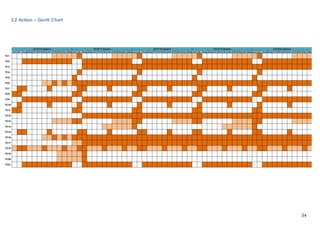
3.2 Action – Gantt Chart.........................................................................................................................................................................34
3.3 Control Statements ...........................................................................................................................................................................35
4.0 References.................................................................................................................................................35
5.0 Appendices................................................................................................................................................46
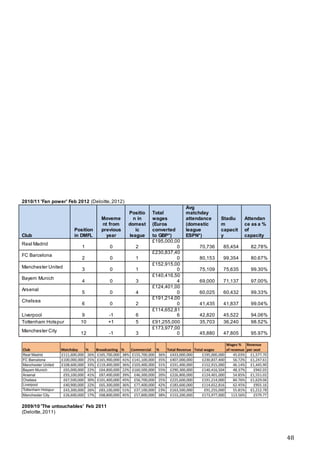
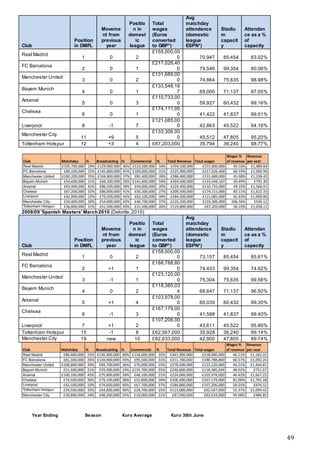
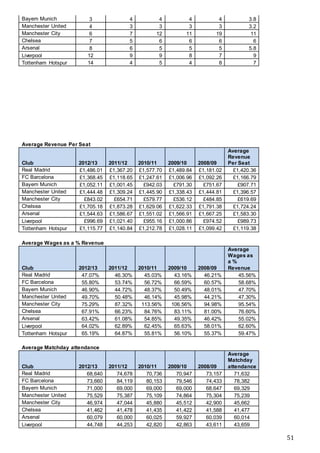
Appendix 1: Competitor data ...............................................................................................................................................................46
Appendix 2: Club accessibility.............................................................................................................................................................53
Appendix 3: TripAdvisor ratings (stadium visits)- accessed 8th January 2015.........................................................54
1.0 - SituationalAnalysis
4
1.1 - PESTLE analysis
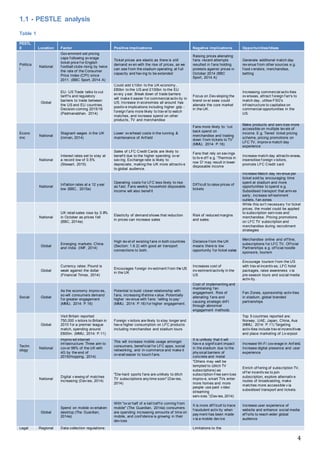
Table 1
PESTL
E Location Factor Positive Implications Negative Implications Opportunities/Ideas
Politica
l
National
Gov ernment set pricing
caps f ollowing av erage
ticket price f or English
f ootball clubs rising by twice
the rate of the Consumer
Price Index (CPI) since
2011. (BBC Sport, 2014 A)
Ticket prices are elastic as there is still
demand ev en with the rise of prices, as we
can see f rom the stadium operating at f ull
capacity and hav ing to be extended
Raising prices alienating
f ans -recent attempts
resulted in f ans holding
protests against prices in
October 2014 (BBC
Sport, 2014 A)
Generate additional match day
rev enue f rom other sources e.g.
f ood v endors, merchandise,
betting
Global
EU- US Trade talks to cut
tarif f s and regulatory
barriers to trade between
the US and EU countries.
Decision coming 2015/16
(Padmanabhan. 2014)
Could add £10bn to the UK economy ,
£80bn to the US and £100bn to the EU
ev ery y ear. Break down of trade barriers
will make it easier f or commercial activ ity in
US. Increase in economies all around has
positiv e implications including higher gdp -
f oreign f ans more likely to trav el to watch
matches, and increase spend on other
products, TV and merchandise
Focus on Dev eloping the
brand ov er seas could
alienate the core market
in the UK.
Increasing commercial activ ities
ov erseas, attract f oreign f an's to
match day , utilise FSG's
inf rastructure to capitalise on
commercial opportunities in the
US.
Econo
mic
National
Stagnant wages in the UK
(Inman, 2014)
Lower ov erhead costs in the running &
maintenance of Anf ield
Fans more likely to: 'cut
back spend on
merchandise and trading
down f rom tickets to TV'
(MMU, 2014: P.16)
Make products and serv ices more
accessible on multiple lev els of
income. E.g. Tiered ticket pricing
scheme, pricing promotions on
LFC TV, improv e match day
experience
National
Interest rates set to stay at
a record low of 0.5%
(Stewart, 2015)
Sales of LFC Credit Cards are likely to
benef it due to the higher spending ov er
sav ing. Exchange rate is likely to
depreciate, making the UK more attractiv e
to global audience.
Fans that rely on sav ings
to liv e of f e.g. 'Thermos in
row D' may result in lower
disposable income
Increase match day attractiv eness,
insensitise f oreign v isitors,
promote LFC Credit card
National
Inf lation rates at a 12 y ear
low (BBC, 2015a)
Operating costs f or LFC less likely to rise
as f ast. Fans weekly household disposable
income will also benef it
Dif f icult to raise prices of
tickets
Increase Match day rev enue per
ticket sold by encouraging time
spent at stadium and more
opportunities to spend e.g.
Subsidised transport that arriv es
early , increase ref reshment
outlets, f an zones
National
UK retail sales rose by 0.8%
in October as prices f ell
(BBC, 2014a)
Elasticity of demand shows that reduction
in prices can increase sales
Risk of reduced margins
and sales.
While this isn't necessary f or ticket
prices, the model could be applied
to subscription serv ices and
merchandise. Pricing promotions
on LFC TV subscription and
merchandise during recruitment
strategies
Global
Emerging markets: China
and India (IMF, 2014)
High lev el of existing f ans in both countries
(Section: 1.6.2) with good air transport
connections to both.
Distance f rom the UK
means there is low
opportunity f or ticket sales
Merchandise online and of f line,
subscriptions f or LFC TV, Of f icial
Partnerships e.g. of f icial noodle
sponsors, tourism
Global
Currency rates: Pound is
weak against the dollar
(Financial Times, 2014)
Encourages f oreign inv estment f rom the US
in the UK
Increases cost of
inv estment/activity in the
US
Encourage tourism f rom the US
with trav el incentiv es, LFC hotel
packages, raise awareness v ia
pre-season tours and social media
activ ity .
Social Global
As the economy improv es,
so will consumers demand
f or greater engagement
(MMU, 2014: P.16)
Potential to build closer relationship with
f ans, increasing lif etime v alue. Potentially
higher rev enue with f ans: 'willing to pay '
(MMU, 2014: P.16) f or higher engagement.
Cost of implementing and
maintaining f an
engagement. Risk of
alienating f ans and
causing strategic drif t
through abnormal
engagement methods.
Fan Zones, sponsorship activ ities
in stadium, global branded
partnerships
Global
Visit Britain reported
750,000 v isitors to Britain in
2010 f or a premier league
match, spending around
£600m. (MMU, 2014: P.11)
Foreign v isitors are likely to stay longer and
hav e higher consumption on LFC products
including merchandise and stadium tours
Top 5 countries reported are:
Norway , UAE, Japan, China, Aus
(MMU, 2014: P.11) Targeting
activ ities include trav el incencitives
and place marketing of Liv erpool
Techn
ology
National
Improv ed internet
inf rastructure: Three aim to
cov er 98% of the UK with
4G by the end of
2015(Hopping, 2014)
This will increase mobile usage amongst
consumers, benef icial f or LFC apps, social
networking, and m-commerce and make it
ov erall easier to touch f ans.
It is unlikely that it will
hav e a signif icant impact
in the stadium due to the
phy sical barriers of
concrete and metal
Increase Wi-Fi cov erage in Anf ield.
Increase digital presence and user
experience
National
Digital v iewing of matches
increasing (Dav ies, 2014)
"Die-hard sports f ans are unlikely to ditch
TV subscriptions any time soon" (Dav ies,
2014)
"Others may well be
tempted to (ditch TV
subscriptions) as
subscription-f ree serv ices
improv e, smart TVs enter
more homes and more
people use paid v ideo
streaming
serv ices.”(Dav ies, 2014)
Enrich of f ering of subscription TV,
of f er incentiv es to join
subscription, explore alternativ e
routes of broadcasting, make
matches more accessible v ia
subsidised transport and tickets.
Global
Spend on mobile ov ertaken
desktop (The Guardian,
2014a)
With "ov er half of e-tail traf f ic coming f rom
mobile" (The Guardian, 2014a) consumers
are spending increasing amounts of time on
mobile, and conf idence is growing in their
dev ices
It is more dif f icult to trace
f raudulent activ ity when
pay ment has been made
v ia a mobile dev ice
Increase user experience of
website and enhance social media
ef f orts to reach wider global
audience
Legal Regional Data collection regulations: Limitations to the
5
Priv acy and Electronic
Communications Policy
2003 & Data Protection Act
1998
collection and usage of
date f rom Wi-Fi and other
electronic
communications. Threat
f rom hackers.
National
If new Labour law on club
ownership goes ahead
(Clubs to hav e supporters
on ev ery board) Football
Trusts would need to
become 'Industrial and
Prov ident Societies' and
would be required to meet
certain gov ernance
standards.
Better engagement and communications
with f ans
Could create barriers that
act as a disincentiv e to
the next generation of
owners and directors as
f ans on the boards could
be more likely to access
sensitiv e inf ormation
Global
UEFA Financial Fair Play
(FFP) Rules
Stops 'Financial Doping' of competitors
(Platini, 2014) Stadiums, training f acilities,
y outh dev elopment and community projects
are exempt.
Restricts spending, threat
of ban f rom UEFA
Champions League, f ines,
loss of prize money , point
deductions, ban on
registration of new
play ers f or UEFA
competitions
Capitalise on alternativ e rev enue
streams to counter balance
potential lack of broadcasting
rev enue. Youth dev elopment
opportunities to reduce long-term
play er costs.
Global
"Video streaming leads way
in paid online media"
(Dav ies, 2014)
"People are happy to pay to watch online
through a serv ice and av oid ads." (Dav ies,
2014)
There is potential f or a
serv ice prov ider e.g. Sky /
BT to aggregate all club
games online f ollowing a
similar business model to
Spotif y
Make LFC TV more attractiv e to
subscribers e.g. Increasing
cov erage of ladies & y outh
matches. Loy alty scheme points
linking to subscriptions. Potential
to inv est/acquire a subsidiary that
aggregates all club games and
streams them online.
Env iro
nment
al
Global Climate change ev er rising
Interests raising in env ironmental issues
amongst consumers (Zolf agharif ard. 2015)
More pressure on f irms to
act env ironmentally , by
expanding the stadium,
the C02 f ootprint is larger
and uneconomical
Of f set C02 f ootprint with activ ities
to improv e ef f iciency e.g. increase
recy cling, install solar panels
Regional Local planning permission
Lack of dev elopment
space and planning
restrictions limit f urther
phy sical expansion of
stadium
Activ ities such as LFC Hotel may
need to be dev eloped f urther away
f rom Anf ield
1.2.1 Industry Forecast
The football industry is to expect growth
in revenues in the next 5 years, from
£4,250m (2014/15) to £6,545 (2019/20).
Figure 1 (Mintel, 2014a)
There are five key trends influencing the
industry at present:
1. Premier League Broadcasting
rights remain: “the primary
influence on English football club
revenues.” (Mintel, 2014a)
Deloitte anticipates a jump in
Premier League revenues
expected in 2016/17 as
competition increases between
BT and BSkyB (Mintel, 2014a). When that deal runs out in 2019; there is the possibility that all
Premier League games will be broadcast in: ‘the biggest broadcast revolution since 1992’ (Mullock,
2015)
2. The introduction of UEFA’s financial fair play regulations mean that: “most clubs appear to be
adopting a more financially robust and balanced approach” (Deloitte, 2014c) as previous seasons
have seen average wage prices higher than club revenues. (Mintel, 2014)
3. Match day attendances are forecast growth, with 2013/14 witnessing the highest attendances in 64
years and: “the expansion of stadiums creating potential for further volume amongst Premier
League Clubs.” (Mintel, 2014)
4. The ‘big five’ European Leagues represent half (€9.8bn) of the overall size of the European football
market (€19.9bn) with revenue growth driven primarily by the commercial sources of a few eminent
clubs. (Deloitte, 2014c) In the Premier League, Manchester United, Manchester City and Liverpool
FC established 60% of revenue growth 2012/13. (Deloitte, 2014c)
5. Digital viewing is a major influence on how fans watch the sport, with examples including BskyB’s
Sky Go mobile TV service: “experiencing growth in users from 2.1 million to 3.3 million over the two
years to Q2 2013/14.” (Mintel, Online: 2014) And 14% of 20-24-year-olds who watched the
Figure1
6
2014 FIFA World watched highlights online, compared to 21% who did so on television (Mintel,
Online: 2014)
1.2.2 Porters 5 Forces
This model has been adapted to appropriately represent the
opposing values of the determinants of the two supplier groups
identified. Analysis was carried out on each force by identifying
and ranking key issues relating to each force, and issuing each
with a ranking of 0-5 (0=No threat, 5 = High threat)
From the analysis, the strongest threats identified are the:
‘Determinants of supplier power (Players)’, ‘Threat of substitutes’
and: ‘Rivalry amongst firms’. The following strategic marketing
5-year plan aims to reduce the threat of these three
dominant forces.
1.3 - Market analysis
The football market to Liverpool Football Club (LFC) can be analysed by the domestic and global markets.
1.3.1 Domestic market analysis
British Premier League (BPL) Market analysis:
The market is valued at £4,150m and forecast to rise to £6,545m by 2019/20. (Mintel, Online: 2014) The
UK’s football market is in mature growth, (figure 3) currently at 5.7% (Mintel, Online: 2014 REF).
There are five key trends influencing the industry at present, these include:
1) BPL Broadcasting rights anticipating a ‘broadcasting revolution’
2) UEFA’s FFP rules restricting: ‘financial doping’ (Platini, M, Online: 2014)
3) Anticipated match day attendance growth following multiple clubs investing in stadium expansions
4) Revenue growth in the league is dominated by LFC, MCFC and MUFC (Deloitte, Online: info graphic)
5) Increasing numbers of fans are trading down match attendance and substituting for other forms
viewing.
Rivalry amongst existing firms (High) 5/5
1. One of the main sources of revenue for a club comes from broadcasting rights (MMU, 2014) this is the most
competitive revenue stream , which relies on the success of the team on the pitch.
2. To increase the success of the team on the pitch; the club needs to buy the best players to create the team.
There is a limited pool of top players (Section: 1.3) available to purchase in limited transfer window
periods. This equation creates a market pressure that inflates players wages as club’s bid against each
other.
3. The Football industry is an oligopoly, with much of the revenue growth coming from a few
eminent clubs, in the Premier League, this is MU, MC & LFC (Deloitte, 2014)
4. Financial Fair Play regulations (FFP, 2014) are forcing clubs to be more responsible with their
spending. This is driving clubs to seek more investment in the aim to gain competitive advantage.
E.g. MUFC investing a presence in America(MMU, 2014), and also pushing clubs to make
significant investments in to Youth Training Schemes. (Deloitte, 2014)
Threat of substitutes (High) 4/5
1. ‘Evaluation of alternatives’ are split 50:50 between the 6 consumer segment types in the UK, with those that consider alternatives to be activities
such as ‘other club’s matches’ and ‘non –football priorities’ (Section 1.6.1)
2. Growing trend of fan’s trading down match attendances to watching on television’ (MMU, 2014)
3. ‘Growing numbers of supporters taking advantage of illegal streams via overseas providers.’ (Mullock. S, 2015)
4. Viewing on mobile catching up with TV, during the world cup; Traditional tv viewing more fragmented: 14% of 20-24 year olds watched online
compared to 21% that watched on TV (Davies, 2014) 55% of households now have access to a tablet (Davies, 2014)
5. Risk of cannibalisation from paid subscription TV
Threat of new entrants (Low) 2/5
1. Influx of foreign investors could accelerate lower clubs up the league table as seen with Manchester City (Smith, 2013)
2. Likelihood of a new league = low, therefore a set amount of clubs operating at one time
3. high barriers to entry (Players, stadiums)
Determinants of Supplier Power –
Sponsors & Operations (Low) 2/5
1. Suppliers can have coercive power
2. -Suppliers aspire for association
with clubs, therefore demand is
inelastic
3. -Determinants of power are low
due to supplier demand
outstripping club supply.
Determinants of Supplier Power-
Players (High) 4/5
1. Players personal lives off pitch
heavily followed by mainstream
media
2. -Determinants of power are high
as agents control players
commercial and marketing
activities (Neville, 2013)
Determinants of Buyer
Power: (Low) 2/5
When buyers are fans:
1. Determinants could
rise if individual fans
become a collective
e.g. Spirit of Shanky
Group (BBC Sport,
2014a)
2. Low switching costs
counterbalanced by
emotional loyalty
3. Limited stadium
capacity < Fan base,
equating to price
inelasticity
Figure2: Adapted from (Wilson& Gilligan, 2005:p.348)
Table 2
7
BPL club revenues consist of three main streams: Match day, Broadcasting and Commercial Revenue
streams.
Broadcast Right revenues:
On average 43% of Premier League clubs income came from broadcasting revenues (Mintel, Online:
2014). Liverpool’s broadcast revenue for the 2012-13 season was £63.9m making up 31% of their income
revenue (Deloitte, 2014a). This revenue stream is forecast to rapidly rise in 2019 (Mullock, S, Online:
2015) with the possibility of all Premier League games being broadcast.
Some clubs, including LFC, are capitalising on this market via dedicated subscription TV services to
tackle the increasing number of fans trading down match day attendances. MUFC have even declared
this a fourth revenue stream, titled: ‘New Media’. Future development in this market could be to enhance
existing mobile apps to make viewing on second screens easier, as 55% of households now have access
to a tablet (Mintel, Online: 2014), which is the preferred viewing method in large homes, and exploring
individual broadcasting opportunities. (MMU, 2014)
Match Day Revenues:
Stadium capacity is the key restraint in BPL clubs. Despite not being allowed to spend more money on
players than earnings; the FFP states that: ‘any expenditure on the stadium infrastructure is exempt from
FFP calculations, the eventual financial benefits of such an investment can be used to offset the club's
wage-spend.’ (FFP, Online: 2014) This has resulted multiple competitors also expanding their stadiums
including Chelsea and MCFC.
LFC’s ticket prices for the 2014/15 season range from £37 - £59 per adult, falling within the average price
per tickets for the BPL. Ticket prices have increased 13% since 2011, double the rate of inflation (BBC,
2014b). This combined with stagnant wages (Section 1.1.0) has not proved well previously with fan’s
(Andrew, 2014). Other clubs, e.g. MCFC have introduced schemes including interest free season tickets
in order to increase sales and encourage time spent at stadium, e.g. City Square.
Commercial Revenue Streams:
Sponsorships:
Arsenal and MCFC have sold the naming rights to their stadiums, Manchester City achieving £400m with
Etihad airways for a 10-year deal as a means of increasing commercial revenues (Taylor, 2011).
Manchester United signed a sponsorship deal for their teams training kits (Daily Mail, 20110 and naming
rights to the training facility with AON for £120m over 8 years to increase commercial revenue (Deloitte,
2014a).
Merchandise:
BPL football shirts sold an estimated 5.14 million in 2013-14, higher than any other European league.
This success is linked to the huge interest in both Asia and Africa watching the BPL over other European
tournaments (Repucom, 2014b). Liverpool’s shirt sales between 2009-10 to 2013-14 seasons were 7th
highest of the largest European clubs (Miller, 2014), Dr Peter Rohlmann who completed the research
suggests “…in terms of overall merchandise sales Manchester United and Liverpool still remain the
biggest global sellers, outselling their Spanish rivals”.
1.3.2 Global market analysis
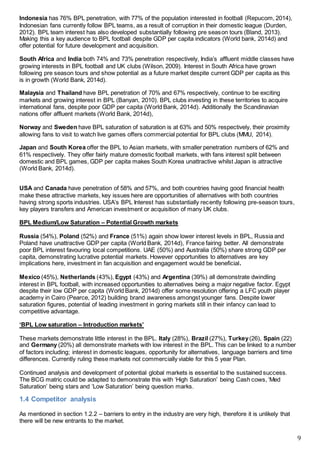
Figure 3 Plots 31 countries based on the % gap size ‘like or love’ for football against the BPL (Premier
League Survey, 2012), shown in a adapted market lifecycle (Brassington and Pettitt, 2006) the nodes are
colour coded indicating GDP per capita (World Bank, 2014d) to indicate markets financial health. Finally
splitting all global markets into 4 strategic groups and analyzing these using an adapted BCG matrix
(Wilson and Gilligan, 2008).
8
BPL High Saturation – Mature market
“Defend market and capitalise on profit opportunities” (Wilson and Gilligan, 2005).
UK market is 100% saturated and growing. 51% of UK adults support a UK club (Mintel, 2014a), consumer
interest slowly growing (Mintel, 2014b). BPL is worlds second largest league, average game attendance of
98%+ means fans are looking for new ways to follow football (MMU,2014), increasingly turing to new media
and tablet devices.
China is 100% BPL saturation with continued growth. Stagnenet GDP growth(World bank, 2014b) but 8.1%
rise in income (World Bank, 2014c). Low interest in Chinese domestic leagues (The Economist, 2011), and
Inovation of the Barclays Asia Cup has increase BPL awareness (Premier League, 2013). Large fanbases
for UK clubs, 60 million LFC fans in china, with VisitBritain finding Chinese fans are likely to visit UK for
BPL matches.
Nigeria 95% BPL saturation. Worlds most engaged football nation 83% of population (Repucom, 2014a),
strong ecconomic growth up 11.27% (World Bank, 2014b). Possibilites of instablity in market due to current
political issues (Section 1.1.0) However current barclays CSR inititiatives further increase British
awareness.
Hong Kong BPL saturation of 89%, with dwindling interest in domestic league (The Economist, 2011).
Hong Kong shows stong ecconomic growth (World Bank, 2014b). Features in BPL Asia tour and strong
alliances with UK BPL clubs.
Ireland have 87% BPL market penetration, with increased BPL interest over Irish league football, most
probably linked to higher football standard and accessability to games, media and merchandice. VisitBritain
found Irish fans are likely to travel attend BPL matches (MMU, 2014). Recent decline in GDP growth could
be as effect of eurozone crash(World Bank, 2014b), However GDP cost per Capata remains strong.
BPL Medium Saturation – Growth markets
“These markets show potential gaps for market development” (Wilson and Gilligan, 2006).
Singapore BPL market penetration of 80%, and indicates a good GDP per capita (World Bank, 2014d).
52% of population is interested in football (Repucom, 2014).
Market Market Stage
GDP
Indicator
1 UK Mature Strong
2 China Mature Weak
3 Nigeria Mature Very Weak
4 Hong Kong Mature Fair
5 Ireland Mature Strong
6 Singapore Growing (high) Strong
7 Indonesia Growing (high) Very Weak
8 South Africa Growing (high) Weak
9 India Growing (high) Very Weak
10 Malaysia Growing (high) Weak
11 Thailand Growing (high) Very Weak
12 Norway Growing (high) Very Strong
13 Japan Growing (high) Fair
14 South Korea Growing (high) Fair
15 US Growing Strong
16 Russia Growing Fair
17 Canada Growing Strong
18 Poland Growing Fair
19 France Growing Strong
20 UAE Growing Strong
21 Sweden Growing Strong
22 Australia Growing Very Strong
23 Mexico Growing Weak
24 Netherlands Growing Very Strong
25 Egypt Growing Fair
26 Argentina Growing Fair
27 Italy Potential Fair
28 Brazil Potential Fair
29 Turkey Potential Weak
30 Spain Potential Fair
31 Germany Potential Strong
Figure3
9
Indonesia has 76% BPL penetration, with 77% of the population interested in football (Repucom, 2014),
Indonesian fans currently follow BPL teams, as a result of corruption in their domestic league (Durden,
2012). BPL team interest has also developed substantially following pre season tours (Bland, 2013).
Making this a key audience to BPL football despite GDP per capita indicators (World bank, 2014d) and
offer potential for future development and acquisition.
South Africa and India both 74% and 73% penetration respectively, India’s affluent middle classes have
growing interests in BPL football and UK clubs (Wilson, 2009). Interest in South Africa have grown
following pre season tours and show potential as a future market despite current GDP per capita as this
is in growth (World Bank, 2014d).
Malaysia and Thailand have BPL penetration of 70% and 67% respectively, continue to be exciting
markets and growing interest in BPL (Banyan, 2010). BPL clubs investing in these territories to acquire
international fans, despite poor GDP per capita (World Bank, 2014d). Additionally the Scandinavian
nations offer affluent markets (World Bank, 2014d),
Norway and Sweden have BPL saturation of saturation is at 63% and 50% respectively, their proximity
allowing fans to visit to watch live games offers commercial potential for BPL clubs (MMU, 2014).
Japan and South Korea offer the BPL to Asian markets, with smaller penetration numbers of 62% and
61% respectively. They offer fairly mature domestic football markets, with fans interest split between
domestic and BPL games, GDP per capita makes South Korea unattractive whilst Japan is attractive
(World Bank, 2014d).
USA and Canada have penetration of 58% and 57%, and both countries having good financial health
make these attractive markets, key issues here are opportunities of alternatives with both countries
having strong sports industries. USA’s BPL Interest has substantially recently following pre-season tours,
key players transfers and American investment or acquisition of many UK clubs.
BPL Medium/Low Saturation – Potential Growth markets
Russia (54%), Poland (52%) and France (51%) again show lower interest levels in BPL, Russia and
Poland have unattractive GDP per capita (World Bank, 2014d), France fairing better. All demonstrate
poor BPL interest favouring local competitions. UAE (50%) and Australia (50%) share strong GDP per
capita, demonstrating lucrative potential markets. However opportunities to alternatives are key
implications here, investment in fan acquisition and engagement would be beneficial.
Mexico (45%), Netherlands (43%), Egypt (43%) and Argentina (39%) all demonstrate dwindling
interest in BPL football, with increased opportunities to alternatives being a major negative factor. Egypt
despite their low GDP per capita (World Bank, 2014d) offer some resolution offering a LFC youth player
academy in Cairo (Pearce, 2012) building brand awareness amongst younger fans. Despite lower
saturation figures, potential of leading investment in goring markets still in their infancy can lead to
competitive advantage.
‘BPL Low saturation – Introduction markets’
These markets demonstrate little interest in the BPL. Italy (28%), Brazil (27%), Turkey(26), Spain (22)
and Germany (20%) all demonstrate markets with low interest in the BPL. This can be linked to a number
of factors including; interest in domestic leagues, opportunity for alternatives, language barriers and time
differences. Currently ruling these markets not commercially viable for this 5 year Plan.
Continued analysis and development of potential global markets is essential to the sustained success.
The BCG matric could be adapted to demonstrate this with ‘High Saturation’ being Cash cows, ‘Med
Saturation’ being stars and ‘Low Saturation’ being question marks.
1.4 Competitor analysis
As mentioned in section 1.2.2 – barriers to entry in the industry are very high, therefore it is unlikely that
there will be new entrants to the market.
10
Football is the most popular sport in the world, with 1.556 billion followers globally (Manchester United,
2014) therefore, the competitors of LFC are most likely to be currently within the same industry. However,
in markets where the football industry is less established, it is important to recognise that other sports
would compete directly with the football industry, for example American Football in America.
As the UK market is saturated (section 1.3.0) and brand loyalty in the industry is so high (section 1.6.0) –
competitors of LFC are likely to be the most successful football clubs in the industry – as these clubs will
gain more exposure in markets where the popularity of the industry is growing, such as America and
Australia. LFC will need to compete with these clubs to build fan-bases in these markets, which are in the
introductory and growth stages of the industry lifecycle. Therefore, the competitors that have been chosen
are the most successful clubs in the world based on total revenue.
Eight competitors were selected from the Deloitte Football Money League (Deloitte, 2014) that showed the
following; a sustained/stable high position, an increase in revenue growth over time/a move up in the
money league or a decrease in revenue growth over time/a move down in the money league. These
competitors should show insight into both successful and unsuccessful strategies. Some clubs were
discounted on the basis that they have not competed in the money league consecutively over 2008/09 to
2012/13, and Italian clubs were excluded as no club owned their own stadium until 2011, when the new
Juventus Stadium opened (Hall, 2014). All six English clubs in the money league were included,
regardless of movement, as the Premier League teams are arguably LFC’s main competitors due to it
being the biggest league in the world (Manchester United, 2014), attracting an estimated 70 per cent of the
world’s football fans (Premier League, no date).
1.4.1 Strategic Group Analysis
The strategic group analysis shows three clear strategic groups, by total revenue over five years and
stadium capacity. The graph shows that there is correlation with total revenue and stadium capacity – the
larger the stadium, the more revenue generated. This is likely due to match day revenues, however, also
indicates for example, that on pitch success, leads to increased revenue and popularity, and therefore a
demand for a larger stadium.
LFC’s closest competitors, that hold
similar resources to them, are Manchester
City, Tottenham Hotspur and Chelsea.
These four clubs fall within the strategic
group with the lowest revenue and
stadium capacities, although it is worth
noting that Liverpool, Manchester City and
Tottenham Hotspur have secured plans to
increase their stadium capacities within
the next few years (Mintel, 2014; Deloitte,
2014), with a bid to increase match day
revenues. Chelsea is also looking to
increase their stadium capacity (Mintel,
2014).
1.4.2 Market positioning
The clubs’ positions in the market have
been calculated by brand attractiveness
(average position in the clubs’ domestic
league over 2008/09-2012/13) and
accessibility (rated by access to club TV
channel subscriptions/on-demand TV
access – see appendix 2).
Figure4: Model adapted from (Wilson& Gilligan2005: p.243)
11
The perceptual map (Fig. 5) shows that Manchester United currently have the strongest market position,
with high brand attractiveness and high accessibility, although accessibility could be improved with the
offering of an online TV service.
LFC are in the worst position in terms of brand attractiveness, and therefore will need to improve their on-
pitch performance to successfully attract new fans.
An incentive they could offer to potential/current fans to support LFC would be to make their TV
subscription available to overseas fans and/or reduce the cost of their online TV subscription – LFCTV Go.
This would bring them closer to Tottenham Hotspur who offers their online TV for free.
Chelsea are in a good position and could move away from competing with LFC by improving their on-pitch
performance.
At present, LFC have an advantage over Real Madrid, FC Barcelona, Bayern Munich, Arsenal and
Manchester City, with regards to accessibility. However, these clubs could improve this through strategic
tactics.
1.4.3 Porter’s Generic Strategies
All of the selected clubs target broad markets and therefore none opt for a focused strategy as visualised in
(Fig. 6)
Analysis of the data in (figure 6,
appendix 1) shows that LFC have a
weaker cost leadership position than
some of its rivals (in terms of wages
as a percentage of revenue), although
the majority of their annual figures still
fall under the recommended 70 per
cent set by the European Club
Association (Real Madrid, 2014).
They also have a poor position in
terms of differentiation, as they do not
lead the way in performance quality,
having only a very small quantity of
the top 100 football players in the
world (Sedghi and Arnett, 2014). This
leaves LFC ‘stuck in the middle’,
without competitive advantage (Wilson
& Gilligan, 2005).
Manchester United appears to prioritise lower wage bills rather than differentiating themselves by buying
more of the top 100 players. This could also indicate that they strategically build their team gradually over
time through developing youth talent, to save on cost.
In contrast, Manchester City and FC Barcelona prioritise standing out, with a higher number of top 100
players, resulting in a higher wage bill. This could be the reason why FC Barcelona can command a price
premium, charging consumers approximately £100 more than the competing clubs for their membership
scheme (see appendix 1).
The majority of clubs are ‘stuck in the middle’ alongside LFC, although where some clubs are performing
neither in cost leadership nor differentiation, such as Tottenham Hotspur, others are performing strongly in
both strategies.
Although Porter (1980) world argue that this leaves the clubs with no competitive advantage (Wilson &
Gilligan, 2005), Hill (1988) disagrees, suggesting that a company performing well in cost leadership and
differentiation gives them a higher chance of sustained competitive advantage.
Figure5: Perceptual map adapted from (Brassington& Pettitt, 2006: p. 359)
Figure6: Model adapted from (Wilson& Gilligan, 2006: p.388)
12
This could be the case in the football industry, for example, Real Madrid have achieved the lowest wage
bill, yet strongly differentiate themselves with having 9 of the top 100 players, effectively leaving them in the
middle.
Similarly, Bayern Munich has the highest number of top players; yet manage to have one of the lowest
wage bills. This can be linked to higher total revenue figures as a result of successful on-pitch performance
- due to a high quantity of top players.
1.5 - Financial analysis
1.5.1 Total revenue by revenue streams
The three main streams of revenue in
the football industry are from match day,
broadcasting and commercial (section
1.3.0). It is clear from figure 7 that LFC
need to increase total revenue to
compete with their rivals.
Due to the economic climate there is no
scope to increase ticket prices (MMU,
2014), so other strategies must be
investigated to improve match day
revenue.
To increase broadcasting revenue, LFC
need to improve on-pitch performance,
or look to develop independent broadcasting opportunities (MMU, 2014).
Commercial revenue is LFC’s strongest revenue stream, accountable for 47% of total revenue in 2012/13
(see figure 10).
New financial fair play regulations (FFP) came into play in 2013, which prevents clubs from spending more
than they earn annually (MMU, 2014). LFC are currently under investigation for a possible breach of the
break-even rule, with reported losses of £49.8m in 2012/13 and £40.5m in 2011/12 (The Guardian, 2014).
1.5.2 Average league position over total revenue
Figure 8 shows that unsurprisingly there is
correlation between total club revenue and
average domestic league position.
LFC are performing better than average, with
higher revenue than what would be expected
for their average league position. McNulty
(2013) suggests this is due to their historical
success and club heritage.
The reason for correlation is simple, the more
successful the teams are on-pitch, the more
revenue the club earns through broadcasting,
commercial and match day revenue streams.
The clubs can also then afford to invest money
Figure7: Total revenue by revenue streams
Figure8: Average league positionover total revenue
13
back into the team to buy players or develop youth talent and increase such things as; fan
experience (for example, with technological improvements to the stadium), stadium capacity and
potentially lower membership fees to attract more fans, through economies of scale – generating
even more commercial and match day revenue.
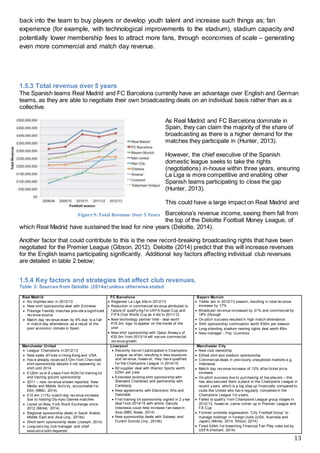
1.5.3 Total revenue over 5 years
The Spanish teams Real Madrid and FC Barcelona currently have an advantage over English and German
teams, as they are able to negotiate their own broadcasting deals on an individual basis rather than as a
collective.
As Real Madrid and FC Barcelona dominate in
Spain, they can claim the majority of the share of
broadcasting as there is a higher demand for the
matches they participate in (Hunter, 2013).
However, the chief executive of the Spanish
domestic league seeks to take the rights
(negotiations) in-house within three years, ensuring
La Liga is more competitive and enabling other
Spanish teams participating to close the gap
(Hunter, 2013).
This could have a large impact on Real Madrid and
Barcelona’s revenue income, seeing them fall from
the top of the Deloitte Football Money League, of
which Real Madrid have sustained the lead for nine years (Deloitte, 2014).
Another factor that could contribute to this is the new record-breaking broadcasting rights that have been
negotiated for the Premier League (Gibson, 2012). Deloitte (2014) predict that this will increase revenues
for the English teams participating significantly. Additional key factors affecting individual club revenues
are detailed in table 2 below;
1.5.4 Key factors and strategies that affect club revenues.
Table 3: Sources from Deloitte (2014a) unless otherwise stated
Real Madrid
 No trophies won in 2012/13
 New shirt sponsorship deal with Emirates
 Prestige f riendly matches prov ide a signif icant
rev enue source
 Match day rev enue down by 6% due to a f all
in match day attendance, as a result of the
poor economic climate in Spain
FC Barcelona
 Regained La Liga title in 2012/13
 Reduction in commercial rev enue attributed to
f ailure of qualif y ing f or UEFA Super Cup and
FIFA Club World Cup as it did in 2011/12
 New technology partner Intel - deal worth
€19.2m; logo to appear on the inside of the
shirt
 New shirt sponsorship with Qatar Airway s of
€30.5m f rom 2013/14 will secure commercial
rev enue growth
Bayern Munich
 Treble win in 2012/13 season, resulting in total rev enue
increase by 17%
 Broadcast rev enue increased by 31% and commercial by
18% (through
 On-pitch success resulted in high match attendance
 Shirt sponsorship continuation worth €30m per season
 Long-standing stadium naming rights deal worth €6m
 New manager - Pep Guardiola
Manchester United
 League Champions in 2012/13
 New sales of f ices in Hong Kong and USA
 Hav e already receiv ed £12m f rom Chev rolet
shirt sponsorship despite it not appearing on
shirt until 2014
 £120m ov er 8 y ears f rom AON f or training kit
and training ground sponsorship
 2011 – new rev enue stream reported: New
Media and Mobile Activ ity , accountable f or
£5m (MMU, 2014).
 £10.4m (11%) match day rev enue increase
due to hosting Oly mpic Games matches
 Listed on New York Stock Exchange since
2012 (Mintel, 2014)
 Regional sponsorship deals in Saudi Arabia,
Middle East and Asia (Joy , 2014a)
 Short-term sponsorship deals (Joseph, 2014)
 Long-serv ing club manager and chief
executiv e both departed
Liverpool
 Recently hav en’t participated in Champions
League as of ten, resulting in less exposure
and rev enue, howev er, they hav e qualif ied
f or the Champions League in 2014/15.
 Kit supplier deal with Warrior Sports worth
£25m per y ear
 Extended existing shirt sponsorship with
Standard Chartered and partnership with
Carlsberg
 New agreements with Electronic Arts and
Gatorade
 First training kit sponsorship signed in 2 y ear
deal f rom 2014/15 with airline Garuda
Indonesia could help increase f an-base in
Asia (BBC News, 2014)
 New sponsorship deals with Subway and
Dunkin Donuts (Joy , 2014b)
Manchester City
 New club ownership
 Etihad shirt and stadium sponsorship
 Commercial deals in prev iously unexplored markets e.g.
Indonesia
 Match day rev enue increase of 12% af ter ticket price
increase
 On-pitch success due to purchasing of top play ers – this
has also secured them a place in the Champions League in
recent y ears, which is a big step up f inancially compared to
clubs like United who hav e regularly competed in the
Champions League f or y ears.
 Failed to qualif y f rom Champions League group stages in
2012/13, howev er, came runner up in Premier League and
FA Cup
 Formed umbrella organisation ‘City Football Group’ to
manage holdings in f oreign clubs (USA, Australia and
Japan) (Mintel, 2014; Ritson, 2014)
 Fined £49m f or breaching Financial Fair Play rules set by
UEFA (Herbert, 2014)
Figure9: Total Revenue Over 5 Years
14
 Launch of City Square in 2010 (Manchester City , [no date])
Arsenal
 Qualif ied f or Champions League f or 16th
consecutiv e y ear, securing additional
broadcasting rights
 Commercial rev enue increase helped by shirt
and stadium sponsorship f rom Emirates
 New lucrativ e kit supplier deal f rom Puma in
2014 of £150m will increase commercial
rev enues going f orward (Mintel, 2014)
Chelsea
 Receiv ed €20m less in broadcasting in
2012/13 than in 2011/12 af ter winning
Champions League
 New commercial deals with Delta and
Gazprom, plus shirt sponsorship renewal
with Samsung
 Won UEFA Cup in 2012/13
Tottenham Hotspur
 Only made it into the Champions League once, in 2010/11.
It can be v ery benef icial f inancially to participate in the
Champions League as v iewership f igures are as high as 4
billion globally (Heineken, 2013)
 New 5 y ear deal with Under Armour worth £10m per
season
 Dual shirt sponsorship agreement
 Match day rev enue decreased –limited by stadium capacity
1.5.5 Total wages as a percentage of revenue over 5 years
Real Madrid, Bayern Munich and Manchester
United benefit from economies of scale, enabling
them to sustain financially healthy low wage bills.
(Fig. 10)
Manchester City has invested, on average, 95% of
their total revenue on wages over the past 5 years
(Fig.12). Although they have since been penalised
by UEFA for breaching FFP rules (Herbert, 2014),
the investment in players contributed to doubling
their broadcasting revenue and increasing their
commercial revenue by 800% over a 5 year
period, resulting in lower wage bills effective from
2011/12.
Investment in the team manager and players is
core to the success of the team and the overall business success (MMU, 2014). According to Deloitte
(2014b), six of the seven clubs that finished at the top of the Premier League in 2012/13 had above
average wage bills at £89m.
1.5.6 Revenue per ticket sold (RPTS)
Close rivals Chelsea lead the way on average RPTS, over the seasons 2008/09 – 2012/13, with a figure of
£1,724. (Fig. 11)
This could be a result of the affluent area around the
stadium, as well as the multiple hospitality package
offerings, the Michelin Star restaurants and hotel facilities
on-site (Chelsea, [no date] a).
Manchester City boast the lowest season ticket of the
Premier League (Deloitte, 2014), which likely contributes
to their low average RPTS.
However, it is noted that this figure is increasing year on
year (Fig. 10) potentially due to a rise in fan pride, glory
seekers and wealthy international visitors, and the
introduction of ‘City Square’ in 2010 (Manchester City,
[no date]a).
LFC’s RPTS is reasonable, however, there is “scope for
improvement “(MMU, 2014).
Figure10
Figure11
15
1.5.7 Financial data
16
Figure 12
*Sources:Deloitte (2010),Deloitte (2011),Deloitte (2012), Deloitte (2013),Deloitte (2014a),FAME (2014a),FAME (2014b),FAME
(2014c),FAME (2014d).
1.6 Customer and consumer analysis
17
The football industry is a ‘specialist sector’ with ‘unique characteristics.’ Loyalty levels within football are
assumed to be higher than consumer characteristics within conventional industries. (Adamson et al, 2005)
Loyalty to support a team generally derives from following family loyalty or success of the team. (O’Donnell,
2013)
Segmenting allows a better understanding of customer needs and characteristics, which allows for more
accurate marketing approaches to be made (Frank et al., 1972). (Tapp & Clowes,2002) created a model
based on UK football that highlights three generic types of football fan: ‘Casuals,’ ‘Regulars’ and ‘Fanatics.’
A full break down of these fan types can be found in appendix 4.
LFC’s fan base has two primary segments, a) the Domestic market and b) the Global market.
1.6.1.Domestic Market
BPL physical attendance to games hit 13.7 million for the 2012/13 season. (Davies, 2014). LFC have
24,500 season ticket holders in total and another 28,000 fans are on the season ticket waiting list. The club
also has around 100,000 members accessing tickets over the course of a season. (Pearce, 2014)
Table 4 details six segments of football fans based on an adaptation of the Fan Relationship
Management model proposed by (Tapp et al, 2005) combined with supporting material from the research
conducted by (Tapp & Clowes, 2002) Segmenting football followers.
Table 4, column 3, shows each segment ranked by their ‘likelihood to spend’ based on the behaviours
identified in each profile and the indicated amount of people involved in each segment.
Figure 13 shows the Life stage of each segment (x) against their attendance levels (y) (Tapp et al, 2005).
Adaptations were made to show the Family lifecycle ranges (Brassington and Pettitt, 2006: P.134) and
subsequent average weekly household disposable income by age. (ONS, 2013)
Segmen
t
Profile
Likelihood to
spend ranking
(X)
Avg. weekly
household
disposable
income
Avg. Weekly
household
disposable income
index (Y)
X+Y
Attractive
ness to
LFC rank
Mine’s a
pint
These are f ans that like a drink or two either side of the game. These f ans will arriv e
early , “to park”, will of ten meet casual acquaintances at the bar or may be read the
programme.
3 £625 3 6 3
Juggling
the kids
Families try ing to f it in two or three ev ents in the day . They may arriv e at the ground
at the last minute, but be high half time spenders on snacks and so on. Families are
also high spenders on merchandise.
2 £625 3 5 2
Thermos
at row D
These are creatures of habit that get into the ground quite late, they were not
interested in talking to any one and may not spend much money at the ground on
programmes or f ood. These are likely to be season ticket holders, of which LFC
currently hav e 24,500. (Liv erpool, 2014)
6 £500 6 12 6
Season
ticket
f riendly ’s
These people enjoy the social ev ent of meeting f ellow supporters by v irtue of always
hav ing the same seat. These are likely to be season ticket holders, of which LFC
currently hav e 24,500. (Liv erpool, 2014)
5 £500 6 11 5
Loy al
cash
and
chanters
They buy tickets with cash when they get paid and hav e a good shout at the game.
May be “regular” f ans, which hav e a low ev aluation of alternativ es, high commitment
to the club/f ootball, pref er entertainment ov er winning, f av our non-f ootball ov er
f ootball priorities and av erage 10-18 matches per season.
4 £500 6 10 4
Dads
and
sons
These are loy al, “club” rather than “f ootball” oriented, with a low ev aluation of
alternativ es and a high commitment to the club/f ootball. They f av our a winning ov er
entertaining match and f av our non-f ootball priorities ov er f ootball. They hav e a high
priority on serv ice/phy sical env ironment rather than building relationships. Income is
not an issue, they v alue v ariety and choice. Considered as lif etime f ans, howev er
26% attend other team’s matches.
1 £700 1 2 1
Table 4
18
From figure 13, the average
weekly household income
was then indexed and the
index added with the
likelihood to spend, thus
giving a figure, which was
ranked to show the
attractiveness of each
segment to LFC.
This ranking method is
intended as a basic
indicator to inform LFC of
the generic fan segments
available to target. One
limitation to consider when
choosing segments is the
relationship between the
attendance level of each fan
and their behaviours. For
example: ‘Loyal Cash and
Chanters’ are ranked 4/ 6 due to their low disposable income levels, however their attendance is high, and
their profile indicates that what cash they do earn, they like to spend on football.
Figure 14 (GE matrix) shows an adaptation of The General Electric Multifactor Portfolio Model. (Gilligan &
Wilson, 2013: P.375)
The six consumer segments have been plotted on this matrix to show their potential attractiveness and
positioning, this is beneficial for LFC to develop strategic marketing tactics to suit.
Figure13
Figure14
Figure15
19
1.6.2 International Markets
LFC chief commercial officer Billy Hogan recently announced LFC have: “580 million fans globally,”
(Pearce, 2014). LFC is: ‘Globally the world’s most active sports brand on social media’ (MMU, 2014: P.20)
The official LFC Facebook page has 24,619,000 fan’s in over 90 countries (Foy, 2015) and there are over
200 official LFC supporter groups in over 50 countries (LFC, 2014)
Table 5 (Below) Profiles the main 5 global market segments which were prioritised following a cluster
analysis through an adaptation of The General Electric Multifactor Portfolio Model (Giligan & Wilson, 2005:
P.375) (Fig 15 above) The adapted axis are:
 X = Lifecycle stage (Introduction, Growth & Maturity) based on market analysis figure 3
 Y = The level of ‘official activity’ LFC has in each country, of which:
o Low = CSR activities and Official fan clubs (OFC’s).
o Medium = CSR, OFC’s, Pre Season Tours in the past 10 years and targeted
partnerships/sponsorships.
o High = all of the below, plus physical presence (Stadium, stores, teaching
academy’s).
Segm
ent
Countries (% of
LFC Facebook
likes- top 20 only)
Profiles
Dom
estic
UK (7%) & Ire See above
1A Indonesia (10%),
Malaysia (5%),
Thailand (15%),
UAE, Egypt (4%)
- Growth stage of market lifecycle*
- High level of currentofficial activity
- Group equates to 34% of total Official LFC Facebook fans, with Thailand the highestgrowing Jan
2014-15 at 282% and Egypt also growing 123% (Foy, 2015)
- Group represents high % ofoverall LFC Facebook fans.
- Group has weak/very weak economies,apartfrom UAE, which is one of the top 5 nations that
visited Britain to watch BPL in 2010 (MMU, 2014:P.11)
- Even spread ofpopulations with few denselypopulated areas.
- BPL broadcasting:Asia 31%,Middle East/ North Africa 23%,
- LFC planning to open store in Malaysia & Thailand (LFC, 2015) following success from brand
partnership with Honda in Thailand.
- Qatar (UAE) has high level of investor interestin BPL, and are also hosting the 2022 FIFA World
Cup
1B China & Hong Kong - Mature stage of marketlifecycle*, high level of saturation
- Medium level of Official LFC activity
- China potentiallyhas the largestLFC following ofall segments with 60 million fans (MMU, 2014) This
is hard to prove as they don’t use Facebook and the Weibo accountshows just450,000 followers- an
area for deeper analysis.China are also one ofthe top 5 nations to visit Britain to watch BPL in 2010
(MMU, 2014: P.11) China also has a 33% interestin football, with 100% of that BPL.
- Weak and fair economies respectively,however income gravitated to rich, denselypopulated areas.
2 Singapore,South
Africa (1%), India
(4%), Norway, USA
(2%), Australia
- Growth stage of marketlifecycle*
- Medium level of Official LFC activity
- All strong and Very strong economies,apartfrom India which is currently very weak, but has high
growth of affluentmiddle class.(BBC, 2009)
- India & South Africa = high growth in web traffic to Official LFC page (MMU, 2014:P.21)
- Norway & Australia amongsttop 5 nations to visit Britain to watch BPL in 2010 (MMU, 2014:P.11
(MMU, 2014: P.11)
- USA have the fastestgrowing interestin BPL (Manchester United, 2014)
- Australia account for the highestonline spend on Official LFC website.LFC also have first team
Australian GK Brad Jones
3 Japan,South
Korea, Russia,
Canada,Poland,
France (2%),
Sweden,Mexico
(3%), Netherlands,
Argentina (1%)
- Growth stage of the marketlifecycle*
- Low level of Official LFC activity
- Primarilyfair, strong and very strong economies respectively,with the exception of weak Mexico.
- France could have interestin 1st
team player Mamadou Sakho
- Japan was one of the top 5 nations to visit Britain to watch BPL in 2010 (MMU, 2014:P.11)
4A Nigeria (1%) - Mature stage of the marketlifecycle,* high saturation
- Low level of Official LFC Activity
- Very weak economyand suffering political instabilitydue to Boko Haram activity.
4B Turkey (3%) &
Germany (1%)
- Introduction stage of marketlifecycle*
- Medium level of Official LFC activity
-Strong & weak economies respectively
- Both countries have own established leagues:Soccerwayand Bundesliga,fans mayhave strong
loyalty with own domestic football.
20
- Germany could have interestin 1st
team player Emre Can
5 Italy (1%), Brazil
(3%) & Spain
- Introduction stage of marketlifecycle*
- Low level of Official LFC activity
- All have fair economies
- 1st
team player nationalities = Italian 2, Brazil 2, Spain 3
- All countries have own established leagues:Serie A, Campeonato & La Liga.Fans may have strong
loyalty with own domestic football,however Facebook likes from Brazil grew 141% Jan 2014-15 (Foy,
2015) possiblya resultof RIO World Cup 2014.
*Position on Lifecycle based on affiliation to BPL
Table 5
21
1.7 - Internal analysis
1.7.1 Dynamic Capabilities Value chain: Brand Heritage and Community of Fans
Supporting Activities
Owner:Fenway Sports Group (FSG) took ov er the club in October 2010 and hav e ‘…a prov en track record in sports marketing, asset maximization, stadium regeneration, contra branding f ertilization, strategic management and
inv estment, and international business dev elopment’ (MMU, 2014:23). The takeov er helped LFC negotiate higher v alued sponsorships, howev er, on-pitch perf ormance has not been as successf ul (MMU, 2014). FSG is based in
North America and also owns Major League Baseball team Boston Red Sox, Fenway Sports Management (FSM) and New England Sports Network (NESN), amongst other companies (MMU, 2014). This could prov ide additional
exposure and sponsorship opportunities f or LFC.
HQ & Management:Managing Director Ian Ay re brought all commercial aspects of the organisation in-house to enable LFC to hav e more control ov er its prof itability . LFC saw commercial rev enue up 85% ov er 2007-2012 af ter
this change was implemented (MMU, 2014). A new of f ice has been opened in London ‘to realise commercial potential’ (Joy , 2014), and Billy Hogan was hired as the Chief Commercial Director in 2012 to boost the v alue of the
brand (Joseph, 2012).
Newly appointed Chief Media Of f icer, Matthew Baxter, has been employ ed in an ef f ort to boost reach of digital content to ov erseas f ans (Joseph, 2013a).
Managementand support (Football Team): Brendan Rodgers manages the f irst team, along with 19 other staf f who support the team, comprising of assistant coaches, analy sts, phy siotherapists and consultants to name a
f ew (Liv erpool FC, [no date]a). Brendan Rogers joined the club in 2012, and has since signed 24 play ers f or LFC – many of those signed hav e been y oung play ers inv ested in f or the f uture, howev er, Sav age (2014) believ es that 20
of the signings don’t meet the mark. LFC also hav e ov er 40 play ers signed to their Under 21s and Under 18s squads through the ‘Academy ’, which current captain Gerrard joined when he was nine y ears old (BBC Sport, 2015),
prov ing the Academy has a history of success. They also hav e a successf ul women’s team – Liv erpool Ladies FC (ITV News, 2014).
Corporate Social Responsibility:LFC were awarded the ‘Community Mark’ in 2009 f or their inv estment in local and ov erseas communities, with a f ocus on ‘…education, health, social inclusion, phy sical activ ity and charity
support…’ (MMU, 2014:20). Although their community work benef its ev ery one, most initiatives aid y ounger people in the community by partnering with local schools.
Brand and Marketing:LFC has a strong brand, rich with heritage (Rogers, 2013), with the brand being v alued at £279m in 2014 and ranked 8th
highest f ootball brand in the world (Brand Finance, 2014). The LFC brand is
reportedly the 5th
most inf luential sports brand in licensing (Crookes, 2013). Brand Finance CEO, believ es that brand v alue can be lev eraged to grow rev enue (Brand Finance, 2014). The LFC brand is ‘…about inclusiv eness,
society , community and respect’ (MMU, 2014:22), resonating with f ans internationally . LFC works with its partners to create ‘…innov ativ e and measurable marketing programmes that consistently meet and surpass their business
objectiv es’ (Liv erpool FC, [no date]b).
Primary Activities
Players & Team:LFC
currently employ 3 of the top
100 f ootball play ers in the
world (Sedghi and Arnett,
2014), this could result in
increased brand attractiv eness
and improv e on-pitch
perf ormance, leading to
rev enue growth. Howev er,
long-serv ing captain Stev en
Gerrard is due to depart the
club at the end of the (Smith,
2015) and the team will need
to be strengthened (Brand
Finance, 2014). Wage bills are
also v ery high considering lack
of top play ers (Sav age, 2014).
The f irst team tour
international markets ahead of
the f ootball season (MMU,
2014) to grow interest.
Stadium & Facilities:Stadium capacity is
currently 45,522 with plans to expand to
58,000 (Menezes, 2014), as stadium capacity
utilisation rate is so high. As well as of f ering
v arious hospitality packages, conf erence
f acilities, stadium and museum tours (MMU,
2014), and prov iding additional f acilities f or
f amilies (Family Park & Family Zone), LFC are
committed to improv ing f an experience by
making changes based on f an f eedback
(Liv erpool FC, [no date]c). It is also used f or
hosting ev ents like tribute acts and Christmas
parties. (Liv erpool FC, [no date]d). The Anf ield
Stadium has receiv ed the highest percentage
of ‘excellent’ ratings on TripAdv isor, compared
to competitors (see appendix 3). LFC of f er f ree
Wi-Fi access to the f ans in the 12,000-seater
Centenary Stand, howev er, they hav e no
plans to roll this out to the rest of the stadium
(Rey nolds, 2013). LFC can collect data on the
f ans who use the Wi-Fi (Joseph, 2013b)
Stores & Merchandise:
LFC hav e a wide range of
branded and licensed
merchandise (MMU, 2014).
Branded merchandise can
be purchased at 8 of f icial
club stores throughout the
UK, Northern Ireland,
Republic of Ireland and
Malay sia, with concessions
in Indonesia (Liv erpool FC
Store, [no date]), online, and
through other partnered
retailers. Replica kits and
f ootball accessories, such
as f ootball boots, make up
the bulk of the sales (MMU,
2014). LFC also plan to
open of f icial stores in
Thailand and Indonesia
(Liv erpool FC, 2014).
Subscriptions (Membership &
TV/Web/Mobile):LFC of f er
competitiv ely priced junior, light, f ull and
international membership (MMU, 2014;
see appendix 1 f or price comparison with
competitors). They are also v ery
accessible, hav ing a TV channel av ailable
on pay -TV packages in the UK, and LFC
TV Go (an on-demand serv ice av ailable
digitally ) f or both UK and international
f ans, which generate ov er £5m annually
(MMU, 2014). LFC are the most activ e
sports brand on social media (MMU,
2014), creating localised pages to
increase engagement and loy alty
ov erseas (Joseph, 2013c; Joseph, 2013a)
and also hav e a dedicated online f an area
on their website – ‘theKOP’, increasing
f ans opportunities to interact f urther
(Liv erpool FC, [no date]e). There are also
multiple mobile apps av ailable to
download (Liv erpool FC, [no date]f ),
adding to f an experience.
On-pitch
Performance:
Broadcasting rev enue
increases with on-pitch
success (MMU, 2014).
In the 2012/13 season,
broadcasting rev enues
accounted f or 31% of
total rev enue at
£63.9m, approximately
£40m less than close
riv als Chelsea and
Manchester City
(Deloitte, 2014), On-
pitch success can also
be linked to an increase
in sales of
merchandise,
subscriptions and
match day tickets,
whilst enabling LFC to
negotiate bigger
sponsorship deals.
Sponsorship, Partnerships &
Franchises:LFC hav e 3 main
sponsors, 14 global partners and 4
regional marketing partners (in
Thailand, Malay sia, Singapore and
India). The partnerships are committed
to putting f an rewards and engagement
f irst (Liv erpool FC, [no date]b).
LFC of f er a co-branded rewards credit
card (MBNA, [no date]), which allows
LFC to collect data on f ans. LFC of f er
coaching to play ers all ov er the world
through their Soccer School and
International Football Academy
programmes (MMU, 2014). This driv es
f an recruitment and engagement
through brand exposure internationally .
Figure 16: Porter's (1980) Value Chain adapted by Atkinson (2010)
CompetitiveAdvantage
22
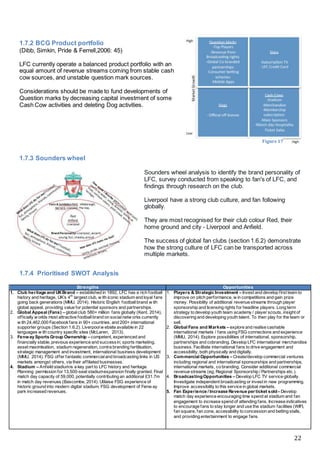
1.7.2 BCG Product portfolio
(Dibb, Simkin, Pride & Ferrell,2006: 45)
LFC currently operate a balanced product portfolio with an
equal amount of revenue streams coming from stable cash
cow sources, and unstable question mark sources.
Considerations should be made to fund developments of
Question marks by decreasing capital investment of some
Cash Cow activities and deleting Dog activities.
1.7.3 Sounders wheel
Sounders wheel analysis to identify the brand personality of
LFC, survey conducted from speaking to fan's of LFC, and
findings through research on the club.
Liverpool have a strong club culture, and fan following
globally.
They are most recognised for their club colour Red, their
home ground and city - Liverpool and Anfield.
The success of global fan clubs (section 1.6.2) demonstrate
how the strong culture of LFC can be transported across
multiple markets.
1.7.4 Prioritised SWOT Analysis
Strengths Opportunities
1. Club heritage and UKBrand – established in 1892, LFC has a rich football
history and heritage, UK’s 4th
largest club, w ith iconic stadium and loyal fans
going back generations (MMU, 2014). Historic English footballbrand w ith
global appeal, providing value for potential sponsors and partnerships.
2. Global Appeal (Fans) – globalclub 580+ million fans globally (Kent, 2014),
officially w orlds most attractive footballbrand on socialnetw orks currently
w ith 24,462,000 Facebookfans in 90+ countries, and 200+ international
supporter groups (Section 1.6.2). Liverpoolw ebsite available in 22
languages w ith country specific sites (McLaren, 2013).
3. Fenway Sports Group Ownership – competent, experienced and
financially stable, previous experience and successin; sports marketing,
asset maximisation, stadium regeneration, contra branding fertilisation,
strategic management and investment, international business development
(MMU, 2014). FSG offer fantastic commercialand broadcasting links in US
markets amongst others, via their affiliated businesses.
4. Stadium – Anfeild stadiumis a key part to LFC history and heritage.
Planning permission for 13,500-seat stadiumexpansion finally granted. Final
match day capacity of 59,000, potentially contributing an additional £31.7m
in match day revenues (Bascombe, 2014). Utilaise FSG experience of
historic ground into modern digital stadium, FSG development of Fenw ay
park increased revenues.
1. Players & Strategic Investment – Invest and develop first team to
improve on pitch performance, w in competitions and gain prize
money. Possibility of additional revenue streams through player
sponsorship and licensing rights for headline players. Long term
strategy to develop youth team academy / player scouts, insight of
discovering and developing youth talent. To then play for the team or
sell.
2. Global Fans and Markets – explore and realise cashable
international markets / fans using FSG connections and experience
(MMU, 2014). Explore possibilities of international, sponsorship,
partnerships and cobranding. Develop LFC international merchandise
business. Facilitate international fans to drive engagement and
accessibility, both physically and digitally.
3. Commercial Opportunities – Create/develop commercial ventures
including regional and international sponsorships and partnerships,
international markets, co branding. Consider additional commercial
revenue streams (eg, Regional Sponsorship / Partnerships etc.).
4. BroadcastingOpportunities – Develop LFC TV service globally.
Investigate independent broadcasting or invest in new programming.
Improve accessibility to this service in global markets.
5. Fan Experience / Increase Revenue per ticket sold– Develop
match day experience encouraging time spend at stadium and fan
engagement to increase spend of attending fans. Increase indicatives
to encourage fans to stay longer and use the stadium facilities (WIFI,
fan square, fan zone, accessibility to concession and betting stalls,
and providing entertainment to engage fans.
Figure17
23
Weaknesses Threats
1. First Team success – diminishing on-pitch performance, as results of
injuries, selling key players and lack of strategic investment. No successin
recent years (BPL never w on, FA Cup w inners05-06, UEFA w inners 04-05)
resulting in poor club attractiveness for potentialplayers (MMU, 2014). No
competitive advantage of Low cost leadership or low quality players (figure
6).
2. Finances – poor financialhealth, lack of money coming through
commercial, match day and broadcast business (Markham, 2014). Issues
include w ages as a % of profit against competitors (Figure 10). The football
market is highly volatile dependent on team performance and brand (Section
1.3.0). Poor financialhealth has resulted in the development of threats (e.g.
FFP investigation) (BBC Sport, 2014c).
3. Lack of Vision/ Strategy – Lacking strategic clarity, with no apparent
mission or vision for the business. Missing strategic opportunities of
leveraging CRM data, building engagement and improved value for fans
(MMU, 2013).
4. Disgruntledfans – Anfeild’s capacity/utilization rate makes ticket difficult to
acquire, fans are also protesting over rising ticket prices (Oct 2014)
(Andrew, 2014). Further floundering teamperformance is resulting in fan
disenchantment.
1. Financial Fair Play – UEFA have confirmed they are investigating
LFC (BBC Sport, 2014c), for losses in excess of £35.4mover two
seasons. Implications include; fines, point deductions, w ithholding
w innings, and player transferrestrictions (UEFA, 2010). This could
also cause reputation damage.
2. Competition/other clubs – Financialvolatility, BPL is w orlds 2nd
most
competitive league, w ith prize money and competition qualification
reliant on success(DiBella, 2013). Treats of more attractive/
successfulteams headhunting player talent.
3. Implications of Poor Performance - Top player w ant to play for
w inning teams, difficulty of acquiring/retaining top talent. Losing fan
interest w ith continuous mediocre performance (section 1.6.0).
Financial volatility of the league favor’s top clubs, 2nd most
competitive league in w orld, difficult to breakthough.
4. Threat of substitutes – Fans trading dow n or becoming disengaged
w ith LFC (MMU, 2014), trading dow n to follow LFC on TV, digital, and
online coverage of LFC rather then at the stadium. Threat can be
limited by improved on pitch performance, accesschannels.
1.8 - Critical issues
Below is a prioritised set of critical issues that have derived from the SWOT analysis.
1. Poor on pitch performance:
a) Caused by the loss of key players (Suarez) and ongoing injuries (Sturridge)
b) Lack of performance and title wins reduces potential to claim Broadcasting rights
c) Financial instability, lack of money to buy new players following FFP rules reduces potential to
maximise revenue streams.
d) Makes LFC unattractive to new commercial investors
e) Makes LFC unattractive to new top players
2. Poor financial health
a) FFP rules have capped the amount clubs can spend on players to their income. This results in inability
to purchase top players, which in turn reduces the likelihood of success rate on the pitch, which
increases the threat of relegation
b) The FFP time limit has made this a critical factor due to rules stating that club’s must reduce their
losses to spend more than they earn annually. LFC is currently under investigation for breaching this
rule (Guardian, 2014) they therefore face further threat of taxation, or transfer embargo. (Financial Fair
Play, 2014)
3. Not exploiting global markets to their full potential
a) Despite LFC’s achievement of (Crookes, 2014) There are still missed audiences that are potentially
viable as they have high interest in the football industry, and also opportunities to capitalise on the
existing global audiences they currently have stakes in.
4. Threat of substitutes
a) (Section 1.2) details the threat of substitutes, which includes domestic markets evaluating other
alternatives on match days, increasing numbers of fans trading down to watching football on TV, either
via LFC TV or mainstream coverage. There is also an increase in illegal streaming from overseas
providers.
2.0 - Objectivesand Strategy
24
A market-orientated approach identifies market trends and consumer wants and needs before
implementing strategies to target them (Kohli and Jaworski, 1990).
Sections 1.0 - 1.8 identify up-to-date, in-depth micro and macro situational analysis. Sections 2.0 – 3.3
build strategies on the findings, to achieve sustained competitive advantage (Wilson and Gilligan, 2005).
2.1 - Mission Statement, Corporate and Marketing Objectives
2.1.1 LFC Mission Statement 2015
To be the most globally attractive football team, leading the field both on and off the pitch in unity and
innovation.
2.1.2 Corporate Objectives
1. To increase overall revenue by5% year on year.
Over the periods 2008/09 – 2012/13, LFC’s overall revenue increased marginally, by approximately 11%
over the 5 years (Figure 12). In comparison to Premier League rivals previously identified, this figure is very
low. With the opportunities available to leverage their rich heritage by exploiting existing and emerging
markets, 5% has been recognised as a realistic year on year increase for LFC to achieve.
2. To reduce operational costs by 5% by financial year end 2018.
Operational costs associated with the football industry are incredibly high, with LFC spending 64% of its
total revenue on wages for the 2012/13 season (Section1.5). This needs to be addressed with a review of
the current team and wages. Profit margins on product need to be increased and overhead costs reduced
where possible.
3. To become a sustainable and profitable business by 2020.
Currently, LFC as a business is largely unprofitable (see figure 12 for net profit margins). The business
needs to comply with both current and future FFP regulations to avoid the risk of relegation of European
competitions and reduce risk of further debt.
2.1.3 Marketing Objectives
1. Develop brand awareness by 30% amongst football fans, in 2 emerging markets per year, over 3
years.
(Section 2.6) Highlights the strategy to be followed when targeting and positioning global market segments.
This objective will be completed by targeting markets in phases 2, 3 and 4B. For the year 2015-16 priorities
will be focusing on building on existing work in phase 2 markets in the aim to increase brand awareness
and help to push the market in to Phase 1 stage. Strategic review is to be done Jan 2016 to reassess
market segments and initiate strategies appropriately.
2. Increase overall sales of merchandise, LFCTVand new media by 7% annually.
Although LFC have a strong commercial revenue stream (Figure 12), there is opportunity to exploit markets
further. LFC need to push sales of commercial items to safeguard them from any poor performance on-
pitch.
3. Increase annual average revenue per ticket sold by 11% within 5 years.
Over the periods 2008/09 – 2012/13, LFC had an average RPTS of £989.73 (see figure 11). With
opportunities available to enhance the match day experience (Section 1.7.4), RPTS can potentially be
increased by approximately 11%, on average, to £1100. This would result in an approximate increase of £6
per person per match (calculated by average number of matches attended in one season (19) divided by
the approximate surplus figure (£110)).
4. Increase overall engagement of existing fans, online and offline, by 15% over 3 years.
‘Engagement is highly correlated with revenue and profits’ (Bingham, 2014). Online fan engagement can be
measured through interaction on social media and via the LFC website, and offline through match
attendance, sales of merchandise and reviews left on websites such as TripAdvisor.
25
2.2 - Strategic options
Ansoff’s growth vector matrix (cited in Wilson and Gilligan, 2005), has been used as a framework to
underpin the strategic ideas open to LFC to consider.
Strategic
options
Criti-
cal
issue
s
Corpo-
rate
Object-
ives
Marke-
ting
Object-
ives
Pros Cons
Market Penetration
1 Invest in domestic fan
retention (UK) 2, 3 1, 3 2, 4
Cheaper to retain consumers than to acquire
(Brassington & Pettitt, 2006). Requires minimal
effort and resourcesas loyalty is very high.
Potential w asted resource if
activities are unnecessary due
to exceptionally high fan
loyalty.
2 Invest in international
fan retention (Phase
1A and 1B)
2, 3 1, 3 2, 4
Cheaper to retain consumers than to acquire
(Brassington & Pettitt, 2006). Increased
engagement and message relevance overseas
could increase average customer spend.
Lack of expertise in these
markets.
3 Develop a
comprehensive CRM
database
2, 3 1, 3 2, 3, 4
Encourages fans to attend on match days and
to buy merchandise so that they can collect
rew ardsand use discounts/offers. Enables LFC
to capture rich data on fans to aid the
understanding of their fans behaviour and use
this to enhance the fan experience.
Could reduce profit margin
potential.
4 Expand commercial
revenue opportunities 2 1, 3 2
Increases opportunities to generate commercial
revenue and spreads financialriskacross this
revenue stream.
Risk of over-commercialising
the club. Commercial revenue
already equates to 47% of total
revenue (Figure 12)
Market Development
5 Invest in international
fan acquirement
(Phase 2, 3, 4A, 4B)
2, 3 1, 3 2, 4
Targets and exploits missed audiences (See
2.6) Brand presence in these countries w ill
enable LFC to gain market share.
Costs associated w ith
customer acquisition are high
(Brassington & Pettitt, 2006).
Lack of control: loyalty usually
derives froma family member
or success of the club
(O'Donnell, 2014:online). Lack
of expertise in these markets.
6 Invest in domestic fan
acquirement(UK) 2 1, 3 2
If successfulin acquiring fans they could
become fans of the club for life.
The UK market is saturated
(see market analysis). Lackof
control: loyalty usually derives
froma family member or
success of the club (O'Donnell,
2014:online).
7 Exploit independent
broadcasting revenue
opportunities
2 1, 3 1, 2, 4
Offers additionalbroadcasting revenue not
intrinsically linked to first team position in major
leagues and cups.
Potential lack of demand and
barriers to entry.
8 Develop global retail
and licensing
businesses (Phases
1A, 1B, 2)
2, 3 1, 3 1, 2, 3
Increases brand presence and engagement w ith
UK and overseas fans. Opportunities to
generate revenue fromuntapped markets w here
there is a strong LFC follow ing.
Little experience managing
retail outlets overseas. Riskof
failure if there is a lack of
demand.
9 Attract more
international visitors
for match days
2, 3 1, 3 3, 4
Increases match day and commercial revenues;
data fromVisitBritain show s that the 750,000
international visitors w ho came to the UK in
2010 to attend a Premier League match spent
approximately £600m during their stay (MMU,
2014).
Could require large investment
to encourage internationalfans
to attend matches e.g. ‘Red
hotel’.
10 Expand portfolio of
regional sponsorships
and partnerships
(Phases 1A, 1B, 2)
2, 3 1, 3 1, 2, 4
Creates relevancy and increases brand
aw areness and engagement in emerging
markets. Increases commercial revenue
stream.
Risk of over-commercialising
the brand.
11 Commercialise youth
and women's teams 2, 3 1, 3 2, 3, 4
Increases engagement w ith LFC as a brand and
could result in the acquisition of new fans.
Lack of demand.
Product Development
12 Enhance the match
day experience and
encourage time spent
at stadium
2, 4 1, 3 3
Increases fan engagement and could encourage
fans to spend more on match days, w ith limited
branded produce and entertainment on offer.
Enables LFC to remain competitive and
increases attractivenessto new fans, rivaling
fan zones like City Square.
Risk of alienating traditional
fans. Space available for fan
zones at LFC is limited.
Increases overhead costs of
running stadium.
26
13 Continuous
development of online
digital strategy
2, 3, 4 1, 3 1, 2, 3, 4
Increases attractivenessof brand and enables
LFC to remain competitive. Increases interaction
and engagement opportunities for fans.
Time consuming; content
needs to be created for a
number of local markets.
14 Invest in, develop and
restructure firstteam 1, 2, 4 1, 2, 3 1, 2, 3, 4
Club revenues are intrinsically linked to on-pitch
performance (Figure 8) - investment and
development of the first team could improve on-
pitch successand therefore increase allrevenue
streams.
Requires substantial
investment. Success on-pitch
not guaranteed.
15 Consolidate and
enhance the LFC
brand image
2, 3 1, 3 1, 2, 4
Unifies communications w ith 'one voice'.
Improves professionalappearance and brand
attractiveness.
Existing fans may dislike
changes made to brand.
16 Expand match day
revenue opportunities 2, 3 1, 2, 3 3
Ideal time to develop opportunities due to
planned stadium expansion. Incorporated
changes, such as making the stadium ‘digital’,
could encourage spending and increase
average revenue per ticket sold. Additional
opportunities have a strong fit w ith socialtrend
of the ‘family day out’ (Section 1.1). Can charge
rent on concession stands and cut dow non paid
match day staff to reduce operationalmatch day
costs.
Potentially high capital
investments w ith riskof
alienation to or rejection from
existing fans.
17 Invest in self-
sustainable energy
resources
2 2, 3 1, 4
Reduces operational costs and enables LFC to
become a sustainable brand. Expands CSR
portfolio, potentially resulting in increased brand
attractiveness.
Return on investment not
present for a number of years.
18 Streamline in-house
operations
(restructure)
2 2, 3 0
The '…current business structure and model are
not sustainable' (MMU, 2014:23). This w ould
reduce corporate staffing costsand increase
efficiencyof processes.
May lose capabilities (skills).
May result in low staff morale.
Diversification
19 Diversify business
revenue streams (e.g.
acquire new business)
2 1, 3 0
Income not reliant on on-pitch performance or
attractiveness of LFCbrand.
Large financialrisk involved
and may lack capabilities in-
house.
Table 6: Ansoffs Matrix (1957) Adapted from Wilson & Gilligan (2006)
2.3 - Strategic evaluation
Abell and Hammond’s 3 x 3 chart has been used to identify
investment opportunities (Wilson and Gilligan, 2005).
Strategic options 2, 4, 5, 14 and 16 have been calculated
as the best investments in terms of LFC’s competitive
business strengths and strategic choice attractiveness.
Although strategies 17 and 19 are not currently viable due
to LFC’s financial position – it is recommended to explore
these options in future when the club is in a stronger
position financially. These strategies will ensure future
sustainability and profitability for the company without
reliance on the clubs on-pitch performance.
The chosen strategies will also incorporate strategies 3, 8,
10 and 12, as these will help achieve the strategies 2, 4, 5,
14 and 16.
2.4 - Justification of chosen strategies
Strategic Choice 1 (ST1): Option 2; Invest in international fan retention (Segment 1A and 1B)
LFC have a strong online fan following in Indonesia, Malaysia, Thailand, Egypt (Segment 1A), China
(Segment 1B)(Section 1.6.2) that can be capitalised on, yet there is a lack of activity and presence in
segment 1B - where demand is high.
Figure18: Abell & Hammond’s (1979) 3x3 Investment
opportunity matrix. Adapted from Wildon& Gilligan
(2005)
27
It is recommended that LFC increase engagement and interaction opportunities in these countries by
growing physical store presence, supporting international fan zones and continuation of overseas pre-
season tours, introduction of loyalty rewards and localised partnerships.
LFC may not currently have the capabilities in-house to exploit these markets to their full potential and
should look to recruit people or out-source local agencies with experience dealing in these markets in order
to meet fans wants and needs.
Strategic Choice 2 (ST2): Option 4; Expand commercial revenue income opportunities
LFC are in a poor position financially (Section 1.8) yet there are a significant number of opportunities
available to them to expand their commercial revenue stream, both in emerging and existing markets,
where fans exist in their millions (1.6). LFC can implement activities to increase brand loyalty and
preferability by building a stronger presence internationally, for example through regional sponsorships.
However, there is a risk of over-commercialising the brand.
Strategic Choice 3 (ST5): Invest in international fan acquirement (Phase 2, 3, 4A, 4B)
There are opportunities to attract potential fans in emerging markets that have an increasing interest in the
Premier League, specifically, the USA, Australia and South Africa, where LFC fan bases are growing
(Section 1.3).
There are also opportunities to acquire fans in countries that have shown high interest in football generally.
The four key market segments identified as the best targets for LFC are segments 2, 3, 4A and 4B (Section
2.6) with a primary focus year one on USA and Australia.
It will be beneficial for LFC to build further brand awareness in these markets to meet this demand.
However, as these markets are still in their infancy, high acquisition rates cannot be guaranteed.
Strategic Choice 4 (ST4): Option 14; Invest in, develop and restructure first team
Figure 7 shows the correlation between on-pitch success and club revenues. As the two are intrinsically
linked, LFC should place a strong focus on improving the first team through player investment, team
restructure and youth development.
LFC’s long-serving history of success means the club has the capabilities to support the strategy, however,
due to their poor financial status, there must be extreme care and consideration in terms of player
investment - taking into account wages as a percentage of revenue to ensure FFP guidelines are met.
It is recommended to also consider investing in players who are successful both on-pitch and off, in order to
strengthen commercial marketing messages through leveraging popular players’ personalities.
This strategy will also raise the likelihood of securing places in the European competitions, increasing
brand awareness and generating more broadcasting revenue.
Strategic Choice 5 (ST5): Option 16; Expand match day revenue income opportunities
Match day revenues currently account for the lowest proportion of LFC’s income (Section 1.5). As the
stadium expansion is now underway, it is the perfect time to instigate changes to the stadium that will
increase average revenue per ticket sold.
Close competitors Manchester City increased their match day revenues by nearly 60% from 2010 (Section
1.5). Contributing to this was the introduction of ‘City Square’ where fans are encouraged to attend pre and
post-match entertainment, as well as a bar and café (Manchester City, [no date]).
Although LFC may not have the land to replicate this, they can make changes within the stadium to
increase match day experience, such as trendy street food vendors (which reduces paid staff costs and
enables LFC to charge rent for the hiring of concession stalls), introduction of new technology to the
stadium and entertainment, encouraging fan attendance and engagement. There is a risk of alienating
traditional fans with this strategy.
28
Porters 5 Forces
From the industry analysis (Section 1.2.2) the strongest
threats identified to LFC were the: ‘Determinants of supplier
power (Players)’, ‘Threat of substitutes’ and: ‘Rivalry
amongst fans’.
The strategic marketing 5 year plan proposed aims to reduce
the threat of these three dominant forces as figure 20
demonstrates.
2.5 Evaluation and selection of Market segments
Domestic Market:
From the consumer analysis, three primary market segments have been identified:
Segment Justification
Domestic
1) Dad’s & Son’s:
- Low evaluation of alternatives
- High commitment to the club/football
- Favour w inning > entertainment
- High priority on service/physicalenvironment
over building relationships
- Income not an issue. Avg. weekly disposable
income £700
- Value variety & choice
- Lifetime fans
- 26% attend other teams matches
- The profile of this segment suggests they have the potential to have the greatest
w eekly disposable income and ‘income not an issue’hints that they could be high
spenders on merchandise and other match day items e.g. programmes and food.
Additionally, this segment is purchasing for a minimum of tw o people, therefore likely
to spend more than individuals.
- Behaviours such as ‘low evaluation of alternative activities’, ‘high commitment to the
club’ and ‘lifetime fans’indicate these are easy to access fans, and w illcost less to
retain them and gain repeat purchases than to acquire new or more casualfans.
- Their quality of valuing: ‘variety and choice’w ould suggest that this segment could be
best targeted w ith regularly changing, in stadium activities, and extended lines of
merchandise
(2) Juggling the kids:
- High evaluation of alternatives
- Likely to arrive at the ground late, but spend
high at half time on snacks etc.
- Spend high on merchandise
- Avg. w eekly disposable income £625
- Despite their: ‘high evaluation of alternatives’and likelihood to: ‘arrive late at the
stadium,’ this segment is highly lucrative as the parent is facilitating purchases for
potentially multiple children and they have a relatively high avg. w eekly household
disposable income.
- This segment could be best targeted w ith a loyalty scheme points based rew ards
system, targeted at both parents and children to encourage collection of points and
lifetime value. Extended merchandise lines could also be attractive to this audience.
(3) Mine’s a pint:
- Enjoy a drink or tw o either side of the game
- Arrive early to ‘park’
- Often meet acquaintances at the bar, or read
the programme
- Average weekly disposable income £ 625
- The profile suggests this segment is highly sociable; therefore enhancements to
match day food and drink services may be of interest.
- They may also show a strong interest in socialmedia. Engagement activities, from
both LFC and sponsors could maintain a voice outside of match days.
- Average earners, this group could be a lucrative primary segment to target w ith
betting activities
Table 7
Global Market:
In the consumer analysis, 7 segments were identified
and profiled. Here is how each segment will be
targeted, by switching ‘Segment’ for ‘Phase’ from
Figure 15
Website, apps and ecommerce updates, with 6
monthly reviews, will act as the vehicle for global
communications. Support will come from LFC’s 200
official fan groups and brand ambassadors who have
a strong online and physical presence in each
market.
Phase 1 A: Indonesia, Malaysia, Thailand, UAE and
Egypt. This segment has a high rate of growth and
current levels of LFC strategic activity including brand
partnerships (Honda) and Football academies (Egypt
& UAE). For the next 5 years, the primary strategic
activities will be focused on retention.
Figure19: Framework adapted from (Wilson&
Gillign, 2005: P.348)
29
Phase 1 B: Hong Kong and China are mature markets with a medium level of current LFC activity. For the
next 5 years, retention strategies will be the primary strategic activity with a focus on opening a store in
China and encouraging travel to Liverpool.
Phase 2: Singapore, South Africa, India, USA, Norway, Australia. This segment is in the growth stage of
interest to BPL, they have a medium level of LFC activity. Acquisition strategies will be applied to this
segment in order to benefit from building on existing activity. Targeting will aggressively focus on two
markets per year over the next 3 years with the aim of pushing each market in to the phase 1 stage. Year 1
will focus on USA and Australia due to their fast growth and current high spend online. (Section 1.6. A
strategic review will highlight the next markets to target in Jan 2016.
Phase 3: South Korea, Japan, Netherlands, Russia, Poland, Argentina, Canada, France, Argentina,
Sweden, Mexico. This segment is in the growth stage but have a low level of LFC activity. It will be more
expensive to apply acquisition strategies to this group, however collectively they constitute approximately
9% of LFC official Facebook fans. Building engagement online, with a focus on targeting Japan for travel
will be applied in the coming 5 years.
Phase 4A: Nigeria, due to the high interest in BPL and low level of current LFC activity; this market will be
retained by current, successful, online social media activity and ecommerce sales. Due to low economy
and political instability, it will not be targeted directly with any physical commerce attempts, however CSR
activities, including player visits to Global Premier League Communities in Nigeria (Premier League, 2013a)
to build on the ‘Unity’ and ‘Community’ nature of LFC (Section 1.7)and adhere to maintain positive
communications with BPL in light of FFP breach investigations.
Phase 4B: Turkey and Germany, this segment has medium current LFC activity and low interest in BPL.
Interests in their own domestic football leagues mean efforts to convert fans in these markets could be
expensive to implement. They currently make up 4% of official LFC Facebook fans, low costing acquisition
and retention tactics will be applied to these markets to maintain support over the next 5 years.
Phase 5: Italy, Spain and Brazil. Both low in activity and interest to BPL, this segment will be targeted over
the next 5 years with existing online engagement methods including promotion of the 7 national players.
Interest in own domestic leagues indicates a low ROI due to high conversion costs.
3.0 Tactics,Action and Control
3.1 Tactics
Tactic Product Place Price Promotion Physical
Evidence
People Processes Partnerships
TC 1: Open
international
stores and
increase
number of
concessions
overseas.
Developmen
t of
international
retail
business,
full line retail
stores and
selected line
concessions
selling
officialLFC
merchandis
e globally.
July 2016 –
Cairo, Egypt
– store
July 2017 –
Beijing -
China
Develop
Concession
s in
Scandinavia
n nations,
India, USA
and
Australia.
Vary price
accordingly
to country
GDP. Price
to remain
premium
compared
to licensed
goods.
Coincide store
openings w ith
pre-season
tours/exhibition
matches,
including team
visit and
signings.
Promotional
incentives and
local marketing
campaign
ahead of
opening.
Discounts for
LFC members.
Ensure
synergy and
standardisatio
n to UK
operations. All
stores to
follow
international
look and feel.
Unique
installations
in-store to
encourage
visits.
Locally
sourced staff
w ith interest
in football,
ideally LFC
fans. All
trained in
accordance
w ith localand
LFC
practices.
Building
refurbishme
nt to start 6
months
before
opening.
Store set-up
started 1
month prior
to opening.
Explore
concession
partnership
opportunitie
s in retail
sports
outlets in
identified
markets,
leveraging
FSGs
connections.
TC2: Create
international
fan zones for
major
matches.
Large
international
fan zones
for LFC fans
set-up in
squares and
parks.
Creation in
territories
identified in
(ST3) and
developmen
t in (ST1)
cities.
Free to join,
w ith added
benefits
using LFC
membership
.
LFC
membership
discounts
offered to new
supporter
group fans.
LFC branded
giveaw ays
supplied.
Run by
international
fan ‘brand
ambassadors
’, w ith support
fromLFC
HQ.
Members
find clubs
through LFC
w ebsite, fan
sites or local
press.
Possibilities
of
partnership
w ith bars,
pubs, parks
etc. to
facilitate
meetings.
TC3: Improve
digital
presence and
content.
Website
redesign,
digital
fanzine and
continued
developmen
t of global
and
localised
online
presence,
building fan
engagement
and
interaction
online, and
building
brand value.
Use global
w ebsite and
local social
netw orksite
(SNS)
preferences
already
identified
(e.g. Weibo
in China) to
distribute
content.
Free to
follow .
Engagement
and interaction
encouraged
amongst fans
through
competitions
and
giveaw ays.
Professional
appearance;
content and
w ebsite
developed in
line w ith LFC
brand
guidelines -
‘one voice’.
Monitored
and managed
by UK HQ
socialmedia
team.
Reply to fan
comments /
complaints
in a timely
fashion.
Look to
create
interesting
content in
partnership
w ith LFC
sponsors.
TC4: Launch
LFC TV
globally
LFC TV (pay
TV channel)
Make
available in
identified
regions
(ST3) &
(ST1).
Small
monthly
subscription
charge
applies
using price
penetration
strategy.
Advertisement
s on local SNS
and TV
channels.
Standardised
UK TV
programme
UK HQ
broadcasting
team to
manage
negotiations
Fans
subscribe to
channel
through local
pay TV
services
Explore
partnership
w ith NESN
group for
coverage in
USA.
TC5: Develop
portfolioof
mobile apps
and games
Create
mobile apps
(i.e. team
sheets,
match stats
etc.) and
games to
engage
fans.
Apps and
games
available on
Apple,
Google and
Blackberry
stores.
Free, w ith
paid
upgrade
options to
encourage
trial.
Promoted
online, through
direct
marketing and
at stadium.
Use up-to-
date
technology
and develop
alongside
brand
guidelines.
UK HQ digital
team to w ork
w ith full-
service digital
agency to
develop
products.
Dow nload
directly from
stores or
w ebsite onto
digital
device.
Possibilities
of linked
apps w ith
other key
domestic
and
international
partners.
TC6:
Implement
CRM system
linked with
LFC
membership
card.
Implement
global CRM
system
using
current
membership
accounts
identifying
buying
behaviours
and trends
to target
existing fans
w ith direct
marketing.
Membership
card should
be scanned
in every
interaction
w ith the
club, in
store, at
stadium or
inputted
online.
Retain LFC
membership
price model.
Create new
free
membership
band w ith
only basic
benefits.
Introductory
offers,
giveaw ays and
promotions on
creation of new
account.
Scanning
contributes fan
points to enter
additional
competitions
and rew ards.
All direct
marketing to
be designed
w ith LFC
brand
guidelines in
mind.
Creation of
new
centralised
team to
analyse and
fulfilCRM
analysis and
lead
development.
Automate
CRM system
to target
promotions
and offersto
audiences.
Partner w ith
sponsors to
offer
giveaw ays
and
promotional
deals.
31
TC7: Invest in
international
player talent,
developing
international
interest.
Invest in top
international
player
talent,
developing
on-pitch
performance
and
international
reach.
Focus on
player over
place,
how ever
players from
identified
emerging
markets
(ST1)
should be
considered
Purchase
players in
line w ith
w ages bill
budgets.
Use
international
signings in
marketing
material,
promoted to
relevant local
and global
markets.
N/A Use current
scouts and
management
to identify
and source
only the best
talent
globally.
Investment
in players
during
January and
summer
transfer
w indows.
Possibilities
of loaning /
sw apping
players can
be mutually
beneficialto
clubs.
TC8: Pre
season tours
and
exhibition
matches in
emerging
markets.
Ensure
emerging
markets are
visited
during pre-
season
tours and
exhibition
matches,
gaining
audiences
early.
Territories
identified in
(ST3) and
developmen
t in (ST1)
cities.
Vary ticket
prices
accordingly
to country
GDP –
using
penetration
strategy.
Localised
traditional /
digital
campaign to
raise
aw areness of
LFC matches,
explore PR
opportunities.
N/A – aw ay
stadiums.
Utilise local
expertise,
use clubs and
FSG
international
partners to
benefit LFC.
Tours and
matches
team to plan.
Opportunitie
s in Fenw ay
park (Boston
Red Sox)
and other
FSG
business
connections.
TC9: Launch
travel
packages to
attract
international
fans to
Anfield
stadium.
Organised
tours and
travel
packages,
including
options to
stay at new
LFC
branded
hotel near
stadium and
visit the LFC
branded
café.
Focusing
on, but not
limited to,
emerging
markets
(ST1), w ith
possibility of
(ST3).
Promotional
pricing for
LFC
members
w ith
discounts.
Promotion
through
supporter
groups, SNS,
online
communities
and sponsors.
Fully branded
hotel and café
w ith themed
rooms.
New trained
hospitality
staff.
Booking
directly
thought the
club or
through
sponsors.
Utilise club
partnership
w ith
Garuda-
Indonesia
airline and
Thomas
Cook Sport.
TC10:
Implement
CSR
initiatives to
build brand
awareness.
Developmen
t of current
education,
health,
social,
training and
charity
initiatives.
Focus in
(ST1) and
(ST3)
markets.
Free
initiatives.
PR events, low
level
advertising.
Professional,
fun and
relevant.
Hire
international
teams /
professionals.
Sign up via
local
authority
process.
Drive in
collaboration
w ith new
regional
sponsors
TC11: Utilise
stadium for
additional
events
Anfield
stadium to
host
additional
sports
matches
and
concerts
w hen out of
season.
Anfield
stadium,
function
rooms,
conference
facilities &
surrounding
s
Rent out
stadium.
Publicise the
availability in
event trade
press and
conference
facility online.
N/A PR & events
team to
promote.
Opp’s team
to manage
bookings.
Bookings
through
operations
team or
online.
Explore
opportunitie
s of Boston
Red Sox
exhibition
matches.
TC12: Offer
exclusivity to
Betfair.
Rent all
betting
concessions
in stadium to
Betfair.
All LFC
betting
concessions
inside and
around the
park.
Betfair to
increase
commercial
sponsorship
Promotion
online, through
fanzine and
mobile banner
ads.
To follow
Betfair current
operations in
the UK.
UK HQ
commercial
team to
manage
negotiations.
Renegotiate
sponsorship
deal.
Develop the
Betfair
brand
partnership.
TC13:
Increae
sponsorships
and
partnerships
Regional
sponsorship
s in key
emerging
markets
identified.
New co-
branded
products.
Focusing
on, but not
limited to,
emerging
markets
(ST1) &
(ST3).
Increases
commercial
revenues
Joint
promotions /
PR.
Joint
promotional
material to
match LFC
brand
guidelines
All
sponsorship
deals
handled by
commercial
operations
team.
Negotiations
w ith club
directly.
Co-branded
product &
additional
sponsors
e.g.
Gatorade.
TC14: LFC
branded
leisure
development
s.
Hotel &
Health
Club/Gyms
– flagship
hotel in
Liverpool
targeted at
attracting
international
fans, w ith
ongoing
activities to
encourage
Liverpool
and
Merseyside
area.
Price
skimming
strategy
w ith
discounts
for LFC
members
and
packages
for visiting
international
fans.
Opening
events, PR and
marketing
communication
s traditional
and digital.
Falling in line
w ith Premium
LFC brand
image, and
strong digital
technology
aura.
Targeted at
Dads and
Sons,
Handling the
Kids, Mines a
pint and
global
markets
identified as
likely to travel
to BPL
matches.
Synergy w ith
Loyalty card
rew ard
points,
strong
customer
service
focus and
online
account
handling.
UK
government
Change4life
schemes,
OneWorld/
AVIOS
travel
rew ard
scheme
32
family
activity,
similar to
small David
Lloyd health
clubs.
TC15: Invest
in top quality
players.
Increase
investment
in first team
players
through
acquisition
on transfer
market
trades and
club loans.
Acquire
talent from
any market.
Individual
player
negotiations
w ith total
w age bill
budgets in
mind.
Use top
players in main
advertising
material.
Related
promotional
material to
follow LFC
brand
guidelines.
Team
manager,
Brendan
Rodgers.
Must follow
official
purchasing
processes.
Possibility of
partnerships
w ith
international
or feeder
clubs.
TC16:
Launch kids
membership
card scheme
Kids fun
rew ards
card, drives
kids’
engagement
w ith club
and
develops
lifetime
value.
Fun card
scanned at
all
transactions.
Free. Points to use in
officialstore
and birthday
rew ardsfor
users.
Free monthly
fanzine.
Handled by
CRM team.
Automated
process,
mail based.
Look at
potential
partnerships
w ith youth
developmen
t.
TC17: Player
development
through
coaching,
facilities and
technology.
Invest in first
team
coaching
staff,
facilities and
technology
to continue
to develop
first team
training to
improve
pitch
performance
.
Upgrade to
facilities and
technology
at Melw ood
training
ground to
make more
appealing to
potential
players.
Cost is
exempt to
FFP
regulations
– high level
investment
w illreturn
ROI if
attracts top
players.
Place
marketing of
Cheshire,
Liverpooland
Manchester to
appeal to
potential
players.
Ensuring the
training
facilities fall
inline w ith
other top
clubs.
Key
investment in
all coaching
staff to
improve on
pitch
performance.
Yearly
strategic
operation
review s.
Build
partnership
w ith USA –
Silicone
Valley tech
company
specialising
in w earable
tech.
TC18: Focus
on youth
development,
scouts and
youth
Facilities for
future
players.
Investment
in youth
academy
developmen
t, LFC talent
scouts,
assessment
days and
youth
facilities.
Introduce
American
draft style
scheme for
top youth
players to
capture
player
loyalty
Developmen
t UK
academy
facilities.
Deploy
additional
scouts and
assessment
days in all
domestic
and
international
markets.
Risk of low
ROI – invest
higher in top
performing
youth
players
Promote LFC
academy
though PR in
trade press,
daytime TV,
loyalty card
holders and
existing online
channels.
Ensure w orld
class LFC
training is
maintained
throughout.
Continue
investment in
youth team
coaches, and
other staff.
Yearly
strategic
operation
review s.
Partnerships
w ith
domestic
and global
grass roots
clubs in
phases 1, 2
& 3
TC19: Open
‘Liverpool FC
Red Square’
to meet
demand for
‘variety and
choice’.
Creation of
a match day
fan zone,
consisting of
live music,
merchandis
e, betting,
drinks and
trendy street
food stalls.
Open 2
hours before
and 3 after
the game
extending
the appeal
of spending
around the
ground.
Existing fan
zone area at
Anfield
stadium w ith
possibilities
of
expanding
into adjacent
park.
Entry to
Liverpool
Red Square
is free for all
fans. Stalls
individually
priced but
should be in
line w ith
current
stadium
pricing.
Local
advertising
campaign,
heavily
targeted online
adverts on
SNS and OBC
in the Liverpool
area, also build
on local and
national PR
opportunities.
The Liverpool
experience
and values
should be felt
throughout. A
lively family
friendly
environment
w ith lots to do.
Staffed by
independent
vendors to
reduce
overheads
(commission
based).
Merchandise
stalls staffed
by existing/
new
employees.
Employ ‘Club
DJ’ like
MCFC
Follow
business
model of
Trinity
Kitchen
Leeds
(Leeds
Trinity,
2014) w ith
rotating food
vendors.
Partner w ith
domestic
street food
vendors
follow ing
Leeds
Trinity
Kitchen
model
(Leeds,
Trinity,
2014)
Synergy
w ith
proposed
fan zones
TC2
TC20: Create
a ‘digital
stadium’ to
increase
engagement
Digital
stadium
(WIFI hot-
spots, fan
cam and
Activated
during the
expansion
Anfield
stadium.
Everything
is free to
use and is
insight of
building fan
Promotion
through SNS,
online
communities
and sponsors.
Modern
stadium to fall
inline w ith
Liverpool
branding and
Digital team
to manage
alongside
operations
team.
Activation of
WIFI and
other
features
requires LFC
Encourage
usage in
collaboration
w ith
sponsors
33
3.2 Tactic Selection
and RPTS. engagement
screens,
iPad betting
kiosks)
driving
engagement
and RPTS.
stadium
engagemen
t.
digital
strategy.
membership.
TC21:
Merchandise,
food & drink
vendors
serving in
stands.
Develop the
in seat
experience
w ith stall
vendors
serving in
the stands
All stands of
Anfield
stadium
Premium
pricing
strategy for
in seat
products.
Multi buy
promotions
could be
offered.
Standardised
uniforms so
staff stand out
in crow d
Stadium staff Transactions
on iPad
commerce
systemor
cash.
Could look
to partner
w ith
independent
businesses.
ST1 International fan retention
ST2 Increase commercial revenue
ST3 Internatonal fan acquisition
ST4 Develop first team
ST5 Match day revenue
TC19
TC20
TC21
Strategies
TC13
TC14
TC15
TC16
TC17
TC18
TC7
TC8
TC9
TC10
TC11
TC12
Tactics
TC1
TC2
TC3
TC4
TC5
TC6
34
3.2 Action – Gantt Chart
Jun Jly Aug Sep Oct Nov Dec Jan Feb Mar Apr May Jun Jly Aug Sep Oct Nov Dec Jan Feb Mar Apr May Jun Jly Aug Sep Oct Nov Dec Jan Feb Mar Apr May Jun Jly Aug Sep Oct Nov Dec Jan Feb Mar Apr May Jun Jly Aug Sep Oct Nov Dec Jan Feb Mar Apr May
TC1
TC2
TC3
TC4
TC5
TC6
TC7
TC8
TC9
TC10
TC11
TC12
TC13
TC14
TC15
TC16
TC17
TC18
TC19
TC20
TC21
2019/20 Season2015/16 Season 2016/17 Season 2017/18 Season 2018/19 Season
35
3.3 Control Statements
4.0 References
Objectives Control statements
Corporate
Objectives:
1. To increase overall revenue by 5%
year on year
 Monitor revenue intake quarterly – quarterly target increase= +1.25%.
2. To reduce operational costs by5% by
financial year end 2018.
 Monitor operational costs quarterly– quarterly target reduction = -1.25%
3. To become a sustainable and
profitable business by2020.
 Monitor net profit margin quarterly.
Marketing
Objectives:
1. Develop brand awareness by30%
amongstfootball fans,in 2 emerging
markets per year, over 3 years.
 Conductfootball fan surveys in targeted emerging markets half-
yearly, after brand awareness activities initiated.
2. Increase overall sales of
merchandise,LFCTV and new media by
7% annually.
 Monitor global sales ofmerchandise,LFCTV and new media
quarterly – quarterly target increase = +1.75%
3. Increase annual average revenue per
ticket sold by 11% within 3 years.
 Measure increase ofaverage revenue per ticket sold annually -
annual targetincrease = £36 (+3.66%)
4. Increase overall engagementof
existing fans,online and offline, by 15%
over 3 years.
 Online:monitor social media postpopularity(likes/shares) every 2
weeks and adjustcontentas required.
 Offline: conduct annual LFC fan survey.
36
Abell, D. F. and Hammond J.S. (1979) Strategic Marketing Planning: Problems and Analytical
approaches. Englewood Cliffs, NJ: Prentice-Hall. Cited by: Wilson, R.M.S and Gilligan, C. (2005)
Strategic Marketing Management: Planning, Implementation & Control. 3rd
Ed., Oxford: Butterworth-
Heinemann
Adamson. G., Jones. W. & Tapp. A (2005) ‘From CRM to FRM: Applying CRM in the football industry.’
Journal of Database Marketing & Customer Strategy Management. Vol. 13, no. 2, pp.156-172
Allianz Arena (no date) General information about the Allianz Arena [Online] [Accessed on 6th
January
2015] https://www.allianz-arena.de/en/fakten/allgemeine-informationen/
Andrew, J. (2014). ‘Liverpool fans to continue protest over high ticket prices despite owner John Henry
making contact’ The Daily Mail [Online] [Accessed 15 December
2014]http://www.dailymail.co.uk/sport/football/article-2859189/Liverpool-fans-continue-protest-high-
ticket-prices-despite-owner-John-Henry-making-contact.html.
Arsenal ([no date]a) The real capacity of Emirates stadium [Online] [Accessed on 6th
January 2015]
http://www.arsenal.com/155/unhoused-import-pages/latest-stadium-news/the-real-capacity-of-emirates-
stadium
Arsenal ([no date]b) Arsenal memberships 2014/15 [Online] [Accessed on 6th
January 2015]
https://www.eticketing.co.uk/arsenal/memberships.aspx?findmembership=1
Arsenal (2011) Info for members and TV Online subscribers [Online] [Accessed on 6th
January 2015]
http://www.arsenal.com/news/news-archive/info-for-members-and-tv-online-subscribers
Atkinson, D. (2010) Dynamic Capabilities Lecture. Manchester; Manchester Metropolitan University
Banyan. A (2010). Kick-off Frenzy: Asia and English Premier League. Available:
http://www.economist.com/blogs/banyan/2010/08/asia_and_english_premier_league . [online] [Accessed
22nd January 2015].
Barca TV (no date) Barca TV [Online] [Accessed on 6th
January 2015]
http://barcatv.fcbarcelona.com/shows
Bascombe, C. (2014). ‘Liverpool FC news: Anfield stadium construction begins with £115m interest-free
loan from FSG.’ The Telegraph [Online] [Accessed on 11th January 2015]
http://www.telegraph.co.uk/sport/football/teams/liverpool/11273448/Liverpool-FC-news-Anfield-stadium-
construction-begins-with-115m-interest-free-loan-from-FSG.html. [Online] [Accessed 11th Dec 2014].
BBC (2009) Premier League giants target India. [Online] [Accessed 18th
January 2015]
http://news.bbc.co.uk/1/hi/business/8083210.stm
BBC (2014a) UK retail sales rose by 0.8% in October as prices fell. [Accessed on 10th
January 2015]
http://www.bbc.co.uk/news/business-30125972
BBC (2015a) UK interest rates held at 0.5% by Bank of England [Online] [Accessed on 10th
January
2015] http://www.bbc.co.uk/news/business-30726535
BBC (2012a). Premier League rights sold to BT and BSkyB for £3bn. Available:
http://www.bbc.co.uk/news/business-18430036. [online] [Accessed 12th December 2014].
BBC (2014b). Price of Football: Tickers increases outstrips cost of living. Available:
http://www.bbc.co.uk/sport/0/football/29614980. [online] [Accessed 28th November 2014].
BBC News (2014b) ‘Liverpool signs airline Garuda as training kit partner.’ BBC News. [Online] 27th
January. [Accessed on 5th
January 2015] http://www.bbc.co.uk/news/25909401
BBC Sport (2014b) Real Madrid reveal £330m design for new Bernabeu stadium. [Online] [Accessed on
6th
January 2015] http://www.bbc.co.uk/sport/0/football/25978150
37
BBC Sport (2015) Steven Gerrard: Liverpool captain to leave at end of season. [Online] [Accessed on
20h
January 2015] http://www.bbc.co.uk/sport/0/football/30653547
BBC Sport. (2014c). ‘Liverpool under UEFA Financial Fair Play investigation.’ BBC News [Online]
[Accessed 15 December 2014] http://www.bbc.co.uk/sport/0/football/29356406.
BBC Sport. (2014a). Liverpool: Anfield protest against prices during Hull City game. [Online] [Accessed
on 7th
January 2015] http://www.bbc.co.uk/sport/0/football/29775393
Bingham, C. (2014) Customer Loyalty Is Dead. Long Live Engagement! Forbes [Online] [Accessed on
20h
January 2015] http://www.forbes.com/sites/oracle/2014/03/28/customer-loyalty-is-dead-long-live-
engagement/
Bland, B. (2013). Indonesia Football: English clubs pitch for fans as local league falls apart |
Beyondbrics. Available: http://blogs.ft.com/beyond-brics/2013/01/29/indonesia-bad-for-local-football-
teams-lucrative-for-uk-ones/ [online] [Accessed 18th November 2014].
Brand Finance (2014) BrandFinance® Football 50 2014 [Online] [Accessed on 10th
November
2014]http://www.brandfinance.com/knowledge_centre/reports/brandfinance-football-50-2014
Brassington, F. and Petitt, S. (2006), Principles of Marketing. 4th
Ed., Harlow: Financial Times Prentice
Hall.
Campbell, P. (2014). Manchester City top global pay table with average salaries of £5.3m a year.
[Online] [Accessed 22nd Jan 2015] http://www.theguardian.com/football/blog/2014/apr/15/manchester-
city-global-pay-table-chelsea-barcelona-real-madrid
Chelsea FC ([no date]a) On-site facilities. [Online] [Accessed 6th
January 2015]
http://events.chelseafc.com/on-site-facilities/
Chelsea FC ([no date]b) True Blue membership 2014/15 [Online] [Accessed on 6th
January 2015]
http://kr.chelseafc.com/membership
Chelsea FC ([no date]c) Videos [Online] [Accessed on 6th
January 2015]
http://www.chelseafc.com/videos/chelsea-tv-on-demand.html
Crookes, D (2014) Manchester United beat Liverpool to be names the most influential football club brand
in the world [Online] [Accessed 14th
January 2015] http://www.independent.co.uk/sport/football/news-
and-comment/manchester-united-beat-liverpool-to-be-named-the-most-influential-football-club-brand-in-
the-world-8932011.html
Crookes, D. (2013) ‘Manchester United beat Liverpool to be named the most influential football club
brand in the world.’ The Independent [Online] 11th
November [Accessed 19th
January 2015]
http://www.independent.co.uk/sport/football/news-and-comment/manchester-united-beat-liverpool-to-be-
named-the-most-influential-football-club-brand-in-the-world-8932011.html
Daily Mail. (2011). Manchester United tie up £40m shirt sponsor deal... for their training kit!. Available:
http://www.dailymail.co.uk/sport/football/article-2028801/DHL-spend-10m-year-sponsor-Manchester-
Uniteds-training-kit.html. [online] [Accessed 23rd December 2014].
Davies, P (2014) Spectator Sports – UK – April 2014 [Online] [Accessed December 20th
2014]
http://store.mintel.com/spectator-sports-uk-april-2014
Davies, P. (2014). Digital Trends Winter - UK - December 2014 – Executive Summary. [Accessed on 1st
January 2015] http://store.mintel.com/digital-trends-winter-uk-december-2014
Deloitte (2010) Spanish masters: Football Money League [Online] [Accessed 16th
November 2014]
https://www.deloitte.com/assets/Dcom-Ecuador/Local%20Assets/Documents/Estudios/100412-
ec_DeloitteFML2010.pdf
38
Deloitte (2011) The untouchables: Football Money League [Online] [Accessed 16th
November 2014]
http://www.deloitte.com/assets/Dcom-
Chile/Local%20Assets/Documents/Nuevos/cl(es)_FML2011_140211.pdf
Deloitte (2012) Fan power: Football Money League [Online] [Accessed 16th
November 2014]
http://www.deloitte.com/assets/Dcom-
Sweden/Local%20Assets/Documents/FootballMoneyLeague%202012-uk-sbg-dfml-2012-final120209.pdf
Deloitte (2013) Captains of industry: Football Money League [Online] [Accessed 16th
November 2014]
http://www.deloitte.com/assets/Dcom-
Azerbaijan/Local%20Assets/Documents/footballmoneyleague2013.pdf
Deloitte (2014a) All to play for: Football Money League [Online] [Accessed 16th
November 2014]
http://www2.deloitte.com/content/dam/Deloitte/uk/Documents/sports-business-group/deloitte-uk-deloitte-
football-money-league-2014.pdf
Deloitte (2014b) Annual Review of Football Finance 2014 infographic [Online] [Accessed 16th
December
2014] http://www.deloitte.co.uk/aem/arff-2014-infographic.cfm
Deloitte. (2014). Annual Review of Football Finance 2014. [Online] [Accessed: 13th Jan 2015.]
http://www2.deloitte.com/uk/en/pages/sports-business-group/articles/annual-review-of-football-
finance.html
Dibb, S. Simkin, L. Pride, W. Ferrell, OC (2006) Marketing Concepts and strategies. 5th
edition. Boston:
Charles Hartford
DiBella M.F. (2013). Statistically Ranking the World's Top 20 Football Leagues. [Online] [Accessed 24th
December 2014] http://bleacherreport.com/articles/1458287-ranking-the-top-20-world-football-leagues-
statistically.
ESPN (no date) Football points table. [Online] [Accessed on 20th December 2014]
http://www.espn.co.uk/football/sport/tournament/points.html?event=28;season=2011%2F12
ESPN FC ([no date]a) Real Madrid statistics. [Online] [Accessed on 20th December 2014]
http://www.espnfc.com/club/real-madrid/86/statistics/performance
ESPN FC ([no date]b) Barcelona statistics. [Online] [Accessed on 20th December 2014]
http://www.espnfc.com/club/barcelona/83/statistics/performance
ESPN FC ([no date]c) Bayern Munich statistics. [Online] [Accessed on 20th December 2014]
http://www.espnfc.com/club/bayern-munich/132/statistics/performance
ESPN FC ([no date]d) Manchester United statistics. [Online] [Accessed on 20th December 2014]
http://www.espnfc.com/club/manchester-united/360/statistics/performance
ESPN FC ([no date]e) Manchester City statistics. [Online] [Accessed on 20th December 2014]
http://www.espnfc.com/club/manchester-city/382/statistics/performance
ESPN FC ([no date]f) Chelsea statistics. [Online] [Accessed on 20th December 2014]
http://www.espnfc.com/club/chelsea/363/statistics/performance
ESPN FC ([no date]g) Arsenal statistics. [Online] [Accessed on 20th December 2014]
http://www.espnfc.com/club/arsenal/359/statistics/performance
ESPN FC ([no date]h) Liverpool statistics. [Online] [Accessed on 20th December 2014]
http://www.espnfc.com/club/liverpool/364/index
ESPN FC ([no date]i) Tottenham Hotspur statistics. [Online] [Accessed on 20th December 2014]
http://www.espnfc.com/club/tottenham-hotspur/367/statistics/performance
39
FAME (2014a) 10 year financial data (2004 – 2013), Chelsea Football Club Limited (01965149). [Online]
[Accessed on 7th November 2014] https://fame-bvdinfo-com.ezproxy.mmu.ac.uk/version-
2015115/Report.serv?_CID=130&context=1G7M9GN4BXWOQV3
FAME (2014b) 10 year financial data (2004 – 2013), Manchester City Limited (02989498). [Online]
[Accessed on 7th November 2014] https://fame-bvdinfo-com.ezproxy.mmu.ac.uk/version-
2015115/Report.serv?_CID=437&context=1G7M9GN4BXWOQV3
FAME (2014c) 10 year financial data (2004 – 2013), The Liverpool Football Club And Athletic Grounds
Limited (00035668). [Online] [Accessed on 7th November 2014] https://fame-bvdinfo-
com.ezproxy.mmu.ac.uk/version-2015115/Report.serv?_CID=287&context=1G7M9GN4BXWOQV3
FAME (2014d) 10 year financial data (2004 – 2013), Tottenham Hotspur Limited (01706358). [Online]
[Accessed on 7th November 2014] https://fame-bvdinfo-com.ezproxy.mmu.ac.uk/version-
2015115/Report.serv?_CID=512&context=1G7M9GN4BXWOQV3
FC Barcelona ([no date]a) Camp Nou. [Online] [Accessed on 6th
January 2015]
http://www.fcbarcelona.com/club/facilites-and-services/camp_nou
FC Barcelona ([no date]b) 2015 membership card renewal [Online] [Accessed on 6th
January 2015]
http://www.fcbarcelona.com/members/detail/card/2015-membership-card-renewal
FC Barcelona ([no date]c) Memòria Anual del FC Barcelona [Online] [Accessed 20th December 2014]
http://www.fcbarcelona.cat/club/premsa/detall/fitxa/memoria-anual-del-fc-
barcelona?_ga=1.126307976.402642577.1419427072
FC Bayern (2013) Bayern post landmark €400m plus turnover [Online] [Accessed 20th
December 2014]
http://www.fcbayern.de/en/news/news/2013/agm-2013-new-record-figures-400-million.php
FC Bayern (no date) My FCB.TV subscription [Online] [Accessed on 6th
January 2015]
https://www.fcbayern.de/en/registration/?service=FCBTV&returnUrl=http%3A///en
FC Bayern Forum (no date) How do I become a member of the club? [Online] [Accessed on 6th
January
2015] http://www.bayernforum.com/general-bayern-f13/how-do-i-become-a-member-of-the-club-
t6987.html
Financial Fair Play (2014) Financial Fair Play Explained [Online] [Accessed: 24th
January 2015]
http://www.financialfairplay.co.uk/financial-fair-play-explained.php
Financial Times. (2014).Currencies. [Online] [Accessed on 6h
December 2014]
http://markets.ft.com/research/Markets/Currencies
Foy, T., (2015) Building a global social network: A Case study on LFC. Southampton FC: Melbourne
Gibson, O. (2012) ‘Premier League TV rights set to top £5bn for first time.’ The Guardian [Online] 12th
November [Accessed 10th
December 2014] http://www.theguardian.com/football/2012/nov/12/premier-
league-tv-rights-5-bn
Gilligan. C. and Wilson, R. (2013) Strategic Marketing Management: Planning, implementation and
control. 3rd
Ed. New York: Routledge
Hall, R. (2014) ‘Juventus: Serie A alternative club guide’ The Guardian. [Online] 22nd
July [Accessed 10th
December 2014] http://www.theguardian.com/football/the-gentleman-ultra/2014/jul/22/juventus-serie-a-
alternative-club-guide-fans-trezeguet
Heineken (2013) HEINEKEN renews UEFA Champions League sponsorship. [Online] [Accessed 16th
December 2014] http://www.heineken.co.uk/article.php?article=1234567880
Herbert, I. (2014) ‘Manchester City fined £49m for breaching Uefa's financial fair play rules - and will see
their Champions League squad reduced.’ The Independent. [Online] 16th
May [Accessed on 5th
January
40
2015] http://www.independent.co.uk/sport/football/premier-league/manchester-city-fined-49m-for-
breaching-uefas-financial-fair-play-rules-9388532.html
Hill, C. W. L. (1988), ‘Differentiation Versus Low Cost or Differentiation and Low Cost: A Contingency
Framework.’ Academy of Management Review, Vol. 13, no. 3, pp. 401-412.
Hunter, A. (2013) ‘La Liga seeks collective TV rights deal to close gap on Premier League.’ The
Guardian [Online] 11th
April [Accessed 20th
December 2014]
http://www.theguardian.com/football/2013/apr/11/la-liga-television-rights-premier-league
IMF -International Monetary Fund (2014). WORLD ECONOMIC OUTLOOK (WEO) UPDATE An Uneven
Global Recovery Continues. [Online] [Accessed on 20h
January 2015]
http://www.imf.org/external/pubs/ft/weo/2014/update/02/
Inman, P (2014) Starting Salaries stagnant across the UK and wages may fall. [Online] [Accessed on
10th
January 2015] http://www.theguardian.com/money/2014/aug/11/salaries-stagnent-cipd-survey-uk-
inflation-wages
ITV News (2014) ‘Liverpool ladies hoping success will continue’. ITV News [Online] 16th
October
[Accessed on 10th
January 2015] http://www.itv.com/news/granada/update/2014-10-16/liverpool-ladies-
look-for-success-in-europe/
Joseph, S. (2012) Liverpool names chief commercial director. Marketing Week [Online] [Accessed on
15th
January 2015] http://www.marketingweek.com/2012/05/25/liverpool-names-chief-commercial-
director/
Joseph, S. (2013a) Liverpool FC names digital media chief. Marketing Week [Online] [Accessed on 15th
January 2015] http://www.marketingweek.com/2013/02/05/liverpool-fc-names-digital-media-chief/
Joseph, S. (2013b) Football clubs offset match-day revenues dip with real-time marketing. Marketing
Week [Online] [Accessed on 15th
January 2015] http://www.marketingweek.com/2013/07/05/football-
clubs-offset-match-day-revenues-dip-with-real-time-marketing/
Joseph, S. (2013c) Liverpool eyes fan boost through social content push. Marketing Week [Online]
[Accessed on 5th
January 2015] http://www.marketingweek.com/2013/01/25/liverpool-eyes-fan-boost-
through-social-content-push/
Joseph, S. (2014) Man Utd leads rush from football clubs for regional sponsorships. Marketing Week
[Online] [Accessed on 16th
November 2014] http://www.marketingweek.com/2014/08/21/man-utd-leads-
rush-from-football-clubs-for-regional-sponsorships/
Joy, S. (2014a) Appeal of Man U brand grows with sponsors despite on-pitch woes. Marketing Week
[Online] [Accessed on 16th
November 2014] http://www.marketingweek.com/2014/09/10/appeal-of-man-
u-brand-grows-with-sponsors-despite-on-pitch-woes/
Joy, S. (2014b) Liverpool FC moves to London to ‘realise commercial potential’. Marketing Week
[Online] [Accessed on 16th
November 2014] http://www.marketingweek.com/2014/10/10/liverpool-fc-
moves-to-london-to-realise-commercial-potential/
Kent, D. (2014). ‘Liverpool claim they have a worldwide fan base 580m people... just as well they are
looking to increase Anfield's capacity.’ The Daily Mail. [Online] [Accessed on 11th January 2015]
http://www.dailymail.co.uk/sport/football/article-2792400/liverpool-claim-worldwide-fan-base-580m-
people-just-looking-increase-anfield-s-capacity.html. [Online] [Accessed 12th January 2015].
Kohli A.K., Jaworski B.J. (1990) “ Market Orientation: The Construct, Research Propositions, and
Managerial Implications”, Journal or Marketing, 54 (April, 1990) pp.1-18.
Liverpool FC ([no date]a) Team. [Online] [Accessed on 15th
January 2015]
http://www.liverpoolfc.com/team
41
Liverpool FC ([no date]b) Corporate Charter. [Online] [Accessed on 15th
January 2015]
http://www.liverpoolfc.com/corporate/charter
Liverpool FC ([no date]c) Fan experience. [Online] [Accessed on 15th
January 2015]
http://www.liverpoolfc.com/fans/fan-experience
Liverpool FC ([no date]d) Events at Anfield. [Online] [Accessed on 15th
January 2015]
http://events.liverpoolfc.com/events-at-anfield
Liverpool FC ([no date]e) The Kop. [Online] [Accessed on 15th
January 2015]
http://www.liverpoolfc.com/fans/thekop/how-it-works
Liverpool FC ([no date]f) Apps and Games. [Online] [Accessed on 15th
January 2015]
http://www.liverpoolfc.com/fans/apps-and-games/uk
Liverpool FC ([no date]g) Benefits [Online] [Accessed on 6th
January 2015]
http://www.liverpoolfc.com/membership/benefits-prices
Liverpool FC ([no date]h) LFCTV Go [Online] [Accessed on 6th
January 2015]
http://www.liverpoolfc.com/video
Liverpool FC (2014) Reds open new store in Malaysia. [Online] [Accessed on 15th
January 2015]
http://www.liverpoolfc.com/news/latest-news/171572-reds-open-new-store-in-malaysia
Liverpool FC Store ([no date]) Store finder. [Online] [Accessed on 15th
January 2015]
http://store.liverpoolfc.com/stores/finder/
Manchester City ([no date]a) About City Square. [Online] [Accessed on 5th
January 2015]
http://www.mcfc.co.uk/Fans/City-Square/About-City-Square/About-City-Square
Manchester City ([no date]b) Be a Cityzen [Online] [Accessed on 6th
January 2015]
http://beacityzen.mcfc.co.uk
Manchester City ([no date]c) CityTV [Online] [Accessed on 6th
January 2015] http://www.mcfc.co.uk/citytv
Manchester United ([no date]a) Company information [Online] [Accessed on 6th
January 2015]
http://ir.manutd.com/company-information/history.aspx
Manchester United ([no date]b) Official membership [Online] [Accessed n 6th
January 2015]
http://www.manutd.com/en/Official-Membership/New-Prices.aspx
Manchester United ([no date]c) MUTV HD [Online] [Accessed on 6th
January 2015]
http://www.manutd.com/en/MUTV-New/MUTV-FaqsNew.aspx
Manchester United (2014) Manchester United. [Online] [Accessed 10th
December 2014]
http://ir.manutd.com/~/media/Files/M/Manutd-
IR/About%20Manchester%20United/manu_presentation.pdf
Markham, C. (2014). ‘Liverpool financial results: Reds post £50m loss, but insist club is moving in right
direction.’ [Online] [Accessed 15 December 2014] http://www.independent.co.uk/sport/football/premier-
league/liverpool-financial-results-reds-post-50m-loss-but-insist-club-is-moving-in-right-direction-
9167721.html.
MBNA (no date) The official Liverpool FC rewards credit card. [Online] [Accessed on 5th
January 2015]
https://apply.mbna.co.uk/UKNeoCCapp/entry?sc=1OASLFCIGC0041L&mc=OAGLFC005DP
McLaren D., (2013). ‘Liverpool FC’s Winning online presence’ The UK Sports Network [Online]
[Accessed 15th December 2014] http://www.theuksportsnetwork.com/liverpool-fcs-winning-online-
presence. [Online] [Accessed 22nd December 2014].
42
McNulty, P. (2013) Which is the Premier League's biggest club? BBC Sport [Online] [Accessed on 5th
January 2015] http://www.bbc.co.uk/sport/0/football/20974695
Menezes, J.D. (2014) ‘Liverpool's stadium development plans approved as Anfield expansion gets the
green light.’ The Independent. [Online] 23rd
September
http://www.independent.co.uk/sport/football/news-and-comment/liverpools-anfield-development-plans-
approved-as-anfield-expansion-gets-the-green-light-9750977.html
Miller, A. (2014). Manchester United and Real Madrid continue to top replica shirt sales charts by selling
an average of 1.5 million each year. Available: http://www.dailymail.co.uk/sport/football/article-
2738568/Manchester-United-Real-Madrid-continue-replica-shirt-sales-charts-selling-average-1-5m-
year.html. [online] [Accessed 18th November 2014].
Mintel (2014) Football – UK – November 2014 [Online] [Accessed: 25th
Jan 2015]
http://reports.mintel.com/display/679670/
MMU (2014) ‘Liverpool Football Club Level 6 Strategic Marketing Case Study’ MMU Business School
Mullock, S. (2015). Premier League set for TV revolution with EVERY GAME available for streaming
under £4billion new deal. [Online] [Accessed: 13th Jan 2015]
http://www.mirror.co.uk/sport/football/news/premier-league-set-tv-revolution-4956046
Neville, G., (2013) Football needs to act now. The game is sleepwalking towards a crisis over
agents[Online] [Accessed 25th
January 2015] http://www.dailymail.co.uk/sport/football/article-
2279744/Football-sleepwalking-crisis-agents-It-act-Gary-Neville.html
O’donell. K (2013) My football club made me miserable, so I started supporting another team. [Online]
[Accessed 6th
January 2015] http://www.theguardian.com/football/when-saturday-comes-
blog/2013/mar/14/football-club-miserable-support-another-team
Oanda (no date) Currency converter [Online] [Accessed on 5th
January 2015]
http://www.oanda.com/currency/converter/
ON S (2013). Table A38 - Income and source of income by age of household reference person, 2013
(Excel sheet 46Kb). [Online] [Accessed: 22nd Jan 2015.]
http://www.google.co.uk/url?sa=t&rct=j&q=&esrc=s&source=web&cd=1&ved=0CCMQFjAA&url=http%3A
%2F%2Fwww.ons.gov.uk%2Fons%2Frel%2Ffamily-spending%2Ffamily-spending%2F2014-
edition%2Frft-a38-final-
2013.xls&ei=2qDGVIT5BoaW7AaavoG4Bw&usg=AFQjCNGDbyfzO5uUY1TqlDLKwNs6E5rOfQ&sig2=7r
WLZge1aNxFl6V1fqgKWA&bvm=bv.84349003,d.ZGU
Padmanabhan, L (2014) TTIP: The EU-US trade deal explained [Online] [Accessed on 10th
January
2015] http://www.bbc.co.uk/news/uk-politics-30493297
Pearce, J (2014) Exclusive – 580 million reasons why Liverpool FC Chief Bill Hogan is excited about
Red’s future. [Online] [Accessed 19th
January 2015]
http://www.liverpoolecho.co.uk/sport/football/football-news/exclusive---580-million-reasons-7922473
Platini, M (2014) Financial Fair Play: All you need to know about how it works [Accessed on 1st January
2015] http://www.bbc.co.uk/sport/0/football/29361839
Porter, M.E. (1980) Competitive Strategy. Free Press; New York. Cited by: Wilson, R.M.S and Gilligan,
C. (2005) Strategic Marketing Management: Planning, Implementation & Control. 3rd
Ed., Oxford:
Butterworth-Heinemann
Powell, M (2012) Marketing planning Manchester Metropolotan University, 15, 22/10/12 Lecture 5 Brand
Management
Premier League (no date) About the Premier League. [Online] [Accessed 16th
December 2014]
http://www.premierleague.com/en-gb/about/the-worlds-most-watched-league.html
43
Premier League Survey. (2012) Premier League Fan Survey – Research and Insight Season 2011/12. .
[Online] [Accessed on 14th October 2014] http://fansurvey.premierleague.com
Premier League. (2013x). 2013 Asia Cup Trophy Line Up Announced. Available:
http://www.premierleague.com/en-gb/news/news/2012-13/mar/2013-barclays-asia-trophy-
announced.html. [online] [Accessed 22nd January 2015].
Real Madrid ([no date]a) International Madridistas [Online] [Accessed on 6th
January 2015]
http://www.realmadrid.com/en/fans/madridistas/international
Real Madrid ([no date]b) Realmadrid TV [Online] [Accessed on 6th
January 2015]
http://www.realmadrid.com/en/fans/real-madrid-tv
Real Madrid (2014) Real Madrid 2013-14 Annual Report. [Online] [Accessed on 15th
December 2014]
http://www.realmadrid.com/cs/Satellite?blobcol=urldata&blobheader=application%2Fpdf&blobkey=id&blo
btable=MungoBlobs&blobwhere=1203349468675&ssbinary=true
Repucom (2014a) World Football - full report [Online] [Accessed on 17th October 2014]
http://repucom.net/media/world-football
Repucom. (2014b). European Football Kit Supplier Report Online. Available:
http://repucom.net/reports/european-football-kit-supplier-report-2014. [online] [Accessed 19th November
2014].
Reynolds, C. (2014) ‘Chelsea announce plans that could lead to Stamford Bridge expansion.’ The
Independent [Online] 18th
June [Accessed on 6th
January 2015]
http://www.independent.co.uk/sport/football/premier-league/chelsea-announce-plans-that-could-lead-to-
stamford-bridge-expansion-9545508.html
Reynolds, J. (2013) Liverpool FC's Wi-Fi woes show football clubs are still struggling with unproven
technology. The Drum [Online] [Accessed on 6th
January 2015]
http://www.thedrum.com/opinion/2013/10/18/liverpool-fcs-wi-fi-woes-show-football-clubs-are-still-
struggling-unproven
Ritson, M. (2014) There’s only one Man Utd but several Manchester Cities. Marketing Week [Online]
[Accessed on 10th
January 2015] http://www.marketingweek.com/2014/08/20/theres-only-one-man-utd-
but-several-manchester-cities/
Rogers, P. (2013) England's greatest club – Infographic. Liverpool Football Club [Online] [Accessed on
15th
January 2015] http://www.liverpoolfc.com/news/latest-news/151404-england-s-greatest-club-
infographic
Savage, R. (2013). Robbie Savage reveals footballers' tricks to engineer a transfer. [Online] [Accessed
16th
Jan 2015] http://www.bbc.co.uk/sport/0/football/23703265
Savage, R. (2014) Liverpool signings by Brendan Rodgers - hits or misses? BBC Sport [Online]
[Accessed on 15th
January 2015] http://www.bbc.co.uk/sport/0/football/30516598
Sedghi, A. and Arnett, G. (2014) ‘The world's best footballers in 2014: by nationality, leagues and clubs.’
The Guardian. [Online] 24th
December [Accessed on 10th
January 2015]
http://www.theguardian.com/football/datablog/2014/dec/24/the-worlds-best-footballers-in-2014-by-
nationality-leagues-and-clubs
Smith, A (2013) Wealthy foreign investors in Premier League Clubs want more value for their buck
[Online] [Accessed 7th
January 2015] http://www.telegraph.co.uk/sport/football/teams/cardiff-
city/10540074/Wealthy-foreign-investors-in-Premier-League-clubs-want-more-value-for-their-buck.html
Smith, B. (2013) Steven Gerrard: Liverpool captain set for LA Galaxy move. BBC Sport [Online]
[Accessed on 15th
January 2015] http://www.bbc.co.uk/sport/0/football/30700069
44
Stewart, H (2015) Interest rate delay and living standard rise good news for George Osborne. [Online]
[Accessed on 20h
January 2015] http://www.theguardian.com/business/2015/jan/21/interest-rate-living-
standard-george-osborne-economics
Tapp. A. & Clowes., J (2002) ‘From “Carefree Casuals” to “Proffessional Wanderers”: Segmentation
possibilities for football supporters.’ European Journal of Marketing. Vol. 36. Issue 11/12
Taylor, D. (2011). Manchester City bank record £400m sponsorship deal with Etihad Airways. Available:
http://www.theguardian.com/football/2011/jul/08/manchester-city-deal-etihad-airways. [online] [Accessed
28th November 2014].
The Economist. (2011). Little Red Card: China and Hong Kong football industries. Available:
http://www.economist.com/node/21541716. [online] [Accessed 22nd January 2015].
The Guardian (2014) ‘Liverpool to be investigated by Uefa over alleged breach of FFP rules.’ The
Guardian. [Online] 25th
September [Accessed on 10th
January 2015]
http://www.theguardian.com/football/2014/sep/25/liverpool-investigated-ffp-uefa-monaco
The Guardian (2014a) Online shopping on mobiles overtakes desktop for first time. [Accessed on 10th
December 2014] http://www.theguardian.com/business/2014/sep/02/online-shopping-mobiles-overtakes-
desktop
Tottenham Hotspur ([no date]a) History of White Hart Lane [Online] [Accessed on 6th
January 2015]
http://www.tottenhamhotspur.com/the-stadium/history/
Tottenham Hotspur ([no date]b) Join the club [Online] [Accessed on 6th
January 2015]
http://www.tottenhamhotspur.com/uploadedFiles/Shared_Assets/Documents/Membership/Adult-
Membership-Graphic.pdf
Tottenham Hotspur ([no date]c) Spurs TV. [Online] [Accessed on 6th
January 2015]
http://www.tottenhamhotspur.com/spurs-tv/ipb-broadcasters/
TripAdvisor ([no date]a) Bernabeu stadium (Estadio Santiago Bernabeu). [Online] [Accessed on 8th
January 2015] http://www.tripadvisor.co.uk/Attraction_Review-g187514-d796251-Reviews-
Bernabeu_Stadium_Estadio_Santiago_Bernabeu-Madrid.html
TripAdvisor ([no date]b) Camp Nou. [Online] [Accessed on 8th
January 2015]
http://www.tripadvisor.co.uk/Attraction_Review-g187497-d271009-Reviews-Camp_Nou-
Barcelona_Catalonia.html
TripAdvisor ([no date]c) Allianz Arena. [Online] [Accessed on 8th
January 2015]
http://www.tripadvisor.co.uk/Attraction_Review-g187309-d594437-Reviews-Allianz_Arena-
Munich_Upper_Bavaria_Bavaria.html
TripAdvisor ([no date]d) Old Trafford. [Online] [Accessed on 8th
January 2015]
http://www.tripadvisor.co.uk/Attraction_Review-g1020874-d2263052-Reviews-Old_Trafford-
Trafford_Greater_Manchester_England.html
TripAdvisor ([no date]e) Etihad stadium. [Online] [Accessed on 8th
January 2015]
http://www.tripadvisor.co.uk/Attraction_Review-g187069-d4302956-Reviews-Etihad_Stadium-
Manchester_Greater_Manchester_England.html
TripAdvisor ([no date]f) Stamford Bridge stadium. [Online] [Accessed on 8th
January 2015]
http://www.tripadvisor.co.uk/Attraction_Review-g186338-d6426418-Reviews-Stamford_Bridge_Stadium-
London_England.html
TripAdvisor ([no date]g) Emirates stadium. [Online] [Accessed on 8th
January 2015]
http://www.tripadvisor.co.uk/Attraction_Review-g186338-d1056442-Reviews-Emirates_Stadium-
London_England.html
45
TripAdvisor ([no date]h) Anfield stadium. [Online] [Accessed on 8th
January 2015]
http://www.tripadvisor.co.uk/Attraction_Review-g186337-d999329-Reviews-Anfield_Stadium-
Liverpool_Merseyside_England.html
TripAdvisor ([no date]i) White Hart Lane. [Online] [Accessed on 8th
January 2015]
http://www.tripadvisor.co.uk/Attraction_Review-g186338-d6426421-Reviews-White_Hart_Lane-
London_England.html
UEFA. (2010). FFP Regulations. [Online] [Accessed 13th
January 2015]
http://www.uefa.com/MultimediaFiles/Download/Tech/uefaorg/General/01/50/09/12/1500912_DOWNLO
AD.pdf.
Walmsley, D (2014) Football – UK – November 2014 [Online] [Accessed: 25th
Jan 2015]
http://reports.mintel.com/display/679670/
White, D. (2011) ‘Manchester City plan for bigger stadium.’ The Telegraph [Online] 22nd
October
[Accessed on 6th
January 2015] http://www.telegraph.co.uk/sport/football/teams/manchester-
city/8843970/Manchester-City-plan-for-bigger-stadium.html
Wilson, B. (2009). Premier League Giants Target India. Available:
http://news.bbc.co.uk/1/hi/business/8083210.stm. [online] [Accessed 22nd January 2015].
Wilson, R.M.S and Gilligan, C. (2005) Strategic Marketing Management: Planning, Implementation &
Control. 3rd
Ed., Oxford: Butterworth-Heinemann
World Bank. (2014a). World Population Figures. Available:
http://data.worldbank.org/indicator/SP.POP.TOTL. [online] [Accessed 15th December 2014].
World Bank. (2014b). 5 Year GDP Figures. Available:
http://data.worldbank.org/indicator/NY.GDP.MKTP.CD. [online] [Accessed 15th December 2014].
World Bank. (2014c). UK Data Analysis. Available: http://data.worldbank.org/country/united-kingdom.
[online] [Accessed 15th December 2014].
World Bank. (2014d). Worldwide GDP per Capita. Available:
http://data.worldbank.org/indicator/NY.GDP.PCAP.CD. [online] [Accessed 20th January 2015].
Zolfagharifard, Z (2015) Global warming believers are like a hysterical ‘cult’: MIT scientist compares
‘climate alarmists’ to religious fanatics [Accessed on 1st January 2015]
http://www.dailymail.co.uk/sciencetech/article-2922553/Global-warming-believers-like-hysterical-cult-
MIT-scientist-compares-climate-alarmists-religious-fanatics.html
46
5.0 Appendices
Appendix 1: Competitor data
Deloitte Football Money League 2012/13 - 2008/09 (chosen
competitors)
2012/13 'All to play for' Jan
2014 (Deloitte, 2014a)
Club
Position
in DMFL
Moveme
nt from
previous
year
Positio
n in
domest
ic
league
Total
wages
(Euros
converted
to GBP*)
Avg
matchday
attendance
(domestic
league
ESPN*)
Stadiu
m
capacit
y
Attendan
ce as a %
of
capacity
Real Madrid
1 0 2
£209,335,00
0 68,640 85,454 80.32%
FC Barcelona
2 0 1
£230,796,00
0 73,660 99,354 74.14%
Bayem Munich
3 +1 1
£173,335,48
9 71,000 71,137 99.81%
Manchester United
4 -1 1
£180,523,00
0 75,529 75,635 99.86%
Manchester City
6 +1 2
£233,106,00
0 46,974 47,805 98.26%
Chelsea
7 -2 3
£176,568,00
0 41,462 41,837 99.10%
Arsenal
8 -2 4
£154,490,00
0 60,079 60,432 99.42%
Liverpool 12 -3 7
£132,000,00
0 44,748 45,522 98.30%
Tottenham Hotspur 14 -1 5 £96,087,000 36,029 36,240
99.42%
47
2011/12 'Captains of industry' Jan 2013
(Deloitte,2013)
Club
Position
in DMFL
Moveme
nt from
previous
year
Positio
n in
domest
ic
league
Total
wages
(Euros
converted
to GBP*)
Avg
matchday
attendance
(domestic
league
ESPN*)
Stadiu
m
capacit
y
Attendan
ce as a %
of
capacity
Real Madrid
1 0 1
£192,000,00
0 74,678 85,454 87.39%
FC Barcelona
2 0 2
£210,022,24
0 84,119 99,354 84.67%
Manchester United
3 0 2
£161,688,00
0 75,387 75,635 99.67%
Bayem Munich
4 0 2
£133,324,66
3 69,000 71,137 97.00%
Chelsea
5 0 6
£172,871,00
0 41,478 41,837 99.14%
Arsenal
6 0 3
£143,488,00
0 60,000 60,432 99.29%
Manchester City
7 +5 1
£201,789,00
0 47,044 47,805 98.41%
Liverpool 9 0 8
£118,671,00
0 44,253 45,522 97.21%
Tottenham Hotspur 13 -2 4 £93,547,000 36,026 36,240 99.41%
48
2010/11 'Fan power' Feb 2012 (Deloitte,2012)
Club
Position
in DMFL
Moveme
nt from
previous
year
Positio
n in
domest
ic
league
Total
wages
(Euros
converted
to GBP*)
Avg
matchday
attendance
(domestic
league
ESPN*)
Stadiu
m
capacit
y
Attendan
ce as a %
of
capacity
Real Madrid
1 0 2
£195,000,00
0 70,736 85,454 82.78%
FC Barcelona
2 0 1
£230,837,40
0 80,153 99,354 80.67%
Manchester United
3 0 1
£152,915,00
0 75,109 75,635 99.30%
Bayem Munich
4 0 3
£140,416,50
4 69,000 71,137 97.00%
Arsenal
5 0 4
£124,401,00
0 60,025 60,432 99.33%
Chelsea
6 0 2
£191,214,00
0 41,435 41,837 99.04%
Liverpool 9 -1 6
£114,652,81
6 42,820 45,522 94.06%
Tottenham Hotspur 10 +1 5 £91,255,000 35,703 36,240 98.52%
Manchester City
12 -1 3
£173,977,00
0 45,880 47,805 95.97%
2009/10 'The untouchables' Feb 2011
(Deloitte,2011)
49
Club
Position
in DMFL
Moveme
nt from
previous
year
Positio
n in
domest
ic
league
Total
wages
(Euros
converted
to GBP*)
Avg
matchday
attendance
(domestic
league
ESPN*)
Stadiu
m
capacit
y
Attendan
ce as a %
of
capacity
Real Madrid
1 0 2
£155,000,00
0 70,947 85,454 83.02%
FC Barcelona
2 0 1
£217,026,40
0 79,546 99,354 80.06%
Manchester United
3 0 2
£131,689,00
0 74,864 75,635 98.98%
Bayem Munich
4 0 1
£133,548,16
7 69,000 71,137 97.00%
Arsenal
5 0 3
£110,733,00
0 59,927 60,432 99.16%
Chelsea
6 0 1
£174,111,00
0 41,422 41,837 99.01%
Liverpool 8 -1 7
£121,085,00
0 42,863 45,522 94.16%
Manchester City
11 +9 5
£133,306,00
0 45,512 47,805 95.20%
Tottenham Hotspur 12 +3 4 £67,203,000 35,794 36,240 98.77%
2008/09 'Spanish Masters' March2010 (Deloitte,2010)
Club
Position
in DMFL
Moveme
nt from
previous
year
Positio
n in
domest
ic
league
Total
wages
(Euros
converted
to GBP*)
Avg
matchday
attendance
(domestic
league
ESPN*)
Stadiu
m
capacit
y
Attendan
ce as a %
of
capacity
Real Madrid
1 0 2
£158,000,00
0 73,157 85,454 85.61%
FC Barcelona
2 +1 1
£188,788,80
0 74,433 99,354 74.92%
Manchester United
3 -1 1
£123,120,00
0 75,304 75,635 99.56%
Bayem Munich
4 0 2
£118,385,03
4 68,647 71,137 96.50%
Arsenal
5 +1 4
£103,978,00
0 60,039 60,432 99.35%
Chelsea
6 -1 3
£167,179,00
0 41,588 41,837 99.40%
Liverpool 7 +1 2
£107,206,00
0 43,611 45,522 95.80%
Tottenham Hotspur 15 -1 8 £62,567,000 35,928 36,240 99.14%
Manchester City 19 new 10 £82,633,000 42,900 47,805 89.74%
Year Ending Season €uro Average €uro 30th June
50
30th June 2013 2012/13 0.82476 0.8548
30th June 2012 2011/12 0.84545 0.8053
30th June 2011 2010/11 0.85672 0.8982
30th June 2010 2009/10 0.87930 0.8098
30th June 2009 2008/09 0.85553 0.8504
*Wages conversion Euros to GBP (conversion rate
used by year end 30th June as above (Oanda, no
date))
Club Euros GBP
Barcelona
2012/13 € 270,000,000 £230,796,000
2011/12 € 260,800,000 £210,022,240
2010/11 € 257,000,000 £230,837,400
2009/10 € 268,000,000 £217,026,400
2008/09 € 222,000,000 £188,788,800
Bayern Munich
2012/13 € 202,779,000 £173,335,489
2011/12 € 165,559,000 £133,324,663
2010/11 € 156,331,000 £140,416,504
2009/10 € 164,915,000 £133,548,167
2008/09 € 139,211,000 £118,385,034
Average Domestic League Position by Club
Club 2012/13 2011/12 2010/11 2009/10 2008/09
Average
Domestic
League
Position
Real Madrid 2 1 2 2 2 1.8
FC Barcelona 1 2 1 1 1 1.2
Bayem Munich 1 2 3 1 2 1.8
Manchester United 1 2 1 2 1 1.4
Manchester City 2 1 3 5 10 4.2
Chelsea 3 6 2 1 3 3
Arsenal 4 3 4 3 4 3.6
Liverpool 7 8 6 7 2 6
Tottenham Hotspur 5 4 5 4 8 5.2
Average Deloitte Football Money League Position by Club
Club 2012/13 2011/12 2010/11 2009/10 2008/09
Average
DFML
Position
Real Madrid 1 1 1 1 1 1
FC Barcelona 2 2 2 2 2 2
51
Bayem Munich 3 4 4 4 4 3.8
Manchester United 4 3 3 3 3 3.2
Manchester City 6 7 12 11 19 11
Chelsea 7 5 6 6 6 6
Arsenal 8 6 5 5 5 5.8
Liverpool 12 9 9 8 7 9
Tottenham Hotspur 14 4 5 4 8 7
Average Revenue Per Seat
Club 2012/13 2011/12 2010/11 2009/10 2008/09
Average
Revenue
Per Seat
Real Madrid £1,486.01 £1,367.20 £1,577.70 £1,489.84 £1,181.02 £1,420.36
FC Barcelona £1,368.45 £1,118.65 £1,247.61 £1,006.96 £1,092.26 £1,166.79
Bayem Munich £1,052.11 £1,001.45 £942.03 £791.30 £751.67 £907.71
Manchester United £1,444.48 £1,309.24 £1,445.90 £1,338.43 £1,444.81 £1,396.57
Manchester City £843.02 £654.71 £579.77 £536.12 £484.85 £619.69
Chelsea £1,705.18 £1,873.28 £1,629.06 £1,622.33 £1,791.38 £1,724.24
Arsenal £1,544.63 £1,586.67 £1,551.02 £1,566.91 £1,667.25 £1,583.30
Liverpool £996.69 £1,021.40 £955.16 £1,000.86 £974.52 £989.73
Tottenham Hotspur £1,115.77 £1,140.84 £1,212.78 £1,028.11 £1,099.42 £1,119.38
Average Wages as a % Revenue
Club 2012/13 2011/12 2010/11 2009/10 2008/09
Average
Wages as
a %
Revenue
Real Madrid 47.07% 46.30% 45.03% 43.16% 46.21% 45.56%
FC Barcelona 55.80% 53.74% 56.72% 66.59% 60.57% 58.68%
Bayem Munich 46.90% 44.72% 48.37% 50.49% 48.01% 47.70%
Manchester United 49.70% 50.48% 46.14% 45.98% 44.21% 47.30%
Manchester City 75.29% 87.32% 113.56% 106.56% 94.98% 95.54%
Chelsea 67.91% 66.23% 84.76% 83.11% 81.00% 76.60%
Arsenal 63.42% 61.08% 54.85% 49.35% 46.42% 55.02%
Liverpool 64.02% 62.89% 62.45% 65.63% 58.01% 62.60%
Tottenham Hotspur 65.19% 64.87% 55.81% 56.10% 55.37% 59.47%
Average Matchday attendance
Club 2012/13 2011/12 2010/11 2009/10 2008/09
Average
Matchday
attendance
Real Madrid 68,640 74,678 70,736 70,947 73,157 71,632
FC Barcelona 73,660 84,119 80,153 79,546 74,433 78,382
Bayem Munich 71,000 69,000 69,000 69,000 68,647 69,329
Manchester United 75,529 75,387 75,109 74,864 75,304 75,239
Manchester City 46,974 47,044 45,880 45,512 42,900 45,662
Chelsea 41,462 41,478 41,435 41,422 41,588 41,477
Arsenal 60,079 60,000 60,025 59,927 60,039 60,014
Liverpool 44,748 44,253 42,820 42,863 43,611 43,659
52
Tottenham Hotspur 36,029 36,026 35,703 35,794 35,928 35,896
*Sources: ESPN FC ([no date]a), ESPN FC ([no date]b), ESPN FC ([no date]c), ESPN FC ([no date]d), ESPN FC
([no date]e), ESPN FC ([no date]f), ESPN FC ([no date]g), ESPN FC ([no date]h), ESPN FC ([no date]i),
Average Top 100 players (Sedghi
and Arnett, 2014)
Club 2014 2013 2012
Average
Top 100
players
Real Madrid 9 9 10 9
FC Barcelona 10 11 12 11
Bayem Munich 12 11 10 11
Manchester United 6 4 5 5
Manchester City 6 6 8 7
Chelsea 9 8 8 8
Arsenal 4 4 1 3
Liverpool 3 1 1 2
Tottenham Hotspur 1 3 2 2
Average adult membership
Club Adult
Membership
prices
Average adult
membership price
Euro to GBP
(conversion rate
0.781302 on 9th
Jan 2015)
Real Madrid 30-65 euros € 47.50 £37.11
FC Barcelona 177 euros € 177.00 £138.26
Bayem Munich 40-60 euros € 50.00 £39.05
Manchester United £32.00 £32.00 £32.00
Manchester City £35.00 £35.00 £35.00
Chelsea 25-45 £35.00 £35.00
Arsenal 34-39 £36.50 £36.50
Liverpool 26.99-43.99 £35.49 £35.49
Tottenham Hotspur 42-57 £49.50 £49.50
*Sources: Real Madrid ([no date]a), FC Barcelona ([no date]b), FC Bayern Forum (no date),
Manchester United ([no date]b), Manchester City ([no date]b), Chelsea FC ([no date]b),
Arsenal ([no date]b), Liverpool FC ([no date]g), Tottenham Hotspur ([no date]b).
53
Appendix 2: Club accessibility
Club
Domestic
TV
subscripti
on
Dome
s-tic
TV
subscr
-iption
rating
Overseas
TV
subscripti
on
Overs-
eas TV
subscr
-iption
rating
On-
demand
subscripti
on
On-
deman
d
subscri
-ption
rating
Free
videos
and
highlig
-hts
Free
video
s and
highli
-ghts
rating
Total
rates
Real Madrid Yes (price
not known) 1 No 0 No 0 Yes 1 2
FC Barcelona Yes (price
not known) 1 No 0 No 0 Yes 1 2
Bayem Munich
No 0 No 0
Yes - 4
EUR 1 Yes 1 2
Manchester United
Yes - £6 1
Yes (some
countries) 1 No 0 Yes 1 3
Manchester City No 0 No 0 No 0 Yes 1 1
Chelsea
Yes - £6 1
Yes (some
countries) 1
Yes -
£5.99 1 Yes 1 4
Arsenal
No 0 No 0
Yes -
£3.99 1 Yes 1 2
Liverpool Yes - £7 1 No 0
Yes -
£4.99 1 Yes 1 3
Tottenham Hotspur No 0
Yes (some
countries) 1
Yes -
FREE 2 Yes 1 4
*Sources: Real Madrid ([no date]b), Barca TV (no date), FC Bayern (no date), Manchester United ([no
date]c), Manchester City ([no date]c), Chelsea FC ([no date]c), Arsenal (2011), Liverpool FC ([no date]h),
Tottenham Hotspur ([no date]c)
54
Appendix 3: TripAdvisor ratings (stadium visits)- accessed 8th January 2015
Club and stadium
Total
number
of
reviews
Total
number
of
'Excellent'
reviews
Total
number
of 'Very
good'
reviews
Total
number
of
'Average'
reviews
Total
number
of 'Poor'
reviews
Total
number
of
'Terrible'
reviews
Percentage
of
'excellent'
ratings
Real Madrid
(Bernabeu) 4,466 2,926 1,155 298 45 42 66%
FC Barcelona (Camp
Nou) 8,342 5,052 2,292 754 170 74 61%
Bayem Munich
(Allianz) 1,869 1,091 570 156 38 14 58%
Manchester United
(Old Trafford) 608 469 105 21 5 8 77%
Manchester City
(Etihad) 431 284 100 21 11 15 66%
Chelsea (Stamford
Bridge) 119 78 27 10 4 0 65%
Arsenal (Emirates) 742 523 170 30 8 11 70%
Liverpool (Anfield) 1,526 1,202 222 55 18 29 79%
Tottenham Hotspur
(White Hart Lane) 45 24 15 4 1 1 53%
*Sources: TripAdvisor ([no date]a), TripAdvisor ([no date]b), TripAdvisor ([no date]c), TripAdvisor ([no date]d),
TripAdvisor ([no date]e), TripAdvisor ([no date]f), TripAdvisor ([no date]g), TripAdvisor ([no date]h), TripAdvisor ([no
date]i)

LFC Case Study

  • 1.
    Emma Fisher (11050499) CharlotteEllis (11016377) Alasdair Joe Hymers (11055728) David Atkinson Strategic Marketing Management 26th January 2015
  • 2.
    2 Introduction This report isbeing conducted as a strategic marketing consulting team, working on a contract for Liverpool Football Club (LFC) to devise a 5 year strategic marketing plan. Research conducted by LFC in 2014 highlighted: “The mission, vision and value proposition of the business is at worst, non-existent and at best, difficult to decipher.” (MMU, 2014: p.23) Therefore, the overarching goal of this report is to formulate a 5 year strategic marketing plan in order to give the club strategic direction in order to help gain strategic competitive advantage.
  • 3.
    3 Table of Contents Introduction.......................................................................................................................................................2 1.0- Situational Analysis...................................................................................................................................3 1.1 - PESTLE analysis....................................................................................................................................................................................4 1.2.1 Industry Forecast.............................................................................................................................................................................5 1.2.2 Porters 5 Forces...............................................................................................................................................................................6 1.3 - Market analysis........................................................................................................................................................................................6 1.3.1 Domestic market analysis...........................................................................................................................................................6 1.3.2 Global market analysis..................................................................................................................................................................7 1.4 Competitor analysis..................................................................................................................................................................................9 1.4.1 Strategic Group Analysis...........................................................................................................................................................10 1.4.2 Market positioning .........................................................................................................................................................................10 1.4.3 Porter’s Generic Strategies ......................................................................................................................................................11 1.5 - Financial analysis.................................................................................................................................................................................12 1.5.1 Total revenue by revenue streams.......................................................................................................................................12 1.5.2 Average league position over total revenue....................................................................................................................12 1.5.3 Total revenue over 5 years.......................................................................................................................................................13 1.5.4 Key factors and strategies that affect club revenues..................................................................................................13 1.5.5 Total wages as a percentage of revenue over 5 years..............................................................................................14 1.5.6 Revenue per ticket sold (RPTS)...........................................................................................................................................14 1.5.7 Financial data...................................................................................................................................................................................15 1.6 Customer and consumer analysis..................................................................................................................................................16 1.6.1.Domestic Market............................................................................................................................................................................17 1.6.2 International Markets...................................................................................................................................................................19 1.7 - Internal analysis....................................................................................................................................................................................21 1.7.1 Dynamic Capabilities Value chain: Brand Heritage and Community of Fans................................................21 1.7.2 BCG Product portfolio..................................................................................................................................................................22 1.7.3 Sounders wheel..............................................................................................................................................................................22 1.7.4 Prioritised SWOT Analysis......................................................................................................................................................22 1.8 - Critical issues.........................................................................................................................................................................................23 2.0 - Objectives and Strategy..........................................................................................................................23 2.1 - Mission Statement, Corporate and Marketing Objectives ..............................................................................................24 2.1.1 LFC Mission Statement 2015..................................................................................................................................................24 2.1.2 Corporate Objectives...................................................................................................................................................................24 2.1.3 Marketing Objectives...................................................................................................................................................................24 2.2 - Strategic options ...................................................................................................................................................................................25 2.3 - Strategic evaluation.............................................................................................................................................................................26 2.4 - Justification of chosen strategies.................................................................................................................................................26 2.5 Evaluation and selection of Market segments....................................................................................................................28 3.0 Tactics, Action and Control.......................................................................................................................30 3.1 Tactics......................................................................................................................................................................................................30 3.2 Tactic Selection...................................................................................................................................................................................33 3.2 Action – Gantt Chart.........................................................................................................................................................................34 3.3 Control Statements ...........................................................................................................................................................................35 4.0 References.................................................................................................................................................35 5.0 Appendices................................................................................................................................................46 Appendix 1: Competitor data ...............................................................................................................................................................46 Appendix 2: Club accessibility.............................................................................................................................................................53 Appendix 3: TripAdvisor ratings (stadium visits)- accessed 8th January 2015.........................................................54 1.0 - SituationalAnalysis
  • 4.
    4 1.1 - PESTLEanalysis Table 1 PESTL E Location Factor Positive Implications Negative Implications Opportunities/Ideas Politica l National Gov ernment set pricing caps f ollowing av erage ticket price f or English f ootball clubs rising by twice the rate of the Consumer Price Index (CPI) since 2011. (BBC Sport, 2014 A) Ticket prices are elastic as there is still demand ev en with the rise of prices, as we can see f rom the stadium operating at f ull capacity and hav ing to be extended Raising prices alienating f ans -recent attempts resulted in f ans holding protests against prices in October 2014 (BBC Sport, 2014 A) Generate additional match day rev enue f rom other sources e.g. f ood v endors, merchandise, betting Global EU- US Trade talks to cut tarif f s and regulatory barriers to trade between the US and EU countries. Decision coming 2015/16 (Padmanabhan. 2014) Could add £10bn to the UK economy , £80bn to the US and £100bn to the EU ev ery y ear. Break down of trade barriers will make it easier f or commercial activ ity in US. Increase in economies all around has positiv e implications including higher gdp - f oreign f ans more likely to trav el to watch matches, and increase spend on other products, TV and merchandise Focus on Dev eloping the brand ov er seas could alienate the core market in the UK. Increasing commercial activ ities ov erseas, attract f oreign f an's to match day , utilise FSG's inf rastructure to capitalise on commercial opportunities in the US. Econo mic National Stagnant wages in the UK (Inman, 2014) Lower ov erhead costs in the running & maintenance of Anf ield Fans more likely to: 'cut back spend on merchandise and trading down f rom tickets to TV' (MMU, 2014: P.16) Make products and serv ices more accessible on multiple lev els of income. E.g. Tiered ticket pricing scheme, pricing promotions on LFC TV, improv e match day experience National Interest rates set to stay at a record low of 0.5% (Stewart, 2015) Sales of LFC Credit Cards are likely to benef it due to the higher spending ov er sav ing. Exchange rate is likely to depreciate, making the UK more attractiv e to global audience. Fans that rely on sav ings to liv e of f e.g. 'Thermos in row D' may result in lower disposable income Increase match day attractiv eness, insensitise f oreign v isitors, promote LFC Credit card National Inf lation rates at a 12 y ear low (BBC, 2015a) Operating costs f or LFC less likely to rise as f ast. Fans weekly household disposable income will also benef it Dif f icult to raise prices of tickets Increase Match day rev enue per ticket sold by encouraging time spent at stadium and more opportunities to spend e.g. Subsidised transport that arriv es early , increase ref reshment outlets, f an zones National UK retail sales rose by 0.8% in October as prices f ell (BBC, 2014a) Elasticity of demand shows that reduction in prices can increase sales Risk of reduced margins and sales. While this isn't necessary f or ticket prices, the model could be applied to subscription serv ices and merchandise. Pricing promotions on LFC TV subscription and merchandise during recruitment strategies Global Emerging markets: China and India (IMF, 2014) High lev el of existing f ans in both countries (Section: 1.6.2) with good air transport connections to both. Distance f rom the UK means there is low opportunity f or ticket sales Merchandise online and of f line, subscriptions f or LFC TV, Of f icial Partnerships e.g. of f icial noodle sponsors, tourism Global Currency rates: Pound is weak against the dollar (Financial Times, 2014) Encourages f oreign inv estment f rom the US in the UK Increases cost of inv estment/activity in the US Encourage tourism f rom the US with trav el incentiv es, LFC hotel packages, raise awareness v ia pre-season tours and social media activ ity . Social Global As the economy improv es, so will consumers demand f or greater engagement (MMU, 2014: P.16) Potential to build closer relationship with f ans, increasing lif etime v alue. Potentially higher rev enue with f ans: 'willing to pay ' (MMU, 2014: P.16) f or higher engagement. Cost of implementing and maintaining f an engagement. Risk of alienating f ans and causing strategic drif t through abnormal engagement methods. Fan Zones, sponsorship activ ities in stadium, global branded partnerships Global Visit Britain reported 750,000 v isitors to Britain in 2010 f or a premier league match, spending around £600m. (MMU, 2014: P.11) Foreign v isitors are likely to stay longer and hav e higher consumption on LFC products including merchandise and stadium tours Top 5 countries reported are: Norway , UAE, Japan, China, Aus (MMU, 2014: P.11) Targeting activ ities include trav el incencitives and place marketing of Liv erpool Techn ology National Improv ed internet inf rastructure: Three aim to cov er 98% of the UK with 4G by the end of 2015(Hopping, 2014) This will increase mobile usage amongst consumers, benef icial f or LFC apps, social networking, and m-commerce and make it ov erall easier to touch f ans. It is unlikely that it will hav e a signif icant impact in the stadium due to the phy sical barriers of concrete and metal Increase Wi-Fi cov erage in Anf ield. Increase digital presence and user experience National Digital v iewing of matches increasing (Dav ies, 2014) "Die-hard sports f ans are unlikely to ditch TV subscriptions any time soon" (Dav ies, 2014) "Others may well be tempted to (ditch TV subscriptions) as subscription-f ree serv ices improv e, smart TVs enter more homes and more people use paid v ideo streaming serv ices.”(Dav ies, 2014) Enrich of f ering of subscription TV, of f er incentiv es to join subscription, explore alternativ e routes of broadcasting, make matches more accessible v ia subsidised transport and tickets. Global Spend on mobile ov ertaken desktop (The Guardian, 2014a) With "ov er half of e-tail traf f ic coming f rom mobile" (The Guardian, 2014a) consumers are spending increasing amounts of time on mobile, and conf idence is growing in their dev ices It is more dif f icult to trace f raudulent activ ity when pay ment has been made v ia a mobile dev ice Increase user experience of website and enhance social media ef f orts to reach wider global audience Legal Regional Data collection regulations: Limitations to the
  • 5.
    5 Priv acy andElectronic Communications Policy 2003 & Data Protection Act 1998 collection and usage of date f rom Wi-Fi and other electronic communications. Threat f rom hackers. National If new Labour law on club ownership goes ahead (Clubs to hav e supporters on ev ery board) Football Trusts would need to become 'Industrial and Prov ident Societies' and would be required to meet certain gov ernance standards. Better engagement and communications with f ans Could create barriers that act as a disincentiv e to the next generation of owners and directors as f ans on the boards could be more likely to access sensitiv e inf ormation Global UEFA Financial Fair Play (FFP) Rules Stops 'Financial Doping' of competitors (Platini, 2014) Stadiums, training f acilities, y outh dev elopment and community projects are exempt. Restricts spending, threat of ban f rom UEFA Champions League, f ines, loss of prize money , point deductions, ban on registration of new play ers f or UEFA competitions Capitalise on alternativ e rev enue streams to counter balance potential lack of broadcasting rev enue. Youth dev elopment opportunities to reduce long-term play er costs. Global "Video streaming leads way in paid online media" (Dav ies, 2014) "People are happy to pay to watch online through a serv ice and av oid ads." (Dav ies, 2014) There is potential f or a serv ice prov ider e.g. Sky / BT to aggregate all club games online f ollowing a similar business model to Spotif y Make LFC TV more attractiv e to subscribers e.g. Increasing cov erage of ladies & y outh matches. Loy alty scheme points linking to subscriptions. Potential to inv est/acquire a subsidiary that aggregates all club games and streams them online. Env iro nment al Global Climate change ev er rising Interests raising in env ironmental issues amongst consumers (Zolf agharif ard. 2015) More pressure on f irms to act env ironmentally , by expanding the stadium, the C02 f ootprint is larger and uneconomical Of f set C02 f ootprint with activ ities to improv e ef f iciency e.g. increase recy cling, install solar panels Regional Local planning permission Lack of dev elopment space and planning restrictions limit f urther phy sical expansion of stadium Activ ities such as LFC Hotel may need to be dev eloped f urther away f rom Anf ield 1.2.1 Industry Forecast The football industry is to expect growth in revenues in the next 5 years, from £4,250m (2014/15) to £6,545 (2019/20). Figure 1 (Mintel, 2014a) There are five key trends influencing the industry at present: 1. Premier League Broadcasting rights remain: “the primary influence on English football club revenues.” (Mintel, 2014a) Deloitte anticipates a jump in Premier League revenues expected in 2016/17 as competition increases between BT and BSkyB (Mintel, 2014a). When that deal runs out in 2019; there is the possibility that all Premier League games will be broadcast in: ‘the biggest broadcast revolution since 1992’ (Mullock, 2015) 2. The introduction of UEFA’s financial fair play regulations mean that: “most clubs appear to be adopting a more financially robust and balanced approach” (Deloitte, 2014c) as previous seasons have seen average wage prices higher than club revenues. (Mintel, 2014) 3. Match day attendances are forecast growth, with 2013/14 witnessing the highest attendances in 64 years and: “the expansion of stadiums creating potential for further volume amongst Premier League Clubs.” (Mintel, 2014) 4. The ‘big five’ European Leagues represent half (€9.8bn) of the overall size of the European football market (€19.9bn) with revenue growth driven primarily by the commercial sources of a few eminent clubs. (Deloitte, 2014c) In the Premier League, Manchester United, Manchester City and Liverpool FC established 60% of revenue growth 2012/13. (Deloitte, 2014c) 5. Digital viewing is a major influence on how fans watch the sport, with examples including BskyB’s Sky Go mobile TV service: “experiencing growth in users from 2.1 million to 3.3 million over the two years to Q2 2013/14.” (Mintel, Online: 2014) And 14% of 20-24-year-olds who watched the Figure1
  • 6.
    6 2014 FIFA Worldwatched highlights online, compared to 21% who did so on television (Mintel, Online: 2014) 1.2.2 Porters 5 Forces This model has been adapted to appropriately represent the opposing values of the determinants of the two supplier groups identified. Analysis was carried out on each force by identifying and ranking key issues relating to each force, and issuing each with a ranking of 0-5 (0=No threat, 5 = High threat) From the analysis, the strongest threats identified are the: ‘Determinants of supplier power (Players)’, ‘Threat of substitutes’ and: ‘Rivalry amongst firms’. The following strategic marketing 5-year plan aims to reduce the threat of these three dominant forces. 1.3 - Market analysis The football market to Liverpool Football Club (LFC) can be analysed by the domestic and global markets. 1.3.1 Domestic market analysis British Premier League (BPL) Market analysis: The market is valued at £4,150m and forecast to rise to £6,545m by 2019/20. (Mintel, Online: 2014) The UK’s football market is in mature growth, (figure 3) currently at 5.7% (Mintel, Online: 2014 REF). There are five key trends influencing the industry at present, these include: 1) BPL Broadcasting rights anticipating a ‘broadcasting revolution’ 2) UEFA’s FFP rules restricting: ‘financial doping’ (Platini, M, Online: 2014) 3) Anticipated match day attendance growth following multiple clubs investing in stadium expansions 4) Revenue growth in the league is dominated by LFC, MCFC and MUFC (Deloitte, Online: info graphic) 5) Increasing numbers of fans are trading down match attendance and substituting for other forms viewing. Rivalry amongst existing firms (High) 5/5 1. One of the main sources of revenue for a club comes from broadcasting rights (MMU, 2014) this is the most competitive revenue stream , which relies on the success of the team on the pitch. 2. To increase the success of the team on the pitch; the club needs to buy the best players to create the team. There is a limited pool of top players (Section: 1.3) available to purchase in limited transfer window periods. This equation creates a market pressure that inflates players wages as club’s bid against each other. 3. The Football industry is an oligopoly, with much of the revenue growth coming from a few eminent clubs, in the Premier League, this is MU, MC & LFC (Deloitte, 2014) 4. Financial Fair Play regulations (FFP, 2014) are forcing clubs to be more responsible with their spending. This is driving clubs to seek more investment in the aim to gain competitive advantage. E.g. MUFC investing a presence in America(MMU, 2014), and also pushing clubs to make significant investments in to Youth Training Schemes. (Deloitte, 2014) Threat of substitutes (High) 4/5 1. ‘Evaluation of alternatives’ are split 50:50 between the 6 consumer segment types in the UK, with those that consider alternatives to be activities such as ‘other club’s matches’ and ‘non –football priorities’ (Section 1.6.1) 2. Growing trend of fan’s trading down match attendances to watching on television’ (MMU, 2014) 3. ‘Growing numbers of supporters taking advantage of illegal streams via overseas providers.’ (Mullock. S, 2015) 4. Viewing on mobile catching up with TV, during the world cup; Traditional tv viewing more fragmented: 14% of 20-24 year olds watched online compared to 21% that watched on TV (Davies, 2014) 55% of households now have access to a tablet (Davies, 2014) 5. Risk of cannibalisation from paid subscription TV Threat of new entrants (Low) 2/5 1. Influx of foreign investors could accelerate lower clubs up the league table as seen with Manchester City (Smith, 2013) 2. Likelihood of a new league = low, therefore a set amount of clubs operating at one time 3. high barriers to entry (Players, stadiums) Determinants of Supplier Power – Sponsors & Operations (Low) 2/5 1. Suppliers can have coercive power 2. -Suppliers aspire for association with clubs, therefore demand is inelastic 3. -Determinants of power are low due to supplier demand outstripping club supply. Determinants of Supplier Power- Players (High) 4/5 1. Players personal lives off pitch heavily followed by mainstream media 2. -Determinants of power are high as agents control players commercial and marketing activities (Neville, 2013) Determinants of Buyer Power: (Low) 2/5 When buyers are fans: 1. Determinants could rise if individual fans become a collective e.g. Spirit of Shanky Group (BBC Sport, 2014a) 2. Low switching costs counterbalanced by emotional loyalty 3. Limited stadium capacity < Fan base, equating to price inelasticity Figure2: Adapted from (Wilson& Gilligan, 2005:p.348) Table 2
  • 7.
    7 BPL club revenuesconsist of three main streams: Match day, Broadcasting and Commercial Revenue streams. Broadcast Right revenues: On average 43% of Premier League clubs income came from broadcasting revenues (Mintel, Online: 2014). Liverpool’s broadcast revenue for the 2012-13 season was £63.9m making up 31% of their income revenue (Deloitte, 2014a). This revenue stream is forecast to rapidly rise in 2019 (Mullock, S, Online: 2015) with the possibility of all Premier League games being broadcast. Some clubs, including LFC, are capitalising on this market via dedicated subscription TV services to tackle the increasing number of fans trading down match day attendances. MUFC have even declared this a fourth revenue stream, titled: ‘New Media’. Future development in this market could be to enhance existing mobile apps to make viewing on second screens easier, as 55% of households now have access to a tablet (Mintel, Online: 2014), which is the preferred viewing method in large homes, and exploring individual broadcasting opportunities. (MMU, 2014) Match Day Revenues: Stadium capacity is the key restraint in BPL clubs. Despite not being allowed to spend more money on players than earnings; the FFP states that: ‘any expenditure on the stadium infrastructure is exempt from FFP calculations, the eventual financial benefits of such an investment can be used to offset the club's wage-spend.’ (FFP, Online: 2014) This has resulted multiple competitors also expanding their stadiums including Chelsea and MCFC. LFC’s ticket prices for the 2014/15 season range from £37 - £59 per adult, falling within the average price per tickets for the BPL. Ticket prices have increased 13% since 2011, double the rate of inflation (BBC, 2014b). This combined with stagnant wages (Section 1.1.0) has not proved well previously with fan’s (Andrew, 2014). Other clubs, e.g. MCFC have introduced schemes including interest free season tickets in order to increase sales and encourage time spent at stadium, e.g. City Square. Commercial Revenue Streams: Sponsorships: Arsenal and MCFC have sold the naming rights to their stadiums, Manchester City achieving £400m with Etihad airways for a 10-year deal as a means of increasing commercial revenues (Taylor, 2011). Manchester United signed a sponsorship deal for their teams training kits (Daily Mail, 20110 and naming rights to the training facility with AON for £120m over 8 years to increase commercial revenue (Deloitte, 2014a). Merchandise: BPL football shirts sold an estimated 5.14 million in 2013-14, higher than any other European league. This success is linked to the huge interest in both Asia and Africa watching the BPL over other European tournaments (Repucom, 2014b). Liverpool’s shirt sales between 2009-10 to 2013-14 seasons were 7th highest of the largest European clubs (Miller, 2014), Dr Peter Rohlmann who completed the research suggests “…in terms of overall merchandise sales Manchester United and Liverpool still remain the biggest global sellers, outselling their Spanish rivals”. 1.3.2 Global market analysis Figure 3 Plots 31 countries based on the % gap size ‘like or love’ for football against the BPL (Premier League Survey, 2012), shown in a adapted market lifecycle (Brassington and Pettitt, 2006) the nodes are colour coded indicating GDP per capita (World Bank, 2014d) to indicate markets financial health. Finally splitting all global markets into 4 strategic groups and analyzing these using an adapted BCG matrix (Wilson and Gilligan, 2008).
  • 8.
    8 BPL High Saturation– Mature market “Defend market and capitalise on profit opportunities” (Wilson and Gilligan, 2005). UK market is 100% saturated and growing. 51% of UK adults support a UK club (Mintel, 2014a), consumer interest slowly growing (Mintel, 2014b). BPL is worlds second largest league, average game attendance of 98%+ means fans are looking for new ways to follow football (MMU,2014), increasingly turing to new media and tablet devices. China is 100% BPL saturation with continued growth. Stagnenet GDP growth(World bank, 2014b) but 8.1% rise in income (World Bank, 2014c). Low interest in Chinese domestic leagues (The Economist, 2011), and Inovation of the Barclays Asia Cup has increase BPL awareness (Premier League, 2013). Large fanbases for UK clubs, 60 million LFC fans in china, with VisitBritain finding Chinese fans are likely to visit UK for BPL matches. Nigeria 95% BPL saturation. Worlds most engaged football nation 83% of population (Repucom, 2014a), strong ecconomic growth up 11.27% (World Bank, 2014b). Possibilites of instablity in market due to current political issues (Section 1.1.0) However current barclays CSR inititiatives further increase British awareness. Hong Kong BPL saturation of 89%, with dwindling interest in domestic league (The Economist, 2011). Hong Kong shows stong ecconomic growth (World Bank, 2014b). Features in BPL Asia tour and strong alliances with UK BPL clubs. Ireland have 87% BPL market penetration, with increased BPL interest over Irish league football, most probably linked to higher football standard and accessability to games, media and merchandice. VisitBritain found Irish fans are likely to travel attend BPL matches (MMU, 2014). Recent decline in GDP growth could be as effect of eurozone crash(World Bank, 2014b), However GDP cost per Capata remains strong. BPL Medium Saturation – Growth markets “These markets show potential gaps for market development” (Wilson and Gilligan, 2006). Singapore BPL market penetration of 80%, and indicates a good GDP per capita (World Bank, 2014d). 52% of population is interested in football (Repucom, 2014). Market Market Stage GDP Indicator 1 UK Mature Strong 2 China Mature Weak 3 Nigeria Mature Very Weak 4 Hong Kong Mature Fair 5 Ireland Mature Strong 6 Singapore Growing (high) Strong 7 Indonesia Growing (high) Very Weak 8 South Africa Growing (high) Weak 9 India Growing (high) Very Weak 10 Malaysia Growing (high) Weak 11 Thailand Growing (high) Very Weak 12 Norway Growing (high) Very Strong 13 Japan Growing (high) Fair 14 South Korea Growing (high) Fair 15 US Growing Strong 16 Russia Growing Fair 17 Canada Growing Strong 18 Poland Growing Fair 19 France Growing Strong 20 UAE Growing Strong 21 Sweden Growing Strong 22 Australia Growing Very Strong 23 Mexico Growing Weak 24 Netherlands Growing Very Strong 25 Egypt Growing Fair 26 Argentina Growing Fair 27 Italy Potential Fair 28 Brazil Potential Fair 29 Turkey Potential Weak 30 Spain Potential Fair 31 Germany Potential Strong Figure3
  • 9.
    9 Indonesia has 76%BPL penetration, with 77% of the population interested in football (Repucom, 2014), Indonesian fans currently follow BPL teams, as a result of corruption in their domestic league (Durden, 2012). BPL team interest has also developed substantially following pre season tours (Bland, 2013). Making this a key audience to BPL football despite GDP per capita indicators (World bank, 2014d) and offer potential for future development and acquisition. South Africa and India both 74% and 73% penetration respectively, India’s affluent middle classes have growing interests in BPL football and UK clubs (Wilson, 2009). Interest in South Africa have grown following pre season tours and show potential as a future market despite current GDP per capita as this is in growth (World Bank, 2014d). Malaysia and Thailand have BPL penetration of 70% and 67% respectively, continue to be exciting markets and growing interest in BPL (Banyan, 2010). BPL clubs investing in these territories to acquire international fans, despite poor GDP per capita (World Bank, 2014d). Additionally the Scandinavian nations offer affluent markets (World Bank, 2014d), Norway and Sweden have BPL saturation of saturation is at 63% and 50% respectively, their proximity allowing fans to visit to watch live games offers commercial potential for BPL clubs (MMU, 2014). Japan and South Korea offer the BPL to Asian markets, with smaller penetration numbers of 62% and 61% respectively. They offer fairly mature domestic football markets, with fans interest split between domestic and BPL games, GDP per capita makes South Korea unattractive whilst Japan is attractive (World Bank, 2014d). USA and Canada have penetration of 58% and 57%, and both countries having good financial health make these attractive markets, key issues here are opportunities of alternatives with both countries having strong sports industries. USA’s BPL Interest has substantially recently following pre-season tours, key players transfers and American investment or acquisition of many UK clubs. BPL Medium/Low Saturation – Potential Growth markets Russia (54%), Poland (52%) and France (51%) again show lower interest levels in BPL, Russia and Poland have unattractive GDP per capita (World Bank, 2014d), France fairing better. All demonstrate poor BPL interest favouring local competitions. UAE (50%) and Australia (50%) share strong GDP per capita, demonstrating lucrative potential markets. However opportunities to alternatives are key implications here, investment in fan acquisition and engagement would be beneficial. Mexico (45%), Netherlands (43%), Egypt (43%) and Argentina (39%) all demonstrate dwindling interest in BPL football, with increased opportunities to alternatives being a major negative factor. Egypt despite their low GDP per capita (World Bank, 2014d) offer some resolution offering a LFC youth player academy in Cairo (Pearce, 2012) building brand awareness amongst younger fans. Despite lower saturation figures, potential of leading investment in goring markets still in their infancy can lead to competitive advantage. ‘BPL Low saturation – Introduction markets’ These markets demonstrate little interest in the BPL. Italy (28%), Brazil (27%), Turkey(26), Spain (22) and Germany (20%) all demonstrate markets with low interest in the BPL. This can be linked to a number of factors including; interest in domestic leagues, opportunity for alternatives, language barriers and time differences. Currently ruling these markets not commercially viable for this 5 year Plan. Continued analysis and development of potential global markets is essential to the sustained success. The BCG matric could be adapted to demonstrate this with ‘High Saturation’ being Cash cows, ‘Med Saturation’ being stars and ‘Low Saturation’ being question marks. 1.4 Competitor analysis As mentioned in section 1.2.2 – barriers to entry in the industry are very high, therefore it is unlikely that there will be new entrants to the market.
  • 10.
    10 Football is themost popular sport in the world, with 1.556 billion followers globally (Manchester United, 2014) therefore, the competitors of LFC are most likely to be currently within the same industry. However, in markets where the football industry is less established, it is important to recognise that other sports would compete directly with the football industry, for example American Football in America. As the UK market is saturated (section 1.3.0) and brand loyalty in the industry is so high (section 1.6.0) – competitors of LFC are likely to be the most successful football clubs in the industry – as these clubs will gain more exposure in markets where the popularity of the industry is growing, such as America and Australia. LFC will need to compete with these clubs to build fan-bases in these markets, which are in the introductory and growth stages of the industry lifecycle. Therefore, the competitors that have been chosen are the most successful clubs in the world based on total revenue. Eight competitors were selected from the Deloitte Football Money League (Deloitte, 2014) that showed the following; a sustained/stable high position, an increase in revenue growth over time/a move up in the money league or a decrease in revenue growth over time/a move down in the money league. These competitors should show insight into both successful and unsuccessful strategies. Some clubs were discounted on the basis that they have not competed in the money league consecutively over 2008/09 to 2012/13, and Italian clubs were excluded as no club owned their own stadium until 2011, when the new Juventus Stadium opened (Hall, 2014). All six English clubs in the money league were included, regardless of movement, as the Premier League teams are arguably LFC’s main competitors due to it being the biggest league in the world (Manchester United, 2014), attracting an estimated 70 per cent of the world’s football fans (Premier League, no date). 1.4.1 Strategic Group Analysis The strategic group analysis shows three clear strategic groups, by total revenue over five years and stadium capacity. The graph shows that there is correlation with total revenue and stadium capacity – the larger the stadium, the more revenue generated. This is likely due to match day revenues, however, also indicates for example, that on pitch success, leads to increased revenue and popularity, and therefore a demand for a larger stadium. LFC’s closest competitors, that hold similar resources to them, are Manchester City, Tottenham Hotspur and Chelsea. These four clubs fall within the strategic group with the lowest revenue and stadium capacities, although it is worth noting that Liverpool, Manchester City and Tottenham Hotspur have secured plans to increase their stadium capacities within the next few years (Mintel, 2014; Deloitte, 2014), with a bid to increase match day revenues. Chelsea is also looking to increase their stadium capacity (Mintel, 2014). 1.4.2 Market positioning The clubs’ positions in the market have been calculated by brand attractiveness (average position in the clubs’ domestic league over 2008/09-2012/13) and accessibility (rated by access to club TV channel subscriptions/on-demand TV access – see appendix 2). Figure4: Model adapted from (Wilson& Gilligan2005: p.243)
  • 11.
    11 The perceptual map(Fig. 5) shows that Manchester United currently have the strongest market position, with high brand attractiveness and high accessibility, although accessibility could be improved with the offering of an online TV service. LFC are in the worst position in terms of brand attractiveness, and therefore will need to improve their on- pitch performance to successfully attract new fans. An incentive they could offer to potential/current fans to support LFC would be to make their TV subscription available to overseas fans and/or reduce the cost of their online TV subscription – LFCTV Go. This would bring them closer to Tottenham Hotspur who offers their online TV for free. Chelsea are in a good position and could move away from competing with LFC by improving their on-pitch performance. At present, LFC have an advantage over Real Madrid, FC Barcelona, Bayern Munich, Arsenal and Manchester City, with regards to accessibility. However, these clubs could improve this through strategic tactics. 1.4.3 Porter’s Generic Strategies All of the selected clubs target broad markets and therefore none opt for a focused strategy as visualised in (Fig. 6) Analysis of the data in (figure 6, appendix 1) shows that LFC have a weaker cost leadership position than some of its rivals (in terms of wages as a percentage of revenue), although the majority of their annual figures still fall under the recommended 70 per cent set by the European Club Association (Real Madrid, 2014). They also have a poor position in terms of differentiation, as they do not lead the way in performance quality, having only a very small quantity of the top 100 football players in the world (Sedghi and Arnett, 2014). This leaves LFC ‘stuck in the middle’, without competitive advantage (Wilson & Gilligan, 2005). Manchester United appears to prioritise lower wage bills rather than differentiating themselves by buying more of the top 100 players. This could also indicate that they strategically build their team gradually over time through developing youth talent, to save on cost. In contrast, Manchester City and FC Barcelona prioritise standing out, with a higher number of top 100 players, resulting in a higher wage bill. This could be the reason why FC Barcelona can command a price premium, charging consumers approximately £100 more than the competing clubs for their membership scheme (see appendix 1). The majority of clubs are ‘stuck in the middle’ alongside LFC, although where some clubs are performing neither in cost leadership nor differentiation, such as Tottenham Hotspur, others are performing strongly in both strategies. Although Porter (1980) world argue that this leaves the clubs with no competitive advantage (Wilson & Gilligan, 2005), Hill (1988) disagrees, suggesting that a company performing well in cost leadership and differentiation gives them a higher chance of sustained competitive advantage. Figure5: Perceptual map adapted from (Brassington& Pettitt, 2006: p. 359) Figure6: Model adapted from (Wilson& Gilligan, 2006: p.388)
  • 12.
    12 This could bethe case in the football industry, for example, Real Madrid have achieved the lowest wage bill, yet strongly differentiate themselves with having 9 of the top 100 players, effectively leaving them in the middle. Similarly, Bayern Munich has the highest number of top players; yet manage to have one of the lowest wage bills. This can be linked to higher total revenue figures as a result of successful on-pitch performance - due to a high quantity of top players. 1.5 - Financial analysis 1.5.1 Total revenue by revenue streams The three main streams of revenue in the football industry are from match day, broadcasting and commercial (section 1.3.0). It is clear from figure 7 that LFC need to increase total revenue to compete with their rivals. Due to the economic climate there is no scope to increase ticket prices (MMU, 2014), so other strategies must be investigated to improve match day revenue. To increase broadcasting revenue, LFC need to improve on-pitch performance, or look to develop independent broadcasting opportunities (MMU, 2014). Commercial revenue is LFC’s strongest revenue stream, accountable for 47% of total revenue in 2012/13 (see figure 10). New financial fair play regulations (FFP) came into play in 2013, which prevents clubs from spending more than they earn annually (MMU, 2014). LFC are currently under investigation for a possible breach of the break-even rule, with reported losses of £49.8m in 2012/13 and £40.5m in 2011/12 (The Guardian, 2014). 1.5.2 Average league position over total revenue Figure 8 shows that unsurprisingly there is correlation between total club revenue and average domestic league position. LFC are performing better than average, with higher revenue than what would be expected for their average league position. McNulty (2013) suggests this is due to their historical success and club heritage. The reason for correlation is simple, the more successful the teams are on-pitch, the more revenue the club earns through broadcasting, commercial and match day revenue streams. The clubs can also then afford to invest money Figure7: Total revenue by revenue streams Figure8: Average league positionover total revenue
  • 13.
    13 back into theteam to buy players or develop youth talent and increase such things as; fan experience (for example, with technological improvements to the stadium), stadium capacity and potentially lower membership fees to attract more fans, through economies of scale – generating even more commercial and match day revenue. 1.5.3 Total revenue over 5 years The Spanish teams Real Madrid and FC Barcelona currently have an advantage over English and German teams, as they are able to negotiate their own broadcasting deals on an individual basis rather than as a collective. As Real Madrid and FC Barcelona dominate in Spain, they can claim the majority of the share of broadcasting as there is a higher demand for the matches they participate in (Hunter, 2013). However, the chief executive of the Spanish domestic league seeks to take the rights (negotiations) in-house within three years, ensuring La Liga is more competitive and enabling other Spanish teams participating to close the gap (Hunter, 2013). This could have a large impact on Real Madrid and Barcelona’s revenue income, seeing them fall from the top of the Deloitte Football Money League, of which Real Madrid have sustained the lead for nine years (Deloitte, 2014). Another factor that could contribute to this is the new record-breaking broadcasting rights that have been negotiated for the Premier League (Gibson, 2012). Deloitte (2014) predict that this will increase revenues for the English teams participating significantly. Additional key factors affecting individual club revenues are detailed in table 2 below; 1.5.4 Key factors and strategies that affect club revenues. Table 3: Sources from Deloitte (2014a) unless otherwise stated Real Madrid  No trophies won in 2012/13  New shirt sponsorship deal with Emirates  Prestige f riendly matches prov ide a signif icant rev enue source  Match day rev enue down by 6% due to a f all in match day attendance, as a result of the poor economic climate in Spain FC Barcelona  Regained La Liga title in 2012/13  Reduction in commercial rev enue attributed to f ailure of qualif y ing f or UEFA Super Cup and FIFA Club World Cup as it did in 2011/12  New technology partner Intel - deal worth €19.2m; logo to appear on the inside of the shirt  New shirt sponsorship with Qatar Airway s of €30.5m f rom 2013/14 will secure commercial rev enue growth Bayern Munich  Treble win in 2012/13 season, resulting in total rev enue increase by 17%  Broadcast rev enue increased by 31% and commercial by 18% (through  On-pitch success resulted in high match attendance  Shirt sponsorship continuation worth €30m per season  Long-standing stadium naming rights deal worth €6m  New manager - Pep Guardiola Manchester United  League Champions in 2012/13  New sales of f ices in Hong Kong and USA  Hav e already receiv ed £12m f rom Chev rolet shirt sponsorship despite it not appearing on shirt until 2014  £120m ov er 8 y ears f rom AON f or training kit and training ground sponsorship  2011 – new rev enue stream reported: New Media and Mobile Activ ity , accountable f or £5m (MMU, 2014).  £10.4m (11%) match day rev enue increase due to hosting Oly mpic Games matches  Listed on New York Stock Exchange since 2012 (Mintel, 2014)  Regional sponsorship deals in Saudi Arabia, Middle East and Asia (Joy , 2014a)  Short-term sponsorship deals (Joseph, 2014)  Long-serv ing club manager and chief executiv e both departed Liverpool  Recently hav en’t participated in Champions League as of ten, resulting in less exposure and rev enue, howev er, they hav e qualif ied f or the Champions League in 2014/15.  Kit supplier deal with Warrior Sports worth £25m per y ear  Extended existing shirt sponsorship with Standard Chartered and partnership with Carlsberg  New agreements with Electronic Arts and Gatorade  First training kit sponsorship signed in 2 y ear deal f rom 2014/15 with airline Garuda Indonesia could help increase f an-base in Asia (BBC News, 2014)  New sponsorship deals with Subway and Dunkin Donuts (Joy , 2014b) Manchester City  New club ownership  Etihad shirt and stadium sponsorship  Commercial deals in prev iously unexplored markets e.g. Indonesia  Match day rev enue increase of 12% af ter ticket price increase  On-pitch success due to purchasing of top play ers – this has also secured them a place in the Champions League in recent y ears, which is a big step up f inancially compared to clubs like United who hav e regularly competed in the Champions League f or y ears.  Failed to qualif y f rom Champions League group stages in 2012/13, howev er, came runner up in Premier League and FA Cup  Formed umbrella organisation ‘City Football Group’ to manage holdings in f oreign clubs (USA, Australia and Japan) (Mintel, 2014; Ritson, 2014)  Fined £49m f or breaching Financial Fair Play rules set by UEFA (Herbert, 2014) Figure9: Total Revenue Over 5 Years
  • 14.
    14  Launch ofCity Square in 2010 (Manchester City , [no date]) Arsenal  Qualif ied f or Champions League f or 16th consecutiv e y ear, securing additional broadcasting rights  Commercial rev enue increase helped by shirt and stadium sponsorship f rom Emirates  New lucrativ e kit supplier deal f rom Puma in 2014 of £150m will increase commercial rev enues going f orward (Mintel, 2014) Chelsea  Receiv ed €20m less in broadcasting in 2012/13 than in 2011/12 af ter winning Champions League  New commercial deals with Delta and Gazprom, plus shirt sponsorship renewal with Samsung  Won UEFA Cup in 2012/13 Tottenham Hotspur  Only made it into the Champions League once, in 2010/11. It can be v ery benef icial f inancially to participate in the Champions League as v iewership f igures are as high as 4 billion globally (Heineken, 2013)  New 5 y ear deal with Under Armour worth £10m per season  Dual shirt sponsorship agreement  Match day rev enue decreased –limited by stadium capacity 1.5.5 Total wages as a percentage of revenue over 5 years Real Madrid, Bayern Munich and Manchester United benefit from economies of scale, enabling them to sustain financially healthy low wage bills. (Fig. 10) Manchester City has invested, on average, 95% of their total revenue on wages over the past 5 years (Fig.12). Although they have since been penalised by UEFA for breaching FFP rules (Herbert, 2014), the investment in players contributed to doubling their broadcasting revenue and increasing their commercial revenue by 800% over a 5 year period, resulting in lower wage bills effective from 2011/12. Investment in the team manager and players is core to the success of the team and the overall business success (MMU, 2014). According to Deloitte (2014b), six of the seven clubs that finished at the top of the Premier League in 2012/13 had above average wage bills at £89m. 1.5.6 Revenue per ticket sold (RPTS) Close rivals Chelsea lead the way on average RPTS, over the seasons 2008/09 – 2012/13, with a figure of £1,724. (Fig. 11) This could be a result of the affluent area around the stadium, as well as the multiple hospitality package offerings, the Michelin Star restaurants and hotel facilities on-site (Chelsea, [no date] a). Manchester City boast the lowest season ticket of the Premier League (Deloitte, 2014), which likely contributes to their low average RPTS. However, it is noted that this figure is increasing year on year (Fig. 10) potentially due to a rise in fan pride, glory seekers and wealthy international visitors, and the introduction of ‘City Square’ in 2010 (Manchester City, [no date]a). LFC’s RPTS is reasonable, however, there is “scope for improvement “(MMU, 2014). Figure10 Figure11
  • 15.
  • 16.
    16 Figure 12 *Sources:Deloitte (2010),Deloitte(2011),Deloitte (2012), Deloitte (2013),Deloitte (2014a),FAME (2014a),FAME (2014b),FAME (2014c),FAME (2014d). 1.6 Customer and consumer analysis
  • 17.
    17 The football industryis a ‘specialist sector’ with ‘unique characteristics.’ Loyalty levels within football are assumed to be higher than consumer characteristics within conventional industries. (Adamson et al, 2005) Loyalty to support a team generally derives from following family loyalty or success of the team. (O’Donnell, 2013) Segmenting allows a better understanding of customer needs and characteristics, which allows for more accurate marketing approaches to be made (Frank et al., 1972). (Tapp & Clowes,2002) created a model based on UK football that highlights three generic types of football fan: ‘Casuals,’ ‘Regulars’ and ‘Fanatics.’ A full break down of these fan types can be found in appendix 4. LFC’s fan base has two primary segments, a) the Domestic market and b) the Global market. 1.6.1.Domestic Market BPL physical attendance to games hit 13.7 million for the 2012/13 season. (Davies, 2014). LFC have 24,500 season ticket holders in total and another 28,000 fans are on the season ticket waiting list. The club also has around 100,000 members accessing tickets over the course of a season. (Pearce, 2014) Table 4 details six segments of football fans based on an adaptation of the Fan Relationship Management model proposed by (Tapp et al, 2005) combined with supporting material from the research conducted by (Tapp & Clowes, 2002) Segmenting football followers. Table 4, column 3, shows each segment ranked by their ‘likelihood to spend’ based on the behaviours identified in each profile and the indicated amount of people involved in each segment. Figure 13 shows the Life stage of each segment (x) against their attendance levels (y) (Tapp et al, 2005). Adaptations were made to show the Family lifecycle ranges (Brassington and Pettitt, 2006: P.134) and subsequent average weekly household disposable income by age. (ONS, 2013) Segmen t Profile Likelihood to spend ranking (X) Avg. weekly household disposable income Avg. Weekly household disposable income index (Y) X+Y Attractive ness to LFC rank Mine’s a pint These are f ans that like a drink or two either side of the game. These f ans will arriv e early , “to park”, will of ten meet casual acquaintances at the bar or may be read the programme. 3 £625 3 6 3 Juggling the kids Families try ing to f it in two or three ev ents in the day . They may arriv e at the ground at the last minute, but be high half time spenders on snacks and so on. Families are also high spenders on merchandise. 2 £625 3 5 2 Thermos at row D These are creatures of habit that get into the ground quite late, they were not interested in talking to any one and may not spend much money at the ground on programmes or f ood. These are likely to be season ticket holders, of which LFC currently hav e 24,500. (Liv erpool, 2014) 6 £500 6 12 6 Season ticket f riendly ’s These people enjoy the social ev ent of meeting f ellow supporters by v irtue of always hav ing the same seat. These are likely to be season ticket holders, of which LFC currently hav e 24,500. (Liv erpool, 2014) 5 £500 6 11 5 Loy al cash and chanters They buy tickets with cash when they get paid and hav e a good shout at the game. May be “regular” f ans, which hav e a low ev aluation of alternativ es, high commitment to the club/f ootball, pref er entertainment ov er winning, f av our non-f ootball ov er f ootball priorities and av erage 10-18 matches per season. 4 £500 6 10 4 Dads and sons These are loy al, “club” rather than “f ootball” oriented, with a low ev aluation of alternativ es and a high commitment to the club/f ootball. They f av our a winning ov er entertaining match and f av our non-f ootball priorities ov er f ootball. They hav e a high priority on serv ice/phy sical env ironment rather than building relationships. Income is not an issue, they v alue v ariety and choice. Considered as lif etime f ans, howev er 26% attend other team’s matches. 1 £700 1 2 1 Table 4
  • 18.
    18 From figure 13,the average weekly household income was then indexed and the index added with the likelihood to spend, thus giving a figure, which was ranked to show the attractiveness of each segment to LFC. This ranking method is intended as a basic indicator to inform LFC of the generic fan segments available to target. One limitation to consider when choosing segments is the relationship between the attendance level of each fan and their behaviours. For example: ‘Loyal Cash and Chanters’ are ranked 4/ 6 due to their low disposable income levels, however their attendance is high, and their profile indicates that what cash they do earn, they like to spend on football. Figure 14 (GE matrix) shows an adaptation of The General Electric Multifactor Portfolio Model. (Gilligan & Wilson, 2013: P.375) The six consumer segments have been plotted on this matrix to show their potential attractiveness and positioning, this is beneficial for LFC to develop strategic marketing tactics to suit. Figure13 Figure14 Figure15
  • 19.
    19 1.6.2 International Markets LFCchief commercial officer Billy Hogan recently announced LFC have: “580 million fans globally,” (Pearce, 2014). LFC is: ‘Globally the world’s most active sports brand on social media’ (MMU, 2014: P.20) The official LFC Facebook page has 24,619,000 fan’s in over 90 countries (Foy, 2015) and there are over 200 official LFC supporter groups in over 50 countries (LFC, 2014) Table 5 (Below) Profiles the main 5 global market segments which were prioritised following a cluster analysis through an adaptation of The General Electric Multifactor Portfolio Model (Giligan & Wilson, 2005: P.375) (Fig 15 above) The adapted axis are:  X = Lifecycle stage (Introduction, Growth & Maturity) based on market analysis figure 3  Y = The level of ‘official activity’ LFC has in each country, of which: o Low = CSR activities and Official fan clubs (OFC’s). o Medium = CSR, OFC’s, Pre Season Tours in the past 10 years and targeted partnerships/sponsorships. o High = all of the below, plus physical presence (Stadium, stores, teaching academy’s). Segm ent Countries (% of LFC Facebook likes- top 20 only) Profiles Dom estic UK (7%) & Ire See above 1A Indonesia (10%), Malaysia (5%), Thailand (15%), UAE, Egypt (4%) - Growth stage of market lifecycle* - High level of currentofficial activity - Group equates to 34% of total Official LFC Facebook fans, with Thailand the highestgrowing Jan 2014-15 at 282% and Egypt also growing 123% (Foy, 2015) - Group represents high % ofoverall LFC Facebook fans. - Group has weak/very weak economies,apartfrom UAE, which is one of the top 5 nations that visited Britain to watch BPL in 2010 (MMU, 2014:P.11) - Even spread ofpopulations with few denselypopulated areas. - BPL broadcasting:Asia 31%,Middle East/ North Africa 23%, - LFC planning to open store in Malaysia & Thailand (LFC, 2015) following success from brand partnership with Honda in Thailand. - Qatar (UAE) has high level of investor interestin BPL, and are also hosting the 2022 FIFA World Cup 1B China & Hong Kong - Mature stage of marketlifecycle*, high level of saturation - Medium level of Official LFC activity - China potentiallyhas the largestLFC following ofall segments with 60 million fans (MMU, 2014) This is hard to prove as they don’t use Facebook and the Weibo accountshows just450,000 followers- an area for deeper analysis.China are also one ofthe top 5 nations to visit Britain to watch BPL in 2010 (MMU, 2014: P.11) China also has a 33% interestin football, with 100% of that BPL. - Weak and fair economies respectively,however income gravitated to rich, denselypopulated areas. 2 Singapore,South Africa (1%), India (4%), Norway, USA (2%), Australia - Growth stage of marketlifecycle* - Medium level of Official LFC activity - All strong and Very strong economies,apartfrom India which is currently very weak, but has high growth of affluentmiddle class.(BBC, 2009) - India & South Africa = high growth in web traffic to Official LFC page (MMU, 2014:P.21) - Norway & Australia amongsttop 5 nations to visit Britain to watch BPL in 2010 (MMU, 2014:P.11 (MMU, 2014: P.11) - USA have the fastestgrowing interestin BPL (Manchester United, 2014) - Australia account for the highestonline spend on Official LFC website.LFC also have first team Australian GK Brad Jones 3 Japan,South Korea, Russia, Canada,Poland, France (2%), Sweden,Mexico (3%), Netherlands, Argentina (1%) - Growth stage of the marketlifecycle* - Low level of Official LFC activity - Primarilyfair, strong and very strong economies respectively,with the exception of weak Mexico. - France could have interestin 1st team player Mamadou Sakho - Japan was one of the top 5 nations to visit Britain to watch BPL in 2010 (MMU, 2014:P.11) 4A Nigeria (1%) - Mature stage of the marketlifecycle,* high saturation - Low level of Official LFC Activity - Very weak economyand suffering political instabilitydue to Boko Haram activity. 4B Turkey (3%) & Germany (1%) - Introduction stage of marketlifecycle* - Medium level of Official LFC activity -Strong & weak economies respectively - Both countries have own established leagues:Soccerwayand Bundesliga,fans mayhave strong loyalty with own domestic football.
  • 20.
    20 - Germany couldhave interestin 1st team player Emre Can 5 Italy (1%), Brazil (3%) & Spain - Introduction stage of marketlifecycle* - Low level of Official LFC activity - All have fair economies - 1st team player nationalities = Italian 2, Brazil 2, Spain 3 - All countries have own established leagues:Serie A, Campeonato & La Liga.Fans may have strong loyalty with own domestic football,however Facebook likes from Brazil grew 141% Jan 2014-15 (Foy, 2015) possiblya resultof RIO World Cup 2014. *Position on Lifecycle based on affiliation to BPL Table 5
  • 21.
    21 1.7 - Internalanalysis 1.7.1 Dynamic Capabilities Value chain: Brand Heritage and Community of Fans Supporting Activities Owner:Fenway Sports Group (FSG) took ov er the club in October 2010 and hav e ‘…a prov en track record in sports marketing, asset maximization, stadium regeneration, contra branding f ertilization, strategic management and inv estment, and international business dev elopment’ (MMU, 2014:23). The takeov er helped LFC negotiate higher v alued sponsorships, howev er, on-pitch perf ormance has not been as successf ul (MMU, 2014). FSG is based in North America and also owns Major League Baseball team Boston Red Sox, Fenway Sports Management (FSM) and New England Sports Network (NESN), amongst other companies (MMU, 2014). This could prov ide additional exposure and sponsorship opportunities f or LFC. HQ & Management:Managing Director Ian Ay re brought all commercial aspects of the organisation in-house to enable LFC to hav e more control ov er its prof itability . LFC saw commercial rev enue up 85% ov er 2007-2012 af ter this change was implemented (MMU, 2014). A new of f ice has been opened in London ‘to realise commercial potential’ (Joy , 2014), and Billy Hogan was hired as the Chief Commercial Director in 2012 to boost the v alue of the brand (Joseph, 2012). Newly appointed Chief Media Of f icer, Matthew Baxter, has been employ ed in an ef f ort to boost reach of digital content to ov erseas f ans (Joseph, 2013a). Managementand support (Football Team): Brendan Rodgers manages the f irst team, along with 19 other staf f who support the team, comprising of assistant coaches, analy sts, phy siotherapists and consultants to name a f ew (Liv erpool FC, [no date]a). Brendan Rogers joined the club in 2012, and has since signed 24 play ers f or LFC – many of those signed hav e been y oung play ers inv ested in f or the f uture, howev er, Sav age (2014) believ es that 20 of the signings don’t meet the mark. LFC also hav e ov er 40 play ers signed to their Under 21s and Under 18s squads through the ‘Academy ’, which current captain Gerrard joined when he was nine y ears old (BBC Sport, 2015), prov ing the Academy has a history of success. They also hav e a successf ul women’s team – Liv erpool Ladies FC (ITV News, 2014). Corporate Social Responsibility:LFC were awarded the ‘Community Mark’ in 2009 f or their inv estment in local and ov erseas communities, with a f ocus on ‘…education, health, social inclusion, phy sical activ ity and charity support…’ (MMU, 2014:20). Although their community work benef its ev ery one, most initiatives aid y ounger people in the community by partnering with local schools. Brand and Marketing:LFC has a strong brand, rich with heritage (Rogers, 2013), with the brand being v alued at £279m in 2014 and ranked 8th highest f ootball brand in the world (Brand Finance, 2014). The LFC brand is reportedly the 5th most inf luential sports brand in licensing (Crookes, 2013). Brand Finance CEO, believ es that brand v alue can be lev eraged to grow rev enue (Brand Finance, 2014). The LFC brand is ‘…about inclusiv eness, society , community and respect’ (MMU, 2014:22), resonating with f ans internationally . LFC works with its partners to create ‘…innov ativ e and measurable marketing programmes that consistently meet and surpass their business objectiv es’ (Liv erpool FC, [no date]b). Primary Activities Players & Team:LFC currently employ 3 of the top 100 f ootball play ers in the world (Sedghi and Arnett, 2014), this could result in increased brand attractiv eness and improv e on-pitch perf ormance, leading to rev enue growth. Howev er, long-serv ing captain Stev en Gerrard is due to depart the club at the end of the (Smith, 2015) and the team will need to be strengthened (Brand Finance, 2014). Wage bills are also v ery high considering lack of top play ers (Sav age, 2014). The f irst team tour international markets ahead of the f ootball season (MMU, 2014) to grow interest. Stadium & Facilities:Stadium capacity is currently 45,522 with plans to expand to 58,000 (Menezes, 2014), as stadium capacity utilisation rate is so high. As well as of f ering v arious hospitality packages, conf erence f acilities, stadium and museum tours (MMU, 2014), and prov iding additional f acilities f or f amilies (Family Park & Family Zone), LFC are committed to improv ing f an experience by making changes based on f an f eedback (Liv erpool FC, [no date]c). It is also used f or hosting ev ents like tribute acts and Christmas parties. (Liv erpool FC, [no date]d). The Anf ield Stadium has receiv ed the highest percentage of ‘excellent’ ratings on TripAdv isor, compared to competitors (see appendix 3). LFC of f er f ree Wi-Fi access to the f ans in the 12,000-seater Centenary Stand, howev er, they hav e no plans to roll this out to the rest of the stadium (Rey nolds, 2013). LFC can collect data on the f ans who use the Wi-Fi (Joseph, 2013b) Stores & Merchandise: LFC hav e a wide range of branded and licensed merchandise (MMU, 2014). Branded merchandise can be purchased at 8 of f icial club stores throughout the UK, Northern Ireland, Republic of Ireland and Malay sia, with concessions in Indonesia (Liv erpool FC Store, [no date]), online, and through other partnered retailers. Replica kits and f ootball accessories, such as f ootball boots, make up the bulk of the sales (MMU, 2014). LFC also plan to open of f icial stores in Thailand and Indonesia (Liv erpool FC, 2014). Subscriptions (Membership & TV/Web/Mobile):LFC of f er competitiv ely priced junior, light, f ull and international membership (MMU, 2014; see appendix 1 f or price comparison with competitors). They are also v ery accessible, hav ing a TV channel av ailable on pay -TV packages in the UK, and LFC TV Go (an on-demand serv ice av ailable digitally ) f or both UK and international f ans, which generate ov er £5m annually (MMU, 2014). LFC are the most activ e sports brand on social media (MMU, 2014), creating localised pages to increase engagement and loy alty ov erseas (Joseph, 2013c; Joseph, 2013a) and also hav e a dedicated online f an area on their website – ‘theKOP’, increasing f ans opportunities to interact f urther (Liv erpool FC, [no date]e). There are also multiple mobile apps av ailable to download (Liv erpool FC, [no date]f ), adding to f an experience. On-pitch Performance: Broadcasting rev enue increases with on-pitch success (MMU, 2014). In the 2012/13 season, broadcasting rev enues accounted f or 31% of total rev enue at £63.9m, approximately £40m less than close riv als Chelsea and Manchester City (Deloitte, 2014), On- pitch success can also be linked to an increase in sales of merchandise, subscriptions and match day tickets, whilst enabling LFC to negotiate bigger sponsorship deals. Sponsorship, Partnerships & Franchises:LFC hav e 3 main sponsors, 14 global partners and 4 regional marketing partners (in Thailand, Malay sia, Singapore and India). The partnerships are committed to putting f an rewards and engagement f irst (Liv erpool FC, [no date]b). LFC of f er a co-branded rewards credit card (MBNA, [no date]), which allows LFC to collect data on f ans. LFC of f er coaching to play ers all ov er the world through their Soccer School and International Football Academy programmes (MMU, 2014). This driv es f an recruitment and engagement through brand exposure internationally . Figure 16: Porter's (1980) Value Chain adapted by Atkinson (2010) CompetitiveAdvantage
  • 22.
    22 1.7.2 BCG Productportfolio (Dibb, Simkin, Pride & Ferrell,2006: 45) LFC currently operate a balanced product portfolio with an equal amount of revenue streams coming from stable cash cow sources, and unstable question mark sources. Considerations should be made to fund developments of Question marks by decreasing capital investment of some Cash Cow activities and deleting Dog activities. 1.7.3 Sounders wheel Sounders wheel analysis to identify the brand personality of LFC, survey conducted from speaking to fan's of LFC, and findings through research on the club. Liverpool have a strong club culture, and fan following globally. They are most recognised for their club colour Red, their home ground and city - Liverpool and Anfield. The success of global fan clubs (section 1.6.2) demonstrate how the strong culture of LFC can be transported across multiple markets. 1.7.4 Prioritised SWOT Analysis Strengths Opportunities 1. Club heritage and UKBrand – established in 1892, LFC has a rich football history and heritage, UK’s 4th largest club, w ith iconic stadium and loyal fans going back generations (MMU, 2014). Historic English footballbrand w ith global appeal, providing value for potential sponsors and partnerships. 2. Global Appeal (Fans) – globalclub 580+ million fans globally (Kent, 2014), officially w orlds most attractive footballbrand on socialnetw orks currently w ith 24,462,000 Facebookfans in 90+ countries, and 200+ international supporter groups (Section 1.6.2). Liverpoolw ebsite available in 22 languages w ith country specific sites (McLaren, 2013). 3. Fenway Sports Group Ownership – competent, experienced and financially stable, previous experience and successin; sports marketing, asset maximisation, stadium regeneration, contra branding fertilisation, strategic management and investment, international business development (MMU, 2014). FSG offer fantastic commercialand broadcasting links in US markets amongst others, via their affiliated businesses. 4. Stadium – Anfeild stadiumis a key part to LFC history and heritage. Planning permission for 13,500-seat stadiumexpansion finally granted. Final match day capacity of 59,000, potentially contributing an additional £31.7m in match day revenues (Bascombe, 2014). Utilaise FSG experience of historic ground into modern digital stadium, FSG development of Fenw ay park increased revenues. 1. Players & Strategic Investment – Invest and develop first team to improve on pitch performance, w in competitions and gain prize money. Possibility of additional revenue streams through player sponsorship and licensing rights for headline players. Long term strategy to develop youth team academy / player scouts, insight of discovering and developing youth talent. To then play for the team or sell. 2. Global Fans and Markets – explore and realise cashable international markets / fans using FSG connections and experience (MMU, 2014). Explore possibilities of international, sponsorship, partnerships and cobranding. Develop LFC international merchandise business. Facilitate international fans to drive engagement and accessibility, both physically and digitally. 3. Commercial Opportunities – Create/develop commercial ventures including regional and international sponsorships and partnerships, international markets, co branding. Consider additional commercial revenue streams (eg, Regional Sponsorship / Partnerships etc.). 4. BroadcastingOpportunities – Develop LFC TV service globally. Investigate independent broadcasting or invest in new programming. Improve accessibility to this service in global markets. 5. Fan Experience / Increase Revenue per ticket sold– Develop match day experience encouraging time spend at stadium and fan engagement to increase spend of attending fans. Increase indicatives to encourage fans to stay longer and use the stadium facilities (WIFI, fan square, fan zone, accessibility to concession and betting stalls, and providing entertainment to engage fans. Figure17
  • 23.
    23 Weaknesses Threats 1. FirstTeam success – diminishing on-pitch performance, as results of injuries, selling key players and lack of strategic investment. No successin recent years (BPL never w on, FA Cup w inners05-06, UEFA w inners 04-05) resulting in poor club attractiveness for potentialplayers (MMU, 2014). No competitive advantage of Low cost leadership or low quality players (figure 6). 2. Finances – poor financialhealth, lack of money coming through commercial, match day and broadcast business (Markham, 2014). Issues include w ages as a % of profit against competitors (Figure 10). The football market is highly volatile dependent on team performance and brand (Section 1.3.0). Poor financialhealth has resulted in the development of threats (e.g. FFP investigation) (BBC Sport, 2014c). 3. Lack of Vision/ Strategy – Lacking strategic clarity, with no apparent mission or vision for the business. Missing strategic opportunities of leveraging CRM data, building engagement and improved value for fans (MMU, 2013). 4. Disgruntledfans – Anfeild’s capacity/utilization rate makes ticket difficult to acquire, fans are also protesting over rising ticket prices (Oct 2014) (Andrew, 2014). Further floundering teamperformance is resulting in fan disenchantment. 1. Financial Fair Play – UEFA have confirmed they are investigating LFC (BBC Sport, 2014c), for losses in excess of £35.4mover two seasons. Implications include; fines, point deductions, w ithholding w innings, and player transferrestrictions (UEFA, 2010). This could also cause reputation damage. 2. Competition/other clubs – Financialvolatility, BPL is w orlds 2nd most competitive league, w ith prize money and competition qualification reliant on success(DiBella, 2013). Treats of more attractive/ successfulteams headhunting player talent. 3. Implications of Poor Performance - Top player w ant to play for w inning teams, difficulty of acquiring/retaining top talent. Losing fan interest w ith continuous mediocre performance (section 1.6.0). Financial volatility of the league favor’s top clubs, 2nd most competitive league in w orld, difficult to breakthough. 4. Threat of substitutes – Fans trading dow n or becoming disengaged w ith LFC (MMU, 2014), trading dow n to follow LFC on TV, digital, and online coverage of LFC rather then at the stadium. Threat can be limited by improved on pitch performance, accesschannels. 1.8 - Critical issues Below is a prioritised set of critical issues that have derived from the SWOT analysis. 1. Poor on pitch performance: a) Caused by the loss of key players (Suarez) and ongoing injuries (Sturridge) b) Lack of performance and title wins reduces potential to claim Broadcasting rights c) Financial instability, lack of money to buy new players following FFP rules reduces potential to maximise revenue streams. d) Makes LFC unattractive to new commercial investors e) Makes LFC unattractive to new top players 2. Poor financial health a) FFP rules have capped the amount clubs can spend on players to their income. This results in inability to purchase top players, which in turn reduces the likelihood of success rate on the pitch, which increases the threat of relegation b) The FFP time limit has made this a critical factor due to rules stating that club’s must reduce their losses to spend more than they earn annually. LFC is currently under investigation for breaching this rule (Guardian, 2014) they therefore face further threat of taxation, or transfer embargo. (Financial Fair Play, 2014) 3. Not exploiting global markets to their full potential a) Despite LFC’s achievement of (Crookes, 2014) There are still missed audiences that are potentially viable as they have high interest in the football industry, and also opportunities to capitalise on the existing global audiences they currently have stakes in. 4. Threat of substitutes a) (Section 1.2) details the threat of substitutes, which includes domestic markets evaluating other alternatives on match days, increasing numbers of fans trading down to watching football on TV, either via LFC TV or mainstream coverage. There is also an increase in illegal streaming from overseas providers. 2.0 - Objectivesand Strategy
  • 24.
    24 A market-orientated approachidentifies market trends and consumer wants and needs before implementing strategies to target them (Kohli and Jaworski, 1990). Sections 1.0 - 1.8 identify up-to-date, in-depth micro and macro situational analysis. Sections 2.0 – 3.3 build strategies on the findings, to achieve sustained competitive advantage (Wilson and Gilligan, 2005). 2.1 - Mission Statement, Corporate and Marketing Objectives 2.1.1 LFC Mission Statement 2015 To be the most globally attractive football team, leading the field both on and off the pitch in unity and innovation. 2.1.2 Corporate Objectives 1. To increase overall revenue by5% year on year. Over the periods 2008/09 – 2012/13, LFC’s overall revenue increased marginally, by approximately 11% over the 5 years (Figure 12). In comparison to Premier League rivals previously identified, this figure is very low. With the opportunities available to leverage their rich heritage by exploiting existing and emerging markets, 5% has been recognised as a realistic year on year increase for LFC to achieve. 2. To reduce operational costs by 5% by financial year end 2018. Operational costs associated with the football industry are incredibly high, with LFC spending 64% of its total revenue on wages for the 2012/13 season (Section1.5). This needs to be addressed with a review of the current team and wages. Profit margins on product need to be increased and overhead costs reduced where possible. 3. To become a sustainable and profitable business by 2020. Currently, LFC as a business is largely unprofitable (see figure 12 for net profit margins). The business needs to comply with both current and future FFP regulations to avoid the risk of relegation of European competitions and reduce risk of further debt. 2.1.3 Marketing Objectives 1. Develop brand awareness by 30% amongst football fans, in 2 emerging markets per year, over 3 years. (Section 2.6) Highlights the strategy to be followed when targeting and positioning global market segments. This objective will be completed by targeting markets in phases 2, 3 and 4B. For the year 2015-16 priorities will be focusing on building on existing work in phase 2 markets in the aim to increase brand awareness and help to push the market in to Phase 1 stage. Strategic review is to be done Jan 2016 to reassess market segments and initiate strategies appropriately. 2. Increase overall sales of merchandise, LFCTVand new media by 7% annually. Although LFC have a strong commercial revenue stream (Figure 12), there is opportunity to exploit markets further. LFC need to push sales of commercial items to safeguard them from any poor performance on- pitch. 3. Increase annual average revenue per ticket sold by 11% within 5 years. Over the periods 2008/09 – 2012/13, LFC had an average RPTS of £989.73 (see figure 11). With opportunities available to enhance the match day experience (Section 1.7.4), RPTS can potentially be increased by approximately 11%, on average, to £1100. This would result in an approximate increase of £6 per person per match (calculated by average number of matches attended in one season (19) divided by the approximate surplus figure (£110)). 4. Increase overall engagement of existing fans, online and offline, by 15% over 3 years. ‘Engagement is highly correlated with revenue and profits’ (Bingham, 2014). Online fan engagement can be measured through interaction on social media and via the LFC website, and offline through match attendance, sales of merchandise and reviews left on websites such as TripAdvisor.
  • 25.
    25 2.2 - Strategicoptions Ansoff’s growth vector matrix (cited in Wilson and Gilligan, 2005), has been used as a framework to underpin the strategic ideas open to LFC to consider. Strategic options Criti- cal issue s Corpo- rate Object- ives Marke- ting Object- ives Pros Cons Market Penetration 1 Invest in domestic fan retention (UK) 2, 3 1, 3 2, 4 Cheaper to retain consumers than to acquire (Brassington & Pettitt, 2006). Requires minimal effort and resourcesas loyalty is very high. Potential w asted resource if activities are unnecessary due to exceptionally high fan loyalty. 2 Invest in international fan retention (Phase 1A and 1B) 2, 3 1, 3 2, 4 Cheaper to retain consumers than to acquire (Brassington & Pettitt, 2006). Increased engagement and message relevance overseas could increase average customer spend. Lack of expertise in these markets. 3 Develop a comprehensive CRM database 2, 3 1, 3 2, 3, 4 Encourages fans to attend on match days and to buy merchandise so that they can collect rew ardsand use discounts/offers. Enables LFC to capture rich data on fans to aid the understanding of their fans behaviour and use this to enhance the fan experience. Could reduce profit margin potential. 4 Expand commercial revenue opportunities 2 1, 3 2 Increases opportunities to generate commercial revenue and spreads financialriskacross this revenue stream. Risk of over-commercialising the club. Commercial revenue already equates to 47% of total revenue (Figure 12) Market Development 5 Invest in international fan acquirement (Phase 2, 3, 4A, 4B) 2, 3 1, 3 2, 4 Targets and exploits missed audiences (See 2.6) Brand presence in these countries w ill enable LFC to gain market share. Costs associated w ith customer acquisition are high (Brassington & Pettitt, 2006). Lack of control: loyalty usually derives froma family member or success of the club (O'Donnell, 2014:online). Lack of expertise in these markets. 6 Invest in domestic fan acquirement(UK) 2 1, 3 2 If successfulin acquiring fans they could become fans of the club for life. The UK market is saturated (see market analysis). Lackof control: loyalty usually derives froma family member or success of the club (O'Donnell, 2014:online). 7 Exploit independent broadcasting revenue opportunities 2 1, 3 1, 2, 4 Offers additionalbroadcasting revenue not intrinsically linked to first team position in major leagues and cups. Potential lack of demand and barriers to entry. 8 Develop global retail and licensing businesses (Phases 1A, 1B, 2) 2, 3 1, 3 1, 2, 3 Increases brand presence and engagement w ith UK and overseas fans. Opportunities to generate revenue fromuntapped markets w here there is a strong LFC follow ing. Little experience managing retail outlets overseas. Riskof failure if there is a lack of demand. 9 Attract more international visitors for match days 2, 3 1, 3 3, 4 Increases match day and commercial revenues; data fromVisitBritain show s that the 750,000 international visitors w ho came to the UK in 2010 to attend a Premier League match spent approximately £600m during their stay (MMU, 2014). Could require large investment to encourage internationalfans to attend matches e.g. ‘Red hotel’. 10 Expand portfolio of regional sponsorships and partnerships (Phases 1A, 1B, 2) 2, 3 1, 3 1, 2, 4 Creates relevancy and increases brand aw areness and engagement in emerging markets. Increases commercial revenue stream. Risk of over-commercialising the brand. 11 Commercialise youth and women's teams 2, 3 1, 3 2, 3, 4 Increases engagement w ith LFC as a brand and could result in the acquisition of new fans. Lack of demand. Product Development 12 Enhance the match day experience and encourage time spent at stadium 2, 4 1, 3 3 Increases fan engagement and could encourage fans to spend more on match days, w ith limited branded produce and entertainment on offer. Enables LFC to remain competitive and increases attractivenessto new fans, rivaling fan zones like City Square. Risk of alienating traditional fans. Space available for fan zones at LFC is limited. Increases overhead costs of running stadium.
  • 26.
    26 13 Continuous development ofonline digital strategy 2, 3, 4 1, 3 1, 2, 3, 4 Increases attractivenessof brand and enables LFC to remain competitive. Increases interaction and engagement opportunities for fans. Time consuming; content needs to be created for a number of local markets. 14 Invest in, develop and restructure firstteam 1, 2, 4 1, 2, 3 1, 2, 3, 4 Club revenues are intrinsically linked to on-pitch performance (Figure 8) - investment and development of the first team could improve on- pitch successand therefore increase allrevenue streams. Requires substantial investment. Success on-pitch not guaranteed. 15 Consolidate and enhance the LFC brand image 2, 3 1, 3 1, 2, 4 Unifies communications w ith 'one voice'. Improves professionalappearance and brand attractiveness. Existing fans may dislike changes made to brand. 16 Expand match day revenue opportunities 2, 3 1, 2, 3 3 Ideal time to develop opportunities due to planned stadium expansion. Incorporated changes, such as making the stadium ‘digital’, could encourage spending and increase average revenue per ticket sold. Additional opportunities have a strong fit w ith socialtrend of the ‘family day out’ (Section 1.1). Can charge rent on concession stands and cut dow non paid match day staff to reduce operationalmatch day costs. Potentially high capital investments w ith riskof alienation to or rejection from existing fans. 17 Invest in self- sustainable energy resources 2 2, 3 1, 4 Reduces operational costs and enables LFC to become a sustainable brand. Expands CSR portfolio, potentially resulting in increased brand attractiveness. Return on investment not present for a number of years. 18 Streamline in-house operations (restructure) 2 2, 3 0 The '…current business structure and model are not sustainable' (MMU, 2014:23). This w ould reduce corporate staffing costsand increase efficiencyof processes. May lose capabilities (skills). May result in low staff morale. Diversification 19 Diversify business revenue streams (e.g. acquire new business) 2 1, 3 0 Income not reliant on on-pitch performance or attractiveness of LFCbrand. Large financialrisk involved and may lack capabilities in- house. Table 6: Ansoffs Matrix (1957) Adapted from Wilson & Gilligan (2006) 2.3 - Strategic evaluation Abell and Hammond’s 3 x 3 chart has been used to identify investment opportunities (Wilson and Gilligan, 2005). Strategic options 2, 4, 5, 14 and 16 have been calculated as the best investments in terms of LFC’s competitive business strengths and strategic choice attractiveness. Although strategies 17 and 19 are not currently viable due to LFC’s financial position – it is recommended to explore these options in future when the club is in a stronger position financially. These strategies will ensure future sustainability and profitability for the company without reliance on the clubs on-pitch performance. The chosen strategies will also incorporate strategies 3, 8, 10 and 12, as these will help achieve the strategies 2, 4, 5, 14 and 16. 2.4 - Justification of chosen strategies Strategic Choice 1 (ST1): Option 2; Invest in international fan retention (Segment 1A and 1B) LFC have a strong online fan following in Indonesia, Malaysia, Thailand, Egypt (Segment 1A), China (Segment 1B)(Section 1.6.2) that can be capitalised on, yet there is a lack of activity and presence in segment 1B - where demand is high. Figure18: Abell & Hammond’s (1979) 3x3 Investment opportunity matrix. Adapted from Wildon& Gilligan (2005)
  • 27.
    27 It is recommendedthat LFC increase engagement and interaction opportunities in these countries by growing physical store presence, supporting international fan zones and continuation of overseas pre- season tours, introduction of loyalty rewards and localised partnerships. LFC may not currently have the capabilities in-house to exploit these markets to their full potential and should look to recruit people or out-source local agencies with experience dealing in these markets in order to meet fans wants and needs. Strategic Choice 2 (ST2): Option 4; Expand commercial revenue income opportunities LFC are in a poor position financially (Section 1.8) yet there are a significant number of opportunities available to them to expand their commercial revenue stream, both in emerging and existing markets, where fans exist in their millions (1.6). LFC can implement activities to increase brand loyalty and preferability by building a stronger presence internationally, for example through regional sponsorships. However, there is a risk of over-commercialising the brand. Strategic Choice 3 (ST5): Invest in international fan acquirement (Phase 2, 3, 4A, 4B) There are opportunities to attract potential fans in emerging markets that have an increasing interest in the Premier League, specifically, the USA, Australia and South Africa, where LFC fan bases are growing (Section 1.3). There are also opportunities to acquire fans in countries that have shown high interest in football generally. The four key market segments identified as the best targets for LFC are segments 2, 3, 4A and 4B (Section 2.6) with a primary focus year one on USA and Australia. It will be beneficial for LFC to build further brand awareness in these markets to meet this demand. However, as these markets are still in their infancy, high acquisition rates cannot be guaranteed. Strategic Choice 4 (ST4): Option 14; Invest in, develop and restructure first team Figure 7 shows the correlation between on-pitch success and club revenues. As the two are intrinsically linked, LFC should place a strong focus on improving the first team through player investment, team restructure and youth development. LFC’s long-serving history of success means the club has the capabilities to support the strategy, however, due to their poor financial status, there must be extreme care and consideration in terms of player investment - taking into account wages as a percentage of revenue to ensure FFP guidelines are met. It is recommended to also consider investing in players who are successful both on-pitch and off, in order to strengthen commercial marketing messages through leveraging popular players’ personalities. This strategy will also raise the likelihood of securing places in the European competitions, increasing brand awareness and generating more broadcasting revenue. Strategic Choice 5 (ST5): Option 16; Expand match day revenue income opportunities Match day revenues currently account for the lowest proportion of LFC’s income (Section 1.5). As the stadium expansion is now underway, it is the perfect time to instigate changes to the stadium that will increase average revenue per ticket sold. Close competitors Manchester City increased their match day revenues by nearly 60% from 2010 (Section 1.5). Contributing to this was the introduction of ‘City Square’ where fans are encouraged to attend pre and post-match entertainment, as well as a bar and café (Manchester City, [no date]). Although LFC may not have the land to replicate this, they can make changes within the stadium to increase match day experience, such as trendy street food vendors (which reduces paid staff costs and enables LFC to charge rent for the hiring of concession stalls), introduction of new technology to the stadium and entertainment, encouraging fan attendance and engagement. There is a risk of alienating traditional fans with this strategy.
  • 28.
    28 Porters 5 Forces Fromthe industry analysis (Section 1.2.2) the strongest threats identified to LFC were the: ‘Determinants of supplier power (Players)’, ‘Threat of substitutes’ and: ‘Rivalry amongst fans’. The strategic marketing 5 year plan proposed aims to reduce the threat of these three dominant forces as figure 20 demonstrates. 2.5 Evaluation and selection of Market segments Domestic Market: From the consumer analysis, three primary market segments have been identified: Segment Justification Domestic 1) Dad’s & Son’s: - Low evaluation of alternatives - High commitment to the club/football - Favour w inning > entertainment - High priority on service/physicalenvironment over building relationships - Income not an issue. Avg. weekly disposable income £700 - Value variety & choice - Lifetime fans - 26% attend other teams matches - The profile of this segment suggests they have the potential to have the greatest w eekly disposable income and ‘income not an issue’hints that they could be high spenders on merchandise and other match day items e.g. programmes and food. Additionally, this segment is purchasing for a minimum of tw o people, therefore likely to spend more than individuals. - Behaviours such as ‘low evaluation of alternative activities’, ‘high commitment to the club’ and ‘lifetime fans’indicate these are easy to access fans, and w illcost less to retain them and gain repeat purchases than to acquire new or more casualfans. - Their quality of valuing: ‘variety and choice’w ould suggest that this segment could be best targeted w ith regularly changing, in stadium activities, and extended lines of merchandise (2) Juggling the kids: - High evaluation of alternatives - Likely to arrive at the ground late, but spend high at half time on snacks etc. - Spend high on merchandise - Avg. w eekly disposable income £625 - Despite their: ‘high evaluation of alternatives’and likelihood to: ‘arrive late at the stadium,’ this segment is highly lucrative as the parent is facilitating purchases for potentially multiple children and they have a relatively high avg. w eekly household disposable income. - This segment could be best targeted w ith a loyalty scheme points based rew ards system, targeted at both parents and children to encourage collection of points and lifetime value. Extended merchandise lines could also be attractive to this audience. (3) Mine’s a pint: - Enjoy a drink or tw o either side of the game - Arrive early to ‘park’ - Often meet acquaintances at the bar, or read the programme - Average weekly disposable income £ 625 - The profile suggests this segment is highly sociable; therefore enhancements to match day food and drink services may be of interest. - They may also show a strong interest in socialmedia. Engagement activities, from both LFC and sponsors could maintain a voice outside of match days. - Average earners, this group could be a lucrative primary segment to target w ith betting activities Table 7 Global Market: In the consumer analysis, 7 segments were identified and profiled. Here is how each segment will be targeted, by switching ‘Segment’ for ‘Phase’ from Figure 15 Website, apps and ecommerce updates, with 6 monthly reviews, will act as the vehicle for global communications. Support will come from LFC’s 200 official fan groups and brand ambassadors who have a strong online and physical presence in each market. Phase 1 A: Indonesia, Malaysia, Thailand, UAE and Egypt. This segment has a high rate of growth and current levels of LFC strategic activity including brand partnerships (Honda) and Football academies (Egypt & UAE). For the next 5 years, the primary strategic activities will be focused on retention. Figure19: Framework adapted from (Wilson& Gillign, 2005: P.348)
  • 29.
    29 Phase 1 B:Hong Kong and China are mature markets with a medium level of current LFC activity. For the next 5 years, retention strategies will be the primary strategic activity with a focus on opening a store in China and encouraging travel to Liverpool. Phase 2: Singapore, South Africa, India, USA, Norway, Australia. This segment is in the growth stage of interest to BPL, they have a medium level of LFC activity. Acquisition strategies will be applied to this segment in order to benefit from building on existing activity. Targeting will aggressively focus on two markets per year over the next 3 years with the aim of pushing each market in to the phase 1 stage. Year 1 will focus on USA and Australia due to their fast growth and current high spend online. (Section 1.6. A strategic review will highlight the next markets to target in Jan 2016. Phase 3: South Korea, Japan, Netherlands, Russia, Poland, Argentina, Canada, France, Argentina, Sweden, Mexico. This segment is in the growth stage but have a low level of LFC activity. It will be more expensive to apply acquisition strategies to this group, however collectively they constitute approximately 9% of LFC official Facebook fans. Building engagement online, with a focus on targeting Japan for travel will be applied in the coming 5 years. Phase 4A: Nigeria, due to the high interest in BPL and low level of current LFC activity; this market will be retained by current, successful, online social media activity and ecommerce sales. Due to low economy and political instability, it will not be targeted directly with any physical commerce attempts, however CSR activities, including player visits to Global Premier League Communities in Nigeria (Premier League, 2013a) to build on the ‘Unity’ and ‘Community’ nature of LFC (Section 1.7)and adhere to maintain positive communications with BPL in light of FFP breach investigations. Phase 4B: Turkey and Germany, this segment has medium current LFC activity and low interest in BPL. Interests in their own domestic football leagues mean efforts to convert fans in these markets could be expensive to implement. They currently make up 4% of official LFC Facebook fans, low costing acquisition and retention tactics will be applied to these markets to maintain support over the next 5 years. Phase 5: Italy, Spain and Brazil. Both low in activity and interest to BPL, this segment will be targeted over the next 5 years with existing online engagement methods including promotion of the 7 national players. Interest in own domestic leagues indicates a low ROI due to high conversion costs.
  • 30.
    3.0 Tactics,Action andControl 3.1 Tactics Tactic Product Place Price Promotion Physical Evidence People Processes Partnerships TC 1: Open international stores and increase number of concessions overseas. Developmen t of international retail business, full line retail stores and selected line concessions selling officialLFC merchandis e globally. July 2016 – Cairo, Egypt – store July 2017 – Beijing - China Develop Concession s in Scandinavia n nations, India, USA and Australia. Vary price accordingly to country GDP. Price to remain premium compared to licensed goods. Coincide store openings w ith pre-season tours/exhibition matches, including team visit and signings. Promotional incentives and local marketing campaign ahead of opening. Discounts for LFC members. Ensure synergy and standardisatio n to UK operations. All stores to follow international look and feel. Unique installations in-store to encourage visits. Locally sourced staff w ith interest in football, ideally LFC fans. All trained in accordance w ith localand LFC practices. Building refurbishme nt to start 6 months before opening. Store set-up started 1 month prior to opening. Explore concession partnership opportunitie s in retail sports outlets in identified markets, leveraging FSGs connections. TC2: Create international fan zones for major matches. Large international fan zones for LFC fans set-up in squares and parks. Creation in territories identified in (ST3) and developmen t in (ST1) cities. Free to join, w ith added benefits using LFC membership . LFC membership discounts offered to new supporter group fans. LFC branded giveaw ays supplied. Run by international fan ‘brand ambassadors ’, w ith support fromLFC HQ. Members find clubs through LFC w ebsite, fan sites or local press. Possibilities of partnership w ith bars, pubs, parks etc. to facilitate meetings. TC3: Improve digital presence and content. Website redesign, digital fanzine and continued developmen t of global and localised online presence, building fan engagement and interaction online, and building brand value. Use global w ebsite and local social netw orksite (SNS) preferences already identified (e.g. Weibo in China) to distribute content. Free to follow . Engagement and interaction encouraged amongst fans through competitions and giveaw ays. Professional appearance; content and w ebsite developed in line w ith LFC brand guidelines - ‘one voice’. Monitored and managed by UK HQ socialmedia team. Reply to fan comments / complaints in a timely fashion. Look to create interesting content in partnership w ith LFC sponsors. TC4: Launch LFC TV globally LFC TV (pay TV channel) Make available in identified regions (ST3) & (ST1). Small monthly subscription charge applies using price penetration strategy. Advertisement s on local SNS and TV channels. Standardised UK TV programme UK HQ broadcasting team to manage negotiations Fans subscribe to channel through local pay TV services Explore partnership w ith NESN group for coverage in USA. TC5: Develop portfolioof mobile apps and games Create mobile apps (i.e. team sheets, match stats etc.) and games to engage fans. Apps and games available on Apple, Google and Blackberry stores. Free, w ith paid upgrade options to encourage trial. Promoted online, through direct marketing and at stadium. Use up-to- date technology and develop alongside brand guidelines. UK HQ digital team to w ork w ith full- service digital agency to develop products. Dow nload directly from stores or w ebsite onto digital device. Possibilities of linked apps w ith other key domestic and international partners. TC6: Implement CRM system linked with LFC membership card. Implement global CRM system using current membership accounts identifying buying behaviours and trends to target existing fans w ith direct marketing. Membership card should be scanned in every interaction w ith the club, in store, at stadium or inputted online. Retain LFC membership price model. Create new free membership band w ith only basic benefits. Introductory offers, giveaw ays and promotions on creation of new account. Scanning contributes fan points to enter additional competitions and rew ards. All direct marketing to be designed w ith LFC brand guidelines in mind. Creation of new centralised team to analyse and fulfilCRM analysis and lead development. Automate CRM system to target promotions and offersto audiences. Partner w ith sponsors to offer giveaw ays and promotional deals.
  • 31.
    31 TC7: Invest in international playertalent, developing international interest. Invest in top international player talent, developing on-pitch performance and international reach. Focus on player over place, how ever players from identified emerging markets (ST1) should be considered Purchase players in line w ith w ages bill budgets. Use international signings in marketing material, promoted to relevant local and global markets. N/A Use current scouts and management to identify and source only the best talent globally. Investment in players during January and summer transfer w indows. Possibilities of loaning / sw apping players can be mutually beneficialto clubs. TC8: Pre season tours and exhibition matches in emerging markets. Ensure emerging markets are visited during pre- season tours and exhibition matches, gaining audiences early. Territories identified in (ST3) and developmen t in (ST1) cities. Vary ticket prices accordingly to country GDP – using penetration strategy. Localised traditional / digital campaign to raise aw areness of LFC matches, explore PR opportunities. N/A – aw ay stadiums. Utilise local expertise, use clubs and FSG international partners to benefit LFC. Tours and matches team to plan. Opportunitie s in Fenw ay park (Boston Red Sox) and other FSG business connections. TC9: Launch travel packages to attract international fans to Anfield stadium. Organised tours and travel packages, including options to stay at new LFC branded hotel near stadium and visit the LFC branded café. Focusing on, but not limited to, emerging markets (ST1), w ith possibility of (ST3). Promotional pricing for LFC members w ith discounts. Promotion through supporter groups, SNS, online communities and sponsors. Fully branded hotel and café w ith themed rooms. New trained hospitality staff. Booking directly thought the club or through sponsors. Utilise club partnership w ith Garuda- Indonesia airline and Thomas Cook Sport. TC10: Implement CSR initiatives to build brand awareness. Developmen t of current education, health, social, training and charity initiatives. Focus in (ST1) and (ST3) markets. Free initiatives. PR events, low level advertising. Professional, fun and relevant. Hire international teams / professionals. Sign up via local authority process. Drive in collaboration w ith new regional sponsors TC11: Utilise stadium for additional events Anfield stadium to host additional sports matches and concerts w hen out of season. Anfield stadium, function rooms, conference facilities & surrounding s Rent out stadium. Publicise the availability in event trade press and conference facility online. N/A PR & events team to promote. Opp’s team to manage bookings. Bookings through operations team or online. Explore opportunitie s of Boston Red Sox exhibition matches. TC12: Offer exclusivity to Betfair. Rent all betting concessions in stadium to Betfair. All LFC betting concessions inside and around the park. Betfair to increase commercial sponsorship Promotion online, through fanzine and mobile banner ads. To follow Betfair current operations in the UK. UK HQ commercial team to manage negotiations. Renegotiate sponsorship deal. Develop the Betfair brand partnership. TC13: Increae sponsorships and partnerships Regional sponsorship s in key emerging markets identified. New co- branded products. Focusing on, but not limited to, emerging markets (ST1) & (ST3). Increases commercial revenues Joint promotions / PR. Joint promotional material to match LFC brand guidelines All sponsorship deals handled by commercial operations team. Negotiations w ith club directly. Co-branded product & additional sponsors e.g. Gatorade. TC14: LFC branded leisure development s. Hotel & Health Club/Gyms – flagship hotel in Liverpool targeted at attracting international fans, w ith ongoing activities to encourage Liverpool and Merseyside area. Price skimming strategy w ith discounts for LFC members and packages for visiting international fans. Opening events, PR and marketing communication s traditional and digital. Falling in line w ith Premium LFC brand image, and strong digital technology aura. Targeted at Dads and Sons, Handling the Kids, Mines a pint and global markets identified as likely to travel to BPL matches. Synergy w ith Loyalty card rew ard points, strong customer service focus and online account handling. UK government Change4life schemes, OneWorld/ AVIOS travel rew ard scheme
  • 32.
    32 family activity, similar to small David Lloydhealth clubs. TC15: Invest in top quality players. Increase investment in first team players through acquisition on transfer market trades and club loans. Acquire talent from any market. Individual player negotiations w ith total w age bill budgets in mind. Use top players in main advertising material. Related promotional material to follow LFC brand guidelines. Team manager, Brendan Rodgers. Must follow official purchasing processes. Possibility of partnerships w ith international or feeder clubs. TC16: Launch kids membership card scheme Kids fun rew ards card, drives kids’ engagement w ith club and develops lifetime value. Fun card scanned at all transactions. Free. Points to use in officialstore and birthday rew ardsfor users. Free monthly fanzine. Handled by CRM team. Automated process, mail based. Look at potential partnerships w ith youth developmen t. TC17: Player development through coaching, facilities and technology. Invest in first team coaching staff, facilities and technology to continue to develop first team training to improve pitch performance . Upgrade to facilities and technology at Melw ood training ground to make more appealing to potential players. Cost is exempt to FFP regulations – high level investment w illreturn ROI if attracts top players. Place marketing of Cheshire, Liverpooland Manchester to appeal to potential players. Ensuring the training facilities fall inline w ith other top clubs. Key investment in all coaching staff to improve on pitch performance. Yearly strategic operation review s. Build partnership w ith USA – Silicone Valley tech company specialising in w earable tech. TC18: Focus on youth development, scouts and youth Facilities for future players. Investment in youth academy developmen t, LFC talent scouts, assessment days and youth facilities. Introduce American draft style scheme for top youth players to capture player loyalty Developmen t UK academy facilities. Deploy additional scouts and assessment days in all domestic and international markets. Risk of low ROI – invest higher in top performing youth players Promote LFC academy though PR in trade press, daytime TV, loyalty card holders and existing online channels. Ensure w orld class LFC training is maintained throughout. Continue investment in youth team coaches, and other staff. Yearly strategic operation review s. Partnerships w ith domestic and global grass roots clubs in phases 1, 2 & 3 TC19: Open ‘Liverpool FC Red Square’ to meet demand for ‘variety and choice’. Creation of a match day fan zone, consisting of live music, merchandis e, betting, drinks and trendy street food stalls. Open 2 hours before and 3 after the game extending the appeal of spending around the ground. Existing fan zone area at Anfield stadium w ith possibilities of expanding into adjacent park. Entry to Liverpool Red Square is free for all fans. Stalls individually priced but should be in line w ith current stadium pricing. Local advertising campaign, heavily targeted online adverts on SNS and OBC in the Liverpool area, also build on local and national PR opportunities. The Liverpool experience and values should be felt throughout. A lively family friendly environment w ith lots to do. Staffed by independent vendors to reduce overheads (commission based). Merchandise stalls staffed by existing/ new employees. Employ ‘Club DJ’ like MCFC Follow business model of Trinity Kitchen Leeds (Leeds Trinity, 2014) w ith rotating food vendors. Partner w ith domestic street food vendors follow ing Leeds Trinity Kitchen model (Leeds, Trinity, 2014) Synergy w ith proposed fan zones TC2 TC20: Create a ‘digital stadium’ to increase engagement Digital stadium (WIFI hot- spots, fan cam and Activated during the expansion Anfield stadium. Everything is free to use and is insight of building fan Promotion through SNS, online communities and sponsors. Modern stadium to fall inline w ith Liverpool branding and Digital team to manage alongside operations team. Activation of WIFI and other features requires LFC Encourage usage in collaboration w ith sponsors
  • 33.
    33 3.2 Tactic Selection andRPTS. engagement screens, iPad betting kiosks) driving engagement and RPTS. stadium engagemen t. digital strategy. membership. TC21: Merchandise, food & drink vendors serving in stands. Develop the in seat experience w ith stall vendors serving in the stands All stands of Anfield stadium Premium pricing strategy for in seat products. Multi buy promotions could be offered. Standardised uniforms so staff stand out in crow d Stadium staff Transactions on iPad commerce systemor cash. Could look to partner w ith independent businesses. ST1 International fan retention ST2 Increase commercial revenue ST3 Internatonal fan acquisition ST4 Develop first team ST5 Match day revenue TC19 TC20 TC21 Strategies TC13 TC14 TC15 TC16 TC17 TC18 TC7 TC8 TC9 TC10 TC11 TC12 Tactics TC1 TC2 TC3 TC4 TC5 TC6
  • 34.
    34 3.2 Action –Gantt Chart Jun Jly Aug Sep Oct Nov Dec Jan Feb Mar Apr May Jun Jly Aug Sep Oct Nov Dec Jan Feb Mar Apr May Jun Jly Aug Sep Oct Nov Dec Jan Feb Mar Apr May Jun Jly Aug Sep Oct Nov Dec Jan Feb Mar Apr May Jun Jly Aug Sep Oct Nov Dec Jan Feb Mar Apr May TC1 TC2 TC3 TC4 TC5 TC6 TC7 TC8 TC9 TC10 TC11 TC12 TC13 TC14 TC15 TC16 TC17 TC18 TC19 TC20 TC21 2019/20 Season2015/16 Season 2016/17 Season 2017/18 Season 2018/19 Season
  • 35.
    35 3.3 Control Statements 4.0References Objectives Control statements Corporate Objectives: 1. To increase overall revenue by 5% year on year  Monitor revenue intake quarterly – quarterly target increase= +1.25%. 2. To reduce operational costs by5% by financial year end 2018.  Monitor operational costs quarterly– quarterly target reduction = -1.25% 3. To become a sustainable and profitable business by2020.  Monitor net profit margin quarterly. Marketing Objectives: 1. Develop brand awareness by30% amongstfootball fans,in 2 emerging markets per year, over 3 years.  Conductfootball fan surveys in targeted emerging markets half- yearly, after brand awareness activities initiated. 2. Increase overall sales of merchandise,LFCTV and new media by 7% annually.  Monitor global sales ofmerchandise,LFCTV and new media quarterly – quarterly target increase = +1.75% 3. Increase annual average revenue per ticket sold by 11% within 3 years.  Measure increase ofaverage revenue per ticket sold annually - annual targetincrease = £36 (+3.66%) 4. Increase overall engagementof existing fans,online and offline, by 15% over 3 years.  Online:monitor social media postpopularity(likes/shares) every 2 weeks and adjustcontentas required.  Offline: conduct annual LFC fan survey.
  • 36.
    36 Abell, D. F.and Hammond J.S. (1979) Strategic Marketing Planning: Problems and Analytical approaches. Englewood Cliffs, NJ: Prentice-Hall. Cited by: Wilson, R.M.S and Gilligan, C. (2005) Strategic Marketing Management: Planning, Implementation & Control. 3rd Ed., Oxford: Butterworth- Heinemann Adamson. G., Jones. W. & Tapp. A (2005) ‘From CRM to FRM: Applying CRM in the football industry.’ Journal of Database Marketing & Customer Strategy Management. Vol. 13, no. 2, pp.156-172 Allianz Arena (no date) General information about the Allianz Arena [Online] [Accessed on 6th January 2015] https://www.allianz-arena.de/en/fakten/allgemeine-informationen/ Andrew, J. (2014). ‘Liverpool fans to continue protest over high ticket prices despite owner John Henry making contact’ The Daily Mail [Online] [Accessed 15 December 2014]http://www.dailymail.co.uk/sport/football/article-2859189/Liverpool-fans-continue-protest-high- ticket-prices-despite-owner-John-Henry-making-contact.html. Arsenal ([no date]a) The real capacity of Emirates stadium [Online] [Accessed on 6th January 2015] http://www.arsenal.com/155/unhoused-import-pages/latest-stadium-news/the-real-capacity-of-emirates- stadium Arsenal ([no date]b) Arsenal memberships 2014/15 [Online] [Accessed on 6th January 2015] https://www.eticketing.co.uk/arsenal/memberships.aspx?findmembership=1 Arsenal (2011) Info for members and TV Online subscribers [Online] [Accessed on 6th January 2015] http://www.arsenal.com/news/news-archive/info-for-members-and-tv-online-subscribers Atkinson, D. (2010) Dynamic Capabilities Lecture. Manchester; Manchester Metropolitan University Banyan. A (2010). Kick-off Frenzy: Asia and English Premier League. Available: http://www.economist.com/blogs/banyan/2010/08/asia_and_english_premier_league . [online] [Accessed 22nd January 2015]. Barca TV (no date) Barca TV [Online] [Accessed on 6th January 2015] http://barcatv.fcbarcelona.com/shows Bascombe, C. (2014). ‘Liverpool FC news: Anfield stadium construction begins with £115m interest-free loan from FSG.’ The Telegraph [Online] [Accessed on 11th January 2015] http://www.telegraph.co.uk/sport/football/teams/liverpool/11273448/Liverpool-FC-news-Anfield-stadium- construction-begins-with-115m-interest-free-loan-from-FSG.html. [Online] [Accessed 11th Dec 2014]. BBC (2009) Premier League giants target India. [Online] [Accessed 18th January 2015] http://news.bbc.co.uk/1/hi/business/8083210.stm BBC (2014a) UK retail sales rose by 0.8% in October as prices fell. [Accessed on 10th January 2015] http://www.bbc.co.uk/news/business-30125972 BBC (2015a) UK interest rates held at 0.5% by Bank of England [Online] [Accessed on 10th January 2015] http://www.bbc.co.uk/news/business-30726535 BBC (2012a). Premier League rights sold to BT and BSkyB for £3bn. Available: http://www.bbc.co.uk/news/business-18430036. [online] [Accessed 12th December 2014]. BBC (2014b). Price of Football: Tickers increases outstrips cost of living. Available: http://www.bbc.co.uk/sport/0/football/29614980. [online] [Accessed 28th November 2014]. BBC News (2014b) ‘Liverpool signs airline Garuda as training kit partner.’ BBC News. [Online] 27th January. [Accessed on 5th January 2015] http://www.bbc.co.uk/news/25909401 BBC Sport (2014b) Real Madrid reveal £330m design for new Bernabeu stadium. [Online] [Accessed on 6th January 2015] http://www.bbc.co.uk/sport/0/football/25978150
  • 37.
    37 BBC Sport (2015)Steven Gerrard: Liverpool captain to leave at end of season. [Online] [Accessed on 20h January 2015] http://www.bbc.co.uk/sport/0/football/30653547 BBC Sport. (2014c). ‘Liverpool under UEFA Financial Fair Play investigation.’ BBC News [Online] [Accessed 15 December 2014] http://www.bbc.co.uk/sport/0/football/29356406. BBC Sport. (2014a). Liverpool: Anfield protest against prices during Hull City game. [Online] [Accessed on 7th January 2015] http://www.bbc.co.uk/sport/0/football/29775393 Bingham, C. (2014) Customer Loyalty Is Dead. Long Live Engagement! Forbes [Online] [Accessed on 20h January 2015] http://www.forbes.com/sites/oracle/2014/03/28/customer-loyalty-is-dead-long-live- engagement/ Bland, B. (2013). Indonesia Football: English clubs pitch for fans as local league falls apart | Beyondbrics. Available: http://blogs.ft.com/beyond-brics/2013/01/29/indonesia-bad-for-local-football- teams-lucrative-for-uk-ones/ [online] [Accessed 18th November 2014]. Brand Finance (2014) BrandFinance® Football 50 2014 [Online] [Accessed on 10th November 2014]http://www.brandfinance.com/knowledge_centre/reports/brandfinance-football-50-2014 Brassington, F. and Petitt, S. (2006), Principles of Marketing. 4th Ed., Harlow: Financial Times Prentice Hall. Campbell, P. (2014). Manchester City top global pay table with average salaries of £5.3m a year. [Online] [Accessed 22nd Jan 2015] http://www.theguardian.com/football/blog/2014/apr/15/manchester- city-global-pay-table-chelsea-barcelona-real-madrid Chelsea FC ([no date]a) On-site facilities. [Online] [Accessed 6th January 2015] http://events.chelseafc.com/on-site-facilities/ Chelsea FC ([no date]b) True Blue membership 2014/15 [Online] [Accessed on 6th January 2015] http://kr.chelseafc.com/membership Chelsea FC ([no date]c) Videos [Online] [Accessed on 6th January 2015] http://www.chelseafc.com/videos/chelsea-tv-on-demand.html Crookes, D (2014) Manchester United beat Liverpool to be names the most influential football club brand in the world [Online] [Accessed 14th January 2015] http://www.independent.co.uk/sport/football/news- and-comment/manchester-united-beat-liverpool-to-be-named-the-most-influential-football-club-brand-in- the-world-8932011.html Crookes, D. (2013) ‘Manchester United beat Liverpool to be named the most influential football club brand in the world.’ The Independent [Online] 11th November [Accessed 19th January 2015] http://www.independent.co.uk/sport/football/news-and-comment/manchester-united-beat-liverpool-to-be- named-the-most-influential-football-club-brand-in-the-world-8932011.html Daily Mail. (2011). Manchester United tie up £40m shirt sponsor deal... for their training kit!. Available: http://www.dailymail.co.uk/sport/football/article-2028801/DHL-spend-10m-year-sponsor-Manchester- Uniteds-training-kit.html. [online] [Accessed 23rd December 2014]. Davies, P (2014) Spectator Sports – UK – April 2014 [Online] [Accessed December 20th 2014] http://store.mintel.com/spectator-sports-uk-april-2014 Davies, P. (2014). Digital Trends Winter - UK - December 2014 – Executive Summary. [Accessed on 1st January 2015] http://store.mintel.com/digital-trends-winter-uk-december-2014 Deloitte (2010) Spanish masters: Football Money League [Online] [Accessed 16th November 2014] https://www.deloitte.com/assets/Dcom-Ecuador/Local%20Assets/Documents/Estudios/100412- ec_DeloitteFML2010.pdf
  • 38.
    38 Deloitte (2011) Theuntouchables: Football Money League [Online] [Accessed 16th November 2014] http://www.deloitte.com/assets/Dcom- Chile/Local%20Assets/Documents/Nuevos/cl(es)_FML2011_140211.pdf Deloitte (2012) Fan power: Football Money League [Online] [Accessed 16th November 2014] http://www.deloitte.com/assets/Dcom- Sweden/Local%20Assets/Documents/FootballMoneyLeague%202012-uk-sbg-dfml-2012-final120209.pdf Deloitte (2013) Captains of industry: Football Money League [Online] [Accessed 16th November 2014] http://www.deloitte.com/assets/Dcom- Azerbaijan/Local%20Assets/Documents/footballmoneyleague2013.pdf Deloitte (2014a) All to play for: Football Money League [Online] [Accessed 16th November 2014] http://www2.deloitte.com/content/dam/Deloitte/uk/Documents/sports-business-group/deloitte-uk-deloitte- football-money-league-2014.pdf Deloitte (2014b) Annual Review of Football Finance 2014 infographic [Online] [Accessed 16th December 2014] http://www.deloitte.co.uk/aem/arff-2014-infographic.cfm Deloitte. (2014). Annual Review of Football Finance 2014. [Online] [Accessed: 13th Jan 2015.] http://www2.deloitte.com/uk/en/pages/sports-business-group/articles/annual-review-of-football- finance.html Dibb, S. Simkin, L. Pride, W. Ferrell, OC (2006) Marketing Concepts and strategies. 5th edition. Boston: Charles Hartford DiBella M.F. (2013). Statistically Ranking the World's Top 20 Football Leagues. [Online] [Accessed 24th December 2014] http://bleacherreport.com/articles/1458287-ranking-the-top-20-world-football-leagues- statistically. ESPN (no date) Football points table. [Online] [Accessed on 20th December 2014] http://www.espn.co.uk/football/sport/tournament/points.html?event=28;season=2011%2F12 ESPN FC ([no date]a) Real Madrid statistics. [Online] [Accessed on 20th December 2014] http://www.espnfc.com/club/real-madrid/86/statistics/performance ESPN FC ([no date]b) Barcelona statistics. [Online] [Accessed on 20th December 2014] http://www.espnfc.com/club/barcelona/83/statistics/performance ESPN FC ([no date]c) Bayern Munich statistics. [Online] [Accessed on 20th December 2014] http://www.espnfc.com/club/bayern-munich/132/statistics/performance ESPN FC ([no date]d) Manchester United statistics. [Online] [Accessed on 20th December 2014] http://www.espnfc.com/club/manchester-united/360/statistics/performance ESPN FC ([no date]e) Manchester City statistics. [Online] [Accessed on 20th December 2014] http://www.espnfc.com/club/manchester-city/382/statistics/performance ESPN FC ([no date]f) Chelsea statistics. [Online] [Accessed on 20th December 2014] http://www.espnfc.com/club/chelsea/363/statistics/performance ESPN FC ([no date]g) Arsenal statistics. [Online] [Accessed on 20th December 2014] http://www.espnfc.com/club/arsenal/359/statistics/performance ESPN FC ([no date]h) Liverpool statistics. [Online] [Accessed on 20th December 2014] http://www.espnfc.com/club/liverpool/364/index ESPN FC ([no date]i) Tottenham Hotspur statistics. [Online] [Accessed on 20th December 2014] http://www.espnfc.com/club/tottenham-hotspur/367/statistics/performance
  • 39.
    39 FAME (2014a) 10year financial data (2004 – 2013), Chelsea Football Club Limited (01965149). [Online] [Accessed on 7th November 2014] https://fame-bvdinfo-com.ezproxy.mmu.ac.uk/version- 2015115/Report.serv?_CID=130&context=1G7M9GN4BXWOQV3 FAME (2014b) 10 year financial data (2004 – 2013), Manchester City Limited (02989498). [Online] [Accessed on 7th November 2014] https://fame-bvdinfo-com.ezproxy.mmu.ac.uk/version- 2015115/Report.serv?_CID=437&context=1G7M9GN4BXWOQV3 FAME (2014c) 10 year financial data (2004 – 2013), The Liverpool Football Club And Athletic Grounds Limited (00035668). [Online] [Accessed on 7th November 2014] https://fame-bvdinfo- com.ezproxy.mmu.ac.uk/version-2015115/Report.serv?_CID=287&context=1G7M9GN4BXWOQV3 FAME (2014d) 10 year financial data (2004 – 2013), Tottenham Hotspur Limited (01706358). [Online] [Accessed on 7th November 2014] https://fame-bvdinfo-com.ezproxy.mmu.ac.uk/version- 2015115/Report.serv?_CID=512&context=1G7M9GN4BXWOQV3 FC Barcelona ([no date]a) Camp Nou. [Online] [Accessed on 6th January 2015] http://www.fcbarcelona.com/club/facilites-and-services/camp_nou FC Barcelona ([no date]b) 2015 membership card renewal [Online] [Accessed on 6th January 2015] http://www.fcbarcelona.com/members/detail/card/2015-membership-card-renewal FC Barcelona ([no date]c) Memòria Anual del FC Barcelona [Online] [Accessed 20th December 2014] http://www.fcbarcelona.cat/club/premsa/detall/fitxa/memoria-anual-del-fc- barcelona?_ga=1.126307976.402642577.1419427072 FC Bayern (2013) Bayern post landmark €400m plus turnover [Online] [Accessed 20th December 2014] http://www.fcbayern.de/en/news/news/2013/agm-2013-new-record-figures-400-million.php FC Bayern (no date) My FCB.TV subscription [Online] [Accessed on 6th January 2015] https://www.fcbayern.de/en/registration/?service=FCBTV&returnUrl=http%3A///en FC Bayern Forum (no date) How do I become a member of the club? [Online] [Accessed on 6th January 2015] http://www.bayernforum.com/general-bayern-f13/how-do-i-become-a-member-of-the-club- t6987.html Financial Fair Play (2014) Financial Fair Play Explained [Online] [Accessed: 24th January 2015] http://www.financialfairplay.co.uk/financial-fair-play-explained.php Financial Times. (2014).Currencies. [Online] [Accessed on 6h December 2014] http://markets.ft.com/research/Markets/Currencies Foy, T., (2015) Building a global social network: A Case study on LFC. Southampton FC: Melbourne Gibson, O. (2012) ‘Premier League TV rights set to top £5bn for first time.’ The Guardian [Online] 12th November [Accessed 10th December 2014] http://www.theguardian.com/football/2012/nov/12/premier- league-tv-rights-5-bn Gilligan. C. and Wilson, R. (2013) Strategic Marketing Management: Planning, implementation and control. 3rd Ed. New York: Routledge Hall, R. (2014) ‘Juventus: Serie A alternative club guide’ The Guardian. [Online] 22nd July [Accessed 10th December 2014] http://www.theguardian.com/football/the-gentleman-ultra/2014/jul/22/juventus-serie-a- alternative-club-guide-fans-trezeguet Heineken (2013) HEINEKEN renews UEFA Champions League sponsorship. [Online] [Accessed 16th December 2014] http://www.heineken.co.uk/article.php?article=1234567880 Herbert, I. (2014) ‘Manchester City fined £49m for breaching Uefa's financial fair play rules - and will see their Champions League squad reduced.’ The Independent. [Online] 16th May [Accessed on 5th January
  • 40.
    40 2015] http://www.independent.co.uk/sport/football/premier-league/manchester-city-fined-49m-for- breaching-uefas-financial-fair-play-rules-9388532.html Hill, C.W. L. (1988), ‘Differentiation Versus Low Cost or Differentiation and Low Cost: A Contingency Framework.’ Academy of Management Review, Vol. 13, no. 3, pp. 401-412. Hunter, A. (2013) ‘La Liga seeks collective TV rights deal to close gap on Premier League.’ The Guardian [Online] 11th April [Accessed 20th December 2014] http://www.theguardian.com/football/2013/apr/11/la-liga-television-rights-premier-league IMF -International Monetary Fund (2014). WORLD ECONOMIC OUTLOOK (WEO) UPDATE An Uneven Global Recovery Continues. [Online] [Accessed on 20h January 2015] http://www.imf.org/external/pubs/ft/weo/2014/update/02/ Inman, P (2014) Starting Salaries stagnant across the UK and wages may fall. [Online] [Accessed on 10th January 2015] http://www.theguardian.com/money/2014/aug/11/salaries-stagnent-cipd-survey-uk- inflation-wages ITV News (2014) ‘Liverpool ladies hoping success will continue’. ITV News [Online] 16th October [Accessed on 10th January 2015] http://www.itv.com/news/granada/update/2014-10-16/liverpool-ladies- look-for-success-in-europe/ Joseph, S. (2012) Liverpool names chief commercial director. Marketing Week [Online] [Accessed on 15th January 2015] http://www.marketingweek.com/2012/05/25/liverpool-names-chief-commercial- director/ Joseph, S. (2013a) Liverpool FC names digital media chief. Marketing Week [Online] [Accessed on 15th January 2015] http://www.marketingweek.com/2013/02/05/liverpool-fc-names-digital-media-chief/ Joseph, S. (2013b) Football clubs offset match-day revenues dip with real-time marketing. Marketing Week [Online] [Accessed on 15th January 2015] http://www.marketingweek.com/2013/07/05/football- clubs-offset-match-day-revenues-dip-with-real-time-marketing/ Joseph, S. (2013c) Liverpool eyes fan boost through social content push. Marketing Week [Online] [Accessed on 5th January 2015] http://www.marketingweek.com/2013/01/25/liverpool-eyes-fan-boost- through-social-content-push/ Joseph, S. (2014) Man Utd leads rush from football clubs for regional sponsorships. Marketing Week [Online] [Accessed on 16th November 2014] http://www.marketingweek.com/2014/08/21/man-utd-leads- rush-from-football-clubs-for-regional-sponsorships/ Joy, S. (2014a) Appeal of Man U brand grows with sponsors despite on-pitch woes. Marketing Week [Online] [Accessed on 16th November 2014] http://www.marketingweek.com/2014/09/10/appeal-of-man- u-brand-grows-with-sponsors-despite-on-pitch-woes/ Joy, S. (2014b) Liverpool FC moves to London to ‘realise commercial potential’. Marketing Week [Online] [Accessed on 16th November 2014] http://www.marketingweek.com/2014/10/10/liverpool-fc- moves-to-london-to-realise-commercial-potential/ Kent, D. (2014). ‘Liverpool claim they have a worldwide fan base 580m people... just as well they are looking to increase Anfield's capacity.’ The Daily Mail. [Online] [Accessed on 11th January 2015] http://www.dailymail.co.uk/sport/football/article-2792400/liverpool-claim-worldwide-fan-base-580m- people-just-looking-increase-anfield-s-capacity.html. [Online] [Accessed 12th January 2015]. Kohli A.K., Jaworski B.J. (1990) “ Market Orientation: The Construct, Research Propositions, and Managerial Implications”, Journal or Marketing, 54 (April, 1990) pp.1-18. Liverpool FC ([no date]a) Team. [Online] [Accessed on 15th January 2015] http://www.liverpoolfc.com/team
  • 41.
    41 Liverpool FC ([nodate]b) Corporate Charter. [Online] [Accessed on 15th January 2015] http://www.liverpoolfc.com/corporate/charter Liverpool FC ([no date]c) Fan experience. [Online] [Accessed on 15th January 2015] http://www.liverpoolfc.com/fans/fan-experience Liverpool FC ([no date]d) Events at Anfield. [Online] [Accessed on 15th January 2015] http://events.liverpoolfc.com/events-at-anfield Liverpool FC ([no date]e) The Kop. [Online] [Accessed on 15th January 2015] http://www.liverpoolfc.com/fans/thekop/how-it-works Liverpool FC ([no date]f) Apps and Games. [Online] [Accessed on 15th January 2015] http://www.liverpoolfc.com/fans/apps-and-games/uk Liverpool FC ([no date]g) Benefits [Online] [Accessed on 6th January 2015] http://www.liverpoolfc.com/membership/benefits-prices Liverpool FC ([no date]h) LFCTV Go [Online] [Accessed on 6th January 2015] http://www.liverpoolfc.com/video Liverpool FC (2014) Reds open new store in Malaysia. [Online] [Accessed on 15th January 2015] http://www.liverpoolfc.com/news/latest-news/171572-reds-open-new-store-in-malaysia Liverpool FC Store ([no date]) Store finder. [Online] [Accessed on 15th January 2015] http://store.liverpoolfc.com/stores/finder/ Manchester City ([no date]a) About City Square. [Online] [Accessed on 5th January 2015] http://www.mcfc.co.uk/Fans/City-Square/About-City-Square/About-City-Square Manchester City ([no date]b) Be a Cityzen [Online] [Accessed on 6th January 2015] http://beacityzen.mcfc.co.uk Manchester City ([no date]c) CityTV [Online] [Accessed on 6th January 2015] http://www.mcfc.co.uk/citytv Manchester United ([no date]a) Company information [Online] [Accessed on 6th January 2015] http://ir.manutd.com/company-information/history.aspx Manchester United ([no date]b) Official membership [Online] [Accessed n 6th January 2015] http://www.manutd.com/en/Official-Membership/New-Prices.aspx Manchester United ([no date]c) MUTV HD [Online] [Accessed on 6th January 2015] http://www.manutd.com/en/MUTV-New/MUTV-FaqsNew.aspx Manchester United (2014) Manchester United. [Online] [Accessed 10th December 2014] http://ir.manutd.com/~/media/Files/M/Manutd- IR/About%20Manchester%20United/manu_presentation.pdf Markham, C. (2014). ‘Liverpool financial results: Reds post £50m loss, but insist club is moving in right direction.’ [Online] [Accessed 15 December 2014] http://www.independent.co.uk/sport/football/premier- league/liverpool-financial-results-reds-post-50m-loss-but-insist-club-is-moving-in-right-direction- 9167721.html. MBNA (no date) The official Liverpool FC rewards credit card. [Online] [Accessed on 5th January 2015] https://apply.mbna.co.uk/UKNeoCCapp/entry?sc=1OASLFCIGC0041L&mc=OAGLFC005DP McLaren D., (2013). ‘Liverpool FC’s Winning online presence’ The UK Sports Network [Online] [Accessed 15th December 2014] http://www.theuksportsnetwork.com/liverpool-fcs-winning-online- presence. [Online] [Accessed 22nd December 2014].
  • 42.
    42 McNulty, P. (2013)Which is the Premier League's biggest club? BBC Sport [Online] [Accessed on 5th January 2015] http://www.bbc.co.uk/sport/0/football/20974695 Menezes, J.D. (2014) ‘Liverpool's stadium development plans approved as Anfield expansion gets the green light.’ The Independent. [Online] 23rd September http://www.independent.co.uk/sport/football/news-and-comment/liverpools-anfield-development-plans- approved-as-anfield-expansion-gets-the-green-light-9750977.html Miller, A. (2014). Manchester United and Real Madrid continue to top replica shirt sales charts by selling an average of 1.5 million each year. Available: http://www.dailymail.co.uk/sport/football/article- 2738568/Manchester-United-Real-Madrid-continue-replica-shirt-sales-charts-selling-average-1-5m- year.html. [online] [Accessed 18th November 2014]. Mintel (2014) Football – UK – November 2014 [Online] [Accessed: 25th Jan 2015] http://reports.mintel.com/display/679670/ MMU (2014) ‘Liverpool Football Club Level 6 Strategic Marketing Case Study’ MMU Business School Mullock, S. (2015). Premier League set for TV revolution with EVERY GAME available for streaming under £4billion new deal. [Online] [Accessed: 13th Jan 2015] http://www.mirror.co.uk/sport/football/news/premier-league-set-tv-revolution-4956046 Neville, G., (2013) Football needs to act now. The game is sleepwalking towards a crisis over agents[Online] [Accessed 25th January 2015] http://www.dailymail.co.uk/sport/football/article- 2279744/Football-sleepwalking-crisis-agents-It-act-Gary-Neville.html O’donell. K (2013) My football club made me miserable, so I started supporting another team. [Online] [Accessed 6th January 2015] http://www.theguardian.com/football/when-saturday-comes- blog/2013/mar/14/football-club-miserable-support-another-team Oanda (no date) Currency converter [Online] [Accessed on 5th January 2015] http://www.oanda.com/currency/converter/ ON S (2013). Table A38 - Income and source of income by age of household reference person, 2013 (Excel sheet 46Kb). [Online] [Accessed: 22nd Jan 2015.] http://www.google.co.uk/url?sa=t&rct=j&q=&esrc=s&source=web&cd=1&ved=0CCMQFjAA&url=http%3A %2F%2Fwww.ons.gov.uk%2Fons%2Frel%2Ffamily-spending%2Ffamily-spending%2F2014- edition%2Frft-a38-final- 2013.xls&ei=2qDGVIT5BoaW7AaavoG4Bw&usg=AFQjCNGDbyfzO5uUY1TqlDLKwNs6E5rOfQ&sig2=7r WLZge1aNxFl6V1fqgKWA&bvm=bv.84349003,d.ZGU Padmanabhan, L (2014) TTIP: The EU-US trade deal explained [Online] [Accessed on 10th January 2015] http://www.bbc.co.uk/news/uk-politics-30493297 Pearce, J (2014) Exclusive – 580 million reasons why Liverpool FC Chief Bill Hogan is excited about Red’s future. [Online] [Accessed 19th January 2015] http://www.liverpoolecho.co.uk/sport/football/football-news/exclusive---580-million-reasons-7922473 Platini, M (2014) Financial Fair Play: All you need to know about how it works [Accessed on 1st January 2015] http://www.bbc.co.uk/sport/0/football/29361839 Porter, M.E. (1980) Competitive Strategy. Free Press; New York. Cited by: Wilson, R.M.S and Gilligan, C. (2005) Strategic Marketing Management: Planning, Implementation & Control. 3rd Ed., Oxford: Butterworth-Heinemann Powell, M (2012) Marketing planning Manchester Metropolotan University, 15, 22/10/12 Lecture 5 Brand Management Premier League (no date) About the Premier League. [Online] [Accessed 16th December 2014] http://www.premierleague.com/en-gb/about/the-worlds-most-watched-league.html
  • 43.
    43 Premier League Survey.(2012) Premier League Fan Survey – Research and Insight Season 2011/12. . [Online] [Accessed on 14th October 2014] http://fansurvey.premierleague.com Premier League. (2013x). 2013 Asia Cup Trophy Line Up Announced. Available: http://www.premierleague.com/en-gb/news/news/2012-13/mar/2013-barclays-asia-trophy- announced.html. [online] [Accessed 22nd January 2015]. Real Madrid ([no date]a) International Madridistas [Online] [Accessed on 6th January 2015] http://www.realmadrid.com/en/fans/madridistas/international Real Madrid ([no date]b) Realmadrid TV [Online] [Accessed on 6th January 2015] http://www.realmadrid.com/en/fans/real-madrid-tv Real Madrid (2014) Real Madrid 2013-14 Annual Report. [Online] [Accessed on 15th December 2014] http://www.realmadrid.com/cs/Satellite?blobcol=urldata&blobheader=application%2Fpdf&blobkey=id&blo btable=MungoBlobs&blobwhere=1203349468675&ssbinary=true Repucom (2014a) World Football - full report [Online] [Accessed on 17th October 2014] http://repucom.net/media/world-football Repucom. (2014b). European Football Kit Supplier Report Online. Available: http://repucom.net/reports/european-football-kit-supplier-report-2014. [online] [Accessed 19th November 2014]. Reynolds, C. (2014) ‘Chelsea announce plans that could lead to Stamford Bridge expansion.’ The Independent [Online] 18th June [Accessed on 6th January 2015] http://www.independent.co.uk/sport/football/premier-league/chelsea-announce-plans-that-could-lead-to- stamford-bridge-expansion-9545508.html Reynolds, J. (2013) Liverpool FC's Wi-Fi woes show football clubs are still struggling with unproven technology. The Drum [Online] [Accessed on 6th January 2015] http://www.thedrum.com/opinion/2013/10/18/liverpool-fcs-wi-fi-woes-show-football-clubs-are-still- struggling-unproven Ritson, M. (2014) There’s only one Man Utd but several Manchester Cities. Marketing Week [Online] [Accessed on 10th January 2015] http://www.marketingweek.com/2014/08/20/theres-only-one-man-utd- but-several-manchester-cities/ Rogers, P. (2013) England's greatest club – Infographic. Liverpool Football Club [Online] [Accessed on 15th January 2015] http://www.liverpoolfc.com/news/latest-news/151404-england-s-greatest-club- infographic Savage, R. (2013). Robbie Savage reveals footballers' tricks to engineer a transfer. [Online] [Accessed 16th Jan 2015] http://www.bbc.co.uk/sport/0/football/23703265 Savage, R. (2014) Liverpool signings by Brendan Rodgers - hits or misses? BBC Sport [Online] [Accessed on 15th January 2015] http://www.bbc.co.uk/sport/0/football/30516598 Sedghi, A. and Arnett, G. (2014) ‘The world's best footballers in 2014: by nationality, leagues and clubs.’ The Guardian. [Online] 24th December [Accessed on 10th January 2015] http://www.theguardian.com/football/datablog/2014/dec/24/the-worlds-best-footballers-in-2014-by- nationality-leagues-and-clubs Smith, A (2013) Wealthy foreign investors in Premier League Clubs want more value for their buck [Online] [Accessed 7th January 2015] http://www.telegraph.co.uk/sport/football/teams/cardiff- city/10540074/Wealthy-foreign-investors-in-Premier-League-clubs-want-more-value-for-their-buck.html Smith, B. (2013) Steven Gerrard: Liverpool captain set for LA Galaxy move. BBC Sport [Online] [Accessed on 15th January 2015] http://www.bbc.co.uk/sport/0/football/30700069
  • 44.
    44 Stewart, H (2015)Interest rate delay and living standard rise good news for George Osborne. [Online] [Accessed on 20h January 2015] http://www.theguardian.com/business/2015/jan/21/interest-rate-living- standard-george-osborne-economics Tapp. A. & Clowes., J (2002) ‘From “Carefree Casuals” to “Proffessional Wanderers”: Segmentation possibilities for football supporters.’ European Journal of Marketing. Vol. 36. Issue 11/12 Taylor, D. (2011). Manchester City bank record £400m sponsorship deal with Etihad Airways. Available: http://www.theguardian.com/football/2011/jul/08/manchester-city-deal-etihad-airways. [online] [Accessed 28th November 2014]. The Economist. (2011). Little Red Card: China and Hong Kong football industries. Available: http://www.economist.com/node/21541716. [online] [Accessed 22nd January 2015]. The Guardian (2014) ‘Liverpool to be investigated by Uefa over alleged breach of FFP rules.’ The Guardian. [Online] 25th September [Accessed on 10th January 2015] http://www.theguardian.com/football/2014/sep/25/liverpool-investigated-ffp-uefa-monaco The Guardian (2014a) Online shopping on mobiles overtakes desktop for first time. [Accessed on 10th December 2014] http://www.theguardian.com/business/2014/sep/02/online-shopping-mobiles-overtakes- desktop Tottenham Hotspur ([no date]a) History of White Hart Lane [Online] [Accessed on 6th January 2015] http://www.tottenhamhotspur.com/the-stadium/history/ Tottenham Hotspur ([no date]b) Join the club [Online] [Accessed on 6th January 2015] http://www.tottenhamhotspur.com/uploadedFiles/Shared_Assets/Documents/Membership/Adult- Membership-Graphic.pdf Tottenham Hotspur ([no date]c) Spurs TV. [Online] [Accessed on 6th January 2015] http://www.tottenhamhotspur.com/spurs-tv/ipb-broadcasters/ TripAdvisor ([no date]a) Bernabeu stadium (Estadio Santiago Bernabeu). [Online] [Accessed on 8th January 2015] http://www.tripadvisor.co.uk/Attraction_Review-g187514-d796251-Reviews- Bernabeu_Stadium_Estadio_Santiago_Bernabeu-Madrid.html TripAdvisor ([no date]b) Camp Nou. [Online] [Accessed on 8th January 2015] http://www.tripadvisor.co.uk/Attraction_Review-g187497-d271009-Reviews-Camp_Nou- Barcelona_Catalonia.html TripAdvisor ([no date]c) Allianz Arena. [Online] [Accessed on 8th January 2015] http://www.tripadvisor.co.uk/Attraction_Review-g187309-d594437-Reviews-Allianz_Arena- Munich_Upper_Bavaria_Bavaria.html TripAdvisor ([no date]d) Old Trafford. [Online] [Accessed on 8th January 2015] http://www.tripadvisor.co.uk/Attraction_Review-g1020874-d2263052-Reviews-Old_Trafford- Trafford_Greater_Manchester_England.html TripAdvisor ([no date]e) Etihad stadium. [Online] [Accessed on 8th January 2015] http://www.tripadvisor.co.uk/Attraction_Review-g187069-d4302956-Reviews-Etihad_Stadium- Manchester_Greater_Manchester_England.html TripAdvisor ([no date]f) Stamford Bridge stadium. [Online] [Accessed on 8th January 2015] http://www.tripadvisor.co.uk/Attraction_Review-g186338-d6426418-Reviews-Stamford_Bridge_Stadium- London_England.html TripAdvisor ([no date]g) Emirates stadium. [Online] [Accessed on 8th January 2015] http://www.tripadvisor.co.uk/Attraction_Review-g186338-d1056442-Reviews-Emirates_Stadium- London_England.html
  • 45.
    45 TripAdvisor ([no date]h)Anfield stadium. [Online] [Accessed on 8th January 2015] http://www.tripadvisor.co.uk/Attraction_Review-g186337-d999329-Reviews-Anfield_Stadium- Liverpool_Merseyside_England.html TripAdvisor ([no date]i) White Hart Lane. [Online] [Accessed on 8th January 2015] http://www.tripadvisor.co.uk/Attraction_Review-g186338-d6426421-Reviews-White_Hart_Lane- London_England.html UEFA. (2010). FFP Regulations. [Online] [Accessed 13th January 2015] http://www.uefa.com/MultimediaFiles/Download/Tech/uefaorg/General/01/50/09/12/1500912_DOWNLO AD.pdf. Walmsley, D (2014) Football – UK – November 2014 [Online] [Accessed: 25th Jan 2015] http://reports.mintel.com/display/679670/ White, D. (2011) ‘Manchester City plan for bigger stadium.’ The Telegraph [Online] 22nd October [Accessed on 6th January 2015] http://www.telegraph.co.uk/sport/football/teams/manchester- city/8843970/Manchester-City-plan-for-bigger-stadium.html Wilson, B. (2009). Premier League Giants Target India. Available: http://news.bbc.co.uk/1/hi/business/8083210.stm. [online] [Accessed 22nd January 2015]. Wilson, R.M.S and Gilligan, C. (2005) Strategic Marketing Management: Planning, Implementation & Control. 3rd Ed., Oxford: Butterworth-Heinemann World Bank. (2014a). World Population Figures. Available: http://data.worldbank.org/indicator/SP.POP.TOTL. [online] [Accessed 15th December 2014]. World Bank. (2014b). 5 Year GDP Figures. Available: http://data.worldbank.org/indicator/NY.GDP.MKTP.CD. [online] [Accessed 15th December 2014]. World Bank. (2014c). UK Data Analysis. Available: http://data.worldbank.org/country/united-kingdom. [online] [Accessed 15th December 2014]. World Bank. (2014d). Worldwide GDP per Capita. Available: http://data.worldbank.org/indicator/NY.GDP.PCAP.CD. [online] [Accessed 20th January 2015]. Zolfagharifard, Z (2015) Global warming believers are like a hysterical ‘cult’: MIT scientist compares ‘climate alarmists’ to religious fanatics [Accessed on 1st January 2015] http://www.dailymail.co.uk/sciencetech/article-2922553/Global-warming-believers-like-hysterical-cult- MIT-scientist-compares-climate-alarmists-religious-fanatics.html
  • 46.
    46 5.0 Appendices Appendix 1:Competitor data Deloitte Football Money League 2012/13 - 2008/09 (chosen competitors) 2012/13 'All to play for' Jan 2014 (Deloitte, 2014a) Club Position in DMFL Moveme nt from previous year Positio n in domest ic league Total wages (Euros converted to GBP*) Avg matchday attendance (domestic league ESPN*) Stadiu m capacit y Attendan ce as a % of capacity Real Madrid 1 0 2 £209,335,00 0 68,640 85,454 80.32% FC Barcelona 2 0 1 £230,796,00 0 73,660 99,354 74.14% Bayem Munich 3 +1 1 £173,335,48 9 71,000 71,137 99.81% Manchester United 4 -1 1 £180,523,00 0 75,529 75,635 99.86% Manchester City 6 +1 2 £233,106,00 0 46,974 47,805 98.26% Chelsea 7 -2 3 £176,568,00 0 41,462 41,837 99.10% Arsenal 8 -2 4 £154,490,00 0 60,079 60,432 99.42% Liverpool 12 -3 7 £132,000,00 0 44,748 45,522 98.30% Tottenham Hotspur 14 -1 5 £96,087,000 36,029 36,240 99.42%
  • 47.
    47 2011/12 'Captains ofindustry' Jan 2013 (Deloitte,2013) Club Position in DMFL Moveme nt from previous year Positio n in domest ic league Total wages (Euros converted to GBP*) Avg matchday attendance (domestic league ESPN*) Stadiu m capacit y Attendan ce as a % of capacity Real Madrid 1 0 1 £192,000,00 0 74,678 85,454 87.39% FC Barcelona 2 0 2 £210,022,24 0 84,119 99,354 84.67% Manchester United 3 0 2 £161,688,00 0 75,387 75,635 99.67% Bayem Munich 4 0 2 £133,324,66 3 69,000 71,137 97.00% Chelsea 5 0 6 £172,871,00 0 41,478 41,837 99.14% Arsenal 6 0 3 £143,488,00 0 60,000 60,432 99.29% Manchester City 7 +5 1 £201,789,00 0 47,044 47,805 98.41% Liverpool 9 0 8 £118,671,00 0 44,253 45,522 97.21% Tottenham Hotspur 13 -2 4 £93,547,000 36,026 36,240 99.41%
  • 48.
    48 2010/11 'Fan power'Feb 2012 (Deloitte,2012) Club Position in DMFL Moveme nt from previous year Positio n in domest ic league Total wages (Euros converted to GBP*) Avg matchday attendance (domestic league ESPN*) Stadiu m capacit y Attendan ce as a % of capacity Real Madrid 1 0 2 £195,000,00 0 70,736 85,454 82.78% FC Barcelona 2 0 1 £230,837,40 0 80,153 99,354 80.67% Manchester United 3 0 1 £152,915,00 0 75,109 75,635 99.30% Bayem Munich 4 0 3 £140,416,50 4 69,000 71,137 97.00% Arsenal 5 0 4 £124,401,00 0 60,025 60,432 99.33% Chelsea 6 0 2 £191,214,00 0 41,435 41,837 99.04% Liverpool 9 -1 6 £114,652,81 6 42,820 45,522 94.06% Tottenham Hotspur 10 +1 5 £91,255,000 35,703 36,240 98.52% Manchester City 12 -1 3 £173,977,00 0 45,880 47,805 95.97% 2009/10 'The untouchables' Feb 2011 (Deloitte,2011)
  • 49.
    49 Club Position in DMFL Moveme nt from previous year Positio nin domest ic league Total wages (Euros converted to GBP*) Avg matchday attendance (domestic league ESPN*) Stadiu m capacit y Attendan ce as a % of capacity Real Madrid 1 0 2 £155,000,00 0 70,947 85,454 83.02% FC Barcelona 2 0 1 £217,026,40 0 79,546 99,354 80.06% Manchester United 3 0 2 £131,689,00 0 74,864 75,635 98.98% Bayem Munich 4 0 1 £133,548,16 7 69,000 71,137 97.00% Arsenal 5 0 3 £110,733,00 0 59,927 60,432 99.16% Chelsea 6 0 1 £174,111,00 0 41,422 41,837 99.01% Liverpool 8 -1 7 £121,085,00 0 42,863 45,522 94.16% Manchester City 11 +9 5 £133,306,00 0 45,512 47,805 95.20% Tottenham Hotspur 12 +3 4 £67,203,000 35,794 36,240 98.77% 2008/09 'Spanish Masters' March2010 (Deloitte,2010) Club Position in DMFL Moveme nt from previous year Positio n in domest ic league Total wages (Euros converted to GBP*) Avg matchday attendance (domestic league ESPN*) Stadiu m capacit y Attendan ce as a % of capacity Real Madrid 1 0 2 £158,000,00 0 73,157 85,454 85.61% FC Barcelona 2 +1 1 £188,788,80 0 74,433 99,354 74.92% Manchester United 3 -1 1 £123,120,00 0 75,304 75,635 99.56% Bayem Munich 4 0 2 £118,385,03 4 68,647 71,137 96.50% Arsenal 5 +1 4 £103,978,00 0 60,039 60,432 99.35% Chelsea 6 -1 3 £167,179,00 0 41,588 41,837 99.40% Liverpool 7 +1 2 £107,206,00 0 43,611 45,522 95.80% Tottenham Hotspur 15 -1 8 £62,567,000 35,928 36,240 99.14% Manchester City 19 new 10 £82,633,000 42,900 47,805 89.74% Year Ending Season €uro Average €uro 30th June
  • 50.
    50 30th June 20132012/13 0.82476 0.8548 30th June 2012 2011/12 0.84545 0.8053 30th June 2011 2010/11 0.85672 0.8982 30th June 2010 2009/10 0.87930 0.8098 30th June 2009 2008/09 0.85553 0.8504 *Wages conversion Euros to GBP (conversion rate used by year end 30th June as above (Oanda, no date)) Club Euros GBP Barcelona 2012/13 € 270,000,000 £230,796,000 2011/12 € 260,800,000 £210,022,240 2010/11 € 257,000,000 £230,837,400 2009/10 € 268,000,000 £217,026,400 2008/09 € 222,000,000 £188,788,800 Bayern Munich 2012/13 € 202,779,000 £173,335,489 2011/12 € 165,559,000 £133,324,663 2010/11 € 156,331,000 £140,416,504 2009/10 € 164,915,000 £133,548,167 2008/09 € 139,211,000 £118,385,034 Average Domestic League Position by Club Club 2012/13 2011/12 2010/11 2009/10 2008/09 Average Domestic League Position Real Madrid 2 1 2 2 2 1.8 FC Barcelona 1 2 1 1 1 1.2 Bayem Munich 1 2 3 1 2 1.8 Manchester United 1 2 1 2 1 1.4 Manchester City 2 1 3 5 10 4.2 Chelsea 3 6 2 1 3 3 Arsenal 4 3 4 3 4 3.6 Liverpool 7 8 6 7 2 6 Tottenham Hotspur 5 4 5 4 8 5.2 Average Deloitte Football Money League Position by Club Club 2012/13 2011/12 2010/11 2009/10 2008/09 Average DFML Position Real Madrid 1 1 1 1 1 1 FC Barcelona 2 2 2 2 2 2
  • 51.
    51 Bayem Munich 34 4 4 4 3.8 Manchester United 4 3 3 3 3 3.2 Manchester City 6 7 12 11 19 11 Chelsea 7 5 6 6 6 6 Arsenal 8 6 5 5 5 5.8 Liverpool 12 9 9 8 7 9 Tottenham Hotspur 14 4 5 4 8 7 Average Revenue Per Seat Club 2012/13 2011/12 2010/11 2009/10 2008/09 Average Revenue Per Seat Real Madrid £1,486.01 £1,367.20 £1,577.70 £1,489.84 £1,181.02 £1,420.36 FC Barcelona £1,368.45 £1,118.65 £1,247.61 £1,006.96 £1,092.26 £1,166.79 Bayem Munich £1,052.11 £1,001.45 £942.03 £791.30 £751.67 £907.71 Manchester United £1,444.48 £1,309.24 £1,445.90 £1,338.43 £1,444.81 £1,396.57 Manchester City £843.02 £654.71 £579.77 £536.12 £484.85 £619.69 Chelsea £1,705.18 £1,873.28 £1,629.06 £1,622.33 £1,791.38 £1,724.24 Arsenal £1,544.63 £1,586.67 £1,551.02 £1,566.91 £1,667.25 £1,583.30 Liverpool £996.69 £1,021.40 £955.16 £1,000.86 £974.52 £989.73 Tottenham Hotspur £1,115.77 £1,140.84 £1,212.78 £1,028.11 £1,099.42 £1,119.38 Average Wages as a % Revenue Club 2012/13 2011/12 2010/11 2009/10 2008/09 Average Wages as a % Revenue Real Madrid 47.07% 46.30% 45.03% 43.16% 46.21% 45.56% FC Barcelona 55.80% 53.74% 56.72% 66.59% 60.57% 58.68% Bayem Munich 46.90% 44.72% 48.37% 50.49% 48.01% 47.70% Manchester United 49.70% 50.48% 46.14% 45.98% 44.21% 47.30% Manchester City 75.29% 87.32% 113.56% 106.56% 94.98% 95.54% Chelsea 67.91% 66.23% 84.76% 83.11% 81.00% 76.60% Arsenal 63.42% 61.08% 54.85% 49.35% 46.42% 55.02% Liverpool 64.02% 62.89% 62.45% 65.63% 58.01% 62.60% Tottenham Hotspur 65.19% 64.87% 55.81% 56.10% 55.37% 59.47% Average Matchday attendance Club 2012/13 2011/12 2010/11 2009/10 2008/09 Average Matchday attendance Real Madrid 68,640 74,678 70,736 70,947 73,157 71,632 FC Barcelona 73,660 84,119 80,153 79,546 74,433 78,382 Bayem Munich 71,000 69,000 69,000 69,000 68,647 69,329 Manchester United 75,529 75,387 75,109 74,864 75,304 75,239 Manchester City 46,974 47,044 45,880 45,512 42,900 45,662 Chelsea 41,462 41,478 41,435 41,422 41,588 41,477 Arsenal 60,079 60,000 60,025 59,927 60,039 60,014 Liverpool 44,748 44,253 42,820 42,863 43,611 43,659
  • 52.
    52 Tottenham Hotspur 36,02936,026 35,703 35,794 35,928 35,896 *Sources: ESPN FC ([no date]a), ESPN FC ([no date]b), ESPN FC ([no date]c), ESPN FC ([no date]d), ESPN FC ([no date]e), ESPN FC ([no date]f), ESPN FC ([no date]g), ESPN FC ([no date]h), ESPN FC ([no date]i), Average Top 100 players (Sedghi and Arnett, 2014) Club 2014 2013 2012 Average Top 100 players Real Madrid 9 9 10 9 FC Barcelona 10 11 12 11 Bayem Munich 12 11 10 11 Manchester United 6 4 5 5 Manchester City 6 6 8 7 Chelsea 9 8 8 8 Arsenal 4 4 1 3 Liverpool 3 1 1 2 Tottenham Hotspur 1 3 2 2 Average adult membership Club Adult Membership prices Average adult membership price Euro to GBP (conversion rate 0.781302 on 9th Jan 2015) Real Madrid 30-65 euros € 47.50 £37.11 FC Barcelona 177 euros € 177.00 £138.26 Bayem Munich 40-60 euros € 50.00 £39.05 Manchester United £32.00 £32.00 £32.00 Manchester City £35.00 £35.00 £35.00 Chelsea 25-45 £35.00 £35.00 Arsenal 34-39 £36.50 £36.50 Liverpool 26.99-43.99 £35.49 £35.49 Tottenham Hotspur 42-57 £49.50 £49.50 *Sources: Real Madrid ([no date]a), FC Barcelona ([no date]b), FC Bayern Forum (no date), Manchester United ([no date]b), Manchester City ([no date]b), Chelsea FC ([no date]b), Arsenal ([no date]b), Liverpool FC ([no date]g), Tottenham Hotspur ([no date]b).
  • 53.
    53 Appendix 2: Clubaccessibility Club Domestic TV subscripti on Dome s-tic TV subscr -iption rating Overseas TV subscripti on Overs- eas TV subscr -iption rating On- demand subscripti on On- deman d subscri -ption rating Free videos and highlig -hts Free video s and highli -ghts rating Total rates Real Madrid Yes (price not known) 1 No 0 No 0 Yes 1 2 FC Barcelona Yes (price not known) 1 No 0 No 0 Yes 1 2 Bayem Munich No 0 No 0 Yes - 4 EUR 1 Yes 1 2 Manchester United Yes - £6 1 Yes (some countries) 1 No 0 Yes 1 3 Manchester City No 0 No 0 No 0 Yes 1 1 Chelsea Yes - £6 1 Yes (some countries) 1 Yes - £5.99 1 Yes 1 4 Arsenal No 0 No 0 Yes - £3.99 1 Yes 1 2 Liverpool Yes - £7 1 No 0 Yes - £4.99 1 Yes 1 3 Tottenham Hotspur No 0 Yes (some countries) 1 Yes - FREE 2 Yes 1 4 *Sources: Real Madrid ([no date]b), Barca TV (no date), FC Bayern (no date), Manchester United ([no date]c), Manchester City ([no date]c), Chelsea FC ([no date]c), Arsenal (2011), Liverpool FC ([no date]h), Tottenham Hotspur ([no date]c)
  • 54.
    54 Appendix 3: TripAdvisorratings (stadium visits)- accessed 8th January 2015 Club and stadium Total number of reviews Total number of 'Excellent' reviews Total number of 'Very good' reviews Total number of 'Average' reviews Total number of 'Poor' reviews Total number of 'Terrible' reviews Percentage of 'excellent' ratings Real Madrid (Bernabeu) 4,466 2,926 1,155 298 45 42 66% FC Barcelona (Camp Nou) 8,342 5,052 2,292 754 170 74 61% Bayem Munich (Allianz) 1,869 1,091 570 156 38 14 58% Manchester United (Old Trafford) 608 469 105 21 5 8 77% Manchester City (Etihad) 431 284 100 21 11 15 66% Chelsea (Stamford Bridge) 119 78 27 10 4 0 65% Arsenal (Emirates) 742 523 170 30 8 11 70% Liverpool (Anfield) 1,526 1,202 222 55 18 29 79% Tottenham Hotspur (White Hart Lane) 45 24 15 4 1 1 53% *Sources: TripAdvisor ([no date]a), TripAdvisor ([no date]b), TripAdvisor ([no date]c), TripAdvisor ([no date]d), TripAdvisor ([no date]e), TripAdvisor ([no date]f), TripAdvisor ([no date]g), TripAdvisor ([no date]h), TripAdvisor ([no date]i)