
THE
FOOTBALL ANALYTICS
HANDBOOK
SOCCERMENT RESEARCH
CLUBS THAT AREN’T PLANNING TO JUMP ON
THE ANALYTICS BANDWAGON RUN THE RISK
OF BEING LEFT BEHIND.
SOCCERMENT RESEARCH
2
SOCCERMENT RESEARCH
2
Over the past two decades, the influence of data analytics has
been growing in every aspect of our lives: in businesses of every
kind, but also in healthcare, media and sports. Until a few years
ago, football was thought to be immune from this trend. Now, the
early adopters in the major football leagues are thriving thanks to
the competitive advantage that investments in data analytics are
beginning to provide them.
A Brief History of
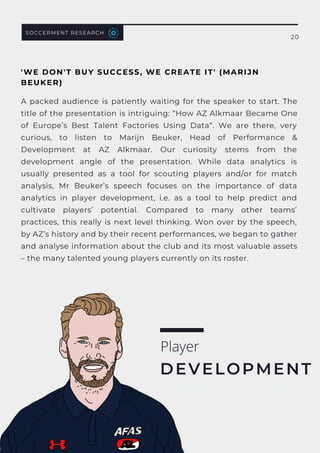
Football Analytics
3
Applications of
Football Analytics
5
Smart Scouting
6
Performance Analysis
12
Player Development
19
Injury Recovery
23
Books and Articles
26
Handbook
INDEX
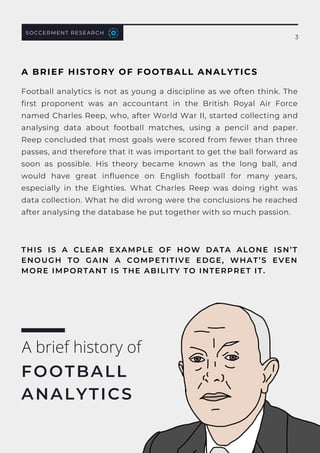
Football analytics is not as young a discipline as we often think. The
first proponent was an accountant in the British Royal Air Force
named Charles Reep, who, after World War II, started collecting and
analysing data about football matches, using a pencil and paper.
Reep concluded that most goals were scored from fewer than three
passes, and therefore that it was important to get the ball forward as
soon as possible. His theory became known as the  long ball, and
would have  great influence on English football for many years,
especially in the Eighties. What Charles Reep was doing right was
data collection. What he did wrong were the conclusions he reached
after analysing the database he put together with so much passion.
A brief history of
FOOTBALL
ANALYTICS
SOCCERMENT RESEARCH
3
THIS IS A CLEAR EXAMPLE OF HOW  DATA ALONE ISN’T
ENOUGH TO GAIN A COMPETITIVE EDGE, WHAT’S EVEN
MORE IMPORTANT IS THE ABILITY TO INTERPRET IT.
A BRIEF HISTORY OF FOOTBALL ANALYTICS
A brief history of
FOOTBALL
ANALYTICS
SOCCERMENT RESEARCH
4
The publication in 2003 of ‘Moneyball: The Art of Winning an Unfair
Game‘ was sports analytics’ real introduction to a wider audience.
According to the book, before sabermetrics were introduced to
baseball, teams were dependent on the skills of their scouts to find
and evaluate players. Football managers, initially, remained sceptical.
Most people thought that, unlike American sports, football would be
impossible to analyse using data. But a few stubborn people
disagreed. And they went on to start  a data revolution in the
Beautiful Game. One of them was Billy Beane himself, who is deeply
interested in football.
The most recent developments,  the successful case studies of
Liverpool, AZ Alkmaar, FC Midtjylland and Brentford, show that ...
...NOT ONLY IS IT POSSIBLE TO ANALYSE FOOTBALL, BUT
THOSE WHO DO IT PROPERLY GAIN AN IMPORTANT
COMPETITIVE EDGE.
In the past few years, the exponential speed of improvement in the
technologies supporting the collection, storage and analysis of data
has gone hand-in-hand with an exponential increase in the human
capital invested in sports analytics.
As the datasets have grown and improved, the number of potential
applications of data analytics to the game has multiplied, making
“football analytics” a quite generic concept. We try to summarise the
main fields of application.
We will go through:
Applications of
FOOTBALL
ANALYTICS
SOCCERMENT RESEARCH
SMART SCOUTING
PERFORMANCE ANALYSIS
PLAYER DEVELOPMENT
INJURY PREVENTION AND REHABILITATION
APPLICATIONS OF FOOTBALL ANALYTICS
5
SAVINGS. Searching for players in large and detailed databases
allows clubs to save incredible amounts of time and money. We
believe that databases cannot replace scouts, but rather that they
can complement their talent identification skills.
SILICON HAS MORE MEMORY THAN YOU AND I. Do you
remember all the actions, all the shots, all the crosses and
dribbles by your favourite team in the past season? Of courses
not. Luckily, computer doesn’t have a favourite team or player, it
can remember everything that has occurred in past seasons.
LIMITING PRE-CONCEPTIONS. Skimming through databases
often gives rise to  counter-intuitive results. In some cases, these
might be false positives. In other cases, they deliver proper
“eureka moments”.
Data analytcs is a very powerful tool for scouting. Here's why:
SOCCERMENT RESEARCH
Smart
SCOUTING
SMART SCOUTING
6
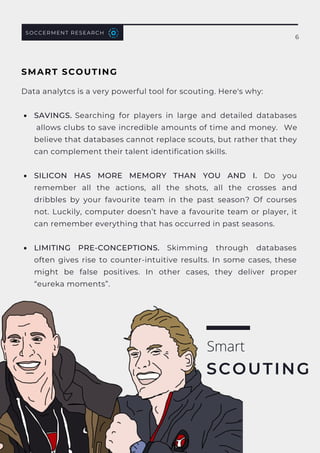
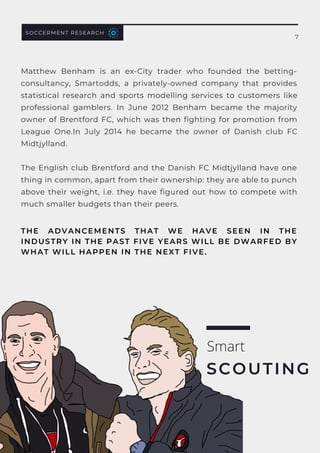
Matthew Benham is an ex-City trader who founded the betting-
consultancy,  Smartodds, a privately-owned company that provides
statistical research and sports modelling services to customers like
professional gamblers. In June 2012 Benham became the majority
owner of Brentford FC, which was then fighting for promotion from
League One.In July 2014 he became the owner of Danish club  FC
Midtjylland.
The English club Brentford and the Danish FC Midtjylland have one
thing in common, apart from their ownership: they are able to punch
above their weight, i.e.  they have figured out how to compete with
much smaller budgets than their peers.
SOCCERMENT RESEARCH
THE ADVANCEMENTS THAT WE HAVE SEEN IN THE
INDUSTRY IN THE PAST FIVE YEARS WILL BE DWARFED BY
WHAT WILL HAPPEN IN THE NEXT FIVE.
Smart
SCOUTING
7
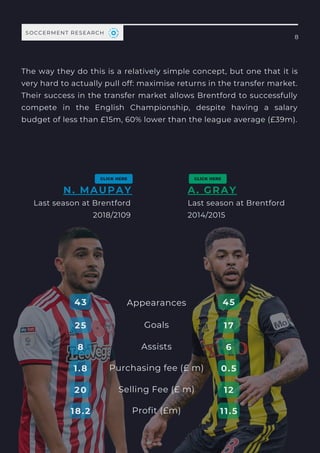
The way they do this is a relatively simple concept, but one that it is
very hard to actually pull off: maximise returns in the transfer market.
Their success in the transfer market allows Brentford to successfully
compete in the English Championship, despite having a salary
budget of less than £15m, 60% lower than the league average (£39m).
8
SOCCERMENT RESEARCH
N. MAUPAY
Last season at Brentford
2018/2109
Last season at Brentford
2014/2015
A. GRAY
Appearances
Goals
Purchasing fee (£ m)
Selling Fee (£ m)
Profit (£m)
Assists
43
25
8
1.8
20
18.2
45
17
6
0.5
12
11.5
SOCCERMENT RESEARCH
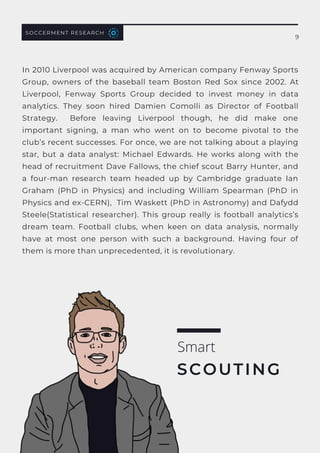
In 2010 Liverpool was acquired by American company Fenway Sports
Group, owners of the baseball team Boston Red Sox since 2002. At
Liverpool, Fenway Sports Group decided to invest money in data
analytics. They soon hired  Damien Comolli  as Director of Football
Strategy. Before leaving Liverpool though, he did make one
important signing, a man who went on to become pivotal to the
club’s recent successes. For once, we are not talking about a playing
star, but a data analyst:  Michael Edwards. He works along with the
head of recruitment Dave Fallows, the chief scout Barry Hunter, and
a  four-man research team  headed up by Cambridge graduate  Ian
Graham  (PhD in Physics) and including  William Spearman  (PhD in
Physics and ex-CERN),  Tim Waskett (PhD in Astronomy) and Dafydd
Steele(Statistical researcher). This group really is  football analytics’s
dream team. Football clubs, when keen on data analysis, normally
have at most one person with such a background. Having four of
them is more than unprecedented, it is revolutionary.
Smart
SCOUTING
9
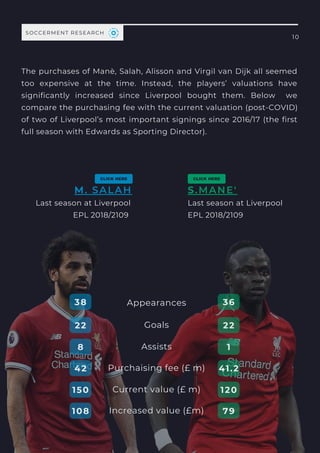
The purchases of Manè, Salah, Alisson and Virgil van Dijk all seemed
too expensive at the time. Instead, the players’ valuations have
significantly increased since Liverpool bought them. Below we
compare the purchasing fee with the current valuation (post-COVID)
of two of Liverpool’s most important signings since 2016/17 (the first
full season with Edwards as Sporting Director).
SOCCERMENT RESEARCH
M. SALAH
Last season at Liverpool
EPL 2018/2109
Last season at Liverpool
EPL 2018/2109
S.MANE'
Appearances
Goals
Purchaising fee (£ m)
Current value (£ m)
Increased value (£m)
Assists
38
22
8
42
150
108
36
22
1
41.2
120
79
10
SOCCERMENT RESEARCH
11
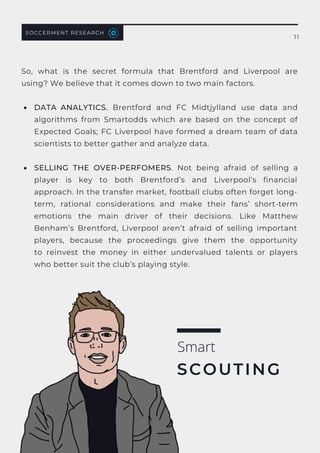
DATA ANALYTICS.  Brentford and FC Midtjylland use data and
algorithms from Smartodds which are based on the concept of
Expected Goals; FC Liverpool have formed a dream team of data
scientists to better gather and analyze data.
SELLING THE OVER-PERFOMERS. Not being afraid of selling a
player is key to both Brentford’s and Liverpool’s financial
approach. In the transfer market, football clubs often forget long-
term, rational considerations and make their fans’ short-term
emotions the main driver of their decisions. Like Matthew
Benham’s Brentford, Liverpool aren’t afraid of selling important
players, because the proceedings give them the opportunity
to  reinvest the money in either undervalued talents  or players
who better suit the club’s playing style.
So, what is the secret formula that Brentford and Liverpool are
using? We believe that it comes down to two main factors.
Smart
SCOUTING
SOCCERMENT RESEARCH
12
Football clubs, along with the media and even fans, can, with the
support of data, easily understand how a team or player has
performed over the course of a match or season. Even the most basic
stats, like the number of shots, shots on target, and ball possession,
can offer a guide, albeit an incomplete one, of how two teams have
performed and if their performance was in line with the result of the
match.  If we then improve the granularity of the stats and include
selected performance indicators, the dataset gradually begins to give
a more defined and complete picture of what has happened on the
pitch, which enables a detailed analysis of the game. Such
granularity can offer a coach more information on how the team has
performed and even whether or not it complied with the pre-match
instructions.
BIG DATA ANALYSIS HELPS US TO DISCOVER COUNTER-
INTUITIVE FACTS ABOUT FOOTBALL, UPON WHICH WE
CAN BUILD AN INNOVATIVE AND WINNING STRATEGY.
Performance
ANALYSIS
PERFORMANCE ANALYSIS
Calculating such probability depends on a number of factors,
including distance from goal, the angle of the shot, the body part the
shot was taken with (head, strong or weak foot), the playing situation
(open play, counterattack), and others (whether there were any
opponents blocking the space ahead, for example).
Expected Goals are normally calculated using a “frequentist”
approach: a dataset of several thousand shots is categorised
according to the aforementioned variables (distance from goal,
angle, body part, etc). If one type of shot, which for example occurred
10,000 times in the dataset, is scored 200 times, then that kind of
shot is “expected” have an xG of 0.02 (2% probability). Using this
methodology, we can determine that a penalty is worth 0.76
Expected Goals, i.e. a penalty has an implied probability of 76% of
being scored.
SOCCERMENT RESEARCH
Performance
ANALYSIS
AN EXPECTED GOAL REPRESENTS THE EXPECTED VALUE
FROM A SHOT, I.E. THE PROBABILITY OF THAT SHOT
BECOMING A GOAL.
13
SOCCERMENT RESEARCH
14
A deeper and wider analysis of Expected Goals will “force” football
coaches to rethink their tactical strategies, especially in one
specific area: shot location. In the next 10-15 years we expect to
see in football something similar to what has happened in the
NBA: a complete overhaul of shooting locations. By looking at the
most common shot locations in the NBA 2001-02 compared to
the ones of 2016-17 it is noticeable how risk-reward considerations
based on analytics have dramatically increased the amount of
three-pointers and limited the number of two-pointers outside
“the paint”.
We would expect (and encourage) football clubs to increasingly
rely on objective measures such as Expected Goals when it comes
to gauging teams’ performances and evaluating how well or
badly coaches are doing. It happens all too often that coaches are
sacked after poor results despite these not being caused by poor
team performance, but rather by bad luck.
How can Expected Goals revolutionise football? In our view, there are
two main areas that are clearly open for disruption:
Performance
ANALYSIS
Performance
ANALYSIS
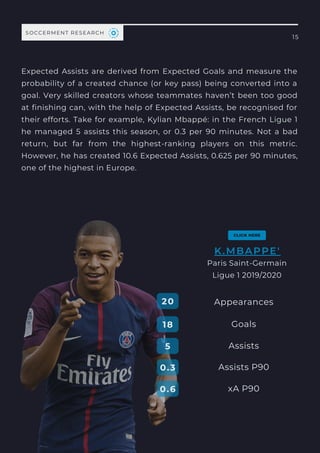
Expected Assists are derived from Expected Goals and measure the
probability of a created chance (or key pass) being converted into a
goal. Very skilled creators whose teammates haven’t been too good
at finishing can, with the help of Expected Assists, be recognised for
their efforts. Take for example, Kylian Mbappé: in the French Ligue 1
he managed 5 assists this season, or 0.3 per 90 minutes. Not a bad
return, but far from the highest-ranking players on this metric.
However, he has created 10.6 Expected Assists, 0.625 per 90 minutes,
one of the highest in Europe.
15
SOCCERMENT RESEARCH
Appearances
Goals
Assists P90
xA P90
Assists
20
18
5
0.3
0.6
K.MBAPPE'
Paris Saint-Germain
Ligue 1 2019/2020
SOCCERMENT RESEARCH
16
The SPR is a synthetic measure with which we can value a player’s
overall contribution to the team’s performance. All events on the
pitch are taken into consideration and weighed using ad-hoc
coefficients, which also depend on the players’ roles. The algorithms
split the players’ contribution into three phases – defence, buildup
and attack – in order to give us a clearer view of the players’ overall
approach to the game.
WE HAVE DEVELOPED OUR OWN PERFORMANCE
INDICATOR, WHICH WE APPLY TO ALL FOOTBALLERS AND
TEAMS IN OUR DATABASE, CALLED  SOCCERMENT
PERFORMANCE RATING (‘SPR’)
Performance
ANALYSIS
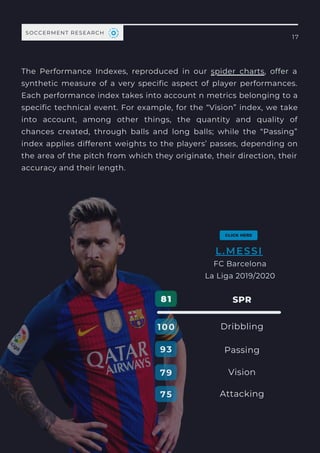
The  Performance Indexes, reproduced in our spider charts, offer a
synthetic measure of a very specific aspect of player performances.
Each performance index takes into account n metrics belonging to a
specific technical event. For example, for the “Vision” index, we take
into account, among other things, the quantity and quality of
chances created, through balls and long balls; while the “Passing”
index applies different weights to the players’ passes, depending on
the area of the pitch from which they originate, their direction, their
accuracy and their length.
17
SOCCERMENT RESEARCH
L.MESSI
FC Barcelona
La Liga 2019/2020
Dribbling
100
Passing
Vision
Attacking
93
79
75
SPR
81
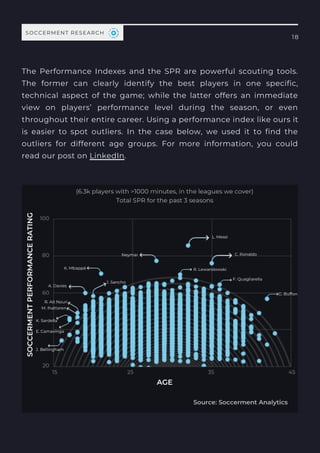
The Performance Indexes and the SPR are powerful scouting tools.
The former can clearly identify the best players in one specific,
technical aspect of the game; while the latter offers an immediate
view on players’ performance level during the season, or even
throughout their entire career. Using a performance index like ours it
is easier to spot outliers. In the case below, we used it to find the
outliers for different age groups. For more information, you could
read our post on LinkedIn.
18
SOCCERMENT RESEARCH
Player
DEVELOPMENT
SOCCERMENT RESEARCH
19
Data analytics is also growing in importance when it comes to youth
development. The reason is simple: having objective and measurable
feedback can help both coaches and players speed up the learning
processes and create virtuous development cycles. Basically, data
analytics becomes a tool to help predict and cultivate players’
potential.  The best example of this is probably the Dutch club  AZ
Alkmaar.We have written extensively about how AZ structure their
development process through data in the analysis linked here below.
In the analysis we also explain how long-term planning requires clear
and efficient governance, which is still not too common at football
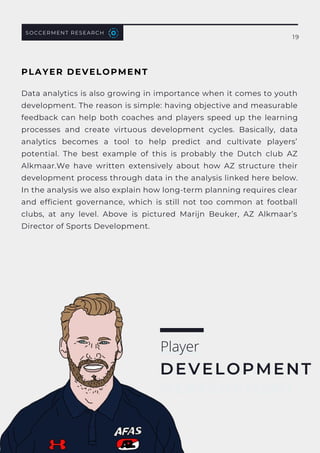
clubs, at any level. Above is pictured  Marijn Beuker, AZ Alkmaar’s
Director of Sports Development.
Player
DEVELOPMENT
PLAYER DEVELOPMENT
Player
DEVELOPMENT
SOCCERMENT RESEARCH
20
A packed audience is patiently waiting for the speaker to start. The
title of the presentation is intriguing: “How AZ Alkmaar Became One
of Europe’s Best Talent Factories Using Data“.  We are there, very
curious, to listen to  Marijn Beuker,  Head of Performance &
Development  at AZ Alkmaar. Our curiosity stems from the
development angle of the presentation. While  data analytics is
usually presented as a tool for scouting players and/or for match
analysis, Mr Beuker’s speech focuses on the  importance of data
analytics in player development, i.e. as a tool to  help predict and
cultivate players’ potential. Compared to many other teams’
practices, this really is next level thinking.  Won over by the speech,
by AZ’s history and by their recent performances, we began to gather
and analyse information about the club and its most valuable assets
– the many talented young players currently on its roster.
'WE DON'T BUY SUCCESS, WE CREATE IT' (MARIJN
BEUKER)
Player
DEVELOPMENT
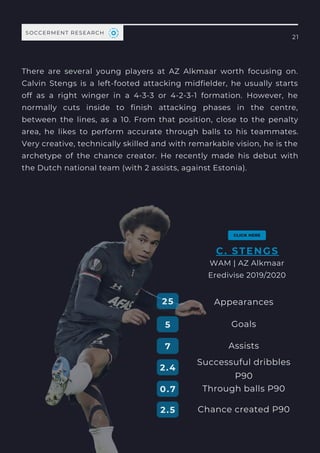
There are several young players at AZ Alkmaar worth focusing on.
Calvin Stengs is a left-footed attacking midfielder, he  usually starts
off as a right winger  in a 4-3-3 or 4-2-3-1 formation. However, he
normally  cuts inside to finish attacking phases in the centre,
between the lines, as a 10. From that position, close to the penalty
area, he likes to perform accurate  through balls  to his teammates.
Very creative, technically skilled and with remarkable vision, he is the
archetype of the chance creator. He recently made his debut with
the Dutch national team (with 2 assists, against Estonia).
21
SOCCERMENT RESEARCH
Performance
ANALYSIS
Appearances
Goals
Successuful dribbles
P90
Through balls P90
Assists
25
5
7
2.4
0.7
C. STENGS
WAM | AZ Alkmaar
Eredivise 2019/2020
Chance created P90
2.5
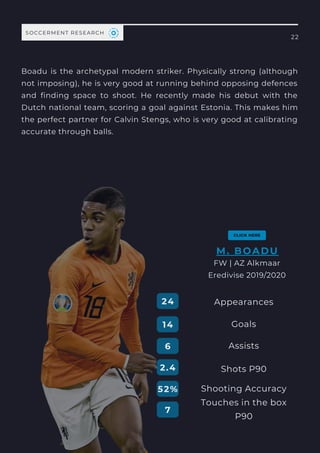
Boadu is the archetypal  modern striker. Physically strong (although
not imposing), he is very good at running behind opposing defences
and finding space to shoot. He recently made his debut with the
Dutch national team, scoring a goal against Estonia. This makes him
the perfect partner for Calvin Stengs, who is very good at calibrating
accurate through balls.
22
SOCCERMENT RESEARCH
Performance
ANALYSIS
Appearances
Goals
Shots P90
Shooting Accuracy
Assists
24
14
6
2.4
52%
M. BOADU
FW | AZ Alkmaar
Eredivise 2019/2020
Touches in the box
P90
7
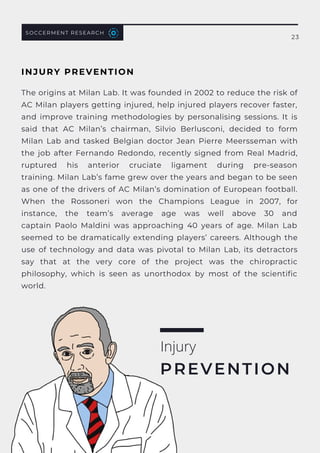
The origins at Milan Lab. It was founded in 2002 to reduce the risk of
AC Milan players getting injured, help injured players recover faster,
and improve training methodologies by personalising sessions. It is
said that AC Milan’s chairman, Silvio Berlusconi, decided to form
Milan Lab and tasked Belgian doctor  Jean Pierre Meersseman with
the job after Fernando Redondo, recently signed from Real Madrid,
ruptured his anterior cruciate ligament during pre-season
training. Milan Lab’s fame grew over the years and began to be seen
as one of the drivers of AC Milan’s domination of European football.
When the  Rossoneri  won the Champions League in 2007, for
instance, the team’s average age was well above 30 and
captain  Paolo Maldini  was approaching 40 years of age. Milan Lab
seemed to be dramatically extending players’ careers. Although the
use of technology and data was pivotal to Milan Lab, its detractors
say that at the very core of the project was the chiropractic
philosophy, which is seen as unorthodox by most of the scientific
world.
Injury
PREVENTION
SOCCERMENT RESEARCH
23
INJURY PREVENTION
Nowadays, any high-level club consistently monitors players’
position, while velocity tracking with GPS allows them to objectively
measure the “external load”, i.e. the amount of work performed on
the pitch. External load tracking through GPS can be also used
to  predict the risk of injury professional players. Researchers
discovered that the greatest injury risk occurred when players
accumulated a very high number of short bursts of speed during
training over a three-week period. Players recorded significantly
higher meters per minute in the weeks preceding an injury,
compared with their seasonal averages (+9.6 and +7.4% for 1- and 4-
week blocks, respectively), indicating an increase in training and
gameplay intensity in the lead up to injuries. Furthermore, “injury
blocks” showed significantly lower average new body load compared
with seasonal averages (-15.4 and -9.0% for 1- and 4-week blocks,
respectively).
Injury
PREVENTION
TODAY: DATA & TECH TO HELP ON ATHLETIC
PERFORMANCE AND INJURY PREVENTION
SOCCERMENT RESEARCH
24
Current research in sports biomechanics supports this trend,
showing that athletes’ movement patterns deteriorate in a
potentially harmful fashion when repeating intense running and
changes of direction. Here is a link to  a research paper on this
subject, authored by  Soccerment’s Head of R&D  Matteo Zago and
published in the European Journal of Sports Science. In sum,
performance monitoring can bring a clear vision of the framework
required to develop and optimise the models used to analyse
training loads. This will help these models gain better insight into
players’ fitness, readiness to perform and fatigue, and improve the
quality and efficiency of their assistance to coaching staff.
Injury
PREVENTION
PERFORMANCE MONITORING CAN BRING A CLEAR VISION
OF THE FRAMEWORK REQUIRED TO DEVELOP AND
OPTIMISE THE MODELS USED TO ANALYSE TRAINING
LOADS.
SOCCERMENT RESEARCH
25
“Moneyball: The Art Of Winning An Unfair Game” (by Michael
Lewis)
“The Numbers Game“ (by Chris Anderson and David Sally)
“Soccernomics” (by Simon Kuper and Stefan Szymanski)
“Soccermatics” (by David Sumpter)
“The Expected Goals Philosophy” (by James Tippett)
“Football Hackers” (by Christoph Biermann)
"The growing importance of football analytics"
"AZ Alkmaar: Creating Success Through Data Analytics"
"AZ Alkmaar’s Talent Factory"
All the articles
Books:
On YouTube: 'The Best Books About Football Analytics' (Italian)
Articles by Soccerment Research:
Master
FOOTBALL
ANALYTICS
MASTER FOOTBALL ANALYTICS: BOOKS AND
ARTICLES TO READ
SOCCERMENT RESEARCH
26
FIND OUT
MORE

The Football Analytics Handbook

  • 1.
    THE FOOTBALL ANALYTICS HANDBOOK SOCCERMENT RESEARCH CLUBSTHAT AREN’T PLANNING TO JUMP ON THE ANALYTICS BANDWAGON RUN THE RISK OF BEING LEFT BEHIND. SOCCERMENT RESEARCH 2
  • 2.
    SOCCERMENT RESEARCH 2 Over thepast two decades, the influence of data analytics has been growing in every aspect of our lives: in businesses of every kind, but also in healthcare, media and sports. Until a few years ago, football was thought to be immune from this trend. Now, the early adopters in the major football leagues are thriving thanks to the competitive advantage that investments in data analytics are beginning to provide them. A Brief History of Football Analytics 3 Applications of Football Analytics 5 Smart Scouting 6 Performance Analysis 12 Player Development 19 Injury Recovery 23 Books and Articles 26 Handbook INDEX
  • 3.
    Football analytics isnot as young a discipline as we often think. The first proponent was an accountant in the British Royal Air Force named Charles Reep, who, after World War II, started collecting and analysing data about football matches, using a pencil and paper. Reep concluded that most goals were scored from fewer than three passes, and therefore that it was important to get the ball forward as soon as possible. His theory became known as the  long ball, and would have  great influence on English football for many years, especially in the Eighties. What Charles Reep was doing right was data collection. What he did wrong were the conclusions he reached after analysing the database he put together with so much passion. A brief history of FOOTBALL ANALYTICS SOCCERMENT RESEARCH 3 THIS IS A CLEAR EXAMPLE OF HOW  DATA ALONE ISN’T ENOUGH TO GAIN A COMPETITIVE EDGE, WHAT’S EVEN MORE IMPORTANT IS THE ABILITY TO INTERPRET IT. A BRIEF HISTORY OF FOOTBALL ANALYTICS
  • 4.
    A brief historyof FOOTBALL ANALYTICS SOCCERMENT RESEARCH 4 The publication in 2003 of ‘Moneyball: The Art of Winning an Unfair Game‘ was sports analytics’ real introduction to a wider audience. According to the book, before sabermetrics were introduced to baseball, teams were dependent on the skills of their scouts to find and evaluate players. Football managers, initially, remained sceptical. Most people thought that, unlike American sports, football would be impossible to analyse using data. But a few stubborn people disagreed. And they went on to start  a data revolution in the Beautiful Game. One of them was Billy Beane himself, who is deeply interested in football. The most recent developments,  the successful case studies of Liverpool, AZ Alkmaar, FC Midtjylland and Brentford, show that ... ...NOT ONLY IS IT POSSIBLE TO ANALYSE FOOTBALL, BUT THOSE WHO DO IT PROPERLY GAIN AN IMPORTANT COMPETITIVE EDGE.
  • 5.
    In the pastfew years, the exponential speed of improvement in the technologies supporting the collection, storage and analysis of data has gone hand-in-hand with an exponential increase in the human capital invested in sports analytics. As the datasets have grown and improved, the number of potential applications of data analytics to the game has multiplied, making “football analytics” a quite generic concept. We try to summarise the main fields of application. We will go through: Applications of FOOTBALL ANALYTICS SOCCERMENT RESEARCH SMART SCOUTING PERFORMANCE ANALYSIS PLAYER DEVELOPMENT INJURY PREVENTION AND REHABILITATION APPLICATIONS OF FOOTBALL ANALYTICS 5
  • 6.
    SAVINGS. Searching for playersin large and detailed databases allows clubs to save incredible amounts of time and money. We believe that databases cannot replace scouts, but rather that they can complement their talent identification skills. SILICON HAS MORE MEMORY THAN YOU AND I. Do you remember all the actions, all the shots, all the crosses and dribbles by your favourite team in the past season? Of courses not. Luckily, computer doesn’t have a favourite team or player, it can remember everything that has occurred in past seasons. LIMITING PRE-CONCEPTIONS. Skimming through databases often gives rise to  counter-intuitive results. In some cases, these might be false positives. In other cases, they deliver proper “eureka moments”. Data analytcs is a very powerful tool for scouting. Here's why: SOCCERMENT RESEARCH Smart SCOUTING SMART SCOUTING 6
  • 7.
    Matthew Benham isan ex-City trader who founded the betting- consultancy,  Smartodds, a privately-owned company that provides statistical research and sports modelling services to customers like professional gamblers. In June 2012 Benham became the majority owner of Brentford FC, which was then fighting for promotion from League One.In July 2014 he became the owner of Danish club  FC Midtjylland. The English club Brentford and the Danish FC Midtjylland have one thing in common, apart from their ownership: they are able to punch above their weight, i.e.  they have figured out how to compete with much smaller budgets than their peers. SOCCERMENT RESEARCH THE ADVANCEMENTS THAT WE HAVE SEEN IN THE INDUSTRY IN THE PAST FIVE YEARS WILL BE DWARFED BY WHAT WILL HAPPEN IN THE NEXT FIVE. Smart SCOUTING 7
  • 8.
    The way theydo this is a relatively simple concept, but one that it is very hard to actually pull off: maximise returns in the transfer market. Their success in the transfer market allows Brentford to successfully compete in the English Championship, despite having a salary budget of less than £15m, 60% lower than the league average (£39m). 8 SOCCERMENT RESEARCH N. MAUPAY Last season at Brentford 2018/2109 Last season at Brentford 2014/2015 A. GRAY Appearances Goals Purchasing fee (£ m) Selling Fee (£ m) Profit (£m) Assists 43 25 8 1.8 20 18.2 45 17 6 0.5 12 11.5
  • 9.
    SOCCERMENT RESEARCH In 2010Liverpool was acquired by American company Fenway Sports Group, owners of the baseball team Boston Red Sox since 2002. At Liverpool, Fenway Sports Group decided to invest money in data analytics. They soon hired  Damien Comolli  as Director of Football Strategy. Before leaving Liverpool though, he did make one important signing, a man who went on to become pivotal to the club’s recent successes. For once, we are not talking about a playing star, but a data analyst:  Michael Edwards. He works along with the head of recruitment Dave Fallows, the chief scout Barry Hunter, and a  four-man research team  headed up by Cambridge graduate  Ian Graham  (PhD in Physics) and including  William Spearman  (PhD in Physics and ex-CERN),  Tim Waskett (PhD in Astronomy) and Dafydd Steele(Statistical researcher). This group really is  football analytics’s dream team. Football clubs, when keen on data analysis, normally have at most one person with such a background. Having four of them is more than unprecedented, it is revolutionary. Smart SCOUTING 9
  • 10.
    The purchases ofManè, Salah, Alisson and Virgil van Dijk all seemed too expensive at the time. Instead, the players’ valuations have significantly increased since Liverpool bought them. Below we compare the purchasing fee with the current valuation (post-COVID) of two of Liverpool’s most important signings since 2016/17 (the first full season with Edwards as Sporting Director). SOCCERMENT RESEARCH M. SALAH Last season at Liverpool EPL 2018/2109 Last season at Liverpool EPL 2018/2109 S.MANE' Appearances Goals Purchaising fee (£ m) Current value (£ m) Increased value (£m) Assists 38 22 8 42 150 108 36 22 1 41.2 120 79 10
  • 11.
    SOCCERMENT RESEARCH 11 DATA ANALYTICS. Brentford and FC Midtjylland use data and algorithms from Smartodds which are based on the concept of Expected Goals; FC Liverpool have formed a dream team of data scientists to better gather and analyze data. SELLING THE OVER-PERFOMERS. Not being afraid of selling a player is key to both Brentford’s and Liverpool’s financial approach. In the transfer market, football clubs often forget long- term, rational considerations and make their fans’ short-term emotions the main driver of their decisions. Like Matthew Benham’s Brentford, Liverpool aren’t afraid of selling important players, because the proceedings give them the opportunity to  reinvest the money in either undervalued talents  or players who better suit the club’s playing style. So, what is the secret formula that Brentford and Liverpool are using? We believe that it comes down to two main factors. Smart SCOUTING
  • 12.
    SOCCERMENT RESEARCH 12 Football clubs,along with the media and even fans, can, with the support of data, easily understand how a team or player has performed over the course of a match or season. Even the most basic stats, like the number of shots, shots on target, and ball possession, can offer a guide, albeit an incomplete one, of how two teams have performed and if their performance was in line with the result of the match.  If we then improve the granularity of the stats and include selected performance indicators, the dataset gradually begins to give a more defined and complete picture of what has happened on the pitch, which enables a detailed analysis of the game. Such granularity can offer a coach more information on how the team has performed and even whether or not it complied with the pre-match instructions. BIG DATA ANALYSIS HELPS US TO DISCOVER COUNTER- INTUITIVE FACTS ABOUT FOOTBALL, UPON WHICH WE CAN BUILD AN INNOVATIVE AND WINNING STRATEGY. Performance ANALYSIS PERFORMANCE ANALYSIS
  • 13.
    Calculating such probabilitydepends on a number of factors, including distance from goal, the angle of the shot, the body part the shot was taken with (head, strong or weak foot), the playing situation (open play, counterattack), and others (whether there were any opponents blocking the space ahead, for example). Expected Goals are normally calculated using a “frequentist” approach: a dataset of several thousand shots is categorised according to the aforementioned variables (distance from goal, angle, body part, etc). If one type of shot, which for example occurred 10,000 times in the dataset, is scored 200 times, then that kind of shot is “expected” have an xG of 0.02 (2% probability). Using this methodology, we can determine that a penalty is worth 0.76 Expected Goals, i.e. a penalty has an implied probability of 76% of being scored. SOCCERMENT RESEARCH Performance ANALYSIS AN EXPECTED GOAL REPRESENTS THE EXPECTED VALUE FROM A SHOT, I.E. THE PROBABILITY OF THAT SHOT BECOMING A GOAL. 13
  • 14.
    SOCCERMENT RESEARCH 14 A deeperand wider analysis of Expected Goals will “force” football coaches to rethink their tactical strategies, especially in one specific area: shot location. In the next 10-15 years we expect to see in football something similar to what has happened in the NBA: a complete overhaul of shooting locations. By looking at the most common shot locations in the NBA 2001-02 compared to the ones of 2016-17 it is noticeable how risk-reward considerations based on analytics have dramatically increased the amount of three-pointers and limited the number of two-pointers outside “the paint”. We would expect (and encourage) football clubs to increasingly rely on objective measures such as Expected Goals when it comes to gauging teams’ performances and evaluating how well or badly coaches are doing. It happens all too often that coaches are sacked after poor results despite these not being caused by poor team performance, but rather by bad luck. How can Expected Goals revolutionise football? In our view, there are two main areas that are clearly open for disruption: Performance ANALYSIS
  • 15.
    Performance ANALYSIS Expected Assists arederived from Expected Goals and measure the probability of a created chance (or key pass) being converted into a goal. Very skilled creators whose teammates haven’t been too good at finishing can, with the help of Expected Assists, be recognised for their efforts. Take for example, Kylian Mbappé: in the French Ligue 1 he managed 5 assists this season, or 0.3 per 90 minutes. Not a bad return, but far from the highest-ranking players on this metric. However, he has created 10.6 Expected Assists, 0.625 per 90 minutes, one of the highest in Europe. 15 SOCCERMENT RESEARCH Appearances Goals Assists P90 xA P90 Assists 20 18 5 0.3 0.6 K.MBAPPE' Paris Saint-Germain Ligue 1 2019/2020
  • 16.
    SOCCERMENT RESEARCH 16 The SPRis a synthetic measure with which we can value a player’s overall contribution to the team’s performance. All events on the pitch are taken into consideration and weighed using ad-hoc coefficients, which also depend on the players’ roles. The algorithms split the players’ contribution into three phases – defence, buildup and attack – in order to give us a clearer view of the players’ overall approach to the game. WE HAVE DEVELOPED OUR OWN PERFORMANCE INDICATOR, WHICH WE APPLY TO ALL FOOTBALLERS AND TEAMS IN OUR DATABASE, CALLED  SOCCERMENT PERFORMANCE RATING (‘SPR’) Performance ANALYSIS
  • 17.
    The  Performance Indexes,reproduced in our spider charts, offer a synthetic measure of a very specific aspect of player performances. Each performance index takes into account n metrics belonging to a specific technical event. For example, for the “Vision” index, we take into account, among other things, the quantity and quality of chances created, through balls and long balls; while the “Passing” index applies different weights to the players’ passes, depending on the area of the pitch from which they originate, their direction, their accuracy and their length. 17 SOCCERMENT RESEARCH L.MESSI FC Barcelona La Liga 2019/2020 Dribbling 100 Passing Vision Attacking 93 79 75 SPR 81
  • 18.
    The Performance Indexesand the SPR are powerful scouting tools. The former can clearly identify the best players in one specific, technical aspect of the game; while the latter offers an immediate view on players’ performance level during the season, or even throughout their entire career. Using a performance index like ours it is easier to spot outliers. In the case below, we used it to find the outliers for different age groups. For more information, you could read our post on LinkedIn. 18 SOCCERMENT RESEARCH
  • 19.
    Player DEVELOPMENT SOCCERMENT RESEARCH 19 Data analyticsis also growing in importance when it comes to youth development. The reason is simple: having objective and measurable feedback can help both coaches and players speed up the learning processes and create virtuous development cycles. Basically, data analytics becomes a tool to help predict and cultivate players’ potential.  The best example of this is probably the Dutch club  AZ Alkmaar.We have written extensively about how AZ structure their development process through data in the analysis linked here below. In the analysis we also explain how long-term planning requires clear and efficient governance, which is still not too common at football clubs, at any level. Above is pictured  Marijn Beuker, AZ Alkmaar’s Director of Sports Development. Player DEVELOPMENT PLAYER DEVELOPMENT
  • 20.
    Player DEVELOPMENT SOCCERMENT RESEARCH 20 A packedaudience is patiently waiting for the speaker to start. The title of the presentation is intriguing: “How AZ Alkmaar Became One of Europe’s Best Talent Factories Using Data“.  We are there, very curious, to listen to  Marijn Beuker,  Head of Performance & Development  at AZ Alkmaar. Our curiosity stems from the development angle of the presentation. While  data analytics is usually presented as a tool for scouting players and/or for match analysis, Mr Beuker’s speech focuses on the  importance of data analytics in player development, i.e. as a tool to  help predict and cultivate players’ potential. Compared to many other teams’ practices, this really is next level thinking.  Won over by the speech, by AZ’s history and by their recent performances, we began to gather and analyse information about the club and its most valuable assets – the many talented young players currently on its roster. 'WE DON'T BUY SUCCESS, WE CREATE IT' (MARIJN BEUKER) Player DEVELOPMENT
  • 21.
    There are severalyoung players at AZ Alkmaar worth focusing on. Calvin Stengs is a left-footed attacking midfielder, he  usually starts off as a right winger  in a 4-3-3 or 4-2-3-1 formation. However, he normally  cuts inside to finish attacking phases in the centre, between the lines, as a 10. From that position, close to the penalty area, he likes to perform accurate  through balls  to his teammates. Very creative, technically skilled and with remarkable vision, he is the archetype of the chance creator. He recently made his debut with the Dutch national team (with 2 assists, against Estonia). 21 SOCCERMENT RESEARCH Performance ANALYSIS Appearances Goals Successuful dribbles P90 Through balls P90 Assists 25 5 7 2.4 0.7 C. STENGS WAM | AZ Alkmaar Eredivise 2019/2020 Chance created P90 2.5
  • 22.
    Boadu is thearchetypal  modern striker. Physically strong (although not imposing), he is very good at running behind opposing defences and finding space to shoot. He recently made his debut with the Dutch national team, scoring a goal against Estonia. This makes him the perfect partner for Calvin Stengs, who is very good at calibrating accurate through balls. 22 SOCCERMENT RESEARCH Performance ANALYSIS Appearances Goals Shots P90 Shooting Accuracy Assists 24 14 6 2.4 52% M. BOADU FW | AZ Alkmaar Eredivise 2019/2020 Touches in the box P90 7
  • 23.
    The origins atMilan Lab. It was founded in 2002 to reduce the risk of AC Milan players getting injured, help injured players recover faster, and improve training methodologies by personalising sessions. It is said that AC Milan’s chairman, Silvio Berlusconi, decided to form Milan Lab and tasked Belgian doctor  Jean Pierre Meersseman with the job after Fernando Redondo, recently signed from Real Madrid, ruptured his anterior cruciate ligament during pre-season training. Milan Lab’s fame grew over the years and began to be seen as one of the drivers of AC Milan’s domination of European football. When the  Rossoneri  won the Champions League in 2007, for instance, the team’s average age was well above 30 and captain  Paolo Maldini  was approaching 40 years of age. Milan Lab seemed to be dramatically extending players’ careers. Although the use of technology and data was pivotal to Milan Lab, its detractors say that at the very core of the project was the chiropractic philosophy, which is seen as unorthodox by most of the scientific world. Injury PREVENTION SOCCERMENT RESEARCH 23 INJURY PREVENTION
  • 24.
    Nowadays, any high-levelclub consistently monitors players’ position, while velocity tracking with GPS allows them to objectively measure the “external load”, i.e. the amount of work performed on the pitch. External load tracking through GPS can be also used to  predict the risk of injury professional players. Researchers discovered that the greatest injury risk occurred when players accumulated a very high number of short bursts of speed during training over a three-week period. Players recorded significantly higher meters per minute in the weeks preceding an injury, compared with their seasonal averages (+9.6 and +7.4% for 1- and 4- week blocks, respectively), indicating an increase in training and gameplay intensity in the lead up to injuries. Furthermore, “injury blocks” showed significantly lower average new body load compared with seasonal averages (-15.4 and -9.0% for 1- and 4-week blocks, respectively). Injury PREVENTION TODAY: DATA & TECH TO HELP ON ATHLETIC PERFORMANCE AND INJURY PREVENTION SOCCERMENT RESEARCH 24
  • 25.
    Current research insports biomechanics supports this trend, showing that athletes’ movement patterns deteriorate in a potentially harmful fashion when repeating intense running and changes of direction. Here is a link to  a research paper on this subject, authored by  Soccerment’s Head of R&D  Matteo Zago and published in the European Journal of Sports Science. In sum, performance monitoring can bring a clear vision of the framework required to develop and optimise the models used to analyse training loads. This will help these models gain better insight into players’ fitness, readiness to perform and fatigue, and improve the quality and efficiency of their assistance to coaching staff. Injury PREVENTION PERFORMANCE MONITORING CAN BRING A CLEAR VISION OF THE FRAMEWORK REQUIRED TO DEVELOP AND OPTIMISE THE MODELS USED TO ANALYSE TRAINING LOADS. SOCCERMENT RESEARCH 25
  • 26.
    “Moneyball: The ArtOf Winning An Unfair Game” (by Michael Lewis) “The Numbers Game“ (by Chris Anderson and David Sally) “Soccernomics” (by Simon Kuper and Stefan Szymanski) “Soccermatics” (by David Sumpter) “The Expected Goals Philosophy” (by James Tippett) “Football Hackers” (by Christoph Biermann) "The growing importance of football analytics" "AZ Alkmaar: Creating Success Through Data Analytics" "AZ Alkmaar’s Talent Factory" All the articles Books: On YouTube: 'The Best Books About Football Analytics' (Italian) Articles by Soccerment Research: Master FOOTBALL ANALYTICS MASTER FOOTBALL ANALYTICS: BOOKS AND ARTICLES TO READ SOCCERMENT RESEARCH 26
  • 27.