DI Water Technicalknowledge Sharing Class for SAET FE 超純水 专业 技術分享會 (6 th Sep, 2005 – Facility System Engineering Section) Prepared by: Anthony Chan
2.
Content 目錄Why do we need High Purity Water for cleaning and rinsing? 为什么要用超纯水作清洗和冲洗? 2. What is DI water? 什么是 DI 水? 3. Water General Standard. 水的一般标准。 4. Learn more about water. 更多了解水。 5. DI water system. DI 水系统。
3.
Content 目錄6. More about RO. 更多了解 RO 。 More about CDI/EDI. 更多了解 CDI/EDI 。 8. More about UV Lamp. 更多了解紫外光灯。 9. Piping for DI water. DI 水管道系统。 10.DI / RO System for A6 為 A6 設計的 DI/RO 純水系统
4.
Why do weneed High Purity Water for cleaning and rinsing? 为什么要用超纯水作清洗和冲洗? In its pure state, water is one of the most aggressive solvents ( aqueous solution ) known . 在它的纯净状态下 , 水是现今所知性能极好的溶剂 ( 水溶剂 ) 。 Water, which is called the “universal solvent”, will dissolve virtually everything exposed to it to a certain degree. 水被称为 “万能溶剂” , 事实上任何物质放入水中 , 都可以溶解到某一特定的程度。
5.
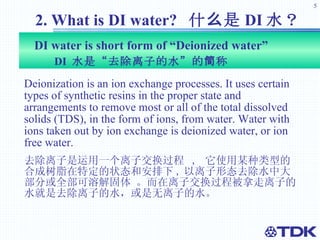
DI water isshort form of “Deionized water” DI 水是“去除离子的水”的简称 Deionization is an ion exchange processes. It uses certain types of synthetic resins in the proper state and arrangements to remove most or all of the total dissolved solids (TDS), in the form of ions, from water. Water with ions taken out by ion exchange is deionized water, or ion free water. 去除离子是运用一个离子交换过程 , 它使用某种类型的合成树脂在特定的状态和安排下 , 以离子形态去除水中大部分或全部可溶解固体 。而在离子交换过程被拿走离子的水就是去除离子的水,或是无离子的水。 2. What is DI water? 什么是 DI 水?
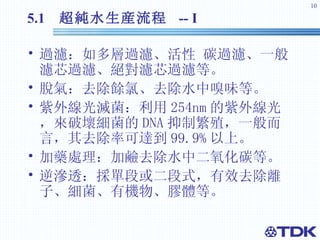
5.1 超純水生産流程 -- I 過濾:如多層過濾、活性 碳過濾、一般濾芯過濾、絕對濾芯過濾等。 脫氣:去除餘氯、去除水中嗅味等。 紫外線光滅菌:利用 254nm 的紫外線光,來破壞細菌的 DNA 抑制繁殖,一般而言,其去除率可達到 99.9% 以上。 加藥處理:加鹼去除水中二氧化碳等。 逆滲透:採單段或二段式,有效去除離子、細菌、有機物、膠體等。
11.
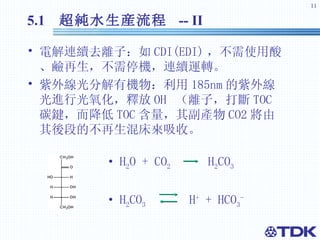
5.1 超純水生産流程 -- II 電解連續去離子:如 CDI(EDI) , 不需使用酸、鹼再生,不需停機,連續運轉。 紫外線光分解有機物:利用 185nm 的紫外線光進行光氧化,釋放 OH ( 離子,打斷 TOC 碳鍵,而降低 TOC 含量,其副產物 CO2 將由其後段的不再生混床來吸收。 H 2 O + CO 2 H 2 CO 3 H 2 CO 3 H + + HCO 3 -
12.
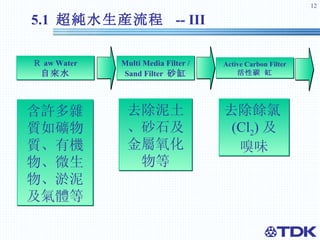
5.1 超純水生産流程 -- III 去除餘氯 (Cl 2 ) 及 嗅味 含許多雜質如礦物質、有機物、微生物、淤泥及氣體等 Active Carbon Filter 活性碳 缸 Multi Media Filter / Sand Filter 砂缸 R a w Water 自來水 去除泥土、砂石及金屬氧化物等
13.
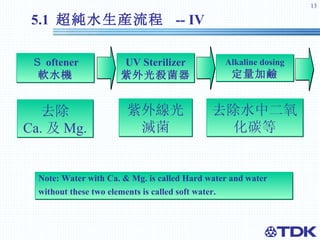
Note: Water withCa. & Mg. is called Hard water and water without these two elements is called soft water. 去除水中二氧化碳等 去除 Ca. 及 Mg. Alkaline dosing 定量加鹼 UV Sterilizer 紫外光殺菌器 S oftener 軟水機 紫外線光滅菌 5.1 超純水 生産流程 -- IV
14.
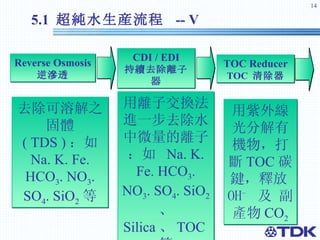
用離子交換法進一步去除水中微量的離子:如 Na.K. Fe. HCO 3 . NO 3 . SO 4 . SiO 2 、 Silica 、 TOC 等 Reverse Osmosis 逆滲透 TOC Reducer TOC 清除器 CDI / EDI 持續去除離子器 用紫外線光分解有機物,打斷 TOC 碳鍵,釋放 OH - 及 副產物 CO 2 去除可溶解之固體 ( TDS ) : 如 Na. K. Fe. HCO 3 . NO 3 . SO 4 . SiO 2 等 5.1 超純水 生産流程 -- V
15.
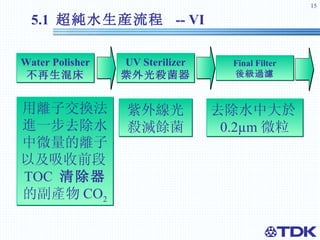
去除水中大於 0.2 µm微粒 Final Filter 後級過濾 UV Sterilizer 紫外光殺菌器 Water Polisher 不再生混床 紫外線光殺滅餘菌 用離子交換法進一步去除水中微量的離子以及吸收前段 TOC 清除器 的副產物 CO 2 5.1 超純水 生産流程 -- VI
16.
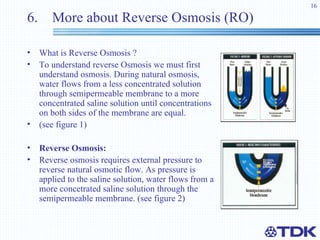
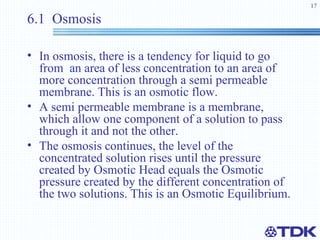
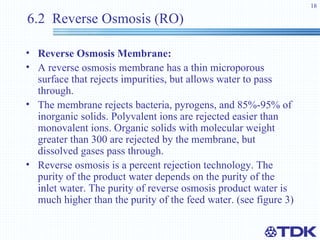
6. Moreabout Reverse Osmosis (RO) What is Reverse Osmosis ? To understand reverse Osmosis we must first understand osmosis. During natural osmosis, water flows from a less concentrated solution through semipermeable membrane to a more concentrated saline solution until concentrations on both sides of the membrane are equal. (see figure 1) Reverse Osmosis: Reverse osmosis requires external pressure to reverse natural osmotic flow. As pressure is applied to the saline solution, water flows from a more concetrated saline solution through the semipermeable membrane. (see figure 2)
17.
6.1 OsmosisIn osmosis, there is a tendency for liquid to go from an area of less concentration to an area of more concentration through a semi permeable membrane. This is an osmotic flow. A semi permeable membrane is a membrane, which allow one component of a solution to pass through it and not the other. The osmosis continues, the level of the concentrated solution rises until the pressure created by Osmotic Head equals the Osmotic pressure created by the different concentration of the two solutions. This is an Osmotic Equilibrium.
18.
6.2 ReverseOsmosis (RO) Reverse Osmosis Membrane: A reverse osmosis membrane has a thin microporous surface that rejects impurities, but allows water to pass through. The membrane rejects bacteria, pyrogens, and 85%-95% of inorganic solids. Polyvalent ions are rejected easier than monovalent ions. Organic solids with molecular weight greater than 300 are rejected by the membrane, but dissolved gases pass through. Reverse osmosis is a percent rejection technology. The purity of the product water depends on the purity of the inlet water. The purity of reverse osmosis product water is much higher than the purity of the feed water. (see figure 3)
19.
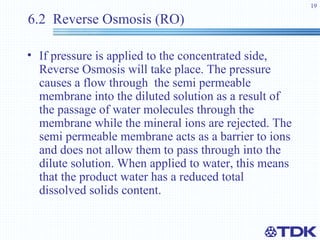
6.2 ReverseOsmosis (RO) If pressure is applied to the concentrated side, Reverse Osmosis will take place. The pressure causes a flow through the semi permeable membrane into the diluted solution as a result of the passage of water molecules through the membrane while the mineral ions are rejected. The semi permeable membrane acts as a barrier to ions and does not allow them to pass through into the dilute solution. When applied to water, this means that the product water has a reduced total dissolved solids content.
7.2 CDI與 EDI 有何不同? CDI 與 EDI 的原理大致相同,主要是品牌的不同,品質也有異差,而且穩定性 亦差別很大。 CDI 是美國 US Filter 的產品,約有 10 年的歷史,品質十分穩定; EDI 則有 IONICS 、 Glegg ( E-cell )、 Electropure 等公司,各有不同的產品。目前在台灣,有些工程公司因為只重視成本問題,而大量採用不成熟的設計產品,導致水質不佳( 1~5MΩ-cm ), 系統不穩定等種種的問題。
24.
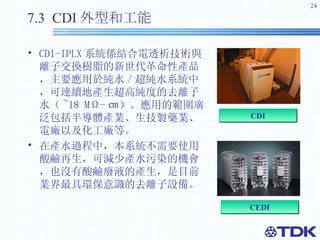
7.3 CDI外型和工能 CDI-IPLX 系統係結合電透析技術與離子交換樹脂的新世代革命性產品,主要應用於純水 / 超純水系統中,可連續地產生超高純度的去離子水( ~18 MΩ- ㎝ )。 應用的範圍廣泛包括半導體產業、生技製藥業、電廠以及化工廠等。 在產水過程中,本系統不需要使用酸鹼再生,可減少產水污染的機會,也沒有酸鹼廢液的產生,是目前業界最具環保意識的去離子設備。 C EDI C DI
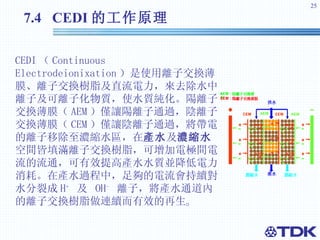
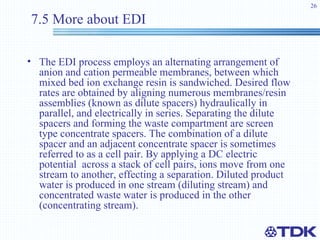
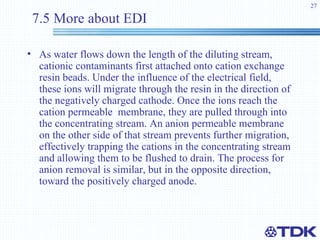
7.5 More aboutEDI The EDI process employs an alternating arrangement of anion and cation permeable membranes, between which mixed bed ion exchange resin is sandwiched. Desired flow rates are obtained by aligning numerous membranes/resin assemblies (known as dilute spacers) hydraulically in parallel, and electrically in series. Separating the dilute spacers and forming the waste compartment are screen type concentrate spacers. The combination of a dilute spacer and an adjacent concentrate spacer is sometimes referred to as a cell pair. By applying a DC electric potential across a stack of cell pairs, ions move from one stream to another, effecting a separation. Diluted product water is produced in one stream (diluting stream) and concentrated waste water is produced in the other (concentrating stream).
27.
7.5 More aboutEDI As water flows down the length of the diluting stream, cationic contaminants first attached onto cation exchange resin beads. Under the influence of the electrical field, these ions will migrate through the resin in the direction of the negatively charged cathode. Once the ions reach the cation permeable membrane, they are pulled through into the concentrating stream. An anion permeable membrane on the other side of that stream prevents further migration, effectively trapping the cations in the concentrating stream and allowing them to be flushed to drain. The process for anion removal is similar, but in the opposite direction, toward the positively charged anode.
28.
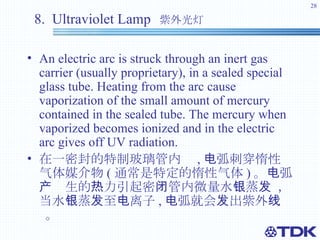
8. UltravioletLamp 紫外光灯 An electric arc is struck through an inert gas carrier (usually proprietary), in a sealed special glass tube. Heating from the arc cause vaporization of the small amount of mercury contained in the sealed tube. The mercury when vaporized becomes ionized and in the electric arc gives off UV radiation. 在一密封的特制玻璃管内 , 电弧刺穿惰性气体媒介物 ( 通常是特定的惰性气体 ) 。电弧产 生的热力引起密闭管内微量水银蒸发 ,当水银蒸发至电离子 , 电弧就会发出紫外线 。
29.
9. Acrylonitrile-Butadiene-Styrene(ABS) pipe ABS 管 Georg Fischer (+GF+) offers 2 standard systems in ABS pipe ; firstly a BS Inch dimensioned system and secondly a metric mm dimensioned system. See ISO15493 for details. GF 牌 ABS 管提供两种标准规格系列,首先是英制尺寸体系,其次是公制尺寸体系。详情可参阅 ISO15493 。 ABS piping is normally used in High Purity DI Water System. ABS 配管通常使用于高纯度的 DI 水系统。 (DI water requirement > 15 MΩ-cm) (DI 水电阻率要求大于 15 兆欧 / 厘米 )
30.
9.1 Advantagesof ABS Pipe ABS 管的优点 High impact strength even at low temperatures. 在低温下也能承受高冲击强度 。 Corrosion resistance. 耐腐蚀性。 Simple processing via solvent cement joints. 使用时用液状粘固剂便可连接。 Low heat conductivity. 低导热性 No halogens. 无卤素 Non-toxic. 无毒
31.
9.1 Advantagesof ABS Pipe ABS 管的优点 Biologically inert; no support for microbial growths. 抗菌性,细菌 \ 微生物不能在其中生长。 Low weight. 重量小。 High Pressure resistance – Max. 15 bar at 20 ℃. 抗高压 – 在 20 ℃ 的温度下,最高可达 15 bar 。 Low pressure losses owing to smooth surfaces. 光滑表面致使低压力损失。 Good abrasion resistance. 抗磨损性好。 Problem-free recycling. 并无因难,可重复利用。
32.
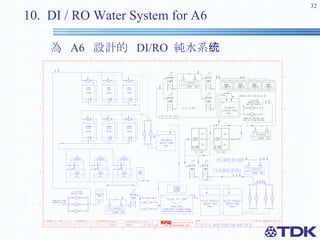
10. DI/ RO Water System for A6 為 A6 設計的 DI/RO 純水系统