Reliability: 5x9s vs 6x9s
(99.999 vs 99.9999)
@3g4gUK
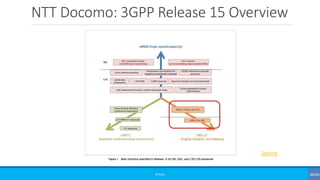
NTT Docomo: 3GPP Release 15 Overview
©3G4G
Source
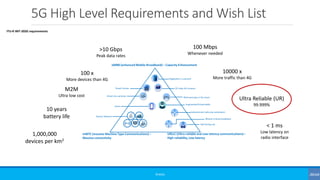
5G High Level Requirements and Wish List
©3G4G
10 years
battery life
M2M
Ultra low cost
100 x
More devices than 4G
>10 Gbps
Peak data rates
100 Mbps
Whenever needed
10000 x
More traffic than 4G
Ultra Reliable (UR)
99.999%
< 1 ms
Low latency on
radio interface
ITU-R IMT-2020 requirements
1,000,000
devices per km2
Rel.16 URLLC Enhancements
©3G4G
Source: 3G4G
Low Latency
(<1ms)
High Reliability
(>99.9999%)
URLLC Efficiency
[bps/Hz]
Rel.15
Rel.16
• Flexible
architecture
• Short TTI/non-
slot based
scheduling
• UL grant free
• DL pre-emptive
scheduling
• Reduced
processing time
• Short PUCCH
• K-repetition
• PDCP duplication
• Various “baseline”
features (e.g. CQI/MCS
tables for URLLC,
Rank-1 MIMO)
• Multi-connectivity enhancements
• Multi-TRP
• 0ms handover interruption
• Various L1 enhancements (PDCCH, UCI,
PUSCH, processing time line,…)
• UL GF enhancements
• QoS monitoring support for URLLC
• Data duplication
enhancements
• Scheduling enhancements
for intra- and inter-UE mux
of eMBB and URLLC
• …
Key Rel.16 SI/WIs Primary
WG
FS_5G_URLLC (SP-180118) SA2
NR_IIoT (RP-181479) RAN2
NR_Mob_enh (RP-181433) RAN2
NR_eURLLC_L1 (RP-181477) RAN1
NR eMIMO (RP-181453) RAN1
• R15 use case improvements
(e.g.AR/VR)
• New use cases with higher
requirements (e.g. factory
automation, transport industry,
electrical power distribution)
© Nokia 2018
Enhancements for latency and reliability in Radio and E2E
Rel.16 URLLC aims for higher reliability and better efficiency
URLLC Use Cases and Requirements (TS 22.261)
©3G4G
Scenario End-to-
end
latency
Communication
service availability
Reliability User
experienced
data rate
Payload
size
Traffic
density
Connection
density
Service area
dimension
Discrete automation
– motion control
1 ms 99.9999% 99.9999% 1 Mbps
up to 10 Mbps
Small 1 Tbps/km2 100 000/km2 100 x 100 x 30
m
Discrete automation 10 ms 99.99% 99.99% 10 Mbps Smallto
big
1 Tbps/km2 100 000/km2 1000 x 1000 x
30 m
Process automation
– remote control
50 ms 99.9999% 99.9999% 1 Mbps
up to100
Mbps
Smallto
big
100 Gbps/km2 1 000/km2 300 x 300 x 50
m
Process automation
‒monitoring
50 ms 99.9% 99.9% 1 Mbps Small 10 Gbps/km2 10 000/km2 300 x 300 x 50
Electricity distribution
– mediumvoltage
25 ms 99.9% 99.9% 10 Mbps Smallto
big
10 Gbps/km2 1 000/km2 100 km along
power line
Electricity distribution –
high voltage
5 ms 99.9999% 99.9999% 10 Mbps Small 100 Gbps/km2 1 000/km2 200 km along
power line
Intelligenttransport
systems – infrastructure
backhaul
10 ms 99.9999% 99.9999% 10 Mbps Smallto
big
10 Gbps/km2 1 000/km2 2 km alonga
road
Tactile interaction 0,5 ms [99.999%] [99.999%] [Low] [Small] [Low] [Low] TBC
Remote control [5 ms] [99.999%] [99.999%] [From low to 10
Mbps]
[Smallto
big]
[Low] [Low] TBC
4
© Nokia 2018
Various requirements from different URLLC services
Table 7.2.2-1 Performance requirements for low-latency and high-reliability scenarios.
Source: 3G4G
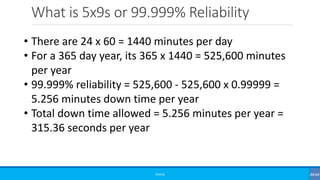
What is 5x9s or 99.999% Reliability
©3G4G
• There are 24 x 60 = 1440 minutes per day
• For a 365 day year, its 365 x 1440 = 525,600 minutes
per year
• 99.999% reliability = 525,600 - 525,600 x 0.99999 =
5.256 minutes down time per year
• Total down time allowed = 5.256 minutes per year =
315.36 seconds per year
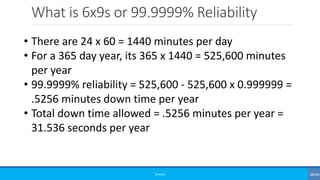
What is 6x9s or 99.9999% Reliability
©3G4G
• There are 24 x 60 = 1440 minutes per day
• For a 365 day year, its 365 x 1440 = 525,600 minutes
per year
• 99.9999% reliability = 525,600 - 525,600 x 0.999999 =
.5256 minutes down time per year
• Total down time allowed = .5256 minutes per year =
31.536 seconds per year
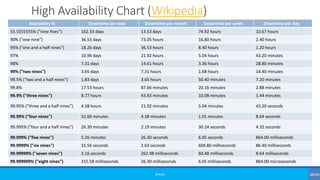
High Availability Chart (Wikipedia)
Availability % Downtime per year Downtime per month Downtime per week Downtime per day
55.5555555% ("nine fives") 162.33 days 13.53 days 74.92 hours 10.67 hours
90% ("one nine") 36.53 days 73.05 hours 16.80 hours 2.40 hours
95% ("one and a half nines") 18.26 days 36.53 hours 8.40 hours 1.20 hours
97% 10.96 days 21.92 hours 5.04 hours 43.20 minutes
98% 7.31 days 14.61 hours 3.36 hours 28.80 minutes
99% ("two nines") 3.65 days 7.31 hours 1.68 hours 14.40 minutes
99.5% ("two and a half nines") 1.83 days 3.65 hours 50.40 minutes 7.20 minutes
99.8% 17.53 hours 87.66 minutes 20.16 minutes 2.88 minutes
99.9% ("three nines") 8.77 hours 43.83 minutes 10.08 minutes 1.44 minutes
99.95% ("three and a half nines") 4.38 hours 21.92 minutes 5.04 minutes 43.20 seconds
99.99% ("four nines") 52.60 minutes 4.38 minutes 1.01 minutes 8.64 seconds
99.995% ("four and a half nines") 26.30 minutes 2.19 minutes 30.24 seconds 4.32 seconds
99.999% ("five nines") 5.26 minutes 26.30 seconds 6.05 seconds 864.00 milliseconds
99.9999% ("six nines") 31.56 seconds 2.63 seconds 604.80 milliseconds 86.40 milliseconds
99.99999% ("seven nines") 3.16 seconds 262.98 milliseconds 60.48 milliseconds 8.64 milliseconds
99.999999% ("eight nines") 315.58 milliseconds 26.30 milliseconds 6.05 milliseconds 864.00 microseconds
©3G4G
Thank You
To learn more, visit:
3G4G Website – https://www.3g4g.co.uk/
3G4G Blog – https://blog.3g4g.co.uk/
3G4G Small Cells Blog – https://smallcells.3g4g.co.uk/
Operator Watch - https://operatorwatch.3g4g.co.uk/
Follow us on Twitter: https://twitter.com/3g4gUK
Follow us on Facebook: https://www.facebook.com/3g4gUK/
Follow us on Linkedin: https://www.linkedin.com/company/3g4g
Follow us on Slideshare: https://www.slideshare.net/3G4GLtd
Follow us on Youtube: https://www.youtube.com/3G4G5G
©3G4G

Beginners: Reliability - 5x9s vs 6x9s

  • 1.
    Reliability: 5x9s vs6x9s (99.999 vs 99.9999) @3g4gUK
  • 2.
    NTT Docomo: 3GPPRelease 15 Overview ©3G4G Source
  • 3.
    5G High LevelRequirements and Wish List ©3G4G 10 years battery life M2M Ultra low cost 100 x More devices than 4G >10 Gbps Peak data rates 100 Mbps Whenever needed 10000 x More traffic than 4G Ultra Reliable (UR) 99.999% < 1 ms Low latency on radio interface ITU-R IMT-2020 requirements 1,000,000 devices per km2
  • 4.
    Rel.16 URLLC Enhancements ©3G4G Source:3G4G Low Latency (<1ms) High Reliability (>99.9999%) URLLC Efficiency [bps/Hz] Rel.15 Rel.16 • Flexible architecture • Short TTI/non- slot based scheduling • UL grant free • DL pre-emptive scheduling • Reduced processing time • Short PUCCH • K-repetition • PDCP duplication • Various “baseline” features (e.g. CQI/MCS tables for URLLC, Rank-1 MIMO) • Multi-connectivity enhancements • Multi-TRP • 0ms handover interruption • Various L1 enhancements (PDCCH, UCI, PUSCH, processing time line,…) • UL GF enhancements • QoS monitoring support for URLLC • Data duplication enhancements • Scheduling enhancements for intra- and inter-UE mux of eMBB and URLLC • … Key Rel.16 SI/WIs Primary WG FS_5G_URLLC (SP-180118) SA2 NR_IIoT (RP-181479) RAN2 NR_Mob_enh (RP-181433) RAN2 NR_eURLLC_L1 (RP-181477) RAN1 NR eMIMO (RP-181453) RAN1 • R15 use case improvements (e.g.AR/VR) • New use cases with higher requirements (e.g. factory automation, transport industry, electrical power distribution) © Nokia 2018 Enhancements for latency and reliability in Radio and E2E Rel.16 URLLC aims for higher reliability and better efficiency
  • 5.
    URLLC Use Casesand Requirements (TS 22.261) ©3G4G Scenario End-to- end latency Communication service availability Reliability User experienced data rate Payload size Traffic density Connection density Service area dimension Discrete automation – motion control 1 ms 99.9999% 99.9999% 1 Mbps up to 10 Mbps Small 1 Tbps/km2 100 000/km2 100 x 100 x 30 m Discrete automation 10 ms 99.99% 99.99% 10 Mbps Smallto big 1 Tbps/km2 100 000/km2 1000 x 1000 x 30 m Process automation – remote control 50 ms 99.9999% 99.9999% 1 Mbps up to100 Mbps Smallto big 100 Gbps/km2 1 000/km2 300 x 300 x 50 m Process automation ‒monitoring 50 ms 99.9% 99.9% 1 Mbps Small 10 Gbps/km2 10 000/km2 300 x 300 x 50 Electricity distribution – mediumvoltage 25 ms 99.9% 99.9% 10 Mbps Smallto big 10 Gbps/km2 1 000/km2 100 km along power line Electricity distribution – high voltage 5 ms 99.9999% 99.9999% 10 Mbps Small 100 Gbps/km2 1 000/km2 200 km along power line Intelligenttransport systems – infrastructure backhaul 10 ms 99.9999% 99.9999% 10 Mbps Smallto big 10 Gbps/km2 1 000/km2 2 km alonga road Tactile interaction 0,5 ms [99.999%] [99.999%] [Low] [Small] [Low] [Low] TBC Remote control [5 ms] [99.999%] [99.999%] [From low to 10 Mbps] [Smallto big] [Low] [Low] TBC 4 © Nokia 2018 Various requirements from different URLLC services Table 7.2.2-1 Performance requirements for low-latency and high-reliability scenarios. Source: 3G4G
  • 6.
    What is 5x9sor 99.999% Reliability ©3G4G • There are 24 x 60 = 1440 minutes per day • For a 365 day year, its 365 x 1440 = 525,600 minutes per year • 99.999% reliability = 525,600 - 525,600 x 0.99999 = 5.256 minutes down time per year • Total down time allowed = 5.256 minutes per year = 315.36 seconds per year
  • 7.
    What is 6x9sor 99.9999% Reliability ©3G4G • There are 24 x 60 = 1440 minutes per day • For a 365 day year, its 365 x 1440 = 525,600 minutes per year • 99.9999% reliability = 525,600 - 525,600 x 0.999999 = .5256 minutes down time per year • Total down time allowed = .5256 minutes per year = 31.536 seconds per year
  • 8.
    High Availability Chart(Wikipedia) Availability % Downtime per year Downtime per month Downtime per week Downtime per day 55.5555555% ("nine fives") 162.33 days 13.53 days 74.92 hours 10.67 hours 90% ("one nine") 36.53 days 73.05 hours 16.80 hours 2.40 hours 95% ("one and a half nines") 18.26 days 36.53 hours 8.40 hours 1.20 hours 97% 10.96 days 21.92 hours 5.04 hours 43.20 minutes 98% 7.31 days 14.61 hours 3.36 hours 28.80 minutes 99% ("two nines") 3.65 days 7.31 hours 1.68 hours 14.40 minutes 99.5% ("two and a half nines") 1.83 days 3.65 hours 50.40 minutes 7.20 minutes 99.8% 17.53 hours 87.66 minutes 20.16 minutes 2.88 minutes 99.9% ("three nines") 8.77 hours 43.83 minutes 10.08 minutes 1.44 minutes 99.95% ("three and a half nines") 4.38 hours 21.92 minutes 5.04 minutes 43.20 seconds 99.99% ("four nines") 52.60 minutes 4.38 minutes 1.01 minutes 8.64 seconds 99.995% ("four and a half nines") 26.30 minutes 2.19 minutes 30.24 seconds 4.32 seconds 99.999% ("five nines") 5.26 minutes 26.30 seconds 6.05 seconds 864.00 milliseconds 99.9999% ("six nines") 31.56 seconds 2.63 seconds 604.80 milliseconds 86.40 milliseconds 99.99999% ("seven nines") 3.16 seconds 262.98 milliseconds 60.48 milliseconds 8.64 milliseconds 99.999999% ("eight nines") 315.58 milliseconds 26.30 milliseconds 6.05 milliseconds 864.00 microseconds ©3G4G
  • 9.
    Thank You To learnmore, visit: 3G4G Website – https://www.3g4g.co.uk/ 3G4G Blog – https://blog.3g4g.co.uk/ 3G4G Small Cells Blog – https://smallcells.3g4g.co.uk/ Operator Watch - https://operatorwatch.3g4g.co.uk/ Follow us on Twitter: https://twitter.com/3g4gUK Follow us on Facebook: https://www.facebook.com/3g4gUK/ Follow us on Linkedin: https://www.linkedin.com/company/3g4g Follow us on Slideshare: https://www.slideshare.net/3G4GLtd Follow us on Youtube: https://www.youtube.com/3G4G5G ©3G4G