Performance Evaluation of Traditional
               Caching Policies on
            A Large System with Petabytes of Data

            Ribel Fares1, Brian Romoser1, Ziliang Zong1,
                     Mais Nijim2 and Xiao Qin3
                       Texas State University, TX, USA1
                      Texas A&M University-Kingsville2
                         Auburn University, AL, USA3


              Presented at the 7th IEEE International Conference
6/28/2012
             on Networking, Architecture, and Storage (NAS2012)
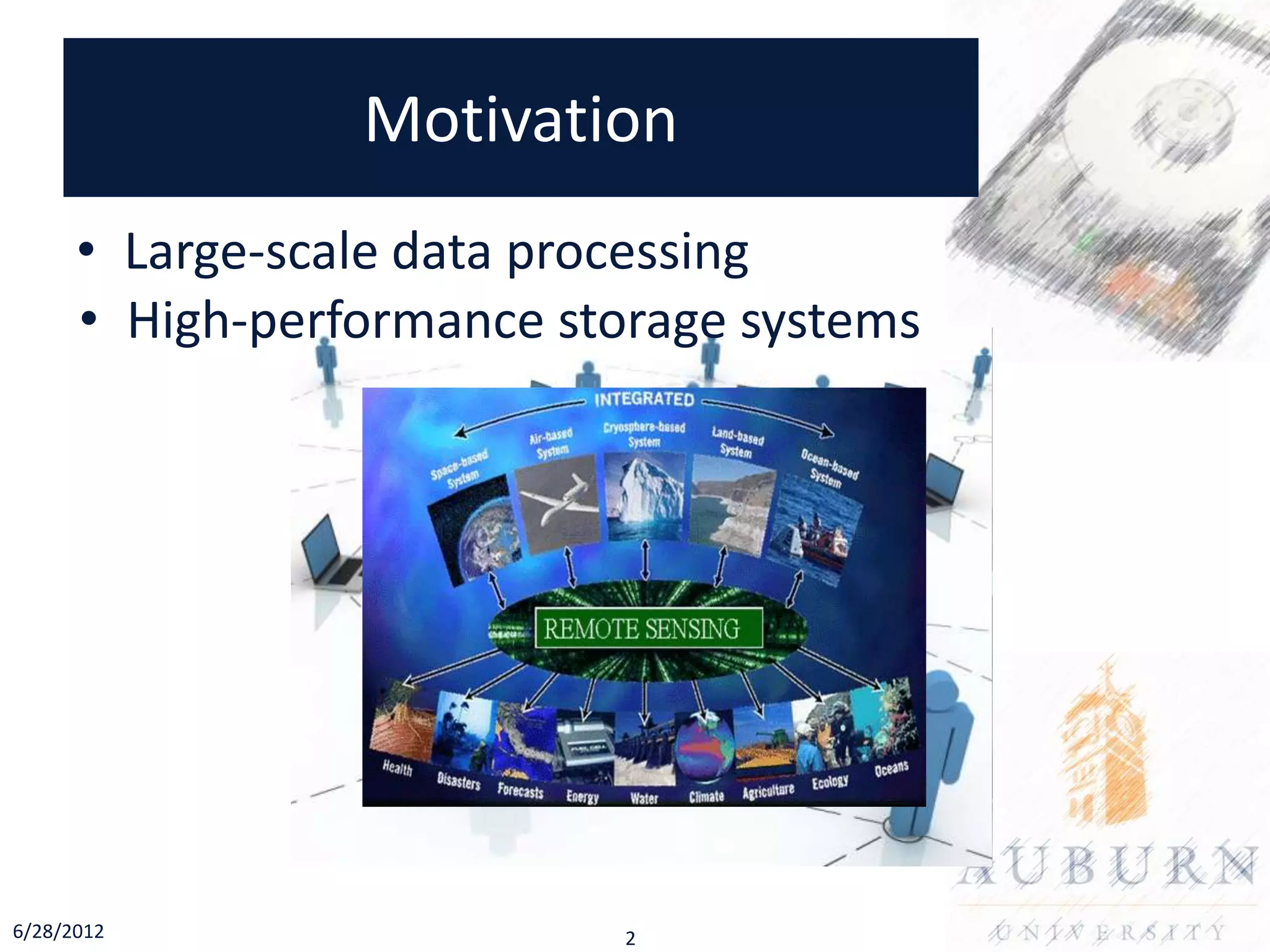
Motivation
      • Large-scale data processing
      • High-performance storage systems


6/28/2012                   2
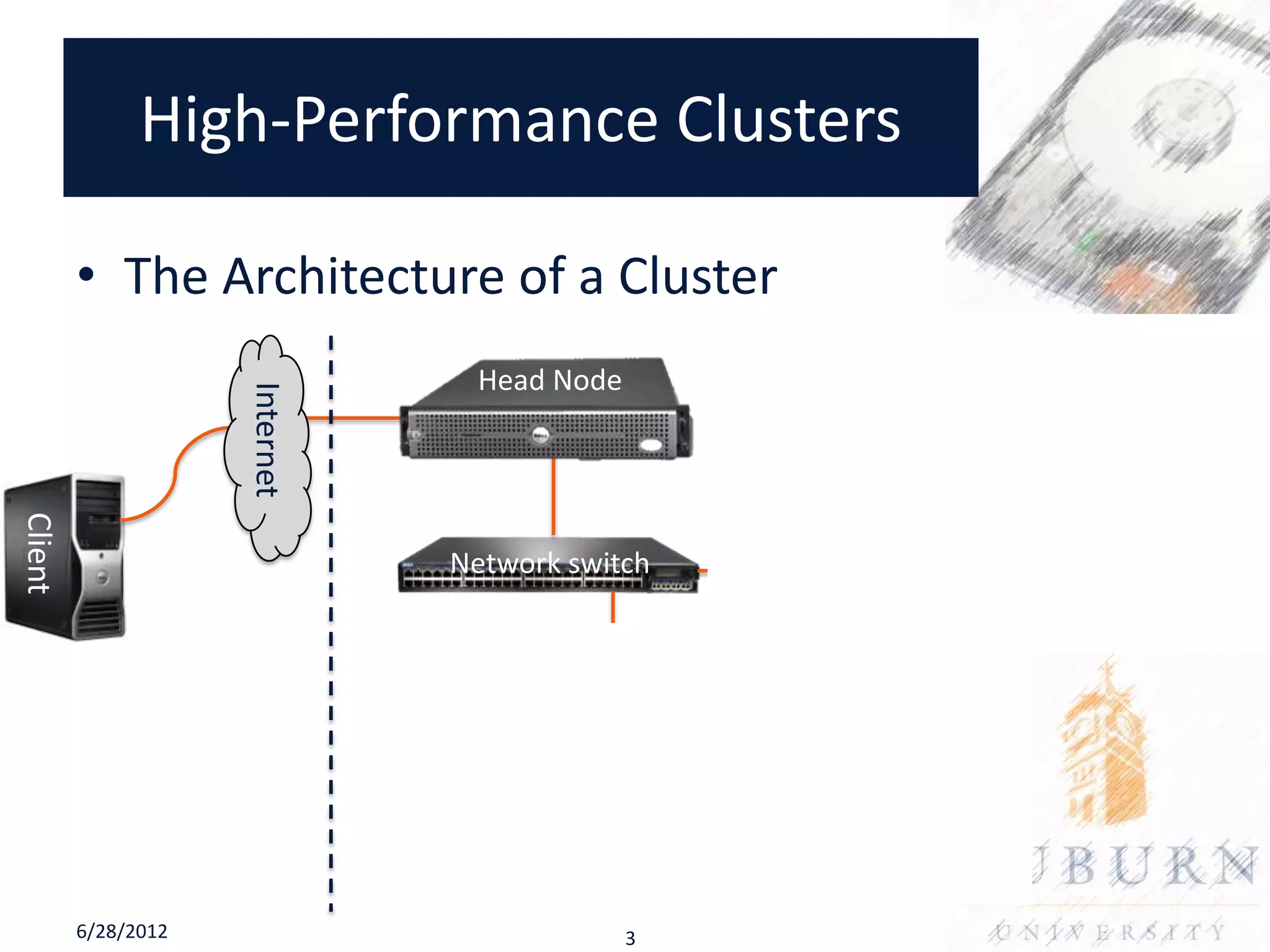
High-Performance Clusters

         • The Architecture of a Cluster
                                                          Storage subsystems
                                       Head Node       (or Storage Area Network)
                     Internet
Client


                                     Network switch


                                Computing
                                Nodes
         6/28/2012                                 3
Techniques for High-Performance
            Storage Systems

•   Caching
•   Prefetching
•   Active Storage
•   Parallel Processing


                          4
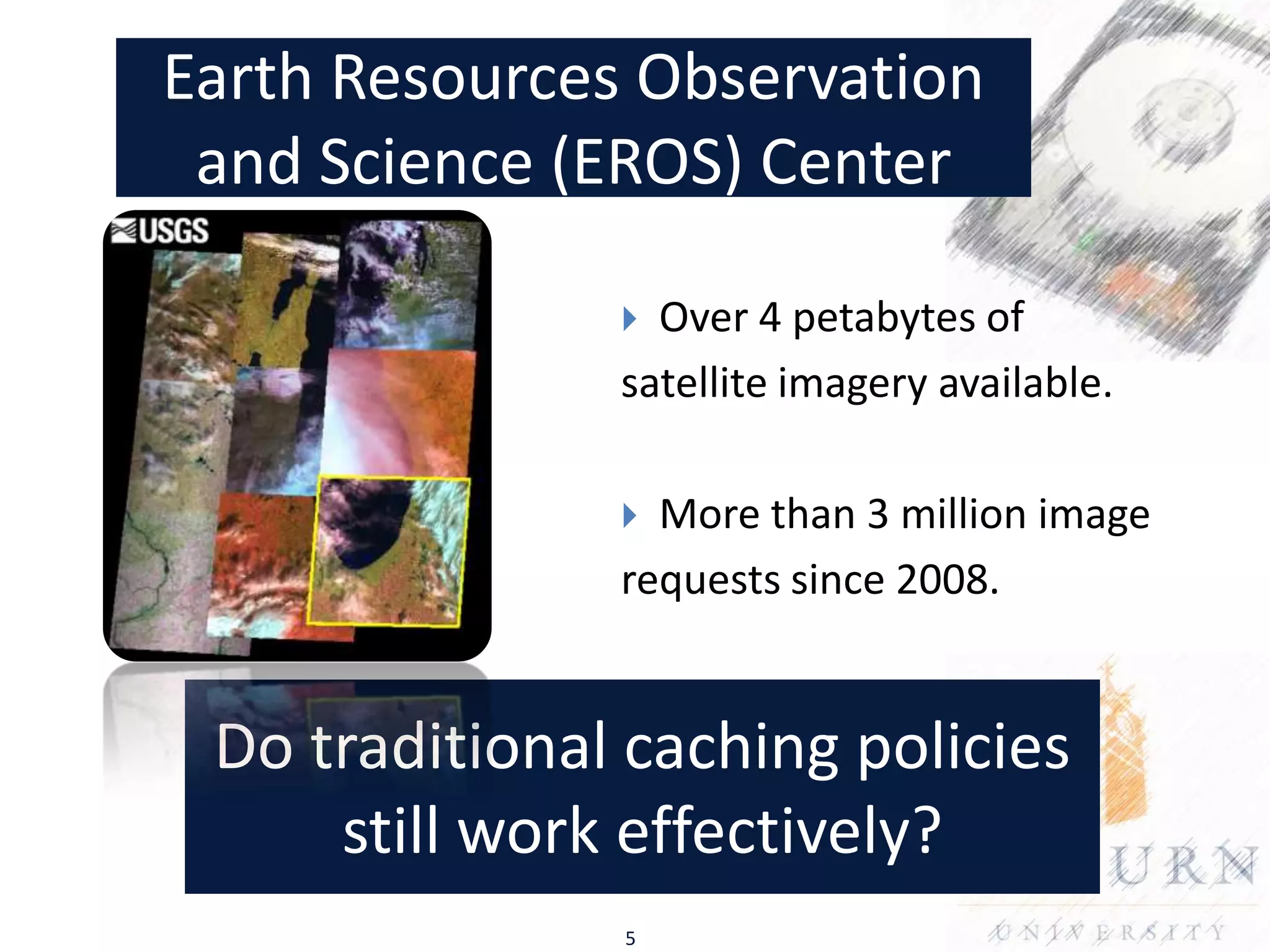
Earth Resources Observation
 and Science (EROS) Center

                Over 4 petabytes of
               satellite imagery available.

                More than 3 million image
               requests since 2008.


 Do traditional caching policies
     still work effectively?
               5
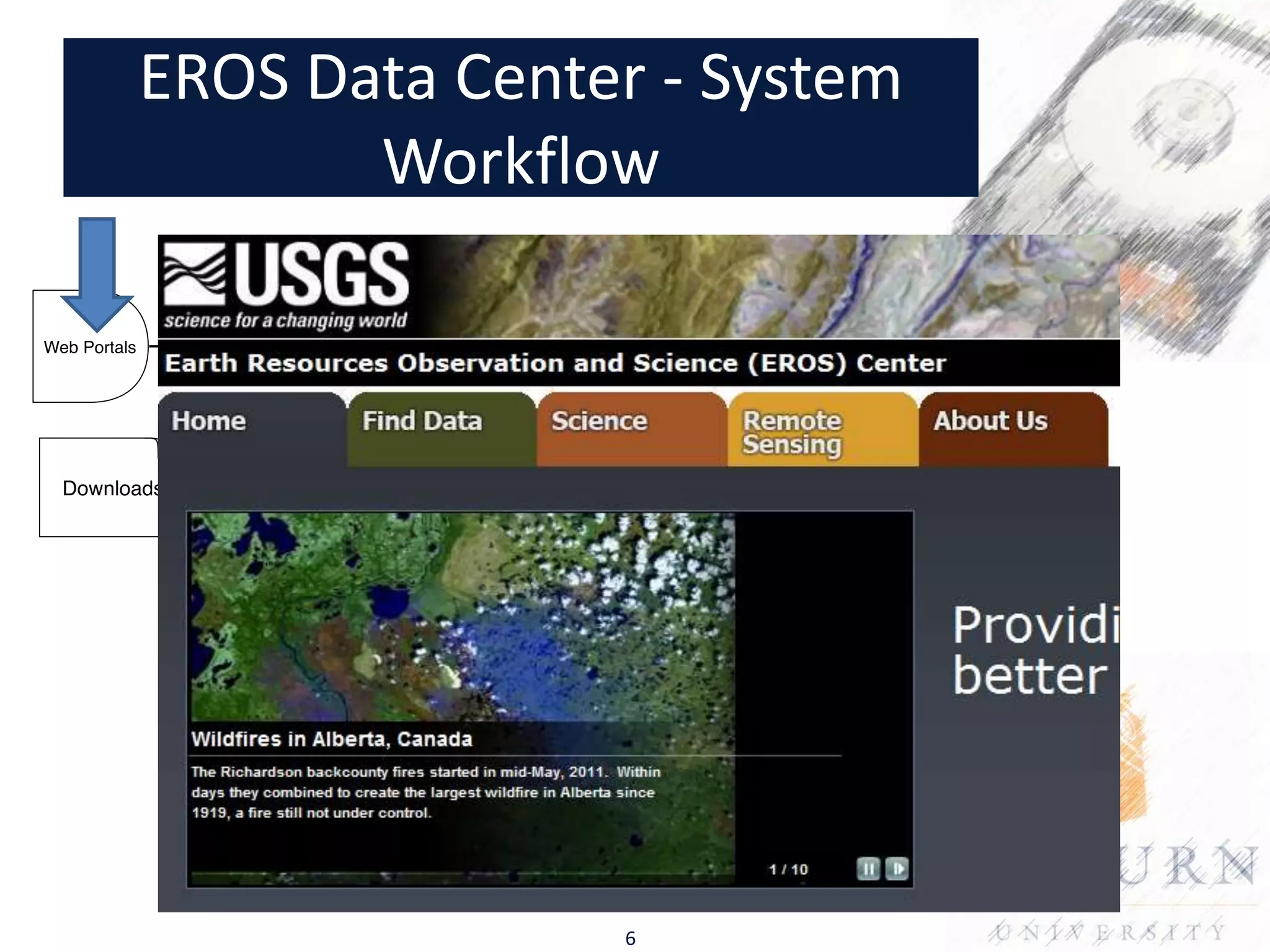
EROS Data Center - System
       Workflow


            data
     data
                        data


                   6
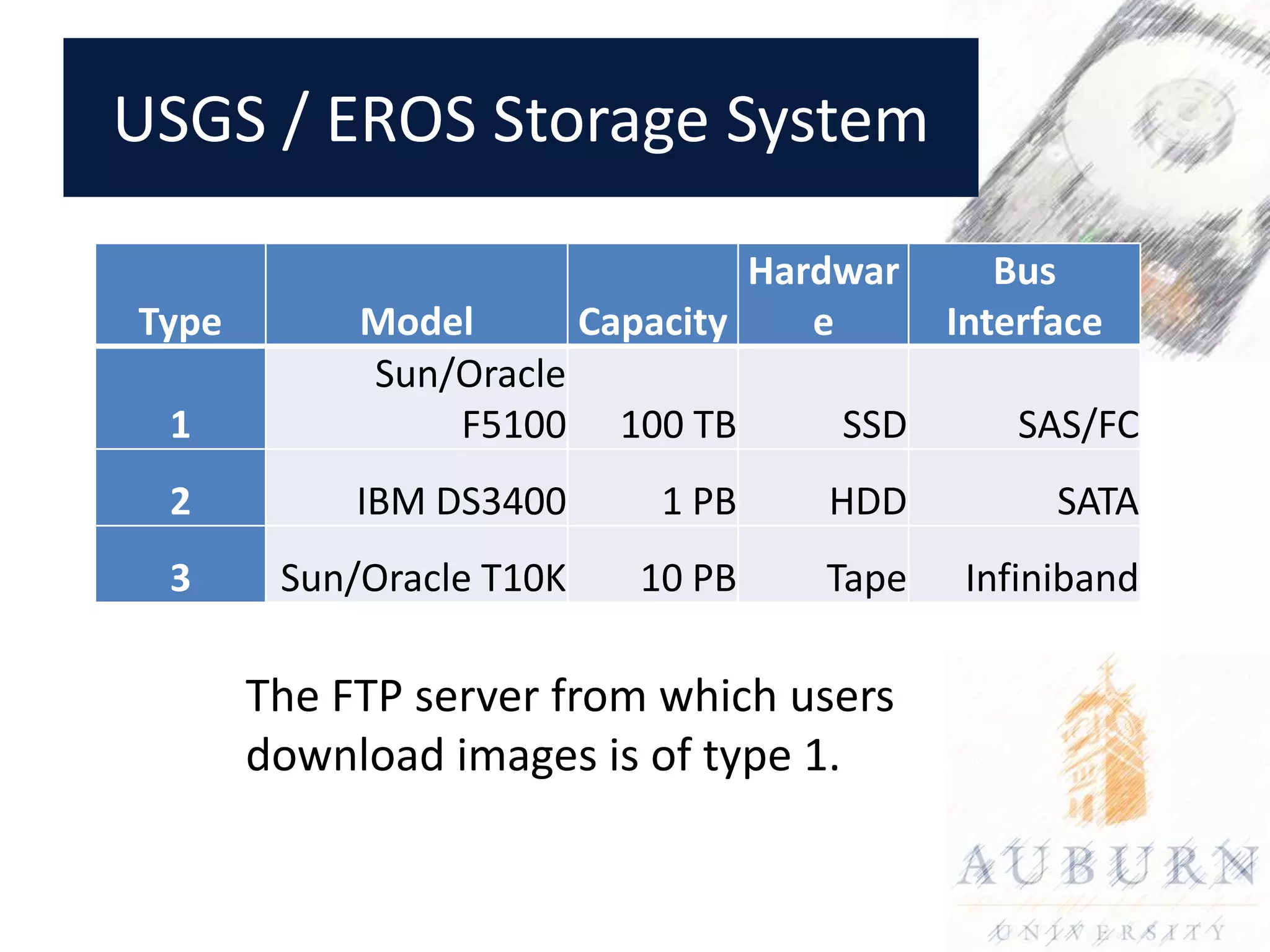
USGS / EROS Storage System

                                   Hardwar      Bus
Type        Model         Capacity    e      Interface
            Sun/Oracle
 1              F5100       100 TB     SSD       SAS/FC
 2          IBM DS3400        1 PB    HDD          SATA
 3      Sun/Oracle T10K      10 PB    Tape    Infiniband

       The FTP server from which users
       download images is of type 1.
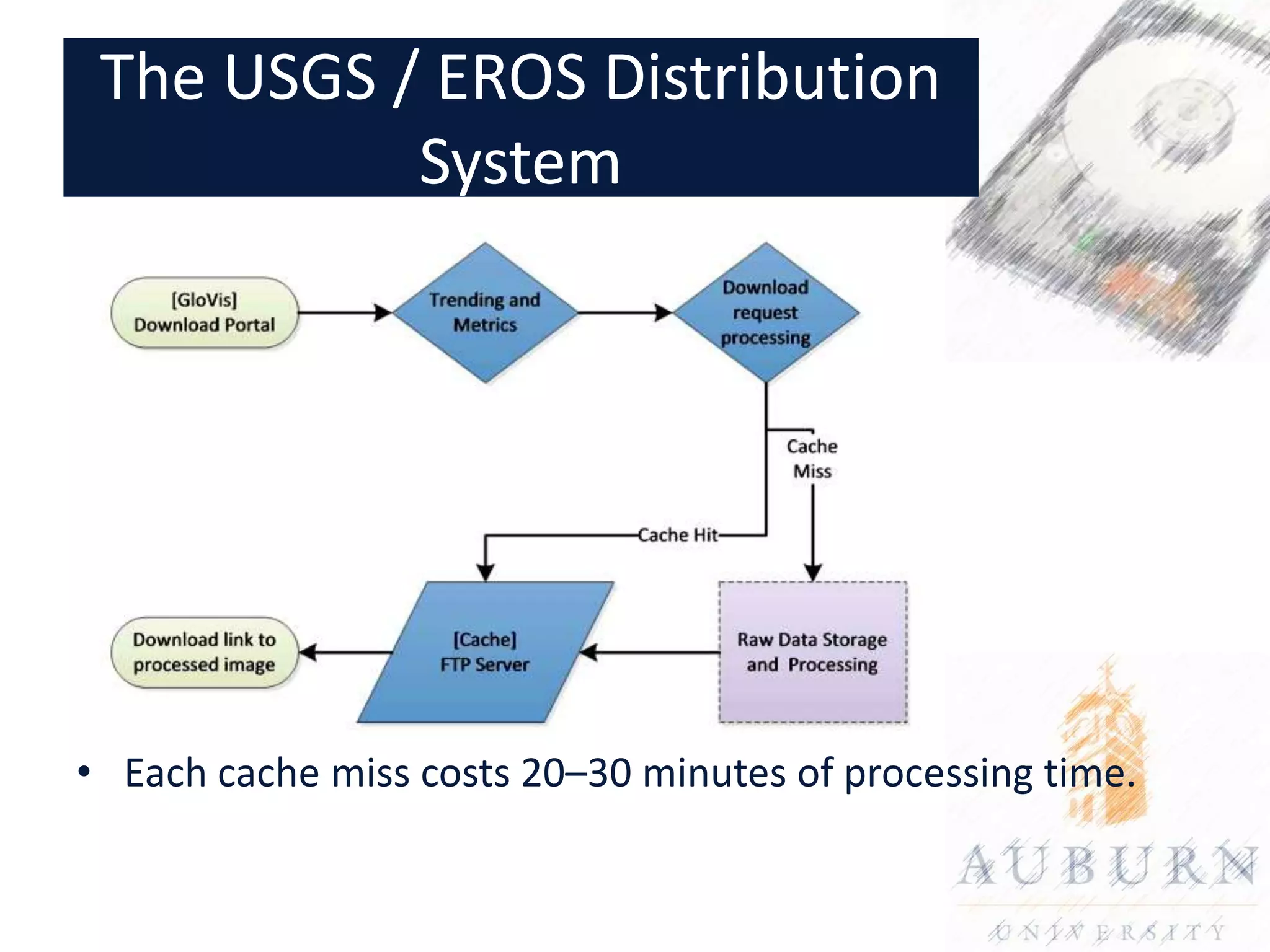
The USGS / EROS Distribution
           System


• Each cache miss costs 20–30 minutes of processing time.
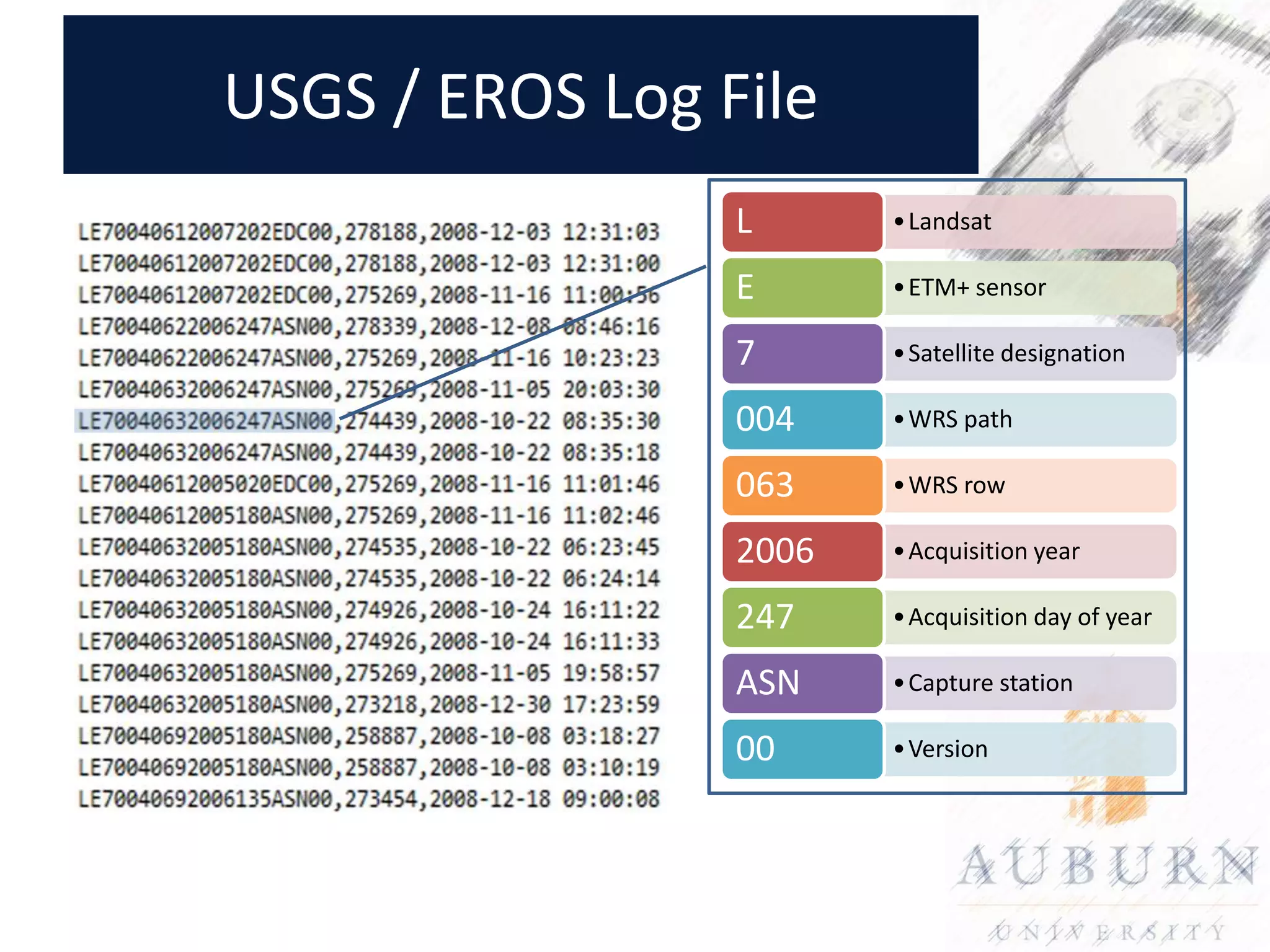
USGS / EROS Log File
                 L      • Landsat

                 E      • ETM+ sensor

                 7      • Satellite designation

                 004    • WRS path

                 063    • WRS row

                 2006   • Acquisition year

                 247    • Acquisition day of year

                 ASN    • Capture station

                 00     • Version
Observation 1


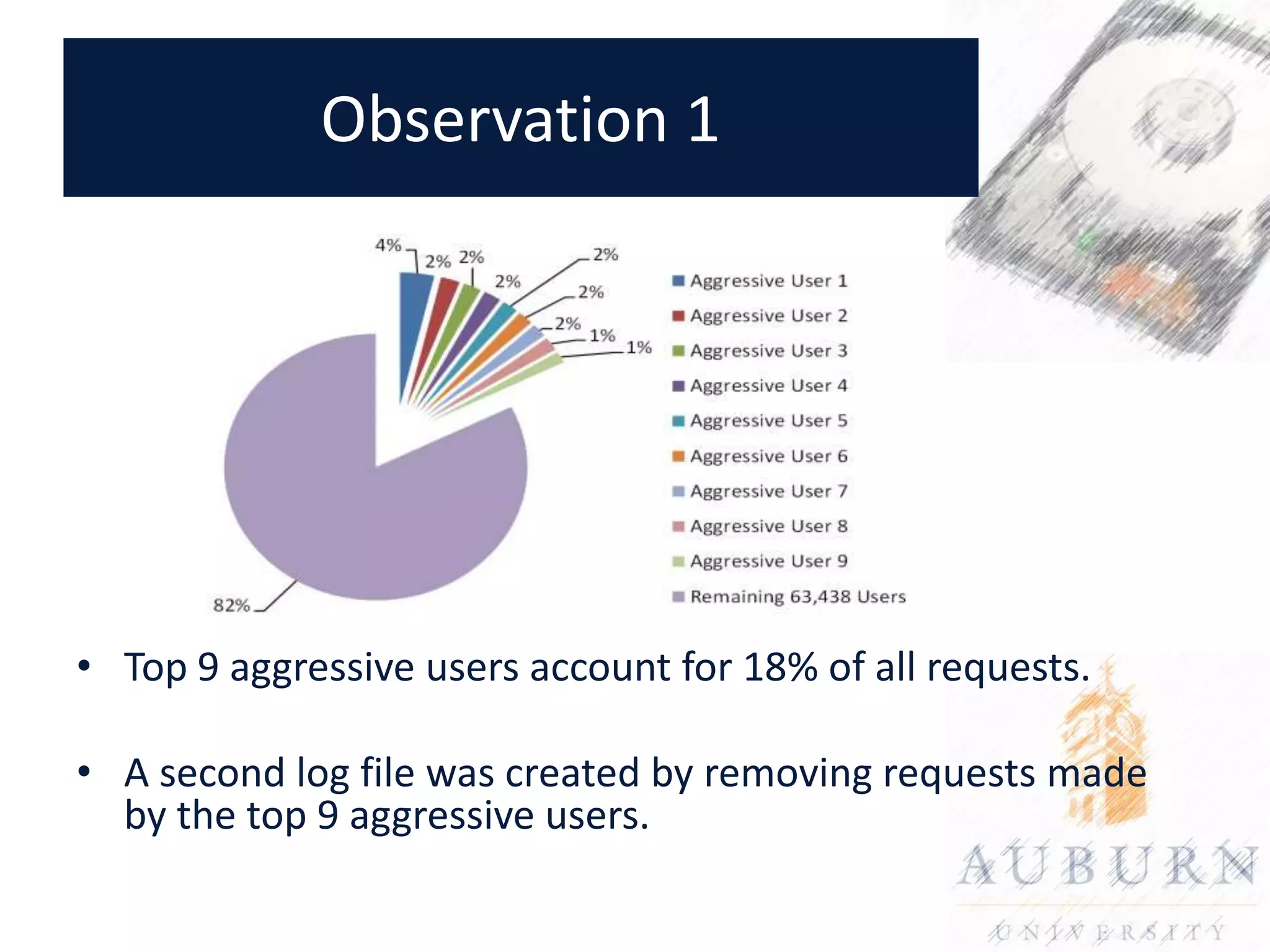
• Top 9 aggressive users account for 18% of all requests.

• A second log file was created by removing requests made
  by the top 9 aggressive users.
Observation 2
                                 35.00%
  Duplicate Request Percentage


                                 30.00%

                                 25.00%

                                 20.00%

                                 15.00%

                                 10.00%

                                  5.00%

                                  0.00%
                                          0   2   4   6           8            10   12   14   16
                                                          Time Window (Days)


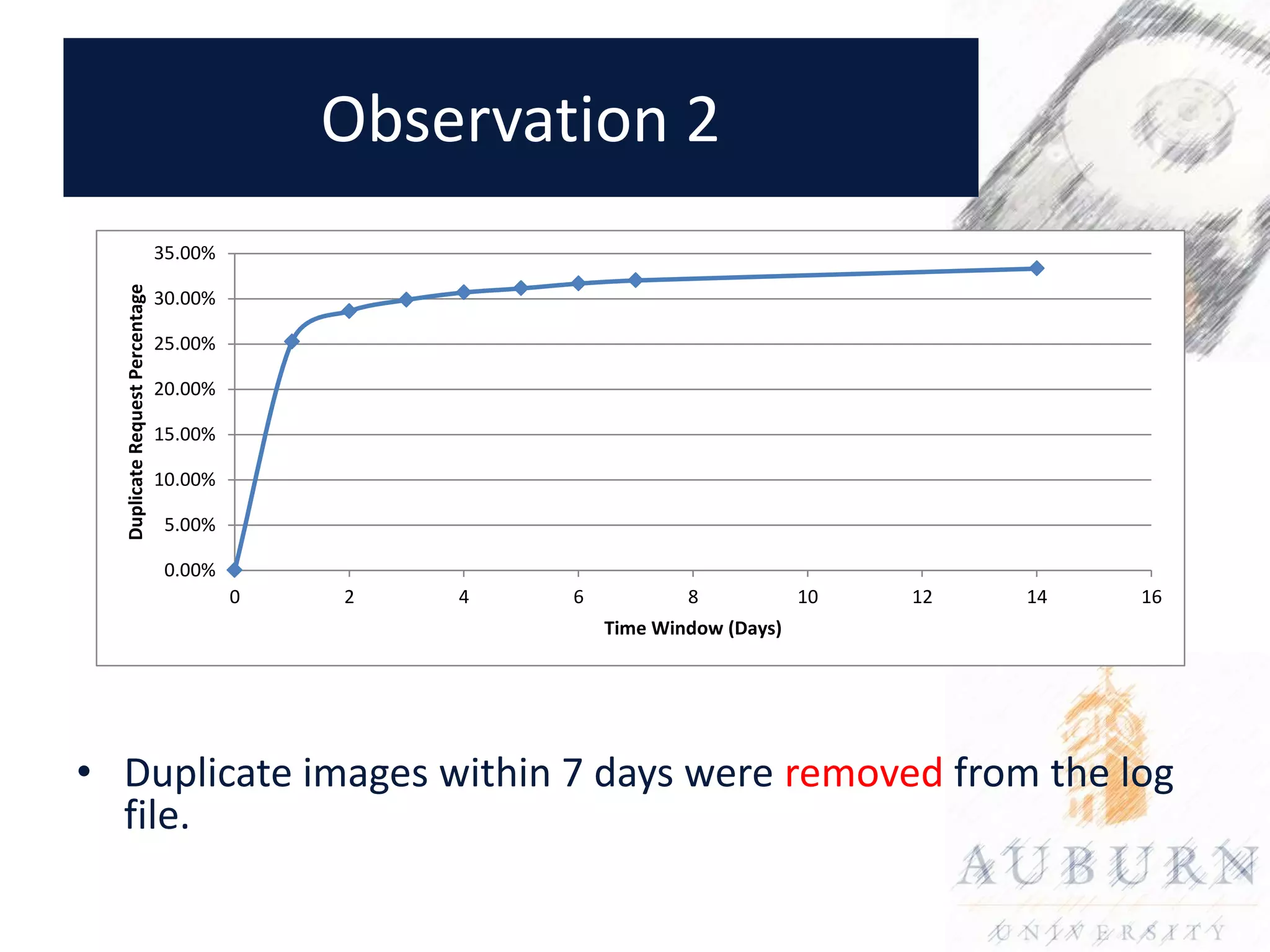
• Duplicate images within 7 days were removed from the log
  file.
Caching Algorithms

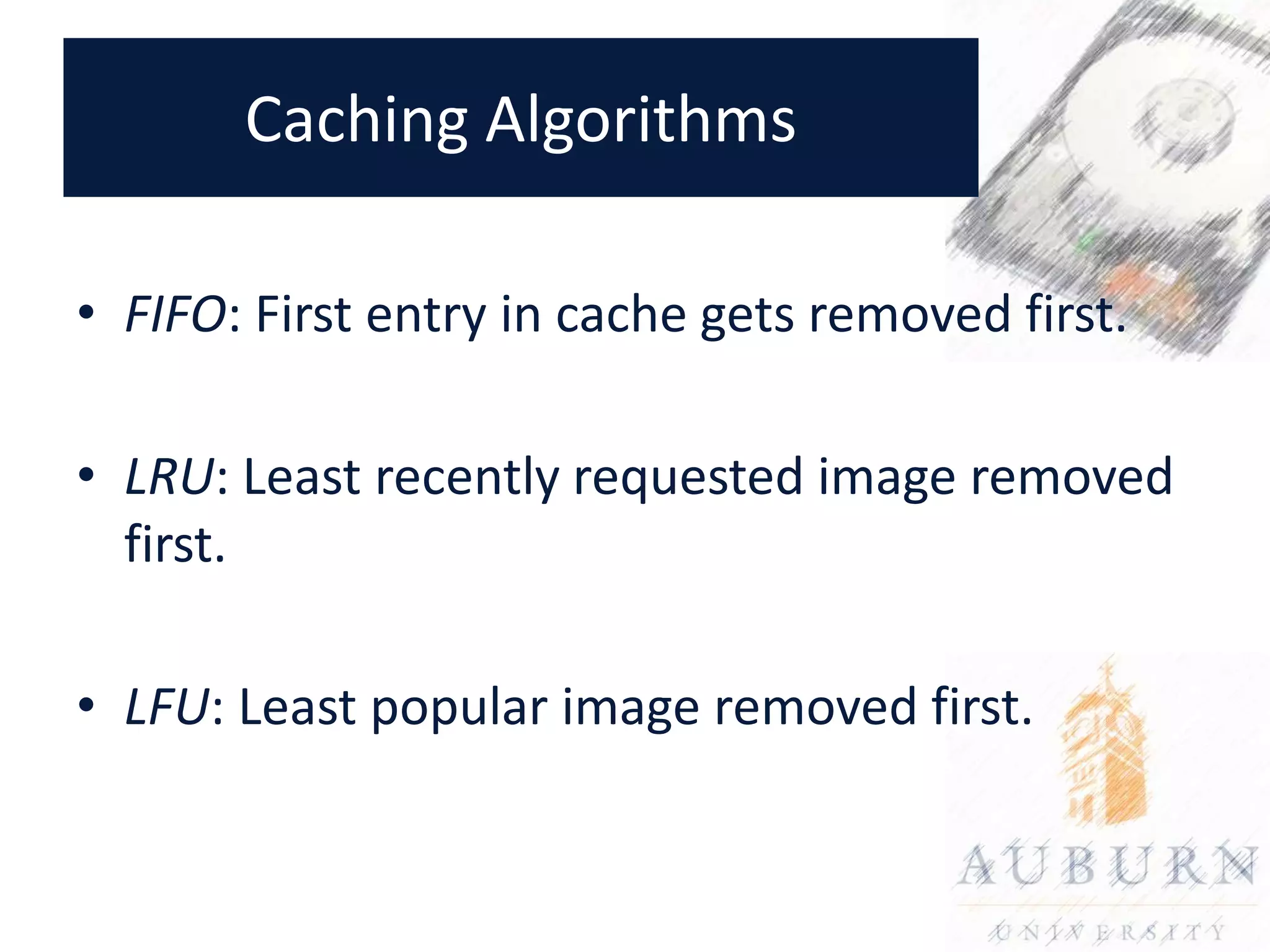
• FIFO: First entry in cache gets removed first.

• LRU: Least recently requested image removed
  first.

• LFU: Least popular image removed first.
Case Studies
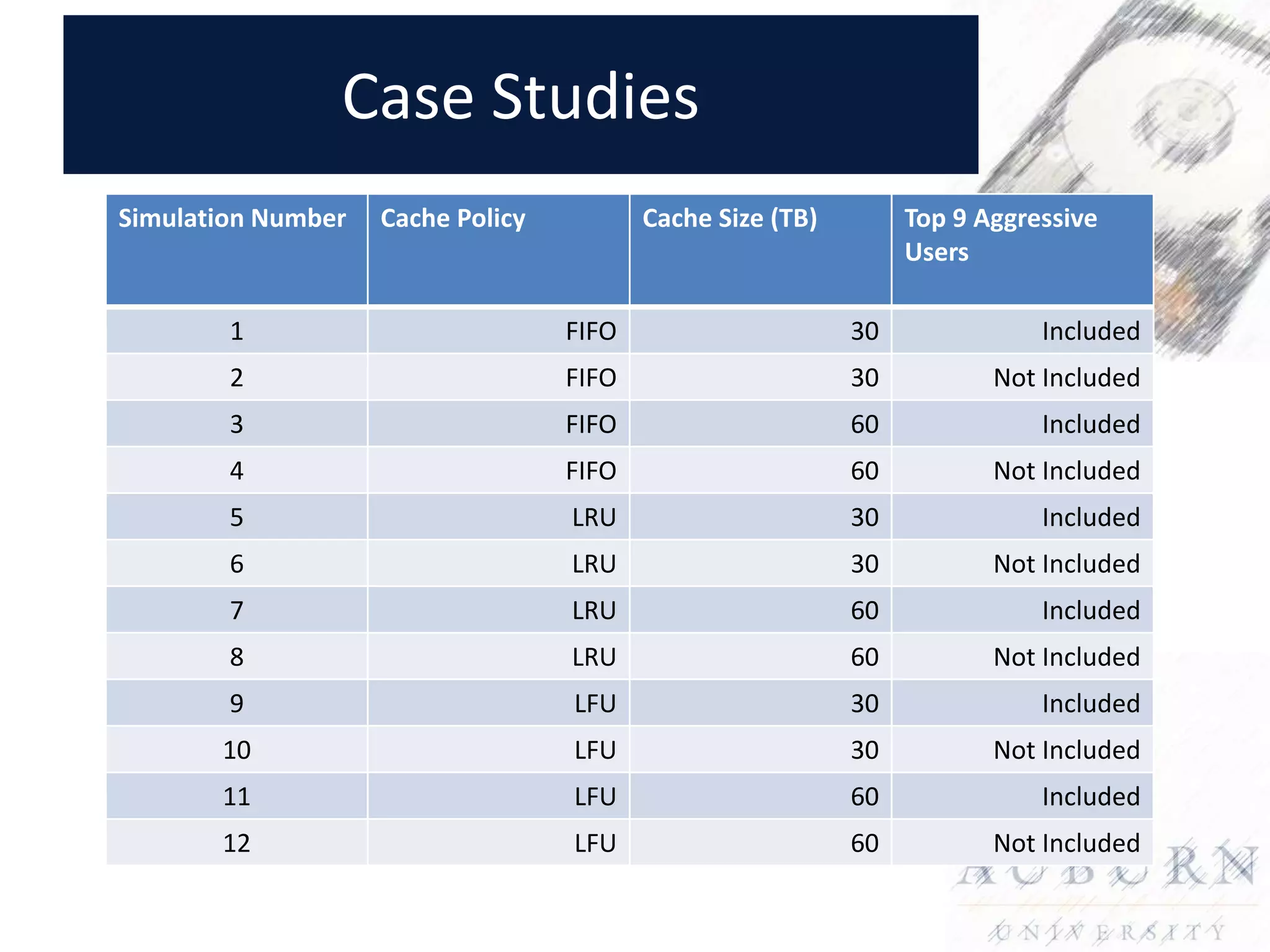
Simulation Number   Cache Policy          Cache Size (TB)        Top 9 Aggressive
                                                                 Users

        1                          FIFO                     30              Included
        2                          FIFO                     30          Not Included
        3                          FIFO                     60              Included
        4                          FIFO                     60          Not Included
        5                          LRU                      30              Included
        6                          LRU                      30          Not Included
        7                          LRU                      60              Included
        8                          LRU                      60          Not Included
        9                          LFU                      30              Included
       10                          LFU                      30          Not Included
       11                          LFU                      60              Included
       12                          LFU                      60          Not Included
Simulation
     Assumptions/Restrictions

• When cache server reaches 90% capacity, images
  will be removed according to adopted cache
  policy until server load is reduced down to 45%.

• Images are assumed to be processed
  instantaneously.

• A requested image can not be removed from the
  server before 7 days.
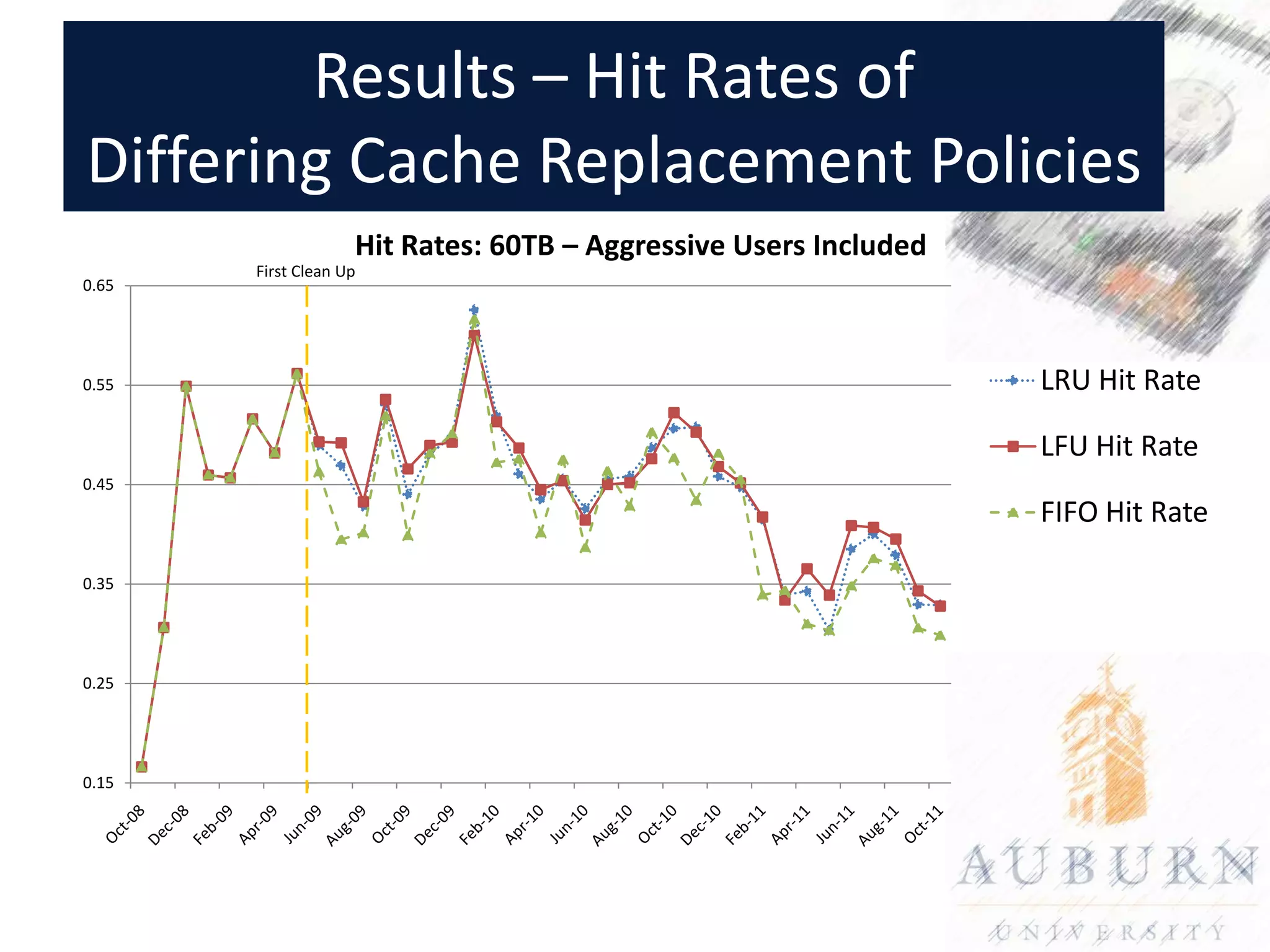
Results – Hit Rates of
Differing Cache Replacement Policies
                    Hit Rates: 60TB – Aggressive Users Included
       First Clean Up
0.65


0.55                                                              LRU Hit Rate

                                                                  LFU Hit Rate
0.45
                                                                  FIFO Hit Rate

0.35


0.25


0.15
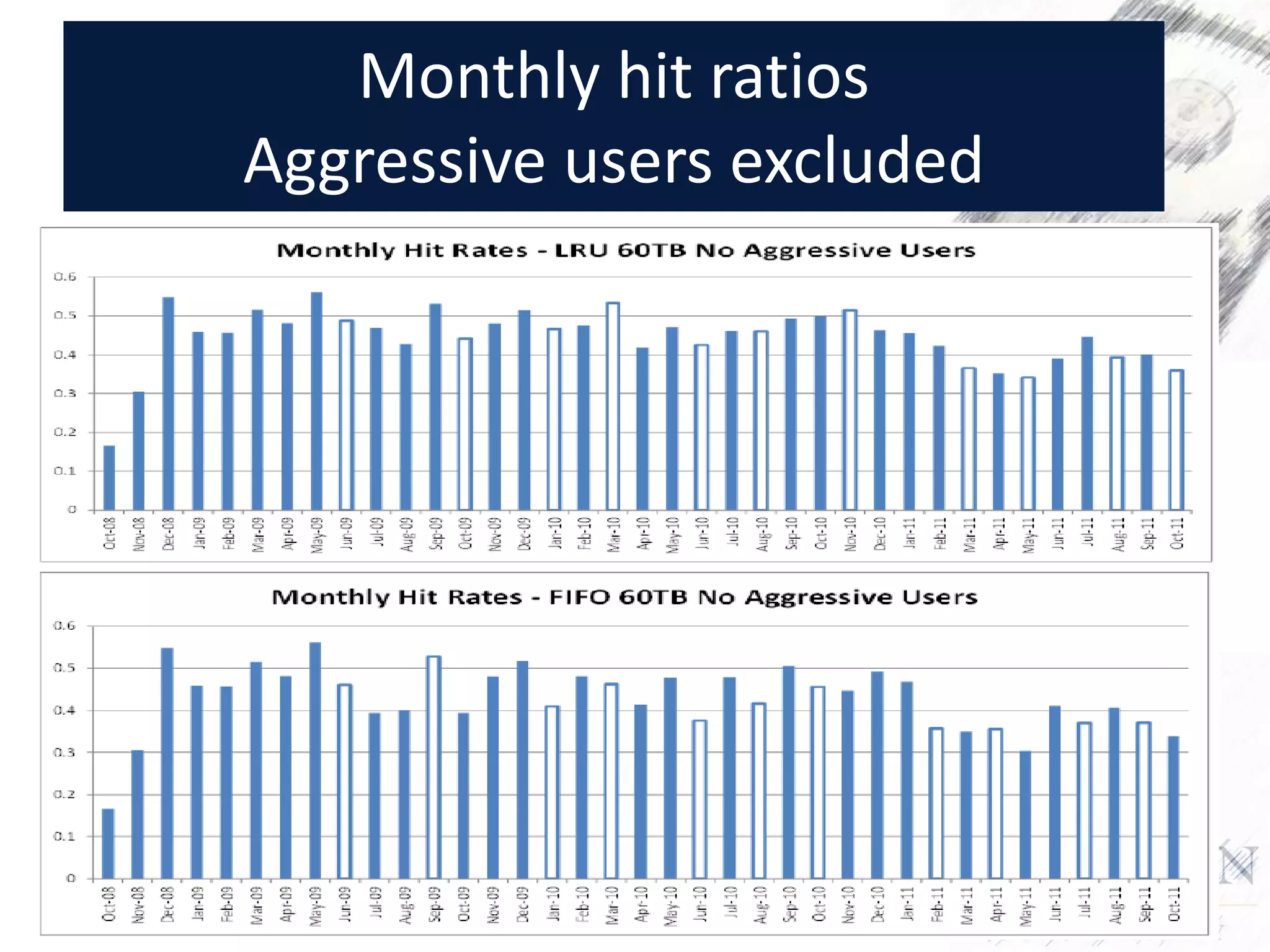
Monthly hit ratios
Aggressive users excluded
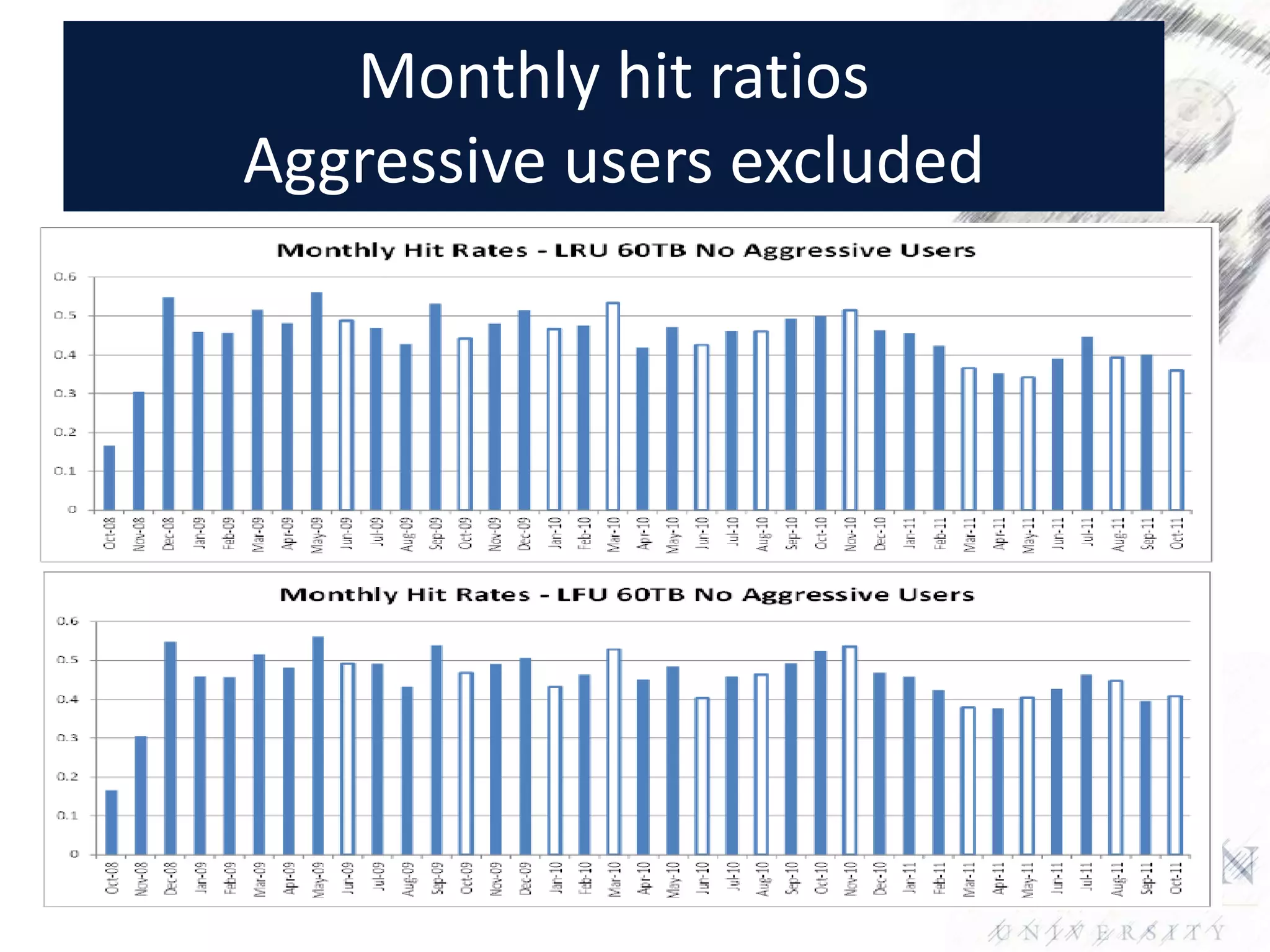
Monthly hit ratios
Aggressive users excluded
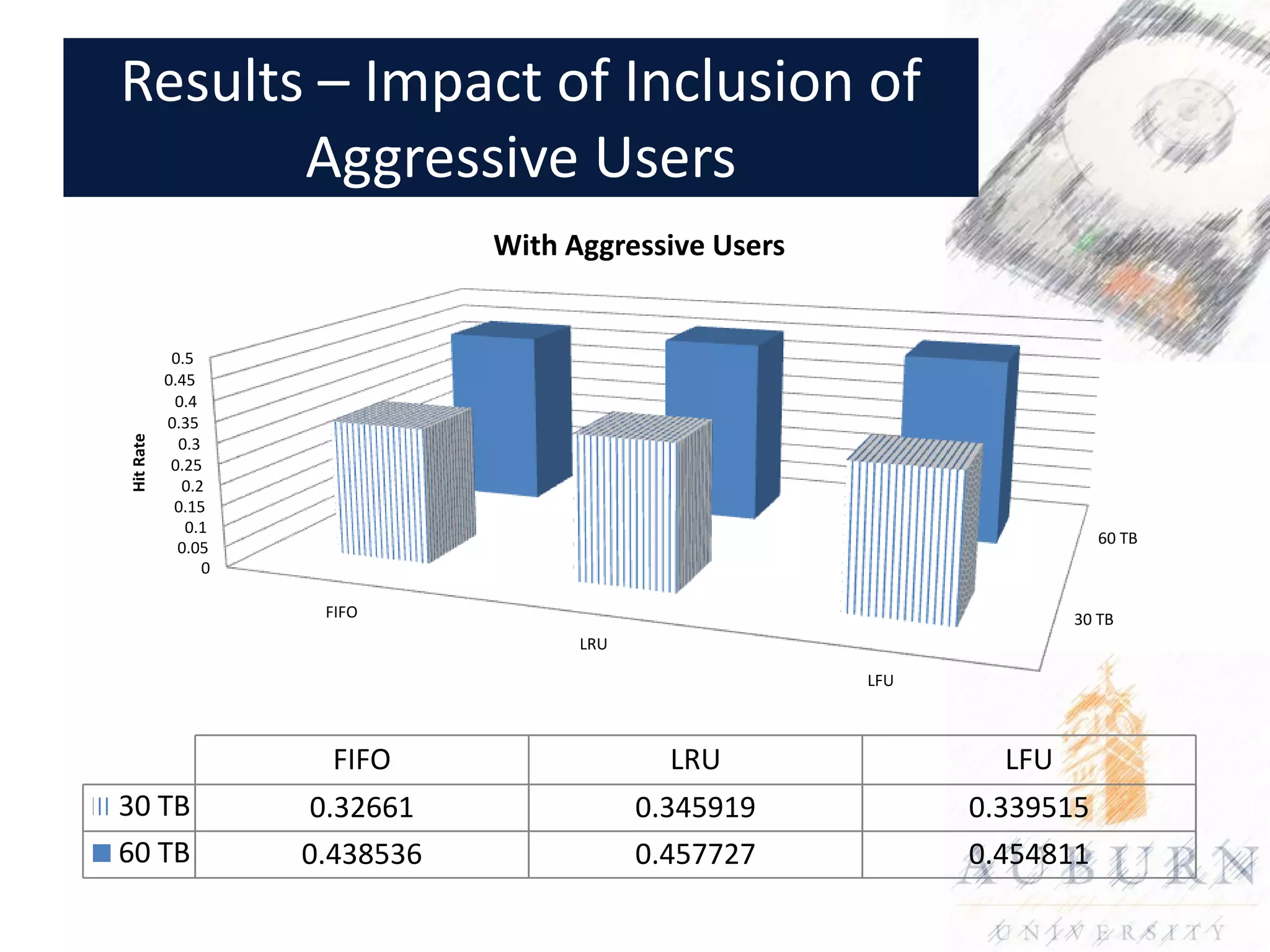
Results – Impact of Inclusion of
       Aggressive Users
                                With Aggressive Users


            0.5
           0.45
            0.4
           0.35
Hit Rate


             0.3
            0.25
             0.2
            0.15
              0.1
                                                                         60 TB
             0.05
                 0

                      FIFO                                            30 TB
                                      LRU

                                                        LFU


                       FIFO                   LRU               LFU
30 TB                0.32661                0.345919          0.339515
60 TB                0.438536               0.457727          0.454811
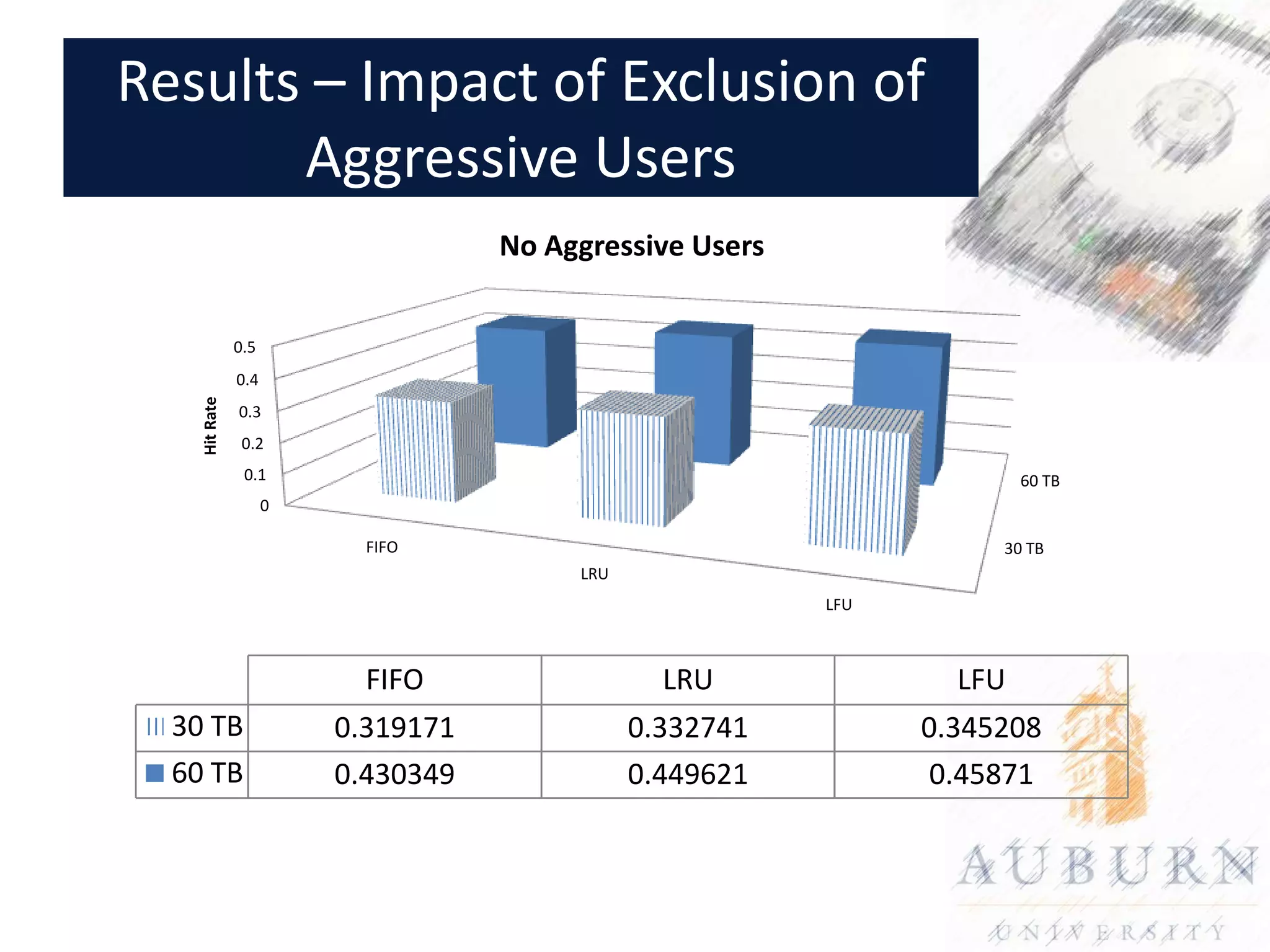
Results – Impact of Exclusion of
       Aggressive Users
                                    No Aggressive Users


               0.5
               0.4
    Hit Rate


               0.3
                0.2
                0.1                                                     60 TB
                     0

                           FIFO                                      30 TB
                                         LRU
                                                          LFU


                           FIFO                  LRU              LFU
  30 TB                  0.319171              0.332741         0.345208
  60 TB                  0.430349              0.449621          0.45871
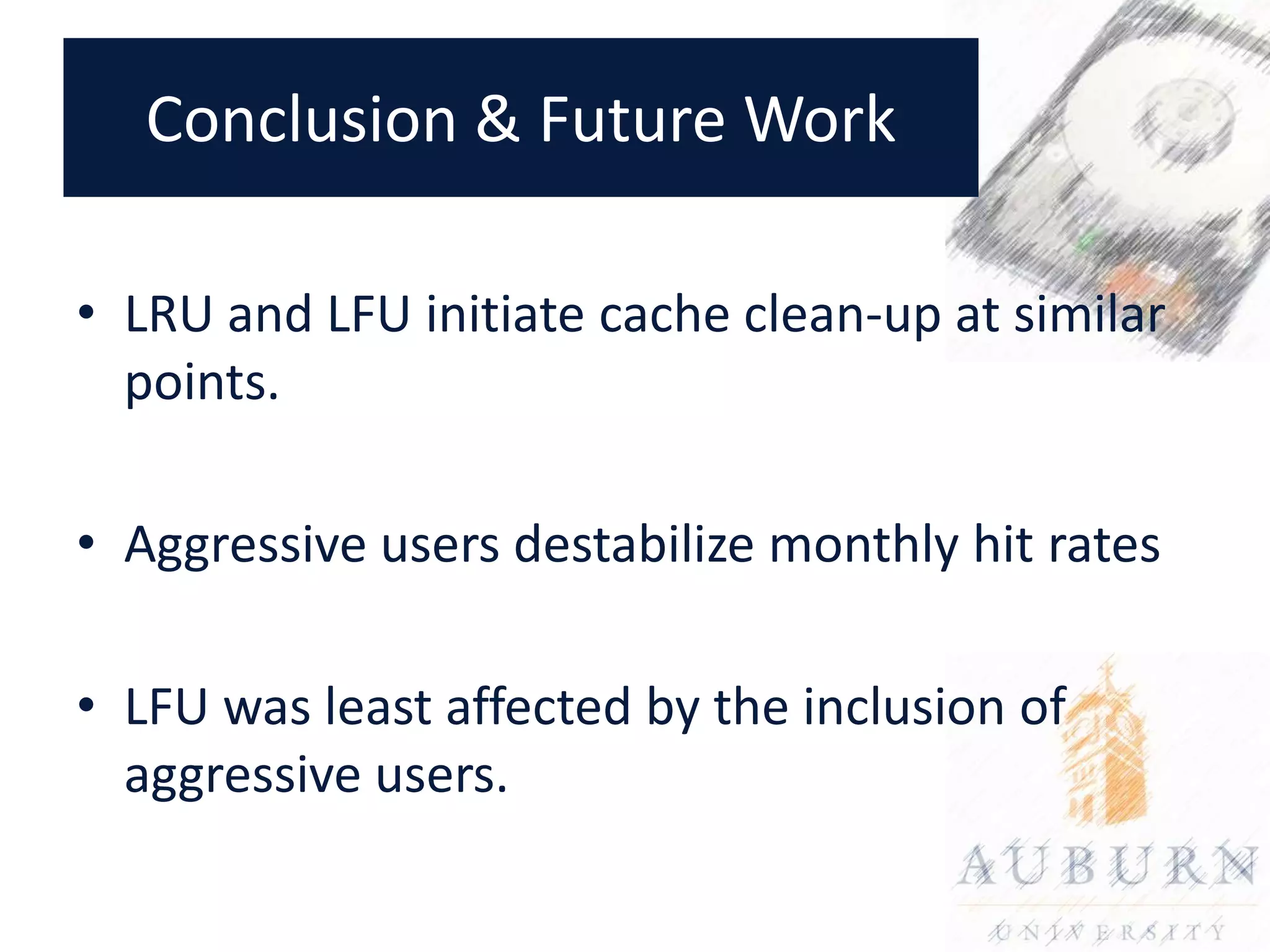
Conclusion & Future Work

• LRU and LFU initiate cache clean-up at similar
  points.

• Aggressive users destabilize monthly hit rates

• LFU was least affected by the inclusion of
  aggressive users.
Conclusion & Future Work
            cont’d.

• LRU and LFU methods improve FIFO as expected.

• However, improvements are on the weaker side.

• Global user behaviors should be further
  investigated to design more complex caching
  and/or prefetching strategies.
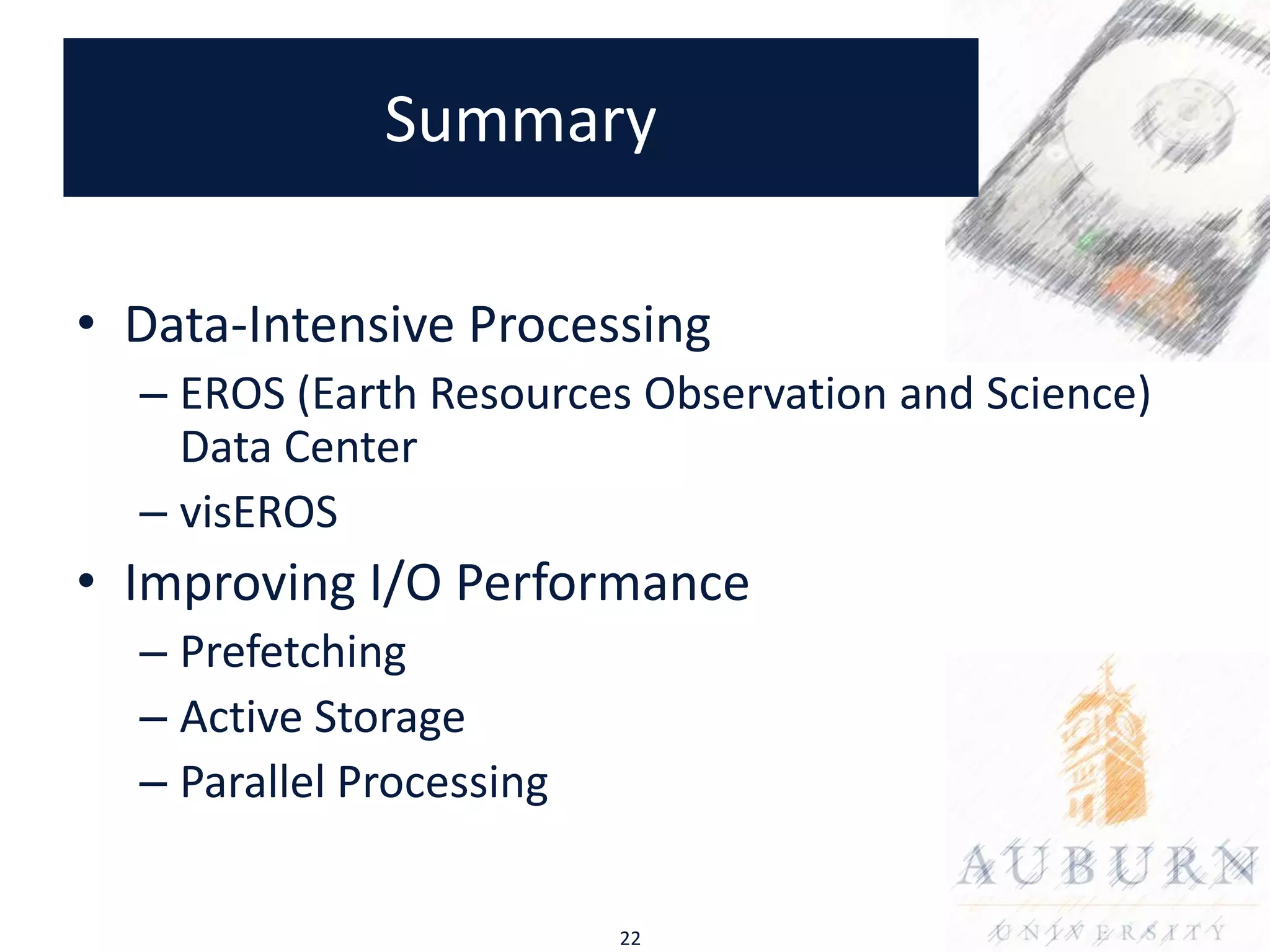
Summary

• Data-Intensive Processing
  – EROS (Earth Resources Observation and Science)
    Data Center
  – visEROS
• Improving I/O Performance
  – Prefetching
  – Active Storage
  – Parallel Processing


                          22
The VisEROS Project –
                   Motivation

• 2M downloads from the EROS data center.
• No existing visualization tools available to utilize
  these data
• Need a tool to:
   –   Monitor user download behaviors
   –   Show the current global download “hot spots”
   –   Demonstrate the actual usage of EROS data
   –   Optimize the storage system performance
   –   Improve the satellite image distribution service

                                 23
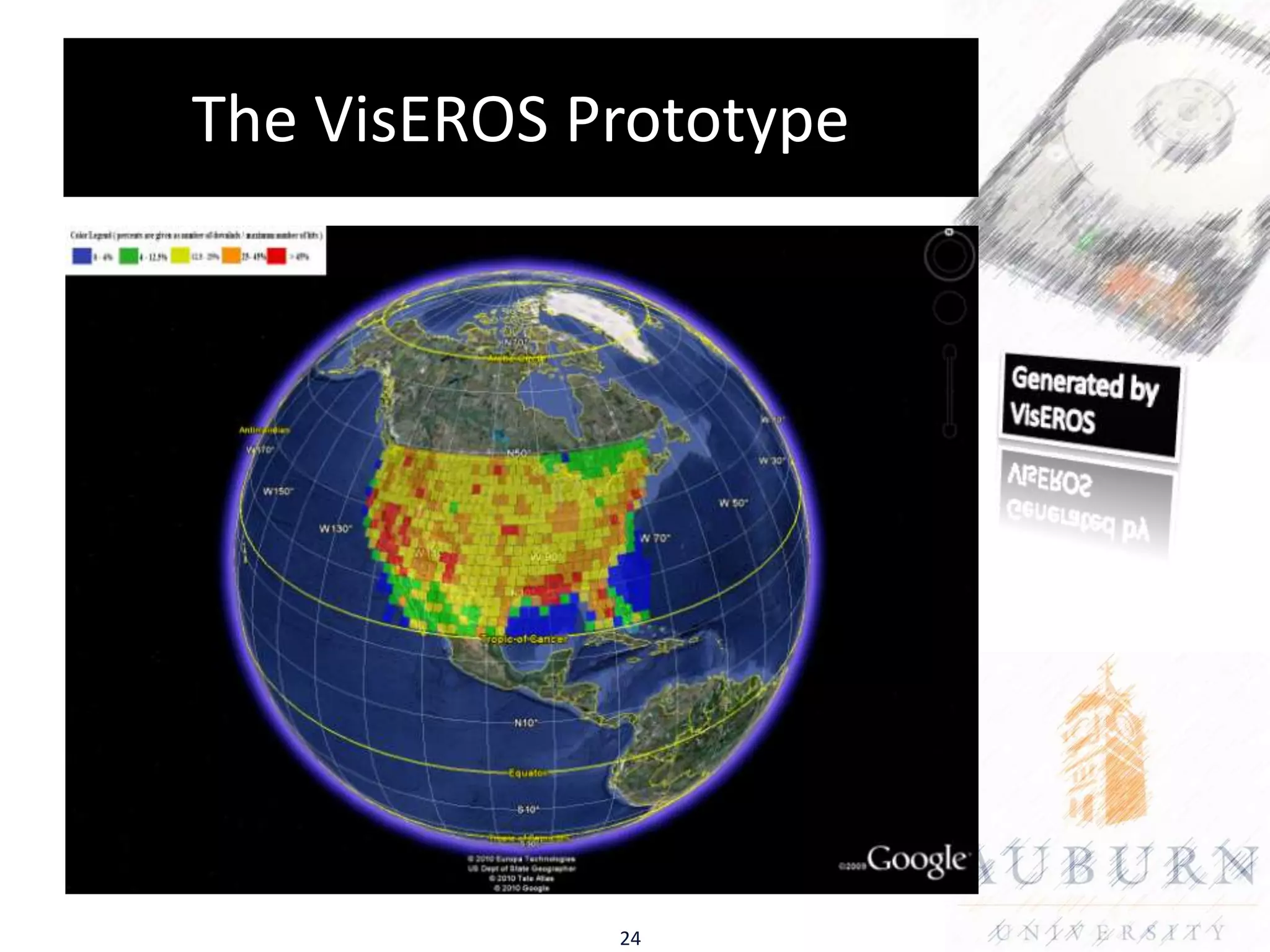
The VisEROS Prototype


             24
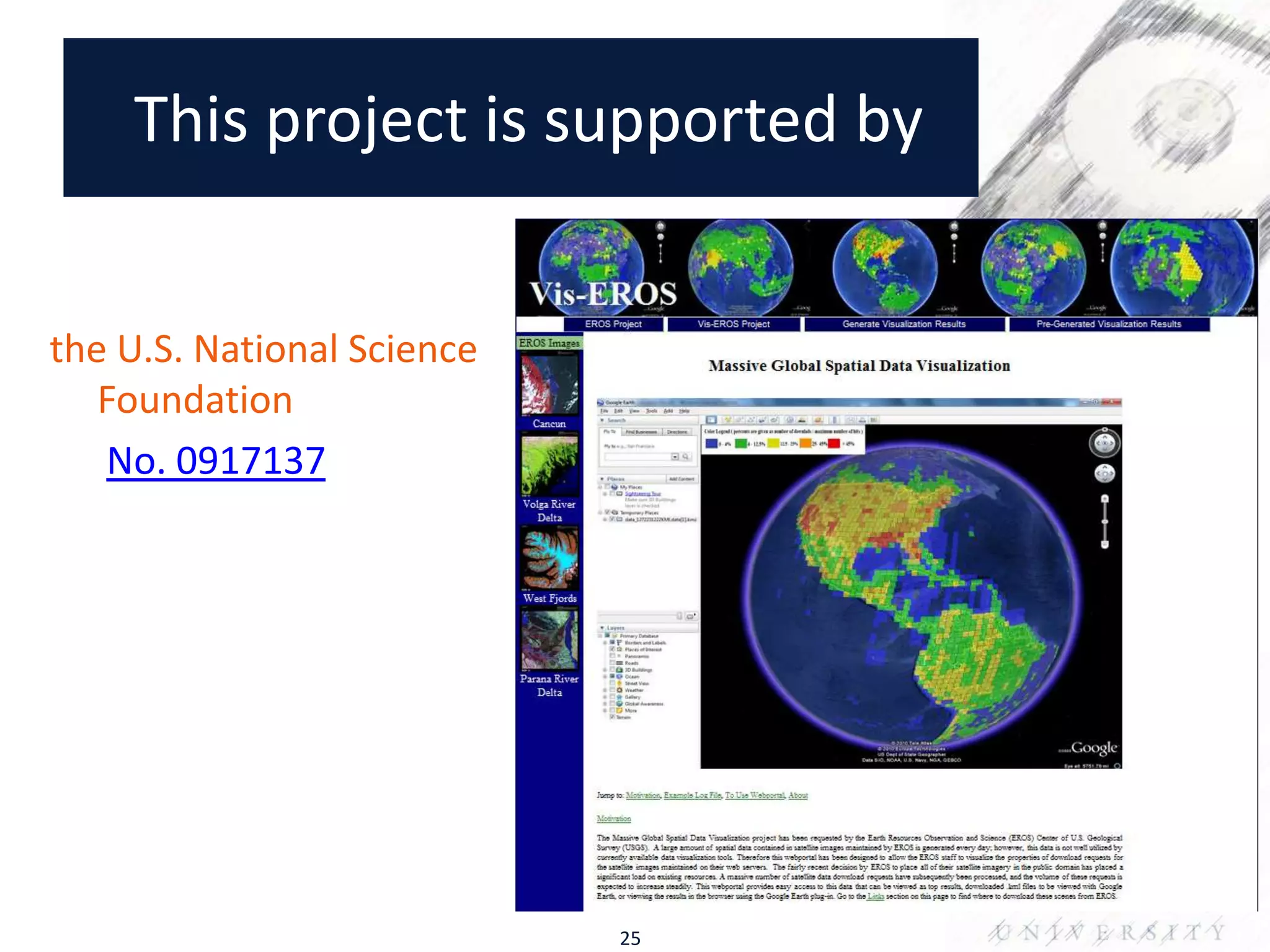
This project is supported by


the U.S. National Science
   Foundation
   No. 0917137


                            25
Download the presentation slides
 http://www.slideshare.net/xqin74


                       Google: slideshare Xiao Qin
Many Thanks!

6/28/2012         27

Performance Evaluation of Traditional Caching Policies on a Large System with Petabytes of Data

  • 1.
    Performance Evaluation ofTraditional Caching Policies on A Large System with Petabytes of Data Ribel Fares1, Brian Romoser1, Ziliang Zong1, Mais Nijim2 and Xiao Qin3 Texas State University, TX, USA1 Texas A&M University-Kingsville2 Auburn University, AL, USA3 Presented at the 7th IEEE International Conference 6/28/2012 on Networking, Architecture, and Storage (NAS2012)
  • 2.
    Motivation • Large-scale data processing • High-performance storage systems 6/28/2012 2
  • 3.
    High-Performance Clusters • The Architecture of a Cluster Storage subsystems Head Node (or Storage Area Network) Internet Client Network switch Computing Nodes 6/28/2012 3
  • 4.
    Techniques for High-Performance Storage Systems • Caching • Prefetching • Active Storage • Parallel Processing 4
  • 5.
    Earth Resources Observation and Science (EROS) Center  Over 4 petabytes of satellite imagery available.  More than 3 million image requests since 2008. Do traditional caching policies still work effectively? 5
  • 6.
    EROS Data Center- System Workflow data data data 6
  • 7.
    USGS / EROSStorage System Hardwar Bus Type Model Capacity e Interface Sun/Oracle 1 F5100 100 TB SSD SAS/FC 2 IBM DS3400 1 PB HDD SATA 3 Sun/Oracle T10K 10 PB Tape Infiniband The FTP server from which users download images is of type 1.
  • 8.
    The USGS /EROS Distribution System • Each cache miss costs 20–30 minutes of processing time.
  • 9.
    USGS / EROSLog File L • Landsat E • ETM+ sensor 7 • Satellite designation 004 • WRS path 063 • WRS row 2006 • Acquisition year 247 • Acquisition day of year ASN • Capture station 00 • Version
  • 10.
    Observation 1 • Top9 aggressive users account for 18% of all requests. • A second log file was created by removing requests made by the top 9 aggressive users.
  • 11.
    Observation 2 35.00% Duplicate Request Percentage 30.00% 25.00% 20.00% 15.00% 10.00% 5.00% 0.00% 0 2 4 6 8 10 12 14 16 Time Window (Days) • Duplicate images within 7 days were removed from the log file.
  • 12.
    Caching Algorithms • FIFO:First entry in cache gets removed first. • LRU: Least recently requested image removed first. • LFU: Least popular image removed first.
  • 13.
    Case Studies Simulation Number Cache Policy Cache Size (TB) Top 9 Aggressive Users 1 FIFO 30 Included 2 FIFO 30 Not Included 3 FIFO 60 Included 4 FIFO 60 Not Included 5 LRU 30 Included 6 LRU 30 Not Included 7 LRU 60 Included 8 LRU 60 Not Included 9 LFU 30 Included 10 LFU 30 Not Included 11 LFU 60 Included 12 LFU 60 Not Included
  • 14.
    Simulation Assumptions/Restrictions • When cache server reaches 90% capacity, images will be removed according to adopted cache policy until server load is reduced down to 45%. • Images are assumed to be processed instantaneously. • A requested image can not be removed from the server before 7 days.
  • 15.
    Results – HitRates of Differing Cache Replacement Policies Hit Rates: 60TB – Aggressive Users Included First Clean Up 0.65 0.55 LRU Hit Rate LFU Hit Rate 0.45 FIFO Hit Rate 0.35 0.25 0.15
  • 16.
  • 17.
  • 18.
    Results – Impactof Inclusion of Aggressive Users With Aggressive Users 0.5 0.45 0.4 0.35 Hit Rate 0.3 0.25 0.2 0.15 0.1 60 TB 0.05 0 FIFO 30 TB LRU LFU FIFO LRU LFU 30 TB 0.32661 0.345919 0.339515 60 TB 0.438536 0.457727 0.454811
  • 19.
    Results – Impactof Exclusion of Aggressive Users No Aggressive Users 0.5 0.4 Hit Rate 0.3 0.2 0.1 60 TB 0 FIFO 30 TB LRU LFU FIFO LRU LFU 30 TB 0.319171 0.332741 0.345208 60 TB 0.430349 0.449621 0.45871
  • 20.
    Conclusion & FutureWork • LRU and LFU initiate cache clean-up at similar points. • Aggressive users destabilize monthly hit rates • LFU was least affected by the inclusion of aggressive users.
  • 21.
    Conclusion & FutureWork cont’d. • LRU and LFU methods improve FIFO as expected. • However, improvements are on the weaker side. • Global user behaviors should be further investigated to design more complex caching and/or prefetching strategies.
  • 22.
    Summary • Data-Intensive Processing – EROS (Earth Resources Observation and Science) Data Center – visEROS • Improving I/O Performance – Prefetching – Active Storage – Parallel Processing 22
  • 23.
    The VisEROS Project– Motivation • 2M downloads from the EROS data center. • No existing visualization tools available to utilize these data • Need a tool to: – Monitor user download behaviors – Show the current global download “hot spots” – Demonstrate the actual usage of EROS data – Optimize the storage system performance – Improve the satellite image distribution service 23
  • 24.
  • 25.
    This project issupported by the U.S. National Science Foundation No. 0917137 25
  • 26.
    Download the presentationslides http://www.slideshare.net/xqin74 Google: slideshare Xiao Qin
  • 27.

Editor's Notes

  • #3 Remote sensing data setFinancial engineering
  • #6 The EROS Data Center is home to the U.S. National Satellite Land Remote Sensing Data Archive. The EROS Data Center is managed by the United States Geological Survey.Provides one of the largest satellite image distribution services in the world.Released image repository to public domain in October 2008.
  • #9 When a user requests an image over the web, the download starts immediately if the requested image is available on the FTP server. Otherwise, the user is sent an e-mail with a link to the requested image once the processing is complete.
  • #10 Detailed description of the log file. From left to right, the attributes in the log file is as follows: scene ID (further broken down into sub-attributes), user ID, request date.
  • #11 A clear power distribution is visible; few people request many images, many people request few images.
  • #12 An exceptionally large amount of duplicate (same user requests same image again) requests were made. We were told by USGS that this was a result of the currentuserinterface.
  • #13 Normally, LRU and LFU improve FIFO significantly. Is this going to be the case on a global system with petabytes of data?
  • #14 Cache size in simulations are smaller than the actual FTP server size.
  • #15 Instantaneous image processing is assumed to simplify simulation. With this simplification, we can not measure the wait time for users. However, we can still calculate the cache hit-rates.
  • #16 No images removed from FTP server until first clean up date. Therefore, all three cache policies behave exactly the same before the first clean up. During clean up. different set images is removed from the server, depending on the cache adopted policy.
  • #17 Number of clean-upsThe monthly hit rate of each of the three cachereplacement policies is shown individually. Hollow bars representmonths in which a “clean-up” occurred. Hilighting monthsin which “clean-ups” occur, we find that all replacementpolicies examined will execute a “clean up”, on average, onceevery 1.8 months. Several brief periods were observed whereinFIFO and the pair of LRU and LFU will exhibit differences in their respective lengths of time between ”clean-ups” beinginitiated, however differences in ”rest times” were marginallysmall (two months at maximum). In addition, we confirm thatLRU and LFU behave extremely similarly, with “clean-up”taking place in the same month for the two policies across allresultant data sets.
  • #18 Number of clean-upsThe monthly hit rate of each of the three cachereplacement policies is shown individually. Hollow bars representmonths in which a “clean-up” occurred. Hilighting monthsin which “clean-ups” occur, we find that all replacementpolicies examined will execute a “clean up”, on average, onceevery 1.8 months. Several brief periods were observed whereinFIFO and the pair of LRU and LFU will exhibit differences in their respective lengths of time between ”clean-ups” beinginitiated, however differences in ”rest times” were marginallysmall (two months at maximum). In addition, we confirm thatLRU and LFU behave extremely similarly, with “clean-up”taking place in the same month for the two policies across allresultant data sets.
  • #19 When requests from top-9 aggressive users are included, LRU seems to be the best performer.
  • #20 When requests from top-9 aggressive users are removed, LFU outperforms LRU. It may be the case that LFU is better when requests are evenly distributed throughout users. Whereas LRU is better when there is a Power Distribution.
  • #24  In September 2008, EROS announced its new policy to place all of their satellite imagery in the public domain for free download. Since then, the number of downloads has significantly increased (already reached 2M). This number is expected to grow steadily.No existing visualization tools available to utilize these data for the purpose of system optimization, user download pattern analysis, data mining, etc. A well designed visualization tool will be helpful to:monitor the historical and current global user download behaviorsshow the current global download “hot spots”demonstrate the importance and actual usage of EROS dataoptimize the storage system performanceimprove the satellite image distribution service provided by EROS